
Showing 38 items matching "shell dressings"
-
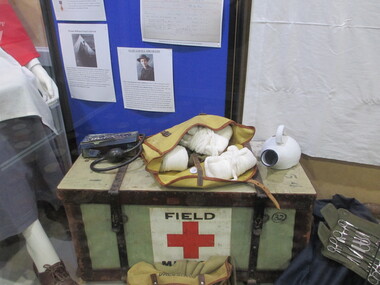 Warrnambool RSL Sub Branch
Equipment - Shell dressings first aid kit
... Shell dressings first aid kit...Shell dressings first aid kit...Shell Dressings and a red cross...Shell dressings first aid kit Equipment Shell dressings first aid kit ...Light brown cnvas bag with a red cross on the front.Shell Dressings and a red cross -
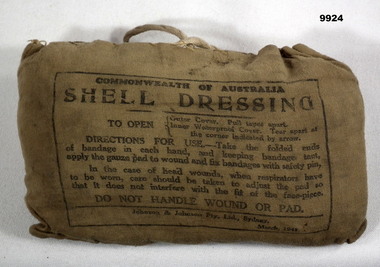 Bendigo Military Museum
Equipment - DRESSING, SHELL WW2, Johnson & Johnson P/L, March 1941
... DRESSING, SHELL WW2......Shell dressings...Shell dressing to be used if wounded in combat. ...Brown sealed pouch with white laced straps. Inside is a shell dressing. On one side is instructions to open and use....Label "Commonwealth of Australia", "Shell Dressing"....Shell dressing to be used if wounded in combat. ...Shell dressing to be used if wounded in combat. Part of the collection of "John Young". Refer Cat No. 1181.3 for service details.Brown sealed pouch with white laced straps. Inside is a shell dressing. On one side is instructions to open and use.Label "Commonwealth of Australia", "Shell Dressing".first aid, shell dressings -
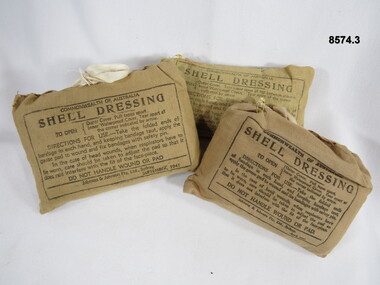 Bendigo Military Museum
Equipment - SHELL DRESSINGS, Johnson & Johnson PTY LTD, 1941 - 1944
... SHELL DRESSINGS......Field Dressing...Shell...1. Shell dressings for field wounds, designed to be carried on the person and to be used in the first instance on a wound. ...“COMMONWEALTH OF AUSTRALIA SHELL DRESSING "See attachment for directions to use". ...Passchendaele Barracks Trust Field Dressing Shell 1. “COMMONWEALTH OF AUSTRALIA SHELL DRESSING "See attachment for directions to use". ...1. Shell dressings for field wounds, designed to be carried on the person and to be used in the first instance on a wound. There are basic instructions on the dressing pack of how to treat the wound. Items 1. 2. & 3. have identical markings except for the Manufacturers date. 1. September 1941. 2. April 1941. 3. January 1944.1. “COMMONWEALTH OF AUSTRALIA SHELL DRESSING "See attachment for directions to use". “DO NOT HANDLE WOUND OR PAD. JOHNSON & JOHNSON Pty Ltd Sydney” 2. & 3. Markings are identical except for Manufacturers date: 1. September 1941. 2. April 1941. 3. January 1944.passchendaele barracks trust, field dressing, shell -
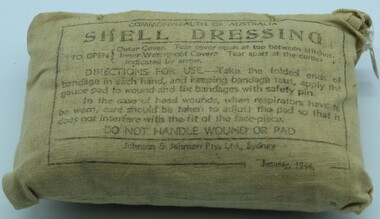 Ringwood RSL Sub-Branch
Equipment - shell dressing, wound pad, Johnson & Johnson, Jan 1944
... shell dressing, wound pad...1 Large shell dressing...Commonwealth of Australia shell dressing (with usage instructions)....Commonwealth of Australia shell dressing (with usage instructions). 1 Large shell dressing Equipment shell dressing, wound pad Johnson & Johnson ...1 Large shell dressingCommonwealth of Australia shell dressing (with usage instructions). -
 Bendigo Military Museum
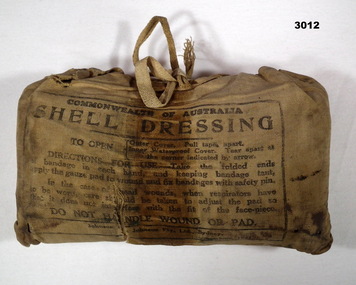
Equipment - DRESSING, Johnson & Johnson, 6.1941
... Shell dressing, khaki colour, light waterproof canvas cover with draw string at top....Commonwealth of Australia Shell Dressing Written: Peter BALL...Item issued to Peter Ball 3796117, refer Cat No 4704 medicine-first aid military history - equipment Commonwealth of Australia Shell Dressing Written: Peter BALL Shell dressing, khaki colour, light waterproof canvas cover with draw string at top. ...The dressing on one side has full directions on use & handling. Item issued to Peter Ball 3796117, refer Cat No 4704Shell dressing, khaki colour, light waterproof canvas cover with draw string at top.Commonwealth of Australia Shell Dressing Written: Peter BALLmedicine-first aid, military history - equipment -
 Frankston RSL Sub Branch
Dressing, Shell (2 of)
... Dressing, Shell (2 of)...SHELL DRESSING...Printed on waterproof cover, Commonwealth of Australia, Shell Dressing, giving instructions to open & directions for use. ...One dated MAY 1942 & other OCTOBER 1943. SHELL DRESSING Dressing, Shell (2 of) ...SHELL DRESSINGPrinted on waterproof cover, Commonwealth of Australia, Shell Dressing, giving instructions to open & directions for use. One dated MAY 1942 & other OCTOBER 1943. -
 Rutherglen RSL Sub-Branch
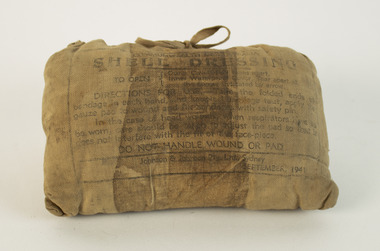
Memorabilia - Field bandages, set
... Trio of field bandages : two field dressings and one shell dressing...Commonwealth of Australia/shell dressing/first field dressing/first field dressing...Commonwealth of Australia/shell dressing/first field dressing/first field dressing Trio of field bandages : two field dressings and one shell dressing Memorabilia Field bandages, set ...Trio of field bandages : two field dressings and one shell dressingCommonwealth of Australia/shell dressing/first field dressing/first field dressing -
 Dandenong/Cranbourne RSL Sub Branch
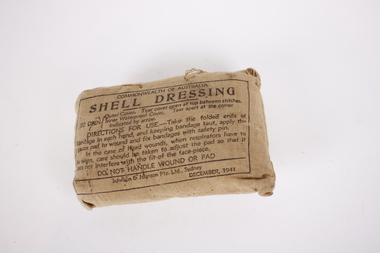
Equipment - Shell Dressing, Johnson & Johnson, 1941
... Shell Dressing...Shell dressings were carried by individual soldiers, intended to be used as a first dressing in event of wounding or injury. ...Commonwealth of Australia / Shell Dressing / (directions for use)...Shell dressings were carried by individual soldiers, intended to be used as a first dressing in event of wounding or injury. ...Shell dressings were carried by individual soldiers, intended to be used as a first dressing in event of wounding or injury. Each cloth pack contains dressings comprised of a gauze pad stitched to a bandage and a safety pin. The field dressing was often the first line of treatment and was intended to be applied by the wounded man himself or other soldiers.This dressing is significant as a representative object carried by every soldier in WWII.Bandage covered in light brown cotton casing. Front side has inscription and instructions for use.Commonwealth of Australia / Shell Dressing / (directions for use)dressing, bandage, australia, johnson & johnson -
 National Vietnam Veterans Museum (NVVM)
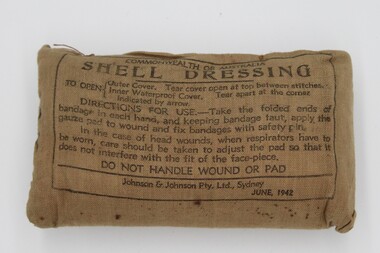
Equipment - Shell Dressing, June 1942
... Shell Dressing......Shell Dressing...The item is standard issue shell dressing as issued for use in the Vietnam conflict. ...Small cotton shell dressing used by medics in the Vietnam conflict produced by Johnson & Johnson Pty Ltd, Sydney June, 1942....Equipment Shell Dressing ...The item is standard issue shell dressing as issued for use in the Vietnam conflict. Note that it was made in 1942 for World war 2.Small cotton shell dressing used by medics in the Vietnam conflict produced by Johnson & Johnson Pty Ltd, Sydney June, 1942.Commonwealth of Australiavietnam, wound dressing, johnson & johnson, shell dressing, first aid, medical, bandage -
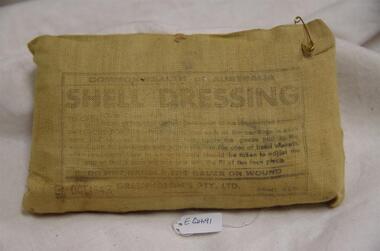 Running Rabbits Military Museum operated by the Upwey Belgrave RSL Sub Branch
medical equipment
... Shell Dressing...Equipment 1943 General Shell Dressing medical equipment ...Shell Dressingequipment, 1943, general -
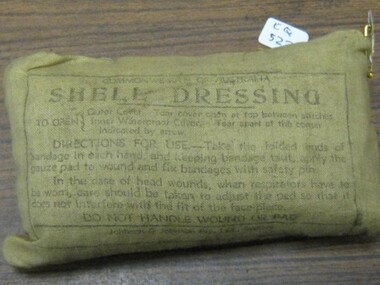 Running Rabbits Military Museum operated by the Upwey Belgrave RSL Sub Branch
Shell Dressing
... Shell Dressing...Shell Dressing...Equipment WW2 Army Shell Dressing Shell Dressing ...Shell Dressingequipment, ww2, army -
 Running Rabbits Military Museum operated by the Upwey Belgrave RSL Sub Branch
Field Dressing
... Shell Dressing...Equipment WW2 Army Shell Dressing Field Dressing ...Shell Dressingequipment, ww2, army -
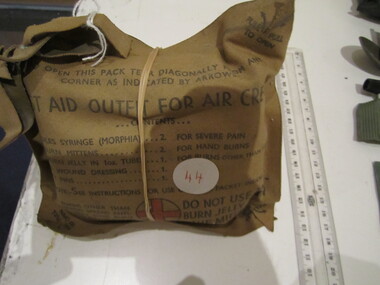 Ballarat RSL Sub-Branch Inc.
First Aid x 2
... Shell Dressing...medical ballarat rsl ballarat Shell Dressing First Aid x 2 ...Shell Dressingmedical, ballarat rsl, ballarat -
 Montmorency–Eltham RSL Sub Branch
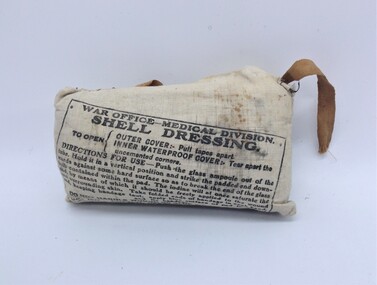
Equipment - Shell Dressing, August 1917
... Shell Dressing...Shell Dressing...Shell Dressing in cotton cover....Detailed instructions for use (see Media file above) Shell Dressing in cotton cover. Shell Dressing Equipment Shell Dressing ...Shell Dressing in cotton cover.Detailed instructions for use (see Media file above) -
 Warrnambool RSL Sub Branch
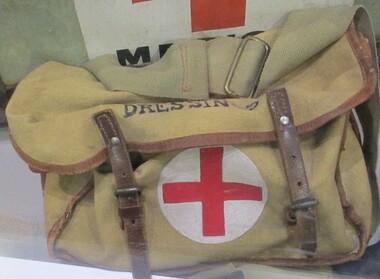
Equipment - Canvas first aid satchel
... Shell dressings Red cross...Shell dressings Red cross Light brown canvas satchel with Canvas first aid satchel Equipment Canvas first aid satchel ...Light brown canvas satchel with Shell dressings Red cross -
 National Vietnam Veterans Museum (NVVM)
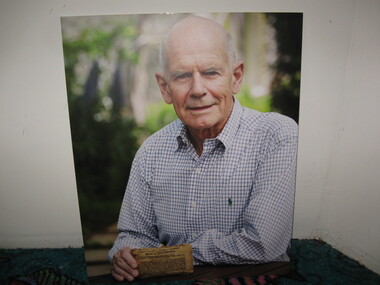
Photograph, Tony White
... Coloured portrait of Tony White holding shell dressing....Photographic Exhibition Behind the Wire Photograph Coloured portrait of Tony White holding shell dressing. Tony White. Photograph Photograph Gordon-Brown, Susan ...Coloured portrait of Tony White holding shell dressing.photographic exhibition, behind the wire, photograph -
 Beechworth RSL Sub-Branch
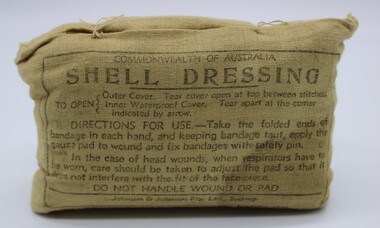
Shell Dressing, March 1944
... Shell Dressing......shell dressing...Shell dressings were carried by individual soldiers, intended to be used as a first dressing in event of wounding or injury. ...Printed on cotton package containing the Shell Dressing. Inside a lined box. Commonwealth of Australia/ SHELL DRESSING / To Open /Outer Cover. ...Front side has inscription and instructions for use. Shell Dressing ...Shell dressings were carried by individual soldiers, intended to be used as a first dressing in event of wounding or injury. Each cloth pack contains dressings comprised of a gauze pad stitched to a bandage and a safety pin. The field dressing was often the first line of treatment and was intended to be applied by the wounded man himself or other soldiersThis dressing is significant as a representative object carried by every soldier in WWII.Bandage covered in light brown cotton casing. Front side has inscription and instructions for use.Printed on cotton package containing the Shell Dressing. Inside a lined box. Commonwealth of Australia/ SHELL DRESSING / To Open /Outer Cover. Tear cover open at top between stitches. / Inner Waterproof Cover. Tear apart at the corner indicated by arrow. / DIRECTION FOR USE -Take the folded ends of/bandage in each hand, and keeping bandage taut, apply the/gauze pad to wound and fix bandages with safety pin./ In the case of head wounds, when respirators have to be worn, care should be taken to adjust the pad so that it / does not interfere with the fit of the face-piece. / DO NOT HANDLE WOUND OR PAD. / under a black line / Johnson & Johnson Pty, Ltd, Sydney/ MARCH 1944 On the reverse an adhesive sticker with the words "Lent by Lance Flynn" dressing, shell dressing, commonwealth of australia, johnson & johnson -
 Bendigo Military Museum
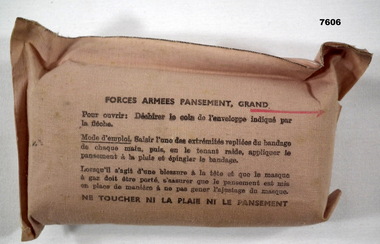
Equipment - DRESSING, SHELL, Robinson & Sons Ltd, July 1964
... DRESSING, SHELL...On side titled "Armed Forces Shell Dressing" then instruction to open and use....JACKSON On side titled "Armed Forces Shell Dressing" then instruction to open and use. ...Part of first aid kit issued to Flight Sergeant “Robert G. Jackson". Based at Butterworth, Malaysia from 1966-69.BROWN CANVAS PACKET CONTAINING DRESSING AND WOUND PAD. Instructions in English in black writing on one side and same instructions in French on other side. Is a seam at one end to tear open.On side titled "Armed Forces Shell Dressing" then instruction to open and use.first aid kit, medical supplies, butterworth, malaysia, robert g. jackson -
 Stawell Historical Society Inc
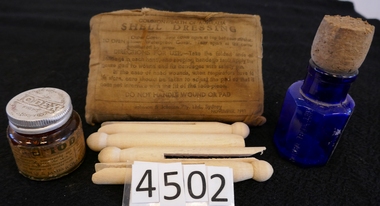
Memorabilia - Realia
... Household Items - 2 Shell Dressing Commonwealth of Australia(John & Johnson Pty Ltd Sydney) November 1941...Stawell WW2 Household Items - 2 Shell Dressing Commonwealth of Australia(John & Johnson Pty Ltd Sydney) November 1941 Memorabilia Realia ...Household Items - 2 Shell Dressing Commonwealth of Australia(John & Johnson Pty Ltd Sydney) November 1941stawell, ww2 -
 Bendigo Military Museum
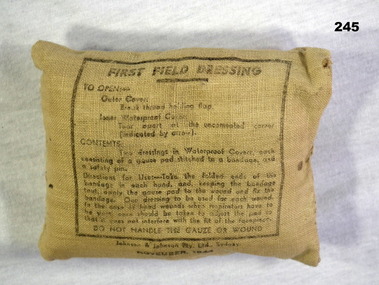
Equipment - DRESSING, SHELL, Johnson and Johnson, C.1940
... DRESSING, SHELL...Shell Dressing. Light khaki cotton cover sewn around medical items. ...Contents, instructions for use, printed on cover. Equipment DRESSING, SHELL Johnson and Johnson ...The package has two seperate dressings inside.Shell Dressing. Light khaki cotton cover sewn around medical items. Contents, instructions for use, printed on cover.medicine - first aid, military - equipment -
 National Vietnam Veterans Museum (NVVM)
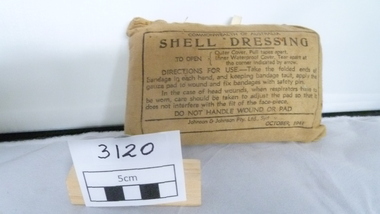
Equipment - Equipment, Army, Field Dressing, 1941
... ...Shell Dressing...Commonwealth of Australia Shell Dressing. Extensive directions for use. Johnson & Johnson P/L Syd October 1941...Field Dressing Shell Dressing SAS Commonwealth of Australia Shell Dressing. ...Tan coloured cotton package containing dressing. Instructions for use written on outside.Commonwealth of Australia Shell Dressing. Extensive directions for use. Johnson & Johnson P/L Syd October 1941field dressing, shell dressing, sas -
 Ringwood RSL Sub-Branch
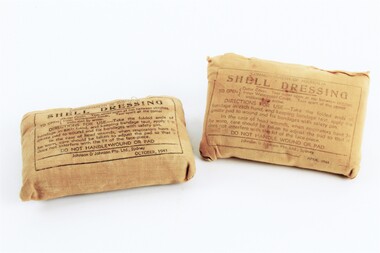
Equipment - Equipment, Shell Dressing, Johnson & Johnson, October 1941
... Equipment, Shell Dressing...00081.1 Cotton package containg shell wound dressing. October 1941 00081.2 Cotton package containing shell wound dressing Aprill 1944...October 1941 00081.2 Cotton package containing shell wound dressing Aprill 1944 Equipment Equipment, Shell Dressing Johnson & Johnson ...00081.1 Cotton package containg shell wound dressing. October 1941 00081.2 Cotton package containing shell wound dressing Aprill 1944wound dressing,, field dressing, first aid, cotton bandage, world war 2, ww2 -
 Woodend RSL
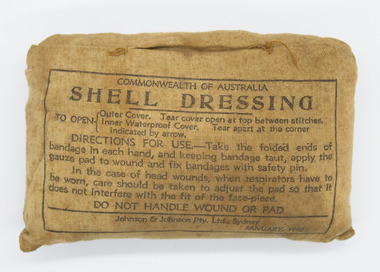
Shell Dressing, January, 1942
... Shell Dressing......shell dressing...Shell dressings are a type of bandage with a gauze pad and a safety pin for fastening around the site of the injury. ...Shell dressings are a type of bandage with a gauze pad and a safety pin for fastening around the site of the injury. ...Shell dressings are a type of bandage with a gauze pad and a safety pin for fastening around the site of the injury. This item was made by Johnson & Johnson Pty. Ltd., Sydney, in or before January, 1942. Shell dressings were carried by individual soldiers and medics intended to be used as a first dressing in event of wounding or injury. The Australian-made shell dressing is opened by breaking the stitches at the top rather than pulling tapes apart as per the British design.Rectangular, light brown fabric pouch. The front is printed with black text in a rectangle explaining the instructions for opening the pouch and directions for use of bandage. The maker's name and date of manufacture are printed under the directions. Sewn together in two locations on the top. Irregular shaped medium brown stain on back.world war two, shell dressing, medical supplies, medical, wound dressing, johnson & johnson -
 Bendigo Military Museum
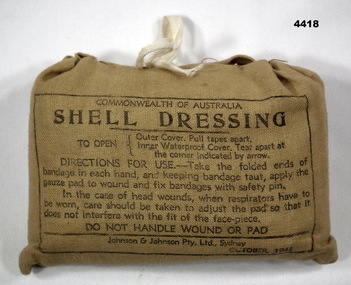
Equipment - SHELL DRESSING, Johnson and Johnson PTY LTD, October 1941
... SHELL DRESSING...Shell dressing...Shell dressing, rectangular shape, rounded edges, khaki colour, all text in black print, consists of outer cover, inner water proof cover, gauze bandage and safety pin, text is about how to apply the bandage to wounds....Equipment SHELL DRESSING Johnson and Johnson PTY LTD ...Shell dressing, rectangular shape, rounded edges, khaki colour, all text in black print, consists of outer cover, inner water proof cover, gauze bandage and safety pin, text is about how to apply the bandage to wounds.shell dressing, accessory, wounds, military -
 Frankston RSL Sub Branch
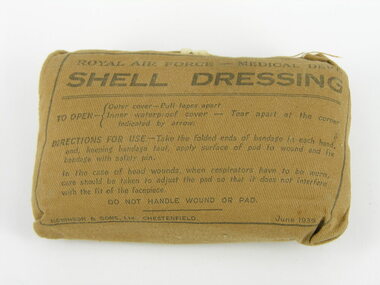
Dressing, Shell
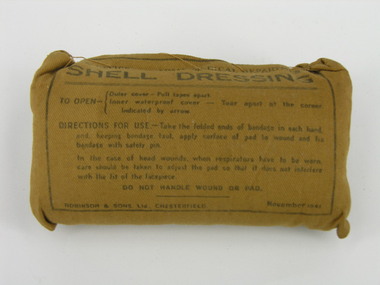
... Dressing, Shell...A packaged shell dressing carried by World War 2 service personnel. ...A packaged shell dressing carried by World War 2 service personnel. ...A packaged shell dressing carried by World War 2 service personnel. This example was used by British RAF Regiment personnel training for airfield guard duties during the 1950s. The dressing is contained within a waterproof cover, giving instructions to open and directions for use. -
 Frankston RSL Sub Branch
Dressing, Shell
... Dressing, Shell...A packaged shell dressing carried by World War 2 service personnel. ...A packaged shell dressing carried by World War 2 service personnel. ...A packaged shell dressing carried by World War 2 service personnel. This example was used by British RAF Regiment personnel training for airfield guard duties during the 1950s. The dressing is contained within a waterproof cover, giving instructions to open and directions for use. -
 Warrnambool and District Historical Society Inc.
First Aid Kit, First aid kit WWII in canvas bag, 20th century
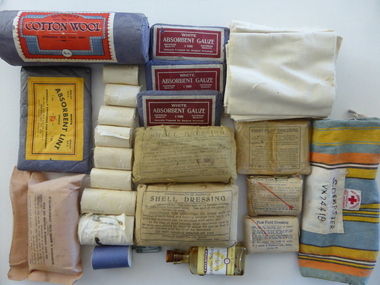
... The bag is frayed and rusted and contains 14 items:-eight flat bandages, five safety pins, six small rolled gauze bandages, three navy blue packages of white absorbent gauze, one rolled package bandage,, rubber hose (broken), two small and one large field dressings, two shell dressings, Armed Forces shell dressing (Commonwealth of Australia), dark blue absorbent lint (yellow label), absorbent cotton wool (navy blue wrapper with red label), striped canvas bag, bottle of aqueous solution Acriflavine, two rolled bandages. ...The bag is frayed and rusted and contains 14 items:-eight flat bandages, five safety pins, six small rolled gauze bandages, three navy blue packages of white absorbent gauze, one rolled package bandage,, rubber hose (broken), two small and one large field dressings, two shell dressings, Armed Forces shell dressing (Commonwealth of Australia), dark blue absorbent lint (yellow label), absorbent cotton wool (navy blue wrapper with red label), striped canvas bag, bottle of aqueous solution Acriflavine, two rolled bandages. ...This field First Aid kit is a mixture of items, some prepared for use in wartime, including World War One and some for use in peace time emergencies. The calico bag, produced by the Red Cross in Kalgoorlie, W.A., has been used by the State Emergency Service and at a later date by a scout group. The name, ‘S. Dempster’ is on the striped calico bag. Samuel Dempster was born in Ireland and was living at Panmure when he enlisted. He was attached to the 6 Ambulance training. He served from 1942-46 This is a calico shoulder bag with the shoulder strap adjustable with the use of metal clips. The bag is frayed and rusted and contains 14 items:-eight flat bandages, five safety pins, six small rolled gauze bandages, three navy blue packages of white absorbent gauze, one rolled package bandage,, rubber hose (broken), two small and one large field dressings, two shell dressings, Armed Forces shell dressing (Commonwealth of Australia), dark blue absorbent lint (yellow label), absorbent cotton wool (navy blue wrapper with red label), striped canvas bag, bottle of aqueous solution Acriflavine, two rolled bandages. ‘S.Dempster VX74418’ ‘Red Cross Society Kalgoorlie West Australia’ s. dempster, world war 2, samuel dempster, first aid kit wwii, warrnambool -
 Federation University Historical Collection
Postcard - black and white, Kemmel, France, c1916, c1916
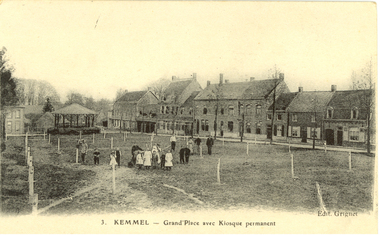
... The chateau at certain stages in the war housed an Advanced Dressing Station (ADS), and the cemetery continued to be used until March 1918, when Kemmel was taken by the Germans. Although it was retaken later on that year, both the cemetery and the chateau suffered from shelling with the chateau being destroyed. ...The chateau at certain stages in the war housed an Advanced Dressing Station (ADS), and the cemetery continued to be used until March 1918, when Kemmel was taken by the Germans. Although it was retaken later on that year, both the cemetery and the chateau suffered from shelling with the chateau being destroyed. ...Holmes Family WW1 memorabilia Kemmel village is around six miles south-west of Ypres. Located just to the north of the village centre is Kemmel Chateau Military Cemetery. The cemetery was established early in the war, in December 1914, taking its name from Kemmel Chateau which stood to the rear of the cemetery location. The chateau at certain stages in the war housed an Advanced Dressing Station (ADS), and the cemetery continued to be used until March 1918, when Kemmel was taken by the Germans. Although it was retaken later on that year, both the cemetery and the chateau suffered from shelling with the chateau being destroyed. In total there are 1,135 First World War soldiers buried here, all but three being identified. In addition, located in a row on the left by the entrance are 21 Second World War burials. http://www.ww1battlefields.co.uk/flanders/kemmel.html, accessed 11/07/2014)Two black and white postcards showing Kemmel, France. .1) Grand'Place avec Kiosque permanent .2) Le Belvedere et le Moulinchatham-holmes family collection, kemmel, france, world war one, postcard -
Glenelg Shire Council Cultural Collection
Functional object - Comb, n.d
... toilette hair dressing personal care Tortoise shell comb, in the shape of a leg (teeth end) and foot Functional object Comb ...Tortoise shell comb, in the shape of a leg (teeth end) and foottoilette, hair dressing, personal care -
 Orbost & District Historical Society
box, Early 20th century
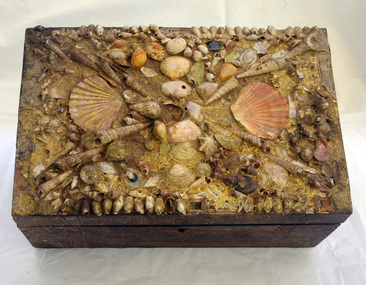
... This wooden box was possibly a plain brown box which has been hand decorated with shells and pieces of glass. It might have been stored on a mantelpiece or dressing table and was used to store "bits and pieces". ...It might have been stored on a mantelpiece or dressing table. container handcraft a.n.a. A wooden box with a hinged lid. The outside lid is decorated with shells and glass. ...This wooden box was possibly a plain brown box which has been hand decorated with shells and pieces of glass. It might have been stored on a mantelpiece or dressing table and was used to store "bits and pieces". The Australian Natives' Association (ANA), a mutual society was founded in Melbourne, Australia in April 1871 as the Victorian Natives' Association. In 1872 it voted to extend membership to men born in the other Australian colonies and changed its name at the same time. The Association played a leading role in the movement for Australian federation in the last 20 years of the 19th century. In 1900 it had a membership of 17,000, mainly in Victoria. The ANA provided sickness, medical and funeral cover. Membership in the ANA was restricted to men born in Australia.The ANA consisted mainly of energetic middle-class men aged under 50. In 1880 the ANA committed itself to the federation of the Australian colonies, and provided much of the organisational and financial support for the Federation Leagues which led the campaign, particularly in Victoria. (ref Wikipedia)This item is an example of a small hand decorated container used to store domestic items. It might have been stored on a mantelpiece or dressing table.A wooden box with a hinged lid. The outside lid is decorated with shells and glass. There is a keyhole at the front. Inside the box is padded and lined with cream/gold decorated paper. It contains photographs, cards a 1906 calendar, postcards, postage stamps and a membership card for A.N.A. - Orbost Branch No.267container handcraft a.n.a.
