
Showing 82 items matching "signals and flags"
-
 Mission to Seafarers Victoria
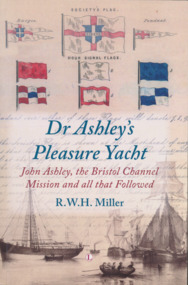
Book, Dr Ashley's Pleasure Yacht: John Ashley, the Bristol Channel Mission and all that Followed, 2017
... Miller with a monochrome coloured cover featuring the British Channel Mission's signal flags and the Bristol Channel Mission Cutter Eirene. ...Sub-title 'John Ashley, the Bristol Channel Mission and all that Followed'. The signal flags comprise a Burgee, the Society's flag for the cutter Eirene, a pendant, and six hour signal flags....Sub-title 'John Ashley, the Bristol Channel Mission and all that Followed'. The signal flags comprise a Burgee, the Society's flag for the cutter Eirene, a pendant, and six hour signal flags. ...Institutional foundation stories have a tendency to change and develop with the passage of time and much repetition. Maritime social historian R.W.H. Miller here explores the life of The Rev. John Ashley and his association with the foundation storyof the Mission to Seafarers, the work of which society is much admired by its present Patron, HRH the Princess Royal. The traditional story is that Ashley's son, out walking by the Bristol Channel with his father, in the early 1830s, asked how the islanders could go to church. Ashley went to see, and from the islands of Flat Holm and Steep Holm seeing large fleets of wind bound ships, asked himself the same question. He used his own money (deriving mainly from the trade of sugar and slaves) to build a schooner, which he sailed in all weathers to provide an answer, in the process creating for himself a place in the ancestry of several Anglican and Catholic societies, of which the Mission to Seafarers, the Royal National Mission to Deep Sea Fishermen, and the Apostleship of the Sea, continue to provide seafarers with a valued and often heroic service.A 123-page book by R.W.H. Miller with a monochrome coloured cover featuring the British Channel Mission's signal flags and the Bristol Channel Mission Cutter Eirene. non-fictionInstitutional foundation stories have a tendency to change and develop with the passage of time and much repetition. Maritime social historian R.W.H. Miller here explores the life of The Rev. John Ashley and his association with the foundation storyof the Mission to Seafarers, the work of which society is much admired by its present Patron, HRH the Princess Royal. The traditional story is that Ashley's son, out walking by the Bristol Channel with his father, in the early 1830s, asked how the islanders could go to church. Ashley went to see, and from the islands of Flat Holm and Steep Holm seeing large fleets of wind bound ships, asked himself the same question. He used his own money (deriving mainly from the trade of sugar and slaves) to build a schooner, which he sailed in all weathers to provide an answer, in the process creating for himself a place in the ancestry of several Anglican and Catholic societies, of which the Mission to Seafarers, the Royal National Mission to Deep Sea Fishermen, and the Apostleship of the Sea, continue to provide seafarers with a valued and often heroic service.cutter, eirene, shipping, r.w.h. miller, mission to seamen, seafarers welfare, reverend john ashley (1801-1886) -
 Parks Victoria - Gabo Island Lightstation
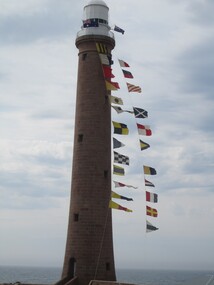
Flags & Pennants, navigational, signal
... The 41 alphabetic and numeric visual signalling flags (including substitute and answering pennants) have either square or pointed ends. ...Forty navigational signal alphabet flags & numeral pennants. Flags are made of wool....Flags are made of wool. Flags & Pennants, navigational, signal ...The 41 alphabetic and numeric visual signalling flags (including substitute and answering pennants) have either square or pointed ends. They are made of bunting, a coarse fabric of worsted (open yarn wool) in various colour combinations. Some of the flags are marked with inscriptions, for example “B”. Attachments to the flags include hemp rope and metal clips. Each flag has its own galvanised canister and lid, each of which is painted grey and marked with a letter, number or word. The flags were used for communicating messages to passing ships. Knowledge of visual signalling was mandatory for all lightkeepers and all lightstations maintained a set of flags. Although used for centuries, visual flag signalling formally developed in the nineteenth century and was published internationally as a system in 1857. By the early twentieth century it had developed into an effective means of conveying all kinds of short range visual messages. The signal flags and canisters at Gabo Island form a complete set and are not historically linked to the lightstation and their provenance is unknown. It is known however that they originate from a lightstation in Victoria and for some years were on loan from AMSA to the Queenscliff Maritime Museum, where they were held in storage and not displayed. Three of the six lightstations that Parks Victoria manages have sets of signal flags in their collections. Forty navigational signal alphabet flags & numeral pennants. Flags are made of wool. -
 Parks Victoria - Cape Nelson Lightstation
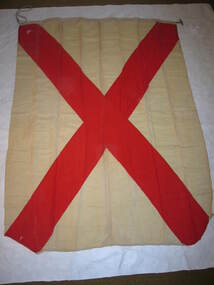
Functional object - Flag set, navigational
... Knowledge of visual signaling was mandatory for all lightkeepers and all stations maintained a set of these flags. ...Cape Nelson Lightstation’s complete set of 41 alphabetic and numeric visual signaling flags (including substitute and answering pennants) are made of bunting, a coarse fabric of worsted (open yarn wool) in various colour combinations, and some of the fabric is hand sewn and bears inscriptions. ...Knowledge of visual signaling was mandatory for all lightkeepers and all stations maintained a set of these flags. ...The flags were used for communicating messages to passing ships. Knowledge of visual signaling was mandatory for all lightkeepers and all stations maintained a set of these flags. Although used for centuries, visual flag signaling formally developed in the nineteenth century and was published internationally as a system in 1857. By the early twentieth century it had developed into an effective means of conveying all kinds of short range visual messages.The Cape Nelson Lightstation is architecturally and scientifically (technologically) important as the most intact complex of lightstation buildings in Victoria. The octagonal signal station is a unique feature which is all the more important for its complete set of signal flags’. Cape Nelson Lightstation’s complete set of 41 alphabetic and numeric visual signaling flags (including substitute and answering pennants) are made of bunting, a coarse fabric of worsted (open yarn wool) in various colour combinations, and some of the fabric is hand sewn and bears inscriptions. Attachments include handmade wooden toggles, brass clips and hemp rope. -
 Flagstaff Hill Maritime Museum and Village
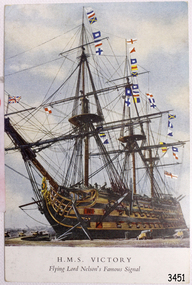
Postcard - Vessel, Sailing Ship, after October 1805
... Admiral Federico Gravina, the senior Spanish flag officer, escaped with the remnant of the fleet. ...A coloured postcard of a sailing ship, warship or battleship, deck cannons on the ship and in the foreground, many signal flags flying from the masts. Printed on the front "H.M.S. ...Victory / Flying Lord Nelson Famous Signal" A coloured postcard of a sailing ship, warship or battleship, deck cannons on the ship and in the foreground, many signal flags flying from the masts. ...The British Royal Navy’s warship HMS Victory was once Lord Nelson’s flagship. The HMS Victory was built in 1765 and after serving active duty is now, in 2019, still a ship of the Royal Navy, in dry dock undergoing continuous restoration to preserve her for display as a museum ship, due to the vessel’s significant naval history. Battle of Trafalgar: On October 21, 1805, twenty-seven British ships of the line, led by Admiral Lord Nelson aboard HMS Victory, defeated thirty-three French and Spanish ships of the line under French Admiral Villeneuve. The battle took place in the Atlantic Ocean off the southwest coast of Spain, just west of Cape Trafalgar, near the town of Los Caños de Meca. The victory confirmed the naval supremacy Britain had established during the course of the eighteenth century and it was achieved in part through Nelson's departure from the prevailing naval tactical orthodoxy of the day. Conventional practice at the time was for opposing fleets to engage each other in single parallel lines, in order to facilitate signalling and disengagement and to maximise fields of fire and target areas. Nelson instead arranged his ships into two columns to sail perpendicularly into the enemy fleet's line. During the battle, Nelson was shot by a French musketeer and he died shortly before the battle ended. Villeneuve was captured, along with his ship Bucentaure. He later attended Nelson's funeral while a captive on parole in Britain. Admiral Federico Gravina, the senior Spanish flag officer, escaped with the remnant of the fleet. He died five months later from wounds sustained during the battle. It was prior to this battle that Nelson had issued his now-famous final orders to his ships in 12 separate flag-hoists “England expects that every man will do his duty”. This wood sample is historically significant for its association with Admiral Lord Nelson the Battle of Trafalgar. Through Nelson’s leadership and unorthodox battle tactics, he secured not only a victory against the French and Spanish but reaffirmed Britain's naval supremacy opening the way for Britain to continuing the policy of colonisation of many countries including Australia.A coloured postcard of a sailing ship, warship or battleship, deck cannons on the ship and in the foreground, many signal flags flying from the masts. Printed on the front "H.M.S. Victory Flying Lord Nelson Famous Signal". The signal was given by Lord Nelson in 1805.Printed on the front "H.M.S. Victory / Flying Lord Nelson Famous Signal"flagstaff hill, warrnambool, shipwrecked-coast, flagstaff-hill, flagstaff-hill-maritime-museum, maritime-museum, shipwreck-coast, flagstaff-hill-maritime-village, post card, postcard, sailing ship, vice-admiral lord nelson, horatio nelson, lord nelson, oak piece, piece of oak, nelson, battle of trafalgar, maritime technology, ship relics, 18th century warship, british royal navy, sir home popham’s telegraphic code, admiralty official day signal book, october 21, 1805, admiral lord nelson, french and spanish navies, nelson's famous signal, england expects that every man will do his duty, hms victory, nelson collection at lloyd's, lloyd’s of london, lloyd’s patriotic fund, napoleonic battles, british naval history, 18th century warship, 18th century battleship -
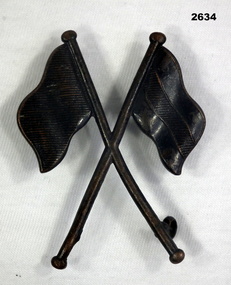 Bendigo Military Museum
Badge - BADGE, SIGNALS, c.1899 - 1902
... Badge consisting of crossed flags possibly “Signals”, made of copper. ...Boer War era possibly. numismatics-badges-army metalcraft-copperware Passchendaele barracks trust Badge consisting of crossed flags possibly “Signals”, made of copper. Badge BADGE, SIGNALS ...Boer War era possibly.Badge consisting of crossed flags possibly “Signals”, made of copper. numismatics-badges-army, metalcraft-copperware, passchendaele barracks trust -
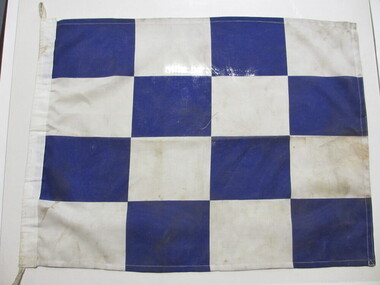 Seaworks Maritime Museum
Signal flag
... Signal blue and white checkered flag signifying the letter "N" with rope attachments...Flag is very dirty Signal blue and white checkered flag signifying the letter "N" with rope attachments Signal flag ...Flag is very dirtySignal blue and white checkered flag signifying the letter "N" with rope attachments -
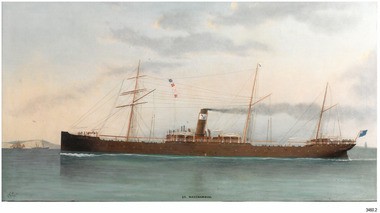 Flagstaff Hill Maritime Museum and Village
Photograph - Vessel, Sail and Steam Ship, S.S. Warrnambool
... The same symbol is painted on the ship’s black funnel. The signal flags on the foremast display ‘M’ ‘R’ ‘V’ ‘B’, with each flag signalling a meaning in the International Code of Signals. ...It displays four raised signal flags, a house flag and a blue ensign on the ship. ...The same symbol is painted on the ship’s black funnel. The signal flags on the foremast display ‘M’ ‘R’ ‘V’ ‘B’, with each flag signalling a meaning in the International Code of Signals. ...This photograph and a matching earlier photograph are images of a 1989 oil-on-canvas painting owned by the donor. They show the British sail and steam ship SS Warrnambool at Dover Strait in the English Channel. Each photograph was accompanied by a letter, one written in 2001 and the other in 2003, confirming that the artist of the painting was by Charles Keith Miller, signed with his initials “CKM” and dated “1893”. The images show the ship’s home flag with a diagonal blue anchor flying from the masthead. The same symbol is painted on the ship’s black funnel. The signal flags on the foremast display ‘M’ ‘R’ ‘V’ ‘B’, with each flag signalling a meaning in the International Code of Signals. While the SS Warrnambool was visiting Melbourne on its maiden voyage on December 1, 1892, a painting of that Lind Line ship by marine artist C.K. Miller was presented to the Town Council of Warrnambool by Mr. William Lund of London, owner of the Lind Line, or Blue Anchor Line. At that time, the Ladies of Warrnambool presented the ship with a ‘house’ flag bearing the Blue Anchor Line’s symbol, made by them especially for the occasion during the preceding moth. On December 6, the homeward bound ship anchored for a short time off the Port of Warrnambool, and a boat was launched from Lady Bay to take a group of friends to the ship with a delivery of gifts. After three cheers each for the ship and its Captain the SS Warrnambool continued its journey towards Britain via Adelaide. Although the painting was gifted in December 1892, it is post-dated “1893”. The reason for the discrepancy is unclear but whatever the reason, the provenance of the painting was confirmed at auctions of this painting and other works by the same artist. CHARLES KEITH MILLER 1836-1907:- Captain Charles Miller left his home in Scotland at the age of 15 years for a life at sea. He earned his Master’s Certificate ten years later. After being the captain of sailing ships, he moved to the steamships because they were faster. He married in 1866 and settled in Glasgow. Over the following eleven years, he and his wife had five children, then sadly, his wife passed away. Captain Miller returned to the sea for a while, but in 1888, he gave up his sea life to spend his time as a marine artist. His understanding of seafaring life and vessels, combined with his artistic skills, enabled him to produce fine art, and several galleries and museums have collections of his sought-after works. S.S. WARRNAMBOOL 1892-1925:- The sail and steamship SS Warrnambool was built in 1892 by the Sunderland Ship Building Company for the Lund Line of London, founded by William Lund in 1869, and registered in London. It efficiently carried passengers and cargo worldwide, including Australia, under its master, Captain Joshua Edward Ilbery, who had many years of experience with the Lund’s Blue Anchor Line, or BAL, which owned a fleet of sail and steamships. The funnels its steamships were painted black, with a white band around the top bearing a diagonal blue anchor and chain, also shown on the company’s house flag. The Lund Line ships were given Australian place names beginning with the letter “W”. Master Mariner, Captain Joshua Ilbery, was lost at sea without a trace in 1909, along with the ship SS Waratah. The ‘no frills’ service carried passengers and cargo to and from Europe around the Cape of Good Hope, stopping at various ports. The ship was involved in bringing home returned soldiers in 1895. At one time, it carried a doctor from Victoria, Australia, to assist at the war front in South Africa. The ship had a very good reputation for its cargo arriving almost always in excellent condition. Exported goods from Australia included iron safes, flour, wool, apples, frozen rabbits, butter, cheese, pork, cattle, poultry and sheep. One remarkable delivery contained Ostriches for Queen Victoria, and they survived the journey well. The SS Warrnambool was sold in 1900 to the British and South American Steam Navigation Co. Ltd of Liverpool and was renamed ‘Harmodius’. R.P. Houston & Company of London managed the company, and its Houston Line funnels were red with a black top. The Harmodius was sold in 1919 to K.S.S. Co. Ltd, managed by Kaye Son & Co. Ltd. of Liverpool, and was renamed ‘Kut’. The line had black funnels with a white ‘K’ in a diamond or between white stripes. In 1926, it was purchased by T.W. Ward Ltd. and broken up. NOTE- other vessels named “Warrnambool” Two other vessels carried the name “Warrnambool” (1)- HMAS Warrnambool J202 (1941-1947), a Bathurst-class corvette vessel owned by the Royal Australian Navy, was destroyed by a mine. (2)- HMAS Warrnambool FCPB204 (1980-2005), a Fremantle Class Patrol Boat of the RAN. The photograph is significant for its association with the painting "SS Warrnambool" by renowned marine artist Charles Keith Miller, whose paintings are well valued. The painting by C K Miller, the photograph, both bear the name Warrnambool, and the house flag of the Lind Line, are connected through the gifts exchanged between the ship company owner, the Town of Warrnambool and the Ladies of Warrnambool. The images connect the SS Warrnambool to the international trade of cargo and passengers. Coloured photograph of a painting depicting the Blue Anchor Line’s 1892 steamship S.S. Warrnambool. The three-masted ship in calm water. Its sails are lowered, and smoke is rising from its funnel. It displays four raised signal flags, a house flag and a blue ensign on the ship. The funnel also bears the house flag's symbol. There are figures on deck. The signature of the painting's artist, CKM (Charles Keith Miller), and a title on the lower edge of the photograph.House flag symbol, [diagonal blue anchor on white background] Text "CKM" and "1893" Text "S. S. WARRNAMBOOL."flagstaff hill, warrnambool, photograph, steam ship warrnambool, flagstaff hill maritime village, shipwreck coast, ss warrnambool, captain, charles keith miller, ckm, 1893, william lund, warrnambool town council, blue anchor line, lund line, ladies of warrnambool, house flag, diagonal blue anchor, captain miller, sunderland ship building company, migrant ship, 1892 ship, home flag, bal, australian export, s.s.warrnambool, dover strait, english chanel, port of warrnambool, lady bay, mrvb, captain charles miller, captain joshua edward iibery, ostriches, queen victoria, british and south american steam navigation co., harmodius, r.p. houston & company, houston line, k.s.s. co. ltd, kaye son & co. ltd, kut, t.w. ward ltd -
 4th/19th Prince of Wales's Light Horse Regiment Unit History Room
Painting - page, Flag and Arm Signal Code
... Flag and Arm Signal Code...Cardboard aide memoir card showing the arm semaphore, flag and horn or whistle signals as used within armoured units...signalling semaphore Cardboard aide memoir card showing the arm semaphore, flag and horn or whistle signals as used within armoured units Flag and Arm Signal Code Painting page ...Cardboard aide memoir card showing the arm semaphore, flag and horn or whistle signals as used within armoured unitssignalling, semaphore -
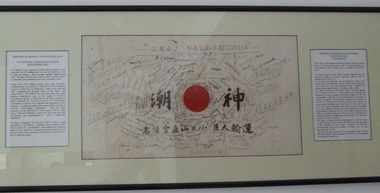 Waverley RSL Sub Branch
Replica Japanese Flag From H.M.A.S. Warramunga
... Mounted Japanese flag made from signal bunting on the H.M.A.S. ...Mounted Japanese flag made from signal bunting on the H.M.A.S. ...Mounted Japanese flag made from signal bunting on the H.M.A.S. Warramunga and signed by ships crew with history mounted in frame under glass -
Port Melbourne Historical & Preservation Society
Document - Chart illustrating shipping flags, 1938
... Chart illustrating shipping flags - the International Code of Signals including alfa, substitutes, numeral pendants and naval numerals. ...transport - shipping Chart illustrating shipping flags - the International Code of Signals including alfa, substitutes, numeral pendants and naval numerals. ...Chart illustrating shipping flags - the International Code of Signals including alfa, substitutes, numeral pendants and naval numerals. From Country Life supplement 1938.transport - shipping -
 Lakes Entrance Historical Society
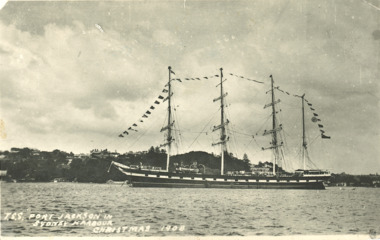
Postcard - TSS Port Jackson 1908, 1908
... Black and white postcard of TSS Port Jackson with all sails furled and signal flags used as bunting for a special occasion in Sydney Harbour N S W....Ships and Shipping Black and white postcard of TSS Port Jackson with all sails furled and signal flags used as bunting for a special occasion in Sydney Harbour N S W. ...Black and white postcard of TSS Port Jackson with all sails furled and signal flags used as bunting for a special occasion in Sydney Harbour N S W.ships and shipping -
 Parks Victoria - Gabo Island Lightstation
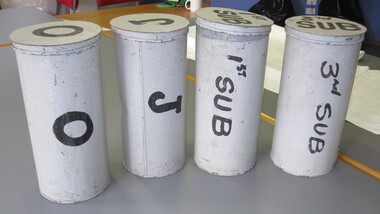
Flag canisters
... The 41 alphabetic and numeric visual signalling flags (including substitute and answering pennants) have either square or pointed ends. ...The 41 alphabetic and numeric visual signalling flags (including substitute and answering pennants) have either square or pointed ends. ...The 41 alphabetic and numeric visual signalling flags (including substitute and answering pennants) have either square or pointed ends. They are made of bunting, a coarse fabric of worsted (open yarn wool) in various colour combinations. Some of the flags are marked with inscriptions, for example “B”. Attachments to the flags include hemp rope and metal clips. Each flag has its own galvanised canister and lid, each of which is painted grey and marked with a letter, number or word. The flags were used for communicating messages to passing ships. Knowledge of visual signalling was mandatory for all lightkeepers and all lightstations maintained a set of flags. Although used for centuries, visual flag signalling formally developed in the nineteenth century and was published internationally as a system in 1857. By the early twentieth century it had developed into an effective means of conveying all kinds of short range visual messages. The signal flags and canisters at Gabo Island form a complete set and are not historically linked to the lightstation and their provenance is unknown. It is known however that they originate from a lightstation in Victoria and for some years were on loan from AMSA to the Queenscliff Maritime Museum, where they were held in storage and not displayed. In three of the six lightstations that Parks Victoria manages have sets of signal flags in their collections. Forty-one galvanised canisters with separate lids. The canisters are painted a grey/white colour and have either numbers, letters or words painted on the lid and on the cannister in black paint. There are variations in the style of canister and in the style of the inscriptions. -
 Wangaratta RSL Sub Branch
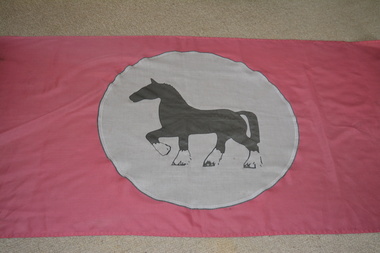
Flag
... Flag of the Force Logistic Support Group (FLSG) - This flag was flown at the Headquarters of FLSG and 145 Signal Squadron until all Units returned to Australia in June 2000...Flag of the Force Logistic Support Group (FLSG) - This flag was flown at the Headquarters of FLSG and 145 Signal Squadron until all Units returned to Australia in June 2000 The International Force East Timor (INTERFET) was a multinational non-United Nations peacemaking taskforce, organised and led by Australia in accordance with United Nations resolutions to address the humanitarian and security crisis that took place in East Timor from 1999–2000 until the arrival of UN peacekeepers. flag force logistic support group timor interfet Large red rectangle flag with large central white circle containing silver image of a horse Flag Flag Flag and Banner World Flag and Banner World ...Flag of the Force Logistic Support Group (FLSG) - This flag was flown at the Headquarters of FLSG and 145 Signal Squadron until all Units returned to Australia in June 2000The International Force East Timor (INTERFET) was a multinational non-United Nations peacemaking taskforce, organised and led by Australia in accordance with United Nations resolutions to address the humanitarian and security crisis that took place in East Timor from 1999–2000 until the arrival of UN peacekeepers.Large red rectangle flag with large central white circle containing silver image of a horseflag, force logistic support group, timor, interfet -
 Flagstaff Hill Maritime Museum and Village
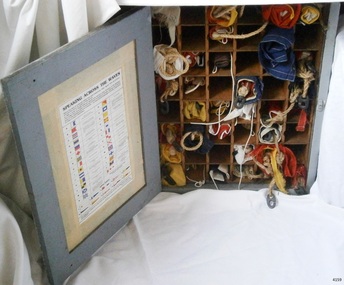
Cupboard
... Cupboard wooden painted grey, 1 door & 48 pigeon holes inside containing 34 signal flags. Has wooden square knob at front. 46mmL x 22mmW x 60mmH...flagstaff hill warrnambool shipwrecked-coast flagstaff-hill flagstaff-hill-maritime-museum maritime-museum shipwreck-coast flagstaff-hill-maritime-village Cupboard wooden painted grey, 1 door & 48 pigeon holes inside containing 34 signal flags. Has wooden square knob at front. 46mmL x 22mmW x 60mmH Cupboard ...Cupboard wooden painted grey, 1 door & 48 pigeon holes inside containing 34 signal flags. Has wooden square knob at front. 46mmL x 22mmW x 60mmHflagstaff hill, warrnambool, shipwrecked-coast, flagstaff-hill, flagstaff-hill-maritime-museum, maritime-museum, shipwreck-coast, flagstaff-hill-maritime-village -
 National Vietnam Veterans Museum (NVVM)
Uniform - Uniform, Army
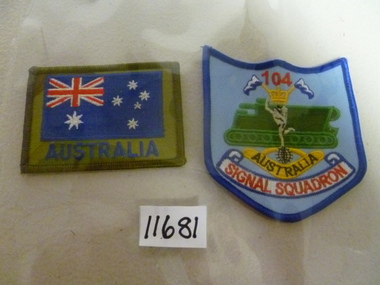
... Blue border around silver banner with red signal Squadron...Blue border around silver banner with red signal Squadron Uniform Uniform, Army Action Badges ...One cloth badge depicting Australian Flag blue on green with velcro backing. One cloth badge depicting red 104, two blue flags on gold crown, green tank, yellow boomerang with Australia written in black on it. Blue border around silver banner with red signal SquadronAction badges on sticker attached to back of Squadron badgecloth badges -
 St Kilda Historical Society
Ephemera - Seasonal card, Christmas and New Year Greetings, 1918
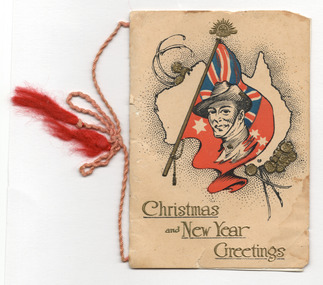
... Depicts Australian flag and soldier. Card is from 5th Divisional Signal Coy., AIF, France....Depicts Australian flag and soldier. Card is from 5th Divisional Signal Coy., AIF, France. 14th Battalion AIF Insert signed by George Arnold. ...Depicts Australian flag and soldier. Card is from 5th Divisional Signal Coy., AIF, France.Folded buff-coloured cardboard with paper insert fastened by faded red cord. Insert signed by George Arnold. Handwritten notation on back of card: Given to St K His Society by Mrs Parker 14/3/8214th battalion aif -
 Parks Victoria - Wilsons Promontory Lightstation
Flags, Navigational
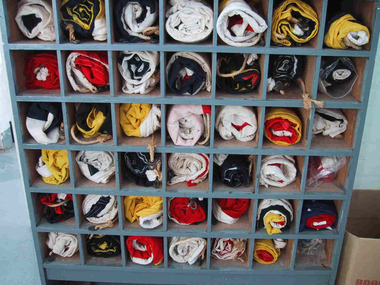
... Knowledge of visual signalling was mandatory for all lightkeepers and all stations maintained a set of flags. ...Knowledge of visual signalling was mandatory for all lightkeepers and all stations maintained a set of flags. ...The forty-two navigational flags appear to be a complete set. Their purpose-built, grey painted wooden locker is divided into forty-two pigeonholes, each holding one of the rolled up flags. It is simply built and stands on short legs and was originally open-fronted, but has since been covered with a protective clear Perspex panel. The set of alphabetic and numeric visual signalling flags (including substitute and answering pennants) are made of wool in various colour combination designs, with canvas sewn to one end that is threaded with hemp rope. Some of the flags have metal clips attached to the rope. The flags were used for communicating messages to passing ships. Knowledge of visual signalling was mandatory for all lightkeepers and all stations maintained a set of flags. Although used for centuries, visual flag signalling formally developed in the nineteenth century and was published internationally as a system in 1857. By the early twentieth century it had developed into an effective means of conveying all kinds of short range visual messages. Most flags are in good condition and their first level significance is enhanced by their completeness and integrity as a set still housed in their original locker, and by the signal charts that remain in the museum collection which offer further insights into visual signalling.1 - 42. Navigational flag set of 42 individual flags. Coloured linen with canvas sewn to one end which has hemp rope threaded through it. Some flags have metal clips attached to the ends of the hemp rope. 43. Wooden cupboard divided into sections with wooden divides. Used to house the 42 flags. • 1. navy & white. 2. navy & yellow. 3. navy & white. 4. white. 5. red & yellow. 6. yellow & navy. 7. yellow & navy. 8.red. 9.red & white. 10. white & navy. 11. red & navy & white. 12.yellow & navy & & red. 13.navy & white. 14. navy & white. 14. navy & white. 15.navy & white. 16. navy & yellow. 17. yellow & white. 18. white & red. 19. white & red. 20. yellow & red. 21. white & navy. 22. yellow & navy. 23. navy & white. 24. white & navy. 25.red & white. 26. navy & white. 27.red & white. 28.red & white. 29. red & navy. 30. white & navy. 31. yellow. 32.red 7 navy. 33. red. 34 navy,white,red & yellow.35. red & blue. 36. white & red. 37. navy & yellow. 38.red, yellow & white. 39. white. 40. white & red. 41. yellow & red. 42.navy. 43.custom built wooden open cupboard divided into sections to house flags.Yes -
 Bendigo Military Museum
Book, Andrew Gordon Author, The Rules of the Game, 2000 A.D
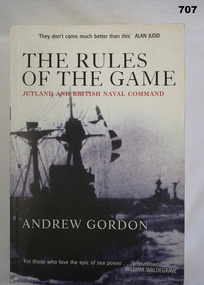
... Front cover has + B+W photo of WWI warship Signal flags flying in the wind NR of Pages 708 Cut Edges. ...Front cover has + B+W photo of WWI warship Signal flags flying in the wind NR of Pages 708 Cut Edges. ...Soft cover Book. Front cover has + B+W photo of WWI warship Signal flags flying in the wind NR of Pages 708 Cut Edges. Plain Paper with B+W Photos in the center.books, military, technical -
 Parks Victoria - Gabo Island Lightstation
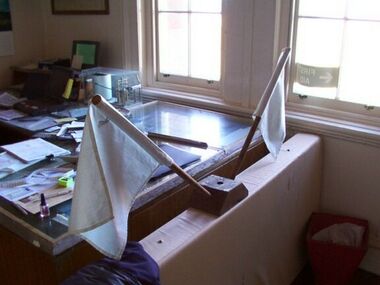
Flags
... Used to signal ships from lightstation. White flags are semaphore flags used for signalling alphabet letters. ...Used to signal ships from lightstation. White flags are semaphore flags used for signalling alphabet letters. ...Used to signal ships from lightstation. White flags are semaphore flags used for signalling alphabet letters. Salvaged from junk pile and mounted on wooden block. The identical, white hand held flags, which were used as a pair, are each stapled to a dowel. Information on both items indicates they were made by a well known flag, pennant and banner makers, Evan and Evans who were then located at 680 Elizabeth Street, Melbourne and are now in Spencer Street West Melbourne. Founded in 1877, the firm was a co designer of the Australian Flag in 1901. The flags are likely to date from c.1960 - 70 and are currently displayed in the former Keepers' quarters/ weather room mounted on a wooden block. Similar pairs of semaphore flags are held in Wilsons Promontory and Cape Nelson collections. The flags have second level contributory significance for their provenance to the lightstation and flag makers Evan & Evans. Thet have historic value for increasing our understanding of the semaphore signalling system formally used at the lightstation.Two identical white fabric flags stapled to a wooden dowel and secured to a wooden base on an angle.They have blue writing, on tags, on the flags.On tags on both flags, "EVAN & EVANS FLAGS P/L / FLAGMAKERS / 680 ELIZABETH ST / MELB. 3000 3475755" -
 Flagstaff Hill Maritime Museum and Village
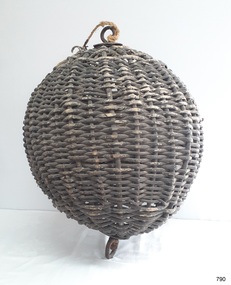
Equipment - Distant Signal, 1897-1931
... The Code was revised in 1887 to cover situations where distance, light, wind and weather conditions affected the visibility of the flags and prevented clear communication. The first report of the International Code of Signals Committee of 1897 warned signalmen not to rely on ordinary semaphore flags and introduced a Distant Signal Code using either particular semaphore flags or the three-dimensional shapes of a ball, cone and drum that aligned with the semaphore flag shapes of a circle, pennant and square. ...The Code was revised in 1887 to cover situations where distance, light, wind and weather conditions affected the visibility of the flags and prevented clear communication. The first report of the International Code of Signals Committee of 1897 warned signalmen not to rely on ordinary semaphore flags and introduced a Distant Signal Code using either particular semaphore flags or the three-dimensional shapes of a ball, cone and drum that aligned with the semaphore flag shapes of a circle, pennant and square. ...This three-dimensional Distant Signal is part of a Flagstaff Signal set of ball, cone and drum shapes. It has been woven and then fabricated with strong metal swivel fittings and loops for suspending from a high point on a flagstaff at a signal station or on a ship’s masthead. The cane signal was constructed to withstand all weather and to be visible from a long distance. The gaps between the woven cane allow air to pass through, minimising possible swaying. Similar sets were made from rope or fabric. Warrnambool's Flagstaff was erected in 1854. Its primary use was to display visual signals that could convey messages between land and sea. It was also used to notify the local population of the approach of ships. One of the popular signalling codes in use in the early-to-mid 1800s was the Marryat’s Code but there were others in use as well; there was no one standard code. In 1857 the International Marine Conference adopted an International Code of Signals as a standard communications system for all vessels that could be understood in many different languages. The Normanby Advertiser reported on June 5th 1857 a query from the Post Master General as to whether the request of the Chief Harbour Master would be carried out, in that Warrnambool would receive a new flagstaff and a set of Marryatt’s signal flags. The Table of Codes was published, showing how to use combinations of these flags to send messages. The Code was revised in 1887 to cover situations where distance, light, wind and weather conditions affected the visibility of the flags and prevented clear communication. The first report of the International Code of Signals Committee of 1897 warned signalmen not to rely on ordinary semaphore flags and introduced a Distant Signal Code using either particular semaphore flags or the three-dimensional shapes of a ball, cone and drum that aligned with the semaphore flag shapes of a circle, pennant and square. International Code of Signals In 1931, after World War I’s experiences in using signal codes, the International Code of Signals conference in Washington revised and published the rules for the conduct of signalling. One of the changes was that “the use of the Distant Signals and of fixed semaphore was abandoned”. It is of interest to know that modern marine law in many countries insists that a set of Day Shapes must be carried onboard vessels of a certain size. These highly visible geometric shapes are used at sea in daylight to communicate messages between vessels. They are used in a similar way to the Distant Signals, in that different combinations of shapes represent different messages. The set of shapes includes a ball, cylinder, cone and diamond. The shapes are hung between the top of the vessel’s foremast and the front of the vessel. They are only coloured black and are about 1.5 metres high. The vertical line of shapes can mean messages such as Boat not under command, Fishing, and Under sail and power.Distant Signals were an important means of marine communication from the late 1880s to the early 1930s, including during World War I. They were an advancement to the International Shipping Codes and safety. The cane signals’ shapes appear to be the same from whatever direction they are viewed, removing confusion about the message they convey. The same shapes continue to be used today for the sets of Day Shapes used as marine navigational signals that are mandatory on certain-sized vessels.Distant Signal Ball, part of a Flagstaff signal set. A round woven cane ball, painted black, with a metal rod passing through the centre. The rod has a loop at each end, then a concave, octagonal metal plate that rests on the outside surface of the ball, serving as a washer. The rod has swivels at each end.flagstaff hill, flagstaff hill maritime museum and village, warrnambool, maritime museum, maritime village, great ocean road, shipwreck coast, distant signal, signal, maritime signal, ball signal, signal shape, flagstaff signal, signal station, masthead signal, communications, marine technology, signals, marine signals, flaghoists, international marine conference, international code of signals, signal codes, marine safety, signal flags, day shape, daymark, day symbol, navigation, warrnambool flagstaff, 1854, 1857 1931, 1887, 1897 -
 Flagstaff Hill Maritime Museum and Village
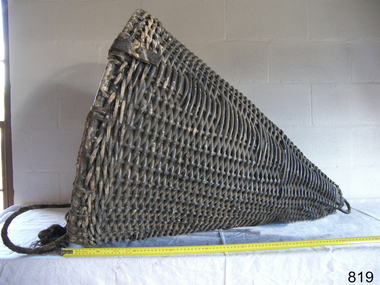
Equipment - Distant Signal, 1897-1931
... The Code was revised in 1887 to cover situations where distance, light, wind and weather conditions affected the visibility of the flags and prevented clear communication. The first report of the International Code of Signals Committee of 1897 warned signalmen not to rely on ordinary semaphore flags and introduced a Distant Signal Code using either particular semaphore flags or the three-dimensional shapes of a ball, cone and drum that aligned with the semaphore flag shapes of a circle, pennant and square. ...The Code was revised in 1887 to cover situations where distance, light, wind and weather conditions affected the visibility of the flags and prevented clear communication. The first report of the International Code of Signals Committee of 1897 warned signalmen not to rely on ordinary semaphore flags and introduced a Distant Signal Code using either particular semaphore flags or the three-dimensional shapes of a ball, cone and drum that aligned with the semaphore flag shapes of a circle, pennant and square. ...This three-dimensional Distant Signal is part of a Flagstaff Signal set of ball, cone and drum shapes. It has been woven and then fabricated with strong metal swivel fittings and loops for suspending from a high point on a flagstaff at a signal station or on a ship’s masthead. The cane signal was constructed to withstand all weather and to be visible from a long distance. The gaps between the woven cane allow air to pass through, minimising possible swaying. Similar sets were made from rope or fabric. Warrnambool's Flagstaff was erected in 1854. Its primary use was to display visual signals that could convey messages between land and sea. It was also used to notify the local population of the approach of ships. One of the popular signalling codes in use in the early-to-mid 1800s was the Marryat’s Code but there were others in use as well; there was no one standard code. In 1857 the International Marine Conference adopted an International Code of Signals as a standard communications system for all vessels that could be understood in many different languages. The Normanby Advertiser reported on June 5th 1857 a query from the Post Master General as to whether the request of the Chief Harbour Master would be carried out, in that Warrnambool would receive a new flagstaff and a set of Marryatt’s signal flags. The Table of Codes was published, showing how to use combinations of these flags to send messages. The Code was revised in 1887 to cover situations where distance, light, wind and weather conditions affected the visibility of the flags and prevented clear communication. The first report of the International Code of Signals Committee of 1897 warned signalmen not to rely on ordinary semaphore flags and introduced a Distant Signal Code using either particular semaphore flags or the three-dimensional shapes of a ball, cone and drum that aligned with the semaphore flag shapes of a circle, pennant and square. International Code of Signals In 1931, after World War I’s experiences in using signal codes, the International Code of Signals conference in Washington revised and published the rules for the conduct of signalling. One of the changes was that “the use of the Distant Signals and of fixed semaphore was abandoned”. It is of interest to know that modern marine law in many countries insists that a set of Day Shapes must be carried onboard vessels of a certain size. These highly visible geometric shapes are used at sea in daylight to communicate messages between vessels. They are used in a similar way to the Distant Signals, in that different combinations of shapes represent different messages. The set of shapes includes a ball, cylinder, cone and diamond. The shapes are hung between the top of the vessel’s foremast and the front of the vessel. They are only coloured black and are about 1.5 metres high. The vertical line of shapes can mean messages such as Boat not under command, Fishing, and Under sail and power.Distant Signals were an important means of marine communication from the late 1880s to the early 1930s, including during World War I. They were an advancement to the International Shipping Codes and safety. The cane signals’ shapes appear to be the same from whatever direction they are viewed, removing confusion about the message they convey. The same shapes continue to be used today for the sets of Day Shapes used as marine navigational signals that are mandatory on certain-sized vessels.Distant Signal Cone, part of a Flagstaff signal set. A woven cane cone, painted black, with a metal rod passing through the centre and two crossed metal bars at the base. The central rod has a loop at the top and passes through the bars at the base, finishing in a metal loop. The rod has swivels at each end.flagstaff hill, warrnambool, flagstaff hill maritime museum and village, shipwreck coast, marine navigation, marine communications, communication signal, lifesaving, ship at sea, day shape, masthead signal, day signal, day mark signals, marine technology, safety equipment, navigation equipment, marine day shape, day marker, cane day shape, signal cone, day signal cone, cone signal, cone day shape, distant signal, flagstaff signal, signal station, communications, signals, marine signals, flaghoists, international marine conference, international code of signals, signal codes, marine safety, signal flags, daymark, day symbol, navigation, warrnambool flagstaff, 1854, 1857 1931, 1887, 1897 -
 Flagstaff Hill Maritime Museum and Village
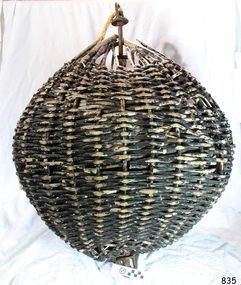
Equipment - Distant Signal, 1897-1931
... The Code was revised in 1887 to cover situations where distance, light, wind and weather conditions affected the visibility of the flags and prevented clear communication. The first report of the International Code of Signals Committee of 1897 warned signalmen not to rely on ordinary semaphore flags and introduced a Distant Signal Code using either particular semaphore flags or the three-dimensional shapes of a ball, cone and drum that aligned with the semaphore flag shapes of a circle, pennant and square. ...The Code was revised in 1887 to cover situations where distance, light, wind and weather conditions affected the visibility of the flags and prevented clear communication. The first report of the International Code of Signals Committee of 1897 warned signalmen not to rely on ordinary semaphore flags and introduced a Distant Signal Code using either particular semaphore flags or the three-dimensional shapes of a ball, cone and drum that aligned with the semaphore flag shapes of a circle, pennant and square. ...This three-dimensional Distant Signal is part of a Flagstaff Signal set of ball, cone and drum shapes. It has been woven and then fabricated with strong metal swivel fittings and loops for suspending from a high point on a flagstaff at a signal station or on a ship’s masthead. The cane signal was constructed to withstand all weather and to be visible from a long distance. The gaps between the woven cane allow air to pass through, minimising possible swaying. Similar sets were made from rope or fabric. Warrnambool's Flagstaff was erected in 1854. Its primary use was to display visual signals that could convey messages between land and sea. It was also used to notify the local population of the approach of ships. One of the popular signalling codes in use in the early-to-mid 1800s was the Marryat’s Code but there were others in use as well; there was no one standard code. In 1857 the International Marine Conference adopted an International Code of Signals as a standard communications system for all vessels that could be understood in many different languages. The Normanby Advertiser reported on June 5th 1857 a query from the Post Master General as to whether the request of the Chief Harbour Master would be carried out, in that Warrnambool would receive a new flagstaff and a set of Marryatt’s signal flags. The Table of Codes was published, showing how to use combinations of these flags to send messages. The Code was revised in 1887 to cover situations where distance, light, wind and weather conditions affected the visibility of the flags and prevented clear communication. The first report of the International Code of Signals Committee of 1897 warned signalmen not to rely on ordinary semaphore flags and introduced a Distant Signal Code using either particular semaphore flags or the three-dimensional shapes of a ball, cone and drum that aligned with the semaphore flag shapes of a circle, pennant and square. International Code of Signals In 1931, after World War I’s experiences in using signal codes, the International Code of Signals conference in Washington revised and published the rules for the conduct of signalling. One of the changes was that “the use of the Distant Signals and of fixed semaphore was abandoned”. It is of interest to know that modern marine law in many countries insists that a set of Day Shapes must be carried onboard vessels of a certain size. These highly visible geometric shapes are used at sea in daylight to communicate messages between vessels. They are used in a similar way to the Distant Signals, in that different combinations of shapes represent different messages. The set of shapes includes a ball, cylinder, cone and diamond. The shapes are hung between the top of the vessel’s foremast and the front of the vessel. They are only coloured black and are about 1.5 metres high. The vertical line of shapes can mean messages such as Boat not under command, Fishing, and Under sail and power.Distant Signals were an important means of marine communication from the late 1880s to the early 1930s, including during World War I. They were an advancement to the International Shipping Codes and safety. The cane signals’ shapes appear to be the same from whatever direction they are viewed, removing confusion about the message they convey. The same shapes continue to be used today for the sets of Day Shapes used as marine navigational signals that are mandatory on certain-sized vessels.Distant Signal Ball, part of a Flagstaff signal set. A round woven cane ball, painted black, with a metal rod passing through the centre. The rod has a loop at each end, then a concave, octagonal metal plate that rests on the outside surface of the ball, serving as a washer. The rod has swivels at each end.flagstaff hill, warrnambool, flagstaff hill maritime museum and village, shipwreck coast, marine navigation, marine communications, communication signal, lifesaving, ship at sea, day shape, masthead signal, day signal, day mark signals, marine technology, safety equipment, navigation equipment, marine day shape, day marker, cane day shape, signal ball, day signal ball, ball signal, ball day shape, distant signal, flagstaff signal, signal station, communications, signals, marine signals, flaghoists, international marine conference, international code of signals, signal codes, marine safety, signal flags, daymark, day symbol, navigation, warrnambool flagstaff, 1854, 1857 1931, 1887, 1897 -
 Flagstaff Hill Maritime Museum and Village
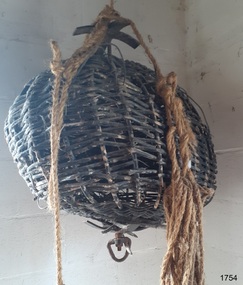
Equipment - Distant Signal, 1897-1931
... The Code was revised in 1887 to cover situations where distance, light, wind and weather conditions affected the visibility of the flags and prevented clear communication. The first report of the International Code of Signals Committee of 1897 warned signalmen not to rely on ordinary semaphore flags and introduced a Distant Signal Code using either particular semaphore flags or the three-dimensional shapes of a ball, cone and drum that aligned with the semaphore flag shapes of a circle, pennant and square. ...The Code was revised in 1887 to cover situations where distance, light, wind and weather conditions affected the visibility of the flags and prevented clear communication. The first report of the International Code of Signals Committee of 1897 warned signalmen not to rely on ordinary semaphore flags and introduced a Distant Signal Code using either particular semaphore flags or the three-dimensional shapes of a ball, cone and drum that aligned with the semaphore flag shapes of a circle, pennant and square. ...This three-dimensional Distant Signal is part of a Flagstaff Signal set of ball, cone and drum shapes. It has been woven and then fabricated with strong metal swivel fittings and loops for suspending from a high point on a flagstaff at a signal station or on a ship’s masthead. The cane signal was constructed to withstand all weather and to be visible from a long distance. The gaps between the woven cane allow air to pass through, minimising possible swaying. Similar sets were made from rope or fabric. Warrnambool's Flagstaff was erected in 1854. Its primary use was to display visual signals that could convey messages between land and sea. It was also used to notify the local population of the approach of ships. One of the popular signalling codes in use in the early-to-mid 1800s was the Marryat’s Code but there were others in use as well; there was no one standard code. In 1857 the International Marine Conference adopted an International Code of Signals as a standard communications system for all vessels that could be understood in many different languages. The Normanby Advertiser reported on June 5th 1857 a query from the Post Master General as to whether the request of the Chief Harbour Master would be carried out, in that Warrnambool would receive a new flagstaff and a set of Marryatt’s signal flags. The Table of Codes was published, showing how to use combinations of these flags to send messages. The Code was revised in 1887 to cover situations where distance, light, wind and weather conditions affected the visibility of the flags and prevented clear communication. The first report of the International Code of Signals Committee of 1897 warned signalmen not to rely on ordinary semaphore flags and introduced a Distant Signal Code using either particular semaphore flags or the three-dimensional shapes of a ball, cone and drum that aligned with the semaphore flag shapes of a circle, pennant and square. International Code of Signals In 1931, after World War I’s experiences in using signal codes, the International Code of Signals conference in Washington revised and published the rules for the conduct of signalling. One of the changes was that “the use of the Distant Signals and of fixed semaphore was abandoned”. It is of interest to know that modern marine law in many countries insists that a set of Day Shapes must be carried onboard vessels of a certain size. These highly visible geometric shapes are used at sea in daylight to communicate messages between vessels. They are used in a similar way to the Distant Signals, in that different combinations of shapes represent different messages. The set of shapes includes a ball, cylinder, cone and diamond. The shapes are hung between the top of the vessel’s foremast and the front of the vessel. They are only coloured black and are about 1.5 metres high. The vertical line of shapes can mean messages such as Boat not under command, Fishing, and Under sail and power.Distant Signals were an important means of marine communication from the late 1880s to the early 1930s, including during World War I. They were an advancement to the International Shipping Codes and safety. The cane signals’ shapes appear to be the same from whatever direction they are viewed, removing confusion about the message they convey. The same shapes continue to be used today for the sets of Day Shapes used as marine navigational signals that are mandatory on certain-sized vessels.Distant Signal Ball, part of a Flagstaff signal set. A round woven cane ball, painted black, with a metal rod passing through the centre. The rod has a loop at each end, then a concave, octagonal metal plate that rests on the outside surface of the ball, serving as a washer. The rod has swivels at each end.distant signal, flagstaff signal, signal station, masthead signal, communications, marine technology, signals, marine signals, flaghoists, international marine conference, international code of signals, signal codes, marine safety, signal flags, day shape, daymark, day symbol, navigation, warrnambool flagstaff, 1854, 1857 1931, 1887, 1897 -
 Flagstaff Hill Maritime Museum and Village
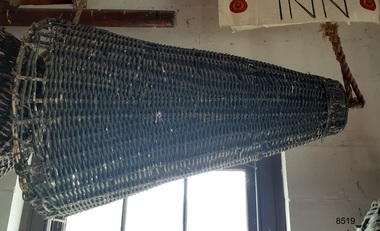
Equipment - Distant Signal, 1897-1931
... The Code was revised in 1887 to cover situations where distance, light, wind and weather conditions affected the visibility of the flags and prevented clear communication. The first report of the International Code of Signals Committee of 1897 warned signalmen not to rely on ordinary semaphore flags and introduced a Distant Signal Code using either particular semaphore flags or the three-dimensional shapes of a ball, cone and drum that aligned with the semaphore flag shapes of a circle, pennant and square. ...The Code was revised in 1887 to cover situations where distance, light, wind and weather conditions affected the visibility of the flags and prevented clear communication. The first report of the International Code of Signals Committee of 1897 warned signalmen not to rely on ordinary semaphore flags and introduced a Distant Signal Code using either particular semaphore flags or the three-dimensional shapes of a ball, cone and drum that aligned with the semaphore flag shapes of a circle, pennant and square. ...This three-dimensional Distant Signal is part of a Flagstaff Signal set of ball, cone and drum shapes. It has been woven and then fabricated with strong metal swivel fittings and loops for suspending from a high point on a flagstaff at a signal station or on a ship’s masthead. The cane signal was constructed to withstand all weather and to be visible from a long distance. The gaps between the woven cane allow air to pass through, minimising possible swaying. Similar sets were made from rope or fabric. Warrnambool's Flagstaff was erected in 1854. Its primary use was to display visual signals that could convey messages between land and sea. It was also used to notify the local population of the approach of ships. One of the popular signalling codes in use in the early-to-mid 1800s was the Marryat’s Code but there were others in use as well; there was no one standard code. In 1857 the International Marine Conference adopted an International Code of Signals as a standard communications system for all vessels that could be understood in many different languages. The Normanby Advertiser reported on June 5th 1857 a query from the Post Master General as to whether the request of the Chief Harbour Master would be carried out, in that Warrnambool would receive a new flagstaff and a set of Marryatt’s signal flags. The Table of Codes was published, showing how to use combinations of these flags to send messages. The Code was revised in 1887 to cover situations where distance, light, wind and weather conditions affected the visibility of the flags and prevented clear communication. The first report of the International Code of Signals Committee of 1897 warned signalmen not to rely on ordinary semaphore flags and introduced a Distant Signal Code using either particular semaphore flags or the three-dimensional shapes of a ball, cone and drum that aligned with the semaphore flag shapes of a circle, pennant and square. International Code of Signals In 1931, after World War I’s experiences in using signal codes, the International Code of Signals conference in Washington revised and published the rules for the conduct of signalling. One of the changes was that “the use of the Distant Signals and of fixed semaphore was abandoned”. It is of interest to know that modern marine law in many countries insists that a set of Day Shapes must be carried onboard vessels of a certain size. These highly visible geometric shapes are used at sea in daylight to communicate messages between vessels. They are used in a similar way to the Distant Signals, in that different combinations of shapes represent different messages. The set of shapes includes a ball, cylinder, cone and diamond. The shapes are hung between the top of the vessel’s foremast and the front of the vessel. They are only coloured black and are about 1.5 metres high. The vertical line of shapes can mean messages such as Boat not under command, Fishing, and Under sail and power.Distant Signals were an important means of marine communication from the late 1880s to the early 1930s, including during World War I. They were an advancement to the International Shipping Codes and safety. The cane signals’ shapes appear to be the same from whatever direction they are viewed, removing confusion about the message they convey. The same shapes continue to be used today for the sets of Day Shapes used as marine navigational signals that are mandatory on certain-sized vessels.Distant Signal Cone, part of a Flagstaff signal set. A woven cane cone, painted black, with a metal rod passing through the centre and two crossed metal bars at the base. The central rod has a loop at the top and passes through the bars at the base, finishing in a metal loop. The rod has swivels at each end.flagstaff hill, warrnambool, flagstaff hill maritime museum and village, shipwreck coast, marine navigation, marine communications, communication signal, lifesaving, ship at sea, day shape, masthead signal, day signal, day mark signals, marine technology, safety equipment, navigation equipment, marine day shape, day marker, cane day shape, signal cone, day signal cone, cone signal, cone day shape, distant signal, flagstaff signal, signal station, communications, signals, marine signals, flaghoists, international marine conference, international code of signals, signal codes, marine safety, signal flags, daymark, day symbol, navigation, warrnambool flagstaff, 1854, 1857 1931, 1887, 1897 -
 Parks Victoria - Gabo Island Lightstation
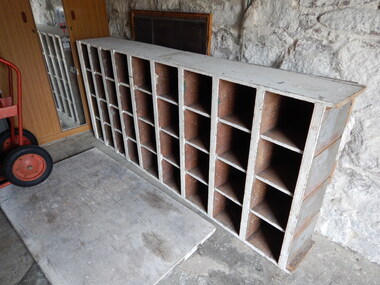
Locker, flag
... Probably used in the past to house the Signal Flag set at the lightstation. Appears to have been stored in the old stables for a number of years.The rectangular wooden cabinet has the distinctive features of a flag locker, comprising numerous open compartments of the same size each for storing a signal flag of a unique design. ...Probably used in the past to house the Signal Flag set at the lightstation. Appears to have been stored in the old stables for a number of years.The rectangular wooden cabinet has the distinctive features of a flag locker, comprising numerous open compartments of the same size each for storing a signal flag of a unique design. ...Probably used in the past to house the Signal Flag set at the lightstation. Appears to have been stored in the old stables for a number of years.The rectangular wooden cabinet has the distinctive features of a flag locker, comprising numerous open compartments of the same size each for storing a signal flag of a unique design. It has three internal shelves and a bench top, and is painted grey, a colour that is used for many of the wooden utilitarian furnishings in the six lightstations Parks Victoria manages. The cabinet, without its flag contents, was found in storage in the old stone stable building and is highly likely to be original to the lightstation. A wooden flag locker is held at Wilsons Promontory Lightstation. A wooden locker comprising two sections of 16 pigeon holes and four cupboard doors is held at Cape Otway The two flag lockers at Cape Nelson Lightstation are included in Victorian Heritage Register for contributing to the significance of the lightstation. The Nelson, Otway and Promontory lockers have associated sets of flags which are original to the lightstations. The Gabo Island cabinet has second level contributory significance for its provenance to the lightstation.Timber cabinet painted grey, partitioned with numerous open compartments of the same size . -
 Ballarat Heritage Services
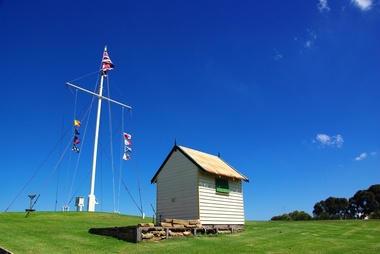
Digital photographs, L.J. Gervasoni, Flags at Flagstaff Fill, c2010
... ...flags...warrnambool flagstaff hill maritime museum flagstaff hill flags signals landscape Colour photographs of Flagstaff Hill, Warrnambool Flags at Flagstaff Fill Digital photographs L.J. ...Colour photographs of Flagstaff Hill, Warrnamboolwarrnambool, flagstaff hill maritime museum, flagstaff hill, flags, signals, landscape -
4th/19th Prince of Wales's Light Horse Regiment Unit History Room
Documents, AFV School, Army Tank Wing, Army Tank Precis, Nov 1942
... A soft covered, stapled, collection of précis issued in 1942 by Army Tank Wing of the AFV School, covering AFV characteristics, orders, map marking, crew training RT Procedure, flag & semaphore signals, battle procedures, working with other arms etc....AFV training World War 2 A soft covered, stapled, collection of précis issued in 1942 by Army Tank Wing of the AFV School, covering AFV characteristics, orders, map marking, crew training RT Procedure, flag & semaphore signals, battle procedures, working with other arms etc. ...A soft covered, stapled, collection of précis issued in 1942 by Army Tank Wing of the AFV School, covering AFV characteristics, orders, map marking, crew training RT Procedure, flag & semaphore signals, battle procedures, working with other arms etc.afv training, world war 2 -
 Parks Victoria - Cape Nelson Lightstation
Equipment - Flag clips
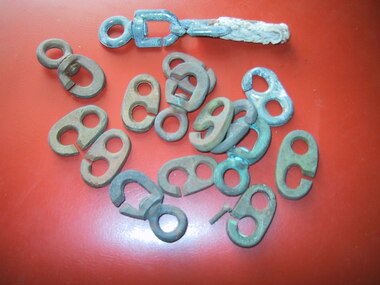
... They were used for hoisting visual signalling flags and relate to the use of the forty‐one flags (CNLS 0004.41), which were used to convey messages to passing ships and which are included in the Victorian Heritage Register listing for the lightstation (VHR H1773) . ...They were used for hoisting visual signalling flags and relate to the use of the forty‐one flags (CNLS 0004.41), which were used to convey messages to passing ships and which are included in the Victorian Heritage Register listing for the lightstation (VHR H1773) . ...The items include one intact brass clip and sections of others. They were used for hoisting visual signalling flags and relate to the use of the forty‐one flags (CNLS 0004.41), which were used to convey messages to passing ships and which are included in the Victorian Heritage Register listing for the lightstation (VHR H1773) . They have second level contributory significance for their provenance to the lightstation and association with its set of navigational flags (CNLS 0004.41), which were a major part of the communications system formerly used at the lightstation.Twenty one flag clips, some are intact others partial. One intact brass clip. -
 Parks Victoria - Cape Nelson Lightstation
Functional object - Flags, semaphore
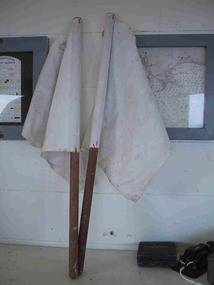
... The two semaphore flags were used as a pair for visual signaling by hand. ...The two semaphore flags were used as a pair for visual signaling by hand. ...The two semaphore flags were used as a pair for visual signaling by hand. The semaphore system is an alphabet signaling system based on the waving of a pair of handheld flags in a particular pattern to compose words to be communicated to passing ships. The system was introduced by the Royal Navy in 1880 and was later adopted in Australia, with the first School of Signaling opening in Williamstown in 1890. The system was superseded in the 1970s by more sophisticated methods of communication. Information on the Cape Nelson flags indicates that they were made by Evan Evans P/L, Flag makers, 690 Elizabeth Street, Melbourne. Evan Evans (d.1927) started a tent‐making business in 1877 and by 1920 Evan Evans P/L maker of canvas goods, was located at 680 Elizabeth Street, Melbourne. In 1924 it acquired land at 632 Bourke Street and built a new factory. His son Ivor continued the business after 1927 and in 1938 opened a bulk store in Carlton.271 In 2016 the firm was located at 673 Spencer Street, Melbourne. Another pair of white semaphore flags made by Evan & Evans is held at Gabo Island, and Wilsons Promontory also has a pair. Cape Nelson’s white semaphore flags have second level contributory significance. They have historical importance as flags formerly used at the lightstation for visual signaling, a system that is now rarely used in navigation, and contribute to the importance of the lightstation’s large collection of flags.A pair of white flags made of white canvas/heavy cotton, the square flags are attached to dowel poles with staples. -
 Queenscliffe Maritime Museum
Flag - UK 'Request for Pilot' flag
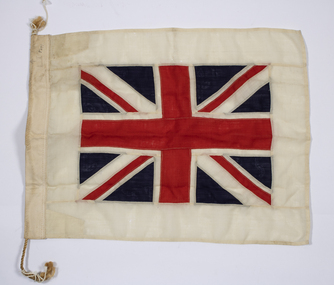
... They also suggested that in the proposed Regulations relating to Pilotage the same flag should be specified as the signal for a pilot. ...They also suggested that in the proposed Regulations relating to Pilotage the same flag should be specified as the signal for a pilot. ...The Ship Owners proposed a Union Jack with a six inch red border on all sides. They thought this would be cheaper than introducing a new flag, as every ship already had a Union Jack. They also suggested that in the proposed Regulations relating to Pilotage the same flag should be specified as the signal for a pilot. Their Lordships agreed to this, but the border was to be white instead of red, and the size of the border was to be a proportion of the size of the flag. The new flag was warranted on 8 July 1823, the details published in the London Gazette on the 9th, to be effective 1 January 1824. The establishment of the Union Jack on a white boarder as a request for pilot flag in British port took effect from 1824.Flag flown by UK registered merchant vessels requiring pilotage on approach to UK portspilot flag, union jack, flags
