
Showing 52 items matching "silk cape"
-
 Bendigo Historical Society Inc.
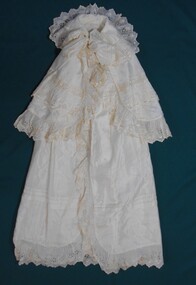
Clothing - INFANTS CREAM COLOURED SILK CAPE
... INFANTS CREAM COLOURED SILK CAPE...infants cream coloured silk cape...Infant's cream coloured silk cape with collar and two layers. Semi-circular 180 degrees lined yoke section with round neckline with casing and fold over collar (18 cm). ...COSTUME Children's infants cream coloured silk cape Clothing. Infant's cream coloured silk cape with collar and two layers. ...Clothing. Infant's cream coloured silk cape with collar and two layers. Semi-circular 180 degrees lined yoke section with round neckline with casing and fold over collar (18 cm). Collar has 9 cm frilled embroidered lace trim with scalloped edges. The cape has two layers both lined with linen fabric. The under layer (110 cm) is edged with 9cm frilled embroidered lace and three horizontal pleats above the hemline. The top layer (52 cm) is edged with 9 cm frilled embroidered lace with a 14 cm panel of embroidered lace across the centre of the cape. The layers create the effect of a long cape with a collar and a shoulder cape. The cape is fastened at the throat with silk fabric ties (8 cm X 50 cm) with fabric frills at the hem.costume, children's, infants cream coloured silk cape -
 Kew Historical Society Inc
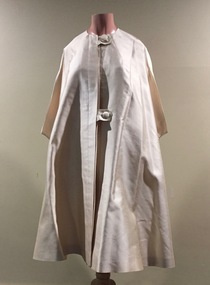
Clothing - Cream Silk Evening Cape, House of Youth, 1960s
... Cream Silk Evening Cape...Three quarter length flared cream coloured silk cape caught at the neck and waist with two large buttons covered with the same coloured fabric....Clothing Cream Silk Evening Cape House of Youth House of Youth ...THE HOUSE OF YOUTH label was founded c.1935) by Mr. Samuel Stein. By 1955 Mrs. Stein, his son, Philip, and his daughter, Elizabeth, all played an active part in the business. The connection with Dior came to them without seeking. Dior, that man of fashion genius, had come to the conclusion that the Australian market offered a scope he could not afford to ignore. He questioned many visitors to Paris and decided that the House of Youth was the obvious channel through which his designs should flow to the Australian woman. Completely versatile, this firm is capable of covering every phase of fashion production, from impeccably tailored suits and coats to softly draped, intricately cut dresses and evening gowns. Mr. Philip Stein was modest when asked what Dior thought of their copies, but confessed that Dior, had been "very flattering". Dior had-been greatly impressed with the standard of Australian craftsmanship, and, as a result of the success of this joint Parisian-Australian fashion venture, it is whispered that the great man himself is seriously contemplating a visit to Australia. (Source: The Argus 22 Feb 1955)The Fashion & Design collection of the Kew Historical Society includes examples of women’s, men’s, children’s and infants’ clothing from the 18th, 19th and 20th centuries. Items in the collection were largely produced for, or purchased by women in Melbourne, and includes examples of outerwear, protective wear, nightwear, underwear and costume accessories.Three quarter length flared cream coloured silk cape caught at the neck and waist with two large buttons covered with the same coloured fabric.Label: House of Youthwomen's clothing, house of youth, evening coats, australian fashion - 1960s -
 Bendigo Historical Society Inc.
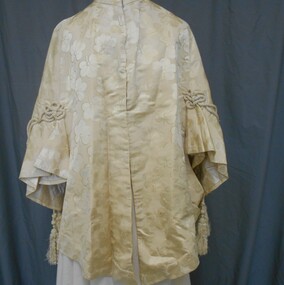
Clothing - CREAM SILK EVENING CAPE (RELATED TO 11400.842), Evening Cape
... CREAM SILK EVENING CAPE (RELATED TO 11400.842)......cream silk evening cape...COSTUME Female cream silk evening cape A card with the cape is hand written - ''For Historical Soc.if wanted, From M.Bush's Collection. ...Cream silk, woven in a jacquard style, featuring a floral design. Fully lined with cream silk satin. A 4cm deep, stand-up mandarin style collar. Eight metal hook and eyes fasten the front in a concealed way. Heavy cording, finished with pearl trimmed tassels,a double inverted pleat, 22cm long at the centre back hemline. Three darts at shoulders giving a 'sleeve-like' shape. Lower edges of which are elaborately corded. A 12cm'slit' at the lower edge seam with the front panel gives more flexibilty to the wearer. Tassel head and decorative 1.5cm ''ball'' are woven in a ''turks head'' style. A 2.5cm wide silk ribbon, attached at centre back, and possibly tied around the waist.A card with the cape is hand written - ''For Historical Soc.if wanted, From M.Bush's Collection. Could have been from Mrs. Mueller's. Gift from Mrs. E.G.JARRETT''costume, female, cream silk evening cape -
 Kew Historical Society Inc
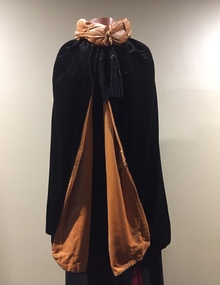
Clothing - Reversible Black Velvet and Apricot Silk Evening Cape, 1920s
... Reversible Black Velvet and Apricot Silk Evening Cape...Reversible black velvet and apricot silk evening cape with black tassels. The rolled collar is typical of the 1920s....Clothing Reversible Black Velvet and Apricot Silk Evening Cape ....The Fashion & Design collection of the Kew Historical Society includes examples of women’s, men’s, children’s and infants’ clothing from the 18th, 19th and 20th centuries. Items in the collection were largely produced for, or purchased by women in Melbourne, and includes examples of outerwear, protective wear, nightwear, underwear and costume accessories. This cape is one of a number of items donated to the Fashion Collection by Dione McIntyre. The cape was owned by her mother Lillian Cohen.The McIntyre Collection of clothing and clothing accessories forms one of the largest single donations to our Fashion & Design collection. It includes clothing and clothing accessories worn by four women in the Cohen and McIntyre families across three generations. The items worn by Melbourne architect, and Kew resident, Dione McIntyre date from the 1960s and 1970s, and include evening wear, day wear, hats and shoes. As Dione McIntyre often accompanied her husband, fellow architect Peter McIntyre, to formal events, there are a number of pieces of evening wear among the items. The McIntyre Collection also includes items worn by women of an earlier generation: by Lilian Cohen, Dione McIntyre's mother, and by her mother-in-law, the wife of the architect Robert McIntyre. At the other end of the chronological spectrum are a number of outfits belonging to, worn and donated by Annie McIntyre. These include outfits created by notable late 20th century Australian and/or international fashion designers. The McIntyre Collection is significant historically and artistically as it includes examples of design that demonstrate changing tastes in fashion over an 80-year period. The collection is also significant in that it includes the work of a large number of Melbourne designers from the 1960s to the 1990s. Reversible black velvet and apricot silk evening cape with black tassels. The rolled collar is typical of the 1920s.women's clothing, evening wear, capes, australian fashion - 1920s, lillian cohen, mcintyre collection -
 Kew Historical Society Inc
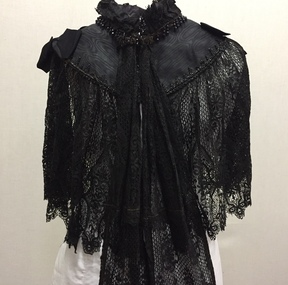
Clothing, Black Silk, Lace & Jet Cape, 1980s
... Black Silk, Lace & Jet Cape...Late Victorian black watered silk cape with a wide border of machine made lace. ...The cape was owned by one of the donor's maternal ancestors. Black Silk, Lace & Jet Cape Clothing Clothing ...The Fashion & Design collection of the Kew Historical Society includes examples of women’s, men’s, children’s and infants’ clothing from the 18th, 19th and 20th centuries. Items in the collection were largely produced for, or purchased by women in Melbourne, and includes examples of outerwear, protective wear, nightwear, underwear and costume accessories.Late Victorian black watered silk cape with a wide border of machine made lace. The cape is extensively adorned with beads of black jet. Two long pieces of black lace fall from the neck at centre front. The cape was owned by one of the donor's maternal ancestors.capes, australian fashion, women's clothing, victorian fashion -
 Bendigo Historical Society Inc.
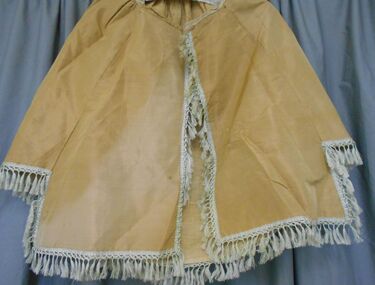
Clothing - GOLD SILK VICTORIAN CAPE (PART OF AN OUTFIT WITH 11400.975 AND 11400.977), Late 1900's
... GOLD SILK VICTORIAN CAPE (PART OF AN OUTFIT WITH 11400.975 AND 11400.977)...A 1.5 cm wide band of striped silk binds the neckline but is in very poor condition. Back panel of cape is gathered by hand, extending from front panel seams....COSTUME Female gold silk victorian bodice Cape with three panels - one either side of front opening, and one rounded panel from side fronts, and across back. ...Cape with three panels - one either side of front opening, and one rounded panel from side fronts, and across back. Two triangular panels - 10 cm X 4 cm at front lower edge of back circular panel. Front panels are longer than sides of back panels. All front and lower edges are finished with a 5 cm long, silver coloured, silk fringe. A 1.5 cm wide band of striped silk binds the neckline but is in very poor condition. Back panel of cape is gathered by hand, extending from front panel seams.costume, female, gold silk victorian bodice -
 Flagstaff Hill Maritime Museum and Village
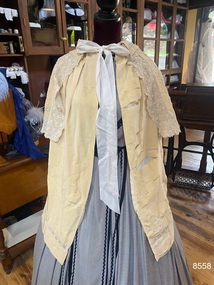
Clothing - Double Cape with Collar
... ...Silk cape...The cape is of a style from the Victorian or the Edwardian Era and so provides a good example of women's clothing from that time. The light colour, silk...Both materials have a silken sheen in the right light. A silk ribbon ties the cape at the neck. The lining and lace have been sewn with fine hand stitching....Flagstaff Hill Warrnambool Maritime Village Maritime Museum Flagstaff Hill Maritime Museum and Village Shipwreck coast Great Ocean Road Ladies Cape Double cape Silk cape Layered cape Cape with lace collar decorative lace edging Victorian era Edwardian era Ladies cape consisting of two circular tiers and a collar. ...The cape is of a style from the Victorian or the Edwardian Era and so provides a good example of women's clothing from that time. The light colour, silk material and lace suggest a cape used for special occasions with the possibility of initially being a wedding cape.The item is of significance historically and socially as an example of women's clothing in the Victorian and Edwardian eras.Ladies cape consisting of two circular tiers and a collar. The inner tier is knee length with a thin lace insert around the hem. The outer tier is elbow length with a wide lace edge and the thin lace insert inside this. The collar has lace edging and a lace insert of the same width. The lace used is of a repeat flower pattern most likely made of a combination of silk and cotton. The cape material appears to be a cream ribbed silk with the lining being of a polished cotton or silk variety. Both materials have a silken sheen in the right light. A silk ribbon ties the cape at the neck. The lining and lace have been sewn with fine hand stitching.flagstaff hill, warrnambool, maritime village, maritime museum, flagstaff hill maritime museum and village, shipwreck coast, great ocean road, ladies cape, double cape, silk cape, layered cape, cape with lace collar, decorative lace edging, victorian era, edwardian era -
 Bendigo Historical Society Inc.
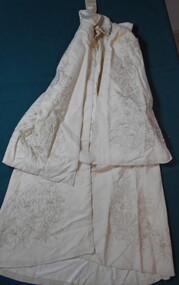
Clothing - MCGOWAN COLLECTION: CHILD'S CAPE, Late 19 th Century
... ...cream coloured silk cape....Clothing, cream coloured double layer child's silk cape. Inner cape has 13 cm one piece circular yolk with 7 cm turned over collar. ...COSTUME Children's cream coloured silk cape. Clothing, cream coloured double layer child's silk cape. ...Clothing, cream coloured double layer child's silk cape. Inner cape has 13 cm one piece circular yolk with 7 cm turned over collar. Casing around neck has 4 cm draw string ribbon threaded through. Inner cape is made from one piece of fabric with inverted V shaped insert on LHS extending 40 cm from edge of yoke. Inner cape is fully lined with cotton fabric. Two extra satin lining panels extend from yolk to hem inside both front openings.(7 cm widening to 28 cm at hem). Outer cape is made from one piece of fabric falling 57 cm from the collar. Outer cape is fully lined with cotton fabric with additional satin lining panels inside front openings from neckline to hem ( 8 cm at neck to 30 cm at hem). Both layers have decorative silk embroidery of floral patterns. Outer cape pattern extends down both sides of front opening and continues above the hem line around the cape. The embroidery on the inner cape extends from the lower edges of the front openings and continues above the hem around the cape. The collar is embroidered with silk thread and lined with satin fabric. Old box 524.costume, children's, cream coloured silk cape. -
 Bendigo Historical Society Inc.
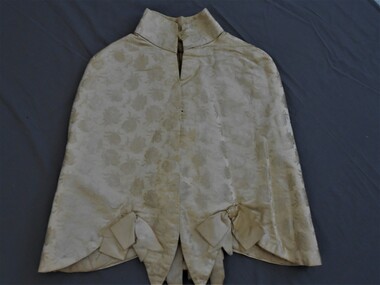
Clothing - MAGGIE BARBER COLLECTION: SILK CREAM BROCADE SHORT CAPE, 1890 - early 1900's
... MAGGIE BARBER COLLECTION: SILK CREAM BROCADE SHORT CAPE......Silk cream brocade short cape...Clothing. Silk-satin brocade cape with 7 cm high stand-up collar. ...COSTUME Female Silk cream brocade short cape Clothing. Silk-satin brocade cape with 7 cm high stand-up collar. ...Clothing. Silk-satin brocade cape with 7 cm high stand-up collar. Rounded at the hipline, and curved upward toward the centre fronts, where two 6 cm wide cream ribbon bows are attached. The hemline then falls to a steep 16 cm deep peak at the centre fronts. Four metal hooks and stitch covered metal eyelets form the closure from the high collar to the bustline. Two silk fabric loops on the inside of the opening-19 cms long, and 6.5 cm wide allow the arms to be free, and the cape to remain firmly fitted. The cape is padded and stitched internally in a diamond-shaped pattern. The back of the cape is curved and fitted at the waistline and the centre back. A large satin bow is attached 12 cm above the hemline, and sits over two box pleats 12 cm long, from waistline to the hemline.costume, female, silk cream brocade short cape -
 Bendigo Historical Society Inc.
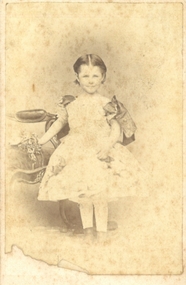
Photograph - BUICK COLLECTION: PHOTOGRAPH OF MAGGIE BUICK
... beside chair (wearing watered silk cape-let). Carte de Visite format....beside chair (wearing watered silk cape-let). Carte de Visite format. Photograph BUICK COLLECTION: PHOTOGRAPH OF MAGGIE BUICK ...Photograph of Maggie Buick (aged 3 - 5 yrs?) beside chair (wearing watered silk cape-let). Carte de Visite format.Mr Fred Frith, 7 Collins St East, Melbourne.person, individual, buick family collection -
 Orbost & District Historical Society
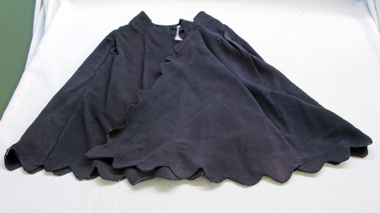
cape, Before 1922
... cape silk clothing...A black shoulder cape made of crepe silk. It has scalloped edges and is probably hand-made. ...From 1902-1920 he was the Assembly member for East Gippsland. cape silk clothing A black shoulder cape made of crepe silk. ...This cape comes from the estate of James Cameron who was one of the first Snowy River councillors for the Tambo Shire. He selected land at Lochiel in 1892. From 1902-1920 he was the Assembly member for East Gippsland.A black shoulder cape made of crepe silk. It has scalloped edges and is probably hand-made. It fastens with press studs and the hems have been machined.cape silk clothing -
 Kew Historical Society Inc
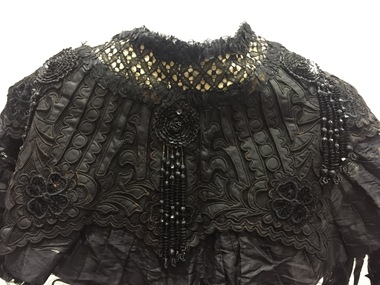
Clothing, Black Silk Taffeta & Guipure Lace Pelerine, 1890s
... Late Victorian black silk taffeta cape featuring extensive use of high quality guipure lace on the front and at the back. ...While the lace is in excellent condition, there is extensive splitting of the silk fabric. The cape was owned by one of the donor's maternal ancestors. ...The Fashion & Design collection of the Kew Historical Society includes examples of women’s, men’s, children’s and infants’ clothing from the 18th, 19th and 20th centuries. Items in the collection were largely produced for, or purchased by women in Melbourne, and includes examples of outerwear, protective wear, nightwear, underwear and costume accessories.Late Victorian black silk taffeta cape featuring extensive use of high quality guipure lace on the front and at the back. While the lace is in excellent condition, there is extensive splitting of the silk fabric. The cape was owned by one of the donor's maternal ancestors.capes, women's clothing, australian fashion, victorian fashion, costumes, micky ashton -
 Clunes Museum
Accessory - CAPE
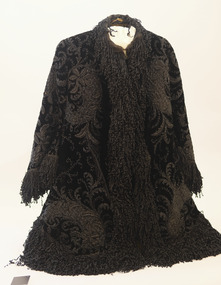
... BLACK VELVET BEADED CAPE - SILK LINED, SILK TRIM....KIT SWANTON OF BALLARAT. local history costume female womens clothing NIL BLACK VELVET BEADED CAPE - SILK LINED, SILK TRIM. Accessory CAPE ...BLACK CAPE BELONGING TO MRS. CATHERINE KELLY - FROM CARGERIE AND SKYE - SCOTLAND. GRANDMOTHER OF MRS. KIT SWANTON OF BALLARAT.BLACK VELVET BEADED CAPE - SILK LINED, SILK TRIM.NILlocal history, costume, female, womens clothing -
 Kew Historical Society Inc
Clothing - Black Silk Embroidered & Fringed Shawl, c.1910
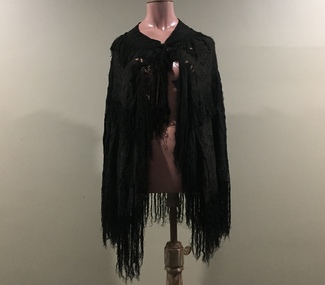
... Fitted black silk cape or shawl, joined at the neck, and incorporating embroidery of the same colour. ...Predictably with the growth of an ethnically and culturally more diverse community in Kew after the Second World War, textiles, clothing and objects in the collection inevitably reflected this diversity. fashion and textiles collection - kew historical society shawls Fitted black silk cape or shawl, joined at the neck, and incorporating embroidery of the same colour. ...The Fashion & Design collection of Kew Historical Society includes examples of textiles dating from the 18th, 19th and 20th centuries. Some of the textiles, were used as items of clothing, others as items of household decoration, or simply as travel souvenirs. These textiles were created both domestically and internationally. Predictably with the growth of an ethnically and culturally more diverse community in Kew after the Second World War, textiles, clothing and objects in the collection inevitably reflected this diversity.Fitted black silk cape or shawl, joined at the neck, and incorporating embroidery of the same colour. The item includes extensive, double-row fringing. On examination of the piece, it would appear that it was constructed from a Manila de Manton (piano shawl). It has been provisionally dated to either the late-Victorian or Edwardian periods.fashion and textiles collection - kew historical society, shawls -
 Brighton Historical Society
Cape, 1890s
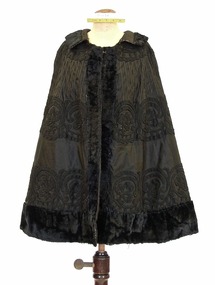
... Black silk satin cape with corded design. Black fur trim on collar, centrefront openings and hem. ...cape 1890s Black silk satin cape with corded design. ...Black silk satin cape with corded design. Black fur trim on collar, centrefront openings and hem. Lined with quilted black silk. Watch pocket on left proper interior. Wool interlining.cape, 1890s -
 Brighton Historical Society
Outfit, Evening outfit, 1930s
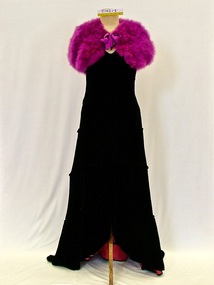
... Evening outfit comprising magenta feathered cape, full-length black velvet dress and a spray of silk flowers. Hem of dress lined with magenta and yellow silk. .1 - cape .2 - dress .3 - floral spray...Her family migrated to Australia, living first in St Kilda before building the house 'Avon' at 42 Bay Street, Brighton, where Bertha lived with her husband Ambrose Reginald Dudfield until 1975. evening dress feather cape bertha dudfield brighton 1930s Evening outfit comprising magenta feathered cape, full-length black velvet dress and a spray of silk flowers. Hem of dress lined with magenta and yellow silk. .1 - cape .2 - dress .3 - floral spray Evening outfit Outfit Bertha Dudfield ...This evening outfit was made and worn by Bertha Frances Dudfield (nee Bruere, 1892-1982). Bertha was born in Christchurch, New Zealand in 1892, one of twelve surviving children. Her family migrated to Australia, living first in St Kilda before building the house 'Avon' at 42 Bay Street, Brighton, where Bertha lived with her husband Ambrose Reginald Dudfield until 1975.Evening outfit comprising magenta feathered cape, full-length black velvet dress and a spray of silk flowers. Hem of dress lined with magenta and yellow silk. .1 - cape .2 - dress .3 - floral sprayevening dress, feather cape, bertha dudfield, brighton, 1930s -
 Kew Historical Society Inc
Clothing - Cape
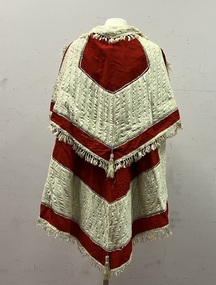
... Off white quilted silk cape, with bands of red wool. The shoulderless cape is tied at the neck by a simple cord. ...capes clothing Name in ink on lining at neck: Off white quilted silk cape, with bands of red wool. The shoulderless cape is tied at the neck by a simple cord. ...Off white quilted silk cape, with bands of red wool. The shoulderless cape is tied at the neck by a simple cord. The overall shape of the cape includes two- triangular panels, one overlaying the other. Each panel is fringed. There is one tassel hanging from the outer cape from centre back. The cape is lined with a cream cotton fabric. Measurements - Inner panel: Length neck to hem front 81cm; Neck to hem back 100cm; Circumference 158cm; Shoulder width 29cm. Outer panel: Neck to hem front 43cm; Neck to hem back 55cm; Circumference 114cmName in ink on lining at neck: capes, clothing -
 Glenelg Shire Council Cultural Collection
Clothing - Childs Cape, 1900-1910
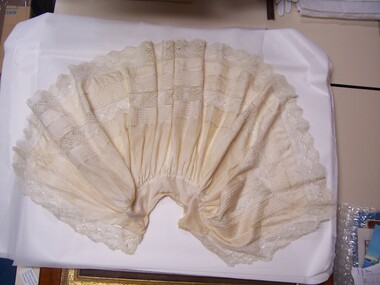
... Cream silk child's cape. Hand-crocheted lace edging around side and bottom edges. ...Cream silk child's cape. Hand-crocheted lace edging around side and bottom edges. ...Cream silk child's cape. Hand-crocheted lace edging around side and bottom edges. Hand-crocheted lace insert between two sections of pintucking, edged with embroidery. Main body of cape gathered onto plain yoke. Silk binding around neck. Garment Measures: Width at yoke: 30, Width at hem: 215, H: 50 -
 Kew Historical Society Inc
Clothing - Cerise Velvet Capelet, 1930s
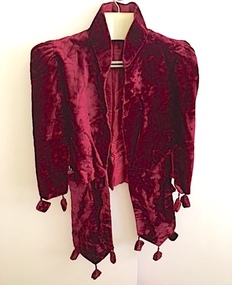
... A high waisted crimson silk velvet fitted cape featuring long panels of velvet at the front. ...The garments in the Weir Collection were donated to the Kew Historical Society by a granddaughter of Edith Weir in 2017. capes women's clothing evening wear edith mary weir (nee betteridge) illapa - 84 princess street -- kew (vic.) fashion -- 1920s A high waisted crimson silk velvet fitted cape featuring long panels of velvet at the front. ...An item forming part of a collection of costumes, photographs and documents relating to the Weir family who lived in a mansion, originally named Illapa, at 84 Princess Street, Kew, from c.1917 to 1950. This historically significant collection includes items relating to both George Weir (1866-1937), his wife Edith Mary Weir (1867-1948) and their children. George Weir attained national prominence in the mining industry, becoming General Manager of the North Broken Hill Silver Mining Company in 1903 (later renamed North Broken Hill Mining Company 1905-12, and North Broken Hill Ltd 1912-1988), and subsequently President of the Mine Owners Association. He was to remain General Manager of North Broken Hill Ltd until his retirement in 1926.This garment is part of a collection of women’s clothing, owned and worn by Edith Mary Weir (nee Betteridge) - born in Clare, South Australia 1867, died Kew 1948 - and also by her daughter. The garments date from the 1880s to the 1930s. The collection includes day dresses, evening dresses, evening coats, capes, and undergarments. As the wife and daughter of a mine manager, the collection includes representative examples of clothing worn by upper middle class Australian women in domestic circumstances, and at social and civic events. A number of the costumes from the 1920s to the 1930s are of a particularly fine quality, being both rare, representative and intact examples of Australian fashion of the period. The garments in the Weir Collection were donated to the Kew Historical Society by a granddaughter of Edith Weir in 2017.A high waisted crimson silk velvet fitted cape featuring long panels of velvet at the front. The cape is decorated at the base with crimson silk diamond shaped velvet drops. All is lined with cherry red silk.capes, women's clothing, evening wear, edith mary weir (nee betteridge), illapa - 84 princess street -- kew (vic.), fashion -- 1920s -
 Nhill and District Historical Society Inc.
Clothing - c 1860 Wedding dress of Erstine Schlisweg
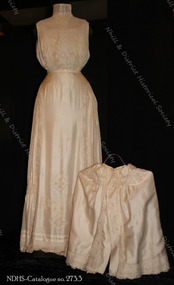
... c 1860 Three piece silk & lace wedding ensemble handmade in Germany, consisting of a silk full length skirt with lace & ribbon trim which hugs the waist, flows into a small train at the back; the high round neck, sleeveless bodice/top tucks into the skirt, is silk with pleats down either side of a lace panel in front; cape is silk, slightly gathered so it elegantly flows over the shoulders, finishing below the hips, is trimmed with lace around the neck and bottom. ...Erstine Schlisweg married William Bosse in Germany in 1860, later settled in Nhill district Settlers in Nhill wedding dress william bosse erstine schlisweg nhill German - textiles - handmade Lace & ribbon trims c 1860 Three piece silk & lace wedding ensemble handmade in Germany, consisting of a silk full length skirt with lace & ribbon trim which hugs the waist, flows into a small train at the back; the high round neck, sleeveless bodice/top tucks into the skirt, is silk with pleats down either side of a lace panel in front; cape is silk, slightly gathered so it elegantly flows over the shoulders, finishing below the hips, is trimmed with lace around the neck and bottom. ...Erstine Schlisweg married William Bosse in Germany in 1860, later settled in Nhill districtSettlers in Nhillc 1860 Three piece silk & lace wedding ensemble handmade in Germany, consisting of a silk full length skirt with lace & ribbon trim which hugs the waist, flows into a small train at the back; the high round neck, sleeveless bodice/top tucks into the skirt, is silk with pleats down either side of a lace panel in front; cape is silk, slightly gathered so it elegantly flows over the shoulders, finishing below the hips, is trimmed with lace around the neck and bottom. Lace & ribbon trims wedding dress, william bosse, erstine schlisweg, nhill, german - textiles - handmade -
 Flagstaff Hill Maritime Museum and Village
Textile - Wall Hanging, curtain, 1854-1855
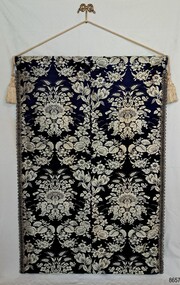
... silk damask...blue and cream...captain’s cabin...ladies’ saloon...clipper ship...migrant...emigrant...Liverpool to Australia...Captain James Nicol Forbes...James Forbes...Captain Forbes...Bully Forbes...James Baines & Co...James Baines...Cape...Flagstaff Hill Maritime Museum and Village Great Ocean Road Shipwreck Coast shipwreck artefact memorabilia curtain saloon curtain Schomberg wall hanging Decorative Object Domestic Item Warrnambool Flagstaff hill Maritime Museum Maritime Village maritime history shipwreck stranding Schomberg curtain Schomberg wall hanging luxury ship 1855 damask silk damask blue and cream captain’s cabin ladies’ saloon clipper ship migrant emigrant Liverpool to Australia Captain James Nicol Forbes James Forbes Captain Forbes Bully Forbes James Baines & Co James Baines Cape Otway Aberdeen Prince of Waterloo Wakefield Cleopatra Maria Thomas Mackay Black Ball line Marco Polo sailing record Lightning Isabella Jaffray Nocol Blakiston Robinson Alexander Hall steamer Queen Captain Helpman James Lawrence steamer Burra Burra steamer jane Elizabeth water police customs agents Lloyds agent ship’s band walk to Warrnambool march to Warrnambool steamer Champion Agnes Nicol Robinson Arthur William Rudd OBE MA LLB This wall hanging, also known as the Schomberg Curtain, was created from a curtain recovered from the stranded luxury ship Schomberg in December 1855. ...The striking fabric of this wall hanging was recovered from the sinking Schomberg. It was originally one of the many curtains adorning the captain’s cabin and ladies’ saloons that attracted first-class passengers to this luxury vessel, built for comfort and speed. The clipper ship was on its maiden voyage, full of passengers emigrating to Australia in 1855. Its commander was Captain James Nicol Forbes, who had been selected by James Baine & Co for his navigation skills, experience, and reputation for breaking sailing records. However, on December 26th, 1855, the vessel became stranded and sank west of Cape Otway, not quite reaching its destination of Melbourne. A reporter explored the Schomberg before its journey; the following detailed description is an excerpt of his article published in a newspaper after the disastrous voyage was announced. “ … descending by a flight of stairs, covered with carpet of a very rich pattern, we came to the saloon passengers’ cabin. This is a noble place, and all that refined taste would suggest has been done to make each berth a miniature palace. The bedding is of the very best material, and the fittings are replete with every convenience. The carpets are of various coloured velvet pile, and the curtains are of satin damask, lined with white satin … The fronts of the berths are highly decorated, and festoons of flowers are painted on the panels … No two berths are furnished with the same-coloured material … the visitor is, therefore, much pleased with the variety which he has to inspect….” (Trove: Shipping Gazette and Sydney General Trade, 31 Dec 1955, p. 283) The curtain material, ‘folded into a single piece and parcelled for protection’, has been passed down through generations of Captain Forbes’ relatives, starting with his half-sister Isabella Jeffrey Nicol. The curtain has remained with the family, although some transition details are incomplete. About a century later, Isabella and Blakiston Robinson’s great-grandson and his wife had the fabric professionally mounted as a wall hanging to showcase the beauty of the woven brocade. Eventually, the custodianship of the curtain was transferred to the donor, who is also a great-grandson of Isabella and Blakiston. He and his wife hung the curtain on the wall of a high-ceilinged room in their home, away from direct light, making it visible for all to appreciate its beauty and significance. In 2024, they donated the curtain for inclusion among the collection of artefacts that help tell the story of the Schomberg and those who sailed on its first and last voyage. The donor’s aunt was highly involved in the family’s history. She had collected and recorded information that dates back to pre-1341. A footnote included in a handwritten letter dated April 20, 1959, from the late Arthur William Rudd, OBE, MA, LLB, husband of another of the donor’s aunts, states, “The curtains you mentioned came from the Schomberg. AWR.” CAPTAIN JAMES NICOL FORBES (1821-1874) and the donor’s family: - Captain Forbes was born in Aberdeen. In his late teens, he moved to Liverpool, a hub for international trade and an emigration port. By the age of 25, he was master of the Prince of Waterloo and later, the Wakefield. He then commanded the Cleopatra for the James Baines Co., which, two years later, transferred him to command the Maria, providing fast and lucrative passage to the gold fields in Ballarat, Australia. James Baines Co. and shipbuilder Thomas Mackay formed the Black Ball Line of clipper ships in 1852. Forbes was appointed master of the largest ship in the fleet, the marvellous Marco Polo. He broke the record time for the passage to Australia, taking only 68 days at sea, and the return journey in only 76 days, a total of 5 months and 21 days. On his second voyage to Melbourne in the Marco Polo the following year, he took 75 days, and 95 days on the return trip. His accomplishment made him famous. James Baines reported that the Marco Polo was the only ship, sail or steam, to do the round trip within 6 months, and it had done it twice. Captain Forbes then took command of the American-built clipper Lightning, one of four built for the Black Ball line. His 19-year-old half-sister, Isabella Jaffray Nicol, was also onboard when he sailed for Melbourne in 1854. During the 77-day voyage, Isabella met Blakiston Robinson, and not long after the ship arrived in Melbourne on July 31, the couple married, with James Nicol Forbes as a witness, on August 16. When Forbes returned to Liverpool, he took a record-breaking 63 days, which has never been bettered. James Baines Co. ordered a new luxury emigrant ship from Alexander Hall of Aberdeen; the Schomberg was the largest sailing ship ever built in Britain. On October 6, 1855, the vessel departed Liverpool commanded by Captain Forbes, with 430 passengers on board, 54 of whom were First Class. It had almost completed its voyage to Melbourne when, on the night of December 26, it ran aground west of Cape Otway. Captain Doran, master of the steamer Queen, responded to the distress signal while on its way to Portland and, with the agreement of his passengers, rescued as many as possible from the Schomberg and returned to Melbourne with them. Captain Helpman, master of the steamer Champion, rescued most of the remaining Schomberg passengers on December 27. On Friday, 28th, Captain James Lawrence was on his way to Adelaide in the steamer Burra Burra, and called past the Schomberg. He reported that the remaining crew were all doing their duties, but the Schomberg was deteriorating on a sand spit and had about 16 feet of water in its hold. That same day, the schooner Jane Elizabeth collected 220 packages of passengers’ luggage to deliver to Melbourne on the 29th. Two steamers also arrived on the 29th with 20 men to collect passengers’ luggage and valuable ship’s cargo items. They were accompanied by water police, customs agents, company representatives and a Lloyds agent. The decision was made to abandon ship on the 30th due to rough and unsafe conditions. The officials and Captain Forbes voyaged to Melbourne, while the seamen remained behind awaiting rescue. Evacuation by sea became too risky, so on January 2, 1856, while the first Mate and Steward remained at the wreck site, the rest of the crew began the 70-mile march to Warrnambool, led by the band. They arrived on January 5th and left for Melbourne on the steamer Champion on January 10th. Parts of the Schomberg wreck ended up in New Zealand. The curtain is important for its connection to the Schomberg, which was unique for being designed and built in Aberdeen, and commanded by an Aberdonian who was the most celebrated clipper captain of the age. The ship was the largest sailing ship ever built in Britain, and reported as the largest vessel that sailed to Australia. The curtain is an example of the rich decorative furnishings available in 1855. The preservation and respect the donor and his family have shown towards the curtain over many decades reflect its important role in telling the family’s history; the journey, the romantic attachment, the family connection to the sea, and travel in gold rush times. The curtain is significant for its connection to James Nocol Forbes, a famous sailing ship commander who broke several sailing records, one of which has never been bettered. This wall hanging, also known as the Schomberg Curtain, was created from a curtain recovered from the stranded luxury ship Schomberg in December 1855. The woven satin damask fabric in blue and cream has been meticulously joined to blend the intricate pattern. The reverse features a soft cream lining. The hems at the top and bottom of the fabric hold wooden rods. The side edges feature decorative braid that has been hand-stitched in place. On the reverse, the bottom hem includes the same braid, which remains unseen from the front, and the centre of the top hem has a hand-worked, unused buttonhole. Each of the hems varies in depth. The curtain was tastefully mounted later to highlight the beauty of the original saloon curtain. A decorative twisted cord of cream silk threads, accented with gold highlights and decorative tassels, was coiled and attached to the ends of the top rod. The elegant display was completed with an ornate gold hook, chosen to complement the wall hanging.flagstaff hill maritime museum and village, great ocean road, shipwreck coast, shipwreck artefact, memorabilia, curtain, saloon curtain, schomberg, wall hanging, decorative object, domestic item, warrnambool, flagstaff hill, maritime museum, maritime village, maritime history, shipwreck, stranding, schomberg curtain, schomberg wall hanging, luxury ship, 1855, damask, silk damask, blue and cream, captain’s cabin, ladies’ saloon, clipper ship, migrant, emigrant, liverpool to australia, captain james nicol forbes, james forbes, captain forbes, bully forbes, james baines & co, james baines, cape otway, aberdeen, prince of waterloo, wakefield, cleopatra, maria, thomas mackay, black ball line, marco polo, sailing record, lightning, isabella jaffray nocol, blakiston robinson, alexander hall, steamer queen, captain helpman, james lawrence, steamer burra burra, steamer jane elizabeth, water police, customs agents, lloyds agent, ship’s band, walk to warrnambool, march to warrnambool, steamer champion, agnes nicol robinson, arthur william rudd obe ma llb -
 Learmonth and District Historical Society Inc.
Baby Dress, Unknown
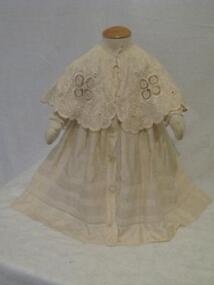
... This hand made cream silk baby's dress has a button through front with a cape style collar that has been embroided in cream on the front, and with scolloped edging all around.The bottom of the skirt has three rows of wide pin tucks just above the hem. ...This is one of only two Babies Dresses in the Learmonth and District Historical Society Inc. collection. clothing babys dress smocking family of joan charles haberdashery mrs cuthbertson hooper This hand made cream silk baby's dress has a button through front with a cape style collar that has been embroided in cream on the front, and with scolloped edging all around.The bottom of the skirt has three rows of wide pin tucks just above the hem. ...This baby's dress was possibly worn by Mrs Cuthbertson nee Hooper,after her birth in 1881,and was in the possesion of her daughter Joan Charles.This is one of only two Babies Dresses in the Learmonth and District Historical Society Inc. collection.This hand made cream silk baby's dress has a button through front with a cape style collar that has been embroided in cream on the front, and with scolloped edging all around.The bottom of the skirt has three rows of wide pin tucks just above the hem. clothing, babys dress, smocking, family of joan charles, haberdashery, mrs cuthbertson hooper -
 Flagstaff Hill Maritime Museum and Village
Clothing - Capelet, c. 20th century
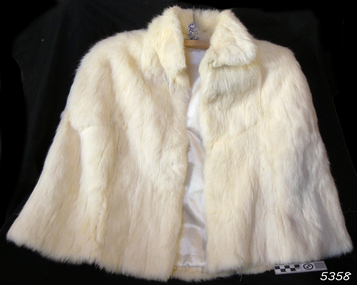
... A capelet is a small cape, usually worn around a person's shoulders and often chosen to wear with an evening outfit. The design may include a hood, collar or even ruffles. Fabrics range from fur, leather, velvet and wool to shear silk...A capelet is a small cape, usually worn around a person's shoulders and often chosen to wear with an evening outfit. The design may include a hood, collar or even ruffles. Fabrics range from fur, leather, velvet and wool to shear silk ...A capelet is a small cape, usually worn around a person's shoulders and often chosen to wear with an evening outfit. The design may include a hood, collar or even ruffles. Fabrics range from fur, leather, velvet and wool to shear silk and net. Trimmings include buttons, lace, ribbon, and tassels. A capelet was a fashionable garment from the late 19th to the early 20th centuries.Capelet with collar. White fur lined with white fabric. flagstaff hill, warrnambool, flagstaff-hill, flagstaff-hill-maritime-museum, maritime-museum, shipwreck-coast, flagstaff-hill-maritime-village, capelet, cape, evening wear, fur garment, fashion, edwardian, victorian, white fur -
 Bendigo Historical Society Inc.
Textile - Black and gold patterned evening cape, 1850s
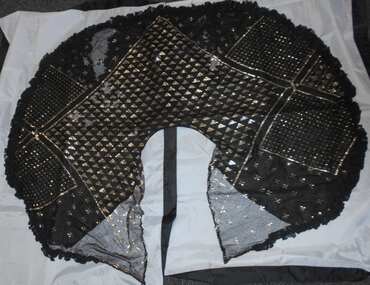
... Black and gold cape with lace trim lined with black silk....Black and gold cape with lace trim lined with black silk. Textile Black and gold patterned evening cape ...Jane Thornton married William Dixon in Northumberland in the 1850s. William Dixon was a pitman who was recruited in England to manage a mine at Eaglehawk. He arrived in about 1857 without his family. His wife Jane and three children arrived on the "Great Britain" in 1863. Two more children were born at Eaglehawk. William died on 28 March 1876. Jane died on 18 April 1884.Jane Thornton Collection: Woman's evening cape c.1850s. Black and gold cape with lace trim lined with black silk.evening wear, evening cape -
 Royal Australian and New Zealand College of Obstetricians & Gynaecologists (RANZCOG)
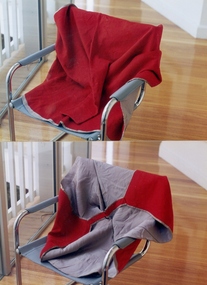
Academic cape associated with F J Browne
... Hooded academic cape, with attachment for a standard academic gown. Red wool with grey grosgrain silk lining. ...Browne FJ Clothing Hooded academic cape, with attachment for a standard academic gown. Red wool with grey grosgrain silk lining. ...This item was designed to be worn with an academic gown, and was possibly worn by FJ Browne at University of Edinburgh.Hooded academic cape, with attachment for a standard academic gown. Red wool with grey grosgrain silk lining. browne fj, clothing -
 Bendigo Historical Society Inc.
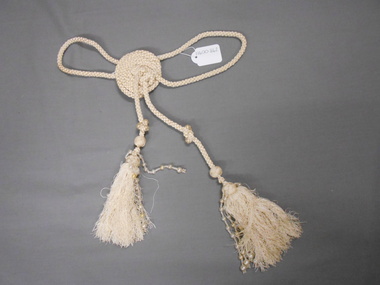
Clothing - DECORATIVE CORDING AND PEARL TRIMMED TASSEL, Tassel, 1920's - 30's,maybe1800's
... Cream silk, cord, wound into a 7cm diameter disk, with loops and decorative pearl trimmed tassel. Matching 11400.843, there is no evidence on the evening cape that it was at one time, attached. ...COSTUME ACCESSORIES Female decorative cord and pearl trimmed tassel Cream silk, cord, wound into a 7cm diameter disk, with loops and decorative pearl trimmed tassel. Matching 11400.843, there is no evidence on the evening cape that it was at one time, attached. ...Cream silk, cord, wound into a 7cm diameter disk, with loops and decorative pearl trimmed tassel. Matching 11400.843, there is no evidence on the evening cape that it was at one time, attached. This item may be a decorative item that was worn over the wrist, and added interest to the wearer of the cape. A ''turk's head'' woven ball'', 1.5cm diameter, and tassel head, add to this decorative item.costume accessories, female, decorative cord and pearl trimmed tassel -
 Bendigo Historical Society Inc.
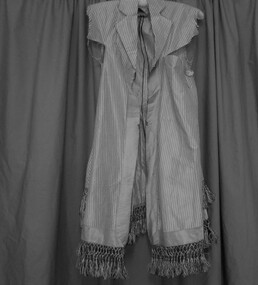
Clothing - GREY STRIPED FRINGED SLEEVELESS CAPE, (MATCHING SET WITH 11400.963), 1870's
... Sleeveless cape of black and silver striped silk. Un-lined. Sleeveless, with bound armholes. ...COSTUME Female grey striped fringing sleeveless cape Sleeveless cape of black and silver striped silk. Un-lined. Sleeveless, with bound armholes. ...Sleeveless cape of black and silver striped silk. Un-lined. Sleeveless, with bound armholes. Revered collar bound in silver silk. A 4.5 cm band of silver silk borders the front opening edges, and the hemline. 10 cm long black and silver fringing then borders the hemline; on the lower edge are two shield shaped patch pockets-one on either side of the front opening, and placed over the seams. Pockets have a fine binding on three sides and the 10cm deep black and silver fringing on lower edge.costume, female, grey striped fringing sleeveless cape -
 National Wool Museum
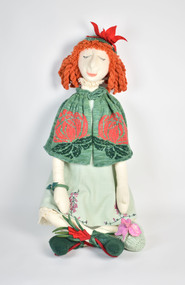
Textile - Doll, Geelong Handweavers and Spinners Guild Inc, Federation Flora, 2000
... silk. It is embroidered at the lower front with pink heath, the floral emblem of Victoria. She is wearing a cream woollen hand knitted underwear set consisting of singlet and pantaloons. The pantaloons have a fine hand knitted edge. Her shoes are of dark green felt with red kangaroo paw decoration. A green knitted cape...silk. It is embroidered at the lower front with pink heath, the floral emblem of Victoria. She is wearing a cream woollen hand knitted underwear set consisting of singlet and pantaloons. The pantaloons have a fine hand knitted edge. Her shoes are of dark green felt with red kangaroo paw decoration. A green knitted cape ..."Federaton Flora" was created by thirteen members of the Geelong Handweavers and Spinners Guild Inc for the centenary of Federation in Australia. It won 1st prize in the Australian Sheep and Wool Show, Bendigo, 2000.Large handmade doll featuring white felted wool with wooden disc joints and orange woollen, possibly hand spun, hair. The facial features have been formed with white stitching, eyelashes are embroidered with black cotton, the lips have been painted on. The doll is dressed in a pale green short sleeved dress, of hand spun wool, buttoned at the back and lined with pale green silk. It is embroidered at the lower front with pink heath, the floral emblem of Victoria. She is wearing a cream woollen hand knitted underwear set consisting of singlet and pantaloons. The pantaloons have a fine hand knitted edge. Her shoes are of dark green felt with red kangaroo paw decoration. A green knitted cape with red and dark green waratah decoration is tied around her neck and tied to her left arm is a small pale felted bangle. handicrafts, geelong handweavers and spinners guild inc., felting, hand spinning, hand knitting, weaving, bendigo, australian sheep and wool show, federation, flora, doll -
 Embroiderers Guild, Victoria
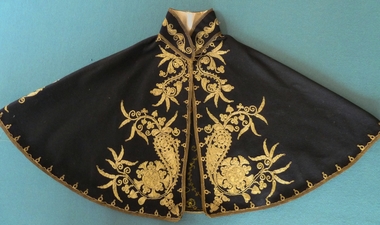
Clothing - 19th C Ottoman Turkish Wool and Goldwork Cape
... Victorian-era Ottoman Turkish capes from the 19th century are characterized by their luxurious materials, such as felted wool, velvet, or silk, and intensive hand-embroidered gold bullion thread (known as "Dival" or couched embroidery). ...Victorian-era Ottoman Turkish capes from the 19th century are characterized by their luxurious materials, such as felted wool, velvet, or silk, and intensive hand-embroidered gold bullion thread (known as "Dival" or couched embroidery). ...Victorian-era Ottoman Turkish capes from the 19th century are characterized by their luxurious materials, such as felted wool, velvet, or silk, and intensive hand-embroidered gold bullion thread (known as "Dival" or couched embroidery). These capes, which were often worn by urban elites, frequently feature high collars, short lengths designed to cover the arms, and intricate floral or paisley patterns. Key Characteristics & Design (19th Century): Fabric & Color: Deep black, red, cream, green, or blue "doeskin" wool or silk satin is common, often lined with bright silk. Goldwork: The defining feature is the lavish use of gold metallic couching stitches and gold bullion thread. Structure: Often high-collared, short-length shoulder capes, sometimes closed with a single ball and loop fastening at the neck. Origin: These were typically high-fashion items worn in large urban centres like Istanbul and İzmir during the late 19th century, influencing and being influenced by Western fashion trends. Black wool cape with stand-up collar. Interfaced, but lining missing. Heavily embroidered with gold metal thread. 0.8 mm gold metal braid round all edges and over neck seam. Gold metal thread embroidery in curvi-linear foliage style design on collar, centre back, front edges, lower side and small running design along bottom edge.goldwork, capes, capes, embroidery, gold work, wool, austrian -
 Stawell Historical Society Inc
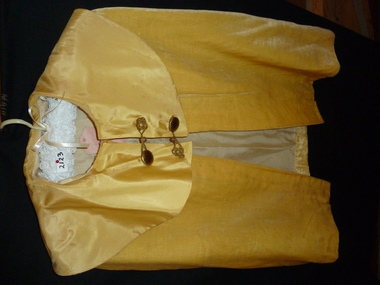
Clothing - Costume and Accessories, 1949
... Yellow Velvet Evening Cape with Taffeta Collar. Cream Silk Linings Gold Frog & Button Fastenings on collar. ...Stawell Clothing Material Yellow Velvet Evening Cape with Taffeta Collar. Cream Silk Linings Gold Frog & Button Fastenings on collar. ...Yellow Velvet Evening Cape with Taffeta Collar. Cream Silk Linings Gold Frog & Button Fastenings on collar. Waist Length. McClure collectionstawell clothing material
