
Showing 163 items matching "silver ball"
-
 Ballarat Heritage Services
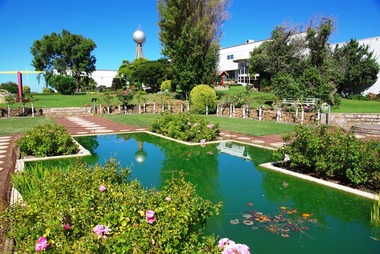
Digital Photograph, L.J. Gervasoni, Fletcher Jones Gardens, 2011
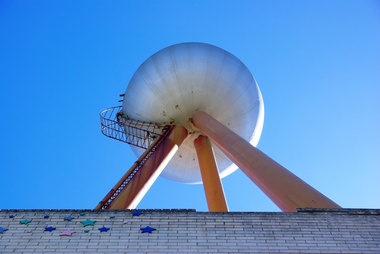
... ...silver ball...This image includes the silver ball (water tank). ...This image includes the silver ball (water tank). Fletcher Jones Gardens Digital Photograph L.J. ...The famous Fletcher Jones clothing factory boasted a beautiful garden for the use of its workers. After the factory closed the building and gardens were retained.Colour photograph of the Fletcher Jones Gardens, Warrnambool. This image includes the silver ball (water tank). fletcher jones, warrnambool, factory, gardens, heritage, silver ball -
 Warrnambool and District Historical Society Inc.
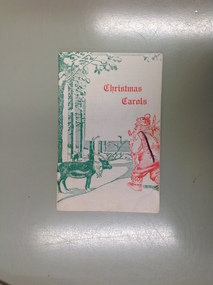
Booklet, Christmas Carols
... ...silver ball beauty salon...Warrnambool businesses included in the booklet include Dalton’s Highway Panels, Saunders Toys and Hobbies, Ted Wilson Motors, Bob Hagan & Staff, Elliots Cleaning, Silver Ball Beauty Salon, Shamrock Hotel, Hotel Criterion. ...Warrnambool businesses included in the booklet include Dalton’s Highway Panels, Saunders Toys and Hobbies, Ted Wilson Motors, Bob Hagan & Staff, Elliots Cleaning, Silver Ball Beauty Salon, Shamrock Hotel, Hotel Criterion. ...Warrnambool businesses included in the booklet include Dalton’s Highway Panels, Saunders Toys and Hobbies, Ted Wilson Motors, Bob Hagan & Staff, Elliots Cleaning, Silver Ball Beauty Salon, Shamrock Hotel, Hotel Criterion. The carols included are all well known.Contains a list of businesses in the 1970’s around Warrnambool and districtCream coloured card cover with red and green drawing of Santa Claus and reindeer. Back cover has advertisement for G I Panels of Hamilton and Merry Christmas in green in the bottom part of page. 47 pages. It contains words to carols on alternate pages with advertisements for businesses from Portland, Hamilton and Warrnambool.warrnambool, daltons highway panels warrnambool, saunder's toys and hobbies, ted wilson motors, bob hagan, elliots cleaning, silver ball beauty salon, shamrock hotel -
 Maccabi Victoria
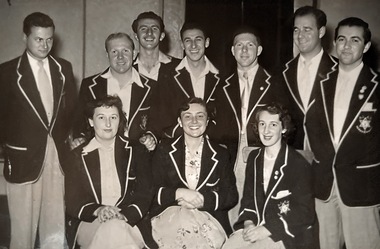
Photograph, 1957-1958
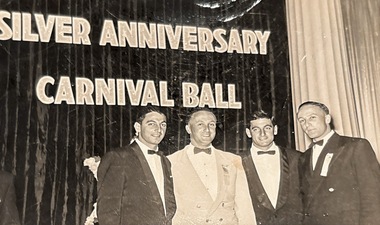
... Silver Anniversary Ball, in Melbourne...Photo of Silver Anniversary Carnival Ball. Held 1957/1958 in Melbourne...Silver Anniversary Ball, in Melbourne Maccabi Senior Carnival 25 Photo of Silver Anniversary Carnival Ball. ...Silver Anniversary Ball, in MelbournePhoto of Silver Anniversary Carnival Ball. Held 1957/1958 in Melbournemaccabi senior carnival 25 -
 Maccabi Victoria
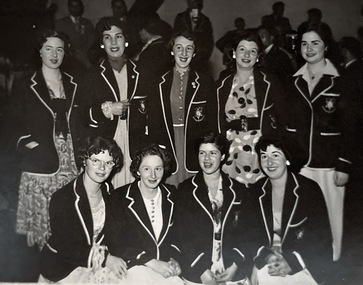
Photograph, 1957-1958
... Silver Anniversary Ball, in Melbourne...Photo of Silver Anniversary Carnival Ball. Held 1957/1958 in Melbourne...Silver Anniversary Ball, in Melbourne Maccabi Senior Carnival 25 Photo of Silver Anniversary Carnival Ball. ...Silver Anniversary Ball, in MelbournePhoto of Silver Anniversary Carnival Ball. Held 1957/1958 in Melbournemaccabi senior carnival 25 -
 Maccabi Victoria
Photograph, 1957-1958
... Silver Anniversary Ball, in Melbourne...Photo of Silver Anniversary Carnival Ball. Held 1957/1958 in Melbourne...Silver Anniversary Ball, in Melbourne Maccabi Senior Carnival 25 Photo of Silver Anniversary Carnival Ball. ...Silver Anniversary Ball, in MelbournePhoto of Silver Anniversary Carnival Ball. Held 1957/1958 in Melbournemaccabi senior carnival 25 -
 Ballarat Heritage Services
Photograph - Digital photographs, L.J. Gervasoni, Fletcher Jones Ball, Warrnambool, 2011, 2011
... ...silver ball...fletcher jones warrnambool factory heritage silver ball Fletcher Jones Ball Colour photograph of the Ball on top of the Fletcher Jones building in Warrnambool. ...Colour photograph of the Ball on top of the Fletcher Jones building in Warrnambool.fletcher jones, warrnambool, factory, heritage, silver ball, fletcher jones ball -
 Ballarat Heritage Services
Digital photographs, L.J. Gervasoni, Fletcher Jones Cross, 2011
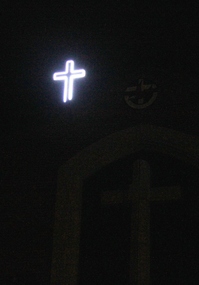
... ...silver ball...fletcher jones warrnambool factory heritage silver ball illuminated cross Colour photograph of an illuminated cross at the Fletcher Jones factory, Warrnambool. ...Colour photograph of an illuminated cross at the Fletcher Jones factory, Warrnambool.fletcher jones, warrnambool, factory, heritage, silver ball, illuminated cross -
 Wodonga & District Historical Society Inc
Accessory - Hat pins, c1920s
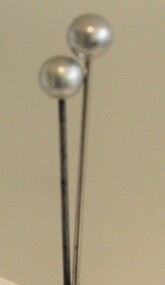
... A pair of simple hat pins with faux silver ball shaped head....Jean Raper. jewellery hat pins fashion accessory A pair of simple hat pins with faux silver ball shaped head. Hat pins Accessory Hat pins ...A hat pin is a decorative pin for holding a hat to the head. During the 1880s, bonnets gave way to hats, and the popularity of hatpins soared. They remained a standard women's accessory through the 1910s and were produced in a vast range of materials and types. They were typically around 20 cm in length, with the pinhead being the most decorated part. In some countries they were viewed as a potentially dangerous weapon which could be used by women in self-defence, so regulations were introduced to limit the length allowed. These hat pins were used c1900.This item is from the Raper Collection donated to the Wodonga Historical Society by Mrs. Jean Raper. A pair of simple hat pins with faux silver ball shaped head.jewellery, hat pins, fashion accessory -
 Tennis Australia
Pin, Circa 1890
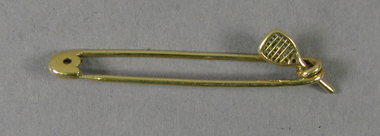
... Gold safety pin with gold racquet & silver ball motif attached. Materials: Gold/Metal, Silver/Metal...Tennis Gold safety pin with gold racquet & silver ball motif attached. Materials: Gold/Metal, Silver/Metal Pin ...Gold safety pin with gold racquet & silver ball motif attached. Materials: Gold/Metal, Silver/Metaltennis -
 Warrnambool and District Historical Society Inc.
Textile - Fire screen, Tapestry, Post 1967
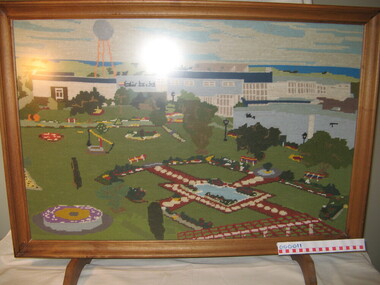
... The image of the gardens is after 1967 as the silver ball is included and that was erected in 1967. ...The image of the gardens is after 1967 as the silver ball is included and that was erected in 1967. ...David Fletcher Jones (1895-1977) was a travelling hawker who opened a business in Liebig Street, Warrnambool in 1924. In 1931 he opened The Man's Shop at the corner of Liebig Street and Koroit Street. He sold suits and overcoats tailored in the work rooms upstairs. In 1948 his factory known as Pleasant Hill was opened in Flaxman Street in Warrnambool, the site of an old quarry. In 1951 the company Fletcher Jones and Staff was formed with the staff owning 51% of the shares, By the 1970s Fletcher Jones and Staff had become one of the largest clothing companies in Australia with 55 shops and 3000 employees. In 1992 the Warrnambool City Council bought the factory and gardens with the site now a tourist attraction. Although the name is retained today for trading purposes the original Fletcher Jones company has been dissolved. The screen is a representation of the Fletcher Jones factory post 1967. It a wool tapestry by Martin Prider who was a painter and caretaker what the Fletcher Jones factory. He lived in one of the Fletcher Jones cottages on site. (Robin Boyd Age Small Homes Scheme, today Heritage listed.)This is an interesting memento of the Fletcher Jones company and the factory. It was done by a local resident and features the famous Fletcher Jones gardensTapestry fire screen in a rectangular light timber frame depicting the Fletcher Jones Factory Gardens. The screen has two timber feet, non relective glass and appears to be a wool tapestry. The image of the gardens is after 1967 as the silver ball is included and that was erected in 1967. Nilfletcher jones company and warrnambool factory, pleasant hill warrnambool, martin prider, fletcher jones, tapestry of fletcher jones factory -
 Kew Historical Society Inc
Award - Cricket ball trophy with engraved plaque, Kew Cricket Club, 1934
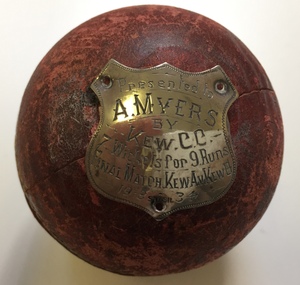
... Red leather cricket ball with silver plaque attached...Arthur Miers died in Kew on 25 January 1966, and after his body was cremated, his body was interred in the Mausoleum of Boroondara General (Kew) Cemetery. kew cricket club (vic.) arthur henry miers cricket balls cricket trophies trophies Presented to / A Myers [sic] / by / Kew Cricket Club / 7 wickets for 9 runs / Final Match Kew A v Kew B / 19.3.34 Red leather cricket ball with silver plaque attached Award Cricket ball trophy with engraved plaque Kew Cricket Club ...Arthur Henry Miers played for cricket, football and baseball teams in Kew for a number of decades in the first half of the twentieth century. He was born on 22 November 1901, the son of Rodolph Theophilus Miers (1874-1951) and Margaret Frances (Margaretta) Fry (1875-1958). He had two brothers, Rodolph Cecil Miers (1904-80) and Charles Wilfred Miers (1906-88), and a sister Marjorie Elizabeth Miers (1911-84). Arthur Miers died in Kew on 25 January 1966, and after his body was cremated, his body was interred in the Mausoleum of Boroondara General (Kew) Cemetery.Red leather cricket ball with silver plaque attachedPresented to / A Myers [sic] / by / Kew Cricket Club / 7 wickets for 9 runs / Final Match Kew A v Kew B / 19.3.34kew cricket club (vic.), arthur henry miers, cricket balls, cricket trophies, trophies -
 Heidelberg Golf Club
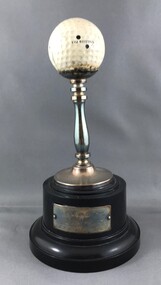
Memorabilia - Commemorative Golf Ball, Heidelberg Golf Club, New clubhouse opening 1998, 21/02/1998
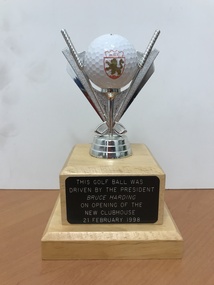
... Golf ball on silver coloured mount and timber base....Bruce Harding HGC clubhouse 1998 "This golf ball was driven by the President Bruce Harding on opening of the new clubhouse 21 February 1998" Golf ball on silver coloured mount and timber base. New clubhouse opening 1998 Memorabilia Commemorative Golf Ball Heidelberg Golf Club ...This golf ball was driven by the President Bruce Harding on opening of the new clubhouse 21 February 1998 at Heidelberg Golf Club.Golf ball on silver coloured mount and timber base."This golf ball was driven by the President Bruce Harding on opening of the new clubhouse 21 February 1998"bruce harding, hgc clubhouse 1998 -
 Heidelberg Golf Club
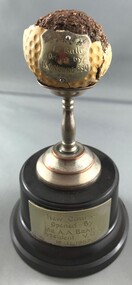
Memorabilia - Commemorative Golf Ball, Heidelberg Golf Club, Hole-in-one - John Wailes 1959, 30/08/1959
... Golf ball on silver coloured mount and bakelite base....John Wailes Hole in one golf balls "Hole-in-one - John Wailes - 12th hole, 242 yards, 30/08/1959" Golf ball on silver coloured mount and bakelite base. ...This golf ball was driven by John Wailes on 30/08/1959 for a hole in one on the 242yards 12th hole.Golf ball on silver coloured mount and bakelite base."Hole-in-one - John Wailes - 12th hole, 242 yards, 30/08/1959"john wailes, hole in one, golf balls -
 Heidelberg Golf Club
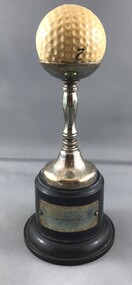
Memorabilia - Commemorative Golf Ball, Heidelberg Golf Club, New course opening 1967, 18/11/1967
... Golf ball on silver coloured mount and bakelite base....Brahe, President VGA. 18.11.1967" Golf ball on silver coloured mount and bakelite base. ...This golf ball was driven by H. G. Young on opening of the new course. Course opened by Mr A. A. Brahe, President VGA. 18/11/1967 at Heidelberg Golf Club. Mr Brahe was President of the Victorian Golf Association from 1965-70.Golf ball on silver coloured mount and bakelite base.On Ball: "1st ball driven by H. G. Young esq". On base: "New course opened by Mr A. A. Brahe, President VGA. 18.11.1967"hgc new course 1967, golf balls, a. a. brahe, h. g. young -
 Heidelberg Golf Club
Memorabilia - Commemorative Golf Ball, Hole-in-one - Eric McCutchan 1951, 04/10/1951
... Golf ball on silver coloured mount and bakelite base....Australian Open 4.10.51 'He played a Penfold'." Golf ball on silver coloured mount and bakelite base. ...This golf ball was driven by Eric McCutchan on 04/10/1951 for a hole in one on the 179 yards 13th hole at Metropolitan Golf Club.Golf ball on silver coloured mount and bakelite base."Eric McCutchan. Hole-in-one. 13th hole, 179 yards. Metropolitan G.C. Australian Open 4.10.51 'He played a Penfold'."hole in one, eric mccutchan, metropolitan golf club, australian open championship -
 Warrnambool and District Historical Society Inc.
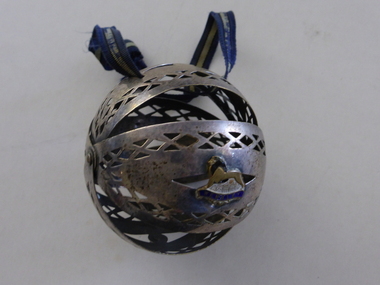
Decorative object - Artefact, Silver pomander - Wembley logo, 1924
... The Wembley emblem with the image of an Art Deco lion is welded onto one of the segments. This silver ball could also be used as a pomander to hold perfumed material and to be placed in a wardrobe or cupboard....The Wembley emblem with the image of an Art Deco lion is welded onto one of the segments. This silver ball could also be used as a pomander to hold perfumed material and to be placed in a wardrobe or cupboard. ...This silver wool-holder was sold as a souvenir at the British Empire Exhibition of 1924-5. This exhibition was staged to strengthen the bonds of the British Empire and 56 of the 58 nations or territories within the Empire participated. Wembley Stadium was built for the Exhibition and called then Empire Stadium. 27,000,000 visited the exhibition in the two years of is existence. Wembley Stadium survived until 2003 when it was rebuilt. This wool-holder is of interest as an example of the type of household item that would have been in a more affluent home in the 1920s. It is also of interest as an example of the type of souvenir sold at the British Empire Exhibition in 1924-5. It is a useful and attractive display item.This is a silver circular-shaped wool holder which was a souvenir of the British Empire Exhibition held at Wembley in 1924-5. It has four silver segments held together at each end with silver pins. The segments have an open fretwork pattern and can retract and open to allow material to be stored and to be easily accessible to the knitter or needleworker. The Wembley emblem with the image of an Art Deco lion is welded onto one of the segments. This silver ball could also be used as a pomander to hold perfumed material and to be placed in a wardrobe or cupboard.‘Wembley’ british empire exhibition, wembley 1924-5, pomander, wool holder -
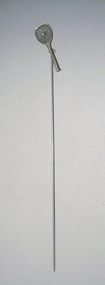 Tennis Australia
Hat pin, Circa 1900
... A silver hat pin featuring a tennis racquet and ball in silver at one end. ...Tennis A silver hat pin featuring a tennis racquet and ball in silver at one end. ...A silver hat pin featuring a tennis racquet and ball in silver at one end. Materials: Silver/Metaltennis -
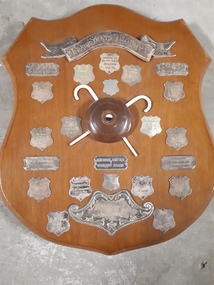 Vision Australia
Award - Image, Frank Yeats trophy, 1963-1979
... A brown wooden award depicting a wooden lawn bowls ball with two white metal canes crossed behind it. The award is inscribed with the following individual silver plates: Frank Yates Trophy -- Charlestown -- 8/6/63 J. ...Digital image of wooden shield with smaller silver plaques and wooden ball top crossed by mini white canes...Awards Royal Blind Society of New South Wales Digital image of wooden shield with smaller silver plaques and wooden ball top crossed by mini white canes Frank Yeats trophy Award Image Lifetime ...A brown wooden award depicting a wooden lawn bowls ball with two white metal canes crossed behind it. The award is inscribed with the following individual silver plates: Frank Yates Trophy -- Charlestown -- 8/6/63 J. McDonald, C. Dodd, R. Bramble, S. Mascord -- 5/10/63 J. McDonald, C. Dodd, R. Bramble, S. Mascord -- Balmain -- 13/6/64 C. Harlinar, R. O'Connor, H. Hussey, F. Yeats -- A. Snowden, K. Barron, D.Evans, P. Gilbert 1964 -- Balmain B.B.C. 9/4/72 -- William St. Blind W.B.C. Balmain 10/2/74 -- Balmain BBC 8/4/78 -- B.S.W.B.C. Enfield 1979 -- William St. Blind W.B.C. Balmain 31/5/70 -- Balmain B.B.C. 14/2/71 -- Partially Blinded Solders Assoc. NSW Branch -- Blind Women William Street v Blind Men Balmain -- Balmain Blind Bowling Combination -- P.B.S.A. 4 Rinks 22/8/65 -- William St. Blind W.B.C. Belfield B.C. 23/6/68 -- B.B.B.C. 1975 -- Balmain B.C. 15/10/67 -- B.B.B.C. 4 Rinks 27/2/66 -- Blamin B.B.C. 2/3/69 -- Balmain Charlestown -- Balmain B.B.C. 12/10/69.Digital image of wooden shield with smaller silver plaques and wooden ball top crossed by mini white canesawards, royal blind society of new south wales -
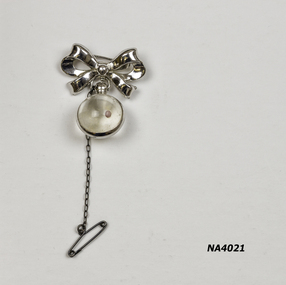 Whitehorse Historical Society Inc.
Accessory - Brooch
... Silver bow with glass ball suspended from bow and silver metal band. ...COSTUME ACCESSORIES Jewellery Silver bow with glass ball suspended from bow and silver metal band. ...Till CollectionTHE TILL COLLECTION SIGNIFICANCE STATEMENT|The significance of the Alwyn Till Collection is that Alwyn was born in Mitcham in 1921. He attended Mitcham Primary School and Box Hill Boys High School. He served his Community mainly through his activities within the Christ Church Anglican Church Mitcham. He joined the Royal Australian Airforce in World War II in September 1939. He trained as a Pilot in Australia and Canada, was posted to England and saw action in Europe. He was shot down over France and rescued by and then joined the French Resistance and while fighting with them was fatally shot. A Baron fighting with him wrote to his mother to inform her of his death.|Alwyn's parents were Evaleen Victoria Till (nee Maggs) and Sydney Norman Till who first lived in Creek Road Mitcham, before moving to 573 Whitehorse Road Mitcham. His father served in World War I where his eyesight was damaged and he was taught by the then Blind Institute in suitcase making of which we have two examples in this collection. He died in 1931. Alwyn took over responsibility for his mother and sister Alison. We can understand how devastated his mother and sister would have been at the news of Alwyn's feeling that he must serve his country in World War 11.|His letters home were so precious to them that they carefully kept all his correspondence, notices of death and condolences from friends. After Alison's death in 2007 her relation Joan Walker transcribed each of Alwyn's letters home into two bound volumes. The executors, Joan Walker and Anne Drew deposited the original letters with the Whitehorse Historical Society. Due to their significance as historical documents of one serviceman's complete correspondence with his family the Whitehorse Historical Society Committee after consultation with the donors deposited the original letters with the State Library of Victoria. The Whitehorse Historical Society retains the copies.|Alison and her mother kept many family memorabilia and personal items which make up this significant collection as they show how people lived, worked and served in the local community and municipality.|This collection represents the love and devotion of the women to their families during the course of two world wars. The father was disabled as a result of World War 1 and died an early death and a son who thereafter took on the responsibility as head of the family at an early age. This young handsome charismatic son served his community in peace time and gave his life in World War 11. This mother and sister were devoted to his memory.Silver bow with glass ball suspended from bow and silver metal band. A safety chain and pin is attachedcostume accessories, jewellery -
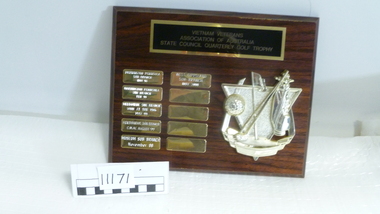 National Vietnam Veterans Museum (NVVM)
Plaque, Vitenam Veterans Golf Trophy
... Wooden Plaque with Silver Decal of Golf Ball, Tee & Flag & Golf Bag Together With Small Plaques for Engraving Trophy Winners...Plaque Golf Trophy Vietnam Veteran Association Of Australia State Council Quarterly Golf Trophy Wooden Plaque with Silver Decal of Golf Ball, Tee & Flag & Golf Bag Together With Small Plaques for Engraving Trophy Winners Vitenam Veterans Golf Trophy Plaque Plaque Fox Trophies And Engraving ...Wooden Plaque with Silver Decal of Golf Ball, Tee & Flag & Golf Bag Together With Small Plaques for Engraving Trophy WinnersVietnam Veteran Association Of Australia State Council Quarterly Golf Trophyplaque, golf trophy -
 City of Moorabbin Historical Society (Operating the Box Cottage Museum)
Personal Effects, lady's hat pins various x 14, c1880 - 1950
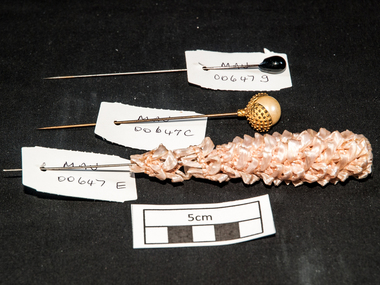
... 14 lady's steel hat pins in various styles numbered A -i A) 6x pearl tear-drop ; B) 1x pink metal beads;C) gold ball in 'oyster shell'; D) gold ball; E) pink plastic weave; F) silver metal ball; g) black bead; h) white ball; i) pale blue glass set in brass...This item is a reflection of the fashion mode of the late 19thC and early 20thC when long hair needed to be controlled by hair pins It is also an example of society's mores of tidiness moorabbin brighton early settlers pioneers cheltenham craftwork clothing 14 lady's steel hat pins in various styles numbered A -i A) 6x pearl tear-drop ; B) 1x pink metal beads;C) gold ball in 'oyster shell'; D) gold ball; E) pink plastic weave; F) silver metal ball; g) black bead; h) white ball; i) pale blue glass set in brass Personal Effects, lady's hat pins various x 14 Unrecorded resident ...These hat pins represents women's fashion in the late 19thC and early 20thC. As the material used in the construction is not of a high monetary value it can be assumed it was everyday woman's apparel to keep the hat firmly fastened into the hair. It does indicate that fashion of the time was important and many women used their craftwork skills to create their own hat pins. This item is a reflection of the fashion mode of the late 19thC and early 20thC when long hair needed to be controlled by hair pins It is also an example of society's mores of tidiness 14 lady's steel hat pins in various styles numbered A -i A) 6x pearl tear-drop ; B) 1x pink metal beads;C) gold ball in 'oyster shell'; D) gold ball; E) pink plastic weave; F) silver metal ball; g) black bead; h) white ball; i) pale blue glass set in brassmoorabbin, brighton, early settlers, pioneers, cheltenham, craftwork, clothing -
 National Wool Museum
Award - Victorian Soccer Football Association, Geelong and District Soccer Football Association Shield, 1926
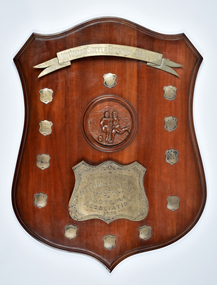
... Wooden shield with central circular carved wooden medallion depicting two soccer players and ball. Silver ribbon at top of shield and a lower silver shield are inscribed. ...Wooden shield with central circular carved wooden medallion depicting two soccer players and ball. Silver ribbon at top of shield and a lower silver shield are inscribed. ...Acquired when "Classweave Industries" closed down.Wooden shield with central circular carved wooden medallion depicting two soccer players and ball. Silver ribbon at top of shield and a lower silver shield are inscribed. Around the edges of the wooden shield are 12 silver medallions, also in the shape of shields. These have also been inscribed however most of the inscriptions are illegible. Victorian Soccer Football Association/ Geelong and District Soccer Football Association, 1926/ H L S POTTER/ PHOTO STORES/...textile mills woollen mills textile mills - staff sporting teams textile mills - sporting teams, classweave industries pty ltd federal woollen mills ltd, sport, textile mills, woollen mills, textile mills - staff, sporting teams, textile mills - sporting teams, award, trophy, shield -
 Whitehorse Historical Society Inc.
Equipment - Natural Gas Conversion Testing Kit
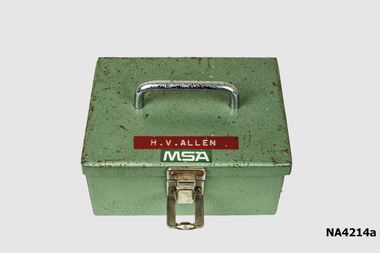
... Gas testing kit in green metal box, with silver handle and clasp (silver colour)|2. Suction ball and pump body.|3. Detector tubes of glass capillary. 4. ...Gas testing kit in green metal box, with silver handle and clasp (silver colour)|2. Suction ball and pump body.|3. Detector tubes of glass capillary. 4. ...All items belonged to Harold Victor Allen who worked for Colonial Gas Association Ltd. Firstly at Footscray and then Box Hill in the 1960's. Retired in 1971. Born in Ballarat in 1906. Apprenticed and worked there till 1945, then moved to Footscray. Eileen, his wife, worked with Harold, helping with the Natural Gas Conversion during Harold's Box Hill time.Change over in Victoria from Gas fired gas supply to Natural Gas supply to Victoria from about 1965 -1. Gas testing kit in green metal box, with silver handle and clasp (silver colour)|2. Suction ball and pump body.|3. Detector tubes of glass capillary. 4. Instruction Manual. 5. Sealing cap ( box of 10) All spare parts |6. Natural Gas Conversion Badge.H.V.Allen MSAgas technology, appliances & accessories -
 Melbourne Legacy
Newspaper - Article, 'Gown of the Year', 1959
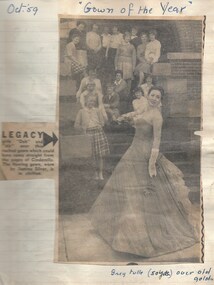
... The newspaper clipping shows a photo of junior legatee girls on the steps of Stanhope watching Justine Silver model a ball gown. The caption says 'Legacy girls "Ooh" and "Ah" over this ruched gown which could have come straight from the pages of Cinderella. ...The newspaper clipping shows a photo of junior legatee girls on the steps of Stanhope watching Justine Silver model a ball gown. The caption says 'Legacy girls "Ooh" and "Ah" over this ruched gown which could have come straight from the pages of Cinderella. ...A newspaper clipping about the 'Gown of the Year' from a book compiled about the Legacy children's residence called Stanhope. The newspaper clipping shows a photo of junior legatee girls on the steps of Stanhope watching Justine Silver model a ball gown. The caption says 'Legacy girls "Ooh" and "Ah" over this ruched gown which could have come straight from the pages of Cinderella. The flowing gown, worn by Justine Silver, is in chiffon.' The note below the picture adds 'Grey tulle (50 yds) over old gold'. The Gown of the Year was annual event modelling the latest ball fashions with the proceeds going to Legacy. Stanhope was supervised by Matron Dorothy (Dorrie) Vines from the time it opened in 1946 until she retired in December 1966. It is likely she compiled this notebook as she is referred to as 'self' in one photo. Individual pages of photos or newspaper clippings have been added separately. Items 01817 to 01834. Stanhope was a residence run by Melbourne Legacy to take care of children whose fathers were deceased servicemen, and who may have been left orphans, or whose mother may have been unable to care for them herself, or they needed to stay in Melbourne for further education. Generally Stanhope looked after girls over 14. The children were cared for until they were old enough to become independent. A record of Stanhope being used as the setting for publicity for the Gown of the Year gala.Newspaper clipping of a girl modelling a gown for girls on the steps of Stanhope in October 1959.stanhope, gala performance -
 The 5th/6th Battalion Royal Victoria Regiment Historical Collection
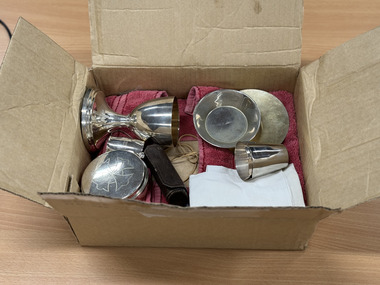
Ceremonial object - Communion Kit- Rev J.J. Tresidder
... On the side of the container is a small silver ball with a hole drilled through it to allow a string to be placed through and the Pyx to be worn around the priests neck. ...On the side of the container is a small silver ball with a hole drilled through it to allow a string to be placed through and the Pyx to be worn around the priests neck. ...Catholic Chaplains Communion kit carried by Rev JJ Tresidder. Rev Tresidder served during the second world war as an Army Chaplian.Catholic Chaplians Communition kit, carried by WW2 chaplain VX117292 John Joseph Tressider. This is an example of the style of equipment, soldiers would have been offered communion from.Communion kit, consisting of 10 items. 1. A white linen Corporal with small red cross embroidered in its centre. This item was used during Mass/ communion/ Lords Supper to collect any host if it were to be dropped, especially after concecration. 2. Pyx. This is a flat circular dish with a hinged lid. On the side of the container is a small silver ball with a hole drilled through it to allow a string to be placed through and the Pyx to be worn around the priests neck. The Pyx is made of silver, and has a cross engraved on the lid. on the reverse " Rev. J.J.Tressider Catholic Chaplain" is enscribed. This item holds individual hosts ( bread) Following Concecration hosts are to be consumed or worn by the Priest and later to be distrubted as reserved sacrement. 3.Paten, a small silver dish, slightly bowing in the centre. There are no engraving on this item except for the makers stamps on the reverse. "T.G. Aunt & Co." " STG. Silver" Use for holding the Priests Host (Bread) representing the body of Christ, broken for all. 4. Chalice. Silver cup with flaired base.The inseide of the cup has a gold coloured appearence. On the base is a small raised silver cruisifix affixed by a screw. The Chalice was used asa a cup for holding water and wine, drunk from by all as a common cup, beginning and ending with the Priest. 5&6. Two silver Cruets. Each crust is a small silver jug with sloping sides with a small pinched lip for pouring. There are no handles and each cruet has the words " Catholic Chaplain" enscribed on its side. One of the cruets is used for adding a small amount of water to the chalice, representing Christs humanity, the outher is used to add a small amount of wine, representing the blood of Christ and divinity. 7. Lavabo Bowl. a small silver bowl with raised sides. The bowl has " Catholic Chaplain" inscribed in the base of the disg. The Lavabo bowl is used to wash the Priests hands prior to celebrating the Mass. 8. Ewer. A small silver water jug with a curled handle. The Ewer has 3 bands engraved arounf its middle and inside has a goldish tint. On its base is stamped "Albion Pla" "EPNS A" The Ewer is used to wash the priests hands prior to Mass. 9. Oil for the infirm- A small sliver canister that can be screwed to two similat canasters. The base has an internal screw thread to allow this to happen. The lid can be screwed on/ off and has an ornate cross enscribed on its top. The side of the canaster has a letter "I" incribed on it filling most of the canasters side. The canaster is believed to still contain the oil. The oil of the infirm is used outside of the mass in a service to administer the sacrement of the anointing of the sick. 10, Leather Oil Carry case, small, chocolate brown tubular carrying case with two snaps for closure on the side. the case has cardboard stiffening and a small amount of cottonwool to soak up any spilt oil. Case is used to carry upto three oil canasters. listed in descriptioncatholic church, 5/6rvr, chaplains kit -
 Flagstaff Hill Maritime Museum and Village
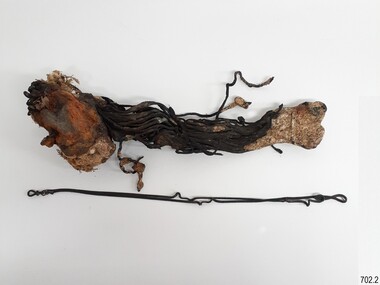
Functional object - Watch Chains, ca 1855
... silver watch chains was recovered from the wreck of the Schomberg over one hundred years later. Schomberg was a large three-masted full-ship rigged wooden ship built in 1855 by Alexander Hall and Co in Aberdeen, Scotland for James Baines' famous Black Ball Line at £43,103. ...silver watch chains was recovered from the wreck of the Schomberg over one hundred years later. Schomberg was a large three-masted full-ship rigged wooden ship built in 1855 by Alexander Hall and Co in Aberdeen, Scotland for James Baines' famous Black Ball Line at £43,103. ...The concretion of silver watch chains was recovered from the wreck of the Schomberg over one hundred years later. Schomberg was a large three-masted full-ship rigged wooden ship built in 1855 by Alexander Hall and Co in Aberdeen, Scotland for James Baines' famous Black Ball Line at £43,103. The vessel was 288 feet (88 meters) in length, with a beam of 45 feet (14 meters), a depth of 29.5 feet (8.99 meters) of 2,284 tons. The mainmast was 210 feet (64 meters) high and she carried 3.3 acres of sail. The vessel was constructed with three skins. One planked fore and aft, and two diagonally planked, fastened together with screw-threaded trunnels (wooden rails). The Schomberg is one of only three clipper wrecks in Victorian waters that operated the England -to- Australia run. While the other two, Empress of the Sea and Lightning, were built by the famous American shipbuilder, Donald Mac Kay. Schomberg was an attempt to build a faster ship than Mac Kay and a vessel fast enough to break the sailing record to Australia. The Schomberg sailed on her maiden voyage from Liverpool on 6 October 1855, under the command of Captain James Forbes, on its maiden voyage to Australia with general cargo, jewellery, spirits, machinery, and 2,000 tons of iron rails and equipment intended to build the Melbourne to Geelong Railway and a bridge over the Yarra from Melbourne to Hawthorn. She also carried a cow for fresh milk, pens for fowls and pigs, plus 90,000 gallons of water for washing and drinking. She also carried 17,000 letters and 31,800 newspapers. There were approximately 473 passengers and a crew of 105. It was hoped that Schomberg would make Melbourne in sixty days, setting a record for the voyage, but light winds at the equator dashed those expectations. The ship sighted Moonlight Head in southwest Victoria on Christmas Day but through a deadly combination of wind, currents and unmarked sand spits, the vessel gently ran aground on 26 December 1855 on a spit that juts into Newfield Bay, just east of Curdies Inlet, and the present town of Peterborough. Fortunately, the SS Queen was nearby and managed to save all passengers and crew. The steamers Keera and Maitland were dispatched to salvage the passenger's baggage and the more valuable cargo. Other salvage attempts were made, but deteriorating weather made the work impossible, and within two weeks the Schomberg's hull was broken up and the vessel abandoned. The wrecking of the Schomberg caused quite a public stir, particularly in light of the fact the vessel was supposed to be, the most perfect clipper ship ever built. Captain Forbes was charged in the Supreme Court under suspicion that he was playing cards with two female passengers below decks when his ship ran aground. Despite a protest meeting, two inquiries and the court proceedings, he was found not guilty and cleared of all charges. In 1975, divers from Flagstaff Hill, including Peter Ronald, found an ornate communion set at the wreck. The set comprised a jug, two chalices, a plate and a lid. The lid did not fit any of the other objects and in 1978 a piece of the lid broke off, revealing a glint of gold. As museum staff carefully examined the lid and removed marine growth, they found a diamond ring, which is currently on display in the Great Circle Gallery at the Flagstaff Hill Maritime Museum that also displays ship fittings and equipment, and personal effects. Most of the artefacts were salvaged from the wreck by Peter Ronald, former director of Flagstaff Hill.The Schomberg has historical significance as one of the first luxurious ships built to bring emigrants to Australia to cash in on the gold rush era. And is included on the Victorian Heritage Register (VHR S612). The collection of Schomberg artefacts held at Flagstaff Hill Museum is primarily significant because of the relationship between these recovered items having a high potential to interpret the story of the Schomberg and its foundering during a storm. The shipwreck is of additional historically significance for representing aspects of Victoria’s shipping history and for its association with the first passenger ship, which was designed not only to be the fastest and most luxurious of its day but foundered on its maiden voyage to Australia.Conglomerated cluster of silver watch chains, encased in concretion at both ends (1 chain is separated). They were recovered from the wreck of the Schomberg.warrnambool, flagstaff-hill, flagstaff-hill-maritime-museum, shipwreck-coast, flagstaff-hill-maritime-village, schomberg, shipwrecked-artefact, clipper ship, black ball line, 1855 shipwreck, aberdeen clipper ship, captain forbes, peterborough shipwreck, ss queen, watch chain -
 Flagstaff Hill Maritime Museum and Village
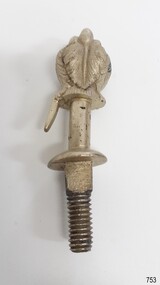
Decorative object - Buggy Fitting, Circa 1855
... The shipwreck is of additional historically significance for representing aspects of Victoria’s shipping history and for its association with the first passenger ship, which was designed not only to be the fastest and most luxurious of its day but foundered on its maiden voyage to Australia. warrnambool flagstaff-hill flagstaff-hill-maritime-museum shipwreck-coast flagstaff-hill-maritime-village schomberg shipwrecked-artefact clipper ship black ball line 1855 shipwreck aberdeen clipper ship captain forbes peterborough shipwreck ss queen Artifact ornate fitting buggy fitting Ornate buggy or coach fitting with feather plumes on top, and a screw thread on the bottom. Silver ...This ornate fitting for a horse-drawn vehicle was amongst the items recovered from the Schomberg over one hundred years after it was wrecked. ABOUT THE SCHOMBERG (October 6 to December 27, 1855)- When the ship Schomberg was launched in 1855, she was considered the most perfect clipper ship ever to be built. James Baine’s Black Ball Line had commissioned her for their fleet of passenger liners. The Aberdeen builders designed her to sail faster than the clippers designed the three-masted wooden clipper ship to be fast. The timber used for the diagonal planking was British oak with layers of Scottish larch. This luxury emigrant vessel was designed for superior comfort. She had ventilation ducts to provide air to the lower decks and a dining saloon, smoking room, library and bathrooms for the first-class passengers. The master for Schomberg’s maiden voyage was Captain ‘Bully’ Forbes. He drunkenly predicted at her launch that he would make the journey between Liverpool and Melbourne in 60 days. Schomberg departed Liverpool on 6 October 1855 with 430 passengers and 3000 tons of cargo including iron rails and equipment intended the build the Geelong Railway and a bridge over the Yarra from Melbourne to Hawthorn. The poor winds slowed Schomberg’s sail across the equator. She was 78 days out of Liverpool when she ran aground on a sand spit near Peterborough, Victoria, on 27 December; the sand spit and currents were not marked on Forbes’s map. The ship’s Chief Officer spotted the coastal steamer SS Queen at dawn and sent a signal. The master of the SS Queen approached the stranded vessel and all of Schomberg’s passengers safely disembarked. In 1975, 120 years after the Schomberg was wrecked, divers from Flagstaff Hill found an ornate communion set at the wreck site along with many other artefacts. In 1978 a diamond ring was discovered under the concretion in the lid of the communion set, which is currently on display. Former Director of Flagstaff Hill, Peter Ronald, had salvaged most of the artefacts from the wreck. The Schomberg has historical significance as one of the first luxurious ships built to bring emigrants to Australia to cash in on the gold rush era. And is included on the Victorian Heritage Register (VHR S612). The collection of Schomberg artefacts held at Flagstaff Hill Museum is primarily significant because of the relationship between these recovered items having a high potential to interpret the story of the Schomberg and its foundering during a storm. The shipwreck is of additional historically significance for representing aspects of Victoria’s shipping history and for its association with the first passenger ship, which was designed not only to be the fastest and most luxurious of its day but foundered on its maiden voyage to Australia.Ornate buggy or coach fitting with feather plumes on top, and a screw thread on the bottom. Silver plated,.warrnambool, flagstaff-hill, flagstaff-hill-maritime-museum, shipwreck-coast, flagstaff-hill-maritime-village, schomberg, shipwrecked-artefact, clipper ship, black ball line, 1855 shipwreck, aberdeen clipper ship, captain forbes, peterborough shipwreck, ss queen, artifact, ornate fitting, buggy fitting -
 Flagstaff Hill Maritime Museum and Village
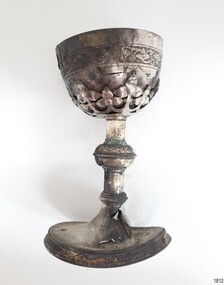
Ceremonial object - Chalice, 1855 or earlier
... Flagstaff Hill Flagstaff Hill Maritime Museum and Village Warrnambool Maritime Museum Maritime Village Great Ocean Road Shipwreck Coast Schomberg 1855 clipper ship James Baines & Co Black Ball line luxury ship emigrant ship Captain Forbes Bully Forbes SS Queen Peterborough shipwreck Communion Set religious service communion service ceremonial service Mass chalice White sticker attached to the base of the chalice Chalice; electroplated silver metal over metal, possibly nickle. ...In 1975, divers from Flagstaff Hill, found an ornate communion set used to celebrate the Eucharist or holy communion by a number of different Christian faiths was recovered from the wreck of the Schomberg. The set comprised a jug, two chalices, a plate and a lid. The lid did not fit any of the other objects and in 1978 a piece of the lid broke off, revealing a glint of gold. As museum staff carefully examined the lid and removed marine growth, they found a diamond ring, which is currently on display in the Great Circle Gallery at Flagstaff Hill. The collection of artefacts from the Schomberg also contains ship fittings and equipment, personal effects, a lithograph, tickets and a photograph from the Schomberg. Most of the artefacts were salvaged from the wreck by Peter Ronald a former director of Flagstaff Hill maritime museum. The Schomberg was a large three-masted full-ship rigged wooden ship built in 1855 by Alexander Hall and Co in Aberdeen, Scotland for James Baines' famous Black Ball Line at £43,103. The vessel was 288 feet (88 meters) in length, with a beam of 45 feet (14 meters), a depth of 29.5 feet (8.99 meters) of 2,284 tons. The mainmast was 210 feet (64 meters) high and she carried 3.3 acres of sail. The vessel was constructed with three skins. One planked fore and aft, and two diagonally planked, fastened together with screw-threaded trunnels (wooden rails). The Schomberg is one of only three clipper wrecks in Victorian waters that operated the England to Australia run. While the other two, Empress of the Sea and Lightning, were built by the famous American shipbuilder, Donald Mac Kay. Schomberg was an attempt to build a faster ship than Mac Kay and a vessel fast enough to break the sailing record to Australia. The Schomberg sailed on her maiden voyage from Liverpool on 6 October 1855, under the command of Captain James Forbes, on its maiden voyage to Australia with a general cargo, jewellery, spirits, machinery, and 2,000 tons of iron rails and equipment intended to build the Melbourne to Geelong Railway and a bridge over the Yarra from Melbourne to Hawthorn. She also carried a cow for fresh milk, pens for fowls and pigs, plus 90,000 gallons of water for washing and drinking. She also carried 17,000 letters and 31,800 newspapers. There were approximately 473 passengers and a crew of 105. It was hoped that Schomberg would make Melbourne in sixty days, setting a record for the voyage, but light winds at the equator dashed those expectations. The ship sighted Moonlight Head in south west Victoria on Christmas Day but through a deadly combination of wind, currents and unmarked sand spits, the vessel gently ran aground on 26 December 1855 on a spit that juts into Newfield Bay, just east of Curdies Inlet, and the present town of Peterborough. Fortunately, the SS Queen was nearby and managed to save all passengers and crew. The steamers Keera and Maitland were dispatched to salvage the passenger's baggage and the more valuable cargo. Other salvage attempts were made, but deteriorating weather made the work impossible, and within two weeks the Schomberg's hull was broken up and the vessel abandoned. The wrecking of the Schomberg caused quite the public stir particularly in light of the fact the vessel was supposed to be, the most perfect clipper ship ever built. Captain Forbes was charged in the Supreme Court under suspicion that he was playing cards with two female passengers below decks when his ship ran aground. Despite a protest meeting, two inquiries and the court proceedings, he was found not guilty and cleared of all charges. In 1975, divers from Flagstaff Hill, including Peter Ronald, found an ornate communion set at the wreck. The set comprised a jug, two chalices, a plate and a lid. The lid did not fit any of the other objects and in 1978 a piece of the lid broke off, revealing a glint of gold. As museum staff carefully examined the lid and removed marine growth, they found a diamond ring, which is currently on display in the Great Circle Gallery at the Flagstaff Hill Maritime museum that also displays ship fittings and equipment, personal effects. Most of the artefacts were salvaged from the wreck by Peter Ronald, former director of Flagstaff Hill.This chalice is significant as an example of an item in common use in the mid-19th century that is still in use today. The Schomberg has historical significance as one of the first luxurious ships built to bring emigrants to Australia to cash in on the gold rush era. And is included on the Victorian Heritage Register (VHR S612). The collection of Schomberg artefacts held at Flagstaff Hill Museum is primarily significant because of the relationship between these recovered items having a high potential to interpret the story of the Schomberg and its foundering during a storm. The shipwreck is of additional historical significance for representing aspects of Victoria’s shipping history and for its association with the first passenger ship, which was designed not only to be the fastest and most luxurious of its day but foundered on its maiden voyage to Australia.Chalice; electroplated silver metal over metal, possibly nickle. The chalice has a wide bowl with an outer layer of intricately cut metal on the underside and a ribbon-like border of grapes and grapevine leaves is etched around it. It is supported by a tall stem with a circular knob partway down its length, and the stem is attached to a round base that is hollow underneath. The decorative pattern around the perimeter of the base is repeated on the knob on the stem. The base also has a pattern of lines around the vertical edge. There is a white sticker attached to the underside of the base. Its inscription is undecipherable. The chalice is part of a Communion set that was recovered from the wreck of the Schomberg. White sticker attached to the base of the chaliceflagstaff hill, flagstaff hill maritime museum and village, warrnambool, maritime museum, maritime village, great ocean road, shipwreck coast, schomberg, 1855, clipper ship, james baines & co, black ball line, luxury ship, emigrant ship, captain forbes, bully forbes, ss queen, peterborough shipwreck, communion set, religious service, communion service, ceremonial service, mass, chalice -
 Flagstaff Hill Maritime Museum and Village
Ceremonial object - Cruet and lid, 1855 or earlier
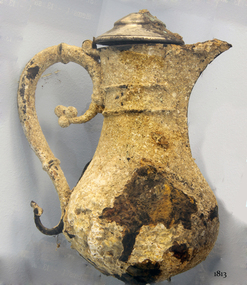
... The shipwreck is of additional historical significance for representing aspects of Victoria’s shipping history and for its association with the first passenger ship, which was designed not only to be the fastest and most luxurious of its day but foundered on its maiden voyage to Australia. warrnambool flagstaff-hill flagstaff-hill-maritime-museum shipwreck-coast flagstaff-hill-maritime-village schomberg shipwrecked-artefact clipper ship black ball line 1855 shipwreck aberdeen clipper ship captain forbes peterborough shipwreck ss queen schomberg jug or cruet jug or cruet schomberg communion set jug cruet and lid cruet Communion Set religious service communion service ceremonial service Mass Cruet and lid; electroplated silver metal over metal, possibly nickle. ...In 1975, divers from Flagstaff Hill, found an ornate communion set used to celebrate the Eucharist or holy communion by a number of different Christian faiths was recovered from the wreck of the Schomberg. The set comprised a cruet or jug, two chalices, a plate and a lid. The lid did not fit any of the other objects and in 1978 a piece of the lid broke off, revealing a glint of gold. As museum staff carefully examined the lid and removed marine growth, they found a diamond ring, which is currently on display in the Great Circle Gallery at Flagstaff Hill. The collection of artefacts from the Schomberg also contains ship fittings and equipment, personal effects, a lithograph, tickets and a photograph from the Schomberg. Most of the artefacts were salvaged from the wreck by Peter Ronald a former director of Flagstaff Hill maritime museum. The Schomberg was a large three-masted full-ship rigged wooden ship built in 1855 by Alexander Hall and Co in Aberdeen, Scotland for James Baines' famous Black Ball Line at £43,103. The vessel was 288 feet (88 meters) in length, with a beam of 45 feet (14 meters), a depth of 29.5 feet (8.99 meters) of 2,284 tons. The mainmast was 210 feet (64 meters) high and she carried 3.3 acres of sail. The vessel was constructed with three skins. One planked fore and aft, and two diagonally planked, fastened together with screw-threaded trunnels (wooden rails). The Schomberg is one of only three clipper wrecks in Victorian waters that operated the England-to-Australia run. While the other two, Empress of the Sea and Lightning, were built by the famous American shipbuilder, Donald Mac Kay. Schomberg was an attempt to build a faster ship than Mac Kay and a vessel fast enough to break the sailing record to Australia. The Schomberg sailed on her maiden voyage from Liverpool on 6 October 1855, under the command of Captain James Forbes, on its maiden voyage to Australia with general cargo, jewellery, spirits, machinery, and 2,000 tons of iron rails and equipment intended to build the Melbourne to Geelong Railway and a bridge over the Yarra from Melbourne to Hawthorn. She also carried a cow for fresh milk, pens for fowls and pigs, plus 90,000 gallons of water for washing and drinking. She also carried 17,000 letters and 31,800 newspapers. There were approximately 473 passengers and a crew of 105. It was hoped that Schomberg would make Melbourne in sixty days, setting a record for the voyage, but light winds at the equator dashed those expectations. The ship sighted Moonlight Head in southwest Victoria on Christmas Day but through a deadly combination of wind, currents and unmarked sand spits, the vessel gently ran aground on 26 December 1855 on a spit that juts into Newfield Bay, just east of Curdies Inlet, and the present town of Peterborough. Fortunately, the SS Queen was nearby and managed to save all passengers and crew. The steamers Keera and Maitland were dispatched to salvage the passenger's baggage and the more valuable cargo. Other salvage attempts were made, but deteriorating weather made the work impossible, and within two weeks the Schomberg's hull was broken up and the vessel abandoned. The wrecking of the Schomberg caused quite a public stir, particularly in light of the fact the vessel was supposed to be, the most perfect clipper ship ever built. Captain Forbes was charged in the Supreme Court under suspicion that he was playing cards with two female passengers below decks when his ship ran aground. Despite a protest meeting, two inquiries and the court proceedings, he was found not guilty and cleared of all charges. In 1975, divers from Flagstaff Hill, including Peter Ronald, found an ornate communion set at the wreck. The set comprised a jug, two chalices, a plate and a lid. The lid did not fit any of the other objects and in 1978 a piece of the lid broke off, revealing a glint of gold. As museum staff carefully examined the lid and removed marine growth, they found a diamond ring, which is currently on display in the Great Circle Gallery at the Flagstaff Hill Maritime Museum that also displays ship fittings and equipment, and personal effects. Most of the artefacts were salvaged from the wreck by Peter Ronald, former director of Flagstaff Hill.This object is significant as an example of an item in common use in the mid-19th century that is still in use today. The Schomberg has historical significance as one of the first luxurious ships built to bring emigrants to Australia to cash in on the gold rush era. And is included on the Victorian Heritage Register (VHR S612). The collection of Schomberg artefacts held at Flagstaff Hill Museum is primarily significant because of the relationship between these recovered items having a high potential to interpret the story of the Schomberg and its foundering during a storm. The shipwreck is of additional historical significance for representing aspects of Victoria’s shipping history and for its association with the first passenger ship, which was designed not only to be the fastest and most luxurious of its day but foundered on its maiden voyage to Australia.Cruet and lid; electroplated silver metal over metal, possibly nickle. The cruet has a wide bowl large handle .The round domed lid has a pattern around the border. The cruet and lid are part of a Communion set that was recovered from the wreck of the Schomberg.warrnambool, flagstaff-hill, flagstaff-hill-maritime-museum, shipwreck-coast, flagstaff-hill-maritime-village, schomberg, shipwrecked-artefact, clipper ship, black ball line, 1855 shipwreck, aberdeen clipper ship, captain forbes, peterborough shipwreck, ss queen, schomberg jug or cruet, jug or cruet, schomberg communion set, jug, cruet and lid, cruet, communion set, religious service, communion service, ceremonial service, mass -
 Flagstaff Hill Maritime Museum and Village
Functional object - Bell, Schomberg 1855, Before 1855
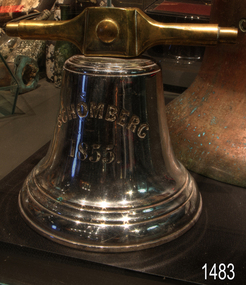
... silver plated bell...mess bell...bell stands...captain ‘bully’ Forbes...alexander hall and son...James Baines and company...Liverpool’s black ball...silver surface. The Sailing Ship Schomberg: Launched in 1855, the Schomberg was regarded as the “Noblest” ship afloat at the time. Owned by the Black Ball...silver surface. The Sailing Ship Schomberg: Launched in 1855, the Schomberg was regarded as the “Noblest” ship afloat at the time. Owned by the Black Ball ...The Rescue and Journey of the Schomberg Bells: This bell was the smaller of two rescued by the crew of the Schomberg following the ship’s wreck in 1855. While the specific purpose of the smaller bell is unknown, it may have served to assemble the crew or signal mealtimes on board. After surviving the shipwreck, the crew carried both bells as they made their way along the coastline. Their journey eventually led them to the home of settler John Manning, located at Hopkins Point near Warrnambool. Manning took possession of the bells and subsequently presented them to two churches in Warrnambool. The smaller bell went to St Joseph’s Catholic Church, while the larger bell went to St John’s Presbyterian Church. After around a year, the small bell at St Joseph’s developed a crack and became unusable. Thomas Manifold imported a replacement bell for the church, and the damaged bell was stored at his farm. Years later, when the property was sold to John Logan, the discarded bell was donated to the old Warrnambool Museum upon its opening in 1886. The Curator, Joseph Archibald, placed the bell on display in the entry. In 1975, it was transferred from the Warrnambool Art Gallery to Flagstaff Hill. The ’Mystery’ of the small bell solved: Despite numerous attempts by the staff at Flagstaff Hill to restore the bell’s lustre, the bell remained dull and tarnished. In October 1986, Director Peter Ronald decided to send the bell for professional advice. The bell was entrusted to Briggs Marine Products, a renowned brass founder established in 1912. Upon examination, the specialists at Briggs discovered the reason behind the bell’s persistent lack of shine: it had originally been silver-plated, but most of the plating had worn away over time. The experts at Briggs then undertook the task of restoring the bell, successfully returning it to a gleaming silver surface. The Sailing Ship Schomberg: Launched in 1855, the Schomberg was regarded as the “Noblest” ship afloat at the time. Owned by the Black Ball Line, it was built for their passenger fleet by Alexander Hall of Aberdeen at a cost of £43,103. The construction featured three skins: one planked fore and aft and two diagonally planked, all fastened with screw-threaded trunnels (wooden rails). The ship’s First Class accommodation was luxurious, boasting velvet pile carpets, large mirrors, rosewood, birds-eye maple and mahogany timbers, satin damask soft furnishings, and an oak-lined library with a piano. Schomberg had a capacity for 1,000 passengers. The ship’s master, Captain James Nicol Forbes—also known as ‘Bully’ Forbes—was only 34 years old at the launch. He had a reputation for setting and breaking speed records on the Black Ball Line’s Marco Polo and Lightning. In 1852, Forbes completed the London to Melbourne journey on the Marco Polo in 68 days, a record at the time, though 53 passengers died during the voyage. In 1854, he sailed the Lightning to Melbourne in 76 days and returned in only 63 days—a record that stood among sailing ships. Forbes was known for driving his ship and crew to their limits, often prioritising speed over passenger comfort. Determined to set new records, he promised to reach Melbourne in sixty days, declaring he would do so “with or without the help of God.” The Maiden Voyage and the Wreck: Schomberg departed Liverpool on 6th October 1855, flying a banner that read “Sixty Days to Melbourne”. The vessel carried 430 passengers and 3,000 tons of cargo, including materials to build the Melbourne to Geelong Railway and a bridge over the Yarra River. Among the cargo were a cow for fresh milk, pens for fowls and pigs, and 90,000 gallons of water for drinking and washing. Additionally, it transported 17,000 letters and 31,800 newspapers. The ship and cargo were insured for $300,000, a considerable sum for the era. Poor winds while crossing the equator delayed Schomberg’s progress. Land was first sighted on Christmas Day at Cape Bridgewater near Portland. Captain Forbes followed the coastline towards Melbourne, but was reportedly playing cards when the third mate, Henry Keen, reported land only three miles away. The ship ran aground on a sand spit near Curdie’s Inlet (approximately 56 km west of Cape Otway) on 26th December 1855, after 78 days at sea. The sand spit and nearby currents were not marked on Forbes’s map. During the night, the crew launched a lifeboat to search for a safe landing spot for the passengers. The scouting party advised Forbes to wait until morning, as rough seas posed a danger to the lifeboats. At dawn, the ship’s Chief Officer spotted the SS Queen and signalled for help. The master of the Queen brought his vessel alongside, and all passengers and crew disembarked safely. The Black Ball Line’s Melbourne agent sent another steamer to collect the passengers’ baggage, and other steamers assisted with cargo salvage until worsening weather forced operations to cease. Notably, a plunderer later recovered a case of Wellington boots, but all were for the left foot. The wreck and its cargo were sold to local merchants Manifold & Bostock, who did not attempt further salvage. They later sold their interest to a Melbourne businessman and two seafarers. In 1864, after two men drowned in their attempt to reach the Schomberg, salvage efforts were abandoned. By 1870, parts of the ship had washed ashore on New Zealand’s South Island. Today, the wreck is about nine metres below the surface. Although most woodwork has disintegrated, the vessel’s shape remains discernible due to the railway irons, girders, and framework. Various goods and materials from the ship are scattered nearby. The bell is particularly significant in that along with other items from the wreck helped in part to having the legislation changed to protect shipwrecks, with far tighter controls being employed to oversee the salvaging of wreck sites. This bell forms part of the Schomberg collection at Flagstaff Hill maritime museum. The collection as a whole is of historical and archaeological significance at a State level. Flagstaff Hill’s collection of artefacts from the Schomberg is also significant for its association with the Victorian Heritage Registered Schomberg shipwreck (VHR S 612). The collection is of additional significance because of the relationship between the objects salvaged, as together they help us to interpret the story of the Schomberg. The collection as a whole is historically significant for representing aspects of Victoria's maritime history and its potential to interpret social and historical themes from society at the time of the wreck. A small ship’s bell. The silver-plated metal bell bears the ship’s name and year of construction on one side and the name and address of the ship’s builders on the other. These details are deeply engraved into the metal and formed in bold, upper-case lettering. The bell has two bell stands: the left and the right. Both stands have an Iron pipe bent into an inverted ‘Y’ shape, with a hole along its length and feet attached to a rectangular metal plate at the other two ends. Feet are bolted to a timber base that has a hole drilled through the centre for mounting. Bell's front; “SCHOMBERG” with “1855” below. Bell's back “HALL & SONS (crack splits letter “N”) / BUILDERS (in italics) / ABERDEEN” (crack splits letter “B”).flagstaff hill, flagstaff hill maritime museum and village, warrnambool, maritime museum, maritime village, great ocean road, shipwreck coast, schomberg, silver plated bell, mess bell, bell stands, captain ‘bully’ forbes, alexander hall and son, james baines and company, liverpool’s black ball line, bell, schomberg bell, ship's bell, small bell, st joseph's church, briggs marine, john manning, john logan, warrnambool museum, briggs foundry, silver bell
