
Showing 1331 items matching "skirt "
-
 Brighton Historical Society
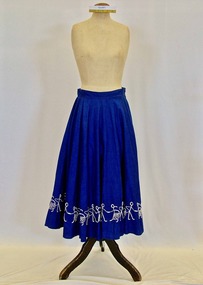
Skirt, 1950s
... Skirt...Skirt...skirt...Blue cotton circular skirt with white cord design of men and women dancing around the hem. ...Label, printed red on cream cotton, centre back: Milton Harding / MELBOURNE / GUARANTEED TAILORED / & HAND FINISHED (image of skirt)...skirt 1950s milton harding Label, printed red on cream cotton, centre back: Milton Harding / MELBOURNE / GUARANTEED TAILORED / & HAND FINISHED (image of skirt) Blue cotton circular skirt with white cord design of men and women dancing around the hem. ...Blue cotton circular skirt with white cord design of men and women dancing around the hem. Fastens with a metal sip in left proper side seam.Label, printed red on cream cotton, centre back: Milton Harding / MELBOURNE / GUARANTEED TAILORED / & HAND FINISHED (image of skirt)skirt, 1950s, milton harding -
 Brighton Historical Society
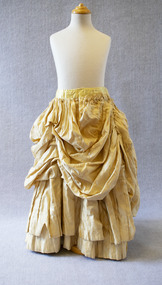
Skirt, Child's crinoline skirt, circa 1855-60
... Skirt...Child's crinoline skirt...This child's crinoline skirt was donated in 1974 by Mrs Ella Kohn of Were Street, a life member of the Society. ...Pale yellow silk half-hoop skirt with cotton lining. Layered skirt with ruched top layer....Layered skirt with ruched top layer. Child's crinoline skirt Skirt ...This child's crinoline skirt was donated in 1974 by Mrs Ella Kohn of Were Street, a life member of the Society. According to then-BHS Secretary Rosalind Landells, the skirt was originally made the fit a girl aged 10-12, but had been modified to add length. Mrs Landells reported that Society members had restored the skirt to the original length and that it would be worn at a costume parade at the Southern Cross on 27 March 1974 by Carolyn Scott.Pale yellow silk half-hoop skirt with cotton lining. Layered skirt with ruched top layer.children's clothing, crinoline, 1850s, 1860s, ella kohn -
 Brighton Historical Society
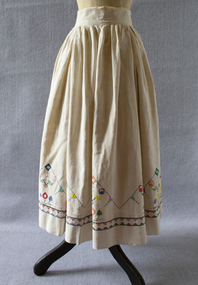
Skirt, late-nineteenth century & 1950s
... Skirt...Skirt...skirt...This skirt belonged to Olga Black, a long-time Brighton resident. ...Ankle-length full cream linen skirt with multi-coloured cross stitch embroidery featuring mountains, birds and trees. ...This skirt belonged to Olga Black, a long-time Brighton resident. ...This skirt belonged to Olga Black, a long-time Brighton resident. The linen used for the skirt were woven by Olga's great-grandmother Efstathia in the late-nineteenth century with flax grown on the island of Ithaca. In the 1950s, Olga made the fabric into a skirt, embellishing it with hand embroidery. Olga Maria Black was born in Melbourne in 1930, the daughter of Ithacan migrants Constantine and Toula Mavrokefalos. Constantine first emigrated to Australia in 1902, returning to Greece circa 1912-13 to serve his home country in the Balkan Wars. Toula's family had left Ithaca for Romania when she was only six months old, but she happened to be visiting the island at the very time that Constantine arrived, fresh from the war. Within three weeks they were married, and when Constantine returned to Melbourne in 1914 his new bride came with him. Constantine had trained as an accountant, but his qualifications were not recognised in Australia. Changing his surname to the Anglicised "Black", he started off working in his older brother Dionysios's cafés before going into business on his own. In 1917 he opened the Paris Residential Café at 54-56 Swanston Street, which offered both dining and accommodation. The business saw some years of success, but did not survive the Great Depression. Constantine died in 1944. Olga's mother Toula learned to sew as a child, while growing up in the Romanian village of Brila. She developed her skills making lace and embroidering items for her trousseau. Some of the linen she embroidered had been woven from flax on Ithaca by her own grandmother, Efstathia. During the Depression, when money was scarce, Toula embroidered at home, doing work for a factory in Flinders Lane. Using a cotton reel, a threepence and a sixpence she created and embroidered designs on hundreds of blouses. Olga spent her preschool days sitting at the table where her mother worked. Toula would involve Olga by allowing her to help choose the colour combinations. Toula lived with Olga in Brighton until her death in 1976. Olga inherited her mother's sewing skills. She re-invented some of Toula’s trousseau nightdresses and skilfully altered other clothing, making dresses which she wore around Brighton for many years.Ankle-length full cream linen skirt with multi-coloured cross stitch embroidery featuring mountains, birds and trees. Fullness is pleated into wide waist band. Left side opening. The fabric widths have been whipped together by hand probably at the time the cloth was woven in the late-nineteenth century. The skirt is machine stitched.skirt, linen, hand woven, embroidery, ithaca, migration, greek diaspora, olga black -
 Brighton Historical Society
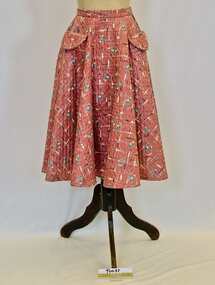
Skirt, 1950s
... Skirt...Skirt...skirt...Pink floral patterned quilted polished cotton circular skirt with two patch pockets. ...Skirt Skirt Malborough Classic ...The Malborough Classic label was a house label of David Jones Department Store.Pink floral patterned quilted polished cotton circular skirt with two patch pockets. Label, woven grey and yellow on white acetate, centre back: A Malborough Classicskirt, 1950s, marlborough classic, david jones -
 National Wool Museum
Textile - Skirt, Wendy Powitt, 1992 Barcelona Olympic Games Official Occasions Skirt, c.1992
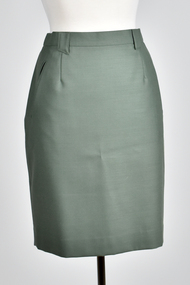
... Skirt...1992 Barcelona Olympic Games Official Occasions Skirt...This included: a tailored blazer and trouser/skirt (all water repellent) by Fletcher Jones, pure wool olive-green faille fabric by Foster Valley, cotton PE formal shirt by Pelaco, pure wool knitwear by Spangaro, printed wool tie by TD Noone, wool nylon socks by Holeproof and footwear by Hush Puppy. 2. ...Green knee length skirt with button and zip back. Has two pockets, and two darts in both front and back....This included: A pure wool shirt featuring blocks of contrasting colours, and a newly developed stretch 1992 Barcelona Olympics Australian Wool Corporation Wool Olympic Games Official Occasions Label 1 - Barcelona 1992 Official Uniform supplied by Australian Wool Corporation Label 2 - Fletcher Jones Australia 14 Green knee length skirt with button and zip back. Has two pockets, and two darts in both front and back. 1992 Barcelona Olympic Games Official Occasions Skirt Textile Skirt Wendy Powitt Fletcher Jones ...About the 1992 Barcelona Olympic Games donator Doug Pleasance wrote- During the 1980s the Australian wool industry was at its most prosperous times with record numbers of sheep producing wool receiving ever increasing values due to the success of the Reserve Price Scheme, and the overall guidance of the Australian Wool Corporation (AWC). As a humble technichian, my role was a low profile newly created position of “Controller, Technical Marketing” where wool was to be marketed on its technical properties, as distinct from the “Product Marketing Group” which exploited trhe traditional high profile approach of marketing wool;s superior fashion attributes. The Woolmark was the tool central to this approach. The 1992 Barcelona Olympic Games saw an evolutionary change in designer selection. A Declaration of Interest Form was communicated to over forty potential designers. The task and especially tight timelines that were involved deterred many aspirants, however, there remained eight designers with the potential we were seeking. These eight designers were paid $3,000 per submission and the winning designer, Wendy Powitt, was paid $15,000. For the first time the judging panel included two athletes, one male swimmer and one female basketballer, their influence was pivotal. The ensemble consisted of three elements- 1. The Official Uniform which was used for travel and all official functions. This included: a tailored blazer and trouser/skirt (all water repellent) by Fletcher Jones, pure wool olive-green faille fabric by Foster Valley, cotton PE formal shirt by Pelaco, pure wool knitwear by Spangaro, printed wool tie by TD Noone, wool nylon socks by Holeproof and footwear by Hush Puppy. 2. Opening Ceremony Uniform a lightweight wool fabric printed with floral designs that had been inspired by the work of Australian artist Margaret Preston. This included: Lightweight W/PE shorts by Fletcher Jones in Foster Valley Fabric, socks by Holeproof and footwear by Hush Puppy. 3. Village Clothing was designed to be highly visible garments to make it easy to ‘spot the Aussie’ and helped to contribute to good team spirit. This included: A pure wool shirt featuring blocks of contrasting colours, and a newly developed stretchGreen knee length skirt with button and zip back. Has two pockets, and two darts in both front and back.Label 1 - Barcelona 1992 Official Uniform supplied by Australian Wool Corporation Label 2 - Fletcher Jones Australia 141992 barcelona olympics, australian wool corporation, wool, olympic games official occasions -
 National Wool Museum
Skirt
... Skirt...Skirt...Australian womens skirt from the closing ceremony of the Sydney 2000 Olympic Games. ...Australian womens skirt from the closing ceremony of the Sydney 2000 Olympic Games. ...Australian womens skirt from the closing ceremony of the Sydney 2000 Olympic Games. Designed by Mambo Graphics.fashion, woolmark company mambo graphics, sport, the woolmark company 2000 australian olympic display - exhibition (21/12/2001 - 24/05/2002) -
National Wool Museum
Skirt
... Skirt...Skirt...Australian womens skirt from the formal uniform for the Sydney 2000 Olympic Games. ...Australian womens skirt from the formal uniform for the Sydney 2000 Olympic Games. ...Australian womens skirt from the formal uniform for the Sydney 2000 Olympic Games. Manufactured by Saba Pty Ltd with wool from Macquarie Textiles.fashion, woolmark company saba pty ltd, sport, the woolmark company 2000 australian olympic display - exhibition (21/12/2001 - 24/05/2002) -
 Moorabbin Air Museum
Uniform (item) - Royal Australian Air Force (RAAF) Woman's Service Dress Jacket & Skirt
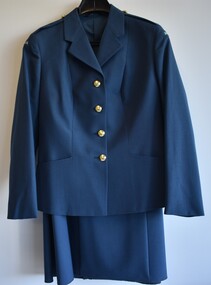
... Royal Australian Air Force (RAAF) Woman's Service Dress Jacket & Skirt....Royal Australian Air Force (RAAF) Woman's Service Dress Jacket & Skirt. Consisting of a single- breasted blue/grey tailored jacket with four King's Crown brass buttons and integrated welt pockets and matching skirt. ...Manufacturers label inside jacket displays, ADI P/L Victoria 1989 8410-66.180.3605 Size:13S To fit Bust: 87.5cm Waist: 67.5cm Matching Skirt Service No. Name. Dry Clean Only Manufacturers Label inside Skirt, ADI P/L Victoria 1989 8410.66108.3605 Size:13S To fit waist: 67.5cm Skirt Matching Service No. ...Manufacturers label inside jacket displays, ADI P/L Victoria 1989 8410-66.180.3605 Size:13S To fit Bust: 87.5cm Waist: 67.5cm Matching Skirt Service No. Name. Dry Clean Only Manufacturers Label inside Skirt, ADI P/L Victoria 1989 8410.66108.3605 Size:13S To fit waist: 67.5cm Skirt Matching Service No. ...Manufacturers label inside jacket displays, ADI P/L Victoria 1989 8410-66.180.3605 Size:13S To fit Bust: 87.5cm Waist: 67.5cm Matching Skirt Service No. Name. Dry Clean Only Manufacturers Label inside Skirt, ADI P/L Victoria 1989 8410.66108.3605 Size:13S To fit waist: 67.5cm Skirt Matching Service No. Name. Dry Clean Only -
 Bendigo Historical Society Inc.
Clothing - SKIRT (WEDDING DRESS), Wedding Dress Skirt, 1896
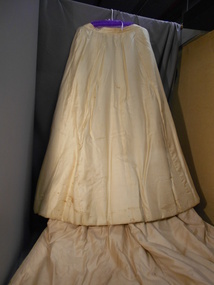
... Wedding Dress Skirt...Skirt hand and machine stitched. Matching bodice 11400.314....Label stitched inside skirt waistband - ''F.Davey & Co Dress & Mantle makers, View Point, Sandhurst....Wedding Dress Skirt Clothing SKIRT (WEDDING DRESS) ...Probably 1890's to early 1900's. The Dress and Mantle Makers departments was part of F. Davey and Co. and the department was run by Miss Middleton, formerly of the Beehive. F Davey and Co. sold their View Point premises in Oct 1904.Cream coloured silk wedding dress with train. Three flat panels at front and side, lined with polished cotton. Centre tightly gathered panel at centre back lined with stiffened cotton.Other panels lined with stiffened cotton above hemline of skirt. Double layer lace insert inside lower edge to hemline. Back opening with four hook and eye fasteners. Deep pocket on side seam at hip on RHS. Three back panels extended below hemline of skirt to form squared edge train. Two hanging tapes inside waist band. Skirt hand and machine stitched. Matching bodice 11400.314.Label stitched inside skirt waistband - ''F.Davey & Co Dress & Mantle makers, View Point, Sandhurst.costume, female, wedding dress skirt -
 Warrnambool RSL Sub Branch
Skirt, 1940s
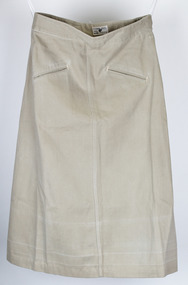
... Skirt...skirt...This skirt belonged to Joan Elizabeth Peck who served with the Royal Australian Air Force in the Second World War. ...Light khaki coloured skirt in cotton fabric. A-line skirt constructed of four panels with two darts on the back and two pockets on the front (as per photograph in Supplementary File). ...Skirt ...This skirt belonged to Joan Elizabeth Peck who served with the Royal Australian Air Force in the Second World War. Joan was born on 27 July 1919 in Acton England and enlisted in Echuca on the 6 January 1943. At the time of her discharge from the RAAF in 1945, Joan was serving as an Aircraftwoman with the 2 Air Observers School in Mount Gambier. Throughout the war, the Mt Gambier base operated under the Empire Air Training Scheme.This skirt was donated by the owner, Joan Peck, and has significant provenance. The inscriptions throughout facilitate significant research ability, though records are not publicly accessible and digitised at this time. Joan Peck’s uniform is also significant as an item of social history, revealing the role of local women in the home front war effort. Light khaki coloured skirt in cotton fabric. A-line skirt constructed of four panels with two darts on the back and two pockets on the front (as per photograph in Supplementary File). Side fastening on the left side with a series of four steel hook and eye fasteners. Two fasteners on the back waistband which are tightened by pulling through two steel rings. Peach-cream coloured bias binding on interior of hem. Label attached to the interior waistband of the skirt back, to the left and right of which is a handwritten inscription.Waistband label reads: “V298/MADE IN/AUSTRALIA/1942/SIZE PECK” Inscription handwritten on waistband interior: “105135.” To the right of the interior label: “J. E. PECK”skirt, uniform, second world war, royal australian air force, world war ii, women -
 Sir Reginald Ansett Transport Museum
Uniform - Skirt, Sportscraft
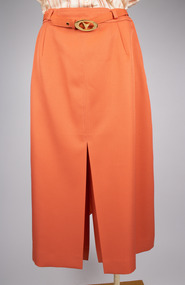
... Skirt...This skirt was art of the uniform made by Sportscraft...Orange skirt with belt...This skirt was art of the uniform made by Sportscraft sportscraft uniform flight attendant hostess Orange skirt with belt Uniform Skirt Sportscraft ...This skirt was art of the uniform made by SportscraftOrange skirt with beltsportscraft, uniform, flight attendant, hostess -
 Flagstaff Hill Maritime Museum and Village
Clothing - Skirt, before April 1874
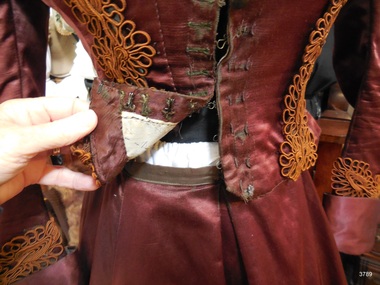
... Skirt...THE SKIRT The skirt has a gentle, soft, feminine design which keeps it in good shape and condition, preserving it from soiling and prolonging its life: - the satin fabric is softly pleated at the waist and falls gently to almost floor length - the opening is concealed at the back within one of the folds and closes with hooks and eyes underneath the bow at the back of the jacket - the horizontal stitching at the base of the skirt joins the lining to the skirt, and the firmness it creates allows it to gently flare out at the base without the need of hooped petticoats - a removable fabric lining at the hem protects the front and back of the skirt from friction and soiling from the wearer’s footwear ...The lined, floor-length, amber satin skirt has gentle folds that gather into a fitted waistband. ...THE SKIRT The skirt has a gentle, soft, feminine design which keeps it in good shape and condition, preserving it from soiling and prolonging its life: - the satin fabric is softly pleated at the waist and falls gently to almost floor length - the opening is concealed at the back within one of the folds and closes with hooks and eyes underneath the bow at the back of the jacket - the horizontal stitching at the base of the skirt joins the lining to the skirt, and the firmness it creates allows it to gently flare out at the base without the need of hooped petticoats - a removable fabric lining at the hem protects the front and back of the skirt from friction and soiling from the wearer’s footwear THE SKIRT This evening outfit is significant for its connection with colonial Australia, Victoria and Warrnambool. ...THE SKIRT The skirt has a gentle, soft, feminine design which keeps it in good shape and condition, preserving it from soiling and prolonging its life: - the satin fabric is softly pleated at the waist and falls gently to almost floor length - the opening is concealed at the back within one of the folds and closes with hooks and eyes underneath the bow at the back of the jacket - the horizontal stitching at the base of the skirt joins the lining to the skirt, and the firmness it creates allows it to gently flare out at the base without the need of hooped petticoats - a removable fabric lining at the hem protects the front and back of the skirt from friction and soiling from the wearer’s footwear THE SKIRT This evening outfit is significant for its connection with colonial Australia, Victoria and Warrnambool. It is a fine example of female fashion of the mid to late 1900s. The outfit is significant for its connection with a wedding uniting two colonial families from Northern Ireland who immigrated to Australia in the mid-1850s. The families had a significant role in the history of Warrnambool and district. The outfit is significant too for connecting the colonial families to the indigenous culture of the district and the contact between the native and European people. The lined, floor-length, amber satin skirt has gentle folds that gather into a fitted waistband. One of the folds at the back conceals the opening of the skirt that fastens using metal hooks and eyes. The bow at the back of the jacket covers the top of the closure. There are metal hooks distributed around the top of the waistband. The skirt is stitched horizontally around the hem in several rows. There is a removable fabric lining at the base of the skirt.evening skirt, ladies 1h century skirt, satin skirt, antique satin skirt -
 Flagstaff Hill Maritime Museum and Village
Textile - Skirt, circa 1910
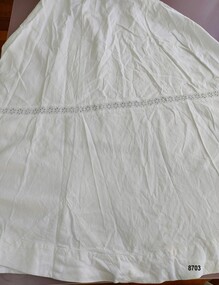
... Skirt......skirt...It is highly likely that the lady who made this skirt brought the lengths of broderie anglaise already made to embellish and personalise her skirt....A full length lady's skirt of heavy textured ribbed twill cotton. ...Textile Skirt ...This item is one of a collection of clothing items that belonged to the Stephenson family who lived at 22 McCracken Street, Kensington, Melbourne. Matthew Stephenson (1861 – 1943) who had grown up on the Bendigo goldfields and shifted to Melbourne in the early 1900’s was a train driver and later, a fireman with the railways. His wife Elizabeth Jane (Betsy) Wigley (1865 – 1953) also grew up on the goldfields around Majorca and Bendigo. They married in 1885 in Bendigo. They had two daughters – Ethel Evelyn Stephenson (1886 – 1956) and Lillian or Lila (1891 – 1977) who were milliners and dressmakers and who continued to live in the family home after the death of their parents. The family are recorded as living at 22 McCracken Street, Kensington, as early as 1914. It is not known who made or owned the clothing that makes up this collection but as it appears to be from the late Victorian and early Edwardian era, the different pieces were probably made and worn by any of the three ladies of the house – Betsy, Ethel and/or Lila. During W.W.2, a local Warrnambool couple (Meryl and Tony Everard) boarded with them – Tony was in the airforce training paratroopers to jump into (and survive) enemy territory and his wife Meryl worked in the Methodist baby Home. The Everards developed a close friendship with the Stephensons and were responsible for clearing out the house (and finding this clothing collection) after Lila died in 1977. This skirt features broderie anglaise trim. Although broderie anglaise was a lace that could be made by hand, it was very time consuming to make. St Gallen was a city in Switzerland that had become known for producing quality textiles. At the beginning of the 19th century, the first embroidery machines were developed in St Gallen. Factories used embroidery machines but people also had them in their homes. They were able to produce broderie anglaise for export. By the early 20th century, machine made lace, fabric, ribbons etc. were being sold in drapers shops all over England and Wales to women who were making clothes and furnishings for their families. It is highly likely that the lady who made this skirt brought the lengths of broderie anglaise already made to embellish and personalise her skirt.This item is an example of the needlework skills of women in the late 19th century - creating pintucks and adding lace to personalise and embellish a practical item of clothing. A full length lady's skirt of heavy textured ribbed twill cotton. The top of the skirt is made from five pieces of fabric, sewn together and inserted into a simple waistband. It has an opening with room for 6 hook and eyes (but only the middle three remain). The top section of the skirt is separated from the bottom section by a strip of eyelet embroidery that has been inserted in a horizontal line at the back but becomes slightly diagonal at the front causing the two ends to cross in a decorative X fashion. The bottom of the skirt is the same heavy cotton as the top and one seam features a V shaped insert or patch.flagstaff hill maritime museum and village, great ocean road, shipwreck coast, warrnambool, broderie anglaise, needlework, sewing, stephenson family, skirt, lady's skirt -
 Moorabbin Air Museum
Uniform (item) - Ansett Airlines Flight Attendant Skirt
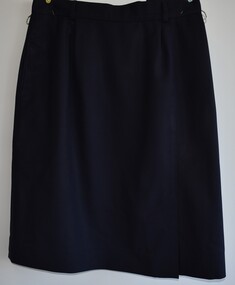
... Ansett Airlines Flight Attendant Skirt...Ansett Airlines Flight Attendant Skirt. Navy blue skirt with blue polyester lining. ...Ansett Airlines Flight Attendant Skirt. Navy blue skirt with blue polyester lining. ... -
 National Wool Museum
Skirt
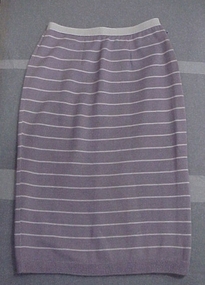
... Skirt...Hand machine knitted skirt, part of set with cardigan. Knitted on the Dubied knitting machine, also donated to the National Wool Museum....Skirt knitted by Mrs Genitilia Sartori....Machine Knitting Sartori Mrs Genitilia Skirt knitted by Mrs Genitilia Sartori. Skirt ...Hand machine knitted skirt, part of set with cardigan. Knitted on the Dubied knitting machine, also donated to the National Wool Museum.Skirt knitted by Mrs Genitilia Sartori.machine knitting, sartori, mrs genitilia -
 Lara RSL Sub Branch
Uniform, Emerco Brand, Army Kahki wool Skirt, 30/8/1990
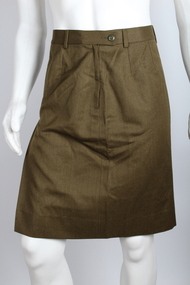
... Army Kahki wool Skirt...Khaki skirt from a Maori Service Uniform....Henshaw No..3275 30/8/1990 Khaki skirt from a Maori Service Uniform. Army Kahki wool Skirt Uniform Uniform Emerco Brand ...Khaki skirt from a Maori Service Uniform.White cloth tag on inside Emerco Brand C. Henshaw No..3275 30/8/1990 -
 Bendigo Historical Society Inc.
Clothing - CREAM SILK LONG WEDDING SKIRT, Wedding Dress Skirt, 1902
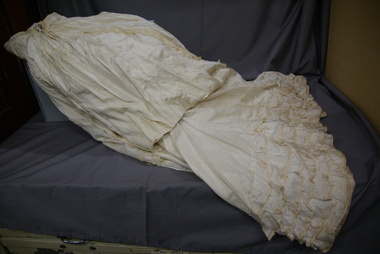
... Wedding Dress Skirt...Wedding Skirt.Cream silk long skirt. Waist band with metal hook and eye fastening. ...COSTUME Female wedding dress skirt Clothing. Wedding Skirt.Cream silk long skirt. ...Clothing. Wedding Skirt.Cream silk long skirt. Waist band with metal hook and eye fastening. Back placket with metal hooks and hand made loops (2). Pintucks- 36 cms deep from waistline. Band of pintucks 26 cms deep around hemline. Back of skirt dips to a short train trimmed with ruffles of skirt fabric, edged with ribbon. Skirt fully lined with cotton, fine lace trims pintucked frill and skirt panels.. See also 11400.77 & 11400.76.costume, female, wedding dress skirt -
 Moorabbin Air Museum
Uniform (item) - Jetstar Flight Attendant Skirt Black
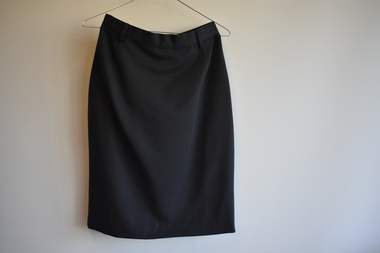
... Jetstar Flight Attendant Skirt Black....Jetstar Flight Attendant skirt black, size 10...Jetstar Flight Attendant skirt black, size 10 Jetstar Flight Attendant Skirt Black. ... -
 Moorabbin Air Museum
Uniform (item) - Qantas Flight Attendant Skirt
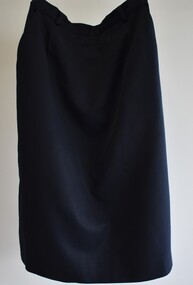
... Qantas Flight Attendant Skirt....Qantas Flight Attendant Skirt. Navy blue skirt with navy blue polyester lining. ...Qantas Flight Attendant Skirt. Navy blue skirt with navy blue polyester lining. ... -
 National Wool Museum
Skirt
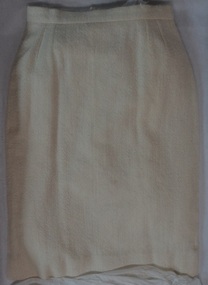
... Skirt...Was spun, woven and dyed by Jean in Geelong, and was put together by a local dressmaker. Skirt is part of Chanel suit with item 7756. ...Cream coloured wool skirt with zipper at back....Earliest Date: 1986 Cream coloured wool skirt with zipper at back. Skirt ...Made by Jean Inglis for the Geelong Show 1986. Was spun, woven and dyed by Jean in Geelong, and was put together by a local dressmaker. Skirt is part of Chanel suit with item 7756. Earliest Date: 1986Cream coloured wool skirt with zipper at back. -
Tatura Irrigation & Wartime Camps Museum
Skirt, 1940's
... Skirt...skirt...Black knitted woollen skirt in a style to form pleats. Elastic in the waistand...Knitted in Camp 3 on needles fashioned from bicycle spokes skirt wool fischer g camp 3 tatura ww2 camp 3 costume female Black knitted woollen skirt in a style to form pleats. ...Knitted in Camp 3 on needles fashioned from bicycle spokesBlack knitted woollen skirt in a style to form pleats. Elastic in the waistandskirt, wool, fischer g, camp 3, tatura, ww2 camp 3, costume, female -
Whitehorse Historical Society Inc.
Clothing - Skirt, c1910
... Skirt...c 1910 Cotton pique tennis skirt - white. 10 hooks and eyes. Curved yoke front and back 6 buttons on each side....c 1910 Cotton pique tennis skirt - white. 10 hooks and eyes. Curved yoke front and back 6 buttons on each side....Clothing Skirt ...c 1910 Cotton pique tennis skirt - white. 10 hooks and eyes. Curved yoke front and back 6 buttons on each side.c 1910 Cotton pique tennis skirt - white. 10 hooks and eyes. Curved yoke front and back 6 buttons on each side.costume, female -
 Brighton Historical Society
Evening outfit, Four piece outfit of blouse, camisole, skirt and wrap, c.1997
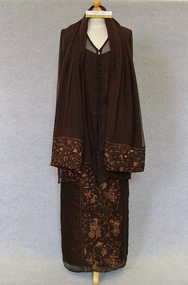
... Four piece outfit of blouse, camisole, skirt and wrap...A four piece outfit consisting of a blouse/cardigan, camisole, skirt and wrap. Double-layered silk wrap with an outer layer of silk chiffon. ...The skirt secures centre back with a nylon zip and botton closure. ...This item is part of the Di Reidie collection. Diane Reidie was a much loved volunteer and President of Brighton Historical Society from 1999 until 2016. Originally from New Zealand, Di and her family lived in Male Street, Brighton for many years. A vibrant and energetic person with a zest for life and a gift for bringing people together, Di was a friend to many in the Bayside community and active in local community organisations. Her tireless work as President of BHS saw her named Bayside Citizen of the Year in 2008. As a seller and collector of vintage clothing, she was passionate about fashion history; one of her many enduring contributions to BHS was her extensive work in preserving, developing and promoting the Society's costume collection. In 2018-19, Di donated more than one hundred items from her personal vintage clothing collection to the Society. The collection, which includes clothing, hats, handbags and shoes from local and international designers, is representative of Di's wide-ranging interests, colourful personality, creativity, humour and love of fashion and travel. Of all the items Di donated to the Society, this four-piece Easton Pearson outfit was her favourite. When she bought it around 1997-98, it was the first time she had spent a large amount of money on clothing, and she thought it only fitting to throw a suitably elegant party at which to wear it. James Cameron's hit movie 'Titanic' had just been released, and upon discovering the recipe book 'Last Dinner On the Titanic: Menus and Recipes from the Great Liner', Di was inspired to host a Titanic-themed party for her friends. Held at her home in Brighton in 1998, the event included a string quartet, an eleven-course meal prepared entirely by Di, and a life boat in the backyard swimming pool.A four piece outfit consisting of a blouse/cardigan, camisole, skirt and wrap. Double-layered silk wrap with an outer layer of silk chiffon. Both ends feature and embroidered band of brown and black cotton, copper wire, and copper glass beads. Camisole of black and copper shot polyester rayon with wide shoulder straps and small shoulder pads. Blouse of brown silk chiffon, with a v-neck and eleven silk-covered buttons and loops at centre front. Patch pockets over front hip and full length sleeves. The neckline and sleeve edges are trimmed with copper-coloured glass beads. Full-length double-layered straight skirt with black and copper shot polyester rayon lining and silk chiffon overskirt. The skirt secures centre back with a nylon zip and botton closure. The skirt features a centre front embroidered panel of brown and black cotton leaf and flower motifs, with copper wire and copper glass beads. manufacturer's label: "Oh! Easton Pearson", "Pure Silk", "Polyester Rayon", Care label, "M"costume party, titanic, easton pearson, pamela easton, lydia pearson, australian fashion, di reidie, 1990s -
 Bendigo Historical Society Inc.
Clothing - ANDREW - MONSANT COLLECTION: BLACK JACQUARD SKIRT, Black Jacquard Skirt, 1940-50's
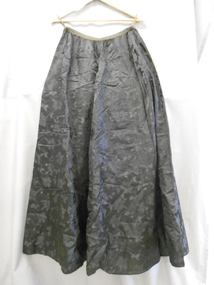
... Black Jacquard Skirt...Black silk lined with black polished cotton- seven gored skirt. A woven floral design through the fabric. ...BHS Collection COSTUME Female black jaquard skirt Black silk lined with black polished cotton- seven gored skirt. ...BHS CollectionBlack silk lined with black polished cotton- seven gored skirt. A woven floral design through the fabric. Hemline is finished with a two cm braid hand stitched on the inside of the skirt, and finished with a one cm fringe edging the hemline. Plackett at centre back waistline fastens with seven metal hooks, and hand stitched loops. Cotton tape two cm wide waistband. Small soft gathers at centre front waistline.costume, female, black jaquard skirt -
 Ballarat RSL Sub-Branch Inc.
Skirt
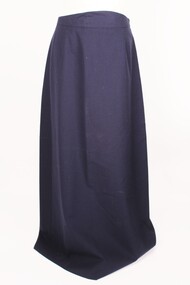
... Skirt......skirt...Long skirt Navy blue in colour, with dark blue lining. ...Owned by Carol Dale. womens ladies clothing skirt navy blue navy royal navy mess dress Long skirt Navy blue in colour, with dark blue lining. ...Owned by Carol Dale. Long skirt Navy blue in colour, with dark blue lining. Navy Dress Womens approximately 1970's Item No. 1322 is the other part of the set. womens, ladies, clothing, skirt, navy blue, navy, royal navy, mess dress -
 Bendigo Historical Society Inc.
Clothing - HELEN MUSK COLLECTION: WEDDING BODICE AND SKIRT, Wedding Bodice and Skirt
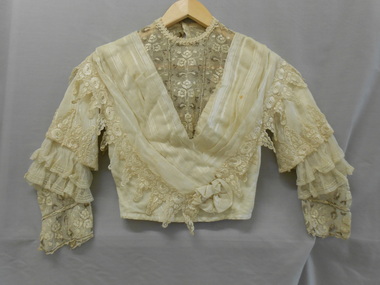
... Wedding Bodice and Skirt...Ivory coloured full-length wedding skirt with train. The skirt is made in two layers. ...Ivory coloured full-length wedding skirt with train. The skirt is made in two layers. ...Ivory coloured waist length silk wedding bodice with front opening. Silk fabric has alternating striped pattern of chequerboard pattern, running stitch pattern and diagonal woven pattern. The bodice is made of two layers of the silk fabric with cotton fabric lining. The front inner layer has two darts from the waistline. The back inner layer has a centre seam and three darts from the waist on either side. The outer layer on both front and back has three knife pleats falling from the shoulders creating a gathered effect. These side panels of pleated fabric create a deep V neckline by crossing over 5cm above the waist. The V shape neckline is filled with an insert of cream and dark green lace with a floral pattern. The lace insert extends to the throat to form a high round neckline. The neckline is edged with cream coloured woven cotton braid. The side edges of the outer layers are trimmed with cream lace with a floral pattern and 5cm zig zag peaked edges that extends from centre waist at the front, over the shoulders and to the crossover section at centre back where there is a decorative silk fabric flower stitched at the crossover point just above the waist. The front opening is fastened with fourteen hooks and eyes plus another hook and eye offset 5 cm above the waist at the crossover point. Set in long sleeves are in two sections. An inner layer of silk fabric widens to the elbow where two five cm frills of gathered tulle are attached. Each frill is edged with a row of silk stitching. Attached below the frills are two 7 cm strips of lace stitched together to form the lower part of the sleeve. The edge of the lace forms the hem at the wrist. Each sleeve has a 5 cm hemmed V shaped split from the hem at the wrist. The outer layer of the sleeve is bell shaped falling from the shoulder to the elbow. This section of the sleeve is edged with cream lace with a floral pattern and 5cm zig zag peaked edges that are stitched to the fabric of the sleeve. Ivory coloured full-length wedding skirt with train. The skirt is made in two layers. The under layer is made from cotton from the waist with a wide border of silk fabric - 18 cm wide at centre front, widening to 37 cm at the side seams. The back of this skirt extends to a train and the border widens to 48 cm. The border section is lined with cotton fabric. At the centre back, the border has two godet inserts to create fullness in the train. The outer layer of the skirt is of ivory silk fabric with alternating vertical stripes of a chequerboard pattern, a running stitch pattern and a diagonal woven pattern. The lower edge of the skirt is edged with an 18 cm border of lace patterned with embroidered circles. The edge of the lace forms a zig zag pattern of elongated V shaped peaks (7 cm). The front of the skirt dips to a V shape at centre front with the point of the V reaching the hemline. The back of the skirt dips below the front hemline in a U shape over the train. The waist band is made of cotton tape. The centre front of the waistband has an embroidered pattern in silk thread. The centre back opening is fastened with seven metal hooks with six cotton loops plus one metal eye on the waistband. There are two cotton tape hanging loops on either side of the inner waistband. Hand and machine stitched.costume, female ceremonial, wedding bodice -
 Bendigo Historical Society Inc.
Clothing - WOMEN'S LONG FAWN SILK SKIRT WITH TRAIN, Women's skirt, 1900-10
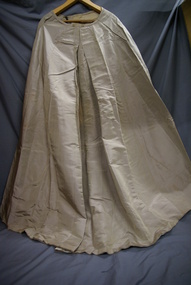
... Women's skirt...Women's long fawn silk skirt with train. Fawn silk lined, 3 panels in front, 4 panels in back. ...COSTUME Female long fawn silk skirt with train Women's long fawn silk skirt with train. ...Women's long fawn silk skirt with train. Fawn silk lined, 3 panels in front, 4 panels in back. Plackett in front seam with 5 hook & eye fasteners. 1inverted pleat at centre back, 2 V shaped inserts at lower back giving fullness. Much fuller at back, with a flat front. Two hooks at rear waist to attach a bodice. Matching velvet ribbon - 1 cm wide lining the hemline. Machine & hand stitching.costume, female, long fawn silk skirt with train -
 Circa Vintage Archive
Clothing - Silk two piece dress 1870s, Plum silk, lace and velvet bodice and bustle skirt 1870s, 1870s
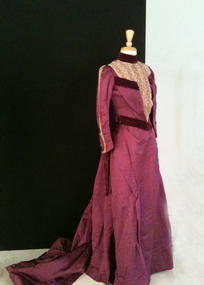
... Plum silk, lace and velvet bodice and bustle skirt 1870s...Exceptional two piece dress with fitted and boned bodice and bustle skirt and train. Bodice features many panels and internal whaleboning with cotton lining. ...Plum silk, lace and velvet bodice and bustle skirt 1870s Clothing Silk two piece dress 1870s ...An excellent example of Australian ladies fashion of the time.Exceptional two piece dress with fitted and boned bodice and bustle skirt and train. Bodice features many panels and internal whaleboning with cotton lining. Waist tape to secure. Pointed waistband to the exterior, trimmed in panels of velvet and lace inserts. Pleated sleeves and high, stand up collar with white cotton insert. Row of metal hooks and eyes to secure at the centre front, covered with a row of small metal and enamel buttons with butterfly design (all present) and hand finished button holes. Another row of hooks and eyes over the top. Skirt is full with the gathers focused on the centre back with a row of cartridge pleats and metal hooks and eyes to secure at the waist. Row of cotton tape sits under the hips to be gathered into the desired fullness. Ornamental panels of velvet provide a faux wrap styling to the front. Underskirt of silk faille with a box pleated trim to the hem. Underneath is a third hem finished in a row of white cambric and lace trim. Train falls from the waist and displays the same hem treatments as the dress. The dress has been mostly machine sewn but with large amounts of hand sewn finishing.none -
 Bendigo Historical Society Inc.
Clothing - HELEN MUSK COLLECTION: CREAM SILK BODICE AND SKIRT, Wedding Bodice and Skirt
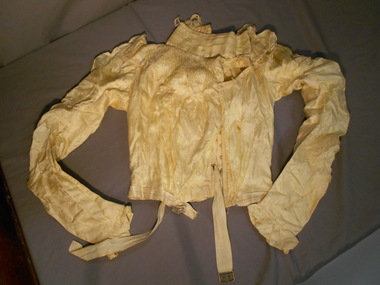
... Wedding Bodice and Skirt...The skirt is fully lined with cotton fabric. The skirt is made of 5 pieces. ...The skirt is fully lined with cotton fabric. The skirt is made of 5 pieces. ...Ivory coloured silk bodice. Part of wedding ensemble with matching skirt with train. (11400.513B). The silk fabric has an all over pattern of scattered leaves. The bodice has long sleeves and is fully lined with cotton fabric with a front opening. The cotton lining at the front forms a separate bodice with a front opening fastened with fifteen hooks and eyes from throat to waist. The lining is edged at centre front on both sides with a border of the silk fabric. The border narrows from 7 cm at the throat to 3 cm at the waist. In the lining of the bodice are two casings on either side of the front opening containing boned segments. Across the lining of the back are seven casings containing boned segments. The front LHS of the bodice has an outer layer of silk fabric with a squared neckline. The RHS of the bodice overlaps the centre opening of the bordered lining to attach across the left shoulder. From the left shoulder the front tapers diagonally to the waistline 4cm to the left of centre. This cross over section is fastened with ten hooks and eyes – seven of the eyes are attached to the bodice lining and three are on the LHS outer silk fabric layer. This section crosses full width to the edge of the LH sleeve, across the top of the shoulder to the neckline. The LHS outer section crosses back over the edge of the centre section. There is a third layer on the RHS with a squared neckline to form a symmetrical appearance. The two side sections are edged with ruffles of fine silk ribbon. The centre section of the crossover part has vertical pintucks extending from the throat for 9 cm. The fullness created by the pintucks is gathered to centre front where the waist dips to a shallow V shape. The back of the bodice has vertical pintucks extending 12 cm from across the shoulders, narrowing to a single vertical strip of pintucks (4 cm) ending at centre waist. The waist is edged with a border of silk ribbon with a horizontal tuck. Inside the back of the bodice above the waist cotton tape ties are attached. These ties extend to the front of the bodice and the ends are fastened with a metal buckle. On this cotton tape at centre back there are to metal hooks for attaching the skirt. Attached to the neckline of the front section of the bodice is a 7 cm stand up collar. The collar extends from the RH shoulder in front of the neck and across the LH shoulder and continues unattached around the back of the neck to attach to the edge of the collar at the RH shoulder. The edges of the collar are fastened with three hooks and eyes. The collar has three full width horizontal pleats and the top edge is trimmed with a frill of fine gathered silk ribbon. On the waistline at centre front and centre back are decorative buttons (3.5 cm) of pearl coloured beads. The buttons have a centre pearl bead bordered by small glass beads surrounded by 9 smaller pearl beads and nine small pearl beads. Each button is edged with a row of tiny class beads with 18 points. The long sleeves are fully lined and made of two sections. The underneath section of the sleeve is ungathered and shaped at the elbow. The upper section of each sleeve is gathered at the shoulders and attached to the underneath section with a series of small pleats down to the elbow creating fullness. There is a small cap sleeve at each shoulder over the top of the gathered sleeve. The cap sleeves are edged with a frill of gathered silk ribbon with a decorative row of gathered silk ribbon parallel to the edge. At each wrist is a gathered frill of silk fabric edged with silk ribbon. Each sleeve has an 8 cm split at the wrist on the back seam. Full length ivory coloured silk skirt. The silk fabric has an all over pattern of scattered leaves. The skirt is fully lined with cotton fabric. The skirt is made of 5 pieces. The centre front panel has two darts at the waistline. The two side panels are cut on the bias and wrap around to form a centre back seam gathered into the waistband and finishing 44 cm below the waist line. Two triangular pieces of fabric are inserted at the back below the centre seam to complete the full circle of the skirt. There is 30 cm back opening. The waistband is made of cotton tape (3cm) fastened with two hooks and eyes with a 2 cm crossover. There is another hook and eye fastener halfway along the opening split. There is one upward facing hook on either side of the centre back opening to attach the matching bodice. The LHS of the back opening has a cotton fabric pocket inserted along the seam. The hem of the skirt is edged with two 5 cm frills of gathered silk fabric.costume, female daywear, silk bodice -
 Sir Reginald Ansett Transport Museum
Uniform - Skirt
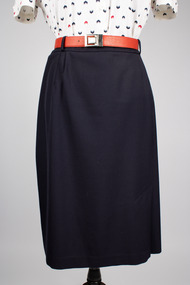
... Skirt...Navy skirt...hostess stewardess flight attendant Navy skirt Uniform Skirt ...Navy skirthostess, stewardess, flight attendant
