
Showing 221 items matching "small bell"
-
 Bendigo Historical Society Inc.
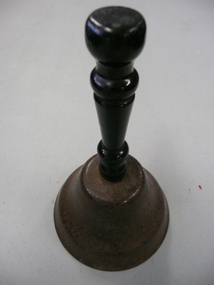
Domestic Object - SMALL BELL
... SMALL BELL...Small metal bell with black turned wooden handle & striker....Domestic Object SMALL BELL ...Small metal bell with black turned wooden handle & striker.commerce, shop equipment, bell, shop equipment -
 Dandenong/Cranbourne RSL Sub Branch
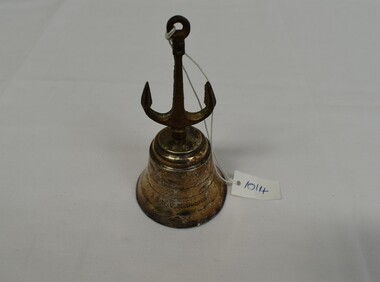
Decorative object - Small Bell with Anchor Handle
... Small Bell with Anchor Handle....Small dinner service type Bell with Anchor handle....Manoora. Small dinner service type Bell with Anchor handle. Decorative object Small Bell with Anchor Handle. ...Small dinner service type Bell with Anchor handle.T.S.M.V. Manoora. -
 Flagstaff Hill Maritime Museum and Village
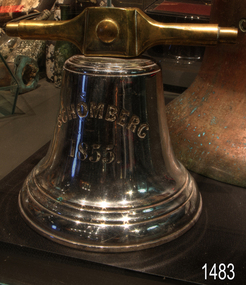
Functional object - Bell, Schomberg 1855, Before 1855
... ...small bell...After around a year, the small bell at St Joseph’s developed a crack and became unusable. ...A small ship’s bell. The silver-plated metal bell bears the ship’s name and year of construction on one side and the name and address of the ship’s builders on the other. ...After around a year, the small bell at St Joseph’s developed a crack and became unusable. ...The Rescue and Journey of the Schomberg Bells: This bell was the smaller of two rescued by the crew of the Schomberg following the ship’s wreck in 1855. While the specific purpose of the smaller bell is unknown, it may have served to assemble the crew or signal mealtimes on board. After surviving the shipwreck, the crew carried both bells as they made their way along the coastline. Their journey eventually led them to the home of settler John Manning, located at Hopkins Point near Warrnambool. Manning took possession of the bells and subsequently presented them to two churches in Warrnambool. The smaller bell went to St Joseph’s Catholic Church, while the larger bell went to St John’s Presbyterian Church. After around a year, the small bell at St Joseph’s developed a crack and became unusable. Thomas Manifold imported a replacement bell for the church, and the damaged bell was stored at his farm. Years later, when the property was sold to John Logan, the discarded bell was donated to the old Warrnambool Museum upon its opening in 1886. The Curator, Joseph Archibald, placed the bell on display in the entry. In 1975, it was transferred from the Warrnambool Art Gallery to Flagstaff Hill. The ’Mystery’ of the small bell solved: Despite numerous attempts by the staff at Flagstaff Hill to restore the bell’s lustre, the bell remained dull and tarnished. In October 1986, Director Peter Ronald decided to send the bell for professional advice. The bell was entrusted to Briggs Marine Products, a renowned brass founder established in 1912. Upon examination, the specialists at Briggs discovered the reason behind the bell’s persistent lack of shine: it had originally been silver-plated, but most of the plating had worn away over time. The experts at Briggs then undertook the task of restoring the bell, successfully returning it to a gleaming silver surface. The Sailing Ship Schomberg: Launched in 1855, the Schomberg was regarded as the “Noblest” ship afloat at the time. Owned by the Black Ball Line, it was built for their passenger fleet by Alexander Hall of Aberdeen at a cost of £43,103. The construction featured three skins: one planked fore and aft and two diagonally planked, all fastened with screw-threaded trunnels (wooden rails). The ship’s First Class accommodation was luxurious, boasting velvet pile carpets, large mirrors, rosewood, birds-eye maple and mahogany timbers, satin damask soft furnishings, and an oak-lined library with a piano. Schomberg had a capacity for 1,000 passengers. The ship’s master, Captain James Nicol Forbes—also known as ‘Bully’ Forbes—was only 34 years old at the launch. He had a reputation for setting and breaking speed records on the Black Ball Line’s Marco Polo and Lightning. In 1852, Forbes completed the London to Melbourne journey on the Marco Polo in 68 days, a record at the time, though 53 passengers died during the voyage. In 1854, he sailed the Lightning to Melbourne in 76 days and returned in only 63 days—a record that stood among sailing ships. Forbes was known for driving his ship and crew to their limits, often prioritising speed over passenger comfort. Determined to set new records, he promised to reach Melbourne in sixty days, declaring he would do so “with or without the help of God.” The Maiden Voyage and the Wreck: Schomberg departed Liverpool on 6th October 1855, flying a banner that read “Sixty Days to Melbourne”. The vessel carried 430 passengers and 3,000 tons of cargo, including materials to build the Melbourne to Geelong Railway and a bridge over the Yarra River. Among the cargo were a cow for fresh milk, pens for fowls and pigs, and 90,000 gallons of water for drinking and washing. Additionally, it transported 17,000 letters and 31,800 newspapers. The ship and cargo were insured for $300,000, a considerable sum for the era. Poor winds while crossing the equator delayed Schomberg’s progress. Land was first sighted on Christmas Day at Cape Bridgewater near Portland. Captain Forbes followed the coastline towards Melbourne, but was reportedly playing cards when the third mate, Henry Keen, reported land only three miles away. The ship ran aground on a sand spit near Curdie’s Inlet (approximately 56 km west of Cape Otway) on 26th December 1855, after 78 days at sea. The sand spit and nearby currents were not marked on Forbes’s map. During the night, the crew launched a lifeboat to search for a safe landing spot for the passengers. The scouting party advised Forbes to wait until morning, as rough seas posed a danger to the lifeboats. At dawn, the ship’s Chief Officer spotted the SS Queen and signalled for help. The master of the Queen brought his vessel alongside, and all passengers and crew disembarked safely. The Black Ball Line’s Melbourne agent sent another steamer to collect the passengers’ baggage, and other steamers assisted with cargo salvage until worsening weather forced operations to cease. Notably, a plunderer later recovered a case of Wellington boots, but all were for the left foot. The wreck and its cargo were sold to local merchants Manifold & Bostock, who did not attempt further salvage. They later sold their interest to a Melbourne businessman and two seafarers. In 1864, after two men drowned in their attempt to reach the Schomberg, salvage efforts were abandoned. By 1870, parts of the ship had washed ashore on New Zealand’s South Island. Today, the wreck is about nine metres below the surface. Although most woodwork has disintegrated, the vessel’s shape remains discernible due to the railway irons, girders, and framework. Various goods and materials from the ship are scattered nearby. The bell is particularly significant in that along with other items from the wreck helped in part to having the legislation changed to protect shipwrecks, with far tighter controls being employed to oversee the salvaging of wreck sites. This bell forms part of the Schomberg collection at Flagstaff Hill maritime museum. The collection as a whole is of historical and archaeological significance at a State level. Flagstaff Hill’s collection of artefacts from the Schomberg is also significant for its association with the Victorian Heritage Registered Schomberg shipwreck (VHR S 612). The collection is of additional significance because of the relationship between the objects salvaged, as together they help us to interpret the story of the Schomberg. The collection as a whole is historically significant for representing aspects of Victoria's maritime history and its potential to interpret social and historical themes from society at the time of the wreck. A small ship’s bell. The silver-plated metal bell bears the ship’s name and year of construction on one side and the name and address of the ship’s builders on the other. These details are deeply engraved into the metal and formed in bold, upper-case lettering. The bell has two bell stands: the left and the right. Both stands have an Iron pipe bent into an inverted ‘Y’ shape, with a hole along its length and feet attached to a rectangular metal plate at the other two ends. Feet are bolted to a timber base that has a hole drilled through the centre for mounting. Bell's front; “SCHOMBERG” with “1855” below. Bell's back “HALL & SONS (crack splits letter “N”) / BUILDERS (in italics) / ABERDEEN” (crack splits letter “B”).flagstaff hill, flagstaff hill maritime museum and village, warrnambool, maritime museum, maritime village, great ocean road, shipwreck coast, schomberg, silver plated bell, mess bell, bell stands, captain ‘bully’ forbes, alexander hall and son, james baines and company, liverpool’s black ball line, bell, schomberg bell, ship's bell, small bell, st joseph's church, briggs marine, john manning, john logan, warrnambool museum, briggs foundry, silver bell -
![Memorabilia - Small hand bell, [ca.1931]](/media/collectors/50187a8f023fd7201471f198/items/510f24082162ef0f3caf93c3/item-media/511082802162ef19087cff4c/item-fit-380x285.jpg?cb=6) Alfred Hospital Nurses League - Nursing History Collection
Alfred Hospital Nurses League - Nursing History CollectionMemorabilia - Small hand bell, [ca.1931]
... Small hand bell...A small, engraved electroplated nickel silver metal bell. A double rim around the base and leaf shaped handle with graded spaces along the length of the handle....A double rim around the base and leaf shaped handle with graded spaces along the length of the handle. Memorabilia Small hand bell ...A few Alfred nurses who trained in the 1880's and 1890's presented this bell, on August 3, 1931, to the Alfred Hospital Nurses League. List of names Emma F. Rice (Graduated 1888) E.M. Farie-Wright (1888), J.May (1891), Rosa J.M.Snodgrass (1897), Florence B.Lloyd-Wilson (1891) Agnes Dale-Smith (1891) Annie Russell (1889) Annie E.H.Thomson (1892)The Nurses League was founded in 1918 for 'nurses to socialize and exchange ideas'. The League was very active and the social events notoriously noisy. The bell was presented in 1931 with a note, 'hoping it will be useful and also to show warm appreciation of our very pleasant Reunions from a few of the Trainees of the Eighties and Nineties'. The thought was to help bring the gatherings to order long enough to make announcements. It has been used extensively for this purpose over the years and most recently, at the League's centenary lunch in 2018.A small, engraved electroplated nickel silver metal bell. A double rim around the base and leaf shaped handle with graded spaces along the length of the handle.'Presented to the Alfred Hospital Nurses League from a Few Trainees of the Eighties & Nineties.' engraved on front of body of bell. EPNS at top of back of handlehand bell, alfred nurses hospital league -
 Stawell Historical Society Inc
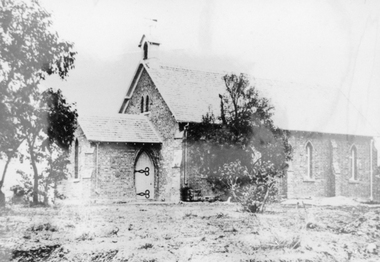
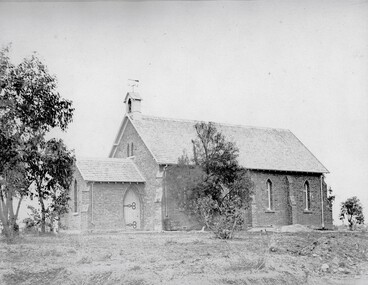
Photograph, Christ Church Stawell
... Brick Church with small bell tower. Trees and rough ground at front....Christ Church Stawell stawell building Brick Church with small bell tower. Trees and rough ground at front. ...Christ Church StawellBrick Church with small bell tower. Trees and rough ground at front.stawell building -
 Stawell Historical Society Inc
Photograph, Christ Church -- Church of England on Church Hill Stawell, built 1862
... Brick Church with small bell tower. Gum trees in front and at left....Stawell Religion Brick Church with small bell tower. Gum trees in front and at left. ...Christ Church. Church of England on Church Hill Stawell. Built 1862. Part of a collection of Photographs by Mr. O.G. Armstrong as commissioned by the Shire of Stawell in 1866 for the Inter-colonial and Paris Exhibition in Melbourne in 1866. This was the first brick church in Stawell, the Christ Church, Stawell West, and was built on Church Hill off Seaby Street in approximately 1862. Opposite the original Manse in Seaby Street it was used for services in 1863. The present Church of England the Holy Trinity is situated in Main Street and was opened and dedicated on Trinity Sunday, May the 26th, 1872. Brick Church with small bell tower. Gum trees in front and at left.stawell religion -
 Flagstaff Hill Maritime Museum and Village
Functional object - Service Bell, 1855
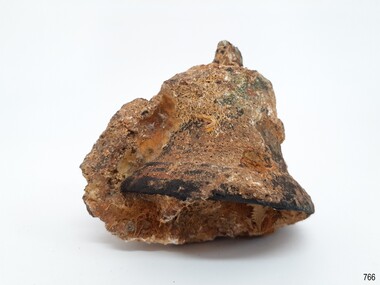
... Bell; small service bell, brass, with heavy encrustation. ...The shipwreck is of additional historically significance for representing aspects of Victoria’s shipping history and for its association with the first passenger ship, which was designed not only to be the fastest and most luxurious of its day but foundered on its maiden voyage to Australia. warrnambool flagstaff-hill flagstaff-hill-maritime-museum shipwreck-coast flagstaff-hill-maritime-village schomberg shipwrecked-artefact clipper ship black ball line 1855 shipwreck aberdeen clipper ship captain forbes peterborough shipwreck ss queen bell Service Bell None Bell; small service bell, brass, with heavy encrustation. ...This service bell was recovered from the wreck of the ship Schomberg. The Schomberg was a large three-masted full-ship rigged wooden ship built in 1855 by Alexander Hall and Co in Aberdeen, Scotland for James Baines' famous Black Ball Line at £43,103. The vessel was 288 feet (88 meters) in length, with a beam of 45 feet (14 meters), a depth of 29.5 feet (8.99 meters) of 2,284 tons. The mainmast was 210 feet (64 meters) high and she carried 3.3 acres of sail. The vessel was constructed with three skins. One planked fore and aft, and two diagonally planked, fastened together with screw-threaded trunnels (wooden rails). The Schomberg is one of only three clipper wrecks in Victorian waters that operated the England to Australia run. While the other two, Empress of the Sea and Lightning, were built by the famous American shipbuilder, Donald Mac Kay. Schomberg was an attempt to build a faster ship than Mac Kay and a vessel fast enough to break the sailing record to Australia. The Schomberg sailed on her maiden voyage from Liverpool on 6 October 1855, under the command of Captain James Forbes, on its maiden voyage to Australia with a general cargo, jewellery, spirits, machinery, and 2,000 tons of iron rails and equipment intended to build the Melbourne to Geelong Railway and a bridge over the Yarra from Melbourne to Hawthorn. She also carried a cow for fresh milk, pens for fowls and pigs, plus 90,000 gallons of water for washing and drinking. She also carried 17,000 letters and 31,800 newspapers. There were approximately 473 passengers and a crew of 105. It was hoped that Schomberg would make Melbourne in sixty days, setting a record for the voyage, but light winds at the equator dashed those expectations. The ship sighted Moonlight Head in south west Victoria on Christmas Day but through a deadly combination of wind, currents and unmarked sand spits, the vessel gently ran aground on 26 December 1855 on a spit that juts into Newfield Bay, just east of Curdies Inlet, and the present town of Peterborough. Fortunately, the SS Queen was nearby and managed to save all passengers and crew. The steamers Keera and Maitland were dispatched to salvage the passenger's baggage and the more valuable cargo. Other salvage attempts were made, but deteriorating weather made the work impossible, and within two weeks the Schomberg's hull was broken up and the vessel abandoned. The wrecking of the Schomberg caused quite the public stir particularly in light of the fact the vessel was supposed to be, the most perfect clipper ship ever built. Captain Forbes was charged in the Supreme Court under suspicion that he was playing cards with two female passengers below decks when his ship ran aground. Despite a protest meeting, two inquiries and the court proceedings, he was found not guilty and cleared of all charges. In 1975, divers from Flagstaff Hill, including Peter Ronald, found an ornate communion set at the wreck. The set comprised a jug, two chalices, a plate and a lid. The lid did not fit any of the other objects and in 1978 a piece of the lid broke off, revealing a glint of gold. As museum staff carefully examined the lid and removed marine growth, they found a diamond ring, which is currently on display in the Great Circle Gallery at the Flagstaff Hill Maritime museum that also displays ship fittings and equipment, personal effects. Most of the artefacts were salvaged from the wreck by Peter Ronald, former director of Flagstaff Hill.The Schomberg has historical significance as one of the first luxurious ships built to bring emigrants to Australia to cash in on the gold rush era. And is included on the Victorian Heritage Register (VHR S612). The collection of Schomberg artefacts held at Flagstaff Hill Museum is primarily significant because of the relationship between these recovered items having a high potential to interpret the story of the Schomberg and its foundering during a storm. The shipwreck is of additional historically significance for representing aspects of Victoria’s shipping history and for its association with the first passenger ship, which was designed not only to be the fastest and most luxurious of its day but foundered on its maiden voyage to Australia.Bell; small service bell, brass, with heavy encrustation. Bell has a square loop at the top. The bell was recovered from the wreck of the Schomberg.Nonewarrnambool, flagstaff-hill, flagstaff-hill-maritime-museum, shipwreck-coast, flagstaff-hill-maritime-village, schomberg, shipwrecked-artefact, clipper ship, black ball line, 1855 shipwreck, aberdeen clipper ship, captain forbes, peterborough shipwreck, ss queen, bell, service bell -
 Mission to Seafarers Victoria
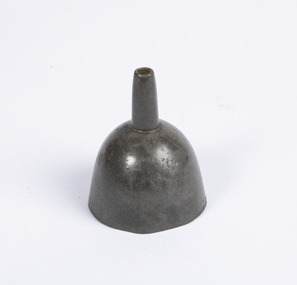
Functional object - Metal Funnel, c. 1840
... Small Bell shaped metal funnel with a large primary container which then is connected to a secondary elongated cylindrical portion with a narrow opening. ...volum collection Small Bell shaped metal funnel with a large primary container which then is connected to a secondary elongated cylindrical portion with a narrow opening. ...Small Bell shaped metal funnel with a large primary container which then is connected to a secondary elongated cylindrical portion with a narrow opening. Found in the top container location of the parent item.volum collection -
 Musculoskeletal Health Australia (now held by the Glen Eira Historical Society)
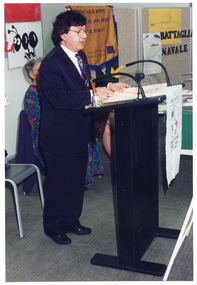
Photograph - Group photo, 1996
... COL photo of a man standing at a black lectern, speaking. There is a small bell placed on the lectern. Partially visible behind and to the side of him is a woman, seated. ...In this photo, a guest speaker addresses the attendees at the launch. arthritis foundation of victoria afv osteoporosis victoria ov culturally and linguistically diverse cald languages other than english lote migrant communities bilingual Italian move it or lose it brochures guest speaker 1996 COL photo of a man standing at a black lectern, speaking. There is a small bell placed on the lectern. Partially visible behind and to the side of him is a woman, seated. ...This series of photos were taken in 1996 at the launch of the bilingual "Move it or Lose it" brochures for the Italian community. As a result of a commitment by the Arthritis Foundation of Victoria (AFV), incorporating Osteoporosis Victoria (OV), to better reach and serve the multicultural community, bilingual brochures were produced in several languages. In this photo, a guest speaker addresses the attendees at the launch.COL photo of a man standing at a black lectern, speaking. There is a small bell placed on the lectern. Partially visible behind and to the side of him is a woman, seated. There are posters on the wall behind them.arthritis foundation of victoria, afv, osteoporosis victoria, ov, culturally and linguistically diverse, cald, languages other than english, lote, migrant communities, bilingual, italian, move it or lose it, brochures, guest speaker, 1996 -
 Trafalgar Holden Museum
Accessory - Stock bell, ca1910
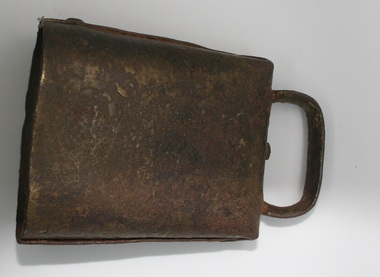
... Small rectangular bell , metal clanger, metal holder on top...Used in agriculture to identify location of stock ca 1910 Metal cow bell, we believe was imported by HOLDEN and FROST ca1910 Agriculture Stock bell c1910 Small rectangular bell , metal clanger, metal holder on top Accessory Stock bell ...Used in agriculture to identify location of stock ca 1910Metal cow bell, we believe was imported by HOLDEN and FROST ca1910 Small rectangular bell , metal clanger, metal holder on topagriculture, stock bell, c1910 -
 Musculoskeletal Health Australia (now held by the Glen Eira Historical Society)
Photograph - Group photo, 1996
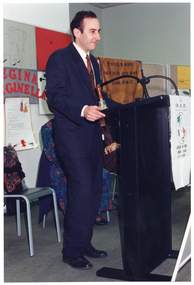
... COL photo of a man standing at a black lectern, speaking. There is a small bell placed on the lectern. Partially visible behind and to the side of him are two women, seated. ...In this photo, a guest speaker addresses the attendees at the launch. arthritis foundation of victoria afv osteoporosis victoria ov culturally and linguistically diverse cald languages other than english lote migrant communities bilingual Italian move it or lose it brochures guest speaker 1996 COL photo of a man standing at a black lectern, speaking. There is a small bell placed on the lectern. Partially visible behind and to the side of him are two women, seated. ...This series of photos were taken in 1996 at the launch of the bilingual "Move it or Lose it" brochures for the Italian community. As a result of a commitment by the Arthritis Foundation of Victoria (AFV), incorporating Osteoporosis Victoria (OV), to better reach and serve the multicultural community, bilingual brochures were produced in several languages. In this photo, a guest speaker addresses the attendees at the launch.COL photo of a man standing at a black lectern, speaking. There is a small bell placed on the lectern. Partially visible behind and to the side of him are two women, seated. There are posters on the wall behind them.arthritis foundation of victoria, afv, osteoporosis victoria, ov, culturally and linguistically diverse, cald, languages other than english, lote, migrant communities, bilingual, italian, move it or lose it, brochures, guest speaker, 1996 -
 Trafalgar Holden Museum
Accessory - Stock bell
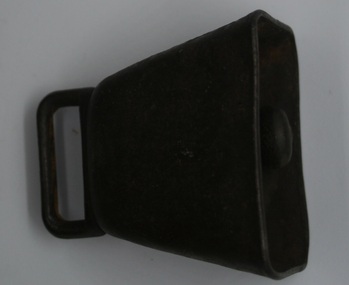
... Small metal bell with metal clanger, rectangular shaped with holder on top...Metal cow bell, we believe was imported by HOLDEN and FROST ca1910 Used in agriculture ca1910 cow bell agriculture Small metal bell with metal clanger, rectangular shaped with holder on top Accessory Stock bell ...Metal cow bell, we believe was imported by HOLDEN and FROST ca1910Used in agriculture ca1910Small metal bell with metal clanger, rectangular shaped with holder on topcow bell, agriculture -
 Musculoskeletal Health Australia (now held by the Glen Eira Historical Society)
Photograph - Group photo, 1996
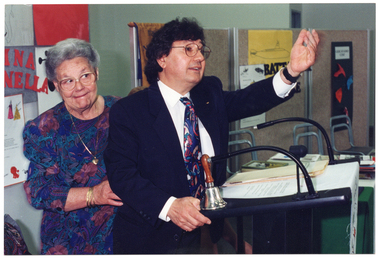
... COL photo of a man standing at a black lectern speaking, with one arm outstretched. There is a small bell placed on the lectern. Behind him is a woman with one hand on his waist. ...In this photo, a guest speaker addresses the attendees at the launch. arthritis foundation of victoria afv osteoporosis victoria ov culturally and linguistically diverse cald languages other than english lote migrant communities bilingual Italian move it or lose it brochures guest speaker 1996 COL photo of a man standing at a black lectern speaking, with one arm outstretched. There is a small bell placed on the lectern. Behind him is a woman with one hand on his waist. ...This series of photos were taken in 1996 at the launch of the bilingual "Move it or Lose it" brochures for the Italian community. As a result of a commitment by the Arthritis Foundation of Victoria (AFV), incorporating Osteoporosis Victoria (OV), to better reach and serve the multicultural community, bilingual brochures were produced in several languages. In this photo, a guest speaker addresses the attendees at the launch.COL photo of a man standing at a black lectern speaking, with one arm outstretched. There is a small bell placed on the lectern. Behind him is a woman with one hand on his waist. There are posters on the wall behind them.arthritis foundation of victoria, afv, osteoporosis victoria, ov, culturally and linguistically diverse, cald, languages other than english, lote, migrant communities, bilingual, italian, move it or lose it, brochures, guest speaker, 1996 -
 Bendigo Historical Society Inc.
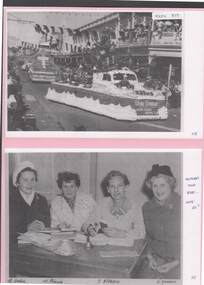
Document - GOLDEN SQUARE P.S. LAUREL ST. 1189 COLLECTION: PHOTO, 1950's
... Bottom 4 women sitting at table, small bell in front. Names on bottom. 'E. Oakes, M. ...Bottom 4 women sitting at table, small bell in front. Names on bottom. 'E. Oakes, M. ...Two copies of photographs: top - Easter Float, depicts White Christmas. Bottom 4 women sitting at table, small bell in front. Names on bottom. 'E. Oakes, M. Pinch, J. Fithall, H. Yanner.education, primary, golden square laurel st p.s. -
 Trafalgar Holden Museum
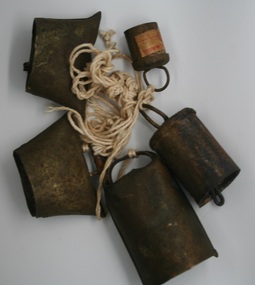
Functional object - Sheep bells, ca1910
... 5 small metal bells of various sizes attached with twine to be hung around the necks of sheep...Sheep Bells, we believe were imported by HOLDEN and FROST ca1910 used in agriculture c1910 Sheep bells agriculture 5 small metal bells of various sizes attached with twine to be hung around the necks of sheep Functional object Sheep bells ...Sheep Bells, we believe were imported by HOLDEN and FROST ca1910 used in agriculture c19105 small metal bells of various sizes attached with twine to be hung around the necks of sheepsheep bells, agriculture -
 University of Melbourne, Burnley Campus Archives
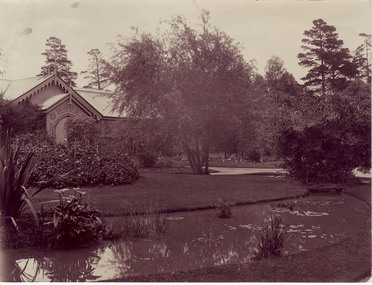
Photograph - Sepia print, A.P. Winzenried, Pavilion, 1909
... Kneen, "The main entry to the Pavilion is surmounted by the small bell tower," and by E.B. Littlejohn, "Staff assembled under the bell tower waiting the bell to sound before moving off for home circa late 1930's."...Kneen, "The main entry to the Pavilion is surmounted by the small bell tower," and by E.B. Littlejohn, "Staff assembled under the bell tower waiting the bell to sound before moving off for home circa late 1930's." lily ponds 1909 pavilion bell tower a.p. winzenried green grows our garden luffmann ponds (1) On reverse of larger copy, "1909." (2) On reverse of second copy taken by A.P. ...Note by T.H. Kneen, "The main entry to the Pavilion is surmounted by the small bell tower," and by E.B. Littlejohn, "Staff assembled under the bell tower waiting the bell to sound before moving off for home circa late 1930's."3 copies black and white/sepia photograph of the Pavilion. Lily ponds in the foreground. (1) On reverse of larger copy, "1909." (2) On reverse of second copy taken by A.P. Winzenried for consideration for inclusion in, "Green Grows Our Garden.", "The old pavilion (pre cement Admin building) Pre 1940's."lily ponds, 1909, pavilion, bell tower, a.p. winzenried, green grows our garden, luffmann ponds -
 Flagstaff Hill Maritime Museum and Village
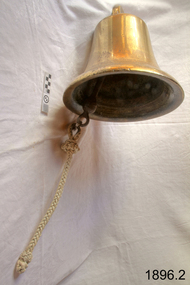
Functional object - Bell
... A bell of this size could have many could be used in many locations such as in a domestic setting, a retail business, a school or other workplace in in a small vessel....Bell; small brass bell with a hole through a link set into the top, and two grooves around circumference. ...A bell of this size could have many could be used in many locations such as in a domestic setting, a retail business, a school or other workplace in in a small vessel. ...A bell of this size could have many could be used in many locations such as in a domestic setting, a retail business, a school or other workplace in in a small vessel.This bell is an example of bells used over the centuries to sound an alarm, mark time or call to order.Bell; small brass bell with a hole through a link set into the top, and two grooves around circumference. The surface has been varnished. The bell has an attached iron clapper with a plaited and knotted rope handle painted white.flagstaff hill, flagstaff hill maritime museum and village, warrnambool, maritime museum, maritime village, great ocean road, shipwreck coast, bell, brass bell -
 Federation University Historical Collection
Slide, Eglise du Bras de Pontho (Church of the Holy Angels of Bras de Pontho), c1970
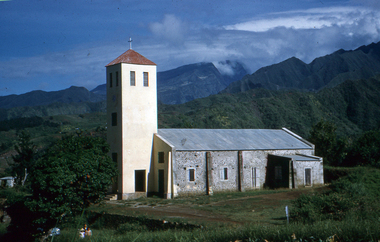
... The concrete building is a large rectangle to which is added a square tower supporting a small bell tower. From the church site you can view the Bras de la Plaine valley ...The concrete building is a large rectangle to which is added a square tower supporting a small bell tower. From the church site you can view the Bras de la Plaine valley eglise du bras de pontho church of the holy angels of bras de pontho church bras de la plaine valley Handwritten "Eglise du Bras de Pontho" Stamped "R. ...A small wooden chapel was built on this site but was destroyed by a cyclone in 1948. It was immediately replaced by the present church, which has simple architecture and interior ornaments. The concrete building is a large rectangle to which is added a square tower supporting a small bell tower. From the church site you can view the Bras de la Plaine valley Photograph of a church Handwritten "Eglise du Bras de Pontho" Stamped "R. Ueberschlag"eglise du bras de pontho, church of the holy angels of bras de pontho, church, bras de la plaine valley -
 Flagstaff Hill Maritime Museum and Village
Functional object - Cow Bell, Circa 1878
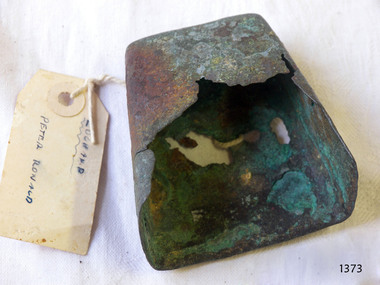
... A small brass cow bell, in poor condition. It is blunt-wedge shaped. ...Cow bells were part of the cargo" - "10/6/73, LOCH ARD, small brass cow bell salvaged by FHMV divers"]. ...Cow bells were part of the cargo" - "10/6/73, LOCH ARD, small brass cow bell salvaged by FHMV divers"]. ...The artefact is a damaged brass cow bell recovered from the 1878 shipwreck of the LOCH ARD near Port Campbell. It was raised by Flagstaff Hill divers in 1973 and is in storage at the Maritime Village. The LOCH ARD was constructed on the Clyde in 1873 for the prestigious Loch Line of colonial clipper ships, designed for the Australian run. She sailed from England on 1 March 1878 carrying 37 crew, 17 passengers and a diverse general cargo ranging from luxury items to bulk railway iron. On 1 June 1878, emerging from fog and hearing too late the sound of breakers against the tall limestone cliffs, the vessel struck the southern foot of Mutton Bird Island and sank in 23 metres of water. Of the fifty-four people on board only two survived, one young male crewman and one young female passenger. A century later, despite the pounding seas and the efforts of looters, the wreck site continued to provide ample evidence of the extraordinary range of goods being imported into the Colony of Victoria in the post-Gold Rush era. Flagstaff Hill divers in the 1970s reported finds of “Bottles of champagne, window panes, rolls of zinc, barrels of cement, iron rails, clocks, lead shot, corrugated iron, lead, marble, salad oil bottles, ink bottles, copper wire, gin bottles, rolls of carpet, floor tiles, copper rivets, gas light fittings, pocket knives, toys, crystal chandeliers, beer mugs, cutlery, candles sticks, wick scissors, cow bells, and sauce bottles.” From this array of objects on the ocean floor emerged the humble brass cow bell. Cow bells were common to colonial agriculture and transport, used wherever animals were turned out to graze overnight and had to be rounded up again next morning. Bells were fastened around the necks of household milking cows, domestic goats, bullock teams, horse teams, and camel teams, to help find them in the pre-dawn light. Station shepherds and cattle drovers also used them to warn of any disturbances to their flocks and herds overnight. The bells were a necessary item in a largely unfenced continent. So important, that Anthony Mongon began making his pot-bells at Yackandandah from 1861, August Menneke produced the “Wagga Pot” from 1867, and Samuel Jones started manufacturing his distinctively shaped “Condamine Bell” in 1868. However, these deeply resonant Australian bells were made from iron — Mongon and Jones were blacksmiths who simply beat old pitsaw blades into shape. Few genuinely brass cow bells were made here, the vast majority being imported from Britain where the industry of brass founding was already well established. (Some bells were also imported from the United States, but these too were nearly all of iron).This bell is historically significant as typical of a cow bell used by farmers and herdsmen in Colonial Victoria. Its significance is increased by being one of a collection of artefact recovered by the Flagstaff Hill Divers from the wreck of the Loch Ard in the early 1970s. Items that come from several wrecks along Victoria's coast have also been recovered for Flagstaff Hill Maritime Village’s museum collection under Government permit, illustrating this item’s level of historical value. The cow bell is also significant for being part of Flagstaff Hill’s collection of artefacts from LOCH ARD, which is significant for being one of the largest collections of artefacts from this shipwreck in Victoria. It is significant for its association with the shipwreck, which is on the Victorian Heritage Register (VHR S417). The collection is significant because of the relationship between the objects, as together they have a high potential to interpret the story of the LOCH ARD. The LOCH ARD collection is archaeologically significant as the remains of a large international passenger and cargo ship. The LOCH ARD collection is historically significant for representing aspects of Victoria’s shipping history and its potential to interpret sub-theme 1.5 of Victoria’s Framework of Historical Themes (living with natural processes). The collection is also historically significant for its association with the LOCH ARD, which was one of the worst and best known shipwrecks in Victoria’s history.A small brass cow bell, in poor condition. It is blunt-wedge shaped. The sides expand outwards from the smaller rectangular roof of the bell to a larger open rectangle or bell mouth. A handwritten label is attached to the bel. Recovered from the wreck of the Loch Ard.Label text "["10/6/73, Brass Cow Bell, LOCH ARD, Found in the sandy hole in the centre of the wreck site. Cow bells were part of the cargo" - "10/6/73, LOCH ARD, small brass cow bell salvaged by FHMV divers"]. "LOCH ARD / PETER RONALD"flagstaff hill, warrnambool, shipwrecked coast, flagstaff hill maritime museum, maritime museum, shipwreck coast, flagstaff hill maritime village, great ocean road, loch line, loch ard, eva carmichael, mutton bird island, loch ard gorge, brass cow bell, colonial cow bells, 1878 shipwreck, shipwreck artefact, flagstaff hill divers -
 Bendigo Historical Society Inc.
Ephemera - Light metal and wooden hand bell
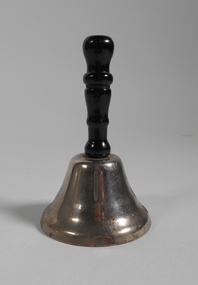
... Small hand bell made of a light steel bell with a wooden turned handle painted black. ...Functional object Bell Small hand bell made of a light steel bell with a wooden turned handle painted black. ...Small hand bell made of a light steel bell with a wooden turned handle painted black. The metal bell shows signs of rust. No manufacturer's marks.functional object, bell -
 Flagstaff Hill Maritime Museum and Village
Bell
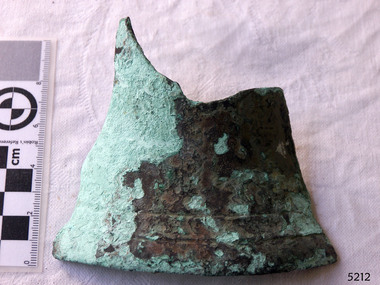
... Part of the base of a small bronze bell. Green corrosion and some traces of bronze disease. . ...The collection is also historically significant for its association with the LOCH ARD, which was one of the worst and best known shipwrecks in Victoria’s history. flagstaff hill warrnambool shipwrecked coast flagstaff hill maritime museum maritime museum shipwreck coast flagstaff hill maritime village great ocean road loch line loch ard captain gibbs eva carmichael tom pearce glenample station mutton bird island loch ard gorge bell bronze bell Part of the base of a small bronze bell. Green corrosion and some traces of bronze disease. . ...Ref: LA 3-32-281 HISTORY OF THE LOCH ARD The LOCH ARD belonged to the famous Loch Line which sailed many ships from England to Australia. Built in Glasgow by Barclay, Curdle and Co. in 1873, the LOCH ARD was a three-masted square rigged iron sailing ship. The ship measured 262ft 7" (79.87m) in length, 38ft (11.58m) in width, 23ft (7m) in depth and had a gross tonnage of 1693 tons. The LOCH ARD's main mast measured a massive 150ft (45.7m) in height. LOCH ARD made three trips to Australia and one trip to Calcutta before its final voyage. LOCH ARD left England on March 2, 1878, under the command of Captain Gibbs, a newly married, 29 year old. She was bound for Melbourne with a crew of 37, plus 17 passengers and a load of cargo. The general cargo reflected the affluence of Melbourne at the time. On board were straw hats, umbrella, perfumes, clay pipes, pianos, clocks, confectionary, linen and candles, as well as a heavier load of railway irons, cement, lead and copper. There were items included that intended for display in the Melbourne International Exhibition in 1880. The voyage to Port Phillip was long but uneventful. At 3am on June 1, 1878, Captain Gibbs was expecting to see land and the passengers were becoming excited as they prepared to view their new homeland in the early morning. But LOCH ARD was running into a fog which greatly reduced visibility. Captain Gibbs was becoming anxious as there was no sign of land or the Cape Otway lighthouse. At 4am the fog lifted. A man aloft announced that he could see breakers. The sheer cliffs of Victoria's west coast came into view, and Captain Gibbs realised that the ship was much closer to them than expected. He ordered as much sail to be set as time would permit and then attempted to steer the vessel out to sea. On coming head on into the wind, the ship lost momentum, the sails fell limp and LOCH ARD's bow swung back. Gibbs then ordered the anchors to be released in an attempt to hold its position. The anchors sank some 50 fathoms - but did not hold. By this time LOCH ARD was among the breakers and the tall cliffs of Mutton Bird Island rose behind the ship. Just half a mile from the coast, the ship's bow was suddenly pulled around by the anchor. The captain tried to tack out to sea, but the ship struck a reef at the base of Mutton Bird Island, near Port Campbell. Waves broke over the ship and the top deck was loosened from the hull. The masts and rigging came crashing down knocking passengers and crew overboard. When a lifeboat was finally launched, it crashed into the side of LOCH ARD and capsized. Tom Pearce, who had launched the boat, managed to cling to its overturned hull and shelter beneath it. He drifted out to sea and then on the flood tide came into what is now known as LOCH ARD Gorge. He swam to shore, bruised and dazed, and found a cave in which to shelter. Some of the crew stayed below deck to shelter from the falling rigging but drowned when the ship slipped off the reef into deeper water. Eva Carmichael had raced onto deck to find out what was happening only to be confronted by towering cliffs looming above the stricken ship. In all the chaos, Captain Gibbs grabbed Eva and said, "If you are saved Eva, let my dear wife know that I died like a sailor". That was the last Eva Carmichael saw of the captain. She was swept off the ship by a huge wave. Eva saw Tom Pearce on a small rocky beach and yelled to attract his attention. He dived in and swam to the exhausted woman and dragged her to shore. He took her to the cave and broke open case of brandy which had washed up on the beach. He opened a bottle to revive the unconscious woman. A few hours later Tom scaled a cliff in search of help. He followed hoof prints and came by chance upon two men from nearby Glenample Station three and a half miles away. In a state of exhaustion, he told the men of the tragedy. Tom returned to the gorge while the two men rode back to the station to get help. By the time they reached LOCH ARD Gorge, it was cold and dark. The two shipwreck survivors were taken to Glenample Station to recover. Eva stayed at the station for six weeks before returning to Ireland, this time by steamship. In Melbourne, Tom Pearce received a hero's welcome. He was presented with the first gold medal of the Royal Humane Society of Victoria and a £1000 cheque from the Victorian Government. Concerts were performed to honour the young man's bravery and to raise money for those who lost family in the LOCH ARD disaster. Of the 54 crew members and passengers on board, only two survived: the apprentice, Tom Pearce and the young woman passenger, Eva Carmichael, who lost all of her family in the tragedy. Ten days after the LOCH ARD tragedy, salvage rights to the wreck were sold at auction for £2,120. Cargo valued at £3,000 was salvaged and placed on the beach, but most washed back into the sea when another storm developed. The wreck of LOCH ARD still lies at the base of Mutton Bird Island. Much of the cargo has now been salvaged and some was washed up into what is now known as LOCH ARD Gorge. Cargo and artefacts have also been illegally salvaged over many years before protective legislation was introduced. One of the most unlikely pieces of cargo to have survived the shipwreck was a Minton porcelain peacock - one of only nine in the world. The peacock was destined for the Melbourne International Exhibition in 1880. It had been well packed, which gave it adequate protection during the violent storm. Today, the Minton peacock can be seen at the Flagstaff Hill Maritime Museum in Warrnambool. From Australia's most dramatic shipwreck it has now become Australia's most valuable shipwreck artefact and is one of very few 'objects' on the Victorian State Heritage Register. Flagstaff Hill’s collection of artefacts from LOCH ARD is significant for being one of the largest collections of artefacts from this shipwreck in Victoria. It is significant for its association with the shipwreck, which is on the Victorian Heritage Register (VHR S417). The collection is significant because of the relationship between the objects, as together they have a high potential to interpret the story of the LOCH ARD. The LOCH ARD collection is archaeologically significant as the remains of a large international passenger and cargo ship. The LOCH ARD collection is historically significant for representing aspects of Victoria’s shipping history and its potential to interpret sub-theme 1.5 of Victoria’s Framework of Historical Themes (living with natural processes). The collection is also historically significant for its association with the LOCH ARD, which was one of the worst and best known shipwrecks in Victoria’s history. Part of the base of a small bronze bell. Green corrosion and some traces of bronze disease. . Artefact Reg no LA/106. Recovered from the wreck of the Loch Ard.flagstaff hill, warrnambool, shipwrecked coast, flagstaff hill maritime museum, maritime museum, shipwreck coast, flagstaff hill maritime village, great ocean road, loch line, loch ard, captain gibbs, eva carmichael, tom pearce, glenample station, mutton bird island, loch ard gorge, bell, bronze bell -
 Glen Eira City Council History and Heritage Collection
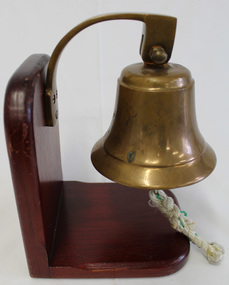
Bell, brass
... Brass bell with small piece of white cord attached....BRIGGS embossed on top of bell. Brass bell with small piece of white cord attached. Bell, brass ...Brass bell with small piece of white cord attached.BRIGGS embossed on top of bell. -
 Whitehorse Historical Society Inc.
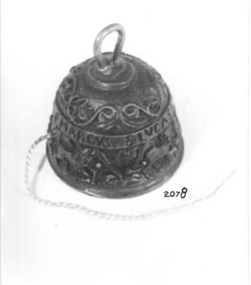
Container - String Dispenser
... Small ornate bell shaped metal container with a hole at side which string protudes. ...Collected by Harold Bakes from a shop (Eileen Conlon's) in Surrey Hills. handcrafts equipment Small ornate bell shaped metal container with a hole at side which string protudes. ...Collected by Harold Bakes from a shop (Eileen Conlon's) in Surrey Hills.Small ornate bell shaped metal container with a hole at side which string protudes. Cotton stored inside. Decorations include 'Mathews, Marcus, Lucas. Johannes. Handle.handcrafts, equipment -
 Emerald Museum & Nobelius Heritage Park
Souvenir - Souvenir Coronation Bell, Gillet and Johnston, 1953
... Small brass bell with crown-like handle and raised lettering around the edge. ...Inside the bell: 'Made by G. & J. England' Small brass bell with crown-like handle and raised lettering around the edge. ...This coronation bell belonged to Karen Alexander who grew up in Belgrave in the 1940s and 1950s.There was widespread excitement in Australia regarding the coronation of the young queen in 1953 and this commemorative bell reflects that.Small brass bell with crown-like handle and raised lettering around the edge. Souvenir of the coronation of Queen Elizabeth II in 1953. Donated by Karen Alexander who grew up in Belgrave.Raised lettering around the edge of the bell: 'Coronation of Queen Elizabeth II 1953'. Inside the bell: 'Made by G. & J. England'alexander, bell, coronation, belgrave victoria australia, karen alexander, 1953, queen elizabeth ii, gillet and johnston, england -
 Flagstaff Hill Maritime Museum and Village
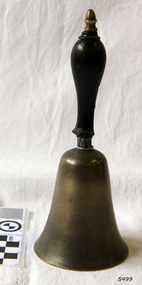
Bell
... Small brass hand bell with ebony handle. Bell has metal clapper attached by copper wire. ...Hand bells such as this one were used in schools, churches, meetings and other public gatherings to draw attention or mark time. flagstaff hill warrnambool shipwrecked-coast flagstaff-hill flagstaff-hill-maritime-museum maritime-museum shipwreck-coast flagstaff-hill-maritime-village brass hand bell hand bell communication "281" Small brass hand bell with ebony handle. ...Hand bells such as this one were used in schools, churches, meetings and other public gatherings to draw attention or mark time.Small brass hand bell with ebony handle. Bell has metal clapper attached by copper wire. Bell has an inscription."281"flagstaff hill, warrnambool, shipwrecked-coast, flagstaff-hill, flagstaff-hill-maritime-museum, maritime-museum, shipwreck-coast, flagstaff-hill-maritime-village, brass hand bell, hand bell, communication -
 Flagstaff Hill Maritime Museum and Village
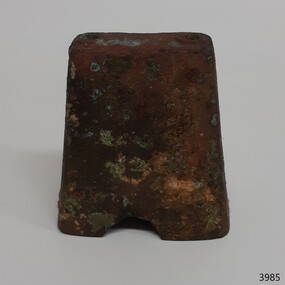
Functional object - Cow Bell, Circa 1878
... Cow bell; a small brass bell, blunt-wedge shaped. The sides expand outwards from the smaller rectangular roof of the bell to a larger open rectangle or bell mouth. ...The collection is also historically significant for its association with the LOCH ARD, which was one of the worst and best-known shipwrecks in Victoria’s history. flagstaff hill warrnambool shipwrecked coast flagstaff hill maritime museum maritime museum shipwreck coast flagstaff hill maritime village great ocean road loch line loch ard eva carmichael mutton bird island loch ard gorge brass cow bell colonial cow bells 1878 shipwreck shipwreck artefact flagstaff hill divers cow bell Cow bell; a small brass bell, blunt-wedge shaped. The sides expand outwards from the smaller rectangular roof of the bell to a larger open rectangle or bell mouth. ...The artefact is a damaged brass cow bell recovered from the 1878 shipwreck of the LOCH ARD near Port Campbell. It was raised by Flagstaff Hill divers in 1973 and is in storage at the Maritime Village. The LOCH ARD was constructed on the Clyde in 1873 for the prestigious Loch Line of colonial clipper ships, designed for the Australian run. She sailed from England on 1 March 1878 carrying 37 crew, 17 passengers and a diverse general cargo ranging from luxury items to bulk railway iron. On 1 June 1878, emerging from fog and hearing too late the sound of breakers against the tall limestone cliffs, the vessel struck the southern foot of Mutton Bird Island and sank in 23 metres of water. Of the fifty-four people on board only two survived, one young male crewman and one young female passenger. A century later, despite the pounding seas and the efforts of looters, the wreck site continued to provide ample evidence of the extraordinary range of goods being imported into the Colony of Victoria in the post-Gold Rush era. Flagstaff Hill divers in the 1970s reported finds of “Bottles of champagne, window panes, rolls of zinc, barrels of cement, iron rails, clocks, lead shot, corrugated iron, lead, marble, salad oil bottles, ink bottles, copper wire, gin bottles, rolls of carpet, floor tiles, copper rivets, gas light fittings, pocket knives, toys, crystal chandeliers, beer mugs, cutlery, candles sticks, wick scissors, cow bells, and sauce bottles.” From this array of objects on the ocean floor emerged the humble brass cow bell. Cow bells were common to colonial agriculture and transport, used wherever animals were turned out to graze overnight and had to be rounded up again next morning. Bells were fastened around the necks of household milking cows, domestic goats, bullock teams, horse teams, and camel teams, to help find them in the pre-dawn light. Station shepherds and cattle drovers also used them to warn of any disturbances to their flocks and herds overnight. The bells were a necessary item in a largely unfenced continent. So important, that Anthony Mongon began making his pot-bells at Yackandandah from 1861, August Menneke produced the “Wagga Pot” from 1867, and Samuel Jones started manufacturing his distinctively shaped “Condamine Bell” in 1868. However, these deeply resonant Australian bells were made from iron — Mongon and Jones were blacksmiths who simply beat old pitsaw blades into shape. Few genuinely brass cow bells were made here, the vast majority being imported from Britain where the industry of brass founding was already well established. (Some bells were also imported from the United States, but these too were nearly all of iron).This bell is historically significant as typical of a cow bell used by farmers and herdsmen in Colonial Victoria. It was included in the cargo of the Loch Ard. Its significance is increased by being one of a collection of artefacts recovered by the Flagstaff Hill Divers from the wreck of the Loch Ard in the early 1970s. Items that come from several wrecks along Victoria's coast have also been recovered for Flagstaff Hill Maritime Village’s museum collection under a Government permit, illustrating this item’s level of historical value. The cow bell is also significant for being part of Flagstaff Hill’s collection of artefacts from LOCH ARD, which is significant for being one of the largest collections of artefacts from this shipwreck in Victoria. It is significant for its association with the shipwreck, which is on the Victorian Heritage Register (VHR S417). The collection is significant because of the relationship between the objects, as together they have a high potential to interpret the story of the LOCH ARD. The LOCH ARD collection is archaeologically significant as the remains of a large international passenger and cargo ship. The LOCH ARD collection is historically significant for representing aspects of Victoria’s shipping history and its potential to interpret sub-theme 1.5 of Victoria’s Framework of Historical Themes (living with natural processes). The collection is also historically significant for its association with the LOCH ARD, which was one of the worst and best-known shipwrecks in Victoria’s history.Cow bell; a small brass bell, blunt-wedge shaped. The sides expand outwards from the smaller rectangular roof of the bell to a larger open rectangle or bell mouth. The handle, now missing, was fixed in two places at the top. A neat half-circle piece has been cut from the base on a long edge. Recovered from the wreck of the Loch Ard.flagstaff hill, warrnambool, shipwrecked coast, flagstaff hill maritime museum, maritime museum, shipwreck coast, flagstaff hill maritime village, great ocean road, loch line, loch ard, eva carmichael, mutton bird island, loch ard gorge, brass cow bell, colonial cow bells, 1878 shipwreck, shipwreck artefact, flagstaff hill divers, cow bell -
 Queenscliffe Maritime Museum
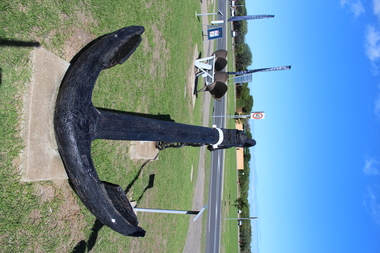
Functional object - Anchor from Eliza Ramsden
... It is archaeologically significant as relics of cultural significance, including a small ship's bell, have been found on the site....It is archaeologically significant as relics of cultural significance, including a small ship's bell, have been found on the site. Struck Corsair Rock and later sank in South Channel, Port Philip on 24 July 1875. ...The Eliza Ramsden, with its intact clipper bow, is one of Victoria's most aesthetically spectacular shipwreck sites, and thus has both recreational and educational significance. It is archaeologically significant as relics of cultural significance, including a small ship's bell, have been found on the site.Struck Corsair Rock and later sank in South Channel, Port Philip on 24 July 1875. Now a popular diving site. Large Anchor ex Eliza Rambden which was wrecked on Corsair Rock Point Nepean 24/071875 Made of Cast Ironeliza ramsden, shipwrecks, port phillip, anchors -
Clunes Museum
Ceremonial object - GOLD HAND BELL, 1983
... SMALL GOLD PLATED HAND BELL USED AT MEETINGS OF CLUNES AUXILIARY VICTORIAN INSTITUTE FOR THE BLIND. ...GOLD BELL. 50TH ANNIVERSARY PRESENTATION TO CLUNES AUXILIARY FOR THE BLIND FROM ROYAL VICTORIAN INSTITUTE FOR THE BLIND. USED DURING MEETINGS local history metal craft societies clunes r.v.i.b auxiliary PRESENTED TO CLUNES R.V.I.B. AUXILIARY 50TH ANNIVERSARY SMALL ...GOLD BELL. 50TH ANNIVERSARY PRESENTATION TO CLUNES AUXILIARY FOR THE BLIND FROM ROYAL VICTORIAN INSTITUTE FOR THE BLIND. USED DURING MEETINGSSMALL GOLD PLATED HAND BELL USED AT MEETINGS OF CLUNES AUXILIARY VICTORIAN INSTITUTE FOR THE BLIND. (R.V.I.B)PRESENTED TO CLUNES R.V.I.B. AUXILIARY 50TH ANNIVERSARYlocal history, metal craft, societies, clunes r.v.i.b auxiliary -
 Musculoskeletal Health Australia (now held by the Glen Eira Historical Society)
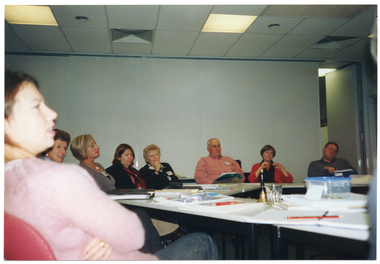
Photograph - Group photo, XX/05/2005
... There are various items on the tables, such as a small brass bell, folders, diaries and note books, a pencil, a glass, and a lunchbox. ...There are various items on the tables, such as a small brass bell, folders, diaries and note books, a pencil, a glass, and a lunchbox. ...In May 2005, a State Foundations Educators' Meeting was held at the Arthritis Foundation of Victoria's headquarters in Elsternwick. This photo depicts several attendees seated at tables during the meeting.COL photo of a group of people seated at tables set in a circle formation. There are various items on the tables, such as a small brass bell, folders, diaries and note books, a pencil, a glass, and a lunchbox. In the background, there is a set of large bi-fold doors held in the closed position, with the last panel opening out into the room behind.[On a white label, typed in black ink] State Foundations - Educators Meeting May 2005arthritis foundation of victoria, afv, osteoporosis victoria, ov, state foundations, educators, meeting, 2005 -
 Musculoskeletal Health Australia (now held by the Glen Eira Historical Society)
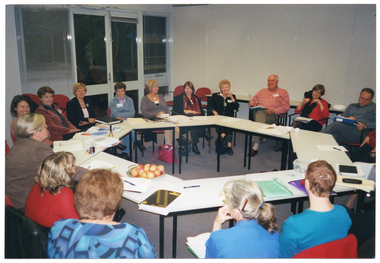
Photograph - Group photo, XX/05/2005
... There are various items on the tables, such as a small brass bell, folders, diaries, note books, leaflets, pens and pencils, a lunchbox, and a platter of apples. ...There are various items on the tables, such as a small brass bell, folders, diaries, note books, leaflets, pens and pencils, a lunchbox, and a platter of apples. ...In May 2005, a State Foundations Educators' Meeting was held at the Arthritis Foundation of Victoria's headquarters in Elsternwick. This photo depicts most of the attendees seated at tables during the meeting.COL photo of a group of people seated at tables set in a circle formation. There are various items on the tables, such as a small brass bell, folders, diaries, note books, leaflets, pens and pencils, a lunchbox, and a platter of apples. In the background, there is a set of double glass doors with a large window on either side. The windows have venetian blinds attached.[On a white label, typed in black ink] State Foundations - Educators Meeting May 2005arthritis foundation of victoria, afv, osteoporosis victoria, ov, state foundations, educators, meeting, 2005
