
Showing 325 items matching "social class"
-
 Uniting Church Archives - Synod of Victoria
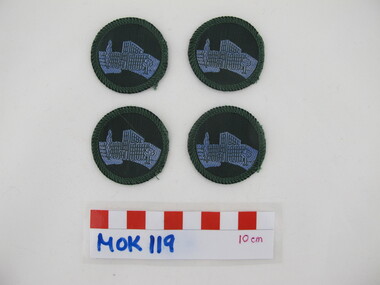
Badge - Merit Badges, 3rd Class Social Merit badge
... 3rd Class Social Merit badge...Third Class tests were set for Pages 10 and 11 years old. Social required Pages to: Assist at a Church social function; Assist at Sunday School, Home or Overseas Missions Appeals by asking for contributions; take part in a working bee. ...Four round 3rd Class Social merit badges. Green background with blue embroidery. ...New. 3rd Class Social Merit badge Badge Merit Badges ...Third Class tests were set for Pages 10 and 11 years old. Social required Pages to: Assist at a Church social function; Assist at Sunday School, Home or Overseas Missions Appeals by asking for contributions; take part in a working bee. [Methodist Church of Australasia Methodist Order of Knights Commanders' Handbook pg 23-24]Four round 3rd Class Social merit badges. Green background with blue embroidery. New.methodist order of knights -
 Unions Ballarat
Who are our enemies? : racism and the Australian working class, Ann Curthoys and Andrew Markus (eds), 1978
... ...social class...Significant to the history of race relations in Australia. btlc migrants immigration racism race relations social class indigenous aboriginal discrimination ballarat trades hall ballarat trades and labour council curthoys, ann markus, andrew who are our enemies Front cover: editors' names and title. ...Tracks racism and discrimination towards the lower-classes, Indigenous persons and immigrants in Australia.Significant to the history of race relations in Australia.Paper; book. Front cover: red background; image of a white spanner - black and white picture shaped like a nut; black text. Front cover: editors' names and title.btlc, migrants, immigration, racism, race relations, social class, indigenous, aboriginal, discrimination, ballarat trades hall, ballarat trades and labour council, curthoys, ann, markus, andrew, who are our enemies -
 Port Fairy Historical Society Museum and Archives
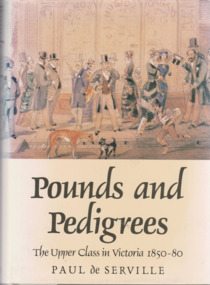
Book, Oxford University Press, Pounds and pedigrees : The Upper Class in Victoria, 1850-80, 1991
... ...social class...Contains extensive biographical entries, a bibliography, an index, and appendices which include lists of landowners in 1879 and club members. elite (social sciences) -- australia -- victoria -- history. upper class -- australia -- victoria -- history. elite (social sciences) manners and customs. upper class. victoria -- social life and customs. victoria. upper classes history victoria elite (social sciences) -- virginia -- history. upper classes -- victoria -- history. social classes -- victoria -- history -- 19th century. upper class -- victoria -- history -- 19th century. upper classes -- victoria -- history -- 19th century. elite (social sciences) -- victoria -- history -- 19th century. upper class -- victoria. elite (social sciences) -- victoria. upper class -- victoria -- history. elite (social sciences) -- victoria -- history. upper classes -- history. pioneers and pioneer life -- victoria. victoria -- social conditions -- 1834-1900. victoria -- social conditions -- history. victoria -- history -- 1851-1900. victoria -- social life and customs -- 1834-1900. social class elites social customs history Book Sweeping history of public and private life in Melbourne's Establishment during the mid-to late 19th century. ...Sweeping history of public and private life in Melbourne's Establishment during the mid-to late 19th century. Contains extensive biographical entries, a bibliography, an index, and appendices which include lists of landowners in 1879 and club members.xv, 619 pages ; 23 cm.1 v 225x160: indexnon-fictionSweeping history of public and private life in Melbourne's Establishment during the mid-to late 19th century. Contains extensive biographical entries, a bibliography, an index, and appendices which include lists of landowners in 1879 and club members.elite (social sciences) -- australia -- victoria -- history., upper class -- australia -- victoria -- history., elite (social sciences), manners and customs., upper class., victoria -- social life and customs., victoria., upper classes history, victoria, elite (social sciences) -- virginia -- history., upper classes -- victoria -- history., social classes -- victoria -- history -- 19th century., upper class -- victoria -- history -- 19th century., upper classes -- victoria -- history -- 19th century., elite (social sciences) -- victoria -- history -- 19th century., upper class -- victoria., elite (social sciences) -- victoria., upper class -- victoria -- history., elite (social sciences) -- victoria -- history., upper classes -- history., pioneers and pioneer life -- victoria., victoria -- social conditions -- 1834-1900., victoria -- social conditions -- history., victoria -- history -- 1851-1900., victoria -- social life and customs -- 1834-1900., social class, elites, social customs, history, book -
 Sunshine and District Historical Society Incorporated
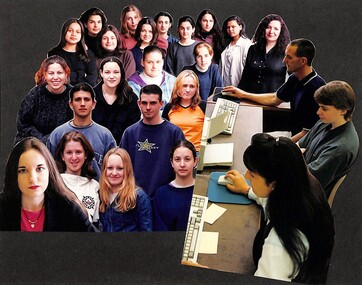
Photograph - Sunshine Secondary School - Teachers & Students Photogaphs
... Collection of color photographs of teachers & students in various classes and social actitives...Sunshine Secondary School Secondary School Collection of color photographs of teachers & students in various classes and social actitives Photograph Sunshine Secondary School - Teachers & Students Photogaphs ...sunshine secondary school, secondary school -
 Uniting Church Archives - Synod of Victoria
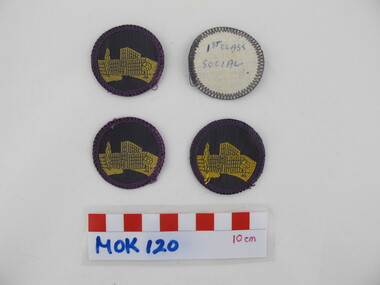
Award - Merit Badges
... First Class Test is set for MOK Esquires aged 14 and 15 years old. Testing for the Social Merit badge included organising a social function; organising a working bee; writing a 100-200 word essay on "How I would abolish slums and their influence"; and preparing a project on the effects of liquor and gambling on the community. ...Four round embroidered 1st Class Social Methodist Order of Knights merit badge. ...[Methodist Church of Australasia Methodist Order of Knights Commanders' Handbook, 1957, pg 28) methodist order of knights Four round embroidered 1st Class Social Methodist Order of Knights merit badge. ...First Class Test is set for MOK Esquires aged 14 and 15 years old. Testing for the Social Merit badge included organising a social function; organising a working bee; writing a 100-200 word essay on "How I would abolish slums and their influence"; and preparing a project on the effects of liquor and gambling on the community. [Methodist Church of Australasia Methodist Order of Knights Commanders' Handbook, 1957, pg 28)Four round embroidered 1st Class Social Methodist Order of Knights merit badge. The badges are dark purple with gold embroidery of a hospital.methodist order of knights -
 Hume City Civic Collection
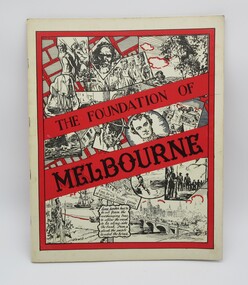
Book, The Foundation Of Melbourne, Volume 13, 1958
... It is set out in comic book style and was used in Social Studies classes in Primary Schools....It is set out in comic book style and was used in Social Studies classes in Primary Schools. melbourne teaching primary school fawkner john pascoe flinders mathew george evans collection A covered book with red lines and black drawings and lettering. ...This book on the Foundation of Melbourne was published in 1958. It is set out in comic book style and was used in Social Studies classes in Primary Schools.A covered book with red lines and black drawings and lettering. There are 32 pages presented as a comic book.melbourne, teaching, primary school, fawkner, john pascoe, flinders, mathew, george evans collection -
 Bendigo Historical Society Inc.
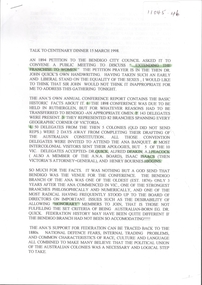
Document - Centenary of ANA Annual Conference 1898, Michele Matthews Collection, 1998
... By 1910 membership had reached 28,844 and was broadly based across all occupations and social classes. Source https://www.nma.gov.au/defining-moments/resources/australian-natives-association ...By 1910 membership had reached 28,844 and was broadly based across all occupations and social classes. Source https://www.nma.gov.au/defining-moments/resources/australian-natives-association Federation Alfred Deakin ANA Australian Natives' Association Tom Stewart Town Crier 1. ...The Australian Natives’ Association was one of many friendly societies operating in Australia in the 19th century. The ANA was an exclusively Australian organisation established in Victoria on 24 April 1871 by a group of young, white Australian-born men. Meetings were open to all and membership did not involve rituals or regalia. Federation of the Australian colonies became an ANA goal in 1884. By 1910 membership had reached 28,844 and was broadly based across all occupations and social classes. Source https://www.nma.gov.au/defining-moments/resources/australian-natives-association 1. Bendigo Advertiser newspaper article reporting an upcoming dinner to be held commemorating the centenary of a meeting held by the Australian Natives' Association (ANA) at the Shamrock Hotel on March 15, 1898. Includes a black and white photograph of town crier Tom Stewart who will read Alfred Deakin's original speech at the commemoration dinner. Published 11.3.98. 2. Programme booklet for Centenary of the Banquet Shamrock Hotel, Bendigo, Sunday 15 March 1998. (Report of proceedings of the Annual Conference of Victorian Branches of the AUSTRALIAN NATIVES' ASSOCIATION held at the A.N.A. Hall Bendigo ON Thursday 15th, Wednesday 16th, Thursday 17th March, 1898). A5 booklet with yellow card cover and two page insert printed on yellow paper. Cover and insert bound together with piece of white curling ribbon. Speakers include Mr. Alan Castleman, Dr. Richard Sneddon, Ms. Michele Matthews. Re-enactment of the 1898 speech by the Hon. Alfred Deakin (Reda by Tom Stewart). Includes menu. 3. Transcript of the talk by Michele Mathews presented to the Centenary Dinner on 15 March 1998. Three type written pages on white paper. Some words and sentences marked with green highlighter.federation, alfred deakin, ana, australian natives' association, tom stewart, town crier -
 Plutarch Project
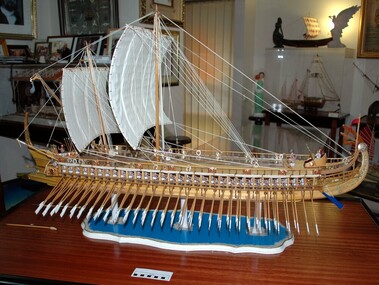
Trireme Replica, Paralos, circa 2005
... The term Paralos derives from the Greek social class from the shores, or the merchant classes. ...The term Paralos derives from the Greek social class from the shores, or the merchant classes. ...The name Trireme comes from its distinct three rows of oars/oarsmen. The first tier of rowers were known as the Thranites, translating to Thrones. They were the most prestigious, and worked the hardest because their oars were furthest away from the water and therefore had to work harder. They were usually younger and they were paid one and a half drachma per day, half a drachma more than the other two tiers of rowers who were paid one drachma per day. After a few years working as Thranites, each was moved down into the second tier, the Zygites. Zygites derives from the word balance, as the second tier was balanced in the middle. After more years again, oarsmen were moved down into the third and final tier, known as the Thalamites. The Thalamites were consistently wet due to the proximity of their tier to the water. The water would leak through the gaps where the oars entered the ships despite the leather skins used to close the openings.This is a unique specimen made by D. Paraskevatos, in that it is the only one of its kind in the world that has been built to the exact specifications of the Athenian vessel. It was built in Melbourne and it also has historic and artistic valueWooden replica model ship that is an exact replica of the ancient Athenian trireme making it unique in the world since there's no other such replica made. Great care was exercised to ensure that it will include all functionality and detail of the ancient ship used to by the Athenians to fight in the Sea battle of Salamis and beyond. Mr Denis Paraskevatos constructed the Paralos Trireme over a period of eighteen months. Mr Paraskevatos relayed the history of his Trireme. The first Trireme was constructed in Greece by the shipbuilder Aminoklis in 704BC, originating from Corinth. The first four Triremes he constructed were ordered by a Poliykrates from Samos, thus the ships were known as Samines. Poliykrates realised he would be able to use the Triremes for his own benefit against invading pirates, as well as to engage in activities of piracy himself. The Athenians built 200 Triremes for the battle of Salamis, all constructed over a period of eighteen months. This was a huge feat, on average a new ship was build every second day. Triremes were primarily used in sea battles, however there were two unique Triremes, the Salaminia and the Paralos, which were considered Holy and only used for Ambassadors and Consulates on overseas trips. Mr Paraskevatos’ Trireme is the Paralos. The term Paralos derives from the Greek social class from the shores, or the merchant classes. Greece was divided into three basic social classes. The mountain region, the plateaus or fields bound to agriculture, and those from the shores. Paralia translates to from the shore. The Paralia were an important class in influencing the democracy. They were divergent group who would deliberately vote on the contrary to everyone else. This is how the Trireme was born. Every Trireme held between 20-50 soldiers, and either 170 or 174 oarsmen. Mr Paraskevatos’ Trireme is a 174 oarsmen ship. The role of the oarsmen was difficult and specialised. When engaged in sea battle and the wind was not enough, the navy would remove the masts and leave them on shore and solely use the oarsmen, leaving the deck clear. However when there were sufficient winds and both the sails and oars were in use the oarsmen had to show great skill in manoeuvrability. When the oarsmen were not needed to manoeuvre the ship they also engaged in battle. model, replica, paraskevatos, plutarch, ship, trireme, παρασκευάτος, πανομοιότυπο -
 City of Moorabbin Historical Society (Operating the Box Cottage Museum)
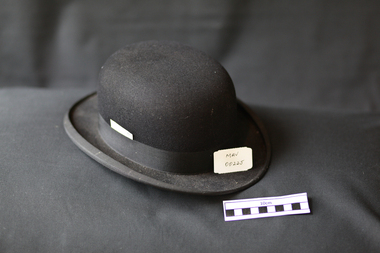
Headwear - Clothing, Bowler Hat black, 20thC
... The Bowler / Derby hat was devised in London during a time when the top hat was the upper-class men’s hat of choice and the lower social class wore soft, cloth caps. However, the top hat was impractical and inconvenient for those on horseback as it easily toppled over and was easily damaged. ...The Bowler / Derby hat was devised in London during a time when the top hat was the upper-class men’s hat of choice and the lower social class wore soft, cloth caps. However, the top hat was impractical and inconvenient for those on horseback as it easily toppled over and was easily damaged. ...The Bowler hat, characterised by its dome-like crown, was invented in 1849 by a pair of hat-makers: brothers Thomas and William Bowler. They were commissioned by the famous London hat retailer “Lock & Co” to invent a close-fitting, low-crowned hat for their customer Mr. Edward Coke. It would be sturdy and not easily knocked or blown off the wearer’s head. The difference between a Bowler hat and a Derby hat is simply that Bowler hats are British, Derby hats are American. The Bowler / Derby hat was devised in London during a time when the top hat was the upper-class men’s hat of choice and the lower social class wore soft, cloth caps. However, the top hat was impractical and inconvenient for those on horseback as it easily toppled over and was easily damaged. Bowler hats were termed “stiff” hats– they were given a coat of shellac in the construction process and therefore never conformed to the shape of the wearers head. While very stiff, the hat is lined in a beautiful, soft silk to ensure comfort. The Bowler hat marked the first middle ground between formality and casual wear. c1900 The Derby hats were very popular for all classes in USA including criminals like Butch Cassidy & Sundance Kid and c1920 many fashionable women also wore them. In England and Commonwealth the Bowler hat remained popular throughout the 1800s and through the first half of the 1900s, being worn by everyone from politicians, actors, accountants, bankers, and the 'everyman' on the street.The family of Nance Blackman were early settlers in Moorabbin ShireA black felt Bowler hat with cream silk lining and black ribbon bandInside Crown & Band ; The Cobweb Felt / easiest/ fitting / extra light / Inside Band Best Quality / 6111hats, hatters, blackman nance, clothing, suits, fashion wear, bankers, actors, politicians, bowler hats, derby hats, top hats, social classes, moorabbin, cheltenham, bentleigh, brighton, market gardeners, pioneers, early settlers, bowler thomas, bowler william, lock & co. ltd. london, england, america, canada -
 City of Moorabbin Historical Society (Operating the Box Cottage Museum)
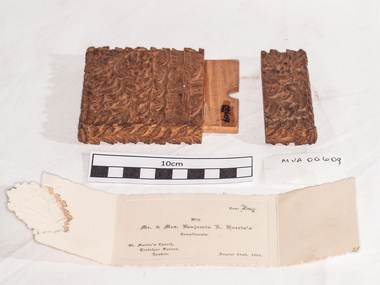
Craftwork, heavily carved calling card case, c1900
... The whole procedure depended upon there being servants to open the door and receive the cards and it was, therefore, confined to the social classes which employed servants. Some visiting cards included refined engraved ornaments, embossed lettering, and fantastic coats of arms. ...The whole procedure depended upon there being servants to open the door and receive the cards and it was, therefore, confined to the social classes which employed servants. Some visiting cards included refined engraved ornaments, embossed lettering, and fantastic coats of arms. ...A visiting card, also known as a calling card, is a small paper card with one's name printed on it, and often bearing an artistic design. Visiting cards became an indispensable tool of etiquette, with sophisticated rules governing their use. The essential convention was that one person would not expect to see another person in his own home (unless invited or introduced) without first leaving his visiting card for the person at his home. Upon leaving the card, he would not expect to be admitted at first, but might receive a card at his own home in response. This would serve as a signal that a personal visit and meeting at home would be welcome. On the other hand, if no card were forthcoming, or if a card were sent in an envelope, a personal visit was thereby discouraged. As an adoption from French and English etiquette, visiting cards became common amongst the aristocracy of Europe, and also in the United States. The whole procedure depended upon there being servants to open the door and receive the cards and it was, therefore, confined to the social classes which employed servants. Some visiting cards included refined engraved ornaments, embossed lettering, and fantastic coats of arms. However, the standard form visiting card in the 19th century in the United Kingdom was a plain card with nothing more than the bearer's name on it. Sometimes the name of a gentlemen's club might be added, but addresses were not otherwise included. If a card was left with a turned corner it indicated that the card had been left in person rather than by a servant. Visiting cards were kept in highly decorated card cases.A timber calling card case, heavily carved with flowers, leaves and huts.craftwork, woodwork, visiting cards, early settlers, moorabbin, bentleigh, cheltenham, market gardeners -
 City of Moorabbin Historical Society (Operating the Box Cottage Museum)
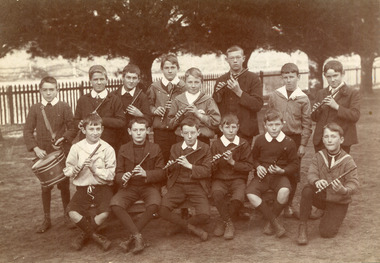
Photograph,Black & White Cheltenham State School Fife & Drum Band c1908, c1908
... The Fife is similar to the piccolo, and usually made of wood, consisting of a tube with 6 finger holes and an embouchure hole that produces sound when blown across.The fife was used in folk music traditions to accompany dancing by all social classes. Also in the Military where drums accompanied the fife and originally these 'boy soldier ' bands were used to signal manouevres in the field for the infantry. ...The Fife is similar to the piccolo, and usually made of wood, consisting of a tube with 6 finger holes and an embouchure hole that produces sound when blown across.The fife was used in folk music traditions to accompany dancing by all social classes. Also in the Military where drums accompanied the fife and originally these 'boy soldier ' bands were used to signal manouevres in the field for the infantry. ...1855 Stephen Charman donated land to the Methodist Church so that a School could be established to educate the children of the early settler market gardeners and farmers in the Cheltenham area . Education was valued by the general community and as well as schools they established mechanics Institutes and Libraries in Moorabbin Shire. Cheltenham State School No. 84 was among the first schools in Melbourne. Stephen Charman, 1821-1906 a market gardener, donated land for the first Methodist Chapel, Cemetery and School in Charman Rd Cheltenham 1855. The enrolment was 36 pupils with Mr Frederick Meeres as Teacher. 1863 the school is called Beaumaris Common School No 84 with 70 pupils and Walter Meeres as Teacher. 1869 another 2 acres in Charman Road were granted by the Education Board and brick building built . 1872 State School 84 Beaumaris was increasing enrollments and 1878 a new brick school was built to accommodate 174 pupils and the name changed to Cheltenham State School No.84 1894 Mentone State School No.2950 amalgamated with Cheltenham SS No.84. 1910 the buildings were in disrepair, overcrowding was increasing and renovations were made 1912 with further additions in 1925 and 1937. Post WW11 extra prefabricated Classrooms were added as enrollment increased to 1038 in 1955.. Cheltenham East State School 4754 was opened as housing development spread over the City of Moorabbin . (J.Larson Sandringham HS) Probably due to the Scottish heritage of many early settlers the Fife & Drum Band was established at the West Beaumaris (Cheltenham) State School . The Fife is similar to the piccolo, and usually made of wood, consisting of a tube with 6 finger holes and an embouchure hole that produces sound when blown across.The fife was used in folk music traditions to accompany dancing by all social classes. Also in the Military where drums accompanied the fife and originally these 'boy soldier ' bands were used to signal manouevres in the field for the infantry. Later Fife & Drum bands were used for marching bands in schools and community groups, 1855 Stephen Charman donated land to the Methodist Church so that a School could be established to educate the children of the early settler market gardeners and farmers in the Cheltenham area . Education was valued by the general community and as well as schools they established mechanics Institutes and Libraries in Moorabbin Shire. Cheltenham State School No. 84 was among the first schools in Melbourne.Black & White photograph of pupils at West Beaumaris (Cheltenham) State School No.84 in the boy's Fife and Drum Band c 1908Back Handwritten Mrs Whelan / Beaumariswhelan r, marriott geoff, meeres frederick, cheltenham state school no.84, education, keys robert, holloway josiah, king brothers, smith j l; smith mary ann, stanley helen, chaff cutter, horse drawn carts, toll gates brighton, motor cars 1900, steam engines, early settlers, bentleigh, parish of moorabbin, city of moorabbin, county of bourke, moorabbin roads board, shire of moorabbin, henry dendy's special survey 1841, were j.b.; bent thomas, o'shannassy john, king richard, charman stephen, highett william, ormond francis, maynard dennis, market gardeners, vineyards, orchards -
Federation University Historical Collection
Document - Document - Letter, Ballarat Junior Technical School: Letter from The Metropolitan Technical Men's Branch of the V.T.U. re class sizes, 1952
... Classes of 48 students are regular in English, Mathematics and Social Studies. ...Classes of 48 students are regular in English, Mathematics and Social Studies. ...Letter from the Secretary of the Metropolitan Technical Men's Branch of the Victorian Teachers' Union, Findlay Masson, outlining the problem of class sizes in Technical Schools. Classes of 48 students are regular in English, Mathematics and Social Studies. In practical classes the size has been set. Asking Technical Schools to submit details of extra accommodation required to allow for reduction of class size to 40 students or less. These needs to be incorporated into a proposed plan to be submitted to the Education Department through the V.T.U. Cream sheet of paper, typed Headmaster Ballarat Junior hand written in red pen Answered 23/10 in pencil Signature of Findlay C Masson, Secretary in red penballarat junior technical school, headmaster, l garner, victorian teachers' union, v.t.u., findlay masson, secretary, metropolitan technical men's branch, class sizes, reduction in number, extra accommodation, proposed plan, education department -
 Uniting Church Archives - Synod of Victoria
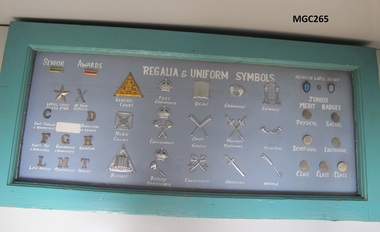
Badge - Framed badge display
... Members Lapel Badges - three Junior Merit Badges: Physical; Social; Devotional; Educational; 2nd Class; 3rd Class; 4th Class....Members Lapel Badges - three Junior Merit Badges: Physical; Social; Devotional; Educational; 2nd Class; 3rd Class; 4th Class. methodist order of knights "REGALIA & UNIFORM SYMBOLS" Methodist Order of Knights regalia and uniform symbols framed badge display. ...Senior Awards: Green Degree of Service bar; Red Degree of Sacrifice bar; Local Court Silver Star; 10 year service badge; Camp Cooking and Management badge; Director or Leader badge; First Aid and Ambulance badge; Gymnastics and Athletics badge; Camping badge; Life Saving badge; Minstrel badge; Teacher badge. Regalia and Uniform Symbols: Gold General Court; High Court; Bishop; Past Commander; Commander; Deputy Commander; Dean; Chief Knight; Chancellor; Companion; Provost Marshall; Marshall; Entrance; Minstrel; Herald. Members Lapel Badges - three Junior Merit Badges: Physical; Social; Devotional; Educational; 2nd Class; 3rd Class; 4th Class.Methodist Order of Knights regalia and uniform symbols framed badge display. The teal blue frame is made from an old window frame with a glass front and plywood backing. It has twine for hanging on the back of the display."REGALIA & UNIFORM SYMBOLS"methodist order of knights -
 Flagstaff Hill Maritime Museum and Village
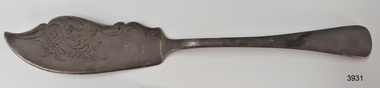
Domestic object - Butter Knife, Barker Brothers, Ca. 1885-1895
... The design and type of this knife was not normally used by everyday people but rather those of a higher social class with time and money to have a particular decorative knife to serve butter or cheese. ...The design and type of this knife was not normally used by everyday people but rather those of a higher social class with time and money to have a particular decorative knife to serve butter or cheese. ...This butter or cheese knife is a decorative example of electroplated cutlery that had become an affordable alternative to more expensive silver cutlery in the late 1800s to early 1900s. The knife has stamp marks in the back of its handle that are a combination of letters and symbols used by British silversmiths to identify their workmanship. The design and type of this knife was not normally used by everyday people but rather those of a higher social class with time and money to have a particular decorative knife to serve butter or cheese. The marks on the handle tell that it was made of nickel silver, and electroplated with superior quality Stirling silver. The Barker Brothers of Birmingham made the knife between 1885 and 1907, but most likely before 1895. It was made for the British, or British colonial, people, connected with a government department such as the navy or defence. This story may be slightly inaccurate, as some silversmiths added extra ‘pseudo marks’ to their wares to disguise the quality. THE MARKS and their meaning – - ‘A1’ The silver used in electroplating this knife was the highest level, ‘superior quality’, measured in grams of silver per table spoon or table fork, with ‘A1’ being 2 2/3 grams, and ‘D’ being 0 1/2 grams of silver. - ‘BB’ The Baker Brothers used these initials from 1885 to 1907. - ‘[crown symbol]’ – This symbol is used for Sterling silver but this knife is a metal alloy. The crown is also the town mark of Sheffield (appointed by the Sheffield Assay Office) but this knife was made in Birmingham, which has the town mark of an anchor. The Barker Brothers may have added the crown mark to this electroplated silverware as a ‘pseudo hallmark’, leading the buyer to think that it was actual Sterling silver. The use of pseudo hallmarks by electroplaters of the Victorian era was common practice but it was illegal. In 1895 the unlawful practice was seen as imitating the Sheffield Silver Mark and the law was firmly applied to eradicate the deception, so items with this mark probably date before 1895. - [EPNS] Electro Plated Nickel Silver, called nickel silver or German silver, is a metal alloy that usually combines copper, nickel and zinc (60 percent copper, 20 percent nickel, 20 percent zinc). It has a silver-white appearance and is sometimes referred to as ‘white ware’. It does not contain any silver but is often used as a base for electroplating, when the item is covered with a thin layer of silver to give it the polished appearance of pure silver. It became popular in the late 19th and early 20th century as an affordable substitute for sterling silver. - Broad Arrow - an official stamp that indicates it was once the property of Britain government, either in Britain or one of its colonies, and used in the defence force. In Great Britain, from an 1875 government act, it was, and still, is a crime to forge or wrongfully use, the broad arrow symbol. The BARKER BROTHERS of Birmingham - Barker Brothers were one of the earlies firms of Birmingham silversmiths, established in 1801 by Mary Barker. They became Barker & Creed, then William and Matthias Barker, then from 1885 they were the Barker Brothers. They were operating in Paradise Street in 1871 until in 1903 they moved to Unity Works, Constitution Hill, in Birmingham. The firm also had a showroom at 292 High Holborn, London, from the early 1900s to the 1980s. In 1907 the firm became Barker Brothers Silversmiths Ltd, then in the 1960s they merged with Ellis & Co, becoming Barker Ellis Silver Co. Ltd. In 1979 they were registered in USA as Ellis & Co., Barker Ellis, and Ellis Barker. The business went into administration in 1992, after almost 200 years of production. The firm advertised as specialists in electroplating, and used the trademarks BRITANOID, UNITY PLATE and THE HYGENIA.This knife is historically significant, dated from 1885 to 1907 but most likely pre-1895, and made by the longstanding Birmingham silversmiths, the Barker Brothers, established in 1801. The knife is an example of decorative flatware used by people of ’class’. It also has the broad arrow stamp, connecting it to the British government, in particular the ordinance department. The stamp also connects it to other items in our collection with that stamp. It may have been connected to pre-Federation government organisations and officials such as the army Garrison, government naval vessel, police, lighthouse keepers, harbour masters. The knife is the only example of its kind in our collection, being a decorative silver butter or cheese knife, made by the Barker Brothers of Birmingham. Butter knife, or cheese knife, electroplated nickel silver (EPNS). Upper blade edge has decorative shape and engraved motifs, lower blade edge is bevelled to a cutting edge, and narrow plain handle flares out to a wide, rounded end. Maker’s marks are stamped on the reverse. Made by Barker Brothers of Birmingham in the late-19th century. Stamps: “flagstaff hill, warrnambool, maritime village, maritime museum, flagstaff hill maritime museum & village, shipwreck coast, great ocean road, butter knife, cheese knife, electroplate, electro plate, nickel silver, nickel alloy, alloy composition, copper nickel zinc, german silver, epns, barker brothers, birmingham, london, silversmiths, victorian era, 19th century, a1, bb, crown inside square, broad arrow, flatware, tableware, cutlery, cutler, dining utensils, eating utensils, superior quality, pseudo hallmark, stirling silver, silver-white metal, mary barker, barker & creed, william barker, matthias barker, barker brothers silversmiths, barker ellis silver co, ellis & co, barker ellis, ellis barker, britanoid, unity plate, the hygenia, british, colonial, government use, defence department use, naval use, knife, serving knife -
 Flagstaff Hill Maritime Museum and Village
Domestic object - Fork
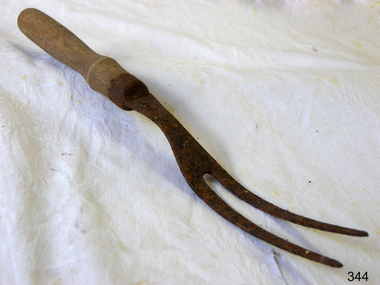
... The use varied according to local customs, social class and the nature of food, but forks of the earlier periods were mostly used as cooking and serving utensils. ...The use varied according to local customs, social class and the nature of food, but forks of the earlier periods were mostly used as cooking and serving utensils. ...Naturally, we tend to take commonplace objects for granted, because they have always been there. Yet how many of you actually have thought “hey, where do forks come from?” Well, it takes one trip to China and a 3-year-old laughing at your face because of your desperate attempt to eat with chopsticks to finally appreciate something so ordinary such as a fork. So, where do forks come from? The early history of the fork is obscure. As a kitchen and dining utensil, it is believed to have originated in the Roman Empire, as proved by archaeological evidence. The personal table fork most likely originated in the Eastern Roman (or Byzantine) Empire. Its use spread to what is now the Middle East during the first millennium AD and then spread into Southern Europe during the second millennium. It did not become common in northern Europe until the 18th century and was not common in North America until the 19th century. Carving fork from 1640. Source: Wikipedia/Public Domain Carving Fork from 1640. Source: Wikipedia/Public Domain Some of the earliest known uses of forks with food occurred in Ancient Egypt, where large forks were used as cooking utensils. Bone forks had been found on the burial site of the Bronze Age Qijia culture (2400–1900 BC) as well as later Chinese dynasties’ tombs.The Ancient Greeks used the fork as a serving utensil. Read also: Steven Spielberg to Remake the Classic Musical ‘West Side Story’ In the Roman Empire, bronze and silver forks were used. The use varied according to local customs, social class and the nature of food, but forks of the earlier periods were mostly used as cooking and serving utensils. The personal table fork was most likely invented in the Eastern Roman (Byzantine) Empire, where they were in everyday use by the 4th century (its origin may even go back to Ancient Greece, before the Roman period). Records show that by the 9th century a similar utensil known as a barjyn was in limited use in Persia within some elite circles. By the 10th century, the table fork was in common use throughout the Middle East. Bronze forks made in Persia during the 8th or 9th century.Source: Wikipedia/Public Domain Bronze forks made in Persia during the 8th or 9th century.Source: Wikipedia/Public Domain The first recorded introduction of the fork to Western Europe, as recorded by the theologian and Cardinal Peter Damian, was by Theophano Sklereina the Byzantine wife of Holy Roman Emperor Otto II, who nonchalantly wielded one at an Imperial banquet in 972, astonishing her Western hosts.By the 11th century, the table fork had become increasingly prevalent in the Italian peninsula. It gained a following in Italy before any other Western European region because of historical ties with Byzantium and continued to get popularity due to the increasing presence of pasta in the Italian diet. At first, pasta was consumed using a long wooden spike, but this eventually evolved into three spikes, design better suited to gathering the noodles. In Italy, it became commonplace by the 14th century and was almost universally used by the merchant and upper classes by 1600. It was proper for a guest to arrive with his fork and spoon enclosed in a box called a cadena; this usage was introduced to the French court with Catherine de’ Medici’s entourage. In Portugal, forks were first used at the time of Infanta Beatrice, Duchess of Viseu, King Manuel I of Portugal’s mother around 1450. However, forks were not commonly used in Western Europe until the 16th century when they became part of Italian etiquette. The utensil had also gained some currency in Spain by this time, and its use gradually spread to France. Nevertheless, most of Europe did not adopt the use of the fork until the 18th century. Read also: The 8 Most Famous ‘Functioning Alcoholics’ in History Long after the personal table fork had become commonplace in France, at the supper celebrating the marriage of the Duc de Chartres to Louis XIV’s natural daughter in 1692, the seating was described in the court memoirs of Saint-Simon: “King James having his Queen on his right hand and the King on his left, and each with their cadenas.” In Perrault’s contemporaneous fairy tale of La Belle au bois dormant (1697), each of the fairies invited for the christening is presented with a splendid “fork holder”. The fork’s adoption in northern Europe was slower. Its use was first described in English by Thomas Coryat in a volume of writings on his Italian travels (1611), but for many years it was viewed as an unmanly Italian affectation. Some writers of the Roman Catholic Church expressly disapproved of its use, St. Peter Damian seeing it as “excessive delicacy.” It was not until the 18th century that the fork became commonly used in Great Britain, although some sources say that forks were common in France, England, and Sweden already by the early 17th century. Spaghetti fork By Lady alys - Own work, CC BY-SA 3.0, https://commons.wikimedia.org/w/index.php?curid=6414948 Spaghetti Fork By Lady alys – Own work, CC BY-SA 3.0, The fork did not become popular in North America until near the time of the American Revolution. The curved fork used in most parts of the world today was developed in Germany in the mid 18th century while the standard four-tine design became current in the early 19th century. The fork was important in Germany because they believed that eating with the fingers was rude and disrespectful. The fork led to family dinners and sit-down meals, which are important features of German culture. https://www.thevintagenews.com/2016/08/31/priority-fork-came-italy-european-country-pasta/?chrome=1Serving fork, two prongs, with a shaped wooden handle. Badly rusted.None.flagstaff hill, warrnambool, shipwrecked-coast, flagstaff-hill, flagstaff-hill-maritime-museum, maritime-museum, shipwreck-coast, flagstaff-hill-maritime-village, food, meat, carving -
 Eltham District Historical Society Inc
Photograph - Digital Photograph, Alan King, Graves of Thomas Sweeney and family, Eltham Cemetery, Victoria, 27 January 2008
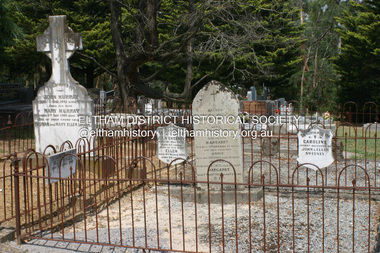
... Graves also indicated social class. Some had grand tombstones, perhaps fenced with ornamental cast iron railing, but most in the 1860s and 1870s were constructed of modest stone slabs.3 This indicated the poverty of the district, which was largely inhabited by farmers on small landholdings. ...Graves also indicated social class. Some had grand tombstones, perhaps fenced with ornamental cast iron railing, but most in the 1860s and 1870s were constructed of modest stone slabs.3 This indicated the poverty of the district, which was largely inhabited by farmers on small landholdings. ...The grave of Thomas Sweeney, former convict turned respectable citizen. The Murray and Sweeney families were both early settlers of the Eltham district and connected by marriage. Their family plots are located side by side in the Catholic section of the Eltham Cemetery. Irish-born Thomas Sweeney is regarded as the first settler in Eltham. He was transported to Sydney in 1823 after being convicted of arson. He was granted his freedom in 1838 and married Margaret Meehan in the same year. They moved to Melbourne and in 1842 Thomas purchased 110 acres beside the Yarra River in the vicinity of present-day Sweeneys Lane. He called the property ‘Culla Hill’ and built a small slab hut (reputedly with Wurundjeri help; Margaret is said to have run an informal hospital for them in return). This was followed in 1846 by more substantial buildings consisting of a three-roomed Irish-style ‘longhouse’ and a barn made of stone and handmade bricks, with doors large enough to accommodate a fully loaded wagon. When the gold rush came, Thomas prospered by selling meat and potatoes to the prospectors, enabling him to purchase a further 308 acres in 1856. He promoted the construction of a bridge over the Plenty River and the establishment of a school at Eltham. Roman Catholic Church services were held at Culla Hill in the early years. When he died in 1867, he was regarded as a respected member of the community. Thomas and Margaret are buried in Eltham Cemetery with many of their descendants. Their first son John continued to farm Culla Hill until his death in 1909. Culla Hill passed out of the Sweeneys' possession in 1939. The house and barn remain today, though lesser outbuildings have gone. The facade of the house is much the same as it was in the 1840s. Sacred To the memory of Thomas Sweeney Who died Sep 6th 1867 Aged 65 years May his soul res in peace Also his wife Margaret Died Oct 3rd 1884 aged 73 years And their daughters Annie Died Aug 22nd 1860 aged 21 years Johanna Died Aug 19th 1872 aged 22 years Margaret Died 7th Sep 1913 aged 72 years R.I.P. Also In Memory Of John Sweeney Died 24th May 1909 Aged 65 years Also of his wife Ellen Died 8th March 1910 Aged 64 years R.I.P Also In Memory Of Caroline Infant daughter of John & Ellen Sweeney Published: Nillumbik Now and Then / Marguerite Marshall 2008; photographs Alan King with Marguerite Marshall.; p55 From the piety and poverty of 19th century Eltham, 20th century artists and environmentalists, to today’s comfortable middle class, Eltham Cemetery records it all — and more. A visit to Eltham Cemetery reveals an important social record since its beginnings in 1858. The cemetery was situated on about six acres (2.4ha) (now around 4.8ha) at the corner of Mount Pleasant and Metery Roads.1* It is thought that Metery Road was originally called Cemetery Road, but in the early 1940s, a resident, possibly a councillor, objected to the name resulting in the change.2 Much can be gleaned about the developing Eltham community from burial styles and the names of former local residents. Originally the cemetery was divided into Christian denominations, like others of that time, following the United Kingdom burial system. In 1861 the cemetery included Church of England, Presbyterian, Roman Catholic and Wesleyans (later Methodist) sites. Graves also indicated social class. Some had grand tombstones, perhaps fenced with ornamental cast iron railing, but most in the 1860s and 1870s were constructed of modest stone slabs.3 This indicated the poverty of the district, which was largely inhabited by farmers on small landholdings. A poignant reminder of the high rates of infant mortality of those times, are the many infants and young children recorded on the headstones. Major changes occurred in the cemetery in the late 20th century as Christian adherence weakened and society became more egalitarian and informal. In the early 1970s a non-denominational lawn section for burials was established. Since then all new areas have been non-denominational to accommodate the more diverse local community. Now, instead of large ornamental headstones, some mourners have chosen boulders, reflecting the natural Eltham style, while others choose graves in the lawn areas or niches in walls. In the late 1970s, the University Donor Section was established north-west of Candlebark Lawn for those who donated their bodies for The University of Melbourne medical research. In the early 1980s the natural Australian garden style, popular in Eltham, was mirrored in a new section called Ashes Walk. Local landscape architect Gordon Ford, who had popularised this style, designed the Walk using boulders shaded by native plants beside curved pathways. Landscape architect Robert Boyle later redesigned Ashes Walk and developed other parts of the cemetery in keeping with this style.4 Appropriately Ford, who died in 1999, was interred in the Native Garden Section in a cluster of sites shaded by a large eucalyptus tree.5 By 2007, about 6400 interments were recorded in the Eltham Cemetery. Close inspection reveals notable names in the district’s history. The grave of Thomas Sweeney, a former convict who became a respected citizen, can be found in the Roman Catholic section near the path. Eltham Primary School’s first headmaster, David Clark, is buried in a modest grave in the Church of England section to the east of the path from the main entrance. Sir William Irvine, Victorian Premier from 1900 to 1902, whose grave is in the north-east Presbyterian section was at various times Victoria’s Chief Justice, Deputy Governor and Treasurer.6 Further south is the grave of social reformer Bertram Wainer, born in Scotland in 1928 and died in 1987. He campaigned to legalise abortion and exposed police corruption in allowing illegal ‘backyard’ abortions. Other prominent local residents interred in the cemetery include: Justus Jörgensen, who founded Montsalvat; Alistair Knox, the mud-brick housing pioneer and Eltham Shire Councillor from 1971 to 1975 and President in 1975; Clem and Nina Christensen, who had a major influence on the literary development of post World War Two Australia. Others were: composer Dorian Le Gallienne; artist Peter Glass; Stephen Dattner, a prominent Melbourne furrier; ALP parliamentarian for Greensborough, Pauline Toner and political scientist and commentator, Professor William Macmahon Ball.This collection of almost 130 photos about places and people within the Shire of Nillumbik, an urban and rural municipality in Melbourne's north, contributes to an understanding of the history of the Shire. Published in 2008 immediately prior to the Black Saturday bushfires of February 7, 2009, it documents sites that were impacted, and in some cases destroyed by the fires. It includes photographs taken especially for the publication, creating a unique time capsule representing the Shire in the early 21st century. It remains the most recent comprehenesive publication devoted to the Shire's history connecting local residents to the past. nillumbik now and then (marshall-king) collection, annie sweeney, caroline sweeney, ellen sweeney, eltham cemetery, graves, gravestones, johanna sweeney, john murray, john sweeney, margaret sweeney, mary ellen drain, mary murray, thomas murray, thomas sweeney -
 Flagstaff Hill Maritime Museum and Village
Book - A Fictional Story, John Galsworthy, Flowering Wilderness, 1932
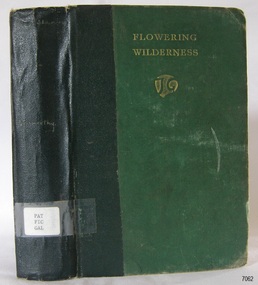
... Beyond fiction, Galsworthy was also a prolific and successful playwright plays like The Silver Box (1906), Strife (1909), Justice (1910), and Loyalties (1922) engaged directly with social injustice: class conflict, the prison system, labour disputes, and antisemitism. ...Beyond fiction, Galsworthy was also a prolific and successful playwright plays like The Silver Box (1906), Strife (1909), Justice (1910), and Loyalties (1922) engaged directly with social injustice: class conflict, the prison system, labour disputes, and antisemitism. ...Flowering Wilderness (1932) is a novel by John Galsworthy, and it's the second book in his 'End of the Chapter' trilogy it's a sequel to 'Maid in Waiting', continuing the story of the Cherrell family. It centres on Dinny Cherrell (niece of the Forsyth-adjacent Cherrell clan) and her love affair with Wilfred Desert, a poet who under threat of death while a captive in the Middle East had renounced Christianity and converted to Islam. The novel explores the social scandal and moral judgement that follows him back to England, and Dinny's loyalty to him in the face of society's condemnation. It's part of Galsworthy's broader fictional universe that includes the famous Forsyte Saga, although this particular trilogy follows a different but related family branch.Hard cover book. Flowering Wilderness Author: John Galsworthy Publisher: William Heinemann Ltd Date: 1932 Further Information: Green cloth boards, gilt/black spine with gilt lettering. William Heinemann publisher's device on the title page, and rebound spine in black cloth. fictionFlowering Wilderness (1932) is a novel by John Galsworthy, and it's the second book in his 'End of the Chapter' trilogy it's a sequel to 'Maid in Waiting', continuing the story of the Cherrell family. It centres on Dinny Cherrell (niece of the Forsyth-adjacent Cherrell clan) and her love affair with Wilfred Desert, a poet who under threat of death while a captive in the Middle East had renounced Christianity and converted to Islam. The novel explores the social scandal and moral judgement that follows him back to England, and Dinny's loyalty to him in the face of society's condemnation. It's part of Galsworthy's broader fictional universe that includes the famous Forsyte Saga, although this particular trilogy follows a different but related family branch.shipwrecked-coast, flagstaff-hill, flagstaff-hill-maritime-museum, warrnambool, maritime-museum, shipwreck-coast, flagstaff-hill-maritime-village, shipwrecked-artefact, book, pattison collection, warrnambool library, warrnambool mechanics’ institute, ralph eric pattison, corangamite regional library service, warrnambool city librarian, mechanics’ institute library, victorian library board, warrnambool books and records, warrnambool children’s library, flowering wilderness, john galsworthy -
 Flagstaff Hill Maritime Museum and Village
Book - A Fictional Love Story, Elizabeth Balch et al, An Authors Love, 1889
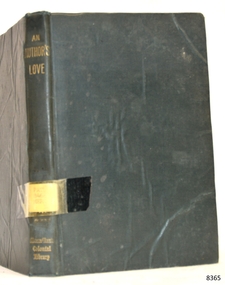
... While An Author's Love is her most famous and clever work of fiction, she published a handful of other books that showcase her range: Mustard Leaves; or, A Glimpse of London Society (1885): Published under her "D.T.S." pseudonym, this was a sharp, satirical, and observant look at the rigid rules, drama, and scandals of the upper-class London social circuit. Zorah: A Love-Tale of Modern Egypt (1887): A romantic adventure novel reflecting the late-Victorian fascination with Middle Eastern travel and exoticism. ...While An Author's Love is her most famous and clever work of fiction, she published a handful of other books that showcase her range: Mustard Leaves; or, A Glimpse of London Society (1885): Published under her "D.T.S." pseudonym, this was a sharp, satirical, and observant look at the rigid rules, drama, and scandals of the upper-class London social circuit. Zorah: A Love-Tale of Modern Egypt (1887): A romantic adventure novel reflecting the late-Victorian fascination with Middle Eastern travel and exoticism. ...The book is an epistolary novel (a story told in letters) written by the American author Elizabeth Balch (though it was published anonymously at the time). It was written as a highly clever literary hoax and a sequel of sorts to a major 1873 French literary sensation, Lettres à une Inconnue (Letters to an Unknown) by the famous French dramatist and short-story writer Prosper Mérimée (best known as the author of the novella Carmen). Mérimée had spent over thirty years writing passionate, brilliant, and deeply personal letters to an anonymous woman (later revealed to be Jenny Dacquin). When these were published after his death, they became a massive hit, but the public only ever saw his side of the conversation. Elizabeth Balch decided to write the missing half of the romance.An Authors Love Author: Prosper Merimee's Publisher: Macmillan And Co Date: 1889 Further Information: Being the unpublished letters of Prosper Merimee's 'Inconnue'fictionThe book is an epistolary novel (a story told in letters) written by the American author Elizabeth Balch (though it was published anonymously at the time). It was written as a highly clever literary hoax and a sequel of sorts to a major 1873 French literary sensation, Lettres à une Inconnue (Letters to an Unknown) by the famous French dramatist and short-story writer Prosper Mérimée (best known as the author of the novella Carmen). Mérimée had spent over thirty years writing passionate, brilliant, and deeply personal letters to an anonymous woman (later revealed to be Jenny Dacquin). When these were published after his death, they became a massive hit, but the public only ever saw his side of the conversation. Elizabeth Balch decided to write the missing half of the romance.flagstaff hil, warrnambool, flagstaff hill maritime museum, maritime museum, shipwreck coast, flagstaff hill maritime village, great ocean road, book, pattison collection, warrnambool library, warrnambool mechanics’ institute, ralph eric pattison, corangamite regional library service, warrnambool city librarian, mechanics’ institute library, victorian library board, warrnambool books and records, warrnambool children’s library, an authors love, prosper merimees -
 Federation University Historical Collection
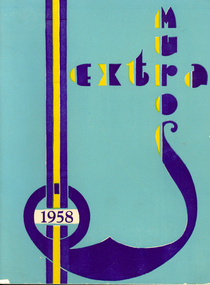
Book, J.A. Hoskin & Son, Ballarat Teachers' College Extra Muros, 1958, 1958
... Classes commence at the new Gillies Street location of Ballarat Teachers’. (BTC Handbook 1965; Beggs-Sunter: 84) Contents include: Editorial, Our Principal Speaks, the President S.R.C., 1958 Highlights, Teaching Round, Section Notes, Social Notes, Hostel Life, Sporting World, Insignias and Awards 1958, Club Notes...Classes commence at the new Gillies Street location of Ballarat Teachers’. (BTC Handbook 1965; Beggs-Sunter: 84) Contents include: Editorial, Our Principal Speaks, the President S.R.C., 1958 Highlights, Teaching Round, Section Notes, Social Notes, Hostel Life, Sporting World, Insignias and Awards 1958, Club Notes btc ballarat teachers college n. harvey t. w. h. turner monica miller m. hines b. rickard d. eldridge n. turnbull b. english k. o'neil p. burgess m. almeida e. doney j. rae p. wise w. crocker p. r. burgess barry withers j. bourke a. linton s. mckaskill h. pattenden d. chandler a. stafford r. croft a. cuthbertson r. reed a. sonsee j. lacy f. ryan c. rodger m. egan j. hill t. turner c. m. canty j. blair e. walpole m. miller michael long m. blair j. blackman n. beacham d. astbury m. bergin a. constable g. clarke g. briggs m. brown e. beck j. badger g. angwin g. alexander k. broad a. costa e. davidson p. burbidge j. clements s. elder d. foster b. fernandes b. fischer m. harcoan j. heenan b. hudson e. jardine k. hayes g. coffey r. dennis w. cartledge v. delbridge n. hawker l. hales d. farnsworth l. hallam r. fencher g. karstens f. leach r. kelly m. long g. macdonald j. mcdermott a. lehmann i. hastie b. haig m. jones l. jeffrey m. kiefel j. mcalpine i. jenkins j. kenworthy b. lawton m. livingston e. mcormick d. mckimmie g. mcintosh m. mckee b. murphy f. mitchell m. mclachlan r. power k. mcdougall s. murphy b. nash d. mckenzie j. madder j. meadows n. mchenry j. mayo l. missen e. muir g. roberts k. ryrie d. ritchie m. scanlon e. robinson m. rutter j. rogers m. rae v. reynolds j. rees r. sloley d. sheen b. nunn r. nicholas b. ruwoldt m. rowe l. walker l. wilkinson n. wright d. shoebridge f. stokie g. stewart j. teschendorf n. souter e. walker m. spinks m. wallace m. stone s. tucker r. taylor j. short b. tucker l. castree w. craig r. bibby b. davies r. bowker g. cabble i. clayton w. coleman j. bates m. elder l. anthony j. carmichael e. edwards l. anderson b. cannard b. drake j. elliott p. dunn b. withers m. stewart l. wright d. smith r. rowe k. wilson k. waltrowicz j. roach l. schreenan i. sutherland d. williams b. wynne j. schaefer s. shepherd s. wright b. whiteside m. oliver j. quayle j. waller j. taylor v. rogers s. moller m. norman l. thomas j. wagner w. j. craig e. anthony r. neville j. noonan b. lay k. hammer g. moncrieff r. mason g. howlett w. knight j. matthews b. lumsden b. phelan p. hope v. la franchi s. henderson l. hayne w. keen b. forbes m. gray g. mcilvena a. horwill j. mccumber m. hateley k. rieniets e. fletcher d. johnson j. miller i. ross c. keys e. jarvis m. youngs j. smith e. davies g. commons p. larmour r. gowan b. hedley miss egan s. blomfield m. meyer k. duffy h. speedie j. witton d. magee a. pope p. quinlan h. jones miss miller kevin o'neil lois e. hayne w. keem mr croft geoff cabble jack noonan jan carmichael gwen macdonald bev. ross Light blue cover with dark blue and yellow titles. ...February 1958 Classes commence at the new Gillies Street location of Ballarat Teachers’. (BTC Handbook 1965; Beggs-Sunter: 84) Contents include: Editorial, Our Principal Speaks, the President S.R.C., 1958 Highlights, Teaching Round, Section Notes, Social Notes, Hostel Life, Sporting World, Insignias and Awards 1958, Club NotesLight blue cover with dark blue and yellow titles. Soft covered magazine of the Ballarat Teachers College. 48 pages. Articles include Victoria Street Hostel, Gilies Street Hostel, Grampians Trip, Beaufort House , Sturt St House , Camp St Hostel, Club Notes btc, ballarat teachers college, n. harvey, t. w. h. turner, monica miller, m. hines, b. rickard, d. eldridge, n. turnbull, b. english, k. o'neil, p. burgess, m. almeida, e. doney, j. rae, p. wise, w. crocker, p. r. burgess, barry withers, j. bourke, a. linton, s. mckaskill, h. pattenden, d. chandler, a. stafford, r. croft, a. cuthbertson, r. reed, a. sonsee, j. lacy, f. ryan, c. rodger, m. egan, j. hill, t. turner, c. m. canty, j. blair, e. walpole, m. miller, michael long, m. blair, j. blackman, n. beacham, d. astbury, m. bergin, a. constable, g. clarke, g. briggs, m. brown, e. beck, j. badger, g. angwin, g. alexander, k. broad, a. costa, e. davidson, p. burbidge, j. clements, s. elder, d. foster, b. fernandes, b. fischer, m. harcoan, j. heenan, b. hudson, e. jardine, k. hayes, g. coffey, r. dennis, w. cartledge, v. delbridge, n. hawker, l. hales, d. farnsworth, l. hallam, r. fencher, g. karstens, f. leach, r. kelly, m. long, g. macdonald, j. mcdermott, a. lehmann, i. hastie, b. haig, m. jones, l. jeffrey, m. kiefel, j. mcalpine, i. jenkins, j. kenworthy, b. lawton, m. livingston, e. mcormick, d. mckimmie, g. mcintosh, m. mckee, b. murphy, f. mitchell, m. mclachlan, r. power, k. mcdougall, s. murphy, b. nash, d. mckenzie, j. madder, j. meadows, n. mchenry, j. mayo, l. missen, e. muir, g. roberts, k. ryrie, d. ritchie, m. scanlon, e. robinson, m. rutter, j. rogers, m. rae, v. reynolds, j. rees, r. sloley, d. sheen, b. nunn, r. nicholas, b. ruwoldt, m. rowe, l. walker, l. wilkinson, n. wright, d. shoebridge, f. stokie, g. stewart, j. teschendorf, n. souter, e. walker, m. spinks, m. wallace, m. stone, s. tucker, r. taylor, j. short, b. tucker, l. castree, w. craig, r. bibby, b. davies, r. bowker, g. cabble, i. clayton, w. coleman, j. bates, m. elder, l. anthony, j. carmichael, e. edwards, l. anderson, b. cannard, b. drake, j. elliott, p. dunn, b. withers, m. stewart, l. wright, d. smith, r. rowe, k. wilson, k. waltrowicz, j. roach, l. schreenan, i. sutherland, d. williams, b. wynne, j. schaefer, s. shepherd, s. wright, b. whiteside, m. oliver, j. quayle, j. waller, j. taylor, v. rogers, s. moller, m. norman, l. thomas, j. wagner, w. j. craig, e. anthony, r. neville, j. noonan, b. lay, k. hammer, g. moncrieff, r. mason, g. howlett, w. knight, j. matthews, b. lumsden, b. phelan, p. hope, v. la franchi, s. henderson, l. hayne, w. keen, b. forbes, m. gray, g. mcilvena, a. horwill, j. mccumber, m. hateley, k. rieniets, e. fletcher, d. johnson, j. miller, i. ross, c. keys, e. jarvis, m. youngs, j. smith, e. davies, g. commons, p. larmour, r. gowan, b. hedley, miss egan, s. blomfield, m. meyer, k. duffy, h. speedie, j. witton, d. magee, a. pope, p. quinlan, h. jones, miss miller, kevin o'neil, lois e. hayne, w. keem, mr croft, geoff cabble, jack noonan, jan carmichael, gwen macdonald, bev. ross -
 Federation University Historical Collection
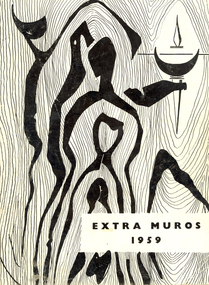
Magazine, J.A. Hoskin & Son, Extra Muros, 1960, 1960
... The contents include: College life, Australian Speech, The Tapestry, The Novel in Australia, The Theatre in Ballarat, The Beat Generation, Music in Australia, The Proposal, Philosophy of Life, Thought of Youth, The Gentle Road, A Frog, Opening of the New Building in Gillies Street, The Cherry Tree Images include: The Publication Committee, Staff, class groups, Student Representative Council, Social Committee...The contents include: College life, Australian Speech, The Tapestry, The Novel in Australia, The Theatre in Ballarat, The Beat Generation, Music in Australia, The Proposal, Philosophy of Life, Thought of Youth, The Gentle Road, A Frog, Opening of the New Building in Gillies Street, The Cherry Tree Images include: The Publication Committee, Staff, class groups, Student Representative Council, Social Committee Extra Muros, 1960 Magazine Magazine J.A. ...In 1960 the Principal of the Ballarat Teachers' College was T.W.H. (Tom) Turner, and the President of the Students' representative Council was Bruce Vandenburg. In that year the Minister of education, Mr Bloomfield, M.L.A. opened the new Gillies Street building. Black and white soft covered magazine of the Ballarat Teachers' College of 59 pages. The contents include: College life, Australian Speech, The Tapestry, The Novel in Australia, The Theatre in Ballarat, The Beat Generation, Music in Australia, The Proposal, Philosophy of Life, Thought of Youth, The Gentle Road, A Frog, Opening of the New Building in Gillies Street, The Cherry Tree Images include: The Publication Committee, Staff, class groups, Student Representative Council, Social Committeeballarat teachers' college, ian george, leonard frecnch, charles bush, trophy, val delbridge, gwen angwin, bob walton, dave pickburn, terry amey, judy teschendorf, dave norman, tony scanlon, ian ferguson, jean cadzow, pam wise, margaret brown, geoff poynton, dave cohen -
 Flagstaff Hill Maritime Museum and Village
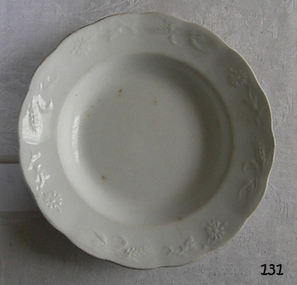
Ceramic - Dish, Johnson Bros, Circa 1883 (very early Mark)
... This allowed potteries to produce fashionable pottery items that were affordable to all social classes of the time. flagstaff hill warrnambool shipwrecked coast flagstaff hill maritime museum flagstaff hill maritime village great ocean road bowl china bowl lion and unicorn crest table ware kitchen ware White Ware Johnson Brothers On base, "Royal Ironside China, Johnson Bros England" & crest of lion and unicorn Bowl white ceramic decorative with floral decoration around lip. ...Johnson Brothers were a British tableware manufacturer and exporter that was noted for its early introduction of "semi-porcelain" tableware. It was among the most successful of the Staffordshire potteries which produced tableware, much of it exported from the 1890s through the 1960s. They were also important manufacturers of large bathroom ceramics. The company was founded in 1883, but from 1968 to 2015 it operated as a part of the Wedgwood Group. However, after the Wedgwood Group was acquired by Fiskars in 2015, the production of Johnson Brothers was discontinued. The company's name derives from the names of the company's founders. The four original "Johnson Brothers" were Alfred, Frederick, Henry, and Robert. Their father married the daughter of a master potter, Alfred Meakin. In 1883, Alfred and Frederick Johnson began production at defunct pottery, known as the Charles Street Works, that they had purchased at a bankruptcy sale in Hanley, Stoke-on-Trent. At first, they specialised in the manufacture of durable earthenware, which they called "White Granite". The success of this venture led to rapid expansion. In 1888, the Rev. Henry Johnson joined them, followed ten years later by a fourth brother, Robert Johnson. Having established a solid reputation producing basic "whiteware", the company developed a product known as "semi-porcelain", a range of pottery that had the characteristics of fine china, but the durability of ironstone ware. This kind of tableware soon became very popular in the United States due to its durability and low cost. In 1889, the Hanley pottery was opened, later the Alexander pottery, and in 1891 the Imperial Works Pottery. In 1896, the Trent Sanitary Works was opened for the production of non-tableware products, and Alfred Johnson left the business to establish his pottery. By 1898, Robert Johnson had relocated to New York City to manage Johnson Brothers' rapid expansion into the North American market. An item that gives a snapshot into the emerging market for tableware that was reasonably priced and serviceable. The company produced "whiteware" but the innervation of the pottery line called semi-porcelain changed the industry. This allowed potteries to produce fashionable pottery items that were affordable to all social classes of the time. Bowl white ceramic decorative with floral decoration around lip. On base, "Royal Ironside China, Johnson Bros England" & crest of lion and unicorn flagstaff hill, warrnambool, shipwrecked coast, flagstaff hill maritime museum, flagstaff hill maritime village, great ocean road, bowl, china bowl, lion and unicorn crest, table ware, kitchen ware, white ware, johnson brothers -
 Flagstaff Hill Maritime Museum and Village
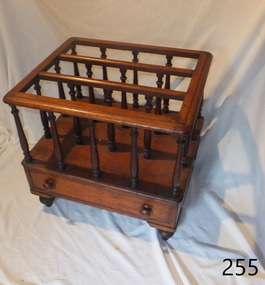
Functional object - Music stand, Early 19th Century before 1860
... classes of society. In a period when printed music was more widely available and disseminated due to more affordable printing techniques, modern sheet music was very popular and therefore storage for such favoured tunes became a luxury and an opportunity for innovative design by cabinet makers. The Classical period of music, from about 1750 to 1820 and the Romantic Period from around 1815-1910 was the golden age of classical music. And it was at this time that The Canterbury often accompanied the piano in the parlour with styles ranging from Georgian simplicity to Victorian exuberance. Social...classes of society. In a period when printed music was more widely available and disseminated due to more affordable printing techniques, modern sheet music was very popular and therefore storage for such favoured tunes became a luxury and an opportunity for innovative design by cabinet makers. The Classical period of music, from about 1750 to 1820 and the Romantic Period from around 1815-1910 was the golden age of classical music. And it was at this time that The Canterbury often accompanied the piano in the parlour with styles ranging from Georgian simplicity to Victorian exuberance. Social ...Thomas Sheraton (1751-1806) appears to have been the first to record the written term “Canterbury” music or magazine stand. In his Cabinet Dictionary of 1803 he refers to “a small music stand” with divisions for holding loose sheet or bound volumes of music. The music stand designed to hold sheet music came into fashion in the late 18th Century in England and was often crafted from mahogany, rosewood or walnut. They were seen as status symbols since music was practiced exclusively by the upper classes of society. In a period when printed music was more widely available and disseminated due to more affordable printing techniques, modern sheet music was very popular and therefore storage for such favoured tunes became a luxury and an opportunity for innovative design by cabinet makers. The Classical period of music, from about 1750 to 1820 and the Romantic Period from around 1815-1910 was the golden age of classical music. And it was at this time that The Canterbury often accompanied the piano in the parlour with styles ranging from Georgian simplicity to Victorian exuberance. Social activities of colonial Victoria would have included evening gatherings of family and friends around the piano to enjoy performances or sing along together with from old and up-to-date music sheets. The Canterbury would also be an elegant and practical place to also store newspapers, magazines, posters and drawings from overseas. The news from ‘home’ would be enjoyed by all. THE INSCRIPTION “Jack Morse” Morse. In 2010 Mr Jack Morse was recognised as one of the “people who have contributed to the long term development of Flagstaff Hill Maritime Village”. He was a member of the Flagstaff hill Planning board and a Current Life Member and had been awarded a Certificate of Service and the provision of an Annual Family Membership for life by Flagstaff Hill. The Morse’s family business, Morse’s Engineering, closed in 2010. It was considered “One of Warrnambool’s longest operating businesses with roots dating to 1883 with the design and manufacture of coaches and buggies, progressing to automotive repairs and later specialising in under-vehicle work” The Canterbury appears to have been handmade prior to 1860 as the dovetails are handmade and there are no saw marks on the drawer sides or back as well the sides. Also the back has small nicks indicating a hand plane or drawer knife was used rather than a saw blade to size the material. Additional indications are that the spindles are slightly different in size meaning they were handmade individually not mass produced. From these indicators the writer believes that the item was made before 1860 as machinery was only used after this date to produce furniture. As yet no individual maker can be attributed to this item, however it is a significant piece historically and is quite valuable if a known maker can be associated with the Canterbury. The item highlights a time in our social history when music played an everyday part in people’s lives as the only entertainment families could enjoy together in their own homes. A Canterbury music stand, having three compartments consisting of twenty turned spindles supporting the slat dividers. A drawer, with two turned wooden handles, is fitted below. The music stand has turnip style turned feet. The drawer front and carcass of the stand are veneered rosewood over a mahogany carcass. The underlined words "Jack Morse" are handwritten underneath the drawer bottom.Hand written inscription on underneath the drawer bottom "Jack Morse".flagstaff hill, warrnambool, shipwrecked-coast, flagstaff-hill, flagstaff-hill-maritime-museum, maritime-museum, shipwreck-coast, flagstaff-hill-maritime-village, canterbury, music rack, magazine rack, music stand, magazine stand, 19th century furniture, occasional furniture, frederick cornwallis, jack morse, morse’s undercar, music, thomas sheraton, regency furniture, music canterbury -
 The Beechworth Burke Museum
Photograph - Lantern Slide, c1900
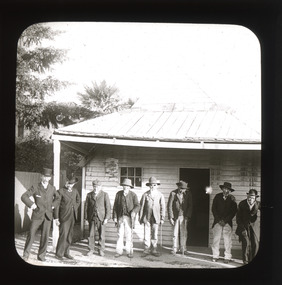
... social relationships in the early Twentieth Century, in particular the experiences of Chinese miners. It is also an example of an early photographic and film-making technology in use in regional Victoria in the time period. Burke Museum Beechworth Lantern Slide Slide Glass Slide Plate Burke Museum Collection Photograph Monochrome magic lantern indigo shire north-east victoria nineteenth century 1900s twentieth century emulsion slides chinese chinese miners protectorate system protection licence immigration racism classism social groups cultural groups taxes hygiene camps Thin translucent sheet of glass with a circular image printed on the front and framed in a black backing. ...This image shows six older Chinese men standing in a row with two younger non-Chinese men outside a small wooden business or official building in the Beechworth region, circa 1900. The two non-Chinese men are wearing clothes of the period that indicate relative prosperity (such as three piece suits, top hats, and a pocket handkerchief), whereas most of the Chinese men are wearing Western-style working clothes of the era. One Chinese man at the far right of the image is wearing similar garments to the non-Chinese men, including a bowler hat and longer, more tailored suit jacket. Chinese miners were a significant cultural group in Beechworth's gold rush period. Carole Woods' history of Beechworth, 'A Titan's Field', details that there were approximately 60 Chinese people in the area in 1855, more than 1000 in 1856 and 4700 (a quarter of the population) in 1857, despite the introduction in 1855 of official policies such as additional taxes formulated by the Victorian Government to limit access by Chinese immigrants. Most Chinese miners in the region came from southern China and had formerly worked as merchants, mechanics, farmers and shop-keepers. Chinese people were subjected to a 'protectorate' system, ostensibly to minimise the potential for conflict with other groups; this system required Chinese people to live in designated 'hygienic' camps with paid Chinese headmen who supervised the village and enforced the protectorate's rules. Chinese people were required to purchase an annual protection ticket to fund this system. The protectorate system was abolished in 1861, before this image was taken in approximately 1900, but it may still provide insight into social stratification or relationships between and within cultural groups in Beechworth resulting from such practices. Lantern slides, sometimes called 'magic lantern' slides, are glass plates on which an image has been secured for the purpose of projection. Glass slides were etched or hand-painted for this purpose from the Eighteenth Century but the process became more popular and accessible to the public with the development of photographic-emulsion slides used with a 'Magic Lantern' device in the mid-Nineteenth Century. Photographic lantern slides comprise a double-negative emulsion layer (forming a positive image) between thin glass plates that are bound together. A number of processes existed to form and bind the emulsion layer to the base plate, including the albumen, wet plate collodion, gelatine dry plate and Woodburytype techniques. Lantern slides and magic lantern technologies are seen as foundational precursors to the development of modern photography and film-making techniques.This glass slide is significant because it provides insight into Beechworth's cultural and social relationships in the early Twentieth Century, in particular the experiences of Chinese miners. It is also an example of an early photographic and film-making technology in use in regional Victoria in the time period.Thin translucent sheet of glass with a circular image printed on the front and framed in a black backing. It is held together by metals strips to secure the edges of the slide.burke museum, beechworth, lantern slide, slide, glass slide, plate, burke museum collection, photograph, monochrome, magic lantern, indigo shire, north-east victoria, nineteenth century, 1900s, twentieth century, emulsion slides, chinese, chinese miners, protectorate system, protection licence, immigration, racism, classism, social groups, cultural groups, taxes, hygiene camps -
 The Beechworth Burke Museum
Photograph - Lantern Slide, c1900
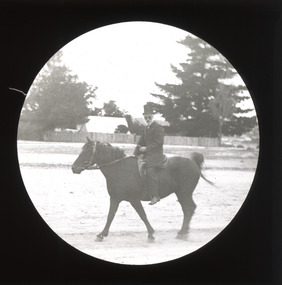
... social relationships in the early Twentieth Century, in particular the experiences of Chinese people. It is also an example of an early photographic and film-making technology in use in regional Victoria in the time period. Burke Museum Beechworth Lantern Slide Slide Glass Slide Plate Burke Museum Collection Photograph Monochrome magic lantern indigo shire north-east victoria nineteenth century 1900s twentieth century emulsion slides chinese chinese miners immigration racism classism social groups cultural groups horse riding horses equestrian horseback Thin translucent sheet of glass with a circular image printed on the front and framed in a black backing. ...This image of a man on horseback is thought to have been taken in Beechworth in approximately 1900. The man pictured may be Chinese. Chinese miners were a significant cultural group in Beechworth's gold rush period. Carole Woods' history of Beechworth, 'A Titan's Field', details a rapid increase in the Chinese population beginning in 1856 that led to Government discrimination and hostility from other miners. Many Chinese people who came to the Victorian goldfields had formerly worked as merchants, mechanics, farmers and shop-keepers. The pictured individual is wearing Western-style clothes indicating prosperity, such as a top hat, so may have held an official position or provided services to the community rather than working as a miner. Lantern slides, sometimes called 'magic lantern' slides, are glass plates on which an image has been secured for the purpose of projection. Glass slides were etched or hand-painted for this purpose from the Eighteenth Century but the process became more popular and accessible to the public with the development of photographic-emulsion slides used with a 'Magic Lantern' device in the mid-Nineteenth Century. Photographic lantern slides comprise a double-negative emulsion layer (forming a positive image) between thin glass plates that are bound together. A number of processes existed to form and bind the emulsion layer to the base plate, including the albumen, wet plate collodion, gelatine dry plate and Woodburytype techniques. Lantern slides and magic lantern technologies are seen as foundational precursors to the development of modern photography and film-making techniques.This glass slide is significant because it provides insight into Beechworth's cultural and social relationships in the early Twentieth Century, in particular the experiences of Chinese people. It is also an example of an early photographic and film-making technology in use in regional Victoria in the time period.Thin translucent sheet of glass with a circular image printed on the front and framed in a black backing. It is held together by metals strips to secure the edges of the slide.burke museum, beechworth, lantern slide, slide, glass slide, plate, burke museum collection, photograph, monochrome, magic lantern, indigo shire, north-east victoria, nineteenth century, 1900s, twentieth century, emulsion slides, chinese, chinese miners, immigration, racism, classism, social groups, cultural groups, horse riding, horses, equestrian, horseback -
 The Beechworth Burke Museum
Functional object - Pocket Watch, C.1853
... classes and the affluent members of society since only the wealthy could afford them. In this era, an early version of the pocket watch was typically worn around the neck, as opposed to being attached to a pocket watch chain like the Albert T Bar chain. Furthermore, the increasing use of the railways during the latter part of the 1800s significantly accelerated the popularity of pocket watches. This pocket watch is significant as they relate to the social ...Although the exact creation of this pocket watch is unknown, the pocket watch was first invented in 1510, in Nuremberg, Germany. The inception of this invention can be attributed to Peter Henlein, a master locksmith who continued producing timepieces until the 16th century when their manufacturing expanded to other parts of Europe. During the 15th century, pocket watches served as a means of distinguishing between the lower classes and the affluent members of society since only the wealthy could afford them. In this era, an early version of the pocket watch was typically worn around the neck, as opposed to being attached to a pocket watch chain like the Albert T Bar chain. Furthermore, the increasing use of the railways during the latter part of the 1800s significantly accelerated the popularity of pocket watches.This pocket watch is significant as they relate to the social history within the Burke Museum's collection playing a vital role in narrating the history of Beechworth, demonstrating the past of the town through insights into its social, cultural, and economic dimensions.A silver pocketwatch with a leather strap attached at the clasp.A01153clock, pocketwatch, timepiece, burke museum -
Marysville & District Historical Society
THE TRIANGLE NEWS-VOL 5 NO 38-NOVEMBER 28 1980
... marysville victoria australia interruption to electricity supply healesville living & learning centre think it over kinder roster community care centre buxton red cross competition r.s.l. news golf congratulations junior cricket swimming club fuel supply carols by candlelight fire brigade footy club wirranda appaloosa stud help coach for sale football social club wanted hand crafts photographer wanted to buy pottery classes for hire wanted to rent cheap rent situations vacant last chance bargains st thomas' church buxton THE TRIANGLE NEWS-VOL 5 NO 38-NOVEMBER 28 1980 ...marysville, victoria, australia, interruption to electricity supply, healesville living & learning centre, think it over, kinder roster, community care centre, buxton red cross competition, r.s.l. news, golf, congratulations, junior cricket, swimming club, fuel supply, carols by candlelight, fire brigade, footy club, wirranda appaloosa stud, help, coach, for sale, football social club, wanted hand crafts, photographer, wanted to buy, pottery classes, for hire, wanted to rent, cheap rent, situations vacant, last chance bargains, st thomas' church buxton -
Federation University Historical Collection
Document - Document - Syllabus, Education Department, Victoria, Syllabus No. J1 (Girls), Junior Technical Schools
... Years 1 & 2 have classes in English - 5 hours; Social Studies which covers History and Civics and Geography - 4 hours; Art which covers Model Drawing, Plant Forms, Lettering and Geometrical Drawing - 6 hours; Needlecrafts which covers Plain and Decorative Needlework, Dressmaking, Millinery - 6 hours; Homecrafts which covers Cookery, Laundry, Housewifery - 4 hours; Horticulture or Special approved subjects - 2 hours; Sports, Physical Drill and Singing - 4 hours. ...Years 1 & 2 have classes in English - 5 hours; Social Studies which covers History and Civics and Geography - 4 hours; Art which covers Model Drawing, Plant Forms, Lettering and Geometrical Drawing - 6 hours; Needlecrafts which covers Plain and Decorative Needlework, Dressmaking, Millinery - 6 hours; Homecrafts which covers Cookery, Laundry, Housewifery - 4 hours; Horticulture or Special approved subjects - 2 hours; Sports, Physical Drill and Singing - 4 hours. ...This syllabus for Girls provides the suggested time-allotment for subjects in Year 1, Year 2 and Year 3. The total hours for each year is 40 hours. Years 1 & 2 have classes in English - 5 hours; Social Studies which covers History and Civics and Geography - 4 hours; Art which covers Model Drawing, Plant Forms, Lettering and Geometrical Drawing - 6 hours; Needlecrafts which covers Plain and Decorative Needlework, Dressmaking, Millinery - 6 hours; Homecrafts which covers Cookery, Laundry, Housewifery - 4 hours; Horticulture or Special approved subjects - 2 hours; Sports, Physical Drill and Singing - 4 hours. Year 3 have English - 5 hours; Civics - 2 hours; Arithmetic and Elementary Bookkeeping - 4 hours; Science - 4 hours; Special approved subjects - 1 hour; Sports, Physical Drill and Singing - 4 hours giving a total of 20 hours. The remaining 20 hours will be for one of the following groups - (a) Dressmaking, (b) Millinery, (c) Art and Craft, (d) Cookery, (e) Homecrafts.21cm x 27.2cm sheet folded to 21cm x 13.7 education department, victoria, syllabus, girls, junior technical schools, time-allotment, hours per subject, english, social studies, history and civics, geography, hygiene and elementary physiology, arithmetic, science, art, model drawing, plant form, lettering, geometrical drawing, needlecrafts, plain and decorative needlework, dressmaking, millinery, homecrafts, cookery, laundry, housewifery, horticulture, sports, physical drill, singing, art and applied design, drafting, history and appreciation of art -
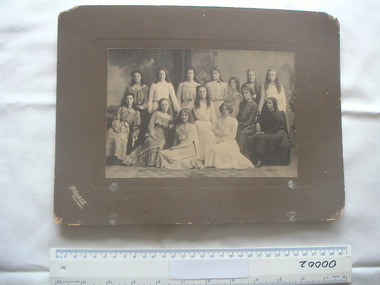 Ballarat Clarendon College
Photograph, Richards and Co, prior to December 1902
... The photograph has social significance due to its representation of fashions for young ladies in the early 1900's. mckenzie mrs kennedy matriculation class 1902 enid winnie clarkson olive tyler helen howe edith clark muriel vickery lucy pratt flossie famer alice mckay violet elliott lucy syme connie snow nellie draper mrs kennedy s school for girls clarendon ladies college Mount inscribed 'Richards and Co Ballarat' Black and white photograph of Mrs Kennedy's last matriculation class in 1902. ...The photograph is a beautiful representation of 1902 fashions for young ladies. The photograph has been taken against a painted backdrop with curtains. The girls wear solemn expressions. They have been artistically positioned, some standing, some seated. The photograph has social significance due to its representation of fashions for young ladies in the early 1900's. Black and white photograph of Mrs Kennedy's last matriculation class in 1902. Photo is attached to cardboard mount. Mount is inscribed 'Richards and Co Ballarat'. Names of those photographed are listed on separate piece of paper attached to rear of mount.The photograph shows a group of 14 girls dressed in fashions of the day, front row seated and back row standing.Mount inscribed 'Richards and Co Ballarat'mckenzie, mrs kennedy, matriculation class, 1902, enid, winnie clarkson, olive tyler, helen howe, edith clark, muriel vickery, lucy pratt, flossie famer, alice mckay, violet elliott, lucy syme, connie snow, nellie draper, mrs kennedy s school for girls, clarendon ladies college -
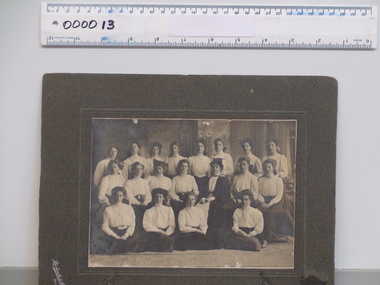 Ballarat Clarendon College
Photograph, Richards & Co, 1909 (exact)
... The photograph has social significance due to its representation of fashions for young ladies in 1909. 1909 clarendon ladies college richards co Printed on bottom left corner of front of mount: Richards & Co/Ballarat; Handwritten on back of mount: Clarendon/Form VI (Inter & leaving)/1909/E.L.R. Black and white photograph with grey mount featuring the Clarendon Ladies College Form VI (Intermediate and leaving) class ...The photograph provides details relating to the student's dress and deportment in 1909. The girls wear full-length dark skirts with wide belts and white blouses. The blouses are not uniform but feature high necks, cuffed sleeves and lace decoration. Their hair is elaborately coiffured and adorned with large bows. The teacher is wearing a mortar-board and academic gown. Her skirt of light-coloured. The photograph has social significance due to its representation of fashions for young ladies in 1909. Black and white photograph with grey mount featuring the Clarendon Ladies College Form VI (Intermediate and leaving) class in 1909. Students are arramnged in three rows - first row on floor, second row seated and third row standing. 18 students and one staff.Printed on bottom left corner of front of mount: Richards & Co/Ballarat; Handwritten on back of mount: Clarendon/Form VI (Inter & leaving)/1909/E.L.R.1909, clarendon ladies college, richards co -
Ballarat Clarendon College
Report card, 1929
... class, personal comment and examination/term marks. Other management of earning indicators include conduct, homework, detentions and attendance. This report has social ...This Form IVA & Romove third term (end of year) report was issued for Jean Wilson in December 1929 and signed by CPLC Principal, Lucy Shaw. The report details subjects studied and gives student percentage, class average, cohort total, position in class, personal comment and examination/term marks. Other management of earning indicators include conduct, homework, detentions and attendance. This report has social significance because it gives indication of educational standards and expectations of the era. Light card, folded in half; Clarendon presbyterian ladies College crest, motto and name on front page; Report on centre pages; back page blankjean wilson, 1929
