
Showing 216 items matching "social culture"
-
 National Wool Museum
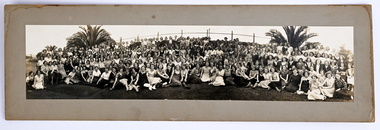
Photograph - Staff Portrait, Valley Worsted Mills, Geelong, 1930's
... ...Social Culture...Beyond their grueling factory shifts, the mill women maintained a vibrant social culture, even forming organized recreation groups like the Valley Worsted Mills Women’s Basketball team during this era. ...Beyond their grueling factory shifts, the mill women maintained a vibrant social culture, even forming organized recreation groups like the Valley Worsted Mills Women’s Basketball team during this era. ...The Valley Worsted Mills were established in 1924 on Swanston Street in South Geelong and quickly grew to become the largest and most modern textile mill in Australia, employing roughly 500 workers at its peak. Built out of distinctive red Geelong brick with iconic Art Deco white trimmings and a sawtooth roofline, the massive 11-acre complex served as a major manufacturing cornerstone during the height of the region's historic wool boom. The mill operated at high production for nearly 50 years before merging with John Foster & Son in December 1973, subsequently closing down entirely in the mid-1970s. During the Great Depression of the 1930s, the female workforce at Valley Worsted Mills and other local Geelong textile factories became more vital than ever. Because women were historically paid significantly lower wage rates than men for equivalent labor, local mills increasingly relied on them to keep operating costs low during severe economic strain. These young women, often referred to affectionately as "mill girls," typically started working as young as 14 to 16 years old. They filled specialized, highly skilled roles as menders, warpers, and weavers. For many families in the Geelong region, the steady industrial employment of these women provided a crucial financial lifeline when male breadwinners faced widespread unemployment. Beyond their grueling factory shifts, the mill women maintained a vibrant social culture, even forming organized recreation groups like the Valley Worsted Mills Women’s Basketball team during this era. The donor's father Stan Hoyle, and grandfather Cliff Hoyle, both worked there at the time.Black and white panoramic photograph attached to backing board. Photograph shows a group portrait of female factory workers outdoors.back: [handwritten] Valley / Worsted Mills Geelong / 34 - 40 / Ada? Stan?valley worsted mills, swanston street geelong, geelong, woollen mills, depression, 1930s, working life, panoramic, employees, staff, portrait, textile industry, great depression, female workers, mill girls, social culture, stan hoyle, cliff hoyle -
 Latrobe Regional Gallery
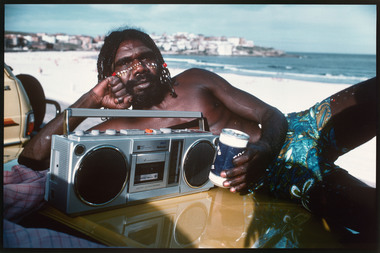
Photograph, MOFFATT, Tracey. born 1960, Brisbane, Queensland, Australia, Movie Star, 1985
... Indigenous culture...social...Indigenous culture social beach Australian culture inscribed 'Tracey Moffatt' (on the reverse) Type C Photograph Movie Star Photograph MOFFATT, Tracey. born 1960, Brisbane, Queensland, Australia ...Type C Photographinscribed 'Tracey Moffatt' (on the reverse)indigenous culture, social, beach, australian culture -
 Unions Ballarat
Ill fares the land : a treatise on our present discontents, Judt, Tony, 2011
... ...social commentary...political culture...Relevant to modern history and common needs. btlc ballarat trades hall ballarat trades and labour council history - modern social commentary political culture social change civilisation Front cover: Quote from Oliver Goldsmith, author name and title. ...Social commentary - post-war Europe. Explores materialism, greed, ethics and society.Relevant to modern history and common needs.Paper; book. Grey, black and white cover.Front cover: Quote from Oliver Goldsmith, author name and title.btlc, ballarat trades hall, ballarat trades and labour council, history - modern, social commentary, political culture, social change, civilisation -
 Stawell Historical Society Inc
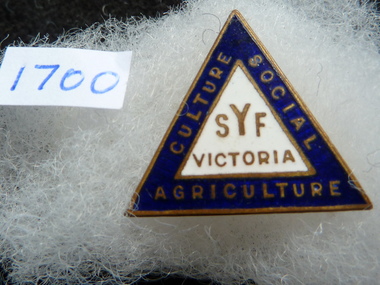
Memorabilia - Badge, c1965-1970
... Young Farmers Victoria, Culture Social Agriculture...Stawell Young Farmers Victoria, Culture Social Agriculture Memorabilia Badge ...Young Farmers Victoria, Culture Social Agriculturestawell -
 Flagstaff Hill Maritime Museum and Village
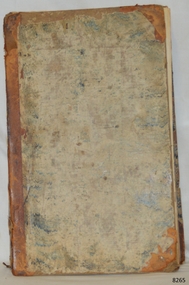
Book - Reference Travel/History/Cartography, Mr Salmon (Thomas Salmon) et al, Modern History or, the Present State of All Nations. Vol III, 1746
... ...Social Studies...Culture...(For more information on the Pattison Collection see item 3678 Flagstaff Hill collections) https://victoriancollections.net.au/items/5580c7e72162f114d8b758db Flagstaff Hill Flagstaff Hill Maritime Museum and Village Warrnambool Maritime Museum Maritime Village Great Ocean Road Shipwreck Coast Pattison Collection Ralph Eric Pattison Warrnambool Mechanics’ Institute Mechanics’ Institute Library Warrnambool Library Free Library Corangamite Regional Library Service Mr Salmon Thomas Salmon 18th century 1746 History Geography Social Studies Culture Maps Modern History Present State of All Nations Vol III Herman Moll T Longman and T Shewell Social History Cartography This 1746 3rd Edition of Thomas Salmon’s Modern History is a fantastic slice of Enlightenment era geography and publishing history. ...This 1746 3rd Edition of Thomas Salmon’s Modern History is a fantastic slice of Enlightenment era geography and publishing history. It sits at a fascinating intersection of early modern travel literature, top tier cartography, and the rise of one of London's most famous publishing houses. Thomas Salmon’s Modern History: or, the Present State of All Nations was an ambitious encyclopedic project. Rather than focusing strictly on dynastic timelines, Salmon took a modern geographical and ethnographic approach. For each region covered, he detailed its geography and climate, along with its natural resources, plants, animals, and minerals. Culture and society were covered by focusing on local habits, dress, religious rites, laws, customs, and architecture. Economy and trade were also detailed, including the arts, sciences, husbandry, and commercial manufactures.Hard cover book,Modern History: or, the Present State of All Nations Vol III Author: Mr Salmon (Thomas Salmon) Illustrator: Herman Moll Publisher: T Longman and T Shewell, London. Date: 1746 (MDCCXLVI), 3rd Edition Further Information: Set of Three Volumes. Hard covered book has reinforcing on the spine and corners. The cover is very well worn and has remnants of a coloured design. The fly page is printed in red and black ink and has a long description of the contents. Inside the cover is printed a Coat of Arms, there is a stocker on the inside cover. non-fictionThis 1746 3rd Edition of Thomas Salmon’s Modern History is a fantastic slice of Enlightenment era geography and publishing history. It sits at a fascinating intersection of early modern travel literature, top tier cartography, and the rise of one of London's most famous publishing houses. Thomas Salmon’s Modern History: or, the Present State of All Nations was an ambitious encyclopedic project. Rather than focusing strictly on dynastic timelines, Salmon took a modern geographical and ethnographic approach. For each region covered, he detailed its geography and climate, along with its natural resources, plants, animals, and minerals. Culture and society were covered by focusing on local habits, dress, religious rites, laws, customs, and architecture. Economy and trade were also detailed, including the arts, sciences, husbandry, and commercial manufactures.flagstaff hill, flagstaff hill maritime museum and village, warrnambool, maritime museum, maritime village, great ocean road, shipwreck coast, pattison collection, ralph eric pattison, warrnambool mechanics’ institute, mechanics’ institute library, warrnambool library, free library, corangamite regional library service, mr salmon, thomas salmon, 18th century, 1746, history, geography, social studies, culture, maps, modern history, present state of all nations vol iii, herman moll, t longman and t shewell, social history, cartography -
 Victorian Aboriginal Corporation for Languages
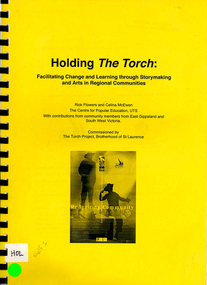
Book, Rick Flowers et al, Holding the torch : facilitating change and learning through storymaking and arts in regional communities, 2004
... ...social capital...culture...performing arts theatre storymaking social capital culture and identity community engagement Reigniting Community project Brotherhood of St Laurence b&w illustrations Booklet reporting on a Regional Arts programme to bring about change through Storymaking and The Arts. ...Booklet reporting on a Regional Arts programme to bring about change through Storymaking and The Arts.b&w illustrationsperforming arts, theatre, storymaking, social capital, culture and identity, community engagement, reigniting community project, brotherhood of st laurence -
Unions Ballarat
Instructions for American servicemen in Australia 1942 (Don Woodward Collection), 1942
... ...social customs...Culture...Australian culture as perceived by outsiders. BTLC Ballarat Trades Hall ballarat trades and labour council social customs Culture - Australia Military - USA war - world war ii Australia - language - vernacular Book; 54 pages. ...Dated. Cultural guide to Australia for US servicemen who were based in Australia during WWII. Includes descriptions of slang, money, places, Commonwealth, food, economy, etc.Australian culture as perceived by outsiders.Book; 54 pages. Cover: blue background; black lettering; title.btlc, ballarat trades hall, ballarat trades and labour council, social customs, culture - australia, military - usa, war - world war ii, australia - language - vernacular -
Emerald Museum & Nobelius Heritage Park
Accessory - Badges and container, 1940s
... Cardboard container with small bulb in it, D R H & P (House and ) Club Badge, Culture Social and Agriculture YFC Badge....4 Medals-Upwey High School Badge-Ferntree Gully Shire Park Ranger Badge-DR H & P Club Badge and Culture Social Agriculture YFC Badge and a small cardboard container...Cardboard container with small bulb in it, D R H & P (House and ) Club Badge, Culture Social and Agriculture YFC Badge. Emerald Victoria Australia education Parks Volunteering 4 Medals-Upwey High School Badge-Ferntree Gully Shire Park Ranger Badge-DR H & P Club Badge and Culture Social Agriculture YFC Badge and a small cardboard container Accessory Badges and container ...J.J Madigan (Jim) was a Park Ranger at Emerald Lake in the late 1940s. Cardboard container with small bulb in it, D R H & P (House and ) Club Badge, Culture Social and Agriculture YFC Badge.4 Medals-Upwey High School Badge-Ferntree Gully Shire Park Ranger Badge-DR H & P Club Badge and Culture Social Agriculture YFC Badge and a small cardboard containeremerald, victoria, australia, education, parks, volunteering -
 Eltham District Historical Society Inc
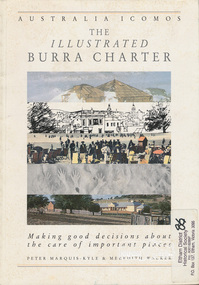
Book, Peter Marquis-Kyle et al, The illustrated Burra Charter : making good decisions about the care of important places / Peter Marquis-Kyle & Meredith Walker, 1992
... ...social customs...art...culture...buildings monuments social customs art culture conservation ISBN 064612403 Paperback; 84 p. : ill., ports ; 30 cm. ...Paperback; 84 p. : ill., ports ; 30 cm.ISBN 064612403buildings, monuments, social customs, art, culture, conservation -
Unions Ballarat
Among the barbarians, Sheehan, Paul, 1998
... social history...national culture...culture and immigration. The book was written in 1998. btlc ballarat trades hall ballarat trades and labour council immigration social history national culture Front cover: author name and title. ...A critical appraisal of Australia's immigration policies and multiculturalism.Relevant to Australian culture and immigration. The book was written in 1998.Paper; book. Cover: White with red, black and white writing. Picture of a burning leaf. Round sticker: "The phenomenal no.1 bestseller".Front cover: author name and title.btlc, ballarat trades hall, ballarat trades and labour council, immigration, social history, national culture -
 Nhill and District Historical Society Inc.
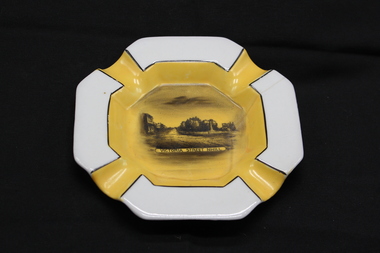
Ceramic - c 1920-1935 Souvenir Ashtray, Victoria Street, Nhill, c 1920 - 1935
... Its use as an ashtray also reflects the domestic and social culture of the period, when smoking accessories were commonplace household objects. ...Its use as an ashtray also reflects the domestic and social culture of the period, when smoking accessories were commonplace household objects. ...The dish is an example of the early 20th-century international souvenir trade, in which German porcelain manufacturers produced inexpensive objects depicting Australian towns and tourist destinations. Such objects were intended to be purchased as tangible reminders of travel or locality. Its use as an ashtray also reflects the domestic and social culture of the period, when smoking accessories were commonplace household objects. The dish depicts Victoria Street, Nhill, a significant regional street in the Wimmera township of Nhill, Victoria. The survival of the street name and pictorial representation makes this more than a generic souvenir: it is a small piece of Nhill local-history material culture.Small octagonal/scalloped porcelain dish with a white ground, broad mustard-yellow decorative band and fine black outlining. The recessed central panel contains a sepia transfer-printed view of a country street, with buildings, trees, fencing and roadway. The image is identified beneath by the printed inscription “VICTORIA STREET NHILL.” The form, with raised sections around the perimeter suitable for resting cigarettes, indicates that it was manufactured as a souvenir ashtray, although it could also have been used as a small decorative dish. On the base - Red circular manufacturer's mark, incorporating the words “Bavaria” and “Germany.” image is identified beneath by the printed inscription “VICTORIA STREET NHILL.” on base - Red circular manufacturer's mark to reverse, apparently incorporating the words “Bavaria” and “Germany.” c 1920-1935 souvenir ashtray, victoria street--nhill, manufactured in germany, ceramics -
 Greensborough Historical Society
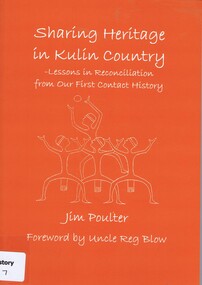
Book, Jim Poulter, Sharing heritage in Kulin country:lessons in reconciliation from our first contact history, by Jim Poulter, 2011_
... Australian Aboriginal social structure and culture, and their relations with Europeans....Australian Aboriginal social structure and culture, and their relations with Europeans. aborigines victoria social structure 117 p., paperback. ...Australian Aboriginal social structure and culture, and their relations with Europeans.117 p., paperback.aborigines victoria, social structure -
 Wycheproof & District Historical Society Inc.
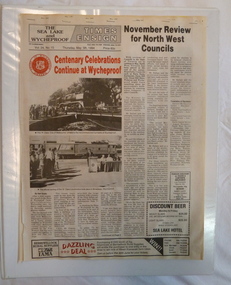
Events Book, Events of Interest, 2000
... These selections of printed articles and photos recaptures past local events, reflecting our culture and social life....These selections of printed articles and photos recaptures past local events, reflecting our culture and social life. This collection of local stories and facts of Wycheproof and District have a connectiveness and provide an opportunity to celebrate occasions, remember and learn of the past. ...These selections of printed articles and photos recaptures past local events, reflecting our culture and social life.This collection of local stories and facts of Wycheproof and District have a connectiveness and provide an opportunity to celebrate occasions, remember and learn of the past. Large white A3 book with 4 ring binder which allows plastic pockets to be added. Includes newspaper items, brochures and other printed matter on various local topics. Mrs Betty Denney's collection is followed by articles collected by other members of the Wycheproof Historical Society.Mrs Betty Denney's Collectionnewspaper- wycheproof, wycheproof - memories -
Whitehorse Historical Society Inc.
Article, Strathdon Day Care offers help, comfort, 1990
... It cuts across every nationality and culture, every social group. Article describes Strathdon Community's Day care Centre....It cuts across every nationality and culture, every social group. Alzheimer's is not a normal sign of ageing, it's a disease which does not discriminate. ...Alzheimer's is not a normal sign of ageing, it's a disease which does not discriminate. It cuts across every nationality and culture, every social group.Alzheimer's is not a normal sign of ageing, it's a disease which does not discriminate. It cuts across every nationality and culture, every social group. Article describes Strathdon Community's Day care Centre.Alzheimer's is not a normal sign of ageing, it's a disease which does not discriminate. It cuts across every nationality and culture, every social group. aged people, strathdon community, houlihan, rosemary, eversteyn, rita, alzheimers disease -
 Victorian Aboriginal Corporation for Languages
Book, George Yule, The study of Language, 2006
... Issues in language study: origin of language, animals & human language, writing, phonetics, phonology, words & word-formation processes, morphology, grammar, syntax, semantics, pragmatics, discourse analysis, language and the brain, language acquisition, gestures and sign languages, languages and regional variation, language and social variation, language and culture....linguistics sociolinguistics history and language B&w illustrations, b&w photographs, maps Issues in language study: origin of language, animals & human language, writing, phonetics, phonology, words & word-formation processes, morphology, grammar, syntax, semantics, pragmatics, discourse analysis, language and the brain, language acquisition, gestures and sign languages, languages and regional variation, language and social variation, language and culture. The study of Language Book George Yule ...Issues in language study: origin of language, animals & human language, writing, phonetics, phonology, words & word-formation processes, morphology, grammar, syntax, semantics, pragmatics, discourse analysis, language and the brain, language acquisition, gestures and sign languages, languages and regional variation, language and social variation, language and culture.B&w illustrations, b&w photographs, mapslinguistics, sociolinguistics, history and language -
 Ballarat Tramway Museum
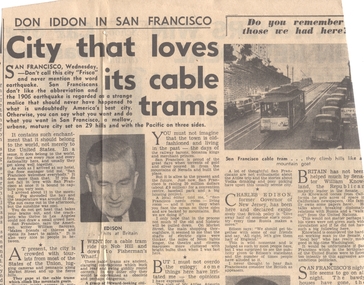
Newspaper, "City that loves its cable trams", 1950's
... Discusses the social mix and cultures of the city, its cable trams, politicians, night life, and its position in world politics. ...Discusses the social mix and cultures of the city, its cable trams, politicians, night life, and its position in world politics. ...Newspaper clipping from a Melbourne paper, no date marked titled "City that loves its cable trams", written by Journalist Don Iddon visiting San Francisco. Discusses the social mix and cultures of the city, its cable trams, politicians, night life, and its position in world politics. Has a photo of a California St cable car. Item was contained within the back cover of Reg Item 5485 - Service Exercise Book, black covers, with label, red binding titled "No. 2 - Ballarat Tramways & S.E.C. Systems" - see list. cable trams, san francisco, usa -
National Wool Museum
Book, Wool in the Australian Imagination
... This book is the catalogue from an exhibition titled "Wool in the Australian Imagination", an evaluation of the social history and popular culture associated with wool. This exhibition was instigated by the Historic Houses Trust of New South Wales in 1994. ...This book is the catalogue from an exhibition titled "Wool in the Australian Imagination", an evaluation of the social history and popular culture associated with wool. This exhibition was instigated by the Historic Houses Trust of New South Wales in 1994. ...This book is the catalogue from an exhibition titled "Wool in the Australian Imagination", an evaluation of the social history and popular culture associated with wool. This exhibition was instigated by the Historic Houses Trust of New South Wales in 1994. The cataIogue contains essays regarding wool in art, wool in music, science and wool, wool and fashion, mutton and pastoralism. The National Wool Museum lent several collection items to this exhibition (which are mentioned in the checklist of the catalogue) and Rachel Faggeter, the first Director of the Wool Museum, curated the exhibition.Wool / in the Australian Imaginationmerino sheep - history sheep breeding - history wool - history, historic houses trust of new south wales, merino sheep - history, sheep breeding - history, wool - history -
![[1] Three Bears Porridge Flaked Oatmeal Bag (Front)](/media/collectors/510b3f7f023fd725b4cd51fe/items/683baf6c69688f11138d56ba/item-media/683bf711460ecdfee7105b40/item-fit-380x285.jpg?cb=6) Arapiles Historical Society
Arapiles Historical SocietyContainer - Roy SCHMIDT Collection - Cotton Flour Bags (3)
... culture, commonly used in product branding in the early-to-mid 20th century. While the bag reflects a specific period in Australian domestic and commercial packaging history, it also exemplifies racially insensitive advertising that would be considered inappropriate and harmful by today’s standards. Such items are preserved today in museum collections to help document past social...culture, commonly used in product branding in the early-to-mid 20th century. While the bag reflects a specific period in Australian domestic and commercial packaging history, it also exemplifies racially insensitive advertising that would be considered inappropriate and harmful by today’s standards. Such items are preserved today in museum collections to help document past social ...[1] Three Bears Porridge Flaked Oatmeal Bag: This textile bag originates from Canadian Cereal Mills Ltd., which marketed "Three Bears" flaked oatmeal. Popular in the early 1900s to mid-century, this product combined functional packaging with a child-friendly incentive — a cut-out cloth doll. The practice of printing toys, games, or clothing patterns on flour or oat sacks was a common marketing strategy, encouraging reuse and appealing to families during times when thrift and creativity were essential, especially during the Depression and wartime years. The Three Bears brand played off the enduring popularity of children’s nursery tales, while the doll encouraged children (and parents) to reuse packaging creatively. This object captures a unique intersection of food marketing, household resourcefulness, and early 20th-century domestic life. [2] Mammy Self-Raising Flour Bag: This item is a mid-20th-century Australian flour bag, branded “Mammy Oven Puff”, produced by A. Mammy Products Pty Ltd in West Footscray, Victoria. The use of the name "Mammy" and the caricatured illustration draws on a now widely recognised and offensive racial stereotype originating from American minstrel culture, commonly used in product branding in the early-to-mid 20th century. While the bag reflects a specific period in Australian domestic and commercial packaging history, it also exemplifies racially insensitive advertising that would be considered inappropriate and harmful by today’s standards. Such items are preserved today in museum collections to help document past social attitudes, consumer culture, and the evolution of racial representation in advertising. [3] Bandung Blue Triangle Brand Flour Bag: This bag represents a mid-20th-century Australian flour export product, particularly aimed at international markets such as Indonesia (as indicated by "Bandung"). The “Blue Triangle Brand” was likely a registered trademark used by a Melbourne-based flour mill engaged in both local and overseas trade. The use of durable cloth bags for bulk flour was common prior to the widespread adoption of paper and plastic packaging. These bags were often reused domestically for household textiles, clothing patterns, or storage. The export reference (Bandung) underscores Australia's historical agricultural trade ties with Southeast Asia, especially in wheat and flour exports. – Roy SCHMIDT resided with his siblings Mabel and Jack at ‘Parklands’ 85 Lake Avenue Natimuk home of Heinrich Friederick ‘Heiny’ & Minna Christina SUDHOLZ nee LANGE and their children Louis, Sophie, Alma, Lena (Roy's Mother), Florence 'Florrie' and Edward ‘Ted’.[1] Three Bears Porridge Flaked Oatmeal Bag: A vintage cloth oatmeal bag printed with black ink on both sides. One side is branded with "Three Bears Porridge – Flaked Oatmeal", showing an image of three bears behind a gate, referencing the well-known “Goldilocks and the Three Bears” fairytale. The opposite side features a printed cut-out doll design, showing a young girl with curly hair holding a bouquet of flowers, intended to be sewn into a stuffed toy. Instructions note that the reverse side (the doll’s back) could be obtained from a second bag. The design combines product branding with a promotional activity for children, typical of early- to mid-20th-century grocery packaging aimed at reuse. [2] Mammy Self-Raising Flour Bag: A small vintage cloth flour bag with printed branding in faded red, blue, and black inks. The front of the bag features a central image of a caricatured smiling African American woman wearing a headscarf. The text is unevenly faded but legible in parts. The bag has a rectangular shape with an open top edge and signs of previous use, including creasing and some fraying at the corners. [3] Bandung Blue Triangle Brand Flour Bag: A large, rectangular vintage cloth flour bag made of cream-coloured calico or cotton. The front of the bag is printed in bold blue ink with branding and export information. It prominently features a large triangular logo reading “Blue Triangle Brand” and numerous lines of text in block and stylised fonts. The bag is open at the top with frayed edges, suggesting it was once machine-stitched shut and later opened.[1] Three Bears Porridge Flaked Oatmeal Bag: Front side (branding side): "THREE BEARS Porridge – FLAKED OATMEAL" "7 Lbs. Net." “Packed and guaranteed by Canadian Cereal Mills Ltd., Toronto” Reverse side (doll pattern): "This is the Front for Three Bears Cut-out Doll" "In order to complete this Doll it will be necessary to obtain the Back Design from another Bag of Three Bears Rolled Oats or Oatmeal." [2] Mammy Self-Raising Flour Bag: Main product name: “MAMMY OVEN PUFF SELF-RAISING FLOUR” Additional text: “The Only Creamed Flour” “Prepared with phosphate aerator” “A. MAMMY PRODUCTS PTY. LTD., Sunshine Rd., West Footscray. Phone: FW 7321” “7 LBS. NET” (near top edge, very faded) [3] Bandung Blue Triangle Brand Flour Bag: The bag is printed with the following: “10270” “G.W.C | H.L” “BANDUNG” “BEST AUSTRALIAN” “BLUE TRIANGLE BRAND” (inside the triangle logo) “GROWER & GRINDERS” (curved around the logo) “Patent Roller” “MELBOURNE” “FLOUR” “50 LBS. GROSS WHEN PACKED” These inscriptions indicate that this flour bag was manufactured in Melbourne, Australia, and was likely exported to Bandung, Indonesia.farm equipment, flour, milling, oats, mammy, bandung blue, schmidt, sudholz, parklands -
 Victorian Aboriginal Corporation for Languages
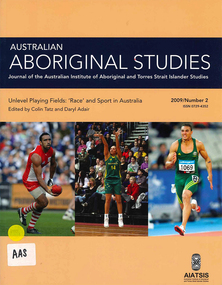
Periodical, Australian Institute of Aboriginal and Torres Strait Islander Studies, Australian Aboriginal studies : journal of the Australian Institute of Aboriginal and Torres Strait Islander Studies, 2009
... social contexts. Understanding discourses about race, racism, ethnicity, otherness, identity and Aboriginality are essential if sense, or nonsense, is to be made of genetic/racial ?explanations? of sporting excellence. Between the two major wars boxing was, disproportionately, a Jewish sport; Kenyans and Ethiopians now ?own? middle- and long-distance running and Jamaicans the shorter events; South Koreans dominate women?s professional golf. This essay explores the various explanations put forward for such ?statistical domination?: genes, biochemistry, biomechanics, history, culture...social contexts. Understanding discourses about race, racism, ethnicity, otherness, identity and Aboriginality are essential if sense, or nonsense, is to be made of genetic/racial ?explanations? of sporting excellence. Between the two major wars boxing was, disproportionately, a Jewish sport; Kenyans and Ethiopians now ?own? middle- and long-distance running and Jamaicans the shorter events; South Koreans dominate women?s professional golf. This essay explores the various explanations put forward for such ?statistical domination?: genes, biochemistry, biomechanics, history, culture ...Darkness and a little light: ?Race? and sport in Australia Colin Tatz (AIATSIS & Australian National University) and Daryl Adair (University of Technology Sydney) Despite ?the wonderful and chaotic universe of clashing colors, temperaments and emotions, of brave deeds against odds seemingly insuperable?, sport is mixed with ?mean and shameful acts of pure skullduggery?, villainy, cowardice, depravity, rapaciousness and malice. Thus wrote celebrated American novelist Paul Gallico on the eve of the Second World War (Gallico 1938 [1988]:9-10). An acute enough observation about society in general, his farewell to sports writing also captures the ?clashing colors? in Australian sport. In this ?land of the fair go?, we look at the malice of racism in the arenas where, as custom might have it, one would least want or expect to find it. The history of the connection between sport, race and society - the long past, the recent past and the social present - is commonly dark and ugly but some light and decency are just becoming visible. Coming to terms: ?Race?, ethnicity, identity and Aboriginality in sport Colin Tatz (AIATSIS & Australian National University) Notions of genetic superiority have led to some of the world?s greatest human calamities. Just as social scientists thought that racial anthropology and biology had ended with the cataclysm of the Second World War, so some influential researchers and sports commentators have rekindled the pre-war debate about the muscular merits of ?races? in a new discipline that Nyborg (1994) calls the ?science of physicology?. The more recent realm of racial ?athletic genes?, especially within socially constructed black athletic communities, may intend no malice but this search for the keys to their success may well revive the old, discredited discourses. This critical commentary shows what can happen when some population geneticists and sports writers ignore history and when medical, biological and sporting doctrines deriving from ?race? are dislocated from any historical, geographic, cultural and social contexts. Understanding discourses about race, racism, ethnicity, otherness, identity and Aboriginality are essential if sense, or nonsense, is to be made of genetic/racial ?explanations? of sporting excellence. Between the two major wars boxing was, disproportionately, a Jewish sport; Kenyans and Ethiopians now ?own? middle- and long-distance running and Jamaicans the shorter events; South Koreans dominate women?s professional golf. This essay explores the various explanations put forward for such ?statistical domination?: genes, biochemistry, biomechanics, history, culture, social dynamics, the search for identity, alienation, need, chance, circumstances, and personal bent or aptitude. Traditional games of a timeless land: Play cultures in Aboriginal and Torres Strait Islander communities Ken Edwards (University of Southern Queensland) Sports history in Australia has focused almost entirely on modern, Eurocentric sports and has therefore largely ignored the multitude of unique pre- European games that are, or once were, played. The area of traditional games, especially those of Aboriginal and Torres Strait Islander peoples, is an important aspect of the cultural, social and historical experiences of Indigenous communities. These activities include customs of play that are normally not associated with European notions of competitive sport. Overall, this paper surveys research undertaken into traditional games among Indigenous Australians, as well as proposals for much needed further study in this area. Culture, ?race? and discrimination in the 1868 Aboriginal cricket tour of England David Sampson As a consequence of John Mulvaney?s important historical research, the Aboriginal cricket and performance tour of Britain in 1868 has in recent decades become established as perhaps the most famous of all public events in contact history involving Aborigines, white settlers and the British metropolis. Although recognition of its importance is welcome and significant, public commemorations of the tour have enveloped the tour in mythologies of cricket and nation. Such mythologies have obscured fundamental aspects of the tour that were inescapable racial and colonial realities of the Victorian era. This reappraisal of the tour explores the centrality of racial ideology, racial science and racial power imbalances that enabled, created and shaped the tour. By exploring beyond cricketing mythology, it restores the central importance of the spectacular performances of Aboriginal skills without which the tour would have been impossible. Such a reappraisal seeks to fully recognise the often trivialised non-cricketing expertise of all of the Aboriginal performers in 1868 for their achievement of pioneering their unique culture, skills and technologies to a mass international audience. Football, ?race? and resistance: The Darwin Football League, 1926?29 Matthew Stephen (Northern Territory Archive Service) Darwin was a diverse but deeply divided society in the early twentieth century. The Commonwealth Government introduced the Aboriginals Ordinance 1911 in the Northern Territory, instituting state surveillance, control and a racially segregated hierarchy of whites foremost, then Asians, ?Coloureds? (Aborigines and others of mixed descent) and, lastly, the so-called ?full-blood? Aborigines. Sport was important in scaffolding this stratification. Whites believed that sport was their private domain and strictly controlled non-white participation. Australian Rules football, established in Darwin from 1916, was the first sport in which ?Coloured? sportsmen challenged this domination. Football became a battleground for recognition, rights and identity for all groups. The ?Coloured? community embraced its team, Vesteys, which dominated the Northern Territory Football League (NTFL) in the 1920s. In 1926, amidst growing racial tension, the white-administered NTFL changed its constitution to exclude non-white players. In reaction, ?Coloured? and Chinese footballers formed their own competition - the Darwin Football League (DFL). The saga of that colour bar is an important chapter in Australia?s football history, yet it has faded from Darwin?s social memory and is almost unknown among historians. That picture - Nicky Winmar and the history of an image Matthew Klugman (Victoria University) and Gary Osmond (The University of Queensland) In April 1993 Australian Rules footballer Nicky Winmar responded to on-field racist abuse by lifting his jersey and pointing to his chest. The photographic image of that event is now famous as a response to racial abuse and has come to be seen as starting a movement against racism in football. The racial connotations in the image might seem a foregone conclusion: the power, appeal and dominant meaning of the photograph might appear to be self-evident. But neither the fame of the image nor its racial connotation was automatic. Through interviews with the photographers and analysis of the use of the image in the media, we explore how that picture came to be of such symbolic importance, and how it has remained something to be re-shown and emulated. Rather than analyse the image as a photograph or work of art, we uncover some of its early history and explore the debates that continue to swirl around its purpose and meaning. We also draw attention to the way the careful study of photographs might enhance the study of sport, race and racism. ?She?s not one of us?: Cathy Freeman and the place of Aboriginal people in Australian national culture Toni Bruce (University of Waikato) and Emma Wensing (Independent scholar) The Sydney 2000 Olympic Games generated a national media celebration of Aboriginal 400 metre runner Cathy Freeman. The construction of Freeman as the symbol of national reconciliation was evident in print and on television, the Internet and radio. In contrast to this celebration of Freeman, the letters to the editor sections of 11 major newspapers became sites for competing claims over what constitutes Australian identity and the place of Aboriginal people in national culture. We analyse this under-explored medium of opinion and discuss how the deep feelings evident in these letters, and the often vitriolic responses to them, illustrate some of the enduring racial tensions in Australian society. Sport, physical activity and urban Indigenous young people Alison Nelson (The University of Queensland) This paper challenges some of the commonly held assumptions and ?knowledges? about Indigenous young people and their engagement in physical activity. These include their ?natural? ability, and the use of sport as a panacea for health, education and behavioural issues. Data is presented from qualitative research undertaken with a group of 14 urban Indigenous young people with a view to ?speaking back? to these commentaries. This research draws on Critical Race Theory in order to make visible the taken-for-granted assumptions about Indigenous Australians made by the dominant white, Western culture. Multiple, shifting and complex identities were expressed in the young people?s articulation of the place and meaning of sport and physical activity in their lives. They both engaged in, and resisted, dominant Western discourses regarding representations of Indigenous people in sport. The paper gives voice to these young people in an attempt to disrupt and subvert hegemonic discourses. An unwanted corroboree: The politics of the New South Wales Aboriginal Rugby League Knockout Heidi Norman (University of Technology Sydney) The annual New South Wales Aboriginal Rugby League Knockout is so much more than a sporting event. Involving a high level of organisation, it is both a social and cultural coming together of diverse communities for a social and cultural experience considered ?bigger than Christmas?. As if the planning and logistics were not difficult enough, the rotating-venue Knockout has been beset, especially since the late 1980s and 1990s, by layers of opposition and open hostility based on ?race?: from country town newspapers, local town and shire councils, local business houses and, inevitably, the local police. A few towns have welcomed the event, seeing economic advantage and community good will for all. Commonly, the Aboriginal ?influx? of visitors and players - people perceived as ?strangers?, ?outsiders?, ?non-taxpayers? - provoked public fear about crime waves, violence and physical safety, requiring heavy policing. Without exception, these racist expectations were shown to be totally unfounded. Research report: Recent advances in digital audio recorder technology provide considerable advantages in terms of cost and portability for language workers.b&w photographs, colour photographs, tablessport and race, racism, cathy freeman, nicky winmar, rugby league, afl, athletics, cricket, digital audio recorders -
 Flagstaff Hill Maritime Museum and Village
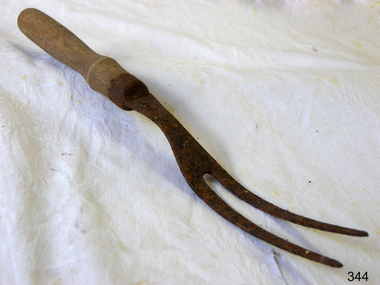
Domestic object - Fork
... culture (2400–1900 BC) as well as later Chinese dynasties’ tombs.The Ancient Greeks used the fork as a serving utensil. Read also: Steven Spielberg to Remake the Classic Musical ‘West Side Story’ In the Roman Empire, bronze and silver forks were used. The use varied according to local customs, social...culture (2400–1900 BC) as well as later Chinese dynasties’ tombs.The Ancient Greeks used the fork as a serving utensil. Read also: Steven Spielberg to Remake the Classic Musical ‘West Side Story’ In the Roman Empire, bronze and silver forks were used. The use varied according to local customs, social ...Naturally, we tend to take commonplace objects for granted, because they have always been there. Yet how many of you actually have thought “hey, where do forks come from?” Well, it takes one trip to China and a 3-year-old laughing at your face because of your desperate attempt to eat with chopsticks to finally appreciate something so ordinary such as a fork. So, where do forks come from? The early history of the fork is obscure. As a kitchen and dining utensil, it is believed to have originated in the Roman Empire, as proved by archaeological evidence. The personal table fork most likely originated in the Eastern Roman (or Byzantine) Empire. Its use spread to what is now the Middle East during the first millennium AD and then spread into Southern Europe during the second millennium. It did not become common in northern Europe until the 18th century and was not common in North America until the 19th century. Carving fork from 1640. Source: Wikipedia/Public Domain Carving Fork from 1640. Source: Wikipedia/Public Domain Some of the earliest known uses of forks with food occurred in Ancient Egypt, where large forks were used as cooking utensils. Bone forks had been found on the burial site of the Bronze Age Qijia culture (2400–1900 BC) as well as later Chinese dynasties’ tombs.The Ancient Greeks used the fork as a serving utensil. Read also: Steven Spielberg to Remake the Classic Musical ‘West Side Story’ In the Roman Empire, bronze and silver forks were used. The use varied according to local customs, social class and the nature of food, but forks of the earlier periods were mostly used as cooking and serving utensils. The personal table fork was most likely invented in the Eastern Roman (Byzantine) Empire, where they were in everyday use by the 4th century (its origin may even go back to Ancient Greece, before the Roman period). Records show that by the 9th century a similar utensil known as a barjyn was in limited use in Persia within some elite circles. By the 10th century, the table fork was in common use throughout the Middle East. Bronze forks made in Persia during the 8th or 9th century.Source: Wikipedia/Public Domain Bronze forks made in Persia during the 8th or 9th century.Source: Wikipedia/Public Domain The first recorded introduction of the fork to Western Europe, as recorded by the theologian and Cardinal Peter Damian, was by Theophano Sklereina the Byzantine wife of Holy Roman Emperor Otto II, who nonchalantly wielded one at an Imperial banquet in 972, astonishing her Western hosts.By the 11th century, the table fork had become increasingly prevalent in the Italian peninsula. It gained a following in Italy before any other Western European region because of historical ties with Byzantium and continued to get popularity due to the increasing presence of pasta in the Italian diet. At first, pasta was consumed using a long wooden spike, but this eventually evolved into three spikes, design better suited to gathering the noodles. In Italy, it became commonplace by the 14th century and was almost universally used by the merchant and upper classes by 1600. It was proper for a guest to arrive with his fork and spoon enclosed in a box called a cadena; this usage was introduced to the French court with Catherine de’ Medici’s entourage. In Portugal, forks were first used at the time of Infanta Beatrice, Duchess of Viseu, King Manuel I of Portugal’s mother around 1450. However, forks were not commonly used in Western Europe until the 16th century when they became part of Italian etiquette. The utensil had also gained some currency in Spain by this time, and its use gradually spread to France. Nevertheless, most of Europe did not adopt the use of the fork until the 18th century. Read also: The 8 Most Famous ‘Functioning Alcoholics’ in History Long after the personal table fork had become commonplace in France, at the supper celebrating the marriage of the Duc de Chartres to Louis XIV’s natural daughter in 1692, the seating was described in the court memoirs of Saint-Simon: “King James having his Queen on his right hand and the King on his left, and each with their cadenas.” In Perrault’s contemporaneous fairy tale of La Belle au bois dormant (1697), each of the fairies invited for the christening is presented with a splendid “fork holder”. The fork’s adoption in northern Europe was slower. Its use was first described in English by Thomas Coryat in a volume of writings on his Italian travels (1611), but for many years it was viewed as an unmanly Italian affectation. Some writers of the Roman Catholic Church expressly disapproved of its use, St. Peter Damian seeing it as “excessive delicacy.” It was not until the 18th century that the fork became commonly used in Great Britain, although some sources say that forks were common in France, England, and Sweden already by the early 17th century. Spaghetti fork By Lady alys - Own work, CC BY-SA 3.0, https://commons.wikimedia.org/w/index.php?curid=6414948 Spaghetti Fork By Lady alys – Own work, CC BY-SA 3.0, The fork did not become popular in North America until near the time of the American Revolution. The curved fork used in most parts of the world today was developed in Germany in the mid 18th century while the standard four-tine design became current in the early 19th century. The fork was important in Germany because they believed that eating with the fingers was rude and disrespectful. The fork led to family dinners and sit-down meals, which are important features of German culture. https://www.thevintagenews.com/2016/08/31/priority-fork-came-italy-european-country-pasta/?chrome=1Serving fork, two prongs, with a shaped wooden handle. Badly rusted.None.flagstaff hill, warrnambool, shipwrecked-coast, flagstaff-hill, flagstaff-hill-maritime-museum, maritime-museum, shipwreck-coast, flagstaff-hill-maritime-village, food, meat, carving -
 The Beechworth Burke Museum
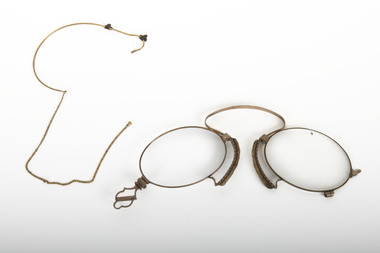
Functional object - Pince-nez Spectacles, c. late 19th century
... Pince-nez were a style of spectacles that held on to a person's nose by a spring mechanism and was popular in the late 19th and early 20th centuries in European cultures. The social history objects held in the Burke Museum's collection help to tell the stories of Beechworth's past by showing the social, cultural, and economic aspects of the town's history. glasses eyewear fashion A01156.2 A pair of brass pince-nez styled spectacles with a loose brass chain earpiece Functional object Pince-nez Spectacles ...Pince-nez were a style of spectacles that held on to a person's nose by a spring mechanism and was popular in the late 19th and early 20th centuries in European cultures.The social history objects held in the Burke Museum's collection help to tell the stories of Beechworth's past by showing the social, cultural, and economic aspects of the town's history.A pair of brass pince-nez styled spectacles with a loose brass chain earpieceA01156.2glasses, eyewear, fashion -
 The Beechworth Burke Museum
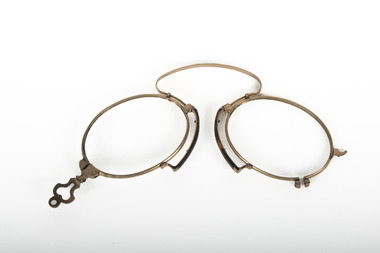
Functional object - Pince-nez Spectacles, c. late 19th century
... Pince-nez were a style of spectacles that held on to a person's nose by a spring mechanism and was popular in the late 19th and early 20th centuries in European cultures. The social history objects held in the Burke Museum's collection help to tell the stories of Beechworth's past by showing the social, cultural, and economic aspects of the town's history. glasses eyewear fashion A pair of brass pince-nez styled spectacles. ...Pince-nez were a style of spectacles that held on to a person's nose by a spring mechanism and was popular in the late 19th and early 20th centuries in European cultures.The social history objects held in the Burke Museum's collection help to tell the stories of Beechworth's past by showing the social, cultural, and economic aspects of the town's history.A pair of brass pince-nez styled spectacles.glasses, eyewear, fashion -
 The Beechworth Burke Museum
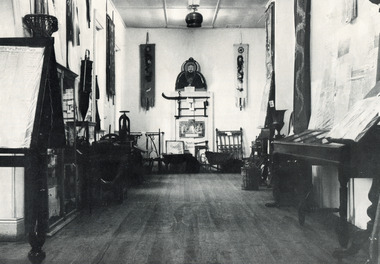
Photograph
... This photograph is contextually, historically and socially significant due to its connection to both the Burke Museum and Chinese culture in and around Beechworth during the mid-1800s through to 1900s. ...This black and white photograph is estimated to have been taken c1900 inside the Burke Museum. Several objects part of the museum collection at the time can be seen, with a high number of Asian influence objects visible; potentially Chinese in origin, as several Chinese villages were located around Beechworth and across Spring Creek, from the mid 1800s. The Burke Museum is part of the Precinct of Beechworth, which was established upon the discovery of gold in 1852. Originally built as the Beechworth Athenaeum in 1857, the museum was later renamed to the Robert O'Hara Burke Memorial Museum, more commonly known as the Burke Museum, in honour of the famous explorer and former Beechworth Superintendent of Police, Robert O'Hara Burke, after his death in 1861 at Coopers Creek during the famed ill-fated Burke and Wills expedition.This photograph is contextually, historically and socially significant due to its connection to both the Burke Museum and Chinese culture in and around Beechworth during the mid-1800s through to 1900s. Around 4700 people of Chinese heritage lived at the Ovens goldfield by April of 1857, representing one-quarter of the entire population at the time. The object holds strong representativeness to the history of the Burke Museum and to the objects in its collection. Its interpretive capacity could be supported and enhanced with other photographs and objects in the collection. Collectively, these records and objects could provide an insight into the museum's collection and its relationship with the origins of the objects.Black and white rectangular photograph printed on paper. Unmounted; taped to paper. beechworth, spring creek, chinese, burke museum, immigration, chinese immigration, ovens goldfield, china, museum, robert o'hara burke, burke and wills expedition, burke and wills, goldfields -
Marysville & District Historical Society
THE TRIANGLE NEWS-VOL 36 NO 8-MARCH 13 2009
... culture series...free concert...sausage sizzle...marysville golf course...need for feed...bushfire benefit...country music festival...brewer's choice...marysville & triangle social...marysville victoria australia the final hurrah buxton firefighters what's on when at the golf course buxton hotel concert deadline disclaimer narby free range eggs mmt inc lake mountain mystic mountains tourism update on community health black saturday bushfires mt cathedral baptist church service disaster relief assistance australian scholarships group -asg members triangle advertisers portable community hub dhs help where it is needed bikes & helmets sunshine coaches school uniforms dylan's buggy shane warne foundation bushfire relief fund marysville bowlers advertisements other help dr margaret miller fire related enquiries the victorian bushfire case management service meeting reports bushfire clean up mayor's chair the victorian bushfire recovery & reconstruction authority christine nixon marysville golf & bowls club cafe culture series free concert sausage sizzle marysville golf course need for feed bushfire benefit country music festival brewer's choice marysville & triangle social bbq councillor comment funeral services church notice mops st thomas church pets service marysville & triangle development group -matdg marysville real estate THE TRIANGLE NEWS-VOL 36 NO 8-MARCH 13 2009 ...marysville, victoria, australia, the final hurrah, buxton firefighters, what's on when at the golf course, buxton hotel concert, deadline, disclaimer, narby free range eggs, mmt inc, lake mountain, mystic mountains tourism, update on community health, black saturday bushfires, mt cathedral baptist church service, disaster relief assistance, australian scholarships group -asg members, triangle advertisers, portable community hub, dhs, help where it is needed, bikes & helmets, sunshine coaches, school uniforms, dylan's buggy, shane warne foundation bushfire relief fund, marysville bowlers, advertisements, other help, dr margaret miller, fire related enquiries, the victorian bushfire case management service, meeting reports, bushfire clean up, mayor's chair, the victorian bushfire recovery & reconstruction authority, christine nixon, marysville golf & bowls club, cafe culture series, free concert, sausage sizzle, marysville golf course, need for feed, bushfire benefit, country music festival, brewer's choice, marysville & triangle social bbq, councillor comment, funeral services, church notice, mops, st thomas church pets service, marysville & triangle development group -matdg, marysville real estate -
 Flagstaff Hill Maritime Museum and Village
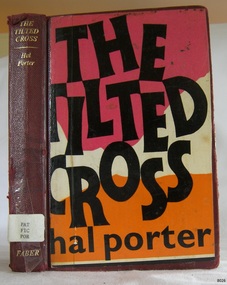
Book - Fiction, Hal Porter, author, The Tilted Cross, 1961
... culture centred on adult education, ultimately fostering an informed and engaged citizenry. Local and State Importance: The Warrnambool Mechanics' Institute publication collection is significant at local and state levels. Its value lies in its relationship to other cultural collections, its historical context, and its enduring role in supporting the intellectual and social development of the community. warrnambool shipwrecked-coast flagstaff-hill flagstaff-hill-maritime-museum maritime-museum shipwreck-coast flagstaff-hill-maritime-village shipwrecked-artefact book pattison collection warrnambool library warrnambool mechanics’ institute ralph eric pattison corangamite regional library service warrnambool city librarian mechanics’ institute library victorian library board warrnambool books and records warrnambool children’s library great ocean road The Tilted Cross Hal Porter Label with typed text": "PAT FIC POR" Sticker: "Corangamite Regional Library Service" Stamp: "Warrnambool Public Library" The Tilted Cross Author: Hal Porter Publisher: Faber and Faber. ...The Pattison Collection: The ‘Pattison Collection’ comprises books and records that were originally owned by the Warrnambool Mechanics’ Institute, which was established in Warrnambool in 1853. By 1886, the Institute had expanded significantly, boasting a Library, Museum, and Fine Arts Gallery. The collection included notable works of art and valuable specimens from various fields, as well as remarkable national curiosities and historic relics relating to the town and district. The Institute later incorporated a School of Design. Despite being popular with the public, the Institute struggled financially and, in 1911, requested that the City Council assume control. In 1935, Ralph Pattison was appointed as City Librarian to establish and organise what was then known as the Warrnambool Library. When the Mechanics’ Institute building was demolished in 1963, a new civic building was constructed on the site, and the Warrnambool Library, managed by the City Council, acquired all the holdings of the WMI. It was during this transition that certain items were separated and designated as the ‘Pattison Collection’, in honour of Ralph Pattison. Over time, the various components of the WMI were distributed among different institutions, including the Art Gallery, Historical Society, and Flagstaff Hill. Some items were also sent to other regional branches of the Corangamite Regional Library, and their exact locations have become difficult to trace. The books at Flagstaff Hill Maritime Village typically bear stamps and markings from Pattison and various other institutions, including the Mechanics’ Institute itself. Ralph Eric Pattison: Ralph Eric Pattison was born in Rockhampton, Queensland, in 1891. In 1920, he married Maude Swan from Warrnambool, and the couple settled in Warrnambool. Pattison accepted the role of City Librarian for the Warrnambool City Council in 1935. Tasked with transforming two rooms in the Mechanics’ Institute into a functional library, he diligently cleaned, sorted, and organised a disordered collection of old books, jars of preserved specimens, and assorted items previously reserved for the city’s museum. Pattison expanded and modernised the library, ensuring it catered to a broad range of interests, including providing reference books for students—a challenging feat in the years following the Depression. He converted the lower level of the building into a library, reference room, and reading room for both members and the public. Books were organised using a cataloguing and card index system that Pattison designed himself. He also prepared the upper floor, establishing both an Art Gallery and, later, a Museum to display the many historical relics collected over the years. Among these treasures was a beautiful antique clock, which Pattison restored and used in his office throughout his tenure. He was known as a meticulous gentleman, recognised for his punctuality, impeccable courtesy, and neat appearance. His restored clock regulated his daily routine and the precise opening and closing of the library’s doors. During 1942 to 1945, Pattison took leave to serve as a Lieutenant in the Royal Australian Navy Volunteer Reserve. A few years later, he converted one of the Museum’s rooms into a Children’s Library, which quickly became popular. In the 1950s, Pattison was appointed to the Victorian Library Board, where he gained further inspiration from monthly conferences in Melbourne. He retired in 1959, after more than 23 years of service, due to having surpassed the working age limit for council officers. Nevertheless, Pattison maintained a strong interest in the ongoing development of the Library until his death in 1969. Warrnambool Public Library: The Warrnambool Mechanics’ Institute (WMI) originated from a voluntary community group in 1863, just six years after the founding of Warrnambool, with its Reading Room opening in 1854. The WMI remained in operation until 1963 and was among the oldest Mechanics’ Institutes in Victoria. Mechanics’ Institutes provided essential public services, including libraries, reading rooms, and spaces for the exhibition and storage of curiosities and local historical relics. In 1886, a Museum and Fine Arts Gallery were added to the WMI, and by the early 20th century, it also featured a billiards room and a School of Art. At this time, it was common for country Victorian Mechanics’ Institutes to have attached museums. Over the years, the Warrnambool Mechanics’ Institute Library was also referred to as the Warrnambool Public Library, the Warrnambool Library, and the Free Library. Early government funding was provided for the “Free Library”. For example, a book titled “Science of Man” was inscribed for the “Warrnambool Public Library” and donated by Joseph Archibald in 1899. Another book, “Catalogue of Plants Under Cultivation in the Melbourne Botanic Gardens 1 & 2, 1883”, was presented to the “Warrnambool Library” and signed by the author W.R. Guilfoyle. In 1903, the Warrnambool Public Library established a Juvenile Department, stocking hundreds of books suitable for young readers. In 1905, the committee updated the book collection by adding 100 new novels and arranging for the latest novels to be included as soon as they became available in Victoria. By July 1911, the Warrnambool Council had assumed management of the Public Library, Art Gallery, Museum, and Mechanics’ Institute, with plans to double the size of the existing building. In 1953, under the stewardship of Mr. R. Pattison, the Warrnambool Public Library’s senior section contained 10,000 fiction books out of a total of 13,000. The children’s section held an additional 3,400 books, equating to one book per head of population and serving around 33 percent of the local reading public. The collection comprised approximately 60 percent reference books and 40 percent fiction, with the library lending out 400 books per day. In 1963, the Warrnambool City Council designated the site of the Mechanics’ Institute building—which included the Public Library, Museum, and Art Gallery—for the new Municipal Offices, resulting in the dispersal of the collections until 1971. The Warrnambool Library subsequently assumed responsibility for the Mechanics’ Institute Library’s holdings on behalf of the City Council. Since the closure of the Mechanics’ Institute, the precise location and composition of the original WMI books and items have become unclear. Additional items have entered the collection over time, including materials from Terang MI, Warrnambool Court House, and Customs House. Many books are now identified as part of the Pattison Collection, named after the librarian who catalogued and numbered them before the Mechanics’ Institute closed. When Warrnambool joined the Corangamite Regional Library, some books and materials were sent to its head office in Colac and later returned to Warrnambool, where they were stored at the Art Gallery for an extended period. Some items subsequently went to the Warrnambool Historical Society, some remained at the Art Gallery, and others were transferred to Flagstaff Hill Maritime Village. The various stamps and labels on the books at Flagstaff Hill reflect the diverse distribution and origins of the collection. The books currently held at Flagstaff Hill Maritime Village date from the 1850s to the late 1950s and include rare and valuable volumes. Many are part of the “Pattison Collection”, named after Warrnambool’s Public Librarian, Mr. R. Pattison.Integration and Significance of the WMI Publication Collection: Many components of the Warrnambool Mechanics' Institute (WMI) publication collection serve to complement and reinforce other important cultural collections in the region, including those held by the Flagstaff Hill Maritime Museum, the Warrnambool Art Gallery, and the Warrnambool Historical Society. Collectively, these collections provide a more comprehensive understanding of the origins and development of the original Warrnambool Mechanics' Institute holdings. The presence and integration of these materials not only enhance the appreciation of the few remaining Mechanics' Institute collections in Victoria, but also contribute to the recognition of similar collections in New South Wales. Examining both the similarities and differences among these surviving collections offers valuable insights into the ways in which the people of Victoria—and the community of Warrnambool in particular—constructed a civic culture centred on adult education, ultimately fostering an informed and engaged citizenry. Local and State Importance: The Warrnambool Mechanics' Institute publication collection is significant at local and state levels. Its value lies in its relationship to other cultural collections, its historical context, and its enduring role in supporting the intellectual and social development of the community.The Tilted Cross Author: Hal Porter Publisher: Faber and Faber. London Date: 1961 Hardcover bound book with gold embossed titles on the spine, and a pasted-on title on the front cover. Inscriptions are on labels on the spine and front loose endpaper, and on a stamp on the fly page. The book is part of the Pattison CollectionLabel with typed text": "PAT FIC POR" Sticker: "Corangamite Regional Library Service" Stamp: "Warrnambool Public Library"warrnambool, shipwrecked-coast, flagstaff-hill, flagstaff-hill-maritime-museum, maritime-museum, shipwreck-coast, flagstaff-hill-maritime-village, shipwrecked-artefact, book, pattison collection, warrnambool library, warrnambool mechanics’ institute, ralph eric pattison, corangamite regional library service, warrnambool city librarian, mechanics’ institute library, victorian library board, warrnambool books and records, warrnambool children’s library, great ocean road, the tilted cross, hal porter -
 Flagstaff Hill Maritime Museum and Village
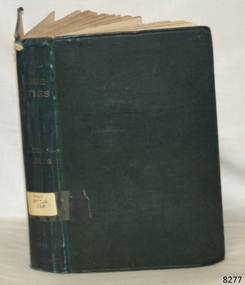
Book - Fictional Novel, Henry James Jr, Tales of Three Cities, 1884
... socially complex works of the late 1880s (such as The Bostonians). In ‘The Impressions of a Cousin’, James uses a diary format to experiment with unreliable narration and deeply buried psychological motives. This experimentation laid the direct groundwork for the intricate, interior psychological style that would later define high literary modernism. Famous for his deep psychological insights and intricate prose style, he explored how innocent Americans interacted with the older, more cynical cultures...socially complex works of the late 1880s (such as The Bostonians). In ‘The Impressions of a Cousin’, James uses a diary format to experiment with unreliable narration and deeply buried psychological motives. This experimentation laid the direct groundwork for the intricate, interior psychological style that would later define high literary modernism. Famous for his deep psychological insights and intricate prose style, he explored how innocent Americans interacted with the older, more cynical cultures ...The novel Tales of Three Cities (1884) is not a single narrative, but rather a collection of three distinct novellas inspired by Henry James’s travels and his deep fascination with regional and transatlantic cultural clashes. The first novella, ‘Lady Barberina’, is a classic exploration of James’s famous ‘international theme’. It focuses on the marriage between a wealthy American doctor and an aristocratic Englishwoman, exposing the rigid social expectations of British high society. The second, ‘A New England Winter’, is a witty, satirical look at the distinct social nuances, manners, and artistic attitudes dividing New York and Boston. The third, ‘The Impressions of a Cousin’, is a story structured around a young woman’s personal journal, detailing a complex web of family relationships, trust, and art.Hard cover book, Tales of Three Cities Author: Henry James Publisher: Macmillan And Co Date: 1884 Blue cloth hardcover and spine with spine lettering in black texter. The spine has a Library label with inscription.fictionThe novel Tales of Three Cities (1884) is not a single narrative, but rather a collection of three distinct novellas inspired by Henry James’s travels and his deep fascination with regional and transatlantic cultural clashes. The first novella, ‘Lady Barberina’, is a classic exploration of James’s famous ‘international theme’. It focuses on the marriage between a wealthy American doctor and an aristocratic Englishwoman, exposing the rigid social expectations of British high society. The second, ‘A New England Winter’, is a witty, satirical look at the distinct social nuances, manners, and artistic attitudes dividing New York and Boston. The third, ‘The Impressions of a Cousin’, is a story structured around a young woman’s personal journal, detailing a complex web of family relationships, trust, and art.flagstaff hill, warrnambool, shipwrecked coast, flagstaff hill maritime museum, maritime museum, shipwreck coast, flagstaff hill maritime village, great ocean road, book, pattison collection, warrnambool library, warrnambool mechanics’ institute, ralph eric pattison, corangamite regional library service, warrnambool city librarian, mechanics’ institute library, victorian library board, warrnambool books and records, warrnambool children’s library, tales of three cities, henry james -
 Flagstaff Hill Maritime Museum and Village
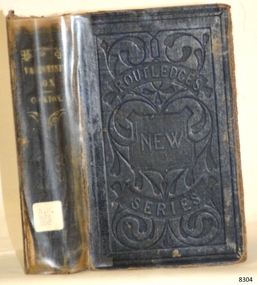
Book - Fictional Novel, Henry Cockton, The Life and Adventures of Valentine Fox, 1854
... social-reform literature. Unfortunately, Cockton’s fame faded significantly by the 20th century; today, it is mostly read by scholars of Victorian popular culture or magic historians interested in the cultural depictions of ventriloquism. ...The Life and Adventures of Valentine Vox, the Ventriloquist was first published in monthly parts between 1839 and 1840, and is a satirical, lighthearted Victorian novel. The story follows a young man named Valentine Vox who discovers he has an extraordinary talent for ventriloquism. Instead of using his gift for simple entertainment, he acts as a chaotic prankster, throwing his voice in public places to stir up trouble, expose hypocrisy, and drive unsuspecting citizens to near-madness. He makes everyday items appear to speak, creates invisible crowds, and wreaks havoc in taverns, political meetings, and crowded streets. Beneath the slapstick comedy, the novel serves a serious social purpose. Valentine’s antics eventually lead him to expose the horrific conditions and corrupt practices of private lunatic asylums in Victorian England, where sane people were sometimes locked away by greedy relatives. The book actually contributed to real-world public outcry and subsequent legal reforms surrounding mental health facilities.Valentine Vox Author: Henry Cockton Publisher: George Routledge & Co Date: 1854 Further Information: The Life and Adventures of Valentine Fox. The Ventriloquist fictionThe Life and Adventures of Valentine Vox, the Ventriloquist was first published in monthly parts between 1839 and 1840, and is a satirical, lighthearted Victorian novel. The story follows a young man named Valentine Vox who discovers he has an extraordinary talent for ventriloquism. Instead of using his gift for simple entertainment, he acts as a chaotic prankster, throwing his voice in public places to stir up trouble, expose hypocrisy, and drive unsuspecting citizens to near-madness. He makes everyday items appear to speak, creates invisible crowds, and wreaks havoc in taverns, political meetings, and crowded streets. Beneath the slapstick comedy, the novel serves a serious social purpose. Valentine’s antics eventually lead him to expose the horrific conditions and corrupt practices of private lunatic asylums in Victorian England, where sane people were sometimes locked away by greedy relatives. The book actually contributed to real-world public outcry and subsequent legal reforms surrounding mental health facilities.flagstaff hill, warrnambool, shipwrecked coast, flagstaff hill maritime museum, maritime museum, shipwreck coast, flagstaff hill maritime village, great ocean road, book, pattison collection, warrnambool library, warrnambool mechanics’ institute, ralph eric pattison, corangamite regional library service, warrnambool city librarian, mechanics’ institute library, victorian library board, warrnambool books and records, warrnambool children’s library, valentine vox, henry cockton -
 Flagstaff Hill Maritime Museum and Village
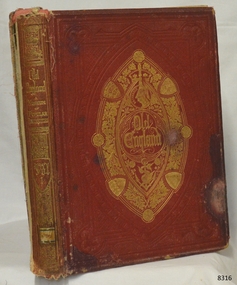
Book - Illustrated compendium of Lithographs/History, Charles Knight, Old England Vol 1, 1864
... There is also extensive coverage of daily life and material culture, including historical costumes, armour, coins, and furniture, along with everyday social customs. ...There is also extensive coverage of daily life and material culture, including historical costumes, armour, coins, and furniture, along with everyday social customs. ...The full title of the work is ‘Old England: A Pictorial Museum of Regal, Ecclesiastical, Baronial, Municipal, and Popular Antiquities’. Edited by Charles Knight, this book serves as a massive, richly illustrated compendium of British social, architectural, and cultural history. It traces the development of England from prehistoric and Roman times, through the Middle Ages, and up to the 18th century.Old England Vol 1 Edited by Charles Knight Publisher: James Sangster & Co Date: 1864 Further Information: Red highly embossed hardcover with spine and lettering in gilt. Title to front cover in a egg shaped lozenge patterned in gilt. The spine has a Library label with an inscription.non-fictionThe full title of the work is ‘Old England: A Pictorial Museum of Regal, Ecclesiastical, Baronial, Municipal, and Popular Antiquities’. Edited by Charles Knight, this book serves as a massive, richly illustrated compendium of British social, architectural, and cultural history. It traces the development of England from prehistoric and Roman times, through the Middle Ages, and up to the 18th century.flagstaff hill, warrnambool, shipwrecked coast, flagstaff hill maritime museum, maritime museum, shipwreck coast, flagstaff hill maritime village, great ocean road, book, pattison collection, warrnambool library, warrnambool mechanics’ institute, ralph eric pattison, corangamite regional library service, warrnambool city librarian, mechanics’ institute library, victorian library board, warrnambool books and records, warrnambool children’s library, old england vol 1, chromolithographs -
 Flagstaff Hill Maritime Museum and Village
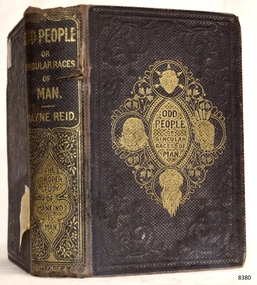
Book - Anthropological Travelogue/Fictional, Captain Mayne Reid, Odd People being A Popular Description of Singular Races of Man, 1860
... The book consists of a series of descriptive chapters focusing on various indigenous and lesser-known tribes and cultures across the globe. Reid details their physical characteristics, social structures, hunting practices, and customs. ...The book consists of a series of descriptive chapters focusing on various indigenous and lesser-known tribes and cultures across the globe. Reid details their physical characteristics, social structures, hunting practices, and customs. ...Odd People: Being a Popular Description of Singular Races of Man (1860) is an interesting piece of 19th-century literature. The book was written by Captain Thomas Mayne Reid (1818–1883), a Scots-Irish American novelist and adventurer. He was immensely popular in the mid-to-late 19th century for his boys' adventure novels, tales of the American West, and travelogues. The true first edition was published in London by Routledge, Warne & Routledge in 1860. In the United States, it was published around the same time (1860/1861) by Ticknor and Fields in Boston, and later editions were retitled The Man-Eaters and Other Odd People. The book is an early work of popular ethnology and anthropology, written for a general audience and heavily marketed toward young readers and armchair travelers of the Victorian era.Book, brown covers, embossed with borders and patterns and gilt decoration and titles. The book includes illustrations. Handwritten inscription on the front paste-down page. The opposite page has a stamped and a handwritten inscription. The book was presented as a prize to a Latin student at the National School, Warrnambool in 1861. Title: Odd People being a Popular Description of Singular Races of Man. Alternate title: Odd People or Singular Races of Man Author: Captain Mayne Reid Publisher: Routledge Warne & Routledge, London Date: 1860 Further information: additional text on the spine reads 'A Proper Study of Mankind is Man'fictionOdd People: Being a Popular Description of Singular Races of Man (1860) is an interesting piece of 19th-century literature. The book was written by Captain Thomas Mayne Reid (1818–1883), a Scots-Irish American novelist and adventurer. He was immensely popular in the mid-to-late 19th century for his boys' adventure novels, tales of the American West, and travelogues. The true first edition was published in London by Routledge, Warne & Routledge in 1860. In the United States, it was published around the same time (1860/1861) by Ticknor and Fields in Boston, and later editions were retitled The Man-Eaters and Other Odd People. The book is an early work of popular ethnology and anthropology, written for a general audience and heavily marketed toward young readers and armchair travelers of the Victorian era.shipwrecked-coast, flagstaff-hill, flagstaff-hill-maritime-museum, warrnambool, maritime-museum, shipwreck-coast, flagstaff-hill-maritime-village, shipwrecked-artefact, book, odd people, captain mayne reid, national school warrnambool., daniel b sellers, classic fiction, the proper study of mankind is man, singular races of man, , routledge warne and routledge, latin student -
 Flagstaff Hill Maritime Museum and Village
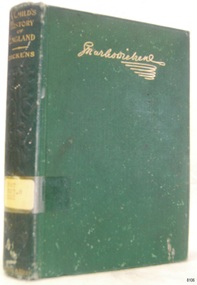
Book - A Fictional Story, Charles Dickens, A Childs History of England, 1900
... social commentary remain influential. This work is significant but mainly as a minor Dickens work rather than one of his major literary achievements. It is historically interesting because it was very popular, widely used in schools well into the 20th century, and shows Dickens applying his storytelling skills to nonfiction history. It is not usually ranked with the great novels, but it matters for Dickens studies, Victorian reading culture ...Charles Dickens (1812–1870) was one of the great English novelists of the Victorian era, famous for vivid characters, social criticism, and stories that were first published in serial form. He began as a journalist, rose to enormous popularity during his lifetime, and wrote major works such as Oliver Twist, David Copperfield, and Great Expectations. “A Child’s History of England” is Dickens’s three volume, child directed history of England, originally serialised in Household Words from 1851 to 1853 and later issued in book form in 1853. It covers English history from ancient times through the fall of James II, with a brief closing summary up to Queen Victoria’s accession to the crown. Dickens wrote it as a readable, lively alternative to dry school history, aiming to interest his own children and young readers. The work is outspoken, often anti monarchical and anti aristocratic in tone, and it uses Dickens’s usual vivid style rather than detached academic prose.A Childs History of England. Author: Charles Dickens. Publisher: Chapman & Hall Ltd, London. Date: 1900. (See note section this document for more information on Edition). Green leather hardcover with title on spine in gold lettering, Charles Dickens signature on front cover written in gold lettering. The spine has a Library label and no Volume information.fictionCharles Dickens (1812–1870) was one of the great English novelists of the Victorian era, famous for vivid characters, social criticism, and stories that were first published in serial form. He began as a journalist, rose to enormous popularity during his lifetime, and wrote major works such as Oliver Twist, David Copperfield, and Great Expectations. “A Child’s History of England” is Dickens’s three volume, child directed history of England, originally serialised in Household Words from 1851 to 1853 and later issued in book form in 1853. It covers English history from ancient times through the fall of James II, with a brief closing summary up to Queen Victoria’s accession to the crown. Dickens wrote it as a readable, lively alternative to dry school history, aiming to interest his own children and young readers. The work is outspoken, often anti monarchical and anti aristocratic in tone, and it uses Dickens’s usual vivid style rather than detached academic prose.book, the old curiosity shop, charles dickens, shipwrecked-coast, flagstaff-hill, flagstaff-hill-maritime-museum, warrnambool, maritime-museum, flagstaff-hill-maritime-village, pattison collection, warrnambool library, warrnambool mechanics’ institute, ralph eric pattison, corangamite regional library service, warrnambool city librarian, mechanics’ institute library, victorian library board, warrnambool books and records, warrnambool children’s library, great ocean road
