
Showing 307 items matching "society studios"
-
 Eltham District Historical Society Inc
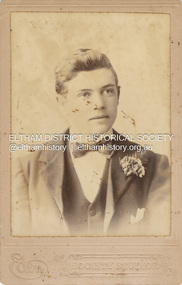
Photograph - Cabinet Photograph, Eden, Society Studios, Possibly Albert Key, c.1896
... ...Eden Society Studios Photographer...Cabinet Photo Eden, Society Studios Photographer If indeeed Colin Key, photo would have been taken c.1925. ...Eden, Society Studios...Cabinet Photo Eden, Society Studios Photographer If indeeed Colin Key, photo would have been taken c.1925. ...Photo is identified on rear as ? Colin Key. Colin Hutchinson Key (1907-1939) was the son of Albert Key (1872-1921) and Isabella Roberts (1875-1940) and the grandson of Frederick Key (1842-1908) and Jane Key (nee Dalrymple 1845-1931) Suspect the photo is misidentified and is actually Albert Key, Colin Key's father. Cabinet Photo Eden, Society Studios Photographer If indeeed Colin Key, photo would have been taken c.1925. The fashion is more indicative of late 1890s - c.1896 [Cataloguing Note: Identification of individual does not fit the time period for the photographer by about 15 to 20 years - possibly misidentified. Eden Studios was big in Sydney from 1895 through 1927+ but only appears to have operated in Melbourne at 284 Collins Street from 1896-1900 and 149 Swanston Street 1904-1906. These individuals were Melbourne based so unlikely to be the Sydney studios. Further, does not look like the same person when compared to other photographs on Ancestry family trees]On back in pencil ? Colin Keycolin key, eden society studios photographer, colin hutchinson key, albert key, pam thoonen (nee ingram) collection -
 Eltham District Historical Society Inc
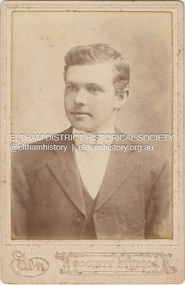
Photograph - Cabinet Photograph, Eden, Society Studios, Possibly Albert Key
... Eden Society Studios Photographer...Cabinet Photo Eden, Society Studios Photographer If indeeed Robbie Key, photo would have been taken c.1925. ...Eden, Society Studios...Cabinet Photo Eden, Society Studios Photographer If indeeed Robbie Key, photo would have been taken c.1925. ...Photo is identified on rear as ? Robbie Key. Robert Dalrymple Key (1905-1972) was the son of Albert Key (1872-1921) and Isabella Roberts (1875-1940) and the grandson of Frederick Key (1842-1908) and Jane Key (nee Dalrymple 1845-1931) Suspect the photo is misidentified and is actually Albert Key, Robbie Key's father. Cabinet Photo Eden, Society Studios Photographer If indeeed Robbie Key, photo would have been taken c.1925. The fashion is more indicative of late 1890s - c.1898 [Cataloguing Note: Identification of individual does not fit the time period for the photographer by about 15 to 20 years - possibly misidentified. Eden Studios was big in Sydney from 1895 through 1927+ but only appears to have operated in Melbourne at 284 Collins Street from 1896-1900 and 149 Swanston Street 1904-1906. These individuals were Melbourne based so unlikely to be the Sydney studios. Further, does not look like the same person when compared to other photographs on Ancestry family trees]On back in pencil ? Robbie Keyeden society studios photographer, robbie key, robert dalrymple key, albert key, pam thoonen (nee ingram) collection -
 Federation University Historical Collection
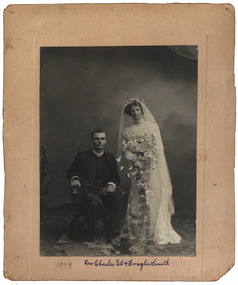
Photograph - Photograph - Black and White, Yeoman Co, Reverend Charles Ed and Evelyn Smith and Smith Family, 1909
... studio...harold smith...rupert smith...society...Studio...Society Studios...Allan Studio Society Studios Stella Studios F.W. Niven ....1 Black and white wedding photograph on a cream colored background .2 Ethel Smith, as a child, sepia photograph on black background .3. Elizabeth Garvey, nee Smith, sepia photograph on cream background .4 Harold Smith and Rupurt Smith sepia photograph on brown background .5 Alice and Florrie Hendri, sepia postcard .6 Memorial fold out card. Cream card with black borders..1 .2 Ethel Smith, father a minister .3. Elizabeth Garvey, nee Smith .4 Harold and Rupert Smith Corowa, 1894, Alice Watson, 7 Cromie Street Murtoa .5 Hendri girls, Alice and Florrie, writing on back, note to Edie from Alice Watson, 1911 .6 Memorial fold out card, in loving memory of Emma Watson, of Happy Valley,1888reverend charles ed, evelyn smith, ethel smith, corowa, mark allen studio, m.j. allen studio, harold smith, rupert smith, society studios, tesla studio, stella studio, alice watson, florrie hendri, emma keys smith, emma smith, george henry smith -
 Bendigo Historical Society Inc.
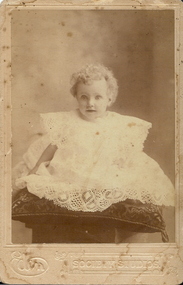
Photograph - BABY PORTRAIT
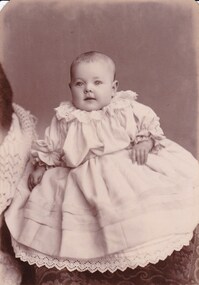
... Pintucking around hem and deep lace flounce, seated on brocaded cushion, placed on pedestal. 'Eden Society Studioes' embossed on bottom edge....Eden Society Studios...PERSON Individual baby portrait Eden Society Studios sepia photograph on cream board. ...sepia photograph on cream board. Young child in light coloured frock. Large collar with lace edge. Pintucking around hem and deep lace flounce, seated on brocaded cushion, placed on pedestal. 'Eden Society Studioes' embossed on bottom edge.Eden Society Studiosperson, individual, baby portrait -
![Photograph, Eden Society Studios, Miss Jennings [probably Martha Emily Jennings]](/media/collectors/5d8bf68021ea67123cb0cc12/items/67242e5e6f77576977669f5a/item-media/67242f686f7757697766ae56/item-fit-380x285.jpg?cb=6) Linton and District Historical Society Inc
Linton and District Historical Society IncPhotograph, Eden Society Studios, Miss Jennings [probably Martha Emily Jennings]
... The photograph was taken by "Eden Society Studios", a Sydney photographic studio which operated between 1895 and 1900....Eden Society Studios...Miss Jennings [probably Martha Emily Jennings] Photograph Eden Society Studios ...This photograph has been variously identified as "Miss Jennings", "Emily Jennings", and "Ilma Jennings", and also as "Reg Jennings' sister" and "Reg Jennings' aunt". It is most likely of Martha Emily Jennings, born 1876 (known as Emily), the oldest daughter of Jonathan and Martha Jennings (née Bersey). Martha Emily Jennings had a brother Reginald (born1899) and also had a nephew Reginald (the son of her brother William Jonathan Jennings). It is unlikely to be a photograph of Ilma Jennings (a daughter of William Jonathan Jennings and niece of Martha Emily Jennings) who was not born until 1909. The photograph was taken by "Eden Society Studios", a Sydney photographic studio which operated between 1895 and 1900.Sepia photograph of a young lady wearing a gown with pintucking on bodice and sleeves, and with a lace collar. She is standing with arms resting on the back of a chair.martha emily jennings -
 Bendigo Historical Society Inc.
Photograph - UNKNOWN FAMILY COLLECTION: PHOTOGRAPH
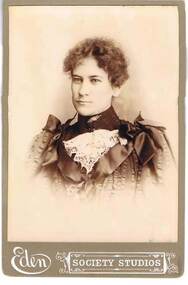
... Eden Society Studios...Daughter of Wootton Lansell. Eden Society Studios Photograph - black and white. Portrait of a woman. ...Photograph - black and white. Portrait of a woman. She has tight curls. Wearing a high collar, lacy neck tie, satin ribbon on shoulders and around neck. Wearing sleeper earring. Written on back 'Phoebe Jane Lansell, youngest child of Wootton Lansell, (brother of George and William).'Eden Society Studiosperson, individual, female portrait, photograph. portrait of phoebe jane lansell. daughter of wootton lansell. -
 Uniting Church Archives - Synod of Victoria
Photograph, Late 19th, early 20th century - undated
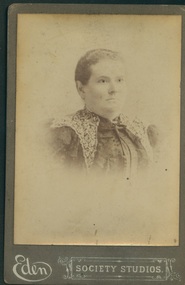
... Breseford, Eden Society Studios...Breseford, Eden Society Studios "Mrs Breseford" scrawled on back, although the spelling of the name is not clear. ...Head and shoulders, sepia, woman of middle age, short hair cropped close to head, wearing dress with shoulder overlay lace. Photo stuck on brown backing card with photographic studio's name."Mrs Breseford" scrawled on back, although the spelling of the name is not clear.breseford, eden society studios -
 Malmsbury Historical Society
Photograph (Item), B/W Adult Female Head Shoulders, Malmsbury ca 1905
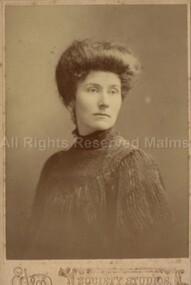
... Associated with - Eden Society Studios...Associated with - Eden Society Studios B/W Adult Female Head Shoulders, Malmsbury ca 1905 Photograph Photograph ...Associated with - Eden Society Studios -
 Malmsbury Historical Society
Photograph (Item), B/W Adult Female Head Shoulders, Malmsbury
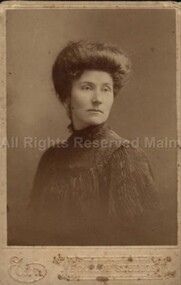
... Associated with - Eden Society Studios...Associated with - Eden Society Studios B/W Adult Female Head Shoulders, Malmsbury Photograph Photograph ...Associated with - Eden Society Studios -
 Bendigo Historical Society Inc.
Photograph - GRAYDON COLLECTION: FAMILY PHOTOGRAPHS
... Mendelfson, Bartlett Bros., The Studio - Chuck, Eden Society Studios, Alan Spicer, R. Bloomfield Rees,...Mendelfson, Bartlett Bros., The Studio - Chuck, Eden Society Studios, Alan Spicer, R. Bloomfield Rees, Photograph GRAYDON COLLECTION: FAMILY PHOTOGRAPHS ...Charles Wallace Gordon Graydon the First came out to Victoria on the S.S. Almora, the same ship on which Eliza Richardson and her family arrived on New Years Day 1875. Evidently C.W.G.G.1st. must have retained fond memories of a young fourteen-year-old girl named Elizabeth Richardson who travelled from Scotland with her mother and family (her father had arrived earlier) because three years later at Kyneton they were married. It was December 26th 1860, and Elizabeth was just seventeen. As the bridegroom’s age is written as 24 years on the wedding certificate, he certainly must have been more than eighteen when he sailed on the "Almora" in 1856. The newly married couple went to live at Taradale, Victoria, and they made a good life for themselves in that town which had then a thriving gold mine. They lived in a large two-storied house in Survey Paddock, and it was there that four daughters - Susan Emily (1861-1906), Elizabeth Constance (1863-1945), Amelia Amy (1865 -1952, Ada Mary Maude (1867-1901), and one son Newenham Edward Eustace (1869-1945) named after his Irish Grandfather, were born. On his wedding certificate C.W.G. Graydon, is described as a foreman. His father-in-law, Robert Richardson was employed as a time-keeper on the Melbourne to Bendigo Railway works, and he and his family lived first in Prahran, then Kyneton, and then Taradale. Perhaps Charles Graydon worked on the railway with him. In Taradale however, he worked for a gold mining company in a surveying capacity. C.W.G.G.1st was to become Shire President of the Shire of Metcalfe. That particular year the Graydon Family entertained the visiting English cricket Eleven at their home in Taradale. He was certainly regarded as an important man in the district when he was requested by a great number of the residents to nominate for the Legislative Assembly election. About 1876 the Graydons left Taradale, and went to live at Sandhurst, now Bendigo, at Barkly Place East. The Richardsons had also left Taradale to go into the grocery business in the same town. Charles Wallace Gordon Graydon the First became a legal manager of mines, and a well-known and popular resident. Sad to say he became ill with a lung infection, and on June 4th. 1885 he died, and was buried at Sandhurst, now Bendigo Cemetery, Back Creek Rd. Eliza Richardson's brother was Mr. James Richardson, the well-known grocer, of Pall Mall and Golden-square, who died at his residence, "Balgownie," Short street, on Thursday 22 Jan 1914. James Richardson was a native of Scotland. He was born at Glasgow in1849 and was only eight years of age when his parents sailed for Australia in the ship Balmoral. The family arrived in Melbourne in 1857 and went to Taradale, where Mr. Richardson, senr., acted as inspector of works during the construction of the Taradale Viaduct. James Richardson, who had commenced his educationin Glasgow, attended school at Taradale until the family removed to Bendigo at the time the railway was being built from Bendigo to Echuca. The contractors for this work engaged Mr Richardson, senr., as their timekeeper. When he left school James Richardson applied himself to learn the grocery business, and he gained a thorough knowledge of it with different employers at Bendigo, Taradale, and Daylesford. In 1872 he opened a grocery store on his own account in High-Street, Bendigo, but within a few months he had the great misfortune to be burnt out. The fire originated in an adjoining building early one morning and both places were burnt to the ground. In spite of his loss, Mr. Richardson was not discouraged, for he soon made another start. His trade improved and he extended his business, opening the Eclipse Cash Store at Golden Square. A little later another branch was opened at the Oddfellows' Hall, and subsequently this business was transferred to the Eureka Cash Store, in Pall Mall, which was the head depot. In addition to the retail trade, Mr. Richardson had, for many years carried on an extensive wholesale business with the Northern District, and had made a specialty of fodder seeds. James was a man of probity and sincerity in business, and as a citizen he was highly esteemed and respected. He was a prominent member of the Bendigo Caledonian Society in the earlier days of his citizenship. He was a staunch member of St Andrew's Presbyterian Church, and was a member of the board of management. In the Easter Fair procession, Mr Richardson's display was always a prominent and attractive one. Mr. Richardson was a member of the Masonic Order, and was a life member of the Bendigo Art Gallery and the old Mechanics Institute. He was married at Daylesford in 1871. Mr James Richardson was interred in the Presbyterian section of the Bendigo Cemetery.A selection of black and white Graydon and Richardson family photographs taken by Bendigo photographers. All photos unnamed. Mounted as Cabinet cards. Photographers - D. Mendelfson, Bartlett Bros., The Studio - Chuck, Eden Society Studios, Alan Spicer, R. Bloomfield Rees,graydon, richardson, cabinet card -
 Bendigo Historical Society Inc.
Book - SCHOOL EXERCISE BOOK: AGNES (AGGIE) MILES
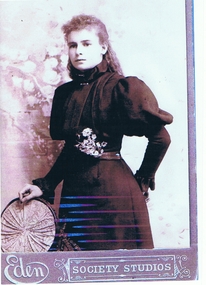
... , Norma Marie, Ron Pickles a--Large photo of a young lady wearing Victorian clothing taken by Eden Society Studios - on the back is written Agnes Miles Age 13 c-Large group photo - on the back is written Agnes Miles .Old lady, Lindsay Gronow , grandson in front of her d Large photo - on the back is written Agnes Miles Wedding Stewart Roy Gronow..., Norma Marie, Ron Pickles a--Large photo of a young lady wearing Victorian clothing taken by Eden Society Studios - on the back is written Agnes Miles Age 13 c-Large group photo - on the back is written Agnes Miles .Old lady, Lindsay Gronow , grandson in front of her d Large photo - on the back is written Agnes Miles Wedding Stewart Roy Gronow Book SCHOOL EXERCISE BOOK: AGNES (AGGIE) MILES ...School exercise book- Agnes (Aggie) Miles, dated 23/9/1892 - address is given on inside cover as High St, Kew (but refer to #4302 which indicates that she was at Kamarooka Central State School later in 1894). Contents - handwritten in ink, includes English grammar, arithmetic and history. F- Family Group sheet for Agnes and Mark Miles providing Ancestry details b -large colour photo featuring three smartly dressed ladies Circa 1960's .A blue Holden ? Car is to the left with a Cemetery behind. On the back is written -Daughter Clarice ?, Norma Marie, Ron Pickles a--Large photo of a young lady wearing Victorian clothing taken by Eden Society Studios - on the back is written Agnes Miles Age 13 c-Large group photo - on the back is written Agnes Miles .Old lady, Lindsay Gronow , grandson in front of her d Large photo - on the back is written Agnes Miles Wedding Stewart Roy Gronowperson, individual, agnes miles -
 Flagstaff Hill Maritime Museum and Village
Ceramic - Chamber Pot, 1912
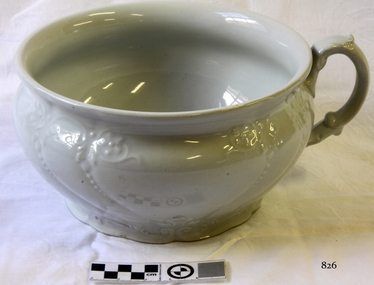
... Studio’ (1953 on) and ‘Royal Staffordshire’ (post 1968) were important J. & G. Meakin Ltd trade names. Meakin marks are numerous, but all include the J. & G. Meakin name. The significance of this item and pottery generally is that often earthenware is portrayed as being a landmark in the evolution of humanity. This is because these items are the few things from the past that have survived in a tangible form. Pottery is an important functional part of society ...In the 19th and early 20th centuries, J. & G. Meakin were important, large-scale producers of good quality, ironstone tableware (‘White Granite’ ware) that met a ready market in the United States, South America, Australia, and other traditional British markets. By the 1890s the company was one of the world’s largest earthenware manufacturers. Although export teaware and tableware was the factory’s staple commodity, Meakin also manufactured toilet ware, kitchen ware and a wide range of fancy earthenware. The company was amongst the first British pottery firms to experiment with modernist designs associated with the art deco period. The Moderne' range was introduced in 1929 consisting of an angular shape decorated design with geometric patterns and often highlighted with silver or gold. This range remained in production through the 1930s. Post 1945 the company introduced the streamlined Studio shape (1953) and Horizon shape (1955) both heavily influenced by the Russell Wright ‘American Modern’ tableware. In 1964 a new Studio shape was released with tall streamlined coffee pots used as the background for many contemporary patterns now associated with the 1950s and 1960s. Designs by Jessie Tate and Eve Midwinter, some originally found on Midwinter shapes, also appear on 1970s Studio ware. The Studio range was one of Meakin’s most successful and continued in production until the late-1970s. The enormous range of floral, geometric, and abstract designs make Studio Ware collectible in its own right. In the 1970s and 1980s as part of the Wedgwood Group Meakin produced contemporary products under the ‘Bull in a China Shop’ and ‘Creative Tableware’ names. ‘Sol’ (c.1912-1963), ‘Studio’ (1953 on) and ‘Royal Staffordshire’ (post 1968) were important J. & G. Meakin Ltd trade names. Meakin marks are numerous, but all include the J. & G. Meakin name. The significance of this item and pottery generally is that often earthenware is portrayed as being a landmark in the evolution of humanity. This is because these items are the few things from the past that have survived in a tangible form. Pottery is an important functional part of society and it has a critical role to play as it helps archaeologists to date other artefacts of the same time period. Also, the decorations on pottery have told much about the beliefs, lifestyles and lives of the people who bought them and used them. In other words it gives us today a snapshot of society from the past and how people used these items in their daily lives, their likes as well as societal and design trends. Earthenware white glazed ironstoneJ & G Meakin Hanley England stamped to base, with white flora designwarrnambool, flagstaff-hill, flagstaff-hill-maritime-museum, shipwreck-coast, flagstaff-hill-maritime-village, pottery, earthenware, iron stone, alfred meakin, james meakin, george meakin, earthenware manufactures, chamber pot -
 Federation University Historical Collection
Book - Programme, South Street Eisteddfod Official Guide, 1907, 1907
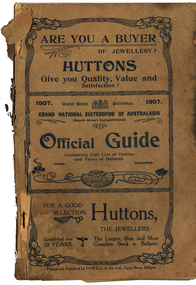
... Correll Music Seller, James Smith, Isaac Pitman, Arthur Brumfield, Hugh Leschen, John Robson, St Augustine's Band Geelong, Moorabool Falls, Kirks Dam, Ballarat Choral Society, Alfred Deakin, James Long, Hugh McKay Advertisements include: Huttons the Jewellers, Sam Jamieson, Sun Foundry, City Saw Mills, Blomeley Bros Iron and Brass Founders, G. Bongiorno- Railway Fruit Palace, Henry Brind & Co., Andrew Cant, Harrison's Foundry, Umbrella and Sunshade Emporium, Ballarat City Baths, Ballarat Coffee Palace, Irwin's Provincial Hotel, Victa Studio; D. ...Correll Music Seller, James Smith, Isaac Pitman, Arthur Brumfield, Hugh Leschen, John Robson, St Augustine's Band Geelong, Moorabool Falls, Kirks Dam, Ballarat Choral Society, Alfred Deakin, James Long, Hugh McKay Advertisements include: Huttons the Jewellers, Sam Jamieson, Sun Foundry, City Saw Mills, Blomeley Bros Iron and Brass Founders, G. Bongiorno- Railway Fruit Palace, Henry Brind & Co., Andrew Cant, Harrison's Foundry, Umbrella and Sunshade Emporium, Ballarat City Baths, Ballarat Coffee Palace, Irwin's Provincial Hotel, Victa Studio; D. ...South Street competitions have been held in Ballarat since 1991.Official guide to the 1907 South Street competitions. Images include: Prince of Wales, Lord Northcote, W.D. Thomas, South Street Competition Executive Committee (W.H. Pearson, W.H. Chandler, A. Prichard, W.H. Richards, W.D. Hill, Col. Williams, W.D. Thomas, F. Besemeres, F.J. Martell, J.T. Morris. F.J. Williams, R. Maddern, R.J. Gribble), Sir John Madden, Lord Tennyson, W.D. Hill, Frederick Bevan, Ballarat (Sturt Street), Lake Wendouree (Yachts), J.W. Beswick, Lawrence Campbell, City of Ballarat Mayor and Councillor (Mayor Brawn, E. Williams, E. Morey. Cr Brokenshire, J. Whykes, J.M. Barker, G. Crocker, W.D. Hill, R. Pearse, T. Hollway), Ballarat East Mayor and Councillors (J. Gent, Cr Glendenning, J.N. Dunn, I. Pearce, C. Bunting, A. Levy, J. Ritchie, J. McNeil, A. McKenzie, Cr Penhalluriak), Sturt Street Looking West, Old Curiosity House, Entrance to the Ballarat Fine Art Gallery, Interior of the Ballarat Fine Art Gallery, Ballarat East Town Hall and Gardens, Lake Wendouree Ferry, W.E. Swenson, S.B. Swenson, J.G.M. Swenson, Rev. T. Flynn, Edwards' Pyrites, Lestor's Hotel, Sunshine Sheild, W to W Shield, Frank Herman, W.F. Coultman, Marks' Trophy, Lighthouse Port Fairy, R. Correll Music Seller, James Smith, Isaac Pitman, Arthur Brumfield, Hugh Leschen, John Robson, St Augustine's Band Geelong, Moorabool Falls, Kirks Dam, Ballarat Choral Society, Alfred Deakin, James Long, Hugh McKay Advertisements include: Huttons the Jewellers, Sam Jamieson, Sun Foundry, City Saw Mills, Blomeley Bros Iron and Brass Founders, G. Bongiorno- Railway Fruit Palace, Henry Brind & Co., Andrew Cant, Harrison's Foundry, Umbrella and Sunshade Emporium, Ballarat City Baths, Ballarat Coffee Palace, Irwin's Provincial Hotel, Victa Studio; D. Lem Chinese Medical Practitioner, Bosisto's Eucalyptus Oil, Ronaldson Bros & Tippett, Unicorn HOtel, Mrs F. Allen Caterer, Coles & Pullum, J.C. Dillon & Co., Surrey Tannery, Coulthard's Ballarat Business College, George Farmer, MrBride's Boots, L.J. Austin, Dyason's, Ballarat Brewing Company, Phoenix Brewery, Royal Standard Brewery, Edwards' Pyrites, Lestor's Hotel, Robson's College of Music, James A. Gear, Williams Shoemen, Tekardo Brothers, Powell & Co.south street competitions, eisteddfod, chinese herbalist, south street, r.b. lemmon, g. bongiorno, w.d. thomas, john madden, lord tennyson, w.d. hill, frederick bevan, j.w. beswick, lawrence campbell, boer war memorial, queen victoria statue, curiosity shop, m.b. john foundry, ballarat east town hall and gardens, sunshine shield, hugh victor mckay, w to w shield, w.j. coltman, frank herman, j. hutton-jones, t. downer, j. marks, hutton and co trophy, marks trophy, hugh leschen, john robson, st augustine's band, geelong, downer trophy, trekardo brothers, moorabool falls, kirks dam, ballarat choral society, alfred deakin, challenge cup, james long, grand national eisteddfod of australasia, ballarat east gardens, ballarat east town hall -
 Flagstaff Hill Maritime Museum and Village
Ceramic - Chamber Pot, J & G Meakin, Early to mid 20th century
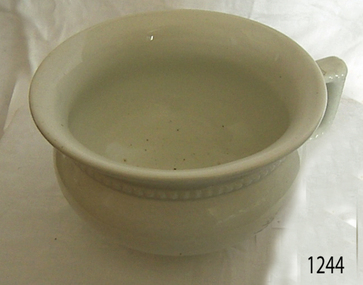
... Studio' (1953 on) and 'Royal Staffordshire' (post-1968) were important J. & G. Meakin Ltd trade names. Meakin marks are numerous, but all include the J. & G. Meakin name. The significance of this item and pottery generally is that often earthenware is portrayed as being a landmark in the evolution of humanity. This is because these items are the few things from the past that have survived in a tangible form. Pottery is an important functional part of society ...In the 19th and early 20th centuries, J. & G. Meakin were important, large-scale producers of good quality, ironstone tableware (‘White Granite’ ware) that met a ready market in the United States, South America, Australia, and other traditional British markets. By the 1890s the company was one of the world’s largest earthenware manufacturers. Although export teaware and tableware was the factory’s staple commodity, Meakin also manufactured toilet ware, kitchenware and a wide range of fancy earthenware. The company was amongst the first British pottery firms to experiment with modernist designs associated with the art deco period. The Moderne' range was introduced in 1929 consisting of an angular shape decorated design with geometric patterns and often highlighted with silver or gold. This range remained in production through the 1930s. Post 1945 the company introduced the streamlined Studio shape (1953) and Horizon shape (1955) both heavily influenced by the Russell Wright ‘American Modern’ tableware. In 1964 a new Studio shape was released with tall streamlined coffee pots used as the background for many contemporary patterns now associated with the 1950s and 1960s. Designs by Jessie Tate and Eve Midwinter, some originally found on Midwinter shapes, also appear on 1970s Studio ware. The Studio range was one of Meakin’s most successful and continued in production until the late-1970s. The enormous range of floral, geometric, and abstract designs make Studio Ware collectible in its own right. In the 1970s and 1980s as part of the Wedgwood Group Meakin produced contemporary products under the 'Bull in a China Shop' and 'Creative Tableware' names. 'Sol' (c.1912-1963), 'Studio' (1953 on) and 'Royal Staffordshire' (post-1968) were important J. & G. Meakin Ltd trade names. Meakin marks are numerous, but all include the J. & G. Meakin name. The significance of this item and pottery generally is that often earthenware is portrayed as being a landmark in the evolution of humanity. This is because these items are the few things from the past that have survived in a tangible form. Pottery is an important functional part of society and it has a critical role to play as it helps archaeologists to date other artefacts of the same time period. Also, the decorations on pottery have told much about the beliefs, lifestyles and lives of the people who bought them and used them. In other words it gives us today a snapshot of society from the past and how people used these items in their daily lives, their likes as well as societal and design trends. Chamber pot ceramic white with handle at side and decoration around top. Unclearwarrnambool, shipwrecked-coast, flagstaff-hill, flagstaff-hill-maritime-museum, shipwreck-coast, flagstaff-hill-maritime-village, champer pot, personal hygiene, personal item, ceramic pot, domestic object -
 Federation University Historical Collection
Booklet - Magazines, Ballarat School of Mines Magazine, 1924-1930, 1924-1930
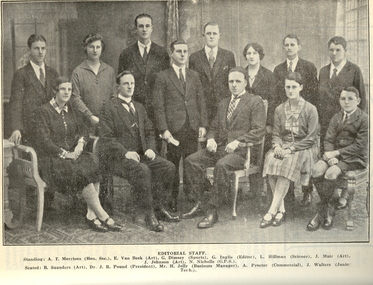
... Taylor, Thornton Studios, Fred Irwin, Isaac Abraham, Ballarat Radio Listening-In, Baxter and Stubbs 1927 * Chemists Trip to Melbourne (Mount Lyell Chemical Works, Footscray, Yarraville * Literary Society * Mr J.N. ...Taylor, Thornton Studios, Fred Irwin, Isaac Abraham, Ballarat Radio Listening-In, Baxter and Stubbs 1927 * Chemists Trip to Melbourne (Mount Lyell Chemical Works, Footscray, Yarraville * Literary Society * Mr J.N. ...The Ballarat School of Mines is a predecessor institution of Federation University Australia. Bound copies of the Ballarat School or Mines Students' Magazine. 1924 * Dr J.R. Pound * Noel Hay Obituary * The History of Chemistry * Literary Society * Herald B. Herbert * Chemistry in Modern Life by Val G. Anderson * Chemistry in Literature by J.R. Pound * School Literary Society * Ladies in Pharmacy * Musings on Modern Literature - Mainly Drama (W.G. C.) * Trip to Newcastle * Appreciation of the Masterpieces of Art * The Antique Room * Dressmaking * Pottery * Sloyd * The Mystery of the Atom *Inorganic Evolution by R.S. Russell * Photography * First Aid Club 1926 * The Trip to Morwell * Chemical Excursions (Yallourn) * Eastern Life and Customs by Rex Warrillow * Organic Evolution by Edwin A. Brophy * Chemistry in the Kitchen * Obituary for Professor Alfred Mica Smith * The Historical Development of Patterns i Silk Fabrics * Pottery * Literary Society * Early Evidence of Metallurgy in Britain * Brief Description of the Magnet Silver Mine, Tasmania * The manufacture of Leather Photographs * SMB Athletics Team, winners of the Herald Shield (M. Timmings, L. Evans, F. Sheahan, R. Collins, A. Murfett, W. Hughes, L. Hillman * SMB Football Team * Ballarat Technical Art School Tennis Four * SMB Girls' Basketball Team * SMB GIrls Hockey Team * Ballarat Junior Technical School Scholarship and Studentship Winners * On Punctuation Advertisements: Sunshine Biscuits, Harris Powell and Sandford, W. Gribble & Co., Gilbert Motors, T.J. Haymes The Wallpaper King, C. Marks and Co., Wilson's Tailors and Mercers, George S. Grant, Miss A. Corin Art Worker, Tunbridges, Felton, Grimwade & Co., Hasten and Ewins, Ballarat Wireless Stores, Fred A. Reed, Suttons, E. Hall-Jones, Stansfield and Smith, Ballarat Gas Company, Richards and Co Studio, F.H. Drew, Adam Scott, R.A. Hudson, Huttons, J.A. Holland, A.E. White, F. Barrow Monumental Sculptor, R. Young, H.A. Evans, Alexandria Tea Rooms, W. Cornell Chemist, Black Cat Tea Rooms, J.A. Reynolds, A.M. Palmer, Morris Cars and Trucks, Mrs Stones, Millers The Clothiers, T.G. Skewes, Wattle TEa Rooms, H.B. Selby, Middleton and Morris, C.P.A. Taylor, Thornton Studios, Fred Irwin, Isaac Abraham, Ballarat Radio Listening-In, Baxter and Stubbs 1927 * Chemists Trip to Melbourne (Mount Lyell Chemical Works, Footscray, Yarraville * Literary Society * Mr J.N. Rowell 1928 * Prohibition in U.S.A. by Ed A. Brophy * Dr. J.W. Mellor and His Work at Stoke, England by Reginald C. Callister * The Science of Chemistry by C.A. Schache * Trip to Yallourn (Brown Coal Deposits, Steam Plant at Yallourn, Switchgear and Transformers, Briquette Factory * Walhalla Past and Present by G.E.B. * The Hand Loom * Precious Stones 1929 * The Old Brewery * The History of Chemistry by J.R. Pound * Occurrence of Mineral Oil in Gippsland * Experiences with Malayan Chinese by R. Warrillow * Organise Colors (Dyestuff Pigments) in Rubber Goods 1930 * News from Chine by Henry Kum Yuen * L'Art Moderne * The Story of Clay by T.H. Trengrove * A Glimpse of England * The Beginnings of Arithmeticballarat school of mines, pottery, ceramics, reginald callister, metallurgy, chemistry, j. pound, alfred mica smith, herald shield, harold herbert, lindsay hillman, john rowell, j.r. pound, noel hay, drawing from antique, yallourn excusion, walhalla, sunshine biscuits, harris powell and sandford, w. gribble & co., gilbert motors, t.j. haymes, the wallpaper king, c. marks and co., wilson's tailors and mercers, george s. grant, miss a. corin art worker, tunbridges, felton, grimwade & co., hasten and ewins, ballarat wireless stores, fred a. reed, suttons, e. hall-jones, stansfield and smith, ballarat gas company, richards and co studio, r.a. hudson, huttons, j.a. holland, a.e. white, f. barrow monumental sculptor, r. young, h.a. evans, alexandria tea rooms, w. cornell chemist, black cat tea rooms, j.a. reynolds, a.m. palmer, morris cars and trucks, mrs stones, millers the clothiers, t.g. skewes, wattle tea rooms, h.b. selby, middleton and morris, c.p.a. taylor, thornton studios, fred irwin, isaac abraham, ballarat radio listening-in, baxter and stubbs, mount lyell chemical works, footscray, c.a. schache, yallourn briquette factory, t.h. trengrove, history of chemistry, excursions, morwell, morwell excursion, women in pharmacy, mt lyall, excursion, slloyd, drawing from the antique, james pound, yallourn, yallourn excursion, ballarat arch of victory, mt macedon, f.h. drew, adam scott, university women -
 Marysville & District Historical Society
Photograph (Item) - Black and white portrait, John William Lindt, 1870s
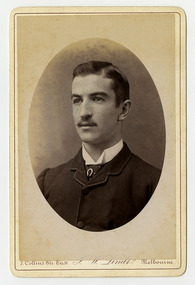
... studios at number 7 at the top of Collins Street opposite the Treasury, in 1877. John Lindt's business of this period was wide-ranging, and included portraits, records of Melbourne public buildings and streetscapes, the Botanical Gardens, and Port Melbourne. He was a welcome photographer of members of parliament and other Melbourne personalities, their society ...A black and white portrait of an unknown man taken by John William Lindt.A black and white portrait of an unknown man taken by John William Lindt. John William Lindt was born in Germany in 1845. At 17 he took a working passage to Australia on a Dutch sailing ship. Taking up work as an itinerant piano-tuner, he traveled amongst towns in Victoria and New South Wales before settling in Grafton in 1863 where he became assistant and apprentice to photographer Conrad Wagner. After a brief return to Germany in 1867 Lindt took over management of Wagner’s studio in 1869. He married Wagner’s daughter, Anna on 13 January 1872. Over 1873-1874, using the slow and laborious wet-plate collodion process, John Lindt produced photographs of the local indigenous people both in their environment conducting actual traditional ceremonies in the Clarence River district, and in his studio. Twelve of this series is included in his 1874 album Australian Aboriginals. John Lindt moved to Melbourne in 1876 where he worked for Batchelder & Co. before opening his own opulent studios at number 7 at the top of Collins Street opposite the Treasury, in 1877. John Lindt's business of this period was wide-ranging, and included portraits, records of Melbourne public buildings and streetscapes, the Botanical Gardens, and Port Melbourne. He was a welcome photographer of members of parliament and other Melbourne personalities, their society and cultural life including the theatre, and was known as a ‘rich man’s photographer’ for those whose families he grouped informally on the lawns in front of their mansions, with servants at the rails of the upstairs balconies. He continued with landscape, producing folios Fernshaw and Watt River Scenery, Victoria ( c.1878-82), Scenery on the Ovens and Buckland Rivers, Victoria (c.1878–82) and Lorne, Louttit Bay and Cape Otway Ranges (1883). Sales of his Black Spur scenery amounted to approximately 25,000 copies printed from the original negatives between 1882 and 1892. John Lindt, in collaboration with Nicholas John Caire, produced a tourist booklet on the area around "The Hermitage" in 1913.7 Collins Str. East/ J.W. Lindt/ Melbournejohn william lindt, conrad wagner, australian aboriginals, batchelder & co, nicholas john caire, anna lindt -
 Marysville & District Historical Society
Photograph (Item) - Black and white portrait, John William Lindt, 1870s
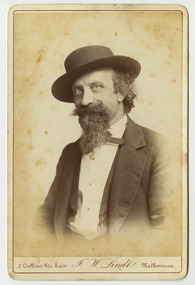
... studios at number 7 at the top of Collins Street opposite the Treasury, in 1877. John Lindt's business of this period was wide-ranging, and included portraits, records of Melbourne public buildings and streetscapes, the Botanical Gardens, and Port Melbourne. He was a welcome photographer of members of parliament and other Melbourne personalities, their society ...A black and white portrait of an unknown man taken by John William Lindt.A black and white portrait of an unknown man taken by John William Lindt. John William Lindt was born in Germany in 1845. At 17 he took a working passage to Australia on a Dutch sailing ship. Taking up work as an itinerant piano-tuner, he traveled amongst towns in Victoria and New South Wales before settling in Grafton in 1863 where he became assistant and apprentice to photographer Conrad Wagner. After a brief return to Germany in 1867 Lindt took over management of Wagner’s studio in 1869. He married Wagner’s daughter, Anna on 13 January 1872. Over 1873-1874, using the slow and laborious wet-plate collodion process, John Lindt produced photographs of the local indigenous people both in their environment conducting actual traditional ceremonies in the Clarence River district, and in his studio. Twelve of this series is included in his 1874 album Australian Aboriginals. John Lindt moved to Melbourne in 1876 where he worked for Batchelder & Co. before opening his own opulent studios at number 7 at the top of Collins Street opposite the Treasury, in 1877. John Lindt's business of this period was wide-ranging, and included portraits, records of Melbourne public buildings and streetscapes, the Botanical Gardens, and Port Melbourne. He was a welcome photographer of members of parliament and other Melbourne personalities, their society and cultural life including the theatre, and was known as a ‘rich man’s photographer’ for those whose families he grouped informally on the lawns in front of their mansions, with servants at the rails of the upstairs balconies. He continued with landscape, producing folios Fernshaw and Watt River Scenery, Victoria ( c.1878-82), Scenery on the Ovens and Buckland Rivers, Victoria (c.1878–82) and Lorne, Louttit Bay and Cape Otway Ranges (1883). Sales of his Black Spur scenery amounted to approximately 25,000 copies printed from the original negatives between 1882 and 1892. John Lindt, in collaboration with Nicholas John Caire, produced a tourist booklet on the area around "The Hermitage" in 1913.7 Collins Str. East/ J.W. Lindt/ Melbournejohn william lindt, conrad wagner, australian aboriginals, batchelder & co, nicholas john caire, anna lindt -
 Marysville & District Historical Society
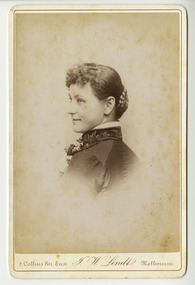
Photograph (Item) - Black and white portrait, John William Lindt, 1870s
... studios at number 7 at the top of Collins Street opposite the Treasury, in 1877. John Lindt's business of this period was wide-ranging, and included portraits, records of Melbourne public buildings and streetscapes, the Botanical Gardens, and Port Melbourne. He was a welcome photographer of members of parliament and other Melbourne personalities, their society ...A black and white portrait of an unknown woman taken by John William Lindt.A black and white portrait of an unknown woman taken by John William Lindt. John William Lindt was born in Germany in 1845. At 17 he took a working passage to Australia on a Dutch sailing ship. Taking up work as an itinerant piano-tuner, he traveled amongst towns in Victoria and New South Wales before settling in Grafton in 1863 where he became assistant and apprentice to photographer Conrad Wagner. After a brief return to Germany in 1867 Lindt took over management of Wagner’s studio in 1869. He married Wagner’s daughter, Anna on 13 January 1872. Over 1873-1874, using the slow and laborious wet-plate collodion process, John Lindt produced photographs of the local indigenous people both in their environment conducting actual traditional ceremonies in the Clarence River district, and in his studio. Twelve of this series is included in his 1874 album Australian Aboriginals. John Lindt moved to Melbourne in 1876 where he worked for Batchelder & Co. before opening his own opulent studios at number 7 at the top of Collins Street opposite the Treasury, in 1877. John Lindt's business of this period was wide-ranging, and included portraits, records of Melbourne public buildings and streetscapes, the Botanical Gardens, and Port Melbourne. He was a welcome photographer of members of parliament and other Melbourne personalities, their society and cultural life including the theatre, and was known as a ‘rich man’s photographer’ for those whose families he grouped informally on the lawns in front of their mansions, with servants at the rails of the upstairs balconies. He continued with landscape, producing folios Fernshaw and Watt River Scenery, Victoria ( c.1878-82), Scenery on the Ovens and Buckland Rivers, Victoria (c.1878–82) and Lorne, Louttit Bay and Cape Otway Ranges (1883). Sales of his Black Spur scenery amounted to approximately 25,000 copies printed from the original negatives between 1882 and 1892. John Lindt, in collaboration with Nicholas John Caire, produced a tourist booklet on the area around "The Hermitage" in 1913.7 Collins Str. East/ J.W. Lindt/ Melbournejohn william lindt, conrad wagner, australian aboriginals, batchelder & co, nicholas john caire, anna lindt -
 Marysville & District Historical Society
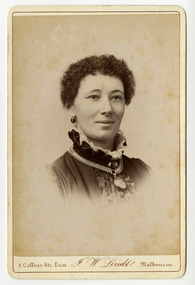
Photograph (Item) - Black and white portrait, John William Lindt, 1870s
... studios at number 7 at the top of Collins Street opposite the Treasury, in 1877. John Lindt's business of this period was wide-ranging, and included portraits, records of Melbourne public buildings and streetscapes, the Botanical Gardens, and Port Melbourne. He was a welcome photographer of members of parliament and other Melbourne personalities, their society ...A black and white portrait of an unknown woman taken by John William Lindt.A black and white portrait of an unknown woman taken by John William Lindt. John William Lindt was born in Germany in 1845. At 17 he took a working passage to Australia on a Dutch sailing ship. Taking up work as an itinerant piano-tuner, he traveled amongst towns in Victoria and New South Wales before settling in Grafton in 1863 where he became assistant and apprentice to photographer Conrad Wagner. After a brief return to Germany in 1867 Lindt took over management of Wagner’s studio in 1869. He married Wagner’s daughter, Anna on 13 January 1872. Over 1873-1874, using the slow and laborious wet-plate collodion process, John Lindt produced photographs of the local indigenous people both in their environment conducting actual traditional ceremonies in the Clarence River district, and in his studio. Twelve of this series is included in his 1874 album Australian Aboriginals. John Lindt moved to Melbourne in 1876 where he worked for Batchelder & Co. before opening his own opulent studios at number 7 at the top of Collins Street opposite the Treasury, in 1877. John Lindt's business of this period was wide-ranging, and included portraits, records of Melbourne public buildings and streetscapes, the Botanical Gardens, and Port Melbourne. He was a welcome photographer of members of parliament and other Melbourne personalities, their society and cultural life including the theatre, and was known as a ‘rich man’s photographer’ for those whose families he grouped informally on the lawns in front of their mansions, with servants at the rails of the upstairs balconies. He continued with landscape, producing folios Fernshaw and Watt River Scenery, Victoria ( c.1878-82), Scenery on the Ovens and Buckland Rivers, Victoria (c.1878–82) and Lorne, Louttit Bay and Cape Otway Ranges (1883). Sales of his Black Spur scenery amounted to approximately 25,000 copies printed from the original negatives between 1882 and 1892. John Lindt, in collaboration with Nicholas John Caire, produced a tourist booklet on the area around "The Hermitage" in 1913.7 Collins Str. East/ J.W. Lindt/ Melbournejohn william lindt, conrad wagner, australian aboriginals, batchelder & co, nicholas john caire, anna lindt -
 Marysville & District Historical Society
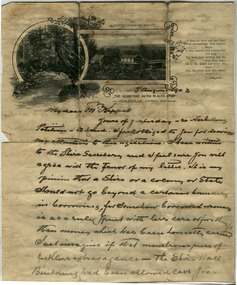
Letter (Item) - Hand written letter, John William Lindt, 1903
... studios at number 7 at the top of Collins Street opposite the Treasury, in 1877. John Lindt's business of this period was wide-ranging, and included portraits, records of Melbourne public buildings and streetscapes, the Botanical Gardens, and Port Melbourne. He was a welcome photographer of members of parliament and other Melbourne personalities, their society ...A letter written to Maurice Keppel by John William Lindt in 1903.A letter written to Maurice Keppel by John William Lindt in 1903. John William Lindt was born in Germany in 1845. At 17 he took a working passage to Australia on a Dutch sailing ship. Taking up work as an itinerant piano-tuner, he traveled amongst towns in Victoria and New South Wales before settling in Grafton in 1863 where he became assistant and apprentice to photographer Conrad Wagner. After a brief return to Germany in 1867 Lindt took over management of Wagner’s studio in 1869. He married Wagner’s daughter, Anna on 13 January 1872. Over 1873-1874, using the slow and laborious wet-plate collodion process, John Lindt produced photographs of the local indigenous people both in their environment conducting actual traditional ceremonies in the Clarence River district, and in his studio. Twelve of this series is included in his 1874 album Australian Aboriginals. John Lindt moved to Melbourne in 1876 where he worked for Batchelder & Co. before opening his own opulent studios at number 7 at the top of Collins Street opposite the Treasury, in 1877. John Lindt's business of this period was wide-ranging, and included portraits, records of Melbourne public buildings and streetscapes, the Botanical Gardens, and Port Melbourne. He was a welcome photographer of members of parliament and other Melbourne personalities, their society and cultural life including the theatre, and was known as a ‘rich man’s photographer’ for those whose families he grouped informally on the lawns in front of their mansions, with servants at the rails of the upstairs balconies. He continued with landscape, producing folios Fernshaw and Watt River Scenery, Victoria ( c.1878-82), Scenery on the Ovens and Buckland Rivers, Victoria (c.1878–82) and Lorne, Louttit Bay and Cape Otway Ranges (1883). Sales of his Black Spur scenery amounted to approximately 25,000 copies printed from the original negatives between 1882 and 1892. John Lindt, in collaboration with Nicholas John Caire, produced a tourist booklet on the area around "The Hermitage" in 1913. Maurice Keppel, from Ireland, was one of the first landholders in the newly surveyed town of Marysville in 1864. He and his wife ran the successful Keppel’s Australian Hotel. Two of their sons, John and Jerry, established a farm and opened up the surrounding high country. The Keppel lease was one of the longest held in the high country and the Keppel Family were amongst Marysville's pioneering families.maurice keppel, keppel family, keppel's australian hotel, marysville, victoria, john william lindt, conrad wagner, australian aboriginals, batchelder & co, nicholas john caire, anna lindt -
 Marysville & District Historical Society
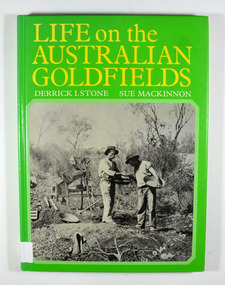
Book - Hardcover book, Life on the Australian Goldfields, 1984
... Society / P.O. Box 22 / Marysville 3779 Hardcover. Front cover has a photograph of two miners from West Australia using the dry-blowing technique. In the background are two 'Wood's dry placer-miners'. Back cover has a photograph of the interior of a steam-operated quartz crushing battery at the Mount Boppy Mine. Life on the Australian Goldfields Book Hardcover book Stone, Derrick I. Mackinnon, Sue Popular Books Pioneer Design Studio ...A history of gold mining in AustraliaHardcover. Front cover has a photograph of two miners from West Australia using the dry-blowing technique. In the background are two 'Wood's dry placer-miners'. Back cover has a photograph of the interior of a steam-operated quartz crushing battery at the Mount Boppy Mine.Front cover has a price sticker that is discolored. Inside there is the stamp of the Marysville & District Historical Society / P.O. Box 22 / Marysville 3779 gold, gold mines, gold mining, australia, history, social life, customs, stone, derrick i, mackinnon, sue -
 Marysville & District Historical Society
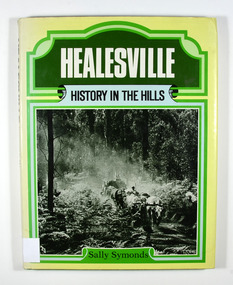
Book, Healesville-History in the Hills, 1982
... Society Inc / P.O. Box 22 / Marysville 3779 R. Whitford For/ MANDY/ whose love of the bush/ brought us to Healesville Hardcover. Front cover of dust jacket has a photograph of a bullock team hauling a load of timber. Back cover of dust jacket has a photograph of the Maroondah Dam. Healesville-History in the Hills Book Book Sally Symonds Pioneer Design Studio ...A history of HealesvilleHardcover. Front cover of dust jacket has a photograph of a bullock team hauling a load of timber. Back cover of dust jacket has a photograph of the Maroondah Dam.Stamp of the Marysville & District Historical Society Inc / P.O. Box 22 / Marysville 3779 R. Whitford For/ MANDY/ whose love of the bush/ brought us to Healesvillehealesville, upper yarra valley, victoria, australia, sally symonds, history -
 Marysville & District Historical Society
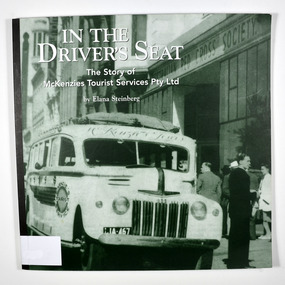
Book, In the Driver's Seat-The Story of McKenzies Tourist Services Pty Ltd, 1999
... Society. In the Driver's Seat-The Story of McKenzies Tourist Services Pty Ltd Book Book Elana Steinberg The Wilder Group Pty Ltd Ari Unglik Artifishal Studios Espress Printers Pty Ltd ...The story of McKenzies Tourist Services Pty Ltd from their beginningPaperback. Front cover has a photograph of an early McKenzie bus with a group of people standing next to it. They are out the front of a building named Australian Red Cross Society.Stamp of Marysville & District / Historical Society Inc / P.O. Box 22 / Marysville 3779mckenzies tourist services, victoria, history -
 Federation University Historical Collection
Artwork - Sketch Books, Neville Bunning, 1902-1990, 1900s
... studio. In 1934 he went to England and studied, wrote and did commission work. Achieving local success and had work acquired by the Victoria and Albert Museum. Neville returned to Australia and became a lecturer at East Sydney Technical School until the outbreak of the Second World War. He joined the RAAF. After the War he joined the staff of the Art School of the Ballarat School of Mines and Industries until his retirement in 1964. Neville Bunning formed the Ballarat Artist's Society...studio. In 1934 he went to England and studied, wrote and did commission work. Achieving local success and had work acquired by the Victoria and Albert Museum. Neville returned to Australia and became a lecturer at East Sydney Technical School until the outbreak of the Second World War. He joined the RAAF. After the War he joined the staff of the Art School of the Ballarat School of Mines and Industries until his retirement in 1964. Neville Bunning formed the Ballarat Artist's Society ...Neville Mirvane Bunning was born in Rockhampton, Queensland in 1902. He was home taught until 1916 and then was a boarder at Geelong Grammar School, Victoria until 1921. He then returned to Queensland and worked on the family property. During this time he built ceramic kilns and taught himself the required skills for ceramiic production. During the Depression he went to Sydney and set up an artist's studio. In 1934 he went to England and studied, wrote and did commission work. Achieving local success and had work acquired by the Victoria and Albert Museum. Neville returned to Australia and became a lecturer at East Sydney Technical School until the outbreak of the Second World War. He joined the RAAF. After the War he joined the staff of the Art School of the Ballarat School of Mines and Industries until his retirement in 1964. Neville Bunning formed the Ballarat Artist's Society, a group which sponsored art and invite guests to speak to students and the public of Ballarat. He wrote a weekly column in "The Courier", the local newspaper where he encouraged people to be more aware of the trends in art. His works were included in the 1988 Australian Bicentennial Exhibition. His sympathetic understanding of Aboriginal culture is recorded in a letter written in 1937 to the Victoria and Albert Museum. Neville Bunning continued painting during his retirement. His last major exhibition was held at the Golden Age Gallery in Ballarat in 1983. The sketch books cover a range of topics using pen, ink and watercolour.28 A3 sketch books, spiral boundneville bunning, queensland, geelong grammar school, ceramics, kilns, depression, sydney, england, commission work, victoria and albert museum, east sydney technical school, art school, ballarat school of mines and industries, ballarat artist's society, second world war, raaf, australian bicentennial exhibition, golden age gallery ballarat, painting -
 Greensborough Historical Society
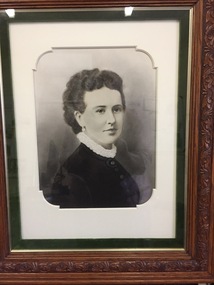
Photograph (Framed), Mrs Samuel Haylock Poulter 1858-1896, 1890c
... This portrait is presented to the Greensborough Historical Society at the request of Mrs Barbara Lenne (nee Cooke) (1935-2017), great grand daughter of Margaret Morrow and Samuel Poulter. samuel haylock poulter margaret morrow poulter family Large timber-framed photograph. Studio ...Margaret Morrow was born in County Tyrone, Ireland in 1858. Her father was John Morrow, a farmer. She married Samuel Haylock Poulter in 1881 at Heidelberg. Samuel was born in 1853, son of William Poulter Seven children were born to Samuel an Margaret. Margaret, aged 38, died on 02/08/1896 seven weeks after the birth of Edith May, from complications of the birth. She was buried at Eltham by rites of the Church of England. This portrait is presented to the Greensborough Historical Society at the request of Mrs Barbara Lenne (nee Cooke) (1935-2017), great grand daughter of Margaret Morrow and Samuel Poulter.Large timber-framed photograph. Studio portrait of woman. Biographical notes.samuel haylock poulter, margaret morrow, poulter family -
 Glenelg Shire Council Cultural Collection
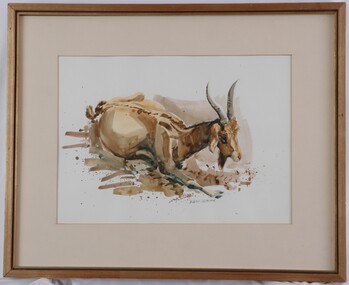
Painting, Robert Ulmann, Goat, c. 1974
... studio and home, together with 13 years of field sketches and his best work collected together for two books were destroyed by the Ash Wednesday fires at Naringal in 1983. Rob exhibited in Sydney, Melbourne, Adelaide and Perth as well as in the Regional Galleries of Warrnambool, Ballarat, Portland and Horsham, and, among numerous prizes, he won the award for watercolour at six of the annual exhibitions of the Wildlife Art Society of Australasia, between 1978 and 1983. ...studio and home, together with 13 years of field sketches and his best work collected together for two books were destroyed by the Ash Wednesday fires at Naringal in 1983. Rob exhibited in Sydney, Melbourne, Adelaide and Perth as well as in the Regional Galleries of Warrnambool, Ballarat, Portland and Horsham, and, among numerous prizes, he won the award for watercolour at six of the annual exhibitions of the Wildlife Art Society of Australasia, between 1978 and 1983. ...Robert Ulmann was born in Zurich, Switzerland, where he studied sculpture and painting, exhibiting annually with the National Art Society of Switzerland and in Paris, Munich and Stockholm. He migrated to Canada in 1956 and became a Canadian citizen. After working on the restoration of sculpture on the west wing of the Parliament Buildings Ottawa, he took up a Government appointment as one of six artist advisers to the Eskimos, initiating handicraft and sculpture programs in isolated settlements across the Central Arctic. He arrived in Australia with his Australian wife, Helen, in 1969, after two adventurous years backpacking and sketching through the United States, Central and South America and the South Pacific. From 1970 to 1972 he was employed by the Northern Territory Administration as a manual arts instructor to the aboriginal people of Docker River, a remote settlement west of Ayers Rock. A series of drawings from this period was exhibited by the Department of the Interior in Canberra, Sydney and Adelaide. Robert Ulmann’s paintings and prints of wildlife from Australia and overseas fill a beautiful studio overlooking the famous Logans Beach whale nursery at Warrnambool in the Western District of Victoria. His previous studio and home, together with 13 years of field sketches and his best work collected together for two books were destroyed by the Ash Wednesday fires at Naringal in 1983. Rob exhibited in Sydney, Melbourne, Adelaide and Perth as well as in the Regional Galleries of Warrnambool, Ballarat, Portland and Horsham, and, among numerous prizes, he won the award for watercolour at six of the annual exhibitions of the Wildlife Art Society of Australasia, between 1978 and 1983. Although his principal interest was in drawing and painting, he retained a fascination with sculpture. His works range from two stone fountains with figures commissioned by the City of Zurich, while he was still a student, to a 4 ½ ton sculpture in bluestone commissioned in 1977 as a memorial to Sir Fletcher Jones., a five metre representation of whale tails in steel, and a life-size bronze of St. John of God commissioned for a private hospital.Image of a goat beginning to rise from a seated position, possible struggling out of mud. Painted in yellow and brown tones, with blue shadows. Earth colours form a rough ground area surrounding the goat. A brown wash provides a cursory background behind the goat's head. Dark cream matt surrounds image. Gold painted wooden frame, with glass.Front: Robert Ulmann (lower centre, paint) Back: (no inscriptions) -
![Photograph, Jessie May Partington [as infant], 1911c](/media/collectors/4f729f5697f83e03086015b8/items/4f72be2097f83e03086067c9/item-media/6a6878b9123f24099dbffc83/item-fit-380x285.jpg?cb=6) Greensborough Historical Society
Greensborough Historical SocietyPhotograph, Jessie May Partington [as infant], 1911c
... Jessie Angus was a Greensborough identity for her work with the local choral society and as a member of the pioneering Partington family. jessie may partington jessie angus jessie scholes partington family In pen on mount: Jessie May Partington Postcard Studio portrait of small child in lace dress. ...Photograph of Jessie May Partington as a child.Jessie Angus was a Greensborough identity for her work with the local choral society and as a member of the pioneering Partington family.Postcard Studio portrait of small child in lace dress. Photograph in oval mount.In pen on mount: Jessie May Partingtonjessie may partington, jessie angus, jessie scholes, partington family -
 Greensborough Historical Society
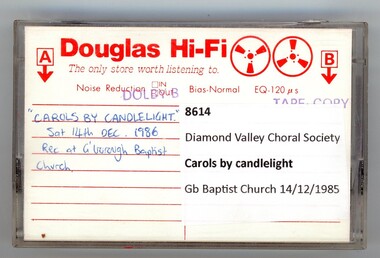
Audio - Audio Cassette, Diamond Valley Choral Society, Carols by candlelight 1986, performed by Diamond Valley Choral Society, 14/12/1986
... This performance by the Diamond Valley Choral Society was recorded at Greensborough Baptist Church on 14/12/1986. diamond valley choral society carols by candlelight greensborough baptist church christmas music Handwritten on cassette: "Carols by candlelight Sat 14/12/86"; stamped on insert; "Recorded at Twintracks Studios, Greensborough". 1 audio cassette in clear plastic case Carols by candlelight 1986, performed by Diamond Valley Choral Society Audio Audio Cassette Diamond Valley Choral Society ...A recording of Carols by Candlelight. This performance by the Diamond Valley Choral Society was recorded at Greensborough Baptist Church on 14/12/1986.1 audio cassette in clear plastic caseHandwritten on cassette: "Carols by candlelight Sat 14/12/86"; stamped on insert; "Recorded at Twintracks Studios, Greensborough".diamond valley choral society, carols by candlelight, greensborough baptist church, christmas music -
 Cheese World Museum
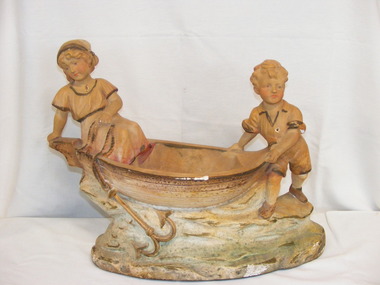
Ornament, Triaca & Picchi figurine, c1930
... A 1927 image of workers at his studio workshop taking a lunch break is in the Italian Historical Society collection (http://trove.nla.au/version172106091). ...A 1927 image of workers at his studio workshop taking a lunch break is in the Italian Historical Society collection (http://trove.nla.au/version172106091). ...Part of the Uebergang Collection. Made by the firm of Triaca & Picchi. Camilo Triaca (1887-1972) was a sculptor born Tuscany, Italy. He arrived in Melbourne in 1909 and practised his craft in Richmond, Melbourne, before returning to Italy in 1914 to serve in the Italian Army. He returned to Melbourne in 1923 and continued to sculpt at his Richmond home before relocating to Fitzroy. A 1927 image of workers at his studio workshop taking a lunch break is in the Italian Historical Society collection (http://trove.nla.au/version172106091). The workshop was situated at 76-78 King William St, Fitzroy.Plaster figurine depicting a boat with a girl sitting in the front holding the rope of an anchor and a boy holding the back of the boat which is up on the sand. The girl wears a short sleeved frock with green edged neck and sleeves, and a matching scarf. The boy wears a V-neck shirt with sleeves rolled up.Triaci & Picchi/1773triaca camilo, triaca & picchi, italian immigrants, families, businesses, trades, sculptures, sculptors, melbourne, allansford, uebergang -
 Ringwood and District Historical Society
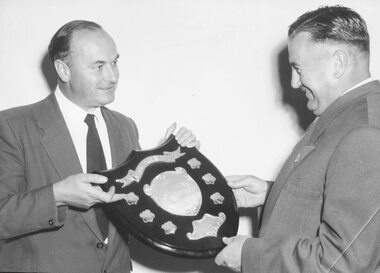
Photograph, Ringwood Horticultural & Agricultural Society- J. Kirby, President, H. & A. Society showing Charles Howitt the Your Garden Shield 1958
... Society showing Charles Howitt the Your Garden Shield to be competed for by the shopkeepers for the best window during the Floral Festival in March. 'Mail' 20 February 1958." Black and white photograph. (Photo by Peter Paynes, Ringwood Studios ...Black and white photograph. (Photo by Peter Paynes, Ringwood Studios.)Written on back of photograph, "J. Kirby, President, H. & A. Society showing Charles Howitt the Your Garden Shield to be competed for by the shopkeepers for the best window during the Floral Festival in March. 'Mail' 20 February 1958."
