
Showing 54 items matching "solomon island"
-
 Federation University Historical Collection
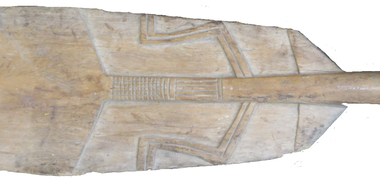
Weapon - Ethnographic Material, Two native weapons, probably South Pacific in origin
... ...Solomon Island...Two native weapons, probably South Pacific in origin. .1) light coloured timber paddle with carving. Possibly Solomon Islands. .2) A dark coloured Alafolo made with heavy ironwood, with geometric designs from the Solomon Islands with stylized face, carved geometric design at top end; two carved rings with geometric design between them toward bottom end....Possibly Solomon Islands. .2) A dark coloured Alafolo made with heavy ironwood, with geometric designs from the Solomon Islands with stylized face, carved geometric design at top end; two carved rings with geometric design between them toward bottom end. ...These items were in the Ballarat School of Mines Museum, and when the museum was closed they were saved from the tip, and returned decades later. The Alafolo or afui are anthropomorphic clubs found across the island of Malaita. As war clubs, blows were struck with the edges of the club, which varied in length from under three to four feet. At least some of these clubs served a largely ceremonial function, particularly those rare examples with shell inlay. Malaitans war clubs are usually made of tooa, a reddish hardwood. Most finished clubs are submerged in mud (saltwater or fresh) for about a month, during which time they acquire a glossy black finish.Two native weapons, probably South Pacific in origin. .1) light coloured timber paddle with carving. Possibly Solomon Islands. .2) A dark coloured Alafolo made with heavy ironwood, with geometric designs from the Solomon Islands with stylized face, carved geometric design at top end; two carved rings with geometric design between them toward bottom end.ballarat school of mines, ballarat school of mines museum, ethnographic, paddle, club, ethnographic material, new number, solomon island, alafolo, malaita, weapons, new guinea -
 Running Rabbits Military Museum operated by the Upwey Belgrave RSL Sub Branch
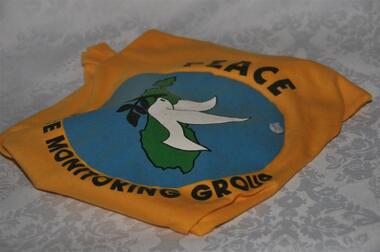
T-shirt
... Solomon Islands Peacekeepers...Uniform c2000 Solomon Islands Peacekeepers T-shirt ...Solomon Islands Peacekeepersuniform, c2000 -
 Bendigo Military Museum
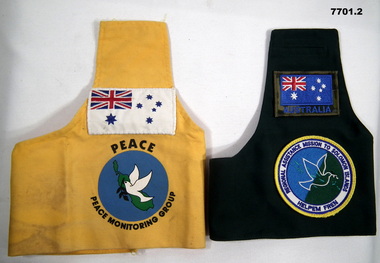
Uniform - BRASSARDS, PEACEKEEPER
... RAMSI brassard for Solomon Island Peace Keeping Mission. Dark green with Australian Flag sewn onto sleeve. ...Embroidered patch "Regional Assistance Mission to Solomon Islands" and "Helpen Frew"....RAMSI brassard for Solomon Island Peace Keeping Mission. Dark green with Australian Flag sewn onto sleeve. ...Brassards were worn by Peacekeeping Forces to identify their identity. Belonged to Gary Clift R.127835 M8073771. For RAMSI was deployed as ship's company HMAS BRUNEI. For PNG was deployed from HMAS TARAKAN & BRUNEI.1. PNG Peace Keeping Mission Brassard. Bright yellow brassard. Stitched on white Australian ensign on arm picture of dove carrying a twig overlaid over a map of Bougainville in green. Blue background. 2. RAMSI brassard for Solomon Island Peace Keeping Mission. Dark green with Australian Flag sewn onto sleeve. As is RAMSI emblem (yellow border, white dove over map os islands).1. Embroidered "Peace" & "Peace Monitorial Group". 2. Embroidered patch "Regional Assistance Mission to Solomon Islands" and "Helpen Frew".peace keepers, uniform, brassards, ramsi -
 Croydon RSL Sub Branch
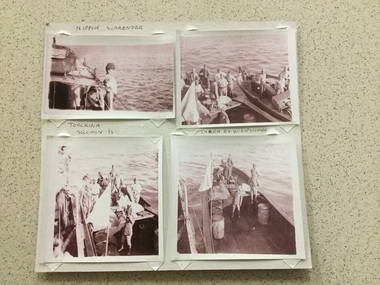
Four photographs
... Torokinda Solomon Island...Japanese surrender Japanese surrender of Solomon Islands Torokinda Solomon Island Four photo's on backing board Four photographs ...Japanese surrender Japanese surrender of Solomon Islands Four photo's on backing boardTorokinda Solomon Island -
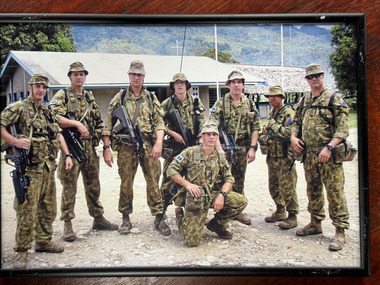 The 5th/6th Battalion Royal Victoria Regiment Historical Collection
Photograph - Framed Photograph, Members of 5/6 in Op Anode
... Coloured photograph with wooden frame showing soldiers before patrolling in Solomon Island during Operation Anode...Coloured photograph with wooden frame showing soldiers before patrolling in Solomon Island during Operation Anode Members of 5/6 in Op Anode Photograph Framed Photograph ...Coloured photograph with wooden frame showing soldiers before patrolling in Solomon Island during Operation Anode -
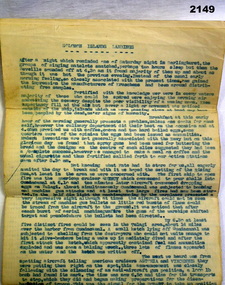 Bendigo Military Museum
Literary work - DIARY, Post August 1942
... Seven page typed in blue ink with heading "Solomon Islands Landings" which began on 7th August 1942. ...Seven page typed in blue ink with heading "Solomon Islands Landings" which began on 7th August 1942. ...Arthur George Holley No 13556 RAN HMAS Hobart. This is the 3rd part of a diary relating to 2147. Refer also 2134 for service history, 2135.3, 2137. Diary, A.G Holley RAN. Seven page typed in blue ink with heading "Solomon Islands Landings" which began on 7th August 1942. There are no clear dates, detailed account of the action.diaries, naval, personal -
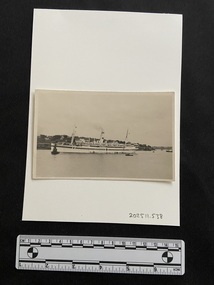 Returned Nurses RSL Sub-branch
Photograph - 3.5 x 5.5 black and white photograph on card, unknown
... 'Between 1941 and 1946, Hospital Ship Wanganella carried wounded and sick evacuees from the Middle East, New Guinea, Solomon Islands, Borneo and the South Pacific. ' [from the Australian War Memorial] ...'Between 1941 and 1946, Hospital Ship Wanganella carried wounded and sick evacuees from the Middle East, New Guinea, Solomon Islands, Borneo and the South Pacific. ' [from the Australian War Memorial] World War 1939-1945 WW2 WWII Hospital Ship Wanganella Hospital Ship Wanganella 'WANGENELLA HOSPITAL / SHIP WWII' [Handwritten in black ink on the back of the card] Black and white photo of a hospital ship in the water with land in the background printed onto card. ...'Between 1941 and 1946, Hospital Ship Wanganella carried wounded and sick evacuees from the Middle East, New Guinea, Solomon Islands, Borneo and the South Pacific. ' [from the Australian War Memorial] Black and white photo of a hospital ship in the water with land in the background printed onto card.'WANGENELLA HOSPITAL / SHIP WWII' [Handwritten in black ink on the back of the card]world war 1939-1945, ww2, wwii, hospital ship, wanganella, hospital ship wanganella -
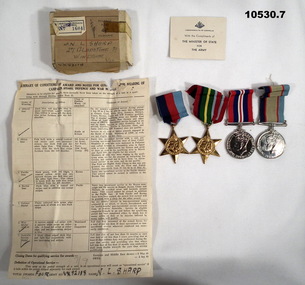 Bendigo Military Museum
Award - MEDALS, WW2
... Overseas service listed as; New Guinea 8.3.1943 - 10.8.1944, Solomon Islands 29.12.1944 - 3.2 1946, discharged from the AIF on 25.10.1946....Overseas service listed as; New Guinea 8.3.1943 - 10.8.1944, Solomon Islands 29.12.1944 - 3.2 1946, discharged from the AIF on 25.10.1946. award medals Main points, "VX82118 - N.L. ...Norm Leslie Sharp VX82118 (born South Melbourne, enlisted Grafton NSW) in the CMF initially on 23.10.1941, transfers to the 2nd AIF on 28.7.1942 in 15th Field Ambulance. Overseas service listed as; New Guinea 8.3.1943 - 10.8.1944, Solomon Islands 29.12.1944 - 3.2 1946, discharged from the AIF on 25.10.1946.Medals, single unmounted. .1) 1939 Star .2) Pacific Star. .3) British War medal 1939 - 45. .4) Australian Service medal 1939 - 45. .5) Box, cardboard with stamp, address and Regimental No on. .6) Card of white colour, text in blue with Coat of Arms at the top. .7) Sheet of paper, double sided, text in black both sides, hand written Soldiers details and with ticks re medals awarded to from the listing. Measurement shown is for one medal. Main points, "VX82118 - N.L. Sharp"award, medals -
 Bendigo Military Museum
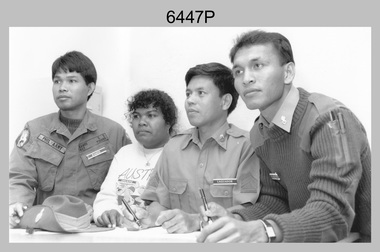
Photograph - Defence Co-operation Project Students, School of Military Survey, Bonegilla, VIC, 1990
... The photograph was scanned at 300 dpi. .1) - Photo, black & white, 1990, DCP Students L to R: SGT Ramos – Philippines, Miss Chukeni – Solomon Islands, SGT Laguador – Philippines, CPL Jais – Malaysia. ...The photograph was scanned at 300 dpi. .1) - Photo, black & white, 1990, DCP Students L to R: SGT Ramos – Philippines, Miss Chukeni – Solomon Islands, SGT Laguador – Philippines, CPL Jais – Malaysia. ...This is a photograph of Defence Co-operation Project (DCP) students from the Pacific region who attended the 1/90 Specialist Carto course held at the School of Military Survey, Bonegilla, Victoria from the 9th of May to the 5th of June 1990.This is a photograph of Defence Co-operation Project (DCP) students attending the 1/90 Specialist Carto course held at the School of Military Survey, Bonegilla, Victoria in 1990. The photograph was printed on photographic paper and is part of the Army Survey Regiment’s Collection. The photograph was scanned at 300 dpi. .1) - Photo, black & white, 1990, DCP Students L to R: SGT Ramos – Philippines, Miss Chukeni – Solomon Islands, SGT Laguador – Philippines, CPL Jais – Malaysia. .1P – Students, course title and date annotated on back of photo.royal australian survey corps, rasvy, army survey regiment, army svy regt, school of military survey, fortuna, asr -
 Mission to Seafarers Victoria
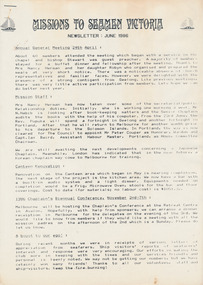
Newsletter, Missions to Seamen Victoria Newsletter - June 1986, June 1986
... Habib, Reverend Pupuka from the Solomon Islands Canteen renovation 1986 Biannual chaplains' conference Volunteers: Philip White, Sharon White, Linda Koerner, Diane Dodgson, Leslie family, Liz Pitcher, Bernice Kennett, Sadie Wilson, John Phillips / Keith Nunweek (honourary lay-reader), Ron Stannus...Habib, Reverend Pupuka from the Solomon Islands Canteen renovation 1986 Biannual chaplains' conference Volunteers: Philip White, Sharon White, Linda Koerner, Diane Dodgson, Leslie family, Liz Pitcher, Bernice Kennett, Sadie Wilson, John Phillips / Keith Nunweek (honourary lay-reader), Ron Stannus 1986 nancy herman n. habib rev. pupuka ian baird A4 typed newsletter. ...Staff news: Nancy Herman, N. Habib, Reverend Pupuka from the Solomon Islands Canteen renovation 1986 Biannual chaplains' conference Volunteers: Philip White, Sharon White, Linda Koerner, Diane Dodgson, Leslie family, Liz Pitcher, Bernice Kennett, Sadie Wilson, John Phillips / Keith Nunweek (honourary lay-reader), Ron StannusA4 typed newsletter.1986, nancy herman, n. habib, rev. pupuka, ian baird -
 Wangaratta RSL Sub Branch
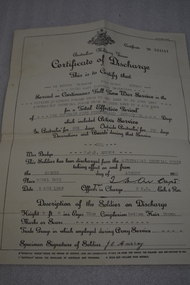
Certificate - Certificate of Discharge, John Brian Murray VX142238, Dated 8 August 1946
... Original AMF Certificate of Discharge certifying VX 142238 Private John Brian Murray born 27/10/1922 at Moyhu 57/60 Australian Infantry Battalion served with CMF 28/5/42 to 29/6/43 and AIF from 30/6/1943 to 8/8/1946 which included overseas service in New Guinea and Solomon Islands....Original AMF Certificate of Discharge certifying VX 142238 Private John Brian Murray born 27/10/1922 at Moyhu 57/60 Australian Infantry Battalion served with CMF 28/5/42 to 29/6/43 and AIF from 30/6/1943 to 8/8/1946 which included overseas service in New Guinea and Solomon Islands. Certificate recognises Private Murray's service in the CMF and AIF during WW2 jb murray 57/60 aust infantry battalion certificate of discharge WW2 Certificate of Discharge - No 554111 Cream coloured paper with black border with Australian Coat of Arms centre top of page. ...Original AMF Certificate of Discharge certifying VX 142238 Private John Brian Murray born 27/10/1922 at Moyhu 57/60 Australian Infantry Battalion served with CMF 28/5/42 to 29/6/43 and AIF from 30/6/1943 to 8/8/1946 which included overseas service in New Guinea and Solomon Islands.Certificate recognises Private Murray's service in the CMF and AIF during WW2Cream coloured paper with black border with Australian Coat of Arms centre top of page. Certificate of Discharge - No 554111jb murray, 57/60 aust infantry battalion, certificate of discharge, ww2 -
 Montmorency–Eltham RSL Sub Branch
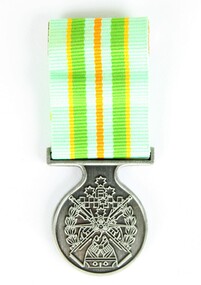
Medal - Military Kid Medallion, Foxhole Medals, After 2004
... Following operations include Bougainville, East Timor, Indian Ocean, Solomon Islands, Meddle East Area, Afghanistan and Sinai....Following operations include Bougainville, East Timor, Indian Ocean, Solomon Islands, Meddle East Area, Afghanistan and Sinai. ...This medal was presented to the children of Victorian Wing - Warrant Officer and Non Commissioned Officers Academy Soldier who have served on operational deployments. As these young children endured an operational deployment of a parent who spent many months away from home in a foreign country representing the Australian Army. Following operations include Bougainville, East Timor, Indian Ocean, Solomon Islands, Meddle East Area, Afghanistan and Sinai.Presented by the Government to children whose parents had served overseas Silver medal with pale green, yellow, orange and deeper green ribbon. It has a metal type container with a clear plastic front and also a black carry bag with Military Kid and print of medal on front. The design is based on the Australian Tri Service Logo. More detailed information can be found on Military Kids websiteOn reverse: "For perseverance on the home front during your parents deployment"; map of Australia (haut relief)military kid, military medal, kids medal -
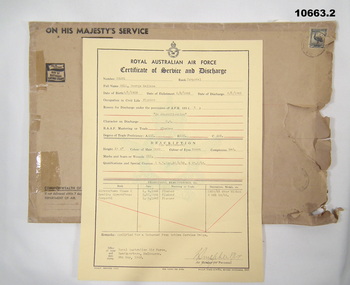 Bendigo Military Museum
Administrative record - CERTIFICATE OF DISCHARGE, RAAF, 9 May 1946
... Service areas were Milne Bay, Kiriwina, Lae, Aitape, Solomon Islands, Labuan. Discharged with the rank of Corporal in 4th Airfield Construction Sqd. ...Service areas were Milne Bay, Kiriwina, Lae, Aitape, Solomon Islands, Labuan. Discharged with the rank of Corporal in 4th Airfield Construction Sqd. ...George Wallace Bell No. 53081 (Born England, enlisted Melbourne). Age 33 on 2/4/1942 & was Discharged 8/3/1946. His overseas service is listed as 16/2/1943 to 13/9/1944 and then 15/3/1945 to 22/2/1946. Service areas were Milne Bay, Kiriwina, Lae, Aitape, Solomon Islands, Labuan. Discharged with the rank of Corporal in 4th Airfield Construction Sqd. His civilian service was a Plumber and maintained that through his War service.1. Yellow certificate A4 size. Form information in blue type with inserted data in black type. Headed Royal Australian Air Force. Data includes No, Rank, Dates of service, Physical description, Qualifications and Service history and Sign off from Authority. 2. Brown stamp and addressed envelope.“53081 - Corporal - BELL GeorgeWallace” "On Her Majesty's Service" Addressed to "Mr G.W. Bell, 16 Thomas Street, Mitcham, Vic."raaf, cert of discharge, admin record -
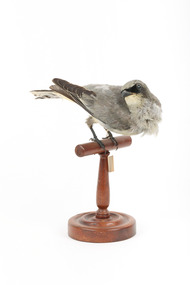 The Beechworth Burke Museum
Animal specimen - White-bellied Cuckooshrike, Trustees of the Australian Museum, 1860-1880
... The species is prevalent throughout Papua New Guinea and the Solomon Islands, but less frequently observed in Indonesia. ...The species is prevalent throughout Papua New Guinea and the Solomon Islands, but less frequently observed in Indonesia. ...The white-bellied cuckooshrike inhabits regions across Australia, Indonesia, Papua New Guinea, and the Solomon Islands. In Australia, it is distributed widely, occurring in tropical northern areas as well as in the eastern parts of the country, including northern Western Australia, the Northern Territory, Queensland, New South Wales, Victoria, and southeastern South Australia. The species is prevalent throughout Papua New Guinea and the Solomon Islands, but less frequently observed in Indonesia. Within Indonesia, it is most commonly found in the northern Moluccas, with occasional sightings in Eastern Wallacea. This specimen was originally identified as a young Black-Cuckoo-shrike and catalogued as such in the Burke Museum original catalogue. Analysis conducted as part of a conservation treatment in 2024 reclassified the specimen as a white-bellied cuckooshrike. This specimen is part of a collection of almost 200 animal specimens that were originally acquired as skins from various institutions across Australia, including the Australian Museum in Sydney and the National Museum of Victoria (known as Museums Victoria since 1983), as well as individuals such as amateur anthropologist Reynell Eveleigh Johns between 1860-1880. These skins were then mounted by members of the Burke Museum Committee and put-on display in the formal space of the Museum’s original exhibition hall where they continue to be on display. This display of taxidermy mounts initially served to instruct visitors to the Burke Museum of the natural world around them, today it serves as an insight into the collecting habits of the 19th century.This specimen is part of a significant and rare taxidermy mount collection in the Burke Museum. This collection is scientifically and culturally important for reminding us of how science continues to shape our understanding of the modern world. They demonstrate a capacity to hold evidence of how Australia’s fauna history existed in the past and are potentially important for future environmental research. This collection continues to be on display in the Museum and has become a key part to interpreting the collecting habits of the 19th century.This specimen is a young White-bellied cuckooshrike which stands perched on a wooden mount. It has pale grey colouring which is darker on the rear. The wings are tipped with grey-brown feathers and the same colour feathers also appear on the bird's tale. The specimen has dark limbs and bill and this specimen is provided with two glass eyes which are dark in colouring. The bird has a more creamy pale grey on the throat and stomach. It has a black facial mask which is restricted to an eye stripe. 21a / Black Faced Graculus / See catalogue page 11taxidermy mount, taxidermy, animalia, burke museum, beechworth, australian museum, skin, reynell eveleigh johns, bird, cuckoo, shrike, common birds, australian birds, australian bird, white-bellied cuckooshrike -
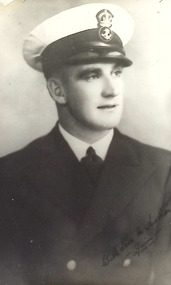 Williamstown Historical Society Inc
Photograph - Petty Officer James A Haining, HMAS Canberra
... In the darkness of the early hours of the morning of 9 August 1942 the RAN heavy cruiser HMAS Canberra was severely damaged off Guadalcanal (Solomon Islands) in a surprise attack by a powerful Japanese naval force in an action that became known as the Battle of Savo Island. ...In the darkness of the early hours of the morning of 9 August 1942 the RAN heavy cruiser HMAS Canberra was severely damaged off Guadalcanal (Solomon Islands) in a surprise attack by a powerful Japanese naval force in an action that became known as the Battle of Savo Island. ...Petty Officer James Arthur HAINING, (Service no: 19561), was born in Williamstown on 15 May 1913 and enlisted in the RAN on 4 January 1932. He served on the HMAS Canberra and was Killed in Action, aged 29 years, on the 9 August 1942. In the darkness of the early hours of the morning of 9 August 1942 the RAN heavy cruiser HMAS Canberra was severely damaged off Guadalcanal (Solomon Islands) in a surprise attack by a powerful Japanese naval force in an action that became known as the Battle of Savo Island. Canberra was hit 24 times in less than two minutes and 84 of her crew were killed including Captain Frank Getting. Source: vwma.org,au and www.awm.gov.au ran, hmas canberra, petty officer, james haining -
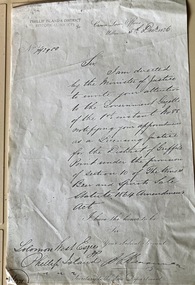 Phillip Island and District Historical Society Inc.
Document, Appointment of Solomon West as a Licensing Justice for the District of Griffith Point.1876
... Solomon West and his brother John were pioneer settlers on Phillip Island. Solomon was also a local councillor....Solomon West Esq Phillip Island....Solomon West and his brother John were pioneer settlers on Phillip Island. Solomon was also a local councillor. ...Solomon West and his brother John were pioneer settlers on Phillip Island. Solomon was also a local councillor.HistoricalFoolscap photocopy of a handwritten letter from The Crown Law Office to Solomom West Esq.stating his appointment as a Licensing Justice for Griffith Point. 5 Dec 1876Solomon West Esq Phillip Island.legal document, solomon west, lifestyle -
 Returned Nurses RSL Sub-branch
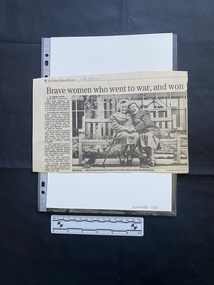
Newspaper - Newspaper clipping, The Sydney Morning Herald, Brave women who went to war, and won, [July 26 1995]
... Women served in the London blitz, North Africa, Singapore, Papua New Guinea, the Solomon Islands, New Britian and Borneo. Many lost their lives and many suffered extreme hardships....Women served in the London blitz, North Africa, Singapore, Papua New Guinea, the Solomon Islands, New Britian and Borneo. Many lost their lives and many suffered extreme hardships. ...The Prime Minister, Mr (Paul) Keating, Paid tribute to the thousands of womens who were prepared to sacrifice their lives and labour in the struggle to save Australia in World War II. He went on to tell a gathering of women veterans at Parliament House during the Australia Remembers ceremonies that the 67,000 women who enlisted, the 250,000 women who worked in factories and the 7,000 working in the Women's Land Army had been essential in the fight for freedom. Women served in the London blitz, North Africa, Singapore, Papua New Guinea, the Solomon Islands, New Britian and Borneo. Many lost their lives and many suffered extreme hardships.A newspaper clipping consisting of a column of text and a large black and white photo of two older women, sitting and hugging on a park bench.'July 26-1995' [blue ink, top]world war 2, world war two, wwii, mary canty, jean ayers, middle east -
 Bendigo Military Museum
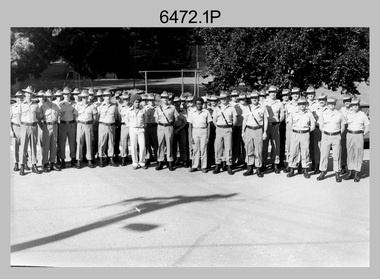
Photograph - Lithographic Squadron with DCP Students, Army Survey Regiment, Fortuna Villa, Bendigo, 1985
... The Australian Defence Force over several years sponsored international students from counties such as Indonesia, Malaysia, Papua New Guinea, Philippines, Solomon Islands and Vanuatu. It is not known which South Pacific country these DCP students came from....The Australian Defence Force over several years sponsored international students from counties such as Indonesia, Malaysia, Papua New Guinea, Philippines, Solomon Islands and Vanuatu. It is not known which South Pacific country these DCP students came from. ...This is a set of six photographs of Lithographic Squadron personnel with Defence Cooperation Program (DCP) students at the Army Survey Regiment, Fortuna Villa, Bendigo Victoria, 1985. These informal and formal group photos were taken on the day of a CO’s Parade. Litho Squadron provided printing and photographic reproduction to the two DCP students. RA Svy also provided technical training to DCP students in map production skills such as, cartography and photogrammetry at the Army Survey Regiment and the School of Military Survey, Bonegilla. The Australian Defence Force over several years sponsored international students from counties such as Indonesia, Malaysia, Papua New Guinea, Philippines, Solomon Islands and Vanuatu. It is not known which South Pacific country these DCP students came from.This is a set of six photographs of Lithographic Squadron personnel with Defence Cooperation Program (DCP) students at the Army Survey Regiment, Fortuna Villa, Bendigo Victoria, 1985. The photographs are on 35mm negative film and were scanned at 96 dpi. They are part of the Army Survey Regiment’s Collection. .1) Photo, black & white, 1985. L to R: Warren ‘Waldo’ Shirley, Per Andersen, Trevor Osborne, Roy Hicks, Lance Strudwick, Steve Burke, Dale Hudson, Paul Baker, Ralph Chant, Peter Breukel, John ‘Flash’ Anderson, Chad Hardwick, Peter Imeson, DCP student John or Henry, unidentified, Greg Rowe, John South, unidentified, Mick ‘Buddha’ Ellis, John ‘Junior’ Whaling, Terry King, Daryl South, DCP student John or Henry, Bronwyn Jones, John Bateman, Kerron South, unidentified officer, Peter Dillon, Kim Reynolds, Rob Jones, unidentified, Jeff Lynch, Garry Hudson, Mark ‘Dogs’ Doherty, Jim Ash, Gavin Neilson, Jeff Willey, unidentified, Graham Johnston, Steve Egan, Peter Barrett, George Austen, Dave Miles. .2) - Photo, black & white, 1985. L to R: Warren ‘Waldo’ Shirley, Per Andersen, Trevor Osborne, Roy Hicks, Lance Strudwick, Steve Burke, Dale Hudson, Paul Baker, Ralph Chant, Peter Breukel, John ‘Flash’ Anderson, Chad Hardwick, Peter Imeson, DCP student John or Henry, unidentified, Greg Rowe, John South, unidentified, Mick ‘Buddha’ Ellis, John ‘Junior’ Whaling, Terry King, Daryl South, DCP student John or Henry, John Bateman, Kerron South, unidentified officer, Peter Dillon, Kim Reynolds, Rob Jones, unidentified, Jeff Lynch, Garry Hudson, Mark ‘Dogs’ Doherty, Jim Ash, Gavin Neilson, Jeff Willey, unidentified, Graham Johnston, Steve Egan, Peter Barrett, Dave Miles, George Austen. .3) - Photo, black & white, 1985. Photo Troop L to R: Steve Burke, Garry Hudson, Warren ‘Waldo’ Shirley, Ralph Chant, Gavin Neilson, DCP student John or Henry, Paul Baker, Trevor Osborne, Peter Imeson, Mick ‘Buddha’ Ellis, unidentified, John ‘Junior’ Whaling, DCP student John or Henry, Chad Hardwick, Terry King, Dave Miles, Graham Johnston, Kerron South, Bronwyn Jones, Rob Jones, unidentified. .4) - Photo, black & white, 1985. L to R: WO1 Jeff Lynch, DCP student John or Henry, CAPT John South, unidentified officer, DCP student John or Henry, WO2 Dave Miles. .5) & .6) - Photo, black & white, 1985. Print Troop L to R: Per Andersen, Daryl South, Lance Strudwick, Peter Dillon, DCP student John or Henry, Jeff Willey, John Bateman, Roy Hicks, Paul Davis, Dale Hudson, Kim Reynolds, Greg Rowe, Jim Ash, DCP student John or Henry, Mark ‘Dogs’ Doherty, Peter Breukel, Peter Barrett, unidentified, unidentified officer, Steve Egan, George Austen.No personnel are identified. Date and DCP students noted on film negative sleeve.royal australian survey corps, rasvy, army survey regiment, army svy regt, fortuna, asr, litho sqn, litho -
 Orbost & District Historical Society
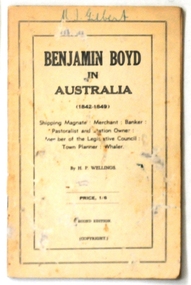
book, D.S. Ford, Benjamin Boyd in Australia 1842 -1849, 1940's
... Boyd briefly tried his luck on the Californian goldfields before being purportedly murdered on Guadalcanal in the Solomon Islands. Many of his business ventures involved blackbirding, the practice of coercing and kidnapping South Sea Islanders as slave labourers. ...Boyd briefly tried his luck on the Californian goldfields before being purportedly murdered on Guadalcanal in the Solomon Islands. Many of his business ventures involved blackbirding, the practice of coercing and kidnapping South Sea Islanders as slave labourers. ...This is the second edition of the book. Benjamin Boyd 1796 - 1851) was a Scottish-born Australian pioneer and entrepreneur, and briefly, a politician. He arrived in Hobson's Bay, Port Phillip District, on his schooner, the Wanderer, on 15 June 1842, and reached Port Jackson, Sydney, on 18 July 1842. He was a shipping magnate, merchant, banker, pastoralist and station owner, Member of the Legislative Council, town planner and a whaler Boyd became one of the largest landholders and graziers of the colony of New South Wales; before suffering financial difficulties and becoming bankrupt. Boyd briefly tried his luck on the Californian goldfields before being purportedly murdered on Guadalcanal in the Solomon Islands. Many of his business ventures involved blackbirding, the practice of coercing and kidnapping South Sea Islanders as slave labourers. This book is a useful reference tool.A small thin 48 pp paper covered book titled, "Benjamin Boyd in Australia". The cover is black and white. The price is noted at 1/6.on front cover - handwritten in green pen : "M.J. Gilbert"book-benjamin-boyd-in-australia boyd-benjamin boydtown -
 Bendigo Military Museum
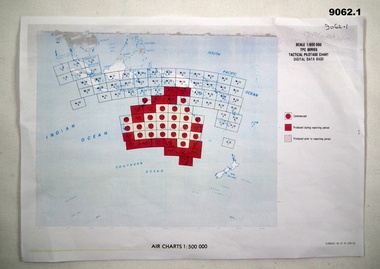
Map - RASvy " Map Makers Exhibition 2025 "- Map display, RAN Hydrographic Office, 1972 - 1992
... These charts were produced and printed at the Army Survey Regiment, Bendigo. .5 RAAF LONG RANGE PLOTTING CHART. NP 43-7 SOLOMON ISLANDS. MERCATOR PROJECTION. Used for the planning of RAAF flights. .6 RAAF AIR STAFF PLANNING CHART NS 137-1 DARWIN NORTH WEST. ...Current as at 30 Jun 92. .2 Extract of Navigational Plotting Chart " NP22-2 Tasmania " .3 Extract of Navigational Plotting Chart " NP 27 RAAF PLOTTING CHART AUSTRALIA - SOUTHEAST " .4 Extract of Navigational Plotting Chart " RAAF LONG RANGE PLOTTING CHART NP43-4 AUSTRALIA WESTERN " .5 Extract of Navigational Plotting Chart " RAAF LONG RANGE PLOTTING CHART NP43-7 SOLOMON ISLANDS " .6 Extract of Navigational Series " RAAF AIR STAFF PLANNING CHART NS 137-2 DARWIN NORTH WEST " .7 Extract of Navigational Series " RAAF AIR STAFF PLANNING CHART NS 137-1 DARWIN NORTH EAST " .8 Extract of Navigational Series " RAAF AIR STAFF PLANNING CHART NS 137-4 DARWIN SOUTH WEST " .9 Extract of Navigational Series " RAAF AIR STAFF PLANNING CHART NS 137-3 DARWIN SOUTH EAST " .10 Extract of Tactical Pilotage Chart " TPC R-13B " .11 Extract of Hydrographic Chart " PORT PHILLIP SOUTH and WEST CHANNELS " .12 Extract of Hydrographic Chart " GEELONG HARBOUR and APPROACHES " .13 Extract of En Route Chart " AUSTRALIA ERC HIGH " " H1 and H2 " ...These charts were produced and printed at the Army Survey Regiment, Bendigo. .5 RAAF LONG RANGE PLOTTING CHART. NP 43-7 SOLOMON ISLANDS. MERCATOR PROJECTION. Used for the planning of RAAF flights. .6 RAAF AIR STAFF PLANNING CHART NS 137-1 DARWIN NORTH WEST. ...All of these Charts / Maps were used for the RSL Museum display " The Mapmakers " ( of RASvy. ) 10 Jun - 10 Aug 2025. .1 Catalogue of Tactical Pilotage Charts, 1:500 000 Scale. Digital Data Base available as at 30Jun 92. This catalogue page shows the extent of the Australian area of responsibility for aeronautical charting. .2 RAAF PLOTTING CHART. NP 22-2 (Navigational Plotting) Tasmania. MERCATOR PROJECTION. This series of charts were used for the training of RAAF Navigators. These charts were produced and printed at the Army Survey Regiment, Bendigo. .3 RAAF PLOTTING CHART AUSTRALIA - SOUTHEAST. NP 27 is Based on LAMBERT CONFORMAL CONIC PROJECTION. This series of charts was used by RAAF Navigators for the planning of RAAF flights. These charts were produced and printed at the Army Survey Regiment, Bendigo. .4 RAAF LONG RANGE PLOTTING CHART. NP 43-4 AUSTRALIA WESTERN. MERCATOR PROJECTION. This series of maps were used for the planning of RAAF flights. Of Particular note these charts were used to plot "Rhumb Lines or loxodromes" where a course crosses all Meridians (Lines of latitude and longitude) at the same angle. On Mercator projection charts Rhumb lines are conveniently shown as straight lines and are also lines of constant compass bearing. Rhumb lines are usually longer than the shortest distance between two points. The shortest distance between two points on the earth's surface is called a "Great Circle Route" which is a route on a circular path on the surface of the earth where the centre of that circle is also the centre of the earth. Great Circle Routes on a Mercator Projection are however curves and harder to plot. These charts were produced and printed at the Army Survey Regiment, Bendigo. .5 RAAF LONG RANGE PLOTTING CHART. NP 43-7 SOLOMON ISLANDS. MERCATOR PROJECTION. Used for the planning of RAAF flights. .6 RAAF AIR STAFF PLANNING CHART NS 137-1 DARWIN NORTH WEST. AZIMUTHAL EQUIDISTANT PROJECTION. This series of charts were used for planning by the staff. The whole chart was produced by joining the four quadrant maps together. The charts are based on a single point of tangency (in this case Darwin) and shows radius (distance) in nautical miles to and from that point. A series of charts were produced centred on each of the major airfields in Northern Australia. These charts were produced and printed at the Army Survey Regiment, Bendigo. .7 RAAF AIR STAFF PLANNING CHART NS 137-2 DARWIN NORTH EAST. AZIMUTHAL EQUIDISTANT PROJECTION. Used for the planning by the staff. The charts are based on a point of tangency and show radius in nautical miles. .8 RAAF AIR STAFF PLANNING CHART NS 137-4 DARWIN SOUTH WEST. AZIMUTHAL EQUIDISTANT PROJECTION. Used for the planning by the staff. The charts are based on a point of tangency and show radius in nautical miles. .9 RAAF AIR STAFF PLANNING CHART NS 137-3 DARWIN SOUTH EAST. AZIMUTHAL EQUIDISTANT PROJECTION. Used for the planning by the staff. The charts are based on a point of tangency and show radius in nautical miles. .10 TACTICAL PILOTAGE CHART. TPC R-13B. LAMBERT CONFORMAL PROJECTION. Used by pilots for flight planning and could be used in flight if necessary for visual navigation using major ground features shown on the chart. These charts also contained aeronautical information such as airfields, radio navigation beacons and obstructions. Contours and height information was shown in feet to be compatible with aircraft altimeters. Each graticule square also contained a Maximum Safe Elevation Figure (MEF) also in feet. Coverage of this series over Australia's area of interest were produced and printed at the Army Survey Regiment, Bendigo. .11 HYDROGRAPHIC CHART. AUS 158. PORT PHILLIP SOUTH and WEST CHANNELS. PROJECTION TRANSVERSE MERCATOR. Used by all people needing to navigate a vessel. Hydrographic charts were printed at the Army Survey Regiment, Bendigo. .12 HYDROGRAPHIC CHART. AUS 157. GEELONG HARBOUR and APPROACHES. PROJECTION TRANSVERSE MERCATOR. Used by all people needing to navigate a vessel. .13 EN ROUTE CHART. AUSTRALIA ERC HIGH. H1 and H2. LAMBERT CONFORMAL CONIC PROJECTION. This series of charts were regularly produced by the RAAF Aeronautical Information Service (AIS) and contained current aeronautical information for pilots. These charts were printed at the Army Survey Regiment, Bendigo..1 Tactical Pilotage Chart Series Catalogue. Current as at 30 Jun 92. .2 Extract of Navigational Plotting Chart " NP22-2 Tasmania " .3 Extract of Navigational Plotting Chart " NP 27 RAAF PLOTTING CHART AUSTRALIA - SOUTHEAST " .4 Extract of Navigational Plotting Chart " RAAF LONG RANGE PLOTTING CHART NP43-4 AUSTRALIA WESTERN " .5 Extract of Navigational Plotting Chart " RAAF LONG RANGE PLOTTING CHART NP43-7 SOLOMON ISLANDS " .6 Extract of Navigational Series " RAAF AIR STAFF PLANNING CHART NS 137-2 DARWIN NORTH WEST " .7 Extract of Navigational Series " RAAF AIR STAFF PLANNING CHART NS 137-1 DARWIN NORTH EAST " .8 Extract of Navigational Series " RAAF AIR STAFF PLANNING CHART NS 137-4 DARWIN SOUTH WEST " .9 Extract of Navigational Series " RAAF AIR STAFF PLANNING CHART NS 137-3 DARWIN SOUTH EAST " .10 Extract of Tactical Pilotage Chart " TPC R-13B " .11 Extract of Hydrographic Chart " PORT PHILLIP SOUTH and WEST CHANNELS " .12 Extract of Hydrographic Chart " GEELONG HARBOUR and APPROACHES " .13 Extract of En Route Chart " AUSTRALIA ERC HIGH " " H1 and H2 " royal australian survey corps, rasvy, fortuna, detachment - army survey regiment, army svy regt, asr -
 Queenscliffe Maritime Museum
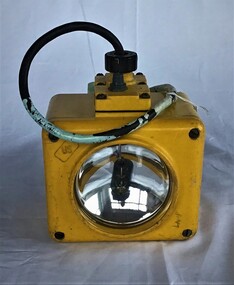
Equipment - Light, electric
... During her career, Canberra was assigned to escort the Royal Yacht Britannia during Queen Elizabeth II's visit in 1988, helped enforce the post-Gulf War United Nations' sanctions against Iraq during 1992 and 1993, was part of the Australian responses to the 1998 Indonesian riots and the 2000 Solomon Islands Civil War, and returned to the Persian Gulf in 2002 as part of the War in Afghanistan. ...During her career, Canberra was assigned to escort the Royal Yacht Britannia during Queen Elizabeth II's visit in 1988, helped enforce the post-Gulf War United Nations' sanctions against Iraq during 1992 and 1993, was part of the Australian responses to the 1998 Indonesian riots and the 2000 Solomon Islands Civil War, and returned to the Persian Gulf in 2002 as part of the War in Afghanistan. ...Removed from HMAS Canberra before being scuttled. HMAS Canberra was an Adelaide class guided missile frigate of the Royal Australian Navy (RAN). Based on the Oliver Hazard Perry class design, Canberra was one of four Adelaide class ships constructed in the United States of America, and one of six to serve in the RAN. The frigate entered service in 1981. During her career, Canberra was assigned to escort the Royal Yacht Britannia during Queen Elizabeth II's visit in 1988, helped enforce the post-Gulf War United Nations' sanctions against Iraq during 1992 and 1993, was part of the Australian responses to the 1998 Indonesian riots and the 2000 Solomon Islands Civil War, and returned to the Persian Gulf in 2002 as part of the War in Afghanistan. In 2005, Canberra became the first ship of her class to be decommissioned. The frigate was marked for conversion into a dive wreck and artificial reef off Barwon Heads, Victoria, and was scuttled on 4 October 2009. Electric emergency light, fixed mountedwarning lights, hmas canberra -
 Lara RSL Sub Branch
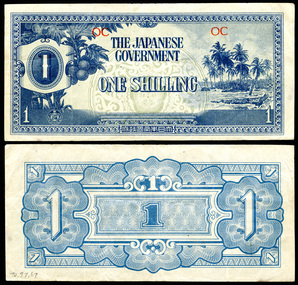
Money, Japanese Goverment One Shilling, 1942
... Geographically, the region of Oceania comprises numerous islands across the vast South and Central Pacific which includes the islands of New Zealand.[1] Certain descriptions may or may not include Australia.[2] Oceania has also been defined by island groupings: Melanesia, Micronesia, and Polynesia.[1][3] However, from a numismatic perspective (i.e., the issuance of Japanese invasion money), Oceania consisted of the occupied territories of Guam, Gilbert and Ellice Islands, Caroline Islands, Marianas Islands, Solomon Islands, Palau, and the now defunct Territory of New Guinea.[4] [5] Although officially called "Oceania" the region was considered a financial and currency union under Japanese colonial dominion that included several political jurisdictions rather than a single polity....Geographically, the region of Oceania comprises numerous islands across the vast South and Central Pacific which includes the islands of New Zealand.[1] Certain descriptions may or may not include Australia.[2] Oceania has also been defined by island groupings: Melanesia, Micronesia, and Polynesia.[1][3] However, from a numismatic perspective (i.e., the issuance of Japanese invasion money), Oceania consisted of the occupied territories of Guam, Gilbert and Ellice Islands, Caroline Islands, Marianas Islands, Solomon Islands, Palau, and the now defunct Territory of New Guinea.[4] [5] Although officially called "Oceania" the region was considered a financial and currency union under Japanese colonial dominion that included several political jurisdictions rather than a single polity. money, paper, currency, japanese, wwii, japan, oceania, shilling, one, occupation, japanese government, blue On the front reads "Japanese Government One Shilling" and on the reverse the number 1. ...The Japanese government-issued Oceanian Pound was one of several issues of Japanese invasion money used during World War II. Consisting of only four denominations, the Oceanian Pound was the shortest set (i.e., total number of denominations) issued. Geographically, the region of Oceania comprises numerous islands across the vast South and Central Pacific which includes the islands of New Zealand.[1] Certain descriptions may or may not include Australia.[2] Oceania has also been defined by island groupings: Melanesia, Micronesia, and Polynesia.[1][3] However, from a numismatic perspective (i.e., the issuance of Japanese invasion money), Oceania consisted of the occupied territories of Guam, Gilbert and Ellice Islands, Caroline Islands, Marianas Islands, Solomon Islands, Palau, and the now defunct Territory of New Guinea.[4] [5] Although officially called "Oceania" the region was considered a financial and currency union under Japanese colonial dominion that included several political jurisdictions rather than a single polity.A blue coloured paper note with picture of fruit and an island beach on the front.On the front reads "Japanese Government One Shilling" and on the reverse the number 1. On the front in red are the letters "OC".money, paper, currency, japanese, wwii, japan, oceania, shilling, one, occupation, japanese government, blue -
 Montmorency–Eltham RSL Sub Branch
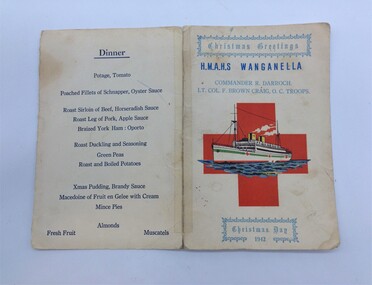
Functional object - Christmas Day Menu H.M.A.H.S. Wanganella
... Between 19 May 1941 and 1946, AHS Wanganella carried wounded and sick evacuees from the Middle East, New Guinea, Solomon Islands, Borneo and the South Pacific, travelling over 251,011 nautical miles (464,872 km) and transporting 13,385 wounded. ...Between 19 May 1941 and 1946, AHS Wanganella carried wounded and sick evacuees from the Middle East, New Guinea, Solomon Islands, Borneo and the South Pacific, travelling over 251,011 nautical miles (464,872 km) and transporting 13,385 wounded. ...During World War II, Wanganella was converted to serve as an Australian Hospital Ship (AHS). Between 19 May 1941 and 1946, AHS Wanganella carried wounded and sick evacuees from the Middle East, New Guinea, Solomon Islands, Borneo and the South Pacific, travelling over 251,011 nautical miles (464,872 km) and transporting 13,385 wounded. A.H.S Wanganella 2/2nd Australian Hospital ship. Ref: "Hospital Ships" Rupert Goodman SLV LT 359.8364 0994 G62H Trip 8 Depart 12th Nov 1942 Melbourne Fremantle Aden 10th - 11th Dec 1942 Port Tewfik, Egypt 21st - 22nd Dec 1942 Colombo, Sri Lanka 01 Jan 1943 Fremantle Adelaide Melbourne Sydney Arrived 13th Jan 1943 Brisbane Wanganella left Colombo 22nd December 1942 for Fremantle, with patients who boarded at Port Tewfik in Egypt arriving on New Year's day 1943. The menu is printed on fawn cardboard. The menu has been torn along the spine and rearranged at some time to put on display. There is evidence of glue or tape damage at the back of each corner of the card. Some grease and finger marks are evident on the front and back of the card. The printing is very legible. The heading 'Christmas Greetings' is at the top of the front page and 'Christmas Day 1942' at the bottom of the page. Originally the menu was assembled as a leaflet with the menu on the inside of the second sheet. Since this time, the menu has been torn along the middle fold and the second page sheet taped to the first page. There is a red cross on the front page with a printed illustration of the Wanganella superimposed over the top. H.M.A.H.S. Wanganella and the dinner menu are printed in dark blue ink. The Christmas greetings and the names of the commander and officer in command of the troops are printed in light blue ink. h.m.a.h.s. wanganella, w.w.ii hospital ship -
 Bendigo Military Museum
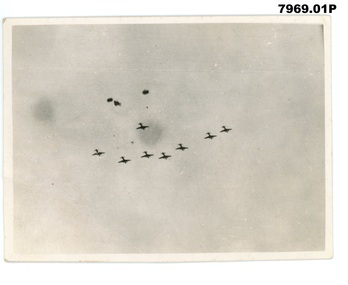
Photograph - ARTHUR GEORGE HOLLEY PHOTOGRAPHIC ALBUM, 10 Photographs HMAS Hobart 1942 Coral Sea and Solomons
... Each description is preceded by an approximate date e.g.1940 06 is June 1940. 1. 1942 05 Coral Sea Japanese aircraft under AA fire.jpg 2. 1942 05 Coral Sea Japanese bombers aircraft under AA fire.jpg 3. 1942 08 HMAS Australia near miss caption three down in that bunch we missed a few.jpg 4. 1942 08 Solomon Islands Hobart white ensign battle flag flying at main mast.jpg 5. 1942 08 Solomons caption a few seconds later another one down this one goes to transports.jpg 6. 1942 08 Solomons caption peaceful and placid waters fury above.jpg 7. 1942 08 Solomons USS Astoria shoots down first high level bomber.jpg 8. 1942 08 Transport on fire off Guadalcanal 9. 1942 08 Solomons American destroyers open up on shore targets.jpg 10. 1942 08 Solomons caption Hobart alters course bombs fall in wake.jpg...HMAS Hobart Arthur George Holley RAN Pacific Theatre Battle of the Coral Sea Solomons Campaign Each description is preceded by an approximate date e.g.1940 06 is June 1940. 1. 1942 05 Coral Sea Japanese aircraft under AA fire.jpg 2. 1942 05 Coral Sea Japanese bombers aircraft under AA fire.jpg 3. 1942 08 HMAS Australia near miss caption three down in that bunch we missed a few.jpg 4. 1942 08 Solomon Islands Hobart white ensign battle flag flying at main mast.jpg 5. 1942 08 Solomons caption a few seconds later another one down this one goes to transports.jpg 6. 1942 08 Solomons caption peaceful and placid waters fury above.jpg 7. 1942 08 Solomons USS Astoria shoots down first high level bomber.jpg 8. 1942 08 Transport on fire off Guadalcanal 9. 1942 08 Solomons American destroyers open up on shore targets.jpg 10. 1942 08 Solomons caption Hobart alters course bombs fall in wake.jpg 10 Photographs HMAS Hobart 1942 Coral Sea and Solomons Photograph ARTHUR GEORGE HOLLEY PHOTOGRAPHIC ALBUM ...Items in the collection relating to ARTHUR GEORGE HOLLEY no 13556 RAN Refer cat no 2134 for his service record. The photographs are from his personal album, and are mainly official photographs widely available among the services. The photographs are from Australian , British and American sources. This set coincides with the Hobart's service around the time of the Battle of the Coral Sea, and her involvement in the Solomons and Guadalcanal landings. Whilst not taken personally, these photographs do capture some of the events Holley and his Hobart crewmates would have experienced and witnessed.Each description is preceded by an approximate date e.g.1940 06 is June 1940. 1. 1942 05 Coral Sea Japanese aircraft under AA fire.jpg 2. 1942 05 Coral Sea Japanese bombers aircraft under AA fire.jpg 3. 1942 08 HMAS Australia near miss caption three down in that bunch we missed a few.jpg 4. 1942 08 Solomon Islands Hobart white ensign battle flag flying at main mast.jpg 5. 1942 08 Solomons caption a few seconds later another one down this one goes to transports.jpg 6. 1942 08 Solomons caption peaceful and placid waters fury above.jpg 7. 1942 08 Solomons USS Astoria shoots down first high level bomber.jpg 8. 1942 08 Transport on fire off Guadalcanal 9. 1942 08 Solomons American destroyers open up on shore targets.jpg 10. 1942 08 Solomons caption Hobart alters course bombs fall in wake.jpghmas hobart, arthur george holley ran, pacific theatre, battle of the coral sea, solomons campaign -
 Phillip Island and District Historical Society Inc.
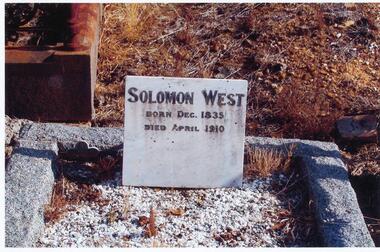
Photographs, West Family, 2004
... Solomon West and his brother John became pioneer settlers on Phillip Island. ...Solomon West and his brother John became pioneer settlers on Phillip Island. Solomon married Elizabeth Bryant in 1857 at St Andres Church of England, Brighton. ...A collection of 3 photographs with a page of notes on the West family. Solomon West and his brother John became pioneer settlers on Phillip Island. Solomon married Elizabeth Bryant in 1857 at St Andres Church of England, Brighton. Elizabeth died in 1895 on Phillip island and is buried in the Phillip Island cemetery. Archie was the son of William and Jane West who died tragically in the Bendigo rail yards at the age of 21. Jane was buried in the same grave in Bendigo. Nellie, William and Jane's 2nd child married Harry Alexander Brown and are buried in the same grave together with Nellie's father, William West.355-01: Coloured photograph of the grave and headston of Solomon West in the Bendigo Cemetry. 355-02: Coloured photograph of the headstone of Archie S. West and Janet West in the Bendigo Cemetry. 355-03: Coloured photograph of the headstone of Nellie Brown, Harry Brown and William West in the Bendigo Cemetry. 355-04: A4 sheets of notes written by Alan West in May 2004 describing the above three photographs and the West family.355-01: On the headstone: Solomon West Born Dec 1835 Died April 1910. 355-02: On the headstone: In loving memory of our beloved son Archie S West, accidentally killed Dec. 7 1911. Aged 21 years. Only "Good Night, Beloved" not "Farewell". Also his mother Janet West. Died July 30, 1938 Aged 79 years. 355-03: On the headstone: In memory of Nellie Elizabeth Brown died Jan 4 1971. Also her husband Harry Alexander Brown and he father William West.the west family phillip island, alan west, bendigo cemetry -
 Flagstaff Hill Maritime Museum and Village
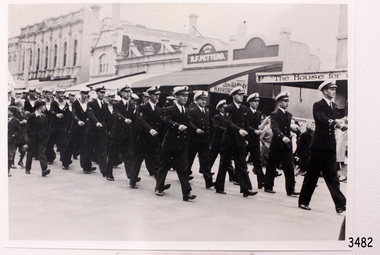
Photograph - Ship's crew, HMAS Warrnambool J202, 1941
... It performed mine clearance work around the Solomon Islands and New Guinea after the war. ...It performed mine clearance work around the Solomon Islands and New Guinea after the war. ...This photograph shows the crew of the first HMAS Warrnambool (J202) marching east along Timor Street in Warrnambool, just opposite the Post Office on the corner of Gillies Street. People are watching the parade from the footpath and two boys, dressed in their ‘best’ clothes, are marching alongside the crew. The HMAS Warrnambool was one of 60 Bathurst class corvette vessels built during World War II for the Royal Australian Navy (RAN) as armed minesweepers. The namesake of the City of Warrnambool, Victoria, was launched in Sydney in 1941. The HMAS Warrnambool began service with patrols off Bass Strait in 1941. In December the ship docked in the Warrnambool harbour at Lady Bay. The crew came ashore and performed a march for the city. The Mayor, Cr. John R Astbury presented them with a plaque of the City of Warrnambool’s Coat of Arms and the Warrnambool Patriotic Fund gave them a gift of 110 books for the crew’s library. The Warrnambool served in Darwin during the time it was bombed, it was involved in several rescues and carried troops to New Guinea, it carried out escort and patrol duties on Australia's east coast, then at Fremantle and back to Darwin. The ship was at Timor when the Japanese surrendered in 1945. It performed mine clearance work around the Solomon Islands and New Guinea after the war. In 1947 the HMAS Warrnambool was at the Great Barrier Reef, off the Queensland coast, to clear the defensive British mines previously laid to protect Australia’s boarders. The ship hit a mine near Cockburn Reef, exploded and sank shortly afterwards. One of the 70 or so men on board was killed and three died later. The rescued men were transferred by boats to the nearby HMAS Swan II, which took the survivors to Cairns. The four deceased were Victorian seamen. In May 1948 the Royal Australian Navy divers recovered a number of items from the wreck, including the ship’s bell and the City of Warrnambool plaque. In 1949 the RAN returned the plaque to the Warrnambool City Council, and donated the ship’s bell to the Australian War Memorial. Further objects were recovered in 1972-75 by Southern Cross Diving and Salvage. A memorial plaque was erected in Warrnambool on September 13, 1995 in honour of all who served on HMAS Warrnambool. NOTE: (1)- HMAS Warrnambool II (FCPB204 was built in 1980 in Cairns, with a compliment of 22 personnel. It was decommissioned in 2005. (2)- SS Warrnambool, a steam and sail ship, was built in 1892 in London and broken up in 1926. [A more detailed history can be found in our Collection Record 3477.]This photograph is significant for its association with the lifesaving rescue of the crew and the sinking Royal Australian Navy vessel, HMAS Warrnambool (J202). The HMAS Warrnambool played a nationally significant role in overturning Australia’s Immigration Restriction Act 1901 (colloquially known as the White Australia policy). The ship rescued, and brought to Australia, Samuel and Annie Jacob and their family after they evacuated Dutch East India. The family was threatened with deportation and made the first successful appeal to High Court regarding that Act. The HMAS Warrnambool has - Local significance for being the namesake of the City of Warrnambool - Local significance, having docked in Warrnambool Harbour - Local significance, the crew having paraded in Timor Street, Warrnambool - State significance for its first patrol being in Bass Strait. - National significance, being present in Timor at the Japanese surrender - National significance, shown by the significance of the ship’s bell being curated as Military Heritage and Technology at the Australian War Memorial. - National significance as part of Australia’s defence force history, being one of only four Bathurst class corvettes lost while in Australian service, the only Bathurst class corvette lost after World War II, the only RAN vessel to be sunk by a mine, and associated with the last four Navy deaths of WWIIPhotograph of the crew of HMAS Warrnambool J202. This black and white image shows the crew marching east along Timor Street in Warrnambool. People are watching from the footpath and two formally dressed boys are marching alongside the sailors. Inscription on the reverse.(PRIVATE details - See Notes)flagstaff hill, maritime village, maritime museum, warrnambool, shipwreck coast, mort's dock & engineering co ltd, h.m.a.s. warrnambool, hmas warrnambool, hmas warrnambool i, hmas warrnambool j202, hmas swan ii, j202, world war ii, bathurst class corvette, royal australian navy, ran, sydney built ship, bass strait patrol, sea mine patrol, mine sweeper, mine clearance, navy divers, great barrier reef, cockburn reef, southern cross diving and salvage, warrnambool city council, cr j r astbury, mayor j r astbury, warrnambool patriotic fund, seal, coat of arms, dedicatory plaque, hmas warrnambool 1941, shipwreck by sea mine 1947, sinking ship, sunk ship, marching, parade, timor street warrnambool, minesweeper -
 Colac RSL Sub Branch
Document (item) - THE LIFE HISTORY OF HMAS COLAC
... IN MAY, COLAC PROCEEDED TO BOUGAINVILLE, IN THE SOLOMON ISLAND WHERE SHE TOOK PART IN OPERATIONS TO PREVENT JAPANESE TROOPS ON CHOISEUL ISLAND, FROM EVACUATING TO BOUGANVILLE, AND TO HARASS THE ENEMY AND TO DESTROY THEIR INSTALLATION ON THE COAST. ...IN MAY, COLAC PROCEEDED TO BOUGAINVILLE, IN THE SOLOMON ISLAND WHERE SHE TOOK PART IN OPERATIONS TO PREVENT JAPANESE TROOPS ON CHOISEUL ISLAND, FROM EVACUATING TO BOUGANVILLE, AND TO HARASS THE ENEMY AND TO DESTROY THEIR INSTALLATION ON THE COAST. ...HMAS COLAC WAS LAUNCHED ON 30 AUGUST 1941 AT MORTS DOCK SYDNEY. ONE OF SIXTY MINESWEEPERS, (CORVETTES), BUILT DURING WW11. TWENTY SIX WERE BUILT FOR THE ROYAL AUSTRALIAN NAVY, COMMISSIONED AT SYDNEY ON THE 6TH JANUARY1942. LATER IN JANUARY1942, COLAC WAS ASSINGED TO ANTI-SUBMARINE PATROL, OPERATION BETWEEN TOWNSVILLE AND NEW GUINEA. IN DECEMBER 1942 COLAC AND HER SISTER SHIPS, BALLARAT AND BROOME WERE ASSIGNED TO TRANSPORT AUSTRALIAN TROOPS TO THE BUNA AREA. THE THREE VESSELS REACHED THE LANDING POINT, AT CAPE SUDEST,NEAR ORO BAY. ALL 762 TROOPS LANDED SUCCESSFULLY. DURING THE REMAINDER OF THE MONTH COLAC WAS INVOLVED IN TROOP CARRYING. IN MARCH 1943, COLAC DETACHED FROM OPERATIONS IN FORWARD AREAS AND WAS ASSINGED TO CONVOY ESCORT DUTY ON THE AUSTRALIAN EAST COAST. ENEMY SUBMARINES WHERE OPERATING IN THE AREA, AND ON THE 26TH APRIL, A CONVOY OF FIVE SHIPS, ESCORTED BY COLAC AND BALLARAT WERE ATTACKED ABOUT 20 MILES OFF CAPE BYRON. THE BRITISH SHIP, M V LIMERICK WAS HIT BY A TORPEDO AND SANK. COLAC RESCUED ALL BUT TWO OF THE LIMERICKS CREW. JULY 1943 COLAC RETURNED TO THE ESCORT, OF CONVOYS BETWEEN AUSTRALIA AN NEW GUINEA, WHICH KEPT HER ALMOST CONSTANTLY AT SEA FOR THE REMAINDER OF THE YEAR. IN JANUARY 1944 SHE RESUMED ESCORT DUTIES OFF THE EAST COAST FOR CONVOYS, FOR A BRIEF PERIOD. THE SHIP RETURNED TO NEW GUINEA WATERS IN 1944 AND 1945. EARLY 1945 COLAC, IN THE COMPANY OF HMAS SWAN AND SISTER SHIP HMAS DELORAINE, AND HMAS DUBBO, GAVE BOMBARDMENT SUPPORT TO OPERATIONS IN THE WEWAK AREA. TARGETS INCLUDED MUSCHA ISLAND, KAIRISU ISLAND ,AND CAPE SAMIER AND WEWAK. IN MAY, COLAC PROCEEDED TO BOUGAINVILLE, IN THE SOLOMON ISLAND WHERE SHE TOOK PART IN OPERATIONS TO PREVENT JAPANESE TROOPS ON CHOISEUL ISLAND, FROM EVACUATING TO BOUGANVILLE, AND TO HARASS THE ENEMY AND TO DESTROY THEIR INSTALLATION ON THE COAST. DURING THESE OPERATIONS COLAC SUBTAINED HER FIRST CASUALTIES. ON THE 26 MAY SHE RECEIVED TWO HITS FROM ENEMY SHORE BATTERIES. THE FIRST KILLED TWO RATINGS. AND WOUNDED TWO OTHERS, WHILE THE SECOND SHELL STRUCK THE SHIP ON THE WATERLINE. AFTER THROWING ALL DEPTH CHARGERS AND FITTINGS OVERBOARD ,SHE WAS ABLE TO PROCCEDTO TREASURY ISLAND; BUT HAD TO BE TAKEN UNDER TOW TO BLANCHE HARBOUR. AFTER REPAIRS, SHE WAS TOWED TO FINSCHHAFEN IN NEW GUINEA. FROM THERE THE COLAC WAS SENT TO SYDNEY. SHE ARRIVED ON 18TH JUNE 1945, TO GO INTO DOCKYARD HANDS. THE SHIP WAS STILL IN DOCKYARD HANDS WHEN THE HOSTILITIES ENDED ON 15 AUGUST 1945. SHE WAS THEN COMMISIONED INTO RESERVE, AT SYDNEY ON 27 NOVEMBER 1945, WITHOUT BECOMING OPERATIONAL. SHE STEAMED 199,991 MILES SINCE COMMISSIONING. ON 20 FEBURAY 1951 COLAC RECOMMISSIONED FOR SERVICE AS A TRAINING SHIP FOR NATIONAL SERVICE TRAINEES AND NAVAL RESERVE PERSONNEL. SHE SERVED ON THE AUSTRALIAN STATION FOR TWO YEARS. PAID OFF INTO RESERVE AT SYDNEY ON 30 JANUARY 1953 SHE HAD STEAMED A FURTHER 33,317MILES . AFTER NINE YEARS IN RESERVE, COLAC WAS TAKEN IN HAND IN 1962 FOR CONVERSION TO A TANK CLEANING VESSEL .COLAC CEASED SERVICE AS A TANK CLEANING VESSEL ON THE 30 SEPTEMBER 1983. HMAS COLAC WAS SUNK BY A MK48 WARSHOT TORPEDO FIRED BY HMAS OVENS OFF JARVIS BAY ON 4 MARCH 1987 NUMBER J2422nd world war -
 Uniting Church Archives - Synod of Victoria
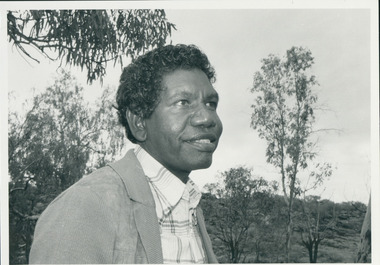
Photograph, Rev. Djiniyini Gondarra, 1986
... In 1969 he trained as a Minister in Papua New Guinea and the Solomon Islands under the Uniting Church, before returning to Arnhemland to minister his own people at the Galiwin’ku parish, firstly as a lay pastor (1971-1972) and then as a Minister from 1976-1982. ...In 1969 he trained as a Minister in Papua New Guinea and the Solomon Islands under the Uniting Church, before returning to Arnhemland to minister his own people at the Galiwin’ku parish, firstly as a lay pastor (1971-1972) and then as a Minister from 1976-1982. ...Rev Dr Djiniyini Gondarra OAM, was born in Milingimbi, eastern Arnhemland in 1945. He was educated at Milingimbi Mission School and pursued his theological education as a youth leader and Sunday School teacher through the Methodist Church, before attending college in Brisbane. In 1969 he trained as a Minister in Papua New Guinea and the Solomon Islands under the Uniting Church, before returning to Arnhemland to minister his own people at the Galiwin’ku parish, firstly as a lay pastor (1971-1972) and then as a Minister from 1976-1982. In 1983-84, Rev Djiniyini worked as a Lecturer in Theology at Nungalinya College, Darwin. He was honoured with a Diploma of Theology (Honorary) from there in 1984, and in 1991 received a Cultural Doctorate in Literature (Honorary) from the World University, Roundtable, Arizona USA. Rev Djiniyini was awarded the Order of Australia Medal (OAM) in 1995. As well as being the Chairman of ALPA since 1993, Rev Djiniyini is currently the Director of Duduy’ngu Pty Ltd, which provides consultancy and cross-cultural services. He is also Director of Yirrkala Business Enterprises. Over the years, Rev Djiniyini has served on many committees and councils including: Member of the Steering Committee of the Australian Indigenous Cultural Network (1998-2001), CEO of Aboriginal Resource and Development Services Inc (1998-2001), CEO of the Northern Regional Council of the Uniting Aboriginal and Islander Christian Congress (1998-2001), Director of Reconciliation Australia Limited (2000-2001), Member of Council for Aboriginal Reconciliation (1998-2000), Chairman of Uniting Aboriginal and Islander Christian Congress (1995-2000 & 1990-1993), Member of Central Committee of the World Council of Churches (1991-1994), Moderator of Northern Synod, Uniting Church in Australia (1985-1987), Secretary of newly formed Aboriginal Presbytery, Northern Synod, Uniting Church in Australia (1985), and Vice-President of Uniting Aboriginal and Islander Christian Congress Uniting Church in Australia (1983-1987). Rev Dr Djiniyini Gondarra OAM has also been extensively published, and his works include: • Information Papers (co authored), Aboriginal Resource and Development Services: • Confusion Between Cultures (1998) • MHead & Shoulders of Djiniyini Gondarra facing right of picture."Rev. Djiniyini Gondarra 1986. Moderator Northern Synod and Vice President of Uniting Aboriginal and Islander Christian Conference."gondarra, djiniyini, uaicc, northern synod uca -
 Flagstaff Hill Maritime Museum and Village
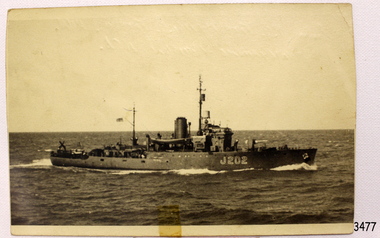
Photograph - Vessel, Steam Ship, H.M.A.S. Warrnambool J202, Between 1941-1947
... It performed mine clearance work around the Solomon Islands and New Guinea after the war. ...It performed mine clearance work around the Solomon Islands and New Guinea after the war. ...This photograph is connected to the first HMAS Warrnambool (J202), which was one of 60 Bathurst class corvette vessels built during World War II by Mort's Dock & Engineering Co Ltd of Sydney under the commission of the Royal Australian Navy (RAN). It was the namesake of the City of Warrnambool in Victoria. The armed minesweeper was 57 metres long and could had a complement of 85 personnel. Its armament included 1 × 4 inch Mk XIX gun, 1 × 40 mm Bofors AA gun (installed later), 3 × 20 mm Oerlikon guns (1 later removed), machine guns and depth charge chutes and throwers. It was launched in Sydney in May, 1941. The HMAS Warrnambool began service with patrols off Bass Strait in 1941. In December the ship docked in Warrnambool Harbour and the crew marched in a parade along Timor Street. The ship’s crew received a donation of 110 books from the Warrnambool Patriotic Fund, and a plaque of the City of Warrnambool’s Coat of Arms presented by the Mayor, Cr. John R Astbury. In September 1942 a Dutch East Indies family, Samuel and Annie Jacob and seven of their eight children, was rescued by the HMAS Warrnambool and evacuated to Darwin. The family settled in Melbourne, then in 1944 Samuel tragically died. After the war ended the family was threatened with deportation under Australia’s Immigration Restriction Act 1901 (known also as the White Australia policy). Annie married her landlord, John O’Keefe but was still issued a deportation order in 1949. The family appealed to the High Court and the case became famous for being the first successful legal challenge to the Act. The HMAS Warrnambool was in Darwin during the time it was bombed, attacked by the Japanese while rescuing 73 crew from a merchant vessel that had also been attacked. The ship was involved in several other rescues and carried troops to New Guinea. Other events included escort and patrol duties on Australia's east coast, then at Fremantle and back to Darwin. When the Japanese surrendered on September 11, 1945, at the end of World War II, the ship was at Timor. It performed mine clearance work around the Solomon Islands and New Guinea after the war. On 13th September 1947 the ship was sent to lead a flotilla at the Great Barrier Reef, off the Queensland coast. The mission was to clear the defensive British mines that were laid during1941-43 to protect Australia’s boarders. The HMAS Warrnambool hit a mine near Cockburn Reef, exploded and sank shortly afterwards. One of the 70 or so men on board was killed at the time and thirty-two men were badly injured; three of these also lost their lives. The four deceased were Victorian seamen. The wounded men were transferred by boats to the nearby HMAS Swan II, where the Swan’s and the Warrnambool’s doctors cared for them. The HMAS Swan II took the survivors to Cairns, and from there the men were flown by RAAF to either Brisbane or Sydney hospitals. The HMAS Warrnambool was the only RAN ship to be sunk by a mine, and the four who lost their livers were the last naval casualties from World War II. The ship’s wartime service was recognised by three honours. In May 1948 a number of items were recovered by Navy divers from the wreck of HMAS Warrnambool. The items included the ship’s bell (inscribed HMAS Warrnambool 1941) and the round plaque with the Seal of the Warrnambool City Council. In 1949 the plaque was returned to the Council, and the bell was donated to the Australian War Memorial. Further objects were recovered by the new owners of the wreck, Southern Cross Diving and Salvage, in 1972-75. A memorial plaque, honouring the memories of all those who served on the HMAS Warrnambool until is sunk on September 13 1947, was erected in Warrnambool on September 13, 1995. NOTE: (1)- The second HMAS Warrnambool (FCPB204), also the namesake of the City of Warrnambool, was built in 1980 in Cairns, one of fifteen Fremantle Class Patrol Boats ordered by the RAN. It was just over 41 metres long with a compliment of 22 personnel. It patrolled Australia’s northern waters for illegal fishing vessels. This vessel was decommissioned in 2005. (2)- There was also a steam and sail ship named the S.S. Warrnambool, built in 1892 in London and broken up in 1926.This photograph is significant for its association with Royal Australian Navy and its vessel, HMAS Warrnambool (j202). The HMAS Warrnambool played a nationally significant role in overturning Australia’s Immigration Restriction Act 1901 (colloquially known as the White Australia policy). The ship rescued, and brought to Australia, Samuel and Annie Jacob and their family after they evacuated Dutch East India. The family was threatened with deportation and made the first successful appeal to High Court regarding that Act. The HMAS Warrnambool has - Local significance for being the namesake of the City of Warrnambool - Local significance, having docked in Warrnambool Harbour - Local significance, the crew having paraded in Timor Street, Warrnambool - State significance for its first patrol being in Bass Strait. - National significance, being present in Timor at the Japanese surrender - National significance as part of Australia’s defence force history, being one of only four Bathurst class corvettes lost while in Australian service, the only Bathurst class corvette lost after World War II, the only RAN vessel to be sunk by a mine, and associated with the last four Navy deaths of WWIIBlack and white photograph of vessel H.M.A.S. Warrnambool J202 on an open sea. The identifying number is painted on the hull. The ship is flying a white ensign. A lifeboat is suspended near the centre of the ship. Figures can be seen on deck. Hand written inscription on the reverse side. On ship's hull "J202" On reverse of photo "From P.O. FRED MATTHEWS. 23378. R.A.N." "MARIBYRNONG MAIDSTON RSL" "H.M.A.S. WARRNAMBOOL"flagstaff hill, warrnambool, shipwrecked-coast, flagstaff-hill, flagstaff-hill-maritime-museum, maritime-museum, shipwreck-coast, flagstaff-hill-maritime-village, photograph, h.m.a.s. warrnambool, maritime village, maritime museum, shipwreck coast, mort's dock & engineering co ltd, hmas warrnambool, hmas warrnambool i, hmas warrnambool j202, hmas swan ii, j202, world war ii, bathurst class corvette, royal australian navy, ran, sydney built ship, bass strait patrol, sea mine patrol, mine sweeper, mine clearance, navy divers, great barrier reef, cockburn reef, southern cross diving and salvage, warrnambool city council, cr j r astbury, mayor j r astbury, warrnambool patriotic fund, seal, coat of arms, ship’s bell, hmas warrnambool 1941, shipwreck by sea mine 1947, sea rescue, life saving, lifesaving, sinking ship, sunk ship, immigration restrictions act 1901, white australia policy, samuel and annie jacob, john o'keere, minesweeper -
 Federation University Historical Collection
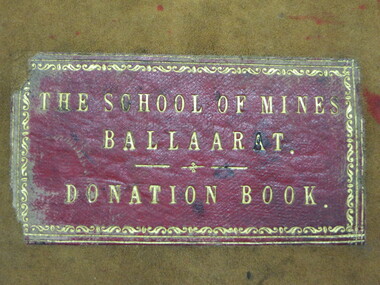
Book - Ledger, Ballarat School of Mines Donation Book, 1878 - 1895, 1878-1895
... Crisp, Bacchus Marsh, Portugal Copper Coin, 1785
1248 James Oddie, Solomon Islands - Bow and arrows & Spears
1285. ...Crisp, Bacchus Marsh, Portugal Copper Coin, 1785
1248 James Oddie, Solomon Islands - Bow and arrows & Spears
1285. ...The Donation Book relates to the Ballarat School of Mines Museum which opened in 1872. Very few of these items are still held by Federation University. The Museum was emptied in the 1960s with items being distrubuted to the Ballarat Historical Society, returned to original lenders (ie Pern Collection), of disposed of. Donations to the Ballarat School of Mines include: 34. M. Hamburger, Ballarat - bunsen burner 41. W.H. Shaw, Phoenix Foundry - 81 nos of 'Engineer' 89. Juvenile Industrial Exhibition Association Committee per Joseph Flude - dies used for striking medals awarded to successful exhibits. 165. Ferdinand Von Mueller 172 Ferdinand Von Mueller o hortus siccus 6 197. James Stoddart 203. Edward Gazzard, North Creswick - Model of safety Cage invented and made by donor 218. E. Morey 222. Alfred Lestor 228. J.J. Sleep, Ballarat, patent Lever escarpment Clock (displayed in laboratories) 237. Bernard Smith (Warden) per favor of James M. Bickett - Bust of Mr John Lynch, Smythesdale. (Note: This item is not in the present Federation University Historical Collection) 241. James Oddie, J.P., Ballarat, Copy of 'the Chemist and Druggist' 267. John Lynch Junior, Smythesdale - Cast of "Golden Age" nugget, found at Browns by Co-operative party, 12 men. Weight 75 oz, 12 dwts, 12 grs.(Note: This item is not in the present Federation University Historical Collection) 270. Isaac Davis, Main Road, Ballarat 294. W. H. Shaw, Ballarat - 94 nos of 'The Engineer' 295. Rivett Henry Bland, Clunes - Specimen of water pipe from the Port Phillip Company's mine encrusted with carbonites of lime and magnesium (Note: This item is not in the present Federation University Historical Collection) 299. D.J. Williams, Queenscliff - 1 case shells from Fiji 305. C. Retallack, Ballarat 314. William Henry Shaw, Ballarat - glass case 323. W. Longley, Ballarat - Botanical Specimen (Note: This item is not in the present Federation University Historical Collection) 327. W. H. Angove, Perth 337. J. Cosmo Newbery, B Sc, Melbourne 343. James Hector, M.D., New Zealand 353. R.S. Mitchell, Ballarat - 8 specimens live plants (medicinal) (for the Ballarat School of Mines Garden) 355. W. Magee, Ballarat - Sugar cane plants and seeds (for the Ballarat School of Mines Garden) 363. James Hector, Wellington, new Zealand 371. William Wesley, 28 Essex St, Strand, London - Scientific book circular 380. Jacob Upfold (deceased) per favor of the trustees - bequest of steam engine indicator and belongings (boothe and case) 381. Joseph Mitchell, 22 Macarthur Street, Ballarat - sod of turf cut from Warboy's High Few, County Huntingdon, England, 1872. 394. W.H. Barnard 401. James Orr 418. F. Ratte, Sydney 440. Alfred Mica Smith, Sandhurst (Bendigo), Inaugural Address, delivered to the Bendigo School of Mines Science Society, June 20. 1881 by P.H. Macgillivray, MA, MRCS, FLS, President. (Note: This item is not in the present Federation University Historical Collection) (Note: This item is not in the present Federation University Historical Collection) 446. C. C. Shoppee, Ballarat 462. Dr Bunce, Ballarat 468. James Black, Mining Manager "Kerrit Bureet' 479. J.S. North, Mining Manager No. 2 Queen Co, Black Hill Ballarat. 505. Smith Tibbitts - A block of ancient leaves from the Nigtingbool Estate near Haddon on the Ballarat district from shaft 80 feet deep. (Note: This item is not in the present Federation University Historical Collection) 512. F.W. Niven, Ballarat - "A Handy Book to Tasmania" 522. James Hector, Wellington, New Zealand 549. C.E. Grainger, Manager Ballarat Woollen Mills - samples of dyed and raw wools 600. (4 July 1882) Henry Sutton, Ballarat - 13th annual report of the Aeronautical Society of Great Britain; 2 papers from the Proceedings of the Royal Society, nos 217 and 218- 1882, "One a new electrical storage battery by Henry Sutton, Ballarat, Victoria. 608. H. Glenny J.P., Ballarat - Specimen of Asbestos from Tasmania 610. M.H. Edelmann, Munich, Germany 674. W.H. Shaw, Phoenix Foundry - Steel boring 95 feet long taken from bed-plate of locomotive engine. 675 - H.R. Hancock J.P. pre favour Mr James Pryor, Moonta Mines 676. Baron Ferdinand Von Mueller KCMG, etc, Melbourne 678. E.F.A. Gaunt, Royal Navy, H.M.S. Nelson, per favour Lyde Gaunt - Specimen of manganese ore from the mines - Russell - New Zealand 728. Dr Pinnock, Ballarat 760. Simon Morrison, Ballarat 784. James Shugg, Hamilton - 1 case fossils from Muddy Creek, near Hamilton. (Note: This item is not in the present Federation University Historical Collection) 786. W. Bolam (inspector of Schools), Melbourne - 2 spears and 1 fishing prong Fijian 806. James Oddie, Ballarat 708. Henry G. Hanks, San Francisco 786. W. Bolam (Inspector of Government Schools Melbourne) - 2 spears and one fishing prong Fijian 824. Henrique Gorceixm Onro Preto, Brazil 840. W. Laplau, Ballarat - Gas furnace with a large assortment of fittings, also large gas holder and oil-heating apparatus 854. Robert Borch, Main Road, Ballarat - Improved safety chain (Note: This item is not in the present Federation University Historical Collection) 928. James Oddie 944. James P. Munroe, Registrar, Massachusetts 952. L.E. Cutter per favour of Mr F.J. Martell - Unexploded bomb shell from the Eureka Stockade 957. H. Glenny, Hobart 962. George Hart, Ballarat - eagle 976. Henry Sutton, Ballarat - 1 volume "Plattner on the Blowpipe" 978. J.W. Flatow, 45 Madeline Street, Carlton, Melbourne 984. Charles C Shoppee Ballarat - Copies of ancient coins 989-95 - Specimens from Moonta, South Australia 985. W.H. Wooster BOlwarra - books microscope related 1179. James Oddie - Live hedgehog 1181 C. Crisp, Bacchus Marsh, Portugal Copper Coin, 1785 1248 James Oddie, Solomon Islands - Bow and arrows & Spears 1285. C. Colyer, Smythesdale 1327. John L. McKenna, Smeaton - Fragment of Stone Axe. 1395. Mrs O. Skoglund, Nerrina 1428. Daniel Brophy, Ballarat - Collection of mineral specimen form Silverton (Collected by Mrs James Murray) 1442. Henry Sutton, Ballarat - Specimens of fossil fruits collected at Haddon by Charles Brown. 1444. Mining Department - Underground Mine Workings from Band of Hope and others. 1517. W.H. Wooster, Ballarat 1592. Bishop of Ballarat - Stone Axe and other native items 1669. H. McHaffier, Napoleons - 1 Spanish silver coin 1681. James Oddie, Dunedin 1688. W. Burbridge, Ballarat - Native Tomahawk from Metung 1708. A. Doepel, Ballarat 1712. Marty Guerin, Ballarat 1735. Bella Guerin. M.A., Ballarat - Copy Wide Awake Vol 1 No 7 May 28th 1887 and The Bulletin, March 19th 1887. 1747. Bella Geurin M.A., Ballarat - Copy Wide Awake Vol 1 No 8 June 4 1887 1751. Bella Geurin M.A., Ballarat - Copy Wide Awake Vol 1 No 9 June 11th 1887 1842. Linnean Society, London England - Charter, By Laws, Proceedings, Transactions, Journals 1853. W.J. Corbould, Silverton, NSW - chloride of silver from Pinnacles, Broken Hill, Silverton 1888. W. J. Corbould, Sample of metallic silver from Silverton, NSW 1928. E. Morey, Ballarat - Steam Engine 1937. Henry Sutton A.S.I.E., Ballarat - Plate Electric Machine, chimes and Sportman (number crossed out) 1951. Henry Sutton A.S.I.E., Ballarat - Plate Electric Machine, chimes and Sportman 1981. Harrie Wood (per W.H.B.[Barnard?), Ballarat 1996. W.H. Shaw, Phoenix Foundry - Papers "The Vict Engineer July 1887, May June July August 1888 and others 2014. Harrie Wood, Sydney - Report Department of Mines, 18872027. W.J. Bechervaise - Copy of Book by Baldwin Spencer 2034. A.G. Randall - Native Hatchet 2045. W.H. Corbould, Silverton, Collection of silver ores 2051. Fowler, Tarnagulla - Native Tomahawk 2123-2131. James Oddie, London 2163. Roff. F. Taplier, Sturt Street - Native Tomahawk 2178. Syd. Johnson, Meredith - Native Tomahawk, Greenstone 2184. Mr Tupp for Hall - Native Spear and Club 2292. Emmanuel Steinfeld, Melbourne 2313. A. Atwood, Rowlands Factory, Dana Street 2361. Dr Pinnock, Ballarat - Collection of Living Sponges 2363. P. Curnow, Ballarat - Piece of wood with stone naturally embedded 2364. R. Dowling, Waubra 2875. Mrs C, Flude, Ballarat - Collection of (5) mineral specimens 3460. Joseph Weir, Ballarat - Sample of rolled Annibar 3466. J. Hart, Ballarat - Native Shield - supposed to have been made by King Billy 4784. Mr. O. Woolnaugh, Pleasant Street - Four Native Tomahawks 6469. L. Balhausen, Ballarat 3472. John English, Smeaton - three samples of auriferous wash dirt 3607. Columbia College, New York - Handbook of Information of the Columbia College in the Ciry of New York 1892-3. 3672. L.A. Samuels, Bendigo 3724. P. Paperhagen 3736. The Late Rivett Henry Bland per John Noble Wilson - Collection of mineral specimens and fossils 3752. G.A. Denny, South Africa 3755. J. Carroll, Ballarat - Specimen of Native bread found in Ballarat East. 4765. J. Donnelly, Springs, Bungaree I. Fowler, Coolgardie, Specimen of Gold Bearing Quartz ballarat school of mines, doantions, museum, ballarat school of mines museum, safety cage, botanical garden, materia medica garden, library, bella guerin, james oddie, phoenix foundry, w.h. shaw, john lynch, henry sutton, aboriginal, stone axe, tomahawk, geological specimens, moonta, fedinand krause, oddie collection of minerals, thomas bath, spears, solomon islands, king billy, bows and arrows, ancient coins, birds eggs, snakes
