
Showing 13 items matching "south australian school of mines and industries"
-
 Federation University Historical Collection
Letter, Letter from Alfred G Higgins to J. Martell
... ...South Australian School of Mines and Industries...Higgins from the South Australian School of Mines and Industries to J. Martell Ballarat School of Mines ....Martell was head of the School of Mines which is a predecessor of Federation University Ballarat School of Mines South Australian School of Mines and Industries J. ...J. Martell was head of the School of Mines which is a predecessor of Federation UniversityLetter from Alfred G. Higgins from the South Australian School of Mines and Industries to J. Martell Ballarat School of Mines .ballarat school of mines, south australian school of mines and industries, j. martell, alfred g. higgins -
Federation University Historical Collection
Booklet - Annual Report, Ballarat School of Mines, Ballarat School of Mines Annual Report, 1969, 1969
... Diploma School - The Ballarat Institute of Advanced Education (A division of the School of Mines and Industries, Ballarat) 2. Trades School - The Ballarat School of Industries (A division of the School of Mines and Industries, Ballarat) 3. ...This annual report was one year before the opening of the new tertiary division at Mt Helen. Council decided to retain the overall title "The School of Mines and Industries, Ballarat" for the foreseeable future, but to separately name the three divisions as follows: 1. Diploma School - The Ballarat Institute of Advanced Education (A division of the School of Mines and Industries, Ballarat) 2. Trades School - The Ballarat School of Industries (A division of the School of Mines and Industries, Ballarat) 3. Secondary School - The Ballarat Technical School (A division of the School of Mines and Industries, Ballarat). The annual report also foreshadowed the Centenary of the School (and technical education in Australia) in 1970. Speaker at the trade Prize Night and Apprenticeship Week was W.J. Anderson, and Craftsmen Certificates were presented by the Ballarat City Council. A number of quarto pages with stapled inside a brown card cover. The report was for the year ended 30 June 1969, and was delivered by Ballarat School of Mines President M.B. John. Page 5 lists the Diplomas awarded. Page 6 lists the scholarships, prizes and awards, including the Josephine Brelaz Scholarship, Martha Pinkerton Scholarship, Frank Pinkerton Scholarship, Mica Smith/Serjeant/Ironworkers Scholarship, Ballaarat Has Comapny Scholarship, Ballaarat City Council Scholarship, R.W. Richards Medal. Page 8 covers buildings and accommodation. Conditions were cramped at Lydiard Street , with conditions hoped to be improved when the Stage I buildings at Mount Helen were completed in the following year. Mount Helen Master Plan was undertaken by Joint site planners G.J. Harrison, staff architect at the Flinders University of South Australia. and messrs L.H. Vernon and associates, of Ballarat. The following staff members retired: A.L.H. Aldersey; J.V. Crotty; M. Page; J.Ralston; P.J. Smith, P.B. Todd; Derek Wooley; Mr Goldfinch. TRADE DIVISION: F.D. Hamilton, J. Moran, D.Drake The following new lecturing appointments were made during the year: G.I. Boyd; E.W. Butters; D.R. Dowling; P.D. Kelly; G.J. medwell; R.E. Northey; C.A. Pogliani; R.H. Pyke; Roy Schrieke; B.J. Shearer, D.J. Stabb, T.W. Sweatman; A.C. Turner; D.G. Williams; C.M. McGarry. The Computer centre was enlarged when Arch MacKinnon was transferred as Mathematics lecturer to Computer Manager. J.A. Wilson was the computer operator, and R. Kopke, E. Dykstra and V. Gay were Card Punch Operators. Preliminary work on the new Brewing and Malting course was continuing, and plans were being made for the commencement of courses in Librarianship and General Studies. A Halls of Residence Committee had held meetings to explore the type of student accommodation required. ballarat school of mines, library, m.b. john, stohr, robertson, beanland, graeme beanland, arthur nicholson, m.j. brown, anderson, rex hollioake, w.j.c. north, patterson, smail, w.g. smith. sutton, e.j. tippett, webb, white, yandell, mount helen, scholarship, martha pinkerton, josephine brelaz, graham beanland -
 Federation University Historical Collection
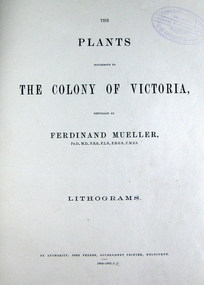
Book, The Plants Indigenous to the Colony of Victoria, 1865 (exact); "1864-1865, CR"
... , Industries & Science, Ballarat. Ingenio Effodere Opes. ...Baron Sir Ferdinand Jacob Heinrich von Mueller was born in Germany on 30 June 1825. Ferdinand was a German-Australian physician, geographer, and a botanist. After passing the pharmaceutical examinations he studied botany at Kiel University. In 1847 he received the degree of Doctor of Philosophy from Kiel University.when he was 21 years old for a thesis on the flora of Schleswig-Holstein. In 1847, he moved to Adelaide, Australia and worked as a chemist. From 1848 to 1852 he travelled through the colony, discovering and describing a large number of unknown to Western science plants. He wrote a few papers to German periodicals on botanical subjects. In 1851, Mueller moved to Melbourne, capital of the new colony of Victoria. In 1853, He was appointed Government Botanist for Victoria by Governor Charles La Trobe. In 1873, Ferdinand received an honorary doctorate of the University of Rostock. In 1883, he was awarded the Clarke Medal by the Royal Society of New South Wales. He published many volumes on the Victorian plants. Many of Australian geographical features were named after him such as: the Mueller Ranges (WA), Muellers Range (Qld), Mount Mueller (in WA, NT, Tas and Vic) and many more. Mueller died in Melbourne on 10 October 1896 and is buried in the St. Kilda Cemetery A green cloth hard cover book. Title and author's name is engraved in gold on spine. It includes an introduction, a table of contents and plates. Lithograms in b/w. Each plate accompanied by a page with descriptive print. Number of plates XIII-LXXI. No. of supplement plates XII-XVII. The book illustrates Victorian plants and outlines the principal characters of those species. This book is No 1290 in the Original Register of Books (Cat. No. 005)Hand written pencil notes on contents page. Stamped throughout with "The School of Mines, Industries & Science, Ballarat. Ingenio Effodere Opes. In the University of Melbourne."australia, botany victoria, plants, ferdinand mueller, ferdinand von mueller, biodiversity, flora -
 Federation University Historical Collection
Booklet, The Ballarat School of Mines and Industries 1870-1920 Jubilee Booklet, 1920 (estimated)
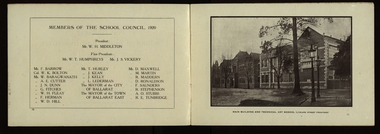
... School continued to grow in reputation and size, and became the science centre of the district, and in 1889 a learge new building was opened by Sir Alexander Peacock. Students came from over seas as well as from all the States of Australia, and after going through their courses they took with them the name and fame of the old School to all parts of the globe. School of Mines boys have played a great part in developing the mining fields of Western Australia, South...The Ballarat School of Mines and Industries 1870-1920 Jubilee Booklet Booklet ...The first school of Mines in Australia was established at Ballarat in 1870. At the time of its jubilee (1930) the following people were members of the School Council: W.H. Middleton (President), W.T. Humphreys (VP), J.S. Vickery (VP), F. Barrow, Col. W.K. Bolton, William Baragwanath, A.E. Cutter, J.N. Dunn, G. Fitches, W.H. Fleay, F. Herman. W.D. Hill, T. Hurley, K. Kean. J. Kelly, L. Lederman, Mayor of Ballarat, Mayour of Ballarat East, D. Maxwell, M. Martin, R. Maddern, D. Ronaldson, F. Saunders, R. Stephenson, A.O. Stubbs, R.E. Tunbridge. The School Staff in 1920 comprised: Herbert H. Smith, Walter Rowbotham, Reginald L. Cutter, M.C. Young, Hilda Wardle, M. Wiliamson, P.S. Richards, L.H. Archibald, J. Woods, Ken Moss, W. Kenneth, Mrs McIlvena. B. Robinson, S. Rowe, E. Hope-Jones, Miss Abrams, L.St.G.P. Austin, Alfred Mica Smith, J.R. Pound, Herbert R. Murphy, N.H. Junner, Maurice Copland, L.H. Archibald, E.J.A. McConnon, Newton King, D.m. Hull, T.R. Gordon, John M. Sutherland, T.K. Jebb, Dick Richards, C. Tonkin, A.W. Steane, J. Paterson, H.W. Malin, R.V. Maddison, S.M. Mayo, F.A. King, W.H. Steane, T.R. Gordon, T.A. Williams, H. Waldron, G. Black, E.J. McConnon, R.V. Duncan. R. Cutter, E.G. Vawdrey, Hilda WardleWhite stapled booklet - landscape format - 20pp + soft covers with blue writing. Includes an historical sketch of the Ballarat School of Mines. Contains images of the school from around 1920. The history outlined in the booklet follows: 'Ballarat has helped to influence the life and destinies of Australia in many ways, the recital of which would perhaps prove tedious to the citizens of less favoured localities! However, it can be said, without much fear of contradiction, that only less known thought Australia than its fame as a gold field is the reputation won for it by its school of Mines, ... Ballarat was still quite a new place when the School was founded, but a very propserous and popular place all the same, with a go-ahead lot of citizens brim full of the spirit of enterprise which seemsto animate mining populations generally. Money was plentiful, and they launched out into ventures, which later, were to develop and take the place of the gold mines, while what is more to the point, they understood the value of education. the old digging days were passing away. So far as Ballarat itself was concerned the day of the cradle and tin dish had already passed into an antiquity "as dead and distant as the age of the Tubal Caon," said dir redmond Barry on declaring the School open. Mining had become a serious business, and the mining engineer, the metallurgist, and the geologist had become a power in the land. In these circumstances the suggestions to found a School of Mines met with ready acceptance. The late Mr James M. Bickett had the honor of bringing forward the proposition at a meeting of the Ballarat Mining Board in October, 1869. it was agreed to, and the Government, having been approached for assistance, granted a lease of the old Supreme Court buildings at a nominal reantal. A modest sum, including 100 pounds from the Borough Council of Ballarat West, was subscribed by a number of sympathisers, and on the 26th October, 1870, the inaugural address was delivered by Sir Redmond Barry, the first President of the School. Classes were commenced on the 23rd January, 1871. The students at first were mostly adults. They were chiefly men emloyed at the mines, who had the wisdom and energy to devote their spare time to study, and, though their attendance was somewhat irregular, they made very good progress. Old prints which have been preserved show them at work at furnaces, big bearded men of the old-fashioned type of miner. It is interesting to note that among those who gave evidence and encouragement was Sir Roderick Murchison, who many years before had advised Cornish miners to emigrate to Australia to search for gold, and who in 1848 was in possession of gold ore sent from this country. Sir Roderick sent a parcel of books for the library, and gave useful advice as to the curriculum which should be adopted. The Museum, which now contains a most valuable collection of minerals, was one of the first things attended to, and the reports presented to the Council from time to time speak of additions being made from all parts of the world. New equipment was constantly being added to the School, a good deal of assay work was done, and some specimens were sent from the East Indies for examination as far back as 1873. By this time there was a difficulty in providing accomodation for the students who wished to enrol, and the number of instructors had grown from two to four. In 1882 the first building was being erected on what was then part of the gaol reserve. A little more than ten years afterwards a buildnig formerly serving as a Methodist Church was absorbed, while later on, the demand for accomodation increasing, the attack upon the gaol was renewed. The School continued to grow in reputation and size, and became the science centre of the district, and in 1889 a learge new building was opened by Sir Alexander Peacock. Students came from over seas as well as from all the States of Australia, and after going through their courses they took with them the name and fame of the old School to all parts of the globe. School of Mines boys have played a great part in developing the mining fields of Western Australia, South Australia, and africa, while old students who have made a name in their profession are constantly dropping in to see how the old place is getting along. It was not to be expected, however, that the Ballarat School would be left without rivals, its very success inspiring competition. Mining Schools were started in other parts of Australia, and, at the same time, Victoria ceased to hold first place as a mining state. On the other hand there was a great advance in manufacturing, and the demand for technicaly trained men became a great and as insistent as ever it had been for trained mining men. The Council was quick to adapt the school to the new conditions, and the result is seen in the institution, which is one of Ballarat's proudest possession. Instruction is given in all branches of technical work, and the classes are filled with students who are building up for Ballarat a reputation as an industrial centre, which promises to equal that which it formerly held as a mining town. Owing to its bracing climate, its abundant opportunities for recreations, and its accessibilty, Ballarat as a city is an ideal place for educational purposed, and is yearly becoming more and more appreciated throughout the State. The chairman of one of Ballarat's biggests industries claims that the workman can do twice the day's work here that he can do in Melbourne. he was a little enthusiastic over it, perhaps, but it is a well-known fact that the healthy and invigourating Ballarat climate is conducive to both physical and mental activity, and the records of the School provide ample proof of it. One of the most interesting and successful branches of the School of Mines and Industries - if the name be enlarged with the enlargement of its scope - is the Technical Art School. "The City of Statues" has from its earliest days been a stronghold of art. Art schools have flourised here, and in 1905 the Education Department came to the conclusion that the best thing to do with them was to place them under the management of the School of Mines Council. A magnificent new Technical Art School was built at a cost of some 12,000 pounds on the site of the old Supreme Court building, and was formally opened on the 23rd July, 1915. The results have not only been justified but surpassed all anticipations. The most comprehensive list of subjects is taught, and this list is constantly added to. Students have flocked to the art School, which may be said to occupy a unique position in Australia, and its record of success is really astonishing. Its students supply art teachers for the newer schools that are being built, and many occupy leading positinos in important business houses. So well is its reputation known that orders are constantly being received, not only from Victoria, but from other States, for honor boards and challenge shields to be designed and made. The most recent addition to the School of Mines and Industries is the Junior Technical School, for which a new building is now being erected on a portion of the gaol site, transferred to the School of Mines Counci by the Government. At the present moment temporary quarters are being occupied. Some students after passing through the Junior School go straight to employment, continuing perhaps to attend the evening trade classes, while others move on to the senior School. In a review of the work of the School of Mines mention must be made of a series of industrial research carried out under supervision of the Principal. One in particular, regarding the suitability of the local ores for the manufacture of pigments attracted much attention, while the experiemtns on the manufacture of white potery from Victorian clayes were considered of sufficient importance by the Federal Advisory Council of Science and Industry to warrant the appointment of a special investigator. The results of these have been most encouraging, and may have far-reaching consequences. The vocational training of returned soldiers also should not be overlooked. The work was taken in hand from the first, before the Repatriation Department gave assistance, and now with the help of the department of the School has become one of the largest vocational training centres in Victoria outside of Melbourne. The soldiers, trained in a variety of occupations, have made remarkable progress, and already considerable numbers have found employment in local workshops and factories. To sum up, the School is divided into the following departments, each well staffed and equipped: - The School of Mines, science, and Engineering; the Techncial Art School, the Boys' Junior Technical School, the Girl's Preparatory Technical Classes, Trade Classes, and the Commercial School. The school of Mines, science and Engineering, comprises the following branches: - Mining, Metallurgy, Geology, Electrical Engineering, Civil Engineering, Mechanical Engineering, Applied Chemistry, and Pharmacy. Battery treatments, Cyanide Testing, Smelting, Assays, and Clay Testing from a regular part of the School's work. Students gaining qualifications obtain concession in their courses at the university, should they proceed there to continue their studies. The technical Art school curriculum includes training in all branches of pictorial and applied art, an Architectural Diploma Course, a Draughtman's Course, technical Art teachers' Course, Photography,Ticket Writing, Art Metal Work, Woodcarving, Needlework, and Leather work. The Trade Classes give instruction in Telephone Mechanics, telegraphy, Carpentry, Cabinet Making, Plumbing, Blacksmithing, Fitting, Electric Wiring, and Printing. Numerous Scholarships are offered every year, and altogether students will find few places to equal the Ballarat School of Mines and Industries as a training place for their life's work. One of the first in the continent to be established, its Jubilee finds it still in the front rank, keeping pace with the times, and offering to the youths of this country the means of taking advantage of Australia's teeming opportunities. william, battery, smith, herbert, drawing from the antique, ballarat school of mines botanical gardens, ballarat school of mines, redmond barry, alfred mica smith, james bickett, museum, dick richards, ballarat junior technical school, s m b, ballarat school of mines and industries, ballarat technical art school, model mine, james m bickett, j m bickett, roderick murchison, vocational training rooms, wesley church, methodist church, alexander peacock, lathes, repatriation, repatriatin department, war service, school council, baragwanath, gold mining, mining laboratory, plaster cast, r.w. richards, anniversary, jubilee -
 Federation University Historical Collection
Photograph - Photograph - Black and White, Former Ballarat Gaol, c1861, c1861
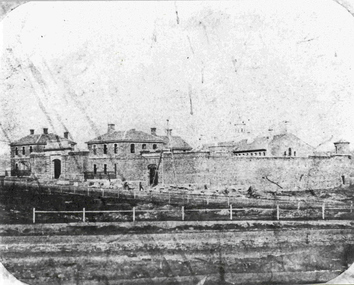
... From 1870 on more buildings were constructed and these became the School of Mines and Industries Ballarat. The Gaol closed in 1965. ...The former Ballarat Gaol was commenced in 1856 and completed in 1862, This view looks up Lydiard Street South, and was taken before the Ballarat Courthouse was built south of the gaol in 1868. The wall was built from quarried basalt with local bricks. A system of burning the lime mortar between the joints and the shape of the wall meant it had a high degree of stability. From 1870 on more buildings were constructed and these became the School of Mines and Industries Ballarat. The Gaol closed in 1965. This image shows the Ballarat Gaol c. 1861 giving us an understanding of what the site looked like before all the changes that have occurred over the years since the gaol closed and other organisations have had the site. Black and white image showing the former Ballarat Gaol from Lydiard Street South.Label on underneath photograph: The Ballarat Gaol, c.1861 - This view looks up Lydiard Street towards our present school entrance. The gaol buildings remain unchanged . Note that the Court House, now S.M.B's Elec. classrooms, has not yet been built on the right hand side of the gaol.ballarat gaol, ballarat school of mines, gaol, m113, lydiard street, courthouse, lime mortar, lydiard street south -
 Federation University Historical Collection
Photograph, Boer War Memorial to Alfred G. Johnston, c1901
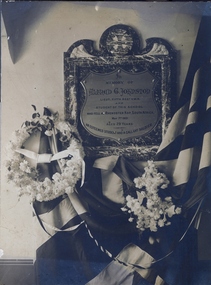
... (See http://guerin.ballarat.edu.au/aasp/is/library/collections/art_history/honour-roll/honourroll_Johnston,%20Alfred.shtml) boer war alfred johnston ballarat school of mines and industries rhenoster kop transvaal Black and white image of a Boer War Memorial to Alfred G Johnston. ...Former Ballarat School of Mines mining student Alfred Johnston was the son of Charles Johnston of Cork, Ireland, and Elizabeth Jameson, the family owning a large furniture store in Fitzroy. Alfred joined the Fifth Victorian (Mounted Riffles) contingent at the Melbourne suburb of Hawthorn. The October 1901 Ballarat School of Mines (SMB) Students Magazine reported 'Alf. Johnston's gone. The news came as a shock to all of us at the school. He who was with us a few short months ago, in all strength of sturdy manhood, has met a soldier's death in South Africa, and we sincerely mourn his loss…. His heart was in the school, and he did his best to further its interests … His last act on leaving Australian shores was to send a telegram from Albany to Prof. Mica Smith, to whom he was warmly attached, wishing the School and all connected with it "Good-bye". In his short, all to short, life of 29 years, he had more adventure than falls the lot of most men, and possibly the spirit of adventure, and also, of duty, prompted him to throw in his lot with the "colors," and leave for the front. The news of his death comes to us with added weight of sadness when we remember that he was one of the organisers of the School entertainment last year to help swell the fund for the erection of a statue to fallen Victorian soldiers.' The SMB Annual Report of 1901 recognised the loss of one of their students: 'Mr Johnston was, until the date of his leaving for active military service in South Africa, one of our students. While here besides being regarded as a general favourite for his urbanity and manliness, he was noted as a faithful, diligent, and most successful student. The news of Lieutenant Johnston's death cast quite a gloom over the school and it was early decided that in addition to a letter of condolence sent to his parents a bronze tablet, suitably inscribed, be erected to his memory in some prominent part of the school. On the 4th November last the ceremony of unveiling the memorial tablet was performed by Professor A. Mica Smith in the presence of several members of the late Lieutenant A.G. Johnston's family, the President and Members of Council, the Staff and Students of the School, and a number of prominent citizens. Lieut. Alfred Johnston was killed on 7 May 1901 at Rhenosterkop, Middleburg district, Transvaal. When the news reached Ballarat the students wrote 'Alfred Gresham Johnston has passed away, and his passing has left many a sorrowing heart amongst his troop of friends everywhere. Outside of his home circle, none will miss him more than his old friends - Professors and students alike - of the Ballarat School of Mines. Farewell, Alf., a long farewell.' Alfred Johnston is buried in an unlocated grave. His SMB friends decided to erect a tablet at the school to the late Lieutenant Johnston. An appeals for donations was made, the SMB students magazine reporting that it had 'met with a handsome response from past and present students.' The SMB Council augmented the fund, and the memorial was dedicated with great reverence. (See http://guerin.ballarat.edu.au/aasp/is/library/collections/art_history/honour-roll/honourroll_Johnston,%20Alfred.shtml) Black and white image of a Boer War Memorial to Alfred G Johnston. The memorial includes a marble and brass plaque, flag and flower. boer war, alfred johnston, ballarat school of mines and industries, rhenoster kop, transvaal -
Federation University Historical Collection
Booklet, The Ballarat School of Mines and Industries 1870-1920 Jubilee Booklet, 1920 (estimated)
... School continued to grow in reputation and size, and became the science centre of the district, and in 1889 a learge new building was opened by Sir Alexander Peacock. Students came from over seas as well as from all the States of Australia, and after going through their courses they took with them the name and fame of the old School to all parts of the globe. School of Mines boys have played a great part in developing the mining fields of Western Australia, South...The Ballarat School of Mines and Industries 1870-1920 Jubilee Booklet Booklet ...The first school of Mines in Australia was established at Ballarat in 1870. At the time of its jubilee (1930) the following people were members of the School Council: W.H. Middleton (President), W.T. Humphreys (VP), J.S. Vickery (VP), F. Barrow, Col. W.K. Bolton, William Baragwanath, A.E. Cutter, J.N. Dunn, G. Fitches, W.H. Fleay, F. Herman. W.D. Hill, T. Hurley, K. Kean. J. Kelly, L. Lederman, Mayor of Ballarat, Mayour of Ballarat East, D. Maxwell, M. Martin, R. Maddern, D. Ronaldson, F. Saunders, R. Stephenson, A.O. Stubbs, R.E. Tunbridge. The School Staff in 1920 comprised: Herbert H. Smith, Walter Rowbotham, Reginald L. Cutter, M.C. Young, Hilda Wardle, M. Wiliamson, P.S. Richards, L.H. Archibald, J. Woods, Ken Moss, W. Kenneth, Mrs McIlvena. B. Robinson, S. Rowe, E. Hope-Jones, Miss Abrams, L.St.G.P. Austin, Alfred Mica Smith, J.R. Pound, Herbert R. Murphy, N.H. Junner, Maurice Copland, L.H. Archibald, E.J.A. McConnon, Newton King, D.m. Hull, T.R. Gordon, John M. Sutherland, T.K. Jebb, Dick Richards, C. Tonkin, A.W. Steane, J. Paterson, H.W. Malin, R.V. Maddison, S.M. Mayo, F.A. King, W.H. Steane, T.R. Gordon, T.A. Williams, H. Waldron, G. Black, E.J. McConnon, R.V. Duncan. R. Cutter, E.G. Vawdrey, Hilda WardleWhite stapled booklet - landscape format - 20pp + soft covers with blue writing. Includes an historical sketch of the Ballarat School of Mines. Contains images of the school from around 1920. The history outlined in the booklet follows: 'Ballarat has helped to influence the life and destinies of Australia in many ways, the recital of which would perhaps prove tedious to the citizens of less favoured localities! However, it can be said, without much fear of contradiction, that only less known thought Australia than its fame as a gold field is the reputation won for it by its school of Mines, ... Ballarat was still quite a new place when the School was founded, but a very propserous and popular place all the same, with a go-ahead lot of citizens brim full of the spirit of enterprise which seemsto animate mining populations generally. Money was plentiful, and they launched out into ventures, which later, were to develop and take the place of the gold mines, while what is more to the point, they understood the value of education. the old digging days were passing away. So far as Ballarat itself was concerned the day of the cradle and tin dish had already passed into an antiquity "as dead and distant as the age of the Tubal Caon," said dir redmond Barry on declaring the School open. Mining had become a serious business, and the mining engineer, the metallurgist, and the geologist had become a power in the land. In these circumstances the suggestions to found a School of Mines met with ready acceptance. The late Mr James M. Bickett had the honor of bringing forward the proposition at a meeting of the Ballarat Mining Board in October, 1869. it was agreed to, and the Government, having been approached for assistance, granted a lease of the old Supreme Court buildings at a nominal reantal. A modest sum, including 100 pounds from the Borough Council of Ballarat West, was subscribed by a number of sympathisers, and on the 26th October, 1870, the inaugural address was delivered by Sir Redmond Barry, the first President of the School. Classes were commenced on the 23rd January, 1871. The students at first were mostly adults. They were chiefly men emloyed at the mines, who had the wisdom and energy to devote their spare time to study, and, though their attendance was somewhat irregular, they made very good progress. Old prints which have been preserved show them at work at furnaces, big bearded men of the old-fashioned type of miner. It is interesting to note that among those who gave evidence and encouragement was Sir Roderick Murchison, who many years before had advised Cornish miners to emigrate to Australia to search for gold, and who in 1848 was in possession of gold ore sent from this country. Sir Roderick sent a parcel of books for the library, and gave useful advice as to the curriculum which should be adopted. The Museum, which now contains a most valuable collection of minerals, was one of the first things attended to, and the reports presented to the Council from time to time speak of additions being made from all parts of the world. New equipment was constantly being added to the School, a good deal of assay work was done, and some specimens were sent from the East Indies for examination as far back as 1873. By this time there was a difficulty in providing accomodation for the students who wished to enrol, and the number of instructors had grown from two to four. In 1882 the first building was being erected on what was then part of the gaol reserve. A little more than ten years afterwards a buildnig formerly serving as a Methodist Church was absorbed, while later on, the demand for accomodation increasing, the attack upon the gaol was renewed. The School continued to grow in reputation and size, and became the science centre of the district, and in 1889 a learge new building was opened by Sir Alexander Peacock. Students came from over seas as well as from all the States of Australia, and after going through their courses they took with them the name and fame of the old School to all parts of the globe. School of Mines boys have played a great part in developing the mining fields of Western Australia, South Australia, and africa, while old students who have made a name in their profession are constantly dropping in to see how the old place is getting along. It was not to be expected, however, that the Ballarat School would be left without rivals, its very success inspiring competition. Mining Schools were started in other parts of Australia, and, at the same time, Victoria ceased to hold first place as a mining state. On the other hand there was a great advance in manufacturing, and the demand for technicaly trained men became a great and as insistent as ever it had been for trained mining men. The Council was quick to adapt the school to the new conditions, and the result is seen in the institution, which is one of Ballarat's proudest possession. Instruction is given in all branches of technical work, and the classes are filled with students who are building up for Ballarat a reputation as an industrial centre, which promises to equal that which it formerly held as a mining town. Owing to its bracing climate, its abundant opportunities for recreations, and its accessibilty, Ballarat as a city is an ideal place for educational purposed, and is yearly becoming more and more appreciated throughout the State. The chairman of one of Ballarat's biggests industries claims that the workman can do twice the day's work here that he can do in Melbourne. he was a little enthusiastic over it, perhaps, but it is a well-known fact that the healthy and invigourating Ballarat climate is conducive to both physical and mental activity, and the records of the School provide ample proof of it. One of the most interesting and successful branches of the School of Mines and Industries - if the name be enlarged with the enlargement of its scope - is the Technical Art School. "The City of Statues" has from its earliest days been a stronghold of art. Art schools have flourised here, and in 1905 the Education Department came to the conclusion that the best thing to do with them was to place them under the management of the School of Mines Council. A magnificent new Technical Art School was built at a cost of some 12,000 pounds on the site of the old Supreme Court building, and was formally opened on the 23rd July, 1915. The results have not only been justified but surpassed all anticipations. The most comprehensive list of subjects is taught, and this list is constantly added to. Students have flocked to the art School, which may be said to occupy a unique position in Australia, and its record of success is really astonishing. Its students supply art teachers for the newer schools that are being built, and many occupy leading positinos in important business houses. So well is its reputation known that orders are constantly being received, not only from Victoria, but from other States, for honor boards and challenge shields to be designed and made. The most recent addition to the School of Mines and Industries is the Junior Technical School, for which a new building is now being erected on a portion of the gaol site, transferred to the School of Mines Counci by the Government. At the present moment temporary quarters are being occupied. Some students after passing through the Junior School go straight to employment, continuing perhaps to attend the evening trade classes, while others move on to the senior School. In a review of the work of the School of Mines mention must be made of a series of industrial research carried out under supervision of the Principal. One in particular, regarding the suitability of the local ores for the manufacture of pigments attracted much attention, while the experiemtns on the manufacture of white potery from Victorian clayes were considered of sufficient importance by the Federal Advisory Council of Science and Industry to warrant the appointment of a special investigator. The results of these have been most encouraging, and may have far-reaching consequences. The vocational training of returned soldiers also should not be overlooked. The work was taken in hand from the first, before the Repatriation Department gave assistance, and now with the help of the department of the School has become one of the largest vocational training centres in Victoria outside of Melbourne. The soldiers, trained in a variety of occupations, have made remarkable progress, and already considerable numbers have found employment in local workshops and factories. To sum up, the School is divided into the following departments, each well staffed and equipped: - The School of Mines, science, and Engineering; the Techncial Art School, the Boys' Junior Technical School, the Girl's Preparatory Technical Classes, Trade Classes, and the Commercial School. The school of Mines, science and Engineering, comprises the following branches: - Mining, Metallurgy, Geology, Electrical Engineering, Civil Engineering, Mechanical Engineering, Applied Chemistry, and Pharmacy. Battery treatments, Cyanide Testing, Smelting, Assays, and Clay Testing from a regular part of the School's work. Students gaining qualifications obtain concession in their courses at the university, should they proceed there to continue their studies. The technical Art school curriculum includes training in all branches of pictorial and applied art, an Architectural Diploma Course, a Draughtman's Course, technical Art teachers' Course, Photography,Ticket Writing, Art Metal Work, Woodcarving, Needlework, and Leather work. The Trade Classes give instruction in Telephone Mechanics, telegraphy, Carpentry, Cabinet Making, Plumbing, Blacksmithing, Fitting, Electric Wiring, and Printing. Numerous Scholarships are offered every year, and altogether students will find few places to equal the Ballarat School of Mines and Industries as a training place for their life's work. One of the first in the continent to be established, its Jubilee finds it still in the front rank, keeping pace with the times, and offering to the youths of this country the means of taking advantage of Australia's teeming opportunities. william, battery, smith, herbert, drawing from the antique, ballarat school of mines botanical gardens, ballarat school of mines, redmond barry, alfred mica smith, james bickett, museum, dick richards, ballarat junior technical school, s m b, ballarat school of mines and industries, ballarat technical art school, model mine, james m bickett, j m bickett, roderick murchison, vocational training rooms, wesley church, methodist church, alexander peacock, lathes, repatriation, repatriatin department, war service, school council, baragwanath, gold mining, mining laboratory, plaster cast, r.w. richards, anniversary, jubilee -
 Federation University Historical Collection
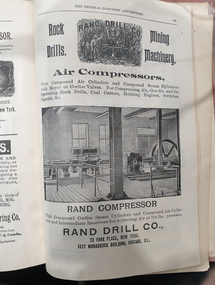
Book, The MIneral Industry its Statistics, Technology and Trade in the United States and Other Countries 1892
... Used at the Ballarat School of Mines Mining statistics technology trades metal industry minerals united states canada china france germany italy japan russia south america spain sweden united kingdom ireland coins Cuba blast furnaces Gold Lead production Manganese opals silver + Australia is included in the index as follows. ...Australia is included in the index as follows. Australiasian Gold Production Silver production Australia Antimony Gold Lead production Manganese opalsRed hard cloth covered book of 115 pages. INcludes contentsnon-fictionAustralia is included in the index as follows. Australiasian Gold Production Silver production Australia Antimony Gold Lead production Manganese opals mining, statistics, technology, trades, metal industry, minerals, united states, canada, china, france, germany, italy, japan, russia, south america, spain, sweden, united kingdom, ireland, coins, cuba, blast furnaces, gold, lead production, manganese, opals, silver, + -
 Federation University Historical Collection
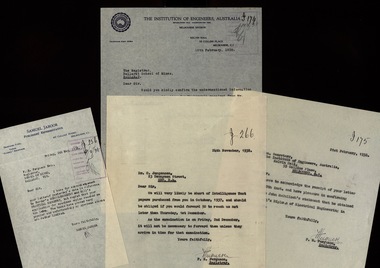
Document - Documents - Correspondence, Ballarat School of Mines: Correspondence with The Institution of Engineers, 1938
... south end of Lydiard Street. Ballarat Junior Technical School began in 1913 and was boys only until 1951 when girls were included. They were under the control of the School of Mines Council. In 1967 the were three divisions. Each was internally distinguished. Ballarat School of Industries, Ballarat Technical School and Ballarat Institute of Advanced Education. In 1976 B.I.A.E. merged with State College of Victoria Ballarat - formerly Ballarat Teachers' College to become Ballarat College of Advanced Education, later to become Federation University. Correspondence between SMB and The Institution of Engineers, Australia...south end of Lydiard Street. Ballarat Junior Technical School began in 1913 and was boys only until 1951 when girls were included. They were under the control of the School of Mines Council. In 1967 the were three divisions. Each was internally distinguished. Ballarat School of Industries, Ballarat Technical School and Ballarat Institute of Advanced Education. In 1976 B.I.A.E. merged with State College of Victoria Ballarat - formerly Ballarat Teachers' College to become Ballarat College of Advanced Education, later to become Federation University. Correspondence between SMB and The Institution of Engineers, Australia ...The School of Mines Ballarat began in 1870. It's location was the south end of Lydiard Street. Ballarat Junior Technical School began in 1913 and was boys only until 1951 when girls were included. They were under the control of the School of Mines Council. In 1967 the were three divisions. Each was internally distinguished. Ballarat School of Industries, Ballarat Technical School and Ballarat Institute of Advanced Education. In 1976 B.I.A.E. merged with State College of Victoria Ballarat - formerly Ballarat Teachers' College to become Ballarat College of Advanced Education, later to become Federation University. Correspondence between SMB and The Institution of Engineers, Australia relating to students' applications for membership of the Institution.Twenty-one letters, typed and hand written.Letterhead of The Institution of Engineers, Australia. Samuel Jaboor, Printers' Representativeschool of mines ballarat, institution of engineers, membership, letterhead -
Federation University Historical Collection
Document - SMB Documents E.J. Barker, Various School of Mines Ballarat Papers collected by E.J. Barker
... Australian Institute of Public Administration Premier of Victoria R.J. Hamer M.B. John New South Wales Institute of Technology Phone Messages Peter O'Loughlin Annual Report Signing of Agreement Position Description Certificates Fifth Form Letters, Reports Plans, Ephemera and Clipboard associated with E.J. Barker and the School of Mines ...E.J. Barker is a past principal of the School of Mines Ballarat and the Library at the Mt Helen Campus is named after him. School of Mines is a predecessor of Federation UniversityLetters, Reports Plans, Ephemera and Clipboard associated with E.J. Barker and the School of Mines Ballaratplanning requirements, individual rooms, dr ron wild, school of mines and industries ballarat, institute profile, location map, university of ballarat, campus plan, great hall/arts complex, notes, 1970-72 building program, operations and decisions, report to council, visit by principal, priorities, electrical engineering, mt helen, minutes of special council meeting, university of melbourne, engineering, mt helen development report, administration building, technical art school, former ballarat gaol, the court house, smb community centre, trust news, articles, discovery day, k.j. flecknoe, retirement, membership of sub committee, n.a crouch, e.j. barker, k.l. cross, w.j. gribble, l.f.j. hillman, r.c lovett, d. nicholson, g. robertson, p.r. shiells, b. tanner, r. feary, i. harris, b.c. mclennan, m. stevens, t.a. wiseman, d.r. bolster, p.h. dixon, r. dunlop, r. furness, e.j. lumsdon, a. mccaffrey, p.r. davies, d. farnsworth, j. harrison, k. mcfarlane, j. mills, s.a. mendelson, i. robinson, d.j. fraser, j. van dreven, k. alsop, b. bridges, m. palmer, r. sutton, l. snibson, h. van hammond, t. runnalls, p. sculley, g. shearer, t. slater, michael ronaldson, robert lovett, edward john barker, e.j. barker building, council membership, clipboard, n.g curry, state college of victoria, articles of association, memorandum, australian conference of principles of colleges of advanced education, commonwealth ministerial working party, victorian post secondary education commission, australian institute of physics symposium, royal australian institute of public administration, premier of victoria, r.j. hamer, m.b. john, new south wales institute of technology, phone messages, peter o'loughlin, annual report, signing of agreement, position description, certificates, fifth form -
 Bendigo Historical Society Inc.
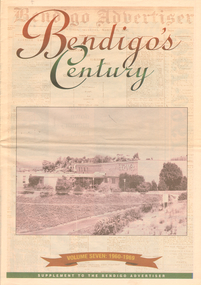
Newspaper - LONG GULLY HISTORY GROUP COLLECTION: BENDIGO'S CENTURY VOLUME SEVEN: 1960 - 1969
... Dispensary Gillies Famous Pies William Basil Ashman Golden Gate Hotel Grieves Family Bendigo Town Hall Mr R R Anderson Mr E H Brown Cr Neville Oliver Cr Tom Flood Traffic Commission Lansell FAmily ABEV-1 Bendigo Ordnance Factory ACTU Bendigo Trades Hall Council The Ramsay Report Bendigo Benevolent Home Bendigo Home and Hospital for the Aged Princess Theatre Amoco Lake Eppalock Bendigo Training Prison Bendigo Police Station Lock-up Shamrock Hotel Rifle Brigade Hotel Hopetoun Hotel ANZ Bank Marong Shire Offices Sir Rohan Delacombe St Paul's Church Que O'Hoy Waldron Family Windermere Hotel Aids & Appliance Shop Anne Caudle Centre E C Thompson Mayfair Hams Sandhurst Guest House Lyric Theatre Chinese Joss House Ordnance Factory Sir John Jenson Bridge Street Chinese Quarter Bendigo City Hall Cr R F Turner Cr Tom Flood Victorian Inland Meat Authority New Zealand Insurance Co Mrtropolitan Security Service Bendigo Easter Fair Society Golden Square High School Eaglehawk High School Bendigo Technical College Mr Ralph W Birrell Bendigo Fountain Plaza The Bethlehem Home for the Aged Dick Hazeldene Victorian Egg Board Bendigo United Cricket Club South Bendigo United Cricket Club Western Mining Corporation Les Priest Alexandra Fountain Bendigo Advertiser Cr W Cambridge Bendigo Council Eaglehawk Council Strathfieldsaye Shire Huntly Shire Marong Shire David Thomas Senator John Gorton Bendigo's College of Advanced Education Bank of New South Wales Harp and Shamrock Hotel The Honorable Leslie William Galvin Kurmala Cain Government Hanro Knitting Mills Myer Store Sidney Myer Davey Brothers Grocery Store National Trust Myer Emporium Myer's Ltd Cox Bros (Australia) Ltd Dame Merlyn Myer Baillieu Myer Frank Greenaway Institute of Technology Gas & Fuel Corporation Bendigo Railway Station ANZ Bank City Family Hotel TAB Branch Senior Constable Alfred Herbert Wright Senior Constable Allan Raymond Brown Victorian Football League Bendigo Police Barracks Camp Hill State School State Electricity Commission The Country Party The Labor Party Transport Regulation Board Stuart Anderson Grose FAmily Jean Theodore De Ravin Kyneton Shire Sir William McDonald Mines Department The Loddon Hospitals Region group Laundry and Central Linen Service Kevin Wynne Albert Vivian Gray Bradford Cotton Mills Ltd Bradmill Industries Ltd Victoria Hill Bendigo and District Tourist Association Professor Brian Lewis Melbourne University Victorian Chinese Community Loong Sun Loong Stafford Ellinson Coles' Store North Deborah Mining Company NL Noel Beaton MHR Durham Ox Hotel Taylor Family Supplement to the Bendigo Advertiser, December 15, 1999 Volume Seven: 1960-1969 titled Bendigo's Century. ...Supplement to the Bendigo Advertiser, December 15, 1999 Volume Seven: 1960-1969 titled Bendigo's Century. The front has a photo of the BCV 8 Studio. Contains photos and local news, council matters, planning, Who's Who, Weather, Sport and Business and some Advertisements. Photos include Early stages in the construction of the Eppalock tower and bridge pillars, Christine Wiseman, TV8's first news reader Ron Alderton, Dr Albert L Beischer, Advertiser buiding, fire at the Advertiser building, Oscar Flight, Bendigo Town Hall, William Basil Ashman, Lake Eppalock, Premier Henry Bolte, Que O'Hoy, Sandhurst Guest House, The Lyric Theatre, E C Thompson, The elm tree in Market Square, Leslie Galvin, The original Myer Store, The Joss House, Sidney Myer, Bendigo Police Barracks, Bunratty Castle, Albert Vivian Gray, The Victoria Hill site, Architects drawing of the new council administrative offices and Noel Beaton MHR.bendigo, history, long gully history group, the long gully history group - bendigo's century volume seven: 1960 - 1969, bendigo advertiser, bcv 8, eppalock dam, premier henry bolte, the criterion hotel, mccarthy family, teachers training college, bendigo original teachers college, long gully state school, stramit, bendigo university site committee, mrs christine wiseman, bendigo city council, the broadcasting control board, general television pty ltd, bendigo central victoria telecasters pty ltd, mr davidson, bennett's arcade, woolworth's, white hills swimming pool, herb elliott, sailor's guide, toni riley pharmacies, rising sun hotel, ron alderton, dr albert l beischer, channel 8, melbourne herald, 3bo, bendigo advertiser officeslyceum theatre, junior technical school white hills, mount alvernia hospital, most reverend dr b d stewart, sisters of the franciscan missionaries of the divine motherhood, lazarus family, bendigo's tramways, state electricity commission, george pethard, lance pethard, bendigo advertiser fire 29/7/1962, riverine herald, the herald and weekly times, bendigo art gallery, oscar flight, hollands foundry, eaglehawk u.f.s. dispensary, gillies famous pies, william basil ashman, golden gate hotel, grieves family, bendigo town hall, mr r r anderson, mr e h brown, cr neville oliver, cr tom flood, traffic commission, lansell family, abev-1, bendigo ordnance factory, actu, bendigo trades hall council, the ramsay report, bendigo benevolent home, bendigo home and hospital for the aged, princess theatre, amoco, lake eppalock, bendigo training prison, bendigo police station lock-up, shamrock hotel, rifle brigade hotel, hopetoun hotel, anz bank, marong shire offices, sir rohan delacombe, st paul's church, que o'hoy, waldron family, windermere hotel, aids & appliance shop, anne caudle centre, e c thompson, mayfair hams, sandhurst guest house, lyric theatre, chinese joss house, ordnance factory, sir john jenson, bridge street chinese quarter, bendigo city hall, cr r f turner, cr tom flood, victorian inland meat authority, new zealand insurance co, mrtropolitan security service, bendigo easter fair society, golden square high school, eaglehawk high school, bendigo technical college, mr ralph w birrell, bendigo fountain plaza, the bethlehem home for the aged, dick hazeldene, victorian egg board, bendigo united cricket club, south bendigo united cricket club, western mining corporation, les priest, alexandra fountain, bendigo advertiser, cr w cambridge, bendigo council, eaglehawk council, strathfieldsaye shire, huntly shire, marong shire, david thomas, senator john gorton, bendigo's college of advanced education, bank of new south wales, harp and shamrock hotel, the honorable leslie william galvin, kurmala, cain government, hanro knitting mills, myer store, sidney myer, davey brothers grocery store, national trust, myer emporium, myer's ltd, cox bros (australia) ltd, dame merlyn myer, baillieu myer, frank greenaway, institute of technology, gas & fuel corporation, bendigo railway station, anz bank, city family hotel, tab branch, senior constable alfred herbert wright, senior constable allan raymond brown, victorian football league, bendigo police barracks, camp hill state school, state electricity commission, the country party, the labor party, transport regulation board, stuart anderson, grose family, jean theodore de ravin, kyneton shire, sir william mcdonald, mines department, the loddon hospitals region group laundry and central linen service, kevin wynne, albert vivian gray, bradford cotton mills ltd, bradmill industries ltd, victoria hill, bendigo and district tourist association, professor brian lewis, melbourne university, victorian chinese community, loong, sun loong, stafford ellinson, coles' store, north deborah mining company nl, noel beaton mhr, durham ox hotel, taylor family -
 Bendigo Historical Society Inc.
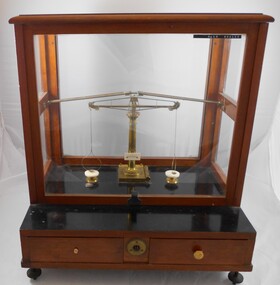
Tool - OERTLING SCALES IN GLASS CASE, 1898
... Australia, New Zealand, Canada, South Africa and India, to Europe and America." Reference: Powerhouse Collection - https://collection.powerhouse.com.au/object/550913 MINING Equipment Scales Ludwig Oertling beam balance assay Bendigo School of Mines and Industry 21736, J.W. 28.2.98, E.C., 3/98 Brass beam balance made by Oertling, London in 1898. ...The Oertling beam balance scale was used in the Bendigo School of Mines assay laboratory. The manufacturer, Ludwig Oertling (1818-1893), was born near Hamburg and gained his apprenticeship in instrument-making with his brother Johann. He immigrated to London in 1840, where he joined instrument-maker and assayer George Makins (1815-1893). Oertling collaborated with Makins and built his first balance, which was "a twin-column assay type with a light lattice beam". By 1851, the year of the Great International Exhibition of the Works of All Nations, Oertling had established his own instrument-making business, employed five instrument-makers and by 1861, ten staff were engaged in designing and making instruments, principally analytical balances. Oertling's first twin-column beam balance was the prototype for all Oertling assay balances that were produced during the next century and exported to the British colonies: Australia, New Zealand, Canada, South Africa and India, to Europe and America." Reference: Powerhouse Collection - https://collection.powerhouse.com.au/object/550913 Brass beam balance made by Oertling, London in 1898. The scale is mounted on a wooden base board with a mahogany case, glass on four sides with two drawers underneath. On bottom of the left hand drawer, written in pencil, is the works number '21736'. A cursive 'L' on the same drawer bottom indicates 'left'. Also on bottom corner 'J.W. 28.2.98'. 'J.W' was John Wright, foreman and cabinet maker. He was Oertling’s longest working cabinet maker from1886-1928. In pencil underneath the right corner of the left drawer is '3/98'. Written in pencil inside the drawer cavity is 'E.C' in fancy script. This refers to 'Charlie Craig, employed as an instrument maker by the Oertling Company. The maker's name, "Oertling' is embossed on the base of the scale. There is a brass knob that fits in the front to make adjustments to the scales and also on either side of the exterior case to set the top of the scales. 21736, J.W. 28.2.98, E.C., 3/98mining, equipment, scales, ludwig oertling, beam balance, assay, bendigo school of mines and industry -
University of Melbourne, Burnley Campus Archives
Certificate - Documents and correspondence, The University of Melbourne, Congratulatory certificates, correspondence, plaques and cards for the Centenary of VCAH Burnley Campus 1991, 1991
... Mostly signed by chancellors, vice-chancellors, councils, chairmen, presidents, deans and directors, 1/ The University of New South Wales certificate July 1991 2/ The Royal Horticultural Society of Victoria 3/ Charles Sturt University 26 June 1991 4/ The Royal Horticultural Society 1891-1991 5/ Massey University, New Zealand July 1991 6/ Monash University 7/ The University of Melbourne 8/ Garden Advisory Service (card) 9/ The School of Mines and Industries Ballarat 10/ Outer Eastern College of Technical and Further Education (letter from Maurie Curwood Director 1/7/1991) 11/ Northern Metropolitan College of Tafe (letter from Brian J McDonald, Director 11/7/1991 12/ Curtin University of Technology 13/ Murdoch University 14/ University of Hawaii 15/ Victotria University of Technology (Letter to Mr R G Luff from G.J Allen) 16/ University of Canberra 12/7/1991 17/ Victorian Farmers Federation (letter froom Alex Arbuthnot President) 18/ Ballarat University College 19/ Deakin University 20/ Northern Territory University 21/ Victoria College 8/5/1991 22/ University of California Santa Barbara (Letter 1/7/1991) 23/ Landscape Contractors Association of Victoria Limited (letter) 24/ University of Adelaide 25/ University of Tasmania ========================BOX 222 26/ The University of Sydney 27/ Australian Catholic University 28/ University of Western Sydney (Hawkesbury) 29/ Griffith University 30/ The University of Wollongong (Letter and certificate) 31/ The University of Queensland 32/ Macquarie University 33/ James Cook University of North Queensland 34/ California Polytechnic State College, Wood and perspex Plaque 35/ Marcus Oldham Farm Management College, Wood plaque with metal coat of arms ============BOX 223 36/ THe University of Western Australia (Certificate in tube) 37/ Loddon Campaspe College of TAFE (Certificate in tube) 38/ Latrobe University (certificate in tube) 39/ Taranaki Polytechnic New Plymouth New Zealand 40/ Warwickshire College of Agriculture (made in UK, Wooden and painted coat of arms on plaque, in Box Heraldic Shield, Painted by hand) 41/ Massey University NZ (Wooden and painted coat of arms on plaque - in addition to (5) certificate) 42/ Ballarat University College ( Metal and wooden coloured plaque in addition to letter (18) Congratulatory certificates, correspondence, plaques and cards for the Centenary of VCAH Burnley Campus 1991 Certificate Documents and correspondence The University of Melbourne Monash University Massey University, New Zealand Garden Advisory Service The Royal Horticultural Society of Victoria Royal Horticultural Society Charles Sturt University The University of New South Wales The School of Mines and Industries Ballarat Outer Eastern College Northern Metropolitan College of Tafe Curtin University of Technology Murdoch University University of Hawaii Victoria College Victoria University of Technology University of Canberra Victorian Farmers Federation Ballarat University College Deakin University Northern Territory University University of California Santa Barbara Landscape Contractors Association of Victoria University of Adelaide University of Tasmania The University of Sydney Australian Catholic University University of Western Sydney Griffith University The University of Wollongong James Cook University California Polytechnic Marcus Oldham Farm Management College The University of Western Australia Loddon Campaspe College of Tafe Latrobe University Warwickshire College of Agriculture Taranki Polytechnic NZ ...Acknowledgement from 40 associations and universities to congratulate the VCAH Burnley Campus for a centenary of education 1891-1991.42 items. Multiple greetings, congratulatory letters, certificates and plaques sent to VCAH Burnley Campus (Director Mr R G Luff) as a record of the campus' revered place in higher education 1891-1991. Mostly signed by chancellors, vice-chancellors, councils, chairmen, presidents, deans and directors, 1/ The University of New South Wales certificate July 1991 2/ The Royal Horticultural Society of Victoria 3/ Charles Sturt University 26 June 1991 4/ The Royal Horticultural Society 1891-1991 5/ Massey University, New Zealand July 1991 6/ Monash University 7/ The University of Melbourne 8/ Garden Advisory Service (card) 9/ The School of Mines and Industries Ballarat 10/ Outer Eastern College of Technical and Further Education (letter from Maurie Curwood Director 1/7/1991) 11/ Northern Metropolitan College of Tafe (letter from Brian J McDonald, Director 11/7/1991 12/ Curtin University of Technology 13/ Murdoch University 14/ University of Hawaii 15/ Victotria University of Technology (Letter to Mr R G Luff from G.J Allen) 16/ University of Canberra 12/7/1991 17/ Victorian Farmers Federation (letter froom Alex Arbuthnot President) 18/ Ballarat University College 19/ Deakin University 20/ Northern Territory University 21/ Victoria College 8/5/1991 22/ University of California Santa Barbara (Letter 1/7/1991) 23/ Landscape Contractors Association of Victoria Limited (letter) 24/ University of Adelaide 25/ University of Tasmania ========================BOX 222 26/ The University of Sydney 27/ Australian Catholic University 28/ University of Western Sydney (Hawkesbury) 29/ Griffith University 30/ The University of Wollongong (Letter and certificate) 31/ The University of Queensland 32/ Macquarie University 33/ James Cook University of North Queensland 34/ California Polytechnic State College, Wood and perspex Plaque 35/ Marcus Oldham Farm Management College, Wood plaque with metal coat of arms ============BOX 223 36/ THe University of Western Australia (Certificate in tube) 37/ Loddon Campaspe College of TAFE (Certificate in tube) 38/ Latrobe University (certificate in tube) 39/ Taranaki Polytechnic New Plymouth New Zealand 40/ Warwickshire College of Agriculture (made in UK, Wooden and painted coat of arms on plaque, in Box Heraldic Shield, Painted by hand) 41/ Massey University NZ (Wooden and painted coat of arms on plaque - in addition to (5) certificate) 42/ Ballarat University College ( Metal and wooden coloured plaque in addition to letter (18) 1991 centenary, vcah burnley, burnley centenary, congratulations, greeting certificates
