
Showing 17 items matching "spanish communities"
-
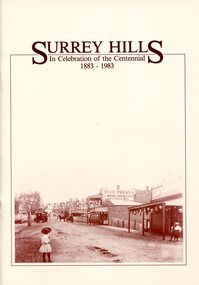 Surrey Hills Historical Society Collection
Book, Surrey Hills: in celebration of the centennial 1883-1983, 1983
... ...spanish communities...It includes early rural properties and diaries, the coming of the railway, land sub-division and early homes, schools, parks and recreation. surrey hills railways land use migrants spanish communities transport houses wattle park festivals and celebrations churches education water supply fire stations hospitals (mr) george klepper ainger family (mr) john woodhead (mr) h. breedon medical services real estate agents businesses musical events and activities entertainment parks and reserves scouts guides A pictorial history of Surrey Hills based on information collected and based at the Surrey Hills Neighbourhood Centre. ...A pictorial history of Surrey Hills based on information collected and based at the Surrey Hills Neighbourhood Centre. It includes early rural properties and diaries, the coming of the railway, land sub-division and early homes, schools, parks and recreation.A pictorial history of Surrey Hills based on information collected and based at the Surrey Hills Neighbourhood Centre. It includes early rural properties and diaries, the coming of the railway, land sub-division and early homes, schools, parks and recreation.surrey hills, railways, land use, migrants, spanish communities, transport, houses, wattle park, festivals and celebrations, churches, education, water supply, fire stations, hospitals, (mr) george klepper, ainger family, (mr) john woodhead, (mr) h. breedon, medical services, real estate agents, businesses, musical events and activities, entertainment, parks and reserves, scouts, guides -
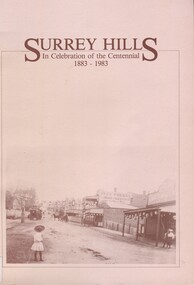 Surrey Hills Historical Society Collection
Book, Surrey Hills: in celebration of the centennial 1883-1983, Reprinted November 1992
... ...spanish communities...It includes information about early rural properties and dairies, the coming of the railway, land sub-division and early homes, doctors, schools, churches, parks and recreation facilities. surrey hills railways land use migrants spanish communities transport houses wattle park festivals and celebrations churches education water supply fire stations hospitals (mr) george klepper ainger family (mr) john woodhead (mr) h. breedon medical services real estate agents businesses musical events and activities entertainment parks and reserves scouts guides 1992 A pictorial history of Surrey Hills based on information collected and based at the Surrey Hills Neighbourhood Centre. ...A pictorial history of Surrey Hills and Mont Albert based on information collected by the history group at the Surrey Hills Neighbourhood Centre. It includes information about early rural properties and dairies, the coming of the railway, land sub-division and early homes, doctors, schools, churches, parks and recreation facilities.A pictorial history of Surrey Hills based on information collected and based at the Surrey Hills Neighbourhood Centre. It includes early rural properties and diaries, the coming of the railway, land sub-division and early homes, schools, parks and recreation.1992surrey hills, railways, land use, migrants, spanish communities, transport, houses, wattle park, festivals and celebrations, churches, education, water supply, fire stations, hospitals, (mr) george klepper, ainger family, (mr) john woodhead, (mr) h. breedon, medical services, real estate agents, businesses, musical events and activities, entertainment, parks and reserves, scouts, guides -
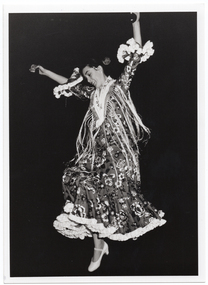 Musculoskeletal Health Australia (now held by the Glen Eira Historical Society)
Photograph - Solo photo
... ... migrant communities... spanish...This photo of a flamenco dancer, in traditional dress, dancing while playing the castanets may have been created for promotional purposes, either by the artist or by Arthritis Victoria. arthritis foundation of victoria afv culturally and linguistically diverse cald languages other than english lote migrant communities spanish multicultural traditional dancing flamenco castanets rhythm percussion traditional dress costumes exercise B&W photo of a flamenco dancer, in traditional dress, dancing while playing the castanets. ...This photo of a flamenco dancer, in traditional dress, dancing while playing the castanets may have been created for promotional purposes, either by the artist or by Arthritis Victoria.B&W photo of a flamenco dancer, in traditional dress, dancing while playing the castanets. She has both arms held up high above her head while one foot is off the ground.arthritis foundation of victoria, afv, culturally and linguistically diverse, cald, languages other than english, lote, migrant communities, spanish, multicultural, traditional dancing, flamenco, castanets, rhythm, percussion, traditional dress, costumes, exercise -
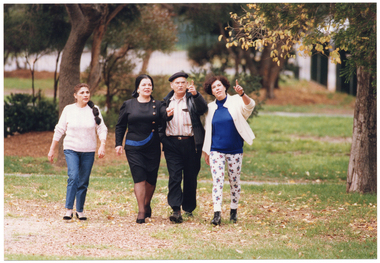 Musculoskeletal Health Australia (now held by the Glen Eira Historical Society)
Photograph - Group photo, Circa 1990s
... communities... bilingual... Spanish...This photo depicts a small group of people from the Spanish community....This photo depicts a small group of people from the Spanish community. arthritis foundation of victoria afv osteoporosis victoria ov culturally and linguistically diverse cald languages other than english lote migrant communities bilingual Spanish C1990s COL photo of a small group of people walking in a park. ...This is one of several series of promotional photos commissioned by the Arthritis Foundation of Victoria (AFV), incorporating Osteoporosis Victoria (OV), to help promote its Culturally And Linguistically Diverse (CALD) programs. This photo depicts a small group of people from the Spanish community.COL photo of a small group of people walking in a park. Some of them are pointing up as they all look towards something outside of the frame.arthritis foundation of victoria, afv, osteoporosis victoria, ov, culturally and linguistically diverse, cald, languages other than english, lote, migrant communities, bilingual, spanish, c1990s -
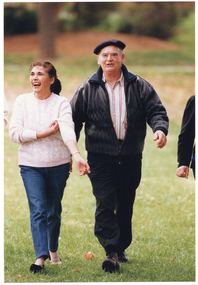 Musculoskeletal Health Australia (now held by the Glen Eira Historical Society)
Photograph - Group photo, Circa 1990s
... communities... bilingual... Spanish...This photo depicts a small group of people from the Spanish community....This photo depicts a small group of people from the Spanish community. arthritis foundation of victoria afv osteoporosis victoria ov culturally and linguistically diverse cald languages other than english lote migrant communities bilingual Spanish C1990s COL medium close up photo of two people within a small group, walking in a park. ...This is one of several series of promotional photos commissioned by the Arthritis Foundation of Victoria (AFV), incorporating Osteoporosis Victoria (OV), to help promote its Culturally And Linguistically Diverse (CALD) programs. This photo depicts a small group of people from the Spanish community.COL medium close up photo of two people within a small group, walking in a park.arthritis foundation of victoria, afv, osteoporosis victoria, ov, culturally and linguistically diverse, cald, languages other than english, lote, migrant communities, bilingual, spanish, c1990s -
 Marysville & District Historical Society
THE TRIANGLE NEWS-VOL 40 NO 38-OCTOBER 4 2013
... community comments to guide final plan...adventurous cooks tapas treats-exploring spain...marysville victoria australia australian sparkling wine show note from editor what's on when in october buxton progress assocn agm marysville & district football & netball club agm marysville community market creative triangle murrindindi shire council annual report 2012-2013 australia day award nominations church notices triangle community dinner el kanah village breakfast for all men mystic mountains tourism notice of special meeting crafters wanted mayor's chair triangle community dance group senior's week special further donations to schools advertisements the salvation army funding available 2009 bushfire relief dalton fiske foundation grant buxton hotel taste of italy pasta night south cathedral landscape group real estate council releases annual report celebrating 150 years of marysville marysville country bakery seeking staff councillor comment creative triangle pink lunch heart foundation walkers wanted australian centre for grief and bereavement future leaders ready to change it up kft plan-community comments to guide final plan adventurous cooks tapas treats-exploring spain sixteenth annual steam and wood show taggerty dance on again casual situation vacant in triangle area marysville & district kindergarten assocn preschool centre open & enrolment day buxton recreation reserve working bee leadership course funded by bendigo bank the committee of management of the gallipoli park precinct THE TRIANGLE NEWS-VOL 40 NO 38-OCTOBER 4 2013 ...marysville, victoria, australia, australian sparkling wine show, note from editor, what's on when in october, buxton progress assocn agm, marysville & district football & netball club agm, marysville community market, creative triangle, murrindindi shire council annual report 2012-2013, australia day award nominations, church notices, triangle community dinner, el kanah village, breakfast for all men, mystic mountains tourism notice of special meeting, crafters wanted, mayor's chair, triangle community dance group, senior's week special, further donations to schools, advertisements, the salvation army, funding available, 2009 bushfire relief, dalton fiske foundation grant, buxton hotel taste of italy pasta night, south cathedral landscape group, real estate, council releases annual report, celebrating 150 years of marysville, marysville country bakery seeking staff, councillor comment, creative triangle pink lunch, heart foundation walkers wanted, australian centre for grief and bereavement, future leaders ready to change it up, kft plan-community comments to guide final plan, adventurous cooks tapas treats-exploring spain, sixteenth annual steam and wood show, taggerty dance on again, casual situation vacant in triangle area, marysville & district kindergarten assocn, preschool centre open & enrolment day, buxton recreation reserve working bee, leadership course funded by bendigo bank, the committee of management of the gallipoli park precinct -
 City of Moorabbin Historical Society (Operating the Box Cottage Museum)
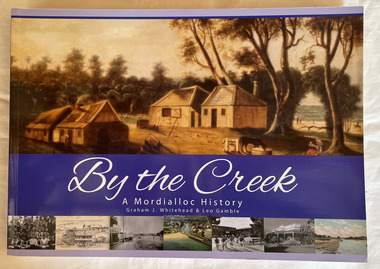
Book, Whitehead, Graham et al, By The Creek : A Mordialloc History, 2014
... Foreword -- Acknowledgements -- By the creek -- Tragedy of the Bunurong people: the Mordialloc connection -- The Muddy creek -- Mordialloc Pier -- They're racing at Mordialloc -- Official opening of Mordialloc Railway Station -- Politicians at Mordialloc -- Mordialloc baths -- Mornington versus Mordialloc: the fateful football match -- FancyDress Carnival at Mordialloc -- The Mordialloc baby murders -- Mordialloc great war memorials -- Spanish flu -- The freemasons at Mordizlloc -- The beginnings of Mordialloc College -- A place to play: Mordialloc's Rotunda -- The Mordialloc brass band -- Mordialloc Carnival 1923-1939 -- Mordialloc Carnival 1940-1968 -- Typhoid outbreak and Mordialloc -- Onion odour at Mordialloc -- Desecration of beach pavilion -- Shindig at the Mordialloc Life Saving Club -- Mordialloc Community and Youth Centre -- Mordialloc Elderly Citizens' Club -- Unforgettable memories: Mordialloc meals on wheels -- No pipeline across the bay -- Pedestrian bridge across Mordialloc Creek -- Page sources of illustrations and photographers -- Index....Mordialloc typhoid Mordialloc creek Foreword -- Acknowledgements -- By the creek -- Tragedy of the Bunurong people: the Mordialloc connection -- The Muddy creek -- Mordialloc Pier -- They're racing at Mordialloc -- Official opening of Mordialloc Railway Station -- Politicians at Mordialloc -- Mordialloc baths -- Mornington versus Mordialloc: the fateful football match -- FancyDress Carnival at Mordialloc -- The Mordialloc baby murders -- Mordialloc great war memorials -- Spanish flu -- The freemasons at Mordizlloc -- The beginnings of Mordialloc College -- A place to play: Mordialloc's Rotunda -- The Mordialloc brass band -- Mordialloc Carnival 1923-1939 -- Mordialloc Carnival 1940-1968 -- Typhoid outbreak and Mordialloc -- Onion odour at Mordialloc -- Desecration of beach pavilion -- Shindig at the Mordialloc Life Saving Club -- Mordialloc Community and Youth Centre -- Mordialloc Elderly Citizens' Club -- Unforgettable memories: Mordialloc meals on wheels -- No pipeline across the bay -- Pedestrian bridge across Mordialloc Creek -- Page sources of illustrations and photographers -- Index. ...Foreword -- Acknowledgements -- By the creek -- Tragedy of the Bunurong people: the Mordialloc connection -- The Muddy creek -- Mordialloc Pier -- They're racing at Mordialloc -- Official opening of Mordialloc Railway Station -- Politicians at Mordialloc -- Mordialloc baths -- Mornington versus Mordialloc: the fateful football match -- FancyDress Carnival at Mordialloc -- The Mordialloc baby murders -- Mordialloc great war memorials -- Spanish flu -- The freemasons at Mordizlloc -- The beginnings of Mordialloc College -- A place to play: Mordialloc's Rotunda -- The Mordialloc brass band -- Mordialloc Carnival 1923-1939 -- Mordialloc Carnival 1940-1968 -- Typhoid outbreak and Mordialloc -- Onion odour at Mordialloc -- Desecration of beach pavilion -- Shindig at the Mordialloc Life Saving Club -- Mordialloc Community and Youth Centre -- Mordialloc Elderly Citizens' Club -- Unforgettable memories: Mordialloc meals on wheels -- No pipeline across the bay -- Pedestrian bridge across Mordialloc Creek -- Page sources of illustrations and photographers -- Index.256 pages : illustrations, portraits non-fictionForeword -- Acknowledgements -- By the creek -- Tragedy of the Bunurong people: the Mordialloc connection -- The Muddy creek -- Mordialloc Pier -- They're racing at Mordialloc -- Official opening of Mordialloc Railway Station -- Politicians at Mordialloc -- Mordialloc baths -- Mornington versus Mordialloc: the fateful football match -- FancyDress Carnival at Mordialloc -- The Mordialloc baby murders -- Mordialloc great war memorials -- Spanish flu -- The freemasons at Mordizlloc -- The beginnings of Mordialloc College -- A place to play: Mordialloc's Rotunda -- The Mordialloc brass band -- Mordialloc Carnival 1923-1939 -- Mordialloc Carnival 1940-1968 -- Typhoid outbreak and Mordialloc -- Onion odour at Mordialloc -- Desecration of beach pavilion -- Shindig at the Mordialloc Life Saving Club -- Mordialloc Community and Youth Centre -- Mordialloc Elderly Citizens' Club -- Unforgettable memories: Mordialloc meals on wheels -- No pipeline across the bay -- Pedestrian bridge across Mordialloc Creek -- Page sources of illustrations and photographers -- Index.mordialloc, typhoid, mordialloc creek -
 Ringwood and District Historical Society
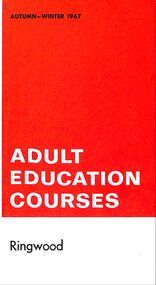
Flyer, Adult Education Courses, Autumn-Winter 1967 - Ringwood, Victoria
... Spanish Guitar - Mrs. Susan Ellis, Basic Painting - Mr. Robert Grieve, French - Mrs. G. Bennett, B.A., Dip.Ed. Brochure listing Council of Adult Education evening classes at Norwood High School and daytime classes at East Ringwood Community Centre Hall. ...Brochure listing Council of Adult Education evening classes at Norwood High School and daytime classes at East Ringwood Community Centre Hall.Subjects and lecturers include: Australia 1967 - Dr. D.B. Waterson, M.A., Phd, Honest Doubt - Mr. C.R. Badger, M.A., Mammals in Australia - Mr. Jack Hyett, How to Read and Understand Music - Mrs. P.J. Rosewarne, L.Mus., Clarinet for Beginners - Mr. C. Boon, Recorder Classes - Mr. Alan Murphy, Mus.Bac., Dip.Ed., Practical Painting - Mr. Geoff Spruzen, The Modern Cinema - Mr. P.G. Hourigan, B.A. (Hons.) Woodwork for Beginners - Mr. P.J. Waring, German - Miss J. Juhasz, B.A. (Hons.) Dip.Ed., Spanish Guitar - Mrs. Susan Ellis, Basic Painting - Mr. Robert Grieve, French - Mrs. G. Bennett, B.A., Dip.Ed. -
 Eltham District Historical Society Inc
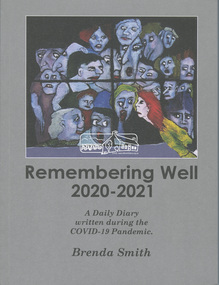
Book, Brenda Smith, Remembering Well 2020-2021: A Daily Diary written during the COVID-19 Pandemic, 2021
... Spanish Flu pandemic. Smith has written a diary since 2009 and as a consquence of her family's earlier experiences with similar but lack of documentation and stories passed on, was determined to chronicle her experiences during the COVID-19 pandemic covering 2020-2021. This pandemic continues unabated in its third year (2022). The journal documents the daily life of living through the COVID-19 pandemic and the influences it had uopon the local community ...Brenda Smith's parents lived throuh two World Wars and the Depression. As an adult migrant arriving in Australia from England in 1970, when she looked back she realised her family spoke very little about what they had endured and she was not even aware of them going through the Spanish Flu pandemic. Smith has written a diary since 2009 and as a consquence of her family's earlier experiences with similar but lack of documentation and stories passed on, was determined to chronicle her experiences during the COVID-19 pandemic covering 2020-2021. This pandemic continues unabated in its third year (2022). The journal documents the daily life of living through the COVID-19 pandemic and the influences it had uopon the local community from both locally and interantionallycovid-19, coronavirus pandemic, journal, person, personal narrative -
Glen Eira Historical Society
Document - Historic Conservation Areas Project
... Caulfield Library Dandenong Road Nepean Highway Hotham Street Iknerman Road Orrong Road North Road Poath Road ‘Plan of the City of Caulfield’ North Ward East Ward South Ward West Ward Kooyong Road Neerim Road Bambra Road Balaclava Road Shire of Caulfield Railways World War 1914-1918 Depression 1929-1939 Rippon Lea Labassa Parks Mansions Community Services ‘Caulfield North Draft Heritage Guidelines July 1999’ City of Glen Eira Caulfield North Heritage Area Glen Eira Heritage Management Plan Mayfield Grove Normanby Avenue Carnarvon Street Glenferrie Street Arthur Street Malakoff Street Normanby Road Heritage Advisory Service Construction Materials Victorian Style Mediterranean Style Spanish Mission Style Californian Bungalow Style Federation Style Architectural Style Architectural Features Heritage Conservation Design Building Construction Building Regulations Aboriginal Peoples Carnarvon Road Document Historic Conservation Areas Project ...Contains 4 items relating to historic conservation: 1/Five newsletters (one page each newsletter, dated 07/1975, 08/1975, 09/1975, 10/1975 and the final one 12/1975) describing how the project evolved, project funds, progress, study method, project 1 report, project 2 report and summary as no further funds available. Project was to include all of Melbourne but funding did not allow this. Note: newsletters stamped with Caulfield Historical Society. 2/Letter (one page on official city of Caulfield letterhead) from Andrew Rodda (manager planning) to Hazal Ford (dated 13/11/1989) describing ‘council resolved on 18/07/1989 to proceed with preliminary conservation survey’ and mentions that a copy is included. 3/Preliminary conservation survey for the City of Caulfield (nine pages) describing background, study area, budget, purpose, study outline, timeframe, report format, ownership, tasks and background information (mentions number and types of houses and properties as at 1986 and 1988) and a map of City of Caulfield. 4/Booklet (28 pages) titled ‘Heritage Area – Caulfield North Draft Heritage Guidelines July 1999 – City of Glen Eira’, containing Caulfield North Heritage Area, cultural heritage, Heritage Overlay Area, architectural description, common architectural forms and features, development guidelines, key design checklist. It includes a map of the Caulfield North Heritage Overlay Area, two illustrations about the development envelope and many black-and-white photographs of houses and architectural features.historic conservation areas project niven barbara, newsletters, town planning, historic buildings, heritage studies, housing, royal historical society of victoria (rhsv), read michael, plans, local government, historical societies, committee for urban action (cua), national trust, hopkins sherry ms., ford hazel, preliminary conservation survey, town planning, heritage studies, rodda andrew, city of caulfield, housing estates, victoria national estate grants program, australia icomos, burra charter, buildings structures and establishments, land surveys, suburbs, historic buildings, architectural significance, ‘caulfield’s heritage study’, soloman geulah dr., caulfield library, dandenong road, nepean highway, hotham street, iknerman road, orrong road, north road, poath road, ‘plan of the city of caulfield’, north ward, east ward, south ward, west ward, kooyong road, neerim road, bambra road, balaclava road, shire of caulfield, railways, world war 1914-1918, depression 1929-1939, rippon lea, labassa, parks, mansions, community services, ‘caulfield north draft heritage guidelines july 1999’, city of glen eira, caulfield north heritage area, glen eira heritage management plan, mayfield grove, normanby avenue, carnarvon street, glenferrie street, arthur street, malakoff street, normanby road, heritage advisory service, construction materials, victorian style, mediterranean style, spanish mission style, californian bungalow style, federation style, architectural style, architectural features, heritage conservation design, building construction, building regulations, aboriginal peoples, carnarvon road -
 Robin Boyd Foundation
Slide, Robin Boyd, 1950
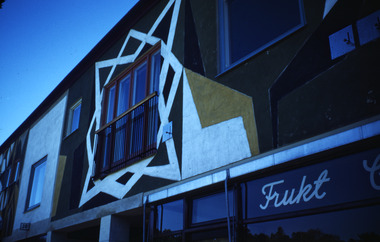
... Spain. Haddon Travelling Scholarship Haddon robin boyd slide Stockholm / Mural / Arsta - Community Centre / Arch: E&T. ...Penleigh Boyd, Robin and Patricia Boyd's son, writes “Prior to 1950 Robin, like most other amateur or hobby photographers, took black and white printed photographs. The oldest slides date from 1950 when Robin and Patricia travelled to Europe on Robin’s Robert Haddon Travelling Scholarship.” In 1948 Robin Boyd was awarded ‘joint first place’ in the Robert Haddon competition for his design of Mildura art gallery. The scholarship helped fund their first overseas trip. Robin and Patricia were passengers on the Greek ship “Cyrenia” departing in May 1950, passing through the Suez Canal and landing in Genoa five weeks later. For six months, they travelled extensively throughout Europe (predominantly driving themselves) - France, Italy, United Kingdom, Sweden, Denmark, Germany, Austria, Switzerland and Spain.Colour slide in a mount. Mural art of the community center of Årsta, 1947-1953, Stockholm, Sweden. (Architects: Erik and Tore Ahlsen.)Stockholm / Mural / Arsta - Community Centre / Arch: E&T. Ahlsen / 1947 (All Handwritten)haddon travelling scholarship, haddon, robin boyd, slide -
Victorian Aboriginal Corporation for Languages
Conference proceedings, Jon Reyhner, Nurturing native languages, 2003
... Spanish: A Language of Indigenous Peoples of the Americas /? Florencia Riegelhaupt, Roberto Carrasco, Elizabeth Brandt 11. Keresan Pueblo Indian Sign Language /? Walter P. Kelley, Tony L. McGregor 12. Oral History Shares the Wealth of a Navajo Community...Spanish: A Language of Indigenous Peoples of the Americas /? Florencia Riegelhaupt, Roberto Carrasco, Elizabeth Brandt 11. Keresan Pueblo Indian Sign Language /? Walter P. Kelley, Tony L. McGregor 12. Oral History Shares the Wealth of a Navajo Community ...Section I: Language and Culture Immersion 1. Native Language Immersion /? Jon Reyhner 2. Assessing the Impact of Total Immersion on Cherokee Language Revitalization: A Culturally Responsive, Participatory Approach /? Lizette Peter with Ella Christie, Marilyn Cochran, Dora Dunn, Lula Elk, Ed Fields, JoAnn Fields, Tracy Hirata-Edds, Anna Huckaby, Margaret Raymond, Deputy Chief Hastings Shade, Gloria Sly, George Wickliffe, Akira Yamamoto 3. Situational Navajo: A School-Based, Verb-Centered Way of Teaching Navajo /? Wayne Holm, Irene Silentman, Laura Wallace Section II: Technology Sustaining Indigenous Languages in Cyberspace /? Courtney B. Cazden 5. Saving a Language with Computers, Tape Recorders, and Radio /? Ruth Bennett Section III: Other Issues 6. How To Teach When the Teacher Isn't Fluent /? Leanne Hinton 7. Preparing Indigenous Language Advocates, Teachers, and Researchers in Western Canada /? Heather A. Blair, Donna Paskemin, Barbara Laderoute 8. Whaia Te Reo: Pursuing the Language': How Metaphors Describe - Our Relationships with Indigenous Languages /? Jeanette King 9. Honoring the Elders /? Evangeline Parsons-Yazzie, Robert N. St. Clair 10.Spanish: A Language of Indigenous Peoples of the Americas /? Florencia Riegelhaupt, Roberto Carrasco, Elizabeth Brandt 11. Keresan Pueblo Indian Sign Language /? Walter P. Kelley, Tony L. McGregor 12. Oral History Shares the Wealth of a Navajo Community /? Sara L. Begay, Mary Jimmie, Louise Lockard 13. Mothertongue: Incorporating Theatre of the Oppressed into Language Restoration Movements /? Qwo-Li Driskill 14. Missionaries and American Indian Languages /? Evangeline Parsons Yazzie Biographical Information on the Authors.tables, b&w illustrationsnavajo, cherokee, indian sign language, bilingual education, indigenous language teaching, native language immersion, language and technology -
Victorian Aboriginal Corporation for Languages
Conference proceedings, Joan Argenter, Endangered languages and linguistic rights on the margins of nations : proceedings of the Eighth FEL Conference : Barcelona (Catalonia) Spain 1-3 October 2004, 2005
... Communities: Top-down and Bottom-up Integration Richard J. Hawkins Probit Modeling Language Attrition Rudy Osiel Camposeco El idioma maya Popti? y la Declaraci�n Universal de los Derechos Ling��sticos Victorio N. Sugbo The literary Response: Claiming Rights in Three Philippin Languages Ya-ling Chang Language Policies in an Aboriginal Primary School in Taiwan Endangered languages and linguistic rights on the margins of nations : proceedings of the Eighth FEL Conference : Barcelona (Catalonia) Spain 1-3 October 2004 Conference proceedings Joan Argenter R McKenna Brown ...Section 1: Grass-roots Efforts and Top-down Institutions Keynote Address: Leanne Hinton The Death and Rebirth of Native American Languages Patrick Marlow Bilingual Education, Legislative Intent, and Language Maintenance in Alaska Galina Dyrkheeva New Language Policy and Small Languages in Russia: the Buryat Example Zelealem Leyew The Fate of Endangered Languages in Ethiopia Gregory Hankoni Kamwendo Language Planning from Below: Chitumbuka as a Marginalised Language in Malawi John Hobson Learning to Speak Again: Towards the Provision of Appropriate Training for the Revitalization of Australian Languages in New South Wales Shelley Tulloch Grassroots Desires for Language Planning in Nunavut Amandina C�rdenas Demay Hacia la definici�n de una pol�tica del lenguaje & Alejandra Arellano Mart�nez expl�cita en M�xico Elena Benedicto, G. McLean, Linguistic Rights in the Nicaraguan Atlantic Coast: Grupo de Ling�istas Ind�genas Mayangna Actions on the Ground within the Legislative Framework of the Estatuto de Autonom�a Bartomeu Meli� Las lenguas ind�genas en el Paraguay. Una visi�n desde el Censo 2002 Monica Ward Building from the Bottom-up: Linguistic Rights for Extremely Endangered Languages Marta Moskal Language Policy and Protection of Endangered Languages in Poland Sue Wright What is a language? Some difficulties inherent in language rights Joan Ramon Sol� Obstacles in the Way of the Recovery of Catalan Section 2: The Global vs. the Local in Linguistic Rights Keynote Address: Patxi Goenaga Fronteras que dividen y fronteras que separan. Una mirada a Europa desde el Euskara Yun-Hsuan Kuo Languages, Identity, and Linguistic Rights in Taiwan Estibaliz Amorrortu, Andoni Barre�a, What Do Linguistic Communities Think about the Esti Izagirre, Itziar Idiazabal, Bel�n Uranga Official Recognition of their Languages? Alok Kumar Das Linguistic Practices and Not Just Linguistic Rights: Endangered Languages in New Europe Section 3: Languages crossing the Borders Keynote Address: Tjeerd de Graaf The Status of Endangered Languages in the Border Areas of Japan and Russia Mariana Bara Arm�n endangered language Ver�nica Grondona Language Policy, Linguistic Rights and Language Maintenance in Argentina Grup d?Estudi de Lleng�es Amena�ades Linguistic diversity in Catalonia: towards a model of linguistic revitalization Nataliya Belitser Endangered Languages in Crimea/Ukraine: The Cases of Crimean Tatar, Karait, and Krymchak Ivelina Kazakova & Maria Miteva The Future of Bulgarian: The Road to Extinction or Paradise Regained Luke O?Callaghan War of Words: Language Policy in Post Independence Kazakhstan Eden Naby From Lingua Franca to Endangered Language: The Legal Aspects of the Preservation of Aramaic in Iraq Poster presentations Akim Elnazarov Endangered languages and Education. A Case of Badakhshan Province of Tajikistan Arnfinn Muruvik Vonen & Oddvar Hjulstad Linguistic Rights Paving the Way Towards Language Endangerment? The Case of Norwegian Sign Language Eva Savelsberg Kurdish (Kurmanc�) as Minority Language in the Federal Republic of Germany Jos� Antonio Flores Farf�n Cultural and Linguistic Revitalization, Maintenance and Development in Mexico Mary Jane Norris Assessing the Status, Use and Accessibility of Canada?s Aboriginal Languages within Communities and Cities: Some Proposed Indicators Michael Prosser van der Riet Promotion of Minority Language Scripts in Southwest China. A Relative Success or Complete Failure? Mikael Grut The Endangered Celtic Languages: A Wake-up Call Nariyo Kono Developing Partnerships Between Universities and Language Communities: Top-down and Bottom-up Integration Richard J. Hawkins Probit Modeling Language Attrition Rudy Osiel Camposeco El idioma maya Popti? y la Declaraci�n Universal de los Derechos Ling��sticos Victorio N. Sugbo The literary Response: Claiming Rights in Three Philippin Languages Ya-ling Chang Language Policies in an Aboriginal Primary School in Taiwanmaps, tables, graphsnsw, endangered languages, linguistic rights -
 Broadmeadows Historical Society & Museum
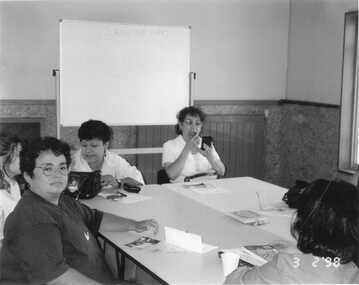
Photograph, Spanish Women's Group at Banksia Gardens 1998, 3 February 1998
... In 1998, the Spanish Women's Group at Banksia Gardens was actively engaged in various activities aimed at fostering social inclusion. These initiatives were designed to help individuals integrate into society, providing a supportive environment for community building and personal development....In 1998, the Spanish Women's Group at Banksia Gardens was actively engaged in various activities aimed at fostering social inclusion. These initiatives were designed to help individuals integrate into society, providing a supportive environment for community building and personal development. ...In 1998, the Spanish Women's Group at Banksia Gardens was actively engaged in various activities aimed at fostering social inclusion. These initiatives were designed to help individuals integrate into society, providing a supportive environment for community building and personal development.The Spanish Women's Group at Banksia Gardens in 1998 played a crucial role in promoting social inclusion and community engagement. This group provided a supportive environment where individuals could connect, share experiences, and participate in activities designed to help them integrate into society. The initiatives undertaken by the group not only fostered a sense of belonging among its members but also contributed to the broader community's cultural diversity and social cohesion.Black and white photograph on glossy photograph paper.Spanish Women's Group/At Banksia Gardens 1998banksia gardens, broadmeadows, spanish women's group, 1998, social activity -
 Surrey Hills Historical Society Collection
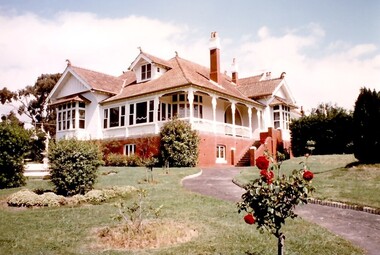
Photograph, Mr A Noack, Emilia Villa, 4 Albany Crescent, Surrey Hills, 1984
... The Rubiras and the Parers established and supplied a number of high-class restaurants and hotels in Melbourne. emilia villa house names 1913 singers spanish community italian community ethnic communities parer family albany crescent surrey hills restaurants hotels edwardian style mr james rubira mrs emilia rubira miss Emilia Tajouera Guidotti On rear in blue pen: "Mr Rubira's House / per / A Noack (underlined) / Albany Cres" Coloured image of an Edwardian style brick house at 4 Albany Crescent, Surrey Hills. ...The house was built in 1913 for Mr James Rubira and named for his wife Emilia Tajouera Guidotti, an Italian opera singer. She was born in 1865 and died in Surrey Hills on 21 October 1950. James was born in 1863 in Allela, Barcelona, Catalonia, Spain and died on 8 November 1935 in Surrey Hills. They married in Victoria in 1892. They married in 1892. James's mother was a member of the Parer family. The Rubiras and the Parers were among a number of Spanish families who began to migrate to Australia in the 1860s. James' mother was Teresa Florentina Lluisa Parer. Many of the families settled in Box Hill and then Surrey Hills by the 1900s. The Rubiras and the Parers established and supplied a number of high-class restaurants and hotels in Melbourne.Coloured image of an Edwardian style brick house at 4 Albany Crescent, Surrey Hills. It shows the path up to the house with the garden on each side. There is a fountain in the garden on the LHS of the path.On rear in blue pen: "Mr Rubira's House / per / A Noack (underlined) / Albany Cres"emilia villa, house names, 1913, singers, spanish community, italian community, ethnic communities, parer family, albany crescent, surrey hills, restaurants, hotels, edwardian style, mr james rubira, mrs emilia rubira, miss emilia tajouera guidotti -
Unions Ballarat
Journal of Australasian mining history 2007, Australian Mining History Association, 2007
... Spanish Legacy: Leaching the Waste Dumps at Moonta Mines 1901-1944. Australian Geochemical Mineral Exploration: It all began at Moonta through V.P. Sokoloff. Hegemony, localism and ethnicity: The ‘Welsh’ mining communities...Spanish Legacy: Leaching the Waste Dumps at Moonta Mines 1901-1944. Australian Geochemical Mineral Exploration: It all began at Moonta through V.P. Sokoloff. Hegemony, localism and ethnicity: The ‘Welsh’ mining communities ...Periodical/journal: "Embracing all aspects of mining history, mining archaeology and heritage." Articles by various contributors Copper Triangle’s Spanish Legacy: Leaching the Waste Dumps at Moonta Mines 1901-1944. Australian Geochemical Mineral Exploration: It all began at Moonta through V.P. Sokoloff. Hegemony, localism and ethnicity: The ‘Welsh’ mining communities of Currawang and Frogmore in southern New South Wales. A Thirsty and Confusing Diggings: The Albert Goldfield, Milparinka-Tibooburra, north-western NSW. ‘Another Broken Hill’: The Mount Deddick Silver-Lead Field. Michael Dineen O’Keeffe: Union Leader - a ‘colourful personality. Radium Hill: Bindi To Boom Town. Tragedy on the Strickland: Jack Hides and the Investors Ltd Expedition of 1937 COMMENTS Observations on the History of the Blackwater Gold Mine. Comment on Brian R. Hill, ‘A Reinterpretation of the History of the Acquisition of the Blackwater Gold Mine’, Journal of Australasian Mining History, vol. 4, September 2006, pp. 156-165. BOOK REVIEWS Bullfinch and the Yilgarn Goldfield, Hesperian Press, Victoria Park, Western Australia, 2007; xvi +265pp Reviewer: Lenore Layman, Murdoch University Fool’s Gold: Myths and Legends of Gold seeking in Australia, Lothian Books, Sydney, 2006. Reviewer: Philip Payton, Exeter University Relevant to Australian and New Zealand history, particularly around miners and mining.Paperback. Front cover: crème coloured background; black and white photo; red and black lettering; 180 pages.Front cover: title and publisher.btlc, ballarat trades and labour council, ballarat trades hall, history - mining, moonta mines, albert goldfield, milparinka-tibooburra, mount deddick, michael dineen o'keeffe, radium hill, strickland, investers ltd, blackwater gold mine, bullfinch, yilgam goldfield, gold -
 City of Melbourne Libraries
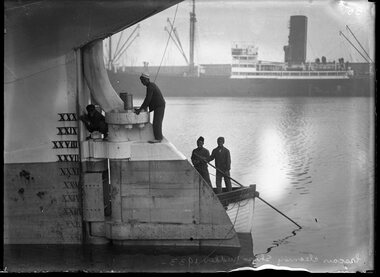
Photograph, Bull, Hugh Jones, 1897-1993, Lascars cleaning ship's rudder
... Spanish diplomat near the end of The Angel of Darkness. In Wuthering Heights, it is speculated that Heathcliff, the main character, may be of lascar origin." (Wikipedia – Lascar) And what has become of these “forgotten heroes of the World Wars”? The South Asian Heritage Trust, which seeks to commemorate, mark and celebrate South Asian cultures, stories, and communities...Spanish diplomat near the end of The Angel of Darkness. In Wuthering Heights, it is speculated that Heathcliff, the main character, may be of lascar origin." (Wikipedia – Lascar) And what has become of these “forgotten heroes of the World Wars”? The South Asian Heritage Trust, which seeks to commemorate, mark and celebrate South Asian cultures, stories, and communities ...Published: unknown, however, on 26 June 1935 a similar, but not the exact photo in the McKenzie Collection, was published in The Age: Published title: Shipping Victorian Flour to the East Published Caption: Flour and wheat figure prominently in all cargoes carried by ships trading to Chinese, Japanese and Eastern ports. Victorian millers are eager to extend lids outlet for their produce, and every opportunity is grasped. The pictures show Australian labourers unloading from railway trucks some of the 2300 tons of flour which will go into the hold of the Burns, Philp motor ship Neptuna for shipment to Hong Kong, while Chinese seamen are busy cleaning and painting the rudder post of the ship. Hard by the Neptuna, other ships are taking on flour for the East. Research by Project Volunteer, Louise McKenzie: The image was described by Hugh Bull on the rear of the glass plate as – “Lascars cleaning ships rudder 1933”. Basically, a “lascar” is a seaman. Image No. 032 in the McKenzie Collection shows two lascars perched on the rudder of a ship, with two others standing in a rowboat along side. They are dressed in baggy trousers and jackets and wearing caps. Across a very calm dock area is a single funnel ship with on-deck derricks. The rudder of the ship being cleaned is white, with large black roman numbering denoting the depth at which the ship is sitting, depending on whether it is loaded or empty. Whilst the exact photo in the McKenzie Collection has yet to be located in The Age in 1933, the date when it was taken, there is a photo published in The Age on 25 June 1935 which appears to be one of a series of photos taken on the same day, featuring lascars cleaning a ship’s rudder. It bears a striking resemblance to MCK 032, but it is taken from a slightly different angle. The 1935 published photo is a close up of a ship’s rudder being cleaned, with same style of roman numerals in black on the white of the rudder. One lascar is standing on the rudder, one is standing in a small clinker style rowboat, with its characteristic wooden overlapping hull planks, holding a broom; two more lascars are sitting in the bow and stern of the rowboat. The ship being cleaned is in a dock, as a wharf and warehouses can be seen in the background, the water is very calm, and there are two other ships moored nearby – one across the other side of the dock with a black and white hull and derricks on its deck, and one adjacent, with its mooring lines clearly visible. The lascars are wearing caps, baggy trousers and jackets. Compelling similarities therefore exist between the two images. Whilst it is difficult to positively identify the cultural background of these particular lascars in either photo, the newspaper article dated June 1935 advises they are “Chinese”. This is possibly because the ship they are associated with, the Neptuna, is reported to have sailed from Melbourne on this date, bound for Hong Kong. However, the men are probably from South East Asia. Wikipedia describes the term “Southeast Asia” as covering ” … the people of Southeast Asia from prehistory to the present in two distinct sub-regions: Mainland Southeast Asia (or Indochina) and Maritime Southeast Asia (or Insular Southeast Asia). Mainland Southeast Asia comprises Cambodia, Laos, Myanmar (or Burma), Peninsular Malaysia, Thailand and Vietnam whereas Maritime Southeast Asia comprises Brunei, Cocos (Keeling) Islands, Christmas Island, East Malaysia, East Timor, Indonesia, Philippines and Singapore. Additionally, Wikipedia “Lascars” states that “Lascars were sailors from the Indian subcontinent, South East Asia, the Arab world, British Somaliland and lands east of the Cape of Good Hope, who were employed to work on colonial merchant ships. The practice ran from the 16th century to the mid 20th century”. Indian seamen were used as early as the 16th century by Portuguese explorer Vasgo da Gama in his successful voyage to India, and subsequently by Portuguese ships in the 16th and 17th centuries. “Through the Portuguese and Spanish maritime world empires, some Indian lascars found their way onto English merchant ships, and were among the sailors on the first English East India Company (EIC) ships to sail to India.” In the 17th Century “When the English adopted the term "lascar", they initially used it for all Asian sailors on English-flagged ships, but after 1661 and the Portuguese ceded Bombay to England, the term was used mainly to describe Indian sailors specifically. The term "topaze" was used to describe Indo-Portuguese personnel, especially those from Bombay, Thana, Diu, Dammam and Cochin. The term "sepoy" was used to describe Indian soldiers in European service. The number of lascars employed on EIC East Indiamen was so great that the Parliament of England restricted their employment via the Navigation Acts (in force from 1660 onwards) which required that 75% of the crew onboard English-flagged ships importing goods from Asia be English subjects. The restriction arose due to the high rates of illnesses and death among European sailors on East Indiamen, and their frequent desertions in Asia, which left such ships short of crew for the return voyage. Another reason was the frequent impressment of European sailors from EIC East Indiamen by the Royal Navy in times of war“. The term “impressment” colloquially refers to “the “press gang” …”a type of conscription of people into a military force, especially a naval force, via intimidation and physical coercion, conducted by an organized group (hence “gang”). .. The large size of the British Royal Navy in the Age of Sail meant impressment was most commonly associated with Great Britain.”. (Wikipedia – Impressment). By the 20th century these sailors served on British ships under "lascar agreements", which allowed shipowners more control than was the case in ordinary articles of agreement. The sailors could be transferred from one ship to another and retained in service for up to three years at one time. “Lascars served all over the world in the period leading up to the First World War. Lascars were barred from landing at some ports, such as in British Columbia. At the beginning of World War I, there were 51,616 lascars working on British merchant ships in and around the British Empire. In World War II thousands of lascars served in the war and died on vessels throughout the world, especially those of the British India Steam Navigation Company, P&O and other British shipping companies. The lack of Canadian naval manpower led to the employment of a total of 121 Catholic Goans and 530 Muslim British Indians on the Empress vessels of the Canadian Pacific Railway, such as the Empress of Asia and Empress of Japan. These ships served in the Indian Ocean both as ANZAC convoy ships and in actions at Aden. The ships were placed under the British Admiralty as part of Canada's contribution to the war effort and all of the Indian men were awarded medals by the Admiralty, though none of them were delivered. In the 1950s the use of the term "lascar" declined with the ending of the British Empire. The Indian “Lascar Act” of 1832 was finally repealed in 1963. However, "traditional" Indian deck and Pakistani engine crews continued to be used in Australia until 1986 when the last crew was discharged from the P&O and replaced by a general-purpose crew of Pakistanis. The term lascar has been widely used to engender an element of exoticism in literature eg “Sir Arthur Conan Doyle created a Lascar foil to Sherlock Holmes in "The Man with the Twisted Lip" in 1891. Lascars aboard the ship Patna figure prominently in the early chapters of Joseph Conrad's novel Lord Jim. Frances Hodgson Burnett's novel A Little Princess features a lascar named Ram Dass. Also, Caleb Carr portrays two lascars as bodyguards for a Spanish diplomat near the end of The Angel of Darkness. In Wuthering Heights, it is speculated that Heathcliff, the main character, may be of lascar origin." (Wikipedia – Lascar) And what has become of these “forgotten heroes of the World Wars”? The South Asian Heritage Trust, which seeks to commemorate, mark and celebrate South Asian cultures, stories, and communities, published an article in July 2025 entitled – The Lascars: Seafaring Roots of Modern Britain. It particularly honours the role of the 80,000 lascars who served Britain in WWI, and the over 100,000 who served in the British Merchant Navy in WWII, and concludes: “The hardships faced by Lascars were profound. They were often assigned the most dangerous tasks, lived in substandard conditions aboard ships and, even after their immense contributions to the war efforts, many veterans found it difficult to secure the recognition, pensions and rights afforded to other veterans. Many were employed under ‘Asiatic Articles’, which offered less protection and lower pay than their European counterparts. Yet, their legacy endures. The multicultural fabric of areas like East London owes much to these early seafarers and settlers. The East London Mosque, established in 1910, became an important spiritual and community hub. Today, efforts to bring their stories out of the shadows are growing. The Museum of London Docklands features exhibits on their history. Memorials, such as the P&O headstone in Dover for the 22 Lascar crew members of the SS Maloja sunk in 1916 and the careful restoration of the Lascar War Memorial in Kolkata, serve as important reminders of the sacrifices. The journey of the Lascars – from their homelands, along dangerous wartime shipping routes, to the docklands of Britain – is a story of personal courage and of a rich contribution to Britain’s history and identity.” The ship MV Neptuna, mentioned in the 1935 article, had that year been purchased from a German company by Australian-owned Burns Philp, with Australian Government assistance, and it was instrumental in ensuring the shipment of rice from Vietnam to Papua New Guinea. Rice is still a household staple in PNG. Despite it being introduced into PNG more than 100 years ago, the crop has not been sufficiently integrated into the country’s traditional agricultural production system, and today PNG imports still account for nearly 98% of rice. (Spotlight Magazine Sept. 2016) The 1935 newspaper article states that the Neptuna is involved in moving flour for the East. Australian wheat exports began in 1845, but were not regular until the 1870s. New land clearing methods in Australia allowed large tracts of land to be cleared more efficiently – this included the invention of the iconic ‘stump jump’ plough. With the success of the wheat harvests, flour mills began to spring up around the country. By the 1870s, many large country towns had their own mills, with around 500 mills producing flour across the country. Flour exports were an important part of the wheat industry until around the 1930s. After the Second World War, many of Australia’s export partners (which were mainly in the developing nations of Asia) began setting up their own flour industries and the Australian product was no longer in demand. In 1942 MV Neptuna was being utilised for the war effort, and carrying depth charges and other armaments for Australia, when on 19 February it was sunk in a bombing raid on Darwin, and where part of her hull still lies. References: SHIPPING VICTORIAN FLOUR TO THE EAST. (1935, June 25). The Age (Melbourne, Vic. : 1854 - 1954), p. 11. Retrieved July 23, 2025, from http://nla.gov.au/nla.news-article204357218 Age (Melbourne, Vic. : 1854 - 1954), Tuesday 25 June 1935, page 11 Wikipedia, Clinker (boat building), https://en.wikipedia.org/wiki/Clinker_(boat_building) Wikipedia, Lascar, https://en.wikipedia.org/wiki/Lascar Wikipedia, History of Southeast Asia, https://en.wikipedia.org/wiki/History_of_Southeast_Asia Wikipedia, Impressment, https://en.wikipedia.org/wiki/Impressment NEPTUNA LEAVES FOR CHINA WITH TOURISTS (1935, June 25). The Herald (Melbourne, Vic. : 1861 - 1954), p. 5. Retrieved July 23, 2025, from http://nla.gov.au/nla.news-article244841163 National Research Institute SPOTLIGHT paper Vol 9, Issue 7, https://pngnri.org/images/Publications/Spotlight_No_9_Vol_7_-_201609_-_Sofe__Odhuno_-_Rice_Import_Quota1.pdf South Asian Heritage Trust, The Lascars: Seafaring Roots of Modern Britain, July 11,2025 : Royal British Legion. https://southasianheritage.org.uk/royal-british-legion/the-lascars-seafaring-roots-of-modern-britain/ Photographer notations on slide: "Lascars cleaning ships rudder 1933".lascars, ships, 1930-1939, employment, ethnic communities
