
Showing 40 items matching "spectacle case"
-
 The Cyril Kett Optometry Museum
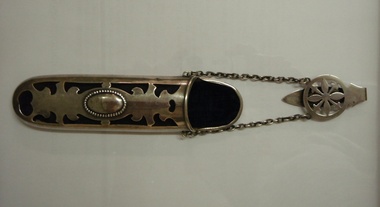
Chatelaine Spectacle Case, W Ltd, 1900 (estimated)
... Chatelaine Spectacle Case...spectacle case...This spectacle case is designed to be worn attached to a belt or waistband in the style of a 'chatelaine'. ...Chatelaine spectacle case with elaborately pierced pattern decoration made of electroplated nickel silver. ...This spectacle case is designed to be worn attached to a belt or waistband in the style of a 'chatelaine'. ...This spectacle case is designed to be worn attached to a belt or waistband in the style of a 'chatelaine'. It is made of electroplated nickel silver (EPNS) and is lined with blue velvet. This style of spectacle case was used late in the late 19th and early 20th centuries.This spectacle case is one of the most ornate in the collection.Chatelaine spectacle case with elaborately pierced pattern decoration made of electroplated nickel silver. Empty cartouche. Deep blue velvet lining. Small chain links case to holding clasp.Rear of clasp hook stamped 'EPNS W Ltd'spectacle case, epns, chatelaine -
 Hymettus Cottage & Garden Ballarat
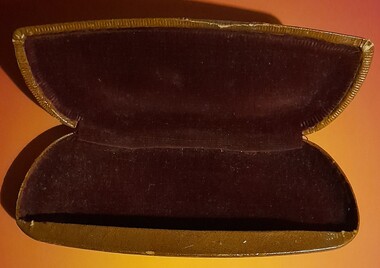
Container - Spectacle Case, Wastell & Cutter spectacle/glasses case
... Spectacle Case...Wastell & Cutter spectacle/glasses case.../glasses case Container Spectacle Case ...Wastell & Cutter were Ophthalmic Opticians at Ballarat, Victoria from the 1930s until the 1970s. A domestic item identifying Wastell & Cutter opticians at Ballarat who provided eye care and glasses to Mrs Mary Taffe of Hymettus from the 1940s until the 1990s. The metal proprietors plaque is an unusual embellishment.Small metal plaque on cover with Optometrist's name Wastell & Cutter embossed against medieval townscape image.optometrist, ballarat, glasses case, taffe -
 Phillip Island and District Historical Society Inc.
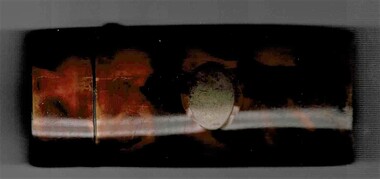
Functional object, Tortoise Shell Spectacle Case
... Tortoise Shell Spectacle Case...Tortoise Shell Spectacle Case with oval gold label and push button opening....Tortoise Shell Spectacle Case Functional object ...HistoricalTortoise Shell Spectacle Case with oval gold label and push button opening. -
 Stawell Historical Society Inc
Memorabilia - Realia, Spectacle Case, c1900
... Spectacle Case...Glasses or Spectacle Case. Black and Gold Asian Design. Lined with purple Velvet from a house in Stawell....Spectacle Case Memorabilia Realia ...Glasses or Spectacle Case. Black and Gold Asian Design. Lined with purple Velvet from a house in Stawell.stawell -
Bright & District Historical Society operating the Bright Museum
Spectacle case (spectacles 97.1)
... Spectacle case (spectacles 97.1)...Spectacle case...Spectacle case glasses case spectacles glasses Black cardboard case with hinged lid Spectacle case (spectacles 97.1) ...Black cardboard case with hinged lidspectacle case, glasses case, spectacles, glasses -
 Bendigo Historical Society Inc.
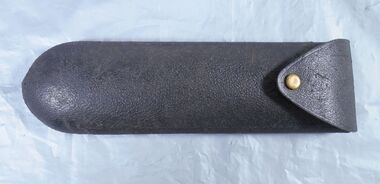
Accessory - Spectacle case
... Spectacle case....Black leather look covered spectacle case. There is a flip lid section at the top that opens to gain access to the case. ...The case is lined with velvet. Accessory Spectacle case. ...Black leather look covered spectacle case. There is a flip lid section at the top that opens to gain access to the case. The lid is fastened with a press stud. The case is lined with velvet.spectacles, spectacles case -
 Bendigo Historical Society Inc.
Accessory - Spectacle case
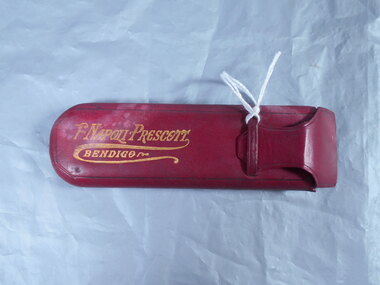
... Spectacle case....Burgundy leather look spectacle case. The case has a flip lid section at the top that opens to gain access to the case. ...Burgundy leather look spectacle case. The case has a flip lid section at the top that opens to gain access to the case. ...Frederick Napoli Prescott was a prominent Bendigo Optician and Jeweller. He was born and educated in Hobart before joining his father's jewellery and optical business. After studying in Europe to gain further qualifications he returned to Australia and opened a business at the corner of Mitchell and Hargreaves Street Bendigo. He was later in partnership with Mr C.M. Dawe trading as Prescott & Dawe. Burgundy leather look spectacle case. The case has a flip lid section at the top that opens to gain access to the case. The lid is held in place under a leather loop. In gold lettering on the front of the case "F Napoli Prescott Bendigo".spectacles, spectacles case, f napoli prescott -
 Bendigo Historical Society Inc.
Accessory - Spectacle case
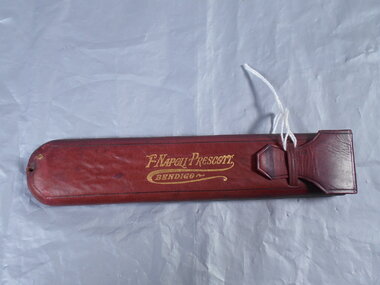
... Spectacle case....Brown leather look spectacle case. The case has a flip lid section at the top that opens to gain access to the case. ...Brown leather look spectacle case. The case has a flip lid section at the top that opens to gain access to the case. ...Frederick Napoli Prescott was a prominent Bendigo Optician and Jeweller. He was born and educated in Hobart before joining his father's jewellery and optical business. After studying in Europe to gain further qualifications he returned to Australia and opened a business at the corner of Mitchell and Hargreaves Street Bendigo. He was later in partnership with Mr C.M. Dawe trading as Prescott & Dawe. Brown leather look spectacle case. The case has a flip lid section at the top that opens to gain access to the case. The lid is held in place under a leather loop. In gold lettering on the front of the case "F Napoli Prescott Bendigo".spectacles, spectacles case, f napoli prescott -
 Bendigo Historical Society Inc.
Accessory - Spectacle case
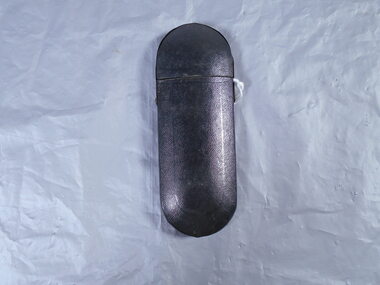
... Spectacle case ...Black leather look covered spectacle case. There is a metal hinged section at the top on the front that opens out to gain access to the case. ...The case is lined with blue and black felt fabric. Accessory Spectacle case ...MESSRS. PRESCOTT AND DAWE. THEIR NEW PREMISES. Article The Bendigo Independent (Vic. 1891 1918)Thursday 15 December 1910 Page 2 MESSRS. PRESCOTT AND DAWE. Messrs. Prescott and Dawe, jewellers and opticians, established business in Mitchell street, Bendigo, in 1887, and so rapidly did their clients increase that they soon gained a top reptation for introducing the best workmanship in every branch. The firm’s goods are always unique and artistic. They have manufactured endless presents, notable amongst which are the civic gifts presented annually to the mayor and mayoress for the time being, the mayoral chain and the late Mr. George Lansell’s medallion, and presents to leading citizens throughout the State. Their new business premises at the corner of Mitchell and Hargreaves streets are now ready. They make an imposing addition to the architecture of the city. The elevations to Mitchell and Hargreaves street have been well treated in every detail and carried out in the renaissance style.Black leather look covered spectacle case. There is a metal hinged section at the top on the front that opens out to gain access to the case. The case is lined with blue and black felt fabric.spectacles, spectacles case -
 City of Moorabbin Historical Society (Operating the Box Cottage Museum)
Personal Effects, spectacle case expanding, c1900
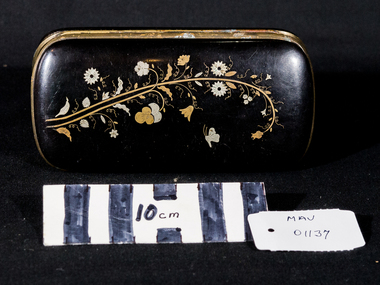
... Personal Effects, spectacle case expanding...A pressed metal spectacle case with brass hinges and clasp and lined with blue moire taffeta. ...Both top and bottom expand by 1cm with concertina folded material Personal Effects, spectacle case expanding ...A pressed metal spectacle case with brass hinges and clasp and lined with blue moire taffeta. The lid is decorated with an inlaid floral motif and inside each section is a 1/2 pocket . Both top and bottom expand by 1cm with concertina folded materialfloral design inlaid on lidspectacles, optomotrists, moorabbin, cheltenham, bentleigh, early settlers -
 Orbost & District Historical Society
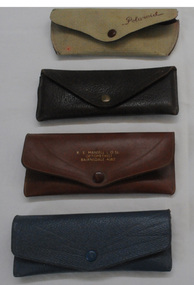
glasses' cases, c. 1950s - 1980s
... spectacle-case mansell-optometrist...Four spectacle cases used in the Orbost district, one being owned by S McKeown and supplied by R C Mansell who was a consulting optometrist in Orbost....Four spectacle cases catalogued 817.1 to 817.4. They are of a similar shape but have different colourings. 817.2 has the words S McKeown, Orbost written inside indicating the owner and R C Mansell L O Sc Optometrist, Orbost on the outside indicating the supplier. 817.4 has the word Polaroid on the outside....Four spectacle cases used in the Orbost district, one being owned by S McKeown and supplied by R C Mansell who was a consulting optometrist in Orbost. spectacle-case mansell-optometrist Four spectacle cases catalogued 817.1 to 817.4. ...Four spectacle cases used in the Orbost district, one being owned by S McKeown and supplied by R C Mansell who was a consulting optometrist in Orbost.Four spectacle cases catalogued 817.1 to 817.4. They are of a similar shape but have different colourings. 817.2 has the words S McKeown, Orbost written inside indicating the owner and R C Mansell L O Sc Optometrist, Orbost on the outside indicating the supplier. 817.4 has the word Polaroid on the outside.spectacle-case mansell-optometrist -
 Warrnambool and District Historical Society Inc.
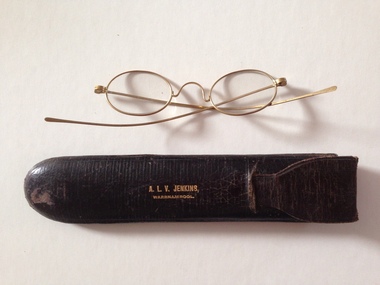
Glasses, Spectacle case and glasses, Early 20th century
... Spectacle case and glasses...The leather is slightly worn and torn. Spectacle case and glasses Glasses ...The seller of these items was A.L.V. Jenkins who was a bookseller and stationer in Warrnambool and obviously also sold miscellaneous goods such as spectacles. It is known that Mr Jenkins was in Warrnambool in 1910. The type of glasses suggest early 20th century use. These items are of interest as examples of spectacles used over a hundred years ago. They are also one of the few items we have connected to the business of A.L.V. Jenkins.This is a pair of spectacles with the glass intact and with gold metal rims, nose and side pieces and screws. They are in a brown leather case with a cardboard lining and a slot in the leather to insert the leather tongue that acts as a closing device. The leather is slightly worn and torn. ‘A.L.V. Jenkins, Warrnambool’ a.l.v. jenkins, early type spectacles, warrnambool -
 Stawell Historical Society Inc
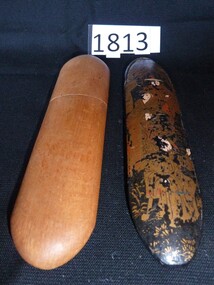
Memorabilia - Realia, Wooden Spectacle for glasses Case, c1900
... Wooden Spectacle for glasses Case ...Wooden Spectacle or glasses Case from a house in Stawell....Stawell Wooden Spectacle or glasses Case from a house in Stawell. Wooden Spectacle for glasses Case Memorabilia Realia ...Wooden Spectacle or glasses Case from a house in Stawell.stawell -
 Embroiderers Guild, Victoria
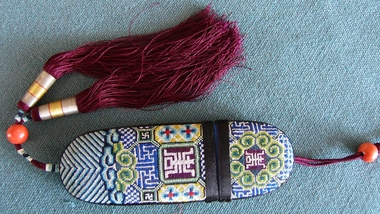
Domestic Object - Spectacle Case, Early 20th Century
... Spectacle Case...Domestic Object Spectacle Case ...Oval case bound in black satin. Very fine canvas, petit point stitching in coloured threads. Top held on with cord. Bottom decorated with two tassels. Two pink wooden beads, Chinese design.Chinese caligraphyembroidery, canvas work, small articles, 1900-20, china -
 Bendigo Historical Society Inc.
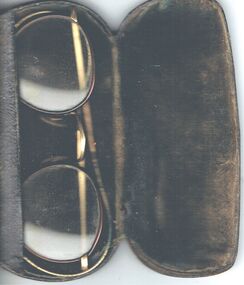
Accessory - PAIR OF BIFOCAL HORN: RIMMED SPECTACLES IN A CASE
... Pair of Bifocal Horn Rimmed Spectacles in old Spectacle case....PERSONAL EFFECTS Seeing aids Pair of Bifocal Horn Rimmed Spectacles in old Spectacle case. Accessory PAIR OF BIFOCAL HORN: RIMMED SPECTACLES IN A CASE ...Pair of Bifocal Horn Rimmed Spectacles in old Spectacle case.personal effects, seeing aids -
 Bright & District Historical Society operating the Bright Museum
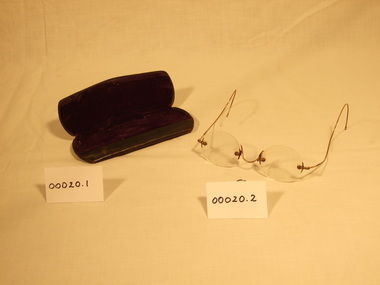
Spectacles and Case, H. Margules F.N.C.O. S.O.I
... ...spectacle case...spectacles glasses margules spectacle case 00020.2 H. Margules F.N.C.O. S.O.I. ...00020.1 Spectacles are comprised of two rimless round glass lenses. The arms are thin wire arms, possibly copper. Two nose clasps, possibly copper. 00020.2 Black leather case with purple velvet lining.00020.2 H. Margules F.N.C.O. S.O.I. Qualified sight specialist, 39a Broadway, Sydney spectacles, glasses, margules, spectacle case -
 Charlton Golden Grains Museum Inc
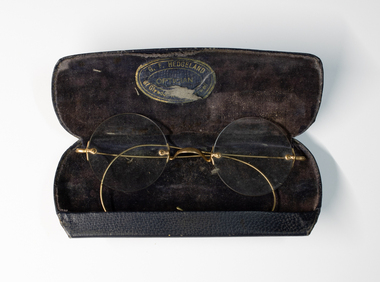
Domestic object - Spectacles and case, Hedgeland optician, 1910
... Rimless spectacles, flat round lens, gold wings, in spectacle Case with snap hinge...HEDGELAND OPTICIAN CAMBERWELL Rimless spectacles, flat round lens, gold wings, in spectacle Case with snap hinge Domestic object Spectacles and case Hedgeland optician ...Rimless spectacles, flat round lens, gold wings, in spectacle Case with snap hingeHEDGELAND OPTICIAN CAMBERWELL -
 Whitehorse Historical Society Inc.
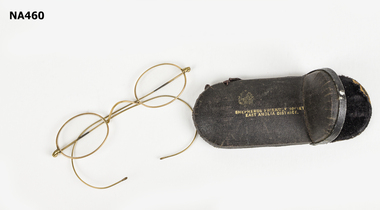
Functional object - Spectacles
... Black spectacle case with hinged lid at one end. Small metal framed spectacles in case....personal effects seeing aids Shepherds Friendly Society, East Anglia District - On Case. Black spectacle case with hinged lid at one end. Small metal framed spectacles in case. ...Black spectacle case with hinged lid at one end. Small metal framed spectacles in case.Shepherds Friendly Society, East Anglia District - On Case.personal effects, seeing aids -
 City of Moorabbin Historical Society (Operating the Box Cottage Museum)
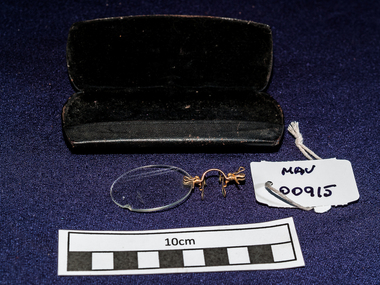
Personal Effects, Boy’s spectacles ½ in case, early 20thC
... A young boy’s frameless spectacles - 1 glass lens with gold style bridge with a stiffened cardboard spectacle case ...They are normally used for vision correction or eye protection. eyes spectacles eye glasses optometry moorabbin bentleigh cheltenham market gardeners pioneers early settlers schools A young boy’s frameless spectacles - 1 glass lens with gold style bridge with a stiffened cardboard spectacle case Personal Effects, Boy’s spectacles ½ in case Unrecorded ...Glasses, also known as eyeglasses or spectacles, are frames bearing lenses worn in front of the eyes. They are normally used for vision correction or eye protection. A young boy’s frameless spectacles - 1 glass lens with gold style bridge with a stiffened cardboard spectacle case eyes, spectacles, eye glasses, optometry, moorabbin, bentleigh, cheltenham, market gardeners, pioneers, early settlers, schools -
 Wangaratta Art Gallery
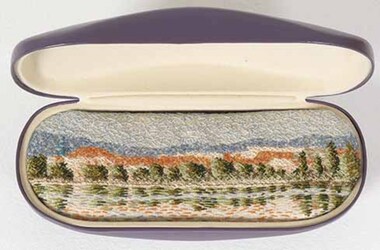
Textile, Sharon Peoples, Lake Tuggeranong 2, 2019
... A small embroidery using a colour palette of green, orange, blue and brown depicting a scene of Lake Tuggeranong mounted into a purple spectacle case....sharon peoples textile embroidery lake tuggeranong landscape A small embroidery using a colour palette of green, orange, blue and brown depicting a scene of Lake Tuggeranong mounted into a purple spectacle case. Lake Tuggeranong 2 Textile Sharon Peoples ...In 2019 Peoples undertook a residency at the Tuggeranong Arts Centre, Canberra. The original proposal was to explore the suburban gardens. However, it was the man-made lake with a different bloom, blue-green algae that held her attention. The still waters of the lake in the early mornings are tranquil. Becoming more familiar with the Lake, details caught Peoples’ eye. However, she realised the only interaction by humans with the Lake were two men who motored a small boat to the centre of the Lake, a hint as to the connection between tranquility and blue/green algae.Wangaratta Art Gallery Collection. Donated by June Brown.A small embroidery using a colour palette of green, orange, blue and brown depicting a scene of Lake Tuggeranong mounted into a purple spectacle case.sharon peoples, textile, embroidery, lake tuggeranong, landscape -
 Wangaratta Art Gallery
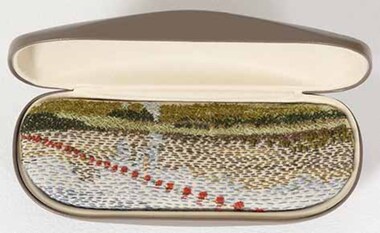
Textile, Sharon Peoples, Lake Tuggeranong 3, 2019
... A small embroidery using a colour palette of green, red, blue and brown depicting a scene of Lake Tuggeranong mounted into a brown spectacle case....Sharon peoples embroidery textile lake tuggeranong A small embroidery using a colour palette of green, red, blue and brown depicting a scene of Lake Tuggeranong mounted into a brown spectacle case. Lake Tuggeranong 3 Textile Sharon Peoples ...In 2019 Peoples undertook a residency at the Tuggeranong Arts Centre, Canberra. The original proposal was to explore the suburban gardens. However, it was the man-made lake with a different bloom, blue-green algae that held her attention. The still waters of the lake in the early mornings are tranquil. Becoming more familiar with the Lake, details caught Peoples’ eye. However, she realised the only interaction by humans with the Lake were two men who motored a small boat to the centre of the Lake, a hint as to the connection between tranquility and blue/green algae.Wangaratta Art Gallery Collection. Donated by June Brown.A small embroidery using a colour palette of green, red, blue and brown depicting a scene of Lake Tuggeranong mounted into a brown spectacle case.sharon peoples, embroidery, textile, lake tuggeranong -
 Flagstaff Hill Maritime Museum and Village
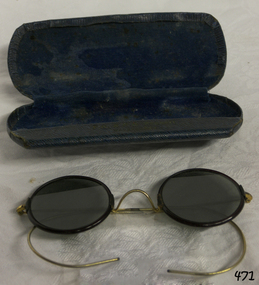
Functional object - Spectacles and case, Fred and Geoff Bennett (F.T. and P.G. Bennett), mid-29th century
... Hard surfaced blue velvet lined spectacle case. Inscription on case. Made by F.G. & P..G. ...Hard surfaced blue velvet lined spectacle case. Inscription on case. Made by F.G. & P..G. ...This pair of spectacles was prescribed and made in Warrnambool by brothers Fred and Geoff Bennet from about 1946 when they established their optometrist business at 192 Liebig Street Warrnambool. The business moved to 152 Liebig Street in 1988, by which time it had already changed hands to become McMahon and Owen Optometrists. Jayson Ward and Mathew Bucks purchased the business in 2012, then changed the name to Warrnambool Eyecare in 2016. They also own and practice at Portland Eyecare.This pair of glasses is significant as an example of locally owned and manufacture red eyewear from the mid 290th century. Spectacles, Pince-nez with oval shaped tinted lenses, metal bridge and rubber nose pads. Hard surfaced blue velvet lined spectacle case. Inscription on case. Made by F.G. & P..G. Bennett in Warrnambool."F.G. & P.G. Bennett Warrnambool"flagstaff hill, warrnambool, shipwrecked-coast, flagstaff-hill, flagstaff-hill-maritime-museum, maritime-museum, shipwreck-coast, flagstaff-hill-maritime-village, pince-nez, glasses, eyewear, seeing aids, vision, optician, f.g. & p.g. bennett warrnambool, eye care, magnifiers, reading glasses, fred and geoff bennett, personal effects -
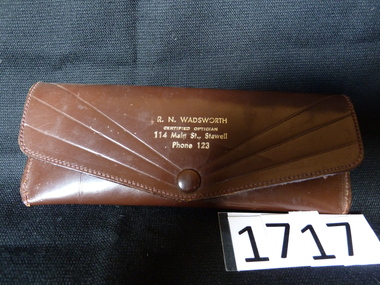 Stawell Historical Society Inc
Memorabilia - Realia, 1940's
... Spectacle or glasses Case (R.N. Wadsworth)...Stawell Spectacle or glasses Case (R.N. Wadsworth) Memorabilia Realia ...Spectacle or glasses Case (R.N. Wadsworth)stawell -
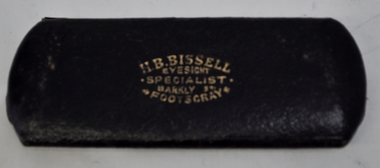 Kiewa Valley Historical Society
Case Leather for Reading Spectacles
... This slim spring lid spectacle case has a body of light steel over layered by a fine skin dyed(dark brown) leather coating. ...BISSELL" underneath "EYESIGHT" underneath "SPECIALIST" underneath "BARKLY st", underneath "FOOTSCRAY" This slim spring lid spectacle case has a body of light steel over layered by a fine skin dyed(dark brown) leather coating. ...This small, slim case was manufactured to contain reading spectacles in a secure but yet "manageable pocket or purse" environment. It was manufactured to contain reading glasses that would not exceed 12mm in thickness. The product was targeting the "professional" reader ie. accountant, lawyer, business and property managers. Because it was made for a "eyesight" specialist to contain "prescription" reading spectacles the quality had to be of a higher level than cheaper "off the shelf" ones. This case was made and used in the late 1800's and early 1900's.This case, for spectacles, holds a significant position in that it points to a time in history when rural Australian families required to travel long distances to obtain professional "eyesight" treatment which, on the whole, were only available in the capital cities (in this case Melbourne). In the pre 1960's, the greater the distance from capital cities for Australian rural folk to seek professional medical, dental, nose ,eye and throat specialists the greater the time involved resulting in the greater expense. This "isolation" brought about increased costs not experienced by city residences. The quality and durability of this case was a pre-requisite for the Kiewa Valley based resident.This slim spring lid spectacle case has a body of light steel over layered by a fine skin dyed(dark brown) leather coating. The inside, of the case, has a 1mm lip opposite the hinged end (to secure the reading spectacles within the case). The inside is fully covered by a "royal" purple felt (to provide the spectacles with a scratch free enclosure).At the outside base in gold lettering "H.B. BISSELL" underneath "EYESIGHT" underneath "SPECIALIST" underneath "BARKLY st", underneath "FOOTSCRAY"personal effects, spectacles, eye fashion, reading glasses -
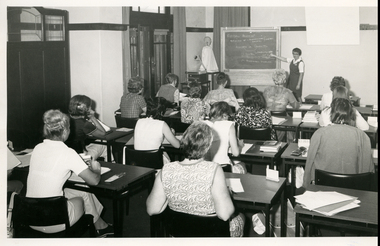 Royal District Nursing Service (now known as Bolton Clarke)
Photograph - Photograph, black and white, Barry Sutton, 25.03.1974
... The 16 Sisters, some partly hidden, are wearing a variety of summer day clothes. Spectacle cases, pens, sheets of paper, and some books are on the tables in front of them. ...The 16 Sisters, some partly hidden, are wearing a variety of summer day clothes. Spectacle cases, pens, sheets of paper, and some books are on the tables in front of them. ...The photograph shows a group of Royal District Nursing Service (RDNS) Sisters receiving a lecture on 'Physical Handicap' given by Sr. Rowley in the Education Department at RDNS Headquarters 452 St. Kilda Road, Melbourne. Sr. Rowley is the Principal Nurse Educator at RDNS.Education was an integral part of Melbourne District Nursing Society (MDNS), from its inception in 1885, later, in 1966, called Royal District Nursing Service, (RDNS). From 1885, only Trained nurses (Nurses), through the Hospital training system, were employed by the Society, and on visits to patients they taught the necessity of hygiene and cleanliness, as well as the need for a good diet, to bring about good health. Doctor’s lectures were later given at the MDNS home to instruct patients and their families on prevention of disease. Education to patients continued throughout the years regarding health care and the use of equipment in the home. In 1961, Education programs commenced at MDNS with Trained nurses (Sisters) receiving In-service education. Sr. Pat (Paddy) Rowley was a leader in In-service Education and established the RDNS Department of Community Nursing Education in 1962. Staff could also apply for scholarships to further their education outside of RDNS. Many of their senior Sisters received Postgraduate diplomas from the College of Nursing in Community Health Nursing, Education, and Administration, and several travelled overseas visiting nursing organizations viewing their public health and District nursing systems. At RDNS many programs were run, including: a Post Basic Course, Cardiac Rehabilitation Nursing, Haematology/Oncology Nursing, Palliative Care program, Diabetic Stabilization Program, Leg Ulcer Management Program, Wound Care Specialist Program, HIV/AIDS Nursing Care, Cystic Fibrosis Home Support, Veterans Home Care Program, Breast Cancer Support Program, Continence Management Program, Stomal Therapy Program, In-Home Lactation Support Program and the Homeless Persons Program. RDNS Sisters attended several hospitals to observe and learn special care needed to some patients, e.g. to the Austin Hospital to learn the care required for paraplegic and quadriplegic patients at home, and to Mount Royal Hospital to observe the care of patients in the Rehabilitation ward. A Community Nursing Education Program was extended to student nurses from hospitals and to other nursing organizations. These Education programs kept the RDNS Sisters abreast of new techniques, such as changes in technology for e.g. new testing methods in detecting glucose levels in Diabetic patients. Sr. Nan Deakin obtained a Post Basic Certificate in Psychiatric Nursing and included this area in her Education lectures. Sr. Daphne Geldard specialized in the area of Alzheimer’s disease and Dementia. These Sisters visited patients in District areas with the regular RDNS Sister when required. Every member of staff, both professional and non professional staff, received regular education in the Education Department. In 1980, a Home Health Aide pilot study, funded by the Federal Government, the Brotherhood of St. Laurence and RDNS, with the program written and taught by Sr. Rowley, was evaluated as successful, and Home Health Aides were employed and worked in RDNS Centres under the supervision of the RDNS Sisters. This black and white photograph shows the back view of four rows of Royal District Nursing Service (RDNS) Sisters sitting at small tables and looking toward Sister Pat (Paddy) Rowley who is facing them. She is in the rear centre of the photograph. The 16 Sisters, some partly hidden, are wearing a variety of summer day clothes. Spectacle cases, pens, sheets of paper, and some books are on the tables in front of them. Sister Rowley who wears glasses; has short straight dark hair, is wearing a white short sleeve blouse under a dark V neck tunic style dress. She is looking at the group and her right hand is pointing to writing on a large blackboard standing to her right. To the left of the blackboard, a draped Human Torso Model sits on a table. A long dark curtain hangs behind part of the blackboard. Running along the left of the photograph is a wooden door with glass panels at the top, some light colour wall with a dark picture rail, and a set of double glass doors with long grey curtains either side. To the right of Sr. Rowley part of a large white board is seen hanging above and below the dark picture rail on the wall.Barry Sutton LY 69rdns, royal district nursing service, rdns education, sister pat (paddy) rowley -
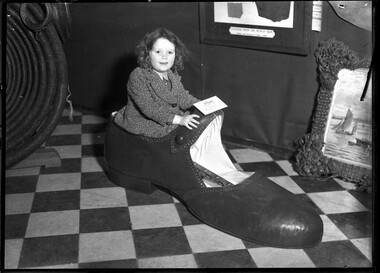 City of Melbourne Libraries
Photograph, Bull, Hugh Jones, 1897-1993, Leather Exhibition, Melbourne Town Hall
... In a host of other directions, in the purchase of handbags, travelling bags, belts and straps, cushions, furniture coverings, purses, notebooks, spectacle cases, their annual expenditure must be very high. ...In a host of other directions, in the purchase of handbags, travelling bags, belts and straps, cushions, furniture coverings, purses, notebooks, spectacle cases, their annual expenditure must be very high. ...Photographer notations on slide: At the Leather Exhib. at T. Hall Melb 1933 Age Published: Age (Melbourne, Vic.: 1854- ), 1933 THE EXHIBITS. (1933, September 20). The Age (Melbourne, Vic. : 1854 - 1954), p. 16. Retrieved January 25, 2026, from http://nla.gov.au/nla.news-article205109730 Published title: THE EXHIBITS. A COMPREHENSIVE RANGE. Curios, Novelties, Working Displays Published Caption: ONE OF THE NOVELTIES – AN OUTSIZE IN SHOES Research by Project Volunteer, Louise McKenzie: Our photo is dated 20 September 1933, and shows a happy, chubby-faced young girl sitting in a very over-sized girl’s shoe. It is labelled – “Shoe, An Out Size, loaned by Messrs Blackman & Rose”. (1) It is an effective way to capture the attention of the readership and alert them to the Melbourne Leather Show 1933. This show was designed to be a drawcard of extraordinary proportion, and there is no doubt that this leather exhibition was a really big deal for Melbourne. It completely took over the Melbourne Town Hall, and was open from 10.30 am until 10.30 pm. It seemed to contain something for everyone – the military, the man about town, the home handyman, the housewife, the child, the sporting types, the domestic workers, the outdoor enthusiasts, the horseracing fans, car enthusiasts, those wishing to show off the latest fashion – both men and women - and those just intrigued by a lot of fascinating and wide ranging exhibits. One of the most comprehensive descriptions of the Exhibition accompanies the photograph, and is worth quoting in full: “PROMINENT among exhibits which first attract attention in the foyer of the Town Hall is a comprehensive display of leather articles used by the defence forces. A conspicuous legend states that leather plays an important part in national defence, being used for saddlery, tool containers, holdalls, range-finding, surveying and signalling equipment, explosives factories, harness accoutrement, bandsmen's equipment and clothing. Three models of horses and several figures of soldiers wearing leather equipment illustrate the lesson, and a great range of leather goods used in military training and work variegate the display. Nearby are Texas cowboy, buckjumping and breaking-in saddles; whips, a walking stick, made of leather and numerous other curios. The general exhibition occupies the whole floor space of the main Town Hall, and is subdivided by partitions running most of the length of the hall. A bewildering variety, of leather goods presses for close and leisured inspection. Here and there operatives in charge of working machinery give practical demonstrations of factory processes in the production of footwear. Polishing materials are well represented. One attractive exhibit includes two bush huts constructed of leather, with wattle bark for roofing. Opossums, rosellas and a kookaburra add touches of bush realism. Adjacent exhibits include bags, fishing boots, leggings, leather covers in all colours. Factory Processes. One exhibitor has installed an automatic cinema apparatus and screen, which projects various factory processes in making a shoe, the operator being shown at work. Elsewhere an interesting exhibit depicts the five stages in the manufacture of sole leather, and the tanning materials employed. "Very handsome effects are achieved in the interior appointments of motor cars, which are attended by figures of smart chauffeurs in leather coats. Motor-trimming leather is said to be more durable and hygienic than fabric materials, and cheaper. The neat finish of the material, its excellent appearance, certainly make a very favourable impression. It takes the hides of three beasts to cover the cushions, squabs and door panels of a full-sized sedan, while to finish the entire interior, including quarter-panels and head linings would take four or even five. Special Exhibits. Amongst the special sections the display arranged by the handicrafts and home industries- committee of the Country Women's Association of Victoria is a notable one. In all there are about 130 entries which are in four classifications, viz., hand-tooled or embossed leathers, suede, hand-made gloves and undecorated leather. The glove section attracted the most numerous entries, a number being the work of members and craft subscribers of the Country Women's Association. In the leathercraft competition, organised by the Country Women's Association, the judges yesterday awarded the first prize for bookbinding (the only prize given in this division) to Miss M. Alston, of South Yarra. There is also a creditable display of exhibits submitted by boys of the orthopaedic section of the Children's Hospital at Frankston. Amongst the novelties on view in other portions of the exhibition were the following: — Leather coats worn by Sir C. Kingsford Smith on his Atlantic flight. Model Wellington boot, Phar Lap's saddle. Melbourne Cup winner's saddle. Longest whip in world, 108 feet long. (33 metres) [See our photo, to left of Girl in Shoe] Diminutive shoes. Pair of shoes 65 years old. Pair of men's working boots 75 years old. Larwood's, Tate’s and Pataudi’s cricket boots. [Three internationally revered cricketers of the day] (2) Picture frame made of leather bought 63 years ago. [See our photo, to right of Girl in Shoe] Leather frame, powder bowl, &c. Saddle used by world's champion buckjumper in U.S.A. Mexican cowboy outfit. Miniature saddle and bridle. A fireman's helmet made of sole leather. (3) Sample of the leather hat worn by porters at the Billingsgate Fish Market, London. (4) From South Australia there have been obtained sets of harness for donkeys, goats and camels, the equipment being displayed to good advantage on stuffed representations of the animals mentioned. Close to the platform is a glass case containing snow shoes and coats which have been used in Antarctic exploration work. Trade Display. Amongst the trade exhibits may be seen in operation a slipper turn shoe sewing machine, with heeling and channelling facilities, and the various stages in the production of ladies' sandals are shown. There is a wide contrast between sole leather of varying degrees of thickness on view in one stall and the choice samples of ladies' footwear in another — footwear, by the way, which could almost be used as ornaments, so dainty in colour and production are they. Again, there are displays of upholstering leathers of such soft texture that they could he readily mistaken for some of the finest cloth. Those who may be particularly interested in the production of chamois leather may gain an insight into the materials and chemicals used in the "working up” of this variety of leather. Supplies of glace kid (5) are tastefully arranged, and there may also be seen bags of all shapes and sizes, including satchels, suit cases and "sporting" cases, and bags for tennis players and golfers. Further variety is given to the exhibition by the display of antique hides, brightly coloured, with punching balls, boxing gloves and batsman's pads. There are crocodile skins and snake skins so cleverly "Worked up" that one could be almost pardoned for betraying an affection for such unpopular creatures.” “ Another wonderful article on this Exhibition, published the same day in one of the opposition daily newspapers, The Argus, is in the weekly article “Women to Women”, entitled “A Great Victorian Industry: Many Uses for Leather”. This weekly column was penned by Vesta, and she writes, with much purpose: “Yesterday afternoon I paid a hurried visit to the Leather Exhibition now being held in the Melbourne Town Hall and I was disappointed to find that the early visitors to the main exhibition were almost all men. Women, I think, should make a point of seeing every exhibition of our great industries, for women are the buyers of household requisites and goods for their own use and their tastes, and opinion influence also, to a large extent, the purchases of men. So, the welfare of industries is more or less in their hands and it becomes a duty for them to inform themselves fully of the extent and the quality of the manufacturing that is done here. The value of the output of the Australian boot and shoe factories alone was in 1930-31, the latest year for which the figures are given, Stg 3,750,000. Fully two thirds of that amount must have been spent by women on boots and shoes for themselves and their children. In a host of other directions, in the purchase of handbags, travelling bags, belts and straps, cushions, furniture coverings, purses, notebooks, spectacle cases, their annual expenditure must be very high. Their interest, therefore, in this industry is practical, and their support of it should be governed by knowledge of comparable values and qualities of the goods they buy. From the point of view of women, however, the exhibition itself is rather disappointing. There is an amazing collection of good stuff on show, but most of it is not displayed in a fashion that attracts attention. I was surprised, for example, at the range and quality of the leathers displayed, the suppleness of the finer qualities, and the varied range of colours and designs. But they are shown in such a fashion that if one set out deliberately to look for them it would be quite easy to miss most of them.” …It was surprising, too, that no one seemed to have taken advantage of the present fashion of wearing coloured gloves, or the cult of glove making, which the Country Women’s Association has fostered so successfully. Outside the collection of chamois leathers I saw no skins which were suitable to glove making. (6) However, it is perhaps a little unfair to be highly critical of the exhibition, inasmuch as it is the first of its kind. The material is there, undoubtedly, for a splendid show of every phase of this enterprising industry, and I am confident that experience will prove to those concerned that it will be worth while next time to devote a great deal of attention of the method of display.” With further research, it transpires that “Vera” is in fact NZ born Stella May Allen (nee Henderson) (1871-1962), a journalist, the first woman in NZ to begin a law course, in 1890-91). She later worked at a law firm while she completed her degree. Study of the law had always been open to women in NZ, but its practice was still barred to them. Her case “…led to amending legislation in 1896 allowing women to practise as barristers or solicitors. However, on gaining her LL.B. in November 1897 she did not apply for admission to the Bar. Instead, she became the Wellington-based correspondent and leader-writer for the Lyttelton Times. Her appointment, the first for a woman, was not welcomed by the all-male Press Gallery, and special permission had to be obtained from a subcommittee of the House before her presence was accepted. In 1900 she married Edwin Allen, a senior leader-writer for the Wellington Evening Post, and they moved to Australia in 1903 when Edwin Allen took up the post of foreign affairs leader-writer and parliamentary man for the Melbourne Argus. As Patricia Keep notes in her excellent entry of Stella Allan in the Australian Dictionary of Biography: “In 1907 The Argus commissioned her to write a series of articles on the first Australian Women's Work Exhibition held in October. They aroused much interest and next year The Argus invited her to join its full-time staff and begin a weekly section on the particular interests of women. She adopted the nom de plume 'Vesta' and called the column 'Women to Women'. Her work was unique in an Australian daily paper at that time. Her pages extended to cover every aspect of women's affairs, children's interests and community welfare, and 'Vesta' became a household word for authoritative information and advice on such matters. An excellent needlewoman and first-rate cook herself, she thoroughly tutored her staff in the work and needs of women in both country and city, as well as providing the usual training for cadet journalists. She conducted interviews and also visited the country to see at first hand the results of bushfires, mouse plagues, droughts and floods. In 1910 she was one of three women foundation members of the Australian Journalists' Association. “…she found time to become deeply involved in community affairs. She was an original committee-member of the Victorian Association of Crèches and of the Free Kindergarten Union of Victoria, and had much to do with the early days of the Victorian Bush Nursing Association, the Baby Health Centres Association and the Queen Victoria Hospital. She was a member of the National Council of Women, first in New Zealand and then in Melbourne, and of the Country Women's Association from its inception. … in 1924 she was appointed substitute delegate for Australia to the fifth assembly of the League of Nations at Geneva and was a delegate to the second Pan Pacific Women's Conference in Hawaii in 1930. A meeting held in the Melbourne Town Hall in 1938 by representatives of all the main Victorian women's organizations paid special tribute to her work and influence. She retired next year to England where she continued to write for the Argus, contributing articles on the experiences of women and children in wartime.” It is little wonder that “Vesta” was unafraid to take to task both the women of Victoria, and those who created the exhibition! One item which appears to have gone unnoticed, or at least unreported, is a framed article in the background of the photo of the chubby girl in the shoe. The display frame is labelled “Leather from the Human Skin, Tanned and Dressed by French artists.” The exhibition was certainly a cabinet of curiosities! A charming article in The Argus is a nice note on which to end. It gives a quick history and overview of the Australian leather industry and its unprecedented, and possibly unexpected, development and success, and states with pride: “Though Victoria is the largest leather producer in the Commonwealth all tanners in the Commonwealth can look back with pride on the long march of progress.” Footnotes: (1) “Blackman and Rose”. Messrs Blackman and Rose were shoe manufacturers, from 1927 located at 200 Noone Street, Clifton Hill. The Melbourne Circle describes their building as a “fine-looking building in the Federation ‘blood and bandage’ style.” It was built around 1912 for Puttifoot and Bloom, boot manufacturers, and today the building is apartments. (2) These cricketers were household names in the day: Tate: Maurice Tate, “English cricketer of the 1920s and 1930s, and leader of England’s Test bowling attack for a long time during this period. The founder of modern seam bowling. “ Larwood: Harold Larwood, “English right-arm fast bowler and the main exponent of the bowling style known as “bodyline”. Used to considerable effect in the 1932-33 Test series in Australia. Pataudi: Iftikhar A K Pataudi, “an Indian prince who in the 1930s played Test cricket for England, and in the 1940s played Test cricket for India (as Captain) – the only test cricketer to have played for both India and England. (3) “sole” leather “… is the thickest and most resistant material existing in the tanning industry … made from vegetable tanned leathers, usually bovine butts, processed in a special way to make them the hardest type of leather in existence.” (4) The hats worn by porters at Billingsgate Fish Market were also known as a “Bobbin” and look quite squat and rather unsophisticated. They were made of wood and tarred leather, with a “flat, hardened top designed to support large rectangular boxes of fish. The upturned brim protected the porter’s head against fish juice draining from the boxes of fish which would be carried on top of the hat. Some hats featured a small drain hole at the rear to allow this collected juice to drain down the back of the carrier. The hats were made using the ‘cuir bouilli’ technique. The leather was immersed in water which was heated until the leather began to shrink. It was then removed and put on a wooden former. The leather was stitched together to make the hat while still wet, and then held in place until dry.” (See article and photo on the London Museum website) (5) Glace kid – described on the Boston Museum of Fine Arts’ Cameo database as “A smooth glossy leather originally prepared from goat or sheepskin. Early glace kid had a shiny surface that was originally prepared by tawing the skin in a mixture of alum, table salt, flour, and egg yolk. Today, glace kid is prepared from many types of vegetable or chrome tanned leathers. The smooth polished surface is obtained mechanically by shaving, glazing, ironing, and/or rolling the dry leather.” (6) In the 1930s, Melbourne’s glovemaking industry was characterised by local manufacturing, with key producers like Simpson’s Gloves Pty Ltd in Richmond and the Stagg Glove Company in Clifton Hill leading the market. These factories produced high-quality leather gloves, handbags, and specialty gear, often employing a clear gendered division of labour and training young, local women. Museum Victoria holds the Simpson’s Gloves Collection, comprising over 1200 items, and the University of Melbourne Archives holds the company’s business records. References: THE EXHIBITS. (1933, September 20). The Age (Melbourne, Vic. : 1854 - 1954), p. 16. Retrieved January 25, 2026, from http://nla.gov.au/nla.news-article205109730 EXPORT LEATHER. (1929, September 17). The Argus (Melbourne, Vic. : 1848 - 1957), p. 17. Retrieved January 19, 2026, from http://nla.gov.au/nla.news-article4037647 LEATHER EXHIBITION (1933, September 18). The Argus (Melbourne, Vic. : 1848 - 1957), p. 10. Retrieved January 19, 2026, from http://nla.gov.au/nla.news-article11693362 (1933, September 23). The Argus (Melbourne, Vic. : 1848 - 1957), p. 21. Retrieved January 19, 2026, from http://nla.gov.au/nla.news-page522766 WOMEN TO WOMEN (1933, September 20). The Argus (Melbourne, Vic. : 1848 - 1957), p. 13. Retrieved January 19, 2026, from http://nla.gov.au/nla.news-article11694034 Australian Dictionary of Biography, Stella May Allan (1871–1962) https://adb.anu.edu.au/biography/allan-stella-may-4998 WOMEN TO WOMEN (1930, January 22). The Argus (Melbourne, Vic. : 1848 - 1957), p. 13. Retrieved January 19, 2026, from http://nla.gov.au/nla.news-article4063888 Museums Victoria, Simpson’s Gloves, 486-496 Victoria Street, North Richmond, VIC, Australia https://collections.museumsvictoria.com.au/articles/2702 The Argus. (1927, October 31). The Argus (Melbourne, Vic. : 1848 - 1957), p. 20. Retrieved February 7, 2026, from http://nla.gov.au/nla.news-article3888451 Melbourne Circle: stories from the suburbs: “Boots and all in Clifton Hill” https://melbournecircle.net/2015/11/20/bootmakers-of-clifton-hill/ Wikipedia, Maurice Tate, https://en.wikipedia.org/wiki/Maurice_Tate Wikipedia, Harold Larwood, https://en.wikipedia.org/wiki/Harold_Larwood Wikipedia, Iftikhar Ali Khan Pataudi, https://en.wikipedia.org/wiki/Iftikhar_Ali_Khan_Pataudi Buy Leather Online Italy, Sole leather: https://buyleatheronline.com/en/blog/outsole-and-insole-leather-n7 London Museum, Porters hats, https://www.londonmuseum.org.uk/collections/v/object-731122/hat-porters-hat/ Cameo Database, Museum of Fine Arts, Boston, Glace Kid, https://cameo.mfa.org/wiki/Glac%C3%A9_kid VICTORIAN LEATHER HAS WON RENOWN (1937, September 22). The Argus (Melbourne, Vic. : 1848 - 1957), p. 31 (March of Progress Supplement). Retrieved February 7, 2026, from http://nla.gov.au/nla.news-article1108704 Photographer notations on slide: "At the Leather Exhib. at T. Hall Melb 1933 Age B5".displays, melbourne town hall, leather, children, shoes, 1930-1939, industry, hats, gloves -
 Flagstaff Hill Maritime Museum and Village
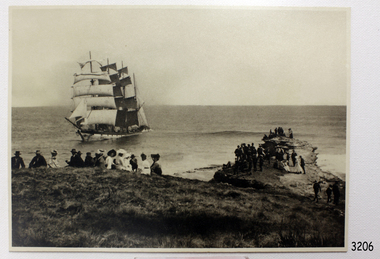
Photograph - Vessel, Sailing Ship, Original image recorded between 14 Nov 1908 and early Jan 1909
... The wreck is protected as a Historic Shipwreck under the Commonwealth Historic Shipwrecks Act (1976). flagstaff hill warrnambool shipwrecked-coast flagstaff-hill-maritime-museum maritime-museum shipwreck-coast flagstaff-hill-maritime-village falls of halladale shipwreck spectacle shipwreck photograph peterborough reef edwardian sightseers russell & co. Letters in upper case and white contrast stretching across the grassed foreground of photograph have been smudged over by development process and are largely indecipherable. ...The photograph represents the original complete landscape (southerly) view of the FALLS OF HALLADALE shipwreck which occurred at 3 am on the 14th of November 1908. This image includes three groups of well-dressed Edwardian sightseers on the clifftop and a rocky headland. Subsequent reproductions of this well-known image have been cropped to a striking portrait view, emphasising the vertical line of the masts and sails of the sailing ship, and excluding the groups of sightseers on the adjoining headland. The small girl in the foreground and the loose topsail on the foremast are common to both the landscape and the cropped portrait images of this memorable scene. The photograph was taken at an early stage of the ship’s final days, somewhere between the date of her grounding in mid-November 1908 and early January 1909, when salvagers began dynamiting her masts to get to the cargo in her holds. The heavily laden FALLS OF HALLADALE was 102 days out of New York when the swell of the Southern Ocean lifted her onto the rocks near Peterborough. At the time she was sailing at six knots in a light breeze, her sails fully set and on an ENE tack. Mist over the land created an optical illusion of a distant horizon and the crew believed they were at least ten miles off the coast. When high cliffs loomed up out of the darkness it was too late in the light conditions to change tack or let go the anchors. Within minutes of running aground, her decks were awash and the holds filling with water. Captain Thomson and his 29 crew took to the boats, leaving the vessel stranded on the reef, looking awkwardly graceful in her predicament, firmly wedged between two parts of the reef and with all her square-rigged sails still set, FALLS OF HALLADALE provided a landmark visible for miles. Over the following two months, she attracted hundreds of sightseers, including contemporary photographers. A Court of Marine Inquiry at Melbourne on 30 November 1908 found Captain Thomson guilty of a gross act of misconduct ― in that he carelessly navigated the ship, neglecting to take proper soundings and failing to place the ship on the port tack before it was too late to do so. His Master’s Certificate of Competency was suspended for six months and he was ordered to pay £15/15/- toward the costs of the inquiry. It was an expensive outcome for the captain but his error provided many weeks of inexpensive entertainment for coastal residents and visitors to Peterborough. To judge from the standard of formal dress in this photograph, visiting the wreck was considered a special occasion as well as a popular one. Falls of Halladale: - The iron-hulled, four-masted barque, the Falls of Halladale, was a bulk carrier of general cargo. She left New York in August 1908 on her way to Melbourne and Sydney. In her hold, along with 56,763 tiles of unusual beautiful green American slates (roofing tiles), 5,673 coils of barbed wire, 600 stoves, 500 sewing machines, 6500 gallons of oil, 14400 gallons of benzene, and many other manufactured items, were 117 cases of crockery and glassware. Three months later and close to her destination, a navigational error caused the Falls of Halladale to be wrecked on a reef off the Peterborough headland at 3 am on the morning of the 15th of November, 1908. The captain and 29 crew members all survived, but her valuable cargo was largely lost, despite two salvage attempts in 1908-09 and 1910. ABOUT THE ‘FALLS OF HALLADALE’ (1886 - 1908) Built: in1886 by Russell & Co., Greenock shipyards, River Clyde, Scotland, UK. The company was founded in 1870 (or 1873) as a partnership between Joseph Russell (1834-1917), Anderson Rodger and William Todd Lithgow. During the period 1882-92 Russell & Co. they standardised designs, which sped up their building process so much that they were able to build 271 ships over that time. In 1886 they introduced a 3000 ton class of sailing vessel with auxiliary engines and brace halyard winches. In 1890 they broke the world output record. Owner: Falls Line, Wright, Breakenridge & Co, 111 Union Street, Glasgow, Scotland. Configuration: Four masted sailing ship; iron-hulled barque; iron masts, wire rigging, fore & aft lifting bridges. Size: Length 83.87m x Breadth 12.6m x Depth 7.23m, Gross tonnage 2085 ton Wrecked: the night of 14th November 1908, Curdies Inlet, Peterborough south west Victoria Crew: 29The shipwreck of the FALLS OF HALLADALE is of state significance: Victorian Heritage Register No. S255. The Falls of Halladale shipwreck is listed on the Victorian Heritage Register (No. S255). She was one of the last ships to sail the Trade Routes. She is one of the first vessels to have fore and aft lifting bridges. She is an example of the remains of an International Cargo Ship and also represents aspects of Victoria’s shipping industry. The wreck is protected as a Historic Shipwreck under the Commonwealth Historic Shipwrecks Act (1976).Black and white photograph on cream-coloured backing card and in good condition. Description of Image: Quadrant 01, vessel with full set of sails perched on reef with stern submerged; Quadrant 02, predominantly clear sky over flat calm sea; Quadrant 03, two groups of standing sightseers on rocky promontory with three individuals approaching from far left foreground; Quadrant 04, fifteen well dressed sightseers seated on grassed cliff top including one child and six women. There is a deliberately obscured inscription in white ink along lower border or foreground of photograph.Letters in upper case and white contrast stretching across the grassed foreground of photograph have been smudged over by development process and are largely indecipherable. However rear of backing board of identical but reduced image Reg. No. 3207 bears pencilled words “Mrs Francis” and “Wreck of ‘Falls of Halladale’ Peterborough 1908”, which accords with what remains of the initial inscription.flagstaff hill, warrnambool, shipwrecked-coast, flagstaff-hill-maritime-museum, maritime-museum, shipwreck-coast, flagstaff-hill-maritime-village, falls of halladale, shipwreck spectacle, shipwreck photograph, peterborough reef, edwardian sightseers, russell & co. -
Frankston RSL Sub Branch
Spectacles (pair)
... case. Spectacles have metal frames with round lenses. It was owned by L/BDR J. Woodhouse 1456221 (British Artillery). The spectacle...case. Spectacles have metal frames with round lenses. It was owned by L/BDR J. Woodhouse 1456221 (British Artillery). The spectacle ...Set of spectacles in a metal and black leather case. Spectacles have metal frames with round lenses. It was owned by L/BDR J. Woodhouse 1456221 (British Artillery). The spectacle frame was designed for ordinary use and for use when wearing a respirator. The small round lenses fitted inside eye pieces and the flat sidearms fitted underneath the rubber sides of the respirator. Issued in November, 1942.spectacles, ww2, case, respirator, l bdr, j, woodhouse -
 Flagstaff Hill Maritime Museum and Village
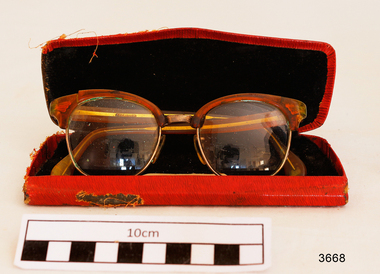
Functional object - Spectacles and Case, 1930s - 1960s
... case...optical testing...optometrist examination...opsm optical prescription spectacle...https://www.college-optometrists.org/the-british-optical-association-museum/the-history-of-spectacles The company Optical Prescription Spectacle Makers (OPSM ) was formed in Sydney in 1932 and publically listed in 1953. These spectacles and case were used by Dr. ...Inscriptions on case, inside case and on spectacle rim....Inscribed on spectacle arms “CONTORA”. Inscription on case in gold print “OPSM Optical Prescription Spectacle Makers Pty Ltd”. ...Inscriptions on case, inside case and on spectacle rim. Functional object Spectacles and Case OPSM Optical Prescription Spectacle Makers Pty Ltd ...The history of spectacles The earliest form of spectacles are generally agreed to have been invented in Northern Italy in the thirteenth century. Over hundreds of years of innovation and refinement, they have been perfected into the stylish and functional designs you see today worn by millions of people to correct their eyesight. Here's a look at the key moments that defined the history of spectacles. Thirteenth century - Rivet spectacles The earliest form of spectacles was simply two mounted lenses riveted together at the handle ends. They had no sides and were secured to the face by clamping the nose between the rims, some of which had notches which may have been intended to improve the grip. Even then the wearer could only keep them in place by remaining relatively still and would normally support them with the hand. These spectacles contained convex lenses for the correction of presbyopic long-sightedness and were generally suited only to those few who lived beyond their forties and had the ability to read. Sixteenth century - Nose spectacles Nose spectacles were in more common use by the early sixteenth century. These often had a bow-shaped continuous bridge, almost of a modern appearance, that was sometimes flexible depending upon the material, for example leather or whalebone. The bridge was as much an area to be gripped as to rest on the nose. Spectacles were still usually held in place with the hand whilst being used temporarily for a brief period of reading or close inspection. By now the lenses could be used to correct both long and short sight. The general design changed little through the seventeenth century, though certain refinements increased the flexibility and comfort for some wearers. In some localised areas, notably in Spain, people experimented with ear loops made of string. This allowed them to walk around with their spectacles on. Eighteenth century - Temple glasses Only in the eighteenth century did the first modern eyewear, or ‘glasses’ as we would understand them, start to appear. The lenses might be glass, rock crystal or any other transparent mineral substance and were prone to smashing if the spectacles fell off, so there was an impetus to develop frames that could be worn continuously and would stay in place. London optician Edward Scarlett is credited with developing the modern style of spectacles which were kept in place with arms, known as ‘temples’. These were made of iron or steel and gripped the side of the head but did not yet hook over the ears because often the ears were concealed beneath a powdered wig, such as was fashionable at the time. As temples developed they were made with wide ring ends through which the wearer could pass a ribbon, thus tying the spectacles securely to the head. As spectacles were no longer primarily for use in sedentary activities, people began to be noticed out and about in their spectacles and might come to be identified as a ‘spectacle wearer’. By the end of the eighteenth century, people who needed correction for both distance and near could choose bifocals. Nineteenth century - Pince-nez Pince-nez were a nineteenth century innovation that literally translates as ‘pinching the nose’. They had a spring clip to retain the item in place under its own tension. Sometimes this clip was too tight and the wearer struggled to breathe. If it was too loose the pince-nez could fall off so, for safety and security, they were often connected to the wearer's clothing by a cord or a chain to avoid them being dropped or lost. Pince-nez were sometimes chosen by people who felt that large spectacles were too prominent and drew attention to a physical defect. They were also suitable for mounting lenses that could correct astigmatism. Twentieth century spectacles Spectacle wearing continued to become more widespread, key developments being the supply of spectacles to troops in the First World War, cheaper spectacles being subsidised through insurance schemes arranged by friendly societies, and the beginning of the National Health Service in 1948, when free spectacles were made available to all who might benefit from them. This normalised spectacle wearing and led to a significant increase in the scale of production. Entirely separate categories of women’s spectacles and sports eyewear both emerged in the 1930s. The latter half of the twentieth century saw spectacles become more fashionable and stylish as frames with different shapes, materials, and colours became available. Plastics frames, in particular, allowed a greater choice of colours and textured finishes. Plastic lenses were more durable and could be made lighter and thinner than glass, spurring a renewed interest in rimless designs. Designer eyewear bearing popular high-street brand names encouraged patients to regard spectacles as a desirable commodity, even as a fashion accessory, not just a disability aid. https://www.college-optometrists.org/the-british-optical-association-museum/the-history-of-spectacles The company Optical Prescription Spectacle Makers (OPSM ) was formed in Sydney in 1932 and publically listed in 1953. These spectacles and case were used by Dr. Angus when testing patients' eyes. The spectacles and case were donated to Flagstaff Hill Maritime Village by the family of Doctor William Roy Angus, Surgeon and Oculist. It is part of the “W.R. Angus Collection” that includes historical medical equipment, surgical instruments and material once belonging to Dr Edward Ryan and Dr Thomas Francis Ryan, (both of Nhill, Victoria) as well as Dr Angus’ own belongings. The Collection’s history spans the medical practices of the two Doctors Ryan, from 1885-1926 plus that of Dr Angus, up until 1969. ABOUT THE “W.R.ANGUS COLLECTION” Doctor William Roy Angus M.B., B.S., Adel., 1923, F.R.C.S. Edin.,1928 (also known as Dr Roy Angus) was born in Murrumbeena, Victoria in 1901 and lived until 1970. He qualified as a doctor in 1923 at University of Adelaide, was Resident Medical Officer at the Royal Adelaide Hospital in 1924 and for a period was house surgeon to Sir (then Mr.) Henry Simpson Newland. Dr Angus was briefly an Assistant to Dr Riddell of Kapunda, then commenced private practice at Curramulka, Yorke Peninsula, SA, where he was physician, surgeon and chemist. In 1926, he was appointed as new Medical Assistant to Dr Thomas Francis Ryan (T.F. Ryan, or Tom), in Nhill, Victoria, where his experiences included radiology and pharmacy. In 1927 he was Acting House Surgeon in Dr Tom Ryan’s absence. Dr Angus had become engaged to Gladys Forsyth and they decided he would take time to further his studies overseas in the UK in 1927. He studied at London University College Hospital and at Edinburgh Royal Infirmary and in 1928, was awarded FRCS (Fellow from the Royal College of Surgeons), Edinburgh. He worked his passage back to Australia as a Ship’s Surgeon on the on the Australian Commonwealth Line’s T.S.S. Largs Bay. Dr Angus married Gladys in 1929, in Ballarat. (They went on to have one son (Graham 1932, born in SA) and two daughters (Helen (died 12/07/1996) and Berenice (Berry), both born at Mira, Nhill ) Dr Angus was a ‘flying doctor’ for the A.I.M. (Australian Inland Ministry) Aerial Medical Service in 1928 . The organisation began in South Australia through the Presbyterian Church in that year, with its first station being in the remote town of Oodnadatta, where Dr Angus was stationed. He was locum tenens there on North-South Railway at 21 Mile Camp. He took up this ‘flying doctor’ position in response to a call from Dr John Flynn; the organisation was later known as the Flying Doctor Service, then the Royal Flying Doctor Service. A lot of his work during this time involved dental surgery also. Between 1928-1932 he was surgeon at the Curramulka Hospital, Yorke Peninsula, South Australia. In 1933 Dr Angus returned to Nhill where he’d previously worked as Medical Assistant and purchased a share of the Nelson Street practice and Mira hospital from Dr Les Middleton one of the Middleton Brothers, the current owners of what was once Dr Tom Ryan’s practice. Dr L Middleton was House Surgeon to the Nhill Hospital 1926-1933, when he resigned. [Dr Tom Ryan’s practice had originally belonged to his older brother Dr Edward Ryan, who came to Nhill in 1885. Dr Edward saw patients at his rooms, firstly in Victoria Street and in 1886 in Nelson Street, until 1901. The Nelson Street practice also had a 2 bed ward, called Mira Private Hospital ). Dr Edward Ryan was House Surgeon at the Nhill Hospital 1884-1902 . He also had occasions where he successfully performed veterinary surgery for the local farmers too. Dr Tom Ryan then purchased the practice from his brother in 1901. Both Dr Edward and Dr Tom Ryan work as surgeons included eye surgery. Dr Tom Ryan performed many of his operations in the Mira private hospital on his premises. He too was House Surgeon at the Nhill Hospital 1902-1926. Dr Tom Ryan had one of the only two pieces of radiology equipment in Victoria during his practicing years – The Royal Melbourne Hospital had the other one. Over the years Dr Tom Ryan gradually set up what was effectively a training school for country general-practitioner-surgeons. Each patient was carefully examined, including using the X-ray machine, and any surgery was discussed and planned with Dr Ryan’s assistants several days in advance. Dr Angus gained experience in using the X-ray machine there during his time as assistant to Dr Ryan. Dr Tom Ryan moved from Nhill in 1926. He became a Fellow of the Royal Australasian College of Surgeons in 1927, soon after its formation, a rare accolade for a doctor outside any of the major cities. He remained a bachelor and died suddenly on 7th Dec 1955, aged 91, at his home in Ararat. Scholarships and prizes are still awarded to medical students in the honour of Dr T.F. Ryan and his father, Dr Michael Ryan, and brother, John Patrick Ryan. ] When Dr Angus bought into the Nelson Street premises in Nhill he was also appointed as the Nhill Hospital’s Honorary House Surgeon 1933-1938. His practitioner’s plate from his Nhill surgery states “HOURS Daily, except Tuesdays, Fridays and Saturday afternoons, 9-10am, 2-4pm, 7-8pm. Sundays by appointment”. This plate is now mounted on the doorway to the Port Medical Office at Flagstaff Hill Maritime Village, Warrnambool. Dr Edward Ryan and Dr Tom Ryan had an extensive collection of historical medical equipment and materials spanning 1884-1926 and when Dr Angus took up practice in their old premises he obtained this collection, a large part of which is now on display at the Port Medical Office at Flagstaff Hill Maritime Village in Warrnambool. During his time in Nhill Dr Angus was involved in the merging of the Mira Hospital and Nhill Public Hospital into one public hospital and the property titles passed on to Nhill Hospital in 1939. In 1939 Dr Angus and his family moved to Warrnambool where he purchased “Birchwood,” the 1852 home and medical practice of Dr John Hunter Henderson, at 214 Koroit Street. (This property was sold in1965 to the State Government and is now the site of the Warrnambool Police Station. ). The Angus family was able to afford gardeners, cooks and maids; their home was a popular place for visiting dignitaries to stay whilst visiting Warrnambool. Dr Angus had his own silk worm farm at home in a Mulberry tree. His young daughter used his centrifuge for spinning the silk. Dr Angus was appointed on a part-time basis as Port Medical Officer (Health Officer) in Warrnambool and held this position until the 1940’s when the government no longer required the service of a Port Medical Officer in Warrnambool; he was thus Warrnambool’s last serving Port Medical Officer. (The duties of a Port Medical Officer were outlined by the Colonial Secretary on 21st June, 1839 under the terms of the Quarantine Act. Masters of immigrant ships arriving in port reported incidents of diseases, illness and death and the Port Medical Officer made a decision on whether the ship required Quarantine and for how long, in this way preventing contagious illness from spreading from new immigrants to the residents already in the colony.) Dr Angus was a member of the Australian Medical Association, for 35 years and surgeon at the Warrnambool Base Hospital 1939-1942, He served as a Surgeon Captain during WWII 1941-45, in Ballarat, Victoria, and in Bonegilla, N.S.W., completing his service just before the end of the war due to suffering from a heart attack. During his convalescence he carved an intricate and ‘most artistic’ chess set from the material that dentures were made from. He then studied ophthalmology at the Royal Melbourne Eye and Ear Hospital and created cosmetically superior artificial eyes by pioneering using the intrascleral cartilage. Angus received accolades from the Ophthalmological Society of Australasia for this work. He returned to Warrnambool to commence practice as an ophthalmologist, pioneering in artificial eye improvements. He was Honorary Consultant Ophthalmologist to Warrnambool Base Hospital for 31 years. He made monthly visits to Portland as a visiting surgeon, to perform eye surgery. He represented the Victorian South-West subdivision of the Australian Medical Association as its secretary between 1949 and 1956 and as chairman from 1956 to 1958. In 1968 Dr Angus was elected member of Spain’s Barraquer Institute of Barcelona after his research work in Intrasclearal cartilage grafting, becoming one of the few Australian ophthalmologists to receive this honour, and in the following year presented his final paper on Living Intrasclearal Cartilage Implants at the Inaugural Meeting of the Australian College of Ophthalmologists in Melbourne In his personal life Dr Angus was a Presbyterian and treated Sunday as a Sabbath, a day of rest. He would visit 3 or 4 country patients on a Sunday, taking his children along ‘for the ride’ and to visit with him. Sunday evenings he would play the pianola and sing Scottish songs to his family. One of Dr Angus’ patients was Margaret MacKenzie, author of a book on local shipwrecks that she’d seen as an eye witness from the late 1880’s in Peterborough, Victoria. In the early 1950’s Dr Angus, painted a picture of a shipwreck for the cover jacket of Margaret’s book, Shipwrecks and More Shipwrecks. She was blind in later life and her daughter wrote the actual book for her. Dr Angus and his wife Gladys were very involved in Warrnambool’s society with a strong interest in civic affairs. Their interests included organisations such as Red Cross, Rostrum, Warrnambool and District Historical Society (founding members), Wine and Food Society, Steering Committee for Tertiary Education in Warrnambool, Local National Trust, Good Neighbour Council, Housing Commission Advisory Board, United Services Institute, Legion of Ex-Servicemen, Olympic Pool Committee, Food for Britain Organisation, Warrnambool Hospital, Anti-Cancer Council, Boys’ Club, Charitable Council, National Fitness Council and Air Raid Precautions Group. He was also a member of the Steam Preservation Society and derived much pleasure from a steam traction engine on his farm. He had an interest in people and the community He and his wife Gladys were both involved in the creation of Flagstaff Hill, including the layout of the gardens. After his death (28th March 1970) his family requested his practitioner’s plate, medical instruments and some personal belongings be displayed in the Port Medical Office surgery at Flagstaff Hill Maritime Village, and be called the “W. R. Angus Collection”. The W.R. Angus Collection is significant for still being located at the site it is connected with, Doctor Angus being the last Port Medical Officer in Warrnambool. The collection of medical instruments and other equipment is culturally significant, being an historical example of medicine from late 19th to mid-20th century. Dr Angus assisted Dr Tom Ryan, a pioneer in the use of X-rays and in ocular surgery. Spectacles and case, from the W.R. Angus Collection and used by Dr. Angus testing the sight of his patients. Metal case covered in red leather, black velvet lining. Tan rimmed spectacles. Maker is OPSM. Inscriptions on case, inside case and on spectacle rim.Inscribed on spectacle arms “CONTORA”. Inscription on case in gold print “OPSM Optical Prescription Spectacle Makers Pty Ltd”. Inscription on white oval label inside case is illegible. flagstaff hill, warrnambool, shipwrecked coast, flagstaff hill maritime museum, maritime museum, shipwreck coast, flagstaff hill maritime village, great ocean road, dr w r angus, spectacles and case, optical testing, optometrist examination, opsm optical prescription spectacle makers -
 Orbost & District Historical Society
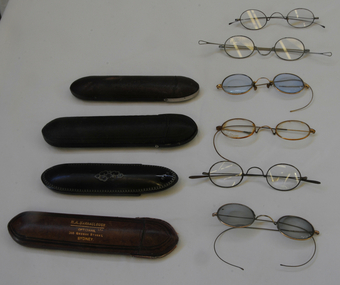
spectacles and cases, first half 20th century
... spectacle fashion. These items reflect how glasses styles have changed over time and are becoming a fashion accessory as well as a prosthesis and support for lenses, spectacles Six pairs of assorted glasses and 4 cases. spectacles and cases ...Women wore frames characterized by an upsweep on the top rim, a style that was very popular until the end of the 1950s, while men tended to sport gold wire frames. These glasses are probably men's glasses. By the latter half of the 20th century, spectacles were considered part of a person's wardrobe. Similar to clothes, eyeglasses needed to be continually updated or a person could be perceived as old-fashioned. More and more celebrities were influencing spectacle fashion.These items reflect how glasses styles have changed over time and are becoming a fashion accessory as well as a prosthesis and support for lenses, Six pairs of assorted glasses and 4 cases. spectacles
