
Showing 47 items matching "spencer and bourke streets"
-
 Melbourne Tram Museum
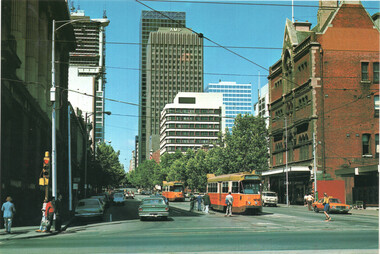
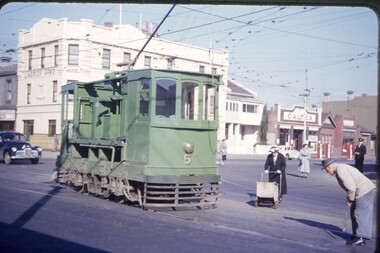
Postcard, Murfett Publishers, Corner Bourke and Spencer Streets, c1976
... Corner Bourke and Spencer Streets...Yields information about the corner of Bourke and Spencer St and the use of Z1 class trams. tramways Bourke St Spencer St Z1 class tram 33 Route 96 Trams Postcard - colour, divided back, unused Corner Bourke and Spencer Streets Postcard Murfett Publishers ...A postcard, colour, taken at the corner of Bourke and Spencer Sts with Z1 class 33 on Route 96 plus another Z1 waiting to shut at the terminus. In the background The National Bank Building at 500 Bourke St is reaching its planned height. It was completed in 1977. Also visible are the BHP and AMP towers, Mail Exchange and the MTOCo Tramway building and part of the new Savoy Taven verandah. Photo c1976.Yields information about the corner of Bourke and Spencer St and the use of Z1 class trams.Postcard - colour, divided back, unusedtramways, bourke st, spencer st, z1 class, tram 33, route 96, trams -
 Melbourne Tram Museum
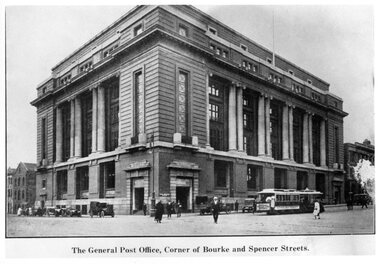
Photograph - Black and White - Mail Exchange Spencer and Bourke Streets c1920
... Black and White - Mail Exchange Spencer and Bourke Streets c1920......bourke street...This building was completed in 1917 to replace the mail sorting functions of the GPO on the corner of Bourke and Elizabeth St. It had tunnels that connected with Spencer Street Railway station opposite and was designed for the sorting and transporting of mail....Photograph - Black and White - Mail Exchange Spencer and Bourke Streets c1920...Tramways trams cable cars bourke street spencer street post office Post Master General mail exchange Photograph - Black and White - Mail Exchange Spencer and Bourke Streets c1920 Photograph Black and White - Mail Exchange Spencer and Bourke Streets c1920 ...Photo of the Mail Exchange Building with a cable tram loading prior to departure and a number of motor vehicles. The photo shows the monumental construction for the then Post Master Generals Department. This building was completed in 1917 to replace the mail sorting functions of the GPO on the corner of Bourke and Elizabeth St. It had tunnels that connected with Spencer Street Railway station opposite and was designed for the sorting and transporting of mail.Yields information about the Mail Exchange building.Photograph - Black and White - Mail Exchange Spencer and Bourke Streets c1920tramways, trams, cable cars, bourke street, spencer street, post office, post master general, mail exchange -
 Melbourne Tram Museum
Photograph - Black & White Photograph/s, Tramway Museum Society of Victoria (TMSV), late 1930s
... Black & White Photograph by the TMSV Sales of a cable car set shunting at the Bourke Street terminus by Spencer Street. Grip car has the destination of "Spencer St", while the trailer, car No 581 shows "Northcote". ...Black & White Photograph by the TMSV Sales of a cable car set shunting at the Bourke Street terminus by Spencer Street. Grip car has the destination of "Spencer St", while the trailer, car No 581 shows "Northcote". ...Black & White Photograph by the TMSV Sales of a cable car set shunting at the Bourke Street terminus by Spencer Street. Grip car has the destination of "Spencer St", while the trailer, car No 581 shows "Northcote". The crews are shown on their respective cars. The photo appears to be taken in the 1930's bases on the motor cars in view. The photograph has a satin finish.Has the TMSV Sales stamp on rear.trams, tramways, cable trams, cable grip, crews, bourke st, tram 581 -
 Melbourne Tram Museum
Photograph - PCC 980 Bourke St at Spencer St, George Bishop, 1969
... Photograph shows PCC tram 980 at the Bourke Street terminus near Spencer St. Tram has adverts for Dave Price second hand cars - High Street Northcote. ...Photograph shows PCC tram 980 at the Bourke Street terminus near Spencer St. Tram has adverts for Dave Price second hand cars - High Street Northcote. ...Photograph shows PCC tram 980 at the Bourke Street terminus near Spencer St. Tram has adverts for Dave Price second hand cars - High Street Northcote. In the background is the Melbourne Tramway and Omnibus Co. office building. Photo by George Bishop 1969.Yields information about the operation of tram 980 in Bourke St during 1969.Black and White Photograph of PCC 980 Bourke St at Spencer St.Details of the photograph and photographer on the rear in pencil and ink.trams, tramways, pcc class, tram 980, mtoco, mmtb, bourke st -
 Melbourne Tram Museum
Photograph - Cable tram trailer 565 Bourke St, c1975
... Photograph reproduced by the TMSV Sales of Cable Trailer No. 565 at the Spencer Street terminus of the Bourke Street line. ...Photograph reproduced by the TMSV Sales of Cable Trailer No. 565 at the Spencer Street terminus of the Bourke Street line. ...Photograph reproduced by the TMSV Sales of Cable Trailer No. 565 at the Spencer Street terminus of the Bourke Street line. Has Carlyons Hotel in the background. Dated in pencil as 1938. Has the destination of Nicholson St. See also Reg Item 3593 for another photo of trailer 565.Yields information about cable tram trailer 565 at Bourke St.Black & White Photograph with notes on rear.Has the TMSV Sales stamp and "1938" on rear.trams, tramways, cable trams, bourke st, tram 565 -
 Melbourne Tram Museum
Photograph - Section of cable tram track - Bourke St at Spencer St, c1960
... The photograph shows a section of remnant track at the intersection of Bourke and Spencer Sts that remained until it was removed on 25/8/1987 when connecting curves were installed at Bourke and Spencer Streets, forming a double track triangular junction, in preparation for the conversion of the St Kilda and Port Melbourne railway lines to 'light rail'. ...The photograph shows a section of remnant track at the intersection of Bourke and Spencer Sts that remained until it was removed on 25/8/1987 when connecting curves were installed at Bourke and Spencer Streets, forming a double track triangular junction, in preparation for the conversion of the St Kilda and Port Melbourne railway lines to 'light rail'. ...The photograph shows a section of remnant track at the intersection of Bourke and Spencer Sts that remained until it was removed on 25/8/1987 when connecting curves were installed at Bourke and Spencer Streets, forming a double track triangular junction, in preparation for the conversion of the St Kilda and Port Melbourne railway lines to 'light rail'. This necessitated the removal of the last few metres of cable car track in Melbourne, which had been left in situ at the former Bourke Street terminus as a reminder of bygone days. Shows two inspection pits in the short section of the cable slot. Photo late 1960s after the construction of the Spencer St railway station building. Photographer unknown.Yields information of last section of visible cable tram track in the city area.Black and white photograph on Ilford papertramways, cable trams, track work, bourke st, spencer st, cable track -
 Melbourne Tram Museum
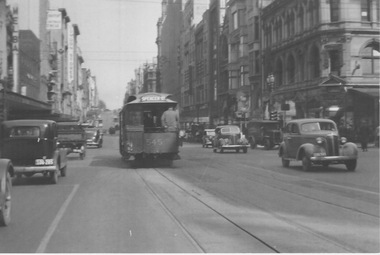
Photograph - Bourke Street, 13 September 1938
... ...Bourke Street...Photograph shows the rear of cable car 545 in Bourke Street crossing Swanston Street and travelling toward its terminus at Spencer Street. ...Photograph shows the rear of cable car 545 in Bourke Street crossing Swanston Street and travelling toward its terminus at Spencer Street. ...Photograph shows the rear of cable car 545 in Bourke Street crossing Swanston Street and travelling toward its terminus at Spencer Street. Bourke St is lined with parked motor cars and others driving eastward. A set of traffic lights can be seen at right above a stationary car and the London Stores signage can be seen at left at the Elizabeth Street intersection.Yields information about Bourke Street and the soon to be closed cable line.Black and white photograph on front and note on rear.On rear in pencil: 'Bourke St 13/9/38' cable car 545, bourke street, swanston street, spencer street, motor cars, traffic lights, london stores, elizabeth street -
 Melbourne Tram Museum
Photograph, Wal Larsen, Cable tram and Parliament House, 7/5/1940
... The photograph shows a cable tram entering Bourke Street from Spring Street bound for Spencer Street with the Victorian Parliament House in the background. ...The photograph shows a cable tram entering Bourke Street from Spring Street bound for Spencer Street with the Victorian Parliament House in the background. ...The photograph shows a cable tram entering Bourke Street from Spring Street bound for Spencer Street with the Victorian Parliament House in the background. The conductor is standing on the back platform. Photo has been copied and printed from a 120 Negative. Photo Wal Larsen, 6/5/1940, tram 543.Yields information about the Bourke St cable trams and Parliament House.Photograph, black and white, plain paper, 2nd copy has notes on rear."Swinging into Bourke Street past Parliament, trailer 543 6/5/40, Photo Wal Larsen"trams, tramways, cable tram, bourke st, parliament house, spring st, tram 543 -
 Melbourne Tram Museum
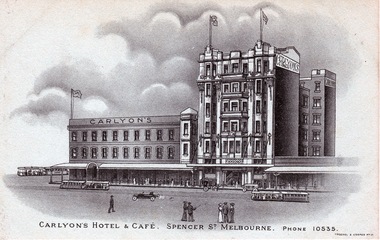
Postcard - Carlyon's Hotel & Cafe, Spencer Street, 1920c
... ...Spencer and Bourke streets...A drawing of Carlyon's Hotel on the south east corner of Spencer and Bourke streets. Built in 1897 and replaced by the Savoy Tavern after 1970, it provided accommodation for many using the regional and interstate trains at the station opposite. ...Yields information about Carlyon's Hotel pedestrians cable tram horse drawn vehicles Carlyon's Hotel Spencer and Bourke streets 1897 Savoy Tavern station opposite MTOC On front: 'Carlyon's Hotel & Cafe, Spencer St melbourne Phone 10535. ...A drawing of Carlyon's Hotel on the south east corner of Spencer and Bourke streets. Built in 1897 and replaced by the Savoy Tavern after 1970, it provided accommodation for many using the regional and interstate trains at the station opposite. In Bourke Street behind the hotel in (but not shown) stood the MTOC (cable tram company) head office. The sketch depicts a grand building of different levels along with cable trams, motor cars, horse drawn vehicles and pedestrians. However, the scale of the people and vehicles on the street is smaller than the hotel building, presumably to accentuate the hotel's grandeur.Yields information about Carlyon's HotelBlack and white drawn postcard printed on green coloured card with title on front and postcard markings on rear. On front: 'Carlyon's Hotel & Cafe, Spencer St melbourne Phone 10535. Troedel & Cooper Pty Ltd'pedestrians, cable tram, horse drawn vehicles, carlyon's hotel, spencer and bourke streets, 1897, savoy tavern, station opposite, mtoc -
 Melbourne Tram Museum
Postcard - Carlyon's Hotel & Cafe, Spencer Street, Troedel & Cooper Pty Ltd, 1920s
... ...Spencer and Bourke streets...A drawing of Carlyon's Hotel on the south east corner of Spencer and Bourke streets. Built in 1897 and replaced by the Savoy Tavern after 1970, it provided accommodation for many using the regional and interstate trains at the station opposite. ...Yields information about Carlyon's Hotel pedestrians cable tram horse drawn vehicles Carlyon's Hotel Spencer and Bourke streets 1897 Savoy Tavern station opposite MTOC On front: 'Carlyon's Hotel & Cafe, Spencer St melbourne Phone 10535. ...A drawing of Carlyon's Hotel on the south east corner of Spencer and Bourke streets. Built in 1897 and replaced by the Savoy Tavern after 1970, it provided accommodation for many using the regional and interstate trains at the station opposite. In Bourke Street behind the hotel in (but not shown) stood the MTOC (cable tram company) head office. The sketch depicts a grand building of different levels along with cable trams, motor cars, horse drawn vehicles and pedestrians. However, the scale of the people and vehicles on the street is smaller than the hotel building, presumably to accentuate the hotel's grandeur.Yields information about Carlyon's HotelBlack and white drawn postcard printed on green coloured card with title on front and postcard markings on rear. On front: 'Carlyon's Hotel & Cafe, Spencer St melbourne Phone 10535. Troedel & Cooper Pty Ltd'pedestrians, cable tram, horse drawn vehicles, carlyon's hotel, spencer and bourke streets, 1897, savoy tavern, station opposite, mtoc -
 Melbourne Tram Museum
Photograph - Bourke St from William St looking west - cable trams, c1910
... On the northside of Bourke Street is the Massey-Harris Building, John Connell & Co. ...On the northside of Bourke Street is the Massey-Harris Building, John Connell & Co. ...Photograph shows the view from William St looking west along Bourke St. Has two cable tram sets in the view, along with on the south side of Bourke Street the former St. James Building, Gollin & Company Building, then over King Street, Bourke Street West Police Station, McLean Bros. & Rigg Ironmongery & Hardware Store, (later Hudon's Store) and the Tramways Head Office Building. On the northside of Bourke Street is the Massey-Harris Building, John Connell & Co. Pty Ltd "Gresham House" and over King Street, H.V. McKay Harvester's Sunshine Head Office. Also in the distance is the Spencer Street Railway Station buildings. The Archway visible through the St. James Building led into the former Lt. James Street. Yields information about Bourke Street between 1909 and 1913Photograph - sepia toned on A4 sheetHas TMSV Sales stamp on rear.trams, bourke st, william st, cable trams, tramways, tram 402, st. james building -
 Melbourne Tram Museum
Photograph - Leyland OPS1 bus number 416, Sutcliffe Pty Ltd, c1949
... ...Bourke Street...Photograph shows the rear entry door of Leyland OPS1 No 416 in Bourke Street at the Swanston Street stop for Nicholson Street, East Brunswick buses. ...Yields information about Bourke Street buses Leyland Bourke Street Nicholson Street East Brunswick OPS1 Official photograph 416 Leyland TD5c double decker Spencer Street Red coloured stamp reads: "88 30RSE No.1 Sutcliffe Pty Ltd Commercial Photographers 94 Elizabeth Street, Melbourne, Cent. 1500" Black and white photograph with coloured stamp on rear. ...Photograph shows the rear entry door of Leyland OPS1 No 416 in Bourke Street at the Swanston Street stop for Nicholson Street, East Brunswick buses. Ahead is a Leyland TD5c double decker bus loading for Northcote at its designated stop. Another OPS1 can be spotted heads to Spencer Street between these two buses. 416 entered service in November 1948 and is sporting some minor damage and not in new condition. Photo dates to c1949. It appears to be an official M&MTB photograph.Yields information about Bourke Street buses Black and white photograph with coloured stamp on rear. Red coloured stamp reads: "88 30RSE No.1 Sutcliffe Pty Ltd Commercial Photographers 94 Elizabeth Street, Melbourne, Cent. 1500"leyland, bourke street, nicholson street, east brunswick, ops1, official photograph, 416, leyland td5c, double decker, spencer street -
 Melbourne Tram Museum
Photograph, Cable tram 457 Bourke and Swanston St, 20/11/1932
... The photograph shows a cable tram (Spencer St), trailer number 457, in Bourke St about to cross over Swanston St. ...The photograph shows a cable tram (Spencer St), trailer number 457, in Bourke St about to cross over Swanston St. ...The photograph shows a cable tram (Spencer St), trailer number 457, in Bourke St about to cross over Swanston St. The grip car or dummy is well loaded. In the background is the Leviathan Clothing Store 1913 - see reference for history details. The motor car ahead of the tram is doing a "Hook" turn into Bourke Street. A young man is skylarking at back of the tram for the photographer. Photo possibly of Frank Sheenen based on the hand writing dated 20/11/1932Yields information about the intersection of Bourke St cable tram services and the corner of Bourke and Swanston Streets.Photograph, black and white, plain back, 2nd copy has notes on the rear.In pencil "Me holding back a cable car, mine 20/11/32" and number '53" in top right hand corner.trams, tramways, cable tram, swanston st, bourke st, the leviathan -
 Melbourne Tram Museum
Slide - MTA tramway operations & light rail - set of 12, Hugh Ballment, 1987
... HBM040 - MTA Tram 272 on Route 96, Aug 1987, Bourke Street, Tram queue of A, Z and Z3 class trams at Spencer Street terminus. ...HBM040 - MTA Tram 272 on Route 96, Aug 1987, Bourke Street, Tram queue of A, Z and Z3 class trams at Spencer Street terminus. ...Set of 12 photos by Hugh Ballment of MTA trams or works: HBM035 - MTA, Aug 1987, Whiteman Street looking east towards Clarendon Street, Path of future St Kilda Light Rail. HBM036 - MTA, Aug 1987, looking east along Flinders Street, from a moving train on the railway viaduct. HBM037 - MTA, Aug 1987, Looking north up Spencer Street, across Flinders Street construction, with former VR Head Office in the background. several sliding door cars and A class are running on Route 12 HBM038 - MTA , Aug 1987, Flinders Street looking west across Spencer Street during reconstruction. HBM039 - MTA Z3 145 on Route 75, Aug 1987, Spencer Street, track works at Bourke Street with Savoy Taven and Hotel and the MMBW Buildings are in the background. HBM040 - MTA Tram 272 on Route 96, Aug 1987, Bourke Street, Tram queue of A, Z and Z3 class trams at Spencer Street terminus. The Eliza Tinsley and Mail Exchange buildings are in the background. HBM041 - MTA, Aug 1987, shows traffic coming out Yarrabank Road, Light Rail billboard at the left HBM042 - MTA W2 380, 1987, Flinders Street, at Swanston Street, with Young and Jackson's Hotel in the background, along with adverts for ANZ and Fosters Lager HBM043 - MTA W2 502, 1987, Flinders Street, Art tram, with St Paul's Cathedral in the background HBM044 - MTA, 1987, Spencer Street, Trackwork at Collins Street, with the former VR Head Office and Outward Parces Office. HBM045 - MTA Y1 611, 1987, Flinders Street, with the Stotts, CTA buildings in the background, with adverts for Peter Jackson cigarettes and Coca Cola. HBM046 - MTA, Sep 1987, Light rail looking west from Clarendon Street, New track with the railway embankment for the Port Melbourne railway line in the background. Note the construction of the West Gate Freeway City Link and associated creeper cranes. Yields information about Melbourne tram operations, and the construction of the St Kilda to Port Melbourne Light Rail.Kodachrome plastic mounts, with notes - set of 12tramways, queensbridge, light rail, bourke st, railways, clarendon st, swanston st, spencer st, trackworks, tram 380, tram 272, tram 145, trams, flinders st, whiteman st, yarrabank road, z3 class, a class, z class, w2 class, tram 611, y1 class, tram 502, route 12, route 96, route 75, collins st -
 Melbourne Tram Museum
Slide - MMTB and MTA tramway operations - set of 11, Hugh Ballment, 1950s to 1980s
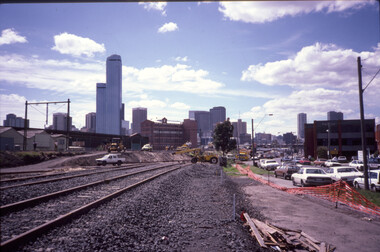
... HBM032 - MTA, Aug 1987, Spencer Street, track work to install curves at the intersection Bourke and Spencer Streets. ...HBM032 - MTA, Aug 1987, Spencer Street, track work to install curves at the intersection Bourke and Spencer Streets. ...Set of 11 photos by Hugh Ballment of MMTB or MTA trams or works: HBM024 - MMTB Tram Scrubber No 5, 24/05/1954, Clarendon Street, turning into Park Street HBM025 - MTA SW6 class No 961, Nov. 1997, Swanston Street, running a route 6 to University. Has the MLC, Drews Corner building in the background. HBM026 - MTA B No 2002, April 1988, Spencer Street, running a route 96 to St Kilda Beach. Has the start of the construction of the World Trade Centre Hotel and convention center on the right side of the photo. In the background is The Tea House with track work upgrades on the south end of Spencer Street Bridge. An AEC MkVI meal bus is present. HBM027 - W2 502, c1987, Flinders Street, Art tram by Rosemary Ryan with the Herald Sun building and Lindrum's in the background plus construction of Shell House on the corner of Spring Street which was completed in 1989. Tram is running as a Special. HBM028 - MTA W2 No 442 Restaurant Tram, Nov 1997, Clarendon Street, with A Class car behind it. The Crown Casino sign is in the background. HBM029 - MMTB Tram 380, Nov. 1987, Flinders Street, at Swanston Street running a route 27 service. Possibility during a tram maintenance staff strike. Has St Pauls Cathedral in the background HBM030 - MTA Z No 86, c1987, Queensbridge, Light Rail sign at left with the Port Melbourne/St Kilda rail line bridge in the background. In the background is Alstergren timber building and the Queen Bridge Hotel with a Foster's Lager advert. HBM031 - MTA SW6 No 915, 1987, Bourke Street, running a route 95 service in the Bourke Street Mall. Possibly during a tram maintenance strike. Shows the original first permanent street furniture. In the background is a Triple M building advert, Billy Guyatt's and Roger David. The Royal Mail Hotel is on the South East corner of the intersection. HBM032 - MTA, Aug 1987, Spencer Street, track work to install curves at the intersection Bourke and Spencer Streets. Note the overhead is all in place. Also shows the V/Line Spencer Street station on the right of the of the photo together with Z3 class no 145 HBM033 - MTA, Aug 1987, Light Rail Junction, looking towards Montague under construction with removal of part of the former St Kilda railway line embankment but the Port Melbourne line is still complete. HBM034 - MTA, Aug 1987, Clarendon Street Junction at Whiteman Street, prior to the removal of the railway overbridge and the erection of the new tram overhead into the Light rail. Yields information about Melbourne tram operations, and the construction of the St Kilda to Port Melbourne Light Rail.Kodachrome card board or plastic mounts, with notes - set of 11tramways, queensbridge, light rail, bourke st, railways, tram 5, clarendon st, swanston st, spencer st, tram 961, tram 2002, tram 502, tram 442, restaurant tram, tram 86, tram 915, bourke st mall, flinder st, trackworks, tram 145, z3 class, a class, w2 class, b class, scrubber tram, z class, whiteman st, arts trams, route 27, route 96, route 6 -
 Melbourne Tram Museum
Slide - MMTB and MTA tramway operations and light rail - set of 11, Hugh Ballment, 1950s to 1987
... and Spencer Street corner with new curves. Note the open Railway carpark on the west side of Spencer Street. ... and Spencer Street corner with new curves. Note the open Railway carpark on the west side of Spencer Street. ...Set of 11 photos by Hugh Ballment, unless noted, of MMTB, MTA trams or works: HBM047 - MTA, Sep 1987, New St. Kilda light rail line beside Whiteman Street looking toward the city, with the Melbourne skyline in the background. HBM048 - MTA, Sep 1987, Light rail from Clarendon Street, under construction. Junction installed and track being positioned. HBM049 - MTA, Aug 1987, New St Kilda light rail from beside Whiteman Street from under the new West Gate Freeway and a Port Melbourne train, with work on the new light rail underway. HBM050 - MTA W2 380, 1987, Flinders Street, with St Paul's Cathedral and the former Gas & Fuel building being refurbished HBM051 - MTA, Z 83, bound for Domain on Route 55. A Volvo B59 bus in 870's is bound for Garden City. 1987, Queensbridge, Light Rail billboard at left, with former St Kilda/Port Melbourne viaduct. HBM052 - MTA, Aug 1987, Reconstruction of the Bourke and Spencer Street corner with new curves. Note the open Railway carpark on the west side of Spencer Street. HBM053 - MMTB, W5 737, 1950s, Elizabeth Street at Londsdale Street, running a route 19, North Coburg service. Note the former cable tram curves into Lonsdale Street in the view. HBM054 - MMTB, early 1950s, Bourke Street, looking east at Elizabeth Street with two double deck buses in the view - Keith Kings photo HBM055 - MMTB, SW6 873 and 931, W2 408 and one other, plus a W5 class car. 1950s, Brunswick Depot, also parked on the southside open storage is another W2 class car. HBM056 - MMTB, W6 988, 19/06/1955, Bourke Street, The first electric tram in Bourke Street, two tower wagons, checking and adjusting the overhead - Keith Kings photo HBM057 - MMTB SW6 859, 1960s, Elizabeth Street, near Queensberry Street, on Route 19. A W5 class is bound for Flinders Street. Yields information about Melbourne tram operations, and the construction of the St Kilda to Port Melbourne Light Rail and 1950s or 1960s photos of Melbourne tramways.Kodachrome plastic and cardboard mounts, with notes - set of 11tramways, queensbridge, light rail, bourke st, clarendon st, swanston st, spencer st, trackworks, new tramway, brunswick depot, tram 931, tram 408, tram 737, tram 83, tram 380, railways, trams, whiteman st, elizabeth st, lonsdale st, queensberry st, russell st, flinders st, w2 class, w5 class, sw6 class, w6 class, z class, mmtb buses, td5c class, volvo b59, tower trucks, route 27, route 19, tram 859, tram 988, tram 873, route 55 -
 Melbourne Tram Museum
Book, Norm Cross, Dale Budd, Randall Wilson, Ian Hammond, "Destination City", 1993
... Photo of B2 2111 at corner of Spencer and Bourke Streets. See Reg Item 1986 for notes on the VR trams by Lloyd Rogers....Photo of B2 2111 at corner of Spencer and Bourke Streets. See Reg Item 1986 for notes on the VR trams by Lloyd Rogers. ...Book - "Destination City" with subtitle "Melbourne's Electric Trams" - 128 A4 pages + card , printed on gloss paper - 7 sections, perfect bound, describes Melbourne's tram car fleet. Includes brief description of each type, photographs and a summary history, including the Victorian Railway's trams. Has many photographs of the various tramcars associated with relevant text. On front cover is a photo of Z3 at the Burwood terminus. Written by Norm Cross, Dale Budd and Randall Wilson as editors, published by Transit Australia Publishing. Has two maps, north and south of Melbourne, printed on the inside card covers. Photo of B2 2111 at corner of Spencer and Bourke Streets. See Reg Item 1986 for notes on the VR trams by Lloyd Rogers.trams, tramways, melbourne, tramcars, mmtb, vr trams -
 City of Melbourne Libraries
Photograph, Bull, Hugh Jones, 1897-1993, [St Patrick's Day Parade, Bourke Street, Melbourne]
... Corner of Bourke and Spring Streets. Visible buildings are Imperial Hotel, Apollo Theatre (later Palace nightclub), Spencer's Old White Hart Hotel, The Salvation Army Building, Ellis Bird's Bookshop, 3UZ radio broadcasting HQ. ...Corner of Bourke and Spring Streets. Visible buildings are Imperial Hotel, Apollo Theatre (later Palace nightclub), Spencer's Old White Hart Hotel, The Salvation Army Building, Ellis Bird's Bookshop, 3UZ radio broadcasting HQ. ...Elevated view looking west from Parliament House of marching boys led by a band with watching crowd and dignitaries in an open car. Corner of Bourke and Spring Streets. Visible buildings are Imperial Hotel, Apollo Theatre (later Palace nightclub), Spencer's Old White Hart Hotel, The Salvation Army Building, Ellis Bird's Bookshop, 3UZ radio broadcasting HQ. St Patrick's Day Parade began at St Patrick's Hall in Bourke Street (demolished 1957) and passed Parliament House where Archbishop Daniel Mannix, seated in an open car saluted the 10,000 Roman Catholic school children, 14 Irish bands and horse teams decorated with shamrocks. The procession ended in Exhibition Oval (now the northern end of Carlton Gardens) where sporting events, exhibitions of Irish dancing and a display of fancy drills, floral dances and Swedish exercises were held. Source: https://trove.nla.gov.au/newspaper/article/243311448Photographer notations on slide: "B19".parades, 1930-1939, catholic church -
 Ballarat Tramway Museum
Postcard, Biscay Greetings, Bourke St Melbourne
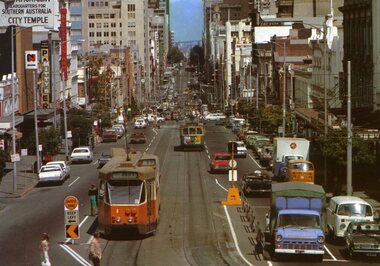
... Tram Z8 has destination of "CITY - SPENCER ST." and showing route 89. On rear of card is name of company "Biscay" and caption "New Z class tram in Bourke Street, Melbourne Victoria." and card number BG98 in dark brown ink, along with space for stamp and address. ...Tram Z8 has destination of "CITY - SPENCER ST." and showing route 89. On rear of card is name of company "Biscay" and caption "New Z class tram in Bourke Street, Melbourne Victoria." and card number BG98 in dark brown ink, along with space for stamp and address. ...Colour postcard with serrated edges of Bourke St. Melbourne from Parliament house with MMTB Z8 and about 6 W7's in photo, along with many motor vehicles. Also shown are the Safety Zones and stops. In image are buildings along either side of Bourke St., featuring the sign of the Salvation Army City Temple in the top left hand corner, Mittys, and a Kwikasair van by the outbound safety zone. Tram Z8 has destination of "CITY - SPENCER ST." and showing route 89. On rear of card is name of company "Biscay" and caption "New Z class tram in Bourke Street, Melbourne Victoria." and card number BG98 in dark brown ink, along with space for stamp and address. See Destination City re introduction of Z class trams (1975)trams, tramways, bourke st, melbourne, z class trams, tram 2 -
 Melbourne Tram Museum
Slide - MMTB, VR and MTA tramway operations set of 12, Hugh Ballment, 1950s to 1980s
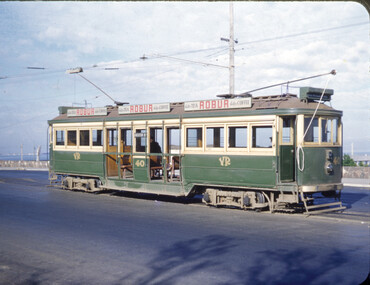
... HBM181 - Photo 1950s, Melbourne from south of Yarra River, Kodak commercial slide titled "Melbourne City Skyline across the River Yarra" HBM182 - MTA Tram SW6-915, cNov 1987, Bourke Street Mall, Has Billy Guyatts, Petra Haircare, Roger David and the Royal Mail Hotel in the background HBM183 - KCR , Apr 1988, ComEng Dandenong, Tuen Mun tram HBM184 - MTA, Aug 1988, Bourke St, Spencer St junction construction. ...HBM181 - Photo 1950s, Melbourne from south of Yarra River, Kodak commercial slide titled "Melbourne City Skyline across the River Yarra" HBM182 - MTA Tram SW6-915, cNov 1987, Bourke Street Mall, Has Billy Guyatts, Petra Haircare, Roger David and the Royal Mail Hotel in the background HBM183 - KCR , Apr 1988, ComEng Dandenong, Tuen Mun tram HBM184 - MTA, Aug 1988, Bourke St, Spencer St junction construction. ...Set of 12 photos by Hugh Ballment, unless noted, of MMTB, VR, Hong Kong KCR and MTA: HHBM173 - VR Tram 40, 26/05/1954, Brighton Beach, Tram has three roof top Robur Tea Adverts HBM174 - VR Trams 39, 54, 1950s, Elwood depot, Both trams have the destination of Elwood Depot HBM175 - VR Tram 3, 1950s, Elwood depot, Has the VR Substation in the background HBM176 - MMTB Trams W2 385, SW6 923, 26/05/1954, Swanston St, Damaged photograph. Tram 385 (South Melbourne Beach route 2A) and 923 (RAAF tram. Camberwell route 7). In the background is the Greer & Ashburnter Pty Ltd building HBM177 - MMTB Tram 31 May 1976, Bourke Street, Dark photo. Has the Palladion Theatre in the background showing Barry's Lindon. HBM178 - MMTB, c1954, Elizabeth St, Looking south from about Little Collins St with street decorations possibly for a Royal Tour positioned. Has the Hotel London and McEwans store in the view. HBM179 - MMTB Tram PCC 980, c1955, Malvern Depot, HBM180 - MMTB Trams 864, 502, c1987, Flinders St, Dark photo - see also HBM027 for a better photo. HBM181 - Photo 1950s, Melbourne from south of Yarra River, Kodak commercial slide titled "Melbourne City Skyline across the River Yarra" HBM182 - MTA Tram SW6-915, cNov 1987, Bourke Street Mall, Has Billy Guyatts, Petra Haircare, Roger David and the Royal Mail Hotel in the background HBM183 - KCR , Apr 1988, ComEng Dandenong, Tuen Mun tram HBM184 - MTA, Aug 1988, Bourke St, Spencer St junction construction. Z3 180 on Route 96 plus several other Z class trams present. Two Welding trucks onsite plus the mobile lilting crane and AEC Mk.VI meal bus further up Bourke Street Yields information about Melbourne tram operations, with 1950s to 1980s photos of Melbourne tramways.Kodachrome cardboard and plastic mounts, with notes - set of 12new tramway, vr, st kilda brighton tramway, tram 915, bourke st, spencer st, tram 40, tram 39, tram 3, tram 54, tram 985, swanston st, tram 31, tram 980, tram 864, tram 502, malvern depot, elizabeth st, hong kong, trams, brighton beach, elwood depot, w2 class, tram 385, sw6 class, tram 923, raaf, route 2a, route 7, z class, pcc class, arts trams, volvo b59, bourke st mall, route 95, comeng, z3 class, tram 180, welding truck, route 96, met bus -
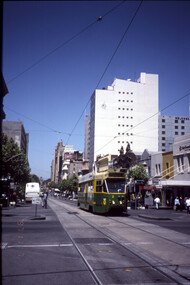 Melbourne Tram Museum
Slide - MMTB, KCR, Yarra and MTA, tramway operations set of 12, Hugh Ballment, 1950s to 1990s
... Bourke St...Swanston St...tram 2...tram 848...tram 235...tram 251...tram 866...Spencer St...City Circle...tram 2040...tram 2023...tram 169...Hong Kong...Comeng...tram 286...tram 2002...tram 284...tram 934...tram 252...RAAF...Batman Ave...Clarendon St...A class...High Street...Street South. HBM130 - Yarra Tram 866, cNov 1997, Spencer St, City Circle livery, at Bourke St. ...Street South. HBM130 - Yarra Tram 866, cNov 1997, Spencer St, City Circle livery, at Bourke St. ...Set of 12 photos by Hugh Ballment, unless noted, of MMTB, KCR, MTA and Yarra trams: HBM127 - MTA Tram 2, cNov 1997, Swanston St, northbound, near Lonsdale Street HBM128 - MTA SW5 class tram No. 848, April 1988, High Street South, Kew, Near back road Kew depot HBM129 - MTA A Class trams No.235, 251, Apr 1988, High Street South, Kew at Barkers Road, shows the east exit track from the Kew Depot into High Street South. HBM130 - Yarra Tram 866, cNov 1997, Spencer St, City Circle livery, at Bourke St. In the background is the Spencer St station building. HBM131 - KCR, cNov1997, ComEng Dandenong, Tuen Mun tram, Hong Kong, in the water testing bay. With a Comeng train shell alongside. HBM132 - MTA Tram 2040, cNov1997, Spencer St, at Latrobe Street, with the Australia Post and the Remand Centre buildings in the background. Tram has an advertisment for Bertocchi. HBM133 - MTA Tram 2023, cNov1997, Bourke Street, at Elizabeth Street with London Stores, and Roger David in the background. HBM134 - MTA Tram 169, cNov1997, Queensbridge, running a route 55 Domain & St Kilda Road service. In the background are the National Mutual, Port Authority, and National Bank buildings. A Comeng train is on the viaduct HBM135 -, cNov 1997, East Camberwell, ComEng train HBM136 - MTA Tram 276, Apr 1988, Collins Street, At Spring Street, running a route 109 to Mont Albert. HBM137 - MTA B class tram No. 2002, and A class tram No. 284, c1997?, Clarendon Street, South Melbourne, running each Route 96 to St Kilda and Route 109 to Mont Albert, respectively. Has a large Crown Casino and Planet Hollywood signs in the background. HBM138 - MMTB Trams 934, 252, 1950s, Batman Ave, RAAF tram, leaving for Burwood route 74. Has a route 72. W2 class tram behind. Yields information about Melbourne tram operations, with 1950s to 1980s photos of Melbourne tramways.Kodachrome cardboard and plastic mounts, with notes - set of 12new tramway, elizabeth st, flinders st, kew depot, bourke st, swanston st, tram 2, tram 848, tram 235, tram 251, tram 866, spencer st, city circle, tram 2040, tram 2023, tram 169, hong kong, comeng, tram 286, tram 2002, tram 284, tram 934, tram 252, raaf, batman ave, clarendon st, a class, high street south, b class, w2 class, sw6 class -
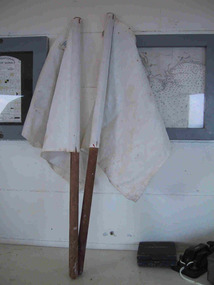 Parks Victoria - Cape Nelson Lightstation
Functional object - Flags, semaphore
... In 1924 it acquired land at 632 Bourke Street and built a new factory. His son Ivor continued the business after 1927 and in 1938 opened a bulk store in Carlton.271 In 2016 the firm was located at 673 Spencer Street, Melbourne. ...In 1924 it acquired land at 632 Bourke Street and built a new factory. His son Ivor continued the business after 1927 and in 1938 opened a bulk store in Carlton.271 In 2016 the firm was located at 673 Spencer Street, Melbourne. ...The two semaphore flags were used as a pair for visual signaling by hand. The semaphore system is an alphabet signaling system based on the waving of a pair of handheld flags in a particular pattern to compose words to be communicated to passing ships. The system was introduced by the Royal Navy in 1880 and was later adopted in Australia, with the first School of Signaling opening in Williamstown in 1890. The system was superseded in the 1970s by more sophisticated methods of communication. Information on the Cape Nelson flags indicates that they were made by Evan Evans P/L, Flag makers, 690 Elizabeth Street, Melbourne. Evan Evans (d.1927) started a tent‐making business in 1877 and by 1920 Evan Evans P/L maker of canvas goods, was located at 680 Elizabeth Street, Melbourne. In 1924 it acquired land at 632 Bourke Street and built a new factory. His son Ivor continued the business after 1927 and in 1938 opened a bulk store in Carlton.271 In 2016 the firm was located at 673 Spencer Street, Melbourne. Another pair of white semaphore flags made by Evan & Evans is held at Gabo Island, and Wilsons Promontory also has a pair. Cape Nelson’s white semaphore flags have second level contributory significance. They have historical importance as flags formerly used at the lightstation for visual signaling, a system that is now rarely used in navigation, and contribute to the importance of the lightstation’s large collection of flags.A pair of white flags made of white canvas/heavy cotton, the square flags are attached to dowel poles with staples. -
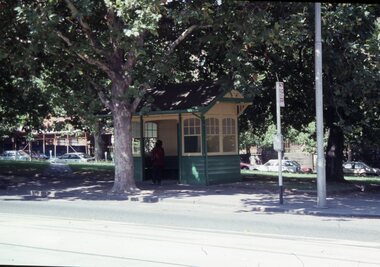 Melbourne Tram Museum
Slide - Set of 15 - Railway MMTB Tram shelters, Robert Green, 2/1990
... Set of 15 colour slides of Tramway Board and MMTB tramway shelters, by Robert Green Feb1990. 1 - Macarthur St and St Andrews Place (Tramway Board) 2 - Macarthur St and St Andrews Place (Tramway Board) 2A - Macarthur St and St Andrews Place (Tramway Board) - logon on the shelter 3 - SW Corner of St Kilda Road & High St 4 - Cnr St Kilda Road and Dorcas St 5 - Batman Ave and St Kilda Road - removed with Batman Ave closed, now at the TMSV Bylands 6 - ditto 7 - ditto - shows the Bundy clock on the office wall. 8 - Victoria and Brunswick Streets 9 - ditto 10 - Cnr St Kilda Road and Bromby St 11 - Victoria and Brunswick Streets 12 - Cnr Dandenong Road and Wattletree Road 13 - Victoria and Brunswick Streets 14 - Bourke and Spencer Streets - note the Bundy clock. ...Set of 15 colour slides of Tramway Board and MMTB tramway shelters, by Robert Green Feb1990. 1 - Macarthur St and St Andrews Place (Tramway Board) 2 - Macarthur St and St Andrews Place (Tramway Board) 2A - Macarthur St and St Andrews Place (Tramway Board) - logon on the shelter 3 - SW Corner of St Kilda Road & High St 4 - Cnr St Kilda Road and Dorcas St 5 - Batman Ave and St Kilda Road - removed with Batman Ave closed, now at the TMSV Bylands 6 - ditto 7 - ditto - shows the Bundy clock on the office wall. 8 - Victoria and Brunswick Streets 9 - ditto 10 - Cnr St Kilda Road and Bromby St 11 - Victoria and Brunswick Streets 12 - Cnr Dandenong Road and Wattletree Road 13 - Victoria and Brunswick Streets 14 - Bourke and Spencer Streets - note the Bundy clock. ...Set of 15 colour slides of Tramway Board and MMTB tramway shelters, by Robert Green Feb1990. 1 - Macarthur St and St Andrews Place (Tramway Board) 2 - Macarthur St and St Andrews Place (Tramway Board) 2A - Macarthur St and St Andrews Place (Tramway Board) - logon on the shelter 3 - SW Corner of St Kilda Road & High St 4 - Cnr St Kilda Road and Dorcas St 5 - Batman Ave and St Kilda Road - removed with Batman Ave closed, now at the TMSV Bylands 6 - ditto 7 - ditto - shows the Bundy clock on the office wall. 8 - Victoria and Brunswick Streets 9 - ditto 10 - Cnr St Kilda Road and Bromby St 11 - Victoria and Brunswick Streets 12 - Cnr Dandenong Road and Wattletree Road 13 - Victoria and Brunswick Streets 14 - Bourke and Spencer Streets - note the Bundy clock. Behind is the MTOCo Offices and Carlyons Hotel.Yields information about Melbourne tramway shelters.Set of 14 Kodak colour slides in plastic mounts and one unmounted phtographAll slides have their location marked on them in black ink.tramways, shelters, tramway board, mmtb, macarthur st, st kilda road, brunwick st, batman ave, victoria parade, wattletree road, bourke st -
 Melbourne Tram Museum
Slide - MMTB, MTA and VR tramway operations set of 11, Hugh Ballment, 1950s to 1990s
... HBM143 - MTA, Aug 1987, Bourke Street, Cable track removal at Spencer Street. ...HBM143 - MTA, Aug 1987, Bourke Street, Cable track removal at Spencer Street. ...Set of 11 photos by Hugh Ballment, unless noted, of MMTB, VR, and MTA: HBM139 - MMTB W6 977, 26/05/1954, Preston Workshops, fitted with Resilient wheels, carbon inserts, dynamic brakes. Tram has been lined out. Note the W2 on the right. HBM140 - MMTB W2 219, mid 1970's, Swan Street, Richmond, has a Tait train set on the overbridge. Tram has a Wattle Park route 70 destination with an advert for Ardath cigarettes and Yellow Pages HBM141 - MTA SW6 939, Nov 1997, Clarendon Street, Restaurant tram No 03. Large Crown Casino and Planet Hollywood signs in the background. HBM142 - MTA, Apr 1988, Spencer Street bridge, A 265 bound for Port Melbourne route 111 and Per Way AEC Mk VI meal bus in view. Track repair works due to ground subsidence on the south end of the bridge. Has Tea House plus the existing railway bridge across Clarendon Street in view. HBM143 - MTA, Aug 1987, Bourke Street, Cable track removal at Spencer Street. HBM144 - MTA, SW6 938, a Z3 and Z class cars. Nov 1997, Swanston Street, at Flinders Street station, with Flinders St station. Adverts for Samsung, Crown Casino, and Optus. HBM145 - MTA, A 234, Nov 1997, Batman Avenue terminus, Z3 class in Swanston Street in background. The Melbourne skyline is in the background. HBM146 - VR Tram No 35, 28/02/1959, St Kilda station, Last day of trams with a Mel. Brighton bus at station. Has the Prince of Wales Hotel in the background and the Railway station buildings on the left. Photo by Keith Kings HBM147 - MMTB, 29/07/1956, Broadmeadows, Original form - Derelict cable grip car. Shows how former grip cars could be repurposed as shelters. Photo by Keith Kings HBM148 - VR Trams 50, 51, 52, 54, 28/02/1959, Elwood Depot, Last day of trams. Photo by Keith Kings HBM149 - VR Trams 50, 51, 22/02/1959, Elwood Depot. Photo by Keith Kings Yields information about Melbourne tram operations, with 1950s to 1990s photos of Melbourne tramways.Kodachrome cardboard and plastic mounts, with notes - set of 11spencer st, clarendon st, preston workshops, tram 977, tram 219, swan st, railways, tram 939, restaurant tram, light rail, cable trams, swanston st, flinders st, tram 938, tram 234, tram 35, tram 50, tram 51, tram 54, w2 class, w6 class, sw6 class, vr trams, buses, st kilda brighton tramway, st kilda railway station, a class, tram 265, route 111, route 15, bourke st, route 70, mmtb -
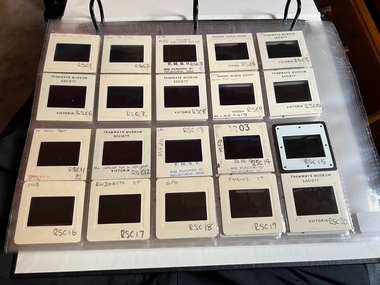 Melbourne Tram Museum
Album - Ron Scholten Slide Collection, Ron Scholten
... Trams on route 88 delayed in Queens Parade Clifton Hill RSC10 Flinders Street at William Street with Cable Cars RSC11 L 104 on the fan of the new shed at Malvern Depot on a TMSV tour RSC12 Cable Set 1 after it’s restoration at Preston Workshops on the fan near the front gate RSC13 X1 466 at a suburban terminus of the Footscray System RSC14 X2 680 at Point Ormond Terminus RSC15 An ex Launceston Tram at the outside terminus of the Penny Royal Complex Tramway in Launceston RSC16 Q 148 at Preston Workshops awaiting disposal RSC17 Elizabeth Street with Cable Cars RSC18 Elizabeth and Bourke Streets corner outside the GPO with cable cars RSC19 Collins Street with Cable Cars RSC20 A photo taken from the observation deck of the ICI building showing a view of Parliament House with a W class tram in Nicholson Street RSC21 Auburn Horse car with a posed photo of all the tramway men employed RSC22 Cheltenham Double Deck Horsecar with a full load of passengers RSC23 City of Northcote cable trailer No 3 at a terminus RSC24 City of Northcote Cable cars passing in High Street Northcote RSC25 St Kilda Road at Princes Bridge with Cable Cars RSC26 Flinders Street with Cable Cars RSC27 Cable Cars RSC28 Bourke Street looking towards Elizabeth Street from Queen Street RSC29 Cable cars in Bourke Street at Elizabeth Street looking east RSC30 Cable cars in Elizabeth Street at the terminus at Flinders Street RSC31 Cable cars in Bourke Street at Swanston Street looking west RSC32 Cable cars in Swanston Street at Flinders Street looking north RSC33 Cable cars in Collins Street near Russell Street RSC34 Cable cars in Elizabeth Street at Bourke Street RSC35 Cable cars in Collins Street at Elizabeth Street RSC36 Cable Cars in Swanston Street at Flinders Street RSC37 Cable cars in Collins Street RSC38 Cable Cars RSC39 Cable cars in St Kilda Road near Princes Bridge RSC40 Cable cars in Collins Street east of Swanston Street RSC41 Cable cars in Spring Street outside Parliament House RSC42 K class No 92 in M&MTB Chocolate and cream livery but with a P&MTT Destination box on Route 14 RSC43 Thornbury Depot viewed from Miller Street and St Georges Road. ...Trams on route 88 delayed in Queens Parade Clifton Hill RSC10 Flinders Street at William Street with Cable Cars RSC11 L 104 on the fan of the new shed at Malvern Depot on a TMSV tour RSC12 Cable Set 1 after it’s restoration at Preston Workshops on the fan near the front gate RSC13 X1 466 at a suburban terminus of the Footscray System RSC14 X2 680 at Point Ormond Terminus RSC15 An ex Launceston Tram at the outside terminus of the Penny Royal Complex Tramway in Launceston RSC16 Q 148 at Preston Workshops awaiting disposal RSC17 Elizabeth Street with Cable Cars RSC18 Elizabeth and Bourke Streets corner outside the GPO with cable cars RSC19 Collins Street with Cable Cars RSC20 A photo taken from the observation deck of the ICI building showing a view of Parliament House with a W class tram in Nicholson Street RSC21 Auburn Horse car with a posed photo of all the tramway men employed RSC22 Cheltenham Double Deck Horsecar with a full load of passengers RSC23 City of Northcote cable trailer No 3 at a terminus RSC24 City of Northcote Cable cars passing in High Street Northcote RSC25 St Kilda Road at Princes Bridge with Cable Cars RSC26 Flinders Street with Cable Cars RSC27 Cable Cars RSC28 Bourke Street looking towards Elizabeth Street from Queen Street RSC29 Cable cars in Bourke Street at Elizabeth Street looking east RSC30 Cable cars in Elizabeth Street at the terminus at Flinders Street RSC31 Cable cars in Bourke Street at Swanston Street looking west RSC32 Cable cars in Swanston Street at Flinders Street looking north RSC33 Cable cars in Collins Street near Russell Street RSC34 Cable cars in Elizabeth Street at Bourke Street RSC35 Cable cars in Collins Street at Elizabeth Street RSC36 Cable Cars in Swanston Street at Flinders Street RSC37 Cable cars in Collins Street RSC38 Cable Cars RSC39 Cable cars in St Kilda Road near Princes Bridge RSC40 Cable cars in Collins Street east of Swanston Street RSC41 Cable cars in Spring Street outside Parliament House RSC42 K class No 92 in M&MTB Chocolate and cream livery but with a P&MTT Destination box on Route 14 RSC43 Thornbury Depot viewed from Miller Street and St Georges Road. ...Photo - see pdf file for further information. Number Brief Description RSC1 PCC 1041 at the gates of Preston Workshops on a test run without its trolley retriever RSC2 PCC 1041 in Glenhuntly Road on Route 67 en-route to Carnegie crossing the Railway Gates at Glenhuntly Station RSC3 W2 482 stored at Malvern Depot with Olympic Park on the Destination RSC4 Cable Car Set 64 in Swanston Street outside Princess Bridge Station in bound with open top Double Deck Bus, Trak Motors ? Departing from Flinders St Station RSC5 W3 669 in St George Road at Sumner Street en-route to Preston Workshops for scrapping RSC6 Cable Car in Lygon Street en-route to Carlton RSC7 PCC 1041 turning from St Georges Road into Miller Street to enter the Preston Workshops RSC8 Flinders Street Station with cable cars RSC9 PCC 1041 in strife on its maiden day in service. Trams on route 88 delayed in Queens Parade Clifton Hill RSC10 Flinders Street at William Street with Cable Cars RSC11 L 104 on the fan of the new shed at Malvern Depot on a TMSV tour RSC12 Cable Set 1 after it’s restoration at Preston Workshops on the fan near the front gate RSC13 X1 466 at a suburban terminus of the Footscray System RSC14 X2 680 at Point Ormond Terminus RSC15 An ex Launceston Tram at the outside terminus of the Penny Royal Complex Tramway in Launceston RSC16 Q 148 at Preston Workshops awaiting disposal RSC17 Elizabeth Street with Cable Cars RSC18 Elizabeth and Bourke Streets corner outside the GPO with cable cars RSC19 Collins Street with Cable Cars RSC20 A photo taken from the observation deck of the ICI building showing a view of Parliament House with a W class tram in Nicholson Street RSC21 Auburn Horse car with a posed photo of all the tramway men employed RSC22 Cheltenham Double Deck Horsecar with a full load of passengers RSC23 City of Northcote cable trailer No 3 at a terminus RSC24 City of Northcote Cable cars passing in High Street Northcote RSC25 St Kilda Road at Princes Bridge with Cable Cars RSC26 Flinders Street with Cable Cars RSC27 Cable Cars RSC28 Bourke Street looking towards Elizabeth Street from Queen Street RSC29 Cable cars in Bourke Street at Elizabeth Street looking east RSC30 Cable cars in Elizabeth Street at the terminus at Flinders Street RSC31 Cable cars in Bourke Street at Swanston Street looking west RSC32 Cable cars in Swanston Street at Flinders Street looking north RSC33 Cable cars in Collins Street near Russell Street RSC34 Cable cars in Elizabeth Street at Bourke Street RSC35 Cable cars in Collins Street at Elizabeth Street RSC36 Cable Cars in Swanston Street at Flinders Street RSC37 Cable cars in Collins Street RSC38 Cable Cars RSC39 Cable cars in St Kilda Road near Princes Bridge RSC40 Cable cars in Collins Street east of Swanston Street RSC41 Cable cars in Spring Street outside Parliament House RSC42 K class No 92 in M&MTB Chocolate and cream livery but with a P&MTT Destination box on Route 14 RSC43 Thornbury Depot viewed from Miller Street and St Georges Road. Two W2 class cars are laying over between the peaks RSC44 Z3 No 201 in Met Livery passes D1 No 3510 in new M/Tram livery. A staff member in uniform stands in the doorway. Dandenong Road RSC45 D1 No 3530 advertising Heinekin Super Golf on Route 55 in Royal Park RSC46 D1 No 3504 in M/Tram livery on the reserved track in Matthews Avenue near Essendon Airport showing Route 81 Travancore. I suspect it is a private enthusiasts charter due to the Malvern W class run number in the rear windscreen RSC47 D1 No 3504 on Route 64 in Dandenong Road in M/Tram Livery RSC48 D1 No 3504 in M/Tram Livery at Airport West Terminus RSC49 D1 No 3504 in M Tram Livery in Union Road outside the Showgrounds RSC50 D1 No 3504 at West Maribyrnong Terminus in M/Tram Livery RSC51 D1 No 3503 in M/Tram Livery in Malvern Depot RSC52 SW6 No 960 and VR No 53 in Harbour Esplanade for the NMEL&T Co Centenary RSC53 Hawthorn Tramways Trust No 32 in Harbour Esplanade for the NMEL&T Co Centenary RSC54 VR 53 & B 2042 in Harbour Esplanade for the NMEL&T Co Centenary RSC55 VR 53 & C 3016 in Harbour Esplanade for the NMEL&T Co Centenary RSC56 NMEL&T Co No 13 (Formerly No 214) in Harbour Esplanade for the NMEL&T Co Centenary RSC57 NMEL&T Co 13 (formerly No 214) at Preston Workshops for the NMEL&T Co Centenary RSC58 Hawthorn Tramways Trust Lettering on HTT No 32 in Harbour Esplanade for the NMEL&T Co Centenary RSC59 Hawthorn Tramways Trust No 32 in Harbour Esplanade for the NMEL&T Co Centenary RSC60 Hawthorn Tramways Trust No 32 in Harbour Esplanade for the NMEL&T Co Centenary RSC61 Hawthorn Tramways Trust No 32 in Harbour Esplanade for the NMEL&T Co Centenary RSC62 NMEL&T Co No 13 (formerly No 214) at Preston Workshops for the NMEL&T Co Centenary RSC63 W2 516 and another on route 59 wait to shunt at Essendon Aerodrome Terminus as W2 571 on route 49 departs. This was the last day of operation. RSC64 Australia’s First Electric Tram at Box Hill with tramway men including H J Hilton who is in the centre RSC65 W2 484 en-route to St Kilda Junction and another wait for passengers after a race meeting at Caulfield Racecourse RSC66 X1 463 on the Footscray system en-route to Russell Street RSC67 Geelong 35 on Chilwell Route, Formerly HTT 13, M&MTB 119, then Bendigo 1 and Ballarat 37 RSC68 P&MTT No 4 on Opening Day of the system in Glenferrie Road RSC69 Bendigo No 6 in McCrae Street near the Depot en-route to North Bendigo RSC70 P&MTT No 4 in Glenferrie Road on opening day of the system RSC71 Scrubber No 3 stripped and awaiting scrapping at Preston Workshops RSC72 Scrubber No 4 at South Melbourne Depot RSC73 Q 191 & 139 at Preston Workshops awaiting scrapping RSC74 Rail Grinder No 3 at Preston Workshops as purchased from Sydney RSC75 Y 469 waits to shunt at Wattle Park Terminus as Y1 613 departs on driver training duties RSC76 VR 53 on the outside roads at Essendon Depot RSC77 W5 796 with three doors and square windows running out of Brunswick Depot in Cameron Street, with a supplementary destination board showing “City via Swanston St” RSC78 W2 258 on the wheel grinder road at Brunswick Depot RSC79 X2 676 on a TMSV tour, W5 817 & 836 & VR 53 on the open roads at Essendon Depot RSC80 PCC 1041 on test, passes W7 1035 in High Street Preston RSC81 D1 class production number 7 as delivered on test in Matthews Avenue RSC82 W2 383 on route 5 turning from the reserved track in Dandenong Road into St Kilda Road at St Kilda Junction RSC83 Z3 204 as advertising tram for Vodaphone Grand Prix running into Malvern Depot new shed RSC84 Z1 No 4 on test in St Georges Road RSC85 PCC 1041 on Route 96 in Bourke Street near Exhibition Street RSC86 Z1 No 3 without numbers on test turning from Miller Street in St Georges Road RSC87 Track components stored in Coldblo Road at Malvern Depot with Z class cars adjacent RSC88 D1 3501 in M/Tram Livery on Route 55 in Peel Street at Franklin Street RSC89 C 3001 in Yarra Trams Livery Porto No 018 & D1 3502 in M/Tram Livery on display in Harbourside Esplanade RSC90 D1 class tram production number 7, in as delivered condition on test in Matthews Avenue RSC91 D1 3503 inside Malvern Depot RSC92 SW6 955 and W6 974 in St Kilda Road at City Road at dusk. RSC93 Freight Car No 19 at Preston Workshops in green Livery RSC94 Rail Grinder No 3 in green Livery at South Melbourne Per Way Yard RSC95 A SW6 class car on route 50 shunting at Elizabeth Street Terminus at night, taken from Flinders Street Station RSC96 W2 588 & 435 in St Kilda Road at Batman Avenue RSC97 Y1 613 in service at Wattle Park Terminus RSC98 W2 588 in Wellington Parade en-route to the City with a Grand Final Load of passengers followed closely by No 384 RSC99 W2 558 on MCG Footy Special entering the Simpson Street siding RSC100 W3 657 & an L Class in the new shed at Malvern Depot RSC101 Y1 613 in St Kilda Road on an enthusiast's tour in St Kilda Road south of St Kilda Junction RSC102 Y1 613 on an enthusiast's tour in Clarendon Street with the two extra tracks on the Railways viaduct under construction RSC103 W6 976 on the fan of the new shed at Malvern Depot RSC104 W7 1024 as an advertising car for Bank of NSW at the route 1 terminus at South Melbourne Beach RSC105 PCC 980 on route 96 in Nicholson Street near North Fitzroy Depot RSC106 SW6 890 with dash canopy lighting in Market Street on the opening day of William Street Services RSC107 W2 444 with big numbers heads a line of footy specials in Simpson Street Siding RSC108 Cable Cars in Elizabeth Street RSC109 NMEL&T co No 2 with a trailer outside the power station in Mount Alexander Road RSC110 Alf Twentyman’s cable car set in his Northcote backyard RSC111 Cable Cars in Queens Parade Clifton Hill RSC112 Cable cars in Collins Street outside the Town Hall RSC113 PCC 1041 at Carnegie terminus RSC114 Cable cars in Elizabeth Street RSC115 Cable cars in Collins St near Swanston St RSC116 HTT 19 turns from Riversdale Road into Camberwell Road at Camberwell Junction RSC117 W1 419 official builders photo of first car of the class RSC118 Cable car with a full load of passengers RSC119 W1 422 illuminated for the visit of T.R.H. The Duke and Duchess of York RSC120 PCC 1041 in strife on it’s maiden day in service. Trams on route 88 delayed in Queens Parade Clifton Hill RSC121 Bendigo Birney car in Finn Street near North Bendigo terminus RSC122 SW6 in St Kilda Road at Domain Road at night RSC123 All 3 of Alf Twentyman’s cable cars in his Northcote backyard RSC124 Cable trailer 256 being unloaded into the shed at Bylands RSC125 Cable grip car 1 being removed from the Melbourne Museum RSC126 Alf Twentyman's cable cars in his Northcote Backyard RSC127 Alf Twentyman's cable cars in his Northcote Backyard RSC128 Alf Twentyman's cable cars in his Northcote Backyard RSC129 Alf Twentyman's cable cars in his Northcote Backyard RSC130 W class car in Swanston Street at Collins Street RSC131 Y1 469, L & W3 on the run out of Glenhuntly Depot on a tour RSC132 W7 1024 as an advertising tram for Bank of NSW at Clifton Hill RSC133 W2 496 on a footy special in Simpson Street Siding RSC134 W2 as originally converted to a test car at Preston Workshops RSC135 W3 667 in Brunswick Depot with Ellen Butland at the controls RSC136 W3 669 on its final run at Victoria Parade and Brunswick Street RSC137 W2 571 in Wellington Parade at Clarendon Street with a Footy Final load of Passengers RSC138 Y1 613 shunts at Spencer Street Terminus as X 217 waits on Australia Day Pageant RSC139 PCC 1041 on Route 96 in Bourke Street outside the Southern Cross Hotel RSC140 SW6 890 with accident damage on the outside roads at Preston Workshops, c1978 RSC141 W2 535 on Route 4 at the old St Kilda Junction, c1967 RSC142 PCC 1041 on Route 88 turns from Bourke Street into Spring Street, 1973 RSC143 L 102 on a tour at Albert Park Beach Terminus, Feb 1972 RSC144 W5 class Nos 833, 834 & 835 in Malvern Depot, c1976 RSC145 W2 No 281 in Wellington Parade on a football very crowded special c1974 RSC146 X1 No 464 Ballarat Road 1960 RSC147 T No 181 bound for the Explosives Factory - at Footscray Station - July 1960 RSC148 T No 181 at Williamstown Road, 1960 RSC149 Cable car set in Alf Twentyman’s back yard, c1970 RSC150 X No 217 at Malvern Depot, c1970 RSC151 X1 No 465 and T No181 Footscray Football ground in Barkly Street. c1960 RSC152 Scrubber No 5 at South Melbourne Depot, c1960 RSC153 X1 No 465 Footscray to Russell Street, c1960 RSC154 X1 No 467 Leeds Street Footscray, 1960 RSC155 PMTT No 4 Glenferrie Road, 1910 RSC156 S No 164 at Malvern Depot c1970 RSC157 T No 178 Footscray c1960 RSC158 Cleaner No. 7 at South Melbourne Depot c1960 RSC159 Two Y classes at Princes Bridge and Batman Avenue mid 1950s RSC160 Swanston Street – Nu color vue slide – M142 Demonstrates the work of Ron Scholten in photography, collection and/or production of duplicate slidesAssembled album in a black presentation folder of 160 colour slides, 8 slide sleeves, collected or produced by Ron Scholten. Many are TMSV or Windsor Publications slides. All photographs have been scanned and placed on the Museum's G drive. A list of all photographs with details has been compiled. melbourne, tramways, trams, cable trams, horse tram, route 67, route 88, route 55, route 64, route 59, route 49, route 50, point ormond, royal park, swanston st, footscray, essendon depot, matthews ave, brunswick depot, glenhuntly depot, malvern depot, st.georges road, preston workshops, pcc class, vr class, w2 class, w3 class, l class, s class, x class, x1 class, k class, z3 class, d1 class, sw6 class, w6 class, w7 class, t class, b1 class, c class, q class, y class, y1 class, w5 class, z1 class, tram 465, tram 181, tram 217, tram 467, tram 164, tram 102, tram 669, tram 667, tram 976, tram 890, tram 558, tram 657, tram 571, tram 484, tram 535, flinders st, tram 980, tram 1041, tram 482, tram 64, tram 104, tram 1, tram 466, tram 680, tram 676, tram 955, tram 92, tram 201, tram 3510, tram 3530, tram 3504, tram 3503, tram 53, tram 588, tram 383, tram 960, tram 32, tram 2042, tram 3016, tram 516, tram 43, tram 463, tram 191, tram 139, tram 469, tram 613, tram 796, tram 258, tram 384 -
 Melbourne Tram Museum
Slide - Set of 4, Keith Caldwell, 1962 and 1963
... and 1031 - City route 97 turning the corner at Bourke and Spring Streets, photographed from the steps of Parliament House. ...and 1031 - City route 97 turning the corner at Bourke and Spring Streets, photographed from the steps of Parliament House. ...Set of four Agfa Colour slides, cardboard mounts, by Keith Caldwell dated 16 March 1962 of: .1 - W6 981, Route 90? Northcote Dundas St? and 1031 - City route 97 turning the corner at Bourke and Spring Streets, photographed from the steps of Parliament House. Notes the new building for the Windsor Hotel, Southern Cross Hotel and signs for The Society cafe, Salvation Army City Temple, Tye's ?, Metro Theatre and Molinans Imperial Hotel. Photo dated 16/3/1962. .2 - W7 1007, east bound in Bourke St, c1963, with destination of East Preston Route 88. Has adverts for Ilford and Twisties. Photo not dated, but post August 1962 - the Southern Cross Hotel opened during August 1962 (from https://en.wikipedia.org/wiki/Southern_Cross_Hotel - accessed 12/9/2019). In the background are signs for The Melbourne Hotel and the Salvation Army city temple. .3 - W6 992 at the intersection with Bourke and Swanston St, showing East Brunswick (should be City), route 96. Has the Myers, Wittners and Broadmans in the view. Also signs for Foys and Hiltons. Slide dated March 62 .4 - W6 1000 descending the Bourke St Hill to Swanston St, showing City Spencer St, route 97. In the background is a car parking building, Prudential building and a store "Canvas goods". Slide dated 13/3/1962In ink: .1 - "Bourke St 16-3-62" .2 - no date .3 - "Bourke Swast Mar 62" .4 - "Bourke 13.3.62 am"trams, tramways, bourke st, swanston st, route 97, northcote - dundas st, route 88, w6 class, w7 class, tram 981, tram 1031, tram 1000, tram 1007, tram 992 -
 Melton City Libraries
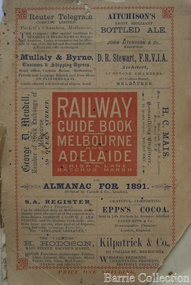
Book, 'Railway Guide Book Melbourne and Adelaide, 1891
... The Motor Train left Spencer Street at 4.23 pm and was the best train for me to catch. ...The Motor Train left Spencer Street at 4.23 pm and was the best train for me to catch. ...Memories of Train Travel compiled by Wendy Barrie 4/09/2013 Train travel had changed very little from the time my mothers generation to mine. The timetable meant the usual rush to Melton South by bike in her case and if she was running late the train pulled up on the crossing. I was driven to the Station from home past Keith and Mary Gillespie’s house near the Ferris Road rail crossing to Bridge road to Melton South for the 7.32 train. While attending Sunshine High School in 1961 I would meet up with three other students, two of whom I knew from Bacchus Marsh High School days. We usually got into the same compartment on the train, it was a typical country train with a corridor along the side and compartments with a door, roof racks and sometimes heated metal containers for the feet in the winter. Some of the trains came through from Horsham and Ballarat, and the Overland from Adelaide passed through in the evening, we could hear it in the distance from the Ferris Lane home. The carriages had 1st and economy class compartments showing photographs of county scenes and holiday destinations. The engine was the large A class diesel. They are still running to Bacchus Marsh 50 years later, due to the need for the greatly increased number of commuters travelling to work in the city. Sometimes the carriages were pull by a Steam engine, these were a problem in the summer time because the sparks caused fires along the train lines and then quickly spread into the dry grass, crops and stubble. The Motor Train left Spencer Street at 4.23 pm and was the best train for me to catch. Ferris Road was a designated stop and train pulled up on the road crossing. It had steps at the door and rungs to hold while alighting to the ground. The ballast along the tracks was rough and uneven and awkward to land on. The train was painted blue and yellow with the letters VR pained on the front. This saved may parents the afternoon trip to collect me from the Station. On the walk home on the gravel road I would pass Uncle Tom and Aunty May’s house before reaching home. Melva Gillespie was studying at Sunshine Technical School and we sometimes both got off the train at the same time. On other occasions the Motor Train was replaced with a diesel engine with carriages, it was also required to stop and the driver had to be notified in advance. This meant getting into the guards van a Rockbank. It was more difficult alighting from the carriage as the gap was greater and more precarious to swing out and land on the ground. A few times in my last year of study at Melbourne Teachers College in Grattan Street Carlton. I managed to catch the 2.30 pm train to Serviceton, it was express to Melton and was very quick trip. The last train, was the 5.25 pm diesel to Ballarat and I usually caught this train to Melton South Station. On one occasion after being held up on the tram in Bourke street I had to make a mad dash to the platform chasing the train as it was just moving off and yelling to the guard, fortunately I was noticed and the train ground to halt. I scrambled into the end door and took most of the journey home to recover. After the last year at High School I continued to travel on the train, 2 years to Prahran Technical School changing at North Melbourne. There were a lot school children travelling to private schools and some at the primary level and mainly from Bacchus Marsh. Rockbank children also travelled by train from the beginning of their high school years, quite a few went to Sunshine High School. Book provided a timetable and information about the stations the train travels to from Melbourne to Adelaide. transport -
 City of Melbourne Libraries
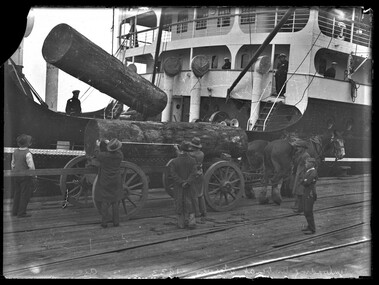
Photograph (item), Bull, Hugh Jones, 1897-1993, Unloading timber at Victoria Dock, 1933
... Kirk's Melbourne Horse and Carriage Bazaar in Bourke Street first advertised for business in 1840, and by the 1850s Bourke Street West was famed for its horse bazaars and saleyards. ...Kirk's Melbourne Horse and Carriage Bazaar in Bourke Street first advertised for business in 1840, and by the 1850s Bourke Street West was famed for its horse bazaars and saleyards. ...Photographer notations on slide: "Unloading Timber at Wharves 1933 Age B5" Published: Age (Melbourne, Vic.: 1854- ), Tuesday 15 August 1933 MAHOGANY FROM MANILA. (1933, August 15). The Age (Melbourne, Vic. : 1854 - 1954), p. 11. Retrieved January 16, 2026, from http://nla.gov.au/nla.news-article204377024 Published title: MAHOGANY FROM MANILA Published Caption: Age Tue 15 Aug 1933 Caption: Unloading Mahogany Logs brought from Manila, Philippine Islands, by the steamer Taiping, which berthed yesterday at Victoria Dock. The vessel discharged twenty logs, each weighing three tons, the first shipment of this type of timber landed in Melbourne. Research by Project Volunteer, Louise McKenzie: This photograph in many ways epitomises Melbourne in the 1930s. It is a time of enormous growth, development and change. But before delving into that, the photo itself is very powerful. The huge mahogany logs being unloaded appear to be so heavy that the ship itself seems to list to port as they are craned over the side. They are being levered into a cart to which two large and sturdy Clydesdale horses are hitched. In contrast to the traditional horses, the wharf is crisscrossed with modern railway tracks. Unloading is both mechanical and manual, and the scene is one of intense interest to a young boy bystander. The ship appears to be squat and solid, but the whole image also gives a feeling of movement and intensity. The mahogany being delivered to Melbourne would be intended for high quality furniture. In the 1930s Australia actually had a growing timber industry, but much of the eucalyptus wood was being utilised for mass produced furniture, and much of this furniture would then have had a veneer applied to it. The fact that it was economic to import this timber from the “Philippine Islands” – not a traditional trading market for Australia – reflects a Victorian economy that was strong enough to support a growing demand for good quality furniture Mahogany was described as a classic, strong hardwood, often used for dark opulent furniture. In the 1930s the importation of timber from Manila (Philippines) to Australia was a notable trade, particularly in Philippine Lauan (often referred to as Philippine Mahogany), which was used as a cheaper alternative to other hardwoods. 1930s furniture, dominated by the art deco style, used a mix of luxurious exotic woods like mahogany, macassar and ebony for high-end pieces, often veneered over less expensive woods such as walnut, birch and poplar, and with plywood, chrome and lacquer also popular for more practical, streamlined designs during the Depression era. By the mid 1930s timber mills were being relocated away from the immediate dock area, but the fact that these logs were being transported by horse-drawn cart implies that the load would not have had to be taken too far for milling. 1885 the Melbourne Harbour Trust Commissioners had decided that land in or near the city was far too valuable to be used as timber yards. Furthermore, large stacks of timber posed a fire risk. The Trust asked the Victorian Government to reserve a site on the east side of the Yarra River opposite Yarraville and Spotswood. Here, in 1889, the Trust began building six jetties and a wharf specifically for the landing of timber. Clydesdale horses were initially brought to Victoria from Tasmania in the 1830s, and with the 1850s gold rush they were imported direct from Scotland. Melbourne was from its earliest years an important centre of horse-breeding from both imported and colonial-bred stock, providing the well-built draught horse for pulling heavily loaded wagons, the harness horse for delivery work and drawing coaches, and the saddle-horse used for riding. Stud breeding facilities were advertised from the early 1840s. By the 1870s the horse export trade was thriving, and the Port of Melbourne was the country's busiest exporter of horses to Indian, Asian and New Zealand markets. Kirk's Melbourne Horse and Carriage Bazaar in Bourke Street first advertised for business in 1840, and by the 1850s Bourke Street West was famed for its horse bazaars and saleyards. The Victorian Clydesdale Horse Society reports that Clydesdale working horses were a vital part of Melbourne's infrastructure and agricultural industry in the 1930s, when they reached the peak of their popularity despite the increasing competition from mechanization. Their main roles and usage at this time were: • City Delivery: Clydesdales were a common sight for metropolitan deliveries, particularly for breweries (such as Carlton & United Breweries), milk runs, and bread deliveries. • Industrial Work: They were heavily used for hauling cargo at the docks, in construction, and at specialized sites like the Truganina Explosives Reserve, where they pulled wagons. • Agriculture: In surrounding rural areas, they were the primary power source for ploughing and agricultural machinery. • Specialization: By the 1930s, the Clydesdale was smaller and more compact than the Shire or Percheron breeds, making them ideal for navigation in urban environments. After the 1930s their numbers decreased due to the onset of WWI and mechanisation. Wartime petrol rationing led to a brief revival for the working horse, as suburban tradesmen, now used to motor delivery, took their old jinkers out of mothballs. By 1947, however, only 1.5% of city traffic was horse-drawn. In 1952 the large horse cartage company A. Kellet Pty Ltd sold its 250 horses and converted its Richmond stables to storage. In the 1950s at Station and Princes piers, wharf labourers refused to work with the six draught horses still being used to haul trolleys and which were soon superseded by the fork lift, semi-trailer and mobile crane. Where carefully trained horses had once shunted trains in city goods yards, a few hundred a week were now being killed at the abattoirs for pet and human consumption. The last MCC dray horse was withdrawn from service in 1958, but some of the few remaining working animals are used by the mounted police for crowd control at demonstrations and football games. The death knell had also sounded for the associated trades of farrier, saddler and blacksmith. Our photo, therefore, showing the wharf with both the haulage Clydesdales and the rail lines, is a strong visual summary of the social and economic changes experienced in Victoria in the 1930s and on towards the 1950s. Our photo is located at Victoria Dock (also known as Victoria Harbour) which is still an active component of Melbourne’s port system. In 1892 the West Melbourne Dock (later Victoria Dock) was opened, downstream and immediately west of the Spencer Street railway shunting yards. It contained a swing basin for ships, replacing the one which had been provided on the south side of the river, later to be the Duke and Orr dry dock, west of the Charles Grimes Bridge. Further west was the South Wharf along the river bank. The history of Victoria Dock is extremely well described by Ashley Smith in his 2 March 2022 article in Docklands News, and its accompanying aerial photo of the Dock taken in 1934. He writes: "In the early 1930s Victoria Dock was one of the biggest sites for trade and export in Melbourne. A constant queue of ships sailed in, unloaded their cargo, recharged and reloaded, then left for the next port. Around the time this photo was taken (found in a 1934 photo book), the trapezium-shaped basin had been through some changes since its construction in the 1890s. The 497-metre-long Central Pier, finished in 1919, now featured six sheds to house the ever-increasing volume of cargo. The entrance had also been widened in the 1920s to allow better access. Some of the berths featured three-ton jib electric cranes to help with loading cargo and a rail network connected to the State Railway service. By the time construction was completed, the dock was 39 hectares and hailed as the second-largest dock in the world (behind Cavendish Dock, Barrow-in-Furness). To further save costs, excavations were dug to a more reasonable seven metres below low water, instead of British engineer Sir John Coode’s recommended 8.3 metres. Even then, the costs were still around £900,000. It was envisaged, with the extra wharfage, that around thirty 90-metre ships could berth inside. On March 22, 1892, Victoria Dock was opened by Victoria’s Governor, the Earl of Hopetoun (later Australia’s first Governor-General) who opened the sluice to let the Yarra in. It took six days to fill the basin with The Leader newspaper estimating that it would take another six months to completely fill (March 26, 1892). In the end, it took nearly a year before the first ship was allowed to enter on February 20, 1893, when the steamer Hubbuck sailed in to unload 1200 tonnes of cargo in 15 hours. The Argus (February 23, 1893) reported that the ship’s captain, J. R. Brodie, called the Yarra “better than the Thames”, and compared Victoria Dock favourably to the Albert Dock (Liverpool)." This would be a good time to move our focus on to the Taiping, which is the transporter of these giant mahogany logs. The Taiping was a steel-hulled, single-screw passenger-cargo Chinese steamer, which today has the dubious legacy of being involved in a collision headlined as “The Chinese Titanic”. It was constructed by the Hong Kong and Shampoa Dock Company at its facility in Hong Kong, with completion in 1926 for service under the Australia Oriental Line. Her gross register tonnage measured 4,324 tons, reflecting her design for inter-island and coastal trade routes, accommodating both passengers and freight. She operated routes connecting Australian ports with East Asian destinations. As World War II approached, Taiping continued predominantly working the trade routes between China and Australia, until December 1941, when she evacuated women and children from Hong Kong to Manila just before Japanese forces overran the region. She then safely reached Australia despite enemy air raids. Taiping was then requisitioned by the Royal Navy and repurposed as a victualling stores issuing ship for the Eastern Fleet, supporting logistical needs in the Pacific and Indian oceans. Returned to the Australian Oriental Line in 1947, she underwent refitting and by mid-1948 was chartered to the Shanghai Shipping Company, and modified for greater passenger accommodation – approximately 500 passengers. In 1948/49 the Chinese Civil War took place. The Taiping departed Shanghai on 26 January 1949 as one of the final vessels evacuating civilians from to Keelung Harbour in Taiwan. Reports indicate that the Taiping carried double the rated capacity of passengers i.e. 1000. The ship carried families, military personnel, civilians, carrying personal belongings, gold and valuables in hope of resettlement in Nationalist Taiwan. It also held heavy cargo in the form of silver and gold bullion loaded by the Central Bank of China. Because of the risk of patrols, and to conserve fuel, the Captain took the ship away from the usual open-sea passage, and instead navigated along the coast. He also extinguished navigation lights to avoid detection. Shortly after midnight on 27 January 1949 the Taiping collided with the smaller cargo steamer Chien Yuan in the East China Sea near the Zhoushan Archipelago. The Chien Yuan was also operating in darkness. The subsequent collision was catastrophic. The Chien Yuan sank with in 5 minutes, with the loss of 72 of its 74 crew. The Taiping sustained severe structural compromise from the broadside strike and initially remained afloat, then made a swift descent into the freezing water, with no attempt at an organised evacuation. No formal recovery process was instigated, however a distress signal went out. 32 survivors were picked up by the Australian destroyer HMAS Warramunga (on patrol nearby), a passing US vessel found 2 more, and local Zhoushan fishermen retrieved others. In the end, only 37 people survived. The event is remembered as a poignant moment in the mass migration to Taiwan, with families tragically separated. A memorial to the disaster exists at the Keelung Harbour naval base on Taiwan. With its total of over 1,500 deaths, it constituted one of the worst peacetime maritime losses. It is sometimes referred to as the “Oriental Titanic” because of the similarly large loss of life and speed of demise with the RMS Titanic in 1912. A fictional depiction of this event appears in the John Woo movies “The Crossing (Part 1) (2014), and The Crossing II (2015), known in Chinese as “Taiping Wheel”. The narrative weaves a story around pre-disaster romances and wartime turmoil among passengers, culminating in the ship’s rapid sinking. “The production, a high-budget Sino-Taiwanese-Hong Kong co-effort, portrays the event as a microcosm of the 1940s Sino-Japanese and civil war legacies, though critics noted the melodramatic style prioritizing spectacle over historical precision.” In conclusion, it is nice to return to our photo, and observe the people involved in this moment. The dockworkers are, so typical of the 1930s, dressed in what looks to us like formal clothing – dark suits or coats, white shirts, and black hats. I am particularly drawn to the young boy, bare-headed, arms crossed, and so intent on the unloading process. He too is wearing a white shirt, black trousers and jacket, and black shoes. This is 1933 Melbourne – but the haircut he is sporting is now very “hipster” and modern in 2026 Melbourne. References: MAHOGANY FROM MANILA. (1933, August 15). The Age (Melbourne, Vic. : 1854 - 1954), p. 11. Retrieved January 30, 2026, from http://nla.gov.au/nla.news-article204377024 Wikipedia, Taiping steamer, https://en.wikipedia.org/wiki/Taiping_(steamer) Wikipedia, Victoria Dock, https://en.wikipedia.org/wiki/Victoria_Dock_(Melbourne) Docklands News, Ashley Smith, 2 Mar 2022, https://www.docklandsnews.com.au/victoria-dock/ Living Histories: Heritage Council of Victoria, Jill Barnard, 2008, Jetties and Piers, https://livinghistories.net.au/wp-content/uploads/2015/11/Jetties-ONL-intro_Part-1.pdf eMelbourne, Wharves and Docks, https://www.emelbourne.net.au/biogs/EM01612b.htm Australian Academy of Technological Sciences – Harvesting Wood, https://www.austehc.unimelb.edu.au/tia/225.html Old Treasury Building, On the Water – The Docks, https://tinyurl.com/3wkbk66m Old Treasury Building, On The Road, https://tinyurl.com/dw44yr3t Port of Melbourne, Victorian Places, https://www.victorianplaces.com.au/port-of-melbourne Docklands Heritage Study - Environmental History, https://mvga-prod-files.s3.ap-southeast-4.amazonaws.com/public/2024-05/docklands-heritage-review-thematic-environmental-history-1991.pdf eMelbourne, Horses, https://www.emelbourne.net.au/biogs/EM00723b.htm Victorian Clydesdale Horse Society, https://www.clydesdalesvic.org.au/history The Crossing, https://letterboxd.com/film/the-crossing-i/Photographer notations on slide: "Unloading Timber at Wharves 1933 Age B5"ships, shipping, timber industry, shipwrecks, horses, docks, wharves, 1930-1939, wars, docklands -
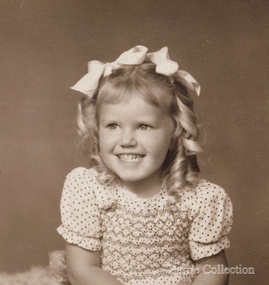 Melton City Libraries
Photograph, Wendy Barrie, Unknown
... The Motor Train left Spencer Street at 4.23 pm and was the best train for me to catch. ...The Motor Train left Spencer Street at 4.23 pm and was the best train for me to catch. ...Eldest daughter of Edna and Bon Barrie, born on 03 November 1943 in Melbourne, Victoria, Memoirs of Wendy Barrie, recalling the early formative years of life in Melton: In 1949 I started school at Melton State School no 430 and was driven the 2½ miles to there by my parents at first. Later we walked home in the afternoons or were picked up by car as we made our way home along the Western Highway. In 1956 I went to Bacchus Marsh High School. There were 4 students in grade 6 and 3 of us went to the High School. The students from Melton, Melton South and Toolern Vale State Schools went by bus to Bacchus Marsh High School as far a fifth form. My parents drove me to the pick up point and during the five years of travel to High School. The bus travelled via Toolern Vale and later went through Exford and through Parwan. On the return journey in the afternoon the bus went in the reverse direction. The bridge at Exford was an old narrow wooden one, and the students had to get off the bus and walk across, with the driver crossing in the empty bus for safety reasons. There was a travelling allowance paid to parents and it was estimated from the distance the crow flies, a straight line. We lived a Ferris Lane, just where the Harness Racing entrance is now situated about 2 ½ miles by road to school too close to qualify for the subsidy. While at State School Melton we would walk home in a group with the Nixon and Gillespie children, along the main road over the bridge near the Shire Offices and down a hill. I was being dinked on Joyce Gillespie’s bike while holding onto the seat, toppled off the bike striking my chin and teeth on the bitumen and cracking my jaw. I was about 9 years old and stayed a couple of days in the Quamby Hospital in Bacchus Marsh, it seemed like and eternity at the time and quite traumatic being separated from my family. I can remember contemplating how I could get out of the window and run away but realised it was too far to walk home. Often we would cut across the Common on our way home from school picking up stray golf balls and collecting them from the creek when it dried out. We were warned about not accepting lifts from strangers passing along the Melbourne/ Ballarat Road. The only danger we faced was being swooped by the magpies particularly on the open ground on the Common. We were also fairly cautious when the Gypsies camped on the Common in the area just about opposite the small reservoir. “Mum” grandma Myers loved to have us call in on our way home, and usually would cut a slice of Jongebloed’s bread and spread it with home made butter. Sometimes we waited there until we were collected by car, usually driven by our mother. Margaret Nixon and Joyce Gillespie were a few grades ahead of me and Barbara Nixon was born just two months earlier than me. Our mothers were great friends for over 6o years, born in the same month three years apart. They lived within a few days of the same age as each other at the time their deaths. Dad and George Nixon attended Melton school at the same time. Sarah nee Hornbuckle Nixon and my grandfather Frederick Myers Snr were at school together at the same in the 1880s. The Nixon family lived in Keilor Road just past the Toolern Creek near the turnoff. Tom and Ann Collins lived on the southern side of the Western highway and Keilor road intersection. Jim and Ruby Gillespie’s house was further long Keilor road on the right. They backed onto the Myers who lived on the north side of Western Highway east of Myers Gully (Ryans Creek). The Bridge over the Toolern Creek as very narrow and as truck traffic increased there were accidents. One truck took out the side railing and plunged upside down into the bank and into the shallow water. Another fatal accident happened between a car and a truck right in front of the Myers house. Grandfather Fred had been a bike rider all his life, as far as the Riverina in his younger years, wryly made the comment about the drivers the speeding along the Ballarat Road were setting out to kill themselves. The road was busy particularly after the Races at Ballarat when the crowds were hurrying home to Melbourne. Train travel had changed very little from the time my mothers generation to mine. The timetable meant the usual rush to Melton South by bike in her case and if she was running late the train pulled up on the crossing. I was driven to the Station from home past Keith and Mary Gillespie’s house near the Ferris Road rail crossing to Bridge road to Melton South for the 7.32 train. While attending Sunshine High School in 1961 I would meet up with three other students, two of whom I knew from Bacchus Marsh High School days. We usually got into the same compartment on the train, it was a typical country train with a corridor along the side and compartments with a door, roof racks and sometimes heated metal containers for the feet in the winter. Some of the trains came through from Horsham and Ballarat, and the Overland from Adelaide passed through in the evening, we could hear it in the distance from the Ferris Lane home. The carriages had 1st and economy class compartments showing photographs of county scenes and holiday destinations. The engine was the large A class diesel. They are still running to Bacchus Marsh 50 years later, due to the need for the greatly increased number of commuters travelling to work in the city. Sometimes the carriages were pull by a Steam engine, these were a problem in the summer time because the sparks caused fires along the train lines and then quickly spread into the dry grass, crops and stubble. The Motor Train left Spencer Street at 4.23 pm and was the best train for me to catch. Ferris Road was a designated stop and train pulled up on the road crossing. It had steps at the door and rungs to hold while alighting to the ground. The ballast along the tracks was rough and uneven and awkward to land on. The train was painted blue and yellow with the letters VR pained on the front. This saved may parents the afternoon trip to collect me from the Station. On the walk home on the gravel road I would pass Uncle Tom and Aunty May’s house before reaching home. Melva Gillespie was studying at Sunshine Technical School and we sometimes both got off the train at the same time. On other occasions the Motor Train was replaced with a diesel engine with carriages, it was also required to stop and the driver had to be notified in advance. This meant getting into the guards van a Rockbank. It was more difficult alighting from the carriage as the gap was greater and more precarious to swing out and land on the ground. A few times in my last year of study at Melbourne Teachers College in Grattan Street Carlton. I managed to catch the 2.30 pm train to Serviceton, it was express to Melton and was very quick trip. The last train, was the 5.25 pm diesel to Ballarat and I usually caught this train to Melton South Station. On one occasion after being held up on the tram in Bourke street I had to make a mad dash to the platform chasing the train as it was just moving off and yelling to the guard, fortunately I was noticed and the train ground to halt. I scrambled into the end door and took most of the journey home to recover. After the last year at High School I continued to travel on the train, 2 years to Prahran Technical School changing at North Melbourne. There were a lot school children travelling to private schools and some at the primary level and mainly from Bacchus Marsh. Rockbank children also travelled by train from the beginning of their high school years, quite a few went to Sunshine High School. During my third year of teacher training I travelled to Flinders Street to RMIT for ceramics classes and Grattan St Teachers College located in the grounds of Melbourne University. There were many teachers being trained at the Secondary Teachers College due to the baby bulge creating a great shortage of teachers. Sunshine High School was very well represented amongst the different courses in Primary, Secondary and Art and Crafts. I attended Melbourne University lectures, studying a Fine Art subject. Bernard Smith was the most notable of the lecturers. he replaced Professor Joseph Bourke who had taken leave for the years. In 1962 he published the art book “Australian Painting”. The secondary art and craft student teachers from the College were in the majority, taking this subject and were well regarded due to their practical art and craft methods and their teaching round experience. In December 1964 I graduated as a Trained Secondary Teacher – Art and Crafts. The graduating ceremony was held at Wilson Hall. I received my appointment to work at Maryborough High School. Uncle Max and Aunty Rosemary Myers arranged my accommodation. Uncle Max was a teacher at the Maryborough Technical School fat the time. The appointment was suddenly changed when just before the school year was about to start when I received notification that I was now required to move to Warracknabeal High School. I was subject to a bond for the three years of training and three years of teaching and was under an obligation to comply with the directive of the Education Department. My father stood as guarantor when I was accepted as student at the Melbourne Teachers’ College, thus enabling me to receive my teacher training, and a 5 pounds a week allowance for expenses. After teaching for two years at Warracknabeal High School I was fortunate enough the gain a transfer to Sunshine West High School, returning to live at home in Melton and travelling by car to work with a fellow colleague, Jock Smith who lived at Station road Melton. I completed bond obligation and resigned at the end of the year. The employment regulations at that time did not allow the option of leave of absence for, indefinite overseas travel. I returned to Australia in October 1969. Visiting Arthur Hart the Principal of Sunshine High School he arranged with the Education Department for my re-employment at Sunshine High School until the end of the year. In 1970 I was transferred, and returned to Sunshine West High School where I worked for the next three years. In January 1968 I sailed on the “Oriana” to South Hampton with two teaching friends from Warracknabeal High School on a travelling and working holiday. Doreen Kiely, a former Bacchus Marsh High student and fellow train traveller from Bacchus Marsh, was already working in London, had arranged our accommodation at the London Travellers Club Hotel, Braham Gardens, Earls Court SW5. We based our stay at this address in London and travelled around Scotland, Ireland and England. In the summer we took a four month trip around the Continent and the Mediterranean. I registered with The Royal Borough Of Kingston Upon Thames as a Supply teacher, and worked at Chessington School form autumn to spring the following year and living with Mrs Rose Gillies at Kinross Avenue, Worcester Park, Surrey. In the spring of 1969 visiting Norway, Sweden and Finland joining an organised camping group to the Artic Circle, entered Russia at Leningrad (St Petersburg) Moscow, Minsk, to Poland and Czechoslovakia. In August returning to Worcester Park for the flight to Montreal to stay with cousin Lynette and husband Jurgen. A side trip was taken to Toronto, Niagara Falls and New York. The flight home from Montreal to Melbourne took 52 hours. A ½ day break in Vancouver before boarding the Qantas boeing 707 via San Francisco, Honolulu, Fiji, Sydney to Melbourne. Around the world in 21 months. Photographs of Wendy local identities -
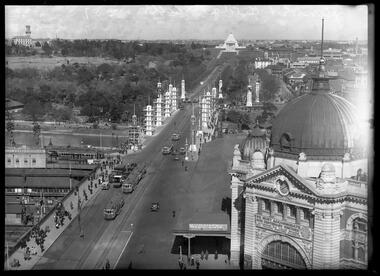 City of Melbourne Libraries
Photograph, Bull, Hugh Jones, 1897-1993, Princes Bridge Centenary pylons under construction
... The streets included in the electric night light decoration scheme were Bourke Street from Spring to William, the entire length of Collins Street, Flinders Street from Elizabeth to Spring, Lonsdale Street from Elizabeth to Swanston, Swanston and Elizabeth Streets from Flinders to Lonsdale, and parts of Springs and Spencer Streets. ...The streets included in the electric night light decoration scheme were Bourke Street from Spring to William, the entire length of Collins Street, Flinders Street from Elizabeth to Spring, Lonsdale Street from Elizabeth to Swanston, Swanston and Elizabeth Streets from Flinders to Lonsdale, and parts of Springs and Spencer Streets. ...Princes Bridge Centenary pylons under construction Possibly taken from Young and Jacksons Hotel (formerly Princes Bridge Hotel) on the corner of Flinders and Swanston streets, Flinders Street Station’s clocks and main entrance dominate, along with its distinctive copper dome and decorative façade. The time on the main clock is 1.40pm, and the sign underneath, reflecting Melbourne’s upcoming Centenary reads, “We must accommodate our Centenary visitors! Citizens! Do your share by taking paying guests.” At left is the original Princes Bridge Station, today the site of Federation Square. The riverside tram terminus advertises a Café/Tobacconist/Refreshment Room selling cigars & cigarettes, fountain drinks & confectionery, and in smaller text: “Leave your boot repairs here”. Nearly everyone is dressed in dark suits, coats and hats. The footpaths are wide and there are no traffic lights. The roadway stretches towards the Shrine of Remembrance, not yet dedicated but very dominant on the skyline. Government House is clearly visible across the wide parkland that would come to be known as Kings Domain and that is an area of deep importance to the people of the Eastern Kulin. Originally, Birrarung was part of a network of swamps and lagoons linked to the course of the river. From 1896, Public Works Department engineer Carlo Catani, oversaw a new channel to straighten the river and the swamps and lagoons were filled with spoil from the channel works. From the same vantage point today, only the top of the tower of Government House would be visible. The photo captures the pylons along Princes Bridge, mid-construction and being installed to mark Melbourne’s Centenary. The pylons were not without controversy. Both The Argus and The Age bemoaned them for being “made almost entirely of imported softwood timber”, denying work to native hardwood timber workers and sawmillers, and leading visitors to think Australia did not have its own exceptional native hardwoods. The pylons were also variously described in their incomplete state, as unimaginative and resembling an oilfield. Published: The Age 5 September 1934 Featured in "Newsworthy: Melbourne in photographs 1933-1936" exhibition at East Melbourne Library, October to December 2023. Exhibition caption by project volunteer, Louise McKenzie Photographer notations on slide: "Pylons + St Kilda Rd C57" Published: Age (Melbourne, Vic. : 1854 - 1954), Wednesday 5 September 1934, page 11 Published title: DECORATIONS -- THEN AND NOW. Published caption: "Although not completed yet, some impression of the effect of the decorations on Princes-bridge may be obtained from the first picture which shows the majestic sweep of St Kilda road with the Shrine of Remembrance and Government House dominating the horizon. The area to the left of St. Kilda-road and in front of Government House is portion of the area which it is proposed to call the King's Domain, which extends to Domain-road and Anderson-street..." Description: East-facing, elevated view of Flinders Street Station and Princes Bridge, featuring partially completed pylons erected for Melbourne's Centenary celebrations. The Shrine of Remembrance and Government House can be seen in the distance. In the foreground are trams, cars and trucks, pedestrians, Batman Avenue tram terminus and refreshment rooms. Signage on Flinders Street Station encourages citizens to accommodate Centenary visitors. The Melbourne Centenary was held 1934-35 in celebration John Batman's proclamation that Melbourne "the place for a village". Centenary events included a visit by Prince Henry, Duke of Gloucester. A Centenary Cake measuring 50 feet in height and ten tons in weight was cut into 250,000 pieces and sold at 1 shilling per piece for charity. Spectacular floodlighting of city landmarks, the creation of the Pioneer Women's Memorial Garden, and the MacRobertson Air Race from London, were other notable activities. Research by project volunteer, Louise McKenzie: The photo in The Age collage of 5 September 1934 has a slightly cropped foreground. The original photo has been taken from an elevated vantage point, most probably the roof of the Nicholas Building on the corner of Flinders and Swanston streets. The right foreground is dominated by the main “clocks” entrance to Flinders Street Station, showing its distinctive copper dome and decorative façade. The time on the main clock is 1.40 pm. The main sign on the front of the Station reads, "We Must Accommodate our Centenary Visitors! Citizens! Do your share by taking paying guests. Write to The Official Centenary Accommodation Bureau, 436 Collins St. City. Tel M 4671”. Another sign at eye level at the main entrance says: “Cheap Trips on Sundays”. The sign on the end of the roof along the eastern side of the station reads, “The Babies Need Your Help! Support Broadmeadows Foundling Hospital Appeal. July and August”. Run by the Sisters of St Joseph of the Sacred Heart, St Joseph’s Foundling Hospital was a purpose built infants’ home for up to 300 babies, plus accommodation for expectant mothers, mainly single women. In the early 1930s, the department (Victorian Children’s Welfare Department) contracted St Joseph’s Foundling Hospital to care for an additional 60 infant state wards, and up to 175 non wards at any given time. In 1931 it also operated a mothercraft training school. The centre foreground shows the commencement of Princes Bridge. Beneath the left side of the bridge was the site of the original Princes Bridge Station, by this time incorporated into Flinders Street Station, and today the area is the site of Federation Square. It was linked to Flinders Street station by the railway tracks that ran underneath the northern approach to the bridge. This photo shows a tram terminus which has a Café/Tobacconist/Refreshment Room, selling cigars & cigarettes, fountain drinks & confectionary, and a sign: Leave your boot repairs here. In the foreground is a wide roadway running south/north, comprising two vehicle lanes each heading north/south, and a central section containing two sets of tram tracks. There are cars, buses and delivery vans on the roadway. The trams visible are Glen Iris (Route No. 6; tram no. 448), Toorak (Route No. 8, tram no. 333), ? (No. 7), ? (No. 1), and ? (No. 2A). The footpaths are extremely wide. There is a square newspaper/magazine stand on the eastern side footpath. And also a “Ferry” sign. There are no traffic lights, but a policeman is visible on the roadway. There are pedestrians – men, women, children, a porter with trolley, women with prams. Clothing comprises dark suits, coats and hats for nearly everyone. There are double headed “Collins Street” lights along the side of the roadway, and along the northern riverbank. The roadway in the foreground is an extension of Swanston Street, which becomes Princes Bridge, then St Kilda Road, stretching towards the Shrine of Remembrance, and diverting past it. The Shrine had not yet been officially dedicated, and looks very white and dominant on the skyline. On the LHS of St Kilda Road, Government House is clearly visible across the wide parkland to be known as Kings Domain. The Kings Domain area is important to the people of the Eastern Kulin nation, and also has historical importance for its association with the early settlement of Melbourne and the foundation of British colonial administration in Victoria. On the southern side of the Yarra River (Birrarung) an historic rowing boathouse is visible, located adjacent to the Alexandra Gardens. Originally Birrarung was part of a network of swamps and lagoons linked to the course of the river. From 1896, under the guidance of engineer Carlo Catani* a new channel to straighten the river was created and the swamps and lagoons were filled with spoil from the channel works. The gardens were then created and completed in time for a Royal visit by the Duke of York in May 1901. The gardens are named after Alexandra of Denmark, the wife of King Edward VII. Both these areas, plus the Royal Botanic Gardens Victoria, Shrine of Remembrance Reserve, Sidney Myer Music Bowl, Government House, and the Queen Victoria Gardens together form the Domain Parklands. The extent of the subsequent plantings is evident today, where from the same vantage point only the top of the tower of Government House would be visible. *Catani was born in Florence in 1852, but after arriving in Melbourne worked as a civil engineer for the Victorian Government. His last major project was the reclamation of the foreshore of St Kilda, envisaged in the style of a European resort, complete with a split level esplanade, bathing pavilions, dance halls, amusements and a French-Italian style of landscape complete with palms. The gardens at the end of Fitzroy Street, St Kilda, now bear his name. The historic boathouse visible across the Yarra is another glimpse into Melbourne’s past. “Boathouse Row” comprises 7 amateur rowing clubs, the first established in 1859 (Melbourne University Boat Club). Other Clubs were Richmond, Melbourne, Banks, Melbourne Grammar School, Yarra Yarra and Mercantile. South of the river and west of the bridge is an area today developed into the Melbourne arts precinct of Hamer Hall and the Arts Centre. But at this time it was the home of Wirths Olympia Circus, which comprised Wirths Pleasure Park (an amusement park), a 5,000 seat auditorium – Hippodrome, a roller skating rink, a glaciarium, a cinema, and the Green Mill Dance Hall. Dog shows were also held at Olympia. The Green Mill Dance Hall closed in 1950, and the remainder of the Wirth buildings on site were destroyed by fire in December 1953. The feature of the photo is the pylons erected along Princes Bridge to mark Melbourne’s Centenary in 1934. The sixteen plastered pylons were designed by Roy Prentice, the second person to qualify as an architect at The University of Melbourne’s Bachelor of Architecture degree, in 1933, aged 27. Simon Reeves in his article marking the 100th birthday of Roy Prentice on 20 June 2006 reports that the State Electricity Commission sponsored this work, and the Argus reported that “… the pylons were “illuminated from within to give the effect of soft radiance”. Australia Home Beautiful 1 Oct 1934 reports in a very detailed and comprehensive article: The 10 taller pylons, including flagpole, were 48 ft, with a base of 8 ft. Timber-framed and faced with fibrous plaster and galvanised sheet iron, each structure was securely bolted to a concrete foundation three feet in depth. Panels of glass let into the shaft of each pylon were indirectly lit by 40, 100 watt lamps, and the upper bank of internal lamps were dyed so as to flood the panels with a deep red light. The decorative painted shields and flagpoles/pennants were illuminated by three 200 watt projectors concealed in the roof of each pylon, and were part of an electric night light decoration scheme involving 28 miles of wire to supply more than 20,000 lights. An article in the Argus on 18 October 1934 provided minute detail of the lighting erected in Melbourne for the Centenary, converting it “… into a coloured fairyland by night.” The estimated cost of 10 pounds per hour the lights were on. The display included 800 standard light poles 30 feet high which were tiered with electric bulbs concealed in inverted cones, 138 specially designed “Venetian poles” draped in flags trophies and streamers. The streets included in the electric night light decoration scheme were Bourke Street from Spring to William, the entire length of Collins Street, Flinders Street from Elizabeth to Spring, Lonsdale Street from Elizabeth to Swanston, Swanston and Elizabeth Streets from Flinders to Lonsdale, and parts of Springs and Spencer Streets. Together with the Princes Bridge pylons, approximately 28 miles of wire was required to supply power to the more than 20,000 lights. And that is just in the city of Melbourne. It was estimated the same amount of lighting was duplicated among other local councils. The pylons were not without controversy. The Argus on 28 August 1934 in an article headed “Imported Timber in Pylons” reported that the Princes Bridge pylons are “made almost entirely of imported softwood timber”, and have therefore denied work to native hardwood timber workers and sawmillers. The same day the Melbourne Age ran a similar story, bemoaning the fact that foreign oregon had been used which may lead tourists to think Australia did not have its own exceptional native hardwoods. A Camberwell City Councillor described the pylons as unimaginative, and the Herald reported that skeletons of pylons for the Centenary decorations in their present form led the area to resemble an oilfield! The Yarra River and Princes Bridge have long been a focal point of Melbourne life. In the early days of European settlement in Melbourne a rope-hauled punt carried people across the Yarra River. A surge in population and increased shipping traffic created a need for a bridge. There was difficulty in agreeing on a suitable site for the bridge (options were crossing at Elizabeth, Swanston, Queen or Market Streets), but the NSW Government favoured Swanston Street and the Melbourne Town Council decided on a temporary bridge across the Yarra spanning from the foot of Swanston Street. This first bridge was a single span timber toll bridge designed by Scottish born bridge designer David Lennox, and completed in 1845. It was 120 feet long, had a roadway of 17 feet wide, and a footpath on one side of 4 feet. It was leased to the Melbourne Bridge Company in the name of Robert A Balbirnie. The tollhouse was on the north side of the river and the toll keeper, Patrick Doherty, was credited with saving nine lives during the four years he was in charge of the toll station. The second bridge was stone (completed 1850), and named Prince’s Bridge after the HRH Prince of Wales, later Edward VII. It was designed with an elliptical single arc and an exceedingly small rise in proportion to the span. However, this design created an obstacle for flood waters, and together with Melbourne’s increasing population it was quickly apparent that a new bridge was required. At its opening on 15 November 1850 coincided with the imminent declaration of Victoria as a separate colony, it provided a moment of great celebration for Melbournians and “The opening ceremony was described as the grandest processional display witnessed in the colony.” (ToMelbourne.com.au) Princes Bridge in its present form, as depicted in this photograph, was designed by Jenkins, D’Ebro and Grainger, and constructed in 1886-88 by David Munro. John Grainger (father of Australian composer Percy Grainger) did the majority of the design work for the bridge. The structure was to have three arches each 96 feet wide measured across the river, and the banks on both sides were raised to allow more space for floodwater to flow. St Kilda Road was originally many feet below the current level. The bridge is of architectural significance for its substantial size, giant half columns, extensive use of wrought and cast iron, decorative elements (cast-iron lamps) and the skilled stonemasonry in the construction of the abutments and piers. Its main design features are similar to those of Blackfriars Bridge in London (1870). The bluestones were quarried from Footscray, the Malmsbury stones were from quarries at Kyneton, and the granite from Harcourt. The cost was met by the State of Victoria, City of Melbourne, and six out of seven of its municipalities, and their coats of arms feature on the bridge. The building of the bridge reflected the boom period of Melbourne, including the Victorian gold rush 1851- late 1860s, and its contractor, David Munro, was also responsible for the construction of Queens Bridge and Sandridge Railway Bridge. The Centenary pylons are no longer in place, but today this intersection still plays a major part in Melbourne’s daily life: people still meet “under the clocks” at Flinders Street station, and the route in and out of the city along St Kilda Road is often a feature of parades such as Moomba, the Grand Final Parade, and of course the Anzac Day Parade which commences at the Princes Bridge intersection and finishes at the Shrine of Remembrance. There are many tram routes, which cross the Bridge, and it directs pedestrians towards the Arts Precinct, the various components of Domain Park, plus the Southbank restaurant and rowing precincts. Even though this is a street scene, it feels very intimate; the viewer is instantly immersed in the activity of a Melbourne afternoon, looking down St Kilda Road from a viewpoint near today’s Federation Square. References: DECORATIONS -- THEN AND NOW. (1934, September 5). The Age (Melbourne, Vic. : 1854 - 1954), p. 11. Retrieved September 21, 2023, from http://nla.gov.au/nla.news-article205880269 'Flinders Street railway station', Wikipedia, https://en.wikipedia.org/wiki/Flinders_Street_railway_station 'St Joseph’s Foundling Hospital (1901-75)', Finding Records, Department of Health and Human Services, State of Victoria, https://www.findingrecords.dhhs.vic.gov.au/collectionresultspage/St-JosephsFoundling-Hospital-Babies-Home#departmental-administration 'Alexandra Gardens', City of Melbourne, https://www.melbourne.vic.gov.au/community/parks-open-spaces/major-parks-gardens/Pages/alexandra-gardens.aspx 'Wirths Circus', Wikipedia, https://en.wikipedia.org/wiki/Wirth's_Circus 'Roy Prentice: Centenary Architect', Built Heritage Pty Ltd, Simon Reeves, https://www.builtheritage.com.au/downloads/prentice.pdf 'Princes Bridge', Heritage Council Victoria, https://vhd.heritagecouncil.vic.gov.au/places/817 PORT PHILLIP. (1846, April 1). The Sydney Morning Herald (NSW : 1842 - 1954), p. 3. Retrieved September 21, 2023, from http://nla.gov.au/nla.news-article12886251 'Edward VII', Wikipedia, https://en.wikipedia.org/wiki/Edward_VII 'Princes Bridge', ToMelbourne.com, https://tomelbourne.com.au/princes-bridge/ 'Princes Bridge', eMelbourne, https://www.emelbourne.net.au/biogs/EM01189b.htm 'Princes Bridge', Australia for everyone, http://australiaforeveryone.com.au/files/melbourne/princes-bridge.html 'Victorian gold rush', Wikipedia, https://en.wikipedia.org/wiki/Victorian_gold_rush IMPORTED TIMBER IN PYLONS (1934, August 28). The Argus (Melbourne, Vic. : 1848 - 1957), p. 9. Retrieved September 21, 2023, from http://nla.gov.au/nla.news-article10952507 Princes-Bridge Pylons. (1934, August 28). The Age (Melbourne, Vic. : 1854 - 1954), p. 7. Retrieved September 21, 2023, from http://nla.gov.au/nla.news-article205532235 Pylons Appear Near Princes Bridge (1934, August 18). The Herald (Melbourne, Vic. : 1861 - 1954), p. 1. Retrieved September 21, 2023, from http://nla.gov.au/nla.news-article243104375 PRINCES-BRIDGE PYLONS. (1934, September 20). The Age (Melbourne, Vic. : 1854 - 1954), p. 10. Retrieved September 21, 2023, from http://nla.gov.au/nla.news-article205873535 28 Miles of Wire (1934, October 18). The Argus (Melbourne, Vic. : 1848 - 1957), p. 1 (The Junior Argus). Retrieved September 21, 2023, from http://nla.gov.au/nla.news-article10977836 'Historical references for Boathouse Row, Melbourne', http://boathouserowmelbourne.com.au/history/ 'ITALIAN DELEGATION TO HONOUR CARLO CATANI, DESIGNER OF THE ST KILDA FORESHORE, St Kilda Historical Society, 2001, https://web.archive.org/web/20070928061938/http://www.skhs.org.au/~SKHSarticles/articles/Carlo_Catani.html# HISTORY IN LIGHTS (1934, July 12). The Herald (Melbourne, Vic. : 1861 - 1954), p. 16. Retrieved September 21, 2023, from http://nla.gov.au/nla.news-article243172436 'Dressing Melbourne for the Duke', The Australian home beautiful: a journal for the home builder. Vol 12 No. 10 (1 October 1934), page 21, 58. Retrieved September 14, 2023, from http://nla.gov.au/nla.obj-2950922209Photographer notations on slide: "Pylons + St Kilda Rd C57".centenaries, bridges, lighting, flinders street railway station
