
Showing 14 items matching "spirit burner"
-
 Flagstaff Hill Maritime Museum and Village
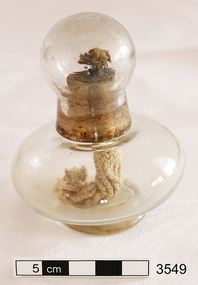
Functional object - Spirit burner, early 1900's
... Spirit burner......spirit burner...This spirit burner was donated to Flagstaff Hill Maritime Village by the family of Doctor William Roy Angus, Surgeon and Oculist. ...Spirit or alcohol burner, round squat shape, clear glass base and bulbous top with cotton wick inside; wick has metal holder. ...This spirit burner was donated to Flagstaff Hill Maritime Village by the family of Doctor William Roy Angus, Surgeon and Oculist. ...This spirit burner was donated to Flagstaff Hill Maritime Village by the family of Doctor William Roy Angus, Surgeon and Oculist. It is part of the “W.R. Angus Collection” that includes historical medical equipment, surgical instruments and material once belonging to Dr Edward Ryan and Dr Thomas Francis Ryan, (both of Nhill, Victoria) as well as Dr Angus’ own belongings. The Collection’s history spans the medical practices of the two Doctors Ryan, from 1885-1926 plus that of Dr Angus, up until 1969. ABOUT THE “W.R.ANGUS COLLECTION” Doctor William Roy Angus M.B., B.S., Adel., 1923, F.R.C.S. Edin.,1928 (also known as Dr Roy Angus) was born in Murrumbeena, Victoria in 1901 and lived until 1970. He qualified as a doctor in 1923 at University of Adelaide, was Resident Medical Officer at the Royal Adelaide Hospital in 1924 and for a period was house surgeon to Sir (then Mr.) Henry Simpson Newland. Dr Angus was briefly an Assistant to Dr Riddell of Kapunda, then commenced private practice at Curramulka, Yorke Peninsula, SA, where he was physician, surgeon and chemist. In 1926, he was appointed as new Medical Assistant to Dr Thomas Francis Ryan (T.F. Ryan, or Tom), in Nhill, Victoria, where his experiences included radiology and pharmacy. In 1927 he was Acting House Surgeon in Dr Tom Ryan’s absence. Dr Angus had become engaged to Gladys Forsyth and they decided he would take time to further his studies overseas in the UK in 1927. He studied at London University College Hospital and at Edinburgh Royal Infirmary and in 1928, was awarded FRCS (Fellow from the Royal College of Surgeons), Edinburgh. He worked his passage back to Australia as a Ship’s Surgeon on the on the Australian Commonwealth Line’s T.S.S. Largs Bay. Dr Angus married Gladys in 1929, in Ballarat. (They went on to have one son (Graham 1932, born in SA) and two daughters (Helen (died 12/07/1996) and Berenice (Berry), both born at Mira, Nhill ) Dr Angus was a ‘flying doctor’ for the A.I.M. (Australian Inland Ministry) Aerial Medical Service in 1928 . The organisation began in South Australia through the Presbyterian Church in that year, with its first station being in the remote town of Oodnadatta, where Dr Angus was stationed. He was locum tenens there on North-South Railway at 21 Mile Camp. He took up this ‘flying doctor’ position in response to a call from Dr John Flynn; the organisation was later known as the Flying Doctor Service, then the Royal Flying Doctor Service. A lot of his work during this time involved dental surgery also. Between 1928-1932 he was surgeon at the Curramulka Hospital, Yorke Peninsula, South Australia. In 1933 Dr Angus returned to Nhill where he’d previously worked as Medical Assistant and purchased a share of the Nelson Street practice and Mira hospital from Dr Les Middleton one of the Middleton Brothers, the current owners of what was once Dr Tom Ryan’s practice. Dr L Middleton was House Surgeon to the Nhill Hospital 1926-1933, when he resigned. [Dr Tom Ryan’s practice had originally belonged to his older brother Dr Edward Ryan, who came to Nhill in 1885. Dr Edward saw patients at his rooms, firstly in Victoria Street and in 1886 in Nelson Street, until 1901. The Nelson Street practice also had a 2 bed ward, called Mira Private Hospital ). Dr Edward Ryan was House Surgeon at the Nhill Hospital 1884-1902 . He also had occasions where he successfully performed veterinary surgery for the local farmers too. Dr Tom Ryan then purchased the practice from his brother in 1901. Both Dr Edward and Dr Tom Ryan work as surgeons included eye surgery. Dr Tom Ryan performed many of his operations in the Mira private hospital on his premises. He too was House Surgeon at the Nhill Hospital 1902-1926. Dr Tom Ryan had one of the only two pieces of radiology equipment in Victoria during his practicing years – The Royal Melbourne Hospital had the other one. Over the years Dr Tom Ryan gradually set up what was effectively a training school for country general-practitioner-surgeons. Each patient was carefully examined, including using the X-ray machine, and any surgery was discussed and planned with Dr Ryan’s assistants several days in advance. Dr Angus gained experience in using the X-ray machine there during his time as assistant to Dr Ryan. Dr Tom Ryan moved from Nhill in 1926. He became a Fellow of the Royal Australasian College of Surgeons in 1927, soon after its formation, a rare accolade for a doctor outside any of the major cities. He remained a bachelor and died suddenly on 7th Dec 1955, aged 91, at his home in Ararat. Scholarships and prizes are still awarded to medical students in the honour of Dr T.F. Ryan and his father, Dr Michael Ryan, and brother, John Patrick Ryan. ] When Dr Angus bought into the Nelson Street premises in Nhill he was also appointed as the Nhill Hospital’s Honorary House Surgeon 1933-1938. His practitioner’s plate from his Nhill surgery states “HOURS Daily, except Tuesdays, Fridays and Saturday afternoons, 9-10am, 2-4pm, 7-8pm. Sundays by appointment”. This plate is now mounted on the doorway to the Port Medical Office at Flagstaff Hill Maritime Village, Warrnambool. Dr Edward Ryan and Dr Tom Ryan had an extensive collection of historical medical equipment and materials spanning 1884-1926 and when Dr Angus took up practice in their old premises he obtained this collection, a large part of which is now on display at the Port Medical Office at Flagstaff Hill Maritime Village in Warrnambool. During his time in Nhill Dr Angus was involved in the merging of the Mira Hospital and Nhill Public Hospital into one public hospital and the property titles passed on to Nhill Hospital in 1939. In 1939 Dr Angus and his family moved to Warrnambool where he purchased “Birchwood,” the 1852 home and medical practice of Dr John Hunter Henderson, at 214 Koroit Street. (This property was sold in1965 to the State Government and is now the site of the Warrnambool Police Station. ). The Angus family was able to afford gardeners, cooks and maids; their home was a popular place for visiting dignitaries to stay whilst visiting Warrnambool. Dr Angus had his own silk worm farm at home in a Mulberry tree. His young daughter used his centrifuge for spinning the silk. Dr Angus was appointed on a part-time basis as Port Medical Officer (Health Officer) in Warrnambool and held this position until the 1940’s when the government no longer required the service of a Port Medical Officer in Warrnambool; he was thus Warrnambool’s last serving Port Medical Officer. (The duties of a Port Medical Officer were outlined by the Colonial Secretary on 21st June, 1839 under the terms of the Quarantine Act. Masters of immigrant ships arriving in port reported incidents of diseases, illness and death and the Port Medical Officer made a decision on whether the ship required Quarantine and for how long, in this way preventing contagious illness from spreading from new immigrants to the residents already in the colony.) Dr Angus was a member of the Australian Medical Association, for 35 years and surgeon at the Warrnambool Base Hospital 1939-1942, He served as a Surgeon Captain during WWII1942-45, in Ballarat, Victoria, and in Bonegilla, N.S.W., completing his service just before the end of the war due to suffering from a heart attack. During his convalescence he carved an intricate and ‘most artistic’ chess set from the material that dentures were made from. He then studied ophthalmology at the Royal Melbourne Eye and Ear Hospital and created cosmetically superior artificial eyes by pioneering using the intrascleral cartilage. Angus received accolades from the Ophthalmological Society of Australasia for this work. He returned to Warrnambool to commence practice as an ophthalmologist, pioneering in artificial eye improvements. He was Honorary Consultant Ophthalmologist to Warrnambool Base Hospital for 31 years. He made monthly visits to Portland as a visiting surgeon, to perform eye surgery. He represented the Victorian South-West subdivision of the Australian Medical Association as its secretary between 1949 and 1956 and as chairman from 1956 to 1958. In 1968 Dr Angus was elected member of Spain’s Barraquer Institute of Barcelona after his research work in Intrasclearal cartilage grafting, becoming one of the few Australian ophthalmologists to receive this honour, and in the following year presented his final paper on Living Intrasclearal Cartilage Implants at the Inaugural Meeting of the Australian College of Ophthalmologists in Melbourne In his personal life Dr Angus was a Presbyterian and treated Sunday as a Sabbath, a day of rest. He would visit 3 or 4 country patients on a Sunday, taking his children along ‘for the ride’ and to visit with him. Sunday evenings he would play the pianola and sing Scottish songs to his family. One of Dr Angus’ patients was Margaret MacKenzie, author of a book on local shipwrecks that she’d seen as an eye witness from the late 1880’s in Peterborough, Victoria. In the early 1950’s Dr Angus, painted a picture of a shipwreck for the cover jacket of Margaret’s book, Shipwrecks and More Shipwrecks. She was blind in later life and her daughter wrote the actual book for her. Dr Angus and his wife Gladys were very involved in Warrnambool’s society with a strong interest in civic affairs. Their interests included organisations such as Red Cross, Rostrum, Warrnambool and District Historical Society (founding members), Wine and Food Society, Steering Committee for Tertiary Education in Warrnambool, Local National Trust, Good Neighbour Council, Housing Commission Advisory Board, United Services Institute, Legion of Ex-Servicemen, Olympic Pool Committee, Food for Britain Organisation, Warrnambool Hospital, Anti-Cancer Council, Boys’ Club, Charitable Council, National Fitness Council and Air Raid Precautions Group. He was also a member of the Steam Preservation Society and derived much pleasure from a steam traction engine on his farm. He had an interest in people and the community He and his wife Gladys were both involved in the creation of Flagstaff Hill, including the layout of the gardens. After his death (28th March 1970) his family requested his practitioner’s plate, medical instruments and some personal belongings be displayed in the Port Medical Office surgery at Flagstaff Hill Maritime Village, and be called the “W. R. Angus Collection”. The W.R. Angus Collection is significant for still being located at the site it is connected with, Doctor Angus being the last Port Medical Officer in Warrnambool. The collection of medical instruments and other equipment is culturally significant, being an historical example of medicine from late 19th to mid-20th century. Dr Angus assisted Dr Tom Ryan, a pioneer in the use of X-rays and in ocular surgery. Spirit or alcohol burner, round squat shape, clear glass base and bulbous top with cotton wick inside; wick has metal holder. Top sits on base, to snuff flame. Suitable for liquid fuel such as methylated spirits; heat from flame is used to sterilize surgical instruments (W.R. Angus Collection)flagstaff hill, warrnambool, shipwrecked-coast, flagstaff-hill, flagstaff-hill-maritime-museum, maritime-museum, shipwreck-coast, flagstaff-hill-maritime-village, spirit burner, alcohol burner, glass spirit burner, metical equipment, dr w r angus, medical equipment, surgical instrument, dr ryan, nhill base hospital, flying doctor, medical history, medical treatment, mira hospital -
 Royal Australian and New Zealand College of Obstetricians & Gynaecologists (RANZCOG)
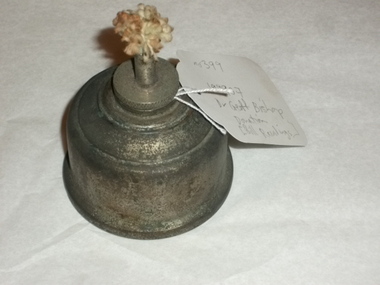
Spirit burner, 1940s
... Spirit burner...Spirit burner, metal container with thick woven cotton wick. ...Urine testing Spirit burner, metal container with thick woven cotton wick. ...This belonged to Dr Bill Rawling's and was in a medical bag that he was used in the 1940s and 1950s. It was donated by Dr Geoff Bishop.Spirit burner, metal container with thick woven cotton wick. No fuel present in container. Used by Bill Rawlings in process of testing urine.urine testing -
 Royal Australian and New Zealand College of Obstetricians & Gynaecologists (RANZCOG)
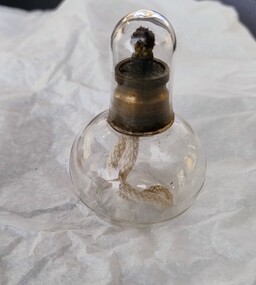
Equipment - Glass spirit burner associated with Dame Constance D'arcy
... Glass spirit burner associated with Dame Constance D'arcy...Bulbous glass spirit burner with brass fitting and thick cotton wick. ...Equipment Glass spirit burner associated with Dame Constance D'arcy ...This item was donated to RANZCOG's historical collection by Dr Ian Cope. In 1958, Dr Cope moved into rooms at 233 Macquarie Street, Sydney, which had previously been occupied by Dr Dame Constance D'arcy. He subsequently donated much of the material which remained in those rooms to the College.Bulbous glass spirit burner with brass fitting and thick cotton wick. Conical glass cap is removable. Wick is burnt from use and burner shows signs of use.dame constance d'arcy, medicine -
 Clunes Museum
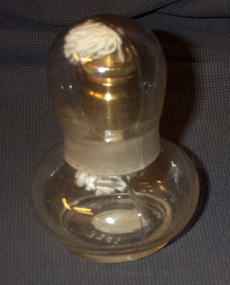
Functional object - SPIRIT BURNER
... SPIRIT BURNER...MEDICAL EQUIPMENT EXAMPLE FROM THE OLD CLUNES HOSPITAL local history medicine medical equipment SMALL CLEAR GLASS LANTERN WITH COTTON WICK .1 BASE AND .2 GLASS COVER Functional object SPIRIT BURNER ...MEDICAL EQUIPMENT EXAMPLE FROM THE OLD CLUNES HOSPITALSMALL CLEAR GLASS LANTERN WITH COTTON WICK .1 BASE AND .2 GLASS COVERlocal history, medicine, medical equipment -
 Torquay and District Historical Society
Functional object - Stove, Spirit, Pre 1890
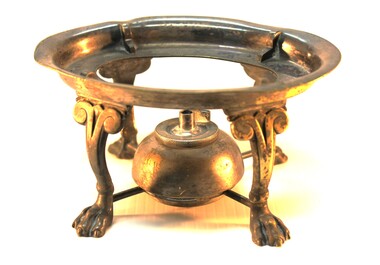
... Small silver spirit stove with four legs supporting a cradle over a spirit burner....The wreck of the Scammell was a significant event in Torquay's history. shipwrecks great ocean road victoria Scammell Collection Small silver spirit stove with four legs supporting a cradle over a spirit burner. Functional object Stove, Spirit ...An original artefact from the Joseph H Scammell purchased at an auction of the ships cargo after the ship was wrecked off Point Danger Torquay in 1891.The wreck of the Scammell was a significant event in Torquay's history.Small silver spirit stove with four legs supporting a cradle over a spirit burner.shipwrecks great ocean road victoria, scammell collection -
 Bright & District Historical Society operating the Bright Museum
Egg Warmer Silver
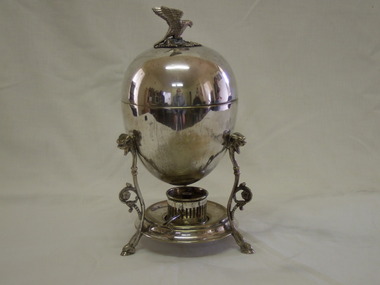
... Egg shaped with egg holder insert and spirit burner. Three animal shaped legs, with a dove and leaves on the lid....Egg shaped with egg holder insert and spirit burner. Three animal shaped legs, with a dove and leaves on the lid. ...Silver egg warmer. Egg shaped with egg holder insert and spirit burner. Three animal shaped legs, with a dove and leaves on the lid.5 hallmarks 14380egg warmer, silver, utensils, tableware -
 Mont De Lancey
Silver teapot on stand
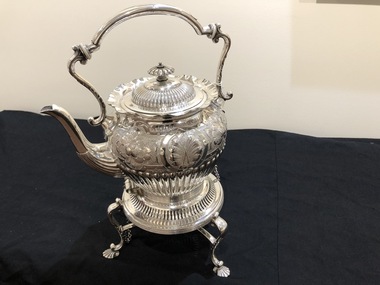
... Ornate embossed lidded silver teapot on three footed stand with a spirit burner on base. Silver pins on chains on both sides of base top for securing teapot....teapots Stands No 4, Badger and shoe symbols, large comma, symbol,l A1, 6305 Ornate embossed lidded silver teapot on three footed stand with a spirit burner on base. Silver pins on chains on both sides of base top for securing teapot. ...Ornate embossed lidded silver teapot on three footed stand with a spirit burner on base. Silver pins on chains on both sides of base top for securing teapot.No 4, Badger and shoe symbols, large comma, symbol,l A1, 6305teapots, stands -
 Bendigo Historical Society Inc.
Domestic Object - WARMER BASE
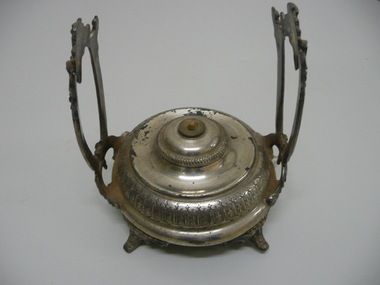
... Warmer base for tea pot or kettle, Brittania metal stand with spirit burner insert on four small legs with 2 upright side arms embossed pattern around base....DOMESTIC EQUIPMENT Food storage & preservation warmer Warmer base for tea pot or kettle, Brittania metal stand with spirit burner insert on four small legs with 2 upright side arms embossed pattern around base. ...Warmer base for tea pot or kettle, Brittania metal stand with spirit burner insert on four small legs with 2 upright side arms embossed pattern around base.domestic equipment, food storage & preservation, warmer -
 Mont De Lancey
Kettle, Circa 1900
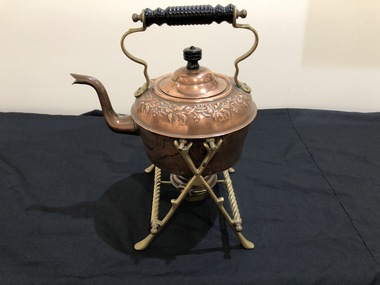
... Hanging copper hot water kettle with spirit burner underneath to keep water hot. Placed on a brass stand with decorative coiled supports. ...From the home of the late Mr and Mrs Edmund Burgi - C1900 Kettles Stands grape and leaf embossed pattern on lid of kettle Hanging copper hot water kettle with spirit burner underneath to keep water hot. Placed on a brass stand with decorative coiled supports. ...From the home of the late Mr and Mrs Edmund Burgi - C1900Hanging copper hot water kettle with spirit burner underneath to keep water hot. Placed on a brass stand with decorative coiled supports. Top of kettle has embossed grapes and leaves pattern with a bakelite and brass handle - knob on lid.grape and leaf embossed pattern on lid of kettlekettles, stands -
 Alfred Hospital Nurses League - Nursing History Collection
Equipment - Portable instrument sterilizer, circa 1928
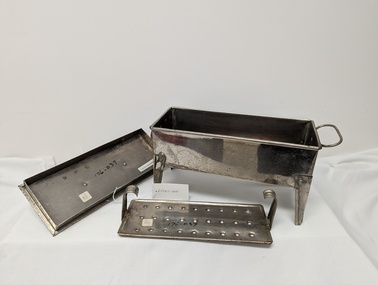
... Water in the steriliser was heated to boiling point either by gas or by methylated spirit burners. Item may have been used by nursing staff at the Alfred Hospital on wards or school of nursing....Water in the steriliser was heated to boiling point either by gas or by methylated spirit burners. Item may have been used by nursing staff at the Alfred Hospital on wards or school of nursing. ...As steam sterilisation became standard practice various types of sterilisers evolved. Water in the steriliser was heated to boiling point either by gas or by methylated spirit burners. Item may have been used by nursing staff at the Alfred Hospital on wards or school of nursing.The more instruments that could be sterilised the better the patient outcomes. These portable sterilisers greatly improved access to sterile equipment. Item may have been used by nursing staff at the Alfred Hospital on wards or school of nursing.Monemetal sterilizer containing a perforated tray on which instruments were placed. Item has two handles and four legs attached with rivets. Item is in 3 parts and can be taken apart.Each part has "176.07" in texta markingearly steam steriliser, ahnl, medical equiptment, alfred hospital -
 Royal Australian and New Zealand College of Obstetricians & Gynaecologists (RANZCOG)
Tool - Instrument steriliser used by Dr Mitchell Henry O'Sullivan, c. 1907
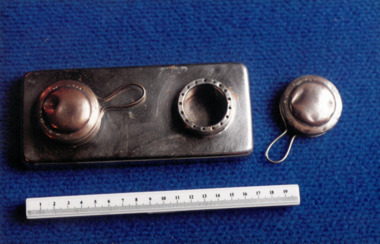
... Consists of a rectangular metal container with lid, an internal metal tray, and two spirit burners. The lid has a small wire handle at either end. ...Consists of a rectangular metal container with lid, an internal metal tray, and two spirit burners. The lid has a small wire handle at either end. ...This type of steriliser was in use from approximately 1907 onward. Designed for surgeons who frequently moved from hospital to hospital. The body and lid of the steriliser were made from one continuous piece of metal to produce a germ-free surface. Dr Mitchell Henry O'Sullivan worked in the Victorian country town of Casterton as a general practitioner from 1919 until his death in 1977. He also practiced obstetrics. His son, Dr David More O'Sullivan donated his obstetric bag and its contents to the College in 1999. The bag and contents are a unique time capsule of the type of instruments and pharmaceuticals used in the inter-war period.Metal instrument steriliser. Consists of a rectangular metal container with lid, an internal metal tray, and two spirit burners. The lid has a small wire handle at either end. The internal tray also had two handles and in perforated with holes to allow for drainage. The upper edge of each burner has a series of eighteen holes in the rim. disinfection -
 Bendigo Historical Society Inc.
Tool - LETTER SEALING SET
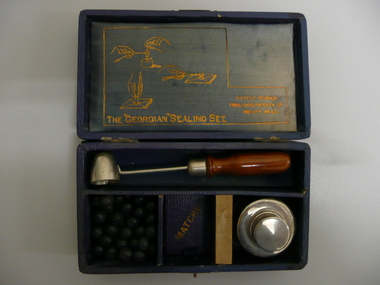
... The 'Georgian' sealing set, in a blue leather covered box with brass clasp, contents include a crucible, wax seals, matches & spirit burner. Inside box lid lined with blue silk with gold writing reading, patent No 30394/10 Third Hand Patents Ltd 881 City Rd E.C. ...COMMUNICATION Postal letters Third Hand Patents Ltd The 'Georgian' sealing set, in a blue leather covered box with brass clasp, contents include a crucible, wax seals, matches & spirit burner. Inside box lid lined with blue silk with gold writing reading, patent No 30394/10 Third Hand Patents Ltd 881 City Rd E.C. ...The 'Georgian' sealing set, in a blue leather covered box with brass clasp, contents include a crucible, wax seals, matches & spirit burner. Inside box lid lined with blue silk with gold writing reading, patent No 30394/10 Third Hand Patents Ltd 881 City Rd E.C. Donated by 'Wiegard 6.11.69'Third Hand Patents Ltdcommunication, postal, letters -
 Wodonga & District Historical Society Inc
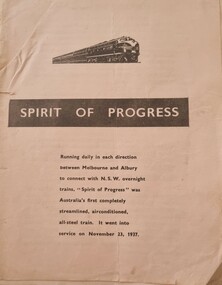
Booklet - Spirit of Progress, Victorian Railways, 1958
... Spirit of Progress" was hauled by one of the four giant "S" class steam locomotives. Each was named after a man famous in Australian History: Matthew Flinders, Edward Henty, Sir Thomas Mitchell and C.J. Latrobe. After World War II the locomotives were converted to oil burners...Spirit of Progress" was hauled by one of the four giant "S" class steam locomotives. Each was named after a man famous in Australian History: Matthew Flinders, Edward Henty, Sir Thomas Mitchell and C.J. Latrobe. After World War II the locomotives were converted to oil burners ...The "Spirit of Progress' was constructed at the Railway Workshops, Newport, Victoria, and placed into service between Melbourne and Albury on 23rd November, 1937. It was the first completely streamlined, airconditioned, all steel train in the Southern Hemisphere. It travelled non-stop daily in both directions between Melbourne and Albury. On its daily run a speed of one mile a minute was averaged for much of the 1,904 mile journey. Eighty m.p.h. was exceeded in tests, but in normal running a 70 m.p.h. restriction was imposed. The average load of the "Spirit of Progress" was 499 tons, and it could carry 240 first-class and 192 second-class passengers. A luxurious dining car was a feature of the “Spirit of Progress” with Queensland beech walls and leather upholstered seats. It had a well-equipped kitchen with walls of stainless steel, a slow combustion coke-burning range and a modern air circulation system. The "Spirit of Progress" was hauled by one of the four giant "S" class steam locomotives. Each was named after a man famous in Australian History: Matthew Flinders, Edward Henty, Sir Thomas Mitchell and C.J. Latrobe. After World War II the locomotives were converted to oil burners and were hauled by “S” class diesel-electric locomotives. In a normal year, the "Spirit of Progress" travelled about 146, 000 miles and carried over 300,000 passengers, while approximately 126,000 meals and 45, 000 serves of light refreshments would be provided in the dining car. The Spirit of Progress ran for the last time on 2nd August 1986.This item is significant because it provides a description and information about an important locomotive which served the Wodonga DistrictA small leaflet of six pages plus cover outlining information about the Spirit of Progress. The cover features a picture of the Spirit of Progress. Printed on buff coloured paper in black ink.SPIRIT OF PROGRESS"spirit of progress", victorian railways, locomotives -- victoria -- history -
 Emerald Museum & Nobelius Heritage Park
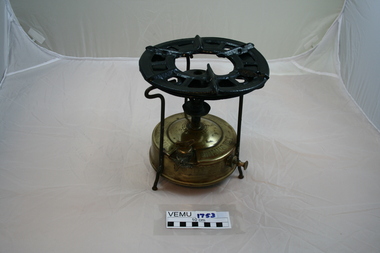
Domestic object - Primus Stove
... burner by 3 support legs. To light the stove, a small amount of alcohol is put into the spirit cup, just below the burner to preheat it. ...burner by 3 support legs. To light the stove, a small amount of alcohol is put into the spirit cup, just below the burner to preheat it. ...The stove was the property of John Biggart, who lived in Avonsleigh. He travelled Victoria from 1920 to the 1940's. The stove was used at a work camp site.Brass base containing the kerosene fuel tank, above which rises a burning tube and burner assembly. The steel top rings are held above the burner by 3 support legs. To light the stove, a small amount of alcohol is put into the spirit cup, just below the burner to preheat it. Kerosene was then vaporised, mixed with air and it burns with a soot less, blue flame.PRIMUS No. 1. MADE IN SWEDEN. TRADEMARK PRI-MUS. PATENT SB. No 48624. ENG No 171536, all on the top of the tank. On the side is engraved; A/B B. AHJORTH AND CO. STOCKHOLM SWEDEN - SOLEMAKERS OF THE GENUINE john biggart
