
Showing 31 items matching "stability / control "
-
 Moorabbin Air Museum
Booklet (item) - CAC reports on investigations of Mirage Engine crash, Macchi Fatigue, CA30 Mk 2 feasibility, ATAR Rotor Compressor & Stability & Control
... CAC reports on investigations of Mirage Engine crash, Macchi Fatigue, CA30 Mk 2 feasibility, ATAR Rotor Compressor & Stability & Control...CAC reports on investigations of Mirage Engine crash, Macchi Fatigue, CA30 Mk 2 feasibility, ATAR Rotor Compressor & Stability & Control...CAC reports on investigations of Mirage Engine crash, Macchi Fatigue, CA30 Mk 2 feasibility, ATAR Rotor Compressor & Stability & Control Booklet CAC reports on investigations of Mirage Engine crash, Macchi Fatigue, CA30 Mk 2 feasibility, ATAR Rotor Compressor & Stability & Control ... -
Moorabbin Air Museum
Document (Item) - GAF - A Note On The Directional Stability And Control Of Jindivik MK.2 On The Launching Trolley
... GAF - A Note On The Directional Stability And Control Of Jindivik MK.2 On The Launching Trolley...GAF - A Note On The Directional Stability And Control Of Jindivik MK.2 On The Launching Trolley...GAF - A Note On The Directional Stability And Control Of Jindivik MK.2 On The Launching Trolley Document GAF - A Note On The Directional Stability And Control Of Jindivik MK.2 On The Launching Trolley ... -
Moorabbin Air Museum
Book (item) - CAC Collection - North American Aviation Inc. Wind Tunnel Investigations Of The Stability And Control Characteristics Of A 0.2-Scale Model Of The F-86F Airplane
... Wind Tunnel Investigations Of The Stability And Control Characteristics Of A 0.2-Scale Model Of The F-86F Airplane...Wind Tunnel Investigations Of The Stability And Control Characteristics Of A 0.2-Scale Model Of The F-86F Airplane...Wind Tunnel Investigations Of The Stability And Control Characteristics Of A 0.2-Scale Model Of The F-86F Airplane ...With Underwing Fuel And Armament Stores and Various 120 Gallon Beaver Tail Wing Tip Fuel Tank Configurations -
Moorabbin Air Museum
Manual (Item) - US Army Air Force studies -stability and control, Stability and Control Requirements for Airplanes
... US Army Air Force studies -stability and control...Stability and Control Requirements for Airplanes...Stability and Control Requirements for Airplanes Manual US Army Air Force studies -stability and control ... -
Moorabbin Air Museum
Document (Item) - GAF - Directional Control And Stability Of Jindivik MK2 Aircraft And Launching Trolley During Take Off
... GAF - Directional Control And Stability Of Jindivik MK2 Aircraft And Launching Trolley During Take Off...GAF - Directional Control And Stability Of Jindivik MK2 Aircraft And Launching Trolley During Take Off...GAF Stability Note/Jindivik/10 GAF - Directional Control And Stability Of Jindivik MK2 Aircraft And Launching Trolley During Take Off Document GAF - Directional Control And Stability Of Jindivik MK2 Aircraft And Launching Trolley During Take Off ...GAF Stability Note/Jindivik/10 -
Moorabbin Air Museum
Document (Item) - Aero 1673 notes on a visit to southern Germany to interrogate German technical staff on stability and control matters with respect to flight testing, Royal aircraft establishment Farnborough Hants
... Aero 1673 notes on a visit to southern Germany to interrogate German technical staff on stability and control matters with respect to flight testing...Royal aircraft establishment Farnborough Hants Document Aero 1673 notes on a visit to southern Germany to interrogate German technical staff on stability and control matters with respect to flight testing ... -
Moorabbin Air Museum
Manual - Aerodynamics, Aerodynamics For Naval Aviators
... ...Stability & control...Aerodynamics Basic aerodynamics Airplane performance High speed aerodynamics Stability & control Operating strengh limitations Application of aerodynamics to specific flying problems Overview of elements of applied aerodynamics & aeronautical engineering circa 1965 2 screw manual Aerodynamics For Naval Aviators Manual Aerodynamics ...Overview of elements of applied aerodynamics & aeronautical engineering circa 19652 screw manualnon-fictionOverview of elements of applied aerodynamics & aeronautical engineering circa 1965basic aerodynamics, airplane performance, high speed aerodynamics, stability & control, operating strengh limitations, application of aerodynamics to specific flying problems -
Moorabbin Air Museum
Book - Flight dynamics, Airplane Flight Dynamics and Automatic Flight Controls Part 1
... ...Stability & control...Flight dyamics Equations of motion & axis systems Review of aerodynamic fundamentals Aerodynamics & thrust forces Stability & control Flying qualities Pilot ratings Regulations & applications Advanced aircraft analyses program Overview of methods for analysis & synthesis of stability & control of aircraft, circa 1995 Airplane Flight Dynamics and Automatic Flight Controls Part 1 Book Flight dynamics ...Overview of methods for analysis & synthesis of stability & control of aircraft, circa 1995non-fictionOverview of methods for analysis & synthesis of stability & control of aircraft, circa 1995equations of motion & axis systems, review of aerodynamic fundamentals, aerodynamics & thrust forces, stability & control, flying qualities, pilot ratings, regulations & applications, advanced aircraft analyses program -
Moorabbin Air Museum
Book - Flight dynamics, Airplane Flight Dynamics and Automatic Flight Controls Part II
... Effects of aeroelasticity on stability & control...Flight dynamicsFu Effects of aeroelasticity on stability & control Theory & application of bode plots Classical control theory with application to airplanes Airplane plus pilot as a closed loop control system Stability augmentation & automatic flight control systems Fundamentals of digital flight control system analysis Autopilot system hardware Overview of methods for analysis & synthesis of automatic flight control systems, circa 1995 Airplane Flight Dynamics and Automatic Flight Controls Part II Book Flight dynamics ...Overview of methods for analysis & synthesis of automatic flight control systems, circa 1995non-fictionOverview of methods for analysis & synthesis of automatic flight control systems, circa 1995effects of aeroelasticity on stability & control, theory & application of bode plots, classical control theory with application to airplanes, airplane plus pilot as a closed loop control system, stability augmentation & automatic flight control systems, fundamentals of digital flight control system analysis, autopilot system hardware -
Moorabbin Air Museum
Book - Aerodyamics, Simple Aerodynamics and The Airplane
... ...stability...Control...Aerodynamics Airfoils stability Control surfaces Dynamic loads Structure Military and civilian aircraft US Army Air Corps overview of aircraft aerodynamics circa 1927 Simple Aerodynamics and The Airplane Book Aerodyamics ...US Army Air Corps overview of aircraft aerodynamics circa 1927non-fictionUS Army Air Corps overview of aircraft aerodynamics circa 1927airfoils, stability, control surfaces, dynamic loads, structure, military and civilian aircraft -
Moorabbin Air Museum
Book - Aircraft design, Aeroplane Design
... ...Stability & control...Aircraft design Structure of airplane Mechanics of flight Stability & control Materials & their strength Heat treatment Lugs & bearings Fundamental principles of aircraft design, circa 1938 Aeroplane Design Book Aircraft design ...Fundamental principles of aircraft design, circa 1938non-fictionFundamental principles of aircraft design, circa 1938structure of airplane, mechanics of flight, stability & control, materials & their strength, heat treatment, lugs & bearings -
Moorabbin Air Museum
Book - Aircraft construction, An Elementary Course in the Construction of Aircraft
... ...Stability & control...Aircraft construction The atmosphere Air resistance Aerofoils The flight of the airplane Stability & control The airscrew Overview of the theories underlying practical aeronautical engineering, circa 1940 An Elementary Course in the Construction of Aircraft Book Aircraft construction ...Overview of the theories underlying practical aeronautical engineering, circa 1940non-fictionOverview of the theories underlying practical aeronautical engineering, circa 1940the atmosphere, air resistance, aerofoils, the flight of the airplane, stability & control, the airscrew -
Moorabbin Air Museum
Book - Aircraft design, Aerospace Vehicle Design Volume I Aircraft Design
... ...Stability / control & control surface design...Aircraft design Design of turboprop airplanes Design of subsonic turbojet airplanes Design of supersonic aircraft & missiles Design of helicopters Design of water based aircraft Structural design considerations Cost as a factor in design Wing design Stability / control & control surface design Landing gear design Fuselage & hull design Overview of how an airplane or helicopter can be designed, circa1963 Aerospace Vehicle Design Volume I Aircraft Design Book Aircraft design ...Overview of how an airplane or helicopter can be designed, circa1963non-fictionOverview of how an airplane or helicopter can be designed, circa1963design of turboprop airplanes, design of subsonic turbojet airplanes, design of supersonic aircraft & missiles, design of helicopters, design of water based aircraft, structural design considerations, cost as a factor in design, wing design, stability / control & control surface design, landing gear design, fuselage & hull design -
Moorabbin Air Museum
Book - Mechanics of Flight, The Mechanics of Flight
... ...Stability & control...Mechanics of flight Air & airflow Aerofoils Thrust Level flight Gliding & landing Performance Manouevres Stability & control Trial flight Flight at transonic & supersonic speeds Space flight Introduction to the principles of the mechanics of flight, circa 1972 The Mechanics of Flight Book Mechanics of Flight ...Introduction to the principles of the mechanics of flight, circa 1972non-fictionIntroduction to the principles of the mechanics of flight, circa 1972air & airflow, aerofoils, thrust, level flight, gliding & landing, performance, manouevres, stability & control, trial flight, flight at transonic & supersonic speeds, space flight -
Moorabbin Air Museum
Book - Aeronautical Research Council technical reports, Technical Report of the Aeronautical Research Council 1950 Volume III
... Stability & control...Aeronautical Research Council technical reports Stability & control Structures Thermodynamics Visual aids Wind tunnels Collection of technical studies from 1950 Technical Report of the Aeronautical Research Council 1950 Volume III Book Aeronautical Research Council technical reports ...Collection of technical studies from 1950non-fictionCollection of technical studies from 1950stability & control, structures, thermodynamics, visual aids, wind tunnels -
Moorabbin Air Museum
Book - Aeronautical Research Council technical reports, Technical Report of the Aeronautical Research Council 1954
... ...Stability & control...Aeronautical Research Council technical reports Aero & hydrodynamics Aerofoils Arrester gear Compressors & turbines Flutter Materials Performance Rotorcraft Stability & control Structures Collection of technical studies from the year 1954 Technical Report of the Aeronautical Research Council 1954 Book Aeronautical Research Council technical reports ...Collection of technical studies from the year 1954non-fictionCollection of technical studies from the year 1954aero & hydrodynamics, aerofoils, arrester gear, compressors & turbines, flutter, materials, performance, rotorcraft, stability & control, structures -
Moorabbin Air Museum
Book - AGARD reports, Aeroelastic Effects from Flight Mechanics Standpoint
... ...Stability & control augmentation devices...AGARD reports State of the art Flight dynamics of a flexible VTOL rotor Flight dynamics of flexible airplanes theoretical methods Experimental methods for flight dynamics of the flexible airplane Stability & control augmentation devices Discussions on the methods used for predicting aeroelastic instabilities, circa 1970 Aeroelastic Effects from Flight Mechanics Standpoint Book AGARD reports ...Discussions on the methods used for predicting aeroelastic instabilities, circa 1970non-fictionDiscussions on the methods used for predicting aeroelastic instabilities, circa 1970state of the art, flight dynamics of a flexible vtol rotor, flight dynamics of flexible airplanes theoretical methods, experimental methods for flight dynamics of the flexible airplane, stability & control augmentation devices -
Moorabbin Air Museum
Book - Aerodyamics, Airplane Flight Dynamics and Automatic Flight Controls Part II
... Steady state stability & control...Aerodynamics General equations of motion for a rigid airplane Basic aerodynamic concepts Aerodynamic & thrust forces & moments Steady state stability & control Dynamic stability & response characteristics Overview of rigid & elastic flight dynamics & automatic flight controls, circa 1979 Possible duplicate item Airplane Flight Dynamics and Automatic Flight Controls Part II Book Aerodyamics ...Overview of rigid & elastic flight dynamics & automatic flight controls, circa 1979Possible duplicate itemnon-fictionOverview of rigid & elastic flight dynamics & automatic flight controls, circa 1979general equations of motion for a rigid airplane, basic aerodynamic concepts, aerodynamic & thrust forces & moments, steady state stability & control, dynamic stability & response characteristics -
Moorabbin Air Museum
Book - Aerodynamics, Airplane Flight Dynamics and Automatic Flight Controls Part 1
... Steady state stability & control...Aerodynamics General equations of motion for a rigid airplane Basic aerodynamic concepts Aerodynamic & thrust forces & moments Steady state stability & control Dynamic stability & response characteristics Overview of rigid flight dymamics, circa 1982 Possible duplicate item Airplane Flight Dynamics and Automatic Flight Controls Part 1 Book Aerodynamics ...Overview of rigid flight dymamics, circa 1982Possible duplicate itemnon-fictionOverview of rigid flight dymamics, circa 1982general equations of motion for a rigid airplane, basic aerodynamic concepts, aerodynamic & thrust forces & moments, steady state stability & control, dynamic stability & response characteristics -
Moorabbin Air Museum
Book - AGARD reports, Manoeuvring Aerodynamics
... ...Stability & control...AGARD reports High angle of attack - aerodynamics Dynamic experiments Stability & control Studies on rapid, large amplitude maneuvers of agile combat aircraft, circa 1991 Manoeuvring Aerodynamics Book AGARD reports ...Studies on rapid, large amplitude maneuvers of agile combat aircraft, circa 1991non-fictionStudies on rapid, large amplitude maneuvers of agile combat aircraft, circa 1991high angle of attack - aerodynamics, dynamic experiments, stability & control -
Moorabbin Air Museum
Book - Aeronautical Engineering, A Summary and Analysis of the Low Speed Longitudinal Characteristics of Swept Wings at High Reynolds Number
... stability...Stall control...Aeronautical engineering Flow considerations Longitudinal stability Stall control Horizontal tail Lift Drag Summary & analyses of low speed characteristics of swept wings, circa 1957 A Summary and Analysis of the Low Speed Longitudinal Characteristics of Swept Wings at High Reynolds Number Book Aeronautical Engineering ...Summary & analyses of low speed characteristics of swept wings, circa 1957non-fictionSummary & analyses of low speed characteristics of swept wings, circa 1957flow considerations, longitudinal stability, stall control, horizontal tail, lift, drag -
Moorabbin Air Museum
Book - Aeronautical Research Council technical reports, Technical Report of the Aeronautical Research Council 1951 Vol.II
... ...Stability and control...Aeronautical Research Council technical reports Compressors & turbines Flutter Instruments Mathematics Ropes Rotorcraft Stability and control Structures Wind tunnels Collection of technical reports from 1951 Technical Report of the Aeronautical Research Council 1951 Vol.II Book Aeronautical Research Council technical reports ...Collection of technical reports from 1951non-fictionCollection of technical reports from 1951 compressors & turbines, flutter, instruments, mathematics, ropes, rotorcraft, stability and control, structures, wind tunnels -
Moorabbin Air Museum
Document (series) - Nomad Development Material - Collection of Vilem Gottlieb
... 1987 74 A seating plan - probably of section at Avalon 75 Copy of the Department of Defence OFFICIAL SECRECY - Crimes Act 1914 1977 76 Technical Officer (Engineering) Duty Statement 1978 77 Memo: Request to train Fight Test Observers as pilots 1980 78 GAF Letter: GAF Test Pilots 1986 79 Letter to the editor of Aircraft 1984 80 GAF/ASTA Letter to the editor of the Geelong Advertiser 1994 81 Geelong Advertiser Article that relates to #80 1994 82 GAF Memorandum of Insurance 1978 83 GAF Duty Statement - Senior Technical Officer (Engineering) Grade 3 84 GAF Duty Statement - Senior Technical Officer (Engineering) Grade 2 85 Suspension folder Nomad Handwritten Certification report N24A-20 - Ground and flight tests - Water methanol injection system 86 Nomad Flight manual supplement - Trial installation - Option G428 - Water-methanol power augmentation system 1980 87 Nomad More handwritten notes about the water/methanol injection system - N24A 88 Nomad Draft Water.methanol power augmentation system flight test schedule - N22S, N22B 89 Nomad Handwritten notes on the water/methanol system 90 Nomad GAF Nomad Model N - Flight test schedule - Water/methanol power augmentation system 91 Nomad GAF Nomad Model N - Flight test schedule - Water/methanol power augmentation system 92 Article - Light-twin engine-out flying by Dennis Newton- Business and Commercial Aviation - November 1987 1987 93 Nomad Handwritten and photocopies attached re conditions for turbine aircraft and federal aviation regulations part 23 94 Mississippi State University Article: Determining Performance Parameters of General Aviation Aircraft - Mississippi State University 95 Technological University, The Netherlands Article: Determination of performance, stability and control characteristics from measurements in non-steady manoeuvres 96 Department of Mechanical and Aerospace Engineering, North Carolina State University Article: Recent results obtained with a new method for measuring aircraft power and drag in flight 1979 97 Mississippi State University Article: Flight test evaluation of a method to determine the level flight performance of a propellor-driven aircraft 1977 98 NASA Report: Practical aspects of using a maximum likelihood estimation method to extract stability and control derivatives from flight data 1976 99 Two photographs of engines unknown 100 Folder Nomad ASTA Aircraft Flight Manual - Nomad Model N22C 2006 101 Plastic Wrapped paper Nomad ASTA Pilot’s Operating Handbook - Model N22S Searchmaster 1990 102 Stapled book Aeronautical Engineering Report: AF-36 - Flight Test Report 103 Manila Folder Nomad ASTA Documentation relating to Florida Court Case 1989 104 Suspension folder Paperwork on recording the weight of aircraft - including aircraft weighing summaries 105 Manila Folder Nomad Brochure: What Nomad is that? ...1987 74 A seating plan - probably of section at Avalon 75 Copy of the Department of Defence OFFICIAL SECRECY - Crimes Act 1914 1977 76 Technical Officer (Engineering) Duty Statement 1978 77 Memo: Request to train Fight Test Observers as pilots 1980 78 GAF Letter: GAF Test Pilots 1986 79 Letter to the editor of Aircraft 1984 80 GAF/ASTA Letter to the editor of the Geelong Advertiser 1994 81 Geelong Advertiser Article that relates to #80 1994 82 GAF Memorandum of Insurance 1978 83 GAF Duty Statement - Senior Technical Officer (Engineering) Grade 3 84 GAF Duty Statement - Senior Technical Officer (Engineering) Grade 2 85 Suspension folder Nomad Handwritten Certification report N24A-20 - Ground and flight tests - Water methanol injection system 86 Nomad Flight manual supplement - Trial installation - Option G428 - Water-methanol power augmentation system 1980 87 Nomad More handwritten notes about the water/methanol injection system - N24A 88 Nomad Draft Water.methanol power augmentation system flight test schedule - N22S, N22B 89 Nomad Handwritten notes on the water/methanol system 90 Nomad GAF Nomad Model N - Flight test schedule - Water/methanol power augmentation system 91 Nomad GAF Nomad Model N - Flight test schedule - Water/methanol power augmentation system 92 Article - Light-twin engine-out flying by Dennis Newton- Business and Commercial Aviation - November 1987 1987 93 Nomad Handwritten and photocopies attached re conditions for turbine aircraft and federal aviation regulations part 23 94 Mississippi State University Article: Determining Performance Parameters of General Aviation Aircraft - Mississippi State University 95 Technological University, The Netherlands Article: Determination of performance, stability and control characteristics from measurements in non-steady manoeuvres 96 Department of Mechanical and Aerospace Engineering, North Carolina State University Article: Recent results obtained with a new method for measuring aircraft power and drag in flight 1979 97 Mississippi State University Article: Flight test evaluation of a method to determine the level flight performance of a propellor-driven aircraft 1977 98 NASA Report: Practical aspects of using a maximum likelihood estimation method to extract stability and control derivatives from flight data 1976 99 Two photographs of engines unknown 100 Folder Nomad ASTA Aircraft Flight Manual - Nomad Model N22C 2006 101 Plastic Wrapped paper Nomad ASTA Pilot’s Operating Handbook - Model N22S Searchmaster 1990 102 Stapled book Aeronautical Engineering Report: AF-36 - Flight Test Report 103 Manila Folder Nomad ASTA Documentation relating to Florida Court Case 1989 104 Suspension folder Paperwork on recording the weight of aircraft - including aircraft weighing summaries 105 Manila Folder Nomad Brochure: What Nomad is that? ...Donation from Anna Gottlieb -
 Upper Yarra Museum
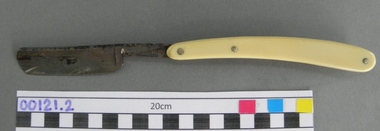
Razor, Cut throat
... control of the blade including the blade angle. Straight razors cover a much greater area per shaving stroke because their cutting edge is much longer than any of the multiblade razors. shaving lever handle blade pivot razor tang Ivory cut throat razor, with cream case 00121.3.Known as a straight razor.Razor with square point, full hollow ground 5/8” blade and double transverse stabiliser. The centre pin adds stability ...Sharped Edged instrument used for cleaning hair from the skin. http://en.wikipedia.org/wiki/Straight_razor A straight razor is a razor with a blade that can fold into its handle.[1] They are also called open razors and cut-throat razors. HISTORY The first modern straight razor complete with decorated handles and hollow ground blades was constructed in Sheffield, England, by Benjamin Huntsman in 1740. Huntsman's process was adopted by the French sometime later. The English manufacturers were even more reluctant than the French to adopt the process and only did so after they saw its success in France.[5] Straight razors were the most common form of shaving before the 20th century and remained that common in many countries until the 1950s. TODAY Straight razors are still manufactured. DOVO, of Solingen, Germany, and Thiers Issard of France are two of the most well-known European manufacturers. Feather Safety Razor Co. Ltd. of Osaka, Japan makes a razor with the same form as a traditional straight, but featuring a disposable blade that can be installed through an injector-type system. Modern straight razor users are known to favor them for a variety of reasons. Some are attracted to the nostalgia of using old and traditional methods of shaving. It is a masculine ritual comparable to pipe smoking. Others profess an interest in reducing the waste of disposable blades.[11][22] Still others agree that straight razors provide a superior shave through a larger blade and greater control of the blade including the blade angle. Straight razors cover a much greater area per shaving stroke because their cutting edge is much longer than any of the multiblade razors. Ivory cut throat razor, with cream case 00121.3.Known as a straight razor.Razor with square point, full hollow ground 5/8” blade and double transverse stabiliser. The centre pin adds stability and rigidity to the handle---I think this is it ROM Parts The narrow end of the blade pivots on a pin, between 2 pieces of ivory forms the handle. LONG EXTRACT FROM WIKI _ SHORTEN to describe 00121 The parts of a straight razor and their function are described as follows: The narrow end of the blade rotates on a pin called the pivot, between two protective pieces called the scales or handle. The upward curved metal end of the narrow part of the blade beyond the pivot is called the tang and acts as a lever to help raise the blade from the handle. One or two fingers resting on the tang also help stabilize the blade while shaving. The narrow support piece between the tang and the main blade is called the shank, but this reference is often avoided because it can be confusing. The shank sometimes features decorations and the stamp of the country of origin. The top side and the underside of the shank can sometimes exhibit indentations known as fluting, or jimps for a more secure grip.[8] The curved lower part of the main blade from the shank to the cutting edge is called the shoulder.[9] The point where the shoulder joins the cutting edge is called the heel. A thick strip of metal running transversely at the junction where the main blade attaches to the shank is called the stabiliser. The stabiliser can be double,[10] single or can be absent in some razor models. The first stabiliser is usually very narrow and thicker and runs at the shank to blade junction, covering the shank and just spilling over to the shoulder. The second stabiliser can be distinguished since it is considerably wider and narrower, appearing after the first stabiliser and running lower into the shoulder. The non-cutting top of the blade is called the back or the spine while the cutting part of the blade opposite the back is called the cutting edge.[11] Finally the other free end of the blade, at the opposite end of the tang, is called the point and, sometimes, the head or the nose.[9][12] There are two to three pins in any handle. The middle pin, if present, is plastic coated and is called the plug.[13] Its function is to stabilise the sides of the handle so that they cannot be squeezed in the middle. When folded into the scales, the blade is protected from accidental damage, and the user is protected from accidental injury. During folding, the back of the blade, being thick and normally with a curved cross-section, acts as a natural stopper and prevents further rotation of the blade out of the handle from the other side shaving, lever, handle, blade, pivot, razor, tang -
 Kiewa Valley Historical Society
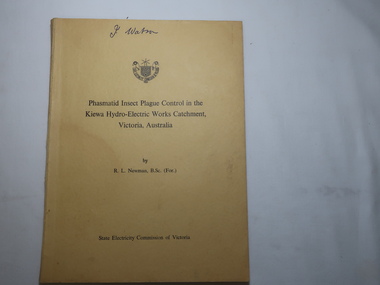
Book - Phasmatid Insect Plague Control in the Kiewa Hydro-Electric Works Catchment, Victoria, Australia. 1964, by R. L. Newman, B.Sc. (For.), Works Forestry Officer - Kiewa Territory
... stability of the Kiewa catchment. Spraying was carried out by the SECV in 1961 and 1963. This was found to be successful indicating that there will be no need for further spraying in the treated areas at least for some years.' Phasmatid Insect Plague R.L.Newman Forestry officer Kiewa Territory In Pen - J. Watson on the cover. Yellow book with 74 pages. Cover has the SECV emblem at the top centre. Print with black and white pictures / illustrations. by R. L. Newman, B.Sc. (For.), Works Forestry Officer - Kiewa Territory Book - Phasmatid Insect Plague Control ...The Phasmatid Didymuria Violescens have been increasing and causing defoliation in south eastern Australia.The author R.L.Newman is the 'Works Forestry Officer - Kiewa Territory reported for the SECV'Fears have been held for the survival of stands of certain eucalypt species the destruction of which might have affected the stability of the Kiewa catchment. Spraying was carried out by the SECV in 1961 and 1963. This was found to be successful indicating that there will be no need for further spraying in the treated areas at least for some years.'Yellow book with 74 pages. Cover has the SECV emblem at the top centre. Print with black and white pictures / illustrations.In Pen - J. Watson on the cover.phasmatid insect plague, r.l.newman, forestry officer kiewa territory -
 Kiewa Valley Historical Society
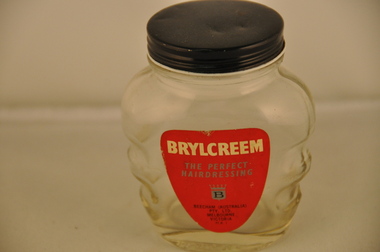
Jar Brylcream- Personal Item, Circa mid 1900s
... control. The glass thickness is far greater than needed and also added the extra stability to the standing jar. ...control. The glass thickness is far greater than needed and also added the extra stability to the standing jar. ...This product was introduced in an era where the "silky smooth" look was in vogue. From the 1920s on, American and British film stars set the tone of how clean cut (hero type) masculine look attracts the opposite sex faster and in greater quantities than the "unkempt" or natural maintained look. This look was bold and "polished" and had the intended projection that the hair matched the character of "I look after myself and have a high opinion of physical appearances". As fashion goes this slick and well maintained look has circled many times, in and out of history and in Australia in the 1950s this was a prime example. The liberation of the stereo type of both sexes occurred in the 1960s when the freedom loving "hippie culture" had a marked affect upon the city inhabitants but not so strong among rural males. Sexism was still rife in that time frame.This jar of Brylcreem was a part of the (masculine) rural scene for a longer period than that found in the larger towns and cities. The long held "men are men" and "women are women" distinction between the sexes lingered on more in rural areas because of the perceived physical differences, mainly "strength" and perceived tasks such as "men only" activities (heavy farm/mining/construction). The jar of Brylcreem maintained the respectable male look for those special occasions when males "dressed" up and looked clean physically and well behaved (to show respect to the women folk)This glass jar with a glued on,red background, label detailing the product Brylcreem (a men's) hairdressing ointment is empty of its original product. It has been contoured on each side to allow for a man's fingers to comfortably and firmly grip the jar. This form would allow even "greased up" hands to maintain control. The glass thickness is far greater than needed and also added the extra stability to the standing jar. The shape of the jar is a latent attempt to emulate the physique of a fit young man (small waist, expanded and muscled mid rift and large shoulders). The jar does not distract from viewing its contents (clear glass). It has a black gloss screw (on/off) lid made from mild grade steel. The jar holds approximately 200 grams of a thick molasses textured product. On the front red Label; in large white letters "BRYLCREEM" underneath this is in smaller silver print "THE PERFECT HAIRDRESSING" underneath this is a banner type motif with a crown at the top and a black letter "B"in the centre. Below this and in much smaller print are printed in black script "BEECHAM (AUSTRALIA) PTY. LTD. MELBOURNE VICTORIA M A Imen's deportment, toiletries, men's hair styles, physical appearances -
Moorabbin Air Museum
Document - Wamira A10 Documents and drawings
... NIA E-55 Wamira Folder CF3/03/1 Effect of flap on power off Cy Cn Ct Folder CF3/03/3 Lateral Directional Static stability Folder CF3/03/4 Aileron Asymmetric Gearing Folder CF3/03/5 Estimate of rudder and sideslip Folder ACF/03/1 Required to trim wings level Folder CF3/D3/6 Aileron profile drag characteristics Folder ACF/D3/7 Lateral directional control characteristics Folder ACF/D3/8 Rudder and aileron sideslip gradients Folder CF3/D4/1 lat/dir stability Folder CF3/D4/2 lat/dir optimisation Folder CF3/D4/3 lat/dir aerodynamic characteristics Folder CF3/D4/4 lat/dir characteristics Folder CF3/D4/5 PC7 turbo trainer handling qualities Folder CF3/D4/6 lat/dir aerodynamic characteristics Folder CF3/D4/8 roll performance Folder ACF/D4/21 Aileron dynamic behaviour Folder ACF/D4/20 lat/dir aerodynamic characteristics Folder CF3/D4/10 Roll control force Vol 1 Folder CF3/D4/9 Roll performance Vols 2 and 3 Folder CF3/D4/12 Rudder hinge moment ratio Folder CF3/D4/11 Roll control force Vols 2 and 3 Folder CF3/D4/13 Lat/Dir stability program validation Folder CF3/D4/14 Lat/Dir handling qualities evaluation Vol 1 Folder ACF/D4/15 Lat/Dir Aerodynamic characteristics Folder ACF/D4/16 Roll performance evaluation Vol 2 Folder ACF/D4/17 Lat/Dir Aerodynamic Characteristics Copy 1 Folder ACF/D4/17 Lat/Dir Aerodynamic Characteristics Copy 2 Folder ACF/D4/17 Lat/Dir Aerodynamic Characteristics Copy 3 Folder ACF/D4/22 Failure requirements – aileron, rudder and elevator trim tab runaways Folder ACF/D4/24 Correlation of roll rate derivatives from rotary balance with estimates Folder ACF/D4/28 Brief analysis of the effect of power and gamma on the spiral T2 Folder ACF/D4/27 Directional control characteristics of proposed extended rudder Folder ACF/D4/25 Brief review of aileron stick forces ...NIA E-55 Wamira Folder CF3/03/1 Effect of flap on power off Cy Cn Ct Folder CF3/03/3 Lateral Directional Static stability Folder CF3/03/4 Aileron Asymmetric Gearing Folder CF3/03/5 Estimate of rudder and sideslip Folder ACF/03/1 Required to trim wings level Folder CF3/D3/6 Aileron profile drag characteristics Folder ACF/D3/7 Lateral directional control characteristics Folder ACF/D3/8 Rudder and aileron sideslip gradients Folder CF3/D4/1 lat/dir stability Folder CF3/D4/2 lat/dir optimisation Folder CF3/D4/3 lat/dir aerodynamic characteristics Folder CF3/D4/4 lat/dir characteristics Folder CF3/D4/5 PC7 turbo trainer handling qualities Folder CF3/D4/6 lat/dir aerodynamic characteristics Folder CF3/D4/8 roll performance Folder ACF/D4/21 Aileron dynamic behaviour Folder ACF/D4/20 lat/dir aerodynamic characteristics Folder CF3/D4/10 Roll control force Vol 1 Folder CF3/D4/9 Roll performance Vols 2 and 3 Folder CF3/D4/12 Rudder hinge moment ratio Folder CF3/D4/11 Roll control force Vols 2 and 3 Folder CF3/D4/13 Lat/Dir stability program validation Folder CF3/D4/14 Lat/Dir handling qualities evaluation Vol 1 Folder ACF/D4/15 Lat/Dir Aerodynamic characteristics Folder ACF/D4/16 Roll performance evaluation Vol 2 Folder ACF/D4/17 Lat/Dir Aerodynamic Characteristics Copy 1 Folder ACF/D4/17 Lat/Dir Aerodynamic Characteristics Copy 2 Folder ACF/D4/17 Lat/Dir Aerodynamic Characteristics Copy 3 Folder ACF/D4/22 Failure requirements – aileron, rudder and elevator trim tab runaways Folder ACF/D4/24 Correlation of roll rate derivatives from rotary balance with estimates Folder ACF/D4/28 Brief analysis of the effect of power and gamma on the spiral T2 Folder ACF/D4/27 Directional control characteristics of proposed extended rudder Folder ACF/D4/25 Brief review of aileron stick forces Document Wamira A10 Documents and drawings ... -
 National Wool Museum
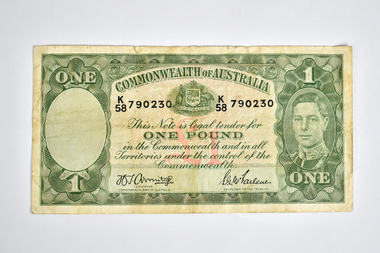
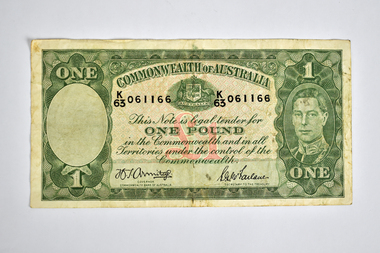
Currency - One Pound Note, John Ash, 1938 - 1948
... stability in the turbulence of the Great Depression and imparted a sense of solidity to paper currency. - museum.rba.gov.au Currency Money Pound Note Pastoral scene Industry Commonwealth of Australia Paul Montford King George VI Frank Manly John Ash Obverse: ONE / 1 / 1 / ONE / COMMONWEALTH OF AUSTRALIA / K / 58 / 790230 / K / 58 / 790230 / This Note is legal tender for / ONE POUND / in the Commonwealth and in all / Territories under the control of the / Commonwealth. / [signature] / GOVERNOR / COMMONWEALTH BANK ON AUSTRALIA / [signature] / SECRETARY TO THE TREASURY Reverse: 1 /1 / 1 / 1 / PASTORAL Commonwealth of Australia paper one pound note in green and white tones depicting graphics and text. ...John Ash succeeded Thomas Harrison as the Australian Note Printer in 1927 and oversaw the printing of a new series of banknotes, known as the Ash Series. First issued between 1933 and 1934, the new banknotes sought to improve the currency's resistance to counterfeiting. A special watermark was created to increase the security of the new series. Shaped as a medallion, the watermark showed the profile of Edward, the Prince of Wales. A new portrait of the King was also introduced, depicting him frontally rather than in profile as he had appeared in the prior banknotes of the Harrison Series (1923-1925). The back of each denomination contained an individual vignette that reflected a sector of the country's economy. The wool and agricultural industries were represented, as they had been in the first series of the nation's banknotes (1913-1914), and they were joined by manufacturing and commerce. The prominent British sculptor, Paul Montford, contributed to the design of the new series. Recognised for his sculptural works on the exterior of Melbourne's Shrine of Remembrance, Montford was commissioned to produce relief sculptures that formed the basis of the banknotes' vignettes. His sculptures were translated into wash drawings by Frank Manley, the artist and engraver for the Commonwealth Bank's Note Printing Branch. Manley accentuated the sculpture's three-dimensional qualities with deep shadows and touches of illusionism. A sheep in Montford's pastoral scene, for example, stands forward from the frame as if entering the viewer's space to escape branding and Manley preserves this visual conceit in his drawing. Whereas the printing of the previous series of Australian banknotes had been criticised for its poor definition, the sculptural basis of the Ash Series clarified the banknotes' imagery. During a period of record unemployment, the scenes emphasised the strength of the human figure in gestures of labour, evoking classical, heroic qualities in their poses. The sculptural forms suggested stability in the turbulence of the Great Depression and imparted a sense of solidity to paper currency. - museum.rba.gov.auCommonwealth of Australia paper one pound note in green and white tones depicting graphics and text. The obverse has a framed design with a blank portal to the left and King George VI in the right portal. The centre shows the Australian Coat of Arms, serial number, and detail over one pound symbol on a mosaic background, with signatories below. The reverse features a framed pastoral scene with farmers tending sheep, with a blank portal to the right.Obverse: ONE / 1 / 1 / ONE / COMMONWEALTH OF AUSTRALIA / K / 58 / 790230 / K / 58 / 790230 / This Note is legal tender for / ONE POUND / in the Commonwealth and in all / Territories under the control of the / Commonwealth. / [signature] / GOVERNOR / COMMONWEALTH BANK ON AUSTRALIA / [signature] / SECRETARY TO THE TREASURY Reverse: 1 /1 / 1 / 1 / PASTORALcurrency, money, pound note, pastoral scene, industry, commonwealth of australia, paul montford, king george vi, frank manly, john ash -
 National Wool Museum
Currency - One Pound Note, John Ash, 1938 - 1948
... stability in the turbulence of the Great Depression and imparted a sense of solidity to paper currency. - museum.rba.gov.au Currency Money Pound Note Pastoral scene Industry Commonwealth of Australia Paul Montford King George VI Frank Manly John Ash Obverse: ONE / 1 / 1 / ONE / COMMONWEALTH OF AUSTRALIA / K / 58 / 790230 / K / 58 / 790230 / This Note is legal tender for / ONE POUND / in the Commonwealth and in all / Territories under the control of the / Commonwealth. / [signature] / GOVERNOR / COMMONWEALTH BANK ON AUSTRALIA / [signature] / SECRETARY TO THE TREASURY Reverse: 1 /1 / 1 / 1 / PASTORAL Commonwealth of Australia paper one pound note in green and white tones depicting graphics and text. ...John Ash succeeded Thomas Harrison as the Australian Note Printer in 1927 and oversaw the printing of a new series of banknotes, known as the Ash Series. First issued between 1933 and 1934, the new banknotes sought to improve the currency's resistance to counterfeiting. A special watermark was created to increase the security of the new series. Shaped as a medallion, the watermark showed the profile of Edward, the Prince of Wales. A new portrait of the King was also introduced, depicting him frontally rather than in profile as he had appeared in the prior banknotes of the Harrison Series (1923-1925). The back of each denomination contained an individual vignette that reflected a sector of the country's economy. The wool and agricultural industries were represented, as they had been in the first series of the nation's banknotes (1913-1914), and they were joined by manufacturing and commerce. The prominent British sculptor, Paul Montford, contributed to the design of the new series. Recognised for his sculptural works on the exterior of Melbourne's Shrine of Remembrance, Montford was commissioned to produce relief sculptures that formed the basis of the banknotes' vignettes. His sculptures were translated into wash drawings by Frank Manley, the artist and engraver for the Commonwealth Bank's Note Printing Branch. Manley accentuated the sculpture's three-dimensional qualities with deep shadows and touches of illusionism. A sheep in Montford's pastoral scene, for example, stands forward from the frame as if entering the viewer's space to escape branding and Manley preserves this visual conceit in his drawing. Whereas the printing of the previous series of Australian banknotes had been criticised for its poor definition, the sculptural basis of the Ash Series clarified the banknotes' imagery. During a period of record unemployment, the scenes emphasised the strength of the human figure in gestures of labour, evoking classical, heroic qualities in their poses. The sculptural forms suggested stability in the turbulence of the Great Depression and imparted a sense of solidity to paper currency. - museum.rba.gov.auCommonwealth of Australia paper one pound note in green and white tones depicting graphics and text. The obverse has a framed design with a blank portal to the left and King George VI in the right portal. The centre shows the Australian Coat of Arms, serial number, and detail over one pound symbol on a mosaic background, with signatories below. The reverse features a framed pastoral scene with farmers tending sheep, with a blank portal to the right.Obverse: ONE / 1 / 1 / ONE / COMMONWEALTH OF AUSTRALIA / K / 58 / 790230 / K / 58 / 790230 / This Note is legal tender for / ONE POUND / in the Commonwealth and in all / Territories under the control of the / Commonwealth. / [signature] / GOVERNOR / COMMONWEALTH BANK ON AUSTRALIA / [signature] / SECRETARY TO THE TREASURY Reverse: 1 /1 / 1 / 1 / PASTORALcurrency, money, pound note, pastoral scene, industry, commonwealth of australia, paul montford, king george vi, frank manly, john ash -
 Returned Nurses RSL Sub-branch
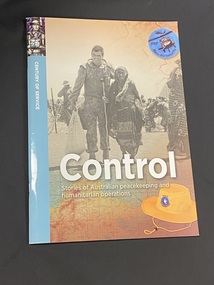
Book - Illustrated paperback book, Department of Veterans' Affairs, Canberra, Control : stories of Australian peacemaking and humanitarian operations, 2019
... In complex and dangerous situations they have provided stability along with commitment and compassion, building hope for the future. The following stories are about people who have shown gret self-control, fostering security and safety in exceptionally fragile environments. ...More than 30,000 Australians have served on peacekeeping operations since 1947, and many have delivered humanitarian aid at home and abroad. In complex and dangerous situations they have provided stability along with commitment and compassion, building hope for the future. The following stories are about people who have shown gret self-control, fostering security and safety in exceptionally fragile environments. They have served all over the world, witnessing the struggles and triumphs of the human spirit in the face of conflict and disaster. Some have given their lives in the service of others. - from TroveStaple bound paperback book. There is a blue strip along the left side with a stained glass image of a soldier at the top and 'century of service' printed sideways in white text below. The cover shows a black and white photo of a soldier assisting a civilian down a road and more civilians in the background, covered by a feint overlay of a map. The title is printed in large white print near the bottom of the page and an image of yellow 'peace monitoring group' hat in the bottom right corner.non-fictionMore than 30,000 Australians have served on peacekeeping operations since 1947, and many have delivered humanitarian aid at home and abroad. In complex and dangerous situations they have provided stability along with commitment and compassion, building hope for the future. The following stories are about people who have shown gret self-control, fostering security and safety in exceptionally fragile environments. They have served all over the world, witnessing the struggles and triumphs of the human spirit in the face of conflict and disaster. Some have given their lives in the service of others. - from Trove war and peacekeeping, peacekeeping forces, humanitarian assistance
