
Showing 176 items matching "staff 1947"
-
 University of Melbourne, Burnley Campus Archives
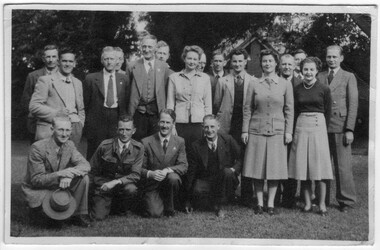
Photograph - Black and white print, Staff 1947 or 1948, 1947-1948
... Staff 1947 or 1948......staff group 1947-1948...burnley college staff group 1947-1948 pavilion Black and white photograph. ...Black and white photograph. Staff standing and squatting on the lawn. Pavilion in the background. List of names on reverse.burnley college, staff group 1947-1948, pavilion -
 University of Melbourne, Burnley Campus Archives
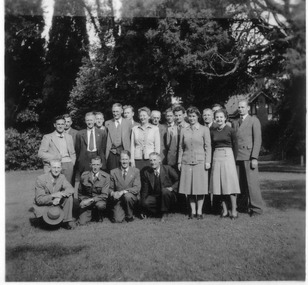
Photograph - Black and white print, E.M. Gibson, Staff Group 1947, 1947
... Staff Group 1947......staff 1947...staff e. m. gibson collection staff 1947 Black and white photograph of Staff group.See B10.0030(40). ...Black and white photograph of Staff group.See B10.0030(40). staff, e. m. gibson collection, staff 1947 -
 University of Melbourne, Burnley Campus Archives
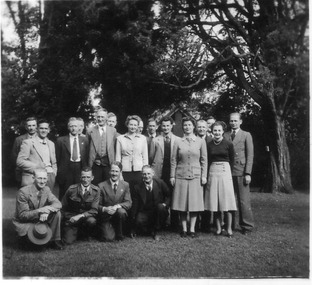
Photograph - Black and white print, E.M. Gibson, Staff Group 1947, 1947
... Staff Group 1947......staff group 1947...staff e. m. gibson collection staff group 1947 49 Staff group.Same as B10.0030(40) but in a slightly different position. ...Staff group.Same as B10.0030(40) but in a slightly different position.49staff, e. m. gibson collection, staff group 1947 -
 University of Melbourne, Burnley Campus Archives
Photograph - Black and white print, E.M. Gibson, Staff Group 1947, 1947
... Staff Group 1947......staff group 1947...staff e. m. gibson collection staff group 1947 49 JK Staff group.Same as B10.0030 36. ...Staff group.Same as B10.0030 36. 49 JKstaff, e. m. gibson collection, staff group 1947 -
Moorabbin Air Museum
Manual (Item) - Ansett Staff list Eng Shop 1947<>1978
... Ansett Staff list Eng Shop 1947<>1978...Ansett Staff list Eng Shop 1947<>1978...Ansett Staff list Eng Shop 1947<>1978 Manual Ansett Staff list Eng Shop 1947<>1978 ... -
 University of Melbourne, Burnley Campus Archives
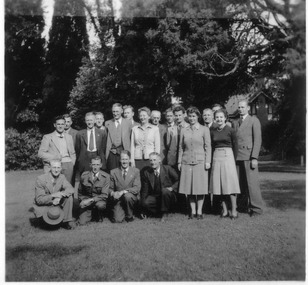
Photograph - Black and white print, E.M. Gibson, Staff group 1947, 1947
... Staff group 1947...Black and white photograph of Staff group in 1947. Standing and crouching on the lawn in front of the Principa's Residence....Staff group 1947 Photograph Black and white print E.M. ...Black and white photograph of Staff group in 1947. Standing and crouching on the lawn in front of the Principa's Residence.Names listed on reverse, " L-R -Bill Nicholls, Cliff Newell, Frank Ellery, ?, Ted White, Jim Newell, Grace Fraser, Jack Plumridge, Jack Nowell, Bob Grant, Betty Williams, Bert Manners, Eric Littlejohn (absent), James Lesley, Jack Tarrant, Arnold Teese, Wm Ross, T. Kneen, Ray Harding."staff, bill nicholls, cliff newell, frank ellery, ted white, jim newell, grace fraser, jack plumridge, jack nowell, bob grant, betty williams, bert manners, eric littlejohn, james lesley, jack tarrant, arnold teese, wm ross, t. kneen, ray harding, e. m. gibson collection, staff groupm1947 -
 Federation University Historical Collection
Photograph - Photograph - Black and White, Ballarat Teachers' College Staff, 1947, 1947
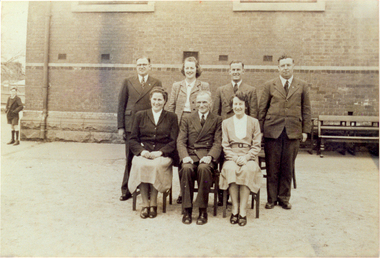
... Ballarat Teachers' College Staff, 1947..., Mr Lord, Monica Miller Ballarat Teachers' College Staff, 1947 Photograph Photograph - Black and White ...This copy was made by the class of 1947, probably for use at a Ballarat Teachers' College ReunionBlack and white photograph showing the staff of the Ballarat Teachers' College. The photograph is taken in the grounds of Dana Street Primary School. Standing left to right: ?, ?, ?, Alan Sonsee Sitting left to right: ?, Mr Lord, Monica Millerballarat teachers' college, dana street primary school, lord, sonsee, miller, monical miller, dana street state school -
Federation University Historical Collection
Image, Ballarat Teachers' College students and staff, 1947
... Ballarat Teachers' College students and staff, 1947...Surnames are: Howlett, Rice, McLean, Williams, Nield, Cooper, Terrill, Gleeson, Pascoe, Harley, Carless, Giddings, Connelly, Magill, Blake, Punshon, Aisbett, Collins, O'Shannessy, Leslie, Dreher, Pamphilon, Lelean, Pattenden, Tyers, Fraser, Henderson, Mallett, martin, Boyd, Ellifson, Collins, Hill, Henning, roddis, Marshman, Doney, Watts, McKinnon, Esmore, Love, Luxford, Elliott, Bunney, Borley, Mathison, Domaschenz, Hannan, Perry, Merlin, Batson, Witney, Tozer, Kerr, Tobin, Morrish, Clode, Purdue, Kennedy, Palmer, Faulds, Ritchie, Lewin, Poland, Welsh, Lynch, Alexander, Williams, Gorris, Sonsee, Miss Kentish, Bryan, Miss Miller, Lord, Miss Hughes, McEwin, Miss Hayes, Vallance, Robinson, Surman, Gunning, Dally, Freeman, Crossett Ballarat Teachers' College students and staff, 1947 Image ...This image was used by the Ballarat Teachers' College Class of 1947 during their reunions. black and white laminated phiotocopied photograph of men and women in front of brick building, with names typed underneath. Surnames are: Howlett, Rice, McLean, Williams, Nield, Cooper, Terrill, Gleeson, Pascoe, Harley, Carless, Giddings, Connelly, Magill, Blake, Punshon, Aisbett, Collins, O'Shannessy, Leslie, Dreher, Pamphilon, Lelean, Pattenden, Tyers, Fraser, Henderson, Mallett, martin, Boyd, Ellifson, Collins, Hill, Henning, roddis, Marshman, Doney, Watts, McKinnon, Esmore, Love, Luxford, Elliott, Bunney, Borley, Mathison, Domaschenz, Hannan, Perry, Merlin, Batson, Witney, Tozer, Kerr, Tobin, Morrish, Clode, Purdue, Kennedy, Palmer, Faulds, Ritchie, Lewin, Poland, Welsh, Lynch, Alexander, Williams, Gorris, Sonsee, Miss Kentish, Bryan, Miss Miller, Lord, Miss Hughes, McEwin, Miss Hayes, Vallance, Robinson, Surman, Gunning, Dally, Freeman, Crossettballarat teachers' college, lindsay harley, nancy cooper, david cooper, dana street primary school, alan sonsee, dana street state school -
 Federation University Historical Collection
Photograph - Photograph - Black and White, Ballarat Teachers' College Staff Members, 1947, 1947
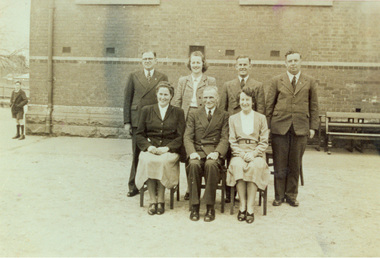
... Ballarat Teachers' College Staff Members, 1947...In 1947 classes at the Ballarat Teachers' College were held in the bluestone building at the Dana Street Primary School. ballarat teachers' college ballarat monica miller sonsee bryan kentish mcewin hughes lord dana street dana street primary school Frank Lord Alan Sonsee University Women Seven staffmembers of the Ballarat Teachers' College pose in front of a building in the grounds of the Dana Street Primary School. Standing Left to right: Carl Bryan, Trudy Kentish, Mephan McEwin, Alan Sonsee. Sitting left to right: Beth Hughes, W.F. (Frank) Lord, Monica Miller Ballarat Teachers' College Staff ...In 1947 classes at the Ballarat Teachers' College were held in the bluestone building at the Dana Street Primary School.Seven staffmembers of the Ballarat Teachers' College pose in front of a building in the grounds of the Dana Street Primary School. Standing Left to right: Carl Bryan, Trudy Kentish, Mephan McEwin, Alan Sonsee. Sitting left to right: Beth Hughes, W.F. (Frank) Lord, Monica Millerballarat teachers' college, ballarat, monica miller, sonsee, bryan, kentish, mcewin, hughes, lord, dana street, dana street primary school, frank lord, alan sonsee, university women -
 University of Melbourne, Burnley Campus Archives
Photograph - Black and white print, E.M. Gibson, Staff group 1947, 1947
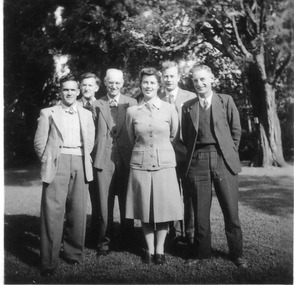
... Staff group 1947...staff e. m. gibson collection 49 Staff group.See B10.0030(39). Staff group 1947 Photograph Black and white print E.M. ...Staff group.See B10.0030(39). 49staff, e. m. gibson collection -
 University of Melbourne, Burnley Campus Archives
Photograph - Black and white photograph, E.M. Gibson, Stasff Group 1947, 1947
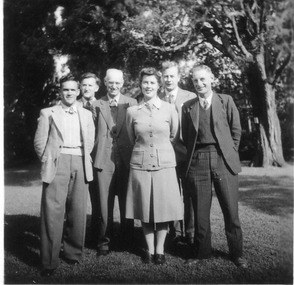
... ...staff group 1947...Black and white photograph of a Staff Group in 1947 standing on the lawn with the Proincipal's Residence behind them....Black and white photograph of a Staff Group in 1947 standing on the lawn with the Proincipal's Residence behind them. ...L-R - Bill Nicholls Eric Littlejohn Jack Plumridge Betty Williams Jim Newell Arnold Teese.staff, staff group 1947, bill nicholls, eric littlejohn, jack plumridge, betty williams, jim newell, arnold teese -
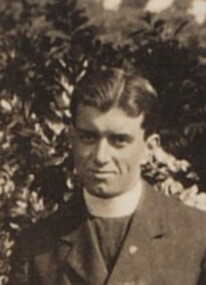 St Patrick's Old Collegians Association (SPOCA)
Photograph - Teachers, Jesuits
... Thomas Van Prooyen SJ - Staff 1947-52...Thomas Van Prooyen SJ - Staff 1947-52 Photograph Teachers, Jesuits ... -
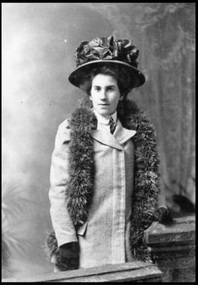 University of Melbourne, Burnley Campus Archives
Black and white photograph, Simon Reeves, Emily Gibson, C. 1904-1909
... Student graduated 1914, Staff 1918-23 and 1947-53. ...Student graduated 1914, Staff 1918-23 and 1947-53. Emily Gibson Black and white photograph Simon Reeves ...Simon Reeves, photographer, obtained the photograph from Emily Gibson's daughter, Helen in the 1990semily gibson, emily grassick, simon reeves, staff, student -
Federation University Historical Collection
Letter - Correspondence, Foreign Service of the United States of America Correspondence, 1947, 1947-1955
... Boyce, and the Ballarat School of Mines and Industries heads of staff between 1947 and 1955. Attached are other documents regarding the 'G.I. ...Boyce, and the Ballarat School of Mines and Industries heads of staff between 1947 and 1955. Attached are other documents regarding the 'G.I. ...The letters are regarding the Education of American Ex-servicemen at the Ballarat School of Mines and Industries as part of the Servicemen's Readjustment Act of 1944 - Public Law 346, the "G.I. Bill of Rights". The G.I. Bill was created to help rehabilitate American servicemen and re-integrate them into civilian society, focusing on and encouraging the education and training of ex-servicemen. The Act offered the payment of tuition, books, supplies and subsistence. Five letters of correspondence between the Foreign Service of the United States of America Consul General Richard F. Boyce, and the Ballarat School of Mines and Industries heads of staff between 1947 and 1955. Attached are other documents regarding the 'G.I. Bill of Rights' itself, veterans information records, amendments made regarding the payment of book, supplies and equipment charges, and receipts and records specific to student Allan C. Pitzen. Letterhead of the Foreign Service of the United States of America. Signature of Richard F. Boyce at the end of each letter. Intials of R.M.R, and a date in the top right corner of each letter.correspondance, usa, united states of america, foreign service, melbourne, ballarat school of mines and industries, ballarat, veterans administration educational and training provisions, servicemen's adjustment act of 1944, world war two, f.e. ferguson -
University of Melbourne, Burnley Campus Archives
Booklet (item), F. R. Drake et al, Lawns and Playing Fields and Pests and Diseases of Lawns, 1974
... Johnston, Entomologist Biology Branch, Staff 1946-1947, and C. R. Millikan, Senior Plant Pathologist and Deputy Biologist....Johnston, Entomologist Biology Branch, Staff 1946-1947, and C. R. Millikan, Senior Plant Pathologist and Deputy Biologist. ...lawns, playing fields, f.r. drake, c.j.r. johnston, c.r. millikan, pests, diseases, turf -
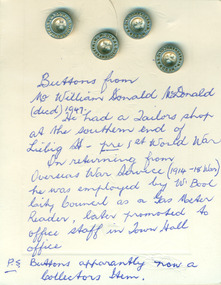 Warrnambool and District Historical Society Inc.
Souvenir - Costume Accessories:Button Collection, W McDonald Tailor Warrnambool, Circa 1900
... He was later promoted to office staff. He died in 1947....He was later promoted to office staff. He died in 1947. A common item which is linked to a Warrnambool business and person. warrnambool william donald mcdonald buttons tailors’ buttons w. mcdonald tailor mcdonald tailor W McDonald Warrnambool. ...Buttons from Mr William Donald McDonald. He trained for 5 years with Armstrong Tailors He had a tailor’s shop at the southern end of Liebig St before World War 1. On returning from overseas war service, he was employed by Warrnambool City Council as a gas meter reader. He was later promoted to office staff. He died in 1947.A common item which is linked to a Warrnambool business and person. Four small silver metal buttons with recessed shank. Embossed on front surface with lettering. Stitched to light card.W McDonald Warrnambool.warrnambool, william donald mcdonald, buttons, tailors’ buttons, w. mcdonald tailor, mcdonald tailor -
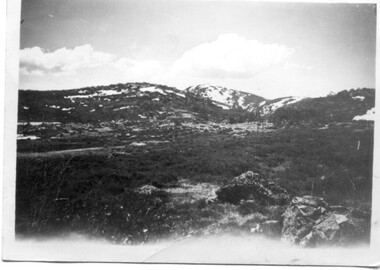 Kiewa Valley Historical Society
7 small black and white photographs of Pretty Valley, c1948
... 1947 it was proposed to construct a dam on the Pretty Valley branch of the East Kiewa River. This was part of the initial planning in 1937. The Pretty Valley Reservoir was to be part of a pumped-storage scheme with a pumping station located immediately below the main structure. Preparatory work was commenced in 1946 with erection of staff...1947 it was proposed to construct a dam on the Pretty Valley branch of the East Kiewa River. This was part of the initial planning in 1937. The Pretty Valley Reservoir was to be part of a pumped-storage scheme with a pumping station located immediately below the main structure. Preparatory work was commenced in 1946 with erection of staff ...In 1947 it was proposed to construct a dam on the Pretty Valley branch of the East Kiewa River. This was part of the initial planning in 1937. The Pretty Valley Reservoir was to be part of a pumped-storage scheme with a pumping station located immediately below the main structure. Preparatory work was commenced in 1946 with erection of staff accommodation. Between 1947 and 1950 the main camp was erected, access roads, constructed and banks and benches at the dam site undertaken. Following the financial crisis in 1951, a review of the scheme was carried out and work ceased in June 1951. Construction of the dam was deleted from the programme of works and all buildings removed.A pictorial history of part of the initial planning in 1937 for a dam to be constructed at Pretty Valley as part of the Kiewa Hydro Electric Scheme.7 small black and white photographs of Pretty ValleyAll photos have a circular stamp on the back with 'Print by Willson White Albury' enclosed. Photo 1 - on the back, handwritten in ink 'New 22Kv pump line - Pretty Valley Nov. 1948'. In pencil '18'. Photo 2 - On the back, handwritten in ink 'Pretty Valley - Staff mess on right Nov. 1948'. In pencil '18'. Photo 3 - On the back, handwritten in ink 'Pretty Valley Basin - looking S.E. Nov. 1948'. In pencil '5'. Photo 4 - On the back, handwritten in ink 'New pump 22Kv line, Pretty Valley - looking towards Mt. Mackie. Nov. 1948'. In pencil '5'. Photo 5 - On the back, handwritten in ink 'Pretty Valley. Mt. Cope just out of picture extreme right. Nov. 1948'. In pencil '78'. Photo 6 - on the back, handwritten in ink 'View from Pretty Valley Ruined Castle in Background Nov. 1948'. In pencil '78'. Photo 7 - on the back, handwritten in ink 'Pretty Valley Pump line (Nov. 1948)'. In pencil'78'.construct, dam, pretty valley -
 Bendigo Military Museum
document - ARMY DOCUMENTS WW2, WWII
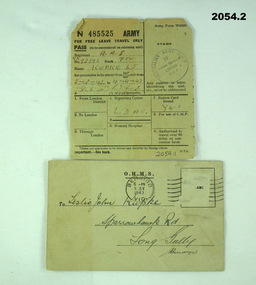
... KUPKE whilst attached to Australian Army Staff in London in 1947. 2054.2) Issued to L. J. KUPKE VX93892 requesting that he report for a medical examination in Bendigo on corner of Pall Mall and Bull St. ...KUPKE whilst attached to Australian Army Staff in London in 1947. 2054.2) Issued to L. J. KUPKE VX93892 requesting that he report for a medical examination in Bendigo on corner of Pall Mall and Bull St. ...2054.1) Travel pass issued to L. J. KUPKE whilst attached to Australian Army Staff in London in 1947. 2054.2) Issued to L. J. KUPKE VX93892 requesting that he report for a medical examination in Bendigo on corner of Pall Mall and Bull St. Leslie John KUPKE (born Albury, enlisted Royal Park) initially signed Mobilization forms on 12.7.1943 as No V513056 age 18 years. He then transferred to the AIF on 3.12.1943 as No VX93892. He embarked for Bougainville with the the 15th Aust Infantry Battalion on 23.11.1944, hospital with Hookworm from 8.6.1945 to 30.6.1945, embarked for Australia returning on 1.6.1946, hospital with Malaria on 17.8.1946. On 21.1.1947 he embarked for England as a POW voyage guard and returned on 14.6.1947. Discharged from the Army 1.7.1947..1) Free leave travel pass issued to L. J. KUPKE VX93892. Army form W4098. .2) Notice to report for Medical Examination..1) Stamped by Australian Army Staff .2) Addressed to Leslie John KUPKE, Sparrowhawk Rd. Long Gully.documents-army records, travel -
 Warrnambool and District Historical Society Inc.
Textile, Fletcher Jones, late 20th century
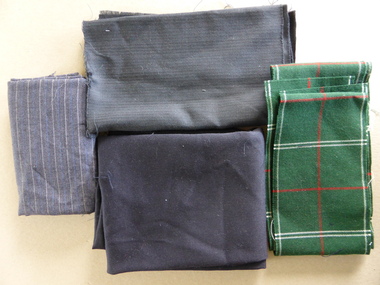
... He transformed his business into a co-operative, with the name, ‘Fletcher Jones and Staff’ registered in 1947. The business diversified into other ranges of clothing for men and women but failed to compete with cheaper overseas clothing imports and the factory and shops were closed in the early 21st century. ...He transformed his business into a co-operative, with the name, ‘Fletcher Jones and Staff’ registered in 1947. The business diversified into other ranges of clothing for men and women but failed to compete with cheaper overseas clothing imports and the factory and shops were closed in the early 21st century. ...These are samples of the material used at the Fletcher Jones Factory in Warrnambool to make garments for men (suits, trousers, shorts) and women (suits, slacks, skirts, shorts). Fletcher Jones Clothing Factory was a key industry in Warrnambool from 1948 to its closure in 2005. The business was founded by David Fletcher Jones (1897-1977), a clothing manufacturer and retailer who worked as a hawker in the Western District following service with the A.I.F. in World War One. In 1924 Fletcher Jones opened three shops in Liebig Street selling men’s wear, hosiery and linen and operating a small tailoring business. He moved his shop to another location in Liebig Street and began to concentrate on men’s trousers production. In 1946 he opened a shop in Collins Street in Melbourne and eventually had stores and factories all over Australia. In Warrnambool he opened his factory at Pleasant Hill in Flaxman Street in 1948 and became a major Warrnambool employer, with over 1000 employees at one time. He transformed his business into a co-operative, with the name, ‘Fletcher Jones and Staff’ registered in 1947. The business diversified into other ranges of clothing for men and women but failed to compete with cheaper overseas clothing imports and the factory and shops were closed in the early 21st century. These pieces of material are of some interest as examples of the materials used in one of the most important businesses in Warrnambool and one that was of national significance for many decades. The Fletcher Jones label was well-known throughout Australia and Fletcher Jones himself was a prominent person in Warrnambool’s history, not only for his business interests but also for his philanthropy, his advocacy of business co-operatives and his support for many Warrnambool institutions. The Fletcher Jones Factory Gardens are still today a feature of Warrnambool and a tourist attraction. These two packets contain samples of materials used at the Fletcher Jones factory in Warrnambool. One packet (VC000690.1) contains four pieces of woollen material, one grey striped, one grey weave, one navy and one green, red and white tartan. The other packet (VC000690.2) contains two pieces of woollen grey and navy material and five small woollen samples of dark grey, light grey, navy, beige and blue and grey check material. warrnambool, industry -
 Warrnambool and District Historical Society Inc.
Work on paper - Booklets Fletcher Jones, 001143.1 Project Book 001143.2 Booklet:Plusites 001143.3 Flyer, Mid 20th century
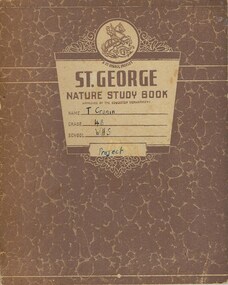
... He transformed his business into a co-operative, with the name, ‘Fletcher Jones and Staff’ registered in 1947. The business diversified into other ranges of clothing for men and women but failed to compete with cheaper overseas clothing imports and the factory and shops were closed in the early 21st century. 001143.1 Project Book. ...He transformed his business into a co-operative, with the name, ‘Fletcher Jones and Staff’ registered in 1947. The business diversified into other ranges of clothing for men and women but failed to compete with cheaper overseas clothing imports and the factory and shops were closed in the early 21st century. 001143.1 Project Book. ...Fletcher Jones Clothing Factory was a key industry in Warrnambool from 1948 to its closure in 2005. The business was founded by David Fletcher Jones (1897-1977), a clothing manufacturer and retailer who worked as a hawker in the Western District following service with the A.I.F. in World War One. In 1924 Fletcher Jones opened three shops in Liebig Street selling men’s wear, hosiery and linen and operating a small tailoring business. He moved his shop to another location in Liebig Street and began to concentrate on men’s trousers production. In 1946 he opened a shop in Collins Street in Melbourne and eventually had stores and factories all over Australia. In Warrnambool he opened his factory at Pleasant Hill in Flaxman Street in 1948 and became a major Warrnambool employer, with over 1000 employees at one time. He transformed his business into a co-operative, with the name, ‘Fletcher Jones and Staff’ registered in 1947. The business diversified into other ranges of clothing for men and women but failed to compete with cheaper overseas clothing imports and the factory and shops were closed in the early 21st century. 001143.1 Project Book. This project book tells the story of the establishment and development of the Fletcher Jones company across the various stores which were established in Melbourne, Adelaide, Sydney, Geelong and Hobart. It explores the philosophy behind the business and milestones achieved and the factory gardens. The book itself provides an example of schoolwork completed in the mid 20th century. 001143.2 Booklet: Plusites: This is a staff booklet which has items of interest relating to staff such as births deaths and marriages. It tells of renovations and happenings in regard to the various shops around the country as well as trading figures. It tells of the royal visit of 1954 and other social events and items of interest around the various shops. 001143.3 Flyer :The text on this flyer also tells the story of the development of the Fletcher Jones brand to the point where there in the year2000 retail expansion was still happening but the Warrnambool workforce had shrunk from over 1000 at the peak to approximately 200. The company had commenced importing a range of clothing by this time These three items present different views of a company which was an important part of industry in Warrnambool for over 60 years in the latter part of the 20th century. The founder was one of Warrnambool’s most well respected people and many district people had connections to the firm. 001143.1 Project Book. Brown mottled card cover with cream insert for personal details. Back cover plain cream. It contains a student’s project work on the Fletcher Jones company. Some is handwritten and also contains a number of black and white photographs throughout the book. A coloured map of Australia is in the middle pages. 001143.2 Booklet: Plusites. White light card cover with dark blue text and diagram. Bottom left of page has a map of the coastline of Victoria. 20 pages. 001143.3 Flyer. Advertising Flyer re factory direct sales at Warrnambool. Black text with maroon border and Fletcher jones logo at the bottom and 4 photographs at the top. 001143.1 Project Book. T Cronin 4B WHS 001143.2 Booklet: Plusites. Vol 1 No 1 June 1954. 001143.3 Flyer fletcher jones, warrnambool history, fletcher jones and staff pty ltd -
 Federation University Historical Collection
Book, Jack A. Hoadley, Antarctica to Footscray: Arch Hoadley, 2010, 2010
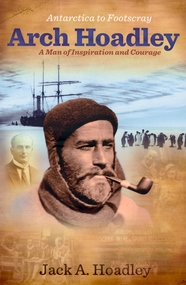
... staff.' Charles Hoadley left to take up a Principalship at Footscray Technical School in 1916, and remained in that position until 1947. ...staff.' Charles Hoadley left to take up a Principalship at Footscray Technical School in 1916, and remained in that position until 1947. ...Predominantly brown covered paperback of 460 pages featuring an image of Arch Hoadley in Antarctica on the cover.non-fictionballarat school of mines, antarctica, footscray technical school, baden powell, scouts, douglas mawson, arch hoadley -
 Federation University Historical Collection
Photograph - Black and White, Ballarat Teachers' College, 1947, 1947
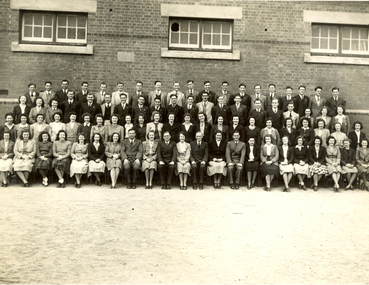
... staff and students have appreciated greatly the appointments and cacilities of the new buildign. In 1968 the three-year Diploma Course began, co-existent with the other courses which will continue during the transitional period. Successful students in the course receive the Diploma of Teaching (Primary). ballarat teachers' college education dana street primary school 1947 ...Ballarat Teachers' College was opened on may 4th, 1926, at S.S. 33, Dana Street, with an enrollment of sixty-one students, its original staff consisted of the Principal, Mr W. H. Ellwood, M.A., m.Ed. (Chairman of the Teachers' tribunal from its inception in 1946 until 1954), Miss A. Bouchier, B.A., and Mr A.B. Jones, B.A. (Lecturers). In 1927 Miss P.A. Hamano joined the staff. Teaching practice and special rural school work were carried on in schools in or near Ballarat - drawing, crafts and singing were taught by local teachers. In 1927 the college moved to the old Ballarat East Town Hall (remodelled for their use) in Barkly Street. During 1927 the numbers in the College were augmented by twenty-six Manual arts students who had formerly received their training at Ballarat High School. Manual Arts students continued till 1930, when, on grounds of economy, their training was concentrated at Melbourne Teachers' College.\During the four succeeding years approximately sixty students annually entered the primary course. Inclusive of Manual Arts students, and private fee-paying students, exactly 400 trainees passed through the college in its brief span of life (1926-1931) Fourteen years were to pass before they were again opened to students on February 2nd, 1946. The college was re-commenced at S.S. Dana Street under the guidance of Mr W.F. Lord, M.C., M.M., B.A., Dip.Ed., (Acting Principal 1946-1950), and a staff consisting of Miss E.B. Hughes, B.A., Dip. Ed., Mr C.B. Bryan, B.A., V.Com., Dip.Ed., Miss M.H. Miller, L.Mus.A., and Miss G. Kentish, Dip.Phys.Ed. The opening ceremony was performed by the Minister for education at that time, the Hon. F. Field, M.L.A., accompanied by the Hon. T.T. Hollway, M.L.A., and the then Director of Education, Mr J.A. Seitz. It was originally intended to cater for women students only (for whom 130 Victoria Street was purchased as a hostel) but, at the last moment, men were also accepted. A co-educational college was thus set up instead, and has continued as such. The original Staff has been considerable augmented, and the number of Students has been more than trebled. 1951 saw the introduction of the two-year course, successful students being presented with the Trained Primary Teachers' Certificate at the final College assembly each year. In December, 1855, College held its first Graduation Ceremony, with its own Graduation hymn, the words of which were written by Miss C.M. Canty of the staff. Mr Ellwood, former Principal,delivered the occasional address and presented the Ellwood Prize to the outstading student of the year (Mr C.P. Handreck). Students who had successfully completed the course received their certificates from Mr E.B. Pederick, Chief Inspector of Primary Schools. College accomodation having been strained for several years, it was pleasant news when tenders were called in July, 1956, for the building of the first section of the new Ballarat Teachers' College in Gillies Street, near the Botanical Gardens. At the beginning of 1958 the new College was occupied, and staff and students have appreciated greatly the appointments and cacilities of the new buildign. In 1968 the three-year Diploma Course began, co-existent with the other courses which will continue during the transitional period. Successful students in the course receive the Diploma of Teaching (Primary).Black and white photograph of students and staff of the Ballarat Teachers' College. The people are in four rows, and they stand in front of the Dana Street Primary School. Back Row: Jim Howlett; Milton Rice; Keith McLean; Jim Williams; George Nield, David Cooper, Ray Terrill, William Gleeson; Tom Pascoe; Lindsay Harley; Ron Carless; Robert Giddings; Colin Connelly; Alex Magill; Eddie Blake; William Punshon; Athol Aisbett; Kevin Collins; John O'Shannessy. Second Row: Beth Leslie; Faye Dreher; Gwen Pamphilon; Arthur Lelean; Howard Pattenden; Jack Tyers; Hugh Fraser; William Henderson; Jack Mallett; Alan Martin; Keith Boyd; John Ellifson; John Collins; Tom Hill; Wal Henning; Burns Roddis; Fred Marshman; Dawn Doney; Pat Watts; Ann McKinnon. Third Row: Ethel Esmore; Joy Love; Pat Luxford; Jean Elliott; Josie Bunny; Phyllis Borley; Joyce Matheson; Val Witney; Ruth Tozer; Nancy Kerr; K.ath Tobin; Muriel Morrish; Jean Clode; Peg Purdue; Joyce Kennedy; Margaret Palmer; Marie Faulds; Thelma Ritchie. Fourth Row: Pat Lewin; Mavis Poland; Lorna Welsh; Lynette Lynch; Nancy Alexander; Betty Williams, Val Gorrie; Alan Sonsee; Trudy Kentish; Carl Bryan; Monica Miller; W.F. Lord; Beth Hughes; Mephan McMcEwin; Mattie Hayes; Neila Vallance; Pat Robinson; Elva Surman; Joan Gunning; Norma Dally; Beatrice Freeman; Kath Crossett.ballarat teachers' college, education, dana street primary school, 1947 -
 Federation University Historical Collection
Booklet, Extra Muros, 1947, 1947
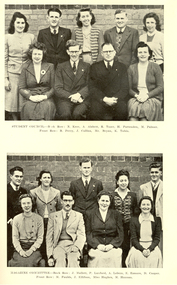
... Arthur Rank; Music; Dingo Blood; Anzac Day 1947; History of Sport; J. Arthur Rank Named images include: staff and students; Sports Committee; Social Committee; Student Council; Magazine Committee' Daylesford Camp; Anglesea Camp; Grampians Camp; Exies, College staff and students;...Arthur Rank; Music; Dingo Blood; Anzac Day 1947; History of Sport; J. Arthur Rank Named images include: staff and students; Sports Committee; Social Committee; Student Council; Magazine Committee' Daylesford Camp; Anglesea Camp; Grampians Camp; Exies, College staff and students; Extra Muros, 1947 Booklet ...Each year World War One and World War Two veteran, and Ballarat Teachers' College Principal addressed the College community for ANZAC Day. The following are excerpts of his 1947 address. "...But we should do more than remember, and instead of pausing once a year for this purpose is should be our aim to remember daily - every day should be an Anzac Day so that we shall be inspired to take stock of ourselves if we are tryig to be worthy of almidst 100,000 dead who died to keep this country free to progress nobly towards a worthy goal, What are we dong about it? As a body of teachers er should be particulalrly concerned, as in our hands largely the growth of the children lies. In the schools we can do much in our work of every day to develop right standards and a better outlook amongst the children it is our privilege to teach. We can successfully teach the three "R's" but if this is all we do then we have failed. Is should be our aim, living in the spirit of those who gace so much, to dedicate ourselfes to the work of teaching young people how to live; to train them gently in ethical standards of conduct; to take responsibility; to live through the operation with otherts; to be prepared to give service without thought of personal gain; to realise to the full all that is best in them for the good of all. What we should do and how it is to be done is difficult to descibe, but if we ourselves have taught something of the Anzac Sprit we shall not fail. In particular, we shold take care of the orphan and th child of the disabled soldier. We should explore all avenues to see what that these children get every opportunity for higher education. As far as it lies in our power we should see that these children do not suffer - thus the legacy of war is ours. In a few months you will be going out to your schools. You will have young children around you. Let you arims be high. Try to live worthily and let your little community be the better and the finer for your coming. If you achiec somethig of thise then 100,000 shall nit have died in vain." Blue soft covered, stapled booklet named 'Extra Muros', the magazine of the Ballarat Teachers College, ANZAC Day. The contents include: The Year's Sport, J. Arthur Rank; Music; Dingo Blood; Anzac Day 1947; History of Sport; J. Arthur Rank Named images include: staff and students; Sports Committee; Social Committee; Student Council; Magazine Committee' Daylesford Camp; Anglesea Camp; Grampians Camp; Exies, College staff and students;A number of authorgraps are written into the back page. ballarat teachers' college, ellwood, lord, robinson, tozer, connelly, pattenden, collins, blake, faulds, sunderland, miller, bryan, yeo, frank lord, lindsay w. harley, lindsay w. harley, anzac day -
 The Beechworth Burke Museum
Audio - Oral History, Jennifer Williams, Nola (Nettie) Maher, 27 April 2000
... Nettie worked for ten years at the Pittman’s Shoe Factory, once located on Ford Street, which was in operation from 1 July 1947 to 28 August 1961. She fondly recalls the camaraderie amongst the staff and certain managers, and details the factory processes, union activities and the work she continued to do once she was married and had children. ...Nettie worked for ten years at the Pittman’s Shoe Factory, once located on Ford Street, which was in operation from 1 July 1947 to 28 August 1961. She fondly recalls the camaraderie amongst the staff and certain managers, and details the factory processes, union activities and the work she continued to do once she was married and had children. ...Nola (Nettie) Maher was born in Beechworth on 31st December, 1935. Her father returned from World War One and purchased a miner’s cottage in 1919 where Nettie lived in for the majority of her life. Nettie worked for ten years at the Pittman’s Shoe Factory, once located on Ford Street, which was in operation from 1 July 1947 to 28 August 1961. She fondly recalls the camaraderie amongst the staff and certain managers, and details the factory processes, union activities and the work she continued to do once she was married and had children. This oral history recording was part of a project conducted by Jennifer Williams in the year 2000 to capture the everyday life and struggles in Beechworth during the twentieth century. This project involved recording seventy oral histories on cassette tapes of local Beechworth residents which were then published in a book titled: Listen to what they say: voices of twentieth century Beechworth. These cassette tapes were digitised in July 2021 with funds made available by the Friends of the Burke. Nola Nettie Maher’s account of her personal and working life in Beechworth and the local area during the 20th century is historically and socially significant to the cultural heritage of the region. She details important details about life and working in the region post World War Two, including insights into women’s working roles, as well as the social aspects of town life. This oral history account is socially and historically significant as it is part of a broader collection of interviews conducted by Jennifer Williams which were published in the book ‘Listen to what they say: voices of twentieth-century Beechworth.’ While the township of Beechworth is known for its history as a gold rush town, these accounts provide a unique insight into the day-to-day life of the town’s residents during the 20th century, many of which would have been lost had they not been preserved. This is a digital copy of a recording that was originally captured on a cassette tape. The cassette tape is black with a horizontal white strip and is currently stored in a clear flat plastic rectangular container. It holds up 40 minutes of recordings on each side.Nola Maher /beechworth, nola maher, nettie maher, listen to what they say, jennifer williams, oral history, hospital, private hospital, birth, miner’s cottage, kerosine, eucalyptus, rabbit, laundry, dressmaking, dressing certificate, dry cleaners, hotel, shoe, leather, shoe factory, uppers, pittman, ford street, charlie king, union, wages, new years eve, dance, memorial hall, married women, flexible hours, ice cream, milk bar -
 Mission to Seafarers Victoria
Photograph - Photograph, Sepia, Mounted, Rev W.F Haire, Rev A Gurney Goldsmith; Mr C A Holmes, Mr H K Vickery, Rev A.T. Pitt, circa 1910
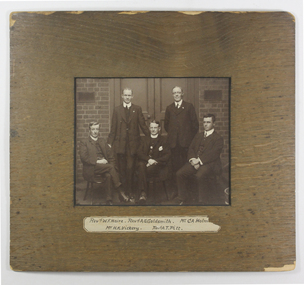
... 1947)...william foster haire...harold kingston vickery...chaplains...lay readers...staff...An original frame with an image of a group of Mission office-bearers including Rev Gurney-Goldsmith who was Senior Chaplain over the significant early 20th Century period of Mission establishment in the Central Docklands area. reverend a. gurney-goldsmith mr h.k. vickery reverend a.t. pitt reverend w. foster haire charles a. holmes charles arthur holmes (-1947) william foster haire harold kingston vickery chaplains lay readers staff chaplains group Front on paper label: Revd W.F Haire, Revd A. ...This photograph depicts five of the Mission's Committee members: top (left to right) are standing Harold Kingston Vickery and Arthur T. Pitt, both Lay Readers. Seated (left to right) are Reverend William Forster Haire, Assistant Chaplain, Reverend Alfred Gurney Goldsmith, Chaplain, and Mr Charles A. Holmes, Honorary Lay Reader. The photograph was probably taken inside the Central Institute, Siddeley Street, between 1909 and 1911.An original frame with an image of a group of Mission office-bearers including Rev Gurney-Goldsmith who was Senior Chaplain over the significant early 20th Century period of Mission establishment in the Central Docklands area. Sepia photograph in a wood frame with group of five men in suits; ink inscription of five names on paper label adhered lwr front of frameFront on paper label: Revd W.F Haire, Revd A. G.Goldsmith; Mr C A Holmes (paper cut) / Mr H. K Vickery, Revd A.T. Pitt; Verso at lwr right crnr in pencil: PH- R14 reverend a. gurney-goldsmith, mr h.k. vickery, reverend a.t. pitt, reverend w. foster haire, charles a. holmes, charles arthur holmes (-1947), william foster haire, harold kingston vickery, chaplains, lay readers, staff, chaplains group -
 Federation University Historical Collection
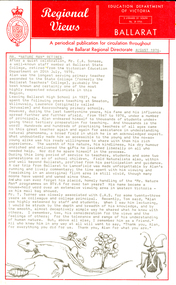
Document, Retirement of Alan Sonsee, 1976, 08/1976
... staff member at Ballarat State College, retired from the Victorian Education Department on 20th July, 1976. Alan was the longest serving primary teacher seconded to the State College (Formerly the Ballarat teachers' College), probably the best known and certainly one of the most highly respected educationalists in this region. Leaving Ballarat high School in 1927, he spent the following years teaching at Smeaton, Willowvale, Lawrence (originally called Jerusalem) and Kooroocheang primary schools. However, during the last twenty-nine years, his fame and his influence spread further and further afield. From 1947...staff member at Ballarat State College, retired from the Victorian Education Department on 20th July, 1976. Alan was the longest serving primary teacher seconded to the State College (Formerly the Ballarat teachers' College), probably the best known and certainly one of the most highly respected educationalists in this region. Leaving Ballarat high School in 1927, he spent the following years teaching at Smeaton, Willowvale, Lawrence (originally called Jerusalem) and Kooroocheang primary schools. However, during the last twenty-nine years, his fame and his influence spread further and further afield. From 1947 ...Born in 1911, Cecil Alan Sonsee lived at Springmount near Creswick, and taught natural history at the Ballarat Teachers' College for 30 years. His teaching career stretched over a 48 year period. He spent six years as a student teacher before reaching the position of first class teacher. He had the distinction of never attending a teachers' college, but spending half his teaching career training students to become teachers. At the time of his retirement Mr Sonsee said during his years at the college, "the training had changed from a one year course to a two year course, followed by a three year course, and now a four year course was offered." He recalled "in the early days all country schools had eight grades and a child finished with a merit certificate. Today [1976], children went to high schools from sixth grade and most of the country schools had disappeared.' Alan Sonsee spent 10 years on a television program on BTV6 answering questions sent by viewers regarding aspects of plant and animal live. Mr Sonsee was a life member of both Creswick and Ballarat Field naturalists Clubs. Alan Sonsee died in 1985.1) Foolscap Department of Victoria Ballarat newsletter titled Education 'Regional Views'. The newsletter depicts an image of Alan Sonsee and outlines his career at the time of his retirement on 20 July 1976. The author of the newsletter is unknown. .2) newspaper article on the retirement of Alan Sonsee dated 25 August 1976 (probably from the Ballarat Courier).1) Mr "Nature Man" Retires After a quiet celebration, Mr C.A. Sonsee, a well-known staff member at Ballarat State College, retired from the Victorian Education Department on 20th July, 1976. Alan was the longest serving primary teacher seconded to the State College (Formerly the Ballarat teachers' College), probably the best known and certainly one of the most highly respected educationalists in this region. Leaving Ballarat high School in 1927, he spent the following years teaching at Smeaton, Willowvale, Lawrence (originally called Jerusalem) and Kooroocheang primary schools. However, during the last twenty-nine years, his fame and his influence spread further and further afield. From 1947 to 1976, under a number of principals, Alan endeared himself to thousands of students undergoing their tertiary preparation for teaching. And thousands is the word! Hundreds and hundreds of practising teachers of all ages came to this great teacher again and again for assistance in understanding natural phenomena, a broad field in which he is an acknowledged expert. What undoubtedly made him so accessible to the young and the no-so-young alike was his ready willingness to share with them is rich experience. The warmth of his nature, his kindliness, his dry humour enriched and enlivened the gifts he lavished liberally on all who needed help. Nor did he spare himself in the process. During his ling period of service to teachers, students and some two generations or so of school children, Field Naturalists also, within and well beyond Ballarat, profited from his participation and guidance. A car trip from Ballarat to Lancefield was made unforgettable by Alan's running and lively commentary; the time spent with him viewing and fossicking in an aboriginal flint area is still vivid, thouhg many moons have waxed and waned since then. And who can ever forget his palcid, home;y handling of "Mr nature Man" programmes on BTV 6 for over ten years? his name became a hose-hold word over an existence viewing area in Western Victoria - as his mail bag showed. Mr T. Turner was closely associated with C.A.S. for some twenty-three years as colleague and college principal. Recently tome said, "Alan was highly esteemed by staff and students, When I saw him lecturing I would be struck by the depth and breadth of his knowledge, and by the smooth, almost deceptively simple way he shared what he knew with others. I remember, too, his consideration for the views and the feelings of others; for the tolerance and range of his understanding of human nature. But, above all else, I remember him as a friend." All who know him in any way at all will want to say, "Thanks you, Alan, for everything you did for us. Thank you, Alan for what you are."alan sonsee, ballarat teachers' college, ballarat state college, education, teaching, ballarat field naturalists, creswick field naturalists, aborigines, lancefield flint, smeaton primary school, willowvale primary school, lawrence primary school, jerusalum primary school, kooroocheang primary school, nature studies, mr nature man -
Ballarat Clarendon College
Framed etching, Clarendon Presbyterian Ladies College streetscape, c1947
... staff member Margo Bentley. Thought to be on the occasion of her marriage to Neil Wellard. Neil and Margo had no children. Item came to sister-in-law Lesley Merle (Carlyon) Wellard (CPLC 1948) who attended CPLC as student but did not know Miss Bentley while at school. clarendon-resbyterian-ladies-college margo-bentley lesley-merle-carlyon-wellard 1947 1948 boarding matron clarendon-resbyterian-ladies-college margo-bentley lesley-merle-carlyon-wellard 1947 1948 boarding matron Artists signature front bottom corner: Donald H Refshauge Reverse card: Names of students Wooden frame with gilt edges enclosing black and white etching; cardboard backing sheet covered in handwritten signatures Clarendon Presbyterian Ladies College streetscape Framed etching ...Gift by students to staff member Margo Bentley. Thought to be on the occasion of her marriage to Neil Wellard. Neil and Margo had no children. Item came to sister-in-law Lesley Merle (Carlyon) Wellard (CPLC 1948) who attended CPLC as student but did not know Miss Bentley while at school. Wooden frame with gilt edges enclosing black and white etching; cardboard backing sheet covered in handwritten signaturesArtists signature front bottom corner: Donald H Refshauge Reverse card: Names of studentsclarendon-resbyterian-ladies-college, margo-bentley, lesley-merle-carlyon-wellard, 1947, 1948, boarding, matron, clarendon-resbyterian-ladies-college, margo-bentley, lesley-merle-carlyon-wellard, 1947, 1948, boarding, matron -
 Shepparton RSL Sub Branch
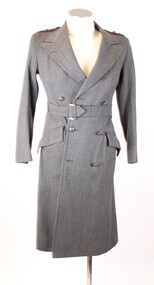
Uniform, Great Coat
... 1947. This coat is part of a complete uniform set held by the Shepparton RSL. The uniform has representative and historic significance as an example of the style of uniform worn by nursing staff of the Australian General Hospital during the 1940s and into the 1950s. ...Coat worn by Sister Danson (VFX151507) during the British presence in Japan following the end of the Second World War. About 16,000 Australians served in the British Commonwealth Occupation Forces, including 130 from the Australian General Hospital with whom Sister Danson presumably served. Sister Danson was born in Numurkah and served as Leiutentant with the Heidelberg Military Hospital before embarking for Japan in 1947.This coat is part of a complete uniform set held by the Shepparton RSL. The uniform has representative and historic significance as an example of the style of uniform worn by nursing staff of the Australian General Hospital during the 1940s and into the 1950s. The uniform set has social significance to the Shepparton area, being owned and worn by a serving community member who was born in Numurkah, enlisted in Shepparton and returned to the community in later life.Shin length grey woollen double breasted coat fastened with three buttons on front centre. Interior bakelite or plastic button fastens panels on interior. Two hip-height pockets with folded flap on exterior. Grey fabric belt fastened with a metal buckle; belt is held in place with two fabric loops on either side of the waist. "AUSTRALIA" shoulder flashes on both left and right shoulders; on left arm a blue and brown rectangular colour patch and on the right arm, a blue square patch with embroidered crown and the words "BRITISH COMMONWEALTH FORCES." Epaulettes on either shoulder carry two metal badges signifying a senior Sister and fastened with a metal button. A pin is missing from the base of the epaulette. Interior lined with purple-grey lining; pocket on interior left chest and manufacturer's label at base of neck underneath loop.Shoulder flashes read "AUSTRALIA" and "BRITISH COMMONWEALTH FORCES". Label reads "TAILORS & HABIT/MAKERS/J. RAVENSDALE/& SON/NICHOLAS BLDG./SWANSTON ST MELBOURNE/SISTER DANSON". Buttons read "AUSTRALIAN MILITARY FORCES"second world war, world war ii, medical, wwii, nurse, women -
 Shepparton RSL Sub Branch
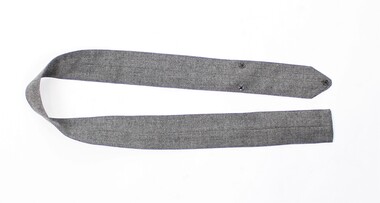
Uniform, Jacket Belt
... 1947. This belt is part of a complete uniform set held by the Shepparton RSL. The uniform has representative and historic significance as an example of the style of uniform worn by nursing staff of the Australian General Hospital during the 1940s and into the 1950s. ...Part of a jacket worn by Sister Danson (VFX151507) during the British presence in Japan following the end of the Second World War. About 16,000 Australians served in the British Commonwealth Occupation Forces, including 130 from the Australian General Hospital with whom Sister Danson presumably served. Sister Danson was born in Numurkah and served as Leiutentant with the Heidelberg Military Hospital before embarking for Japan in 1947.This belt is part of a complete uniform set held by the Shepparton RSL. The uniform has representative and historic significance as an example of the style of uniform worn by nursing staff of the Australian General Hospital during the 1940s and into the 1950s. The uniform set has social significance to the Shepparton area, being owned and worn by a serving community member who was born in Numurkah, enlisted in Shepparton and returned to the community in later life.Grey fabric belt fastened with a metal buckle; belt is held in place with two fabric loops on either side of the waist.second world war, world war ii, medical, wwii, nurse, women -
 Shepparton RSL Sub Branch
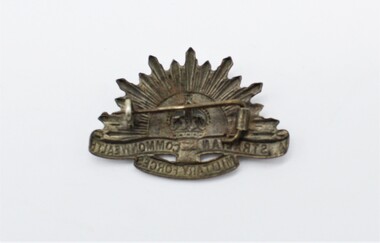
Uniform, Badge
... 1947. This badge is part of a complete uniform set held by the Shepparton RSL. The uniform has representative and historic significance as an example of the style of uniform worn by nursing staff of the Australian General Hospital during the 1940s and into the 1950s. ...This badge is attached to a tie which was worn as part of an official uniform by Sister Danson (VFX151507) during the British presence in Japan following the end of the Second World War. About 16,000 Australians served in the British Commonwealth Occupation Forces, including 130 from the Australian General Hospital with whom Sister Danson presumably served. Sister Danson was born in Numurkah and served as Leiutentant with the Heidelberg Military Hospital before embarking for Japan in 1947.This badge is part of a complete uniform set held by the Shepparton RSL. The uniform has representative and historic significance as an example of the style of uniform worn by nursing staff of the Australian General Hospital during the 1940s and into the 1950s. The uniform set has social significance to the Shepparton area, being owned and worn by a serving community member who was born in Numurkah, enlisted in Shepparton and returned to the community in later life.Dark brown metallic badge with pin on the back for fastening. The badge has embossed features. These depict a crown in the centre, a crescent shaped section which is meant to represent the rising sun and which half encircles the crown as well as three pieces of ribbon (metallic) with the embossed words "Australian Commonwealth Military Forces".second world war, world war ii, medical, wwii, nurse, women, badge, australian commonwealth military forces, military
