
Showing 314 items matching "staff development"
-
 NMIT (Northern Melbourne Institute of TAFE)
Reports: Staff development Preston Technical College 1979-1982
... Reports: Staff development Preston Technical College 1979-1982...Reports: Staff development Preston Technical College 1979-1982...Periods covered: 1st Semester 1979; 2nd Semester 1979 Part 1; 2nd Semester 1979 Part 2; 1980, 1981, First Semester, 1982. Reports: Staff development Preston Technical College 1979-1982 Reports: Staff development Preston Technical College 1979-1982 ...Bound reports A4 size. Periods covered: 1st Semester 1979; 2nd Semester 1979 Part 1; 2nd Semester 1979 Part 2; 1980, 1981, First Semester, 1982.preston technical college, preston college of tafe, reports, nmit -
University of Melbourne, Burnley Campus Archives
Booklet, The University of Melbourne, Development Opportunities for University Staff, 2003
... Development Opportunities for University Staff...Produced by the Staff Development Unit, Human Resources. Professional development services and options, The University of Melbourne......Staff Development Unit, Human Resources...professional development stsaff university of melbourne services options Produced by the Staff Development Unit, Human Resources. Professional development services and options, The University of Melbourne Development Opportunities for University Staff Booklet The University of Melbourne Staff Development Unit, Human Resources ...professional development, stsaff, university of melbourne, services, options -
 Alfred Hospital Nurses League - Nursing History Collection
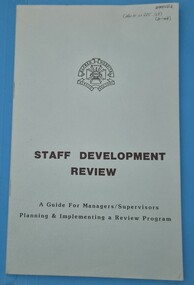
Document - Review manual, Robert N Gray, Staff development review - a guide for managers/supervisors planning & implementing a review program, 1987
... Staff development review - a guide for managers/supervisors planning & implementing a review program...staff development...A professional development resource for staff covering training,education and career pathways within a healthcare setting. ...Light blue covers, title [black print] under the logo of the Alfred Hospital on the front cover. Staff development review - a guide for managers/supervisors planning & implementing a review program Document Review manual Robert N Gray Alfred Hospital ...A professional development resource for staff covering training,education and career pathways within a healthcare setting. The guide is deaigned to help managers structure the review process for employeesA significat Alfred Hospital document from the 1980'sPaperback gluebound doccument. Light blue covers, title [black print] under the logo of the Alfred Hospital on the front cover. At top right of the front cover is the previous catalogue number [handwritten black ink] two other numbers have been crossed outstaff development, alfred hospital -
University of Melbourne, Burnley Campus Archives
Document, Information Circular No.19 TAFE Staff Development, 1991
... Information Circular No.19 TAFE Staff Development...Information Circular No.19 TAFE Staff Development Document ...Brochure with guidelines and proposals to improve teaching in TAFEs-37 pp.tafe -
University of Melbourne, Burnley Campus Archives
Document, Burnley Horticultural College. Campus Staff and Facilities Development Programme Proposal, 1982
... Campus Staff and Facilities Development Programme Proposal...Campus Staff and Facilities Development Programme Proposal Document ...Department of Agriculture, Victoria, 17 pp.burnley horticultural college, campuses, facilities, staff -
 Federation University Historical Collection
Photograph - Photograph - Black and White, Jenny Gough, 1993, 1993
... Photographic portrait of Jenny Gough, Staff Development Officer at the Ballarat School of Mines. ...ballarat school of mines jenny gough staff University women Photographic portrait of Jenny Gough, Staff Development Officer at the Ballarat School of Mines. ...Photographic portrait of Jenny Gough, Staff Development Officer at the Ballarat School of Mines. ballarat school of mines, jenny gough, staff, university women -
Federation University Historical Collection
Book, Ballarat University College Submission to Tourism Victoria 1993, 1993
... ...staff development activities...Ballarat University College - A submission to Tourism Victoria for the 1993 Victorian Tourism Awards - Industry Education Category outstanding features of ballarat university's tourism courses staff development activities raising professionalism in the tourism industry meeting industry needs details of ballarat university college' tourism courses innovations in new training & education concepts barry davis megan waring stewart toplis anthony dean sue nicholls andrea carroll michelle connelly carolyn jeffs peter leersen lisa louey david noy therese o'brien sally parker alicia pickering scott pickett chris pittaway julie-anne reither duncan skene james veitch tourism customer service White soft covered book of 27 pages with 6 attachments. ...Ballarat University College - A submission to Tourism Victoria for the 1993 Victorian Tourism Awards - Industry Education CategoryWhite soft covered book of 27 pages with 6 attachments. outstanding features of ballarat university's tourism courses, staff development activities, raising professionalism in the tourism industry, meeting industry needs, details of ballarat university college' tourism courses, innovations in new training & education concepts, barry davis, megan waring, stewart toplis, anthony dean, sue nicholls, andrea carroll, michelle connelly, carolyn jeffs, peter leersen, lisa louey, david noy, therese o'brien, sally parker, alicia pickering, scott pickett, chris pittaway, julie-anne reither, duncan skene, james veitch, tourism, customer service -
Federation University Historical Collection
Book, Tourism Education and Training at Ballarat University College - A Submission to Tourism Victoria1993, 1993
... ...staff development activities...Tourism Education and Training at Ballarat University College - A Submission to Tourism Victoria for the 1993 Victorian Tourism Awards, industry Education Category mary hollick demonstrating business success through specific marketing activities outstanding features of ballarat university college's programmes staff development activities raising professionalism in the tourism industry meeting industry needs details of ballarat university college's tourism courses student evaluation comments the industrial experience programme reverend ronald albiston jane mccormack john greenslade emma molloy gabrielle mullaly michael pearlman peter hiscock professor peter lloyd peter price lloyd steer jane westwood anne hywood graham couch geoffrey conaghan wayne treeby colin bansgrove patrick hope denis shanahan trevor hastings pandora kay sue williamson customer service toruism courses accreditation University of Ballarat Alterations, deletions, additions and markings throughout book. ...Tourism Education and Training at Ballarat University College - A Submission to Tourism Victoria for the 1993 Victorian Tourism Awards, industry Education CategoryWhite soft covered book of 21 pages and five attachments.Alterations, deletions, additions and markings throughout book.mary hollick, demonstrating business success through specific marketing activities, outstanding features of ballarat university college's programmes, staff development activities, raising professionalism in the tourism industry, meeting industry needs, details of ballarat university college's tourism courses, student evaluation comments, the industrial experience programme, reverend ronald albiston, jane mccormack, john greenslade, emma molloy, gabrielle mullaly, michael pearlman, peter hiscock, professor peter lloyd, peter price, lloyd steer, jane westwood, anne hywood, graham couch, geoffrey conaghan, wayne treeby, colin bansgrove, patrick hope, denis shanahan, trevor hastings, pandora kay, sue williamson, customer service, toruism courses, accreditation, university of ballarat -
 Peter MacCallum Cancer Centre
Archive - Board Report, Report of the Proceedings of the Cancer Institute Board, 1960-1962, 1962
... Staff...Development...Staff Development Achievements of note in the 1960 - 1962 report: - First length of service awards - Stage one of Centre Block completed - 19 clinics in operation in country hospitals. 1962 the decision was made to charter a twin engined aircraft to visit the country locations - Visiting Nursing Service Expansion to eastern and southeastern suburbs. ...Achievements of note in the 1960 - 1962 report: - First length of service awards - Stage one of Centre Block completed - 19 clinics in operation in country hospitals. 1962 the decision was made to charter a twin engined aircraft to visit the country locations - Visiting Nursing Service Expansion to eastern and southeastern suburbs. The extension and delays due to travel times lead to establishment of two depots at Box Hill and District Hospital and St John of God Training Cantre CheltenhamAchievements of note in the 1960 - 1962 report: - First length of service awards - Stage one of Centre Block completed - 19 clinics in operation in country hospitals. 1962 the decision was made to charter a twin engined aircraft to visit the country locations - Visiting Nursing Service Expansion to eastern and southeastern suburbs. The extension and delays due to travel times lead to establishment of two depots at Box Hill and District Hospital and St John of God Training Cantre Cheltenhamstaff, development -
 Federation University Historical Collection
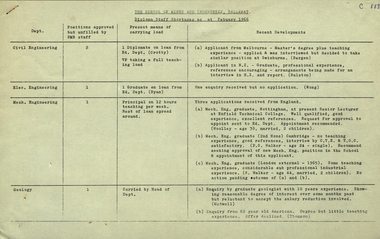
Document, School of Mines Ballarat, Diploma Staff shortages as at February 1966, 1966
... Typed sheets listing departments, staff and developments...staffing ballarat school of mines civil engineering electrical engineering mechanical engineering geology mathematica humanities time allocations Typed sheets listing departments, staff and developments School of Mines Ballarat, Diploma Staff shortages as at February 1966 Document ...Typed sheets listing departments, staff and developmentsstaffing, ballarat school of mines, civil engineering, electrical engineering, mechanical engineering, geology, mathematica, humanities, time allocations -
 Peter MacCallum Cancer Centre
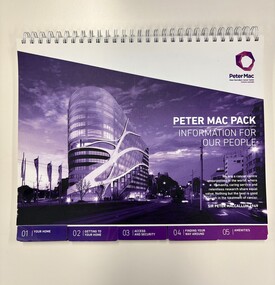
Manual (item) - Staff Information Pack, Peter Mac Pack: Information For Our People
... Staff...VCCC...Development...Parkville Facilities Staff VCCC Development Directory Peter Mac Pack: Information For Our People Manual Staff Information Pack ...When staff were moving from the East Melbourne Campus to the Parkville building these Information booklets were created to ease the transition. Familiarising staff with the new location including transport, security and amenities. parkville, facilities, staff, vccc, development, directory -
Bialik College
Document (sub-series) - Staff conference presentations, c. 2000s, 2000, 2003, 2006, 2008
... professional development...staff...Please contact [email protected] to request access to this record. 2000s professional development staff Document Staff conference presentations, c. 2000s ...2000s, professional development, staff2000s, professional development, staff -
 Victorian Aboriginal Corporation for Languages
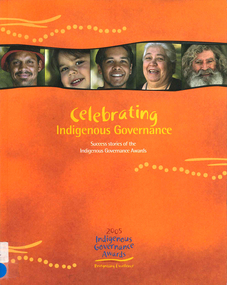
Book, Rowena Withers, Celebrating Indigenous governance : success stories of the Indigenous governance awards, 2005
... The Indigenous Governance Awards Key elements of good governance Finalists 2005: Koorie Heritage Trust, Victoria; Central Australian Aboriginal Congress, NT; Sunrise Health Service, NT; Goldfields Land and Sea Council, WA; Institute for Aboriginal Development, NT; Maari Ma Health Aboriginal Corporation NSW; North Coast Aboriginal Corporation for Community Health Qld; Tiwi Islands Local Government, NT What works: lessons from the 2005 Indigenous Governance awards Governing body: choosing the board; Size and frequency of meetings; Board change and continuity; Processes of decision-making; Making good decisions; Financial decision-making; Accountability tools Managing and implementing decisions: carrying out recommendations; Informing stakeholders Conflict resolution: conflicts among the board; Complaints from members; Staff conflicts Leadership development: developing youth; Staff development and training Cultural norms and values: Boards and elders; Community and culture Future planning....The Indigenous Governance Awards Key elements of good governance Finalists 2005: Koorie Heritage Trust, Victoria; Central Australian Aboriginal Congress, NT; Sunrise Health Service, NT; Goldfields Land and Sea Council, WA; Institute for Aboriginal Development, NT; Maari Ma Health Aboriginal Corporation NSW; North Coast Aboriginal Corporation for Community Health Qld; Tiwi Islands Local Government, NT What works: lessons from the 2005 Indigenous Governance awards Governing body: choosing the board; Size and frequency of meetings; Board change and continuity; Processes of decision-making; Making good decisions; Financial decision-making; Accountability tools Managing and implementing decisions: carrying out recommendations; Informing stakeholders Conflict resolution: conflicts among the board; Complaints from members; Staff conflicts Leadership development: developing youth; Staff development and training Cultural norms and values: Boards and elders; Community and culture Future planning. ...Good governance means good business What is governance? The Indigenous Governance Awards Key elements of good governance Finalists 2005: Koorie Heritage Trust, Victoria; Central Australian Aboriginal Congress, NT; Sunrise Health Service, NT; Goldfields Land and Sea Council, WA; Institute for Aboriginal Development, NT; Maari Ma Health Aboriginal Corporation NSW; North Coast Aboriginal Corporation for Community Health Qld; Tiwi Islands Local Government, NT What works: lessons from the 2005 Indigenous Governance awards Governing body: choosing the board; Size and frequency of meetings; Board change and continuity; Processes of decision-making; Making good decisions; Financial decision-making; Accountability tools Managing and implementing decisions: carrying out recommendations; Informing stakeholders Conflict resolution: conflicts among the board; Complaints from members; Staff conflicts Leadership development: developing youth; Staff development and training Cultural norms and values: Boards and elders; Community and culture Future planning.colour photographsbusiness enterprise, indigenous business -
Whitehorse Historical Society Inc.
Article, Staff morale low, 1993
... City of Nunawading Planning and development group staff experiencing a low morale. ...City of Nunawading Glickman Ray City of Nunawading Planning and development group staff experiencing a low morale. City of Nunawading Planning and development group staff experiencing a low morale. ...City of Nunawading Planning and development group staff experiencing a low morale.City of Nunawading Planning and development group staff experiencing a low morale. Ray Glickman, Group Manager, identifies future directions.City of Nunawading Planning and development group staff experiencing a low morale. city of nunawading, glickman, ray -
 Federation University Historical Collection
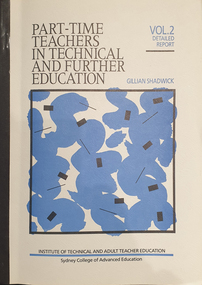
Book, Gillian Shadwick, Part-Time Teachers In Technical and Further Education Volume Two by Gillian Shadwick, 06/1986
... To identify initial and on-going staff development and teacher-training needs. 5. ...To identify initial and on-going staff development and teacher-training needs. 5. ...Part-Time Teachers In Technical and Further Education, Volume Two - Detailed Report on Findings and Recommendations by Gillian Shadwick (Institute of Technical and Adult Teacher Education within the Sydney College of Advanced Education). Published by the Sydney College of Advanced Education and funded by the TAFE Council of the Commonwealth Tertiary Education Commission, June 1986. The steering committee included Greg Woodburne, Dr Rod McDonald, Gary Hilton, Ian Hamilton, Warwick Goodsir, Ray Jolliffe, Sue Hatherley, and Rex Hewitt. The aims of the study were: "1. To provide profile(s) of the part-time TAFE teachers; 2. To determine the extent of the part-time teacher contribution to TAFE's educational provision. 3. To determine the nature of the part-time teacher contribution to TAFE's provision. 4. To identify initial and on-going staff development and teacher-training needs. 5. To describe the superviser: part-time teacher relationship. 6. To identify sources of part-time teacher job satisfaction and job dissatisfaction. 7. To recommend future directions for the contribution of part-time teachers to educational provision within TAFE." These are discussed throughout the report. ISBN 0-86398-035-XBook concerning Part-Time Teachers in Technical and Further Education, a Detailed Report on Findings and Recommendations. 249 Pages. Includes two questionnaires for teachers. Bound with plastic spine, covers made of thicker, textured paper. Sections and appendixes marked with yellow paper.part-time teachers in technical and further education, volume 2, detailed report, gillian shadwick, institute of technical and adult teacher education, 1986, greg woodburne, dr rod mcdonald, gary hilton, ian hamilton, warwick goodsir, ray jolliffe, sue hatherley, rex hewitt, questionnaire, tafe, part-time teachers, teaching -
NMIT (Northern Melbourne Institute of TAFE)
Report: Life skills and TAFE programs in Victoria, TAFE Board, 1985
... Part B focuses on the experience of these activities towards curriculum and implementation needs, and evaluation and staff development requirements particular to these programs. ...Part B focuses on the experience of these activities towards curriculum and implementation needs, and evaluation and staff development requirements particular to these programs. ...A4 size report, aqua cover and various pagings, written in 1985. The primary aim of this project was to report to the TAFE Board, Victoria on the implementation of life skills material into mainstream vocational education at Royal Melbourne Institute of Technology (RMIT), with parallel emphasis on implementation models for statewide courses. The report is divided into 3 parts. Part A attempts to define the notion of life skills that developed from the work of Dr Stewart Sharlow’s ‘TAFE and basic life skills’, TAFE Services, Victoria, 1982 and the ‘Audit of TAFE middle level and technician humanities subjects,TAFE Services, Victoria, 1982. As a result of these publications a conference ‘Life Skills and the TAFE Practitioner’ was held in October, 1983 at Preston College of TAFE in Victoria with the aim of seeking a definition of the term life skill with regard to curriculum developments and classroom teaching. This report draws on these events and a number of programs developed or piloted in Victoria that are relevant to the issue. The report focuses on: 1. Work and Engineering Programme (RMIT,1984); 2. Diploma of Architectural Technology (RMIT); 3. Certificate of Law Enforcement Studies (RMIT); 4. Office and Secretarial Studies Certificate; 5. Life Skills at the Gordon College of TAFE; 6. Life Skills in the V.O.P. at Box Hill College of TAFE. Part B focuses on the experience of these activities towards curriculum and implementation needs, and evaluation and staff development requirements particular to these programs. Part C presents conclusions and recommendations.tafe board victoria, nmit -
 Australian Nursing & Midwifery Federation
Australian Nursing Federation ratios campaign badge, 2001
... The booklet describes some of the rationale for minimum staffing ratios and developments in 2000-2001 regarding campaigning for ratios, particular the landmark decision of the Australian Industrial Relations Commission in 2000 that saw the ANF securing the world's first mandated minimum nurse-to-patient ratios. ...The booklet describes some of the rationale for minimum staffing ratios and developments in 2000-2001 regarding campaigning for ratios, particular the landmark decision of the Australian Industrial Relations Commission in 2000 that saw the ANF securing the world's first mandated minimum nurse-to-patient ratios. ...Button distributed to and worn by Australian Nursing Federation (ANF) members and staff as part of a campaign to secure minimum nurse staffing in the public healthcare sector. This badge was accompanied by a booklet 'Nursing the system back to health : Nurse patient ratios 2001', published in April 2002. The booklet describes some of the rationale for minimum staffing ratios and developments in 2000-2001 regarding campaigning for ratios, particular the landmark decision of the Australian Industrial Relations Commission in 2000 that saw the ANF securing the world's first mandated minimum nurse-to-patient ratios. After decades of campaigning from the ANF/ANMF, ratios were legislated for the public sector in Victoria with the passing of the Safe Patient Care (Nurse to Patient and Midwife to Patient) Bill in 2015. The web address on the badge was active from 1999 to 2004, and the shortcut 'anfvic.asn.au' was active from April 2001, suggesting this badge dates from 2001.Circular yellow, blue and white badge. Silver metal, plastic-coated, with safety pin fastener adhered to back. Badge printed with a blue and white ANF [Australian Nursing Federation] logo, the text 'Nurses Nursing the system back to health' and the (then) website of the ANF (Victorian Branch), 'www.vicnet.net.au/~anfvb/'.nursing, ratios, workforce, staffing, nurses, unionism, badges, buttons, pins, campaigning, trade unions, labour history, safe patient care (nurse to patient and midwife to patient ratios) act 2015, australian nursing federation, victoria, enterprise bargaining -
 Australian Nursing & Midwifery Federation
Australian Nursing Federation ratios campaign bumper sticker, 2001
... The booklet describes some of the rationale for minimum staffing ratios and developments in 2000-2001 regarding campaigning for ratios, particular the landmark decision of the Australian Industrial Relations Commission in 2000 that saw the ANF securing the world's first mandated minimum nurse-to-patient ratios. ...The booklet describes some of the rationale for minimum staffing ratios and developments in 2000-2001 regarding campaigning for ratios, particular the landmark decision of the Australian Industrial Relations Commission in 2000 that saw the ANF securing the world's first mandated minimum nurse-to-patient ratios. ...Sticker distributed to and used by Australian Nursing Federation (ANF) members and staff as part of a campaign to secure minimum nurse staffing in the public healthcare sector. This sticker was accompanied by a booklet 'Nursing the system back to health : Nurse patient ratios 2001', published in April 2002. The booklet describes some of the rationale for minimum staffing ratios and developments in 2000-2001 regarding campaigning for ratios, particular the landmark decision of the Australian Industrial Relations Commission in 2000 that saw the ANF securing the world's first mandated minimum nurse-to-patient ratios. After decades of campaigning from the ANF/ANMF, ratios were legislated for the public sector in Victoria with the passing of the Safe Patient Care (Nurse to Patient and Midwife to Patient) Bill in 2015. The web address on the sticker was active from 1999 to 2004, and the shortcut 'anfvic.asn.au' was active from April 2001, suggesting this sticker dates from around 2001.Rectangular yellow, blue and white bumper sticker. Badge printed with a blue and white ANF [Australian Nursing Federation] logo, the text 'Nurses Nursing the system back to health' and the (then) website of the ANF (Victorian Branch), 'www.vicnet.net.au/~anfvb/'.nursing, ratios, workforce, staffing, nurses, unionism, stickers, campaigning, trade unions, labour history, safe patient care (nurse to patient and midwife to patient ratios) act 2015, australian nursing federation, enterprise bargaining, victoria -
 Federation University Historical Collection
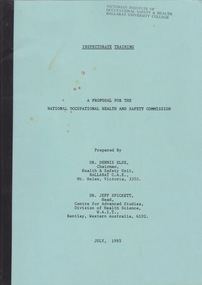
Document - Document - Booklet, VIOSH: Inspectorate Training; A Proposal for the National Health and Safety Commission, prepared by Dr Dennis Else and Dr Jeff Spickett, 1985
... PHASE 1: Development of options paper for Commission to clarify roles, methods of operation, composition, size and base qualifications of staff. ...PHASE 1: Development of options paper for Commission to clarify roles, methods of operation, composition, size and base qualifications of staff. ...Victorian Institute of Occupational Safety and Health (VIOSH) Australia is the Asia-Pacific centre for teaching and research in occupational health and safety (OHS) and is known as one of Australia's leaders on the field. VIOSH has a global reputation for its innovative approach within the field of OHS management. VIOSH had its first intake of students in 1979. At that time the Institution was known as the Ballarat College of Advanced Education. In 1990 it became known as Ballarat University College, then in 1994 as University of Ballarat. It was 2014 that it became Federation University. VIOSH Australia students are safety managers, senior advisors and experienced OHS professionals. They come from all over Australia and industry. Students are taught active research and enquiry; rather than textbook learning and a one-size fits all approach. VIOSH accepts people into the Graduate Diploma of Occupational Hazard Management who have no undergraduate degree - on the basis of extensive work experience and knowledge. This is a proposal for the National Occupational Health and Safety Commission prepared jointly by Dr Dennis Else, Chairman, Health and Safety Unit, Ballarat C.A.E., Victoria and Dr Jeff Spickett, Head, Centre of Advanced Studies Division of Health Science, W.A.I.T.. Bentley, Western Australia. A joint project team from both organisations' staff have been involved in the development and implementation of training courses for health and safety inspectors in Australia, UK and developing countries. PHASE 1: Development of options paper for Commission to clarify roles, methods of operation, composition, size and base qualifications of staff. PHASE 2: Development of detailed training program and training materials..viosh, victorian institute of occupational safety and health, dennis else, jeff spickett, health and safety unit ballarat, advanced studies divion of health science, w.a.i.t, b.c.a.e., national occupational health and safety commission, health and safety inspectors, training program, training materials -
 Federation University Historical Collection
Document - Document - Reports, VIOSH: VIOSH Annual Reports for 1996, 1997, 1998, 1999
... Each year an Annual Report was produced outlining the year's activities, award winners ,professional development of staff, graduation of students. The courses taken and specific groups are also outlined. ...Each year an Annual Report was produced outlining the year's activities, award winners ,professional development of staff, graduation of students. The courses taken and specific groups are also outlined. ...Victorian Institute of Occupational Safety and Health (VIOSH) Australia is the Asia-Pacific centre for teaching and research in occupational health and safety (OHS) and is known as one of Australia's leaders on the field. VIOSH has a global reputation for its innovative approach within the field of OHS management. VIOSH had its first intake of students in 1979. At that time the Institution was known as the Ballarat College of Advanced Education. In 1990 it became known as Ballarat University College, then in 1994 as University of Ballarat. It was 2014 that it became Federation University. VIOSH Australia students are safety managers, senior advisors and experienced OHS professionals. They come from all over Australia and industry. Students are taught active research and enquiry; rather than textbook learning and a one-size fits all approach. VIOSH accepts people into the Graduate Diploma of Occupational Hazard Management who have no undergraduate degree - on the basis of extensive work experience and knowledge. Each year an Annual Report was produced outlining the year's activities, award winners ,professional development of staff, graduation of students. The courses taken and specific groups are also outlined. Sponsorship was important for the continuation of VIOSH. Acknowledgement important in the Reports.Four booklets with white covers and blue print. .1 Annual Report 1996. 14 sheets folded - 54 pages. Stapled .2 Annual Report 1997. 41 sheets, glued and book binding tape along spine. .3 Annual Report 1998. 13 sheets folded - 50 pages. Stapled. .4 Annual Report 1999. 64 sheets, glued . Stamp of VIOSH Australia and contact information on back cover.viosh, victorian institute of occupational safety and health, steve cowley, viosh staff, research projects, consultancies, publications and conferences, financial summary, sponsorships, annual report -
 Federation University Historical Collection
Document - Document - Booklet, VIOSH: B.C.A.E.: Proposal to develop a data bank of successful technical solutions to health and safety problems
... Detailed information is given on Project Methodology, Publication Schedule, Timetable for Project, Resources which includes staffing, Budget and Future Developments...Detailed information is given on Project Methodology, Publication Schedule, Timetable for Project, Resources which includes staffing, Budget and Future Developments viosh victorian institute of occupatioal safety and health share safety and health accumulated research and experience technical solutions publications dennis else stephen cowlet bcae ballarat college of advanced education methodology staffing timetable Twenty-one sheet of A4 typed paper within blue paper cover - front and back. ...Victorian Institute of Occupational Safety and Health (VIOSH) Australia is the Asia-Pacific centre for teaching and research in occupational health and safety (OHS) and is known as one of Australia's leaders on the field. VIOSH has a global reputation for its innovative approach within the field of OHS management. VIOSH had its first intake of students in 1979. At that time the Institution was known as the Ballarat College of Advanced Education. In 1990 it became known as Ballarat University College, then in 1994 as University of Ballarat. It was 2014 that it became Federation University. VIOSH Australia students are safety managers, senior advisors and experienced OHS professionals. They come from all over Australia and industry. Students are taught active research and enquiry; rather than textbook learning and a one-size fits all approach. VIOSH accepts people into the Graduate Diploma of Occupational Hazard Management who have no undergraduate degree - on the basis of extensive work experience and knowledge. Booklet outlines the proposal to develop a data bank of successful technical solutions to health and safety problems vis a series of publications. The project title is "Safety & Health Accumulated Research and Experience" Control - SHARE. The project is designed and written by Dr Dennis Else and Mr Stephen Cowley of the Health & Safety Unit at Ballarat College of Advanced Education in January 1986. Detailed information is given on Project Methodology, Publication Schedule, Timetable for Project, Resources which includes staffing, Budget and Future DevelopmentsTwenty-one sheet of A4 typed paper within blue paper cover - front and back. Booklet staple and bound with book binding tapes was lifting. Printed on one side only.viosh, victorian institute of occupatioal safety and health, share, safety and health accumulated research and experience, technical solutions, publications, dennis else, stephen cowlet, bcae, ballarat college of advanced education, methodology, staffing, timetable -
 Federation University Historical Collection
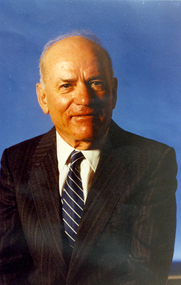
Photograph - Photograph - Colour, William James Gribble, 1996, 1996
... The vigorous leadership you provided as President of Council ensured the continued development of the Institute as an outstanding provider of technical and further education well placed to face challenges ahead. The Council, Staff...The vigorous leadership you provided as President of Council ensured the continued development of the Institute as an outstanding provider of technical and further education well placed to face challenges ahead. The Council, Staff ...Ballarat School of Mines Council President, Bill Gribble, studied Art at Ballarat School of Mines Technical Art School. In 1956 he was working with Villiers Engineering, then Bendex Mintex in 1966. He retired from there in 1988 as Chairman and Managing Director. In 1989 Bill Gribble was appointed to the Ballarat School of Mines Council. He served as President from 1992 until his retirement in 1996. In that year the Ballarat Technical Art School building was named the W.J. Gribble building..1) Portrait of Bill Gribble, President of the Ballarat School of Mines Council .2) Presentation to ill Gribble on his retirement from the Ballarat School of Mines CouncilThe presentation states: "The Council expresses its deep appreciation of the outstanding contribution of William James gribble. During your time as a member of the Council from 1988 and as President from 1992 until 1996 the Institute experienced a significant expansion in progress, enrolments and facilities, faced many challenges and achieved great success. Your dedication , commitment and loyalty to the institute is acknowledge. The vigorous leadership you provided as President of Council ensured the continued development of the Institute as an outstanding provider of technical and further education well placed to face challenges ahead. The Council, Staff and Students wish you well for the future and thank you for your devotion to the good governance of the institute."bill gribble, gribble, w.j. gribble, ballarat school of mines, ballarat school of mines council -
 Federation University Historical Collection
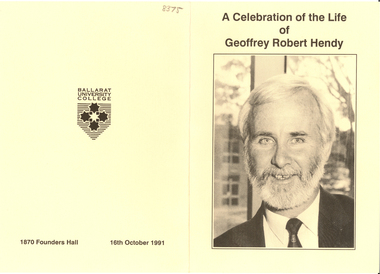
Programme, A Celebration of the Life of Geoffrey Robert Hendy, 1991, 10/1991
... The Federation University Hendy Award was established to support the professional development of the general staff of the University. The award is made biennially (in years with an odd number) The award is named in honour of the late Mr geoff Hendy, a long serving staff member of the University and its predecessor institutions. ...The Federation University Hendy Award was established to support the professional development of the general staff of the University. The award is made biennially (in years with an odd number) The award is named in honour of the late Mr geoff Hendy, a long serving staff member of the University and its predecessor institutions. ...Geoff Hendy was born at Numurkah on 06 November 1945. In 1963 he was employed by the Victorian Education Department as an Administrative Officer. He moved to Ballarat in 1970 to take up the position of registrar at the Ballarat Teachers' College. In 1973 he resigned from the Education Department to become the Academic registrar at the State College of Victoria at Ballarat. He died on 08 October 1991 in Los Angeles, United States of America. The Federation University Hendy Award was established to support the professional development of the general staff of the University. The award is made biennially (in years with an odd number) The award is named in honour of the late Mr geoff Hendy, a long serving staff member of the University and its predecessor institutions. He joined Ballarat Teachers' College as Registrar in 1970, and in 1973 became the Academic Registrar for the State College of Victoria at Ballarat. In 1976 he was appointed Academic Secretary when the Ballarat College of Advanced Education was established, and later became Registrar of that institution. Geoff Hendy was still Registrar at the time of his death in 1991. A beige coloured card used at a service to celebrate the life of staffmember Geoff Hendy who died suddenly in America while representing Ballarat University College.hendy, geoff hendy, geoff hendy award, ballarat teachers college, ballarat college of advanced education, state college of victoria, ballarat university college, john sharpham, ian gordon, ken clements, gerardine christou, robert hook, anne beggs sunter, norman barling -
 Mission to Seafarers Victoria
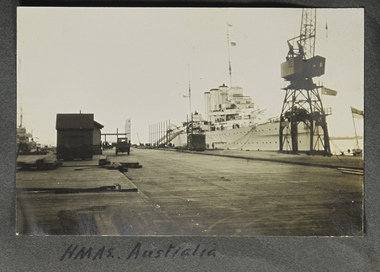
Photograph - Photograph, Sepia, HMAS Australia, 1928
... staff. Padre Frank Oliver Chaplain from 1930-60 served on the ship in WW2. Cadets and officers also regularly visited the Mission. The pier also played a significant role in the development and life of Melbourne. battleship hmas australia ww1 fan album ships piers port melbourne handwritten inscription below photograph adhered to album page. ...HMAS AustraliaHMAS Australia has been a significant link with and factor in the history of the Mission and staff. Padre Frank Oliver Chaplain from 1930-60 served on the ship in WW2. Cadets and officers also regularly visited the Mission. The pier also played a significant role in the development and life of Melbourne.Small landscape sepia image depicting 3-funnel stack battleship moored at a pier, an ships ensign flies at far right of frame.handwritten inscription below photograph adhered to album page.battleship, hmas australia, ww1, fan album, ships, piers, port melbourne -
 Federation University Historical Collection
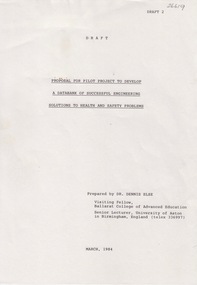
Document - Document - Draft Proposal, VIOSH: B.C.A.E.:Proposal for Pilot Program - Databank - Successful Engineering Solutions
... They have been responsible for the development of Australia's first tertiary course in Occupational Health and Safety and Occupational Hazard Management. viosh victorian institute of occupational safety and health ballarat college of advanced education dennis else databank engineering solutions draft proposal visiting fellow occupational hazard management occupational health and safety multidisciplinary team dulcie brooke max brooke gerald fernandez kathleen kent peter mccarthy tom norwood roy schrieve bill vermeend derek viner derek woolley Fifty-seven A4 pages - includes 27 pages of photocopied pages from reference books and 11 pages of Curriculum Vitae, Staff. ...Victorian Institute of Occupational Safety and Health (VIOSH) Australia is the Asia-Pacific centre for teaching and research in occupational health and safety (OHS) and is known as one of Australia's leaders on the field. VIOSH has a global reputation for its innovative approach within the field of OHS management. VIOSH had its first intake of students in 1979. At that time the Institution was known as the Ballarat College of Advanced Education. In 1990 it became known as Ballarat University College, then in 1994 as University of Ballarat. It was 2014 that it became Federation University. VIOSH Australia students are safety managers, senior advisors and experienced OHS professionals. They come from all over Australia and industry. Students are taught active research and enquiry; rather than textbook learning and a one-size fits all approach. VIOSH accepts people into the Graduate Diploma of Occupational Hazard Management who have no undergraduate degree - on the basis of extensive work experience and knowledge. Document is a Draft Proposal for a Pilot Project to Develop a Databank of Successful Engineering Solutions to Health and Safety Problems. It has been written by Dr Dennis Else, Visiting Fellow, Ballarat College of Advanced Education. Dennis is also a Senior Lecturer, University of Aston, Birmingham, England. The document outlines the need for a databank and often ""our failure to control health and safety problems is from our inability to apply existing knowledge rather than because the knowledge does not exist." The control solutions would need to be technically vetted to ensure feasibility of the solution. An experienced group of specialists in aspects of health and safety and from engineering branches would be required. Ballarat CAE already has this blend of expertise. They have been responsible for the development of Australia's first tertiary course in Occupational Health and Safety and Occupational Hazard Management.Fifty-seven A4 pages - includes 27 pages of photocopied pages from reference books and 11 pages of Curriculum Vitae, Staff.viosh, victorian institute of occupational safety and health, ballarat college of advanced education, dennis else, databank, engineering solutions, draft proposal, visiting fellow, occupational hazard management, occupational health and safety, multidisciplinary team, dulcie brooke, max brooke, gerald fernandez, kathleen kent, peter mccarthy, tom norwood, roy schrieve, bill vermeend, derek viner, derek woolley -
 Federation University Historical Collection
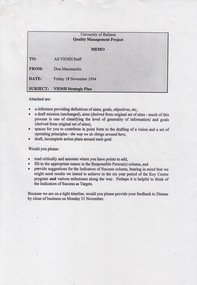
Document - Document - Project, VIOSH: University of Ballarat, Strategic Plan; Quality Management Project 1994
... Memo from Don Maconachie was sent to all VIOSH Staff in relation to the development of a VIOSH Strategic Plan. ...Memo from Don Maconachie was sent to all VIOSH Staff in relation to the development of a VIOSH Strategic Plan. ...Victorian Institute of Occupational Safety and Health (VIOSH) Australia is the Asia-Pacific centre for teaching and research in occupational health and safety (OHS) and is known as one of Australia's leaders on the field. VIOSH has a global reputation for its innovative approach within the field of OHS management. VIOSH had its first intake of students in 1979. At that time the Institution was known as the Ballarat College of Advanced Education. In 1990 it became known as Ballarat University College, then in 1994 as University of Ballarat. It was 2014 that it became Federation University. VIOSH Australia students are safety managers, senior advisors and experienced OHS professionals. They come from all over Australia and industry. Students are taught active research and enquiry; rather than textbook learning and a one-size fits all approach. VIOSH accepts people into the Graduate Diploma of Occupational Hazard Management who have no undergraduate degree - on the basis of extensive work experience and knowledge. Memo from Don Maconachie was sent to all VIOSH Staff in relation to the development of a VIOSH Strategic Plan. They were to develop value statement, vision statement, aims, goals, objectives, targets, strategies. Staff provided with forms to be completed coving these aspects. They were to state the responsible person, timeline, target groups, resources required and indicators of success. On completion results compiled and given to staff. Report would then be sent to Director of VIOSH Australia.Forty-two pages that was stapled together in sections. Type written with relevant charts.viosh, victorian institute of occupational safety and health, quality management project, visor strategic plan, don maconachie, mission statement, aims, targets, director -
 Federation University Historical Collection
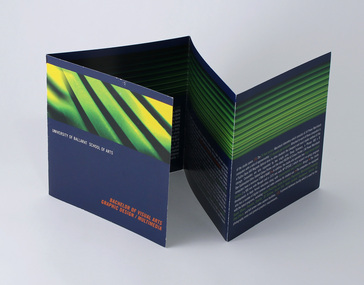
Pamphlet - Promotional brochure, Bachelor of Visual Arts, Graphic Design/Multimedia, c1999
... development with an open ethos and cross-level delivery and learning. This maximises the use of information in order for it to be applied throughout all levels of the learning process, whilst allowing a natural mentor arrangment to be developed for all first year students, " "The open ethos approach also encourages students and staff to freely express their opinions in relation to design via cross-level critiques, whilst allowing for a liberal arts approach and structure to the development of the creative process." ...development with an open ethos and cross-level delivery and learning. This maximises the use of information in order for it to be applied throughout all levels of the learning process, whilst allowing a natural mentor arrangment to be developed for all first year students, " "The open ethos approach also encourages students and staff to freely express their opinions in relation to design via cross-level critiques, whilst allowing for a liberal arts approach and structure to the development of the creative process." ...Promoting the Graphic Design/Multimedia program being offered by the University of Ballarat at the Mt Helen Campus. Promoted course as "one of the smallest and arguably the best three year programs of its kind in Australia and the South Pacific region." The brochure lists student awards received including Platinum and Gold in the AGFA International Young Designer Contest, 1999; two meritorious awards in The Art Directors Club Student Awards, New York, USA 1999; Graphis New Talent 1999; two Gold in Souther Cross Packaging Awards, 1998. At time of publication, the School of Arts, Visual Arts reportedly had 210 students with majors in Graphic Design/Multimedia, Ceramics/3D, Painting, Drawing, and Multidiscipline. Minors studies included Printmaking, Photography, 3D, 2D, and Graphic Communication. ___ Course aimed to train "independent, flexible thinkers". The course promised to "Promote creativity, originality and imaginative thinking; Develop self-directed learners, displaying initiative in the formation of ideas and the confidence to construct personal responses; Develop appropriate conceptual, technical and professional skills; Develop the student's critical process: ability to undertake research, and to make informed decisions; Clarify thinking, concepts and understanding and deep knowledge, attitudes and skills enabling the designer to respond to community needs." Studio and working environment described as "one open space with working facilities for approximately 75 students across 3 year levels. The area is divided up into work stations where 1st, 2nd and 3rd year students intermix, allowing a natural interaction. These workstations are configurations of six, consisting of two students from each year level. This reinforces the area's ongoing development with an open ethos and cross-level delivery and learning. This maximises the use of information in order for it to be applied throughout all levels of the learning process, whilst allowing a natural mentor arrangment to be developed for all first year students, " "The open ethos approach also encourages students and staff to freely express their opinions in relation to design via cross-level critiques, whilst allowing for a liberal arts approach and structure to the development of the creative process." "Emphasis is placed on experimentation, innovation, expression and the development of the individual's design philosophies, concepts and style." Also notes the 24 hour access Macintosh laboratory, with 34 Power Macintosh computers, ratio of one for every 2.5 students. Each with a Fujitsu Dyna Magneto Optical drive for file storage and transport. Two Sharp scanners, Phaser Dye-Sublimation Extra Tabloid colour printer and Ricoh A3 colour printer. Two large format printers. Digital and video cameras. Software: Adobe Photoshop, Illustrator, Acrobat; QuarkXpress; Macromedia Freehand; Pagemaker; Premier; Director; 3D Extreme; Sound Eidt, Shockwave, Infinite 3D and After Effects. Approx 4.5 staff, "all of whom are practicing designers. They have a full understanding of industry requirements and trends which assists in the development of industrial contacts when specialists are required." Prospective students interviewed in late Nov/ early Dec, face to face. Present a "comprehensive folio of work", academic records, references. "Selection is determined by the perceived potential of the student, their motivation and reason for study within the field as well as their previous experience in the Visual Arts. Folio work should be representative of the individual's ideas and abilities. Qualities of importance are: originality, innovation, imagination, experimentation and a competent display of the basic skills associated with visual arts [evidence of drawing skills should be included]." Demonstration of GD/MM computer skills an advantage. Students also asked to bring sketch books. Promotional brochure for prospective students. 8pp Double fold brochureuniversity of ballarat, federation university, graphic design, multimedia, bachelor, degree -
 Federation University Historical Collection
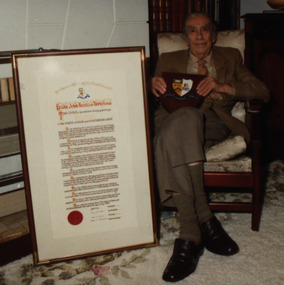
Photograph - Colour, E.J.T. Tippett receives an Illuminated Address from the Ballarat School of Mines, 1984, 18/07/1984
... The Council, Staff and Students humbly thank you for your magnificent contribution to the continuing development of this School. ...The Council, Staff and Students humbly thank you for your magnificent contribution to the continuing development of this School. ...E.J.T. Tippett was a long term President of the Ballarat School of Mines Council.Colour photograph of E.J.T. Tippett in his home, surrounded by an framed illuminated address and a Ballarat School of Mines shield. The illumination reads: 'The Council, by resolution, hereby appoints you Patron of the School of Mines and Industries Ballarat. In so resolving, the Council is mindful of your lifelong association with the School in many capacities, and the distinguished contribution you have made to Technical and Further Education in this State. It is considered appropriate that this unique contribution be recognised by the appointment. A student at this School from 1918 to 1920, you were elected to the Council in 1934 and have maintained continuous active membership for fifty years, serving also on the Ballarat C.A.E. Council. Your remarkable service to the School included President of Council from 1940 to 1960, during which years your leadership contributed to the growth and stature of the School. As a member of the Interim Council established to plan the development of the Victoria Institute of Colleges, as a member of the COuncils of the Victoria Institute of Colleges and Monash University and as President of the technical Schools' Association of Victoria, you have given generously of your time and expert ability in the furtherance of education in Victoria. Your contribution to the development of this School has been perpetuated by the naming of the E.J. Tippett Recreation Hall in 1959 and the E.J. Tippett Library in 1978. The establishment, through your gift of an endowment fund, of the Ronaldson Brothers and Tippett Founders' Prize has provided a permanent link between the school and the early established Ballarat engineering firm of which you were Managing Director. The City of Ballarat has recognized your efforts in establishing the annual presentation of Craftsman Certificates. Your distinguished services to education has been recognized buy the State Government by awarding you the M.B.E. in 1975. The Council, Staff and Students humbly thank you for your magnificent contribution to the continuing development of this School. Given under the Common Seal of the School of Mines and Industries Ballarat, this eighteenth day of July, 1984.e.j.t. tippett, illumination, ballarat school of mines -
Federation University Historical Collection
Book, University of Ballarat Interim Strategic Plan, 1997, 1989
... Development * Processes to be investigated/Introduced Tables include: * Staffing by level, gender and age * Fianancial & Resource Services Budget, 1997 * Fianancial & Resource Services Budget, 1998 ...staffing information technology halls of residence student accomodation A4 book compiled by the University of Ballarat Financial and Resource Services Branch. Appendices include: * Statutory requirements for Financial & Planning Services Branch * Halls of Residence Strategic Plan * Campus Amentities Strategic Plan * Finanace Database Volume Statistics * Client Survey - PLanning Services and Budgeting Services * Recent In-House I.T. Development ...A4 book compiled by the University of Ballarat Financial and Resource Services Branch. Appendices include: * Statutory requirements for Financial & Planning Services Branch * Halls of Residence Strategic Plan * Campus Amentities Strategic Plan * Finanace Database Volume Statistics * Client Survey - PLanning Services and Budgeting Services * Recent In-House I.T. Development * Processes to be investigated/Introduced Tables include: * Staffing by level, gender and age * Fianancial & Resource Services Budget, 1997 * Fianancial & Resource Services Budget, 1998 strategic plan, fiancial planning, robert hook, mission, vision, values, staffing, information technology, halls of residence, student accomodation -
Federation University Historical Collection
Article - Article - Women, Federation University: Women of Note; Dr Doris Paton, Academic and Aboriginal Elder
... Her work has been presented at conferences including the World Indigenous Peoples Conference on Education, and recognised with several awards including the GippsTAFE Staff Excellence Awards in the Community Development, and Personal Achievement categories, The Wurreker Award for Community Based Employee, and the Parks Victoria Regional Achiever Award....Her work has been presented at conferences including the World Indigenous Peoples Conference on Education, and recognised with several awards including the GippsTAFE Staff Excellence Awards in the Community Development, and Personal Achievement categories, The Wurreker Award for Community Based Employee, and the Parks Victoria Regional Achiever Award. women of note federation university doris paton aboriginal elder academic aboriginal languages monash university gippsland graduate diploma education bachelor of arts master of education phd philosophy victorian aboriginal languages corporation vacl councillor Federation University: Women of Note; Dr Doris Paton, Academic and Aboriginal Elder. ...Dr Doris Paton is an accomplished academic and respected Aboriginal Elder with a passion for the advancement of First Nations People through education, and the reclamation and revival of Aboriginal languages across Australia. She graduated with a Bachelor of Arts (Social Science) from Monash University, Gippsland campus in 1993, and went on to complete a Graduate Diploma Education (Secondary); Master of Education Studies (Aboriginal Education); Master of Education (Aboriginal Education); and a PhD Philosophy (Education). Her skill and expertise have been acknowledged through roles as Director Vice-Chairperson of the Victorian Aboriginal Languages Corporation (VACL) and as Chairperson of the Victorian Indigenous Languages Implementation Reference Group, Victorian Curriculum Assessment Authority, where she developed the framework to accredit “Indigenous Languages of Victoria: Revival and Reclamation”, a VCE accredited subject contributing toward the preservation of Indigenous languages across Australia. A Federation University Council Member since 2020, Doris is also long-serving Director of the Nindi Ngujarn Ngarigo Monero Aboriginal Corporation; and has served on boards for Parks Victoria, the Victorian Aboriginal Heritage Council, and the East Gippsland School for Aboriginal Health Professionals. Her work has been presented at conferences including the World Indigenous Peoples Conference on Education, and recognised with several awards including the GippsTAFE Staff Excellence Awards in the Community Development, and Personal Achievement categories, The Wurreker Award for Community Based Employee, and the Parks Victoria Regional Achiever Award.women of note, federation university, doris paton, aboriginal elder, academic, aboriginal languages, monash university gippsland, graduate diploma education, bachelor of arts, master of education, phd philosophy, victorian aboriginal languages corporation, vacl, councillor
