
Showing 119 items matching "stained glass memorial windows"
-
 Stawell Historical Society Inc
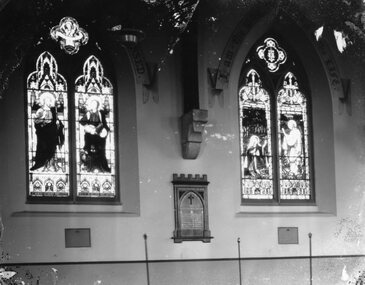
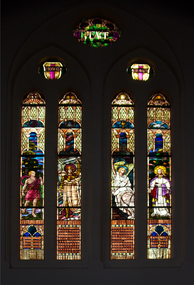
Photograph, Holy Trinity Anglican Church's Stained Glass Memorial Windows
... Holy Trinity Anglican Church's Stained Glass Memorial Windows...Holy Trinity Anglican Church Stained glass memorial Windows...Holy Trinity Anglican Church Stained glass memorial Windows Stawell Religion Holy Trinity Anglican Church's Stained Glass Memorial Windows Photograph ...Holy Trinity Anglican Church Stained glass memorial Windowsstawell religion -
 Tatura Irrigation & Wartime Camps Museum
Photograph, Daryl Walker, Presbyterian Church Stained Glass Window, 1986
... ...stained glass memorial windows...memorial windows Tatura Presbyterian Church. One of St. Andrew - in memory of Robert Barron, from his wife and family; St. Michael - in memory of Robert and Christina McTier and son Robert. Presbyterian Church Tatura Church stained windows stained glass ...Interior memorial windows Tatura Presbyterian Church. One of St. Andrew - in memory of Robert Barron, from his wife and family; St. Michael - in memory of Robert and Christina McTier and son Robert.Black and white photograph of stained glass windows, Presbyterian Church, Tatura.on back: Memorial window. Tatura Presbyterian Church. Photograph taken 1986.presbyterian church tatura, church stained windows, stained glass memorial windows -
 Bendigo Historical Society Inc.
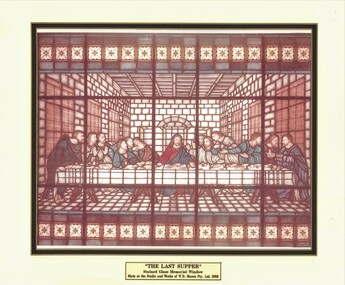
Photograph - W.D. MASON COLLECTION: ''THE LAST SUPPER''
... "The Last Supper" Stained glass memorial window made at the studio and works of W.D. ..."The Last Supper" Stained glass memorial window made at the studio and works of W.D. ...Photograph attached to cardboard. "The Last Supper" Stained glass memorial window made at the studio and works of W.D. Mason Pty Ltd 1968.bendigo, business, w.d. mason -
 Bendigo Military Museum
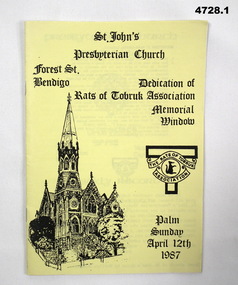
Programme - PROGRAMME, DEDICATION of RATS of TOBRUK, Rats of Tobruk Association, Dedication Service, Memorial Window, St. John's Presbyterian Church, Bendigo
... The stained glass memorial window was dedicated 12 April 1987. ...The stained glass memorial window was dedicated 12 April 1987. ...The stained glass memorial window was dedicated 12 April 1987. Dean Collection, refer Cat No 4575P1. The programme consists of 4 sheets of A.4 paper, when folded in two forms 16 pages. The cover is a yellow colour. The front cover has an image of St John's Church, the Rats of Tobruk Association logo and the title words. The rear cover has a black and white image of "A Weary Digger" drawn by Ivor Hele. Inside is a coloured photograph (15 x 10 cms) of the memorial window. The rest of the programme has the introduction and the church service by Rev. John E Webster B.A. LTh. Bendigo. 2, The programme is the same but without the coloured photo.ww2, rats of tobruk association -
 Christ Church Anglican Parish of Warrnambool
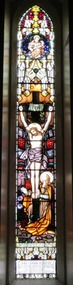
Memorial Window: John Edward BENNETT, Crucifixion "I, if I be lifted up from the earth/ will draw all men unto me"
... Stained glass memorial lancet window, central light, west wall, north nave, depicting the crucifixion of Jesus....Stained glass memorial lancet window, central light, west wall, north nave, depicting the crucifixion of Jesus. ...John Edward Bennett was born in Leeds, Yorkshire, 1862. He was devoted to his family and his church, being a churchwarden and a verstryman of this Parish. He was a lay preacher for 40 years in the Dioceses of Melbourne and Ballarat. He was the first Manager of the Warrnambool Woollen Mill. He died on Nov 10th 1928.He was the first manager of Warrnambool Woollen Mill.Stained glass memorial lancet window, central light, west wall, north nave, depicting the crucifixion of Jesus.To the Glory of God and in loving memory of/John Edward Bennett/ sometime Churchwarden and Vestryman of this Parish, and for/40 years a Lay Reader in the Dioceses of Melbourne and/ Ballarat, born in Leeds, Yorkshire, 1862, entered into rest Nov 10th, 1928/ A devoted husband and father,/ a faithful servant of God and His Church/Not slothful in business, fervent in spirit, serving the Lord.memorial stained glass window lancet window bennett je bennett john edward bennett warrnambool woollen mill -
 Victorian Interpretive Projects Inc.
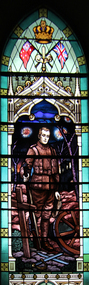
Photograph - Photograph - colour, Clare Kathleen Gervasoni, World War One Memorial Stained Glass Window, Former Barkly Street, Ballarat East, 2015, 05/04/2015
... The World War One Memorial Stained glass windows in the Barkly Street Uniting Church resulted from a request made in 1919 by the Barkly Street Young Men's Club to be given permission to raise money to pay for the project. ...Digital Photographs of the World War One memorial stained glass windows in the Barkly Street Uniting Church, Ballarat East....Digital Photographs of the World War One memorial stained glass windows in the Barkly Street Uniting Church, Ballarat East. ...The World War One Memorial Stained glass windows in the Barkly Street Uniting Church resulted from a request made in 1919 by the Barkly Street Young Men's Club to be given permission to raise money to pay for the project. The window was designed by Fisher Co. Pty Ltd, and was unveiled by a former army chaplain - either Rev. J.A. Gaunt or Rev. Bladen on the 14th March 1920. The total cost of the windows was 171 pounds 10 shillings. The window cost 150pounds, the window was fixed into position for 15 pounds, and three wire screens cost 6 pounds 10 shillings.Digital Photographs of the World War One memorial stained glass windows in the Barkly Street Uniting Church, Ballarat East.Repousse World War One tablet: 1914-1919 For God, King and Country The windows above have been erected as a memorial to the heroic lads of this school and church who fell in the Great War. Brittain, H.O. Butcher, J.C. Cornish, H. R. MM (Richard) Eady, James Arthur Edmends, William H. Ferguson, F. Farrar, A.Z. Gist, C.H. Gates, Stanley C. Grave, Howard B. Hughes, Arthur W. Hughes, George A.C. Jones, William Stanley (Stan) Marshall, Robert R. McConnell, A.R. (Ralph) Muller, A.V. Polkinghorne, E.C. (Clifford) Ridgwell, Herbert R. Sansum, Arthur H. Smith, Alfred G. Tait, Robert E. Tait, Lawrence (Laurie) Veal, Thomas P. Vincent, Leslie A.barkly street uniting church, barkly steet methodist church, barkly street weseyan church, j.a. gaunt, bladen, stained glass, soldier, world war, world war one, mmm -
 Bendigo Military Museum
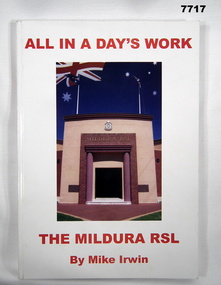
Book - BOOK, RSL HISTORY, Mike IRWIN, "ALL IN A DAY'S WORK", 2005
... Back - colour photograph of a stained glass memorial window. 205 pages, cut, plain white paper. ...Back - colour photograph of a stained glass memorial window. 205 pages, cut, plain white paper. ...From back cover- "FROM THE BOER WAR 1900/ TO EAST TIMOR 2000/ MILDURA WAS THERE! / A HISTORY OF SERVICE IN WAR & PEACE."Soft Cover Book. Cover - cardboard with adhered paper cover with gloss finish. Red colour print on front, spine and back cover. Illustrated, front colour photograph of a building entrance - "MILDURA RSL". Back - colour photograph of a stained glass memorial window. 205 pages, cut, plain white paper. Illustrated black and white and colour photographs, portraits and cartoons. Commissioned by the "MILDURA RSL SUB-BRANCH INCORPORATED".books, history, mildura rsl sub branch -
 Christ Church Anglican Parish of Warrnambool
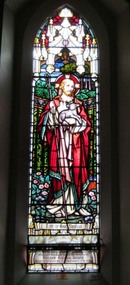
Memorial Window: Rev Walter Guthrie BOWER, Brooks Robinson & Co, The Good Shepherd
... Stained glass lancet window memorial to the Reverend Walter Guthrie Bower, the 7th Vicar of the Parish of Warrambool 1923 - 1932. ...A faithful minister of the Gospel. Stained glass lancet window memorial to the Reverend Walter Guthrie Bower, the 7th Vicar of the Parish of Warrambool 1923 - 1932. ...Rev Walter Guthrie Bower was born in Lincoln, Lincolnshire, England in 1877. He was a graduate of London University and was ordained a priest in 1901. He had been a curate of St. Michael & All Angels, Bedminster, then he became the Vicar of St. Thomas, Bristol, for 8 years prior to coming to Warrnambool in 1923. He made a lasting impression on the Parish with his teaching and Christian humility and service. He was a quiet, scholarly, Christian gentleman who endeared himself to all sections of the community. He was married to Norah Marianne. He resigned from the Vicariate of Warrnambool in 1932, to return to England to accept the living of Metfield with Withersdale, Suffolk. HIs address when he died was - The Vicarage, Metfield, Harleston, Norfolk. He died on Mar 26th, 1936 aged 59 yrs leaving his widow Norah. Norah died in 1963 aged approx 77 yrs in Horiston, Devon. Stained glass lancet window memorial to the Reverend Walter Guthrie Bower, the 7th Vicar of the Parish of Warrambool 1923 - 1932. Depicting Jesus as the Good Shepherd.To the Glory of God. In grateful and/affectionate memory of the life and ministry of/ Walter Guthrie Bower/ Vicar of this parish 19230-01932. A faithful minister of the Gospel. -
Tatura Irrigation & Wartime Camps Museum
Photograph, Daryl Walker, Presbyterian Interior Window, 1986
... Memorial stained glass window in Tatura Presbyterian church. ...Memorial stained glass window in Tatura Presbyterian church. ...Memorial stained glass window in Tatura Presbyterian church. In memorial of Ada Mary, wife of Rev. C. J. Legate and John Galloway Steward, killed in action.Black and white photograph of windows in interior of Presbyterian Church, Tatura. 2 copieson back: Memorial windows in Presbyterian church. Photograph taken 1986.tatura presbyterian church, ada mary legate, rev c. j. legate, john galloway -
 Returned Nurses RSL Sub-branch
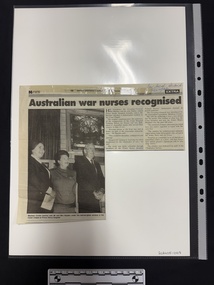
Newspaper - Newspaper clipping, Weekly Southern Courier, Australian war nurses recognised, Tuesday, February 21, 1995
... Article about the dedication of a memorial stained glass window in the Coast Chapel of the Prince Henry Hospital in Sydney, dedicated to nurses from all hospitals who served in the army, navy and airforce....Article about the dedication of a memorial stained glass window in the Coast Chapel of the Prince Henry Hospital in Sydney, dedicated to nurses from all hospitals who served in the army, navy and airforce. ...Article about the dedication of a memorial stained glass window in the Coast Chapel of the Prince Henry Hospital in Sydney, dedicated to nurses from all hospitals who served in the army, navy and airforce.Clipping of article with a large black and white photograph of two women and a man standing in front of a stained glass window. Article has two columns of text and the details of the publication are sticky taped to the top of the clipping.'Our local Randwick / Newspaper' [blue ink top right hand corner]war nurses, army nurses, airforce nurses, navy nurses, memorial, bill hayden, maylean cordia, sydney -
 Ballarat Heritage Services
Photograph - Stained Glass, Clare Gervasoni, Stained Glass Windows in Lydiard Street Uniting Church, Ballarat, 14/02/2009
... Colour photograph of World War One memorial stained glass windows in the Lydiard Street Uniting Church. ...Three Ballarat churches boast stained glass windows by Amalie Feild - St Andrew's Kirk, Lydiard Street Uniting Church, and the Mount Pleasant Methodist Church boast stained glass windows were made to Amalie's design. stained glass lydiard street uniting church amalie feild world war one memorial amalie colquhoun lydiard street wesleyan church Colour photograph of World War One memorial stained glass windows in the Lydiard Street Uniting Church. ...Three Ballarat churches boast stained glass windows by Amalie Feild - St Andrew's Kirk, Lydiard Street Uniting Church, and the Mount Pleasant Methodist Church boast stained glass windows were made to Amalie's design. Colour photograph of World War One memorial stained glass windows in the Lydiard Street Uniting Church. The windows were designed by Amalie Feild (later Colquhoun). The windows were made by Tarrant in 1920.stained glass, lydiard street uniting church, amalie feild, world war one memorial, amalie colquhoun, lydiard street wesleyan church -
 Ballarat Heritage Services
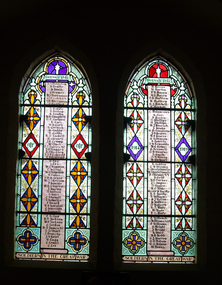
Photograph - Photograph - Colour, Stained Glass Windows in Lydiard Street Uniting Church, Ballarat, 14/02/2009
... Two colour photographs of World War One memorial stained glass windows in the Lydiard Street Uniting Church. ...stained glass lydiard street uniting church world war one memorial honour roll architecture Two colour photographs of World War One memorial stained glass windows in the Lydiard Street Uniting Church. ...Two colour photographs of World War One memorial stained glass windows in the Lydiard Street Uniting Church. Three windows are dedicated to those who volunteered for service and returned, the fourth commemorates those who fell. stained glass, lydiard street uniting church, world war one memorial, honour roll, architecture -
 Kew Historical Society Inc
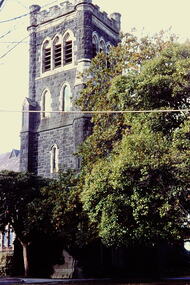
Slide - Holy Trinity Anglican Church, 1976
... Built of bluestone in 1863, with significant stained glass windows and memorial tablets, Holy Trinity is the oldest remaining ecclesiastical building in Kew. ...Built of bluestone in 1863, with significant stained glass windows and memorial tablets, Holy Trinity is the oldest remaining ecclesiastical building in Kew. ...Colour transparency (slide) created in June 1976 during a tour by the Junior National Trust, which was led by members of Kew Historical Society. The collection of 21 slides reveals that the tour covered all parts of Kew, but focused understandably on heritage buildings and sites.Image of an historic place in Kew that can be dated to an exact time and place. The images, albeit amateurish in composition, frequently reveal aspects of important buildings and sites that have changed over time.35mm colour transparency of the tower of Holy Trinity Anglican Church in High Street, Kew. Built of bluestone in 1863, with significant stained glass windows and memorial tablets, Holy Trinity is the oldest remaining ecclesiastical building in Kew. churches -- kew (vic.), holy trinity -- kew (vic.) -
 Mission to Seafarers Victoria
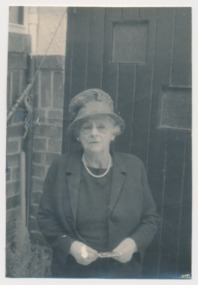
Photograph - Digital photograph, Black and white, Ruby Forge, c. 1967
... She donated the fund for one of the memorial stained glass window to her brother after his passing in 1917. ...She donated the fund for one of the memorial stained glass window to her brother after his passing in 1917. ...Ruby Forge (April 15th 1881-April 2nd 1969) was the sister of James Leslie Forge. She donated the fund for one of the memorial stained glass window to her brother after his passing in 1917. Ruby was engaged to a young man who was sent to the front during WWI. Unfortunately he died over there, and she never married. She passed away in April 1969. Sue McPhail, her niece, visited the Mission on Thursday 7 September 2023, bringing this photograph.Small black and white portrait of Ruby Forge wearing a hat.ruby forge, sue mcphail -
 Flagstaff Hill Maritime Museum and Village
Plaque - Commemorative Plaque, circa August 1947
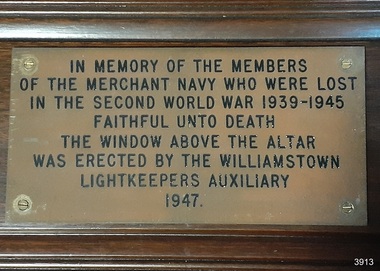
... This commemorative plaque was made for the round, stained glass memorial window titled “Christ showing the helmsman the way”, originally installed at the St Nicholas Seamen’s Church in Williamstown. ...Plaque refers to the memorial, a stained glass window titled "Christ Showing the Helmsman the Way," donated by the Williamstown Lightkeepers' Auxiliary to the Willimastown Missions to Seamen. ...This commemorative plaque was made for the round, stained glass memorial window titled “Christ showing the helmsman the way”, originally installed at the St Nicholas Seamen’s Church in Williamstown. ...This commemorative plaque was made for the round, stained glass memorial window titled “Christ showing the helmsman the way”, originally installed at the St Nicholas Seamen’s Church in Williamstown. The window was donated as a memorial to the members of the Merchant Navy whose lives were lost in the Second World War, 1939-1945. The donor was the Williamstown Lightkeepers Auxiliary, an independent ladies' association that worked with the Williamstown Missions to Seamen (renamed the Mission to Seafarers in 2000). The window was officially dedicated on December 14, 1947, by Geelong's Anglican Bishop, Rt. Rev. J.D. McKie. In the early months of 1948, this bronze plaque was also placed in the chapel above the altar. The Williamstown St Nicholas Seamen’s Church ceased operation in 1966. In 1979, the Victoria Missions to Seamen donated this round, stained glass window and the memorial plaque to Flagstaff Hill Maritime Village, along with many other items and furnishings. These items have been used to simulate the Williamstown Mission and Chapel as much as possible. THE MISSIONS TO SEAMEN: - The Missions to Seamen was an Anglican charity that served seafarers since 1856 in Great Britain. Its symbol is a Flying Angel, inspired by a Bible verse. Today, there are centres in over 200 ports worldwide where seamen of all backgrounds are offered a warm welcome and provided with a wide range of facilities. In Victoria, the orgainsation began in Williamstown in 1857 as a Sailors’ Church, also known as ‘Bethel’ or the ‘Floating Church’ in an old hulk floating in Hobson’s Bay, Port of Melbourne. It soon became part of the Missions to Seamen, Victoria. In the year 2000, the organisation, now named Mission to Seafarers, still operated locally in Melbourne, Portland, Geelong and Hastings. The Ladies’ Harbour Lights Guild was formed in 1906 to support the Missions to Seamen in Melbourne and other centres such as Williamstown. Two of the most significant ladies of the Guild were founder Ethel Augusta Godfrey and foundation member Alice Sibthorpe Tracy (who established a branch of the Guild in Warrnambool in 1920). The Guild continued its work until the 1960s. In 1943, a former Williamstown bank was purchased for the Missions to Seamen Club. The chapel was named St Nicholas’ Seamen’s Church and was supported by the Ladies’ Harbour Lights Guild, the Williamstown Lightkeepers’ Auxiliary and the League of Soldiers’ and Sailors’ Friends. It ceased operation in 1966. A Missions to Seamen Chapel and Recreation Room was a significant feature of ports during the late 1800s and into the 1900s. It seemed appropriate for Flagstaff Hill to include such a representation within the new Maritime Village, so the Melbourne Board of Management of Missions to Seamen Victoria gave its permission on 21st May 1979 for the entire furnishings of the Williamstown chapel to be transferred to Flagstaff Hill. The St Nicholas Seamen’s Church was officially opened on October 11, 1981 and closely resembles the Williamstown chapel. This plaque is significant for its connection with the round Sanctuary window above the altar in the chapel at Flagstaff Hill. The window was originally installed at the chapel of the St Nicholas Seamen’s Church in Williamstown in 1947, and is listed on the Victorian War Heritage Inventory No. 196973 as an object of significance. The plaque is also significant for its recognition of the members of the Merchant Navy who lost their lives in service to our country during World War II. The plaque is important for its connection with the Williamstown Lightkeepers’ Auxiliary and Missions to Seamen, which were dedicated to supporting seafarers from all over the world. The funds the group raised helped to furnish the St Nicholas Seamen’s Church in Williamstown, including the Sanctuary window, pews, carpets and hangings. These items are now part of the St Nicholas Seamen's Church Williamstown Collection at Flagstaff Hill Maritime Village, Warrnambool. Plaque: rectangular brass commemorative plaque. Each corner has a round hole. Inscription impressed into the metal and filled in with black paint. Plaque refers to the memorial, a stained glass window titled "Christ Showing the Helmsman the Way," donated by the Williamstown Lightkeepers' Auxiliary to the Willimastown Missions to Seamen. This plaque is part of the St. Nicholas Seamen's Church Collection. “IN MEMORY OF THE MEMBERS / OF THE MERCHANT NAVY WHO WERE LOST / IN THE SECOND WORLD WAR 1939-1945 / FAITHFUL UNTO DEATH / THE WINDOW ABOVE THE ALTAR / WAS ERECTED BY THE WILLIAMSTOWN / LIGHTKEEPERS AUXILIARY / 1947.”flagstaff hill, warrnambool, flagstaff hill maritime museum, maritime museum, shipwreck coast, flagstaff hill maritime village, mission to seamen williamstown, st nicholas seaman’s church williamstown, missions to seamen victoria, mission to seafarers, lightkeepers auxiliary, ladies harbour light guild, 139 nelson place williamstown, religion, religious service, sailors rest, bethel sailors’ church, bethel floating church, e. s. & a. bank williamstown, christ directing a sailor, christ showing the helmsman the way, quartermaster’s hand on the wheel, stained glass window, church window, religious window, sanctuary window, memorial window, war memorial window, victorian war heritage inventory, victorian heritage database, merchant navy ww2, 1939-1945, anglican church, bishop mckie, flying angel club, williamstown lightkeepers' auxiliary, ladies' harbour lights guild, commemorative window, memorial plaque, merchant navy, ww ii, st. nicholas seamen's church -
 Phillip Island and District Historical Society Inc.
Photograph, 1978/79
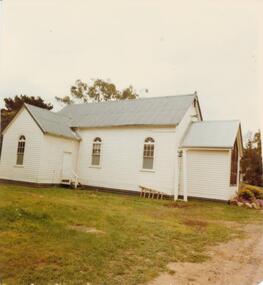
... In 1912 a Sanctuary was added to the church and a Memorial Stained Glass Window donated by Miss Rose in memory of her father and two brothers was installed....In 1912 a Sanctuary was added to the church and a Memorial Stained Glass Window donated by Miss Rose in memory of her father and two brothers was installed. ...The site on the corner of Thompson Avenue and Church Street, Cowes was reserved on the 12th April 1869 and the church was erected by the end of the year. Financed by the Island Church of England people. Dean McCartney preached the first sermon and performed the dedication service on 30th January 1870. Prior to this time services were held at the McHaffie homestead, Ventnor. Mrs S D (Georgianna) McHaffie, wife of the first European settlers, wrote in her diary "30th January 1870. Drove to Cowes, opened the Church, fine day". the large Bible presented by her is on loan and displayed in the Museum of the Phillip Island & District Historical Society.The timber Anglican Church of St Philips was built by Alex McLardy Sen. in 1869. It is still situated in Thompson Avenue on the corner of Church Street. The Vestry was added by Mr Alex McLardy in 1903 at the cost of 21 pounds. In 1912 a Sanctuary was added to the church and a Memorial Stained Glass Window donated by Miss Rose in memory of her father and two brothers was installed.local history, photographs, buildings, historic, buildings - historical, coloured photograph, john cook, phillip island, anglican church -
 Flagstaff Hill Maritime Museum and Village
Plaque - Commemorative, circa 1928
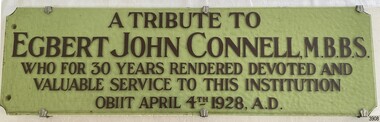
... Its conception was partly motivated by the offer of Stained Glass Memorial Windows from the local Warrnambool and District Base Hospital, which was undergoing multi-storey development in the late 1960’s and early 1970’s. ...glass rectangle mounted on white timber board and held in place with six decorative silver coloured clasps. Five rows of printed, capitalised text are fixed on the top surface. The plaque is companion to the commemorative, stained glass window installed in the St. Nicholas Mission to Seamen's Church at Flagstaff Hill. (The window was previously known locally as the Dr. Connell Memorial...stained glass widow called ‘Christ Guiding the Helmsman’. However the provenance of this particular artefact, large western window, is local. This plaque is significant because of its association with stained glass memorial window is of local, historical and social significance, linking local history and heritage with one of Warrnambool's doctors, Dr. ...This commemorative plaque refers to the religiously themed window situated in the western (weather) wall of the St. Nicholas Mission to Seamen’s Church building in the Flagstaff Hill Maritime Village. It was crafted circa 1928. ABOUT THE WINDOW The window, to which this plaque belongs was once known as the Dr Connell Memorial Window, which was a feature of an external wall adjacent to the Women’s Children’s Wards of Warrnambool Hospital. Honorary Doctors had played a significant role in the operation of the hospital between the years 1900 to 1939. One of these doctors was Dr. Connell, who passed away in 1928. A paragraph in the book ‘A History of the Warrnambool Base Hospital’ by Forth and Yule describes the role of the Honorary Doctors - “At the start of the period the senior-part time medical officer was replaced by the junior resident medical officer and control of beds and the right to operate were given to the honorary medical officers...and these men dominated the Warrnambool medical world in the years before the Second World War.” Dr. Connell leased ‘Ambleside’, 192 Koroit Street, in the early 20th century, following Dr Teed who had previously run his medical practice there. In 1914 Dr Connell purchased the property and continued his private practice there until his death in 1928. He also took a prominent part in hospital work, both as physician and surgeon, and often acted as spokesmen for the Honorary Doctors. According to colleague Dr. Horace Holmes’ subsequent notes, it was after the close of the First World War, and the following years of the world-wide pneumonic influenza epidemic, that Dr. Connell himself contracted pneumonia and died. His family and friends then recognised his work by gifting the memorial window in his honour to the Hospital. By the mid-1970s the old wards at the hospital had been replaced and there was no obvious place for the window. Discussions between the previous and past Hospital managers, the Anglican Diocese, and Flagstaff Hill Planning Board, led to its installation in its present position in St Nicholas Seamen’s Church. It was installed without the bottom section of stained glass, which was inscribed as a memorial to Dr. Connell. St NICHOLAS SEAMEN’S CHURCH, Anglican Church Flagstaff Hill’s Mission to Seamen was opened in 1981. Its conception was partly motivated by the offer of Stained Glass Memorial Windows from the local Warrnambool and District Base Hospital, which was undergoing multi-storey development in the late 1960’s and early 1970’s. The Manager/Secretary at the time was keen to see the historical windows installed in an appropriate location. The chapel was designed by a local architectural draftsman in conjunction with members of the Planning Board of Flagstaff Hill, and built by Mr Leon Habel. The vision of the designers included the hope that the church be used for formal worship such as weddings and funeral, and for multi-denominational special services such as War commemorations. The design is based on the ‘Mission to Seamen’ buildings in both Portland and Port Melbourne. These types of buildings were often erected to house social and worshipful activities for seamen. The materials used in the building include sandstone recycled from nineteenth-century buildings demolished in Warrnambool and American slate tiles retrieved from the 1908 wreck of the FALLS OF HALLADALE. Most of the chapel furnishings came from the Williamstown Missions to Seamen, which was consecrated in 1946 but later decommissioned. These artefacts range from the altar cloth to the hymn board and include a visually stunning round stained glass widow called ‘Christ Guiding the Helmsman’. However the provenance of this particular artefact, large western window, is local.This plaque is significant because of its association with stained glass memorial window is of local, historical and social significance, linking local history and heritage with one of Warrnambool's doctors, Dr. Egbert John Connell (d. 1928), who gave 30 years of dedicated, medical service to the local citizens.Plaque, opaque, pale green glass rectangle mounted on white timber board and held in place with six decorative silver coloured clasps. Five rows of printed, capitalised text are fixed on the top surface. The plaque is companion to the commemorative, stained glass window installed in the St. Nicholas Mission to Seamen's Church at Flagstaff Hill. (The window was previously known locally as the Dr. Connell Memorial Window.)"A TRIBUTE TO / EGBERT JOHN CONNELL, M.B.B.S. / WHO FOR 30 YEARS RENDERED DEVOTED AND / VALUABLE SERVICE TO THIS INSTITUTION / OBIIT APRIL 4th 1928, A.D."flagstaff hill, warrnambool, shipwrecked coast, flagstaff hill maritime museum, maritime museum, shipwreck coast, flagstaff hill maritime village, great ocean road, chapel window, stained glass window, warrnambool and district base hospital, st nicholas mission to seamen’s church, williamstown mission to seamen, dr egbert connell, ambleside warrnambool, leon habel builder, falls of halladale slate, memorial window, commemorative window, dr connell, commemorative plaque, plaque, edgar mcconnell -
Glen Eira Historical Society
Letter - St Pauls Anglican Church, 530 Dandenong Road, Caulfield North
... The book takes in all aspects of the church’s ministry, from acquiring the first building, church festivals, Dramatic Club, Social dances, Annual fetes, tennis club, St Pauls Preparatory School; Darish Heros, the 16 memorial stained glass windows, St Pauls dance group, Home group, the healing team, St Pauls Juvenile Orchestra and womens guilds. ...The book takes in all aspects of the church’s ministry, from acquiring the first building, church festivals, Dramatic Club, Social dances, Annual fetes, tennis club, St Pauls Preparatory School; Darish Heros, the 16 memorial stained glass windows, St Pauls dance group, Home group, the healing team, St Pauls Juvenile Orchestra and womens guilds. ...Ring out Wild Bells!', an all-encompassing history of St Pauls Anglican Church from 1904 – 2004 by Southern cross ministries.com.au. The book takes in all aspects of the church’s ministry, from acquiring the first building, church festivals, Dramatic Club, Social dances, Annual fetes, tennis club, St Pauls Preparatory School; Darish Heros, the 16 memorial stained glass windows, St Pauls dance group, Home group, the healing team, St Pauls Juvenile Orchestra and womens guilds. Correspondence to Claire Barton, dated 29/04/2010 from Cynthia Nyholm, with enclosed book – Ring out Wild Bells the centenary book for St Pauls Anglican Church; Caulfield North 2004.st paul’s anglican church, lynch frank rev., nyholm cynthia, falkingham john canon, north caulfield, ivens george walter dr., kircher godfre rev., saunders harriet eleanor (nelly), wilson albert rev., thewlis brian rev., saunder elizabeth (topsy), meredith charles rev., rutherford. graeme rev., arnold leonard rev, drought john rev., hannaford. john rev., rich roger rev., grully/moore alison, charles oliver, bell towers, clarke henry lowther, roberts frank, ngaruk william, boon wurrung, aboriginal peoples, the black chapel, hawthorn road, balaclava road, glen eira road, taylor rev., seddon rev., edith street, park street, st. mary's parish, shelley edgar, ellerslie, roe thomas, salisbury street, st. elmo's community, mccartney hugh, herring nigel, robinson john, mollinson a.j., derby parade, vance george, statham rev., priest rev., cox rev., queen's hall caulfield, jolly edith, evans jan, societal event and activities, clubs and associations, sporting clubs, cohen leslie, cohen doris, 'anselm', manses, wilson albert mrs, wainwright emily, ivens eleanor, roberts frank, falkenstein lynaire, dove bill, lawn david, edwards peter, jenkins barry, backhouse gerald, triller henrietta, monahan marjorie, wainright bill, 'yanga', alma road, dandenong road, fitzwater mr, lovell house girls school, st paul's preparatory school, independent schools, kindergartens, hoggart mrs, jackson miss, davidson bob, hutchens bernard, meredith benjamin, mannett david, hutchins harry, vicars, foote sheila, scholes lillian, mee elroy, driver marjorie, manton betty, bottomley hilda, west joan, finn grace, dell hazel, guild of the holy spirit, carrigan john rev., allen douglas, thompson norman, hardy don, moroney john, scott-simmons harry, morphet george, houghton robert, drought tom, stringer alf, miller eddie, michie bill, roberts david, hardy bill, cohen vernon, cohen leon, thewlis jeremy, tanner simon, lambert luke, wainwright bill, wilson albert, meredith charles, williams louis r., architects, dawson and smith, builders, monuments and memorials, st. paul apostle and martyr, red hill, ackland a.l., drought peter, kircher virginia, martinu ignaz, metal working, crafts and craft equipment, mathieson w., stained glass, morgan kerr w., cohen ursula, french anne maree, stephens evelyn, roberts janet, tanner john, oliphant alison, oliphant david, drought alison, widdowson charles rev., rich regina, fettel rex, amson evan, amson angela, stonehouse elwyn, thewlis elsbeth, cranswick jim, byrne meredith, jackson jill, jackson family, fitzgerald anne, molineux john, pilkington merridee, wood noel, major paula, major tracy, kaines fiona, west ed, nelson jenny, booth anne, pental road, carnarvon road, daynes alysa, tanner john, tanner winkie, jackson les, thornton graham, thornton gwyn, drought gladys, mcgillivery joan, glennen jim canon, wood maureen, wood david boyle, wood felicity, corrie ian, corrie lesley, sharrock heidi, sharrock lynette, sharrock david, rutherford david, samuel anto (hilda), hannaford john, palliar bob, golden hope healing sanctuary, hostels, moore alison, johnson wendy, stringer barbara, carson penny, edwards joan, glen eira intercessary group, smith beverly, daynes aylsa, lyon tryphena, fitzgerald anne, de bibra (peggy) margaret, de bibra florence, singleton george, darke guy, thompson norman, hutchinson jay, lawry margaret, woddy julie, mcgrath lesley, amson angela, prashanthi samuel, mclean rob, st. elmo's fire alpha in victoria, kainey john, kainey dick rev., amson evan, hannaford janine, hannaford john rev., playgrounds, shinkfield thelma, west joan, staham clive, batey mandy, walker david rev., stokes tom rev., batey david, freeman lesley, social services, pittaway geoff, jones greg, turf club hotel, the angel, conway carolyn, razmaran (raz) rameen, moore peter, thewlis sharon, walker stephen, turuwhenva jo maka maka, redman dylan, jolly david, toombs nicole, hannaford/akins christy, akins ben, edwards rozanne, masson andrew, batey kyle, batey ailsa, kovars aranka, graffiti, mcallister alison, buchanen noel, cocks damien, holland m.w., artists, akins robert, barberis irene, reynolds chris, wolstencroft ivor, gully/moore alison, moore peter, engineers, kovacs joseph, architects, vicars-foote bequest dorothy, hallock shanta, newman philip, molineux john, stained glass, molineux kim, moorhouse philip, o'farrell gavan, smith beverley rev., peppercorn miss, corrigan mrs, choirs, thomas ronald, geo fincham and sons, wicks mr, mcgillivery alf, organs, mcgillivery ian, touzeau mme, triller lily, lawrence jean, falkingham john, bonsal/boone peter, tweeddale alistair, worsnop paul, stonehouse pam, rutherford graeme, rutherford caroline, braun doug, naughton celia, correll madge, edwards joan, paranavitana darshini, gebert barb, wood felicity, cowell alison, mannaford lawson, ellankoon robby, knight sheila, thornton graeme, kyle estelle, davies john, roberts frank, welch ian, de saint-ferjeux, francis peggy, gill heather, lambert dale, newing joyce, young rosemary, mcallister (pownell/washington), roeland linda, mcdonald brendan, lewis irene, lewis graham, fitzgerald anne, hoffman tim, kaines fiona, marriott dianne, stryk angela, leaf narelle, choo lucy, fitzgerald narelle, nunis mark, waterman roma, beggs joshua, cramer deb, beggs camilla, gebert kelvin, oakes joanne, sargeant john, schulz wendy, smith lerisse, austin adrian, mitchell stephanie, oakes jessica, cropley stan, banks caroline, banks peter, chen caroline, west rob, chen family, mcgough virginia (now mcdonald_, fin tania, stonehouse elwyn, ryan luisa, knight sheila, savage ian rev., kircher jillian, kircher pamela, kircher margaret, bernaldo darryl, rich cassandra, rich leighton, james scott, correll madge (nee gamble), correll tony, o'brien maureen, rodwell kevin, de vries isabella, de vries andre, de vries darren, cummins mr, roberts mr, de vries ngaio (nee morre), wainright emily, wainright william, massauelli lionel, roberts frank, foster muriel, thomas janet, laycock gordon, shiel john, langmuir keith, langford alan, burns jack, manson ian, manton john, mclean robert, lund milton, carr sylvia, ross margie, naughton michael, edwards joan, chappele ethel, chappele marion, pollard mrs, moorhouse michelle, shipp joyce, hayman jean, bright-parker kath, stringer thelma, armstrong wendy, martin neil, stonehouse janet, eddy elsie, gras elsie, macartney kitty, ormond special school (katandra), herring nigel, roe sisters, watson w.g., nicholls w., beith harley, cullen phyllis, burns leline, hayman eric, boyd-jones ennys, roberts frank, ellankoon chrissie, blommestein michael, ahn sil -
 Flagstaff Hill Maritime Museum and Village
Artwork, other - Window, circa 1928
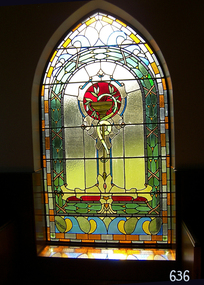
... memorial window in his honour to the Hospital. By the mid-1970s the old wards at the hospital had been replaced and there was no obvious place for the window. Discussions between the previous and past Hospital managers, the Anglican Diocese, and Flagstaff Hill Planning Board, led to its installation in its present position in St Nicholas Seamen’s Church and the memorial plaque was later installed beside the window. St NICHOLAS SEAMEN’S CHURCH, Anglican Church Flagstaff Hill’s Mission to Seamen was opened in 1981. Its conception was partly motivated by the offer of Stained Glass...Stained glass leadlight window in Gothic arched metal frame with six horizontal reinforcing rods. Image depicts a golden flat-bowled baptismal font on a slender stand with foliage proceeding from it. The image is internally framed by a Roman arch of coloured glass and surrounding rectangular and breaking-wave shapes. (The window was previously known locally as the Dr. Connell Memorial...stained glass widow called ‘Christ Guiding the Helmsman’. However the provenance of this particular artefact, large western window, is local. This stained glass memorial ...This religiously themed window is situated in the western (weather) wall of the St. Nicholas Mission to Seamen’s Church building in the Flagstaff Hill Maritime Village. It was crafted circa 1928. ABOUT THE WINDOW This window, once known as the Dr Connell Memorial Window, was a feature of an external wall adjacent to the Women’s Children’s Wards of Warrnambool Hospital. Honorary Doctors had played a significant role in the operation of the hospital between the years 1900 to 1939. One of these doctors was Dr. Connell, who passed away in 1928. The green glass plaque is also a registered object in Flagstaff Hill's Collection. Its inscription dedicates the window to Dr. Connell. The inscription reads: “A tribute to Egbert John Connell M.B.B.S. who for 30 years rendered devoted and valuable service to this institution. Obiit April 4th 1928 A.D." A paragraph in the book ‘A History of the Warrnambool Base Hospital’ by Forth and Yule describes the role of the Honorary Doctors - “At the start of the period the senior-part time medical officer was replaced by the junior resident medical officer and control of beds and the right to operate were given to the honorary medical officers...and these men dominated the Warrnambool medical world in the years before the Second World War.” Dr. Connell leased ‘Ambleside’, 192 Koroit Street, in the early 20th century, following Dr Teed who had previously run his medical practice there. In 1914 Dr Connell purchased the property and continued his private practice there until his death in 1928. He also took a prominent part in hospital work, both as physician and surgeon, and often acted as spokesmen for the Honorary Doctors. According to colleague Dr. Horace Holmes’ subsequent notes, it was after the close of the First World War, and the following years of the world-wide pneumonic influenza epidemic, that Dr. Connell himself contracted pneumonia and died. His family and friends then recognised his work by gifting the memorial window in his honour to the Hospital. By the mid-1970s the old wards at the hospital had been replaced and there was no obvious place for the window. Discussions between the previous and past Hospital managers, the Anglican Diocese, and Flagstaff Hill Planning Board, led to its installation in its present position in St Nicholas Seamen’s Church and the memorial plaque was later installed beside the window. St NICHOLAS SEAMEN’S CHURCH, Anglican Church Flagstaff Hill’s Mission to Seamen was opened in 1981. Its conception was partly motivated by the offer of Stained Glass Memorial Windows from the local Warrnambool and District Base Hospital, which was undergoing multi-storey development in the late 1960’s and early 1970’s. The Manager/Secretary at the time was keen to see the historical windows installed in an appropriate location. The chapel was designed by a local architectural draftsman in conjunction with members of the Planning Board of Flagstaff Hill, and built by Mr Leon Habel. The vision of the designers included the hope that the church be used for formal worship such as weddings and funeral, and for multi-denominational special services such as War commemorations. The design is based on the ‘Mission to Seamen’ buildings in both Portland and Port Melbourne. These types of buildings were often erected to house social and worshipful activities for seamen. The materials used in the building include sandstone recycled from nineteenth-century buildings demolished in Warrnambool and American slate tiles retrieved from the 1908 wreck of the FALLS OF HALLADALE. Most of the chapel furnishings came from the Williamstown Missions to Seamen, which was consecrated in 1946 but later decommissioned. These artefacts range from the altar cloth to the hymn board and include a visually stunning round stained glass widow called ‘Christ Guiding the Helmsman’. However the provenance of this particular artefact, large western window, is local. This stained glass memorial window is of local, historical and social significance, linking local history and heritage with one of Warrnambool's doctors, Dr. Egbert John Connell (d. 1928), who gave 30 years of dedicated, medical service to the local citizens.Stained glass leadlight window in Gothic arched metal frame with six horizontal reinforcing rods. Image depicts a golden flat-bowled baptismal font on a slender stand with foliage proceeding from it. The image is internally framed by a Roman arch of coloured glass and surrounding rectangular and breaking-wave shapes. (The window was previously known locally as the Dr. Connell Memorial Window and a plaque dedicated to Dr. Connell is catalogued separately. See Context notes for details.)flagstaff hill, warrnambool, shipwrecked coast, flagstaff hill maritime museum, maritime museum, shipwreck coast, flagstaff hill maritime village, great ocean road, chapel window, stained glass window, warrnambool and district base hospital, st nicholas mission to seamen’s church, williamstown mission to seamen, dr egbert connell, ambleside warrnambool, leon habel builder, falls of halladale slate, memorial window, commemorative window, dr connell -
 St Kilda Historical Society
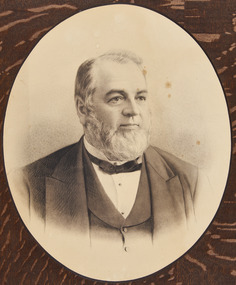
Photograph - Portrait, Edmund Samuel Parkes
... His life is commemorated with a stained-glass window and memorial plaque at Holy Trinity Church, Balaclava....His life is commemorated with a stained-glass window and memorial plaque at Holy Trinity Church, Balaclava. ...Edmund Samuel Parkes (1834-1887) married Nancy Penrose Lawry (1831-1886) in 1855 in London. They travelled to Australia aboard the Damascus in November 1867 with their six children and other relatives to enable Edmund to take up an appointment as inspector of the Bank of Australasia. Four more Parkes children were born in St Kilda. They lived at Iron (later called Willyama), 241 Carlisle Street, Balaclava. Edmund Parkes was one of the best educated banks in Victoria. Following his appointment as superintendent of the Bank of Australasia in 1876, he purchased a Remington typewriter for the bank and employed Australia's first woman bank employee, Mary Swifte, to operate it. Nancy died in 1886. Edmund died in a train accident in 1887. His life is commemorated with a stained-glass window and memorial plaque at Holy Trinity Church, Balaclava.Black and white photograph mounted on plywood and cardboardHandwritten notes on the back: Edmund Samuel Parkes Father of Agnes Sargood nee Parkesst kilda, edmund samuel parkes -
 Christ Church Anglican Parish of Warrnambool
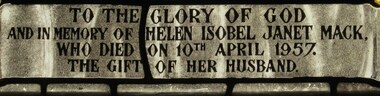
Memorial window: Helen Isobel Janet MACK, "Peace... Goodwill Towards Men"
... Her husband had erected in Christ Church, a Memorial Stained Glass window in her memory. Her husband was eventually Knighted (in 1967) while he was Minister for Health of which his main focus was on the mentally ill and the aged. ...Her husband had erected in Christ Church, a Memorial Stained Glass window in her memory. Her husband was eventually Knighted (in 1967) while he was Minister for Health of which his main focus was on the mentally ill and the aged. ...Helen Isobel Janet Mack was born to parents Gilbert Bailee Nicol and Lizzie (or Lillie) Mary Nicol (nee Jellie) at Woodford, Victoria or Rose Hill Warrong, in approx. 1895. Her mother's parents were James and Sarah Jane Jellie (nee Bower) Her father's parents were Gilbert and Jane Boili Nicol (nee Jelllie) She lived her life here at least until her first marriage. She firstly married a Mr LIndsay and they had two daughters - Helen and Jane. They were later divorced. On 16th February 1935, Helen married Ronald William Mack (a pioneering family of Warrnambool) at the Registry Office in Collins St. Melbourne. They had a son James. It appears Helen lived at 52 Banyan St, including while her husband was absent, until her death. Her husband Ronald William Mack was born in Warrnambool in 1904. He joined the Australian Imperial Forces and was based in the Middle East during some of WW11 and returned to Warrnambool in approx 1943 due to injury. He was involved in the community, and politics and was elected to the Legislative Council in 1955. Janet died on 10th April, 1957, aged 55 years, her funeral leaving Christ Church on April 11th. Her husband had erected in Christ Church, a Memorial Stained Glass window in her memory. Her husband was eventually Knighted (in 1967) while he was Minister for Health of which his main focus was on the mentally ill and the aged. He was then Sir Ronald William Mack. First wife of Sir Ronald William Mack. Stained glass, lancet window, north wall, Hammond Fellowship Centre, Christ Church. Depiction of the Nativity with Mary , Joseph and the infant Jesus"Peace... Goodwill Towards Men"/ To the Glory of God/ and in memory of Helen Isobel Janet Mack,/ who died on 10th April 1957./ The gift of her husband. -
 Flagstaff Hill Maritime Museum and Village
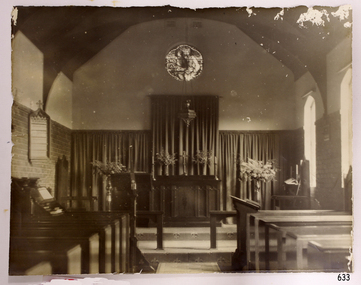
Photograph - Historical, religious, mid-20th century
... Nicholas Seamen's Church: - The idea behind Flagstaff Hill’s Missions to Seamen’s Church was partly driven by the offer of Stained Glass Memorial Windows that originated from the Warrnambool and District Base Hospital, which was undergoing multi-storey expansion in the late 1960s and early 1970s. ...Nicholas Seamen's Church: - The idea behind Flagstaff Hill’s Missions to Seamen’s Church was partly driven by the offer of Stained Glass Memorial Windows that originated from the Warrnambool and District Base Hospital, which was undergoing multi-storey expansion in the late 1960s and early 1970s. ...This photograph records the interior of St Nicholas Seamen's Church at 139 Nelson Place, Williamstown, Victoria, which was purchased and furnished around 1943. The furniture and furnishings are now part of the St. Nicholas Seamen's Church collection. HISTORY of the Missions to Seamen: - DETAILED HISTORY of the Missions to Seamen: - The Missions to Seamen is an Anglican (Church of England) charity that has served the world’s seafarers since 1856. It was inspired by the work of Rev. John Ashley, who, 20 years earlier, had pioneered a ministry to seafarers in the Bristol Channel in Great Britain. When Ashley retired, others continued the work, founding the Missions to Seamen. It adopted a Flying Angel as its symbol, inspired by a verse from the Bible in Revelation 14. Today, over 200 world ports have Missions to Seamen centres and chaplains. A Missions to Seamen’s Club warmly welcomes sailors of all colours, creeds and races and provides a wide range of facilities. The Missions to Seamen organisation changed its name to the Mission to Seafarers in 2000, continuing to include Missions to Seamen clubs in Victoria’s cities of Melbourne, Portland, Geelong and Hastings. Flagstaff Hill’s St Nicholas’ Seamen’s Church is named after its namesake from Williamstown, Victoria, which began in 1857. Bishop Perry opened the first Sailors’ Church there, known as ‘Bethel’, on an old hulk floating in Hobson’s Bay, Port of Melbourne. In 1860, a Sailors’ Rest started operating from rented premises in Williamstown. In 1878, the Sailors’ Church moved into an old Wesleyan chapel in Ann Street. By the end of that year, they managed to purchase the building, which they had already refurbished. In 1883, they affiliated with the Victorian Seamen’s Mission. A few years later, in 1906, the building had to be demolished because it was no longer safe. While they raised funds for a new building, the Sailors’ Rest temporarily moved to premises in front of Customs House in Nelson Place. Around this time, in 1906, the Ladies Harbour Lights Guild was formed in Australia to support and raise funds for the Mission to Seamen organisation in Melbourne. Two of the most significant ladies of the Guild were founding members Ethel Godfrey and Alice Sibthorpe. During the Mission's time at Siddeley Street, Melbourne, the activities of the Guild raised funds for the Mission to Seamen's Chapel at their new, and still current, premises in Flinders Street, Melbourne, opened in 1917. The Guild continued its important work until the 1960s. In 1908, the Williamstown Mission had enough money to purchase the former Mascotte skating rink on Thompson Street, Williamstown. In August of that year, they were inaugurated into the Victorian Missions to Seamen. They continued at that venue for a few decades. In 1943, the former ES&A Bank building at 139 Nelson Place, Williamstown, was purchased to become the new Mission to Seamen’s Club. On May 6th, 1944, it was officially opened, described as a ‘distinctive little building’. Funds had previously been raised for the building and furnishing of the chapel at the rear. The chapel was named St Nicholas’ Seamen’s Church, after St Nicholas, fourth-century bishop and patron saint of sailors. Services were held on Wednesdays and Sundays. The church was supported by the Williamstown Lightkeepers’ Auxiliary, newly founded by Mrs Ethel Margaret Musther in 1943, as well as the Harbour Lights Guild and the League of Soldiers’ and Sailors’ Friends. The Williamstown Mission to Seamen’s Church operated until 1966, when large international ships no longer used the Port of Williamstown. The Commonwealth Government then leased the premises. In the formative years of Flagstaff Hill Maritime Village, the Advisory Board decided to include a Missions to Seamen Chapel and Recreation Room in its village. The Missions organisation was a significant feature of ports during the late 1800s and early 1900s, the period that the Village represents. They often erected Missions to house social and worshipful activities for seamen. Flagstaff Hill’s curator, Mr Ken Marshman, approached the Melbourne Board of Management of Missions to Seamen regarding the Williamstown branch. Consequently, the Board permitted the furnishings of the Williamstown chapel to be transferred to Flagstaff Hill Maritime Village. A provision of the transfer was that the Victoria Missions to Seamen be recognised, that the items would remain as a collection, and that the chapel would be called St Nicholas Seamen’s Church and conduct Divine services. The donation was approved on 21st May 1979. Flagstaff Hill's St. Nicholas Seamen's Church: - The idea behind Flagstaff Hill’s Missions to Seamen’s Church was partly driven by the offer of Stained Glass Memorial Windows that originated from the Warrnambool and District Base Hospital, which was undergoing multi-storey expansion in the late 1960s and early 1970s. The hospital’s Manager/Secretary was eager to see the historic window installed in a suitable place. The church, or chapel, was designed by a local architectural draftsman in collaboration with the Flagstaff Hill Planning Board and was constructed by Mr Leon Habel. The designers hoped that the church would be used for formal worship such as weddings, funerals, and multi-denominational special services like war commemorations. The design is inspired by the ‘Missions to Seamen’ buildings in Portland and the Port of Melbourne. The furniture and furnishings were placed as accurately as possible according to photographs of the Williamstown St Nicholas Seamen’s Church and with assistance from local clergy. The Recreation Room was furnished and arranged on advice from experienced members of the Missions to Seamen organisation. A framed document in the building recognises the donor of the furnishings, Victoria Missions to Seamen, and includes the names of some original donors and their donated item/s. The building’s design incorporates local features such as Warrnambool sandstone, which was no longer commercially available but was procured from demolished buildings and uniformly cut to use as a veneer over the stronger Mt. Gambier stone. Also, traditional green American roofing slate was used, sourced from the 1908 local shipwreck “Falls of Halladale” by Flagstaff Hill volunteer divers. The bell tower includes a bell believed to be from a local shipwreck. Additional furnishings were acquired locally, along with several items donated by Warrnambool residents. Light fittings in both rooms were assembled to simulate 19th-century gas light fittings. The stained-glass window at the back of the church is a memorial to Dr Connell, a well-respected member of the Warrnambool community. It was originally installed in 1928 in the main building of Warrnambool Hospital. The St Nicholas’ Seamen’s Church at Flagstaff Hill was officially opened by His Worship the Mayor, Cr. John Lindsay, on Sunday, 11th October 1981. The event included a service of thanksgiving conducted by the Warrnambool Ministers Fraternal. Since then, the Chapel has been the historic venue for many weddings. This photograph is significant through its association with the St Nicholas' Mission to Seamen Church in Williamstown, Melbourne, established in 1857. The building in the photograph is the former English, Scottish and Australian Bank (ES&A bank), also known as the Mission to Seamen. It is listed on the Victorian Heritage Database for having local historic and aesthetic interest. Photograph of St Nicholas Seamen's Church, Williamstown. Sepia photograph. The photograph shows the inside of the Chapel of Mission to Seamen, including organ, pews and other furniture and furnishings. There is a circular stained glass window high on the back wall depicting a sailor at the helm of a ship and a man standing behind him and pointing the way - "Christ Showing The Helmsman The Way". A Sanctuary Light is suspended from the ceiling. The Sanctuary chars are visible. This shows the St Nicholas Seamen's Church in Williamstown, the furnishings and furniture of which is now part of the St Nicholas Seamen's Church Collection’.flagstaff hill, warrnambool, shipwrecked-coast, flagstaff-hill, flagstaff-hill-maritime-museum, maritime-museum, shipwreck-coast, flagstaff-hill-maritime-village, st nicholas mission to seamen's church williamstown, mission to seamen williamstown, mission to seamen victoria, st nicholas mission to seamen, chapel window, christ showing the helmsman the way, stained glass window, st nicholas seamen's church, religion, religious service, sailor's rest, ladies harbour light guild -
 Flagstaff Hill Maritime Museum and Village
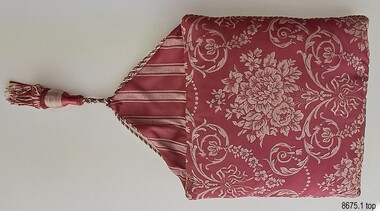
Textile - Seat Squabs, mid-20th century
... Nicholas Seamen's Church: - The idea behind Flagstaff Hill’s Missions to Seamen’s Church was partly driven by the offer of Stained Glass Memorial Windows that originated from the Warrnambool and District Base Hospital, which was undergoing multi-storey expansion in the late 1960s and early 1970s. ...Nicholas Seamen's Church: - The idea behind Flagstaff Hill’s Missions to Seamen’s Church was partly driven by the offer of Stained Glass Memorial Windows that originated from the Warrnambool and District Base Hospital, which was undergoing multi-storey expansion in the late 1960s and early 1970s. ...The term 'seat squabs' is no longer commonly used, but is sometimes referred to in the upholstery and motor vehicle industries. Squabs are padded cushions frequently added to wooden chairs or benches to add comfort to their hard forms. They have been made to an 18th-to-19th-century pattern using beautiful, richly coloured satin fabric and fancy cord tassels. The weighted flap at the rear of the squabs helps to keep them in place on the chair, and could be used on the top of the backrest instead of on the seat. These days, squabs are attached with fabric ties or hook-and-loop tabs. These seat squabs were once used in the St Nicholas Seamen's Church at 139 Nelson Place, Williamstown, Victoria, which was purchased and furnished around 1943. The furniture and furnishings are now part of the St. Nicholas Seamen's Church collection. DETAILED HISTORY of the Missions to Seamen: - The Missions to Seamen is an Anglican (Church of England) charity that has served the world’s seafarers since 1856. It was inspired by the work of Rev. John Ashley, who, 20 years earlier, had pioneered a ministry to seafarers in the Bristol Channel in Great Britain. When Ashley retired, others continued the work, founding the Missions to Seamen. It adopted a Flying Angel as its symbol, inspired by a verse from the Bible in Revelation 14. Today, over 200 world ports have Missions to Seamen centres and chaplains. A Missions to Seamen’s club warmly welcomes sailors of all colours, creeds and races and provides a wide range of facilities. The Missions to Seamen organisation changed its name to the Mission to Seafarers in 2000, continuing to include Missions to Seamen clubs in Victoria’s cities of Melbourne, Portland, Geelong and Hastings. Flagstaff Hill’s St Nicholas’ Seamen’s Church is named after its namesake from Williamstown, Victoria, which began in 1857. Bishop Perry opened the first Sailors’ Church, which was known as ‘Bethel’, on an old hulk floating in Hobson’s Bay, Port of Melbourne. In 1860, a Sailors’ Rest started operating from rented premises in Williamstown. In 1878, the Sailors’ Church moved into an old Wesleyan chapel in Ann Street. By the end of that year, they managed to purchase the building, which they had already refurbished. In 1883, they affiliated with the Victorian Seamen’s Mission. A few years later, in 1906, the building had to be demolished because it was no longer safe. While they raised funds for a new building, the Sailors’ Rest temporarily moved to premises in front of Customs House in Nelson Place. Around this time, in 1906, the Ladies Harbour Lights Guild was formed in Australia to support and raise funds for the Mission to Seamen organisation in Melbourne. Two of the most significant ladies of the Guild were founding members Ethel Godfrey and Alice Sibthorpe. During the Mission's time at Siddeley Street, Melbourne, the activities of the Guild raised funds for the Mission to Seamen's Chapel at their new, and still current, premises in Flinders Street, Melbourne, opened in 1917. The Guild continued its important work until the 1960s. In 1908, the Williamstown Mission had enough money to purchase the former Mascotte skating rink on Thompson Street, Williamstown. In August of that year, they were inaugurated into the Victorian Missions to Seamen. They continued at that venue for a few decades. In 1943, the former ES&A Bank building at 139 Nelson Place, Williamstown, was purchased for the new Mission to Seaman’s Club. The official opening was on May 6th, 1944. It was described as a ‘distinctive little building’. Funds had previously been raised for the building and furnishing of the chapel at the rear. The chapel was named St Nicholas’ Seamen’s Church, after St Nicholas, fourth-century bishop and patron saint of sailors. Services were held on Wednesdays and Sundays. The church was supported by the Williamstown Lightkeepers’ Auxiliary, newly founded by Mrs Ethel Margaret Musther in 1943, as well as the Harbour Lights Guild and the League of Soldiers’ and Sailors’ Friends. The Williamstown Mission to Seamen’s Church operated until 1966, when large international ships no longer used the Port of Williamstown. The Commonwealth Government then leased the premises. In the formative years of Flagstaff Hill Maritime Village, the Advisory Board decided to include a Missions to Seamen Chapel and Recreation Room in its village. The Missions organisation was a significant feature of ports during the late 1800s and early 1900s, the period that the Village represents. They often erected Missions to house social and worshipful activities for seamen. Flagstaff Hill’s curator, Mr Ken Marshman, approached the Melbourne Board of Management of Missions to Seamen regarding the Williamstown branch. Consequently, the Board permitted the furnishings of the Williamstown chapel to be transferred to Flagstaff Hill Maritime Village. A provision of the transfer was that the Victoria Missions to Seamen be recognised, that the items would remain as a collection, and that the chapel would be called St Nicholas Seamen’s Church and conduct Divine services. The donation was approved on 21st May 1979. Flagstaff Hill's St. Nicholas Seamen's Church: - The idea behind Flagstaff Hill’s Missions to Seamen’s Church was partly driven by the offer of Stained Glass Memorial Windows that originated from the Warrnambool and District Base Hospital, which was undergoing multi-storey expansion in the late 1960s and early 1970s. The hospital’s Manager/Secretary was eager to see the historic window installed in a suitable place. The church, or chapel, was designed by a local architectural draftsman in collaboration with the Flagstaff Hill Planning Board and was constructed by Mr Leon Habel. The designers hoped the church would be used for formal worship, such as weddings, funerals, and multi-denominational special services like war commemorations. Its design was inspired by the ‘Missions to Seamen’ buildings in Portland and the Port of Melbourne. The furniture and furnishings were placed as accurately as possible according to photographs of the Williamstown St Nicholas Seamen’s Church and with assistance from local clergy. The Recreation Room was furnished and arranged on advice from experienced members of the Missions to Seamen organisation. A framed document in the building recognises the donor of the furnishings, Victoria Missions to Seamen, and includes the names of some original donors and their donated item/s. The building’s design incorporates local features such as Warrnambool sandstone, which was no longer commercially available but was procured from demolished buildings and uniformly cut to use as a veneer over the stronger Mt. Gambier stone. Also, traditional green American roofing slate was used, sourced from the 1908 local shipwreck “Falls of Halladale” by Flagstaff Hill volunteer divers. The bell tower includes a bell believed to be from a local shipwreck. Additional furnishings were acquired locally, and several items were donated by Warrnambool residents. Light fittings in both rooms were assembled to simulate 19th-century gas light fittings. The stained-glass window at the back of the church is a memorial to Dr Connell, a well-respected member of the Warrnambool community. It was originally installed in 1928 in the main building of Warrnambool Hospital. The St Nicholas’ Seamen’s Church at Flagstaff Hill was officially opened by His Worship the Mayor, Cr. John Lindsay, on Sunday, 11th October 1981. The event included a service of thanksgiving conducted by the Warrnambool Ministers Fraternal. Since then, the Chapel has been the historic venue for many weddings. This pair of seat squabs is historically significant for its origin in the St Nicholas Mission to Seamen's Church in Williamstown, established in 1857 to cater for seafarers’ physical, social, and spiritual needs. The organisation originated in Bristol, England, when a Seamen's Mission was formed in 1837. The squabs are also significant for their use in the St Nicholas Missions to Seamen's chapel, Williamstown, as the original building is now listed on the Victorian Heritage Register. Squabs or padded seat cushions, a pair of two. These 18th to 19th-century design squabs have crimson and cream satin fabric on top and underneath, and weighted tassels are attached to their rear corners. They can be used for comfort on hard seats and benches. The squabs were furnishings from the Missions to Seamen chapel in Williamstown, and they are now part of the St Nicholas Seamen's Church Collection.flagstaff hill, warrnambool, shipwrecked-coast, flagstaff-hill, flagstaff-hill-maritime-museum, maritime-museum, shipwreck-coast, flagstaff-hill-maritime-village, st nicholas mission to seamen's church williamstown, mission to seamen williamstown, mission to seamen victoria, st nicholas mission to seamen, st nicholas seamen's church, religion, religious service, sailor's rest, ladies harbour light guild, squab, seat covers, cushions, squabs, religious furnishing, padded seats, seating, accessory -
 Flagstaff Hill Maritime Museum and Village
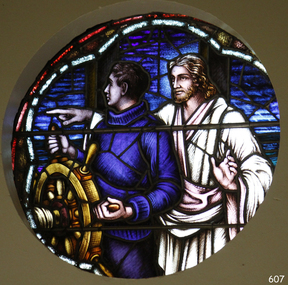
Artwork, other - Window, Brooks, Robinson & Co, Christ Showing the Helmsman the Way, circa August 1947
... This round, stained glass window, titled "Christ Showing the Helmsman the Way", was also referred to as the Sanctuary Window or Memorial window. ...This round, stained glass window, titled "Christ Showing the Helmsman the Way", was also referred to as the Sanctuary Window or Memorial window. ...This round, stained glass window, titled "Christ Showing the Helmsman the Way", was also referred to as the Sanctuary Window or Memorial window. It was installed in the St Nicholas Seamen's Church at 139 Nelson Place, Williamstown, Victoria, inside the chapel above the altar. This memorial window has significance as a part of Victoria's War Heritage and is listed on the Victorian Heritage Database. The window and subsequent plaque were donated to St Nicholas Seamen’s Church as a memorial to the members of the Merchant Navy whose lives were lost in the Second World War, 1939-1945. The donor was the Williamstown Lightkeepers Auxiliary, an independent ladies' association working with the Williamstown Missions to Seamen (the Missions to Seamen organisation was re-named the Mission to Seafarers in the year 2000). The window was officially dedicated on December 14, 1947, by Geelong's Anglican Bishop, Rt. Rev. J.D. McKie. In the early months of 1948, a bronze plaque was also placed in the chapel above the altar. It recognises the lost souls of the Merchant Navy during World War 2, as well as the donor of the window, the Williamstown Lightkeepers Auxiliary. The inscription impressed on the rectangular bronze plaque, 20.4 x 10.2cm, is as follows: “IN MEMORY OF THE MEMBERS OF THE MERCHANT NAVY WHO WERE LOST IN THE SECOND WORLD WAR 1939-1945 FAITHFUL UNTO DEATH. THE WINDOW ABOVE THE ALTAR WAS ERECTED BY THE WILLIAMSTOWN LIGHTKEEPERS AUXILIARY 1947.” The Williamstown St Nicholas Seamen’s Church ceased operation in 1966. In 1979, the Victoria Missions to Seamen donated this round, stained glass window and the memorial plaque to Flagstaff Hill Maritime Village, along with many other items and furnishings. These items have been used to simulate the Williamstown Mission and Chapel as much as possible. The round space that formerly displayed the window can still be seen at the back of the old St Nicholas Seamen’s Church, previously the ES&A bank, in Williamstown. THE MISSIONS TO SEAMEN (Brief History): - The Missions to Seamen was an Anglican charity in Great Britain that has served the world's seafarers since 1856. Its symbol is a Flying Angel, inspired by a Bible verse. Today, there are centres in over 200 ports worldwide where seamen of all backgrounds are offered a warm welcome and provided with a wide range of facilities. In Victoria, the organisation began in Williamstown in 1857 as a Sailors’ Church, also known as ‘Bethel’ or the ‘Floating Church’ in an old hulk floating in Hobson’s Bay, Port of Melbourne. It soon became part of the Missions to Seamen, Victoria. In 2000, the organisation, now named Mission to Seafarers, still operated locally in Melbourne, Portland, Geelong and Hastings. The Ladies’ Harbour Lights Guild was formed in 1906 to support the Missions to Seamen in Melbourne and other centres, such as Williamstown. Two of the most significant ladies of the Guild were founder Ethel Augusta Godfrey and foundation member Alice Sibthorpe Tracy (who established a branch of the Guild in Warrnambool in 1920). The Guild continued its work until the 1960s. In 1943, a former Williamstown bank was purchased for the Missions to Seamen Club. The chapel was named St Nicholas’ Seamen’s Church and was supported by the Ladies’ Harbour Lights Guild, the Williamstown Lightkeepers’ Auxiliary and the League of Soldiers’ and Sailors’ Friends. It ceased operation in 1966. A Missions to Seamen Chapel and Recreation Room was a significant feature of ports during the late 1800s and 1900s. It seemed appropriate for Flagstaff Hill to include such a representation within the new Maritime Village, and the Melbourne Board of Management of Missions to Seamen Victoria gave its permission on 21st May 1979 for the entire furnishings of the Williamstown chapel to be transferred to Flagstaff Hill. The St Nicholas Seamen’s Church was officially opened on October 11, 1981, and resembles the Williamstown chapel. This stained glass window is historically significant for its connection to the St Nicholas Mission to Seamen's Church in Williamstown, established in 1857 to cater for the physical, social, and spiritual needs of seafarers. It was donated to the Mission by the Lightkeepers Auxiliary (Ladies Harbour Lights Guild, which was formed in 1905). The Missions to Seamen organisation had its origins in Bristol, England, when a Seamen's Mission was formed in 1837. The first Australian branch was started in 1856 by the Rev. Kerr Johnston, a Church of England clergyman, and operated from a hulk moored in Hobson’s Bay. Later, the Mission occupied buildings in Williamstown and Port Melbourne. The connection of this window, the Mission to Seamen and the Ladies Harbour Lights Guild highlights the strong community awareness of the life of people at sea, their dangers and hardships, and their need for physical, financial, spiritual and moral support. This memorial window is significant as a part of Victoria's War Heritage and is listed on the Victorian Heritage Database, Heritage Number 196973.Window, stained glass, circular, with reinforcing bars. The window represents Christ showing the helmsman the way. It shows a man in blue knitted jumper holding onto a ship's wheel, looking over his right shoulder. Behind him stands a man in a white robe, pointing to his right and looking to his left, his left hand gesturing to pause. The background has various shapes and patterns of blue glass, bordered by two arcs; the outer one is white, the inner one is red. This beautiful window is in our St Nicholas Seamen's Church Collection and was brought to Warrnambool from the original St Nicholas Seamen’s Church in Williamstown. flagstaff hill, warrnambool, shipwrecked coast, flagstaff hill maritime museum, maritime museum, shipwreck coast, flagstaff hill maritime village, great ocean road, mission to seamen williamstown, st nicholas seaman’s church williamstown, missions to seamen victoria, mission to seafarers, lightkeepers auxiliary, ladies harbour light guild, 139 nelson place williamstown, religion, religious service, sailors rest, bethel sailors’ church, bethel floating church, e. s. & a. bank williamstown, christ directing a sailor, christ showing the helmsman the way, quartermaster’s hand on the wheel, stained glass window, church window, religious window, sanctuary window, memorial window, war memorial window, victorian war heritage inventory, victorian heritage database, merchant navy ww2, 1939-1945, anglican church, bishop mckie, mrs musther, brooks robinson & co, flying angel club, williamstown lightkeepers' auxiliary, ladies' harbour lights guild, commemorative window -
 Federation University Historical Collection
Magazine, Ballarat Courier, The Christmas Number of the Ballarat Courier Special Edition, 1921, 20/12/1921
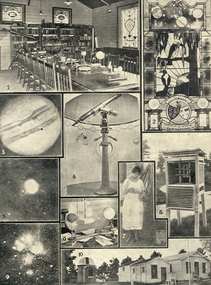
... The 1921 edition had the theme 'Industrial Ballarat'. ballarat newspaper wf coltman ridings dentist ballarat botanical gardens lake wendouree fishing james smith pty ltd ludbrook undertaker jubilee lake daylesford hager underthaker springmount barlow motors ballarat mining exchnage south street competitions we longhurst ru nicholls lal lal falls old colonists association of ballarat clark cottage swj clark williams cottage f.j. williams ritchies grocery stores american sailors victorian methodist local preachers association ballarat police force macrobertson staff ballarat sewerage authority commons bros monumental masons fdp miller herbalist lake tyers pine plantation tonner memorial george tonner ballarat observatory ballarat north gold club tw glasgow suttons music store barnet glass road race lake burrumbeet berry anderson val purdue rowlands ballarat motor cycle club Stained Glass windows Printed magazine with many Ballarat images and advertisements. ...The Ballarat Courier did an annual December magazine. The 1921 edition had the theme 'Industrial Ballarat'. Printed magazine with many Ballarat images and advertisements. Images include: Barnet Glass Road Race (Ballarat to Melbourne, c1921); Berry Anderson and Co.; View from Springmount; Ballarat North Gold Club; Lake-Burrumbeet; Ballarat Motor Cycle Club Reliability Trial; Ballarat Observatory; Ballarat Old Colonists' Homes, F.W. Williams, S.W.J. Clarkballarat, newspaper, wf coltman, ridings dentist, ballarat botanical gardens, lake wendouree, fishing, james smith pty ltd, ludbrook undertaker, jubilee lake daylesford, hager underthaker, springmount, barlow motors, ballarat mining exchnage, south street competitions, we longhurst, ru nicholls, lal lal falls, old colonists association of ballarat, clark cottage, swj clark, williams cottage, f.j. williams, ritchies grocery stores, american sailors, victorian methodist local preachers association, ballarat police force, macrobertson staff, ballarat sewerage authority, commons bros monumental masons, fdp miller, herbalist, lake tyers, pine plantation, tonner memorial, george tonner, ballarat observatory, ballarat north gold club, tw glasgow, suttons music store, barnet glass road race, lake burrumbeet, berry anderson, val purdue, rowlands, ballarat motor cycle club, stained glass windows -
 Federation University Historical Collection
Booklet - Church, Harry Brown and Co, St Peter's Church, Ballarat, 1961
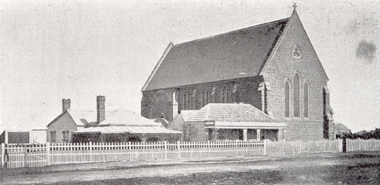
... Stained Glass W. Tunbridge H.C. Curwen-Walker White soft covered booklet outlining the first 100 years of St Peter's Anglican Church, Ballarat. The book includes information on each of the ministers until 1961, a programme of the Centenary Celebrations, and black and white photographs of the exterior and interior of the church. Images include the Pittard Memorial Windows ...St Peter's Church was established in 1861 in the school house. In 1864 the question of building a church was seriously discussed. A foundation stone for the church was laid on 16 November 1864 by Bendan S. Hassell. The architect was Charles Davenport Cuthbert; the trustees were Somerville Learmonth, W.P. Whitcombe, Robert Wynne and J.B. McQuie. The church building committee consisted of Horace walker, J.S. Carver, John M. Fisher, Robert Williams, Thomas Gibson, John E. Hodgson and W. Lindisay Richardson. The foundation stone of the Soldier's Chapel was laid on 06 April 1917. The beautiful stained glass in the chapel was donated by Mrs W. Tunbridge and H.C. Curwen-Walker, in memory of their sons who were killed during World War One. In 1929 a new three manual organ by London's Hill, Norman and Beard was installed. It was the first in Ballarat with electro-pneumatic action.White soft covered booklet outlining the first 100 years of St Peter's Anglican Church, Ballarat. The book includes information on each of the ministers until 1961, a programme of the Centenary Celebrations, and black and white photographs of the exterior and interior of the church. Images include the Pittard Memorial Windows, the Crocker Memorial Windows and baptistry, and H.W.H. Adeney.st peter's anglican church ballarat, churches, religion, charles d. cuthbert, stained glass, w. tunbridge, h.c. curwen-walker -
 Mission to Seafarers Victoria
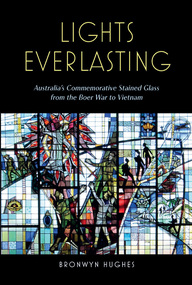
Book, Australian Scholarly Publishing, Lights Everlasting: Australia’s commemorative stained glass from the Boer War to Vietnam, 2023
... stained glass windows are mentioned in the book. Bronwyn Hughes is the stained glass specialist in Australia and has a long connection with the Mission as she helped identifies the chapel windows' origins. australian history ww1 ww2 boer war vietnam war stained glass windows bronwyn hughes Almost hidden within religious buildings, hospitals, school chapels and civic buildings, stained-glass windows tell of Australians at war. Bronwyn Hughes focuses on commemorative stained glass—an overlooked art form—describing its rich artistic and architectural heritage and the artists and firms who created it. Memorial ...Almost hidden within religious buildings, hospitals, school chapels and civic buildings, stained-glass windows tell of Australians at war. Bronwyn Hughes focuses on commemorative stained glass—an overlooked art form—describing its rich artistic and architectural heritage and the artists and firms who created it. Memorial stained glass serves to depict and illuminate the men and women who fought and died for their faith and their country. It has a tragic beauty. The book includes stained glass windows from the St Peter chapel of the Mission to Seafarers.255 pages with colour and black and white illustrations; notes, bibliography, index.non-fictionAlmost hidden within religious buildings, hospitals, school chapels and civic buildings, stained-glass windows tell of Australians at war. Bronwyn Hughes focuses on commemorative stained glass—an overlooked art form—describing its rich artistic and architectural heritage and the artists and firms who created it. Memorial stained glass serves to depict and illuminate the men and women who fought and died for their faith and their country. It has a tragic beauty. The book includes stained glass windows from the St Peter chapel of the Mission to Seafarers.australian history, ww1, ww2, boer war, vietnam war, stained glass windows, bronwyn hughes -
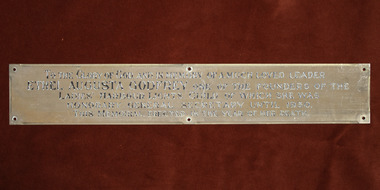 Mission to Seafarers Victoria
Plaque - Memorial Plaque, Ethel Augusta Godfrey
... It's one the three memorials to Ethel Godfrey with the stained glass window in the St Peter chapel in the Central Institute (See 0064.2) ) and the optus sectile plaque in the 1888 Port Melbourne Institute (See 2053) . ...It's one the three memorials to Ethel Godfrey with the stained glass window in the St Peter chapel in the Central Institute (See 0064.2) ) and the optus sectile plaque in the 1888 Port Melbourne Institute (See 2053) . ...This plaque was erected in the Williamstown Sailors' Rest, the former skating ring in Thompson Street. It's one the three memorials to Ethel Godfrey with the stained glass window in the St Peter chapel in the Central Institute (See 0064.2) ) and the optus sectile plaque in the 1888 Port Melbourne Institute (See 2053) . This plaque was moved to the Nelson Place building when the Mission purchased the E,S&A Bank in 1943. In 1982, the plaque ws removed from the Williamstown mission along with 4 other plaques, objects and furniture to furnish the chapel of the new Flagstaff Maritime Museum. The transfer of the 5 plaques was requested in 2020 and they returned to the Mission's collection in 2022.The plaque along with the two other memoriels erected in the memory of Ethel Godfrey demonstrates the gratitude for the her 30 years of work.Rectangular plaque for Ethel Augusta Godfrey ethel augusta godfrey 1861-1935, williamstown, thompson street, seamen's mission, sailors' rest, flasgstaff maritime museum, lhlg -
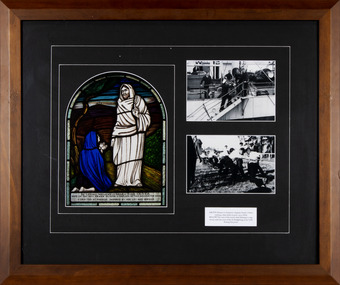 Mission to Seafarers Victoria
Photograph - Framed montage, Arthouse - Picture Framing & Gallery, Noli Me Tangere, 2013
... stained glass windows from the St Peter chapel. This exhibition curated by Georgia Melville and Catherine McLay, and funded by PROV and Creative Victoria, was displayed in the World Trade Centre Wharf Gallery in June July 2013 and toured to Queenscliff Maritime Museum. The photographs of the windows were taken by scientific photographer Justine M. Philip. This frame is showcasing the memorial...stained glass windows from the St Peter chapel. This exhibition curated by Georgia Melville and Catherine McLay, and funded by PROV and Creative Victoria, was displayed in the World Trade Centre Wharf Gallery in June July 2013 and toured to Queenscliff Maritime Museum. The photographs of the windows were taken by scientific photographer Justine M. Philip. This frame is showcasing the memorial ...A GLOBAL PERSPECTIVE Before the increase of air transport, everything that arrived or departed from Australia did so via the ports and wharves. The Mission to Seafarersis not a Victorian initiative, but rather a global network that currently operates in over 260 ports worldwide, assisting over 1.3 million seafaring men and women each year. The importance of the Mission’s role is demonstrated in the Chaplain’s Report 1947, which notes that ships and their crews are: “...inextricably linked with the well-being of Australian industrial and economic life... This, in turn, means that you cannot escape some share in responsibility for their welfare.” This window, titled ‘Noli Me Tangere’, was installed in memoriam of Moira Oliver, the wife of the Reverend Frank Oliver, chaplain at the Mission 1930-60, and whose dedication in life and service to the welfare of seafarers was inspirational to many.Reflections of the Sea was an exhibition of 10 framed montage of photographs from the mission's archive collection showcasing 10 stained glass windows from the St Peter chapel. This exhibition curated by Georgia Melville and Catherine McLay, and funded by PROV and Creative Victoria, was displayed in the World Trade Centre Wharf Gallery in June July 2013 and toured to Queenscliff Maritime Museum. The photographs of the windows were taken by scientific photographer Justine M. Philip. This frame is showcasing the memorial window to Moira Bird Oliver, wife of Padre Oliver , a photograph of Padre Oliver listing a ship and a photograph of sailors playing tug-of-war during a picnic.Framed and mounted on black cardboard of black and white and colour reproductions from the MTSV collection for the exhibition Reflections of the Sea with brief label signageon label: ABOVE: Mission to Seafarers' chaplain Frank L Oliver, visiting a ship whilst in port, c1950s BELOW: The crew of the motor ship Nyhaugin a tug-of-war with the crew of the SS Madgeburg at the 1926 Boxing Day picnicreflections of the sea, georgia melville, exhibition, 2013, world trade centre, wtc, creative victoria, prov, mission to seafarers, stained glass windows, justine m. philip, moira bird oliver, moira bird oliver (nee good), padre frank leslie oliver, picnic, tug-of-war, flinders street, catherine mclay, arthouse -
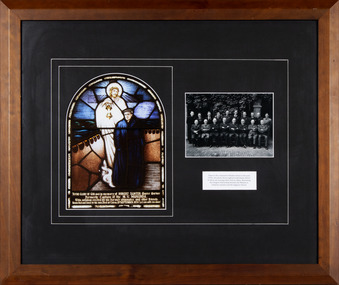 Mission to Seafarers Victoria
Photograph - Framed montage, Arthouse - Picture Framing & Gallery, Light of the World, 2013
... stained glass windows from the St Peter chapel. This exhibition curated by Georgia Melville and Catherine McLay, and funded by PROV and Creative Victoria, was displayed in the World Trade Centre Wharf Gallery in June July 2013 and toured to Queenscliff Maritime Museum. The photographs of the windows were taken by scientific photographer Justine M. Philip. his frame is showcasing the memorial...stained glass windows from the St Peter chapel. This exhibition curated by Georgia Melville and Catherine McLay, and funded by PROV and Creative Victoria, was displayed in the World Trade Centre Wharf Gallery in June July 2013 and toured to Queenscliff Maritime Museum. The photographs of the windows were taken by scientific photographer Justine M. Philip. his frame is showcasing the memorial ...THE CHAPLAINCY Although fostered by the Anglican Church since 1906, the work of the Mission to Seafarers’ is inter- denominational and is not limited by the physical space of its buildings. When the old Melbourne wharves and their moorings were still in use, chaplains would also visit ships to look after the welfare of those who could not visit the Mission. Today, the Mission’s ‘Ship Visitors’ provide a similar service. The Flinders Street central complex was purpose built to meet with seafarers’ needs: “...the first thing a sailor would see before the traps and temptations of the city would be the Institute and its comfortable rooms.” (The Argus, ND). Today, the Mission continues to offer its comfortable, safe spaces and a friendly ear to seafarers, alongside other services that extend well beyond those traditionally offered - including TV, phone cards, and access to the internet. This window, titled ‘Light of the World’, was installed in 1935 in memory of a former ‘M.V. Manunda’ captain and represents chaplaincy support to the seafaring community.Reflections of the Sea was an exhibition of 10 framed montage of photographs from the mission's archive collection showcasing 10 stained glass windows from the St Peter chapel. This exhibition curated by Georgia Melville and Catherine McLay, and funded by PROV and Creative Victoria, was displayed in the World Trade Centre Wharf Gallery in June July 2013 and toured to Queenscliff Maritime Museum. The photographs of the windows were taken by scientific photographer Justine M. Philip. his frame is showcasing the memorial window to Captain Robert Sunter and a photograph of a chaplains conférence in the 1950s.Framed and mounted on black cardboard of black and white and colour reproductions from the MTSV collection for the exhibition Reflections of the Sea with brief label signageon label: Taken in the courtyard at Flinders Street in the early 1950s, this photo shows eighteen individuals, fifteen of whom are wearing white clerical collars, illutsrating the integral relationship between the Mission to Seafarers ministry and the Anglican Churchreflections of the sea, georgia melville, exhibition, 2013, world trade centre, wtc, captain robert sunter, chaplaincy, conference, mv manunda, creative victoria, prov, mission to seafarers, stained glass windows, justine m. philip, flinders street, catherine mclay, arthouse
