
Showing 26 items matching "start of the bombing"
-
 Moorabbin Air Museum
Book - Aerial reconnaisance, Evidence in Camera
... ...Start of the bombing...Aerial reconnaisance Higher & faster Trial & error The invasion threat Start of the bombing The sea war The Mediterranean Combined operations Allied bombing offensive Battle against V weapons Last stages in Europe The story of photographic intelligence in World War II, circa 1957 Evidence in Camera Book Aerial reconnaisance ...The story of photographic intelligence in World War II, circa 1957non-fictionThe story of photographic intelligence in World War II, circa 1957higher & faster, trial & error, the invasion threat, start of the bombing, the sea war, the mediterranean, combined operations, allied bombing offensive, battle against v weapons, last stages in europe -
 Bendigo Military Museum
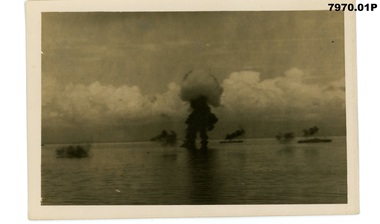
Photograph - ARTHUR GEORGE HOLLEY PHOTOGRAPHIC ALBUM, 10 Photographs HMAS Hobart 1942 Solomons
... Each description is preceded by an approximate date e.g.1940 06 is June 1940. 1. 1942 08 Solomons caption torpedo bombers two more on fire.jpg 2. 1942 08 Solomons high level bombers no hits Japs flew one thousand miles for this 054.jpg 3. 1942 08 Solomons caption there is no doubt this one being a Jap note marking.jpg 4. 1942 08 Solomons Dawn entering Guadalcanal Hobart Hoists battle ensign.jpg 5. 1942 08 Solomons fires started by bombing and shell fire.jpg 6. 1942 08 Solomons Fires started by gunfire and dive bombers .jpg 7. 1942 08 Solomons Guadalcanal HMS Exeter evading Japanese bombers February 1942.jpg 8. 1942 08 Solomons US Mugford hit by bomb.jpg 9. 1942 08 Solomons USS Mugford attacked by dive bombers caption shot down one bomber.jpg 10. 1942 08 Solomons USS Mugford attacked by dive bombers.jpg ...HMAS Hobart Arthur George Holley RAN Pacific Theatre Solomons Campaign Guadalcanal Each description is preceded by an approximate date e.g.1940 06 is June 1940. 1. 1942 08 Solomons caption torpedo bombers two more on fire.jpg 2. 1942 08 Solomons high level bombers no hits Japs flew one thousand miles for this 054.jpg 3. 1942 08 Solomons caption there is no doubt this one being a Jap note marking.jpg 4. 1942 08 Solomons Dawn entering Guadalcanal Hobart Hoists battle ensign.jpg 5. 1942 08 Solomons fires started by bombing and shell fire.jpg 6. 1942 08 Solomons Fires started by gunfire and dive bombers .jpg 7. 1942 08 Solomons Guadalcanal HMS Exeter evading Japanese bombers February 1942.jpg 8. 1942 08 Solomons US Mugford hit by bomb.jpg 9. 1942 08 Solomons USS Mugford attacked by dive bombers caption shot down one bomber.jpg 10. 1942 08 Solomons USS Mugford attacked by dive bombers.jpg 10 Photographs HMAS Hobart 1942 Solomons Photograph ARTHUR GEORGE HOLLEY PHOTOGRAPHIC ALBUM ...Items in the collection relating to ARTHUR GEORGE HOLLEY no 13556 RAN Refer cat no 2134 for his service record. The photographs are from his personal album, and are mainly official photographs widely available among the services. The photographs are from Australian , British and American sources. This set coincides with the Hobart's service around the time of the Battle of the Coral Sea, and her involvement in the Solomons and Guadalcanal landings. Whilst not taken personally, these photographs do capture some of the events Holley and his Hobart crewmates would have experienced and witnessed.Each description is preceded by an approximate date e.g.1940 06 is June 1940. 1. 1942 08 Solomons caption torpedo bombers two more on fire.jpg 2. 1942 08 Solomons high level bombers no hits Japs flew one thousand miles for this 054.jpg 3. 1942 08 Solomons caption there is no doubt this one being a Jap note marking.jpg 4. 1942 08 Solomons Dawn entering Guadalcanal Hobart Hoists battle ensign.jpg 5. 1942 08 Solomons fires started by bombing and shell fire.jpg 6. 1942 08 Solomons Fires started by gunfire and dive bombers .jpg 7. 1942 08 Solomons Guadalcanal HMS Exeter evading Japanese bombers February 1942.jpg 8. 1942 08 Solomons US Mugford hit by bomb.jpg 9. 1942 08 Solomons USS Mugford attacked by dive bombers caption shot down one bomber.jpg 10. 1942 08 Solomons USS Mugford attacked by dive bombers.jpg hmas hobart, arthur george holley ran, pacific theatre, solomons campaign, guadalcanal -
 Flagstaff Hill Maritime Museum and Village
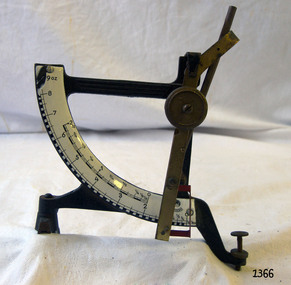
Instrument - Letter Scale, Philip Jakob, Maul, 1930s
... At the age of 45, he started a metal works factory to produce various types of scales but during the second world war the factory was bombed and production ended. ...At the age of 45, he started a metal works factory to produce various types of scales but during the second world war the factory was bombed and production ended. ...Jakob Maul (1866-1953) founded a metal works factory in 1912 at Zell in Odenwald not far from Frankfurt. He was born the son of a winegrower from the Rheinhessen region of Germany that lies on the left bank of the river Rhine. At the age of 45, he started a metal works factory to produce various types of scales but during the second world war the factory was bombed and production ended. Production for the manufacture of scales resumed in 1948. In 1953 at his death Jakobs son Fritz Scharmann an engineer who had been working with his father since 1923 took over the management of the Maul companies. In 1970 the production responsibilities for Philip J Maul was taken over by Porti Office Equipment who was based in Hamburg. The company has undergone several integrations with subsidiary companies. Today the company has diversified into different areas one of which is manufacturing solar scales. An original postal scale made in Germany before the Second World War and regarded today as a collector's item. It is significant as it is a snapshot into the past and how everyday vintage items were used and interacted within society in the 1930s.Antique German Jacob Maul "Concav" brass postal or letter scale, quadrant type, with pendulum, measuring up to 9ozs. The scale has a level-adjusting screw.The balance is marked "CONCAV" and graduated in imperial ounces to 9 ozflagstaff hill, warrnambool, shipwrecked-coast, flagstaff-hill, flagstaff-hill-maritime-museum, maritime-museum, shipwreck-coast, flagstaff-hill-maritime-village, scale, quadrant scale, postal weight, 9 oz, philip jakob, maul, scale manufacturer, german industry, weighing instrument, inclination scale -
 Mission to Seafarers Victoria
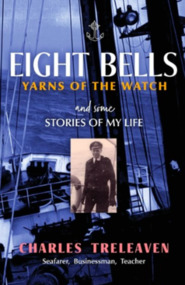
Book - Biography, Silverbird Publishing, Eight Bells, Yarns of the Watch and some Stories of my Life, 2021
... start of the new. After settling in Melbourne, Charles Treleaven was a leading figure in the maritime heritage of Melbourne saving the Polly Woodside, and initiating the construction of the Entreprize replica. He came to the Mission (p.146-147) charles treleaven polly woodside seamen ww2 entreprize melbourne britain merchant navy cosmodome maritime heritage association of victoria mhav starlab blitz saint gregory interest group There's no doubt that Charles has had an interesting life. Born in England during the Depression, he experienced the Blitz on London, the Flying Bombs ...There's no doubt that Charles has had an interesting life. Born in England during the Depression, he experienced the Blitz on London, the Flying Bombs, and then the V2 rockets. From the age of sixteen Charles spent the next 24 years travelling the world aboard British, New Zealand, Fijian, and Australian ships, then settled ashore in Melbourne to start his own packaging business. He was later asked to work with the U.N. in Jordan, based in Amman for some time. On his return to Melbourne, he was appointed CEO for the continued restoration of the award winning sailing ship Polly Woodside, now the pride of our City. Whilst there, Charles initiated the construction of the ship "Enterprize" replica. Finally, he used his knowledge as a navigator to excite over 800,000 Victorian school children with the basics of Science and Astronomy. Charles decided to retire after teaching for 23 years, at the tender age of 82. It is quite a Lifetime. It is quite a story !Photograph of Charles Treleaven ob the cover, 372 pagesnon-fictionThere's no doubt that Charles has had an interesting life. Born in England during the Depression, he experienced the Blitz on London, the Flying Bombs, and then the V2 rockets. From the age of sixteen Charles spent the next 24 years travelling the world aboard British, New Zealand, Fijian, and Australian ships, then settled ashore in Melbourne to start his own packaging business. He was later asked to work with the U.N. in Jordan, based in Amman for some time. On his return to Melbourne, he was appointed CEO for the continued restoration of the award winning sailing ship Polly Woodside, now the pride of our City. Whilst there, Charles initiated the construction of the ship "Enterprize" replica. Finally, he used his knowledge as a navigator to excite over 800,000 Victorian school children with the basics of Science and Astronomy. Charles decided to retire after teaching for 23 years, at the tender age of 82. It is quite a Lifetime. It is quite a story !charles treleaven, polly woodside, seamen, ww2, entreprize, melbourne, britain, merchant navy, cosmodome, maritime heritage association of victoria, mhav, starlab, blitz, saint gregory, interest group -
 Lara RSL Sub Branch
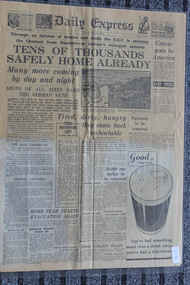
Newspaper - The Daily Express Newspaper Dated 31/5/1940, Dunkirk -Tens of Thousands Safely Home Already - Three Destroyers Lost - omb Fear Starts Evacuation Again
... Dunkirk -Tens of Thousands Safely Home Already - Three Destroyers Lost - Bomb Fear Starts Evacuation Again....starts evacuation again. Dunkirk -Tens of Thousands Safely Home Already - Three Destroyers Lost - Bomb Fear Starts Evacuation Again. ...The Daily Express Newspaper Dated 31/5/1940The Daily Express Newspaper Dated 31/5/1940The Daily Express Newspaper Dated 31/5/1940Dunkirk -Tens of Thousands Safely Home Already - Three Destroyers Lost - Bomb Fear Starts Evacuation Again.dunkirk -tens of thousands safely home already - three destroyers lost - omb fear starts evacuation again. -
 Federation University Historical Collection
Book - Scrap Book, Ballarat School of Mines Scrap Book, 1954-1957, 1954-1957
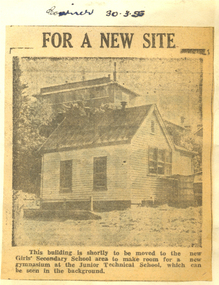
... start in Ballarat North 1955 - Removal of caretaker's Cottage 1955 - Air Training Corps Cadets 1955 - Fluoridation 1955 - I.G. Witcher 1955 - Graham Willey, football 1955 - Image of L. Wilson, head teacher of the Ballarat North Technical School 1955 - Ballarat Girls' Technical School takes shape at White Flat. 1955 - Ballarat Junior Technical School Pine Plantation at Nerrina 1955 - Lake water test by W.G. Cornell 1955 - John Rowell 1956 - Geoffrey Mainwarring painting Lieutenant F.A. Reiter 1956 - Pittong Mine 1956 - Atom Bombs...start in Ballarat North 1955 - Removal of caretaker's Cottage 1955 - Air Training Corps Cadets 1955 - Fluoridation 1955 - I.G. Witcher 1955 - Graham Willey, football 1955 - Image of L. Wilson, head teacher of the Ballarat North Technical School 1955 - Ballarat Girls' Technical School takes shape at White Flat. 1955 - Ballarat Junior Technical School Pine Plantation at Nerrina 1955 - Lake water test by W.G. Cornell 1955 - John Rowell 1956 - Geoffrey Mainwarring painting Lieutenant F.A. Reiter 1956 - Pittong Mine 1956 - Atom Bombs ...The Ballarat School of Mines was the first school of mines in AustraliaA scrapbook of news clippings relating to the Ballarat School of MInes, including: 1954 - Barry Singleton 1954 - Neville Bunning 1954 - Victor Greenhalgh and his sculpture of King George V 1954 - Road Deviation in Hickman Street near White Flat 1954 - John Skuka naturalisation 1954 - Fire Danger in Vale Park 1954 - retirement of William J. Paterson from the staff of the Ballarat Junior Technical School 1954 - First pottery exhibition, featuring local clays. 1954 - New Technical school start in Ballarat North 1955 - Removal of caretaker's Cottage 1955 - Air Training Corps Cadets 1955 - Fluoridation 1955 - I.G. Witcher 1955 - Graham Willey, football 1955 - Image of L. Wilson, head teacher of the Ballarat North Technical School 1955 - Ballarat Girls' Technical School takes shape at White Flat. 1955 - Ballarat Junior Technical School Pine Plantation at Nerrina 1955 - Lake water test by W.G. Cornell 1955 - John Rowell 1956 - Geoffrey Mainwarring painting Lieutenant F.A. Reiter 1956 - Pittong Mine 1956 - Atom Bombs and rain 1956 - Ballarat Gaol and the Ballarat School of MInes 1956 - William Paterson and A.W. Steane of the Ballarat Junior Technical School 1957 - Ballarat "Junior Tech" Has a Bright History 1957 - Brelaz Scholarship for School of Mines (scrap book, ballarat school of mines, ballarat gaol, nerrina, caretaker's cottage, geoffrey mainwarring, gymnasium, noel flood, neville bunning, art lending library -
 City of Moorabbin Historical Society (Operating the Box Cottage Museum)
Manufacturect Object, Clock, floral brass, electric, c1950
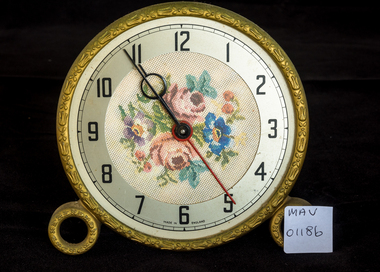
... The company started as an offshoot of the furniture manufacturers Jentique in about 1941, which made boxes for instruments and bombs during World War II.The first Metamec model was a mains-powered mantle clock numbered "701" (approx. 1947). ...The company started as an offshoot of the furniture manufacturers Jentique in about 1941, which made boxes for instruments and bombs during World War II.The first Metamec model was a mains-powered mantle clock numbered "701" (approx. 1947). ...Metamec was a manufacturer of domestic clocks in the second half of the 20th century, and was based in Dereham, Norfolk, England. The name "Metamec" is derived from "metal-work and mechanics". The company started as an offshoot of the furniture manufacturers Jentique in about 1941, which made boxes for instruments and bombs during World War II.The first Metamec model was a mains-powered mantle clock numbered "701" (approx. 1947). All clocks produced by Metamec were produced to a high standard, The company declined in the late 1980s and went into receivership in December 1984 and sold to FKI of Halifax, West Yorkshire, who continued to use the name until 1993. Now another company is producing clocks under the Metamec name in Derbyshire England Gladys Reed who used this clock was a member of the Ormond Choral Society c 1950. who performed plays and musicals the City of Moorabbin Metamec was a manufacturer of domestic electric clocks in the second half of the 20th century, and was based in Dereham, Norfolk, England Gladys Reed was a member of the Ormond Choral Society c 1950. who performed plays and musicals the City of Moorabbin.Dressing table brass, electric clock with floral pattern.METAMEC / Made in Englandclocks, metamec ltd., norfolk england, reed gladys, clark judy, brighton, moorabbin, furniture, pioneers, clocks, market gardeners, early settlers, mechanics institute cheltenham, ormond choral society, postworld war 11 settlers, housing estates moorabbin 1950, bentleigh, -
 Orbost & District Historical Society
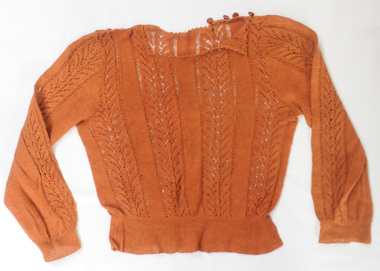
knitted jumper, 1938-1940
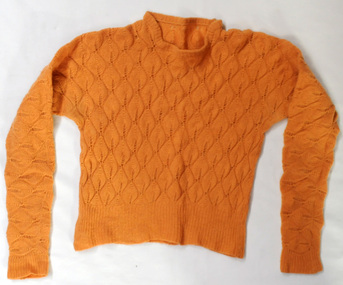
... bombing with her young daughter. Air raid shelters were built specifically to serve as protection against enemy air raids. However, pre-existing structures such as underground stations (tube or subway stations), tunnels, cellars in houses or basements in larger establishments, and railway arches, above ground, were suitable for safeguarding people during air raids. This item is an example of a handcrafted item and reflects the handcraft skills of women necessary during WW11 when clothing became scarce. Clothes rationing began on June 1, 1941, two years after food rationing started ...This was knitted by Marjorie Burton during WW11 in England. She used to knit while in an air raid shelter escaping the bombing with her young daughter. Air raid shelters were built specifically to serve as protection against enemy air raids. However, pre-existing structures such as underground stations (tube or subway stations), tunnels, cellars in houses or basements in larger establishments, and railway arches, above ground, were suitable for safeguarding people during air raids. This item is an example of a handcrafted item and reflects the handcraft skills of women necessary during WW11 when clothing became scarce. Clothes rationing began on June 1, 1941, two years after food rationing started. Clothes rationing ended on 15 March 1949.A hand-knitted orange/tan woolen jumper. It is a lady's long-sleeved jumper.handcraft knitting ww11 -
 Orbost & District Historical Society
knitted jumper, Burton, Marjorie, 1938 - 1940
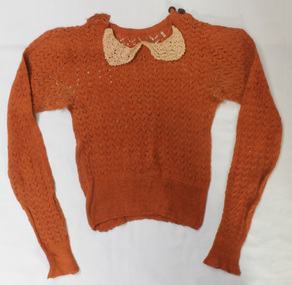
... bombing with her young daughter. This item is an example of a handcrafted item and reflects the handcraft skills of women necessary during WW11 when clothing became scarce. Clothes rationing began on June 1, 1941, two years after food rationing started ...This was knitted by Marjorie Burton during WW11 in England. She used to knit while in an air raid shelter escaping the bombing with her young daughter. Marjorie Burton ( nee Whiteman), born 12 June, in Birmingham, England came to Orbost in 1995. In England she did office work – typing, shorthand and secretarial work - in accountants’ offices and also trained as a comptometrist with Burroughs in London. She came from middle-class working church-going family. Her mother was a milliner who mad all of Marjorie’s clothes, hats and outfits. Marjorie married in 1938 to a salesman who later became a mechanic in the R.A.F. during WW11. Her father served in Civil Defence during the war. Marjorie was in Birmingham during the war and remembered sheltering with her young daughter, Anne (Quaadgras) in the air raid shelter during bombing. This was knitted by Marjorie Burton during WW11 in England. She used to knit while in an air raid shelter escaping the bombing with her young daughter. This item is an example of a handcrafted item and reflects the handcraft skills of women necessary during WW11 when clothing became scarce. Clothes rationing began on June 1, 1941, two years after food rationing started. Clothes rationing ended on 15 March 1949.A brown cotton hand-knitted lacy jumper. it is a long-sleeved lady'e jumper with a tea-coloured crocheted collar sewn on. On each shoulder are two brown buttons.knitting jumper handcraft ww11 burton-marjorie -
 Orbost & District Historical Society
knitted jumper, Burton, Marjorie, 1938-1940
... bombing with her young daughter. This item is an example of a handcrafted item and reflects the handcraft skills of women necessary during WW11 when clothing became scarce. Clothes rationing began on June 1, 1941, two years after food rationing started...bombing with her young daughter. This item is an example of a handcrafted item and reflects the handcraft skills of women necessary during WW11 when clothing became scarce. Clothes rationing began on June 1, 1941, two years after food rationing started ...Marjorie Burton ( nee Whiteman), born 12 June, in Birmingham, England came to Orbost in 1995. In England she did office work – typing, shorthand and secretarial work - in accountants’ offices and also trained as a comptometrist with Burroughs in London. She came from middle-class working church-going family. Her mother was a milliner who mad all of Marjorie’s clothes, hats and outfits. Marjorie married in 1938 to a salesman who later became a mechanic in the R.A.F. during WW11. Her father served in Civil Defence during the war. Marjorie was in Birmingham during the war and remembered sheltering with her young daughter, Anne (Quaadgras) in the air raid shelter during bombing. This was knitted by Marjorie Burton during WW11 in England. She used to knit while in an air raid shelter escaping the bombing with her young daughter. This item is an example of a handcrafted item and reflects the handcraft skills of women necessary during WW11 when clothing became scarce. Clothes rationing began on June 1, 1941, two years after food rationing started. Clothes rationing ended on 15 March 1949. This item is an example of a handcrafted item and reflects the handcraft skills of women necessary during WW11 when clothing became scarce. Clothes rationing began on June 1, 1941, two years after food rationing started. Clothes rationing ended on 15 March 1949.A brown hand-knitted lacy cotton jumper. It is a long-sleeved lady's jumper and has 4 brown buttons on each shoulder opening.knitting jumper handcraft burton-marjorie ww11 -
 Orbost & District Historical Society
knitted vests/singlets, Burton, Marjorie, WW11
... bombing. This item is an example of a handcrafted item and reflects the handcraft skills of women necessary during WW11 when clothing became scarce. Clothes rationing began on June 1, 1941, two years after food rationing started. ...This was knitted by Marjorie Burton during WW11 in England. She used to knit while in an air raid shelter escaping the bombing with her young daughter. Marjorie Burton ( nee Whiteman), born 12 June, in Birmingham, England came to Orbost in 1995. In England she did office work – typing, shorthand and secretarial work - in accountants’ offices and also trained as a comptometrist with Burroughs in London. She came from middle-class working church-going family. Her mother was a milliner who made most of Marjorie’s clothes, hats and outfits. Marjorie married in 1938 to a salesman who later became a mechanic in the R.A.F. during WW11. Her father served in Civil Defence during the war. Marjorie was in Birmingham during the war and remembered sheltering with her young daughter, Anne (Quaadgras) in the air raid shelter during bombing. This item is an example of a handcrafted item and reflects the handcraft skills of women necessary during WW11 when clothing became scarce. Clothes rationing began on June 1, 1941, two years after food rationing started. Clothes rationing ended on 15 March 1949.Two hand-knitted lady's vests(singlets). Both have been knitted from left over wools. Both have crocheted necklines and ribbon straps and are fitted styles. 2483.12 is red and grey with a V neck. 2483.13 is pink, grey and blue with a V neck.ww11 knitwear handcraft nightgown sleepwear burton-marjorie -
 Orbost & District Historical Society
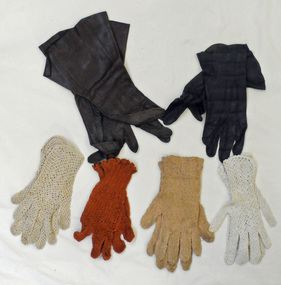
six pairs of gloves, Burton, Marjorie, 1940's -1950's
... bombing. These items are examples of handcrafted items and reflect the handcraft skills of women necessary during WW11 when clothing became scarce. Clothes rationing began on June 1, 1941, two years after food rationing started. ...Marjorie Burton ( nee Whiteman), born 12 June, in Birmingham, England came to Orbost in 1995. In England she did office work – typing, shorthand and secretarial work - in accountants’ offices and also trained as a comptometrist with Burroughs in London. She came from middle-class working church-going family. Her mother was a milliner who made all of Marjorie’s clothes, hats and outfits. Marjorie married in 1938 to a salesman who later became a mechanic in the R.A.F. during WW11. Her father served in Civil Defence during the war. Marjorie was in Birmingham during the war and remembered sheltering with her young daughter, Anne (Quaadgras) in the air raid shelter during bombing. These items are examples of handcrafted items and reflect the handcraft skills of women necessary during WW11 when clothing became scarce. Clothes rationing began on June 1, 1941, two years after food rationing started. Clothes rationing ended on 15 March 1949.Six pairs of ladies' gloves. 2483.16 is a white crocheted cotton pair. 2483.17 is a light tan knitted woolen pair. 2483.18 is a brown crocheted cotton pair. 2483.19 is an ecru crocheted cotton pair. 2483.20 is a black leather pair and 2483.21 is a brown leather pair. women's-accessories gloves crochet knitting burton-marjorie -
 Orbost & District Historical Society
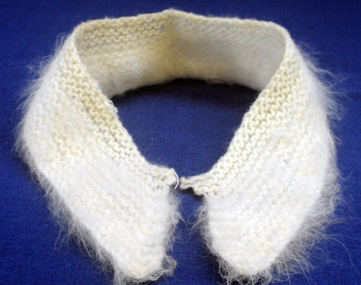
knitted collar, Burton, Marjorie, 1940's
... bombing. This item is an example of a handcrafted item and reflects the handcraft skills of women necessary during WW11 when clothing became scarce. Clothes rationing began on June 1, 1941, two years after food rationing started. ...This was knitted by Marjorie Burton during WW11 in England. She used to knit while in an air raid shelter escaping the bombing with her young daughter. Marjorie Burton ( nee Whiteman), born 12 June, in Birmingham, England came to Orbost in 1995. In England she did office work – typing, shorthand and secretarial work - in accountants’ offices and also trained as a comptometrist with Burroughs in London. She came from a middle-class, working, church-going family. Her mother was a milliner who mademany of Marjorie’s clothes, hats and outfits. Marjorie married in 1938 to a salesman who later became a mechanic in the R.A.F. during WW11. Her father served in Civil Defence during the war. Marjorie was in Birmingham during the war and remembered sheltering with her young daughter, Anne (Quaadgras) in the air raid shelter during bombing. This item is an example of a handcrafted item and reflects the handcraft skills of women necessary during WW11 when clothing became scarce. Clothes rationing began on June 1, 1941, two years after food rationing started. Clothes rationing ended on 15 March 1949.A narrow, detachable hand-knitted lady's collar. It is hand-knitted in white brushed wool.women's -clothing accessory burton-marjorie -
 Eltham District Historical Society Inc
Newspaper - News Clipping, Herald, He died at Eltham. Herald, March 4, p3, 4 Mar 1965
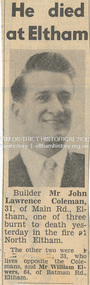
... started on the West side of Upper Glen road on the edge of Eltham. Before the fire brigade could arrive, it was burning on a widening front through timber and high grass north of Eltham. Two wind changes in rapid succession saw the fire leaping Diamond Creek. With a freshening wind it struck home after home in three streets. More than one of them exploded suddenly as if hit by an incendiary bomb...started on the West side of Upper Glen road on the edge of Eltham. Before the fire brigade could arrive, it was burning on a widening front through timber and high grass north of Eltham. Two wind changes in rapid succession saw the fire leaping Diamond Creek. With a freshening wind it struck home after home in three streets. More than one of them exploded suddenly as if hit by an incendiary bomb ...John Lawrence Coleman (1934-1965) born January 10, was the son of Raymond John Coleman and Hanna May (Gillet) Coleman. He married Margaret Frances Dare in 1955 and was the father of two children. He died whilst attempting to rescue an older man trapped in the bushfire at North Eltham on March 3, 1965 He died at Eltham (Herald, 4 March 1965, p3) [Picture of John Lawrence Coleman] Builder Mr John Lawrence Coleman, 31, of Main Rd., Eltham, one of three men burnt to death yesterday in the fire at North Eltham. The other two were XXXXX, 33 who lives opposite the Colemans and Mr William Elwers, 64 of Batman Rd., Eltham. * * * Frank Martin was a volunteer with the Eltham rural fire brigade at the time of the 1965 bushfires which burnt Eltham North and Research. Frank was asked to assist with the removal of three bodies from the back gully (now Orchard Avenue). They were badly burnt and one was found stuck under a fence as though trying to escape. Volunteers John Coleman Jnr, William Elwers and George Crowe were killed trying to protect Eltham from bushfire – they were local heroes. At the time, John Coleman Jnr was survived by his wife Margaret and two young children – John 11 and Vicky 2. Margaret Coleman lived in the family home until 1992 when she sold it and moved to Tasmania to be close to her son. She died in 1997 aged 65 years. 75 yr old Ken Gaston grew up on Edendale farm, which was originally a poultry farm but is now owned and run by the Shire of Nillumbik as an educational farm for schools and visitors. He was Captain of the Eltham rural fire brigade in 1965 when John Coleman Jnr was burnt to death in the Eltham North bushfires serving as an unofficial volunteer. He was able to draw where the original Wattletree Road was and at the time was verified with the location of some remaining bitumen and a post from the original bridge over the Diamond Creek located near the junction of the Diamond Creek and another small creek which is further down from Research or Christmas Creek as locals refer to it. The original Main Road ran behind Colemans before the railway line was built beyond Eltham in 1912. (Information recorded by Harry Gilham, President EDHS c.2011) * * * Bushfires rage in Victoria, Snowy: Three dead (1965, March 4). The Canberra Times (ACT : 1926 - 1995), p. 1. Retrieved May 19, 2022, from http://nla.gov.au/nla.news-article131758981 Includes two photos of the fire in North Eltham “Firemen make for safety as fire rages in Upper Glen Park Road, North Eltham, Victoria. The smoke hides a house.” and “A house explodes into flames at North Eltham, Victoria. Firemen said bottled gas went up.” Canberra Times (ACT : 1926 - 1995), Thursday 4 March 1965, page 1 ________________________________________ Firemen make for safety as fire rages in Upper Glen Park Road. North Eltham. Victoria. The smoke hides a house. A house explodes into flames at North Eltham. Victoria. Firemen said bottled gas went up. Bushfires rage in Victoria, Snowy: Three dead MELBOURNE, Wednesday.—Three people died today in a bush» fire which raged through North Eltham, about 15 miles from Melbourne. The victims were three men. A fourth man is feared to be dead. Another bushfire. sparked off by the heatwave sizzling over south-eastern Australia, is burning out of control in the Kosciusko State Park, in the Snowy Mountains. Firefighters fear that if it reaches pine forests up the Yarrangobilly River, they will be powerless to stop it. The three victims of the North Eltbam fire were trapped by flames in a valley. Their bodies were found only a few yards apart. They were named by police tonight as Mr. George Crowe, 78, of North Eltham, William John Ewers, 64, and John Laurence Coleman, 31, both of Eltham. The other two have not been identified. They are believed to be a man aged about 40 and an 18-year-old youth. At least 12 homes were destroyed by the fire, the worst in Victoria since 1962, when eight lives were lost and hundreds of homes burnt down at Warrandyte. At one time the township of Eltham was threatened, but a cool change swept in from the south and held back the wall of flames. More than 100 dogs, worth about £4,000, died when the fire raced through two kennels in Short Street, Eltham. and Upper Glen Park Road, North Eltham. A trickle of water Residents ran into the streets as the blaze raced towards their houses. Others frantically dug firebreaks around their homes. Mrs. Sue Recourt wept when firemen arrived while she was vainly trying to stop the flames with a trickle of water from the garden hose. A stack of firewood was blazing, but the firemen managed to save the house and rescue four goats. Many homes in Eltham were saved after flames had crept to within feet of their fences. Students at North Eltham State School had to be evacuated when the blaze threatened the building. Fire fighters were severely hampered by lack of water and narrow roads. The blaze, which began in above century heat, turned toward Wattle Glen, where two houses were gutted. Then the flames raced towards Hurstbridge to the north. Firemen battling desperately, controlled the fire late this afternoon. Five forest fires were still burning in Victoria tonight. IN VICTORIA THIS WEEK Tragic lack of central fire authority (1965, March 9). The Canberra Times (ACT : 1926 - 1995), p. 2. Retrieved May 19, 2022, from http://nla.gov.au/nla.news-article131759928 Canberra Times (ACT : 1926 - 1995), Tuesday 9 March 1965, page 2 ________________________________________ IN VICTORIA THIS WEEK Tragic lack of central fire authority From Rohan Rivett It was the worst week for Victorian fire fighters since Black Friday 27 years ago. On that day one pilot up in a spotter plane said afterwards: "It seemed at times that half the State was on fire." This time, for three days on end, Gippsland men, women and children had moments of conviction that their towns would have blackened into anonymity before the weekend was out. The week began with horror at Eltham on the North-eastern edge of Melbourne. Eltham today is something of an artists' colony. Oil painters, water colourists, potters and sculptors proliferate. A number of University folk have emulated the example of Professor MacMahon Ball who pioneered the way by moving to Eltham and carving a home out of the bush in the thirties. Innermost Eltham is barely 14 miles from the G.P.O. Farthest Eltham stretches miles beyond. It served to illustrate the tragi-ludicrous truncation of Victoria's fire control. Part of Eltham is under the protection of the Melbourne Fire Brigade. But this responsibility ceases at some invisible and incomprehensible line — apparently determined by the meanderings of the water mains. At this point everybody's property throughout the rest of Eltham is dependent on the Country Fire Authority. Half an hour before midday on Wednesday, a fire suddenly started on the West side of Upper Glen road on the edge of Eltham. Before the fire brigade could arrive, it was burning on a widening front through timber and high grass north of Eltham. Two wind changes in rapid succession saw the fire leaping Diamond Creek. With a freshening wind it struck home after home in three streets. More than one of them exploded suddenly as if hit by an incendiary bomb. There is no piped gas in the Eltham area, hence many housewives use bottle gas. The flames outside caused the bottles to explode. Altogether twelve homes were completely incinerated and four more were badly damaged. Thirty prize dogs perished. About three hours after the fire started it raced suddenly down a gully hillside trapping an elderly man. Two other men apparently raced to the rescue. Flames caught the three men within yards of each other, not 200 yards off the Upper Glen Park Road where safety lay. They were burned to death. Next evening an angry and convincing secretary of the Fire Brigade Union, Mr. W. M. Webber, came on television and appealed to the people of Victoria to end the ridiculous and dangerous dualism in fire-fighting control. The Eltham fire, he said, had precisely illustrated the situation. The Metropolitan Fire Brigade area touched Eltham, but where the fire had gutted and killed, was just outside its area. Mr. Webber said his union had constantly urged one authority for the State with a complete reorganisation of fire protection. On Wednesday the union had repeated its call for an inquiry into fire protection in Victoria to the Chief Secretary, Mr Rylah. "No matter how close the liaison between the two organisations, there are always divided sections of thinking," Mr. Webber told viewers. "I don't know how much tragedy the com-munity can take before it demands that it is properly protected." Rumours that differences in gauge between taps and hose nozzles (as between the two authorities) accentuated the damage were denied by fire chiefs who said that all appliances were now carrying adaptors so that hoses could be linked to mains everywhere. But there is grave concern in the Metropolitan Fire Brigade's higher councils at the action of several Federal authorities with projects in and around Melbourne. They are installing non-standard equipment without reference to the State authorities or any dovetailing of appliances and equipment. Public alarm was not diminished by the publication on Friday and Saturday of a heart tearing letter from the young widow of John Lawrence Coleman, 31 year old father of two, who had died in the flames apparently trying to rescue the old man trapped in the gully. By that time, a Vast area of Gippsland was in flames and the troops had been sent in to back up the overworked and often helpless fire-fighters. By Saturday, the Leader of the Opposition, Mr. Stoneham, who has previously demanded a Royal Commission into fire-fighting arrangements, repeated his demand. To add to the Chief Secretary's worries he was publicly rebuked for allegedly implying on television that lives had been lost at Eltham because people went to the wrong place at the wrong time. In a letter to the Press, Professor MacMahon Ball pointed out that two of the men involved were experienced bushmen who had gone "to help an old man in great danger fully aware of the danger to themselves". As Victoria faced its sixth day of total State-wide fire ban, it looked likely that even official resistance was not going to silence the demand for one central authority to control the fire fiend. At the moment, the 400 square miles where two million Victorians live in Greater Melbourne are divorced from the rest of the State in planning, communications, equipment and control of personnel. No one doubts the whole-hearted co-operation and willingness to back each other up of the M.F.B. and the C.F.A., both at top-level and among the firemen themselves. However, when a city straggles so deeply into the country side, the absence of a single authority, to oversee and analyse the fire threat as a whole, suggests suicidal policy of divide and fuel. Emphasis of the tragic loss of a member of a pioneering family who died whilst helping others in his communitybushfire, cfa, country fire authority, fire brigrade, glen park road, heroes, john lawrence coleman, north eltham, victorian bushfires - 1965, volunteers, william john elwers, fire fighter, frank martin, george john crowe, ken gaston, orchard avenue -
 Eltham District Historical Society Inc
Photograph, Liz Pidgeon, Heritage Excursion; The 1901 Eltham Railway Walk, 3 May 2014, 3 May 2014
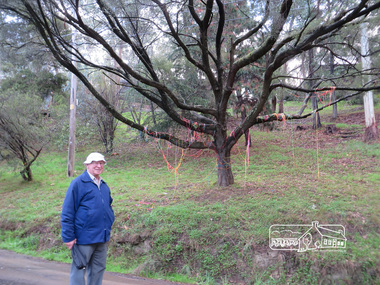
... It will start at 2 pm at the Eltham Railway Station car park (east/Main Road side) (Melway Ref. 21 J5). heritage excursion activities eltham district historical society eltham railway station eltham library trestle bridge yarn bombing Doug Orford Born Digital Heritage Excursion; The 1901 Eltham Railway Walk, 3 May 2014 Photograph Photograph Liz Pidgeon ...EDHS Member Doug Orford stands by a yarn bombing installation. ewsletter No. 216, May 2014 May Excursion – The 1901 Eltham Railway Walk The railway from Heidelberg to Eltham was opened in 1902. Over the previous year railway construction cut a curving swathe through Josiah Holloway’s 1851 Little Eltham subdivision. The survey plans for the railway show the owners and occupiers of land within Little Eltham affected by the railway alignment and for some distance each side. The plans show houses and other buildings but development at that time was rather sparse. Copies of these plans from the State Library of Victoria collection have been provided to the Society by Alan Sheehan. For our walk on 3rd May we intend to follow the railway from the Eltham Station to Ryans Road, which was the boundary of the adjoining Montmorency Farm. The return will be by way of nearby streets. Along the way we will discuss the details shown on the railway plans as well as more recent railway documents and photographs. At the conclusion and if time permits we can inspect the historical display at the Eltham Station. The walk is about 3 km in length and will take about 2.5 hours. It will start at 2 pm at the Eltham Railway Station car park (east/Main Road side) (Melway Ref. 21 J5).Born Digitalheritage excursion, activities, eltham district historical society, eltham railway station, eltham library, trestle bridge, yarn bombing, doug orford -
 Waverley RSL Sub Branch
RSL Photo Album, RSL Photo Album Section 3
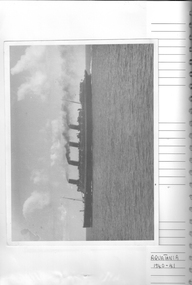
... bombed Rabaul. On 23 January, Japanese marines landed by the thousands, starting the Battle of Rabaul. ...bombed Rabaul. On 23 January, Japanese marines landed by the thousands, starting the Battle of Rabaul. ...During World War II the Japanese attacked New Britain soon after the outbreak of hostilities in the Pacific Ocean. During January 1942, Japanese heavily bombed Rabaul. On 23 January, Japanese marines landed by the thousands, starting the Battle of Rabaul. The Japanese used Rabaul as a heavy base until 1944; it served as the key point for the failed invasion of Port Moresby (May to November, 1942) Note: these photos are incorrectly labelled as Nth. Britain Photograph of "OIRE LUNG " airfield is in fact "WUNUNG, JACQUINOT BAY, NEW BRITAIN, 1945-08-28. A FULL PARADE OF 37/52 INFANTRY BATTALION AND 29/46 INFANTRY BATTALION, BOTH OF 4 BRIGADE, WAS HELD ON WUNUNG AIRSTRIP. THIS PARADE WAS TO PREPARE TROOPS FOR A PARADE TO BE HELD ON 1945-09-03. SHOWN, 37/52 INFANTRY BATTALION PRESENTING ARMS." Airstrip was maintained by 1 ACSPhoto Album 360 Pocket "Photo Safe" divided for cataloguing purposes into 4 sections. Section 1 Recent Colour Photos of RSL and commemoration services Section 2 Black and white photos of earlier commemoration services, Section 3 WWII photos mainly of New Britain 1945, Section 4 Early photos of Memorabilia display.new britain, wwii, japanese surrender, pow, rms aquitania, ss nieuw amsterdam, rms mauritania, rabaul, wunung airfield, jaquinot bay, 1 acs -
 Monbulk RSL Sub Branch
Book, Hardie Grant Books, War on our doorstep : diaries of Australians at the frontline in 1942, 2004
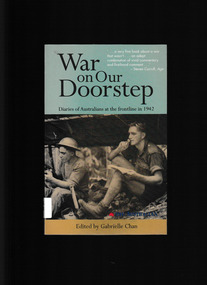
... Clocks were put forward an hour for the start of daylight saving, as part of a war-time scheme to save power. All around the Pacific, Japan was making gains. They already occupied most of China; bombed Pearl Harbour, Guam and Wake; sunk the stars of the British naval fleet, the Prince of Wales and Repulse. ...As the clock struck twelve to signal the start of 1942, Australians did not give the New Year their traditional noisy welcome. Regular events were cancelled, nightclub bookings were down and most people stayed in their blacked out homes. Clocks were put forward an hour for the start of daylight saving, as part of a war-time scheme to save power. All around the Pacific, Japan was making gains. They already occupied most of China; bombed Pearl Harbour, Guam and Wake; sunk the stars of the British naval fleet, the Prince of Wales and Repulse. They had landed in British Borneo, Hong Kong and the Philippines. This is the story of 1942, as told in first-hand accounts by the men and women in Australia and around the world.Ill, map, p.316.non-fictionAs the clock struck twelve to signal the start of 1942, Australians did not give the New Year their traditional noisy welcome. Regular events were cancelled, nightclub bookings were down and most people stayed in their blacked out homes. Clocks were put forward an hour for the start of daylight saving, as part of a war-time scheme to save power. All around the Pacific, Japan was making gains. They already occupied most of China; bombed Pearl Harbour, Guam and Wake; sunk the stars of the British naval fleet, the Prince of Wales and Repulse. They had landed in British Borneo, Hong Kong and the Philippines. This is the story of 1942, as told in first-hand accounts by the men and women in Australia and around the world. world war 1939-1945 - personal narratives - australia, soldiers - australia - diaries -
 Eltham District Historical Society Inc
Newspaper - News Clipping, Herald, The big Eltham clean-up gets under way, Herald, 4 March, p3, 1965
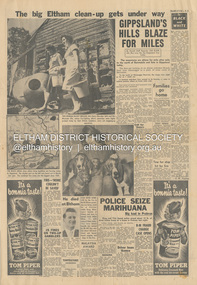
... started on the West side of Upper Glen road on the edge of Eltham. Before the fire brigade could arrive, it was burning on a widening front through timber and high grass north of Eltham. Two wind changes in rapid succession saw the fire leaping Diamond Creek. With a freshening wind it struck home after home in three streets. More than one of them exploded suddenly as if hit by an incendiary bomb...started on the West side of Upper Glen road on the edge of Eltham. Before the fire brigade could arrive, it was burning on a widening front through timber and high grass north of Eltham. Two wind changes in rapid succession saw the fire leaping Diamond Creek. With a freshening wind it struck home after home in three streets. More than one of them exploded suddenly as if hit by an incendiary bomb ...Full page newspaper clipping featuring the March 1965 Victorian bushfires. Items include: Photograph - TWO-WOMAN BUCKET BRIGADE, Mrs Henry Marsden (left) and Mrs Moureen Ellis, whose fire-fighting efforts yesterday were highly praised today by their Eltham neighbours, carry out mopping-up operations Photograph - DOGS MADE HOMELESS by the fire in North Eltham yesterday are being cared for at First-Constable Doug. Mummery's kennels at Eltham and here is kennel maid Helen Oliver, 17, with some of them today. The two basset hounds are owned by Mr Bill Guy who lost about 100 daschund and basset hound puppies and dogs in the fire. Photograph - He died at Eltham [Picture of John Lawrence Coleman] Builder Mr John Lawrence Coleman, 31, of Main Rd., Eltham, one of three men burnt to death yesterday in the fire at North Eltham. The other two were XXXXX, 33 who lives opposite the Colemans and Mr William Elwers, 64 of Batman Rd., Eltham. John Lawrence Coleman (1934-1965) born January 10, was the son of Raymond John Coleman and Hanna May (Gillet) Coleman. He married Margaret Frances Dare in 1955 and was the father of two children. He died whilst attempting to rescue an older man trapped in the bushfire at North Eltham on March 3, 1965 Other news stories of the day: Bushfires rage in Victoria, Snowy: Three dead (1965, March 4). The Canberra Times (ACT : 1926 - 1995), p. 1. Retrieved May 19, 2022, from http://nla.gov.au/nla.news-article131758981 Includes two photos of the fire in North Eltham “Firemen make for safety as fire rages in Upper Glen Park Road, North Eltham, Victoria. The smoke hides a house.” and “A house explodes into flames at North Eltham, Victoria. Firemen said bottled gas went up.” Canberra Times (ACT : 1926 - 1995), Thursday 4 March 1965, page 1 ________________________________________ Firemen make for safety as fire rages in Upper Glen Park Road. North Eltham. Victoria. The smoke hides a house. A house explodes into flames at North Eltham. Victoria. Firemen said bottled gas went up. Bushfires rage in Victoria, Snowy: Three dead MELBOURNE, Wednesday.—Three people died today in a bush» fire which raged through North Eltham, about 15 miles from Melbourne. The victims were three men. A fourth man is feared to be dead. Another bushfire. sparked off by the heatwave sizzling over south-eastern Australia, is burning out of control in the Kosciusko State Park, in the Snowy Mountains. Firefighters fear that if it reaches pine forests up the Yarrangobilly River, they will be powerless to stop it. The three victims of the North Eltbam fire were trapped by flames in a valley. Their bodies were found only a few yards apart. They were named by police tonight as Mr. George Crowe, 78, of North Eltham, William John Ewers, 64, and John Laurence Coleman, 31, both of Eltham. The other two have not been identified. They are believed to be a man aged about 40 and an 18-year-old youth. At least 12 homes were destroyed by the fire, the worst in Victoria since 1962, when eight lives were lost and hundreds of homes burnt down at Warrandyte. At one time the township of Eltham was threatened, but a cool change swept in from the south and held back the wall of flames. More than 100 dogs, worth about £4,000, died when the fire raced through two kennels in Short Street, Eltham. and Upper Glen Park Road, North Eltham. A trickle of water Residents ran into the streets as the blaze raced towards their houses. Others frantically dug firebreaks around their homes. Mrs. Sue Recourt wept when firemen arrived while she was vainly trying to stop the flames with a trickle of water from the garden hose. A stack of firewood was blazing, but the firemen managed to save the house and rescue four goats. Many homes in Eltham were saved after flames had crept to within feet of their fences. Students at North Eltham State School had to be evacuated when the blaze threatened the building. Fire fighters were severely hampered by lack of water and narrow roads. The blaze, which began in above century heat, turned toward Wattle Glen, where two houses were gutted. Then the flames raced towards Hurstbridge to the north. Firemen battling desperately, controlled the fire late this afternoon. Five forest fires were still burning in Victoria tonight. IN VICTORIA THIS WEEK Tragic lack of central fire authority (1965, March 9). The Canberra Times (ACT : 1926 - 1995), p. 2. Retrieved May 19, 2022, from http://nla.gov.au/nla.news-article131759928 Canberra Times (ACT : 1926 - 1995), Tuesday 9 March 1965, page 2 ________________________________________ IN VICTORIA THIS WEEK Tragic lack of central fire authority From Rohan Rivett It was the worst week for Victorian fire fighters since Black Friday 27 years ago. On that day one pilot up in a spotter plane said afterwards: "It seemed at times that half the State was on fire." This time, for three days on end, Gippsland men, women and children had moments of conviction that their towns would have blackened into anonymity before the weekend was out. The week began with horror at Eltham on the North-eastern edge of Melbourne. Eltham today is something of an artists' colony. Oil painters, water colourists, potters and sculptors proliferate. A number of University folk have emulated the example of Professor MacMahon Ball who pioneered the way by moving to Eltham and carving a home out of the bush in the thirties. Innermost Eltham is barely 14 miles from the G.P.O. Farthest Eltham stretches miles beyond. It served to illustrate the tragi-ludicrous truncation of Victoria's fire control. Part of Eltham is under the protection of the Melbourne Fire Brigade. But this responsibility ceases at some invisible and incomprehensible line — apparently determined by the meanderings of the water mains. At this point everybody's property throughout the rest of Eltham is dependent on the Country Fire Authority. Half an hour before midday on Wednesday, a fire suddenly started on the West side of Upper Glen road on the edge of Eltham. Before the fire brigade could arrive, it was burning on a widening front through timber and high grass north of Eltham. Two wind changes in rapid succession saw the fire leaping Diamond Creek. With a freshening wind it struck home after home in three streets. More than one of them exploded suddenly as if hit by an incendiary bomb. There is no piped gas in the Eltham area, hence many housewives use bottle gas. The flames outside caused the bottles to explode. Altogether twelve homes were completely incinerated and four more were badly damaged. Thirty prize dogs perished. About three hours after the fire started it raced suddenly down a gully hillside trapping an elderly man. Two other men apparently raced to the rescue. Flames caught the three men within yards of each other, not 200 yards off the Upper Glen Park Road where safety lay. They were burned to death. Next evening an angry and convincing secretary of the Fire Brigade Union, Mr. W. M. Webber, came on television and appealed to the people of Victoria to end the ridiculous and dangerous dualism in fire-fighting control. The Eltham fire, he said, had precisely illustrated the situation. The Metropolitan Fire Brigade area touched Eltham, but where the fire had gutted and killed, was just outside its area. Mr. Webber said his union had constantly urged one authority for the State with a complete reorganisation of fire protection. On Wednesday the union had repeated its call for an inquiry into fire protection in Victoria to the Chief Secretary, Mr Rylah. "No matter how close the liaison between the two organisations, there are always divided sections of thinking," Mr. Webber told viewers. "I don't know how much tragedy the com-munity can take before it demands that it is properly protected." Rumours that differences in gauge between taps and hose nozzles (as between the two authorities) accentuated the damage were denied by fire chiefs who said that all appliances were now carrying adaptors so that hoses could be linked to mains everywhere. But there is grave concern in the Metropolitan Fire Brigade's higher councils at the action of several Federal authorities with projects in and around Melbourne. They are installing non-standard equipment without reference to the State authorities or any dovetailing of appliances and equipment. Public alarm was not diminished by the publication on Friday and Saturday of a heart tearing letter from the young widow of John Lawrence Coleman, 31 year old father of two, who had died in the flames apparently trying to rescue the old man trapped in the gully. By that time, a Vast area of Gippsland was in flames and the troops had been sent in to back up the overworked and often helpless fire-fighters. By Saturday, the Leader of the Opposition, Mr. Stoneham, who has previously demanded a Royal Commission into fire-fighting arrangements, repeated his demand. To add to the Chief Secretary's worries he was publicly rebuked for allegedly implying on television that lives had been lost at Eltham because people went to the wrong place at the wrong time. In a letter to the Press, Professor MacMahon Ball pointed out that two of the men involved were experienced bushmen who had gone "to help an old man in great danger fully aware of the danger to themselves". As Victoria faced its sixth day of total State-wide fire ban, it looked likely that even official resistance was not going to silence the demand for one central authority to control the fire fiend. At the moment, the 400 square miles where two million Victorians live in Greater Melbourne are divorced from the rest of the State in planning, communications, equipment and control of personnel. No one doubts the whole-hearted co-operation and willingness to back each other up of the M.F.B. and the C.F.A., both at top-level and among the firemen themselves. However, when a city straggles so deeply into the country side, the absence of a single authority, to oversee and analyse the fire threat as a whole, suggests suicidal policy of divide and fuel. Emphasis of the tragic loss of a member of a pioneering family who died whilst helping others in his communitybushfire, cfa, country fire authority, fire brigrade, glen park road, heroes, john lawrence coleman, north eltham, victorian bushfires - 1965, volunteers, william john elwers, fire fighter, frank martin, george john crowe, ken gaston, orchard avenue, doug mummery, helen oliver, mrs henry marsden, mrs moureen ellis -
 Sunshine and District Historical Society Incorporated
Photograph - John 'Jack' Horace Jackson Collection - Australia Defence Industries Photographs
... bombs]. They were cheaper and could be used closer to population centres thus saying in transit times and fuel. They are still made today. The flow forming machine uses a former mounted in a lathe chuck then a sheet of metal [usually aluminium or copper] is placed against the former. The forming tool is mover up and as the metal sheet turns the forming tool starts...bombs]. They were cheaper and could be used closer to population centres thus saying in transit times and fuel. They are still made today. The flow forming machine uses a former mounted in a lathe chuck then a sheet of metal [usually aluminium or copper] is placed against the former. The forming tool is mover up and as the metal sheet turns the forming tool starts ...All these products were manufactured at the Ordnance Factory Wests Road Maribyrnong. The practice bombs were used instead of live bombs [explosives filled bombs]. They were cheaper and could be used closer to population centres thus saying in transit times and fuel. They are still made today. The flow forming machine uses a former mounted in a lathe chuck then a sheet of metal [usually aluminium or copper] is placed against the former. The forming tool is mover up and as the metal sheet turns the forming tool starts to form the sheet to the shape of the former. This process is quicker than pressing the shapes. Form shapes are usually round to allow rotation in the machine. The flow forming machine show in the picture was manually operated, this would be in the 1970’s and 1980’s when they were making rocket nose cones and similar objects.John 'Jack' Horace Jackson Collection - Australia Defence Industries Photographs - L.A.W. Warhead John 'Jack' Horace Jackson Collection - Australia Defence Industries Photographs - Filter Housing John 'Jack' Horace Jackson Collection - Australia Defence Industries Photographs - Flow forming Machine John 'Jack' Horace Jackson Collection - Australia Defence Industries Photographs - Flow forming Machine John 'Jack' Horace Jackson Collection - Australia Defence Industries Photographs - 5KG PRAC Bomb Fitted To Carrier John 'Jack' Horace Jackson Collection - Australia Defence Industries Photographs - 11.5LB PRAC Bomb Components Parts John 'Jack' Horace Jackson Collection - Australia Defence Industries Photographs - Comparison 11.5LB & 5KG PRAC Bombsjohn "jack" horace jackson -
Moorabbin Air Museum
Book - Avro Lancaster, The Lancaster At War
... Avro Lancaster Early days In production Entry in to service Making ready Bombing up 20 Lancasters Fuelling Dispersal Briefings Interiors Start up First flight on ops Taxying & marshalling Take off En route On target The way back Safely home After the raid Battle damage Prangs Under repair Insignia Mercy missions Canadian Lancasters Graveyards The Dam Busters Historical overview of Avro Lancaster at war, circa 1972 The Lancaster At War Book Avro Lancaster ...Historical overview of Avro Lancaster at war, circa 1972non-fictionHistorical overview of Avro Lancaster at war, circa 1972early days, in production, entry in to service, making ready, bombing up, 20 lancasters, fuelling, dispersal, briefings, interiors, start up, first flight on ops, taxying & marshalling, take off, en route, on target, the way back, safely home, after the raid, battle damage, prangs, under repair, insignia, mercy missions, canadian lancasters, graveyards, the dam busters -
 Melbourne Legacy
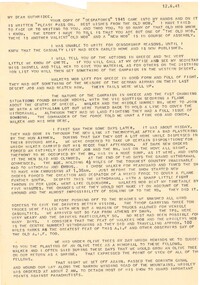
Letter, Actions of the AIF in Greece and Crete told by SG Savige 1941, 1941
... He mentions Thermopylae, Kalamai, and evacuation via the ship Costa Rica, which was bombed by German planes and sunk, which resulted in Walker's mob being lost. It starts addressed to Dear Guthridge, who has not been identified....He mentions Thermopylae, Kalamai, and evacuation via the ship Costa Rica, which was bombed by German planes and sunk, which resulted in Walker's mob being lost. It starts addressed to Dear Guthridge, who has not been identified. ...A typed letter designed to be copied and circulated to members of Stan Savige's 'old mob' recounting events in Greece and Crete in 1941. Legatee Savige was deployed in Greece and this letter recounts the withdrawal of his company and those of Walker and Wrigley. He mentions Thermopylae, Kalamai, and evacuation via the ship Costa Rica, which was bombed by German planes and sunk, which resulted in Walker's mob being lost. It starts addressed to Dear Guthridge, who has not been identified.A first hand account of the campaign in Greece during 1941, and an important link to Legatee Stan Savige, the founder of Legacy.Cream foolscap paper x 4 pages with black type transcription of a letter by Stan Savige in 1941.stan savige, world war two, crete, greece -
 Melton City Libraries
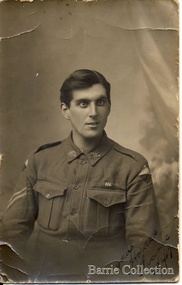
Photograph, Horace Lang, 1917
... started his schooling at Melton State School in Nov 1897. Mr Lang was the Head Teacher from 1896 – 1917. Horace enlisted on the 29th March 1915 24th Battalion D Company and sailed on the Euripides on the 8th May to Egypt. They landed on Gallipoli in early September returning to Egypt at the end of the year. In April on 1916 Horace and his brother Thomas had an opportunity to meet for a few hours before he moved onto France. He received the military medal in 1916 “For conspicuous gallantry in constructing and holding an advanced bombing...started his schooling at Melton State School in Nov 1897. Mr Lang was the Head Teacher from 1896 – 1917. Horace enlisted on the 29th March 1915 24th Battalion D Company and sailed on the Euripides on the 8th May to Egypt. They landed on Gallipoli in early September returning to Egypt at the end of the year. In April on 1916 Horace and his brother Thomas had an opportunity to meet for a few hours before he moved onto France. He received the military medal in 1916 “For conspicuous gallantry in constructing and holding an advanced bombing ...Date of birth 27th April 1893 Born at Spring Hill – Kyneton Parents – Thomas and Mary Elizabeth nee Coates Lang. The family lived in High Street Melton 1896. He started his schooling at Melton State School in Nov 1897. Mr Lang was the Head Teacher from 1896 – 1917. Horace enlisted on the 29th March 1915 24th Battalion D Company and sailed on the Euripides on the 8th May to Egypt. They landed on Gallipoli in early September returning to Egypt at the end of the year. In April on 1916 Horace and his brother Thomas had an opportunity to meet for a few hours before he moved onto France. He received the military medal in 1916 “For conspicuous gallantry in constructing and holding an advanced bombing post near Flers on 18/19 November within close range of the enemy. The garrison had to remain motionless throughout the day but Corpl. Lang refused to be relieved until his company left the trenches, setting a most encouraging example of endurance.” In May 1917 the Battalion was near Arras – Bullecourt. On 3rd May he was last seen alive carrying a Lewis Gun, and wounded making his way to the casualty station according to witnesses reporting to the court of enquiry. The family, in Melton had a first heard that he had been wounded, or was a prisoner. My grandmother Jessie Barrie and the Lang family went to Port Melbourne as the troop ships arrived hoping they would find someone who might know of his fate. AWM records and Red Cross files reveal the extent of the efforts that family and friends made enquiring about his fate. In December 1917 he was declared Killed in Action on May 3rd at Bullecourt where he is commemorated. Horace Lang postcardRear: Dear Jessie & All, I am in the pink not doing to bad. Haven't had any letters from you for some time. Hope you haven't forgotte me. Don't be so long nest time. Letter later from your loving bro Horace. (PS) Photo is very crook. (Front: Yours Horace, France 28/2/17)local identities -
 Kew Historical Society Inc
Biographical information, Ronald Horace Setford (1915–1988)
... bombed. He spent time in Darwin, Wayville (South Australia), Herberton and Grovely (Queensland). Afterwards he refused to eat rice, never spoke of the war, nor took part in any ANZAC day proceedings. In 1941, Ron and Grace bought their block of land at 9 Tanner Avenue, East Kew, part of the Old Golf Links Estate, for £225. It was not until December 1945 that Ron started...bombed. He spent time in Darwin, Wayville (South Australia), Herberton and Grovely (Queensland). Afterwards he refused to eat rice, never spoke of the war, nor took part in any ANZAC day proceedings. In 1941, Ron and Grace bought their block of land at 9 Tanner Avenue, East Kew, part of the Old Golf Links Estate, for £225. It was not until December 1945 that Ron started ...Ronald Horace Setford was born in April 1915 at 18 Church Street, Hawthorn, at his family’s home above their decorator shop. He was the second of three sons born to Horace Turner Setford (1880-1944) and Mabel Crofts (1887-1943). He attended Hawthorn West Primary School and then Swinburne before beginning work in his family’s business ‘Setford and Son’ in October 1930. This was formalised in April 1931 when he became a carpentry and joinery apprentice. In 1934 he graduated as a grade four carpenter. Ron worked in the family business until 1964 and then worked at J S Kidd and Co Pty Ltd as a storeman until his retirement in December 1973. Ron married Grace Muriel Agnes Perrey (1915-2001) in 1936 and they first lived in Kew around 1940, at 38 Marshall Avenue. Ron served in the Citizen Military Forces as a sapper with the 9 Australian Army Transport Company, Royal Australian Engineers, signing up a week after Darwin had been bombed. He spent time in Darwin, Wayville (South Australia), Herberton and Grovely (Queensland). Afterwards he refused to eat rice, never spoke of the war, nor took part in any ANZAC day proceedings. In 1941, Ron and Grace bought their block of land at 9 Tanner Avenue, East Kew, part of the Old Golf Links Estate, for £225. It was not until December 1945 that Ron started building their home and they moved in during May 1947. Ron and Grace remained there for thirty-seven years until the house was sold to their nephew in 1984. It has since been demolished. Ron’s great passion was photography and in the early 1960s he purchased his Minolta camera. Slide evenings at Tanner Avenue were a regular occurrence. Ron made his own title slides, interval slides and end slides. As well as many holiday photos (around Australia and their world trip in 1966), he enjoyed photographing local landmarks, flowers, insects and family. One of Ron’s photography projects was to record the progress of the building of the Eastern Freeway. This was near their home, and he’d walk down to the works on a regular basis, dressed smartly, with his camera in hand. The workers thought he was an official photographer, and he was allowed on site to take his photos. In 1984, Ron and Grace downsized and moved to Bayswater. Ron passed away on 31 October 1988 at the Maroondah Hospital in Ringwood East, at age 73. His ashes were spread on his beloved rose bushes at Tanner Avenue. Lauren Thomson, 2025ron setford, 9 tanner avenue -- kew east (vic, setford and son -- 18 church st (hawthorn), grace muriel agnes perrey, 9 australian army transport company, j s kidd and co pty ltd, eastern freeway, f19 freeway -
 Ballarat Heritage Services
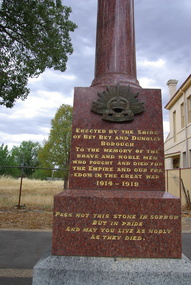
Photograph - War Memorial, Lisa Gervasoni, Dunolly War Memorial, 2025, 1921
... bombs fell, so I was pretty right. I thought I had left the war behind in France, but it seems to be on over here at times also. I spent Christmas day with a family at Grantham, a town between London and Newcastle; they were very nice people. I had a very enjoyable time with them. I went to a dance in the evening and enjoyed it very much. It was a bit strange for a start...bombs fell, so I was pretty right. I thought I had left the war behind in France, but it seems to be on over here at times also. I spent Christmas day with a family at Grantham, a town between London and Newcastle; they were very nice people. I had a very enjoyable time with them. I went to a dance in the evening and enjoyed it very much. It was a bit strange for a start ...The Dunolly World War One Memorial Pillar, located in front of the Town Hall on Broadway Street, and was unveiled on November 18th 1921. The pillar is topped by an urn and rests on a square concrete plinth, which lists the names ninety-four locals who died serving during the First World War. On Friday afternoon the Premier, accompanied by Messrs. Pennington and Groves, M's.L.A., visited Dunolly, and unveiled a soldiers' memorial — a polished granite column on a square base, erected by the residents at a cost of £300. It bears the names of 94 district soldiers who were killed in action. The Premier, who is a native of Dunolly, referred to his early associations with the town and district. Speaking of the valiant service rendered by the Australian soldiers in the great war, he paid a tribute to those who enlisted from the country districts. He was not one of those who would withhold national memorials to the fallen because provision had not been made for all who had returned. It was right and proper to have these memorials as silent reminders of the great sacrifice made by the many as a lasting tribute to their memory. Messrs. Groves and Pennington and local clergymen also spoke. The school children sang O God, Our Help in Ages Past, and a bugler sounded the Last Post after the unveiling. The shire president entertained the visitors and committee at dinner. The Age (Melbourne), 19 November 1921. Colour photograph of the Dunolly War Memorial. Front Inscription "Erected by the Shire of Bet Bet and Dunolly Borough To the memory of the brave and noble men who fought and died for the Empire and our freedom in the Great War 1914 - 1918. Pass not this stone in sorrow but in pride, and may you live as nobly as they died." "Private L. Polinelli has written several letters to his mother at Dunolly, dated from from Tel el Kebir from January 13th till the 22nd. He had written every day or two, and this example, is a very fine one. He explains why there was an interval some weeks during which he sent no letters. This was just before the evacuation of Gallipoli, and no-one was permitted to send letters at such a critical time, as there were fears that carefully arranged plans might leak out in some way. Gallipoli had been evacuated on the 19th December, which happened to be Private Polinelli's 24th birthday, and he has cause, he says, to remember that birthday particularly, when this important movement, in which he participated, was so success-fully carried out. He was in the best of health. They had been on Lemnos Island for two weeks after leaving Galilipoli, and while there they got billeted and numerous gifts from Australia, which gave great delight. He (Private Polinelli) had got a big mail - 35 letters and a number of parcels. Both Norman Watson and himself were feeling well, although they had a pretty rough time at the front, but they were feeling better every day. Further letters speak of the arrival in Egypt and the Australian being encamped at Tel el Kebir, 40 miles from Cairo. He states that W. Lyndon had returned from England and was with them. He (W. Lyndon) looks splendid and had had a splendid time in England and Scotland. He saw Jack Lewis in England, and thinks he was to return to Australia. Reference is made to the Rev. Father Goidanich who was with their brigade, and who had been wounded at the front, but was all right again. Father Goidanich is well-known in this district. The letters were written in good spirits and many references were made to friends in Dunolly and district. A friend in Dunolly has received a letter from Private L. Polinelli, which is dated February 3rd, and written 'from the Arabian Desert.' This covers a vast extent of country, so that there is no use in speculating as to the locality, and portions of the letter which possibly would have given some indication have bean 'censored.' Private Polinelli wrote that Norman Watson and Himself were in the best of health and have stook the life well. They are right out of civilisation at time of writing. He referred to their Dtsojourns at Lemoos Island, where Christmas was spent, and where the billies and puddings assisted much in their enjoyment. But they were glad to leave Lemnos Island. After being in camp at Tel el E-bir for two weeks they were sent to where they were at the time of writing, all being in good xxxx and the open country suiting them well. He speaks with admiration of the desert work done by the camels so very largely used. The censoring was very strict so that he could not give much news. After alluding to the return to splendid health of W. Lyndon from England, he says he saw a lot of others from round Dunolly on returning to Egypt, including Tom Fishlock, R. Johnson, and J. Taylor, and some others from Betley, and all looked well. He had also seen Erie Williamson a few times, and he looked splendid. He concludes with remembrances to friends, and from himself and Norman Watson to the Loyal Prince Alfred Lodge." (Dunolly and Betbetshire Express and County of Gladstone Advertiser, Tue 14 Mar 1916) "SOLDIER'S LETTERS PRIVATE L. POLINELLI A friend in Dunolly has received another interesting letter from Private L Polinelli, son of Mrs J Davis, South Dunolly. It is from "Somewhere in France," and is dated July 23rd. He remarks with regret that a good deal of the soldiers' mail from Australia went down in the Arabia, and then goes on to say:- "Norman is back here with us again now and looking well. He had a splendid time over in England after he was able to get out of bed. It was two years on the 18th of this month (January) since Norman and I enlisted, and we celebrated the occasion by having a bit of an evening out. I am very pleased that he is back; we spend most of our time together. We are at present out of the line having a spell in a village, so we are not having a bad time just now but we will soon be going into the trenches again. I met Wally Bell a few days ago; they were going into the line to relieve our brigade. We did not have time to have a long talk. He looks rather thin, but he was always that way. He is feeling well, and wishes to be remembered to his friends in Dunolly. I also met C. Game the same day; he looked well but, as he was also going into the line, we could not have much of a talk J. Hughes and C. Atherton are also over here now; I often see them. W. Lyndon and T. Miles are well ; I was speaking to them yesterday. We are having very bad weather over here now ; it is either raining or snowing every day. The snow was about a fool deep a few days ago. When the rain comes after it, it makes things muddy, The mud is very bad over here; it takes us all our time to struggle through it in places. We will all be very glad when the winter is over. I was over in England on furlough last month, and had a splendid time. The people over there do all they can to give us a good time. I had several invitations to visit different people, and those that we did visit gave us a splendid time. At the place where I was staying they always had a guide waiting of a morning to show us any place of interest that we wanted to see. There was also always a supply of free tickets to the different theatres if we wanted them ; so you see that they go to some expense to give ns a good time. When they know yon are from France you are sure of a hearty welcome. was up in Scotland, and spent five days in Edinburgh. It is a very pretty place, especially when it is seen from Edinburgh Castle, which is on a high bill overlooking the place. We veil through the Castle; also Holyrood Palace. There are a lot of interesting things to be seen in the two places connected with the history of Scotland. It was snowing very heavily while v« were in Scotland, and we bad some fine snowballing with the Scotch people. I greatly enjoyed the trip to Scotland. It would take a very long time to see all round London. I saw a lot of the old historical places there, which were very interesting. The fogs are very bad in London. I had an experience of a London fog one day; it was the heaviest they experienced for a number of years. We could only see a few yards ahead of us. Nearly everyone carried torches; it looked very funny. . . . There are nearly always as many women drinking in the bars as men; it struck me as being very strange, a bit different to what we are used to in Australia, a trip through some parts of London is a real eye-opener to us. It is interesting to watch the traffic in some of the business parts of London it moves along in one big mass. It is a wonder that a lot more accidents do not happen. I saw Australia House, where the High Commissioner has his office, in the Strand. It is not yet finished. It looks a very fine place, and when completed will be 'some' place. Both Norman and I are well, and send remembrances to friends." (Since this letter was written we have had the sad news of the death from wounds of Privates Atherton and Hughes, and that Sergeant Miles and Corporal Norman Watson have been wounded.) (Dunolly and Betbetshire Express and County of Gladstone Advertiser , Friday 13 April 1917, page 2) "Private L Polinelli, from some of whose previous letters we have published interesting extracts, has written to a friend in Dunolly, the letter being from France, and dated April 28th. Private Polinelli says among other things, "I am pleased to say that, Norman (Watson), Les (Anderson) and myself are in the best of health. We now have been in France some time. It is a terrible place for rain ; It has been raining all the time we have been here. It has also been very cold, snowing at times, but it is starting to "fine up" now, and the last few days have been splendid. I hope it keeps like that for a while, as it makes things very miserable in the trenches when it is so wet. We get a few days spell out of the trenches every now and again; so things are not as bad here as they were at Gallipoli. It is not so lively here so far as it was over there either. I am sorry to say that Jack Sanderson, who had been Will Lyndon's mate since they joined the forces, got killed during a bombardment last night. He was terribly knocked about with a shell. I saw W. Lyndon to-day and he was telling me all about it. He seemed terribly cut up over it, and so am I, as I was with Jack a lot over at Gallipoli after Will got sent away sick. He was always bright and cheerful, always had a smile up whenever I met him. I feel very sad about it. We will do all we can to make the Germans pay for it. You will most likely know him, as be used to live in Dunolly before going to Bendigo. Will Lyndon had a narrow escape also, as he was not very far from where the shell burst. He escaped with a bit of a shock, otherwise he is in the best of health. We have a good time among the French people when we are out of the trenches. They do all they can to make us feel at home. I am getting quite expert at speaking French. They smile at us a treat trying to speak French, but we generally make ourselves understood and have a good time among them. It is very rarely we see a young Frenchman, they being all away fighting. The women do all the work on the farms themselves, and deserve every credit for it. . . . I was sorry to hear about the death of Nurse M'Mahon; she was a grand old nurse. I heard that her daughter Nelly was nurse in a hospital on Lemnos Island, and when we were there I went to two of the hospitals to try to see her, but she did not happen to be at either, and I had no time to visit any of the others, so I did not see her. I was also sorry to hear about Mrs Rokahr, as she has left so many little ones behind. (Reference is made to other happenings in Dunolly.) So far I am pleased to say Norman and I have had the luck not to have had a day's illness; I think we are very fortunate, as such a lot get sent to the hospital ill. We are also lucky to have escaped the bullets and shells so far. I hope that luck sticks to us. I am sorry that, owing to the censorship, I cannot give you any interesting news of our trip over to France and the places we have seen. I will have to keep that till I get back to Dunolly again. . . . I have just heard that the battalion that Teddy Game is in has arrived, so I am going to look him up first chance I get." (The letter concludes with remembrances to members of the Lodge and other friends.) (Dunolly and Betbetshire Express and County of Gladstone Advertiser, Tuesday 13 June 1916, page 3) "PRIVATE L POLINELLI Another very interesting letter has been received by a friend in Dunolly from Private L. Polinelli, from France dated May 4th, 1916- Private Polinelli says-" I was glad that you got the letter I wrote from the Arabian Desert. The Censor must have crossed a good deal of it out. They seem to cross out a lot more than is really necessary. We left out there all of a sudden, and in a very short while found ourselves over here. It does not take them very long to make a move. I was saying in the last letter that I was going to try and find " Teddy " Game. I met him a few days ago and had a good yarn with him; he looks real well. I also met S. Prew, and "Ted" Smyth and his son Ernie. They all looked splendid, and are in the same battalion. "Ted" Smyth sticks to it well, and looks better than he ever looked. They will be under fire for the first time in a few days. S. Prew was hit in the landing at Gallipoli, but be is quite well now. W. Smythe, who is in our brigade is well ; I see him very often. " Les " Peart is not with us now; he has joined a Pioneer battalion, and I have not seen him since he joined it. I gave all the Dunolly boys your best wishes and they all wish to be remembered to you— also the same remembrance from Dave Millar, who used to play football for Dunolly from Moliagul. He is in our battalion, having come over with reinforcements. I see him every day and he wished to be remembered to you. A brother of Mr A. J. Williamson, manager of the Bank of Victoria, Dunolly, is also in this battalion. He is a great friend of mine ; we often have a talk about Dunolly. He was not well a little while ago, having to go into a hospital, but is all right again and is back with me. Eric Williamson, son of Mr A. J. Williamson is over here ; Norman (Watson) saw him a few days ago and said he looked well. Norman has been a corporal for some time. I was also offered stripes lately, but preferred to remain a private. There is a lot of worry and running about when you are an N.C.O., so I think I will remain as I am. ... So football is about done this season. I don't think they should cut it right out. I suppose some of them have to stay at home, so they ought to have some amusement. I would very much like to have a game, but I think I would just about forget how to play now. It is very amusing for us to read some of the soldiers letters in the Australian papers. . . l told you in the last letter about xxx young "Jack "Sanderson ; I was terribly sorry about him." Private Polinelli mentions in a letter to his sister in Dunolly that he happened to be beach at Gallipoli where the late Lord Kitchener was xxxxx addressed the' soldiers and' xxxxxx to them the message from the King. Private Polinelli states that he was very proud to have been one of those addressed by the great man. He and Norman Watson have never been a day out of the lines since arriving first in Egypt. It is intended to grant special leave to all those who have been kept so close to their posts xxx three months, and they are looking forward to this relaxation with keen anticipation, hoping to visit England and Scotland. (Dunolly and Betbetshire Express and County of Gladstone Advertiser, Tue 27 Jun 1916) "SOLDIER'S LETTERS. CORPORAL L. POLINELLI. Two letters have been received by Mrs J. Davis, South Dunolly, from her son, Corporal L. Polinelli, both written subsequent to the time when he was wounded, as reported when word was received at the time. Corporal Polinelli writes from No. 12 General Hospital, Rouen, France, and his first letter is dated 7th May. He stated that he was in hospital, he having been wounded in the arm and shoulder on 3rd May. He continued— " It is not a bad wound, and will not take long to heal up, as it is a clean wound. I was very lucky to get out of the fight alive, as I was buried by a shell explosion about an hour before I was wounded. It was very rough, and the noise of all the shells was terrible. Four men were killed by the same shell that wounded me, so I was fortunate. I am feeling a bit " shook up," and my head is aching from the concussion of the shells, but after a few days' spell in bed here I will be feeling just the thing again. So you need not worry about me ; a week or two will see me quite right again. We are having very nice warm weather just now-pleasant change after all the bad weather we have had." The second letter is dated May 12, Corporal Polinelli saying— "I am getting along splendidly ; the wound is healing up fast, so it will not be very long before I am quite right. The doc-tor, the other day said it would be better not to take the piece of shell out of my shoulder yet, and that it would not interfere with me in any way ; so perhaps l will always carry it about with me. He feared lest taking it out at that time would interfere with an artery. Rouen, where the hospital is, is a very pretty city. They give us leave to visit all the places when we are well enough. It is a nice spell here, away from the firing line. We have nothing to trouble us at all, so I will soon be just the thing again. When I got buried by a shell it shook me up a good deal. I felt it far more than the wound I got after; but it has not done me any harm, as I feel hardly any effects now. My good luck sticks to me in getting out of it so lightly. I hope you are not worrying at all about me, as I am all right. We are having beautiful weather over here— sunny days just like the Australian spring. . . . The sisters in the hospital are very nice, and treat us well. They have a lot of work to do, as a good few men have been wounded lately. I would have liked to have been sent over to England, but they are not sending many over there now. They treat as many as they can in France on account of attacks on hospital ships. I would have been able to have a good time with Norman (Watson) had l got over. He was just about all right when I heard from him last." Corporal Polinelli sends kind remembrances to friends." (Dunolly and Betbetshire Express and County of Gladstone Advertiser, Friday 6 July 1917, page 2) "SOLDIERS' LETTERS. CORPORAL L. POLINELLI. The following letter, dated from London on December 27; has been received by a friend in Dunolly from Corporal L. Polinelli (son of Mrs J. Davis, South Donolly), who, at the time of writing, after long and hard service at the front, was on furlough in England. After an introduction he says:— I am having a very good time. I went over to Ireland for five days, spending the most of the time in Dublin. I like the place very much. War appearances are not so conspicuous in Ireland as in England. The hotels are open all day, and a good meal can be obtained anywhere, which is more than can be got in England. The war seems to be making things very bad in England. It is very hard to get a good meal in London ; everything is so restricted. The only way to get a good meal is to go into two places. The people have to line up outside the shops for hours to get sugar, tea, and butter, and then they sometimes fail to get any. So many of our boats getting sunk is the cause of it. If things continue to go on in this way I am afraid that there is a very hard time in store for the people in England. Several people that I have spoken to say that they are just beginning to feel the pinch now. I was in London while an air raid was on a few days ago; it caused a lot of excitement among the people. Ten were killed and 70 wounded in the raid. I was about half a mile from where the bombs fell, so I was pretty right. I thought I had left the war behind in France, but it seems to be on over here at times also. I spent Christmas day with a family at Grantham, a town between London and Newcastle; they were very nice people. I had a very enjoyable time with them. I went to a dance in the evening and enjoyed it very much. It was a bit strange for a start, as it is the first dance I have been to since Norman and I had the send off at Dunolly in January, 1915. They do the dances a bit different over here to what they are done in Australia, and that made it worse still. I went through Guinness's Brewery while I was in Dublin. It is a wonderful place, and covers 55 acres of ground. I got a great surprise when I was starting on my leave in France. We were taken to the station we had to start from in a motor lorry, and who should the driver of the lorry be but Syd. Richards (son of Mr W. Richards, South Dunolly), who used to work at the Post Office in Dunolly. I rode on the front with him, so we had a good yarn. I did not know that be had joined, so was surprised to see him. He has grown a lot since I saw him last, and is looking well. Norman and Bill Lyndon were both well when I left France. We had been having a good spell near Messines, in Flanders, but they will be in the trenches by now. We have been round about Ypres for this last four months, and had some pretty rough times there. dunolly, dunolly war memorial, l. polinelli, bet bet, world war one, world war two, j. deledio, b. battilana, c. fitzgerald, f.s. kendall, j.h. hogan, p. zampatti, louisa davis, louisa gervasoni, bill lyndon, norman lyndon, sydney lindsay -
Woodend RSL
Memorabilia - Trench Art - French Shell Casing Model 1885 37 mm, January 1918
... On the base: PDPs 267 1.18 37-85 (there is a symbol of a flaming bomb between 18 and 37) On the side: "1916 ROBECQ VIMY HAMEL BUSIGNY" On opposite side (in an engraved ribbon starting from the base): A-F-A- - - - 46th Bty - - K.F. ...On the base: PDPs 267 1.18 37-85 (there is a symbol of a flaming bomb between 18 and 37) On the side: "1916 ROBECQ VIMY HAMEL BUSIGNY" On opposite side (in an engraved ribbon starting from the base): A-F-A- - - - 46th Bty - - K.F. ...The Canon d'Infanterie de 37 modèle 1916 TRP (37mm mle.1916) was a French infantry support gun, first used during World War I. TRP stands for tir rapide, Puteaux (fast-firing, designed by the Atelier de Puteaux). The tactical purpose of this gun was the destruction of machine gun nests. It was also used on aircraft such as the Beardmore W.B.V and the Salmson-Moineau. Fighter ace René Fonck used a 37mm mle.1916 on a SPAD S.XII.Shell casing - BrassOn the base: PDPs 267 1.18 37-85 (there is a symbol of a flaming bomb between 18 and 37) On the side: "1916 ROBECQ VIMY HAMEL BUSIGNY" On opposite side (in an engraved ribbon starting from the base): A-F-A- - - - 46th Bty - - K.F. KEATING -
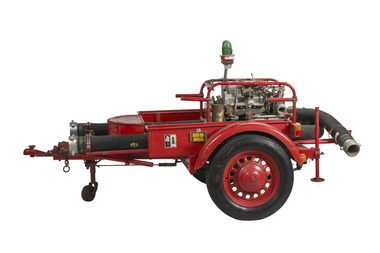 Department of Energy, Environment and Climate Action
Coventry Climax Pump - modified with recoil start
... bombings of WW2. Fire pump Forests Commission Victoria (FCV) Bushfire Coventry Climax Fire pump mounted on trailer Two lengths of suction hose, nozzles and some tools. Modified from original design at Altona to include recoil battery starter Coventry Climax Pump - modified with recoil start ...Among the many pressing priorities for Alf Lawrence, the Forests Commission's new Chief Fire Officer, in rebuilding the firefighting capacity after the catastrophic 1939 bushfires was to invest heavily in modern vehicles and equipment. Powered pumps like the trailer-mounted Coventry Climax (Godiva) gave firefighters a much greater capacity than ever before to put the “wet stuff on the red stuff”. Its four-cylinder, four-stroke, water-cooled, petrol motor produced 38Hp and was connected with either 1½ inch or 2½ inch canvas hose for direct attack, or as a filler pump it could deliver 300 gallons per minute at 120 psi. Some of the first acquisitions included this war surplus veteran shipped over from the London after the blitz bombings of WW2. Fire pump mounted on trailer Two lengths of suction hose, nozzles and some tools. Modified from original design at Altona to include recoil battery starterCoventry Climax fire pump, forests commission victoria (fcv), bushfire
