
Showing 93 items matching "starting the engine"
-
 Moorabbin Air Museum
Book - Aero engines, Aero Engines ? - no title page, book spine illegible
... ...Starting the engine...Aero engines The internal combustion engine Lubrication system Ignition system Installation Starting the engine Airscrews Instruments Undercarriage Airframe Overview of aero engine construction, functioning & repair. ...Overview of aero engine construction, functioning & repair. Unable to locate date, but pre jet engineSpine illegible, title page missingnon-fictionOverview of aero engine construction, functioning & repair. Unable to locate date, but pre jet enginethe internal combustion engine, lubrication system, ignition system, installation, starting the engine, airscrews, instruments, undercarriage, airframe -
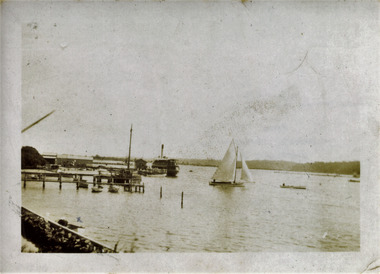 Lakes Entrance Historical Society
Photograph - SS Gippsland Lakes Entrance Victoria c1926
... On back, 1926 'Nyama', 'SS Gippsland', Pilot Launch, 'Tambo', 'TNS' Barge, Reg Shilz starting Evinrude engine on dinghy 'Bunga'...Reg Schulz son of W Schulz, Harbour Engineer at Lakes Entrance, 1917 - 1930 c Jetties Boats and Boating Waterfront On back, 1926 'Nyama', 'SS Gippsland', Pilot Launch, 'Tambo', 'TNS' Barge, Reg Shilz starting Evinrude engine on dinghy 'Bunga' Black and white photograph copy of the waterfront. ...Reg Schulz son of W Schulz, Harbour Engineer at Lakes Entrance, 1917 - 1930 cBlack and white photograph copy of the waterfront. It shows the SS Gippsland at the Post Office Jetty, other vessels on lake or moored, part of retaining wall at lake edge, southern shore in background. On back, 1926 'Nyama', 'SS Gippsland', Pilot Launch, 'Tambo', 'TNS' Barge, Reg Shilz starting Evinrude engine on dinghy 'Bunga'jetties, boats and boating, waterfront -
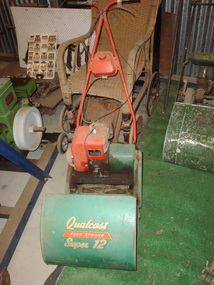 Maldon Vintage Machinery Museum Inc
Motor Mower
... Green painted catcher and engine cover, orange petrol tank and handles. Pull start with engine control on RHS handle. ...Green painted catcher and engine cover, orange petrol tank and handles. Pull start with engine control on RHS handle. Motor Mower ...Cylindrical lawn mower with grass catcher. Green painted catcher and engine cover, orange petrol tank and handles. Pull start with engine control on RHS handle. Name prominantly printed on front of catcher "Qualcast / four stroke / Super 12". Sticker on engine "Stowmarket, SIP (in a red diamond background) Suffolk / Engine type 75G14 Model No. 25A / Made in Englsnd / Recommended Lubricants" followed by a table of lubricant makers and oil specification.machinery, lawn mowing -
4th/19th Prince of Wales's Light Horse Regiment Unit History Room
Document, 4th/19th Prince of Wales's Light Horse Regiment, Cars Armoured Staghound DONT'S, 1960's
... A single page listing 16 things not to do with regard to the Staghound, such as - "Don't start the engines before carrying out first parade service", and, "Don't traverse the turret unless the turret lock is fully disengaged"...Staghound Armoured Car A single page listing 16 things not to do with regard to the Staghound, such as - "Don't start the engines before carrying out first parade service", and, "Don't traverse the turret unless the turret lock is fully disengaged" Cars Armoured Staghound DONT'S Document 4th/19th Prince of Wales's Light Horse Regiment ...A single page listing 16 things not to do with regard to the Staghound, such as - "Don't start the engines before carrying out first parade service", and, "Don't traverse the turret unless the turret lock is fully disengaged"staghound armoured car -
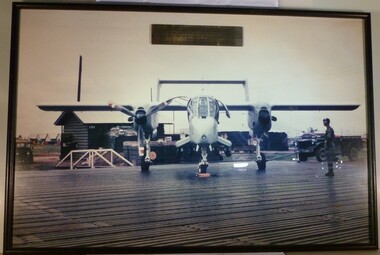 National Vietnam Veterans Museum (NVVM)
Photograph - A Framed Coloured Photograph, The Big Red, 1/09/1969 12:00:00 AM
... A framed colour photograph of RAAF Flt Lt Ron Slater starting left engine of OV-10 aircraft at Di An, South Vietnam September 1969. ...Plaque with details of the engine start Donated by Flt Lt Peter Condon...Flight Lieutenant Ronald Alexander Slater O61240 Distinguished Flying Cross 79 Squadron Headquarters Australian Force Vietnam RAAF Element 2nd Brigade 1st Infantry Division The Big Red Flight Lieutenant Peter Damien Condon O44252 OV-10 Aircraft Di An Photograph Plaque with details of the engine start Donated by Flt Lt Peter Condon A framed colour photograph of RAAF Flt Lt Ron Slater starting left engine of OV-10 aircraft at Di An, South Vietnam September 1969. ...A framed colour photograph of RAAF Flt Lt Ron Slater starting left engine of OV-10 aircraft at Di An, South Vietnam September 1969. Ron supported the 2nd Brigade of US 1st Infantry Division 'The Big Red'.Plaque with details of the engine start Donated by Flt Lt Peter Condonflight lieutenant ronald alexander slater, o61240, distinguished flying cross, 79 squadron, headquarters, australian force vietnam raaf element, 2nd brigade, 1st infantry division, the big red, flight lieutenant peter damien condon, o44252, ov-10 aircraft, di an, photograph -
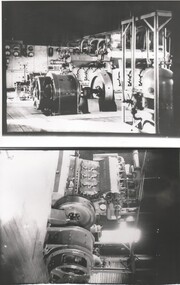 Bendigo Historical Society Inc.
Photograph - HARRY BIGGS COLLECTION: EAGLEHAWK POWER HOUSE, Date unknown
... The other is a wider view of the area, in the background are gauges and switching gear mounted in racks, in the right foreground is a compressed air tank, which was used for starting the engines. On the back is written Eaglehawk power house, Negative at 254....The other is a wider view of the area, in the background are gauges and switching gear mounted in racks, in the right foreground is a compressed air tank, which was used for starting the engines. On the back is written Eaglehawk power house, Negative at 254. ...Two photographs of the interior of the Eaglehawk Power House showing large diesel engines and associated Generators. One photo is a close up of a motor generator set. The other is a wider view of the area, in the background are gauges and switching gear mounted in racks, in the right foreground is a compressed air tank, which was used for starting the engines. On the back is written Eaglehawk power house, Negative at 254.buildings, commercial, power station, eaglehawk power house -
 Bendigo Military Museum
Accessory - CASING, est 1979
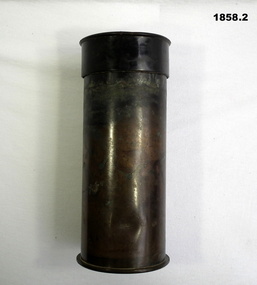
... .1 Rimmed brass case for "shotgun" type aircraft engine starting system. .2 Plastic end cap....machinery-engines military history-raaf .1 Base has "Cart Elec Eng Start MF 79/3 84 ME 7-79" .2 "Remove cap before loading EFM 79" .1 Rimmed brass case for "shotgun" type aircraft engine starting system. .2 Plastic end cap. ....1 Rimmed brass case for "shotgun" type aircraft engine starting system. .2 Plastic end cap..1 Base has "Cart Elec Eng Start MF 79/3 84 ME 7-79" .2 "Remove cap before loading EFM 79"machinery-engines, military history-raaf -
 Puffing Billy Railway
Blackstone Oil Engine, 6 November 1908
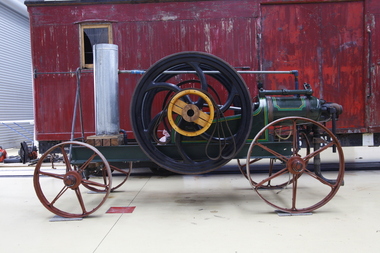
... 8HP Blackstone Lamps Start Oil Engine engine number 71076 Engine Details Maximum operating RPM of 240. ...8HP Blackstone Lamps Start Oil Engine engine number 71076 Engine Details Maximum operating RPM of 240. ...8HP Blackstone Lamps Start Oil Engine engine number 71076 Engine Details Maximum operating RPM of 240. Fitted with a 3'9" Flywheel Tested on the 6th of November 1908. Shipped to Cluter buck South Australia for installation on concrete base. Recovered and restored during the 80's in South Australia Purchased privately in 2013 in Tailem Bend South Australia and transported to Victoria. Currently on loan to the Puffing Billy Museum at Menzies Creek as an operating exhibit. Blackstone & Co. was a farm implement maker at Stamford, Lincolnshire, United Kingdom. In 1896 they built lamp start oil engines. The Lamp or hot-bulb engine (also hotbulb or heavy-oil engine) is a type of internal combustion engine. It is an engine in which fuel is ignited by being brought into contact with a red-hot metal surface inside a bulb, followed by the introduction of air (oxygen) compressed into the hot-bulb chamber by the rising piston. There is some ignition when the fuel is introduced, but it quickly uses up the available oxygen in the bulb. Vigorous ignition takes place only when sufficient oxygen is supplied to the hot-bulb chamber on the compression stroke of the engine. Most hot-bulb engines were produced as one-cylinder, low-speed two-stroke crankcase scavenged units Historic - Industrial - single cylinder, horizontal, 4 stroke, hot-bulb ignition oil engine Blackstone 8HP Oil Engine made from steel, wrought iron and brassOval Plate with Black Stones and Clutter Buck Brass Plaque engine number 71076blackstone, oil engine, clutter buck, black stone, puffing billy, hit and miss, engine, blackstone & co -
Moorabbin Air Museum
Manual (Item) - Armstrong-Whitworth Argosy 650 Series Illustrated Parts Catalogue Volume 3, Chapters 52-91, AW. 650 Aircraft Manual
... Topics include fuselage, nacells, wings, stabilisers, windows, air, ignition, engines, propellers, power plant, engine controls, starting, oil, exhaust, engine indicators, water injection, turbines, charts and accessory gearboxes....Topics include fuselage, nacells, wings, stabilisers, windows, air, ignition, engines, propellers, power plant, engine controls, starting, oil, exhaust, engine indicators, water injection, turbines, charts and accessory gearboxes. ...Topics include fuselage, nacells, wings, stabilisers, windows, air, ignition, engines, propellers, power plant, engine controls, starting, oil, exhaust, engine indicators, water injection, turbines, charts and accessory gearboxes. -
 Bendigo Historical Society Inc.
Document - MINING ACCIDENTS - SHOCKING ACCIDENT AT WILSON'S REEF
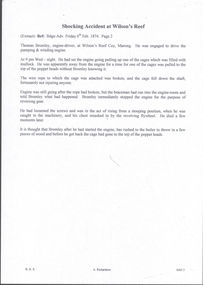
... It was thought that Bromley had started the engine, the rushed to the boiler to throw in a few pieces of wood and before he got back the cage had gone to the top of the poppet heads....It was thought that Bromley had started the engine, the rushed to the boiler to throw in a few pieces of wood and before he got back the cage had gone to the top of the poppet heads. ...Handwritten extract from the Bendigo Advertiser dated Friday 6th Feb. 1874 Page 2 when Thomas Bromley, engine driver at Wilson's Reef Coy, Marong was killed when he got caught in the flywheel. He had set the engine going pulling up a cage of mullock, then went away from the engine, One of the cages was pulled to the top of the poppet heads without him knowing. The wire rope broke and the cage fell down the shaft, no one was injured. The engine was still going, the braceman ran into the engine-room and told Bromley what had happened. Bromley stopped the engine to reverse the gear. He had loosened the screws and was rising from a stooping position when he was caught by the flywheel. It was thought that Bromley had started the engine, the rushed to the boiler to throw in a few pieces of wood and before he got back the cage had gone to the top of the poppet heads.document, gold, mining accidents, shocking accident at wilson's reef, bendigo advertiser 6/2/1874, thomas bromley -
 Orbost & District Historical Society
catalogue, Fraser & Jenkinson, Langwill Bros & Davies Pty Ltd, early 20th century
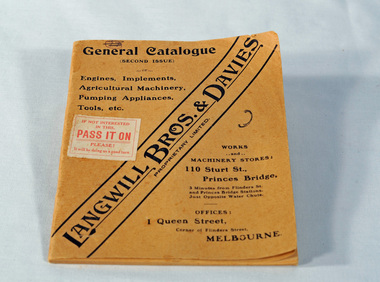
... Langwill Bros & Davies of Melbourne were agents for imported farm pump engines, windmills and other farm implements.. Because of war shortages, they started building the engines themselves under the Challenge brand in 1916. "..with the exception of the magneto, every part of the engine is manufactured in Australia from Australian raw material." ...Langwill Bros & Davies of Melbourne were agents for imported farm pump engines, windmills and other farm implements.. Because of war shortages, they started building the engines themselves under the Challenge brand in 1916. "..with the exception of the magneto, every part of the engine is manufactured in Australia from Australian raw material." ...Langwill Bros & Davies of Melbourne were agents for imported farm pump engines, windmills and other farm implements.. Because of war shortages, they started building the engines themselves under the Challenge brand in 1916. "..with the exception of the magneto, every part of the engine is manufactured in Australia from Australian raw material." They also sold imported Challenge windmills.This item is associated with the history of agriculture in early Orbost and is a useful research tool.A small light brown covered catalogue which has "Langwill Bros. & Davies Pty Ltd" diagonally across front in black print, items on offer and details of the company. There is a white stamp on the front with red print - "If you're not interested in this; PASS IT ON; Please; It will be doing us a good turn".catalogue farm-machinery langwill-davies -
 Nhill Aviation Heritage Centre
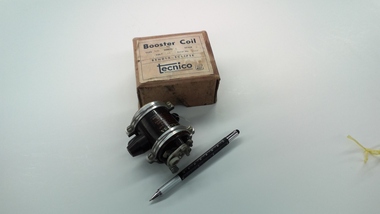
Memorabilia - Ignition coil / shower of sparks, 26/2/45
... commonly known as 'shower of sparks' this buzzer type ignition coil is connected via the distributor and spark plug leads to generate a continuous spark while crank starting the Cheetah aero engine. ...commonly known as 'shower of sparks' this buzzer type ignition coil is connected via the distributor and spark plug leads to generate a continuous spark while crank starting the Cheetah aero engine. The type of ignition coil fitted to the Cheetah engine fitted to an Avro Anson, Parts stock unused. ignition coil, shower of sparks, ignition garth rohdes D-5271BA Adjust to 2.5 volts with standard secondary load for use on 12 volt system. ...commonly known as 'shower of sparks' this buzzer type ignition coil is connected via the distributor and spark plug leads to generate a continuous spark while crank starting the Cheetah aero engine. The type of ignition coil fitted to the Cheetah engine fitted to an Avro Anson, Parts stock unused.electronic ignition coil with high tension outlet and set of adjustable breaker points and connectors. New in original box.D-5271BA Adjust to 2.5 volts with standard secondary load for use on 12 volt system. On Box 'Booster Coil Type 512 Model 1 Style E' serial number 1552 ignition coil, shower of sparks, ignition, garth rohdes -
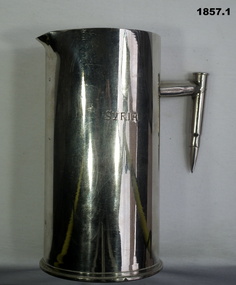 Bendigo Military Museum
Memorabilia - TRENCH ART, JUG & VASE, C.1941 - 43
... Handle is made of rifle cartridges soldered on. .2 Brass casing for "shotgun" type starting system for English Electric engine....Handle is made of rifle cartridges soldered on. .2 Brass casing for "shotgun" type starting system for English Electric engine. Memorabilia TRENCH ART, JUG & VASE ...Vase & Jug made from shells brought home by Gunner Harold Salmon VX32173, enlisted 18.06.1940, discharged 17.09.1945.1 Jug, made from shell casing and silver or chrome plated. Handle is made of rifle cartridges soldered on. .2 Brass casing for "shotgun" type starting system for English Electric engine..1 Stamped on side "Syria", base has "75 DE C ATL 953 18C" .2 On base "Cart Elec Eng Start ME 79/2 87 ME 7/80", stamped in black ink "N010 Mk2"arms-ammunition, metalcraft-brassware, epns, trench art -
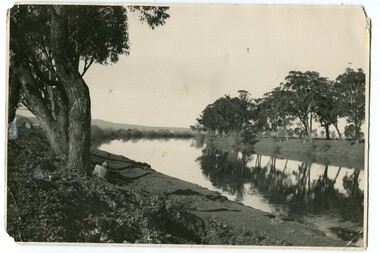 Orbost & District Historical Society
black and white photograph, first half 20th century
... At their Lochend Barn, they had a Blackstone engine which ran on oil. They used to light a fire under it and hot it up to start it. ...At their Lochend Barn, they had a Blackstone engine which ran on oil. They used to light a fire under it and hot it up to start it. ...The seed bean industry was a major industry in the Orbost district for the first half of the 20th century. The total area sown with beans for seed at Orbost was estimated to be about 1000 acres. Fisher Bros, grew or supervised the growing of approximately one quarter of the bean seed produced at Orbost, and, in addition, prepared for market and sold a considerable quantity for other growers. From Newsletter February 2015 : "the Fishers took over the old Butter Factory in Lochiel Street. They had sorting tables there in the 1920s. In Orbost, the Fishers had a Shell fuel depot at the back of the bean factory. The Fishers were very enterprising people, very smart. One of their uncles is supposed to have invented the knot that was used to tie the sheaves of hay in the fields. At their Lochend Barn, they had a Blackstone engine which ran on oil. They used to light a fire under it and hot it up to start it. This engine drove all the bean machinery in the barn" The seed bean industry was a major industry in the Orbost district for the first half of the 20th century. the Fisher Brothers were a significant part of that industry.A black / white photograph tajen from a river bank. On the right behind some trees is a barn. On the left between tres is a small building. Reflections can be seen in the water.on back - "Snowy River, Fisher barn on right. Mary Gilbert"bean-industry fisher-beans snowy-river -
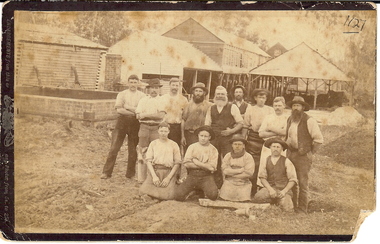 Bendigo Historical Society Inc.
Photograph - EDINBURGH TANNERY: SHEEPWASH CREEK, 1890 approx
... In December 1894 the plant was destroyed by a fire believed to have started in the engine room. The plant was quickly rebuilt at an estimated cost of ten thousand pounds. ...In December 1894 the plant was destroyed by a fire believed to have started in the engine room. The plant was quickly rebuilt at an estimated cost of ten thousand pounds. ...In 1878, J H Abbott bought the Edinburgh tannery from Mr Lambert and Mr Sibley in 1878 and set about expanding and modernising it. Soon it consisted of the necessary sheds surrounded by cottages built for the workers. The tannery buidings and processes consisted of :- 1. Hide shed that held 400-500 salted hides 2. Salt pots where the salted hides were soaked to remove all salt 3. Lime water pits where the hides were soaked to remove hair and all adherent flesh. 4.Beam shed where hides were hung so they could be scraped clean with double handled knives 5. Water baths that soaked the hides to remove the lime 6. Tan yard where there were 10 pits containing tanning liquid made from ground wattle bark. The entire process could take up to 9 months depending on the type of leather required. A forward thinking initiative of this tannery was the lack of waste. The left over flesh was boiled down to make tallow, trimmings from the hides was used to make glue, hair was washed and used by saddlers and upholsterers and the lime was mixed with tanning liquid to produce fertilizer. The tannery was producing about 240 sides of leather a week, with about two thirds of this being sent to England where it was in great demand because of its quality. In December 1894 the plant was destroyed by a fire believed to have started in the engine room. The plant was quickly rebuilt at an estimated cost of ten thousand pounds. The plant at 145 Tannery Lane operated until 1906.Sepia photograph: 13 workmen, shed at rear. Brick, timber, corrugated iron buildings in back ground. Interesting industrial site of the time. Photo of workmen taken in front of open sheds. Brick chimney and pile on L.H.S. Suggests Edinburgh Tannery, Sheepwash. J.H Abbott & Co. On back on small piece of paper 1127 Bgo. New registration No. rather indistinct. James Lerk 26.11.1999, ' Edinburgh Tannery - Sheepwash?' Ken Arnold Book 'Bendigo A History in Bottles & Stoneware 1852-1930 p10. This photograph labelled 'Workers at Sheepwash Tannery,' C. 1880-1890 with section about J.H. Abbott & Co. See book 'Bendigo A History in Bottles & Stoneware 1852-1930 by Ken Arnold, p.10RHSV 1127, Bgoorganization, business, edinburgh tannery, sheepwash creek. -
 Otway Districts Historical Society
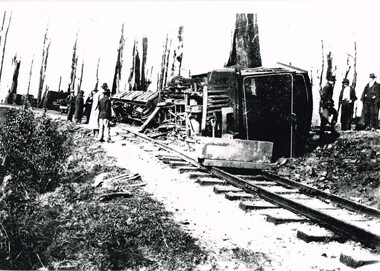
Photograph, Victorian Railways, Derailment at Beech Forest, 1904, 4 October 1904
... While they were engaged some local children boarded the unattended engine, started it, panicked when it began moving and jumped out leaving in to speed away and tip on a curve in a cutting at Ditchley. ...While they were engaged some local children boarded the unattended engine, started it, panicked when it began moving and jumped out leaving in to speed away and tip on a curve in a cutting at Ditchley. ...On Tuesday, 4 October 1904, the first serious railway accident occurred on the Colac-Beech Forest line near Beech Forest. As no train was scheduled that day in the afternoon the crew decided to fetch some wood from down the line. They fired the boiler on locomotive 3A, attached two trucks to the locomotive and moved out of the station. When they arrived opposite the Ditchley Park Hotel they stopped the engine and adjourned to the bar for some refreshments before beginning work. While they were engaged some local children boarded the unattended engine, started it, panicked when it began moving and jumped out leaving in to speed away and tip on a curve in a cutting at Ditchley. The engine was severely damaged. However, its cause remained an Otways secret. The official reason given for the accident is that the driver had fallen out of the engine while engaged in shunting allowing it to run away out of control.Locomotive No. 3A and goods wagons following their derailment at Beech Forest, 4 October 1904.beech forest; railways; narrow gauge; derailment; -
 Wodonga & District Historical Society Inc
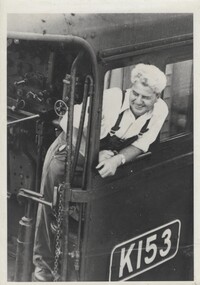
Photograph - Fred Rochow Railways Collection - Driver George Sandford, C. 1970s
... Throughout its preservation career (starting from 1974), the engine has been painted all-over black with some details picked out in white or yellow (such as handrails and the staff exchanger horn, welded in the raised position) to meet modern safety standards. ...Throughout its preservation career (starting from 1974), the engine has been painted all-over black with some details picked out in white or yellow (such as handrails and the staff exchanger horn, welded in the raised position) to meet modern safety standards. ...The Fred Rochow Railways Collection incorporates photos related to the operation of the Wodonga Railway Station including different types of trains and railways staff C. 1930 – 1990. It was donated to the Wodonga Historical Society by Fred Rochow, a railwayman who spent many years based in Wodonga. He joined the Victorian Railways on 17th June l947 and retired in 1988. For some time, he was a member of the Australian Federated Union of Locomotive Enginemen and served a term as a member of the Trades Hall Council. He had an extensive knowledge of the struggles that took place to achieve better conditions for railway workers. Fred worked for many years as a fireman and then worked his way up the ranks to driver, experiencing many changes from the days of steam locomotives through to diesel trains, locomotives and even the modern XPT train. He worked throughout Victoria at different stages of his career, with his final working years focused on the northeast of Victoria and the Albury to Melbourne line. After his retirement, Fred continued to share his love of steam miniature trains with the community.This collection has local and statewide significance as it captures images of trains, locomotives and personnel who operated the railway services in Wodonga and throughout Northeast Victoria. The railways played a critical role in opening up Victoria and connecting Australia for trade, business, social communication and transport.Driver George Sandford on Locomotive K153 George joined Victoria Railways on 4th June 951. He started cleaning at Seymour on 21 February 1955. George passed his Driver qualification on 18 May 1960. He was based at Cressy from 1966 to 1968 followed by Wodonga from 1966 to 1982. K Class Locomotives - One of VR's most successful classes of loco they were built over a 24 year period. A general purpose, light lines loco the K class had a very long career in all sorts of service from branch line passenger and goods work to pilot and banker duties and roadside mainline service. The K class is credited with working virtually every line in the VR system and hauling almost every kind of train. The majority of the class lasted into the 60's. K153 entered service on 9 September 1940, initially allocated to the Benalla locomotive Depot It is now owned by VicTrack and managed by Steamrail Victoria. When in Melbourne, it is regularly used on suburban shuttles and on day tours to Geelong and similar-length trips. At various stages it has been withdrawn from service for preservation work. Throughout its preservation career (starting from 1974), the engine has been painted all-over black with some details picked out in white or yellow (such as handrails and the staff exchanger horn, welded in the raised position) to meet modern safety standards. It most recently returned to service in 2003.railways wodonga, fred rochow, wodonga railwaymen, george sandford, locomotive k153 -
 Flagstaff Hill Maritime Museum and Village
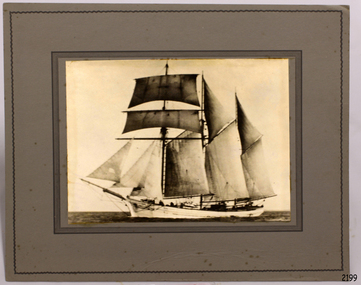
Photograph - Ship, Alma Doepel, 1931-1934
... engines and in 1976 they brought her to Melbourne. An Alma Doepel Supporters Club was formed to support the ship’s major restoration to a topsail schooner. In 1987 she was overhauled in Adelaide, with the support of Elders IXL and she returned to Sydney to lead the Parade of Sail on Bicentenary Day, 25th January 1988. She returned to Melbourne in February and began sail training voyages in Port Phillip Bay, operating from an office on Station Pier. The Alma Doepel Voyagers Club was started...engines and in 1976 they brought her to Melbourne. An Alma Doepel Supporters Club was formed to support the ship’s major restoration to a topsail schooner. In 1987 she was overhauled in Adelaide, with the support of Elders IXL and she returned to Sydney to lead the Parade of Sail on Bicentenary Day, 25th January 1988. She returned to Melbourne in February and began sail training voyages in Port Phillip Bay, operating from an office on Station Pier. The Alma Doepel Voyagers Club was started ...This photograph is of the square-rigged schooner "Alma Doepel". Details added to the back of the photograph incorrectly describe the vessel as "Amy Doepel / ketch / Amy Doepel". The rigging on the vessel dates the photograph to sometime between 1931-1933. The location is yet to be determined. Frederick Doepel was a shipping agent in Bellinger Valley, NSW. He employed an experienced shipwright to build Alma Doepel, which was made from local timber. He named the ship “Alma Doepel” after his baby daughter Alma. The ship was registered in Sydney and launched 19th October 1903, and her first sea voyage was in December. She traded in timber Port Macquarie/Bellinger River and New Zealand. “Alma Doepel” was purchased by Henry Jones & Co., Hobart jam makers, in partnership with Harry Heather, her new captain, in 1916. The ship was then registered in Hobart. She carried jam and timber to the mainland, particularly Melbourne, and brought back cargo for Tasmania. She even carried the piles for the building of Portland Harbour. When Harry Heather passed away in 1937 he was succeeded by Eric Droscoll. Before the square-rigged "Alma Doepel" left for Tasmania on March 8th 1937 she was fitted with a new set of sails, becoming a fore-and-aft rigged schooner. She had been the last 'top sail' schooner in Bass Strait trade! "Alma Doepel" continued her coastal trading until 1942, when she was requisitioned by the Army. In January 1943 she was left in Melbourne by her crew and the Army took her over, taking her to Sydney in February, 1943. She was relaunched by the Army in 1944 minus two of her masts and her small 1936 engine, and was fitted with three large bus engines. In March 1945 she headed for the war zone, delivering cargo up and down the coast of New Guinea, at one time carrying over 400 troops. In 1946 she returned to Hobart where the Army re-converted her back for Bass Strait trading and returned her. In January 1947 Eric Driscoll took “Alma Doepel” to the eastern Tasmanian coastal port of St. Helens, trading cargo of local mountain ash timber to Melbourne on the mainland until 1959. She was then stripped down to her hull with only a single mast and two engines, and fitted with wooden bins on rails in her hold. From 1961 to 1975 she carried limestone to a factory to make carbide. Michael Wood and David Boykett, two of the governors of "Sail and Adventure", then bought her for the price of her two Gardiner engines and in 1976 they brought her to Melbourne. An Alma Doepel Supporters Club was formed to support the ship’s major restoration to a topsail schooner. In 1987 she was overhauled in Adelaide, with the support of Elders IXL and she returned to Sydney to lead the Parade of Sail on Bicentenary Day, 25th January 1988. She returned to Melbourne in February and began sail training voyages in Port Phillip Bay, operating from an office on Station Pier. The Alma Doepel Voyagers Club was started. Trainees joined the crew in sailing the ship over nine or ten days of instruction in sailing and seamanship. These trips plus chartered trips and fund raisers continued until early 1999, when she was no longer in a condition to operate; she needed a lot of attention. She lay idle in Victoria Dock for quite some time. In April 2001 “Alma Doepel” was taken to Port Macquarie’s Lady Nelson Wharf where she became a museum ship maintained by volunteers. In 2008 she had time in dry-dock and after sea-trials headed off to Victoria Harbour, Docklands, in Melbourne, where she is currently being restored with the help of The Supporters.This phot graph is significant for its connection with the Bass Strait trade, being the last top-sail schooner to brade across the strait. The photograph is also significant in its representation of the the sailing ships that traded around Australia in the 1930s.Photograph of "Alma Doepel " a wooden, 3 masted, square rigged sailing schooner built in Sydney, launched in 10/10/1903. Photograph is sepia coloured, mounted on card, inscription on the back. Information also provided with photograph. Photograph (marked incorrectly on back) "Amy Doepel / ketch / Amy Doepel". Sticker with "91" in pencil. Information provided (dated incorrectly) "1943, Sydney, New South Wales"flagstaff hill, warrnambool, shipwreck coast, maritime museum, maritime village, photograph, alma doepel, frederick doepel, henry jones and co, harry heather, eric droscoll, alma doepel supporters club, elders ixl, parade of sail, bicentenary day, alma doepel voyagers club, last top sail schooner in bass strait trade, square-rigged, fore-and-aft rigged -
 Flagstaff Hill Maritime Museum and Village
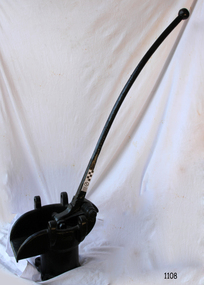
Functional object - Water Pump, Goulds Manufacturing Co, 1915-1925
... start producing cast iron pumps. An iron pump, he believed, would overcome all the disadvantages of a wooden pump. It would be strong and efficient and provide fresh flowing water for the pioneers. He ran the company until after the American Civil War and because Goulds Manufacturing had a foundry, they also produced all kinds of cast iron products such as corn shellers, bells, sad irons, sinks, tools, and a line of fire engines. ...start producing cast iron pumps. An iron pump, he believed, would overcome all the disadvantages of a wooden pump. It would be strong and efficient and provide fresh flowing water for the pioneers. He ran the company until after the American Civil War and because Goulds Manufacturing had a foundry, they also produced all kinds of cast iron products such as corn shellers, bells, sad irons, sinks, tools, and a line of fire engines. ...Gould manufacturing company was founded in 1848 at Seneca Falls, New York when Seabury S. Gould purchased an interest in Downs, Mynderse & Co. and the firm became Downs & Co. Wooden pumps were produced at the time in an old cotton factory building. In 1869, the name of the company was changed from Downs & Company to Goulds Manufacturing Company. Seabury S. Gould was regarded as a man of unusual vision, and as the founder of Goulds Manufacturing Company he was keen to start producing cast iron pumps. An iron pump, he believed, would overcome all the disadvantages of a wooden pump. It would be strong and efficient and provide fresh flowing water for the pioneers. He ran the company until after the American Civil War and because Goulds Manufacturing had a foundry, they also produced all kinds of cast iron products such as corn shellers, bells, sad irons, sinks, tools, and a line of fire engines. From 1848 to 1964 a Gould family member had always been President of the company. However, the company ownership in 1964 was transferred from family-owned stock to public offerings and employee ownership of stock. The subject item called the "N e w Deluge" was an improved bilge pump for vessels having not more than 25 feet depth of hold. It was also used by contractors for pumping out excavations and was well adapted for irrigation use. This hand pump was designed to be used where a hand pump of large capacity was desired. Goulds made many different types of pumps to suit differing pumping situations such as. Well Pumps, Hydraulic Rams, Diaphragm Pumps, Tank Pumps, Sprayers and Small Capacity Power rumps. Goulds Triplex, Centrifugal, Rotary and Deep Well Power Pumps The subject item was first introduced to the market in the Goulds catalogue of 1915 and became a very popular pump used in Australia and the USA. It is manufactured by a company still trading today with offices in Australia and many other countries.Hand Pump cast iron with long reversable pumping lever and cylindrical casing there are 4 metal holes for fastening to floor surface. Painted black. Embossed "NEW DELUGE" "- - -" and "No 16" or "No 18".warrnambool, flagstaff-hill, flagstaff-hill-maritime-museum, maritime-museum, shipwreck-coast, flagstaff-hill-maritime-village, pump, hand pump, goulds manufacturing -
 Federation University Historical Collection
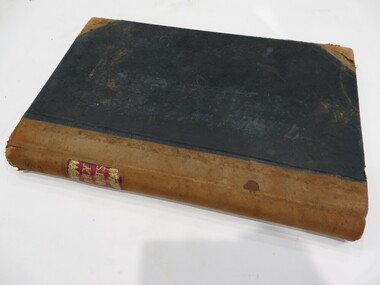
Book - ledger, Ballarat School of Mines Reports, 1900-1915, 1900-1915
... 27 June 1902 - Davey Paxmen Steam Engine 01 September 1905 - James Oddie donation a pair of lanterns and a lantern Microscope 03 August 1906 - Costs of starting an Agricultural High School in the district - Dr Stewart Bequest 29 April 1910- Planning for new Art School Building 28 April 1911 - Ballarat Observatory 26 May 1911 - Ballarat Observatory. ...27 June 1902 - Davey Paxmen Steam Engine 01 September 1905 - James Oddie donation a pair of lanterns and a lantern Microscope 03 August 1906 - Costs of starting an Agricultural High School in the district - Dr Stewart Bequest 29 April 1910- Planning for new Art School Building 28 April 1911 - Ballarat Observatory 26 May 1911 - Ballarat Observatory. ...27 June 1902 - Davey Paxmen Steam Engine 01 September 1905 - James Oddie donation a pair of lanterns and a lantern Microscope 03 August 1906 - Costs of starting an Agricultural High School in the district - Dr Stewart Bequest 29 April 1910- Planning for new Art School Building 28 April 1911 - Ballarat Observatory 26 May 1911 - Ballarat Observatory. Mr Brittain living in the caretaker's cottage, and proposes moving his telescope to the observatory 30 June 1911 - H.H. Smith in conjunction with Mr Clegg asked to prepare sketch plans for a new art school 28 July 1913 - Establishment of the Ballarat Junior Technical School 04 April 1913 - Removal of organ and pipes from the former Wesleyan Church 26 June 1914 - Laying of the Foundation Stone for the Ballarat Technical Art School. A photograph was taken featuring Mr Tate, Mr Carew-Smyth and Col. Watson.Black covered foolscap book with brown leather spine and corners. The handwritten reports were written for the Ballarat School of Mines Councilballarat school of mines, monthly reports, ballarat school of mines principal, ballarat school of mines principal's report, ballarat school of mines battery, ballarat school of mines council, r.t. vale, davey paxmen, andrew anderson, james bickett, james oddie, david kerr, j. baird, learmonth, dr stewart bequest, ballarat technical art school, h.h. smith, w.h. middleton, clegg -
 Flagstaff Hill Maritime Museum and Village
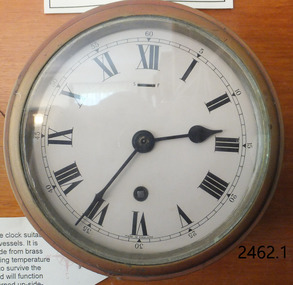
Instrument - Clock, 1950
... Elliott's started to produce clocks for the armed forces when war was declared in 1939, together with test gear and apparatus for the Rolls-Royce engines used in the RAF planes. ...Elliott's started to produce clocks for the armed forces when war was declared in 1939, together with test gear and apparatus for the Rolls-Royce engines used in the RAF planes. ...In 1865, James Jones Elliott of 156 Cheapside in the City of London, was apprenticed to a clockmaker, "Bateman" of 82 St John Street, Smithfield, London, to learn the art of clock making. Initially, J J Elliott specialised in producing pinions and balance shafts for clocks. He eventually progressed to making and patenting a weight-driven movement that had chimes on tubes. This clock was very successful and resulted in considerable trade with America. James Elliott's son, Frank Westcombe Elliott, who at the age of 17 years, went into business with his father after his father had bought a partnership with a jeweller called “Walden” of Brompton Road, London. In 1904, JJ Elliott died and Frank succeeded his father in clock clock-making business. In 1909 company of JJ Elliott amalgamated with Grimshaw Baxter, and the factory moved to Greys Inn Lane, London, in 1911, followed by a further move, in 1917, to larger premises in St Ann’s Road, Tottenham, London. In 1921, the partnership with Grimshaw Baxter was dissolved, and Frank Elliott joined a well-known firm of Bell Founders and Clockmakers, Gillett and Johnson Ltd, in Croydon. In 1923, two years later, he took over their clock factory and formed the famous company of F.W. Elliott Ltd. He was joined by his two sons, Leonard and Horace Elliott, who had served their apprenticeships in the trade. The third son, Ronald, joined the company in 1929. Elliott's started to produce clocks for the armed forces when war was declared in 1939, together with test gear and apparatus for the Rolls-Royce engines used in the RAF planes. In 1944, Frank Elliott died at the age of 69, and Horace Elliott assumed the role of Managing Director. Whilst Horace controlled sales from a showroom in Hatton Garden. In 1952, Horace Elliott was elected Chairman of the British Horological Institute in the same year as Tony, one of Horace's sons, joined the company after he had completed training as a cabinet maker. Ronald Elliott died suddenly in 1966, at the age of 54. His son Peter continued to manage the company until 1998, when it ceased trading. An item that is now regarded as vintage, sought by horology collector’s worldwide and is in excellent condition. The item is unique in that it was made specifically for ships by a well-known British clock manufacture. Its provenance is well established as the serial numbers on the clock indicate it was made in 1950. Production by F.W Elliott for this design of ships clock ceased in 1959. Clock has a gold color case with a 150 mm white painted dial and Roman numerals. The movement has a balance wheel escapement and a slow-fast timekeeping adjuster to the top of the dial. The back of the clock is stamped “made by F W Elliott Ltd of Croydon” and a serial number 21B/829, an additional number 994 is also stamped on the back casing. Thsi model clock finished production in 1959. flagstaff hill, warrnambool, shipwrecked-coast, flagstaff-hill, flagstaff-hill-maritime-museum, maritime-museum, shipwreck-coast, flagstaff-hill-maritime-village, clock, f w elliott, maritime clock, horology, time keeping, english clock -
 Flagstaff Hill Maritime Museum and Village
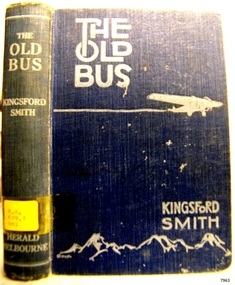
Book, The Old Bus
... started to search for support to do a trans-Pacific flight. This support came from the New South Wales government, Sidney Myer and G. Allan Hancock, an American oil magnate. On 31st May 1928 Kingsford Smith, Charles Ulm and two American crewmen, Harry Lyan and Jim Warner, took off from Oakland, California and flew to Brisbane via Hawaii and Suva. This historic flight took 83 hours and 38 minutes. Their Fokker plane had three engines...started to search for support to do a trans-Pacific flight. This support came from the New South Wales government, Sidney Myer and G. Allan Hancock, an American oil magnate. On 31st May 1928 Kingsford Smith, Charles Ulm and two American crewmen, Harry Lyan and Jim Warner, took off from Oakland, California and flew to Brisbane via Hawaii and Suva. This historic flight took 83 hours and 38 minutes. Their Fokker plane had three engines ...Sir Charles Edward Kingsford Smith is a famous Australian, well known in civil aviation history for his courageous endeavours in flight. He broken many flight records for long distance and time travelled and he was also a war hero in World War 1. He has been referred to as being “known to millions of Australians as “Smithy” … he was one of Australia’s true twentieth-century legends”. In honour of his place amongst the world’s famous pioneers his image is featured on Australia’s $20 note, Sydney airport is named after him, there is a memorial to Kingsford Smith, Taylor and Ulm at the Anderson Park, also in Sydney and his plane “Southern Cross” is on view at Brisbane Airport. Kingsford Smith wrote ‘The Old Bus’ (1932) and he and Ulm were co-authors of ‘Story of 'Southern Cross' Trans-Pacific Flight’ (1928). His also wrote a book about his own life ‘My Flying Life’ which was published after his death in 1937. and the story of his life was filmed in Australia in 1946. A BRIEF HISTORY OF SIR CHARLES EDWARD KINGSFORD SMITH (1897 – 1935) … Kingsford Smith was born 9th February 1897 in Brisbane, Queensland, Australia. His parents were William Charles Smith and Catherine Mary, nee Kingsford. His mother’s maiden name of “Kingsford” was added to the family name when they spent time in Canada from around 1903 to 1907, after which they returned to Sydney, Australia. In 1915 Kingsford Smith enlisted in Australian Imperial Force. He served in 4th Signal Troop, 2nd Division Signal Company at Gallipoli Peninsular as a ‘sapper’ or combat engineer and later in Egypt and in France as a dispatch rider. In 1916 Kingsford Smith was transferred to the Australian Flying Corps as a sergeant. He was discharged after training in England and commissioned as a second lieutenant in the Royal Flying Corps. He was appointed fling officer and soon joined the 23rd Squadron in France. He brought down four machines in his first month there and also did invaluable work attacking enemy targets. He was wounded and shot down and later awarded the Military Cross ‘for conspicuous gallantry and devotion to duty’. He was promoted to lieutenant in 1918 and served as a Flying Instructor with the R.F.C. Kingsford Smith was not allowed to participate in the 1919 England to Australia air race because of assumed lack of navigational experience. He and his pilot friend Cyril Maddocks formed a business and flew joy-flights in both England and America. In America he did some stunt flying with a Flying Circus. Kingsford Smith returned to Australia in 1921 and found employment as a pilot. He soon realised the value of air transport in such a vast country. He formed a partnership with pilot Keith Anderson in 1924 and they purchased two Bristol Tourer biplanes. Their business broadened to include Charles Ulm and became the Interstate Flying services in Sydney. Together they performed important ‘demonstration’ flights including a flight around Australia in 10 days and 5 hours using very limited navigational equipment. Kingsford Smith immediately started to search for support to do a trans-Pacific flight. This support came from the New South Wales government, Sidney Myer and G. Allan Hancock, an American oil magnate. On 31st May 1928 Kingsford Smith, Charles Ulm and two American crewmen, Harry Lyan and Jim Warner, took off from Oakland, California and flew to Brisbane via Hawaii and Suva. This historic flight took 83 hours and 38 minutes. Their Fokker plane had three engines and was named the “Southern Cross”. This amazing achievement resulted in huge financial subscriptions. Kingsford Smith was awarded the Air Force Cross and appointed as honorary squadron leader, Royal Australian Air Force. Kingsford Smith flew his Southern Cross plane from Point Cook in Victoria to Perth nonstop. Then in September – October 1928, with Charles Ulm and an Australian crew, he piloted the Southern Cross from Sidney to Christchurch New Zealand. This flight showed that was possible for regular passenger and mail services across the Tasman Sea. Kingsford Smith flew his plane to England to an order for four aircraft, planning to use them for an inter-capital air service in Australia. Sadly on 1st April 1929 he was forced to land, having lost radio contact with the ground and having run into bad weather over north – west Australia. Keith Anderson and Robert Hitchcock both perished before the search party reached them. Once official enquiries were completed the flight to England continued in June and was completed in record time of 12 days and 18 hours. In January 1930 Kingsford Smith piloted the “Southern Cloud”, one of the new Avro Ten planes, on the first flight of his airline, the Australian National Airways, from Sydney to Melbourne. The “Southern Cross” was overhauled in Holland by the Fokker Aircraft Co. and in June 1930 Kingsford Smith achieved an east-west crossing of the Atlantic from Ireland to Newfoundland in 31.5 hours. Kingsford Smith returned to England and took delivery of an Avro Avian biplane that he named the “Southern Cross Junior” and flew solo from England to Darwin, Australia. This record breaking flight took less than 10 days. He beat four other planes that had left England before him and he was 5.5 days faster than Hinkler. Sadly Kingsford Smith’s “Southern Cloud” was lost during a flight from Sydney to Melbourne in 1931 with no surviving crew or passengers; in 1958 the wreckage was discovered in the Snowy Mountains. Later that year Kingsford Smith flew his “Southern Cloud” from Australia to Timor, collecting mail from a damaged Imperial Airways plane in Timor. Other flights followed. Kingsford Smith was knighted in 1932 for his services in Aviation. He returned to selling joy flights then established the Kingsford Smith Air Service, a flying training school in Sydney. In 1933 Kingsford Smith flew the amazing record flight in “Miss Southern Cross” – a Percival Gull - from London to Wyndham in Western Australia in just over ten days. The Australian Commonwealth then gave Kingsford Smith a large grant and he was also appointed as aviation consultant to Vacuum Oil Co. Another flying record was made when Kingsford Smith and Sir P.G. Taylor flow “Lady Southern Cross” from Brisbane to San Francisco in order to sell her there; the west-east-trans-Pacific flight made aviation history. They returned to Australia to make an attempt at the trans-Tasman flight but their attempt failed due to engine failure; they managed to get back to Sydney safely, minus most of their cargo. Kingsford Smith had his unsold “Lady Southern Cross” shipped back to England, from where he and J. T. Pethybridge in the “Lady Southern Cross” attempted another record breaking flight from England The Old Bus Author: Charles Kingsford Smith Publisher: Distibuted by Herald Feature Service Date; 1932Label on spine cover with typed text RA 629.1309 KIN flagstaff hill, warrnambool, shipwrecked coast, flagstaff hill maritime museum, maritime museum, shipwreck coast, flagstaff hill maritime village, great ocean road, the old bus, charles kingsford smith -
 Ringwood and District Historical Society
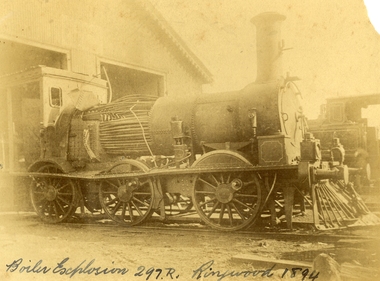
Photograph, Boiler explosion at Ringwood station 20th June 1894 for engine 297R. "Heard in Box Hill"
... engine, but could not do so on account of the steam and coal dust. He called out to know whether any of the passengers were injured, and got no response, so that he concluded they were all right. All the lamps but about half dozen were extinguished by the force of the explosion, although the glass was not broken. He could testify most distinctly that the driver and fireman were both sober. The driver was a man who never drank. The steam started...engine, but could not do so on account of the steam and coal dust. He called out to know whether any of the passengers were injured, and got no response, so that he concluded they were all right. All the lamps but about half dozen were extinguished by the force of the explosion, although the glass was not broken. He could testify most distinctly that the driver and fireman were both sober. The driver was a man who never drank. The steam started ...Black and white photographs - 2 copiesTyped below photograph, "Boiler explosion at Ringwood station 20/6/1894. Heard in Box Hill". Article from newspapers:- Weekly Times (Melbourne, Vic. : 1869 - 1954), Saturday 27 January 1894, page 21 Official enquiry. The Board of Enquiry appointed by the Railway Commissioners to enquire into the causes of the boiler explosion which shattered the locomotive at Ringwood on Saturday night, assembled at the Railway department on Wednesday to commence its deliberations, The board consisted of Mr R. Fulton, engineer, C. W. McLean; engineer to the Marine Board, and Mr Mephan Ferguson, iron-founder. There is some difficulty at the outset about the constitution of the board; It was suggested that the Apt of Parliament contemplated that boards of experts, after the manner of the present one, needed, to have their appointments confirmed by the Governor-in-Council. The point, however, was not considered sufficiently important to prevent the board from proceeding with evidence. Robert Greyford, stationmaster at Ringwood, was the first witness. He said he saw the explosion on Saturday night at about twenty minutes to 8. There was a rush to the engine to see what had happened, and the driver and fireman were both found on the platform of the engine. The driver seemed badly hurt, but the fireman, to all appearances, was not so badly injured. They were both attended to and sent up to Melbourne by the last suburban train. Witness had a look at the engine and found the dome and all the plates round the boiler blown clean, away. The springs were also blown clean away. The Chairman (Mr Fulton) : Did you measure the distance ? Witness: Yes; one of the plates was 209 yards away. A piece from the top of the boiler 15 pounds in weight he found driven into the hard beaten track 410 yards away. Several pieces of boiler plate were found scattered at various distances. The buildings roundabout were injured. The Chairman; Did you notice anything peculiar about either of the driver or the fireman ? — No ; nothing wrong, with either of them. If the engine was blowing off at all, it must have been very light. In your opinion, were they perfectly sober ? — Perfectly. In approaching the station, is there a down or an up grade? — A very slight down grade. How is the road from Healesville ? — Up and down all the way. It is down, grade for about 200 yards coming into Ringwood station. They shut off ; steam about a quarter of a mile away, and come in at a good pace. They generally put on 15 pounds of steam while they are in the station. Mr Ferguson : Had the driver the usual load on ? — Yes ; about the usual load. Witness added that he had known the driver personally for about 10 years, and he had always been a careful, steady, sober man. He did not know the fireman so well. John Palmer, porter at Ringwood station, also saw the explosion. He was attending to the train on its arrival. He was knocked down by the force of the explosion. When he got up he saw the engine driver being carried into the office covered in blood. He noticed nothing peculiar about the driver and fireman, nor about the engine. Mr McLean : How far were you from the engine when you were knocked down ? — From ten to fifteen yards. William Paul, the guard of the train to which the injured locomotive Was attached, said he was looking at the engine at the very moment the explosion occurred. It seemed to come from exactly under the dome. The force of it took him off his feet. He was about 15 yards from the tender. When he rose he tried to reach the engine, but could not do so on account of the steam and coal dust. He called out to know whether any of the passengers were injured, and got no response, so that he concluded they were all right. All the lamps but about half dozen were extinguished by the force of the explosion, although the glass was not broken. He could testify most distinctly that the driver and fireman were both sober. The driver was a man who never drank. The steam started to blow off about a minute and a half before the explosion took place. The last place at which the engine took water was Healesville. The Chairman : Do yon know anything of the quality of the water there ? Is it creek water ? — Yes ; it comes from the Graceburn River. You never heard of its quality ?— No. How long have you known this engine on the road— About 13 months. Hew long have you known the driver on this line ? — About six weeks. I have known the fireman several years. The driver was a strict teetotaller, and I never saw the fireman take anything to drink in his life. Mr T. H, Woodroffe, chief mechanical engineer of the Victorian Railways, produced a report he had written to the secretary, about this explosion. The document gave facts concerning the engine and the explosion. It stated that the rapture seemed to have occurred at the rim of the plates adjoining the fire box. The engine was built at the Phoenix Foundry, Ballarat, in 1883. It was repaired at various times, the last time being in July of last year when it was sent to the Port Melbourne shops, and was then tested to a cold water pressure of 195 and found all right. It was the custom to overhaul all locomotives about every five years. The Chairman : There were no very heavy repairs in July, 1893; were there? — Not to the boilers. The shop manager's report says that the plug and safety tap holes were repaired, five new copper studs put in firebox, ash-pan door repaired, tender cleaned and overhauled, and studs re-rivetted, and boiler tested to pressure of 195, cold water. Mr Woodroffe read the report of the repairs effected to the boiler in December, 1888. That would be the time the plate was put in the boiler. On that occasion three new plates were put in the bottom and the boiler tested up to 195. The Chairman: Do you keep a record of the water used ?— Yes, the water in this case, I think, came from the Maroondah scheme. Mr Woodroffe said boilers were examined front time to time in the running sheds. In his opinion every possible care had been taken to keep the engine in proper care. There might, however, be lessons learnt from this. The Chairman: No doubt. From his examination of the plates [the] witness did not think the state of them could have been detected from the outside. There were no signs of leakage or sweating or anything of that sort. The next witness- was Walter Stinton, workshop manager at Newport and he said that the injured engine had been repeatedly repaired under his charge. He gave a technical account of the repairs effected on various occasions. The testing of locomotives was under his special notice. They had a high pressure pipe running; round the works, and a pump set at 2001b. When the boiler was pumped full of water the pressure when applied up to 1951b. The board appointed by the department to inquire into the Ringwood locomotive boiler explosion sat again at Spencer street on 25th inst. Mr R. Fulton presided and the other members of the board were. Mr Mephan Ferguson and Mr C. W. McLean. Charles Grubb, foreman of the boiler-makers at the Newport workshops, said he had inspected the pieces of plate that had been blown out of the engine, and after examining them, pointed out to the Chief Mechanical Engineer the portion where the plate had started to burst. It was under the lap, on the right hand side of the boiler. The grooving might be accounted for by bad water. During the past twenty years he had examined all the boilers that came into the Williamstown workshops, and while some were hardly marked at all, others were very badly eaten away. The practice was to cut out the defective portions. In this case the boiler was repaired in a similar manner. The Chairman : Can you suggest any other way of repairing so as to prevent accident ? — No, unless by taking out a plate on one side from the joint, and carrying it further up so as to avoid the joints meeting, or by taking out the plate altogether. What would.be the cost .of putting in a new " plate I—Perhaps about double the price; but I wouldn't recommend that course. It would be putting a new plate against plates that have been in use ten years or so and that would not be advisable. I think the present system better. I consider the present system of repairing the best. This is the first we have had so bad like that, to my knowledge. You attributed this to bad water. Is there no other probable cause ? — Well; unless the iron be bad. This was Lowmoor iron. I think this accident was caused by the eating away of plates. This one was the worst I have seen, for the short time it had been running. We use three classes of iron — Lowmoor, Monkbridge and Bowling. By Mr Woodroffe (Chief Mechanical Engineer) ; There are engines still running that were repaired at the same time as this one, in 1888, and. in the same way. These are engines 339 and 333. They have been recently examined and are in splendid order. What in your experience, is the age of a boiler on the Victorian railways? — From 17 to 20 years our earlier boilers stood. The later boilers don't stand so well. How is that? — There is difference in construction, and the material is lighter. The old boilers had thicker plates. Have you been asked in any way to curtail boiler affairs? — No, sir; nor in any way. You have never hesitated to carry out any necessary repairs? — Never. Our orders have been to exercise every care in examining, repairing and renewing boilers. Witness said that his practice was when an engine came into the workshop to find out how long she had been running. If over five years, he informed the workshop manager, and they thought it necessary the tubes were taken nut. If everything was in good order witness reported to the manager. The cost of taking out the tubes and putting them in again was about L20. Mr Woodroffe : Have you ever hesitated to repair a boiler on the score of expense ? — No, never. Mr McLean : Hew do yon ascertain whether a boiler requires repairs?— I keep a record of every boiler examined. From every boiler that comes in I have the dome covers taken off, and when it is practical I get inside. l can almost tell from the top of a boiler what the bottom is like. If there is any doubt about it I have the tubes taken out. If I have suspicion of defective plate I cause to have bored a triangle in the plate at the point where there is the most wear. There is a travelling inspector who visits all the running sheds of the colony except Port Melbourne and tests the boilers. He reports to us and we note what he points out. Alfred Thompson, locomotive inspector of the eastern section, said he knew this engine, 297R. He read a list of her repairs. He heard of the accident on Saturday night and went up to Ringwood. The Chairman : Did you ever notice anything peculiar about the engine? — No, I considered her A1 and would not have hesitated to have put on 140lb pressure owing to the repairs she had undergone. Witness considered that the explosion was caused by the expansion and contraction of the plates ; and, no doubt, the plate had been eaten away through bad water. The other side of the boiler showed: signs of corrosion: By Mr Woodroffe ; Is every care taken with the boilers ? — Yes, every possible care is taken for the safety of boilers, Weekly Times (Melbourne, Vic. : 1869 - 1954), Saturday 27 January 1894, page 7 EXPLOSION OF A LOCOMOTIVE BOILER, NARROW ESACPE FROM FATALITIES. THE DAMAGED ENGINE. [See drawing of loco – saved in “Railways” folder] The explosion of a locomotive boiler at Ringwood on Saturday evening, formed the subject of much discussion in railway circles on Monday. The Minister arrived at the office at an unusually early hour and immediately entered into a consultation with the acting chairman, Mr Kibble, and Mr Commissioner Murray. As the result of the interview it was resolved to ask three gentlemen of acknowledged engineering experience to sib as a board with the . object of inquiring into the cause of the accident and furnishing a report. Mr Richardson and the Commissioners are tally seized of the importance of having a searching investigation into the accident, and, with Mr Murray, the former went to Ringwood to inspect the scene of the disaster. They will he accompanied by Mr Woodroffe. During the morning no official report had come to hand from the driver or fireman of the engine in reference to the accident, but that is thought to be due to the circumstance that they have not sufficiently recovered to be able to give a circumstantial account of what occurred. The engine was one of the old R's, and, Mr Kibble pronounced them to be about the best class of engines used. So far nothing can be said as to the probable cause of the accident, as the broken plating of the engine has not been submitted to the inspection of experts. Weekly Times (Melbourne, Vic. : 1869 - 1954), Saturday 27 January 1894, page 7 STATEMENT BY THE FIREMAN. This morning Thomas Miles, fireman on the engine the boiler of which exploded on Saturday night, is suffering from an injury to the spine, as well as a very severe shaking to the system. He states that he was fireman on the engine attached to the train which left Healesville on Saturday evening, at ten minutes to 8. Everything went all right until Ringwood was reached, when, .just as the train was about to continue its journey, a load explosion took place and Miles remembers nothing more until he was picked np on the platform ; and found himself suffering from a pain in the back, and an injury to his arm. He cannot think of any reason which could have caused the explosion, as there was plenty of water in the boiler, and everything seemed working all right. Mr R. Fulton, consulting engineer, of Queen street; Mr McLean, a member of the Marine Board ; and Mr Mephan Ferguson, engineer, have consented to act as a board to inquire into the cause of the engine boiler explosion at Ringwood on Saturday evening. The board has been appointed under section 117 of Act 1135, which provides that the Governor-in-Council may direct the taking of a such a step. Mr1 Fulton will act as chairman of the board, which met for the first time at the railway offices, Spencer street, this forenoon. Before separating the members of the Board paid a visit to the Prince's Bridge locomotive sheds in company with Mr Woodroffe, the chief mechanical engineer, for the purpose of inspecting the shattered boiler. It has been stated that the explosion is known to have been caused by a flaw in a plate which was put on the boiler about four years ago, but enquiries have tailed to elicit anything in support of that view. The engineers connected with the department are not inclined to say anything on the subject. Weekly Times (Melbourne, Vic. : 1869 - 1954), Saturday 14 April 1894, page 20 The Ringwood Boiler Explosion, The Minister of Railways has received the supplementary report of the board appointed by him to investigate the circumstances connected with the explosion of a locomotive boiler at Ringwood. In their first report the board did not attach blame to anyone. Mr Richardson felt satisfied that the responsibility of having the engines properly inspected and overhauled periodically could be fixed if the inquiry were extended. He therefore referred the matter again to the Board, who took further evidence. In the report now furnished, the Board hold Loco. Inspector Thompson blameable, but point out as a mitigating circumstance that he had not received "written instructions" respecting inspections and overhauls. Weekly Times (Melbourne, Vic. : 1869 - 1954), Saturday 7 July 1894, page 32 The Ringwood Boiler Explosion. The Minister of Railways takes exception to the tone of a paragraph appearing in a morning contemporary respecting the Ringwood boiler explosion. It makes it appear that Mr Richardson has referred the report of the board which considered the facts connected with the explosion to the Crown solicitor simply because he differed from the finding of the board. The Minister explains that when he received the report he found that the responsibility for having boilers properly inspected and overhauled had not been clearly fixed. He personally obtained farther evidence on that point, and arrived at a conclusion, from which the commissioners differed. As he did not like to take upon himself the responsibility of deciding upon the effect of the evidence, he submitted the matter to the Crown Solicitor, but that officer did not furnish him with the information sought. He has, therefore, referred the question to the Attorney-General, together with the draft of a regulation respecting boiler inspections and overhauls in the future. Mr Richardson says that his whole aim is to have the responsibility positively fixed. Weekly Times (Melbourne, Vic. : 1869 - 1954), Saturday 28 April 1894, page 23 The Minister of Railways has completed his consideration of the supplementary report received by him from the Ringwood Boiler Explosion Board. The report, it will be remembered, held Loco-Inspector Thompson blameable for the non-inspection of the boiler, but considered there was extenuating circumstances. There was a certain amount of doubt as to the absolute instructions given for overhauling engines periodically. Mr. Richardson is sending the report on to the Commissioners with instructions that the responsibility respecting inspection of boilers shall be made clear for the future. -
 Flagstaff Hill Maritime Museum and Village
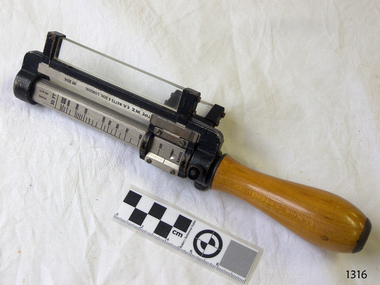
Rangefinder, E R Watts & Sons, 1930-1945
... engine was completed by George William Watts. It was so remarkable an instrument at the time and for years afterwards, In 1907 Arthur Ames went to Canada and started an organisation in Winnipeg in 1909 this became a separate company called E. ...engine was completed by George William Watts. It was so remarkable an instrument at the time and for years afterwards, In 1907 Arthur Ames went to Canada and started an organisation in Winnipeg in 1909 this became a separate company called E. ...E. R. Watts and Son, makers of theodolites and other surveying instruments, of 123 Camberwell Road, London. The company was established in 1856 by Edwin Watts at twenty-three he had saved £100 from his earnings to start the business with his staff consisting of one boy and later Alexander Clarkson as an apprentice with the workshop a small room over a Bemondsey stable. Watts' first order was from Negretti and Zambra for a mining dial Alexander Clarkson In the early days the firm worked mainly on marine compasses. Edwin Watts would go down to the Docks to adjust the compasses once they had been installed on the ships. In May 1873 the business moved to larger premises a house with a garden. The workshop was also the home of Mr and Mrs Watts and their five sons and three daughters. By now there were fifteen to twenty men employed by the firm. The company were commissioned to supply the Theodolites and Levels for the construction to the Canadian Pacific Railway in 1881. Towards the end of the century, the firm began to make heliographs continuing to produce them for the government until just before the Second World War when by agreement assigned their manufacture to another firm. 1904 The first dividing engine was completed by George William Watts. It was so remarkable an instrument at the time and for years afterwards, In 1907 Arthur Ames went to Canada and started an organisation in Winnipeg in 1909 this became a separate company called E. R. Watts and Son Ltd. of Ottawa. This firm developed considerably and was eventually with the co-operation of three other instrument companies (Cambridge Instrument Co, Ross, and Negretti and Zambra), were reconstituted as ”Instruments Ltd” of Ottawa and Toronto. During the next ten years, the firm expanded greatly to include glass grinding, leather work, dividing and engraving, testing, adjusting and packing. This expansion was continued during the First World War when workshops were completed and the machinery installed and running within eleven weeks from the start of construction. During the war, a Sergeant Coles, among the rats, lice and mud of the trenches, fitted various bits of scrap into his cocoa tin and made the first Flash Spotter for plotting the positions of enemy guns. Coles was rushed home to the firm's factory where he and George William Watts designed a spotter not made out of a cocoa tin and as a result, the Watts Vertical Force Variometer was developed during WWI. Other Watts instruments made in the First World War included the Light Mountain Theodolites which were taken on Mt Everest expeditions. In 1919 ER Watts and Sons was incorporated as a limited company and in 1939 G. A. Whipple joined the Board of Directors. Shortly afterwards, Frank Charles Watts died having been Chairman of the firm for over 37 years and seen it through the First World War with all its expansions and difficulties. He was succeeded by his brother George William Watts with the vacant post of Managing Director being filled by G. A. Whipple. During the Second World War, the company expanded further and the number of employees rose to well over 1,300. In 1946 Watts acquired 78% of Adam Hilger and the microscope maker James Swift and Son Who were Manufacturers of Theodolites, Levels, Alidades, Meteorological Instruments, Variometers, and many other types of scientific instruments Then in 1948 the company amalgamated with Adam Hilger as Hilger and Watts which was then incorporated as a public company.Naval Rangefinder with a vertical wooden handle, and an arrangement of optical lenses. Three reversible brass inserts calibrated on both sides in yards, correspond to various base heights, (20 and 25 feet, 30 and 35 feet and 40 and 50 feet). They are fitted along the axis of the instrument. When the scale for the appropriate base height is selected and inserted, the carriage can be slid for coincidence and the distance read at the index mark on the sliding carriage.inscribed "Rangefinder Cotton Type Mk II" Calibrated scale up to 5000 yds (50 ft), 5000 yds (35 ft), 4000 yds (25 ft) made by E. R. Watts & Son.flagstaff hill, warrnambool, shipwrecked coast, flagstaff hill maritime museum, maritime museum, shipwreck coast, flagstaff hill maritime village, great ocean road, rangefinder, cotton type, e r watts & sons, naval range finder, marine equipment -
 Bendigo Military Museum
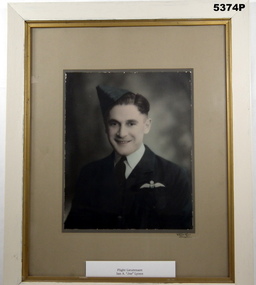
Photograph - PHOTOGRAPH, FRAMED, Vincent Kelly
... Starting in the ranks as an LAC, he rose to Flt/Sgt pre-embarkation. He embarked for the Middle East on 2.11.1941before dis-embarking to serve with No 3 Sqd RAAF. During heavy action on 8.1.1942, his plane was forced down due to engine...Starting in the ranks as an LAC, he rose to Flt/Sgt pre-embarkation. He embarked for the Middle East on 2.11.1941before dis-embarking to serve with No 3 Sqd RAAF. During heavy action on 8.1.1942, his plane was forced down due to engine ...IAN ALFRED (Joe) LYONS MBE Born 16.2.1915 in Bendigo enlisted in the RAAF aged 25 years on 27.5.1940, No 400095. Starting in the ranks as an LAC, he rose to Flt/Sgt pre-embarkation. He embarked for the Middle East on 2.11.1941before dis-embarking to serve with No 3 Sqd RAAF. During heavy action on 8.1.1942, his plane was forced down due to engine damage. It landed in an enemy minefield and when it came to a halt, its wheels were straddling a mine. After being rescued by a British officer, dozens of mines were located and dug up. On return, some 15 miles from base, the vehicle Lyons was travelling in hit a mine (on 9.1.1942), resulting in 5 KIA or WIA. Lyons spent 2 weeks in hospital with severe concussion and deafness. Lyons the embarked for Australia on 11.3.1942 before disembarking on 18.4.1942. He was posted to Townsville with 82nd Sqd on 27.6.1944. Subsequently he was posted to Noemfoor Island on 21.9.1944 as Operational with 82nd Sqd and promoted to Flt/Lt (Temp.) on 3.1.1945. On 6.1.1945 he was posted to 77Sqd as Operational on Morotai. This deployment ended on 9.7.1945. Records show that he flew 26 Strike/Attack missions and 13 others with both squadrons. Post WW2, Lyons remained with the RAAF with a new service number (033072). On 2.2.1948 he was posted to Japan before returning to Australia on 28.8.1948, apparently for medical reasons. He was appointed Flt/Lt on 23.9.1948 before returning to Japan and Korea on 22.8.1950. He was awarded an MBE as Operations Officer with 77Sqd for 'Outstanding enthusiasm and energy at 3 Korean bases'. A US Bronze Star was awarded to Lyons for 'Distinguished and meritorious service as Operations Officer in Korea during the period 14.10.1950 to 17.2.1951'. After Korea, Lyons received a number of posting from Victoria to Western Australia. He was awarded the Air Efficiency Medal in 1964. At his own request, Flt/Lt Ian Alfred 'Joe' Lyons MBE, retired from the RAAF HQ OP COM on 15.12.1967. The photograph is part of the Ian A. 'Joe' Lyons MBE Collection.Framed hand tinted colour head and shoulders photograph of a man in an RAAF uniform. The photograph is bordered with a light brown matt. THe wooden frome is painted white and gold. A white printed label bearing the name of the man is located below the photograph. Clear perspex covers the photograph. The photographer's name also appears below the photograph. The rear of the frame is covered in brown paper secured with masking tape. Two eyes and white cord are attached for hanging purposes.Handwritten in black below the photograph: 'VINCENT KELLY, Bendigo'.raaf uniform, photograph, flight lieutenant ian a. lyons -
 Eltham District Historical Society Inc
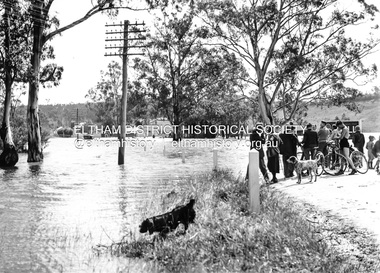
Photograph, Main Road, Eltham South, near Eltham Park, flooded by the Diamond Creek, 30 Nov. 1934
... Monteith, after removing all the mud and debris gave the engine one turn with the handle and it started first time! So the story goes! ...Monteith, after removing all the mud and debris gave the engine one turn with the handle and it started first time! So the story goes! ...Near Eltham Park (now known as Eltham Lower Park), floodwaters from the Diamond Creek cut off the Main road into Eltham at Bremner’s Flats (present day Wingrove Park). In the distance, left of centre, is Mr. Montieth's Ford Wagonette stranded in the floodwater near Wingrove Cottage. “On the Lower Eltham Reserve the water was nearly five feet deep across the reserve and over a mile along the road. All the week-end shops are surrounded. For over 40 years flood waters have not reached this unprecedented level.” - Advertiser, Friday November 30, 1934, p7 "Whilst we were at the shop a "tidal" wave occured . There used to be a Mr. Monteith who ran a Model T Ford bus from the Eltham Railway Station down the main street. The bus would hold seven, six seated in the back, 3 aside a seventh standing on the step on the middle of the back hanging on to two small hand rails. The bus was caught by the flood and was abandoned not far from our shop in the paddocks towards the Higher Elementary School. It was there for days and after the flood waters receded, Mr. Monteith, after removing all the mud and debris gave the engine one turn with the handle and it started first time! So the story goes! " (Doug Orford Reminiscences, 2004) The 1934 flood of the Diamond Creek and Yarra River is the highest recorded flooding in the district and set the standard for the current planning flood plain level.Black and white photograph showing the floodwater from Diamond Creek across Main Road in 1934. Left of centre shows Mr. Montieth's Ford Wagonette in the floodwater in the distancefloods, main road, eltham south, diamond creek (creek), wingrove cottage, wingrove park, bus services, bremner's flat, eltham park, ford wagonette, mr. montieth, floodwater, reminscences -
 B-24 Liberator Memorial Restoration Australia Inc
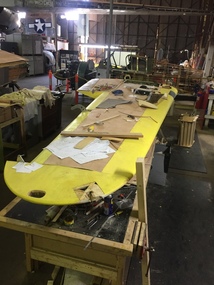
Airspeed Oxford aircraft (Replica under construction), c.1940
... This type first flew in 1937 and by the start of WWII it was the preferred aircraft in all Empire Air Training Schemes for multi-engine pilot training....This type first flew in 1937 and by the start of WWII it was the preferred aircraft in all Empire Air Training Schemes for multi-engine pilot training. ...This type first flew in 1937 and by the start of WWII it was the preferred aircraft in all Empire Air Training Schemes for multi-engine pilot training. By the beginning of WWII the Airspeed Oxford was the preferred aircraft in all Empire Air Training Schemes for multi-engine pilot training. As of April 2014, no Airspeed Oxfords remain in the world in airworthy condition and there are very few complete air frames. There are reportedly some restoration-to-fly projects underway, one in New Zealand.Full-sized replica of an Airspeed Oxford aircraft. This type of aircraft was described as a multi-engine three-seat advanced military trainer monoplane. It was a wooden construction using plywood and fabric covering and powered by two 375 HP Armstrong Siddeley Cheetah 10 engines. Parts originally used a base for this reconstruction were reckoned to be from an Oxford Mk 2 with registration A25 LX181 which was based at Point Cook and used extensively in training from the Werribee Aerodrome. -
B-24 Liberator Memorial Restoration Australia Inc
Pratt & Whitney R 1830 Radial Engine, 722
... engine was used by RAAF 21 Squadron personnel to manufacture and fit up exhaust systems and had been left standing for a long time without any preservation treatment. Much effort was put in to free up the motor and after it had been made to turn, checks by borescope showed some fretting had occurred in the cylinder bores. This was deemed not serious enough to warrant a strip down. It did need repairs to the ignition looms and various other adjustments but first started...engine was used by RAAF 21 Squadron personnel to manufacture and fit up exhaust systems and had been left standing for a long time without any preservation treatment. Much effort was put in to free up the motor and after it had been made to turn, checks by borescope showed some fretting had occurred in the cylinder bores. This was deemed not serious enough to warrant a strip down. It did need repairs to the ignition looms and various other adjustments but first started ...This engine was used by RAAF 21 Squadron personnel to manufacture and fit up exhaust systems and had been left standing for a long time without any preservation treatment. Much effort was put in to free up the motor and after it had been made to turn, checks by borescope showed some fretting had occurred in the cylinder bores. This was deemed not serious enough to warrant a strip down. It did need repairs to the ignition looms and various other adjustments but first started on the 16 July 2009. Various fuel problems were evident and repairs have been done and it now runs very well. All parts used in getting this motor to run successfully came from the fund's own stock or parts included in other purchases. The Pratt & Whitney R 1830 is a double row 14 cylinder air cooled radial engine with a capacity of 1830 cubic inches, (30 litres), developing some 1200 horsepower at a maximum 2700 rpm.Engine Number 722 -
 Bendigo Historical Society Inc.
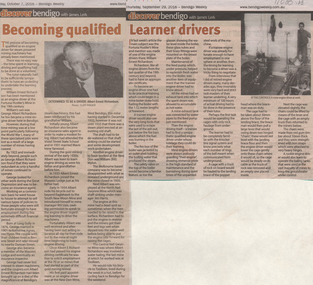
Newspaper - Albert Ernest Richardson, Peter Anderson's article 2020
... engine drivers on the Bendigo field. Albert had his own model goldmine, complete with poppet head, baling tanks etc and was up and ready to start work with the sound of the 7 a.m. mine whistles. ...engine drivers on the Bendigo field. Albert had his own model goldmine, complete with poppet head, baling tanks etc and was up and ready to start work with the sound of the 7 a.m. mine whistles. ...Albert Richardson was born on 22nd. June, 1902 to George Albert Richardson and Catherine Agnes (nee Flynn). He married Mavis Irene Yarwood on 23rd. December, 1931. Albert Richardson's childhood activities in Duncan Street, Long Gully, were influenced strongly by the occupation of his father and grandfather, both of whom were engine drivers on the Bendigo field. Albert had his own model goldmine, complete with poppet head, baling tanks etc and was up and ready to start work with the sound of the 7 a.m. mine whistles. Albert spent a short time working as a motor mechanic and then took up0 welling insurance with T & G. However, his heart was with the mines and he worked daytimes with T. & G. and then took off to learn engine driving with night shift in one of the mines. He gained his engine drivers' ticket in 1938 and began work at the Nell Gwynne. His longest work time was at the North Nell but he also had shorter spells at other mines. His leter work years were spent at John Brown, from where he retired in 1968. Albert had a deep regard for the working man and worked for many years in the position of Secretary at the Trades Hall, Bendigo. (adapted from biography in BHS Collection, written by I. Hendry, 1972) The Bendigo Historical Society holds a wide range of Bendigo mining records researched and written by Mr. Albert Richardson. He was President of the Bendigo Branch of the Royal Historical Society of Victoria from 1969 to 1971.When he joined the Bendigo Branch in 1966 he began compiling a history of the Bendigo mines. He spent many long hours researching at the Bendigo Mines Department, summarising mine records. He gathered relevant mining material wherever it could be obtained. He devoted most of his spare time and energy to the Society, conducting tours of the goldfields, writing articles and presenting talks to various organisations. His first and foremost interest lay in Victoria Hill. He examined mining reports and early newspaper articles to document its history. He envisaged the once fabulously rich hill as becoming a tourist attraction and campaigned vigorously to achieve this. In 1971 his dream was realised, when, with the help of South Bendigo Rotary Club 'The Hill' was cleaned up and historical site4s sign-posted. In 1972 the Bendigo Trust produced a booklet on Victoria Hill. Albert Richardson is acknowledged as the person ' on whose work and writings the text of this booklet has been based' The park adjoining Victoria Hill was named the Albert Richardson Reserve in his honour. Four newspaper clippings on mining, focusing on Albert Richardson's life; his passion for mining history and more generally, the work of engine drivers on the Bendigo goldfield. Clippings taken from the 'Bendigo Weekly' 2016, dated September 29 'Learner Drivers' , October 7 'Becoming qualified', October 14 'Steam power in his veins' and November 11 ' Victoria Hill over the decades'. All articles written by James Lerk in a series titled 'Discover Bendigo'. One page biography on Albert Richardson, on yellow paper.albert richardson, engine driver, mining, bendigo, boiler, engine room, mining cage, albert richardson reserve, victoria hill, george ellis, south bendigo rotary club -
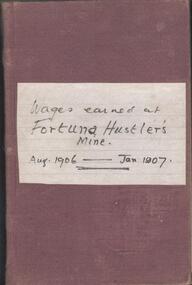 Bendigo Historical Society Inc.
Booklet - Albert Richardson Collection: Fortuna Hustler's Mine Wages Book August 1906 - January 1907
... started to work at Fortuna Hustlers Feb 25th 1899 sh 1907'. Child's pencil drawing of a man on front page. Long Gully Bendigo written in pencil across front page. Royal Historical Society of Victoria, Bendigo Branch, stamp. Example: first entries in Time Book for 9/06 (August 1906) is L. Phillips, Manager, no hourly rate given; G. Richardson, Engine...engine driver wages book wage rates 1906 1907 George A. Richardson, off Revere St. Maroon hard cover booklet. On front cover on affixed paper: 'Wages earned at Fortuna Hustler's Mine, Aug 1906 - Jan 1907'. Inside front cover: George A.G. Richardson, off Revere St.' and 'started ...Albert Richardson's father was G. Richardson, the Engine Driver at the Fortuna Hustler's Mine. Maroon hard cover booklet. On front cover on affixed paper: 'Wages earned at Fortuna Hustler's Mine, Aug 1906 - Jan 1907'. Inside front cover: George A.G. Richardson, off Revere St.' and 'started to work at Fortuna Hustlers Feb 25th 1899 sh 1907'. Child's pencil drawing of a man on front page. Long Gully Bendigo written in pencil across front page. Royal Historical Society of Victoria, Bendigo Branch, stamp. Example: first entries in Time Book for 9/06 (August 1906) is L. Phillips, Manager, no hourly rate given; G. Richardson, Engine Driver, 8/4d per day; T. Coates Engine Driver, 8/4d; H. (?) Kelly, Engine Driver 8/4d; T. Berryman, blacksmith 10/-. Names of miners, occupation, days worked, total number of days worked, rate per day and total amount paid are listed in the Time Book. George A. Richardson, off Revere St.fortuna hustler's mine, gold mining, bendigo goldfield, a. richardson, engine driver, wages book, wage rates, 1906, 1907
