
Showing 49 items matching "state electric company"
-
 Ballarat Tramway Museum
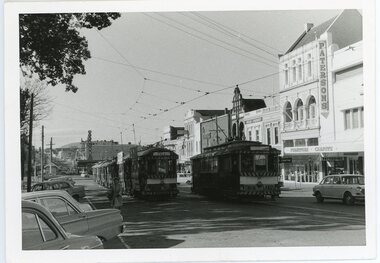
Photograph - Ballarat Tram 27, Ballarat Tram 27 travelling up Sturt Street
... ...state electric company...It was sold to the State Electric Company of Victoria in 1931. The number became its present number 27. ...It was sold to the State Electric Company of Victoria in 1931. The number became its present number 27. ...Built in 1916 for the Hawthorn Tramways Trust, it ran as Tram No.10. Renumbered 116 by the Melbourne and Metropolitan Tramways Board in 1920. It was sold to the State Electric Company of Victoria in 1931. The number became its present number 27. The tram continued in service until 1971 when the SEC operated system closed. The photograph shows Tram 27 heading up the hill in Sturt Street. A line of other trams is waiting. This is at the bottom end of Sturt Street Ballarat. Photograph taken by Campbell Duncan.Black and white photographPurple stamp on back - 12.1.711916, hawthorn tramway trust, tram 10, melborne and metropolitan tramways board, tram 116, 1920, state electric company, 1931, tram 27, 1971, sturt street, campbell duncan, photographer -
 Federation University Historical Collection
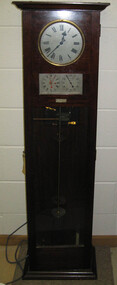
Object, Synchronome Co. Ltd, Synchronome Frequency Checking Master Clock No. 2191, c1930
... state electricity commission...wendouree parade power station...secv...clock...time...pendulum...electric supply company...Electric Supply Company of Victoria. AC generating plant was installed in 1925 and conversion to AC proceeded. In 1934 the company was taken over by the State Electricity Commission Victoria (SECV) and more AC generation was installed and the changeover of customers was accelerated. ...Electric Supply Company of Victoria. AC generating plant was installed in 1925 and conversion to AC proceeded. In 1934 the company was taken over by the State Electricity Commission Victoria (SECV) and more AC generation was installed and the changeover of customers was accelerated. ...Information from Norman F. Dalton: Ballarat had a reticulated DC supply in the early part of last century and in 1905 had sufficient generating capacity to enable the trams to be changed from horse drawn to DC electricity. The use of electricity increased with the main power station located on Wendouree Parade, near Webster Street, under the ownership of The Electric Supply Company of Victoria. AC generating plant was installed in 1925 and conversion to AC proceeded. In 1934 the company was taken over by the State Electricity Commission Victoria (SECV) and more AC generation was installed and the changeover of customers was accelerated. This is around the time that the Synchronome Frequency Checking Mast Clock was installed at the Wendouree Parade Power Station. The SECV Annual Report of 1921 states: ::Section 11 of the act directed the COmmission to enquire into the question of securing the adoption of such standards of plant and equipment of a system, frequency and pressure for the generation and distribution of electricity as will admit of the efficient interconnection of undertakings throughout the State. In 1934 when the SECV took over the Ballarat operations the question of linking with the State grid had been a planned operation for some years but due to financial considerations had hindered it and in fact would continue to do so for a further 10 years. So while the need for close frequency control for interconnection was hardly an issue, the need to keep electric clocks correct was important, particularly as this item was a frequent sales point to cover the inconvenience and sometimes expense of converting from DC to AC. The clock is a very accurate pendulum clock with provision for varying effective length during operation for precise time regulation. There are two normal time dials and one is controlled by the pendulum and the other is operated by the system frequency. When the clock was in use it was installed by the MEter and Tests Laboratory and the time was checked daily by radio time signals. The two dials were repeated in the operators control panel in the Power Station. A maximum deviation between the two dials was set in the operating instructions (eg 5 seconds) and the operator would correct this when necessary by remote manual alteration of the turbine governor set point. The clock was used to drive and regulate a system of "slave" clocks which were used to display the time in various locations around the power station. A slave clock is a simple clock which is driven by a small electric motor, its accuracy is regulated by the master clock every 30 seconds to ensure that it and all the other slave clocks in the station are on exactly the right time; slave clocks were placed in various locations, from common rooms to workshops. A master clock could potentially run thousands of slave clocks at one plant. The clock also contains a rectifier. A rectifier is a device that is used to convert AC power to more stable DC current.Two clocks in a timber case. Both are electric, one is powered by the main pendulum mechanism, the other is a self contained electric clock. The main mechanism is of the gravity arm and roller type, which sends an impulse to the slave clocks every 30 seconds. The This Synchronome Frequency Checking Master Clock was used at the Ballarat Power Station. Below the main section of the case is a smaller cabinet containing a rectifier to provide consistent DC power for the clock. The rectifier was made by the Victorian company Hilco, which was located in Burwood. There is a high chance this is not the original rectifier from this clock as there appears to be brackets to hold a larger device in the space the rectifier occupies.Front below main clock face on front of case: "Patented Sychronome Brisbane" Lower left-hand clock face: "Frequency time" Lower right-hand clock face: "Standard Seconds" Synchronous electric clock mechanism on door (Frequency time clock): >200/250 V. 50~ >"Synchronomains" Made in England >Direction indicator for clock starting switch >"To start move lever in direction of arrow and release" >"Patent applied for" Mechanism for "standard seconds" clock: >"English Made" >"Patented" >Serial number "321" >0 above right-hand pillar on front-plate Mechanism for "standard seconds" clock: >"English Made" >"Patented" >Serial number "321" >0 above right-hand pillar on front-plate Mechanism for main clock face: >"English Made" >"Patented" >Serial number "8751" >0 above right-hand pillar on front-plate Inside case, back panel, top enamel plate: >Seconds Battery + Pos. > Battery Common or - Neg. >1/2 min dials Inside case, back panel, bottom enamel plate: external seconds dial Inside case, right hand side, electrical knobs: two switches, both "A.C. mains" Pendulum rod, below suspension spring: Serial number (?) 0000005 Rectifier in bottom cabinet: >"Hilco Rectifier" >"A.C. Volts 230/240" >"Model 1060/S" >"A.C. Amperes" >"Serial No. 1060/S >"Phases 1" >"D.C. Volts 6" >"C.P.S. 50" >"D.C. Amperes 1" >"Made in Australia by Hilco Transformers McIntyre St., Burwood, Victoria." Bakelite electrical plug: makers mark Lower cabinet, RH side panel, pressed tin plate: "AC" (upside down) Brass speed adjustment, outer right RH side: "S" and "F" Ivory and wood pendulum beat ruler: >Ruler, with 0 in centre and numbers 1-5 in ascending order from centre on left and right. > "Synchronome Patent." Steel plate, back panel, inside case, right hand side: >N R A" (descending) >"2191" serial number/part number Face of main clock: "Synchronome Electric" synchronome frequency checking master clock, electricity, state electricity commission, wendouree parade power station, secv, clock, time, pendulum, electric supply company of victoria, norman f. dalton, ballarat power station, rectifier, slave clock -
 Federation University Historical Collection
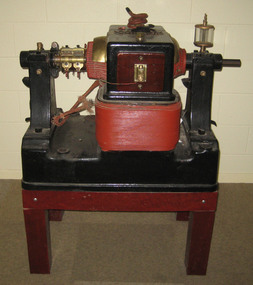
Equipment, Elwell-Powell, Elwell-Parker AC Generator
... Electric tram cars are going to be a big thing in England. Parker’s Company Limited, is now, with three other companies, in the hands of the Electric Construction Company, with Mr. Parker as manager of the lot. The whole of the works will be taken to Wolverhampton. Before I left, a tender for £50,000 was accepted for the construction of new works. generator ac generator elwell-parker ltd state ...This AC generator operated for the State Electricity Commission in the Ballarat North Power Station prior to World War Two. James Oddie of Ballarat has an association with Thomas Parker of Elswell-Parker. In early 1887 Oddie arrived in England seeking information on electrical knowledge and its developments. At this time Henry Sutton was teaching Electricity and Magnetism at the Ballarat School of Mines. Oddie stayed in the United Kingdom for around three years and during that time became a close friend of Thomas Parker and his family. The two first met at the first official running of the Blackpool tram, and Oddie was invited to visit Parker at Wolverhampton. Over the years Thomas Parker kept newspaper cuttings (mainly Australian) relating to James Oddie and his work. The following article is a description of the Wolverhampton works by James Oddie, and was collected by Thomas Parker. After the dinner at Blackpool, Mr. Parker visited me, and cordially invited me to see his extensive works at Wolverhampton, an invitation I was not slow to avail myself of. This was the keynote of the best friendship I made in England. I went shortly afterwards and stayed several days, visiting the works daily, as Mr. Parker gave me the run of the whole works. There I ordered the installation of a 60 light dynamo, with a 28 cell storage battery and paraphernalia, now doing duty at the Observatory. I subsequently visited the works frequently, sometimes for a week at a time, and I regard it as the brightest spot in my English constellation. Mr. Parker started his works in 1880, with one man beside himself. He never had a single day’s instruction in electricity in his life; now he daily instructs between 300 and 400 employees, who worship him as a father. He is said to be now the most practical electrical engineer and mechanist in Europe. During one of my visits I took with me an artist, who is painting for me a portrait, 6 feet by 5 feet, of Mr. Parker, surrounded by dynamos, secondary batteries, measuring instruments etc. Electric tram cars are going to be a big thing in England. Parker’s Company Limited, is now, with three other companies, in the hands of the Electric Construction Company, with Mr. Parker as manager of the lot. The whole of the works will be taken to Wolverhampton. Before I left, a tender for £50,000 was accepted for the construction of new works.AC Generator painted read and black on a stand. This AC generator operated for the State Electricity Commission in the Ballarat North Power Station prior to World War Twogenerator, ac generator, elwell-parker ltd, state electricity commission, sec, ballarat north power station, james oddie, wolverhampton -
 Federation University Historical Collection
Letter, Inward Correspondence to the Ballarat School of Mines, 1910, 08/1910
... Company...Ballarat City BOard of Advice...Metallurgical Laboratory...S. Radcliff...F.W. Hall...Ararat...Gordon Technical School...D.C. Newham...Staffordshire Reef...John Wilesmith...Sandstone Western Australia...J. Worthington...Elaine...J. Loughman...Gold Buyers Act...H.H. Smith...Incorporated Institute of Accountants...James Stapp...Electric Supply Companyof Victoria...H.J. Spencer...Tasmanis Mines Department...David Melvin...Caulter F. Ingpen...Hobson's Gold Mining Company...Canadian Finance and Securities...Scott Hotel Steiglitz...G. Straight...Jubilee Mine Italians...Elsie Alcock...Dressmaking...W.A. T. Davies...LEgislative Assembly...State...Company Ballarat City BOard of Advice Metallurgical Laboratory S. Radcliff F.W. Hall Ararat Gordon Technical School D.C. Newham Staffordshire Reef John Wilesmith Sandstone Western Australia J. Worthington Elaine J. Loughman Gold Buyers Act H.H. Smith Incorporated Institute of Accountants James Stapp Electric Supply Companyof Victoria H.J. Spencer Tasmanis Mines Department David Melvin Caulter F. Ingpen Hobson's Gold Mining Company Canadian Finance and Securities Scott Hotel Steiglitz G. Straight Jubilee Mine Italians Elsie Alcock Dressmaking W.A. T. Davies LEgislative Assembly State ...Inward Correspondence to the Ballarat School of Mines, November 1910letterhead, education department, telegram, yarraville chlorination and ore reduction works, a. anderson, h.b. silberberg & co, a.h. walsh, j.m. edgar, charles w. frost, gordon technical college, g. king, jennings deep lead tingha tin mining company, ballarat city board of advice, metallurgical laboratory, s. radcliff, f.w. hall, ararat, gordon technical school, d.c. newham, staffordshire reef, john wilesmith, sandstone western australia, j. worthington, elaine, j. loughman, gold buyers act, h.h. smith, incorporated institute of accountants, james stapp, electric supply companyof victoria, h.j. spencer, tasmanis mines department, david melvin, caulter f. ingpen, hobson's gold mining company, canadian finance and securities, scott hotel steiglitz, g. straight, jubilee mine italians, elsie alcock, dressmaking, w.a. t. davies, legislative assembly, state forests department, myles b. webster, photography, albury, commercial banking company sydney -
Federation University Historical Collection
Letter, Ballarat School of Mines Correspondence, 1910, 1910
... Electric Supply Company of Victoria H.C. Spencer David Melvin Walter T. Ingpen Canadian Finanace Securities Scott's Hotel Steiglitz G. Straight Jubilee Mines Italians Elsie Alcock W.A.T. Davies Morgan's Gold Mining Company H.G. Taylor Myles B. Webster Mourning letterhead S.S> Antill Correspondence of the Ballarat SChool of Mines * Yarraville Chlorination and Ores Reduction Works * Gordon Technical College letterhead * Jennings Tin Mining Co Letterhead * Ballarat City Board of Advice * Scot's Hotel Steiglitz from G. Straight * Jubilee Mine, Italians from Elsie Alcock * State ...Correspondence of the Ballarat SChool of Mines * Yarraville Chlorination and Ores Reduction Works * Gordon Technical College letterhead * Jennings Tin Mining Co Letterhead * Ballarat City Board of Advice * Scot's Hotel Steiglitz from G. Straight * Jubilee Mine, Italians from Elsie Alcock * State Parliament House LEgislative Assembly * State Forests Department 0 Creswick Forestry School - Classes taught by Ballarat School of Mines lecturers; yarraville chlorination and ores reduction works, jaques fisher, ponsonby carew smyth, telegram, a. anderson, a.h. walsh, j.m. edgar, charles w. frost, gordon technical college, ballarat city board of advice, w. coulthard, stephen chambers, s. radcliff, photography, d.c. newman, john wilsmith, j. worthington, elaine post office, j. laughman, meredith police station, h.h. smtih, incorporated institute of accountants, w. nixon, electric supply company of victoria, h.c. spencer, david melvin, walter t. ingpen, canadian finanace securities, scott's hotel steiglitz, g. straight, jubilee mines italians, elsie alcock, w.a.t. davies, morgan's gold mining company, h.g. taylor, myles b. webster, mourning letterhead, s.s> antill -
 Federation University Historical Collection
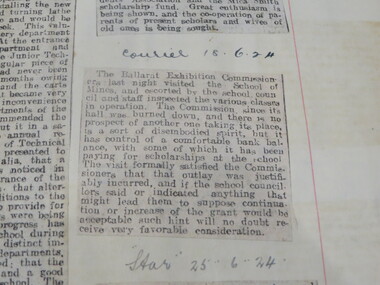
Book - Scrapbook, Ballarat School of Mines Scrapbook 1921-1924, 1921-1924
... company...electric supply company...state...The clippings in this book relate to the Ballarat School of Mines. ballarat school of mines scrapbook ballarat technical art school clay ceramics pottery native clay maurice copland h.h. smith c.h. beanland technical schools albert e. dowling john dulfer jenkin swimming shield r.s. dale j.y. mcdonald a.f. heseltine stained glass windows amalie feild richard dale ballarat school of mines museum ballarat junior secondary school war criminal trials j.f. crichton repatriation department w.o.f. close soldiers vocational classes world war one alexander peacock ballarat junior technical school opening effie holmes cornell chemist w.k. moss ken moss obituary j. vickery w.d. hill r.w. richards shackelton antarctic exploration t.h. trengrove samuel mayo vera lindsay bessie robertson victor greenhalgh repatriation classes closure repatriation classes termination university college vocational training arbor day j.b. corbet ballarat school of mines procession ballarat junior technical school honour board harold herbert albert steane a.w. steane francis davis tree planting clyde lukeis trade classes old boys association alfred james higgin blackill color and oxide company electric supply company state school exhibition state education jubilee scholarships clay deposits james coad t.a. williams copland memorial e.j. mcconnon alfred mica smith ponsonby carew smyth d. maxwell lena rutherford dorothy whitehead examination results geoffrey nicholls robert dowling j.b. robinson percy trompf j.c. bush white flat reserve rubbish tip sports ground broken hill excursion old boy's association school of mines procession white flat improvements empire exhibition ballarat school of mines literary society school reunion john rowell d.e. mullins g. renkin t.m. shattock new law courts supreme court building transferred to ballarat school of mines buildings ballarat state offices ballarat school of mines museum closed ballarat school of mines and industries k.b. brown sir r. garran alf hannah macrobertson scholarship simone fraser violet hambley alfred bayley j. heriot c.r. pittock i.r. bradshaw ballarat exhbition e. parkin c.m. harris mica smith bust william henry nicholls daniel walker paul montford w.h. corbould j.w. sutherland Technical Training for girls girls education Amalie Colquhoun ken moss obituary OPening of the Ballarat Junior Technical School J.S. ...The clippings in this book relate to the Ballarat School of Mines. Hard covered scrapbook with newspaper clippings relating to the Ballarat School of Mines.ballarat school of mines, scrapbook, ballarat technical art school, clay, ceramics, pottery, native clay, maurice copland, h.h. smith, c.h. beanland, technical schools, albert e. dowling, john dulfer, jenkin swimming shield, r.s. dale, j.y. mcdonald, a.f. heseltine, stained glass windows, amalie feild, richard dale, ballarat school of mines museum, ballarat junior secondary school, war criminal trials, j.f. crichton, repatriation department, w.o.f. close, soldiers vocational classes, world war one, alexander peacock, ballarat junior technical school opening, effie holmes, cornell chemist, w.k. moss, ken moss, obituary, j. vickery, w.d. hill, r.w. richards, shackelton, antarctic exploration, t.h. trengrove, samuel mayo, vera lindsay, bessie robertson, victor greenhalgh, repatriation classes closure, repatriation classes termination, university college, vocational training, arbor day, j.b. corbet, ballarat school of mines procession, ballarat junior technical school honour board, harold herbert, albert steane, a.w. steane, francis davis, tree planting, clyde lukeis, trade classes, old boys association, alfred james higgin, blackill color and oxide company, electric supply company, state school exhibition, state education jubilee, scholarships, clay deposits, james coad, t.a. williams, copland memorial, e.j. mcconnon, alfred mica smith, ponsonby carew smyth, d. maxwell, lena rutherford, dorothy whitehead, examination results, geoffrey nicholls, robert dowling, j.b. robinson, percy trompf, j.c. bush, white flat reserve, rubbish tip, sports ground, broken hill excursion, old boy's association, school of mines procession, white flat improvements, empire exhibition, ballarat school of mines literary society, school reunion, john rowell, d.e. mullins, g. renkin, t.m. shattock, new law courts, supreme court building transferred to ballarat school of mines, buildings, ballarat state offices, ballarat school of mines museum closed, ballarat school of mines and industries, k.b. brown, sir r. garran, alf hannah, macrobertson scholarship, simone fraser, violet hambley, alfred bayley, j. heriot, c.r. pittock, i.r. bradshaw, ballarat exhbition, e. parkin, c.m. harris, mica smith bust, william henry nicholls, daniel walker, paul montford, w.h. corbould, j.w. sutherland, technical training for girls, girls education, amalie colquhoun, ken moss obituary, opening of the ballarat junior technical school, j.s. vickery, j.s. vickery obituary, ida v. johnson, john rowell exhibition, max meldrum, w.g. coates, g.f. fitches, walter white, sewerage plumbing, villers brettonneux school -
 Flagstaff Hill Maritime Museum and Village
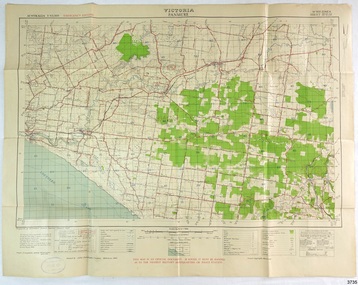
Document - Map, Department of Lands & Survey, Victoria / Panmure, 1942
... electric transmission lines, and fire stations. The map has margin notes that include distances in miles to nearby towns. The map was compiled for the Dept. of Army by the Dept. of Lands and Survey in Melbourne, prepared by the Australian Section, Imperial General Staff and printed by A.H.Q. Cartographic Company, Melbourne in 1942. Crown Copyright Reserved. Inscriptions in red print state...electric transmission lines, and fire stations. The map has margin notes that include distances in miles to nearby towns. The map was compiled for the Dept. of Army by the Dept. of Lands and Survey in Melbourne, prepared by the Australian Section, Imperial General Staff and printed by A.H.Q. Cartographic Company, Melbourne in 1942. Crown Copyright Reserved. Inscriptions in red print state ...This Emergency Edition of the map of Panmure, Victoria, is part of the W.R. Angus Collection. It was printed in 1942 during World War II. It is one of two maps donated to Flagstaff Hill Maritime Village by the family of Doctor William Roy Angus, who served as Surgeon Captain in the Australian Defence Department. The map was compiled for the Dept. of Army by the Dept. of Lands and Survey in Melbourne, prepared by the Australian Section of the Imperial General Staff, which was a British Government body created in 1907 to co-ordinate the defence of Britain and its Empire. It was printed by A.H.Q. Cartographic Company, Survey Corps, which was formed in 1941. The Corp changed its name to L.H.Q. Cartographic Company of Bendigo. In 1947 the name reverted back to the A.H.Q. Cartographic Company until 1955 when it became the A.H.Q. Survey Regiment. The W.R. Angus Collection includes historical medical equipment, surgical instruments and material once belonging to Dr Edward Ryan and Dr Thomas Francis Ryan, (both of Nhill, Victoria) as well as Dr Angus’ own belongings. The Collection’s history spans the medical practices of the two Doctors Ryan, from 1885-1926 plus that of Dr Angus who began practice in 1924. Dr. Angus served with the Australian Department of Defence as a Surgeon Captain during the Second World Was from 1942 to 1945. He served in Ballarat, Victoria, and in Bonegilla, N.S.W. until he suffering from a heart attack just before the war ended. ABOUT THE “W.R.ANGUS COLLECTION” - Doctor William Roy Angus M.B., B.S., Adel., 1923, F.R.C.S. Edin.,1928, was generally known as Dr Roy Angus. His working life included a position as a doctor with the Flying Doctor Service in Australia’s rural and remote areas. After many varied experiences Dr Angus and his family moved to Warrnambool in 1939 where he purchased “Birchwood,” the 1852 home and medical practice of Dr John Hunter Henderson. He was appointed on a part-time basis as Port Medical Officer in Warrnambool and held this position until the 1940’s when the government no longer required the service of a Port Medical Officer. Dr Angus was a surgeon at the Warrnambool Base Hospital 1939-1942. After further studies he commenced practice as an ophthalmologist in Warrnambool, pioneering in artificial eye improvements. He was Honorary Consultant Ophthalmologist to Warrnambool Base Hospital for 31 years and made monthly visits to Portland to perform eye surgery. Dr Angus and his wife Gladys were very involved in Warrnambool’s community with a strong interest in civic affairs. They were both involved in the creation of Flagstaff Hill Maritime Village, including the layout of the gardens. After his death on 28th March 1970 his family requested his practitioner’s plate, medical instruments and some personal belongings be displayed in the Port Medical Office surgery at Flagstaff Hill Maritime Village, and be called the “W. R. Angus Collection”. This Emergency Edition of the Map of Panmure is significant as an example of the documents prepared for the defence of Australia in World War 2. The Map is also significant for its connection between the Australian Army and the involvement of Dr WR Angus as a Surgeon in the Medical Services during World War II. The W.R. Angus Collection is significant for still being located at the site it is connected with, Doctor Angus being the last Port Medical Officer in Warrnambool. The collection of medical instruments and other equipment is culturally significant, being an historical example of medicine, administration, household equipment and clothing from late 19th to mid-20th century. Dr Angus assisted Dr Tom Ryan, a pioneer in the use of X-rays and in ocular surgery. The collection includes Dr Angus’s Army objects and is significant as an example of items issued to Doctors and Surgeons in the Medical Services of the Australian Army in World War IIMilitary map of Panmure, Victoria, Australia; part of the W.R. Angus Collection. Rectangular coloured map on cream paper for the Australian Army. Details include sea, waterways and land, contour lines, grid lines, names of districts, towns and roads, bridges, swamps, rail lines, cuttings, tracks, buildings (including blacksmiths), pumps, lighthouses, telegraph, telephones and electric transmission lines, and fire stations. The map has margin notes that include distances in miles to nearby towns. The map was compiled for the Dept. of Army by the Dept. of Lands and Survey in Melbourne, prepared by the Australian Section, Imperial General Staff and printed by A.H.Q. Cartographic Company, Melbourne in 1942. Crown Copyright Reserved. Inscriptions in red print state that it is and Emergency Edition and an Official document. An oval purple stamp includes the price.Printed in black; 'Victoria / Panmure", "No. 930 / Zone 6" Printed in red; “EMERGENCY EDITION”, “THIS MAP IS AN OFFICIAL DOCUMENT. IF FOUND, IT MUST BE HANDED / IN TO THE NEAREST MILITARY HEADQUARTERS OR POLICE STATION” Stamped: within concentric ovals (“- - - FOR SALE / PRICE 2/- / - - - - - OF THE ARMY”)flagstaff hill, warrnambool, flagstaff hill maritime museum, maritime museum, shipwreck coast, flagstaff hill maritime village, great ocean road, dr w r angus, dr ryan, warrnambool base hospital, flying doctor, surgeon captain, australian department of defence, royal australian army, world war 2, map panmure 1942, roy angus, port medical officer, nhill base hospital, military map, emergency map, military service australian army, department of army, department of lands and survey, a.h.q. cartographic company melbourne, panmure 1942, australian section, imperial general staff -
 Flagstaff Hill Maritime Museum and Village
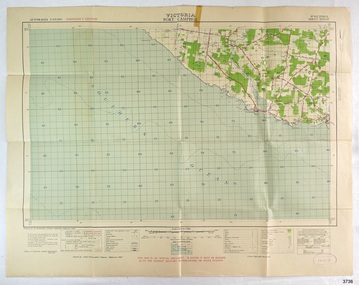
Document - Map, Department of Lands & Survey, Victoria / Port Campbell, 1942
... electric transmission lines, and fire stations. The map has margin notes that include distances in miles to nearby towns. The map was compiled for the Dept. of Army by the Dept. of Lands and Survey in Melbourne, prepared by the Australian Section, Imperial General Staff and printed by A.H.Q. Cartographic Company, Melbourne in 1942. Crown Copyright Reserved. Inscriptions in red print state...electric transmission lines, and fire stations. The map has margin notes that include distances in miles to nearby towns. The map was compiled for the Dept. of Army by the Dept. of Lands and Survey in Melbourne, prepared by the Australian Section, Imperial General Staff and printed by A.H.Q. Cartographic Company, Melbourne in 1942. Crown Copyright Reserved. Inscriptions in red print state ...This Emergency Edition of the map of Port Campbell, Victoria, is part of the W.R. Angus Collection. It was printed in 1942 during World War II. It is one of two maps donated to Flagstaff Hill Maritime Village by the family of Doctor William Roy Angus, who served as Surgeon Captain in the Australian Defence Department. The map was compiled for the Dept. of Army by the Dept. of Lands and Survey in Melbourne, prepared by the Australian Section of the Imperial General Staff, which was a British Government body created in 1907 to co-ordinate the defence of Britain and its Empire. It was printed by A.H.Q. Cartographic Company, Survey Corps, which was formed in 1941. The Corp changed its name to L.H.Q. Cartographic Company of Bendigo. In 1947 the name reverted back to the A.H.Q. Cartographic Company until 1955 when it became the A.H.Q. Survey Regiment. The W.R. Angus Collection includes historical medical equipment, surgical instruments and material once belonging to Dr Edward Ryan and Dr Thomas Francis Ryan, (both of Nhill, Victoria) as well as Dr Angus’ own belongings. The Collection’s history spans the medical practices of the two Doctors Ryan, from 1885-1926 plus that of Dr Angus who began practice in 1924. Dr Angus served with the Australian Department of Defence as a Surgeon Captain during the Second World Was from 1942 to 1945. He served in Ballarat, Victoria, and in Bonegilla, N.S.W. until he suffering from a heart attack just before the war ended. ABOUT THE “W.R.ANGUS COLLECTION” - Doctor William Roy Angus M.B., B.S., Adel., 1923, F.R.C.S. Edin.,1928, was generally known as Dr Roy Angus. His working life included a position as a doctor with the Flying Doctor Service in Australia’s rural and remote areas. After many varied experiences Dr Angus and his family moved to Warrnambool in 1939 where he purchased “Birchwood,” the 1852 home and medical practice of Dr John Hunter Henderson. He was appointed on a part-time basis as Port Medical Officer in Warrnambool and held this position until the 1940’s when the government no longer required the service of a Port Medical Officer. Dr Angus was a surgeon at the Warrnambool Base Hospital 1939-1942. After further studies he commenced practice as an ophthalmologist in Warrnambool, pioneering in artificial eye improvements. He was Honorary Consultant Ophthalmologist to Warrnambool Base Hospital for 31 years and made monthly visits to Portland to perform eye surgery. Dr Angus and his wife Gladys were very involved in Warrnambool’s community with a strong interest in civic affairs. They were both involved in the creation of Flagstaff Hill Maritime Village, including the layout of the gardens. After his death on 28th March 1970 his family requested his practitioner’s plate, medical instruments and some personal belongings be displayed in the Port Medical Office surgery at Flagstaff Hill Maritime Village, and be called the “W. R. Angus Collection”. This Emergency Edition of the Map of Port Campbell is significant as an example of the documents prepared for the defence of Australia in World War 2. The Map is also significant for its connection between the Australian Army and the involvement of Dr WR Angus as a Surgeon in the Medical Services during World War II. The W.R. Angus Collection is significant for still being located at the site it is connected with, Doctor Angus being the last Port Medical Officer in Warrnambool. The collection of medical instruments and other equipment is culturally significant, being an historical example of medicine, administration, household equipment and clothing from late 19th to mid-20th century. Dr Angus assisted Dr Tom Ryan, a pioneer in the use of X-rays and in ocular surgery. The collection includes Dr Angus’s Army objects and is significant as an example of items issued to Doctors and Surgeons in the Medical Services of the Australian Army in World War IIMilitary map of Port Campbell, Victoria, Australia; part of the W.R. Angus Collection. Rectangular coloured map on cream paper for the Australian Army. Details include sea, waterways and land, contour lines, grid lines, names of districts, towns and roads, bridges, swamps, rail lines, cuttings, tracks, buildings (including blacksmiths), pumps, lighthouses, telegraph, telephones and electric transmission lines, and fire stations. The map has margin notes that include distances in miles to nearby towns. The map was compiled for the Dept. of Army by the Dept. of Lands and Survey in Melbourne, prepared by the Australian Section, Imperial General Staff and printed by A.H.Q. Cartographic Company, Melbourne in 1942. Crown Copyright Reserved. Inscriptions in red print state that it is and Emergency Edition and an Official document. An oval purple stamp includes the price.Printed in black; 'Victoria / Port Campbell", "No. 932 / Zone 6" Printed in red; “EMERGENCY EDITION”, “THIS MAP IS AN OFFICIAL DOCUMENT. IF FOUND, IT MUST BE HANDED / IN TO THE NEAREST MILITARY HEADQUARTERS OR POLICE STATION” Stamped: within concentric ovals (“- - - FOR SALE / PRICE 2/- / - - - - - OF THE ARMY”)flagstaff hill, warrnambool, flagstaff hill maritime museum, maritime museum, shipwreck coast, flagstaff hill maritime village, great ocean road, dr w r angus, dr ryan, warrnambool base hospital, nhill base hospital, flying doctor, surgeon captain, map port campbell 1942, roy angus, port medical officer, military map, emergency map, australian department of defence, royal australian army, military service australian army, department of army, department of lands and survey, world war 2, a.h.q. cartographic company melbourne, australian section, imperial general staff, port campbell 1942 -
Glenelg Shire Council Cultural Collection
Functional object - Foot Warmer, Hecla Electrics Pty Ltd, c. 1920
... electric radiators in 1899, and also built an early steam car. As electricity use exploded in the 1920s and 1930s, 'Hecla' became a household name in Melbourne. They made a wide range of appliances for the home, and supplied commercial appliances to cafés, hospitals and offices. In 1927, the company shifted from small premises in the city to a bigger, electric-powered factory in South Yarra. Hecla had no retail stores of its own - instead it sold products through wholesalers and retailers, including the State...electric radiators in 1899, and also built an early steam car. As electricity use exploded in the 1920s and 1930s, 'Hecla' became a household name in Melbourne. They made a wide range of appliances for the home, and supplied commercial appliances to cafés, hospitals and offices. In 1927, the company shifted from small premises in the city to a bigger, electric-powered factory in South Yarra. Hecla had no retail stores of its own - instead it sold products through wholesalers and retailers, including the State ...From Museum Victoria: Made in about 1927 by Hecla Electrics Pty Ltd and sold under the model name 'Foot Warma'. The foot warmer was made from the late 1920s until the 1950s and did not change substantially in design during this time. The Hecla brand name and logo was registered in 1918 by Clarence Marriott. It was inspired by the recent eruption of Iceland's volcano Mt Heckla. Clarence and his father James were metal workers who had made Australia's first carbon filament electric radiators in 1899, and also built an early steam car. As electricity use exploded in the 1920s and 1930s, 'Hecla' became a household name in Melbourne. They made a wide range of appliances for the home, and supplied commercial appliances to cafés, hospitals and offices. In 1927, the company shifted from small premises in the city to a bigger, electric-powered factory in South Yarra. Hecla had no retail stores of its own - instead it sold products through wholesalers and retailers, including the State Electricity Commission (SEC). The company promoted its goods through advertisements in home magazines and displays in shop windows, home shows and the 1935 All-Electricity Exhibition. A popular advertising slogan in the 1930s was 'Hecla household helps make happy healthy housewives!'. Hecla ceased manufacturing in Melbourne in the 1980s.Documentation of how people lived and is an example of early domestic electrical appliances. From Museum Victoria: Hecla Electrics Pty Ltd were a significant Melbourne manufacturing company, who became a household name in the 1920s making small electric appliances such as heaters and kettles. They also made a variety of other electrical appliances for domestic, commercial and military use. The company manufactured electric appliances in Melbourne from about 1922 until the 1980s, although Clarence Marriott, who formed the company, had begun making radiators with his father James in 1899. The company had a reputation for quality products. The company also played an important role within the Australian domestic and commercial appliance industry, both as a leading innovator and through its role in training skilled staff, many of whom went on to work for competitors such as Kambrook, Electrolux and Sunbeam. This electric coffee percolator represents the typical small domestic appliance that the Hecla company was famous for. Along with other items in the Hecla Collection, it highlights the diversity of electric appliances that the company made. This object also highlights the legacy of high quality design and metal construction work that Clarence and James established for the company, stemming from their early work as talented art metal workers. It also represents the first major period of the take-up of electricity use in the home. This take-up began in the 1920s and 1930s with the use of small appliances, and by the 1950s electricity had become commonplace in the home, and large appliances such as refrigerators and stoves became standard.Square metal object. The top surface is heavy cast iron and patterned with floral motifs. In the centre is a circle with the words ' Hecla Foot Warma' inside. Under the top is a black metal base with two feet at either end which extend the length of the base. The back foot is higher than the front foot. There is a circular disk from which extends the electrical cord. The cord is brown and white checks. At the end of the cord is a plug on which is printed 250V AMP S.2 EARTH 5. The plug is brown and made from Bakelite. On the base is a rectangular label which has words printed - HECLA Australia.Top: HECLA/-FOOT-/WARMA Base: Volts / 230/250 / WATTS / 80 / HECLA / Australia / CAT. NO. F26domestic, city of portland, glenelg shire council, electrical, foot warmer, heating, hecla, manufacture -
 Kiewa Valley Historical Society
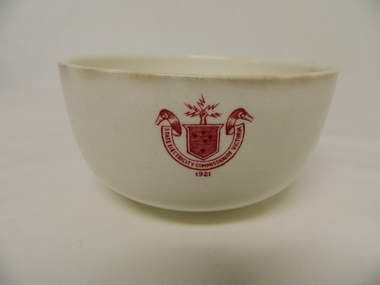
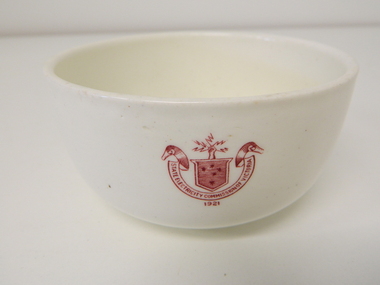
Bowl Ceramic - SECV
... Electric Company). As the scheme was of such a huge scope, isolated and time consuming nature, the feeding of its workers was quite demanding of cutlery and crockery. (See more KVHS 0113) This bowl was used by SECV workers working on the Kiewa Hydro Electric Scheme (1938 - 1961) in camps and mess halls and at the Mt Beauty chalet. (See more KVHS 0113) crockery; State ...This bowl was used by the SECV in their mess rooms for workers during the construction of the Kiewa Hydro Electric Scheme. The imprint of the year '1921' was to identify the year that the SECV was formed which relieved the private VHEC (Victorian Hydro-Electric Company). As the scheme was of such a huge scope, isolated and time consuming nature, the feeding of its workers was quite demanding of cutlery and crockery. (See more KVHS 0113)This bowl was used by SECV workers working on the Kiewa Hydro Electric Scheme (1938 - 1961) in camps and mess halls and at the Mt Beauty chalet. (See more KVHS 0113)This item is a white ceramic State Electricity Commission of Victoria bowl. It is made in England and is of strong and durable ceramic. The 5 mm thickness of the ceramic suggests this bowl (cereal / soup) belongs to a commercial kitchen environment and not domestic. The indent bottom of the bowl is 5 mm deep with a side curvature ratio of 2:5. The ceramic is glazed to a commercial standard (workers' mess). See also KVHS 0128 (B - D) for other ceramic crockery.The red printed seal of the State Electricity Commission of Victoria is imprinted on the top outside rim within a curved scroll and a raised fist with electrical "Charges" extending out. Snuggled within the borders of the scroll is a banner with the 5 stars of the Southern Cross. On the underside "Vitrified sold by Cafe & Hotel Supplies Pty Ltd Dunn Bennett & Co. Ltd. Burslem. Made in Englandcrockery; state electricity commission of victoria; dunn bennett pty. ltd.; bowl -
 Kiewa Valley Historical Society
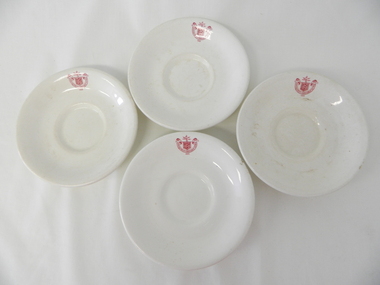
Saucer Ceramic, circa 1940's to 1950's
... This item was used by the State Electricity Commission of Victoria in their mess rooms for their workers during the construction of the Kiewa Hydro Electricity Scheme. The imprint of the year "1921" was to identify the year that the SECV was formed and relieved the private VHEC (Victorian Hydro-Electric Company). ...This item was used by the State Electricity Commission of Victoria in their mess rooms for their workers during the construction of the Kiewa Hydro Electricity Scheme. The imprint of the year "1921" was to identify the year that the SECV was formed and relieved the private VHEC (Victorian Hydro-Electric Company). ...This item was used by the State Electricity Commission of Victoria in their mess rooms for their workers during the construction of the Kiewa Hydro Electricity Scheme. The imprint of the year "1921" was to identify the year that the SECV was formed and relieved the private VHEC (Victorian Hydro-Electric Company). As the scheme was of such a huge, isolated and time consuming nature the feeding of its workers was quite demanding of cutlery and crockery. The use of sturdy English cups and saucers was essential. The period of construction and the isolation of the Kiewa Valley area placed heavy demand for "solid" crockery that could wear abusive handling. This period in time was one when crockery, whether for domestic or commercial use, was imported from "mother" England. This scenario was more so for governmental bodies such as rail, jails and electricity providers than domestic users. The influx of cheaper Asian crockery had not yet begun.This type of crockery item was used by the thousands of SEC Victorian staff and construction workers involved in the building of the Kiewa Hydro Electricity Scheme, over the extensive period (1938 to 1961). This was a period when Government bodies and other semi- government organisations were still tied to the "establishments" of "mother" England. It was a period in Australia's development when the Asian influence was very weak and the established ties to England and Europe was still very strong. The majority of heavy equipment and machinery was either made in England or Europe. Local/European expertise in dam construction and water management in alpine terrain came from migrants or specially recruited English and Europe specialists. The quality of workmanship from big steel manufacturing plants in England and Europe could not be matched from anywhere else in the developed world.This item is a white ceramic State Electricity Commission Of Victoria saucer (tea /coffee). It is made in England and is of strong and durable ceramic. The bottom cup indent is for either tea or coffee cups of a similar ceramic structure. The 5mm thickness of the ceramic suggests this saucer belongs to a commercial kitchen environment and not domestic. The indent bottom of the saucer is 5mm deep with a side curvature ratio of 2:5. The ceramic is glazed to a commercial standard (worker's mess). See also KVHS 0128 (B to D)The seal of the State Electricity Commission Of Victoria is imprinted on the top inside rim within a curved scroll. Snuggled within the borders of the scroll is a banner with the five stars of the southern cross and an arm with a closed fist projecting from the top with five lightning bolts projecting outwards. On the underside "Vitrified sold by Cafe & Hotel Supplies Pty Ltd Dunn Bennett & Co. Ltd. Burslem Made in England"saucer, plate, secv, state electricity commission of victoria, crockery, mt beauty chalet, bogong mess hall -
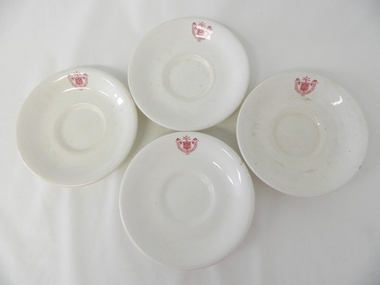 Kiewa Valley Historical Society
Saucer Ceramic, from 1921 to 1961
... This item was used by the State Electricity Commission of Victoria in their mess rooms for their workers during the construction of the Kiewa Hydro Electricity Scheme. The imprint of the year "1921" was to identify the year that the SECV was formed and relieved the private VHEC(Victorian Hydro-Electric Company). ...This item was used by the State Electricity Commission of Victoria in their mess rooms for their workers during the construction of the Kiewa Hydro Electricity Scheme. The imprint of the year "1921" was to identify the year that the SECV was formed and relieved the private VHEC(Victorian Hydro-Electric Company). ...This item was used by the State Electricity Commission of Victoria in their mess rooms for their workers during the construction of the Kiewa Hydro Electricity Scheme. The imprint of the year "1921" was to identify the year that the SECV was formed and relieved the private VHEC(Victorian Hydro-Electric Company). As the scheme was of such a huge, isolated and time consuming nature the feeding of its workers was quite demanding of cutlery and crockery. The use of sturdy English cups and saucers was essential. The period of construction and the isolation of the Kiewa Valley area placed heavy demand for "solid" crockery that could wear abusive handling. This period in time was one when crockery, whether for domestic or commercial use, was imported from "mother" England. This scenario was more so for governmental bodies such as rail, jails and electricity providers than domestic users. The influx of cheaper Asian crockery had not yet begun.This type of crockery item was used by the thousands of SEC Victorian staff and construction workers involved in the building of the Kiewa Hydro Electricity Scheme, over the extensive period (1938 to 1961). This was a period when Government bodies and other semi- government organisations were still tied to the "establishments" of "mother" England. It was a period in Australia's development when the Asian influence was very weak and the established ties to England and Europe was still very strong. The majority of heavy equipment and machinery was either made in England or Europe. Local/European expertise in dam construction and water management in alpine terrain came from migrants or English and European specialist. The quality of workmanship from big steel manufacturing plants in England and Europe could not be matched from anywhere else in the developed world.This item is a white ceramic saucer (tea /coffee). It is made in England and is of strong and durable ceramic. The bottom cup indent is for either tea or coffee cups of a similar ceramic structure. The 5mm thickness of the ceramic suggests this saucer belongs to a commercial kitchen environment and not domestic. The indent bottom of the saucer is 5mm deep with a side curvature ratio of 2:5. The ceramic is glazed to a commercial standard (worker's mess). See also KVHS 0128 (A,C and D) The seal of the State Electricity Commission Of Victoria is imprinted on the top inside rim within a curved scroll. Snuggled within the borders of the scroll is a banner with the five stars of the southern cross and an arm with a closed fist projecting from the top with five lightning bolts projecting outwards. On the underside "Vitrified sold by Cafe & Hotel Supplies Pty Ltd Dunn Bennett & Co. Ltd. Burslem Made in England"saucer, plate, secv, state electricity commission of victoria, crockery, mt beauty chalet, bogong mess hall -
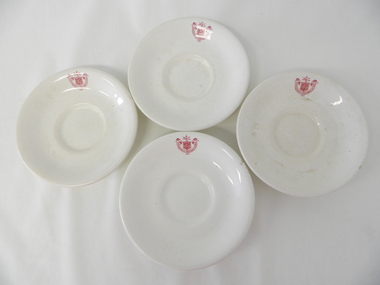 Kiewa Valley Historical Society
Saucer Ceramic, from 1921 to 1961
... This item was used by the State Electricity Commission of Victoria in their mess rooms for their workers during the construction of the Kiewa Hydro Electricity Scheme. The imprint of the year "1921" was to identify the year that the SECV was formed and relieved the private VHEC (Victorian Hydro-Electric Company). ...This item was used by the State Electricity Commission of Victoria in their mess rooms for their workers during the construction of the Kiewa Hydro Electricity Scheme. The imprint of the year "1921" was to identify the year that the SECV was formed and relieved the private VHEC (Victorian Hydro-Electric Company). ...This item was used by the State Electricity Commission of Victoria in their mess rooms for their workers during the construction of the Kiewa Hydro Electricity Scheme. The imprint of the year "1921" was to identify the year that the SECV was formed and relieved the private VHEC (Victorian Hydro-Electric Company). As the scheme was of such a huge, isolated and time consuming nature the feeding of its workers was quite demanding of cutlery and crockery. The use of sturdy English cups and saucers was essential. The period of construction and the isolation of the Kiewa Valley area placed heavy demand for "solid" crockery that could wear abusive handling. This period in time was one when crockery, whether for domestic or commercial use, was imported from "mother" England. This scenario was more so for governmental bodies such as rail, jails and electricity providers than domestic users. The influx of cheaper Asian crockery had not yet begun.This type of crockery item was used by the thousands of SEC Victorian staff and construction workers involved in the building of the Kiewa Hydro Electricity Scheme, over the extensive period (1938 to 1961). This was a period when Government bodies and other semi- government organisations were still tied to the "establishments" of "mother" England. It was a period in Australia's development when the Asian influence was very weak and the established ties to England and Europe was still very strong. The majority of heavy equipment and machinery was either made in England or Europe. Local/European expertise in dam construction and water management in alpine terrain came from migrants and specialist recruited from England and Europe. The quality of workmanship from big steel manufacturing plants in England and Europe could not be matched from anywhere else in the developed world.This item is a white ceramic saucer (tea /coffee). It is made in England and is of strong and durable ceramic. The bottom cup indent is for either tea or coffee cups of a similar ceramic structure. The 5mm thickness of the ceramic suggests this saucer belongs to a commercial kitchen environment and not domestic. The indent bottom of the saucer is 5mm deep with a side curvature ratio of 2:5. The ceramic is glazed to a commercial standard (worker's mess). See also KVHS 0128 ( A,B&D)The seal of the State Electricity Commission Of Victoria is imprinted on the top inside rim within a curved scroll. Snuggled within the borders of the scroll is a banner with the five stars of the southern cross and an arm with a closed fist projecting from the top with five lightning bolts projecting outwards. On the underside "Vitrified sold by Cafe & Hotel Supplies Pty Ltd Dunn Bennett & Co. Ltd. Burslem Made in England"saucer, plate, secv, state electricity commission of victoria, crockery, mt beauty chalet, bogong mess hall -
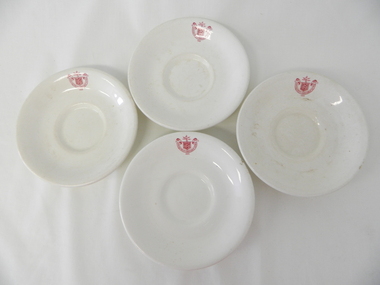 Kiewa Valley Historical Society
Saucer Ceramic, Circa 1921
... This item was used by the State Electricity Commission of Victoria in their mess huts/rooms for their workers during the construction of the Kiewa Hydro Electricity Scheme. The imprint of the year "1921" was to identify the year that the SECV was formed and relieved the private VHEC (Victorian Hydro-Electric Company). ...This item was used by the State Electricity Commission of Victoria in their mess huts/rooms for their workers during the construction of the Kiewa Hydro Electricity Scheme. The imprint of the year "1921" was to identify the year that the SECV was formed and relieved the private VHEC (Victorian Hydro-Electric Company). ...This item was used by the State Electricity Commission of Victoria in their mess huts/rooms for their workers during the construction of the Kiewa Hydro Electricity Scheme. The imprint of the year "1921" was to identify the year that the SECV was formed and relieved the private VHEC (Victorian Hydro-Electric Company). As the scheme was of such a huge, isolated and time consuming nature the feeding of its workers was quite demanding of cutlery and crockery. The use of sturdy English cups and saucers was essential. The period of construction and the isolation of the Kiewa Valley area placed heavy demand for "solid" crockery that could wear abusive handling. This period in time was one when crockery, whether for domestic or commercial use, was imported from "mother" England. This scenario was more so for governmental bodies such as rail, jails and electricity providers than domestic users. The influx of cheaper Asian crockery had not yet begun.This type of crockery item was used by the thousands of SEC Victorian staff and construction workers involved in the building of the Kiewa Hydro Electricity Scheme, over the extensive period (1938 to 1961). This was a period when Government bodies and other semi- government organisations were still tied to the "establishments" of "mother" England. It was a period in Australia's development when the Asian influence was very weak and the established ties to England and Europe was still very strong. The majority of heavy equipment and machinery was either made in England or Europe. Local and European expertise in dam construction and water management in alpine terrain came from migrants for England and Europe. The quality of workmanship from big steel manufacturing plants in England and Europe could not be matched from anywhere else in the developed world. These saucers were used in the mess huts including later in the Bogong mess hall and the Mount Beauty Chalet.This item is a white ceramic saucer (tea /coffee). It is made in England and is of strong and durable ceramic. The bottom cup indent is for either tea or coffee cups of a similar ceramic structure. The 5mm thickness of the ceramic suggests this saucer belongs to a commercial kitchen environment and not domestic. The indent bottom of the saucer is 5mm deep with a side curvature ratio of 2:5. The ceramic is glazed to a commercial standard (worker's mess). See also KVHS 0128 (A to C)The seal of the State Electricity Commission Of Victoria is imprinted on the top inside rim within a curved scroll. Snuggled within the borders of the scroll is a banner with the five stars of the southern cross and an arm with a closed fist projecting from the top with five lightning bolts projecting outwards. On the underside "Vitrified sold by Cafe & Hotel Supplies Pty Ltd Dunn Bennett & Co. Ltd. Burslem Made in England"saucer, plate, secv, state electricity commission of victoria, crockery, mt beauty chalet, bogong mess hall -
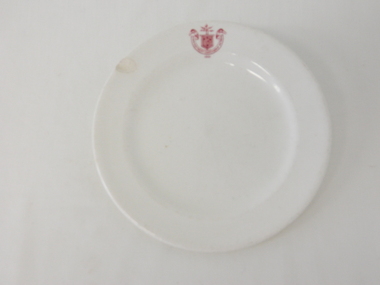 Kiewa Valley Historical Society
Plate Bread & Butter, Circa 1921
... This item was used by the State Electricity Commission of Victoria in their mess rooms for their workers during the construction of the Kiewa Hydro Electricity Scheme. The imprint of the year "1921" was to identify the year that the SECV was formed and relieved the private VHEC (Victorian Hydro-Electric Company). ...This item was used by the State Electricity Commission of Victoria in their mess rooms for their workers during the construction of the Kiewa Hydro Electricity Scheme. The imprint of the year "1921" was to identify the year that the SECV was formed and relieved the private VHEC (Victorian Hydro-Electric Company). ...This item was used by the State Electricity Commission of Victoria in their mess rooms for their workers during the construction of the Kiewa Hydro Electricity Scheme. The imprint of the year "1921" was to identify the year that the SECV was formed and relieved the private VHEC (Victorian Hydro-Electric Company). As the scheme was of such a huge, isolated and time consuming nature the feeding of its workers was quite demanding of cutlery and crockery. The use of sturdy English cups and saucers was essential. The period of construction and the isolation of the Kiewa Valley area placed heavy demand for "solid" crockery that could wear abusive handling. This period in time was one when crockery, whether for domestic or commercial use, was imported from "mother" England. This scenario was more so for governmental bodies such as rail, jails and electricity providers than domestic users. The influx of cheaper Asian crockery had not yet begun.This type of crockery item was used by the thousands of SEC Victorian staff and construction workers involved in the building of the Kiewa Hydro Electricity Scheme, over the extensive period (1938 to 1961). This was a period when Government bodies and other semi- government organisations were still tide to the "establishments" of "mother" England. It was a period in Australia's development when the Asian influence was very weak and the established ties to England and Europe was still very strong. The majority of heavy equipment and machinery was either made in England or Europe. Local expertise in dam construction and water management in alpine terrain came from migrants for England and Europe. The quality of workmanship from big steel manufacturing plants in England and Europe could not be matched from anywhere else in the developed world.This item is a white ceramic plate (bread & butter). It is made in England and is of strong and durable ceramic. The bottom of the plate is flat with edges sloping out (to position the bread) and the extended rim is to catch any spillages. The 5mm thickness of the ceramic suggests this plate belongs to a commercial kitchen/eating establishment (mess) and not a domestic dining room. The indent bottom of the plate is 5mm deep with a side curvature ratio of 2:5. The ceramic is glazed to a commercial standard (see KVHS 0128 for its saucer part of a dinner set.The seal of the State Electricity Commission Of Victoria is imprinted on the top inside rim within a curved scroll. Snuggled within the borders of the scroll is a banner with the five stars of the southern cross and an arm with a closed fist projecting from the top with five lightning bolts projecting outwards. On the underside "Vitrified sold by Cafe & Hotel Supplies Pty Ltd Dunn Bennett & Co. Ltd. Burslem Made in England"saucer, plate, secv, state electricity commission of victoria, crockery -
 Kiewa Valley Historical Society
Bowl Ceramic, circa mid to late 1900's
... This bowl was used by the State Electricity Commission of Victoria in their mess rooms for their workers during the construction of the Kiewa Hydro Electric Scheme. The imprint of the year "1921" was to identify the year that the SECV was formed which relieved the private VHEC (Victorian Hydro-Electric Company). ...This bowl was used by the State Electricity Commission of Victoria in their mess rooms for their workers during the construction of the Kiewa Hydro Electric Scheme. The imprint of the year "1921" was to identify the year that the SECV was formed which relieved the private VHEC (Victorian Hydro-Electric Company). ...This bowl was used by the State Electricity Commission of Victoria in their mess rooms for their workers during the construction of the Kiewa Hydro Electric Scheme. The imprint of the year "1921" was to identify the year that the SECV was formed which relieved the private VHEC (Victorian Hydro-Electric Company). As the scheme was of such a huge scope, isolated and time consuming nature, the feeding of its workers was quite demanding of cutlery and crockery. The use of sturdy English cups and saucers was essential. The period of construction and the isolation of the Kiewa Valley area placed heavy demand for "solid" crockery that could wear abusive handling. This period in time was one when crockery, whether for domestic or commercial use, was imported from "mother" England. This scenario was more so for governmental bodies such as rail, jails and electricity providers than domestic users. The influx of cheaper Asian crockery had not yet begun.This type of crockery item was used by the thousands of SEC Victorian staff and construction workers involved in the building of the Kiewa Hydro Electricity Scheme, over the extensive period (1938 to 1961). This was a period when Government bodies and other semi- government organisations were still tied to the "establishments" of "mother" England. It was a period in Australia's development when the Asian influence was very weak and the established ties to England and Europe was still very strong. The majority of heavy equipment and machinery was either made in England or Europe. Local/European expertise in dam construction and water management in alpine terrain came from migrants and specialist recruited from England and Europe. The quality of workmanship from big steel manufacturing plants in England and Europe could not be matched from anywhere else in the developed world.This item is a white ceramic State Electricity Commission of Victoria bowl. It is made in England and is of strong and durable ceramic. The 5mm thickness of the ceramic suggests this bowl (cereal/soup) belongs to a commercial kitchen environment and not domestic. The indent bottom of the bowl is 5mm deep with a side curvature ratio of 2:5. The ceramic is glazed to a commercial standard (worker's mess). See also KVHS 0128 (B to D) for other ceramic crockery. The seal of the State Electricity Commission of Victoria is imprinted on the top outside rim within a curved scroll and a raised fist with electrical "charges" extending out.. Snuggled within the borders of the scroll is a banner with the five stars of the Southern Cross . On the underside "Vitrified sold by Cafe & Hotel Supplies Pty Ltd Dunn Bennett & Co. Ltd. Burslem Made in England"ceramic crockery, plate, secv, state electricity commission of victoria, crockery, mt beauty chalet, bogong mess hall -
 Kiewa Valley Historical Society
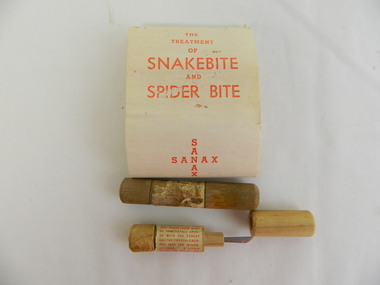
Lancette - S.E.C. - Medical
... State Electricity workers working on the Kiewa Hydro Electric Scheme during the 1940's and 1950's. Historical: S.E.C. workers worked in remote areas where they didn't have easy access to medical facilities. Shows the development of snake bite treatment and spider bites. first aid snakebite spider bite sanax company ...Supplied to S.E.C. workers. This equipment was distributed to State Electricity workers working on the Kiewa Hydro Electric Scheme during the 1940's and 1950's.Historical: S.E.C. workers worked in remote areas where they didn't have easy access to medical facilities. Shows the development of snake bite treatment and spider bites.Cardboard brown box without lid for holding two wooden cylinders. Each cylinder can be pulled apart showing one end with a lancet which is used to cut the skin after a snake or spider bite. Each wooden container has instructions in very small red writing. Also in the box are instructions for Snakebite and Spider Bite. This leaflet is written in red on white paper and has more detail than the instructions on the lancets. It is made up of a front and back page opening up to the middle page.Pamphlet: 'The / Treatment / of / Snakebite / and / Spider Bite' and at the bottom 'Sanax'first aid, snakebite, spider bite, sanax company, state electricity commission of victoria, workers, medical -
 Bendigo Historical Society Inc.
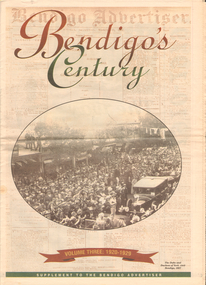
Newspaper - LONG GULLY HISTORY GROUP COLLECTION: BENDIGO'S CENTURY VOLUME THREE: 1920 - 1929
... State Rivers and Water Supply Commission... Bendigo Railway Workshops... Frank Grove... Cr Curnow... Electric Supply Company...Bendigo Knitting Mills Charles Handschin Farmers' Union Andrew Sunstan MLA Country Progressive Party John Allan Captain G J C Dyett Eahlehawk UFS Dispensary Data Fundamentals The Duke and Duchess of York The Hercules Mine Cr J A Michelsen Lansell Family Bendigo Agricultural Society Huntly Shire Council Bendigo Creek Trust South African War Memorial Cr J H Curnow St Paul's Church of England Diamond Jubilee Bendigo Chamber of Commerce Bendigo Freezing Works Bendigo Pottery Bendigo Trotting Club New Red White and Blue Mine The Conservatory Cr E G Batchelder Hercules Mine Billie Rigby Bendigo Railway Station Travellers' aid Society Eppalock Weir The State Rivers and Water Supply Commission Bendigo Railway Workshops Frank Grove Cr Curnow Electric Supply Company State Electricity Commission Australian Aero Club Bendigo Preserving Company Jardine Busbridge Feeman Mr H Pearce BFL Fred Wood Newspaper supplement titled Bendigo's Century Volume Three: 1920 - 1929. ...Newspaper supplement titled Bendigo's Century Volume Three: 1920 - 1929. Front page has a photo of The Duke and Duchess of York visit to Bendigo, 1927. Each year has heading of Who's Who, Weather, Sport and Business. First years are 1910 - 1919 titled The way we were. 1920 is titled Prince hailed. 1921 - City racks up a milestone. 1922 - Furore erupts. 1923 - Felons escape from city gaol. 1924 - Bid to finish RSL memorial. 1925 - Foul odour over sewerage plan. 1926 - Lest we forget Bendigo's fallen. 1927 - Royal Visit captures city. 1928 - Four shot in farm tragedy. 1929 - Billie's trip to remember.bendigo, history, long gully history group, the long gully history group - bendigo's century - volume three: 1920 - 1929, bendigo advertiser, duke and duchess of york, cr e m vains, r putnam, a j taylor, j h jackson, w crowley, sandhurst football club, george lansell, st peter's church, bendigo junior technical school, prince of wales, unity mine, mr w wilson, badak tin mining syndicate, mr t w ortonmr h scarborough, mr raleigh, general sir w r birdwood, the soldiers' memorial committee, bendigo city council, rsl memorial hall, captain g c wilson, lietenant r j parer, lieutenant j c mcintosh, cr j p carolin, h k morris, e a morris, turf tavern hotel, rev donald baker, all saints' pro--cathedral, keck's nursery, bendigo amalgamated goldfields, rising sun hotel, leanne mcdonnell, most rev john mccarthy, sir john quick, prime minister billy hughes, state rivers and water supply commission, diptheria, edna stevens, bendigo railway workshops, watson sustenance fund, sir joseph cook, dr lanza, bendigo amalgamated goldfields, bendigo benevolent asylum, miner's phthisis, bendigo gas company, electric light company, bendigo sewerage authority, commonwealth bank, cr curnow, the earl of stradbroke, dame nellie melba, princess theatre, lt-col g hurry, h sw lawson, countess of stradbroke, clunes woollen mills, girton college, mrs polglaise, mrs kennedy, gold discovery memorial, cr m g giudice, victorian co-operative freezing company, bendigo brick and tile company, mr lawson, soldiers' memorial, windermere hotel, toni riley pharmacy, bendigo gaol, mr a a dunstan mla, new red white and blue mine, claude de vere, walter osborne, sir john and lady quick, jonathan smalley, bendigo advertiser, st paul's bells, mr t cambridge, epsom public hall, bendigo school of mines, major lansell, mr h s w lawson, cr david andrew, colonel hurry, mr s bruce, bendigo sewerage authority, eppalock weir scheme, bendigo football league, r s l memorial, major g v lansell, lempriere, mr s m bruce, sandhurst hotel, market square, big hill tunnel, bendigo football league, bendigo united cricket club, south bendigo rex, sacred heart cathedral, hercules mine, gillies, aids & appliance shop, anne caudle centre, fizelle & mulqueen, south new moon mine, bendigo sewerage authority, mr a a kelley, epsom sewerage works, white hills botanical gardens, mr j sternberg mlc, bendigo book of remembrance, bendigo football league, senator general drake-brockman, captain dyett, school of mines, handschin and romus, hanro (aust.) bendigo knitting mills, charles handschin, farmers' union, andrew sunstan mla, country progressive party, john allan, captain g j c dyett, eahlehawk ufs dispensary, data fundamentals, the duke and duchess of york, the hercules mine, cr j a michelsen, lansell family, bendigo agricultural society, huntly shire council, bendigo creek trust, south african war memorial, cr j h curnow, st paul's church of england diamond jubilee, bendigo chamber of commerce, bendigo freezing works, bendigo pottery, bendigo trotting club, new red white and blue mine, the conservatory, cr e g batchelder, hercules mine, billie rigby, bendigo railway station, travellers' aid society, eppalock weir, the state rivers and water supply commission, bendigo railway workshops, frank grove, cr curnow, electric supply company, state electricity commission, australian aero club, bendigo preserving company, jardine, busbridge, feeman, mr h pearce, bfl, fred wood -
 Tramway Heritage Centre
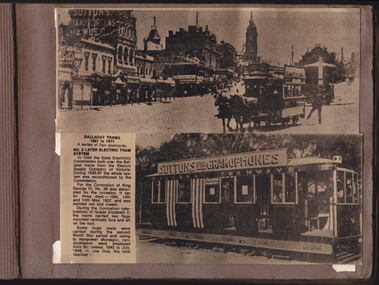
Photograph Album (part of), Ray Pearson's Photo Album - Trams of Victorian Railways, Ballarat, Bendigo, Geelong
... . / NO. 3 LATER ELECTRIC TRAM SYSTEM / In 1934 the State Electricity / Commission took over the Bal- / larat trams from the Electric / Supply Company of Victoria. / During 1935-37 the whole sys- / tem was reconditioned by the / Commission. / For the Coronation of King / George VI, No. 28 was decor- / ated for the occasion. .... / NO. 3 LATER ELECTRIC TRAM SYSTEM / In 1934 the State Electricity / Commission took over the Bal- / larat trams from the Electric / Supply Company of Victoria. / During 1935-37 the whole sys- / tem was reconditioned by the / Commission. / For the Coronation of King / George VI, No. 28 was decor- / ated for the occasion. ...Page 3 of Ray Pearson's Photo Album. Brown card page with two metallic look postcards (landscape format) placed on page using clear plastic photo corners. Both postcard images depict trams in Ballarat. The bottom postcard has come loose of two of it's photo corners (top and bottom on the right) and is not secure on the page. A hand written inscription is written in pencil behind the bottom photograph.Hand written inscription in pencil behind postcard at base of page: W.4. Printed text to left of image on bottom postcard: BALLARAT TRAMS / 1887 to 1971 / A series of four postcards. / NO. 3 LATER ELECTRIC TRAM SYSTEM / In 1934 the State Electricity / Commission took over the Bal- / larat trams from the Electric / Supply Company of Victoria. / During 1935-37 the whole sys- / tem was reconditioned by the / Commission. / For the Coronation of King / George VI, No. 28 was decor- / ated for the occasion. It ran / for three days – 12th, 13th / and 14th May, 1937, and was / painted red and cream. / During the Coronation cele- / brations of Queen Elizabeth II, / the trams carried two flags / mounted vertically fore and aft / on the roof. / Some huge loads were / carried during the second / World War period and owing / to man power shortages, con- / doctresses were employed / from September, 1942 to July, 1946. At one time, the total / reached 23. Printed text to back of bottom postcard: BALLARAT TRAMS / 1887 to 1971 / A series of four postcards. / In the early fifties, loading / on the trams was heavy. When / the lag in housing was over- / taken, however, breadwinners / started to leave the trams and / travel to work in cars. Increas- / ing affluence in the sixties ac- / centuated the trend. Soon the / trams were running with mount- / ing annual losses. Most of the / passengers travelling in these / times were concession holders: / students, pensioners, deserted / wives and T.P.I.'s A fine printed vertical line runs down the centre of the blank writing space to the left of the body text. Above is written: POSTCARD postcard, coronation, ray pearson, vintage trams, ballarat tramway, tram postcard, female conductors, suttons, ballarat tram -
 Bendigo Historical Society Inc.
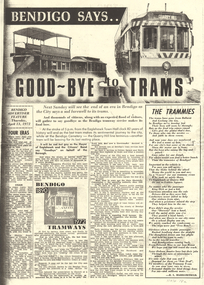
Newspaper - LONG GULLY HISTORY GROUP COLLECTION: BENDIGO SAYS GOOD-BYE TO THE TRAMS
... The Electric Supply Company of Victoria... State...BHS Collection BENDIGO History long gully history group The Long Gully History Group - Bendigo Says Good-bye to the Trams The Electric Supply Company of Victoria State Electricity Commission of Victoria Cr D E Elliott The City Council Bendigo Trust Sandhurst and Eaglehawk Tramway Company Bendigo Tramway Company Battery Trams Steam Trams Electric Trams R L Harrowfield Tom Griffiths Baby Health Centre Miss Tavenor's Sweet Shop Needle Mine The Robbie Burns Hotel Eaglehawk Wine Saloon Town Hall Hotel Hooley's Dress Fabrics Kevin Anstee Bert Knight Bendigo Curtain Service Graham O'Donahoo John Henderson The English Electric Traction Company Princess Theatre Upper Reserve Five Lions Hercules Mine Needle loop (Needle Mine) Jim Collins Arch Robinson's Seat St Liborius Church Virginia Mine Upper Reserve (QEO) Bendigo Tram History Gibson's Blum's Powney's View Point Newsagency City Offices Hopetoun Hotel ? ...BHS CollectionCopy (2 pages) of a Bendigo Advertiser Feature dated Thursday, April 13, 1972 titled Bendigo Says. Good-bye to the Trams. Article contains photos of trams, a photo of a conductor assisting an elderly lady with a shopping jeep and a photo of trams and people at the Alexander Fountain. The article mentions Four Eras of Trams, a poem titled 'The Trammies' by R L Harrowfield, some men who worked on the trams and tasks they did, some accidents, local identities, and some of Tom Griffiths memories.bendigo, history, long gully history group, the long gully history group - bendigo says good-bye to the trams, the electric supply company of victoria, state electricity commission of victoria, cr d e elliott, the city council, bendigo trust, sandhurst and eaglehawk tramway company, bendigo tramway company, battery trams, steam trams, electric trams, r l harrowfield, tom griffiths, baby health centre, miss tavenor's sweet shop, needle mine, the robbie burns hotel, eaglehawk wine saloon, town hall hotel, hooley's dress fabrics, kevin anstee, bert knight, bendigo curtain service, graham o'donahoo, john henderson, the english electric traction company, princess theatre, upper reserve, five lions, hercules mine, needle loop (needle mine), jim collins, arch robinson's seat, st liborius church, virginia mine, upper reserve (qeo), bendigo tram history, gibson's, blum's, powney's, view point newsagency, city offices, hopetoun hotel, ?ob & dorothy mills' concern, gillies bros pty ltd -
 Bendigo Historical Society Inc.
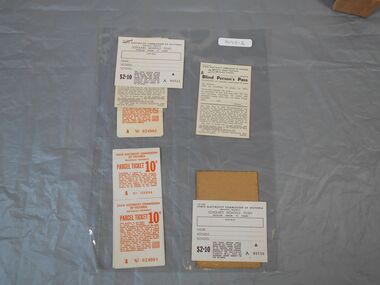
Document - Various passes and tickets
... Electric Supply Company of Victoria and in 1903 the trams were converted to electricity. After WW1 the SEC was formed and took over the running of the trams. With the increased usage of cars, patronage of the trams began to drop off after WW2. In 1972 the tramways closed as a commuter service. The Bendigo trust then restored trams and infrastructure and began the tourist/talking trams. Provincial Tramways Tramways Tickets Passes Electricity State ...Sandhurst and Electric Tramways Company introduced the first trams to Bendigo in June 1890. These were battery operated trams but it soon became obvious that the battery life was unable to copy with Bendigo's hilly terrain. The trams were converted to steam in 1892. In 1899 the tramways were sold to the Electric Supply Company of Victoria and in 1903 the trams were converted to electricity. After WW1 the SEC was formed and took over the running of the trams. With the increased usage of cars, patronage of the trams began to drop off after WW2. In 1972 the tramways closed as a commuter service. The Bendigo trust then restored trams and infrastructure and began the tourist/talking trams.State Electricity Commission of Victoria Provincial Tramways: 2 x single parcel tickets Nos 024004 and 024005, 1 x single Scholars Monthly ticket, 1 x single Blind persons pass, 1 x transfer with image of by holding sign with quote "Electricity makes life easier!". Also stapled together 1 x Scholars Monthly ticket, 1 x Blind persons pass and 2 x parcel tickets. Parcel tickets have orange print on thin paper. Monthly ticket and Blind persons pass have black print on cardboard. Transfer is on original brown cardboard.provincial tramways, tramways, tickets, passes, electricity -
 Bendigo Historical Society Inc.
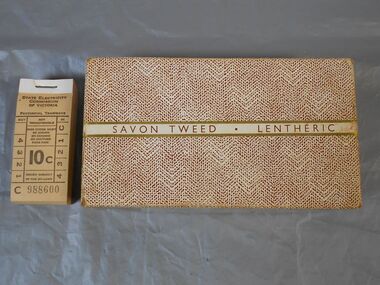
Administrative record - Tramways student passes
... Electric Supply Company of Victoria and in 1903 the trams were converted to electricity. After WW1 the SEC was formed and took over the running of the trams. With the increased usage of cars, patronage of the trams began to drop off after WW2. In 1972 the tramways closed as a commuter service. The Bendigo trust then restored trams and infrastructure and began the tourist/talking trams. Provincial Tramways Tramways Tickets Passes Electricity On back of separate ticket bundle is blue pen with OCT 1972 crossed out and 16.4.1972 Trams Finished State ...Sandhurst and Electric Tramways Company introduced the first trams to Bendigo in June 1890. These were battery operated trams but it soon became obvious that the battery life was unable to copy with Bendigo's hilly terrain. The trams were converted to steam in 1892. In 1899 the tramways were sold to the Electric Supply Company of Victoria and in 1903 the trams were converted to electricity. After WW1 the SEC was formed and took over the running of the trams. With the increased usage of cars, patronage of the trams began to drop off after WW2. In 1972 the tramways closed as a commuter service. The Bendigo trust then restored trams and infrastructure and began the tourist/talking trams.State Electricity Commission of Victoria Provincial Tramways: student passes One box containing various types of tram tickets. Bottom of box is red. Top of box has a mottled pattern with a stripe across the length with the words "SAVON TWEED LENTHERIC". 1 separate bundle of 10c paper tickets with cardboard backing and whitestripe where tickets are stapled together. Tickets are a beige color with black print. Bottom of box has a blue sticker with white typeface - "JW Jones Chemist Hargreaves St. Bendigo" 13/6 is written in the middle of this sticker with pencil.On back of separate ticket bundle is blue pen with OCT 1972 crossed out and 16.4.1972 Trams Finishedprovincial tramways, tramways, tickets, passes, electricity -
 Bendigo Historical Society Inc.
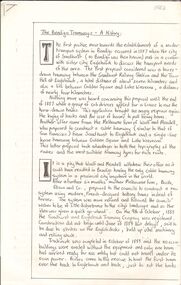
Document - ''THE BENDIGO TRAMWAYS: A HISTORY''
... Early moves to have tramway system in 1880s; battery trams operation; steam tram motors; Bendigo Tramway Company; Electric Supply Company; Route maps (''in the appendices at the end of this report'' ???); State...Early moves to have tramway system in 1880s; battery trams operation; steam tram motors; Bendigo Tramway Company; Electric Supply Company; Route maps (''in the appendices at the end of this report'' ???); State ...''The Bendigo Tramways - A History'' (author, not named, but last page indicates that writer was 17 years of age). Eight handwritten pages; 4 pages of photo reproductions; loose sheet - broad description of 'Bendigo''; loose sheet showing ''S.E.C. Bendigo Tramways Track Diagram as at closure of system, April 1972''. Early moves to have tramway system in 1880s; battery trams operation; steam tram motors; Bendigo Tramway Company; Electric Supply Company; Route maps (''in the appendices at the end of this report'' ???); State Electricity Commission of Victoria; list of the major purchases made by the SEC from the MMB to add to the Bendigo fleet (1930 -1960) closure of tramways; Bendigo 'talking' tourist tram (Dec. 1972); Writer's notes - acknowledgementtramways, history, bendigotramway history., bendigo tramways, electric supply company, talking tourist tram. tramsways track diagram. battery trams, ellsen and co., the sandhurst and eaglehawke tramways company. mollison street. arnold street. -
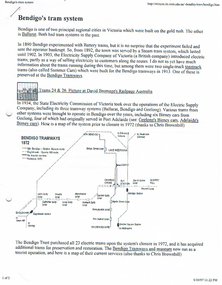 Bendigo Historical Society Inc.
Document - LONG GULLY HISTORY GROUP COLLECTION: BENDIGO'S TRAM SYSTEM
... Company of Victoria... Toastrack Trams... David Bromage... Bendigo Tramways... State Electricity Commission of Victoria... The Bendigo Trust... Chris Brownbill... Bendigo Talking Tram... David Hoadley... Prahran and Malvern Tramways Trust... Hawthorn Tramways Trust... Fitzroy Northcote and Preston Tramways Trust... Melbourne Brunswick and Coburg Tramways Trust... North Melbourne Electric...BENDIGO History long gully history group The Long Gully History Group - Bendigo's Tram System Battery Trams Steam Trams Electricity Supply Company of Victoria Toastrack Trams David Bromage Bendigo Tramways State Electricity Commission of Victoria The Bendigo Trust Chris Brownbill Bendigo Talking Tram David Hoadley Prahran and Malvern Tramways Trust Hawthorn Tramways Trust Fitzroy Northcote and Preston Tramways Trust Melbourne Brunswick and Coburg Tramways Trust North Melbourne Electric Tramway and Lighting Co Sydney Tramway Museum Tramway Museum of Victoria Railpage Australia Ballarat Vintage Tramway Andrew Cox Russell Jones Australian Electric Transport Museum Birney Cars J G Brill & Co Bob Hawke Adelaide Municipal Tramways Trust Tim Blythman Bill Winn John Radcliffe Information on trams. ...Information on trams. Includes small photo of Trams 24 & 26, Map of Bendigo Tram routes 1972and 1996, Ballarat No 26 tram, S 164 tram, and No 38 tram. Mentioned is the individual history and where they can be found, operating and non operating trams, different classes of trams. Geelong's Birney Cars, two of which came to Bendigo and the Type G (Birney Safety Cars). Other information includes Nos, First introduced, Last withdrawn, Electrics (motors), Size and Seating/Crush Load. (8 pages).bendigo, history, long gully history group, the long gully history group - bendigo's tram system, battery trams, steam trams, electricity supply company of victoria, toastrack trams, david bromage, bendigo tramways, state electricity commission of victoria, the bendigo trust, chris brownbill, bendigo talking tram, david hoadley, prahran and malvern tramways trust, hawthorn tramways trust, fitzroy northcote and preston tramways trust, melbourne brunswick and coburg tramways trust, north melbourne electric tramway and lighting co, sydney tramway museum, tramway museum of victoria, railpage australia, ballarat vintage tramway, andrew cox, russell jones, australian electric transport museum, birney cars, j g brill & co, bob hawke, adelaide municipal tramways trust, tim blythman, bill winn, john radcliffe -
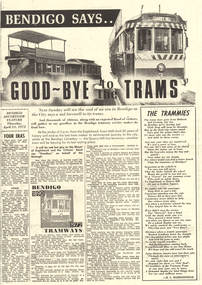 Bendigo Historical Society Inc.
Newspaper - LONG GULLY HISTORY GROUP COLLECTION: GOOD-BYE TO THE TRAMS
... The Electric Supply Company of Victoria... State...BENDIGO History long gully history group The Long Gully History Group - Good-bye to the Trams Bendigo Advertiser 13 April 1972 The Electric Supply Company of Victoria State Electricity Commission of Victoria Bendigo Cemetery Cr D E Elliott City Council Bendigo Trust Sandhurst and Eaglehawk Tramway Company Bendigo Tramway Company R L Harrowfield Copy of a Bendigo Advertiser Feature, dated April 13, 1972 titled Bendigo says Good-bye to the Trams. ...Copy of a Bendigo Advertiser Feature, dated April 13, 1972 titled Bendigo says Good-bye to the Trams. Article mentions the battery, steam and electrical powered trams. The main article mentions the history of the trams in Bendigo, the farewell Bendigo had for the trams and some happenings along the routes. There are some photos of trams on the page. There is also a poem titled 'The Trammies" by R. L. Harrowfield.bendigo, history, long gully history group, the long gully history group - good-bye to the trams, bendigo advertiser 13 april 1972, the electric supply company of victoria, state electricity commission of victoria, bendigo cemetery, cr d e elliott, city council, bendigo trust, sandhurst and eaglehawk tramway company, bendigo tramway company, r l harrowfield -
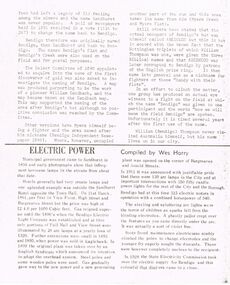 Bendigo Historical Society Inc.
Document - PAGE FROM HISTORICAL MAGAZINE (UNTITLED)
... Bendigo Electric Power Company...Wes Harry... State...Reference to Bendigo Electric Power Company and State Electricity Company....PERSON Individual William Thompson Bendigo Electric Power Company Wes Harry State Electricity Commission. ...Page from Historical Magazine. Part of article about the naming of Bendigo (ref to Abednego Thompson, William (Bendigo) Thompson. Further short article (in full) by Wes Harry about Electric Power in Bendigo. Reference to Bendigo Electric Power Company and State Electricity Company.person, individual, william thompson, bendigo electric power company, wes harry, state electricity commission. -
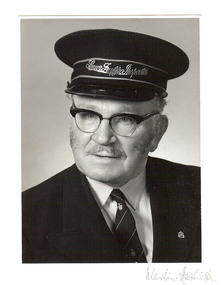 Bendigo Historical Society Inc.
Photograph - BASIL MILLER COLLECTION: PORTRAIT OF BASIL MILLER
... In the 1920's Basil obtained employment with the Electric Supply Company of Victoria as an 'oiler boy' and later Junior Conductor. He rose through Conductor, Motorman and Inspector to retire as Senior Inspector when the State Electricity Commission of Victoria closed the Bendigo Tramways in April 1972. ...In the 1920's Basil obtained employment with the Electric Supply Company of Victoria as an 'oiler boy' and later Junior Conductor. He rose through Conductor, Motorman and Inspector to retire as Senior Inspector when the State Electricity Commission of Victoria closed the Bendigo Tramways in April 1972. ...Basil William Bates Miller was born in Castlemaine on 27th June, 1908, the eldest child of Ferdinand and Lavina. The family moved to Bendigo and subsequently to a house in King Street, where Basil lived for over 70 years. All the family were musical and Basil became accomplished at Piano, organ and violin. He was honorary organist at his church and many Masonic Lodges for up to 40 years. He served in the Bendigo Regiment and as a warrant Officer in the Royal Australian Engineers in World War II. In the 1920's Basil obtained employment with the Electric Supply Company of Victoria as an 'oiler boy' and later Junior Conductor. He rose through Conductor, Motorman and Inspector to retire as Senior Inspector when the State Electricity Commission of Victoria closed the Bendigo Tramways in April 1972. He was involved in Tramway Union affaird for many years and his staunch views on inductrial matters were well known. He remained active during almost 30 years of retirement and died in the Bendigo Hospitral on 14th August, 2001 at the age of 93. Black and white photograph of Basil Miller, Senior Traffic Inspector of Bendigo Tramways, in uniform, looking to the right. Martin Washington written in pencil, bottom right corner. Mounted on cream card. Basil left his tramways collection of photographs and documents to the Bendigo Historical Society. Mr. Arthur Penna, 78 emmett Street, Golden Square, was the executor of Basil's will.person, individual, basil miller -
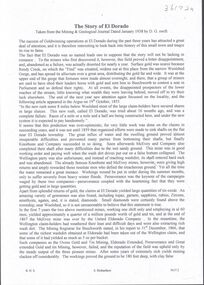 Bendigo Historical Society Inc.
Document - ELDORADO - THE STORY OF EL DORADO
... Company... McEvoy Disaster... Cock's Pioneer Electric Gold and Tin Sluicing Company... Mr H Falsoner... Cock's Pioneer Gold and Tin Mines N L Company... State...DOCUMENT Gold eldorado Eldorado The Story of El Dorado Mining & Geological Journal January 1938 D G Swift The Argus 19/10/1855 Kneebone & Company Wellington Party McEvoy Mine Kneebone Mine Tin Oxide Gemstones United Eldorado Company Mining Registrar Ovens Gold and Tin Mining Eldorado Extended Perserverance Great Extended Gold and Tin Mining Wellington Company Mr William Dunstan United Ovens Gold and Tin The Warrior Try Again Company McEvoy Disaster Cock's Pioneer Electric Gold and Tin Sluicing Company Mr H Falsoner Cock's Pioneer Gold and Tin Mines N L Company State Electricity Commission Hydraulic Sluicing Gold Dredge Cock's Eldorado Company L G Schilling Typed notes titled 'The Story of El Dorado' taken from the Mining & Geological Journal, dated January 1938 by D. ...Typed notes titled 'The Story of El Dorado' taken from the Mining & Geological Journal, dated January 1938 by D. G. Swift. Notes typed by L. G. Schilling, 13/10/69. Notes mention the disappointments, difficulties with water and the ground and floods, As well as gold they also found large quantities of tin oxide and a large variety of gemstones. A powerful jet of water was used for the mining.document, gold, eldorado, eldorado, the story of el dorado, mining & geological journal january 1938, d g swift, the argus 19/10/1855, kneebone & company, wellington party, mcevoy mine, kneebone mine, tin oxide, gemstones, united eldorado company, mining registrar, ovens gold and tin mining, eldorado extended, perserverance, great extended gold and tin mining, wellington company, mr william dunstan, united ovens gold and tin, the warrior, try again company, mcevoy disaster, cock's pioneer electric gold and tin sluicing company, mr h falsoner, cock's pioneer gold and tin mines n l company, state electricity commission, hydraulic sluicing, gold dredge, cock's eldorado company, l g schilling -
 Kiewa Valley Historical Society
Photographs- Original S.E.C.V. home designs in Mt Beauty – Set of 6 black and white photographs
... State Electricity Utility Commission (SEC) from the 1930’s to the 1950’s to house workers on the Kiewa Hydro Electric Scheme. At its peak the Kiewa Scheme employed around 4000 people. Although the towns were built as temporary accommodation for the workers and their families, many stayed and even retired there after the scheme had finished. The Bright Council, now the Alpine Shire took over the control of the township in 1960 and today Mount Beauty is one of the most complete company...State Electricity Utility Commission (SEC) from the 1930’s to the 1950’s to house workers on the Kiewa Hydro Electric Scheme. At its peak the Kiewa Scheme employed around 4000 people. Although the towns were built as temporary accommodation for the workers and their families, many stayed and even retired there after the scheme had finished. The Bright Council, now the Alpine Shire took over the control of the township in 1960 and today Mount Beauty is one of the most complete company ...The townships of Mount Beauty and Bogong Village were constructed by the Victorian State Electricity Utility Commission (SEC) from the 1930’s to the 1950’s to house workers on the Kiewa Hydro Electric Scheme. At its peak the Kiewa Scheme employed around 4000 people. Although the towns were built as temporary accommodation for the workers and their families, many stayed and even retired there after the scheme had finished. The Bright Council, now the Alpine Shire took over the control of the township in 1960 and today Mount Beauty is one of the most complete company towns in Victoria.The SECV provided several standard designs for the housing of workers and management in Mt Beauty. At the completion of the scheme the housing was retained and Mount Beauty now exists as one of the best examples of a company town in Victoria.There are many examples of the original houses remaining around the town. This is significant as the houses were only built as temporary accommodation and still remain functional after over 60 or more years of use.Set of 6 black and white photographs of original SECV temporary house designs in Mt Beauty.Written in blue ink on front of photos 1. Winwood 2. Winwood 3. K Type 4. K Type 5. English Precut 6. Cube mt beauty houses, secv housing -
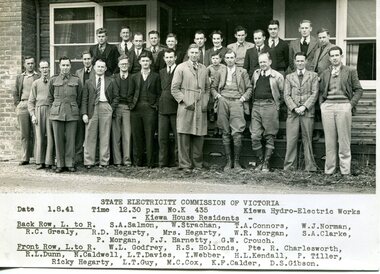 Kiewa Valley Historical Society
Photographs – Set of 10 black and white photographs and photocopies of original photographs documenting early residents of Bogong Village
... It also shows a glimpse into how a large group of people from very diverse backgrounds came together to enjoy social activities and share each others company Bogong Village; Kiewa Hydro Electric Scheme; Social activities; Community Clubs 1. Printed under photo: STATE ELECTRICITY COMMISSION OF VICTORIA Date: 1.8.41 Time: 12.30pm No:K 435 Kiewa Hydro-Electric Works. ...Bogong Village, which was known as “The Junction”, is well recorded. The first tent camp was at the junction of Pretty Valley and Rocky Valley streams in the early 40’s. Further downstream were the sawmill, stables and blacksmith’s forge. Horses were the main mode of transport in the early days. The road to Bogong had reached the lookout spur just beyond Roper’s Spur track just before the 1939 fires. The early forties saw rapid growth of the village, with single and married men’s quarters, workshops, mess huts and administrative offices. The facilities necessary for communal living were quickly in place- a post office, police station, co-op store, medical centre, community hall/theatre, tennis courts and school. Much of the temporary accommodation that housed groups such as the Albion Quarrying Company were in the area now under water.This group of photographs are a pictorial record of the early history of the Kiewa Hydro Scheme, the people who worked in the background supplying administrative support and the workers and their families. It also shows a glimpse into how a large group of people from very diverse backgrounds came together to enjoy social activities and share each others companyGroup of 10 black and white photographs and photocopies of original photographs of varying sizes (some official SECV photos) Some Photos are labelled with the date and the names of SECV staff members. Depicting early life at Bogong Village 1. Group photo – Kiewa House Residents 1.8.41 (SECV official photo) 2. Female staff residents 3. Female office staff 4. Kitchen staff – Junction Mess (SECV official photo) 5. Male administration staff Bogong 6. Bogong Social Club fancy dress ball, 1940 7. Wives and children of SECV workers 8. Children in fancy dress 9. Opening of Volunteer Air Observers post 1943 10. Flag raising at opening of Volunteer Air Observers post 1. Printed under photo: STATE ELECTRICITY COMMISSION OF VICTORIA Date: 1.8.41 Time: 12.30pm No:K 435 Kiewa Hydro-Electric Works. Kiewa House Residents Back Row L to R: S.A. Salmon, W. Strachn, T.A Connors, W.J Norman, R.C Grealey, R.D Hegarty, Mrs Hegarty, W.R Morgan, S.A Clarke, P. Morgan, P.J. Harnetty, G.W Crouch. Front Row L to R: W.L Godfrey, R.S Hollands, Pte. R Charlesworth, R.L Dunn, N Caldwell, L.T Davies, I Webber, H.L Kendall, P Tiller, Ricky Hegarty, L.T Guy, M.C Cox, K.F Calder, D.S Gibson 2. Printed on bottom: Staff who lived at Kiewa House and worked in the Administration Office c 1943 Handwritten at bottom Priscilla Johnson (nee Reid) At top of page A GOOD LIFE: WOMEN’S RECOLLECTIONS OF LIFE IN THE UPPER KIEWA VALLEY 3. Printed under photo- Office Staff – Bogong 4. Printed under photo: STATE ELECTRICITY COMMISSION OF VICTORIA Date: 18.5.40 Time: 11.05am No:K 103. Kiewa Hydro-Electric Works. Kitchen Staff- Junction Mess. Opening night of the new staff mess Bogong. 5. Printed under photo -Administration staff Bogong 6. Printed under photo- The social club raised money for patriotic fund from fancy dress nights. (1st Fancy Dress Ball, Bogong 1940) 7. Printed above photo: ---- and family life begins (1942 Bogong) 8. Printed under photo: A favourite photograph 9. Printed under photo: STATE ELECTRICITY COMMISSION OF VICTORIA Date: 24.5.43 Time: 2.8pm No:K 1151 Kiewa Hydro-Electric Works. Bogong- Squadron Leader Leggett speaking at opening of Air Observer’s Post 10. Printed under photo: Raising the flag at the opening of the Volunteer Air Observer’s Post at Bogong - 1943 bogong village; kiewa hydro electric scheme; social activities; community clubs
