
Showing 289 items matching "state government house"
-
 Phillip Island and District Historical Society Inc.
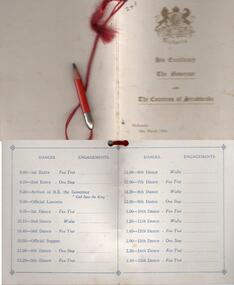
Card, Dance Cards
... ...State Government House...Dance Cards for Governor General and Staff of State Government House...1027-01 His Excellency The Governor and The Countess of Stradbroke Dance Card 18th March 1924 1027-02 State Government House Staff Dance 7th March 1929. ...Dance Cards for Governor General and Staff of State Government House Dance Cards State Government House Governor and Countess Stradbroke Cards with pencils 1027-01 His Excellency The Governor and The Countess of Stradbroke Dance Card 18th March 1924 1027-02 State Government House Staff Dance 7th March 1929. ...Dance Cards for Governor General and Staff of State Government House1027-01 His Excellency The Governor and The Countess of Stradbroke Dance Card 18th March 1924 1027-02 State Government House Staff Dance 7th March 1929. Cards with pencilsdance cards, state government house, governor and countess stradbroke -
 Kew Historical Society Inc
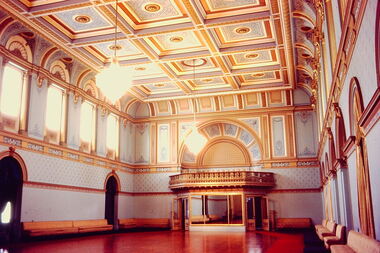
Slide - State Ballroom: Government House Victoria, John T Collins, 1979
... State Ballroom: Government House Victoria...Government House, Melbourne was constructed between 1972 and 1876 to a design of William Wardell. The interiors including the ballroom were created soon after the building's opening. The Victorian Heritage Register citation notes that the extravagant single storey State...One of six colour transparencies, purchased from John T Collins of interior and exterior views of Government House, Melbourne. This photograph (slide) is of the entrance to the State Ballroom....Slide State Ballroom: Government House Victoria John T Collins ...Government House, Melbourne was constructed between 1972 and 1876 to a design of William Wardell. The interiors including the ballroom were created soon after the building's opening. The Victorian Heritage Register citation notes that the extravagant single storey State Ballroom occupies the entire south wing. The slide is significant as it represents the decoration and furnishings of the State Ball Room in 1979.One of six colour transparencies, purchased from John T Collins of interior and exterior views of Government House, Melbourne. This photograph (slide) is of the entrance to the State Ballroom."South Yarra Government House Ballroom J Collins 17-10-79"government house -- melbourne, victorian interiors, ballrooms -- melbourne (vic.), john t collins -
 Kew Historical Society Inc
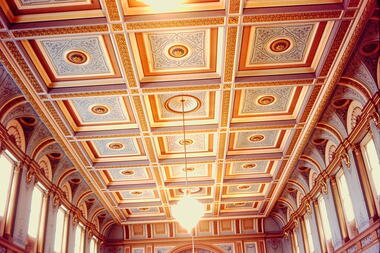
Slide - Coffered Ceiling of the State Ballroom: Government House Victoria, John T Collins, 1979
... Coffered Ceiling of the State Ballroom: Government House Victoria...Government House, Melbourne was constructed between 1972 and 1876 to a design of William Wardell. The interiors including the ballroom were created soon after the building's opening. The Victorian Heritage Register citation notes that the extravagant single storey State...One of six colour transparencies, purchased from John T Collins of interior and exterior views of Government House, Melbourne. This photograph (slide) is of the coffered ceiling of the State Ballroom....Slide Coffered Ceiling of the State Ballroom: Government House Victoria John T Collins ...Government House, Melbourne was constructed between 1972 and 1876 to a design of William Wardell. The interiors including the ballroom were created soon after the building's opening. The Victorian Heritage Register citation notes that the extravagant single storey State Ballroom occupies the entire south wing. The slide is significant as it represents the decoration of the State Ball Room in 1979.One of six colour transparencies, purchased from John T Collins of interior and exterior views of Government House, Melbourne. This photograph (slide) is of the coffered ceiling of the State Ballroom."South Yarra Government House Ballroom J Collins 17-10-79"government house -- melbourne, victorian interiors, ballrooms -- melbourne (vic.), john t collins -
 Kew Historical Society Inc
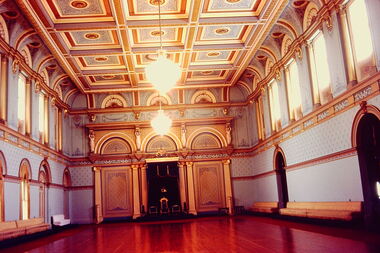
Slide - State Ballroom: Government House Victoria, John T Collins, 1979
... State Ballroom: Government House Victoria...Government House, Melbourne was constructed between 1972 and 1876 to a design of William Wardell. The interiors including the ballroom were created soon after the building's opening. The Victorian Heritage Register citation notes that the extravagant single storey State...One of six colour transparencies, purchased from John T Collins of interior and exterior views of Government House, Melbourne. This photograph (slide) is of the State Ballroom....Slide State Ballroom: Government House Victoria John T Collins ...Government House, Melbourne was constructed between 1972 and 1876 to a design of William Wardell. The interiors including the ballroom were created soon after the building's opening. The Victorian Heritage Register citation notes that the extravagant single storey State Ballroom occupies the entire south wing. The slide is significant as it represents the decoration of the State Ball Room in 1979.One of six colour transparencies, purchased from John T Collins of interior and exterior views of Government House, Melbourne. This photograph (slide) is of the State Ballroom."South Yarra Government House Ballroom J Collins 17-10-79"government house -- melbourne, victorian interiors, ballrooms -- melbourne (vic.), john t collins -
 Kew Historical Society Inc
Slide - State Ballroom: Government House Victoria, John T Collins, 1979
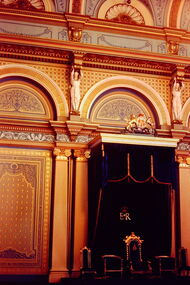
... State Ballroom: Government House Victoria...Government House, Melbourne was constructed between 1972 and 1876 to a design of William Wardell. The State...One of six colour transparencies, purchased from John T Collins of interior and exterior views of Government House, Melbourne. This photograph (slide) is of the throne in the State Ballroom....Slide State Ballroom: Government House Victoria John T Collins ...Government House, Melbourne was constructed between 1972 and 1876 to a design of William Wardell. The State Ballroom is part of the 'State Apartments' which also includes the State Hall, State Drawing Room, State Dining Room and the Billiard Room.The slide is significant as it represents the ceiling decoration of the State Drawing Room in 1979.One of six colour transparencies, purchased from John T Collins of interior and exterior views of Government House, Melbourne. This photograph (slide) is of the throne in the State Ballroom."South Yarra Government House Throne J Collins 17-10-79"government house -- melbourne, victorian interiors, ballrooms -- melbourne (vic.), john t collins -
 Kew Historical Society Inc
Slide - Ceiling of the State Drawing Room: Government House Victoria, John T Collins, 1979
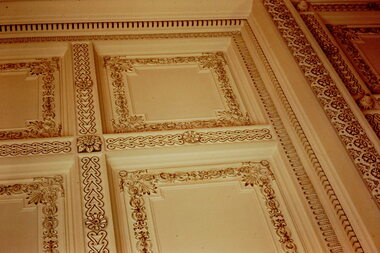
... Ceiling of the State Drawing Room: Government House Victoria...government house -- melbourne...victorian interiors...john t collins...state...Government House, Melbourne was constructed between 1972 and 1876 to a design of William Wardell. The State...Slide Ceiling of the State Drawing Room: Government House Victoria John T Collins ...Government House, Melbourne was constructed between 1972 and 1876 to a design of William Wardell. The State Drawing Room is part of the 'State Apartments' which also includes the State Hall, State Ballroom, State Dining Room and the Billiard Room.The slide is significant as it represents the ceiling decoration of the State Drawing Room in 1979.One of six colour transparencies, purchased from John T Collins of interior and exterior views of Government House, Melbourne. This photograph (slide) is of the ceiling of the Drawing Room."South Yarra Government House Ceiling Drawing Room J Collins 17-10-79"government house -- melbourne, victorian interiors, john t collins, state drawing room (melbourne) -
 Bendigo Historical Society Inc.
Document - R.H.ABBOTT. INVITATIONS. 1908, 1908
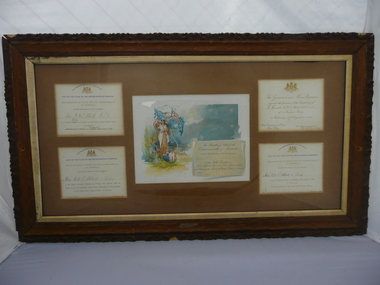
... Invitation to garden party. State government house. Rose Bay. Wednesday. 26th August 1980 at 3pm. 5. ...Invitation to garden party. State government house. Rose Bay. Wednesday. 26th August 1980 at 3pm. 5. ...5 Invitation cards in a display. 1. The ministers of state for the commonwealth of Australia request the pleasure of the company of R.H.S. Abbott at the public reception of Rear Admiral Sperry and the officers, sailors, & marines of the fleet of the united states of America. Sydney. August 1908. 2. Invitations to a theatre parties. Tuesday 25th August 1908. 3. Invitation to Public Reception. Friday 21st August. 1908. 4. Invitation to garden party. State government house. Rose Bay. Wednesday. 26th August 1980 at 3pm. 5. Invitation to Naval & Military review. Monday 24th August 1908 at centennial park. Deframed 2022document, invitations, receptions -
 Whitehorse Historical Society Inc.
Letter - Correspondence, Tour of Government House, 1976
... Shortland, Secretary, Nunawading and District Historical Society and Loris Callender, Secretary to the Governor re arranging a visit to the State Apartments of Government House, Victoria....government house victoria shortland j callender loris a Correspondence between Mrs J. Shortland, Secretary, Nunawading and District Historical Society and Loris Callender, Secretary to the Governor re arranging a visit to the State Apartments of Government House, Victoria. ...Correspondence between Mrs J. Shortland, Secretary, Nunawading and District Historical Society and Loris Callender, Secretary to the Governor re arranging a visit to the State Apartments of Government House, Victoria.Correspondence between Mrs J. Shortland, Secretary, Nunawading and District Historical Society and Loris Callender, Secretary to the Governor re arranging a visit to the State Apartments of Government House, Victoria.Correspondence between Mrs J. Shortland, Secretary, Nunawading and District Historical Society and Loris Callender, Secretary to the Governor re arranging a visit to the State Apartments of Government House, Victoria.government house, victoria, shortland, j, callender, loris a -
 Melbourne Legacy
Photograph, Governor of Victoria with Victoria Cross Winners
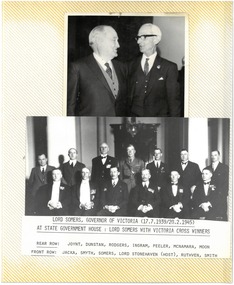
... The note identifies the men in 01592.2 as follows: "Lord Somers, Governor of Victoria (17.7.1939/20.2.1945) at State Government House: Lord Somers with Victoria Cross Winners. ...The note identifies the men in 01592.2 as follows: "Lord Somers, Governor of Victoria (17.7.1939/20.2.1945) at State Government House: Lord Somers with Victoria Cross Winners. ...Page of a photo album (Cat.No. 01588) about the life of Legatee Donovan Joynt. This page featured two photos and a caption. 01592.1 is of Donovan Joynt and Captain Mick Moon, whilst 01592.2 is photograph taken in the 1940s when they were considerably younger. The note identifies the men in 01592.2 as follows: "Lord Somers, Governor of Victoria (17.7.1939/20.2.1945) at State Government House: Lord Somers with Victoria Cross Winners. Rear row: Joynt, Dunstan, Rodgers, Ingram, Peeler, McNamara, Moon. Front Row: Jacka, Smyth, Somers, Lord Stonehaven (host), Ruthven, Smith."Part of the collection of material held by Melbourne Legacy on Legatee Joynt, a prominent Australian.Black and white photo x 2 featuring L/ Joynt and a typed note originally stuck in a photo album together.Extensive notes on the back of the photograph of Lord Somers with VC winners in blue and black biro identifying the men. Rear Row: Joynt, Dunstan, Rodgers, Ingram, Peeler, McNamara, Moon. Front row: Jacka, Smyth, Somers, Lord Stonehaven (host), Ruthven, Smith.donovan joynt, governor of victoria -
 Musculoskeletal Health Australia (now held by the Glen Eira Historical Society)
Photograph - Group photo, 08/03/2002
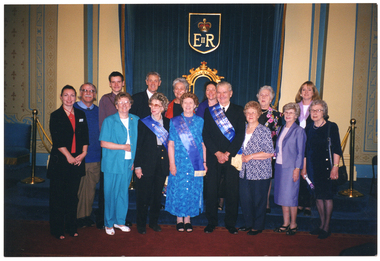
... ... government house victoria... state...Government House. In this photo, a group of AV members and their families pose for a photo in front of the State Chair in the State Ballroom at Government House. ...Government House. In this photo, a group of AV members and their families pose for a photo in front of the State Chair in the State Ballroom at Government House. ...On the 8th of March 2002, fifteen Arthritis Victoria volunteers, staff, and special guests attended Seniors Week at Government House. In this photo, a group of AV members and their families pose for a photo in front of the State Chair in the State Ballroom at Government House. A cropped version of the photo appears on page 3 of the Vol 15 Issue 02, Winter 2002 edition of the Arthritis Foundation of Victoria's quarterly magazine, Update. It is captioned: "Seniors Week at Government House Back L to R: Robert Munro, Michael Macdonald, Ed Courtenay, Sonja Krawatt, Rose Ahrens, Maisie Scott, Fiona Bainbridge Front L to R: Jacqueline De Roach, Ann Houben, Barbara Hope, Pat Courtenay, Des Custerson, Rae Johnson, Doreen McConnell, Sal Prain".Colour photo of a large group of people posing for a photo in front of a blue velvet dais with a blue and gold throne. In the background, there is a blue velvet curtain upon which hangs a plaque depicting a crown and the text "E II R".[Handwritten in black ink, in the top right corner] 3 [circled] [On a yellow sticky note, handwritten in black ink] SENIORS WEEK 2002 at Government House BACK L-R: Robert Munro, Michael MacDonald, Ed Courtenay, Sonja Krawalt, Rose Ahrens, Maisie Scott, Fiona Bainbridge FRONT L-R: Jacqueline De Roach, Ann Houben, Barbara Hope, Pat Courtenay, Des Custerson, Rae Johnson, Doreen McConnell, Sal Prain [On a MOVE-branded sticky note, handwritten in black ink] UPDATE WINTER 2002 page 3arthritis victoria, av, seniors week, government house victoria, state chair, state ballroom, robert munro, michael macdonald, ed courtenay, sonja krawatt, rose ahrens, maisie scott, fiona bainbridge, jacqueline de roach, ann houben, barbara hope, pat courtenay, des custerson, rae johnson, doreen mcconnell, sal prain, update, 2002 -
 Sunshine and District Historical Society Incorporated
Administrative record - City of Sunshine - Commissioner Mr Alexander Alex George Gillon Collection 1976 - 1982 - Notice of ordinary meeting of the council of the City of Sunshine to be held on 5th October 1977, City of Sunshine, 28th September 1977
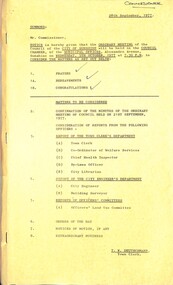
... Notice of Ordinary Meeting of the Council of the City of Sunshine to be held on 5th October 1977 Report of the Town Clerk's Department Report of the Town Clerk Private Street Construction Scheme Sheffield Estate and Cumberland Street Area United Grants From Commonwealth Government through State Government House 6 Corio Street Demolishment Alternative Premises for Citizens Advice Bureau Increases Charges at Sunshine Tip Cultural Centre for Western Region Henderson House Footscray Crossing over Railway Line at Ardeer Land Acquisition Maribyrnong Valley Zoning Officer's Committees Reports Method of Presentation Home Help Service Housekeepers Speaking Different Languages Sale of Land Derby Road and Anderson Road to Education Department Report of the Co-Ordinator of Welfare Services The Combined Pensioners Association Report of the Chief Health Inspector Training & Registration of Public Swimming Pool Operators Prosecutions Proceedings Sunshine Magistrate Court Application for Septic Tank Warranties Report of City Engineer Land Use Permit Application Poultry Farming Service Premises and Take Away Food Premise 159 - 161 Rosamond Road Maribyrnong Land Use Permit Application Extension to Existing Holy Eucharist Primary School, Holy Eucharist Church and Holy Eucharist Parish Centre Oleander Drive Land Use Permit Application Service Premises Mitchell Street Land Use Permit Application External Paging System 556 Ballarat Road Land Use Permit Application Car Sales Yard Lots 497 & 498 St. ...Albans Road Lawton Street Braybrook Hampstead Road Emu Street Hook Street Vule Street Neale Road Albanvale Deer Park Suffolk Road Albion Explosive Factory Monsanto Bon Thomas Reserve Quinn Street Fairbairn Pre-School Centre Fairbairn Road Sunshine Indoor Swimming Pool Albion Percy Street Kevin Street Berkshire Road Adelaide Street Notice of Ordinary Meeting of the Council of the City of Sunshine to be held on 5th October 1977 Report of the Town Clerk's Department Report of the Town Clerk Private Street Construction Scheme Sheffield Estate and Cumberland Street Area United Grants From Commonwealth Government through State Government House 6 Corio Street Demolishment Alternative Premises for Citizens Advice Bureau Increases Charges at Sunshine Tip Cultural Centre for Western Region Henderson House Footscray Crossing over Railway Line at Ardeer Land Acquisition Maribyrnong Valley Zoning Officer's Committees Reports Method of Presentation Home Help Service Housekeepers Speaking Different Languages Sale of Land Derby Road and Anderson Road to Education Department Report of the Co-Ordinator of Welfare Services The Combined Pensioners Association Report of the Chief Health Inspector Training & Registration of Public Swimming Pool Operators Prosecutions Proceedings Sunshine Magistrate Court Application for Septic Tank Warranties Report of City Engineer Land Use Permit Application Poultry Farming Service Premises and Take Away Food Premise 159 - 161 Rosamond Road Maribyrnong Land Use Permit Application Extension to Existing Holy Eucharist Primary School, Holy Eucharist Church and Holy Eucharist Parish Centre Oleander Drive Land Use Permit Application Service Premises Mitchell Street Land Use Permit Application External Paging System 556 Ballarat Road Land Use Permit Application Car Sales Yard Lots 497 & 498 St. ...Notice of Ordinary Meeting of the Council of the City of Sunshine to be held on 5th October 1977 Report of the Town Clerk's Department Report of the Town Clerk Private Street Construction Scheme Sheffield Estate and Cumberland Street Area United Grants From Commonwealth Government through State Government House 6 Corio Street Demolishment Alternative Premises for Citizens Advice Bureau Increases Charges at Sunshine Tip Cultural Centre for Western Region Henderson House Footscray Crossing over Railway Line at Ardeer Land Acquisition Maribyrnong Valley Zoning Officer's Committees Reports Method of Presentation Home Help Service Housekeepers Speaking Different Languages Sale of Land Derby Road and Anderson Road to Education Department Report of the Co-Ordinator of Welfare Services The Combined Pensioners Association Report of the Chief Health Inspector Training & Registration of Public Swimming Pool Operators Prosecutions Proceedings Sunshine Magistrate Court Application for Septic Tank Warranties Report of City Engineer Land Use Permit Application Poultry Farming Service Premises and Take Away Food Premise 159 - 161 Rosamond Road Maribyrnong Land Use Permit Application Extension to Existing Holy Eucharist Primary School, Holy Eucharist Church and Holy Eucharist Parish Centre Oleander Drive Land Use Permit Application Service Premises Mitchell Street Land Use Permit Application External Paging System 556 Ballarat Road Land Use Permit Application Car Sales Yard Lots 497 & 498 St. Albans Road Land Use Permit Application Two Illuminated signs 501 Ballarat Road Albion Land Use Permit Application Light Industry Loy 76 Lawton Street Braybrook Enforcement under the Town and Country Planning Act Massage Parlours Cities of Essendon & St. Kilda Land Use Permit Application Service Premises Take Away Food Premise and Caretaker's Residence Addition to Existing Retail Nursery and Bird Aviary Corner Hampstead Road and Emu Street Contract Supply & Maintenance of Vehicles Contract Supply of Tractor & Gang Mower Plan of subdivision Hook Street and Vule Street Plan of Subdivision Stage 26 Albanvale Westerngate Estate Neale Road Bus Routes and Bus Stops Sunshine Bus Lines Suffolk Road Shops Bicycle Racks 407 Ballarat Road (Opposite McDonald) No Standing Anytime Use of Commonwealth Land for Garbage Disposal Purposes Eastern Side of Albion Explosive Factory Monsanto Outfall Drain Brooklyn Telecom Australia Public Telephones in the Maidstone Area Bon Thomas Reserve Development Report of the Building Surveyor Maintenance Organisation Australian Institute of Building Surveyors Annual Conference Fencing Council Contribution towards Shared Fences with Owner Fairbairn Pre-School Centre Fairbairn Road Sunshine West Sunshine Indoor Swimming Pool Sunshine Indoor Swimming Pool Facilities Fencing 34 Adelaide Street Flats Lot 30 Percy Street St. Albans Extension to House 2 Kevin Street Sunshine Installation of Overhead Tank 44 Berkshire Road Sunshine North Report of Land Use Committee Orders of the Day Accounts Submitted for Payment as at 15th September 1977 Notice of Motion Commissioner Gillon to Move Rates Commissioner Gillon to Move Sanitary Commissioner Gillon to Move Valuation city of sunshine, alexander "alex" george gillon, cumberland street, sunshine north, corio street, sunshine, maribyrnong valley, derby road, anderson road, citizens advice bureau, sunshine tip, rosamond road, maribyrnong, holy eucharist primary school, holy eucharist church, holy eucharist parish centre, oleander drive, st. albans, mitchell street, maidstone, ballarat road, st. albans road, lawton street, braybrook, hampstead road, emu street, hook street, vule street, neale road, albanvale, deer park, suffolk road, albion explosive factory, monsanto, bon thomas reserve, quinn street, fairbairn pre-school centre, fairbairn road, sunshine indoor swimming pool, albion, percy street, kevin street, berkshire road, adelaide street -
 Sunshine and District Historical Society Incorporated
Administrative record - City of Sunshine - Commissioner Mr Alexander Alex George Gillon Collection 1976 - 1982 - Minutes of the ordinary meeting of council held on 5th October 1977, City of Sunshine, 5th October 1977
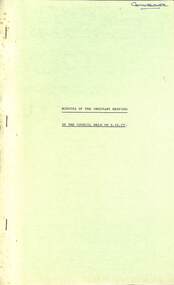
... Minutes of the Ordinary Meeting of Council held on 5th October 1977 Report of the Town Clerk's Department Report of the Town Clerk Private Street Construction Scheme Sheffield Estate and Cumberland Street Area United Grants From Commonwealth Government through State Government House 6 Corio Street Demolishment Alternative Premises for Citizens Advice Bureau Increases Charges at Sunshine Tip Cultural Centre for Western Region Henderson House Footscray Crossing over Railway Line at Ardeer Land Acquisition Maribyrnong Valley Zoning Officer's Committees Reports Method of Presentation Home Help Service Housekeepers Speaking Different Languages Sale of Land Derby Road and Anderson Road to Education Department Report of the Co-Ordinator of Welfare Services The Combined Pensioners Association Report of the Chief Health Inspector Training & Registration of Public Swimming Pool Operators Prosecutions Proceedings Sunshine Magistrate Court Application for Septic Tank Warranties Report of City Engineer Land Use Permit Application Poultry Farming Service Premises and Take Away Food Premise 159 - 161 Rosamond Road Maribyrnong Land Use Permit Application Extension to Existing Holy Eucharist Primary School, Holy Eucharist Church and Holy Eucharist Parish Centre Oleander Drive Land Use Permit Application Service Premises Mitchell Street Land Use Permit Application External Paging System 556 Ballarat Road Land Use Permit Application Car Sales Yard Lots 497 & 498 St. ...Albans Road Lawton Street Braybrook Hampstead Road Emu Street Hook Street Vule Street Albanvale Neale Road Deer Park Suffolk Road Albion Explosive Factory Monsanto Brooklyn Bon Thomas Reserve Quinn Street Fairbairn Pre-School Centre Fairbairn Road Sunshine West Sunshine Indoor Swimming Pool Adelaide Street Percy Street Kevin Street Berkshire Road Minutes of the Ordinary Meeting of Council held on 5th October 1977 Report of the Town Clerk's Department Report of the Town Clerk Private Street Construction Scheme Sheffield Estate and Cumberland Street Area United Grants From Commonwealth Government through State Government House 6 Corio Street Demolishment Alternative Premises for Citizens Advice Bureau Increases Charges at Sunshine Tip Cultural Centre for Western Region Henderson House Footscray Crossing over Railway Line at Ardeer Land Acquisition Maribyrnong Valley Zoning Officer's Committees Reports Method of Presentation Home Help Service Housekeepers Speaking Different Languages Sale of Land Derby Road and Anderson Road to Education Department Report of the Co-Ordinator of Welfare Services The Combined Pensioners Association Report of the Chief Health Inspector Training & Registration of Public Swimming Pool Operators Prosecutions Proceedings Sunshine Magistrate Court Application for Septic Tank Warranties Report of City Engineer Land Use Permit Application Poultry Farming Service Premises and Take Away Food Premise 159 - 161 Rosamond Road Maribyrnong Land Use Permit Application Extension to Existing Holy Eucharist Primary School, Holy Eucharist Church and Holy Eucharist Parish Centre Oleander Drive Land Use Permit Application Service Premises Mitchell Street Land Use Permit Application External Paging System 556 Ballarat Road Land Use Permit Application Car Sales Yard Lots 497 & 498 St. ...Minutes of the Ordinary Meeting of Council held on 5th October 1977 Report of the Town Clerk's Department Report of the Town Clerk Private Street Construction Scheme Sheffield Estate and Cumberland Street Area United Grants From Commonwealth Government through State Government House 6 Corio Street Demolishment Alternative Premises for Citizens Advice Bureau Increases Charges at Sunshine Tip Cultural Centre for Western Region Henderson House Footscray Crossing over Railway Line at Ardeer Land Acquisition Maribyrnong Valley Zoning Officer's Committees Reports Method of Presentation Home Help Service Housekeepers Speaking Different Languages Sale of Land Derby Road and Anderson Road to Education Department Report of the Co-Ordinator of Welfare Services The Combined Pensioners Association Report of the Chief Health Inspector Training & Registration of Public Swimming Pool Operators Prosecutions Proceedings Sunshine Magistrate Court Application for Septic Tank Warranties Report of City Engineer Land Use Permit Application Poultry Farming Service Premises and Take Away Food Premise 159 - 161 Rosamond Road Maribyrnong Land Use Permit Application Extension to Existing Holy Eucharist Primary School, Holy Eucharist Church and Holy Eucharist Parish Centre Oleander Drive Land Use Permit Application Service Premises Mitchell Street Land Use Permit Application External Paging System 556 Ballarat Road Land Use Permit Application Car Sales Yard Lots 497 & 498 St. Albans Road Land Use Permit Application Two Illuminated signs 501 Ballarat Road Albion Land Use Permit Application Light Industry Loy 76 Lawton Street Braybrook Enforcement under the Town and Country Planning Act Massage Parlours Cities of Essendon & St. Kilda Land Use Permit Application Service Premises Take Away Food Premise and Caretaker's Residence Addition to Existing Retail Nursery and Bird Aviary Corner Hampstead Road and Emu Street Contract Supply & Maintenance of Vehicles Contract Supply of Tractor & Gang Mower Plan of subdivision Hook Street and Vule Street Plan of Subdivision Stage 26 Albanvale Westerngate Estate Neale Road Bus Routes and Bus Stops Sunshine Bus Lines Suffolk Road Shops Bicycle Racks 407 Ballarat Road (Opposite McDonald) No Standing Anytime Use of Commonwealth Land for Garbage Disposal Purposes Eastern Side of Albion Explosive Factory Monsanto Outfall Drain Brooklyn Telecom Australia Public Telephones in the Maidstone Area Bon Thomas Reserve Development Report of the Building Surveyor Maintenance Organisation Australian Institute of Building Surveyors Annual Conference Fencing Council Contribution towards Shared Fences with Owner Fairbairn Pre-School Centre Fairbairn Road Sunshine West Sunshine Indoor Swimming Pool Sunshine Indoor Swimming Pool Facilities Fencing 34 Adelaide Street Flats Lot 30 Percy Street St. Albans Extension to House 2 Kevin Street Sunshine Installation of Overhead Tank 44 Berkshire Road Sunshine North Report of Land Use Committee Orders of the Day Accounts Submitted for Payment as at 15th September 1977 Notice of Motion Commissioner Gillon to Move Rates Commissioner Gillon to Move Sanitary Commissioner Gillon to Move Valuation city of sunshine, alexander "alex" george gillon, cumberland street, sunshine north, corio street, sunshine, maribyrnong valley, derby road, anderson road, rosamond road, maribyrnong, holy eucharist primary school, holy eucharist church, holy eucharist parish centre, oleander drive, st. albans, mitchell street, maidstone, ballarat road, albion, st. albans road, lawton street, braybrook, hampstead road, emu street, hook street, vule street, albanvale, neale road, deer park, suffolk road, albion explosive factory, monsanto, brooklyn, bon thomas reserve, quinn street, fairbairn pre-school centre, fairbairn road, sunshine west, sunshine indoor swimming pool, adelaide street, percy street, kevin street, berkshire road -
 City of Moorabbin Historical Society (Operating the Box Cottage Museum)
Badge - WWI Red Cross Buttons
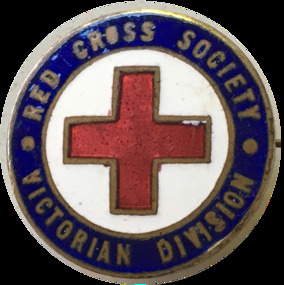
... Items were sent to headquarters located in the state capitals, often using government houses as depots, where, after being sorted and packed by yet more volunteers, they were sent to Britain or the front. ...Items were sent to headquarters located in the state capitals, often using government houses as depots, where, after being sorted and packed by yet more volunteers, they were sent to Britain or the front. ...The International Committee of the Red Cross was formed in 1862. Initially its purpose was to try and find ways of overcoming the inadequacy of army medical services so as to alleviate the suffering of those wounded in armed conflict. Over time it has extended its work to include many forms of humanitarian aid in times of peace and war. The Australian Red Cross Society (ARCS) was formed just after the outbreak of the First World War in August 1914, originally as a branch of the British Red Cross. It is especially remembered in the provision of “comforts” for soldiers overseas. Enormous sums of money were raised, and thousands of women volunteers contributed their time by making vast quantities of clothing: socks, vests, mittens, mufflers, pyjamas and a variety of linen. Items were sent to headquarters located in the state capitals, often using government houses as depots, where, after being sorted and packed by yet more volunteers, they were sent to Britain or the front. The effect of this work for the recipients was to bring comfort in its truest sense, for a seemingly trivial gift of a bar of chocolate of a pair of dry socks could bring the most profound relief for a soldier on the Western Front. From the date of its inception until the armistice the ARCS dispatched 395,695 food parcels and 36,339 clothing parcels Between 1914 and 1918 more than £3,500,00 was collected and spent on Red Cross services to the Australian Forces and Empire Forces. During WW1 and WW2 Red Cross raised funds selling buttons.Early settlers in Moorabbin Shire held fundraising events for the support of Red Cross Victoria and made cakes and knitted socks, gloves and scarves for distribution to serving men and women Metal buttons with printing on themRed Crossred cross, fund raising buttons, wwi, wwii, french red cross, british red cross, market gardeners, early settlers, moorabbin shire, bentleigh, cheltenham, caulfield repatriation hospital -
 City of Moorabbin Historical Society (Operating the Box Cottage Museum)
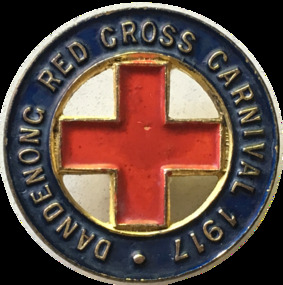
Badge - Red Cross - Springvale, 1917
... Items were sent to headquarters located in the state capitals, often using government houses as depots, where, after being sorted and packed by yet more volunteers, they were sent to Britain or the front. ...Items were sent to headquarters located in the state capitals, often using government houses as depots, where, after being sorted and packed by yet more volunteers, they were sent to Britain or the front. ...The International Committee of the Red Cross was formed in 1862. Initially its purpose was to try and find ways of overcoming the inadequacy of army medical services so as to alleviate the suffering of those wounded in armed conflict. Over time it has extended its work to include many forms of humanitarian aid in times of peace and war. The Australian Red Cross Society (ARCS) was formed just after the outbreak of the First World War in August 1914, originally as a branch of the British Red Cross. It is especially remembered in the provision of “comforts” for soldiers overseas. Enormous sums of money were raised, and thousands of women volunteers contributed their time by making vast quantities of clothing: socks, vests, mittens, mufflers, pyjamas and a variety of linen. Items were sent to headquarters located in the state capitals, often using government houses as depots, where, after being sorted and packed by yet more volunteers, they were sent to Britain or the front. The effect of this work for the recipients was to bring comfort in its truest sense, for a seemingly trivial gift of a bar of chocolate of a pair of dry socks could bring the most profound relief for a soldier on the Western Front. From the date of its inception until the armistice the ARCS dispatched 395,695 food parcels and 36,339 clothing parcels Between 1914 and 1918 more than £3,500,00 was collected and spent on Red Cross services to the Australian Forces and Empire Forces. During WW1 and WW2 Red Cross raised funds selling buttons.This Carnival was an example of the support given to Red Cross by market gardeners, early settler families and schools in Moorabbin ShireDandenong Red Cross Carnival 1917red cross, dandenong, springvale, chelsea, dingley, keysborough -
 Flagstaff Hill Maritime Museum and Village
Letter - William Ferrier, 14th November 1905
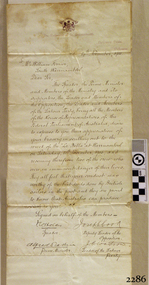
... state and national significance. It is one of the only two shipwrecks discovered in Lady Bay, Warrnambool, out of the 15-17 shipwrecks in the bay. la bella william ferrier bill ferrier lady bay 1905 10th november 1905 11th november 1905 parliament of the commonwealth prime minister australian government new zealand flagstaff hill warrnambool shipwrecked coast flagstaff hill maritime museum maritime museum shipwreck coast flagstaff hill maritime village The printed coat of arms is that of the House of Representatives. ...The letter to William Ferrier of South Warrnambool from the Prime Minister and the Parliament of the Commonwealth recognised the significance of William’s brave and courageous lifesaving act to the people of Australia; “They all feel that your conduct was worthy of the best deeds done by British sailors in the past and they are proud to know that Australia can produce such as you.” The story of that brave rescue follows on below … The ship from which the sailors were rescued was the three-masted, iron and steel barquentine the La Bella, built in Norway in 1893. She was one of two iron and steel ships by Johan Smith, The company was one of the leading shipping families in Tvedestrand, Norway. She was significant to Norwegian shipping, being one of only 27 iron and steel ships ever built in Norway. She was registered in New Zealand and engaged from 1902 in inter-colonial trading of timber in the Pacific, between New Zealand and Australia and was often in Port Phillip Bay, Victoria. On 5th October 1905, the twelve-year-old La Bella left Lyttleton, New Zealand carrying a cargo of timber bound for Warrnambool, Australia. She was manned by a crew of twelve: the Master, (Captain Mylius, previously 1st Mate of La Bella, appointed Captain to La Bella on 6th February 1903) 2 Mates, Cook, six able seamen, one ordinary seaman and a boy. Bad weather en route caused her to shelter at Burnie on Tasmania's North West coast. On November 10th, the 37th day of her journey, La Bella approached Warrnambool. Captain Mylius steered her towards Lady Bay Channel in heavy south-west seas and evening mist. He ordered the helmsman to steer for the light. As the ship came round, a tremendous sea struck her on the port quarter, causing her to breach broadside in a north-westerly direction into breakers. The helm was brought round twice more, but each time heavy seas broke over her, the third time throwing the La Bella on to a submerged reef in Lady Bay now known as La Bella Reef (about 100 yards from the Warrnambool breakwater). The sea was so rough that it even wrenched a one-and-a-half ton anchor from its fastenings and into the sea. As Captain Mylius headed to the steel wheelhouse, intending to send up a rocket flare, a huge sea slammed the steel door into him (resulting in massive bruising front and back) Despite his injuries he still managed to set off a blue light, which he held up in his hands. La Bella’s lifeboats were filled with seawater and broke up on their chocks. The blue light was the first indication to people on the shore that there was a ship in distress. The Harbour Master, Captain Roe (who lived in the Harbour Master’s House opposite Flagstaff Hill), organised a group of volunteers to crew the lifeboat because the trained crew was unavailable; the crewmen were working on a steamer in Port Fairy at the time. He then poured oil onto the water to try and smooth the sea. At around 11 pm three of the crew took shelter in the steel forecastle but the sea crashed into it and broke it up. While the rest of the crew and onlookers watched helplessly in the moonlight the bodies were washed away into the sea, never to be seen again. Some of the crew lashed themselves to the weather rail to keep from being washed away. Watson, the ordinary seaman, became tangled in the rigging lines and was too weak to move, so the 2nd Mate, Robertson, put a line onto him so that he wouldn’t wash off. Around 11 pm three of the crew were unconscious from exhaustion. The situation on La Bella was becoming dangerous. The 2nd Mate moved to the ‘house’ and soon afterwards the ship slipped in the heavy sea. The lashings of the 1st Mate and the ‘boy’ Denham had kept them safe until about 2 am when they were washed overboard; no one was able to help. One by one, the exhausted crew were being washed overboard, too weak to hold on any longer. During the night the La Bella had broken into two and the deckhouse ran out towards the sea. Two more men drowned when trying to reach the lifeboat. By sunrise, the only survivors of the twelve were the Master, 2nd Mate and three seamen. Early in the morning, Captain Roe used the rocket apparatus on shore to try and shoot a line to the ship for a safer rescue but each attempt fell short of the target. Several attempts were made by the lifeboat to rescue the stricken sailors, but the rough conditions made this difficult for the boat to get close enough to the ship and the lifeboat had to return to shore. During a final attempt to reach the ship Captain Mylius ordered his men to jump into the sea. Leonard Robertson, 2nd mate, jumped and swam towards the lifeboat, taking hold of the boat hook offered to him. Oscar Rosenholme managed to reach the boat floating on a piece of timber from the ship’s load and a third survivor, Noake, also made the boat. Along with the lifeboat rescue crew, 25-year-old William Ferrier rowed his small dingy through the heavy seas and managed to rescue the Captain, whom he landed on the breakwater. Ferrier then returned to the ship to attempt a final rescue, losing his oars and rowlocks into the high sea. Using just a spare paddle he skulled towards the La Bella, reaching her stern in time to cut loose the lone surviving sailor, Payne, from the lashing that held him to the ship; the terrified sailor dropped from the ship and into the dingy. Shortly after the last man was rescued, the La Bella was lifted by a huge wave and crashed back down on the reef; she broke up and sank. The ordeal had lasted ten hours. The survivors were taken to the nearby Bay View Hotel and gratefully received warm food and clothing, medical attention and a place to sleep. In the following days, an unidentified body of a young person has washed ashore; it was either Watson or Denham. The body was buried in the Warrnambool cemetery with an appropriate gravestone and inscription. William Ferrier became a national hero as news of the daring rescue spread. In recognition of his bravery in the two daring rescues, he was awarded the Silver Medal for Bravery by the Royal Humane Society and was honoured in the letter from the Prime Minister and the Parliament of the Commonwealth, telegrams and a cheque for £20 from the Governor-General, over £150 subscribed by the public, including Warrnambool and district and readers of The Argus, and a gold medal from the Glenelg Dinghy Club of South Australia. Ferrier’s rescue efforts are one of the most heroic in Victoria’s shipwreck history. (William Ferrier’s son, Frank, received a similar award almost fifty years later when he helped rescue four members of the crew on the yacht Merlan after it ran on to a reef near the Point Lonsdale Lighthouse. ) The wreck of La Bella now lies on her port side in 13 metres of sheltered water inside the reef she struck. The bow section is relatively intact and part of the stern has drifted north-easterly towards the mouth of the Hopkins River. The reef the La Bella struck now bears its name. Those five rescued from the La Bella were Captain George Mylius, Leonard Robertson (2nd Mate, 21 years old), R. Payne, Oscar Rosenholme and Jack Noake. Those seven who lost their lives were Mr Coulson (1st mate), Charles Jackman (cook) Gustave Johnson, Pierre Johann and Robert Gent (all able seamen), Harry Watson (ordinary seaman) and Jack Denham (ship’s boy), Captain Mylius was found guilty of careless navigation; he had sailed into the bay without the services of a pilot. His Master Certificate was suspended for twelve months. Later he was also charged with the manslaughter of one of the crew who had died when the La Bella was wrecked but found not guilty. The event’s adverse publicity and damage to his career took a toll on his health and he died of a heart attack six months after the wreck; he was only thirty-seven. His body was buried in the Melbourne General Cemetery. The La Bella was “the best documented of all sailing ships owned in New Zealand”. Her record books, ship logs, correspondence and supporting papers are still available. At the time of the tragedy, she was owned by Messers David C.Turnbull and Co. of Timaru, New Zealand timber merchants and shipping agents, who had purchased her on 13th December 1901. A detailed account of the last journey of La Bella can be read in “Leonard Robertson, the Whangaroa & La Bella” written by Jack Churchouse, published in 1982 by Millwood Press Ltd, Wellington, NZ. As well as this letter, Flagstaff Hill’s La Bella Collection includes a photograph of the wrecked La Bella, a brass rail holder and a postcard of William Ferrier with four of the survivors. Some 15 – 17 ships are believed to have sunk in Lady Bay, but only two have been discovered on the seafloor; the “La Bella” and the “Edinburgh Castle”. Both wrecks are popular diving sites and are preserved as significant historical marine and marine archaeological sites. This original congratulatory letter sent to William Ferrier by the Prime Minister and Government of Australia demonstrates the importance attached to his efforts for Victoria and to Australia. The letter is part of the La Bella Collection and is significant at both a local and state level. Its connection to the La Bella shipwreck and the rescue of five survivors highlights the dangers of Victoria’s Shipwreck Coast. The letter to William Ferrier from the Australian Government acknowledges the bravery of ordinary Australians who risked their lives to save victims of shipwrecks along the coast. The letter is significant to the history of Warrnambool as it honours William Ferrier, a local fisherman whose descendants continue to live in the area. It highlights the way of life of people who lived in coastal towns in 19th century Victoria and the effects of shipwrecks upon them. The letter connects to the postcard of William Ferrier with four of the five rescued crew, the photograph of the wreck of the La Bella and the artefact from the wreck, the rail holder. This letter is significant because of its association with the sailing ship “La Bella”. The “La Bella” is of local and state and national significance. It is one of the only two shipwrecks discovered in Lady Bay, Warrnambool, out of the 15-17 shipwrecks in the bay. Letter to William Ferrier of South Warrnambool from the Prime Minister and Members of Parliament commending him on his bravery. The printed letterhead includes a coat of arms in the top centre and the official address. The letter is very neatly hand written in black pen and includes 4 signatures of Members of Parliament. The rectangular paper is cream coloured with some yellow/brown discolouring. It has the letterhead on the right hand side of it and the written letter begins below the letterhead. The paper has been folded so that the right side becomes the cover page of the letter. The writing is continued onto the inside right hand page of the folded paper and the writing ends here. There is more recent writing on the bottom right hand corner of the back page. The paper has been officially folded in half a total 3 times and there is heavy discolouration on the sections that form the front and back of the folded letter. There is a 4th fold line that is less pronounced that the other folds and would make the paper the size to fit into a pocket. At several fold creases the paper has worn through. The edges of the paper have minor tears. The printed coat of arms is that of the House of Representatives. Underneath is printed “The Parliament of the Commonwealth, / Parliament House / Melbourne”. The hand written, letter is dated “14th November, 1905” and addressed to “Mr. William Ferrier / South Warrnambool” The letter begins “The Speaker, the Prime Minister and Members of the Ministry and its supporters, the Leader and Members of the Opposition, the Leader and Members of the Labour Party, being all the Members of the House of Representatives of the Federal Parliament of Australia” … It continues “desire to express to you their appreciation of your bravery in skulling out to the wreck of the “La Bella” at Warrnambool on Saturday, 11th November, 1905, and recovering therefrom two of the crew who were in imminent danger of their lives. They all feel that your conduct was worthy of the best deeds done by British sailors in the past and they are proud to know that Australia can produce such as you.” The letter is “Signed on behalf of the Members – Speaker (Frederick Holder ), Deputy Leader of the Opposition (Joseph Cook ), Prime Minister (Alfred Deakin), Leader of the Labour Party ( J.C. Watson)” On the back of the letter is blue ink handwriting “OWNER / G. FERRIER / TO. BE. PHOTOGRAPHED / 27-4-76”la bella, william ferrier, bill ferrier, lady bay, 1905, 10th november 1905, 11th november 1905, parliament of the commonwealth, prime minister, australian government, new zealand, flagstaff hill, warrnambool, shipwrecked coast, flagstaff hill maritime museum, maritime museum, shipwreck coast, flagstaff hill maritime village -
 Flagstaff Hill Maritime Museum and Village
Document, Royal Commission on Vicrorian Outer Ports, 1925
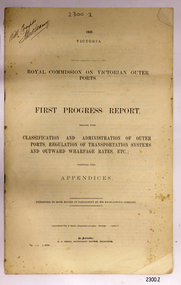
... State of Victoria", to both Houses of Parliament by His Excellency's Command in 1925. TRANSCRIPTION of front cover = = = = = = = = 1925. VICTORIA. ROYAL COMMISSION ON VICTORIAN OUTER PORTS. FIRST PROGRESS REPORT, DEALING WITH CLASSIFICATION AND ADMINISTRATION OF OUTER PORTS, REGULATION OF TRANSPORTATION SYSTEMS AND OUTWARD WHARFAGE RATES, ETC.; TOGETHER WITH APPENDICES. PRESENTED TO BOTH HOUSES OF PARLIAMENT BY EXCELLENCY’S COMMAND. Approximate Cost of Report. – Preparation not given. Printing ( copies) £ By Authority: H. J. GREEN, GOVERNMENT...State of Victoria", to both Houses of Parliament by His Excellency's Command in 1925. TRANSCRIPTION of front cover = = = = = = = = 1925. VICTORIA. ROYAL COMMISSION ON VICTORIAN OUTER PORTS. FIRST PROGRESS REPORT, DEALING WITH CLASSIFICATION AND ADMINISTRATION OF OUTER PORTS, REGULATION OF TRANSPORTATION SYSTEMS AND OUTWARD WHARFAGE RATES, ETC.; TOGETHER WITH APPENDICES. PRESENTED TO BOTH HOUSES OF PARLIAMENT BY EXCELLENCY’S COMMAND. Approximate Cost of Report. – Preparation not given. Printing ( copies) £ By Authority: H. J. GREEN, GOVERNMENT ...This first progress report dealing with classification and administration of Victoria's outer ports, regulation of transportation systems and outward wharfage rates etc., together with appendices, was presented "To His Excellency Colonel the Right Honorable George Edward John Mowbray, Earl of Stradbroke ... Governor of the State of Victoria", to both Houses of Parliament by His Excellency's Command in 1925. TRANSCRIPTION of front cover = = = = = = = = 1925. VICTORIA. ROYAL COMMISSION ON VICTORIAN OUTER PORTS. FIRST PROGRESS REPORT, DEALING WITH CLASSIFICATION AND ADMINISTRATION OF OUTER PORTS, REGULATION OF TRANSPORTATION SYSTEMS AND OUTWARD WHARFAGE RATES, ETC.; TOGETHER WITH APPENDICES. PRESENTED TO BOTH HOUSES OF PARLIAMENT BY EXCELLENCY’S COMMAND. Approximate Cost of Report. – Preparation not given. Printing ( copies) £ By Authority: H. J. GREEN, GOVERNMENT PRINTER, MELBOURNE = = = = = = = = This document represents the process of the Parliament of Victoria to examine matters of importance to the people and situations in Victoria. In particular this document is the beginning of the examination of the situation with the transportation and cost of freight in outer ports of Victoria. The results of the Royal Commission could have a major impact on those ports and the services that are offered.First Progress Report, Parliament of Victoria, - Royal Commission on Victorian Outer Ports, 1925. Printed and published for the Government of Victoria by H.J. Green, Government Printer, Melbourne.Handwritten on top left corner “With Compts. [signature]”flagstaff hill, warrnambool, shipwrecked-coast, flagstaff-hill, flagstaff-hill-maritime-museum, maritime-museum, shipwreck-coast, flagstaff-hill-maritime-village, royal commission 1925, regulation of transport systes, regulation of outward wharfage rates, victorian outer ports development, legal document, regulation of transport systems and rates, victorian transport systems -
 Federation University Historical Collection
Photograph - Photograph - Colour, Site of the State Revenue Office, Ballarat Technology Park, c2000
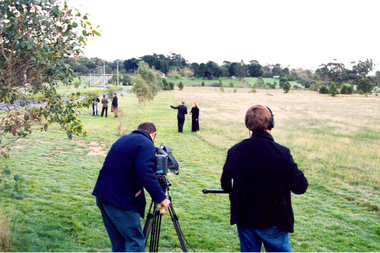
... State Revenue Office (SRO) is a $5 million world-class purpose built revenue collection facility employing over 200 people. SRO relocated 40% of its operations from Melbourne to the Ballarat Technology Park, creating more than 180 employment opportunities for skilled people from the region. The Ballarat facility houses the majority of the SRO's operations capability and utilises state-of-the-art technology. The BTP was selected to host the SRO after a feasibility study revealed that Ballarat was an ideal regional centre to support this important government...State Revenue Office (SRO) is a $5 million world-class purpose built revenue collection facility employing over 200 people. SRO relocated 40% of its operations from Melbourne to the Ballarat Technology Park, creating more than 180 employment opportunities for skilled people from the region. The Ballarat facility houses the majority of the SRO's operations capability and utilises state-of-the-art technology. The BTP was selected to host the SRO after a feasibility study revealed that Ballarat was an ideal regional centre to support this important government ...The State Revenue Office (SRO) is a $5 million world-class purpose built revenue collection facility employing over 200 people. SRO relocated 40% of its operations from Melbourne to the Ballarat Technology Park, creating more than 180 employment opportunities for skilled people from the region. The Ballarat facility houses the majority of the SRO's operations capability and utilises state-of-the-art technology. The BTP was selected to host the SRO after a feasibility study revealed that Ballarat was an ideal regional centre to support this important government function. The BTP enables the SRO to be in close proximity to an existing cluster of technology based enterprises and organisations, as well as education, training and research opportunities presented to SRO staff at the nearby Federation University. Three coloured photographs of people on the site of State Revenue Office, Ballarat Technology Park. The man being interviewed is Premier John Brumby. Geoff Howard MP and University of Ballarat Vice Chancellor Kerry Cox stand to his right. Two hundred State Revenue Office (SRO) workers were shifted to Ballarat from Melbourne in 2001 in a government initiative to create regional growth and cost savings.ballarat technology centre, john brumby, kerry cox, geoff howard, university of ballarat, state revenue office -
 Federation University Historical Collection
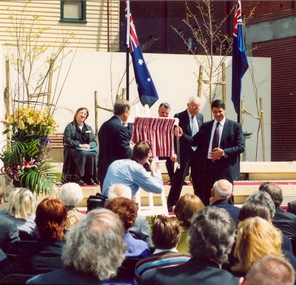
Photograph - Photograph - Colour, Ian Reid, Steve Bracks, Premier of Victoria, opens the University of Ballarat Arts Academy, Camp Street, 22/07/2008
... State and Commonwealth Governments, the Art Gallery Ballarat has been extended through to include the 1884 Police Station on Camp Street. The Post Office building (1864-1887) was acquired for the University. The 1904 and 1941 Courthouses and the c1900 Public Library building were also included. Two new buildings have been constructed. These six buildings will house...State and Commonwealth Governments, the Art Gallery Ballarat has been extended through to include the 1884 Police Station on Camp Street. The Post Office building (1864-1887) was acquired for the University. The 1904 and 1941 Courthouses and the c1900 Public Library building were also included. Two new buildings have been constructed. These six buildings will house ...The University of Ballarat (later Federation University_ inherited the Camp Street Arts Precinct. As the functions of the former public buildings were moved elsewhere, the Victorian Government of the time recognised the importance of maintaining the heritage buildings and the opportunity to create a cultural precinct extending from the Art Gallery. The 19th century architecture along Lydiard Street and the dogleg bend of Camp Street define the precinct. With substantial financial assistance from both State and Commonwealth Governments, the Art Gallery Ballarat has been extended through to include the 1884 Police Station on Camp Street. The Post Office building (1864-1887) was acquired for the University. The 1904 and 1941 Courthouses and the c1900 Public Library building were also included. Two new buildings have been constructed. These six buildings will house the University's Visual and Performing Arts ProgramsColoured postcard size photograph of Steve Bracks, Premier of Victoria, unveiling the plaque at the opening of the University of Ballarat Arts Academy, Camp Street. .1) L to R Kerry Cox (Vice Chancellor); Brendan Nelson (Federal Minister - Education); Chancellor David Caro; Steve Bracks, Premier of Victoria. Photographer Ian Reiduniversity of ballarat, camp street, victorian government, commonwealth government, ballarat fine art gallery, police station, courthouse, public library, post office, art gallery ballarat, art gallery of ballarat -
 Federation University Historical Collection
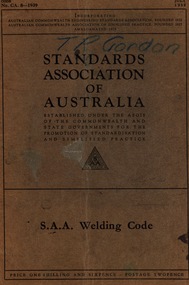
Booklet - Booklet - Standards Association, Standards Association of Australia: .1 Welding Code, .2 Structural Steel
... government...state governments...welding code...structural steel code...1933...1939...1928...1940...science house...State Governments for the promotion of standardisation and simplified practice. .1 is on Welding Code. It was first issued on 1933 and revised in 1939. Cost One Shilling and Sixpence. .2 is the code for Structural Steel. It was first issued in 1928, amended in 1931 and revised in 1940. Cost Two Shillings and Sixpence. Both published by The Association, Science House...State Governments for the promotion of standardisation and simplified practice. .1 is on Welding Code. It was first issued on 1933 and revised in 1939. Cost One Shilling and Sixpence. .2 is the code for Structural Steel. It was first issued in 1928, amended in 1931 and revised in 1940. Cost Two Shillings and Sixpence. Both published by The Association, Science House ...Two booklets produced by the Standards Association of Australia - established under the aegis of the Commonwealth and State Governments for the promotion of standardisation and simplified practice. .1 is on Welding Code. It was first issued on 1933 and revised in 1939. Cost One Shilling and Sixpence. .2 is the code for Structural Steel. It was first issued in 1928, amended in 1931 and revised in 1940. Cost Two Shillings and Sixpence. Both published by The Association, Science House, Gloucester and Essex Streets, Sydney..1 Folded green cover, 28 pages, stapled .2 Folded light brown cover, 30 pages, stapled.1 T R Gordon in blue pencil on cover .2 E J Barker in blue pen on cover.standards association of australia, commonwealth government, state governments, welding code, structural steel code, 1933, 1939, 1928, 1940, science house sydney -
 Federation University Historical Collection
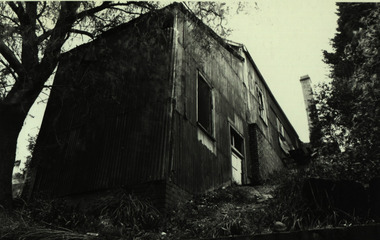
Photograph - black and white, Ballarat School of Mines Model Mine, 06/03/1972
... These images were supplied by Philip Law in support of capital extimates requests to the state and Commonwealth Governments. ballarat school of mines model mine ballarat school of mines mining laboratory ballarat school of mines mining workshop albert street, ballarat former ballarat supreme court motor mechanics electrical trades phil law Eleven black and white imaes of a number of Ballarat School of Mines Buildings. .1) Former Supreme Court House (Electrical Trades) .3) Pre Fab Building with brick wall .4) Lean to (Possibly added to pottery building as a store and used for pottery hand work in 1972. .5), .6), .9), 10), .11) Corrugated iron buildings - former Model Mine, Albert Street, Ballarat .8) Prefab buildings used for motor mechanics Ballarat School of Mines Model Mine Photograph - black and white ...These images were supplied by Philip Law in support of capital extimates requests to the state and Commonwealth Governments. Eleven black and white imaes of a number of Ballarat School of Mines Buildings. .1) Former Supreme Court House (Electrical Trades) .3) Pre Fab Building with brick wall .4) Lean to (Possibly added to pottery building as a store and used for pottery hand work in 1972. .5), .6), .9), 10), .11) Corrugated iron buildings - former Model Mine, Albert Street, Ballarat .8) Prefab buildings used for motor mechanicsballarat school of mines model mine, ballarat school of mines mining laboratory, ballarat school of mines mining workshop, albert street, ballarat, former ballarat supreme court, motor mechanics, electrical trades, phil law -
 Federation University Historical Collection
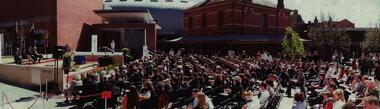
Photograph - Colour, Steve Bracks, Premier of Victoria, opens the University of Ballarat Arts Academy, Camp Street, 22/07/2008
... State and Commonwealth Governments, the Art Gallery Ballarat has been extended through to include the 1884 Police Station on Camp Street. The Post Office building (1864-1887) was acquired for the University. The 1904 and 1941 Courthouses and the c1900 Public Library building were also included. Two new buildings have been constructed. These six buildings will house...State and Commonwealth Governments, the Art Gallery Ballarat has been extended through to include the 1884 Police Station on Camp Street. The Post Office building (1864-1887) was acquired for the University. The 1904 and 1941 Courthouses and the c1900 Public Library building were also included. Two new buildings have been constructed. These six buildings will house ...The University of Ballarat inherited the Camp Street Arts Precinct. As the functions of the former public buildings were moved elsewhere, the Victorian Government of the time recognised the importance of maintaining the heritage buildings and the opportunity to create a cultural precinct extending from the Art Gallery. The 19th century architecture along Lydiard Street and the dogleg bend of Camp Street define the precinct. With substantial financial assistance from both State and Commonwealth Governments, the Art Gallery Ballarat has been extended through to include the 1884 Police Station on Camp Street. The Post Office building (1864-1887) was acquired for the University. The 1904 and 1941 Courthouses and the c1900 Public Library building were also included. Two new buildings have been constructed. These six buildings will house the University's Visual and Performing Arts Programs.3 Panorama photograph of the opening of the University of Ballarat Arts Academy, Camp Street. .2 Poster .1) L to R Kerry Cox (Vice Chancellor); Brendan Nelson (Federal Minister - Education); Chancellor David Caro; Steve Bracks, Premier of Victoria. Photographer Ian Reiduniversity of ballarat, camp street, victorian government, commonwealth government, ballarat fine art gallery, police station, courthouse, public library, post office, art gallery ballarat -
 Flagstaff Hill Maritime Museum and Village
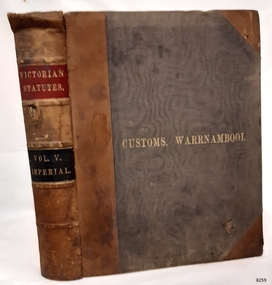
Book - Reference/Legal Statutes, John Ferres, Government Printer, The Victorian Imperial Statutes Vol 5 Customs Warrnambool, 1868
... state desperately needed to print its official financial Estimates. Thanks to his sterling reputation at the Herald, Ferres was tapped by government officials and officially appointed Victorian Government Printer on November 8, 1851. Historically and legally, the subject work is immensely significant, particularly given its connection to Imperial Customs and Warrnambool. There is also great regional significance for Warrnambool. In 1868, Warrnambool was expanding rapidly as a vital deep-sea port handling the booming shipping trade of the Western District by exporting wool, wheat, and potatoes. Because it was an official port of entry, it had its own Customs House ...This volume is part of the first comprehensive consolidation of laws for the Colony of Victoria after it separated from New South Wales and established its own parliament. Specifically, Volume 5 (published in 1868) is dedicated to "A selection of the imperial statutes apparently in force in Victoria". Because Victoria was still a British colony, laws passed by the British (Imperial) Parliament in Westminster still applied locally if they hadn't been superseded by local Victorian colonial acts. Volume 5 was the legal handbook used by lawyers, judges, and government officials to determine exactly which British laws still governed colonial matters, ranging from shipping and trade to criminal law and merchant customs.The Victorian Statutes Vol 5 Customs Warrnambool Publisher: John Ferres Government Printer Melbourne Date: 1868 Further Information: Three quarter leather. Junction between front board and spine slightly exposed. Top section of leather on spine damaged. non-fictionThis volume is part of the first comprehensive consolidation of laws for the Colony of Victoria after it separated from New South Wales and established its own parliament. Specifically, Volume 5 (published in 1868) is dedicated to "A selection of the imperial statutes apparently in force in Victoria". Because Victoria was still a British colony, laws passed by the British (Imperial) Parliament in Westminster still applied locally if they hadn't been superseded by local Victorian colonial acts. Volume 5 was the legal handbook used by lawyers, judges, and government officials to determine exactly which British laws still governed colonial matters, ranging from shipping and trade to criminal law and merchant customs.flagstaff hill, warrnambool, shipwrecked coast, flagstaff hill maritime museum, maritime museum, shipwreck coast, flagstaff hill maritime village, great ocean road, book, pattison collection, warrnambool library, warrnambool mechanics’ institute, ralph eric pattison, corangamite regional library service, warrnambool city librarian, mechanics’ institute library, victorian library board, warrnambool books and records, warrnambool children’s library -
 Flagstaff Hill Maritime Museum and Village
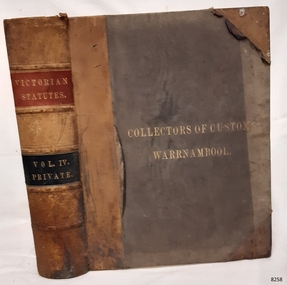
Book - Reference/Legal Statutes, John Ferres, Government Printer, The Victorian Statutes Vol 4 Various Legal Statues /Warrnambool, 1866
... state desperately needed to print its official financial Estimates. Thanks to his sterling reputation at the Herald, Ferres was tapped by government officials and officially appointed Victorian Government Printer on November 8, 1851. Historically and legally, the subject work is immensely significant, particularly given its connection to Warrnambool. There is also great regional significance for Warrnambool. In 1866, Warrnambool was expanding rapidly as a vital deep-sea port handling the booming shipping trade of the Western District by exporting wool, wheat, and potatoes. Because it was an official port of entry, and it had its own Customs House ...This volume is part of the first comprehensive consolidation of laws for the Colony of Victoria after it separated from New South Wales and established its own parliament. Specifically, Volume 4 (published in 1866) contains Local Colonial Acts. These were laws debated, passed, and enacted right here in Melbourne by the newly formed Parliament of the Colony of Victoria. They dealt with purely domestic, local matters, such as Victorian land selection, goldfields regulations, local municipal boundaries, and colonial courts. Volume 4 was the handbook for everyday domestic Victorian life, governing how a local town council operated, how gold claims were filed, or how local debts were settled in a Victorian county court.The Victorian Statutes Vol 4 Various Legal Statues /Warrnambool Publisher: John Ferres Government Printer Melbourne Date: 1866 Further Information: Three quarter leather. Junction between front board and spine slightly exposed. non-fictionThis volume is part of the first comprehensive consolidation of laws for the Colony of Victoria after it separated from New South Wales and established its own parliament. Specifically, Volume 4 (published in 1866) contains Local Colonial Acts. These were laws debated, passed, and enacted right here in Melbourne by the newly formed Parliament of the Colony of Victoria. They dealt with purely domestic, local matters, such as Victorian land selection, goldfields regulations, local municipal boundaries, and colonial courts. Volume 4 was the handbook for everyday domestic Victorian life, governing how a local town council operated, how gold claims were filed, or how local debts were settled in a Victorian county court.flagstaff hill, warrnambool, shipwrecked coast, flagstaff hill maritime museum, maritime museum, shipwreck coast, flagstaff hill maritime village, great ocean road, book, pattison collection, warrnambool library, warrnambool mechanics’ institute, ralph eric pattison, corangamite regional library service, warrnambool city librarian, mechanics’ institute library, victorian library board, warrnambool books and records, warrnambool children’s library -
 Flagstaff Hill Maritime Museum and Village
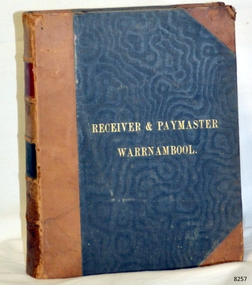
Book - Reference/Legal Statutes, John Ferres, Government Printer, The Victorian Legal Statutes Vol 3, Receiver Paymaster/Warrnambool, 1866
... state desperately needed to print its official financial Estimates. Thanks to his sterling reputation at the Herald, Ferres was tapped by government officials and officially appointed Victorian Government Printer on November 8, 1851. Historically and legally, the subject work is immensely significant, particularly given its connection to Warrnambool. There is also great regional significance for Warrnambool. In 1866, Warrnambool was expanding rapidly as a vital deep-sea port handling the booming shipping trade of the Western District by exporting wool, wheat, and potatoes. Because it was an official port of entry, and it had its own Customs House ...This volume is part of the first comprehensive consolidation of laws for the Colony of Victoria after it separated from New South Wales and established its own parliament. Specifically, Volume 3 is the final part of the core "Public and General" Victorian colonial laws. The first three volumes of the 1866 consolidation were organised alphabetically by legal topic. Volume 3 specifically contains all the major public acts running from P to W. Because it covers the tail end of the alphabet, it holds some of the most critical laws that built day-to-day society in 19th-century Victoria. These include: · Police Offences and Public Order: The legal frameworks for policing the goldfield boomtowns, managing public behaviour, and running early colonial prisons. · Public Works and Infrastructure: The acts authorising the construction of roads, bridges, and early municipal water supplies across the fast-growing colony. · Railways: The specific general legislation governing the expansion of Victoria's heavily subsidised, state-expanding railway networks. · Property and Land Transfer: Crucial laws managing land ownership, inheritance, and the foundational transfers of property as the colony shifted away from old squatter runs to permanent towns. · Wines, Beer, and Spirits: The colonial acts regulating the licensing of hotels and public houses, and managing the highly lucrative, tightly controlled alcohol trade.The Victorian Statutes Vol 3 Various Legal Statues /Warrnambool Publisher: John Ferres Government Printer Melbourne Date: 1866 Further Information: Three quarter leather. Corners worn lettering in gilt. non-fictionThis volume is part of the first comprehensive consolidation of laws for the Colony of Victoria after it separated from New South Wales and established its own parliament. Specifically, Volume 3 is the final part of the core "Public and General" Victorian colonial laws. The first three volumes of the 1866 consolidation were organised alphabetically by legal topic. Volume 3 specifically contains all the major public acts running from P to W. Because it covers the tail end of the alphabet, it holds some of the most critical laws that built day-to-day society in 19th-century Victoria. These include: · Police Offences and Public Order: The legal frameworks for policing the goldfield boomtowns, managing public behaviour, and running early colonial prisons. · Public Works and Infrastructure: The acts authorising the construction of roads, bridges, and early municipal water supplies across the fast-growing colony. · Railways: The specific general legislation governing the expansion of Victoria's heavily subsidised, state-expanding railway networks. · Property and Land Transfer: Crucial laws managing land ownership, inheritance, and the foundational transfers of property as the colony shifted away from old squatter runs to permanent towns. · Wines, Beer, and Spirits: The colonial acts regulating the licensing of hotels and public houses, and managing the highly lucrative, tightly controlled alcohol trade.flagstaff hill, warrnambool, shipwrecked coast, flagstaff hill maritime museum, maritime museum, shipwreck coast, flagstaff hill maritime village, great ocean road, book, pattison collection, warrnambool library, warrnambool mechanics’ institute, ralph eric pattison, corangamite regional library service, warrnambool city librarian, mechanics’ institute library, victorian library board, warrnambool books and records, warrnambool children’s library -
 Flagstaff Hill Maritime Museum and Village
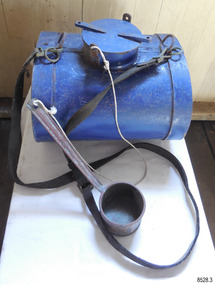
Equipment - Water Canteen and Ladle, mid-to-late 19th century
... House installed beside the Harbour. This water canteen is significant for its connection with local history, maritime history and marine technology. Lifesaving has been an important part of the services performed from Warrnambool's very early days, supported by State and Local Government, and based on the methods and experience of Great Britain. ...The horizontal water canteen has been carefully designed to fit snugly on the hip when worn with the straps diagonally across the body. The ladle allows quick and easy scooping of the contents to refresh the lifeboat and rocket launching crew, and the survivors of the disaster Saving lives in Warrnambool – The coastline of South West Victoria is the site of over 600 shipwrecks and many lost lives; even in Warrnambool’s Lady Bay there were around 16 known shipwrecks between 1850 and 1905, with eight lives lost. Victoria’s Government responded to the need for lifesaving equipment and, in 1858, the provision of rocket and mortar apparatus was approved for the lifeboat stations. In 1859 the first Government-built lifeboat arrived at Warrnambool Harbour and a shed was soon built for it on the Tramway Jetty, followed by a rocket house in 1864 to safely store the rocket rescue equipment. In 1878 the buildings were moved to the Breakwater (constructed from 1874-1890), and in 1910 the new Lifeboat Warrnambool arrived with its ‘self-righting’ design. For almost a hundred years the lifesaving and rescue crews, mostly local volunteers, trained regularly to rehearse and maintain their rescue skills. They were summoned when needed by alarms, gunshots, ringing bells and foghorns. In July 1873 a brass bell was erected at Flagstaff Hill specifically to call the rescue crew upon news of a shipwreck. Some crew members became local heroes but all served an important role. Rocket apparatus was used as recently as the 1950s. Rocket Rescue Method - The Government of Victoria adopted lifesaving methods based on Her Majesty’s Coast Guard in Great Britain. It authorised the first line-throwing rescue system in 1858. Captain Manby’s mortar powered a projectile connected to a rope, invented in 1808. The equipment was updated to John Dennett’s 8-foot shaft and rocket method that had a longer range of about 250 yards. From the 1860s the breeches buoy apparatus was in use. The apparatus was suspended on a hawser line and manually pulled to and from the distressed vessel carrying passengers and items. In the early 1870s Colonel Boxer’s rocket carried the light line, which was faked, or coiled, in a particular way between pegs in a faking box to prevent twists and tangles when fired. The angle of firing the rocket to the vessel in distress was measured by a quadrant-type instrument on the side of the rocket machine. Decades later, in about 1920, Schermuly invented the line-throwing pistol that used a small cartridge to fire the rocket. The British Board of Trade published instructions for both the beach rescue crew and ship’s crew. It involved setting up the rocket launcher on shore at a particular angle measured by the quadrant, inserting a rocket that had a lightweight line threaded through its shaft, and then firing it across the stranded vessel, the line issuing freely from the faking board. A tally board was then sent out to the ship with instructions in four languages. The ship’s crew would haul on the line to bring out the heavier, continuous whip line, then secure the attached whip block to the mast or other sturdy part of the ship. The rescue crew on shore then hauled out a stronger hawser line, which the ship’s crew fixed above the whip block. The hawser was then tightened using the block on the shore end of the whip. The breeches buoy and endless whip are then attached to the traveller block on the hawser, allowing the shore crew to haul the breeches buoy to and from the vessel, rescuing the stranded crew one at a time. Beach apparatus equipment - In the mid-1800s the equipment could include a line throwing set, coiled line in wooden carrying case, rockets, cartridges, breeches buoy, hawser and traveller block, line-throwing pistol, beach cart, hand barrow, sand anchor, crotch pole, and tools such as spade, pick, mallet and hawser cutter. Around the 1860s Warrnambool had a Rocket House installed beside the Harbour. This water canteen is significant for its connection with local history, maritime history and marine technology. Lifesaving has been an important part of the services performed from Warrnambool's very early days, supported by State and Local Government, and based on the methods and experience of Great Britain. Hundreds of shipwrecks along the coast are evidence of the rough weather and rugged coastline. Ordinary citizens, the Harbour employees, and the volunteer boat and rescue crew, saved lives in adverse circumstances. Some were recognised as heroes, others went unrecognised. In Lady Bay, Warrnambool, there were around 16 known shipwrecks between 1850 and 1905. Many lives were saved but tragically, eight lives were lost.Water canteen and ladle; blue painted oval metal cylinder with a removable round threaded lid. Two adjustable leather shoulder straps are attached to the canteen through metal rings on the sides of the lid. A blue-painted copper ladle with a fixed, 45-degree angled handle is attached to the canteen with a length of string. The water canteen is designed to be carried horizontally.flagstaff hill maritime museum and village, flagstaff hill, maritime museum, maritime village, warrnambool, great ocean road, lady bay, shipwreck, life-saving, lifesaving, rescue crew, rescue, rocket rescue, rocket crew, lifeboat men, beach rescue, line rescue, rescue equipment, volunteer lifesavers, volunteer crew, life saving rescue crew, lifesaving rescue crew, rocket apparatus, survival canteen, rescue canteen, dipper, cup, canteen and dipper, canteen and ladle, water canteen -
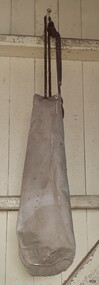 Flagstaff Hill Maritime Museum and Village
Equipment - Canvas Bag, mid-to-late 19th century
... House installed beside the Harbour. This canvas bag is significant for its connection with local history, maritime history and marine technology. Lifesaving has been an important part of the services performed from Warrnambool's very early days, supported by State and Local Government, and based on the methods and experience of Great Britain. ...This drawstring canvas bag is amongst the Rocket Rescue equipment. It could have been used to carry equipment, clothing or provisions between the crew on the shore and the victims of a shipwreck or other rescue need. It could be worn on the shoulder or as a backpack or winched out to a vessel on the block and pulley system. The strong canvas could be weatherproof and waterproof to a large extent, provided the drawstring was pulled tight. Saving lives in Warrnambool – The coastline of South West Victoria is the site of over 600 shipwrecks and many lost lives; even in Warrnambool’s Lady Bay, there were around 16 known shipwrecks between 1850 and 1905, with eight lives lost. Victoria’s Government responded to the need for lifesaving equipment and, in 1858, the provision of rocket and mortar apparatus was approved for the lifeboat stations. In 1859 the first Government-built lifeboat arrived at Warrnambool Harbour and a shed was soon built for it on the Tramway Jetty, followed by a rocket house in 1864 to safely store the rocket rescue equipment. In 1878 the buildings were moved to the Breakwater (constructed from 1874-1890), and in 1910 the new Lifeboat Warrnambool arrived with its ‘self-righting’ design. For almost a hundred years the lifesaving and rescue crews, mostly local volunteers, trained regularly to rehearse and maintain their rescue skills. They were summoned when needed by alarms, gunshots, ringing bells and foghorns. In July 1873 a brass bell was erected at Flagstaff Hill specifically to call the rescue crew upon news of a shipwreck. Some crew members became local heroes but all served an important role. Rocket apparatus was used as recently as the 1950s. Rocket Rescue Method - The Government of Victoria adopted lifesaving methods based on Her Majesty’s Coast Guard in Great Britain. It authorised the first line-throwing rescue system in 1858. Captain Manby’s mortar powered a projectile connected to a rope, invented in 1808. The equipment was updated to John Dennett’s 8-foot shaft and rocket method that had a longer range of about 250 yards. From the 1860s the breeches buoy apparatus was in use. The apparatus was suspended on a hawser line and manually pulled to and from the distressed vessel carrying passengers and items. In the early 1870s Colonel Boxer’s rocket carried the light line, which was faked, or coiled, in a particular way between pegs in a faking box to prevent twists and tangles when fired. The angle of firing the rocket to the vessel in distress was measured by a quadrant-type instrument on the side of the rocket machine. Decades later, in about 1920, Schermuly invented the line-throwing pistol that used a small cartridge to fire the rocket. The British Board of Trade published instructions for both the beach rescue crew and ship’s crew. It involved setting up the rocket launcher on shore at a particular angle measured by the quadrant, inserting a rocket that had a lightweight line threaded through its shaft, and then firing it across the stranded vessel, the line issuing freely from the faking board. A tally board was then sent out to the ship with instructions in four languages. The ship’s crew would haul on the line to bring out the heavier, continuous whip line, then secure the attached whip block to the mast or other sturdy part of the ship. The rescue crew on shore then hauled out a stronger hawser line, which the ship’s crew fixed above the whip block. The hawser was then tightened using the block on the shore end of the whip. The breeches buoy and endless whip are then attached to the traveller block on the hawser, allowing the shore crew to haul the breeches buoy to and from the vessel, rescuing the stranded crew one at a time. Beach apparatus equipment - In the mid-1800s the equipment could include a line throwing set, coiled line in a wooden carrying case, rockets, cartridges, breeches buoy, hawser and traveller block, line-throwing pistol, beach cart, hand barrow, sand anchor, crotch pole, and tools such as spade, pick, mallet and hawser cutter. Around the 1860s Warrnambool had a Rocket House installed beside the Harbour. This canvas bag is significant for its connection with local history, maritime history and marine technology. Lifesaving has been an important part of the services performed from Warrnambool's very early days, supported by State and Local Government, and based on the methods and experience of Great Britain. Hundreds of shipwrecks along the coast are evidence of the rough weather and rugged coastline. Ordinary citizens, the Harbour employees, and the volunteer boat and rescue crew saved lives in adverse circumstances. Some were recognised as heroes, others went unrecognised. In Lady Bay, Warrnambool, there were around 16 known shipwrecks between 1850 and 1905. Many lives were saved but tragically, eight lives were lost.Canvas bag; thick beige canvas bag, cylindrical with a round base. The top has a thin rope in a drawstring closure. flagstaff hill maritime museum and village, flagstaff hill, maritime museum, maritime village, warrnambool, great ocean road, lady bay, shipwreck, life-saving, lifesaving, rescue crew, rescue, rocket rescue, rocket crew, lifeboat men, beach rescue, line rescue, rescue equipment, volunteer lifesavers, volunteer crew, life saving rescue crew, lifesaving rescue crew, rocket apparatus, survival kit, rescue kit, canvas bag, storage bag, carry bag, equipment bag, drawerstring bag -
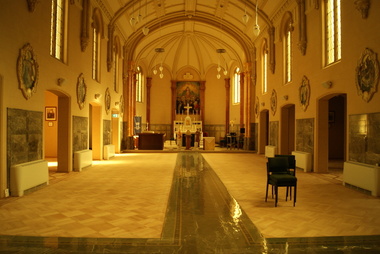 Greensborough Historical Society
Photograph - Digital image, Jasmin Burge, Chapel interior, Loyola College 2012, 19/06/2012
... Inscription on plaque: "This Chapel was dedicated on Wednesday 1st August 1934 by Most Reverend Bishop McCarthy DD, Bishop of Sandhurst (Bendigo) for the House of Studies, Novitiate and Retreat Centre of the Society of Jesus (1934-1974) and after sale to the State Government was deconsecrated. ...Inscription on plaque: "This Chapel was dedicated on Wednesday 1st August 1934 by Most Reverend Bishop McCarthy DD, Bishop of Sandhurst (Bendigo) for the House of Studies, Novitiate and Retreat Centre of the Society of Jesus (1934-1974) and after sale to the State Government was deconsecrated. ...Chapel interior and plaque, Loyola College 2012. Inscription on plaque: "This Chapel was dedicated on Wednesday 1st August 1934 by Most Reverend Bishop McCarthy DD, Bishop of Sandhurst (Bendigo) for the House of Studies, Novitiate and Retreat Centre of the Society of Jesus (1934-1974) and after sale to the State Government was deconsecrated. It was returned to the catholic community in 2002." Part of a collection of photographs of Loyola College, Grimshaw Street Watsonia, established 1980 on the site of the Loyola Seminary. The College purchased the original building in 2002. These photographs of the original building and grounds were taken by GHS member Jazz Burge in June 2012.Digital copy of colour photograph.loyola college -
Glenelg Shire Council Cultural Collection
Document - Military Submission, John Ferres, Government Printer, Defences of the Colony, 1864
... Government Gazette in January 1852. Work increased with the rapid growth of the colony and by 1887 the staff numbered 278. In 1858, after several moves, the Printing Office was housed in a new building in Gisborne (now Macarthur) Street; as government printer, Ferres resided on the premises. At 60 he was superannuated on a pension of £333 but in 1881 was reinstated; his return, according to the Australasian, was 'a distinct gain to the state...Government Gazette in January 1852. Work increased with the rapid growth of the colony and by 1887 the staff numbered 278. In 1858, after several moves, the Printing Office was housed in a new building in Gisborne (now Macarthur) Street; as government printer, Ferres resided on the premises. At 60 he was superannuated on a pension of £333 but in 1881 was reinstated; his return, according to the Australasian, was 'a distinct gain to the state ...1864 group of 4 submissions bound in to one document. Heavy paper sewn together with twine, black print on white.portland battery, military, major scratchley, commodore wiseman, governor, john ferres -
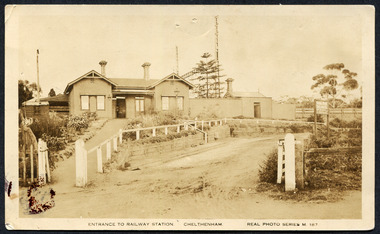 City of Moorabbin Historical Society (Operating the Box Cottage Museum)
Photograph, Black & White Postcard, Cheltenham Railway Station c1920, c1920
... houses in his constituency were built in a distinctive decorative cottage style. Bent faced severe criticism for diverting the rail line through his local area and for the expenditure on the Stations. Local residents established and cared for Gardens at the Stations and Cheltenham was awarded Best Garden c1910. The arrival of the Railway Line saw the traders move from Point Nepean Rd to Charman Rd and by 1910 various shops and business were present. 2016 - current has seen large protest rallies against the destruction of Mentone Station and Cheltenham Station as the Victorian State Government proceeds to remove Railway Level Crossings. ...houses in his constituency were built in a distinctive decorative cottage style. Bent faced severe criticism for diverting the rail line through his local area and for the expenditure on the Stations. Local residents established and cared for Gardens at the Stations and Cheltenham was awarded Best Garden c1910. The arrival of the Railway Line saw the traders move from Point Nepean Rd to Charman Rd and by 1910 various shops and business were present. 2016 - current has seen large protest rallies against the destruction of Mentone Station and Cheltenham Station as the Victorian State Government proceeds to remove Railway Level Crossings. ...Although the Railway line had been planned for some time Sir Thomas Bent MP was responsible for making it happen in order to revitalize the fortunes of the Moorabbin Shire that he had represented for so long. The train line opened in 1881with 8 Stations between Caulfield and Mordialloc.The first Steam engine carried dignitaries and local residents. Bent also ensured that the Station houses in his constituency were built in a distinctive decorative cottage style. Bent faced severe criticism for diverting the rail line through his local area and for the expenditure on the Stations. Local residents established and cared for Gardens at the Stations and Cheltenham was awarded Best Garden c1910. The arrival of the Railway Line saw the traders move from Point Nepean Rd to Charman Rd and by 1910 various shops and business were present. 2016 - current has seen large protest rallies against the destruction of Mentone Station and Cheltenham Station as the Victorian State Government proceeds to remove Railway Level Crossings. A compromise to retain the Station buildings whilst placing the Rail Line underground is desired.Cheltenham Railway Station is one of the original cottage style stations ordered by Sir Thomas Bent when the rail line was extended from Caulfield to Mordialloc 1881Photograph Black & White Postcard showing the entrance to Cheltenham Railway Station c1920Valentine &Sons Pub Co Ltd Melb railways, cheltenham station, mentone station, south brighton station, railway level crossing removal 2016 -19, smith j l; smith mary ann, stanley helen, smith vic, smith harry redvers, chaff cutter, horse drawn carts, toll gates brighton, motor cars 1900, steam engines, early settlers, bentleigh, parish of moorabbin, city of moorabbin, county of bourke, moorabbin roads board, shire of moorabbin, henry dendy's special survey 1841, were j.b.; bent thomas, o'shannassy john, king richard, charman s, highett william, ormond francis, maynard dennis, market gardeners, vineyards, orchards -
Glenelg Shire Council Cultural Collection
Certificate - Certificate - Historic Buildings, Portland Town Hall, 1974
... government administration. Portland Town Hall History House heritage register historic buildings certificate A4 sized certificate demonstrating Portland Town Hall's special significance to the state of Victoria & inclusion on the Historic Building Register. ...From the Victorian Heritage Register: The foundation stone of the original Portland Town Hall was laid by William Learmonth on 21st September, 1863 following a competition and subsequent public controversy over the permitted entry of architect John Barrow. The conservative classical design of municipal surveyor Alexander Ross was preferred and this axially planned design with central council chamber and side offices fronted by a fine axed pedimented gable entablature of basalt and Tuscan Doric pilasters was completed by 24th may 1864. The old Town Hall is one of a distinguished group of public buildings in Portland and an interesting example of conservative classical architecture of the first years of settlement in western Victoria. The basalt structure was partially erected of stone from the Portland stockade and has significant historical associations with local Government administration in the district. The Town Hall is the most impressive work of Alexander Ross, a surveyor architect whose career remains largely undocumented. The old Town Hall at Portland has been discreetly extended at the rear to provide additional meeting room accommodation. The premises are no longer used for local government administration.A4 sized certificate demonstrating Portland Town Hall's special significance to the state of Victoria & inclusion on the Historic Building Register. Singed by Robert Maclellan, Minister for planning & Historic Buildings Council Chairperson. Red seal attached, bottom right.portland town hall, history house, heritage register, historic buildings, certificate
