
Showing 37 items matching "steam locomotives - preservation"
-
 Victorian Railway History Library
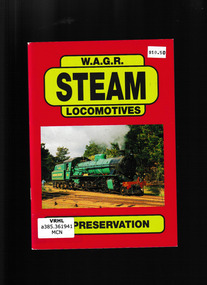
Book, Railmac Publications, WAGR steam locomotives in preservation, 1994
... WAGR steam locomotives in preservation...Western Australia - Locomotives - Steam Western Australia - Rail preservation A listing by type of WAGR steam locomotives in preservation Ill, p.44. ...A listing by type of WAGR steam locomotives in preservationIll, p.44. non-fiction A listing by type of WAGR steam locomotives in preservation western australia - locomotives - steam, western australia - rail preservation -
 Victorian Railway History Library
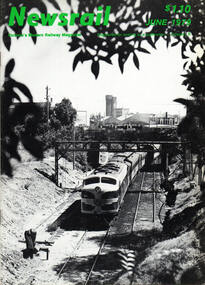
Journal - Newsrail June 1979, Peter Tesdorpf and Gary McDonald, The Metrol System and Vulcan No. 4 Steams to Queenscliff, 1979
... Industrial Railways Victoria - Steam Locomotives Preservation...The Metrol System and Vulcan No. 4 Steams to Queenscliff Government Railways Victoria Train Control Industrial Railways Victoria - Steam Locomotives Preservation Index,Ill, p.28. The Metrol System and Vulcan No. 4 Steams to Queenscliff Journal Newsrail June 1979 Peter Tesdorpf and Gary McDonald Australian Railway Historical Society ...Index,Ill, p.28. non-fiction government railways victoria train control, industrial railways victoria - steam locomotives preservation -
 Victorian Railway History Library
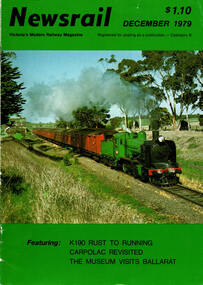
Journal - Newsrail December 1979, POT and N. Houghton, K190, Rust to Running and Carpolac Revisited, 1979
... Steam Locomotives - Preservation...K190, Rust to Running and Carpolac Revisited Steam Locomotives - Preservation Government Railways Victoria - Closed Railway Lines Index,Ill, p.28. ...Index,Ill, p.28. non-fiction steam locomotives - preservation, government railways victoria - closed railway lines -
 Eltham District Historical Society Inc
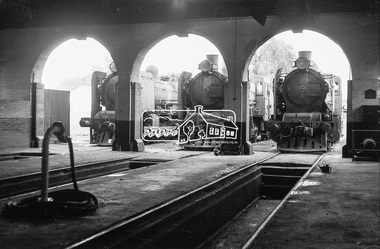
Photograph, Steam locomotives K-175, K-155 and K-182 outside the locomotive workshop, Echuca Railway Station, c.1962, 1962c
... steam locomotive that ran on Victorian Railways in Australia from 1922 to 1979. Although its design was entirely conventional and its specifications unremarkable, the K class was in practice a remarkably versatile and dependable locomotive. It went on to outlast every other class of steam locomotive in regular service on the VR, and no fewer than 21 examples of the 53 originally built have survived into preservation. https://en.wikipedia.org/wiki/Victorian_Railways_K_class...steam locomotive that ran on Victorian Railways in Australia from 1922 to 1979. Although its design was entirely conventional and its specifications unremarkable, the K class was in practice a remarkably versatile and dependable locomotive. It went on to outlast every other class of steam locomotive in regular service on the VR, and no fewer than 21 examples of the 53 originally built have survived into preservation. https://en.wikipedia.org/wiki/Victorian_Railways_K_class Echuca Railway Station, George Coop Collection, K-155, K-175, K-182, K-Class Steam Locomotive (VR Newport Workshops), Railway Workshop Digital TIFF file Scan of 35mm Ilford FP3 black and white negative transparency Steam locomotives K-175, K-155 and K-182 outside the locomotive workshop, Echuca Railway Station, c.1962 Photograph George Coop George Coop ...The K class was a branch line steam locomotive that ran on Victorian Railways in Australia from 1922 to 1979. Although its design was entirely conventional and its specifications unremarkable, the K class was in practice a remarkably versatile and dependable locomotive. It went on to outlast every other class of steam locomotive in regular service on the VR, and no fewer than 21 examples of the 53 originally built have survived into preservation. https://en.wikipedia.org/wiki/Victorian_Railways_K_class Digital TIFF file Scan of 35mm Ilford FP3 black and white negative transparency echuca railway station, george coop collection, k-155, k-175, k-182, k-class steam locomotive (vr newport workshops), railway workshop -
 Eltham District Historical Society Inc
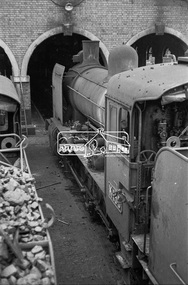
Photograph, Steam locomotives K-175, K-155 and K-182 outside the locomotive workshop, Echuca Railway Station, c.1962, 1962c
... steam locomotive that ran on Victorian Railways in Australia from 1922 to 1979. Although its design was entirely conventional and its specifications unremarkable, the K class was in practice a remarkably versatile and dependable locomotive. It went on to outlast every other class of steam locomotive in regular service on the VR, and no fewer than 21 examples of the 53 originally built have survived into preservation. https://en.wikipedia.org/wiki/Victorian_Railways_K_class...steam locomotive that ran on Victorian Railways in Australia from 1922 to 1979. Although its design was entirely conventional and its specifications unremarkable, the K class was in practice a remarkably versatile and dependable locomotive. It went on to outlast every other class of steam locomotive in regular service on the VR, and no fewer than 21 examples of the 53 originally built have survived into preservation. https://en.wikipedia.org/wiki/Victorian_Railways_K_class echuca railway station, george coop collection, k-155, k-175, k-182, k-class steam locomotive (vr newport workshops), railway workshop Digital TIFF file Scan of 35mm Ilford FP3 black and white negative transparency Steam locomotives K-175, K-155 and K-182 outside the locomotive workshop, Echuca Railway Station, c.1962 Photograph George Coop George Coop ...The K class was a branch line steam locomotive that ran on Victorian Railways in Australia from 1922 to 1979. Although its design was entirely conventional and its specifications unremarkable, the K class was in practice a remarkably versatile and dependable locomotive. It went on to outlast every other class of steam locomotive in regular service on the VR, and no fewer than 21 examples of the 53 originally built have survived into preservation. https://en.wikipedia.org/wiki/Victorian_Railways_K_class Digital TIFF file Scan of 35mm Ilford FP3 black and white negative transparency echuca railway station, george coop collection, k-155, k-175, k-182, k-class steam locomotive (vr newport workshops), railway workshop -
 Eltham District Historical Society Inc
Photograph, Steam locomotive K-155 outside the locomotive workshop, Echuca Railway Station, c.1962, 1962c
... steam locomotive that ran on Victorian Railways in Australia from 1922 to 1979. Although its design was entirely conventional and its specifications unremarkable, the K class was in practice a remarkably versatile and dependable locomotive. It went on to outlast every other class of steam locomotive in regular service on the VR, and no fewer than 21 examples of the 53 originally built have survived into preservation. https://en.wikipedia.org/wiki/Victorian_Railways_K_class...steam locomotive that ran on Victorian Railways in Australia from 1922 to 1979. Although its design was entirely conventional and its specifications unremarkable, the K class was in practice a remarkably versatile and dependable locomotive. It went on to outlast every other class of steam locomotive in regular service on the VR, and no fewer than 21 examples of the 53 originally built have survived into preservation. https://en.wikipedia.org/wiki/Victorian_Railways_K_class Echuca Railway Station, George Coop Collection, K-155, K-Class Steam Locomotive (VR Newport Workshops), Railway Workshop Digital TIFF file Scan of 35mm Ilford FP3 black and white negative transparency Steam locomotive K-155 outside the locomotive workshop, Echuca Railway Station, c.1962 Photograph George Coop George Coop ...The K class was a branch line steam locomotive that ran on Victorian Railways in Australia from 1922 to 1979. Although its design was entirely conventional and its specifications unremarkable, the K class was in practice a remarkably versatile and dependable locomotive. It went on to outlast every other class of steam locomotive in regular service on the VR, and no fewer than 21 examples of the 53 originally built have survived into preservation. https://en.wikipedia.org/wiki/Victorian_Railways_K_class Digital TIFF file Scan of 35mm Ilford FP3 black and white negative transparency echuca railway station, george coop collection, k-155, k-class steam locomotive (vr newport workshops), railway workshop -
 Eltham District Historical Society Inc
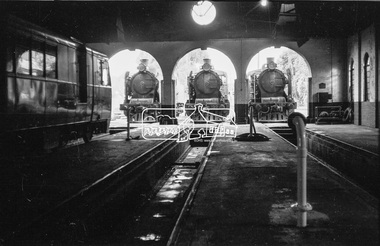
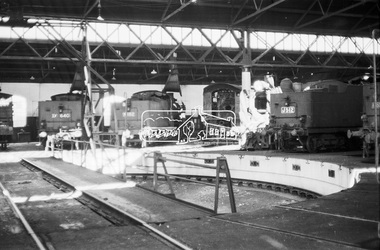
Photograph, Steam locomotives D3-640, K-182, K-158, J-512 and K-168 in the locomotive shed, Bendigo Railway Station, c.November 1962, 1962
... steam locomotive that ran on Victorian Railways in Australia from 1922 to 1979. Although its design was entirely conventional and its specifications unremarkable, the K class was in practice a remarkably versatile and dependable locomotive. It went on to outlast every other class of steam locomotive in regular service on the VR, and no fewer than 21 examples of the 53 originally built have survived into preservation. https://en.wikipedia.org/wiki/Victorian_Railways_K_class...steam locomotive that ran on Victorian Railways in Australia from 1922 to 1979. Although its design was entirely conventional and its specifications unremarkable, the K class was in practice a remarkably versatile and dependable locomotive. It went on to outlast every other class of steam locomotive in regular service on the VR, and no fewer than 21 examples of the 53 originally built have survived into preservation. https://en.wikipedia.org/wiki/Victorian_Railways_K_class bendigo, d3-640, george coop collection, j-512, j-class steam locomotive (vulcan foundry), k-158, k-168, k-182, k-class steam locomotive (vr newport workshops), railway turntable, railway workshop, bendigo railway station Digital TIFF file Scan of 35mm Ilford FP3 black and white negative transparency Steam locomotives D3-640, K-182, K-158, J-512 and K-168 in the locomotive shed, Bendigo Railway Station, c.November 1962 Photograph George Coop George Coop ...The Victorian Railways J class was a branch line steam locomotive operated by the Victorian Railways (VR) between 1954 and 1972. A development of the successful Victorian Railways K class 2-8-0, it was the last new class of steam locomotive introduced on the VR. Introduced almost concurrently with the diesel-electric locomotives that ultimately superseded them, these locomotives were only in service for a relatively short time. https://en.wikipedia.org/wiki/Victorian_Railways_J_class The K class was a branch line steam locomotive that ran on Victorian Railways in Australia from 1922 to 1979. Although its design was entirely conventional and its specifications unremarkable, the K class was in practice a remarkably versatile and dependable locomotive. It went on to outlast every other class of steam locomotive in regular service on the VR, and no fewer than 21 examples of the 53 originally built have survived into preservation. https://en.wikipedia.org/wiki/Victorian_Railways_K_class Digital TIFF file Scan of 35mm Ilford FP3 black and white negative transparency bendigo, d3-640, george coop collection, j-512, j-class steam locomotive (vulcan foundry), k-158, k-168, k-182, k-class steam locomotive (vr newport workshops), railway turntable, railway workshop, bendigo railway station -
 Bendigo Historical Society Inc.
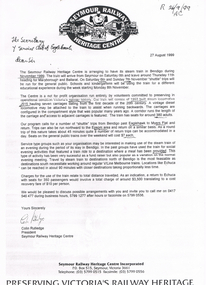
Document - LONG GULLY HISTORY GROUP COLLECTION: SEYMOUR RAILWAY HERITAGE CENTRE INCORPORATED
... Steam Preservation Group... Victorian Railways Locomotive Depot...BENDIGO History long gully history group The Long Gully History Group - Seymour Railway Heritage Centre Incorporated Y Service Club of Eaglehawk Colin Rutledge Seymour Loco Steam Preservation Group Victorian Railways Locomotive Depot Spirit of Progress Transport Corporation A letter to The Secretary, Y Service Club of Eaglehawk from Colin Rutledge, President, Seymour Heritage Centre, dated 27 August 1999. ...A letter to The Secretary, Y Service Club of Eaglehawk from Colin Rutledge, President, Seymour Heritage Centre, dated 27 August 1999. Letter mentions the Heritage Centre is arranging to have its steam train in Bendigo during November 1999. Train and carriages are mentions and perhaps a vintage diesel locomotive. A number of short trips are mentioned and the time and cost. Some longer rides are also mentioned for the evening, preferably north of Bendigo. Number of passengers and charges are also mentioned. Two pages are also included which mentions the Fleet, Carriages and For more information. The last page mentions How it all started, Our aims, Depot Facilities, Depot Visitors and Memberships. bendigo, history, long gully history group, the long gully history group - seymour railway heritage centre incorporated, y service club of eaglehawk, colin rutledge, seymour loco steam preservation group, victorian railways locomotive depot, spirit of progress, transport corporation -
 Narre Warren and District Family History Group
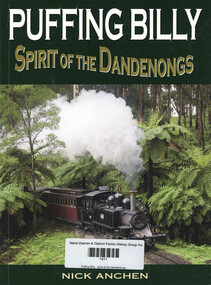
Book, Nick Anchen, Puffing Billy : spirit of the Dandenongs, 2017
... steam train is one of the great Australian stories. The history, preservation and current operation of the Puffing Billy Railway. A detailed description of the Puffing Billy train journey, including information on local history, fauna and flora. Technical details of locomotives ...The Puffing Billy Railway is a genuine living museum, part of the original Victorian Railways branch line which operated for fifty three years between Upper Ferntree Gully and Gembrook. The quaint little train became in institution of the Dandenongs, and the closure of the line in 1954 caused a public outcry. The salvation and continuing operation of Australia’s best-loved steam train is one of the great Australian stories. The history, preservation and current operation of the Puffing Billy Railway. A detailed description of the Puffing Billy train journey, including information on local history, fauna and flora. Technical details of locomotives, rolling stock and other associated equipment. An extensive photographic gallery featuring over 200 b&w and colour images.108 p.; 24 cm non-fiction The Puffing Billy Railway is a genuine living museum, part of the original Victorian Railways branch line which operated for fifty three years between Upper Ferntree Gully and Gembrook. The quaint little train became in institution of the Dandenongs, and the closure of the line in 1954 caused a public outcry. The salvation and continuing operation of Australia’s best-loved steam train is one of the great Australian stories. The history, preservation and current operation of the Puffing Billy Railway. A detailed description of the Puffing Billy train journey, including information on local history, fauna and flora. Technical details of locomotives, rolling stock and other associated equipment. An extensive photographic gallery featuring over 200 b&w and colour images. puffing billy railway, dandenongs -
 Puffing Billy Railway
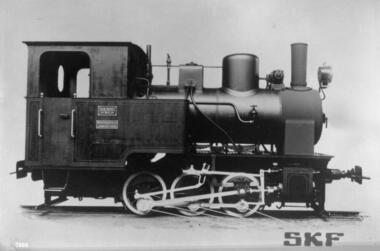
Steam Locomotive, Orenstein & Koppel 0-6-0 Well Tank 2'6" Gauge, 1931
... locomotive fleet at the Sub Nigel Gold Mines Ltd, South Africa. No.3 was obtained by the Puffing Billy Preservation Society and imported to Australia in the early 1970s. It arrived at the museum on 30th Jan 1973. It has since been displayed at the Puffing Billy Museum, Menzies Creek. Details from http://www.australiansteam.com/ok12331.htm Donated by Gold Fields Property Co. Ltd South Africa in 1973. Historic - Industrial Narrow Gauge railway - Steam ...Sub Nigel Gold Mines No. 3 Wheels: 0-6-0 WT Builder: Orenstein & Koppel Build Date: June 1931 Construction No.: 12331 Empty Weight: 10 tons 7 cwt Weight in working order: 12 I/2 tons Driver Diameter: Unknown Tractive Effort: Unknown Boiler Pressure: 185 lbs Cylinders: Unknown Fuel: Coal Gauge: 2 ft 6 in (760mm) Builders Number 12331 Used to haul gold bearing ore from mine to reduction works at the Sub Nigel Mine at Dunnattar, Transvaal, South Africa. It was the first locomotive fitted by roller bearings by SKF and featured in the SKF catalogue at the time. This interesting 0-6-0WT locomotive was built by Orenstein & Koppel in 1931 as their builder's number 12331, becoming No.3 in the locomotive fleet at the Sub Nigel Gold Mines Ltd, South Africa. No.3 was obtained by the Puffing Billy Preservation Society and imported to Australia in the early 1970s. It arrived at the museum on 30th Jan 1973. It has since been displayed at the Puffing Billy Museum, Menzies Creek. Details from http://www.australiansteam.com/ok12331.htm Donated by Gold Fields Property Co. Ltd South Africa in 1973. Historic - Industrial Narrow Gauge railway - Steam Locomotive with SKF Roller bearings - used at the Sub Nigel Mine at Dunnattar, Transvaal, South Africa. Steam Locomotive - Steel (Painted) The Sub Nigel Ltd / 12331 puffing billy, steam, locomotive, orenstein, koppel, sub nigel mine, skf roller bearings, sub nigel no. 3 -
 Puffing Billy Railway
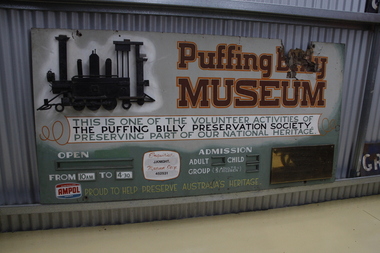
Sign - Puffing Billy Museum Entry
... locomotives and other railway features offered items to the Museum. When interesting exhibits from the "Steam Era " were known to be coming available,discussions were held with the owners in an attempt to obtain the item for preservation. ...locomotives and other railway features offered items to the Museum. When interesting exhibits from the "Steam Era " were known to be coming available,discussions were held with the owners in an attempt to obtain the item for preservation. ...The Museum was first considered in 1963 when it was felt that Victorian narrow gauge railway history was quickly being destroyed by progress. Originally it was planned to only cater for two locomotives and some rolling stock associated with the Moe and Walhalla Railway. Construction of the site commenced on Labour Day Weekend in March 1964, the area was then fenced. The first exhibit arrived soon after and companies with locomotives and other railway features offered items to the Museum. When interesting exhibits from the "Steam Era " were known to be coming available,discussions were held with the owners in an attempt to obtain the item for preservation. In 1965 an Umbrella style shed was built and by May, the first locomotive ex Erica State Saw Mill (CLIMAX) had arrived. The Museum was opened to the public in November 1970 but was officially opened by His Excellency the Governor of Victoria, Sir Rohan Delacombe on Saturday 7th April 1973. Historic - Puffing Billy Museum Entry Sign Puffing Billy Museum Entry Sign Rectangular hand painted sign in use from 1970. Puffing Billy Museum This is one of the Volunteer activities of The Puffing Billy Preservation Society Preserving part of our National Heritage Proud to Help Preserve Australia's Heritage puffing billy, menzies creek, sir rohan delacombe, narrow gauge, steam -
 Puffing Billy Railway
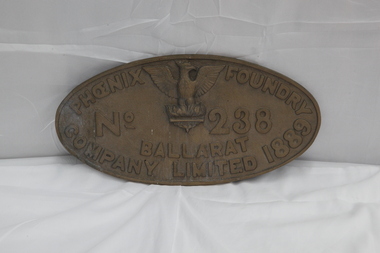
Phoenix Foundry Plate
... They were inevitably superseded by more modern and powerful steam locomotives and a number cascaded into shunting and yard pilot duties, often with the addition of shunters steps along both locomotive and tender. Y 112 was one of the last in service when withdrawn in 1961. Fortunately it was saved for preservation...They were inevitably superseded by more modern and powerful steam locomotives and a number cascaded into shunting and yard pilot duties, often with the addition of shunters steps along both locomotive and tender. Y 112 was one of the last in service when withdrawn in 1961. Fortunately it was saved for preservation ...Phoenix Foundry Plate - replica Made about 2010 cast off original from locomotive Y112 The Phoenix Foundry (1857-1906) fabricated iron and brass products - including engines and pumping gear for the mining industry, locomotives, steam rollers, water pipes, water gauges and diverse small items. Throughout its operation the business was located at premises on Armstrong Street, Ballarat . Background In 1852, at the age of thirty-three and after a year of operating his own engineering business at Williamstown, Lancashire-born blacksmith and engineer George Threlfall (1819-1897) arrived on the Sebastopol gold plain and immediately undertook blacksmith work repairing picks and tools for the miners. Little did he know that this fledgling business would be the genesis of the most iconic business of nineteenth-century Ballarat. At approximately thirty-nine years of age, English mechanical engineer Richard Carter (c1814-1883) came to Australia on board the Arrogant - arriving in Melbourne on 19 April 1853. He soon travelled to the Ballarat goldfields. Born in the year 1830 in Belfast (Ireland), mechanical engineer William Henry Shaw (1830-1896) arrived in Australia in October 1853. He worked briefly with George Threlfall at Sebastopol, then moved to Geelong to manage the small foundry of Frederick Moore. Twenty-four year old English-born iron moulder Robert Holden (c1831-?) left his home in Belfast (Ireland) in late 1854 and travelled from Liverpool to Melbourne on board the James Baines - arriving in February 1855. Afterwards he joined his brother-in-law William Henry Shaw in Ballarat. History Foundation to Incorporation In March 1857 George Threlfall joined in business with Richard Carter, William Henry Shaw and Robert Holden. They relocated Threlfall's successful engineering enterprise from Sebastopol to new premises in Armstrong Street, Ballarat. This business was then known variously as the Phoenix Iron Works Company, Phoenix Foundry or Messrs Carter and Co. By 15 April 1857 they were advertising that they were open for business as engineers, millwrights, boiler makers, smiths, iron founders and brass founders. In January 1858 George Threlfall left the partnership. Incorporation to 1889 1890 to Closing locomotive Y112 Builder: Phoenix Foundry, Ballarat Builder’s Number & Year: 238 of 1889 Designer: Kitson & Co Wheel Arrangement: 0-6-0 No. in class: 31 Entered Service: 24 July 1889 Taken off Register: 11 May 1961 The origins of the Victorian Railways Y-class lay with the decision by Kitson & Co, Leeds to place a 0-6-0 freight locomotive on display at the Centennial International Exhibition, Melbourne in 1888, together with a 2-4-2T suburban passenger locomotive. This marketing initiative proved successful as the Victorian Railways were clearly impressed with these machines, with both purchased after the exhibition and becoming the patterns for new standard locomotive types. Thirty examples of the 0-6-0 heavy freight design were ordered from the Phoenix Foundry, Ballarat, becoming the Y-class for main line heavy freight duties, while the 2-4-2T design became the E-class for Melbourne suburban passenger duties (represented by preserved locomotive E 236). The Y-class prove successful in service and accrued high mileages. They were inevitably superseded by more modern and powerful steam locomotives and a number cascaded into shunting and yard pilot duties, often with the addition of shunters steps along both locomotive and tender. Y 112 was one of the last in service when withdrawn in 1961. Fortunately it was saved for preservation and plinthed in central Ballarat, ostensibly in commemoration of Phoenix Foundry. I understand it is owned by the Sovereign Hill Museums Association. During the 1980’s, Y 112 was leased to Steamrail Victoria and restored to operation at an industrial site in Ballarat. Y 112 features an attractive lined apple green livery and has performed various rail tours around Victoria since restoration. It is normally based at the Steamrail depot in Ballarat East. Y 112 is the only 19th century design in operational condition in Victoria and as such is one of the oldest working steam locomotive in Victoria . Historic - Phoenix Foundry Plate - replica Made about 2010 cast off original from locomotive Y112 Phoenix Foundry Plate Oval shaped plate with an image of a phoenix centered at the top with lettering surrounding it. Phoenix Foundry No 238 Ballarat Company Limited 1889. puffing billy, phoenix foundry, ballarat, locomotive y112, phoenix foundry plate - replica -
 Puffing Billy Railway
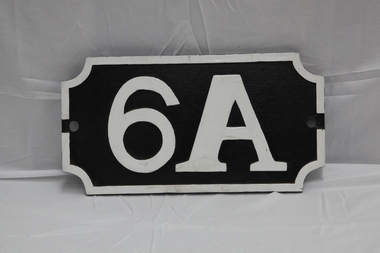
Number Plate - 6A, 2010
... Historic - Replica Victorian Railways Locomotive Number Plate of the type used on Steam Locomotive 6A in the later 40's and 50's created for the preservation society's reenactment trains in 2012 for the 50 year celebration of reopening to Menzies Creek. puffing billy menzies creek 6a number plate 6A Number Plate 6A Cast aluminum replica number board. ...Replica of a Victorian Railways replacement number board that 6A carried in the later 40's and 50's. This plate was created for the preservation society's reenactment trains in 2012 for the 50 year celebration of reopening to Menzies Creek. Loco: 6A In service Thursday, 18th July 1901 Livery Green Owner Puffing Billy Gauge 762 Status Preserved - Operational 6A Built in 1901 and painted two-tone green, this locomotive was issued to the Colac to Beech Forest line and was used in that line’s construction. Over the years, it saw service on all four lines, but mostly on the Colac to Crowes and Upper Fern Tree Gully to Gembrook lines. It was temporarily withdrawn from service in 1958 and returned to service at Belgrave in 1962 for the reopening of this line where it saw almost continuous service until being withdrawn in 1983. It has been restored, as far as possible, to its original condition with original design side tanks, low bunker, original size windows, etc., but a steel cow-catcher in place of the original style wooden one. It also has its original colour scheme of two-tone green with white lining. Historic - Replica Victorian Railways Locomotive Number Plate of the type used on Steam Locomotive 6A in the later 40's and 50's created for the preservation society's reenactment trains in 2012 for the 50 year celebration of reopening to Menzies Creek. Number Plate 6A Cast aluminum replica number board. 6A puffing billy, menzies creek, 6a, number plate -
 Puffing Billy Railway
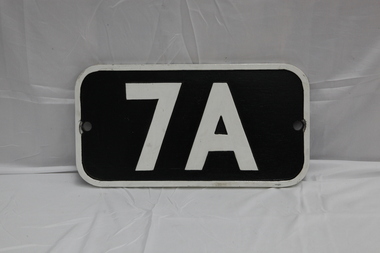
7A Number Plate
... Historic - Replica Victorian Railways Locomotive Number Plate of the type used on Steam Locomotive 7A in the later 40's and 50's created for the preservation society's reenactment trains in 2012 for the 50 year celebration of reopening to Menzies Creek puffing billy 7a number plate 7A Number Plate 7A Rectangular black and white number plate. ...Replica of a Victorian Railways replacement number board that 7A carried in the later 40's and 50's. This plate was created for the preservation society's reenactment trains in 2012 for the 50 year celebration of reopening to Menzies Creek. Loco: 7A In service Saturday, 6th May 1905 Livery Maroon Owner Puffing Billy Gauge 762 Status Preserved - Operational 7A Built in 1905 and painted Canadian red & dark brown, this locomotive was issued to the Wangaratta to Whitfield line and saw service on all four lines with most of its service on the Upper Fern Tree Gully to Gembrook line. It was temporarily withdrawn from service in 1958 and returned to service at Belgrave in 1962 for the reopening of this line where it has seen almost continuous service since. 1979 saw the early two-tone green colour scheme applied to this loco as a trial even though it never historically carried it, but its physical configuration was not altered accordingly. It is now painted its original livery of Canadian red & dark brown and will eventually be returned, as far a possible, to its original condition with a low bunker, narrow ash-chute, etc. Historic - Replica Victorian Railways Locomotive Number Plate of the type used on Steam Locomotive 7A in the later 40's and 50's created for the preservation society's reenactment trains in 2012 for the 50 year celebration of reopening to Menzies Creek Number Plate 7A Rectangular black and white number plate. Cast aluminum replica number board. 7A puffing billy, 7a, number plate -
 Puffing Billy Railway
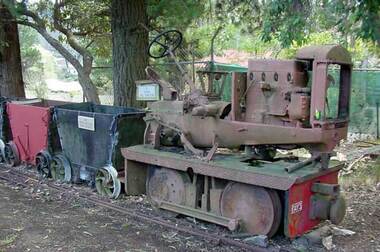
Day's Petrol Rail Tractor, Petrol Rail Tractor Gauge 2'0", circa 1926 - 1940
... Today, only two survive, a complete example at the Puffing Billy Railway Museum at Menzies Creek, and one at Alexandra Timber Tramway Museum This 2-ft gauge 4wPM locomotive is believed to have been one of two Day's Petrol Rail tractors formerly used by Cheetham Salt, possibly at the Moolap works near Geelong. Service History :owned by Cheetham Salt, Moolap ( dates unknown ) Geelong Steam Preservation Society , Belmont 1973 ? ...Today, only two survive, a complete example at the Puffing Billy Railway Museum at Menzies Creek, and one at Alexandra Timber Tramway Museum This 2-ft gauge 4wPM locomotive is believed to have been one of two Day's Petrol Rail tractors formerly used by Cheetham Salt, possibly at the Moolap works near Geelong. Service History :owned by Cheetham Salt, Moolap ( dates unknown ) Geelong Steam Preservation Society , Belmont 1973 ? ...Rail tractors were popular with Victorian sawmillers. They were generally cheaper than a steam locomotive, required no special qualifications to drive, and used proven power plants for which spares were available locally. The tractor was constructed by Day’s Engineering of South Melbourne which, although better known for its pumping equipment, built more than fifty rail tractors for Victorian sawmillers and other industrial tramway users. W. Day & Sons is believed to have constructed its first light railway locomotive in 1926. From then until the mid 1940s, the firm appears to have built at least fifty locomotives at its premises in South Melbourne, of which roughly half were four-wheel locomotives and roughly half were six-wheel locomotives like the restored Day’s rail tractor formerly operated by Ruoak Timbers. Of the four-wheel locomotives, ten were 2-ft (610mm) gauge locomotives similar to this one. Today, only two survive, a complete example at the Puffing Billy Railway Museum at Menzies Creek, and one at Alexandra Timber Tramway Museum This 2-ft gauge 4wPM locomotive is believed to have been one of two Day's Petrol Rail tractors formerly used by Cheetham Salt, possibly at the Moolap works near Geelong. Service History :owned by Cheetham Salt, Moolap ( dates unknown ) Geelong Steam Preservation Society , Belmont 1973 ? Puffing Billy Steam Museum , Menzies Creek Historic - Industrial Narrow gauge Railway - Rail Tractor used by Cheetham Salt Company works at Laverton, Moolap and Geelong, Victoria , Australia Petrol Rail Tractor made of Iron , wrought iron, steel puffing billy, industrial narrow gauge railway, rail tractor, days engineering, cheetham salt,, petrol rail tractor -
 Puffing Billy Railway
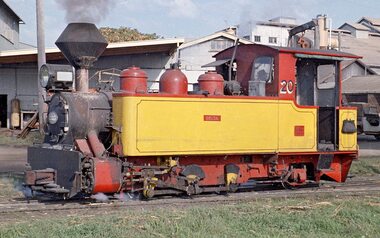
Tank Locomotive, 0-6-2 T No.1 "Delta", 1950
... steam locomotives, which worked in the canefields of Queensland until 1978. “DELTA” worked at various sugar mills in the Bundaberg area and was finally withdrawn from service at Quanba Mill after a life of 28 years. Obtained by the Puffing Billy Preservation...steam locomotives, which worked in the canefields of Queensland until 1978. “DELTA” worked at various sugar mills in the Bundaberg area and was finally withdrawn from service at Quanba Mill after a life of 28 years. Obtained by the Puffing Billy Preservation ...0-6-2 Tank Locomotive No.1 "Delta" Gauge 2'0" Identification: 1 Delta Type: 0-6-2T Builder: Perry Engineering, Mile End, South Australia Builder's number: Perry 7967.50.4 of 1950 Building date: 1950 Current status - Static Exhibit Wheel Arrangement 0-6-2T Cylinders (Diameter X Stroke) 10 inches X 18 inches Boiler Pressure 180 psi Driving Wheel (Dia.) 28 ½ inches Weight 16 tons Coal Capacity 27 cubic feet Water Capacity 500 gallons The Perry Engineering Co, Mile End, South Australia built a total of 18 locomotives for the 2’0” gauge tramways used by the sugar industry in Queensland. This 0-6-2T locomotive was built by Perry Engineering Co. Ltd. of Mile End, Adelaide as their Builder's No. 7967.50.4 of 1950. It was used at Qanaba Mill, Bundaberg where it was known as No.1 "Delta". / Qanaba Mill No.1 No. 1 “DELTA” 0-6-2 TANK LOCOMOTIVE Gauge: 2 foot Built by Perry Engineering Company of South Australia in 1950 (Builder’s number 7967.50.4), “DELTA” is a medium sized Australian designed locomotive featuring Walschaert’s valve gear driving piston valves. Weighing 16 tons (16.3 tonnes) it was one of the post-war narrow gauge steam locomotives, which worked in the canefields of Queensland until 1978. “DELTA” worked at various sugar mills in the Bundaberg area and was finally withdrawn from service at Quanba Mill after a life of 28 years. Obtained by the Puffing Billy Preservation Society in 1981. Delivered to Australian Estates Co., Kalamia Mill named DELTA in 1950. Purchased by Fairymead Mill as No 20 DELTA. Purchased by Millaquin Sugar for Qanaba Mill as No. 1 DELTA, 1970 Withdrawn from service, 1978. Obtained by Puffing Billy Preservation Society for display at the Puffing Billy Museum. Historic - Industrial Narrow Gauge Railway - Steam Locomotive used in Queensland in Sugar Mill service. Locomotive No.1 "Delta" - Steam Locomotive - made of steel, and wrought iron Delta 0-6-2 tank locomotive no.1 "delta" perry engineering - puffing billy railway perry 7967.50.4 of 1950, puffing billy, qunaba sugar mill, bundaberg, perry engineering, delta, steam locomotive, 0-6-2 tank locomotive no.1 -
 Puffing Billy Railway
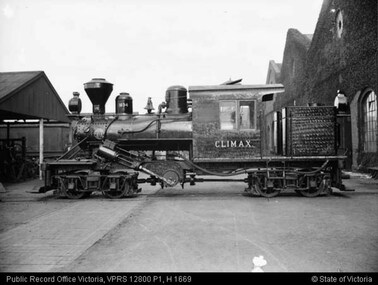
Climax - Geared Steam Locomotive No. 1694, 1928
... This locomotive was withdrawn from service in 1949 following the closure of the tramway and in 1950 it travelled from Tyers Junction to Collins Siding to Erica where it remained stored until 1965. Loaned to the Puffing Billy Preservation Society for its Steam...This locomotive was withdrawn from service in 1949 following the closure of the tramway and in 1950 it travelled from Tyers Junction to Collins Siding to Erica where it remained stored until 1965. Loaned to the Puffing Billy Preservation Society for its Steam ...Climax geared locomotive No. 1694 in active service on special occasions - stored at Emerald Station A Miraculous Survivor Climax locomotive No.1694 is a miraculous survivor of a rare breed of steam locomotive. For about 100 years from the mid-1850s sawn timber was carted from Victorian sawmills to the nearest railway station by timber tramway. These tramways were generally very rough, steeply graded, sharply curved, and of narrow gauge. Many had wooden rails, and horses provided haulage. The better ones used steam locomotives. In all about fifty steam locomotives are known to have worked on Victorian timber tramways. These locomotives were usually somewhat peculiar - made to cope with arduous, rough conditions, rather than speed. Climax locomotive No.1694 is the only one of these locomotives to survive intact. It was built in 1928 by the Climax Manufacturing Company, Corry, Pennsylvania, USA, for the Forests Commission of Victoria. The distinctive feature of the Climax locomotive is that the cylinders do not directly connect to the driving wheels. Instead they drive a cross shaft near the centre of the locomotive. From there the drive is transmitted to the small driving wheels through rotating shafts, universal joints, and bevel gears. The driving wheels are mounted in two four-wheel bogies so that they can easily follow sharp curves in the track. None of these features are found in normal steam locomotives. The result is a locomotive that is extremely powerful for its size, and that will cope with sharp curves and steep grades with ease. But this is at the cost of speed, Climax locomotive No.1694 is just about flat-out at 13 km/h (8 mph). Climax Locomotive Built in 1928 for the Forests Commission of Victoria and painted all-over black with the name CLIMAX painted on the sides of the cab in white block letters, this locomotive was issued to the Tyers Valley tramway which branched off the Moe to Walhalla line at Collins Siding. This locomotive was withdrawn from service in 1949 following the closure of the tramway and in 1950 it travelled from Tyers Junction to Collins Siding to Erica where it remained stored until 1965. Loaned to the Puffing Billy Preservation Society for its Steam Museum, it was taken to Menzies Creek in 1965 where it remained until 1982 when the Emerald Tourist Railway Board bought it and transferred it to Belgrave for restoration. It was returned to service for special use on the Belgrave to Gembrook line in 1988 painted in its original all-over black livery, except that the word “Climax” on the sides of the cab was now painted in the style of the Climax Manufacturing Co., a style that this locomotive had never carried. Historical - Industrial railway - Forests Commission of Victoria, Timber Logging Climax Locomotive Climax geared Steam locomotive made of steel and wrought iron Climax 1694 climax locomotive works, climax, geared steam locomotive, puffing billy, climax locomotive no. 1694, steam locomotive -
 Puffing Billy Railway
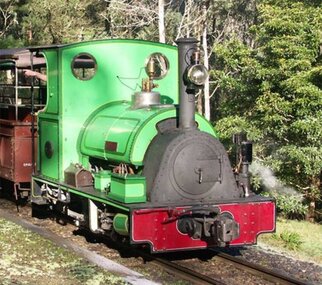
Peckett, 1711 Peckett Steam Locomotive, 1926
... locomotive was named “Sir John Grice” in 1928. It was withdrawn from traffic in 1941 and stored until sold privately in 1962. In 1965 it was sold again and went to the Whistle Stop Amusement Park in Frankston and again stored until bought at auction by the Puffing Billy Preservation Society in 1974 and put on static display in the Steam Museum. ...locomotive was named “Sir John Grice” in 1928. It was withdrawn from traffic in 1941 and stored until sold privately in 1962. In 1965 it was sold again and went to the Whistle Stop Amusement Park in Frankston and again stored until bought at auction by the Puffing Billy Preservation Society in 1974 and put on static display in the Steam Museum. ...Steam Locomotive - 1711 Peckett “Sir John Grice” Date built - 1926 Locomotive type ; Cranmore Original owner - Metropolitan Gas Coy., West Melbourne Original gauge - 762mm Withdrawn - 1941 Next owner - Whistle Stop Amusement Park, Frankston Built in 1926 for the West Melbourne site of the Metropolitan Gas Company, and issued to traffic the same year this saddle tank locomotive was named “Sir John Grice” in 1928. It was withdrawn from traffic in 1941 and stored until sold privately in 1962. In 1965 it was sold again and went to the Whistle Stop Amusement Park in Frankston and again stored until bought at auction by the Puffing Billy Preservation Society in 1974 and put on static display in the Steam Museum. Restoration started in 1978 and it was returned to service in 1981 painted light green with yellow lining. It is temporarily renamed “Thomas the Tank Engine” with a fibreglass “Thomas” body cover each time it appears in the “Thomas the Tank Engine” shows at Gembrook station. Historic - Industrial Narrow Gauge Railway - Steam Locomotive used at the Metropolitan Gas Coy., West Melbourne, Victoria, Australia Steam Locomotive made of steel, wrought iron Peckett peckett “sir john grice”, 1711 peckett, puffing billy, steam locomotive, industrial narrow gauge railway, metropolitan gas coy., west melbourne -
 Surrey Hills Historical Society Collection
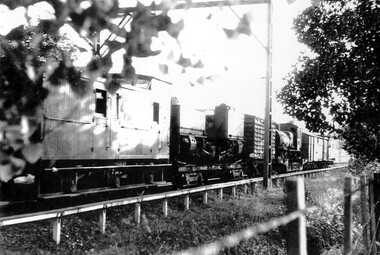
Photograph, Narrow Gauge Garratt Loco G 42 being transferred through Surrey Hills to Belgrave
... steam locomotive...Puffing Billy Preservation Society...Steam Locomotive was one of two heavier more powerful locomotives that operated on Victoria's narrow gauge railways. These Beyer Garratt locomotives were built in Manchester, England and delivered in 1926. They were numbered G41 and G42. They operated on the Colac–Beech Forest–Crowes line and the Moe–Walhalla line respectively. After the line from Moe closed in 1954, G42 was sent to Colac, where it worked until closure of that line in mid-1962. At that time the G41 was in poor condition and was scrapped. G42 was offered to the Puffing Billy Preservation... Society. surrey hills trains goods carriages G42 Garratt steam locomotive Puffing Billy Preservation Society Victorian Railways A black and white photocopy of a goods train and carriages. ...The G42 Garratt Steam Locomotive was one of two heavier more powerful locomotives that operated on Victoria's narrow gauge railways. These Beyer Garratt locomotives were built in Manchester, England and delivered in 1926. They were numbered G41 and G42. They operated on the Colac–Beech Forest–Crowes line and the Moe–Walhalla line respectively. After the line from Moe closed in 1954, G42 was sent to Colac, where it worked until closure of that line in mid-1962. At that time the G41 was in poor condition and was scrapped. G42 was offered to the Puffing Billy Preservation Society. A black and white photocopy of a goods train and carriages. surrey hills, trains, goods carriages, g42 garratt steam locomotive, puffing billy preservation society, victorian railways -
 Wodonga & District Historical Society Inc
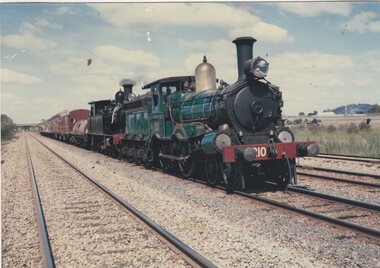
Photograph - Fred Rochow Railways Collection - Locomotives 1210 and 3112 waiting to cross, 15 October 1988
... Locomotive 1210 continued in use until 1958 when it was finally withdrawn from service. The NSW Steam Tram and Preservation Society appealed to the National Capital Development Commission (NCDC) and the NSW Railways to assist in the locomotive's preservation. ...Locomotive 1210 continued in use until 1958 when it was finally withdrawn from service. The NSW Steam Tram and Preservation Society appealed to the National Capital Development Commission (NCDC) and the NSW Railways to assist in the locomotive's preservation. ...The Fred Rochow Railways Collection incorporates photos related to the operation of the Wodonga Railway Station including different types of trains and railways staff C. 1930 – 1990. It was donated to the Wodonga Historical Society by Fred Rochow, a railwayman who spent many years based in Wodonga. He joined the Victorian Railways on 17th June l947 and retired in 1988. For some time, he was a member of the Australian Federated Union of Locomotive Enginemen and served a term as a member of the Trades Hall Council. He had an extensive knowledge of the struggles that took place to achieve better conditions for railway workers. Fred worked for many years as a fireman and then worked his way up the ranks to driver, experiencing many changes from the days of steam locomotives through to diesel trains, locomotives and even the modern XPT train. He worked throughout Victoria at different stages of his career, with his final working years focused on the northeast of Victoria and the Albury to Melbourne line. After his retirement, Fred continued to share his love of steam miniature trains with the community. This collection has local and statewide significance as it captures images of trains, locomotives and personnel who operated the railway services in Wodonga and throughout Northeast Victoria. The railways played a critical role in opening up Victoria and connecting Australia for trade, business, social communication and transport. This locomotive was built in 1878 by Beyer Peacock & Co, Manchester, England. It arrived in Sydney on August 19, 1878 and began its working life as No 120 of C[79] class on the southern and western lines of NSW in September that year. On 24 May 1914, when the new branch line to Canberra was completed, the locomotive unofficially opened the track by pulling the first train to the construction site of the national capital. The engine was given the new number 1210 in the 1923 re-classification of NSW engines. Locomotive 1210 continued in use until 1958 when it was finally withdrawn from service. The NSW Steam Tram and Preservation Society appealed to the National Capital Development Commission (NCDC) and the NSW Railways to assist in the locomotive's preservation. As a result of the Society's appeal the locomotive was purchased by the NCDC for 800 pounds. The locomotive was relocated to the Canberra Railway Museum in 1984. It was restored with funds received from the Australian Bicentennial Authority. It was a requirement of the Bicentennial Authority Grant that the engine be operational. The locomotive was re-commissioned by the Member for Canberra, the Hon Ros Kelly, on 19 September 1988. As part of the Australian Bicentennial celebrations Locomotive 1210 attended the AusSteam '88 event in Melbourne, travelling south in the company with Locomotive 3112. It is claimed by the Australian Railway Historical Society that No 1210 is the oldest operational main line steam locomotive in the world. On front of locomotive "1210" railways wodonga, fred rochow, locomotive 1210 -
 Victorian Railway History Library
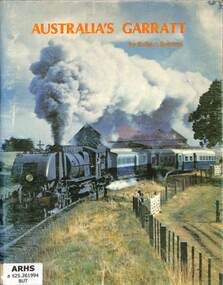
Book, Butrims, Robert, Australia's Garratt, 1975
... Locomotives -- Australia -- History Australian Standard Garratt locomotive - history A history of the Australian Standard Garratt 4-8-2 2-8-4 steam locomotive. ill, p.72. Australia's Garratt Book Butrims, Robert Geelong Steam Preservation Society Australian Railway Historical Society Victorian Division ...A history of the Australian Standard Garratt 4-8-2 2-8-4 steam locomotive.ill, p.72. non-fiction A history of the Australian Standard Garratt 4-8-2 2-8-4 steam locomotive. locomotives -- australia -- history, australian standard garratt locomotive - history -
 Victorian Railway History Library
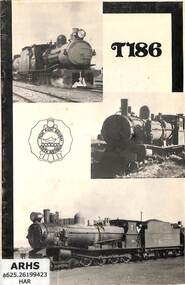
Book, Hart, Hayden, T186, 1976
... Narrow gauge railroads - South Australia - history Preserved locomotives - South Australia - history A history of the narrow gauge 3'6" steam locomotive T186 on the South Australian Government Railways and its preservation by the Pichi Richi Railway at Quorn. ill, p.17 T186 Book Hart, Hayden McNicol, Steve Pichi Richi Railway Preservation Society Inc. ...A history of the narrow gauge 3'6" steam locomotive T186 on the South Australian Government Railways and its preservation by the Pichi Richi Railway at Quorn.ill, p.17 non-fiction A history of the narrow gauge 3'6" steam locomotive T186 on the South Australian Government Railways and its preservation by the Pichi Richi Railway at Quorn. narrow gauge railroads - south australia - history, preserved locomotives - south australia - history -
 Victorian Railway History Library
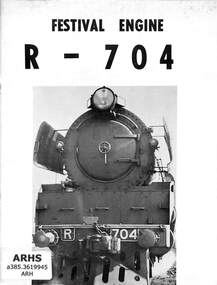
Booklet, Potts, Don, Festival Engine R-704
... steam locomotives - Victoria- history R class locomotive - Victoria - history A history of R704 4-6-4 steam locomotive on the Victorian Railways from introduction to preservation in the ARHS railway museum. ill, p.12. ...A history of R704 4-6-4 steam locomotive on the Victorian Railways from introduction to preservation in the ARHS railway museum.ill, p.12. non-fiction A history of R704 4-6-4 steam locomotive on the Victorian Railways from introduction to preservation in the ARHS railway museum. steam locomotives - victoria- history, r class locomotive - victoria - history -
 Victorian Railway History Library
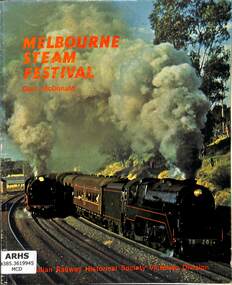
Book, McDonald, Gary, Melbourne Steam Festival, 1973
... railroad preservation - Victoria - history Steam locomotives - Australia - history A pictorial history of the Melbourne Steam Festival at Easter 1973 with the visit of 3801 & 3820 from NSW. ill, p.80. ...A pictorial history of the Melbourne Steam Festival at Easter 1973 with the visit of 3801 & 3820 from NSW.ill, p.80. non-fiction A pictorial history of the Melbourne Steam Festival at Easter 1973 with the visit of 3801 & 3820 from NSW. railroad preservation - victoria - history, steam locomotives - australia - history -
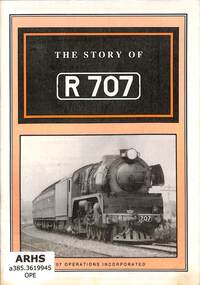 Victorian Railway History Library
Booklet, 707 Operations Incorporated, The Story of R707, 1992
... steam locomotives - Victoria- history R class locomotive - Victoria - history A history of R707 4-6-4 steam locomotive on the Victorian Railways from introduction to preservation in the ARHS railway museum. ill, p.23. ...A history of R707 4-6-4 steam locomotive on the Victorian Railways from introduction to preservation in the ARHS railway museum.ill, p.23. non-fiction A history of R707 4-6-4 steam locomotive on the Victorian Railways from introduction to preservation in the ARHS railway museum. steam locomotives - victoria- history, r class locomotive - victoria - history -
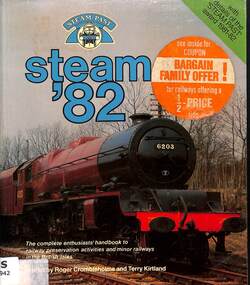 Victorian Railway History Library
Book, Crombleholme, Roger, Steam '82, 1982
... Preserved railways - Great Britain - history Preserved locomotives - Great Britain The complete enthusiast's handbook to railway preservation activities and minor railways in the British Isles with details of the Steam Past award 1981-82. index, ill, maps, p.218. ...The complete enthusiast's handbook to railway preservation activities and minor railways in the British Isles with details of the Steam Past award 1981-82.index, ill, maps, p.218. non-fiction The complete enthusiast's handbook to railway preservation activities and minor railways in the British Isles with details of the Steam Past award 1981-82. preserved railways - great britain - history, preserved locomotives - great britain -
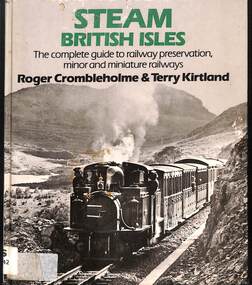 Victorian Railway History Library
Book, Crombleholme, Roger, Steam British Isles: The complete guide to railway preservation, minor and miniature railways, 1985
... Preserved railways - Great Britain - history Preserved locomotives - Great Britain The complete guide to railway preservation activities and minor railways in the British Isles including miniature railways. index, p.208. Steam ...The complete guide to railway preservation activities and minor railways in the British Isles including miniature railways.index, p.208. non-fiction The complete guide to railway preservation activities and minor railways in the British Isles including miniature railways. preserved railways - great britain - history, preserved locomotives - great britain -
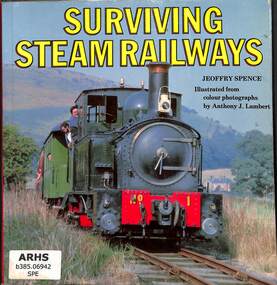 Victorian Railway History Library
Book, Spence, Jeoffry, Surviving Steam Railways, 1979
... Preserved locomotives - Great Britain Railroad preservation - Great Britain - history A guide to the preserved steam locomotives in the United Kingdom. ill, maps, p.64. ...A guide to the preserved steam locomotives in the United Kingdom.ill, maps, p.64. non-fiction A guide to the preserved steam locomotives in the United Kingdom. preserved locomotives - great britain, railroad preservation - great britain - history -
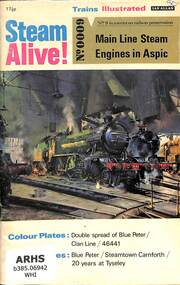 Victorian Railway History Library
Book, Whitehouse, P.B, Steam Alive! No.0009 Mainline Steam Engines in Aspic, 1970
... Preserved locomotives - Great Britain Railroad preservation - Great Britain - history A guide to the preserved steam locomotives in the United Kingdom. ...A guide to the preserved steam locomotives in the United Kingdom. No.9 in a series on railway preservation.ill, p.45. non-fiction A guide to the preserved steam locomotives in the United Kingdom. No.9 in a series on railway preservation. preserved locomotives - great britain, railroad preservation - great britain - history -
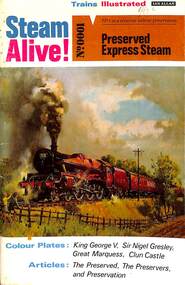 Victorian Railway History Library
Book, Whitehouse, P.B, Steam Alive! No.0001 Preserved Express Steam, 1967
... Preserved locomotives - Great Britain Railroad preservation - Great Britain - history A guide to the preserved express steam locomotives in the United Kingdom. ...A guide to the preserved express steam locomotives in the United Kingdom. No.1 in a series on railway preservation.ill, p.50. non-fiction A guide to the preserved express steam locomotives in the United Kingdom. No.1 in a series on railway preservation. preserved locomotives - great britain, railroad preservation - great britain - history
