
Showing 615 items matching "stranded"
-
 Mission to Seafarers Victoria
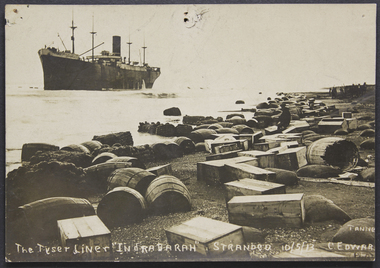
Postcard, The Tyser Liner Indrabarah stranded 10 May 1913 (New Zealand)
... The Tyser Liner Indrabarah stranded 10 May 1913 (New Zealand)...The steamer Indrabarah was stranded for 45+ days on the west coast of the north island of New Zealand, before being successfully towed free during a high spring tide. ...The steamer Indrabarah was stranded for 45+ days on the west coast of the north island of New Zealand, before being successfully towed free during a high spring tide. ...The steamer Indrabarah was stranded for 45+ days on the west coast of the north island of New Zealand, before being successfully towed free during a high spring tide. The cargo (mostly frozen meat) was reported to have survived the ordeal. This card (postcard) with print of Liner Indrabarah -
 Ballarat Tramway Museum
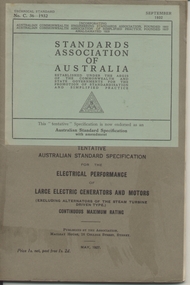
Book, Australian Commonwealth Engineering Standards Association, "Electrical Performance of Large Electric Generators and Motors - Continuous Maximum Rating", "Pressboard for Electrical Purposes", "Hard Drawn copper stranded circular conductors for overhead power transmission purposes", "for Indicating Ammeters, Voltmeters, wattmeters, frequency and power factor meters", "Instrument Transformers", "Liquid Starters for Electric Motors", "Star Delta switch starters for Electric Motors", "Multiple switch starters for Electric Motors", 1926-1933
... "Electrical Performance of Large Electric Generators and Motors - Continuous Maximum Rating", "Pressboard for Electrical Purposes", "Hard Drawn copper stranded circular conductors for overhead power transmission purposes", "for Indicating Ammeters, Voltmeters, wattmeters, frequency and power factor meters", "Instrument Transformers", "Liquid Starters for Electric Motors", "Star Delta switch starters for Electric Motors", "Multiple switch starters for Electric Motors"....1 - Book - 56 pages + grey covers, side stapled, issued by the Australian Commonwealth Engineering Standards Association, Tentative Australian Standard - "Electrical Performance of Large Electric Generators and Motors - Continuous Maximum Rating" - C36-1927, May 1927 with a green label dated September 1932 advised that the tentative standard has been endorsed as a Standard with amendment. .2 - Book - 48 pages + grey covers, side stapled, issued by the Australian Commonwealth Engineering Standards Association, Tentative Australian Standard - "Electrical Performance of Alternators of the Steam Driven Type" - C38-1927 - December 1927 with a green label dated September 1932 advised that the tentative standard has been endorsed as a Standard with amendment. .3 - Book - 32 pages + grey covers, side stapled, issued by the Australian Commonwealth Engineering Standards Association, Tentative Australian Standard - "Electricity Meters" C39-1927, August 1927. .4 - Book - 28 pages + grey covers, side stapled, issued by the Australian Commonwealth Engineering Standards Association, Tentative Australian Standard - "Pressboard for Electrical Purposes" - C40-1927, January 1927. .5 - Book - 24 pages + grey covers, side stapled, issued by the Australian Commonwealth Engineering Standards Association, Tentative Australian Standard - "Hard Drawn copper stranded circular conductors for overhead power transmission purposes" C41-1930, August 1927, with a green label dated October 1932 advised that the tentative standard has been endorsed as a Standard with amendment. .6 - Book - 48 pages + grey covers, side stapled, issued by the Australian Commonwealth Engineering Standards Association, Tentative Australian Standard "for Indicating Ammeters, Voltmeters, wattmeters, frequency and power factor meters" - C42-1927 - December 1927, with a green label dated October 1932 advised that the tentative standard has been endorsed as a Standard with amendment. .7 - Book - 32 pages + grey covers, side stapled, issued by the Australian Commonwealth Engineering Standards Association, Tentative Australian Standard - "Instrument Transformers" - C45-1928, June 1928. .8 - Book - 28 pages + grey covers, side stapled, issued by the Australian Commonwealth Engineering Standards Association, Australian Standard "Liquid Starters for Electric Motors" C46-1927, December 1927. .9 - Book - 20 pages + grey covers, side stapled, issued by the Australian Commonwealth Engineering Standards Association, Australian Standard "Star Delta switch starters for Electric Motors" C47-1927, December 1927. .10 - Book - 24 pages + grey covers, side stapled, issued by the Australian Commonwealth Engineering Standards Association, Australian Standard "Multiple switch starters for Electric Motors" C48-1927, December 1927. ..."Electrical Performance of Large Electric Generators and Motors - Continuous Maximum Rating", "Pressboard for Electrical Purposes", "Hard Drawn copper stranded circular conductors for overhead power transmission purposes", "for Indicating Ammeters, Voltmeters, wattmeters, frequency and power factor meters", "Instrument Transformers", "Liquid Starters for Electric Motors", "Star Delta switch starters for Electric Motors", "Multiple switch starters for Electric Motors" Book Australian Commonwealth Engineering Standards Association ....1 - Book - 56 pages + grey covers, side stapled, issued by the Australian Commonwealth Engineering Standards Association, Tentative Australian Standard - "Electrical Performance of Large Electric Generators and Motors - Continuous Maximum Rating" - C36-1927, May 1927 with a green label dated September 1932 advised that the tentative standard has been endorsed as a Standard with amendment. .2 - Book - 48 pages + grey covers, side stapled, issued by the Australian Commonwealth Engineering Standards Association, Tentative Australian Standard - "Electrical Performance of Alternators of the Steam Driven Type" - C38-1927 - December 1927 with a green label dated September 1932 advised that the tentative standard has been endorsed as a Standard with amendment. .3 - Book - 32 pages + grey covers, side stapled, issued by the Australian Commonwealth Engineering Standards Association, Tentative Australian Standard - "Electricity Meters" C39-1927, August 1927. .4 - Book - 28 pages + grey covers, side stapled, issued by the Australian Commonwealth Engineering Standards Association, Tentative Australian Standard - "Pressboard for Electrical Purposes" - C40-1927, January 1927. .5 - Book - 24 pages + grey covers, side stapled, issued by the Australian Commonwealth Engineering Standards Association, Tentative Australian Standard - "Hard Drawn copper stranded circular conductors for overhead power transmission purposes" C41-1930, August 1927, with a green label dated October 1932 advised that the tentative standard has been endorsed as a Standard with amendment. .6 - Book - 48 pages + grey covers, side stapled, issued by the Australian Commonwealth Engineering Standards Association, Tentative Australian Standard "for Indicating Ammeters, Voltmeters, wattmeters, frequency and power factor meters" - C42-1927 - December 1927, with a green label dated October 1932 advised that the tentative standard has been endorsed as a Standard with amendment. .7 - Book - 32 pages + grey covers, side stapled, issued by the Australian Commonwealth Engineering Standards Association, Tentative Australian Standard - "Instrument Transformers" - C45-1928, June 1928. .8 - Book - 28 pages + grey covers, side stapled, issued by the Australian Commonwealth Engineering Standards Association, Australian Standard "Liquid Starters for Electric Motors" C46-1927, December 1927. .9 - Book - 20 pages + grey covers, side stapled, issued by the Australian Commonwealth Engineering Standards Association, Australian Standard "Star Delta switch starters for Electric Motors" C47-1927, December 1927. .10 - Book - 24 pages + grey covers, side stapled, issued by the Australian Commonwealth Engineering Standards Association, Australian Standard "Multiple switch starters for Electric Motors" C48-1927, December 1927. On top right hand corner has the date stamp of the "The Electric Supply Co. of Victoria Ltd Ballarat" trams, tramways, power station, standards, materials, electrical systems -
 Queenscliffe Maritime Museum
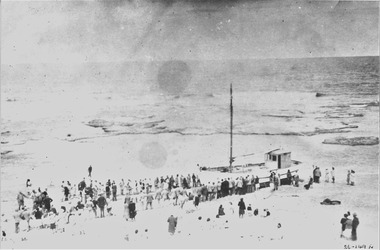
Photograph - JAMES WILLIAM stranded Pt Lonsdale, JAMES WILLIAM beached at Point Lonsdale, 1953
... Black & white photo of the fishing boat JAMES WILLIAM stranded & beached at Point Lonsdale ...Reverse - " The JAMES WILLIAM stranded approx 1/2 mile west of the Pt Lonsdale lighthouse / owner James 'Dugga' Warren, crewman C Zanoni / For date - see L Ferrier / salvaged by jacking up, putting cradle under, 300-400 people pulled her up under dunes, on planking tracks and rollers / 3 weeks later used the same procedure to launch her into sea...JAMES WILLIAM fishing boat beached stranded JAMES WILLIAM historical references fishing boat stranded & beached JAMES WILLIAM Reverse - " The JAMES WILLIAM stranded approx 1/2 mile west of the Pt Lonsdale lighthouse / owner James 'Dugga' Warren, crewman C Zanoni / For date - see L Ferrier / salvaged by jacking up, putting cradle under, 300-400 people pulled her up under dunes, on planking tracks and rollers / 3 weeks later used the same procedure to launch her into sea. " Black & white photo of the fishing boat JAMES WILLIAM stranded & beached at Point Lonsdale JAMES WILLIAM beached at Point Lonsdale Photograph JAMES WILLIAM stranded Pt Lonsdale ...JAMES WILLIAM fishing boat beachedstranded JAMES WILLIAMBlack & white photo of the fishing boat JAMES WILLIAM stranded & beached at Point Lonsdale Reverse - " The JAMES WILLIAM stranded approx 1/2 mile west of the Pt Lonsdale lighthouse / owner James 'Dugga' Warren, crewman C Zanoni / For date - see L Ferrier / salvaged by jacking up, putting cradle under, 300-400 people pulled her up under dunes, on planking tracks and rollers / 3 weeks later used the same procedure to launch her into sea. "historical references, fishing boat, stranded & beached, james william -
 Phillip Island and District Historical Society Inc.
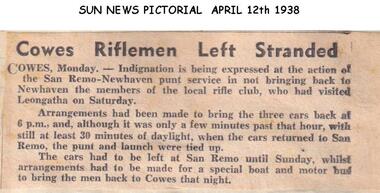
Newspaper clippings, 12/04/1938
... Article on how Cowes Riflemen were stranded at Newhaven....Sun News Pictorial on 12/4/1938. local history documents newspapers cowes riflemen phillip island black & white newspaper clipping Article on how Cowes Riflemen were stranded at Newhaven. Newspaper clippings ...Article on stranding of Cowes Riflemen at San Remo when Punt stopped running. Sun News Pictorial on 12/4/1938.Article on how Cowes Riflemen were stranded at Newhaven.local history, documents, newspapers, cowes riflemen, phillip island, black & white newspaper clipping -
 Phillip Island and District Historical Society Inc.
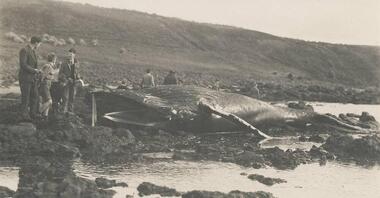
Photograph, Whale carcass Cat Bay
... Photograph of stranded whale at Cat Bay with school children examining it. ...One of a collection of over 400 photographs in an album commenced in 1960 and presented to the Phillip Island & Westernport Historical Society by the Shire of Phillip Island local history photography stranded whale black & white photograph wild life whales coastline cat bay John Jenner Bryant West cowes primary school Photograph of stranded whale at Cat Bay with school children examining it. ...Students were from Cowes State School. One of those students was Helen Forrest who believes it was in 1948. One of a collection of over 400 photographs in an album commenced in 1960 and presented to the Phillip Island & Westernport Historical Society by the Shire of Phillip IslandPhotograph of stranded whale at Cat Bay with school children examining it. local history, photography, stranded whale, black & white photograph, wild life, whales, coastline, cat bay, john jenner, bryant west, cowes primary school -
 Lakes Entrance Historical Society
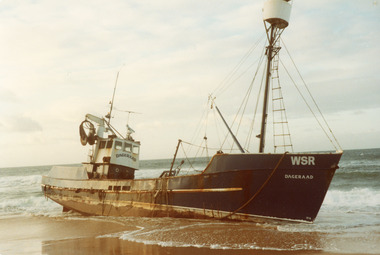
Photograph - Dageraad, 1981
... Colour photograph of the fishing boat Dageraad stranded on the beach at Lakes Entrance, Victoria....Boats and Boating Fishing Industry Disasters Colour photograph of the fishing boat Dageraad stranded on the beach at Lakes Entrance, Victoria. ...Colour photograph of the fishing boat Dageraad stranded on the beach at Lakes Entrance, Victoria.boats and boating, fishing industry, disasters -
 Bendigo Historical Society Inc.
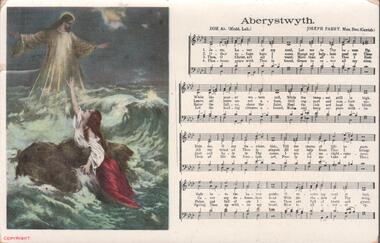
Postcard - POSTCARD. ABERYSTWTH, 1935
... Christmas and new year wishes. Photo of girl stranded in wild waters. Reaching to the Lord above for assistance....Christmas and new year wishes. Photo of girl stranded in wild waters. Reaching to the Lord above for assistance. ...Postcard. Christmas and new year wishes. Photo of girl stranded in wild waters. Reaching to the Lord above for assistance. -
 8th/13th Victorian Mounted Rifles Regimental Collection
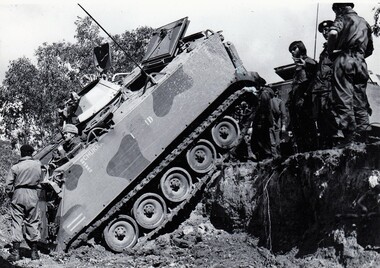
Photograph
... Black and white photograph of M113 Light Reconnaissance Vehicle ( LRV ) stranded in an anti tank ditch during training. ...Driver : trooper Grundy " Black and white photograph of M113 Light Reconnaissance Vehicle ( LRV ) stranded in an anti tank ditch during training. ...Incidents of this kind occurred as crewmen tested the limits of their vehicle.The 8th/13th Victorian Mounted Rifles was raised as a regiment of the Royal Australian Armoured Corps on 1 May 1948 with Headquarters in Melbourne and squadrons in Sale, Benalla/Wangaratta and Albury. In 1955 Regimental Headquarters moved to Wangaratta and a second squadron was located at Albury. The Sale squadron transferred to 4th/19th Prince of Wales’s Light Horse. In 1977 8/13 VMR Regiment was reduced to an independent squadron A Squadron 8th/13th Victorian Mounted Rifles and in 1991 was linked with 4th/19th Prince of Wales’s Light Horse forming the VMR Squadron of that regiment.Black and white photograph of M113 Light Reconnaissance Vehicle ( LRV ) stranded in an anti tank ditch during training. " M113 in a awkward position. Driver : trooper Grundy " -
 Embroiderers Guild, Victoria
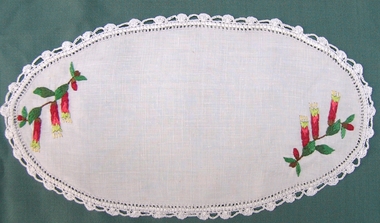
Textile - Geoff Riley Design Correa Doyley, Mr Geoff Riley, 1940-60
... Oval doyley, cream linen embroidered Correa flowers in surface stitchery using stranded cotton, crochet edge. ...Embroidery Surface stitchery Mats 1940-60 Australia Geoff Riley Oval doyley, cream linen embroidered Correa flowers in surface stitchery using stranded cotton, crochet edge. Textile Geoff Riley Design Correa Doyley Mr Geoff Riley ...Mr Geoff Riley was a designer who produced a number of these types of designs, many were embroidered by his wife Betty Riley as samples. See supp. file.Oval doyley, cream linen embroidered Correa flowers in surface stitchery using stranded cotton, crochet edge. embroidery, surface stitchery, mats, 1940-60, australia, geoff riley -
 Orbost & District Historical Society
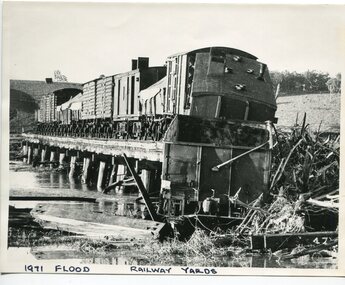
black and white photograph, February 1971
... A large black / white photograph of flooded railway yards with a train engine stranded on a small section of track surrounded by water and debris....It is connected to the history of the railway in East Gippsland. floods-1971-orbost orbost-railway natural-disasters-orbost on front - "1971 Flood, Railway Yards" A large black / white photograph of flooded railway yards with a train engine stranded on a small section of track surrounded by water and debris. black and white photograph ...The 1971 flood was the the worst flood on record. At Jarrahmond it was at least 11 metres and up to one and a half kilometres wide on the flats causing enormous damage to the flood plain. Records say that "The brown floodwater stain in Bass Strait could be seen from passing airliners." Considerable damage was done to railway infrastructure, roads and farms. More information from the APRIL, 2008 newsletter by John Phillips. (see orbosthistory.com.au) The railway line was destroyed and was not expected to be opened for a fortnight. Orbost was cut off by 50 square miles of Snowy River floodwater. This train was being shunted across the viaduct when waters smashed through washing away several trucks sending the crew running for their lives.This is pictorial evidence of a significant local event. It is connected to the history of the railway in East Gippsland.A large black / white photograph of flooded railway yards with a train engine stranded on a small section of track surrounded by water and debris.on front - "1971 Flood, Railway Yards"floods-1971-orbost orbost-railway natural-disasters-orbost -
 Peterborough History Group
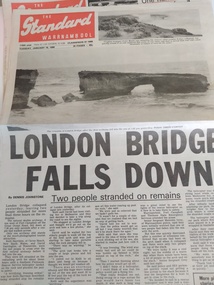
Newspaper, London Bridge Falls Down, 16th January 1990
... Two full page articles about the rock formation London Bridge falling down, and the people who were stranded on the rock platform...The rockfall occurred after two recent events - a helicopter hit the arch and crashed, no one injured; and the earthquake in Newcastle NSW. london bridge london bridge rock formation rock collapse great ocean road peterborough Two full page articles about the rock formation London Bridge falling down, and the people who were stranded on the rock platform London Bridge Falls Down Newspaper Warrnambool Standard ...The collapse of one arch of the London Bridge rock formation on January 15th 1990 was a significant event for Peterborough residents.London Bridge is a major local tourist attraction. Prior to the collapse tourists could walk across the arches onto the rock platform and it was a regular fishing spot. The collapse of the arch was a significant event for the town. The site is still an important tourist stop. The rockfall occurred after two recent events - a helicopter hit the arch and crashed, no one injured; and the earthquake in Newcastle NSW.Two full page articles about the rock formation London Bridge falling down, and the people who were stranded on the rock platformlondon bridge, london bridge rock formation, rock collapse, great ocean road, peterborough -
 Flagstaff Hill Maritime Museum and Village
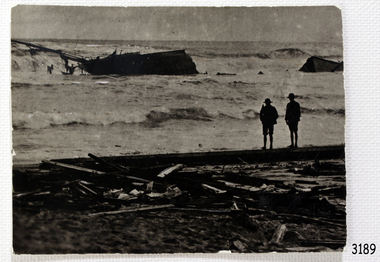
Photograph - Photograph of Edinburgh Castle' stranded and wrecked at Lady Bay, circa 1888
... A distress signal was sent to the coastal steamer “Julia Percy”, which spent several hours trying to pull the stranded ship away, but it would not budge. ...Black and white photograph of the iron barque 'Edinburgh Castle' stranded and wrecked at Lady Bay, Warrnambool, on January 15th 1888. ...Photograph Photograph of Edinburgh Castle' stranded and wrecked at Lady Bay. ...This photograph was taken close to the time of the wreck of the "Edinburgh Castle". The “Edinburgh Castle”, three-masted iron barque, was built in Glasgow, Scotland, in 1863 by J.G. Lawrie. She was 53.7 meters long and weighed 627 tons. She was owned by shipping company T Skinner and Co and registered at Liverpool, England. She sailed from 1863 to 1885 along the trade route between Scotland, China, and Singapore. In 1887 the Master, Captain J.B. Darling, sailed the “Edinburgh Castle” for its new owners Gifford & Nicholson from London to Warrnambool. Her cargo was 4,900 casks of cement for the construction of the new Warrnambool Breakwater. Over the three month journey, the ship met with rough weather and even a hurricane. On January 15th 1888 the “Edinburgh Castle” approached Lady Bay where a welcoming crowd gathered. The Port’s relief Harbour Master, Pilot Carless took over to complete the docking. As he tried to guide her, the Lighthouse Keeper signalled that the ship was too close to shore. The pilot continued on his course, causing her to ‘miss stays’ (make an incorrect tack). The crew dropped anchors and tried to lighten the load by throwing some of the casks of cement overboard but this was to no avail, and she drifted sideways in calm waters, lodging in the sand. A distress signal was sent to the coastal steamer “Julia Percy”, which spent several hours trying to pull the stranded ship away, but it would not budge. Those involved hoped to re-float the ship but efforts to save the vessel were useless. The captain and some crew stayed on board. When the weather became rough the rocket crew brought its lifesaving gear to the shore, ready to launch a line to the ship. The three men on board sent those onshore a message in a bottle to assure the on-lookers that they were quite comfortable to stay aboard. After a night of bad weather, the crew were glad to accept the rocket crew’s help and were in turn safely hauled to shore in a breeches buoy. The ship broke up quickly. Very little of the cargo could be saved. A week later all that could be seen of her was the bow and some of the stern. The beach was littered with wreckage, including cement cask fragments, for weeks. Ironically, on the morning after the ship ran aground, the very same “Edinburgh Castle” was offered for sale at an auction in Melbourne, billed as “a sound ship with all the fittings and in the best order.” The sale was completed before they heard the news that the ship was totally wrecked! Over the decades the shifting sands concealed the wreck of “Edinburgh Castle”. However, in October 1985 two local divers, Peter Ronald and Colin Goodall discovered her near the Hopkins River mouth. Peter said in his book ‘Exploring Shipwrecks of Western Victoria’, “In the midst of this sand-cloud I could clearly see row after row of neatly stacked barrels”. He remarked, “I am privileged to have had at least a glimpse of one of Warrnambool's most significant wrecks.” Some 15 – 17 ships are believed to have sunk in Lady Bay, but only two have been discovered on the seafloor; the “Edinburgh Castle” and the “La Bella”. Both wrecks are popular diving sites and are preserved as significant historical marine and marine archaeological sites. The sailing ship “Edinburgh Castle” is of local and state and national significance. It is one of the only two shipwrecks discovered in Lady Bay, Warrnambool, out of the 15-17 shipwrecks in the bay. The “Edinburgh Castle” is significant for being one of the largest vessels lost in the bay. The significance of the wreck of the “Edinburgh Castle” was recognised by being listed on the Victorian Heritage Database VHR S209. She was declared an Historic Shipwreck on 17th January 1989 under the Commonwealth Historic Shipwrecks Act (1976). The “Edinburgh Castle” wreck is also significant for the connection of its cargo with the building of the Warrnambool Breakwater, also listed on the Victorian Heritage Database VHR H2024. The “Edinburgh Castle” is included as one of the shipwrecks in Heritage Victoria’s Historic Shipwreck Trail on Victoria’s West Coast. Black and white photograph of the iron barque 'Edinburgh Castle' stranded and wrecked at Lady Bay, Warrnambool, on January 15th 1888. The photograph shows wreckage along the shore and two standing figures looking on.flagstaff hill, warrnambool, shipwrecked-coast, flagstaff-hill, flagstaff-hill-maritime-museum, maritime-museum, shipwreck-coast, flagstaff-hill-maritime-village, great ocean road, edinburgh castle barque 1863, edinburgh castle shipwreck 1888, shipwreck 15-05-1888, glasgow ship, jg lawrie, t skinner and co, liverpool ship register, captain j.b. darling, gifford & nicholson, cement casks, cement barrels, warrnambool breakwater construction, breaches buoy, rocket crew, rocket launcher, lifesaving equipment, warrnambool harbour, lady bay warrnambool, ship pilot carless, lady bay shipwreck, peter ronald, colin goodall, lady bay diving site, marine archaeology, victorian heritage register, vhr s209 -
 Embroiderers Guild, Victoria
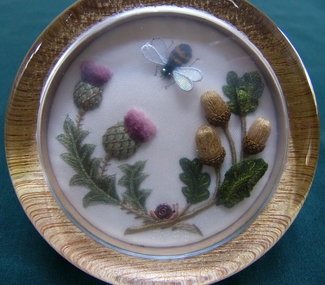
Functional Object - Stumpwork Paperweight Jane Nicholas, Jane Nicholas, Stumpwork Paperweight "Thistles and Acorns", 1993
... Raised embroidery on heavy cream satin, mainly stranded cotton, depicting thistles, acorns, a snail and a bee....Raised embroidery on heavy cream satin, mainly stranded cotton, depicting thistles, acorns, a snail and a bee. ...Jane Nicholas - designer/maker. Teacher of stumpwork embroidery.Glass paper weight, wooden base. Raised embroidery on heavy cream satin, mainly stranded cotton, depicting thistles, acorns, a snail and a bee.J.N. 93embroidery, stumpwork, small articles, 1980-2000, australia, paperweight -
 Queenscliffe Maritime Museum
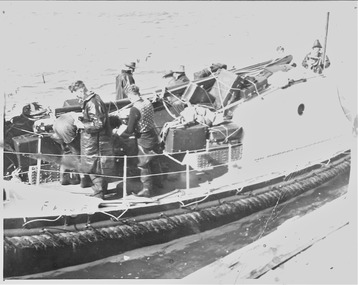
Photograph - Black & white photograph TIME crew being rescued, TIME crew on board LB Queenscliffe, unknown
... Reverse - " Lifeboat Queenscliffe taking crew of(f) [wreck] stranded SS TIME. Ran on to Corsair Reefs, steering failed / Port Phillip Heards August 1949 "...Rescue of crew off SS TIME wreck historical references SS TIME wreck Reverse - " Lifeboat Queenscliffe taking crew of(f) [wreck] stranded SS TIME. Ran on to Corsair Reefs, steering failed / Port Phillip Heards August 1949 " Black & white photo of some of the crew off the TIME on board the LB Queenscliffe TIME crew on board LB Queenscliffe Photograph Black & white photograph TIME crew being rescued ...ship wreck, SS TIME, lifeboat Queenscliffe, rescue crew.Rescue of crew off SS TIME wreckBlack & white photo of some of the crew off the TIME on board the LB QueenscliffeReverse - " Lifeboat Queenscliffe taking crew of(f) [wreck] stranded SS TIME. Ran on to Corsair Reefs, steering failed / Port Phillip Heards August 1949 "historical references, ss time wreck -
 Embroiderers Guild, Victoria
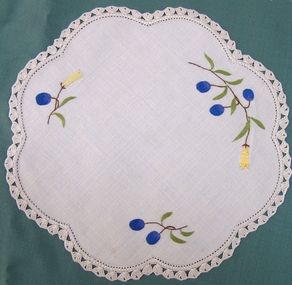
Textile - Geoff Riley Design Floral Doyley, Mr Geoff Riley, 1940-60
... Deep blue berries and yellow flowers of the Apple berry, surface stitchery in stranded cotton. ...Deep blue berries and yellow flowers of the Apple berry, surface stitchery in stranded cotton. Textile Geoff Riley Design Floral Doyley Mr Geoff Riley ...Mr Geoff Riley was a designer who produced a number of Australiana type designs, many were embroidered by his wife Betty Riley as samples. See Supp. file.Circular doyley, cream linen with scalloped edge trimmed with crochet. Deep blue berries and yellow flowers of the Apple berry, surface stitchery in stranded cotton. embroidery, surface stitchery, mats, 1940-60, australia -
 Lakes Entrance Historical Society
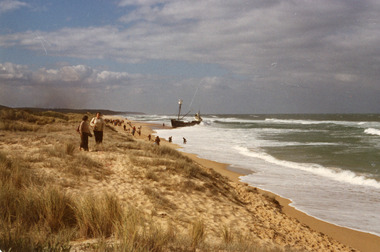
Photograph - Dageraad Lakes Entrance Victoria 1981
... Colour photograph showing view of the stranded fishing vessel Dagaraad which ran aground on the 90 mile beach. ...Vessel went aground 26 April 1981 Ships and Shipping Shipwrecks Media Coast Fishing Industry Colour photograph showing view of the stranded fishing vessel Dagaraad which ran aground on the 90 mile beach. ...Vessel went aground 26 April 1981Colour photograph showing view of the stranded fishing vessel Dagaraad which ran aground on the 90 mile beach. Many people on beach. Lakes Entrance Victoriaships and shipping, shipwrecks, media, coast, fishing industry -
 Flagstaff Hill Maritime Museum and Village
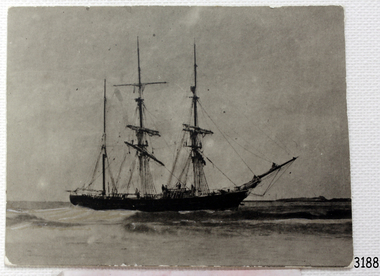
Photograph, circa 1888
... A distress signal was sent to the coastal steamer “Julia Percy”, which spent several hours trying to pull the stranded ship away, but it would not budge. ...Black and white photograph of the iron barque 'Edinburgh Castle' on breaking waves, land in the background. The ship was stranded and wrecked in Lady Bay, Warrnambool, on January 15th 1888. ...A distress signal was sent to the coastal steamer “Julia Percy”, which spent several hours trying to pull the stranded ship away, but it would not budge. ...This photograph was taken close to the time of the wreck of the "Edinburgh Castle". The “Edinburgh Castle”, three-masted iron barque, was built in Glasgow, Scotland, in 1863 by J.G. Lawrie. She was 53.7 meters long and weighed 627 tons. She was owned by shipping company T Skinner and Co and registered at Liverpool, England. She sailed from 1863 to 1885 along the trade route between Scotland, China, and Singapore. In 1887 the Master, Captain J.B. Darling, sailed the “Edinburgh Castle” for its new owners Gifford & Nicholson from London to Warrnambool. Her cargo was 4,900 casks of cement for the construction of the new Warrnambool Breakwater. Over the three month journey, the ship met with rough weather and even a hurricane. On January 15th 1888 the “Edinburgh Castle” approached Lady Bay where a welcoming crowd gathered. The Port’s relief Harbour Master, Pilot Carless took over to complete the docking. As he tried to guide her, the Lighthouse Keeper signalled that the ship was too close to shore. The pilot continued on his course, causing her to ‘miss stays’ (make an incorrect tack). The crew dropped anchors and tried to lighten the load by throwing some of the casks of cement overboard but this was to no avail, and she drifted sideways in calm waters, lodging in the sand. A distress signal was sent to the coastal steamer “Julia Percy”, which spent several hours trying to pull the stranded ship away, but it would not budge. Those involved hoped to re-float the ship but efforts to save the vessel were useless. The captain and some crew stayed on board. When the weather became rough the rocket crew brought its lifesaving gear to the shore, ready to launch a line to the ship. The three men on board sent those onshore a message in a bottle to assure the on-lookers that they were quite comfortable to stay aboard. After a night of bad weather, the crew were glad to accept the rocket crew’s help and were in turn safely hauled to shore in a breeches buoy. The ship broke up quickly. Very little of the cargo could be saved. A week later all that could be seen of her was the bow and some of the stern. The beach was littered with wreckage, including cement cask fragments, for weeks. Ironically, on the morning after the ship ran aground, the very same “Edinburgh Castle” was offered for sale at an auction in Melbourne, billed as “a sound ship with all the fittings and in the best order.” The sale was completed before they heard the news that the ship was totally wrecked! Over the decades the shifting sands concealed the wreck of “Edinburgh Castle”. However, in October 1985 two local divers, Peter Ronald and Colin Goodall discovered her near the Hopkins River mouth. Peter said in his book ‘Exploring Shipwrecks of Western Victoria’, “In the midst of this sand-cloud I could clearly see row after row of neatly stacked barrels”. He remarked, “I am privileged to have had at least a glimpse of one of Warrnambool's most significant wrecks.” Some 15 – 17 ships are believed to have sunk in Lady Bay, but only two have been discovered on the seafloor; the “Edinburgh Castle” and the “La Bella”. Both wrecks are popular diving sites and are preserved as significant historical marine and marine archaeological sites. The sailing ship “Edinburgh Castle” is of local and state and national significance. It is one of the only two shipwrecks discovered in Lady Bay, Warrnambool, out of the 15-17 shipwrecks in the bay. The “Edinburgh Castle” is significant for being one of the largest vessels lost in the bay. The significance of the wreck of the “Edinburgh Castle” was recognised by being listed on the Victorian Heritage Database VHR S209. She was declared an Historic Shipwreck on 17th January 1989 under the Commonwealth Historic Shipwrecks Act (1976). The “Edinburgh Castle” wreck is also significant for the connection of its cargo with the building of the Warrnambool Breakwater, also listed on the Victorian Heritage Database VHR H2024. The “Edinburgh Castle” is included as one of the shipwrecks in Heritage Victoria’s Historic Shipwreck Trail on Victoria’s West Coast. Black and white photograph of the iron barque 'Edinburgh Castle' on breaking waves, land in the background. The ship was stranded and wrecked in Lady Bay, Warrnambool, on January 15th 1888. Figures are standing on deck. The masts are free from sails.flagstaff hill, warrnambool, shipwrecked-coast, flagstaff-hill, flagstaff-hill-maritime-museum, maritime-museum, shipwreck-coast, flagstaff-hill-maritime-village, great ocean road, edinburgh castle barque 1863, edinburgh castle shipwreck 1888, shipwreck 15-05-1888, glasgow ship, jg lawrie, t skinner and co, liverpool ship register, captain j.b. darling, gifford & nicholson, cement casks, cement barrels, warrnambool breakwater construction, breaches buoy, rocket crew, rocket launcher, lifesaving equipment, warrnambool harbour, lady bay warrnambool, ship pilot carless, lady bay shipwreck, peter ronald, colin goodall, lady bay diving site, marine archaeology, victorian heritage register, vhr s209 -
 Embroiderers Guild, Victoria
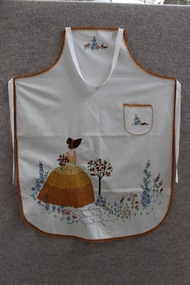
Domestic Object - 1930's Crinoline Lady Embroidered Apron, Mell Egan, 1930-1940
... Cream calico heavily embroidered in stranded threads depicting a crinoline lady in a garden. ...Embroidery Apron Lady Yellow Cream calico heavily embroidered in stranded threads depicting a crinoline lady in a garden. ...Placed into the care of June Broadstock and passed on to Alison Sudholz, the donor.Cream calico heavily embroidered in stranded threads depicting a crinoline lady in a garden. Dress is in shades of yellow to orange, brown hat with red flowers. Orange crocheted edge.embroidery, apron, lady, yellow -
 Embroiderers Guild, Victoria
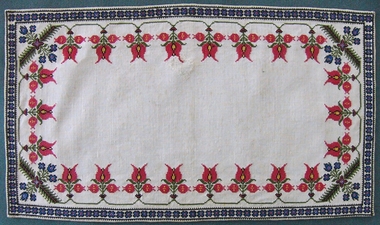
Textile - German Cross Stitch Mat, Mrs Gretchen Fuiche, 1940
... Cross stitch mat in red, blue and green design. Stranded cotton, the stylised tulip design appears to be a traditional German design (refer to 1151 which has an identical design)...Mat was embroidered by the donor's aunt - Mrs Gretchen Fuiche from a design she obtained in Germany in 1939 Embroidery Cross stitch Mats 1920-40 Germany Cross stitch mat in red, blue and green design. Stranded cotton, the stylised tulip design appears to be a traditional German design (refer to 1151 which has an identical design) Textile German Cross Stitch Mat Mrs Gretchen Fuiche ...Mat was embroidered by the donor's aunt - Mrs Gretchen Fuiche from a design she obtained in Germany in 1939Cross stitch mat in red, blue and green design. Stranded cotton, the stylised tulip design appears to be a traditional German design (refer to 1151 which has an identical design)embroidery, cross stitch, mats, 1920-40, germany -
 Embroiderers Guild, Victoria
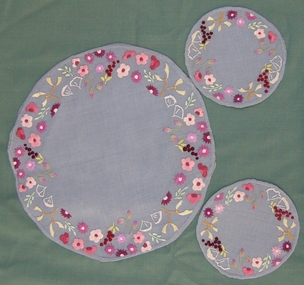
Textile - Floral Embroidery Dressing Table Set, Mrs Elma Wright, 1950's
... Each has a circle of flowers in surface embroidery in stranded cotton in shades of burgundy and pink....Each has a circle of flowers in surface embroidery in stranded cotton in shades of burgundy and pink. ...These were worked by Mrs Elma Wright before she joined the Guild.Set of three round mats (1 large, 2 small) in blue, grey linen. Each has a circle of flowers in surface embroidery in stranded cotton in shades of burgundy and pink.embroidery, surface stitchery, mats, 1840-60, australia -
 Embroiderers Guild, Victoria
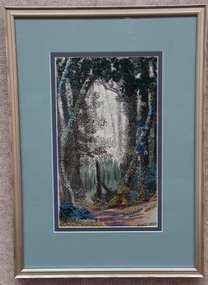
Artwork, other - Framed Picture, Edith Mildred (Mim) Egan, 'The Last of the Forest', 1990
... Painted background on cotton twill, worked in wool and stranded threads....Painted background on cotton twill, worked in wool and stranded threads. 'The Last of the Forest' Artwork, other Framed Picture Edith Mildred (Mim) Egan ...Hand embroidered picture displaying forest scene. Stitches used - needlelace, french lace, straight stitches, single chain. Painted background on cotton twill, worked in wool and stranded threads."The Last of the Forest"picture -
 Embroiderers Guild, Victoria
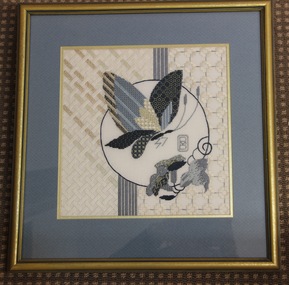
Artwork, other - Picture, Pam Breukhaven, Late 20th early 21st century
... A butterfly worked on white canvas in shades of blue and gold stranded cotton metalic threads mostly in satin stitch. ...Pam made this picture as a result of a class in Dookie in 2003 Designed by Betty Chen Lewis Embroidery Picture Butterflies Satin stitch Gold A butterfly worked on white canvas in shades of blue and gold stranded cotton metalic threads mostly in satin stitch. ...Pam made this picture as a result of a class in Dookie in 2003 Designed by Betty Chen LewisA butterfly worked on white canvas in shades of blue and gold stranded cotton metalic threads mostly in satin stitch. Blue mount edged in gold. Gold frame.Blue threads may be fine wool.embroidery, picture, butterflies, satin stitch, gold -
 Lakes Entrance Historical Society
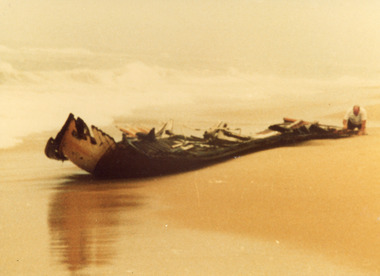
Photograph - Keith Bryce with St John Star wreck near Lakes Entrance, Victoria. 1981, Bryce, Anne
... Colour photograph showing Keith Bryce inspecting the remains of the wrecked St John Star which became stranded in fog fourteen kilometres east of Lake Tyers, near Lakes Entrance, Victoria....Date made 13 August 1981 Fishing Industry Ships and Shipping Shipwrecks Colour photograph showing Keith Bryce inspecting the remains of the wrecked St John Star which became stranded in fog fourteen kilometres east of Lake Tyers, near Lakes Entrance, Victoria. ...Date made 13 August 1981Colour photograph showing Keith Bryce inspecting the remains of the wrecked St John Star which became stranded in fog fourteen kilometres east of Lake Tyers, near Lakes Entrance, Victoria.fishing industry, ships and shipping, shipwrecks -
 Embroiderers Guild, Victoria
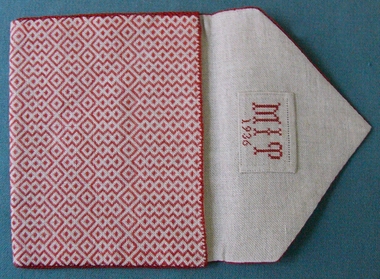
Textile - Kogin Japanese Pattern Darning Sachet, 1936
... Natural evenweave linen with an overall design of pattern darning using red stranded cotton. Lined with same linen. Front flap tapers to a point. ...Embroidery Bags 1960-80 Australia Darning MIT 1963 Natural evenweave linen with an overall design of pattern darning using red stranded cotton. Lined with same linen. Front flap tapers to a point. ...Worked by donor after her trip to Japan in 1965 and described by her in the News sheet No. 38 June. A Japanese embroidery called Kogin.Natural evenweave linen with an overall design of pattern darning using red stranded cotton. Lined with same linen. Front flap tapers to a point. Edged in red, knotted and wrapped stitching (Antwerp).MIT 1963embroidery, bags, 1960-80, australia, darning -
 Embroiderers Guild, Victoria
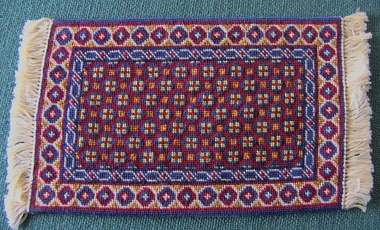
Textile - Miniature Canvas Work Turkish Carpet, Lorna Rice, c. 2000
... Rug is in a geometric design in red, gold, cream, white and blue in petit point stitch in stranded cotton on pale pink mono canvas with fringing....Rug is in a geometric design in red, gold, cream, white and blue in petit point stitch in stranded cotton on pale pink mono canvas with fringing. ...Canvas work replica of Turkish Bergana rug in miniature. Rug is in a geometric design in red, gold, cream, white and blue in petit point stitch in stranded cotton on pale pink mono canvas with fringing.embroidery, canvas work, rug, mat -
 Embroiderers Guild, Victoria
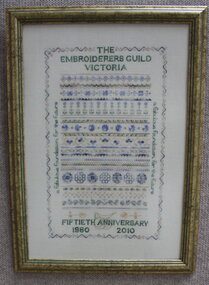
Textile - EGV 50 th Anniversary Sampler, Jan Green, 50 th EGV Anniversary Sampler, 2010
... Sampler on cream evenweave linen stitched with green, blue and peach variegated stranded cotton and metallic thread. Sampler was designed by Guild members for the 50th anniversary of The Embroiderers Guild Victoria. ...Embroidery Sampler Australia The Embroiderers Guild Victoria Fiftieth Anniversary 1960-2010 Sampler on cream evenweave linen stitched with green, blue and peach variegated stranded cotton and metallic thread. Sampler was designed by Guild members for the 50th anniversary of The Embroiderers Guild Victoria. ...Sampler designed by 4 Guild members to celebrate the Guild's 50th Anniversary, Rosemany Tonkin, Jan Green (member), Margaret Freeman and Susan Davies.Sampler on cream evenweave linen stitched with green, blue and peach variegated stranded cotton and metallic thread. Sampler was designed by Guild members for the 50th anniversary of The Embroiderers Guild Victoria. Framed green/gold.The Embroiderers Guild Victoria Fiftieth Anniversary 1960-2010embroidery, sampler, australia -
 Embroiderers Guild, Victoria
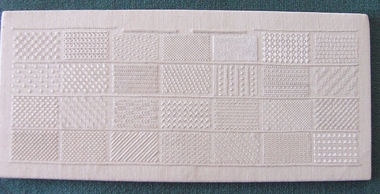
Textile - Royal School of Needlework Whitework Sampler, Miss Elizabeth Lewis, RSN Whitework Sampler, 1940-60
... Cream sampler with counted thread work, probably in stranded cotton or fine linen (52 threads to the inch). ...Embroidery Samplers 1940-60 England White work Cream sampler with counted thread work, probably in stranded cotton or fine linen (52 threads to the inch). ...One of a number of samplers embroidered by the donor's aunt, while she was studying at the Royal School of Needlework. She taught and judged embroidery throughout England.Cream sampler with counted thread work, probably in stranded cotton or fine linen (52 threads to the inch). The sampler is divided into rectangles and each rectangle has a different counted thread pattern. It is mounted on board.embroidery, samplers, 1940-60, england, white work -
 Embroiderers Guild, Victoria
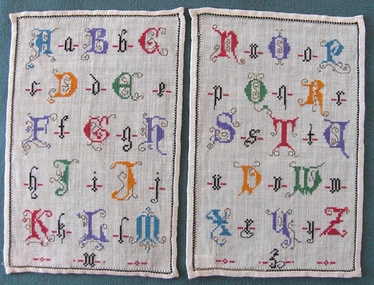
Textile - Alphabet Cross Stitch Sampler, Miss J. Pepperill, 1961
... A variety of coloured stranded cotton and metal or lurex threads. ...A variety of coloured stranded cotton and metal or lurex threads. Two sizes of letters. ...Worked by donor for a display in 1961Elizabethan alphabet letters A to M worked in cross stitch on natural even weave linen. A variety of coloured stranded cotton and metal or lurex threads. Two sizes of letters. The small one in black and red. Hem stitched edge.embroidery, cross stitch, sampler, australia, 1960-80 -
 Flagstaff Hill Maritime Museum and Village
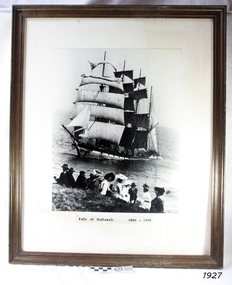
Photograph - Vessel, Sailing Ship, Falls of Halladale 1886 - 1908, 1908
... Image of a group of people seated on the ground with the stranded barque, the Falls of Halladale, in full sail nearby in the water. ...Image of a group of people seated on the ground with the stranded barque, the Falls of Halladale, in full sail nearby in the water. ...The photograph shows some of the hundreds of sightseers who visited the site of the wreced Falls of Halladale, watching the fully rigged ship slowly disintegrate over two months or more. The Falls of Halladale was a four-masted sailing ship built in 1886 in Glasgow, Scotland, for the long-distance cargo trade and was mostly used for the Pacific grain trade. The ship was sturdy. It could carry maximum cargo and maintain full sail in heavy gales. It was one of the last of the ‘windjammers’ that sailed the Trade Route, and one of the first vessels to include fore and aft lifting bridges, which kept the crew safe and dry as they moved around the decks in stormy conditions. It was one of several Falls Line ships named after the waterfalls of Glasgow by its owner, Wright, Breakenridge & Co of Glasgow. On 4th August 1908, with new sails, 29 crew, and 2800 tons of cargo, the Falls of Halladale left New York, bound for Melbourne and Sydney via the Cape of Good Hope. The cargo on board was valued at £35,000. It included 56,763 tiles of American slate roofing tiles, 5,673 coils of barbed wire, 600 stoves, 500 sewing machines, 6,500 gallons of oil, 14,400 gallons of benzene, plumbing iron, 117 cases of crockery and glassware and many other manufactured items. The Falls of Halladale had been at sail for 102 days when, at 3 am on the 14th November 1908, under full sail in calm seas with a six knots breeze behind and misleading fog along the coast, the great vessel rose upon an ocean swell and settled on top of a submerged reef near Peterborough on south-west Victoria’s coast. The ship was jammed on the rocks and began filling with water. The crew launched the two lifeboats and all 29 crew landed safely on the beach over 4 miles away at the Bay of Islands. The postmistress at Peterborough, who kept a watch for vessels in distress, saw the stranding and sent out an alert to the local people. A rescue party went to the aid of the sailors and the Port Campbell rocket crew was dispatched, but the crew had all managed to reach shore safely by the time help arrived. The ship stayed in full sail on the rocky shelf for nearly two months, attracting hundreds of sightseers who watched her slowly disintegrate until the pounding seas and dynamiting by salvagers finally broke her back, and her remains disappeared back into deeper water. The valuable cargo was largely lost, despite two salvage attempts in 1908-09 and 1910. Further salvage operations were made from 1974-1986, during which time 22,000 slate tiles were recovered with the help of 14 oil drums to float them, plus personal artefacts, ship fittings, reams of paper and other items (a list of items held at Flagstaff Hill Maritime Village is included below). The Court of Marine Inquiry in Melbourne ruled that the foundering of the ship was entirely due to Captain David Wood Thomson’s navigational error, not too technical failure of the Clyde-built ship. The shipwreck is a popular site for divers, about 300m off-shore and in 3 – 15m of water. Some of the original cargo can be seen at the site, including pieces of roof slate and coils of barbed wire. ABOUT THE ‘FALLS OF HALLADALE’ (1886 - 1908) Built: in1886 by Russell & Co., Greenock shipyards, River Clyde, Scotland, UK. The company was founded in 1870 (or 1873) as a partnership between Joseph Russell (1834-1917), Anderson Rodger and William Todd Lithgow. During the period 1882-92 Russell & Co., standardised designs, which sped up their building process so much that they were able to build 271 ships over that time. In 1886 they introduced a 3000 ton class of sailing vessel with auxiliary engines and brace halyard winches. In 1890 they broke the world output record. Owner: Falls Line, Wright, Breakenridge & Co, 111 Union Street, Glasgow, Scotland. Configuration: Four-masted sailing ship; iron-hulled barque; iron masts, wire rigging, fore & aft lifting bridges. Size: Length 83.87m x Breadth 12.6m x Depth 7.23m, Gross tonnage 2085 ton Wrecked: the night of 14th November 1908, Curdies Inlet, Peterborough south west Victoria Crew: 29The Falls of Halladale shipwreck is listed on the Victorian Heritage Register (No. S255). It was one of the last ships to sail the Trade Routes. The ship was one of the first vessels to have fore and aft lifting bridges. The wreck is an example of an International Cargo Ship and represents aspects of Victoria’s shipping industry. The wreck is protected as a Historic Shipwreck under the Commonwealth Historic Shipwrecks Act (1976).Photograph, behind glass in a timber frame. Image of a group of people seated on the ground with the stranded barque, the Falls of Halladale, in full sail nearby in the water. The photograph was taken at Peterborough, southwest Victoria, on November 13th 1908. A typed inscription is below the picture.Typed beneath photograph "Falls of Halladale 1886 - 1908"flagstaff hill, maritime museum, maritime village, flagstaff hill maritime museum and village, great ocean road, shipwreck, peterborough, falls of halladale, 1908, barque, scotish, 4-masted, sailing ship, 1886, glasgow, trade, grain trade, cargo, windjammer, fore and aft bridges, falls line, wright, breakenridge & co, american slate, roofing tiles, barbed wire, sewing machines, oil, benzene, port campbell rocket crew, sightseers, salvage, captain david wood thomson, captain thomson, navigational error, clyde-built, russell & co -
 Embroiderers Guild, Victoria
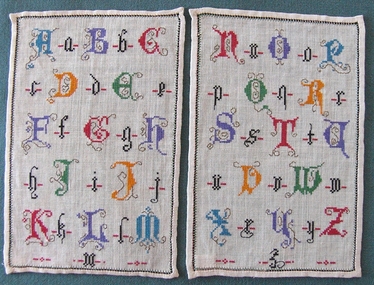
Textile - Alphabet Cross Stitch Sampler, Miss J. Pepperill, 1961
... A variety of coloured stranded cotton and metal/lurex threads. Two sizes of letters. ...A variety of coloured stranded cotton and metal/lurex threads. Two sizes of letters. ...Worked by donor for a display in 1961Elizabethan alphabet - Letters N to Z, worked in cross stitch on natural even weave linen. A variety of coloured stranded cotton and metal/lurex threads. Two sizes of letters. Small letters in black and red only. Hem stitched edge.J.P. 1961 (on back hem)embroidery, sampler, australia, cross stitch, 1960-80
