
Showing 197 items matching "student writing"
-
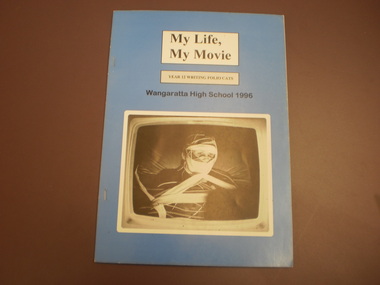 Wangaratta High School
WHS Student Creative writing book, 1996
... WHS Student Creative writing book...Blue stapled book containing a collaboration of 1996 year 12 student creative writing short stories with an image of a bound man in an analogue television screen border on the cover and white boxes with titles reading: ...My Life, My Movie YEAR 12 WRITING FOLIO CATS Wangaratta High School 1996 Blue stapled book containing a collaboration of 1996 year 12 student creative writing short stories with an image of a bound man in an analogue television screen border on the cover and white boxes with titles reading: WHS Student Creative writing book ...Blue stapled book containing a collaboration of 1996 year 12 student creative writing short stories with an image of a bound man in an analogue television screen border on the cover and white boxes with titles reading: My Life, My Movie YEAR 12 WRITING FOLIO CATS Wangaratta High School 1996 -
 Canterbury History Group
Booklet - The Meaning of Anzac Day - A collection of student's writing, Canterbury Primary School, Archives Committee, 2001
... ...Student writing...The students writing on the meaning of Anzac Day...The students writing on the meaning of Anzac Day Canterbury Primary School Anzac Day Student writing World War 1 1914 - 1918 10 x A4 typed pages with a green cover page Booklet The Meaning of Anzac Day - A collection of student's writing Canterbury Primary School, Archives Committee ...The students writing on the meaning of Anzac Day10 x A4 typed pages with a green cover pagecanterbury primary school, anzac day, student writing, world war 1, 1914 - 1918 -
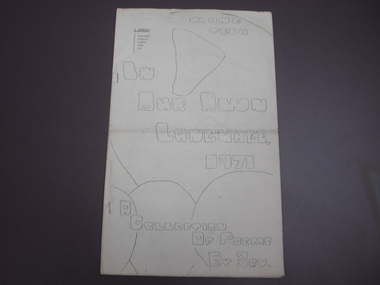 Wangaratta High School
WTS Student Creative writing book, 1971
... WTS Student Creative writing book...A drawing of balloons and text reads: WTS Student Creative writing book ...White stapled booklet containing a collaboration of poems by students of Wangaratta Technical School. A drawing of balloons and text reads: WANG TECH IN OUR LANGUAGE 1971 A COLLECTION OF POEMS BY 3CV -
University of Melbourne, Burnley Campus Archives
Document, Student style manual for writing assignments and research reports, 2000
... Student style manual for writing assignments and research reports...Avery for Institute of Land & Food Resources (Version 1.2) Student style manual for writing assignments and research reports Document ...J.C. Avery for Institute of Land & Food Resources (Version 1.2)style manuals, students, assignments, reports, j.c. avery -
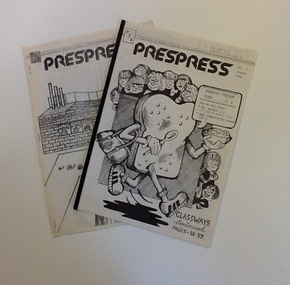 NMIT (Northern Melbourne Institute of TAFE)
School Magazines - PTS, Prespress August 1980, May 1981 (student magazine); Class magazines 1980s, 1980s
... ...student magazines...creative writing...These student produced magazines contain a variety of articles on current events, student creative writing and puzzles. Each magazine represents one 'class' group....The magazines give a student view of PTS in the 1980s. preston technical school pts student magazines creative writing nmit Student written and designed class magazines. ...These student produced magazines contain a variety of articles on current events, student creative writing and puzzles. Each magazine represents one 'class' group.The magazines give a student view of PTS in the 1980s.Student written and designed class magazines. Various coloured covers, cover designs and binding. preston technical school, pts, student magazines, creative writing, nmit, -
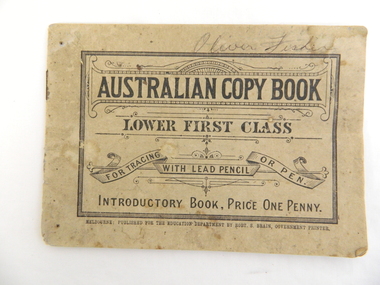 Kiewa Valley Historical Society
Book - Student Exercise Book for Writing, Australian Copy Book / Lower First Class, 2.10.1906 to 2.7.1907
... Book - Student Exercise Book for Writing...A student could be practising his/her writing while the teacher attended to other students and/or classes....Writing surrounded by fancy graphics. Border is thick but not solid black line. Australian Copy Book / Lower First Class Book - Student Exercise Book for Writing Education Department of Victoria ...In 1906 and 1907, students were taught to write with the letters joined. To achieve this booklets were designed to enable the student to copy the example and to repeat this, often to gain perfection. A student could be practising his/her writing while the teacher attended to other students and/or classes.Oliver Fisher lived at Mongan's Bridge a small, remote, rural area in the Kiewa Valley.Soft covered small booklet - grubby blue on back and very faded 'blue' on front with black writing. Held together with 2 staples. "For Tracing with lead pencil or pen. / Introductory Book, Price One penny" Writing surrounded by fancy graphics. Border is thick but not solid black line.Inside book letters have been copied but joined up to practice writing eg. m m m and then mu mu mu Each page is different. On some pages the date has been writteneducation, writing, mongan's bridge, oliver fisher, school -
 NMIT (Northern Melbourne Institute of TAFE)
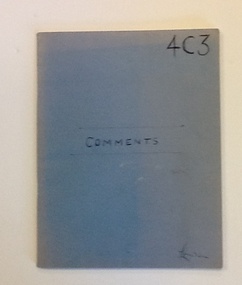
School Report Cards - PTS, Comments: 4C3
... ...report writing...student...An unofficial record of these students, as the final report sent home to parents would be the official record. It is an example of the reord keeping used in the 1960s. preston technical school pts reports report writing student records nmit Written on cover: '4C3 / Comments / [name of teacher] / Lawler?' ...This appears to be a draft copy of half- yearly reports on these students, possibly handed to each teacher to make comments from which the class teacher compiled the final report.An unofficial record of these students, as the final report sent home to parents would be the official record. It is an example of the reord keeping used in the 1960s.Blue exercise book containing hand written reports on each student in class 4C3. Includes thumbnail photograph of each student. Not dated (circa 1960s).Written on cover: '4C3 / Comments / [name of teacher] / Lawler?'preston technical school, pts, reports, report writing, student records, nmit, -
 NMIT (Northern Melbourne Institute of TAFE)
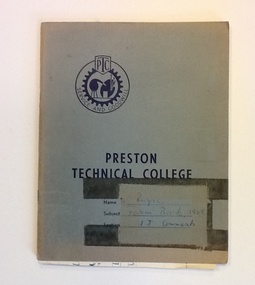
School Report Cards - PTC, Preston Technical College. Form book 1965. Comments: 1J, 1965
... ...report writing...student...An unofficial record of these students, as the final report sent home to parents would be the official record. It is an example of the reord keeping used in the 1960s preston technical college ptc reports report writing student records nmit On front cover: 'W. ...This appears to be a draft copy of half- yearly reports on these students, possibly handed to each teacher to make comments from which the class teacher compiled the final report.An unofficial record of these students, as the final report sent home to parents would be the official record. It is an example of the reord keeping used in the 1960sBlue exercise book with Preston Technical College name and logo on front cover. Handwritten individual class reports throughout, includes a thumbnail photograph of each student.On front cover: 'W. Ruzic / From Book 1965 / 1J Comments"preston technical college, ptc, reports, report writing, student records, nmit, -
 NMIT (Northern Melbourne Institute of TAFE)
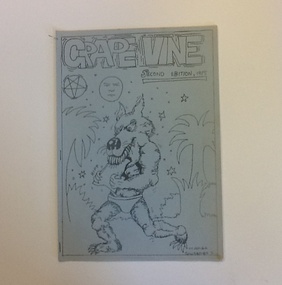
School Magazines - PTS, Grapevine. Second edition 1985, 1985
... ...student magazines...creative writing...A student produced magazine containing articles and puzzles. preston technical school pts student magazines creative writing nmit Photocopied student magazine with pale blue paper cover. ...A student produced magazine containing articles and puzzles.Photocopied student magazine with pale blue paper cover. Contains student-generated articles and puzzles.preston technical school, pts, student magazines, creative writing, nmit, -
NMIT (Northern Melbourne Institute of TAFE)
School Magazines - PTS, Moira's marvels, 1974
... ...student magazines...creative writing...An example of student work. preston technical school pts student magazines creative writing nmit At foot of front cover "To benefit Aboriginal Affairs Fund". ...Student produced magazine from 1974. Contains articles, short stories and puzzles.An example of student work.Student produced magazine. Hand drawn cover. Stapled on left.At foot of front cover "To benefit Aboriginal Affairs Fund".preston technical school, pts, student magazines, creative writing, nmit, -
![Book - Exercise Book, [Exercise book] 1928, 1920s](/media/collectors/4f729f5697f83e03086015b8/items/6087a296983a0c972ac541ac/item-media/6087a3e8983a0c972ac58122/item-fit-380x285.jpg?cb=6) Greensborough Historical Society
Greensborough Historical SocietyBook - Exercise Book, [Exercise book] 1928, 1920s
... An exercise book, containing student writing, essays and poetry, with examples of writing cut from newspapers and pasted into book....An exercise book, containing student writing, essays and poetry, with examples of writing cut from newspapers and pasted into book. ...An exercise book, containing student writing, essays and poetry, with examples of writing cut from newspapers and pasted into book.An example of early 20th century school workStudent's exercise book, 120 p. (approx.). Handwritten exercises inside. Some newspaper clipping pasted in book.Front cover torn.Inside front cover student's name, address and schoolschool books, exercise books, writing -
 Greensborough Historical Society
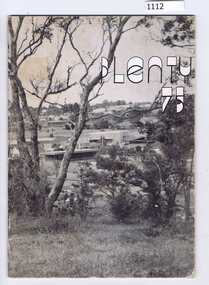
Magazine - School Magazine, Plenty 75, 1975_
... Includes a history of Montmorency High School from 1969, student writing and art....Includes a history of Montmorency High School from 1969, student writing and art. montmorency high school montmorency secondary college Black and white photographs and line drawings Plenty 75 Magazine School Magazine Montmorency High School ...School magazine for Montmorency High School 1975. Includes a history of Montmorency High School from 1969, student writing and art.Black and white photographs and line drawingsmontmorency high school, montmorency secondary college -
 Greensborough Historical Society
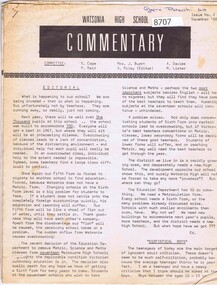
Newsletter - School Newsletter, Watsonia High School, Commentary: Watsonia High School 1966 WaHIGH, 1966_
... Contains editorial comment on school conditions and activities as well as student writing....Contains editorial comment on school conditions and activities as well as student writing. Part of the Glynne Cousins Pietzsch collection of memorabilia from Watsonia High School. ...A school newsletter for and by the students of Watsonia High School. Includes Issue 2, November 1966 and Issue 3, December 1966. Contains editorial comment on school conditions and activities as well as student writing.Part of the Glynne Cousins Pietzsch collection of memorabilia from Watsonia High School. Glynne was a student at Watsonia High in the 1960s.2 editions of Commentary newsletter, 6 pages with articles and black and white images.watsonia high school, school magazines, glynne pietzsch, glynne cousins pietzsch, school newsletters -
 Federation University Historical Collection
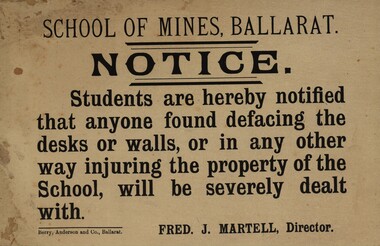
Sign, Frederick J Martell, School of Mines notice, c1895-1912
... Printed card with writing asking students not to deface property...frederick martell ballarat school of mines berry anderson & co notice poster defacing property Printed card with writing asking students not to deface property School of Mines notice Sign Frederick J Martell Berry Anderson & Co. ...Printed card with writing asking students not to deface propertyfrederick martell, ballarat school of mines, berry anderson & co, notice, poster, defacing property -
 Whitehorse Historical Society Inc.
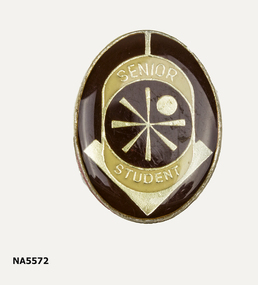
Accessory - Senior Student badge, K.G.Luke
... Oval burgundy with gold writing "Senior Student " badge....Mitcham Technical School Badge Senior student on back K.G. Luke - Melbourne Oval burgundy with gold writing "Senior Student " badge. ...From Captain Badge - Mitcham Technical School.Oval burgundy with gold writing "Senior Student " badge.Senior student on back K.G. Luke - Melbournemitcham technical school, badge -
 Sunshine and District Historical Society Incorporated
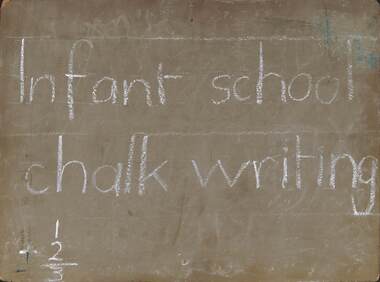
Education kit - Sunvale Primary School Infant Chalk Boards
... These boards were typically used by State & Primary infant students to learn writing. They were lasted used in schools during the 1970s...These boards were typically used by State & Primary infant students to learn writing. They were lasted used in schools during the 1970s Sunvale Primary School Primary School Neil Street Chalk Board 3585.01 - Infant school chalk writing 1 2 3|2505.02 - Sunshine School Display Two chalk boards of different sozes Education kit Sunvale Primary School Infant Chalk Boards ...These boards were typically used by State & Primary infant students to learn writing. They were lasted used in schools during the 1970sTwo chalk boards of different sozes3585.01 - Infant school chalk writing 1 2 3|2505.02 - Sunshine School Displaysunvale primary school, primary school, neil street, chalk board -
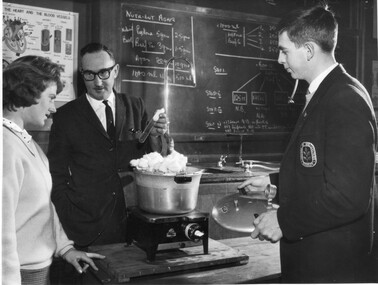 University of Melbourne, Burnley Campus Archives
Photograph - Black and white print, Publicity Branch Victorian Department of Agriculture, Laboratory Class, c. 1962
... Farrance (Biological Sciences, holding a test tube)with 2 students in the Laboratory. Writing on blackboard in the background....Farrance (Biological Sciences, holding a test tube)with 2 students in the Laboratory. Writing on blackboard in the background. ...Black and white photograph. A.J. Farrance (Biological Sciences, holding a test tube)with 2 students in the Laboratory. Writing on blackboard in the background.On reverse, "Photograph by Publicity Branch Victorian Department Of Agriculture Ref. No. D.162.B."a.j. farrance, biological sciences, students, laboratory, students in class, publicity, dept of agriculture -
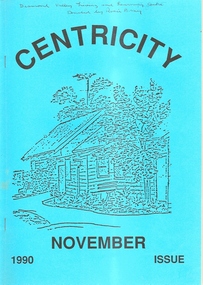 Greensborough Historical Society
Magazine, Plenty Valley Graphics and Desktop Puiblishing, Centricity November 1990, 1990_11
... A collection of short stories, poetry and other writing by students (local women) at the Diamond Valley Living and Learning Centre Greensborough....A collection of short stories, poetry and other writing by students (local women) at the Diamond Valley Living and Learning Centre Greensborough. ...A collection of short stories, poetry and other writing by students (local women) at the Diamond Valley Living and Learning Centre Greensborough.A publication of writing by local women.40 pages, black and white illus. Blue cover with line drawing of DVLC.On front cover in pen: "Diamond Valley Living and Learning Centre. Donated by Rosie Bray"diamond valley living and learning centre, dvlc, diamond valley learning centre, writing, centricity -
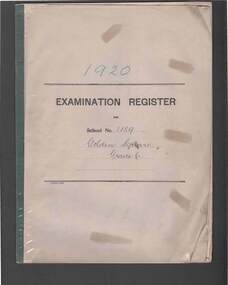 Bendigo Historical Society Inc.
Document - GOLDEN SQUARE LAUREL STREET P.S. COLLECTION: EXAMINATION REGISTER 1920
... Contains description of exams given to grade 6 students, with comments regarding the overall curriculum program and marks of the students in reading, writing, arithmetic and history....Contains description of exams given to grade 6 students, with comments regarding the overall curriculum program and marks of the students in reading, writing, arithmetic and history. Document GOLDEN SQUARE LAUREL STREET P.S. ...Examination register 1920, school no. 1189, Golden Square, Grade 6. Contains description of exams given to grade 6 students, with comments regarding the overall curriculum program and marks of the students in reading, writing, arithmetic and history.Education Department Victoria, A.C. Brooks Government Printer Melbourne.bendigo, education, golden square primary school, golden square grade 6, school 1189 -
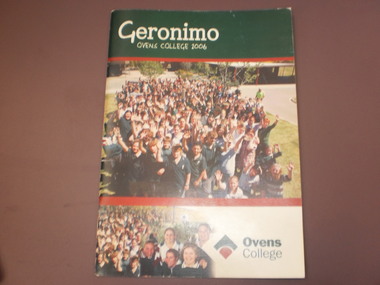 Wangaratta High School
OC Yearbook -Geronimo, 2006
... White yearbook with a green header and a two red stripes separating two images of crowds of ovens college students. There is white writing in the header reading Geronimo OVENS COLLEGE 2006. ...Geronimo OVENS COLLEGE 2006 White yearbook with a green header and a two red stripes separating two images of crowds of ovens college students. There is white writing in the header reading Geronimo OVENS COLLEGE 2006. ...White yearbook with a green header and a two red stripes separating two images of crowds of ovens college students. There is white writing in the header reading Geronimo OVENS COLLEGE 2006. The OC logo is in the bottom right cornerGeronimo OVENS COLLEGE 2006 -
 Bendigo Historical Society Inc.
Newspaper - LONG GULLY HISTORY GROUP COLLECTION: GRAVEL HILL PRIMARY SCHOOL
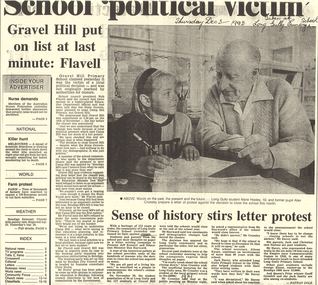
... A photo accompanying the article shows a Long Gully student Marie Hooley writing a letter of protest. She is being assisted by former pupil Alan Crossley. ...A photo accompanying the article shows a Long Gully student Marie Hooley writing a letter of protest. She is being assisted by former pupil Alan Crossley. ...Copy of an article from the Bendigo Advertiser Dec 3 - 1992 mentioning the closure of the Gravel Hill and Long Gully Primary Schools. The column about the Gravel Hill Primary School mentions that the Camp Hill School was the one that was going to close and then it was changed to close the Gravel Hill Primary School. The other article titled Sense of history stirs letter protest mentions the Long Gully Primary School fight to stay open. A photo accompanying the article shows a Long Gully student Marie Hooley writing a letter of protest. She is being assisted by former pupil Alan Crossley. Also mentioned is the school secretary, Aileen Ewart and former students Jack Davey, Jack and Christina (nee Sutton) Davey, George Ennor, Geoff Grenfell and the Jack Family. Article written by Nathan Dole.bendigo, history, long gully history group, the long gully history group - gravel hill primary school, rob flavell, education department, camp hill primary, don hayward, bendigo city council, chris stoltz, marie hooley, alan crossley, jeff kennett, aileen ewart, jack davey, jack and christina (nee sutton) davey, george ennor, geoff grenfell, jack family, nathan dole -
 Federation University Historical Collection
Booklet, The Ballarat School of Mines and Industries 1870-1920 Jubilee Booklet, 1920 (estimated)
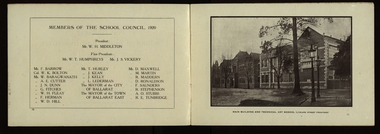
... Students gaining qualifications obtain concession in their courses at the university, should they proceed there to continue their studies. The technical Art school curriculum includes training in all branches of pictorial and applied art, an Architectural Diploma Course, a Draughtman's Course, technical Art teachers' Course, Photography,Ticket Writing, Art Metal Work, Woodcarving, Needlework, and Leather work. ...Students gaining qualifications obtain concession in their courses at the university, should they proceed there to continue their studies. The technical Art school curriculum includes training in all branches of pictorial and applied art, an Architectural Diploma Course, a Draughtman's Course, technical Art teachers' Course, Photography,Ticket Writing, Art Metal Work, Woodcarving, Needlework, and Leather work. ...The first school of Mines in Australia was established at Ballarat in 1870. At the time of its jubilee (1930) the following people were members of the School Council: W.H. Middleton (President), W.T. Humphreys (VP), J.S. Vickery (VP), F. Barrow, Col. W.K. Bolton, William Baragwanath, A.E. Cutter, J.N. Dunn, G. Fitches, W.H. Fleay, F. Herman. W.D. Hill, T. Hurley, K. Kean. J. Kelly, L. Lederman, Mayor of Ballarat, Mayour of Ballarat East, D. Maxwell, M. Martin, R. Maddern, D. Ronaldson, F. Saunders, R. Stephenson, A.O. Stubbs, R.E. Tunbridge. The School Staff in 1920 comprised: Herbert H. Smith, Walter Rowbotham, Reginald L. Cutter, M.C. Young, Hilda Wardle, M. Wiliamson, P.S. Richards, L.H. Archibald, J. Woods, Ken Moss, W. Kenneth, Mrs McIlvena. B. Robinson, S. Rowe, E. Hope-Jones, Miss Abrams, L.St.G.P. Austin, Alfred Mica Smith, J.R. Pound, Herbert R. Murphy, N.H. Junner, Maurice Copland, L.H. Archibald, E.J.A. McConnon, Newton King, D.m. Hull, T.R. Gordon, John M. Sutherland, T.K. Jebb, Dick Richards, C. Tonkin, A.W. Steane, J. Paterson, H.W. Malin, R.V. Maddison, S.M. Mayo, F.A. King, W.H. Steane, T.R. Gordon, T.A. Williams, H. Waldron, G. Black, E.J. McConnon, R.V. Duncan. R. Cutter, E.G. Vawdrey, Hilda WardleWhite stapled booklet - landscape format - 20pp + soft covers with blue writing. Includes an historical sketch of the Ballarat School of Mines. Contains images of the school from around 1920. The history outlined in the booklet follows: 'Ballarat has helped to influence the life and destinies of Australia in many ways, the recital of which would perhaps prove tedious to the citizens of less favoured localities! However, it can be said, without much fear of contradiction, that only less known thought Australia than its fame as a gold field is the reputation won for it by its school of Mines, ... Ballarat was still quite a new place when the School was founded, but a very propserous and popular place all the same, with a go-ahead lot of citizens brim full of the spirit of enterprise which seemsto animate mining populations generally. Money was plentiful, and they launched out into ventures, which later, were to develop and take the place of the gold mines, while what is more to the point, they understood the value of education. the old digging days were passing away. So far as Ballarat itself was concerned the day of the cradle and tin dish had already passed into an antiquity "as dead and distant as the age of the Tubal Caon," said dir redmond Barry on declaring the School open. Mining had become a serious business, and the mining engineer, the metallurgist, and the geologist had become a power in the land. In these circumstances the suggestions to found a School of Mines met with ready acceptance. The late Mr James M. Bickett had the honor of bringing forward the proposition at a meeting of the Ballarat Mining Board in October, 1869. it was agreed to, and the Government, having been approached for assistance, granted a lease of the old Supreme Court buildings at a nominal reantal. A modest sum, including 100 pounds from the Borough Council of Ballarat West, was subscribed by a number of sympathisers, and on the 26th October, 1870, the inaugural address was delivered by Sir Redmond Barry, the first President of the School. Classes were commenced on the 23rd January, 1871. The students at first were mostly adults. They were chiefly men emloyed at the mines, who had the wisdom and energy to devote their spare time to study, and, though their attendance was somewhat irregular, they made very good progress. Old prints which have been preserved show them at work at furnaces, big bearded men of the old-fashioned type of miner. It is interesting to note that among those who gave evidence and encouragement was Sir Roderick Murchison, who many years before had advised Cornish miners to emigrate to Australia to search for gold, and who in 1848 was in possession of gold ore sent from this country. Sir Roderick sent a parcel of books for the library, and gave useful advice as to the curriculum which should be adopted. The Museum, which now contains a most valuable collection of minerals, was one of the first things attended to, and the reports presented to the Council from time to time speak of additions being made from all parts of the world. New equipment was constantly being added to the School, a good deal of assay work was done, and some specimens were sent from the East Indies for examination as far back as 1873. By this time there was a difficulty in providing accomodation for the students who wished to enrol, and the number of instructors had grown from two to four. In 1882 the first building was being erected on what was then part of the gaol reserve. A little more than ten years afterwards a buildnig formerly serving as a Methodist Church was absorbed, while later on, the demand for accomodation increasing, the attack upon the gaol was renewed. The School continued to grow in reputation and size, and became the science centre of the district, and in 1889 a learge new building was opened by Sir Alexander Peacock. Students came from over seas as well as from all the States of Australia, and after going through their courses they took with them the name and fame of the old School to all parts of the globe. School of Mines boys have played a great part in developing the mining fields of Western Australia, South Australia, and africa, while old students who have made a name in their profession are constantly dropping in to see how the old place is getting along. It was not to be expected, however, that the Ballarat School would be left without rivals, its very success inspiring competition. Mining Schools were started in other parts of Australia, and, at the same time, Victoria ceased to hold first place as a mining state. On the other hand there was a great advance in manufacturing, and the demand for technicaly trained men became a great and as insistent as ever it had been for trained mining men. The Council was quick to adapt the school to the new conditions, and the result is seen in the institution, which is one of Ballarat's proudest possession. Instruction is given in all branches of technical work, and the classes are filled with students who are building up for Ballarat a reputation as an industrial centre, which promises to equal that which it formerly held as a mining town. Owing to its bracing climate, its abundant opportunities for recreations, and its accessibilty, Ballarat as a city is an ideal place for educational purposed, and is yearly becoming more and more appreciated throughout the State. The chairman of one of Ballarat's biggests industries claims that the workman can do twice the day's work here that he can do in Melbourne. he was a little enthusiastic over it, perhaps, but it is a well-known fact that the healthy and invigourating Ballarat climate is conducive to both physical and mental activity, and the records of the School provide ample proof of it. One of the most interesting and successful branches of the School of Mines and Industries - if the name be enlarged with the enlargement of its scope - is the Technical Art School. "The City of Statues" has from its earliest days been a stronghold of art. Art schools have flourised here, and in 1905 the Education Department came to the conclusion that the best thing to do with them was to place them under the management of the School of Mines Council. A magnificent new Technical Art School was built at a cost of some 12,000 pounds on the site of the old Supreme Court building, and was formally opened on the 23rd July, 1915. The results have not only been justified but surpassed all anticipations. The most comprehensive list of subjects is taught, and this list is constantly added to. Students have flocked to the art School, which may be said to occupy a unique position in Australia, and its record of success is really astonishing. Its students supply art teachers for the newer schools that are being built, and many occupy leading positinos in important business houses. So well is its reputation known that orders are constantly being received, not only from Victoria, but from other States, for honor boards and challenge shields to be designed and made. The most recent addition to the School of Mines and Industries is the Junior Technical School, for which a new building is now being erected on a portion of the gaol site, transferred to the School of Mines Counci by the Government. At the present moment temporary quarters are being occupied. Some students after passing through the Junior School go straight to employment, continuing perhaps to attend the evening trade classes, while others move on to the senior School. In a review of the work of the School of Mines mention must be made of a series of industrial research carried out under supervision of the Principal. One in particular, regarding the suitability of the local ores for the manufacture of pigments attracted much attention, while the experiemtns on the manufacture of white potery from Victorian clayes were considered of sufficient importance by the Federal Advisory Council of Science and Industry to warrant the appointment of a special investigator. The results of these have been most encouraging, and may have far-reaching consequences. The vocational training of returned soldiers also should not be overlooked. The work was taken in hand from the first, before the Repatriation Department gave assistance, and now with the help of the department of the School has become one of the largest vocational training centres in Victoria outside of Melbourne. The soldiers, trained in a variety of occupations, have made remarkable progress, and already considerable numbers have found employment in local workshops and factories. To sum up, the School is divided into the following departments, each well staffed and equipped: - The School of Mines, science, and Engineering; the Techncial Art School, the Boys' Junior Technical School, the Girl's Preparatory Technical Classes, Trade Classes, and the Commercial School. The school of Mines, science and Engineering, comprises the following branches: - Mining, Metallurgy, Geology, Electrical Engineering, Civil Engineering, Mechanical Engineering, Applied Chemistry, and Pharmacy. Battery treatments, Cyanide Testing, Smelting, Assays, and Clay Testing from a regular part of the School's work. Students gaining qualifications obtain concession in their courses at the university, should they proceed there to continue their studies. The technical Art school curriculum includes training in all branches of pictorial and applied art, an Architectural Diploma Course, a Draughtman's Course, technical Art teachers' Course, Photography,Ticket Writing, Art Metal Work, Woodcarving, Needlework, and Leather work. The Trade Classes give instruction in Telephone Mechanics, telegraphy, Carpentry, Cabinet Making, Plumbing, Blacksmithing, Fitting, Electric Wiring, and Printing. Numerous Scholarships are offered every year, and altogether students will find few places to equal the Ballarat School of Mines and Industries as a training place for their life's work. One of the first in the continent to be established, its Jubilee finds it still in the front rank, keeping pace with the times, and offering to the youths of this country the means of taking advantage of Australia's teeming opportunities. william, battery, smith, herbert, drawing from the antique, ballarat school of mines botanical gardens, ballarat school of mines, redmond barry, alfred mica smith, james bickett, museum, dick richards, ballarat junior technical school, s m b, ballarat school of mines and industries, ballarat technical art school, model mine, james m bickett, j m bickett, roderick murchison, vocational training rooms, wesley church, methodist church, alexander peacock, lathes, repatriation, repatriatin department, war service, school council, baragwanath, gold mining, mining laboratory, plaster cast, r.w. richards, anniversary, jubilee -
 Federation University Historical Collection
Card - Greeting Card, Ballarat School of Mines et al, Ballarat School of Mines Botanical Gardens, c1970s
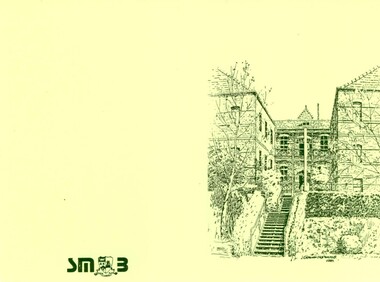
... Graham Hopwood was a student at the Ballarat Technical Art School when he completed the sketch of the gardens. He later became a renowned secondary art teacher writing the book 'A Handbook of Art'....Graham Hopwood was a student at the Ballarat Technical Art School when he completed the sketch of the gardens. He later became a renowned secondary art teacher writing the book 'A Handbook of Art'. ballarat school of mines botanical gardens ballarat school of mines graham hopwood centenary materia medica alumni Eight greeting cards featuring a drawing of the Ballarat School of Mines Botanical Gardens by Graham Hopwood. ...Graham Hopwood was a student at the Ballarat Technical Art School when he completed the sketch of the gardens. He later became a renowned secondary art teacher writing the book 'A Handbook of Art'.Eight greeting cards featuring a drawing of the Ballarat School of Mines Botanical Gardens by Graham Hopwood.ballarat school of mines botanical gardens, ballarat school of mines, graham hopwood, centenary, materia medica, alumni -
 Federation University Historical Collection
Document, Waller and Chester, Ballarat School of Mines and Industries Ballarat: The Art School, c1948, c1948
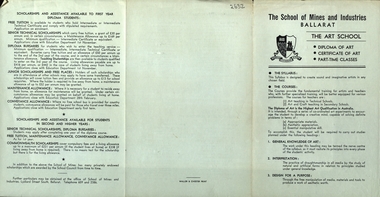
... students, who have passed the Certificate of Art Examination or its equivalent. Candidates of the examination must be at least 19 years of age, must have completed two years' full -time training or not less than three years' part-time training, and must present for the Matriculation examination for English Expression. Part-Time classes at the Ballarat Technical Art School c1948 were: Day: Dressmaking, Weaving, Leatherwork, Pottery, Metalwork, Painting, Sculpture, Junior Art. Evening: Dressmaking, Weaving, Leatherwork, pottery, Metalwork, Painting, Sculpture, Ticket Writing...students, who have passed the Certificate of Art Examination or its equivalent. Candidates of the examination must be at least 19 years of age, must have completed two years' full -time training or not less than three years' part-time training, and must present for the Matriculation examination for English Expression. Part-Time classes at the Ballarat Technical Art School c1948 were: Day: Dressmaking, Weaving, Leatherwork, Pottery, Metalwork, Painting, Sculpture, Junior Art. Evening: Dressmaking, Weaving, Leatherwork, pottery, Metalwork, Painting, Sculpture, Ticket Writing ...Entrance requirements for a full-course student was an Intermediate Certificate of equivalent. The Certificate of Art was a two year course of basic study to enable students to undertake a further two years of specialised training in a chosen field of art. The Diploma of Art was a two-year course of specialised training available to students, who have passed the Certificate of Art Examination or its equivalent. Candidates of the examination must be at least 19 years of age, must have completed two years' full -time training or not less than three years' part-time training, and must present for the Matriculation examination for English Expression. Part-Time classes at the Ballarat Technical Art School c1948 were: Day: Dressmaking, Weaving, Leatherwork, Pottery, Metalwork, Painting, Sculpture, Junior Art. Evening: Dressmaking, Weaving, Leatherwork, pottery, Metalwork, Painting, Sculpture, Ticket Writing, Lettering, Figure Drawing. Two fold, 6 page information flyer on classes held at the Ballarat Technical Art School. The Art school offered Diploma of Art, Certificate of Art and Part-time classes.ballarat technical art school, art, diploma of art, certificate of art, part-time classes, syllabus, design, scholarships, diploma of art in pottery, diploma of art in advertising, art education, dressmaking, weaving, leatherwork, pottery, metalwork, painting, sculpture, junior art, dressmaking, weaving, leatherwork, pottery, metalwork, painting, sculpture, ticket writing, lettering, figure drawing -
 Flagstaff Hill Maritime Museum and Village
Furniture - Set of desks & benches, Unknown
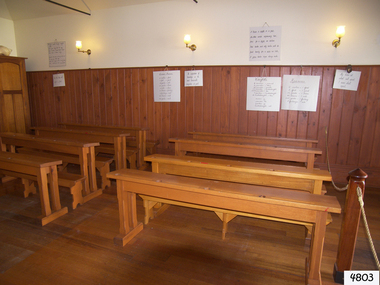
... student was equipped with a small tobacco tin in which was kept a damp sponge or cloth to erase the marks. Sharpening slate pencils was a regular task. We rubbed them on any suitable brick or concrete surface in the school yard. Teachers also kept a good supply of spares, all writing...student was equipped with a small tobacco tin in which was kept a damp sponge or cloth to erase the marks. Sharpening slate pencils was a regular task. We rubbed them on any suitable brick or concrete surface in the school yard. Teachers also kept a good supply of spares, all writing ...The following are the recollections of John Elkins, who started school in February, 1945 at Maryborough in Queensland, Australia. 'I think in Prep 1 that we had some paper to write on with pencils, but my memory of the routine use of slates is much more vivid. Each slate was framed in wood and one side was inscribed with lines to guide the limits for the upper and lower extremities of letters. The slate "pencils" were made of some pale gray mineral softer than slate which had been milled into cylinders some one-eighth of an inch in diameter and inserted into metal holders so that about an inch protruded. Each student was equipped with a small tobacco tin in which was kept a damp sponge or cloth to erase the marks. Sharpening slate pencils was a regular task. We rubbed them on any suitable brick or concrete surface in the school yard. Teachers also kept a good supply of spares, all writing materials and books being provided by the school. It is possible that the retention of slates stemmed from the political imperative that public education should be free. I do recall being given a Copy Book for home practice of letter formation, a typical practice until Grade 6. The tables at which we used to sit in the Infant School were replaced in the primary Grades by long desks seating five or six pupils. These had slots into which the slates could be inserted vertically. When the teacher asked the class to clear their desks, the command issued was "slates away!" This was an occasion for a noisy expression of relief as we dropped the slates producing a sound not unlike a volley of rifle shots, and usually brought a request from the teacher to repeat the process with no noise by holding the frames throughout. Thus, I suspect we may still have used slates in Grade Three, though by then paper, which may have been scarce during the War, seemed to be used more routinely.' The full context of John's account of writing during his primary school days can be found at: https://www.readinghalloffame.org/sites/default/files/history_of_literacy_22slates_away22_penmanship_in_queensland_australia.pdfSchool desks and benches/chairs have been in use in schools since formal group education started.Eight long school desks (five higher three lower), each with four inkwells and groove along length. eight school benches (five higher three lower). Each desk and bench accommodates four children.None.flagstaff hill, warrnambool, shipwrecked-coast, flagstaff-hill, flagstaff-hill-maritime-museum, maritime-museum, shipwreck-coast, flagstaff-hill-maritime-village -
 Federation University Historical Collection
Tool - Brushes, Keith Rash's Sign writing Brushes
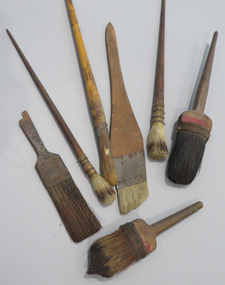
... At the Ballarat Technical Art School, sign writing, ticket writing, and house decoration were overseen by Thomas Raisbeck (1884-1970) from 1915. Classes were then successively taught by former students William Kenneth (Ken) Moss (1889-1921) from 1920 until his untimely death, Albert E. ...At the Ballarat Technical Art School, sign writing, ticket writing, and house decoration were overseen by Thomas Raisbeck (1884-1970) from 1915. Classes were then successively taught by former students William Kenneth (Ken) Moss (1889-1921) from 1920 until his untimely death, Albert E. ...Commercial artist, Keith Edwin Rash (1910-1985), studied at the Ballarat Technical Art School between 1923 and 1929. These artefacts are from his professional practice. Sign writing and ticket-writing bridged art and trade, with hand lettering applied to long-term signage and short-term promotional materials. At the Ballarat Technical Art School, sign writing, ticket writing, and house decoration were overseen by Thomas Raisbeck (1884-1970) from 1915. Classes were then successively taught by former students William Kenneth (Ken) Moss (1889-1921) from 1920 until his untimely death, Albert E. Williams (1899-1986) until 1928, followed by experienced, practising sign writer, Charles Emrys (Angus) Henderson (1899-1976), who had trained under Raisbeck. A number of brushes and sponges used by Ballarat sign writer, Keith Rash, who studied sign writing at the Ballarat School of Mines. signwriting, keith rash, ballarat school of mines, brushes, ballarat technical art school, sign writing, ticket writing -
 Federation University Historical Collection
Poster, Resball: Carnival. March 16th, 2016, 2016
... Student Residence Albert Coates Complex FedUniLiving, Federation University Australia, ResFest 2016. Catalogue no. '23154' written on back in Pencil A small poster with bright colours, stars on the border, images of circus tents with flags, and writing advertising the Resball for 2016. ...The Resball carnival was held on March 16th, 2016 at the Albert Coates Complex, and poster were displayed around the university to advertise it's event: 7:30 pm - 12:00 am. Residents Free: Tickets available from the FedUni Living Office. Non Residents $15: Tickets available from the FedUni Store. Dress Formal: Bus Leaving City Residences 7 pm. Entry between 7:30 pm - 9:00 pm = no tickets at the door - no passouts - This is a fully licensed events - Proof of age, res ID and valid ticket required - Management reserve the right to refuse entry. A small poster with bright colours, stars on the border, images of circus tents with flags, and writing advertising the Resball for 2016.FedUniLiving, Federation University Australia, ResFest 2016. Catalogue no. '23154' written on back in Pencilresball, feduniliving, federation university australi, resfest 2016, poster, carnival, student residence, albert coates complex -
 Federation University Historical Collection
Book - Book -Scrap Book, Ballarat School of Mines: Scrap Book of newspaper cuttings, Book 29, November 1986 to February 1987, 1986-1987
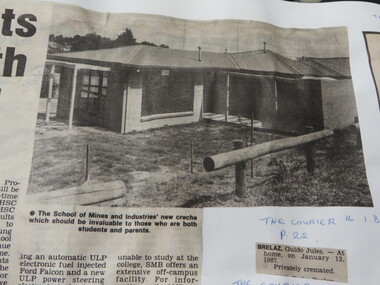
... student...royal horticultural society of victoria...garden tools for field officers...helen mclennan course teacher...writing...The papers concerned are The Courier, Ballarat, The Australian, The Age over the period of 20 November 1986 to 14 February 1987. courses available tertiary orientation program t o p teaching positions advertised smb programs fashion of the future clare schreenan lisa willison mary anne rowe smb staff join protest wool classing exams smb secretarial program women graduate with trades skills linda bland julie baulch tracey coleman student royal horticultural society of victoria garden tools for field officers helen mclennan course teacher writing for pleasure book launch "wednesday's words"june griffiths nan gale averil macklin smb applied science grant atomic absorption spectrophotometer julie baulch encourages women to break with tradition family centre space in tippett building mellissa bone win photographic award smb computer world's best sue dennis school's in for adults smb vocational programs university of the third age ken flecknoe managing director courier retires Book with blue cover, front, spiral bound. ...Collection of newspaper articles related to Ballarat School Of Mines.They cover activities and advertisements for staff. The papers concerned are The Courier, Ballarat, The Australian, The Age over the period of 20 November 1986 to 14 February 1987.Book with blue cover, front, spiral bound.courses available, tertiary orientation program, t o p, teaching positions advertised, smb programs, fashion of the future, clare schreenan, lisa willison, mary anne rowe, smb staff join protest, wool classing exams, smb secretarial program, women graduate with trades skills, linda bland, julie baulch, tracey coleman student, royal horticultural society of victoria, garden tools for field officers, helen mclennan course teacher, writing for pleasure, book launch "wednesday's words"june griffiths, nan gale, averil macklin, smb applied science grant, atomic absorption spectrophotometer, julie baulch encourages women to break with tradition, family centre space in tippett building, mellissa bone win photographic award, smb computer world's best, sue dennis, school's in for adults, smb vocational programs, university of the third age, ken flecknoe managing director courier retires -
Federation University Historical Collection
Booklet, The Ballarat School of Mines and Industries 1870-1920 Jubilee Booklet, 1920 (estimated)
... Students gaining qualifications obtain concession in their courses at the university, should they proceed there to continue their studies. The technical Art school curriculum includes training in all branches of pictorial and applied art, an Architectural Diploma Course, a Draughtman's Course, technical Art teachers' Course, Photography,Ticket Writing, Art Metal Work, Woodcarving, Needlework, and Leather work. ...Students gaining qualifications obtain concession in their courses at the university, should they proceed there to continue their studies. The technical Art school curriculum includes training in all branches of pictorial and applied art, an Architectural Diploma Course, a Draughtman's Course, technical Art teachers' Course, Photography,Ticket Writing, Art Metal Work, Woodcarving, Needlework, and Leather work. ...The first school of Mines in Australia was established at Ballarat in 1870. At the time of its jubilee (1930) the following people were members of the School Council: W.H. Middleton (President), W.T. Humphreys (VP), J.S. Vickery (VP), F. Barrow, Col. W.K. Bolton, William Baragwanath, A.E. Cutter, J.N. Dunn, G. Fitches, W.H. Fleay, F. Herman. W.D. Hill, T. Hurley, K. Kean. J. Kelly, L. Lederman, Mayor of Ballarat, Mayour of Ballarat East, D. Maxwell, M. Martin, R. Maddern, D. Ronaldson, F. Saunders, R. Stephenson, A.O. Stubbs, R.E. Tunbridge. The School Staff in 1920 comprised: Herbert H. Smith, Walter Rowbotham, Reginald L. Cutter, M.C. Young, Hilda Wardle, M. Wiliamson, P.S. Richards, L.H. Archibald, J. Woods, Ken Moss, W. Kenneth, Mrs McIlvena. B. Robinson, S. Rowe, E. Hope-Jones, Miss Abrams, L.St.G.P. Austin, Alfred Mica Smith, J.R. Pound, Herbert R. Murphy, N.H. Junner, Maurice Copland, L.H. Archibald, E.J.A. McConnon, Newton King, D.m. Hull, T.R. Gordon, John M. Sutherland, T.K. Jebb, Dick Richards, C. Tonkin, A.W. Steane, J. Paterson, H.W. Malin, R.V. Maddison, S.M. Mayo, F.A. King, W.H. Steane, T.R. Gordon, T.A. Williams, H. Waldron, G. Black, E.J. McConnon, R.V. Duncan. R. Cutter, E.G. Vawdrey, Hilda WardleWhite stapled booklet - landscape format - 20pp + soft covers with blue writing. Includes an historical sketch of the Ballarat School of Mines. Contains images of the school from around 1920. The history outlined in the booklet follows: 'Ballarat has helped to influence the life and destinies of Australia in many ways, the recital of which would perhaps prove tedious to the citizens of less favoured localities! However, it can be said, without much fear of contradiction, that only less known thought Australia than its fame as a gold field is the reputation won for it by its school of Mines, ... Ballarat was still quite a new place when the School was founded, but a very propserous and popular place all the same, with a go-ahead lot of citizens brim full of the spirit of enterprise which seemsto animate mining populations generally. Money was plentiful, and they launched out into ventures, which later, were to develop and take the place of the gold mines, while what is more to the point, they understood the value of education. the old digging days were passing away. So far as Ballarat itself was concerned the day of the cradle and tin dish had already passed into an antiquity "as dead and distant as the age of the Tubal Caon," said dir redmond Barry on declaring the School open. Mining had become a serious business, and the mining engineer, the metallurgist, and the geologist had become a power in the land. In these circumstances the suggestions to found a School of Mines met with ready acceptance. The late Mr James M. Bickett had the honor of bringing forward the proposition at a meeting of the Ballarat Mining Board in October, 1869. it was agreed to, and the Government, having been approached for assistance, granted a lease of the old Supreme Court buildings at a nominal reantal. A modest sum, including 100 pounds from the Borough Council of Ballarat West, was subscribed by a number of sympathisers, and on the 26th October, 1870, the inaugural address was delivered by Sir Redmond Barry, the first President of the School. Classes were commenced on the 23rd January, 1871. The students at first were mostly adults. They were chiefly men emloyed at the mines, who had the wisdom and energy to devote their spare time to study, and, though their attendance was somewhat irregular, they made very good progress. Old prints which have been preserved show them at work at furnaces, big bearded men of the old-fashioned type of miner. It is interesting to note that among those who gave evidence and encouragement was Sir Roderick Murchison, who many years before had advised Cornish miners to emigrate to Australia to search for gold, and who in 1848 was in possession of gold ore sent from this country. Sir Roderick sent a parcel of books for the library, and gave useful advice as to the curriculum which should be adopted. The Museum, which now contains a most valuable collection of minerals, was one of the first things attended to, and the reports presented to the Council from time to time speak of additions being made from all parts of the world. New equipment was constantly being added to the School, a good deal of assay work was done, and some specimens were sent from the East Indies for examination as far back as 1873. By this time there was a difficulty in providing accomodation for the students who wished to enrol, and the number of instructors had grown from two to four. In 1882 the first building was being erected on what was then part of the gaol reserve. A little more than ten years afterwards a buildnig formerly serving as a Methodist Church was absorbed, while later on, the demand for accomodation increasing, the attack upon the gaol was renewed. The School continued to grow in reputation and size, and became the science centre of the district, and in 1889 a learge new building was opened by Sir Alexander Peacock. Students came from over seas as well as from all the States of Australia, and after going through their courses they took with them the name and fame of the old School to all parts of the globe. School of Mines boys have played a great part in developing the mining fields of Western Australia, South Australia, and africa, while old students who have made a name in their profession are constantly dropping in to see how the old place is getting along. It was not to be expected, however, that the Ballarat School would be left without rivals, its very success inspiring competition. Mining Schools were started in other parts of Australia, and, at the same time, Victoria ceased to hold first place as a mining state. On the other hand there was a great advance in manufacturing, and the demand for technicaly trained men became a great and as insistent as ever it had been for trained mining men. The Council was quick to adapt the school to the new conditions, and the result is seen in the institution, which is one of Ballarat's proudest possession. Instruction is given in all branches of technical work, and the classes are filled with students who are building up for Ballarat a reputation as an industrial centre, which promises to equal that which it formerly held as a mining town. Owing to its bracing climate, its abundant opportunities for recreations, and its accessibilty, Ballarat as a city is an ideal place for educational purposed, and is yearly becoming more and more appreciated throughout the State. The chairman of one of Ballarat's biggests industries claims that the workman can do twice the day's work here that he can do in Melbourne. he was a little enthusiastic over it, perhaps, but it is a well-known fact that the healthy and invigourating Ballarat climate is conducive to both physical and mental activity, and the records of the School provide ample proof of it. One of the most interesting and successful branches of the School of Mines and Industries - if the name be enlarged with the enlargement of its scope - is the Technical Art School. "The City of Statues" has from its earliest days been a stronghold of art. Art schools have flourised here, and in 1905 the Education Department came to the conclusion that the best thing to do with them was to place them under the management of the School of Mines Council. A magnificent new Technical Art School was built at a cost of some 12,000 pounds on the site of the old Supreme Court building, and was formally opened on the 23rd July, 1915. The results have not only been justified but surpassed all anticipations. The most comprehensive list of subjects is taught, and this list is constantly added to. Students have flocked to the art School, which may be said to occupy a unique position in Australia, and its record of success is really astonishing. Its students supply art teachers for the newer schools that are being built, and many occupy leading positinos in important business houses. So well is its reputation known that orders are constantly being received, not only from Victoria, but from other States, for honor boards and challenge shields to be designed and made. The most recent addition to the School of Mines and Industries is the Junior Technical School, for which a new building is now being erected on a portion of the gaol site, transferred to the School of Mines Counci by the Government. At the present moment temporary quarters are being occupied. Some students after passing through the Junior School go straight to employment, continuing perhaps to attend the evening trade classes, while others move on to the senior School. In a review of the work of the School of Mines mention must be made of a series of industrial research carried out under supervision of the Principal. One in particular, regarding the suitability of the local ores for the manufacture of pigments attracted much attention, while the experiemtns on the manufacture of white potery from Victorian clayes were considered of sufficient importance by the Federal Advisory Council of Science and Industry to warrant the appointment of a special investigator. The results of these have been most encouraging, and may have far-reaching consequences. The vocational training of returned soldiers also should not be overlooked. The work was taken in hand from the first, before the Repatriation Department gave assistance, and now with the help of the department of the School has become one of the largest vocational training centres in Victoria outside of Melbourne. The soldiers, trained in a variety of occupations, have made remarkable progress, and already considerable numbers have found employment in local workshops and factories. To sum up, the School is divided into the following departments, each well staffed and equipped: - The School of Mines, science, and Engineering; the Techncial Art School, the Boys' Junior Technical School, the Girl's Preparatory Technical Classes, Trade Classes, and the Commercial School. The school of Mines, science and Engineering, comprises the following branches: - Mining, Metallurgy, Geology, Electrical Engineering, Civil Engineering, Mechanical Engineering, Applied Chemistry, and Pharmacy. Battery treatments, Cyanide Testing, Smelting, Assays, and Clay Testing from a regular part of the School's work. Students gaining qualifications obtain concession in their courses at the university, should they proceed there to continue their studies. The technical Art school curriculum includes training in all branches of pictorial and applied art, an Architectural Diploma Course, a Draughtman's Course, technical Art teachers' Course, Photography,Ticket Writing, Art Metal Work, Woodcarving, Needlework, and Leather work. The Trade Classes give instruction in Telephone Mechanics, telegraphy, Carpentry, Cabinet Making, Plumbing, Blacksmithing, Fitting, Electric Wiring, and Printing. Numerous Scholarships are offered every year, and altogether students will find few places to equal the Ballarat School of Mines and Industries as a training place for their life's work. One of the first in the continent to be established, its Jubilee finds it still in the front rank, keeping pace with the times, and offering to the youths of this country the means of taking advantage of Australia's teeming opportunities. william, battery, smith, herbert, drawing from the antique, ballarat school of mines botanical gardens, ballarat school of mines, redmond barry, alfred mica smith, james bickett, museum, dick richards, ballarat junior technical school, s m b, ballarat school of mines and industries, ballarat technical art school, model mine, james m bickett, j m bickett, roderick murchison, vocational training rooms, wesley church, methodist church, alexander peacock, lathes, repatriation, repatriatin department, war service, school council, baragwanath, gold mining, mining laboratory, plaster cast, r.w. richards, anniversary, jubilee -
 Federation University Historical Collection
Document - Document - Correspondence, VIOSH: Letter from Eric Wigglesworth to Derek Woolley re History: Graduate Diploma in Occupational Hazard Management, 1990
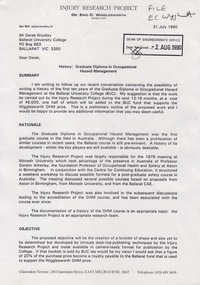
... Students are taught active research and enquiry; rather than textbook learning and a one-size fits all approach. VIOSH accepts people into the Graduate Diploma of Occupational Hazard Management who have no undergraduate degree - on the basis of extensive work experience and knowledge. The letter concerns the possibility of writing...Students are taught active research and enquiry; rather than textbook learning and a one-size fits all approach. VIOSH accepts people into the Graduate Diploma of Occupational Hazard Management who have no undergraduate degree - on the basis of extensive work experience and knowledge. The letter concerns the possibility of writing ...Victorian Institute of Occupational Safety and Health (VIOSH) Australia is the Asia-Pacific centre for teaching and research in occupational health and safety (OHS) and is known as one of Australia's leaders on the field. VIOSH has a global reputation for its innovative approach within the field of OHS management. VIOSH had its first intake of students in 1979. At that time the Institution was known as the Ballarat College of Advanced Education. In 1990 it became known as Ballarat University College, then in 1994 as University of Ballarat. It was 2014 that it became Federation University. VIOSH Australia students are safety managers, senior advisors and experienced OHS professionals. They come from all over Australia and industry. Students are taught active research and enquiry; rather than textbook learning and a one-size fits all approach. VIOSH accepts people into the Graduate Diploma of Occupational Hazard Management who have no undergraduate degree - on the basis of extensive work experience and knowledge. The letter concerns the possibility of writing a history of the first ten years of the Graduate Diploma in Occupational Hazard Management. He outlines the estimated time-line to produce the history, that it be done by the Injury Research Project and the costing for the project. Half of the costs (at a reduced rate) would be given back to the University for the Wigglesworth OHM prize fund.Three A4 sheets - typed. Letterhead for sender and Received stamp for Dean of Engineering OfficeDate: 1990. Eric Wigglesworth letterhead and signature.viosh, victorian institute of occupational safety and health, graduate diploma in occupational hazard management, first ten years, eric wigglesworth, ballarat university college, injury research project
