
Showing 106 items matching "sunday schools - victoria"
-
 Kew Historical Society Inc
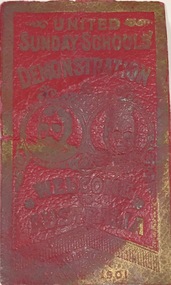
Souvenir, United Sunday schools, Red Leather Bookmark, United Sunday Schools' Demonstration, Melbourne, 6 May 1901, 1901
... ...sunday schools - victoria...(The Age, Tues 7 May 1901, p.6) This tiny battered piece of ephemera recording the United Sunday School Demonstration of 1901 must once have been exceedingly common, however in the context of the growing collection that the Society has relating to the opening of the first Commonwealth Parliament in Melbourne it has historic and social significance. opening of the first commonwealth parliament - 1901 sunday schools - victoria federation events - victoria - 1901 ephemera "United Sunday Schools Demonstration, Melbourne Australia, Melbourne May 6 1901" Embossed red leather bookmark commemorating the 'United Sunday Schools Demonstration' in St Kilda Road in 1901 to welcome the Prince and Princess of Wales to open the first Commonwealth Parliament in the Royal Exhibition Building. ...SUNDAY SCHOOL DEMONSTRATION. With three times three we coo-ee, The Prince we meet again; Our Princess May we welcome, With heart and voice amain. This was the welcome of the children of the Melbourne Sunday schools. The greeting came from over 30,000 youthful voices to the accompaniment of as many waving flags of diminutive size, held by the children. Probably not one of those who sang so lustily had witnessed the previous visit of his Royal Highness; or knew anything of it except as a traditional event, but the sentiment was a good and proper one all the same. The children were massed on the rising ground in the Domain, and apparently the long wait was not at all wearying. It was to most of them a huge picnic. They lunched on the grass, and filled in the intervening lime with games such as the juvenile heart delights in. At intervals something approaching order, was observed, and then songs, which have been in rehearsal for some weeks past, were sung under the baton of Mr. D. R. Davies, musical director, and to the lead of a united brass band of over a hundred instrumentalists under Bandmaster E; T. Code. A solo was also sung by Mr. H. J. Floyd. At all times the scene was an exceedingly animated one. Most of the children were attired in light costumes, and those in whose dress there was some color provided the necessary variety to make up a most picturesque scene. Probably there were nearly 35,000 adults and children at this spot. They occupied the frontage to St. Kilda-road, from Government House gates to the intersecting thoroughfare beyond. As the children were confined to the high ground, there was a green strip in front of them, and the dark green of the fir trees at the top of the slope made a most suitable background. Between these two lines of even coloring the children, with the easy freedom of youth, made perhaps as pretty a feature of the pageant as could be found anywhere in the whole route of the procession." (The Age, Tues 7 May 1901, p.6)This tiny battered piece of ephemera recording the United Sunday School Demonstration of 1901 must once have been exceedingly common, however in the context of the growing collection that the Society has relating to the opening of the first Commonwealth Parliament in Melbourne it has historic and social significance.Embossed red leather bookmark commemorating the 'United Sunday Schools Demonstration' in St Kilda Road in 1901 to welcome the Prince and Princess of Wales to open the first Commonwealth Parliament in the Royal Exhibition Building."United Sunday Schools Demonstration, Melbourne Australia, Melbourne May 6 1901"opening of the first commonwealth parliament - 1901, sunday schools - victoria, federation events - victoria - 1901, ephemera -
 Melbourne Tram Museum
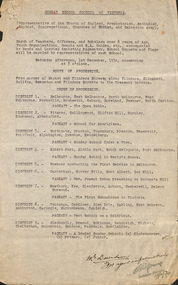
Letter, Melbourne & Metropolitan Tramways Board (MMTB), "Sunday School Council of Victoria", Dec. 1984
... "Sunday School Council of Victoria"..."Sunday School Council of Victoria" Letter from Sunday School Council of Victoria informing tramways of procession to be held 1 December 1934. ...Trams tramways Instructions Events Sunday School Procession Town Hall Bookings Mr Davidson for your attention written in black ink "Sunday School Council of Victoria" Letter from Sunday School Council of Victoria informing tramways of procession to be held 1 December 1934. ..."Sunday School Council of Victoria" Letter from Sunday School Council of Victoria informing tramways of procession to be held 1 December 1934. Notice to Inspectors for town hall bookings for Prahran, St Kilda and Malvern for Dec 1934.Mr Davidson for your attention written in black inktrams, tramways, instructions, events, sunday school procession, town hall bookings -
 Clunes Museum
book, ADVERTISER PRINTING WORKS, THE HOUSEWIFE'S COMPANION, C 1916
... PRODUCED BY THE METHODIST SUNDAY SCHOOL, MARYBOROUGH, VICTORIA, AUSTRALIA...PRODUCED BY THE METHODIST SUNDAY SCHOOL, MARYBOROUGH, VICTORIA, AUSTRALIA LOCAL HISTORY COOKERY PRODUCED BY THE METHODIST SUNDAY SCHOOL, MARYBOROUGH, VICTORIA, AUSTRALIA HANDWRITTEN ON FRONT COVER: OLGA CHAMPION COOKERY BOOK - "THE HOUSEWIFE'S COMPANION" THE HOUSEWIFE'S COMPANION book BOOK ADVERTISER PRINTING WORKS ...PRODUCED BY THE METHODIST SUNDAY SCHOOL, MARYBOROUGH, VICTORIA, AUSTRALIACOOKERY BOOK - "THE HOUSEWIFE'S COMPANION"PRODUCED BY THE METHODIST SUNDAY SCHOOL, MARYBOROUGH, VICTORIA, AUSTRALIAlocal history, cookery, -
 Ballarat Heritage Services
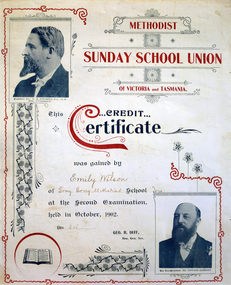
Certificate, Methodist Sunday School Union of Victoria and Tasmania, 1902
... Methodist Sunday School Union of Victoria and Tasmania...Certificate of the Methodist Sunday School Union of Victoria and Tasmania made out to Emily Wilson in 1902....Methodist Sunday School Union of Victoria and Tasmania Certificate ...Certificate of the Methodist Sunday School Union of Victoria and Tasmania made out to Emily Wilson in 1902.emily wilson, gong gong methodist sunday school, methodist, w.h. fitchett, edward barrett, gong gong, certificate -
 Bendigo Historical Society Inc.
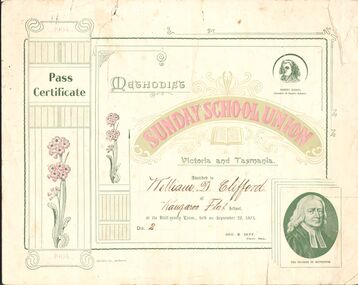
Document - METHODIST SUNDAY SCHOOL UNION OF VICTORIA AND TASMANIA PASS CERTIFICATE PASS - WILLIAM D CLIFFORD, 1904
... METHODIST SUNDAY SCHOOL UNION OF VICTORIA AND TASMANIA PASS CERTIFICATE PASS - WILLIAM D CLIFFORD...Methodist Sunday School Union of Victoria and Tasmania Pass Certificate awarded to William D Clifford of Kangaroo Flat School, at the Half-yearly Exam, held on September 29, 1904....Document METHODIST SUNDAY SCHOOL UNION OF VICTORIA AND TASMANIA PASS CERTIFICATE PASS - WILLIAM D CLIFFORD ...Methodist Sunday School Union of Victoria and Tasmania Pass Certificate awarded to William D Clifford of Kangaroo Flat School, at the Half-yearly Exam, held on September 29, 1904.person, individual, william d clifford -
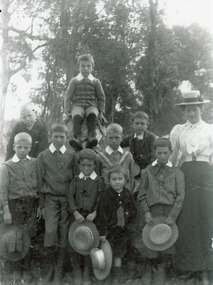 Lakes Entrance Historical Society
Photograph - St Nicholas Sunday School Group. Lakes Entrance Victoria c1900, 1900
... St Nicholas Sunday School Group. Lakes Entrance Victoria c1900...Known to be St Nicholas Sunday School Group. Lakes Entrance Victoria... Photograph St Nicholas Sunday School Group. Lakes Entrance Victoria c1900 ...Also b & w copy 13 x 18, purchasedBlack and white photograph of nine boys and one young woman, all dressed in their Sunday Best clothing. Known to be St Nicholas Sunday School Group. Lakes Entrance VictoriaMiss Mollands Classreligion, schools, fashion -
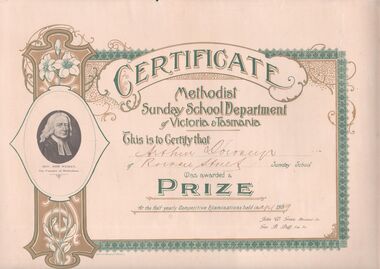 Bendigo Historical Society Inc.
Certificate - Sunday School Certificate
... Methodist Sunday School Union of Victoria and Tasmania. Arthur Dowsey of Rowan Street was awarded a prize at the half yearly competitive examination held in April 1909. ...Sunday School Methodist school John Wesley Methodist Sunday School Union of Victoria and Tasmania. ...Arthur Dowsey, b. 1899, was the son of Thomas and Rebecca Jane (nee Harding) Dowsey and brother of Ruby May. HE married Una Beryl Whitey in 1925. Arthur died in 1975 and is buried at Ferntree Gully.Methodist Sunday School Union of Victoria and Tasmania. Arthur Dowsey of Rowan Street was awarded a prize at the half yearly competitive examination held in April 1909. The certificate is buff in colour with green and gold decoration. A portrait of Rev. John Wesley founder of the Methodist Church at left.sunday school, methodist school, john wesley -
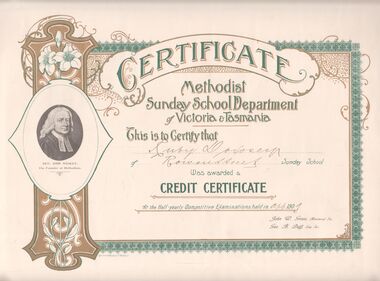 Bendigo Historical Society Inc.
Certificate - Sunday School Certificate
... Methodist Sunday School Union of Victoria and Tasmania. Ruby Dowsey of Rowan Street was awarded a credit certificate at the half yearly competitive examination held in April 1909. ...See Item 8651.1 Sunday School Methodist school John Wesley Methodist Sunday School Union of Victoria and Tasmania. ...BHS Collection. See Item 8651.1Methodist Sunday School Union of Victoria and Tasmania. Ruby Dowsey of Rowan Street was awarded a credit certificate at the half yearly competitive examination held in April 1909. The certificate is buff in colour with green and gold decoration. A portrait of Rev. John Wesley founder of the Methodist Church at left.sunday school, methodist school, john wesley -
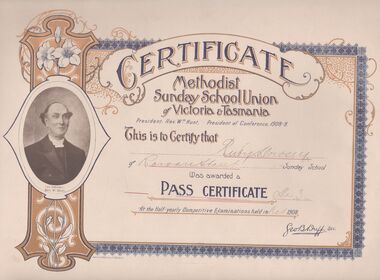 Bendigo Historical Society Inc.
Certificate - Sunday School Certificate
... Methodist Sunday School Union of Victoria and Tasmania. President Rev. ...Sunday School Methodist school Rev. Hunt Methodist Sunday School Union of Victoria and Tasmania. ...Methodist Sunday School Union of Victoria and Tasmania. President Rev. Wm. Hunt President of conference 1908-09. Ruby Dowsey of Rowan Street was awarded a pass certificate div.3at the half yearly competitive examination held in Oct. 1908. The certificate is buff in colour with blue and gold decoration. A portrait of Rev. W. Hunt at left.sunday school, methodist school, rev. hunt -
 Mont De Lancey
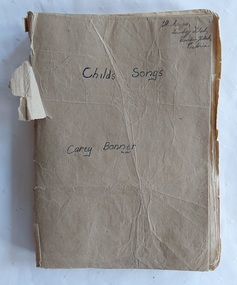
Book, Cary Bonner, Child Songs, May 1930
... On the front of the brown paper cover handwritten in black ink is ' Child's songs Carey Bonner' At the top right hand corner handwritten in black ink is, 'St Mary's, Sunday School, Wandin Yallock , Victoria.' inside on the right end paper written in grey pencil 'St Mary's Sunday School Wandin Yallock 8/33, H/N, 8/3. ...Sunday School and Day School, and for Home Singing. Edited and in Part Composed by Carey Bonner. Forward by Geo. Hamilton Archibald. 1930 Vol 1. On the front of the brown paper cover handwritten in black ink is ' Child's songs Carey Bonner' At the top right hand corner handwritten in black ink is, 'St Mary's, Sunday School, Wandin Yallock , Victoria.' inside on the right end paper written in grey pencil 'St Mary's Sunday School Wandin Yallock 8/33, H/N, 8/3. ...Child Songs For The Primary Departments of the Sunday School and Day School, and for Home Singing. Edited and in Part Composed by Carey Bonner. Forward by Geo. Hamilton Archibald. 1930 Vol 1.An old red cloth soft covered music book with a homemade brown paper cover. The red cover cannot be seen as it under the brown paper, but under a small tear at the top left side a black lined illustration of a woman and children singing can be seen. The title and owner details are handwritten in black ink on the outer cover. Printed on the title page there are full details of the title, use of the book, editor and composer, Volume and publisher. On the back is a list of all 17 editions with dates published as well as lists of Music Editions, Words Editions with prices. There is a Dedication, Preface. Order of Exercises, Alphabetical list of First Lines, Classified Index of the Songs and a Foreword. There are 189 songs Pp. 202.non-fictionChild Songs For The Primary Departments of the Sunday School and Day School, and for Home Singing. Edited and in Part Composed by Carey Bonner. Forward by Geo. Hamilton Archibald. 1930 Vol 1. -
 Uniting Church Archives - Synod of Victoria
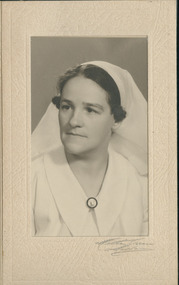
Photograph, C1947
... Before she became a nurse, Hilda Foster trained to be a Sunday School teacher and was a member of the Sunday School Council of Victoria. ...Before she became a nurse, Hilda Foster trained to be a Sunday School teacher and was a member of the Sunday School Council of Victoria. ...Hilda Charlotte Foster, 1902 - 1990, was a Double Certified Nurse when, at the age of 35, she successfully applied to the board of the Australian Inland Mission (AIM) to work at an outback field centre in South Australia. Born and raised in suburban Melbourne, she had been inspired by stories told to her by other missionaries about the fulfilment to be gained working amongst Aboriginal communities. Given her religious faith and nursing skills, she believed she could make a difference. She worked in Oodnadatta in South Australia for two years (1937-1939), followed by a stint in Innamincka in New South Wales in 1940 -1942. Before she became a nurse, Hilda Foster trained to be a Sunday School teacher and was a member of the Sunday School Council of Victoria. She completed first aid courses run through the Presbyterian Deaconesses Institute in Carlton, Victoria, and in 1930 successfully applied to become a trainee nurse at the Austin Hospital for Incurables, in Heidelberg. She commenced her training there in 1931, before moving to the Women's Hospital in 1933. In 1934 she had six months at the Fairfield Infectious Diseases Hospital, before returning to the Austin, where she was employed when she sat her final exams in November 1934. Her combined skills made her a most attractive option for the Australian Inland Mission. As well as being multi-skilled as a nurse, she provided religious instruction and spiritual ministry to members of the community. https://trove.nla.gov.au/people/762093?c=people Sister Foster nursed at Toora Bush Hospital prior to leaving for the Paton Memorial Hospital, Vila, New Hebrides in 1944. She left the New Hebrides in 1946.Matt, black and white, head and shoulders, studio portrait of Sister Hilda Charlotte Foster on card.australian inland mission, presbyterian deaconess, sister hilda charlotte foster, paton memorial hospital vila new hebrides -
 Ringwood and District Historical Society
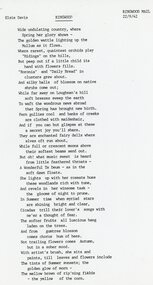
Document - Family History, Elsie May Davis, Ringwood, Victoria
... Sunday School, and remembered when the Church was located near the antimony mine. ..." Two A4 pages typewritten by Elsie Davis addressed to Ringwood Mail newspaper dated 22/9/1942, with poem and autobiographical remarks published in the Ringwood Mail, Thursday September 24, 1942. Elsie May Davis, Ringwood, Victoria ...Two A4 pages typewritten by Elsie Davis addressed to Ringwood Mail newspaper dated 22/9/1942, with poem and autobiographical remarks published in the Ringwood Mail, Thursday September 24, 1942."Miss Elsie Davis was a life time member of the Parish of St.Paul, Ringwood. She was a member of the choir, served as superintendent of the Sunday School, and remembered when the Church was located near the antimony mine. ..." -
Marysville & District Historical Society
THE TRIANGLE NEWS-VOL 3 NO 41-15 DECEMBER 1978
... victoria...australia...marysville waterworks trust...community care centre...swimming club...sunday school...marysville victoria australia marysville waterworks trust community care centre swimming club sunday school children vicswim christmas carol service poison pen letters congratulations part time work needed donations to typewriter appeal senior citizens school council marysville hotel rainfall best wishes christmas greeting to u.s.a. action time bingo help THE TRIANGLE NEWS-VOL 3 NO 41-15 DECEMBER 1978 ...marysville, victoria, australia, marysville waterworks trust, community care centre, swimming club, sunday school children, vicswim, christmas carol service, poison pen letters, congratulations, part time work needed, donations to typewriter appeal, senior citizens, school council, marysville hotel, rainfall, best wishes, christmas greeting to u.s.a., action time, bingo, help -
 Flagstaff Hill Maritime Museum and Village
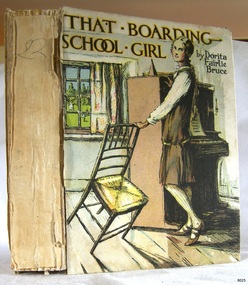
Book - Fiction, Oxford University Press, That Boarding School Girl, 1926
... Victoria. It is a tangible link to the history and legacy of these early settlers, who were instrumental in shaping the regional development. Flagstaff Hill Flagstaff Hill Maritime Museum and Village Warrnambool Maritime Museum Maritime Village Great Ocean Road Shipwreck Coast book Warrnambool Library Warrnambool Mechanics’ Institute Mechanics’ Institute Library Victorian Library Board Warrnambool Books and Records Warrnambool Children’s Library Warrnambool Public Library that boarding school girl Dorita Fairlie Bruce Sylvia McCullagh Sylvia Jean Veronica McCullagh Sylvia Barr James McCullagh Elizabeth Eccles McCullagh William McCullagh Margaret Jane Russell McCullagh Oak Grove Yangery Illowa Dennington Presbyterian Sabbath School Presbyterian Sunday School Dennington Presbyterian Church book award book prize book presentation F. ...Sylvia Jean Veronica McCullagh Barr (1914–1998) was a student at the Presbyterian Sabbath School in Dennington, near Warrnambool. In December 1930, she received a book as an award from F. Jones, the Sabbath School Superintendent, recognising her involvement and achievements at the school. Sylvia was the granddaughter of James McCullagh (1831–1911) and Elizabeth Eccles (1831–1909), a pioneering couple in the region. Married in 1856, James and Elizabeth settled at Oak Grove, Yangery, Illowa from 1859, where they lived until their deaths. One of James and Elizabeth’s sons, William McCullagh (1873–1940), married Margaret Jane Russell (1879–1981). William and Margaret also made their home at Oak Grove and raised eleven children there, including Sylvia.The book, “That Boarding School Girl” by Dorita Fairlie Bruce, represents an example of literature accessible to older girls during the early 20th century. It was specifically selected as an end-of-year award, recognising consistent attendance at Sabbath School. Such choices highlight the role of books in supporting the educational and moral development of young women during this period. The book is important as a connection to the early township of Dennington, a community distinguished by its established school and church. This association reflects the values the community placed on education and religious instruction. The book’s significance is further enhanced by its relationship with colonial pioneer families in Australia, particularly those from Victoria and the Warrnambool district in southwest Victoria. It is a tangible link to the history and legacy of these early settlers, who were instrumental in shaping the regional development. That Boarding School Girl Author: Dorita Fairlie Bruce Publisher: Oxford University Press Date: 1926 The front cover and the page opposite the fly page have drawn and coloured illustrations. The cloth-covered, hardcover book includes black and white illustrations and coloured illustrations on the front cover and frontispiece. The front cover illustration shows a teenage irl in a school tunic, standing beside a piano with one hand on the backrest of a tilted chair. Inscriptions are printed on the front loose endpaper and handwritten on the fly page. The book belonged to Sylvia McCullagh. It was awarded to her as a prize in 1930.Handwritten on the top of the fly page: "Sylvia McCullagh Den" [ Den - abbreviation for Dennington] " Presbyterian Sabbath School, Dennington. Prize Awarded to: Sylvia McCullagh. December 1930." "F. Jones, Superintendent"flagstaff hill, flagstaff hill maritime museum and village, warrnambool, maritime museum, maritime village, great ocean road, shipwreck coast, book, warrnambool library, warrnambool mechanics’ institute, mechanics’ institute library, victorian library board, warrnambool books and records, warrnambool children’s library, warrnambool public library, that boarding school girl, dorita fairlie bruce, sylvia mccullagh, sylvia jean veronica mccullagh, sylvia barr, james mccullagh, elizabeth eccles mccullagh, william mccullagh, margaret jane russell mccullagh, oak grove, yangery, illowa, dennington, presbyterian sabbath school, presbyterian sunday school, dennington presbyterian church, book award, book prize, book presentation, f. jones, sabbath school superintendent, 1930 -
 Flagstaff Hill Maritime Museum and Village
Book - Fiction, Mrs Herbert Strang, editor, The Rose Book for Girls, 1916
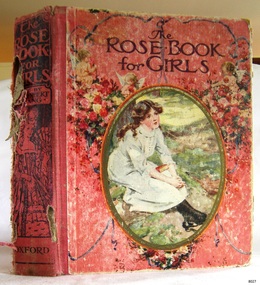
... Victoria...Warrnambool district...Presbyterian Sabbath School...Presbyterian Sunday...Flagstaff Hill Flagstaff Hill Maritime Museum and Village Warrnambool Maritime Museum Maritime Village Great Ocean Road Shipwreck Coast book The Rose Book for Girls Mrs Herbert Strang short stories Henry Frowde Hodder & Stoughton London Morrison & Gibb Ltd 1916 Alma McCullagh James McCullagh Elizabeth Eccles McCullagh ca. 1928 Dennington southwest Victoria Warrnambool district Presbyterian Sabbath School Presbyterian Sunday School Dennington Presbyterian Church book award book prize book presentation R. ...Alma McCullagh was a student at the Presbyterian Sabbath School located in Dennington, near Warrnambool. In January, around 1928, she received a book as an award from R. Conn, her Sabbath School teacher, in recognition of her involvement and achievements at the school. The exact year of this award is based on available records: in January 1928, Alma was presented with a prize by R. Conn, whereas by 1930, the role of awarding prizes had passed to F. Jones. Alma was probably the granddaughter of James McCullagh (1831–1911) and Elizabeth Eccles (1831–1909), who were pioneering settlers in the region. James and Elizabeth married in 1856 and established their home at Oak Grove, Yangery, Illowa from 1859, residing there until their deaths. One of their sons, William McCullagh (1873–1940), married Margaret Jane Russell (1879–1981). William and Margaret continued the family tradition, making their home at Oak Grove as well. They raised eleven children, with Alma likely being among the youngest of their children.The book, “The Rose Book for Girls”, edited by Mrs Herbert Strang, represents an example of literature accessible to older girls during the early 20th century. It was specifically selected as an end-of-year award, recognising consistent attendance at Sabbath School. Such choices highlight the role of books in supporting the educational and moral development of young women during this period. The book is important as a connection to the early township of Dennington, a community distinguished by its established school and church. This association reflects the values the community placed on education and religious instruction. The book’s significance is further enhanced by its relationship with colonial pioneer families in Australia, particularly those from Victoria and the Warrnambool district in southwest Victoria. It is a tangible link to the history and legacy of these early settlers, who were instrumental in shaping the regional development. In addition, the book is notable for its connection to the McCullagh family, a prominent farming family whose contributions supported the social and economic growth of the local district. This historical association enriches its value, situating the book within the broader narrative of community progress and pioneer achievement in the area, and highlighting its place within a tradition of religious life and community building.The Rose Book for Girls A collection of short stories by various authors Edited by Mrs Herbert Strang Publisher: Henry Frowde, Hodder & Stoughton, London Printer: Morrison & Gibb Ltd., Tanfield, Edinburgh, Scotland, UK Date: 1916 Hardcover book. Deep pink front and back covers, decorated with garlands of pink and white flowers, cupids and blue ribbons. The front has a cameo with a seated girl in white, with a book in her lap. Details on the spine: title, author, publisher and a sketched female in 19th-century dress holding a fan. The fly page shows details of the book and has a black and red sketch of two seated girls, one reading, the other stitching. Twenty-five books are listed on the Contents page, as well as the printer's details. Within the book are several colourful sketches. Inscriptions include the name of the book's previous owner, Alma McCullagh.Front loose-end paper: "Presbyterian Sabbath School, Dennington. Prize Awarded to: Alma McCullagh. January. (year is unreadable, circa 1928) R. Conn, Teacher"flagstaff hill, flagstaff hill maritime museum and village, warrnambool, maritime museum, maritime village, great ocean road, shipwreck coast, book, the rose book for girls, mrs herbert strang, short stories, henry frowde, hodder & stoughton, london, morrison & gibb ltd, 1916, alma mccullagh, james mccullagh, elizabeth eccles mccullagh, ca. 1928, dennington, southwest victoria, warrnambool district, presbyterian sabbath school, presbyterian sunday school, dennington presbyterian church, book award, book prize, book presentation, r. conn, sabbath school superintendent -
 Flagstaff Hill Maritime Museum and Village
Work on paper - Religious Portrait Print, Herbert Beecroft, artist, The Lord turned and looked upon Peter … and Peter remembered, 1947
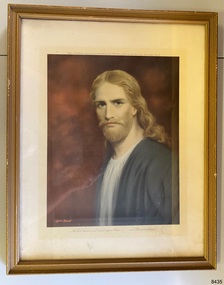
... Victoria, operated by the Missions to Seamen organisation. The title of the print is taken from the Holy Bible, from the New Testament book of Luke, chapter 22 verse 61, which is a famous Christian account of Jesus being betrayed by Peter, which leads to Jesus’ crucifixion; “And the Lord turned, and looked upon Peter. And Peter remembered the word of the Lord, how he had said unto him, Before the cock crow, thou shalt deny me thrice.”. The print was published in 1942 by the National Sunday School...Victoria, operated by the Missions to Seamen organisation. The title of the print is taken from the Holy Bible, from the New Testament book of Luke, chapter 22 verse 61, which is a famous Christian account of Jesus being betrayed by Peter, which leads to Jesus’ crucifixion; “And the Lord turned, and looked upon Peter. And Peter remembered the word of the Lord, how he had said unto him, Before the cock crow, thou shalt deny me thrice.”. The print was published in 1942 by the National Sunday School ...This print of Christ is slightly smaller than the original 1927 oil painting by Herbert Beecroft, which is titled “Christ” and measures, in centimetres, 60 high by 50 wide. The original is displayed at John Wesley’s House & The Museum of Methodism in Islington, England. This print was part of the original furnishings donated by the Williamstown Lightkeepers' Auxiliary to the St Nicholas' Mission to Seamen's Church at 139 Nelson Place, Williamstown, Victoria, operated by the Missions to Seamen organisation. The title of the print is taken from the Holy Bible, from the New Testament book of Luke, chapter 22 verse 61, which is a famous Christian account of Jesus being betrayed by Peter, which leads to Jesus’ crucifixion; “And the Lord turned, and looked upon Peter. And Peter remembered the word of the Lord, how he had said unto him, Before the cock crow, thou shalt deny me thrice.”. The print was published in 1942 by the National Sunday School Union in England, now known as the National Christian Education Council. The NSSU was established in Britain in 1803 to promote Sunday Schools in Britain and overseas. The organisation produced many publications, including training manuals and materials for Sunday School teachers. Herbert Beecroft 1864-1951, also known as Lawrence Herbert Beecroft, was an early 20th-century artist. He and his wife emigrated from England to Sydney, Australia, in 1905. He worked as a painter, illustrator, miniaturist, lightning cartoonist, and lecturer. From 1927, Beecroft painted a series of portraits of Jesus Christ, prints of which made many worldwide sales. He entered a miniature portrait in the 1921 inaugural Archibald Prize competition. It was one of forty-one entries but the title was unknown. It was probably JF Archibald, the person who endowed the prize, first awarded in 1921. THE MISSIONS TO SEAMEN (Brief History): - The Missions to Seamen was an Anglican charity in Great Britain that has served the world's seafarers since 1856. Its symbol is a Flying Angel, inspired by a Bible verse. Today, there are centres in over 200 ports worldwide where seamen of all backgrounds are offered a warm welcome and provided with a wide range of facilities. In Victoria, the organisation began in Williamstown in 1857 as a Sailors’ Church, also known as ‘Bethel’ or the ‘Floating Church’ in an old hulk floating in Hobson’s Bay, Port of Melbourne. It soon became part of the Missions to Seamen, Victoria. In 2000, the organisation, now named Mission to Seafarers, still operated locally in Melbourne, Portland, Geelong and Hastings. The Ladies’ Harbour Lights Guild was formed in 1906 to support the Missions to Seamen in Melbourne and other centres, such as Williamstown. Two of the most significant ladies of the Guild were founder Ethel Augusta Godfrey and foundation member Alice Sibthorpe Tracy (who established a branch of the Guild in Warrnambool in 1920). The Guild continued its work until the 1960s. In 1943, a former Williamstown bank was purchased for the Missions to Seamen Club. The chapel was named St Nicholas’ Seamen’s Church and was supported by the Ladies’ Harbour Lights Guild, the Williamstown Lightkeepers’ Auxiliary and the League of Soldiers’ and Sailors’ Friends. It ceased operation in 1966. A Missions to Seamen Chapel and Recreation Room was a significant feature of ports during the late 1800s and 1900s. It seemed appropriate for Flagstaff Hill to include such a representation within the new Maritime Village, and the Melbourne Board of Management of Missions to Seamen Victoria gave its permission on 21st May 1979 for the entire furnishings of the Williamstown chapel to be transferred to Flagstaff Hill. The St Nicholas Seamen’s Church was officially opened on October 11, 1981, and resembles the Williamstown chapel. This print of Christ, originally painted by Herbert Beecroft, represents the social movement in the early 20th century to educate all children in good morals and Christianity. The book is historically significant for its connection to the Missions to Seamen and to the Williamstown Lightkeepers' Auxiliary, an organisation of women, formed to support seafarers. A religious portrait of the artist’s impression of Jesus. The print is in a gilt timber frame behind glass. The frame has eyelets and wire for hanging. The backing paper lifts to reveal a handwritten pencil inscription. The portrait shows a male figure from the waist up facing the viewer but turned slightly to his right. He has long wavy blond hair, a moustache and a beard. He wears a blue-grey robe over a collarless white shirt. The background is red-brown. It is the artist’s impression of Jesus. The whole frame-mat has script text above and below the print, giving its title, and details of the publisher and producer. This print was produced from an original 1927 oil painting by Herbert Beecroft. It was published in 1942 by The National Sunday School Union in London and produced by Frost & Reed Ltd., England. This print is part of the St. Nicholas Seamen's Church Collection. Handwritten script on the mat; “Published in 1942 by the National Sunday School Union, 4 Black Friars Lane, London, EC4. Produced by Frost & Reed Ltd., Bristol & London. Printed in England. Copyright.” and, “The Lord turned and looked upon Peter … and Peter remembered” Signature on bottom left “Herbert Beecroft” In pencil on backboard under back paper “H 89 / 12”. Pen on white tape “155”flagstaff hill, warrnambool, maritime village, maritime museum, shipwreck coast, great ocean road, print, religious, vintage, 1942, herbert beecroft, lawrence herbert beecroft, archibald prize winner, early 20th-century, artist, oil painting, luke 22:61, flagstaff hill maritime museum and village, religion, religious service, religious worship, worship service, st nicholas seamen’s church, williamstown, missions to seamen victoria, mission to seafarers, st nicholas missions to seamen’s church williamstown, missions to seamen, st nicholas missions to seamen’s church flagstaff hill, 139 nelson place williamstown, anglican church, church furnishings, religious furnishings, seating, williamstown lightkeepers' auxiliary -
 Flagstaff Hill Maritime Museum and Village
Book - Reference Encyclopedia, Angus & Robertson, The Australian Encyclopaedia Vol 7 Parliamentary Government to Sandal Box (set 2), 1958
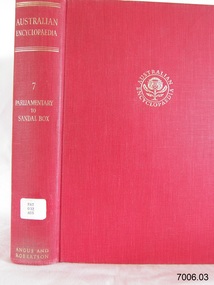
... Victoria. He was a noted Australian naturalist, journalist, newspaper editor, author, and ornithologist. He was the seventh of eight children born to Colin Chisholm, an Australian-born grocer, and Charlotte (née Kennedy), from Scotland. He was educated at Maryborough State School only until age 12 a largely self-taught polymath from there on. He worked as a journalist across Melbourne, Brisbane, and Sydney, and edited a number of prominent Australian newspapers, including the Argus (Melbourne), the Australasian (Melbourne), and the Sunday...Victoria. He was a noted Australian naturalist, journalist, newspaper editor, author, and ornithologist. He was the seventh of eight children born to Colin Chisholm, an Australian-born grocer, and Charlotte (née Kennedy), from Scotland. He was educated at Maryborough State School only until age 12 a largely self-taught polymath from there on. He worked as a journalist across Melbourne, Brisbane, and Sydney, and edited a number of prominent Australian newspapers, including the Argus (Melbourne), the Australasian (Melbourne), and the Sunday ...The Australian Encyclopaedia is a general reference work covering Australian history, geography, geology, flora, fauna, and biographies of notable Australians. Volume 7 ("Parliamentary Government to Sandal Box") is one volume in an alphabetically arranged multi-volume set. The entries in that volume run from topics starting with "Parliamentary Government thru to Sandal Box".Hard cover book, The Australian Encyclopaedia Vol 7 Parliamentary Government to Sandal Box (Set 2) Editor: Alexander Hugh "Alec" Chisholm Publisher: Angus & Robertson, Sydney Date: 1958 Further Information: Textured hard cover cloth bound book, red colour with gilt lettering. Publishers logo to front cover. non-fictionThe Australian Encyclopaedia is a general reference work covering Australian history, geography, geology, flora, fauna, and biographies of notable Australians. Volume 7 ("Parliamentary Government to Sandal Box") is one volume in an alphabetically arranged multi-volume set. The entries in that volume run from topics starting with "Parliamentary Government thru to Sandal Box".warrnambool, shipwrecked-coast, flagstaff-hill, flagstaff-hill-maritime-museum, maritime-museum, shipwreck-coast, flagstaff-hill-maritime-village, shipwrecked-artefact, book, the australian encyclopaedia, pattison collection, warrnambool library, warrnambool mechanics’ institute, ralph eric pattison, warrnambool city librarian, mechanics’ institute library, victorian library board, warrnambool books and records, warrnambool children’s library, the australian encyclopaedia vol 5 -
 City of Moorabbin Historical Society (Operating the Box Cottage Museum)
Badge - Sunday School Scholars Demonstration Pin, 1934
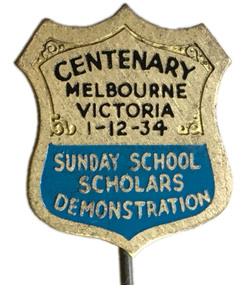
... Centenary Melbourne Victoria 1-12-34 - Sunday School Scholars Demonstration...The Sunday School Scholars Anniversary Celebration was to be held on 1 December 1934, but due to an abnormal storm on the day before it was postponed to 8th December 1934. 15000 Sunday school scholars and teachers marched through the streets of Melbourne to demonstrate the strength of youth organisations associated with the Churches. The march ended at the Treasury Gardens where a thanksgiving service was held, more than 35,000 people attended. Some of the families of the City of Moorrabbin would have attended this march. sunday school religion melbourne treasury gardens Centenary Melbourne Victoria ...The Sunday School Scholars Anniversary Celebration was to be held on 1 December 1934, but due to an abnormal storm on the day before it was postponed to 8th December 1934. 15000 Sunday school scholars and teachers marched through the streets of Melbourne to demonstrate the strength of youth organisations associated with the Churches. The march ended at the Treasury Gardens where a thanksgiving service was held, more than 35,000 people attended. Some of the families of the City of Moorrabbin would have attended this march.Silver pin in the shape of a shieldCentenary Melbourne Victoria 1-12-34 - Sunday School Scholars Demonstrationsunday school, religion, melbourne, treasury gardens -
 Glenelg Shire Council Cultural Collection
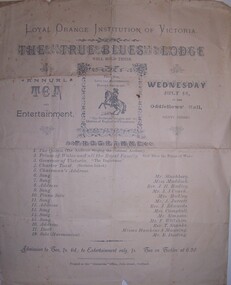
Programme - Programme - Loyal Orange Institution of Victoria "True Blues" Lodge Annual Tea and Entertainment Programme, c. 1900
... By the 1890s there were 169 branches in Victoria, engaged in political lobbying for mainstream Protestant issues like temperance, Sunday observance, opposition to state aid for church schools, and opposition to any expansion of the political influence of Roman Catholics. ...By the 1890s there were 169 branches in Victoria, engaged in political lobbying for mainstream Protestant issues like temperance, Sunday observance, opposition to state aid for church schools, and opposition to any expansion of the political influence of Roman Catholics. ...The Loyal Orange Institution of Victoria was established in 1843. As a society composed of Protestants, it works to support and defend the Protestant faith. The Institution is named in honour of King William III, Prince of Orange (1650-1702) and his achievements for civil and religious liberty. The first Orange Lodge in Victoria was founded in 1843, following a sectarian protest in Elizabeth Street Melbourne over the election of a Protestant candidate to the Legislative Council. By the 1890s there were 169 branches in Victoria, engaged in political lobbying for mainstream Protestant issues like temperance, Sunday observance, opposition to state aid for church schools, and opposition to any expansion of the political influence of Roman Catholics. The monthly meetings had an element of secrecy, as members wore regalia and followed a simple ritual. No Catholics could join. Women were admitted to Lodges in 1903.Single-sided sheet printed in blue ink containing program details. Decorative title at top of page, with central image of cavalier on rearing horse within a decorative ribbon and floral border, containing a Protestant oath. Loyal Orange Institution of Victoria "True Blues" Lodge Annual Tea and Entertainment Programmeloyal orange institution, protestant, societies, religion -
 The Beechworth Burke Museum
Photograph
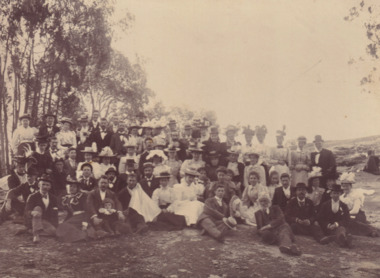
... A Sunday School group for local youth was established in 1869, emphasising the importance of children's religious education during the nineteenth century. Thus, the photograph reflects the importance of Methodism in Beechworth - and, more broadly, Victoria - at this time. entertainment album entertainment church religion beechworth methodist church youth group leisure recreation Reverse: 3714 / Beechworth Meth / 97.2332 / Endeavour / Beechworth Methodist / Endeavour Group / Sepia rectangular photograph printed on matte photographic paper mounted on card. ...The photograph depicts a large group of young men and women dressed in formal attire. They were part of the Beechworth Methodist Church's Youth Group.The photograph provides insight into one of the first religious institutions in Beechworth. The Methodist Church is historically significant as it was the first permanent church built on the Ovens goldfield in 1857. A Sunday School group for local youth was established in 1869, emphasising the importance of children's religious education during the nineteenth century. Thus, the photograph reflects the importance of Methodism in Beechworth - and, more broadly, Victoria - at this time.Sepia rectangular photograph printed on matte photographic paper mounted on card.Reverse: 3714 / Beechworth Meth / 97.2332 / Endeavour / Beechworth Methodist / Endeavour Group /entertainment album, entertainment, church, religion, beechworth, methodist church, youth group, leisure, recreation -
 The Beechworth Burke Museum
Photograph, 1920
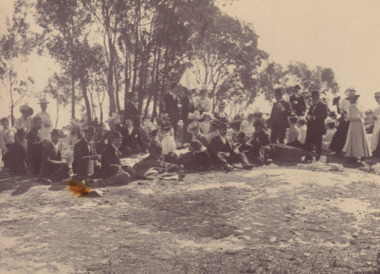
... A Sunday School group for local youth was established in 1869, emphasising the importance of children's religious education during the nineteenth century. Thus, the photograph reflects the importance of Methodism in Beechworth - and, more broadly, Victoria - at this time. entertainment entertainment album church beechworth religion recreation leisure youth group methodist church Reverse: 3716 / 97.2339 / Beechworth / Meth Endeavour / Beechworth Methodist Church / Endeavour Group / A03289 / Sepia rectangular photograph printed on matte photographic paper mounted on card. ...The photograph depicts a large group of young men and women dressed in formal attire. They were part of the Beechworth Methodist Church's Youth Group.The photograph provides insight into one of the first religious institutions in Beechworth. The Methodist Church is historically significant as it was the first permanent church built on the Ovens goldfield in 1857. A Sunday School group for local youth was established in 1869, emphasising the importance of children's religious education during the nineteenth century. Thus, the photograph reflects the importance of Methodism in Beechworth - and, more broadly, Victoria - at this time.Sepia rectangular photograph printed on matte photographic paper mounted on card.Reverse: 3716 / 97.2339 / Beechworth / Meth Endeavour / Beechworth Methodist Church / Endeavour Group / A03289 /entertainment, entertainment album, church, beechworth, religion, recreation, leisure, youth group, methodist church -
 Orbost & District Historical Society
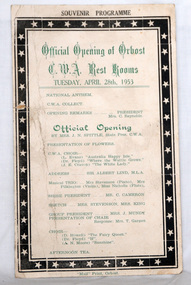
program, 1953
... Sunday School classes and dance lessons. This event was opened by Mrs J.N. Spittle, the state president of the C.W.A. The program lists an address by Sir Albert Lind M.L.A. In Australia, the Country Women’s Association was first formed in New South Wales and Queensland in 1922. Subsequently each State and the Northern Territory formed an Association, a process which took a period of 14 years. Mrs Spittle was the national president from 1951-1953. This item is of social significance as a representation of the role that the C.W.A. has played in the local and extended community. c.w.a. country-women's-association-victoria ...The C.W.A. rooms were in Munro Street, Orbost and were used for many activities, including Sunday School classes and dance lessons. This event was opened by Mrs J.N. Spittle, the state president of the C.W.A. The program lists an address by Sir Albert Lind M.L.A. In Australia, the Country Women’s Association was first formed in New South Wales and Queensland in 1922. Subsequently each State and the Northern Territory formed an Association, a process which took a period of 14 years. Mrs Spittle was the national president from 1951-1953. This item is of social significance as a representation of the role that the C.W.A. has played in the local and extended community. A souvenir program for the opening of a C.W.A. rest room in 1953. It is rectangular in shape with green print on white card with a black frame. Handwritten in pen on the back -"Thought you might like to have this love Annie"c.w.a. country-women's-association-victoria-orbost associations-women -
 Orbost & District Historical Society
certificate, Phillips, John, 2012
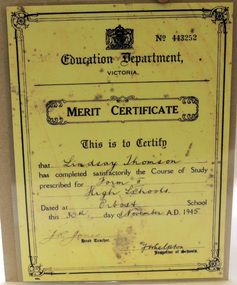
... school certificate On back : Produced by John Phillips for the Orbost Secondary College Centenary Celebrations on Saturday 28th April and Sunday 29th April 2012. A laminated copy of a merit certificate awarded to Lindsay Thomson on 30.11.45 Form 11 High School Orbost. It is signed by the J.R. Jones (head teacher) and F. Whelpston (Inspector of Schools). The original was issued by the Education Department, Victoria ...The certificate was produced by John Phillips for the Orbost Secondary College Centenary Celebrations on Saturday 28th April and Sunday 29th April 2012. The original certificate was in the possession of Lindsay Thomson. Lindsay Thomson lives in Orbost and is a current member of the Orbost & District Historical Society.Orbost High School / Orbost Secondary College has played a significant part in the education of senior students in the Orbost district . It is the sole senior educational institution. This certificate is representative of its history.A laminated copy of a merit certificate awarded to Lindsay Thomson on 30.11.45 Form 11 High School Orbost. It is signed by the J.R. Jones (head teacher) and F. Whelpston (Inspector of Schools). The original was issued by the Education Department, Victoria 443252On back : Produced by John Phillips for the Orbost Secondary College Centenary Celebrations on Saturday 28th April and Sunday 29th April 2012.education orbost-high-school certificate -
 Ringwood and District Historical Society
Document, Certificate of Title - W.G. Carter, Grandview Grove, Warranwood, Victoria, (later Bemboka Road) - part of Crown Section Twenty, Parish of Warrandyte, County of Evelyn - 1947
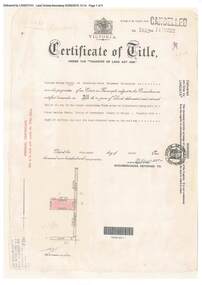
... Sunday school. By the early 2000s, construction of a contemporary-design church and carparking area between the house and street alignment had been completed but the house remained as a detatched meeting room until falling into disrepair and was eventually demolished around 2010. A4 copies of Landata Victoria ...A4 copies of Landata Victoria Historical Search documents - Vol 7052 Fol 1410222. Includes Carter Family Tree property notes. William George Carter of Grandview Grove Ringwood, Nurseryman, is now the proprietor - three acres or thereabouts shown on map (12202a) - 14th March, 1947. Transfer B284834 Registered 21 September, 1961 - 1 acre shown on map (12202c) north of Plymouth Road. NOTES ON GRANDVIEW GROVE PROPERTY (Carter Family Tree extract) The Grandview Grove property was purchased by William (Bill) and Doreen Carter in 1947 as three acres of uncleared bushland. They had a 2 bedroom fibro-cement house built on the land which they informally called "Willoreen". With Doreen looking after sons Peter (born in 1940) and Robin (born in 1950), Bill worked locally at Croydon Dairy. The family spent much of their spare time clearing the land, where Bill then grew and sold fruit, flowers and berries, particularly strawberries, as a hobby and to supplement their income. Bill continued to do so while Peter and Robin were growing up, and after Doreen died in 1958. In 1961 Bill sold one of the three acres to one of his seven sisters, Grace, who lived in Kew but later moved to Rosebud and sold the land without ever building on it. During the 1960s, Grandview Grove was renamed Bemboka Road. After retiring as a milkman, Bill moved to Rosebud, Vic, and in 1977, sold the property to the Anglican Church, who were looking to invest in the site in anticipation of proposed future residential development in the area. As nearby properties were subdivided during the 1980s, the house, which the Church had initially utilised as low-cost family accommodation, was modified internaly to become a church/Sunday school. By the early 2000s, construction of a contemporary-design church and carparking area between the house and street alignment had been completed but the house remained as a detatched meeting room until falling into disrepair and was eventually demolished around 2010. -
 Ringwood and District Historical Society
Newspaper, Scrapbook Clipping, Library Collection, Ringwood, Victoria
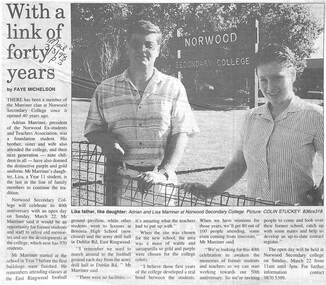
... school wil celebrate its 40th anniversary with an open day on Sunday March 22nd 1998. Newspaper Clipping from "The Mail", 3-3-1998, Page 3. With a link of 40 years - by Faye Michelson Scrapbook Clipping, Library Collection, Ringwood, Victoria,. ...Newspaper Clipping from "The Mail", 3-3-1998, Page 3. With a link of 40 years - by Faye MichelsonThere has been a member of the Marriner clan at Norwood Secondary College since it opened 40 years ago. Adrian Marriner, President of the Norwood Ex-Students and Teachers Association was a foundation student. He is pictured with his daughter Lisa, a year 11 student. The school wil celebrate its 40th anniversary with an open day on Sunday March 22nd 1998. -
 Ringwood and District Historical Society
Newspaper, Scrapbook Clipping, Library Collection, Ringwood, Victoria
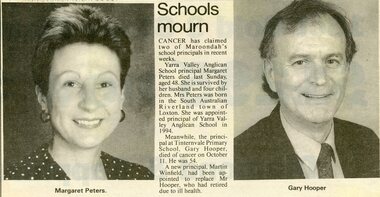
... School principal Margaret Peters died last Sunday. She was appointed principal of Yarra Valley in 1994. Meanwhile, the principal at Tinternvale Primary School, Gary Hooper died of cancer on October 11. He was 54. A new principal, Martin Winfield, had been appointed to replace Mr Hooper, who had retired due to ill health Newspaper Clipping from the ""Mail", 29 October 96, P 26. "Schools mourn". Scrapbook Clipping, Library Collection, Ringwood, Victoria ...Newspaper Clipping from the ""Mail", 29 October 96, P 26. "Schools mourn".Cancer has claimed two of Maroondah's school principals in recent weeks. Yarra Valley Anglican School principal Margaret Peters died last Sunday. She was appointed principal of Yarra Valley in 1994. Meanwhile, the principal at Tinternvale Primary School, Gary Hooper died of cancer on October 11. He was 54. A new principal, Martin Winfield, had been appointed to replace Mr Hooper, who had retired due to ill health -
 Ringwood and District Historical Society
Book - Bibles, Collection of 6 Bibles - Maggs Family Collection, Ringwood, Victoria - 1908-1934
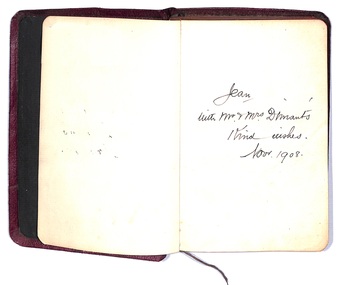
... Bibles given as gifts to siblings or prizes from Sunday School 26272-1 Jean with Mr. and Mrs. Dimants good wishes Nov 1908. 26272-2 To my Dear Sister Evelyn Victoria Maggs with fond love and best wishes for her 13th. birthday from her loving sister Jane E. ...Bibles given as gifts to siblings or prizes from Sunday SchoolBibles belonging to various members of the Maggs Family. 1 . Jean 1908. 2 Evelyn victoria Maggs 1910. 3 David Maggs 21st. birthday. 4 Eva Maggs 1911. 5 Eva Maggs 1914. 6 Chrissie Maggs 1934. 26272-1 Jean with Mr. and Mrs. Dimants good wishes Nov 1908. 26272-2 To my Dear Sister Evelyn Victoria Maggs with fond love and best wishes for her 13th. birthday from her loving sister Jane E. Maggs. Proverbs 3.6. 26272-3 To my beloved brother David J Maggs as a gift of sincere love for his 21st. Birthday of the 31st. January 1908 from his affectionate sister Jean E. Maggs &. Proverbs 3.6 26272-4 Eva Maggs 2nd class Special Prize May 1911 26272-5 Eva Maggs Presented by her S.S. Super H. L Smythe 25-12-14 also to my dear Alison from Mother Armistice Day 11-11 30 26272-6 Presented to Chrissie Maggs from Mother 24-5-34 -
 Ringwood and District Historical Society
Photograph, Ringwood Methodist Sunday School picnic at Bayswater, 1908/9
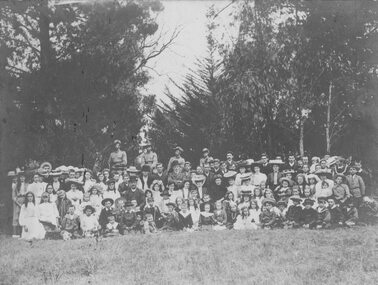
... Sunday School picnic - At Bayswater, 1908. Photo by Lewis F. East". The other label reads, "Ringwood Methodist Sunday School picnic at Bayswater - 1909. Photographs Lewis F. East". Small label in lower left corner "Sir Ronald East, 57 Waimarie Drive, Mt. Waverley Victoria...Sunday School picnic - At Bayswater, 1908. Photo by Lewis F. East". The other label reads, "Ringwood Methodist Sunday School picnic at Bayswater - 1909. Photographs Lewis F. East". Small label in lower left corner "Sir Ronald East, 57 Waimarie Drive, Mt. Waverley Victoria ...Black and white photograph mounted on lightly embossed backing board.Typed on backing sheet two labels: "Ringwood Methodist Sunday School picnic - At Bayswater, 1908. Photo by Lewis F. East". The other label reads, "Ringwood Methodist Sunday School picnic at Bayswater - 1909. Photographs Lewis F. East". Small label in lower left corner "Sir Ronald East, 57 Waimarie Drive, Mt. Waverley Victoria 3149. Telephone 277 4315". -
 Orbost & District Historical Society
display cabinet and tools
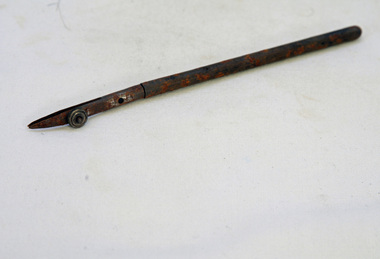
... Victoria entitled her to carry 25 passengers and only 10 passengers when engaged in towage service. Two children under 12 years of age to be reckoned as one passenger. PS Curlip towed five barges at a time, traveling upstream as far as Bete Bolong, 20 km upstream of the mouth to collect produce to be transferred to schooners near Marlo. She towed vessels in and out through the Snowy river entrance and was also used for social functions such as Sunday School...Victoria entitled her to carry 25 passengers and only 10 passengers when engaged in towage service. Two children under 12 years of age to be reckoned as one passenger. PS Curlip towed five barges at a time, traveling upstream as far as Bete Bolong, 20 km upstream of the mouth to collect produce to be transferred to schooners near Marlo. She towed vessels in and out through the Snowy river entrance and was also used for social functions such as Sunday School ...This display was put together by the Curlip Committee and used as promotion in the shed during the construction of Curlip 11 A community project, this boat was constructed out of local hardwood timbers utilizing the traditional skills of wooden boat builders and is powered by a steam engine. Paddle Steamer Curlip II is a replica of an historic paddle steamer of the Snowy River, in Far East Gippsland, Victoria. The original Paddle Steamer Curlip was built by Sam Richardson and his sons Mark, Albert and Frank, at their sawmill at Tabbara, a pioneering settlement on the Brodribb River, a tributary of the Snowy River. The keel was laid on 14th October 1889 and PS Curlip was launched in 1890. The name “ Curlip” is derived from the indigenous name for the area where Tabbara is located and includes land to the east of the Snowy and Brodribb Rivers towards Cape Conran. PS Curlip was registered in 1893 and the Passenger Certificate issued on 30th January 1903 to Captain Alan Richardson by the Marine Board of Victoria entitled her to carry 25 passengers and only 10 passengers when engaged in towage service. Two children under 12 years of age to be reckoned as one passenger. PS Curlip towed five barges at a time, traveling upstream as far as Bete Bolong, 20 km upstream of the mouth to collect produce to be transferred to schooners near Marlo. She towed vessels in and out through the Snowy river entrance and was also used for social functions such as Sunday School picnics. She was the main means of transport for imports and exports on the Snowy River for almost 30 years. The Curlip era ended abruptly on Friday 28th February when a flash flood carried her and 2 barges down river and out to sea, where she washed ashore at Marlo and broke up.More than eighty years after the original Paddle Steamer Curlip was wrecked at sea, the Orbost community launched a replica which it hoped would draw tourists to the region. The P.S. Curlip II, is based on drawings of the original Curlip that made its home in the Snowy and Brodribb Rivers of East Gippsland in the 1890s and early 1900s, It took six years of planning and hundreds of hours of volunteer work from the local community.A display cabinet containing tools and sundry items related to the Paddle Steamer Curlip. (More information on individual items in Catalogue 1400-1600)p.s.curlip richardson-samuel boat-building-tools transport -
 Glen Eira Historical Society
Letter - Carnegie Methodist Church, Neerim Rd, 252- 254, Carnegie
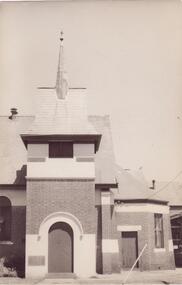
... Victoria) notifying inclusion of the Carnegie Methodist on the Register – 25/09/1990 Carnegie Rosstown State School Rosstown Neerim Road Carnegie State School Coles A. Phipps Schools Oakleigh Circuit Ward Andrew Toolambool Road Methodist Circuit Carnegie Methodist Church Broadbent L. C. Snell J. F. Reid G. Rosstown Theatrical Company Methodist Church Uniting Church Architectural Styles Architectural Features Frederick H. W. Rev. Californian Bungalow Sunday ...Caulfield Conservation Study – Andrew Ward 1995 with photos. Photocopy of extract from the study. Two Black and White photographs of the Carnegie Methodist Church 1) 90mm x 135mm 2) 80mm x 115mm. Sats unknown. Handwritten research note on the Carnegie Methodist Church. Undated and unacknowledged. Letter, National Trust of Australia (Victoria) notifying inclusion of the Carnegie Methodist on the Register – 25/09/1990carnegie, rosstown state school, rosstown, neerim road, carnegie state school, coles a. phipps, schools, oakleigh circuit, ward andrew, toolambool road, methodist circuit, carnegie methodist church, broadbent l. c., snell j. f., reid g., rosstown theatrical company, methodist church, uniting church, architectural styles, architectural features, frederick h. w. rev., californian bungalow, sunday schools, towers.
