
Showing 7 items matching "tallangatta butter factory"
-
 Wodonga & District Historical Society Inc
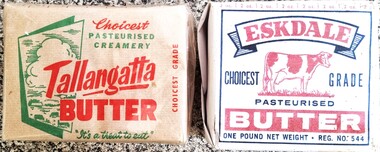
Domestic object - Butter packet - Eskdale and Tallangatta Butter Factories
... ...Tallangatta Butter Factory...Tallangatta Butter Factory The Tallangatta Butter Factory and Creamery Co. ...2 wrappers for butter produced in North East Victoria by the Tallangatta Butter Factory and the Eskdale Butter Factory and Creamery. ...Tallangatta Butter Factory The Tallangatta Butter Factory and Creamery Co. ...Tallangatta Butter Factory The Tallangatta Butter Factory and Creamery Co. Ltd was established as a co-operative with application for shares closing on 19 December 1891. It was registered in February 1892 and notified in the Victorian Government Gazette. It was one of the first north eastern Victoria dairy co-operatives. The Upper Murray and Mitta Herald on Thursday 23 March 1905 recorded that advice had been received of the sale in London of a shipment of 191 boxes of sent via India. The sale fetched a price at 105 shillings per cwt (hundredweight). When the township of Tallangatta was moved due to the raising of the Hume Weir in 1956, a new factory was built at the new location. It continued to operate until 1959 when it merged with the Kiewa Butter Factory to become the North Eastern Dairy Company. In 1985 this organisation was taken over by the Murray Goulburn Co-operative Eskdale Butter Company. After the selling of shares to form a co-operative, The Eskdale Butter Factory was officially opened on Saturday 26 November 1904. It closed after a merger with Murray Goulburn in 1969.This item is representative of the dairy industry in North East Victoria.2 wrappers for butter produced in North East Victoria by the Tallangatta Butter Factory and the Eskdale Butter Factory and Creamery. Both wrappers are a single sheet of folded paper with coloured images and logos.dairy industry victoria, tallangatta butter factory, eskdale butter factory -
 Wodonga & District Historical Society Inc
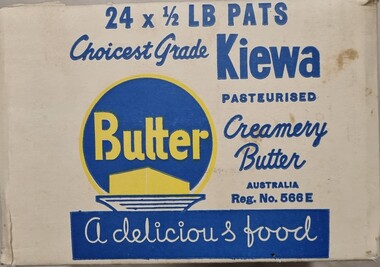
Functional object - Kiewa Dairy Box
... Butter Factory began in 1893, named after the Kiewa River on which it is located. By 1905, butter shipped from Kiewa was receiving a top price of 114 s per cwt at the London market. It continued to prosper until 1959 when it merged with Tallangatta...Butter Factory began in 1893, named after the Kiewa River on which it is located. By 1905, butter shipped from Kiewa was receiving a top price of 114 s per cwt at the London market. It continued to prosper until 1959 when it merged with Tallangatta ...The Kiewa Butter Factory began in 1893, named after the Kiewa River on which it is located. By 1905, butter shipped from Kiewa was receiving a top price of 114 s per cwt at the London market. It continued to prosper until 1959 when it merged with Tallangatta Butter Factory and Creamery Co. Ltd to become the North Eastern Dairy Company. In 1985 this organisation was taken over by the Murray Goulburn Co-operative.This package is representative of an important industry in Wodonga and the surrounding district.A packing box for butter from the Kiewa North Eastern Dairy. Made from heavy cardboard with blue and yellow design.On Front: 24 x 1/2 lb PATS / Choicest grade Kiewa/ Pasteurised / Creamery Butter/ AUSTRALIA / Reg. No. 566E/ BUTTER A delicious food On sides: 24 x 1/2 lb PATS / Choicest grade Kiewa/ Pasteurised / Creamery Butter/ AUSTRALIA / Reg. No. 566E/ North Eastern Dairy Co. Ltd. / KIewa Australianortheastern dairy co, dairies and butter factories, dairy industry victoria -
 Wodonga & District Historical Society Inc
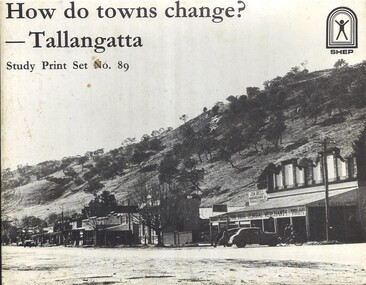
Education kit - How do towns change? - Tallangatta, SHEP Project, 1979
... Tallangatta was relocated. The State Rivers and Water Supply Commission oversaw the move with a £3 million budget. Over 100 timber homes were relocated, 37 brick homes rebuilt, and 74 prefabricated houses brought in. Thirty-five new buildings were added, including hotels, banks, a butter factory ...The Tallangatta pastoral run was established in 1838. By the 1850s a thriving town had been established near the junction of the Mitta Mitta River and Tallangatta Creek. Officially named in 1854, Tallangatta became a vital gateway to nearby goldfields such as Mount Wills, Mitta Mitta, and Cravensville. It also grew as a service centre to the pastoralists in the surrounding area. Rail reached Tallangatta in 1891, doubling the population within a decade. A mile-long viaduct took two years to complete. The railway brought jobs and connected local mining and farming industries to broader markets. From 1918, Tallangatta's future was uncertain. Plans for a reservoir at the confluence of the Mitta Mitta and Murray Rivers threatened the town. Stage one of Lake Hume was completed in 1936, sparing the town temporarily. After WWII, demand for irrigation water rose—and residents were told the town would be flooded. Between 1952 and 1958, Tallangatta was relocated. The State Rivers and Water Supply Commission oversaw the move with a £3 million budget. Over 100 timber homes were relocated, 37 brick homes rebuilt, and 74 prefabricated houses brought in. Thirty-five new buildings were added, including hotels, banks, a butter factory, a hospital, and a modern shopping centre. The new town of Tallangatta was officially reopened by Governor Sir William Slim on June 29, 1956. In 2016, Tallangatta was designated a "Notable Town" by the National Trust for its architectural and historical significance, making it the second town to receive this honour.A set of 89 Photographs, maps and information sheets produced as a case study of the moving of the town of Tallangatta in the 1950s. It was created as a resource to enable secondary school students to investigate how towns can change over time. non-fictionThe Tallangatta pastoral run was established in 1838. By the 1850s a thriving town had been established near the junction of the Mitta Mitta River and Tallangatta Creek. Officially named in 1854, Tallangatta became a vital gateway to nearby goldfields such as Mount Wills, Mitta Mitta, and Cravensville. It also grew as a service centre to the pastoralists in the surrounding area. Rail reached Tallangatta in 1891, doubling the population within a decade. A mile-long viaduct took two years to complete. The railway brought jobs and connected local mining and farming industries to broader markets. From 1918, Tallangatta's future was uncertain. Plans for a reservoir at the confluence of the Mitta Mitta and Murray Rivers threatened the town. Stage one of Lake Hume was completed in 1936, sparing the town temporarily. After WWII, demand for irrigation water rose—and residents were told the town would be flooded. Between 1952 and 1958, Tallangatta was relocated. The State Rivers and Water Supply Commission oversaw the move with a £3 million budget. Over 100 timber homes were relocated, 37 brick homes rebuilt, and 74 prefabricated houses brought in. Thirty-five new buildings were added, including hotels, banks, a butter factory, a hospital, and a modern shopping centre. The new town of Tallangatta was officially reopened by Governor Sir William Slim on June 29, 1956. In 2016, Tallangatta was designated a "Notable Town" by the National Trust for its architectural and historical significance, making it the second town to receive this honour.moving tallangatta, tallangatta - the town that moved, history tallangatta -
 Wodonga & District Historical Society Inc
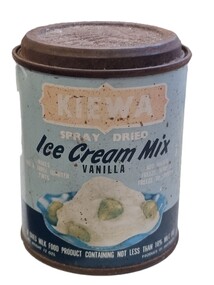
Domestic object - Kiewa Spray Dried Ice Cream Mix, c1950s
... Tallangatta Companies amalgamated in 1959 to form the North Eastern Dairy Company Limited. This product therefore predates that time. This item is significant because it was manufactured by a Dairy Cooperative in the Wodonga District. Kiewa Milk Dairies and butter factories ...On 28th December 1892 it was decided to form a company to be called the Kiewa Butter and Cheese Factory and Creamery Co. Ltd. Share Capital was to be 3000 shares at one pound per share. The factory was built at Kiewa in 1893 and took in its first milk in December 1893. The first intake of cream from surrounding farmers took place in 1899. From 1900 to 1910 the Kiewa factory intake was affected by vagaries of weather. The following years were affected by the First World War and impacts on the London markets. In 1928 a new factory was constructed. In the 1940s a piggery was established to dispose of buttermilk and a dairy farm was established for effluent disposal. In the 1950s a new factory for the receival of milk and milk products was constructed with surplus milk being manufactured into spray dried milk powder. The Company was the first Victorian co-operative dairy to pasteurise and bottle milk for home delivery. They also promoted their milk which was Tuberculin free. Farmers were paid a premium for milk from herds declared T.B. free after testing by veterinary officers of the Kiewa and Mitta Valleys Veterinary Scheme. That important fact is noted on the label of this product. The Kiewa and Tallangatta Companies amalgamated in 1959 to form the North Eastern Dairy Company Limited. This product therefore predates that time. This item is significant because it was manufactured by a Dairy Cooperative in the Wodonga District.A tin of powder used to make ice cream at home. The front features a photo of a bowl of ice cream with grapes sprinkled on it. Background information about the product and instructions for use are included.Kiewa Spray Dried Ice Cream Mix Vanilla kiewa milk, dairies and butter factories, dairy cooperatives -
 Wodonga & District Historical Society Inc
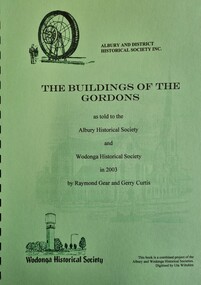
Booklet - The Buildings of the Gordons
... Schlink's Store in High Street, Wodonga, Old Tallangatta Shire Offices and Butter Factory, St. Joseph's Convent, Wodonga, "Cambourne" and the de Kerilleau Homestead. ...John Gordon was born in Chelsea, London in 1826. He and his wife Eliza migrated to Australia in mid-1853. They settled originally in Sydney where John practiced his profession of carpenter. By 1868 John was advertising himself as an architect. In May 1876 he and George Sheppard of Wagga announced they had entered into partnership, adopting the name "Gordon and Sheppard". John drowned in the Murrumbidgee River at Wagga on the 19 December 1880 when aged 54, leaving a wife Eliza, two sons William Joseph and Charles Goodwin and a daughter, Ada Martin. In 1881 William and Charles established the firm Gordon & Gordon. Gordon & Gordon's practice initially covered southern Riverina, however by 1890 it was very Victorian orientated having offices in Melbourne, Corowa, Rutherglen, Mansfield, Benalla, Euroa, Wangaratta, Albury, Seymour and Wodonga. This publication documents many of the buildings designed by William and Charles Gordon, including images of many of them. Some of the more well-known ones were St. Patrick's Church in Albury, Fairfield villa at Brown’s Plains for G F Morris, the Wodonga Shire Hall of 1890, A. Schlink's Store in High Street, Wodonga, Old Tallangatta Shire Offices and Butter Factory, St. Joseph's Convent, Wodonga, "Cambourne" and the de Kerilleau Homestead.An A4 size spiral bound publication detailing the work of John Gordon and his sons William and Charles. It includes a speech transcript as well as articles and images.John Gordon was born in Chelsea, London in 1826. He and his wife Eliza migrated to Australia in mid-1853. They settled originally in Sydney where John practiced his profession of carpenter. By 1868 John was advertising himself as an architect. In May 1876 he and George Sheppard of Wagga announced they had entered into partnership, adopting the name "Gordon and Sheppard". John drowned in the Murrumbidgee River at Wagga on the 19 December 1880 when aged 54, leaving a wife Eliza, two sons William Joseph and Charles Goodwin and a daughter, Ada Martin. In 1881 William and Charles established the firm Gordon & Gordon. Gordon & Gordon's practice initially covered southern Riverina, however by 1890 it was very Victorian orientated having offices in Melbourne, Corowa, Rutherglen, Mansfield, Benalla, Euroa, Wangaratta, Albury, Seymour and Wodonga. This publication documents many of the buildings designed by William and Charles Gordon, including images of many of them. Some of the more well-known ones were St. Patrick's Church in Albury, Fairfield villa at Brown’s Plains for G F Morris, the Wodonga Shire Hall of 1890, A. Schlink's Store in High Street, Wodonga, Old Tallangatta Shire Offices and Butter Factory, St. Joseph's Convent, Wodonga, "Cambourne" and the de Kerilleau Homestead.gordon and gordon architects, building albury & wodonga -
 Wodonga & District Historical Society Inc
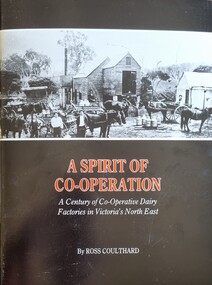
Book - A Spirit of Co-operation, Ross Coulthard, April 1993
... Companies detailed in this publication include Yabba Cheese Factory, Tallangatta Butter Factory and Creamery Co. Ltd, Ovens & Murray Dairy Company Springhurst, Kiewa Butter & Cheese Factory & Creamery Co. ...This book was produced for the centenary of the North Eastern Dairy Company. Companies detailed in this publication include Yabba Cheese Factory, Tallangatta Butter Factory and Creamery Co. Ltd, Ovens & Murray Dairy Company Springhurst, Kiewa Butter & Cheese Factory & Creamery Co. Ltd., Eskdale Butter Factory Company Ltd, Holdenson & Nielson Fresh Food Pty. Ltd, Croyland Cheese Factory Walwa Creek Dairy Co. and the Cudgewa Dairy Company. With changes in farming population and technology many of the smaller companies merged or closed. In 1959 the Tallangatta and Kiewa factories merged to become the North Eastern Dairy Company which was taken over by the Murray Goulburn Co-operative in 1985.A soft covered publication outlining the history of the dairy industry and dairy cooperatives in North East Victoria. It contains text and images .This book was produced for the centenary of the North Eastern Dairy Company. Companies detailed in this publication include Yabba Cheese Factory, Tallangatta Butter Factory and Creamery Co. Ltd, Ovens & Murray Dairy Company Springhurst, Kiewa Butter & Cheese Factory & Creamery Co. Ltd., Eskdale Butter Factory Company Ltd, Holdenson & Nielson Fresh Food Pty. Ltd, Croyland Cheese Factory Walwa Creek Dairy Co. and the Cudgewa Dairy Company. With changes in farming population and technology many of the smaller companies merged or closed. In 1959 the Tallangatta and Kiewa factories merged to become the North Eastern Dairy Company which was taken over by the Murray Goulburn Co-operative in 1985.victorian dairy industry, north east victoria dairies, dairy cooperatives -
 Wodonga & District Historical Society Inc
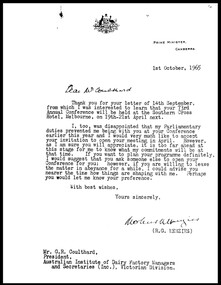
Letter - Robert G Menzies re Australian Institute of Dairy Factory Managers Conferences 1965 & 1966
... Butter Factories’ Managers Association was formed in the 1890s and held its first annual conference in 1893. This organisation became the Australian Dairy Institute and then was incorporated with the Australian Society of Dairy Technology on 24 March 1986 to become the Dairy Industry Association of Australia. Ross Coulthard was a former manager of the Tallangatta...Butter Factories’ Managers Association was formed in the 1890s and held its first annual conference in 1893. This organisation became the Australian Dairy Institute and then was incorporated with the Australian Society of Dairy Technology on 24 March 1986 to become the Dairy Industry Association of Australia. Ross Coulthard was a former manager of the Tallangatta ...These letters are part of communication which took place between Sir Robert Menzies and Mr. G. R. Coulthard, President of the Australian Institute of Dairy Factory Managers and Secretaries Inc. (Victorian Branch) in 1965 and 1966. The Butter Factories’ Managers Association was formed in the 1890s and held its first annual conference in 1893. This organisation became the Australian Dairy Institute and then was incorporated with the Australian Society of Dairy Technology on 24 March 1986 to become the Dairy Industry Association of Australia. Ross Coulthard was a former manager of the Tallangatta dairy factory and later manager of the North Eastern Dairy Company at Kiewa. He had gained experience at several dairies across Victoria and was a qualified Butter Maker, Milk and Cream Grader and Tester and later a Cheesemaker. He took over as manager at Tallangatta in 1954 and later became Manager of the North Eastern Dairy Company at Kiewa after a merger with the Tallangatta Butter Company. He served as Victorian President of the Dairy Industry Association in 1966 and 1976 and was the Australian National President in 1980. These letters are significant because they are linked to Australia's longest serving Prime Minister and the Victorian Dairy Industry.2 letters from Robert G. Menzies and Private Secretary to Mr. G. R, Coulthard printed on Commonwealth of Australia Government letterhead.robert g menzies, australian institute of dairy factory managers, dairy industry victoria
