
Showing 26 items matching "telephone operator"
-
 Ballarat Heritage Services
Image - Black and White, Switchboard Operator, c1950, c1950
... ...telephone...operator...switchboard telephone operator cats A black and white image of a woman on a handset of a switchboard. ...A black and white image of a woman on a handset of a switchboard. switchboard, telephone, operator, cats -
 Ballarat Heritage Services
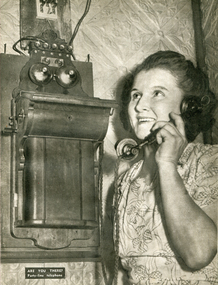
Image - Black and White, Woman on a party-line wall telephone, c1950, c1950
... telephone...operator...telephone operator cats party-line A black and white image of a woman on a handset of a timeline.. ...A black and white image of a woman on a handset of a timeline.. telephone, operator, cats, party-line -
 Emerald Museum & Nobelius Heritage Park
Machine - Kellogg Masterphone 1000, Kellogg, 1947-1953
... ...telephone operator...This phone and crank box is a reminder of a time when there was no automatic connection when making a telephone call. Connection had to be mediated by an operator. Kellogg Masterphone 1000 Kellogg crank box telephone operator USA A non-dial phone connected to a crank box. ...This phone and crank box is a reminder of a time when there was no automatic connection when making a telephone call. Connection had to be mediated by an operator.A non-dial phone connected to a crank box. Manufactured by Kellogg in the period 1947-1953 - the first phone made by Kellogg to have interchangeable parts for dial and non-dial models. For this model, the user had to first turn the crank which generated a signal that was transmitted to the operator. The operator would then connect the call to the intended recipient by manually plugging the appropriate cables into the correct socket. The recipient could then hear the caller's voice through the speaker. Note , handset incorrectly nnumbeed VEMU1591kellogg masterphone 1000, kellogg, crank box, telephone operator, usa -
 Sunshine and District Historical Society Incorporated
Photograph - Lynch Family Sunshine, 1938 - 1950
... Norma was a telephone operator at McKays|Photograph 1938 start of Melbourne to Warrnambool bike race|Photograph Jim Lynch and Ron Lynch at a family gathering....Norma was a telephone operator at McKays|Photograph 1938 start of Melbourne to Warrnambool bike race|Photograph Jim Lynch and Ron Lynch at a family gathering. ...Photograph MB Lynch and Sons Pty Ltd Early 1950s|Photograph Ron Lynch and wife Norma nee Bradley at their wedding They lived next door to Lynch's garage. Norma was a telephone operator at McKays|Photograph 1938 start of Melbourne to Warrnambool bike race|Photograph Jim Lynch and Ron Lynch at a family gathering.|Blacksmithing in Sunshine phamphletlynch -
 Kiewa Valley Historical Society
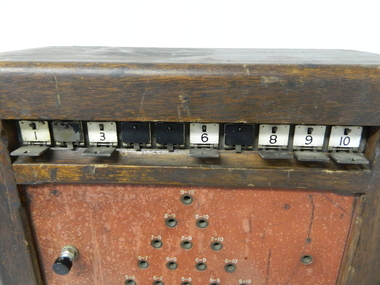
Console Telephone 10 shutter, circa early 1900s
... This console telephone switchboard (manual) unit has a shutter operation (precursor to the light indicator) to identify the caller to the telephone switchboard operator. This switchboard has a ten point indication shutter system allowing the operator to clearly identify where the caller is located. ...A benefit with a line communication system (such as the one that fed this console was that interference from atmospheric conditions did not impede the connection. sec vic kiewa hydro scheme alternate energy supplies alpine population growth and communications This console telephone switchboard (manual) unit has a shutter operation (precursor to the light indicator) to identify the caller to the telephone switchboard operator. This switchboard has a ten point indication shutter system allowing the operator to clearly identify where the caller is located. ...This manual telephone exchange console is an important piece of equipment which provided the most efficient method of long distance communications in the 1950's to the 1980's. Communications were critical, not only for the regional Hospital, but also for large construction sites i.e. the Kiewa Hydro Scheme, especially if they are in dense rugged mountainous regions. The degree of Occupation Health and Welfare on industrial sites were at a bare minimum compared to the work scene after the 1980's.This telephone exchange console is highly significant to both the Kiewa Valley and Mount Beauty region because it was so important in the communications field relating to operational safety and work related controls. The success of any large undertaken relies heavily upon good communications. In the hospital this method of communications is still used i.e. patient to ward station. This flag system link a patient's room to the controlling nursing station. Identification of the patient needing help is crucial for swift action from the available medical staff. Similarly in large construction sites such as the Kiewa Hydro Scheme, successful instant communications was also essential. This switchboard required a 50 volt supply to successfully operate and was in use when both telecommunications and postal were under the one Federal Government carrier i.e. The Post Master General. A benefit with a line communication system (such as the one that fed this console was that interference from atmospheric conditions did not impede the connection.This console telephone switchboard (manual) unit has a shutter operation (precursor to the light indicator) to identify the caller to the telephone switchboard operator. This switchboard has a ten point indication shutter system allowing the operator to clearly identify where the caller is located. The console has a 44 connection point holes with their configurations in a triangular shape. The shutters are held closed by a small lever at the top which is opened by a small electrical charge from the incoming call. The operator uses a wind up handle to power a magneto connector(handle on the console's right side). The telephone hand set is located on the left side of the console. sec vic kiewa hydro scheme, alternate energy supplies, alpine population growth and communications -
Vision Australia
Film - Video recording, 20th Century movies from RVIB, 1940s
... A man gives dictation to a women, who is using possibly a Stainsby-Wayne embossed shorthand typewriter, a telephone operator connects calls, a man takes notes on a Stainsby-Wayne crab writer, a room full of people working, a metal device moves between two springs and two men work with timber. 27. ...A man gives dictation to a women, who is using possibly a Stainsby-Wayne embossed shorthand typewriter, a telephone operator connects calls, a man takes notes on a Stainsby-Wayne crab writer, a room full of people working, a metal device moves between two springs and two men work with timber. 27. ...Various movies made by the RVIB and transferred on to digital media. These were created for raising awareness of the RVIB and to appeal for donations from the general public. Most are assumed to be from the 1940s. 1. Brief image of children at RVIB. Various girls knitting in the grounds of St Kilda road, with a quick cutaway to two babies in prams. In the middle of the girls is a globe with a rainbow style surround that reads "The sun will never set on our Empire / Because we have the will to win!" The Australia flag and Union Jack flutter above the words and in the middle is the AIF rising sun badge. There is a brief shot of uniformed girls holding up a rug. 2. Two men stand beside a Clarke and Smith talking book player. One man guides the other to the cartridge and to open the cartridge mailing container. 3. "The work and play of the babies and children give our supporters never ending interest and enthusiasm!" A boy weaving cane on to a timber frame, a girl reads her piano music as she plays, whilst another writes in Braille. 4. "This girl is studying for her leaving Certificate to enter the University for the Degree of Bachelor of Arts!" Phyllis Lawson at a typewriter, a classroom of students and a girl reading a book. 5. "Arithmetic and algebra sums are worked out by steel pins placed in octagonal holes." Students using a Taylor's Slate. 6. "Born into a world of darkness. They depend upon for the LIGHT! Through education, training, recreation." A teacher helps a girl read a raised map, a boy finds the South American landmass on the globe, and a boy feels his way around a toy galleon. 7. "You can quite understand why the School Inspector said the manual training and work of our pupils would do credit to a normal School!" A boy adjusts the rear wheels of a wooden model biplane and spins the propeller when done. 8. "Little fingers which are frequently stiff and clumsy through lack of training are guided into confidence and self help." Various children are shown weaving canework baskets or stringing beads, and a younger child creates plasticine models. 9. "Out of the Shadows of ignorance into the Sunshine" of Happy, useful Citizenship. With your help!" Two children make a bed in a dormitory, a girl brushes her teeth and washes and dries her hands in a dormitory bathroom, children eat with napkins tucked under their chins at tables covered in cloth and with flower centrepieces in a dining room, and girls in various costumes dance in the garden. 10. "They afford an object lesson on how to tackle and vanquish misfortune!" Four children row an adult on Albert Park Lake, children play on a swing carousel next to a building on which is painted 'Blind Babies Nursery', a boy winds up a train and places in on the track, and two children play with blocks. 11. "And now we come to our blind toddlers! Our Nursery School is the only one in the Southern Hemisphere!" Children play with dolls, a playhouse and a rocker swing. 12. "Only for your support their lives might have been pitiful tragedies!" Children cuddle or play with soft toys, rocker swing and playhouse whilst a younger child sits in a chair. 13. "All that sight means stimulates our minds to express the sympathy of our heart to them." Three girls sing their dolls to sleep as they cradle and rock them. 14. Outside of St Kilda Road building from various views. 15. "Our hostels for young blind." Raleigh Street hostel. 16. "The Lighthouse is the symbol of the Institute's activities. It spreads light through education and training into the lives of all eligible blind babies, children and adults of Victoria! A peep into our factories!" View of factory building, workers making millet brooms, weaving mats and basket weaving. 17. "Although our income totals 40,000 pounds annually the hand made articles of our sightless workers have to be sold at a heavy loss to compete with machine made goods! This loss, and the 10,000 pounds given annually in compassionate allowances to the adult blind to help them to support their wives and families can only be maintained by donations from Citizens!" Various workers making a range of brooms in the factory. 18. "All our blind adults live in their own homes. They receive 36,000 pounds annually, including nearly 10,000 pounds in compassionate allowances! We can NEVER THEREFORE BE SELF SUPPORTING." The range of goods produced by RVIB (baskets, mats, brooms and brushes) is shown hanging from the swing carousel in the children's playground. "Our blind workers can support their wives and families by constant employment only if Citizens ask Storekeepers for "BLIND INSTITUTE" goods. 19. A man adjusts the dampeners on a piano. "Please engage our expert blind piano tuners and repairers. They attend to more than 1000 pianos and pianolas every year!" A man puts in a row of dampeners and then tunes the piano. 20. "Our gymnasium, social, dancing, cricket and other forms of recreation give the sightless endless pleasure!" Male on a stationary bike, using a skipping rope, weightlifting and Greco-Roman wrestling in the gym, men playing cricket, people playing cards, a tile game, dominoes, checkers and a pinball game. 21. A girl using a wireless set. "For many years now we have given and maintained FREE wireless sets to all needy applicants throughout Victoria!" Girl puts on headphones and adjusts the dials. 22. " "TALKING BOOKS" have now been invented for the education and entertainment of the sightless. Literature of all kinds is thereby read to them by means of special records." A boy puts on headphones to listening to a recording. 23. Couples dance as the RVIB Orchestra plays on stage. Plates of cakes are passed around a table amongst tired dancers. The camera pans across the four piece orchestra (piano, saxophone, drummer and double bass). 24. "To lighten their darkness is a work of mercy! Please help us to give them The courage of usefulness, The privilege of work, The happiness of comradeship". 25. Various people at a meeting, one with a dog guide at his feet and some with dark glasses. Three men stand near a Clarke & Smith cartridge player talking. Two of them appeared earlier. 26. Women working in a room. A man gives dictation to a women, who is using possibly a Stainsby-Wayne embossed shorthand typewriter, a telephone operator connects calls, a man takes notes on a Stainsby-Wayne crab writer, a room full of people working, a metal device moves between two springs and two men work with timber. 27. RVIB sign, outside front of RVIB building and a group of adults sit on benches under the giant central trees, children have running races, children cheer and one receives a ribbon for her sash that is over her school uniform, a woman writes down the results, a man uses a device, various shots of children, games such as ball tossing, winding up string race, younger children have a running race holding hands with nursing staff. 28. "Melbourne, Blind Childrens' Annual Sports". Outside of RVIB building and sign, children compete in a variety of games as adults watch on. 29. "Melbourne, Swimming Under Handicap". Children walking along a street, past a Holden, to enter the City Baths. Inside they swim, learn to swim, jump and dive into the pool under the watchful gaze of a group of women. This portion of the film then is repeated in segments.1 colour video recordings with no soundroyal victorian institute for the blind, phyllis gration, rvib nursery, rvib school, rvib orchestra, braille equipment, braille music, recreation, fundraising, education, employment, buildings, raleigh street hostel, audio books -
 Flagstaff Hill Maritime Museum and Village
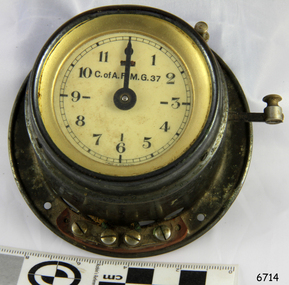
Timer, 1940s
... telephones in Australia. It was a quicker and more convenient way of communicating with another person on the same exchange — instead of having to go through tedious processes with the operator. ...telephones in Australia. It was a quicker and more convenient way of communicating with another person on the same exchange — instead of having to go through tedious processes with the operator. ...Australia's first telephone exchange was opened in Melbourne in August 1880. It was operated by the Melbourne Telephone Exchange Company. Owned by W. H. Masters and T. T. Draper, the Manager of the Company was H. Byron Moore. This was only two years after the world's first exchange in the United States, and just four years after Bell first spoke on a telephone. The exchange was located in the old Stock Exchange building at 367 Collins Street, a site now occupied by the Commonwealth Bank. In 1884, the operations of the Company, by then known as the Victorian Telephone Exchange Company, had grown considerably and were transferred to Wills Street, Melbourne. Private ownership of this company continued until 1887 when it was bought out by the Victorian Colonial Government. Other colonial governments followed this example. By 1910, the growth in telephone services made additional accommodation necessary. This could not be provided in the existing building in Wills Street and arrangements were made for a new exchange in Lonsdale Street. Alexander Graham Bell visited Australia in 1910 to advise the Federal Government's Postal Commission. Telephone exchanges were established in Adelaide with (48 subscribers), Hobart (10 subscribers) and Launceston (35 subscribers). The first exchange in Western Australia was established in 1887 and located in a small three-room cottage in Wellington Street, Perth with 17 subscribers. The year 1888 marked the opening of the Fremantle exchange in a small room at the rear of the Town Hall. There were nine subscribers. Australia's first automatic exchange was installed in the GPO in Sydney, in 1911, for internal use. But the first automatic exchange for public use was opened at Geelong in Victoria in the next year July 1912 with 800 subscribers. Melbourne's first automatic exchange was opened in the suburb of Brighton in 1914; the first public automatic exchange in NSW began operating at Newtown, Sydney in 1915; and Queensland's first was installed at South Brisbane in 1925. 1929 saw the opening of Tasmania's first automatic exchange in Hobart. an automatic telephone service. In June 1977, the manual telephone exchange at Swansea was replaced with an automatic service and made Tasmania the first State in Australia to have a fully automatic net work. The half-century following Federation saw the growth of the automatic operation; a great extension of trunk line services; The automatic telephone contributed greatly to the early popularity of telephones in Australia. It was a quicker and more convenient way of communicating with another person on the same exchange — instead of having to go through tedious processes with the operator. From its introduction, the number of automatic telephones in operation grew to a remarkable extent. In 1886, the first trunk link of 16 km was connected to the exchanges of Adelaide and Port Adelaide in South Australia. Then, in 1907, the first inter-capital telephone trunk line was opened between Sydney and Melbourne. It was followed by a line between Melbourne and Adelaide in 1914. Sydney and Brisbane were linked in 1923, and Perth and Adelaide in 1930. In 1930, the first overseas calls from Australia came possible with the introduction of a radio telephone service to England, and through there to Europe and America. A similar service opened to New Zealand in the same year. Initially, trunk channels linked different manual trunk exchanges. It was necessary for a succession of trunk operators to connect the appropriate channels, one after the other until the connection was made. As trunk traffic grew. the system became increasingly unsuitable. More trunk operators had to be employed and so labour costs increased. It was a tedious and slow way of making a long-distance call, and it was sometimes hard to hear, particularly when several exchanges were linked With technical advances, trunk switching moved from manual operation through a partly automatic phase. Automatic transit switching equipment was used and only a single operator was required to connect a trunk call to a wanted automatic subscriber. Until well beyond the middle of this century, the majority of trunk traffic went through this single telephonist control. In 1953, the number of telephones in use in Australia passed the one million mark. By then, the need for improvement in the automatic exchanges was be coming well recognised. The need was for a telephone switching system which would do a better job more economically than the conventional step-by-step ex-change. This led to the adoption of the Crossbar system as the standard in automatic telephone exchanges in 1960. The introduction of Crossbar switching was a big step forward in the automation of trunk calls. It substituted automatic switching and charging equipment for the originating trunk operator, and improved the quality of the system radically. Before the introduction of the Crossbar system there were often very long delays in obtaining a booked trunk call, and the quality of sound was often very poor. With Crossbar, Subscriber Trunk Dialing (STD) became a reality. A trunk call by STD was as easy to make and almost as fast to connect as a local call.The item was made around the 1940s and used up until the 1970s in manual cord telephone exchanges as a way to time and charge users for trunk calls made over the telecom system of the time. Post Master General dept. - Trunk Call Timer.Inscribed PMG, C. of A, 37. Bell chimes at 3 min increments.flagstaff hill, warrnambool, shipwrecked-coast, flagstaff-hill, flagstaff-hill-maritime-museum, maritime-museum, shipwreck-coast, flagstaff-hill-maritime-village, timer, trunk call, telephone, cord exchange -
 Heytesbury District Historical Society Inc.
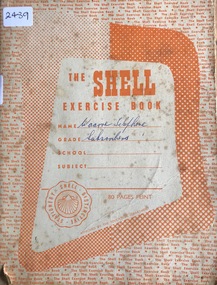
Administrative record - Minute Book, Waarre Telephone Subscribers, 1960
... Excercise book with minutes taken at two meetings held in the Waarre hall in Decemberr 1960 to resolve the problem of the local telephone exchange losing its current operator. The minutes note the majority of people who lived on Eastern Creek Rd. and Waarre Rd. at this time. ...Excercise book with minutes taken at two meetings held in the Waarre hall in Decemberr 1960 to resolve the problem of the local telephone exchange losing its current operator. The minutes note the majority of people who lived on Eastern Creek Rd. and Waarre Rd. at this time. ...Excercise book with minutes taken at two meetings held in the Waarre hall in Decemberr 1960 to resolve the problem of the local telephone exchange losing its current operator. The minutes note the majority of people who lived on Eastern Creek Rd. and Waarre Rd. at this time. Families included. Bottrel, Bramley, Lloyd, Fitzpatrick, McKenzie, Clarke, Welton, Younis, Meek, Wills, Shiells, Jeffery, Wilson, Giblett, Webb, Tranter, Stevens, Meek. The book contains a letter written to the PMG and a response. The situation was resolved when Sylvia Fitzpatrick agreed to become the telephonist and for the exchange to be relocated from the home of Roy and Minnie Ford to the Home of Jim and Sylvia Fitzpatrick. School Exercise bookWaarre Telephone Subscriberscommunication, telephone, community action -
 Kiewa Valley Historical Society
Switchboard - S.E.C.V
... Employees living in the towns and in the Kiewa Valley who had telephones were connected to the switchboard and were able to speak after dialling a number and then being connected by an operator working at the switchboard. ...This switchboard was used by the S.E.C.V. for their employees on the Kiewa Hydro Electric Scheme and is an example of communications used in the 1940s and 1950s using telephones and operators prior to automatic 'stations'. ...The switchboard was located in the office of the switchyard. This switchboard was used by the State Electricity Commission of Victoria on the Kiewa Hydro Electric Scheme in Mt Beauty. Employees living in the towns and in the Kiewa Valley who had telephones were connected to the switchboard and were able to speak after dialling a number and then being connected by an operator working at the switchboard. This connection pre dated automatic connections. This switchboard was used by the S.E.C.V. for their employees on the Kiewa Hydro Electric Scheme and is an example of communications used in the 1940s and 1950s using telephones and operators prior to automatic 'stations'. To prevent operators from listening to conversations, a tone was introduced so that those on the phone became aware of someone listening in to their conversation.switchboard. mt beauty. state electricity commission of victoria. kiewa hydro electric scheme. telephones. communication. -
 Kiewa Valley Historical Society
Headphones - Transmitter radio, c1924
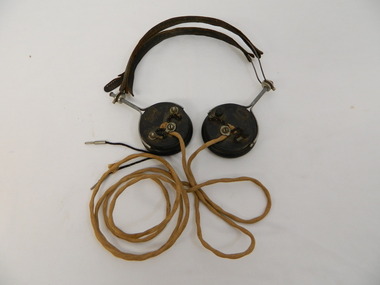
... In operation, the service is similar to a normal telephone system but dispenses with the physical connection of wires and poles between the main terminals. Historical: This type of headphone was recommended for amateurs. It may have been used by operators ...Radio Telephone was minuted during the war. It was approved in 1944 for State Electricity Commission of Victoria use only. It was completed by the end of 1946. Used by the State Electricity Commission of Victoria at Bogong during the construction of the Kiewa Hydro Electric Scheme to connect with head office in Melbourne. It allows one conversation at a time using traffic controls in an unusual system of radio telephone providing communication. At the time it was unique in Australia and installed by the S.E.C.V. technicians. It provided an unattended shortwave radio link between two ordinary telephone switchboards, connecting any of the S.E.C.V.'s internal lines with the telephone system at Bogong and the construction camps beyond. From Bogong, radio phones connect to the outpost stations on the High Plains far above the snow-line. In operation, the service is similar to a normal telephone system but dispenses with the physical connection of wires and poles between the main terminals. Historical: This type of headphone was recommended for amateurs. It may have been used by operators on the Switchboard at Bogong or one of the construction camps on the Kiewa Hydro Electric Scheme. The S.E.C.V installed this unique system of communication to operate their branches especially at Bogong and beyond where the distance was great and often limited by the terrain and weather.Used for a transmitter radio or Radio Telephone as installed by the State Electricity Commission of Victoria 2 round ear pieces. Outside of ear piece has the brand inscribed and 3 points where wires are attached. On opposite edges of the earpieces a metal piece with handle is attached from which the 2 earpieces are connected with curved wire covered by leather to fit on top of the head. Each earpiece has a cord hanging from the middle attachment (on the outside) which joins and then continues as one to 2 metal pins that would fit into holes in the switchboard. On outside of each earpiece - 'Brunet & Co. / Paris' in oval 'Type f' underneathradio telephone. ear phones. head phones.communications.state electricity commission of victoria. kiewa hydro electric scheme. bogong. switchboards. -
 Kiewa Valley Historical Society
Headphone - Transmitter radio
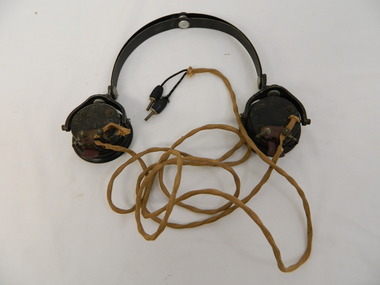
... In operation, the service is similar to a normal telephone system but dispenses with the physical connection of wires and poles between the main terminals. Historical: This type of headphone was used by operators on the switchboards at Bogong, Mt Beauty or on one of the construction camps on the Kiewa Hydro Electric Scheme. ...Radio Telephone: Minuted during the war. It was approved in 1944 for State Electricity Commission of Victoria use only. It was completed by the end of 1946. Used by the State Electricity Commission of Victoria at Bogong during the construction of the Kiewa Hydro Electric Scheme to connect with head office in Melbourne. It allows one conversation at a time using traffic controls in an unusual system of radio telephone providing communication. At the time it was unique in Australia and installed by the S.E.C.V. technicians. It provided an unattended shortwave radio link between two ordinary telephone switchboards, connecting any of the S.E.C.V.'s internal lines with the telephone system at Bogong and the construction camps beyond. From Bogong, radio phones connect to the outpost stations on the High Plains far above the snow-line. In operation, the service is similar to a normal telephone system but dispenses with the physical connection of wires and poles between the main terminals.Historical: This type of headphone was used by operators on the switchboards at Bogong, Mt Beauty or on one of the construction camps on the Kiewa Hydro Electric Scheme. The S.E.C.V. installed this unique system of communication to operate their branches especially at Bogong and beyond where the distance was great and often limited by the weather and terrain.Used for a transmitter radio or Radio Telephone as installed by the State Electricity Commission of Victoria 2 round ear pieces. Outside of each ear piece has the brand inscribed, 4 screws and 1 small piece of metal. The metal has 2 screws attaching the the cord that goes to the 'switchboard'. On opposite edges of the earpieces is a thick metal piece that curves up to which the curved metal headpiece is attached and therefore connecting the earpieces. Each earpiece has a cord hanging from the small metal piece of earphone. This cord joins and then continues as one to the end where there are 2 metal pins coming out of the soft cover.'C-LR ST & C of Sydney'radio telephone. ear phones. headphones. communications. state electricity commission of victoria. kiewa hydro electric scheme. bogong. switchboards. -
 Kiewa Valley Historical Society
Headphone Set x2
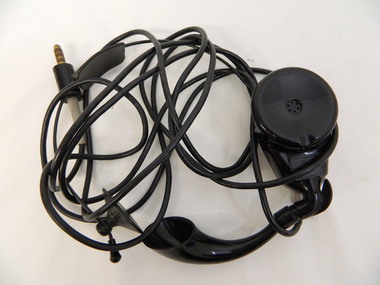
... In operation, the service was similar to a normal telephone system but dispensed with the physical connection of wires and poles between the main terminals. Historical: This headphone set superseded headphones with two earpieces and those without a microphone. This one may have been used by operators ...Radio Telephone was minuted during the war. it was approved in 1944 for the State Electricity Commission of Victoria's use only. it was completed by the end of 1946. used by the State Electricity Commission of Victoria at Bogong during the construction of the Kiewa Hydro Electric Scheme to connect with head office in Melbourne. It allows one conversation at a time using traffic controls in an unusual system of radio telephone providing communication. At the time it was unique in Australia and installed by the S.E.C.V. technicians. It provided unattended shortwave radio link between two ordinary telephone switchboards, connecting any of the S.E.C.V.'s internal lines with the telephone system at Bogong and the construction camps beyond. From Bogong, radio phones connected to the outpost stations on the High Plains far above the snow-line. In operation, the service was similar to a normal telephone system but dispensed with the physical connection of wires and poles between the main terminals.Historical: This headphone set superseded headphones with two earpieces and those without a microphone. This one may have been used by operators on the switchboard at Bogong or Mt Beauty or one of the construction camps on the Kiewa Hydro Electric Scheme. The S.E.C.V. installed this unique system of communication to operate their branches especially at Bogong and beyond where the distance was great and often limited by the terrain and weather.Radio Telephone for SECV switchboard. Black plastic earpiece with microphone. Ear side circular with inscription on outer side then formed into elongated shape narrowing to the curved speaker piece at the narrow end. On top of the narrow end a long rubber cord is attached to a thick brass pin. On top of the wider end a thin stiff wire is attached to curve around the head to a blank rubber earpiece. This head piece has a piece of rectangular rubber attached at the top for comfort.'4408A IW61 / 1'radio telephone, ear phones, head phones. head set. communications, state electricity commission of victoria. kiewa hydro electric scheme. bogong. switchboards -
Bendigo Historical Society Inc.
Ephemera - STD information, 1971
... Six figure telephone numbers were introduced on the 16th May 1971 leading into the introduction of National Subscriber Dialling (STD) on the 30th May 1971. Operator...Six figure telephone numbers were introduced on the 16th May 1971 leading into the introduction of National Subscriber Dialling (STD) on the 30th May 1971. Operator ...Six figure telephone numbers were introduced on the 16th May 1971 leading into the introduction of National Subscriber Dialling (STD) on the 30th May 1971. Operator connected trunk calls were still available as some places were not accessible by STD.Information pack from the Australian Post Office on new six-digit phone numbers for Bendigo. The pack consists of: 1. Information letter of stage 1 (Six Figure Dialing) and stage 2 (National subscriber trunk dialling) 2. Info pack envelope 3. Info brochure on STD (Subscriber Trunk Dialling) 4. Info brochure on special Features of the new telephone system history, bendigo, subscriber trunk dialling, australian post office, merle lummis collection -
 National Vietnam Veterans Museum (NVVM)
Manual, United States Army, Department of the Army Technical Manual: Operation And Organizational And Field Maintenance Switchboard, Telephone, Manual SB-993/GT, 1961
... Operator's Manual United States War Office Technical Manual Field Maintenance Switchboard Telephone Manual SB-993-GT A cream coloured paper cover with black information on the front. ...A cream coloured paper cover with black information on the front. In bold ink at the top reads TM 11-5805-294-15. There are lots of detail on the cover.operator's manual, united states war office, technical manual, field maintenance, switchboard telephone, manual sb-993-gt -
 Kiewa Valley Historical Society
Book - Kergunyah Telephone Numbers
... operator would then ring the individual's code, like morse code, eg. 1 long 2 short. Also ref. KVHS 0897 Mt Beauty Switchboard This book is a list of residents living at Kergunyah who have a phone and lists their phone numbers. Kergunyah is in the Kiewa Valley. The book also notes some problems with the line eg. 'suspect sheath damage'. kergunyah telephone ...In rural Australia phone calls were made through the switchboard usually situated at the local post office. This book lists the residents of Kergunyah and their phone numbers. If you want to talk to a neighbour for example, you ask for that person or give the operator their number. The switchboard operator 'puts the caller through'. However some people shared a number and were therefore on a party line eg. in this book 6 people share number 3. The operator would then ring the individual's code, like morse code, eg. 1 long 2 short. Also ref. KVHS 0897 Mt Beauty SwitchboardThis book is a list of residents living at Kergunyah who have a phone and lists their phone numbers. Kergunyah is in the Kiewa Valley. The book also notes some problems with the line eg. 'suspect sheath damage'. Stiff beige cardboard cover bound by black tape "Subscribers' M.D.F. / Record" printed on centre of cover. 7 pages but only written on pages 2 and 3 with residents' names and phone numbers in columns."Kergunyah" on front coverkergunyah, telephone, kiewa valley, switchboard -
 Stawell Historical Society Inc
Photograph, Stawell Post Office Cnr Wimmera and Main Streets 1875
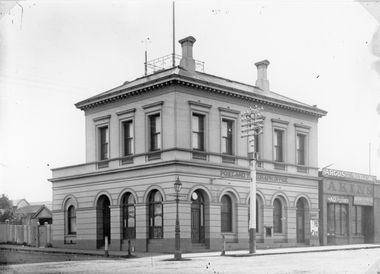
... The main room originally included the Telegraph office where operators worked at machines, sending and receiving Morse code messages. Later alterations were made for a telephone switchboard room downstairs, with trunk line equipment upstairs. ...The main room originally included the Telegraph office where operators worked at machines, sending and receiving Morse code messages. Later alterations were made for a telephone switchboard room downstairs, with trunk line equipment upstairs. ...Stawell Post Office on corner of Wimmera and Main Streets. Erected 1875. Telegraph pole and streetlamp in foreground. Akins store visible at right of photo. The building has 3 arched doors & 6 arched windows on the ground floor and 8 square windows on the top story. Two chimneys on the roof and a wrought iron square fence on the roof. The outside of the building has not changed while the interior has been remodelled several times. The early Postmasters and their families lived upstairs. The main room originally included the Telegraph office where operators worked at machines, sending and receiving Morse code messages. Later alterations were made for a telephone switchboard room downstairs, with trunk line equipment upstairs. In 1965 the telephone system was converted to automatic.Black & white photo of a two story building on the corner of Wimmera & Main St. The building the Stawell Post and Telegraph Office. Out the front of the Post office is a telegraph pole and a light post. Next door in Main St is a single story building with a sign over the building Argus Australasian, underneath Akins, Age/Leader possible a newsagent. stawell -
 Melbourne Tram Museum
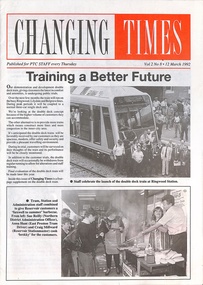
Magazine - Set of 2, Public Transport Corporation (PTC), "Changing Times", 1992
... On page 4 is a photo of Dean Bernardini with Connie Snyders Control Centre Operator. 2 - 12/11/1992 - Vol. 2 No. 43 - Better telephone help for Customes. ...On page 4 is a photo of Dean Bernardini with Connie Snyders Control Centre Operator. 2 - 12/11/1992 - Vol. 2 No. 43 - Better telephone help for Customes. ...Changing Times - PTC Newsletter - set of 2 1 - 12/3/1992, Vol 2, No. 8 - Training a better future, regarding the introduction of double deck suburban trains. On page 4 is a photo of Dean Bernardini with Connie Snyders Control Centre Operator. 2 - 12/11/1992 - Vol. 2 No. 43 - Better telephone help for Customes. On page 8 is a group photo of some of the staff at the Control Centre - Fleet Operations a presentation for Ted Millward. Ray Ter Horst, Russell Nathan, Ted Millward, David Chin, and Dean Bernardini.Yields information about the work of the staff of Fleet operations.Magazine, finished to A4, set of 2tramways, staff photo, fleet operations, ptc, newsletters -
 Maldon Museum and Archives Association
Functional object - Telephone Switchboard
... operator instructions this stands nearly two meters tall. Indicators, patch leads and sockets are in left and right banks, with the call/speak toggles in front of them. A small timer to the right is turned on or off when required. Functional object Telephone ...Known to have been in use in 1909, when there were sixteen subscribers. Decommissioned in 1968.With a timber polished frame with 20 incoming lines, a clock timer and glass fronted notice board on top with various operator instructions this stands nearly two meters tall. Indicators, patch leads and sockets are in left and right banks, with the call/speak toggles in front of them. A small timer to the right is turned on or off when required. -
 Melton City Libraries
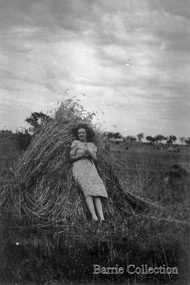
Photograph, Edna Barrie, 1920, 1924, 1933 and 1940
... In times of emergency the Barrie family assisted Bon the base radio operator to plot the position and location of fire trucks and to help clarify garbled radio traffic, keep notes and make telephone calls. ...In times of emergency the Barrie family assisted Bon the base radio operator to plot the position and location of fire trucks and to help clarify garbled radio traffic, keep notes and make telephone calls. ...SUMMARY - Edna (Myers) Barrie, 1918 – 2018, Profile Early Life Edna was born at Melton and delivered by Hannah Watts. Her mother Martha walked in the dark at night with her basket under her arm to the bridge over the Toolern Creek Bridge and into Sherwin Street to the corner of Yuille Street to Hannah’s house Lynch Cottage. Martha’s husband was away shearing and eventually heard the news of the birth of their blue eyed third child and second daughter. She was born into a family that was surrounded by music; her father played the “squeeze box” and mother the mouth organ. From an early age the family were aware of the great composers, a framed picture of Beethoven, Chopin, Schubert and Wagner hung above the door to the lounge room of their 4 roomed cottage, the room where the piano stood. Her life on stage started as a singer aged 6 years at the Melton Mechanics Institute Hall. Edna was born with a natural ear for music learning piano and singing from her older sister Marjorie who became an accomplished pianist and soloist and renowned music teacher in Melton and district. In the 1920s and 1930s concerts at the Melton Mechanics Institute were regular events were the local talent was fostered. The Myers children, like other children of Melton and Rockbank, studied singing, piano and elocution, sat examinations, entered in competitions in South Street Ballarat, Footscray and Melbourne. In 1929 a Sacred Concert was broadcast by 3AR from the Hall as part of the Back to Melton Celebrations. Marjorie Myers performed two of the items on the piano. Edna attended Melton State School 430 from 1924 – 1933. Her father Fred had also attended the same school. In 1924 the School staged Cinderella at the Melton Mechanics Institute Hall with a cast of 33 students. After completing her education a Melton she boarded in South Melbourne and attending Melbourne Girls High School (MacRobertson Girls High School), a school which recognized her musical attributes. She travelled home on the train on the weekends, sometimes getting off at Rockbank to save a few pennies in fares. Working life The early 1930s the Depression was a difficult time for a young woman to find work. Jobs were often menial and given to the youngest and therefore cheapest applicant. She worked as sales assistant at Polonskis and Myer in the city, and Irvines Modes in Footscray. Working to 1pm on Saturday, and when held up by a customer meant missing the train home. While at Myer Department store she lived at home and rode her bike to the Melton railway station. On one occasion she had a nasty fall when a part of her bicycle came loose causing the bike to crash rendering her concussed and injuring her nose. During the 1930s she was given a camera “a little snap” by Mrs Kelly her landlady. This began her interest in photography documenting family life at their “Burnbank” home. Musically, while at Myers she participated in annual performances held at The Kings Hall and the Myer Mural Hall. Working in the basement at Myers she was often embarrassed when her name was called, customers assuming she belonged to the Myer Family. Ken Myer worked in the basement at the same time handling the ‘Wheeler’, a wicker basket used for moving goods around the store. The family philosophy was for the children to start at the bottom and work their way up. Social life Social life in her teenage years was connected also with Scots Presbyterian Church. She attended Sunday School classes and received book prizes for attendance. She loved to read and welcomed the times when she received new book. She took part in the Sunday School Anniversaries and was presented with a Bible from the Superintendent, Henry Robinson for her assistance with the music. Marriage and War years In 1941 Edna married Ernest “Bonnie” Barrie. War in the Pacific was soon to break out. While in Sydney on their honeymoon they met up with Jim Barrie who was on his way to Canada via Hawaii just missing Pearl Harbour by two days. Jim became a Spitfire Pilot and joined the RAF and was based in England. He returned to Australia later in RAAF to fight the Japanese off the coast of New Guinea. The three eldest Barrie brothers were farmers and food producers and were thus except from military service. Edna and Bon were members of the VAOC- Volunteer Air Observers Corp entailing being rostered on duty as plane spotters. The women took shifts during the day and the men at night which involved staying overnight in the Shire Offices. Later the spotting tower was built in the plantation opposite the Post Office. Edna and Bon carried on with this from their home in Ferris Rd when the threat of invasion had ceased Community life Community life in Melton revolved around fund raising events for the Melton Mechanics Institute for the War effort and keeping up with maintenance for the Hall. In 1944 the Minister for Health gave approval for the Shire of Melton to open and Infant Welfare Centre inviting Edna to form part of the Committee with seven other women. In 1948 she was President of Melton Branch of the Victorian Health Centres Association. She volunteered this use of her car driving the person in charge, Sister Smith to visit mothers and their babies. In 1963, along with Betty Jones and Isabel Snell, Edna was instrumental in forming the 1st Melton Cub Pack and later supported the formation of the 1st Melton Scouts. During 1963 – 1968 she completed the Australian Boy Scout Association Cub Pack Preliminary Training and achieved her Wood Badge. Country Women’s Association In 1944-1996 she was a member of the Melton Branch Country Women’s Association (CWA), Melton Branch, Secretary of the Branch in 1945 – 1946 and Branch International Secretary 1970-1971. She worked with choir, music and drama interest groups within the branch attaining both first and second place in 1959, second place in 1952 Exhibition and second in Music in 1960 in the state. She was involved in their handicraft craft events, fund raising and musical events and singing competitions. During the 1950s she trained Trios and Quartets in part singing for the CWA competitions in Ballarat and Melbourne. It was at this time that she developed her skill as a conductor and trainer of choirs. She later auditioned for the Victorian Choir for alto parts believing she would stand a better chance of being chosen, because of her ability to sing in natural harmony. In 1962 she participated in the Tenth Australian Country Women of the World (ACWW) Triennial Conference “Australia Presents: CWA Massed Choir” in the Melbourne Town Hall. This event was recorded by Super Sound Spotlight on 45 extended play vinyl record. The songs were Australian music and words, for example The Silver Stars are in the Sky, The Graceful Swaying Wattle and Kookaburra. Edna continued with her interest in the Victorian Choir regularly meeting at the CWA Headquarters in Toorak for rehearsals. In 1974 she took part in the Australian Choir at the fourteenth Triennial conference of the ACWW Interfaith Service held at the Perth Concert Hall on the 13th of October. Arts and Culture Edna was also in the Choir of 3KZ Carols by Candlelight at the Myer Music Bowl in 1963 and 1964. Melton Choral Society. Edna was Director and Conductor in the 1970s performing at many community events such as Carols by Candle Light, Church Services, Easter and Palm Sunday services, Mothers Union and the 1976 Community Services Week Combined Church Service. The October – November 1978 Program covered the following: songs from the Musicals, Choral and Solo with Narratives, Guest Instrumental Item, Recitation Negro Spirituals and Australian Songs. Her involvement with church choirs included the Scots Presbyterian Church Choir Easter and Christmas performances and the 1967 Centenary Service. In 1980s the Melton Uniting Church Sacred Music Performances included The Crucifixion by Stainer, The Olivet to Calvary and other church Hymns. Edna was Musical Director of the Melton Amateur Theatrical Society and worked on performances in collaboration with Mabel Rogers on script and musical interpretation. Melton and District Historical Society Annual Art and Craft Show. First held in Melton Mechanics Institute Hall in 1973, it later took place in the in the Melton Community Hall. The Art Show was also run in conjunction with other community organizations such as Rotary and Girl Guides. Community history and research Melton streetscape and society Over 20 years commencing in the 1970s, Edna undertook extensive photographing of the changing streetscape of Melton’s High Street. She anticipated the impact of change on the community during the time of Melton’s rapid transition from a small farming district to a large urban community and this led to her extensively document and photograph many of the structures and landscape features of the township that have since been lost. She also meticulously recorded much of the contemporary life of the town and has left a significant legacy of archival material. Melton State School 100 Years Celebration, October 1970 Co-author with Mabel Rogers “The First 100 Years, 1870 – 1970” Assembled a collection of School Class Photograph and identified and compiled lists of names for future school history. She also assembled a photographic display for the 125th anniversary in 1995. Melton and District Historical Society (M&DHS) Foundation Member, 1968 Held President and Secretary positions from its inception Research associated with the classification of Heritage buildings Christ Church Classification C Scots’ Presbyterian Church Classification D Set up the storage and Catalogue system in the Office at the Willows Organised society visits to Heritage sites in and beyond the Shire of Melton, including Stathtulloh, Eynesbury, Deanside, ToolernVale sites including Merrywood (now demolished) Staughton Vale, Chirnside, Point Cook, Shwerkolts Cottage. 1970 – 1983 Melton and District Historical Society Letterhead. Staughton Memorial Light from early newspaper cutting in its location before restoration to present location. Sketch by Wendy Barrie. Designing and printing pamphlets, stationery, and other sale items with Willows title. M&DHS street naming research for new housing developments (1970 – 2000). Collaborated with Mary Tolhurst to research the names of early landowners and pioneer families connected to the first settlers. Researched Aboriginal names for inclusion on lists submitted to developers. An early example is the naming of Kuranjang and the street names associated with the McPherson family. Plains of Promise (Shire of Melton history) by Joan Starr (1985). Edna assisted with Historical Society materials and contributed her own research and photographs. Contacted and organised for Hubert Opperman to launch the book. (She was also present at his last bike ride at Rochester in 1995.) Western Metropolitan Groups of Historical Societies. Member attending meetings and representing Melton, also hosted the Group at Melton The Willows Member of the Committee of Management for the restoration of the “Willows” house the establishment of The Willows Park 1982 March - Official Opening of the Willows Park- Preparation and planning for the event. Involved in the collecting of items in the furnishing of the display rooms in the Willows house. Donated items and furniture from the Myers and Daley family houses. (19th century) Machinery Shed Establishment. Involved with Jeff Robinson in the construction and collection of machinery display Other significant sites Championed and participated in the restoration and preservation significant sites in Melton, including: restoration of the Staughton Memorial Light and its return to its present site restoration of the Pykes Grave (using EW Barrie earthmoving equipment) restoration and reconstruction of Dunvegan restoration and reconstruction of Macs Cottage, the management and Caretakers residence Melton State School War Memorial Gates removed from Unitt Street entrance and relocated to the Willows Park Donated the Barrie family single furrow plough which was standing at the Court House Plaza. It removed and to Council Depot and later missing. The plaque was taken to the Willows. Jimmy Melrose (aviator) cairn restoration at crash site in Melton South Donald Mackintosh (Olympic gold medallist marksman) grave site at the Melton Cemetery (Historical items held by the Myers family collection.) Houdini first flight at Diggers Rest. Edna’s father was shearing at Diggers Rest at the time and witnessed the flight. She attended the 90 year anniversary of the event at the site in 2000. Radio and electronics Edna’s husband Bon interest in wireless communication dates in the 1920s with the building of a crystal set in the early days of public broadcasting. At the Back to Melton Celebrations in 1929, 3AR broadcast a concert from the Melton Mechanics Institute on the 20th February at 8pm featuring Footscray City Band, James Hill baritone, Vera Carew Soprano, James Foran Tenor, Marjorie Myers Piano, and James Williamson Entertainer. Accompanists: Miss Agnes Ross and Mrs James Hill. The Myers children had recordings of their piano playing made onto the aluminium records, Martha Myers’ voice can be heard introducing an item. These were made in a studio in Melbourne. Marjorie was given a upright Gramophone by Donald Mackintosh in recognition of her talent and her contribution to the cultural life of Melton. The family were then able to listen to 78rpm recordings of the famous classical recordings. The turntable was hand wound metal stylus needles had to be regularly replaced. The aluminium disk needed a bamboo needle to prevent damage to the surface. Before electricity was introduced to Melton in 1939 the Mechanics Hall relied on generators to produce electricity. Bon Barrie, being mechanically minded, built a public address system for be used a community functions at the Hall and Recreational Park. By 1939 this was up and running and used for over three decades. A large Collection of 78rpm records provided music for dances, marching, parades and any public event needing music and microphones. The early system was portable and worked on batteries. CFA Radio Communication In the 1950s with the introduction two-way HF and later VHF very high frequency radio sets. Melton Rural Fire Brigade was part of the Bacchus Marsh Group. Radio sets where located in the Melton Fire Truck, and in the house of the Barrie family at Ferris Road. This was an ideal location to observe a 360 degree view in all directions when smoke appeared on the horizon. An antenna was erected beside the house. The set OX 7 was located in the kitchen and monitored 24 hours by the family. When an electrical fire occurred at the junction of the electricity to the house there was time to radio the fire station and summons the men working in the paddocks, thus saving the house from possible destruction. With the introduction of UHF – ultra high frequency Vinten Radios the signal was clearer and static and interference lessened and radio traffic became easier to read, and reduced noise levels in the household. VL3 LY Radio Base became the Group Headquarters was established in 1967. By 1970 the Brigades were: Melton, Rockbank, Sydenham, Toolern Vale, Diggers Rest, Truganina, and Werribee. In 1974 when the family moved to First Avenue, another antenna and a small building were erected adjacent to the residence and used to house the equipment, maps. Radio traffic consisted of regular schedule times and communication with adjoining groups of brigades such as Bacchus Marsh, Mt Macedon and Little River Groups. Many of the brigade and group base radios were situated in private residences and operated primarily by fire fighters wives who held the position of Communications Officer, either registered as a brigade member or informally. Edna was never registered as an operational brigade member but operated informally as an assistant to her husband Bon. She was however a member of the Melton Fire Brigade Ladies Auxiliary from its inception in 1968, a non-operational position. Edna kept up to date with radio procedure following the 1967 handbook; preparing maps, plotting compass points and taking notes on weather forecasts from the SA Border and Western District. Daily notes were taken in anticipation of fire warnings. These log books and daily radio traffic were incidental to the regular radio schedules. Emergency turnouts noted, burning off times and predicted location of smoke. In the summer fire season all TBF (total fire ban days were recorded.) In times of emergency the Barrie family assisted Bon the base radio operator to plot the position and location of fire trucks and to help clarify garbled radio traffic, keep notes and make telephone calls. These log books are held in the EE and EW Family Archive. Melton Uniting Church Edna founded the Church Opportunity with Maisie Robinson in 1975 in the Melton South Methodist Church building. Methodist and Presbyterian Churches of Melton had combined severing their long held connection with Bacchus Marsh. A Manse had been recently built for the Melton Minister. At a Parish Committee meeting at the Melton South Church it was suggested to use the building as an Opportunity Shop. It opened in July 1975, and it raised $1,600 contribution to the church budget in 1976. In 1977 The Uniting Church in Australia was formed and the Melton South Uniting Church Opportunity shop continued to go from strength to strength expanding the buildings providing the welfare needs of the community. Archive Set up by Edna Catalogued items dating from 1857 Minute Book and set ongoing system and storage of items of heritage. Melton Un Awards and recognition of service to the Melton community Rotary Award for Community Service, 1980 Victoria 150th Anniversary Celebrations contributions, 1985 Life Membership of the Melton and District Historical Society (M&DHS), 1989 Extra-Ordinary Contribution for years of service to M&DHS, 1992 Long Service for Exceptional Service MD&HS, 1993 Royal Historical Society of Victoria Award of Merit, 1997 Shire of Melton Certificate of Appreciation for continued support and dedication as a member of MD&HS to the preservation of Melton’s History, 1998 Centenary of Federation Peoplescape (Canberra) Melton Shire nomination, 2001 Uniting Church Melton Life Membership of the Opportunity Shop Uniting Church in Australia Commission for Mission for 30 years of hard work and dedications to the Uniting Church, 2007 Uniting Church Adult Fellowship Certificate appreciation in recognition of valuable support through the “Sammy” Stamp Fund Neighbourhood Watch 5 year award Photographs of Edna at different ageslocal identities -
 Melton City Libraries
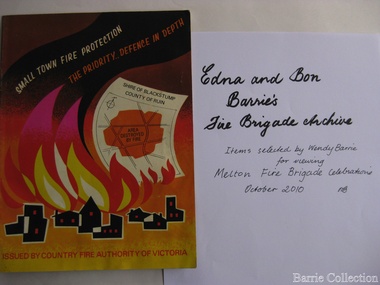
Archive, Edna and Bon Barries Fire Brigade Archives, 2010
... In times of emergency the Barrie family assisted Bon the base radio operator to plot the position and location of fire trucks and to help clarify garbled radio traffic, keep notes and make telephone calls. ...In times of emergency the Barrie family assisted Bon the base radio operator to plot the position and location of fire trucks and to help clarify garbled radio traffic, keep notes and make telephone calls. ...In the 1950s with the introduction two-way HF and later VHF very high frequency radio sets. Melton Rural Fire Brigade was part of the Bacchus Marsh Group. Radio sets where located in the Melton Fire Truck, and in the house of the Barrie family at Ferris Road. This was an ideal location to observe a 360 degree view in all directions when smoke appeared on the horizon. An antenna was erected beside the house. The set OX 7 was located in the kitchen and monitored 24 hours by the family. When an electrical fire occurred at the junction of the electricity to the house there was time to radio the fire station and summons the men working in the paddocks, thus saving the house from possible destruction. With the introduction of UHF – ultra high frequency Vinten Radios the signal was clearer and static and interference lessened and radio traffic became easier to read, and reduced noise levels in the household. VL3 LY Radio Base became the Group Headquarters was established in 1967. By 1970 the Brigades were: Melton, Rockbank, Sydenham, Toolern Vale, Diggers Rest, Truganina, and Werribee. In 1974 when the family moved to First Avenue, another antenna and a small building were erected adjacent to the residence and used to house the equipment, maps. Radio traffic consisted of regular schedule times and communication with adjoining groups of brigades such as Bacchus Marsh, Mt Macedon and Little River Groups. Many of the brigade and group base radios were situated in private residences and operated primarily by fire fighters wives who held the position of Communications Officer, either registered as a brigade member or informally. Edna was never registered as an operational brigade member but operated informally as an assistant to her husband Bon. She was however a member of the Melton Fire Brigade Ladies Auxiliary from its inception in 1968, a non-operational position. Edna kept up to date with radio procedure following the 1967 handbook; preparing maps, plotting compass points and taking notes on weather forecasts from the SA Border and Western District. Daily notes were taken in anticipation of fire warnings. These log books and daily radio traffic were incidental to the regular radio schedules. Emergency turnouts noted, burning off times and predicted location of smoke. In the summer fire season all TBF (total fire ban days were recorded.) In times of emergency the Barrie family assisted Bon the base radio operator to plot the position and location of fire trucks and to help clarify garbled radio traffic, keep notes and make telephone calls. These log books are held in the EE and EW Family Archive. Items selected by Wendy Barrie for viewing Melton Fire Brigade celebrationsemergency services, local identities -
 Harcourt Valley Heritage & Tourist Centre
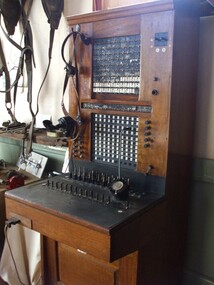
manuel telephone exchange
... telephone exchange, manufactured by British Ericson, History Originally in use at Cohuna. When Cohuna was converted to automatic dialing this exchange was relocated to Harcourt, to become the third and last in a bank of three exchanges. At this time Harcourt exchange was expanded to 260 lines. It was connected to the district central exchange at Castlemaine. Operated by mains power with battery back-up. Harcourt exchange was operated by Betty McLean, Miss Mitchell, Josie Hogarth, Mr. & Mrs. Heighway, Bill & Valerie Milford, Irene Bolitho and others. Decommissioned approx. 1970. Incoming calls prompted the fall of a shutter. The operator...A manual telephone exchange, manufactured by British Ericson complete with operator hands-free headset/earphones and speaker mouthpiece. ...operator. This exchange was restored in 2004 - 2005 by Trevor Grant. . Many people relate to this exchange. It is a survivor of the pre-electronic era when ‘telephonist’ was a common occupation. A vital element in the communications between households and between district orchardists and their suppliers and clients. A manual telephone ...A manual telephone exchange, manufactured by British Ericson, History Originally in use at Cohuna. When Cohuna was converted to automatic dialing this exchange was relocated to Harcourt, to become the third and last in a bank of three exchanges. At this time Harcourt exchange was expanded to 260 lines. It was connected to the district central exchange at Castlemaine. Operated by mains power with battery back-up. Harcourt exchange was operated by Betty McLean, Miss Mitchell, Josie Hogarth, Mr. & Mrs. Heighway, Bill & Valerie Milford, Irene Bolitho and others. Decommissioned approx. 1970. Incoming calls prompted the fall of a shutter. The operator made the connection by plugging the line into the number requested. While responding to calls the operator needed her hands free to jot down the billing particulars or to write out each telegram. Nearby stood pigeonholes with various items of stationary. Many telegrams were received each day, particularly advising fruit growers on interstate markets. Most telegrams were phoned through by the operator. This exchange was restored in 2004 - 2005 by Trevor Grant.. Many people relate to this exchange. It is a survivor of the pre-electronic era when ‘telephonist’ was a common occupation. A vital element in the communications between households and between district orchardists and their suppliers and clients.A manual telephone exchange, manufactured by British Ericson complete with operator hands-free headset/earphones and speaker mouthpiece. Wooden case with one hundred shutters and sockets. Accommodates twelve lines with extension leads with associated switches. Operated by mains power with battery back-up. Decommissioned approx. 1970. Incoming calls prompted the fall of a shutter. The operator made the connection by plugging the line into the number requested. This exchange was restored in 2004 - 2005 by Trevor Grant. -
 Whitehorse Historical Society Inc.
Equipment - Magneto Telephone, C1930
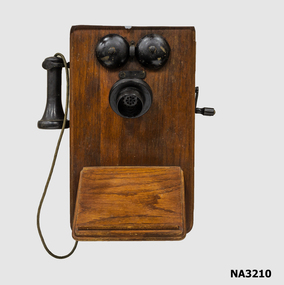
... telephone exchange. The handle on the right hand side, which was turned to rotate the magneto to call the exchange - ask operator for a number and then to be connected. ...telephone exchange. The handle on the right hand side, which was turned to rotate the magneto to call the exchange - ask operator for a number and then to be connected. ...Used to communicate with the local telephone exchange and for connection to other subscribers. The introduction of automatic exchanges saw the their demise. This phone was used in the family home of the donor at Caboolture (aboriginal for carpet snake) during the 1940s and 1950s.A magneto telephone for communication with a manual telephone exchange. The handle on the right hand side, which was turned to rotate the magneto to call the exchange - ask operator for a number and then to be connected. Telephone enclosed in a specially designed box for mounting on the wall. There was a bell on top which rang when the magneto ringer at the exchange was turned. Fitted with a carbon microphone mounted on the front of the box for the transmission of the spoken word and an electro- magnet. A receiver which hangs on the left hand side on a hook. The hook acts as the on and off switch to answer the call and to switch on the battery to provide power for the receiver and energize the transmitter. There is an angled ledge for writing any messages. There is no battery. The circuit for the phone is on the inside of the door to the interior of the phone. pHone is type CDA116 - PMG Registered - Ericsson.communication, telephonic -
 Vision Australia
Photograph (item) - Image, Blind and vision impaired people working on switchboards
... operators. In the first image, a man wearing a headset sits behind a small switchboard and on the desk is a sign that reads "Please buzz for attention. Our receptionist/telephonist is blind". In a second image, two people sit at a desk. The woman uses a device to locate a key on the switchboard whilst wearing a headset. Beside her a man points to the key and holds a telephone...operators. In the first image, a man wearing a headset sits behind a small switchboard and on the desk is a sign that reads "Please buzz for attention. Our receptionist/telephonist is blind". In a second image, two people sit at a desk. The woman uses a device to locate a key on the switchboard whilst wearing a headset. Beside her a man points to the key and holds a telephone ...Employment is a key area that blind or vision impaired people are under-represented. These photographs were taken to demonstrate and provide examples of how blind and visually impaired workers can undertake skilled positions as switchboard operators. In the first image, a man wearing a headset sits behind a small switchboard and on the desk is a sign that reads "Please buzz for attention. Our receptionist/telephonist is blind". In a second image, two people sit at a desk. The woman uses a device to locate a key on the switchboard whilst wearing a headset. Beside her a man points to the key and holds a telephone receiver to his ear. In the third image, a seated man reaches forward to find a socket in the switchboard, with an audio jack attached to his finger. Beside the switchboard a man stands and holds his wrist, possibly guiding him.employment, royal victorian institute for the blind -
 National Communication Museum
Souvenir - Souvenir cable, 1960
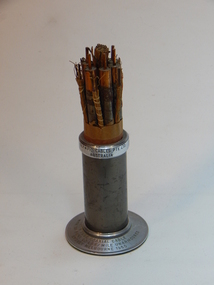
... operator assisted), and supported simultaneous television broadcasts for the first time; it put the power of connection directly into the hands of the Australian public. This souvenir length of cable is well provenanced, and the details of the cables use and significance is inscribed on the steel casing. coaxial cable cable sydney-melbourne coaxial cable telstra postmaster general's department (pmg) telecommunications subscriber trunk dialling (std) television telephone "OLYMPIC CABLES PTY. ...Construction on the Sydney Melbourne coaxial cable began in 1960 and was one of Australia's biggest and most important telecommunications projects of the 20th century. The laying of a coaxial cable between Sydney, Canberra and Melbourne, allowed people to direct dial long distance phone calls (rather than operator assisted), and supported simultaneous television broadcasts for the first time. It was officially opened on 9 April 1962 by the then Prime Minister, Sir Robert Menzies. This souvenir coaxial cable was presented to Mr Roy Kerr on his retirement. Mr Kerr was the Assistant Chief Engineer, Headquarters Customer Networks Branch, Telecom Australia.This cable has strong historic significance as part of the historic and technologically important Sydney-Melbourne coaxial cable. The cable represents not only a feat of technology but a shift in social engagement with telecommunication technologies, as it allowed people to direct dial long distance phone calls (rather than operator assisted), and supported simultaneous television broadcasts for the first time; it put the power of connection directly into the hands of the Australian public. This souvenir length of cable is well provenanced, and the details of the cables use and significance is inscribed on the steel casing. A 6 tube copper coaxial cable with lead sheath, quad 20lbs conductor cable (paper insulated), and a presentation metal collar and base. Inscriptions around the top of the metal collar and the base. "OLYMPIC CABLES PTY. LTD / AUSTRALIA" "6 TUBE COAXIAL CABLE / WITH 32 PAIRS 20LBS/MILE UNARMOURED / SYDNEY MELBOURNE 1960"coaxial cable, cable, sydney-melbourne coaxial cable, telstra, postmaster general's department (pmg), telecommunications, subscriber trunk dialling (std), television, telephone -
 Wodonga & District Historical Society Inc
Functional object - Post Master General Exchange Clock, Junghans Watchmakers
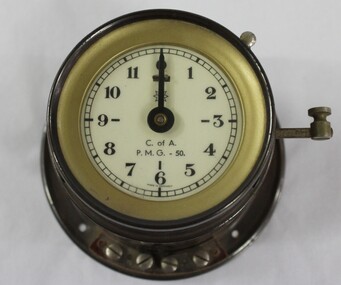
... Telephone calls were transferred through exchanges by manual operators who staffed switchboards throughout the country. ...A small clock used by switchboard operators to time calls at the Wodonga Telephone Exchange. Lever on the side operates timier....Telephone calls were transferred through exchanges by manual operators who staffed switchboards throughout the country. ...The Postmaster-General's Department (PMG) was a department of the Australian federal government, established at Federation in 1901, whose responsibilities included the provision of postal and telegraphic services throughout Australia. It was abolished in December 1975 and replaced by the Postal and Telecommunications Department. Telephone calls were transferred through exchanges by manual operators who staffed switchboards throughout the country. The clock was used to time calls in order to levy appropriate charge for telephone usage.The use of manual telephone exchanges played an important role in Australian telecommunications history, not just for day -to-day business and commercial use, but for social connections and communication during emergency. This timer has local significance as it was used at the Wodonga Telephone Exchange.A small clock used by switchboard operators to time calls at the Wodonga Telephone Exchange. Lever on the side operates timier.In centre of clock 'C. of A./P.M.G -50" Insignia of the Junghans Clock Manufacturers At the bottom edge of the time "Made in Germany",telecommunication, wodonga telephone exchange, p.m.g., timer, wodonga -
 Falls Creek Historical Society
Functional object - Three early telephones
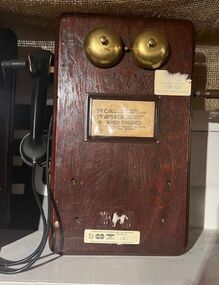
... The operator would disconnect you after a minute if you did not reply to her question "are you extending?". These telephones...The operator would disconnect you after a minute if you did not reply to her question "are you extending?". These telephones ...Until 1960 there were no telephones in Falls Creek. The only access to a phone was at Rocky Valley Camp where the State Electricity Commission (SEC) had an extensive network to Mount Beauty, Bogong and the other camps such as Clover power station and Howman's Gap. There were test points with a phone beside the road where contact could be made to the office in Mount Beauty. The SEC was unconcerned about Falls Creek, so no power was connected until 1960 when Tom Mitchell aired the matter in parliament. Tom was a keen skier. He applied to the Post Master General who was then responsible for telephones as well as mail. The PMG staff came up from Bright and installed an exchange in Diana Lodge. There were only about 15 lines to a post across the road uphill about 20 metres. It was from here that you could put a line from the building into a box where connections were possible. You had to buy a cable from the disposal store. It needed to have an alloy of copper and steel in the wire similar to what the army had used during the war. If the phone failed the owner would have to find the break in the wire, not an easy task in the heavy snow. Then came the telephone itself. Falls Creek was given old-fashioned sets with a hand wound magneto to ring the bell at the exchange. When the operator answered she could then plug a line into another phone line or the exchange in Bright. In the phone were two dry cell batteries that carried the spoken word to the other phone connected. Trunk lines were expensive then, so each trunk call was timed by the minute. The operator would disconnect you after a minute if you did not reply to her question "are you extending?". These telephones were donated by Julian Newton Brown. Julian's Lodge Arundel was known as Falls Creek 11.These telephones are significant because they illustrate the earliest form of technology available to connect Falls Creek Village to other areas.Telephones constructed of polished wood, brass bell, handles and cabling. Designed to operate through a telephone exchange. They operated on two dry cell batteries.Attached to front of telephone: Instructions on how to make or receive a call.falls creek village, falls creek communicaton
