
Showing 10 items matching "temporary job"
-
 Marysville & District Historical Society
THE TRIANGLE NEWS-VOL 3 NO 8-APRIL 7 1978
... ...temporary job...rainfall narbethong hall committee lost temporary job lions bon voyage badminton inter-school sports narbethong primary school fire brigade wirreanda meeting football wanted to buy fruit salad farm handyman THE TRIANGLE NEWS-VOL 3 NO 8-APRIL 7 1978 ...marysville, victoria, australia, community care centre, scottish dancing, senior citizens, thank you, kindergarten, church, what tree is that?, rainfall, narbethong hall committee, lost, temporary job, lions, bon voyage, badminton, inter-school sports, narbethong primary school, fire brigade, wirreanda meeting, football, wanted to buy, fruit salad farm, handyman -
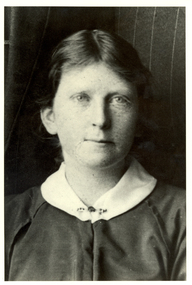 Federation University Historical Collection
Photograph - Photograph - black and white, Rubie Lonie
... temporary answer was Miss Lonie, who was the senior clerk on the Registrar's staff. The permanent position was looked upon as an exclusively male preserve. At Miss Lonie's retirement function SMB President, M.B. John, noted that Miss Lonie had joined the staff in 1914 and had 'done a tremendous job...temporary answer was Miss Lonie, who was the senior clerk on the Registrar's staff. The permanent position was looked upon as an exclusively male preserve. At Miss Lonie's retirement function SMB President, M.B. John, noted that Miss Lonie had joined the staff in 1914 and had 'done a tremendous job ...Ruby Lonie was Senior Clerk of the Ballarat School of Mines (SMB) Administrative Staff. Always known as Miss Lonie, her sole position was at SMB where she worked between May 1914 and May 1960. When the SMB Registrar, John Robinson, died in 1935 the question of who would fill the position became a matter of urgency. The temporary answer was Miss Lonie, who was the senior clerk on the Registrar's staff. The permanent position was looked upon as an exclusively male preserve. At Miss Lonie's retirement function SMB President, M.B. John, noted that Miss Lonie had joined the staff in 1914 and had 'done a tremendous job since that time, and for many years had been the Registrar's "Right Hand Man". Twenty Four years after having acted as Registrar the current SMB Registrar, F.F.Ferguson recognised Miss Lonie's assistance and her extensive knowledge of the history and the administrative procedures of the School. He added 'I have noted on many occasions Miss Lonie's kindly interest in people in times of sickness or difficulty and her willingness to help.' Current and former staff members were keen to acknowledge Miss Lonie. Former Principal Dick Richards said 'That Miss Lonie had been in this one job all her life is a great tribute to the school, and the Council is conscious of her devoted service.' The Principal, Mr Arblaster, on behalf of himself and the staff presented Miss Lonie with a gold watch and wished her well in her retirement. The next day Miss Lonie, along with Hestor Darby, the SMB Typewriting teacher who was on long service leave, sailed from Melbourne for London, mainly to visit Scotland.A black and white photo of a woman, Ruby Lonieruby lonie, ballarat school of mines, women, university women -
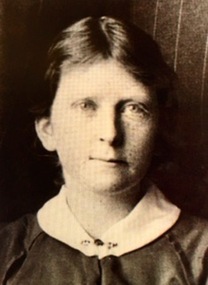 Federation University Historical Collection
Article - Article - Women, Ballarat School of Mines: Women of Note; Ruby Helen Lonie, Staff Member and Acting Registrar, (1895-1979)
... temporary answer was Miss Lonie, who was the senior clerk on the Registrar's staff. The permanent position was looked upon as an exclusively male preserve. Twenty Four years after having acted as Registrar the current SMB Registrar, F.F.Ferguson recognised Miss Lonie's assistance and her extensive knowledge of the history and the administrative procedures of the School. At Miss Lonie's retirement function SMB President, M.B. John, noted that Miss Lonie had joined the staff in 1914 and had 'done a tremendous job...temporary answer was Miss Lonie, who was the senior clerk on the Registrar's staff. The permanent position was looked upon as an exclusively male preserve. Twenty Four years after having acted as Registrar the current SMB Registrar, F.F.Ferguson recognised Miss Lonie's assistance and her extensive knowledge of the history and the administrative procedures of the School. At Miss Lonie's retirement function SMB President, M.B. John, noted that Miss Lonie had joined the staff in 1914 and had 'done a tremendous job ...Ruby Lonie was Senior Clerk of the Ballarat School of Mines (SMB) Administrative Staff. Always known as Miss Lonie, her sole position was at SMB where she worked between May 1914 and May 1960. When the SMB Registrar, John Robinson, died in 1935 the question of who would fill the position became a matter of urgency. The temporary answer was Miss Lonie, who was the senior clerk on the Registrar's staff. The permanent position was looked upon as an exclusively male preserve. Twenty Four years after having acted as Registrar the current SMB Registrar, F.F.Ferguson recognised Miss Lonie's assistance and her extensive knowledge of the history and the administrative procedures of the School. At Miss Lonie's retirement function SMB President, M.B. John, noted that Miss Lonie had joined the staff in 1914 and had 'done a tremendous job since that time, and for many years had been the Registrar's "Right Hand Man"women of note, ruby helen lonie, ballarat school of mines, senior clerk, administrative staff, acting registrar, recognition at retirement, f ferguson, smb president, m b john, 1914-1960 -
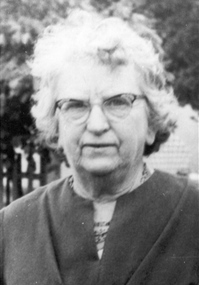 Federation University Historical Collection
Photograph - Photograph - black and white, Rubie Lonie
... temporary answer was Miss Lonie, who was the senior clerk on the Registrar's staff. The permanent position was looked upon as an exclusively male preserve. At Miss Lonie's retirement function SMB President, M.B. John, noted that Miss Lonie had joined the staff in 1914 and had 'done a tremendous job...temporary answer was Miss Lonie, who was the senior clerk on the Registrar's staff. The permanent position was looked upon as an exclusively male preserve. At Miss Lonie's retirement function SMB President, M.B. John, noted that Miss Lonie had joined the staff in 1914 and had 'done a tremendous job ...Ruby Lonie was Senior Clerk of the Ballarat School of Mines (SMB) Administrative Staff. Always known as Miss Lonie, her sole position was at SMB where she worked between May 1914 and May 1960. When the SMB Registrar, John Robinson, died in 1935 the question of who would fill the position became a matter of urgency. The temporary answer was Miss Lonie, who was the senior clerk on the Registrar's staff. The permanent position was looked upon as an exclusively male preserve. At Miss Lonie's retirement function SMB President, M.B. John, noted that Miss Lonie had joined the staff in 1914 and had 'done a tremendous job since that time, and for many years had been the Registrar's "Right Hand Man". Twenty Four years after having acted as Registrar the current SMB Registrar, F.F.Ferguson recognised Miss Lonie's assistance and her extensive knowledge of the history and the administrative procedures of the School. He added 'I have noted on many occasions Miss Lonie's kindly interest in people in times of sickness or difficulty and her willingness to help.' Current and former staff members were keen to acknowledge Miss Lonie. Former Principal Dick Richards said 'That Miss Lonie had been in this one job all her life is a great tribute to the school, and the Council is conscious of her devoted service.' The Principal, Mr Arblaster, on behalf of himself and the staff presented Miss Lonie with a gold watch and wished her well in her retirement. The next day Miss Lonie, along with Hestor Darby, the SMB Typewriting teacher who was on long service leave, sailed from Melbourne for London, mainly to visit Scotland.A black and white photo of a woman, Ruby Lonieruby lonie, ballarat school of mines, women, university women -
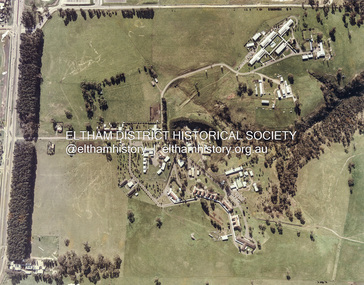 Eltham District Historical Society Inc
Photograph - Colour Print, Janefield, Bundoora, c.1982
... For Mick, this was an impossible job, so he arranged a contract, to house all the soil removed from works associated with the construction of the Greensborough Bypass, which needed temporary storage as it was too valuable, and would be great for use in road construction. ...For Mick, this was an impossible job, so he arranged a contract, to house all the soil removed from works associated with the construction of the Greensborough Bypass, which needed temporary storage as it was too valuable, and would be great for use in road construction. ...The photo encompasses what is present-day University Hill shopping complex and the Janefield Wetlands. Plenty Road is just visible to the left of the photo. Janefield was an area 18 km north-east of central Melbourne that is now part of Bundoora. In 1842 a flour mill, powered by the Plenty River, was built at Janefield, although the locality was not known by that name at that time. It seems that the name Springfield was used in the late 1840s, after a Springfield homestead, and this was changed to Janefield possibly upon the death of Jane Brock in 1847. She was the wife of James Brock, a local landowner and son of the purchaser of the flour mill. This photo is not strictly within the area of interest for EDHS but overlaps do occur at times with other Society’s interests through families and other associated connections. Eltham District Historical Society member (and Greensborough Historical Society member), Peter Van Eeken was undertaking research into this photo and approached the Local History Librarian at Yarra Plenty Regional Library to enquire about digitising the large print copy to facilitate research. Approaches were made to EDHS who had suitable facilities and were willing to accommodate and all parties agreed to add the image as part of their respective collections in partnership. Michael Lanigan, started work as a message boy at Mont Park when he left school at age 14. He worked his way up the system to become farm manager at Mont Park and Janefield Special School. He was one of the last people to drive a herd of cattle (in 1964) between the two locations along Plenty Road. He retired when the school closed around 1993. Mick pointed out the location of three remnant farm houses of the 1800s. The Brock House being the main one. Peter has been unable to find any photos of the Brock House, which what built in the late 1850s, severely burnt in the 1930s and demolished in the mid 1960s. The tree plantation along Plenty Road was established in 1930 and cut down in the mid 1980s. The Victorian Government established tree plantations at about 350 schools in the early 1930s. Briar Hill School had one but Peter is not sure about any other local schools having a tree plantation. Mick informed Peter that it was his job to remove the 14 acres of pine tree roots, after the trees were cut down (due to old age and an infestation of sap sucking insects). For Mick, this was an impossible job, so he arranged a contract, to house all the soil removed from works associated with the construction of the Greensborough Bypass, which needed temporary storage as it was too valuable, and would be great for use in road construction. The contract to store the soil was important to Mick, as the contract stipulated that when the soil was eventually removed, the tree roots had to be removed too. Which got rid of Mick's headache. Apparently, the huge mound of soil that covered the roots in the late 1980s could be seen from Briar Hill. Based on this, the photo is most likely to have been taken 1982 or 1983. The key to a final date is working out when the Board of Works Office opened but so far no information has come to light. (It was purchased by La Trobe University in 1991). The Office existed, or is hinted at, in the photo at the extreme north of the photo, opposite McKimmies Road, on the eastern side of Plenty Road. Photo on loan from Michael Lanigan via Peter Van Eeken. He cannot recall why it was taken. brock family, janefield, janefield drive, janefield wetlands, plenty road, university hill -
 Eltham District Historical Society Inc
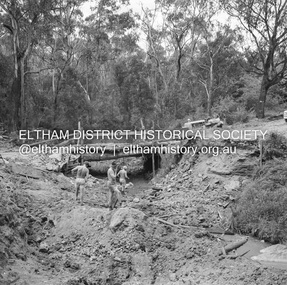
Negative - Photograph, J.A. McDonald, Heidelberg-Kinglake Road, 3 Nov. 1959
... Job 56M431 Contractors Wolf and Wood Yow Yow Creek Bridge Old bridge cut Temporary bridge in use 3 November 1959...Job 56M431 Contractors Wolf and Wood Yow Yow Creek Bridge Old bridge cut Temporary bridge in use 3 November 1959 Record of various Shire of Eltham infrastructure works undertaken during the period of 1952-1962 involving bridge and road reconstruction projects, sometimes with Eltham Shire Council Project Reference numbers quoted. ...Job 56M431 Contractors Wolf and Wood Yow Yow Creek Bridge Old bridge cut Temporary bridge in use 3 November 1959Record of various Shire of Eltham infrastructure works undertaken during the period of 1952-1962 involving bridge and road reconstruction projects, sometimes with Eltham Shire Council Project Reference numbers quoted. It was during this period that a number of significant improvements were made to roads and new bridges constructed within the shire that remain in place as of present day (2022). In many situations, the photos provide a tangible visible record of infrastructure that existed throughout the early days of the Shire. The album was put together by or under the direction of the Shire Engineer, J.A. McDonald.infrastructure, shire of eltham, bridge construction, heidelberg-kinglake road, road construction, yow yow creek, 1959-11-03 -
 Eltham District Historical Society Inc
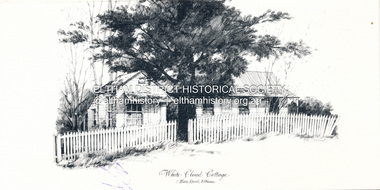
Greeting Card, Bill Caldwell, Sketch (reprint): White Cloud Cottage, Bill Caldwell n.d, c.1982
... job!" recalls one enthusiastic local. Aside from its early temporary use as Eltham's first Police Station, Jarrold Cottage also attracted attention from one writer in 1902 because of its "Surrey or Sussex village" qualities and its " essentially English" village pond. ...job!" recalls one enthusiastic local. Aside from its early temporary use as Eltham's first Police Station, Jarrold Cottage also attracted attention from one writer in 1902 because of its "Surrey or Sussex village" qualities and its " essentially English" village pond. ...Greeting card from Neville Emerson and Staff with sketch commissioned by Neville Emerson Real Estate. The image was also used on the Wiregrass Gallery calendar for 1982 or 1983 Jarrold Cottage Set only metres from Eltham's busy Main Road is this striking reminder of a bygone era. Built in the 1850s, this small cottage, also known as White Cloud or Skippers Cottage, is one of the oildest buildings in Eltham. In the tiny shop at the side of the cottage locals could have their boots soled by Mr. John Henry Clark, the boot and harness maker (and former photographer of note) who boarded with the Jarrolds. "he did a first rate job!" recalls one enthusiastic local. Aside from its early temporary use as Eltham's first Police Station, Jarrold Cottage also attracted attention from one writer in 1902 because of its "Surrey or Sussex village" qualities and its " essentially English" village pond. Remnants of the original pond are still visible amongst the willows.Christmas card 9.5 x 19.5 cmart, bill caldwell, main road, white cloud cottage, artist, fay bridge collection, neville emerson real estate, sketches, wiregrass gallery calendar -
 Ballarat Tramway Museum
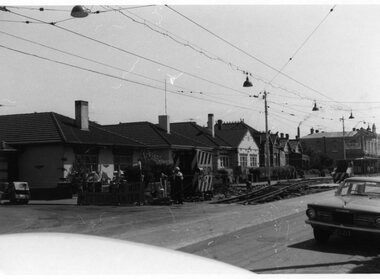
Photograph - Black & White Photograph/s, Nov. 1965
... (Electric Traction 11/65) (Unusual to have two jobs at once - see Hawthorn Rd - Reg item 1421). Series show the construction method. Temporary track formed by progressively lifting original track on to side of road each night. ...(Electric Traction 11/65) (Unusual to have two jobs at once - see Hawthorn Rd - Reg item 1421). Series show the construction method. Temporary track formed by progressively lifting original track on to side of road each night. ...Set of seven Black and white photographs on Kodak paper for the arrangements and work for the track reconstruction of Commercial Road Prahran. Series of photos show Down track already complete. Probably second half of October or early November 1965. (Electric Traction 11/65) (Unusual to have two jobs at once - see Hawthorn Rd - Reg item 1421). Series show the construction method. Temporary track formed by progressively lifting original track on to side of road each night. Relaying then follows progressively. Pictures show almost completed section (1423.1 &2), concreting (1423.3), new rails in situ (1423.4&5),newly moved track (1423.6&7), excavation taking place (1423.7) 1421.1 - Commercial Rd looking west at Charles St showing ramp to temporary city bound track. 1423.2 Ditto - just west of Charles St. 1423.3 Ditto - corner Perth St on left, Hyland St on right. 1423.4 Ditto - between Perth and Donald Sts. Scrubber car No 9. 1423.5 Ditto - looking east between Perth and Donald Sts. - W5 723 on new track, W5 722 on temporary track. 1423.6 Ditto - looking east. Max Hotel on corner of Donald St. 1423.7 Ditto - looking east at corner of Alfred St. Scrubber car No 9. See P.Winspur note with item 1418.trams, tramways, commercial road, reconstruction, trackwork, mmtb, tram 9, tram 723, tram 722 -
 Wodonga & District Historical Society Inc
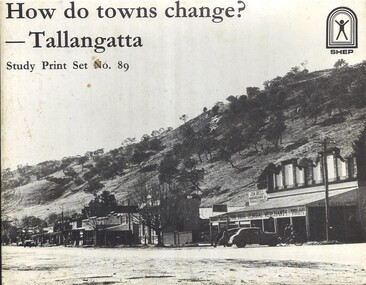
Education kit - How do towns change? - Tallangatta, SHEP Project, 1979
... jobs and connected local mining and farming industries to broader markets. From 1918, Tallangatta's future was uncertain. Plans for a reservoir at the confluence of the Mitta Mitta and Murray Rivers threatened the town. Stage one of Lake Hume was completed in 1936, sparing the town temporarily ...The Tallangatta pastoral run was established in 1838. By the 1850s a thriving town had been established near the junction of the Mitta Mitta River and Tallangatta Creek. Officially named in 1854, Tallangatta became a vital gateway to nearby goldfields such as Mount Wills, Mitta Mitta, and Cravensville. It also grew as a service centre to the pastoralists in the surrounding area. Rail reached Tallangatta in 1891, doubling the population within a decade. A mile-long viaduct took two years to complete. The railway brought jobs and connected local mining and farming industries to broader markets. From 1918, Tallangatta's future was uncertain. Plans for a reservoir at the confluence of the Mitta Mitta and Murray Rivers threatened the town. Stage one of Lake Hume was completed in 1936, sparing the town temporarily. After WWII, demand for irrigation water rose—and residents were told the town would be flooded. Between 1952 and 1958, Tallangatta was relocated. The State Rivers and Water Supply Commission oversaw the move with a £3 million budget. Over 100 timber homes were relocated, 37 brick homes rebuilt, and 74 prefabricated houses brought in. Thirty-five new buildings were added, including hotels, banks, a butter factory, a hospital, and a modern shopping centre. The new town of Tallangatta was officially reopened by Governor Sir William Slim on June 29, 1956. In 2016, Tallangatta was designated a "Notable Town" by the National Trust for its architectural and historical significance, making it the second town to receive this honour.A set of 89 Photographs, maps and information sheets produced as a case study of the moving of the town of Tallangatta in the 1950s. It was created as a resource to enable secondary school students to investigate how towns can change over time. non-fictionThe Tallangatta pastoral run was established in 1838. By the 1850s a thriving town had been established near the junction of the Mitta Mitta River and Tallangatta Creek. Officially named in 1854, Tallangatta became a vital gateway to nearby goldfields such as Mount Wills, Mitta Mitta, and Cravensville. It also grew as a service centre to the pastoralists in the surrounding area. Rail reached Tallangatta in 1891, doubling the population within a decade. A mile-long viaduct took two years to complete. The railway brought jobs and connected local mining and farming industries to broader markets. From 1918, Tallangatta's future was uncertain. Plans for a reservoir at the confluence of the Mitta Mitta and Murray Rivers threatened the town. Stage one of Lake Hume was completed in 1936, sparing the town temporarily. After WWII, demand for irrigation water rose—and residents were told the town would be flooded. Between 1952 and 1958, Tallangatta was relocated. The State Rivers and Water Supply Commission oversaw the move with a £3 million budget. Over 100 timber homes were relocated, 37 brick homes rebuilt, and 74 prefabricated houses brought in. Thirty-five new buildings were added, including hotels, banks, a butter factory, a hospital, and a modern shopping centre. The new town of Tallangatta was officially reopened by Governor Sir William Slim on June 29, 1956. In 2016, Tallangatta was designated a "Notable Town" by the National Trust for its architectural and historical significance, making it the second town to receive this honour.moving tallangatta, tallangatta - the town that moved, history tallangatta -
 Unions Ballarat
Change the Rules bumper sticker, 2018
... jobs they can count on. Give people the choice of converting from casual to permanent if they work regular hours End labour hire and sham contracting rip-offs Stop the exploitation of temporary visa workers Stop allowing employers to terminate workplace agreements Equal rights for people working in the gig economy Investment in apprenticeships and vocational training Governments to procure from local businesses first, to create local jobs" Change the Rules is a union driven campaign that supported campaigning towards the 2018 Victorian State election and the 2019 Federal election. ...jobs they can count on. Give people the choice of converting from casual to permanent if they work regular hours End labour hire and sham contracting rip-offs Stop the exploitation of temporary visa workers Stop allowing employers to terminate workplace agreements Equal rights for people working in the gig economy Investment in apprenticeships and vocational training Governments to procure from local businesses first, to create local jobs" Change the Rules is a union driven campaign that supported campaigning towards the 2018 Victorian State election and the 2019 Federal election. ...From Change the Rules website: "We need to change the rules so people have jobs they can count on. Give people the choice of converting from casual to permanent if they work regular hours End labour hire and sham contracting rip-offs Stop the exploitation of temporary visa workers Stop allowing employers to terminate workplace agreements Equal rights for people working in the gig economy Investment in apprenticeships and vocational training Governments to procure from local businesses first, to create local jobs" Change the Rules is a union driven campaign that supported campaigning towards the 2018 Victorian State election and the 2019 Federal election. Elections, politics and government, and industrial relations.Bumper sticker: blue background; white lettering; slogan; adhesive with backing strip.Slogan reads: "For more secure jobs and better pay, Change the RULES".btlc, ballarat trades hall, ballarat trades and labour council, vthc, victorian trades hall council, actu, australian council of trade unions, elections, politics and government, political campaigns, industrial relations, unions, change the rules
