
Showing 49 items matching "tennis coaching"
-
 Musculoskeletal Health Australia (now held by the Glen Eira Historical Society)
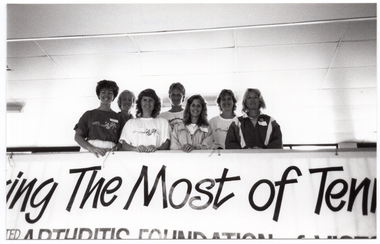
Photograph - Group photo, XX/04/1989
... ... tennis clinic... coaching...This photo depicts a small group of tennis coaches posing for a photo at a coaching clinic....[Handwritten in blue ink] Tennis Coaches at Coaching Clinic Corio 1989 April...This photo depicts a small group of tennis coaches posing for a photo at a coaching clinic. arthritis foundation of victoria afv outreach tennis clinic coaching clinic participants coaches banner viewing platform balcony corio geelong north 1989 [Handwritten in blue ink] Tennis Coaches at Coaching Clinic Corio 1989 April B&W photo of a small group of women standing behind a barrier on a viewing platform or balcony. ...In April 1989, the Arthritis Foundation of Victoria (AFV), in partnership with the Australian Women's Tennis Association, held some tennis clinics in Corio, including this one specifically for tennis coaches. The event was held as part of an outreach visit to Geelong and Corio. This photo depicts a small group of tennis coaches posing for a photo at a coaching clinic.B&W photo of a small group of women standing behind a barrier on a viewing platform or balcony. On the barricade, there is a large banner (partially obscured) with the text, "Making The Most of Tenhis" and "... ARTHRITIS FOUNDATION of VICTORIA" (partially obscured).[Handwritten in blue ink] Tennis Coaches at Coaching Clinic Corio 1989 Aprilarthritis foundation of victoria, afv, outreach, tennis clinic, coaching clinic, participants, coaches, banner, viewing platform, balcony, corio, geelong north, 1989 -
 Lakes Entrance Historical Society
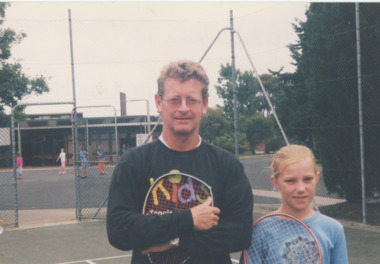
Photograph - Lake Entrance tennis coach Mike Spruzen with St Brendans pupil Tabitha Lancaster 2001, Lakes Post Newspaper
... Lake Entrance tennis coach Mike Spruzen with St Brendans pupil Tabitha Lancaster 2001...tennis coach Mike Spruzen with St Brendans grade five pupil Tabitha Lancaster during kids tennis foundation program taken at tennis court on Rowe Street Lake Entrance Victoria...Colour photograph of tennis coach Mike Spruzen with St Brendans grade five pupil Tabitha Lancaster during kids tennis foundation program taken at tennis court on Rowe Street Lake Entrance Victoria...tennis coach Mike Spruzen with St Brendans grade five pupil Tabitha Lancaster during kids tennis foundation program taken at tennis court on Rowe Street Lake Entrance Victoria Sports Tennis Clubs Recreation Colour photograph of tennis coach Mike Spruzen with St Brendans grade five pupil Tabitha Lancaster during kids tennis foundation program taken at tennis court on Rowe Street Lake Entrance Victoria Photograph Lake Entrance tennis coach Mike Spruzen with St Brendans pupil Tabitha Lancaster 2001 Lakes Post Newspaper ...tennis coach Mike Spruzen with St Brendans grade five pupil Tabitha Lancaster during kids tennis foundation program taken at tennis court on Rowe Street Lake Entrance VictoriaColour photograph of tennis coach Mike Spruzen with St Brendans grade five pupil Tabitha Lancaster during kids tennis foundation program taken at tennis court on Rowe Street Lake Entrance Victoriasports, tennis, clubs, recreation -
 Marysville & District Historical Society
THE TRIANGLE NEWS-VOL 2 NO 32-OCTOBER 14 1977
... ...tennis coaching...marysville victoria australia bingo community care centre 'rats' not signing with kerry packer golf club dance golf news marysville senior citizens lions club olde time dance crossways rubbish rainfall marysville waterworks trust shop at manuel's the pumpernickel marysville swimming club kindergarten roster fishing club outing situation vacant football club presentation night narbethong old time dance wirreanda debutante ball fire brigade tennis coaching calendar swimming club gwen greatorex undergoes surgery THE TRIANGLE NEWS-VOL 2 NO 32-OCTOBER 14 1977 ...marysville, victoria, australia, bingo, community care centre, 'rats' not signing with kerry packer, golf club dance, golf news, marysville senior citizens, lions club, olde time dance crossways, rubbish, rainfall, marysville waterworks trust, shop at manuel's, the pumpernickel, marysville swimming club, kindergarten roster, fishing club outing, situation vacant, football club presentation night, narbethong old time dance, wirreanda debutante ball, fire brigade, tennis coaching, calendar, swimming club, gwen greatorex undergoes surgery -
Marysville & District Historical Society
THE TRIANGLE NEWS-VOL 11 NO 2-7 FEBRUARY 1986
... ...tennis coaching...marysville victoria australia senior citizens anglican church annual meeting marysville retirement village dinner cumberland hotel parents & boys community care centre interruption to s.e.c. supply marysville produce marysville primary school agm tennis coaching brownies 1986 kindergarten roster footy news marysville saddle tramps no guides till further notice christ church anglican marysville st thomas' buxton video hire kitchen work cumberland hotel marysville retirement village construction buying or selling house or land marysville hardware triangle arts council news guidelines for triangle news fire brigade news advertising welcome new principal marysville primary school thanks from committee marysville saddle tramps THE TRIANGLE NEWS-VOL 11 NO 2-7 FEBRUARY 1986 ...marysville, victoria, australia, senior citizens, anglican church annual meeting, marysville retirement village dinner, cumberland hotel, parents & boys, community care centre, interruption to s.e.c. supply, marysville produce, marysville primary school agm, tennis coaching, brownies 1986, kindergarten roster, footy news, marysville saddle tramps, no guides till further notice, christ church anglican marysville, st thomas' buxton, video hire, kitchen work cumberland hotel, marysville retirement village construction, buying or selling house or land, marysville hardware, triangle arts council news, guidelines for triangle news, fire brigade news, advertising, welcome new principal, marysville primary school, thanks from committee marysville saddle tramps -
Marysville & District Historical Society
THE TRIANGLE NEWS-VOL 11 NO 4-21 FEBRUARY 1986
... ...tennis coaching...marysville victoria australia lions ladies tupperware party new babes coffee morning senior citizens baby sitting happy anniversary shopping spree tour community employment program marysville saddle tramps happy birthday kindergarten roster toddler/play group lost dept of conservation forest and lands interruption to s.e.c. supply house to rent wanted for sale buying or selling house or land shire of alexandra mechanic strawberries marysville hardware igloo roadhouse new owners baby sitter required narbethong tennis coaching roofs agistment christ church anglican church marysville newsagency st thomas' buxton THE TRIANGLE NEWS-VOL 11 NO 4-21 FEBRUARY 1986 ...marysville, victoria, australia, lions ladies tupperware party, new babes coffee morning, senior citizens, baby sitting, happy anniversary, shopping spree tour, community employment program, marysville saddle tramps, happy birthday, kindergarten roster, toddler/play group, lost, dept of conservation forest and lands, interruption to s.e.c. supply, house to rent, wanted, for sale, buying or selling house or land, shire of alexandra, mechanic, strawberries, marysville hardware, igloo roadhouse new owners, baby sitter required narbethong, tennis coaching, roofs, agistment, christ church anglican church, marysville newsagency, st thomas' buxton -
Whitehorse Historical Society Inc.
Article, Coach Calling It A Day, 2014
... Tennis coach Ian Strong has just retired from 32 years as coach of Vermont South Club....Tennis coach Ian Strong has just retired from 32 years as coach of Vermont South Club. ...Tennis coach Ian Strong has just retired.Tennis coach Ian Strong has just retired from 32 years as coach of Vermont South Club.Tennis coach Ian Strong has just retired. vermont south tennis club, strong, ian -
 Lakes Entrance Historical Society
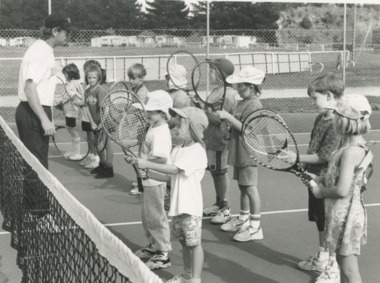
Photograph - Saturday morning Junior Tennis Lakes Entrance 1994, Lakes Post Newspaper
... Black and white photograph showing tennis coach Michael Spuzen instructing a group of enthusiastic youngsters at Saturday morning Junior Tennis Lakes Entrance Victoria...Michael Spuzen instructing a group of enthusiastic youngsters at Saturday morning Junior Tennis Lakes Entrance Victoria Sports Tennis Clubs Recreation Black and white photograph showing tennis coach Michael Spuzen instructing a group of enthusiastic youngsters at Saturday morning Junior Tennis Lakes Entrance Victoria Photograph Saturday morning Junior Tennis Lakes Entrance 1994 Lakes Post Newspaper ...Michael Spuzen instructing a group of enthusiastic youngsters at Saturday morning Junior Tennis Lakes Entrance VictoriaBlack and white photograph showing tennis coach Michael Spuzen instructing a group of enthusiastic youngsters at Saturday morning Junior Tennis Lakes Entrance Victoriasports, tennis, clubs, recreation -
 Tennis Australia
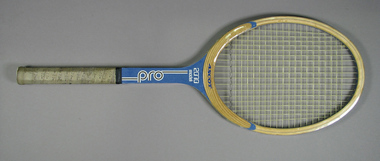
Racquet, Circa 1975
... An Ascot 2070 Pro tennis racquet, approved by the Professional Tennis Coaches' Association (UK), with leather handle grip with arrowhead patterned perforations. ...Tennis An Ascot 2070 Pro tennis racquet, approved by the Professional Tennis Coaches' Association (UK), with leather handle grip with arrowhead patterned perforations. ...An Ascot 2070 Pro tennis racquet, approved by the Professional Tennis Coaches' Association (UK), with leather handle grip with arrowhead patterned perforations. Materials: Wood, Nylon, Ink, Glue, Lacquer, Metal, Leather, Adhesive tape, Fibre, Plastictennis -
 Musculoskeletal Health Australia (now held by the Glen Eira Historical Society)
Photograph - Group photo, XX/04/1989
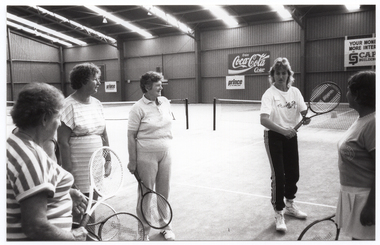
... This photo depicts a tennis coach demonstrating racquet technique to participants....This photo depicts a tennis coach demonstrating racquet technique to participants. arthritis foundation of victoria afv outreach tennis clinic tennis court tennis net tennis racket racquet technique participants coaches corio geelong north 1989 [Handwritten in blue ink] Tennis Clinic - Corio April 1989 [Handwritten in pencil] 27226 B&W photo of five women standing on one of two indoor tennis courts. ...In April 1989, the Arthritis Foundation of Victoria (AFV), in partnership with the Australian Women's Tennis Association, held a tennis clinic in Corio. The event was held as part of an outreach visit to Geelong and Corio. This photo depicts a tennis coach demonstrating racquet technique to participants.B&W photo of five women standing on one of two indoor tennis courts. They are each holding a tennis racket. One woman is demonstrating how to hold the racket while the other four women are watching her. In the background, there are some advertising signs on the wall, including two for Prince tennis products, one for Coca-Cola soft drinks, and one for a building society (financial institution). The text on that sign (partially obscured) says, "YOUR MONEY MORE INTEREST CAPITOL BUILDING SOCIETY".[Handwritten in blue ink] Tennis Clinic - Corio April 1989 [Handwritten in pencil] 27226arthritis foundation of victoria, afv, outreach, tennis clinic, tennis court, tennis net, tennis racket, racquet technique, participants, coaches, corio, geelong north, 1989 -
 Musculoskeletal Health Australia (now held by the Glen Eira Historical Society)
Photograph - Solo photo, XX/04/1989
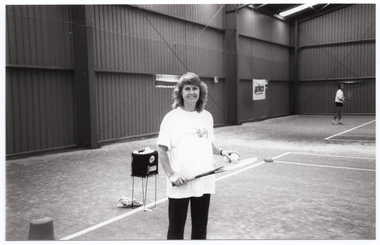
... tennis balls... serve technique... coach...This photo depicts one of the tennis coaches posing for a photo on the court....This photo depicts one of the tennis coaches posing for a photo on the court. arthritis foundation of victoria afv outreach tennis clinic tennis court tennis racket tennis balls serve technique coach corio geelong north 1989 B&W photo of a woman standing on an indoor tennis court. ...In April 1989, the Arthritis Foundation of Victoria (AFV), in partnership with the Australian Women's Tennis Association, held a tennis clinic in Corio. The event was held as part of an outreach visit to Geelong and Corio. This photo depicts one of the tennis coaches posing for a photo on the court.B&W photo of a woman standing on an indoor tennis court. She is wearing a t-shirt with the logo for the Australian Women's Tennis Association. She is holding two tennis balls in one hand, poised over a tennis racket which she is holding with her other hand. Behind her, there is a square container on a stand, filled with tennis balls. In the background, to the right of the frame, a man is playing tennis on an adjoining court. On the wall, there is an advertising sign for Prince tennis products.arthritis foundation of victoria, afv, outreach, tennis clinic, tennis court, tennis racket, tennis balls, serve technique, coach, corio, geelong north, 1989 -
 Musculoskeletal Health Australia (now held by the Glen Eira Historical Society)
Photograph - Group photo, 1989
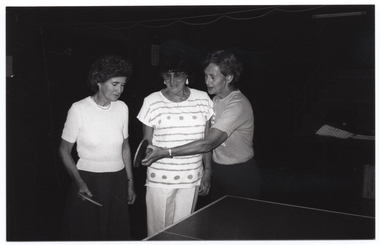
... In February 1989, Joan Guggenheim (from the Over 50s Table Tennis Association), conducted a table tennis clinic in Dandenong on behalf of the Arthritis Foundation of Victoria. This photo depicts Joan coaching two beginners in how to use the racquet or bat (also known as a 'paddle' in the USA) to either serve or make a stroke....[On a yellow sticky note, handwritten in black ink] Joan Guggenheim (over 50's Table Tennis Assoc~) coaching two beginners. Feb 1989...In February 1989, Joan Guggenheim (from the Over 50s Table Tennis Association), conducted a table tennis clinic in Dandenong on behalf of the Arthritis Foundation of Victoria. This photo depicts Joan coaching two beginners in how to use the racquet or bat (also known as a 'paddle' in the USA) to either serve or make a stroke. arthritis foundation of victoria afv table tennis clinic joan guggenheim over 50s table tennis association dandenong 1989 [On a yellow sticky note, handwritten in black ink] Joan Guggenheim (over 50's Table Tennis Assoc~) coaching two beginners. ...In February 1989, Joan Guggenheim (from the Over 50s Table Tennis Association), conducted a table tennis clinic in Dandenong on behalf of the Arthritis Foundation of Victoria. This photo depicts Joan coaching two beginners in how to use the racquet or bat (also known as a 'paddle' in the USA) to either serve or make a stroke.Black and white photo of three women standing behind a table tennis table. One of the women is instructing the other two women, who are each holding a racquet or bat (also known as a 'paddle' in the USA) in one hand. The woman instructing is guiding the hand of one of the women.[On a yellow sticky note, handwritten in black ink] Joan Guggenheim (over 50's Table Tennis Assoc~) coaching two beginners. Feb 1989arthritis foundation of victoria, afv, table tennis clinic, joan guggenheim, over 50s table tennis association, dandenong, 1989 -
 Tennis Australia
Book, Circa 1989
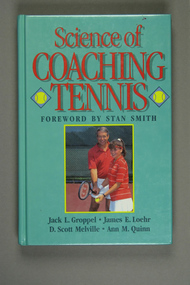
... Book: 'SCIENCE OF COACHING TENNIS'. Hardcover. Copyrighted 1989. Materials: Ink, Paper, Cardboard...Tennis Book: 'SCIENCE OF COACHING TENNIS'. Hardcover. Copyrighted 1989. ...Book: 'SCIENCE OF COACHING TENNIS'. Hardcover. Copyrighted 1989. Materials: Ink, Paper, Cardboardtennis -
 Ballarat Clarendon College
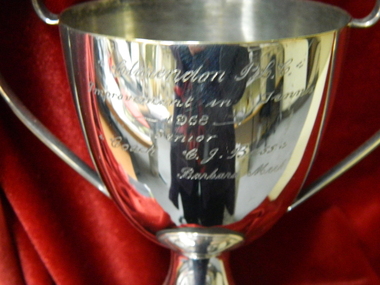
Trophy, Improvement in tennis
... . / Improvement in tennis / 1968 / Senior / Coach C J Bass / Barbara Meek.... / Improvement in tennis / 1968 / Senior / Coach C J Bass / Barbara Meek Medium silver cup wth double handles on silver stem with melamine base; engraved on face of cup. ...Barabara Meek boarded at Clarendon Presbyterian Ladies College 1964 - 1968, passing her Leaving examinations in 1968. Medium silver cup wth double handles on silver stem with melamine base; engraved on face of cup. Engraving on face: Clarendon P.L.C. / Improvement in tennis / 1968 / Senior / Coach C J Bass / Barbara Meekbarbara-meek, 1968, tennis, sports, clarendon-presbyterian-ladies-college -
 Tennis Australia
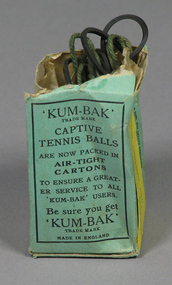
Tether, Circa 1931
... A small carton, with inscription across one face of the box: THIS CARTON/CONTAINS TWO/COMPLETE ATTACHMENTS FOR/THE TENNIS AUTO COACH, 1/6/... Materials: String, Rubber, Metal, Cardboard, Paper, Ink...Tennis A small carton, with inscription across one face of the box: THIS CARTON/CONTAINS TWO/COMPLETE ATTACHMENTS FOR/THE TENNIS AUTO COACH, 1/6/... Materials: String, Rubber, Metal, Cardboard, Paper, Ink Tether ...A small carton, with inscription across one face of the box: THIS CARTON/CONTAINS TWO/COMPLETE ATTACHMENTS FOR/THE TENNIS AUTO COACH, 1/6/... Materials: String, Rubber, Metal, Cardboard, Paper, Inktennis -
 Port Melbourne Historical & Preservation Society
Photograph - PMTC Metro Tennis Notice
... Digital photograph of a notice at the Port Melbourne Tennis Club for MetroTennis coaching programs....Port Melbourne Tennis Club Sport - Tennis Digital photograph of a notice at the Port Melbourne Tennis Club for MetroTennis coaching programs. Photograph PMTC Metro Tennis Notice ...From a collection of 50 digital photographs and 1 short video relating to Port Melbourne Tennis Club. Information relating to individual images has been obtained from the image itself and/or the file name it has been given. The folder structure for the images has been maintained. One folder is called Opening with a sub-folder called EnTousCas which presumably refers to new court surface shown under construction and completed in some of the photos. This is one of an eclectic mix of 32 images in a sub-folder named "EnTousCas" under "Opening". Digital photograph of a notice at the Port Melbourne Tennis Club for MetroTennis coaching programs.port melbourne tennis club, sport - tennis -
St Vincent's Hospital Melbourne Archives
Document - A poem describing Nurse Mary Deane circa 1936
... Harry Hopman was an Australian tennis player, coach and journalist. ...Harry Hopman was an Australian tennis player, coach and journalist. Mary Deane St Vincent's Hospital Nurse Training. ...A humorous poem typewritten and in jest, regarding Mary Dean's bedside nursing, administering aperients and waking patients up when they were asleep. The postscript is hand-written by Harry Hopman, it is unknown whether he is the author of the poem. Harry Hopman was an Australian tennis player, coach and journalist. mary deane, st vincent's hospital nurse training., harry hopman -
Tatura Irrigation & Wartime Camps Museum
Photograph, Tennis Youths with Coach
... Tennis Youths with Coach...Tennis coach from Melbourne instructs local youths....tatura recreations sports costume children male Tennis coach from Melbourne instructs local youths. ...Tennis coach from Melbourne instructs local youths.|Back row: Janet Curtis, Jan Robbins, Kerry Russell, Kate Robbins, Ann Cockroft, Julie Kerrins, Margaret Dunlop, Michael Blackall, Kevin Cummins, Philip Ritchie, Geoff Cockroft, Andrew McCallum.|Middle row: Leanne Clapp, Debbie Panenberg, Sue Bell, Debbie Russell, Fairy (Rosemary) O'Toole, Kerry Bell, Gavin Lesuer, David Panenberg.|Front row: Irene van den Ende, ....?, Mark Kerrins, John Cockroft, Ian Baxter, Brian Curtis, Geoffrey Dunlop.tatura, recreations, sports, costume, children, male -
 Greensborough Historical Society
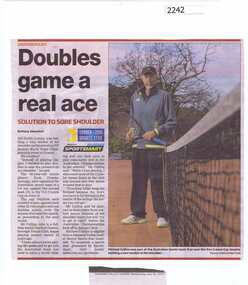
Newspaper clipping, Doubles game a real ace, 22/07/2015
... Michael Collins, senior tennis player and coach at Greensborough Tennis Club played in the successful Australian team in the Von Cramm Cup in June 2015....Michael Collins, senior tennis player and coach at Greensborough Tennis Club played in the successful Australian team in the Von Cramm Cup in June 2015. michael collins greensborough tennis club News clipping, black text, colour image. ...Michael Collins, senior tennis player and coach at Greensborough Tennis Club played in the successful Australian team in the Von Cramm Cup in June 2015.News clipping, black text, colour image.michael collins, greensborough tennis club -
 Tennis Australia
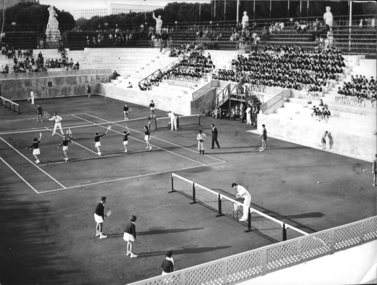
Photographic print, Circa 1950
... Black and white photograph of tennis players and coaches at a tennis clinic in Italy. ...Tennis Black and white photograph of tennis players and coaches at a tennis clinic in Italy. ...Black and white photograph of tennis players and coaches at a tennis clinic in Italy. Many players and spectators are youths in uniforms, possibly schoolchildren. Materials: Paper, Photographic emulsiontennis -
 Whitehorse Historical Society Inc.
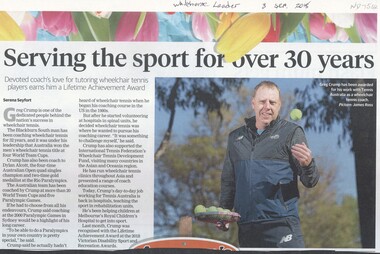
Article, Greg Crump, 2018
... Greg Group of Blackburn South has been coaching wheelchair tennis for 32 years and has been awarded a Lifetime Achievement Award....crump greg tennis awards Greg Group of Blackburn South has been coaching wheelchair tennis for 32 years and has been awarded a Lifetime Achievement Award. ...Greg Group of Blackburn South has been coaching wheelchair tennis for 32 years and has been awarded a Lifetime Achievement Award.Greg Group of Blackburn South has been coaching wheelchair tennis for 32 years and has been awarded a Lifetime Achievement Award.Greg Group of Blackburn South has been coaching wheelchair tennis for 32 years and has been awarded a Lifetime Achievement Award.crump, greg, tennis, awards -
 Tennis Australia
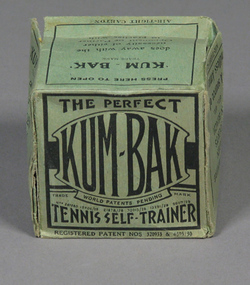
Tether ball, Circa 1933
... Across another: THIS CARTON/CONTAINS -/ONE TENNIS/AUTO COACH/CAPTIVE BALL/COMPLETE WITH/ATTACHMENTS. ...Across another: THIS CARTON/CONTAINS -/ONE TENNIS/AUTO COACH/CAPTIVE BALL/COMPLETE WITH/ATTACHMENTS. ...A small, sealed carton, most likely containing a tether tennis ball and, a string and elastic tether. Inscription across one face of the box: THE PERFECT/KUM-BAK/.../TENNIS SELF-TRAINER/... Across another: THIS CARTON/CONTAINS -/ONE TENNIS/AUTO COACH/CAPTIVE BALL/COMPLETE WITH/ATTACHMENTS. Materials: Rubber, Felt, String, Metal, Cardboard, Paper, Inktennis -
 Tennis Australia
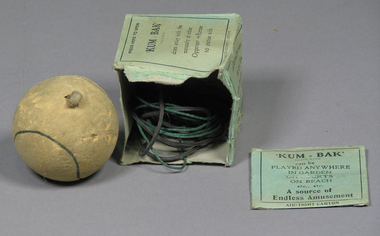
Tether ball, Circa 1933
... Across another: THIS CARTON/CONTAINS -/ONE TENNIS/AUTO COACH/CAPTIVE BALL/COMPLETE WITH/ATTACHMENTS. ...Across another: THIS CARTON/CONTAINS -/ONE TENNIS/AUTO COACH/CAPTIVE BALL/COMPLETE WITH/ATTACHMENTS. ...A small carton (.2) containing a used tether tennis ball (.1), and, a string and elastic tether (.3). Inscription across one face of the box: THE PERFECT/KUM-BAK/.../TENNIS SELF-TRAINER/... Across another: THIS CARTON/CONTAINS -/ONE TENNIS/AUTO COACH/CAPTIVE BALL/COMPLETE WITH/ATTACHMENTS. Materials: Rubber, Felt, String, Metal, Cardboard, Paper, Inktennis -
 Ringwood and District Historical Society
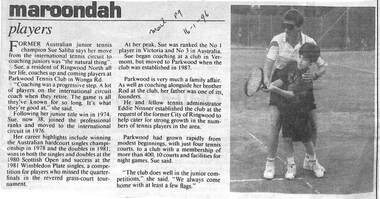
Newspaper, Scrapbook Clipping, Library Collection, Ringwood, Victoria
... Former Australian junior tennis champion, Sue Saliba, has moved from the international tennis circuit to coaching juniors at the Parkwood Tennis Club in Wonga Road.Following her junior title in 1974, Sue, now 38, joined the professional ranks and moved to the international circuit in 1996. ...Former Australian junior tennis champion, Sue Saliba, has moved from the international tennis circuit to coaching juniors at the Parkwood Tennis Club in Wonga Road.Following her junior title in 1974, Sue, now 38, joined the professional ranks and moved to the international circuit in 1996. ...Newspaper Clipping from "The Mail", 16-1-1996. P 9 "Maroondah players"'. Sue SalibaFormer Australian junior tennis champion, Sue Saliba, has moved from the international tennis circuit to coaching juniors at the Parkwood Tennis Club in Wonga Road.Following her junior title in 1974, Sue, now 38, joined the professional ranks and moved to the international circuit in 1996. At her peak, Sue was ranked No. 1 in Victoria and No. 3 in Australia. -
 City of Melbourne Libraries
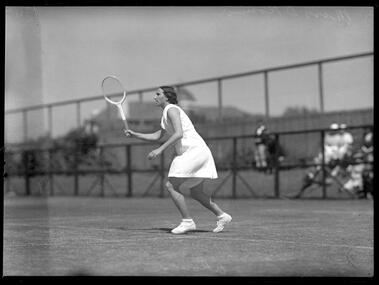
Photograph, Bull, Hugh Jones, 1897-1993, Tennis player, Dorothy Round, Albert Grounds, Melbourne
... She gave up competitive tennis to coach and write newspaper articles. In later life she took up golf. ...She gave up competitive tennis to coach and write newspaper articles. In later life she took up golf. ...Dorothy Round in shorts English-born Dorothy Round (1909-1982) plays tennis at Albert Park Cricket Ground, wearing her signature white sleeveless dress with divided skirt, pleated to form loose shorts. Dorothy won Wimbledon in 1934 and 1937, and the Australian Open in 1935. In the early 1930s, many women players in Europe and USA swapped stockings and long skirts for bare legs, short skirts and shorts. In October 1933, Mr Harley Malcolm, Secretary of Lawn Tennis Association Australia (LTAA) declared, “I consider shorts not regulation costume and would stop both men and women, particularly women, wearing them. I think women’s desire to strut themselves in such a costume is unreasonable.” However by November, the Victorian Lawn Tennis Association (VLTA) officially allowed shorts at Kooyong for both sexes. At the July 1934 Wimbledon Women’s Final, played in front of the King and Queen, Dorothy wore a sleeveless dress with the skirt divided. Her American competitor, Helen Jacobs, wore white tailored shorts with a black stripe on either side, described as “mannish, though businesslike”. In October, Australian tennis player Mrs Nell Hopman warned, “When Miss Dorothy Round arrives in a few weeks’ time, the LTAA will have to reconsider its decision about women playing in dresses, as she is sure to bring a trunkful of shorts. Miss Round has a “shorts only” rule which I fancy she will stick to here. She is the most stylish player I saw abroad.” The papers also reported that “Mrs Hopman saw no “he girls” among tennis players in Europe. Even the almost universal rule for shorts did not make them look masculine.” Dorothy said, “I wear shorts because they do not get in the way as a frock does. Mine are made in one piece and this avoids any tightness around the waist.” Featured in "Newsworthy: Melbourne in photographs 1933-1936" exhibition at East Melbourne Library, October to December 2023. Exhibition caption by project volunteer, Fiona Collyer. Photographer notations on slide: "Mrs D Round; D Round B6" Description: Dorothy Round plays tennis at Albert Grounds, Albert Park, Melbourne. She is wearing her signature white sleeveless dress with divided skirt, pleated to form loose shorts. Research by project volunteer, Fiona Collyer: Dorothy Round (1909-1982) was an English tennis champion from Dudley, Worcestershire. She won the Wimbledon Women’s Singles in 1934 and 1937. In 1935 she won the Australian Championships Women’s Singles in Melbourne. Dorothy won the Mixed Doubles at Wimbledon in 1934, 1935 and 1936. Dorothy was a staunch Methodist and taught Sunday School at Dudley Wesleyan Methodist Church throughout her career. She did not drink, smoke, dance or play tennis on Sundays and declined to compete in the 1933 French Open as tennis officials refused to comply to her scheduling preferences of No Sundays. During the Wightman Cup in New York when play was rained out on the Saturday, Dorothy refused to return on the Sunday. Officials reluctantly agreed to reschedule the clash for Monday, where she put in a sub par performance, prompting the New York Times to quip “Miss Round doesn’t play on Sundays, and doesn’t play particularly well on Mondays!”. In the early 1930s many women tennis players in Europe and USA abandoned their stockings and long skirts for bare legs, short skirts and shorts and some men swapped their long flannel trousers for shorts. British player Henry “Bunny” Austin was the first top male player to wear shorts at Centre Court Wimbledon in 1933, and his sister Joan Lycett nee Austin became the first female player to play without stockings on Centre Court, appearing with bare legs and ankle socks in 1931. In 1933 Mr Harley Malcolm, Secretary of the Lawn Tennis Association Australia (LTAA) and referee of big tournaments , said “the rules say regulation costume must be worn – I consider shorts are not regulation costume and would stop both men and women, particularly women, wearing them. I think women’s desire to strut themselves in such a costume is unreasonable.” (Herald 5/10/1933) However, by November 1933 the Victorian Lawn Tennis Assn officially allowed shorts as regulation dress at Kooyong for both sexes. One speaker suggested that as the majority of women were knock-kneed, the privilege of wearing shorts would not be taken up extensively by them. He added that women were not intended by nature to wear such garments. Another member mentioned that men were rather handsome objects and “works of art” and would carry off the short pants vogue nicely. (Sun Sydney 15/11/33) At the 1934 Wimbledon Singles Finals, playing in front of King George V and Queen Mary, Dorothy wore her signature outfit of sleeveless white dress with the skirt divided and pleated to form loose shorts and American Helen Jacobs wore white tailored shorts with a black stripe on either side described as “mannish, though business like.” In the lead up to Dorothy’s arrival in Australia to compete in the Australian Championship of 1935, there was much speculation written in the press about Dorothy’s preference for wearing shorts. Tennis player Mrs Nell Hopman warned “When Miss Dorothy Round arrives in a few weeks’ time, the Australian Lawn Tennis Association will have to reconsider its decision about women playing in dresses, as she is sure to bring a trunkful of shorts.” “Miss Round has a “shorts only” rule which I fancy she will stick to here. She is the most stylish player abroad.” Mrs Hopman saw no “he girls” among the tennis players in Europe. Even the almost universal rule for shorts did not make them look masculine. Mrs Hopman brought back a couple of pleated pairs that tennis player and designer Mrs Fearnley-Whittingstall (nee Eileen Bennett) made popular and worn by most English players. “They are really quite radical for they look no more startling than a short, pleated skirt” she said. (Newcastle Sun 1/10/1934) Writing for the Sydney Morning Herald 6/12/34, Dorothy said ”I have heard that a photograph of a player wearing shorts was sent to the Queen for her approval and I understand that she said in reply “that they were very attractive”. The Queen is a frequent and interested visitor to Wimbledon so this story is most credible and possibly explains the lack of official opposition to shorts this year.” “I wear shorts because they do not get in the way as a frock does. You have probably noticed that mine are made in one piece and this avoids any tightness around the waist. I don’t know whether shorts have come to stay. They do not suit everybody and the majority of the men don’t like the women in them and this may help condemn the fashion. I really think the men dislike them because too many people who shorts obviously do not suit rushed to be in the fashion and the result was devastating. For my part, I hope that this comfortable fashion endures.” Dorothy’s doubles partner, English tennis champion Fred Perry, did not approve of shorts for men and was particularly perturbed at the idea of women wearing them. Fred always wore long, white flannel trousers and white collared polo shirt on the tennis court. In July 1935 Dorothy took up a post as a dress designer and sportswear design advisor at British outfitters Jaeger. She published two books – “Modern Lawn Tennis” in 1935 and ”Tennis for Girls” in 1938 – described as cheerful and sensible guides. In 1937, Dorothy married Dr Douglas Leigh Little at Dudley Wesleyan Methodist Church. Her wedding dress was designed by renowned fashion designer Teddy Tinling who specialised in designing tennis dresses. (Tinling designed the dress worn by Billie Jean King for the famous “Battle of the Sexes” tennis match against Bobby Riggs in 1973.) News reel co. Gaumont British News filmed the wedding, showing 10,000 people, mostly women, surging towards the couple, describing it as a riot, and quipping that Dorothy’s forehand was useful when cutting the wedding cake. The city of Dudley gifted the couple an antique walnut bedroom suite chosen by them. Dorothy and Douglas had a son, Ian, and a daughter, Patricia. She gave up competitive tennis to coach and write newspaper articles. In later life she took up golf. Dorothy died of cancer in 1982 aged 73. She was inducted into the International Tennis Hall of Fame 1986. In 2004 a bronze bust of Dorothy was installed at Wimbledon, and in 2013 a life size bronze statue was erected at Priory Park, Dudley. References: MRS. HOPMAN RETURNS (1934, October 1). The Newcastle Sun (NSW : 1918 - 1954), p. 9. Retrieved September 20, 2023, from http://nla.gov.au/nla.news-article166292409 FIGURED IT OUT (1933, November 15). The Sun (Sydney, NSW : 1910 - 1954), p. 13 (FINAL EXTRA). Retrieved September 20, 2023, from http://nla.gov.au/nla.news-article230199908 FASHIONS OF THE TENNIS COURTS. (1934, December 6). The Sydney Morning Herald (NSW : 1842 - 1954), p. 7 (Women's Supplement). Retrieved September 20, 2023, from http://nla.gov.au/nla.news-article28021332 Leading Tennis Referee Condemns Wearing of Shorts (1933, October 5). The Herald (Melbourne, Vic. : 1861 - 1954), p. 11. Retrieved September 20, 2023, from http://nla.gov.au/nla.news-article243193607 DOROTHY ROUND Chooses Going-Away TROUSSEAU (1937, September 4). The Australian Women's Weekly (1933 - 1982), p. 39. Retrieved September 20, 2023, from http://nla.gov.au/nla.news-article51588090 Ban On Shorts For Tennis Girls? (1934, April 15). The Sun (Sydney, NSW : 1910 - 1954), p. 3. Retrieved February 5, 2024, from http://nla.gov.au/nla.news-article230535547 Dorothy Round Little - one of Britain's greatest champions, 13 September 2009, Tennis Forum, https://www.tennisforum.com/threads/dorothy-round-little-one-of-britains-greatest-champions.409612/Photographer notations on slide: "Mrs D Round; D Round B6".tennis, clothing and dress, 1930-1939 -
 Federation University Historical Collection
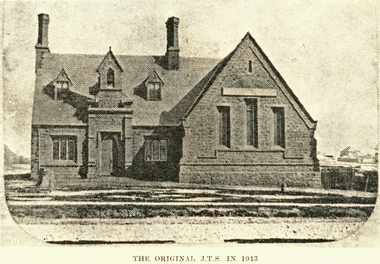
Magazine - Booklet, F.W. Niven, Ballarat School of Mines Students' Magazine, 1957, 1957
... Whitcher, ATC Flight No 24, BJTS Football Team, BJTS Swimming Team, BJTS Tennis Team, BJTS Athletics Squad, BJTS Cricket Team, BJTS Softball team and coach, W. ...Whitcher, ATC Flight No 24, BJTS Football Team, BJTS Swimming Team, BJTS Tennis Team, BJTS Athletics Squad, BJTS Cricket Team, BJTS Softball team and coach, W. ...The Ballarat School of Mines produced an annual students' magazine from 1899 - 1966. Contents include, School Council, Members of Staff, 1st Corbould Scholarship, Australian Speech, Art Lending Library, Literary Society, football, Boys' Junior Technical School, Bullarto Camp Reunion, John Leckie, Stan Hillman, Girls' Junior Technical School, Parliament House, Ballarat North Junior Technical School Images include: Craig's Royal Hotel, Peter Robinson, John Thomas Huyton Clelland, John Wolfe, Bernie Gallagher, Nelson Hails, John Gowan, Beverley Selkirk, Pat Collier, Barry Singleton Mara Jekabsons, Bill Widdop, Neil Brogden, frank Pomeroy, Laurence Trevan, Neville Bunning, Jim McKay, Malcolm Hausler, Josephine Young, George Lewis, Alan Clarke, Norman Leckie, Andrew Atkins, Lorette Davey, Noel Flood, Denis Bryan, SMB Football Team, SMB Athletics Team, SMB Baseball Team, SMB Basketball Team, SMB Tennis Team, Athletic Champions, R. Ross, I. Beaumont, R. Parker, G. Waller, John Rash, J. Sarah, J. Walters, P. Rowe, L. Drummond, R. Whitcher, ATC Flight No 24, BJTS Football Team, BJTS Swimming Team, BJTS Tennis Team, BJTS Athletics Squad, BJTS Cricket Team, BJTS Softball team and coach, W. Sawall, L. McDonald, K. Penna, J. Clarke, K. Rogers, Mr Wilson, F. Holmes, graham Manning, Andrew Brumby, Kevin Rogers, Graham Walters, Yellow soft covered students' magazine of 92 pages. keith alexander, brian bellingham, neil brogden, bernie gallagher, john gowan, francis hunting, teng hor khoo, teng seong khoo, norman leckie, boon thiam lu, brian mclennan, peter russell, chookiate sirivingse, laurie trean, john wolfe, ballarat school of mines, peter robinson, john thomas huyton clelland, d. w. brown, n. bunning, jim mckay, barry singleton, malcolm hausler, josephine young, george lewis, alan clarke, andrew atkins, lorette davey, noel flood, denis bryans, john mckenzie, robert skewes, ian fraser, walter reimann, pat collier, ralph hepburn, peter m. robinson, a. bethune, j. lane, d. colbourn, w. etty, b. bellingham, n. hails, t. white, p. agrums, w. widdop, f. pomeroy, b. singleton, j. mckay, j. pollock, r. cutter, d. vendy, j. wolfe, p. collier, w. bowtell, r. hepburn, w. wynd, p. menz, b. dunstan, j. gowan, l. groat, g. westwood, j. erdmanis, a. rock, k. alexander, p. walker, w. reimann, n. delosa, b. mclennan, a. clarke, g. wilson, t. coad, j. caldwell, d. chung, r. champneys, j. mckenzie, b. paterson, j. cowan, somnam nandhabiwat, w. spencer, p. schoutens, d. treller, gayle peterson, denise lockett, carmel dobbyn, margaret ayars, raymond jenkin, l. nester, w. eyers, r. ross, g. dreever, r. ross, i. beaumont, r. parker, g. waller, j. rash, j. sarah, j. walters, p. rowe, l. drummond, r. whitcher, r. ingle, i. pollock, p. bilney, i. collier, l. thomas, g. leslie, p. schoutens, a. morris, g. wells, b. mcgregor, j. bedggood, k. spencer, j. vincent, j. elliott, j. whitten, g. higgins, g. le couteur, h. mcdougall, g. wise, m. allen, d. pattie, i. collinson, c. kearns, g. severino, g. smith, n. smith, f. tolliday, r. williams, d. coldicott, m. hewitt, g. higgins, c. ludbrook, j. simpson, glenys spielvogel, norma davies, dawn ridgeway, carmel dobbyn, beverley davis, j. crouch, kathleen harris, j. walters, jan hunter, j. carroll, c. jenkins, lesley cutts, h. vagg, irene horgan, graham manning, andrew brumby, kevin rogers, graham walters, k. howell, n. malthouse, l. deppler, g. manning, n. nugent, b. antonio, r. mccarthy, mr morrison, r. mckenzie, w. wakeling, j. clarke, l. mayne, n. bromley, a. brumby, a. abrams, k. penna, r. button, p. linane, f. holmes, n. yean, mr love, miss atkins, p. cochrane, i. quick, mr mitchell, b. flynn, r. brown, k. penna, j. mcmahon, g. turnbull, n. skewes, d. vowles, d. blake, mr nuttall, g. borchers, i. greenbank, d. evans, j. whelan, j. milne, w. sawall, d. ward, r. rundell, mr ellerton, m. foy, l. reed, c. tilgals, peter agrums -
 Federation University Historical Collection
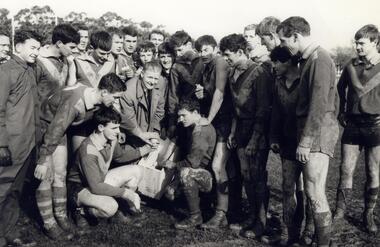
Photograph - Black and White Photographs, Photographs relating to runner and Olympian Tony Benson
... Lecturer and coach Peter Fryar hand out the oranges. .4) Ballarat Teachers' College Tennis Team, 1963 .5) Tony Benson defeating the great Kip Keino at the 1971 Stockholm Grand Prix...Keino received the first ever Olympic Laureate Award by the IOC at the Rio opening ceremony in 2016. tony benson olympics olympic games running ballarat teachers' college peter fryar olympian football tennis athletics Five images from the Collection of Tony Benson. .1) Tony Benson runs during the Ballarat Teachers' College Lap of the Lake, 1962 .2) Ballarat Teachers' College Athletics, 1963 .3) Ballarat Teachers' College Athletics, 1963. Lecturer and coach ...As of 2016 Tony Benson is the last Australian to win the 5000m at one of the major meets (now called Diamond League). That year Tony Benson was undefeated in Europe something no Australian has done since. He was also undefeated in the USA in early 1972 and probably would have medalled in Munich 1972 except for an incurring a hamstring injury 10 days before the race AND not being able to find the team medical doctors until some 16 hrs after the injury due to them being away from the village. Despite running with a torn hamstring Tony Benson broke Ron Clarke's Australian Olympic record for the 5000m but had no 'kick' and finished 7th in the heat. None of those who made the final had ever beaten Benson. Kip Keino and Tony Benson became friends. Keino received the first ever Olympic Laureate Award by the IOC at the Rio opening ceremony in 2016. Five images from the Collection of Tony Benson. .1) Tony Benson runs during the Ballarat Teachers' College Lap of the Lake, 1962 .2) Ballarat Teachers' College Athletics, 1963 .3) Ballarat Teachers' College Athletics, 1963. Lecturer and coach Peter Fryar hand out the oranges. .4) Ballarat Teachers' College Tennis Team, 1963 .5) Tony Benson defeating the great Kip Keino at the 1971 Stockholm Grand Prixtony benson, olympics, olympic games, running, ballarat teachers' college, peter fryar, olympian, football, tennis, athletics -
Ballarat Clarendon College
Trophy
... . / for Improvement in Tennis / Junior 1962 / Christine McAllister / Coach C.J.Bass" Rear base of cup : PITCHER / EPNS A1".... / for Improvement in Tennis / Junior 1962 / Christine McAllister / Coach C.J.Bass" Rear base of cup : PITCHER / EPNS A1" Small silver-plated cup on plastic mount; cup engraved on front Trophy ...Trophy awarded to Christina (McAllister) Peters (CPLC 1965) for improvement in tennis 1962. Accompanied by Christina's CPLC hat band.Small silver-plated cup on plastic mount; cup engraved on frontFront of cup: 'Clerndon P.L.C. / for Improvement in Tennis / Junior 1962 / Christine McAllister / Coach C.J.Bass" Rear base of cup : PITCHER / EPNS A1"hat, trophy, cup, uniform, 1962, sport, tennis, c-p-l-c, clarendon-presbyterian-ladies-college, christina-mcallister, 1965, christina-peters -
 Flagstaff Hill Maritime Museum and Village
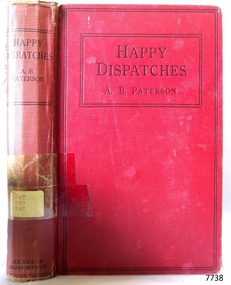
Book, Happy Dispatches
... coaches. His lifelong love of horses and horsemen was forged from the riders and their horses he saw at the picnic races and polo matches the family attended. These horses and riders where from the Murrumbidgee River and Snowy Mountain areas of New South Wales. Patterson lived most of his life in Sydney. He became a journalist, army officer, novelist, poet, solicitor and a war correspondent. He enjoyed many different sports such as tennis...coaches. His lifelong love of horses and horsemen was forged from the riders and their horses he saw at the picnic races and polo matches the family attended. These horses and riders where from the Murrumbidgee River and Snowy Mountain areas of New South Wales. Patterson lived most of his life in Sydney. He became a journalist, army officer, novelist, poet, solicitor and a war correspondent. He enjoyed many different sports such as tennis ...This item is from the ‘Pattison Collection’, a collection of books and records that was originally owned by the Warrnambool Mechanics’ Institute, which was founded in Warrnambool in 1853. By 1886 the Warrnambool Mechanics’ Institute (WMI) had grown to have a Library, Museum and Fine Arts Gallery, with a collection of “… choice productions of art, and valuable specimens in almost every branch and many wonderful national curiosities are now to be seen there, including historic relics of the town and district.” It later included a School of Design. Although it was very well patronised, the lack of financial support led the WMI in 1911 to ask the City Council to take it over. In 1935 Ralph Pattison was appointed as City Librarian to establish and organise the Warrnambool Library as it was then called. When the WMI building was pulled down in 1963 a new civic building was erected on the site and the new Warrnambool Library, on behalf of the City Council, took over all the holdings of the WMI. At this time some of the items were separated and identified as the ‘Pattison Collection’, named after Ralph Pattison. Eventually the components of the WMI were distributed from the Warrnambool Library to various places, including the Art Gallery, Historical Society and Flagstaff Hill. Later some were even distributed to other regional branches of Corangamite Regional Library and passed to and fro. It is difficult now to trace just where all of the items have ended up. The books at Flagstaff Hill Maritime Village generally display stamps and markings from Pattison as well as a variety of other institutions including the Mechanics’ Institute itself. RALPH ERIC PATTISON Ralph Eric Pattison was born in Rockhampton, Queensland, in 1891. He married Maude Swan from Warrnambool in 1920 and they set up home in Warrnambool. In 1935 Pattison accepted a position as City Librarian for the Warrnambool City Council. His huge challenge was to make a functional library within two rooms of the Mechanics’ Institute. He tirelessly cleaned, cleared and sorted a disarrayed collection of old books, jars of preserved specimens and other items reserved for exhibition in the city’s museum. He developed and updated the library with a wide variety of books for all tastes, including reference books for students; a difficult task to fulfil during the years following the Depression. He converted all of the lower area of the building into a library, reference room and reading room for members and the public. The books were sorted and stored using a cataloguing and card index system that he had developed himself. He also prepared the upper floor of the building and established the Art Gallery and later the Museum, a place to exhibit the many old relics that had been stored for years for this purpose. One of the treasures he found was a beautiful ancient clock, which he repaired, restored and enjoyed using in his office during the years of his service there. Ralph Pattison was described as “a meticulous gentleman whose punctuality, floorless courtesy and distinctive neat dress were hallmarks of his character, and ‘his’ clock controlled his daily routine, and his opening and closing of the library’s large heavy doors to the minute.” Pattison took leave during 1942 to 1945 to serve in the Royal Australian Navy, Volunteer Reserve as Lieutenant. A few years later he converted one of the Museum’s rooms into a Children’s Library, stocking it with suitable books for the younger generation. This was an instant success. In the 1950’s he had the honour of being appointed to the Victorian Library Board and received more inspiration from the monthly conferences in Melbourne. He was sadly retired in 1959 after over 23 years of service, due to the fact that he had gone over the working age of council officers. However he continued to take a very keen interest in the continual development of the Library until his death in 1969. About A. B. ‘Banjo’ Paterson Andrew Barton Paterson was born at Narrambla Station in New South Wales, Australia, on 17th February 1864 and died 5th February 1941. His first seven years were spent on his father’s station, where like so many Australian children he enjoyed a bush boyhood. This property was at Obley in the Orange district of New South Wales. The family moved to the Yass district and lived near the main route from Sydney to Melbourne where he saw a great many bullock teams, drovers with herds of stock, gold escorts and Cob & Co coaches. His lifelong love of horses and horsemen was forged from the riders and their horses he saw at the picnic races and polo matches the family attended. These horses and riders where from the Murrumbidgee River and Snowy Mountain areas of New South Wales. Patterson lived most of his life in Sydney. He became a journalist, army officer, novelist, poet, solicitor and a war correspondent. He enjoyed many different sports such as tennis, rowing and, most of all, he delighted in his horsemanship. His first poem ‘El Mahdi to the Australian Troop’ was published in the Bulletin in 1885 under the pen name of “The Banjo”, which was the name of his favourite horse. In 1895 his first book was published and was sold out in the week of publication; he sold 7000 copies in a few months. This book was “The Man From Snowy River, and other Verses” and it contained such ballads as ‘Clancy of the Overflow’, ‘The Geebung Polo Club’, ‘The Man from Ironbark’, and ‘Saltbush Bill’. The tittle poem was first published in 1890. In 1895 Patterson visited his fiancé (at that time), Sarah Riley, who was staying with her friends the Macphersons at Dagworth Station in Queensland. Sarah’s old school friend Christina McPherson. Christina replayed to them an old Scottish tune called “The Craigielee March” that she had heard played by the Garrison Artillery band at the Warrnambool picnic races in Victoria, 1894. Patterson wrote words to fit the tune and it became the now famous ‘Waltzing Matilda’. He was commissioned by the Sydney Morning Herald and the Melbourne Age as they correspondent to report on the South African War. After being a roving reporter in China he went to England and spent time with Rudyard Kipling. In April 1903 Paterson married Alice Walker in Tenterfield, New South Wales, and they had two children, Grace and Hugh. At the outbreak of World War 1 Paterson sailed for England in the hope of covering the fighting in Flanders as a correspondent but finished up driving an ambulance for the Australian Voluntary Hospital, Wimereux, France. In 1915 as an honorary vet he made three voyages taking horse to Africa, China and Egypt. On 18th October 1915 he was commissioned in the 2nd Remount Unit in the Australian Imperial Force and was promoted to Captain serving in the Middle East. He was wounded in April 1916, when he re-joined his unit he was promoted to major and commanded the Australian Remount Squadron from October 1916 to his return to Australia in 1919. Once the War was over he resumed his work as a journalist until he retired in 1930 so that he could devote time to creative writing. He became a successful radio broadcaster with the Australian Broadcasting Commission using his travel experiences. He wrote the children’s book “The Animals Noah Forgot” in 1933 and then in 1934 “Happy Dispatches” in which he told of his meetings with people like Winston Churchill and Kipling. “The Shearer’s Colt was published in 1936 and in 1939 he wrote for the Sydney Morning Herald. After a short illness he passed away in Sydney on 5th February 1941. The Pattison Collection, along with other items at Flagstaff Hill Maritime Village, was originally part of the Warrnambool Mechanics' Institute’s collection. The Warrnambool Mechanics’ Institute Collection is primarily significant in its totality, rather than for the individual objects it contains. Its contents are highly representative of the development of Mechanics' Institute libraries across Australia, particularly Victoria. A diversity of publications and themes has been amassed, and these provide clues to our understanding of the nature of and changes in the reading habits of Victorians from the 1850s to the middle of the 20th century. The collection also highlights the Warrnambool community’s commitment to the Mechanics’ Institute, reading, literacy and learning in the regions, and proves that access to knowledge was not impeded by distance. These items help to provide a more complete picture of our community’s ideals and aspirations. The Warrnambool Mechanics Institute book collection has historical and social significance for its strong association with the Mechanics Institute movement and the important role it played in the intellectual, cultural and social development of people throughout the latter part of the nineteenth century and the early twentieth century. The collection of books is a rare example of an early lending library and its significance is enhanced by the survival of an original collection of many volumes. The Warrnambool Mechanics' Institute’s publication collection is of both local and state significance. Happy Dispatches Author: A B ("Banjo") Paterson Publisher: Angus & Robertson Ltd Date: 1935Label on spine cover with typed text PAT 920 PAT Pastedown front endpaper has sticker from Warrnambool Public Library covered by a sticker from Corangamite Regional Library Service Front loose endpaper has a stamp from Corangamite Regional Library Service warrnambool, shipwrecked-coast, flagstaff-hill, flagstaff-hill-maritime-museum, maritime-museum, shipwreck-coast, flagstaff-hill-maritime-village, shipwrecked-artefact, book, pattison collection, warrnambool library, warrnambool mechanics’ institute, ralph eric pattison, corangamite regional library service, warrnambool city librarian, mechanics’ institute library, victorian library board, warrnambool books and records, warrnambool children’s library, great ocean road, happy dispatches, a b paterson, banjo paterson -
 Flagstaff Hill Maritime Museum and Village
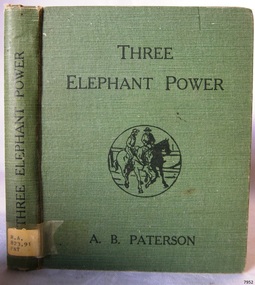
Book, Three Elephant Power
... coaches. His lifelong love of horses and horsemen was forged from the riders and their horses he saw at the picnic races and polo matches the family attended. These horses and riders where from the Murrumbidgee River and Snowy Mountain areas of New South Wales. Patterson lived most of his life in Sydney. He became a journalist, army officer, novelist, poet, solicitor and a war correspondent. He enjoyed many different sports such as tennis...coaches. His lifelong love of horses and horsemen was forged from the riders and their horses he saw at the picnic races and polo matches the family attended. These horses and riders where from the Murrumbidgee River and Snowy Mountain areas of New South Wales. Patterson lived most of his life in Sydney. He became a journalist, army officer, novelist, poet, solicitor and a war correspondent. He enjoyed many different sports such as tennis ...This item is from the ‘Pattison Collection’, a collection of books and records that was originally owned by the Warrnambool Mechanics’ Institute, which was founded in Warrnambool in 1853. By 1886 the Warrnambool Mechanics’ Institute (WMI) had grown to have a Library, Museum and Fine Arts Gallery, with a collection of “… choice productions of art, and valuable specimens in almost every branch and many wonderful national curiosities are now to be seen there, including historic relics of the town and district.” It later included a School of Design. Although it was very well patronised, the lack of financial support led the WMI in 1911 to ask the City Council to take it over. In 1935 Ralph Pattison was appointed as City Librarian to establish and organise the Warrnambool Library as it was then called. When the WMI building was pulled down in 1963 a new civic building was erected on the site and the new Warrnambool Library, on behalf of the City Council, took over all the holdings of the WMI. At this time some of the items were separated and identified as the ‘Pattison Collection’, named after Ralph Pattison. Eventually the components of the WMI were distributed from the Warrnambool Library to various places, including the Art Gallery, Historical Society and Flagstaff Hill. Later some were even distributed to other regional branches of Corangamite Regional Library and passed to and fro. It is difficult now to trace just where all of the items have ended up. The books at Flagstaff Hill Maritime Village generally display stamps and markings from Pattison as well as a variety of other institutions including the Mechanics’ Institute itself. RALPH ERIC PATTISON Ralph Eric Pattison was born in Rockhampton, Queensland, in 1891. He married Maude Swan from Warrnambool in 1920 and they set up home in Warrnambool. In 1935 Pattison accepted a position as City Librarian for the Warrnambool City Council. His huge challenge was to make a functional library within two rooms of the Mechanics’ Institute. He tirelessly cleaned, cleared and sorted a disarrayed collection of old books, jars of preserved specimens and other items reserved for exhibition in the city’s museum. He developed and updated the library with a wide variety of books for all tastes, including reference books for students; a difficult task to fulfil during the years following the Depression. He converted all of the lower area of the building into a library, reference room and reading room for members and the public. The books were sorted and stored using a cataloguing and card index system that he had developed himself. He also prepared the upper floor of the building and established the Art Gallery and later the Museum, a place to exhibit the many old relics that had been stored for years for this purpose. One of the treasures he found was a beautiful ancient clock, which he repaired, restored and enjoyed using in his office during the years of his service there. Ralph Pattison was described as “a meticulous gentleman whose punctuality, floorless courtesy and distinctive neat dress were hallmarks of his character, and ‘his’ clock controlled his daily routine, and his opening and closing of the library’s large heavy doors to the minute.” Pattison took leave during 1942 to 1945 to serve in the Royal Australian Navy, Volunteer Reserve as Lieutenant. A few years later he converted one of the Museum’s rooms into a Children’s Library, stocking it with suitable books for the younger generation. This was an instant success. In the 1950’s he had the honour of being appointed to the Victorian Library Board and received more inspiration from the monthly conferences in Melbourne. He was sadly retired in 1959 after over 23 years of service, due to the fact that he had gone over the working age of council officers. However he continued to take a very keen interest in the continual development of the Library until his death in 1969. About A. B. ‘Banjo’ Paterson Andrew Barton Paterson was born at Narrambla Station in New South Wales, Australia, on 17th February 1864 and died 5th February 1941. His first seven years were spent on his father’s station, where like so many Australian children he enjoyed a bush boyhood. This property was at Obley in the Orange district of New South Wales. The family moved to the Yass district and lived near the main route from Sydney to Melbourne where he saw a great many bullock teams, drovers with herds of stock, gold escorts and Cob & Co coaches. His lifelong love of horses and horsemen was forged from the riders and their horses he saw at the picnic races and polo matches the family attended. These horses and riders where from the Murrumbidgee River and Snowy Mountain areas of New South Wales. Patterson lived most of his life in Sydney. He became a journalist, army officer, novelist, poet, solicitor and a war correspondent. He enjoyed many different sports such as tennis, rowing and, most of all, he delighted in his horsemanship. His first poem ‘El Mahdi to the Australian Troop’ was published in the Bulletin in 1885 under the pen name of “The Banjo”, which was the name of his favourite horse. In 1895 his first book was published and was sold out in the week of publication; he sold 7000 copies in a few months. This book was “The Man From Snowy River, and other Verses” and it contained such ballads as ‘Clancy of the Overflow’, ‘The Geebung Polo Club’, ‘The Man from Ironbark’, and ‘Saltbush Bill’. The tittle poem was first published in 1890. In 1895 Patterson visited his fiancé (at that time), Sarah Riley, who was staying with her friends the Macphersons at Dagworth Station in Queensland. Sarah’s old school friend Christina McPherson. Christina replayed to them an old Scottish tune called “The Craigielee March” that she had heard played by the Garrison Artillery band at the Warrnambool picnic races in Victoria, 1894. Patterson wrote words to fit the tune and it became the now famous ‘Waltzing Matilda’. He was commissioned by the Sydney Morning Herald and the Melbourne Age as they correspondent to report on the South African War. After being a roving reporter in China he went to England and spent time with Rudyard Kipling. In April 1903 Paterson married Alice Walker in Tenterfield, New South Wales, and they had two children, Grace and Hugh. At the outbreak of World War 1 Paterson sailed for England in the hope of covering the fighting in Flanders as a correspondent but finished up driving an ambulance for the Australian Voluntary Hospital, Wimereux, France. In 1915 as an honorary vet he made three voyages taking horse to Africa, China and Egypt. On 18th October 1915 he was commissioned in the 2nd Remount Unit in the Australian Imperial Force and was promoted to Captain serving in the Middle East. He was wounded in April 1916, when he re-joined his unit he was promoted to major and commanded the Australian Remount Squadron from October 1916 to his return to Australia in 1919. Once the War was over he resumed his work as a journalist until he retired in 1930 so that he could devote time to creative writing. He became a successful radio broadcaster with the Australian Broadcasting Commission using his travel experiences. He wrote the children’s book “The Animals Noah Forgot” in 1933 and then in 1934 “Happy Dispatches” in which he told of his meetings with people like Winston Churchill and Kipling. “The Shearer’s Colt was published in 1936 and in 1939 he wrote for the Sydney Morning Herald. After a short illness he passed away in Sydney on 5th February 1941. The Pattison Collection, along with other items at Flagstaff Hill Maritime Village, was originally part of the Warrnambool Mechanics' Institute’s collection. The Warrnambool Mechanics’ Institute Collection is primarily significant in its totality, rather than for the individual objects it contains. Its contents are highly representative of the development of Mechanics' Institute libraries across Australia, particularly Victoria. A diversity of publications and themes has been amassed, and these provide clues to our understanding of the nature of and changes in the reading habits of Victorians from the 1850s to the middle of the 20th century. The collection also highlights the Warrnambool community’s commitment to the Mechanics’ Institute, reading, literacy and learning in the regions, and proves that access to knowledge was not impeded by distance. These items help to provide a more complete picture of our community’s ideals and aspirations. The Warrnambool Mechanics Institute book collection has historical and social significance for its strong association with the Mechanics Institute movement and the important role it played in the intellectual, cultural and social development of people throughout the latter part of the nineteenth century and the early twentieth century. The collection of books is a rare example of an early lending library and its significance is enhanced by the survival of an original collection of many volumes. The Warrnambool Mechanics' Institute’s publication collection is of both local and state significance. Three Elephant Power Author: A B Paterson Publisher: Angus & Robertson Date: 1917Label on spine cover with typed text RA 823.91 PAT Pastedown front endpaper has sticker from Warrnambool Mechanics Institute and Free Library Front loose endpaper has a stamp from Warrnambool Mechanics Institute Fly paper has a stamp from Warrnambool Mechanics Institutewarrnambool, shipwrecked-coast, flagstaff-hill, flagstaff-hill-maritime-museum, maritime-museum, shipwreck-coast, flagstaff-hill-maritime-village, shipwrecked-artefact, book, pattison collection, warrnambool library, warrnambool mechanics’ institute, ralph eric pattison, corangamite regional library service, warrnambool city librarian, mechanics’ institute library, victorian library board, warrnambool books and records, warrnambool children’s library, great ocean road, three elephant power, a b paterson -
 Eltham District Historical Society Inc
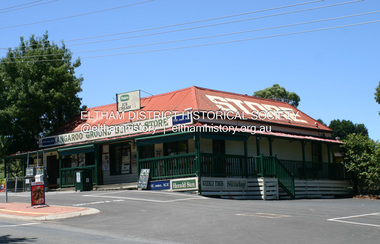
Photograph - Digital Photograph, Alan King, Kangaroo Ground General Store, Eltham-Yarra Glen Road, 28 December 2007
... tennis court site. The first postmaster at this store was Edward Weller, followed in 1868 by James Anderson. At that time a mail coach...tennis court site. The first postmaster at this store was Edward Weller, followed in 1868 by James Anderson. At that time a mail coach ...The present store was built circa 1900 to replace another which had been destroyed by fire in 1898, which had replaced a predecessor on the opposite side of the road in 1865. The store was also used as a post office until early 2000s. The general store is historically significant because it has a long association with Kangaroo Ground and has been an important centre of community life for more than 120 years - Council meetings used to be conducted in the front room of the store at a time when Kangaroo Ground rivalled Eltham as the major centre of the Shire. The general store is historically and aesthetically significant as one of a group of three well preserved public buildings in the Kangaroo Ground hamlet and as a major heritage component of Kangaroo Ground which was one of the earliest settled areas of the Shire and which has the character of an English village rather than an Australian settlement. Covered under Heritage Overlay, Nillumbik Planning Scheme. Published: Nillumbik Now and Then / Marguerite Marshall 2008; photographs Alan King with Marguerite Marshall.; p77 Today the general store is an uncommon form of trade but the one at Kangaroo Ground continues a long tradition of friendliness and service. For more than 100 years it has been a centre of community life. In the settlement’s early days a previous general store, on the same site, was the meeting place for the Eltham District Road Board, precursor to the Eltham Shire Council. For years Kangaroo Ground rivalled Eltham as the shire’s major centre. It developed very differently from the rest of the shire as its rich soil attracted prosperous Presbyterian Scots who had large agricultural properties.1 The present store was built to replace another one, which had burnt down in 1898, after replacing a predecessor on the other side of the road in 1865. The store retains its outward character and its cellar, although inside it has changed considerably. It now includes a café and offers local produce, milk bar products, grocery items, gas and other fuel. Until early this century the store was also used as a post office. Kangaroo Ground’s first postmaster was Andrew Ross, who first operated from the school opposite, then from his hotel next to the present tennis court site. The first postmaster at this store was Edward Weller, followed in 1868 by James Anderson. At that time a mail coach ran three times a week between Eltham and Woods Point through Kangaroo Ground, Yarra Flats, Healesville, Fernshaw, Marysville and Matlock. Some early postmasters were Rodger, McLaughlin, Greenway and Burns.2 Burns was the only postmaster operating from the store. The others operated from Andrew Ross’s hotel. The mail service improved in 1892 when coaches ran from Melbourne to Queenstown (now known as St Andrews) and changed horses at Kangaroo Ground twice daily. The only telegraph office in the district at that time was at the Kangaroo Ground Post Office. Telegrams to outlying areas such as Queenstown and Kinglake had to be sent by hand. A local resident in the early 1900s often rode his pony to deliver telegrams and was paid one shilling a mile porterage. The store has also contributed to the lighter side of Kangaroo Ground life. During the years that Con Wraight owned the store, between 1906 and 1946, a new piano was needed for the Kangaroo Ground Hall, so monthly dances were held to raise money. When the piano was bought, a grand ball was held in the Kangaroo Ground Hall to celebrate the occasion and supper followed at Mr Wraight’s barn, cleaned especially for the occasion. Every New Year’s Eve, a Scottish piper would set off from between the store and the schoolhouse, playing his pipes, and march to Cameron’s Pigeon Bank homestead on the Kangaroo Ground-Warrandyte Road. Between 1914 and 1922, the store was a station for the Kangaroo Ground Bush Fire Brigade’s tanker. It consisted of a wooden barrel on a cart, fitted with a hand-pump, and stood on the side of the road outside the store. Joy Ness, who belonged to an early Kangaroo Ground family, moved here in 1940 and recalled her impressions of the store at that time: ‘It was a very dark shop stained in a dark colour and on the walls just below the ceiling hung hurricane lamps, ropes, kitchen utensils and other goods for sale. ‘Goods were weighed on a brass scale with weights, on which mothers also weighed their babies, because the nearest Infant Welfare Centre was at Greensborough. The bacon was cut with a hand slicer and later a pot-bellied stove warmed the store. Farmers and other locals used to gossip around it as they collected their daily mail. In those days the butter and cheese were kept in the cellar as no ice was delivered for cooling.’This collection of almost 130 photos about places and people within the Shire of Nillumbik, an urban and rural municipality in Melbourne's north, contributes to an understanding of the history of the Shire. Published in 2008 immediately prior to the Black Saturday bushfires of February 7, 2009, it documents sites that were impacted, and in some cases destroyed by the fires. It includes photographs taken especially for the publication, creating a unique time capsule representing the Shire in the early 21st century. It remains the most recent comprehenesive publication devoted to the Shire's history connecting local residents to the past. nillumbik now and then (marshall-king) collection, eltham-yarra glen road, kangaroo ground general store
