
Showing 33 items matching "test techniques"
-
 Moorabbin Air Museum
Book - AGARD reports, Special Course on Advances in Cryogenic Wind Tunnel Technology
... ...Test techniques...AGARD reports Introduction to cryogenic wind tunnels NASA Langley 0.3 metre transonic cryogenic wind tunnel US national transonic facility Kryo-Koln (KKK) : description of tunnel conversion Automatic control of KKK European transonic wind tunnel Cryogenic induction tunnel Various other cryogenic tunnels Cryogenic engineering & materials/instrumentation Test techniques Overview of concerns around building & use of cryogenic wind tunnels, circa 1989 Special Course on Advances in Cryogenic Wind Tunnel Technology Book AGARD reports ...Overview of concerns around building & use of cryogenic wind tunnels, circa 1989non-fictionOverview of concerns around building & use of cryogenic wind tunnels, circa 1989introduction to cryogenic wind tunnels, nasa langley 0.3 metre transonic cryogenic wind tunnel, us national transonic facility, kryo-koln (kkk) : description of tunnel conversion, automatic control of kkk, european transonic wind tunnel, cryogenic induction tunnel, various other cryogenic tunnels, cryogenic engineering & materials/instrumentation, test techniques -
 4th/19th Prince of Wales's Light Horse Regiment Unit History Room
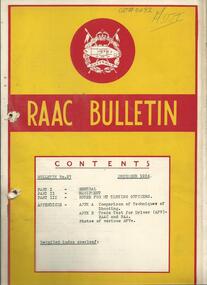
Document - Bulletin, Royal Australian Armoured Corps Bulletin No 27 (2 copies), Dec 1954
... A 22 page document covering, in Part 1, Officer postings, rotation system, courses, seniority list for WO & NCO etc, Part 2 Equipment: Ferret, Saracen, Staghound & Grant CIM's, .22 rifle brackets, maintenance etc and Part 3 - Appendices, Comparison of shooting techniques, Trade Test Drivers of AFV's and photographs of some AFV's. 2 copies, 1 incomplete....raac bulletin RAAC A 22 page document covering, in Part 1, Officer postings, rotation system, courses, seniority list for WO & NCO etc, Part 2 Equipment: Ferret, Saracen, Staghound & Grant CIM's, .22 rifle brackets, maintenance etc and Part 3 - Appendices, Comparison of shooting techniques, Trade Test Drivers of AFV's and photographs of some AFV's. 2 copies, 1 incomplete. ...A 22 page document covering, in Part 1, Officer postings, rotation system, courses, seniority list for WO & NCO etc, Part 2 Equipment: Ferret, Saracen, Staghound & Grant CIM's, .22 rifle brackets, maintenance etc and Part 3 - Appendices, Comparison of shooting techniques, Trade Test Drivers of AFV's and photographs of some AFV's. 2 copies, 1 incomplete.raac bulletin, raac -
Federation University Historical Collection
Book - Book - Scrapbook, Ballarat School of MInes: Scrapbook of Newspaper Cuttings, Book 39, April 1989 to July 1989
... technique...auction of webster street student houses...back to back theatre group...fiona watson...regional vocational information service...ann mccaffrey smb equal opportunity officer...sole parents get job boost...retail traineeship at smb...judge david boyle. smb hospitality department...smb's work at clay cave...smb service on careers...tradesmen put their skills to the test...The papers concerned are The Courier, Ballarat, The Australian, The Age over the period of 1 April 1989 to 1 July 1989. teaching positions advertised pre-employment courses courses available enrolment for smb courses work skill competition michael pierce finalist scott cook apprentice $500000 to buils smb hostel certificates for small business course new dance technique auction of webster street student houses back to back theatre group fiona watson regional vocational information service ann mccaffrey smb equal opportunity officer sole parents get job boost retail traineeship at smb judge david boyle. smb hospitality department smb's work at clay cave smb service on careers tradesmen put their skills to the test marketing is the way to succeed winning hairdressing apprentices kathryn reichelt lois rowan janine sprattling maria ashton ballarat regional board course in conservation liz eddy top woolclasser student jennifer mulholland suzanne addison cook for bosses $393000grant for agricultural training centre whole farm planning course greg carlson simon lidgett youth achiever awards return to workforce reading and writing for adults program new students' home ready soon Book with yellow cover, front, spiral bound. ...Collection of newspaper articles related to Ballarat School Of Mines.They cover activities and advertisements for staff. The papers concerned are The Courier, Ballarat, The Australian, The Age over the period of 1 April 1989 to 1 July 1989.Book with yellow cover, front, spiral bound. teaching positions advertised, pre-employment courses, courses available, enrolment for smb courses, work skill competition, michael pierce finalist, scott cook apprentice, $500000 to buils smb hostel, certificates for small business course, new dance technique, auction of webster street student houses, back to back theatre group, fiona watson, regional vocational information service, ann mccaffrey smb equal opportunity officer, sole parents get job boost, retail traineeship at smb, judge david boyle. smb hospitality department, smb's work at clay cave, smb service on careers, tradesmen put their skills to the test, marketing is the way to succeed, winning hairdressing apprentices, kathryn reichelt, lois rowan, janine sprattling, maria ashton, ballarat regional board, course in conservation, liz eddy top woolclasser student, jennifer mulholland, suzanne addison, cook for bosses, $393000grant for agricultural training centre, whole farm planning course, greg carlson, simon lidgett, youth achiever awards, return to workforce, reading and writing for adults program, new students' home ready soon -
 Waverley RSL Sub Branch
R.A.A.F. Long Service Medal
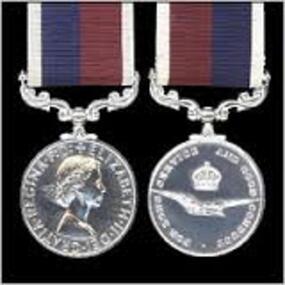
... The progression to Senior required a further trade test in techniques including setting up, clasp-forming, casting and backing teeth. ...Awarded to Alan Bowers (A236814) who was a R.A.A.F. dental mechanic who serverd during WWII including service in Darwin, and then continued in the R.A.A.F. for some years after the end of WWII The Royal Australian Air Force (and all Commonwealth Air Forces) Long Service and Good Conduct Medal: Awarded to NCOs and ORs of the RAAF (RAF, RCAF etc) for 15 years service. A cupro-nickel plated medal, the obverse features the sovereign's head, the reverse features the crown and eagle emblem of the RAAF (and RAF). Officers are eligible for the award provided they have served a minimum 12 years in the ranks. The riband is dark blue and maroon with white edges. This medal ceased to be awarded in Australia in 1975 when it was replaced by the National Medal (and sbsequently the DFSM and DLSM) in the Australian system of honours and awards. http://www.heritagemedals.com.au/medals-1/service-long-service/air-force-long-service-and-good-conduct-medal.html History of the RAAF Dental Branch It took six years following the formation of the RAAF in 1921 for the first Dental Clinic to be established at Point Cook, Victoria. On 10th June 1927 Flying Officer James Carl Rosenbrock commenced work as an RAAF Dental Officer for the FlyingTraining School at Point Cook. As personnel numbers were still relatively small, Rosenbrock was also responsible for the dental care of all Victorian RAAF units, which involved treating members at 1AD Laverton, as well as Air Force Headquarters at Victoria Barracks in Melbourne. As Army Dental Officers were currently caring for RAAF personnel at Richmond, NSW, the Senior Dental Officer of the 3rd Military District in Victoria (SDO 3MD) requested through the military board that a similar arrangement be established, where that the newly appointed RAAF Dentist provide part time dental services to the Army units stationed at Queenscliff. This was seen as an effective reciprocal arrangement, with both units having a Dental Officer in attendance for, in total, around 3-4 weeks a year. Rosenbrock continued to serve as the sole RAAF Dental Officer until the middle of 1933, when the Air Board asked for his service to be terminated following ‘behaviour unbecoming of a RAAF officer'. He had borrowed several sums of money, of around 40 Pounds or so, from junior ranks on base (as well as from the Regimental Sergeant Major) and had failed to pay the money back. He was replaced by a fellow Victorian, FLGOFF Norman Henry Andrews, on the 18th Sep 1933, who went on to become our first Director of Dental Services, and was instrumental in establishing the organisations and conditions of the Branch that are still present today. Through a fair amount of persistence and hard work on the part of Norman Andrews, the RAAF Dental Branch began to expand from 1937, with the introduction of 2 additional positions, at RAAF station Richmond, and at the FlyingTraining School at Point Cook. This gave the RAAF 3 uniformed Dental Officers, which was expanded to 5 in the months leading up to WW2. 4 of these Dental Officers were based in Victoria and 1 at Richmond, with the other two RAAF units being cared for by the Army (as in the case of Pearce in WA) or by civilians (as in Darwin). With the sudden increase in RAAF personnel required at the outbreak of WW2, the number of RAAF Dental Officers increased dramatically, from 5 in 1939, 28 in 1940, 64 in 1941, 147 in 1942, 193 in 1943, 219 in 1944, and peaking at 227 in 1945. RAAF Dental Officers were required to work in a variety of locations, both in and out of Australia. Between 1940 and 1942 a massive construction programme occurred, with new dental clinics being established around Australia. Priority was given to aircrew training units in order to get these personnel dentally fit for operational deployment, but Dental Officers could equally find themselves posted to recruit depots, fixed stations, medical clearance stations, mobile dental sections, and RAAF and civilian hospitals. RAAF Dental Officers were posted to the large dental centres at Ascot Vale (Vic) and Bradfield Park (NSW) when first appointed, where they received military and clinical training, before being deployed to their needed location. Mobile Dental Units When Japan entered the war in 1941, the rapid deployment of troops to northern operational areas with less than ideal dental fitness was extremely high. As a result, the RAAF deployed a range of mobile dental units, either alone or with medical sections, to support the increasing number of isolated deployed personnel within Australia and overseas. There were three types of mobile unit used: a. Mobile Dental Unit – relied on using either a semi-trailer to get around or by building a surgery directly on to the truck chassis, and installing hydraulic chairs, units, x-rays, and laboratory equipment. They were able to move around between small units, such as RAAF radar stations, where they could plug into the local power supply and work immediately. b. Transportable Dental Units – used for stops of longer duration, where field equipment was carried in panniers from one unit to another by road or rail and housed in whatever accommodation was available at the destination. They were often carried within Australia on Tiger Moths and Dakota aircraft. c. Itinerant Dental Units – in some areas, the dental equipment was installed at the RAAF unit and the Dental Officer and their staff would travel from unit to unit, using the equipment available at each location. RAAF Dental BadgeAs the war developed in Europe, it soon became obvious that the RAF Dental support was not capable of supporting the increasing numbers of RAAF aircrew that were being sent for service with the RAF, with only enough Dental Officers available to provide one to every 2000 men ( instead of the preferred 1 to 600). As a result, the RAAF provided a mobile dental unit, fitted out in a caravan and pulled by a Ford V8 Coupe, to travel around England in support of RAAF personnel at various squadrons. Some degree of tact was needed to ensure that the RAF did not take this as a comment on the treatment they were providing, but it proved successful in maintaining a satisfactory state of dental fitness in RAAF personnel, and a second mobile unit was soon dispatched. They were also set up with a laboratory on board as well as the surgery, which was a major difference between the RAF and RAAF, as the RAF did not provide dentures for their troops (the RAAF would, providing they had served for 6 years). In 1943 the RAF was no longer able to provide Dental support to Australian troops in the Middle East, which resulted in the need for a transportable dental unit to be deployed from Australia. It functioned in a similar manner to the RAF, by moving from one squadron to another. It served in the Middle East and Africa, from Cairo across North Africa, to Italy, and eventually back to England to treat returned prisoners of war. GPCAPT Norman Andrews The growth and development of the RAAF Dental Branch owes a debt to one man in particular, GPCAPT Norman Andrews. As the second RAAF Dental Officer to enlist on 18 Sep 1933, Andrews became the principal architect of the structure and organisation of the RAAF Dental Branch leading up to and during WW2. Until early 1940, the RAAF Dental Branch was administered by the Director of Medical Services (Air), which placed it under the control of the Army Medical staff. The Army would provide their Inspector of Dental Services for advice whenever needed. In April 1940, the RAAF Medical service separated from the Army, resulting in the control of the RAAF Dental Branch shifting back to the RAAF. Andrews became the first Director of Dental Services, when the position was created in 1943 as recognition of the higher profile the Dental Branch was now playing in the RAAF Medical service. Until this time, Andrews's title had been as the Dental Staff Officer to the RAAF Medical Service. Andrews was responsible for the establishment of the war-time structure of the Dental service, establishing new dental centres at all major bases, creating mobile and transportable dental units, ensuring the continual growth of the Branch, maintaining professional development of staff through the establishment of a professional journal, and by organising renowned lecturers to speak at RAAF bases. He also believed in visiting as many dental units as possible to see for himself what conditions were like and to talk first-hand to staff in remote units. His itinerary during the war years, both in and out of Australia, shows a large number of trips in a variety of modes of transport in order to reach remote areas where units were serving. He was promoted to GPCAPT in July 1944, as the numbers of Dental Officers soon peaked at 227 towards the end of the war (1 GPCAPT, 9 WGCDRs, 60 SQNLDRs, and 157 FLTLTs). After the war, with the reduction in RAAF personnel required in uniform, the Dental Branch also reduced its numbers significantly. By 1947 there were only 18 Dental Officers serving (many part-time), with 1 GPCAPT, 1 WGCDR, 10 SQNLDRs, and 6 FLTLTs, and only 13 by 1950. With the decrease in Branch personnel numbers, the ‘powers to be' saw fit to reduce the Director of Dental Service rank to WGCDR, and as a result Norman Andrews found that in order to continue serving in the RAAF he would have to wear a reduced rank. This appears to have been a contributing factor in his decision to discharge at the relatively early age of 43 and accept an administrative job as Director of the Victorian Government's School Dental Service. Norman Andrews holds the proud honour of being the founder of the RAAF Dental Branch, which during the war was instrumental in educating servicemen of the importance of dental health and maintaining the dental fitness of troops in a variety of areas. Dental Orderlies (Assistants) The dental orderly mustering was first introduced in 1937. Until that time, medical orderlies were assigned to assist the Dental officer with their duties. As early as 1931 it had been noted by both RAAF and Army Dental Officers working in Victoria and Richmond that a lot of the troubles they were having would be solved by appointing a permanent Dental Orderly. Often they would find that the medical orderly they were assigned was a different one each day, and as a result the administration and work in general was very inefficient. By 1937, with the increase in Dental Officers to 3, it was realised that a Dental Orderly mustering needed to be created. Dental Mechanics/Technicians Before WW2, dental laboratory work was provided by civilian laboratories, as most RAAF units were stationed around metropolitan areas. At this time, service personnel were still required to pay for their own dentures, unless they had served for six years or had their dentures damaged during performance of their duties. In July 1940, mainly in response to the development of more remote RAAF dental units and the increasing demand for dental prostheses, the Dental Mechanic mustering was established. Unfortunately there was a very limited pool of civilian dental mechanics to recruit from, and as a result the RAAF set up a training school at Laverton (which was later moved to Ascot Vale) in June 1941 which conducted an intensive 6 month course in Dental mechanics. Dental mechanics were quickly in demand. In all fixed and mobile dental units at least 1 Mechanic was supplied for each Dental Officer, and indeed the RAAF supplied Dental Mechanics throughout all its deployments, something the RAF were unwilling, or unable, to do. Two grades of dental mechanic existed: the Senior Mechanic (with the rank of NCO), who was competent in all phases of laboratory work; and the Junior Mechanic, who could only handle routine work and not more advanced denture work. The progression to Senior required a further trade test in techniques including setting up, clasp-forming, casting and backing teeth. During the course of the War, two special courses were held for Mechanics. The first, directed at senior mechanics so that they could instruct others, was in 1942 when Acrylic Resin was first introduced as a denture base material, as an alternative to the current option of vulcanite. Later, towards the end of the War, a ‘refresher' course was provided for those that had served for the greatest period of time in order to allow them retraining in techniques that they had not practised during their service and which were common in civilian life. This included cast base dentures, crowns and bridges, partial dentures, and retainers. Towards the end of the War, a course was held with WAAAF trainees to train them as Mechanics. However, as the War was soon to end they never had the opportunity to progress within the mustering to become Senior Mechanics. The RAAF Dental Branch has survived 75 years of turbulence, with reviews of its viability occurring regularly every few years from as early as 1937. The Branch continues to provide excellent service to the ADF community and, despite reduced manpower, will continue to play an important role in Air Force Health operations. http://www.defence.gov.au/health/about/docs/RAAFDental.pdf40cm cupro-nickel plated medal, the obverse features the sovereign's head, the reverse features the crown and eagle emblem of the RAAF (and RAF). A23814 BOWERS.A. A. F.r.a.a.f long service medal, r.a.a.f good conduct, r.a.a.f. dental service medal -
 Royal Australian and New Zealand College of Obstetricians & Gynaecologists (RANZCOG)
Envelope with commemorative Royal Mail Millenium Special Stamp featuring image of 'Test-tube baby' sculpture by A Gormley, 1999
... From British Philatelic Bulletin, Volume 36 February 1999: "This 63P stamp (second step airmail letter rate) recalls techniques developed by British gynaecologist/obstetrician Patrick Steptoe (1913-88) and physiologist Robert Edwards. The popular term ‘test...From British Philatelic Bulletin, Volume 36 February 1999: "This 63P stamp (second step airmail letter rate) recalls techniques developed by British gynaecologist/obstetrician Patrick Steptoe (1913-88) and physiologist Robert Edwards. The popular term ‘test ...This stamp was part of a series of four stamps released by Royal Mail in 1999 under the subject 'The Patients' Tale'. From British Philatelic Bulletin, Volume 36 February 1999: "This 63P stamp (second step airmail letter rate) recalls techniques developed by British gynaecologist/obstetrician Patrick Steptoe (1913-88) and physiologist Robert Edwards. The popular term ‘test tube’ is inaccurate, the treatment - in vitro fertilization (ivf) involves combining egg and sperm in a glass dish with the resulting embryo being replaced in the womb. Initially developed to treat infertile women, it is now used to help men who produce few or defective sperm. It is estimated that about 7000 ivf babies have been born in Britain over the past five years." This object was retrieved from the mail room by and added to the collection in 1999 by College Archivist, Ros Winspear.A standard size white envelope with an 'AIR MAIL' sticker attached to from bottom proper RH corner, and a square grey, blue and black stamp in upper proper RH corner. The stamp is a Royal Mail Special issue stamp, beaing an image of a sculpture in a foetal position. Text on stamp reads, "63/ Millennium 1999/37/ Test tube baby/ A Gormley". The envelope is addressed to RACOG, and the sender of the envelope was 'FM McKellar/ 2 Norham End/ Norham Road/ Oxford OX205G/ United Kingdom.'in vitro fertilisation (ivf) -
 Royal Australian and New Zealand College of Obstetricians & Gynaecologists (RANZCOG)
Rubin's tubal insufflator apparatus associated with St Vincent's Hospital, c1919
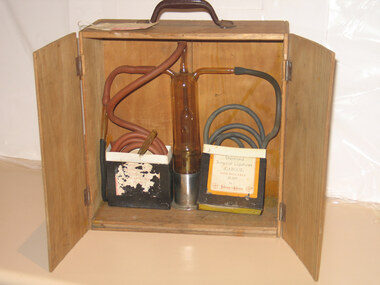
... Rubin’s test formed a standard part of infertility investigations for many years. It was gradually replaced by an X-ray technique involving radio-opaque ‘dye’ injected into the uterus." ...Rubin’s test formed a standard part of infertility investigations for many years. It was gradually replaced by an X-ray technique involving radio-opaque ‘dye’ injected into the uterus." ..."Potential blockage in the Fallopian tubes was assessed using this apparatus. It was developed by American gynaecologist Isidor Clinton Rubin (1883-1958). It blows carbon dioxide, via a cannula, into the uterus. The ease with which gas escaped through the Fallopian tubes was reflected by pressure changes on an instrument called a manometer. Blockage of the tubes is often due to previous infection or surgery. It is a common cause of infertility. Rubin’s test formed a standard part of infertility investigations for many years. It was gradually replaced by an X-ray technique involving radio-opaque ‘dye’ injected into the uterus." Source: Science Museum Group. Rubin’s apparatus for uterotubal insufflation, New York, United States, 1928. A639503Science Museum Group Collection Online. Accessed 12 June 2024. https://collection.sciencemuseumgroup.org.uk/objects/co96774/rubins-apparatus-for-uterotubal-insufflation-new-york-united-states-1928-tubal-insufflator. There is no manometer to monitor gas pressure on this model so it is either incomplete or a manometer was not available in this possibly early model. This device may be dated c1919, 1920s, or 1930s. 1919 was the year Isidor Clinton Rubin (1883-1958) introduced this apparatus. Rubin's tubal insufflator apparatus. Consists of a large cylindrical glass canister, with three glass nozzles at top with long rubber tubing attached to each. The device is inside a portable plywood box with two door. One surgical steel introducer, and one glass introducer, are also attached to the device. -
 Royal Australian and New Zealand College of Obstetricians & Gynaecologists (RANZCOG)
Tubal insufflator associated with Dr Lorna Lloyd-Green, c1919
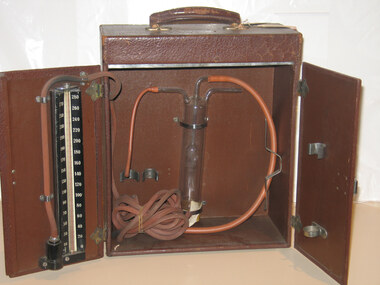
... Rubin’s test formed a standard part of infertility investigations for many years. It was gradually replaced by an X-ray technique involving radio-opaque ‘dye’ injected into the uterus." ...Rubin’s test formed a standard part of infertility investigations for many years. It was gradually replaced by an X-ray technique involving radio-opaque ‘dye’ injected into the uterus." ..."Potential blockage in the Fallopian tubes was assessed using this apparatus. It was developed by American gynaecologist Isidor Clinton Rubin (1883-1958). It blows carbon dioxide, via a cannula, into the uterus. The ease with which gas escaped through the Fallopian tubes was reflected by pressure changes on an instrument called a manometer. Blockage of the tubes is often due to previous infection or surgery. It is a common cause of infertility. Rubin’s test formed a standard part of infertility investigations for many years. It was gradually replaced by an X-ray technique involving radio-opaque ‘dye’ injected into the uterus." Source: Science Museum Group. Rubin’s apparatus for uterotubal insufflation, New York, United States, 1928. A639503Science Museum Group Collection Online. Accessed 12 June 2024. https://collection.sciencemuseumgroup.org.uk/objects/co96774/rubins-apparatus-for-uterotubal-insufflation-new-york-united-states-1928-tubal-insufflator. Model may be dated c1919 or 1920s or 1930s. 1919 was the year Isidor Clinton Rubin (1883-1958) introduced the apparatus. Instrumant has a label with Cyrus Jones monogram " Donated by Dr Lorna Lloyd Green, 1986/ Rubin's Insufflator/ NB "sparklet holder separate" missing?Rubin's tubal insufflator apparatus, large cylidrical glass canister inside a portable carry box with two doors with three glass nozzels at top with long rubber tubing attached on each. One surigical steel introducer, one glass introducer attached. A blood pressure manometer is fixed on the inside door. infertility -
 Royal Australian and New Zealand College of Obstetricians & Gynaecologists (RANZCOG)
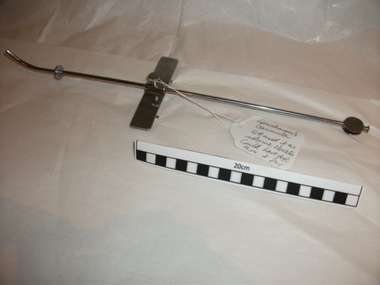
Cannula, Spackman's, c1969
... techniques included diathermy and division of the Fallopian tubes using the Palmer forceps. [Dr Peter Renou, former honoury curator.] Laparoscopy Tubal ligation Infertility investigation This Spackman's cannula was used by Dr Geoff Bishop during gynaecological laparscopioc surgery.He used this decice as a uterine elevator. Also, for testing ...Part of the laparoscopy equipment donated by Dr Geoff Bishop. Dr Geoffrey Bishop, whilst at the Department of O and G, University of Liverpool, UK, began laparoscopy in 1969. On returning to Australia, Bishop and Grimwade together with Mr Peter Paterson introduced gynaecological laparoscopy to Melbourne, practising at the Queen Victoria Memorial Hospital (QVMH), Melbourne in 1969. The College, through the Victorian State Committee of the Australian Council, RCOG, ran training courses in laparoscopy for local and interstate gynaecologists. These were conducted by Bishop, Grimwade and Paterson. They established protocols, with particular reference to safety, for the conduct of laparoscopy. Laparoscopy was used initially for diagnosis and for limited treatment using diathermy for conditions such as endometriosis. The real impetus came with the great upsurge of tubal sterilization in the early 1970s. Early techniques included diathermy and division of the Fallopian tubes using the Palmer forceps. [Dr Peter Renou, former honoury curator.]This Spackman's cannula was used by Dr Geoff Bishop during gynaecological laparscopioc surgery.He used this decice as a uterine elevator. Also, for testing tubal patency by inserting dye through it. Manufacturers stamp: ANAX.laparoscopy, tubal ligation, infertility investigation -
 Royal Australian and New Zealand College of Obstetricians & Gynaecologists (RANZCOG)
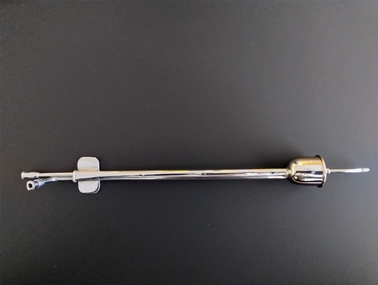
Infertility cannula used by Dr Geoff Bishop, Precious, c1969
... techniques included diathermy and division of the Fallopian tubes using the Palmer forceps. [Dr Peter Renou, former honorary curator.] This object was used by Dr Geoff Bishop during gynaecological laparoscopic surgery. This instrument is commonly used for suction. It is also used for testing...techniques included diathermy and division of the Fallopian tubes using the Palmer forceps. [Dr Peter Renou, former honorary curator.] This object was used by Dr Geoff Bishop during gynaecological laparoscopic surgery. This instrument is commonly used for suction. It is also used for testing ...Part of a set of laparoscopy equipment donated by Dr Geoff Bishop. Dr Geoffrey Bishop, whilst at the Department of O and G, University of Liverpool, UK, began laparoscopy in 1969. On returning to Australia, Bishop and Grimwade together with Mr Peter Paterson introduced gynaecological laparoscopy to Melbourne, practising at the Queen Victoria Memorial Hospital (QVMH), Melbourne in 1969. The College, through the Victorian State Committee of the Australian Council, RCOG, ran training courses in laparoscopy for local and interstate gynaecologists. These were conducted by Bishop, Grimwade and Paterson. They established protocols, with particular reference to safety, for the conduct of laparoscopy. Laparoscopy was used initially for diagnosis and for limited treatment using diathermy for conditions such as endometriosis. The real impetus came with the great upsurge of tubal sterilization in the early 1970s. Early techniques included diathermy and division of the Fallopian tubes using the Palmer forceps. [Dr Peter Renou, former honorary curator.] This object was used by Dr Geoff Bishop during gynaecological laparoscopic surgery. This instrument is commonly used for suction. It is also used for testing tubal patency by inserting dye through it. Cannula. Consists of a slender shaft with fittings at each end. There are two points for tubal attachments at one end, set into separate small metal tubes at ninety degrees to each other. At the other end, there is a bell cap enclosing a curved nozzle. The nozzle is punctured with six small holes. Manufacturers stamp on plate near the attachment points reads 'PRECIOUS'.infertility, gynaecology -
Moorabbin Air Museum
Document (Item) - Manufacturing techniques, fitting and inspection, test rig instructions, Viper engine
... Viper engine Document Manufacturing techniques, fitting and inspection, test rig instructions. ... -
 Warrnambool and District Historical Society Inc.
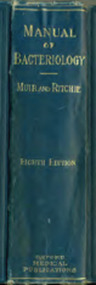
Book, Manual of Bacteriology, 1927
... techniques used in the dairy industry. The Warrnambool Cheese and Butter Factory was established at Allansford in 1888 and is still in production today, operated by the Canadian firm of Saputo. This book is of interest because of its connection to Arthur Gregory, a test ...This book was a text book used by Arthur Gregory, the test room technician at Warrnambool Cheese and Butter Factory in the 1930s. He tested the suppliers’ milk and cream for butterfat percentage in order to determine the payment to the suppliers. Arthur Gregory later became the manager of Jays Laundry in Fairy Street. In the 1930s Arthur Gregory boarded at 28 Spence Street in Warrnambool. This boarding house was run by May Taggart, the wife of Sam Taggart, a Warrnambool tailor. Les O’Callaghan was also a boarder there and it was through his contact with Arthur Gregory that he obtained the position of laboratory technician at the Warrnambool Cheese and Butter Factory. Les O’Callaghan remained for over 40 years at this factory (leased at that time by the Kraft company) and was very important in the development of laboratory techniques used in the dairy industry. The Warrnambool Cheese and Butter Factory was established at Allansford in 1888 and is still in production today, operated by the Canadian firm of Saputo. This book is of interest because of its connection to Arthur Gregory, a test room technican at the Warrnambool Cheese and Butter Factory in the 1930s and to Les O’Callaghan, the Laboratory Manager and Microbiologist at Warrnambool Cheese and Butter Factory for more than 40 years. This is a hard cover book of 822 pages. It has a blue cover with gold lettering on the spine. It has 29 chapters, an appendix, a bibliography and an index. It has many black and white illustrations and drawings. The spine is slightly scuffed. The inscription is handwritten in pencil.‘A.S.Gregory 28 Spence Street W’bool’warrnambool cheese and butter factory, arthur gregory, warrnambool, les o’callaghan, warrnambool, history of warrnambool -
 National Wool Museum
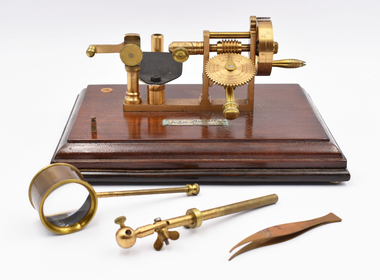
Functional object - Yarn Spinner and Accessories, John Nesbitt, 19th Century
... techniques and developed timeless designs that were much loved by Australians. These items are on rotational display at the National Wool Museum’s ‘In the Factory’ exhibition. For many years, Nino also worked as part of the Honorary Staff of the National Wool Museum. His passion for the world of textiles provided energy and knowledge to the visitors and staff of the museum. Although Nino has now retired from his honorary position and has hung up his Australian Tartan vest, these items will continue to serve the community in sharing the stories of Australian Textile design. apparatus textile testing ...Nino Corda was a Geelong based textile designer who worked at various textile mills between 1957 & 2003. He travelled the world in search of the latest fashions and techniques and developed timeless designs that were much loved by Australians. These items are on rotational display at the National Wool Museum’s ‘In the Factory’ exhibition. For many years, Nino also worked as part of the Honorary Staff of the National Wool Museum. His passion for the world of textiles provided energy and knowledge to the visitors and staff of the museum. Although Nino has now retired from his honorary position and has hung up his Australian Tartan vest, these items will continue to serve the community in sharing the stories of Australian Textile design.Custom made wooden hinged box with a hook latch. Brass yarn spinner, attached to a mahogany wood plinth base, which spins fibre into cord/yarn/thread. It has dials to set the rate that it spins. Metal plaque with black inlaid enamel lettering. Small cork inlay. Brass rod with hinge and wingnut, and ball at end. Ball at end has an adjustment mechanism. Rod also has an adjustable circular collar. Pair of curved tweezers. Circular magnifying glass on long thin handle. Glass has two concave lenses. Weaving sample in shades of blue, green and brown. Twill weave. Alternate pattern samples separated by red thread.Brass plaque on base of spinner: 42 MARKET St / John Nesbitt / REGd TRADE MARK / LIMd / MANCHESTER Underside of wooden plinth: 4976apparatus, textile, testing, spinning, nino corda, magnifyer, tools, brass, mahogany, tweezers, yarn, spinner, design, john nesbitt, manchester, england, 19th century, engineering, manufacturing -
Moorabbin Air Museum
Book - Aircraft maintenance, Acceptable Methods, Techniques and Practices Aircraft Inspection, Repair & Alterations
... Aircraft maintenance Aircraft wood structures Aircraft metal structures Fabric covering Control cables & terminals Aircraft hardware Corrosion protection Identification/testing/inspection of materials Aircraft equipment Windshields/enclosures & exits Hydraulic & pneumatic systems electrical systems Propellers / rotors & associated equipment Engines & fuel systems Radio & electronic systems Methods, techniques & practices acceptable for inspection & repair of civil aircraft, circa 1988 Acceptable Methods, Techniques and Practices Aircraft Inspection, Repair & Alterations Book Aircraft maintenance ...Methods, techniques & practices acceptable for inspection & repair of civil aircraft, circa 1988non-fictionMethods, techniques & practices acceptable for inspection & repair of civil aircraft, circa 1988aircraft wood structures, aircraft metal structures, fabric covering, control cables & terminals, aircraft hardware, corrosion protection, identification/testing/inspection of materials, aircraft equipment, windshields/enclosures & exits, hydraulic & pneumatic systems, electrical systems, propellers / rotors & associated equipment, engines & fuel systems, radio & electronic systems -
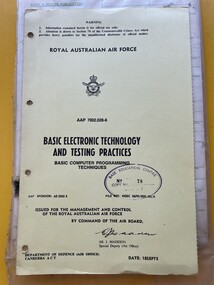 Moorabbin Air Museum
Document - (SP) AAP 7002.028-6 Basic Electronic Technology and Testing Practices Basic Computer Programming Techniques, RAAF
... RAAF Document (SP) AAP 7002.028-6 Basic Electronic Technology and Testing Practices Basic Computer Programming Techniques ... -
Moorabbin Air Museum
Book - AGARD reports, Computing Systems Configuration for Highly Integrated Guidance and Control Systems
... AGARD reports Computing system configuration for fighter aircraft flight control systems Highly reliable computer for airborne applications Testing embedded software Advanced avionics architecture Data & sigal processing architectures for future avionics Fibre optic buses & networks High speed parallel processing networks Overview of advances in the field of computing system design,design tools & techniques, circa 1988 Computing Systems Configuration for Highly Integrated Guidance and Control Systems Book AGARD reports ...Overview of advances in the field of computing system design,design tools & techniques, circa 1988non-fictionOverview of advances in the field of computing system design,design tools & techniques, circa 1988computing system configuration for fighter aircraft flight control systems, highly reliable computer for airborne applications, testing embedded software, advanced avionics architecture, data & sigal processing architectures for future avionics, fibre optic buses & networks, high speed parallel processing networks -
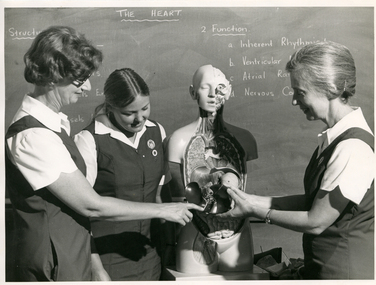 Royal District Nursing Service (now known as Bolton Clarke)
Photograph - Photograph, black and white, Barry Sutton, 25.03.1974
... These Education programs kept the RDNS Sisters abreast of new techniques, such as changes in technology for e.g. new testing methods in detecting glucose levels in Diabetic patients. ...The RDNS Sisters are named in the photograph, L-R - Sister Megan Margaret Day who works in the Domiciliary Infant Maternal Care (DIMC) section of RDNS. The next Sister's name is unknown, and on the right is Sister Ruth Eileen McKeon who is a Nurse Educator with RDNS. The photograph is taken in the Education Department of Royal District Nursing Service, and the two Sisters are receiving instruction on the function of the organs of the human body from Sister McKeon. The Sisters are wearing the RDNS summer uniform of a white short sleeve blouse under a royal blue V neck tunic style frock. Education was an integral part of Melbourne District Nursing Society (MDNS), from its inception in 1885, later, in 1966, called Royal District Nursing Service, (RDNS). From 1885, only Trained nurses (Nurses), through the Hospital training system, were employed by the Society, and on visits to patients they taught the necessity of hygiene and cleanliness, as well as the need for a good diet, to bring about good health. Doctor’s lectures were later given at the MDNS home to instruct patients and their families on prevention of disease. Education to patients continued throughout the years regarding health care and the use of equipment in the home. In 1961, Education programs commenced at MDNS with Trained nurses (Sisters) receiving In-service education. Sr. Pat (Paddy) Rowley was a leader in In-service Education and established the RDNS Department of Community Nursing Education in 1962. Staff could also apply for scholarships to further their education outside of RDNS. Many of their senior Sisters received Postgraduate diplomas from the College of Nursing in Community Health Nursing, Education, and Administration, and several travelled overseas visiting nursing organizations viewing their public health and District nursing systems. At RDNS many programs were run, including: a Post Basic Course, Cardiac Rehabilitation Nursing, Haematology/Oncology Nursing, Palliative Care program, Diabetic Stabilization Program, Leg Ulcer Management Program, Wound Care Specialist Program, HIV/AIDS Nursing Care, Cystic Fibrosis Home Support, Veterans Home Care Program, Breast Cancer Support Program, Continence Management Program, Stomal Therapy Program, In-Home Lactation Support Program and the Homeless Persons Program. RDNS staff attended several hospitals to observe and learn special care needed to some clients, e.g. to the Austin Hospital to learn the care required for paraplegic and quadriplegic patients at home, and to Mount Royal Hospital to observe the care of patients in the Rehabilitation ward. A Community Nursing Education Program was extended to student nurses from hospitals and to other nursing organizations. These Education programs kept the RDNS Sisters abreast of new techniques, such as changes in technology for e.g. new testing methods in detecting glucose levels in Diabetic patients. Sr. Nan Deakin obtained a Post Basic Certificate in Psychiatric Nursing and included this area in her Education lectures. Sr. Daphne Geldard specialized in the area of Alzheimer’s disease and Dementia. These Sisters visited patients in District areas with the regular RDNS Sister when required. Every member of staff, both professional and non professional staff, received regular education in the Education Department. In 1980, a Home Health Aide pilot study, funded by the Federal Government, the Brotherhood of St. Laurence and RDNS, with the program written and taught by Sr. Rowley, was evaluated as successful, and Home Health Aides were employed and worked in RDNS Centres under the supervision of the RDNS Sisters. On the left of this black and white photograph is Royal District Nursing Service (RDNS), Sister Megan Day, who has curled short dark hair and is wearing glasses. She is standing side-on facing to the right of the photograph. The index finger of her right hand is pointing to an area on the internal frontal view of a Human Torso Model which is sitting on a table to her right. Between her and the model is another Sister who has her long dark hair drawn back. She is looking at the internal organs in the Model. To the right of the Model is Sister Ruth McKeon, who has her long light colour hair drawn back into a French Twist. She is standing side-on facing to the left of the photograph, and is smiling as she holds one of the organs taken from the Model. When looking at the photograph, the left side of the Model's face is seen, and on the right side the Internal organs of the face are seen. The internal organs of the neck and torso of the Model are seen. A blackboard with writings about the function of 'The Heart' is In the background. The Sisters are all wearing their RDNS uniforms of a short sleeve white blouse under a V neck tunic style dress which has the RDNS logo on its upper left.Barry Sutton LY 66 namesrdns, rdns education, royal district nursing service, sister megan margaret day, sister ruth eileen mckeon -
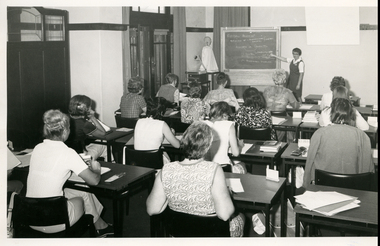 Royal District Nursing Service (now known as Bolton Clarke)
Photograph - Photograph, black and white, Barry Sutton, 25.03.1974
... These Education programs kept the RDNS Sisters abreast of new techniques, such as changes in technology for e.g. new testing methods in detecting glucose levels in Diabetic patients. ...The photograph shows a group of Royal District Nursing Service (RDNS) Sisters receiving a lecture on 'Physical Handicap' given by Sr. Rowley in the Education Department at RDNS Headquarters 452 St. Kilda Road, Melbourne. Sr. Rowley is the Principal Nurse Educator at RDNS.Education was an integral part of Melbourne District Nursing Society (MDNS), from its inception in 1885, later, in 1966, called Royal District Nursing Service, (RDNS). From 1885, only Trained nurses (Nurses), through the Hospital training system, were employed by the Society, and on visits to patients they taught the necessity of hygiene and cleanliness, as well as the need for a good diet, to bring about good health. Doctor’s lectures were later given at the MDNS home to instruct patients and their families on prevention of disease. Education to patients continued throughout the years regarding health care and the use of equipment in the home. In 1961, Education programs commenced at MDNS with Trained nurses (Sisters) receiving In-service education. Sr. Pat (Paddy) Rowley was a leader in In-service Education and established the RDNS Department of Community Nursing Education in 1962. Staff could also apply for scholarships to further their education outside of RDNS. Many of their senior Sisters received Postgraduate diplomas from the College of Nursing in Community Health Nursing, Education, and Administration, and several travelled overseas visiting nursing organizations viewing their public health and District nursing systems. At RDNS many programs were run, including: a Post Basic Course, Cardiac Rehabilitation Nursing, Haematology/Oncology Nursing, Palliative Care program, Diabetic Stabilization Program, Leg Ulcer Management Program, Wound Care Specialist Program, HIV/AIDS Nursing Care, Cystic Fibrosis Home Support, Veterans Home Care Program, Breast Cancer Support Program, Continence Management Program, Stomal Therapy Program, In-Home Lactation Support Program and the Homeless Persons Program. RDNS Sisters attended several hospitals to observe and learn special care needed to some patients, e.g. to the Austin Hospital to learn the care required for paraplegic and quadriplegic patients at home, and to Mount Royal Hospital to observe the care of patients in the Rehabilitation ward. A Community Nursing Education Program was extended to student nurses from hospitals and to other nursing organizations. These Education programs kept the RDNS Sisters abreast of new techniques, such as changes in technology for e.g. new testing methods in detecting glucose levels in Diabetic patients. Sr. Nan Deakin obtained a Post Basic Certificate in Psychiatric Nursing and included this area in her Education lectures. Sr. Daphne Geldard specialized in the area of Alzheimer’s disease and Dementia. These Sisters visited patients in District areas with the regular RDNS Sister when required. Every member of staff, both professional and non professional staff, received regular education in the Education Department. In 1980, a Home Health Aide pilot study, funded by the Federal Government, the Brotherhood of St. Laurence and RDNS, with the program written and taught by Sr. Rowley, was evaluated as successful, and Home Health Aides were employed and worked in RDNS Centres under the supervision of the RDNS Sisters. This black and white photograph shows the back view of four rows of Royal District Nursing Service (RDNS) Sisters sitting at small tables and looking toward Sister Pat (Paddy) Rowley who is facing them. She is in the rear centre of the photograph. The 16 Sisters, some partly hidden, are wearing a variety of summer day clothes. Spectacle cases, pens, sheets of paper, and some books are on the tables in front of them. Sister Rowley who wears glasses; has short straight dark hair, is wearing a white short sleeve blouse under a dark V neck tunic style dress. She is looking at the group and her right hand is pointing to writing on a large blackboard standing to her right. To the left of the blackboard, a draped Human Torso Model sits on a table. A long dark curtain hangs behind part of the blackboard. Running along the left of the photograph is a wooden door with glass panels at the top, some light colour wall with a dark picture rail, and a set of double glass doors with long grey curtains either side. To the right of Sr. Rowley part of a large white board is seen hanging above and below the dark picture rail on the wall.Barry Sutton LY 69rdns, royal district nursing service, rdns education, sister pat (paddy) rowley -
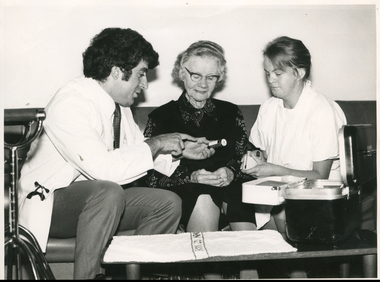 Royal District Nursing Service (now known as Bolton Clarke)
Photograph - Photograph, black and white, Barry Sutton, 24.04.1974
... These Education programs kept the RDNS Sisters abreast of new techniques, such as changes in technology for e.g. new testing methods for detecting glucose levels in Diabetic patients. ...A Medical Student is explaining the use of a bottle of testing tablets to a lady who is a patient of RDNS. The Royal District Nursing Service (RDNS) Sister is holding testing equipment; i.e. the eye dropper and test tube in the receptacle, in her hands, and is observing the Medical Student giving instructions to the lady. The photograph is taken in the lady's home.Education was an integral part of Melbourne District Nursing Society (MDNS) from its inception in 1885, later called Royal District Nursing Service, (RDNS). Only Trained nurses (Nurses) were employed by the Society, and on visits to patients they taught the necessity of hygiene and cleanliness, as well as the need for a good diet, to bring about good health. Doctor’s lectures were later given at the MDNS home to instruct patients and their families on prevention of disease. Education to patients continued throughout the years regarding health care and the use of equipment in the home. In 1961 Education programs commenced at MDNS with Trained nurses (Sisters) receiving In-service education. Sr. Pat (Paddy) Rowley was a leader in In-service Education and established the RDNS Department of Community Nursing Education in 1962. Staff could also apply for scholarships to further their education outside of RDNS. At RDNS many programs were run, including: a Post Basic Course, Cardiac Rehabilitation Nursing, Haematology/Oncology Nursing, Palliative Care program, Diabetic Stabilization Program, Leg Ulcer Management Program, Wound Care Specialist Program, HIV/AIDS Nursing Care, Cystic Fibrosis Home Support, Veterans Home Care Program, Breast Cancer Support Program, Continence Management Program, Stomal Therapy Program, In-Home Lactation Support Program. RDNS Sisters attended several hospitals to observe and learn special care needed to some patients, e.g. to the Austin Hospital to learn the care required for paraplegic and quadriplegic patients at home and to Mount Royal Hospital to observe the care of patients in the rehabilitation ward. RDNS moved its Education Department from 452 St. Kilda Road to 448 St. Kilda Road in 1974. A Community Nursing Education Program was extended to student nurses from hospitals and to other nursing organizations. These Education programs kept the RDNS Sisters abreast of new techniques, such as changes in technology for e.g. new testing methods for detecting glucose levels in Diabetic patients. Sr. Nan Deakin obtained a Post Basic Certificate in Psychiatric Nursing and included this area in her Education lectures. Sr. Daphne Geldard specialized in the area of Alzheimer’s disease and Dementia. These Sisters visited patients in District areas with the regular RDNS Sister when required. Every member of staff, both professional and non professional staff, received regular education in the Education Department. In 1980, a Home Health Aide pilot study, funded by the Federal Government, the Brotherhood of St. Laurence and RDNS, with the program written and taught by Sr. Rowley, was evaluated as successful, and Home Health Aides were employed and worked in RDNS Centres under the supervision of the RDNS Sisters.In the left foreground of this black and white photograph is the partial view of two metal 4 prong sticks.To their right, seated on a long dark vinyl type couch, is a Medical Student who has short curly black hair; is wearing a white hospital coat over grey trousers, a white shirt, and a tie with small black and white squares. A stethoscope is folded in the pocket of his coat. He is turned toward the right of the photograph and is holding, on its side, a small bottle in his left hand and is pointing his right index finger to writing on its label. An elderly lady who is wearing glasses and has wavy grey hair is sitting to his right and is looking at the label on the bottle. She is wearing a black skirt and black sleeveless jacket over a black and white patterned blouse. Her hands are clasped in her lap. Sitting to her right, and facing the lady, is a Royal District Nursing Service (RDNS) Sister who has her long dark hair drawn back. She is wearing a white short sleeve gown over her uniform, and is holding a white oblong receptacle which holds a test tube, which has dark fluid in the bottom, and an eye dropper. In front of her, is a white 'inner tray' which is clipped onto the front edge of an open oblong black RDNS nursing case which is in the right foreground of the photograph sitting on a long, narrow, low table. On the table and to the left of the case a small white hospital drape runs along the table.Barry Sutton MA 24royal district nursing service, rdns, rdns patient care, rdns education -
 Royal District Nursing Service (now known as Bolton Clarke)
Photograph - Photograph, black and white, Barry Sutton, 1972
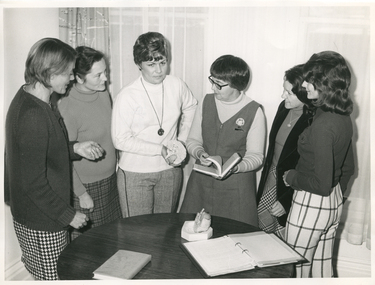
... These Education programs kept the RDNS Sisters abreast of new techniques, such as changes in technology for e.g. new testing methods in detecting glucose levels in Diabetic patients. ...This photograph is taken in the Education Department at Royal District Nursing Service (RDNS). Principal Nurse Educator, Sister Pat (Paddy) Rowley is instructing the group in the Anatomy of the Brain. Jan Turski is a Trained nurse (Sister) working in the Domiciliary Infant and Maternal Care (DIMC) section of RDNS. Pat Walker is a Sister from Geelong, Lynne Lambert is a Sister from Qld, Paula McBreen is a Sister from St. Vincent's Hospital and Liz Seymour-Smith is a Sister from Qld. Sister Pat (Paddy) Rowley is wearing the RDNS winter uniform of a blue/grey skivvie under a blue/grey V neck tunic style frock made out of herringbone winter material.Education was an integral part of Melbourne District Nursing Society (MDNS), from its inception in 1885, later, in 1966, called Royal District Nursing Service, (RDNS). From 1885, only Trained Nurses (Nurses), through the Hospital training system, were employed by the Society, and on visits to patients they taught the necessity of hygiene and cleanliness, as well as the need for a good diet, to bring about good health. Doctor’s lectures were later given at the MDNS home to instruct patients and their families on prevention of disease. Education to patients continued throughout the years regarding health care and the use of equipment in the home. In 1961, Education programs commenced at MDNS with Trained nurses (Sisters) receiving In-service education. Sr. Pat (Paddy) Rowley was a leader in In-service Education and established the RDNS Department of Community Nursing Education in 1962. Sisters could also apply for scholarships to further their education outside of RDNS. Many of their senior Sisters received Postgraduate diplomas from the College of Nursing in Community Health Nursing, Education, and Administration, and several travelled overseas visiting nursing organizations viewing their public health and District nursing systems. At RDNS many programs were run, including: a Post Basic Course, Cardiac Rehabilitation Nursing, Haematology/Oncology Nursing, Palliative Care program, Diabetic Stabilization Program, Leg Ulcer Management Program, Wound Care Specialist Program, HIV/AIDS Nursing Care, Cystic Fibrosis Home Support, Veterans Home Care Program, Breast Cancer Support Program, Continence Management Program, Stomal Therapy Program, In-Home Lactation Support Program and the Homeless Persons Program. RDNS Sisters attended several hospitals to observe and learn special care needed to some patients, e.g. to the Austin Hospital to learn the care required for paraplegic and quadriplegic patients at home, and to Mount Royal Hospital to observe the care of patients in the Rehabilitation ward. A Community Nursing Education Program was extended to student nurses from hospitals and to other nursing organizations. These Education programs kept the RDNS Sisters abreast of new techniques, such as changes in technology for e.g. new testing methods in detecting glucose levels in Diabetic patients. Sr. Nan Deakin obtained a Post Basic Certificate in Psychiatric Nursing and included this area in her Education lectures. Sr. Daphne Geldard specialized in the area of Alzheimer’s disease and Dementia. These Sisters visited patients in District areas with the regular RDNS Sister when required. Every member of staff, both professional and non professional staff, received regular education in the Education Department. In 1980, a Home Health Aide pilot study, funded by the Federal Government, the Brotherhood of St. Laurence and RDNS, with the program written and taught by Sr. Rowley, was evaluated as successful, and Home Health Aides were employed and worked in RDNS Centres under the supervision of the RDNS Sisters. This black and white photograph shows, standing L-R, a side-on view of Jan Turski, who has short, straight light hair and is wearing a dark cardigan and white and black hound's-tooth check skirt; she is facing right. Next is Pat Walker, who has short dark hair and is wearing a grey jumper over a check skirt. Then, Lynne Lambert, who has short wavy dark hair, and is wearing a white jumper, with a pendant hanging down it, over grey slacks. She is holding half of an Anatomical brain in her right hand. Next is Royal District Nursing Service (RDNS) Principal Nurse Educator, Pat (Paddy) Rowley, who is looking towards the left of the photograph at the Anatomical brain held by Lynne Lambert. She is wearing glasses, has short dark hair and is wearing a light grey skivvie under a darker V neck tunic style frock. She is holding an open book in her hands. Next is Paula McBreen, who has shoulder length dark hair and is wearing a dark cardigan over a grey skivvie, with a pendant hanging down it, and a check skirt. She is smiling and looking to her right toward the others. On the far right, side-on and facing the others on the left of the photograph, is Liz Seymour-Smith who has shoulder length dark hair and is wearing a dark grey skivvie, and white, with dark check, slacks. In front of the group is a round dark wooden top table, which has a book and open folder on it, as well as a round white plastic base with the other half of the anatomical brain sitting in it.Barry Sutton MB 30royal district nursing service, rdns, rdns education, sister jan turski, sister pat (paddy) rowley, sister lynne lambert, sister pat walker, sister paula mcbreen, sister liz seymour-smith -
 Northern District School of Nursing. Managed by Bendigo Historical Society Inc.
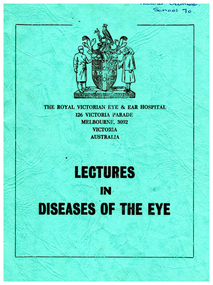
Book - Northern District School of Nursing Graduates Association - Lectures in Diseases of the Eye, Revised 1968
... Outlines examination techniques for various eye structures.Provides tests for retinal function and assessment of binocular vision.Injuries and Surgical CareDiscusses types of eye injuries, including contusions, penetrating wounds, and burns. ...Outlines examination techniques for various eye structures.Provides tests for retinal function and assessment of binocular vision.Injuries and Surgical CareDiscusses types of eye injuries, including contusions, penetrating wounds, and burns. ...The Northern District School of Nursing in Victoria, Australia Graduates Association: History of the School Managed by a committee including hospital administrators, medical professionals, and nursing leaders from several regional hospitals. Associated with major hospitals in the Northern District, including Bendigo Base, Mildura Base, Castlemaine, Echuca, Swan Hill, St. Arnaud, and Kyneton District Hospitals. Provide high-quality theoretical and practical nursing training. Raise the standard of nursing education in the region. Maintain the highest principles of nursing practice. Applicants must be at least 17 years old and hold a Proficiency Certificate or higher educational qualification. Application involves submitting forms, certificates, an interview, an aptitude test, and a medical examination. A three-month probationary period follows initial acceptance. Preliminary Training School: Four-week introductory course covering basic nursing, anatomy, hygiene, and practical skills. Practical experience in various hospital departments, guided by senior staff. Study Block Plan: Includes several blocks of theoretical and practical instruction throughout the three-year program. Regular school exams and two state exams (First Professional and Final State) are required for progression and graduation. Nurses work a 40-hour week with at least one or two days off per week and three weeks of annual leave. Accommodation is provided in comfortable hostels with good facilities. Uniforms are supplied free; nurses provide their own shoes and stockings. Salaries and allowances are regulated, with deductions for board and free medical care. Additional Information Post-Graduate Opportunities. Senior positions require further experience and additional certificates (e.g., Midwifery, Infant Welfare).Diploma courses available in administration, teaching, and specialized nursing fields. Bursaries are available for advanced study.Career Prospects: Graduates can pursue roles in administration, teaching, ward and departmental leadership, district and visiting nursing, industrial and school nursing, and more. Opportunities existed both within hospitals and in community or specialized settings.FAQs and Practical Details. Minimal training costs (mainly exam fees and personal items).Living out allowances and travel expenses are covered. Four training intakes per year; waiting periods are short if qualifications are met.Northern District School of Nursing Graduates Association - Lectures in Diseases of the Eye Revised 1968 39 pages, owned by Heather Gamble School 70 This item contains the following documents: 3793.1a Lectures in Diseases of the Eye Revised 1968 3793.1b Front Cover and Contents Page This document is a comprehensive educational guide for nurses at The Royal Victorian Eye and Ear Hospital, focusing on eye anatomy, diseases, examination techniques, and ophthalmic nursing practices. Detailed coverage of the orbit, eyeball, fibrous coat, uvea, retina, lids, lacrimal apparatus, and conjunctiva. Explains the function of extra-ocular muscles and the mechanics of vision. Describes diseases affecting the orbit, cornea, sclera, uvea, retina, lids, lacrimal apparatus, and conjunctiva. Covers errors in the optical properties of the eye and their corrections.Includes information on glaucoma and diseases of the crystalline lens. Outlines examination techniques for various eye structures.Provides tests for retinal function and assessment of binocular vision.Injuries and Surgical CareDiscusses types of eye injuries, including contusions, penetrating wounds, and burns. Details pre-operative, operative, and post-operative care for intra-ocular operations. Offers guidance on ophthalmic nursing techniques.Lists pharmaceuticals, accessories, instruments, and equipment used in eye surgery.nurse training, lister house, lectures in disease of the eye -
 Royal District Nursing Service (now known as Bolton Clarke)
Photograph - Photograph, black and white, Barry Sutton, 1974
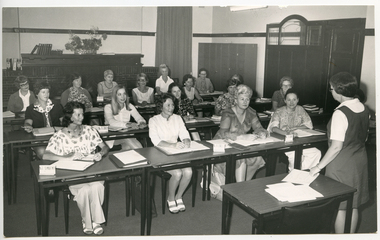
... These Education programs kept the RDNS Sisters abreast of new techniques, such as changes in technology for e.g. new testing methods in detecting glucose levels in Diabetic patients. ...Sr. Pat (Paddy) Rowley is the Principal Nurse Educator at RDNS and is giving a lecture to RDNS Sisters in the Education Department at 452 St. Kilda Rd, Melbourne. She is wearing the RDNS summer uniform of a white short sleeve blouse under a royal blue V neck tunic style frock with the RDNS insignia on the upper left.Education was an integral part of Melbourne District Nursing Society (MDNS), from its inception in 1885, later, in 1966, called Royal District Nursing Service, (RDNS). From 1885, only Trained Nurses (Nurses), through the Hospital training system, were employed by the Society, and on visits to patients they taught the necessity of hygiene and cleanliness, as well as the need for a good diet, to bring about good health. Doctor’s lectures were later given at the MDNS home to instruct patients and their families on prevention of disease. Education to patients continued throughout the years regarding health care and the use of equipment in the home. In 1961, Education programs commenced at MDNS with Trained nurses (Sisters) receiving In-service education. Sr. Pat (Paddy) Rowley was a leader in In-service Education and established the RDNS Department of Community Nursing Education in 1962. Staff could also apply for scholarships to further their education outside of RDNS. Many of their senior Sisters received Postgraduate diplomas from the College of Nursing in Community Health Nursing, Education, and Administration, and several travelled overseas visiting nursing organizations viewing their public health and District nursing systems. At RDNS many programs were run, including: a Post Basic Course, Cardiac Rehabilitation Nursing, Haematology/Oncology Nursing, Palliative Care program, Diabetic Stabilization Program, Leg Ulcer Management Program, Wound Care Specialist Program, HIV/AIDS Nursing Care, Cystic Fibrosis Home Support, Veterans Home Care Program, Breast Cancer Support Program, Continence Management Program, Stomal Therapy Program, In-Home Lactation Support Program and the Homeless Persons Program. RDNS Sisters attended several hospitals to observe and learn special care needed to some patients, e.g. to the Austin Hospital to learn the care required for paraplegic and quadriplegic patients at home, and to Mount Royal Hospital to observe the care of patients in the Rehabilitation ward. A Community Nursing Education Program was extended to student nurses from hospitals and to other nursing organizations. These Education programs kept the RDNS Sisters abreast of new techniques, such as changes in technology for e.g. new testing methods in detecting glucose levels in Diabetic patients. Sr. Nan Deakin obtained a Post Basic Certificate in Psychiatric Nursing and included this area in her Education lectures. Sr. Daphne Geldard specialized in the area of Alzheimer’s disease and Dementia. These Sisters visited patients in District areas with the regular RDNS Sister when required. Every member of staff, both professional and non professional staff, received regular education in the Education Department. In 1980, a Home Health Aide pilot study, funded by the Federal Government, the Brotherhood of St. Laurence and RDNS, with the program written and taught by Sr. Rowley, was evaluated as successful, and Home Health Aides were employed and worked in RDNS Centres under the supervision of the RDNS Sisters. This black and white photograph shows Royal District Nursing Service (RDNS) Sister Pat (Paddy) Rowley and seventeen (some partly hidden), Royal District Nursing Service (RDNS) Sisters. The bulk of the photograph shows the front view of three rows of RDNS Sisters sitting at tables which have books and sheets of paper on them. The Sisters are wearing a variety of day clothes. In the right foreground of the Photograph is a table containing papers, and standing to its right, facing the group, is the back view of Sr. Rowley, who has short dark hair and glasses. She has her left hand on a sheet of paper on the table. She is wearing her RDNS uniform of a white short sleeve blouse under a dark tunic style frock. In the rear of the photograph a brick fireplace can be seen with some books and a vase of flowers on the mantelpiece. On the right is a long curtain, some lockers and an open wooden door with glass panel. Some of the Sisters named are:- Ann Greenwood, Judy Peter, Ethel Fullarton, Barbara Lovell, Shirley Lewis, Jane Ball..Barry Sutton Stamp. Quote LY 68royal district nursing service (1966-2017), rdns, rdns education, sister ethel fullerton, sister barbara lovell, sister shirley lewis, sister jane ball, sister pat (paddy) rowley, sister ann greenwood, sister judy peter -
 Royal District Nursing Service (now known as Bolton Clarke)
Photograph - Photograph, black and white, Barry Sutton, 14.09.1972
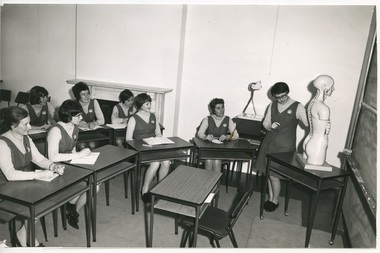
... These Education programs kept the RDNS Sisters abreast of new techniques, such as changes in technology for e.g. new testing methods in detecting glucose levels in Diabetic patients. ...This black and white photograph shows a group of RDNS Sisters who are part of the Post Basic Community Nursing Course. They are receiving education from Sr. Pat (Paddy) Rowley, RDNS Principal Nurse Educator. The session is being held in the Education Department at the Royal District Nursing Service Headquarters, 452 St. Kilda Rd, Melbourne.The RDNS winter uniform worn is a blue/grey skivvie under a blue/grey V neck tunic style herringbone winter material frock.Melbourne District Nursing Service ran its first Post-Basic Course for community nurses in 1962. Sisters attended the course for 12 weeks. The course ran annually until the mid 1990s. Education was an integral part of Melbourne District Nursing Society (MDNS), from its inception in 1885, later, in 1966, called Royal District Nursing Service, (RDNS). From 1885, only Trained nurses (Nurses) through the Hospital training system, were employed by the Society, and on visits to patients they taught the necessity of hygiene and cleanliness, as well as the need for a good diet, to bring about good health. Doctor’s lectures were later given at the MDNS home to instruct patients and their families on prevention of disease. Education to patients continued throughout the years regarding health care and the use of equipment in the home. In 1961, Education programs commenced at MDNS with their Trained nurses (Sisters) receiving In-service education. Sr. Pat (Paddy) Rowley was a leader in In-service Education and established the RDNS Department of Community Nursing Education in 1962. Staff could also apply for scholarships to further their education outside of RDNS. Many of their senior Sisters received Postgraduate diplomas from the College of Nursing in Community Health Nursing, Education, and Administration, and several travelled overseas visiting nursing organizations viewing their public health and District nursing systems. At RDNS many programs were run, including: a Post Basic Course, Cardiac Rehabilitation Nursing, Haematology/Oncology Nursing, Palliative Care program, Diabetic Stabilization Program, Leg Ulcer Management Program, Wound Care Specialist Program, HIV/AIDS Nursing Care, Cystic Fibrosis Home Support, Veterans Home Care Program, Breast Cancer Support Program, Continence Management Program, Stomal Therapy Program, In-Home Lactation Support Program and the Homeless Persons Program. RDNS staff attended several hospitals to observe and learn special care needed to some patients, e.g. to the Austin Hospital to learn the care required for paraplegic and quadriplegic patients at home, and to Mount Royal Hospital to observe the care of patients in the Rehabilitation ward. A Community Nursing Education Program was extended to student nurses from hospitals and to other nursing organizations. These Education programs kept the RDNS Sisters abreast of new techniques, such as changes in technology for e.g. new testing methods in detecting glucose levels in Diabetic patients. Sr. Nan Deakin obtained a Post Basic Certificate in Psychiatric Nursing and included this area in her Education lectures. Sr. Daphne Geldard specialized in the area of Alzheimer’s disease and Dementia. These Sisters visited patients in District areas with the regular RDNS Sister when required. Every member of staff, both professional and non professional staff, received regular education in the Education Department. In 1980, a Home Health Aide pilot study, funded by the Federal Government, the Brotherhood of St. Laurence and RDNS, with the program written and taught by Sr. Rowley, was evaluated as successful, and Home Health Aides were employed and worked in RDNS Centres under the supervision of RDNS Sisters. This black and white photograph is of a group of seven Royal District Nursing Service (RDNS) Sisters sitting in a semi-circle in two rows at single small two shelf tables. There are open white paged books or papers on each table and some of the Sisters have pens in their hands. The Sister sitting in the front far right is Sr. Affleck, who has dark short curly hair. The other Sisters have dark short hair in various styles. Further right in the photograph stands Sr. Rowley, who has dark short hair and is wearing glasses. She has her left hand supporting a torso of an anatomical model which is sitting on a table slightly to her left. She and the Sisters are looking at the vertebrae down the spine of the model. Another empty table is in front of the semi-circle and it sits in the centre foreground of the photograph. In the rear between Sr. Affleck and Sr. Rowley, a piece of equipment stands on a table. To the right of the photograph part of a large blackboard can be seen. The Sisters are wearing light grey skivvies under a darker V neck tunic style frock with the RDNS insignia on its upper left.Photographers stamp. Quote No. LD 8rdns education, rdns uniform, royal district nursing service, sister pat (paddy) rowley, sister margaret affleck -
 Royal District Nursing Service (now known as Bolton Clarke)
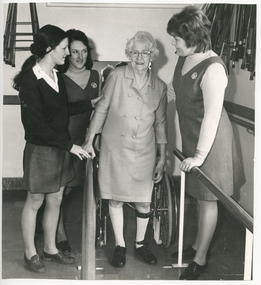
Photograph - Photograph, black and white, Barry Sutton, 20.07.1972
... These Education programs kept the RDNS Sisters abreast of new techniques, such as changes in technology for e.g. new testing methods in detecting glucose levels in Diabetic patients. ...The photograph is taken in the Physiotherapy Department at Mount Royal Hospital. RDNS Sr. Sue Revill is from RDNS Moorabbin Centre and Sr. Helen Watt is from Footscray Centre, They are attending an Education session on Rehabilitation at Mount Royal. Hospital. They are wearing the RDNS winter uniform of a blue/grey skivvie under a V neck tunic style herringbone winter material dress with the RDNS insignia emblazoned on its upper left.Education was an integral part of Melbourne District Nursing Society (MDNS), from its inception in 1885, later, in 1966, called Royal District Nursing Service, (RDNS). From 1885, only Trained Nurses (Nurses) who trained through the Hospital training system were employed by the Society, and on visits to patients they taught the necessity of hygiene and cleanliness, as well as the need for a good diet, to bring about good health. Doctor’s lectures were later given at the MDNS home to instruct patients and their families on prevention of disease. Education to patients continued throughout the years regarding health care and the use of equipment in the home. In 1961, Education programs commenced at MDNS with their Trained nurses (Sisters) receiving In-service education. Sister Pat (Paddy) Rowley was a leader in this In-service Education and established the MDNS, later called RDNS, Department of Community Nursing Education in 1962. Staff could also apply for scholarships to further their education outside of RDNS. Many of their senior Sisters received Postgraduate diplomas from the College of Nursing in Community Health Nursing, Education, and Administration, and several travelled overseas visiting nursing organizations viewing their public health and district nursing systems. Many programs were run at RDNS, including: a Post Basic Course, Cardiac Rehabilitation Nursing, Haematology/Oncology Nursing, Palliative Care program, Diabetic Stabilization Program, Leg Ulcer Management Program, Wound Care Specialist Program, HIV/AIDS Nursing Care, Cystic Fibrosis Home Support, Veterans Home Care Program, Breast Cancer Support Program, Continence Management Program, Stomal Therapy Program, In-Home Lactation Support Program and the Homeless Persons Program. RDNS staff attended several hospitals to observe and learn special care needed to some clients, e.g. to the Austin Hospital to learn the care required for paraplegic and quadriplegic clients at home, and to Mount Royal Hospital to observe the care of clients in the Rehabilitation ward. A Community Nursing Education Program was extended to Student nurses from Hospitals and to other nursing organizations. These Education programs kept the RDNS Sisters abreast of new techniques, such as changes in technology for e.g. new testing methods in detecting glucose levels in Diabetic patients. Sr. Nan Deakin did a Post Basic Course in Psychiatric Nursing and included this area in her education lectures. Sr. Daphne Geldard specialized in the area of Alzheimer’s disease and Dementia. These Sisters visited patients in District areas with the regular RDNS Sister when required. Every member of staff, both professional and non professional staff, received regular education in the Education Department. In 1980, a Home Health Aide pilot study, funded by the Federal Government, the Brotherhood of St. Laurence and RDNS, with the program written and taught by Sr. Rowley, was evaluated as successful, and Home Health Aides were employed and worked in RDNS Centres under the supervision of the RDNS Registered Nurses. Black and white photograph depicting, on the left, a side-on view of a Hospital Physiotherapist with her long hair drawn back in a pony tail, and wearing a grey V neck dress over a white blouse and a dark cardigan who is facing right. She has her left hand on the arm of a standing lady and her right hand on the lady's hand which is on a walking rail. To the right rear of the Physiotherapist is Royal District Nursing Service (RDNS) Sister Sue Revill who has shoulder length dark hair and is looking at the lady. To her right the elderly lady who is wearing glasses; has wavy white hair and is wearing a light grey frock, is standing in front of a wheelchair with her right hand on the walking rail. Her left arm hangs loosely by her side. To her right is a walking rail and standing to its right is Sr. Helen Watt who is looking towards the lady. She has short dark wavy hair, and has her right arm around the back of the lady and her left hand is on the walking rail. In the background of the photograph, the lower section of several 4 prong walking stick are seen hanging on the wall. Barry Sutton photographer's stamp. Quote KY 78rdns, royal district nursing service, rdns uniform, rdns education, sister sue revill, sister helen watt -
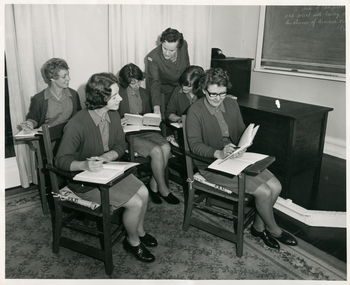 Royal District Nursing Service (now known as Bolton Clarke)
Photograph - Photograph, black and white, 07 06 1967
... These Education programs kept the RDNS Sisters abreast of new techniques, such as changes in technology for e.g. new testing methods in detecting glucose levels in Diabetic patients. ...Miss Evans, Director of Nursing of Royal District Nursing Service, (RDNS), is holding an Education session with RDNS staff. Her uniform is a grey skirt and jacket with the RDNS badge emblazoned on her right shoulder. The badge has a white background and black writing. The RDNS Sisters are wearing their grey uniform frocks and red cardigans. Education was an integral part of Melbourne District Nursing Society (MDNS), from its inception in 1885, later, in 1966, called Royal District Nursing Service, (RDNS). From 1885, only Trained Nurses, through the hospital training system, were employed by the Society, and on visits to patients they taught the necessity of hygiene and cleanliness, as well as the need for a good diet, to bring about good health. Doctor’s lectures were later given at the MDNS home to instruct patients and their families on prevention of disease. Education to patients continued throughout the years regarding health care and the use of equipment in the home. In 1961, Education programs commenced at MDNS with Sisters receiving In-service education. Sr. Pat (Paddy) Rowley was a leader in In-service Education and established the RDNS Department of Community Nursing Education in 1962. Staff could also apply for scholarships to further their education outside of RDNS. Many of their senior trained nurses received Postgraduate diplomas from the College of Nursing in Community Health Nursing, Education, and Administration and several travelled overseas visiting nursing organizations viewing their public health and district nursing systems. At RDNS many programs were run, including: a Post Basic Course, Cardiac Rehabilitation Nursing, Haematology/Oncology Nursing, Palliative Care program, Diabetic Stabilization Program, Leg Ulcer Management Program, Wound Care Specialist Program, HIV/AIDS Nursing Care, Cystic Fibrosis Home Support, Veterans Home Care Program, Breast Cancer Support Program, Continence Management Program, Stomal Therapy Program, In-Home Lactation Support Program and the Homeless Persons Program. RDNS staff attended several hospitals to observe and learn special care needed to some clients, e.g. to the Austin Hospital to learn the care required for paraplegic and quadriplegic clients at home, and to Mount Royal Hospital to observe the care of clients in the Rehabilitation ward. A Community Nursing Education Program was extended to student nurses from hospitals and to other nursing organizations. These Education programs kept the RDNS Sisters abreast of new techniques, such as changes in technology for e.g. new testing methods in detecting glucose levels in Diabetic patients. Sr. Nan Deakin obtained a Post Basic Certificate in Psychiatric Nursing and included this area in her education lectures. Sr. Daphne Geldard specialized in the area of Alzheimer’s disease and Dementia. These Sisters visited patients in District areas with the regular RDNS Sister when required. Every member of staff, both professional and non professional staff, received regular education in the Education Department. In 1980, a Home Health Aide pilot study, funded by the Federal Government, the Brotherhood of St. Laurence and RDNS, with the program written and taught by Sr. Rowley, was evaluated as successful, and Home Health Aides were employed and worked in RDNS Centres under the supervision of the RDNS Registered Nurses. Black and white photograph showing Miss Mary Evan standing in the centre rear of the photograph. She is with five RDNS Sisters who have short hair, three with curly hair and two with straight hair, who are sitting on chairs with white paged books resting on 'over the lap' tables. Three Sisters are seated in front of Miss Evans, and another two Sisters are sitting in the foreground. Miss Evans, who has short dark curled hair, is wearing her grey uniform jacket which can be seen with the RDNS cloth badge visible at the top of her right sleeve. She is bending over one of the Sisters and has her right hand pointing to something on the Sister's book. Closed light curtains are seen in the rear of the photograph and a dark desk to the right. On the wall above this, part of a blackboard can be seen.Photographers stamp. Quote No. GF 28rdns, royal district nursing service, rdns education, miss mary evans, rdns d.o.n -
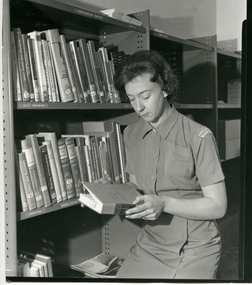 Royal District Nursing Service (now known as Bolton Clarke)
Photograph - Photograph, black and white, c.1967
... These Education programs kept the RDNS Sisters abreast of new techniques, such as changes in technology for e.g. new testing methods in detecting glucose levels in Diabetic patients. ...Sister Rignall is undergoing In-service education at RDNS and is wearing the grey RDNS uniform of that era.Education was an integral part of Melbourne District Nursing Society (MDNS), from its inception in 1885, later, in 1966, called Royal District Nursing Service, (RDNS). From 1885, only Trained Nurses who trained through the Hospital training system were employed by the Society, and on visits to patients they taught the necessity of hygiene and cleanliness, as well as the need for a good diet, to bring about good health. Doctor’s lectures were later given at the MDNS home to instruct patients and their families on prevention of disease. Education to patients continued throughout the years regarding health care and the use of equipment in the home. In 1961, Education programs commenced at MDNS with nurses receiving In-service education. Sr. Pat (Paddy) Rowley was a leader in this In-service Education and established the MDNS, later called RDNS, Department of Community Nursing Education in 1962. Staff could also apply for scholarships to further their education outside of RDNS. Many of their senior trained nurses received Postgraduate diplomas from the College of Nursing in Community Health Nursing, Education, and Administration, and several travelled overseas visiting nursing organizations viewing their public health and district nursing systems. Many programs were run at RDNS, including: a Post Basic Course, Cardiac Rehabilitation Nursing, Haematology/Oncology Nursing, Palliative Care program, Diabetic Stabilization Program, Leg Ulcer Management Program, Wound Care Specialist Program, HIV/AIDS Nursing Care, Cystic Fibrosis Home Support, Veterans Home Care Program, Breast Cancer Support Program, Continence Management Program, Stomal Therapy Program, In-Home Lactation Support Program and the Homeless Persons Program. RDNS staff attended several hospitals to observe and learn special care needed to some clients, e.g. to the Austin Hospital to learn the care required for paraplegic and quadriplegic clients at home, and to Mount Royal Hospital to observe the care of clients in the Rehabilitation ward. A Community Nursing Education Program was extended to student nurses from hospitals and to other nursing organizations. These Education programs kept the RDNS Sisters abreast of new techniques, such as changes in technology for e.g. new testing methods in detecting glucose levels in Diabetic patients. Sr. Nan Deakin did a Post Basic Course in Psychiatric Nursing and included this area in her education lectures. Sr. Daphne Geldard specialized in the area of Alzheimer’s disease and Dementia. These Sisters visited patients in District areas with the regular RDNS Sister when required. Every member of staff, both professional and non professional staff, received regular education in the Education Department. Black and white photograph showing Royal District Nursing Service (RDNS), Sister J. Rignall using the Library facilities at RDNS. Sister Rignall has short curly hair and is wearing her short sleeve grey uniform frock; the RDNS insignia is seen at the top of her left sleeve. She is standing and looking down at a book she is holding. Shelves of library books are seen running behind her on her left hand side.Photographers Stamp and Quote No. GW 94melbourne district nursing society, mdns, royal district nursing service, rdns, rdns education, rdns library, sister j. rignall -
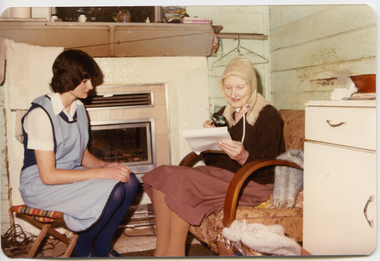 Royal District Nursing Service (now known as Bolton Clarke)
Photograph - Photograph, colour, c.1975
... These Education programs kept the RDNS Sisters abreast of new techniques, such as changes in technology for e.g. new testing methods in detecting glucose levels in Diabetic patients. ...This photograph is taken in Mrs. McDonald's home and she is reading information provided to her by Sister Faye Cook of the Royal District Nursing Service (RDNS) who is visiting to provide her with nursing care. Written communication is required between Mrs. McDonald and Sr. Cook. Sisters from the Royal District Nursing Service (RDNS) used various means to communicate with their patients who had various health conditions. Sometimes this was by written word, using interpreters or using digital devices. The RDNS Education department wrote instructions for patients to follow for various conditions and treatments to assist them in their care. The attending Sister discussed the instructions and left the leaflet with the patient. Examples of instruction included on how to sterilize dressings and equipment in the home and another giving information and instructions on diabetic care.. Education was an integral part of Melbourne District Nursing Society (MDNS), from its inception in 1885, later, in 1966, called Royal District Nursing Service, (RDNS). From 1885, only Trained Nurses (Nurses) who trained through the Hospital training system were employed by the Society, and on visits to patients they taught the necessity of hygiene and cleanliness, as well as the need for a good diet, to bring about good health. Doctor’s lectures were later given at the MDNS home to instruct patients and their families on prevention of disease. Education to patients continued throughout the years regarding health care and the use of equipment in the home. In 1961, Education programs commenced at MDNS with their Trained nurses (Sisters) receiving In-service education. Sr. Pat (Paddy) Rowley was a leader in this In-service Education and established the MDNS, later called RDNS, Department of Community Nursing Education in 1962. Staff could also apply for scholarships to further their education outside of RDNS. Many of their senior Sisters received Postgraduate diplomas from the College of Nursing in Community Health Nursing, Education, and Administration, and several travelled overseas visiting nursing organizations viewing their public health and district nursing systems. Many programs were run at RDNS, including: a Post Basic Course, Cardiac Rehabilitation Nursing, Haematology/Oncology Nursing, Palliative Care program, Diabetic Stabilization Program, Leg Ulcer Management Program, Wound Care Specialist Program, HIV/AIDS Nursing Care, Cystic Fibrosis Home Support, Veterans Home Care Program, Breast Cancer Support Program, Continence Management Program, Stomal Therapy Program, In-Home Lactation Support Program and the Homeless Persons Program. RDNS staff attended several hospitals to observe and learn special care needed to some clients, e.g. to the Austin Hospital to learn the care required for paraplegic and quadriplegic clients at home, and to Mount Royal Hospital to observe the care of clients in the Rehabilitation ward. A Community Nursing Education Program was extended to student nurses from hospitals and to other nursing organizations. These Education programs kept the RDNS Sisters abreast of new techniques, such as changes in technology for e.g. new testing methods in detecting glucose levels in Diabetic patients. Sr. Nan Deakin did a Post Basic Course in Psychiatric Nursing and included this area in her education lectures. Sr. Daphne Geldard specialized in the area of Alzheimer’s disease and Dementia. These Sisters visited patients in District areas with the regular RDNS Sister when required. Every member of staff, both professional and non professional staff, received regular education in the Education Department. In 1980, a Home Health Aide pilot study, funded by the Federal Government, the Brotherhood of St. Laurence and RDNS, with the program written and taught by Sr. Rowley, was evaluated as successful, and Home Health Aides were employed and worked in RDNS Centres under the supervision of the RDNS Registered Nurses. Coloured photograph of Sister Faye Cook of the Royal District Nursing Service (RDNS), sitting with Mrs McDonald who is reading the top page of a white writing pad. On the left, sitting 'side on' looking at Mrs McDonald, is Sister Cook who has short dark hair, and is wearing her pale blue RDNS apron over her RDNS royal blue V neck tunic style frock which is over her short sleeve white blouse; she is wearing blue stockings. She is seated on a striped low stool in Mrs. McDonald's room. Mrs.McDonald is to her right, and is seated in a bone and brown patterned lounge chair with wooden arms. She has a bone coloured wrap over her hair, and is wearing a dark brown V neck jumper over a deep pink frock. She is hoding a magnifying glass in her right hand and is reading information on a white writing pad which she is holding in her left hand. In the rear of the photograph is a gas type fire set into a fireplace. A white cupboard with a drawer is seen to the right hand side. The wall behind is vertical boards.Red coloured 'Kodak' stamps. Handwritten information.royal district nursing service, rdns, rdns education, mrs mcdonald, sister faye cook -
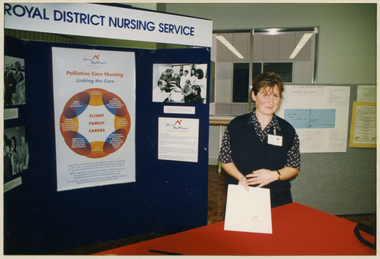 Royal District Nursing Service (now known as Bolton Clarke)
Photograph - Photograph, colour, c.2000
... These Education programs kept the RDNS Sisters abreast of new techniques, such as changes in technology for e.g. new testing methods in detecting glucose levels in Diabetic patients. ...This photograph shows some of the information documents displayed on boards during an Education session on Palliative Care run by the Royal District Nursing Service Education Department.Education was an integral part of Melbourne District Nursing Society (MDNS), from its inception in 1885, later, in 1966, called Royal District Nursing Service, (RDNS). From 1885, only Trained Nurses (Nurses), through the Hospital training system, were employed by the Society, and on visits to patients they taught the necessity of hygiene and cleanliness, as well as the need for a good diet, to bring about good health. Doctor’s lectures were later given at the MDNS home to instruct patients and their families on prevention of disease. Education to patients continued throughout the years regarding health care and the use of equipment in the home. In 1961, Education programs commenced at MDNS with their Trained nurses (Sisters) receiving In-service education. Sr. Pat (Paddy) Rowley was a leader in In-service Education and established the RDNS Department of Community Nursing Education in 1962. Staff could also apply for scholarships to further their education outside of RDNS. Many of their senior Sisters received Postgraduate diplomas from the College of Nursing in Community Health Nursing, Education, and Administration and several travelled overseas visiting nursing organizations viewing their public health and district nursing systems. At RDNS many programs were run, including: a Post Basic Course, Cardiac Rehabilitation Nursing, Haematology/Oncology Nursing, Palliative Care program, Diabetic Stabilization Program, Leg Ulcer Management Program, Wound Care Specialist Program, HIV/AIDS Nursing Care, Cystic Fibrosis Home Support, Veterans Home Care Program, Breast Cancer Support Program, Continence Management Program, Stomal Therapy Program, In-Home Lactation Support Program and the Homeless Persons Program. RDNS staff attended several hospitals to observe and learn special care needed to some clients, e.g. to the Austin Hospital to learn the care required for paraplegic and quadriplegic clients at home, and to Mount Royal Hospital to observe the care of clients in the Rehabilitation ward. A Community Nursing Education Program was extended to student nurses from hospitals and to other nursing organizations. These Education programs kept the RDNS Sisters abreast of new techniques, such as changes in technology for e.g. new testing methods in detecting glucose levels in Diabetic patients. Sr. Nan Deakin obtained a Post Basic Certificate in Psychiatric Nursing and included this area in her Education lectures. Sr. Daphne Geldard specialized in the area of Alzheimer’s disease and Dementia. These Sisters visited patients in District areas with the regular RDNS Sister when required. Every member of staff, both professional and non professional staff, received regular education in the Education Department. In 1980, a Home Health Aide pilot study, funded by the Federal Government, the Brotherhood of St. Laurence and RDNS, with the program written and taught by Sr. Rowley, was evaluated as successful, and Home Health Aides were employed and worked in RDNS Centres under the supervision of the RDNS SistersColoured photograph of a Royal District Nursing Service (RDNS) Sister standing in front of a Palliative Nursing Display board. The board has a white banner across the top with the dark blue words 'Royal District Nursing Service' written in capital letters. There are several light coloured background posters displayed on the large dark coloured display board. The Sister, who has her dark hair drawn up, is wearing a RDNS blue and white patterned blouse and short sleeve V neck dark blue jumper with a name badge attached on the upper left. The Sister is holding.a white sheet of paper. Part of a red covered table is seen in front of her. A mid green board with documents attached to it is behind and to the right of the Sister. Behind this is a pale green wall with part of a bench and two large windows showing a room beyond.royal district nursing service, rdns, rdns palliative care nursing, rdns education -
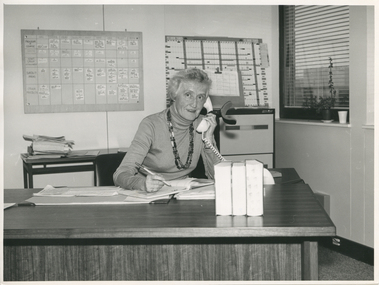 Royal District Nursing Service (now known as Bolton Clarke)
Photograph - Photograph, black and white, Barry Sutton, c.1970
... These Education programs kept the RDNS Sisters abreast of new techniques, such as changes in technology for e.g. new testing methods in detecting glucose levels in Diabetic patients. ...Miss Wright is Director of Education at Royal District Nursing Service (RDNS). She is sitting at a desk in the Education Department which was in Headquarters, 452 St. Kilda Road, until 1974 when it relocated to larger premises at 448 St. Kilda Road. Education was an integral part of Melbourne District Nursing Society (MDNS) from its inception in 1885, later called Royal District Nursing Service, (RDNS). Only Trained Nurses (Nurses) were employed by the Society, and on visits to patients they taught the necessity of hygiene and cleanliness, as well as the need for a good diet, to bring about good health. Doctor’s lectures were later given at the MDNS home to instruct patients and their families on prevention of disease. Education to patients continued throughout the years regarding health care and the use of equipment in the home. In 1961 Education programs commenced at MDNS with their Trained nurses (Sisters) receiving In-service education. Staff could also apply for scholarships to further their education outside of RDNS. At RDNS many programs were run, including: a Post Basic Course, Cardiac Rehabilitation Nursing, Haematology/Oncology Nursing, Palliative Care program, Diabetic Stabilization Program, Leg Ulcer Management Program, Wound Care Specialist Program, HIV/AIDS Nursing Care, Cystic Fibrosis Home Support, Veterans Home Care Program, Homeless persons Program, Breast Cancer Support Program, Continence Management Program, Stomal Therapy Program, In-Home Lactation Support Program. RDNS staff attended several hospitals to observe and learn special care needed to some clients, e.g. to the Austin Hospital to learn the care required for paraplegic and quadriplegic clients at home and to Mount Royal Hospital to observe the care of clients in the rehabilitation ward.. A Community Nursing Education Program was extended to student nurses from hospitals and to other nursing organizations. These Education programs kept the RDNS Sisters abreast of new techniques, such as changes in technology for e.g. new testing methods in detecting glucose levels in Diabetic patients. Sr. Nan Deakin obtained a Post Basic Certificate in Psychiatric Nursing and included this area in her education lectures. Sr. Daphne Geldard specialized in the area of Alzheimer’s disease and Dementia. These Sisters visited patients in District areas with the regular RDNS Sister when required. Every member of staff, both professional and non professional staff, received regular education in the Education Department. In 1980, a Home Health Aide pilot study, funded by the Federal Government, the Brotherhood of St. Laurence and RDNS, with the program written and taught by Sr. Rowley, was evaluated as successful, and Home Health Aides were employed and worked in RDNS Centres under the supervision of the RDNS Sisters. Black and white photograph of Miss Ora Wright, who has light coloured wavy hair and is wearing a grey long sleeve top with a long string of mixed coloured beads hanging over it. She is sitting behind a dark coloured wooden desk and has a pen in her right hand poised to write on a white sheet of paper. Her left arm is bent with her hand holding the light coloured hand-piece of a telephone to her left ear. There is a large blotter and other sheets of white paper on the desk as well as three thick books standing on the front right hand side of the desk. Behind her to the right is a two drawer filing cabinets and above this is a large board with charts running down it. On the left hand side of the photograph a low table with papers stacked on it. Above this, attached to the wall, is a rectangular board with horizontal and vertical rows marked out and some white cards on it. On the far right of the photograph, part of a wall and open Venetian blinds over a window can be seen.Photographer stamp and Quote No. DR 2royal district nursing service, rdns, rdns education, ora wright, -
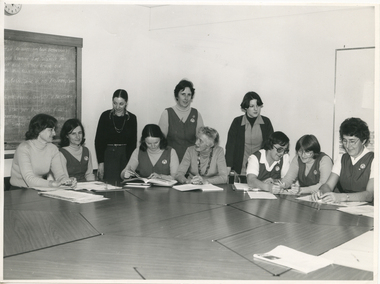 Royal District Nursing Service (now known as Bolton Clarke)
Photograph - Photograph, black and white, Barry Sutton, c.1970
... These Education programs kept the RDNS Sisters abreast of new techniques, such as changes in technology for e.g. new testing methods in detecting glucose levels in Diabetic patients. ...Miss Wright is the Education Director of Royal District Nursing Service (RDNS) and is giving a lecture to the RDNS staff. Two of the RDNS Sisters are wearing their summer uniform which was a royal blue V necked tunic style frock, with the RDNS badge emblazoned on the upper left hand side, over a short sleeved white blouse. Three of the Sisters are wearing their winter uniform of a blue/grey skivvy under a blue/grey herringbone V neck tunic style winter material dress.Education was an integral part of Melbourne District Nursing Society (MDNS), from its inception in 1885, later, in 1966, called Royal District Nursing Service, (RDNS). From 1885, only Trained nurses (Nurses), through the Hospital training system, were employed by the Society, and on visits to patients they taught the necessity of hygiene and cleanliness, as well as the need for a good diet, to bring about good health. Doctor’s lectures were later given at the MDNS home to instruct patients and their families on prevention of disease. Education to patients continued throughout the years regarding health care and the use of equipment in the home. In 1961, Education programs commenced at MDNS with their Trained nurses (Sisters) receiving In-service education. Sister Pat (Paddy) Rowley was a leader in In-service Education and established the RDNS Department of Community Nursing Education in 1962. Staff could also apply for scholarships to further their education outside of RDNS. Many of their senior Sisters graduated from the College of Nursing in Community Health, Education and Administration and several travelled overseas visiting nursing organizations viewing their public health and district nursing systems. At RDNS many programs were run, including: a Post Basic Course, Cardiac Rehabilitation Nursing, Haematology/Oncology Nursing, Palliative Care program, Diabetic Stabilization Program, Leg Ulcer Management Program, Wound Care Specialist Program, HIV/AIDS Nursing Care, Cystic Fibrosis Home Support, Veterans Home Care Program, Breast Cancer Support Program, Continence Management Program, Stomal Therapy Program, In-Home Lactation Support Program and the Homeless Persons Program. RDNS staff attended several hospitals to observe and learn special care needed to some clients, e.g. to the Austin Hospital to learn the care required for paraplegic and quadriplegic clients at home, and to Mount Royal Hospital to observe the care of clients in the Rehabilitation ward. A Community Nursing Education Program was extended to student nurses from hospitals and to other nursing organizations. These Education programs kept the RDNS Sisters abreast of new techniques, such as changes in technology for e.g. new testing methods in detecting glucose levels in Diabetic patients. Sr. Nan Deakin did a Post Basic Course in Psychiatric Nursing and included this area in her education lectures. Sr. Daphne Geldard specialized in the area of Alzheimer’s disease and Dementia. These Sisters visited patients in District areas with the regular RDNS Sister when required. Every member of staff, both professional and non professional staff, received regular education in the Education Department. In 1980, a Home Health Aide pilot study, funded by the Federal Government, the Brotherhood of St. Laurence and RDNS, with the program written and taught by Sr. Rowley, was evaluated as successful, and Home Health Aides were employed and worked in RDNS Centres under the supervision of the RDNS SistersBlack and white photograph showing Royal District Nursing Service (RDNS), Miss Ora Wright seated at a table in discussion amid a group of nine RDNS Educators, Physiotherapists and Clerical staff. Miss Wright has short light coloured hair and has her head turned to her right. She is wearing a long necklace of mixed coloured beads over a light coloured top. Three of the staff are standing behind the seated group. Three staff are seated either side of Miss Wright. Two of the RDNS Educators are wearing white short sleeve blouses under a V neck tunic style dress and the other three are wearing a light coloured skivvy under a V neck grey tunic style dress. The RDNS insignia on a white background can be seen on the upper left of each RDNS uniforms. A blackboard full of white writing can be seen in the left rear of the photograph and several tables joined together are in the foreground. Two books and several sheets of white paper are in front of the seated staff.Photographer stamp. Quote No. DR 12royal district nursing service, rdns, rdns education, rdns clerical staff, rdns physiotherapist, miss ora wright -
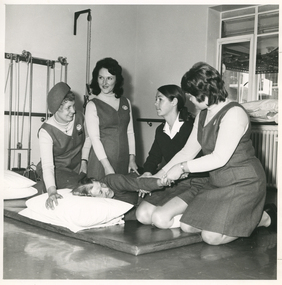 Royal District Nursing Service (now known as Bolton Clarke)
Photograph - Photograph, black and white, Barry Sutton, 20.07.1972
... These Education programs kept the RDNS Sisters abreast of new techniques, such as changes in technology for e.g. new testing methods in detecting glucose levels in Diabetic patients. ...This photograph is taken in the Physiotherapy Department at Mount Royal Rehabilitation Hospital. The Physiotherapist is giving an Education session to RDNS Sisters. The Sisters are wearing the RDNS winter uniform, which was a blue/grey herringbone winter material V neck tunic style frock over a blue/grey skivvie. Sr. Peter is wearing the uniform beret style hat which was made of the herringbone winter material. Education was an integral part of Melbourne District Nursing Society (MDNS), from its inception in 1885, later, in 1966, called Royal Education was an integral part of Melbourne District Nursing Society (MDNS), from its inception in 1885, later, in 1966, called Royal District Nursing Service, (RDNS). From 1885, only Trained Nurses (Nurses) who trained through the Hospital training system were employed by the Society, and on visits to patients they taught the necessity of hygiene and cleanliness, as well as the need for a good diet, to bring about good health. Doctor’s lectures were later given at the MDNS home to instruct patients and their families on prevention of disease. Education to patients continued throughout the years regarding health care and the use of equipment in the home. In 1961, Education programs commenced at MDNS with their Trained nurses (Sisters) receiving In-service education. Sr. Pat (Paddy) Rowley was a leader in this In-service Education and established the MDNS, later called RDNS, Department of Community Nursing Education in 1962. Staff could also apply for scholarships to further their education outside of RDNS. Many of their senior Sisters received Postgraduate diplomas from the College of Nursing in Community Health Nursing, Education, and Administration, and several travelled overseas visiting nursing organizations viewing their Public health and District nursing systems. Many programs were run at RDNS, including: a Post Basic Course, Cardiac Rehabilitation Nursing, Haematology/Oncology Nursing, Palliative Care program, Diabetic Stabilization Program, Leg Ulcer Management Program, Wound Care Specialist Program, HIV/AIDS Nursing Care, Cystic Fibrosis Home Support, Veterans Home Care Program, Breast Cancer Support Program, Continence Management Program, Stomal Therapy Program, In-Home Lactation Support Program and the Homeless Persons Program. RDNS staff attended several hospitals to observe and learn special care needed to some clients, e.g. to the Austin Hospital to learn the care required for paraplegic and quadriplegic clients at home, and to Mount Royal Hospital to observe the care of clients in the Rehabilitation ward. A Community Nursing Education Program was extended to student nurses from hospitals and to other nursing organizations. These Education programs kept the RDNS Sisters abreast of new techniques, such as changes in technology for e.g. new testing methods in detecting glucose levels in Diabetic patients. Sr. Nan Deakin did a Post Basic Course in Psychiatric Nursing and included this area in her education lectures. Sr. Daphne Geldard specialized in the area of Alzheimer’s disease and Dementia. These Sisters visited patients in District areas with the regular RDNS Sister when required. Every member of staff, both professional and non professional staff, received regular education in the Education Department. In 1980, a Home Health Aide pilot study, funded by the Federal Government, the Brotherhood of St. Laurence and RDNS, with the program written and taught by Sr. Rowley, was evaluated as successful, and Home Health Aides were employed and worked in RDNS Centres under the supervision of the RDNS Registered Nurses. Black and white photograph showing Royal District Nursing Service (RDNS), Sisters observing in a Physiotherapy Department. Left to right - Sisters Judy Peter, who is wearing her uniform beret over her light coloured curly hair, and kneeling and leaning over, with her right hand resting on a white pillow which is on a large thick mat. Next is Sr. Sue Revill, who has dark shoulder length curled hair and is kneeling behind a lady who is lying on her left side on a the mat which is on the floor. She has her head on a white pillow and facing frontward. She has light coloured curled hair and is wearing a dark grey long sleeve top. Next is the Physiotherapist, who has long dark hair drawn back in a pony tail and is wearing a dark cardigan over a white blouse and grey frock. She is kneeling on the mat with her hands on the lady's side. Sister Helen Watt, who has collar length curled hair is kneeling to her right and is holding the lady's outstretched right arm and hand and looking toward the Physiotherapist. The Sisters are wearing the RDNS uniform of a light grey skivvie under a V neck tunic style dress with the RDNS insignia on the upper left. In the background are some some vertical bars attached to the wall and part of a pillow can be seen in front of these on the large mat. On the right of the photograph is a heater and above this windows are seen. Photographer stamp. Quote No. KY 82royal district nursing service, rdns, rdns education, sister judy peter, sister sue revill, sister helen watt
