
Showing 59 items matching "the peace 1918"
-
 Bendigo Military Museum
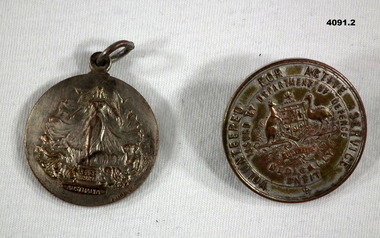
Accessory - MEDALLION & MEDAL, 1) 1919
... The Peace 1918....1) On front, “”Victory, The triumph of Liberty and Justice, The Peace 1918” On reverse, “Peace 1919 Australia” .2) On the front, “Volunteered for Active Service - Medically unfit”, On reverse, “65066”....1) These medallions were issued to School children in 1919. .2) After a call was made to have something to show you had volunteered for Active service but were rejected on medical grounds. The Peace 1918 Volunteered medically unfit .1) On front, “”Victory, The triumph of Liberty and Justice, The Peace 1918” On reverse, “Peace 1919 Australia” .2) On the front, “Volunteered for Active Service - Medically unfit”, On reverse, “65066” .1) Medallion, round with ring at top, etched raised figures front and back. .2) Medal, round, with etched raised Australian Coat of Arms on the front. ....1) These medallions were issued to School children in 1919. .2) After a call was made to have something to show you had volunteered for Active service but were rejected on medical grounds..1) Medallion, round with ring at top, etched raised figures front and back. .2) Medal, round, with etched raised Australian Coat of Arms on the front..1) On front, “”Victory, The triumph of Liberty and Justice, The Peace 1918” On reverse, “Peace 1919 Australia” .2) On the front, “Volunteered for Active Service - Medically unfit”, On reverse, “65066”the peace 1918, volunteered, medically unfit -
 Queenscliffe Maritime Museum
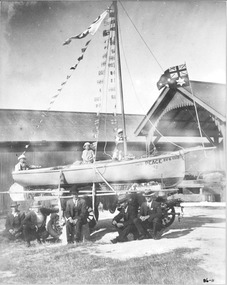
Photograph - Photographss of 1918 Peace Procession fishing boats, 3 x Photographs of 1918 Peace Procession fishing boats & 1 x map, 1918
... Photographss of 1918 Peace Procession fishing boats...3 x Photographs of 1918 Peace Procession fishing boats & 1 x map......1918 Peace Procession...1918 Peace Procession at Queenscliffe...black and white photographs of people & fishing boats involved in the 1918 Peace Procession at Queenscliffe...1918 Peace Procession at Queenscliffe Lifeboats 1918 Peace Procession Refer Notes section for details black and white photographs of people & fishing boats involved in the 1918 Peace Procession at Queenscliffe 3 x Photographs of 1918 Peace Procession fishing boats & 1 x map Photograph Photographss of 1918 Peace Procession fishing boats ...1918 Peace Procession at Queenscliffeblack and white photographs of people & fishing boats involved in the 1918 Peace Procession at QueenscliffeRefer Notes section for detailslifeboats, 1918 peace procession -
 Whitehorse Historical Society Inc.
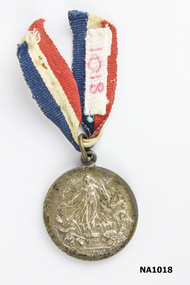
Badge, 1918
... Peace Medal 1918 on Red, white and blue ribbon...numismatics badges Reverse - 'Victory/Triumph of Liberty and Justice' Peace Medal 1918 on Red, white and blue ribbon Badge Badge ...Peace Medal 1918 on Red, white and blue ribbonReverse - 'Victory/Triumph of Liberty and Justice'numismatics, badges -
 Stawell Historical Society Inc
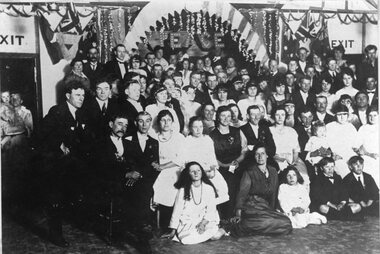
Photograph, "Peace Function" with a group of people 1918
... "Peace Function" with a group of people 1918...Group of People (Peace 1918) WW1...Group of People (Peace 1918) WW1 Stawell War "Peace Function" with a group of people 1918 Photograph ...Group of People (Peace 1918) WW1stawell war -
 Clunes Museum
Pamphlet - ORDER OF SERVICE, GUARDIAN PRINT, 1918
... SMALL PAMPHLET COMMORATION OF PEACE, SATURDAY NOVEMBER 16TH. 1918...ORDER OF SERVICE local history document pamphlet trembath perry SMALL PAMPHLET COMMORATION OF PEACE, SATURDAY NOVEMBER 16TH. 1918 Pamphlet ORDER OF SERVICE. ...ORDER OF SERVICESMALL PAMPHLET COMMORATION OF PEACE, SATURDAY NOVEMBER 16TH. 1918local history, document, pamphlet, trembath, perry -
 Narre Warren and District Family History Group
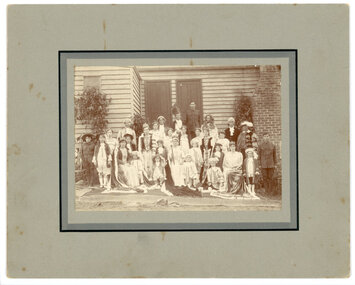
Photograph - Harkaway Queen of Peace Competition, Queen of Peace competition 1918
... Queen of Peace competition 1918......Queen of Peace competition 1918...The Queen of Peace competion was a means of raising funds for the local Red Cross. The "queens" held concerts and appealed for funds. The winner in 1918...Photograph of children from Harkaway Primary School dressed up for the Queen of Peace competion in 1918. Photograph has been mounted and framed in cardboard....Queen of Peace competition 1918 Photograph Harkaway Queen of Peace Competition ...The Queen of Peace competion was a means of raising funds for the local Red Cross. The "queens" held concerts and appealed for funds. The winner in 1918 was Adelaide Wanke. Adelaide was born in Harkaway on 24 December 1900. Her parents were Immanuel Gottlob Wanke and Bertha Nathalie nee Aurisch. Adelaide married William Frederich Blobel in 1926 and they had an orchard in Templestowe. Sh e died on 14 July 1995 Photograph of children from Harkaway Primary School dressed up for the Queen of Peace competion in 1918. Photograph has been mounted and framed in cardboard.On the back of the photograph written in blue inke, "Adelaide Wanke centre with crown." at the bottom right hand corner on the back is 'Rushton Photo Pakenham"adelaide wanke, queen of peace competition 1918, harkaway (vic.) -
 Mont De Lancey
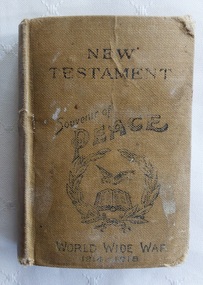
Book, British and Foreign Bible Society, The New Testament, 1918
... Designed to fit easily into a pocket (roughly 70 x 100 mm up to 14.5 x 9 cm), they typically featured cloth, leatherette, or pictorial cardboard covers stamped with titles like "Souvenir of Peace WW 1914-1918"....Outside the wreath stamped in black lettering - Souvenir of Peace World Wide War 1914 - 1918. The back cover has a symbol of the letters of the British and Foreign Bible Society in black print. ...On the left front end paper is a sticker - 'Presented by Kew Baptist Sunday School as a memento of the Signing of Peace June 28, 1919, in connection with the Great War, 1914-1918 E.S Ratten, Supt. ...Designed to fit easily into a pocket (roughly 70 x 100 mm up to 14.5 x 9 cm), they typically featured cloth, leatherette, or pictorial cardboard covers stamped with titles like "Souvenir of Peace WW 1914-1918". Bibles New Testament Commemorative New Testament WW1 - souvenir On the left front end paper is a sticker - 'Presented by Kew Baptist Sunday School as a memento of the Signing of Peace June 28, 1919, in connection with the Great War, 1914-1918 E.S Ratten, Supt. ...The "New Testament Souvenir of Peace World Wide War 1914 - 1918" refers to small pocket-sized New Testaments printed and distributed by religious organizations near the end of or immediately after World War I. They were handed out to soldiers, returning servicemen, or civilians as spiritual keepsakes, similar to the active-service pocket Bibles carried in the trenches. Designed to fit easily into a pocket (roughly 70 x 100 mm up to 14.5 x 9 cm), they typically featured cloth, leatherette, or pictorial cardboard covers stamped with titles like "Souvenir of Peace WW 1914-1918".A miniature light tan cloth covered New Testament of our Lord and Saviour Jesus Christ with a black circular laurel wreath, a book and dove stamped on the front cover. Outside the wreath stamped in black lettering - Souvenir of Peace World Wide War 1914 - 1918. The back cover has a symbol of the letters of the British and Foreign Bible Society in black print. Pp. 464. Inside the front cover is a sticker of Presentation. On the opposite page is the name of the owner and date. Pp. 464.On the left front end paper is a sticker - 'Presented by Kew Baptist Sunday School as a memento of the Signing of Peace June 28, 1919, in connection with the Great War, 1914-1918 E.S Ratten, Supt. J.B Herbert. Sec. July 20, 1919'. G.A Green. Print. On the top of the opposite page handwritten in black ink: 'Norman Walter Cook 20. 7. 1919.'bibles, new testament, commemorative new testament, ww1 - souvenir -
 Bendigo Historical Society Inc.
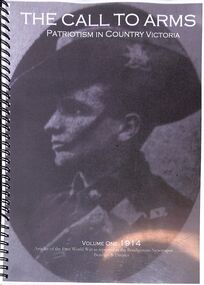
Book - "The Call to Arms. Patriotism in Country Victoria. Volume 1.", 2011
... Later that year, the Bolsheviks seized power in Russia in the October Revolution; Soviet Russia signed an armistice with the Central Powers in December, followed by a separate peace in March 1918. That month, Germany launched a spring offensive in the west, which despite initial successes left the German Army exhausted and demoralised. ...Later that year, the Bolsheviks seized power in Russia in the October Revolution; Soviet Russia signed an armistice with the Central Powers in December, followed by a separate peace in March 1918. That month, Germany launched a spring offensive in the west, which despite initial successes left the German Army exhausted and demoralised. ...World War one began in 1914, and ended in 1918. World War I or the First World War (28 July 1914 – 11 November 1918), also known as the Great War, was a global conflict between two coalitions: the Allies (or Entente) and the Central Powers. One of the deadliest conflicts in history, World War I resulted in an estimated 15 to 22 million deaths, including those in war crimes and genocides. The war also helped spread the Spanish flu pandemic. The conflict saw important developments in weaponry, including the first large-scale use of machine guns, artillery, aircraft, chemical weapons, and tanks. The causes of World War I included the rise of the German Empire, which disturbed the long-standing balance of power in Europe, and the exacerbation of imperial rivalries, as reflected in new alliances and an arms race between the great powers. Tensions in the Balkans reached a breaking point on 28 June 1914 when Gavrilo Princip, a Bosnian Serb, assassinated Franz Ferdinand, the heir to the Austro-Hungarian throne. Austria-Hungary blamed Serbia and declared war on 28 July, upon which the Russian Empire mobilised in Serbia's defence. In early August, Germany declared war on Russia and France; the United Kingdom entered the war after Germany invaded Belgium. Germany's strategy in 1914 was to quickly defeat France, but its advance was halted in September, and the Western Front solidified into a near-continuous line of fortified trenches from the English Channel to Switzerland. The Eastern Front was more dynamic, but neither side gained a decisive advantage, despite costly offensives. The Ottoman Empire joined the Central Powers in November, which was followed by a failed Allied campaign at Gallipoli. Japan and Italy also joined the Allies. Major battles, including those at Verdun, the Somme, and Passchendaele, failed to break the stalemate on the Western Front. In April 1917, the United States joined the Allies after Germany resumed unrestricted submarine warfare against Atlantic shipping. Later that year, the Bolsheviks seized power in Russia in the October Revolution; Soviet Russia signed an armistice with the Central Powers in December, followed by a separate peace in March 1918. That month, Germany launched a spring offensive in the west, which despite initial successes left the German Army exhausted and demoralised. The Allied Hundred Days Offensive, beginning in August 1918, caused a collapse of the German front line. By early November, the Allies had signed armistices with the Ottomans and with Austria-Hungary, leaving Germany isolated. Facing a revolution at home, Kaiser Wilhelm II abdicated on 9 November, and the war ended with the Armistice of 11 November 1918. Metal spiral bound book. Plastic clear cover, and black cardboard back cover. Soft cover. Cover has an image of a black and white image of the bust of a soldier looking to the left. Titles in white. 121 pages. Contains articles of the First World War as reported in the 'Bendigonian Newspaper'. Contains a timeline of significant events during WW1. Has index. Transcribed by Pamela Houston. Printed by Bendigo Copy Centre, Bendigo. Volume one deals with 1914.world war one, soldiers, bendigonian newspapaper -
 Federation University Historical Collection
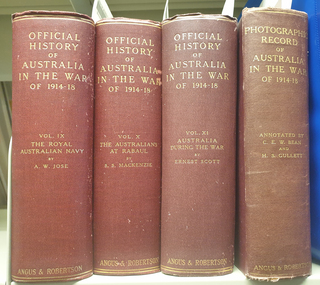
Book, Ernest Scott, Official History of Australia in the War, Vol 11, Australia During the War of 1914 - 1918, 1936
... Ernest Scott was a Professor in History at the University of Melbourne. world war world war one aif anzac censorship germans internment spying war correspondents official photographers propaganda equipment munitions conscription conscription referendum recruiting horses patriotic funds red cross australian comforts fund junior red cross peace conference treaty repatriation soldier settlement andrew fisher legacy Red hard covered book of 922 pages with 67 illustrations Official History of Australia in the War, Vol 11, Australia During the War of 1914 - 1918 Book Book Ernest Scott ...Ernest Scott was a Professor in History at the University of Melbourne.Red hard covered book of 922 pages with 67 illustrationsworld war, world war one, aif, anzac, censorship, germans, internment, spying, war correspondents, official photographers, propaganda, equipment, munitions, conscription, conscription referendum, recruiting, horses, patriotic funds, red cross, australian comforts fund, junior red cross, peace conference, treaty, repatriation, soldier settlement, andrew fisher, legacy -
 Federation University Historical Collection
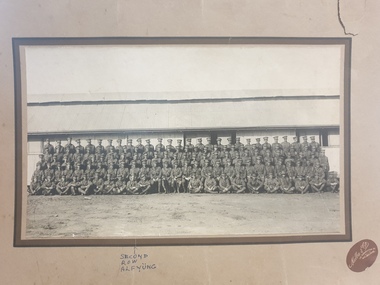
Photograph, Melba & Co, 7th Australian Infantry Training Battalion WW1
... At 11 am on 11 November 1918, the guns fell silent. The November armistice was followed by the peace treaty of Versailles signed on 28 June 1919. ...At 11 am on 11 November 1918, the guns fell silent. The November armistice was followed by the peace treaty of Versailles signed on 28 June 1919. ...George Alfred Yung, known as Alf, pictured in the second row, 10th from the left, enlisted on 25/02/1916; embarked on 19/02/1917; was killed during the battle of Menin Gate at Yrpres, Belgium on 20/09/1917. https://www.awm.gov.au/collection/U51447 The 7th Battalion was among the first infantry units raised for the AIF during the First World War. Like the 5th, 6th and 8th Battalions, it was recruited from Victoria and, together with these battalions, formed the 2nd Brigade. The battalion was raised by Lieutenant Colonel H. E. "Pompey" Elliott within a fortnight of the declaration of war in August 1914 and embarked just two months later. After a brief stop in Albany, Western Australia, the battalion proceeded to Egypt, arriving on 2 December. It later took part in the ANZAC landing on 25 April 1915, as part of the second wave. Ten days after the landing, the 2nd Brigade was transferred from ANZAC to Cape Helles to help in the attack on the village of Krithia. The attack captured little ground but cost the brigade almost a third of its strength. The Victorian battalions returned to ANZAC to help defend the beachhead, and in August the 2nd Brigade fought at the battle of Lone Pine. While holding positions captured by the 1st Brigade, four members of the 7th Battalion, Corporal A. S. Burton, Acting Corporal W. Dunstan, Lieutenant W. Symons and Captain F. H. Tubb, earned the Victoria Cross - Burton posthumously. The battalion served at ANZAC until the evacuation in December. After the withdrawal from Gallipoli in December 1915, the battalion returned to Egypt. In March 1916, it sailed for France and the Western Front and entered the front line trenches for the first time on 3 May. The battalion's first major action in France was at Pozieres in the Somme valley where it fought between 23-27 July and 15-21 August. After Pozieres the battalion manned trenches in the Ypres salient in Belgium, before returning to the Somme valley. It saw out the horrendous winter of 1916-1917 rotating between training, working parties and duty in the trenches. In early 1917, the Germans withdrew to the Hindenburg Line and the 7th Battalion participated in the brief advance that followed and then came to a grinding halt before Bullecourt. The battalion was withdrawn from the front line for training on 9 May 1917 and did not return to action until the Ypres offensive of September and October. It fought major battles at Menin Road on 20 September and Broodseinde on 4 October, and then spent much of ensuing winter in the Ypres mud. In March and April 1918 the 7th helped stop the German spring offensive in northern France and later participated in the Allies' own great offensive of 1918, that began with the battle of Amiens on 8 August. The advance by British and empire troops on 8 August was the greatest success in a single day on the Western Front, one that German General Erich Ludendorff described as, "the black day of the German Army in this war". The battalion continued operations until late September 1918. At 11 am on 11 November 1918, the guns fell silent. The November armistice was followed by the peace treaty of Versailles signed on 28 June 1919. In November 1918 members of the AIF began to return to Australia for demobilisation and discharge. In March, the battalion was so reduced that it and the 6th Battalion were amalgamated to form a composite battalion. In turn, this battalion was merged with another, formed from the 5th and 8th Battalions, to form the 2nd Brigade Battalion. https://www.awm.gov.au/collection/U51447army, soldier, alf yung, 7th australian infantry battalion -
Lara RSL Sub Branch
Medals, C T Fleming
... V........Medal 2Reverse 1914/1918 ....Face Georg..I V SV BRITT.OMN .REX E T IND.IMP ......on rim 230CorporalC T L/C.Fleming Sec.Fce A I F ......Medal 3 Reverse THE GREAT WAR FOR CIVILISATION ......Face.Adepiction of The Angel of Peace.....on rim ...230Corporal. ...V........Medal 2Reverse 1914/1918 ....Face Georg..I V SV BRITT.OMN .REX E T IND.IMP ......on rim 230CorporalC T L/C.Fleming Sec.Fce A I F ......Medal 3 Reverse THE GREAT WAR FOR CIVILISATION ......Face.Adepiction of The Angel of Peace.....on rim ...230Corporal. ...MEDAL ''1'' 1914/15 STAR .....ISSUED 5/8/14TO 31/12 /15. MEDAL ''2'' BRITISH WAR MEDAL......ISSUED AUG 14 TO NOV 18........MEDAL''3''VICTORY MEDAL .......ISSUED AUG 14 TO NOV 18. World War 1 Medals belonging to C. Fleming Service number 230THREE MEDALS Medal 1 ....731issue SPR/C.Fleming ...2/F CE D6/A I F FACE 1914/15. V........Medal 2Reverse 1914/1918 ....Face Georg..I V SV BRITT.OMN .REX E T IND.IMP ......on rim 230CorporalC T L/C.Fleming Sec.Fce A I F ......Medal 3 Reverse THE GREAT WAR FOR CIVILISATION ......Face.Adepiction of The Angel of Peace.....on rim ...230Corporal. C T L/C.Fleming Sec.Fce A I F.Medalmedal, lara, rsl, world war one, wwi -
 Lara RSL Sub Branch
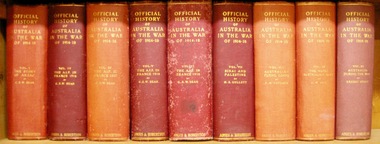
Book, Official History of Australia in the War of 1914-18 - Volume VI - The AIF in France 1918 Author C.E.W. Bean. The AIF in France May 1918- the Armistice, Published 1942
... 1918...monash succeeds...battle of hamel...amiens...armistice...peace...An account of the conclusion of the first world war with Germany being defeated and surrendering. german surrender battle of aisne 1918 monash succeeds battle of hamel amiens armistice peace treaty signed battle of montbrehain Official History of Australia in the War of 1914-18 - Volume VI - The AIF in France 1918. ...This volume deals with those months in which the first World War turned against the German Army on the western front, and shows in detail how, in the crucial Amiens sector that change was brought about. The completion of the story of the final offensive in 1918.An account of the conclusion of the first world war with Germany being defeated and surrendering.Official History of Australia in the War of 1914-18 - Volume VI - The AIF in France 1918. Hardcover cardboard. Maps, diagrams, illustrations, chronologygerman surrender, battle of aisne 1918, monash succeeds, battle of hamel, amiens, armistice, peace treaty signed, battle of montbrehain -
 City of Moorabbin Historical Society (Operating the Box Cottage Museum)
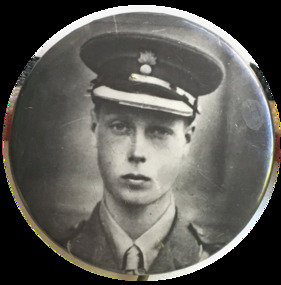
Badge - Visit of the Prince of Wales in 1920, 1954
... At the Imperial War Conference in 1917, and again at the conference of overseas Prime Ministers in 1918, King George V had foreshadowed a visit to the Dominions by his eldest son, “when peace comes”. ...At the Imperial War Conference in 1917, and again at the conference of overseas Prime Ministers in 1918, King George V had foreshadowed a visit to the Dominions by his eldest son, “when peace comes”. ...At the Imperial War Conference in 1917, and again at the conference of overseas Prime Ministers in 1918, King George V had foreshadowed a visit to the Dominions by his eldest son, “when peace comes”. At the end of the War, the King kept his pledge and, following on from successful visits to other countries, including the USA and West Indies in 1919, Edward Albert Christian George Andrew Patrick David, the Prince of Wales, embarked on a journey to Australia. The visit was in part to offer official thanks for the support Australia had shown Great Britain during World War I. It was also designed to strengthen the links between Australia and the Empire. The Prince of Wales arrived in Australia on board the HMS Renown in April 1920, having left England the previous month. He spent nine days in Victoria, eleven days in New South Wales, four days in Tasmania, eleven days in Western Australia, six days in South Australia and eight days in Queensland. In all, he visited 110 cities and towns across Australia.Metal badge with photo of Prince of Walesprince of wales, royal visit 1920, badge -
 Learmonth and District Historical Society Inc.
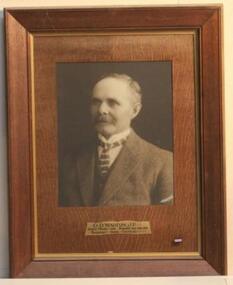
Photo -Walton, Richards & Co. Photos Ballaarat, Councilor D. Walton.J.P, "circa 1924"
... 1918 and 1924. Original Historic Photo. ballarat shire council justice of the peace walton d 1906 1924 Councilor D.Walton,J.P. ...Councilor D.Walton. J.P. was elected as a member of council in 1906 until 1924. He was nominated for three terms as President in 1912, 1918 and 1924.Original Historic Photo.Sepia photo,rectangular, of Councilor D.Walton,J.P.It is set in a wide dark frame with gold coloured inner edge. the mount is brown woodgrain finish.Councilor D.Walton,J.P.ballarat shire council, justice of the peace, walton d, 1906 1924 -
Glenelg Shire Council Cultural Collection
Book - Bible, Cambridge University Press, New Testament, c. 1916
... 'NEW TESTAMENT SOUVENIR OF PEACE WORLD WIDE WAR 1914 - 1918'...'NEW TESTAMENT SOUVENIR OF PEACE WORLD WIDE WAR 1914 - 1918' New Testament Book Bible Cambridge University Press ...New Testament, olive hardcover. Black print and wreath on front cover. 'NEW TESTAMENT SOUVENIR OF PEACE WORLD WIDE WAR 1914 - 1918' -
 Ringwood and District Historical Society
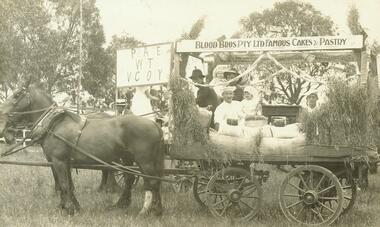
Photograph, Blood Bros wagon on Ringwood Oval for 1914-18 victory celebration, 1918
... 1918 victory celebrations on Ringwood oval. Oval now site of Eastland. 1. Right hand side 'Roy Blood' father of Thelma Wileman (Blood). 2. Probably Arthur Blood holding his only daghter Edith (later Edith Gluth) at back of photo. 3. Arthur Knee (driver). 4. Jim Skerrett (facing with little girl or boy, if a boy then could be Bob). Black and white photographs of people sitting on horse drawn wagon. (2 copies, 1 Postcard size, 1 larger copy.) Signs on Wagon: "Peace ...Black and white photographs of people sitting on horse drawn wagon. (2 copies, 1 Postcard size, 1 larger copy.) Signs on Wagon: "Peace with Victory", "Blood Bros Pty Ltd Famous Cakes & Pastry"Written on back of postcard copy: "Arthur Knee (driver), Arthur Blood, Edith (Mrs Gluth), Roy Blood (pastrycook), Jim Skerrett & Bob. Written on rear of backing sheet of large copy: "At 1918 victory celebrations on Ringwood oval. Oval now site of Eastland. 1. Right hand side 'Roy Blood' father of Thelma Wileman (Blood). 2. Probably Arthur Blood holding his only daghter Edith (later Edith Gluth) at back of photo. 3. Arthur Knee (driver). 4. Jim Skerrett (facing with little girl or boy, if a boy then could be Bob). -
 Eltham District Historical Society Inc
Document - Folio, Stanley Simpson Addison 14 Oct. 1880 – 1 Jan. 1972, 1880-1972
... 1918 • Presented by the Joint Committee of the British Red Cross and the Order of St John of Jerusalem in England to Mr Stanley S. Addison in recognition of valuable services rendered during the War, 1914 - 1919 • George the Fifth; Grant of the dignity of a Member of the Civil Division of the Order of the British Empire to Stanley Addison, Esq., 15 October 1920 • Appointment of Stanley Simpson Addison as one of His Majesty’s Justices of the Peace, Crown Law Offices, Melbourne, 9 April 1923 • Credential issued to Mr. ...1918 • Presented by the Joint Committee of the British Red Cross and the Order of St John of Jerusalem in England to Mr Stanley S. Addison in recognition of valuable services rendered during the War, 1914 - 1919 • George the Fifth; Grant of the dignity of a Member of the Civil Division of the Order of the British Empire to Stanley Addison, Esq., 15 October 1920 • Appointment of Stanley Simpson Addison as one of His Majesty’s Justices of the Peace, Crown Law Offices, Melbourne, 9 April 1923 • Credential issued to Mr. ...Contents: • Compulsory Certificate, Education Department, South Australia, Stanley Simpson Addison of Aldinga School, Reg. No. 149, 11 October 1893 • Composition Book, Stanley Simpson Addison, 1894 • Stanley Simpson Addison admitted to the Degree of Bachelor of Science in The University of Adelaide, 16 December 1908 • Appointment of Mr Stanley Simpson Addison as Sub Lieutenant in the Royal Navy Volunteer Reserve, 16 March 1918 • Presented by the Joint Committee of the British Red Cross and the Order of St John of Jerusalem in England to Mr Stanley S. Addison in recognition of valuable services rendered during the War, 1914 - 1919 • George the Fifth; Grant of the dignity of a Member of the Civil Division of the Order of the British Empire to Stanley Addison, Esq., 15 October 1920 • Appointment of Stanley Simpson Addison as one of His Majesty’s Justices of the Peace, Crown Law Offices, Melbourne, 9 April 1923 • Credential issued to Mr. Stanley S. Addison MBE, BSc, JP upon proceeding on a visit to Europe, Premiers Office, Melbourne, 8 January 1929 • Stanley Simpson Addison, Matriculation Certificate, University of Melbourne, 3 October 1934 • Stanley Simpson Addison admitted to the Degree of Bachelor of Arts in the University of Melbourne, 4 April 1936 • Appointment by the Solicitor-General of S.S. Addison as a Commissioner for Declarations under the Statutory Declarations Act 1911-1922, Canberra 14 November 1940 • Australian Red Cross Society Certificate of Service awarded to Mr Stanley S. Addison in recognition of faithful service rendered to the Australian Red Cross during the World War of 1939-1945 • Coronation Medal: E II R, Buckingham Palace, By Command of HER MAJESTY THE QUEEN the accompanying Medal is forwarded to Councillor Stanley Simpson Addison to be worn in commemoration of Her Majesty’s Coronation, 2nd June, 1953 [Medal not included] • Birth Certificate, Stanly Simpson Addison, 14 October 1880, Willunga, South Australia • Marriage Certificate; Stanley Simpson Addison and Minnie Vera Elizabeth Staley, Parish of Christ Church, Brondesbury, Middlesex, England, 8 January 1917 • Copy of Eulogy given by Sir John Nimmo at Stanley Addison’s funeral service, January 1972 (see 04605-2-3) stanley simpson addison -
 Eltham District Historical Society Inc
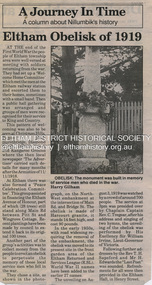
Folder, Eltham Obelisk (later Cenotaph), 1918-2018
... Handwritten notes in pencil (2 pages) by Harry Gilham, Items form the Eltham and Whittlesea Shires The Advertiser newspaper 7 June 1918 - 1919 providing a summary of the formation of the Peace Celebration Committee leading to the establishment of the Avenue of Honour and the Eltham Obelisk and seeking information in lead up to WW1 Centenary, 2013 45. ...Handwritten notes in pencil (2 pages) by Harry Gilham, Items form the Eltham and Whittlesea Shires The Advertiser newspaper 7 June 1918 - 1919 providing a summary of the formation of the Peace Celebration Committee leading to the establishment of the Avenue of Honour and the Eltham Obelisk Newspaper article: Obelisk honors their memory, Diamond Valley News, March 30, 1971, p11...Handwritten notes in pencil (2 pages) by Harry Gilham, Items form the Eltham and Whittlesea Shires The Advertiser newspaper 7 June 1918 - 1919 providing a summary of the formation of the Peace Celebration Committee leading to the establishment of the Avenue of Honour and the Eltham Obelisk and seeking information in lead up to WW1 Centenary, 2013 45. ...The Eltham Obelisk was originally located at the corner of Bridge and Main Roads in 1919. It commemorated the memory of the Eltham Soldiers who fell in the First World War and complemented the Eltham Avenue of Honour established in 1917 to those that served. In 1943 (WW2) the local community commenced plans to establish the Eltham War Memorial, a living memorial to benefit the children as opposed to a one in stone as per the obelisk. The Eltham War Memorial Trust was established in 1945. In 1947 the Trust intended for the Obelisk to be relocated from Bridge Street and Main Road to the Garden of Remembrance which was planned as part of the Baby Health Centre which was to be the first of three buildings of the Eltham War Memorial to be built in 1951. In 1951 the Eltham RSL was invited to be represented on the Eltham War Memorial Trust. During the period of June through October 1956 the original wooden bridge over the Diamond Creek in Bridge Street was replaced with a new concrete structure. At the same time the intersection of Bridge Street at Main Road was revised necessitating the relocation of the Eltham Obelisk. It was ‘temporarily’ relocated to the front garden of the Eltham RSL Sub-Branch on Main Road for safe keeping. In 2007, a suggestion was proposed by Harry Gilham (President, EDHS) to John Cohen (ERSL) to claim a special site along with the historic Shillinglaw trees on the now vacant former Eltham Shire Office site adjacent to the Eltham War Memorial precinct for relocation of the obelisk. In 2010 following the financial collapse and sale of the Eltham RSL Sub-Branch property and amalgamation with the Montmorency Eltham RSL sub-branch, the location of the obelisk was again in immediate jeopardy and in conjunction with Nillumbik Shire Council, supported by the RSL, the obelisk was relocated in front of the Eltham War Memorial buildings in preparation for the Dawn Service on Anzac Day 2012. The new location resulted in significant impact upon the Eltham War Memorial Garden. Council’s preferred location was near the Eltham Library however that would have cost $39,000. The Eltham War Memorial Garden was subjected to further intrusion in 2014 with a proposed expansion of the War Memorial Terrace. Contents: 1. Newspaper article: Eltham, The Advertiser, 15 Nov 1918 2. Newspaper article: Eltham, The Advertiser, 18 Nov 1918 3. Newspaper article: An Obelisk at Eltham, The Advertiser, 11 Jul 1919 4. Newspaper advertisement: Unveiling of Obelisk at Eltham, The Advertiser, 1 Aug 1919 5. Newspaper article: Eltham Soldiers’ Memorial; Unveiled by Sir William Irvine, The Argus, Monday, 4 Aug 1919, p8 6. Newspaper article: Memorial to the Fallen; Unveiled at Eltham, The Age, Monday, 4th August 1919 7. Newspaper article: Eltham Memorial to Fallen Soldiers, Diamond Creek Valley Advocate, 8 Aug 1919 8. Newspaper article: Programme - Presentation of German Machine Gun at the Obelisk, Eltham on Sunday, 8th August 1920, at 3.30 P.M. 9. Newspaper article: article about presentation of a war trophy, a heavy machine gun placed beside obelisk, The Advertiser, 13 Aug 1920 10. Newspaper article: Eltham: ANZAC Services, The Advertiser, Friday, May 2, 1924 11. Newspaper article: Eltham War Memorial, The Advertiser, Oct 26, 1928 12. Newspaper article: Obelisk honors their memory, Diamond Valley News, March 30, 1971, p11 13. Newspaper article: Eltham Obelisk of 1919, Harry Gilham, August 2000 as well as draft submitted dated 22 Aug 2000 14. Newspaper article: Names renewal, thanks to Barry, Diamond Valley Leader, 18 Apr 2007, p3 with picture featuring Eltham RSL president John Haines and Gwen Rosewall 15. Handwritten note from Harry Gilham (President EDHS) to John Cohen (ERSL) regarding history of Eltham RSL site and 1947 newspaper article "Eltham War Memorial Trust "Garden of Remembrance" referencing relocation of Obelisk to the proposed Garden of Remembrance at the Baby Health Centre (Eltham War Memorial), 24 December 2000. 16. Minutes of Eltham RSL and Community Meeting held at 29 Nyora Road, Eltham, 23 June 2010 (Community meeting re closure of Eltham RSL sub-branch and relocation of the WW1 Obelisk) 17. Newspaper article: RSL branch has a fight on its hands by Alana Schetzer, Heidelberg & Valley Weekly, 3 August 2010, p7 18. Newspaper article: Locals battle state RSL over building, Diamond Valley Leader, 4 August 2010, p7 19. Newspaper article: Move war memorial: RSL, c. Dec. 2010 20. Officers' reports, 11.113/10 Relocation of Eltham RSL Cenotaph, Nillumbik Shire Council Ordinary Meeting, 21 December 2010 21. Newspaper article: New home for cenotaph; Councillors support proposal for relocation to Eltham's War Memorial Hall, Diamond Valley Leader, 12 January 2011 22. Newspaper article: CFA hot for RSL site; MP presses for 'fast-track' purchase, Diamond Valley Leader, 23 February 2011, p1 23. Email Correspondence: EDHS President to NSC General Manager Community and Leisure re RSL Obelisk (Cenotaph) proposed relocation, 24 May 2011 24. Officers' reports, OCM.091/11 Interim Relocation site for the Eltham Cenotaph, Nillumbik Shire Council Ordinary Meeting, 23 August 2011 25. Newspaper article: New home for cenotaph delights war veterans, Diamond Valley Leader, 31 August 2011, p9 26. Newsletter Extract: Eltham RSL and War Memorial, EDHS Newsletter 14 Sep 2011 27. Officers' reports, OCM.004/121 Interim Relocation of the Eltham Cenotaph, Nillumbik Shire Council Ordinary Meeting, 31 January 2012 (includes Funding agreement between NSC and Montmorency-Eltham RSL Sub-branch Inc) 28. Newspaper article: Memorial move lags, Diamond Valley Leader, 1 February 2012 29. Site history of Obelisk and Wall Memorial Hall, Montmorency-Eltham RSL, March 2012 draft 30. Open Letter to the Residents of ELTHAM and MONTMORENCY [And their Surrounding Districts]; Montmorency-Eltham RSL, 19 March 2012 (including drafts) 31. Newspaper advertisement: Open letter to the residents of Eltham and Montmorency, Montmorency Eltham RSL, Diamond Valley News, 21 March 2012 32. Newspaper advertisement: Open letter to the residents of Eltham and Montmorency, Montmorency Eltham RSL, Banyule & Nillumbik Weekly, 27 March 2012, p7 33. Newspaper article: New dawn for tribute, Diamond Valley Leader ca April 2012 34. Email (Copy): Alex Smith (MERSL Ast. Sec.) advising that contractor (Malcorp) will relocate obelisk Monday, April 2, 2012 35. Newspaper article: Memorial Moved, Banyule/Nillumbik Weekly, 10 April 2012 36. Newspaper article: Eltham cenotaph move goes 'like clockwork', Diamond Valley Leader, 11 April 2012 37. Newspaper photo: Veterans (l-r) Alan Field, Max Lowerson and John Cohen will join piper David Cretney to commemorate fallen Diggers, 2012 (standing beside relocated obelisk in front of the Eltham War Memorial complex), c. 11 April 2012 38. Advertisement, Program for Eltham Dawn Service, Diamond Valley Leader, April 2012 39. Program for Montmorency Anzac Day March 2012 (incomplete, some pages duplicated, some pages upside down). 40. Newspaper article: RSL site nets $1.8m, Diamond Valley Leader, 9 May 2012 41. OCM.076/13 Amendment C84 Eltham Cenotaph; 11. Officer's reports, Ordinary Meeting of Council Agenda, 25 June 2013, pp42-44 and Attachment; Amendment C84 Eltham Cenotaph; Citation - Eltham War Memorial (4 pages) 42. Newspaper article: Council seeks to protect cenotaph, Diamond Valley Leader, Wednesday, July 3, 2013, p5 43. Newspaper article: Future safe for war memorial, Diamond Valley Leader, Wednesday, November 13, 2013, p5 44. Handwritten notes in pencil (2 pages) by Harry Gilham, Items form the Eltham and Whittlesea Shires The Advertiser newspaper 7 June 1918 - 1919 providing a summary of the formation of the Peace Celebration Committee leading to the establishment of the Avenue of Honour and the Eltham Obelisk and seeking information in lead up to WW1 Centenary, 2013 45. Newspaper article: Memories of our heroes, Diamond Valley Leader, 25 Apr 2018 – also Veteran saluted, featuring article on Army veteran, Glen Ferrarotto. Contents: Newspaper article: Eltham Obelisk of 1919, Harry Gilham, August 2000 as well as draft submitted dated 22 Aug 2000 Newspaper article: Eltham, The Advertiser 15 Nov 1918 and 18 Nov 1918 Newspaper article: An Obelisk at Eltham, The Advertiser, 11 Jul 1919 Newspaper advertisement: Unveiling of Obelisk at Eltham, The Advertiser, 1 Aug 1919 Newspaper article: Eltham Soldiers’ Memorial; Unveiled by Sir William Irvine, The Argus, Monday, 4 Aug 1919, p8 Newspaper article: Eltham Memorial to Fallen Soldiers, Diamond Creek Valley Advocate, 8 Aug 1919 Newspaper article: Memorial to the Fallen; Unveiled at Eltham, The Age, Monday, 4th August 1919 Newspaper article: Programme - Presentation of German Machine Gun at the Obelisk, Eltham on Sunday, 8th August, 1920, at 3.30 P.M. Newspaper article: article about presentation of a war trophy, a heavy machine gun placed beside obelisk, The Advertiser, 13 Aug 1920 Newspaper article: Eltham: ANZAC Services, The Advertiser, Friday, May 2, 1924 Newspaper article: Eltham War Memorial, The Advertiser, Oct 26, 1928 Handwritten note from Harry Gilham (President EDHS) to John Cohen (ERSL) regarding history of Eltham RSL site and 1947 newspaper article "Eltham War Memorial Trust "Garden of Remembrance" referencing relocation of Obelisk to the proposed Garden of Remembrance at the Baby Health Centre (Eltham War Memorial). Officers' reports, 11.113/10 Relocation of Eltham RSL Cenotaph, Nillumbik Shire Council Ordinary Meeting, 21 December 2010 Email Correspondence: EDHS President to NSC General Manager Community and Leisure re RSL Obelisk (Cenotaph) proposed relocation, 24 May 2011 Newsletter Extract: Eltham RSL and War Memorial, EDHS Newsletter 14 Sep 2011 Officers' reports, OCM.091/11 Interim Relocation site for the Eltham Cenotaph, Nillumbik Shire Council Ordinary Meeting, 23 August 2011 Officers' reports, OCM.004/121 Interim Relocation of the Eltham Cenotaph, Nillumbik Shire Council Ordinary Meeting, 31 January 2012 (includes Funding agreement between NSC and Montmorency-Eltham RSL Sub-branch Inc) Newspaper article: Move war memorial: RSL, c.2011 Newspaper article: Memorial move lags, Diamond Valley Leader, 1 February 2012 Newspaper article: New dawn for tribute, Diamond Valley Leader ca April 2012 Open letter to the residents of Eltham and Montmorency and copies of drafts by the Montmorency Eltham RSL, no date and final version published in Diamond Valley New 21 March 2012 and Banyule & Nillumbik Weekly, 27 March, 2012 Newspaper article: RSL site nets $1.8m, Diamond Valley Leader, 9 May 2012 Newspaper article: Memorial Moved, Banyule/Nillumbik Weekly, 10 April 2012 Newspaper article: Eltham cenotaph move goes 'like clockwork', Diamond Valley Leader, 11 April 2012 Advertisement, Program for Eltham Dawn Service, Diamond Valley Leader, April 2012 Newspaper photo: Veterans (l-r) Alan Field, Max Lowerson and John Cohen will join piper David Cretney to commemorate fallen Diggers, 2012 (standing beside relocated obelisk in front of the Eltham War Memorial complex) Program for Montmorency Anzac Day March 2012 (incomplete, some pages duplicated, some pages upside down). Newspaper article: Plan to expand memorial, Diamond Valley Leader, Sep. 2004, p5 Newspaper article: Names renewal, thanks to Barry, Diamond Valley Leader, 18 Apr 2007, p3 with picture featuring Eltham RSL president John Haines and Gwen Rosewall Letter: EDHS President to Manager Community Participation, Learning and Culture, Nillumbik Shire Council regarding a proposal by the Montmorency-Eltham RSL Sub-branch to expand the area occupied by the relocated obelisk further into the Eltham War Memorial Garden of Remembrance, 18 Aug 2014 Notices of Motion, NOM.001/14 pertaining to memorials Advisory Committee and Montmorency-Eltham RSL to upgrade the Eltham War Memorial site in time for ANZAC Day 2015, Nillumbik Shire Council Ordinary Meeting, 26 August 2014 Agenda: User Groups and Stakeholders Meeting, Proposed Extension to Memorial Terrace, 11 September 2014 EDHS presentation to NSC Policy and Services meeting 9 September 2014 regarding the Montmorency-Eltham RSL proposal to expand/upgrade the Eltham War Memorial Policy and Services reports, PSD.034/14 Eltham War Memorial Building Precinct - Proposed Extension to Memorial Terrace, Nillumbik Shire Council Ordinary Meeting, 9 September 2014 Email (copy): President EDHS re Eltham War Memorial Complex, Main Road, Eltham, 15 Sep 2014 requesting Nillumbik Shire Council place a Heritage Overlay upon the Eltham War Memorial Complex Media Release: Support for cenotaph expansion, Nillumbik Shire Council, Sep 2014 Newspaper article: Council defers RSL war memorial upgrade to see consultation, Diamond Valley News, 17 Sep 2014 Letter (copy): Harry Gilham, Eltham to local press and others, 20 Sep 2014 protesting attempts by the RSL to further expand upon the area already ceded from the Eltham War Memorial for the relocated WW1 obelisk and alter the original vision for an Eltham War Memorial complex. Letter: Alan Field, President, The Eltham Veterans War Memorial Preservation Society Inc. to CEO and Councillors, Nillumbik Shire Council protesting at perceived injustices and ‘veteran bashing’ regarding their previous efforts to relocate ‘their Obelisk and Cenotaph’ to the Eltham War Memorial complex and their frustration in their attempts to further expand upon the Memorial Terrace. Areas of letter are highlighted with handwritten markups and notes. Also notes on loose card and paper with definitions of Memorial, Obelisk, Cenotaph, commentary on establishment of Eltham War Memorial, The Eltham War Memorial Trust and RSL involvement and current actions by RSL in respect to claims in the letter (written by Harry Gilham ?). Policy and Services reports, PS.038/14 Eltham War Memorial Building Precinct - proposed extension to the Eltham Cenotaph Terrace, Nillumbik Shire Council Policy and Services Committee Meeting, 14 October 2014 Newspaper article: Centenary dawn service moves to Petrie Park, Diamond Valley Leader, 22 Oct 2014 Newspaper article: Upset over upgrade; war memorial revamp plans get culled, Diamond Valley Leader, 29 Oct 2014 Newspaper article: Memories of our heroes, Diamond Valley Leader, 25 Apr 2018 – also Veteran saluted, featuring article on Army veteran, Glen Ferrarotto. Handwritten notes in pencil (2 pages) by Harry Gilham, Items form the Eltham and Whittlesea Shires The Advertiser newspaper 7 June 1918 - 1919 providing a summary of the formation of the Peace Celebration Committee leading to the establishment of the Avenue of Honour and the Eltham Obelisk Newspaper article: Obelisk honors their memory, Diamond Valley News, March 30, 1971, p11eltham cenotaph, nillumbik shire council, eltham war memorial, montmorency eltham rsl sub-branch, dawn service, cenotaph, eltham rsl sub-branch, eltham war memorial trust, garden of remembrance, harry gilham collection, john cohen, obelisk, remembrance garden, shillinglaw trees, german machine gun, war memorial, war trophy -
 Eltham District Historical Society Inc
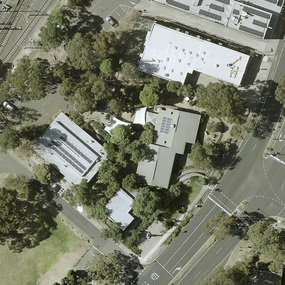
Archive Box, Eltham War Memorial
... Handwritten notes in pencil (2 pages) by Harry Gilham, Items form the Eltham and Whittlesea Shires The Advertiser newspaper 7 June 1918 - 1919 providing a summary of the formation of the Peace Celebration Committee leading to the establishment of the Avenue of Honour and the Eltham Obelisk and seeking information in lead up to WW1 Centenary, 2013 45. ...Handwritten notes in pencil (2 pages) by Harry Gilham, Items form the Eltham and Whittlesea Shires The Advertiser newspaper 7 June 1918 - 1919 providing a summary of the formation of the Peace Celebration Committee leading to the establishment of the Avenue of Honour and the Eltham Obelisk and seeking information in lead up to WW1 Centenary, 2013 45. ...CONTENTS: BOX 1 04585-1 04585 History • 04585-1-1 An Outline History of the Eltham War Memorial Trust by Stanley S. Addison • 04585-1-2 Stanly Addison's notes for his Outline History of the Eltham War Memorial Trust • 04585-1-3-1 Newspaper article: Eltham War Memorial Trust: Ready Now for Forward Movement; Acknowledgements £722; publication unknown, c.1946 • 04585-1-3-2 Newspaper article: Eltham War Memorial Trust: "Garden of Remembrance"; Baby Health Centre First Building, The News: The Newspaper of the City of Heidelberg and of the Shire of Eltham, 11 April 1947 • 04585-1-3-3 Newspaper: The News: The Newspaper of the City of Heidelberg and of the Shire of Eltham; Friday, December 1, 1950 • 04585-1-3-4 Newspaper article: Eltham War Memorial Trust by Stanley Addison, 1953 • 04585-1-3-5 Newspaper article: War Memorial Trust (publication unknown, n.d.) • 04581-1-4 Folder: A brief history of the Eltham War Memorial and Eltham Library, Harry Gilham, 1997-1999 • 04585-1-5 Newspaper article: Eltham's War Memorial; A Journey in Time, Nillumbik Mail, 5 July c.2001 04585-2 Eltham War Memorial Trust Minutes • 04585-2-1 Eltham War Memorial Trust Minutes, Book No. 2, 20 March 1951 to 4 June 1957 • 04585-2-2 Minute Book: Eltham War Memorial Trust Minutes, 2 July 1957 to 12 November 1973 BOX 2 04585-3 Women's Auxiliary, Eltham War Memorial Trust • 04585-3-1-1 Minute Book: Minute Book No. 1, Women's Auxiliary, Eltham War Memorial Trust, 10 May 1946 to 10 April 1952 • 04585-3-1-2 Minute Book: Minute Book No. 2, Women's Auxiliary, Eltham War Memorial Trust, 12 June 1952 to 14 June 1956 • 04585-3-1-3 Minute Book: Minute Book No. 3, Women's Auxiliary, Eltham War Memorial Trust, 12 July 1957 to 14 May 1959 • 04585-3-1-4 Minute Book: Minute Book No. 4, Women's Auxiliary, Eltham War Memorial Trust, 14 May 1959 to 12 August 1965 • 04585-3-2 Book: A favourite book of country recipes / compiled by the Women's Auxiliary of the Eltham War Memorial Trust 04585-4 04591 Eltham Easter Show and Gymkhana • 04585-4-1 Minute Book: Eltham War Memorial Trust; Easter Gymkhana Committee Minutes, 19 Nov 1954-6 Jun 1958 • 04585-4-2 Folder: Eltham War Memorial Trust; Easter Gymkhana Committee Correspondence, 19 Nov 1954-6 Jun 1958 o 04585-4-2-1 Notice from Honorary Treasurer of Easter Gymkhana Committee regarding completion of 1954 event and expression of thanks and that committee is now going into recess prior to commencement of planning for 1955 o 04585-4-2-2 Notice of Easter Gymkhana Committee Meeting, Monday 24th October, 1955 at the Shire Hall, Eltham o 04585-4-2-3 Letter from B.T. Taylor, Hon. Secretary, Eltham Easter Show Committee regarding the sale of tickets (c.1957) o 04585-4-2-4 Letter from B.T. Taylor, President, Eltham Easter Show Committee to Georges Ltd regarding the supply of The Georges Cup for the Eltham Easter Show, 11 April 1958 o 04585-4-2-5 Letter from Georges Ltd to B.T. Taylor, President, Eltham Easter Show Committee with payment for the miniatures of The Georges Cup, 6 June 1958 o 04585-4-2-6 Letter from Eltham Shire Secretary to B.T. Taylor, President, Eltham Easter Show Committee advising of new process regarding raffle, 5 May 1958 o 04585-4-2-7 Letter from Lilian Heath, Secretary, Judge Book Village Auxiliary to B.T. Taylor, Eltham Easter Show Committee, 24 May 1958 o 04585-4-2-8 Letter from Mrs R.J. Godfrey on behalf of M.A. Godfrey of Dandenong to B.T. Taylor, President, Eltham Easter Show under threat of legal action requesting replacement of cheque for £10 (second prize Open Jumping Contest), which was lost, 24 May 1958 o 04585-4-2-9 Reply by B.T. Taylor, President, Eltham Easter Show Committee to Mrs R.J. Godfrey to her letter of 24 May explaining circumstances and denying responsibility to forward a replacement cheque as it was cashed at the Golf Club Hotel; 6 June 1958 • 04585-4-3 Folder: Easter Gymkhana Committee Minutes and other associated ephemera o 04585-4-3-1 Letter: Letter of donation to Shire of Eltham Historical Society of the Easter Gymkhana Committee Minutes and other associated ephemera, J.M. Peter Bassett-Smith, 31 October 1987 o 04585-4-3-2 Souvenir Program: Free Program; Eltham Easter Gymkhana and Light Horse Show also Dog Competition, Easter Saturday 9th April, 1955 at Eltham (Lower) Park o 04585-4-3-3 Program Schedule; Eltham Easter Gymkhana and Light Horse Show also Dog Competition, Easter Saturday 9th April, 1955 at Eltham (Lower) Park o 04585-4-3-4 Program; Monster Gymkhana in aid of Hurstbridge Hall Re-Building Fund, Hurstbridge Recreation Reserve, Sunday, September 18, 1955 o 04585-4-3-5 Record Crowd Came To Eltham Gymkhana, Sporting World, Diamond Valley Local, Thursday, April 14, 1955, p8 o 04585-4-3-6 Program; Eltham Easter Gymkhana Goat Show Schedule, Easter Saturday 31st March, 1956, Eltham Park o 04585-4-3-7 Official Program; Eltham Easter Horse Show and Goat Show, Easter Saturday April 20th, 1957, Eltham Park o 04585-4-3-8 Program Schedule; Eltham Easter Horse Show and Goat Show, Easter Saturday April 20th, 1957, Eltham Park o 04585-4-3-9 Young Rider to Judge at Show, The Age, Wednesday, April 17, 1957, p8 o 04585-4-3-10 Promotional window label, Eltham Gymkhana, Easter Saturday, 20 April 1957 o 04585-4-3-11 Entry form for the Skyline Drive-In “Soap-Box” Derby, to be held along Main Road between Panorama Avenue and Bolton Street, Easter Saturday, 20 April 1957 o 04585-4-3-12 Official Program; Eltham Easter Horse Show and Goat Show, Easter Saturday, 5th April, 1958, Eltham Park o 04585-4-3-13 Brief history of the Eltham War Memorial Trust and Women's Auxiliary, Peter Bassett-Smith, 1987 o 04585-4-3-14 Summary of the Eltham War Memorial Trust Easter Gymkhana Committee Minutes (1954-1956) 04585-5 Folder: Infant Welfare Centre (1952) 04585-5-1 Newspaper article: Eltham: “Memorial Baby Health Centre Opening”; District News, The News, 14 November 1952. (Single sheet newsprint printed one side with District News for Macleod, Kinglake, Watsonia, Wattle Glen, Diamond Creek, Panton Hill, Eltham North, Lower Plenty, Research, Eltham. On reverse in handwritten purple pencil to the President, somewhat indecipherable, about an item to be hung on the walls of the beautiful building.) • 04585-5-2 Eltham War Memorial Trust, Official Opening - Baby Health Centre, 15th November 1952; Timetable of proceedings (1 page handwritten) • 04585-5-3 Eltham Baby Health Centre; Official Opening - Baby Health Centre: Address by President, 15 November 1952 (9 pages handwritten) • 04585-5-4 Newspaper article: Infant Welfare Centre as War Memorial, 15 November 1952 • 04585-5-5 Souvenir Booklet: Eltham War Memorial Trust, 1954 • 04585-5-6 Eltham War Memorial: Address by Mrs Stanley Addison at the Annual Meeting of the Infant Welfare Centre, Thursday 21st October, 1965 (4 pages typed, carbon copy) 04585-6 Roll of Honour Board (1954), Eltham War Memorial 04585-7 Eltham Pre-School (1956), Eltham War Memorial • 04585-7-1 Newspaper article: Minister to open Eltham Pre-school Tomorrow • 04585-7-2 Program; Eltham War Memorial Trust: Opening of the Second Unit of the War memorial, The Pre-school Centre, on Saturday, December 1st, 1956 at 3 p.m. • 04585-7-3 Folder: Eltham Pre-School (1956) Papers donated by Gordon Pearce, 30 Apr 2021 pertaining to Eltham Pre-school and Eltham War Memorial Trust. Gordon was a former President of the Eltham Pre-school at the time the Eltham War Memorial Trust was disbanded by Eltham Shire Council in December 1973. o Articles of the Eltham War Memorial Trust (9 A3 photocopies of original foolscap pages) o President’s Report: Eltham War Memorial Trust, Committee of Management, Dec. 1973 in which it was advised that the Committee was to be disbanded. o Letter: Gordon J.J. Pearce, President Eltham Pre-school to C.J. Bock, Chief Administrative Officer, Shire of Eltham, 21 Nov 1973 expressing disappointment at the Shire wanting to disband the Committee of Management of the Eltham War Memorial Trust o Minutes: Eltham Pre-school Committee, 26 Nov 1973 o Minutes: Eltham Pre-school Committee, 17 Dec 1973 o President’s Report: Gordon Pearce, Eltham Pre-school, 4 Feb 1974 • 04585-7-4 Newspaper clipping: A humble beginning, Diamond Valley Leader, July 26, 2006, p35 04585-8 Children’s Library (1961) / Eltham War Memorial Hall (1966) • 04585-8-1 Letter: Hon. Secretary Eltham Shire Council inviting Lieut-General The Honourable Sir Edmund Herring to attend the opening of the Children's Library. 23 Aug. 1961 • 04585-8-2 Newspaper article: Third unit of Eltham's memorial opened; Diamond Valley News, 14 Nov 1961 (Ref: SEA_74_001-055) • 04585-8-3-1 Receipt to Eltham Historical Society for hire of Eltham War Memorial Hall, 23 June 1970 • 04585-8-3-2 Receipt to Eltham Historical Society for hire of Eltham War Memorial Hall, 6 July 1970 • 04585-8-4 A brief history of the Eltham Library, Harry Gilham, c.1994 04585-9 Eltham Enlistments for the Second World War 04585-1964 • Document: Photocopy of Certificate of Title, Eltham War Memorial Trust, Lot 2, Plan of Subdivision No. 63242, Parish of Nillumbik; derived from Vol. 7073 Fol. 498, 18 May 1964 04585-1996 (Eltham Town Focus Group) Documents relating to a focus group brought together by the Shire of Nillumbik Chairman of Commissioners in 1996 to provide advice on the best long term use for the buildings and land situated between the former Eltham Shire Offices and Country Fire Authority buildings. These buildings are known as the Eltham War Memorial buildings located at 903-907 Main Road, Eltham. In May 2020, the Heritage Council Victoria did not recommend the site for inclusion in the Victorian Heritage Register. Potential impact upon the Memorial Garden because of a proposed roundabout at Dudley Street and Main Road • Notes concerning impact upon Eltham War Memorial Garden of a proposed roundabout at Dudley Street, Eltham, 20 August 1996 • Draft proposal of a roundabout at Dudley Street and Main Road showing impact upon Eltham War Memorial Garden, c. Sep. 1996 • Letter (copy): Harry Gilham, President, EDHS to Bruce Ruxton, President, Victorian RSL concerning impact upon Eltham War Memorial Garden of a proposed roundabout at Dudley Street, Eltham, 1 September 1996 • Letter: Bruce Ruxton, President, Victorian RSL to Harry Gilham, President, EDHS, 20 Sep 1996 concerning impact upon Eltham War Memorial Garden of a proposed roundabout at Dudley Street, Eltham, including copy of communication with Eltham RSL (T. Beaton, Hon Sec.) of 10 Sep 1996 • Letter: EDHS (H. Gilham, President) to Commissioners, Nillumbik Shire Council, 16 Sep 1996 advising not in support of roundabout at Dudley Street due to impact upon Eltham War Memorial Garden • Photocopy: Editorial comment, Peter Doughterty, ArtStreams Dec 1996/Jan 1997 re Commissioners push for development in activity zone of former office site and Eltham War Memorial (see EDHS_04362) • Letter: Don Cordell, Chairman of Commissioners, Nillumbik Shire Council, 10 Dec. 1996 inviting Harry Gilham to join a Focus Group to advise him, chaired by Alan Field. Includes a list of focus group members and contact details. • Minutes of Meeting, Eltham Town Focus Group, 17 Dec. 1996 04585-1997 (Eltham Town Focus Group) Documents relating to a focus group brought together by the Shire of Nillumbik Chairman of Commissioners in 1996 to provide advice on the best long term use for the buildings and land situated between the former Eltham Shire Offices and Country Fire Authority buildings. These buildings are known as the Eltham War Memorial buildings located at 903-907 Main Road, Eltham. In May 2020, the Heritage Council Victoria did not recommend the site for inclusion in the Victorian Heritage Register. Investigating condition of and future use of the Eltham War Memorial Complex and redevelopment of the site • Letter: Alan Field to Harry Gilham. 8 Jan. 1997 advising date of 18 Jan. for next meeting of Eltham Town Focus Group • Minutes of Meeting, Eltham Town Focus Group, 18 Jan. 1997 with handwritten notes by Harry Gilham • Draft Report: A Community Vision for “The Eltham War Memorial Trust” Property, Main Road, Eltham, prepared at the request of Chief Commissioner, Don Cordell, 31 Jan. 1997, along with handwritten nots by Ross McDonald and accompanying note by Harry Gilham written in 2010 upon handover of EDHS presidency 04585-2000 • Notes used by Harry Gilham at Nillumbik Council Meeting of 21 March 2000 regarding proposed sale/development of the Eltham War Memorial property 04585-2004 Material covers Eltham Major Activity Structure Plan and a proposal by Council to sell the Eltham War Memorial site for commercial use • Eltham Major Activity Structure Plan Comments Sheet; Response by Harry Gilham, 22 June 2004 • Letter from Eric Mack to the Hon. Steve Herbert, Member for Eltham regarding draft Major Activity Centre Structure Plan, 22 June 2004 • Newspaper article: Protect war memorial, Harry Gilham, President, Eltham District Historical Society; Letter, Diamond Valley Leader, June 30, 2004, p16 (Includes copy sent to paper 17 June) • Letter from Eric Mack to Nillumbik Shire Council CEO and Councillors regarding draft Major Activity Centre Structure Plan, 2004 • Copy of fax sent by John Cohen, OAM, JP to Diamond Valley News, re his support for the appeal for protection of the Eltham War Memorial 3 July 2004 • Newspaper article: Sell-off a betrayal of trust, Ken Eckersall; Letters, Diamond Valley Leader, 7 July 2004 • Newspaper article: Don't insult memory of fallen servicemen, John Cohen; Letters, Diamond Valley Leader, 7 July 2004 • Newspaper article: Up in arms against sell-off, Dave Crosswaite, Diamond Valley Leader, July 14, 2004, p5 • Copy of letter from John Cohen to President and Executive of the Eltham RSL regarding the Eltham War Memorial, 16 July 2004 • Reply to Eric Mack from the Hon. Steve Herbert, Member for Eltham regarding his letter of 22 June, 27 July, 2004 • Notice issued by Cr Greg Johnson of 11 August meeting by Council's Policy and Services Committee to consider a proposal to sell the Eltham War memorial and old shire office properties, 6 August 2004 • Minutes for the policy and Services Committee of Nillumbik Shire Council held Wednesday 11 August 2004 • Newspaper article: Shire plan 'sacrilegious' by Dave Crossthwaite, Diamond Valley Leader, Wednesday, August 19, 2004, p1 • Newspaper article: Our say on sale of land; Have you say, Diamond Valley Leader, August 18, 2004, p22 • Newspaper article: School hall is not ratepayers' worry; Have your Say, Diamond Valley Leader, August 18, 2004, p23 • Copy of letter sent by John Cohen, OAM, JP to the CEO, RSL Victoria requesting their opposition to sale of the Eltham War Memorial, 19 August 2004 • Newspaper article: Clash over land sale by Dave Crossthwaite, Diamond Valley Leader, August 25, 2004, p1 • Newspaper article: Mayor beset over arts agenda claim by Dave Crossthwaite, Diamond Valley Leader, August 25, 2004, p5 • Newspaper article: A lot of work has gone into shire structure plan; Letters, Diamond Valley Leader, August 25, 2004, p10 • Newspaper article: Public assets are not for sale; Letters, Diamond Valley Leader, August 25, 2004, p11 • Copy of letter sent by John Cohen, OAM, JP to Brigadier J.R. Deighton, State Secretary, Victorian RSL re his comments in Diamond Valley Leader regarding the Eltham War Memorial, 27 August 2004 • Handwritten notes prepared by Harry Gilham in preparation of presentation to Council pertaining to draft Eltham Major Activity Structure Plan, c. Sep. 2004 • Newspaper article: Don't let a dream stay hijacked; Letters, Diamond Valley Leader, September 1, 2004, p11 • Ordinary Meeting of Council Agenda, 15 September 2004, p55 with notes on vote for motion that any reference to the sale of the War Memorial be removed • Copy of letter sent by John Cohen, OAM, JP to Brigadier J.R. Deighton, State Secretary, Victorian RSL advising the War Memorial had been removed from the wider proposal of the Eltham Activity Centre, 16 September 2004 • Newspaper article: Future of memorial site on hold until poll by Caroline Gonzalez, Diamond Valley Leader, September 20, 2004 • Fax from Catherine Dale, CEO, Nillumbik Shire Council to John Cohen re Renovation and Maintenance of Victorian War Memorials, 6 October 2004 • Letter from Cr Tony Raunic, Mayor to Harry Gilham regarding Eltham Major Activity Centre Structure Plan advising the removal of any reference to sale of the War Memorial and detailed consultation to be held with stakeholders regarding the former Shire of Eltham Office site; 8 October 2004 • Letter from Barry Rosewall, President, Eltham RSL to John Cohen advising the sub-branch strongly opposes the sale of the Eltham War Memorial, 20 October 2004 • Fax from Bill Forrest, Interim CEO, Nillumbik Shire Council to John Cohen re Renovation and Maintenance of Victorian War Memorials, 8 November 2004 • Copy of letter from John Cohen to Bill Forrest, Interim CEO, Nillumbik Shire Council re Maintenance of Eltham War Memorial, November 2004 04585-2007 • News article: The spin starts here; Brian Murray, Nillumbik Ratepayers’ Association, Valley Views, Diamond Valley Leader, 13 June 2007 suggesting Council proposing to bring back Shire Offices to Eltham with potential loss of Eltham War Memorial • News article: War memorial fear-mongering; Harry Gilham, Heidelberg Valley Weekly, 26 June 2007 • News article: Consultation is no spin; John Cohen, Former Shire President, Valley Views, Diamond Valley Leader, 27 June 2007 • News article: Troops enlist for campaign by Fiona Willan, Diamond Valley Leader, 18 July 2007 04585-2010 • Newspaper article: Hall 'scruffy' - war vet, Diamond Valley Leader, 17 February 2010, p2 04585-2011 Cultural Significance Assessment • Cultural Heritage Significance Assessment; Civic Building Complex, 903-907 Main Road, Eltham, September 2011 DRAFT • Feedback to Nillumbik Shire Council by Eltham District Historical Society in response to September 2011 Draft Cultural Heritage Significance Assessment of the Eltham War Memorial Building Complex, 3 November 2011 • War Memorial Building Complex, 903-907 Main Road, Eltham: Cultural Significance Assessment, November 2011 prepared for Nillumbik Shire Council by Samantha Westbrooke Pty Ltd in association with Peter Mills PhD, Architectural Historian 04585-2014 Proposed extension to Cenotaph War Memorial Terrace championed by Montmorency-Eltham RSL and its impact upon the Memorial Garden and Eltham War Memorial buildings complex. • Draft Landscape Concept Plan by Henry Architects for Proposed Extension to Memorial Terrace, 14 July 2014 (Note: Senior Citizen’s Building correctly identified. Every subsequent plan incorrectly shows this building as the former Children’s Library, which was the War Memorial Hall building) • Letter: Eltham Gateway Action Group to Stuart Burdack, Shire of Nillumbik (undated) offering comment on Proposed Extension to Memorial Terrace with handwritten notes • Letter: Jim Connor, President, EDHS to Adrian Cully, Manager Community Participation, Learning and Culture, Nillumbik Shire Council, 18 Aug. 2014, encouraging Council not to support proposed extension to War Memorial Terrace due to significant impact upon the Eltham War Memorial Complex as supported by the Cultural Significance assessment conducted by Council in 2011 • Notices of Motion, NOM.001/14 pertaining to memorials Advisory Committee and Montmorency-Eltham RSL to upgrade the Eltham War Memorial site in time for ANZAC Day 2015, Nillumbik Shire Council Ordinary Meeting, 26 August 2014 • Notices of Motion, NOM.001/14 pertaining to memorials Advisory Committee and Montmorency-Eltham RSL to upgrade the Eltham War Memorial site in time for ANZAC Day 2015, Nillumbik Shire Council Ordinary Meeting, 26 August 2014 • Media Release: Support for cenotaph expansion, Nillumbik Shire Council, Sep 2014 • Eltham War Memorial Park (Stage 2), Nillumbik Shire Council, c.2014 • Email (copy): Summary of advice from Samantha Westbrooke (2 Sep. 2014) regarding proposed impact of landscaping around the cenotaph as identified in the significance assessment conducted Nov. 2011 by herself and Dr Peter Mills. • Policy and Services reports, PSD.034/14 Eltham War Memorial Building Precinct - Proposed Extension to Memorial Terrace, Nillumbik Shire Council Ordinary Meeting, 9 September 2014 • EDHS presentation to NSC Policy and Services meeting 9 September 2014 regarding the Montmorency-Eltham RSL proposal to expand/upgrade the Eltham War Memorial with handwritten notes from Harry Gilham for his submission at Council meeting • Newspaper article: Plan to expand memorial; growth in ANZAC Day services inspires RSL proposal by Megan Bailey, Diamond Valley Leader, Wednesday, September 10, 2014 • Agenda: User Groups and Stakeholders Meeting, Proposed Extension to Memorial Terrace, 11 September 2014 • Email: Jim Connor, EDHS, regarding option to seek a heritage protection overlay for the Eltham War Memorial Building complex similar to that for the cenotaph, 15 Sep. 2014 • Newspaper article: Council defers RSL war memorial upgrade to seek consultation, Diamond Valley Leader, September 17, 2014 • Letter: Harry Gilham to Local Press, 20 Sep. 2014 regarding the Eltham War Memorial and moves by the RSL to take expand the War Memorial Terrace further into the orginal Memorial Garden • Letter: Alan Field, President, The Eltham Veterans War Memorial Preservation Society Inc. to CEO and Councillors, Nillumbik Shire Council protesting at perceived injustices and ‘veteran bashing’ regarding their previous efforts to relocate ‘their Obelisk and Cenotaph’ to the Eltham War Memorial complex and their frustration in their attempts to further expand upon the Memorial Terrace. Areas of letter are highlighted with handwritten markups and notes. Also notes on loose card and paper with definitions of Memorial, Obelisk, Cenotaph, commentary on establishment of Eltham War Memorial, The Eltham War Memorial Trust and RSL involvement and current actions by RSL in respect to claims in the letter (written by Harry Gilham ?). • Newspaper article: Residents say no to memorial upgrade; Mayor says feedback will be considered at next meeting by Megan Bailey, Diamond Valley Leader, Wednesday, October 1, 2014 • Policy and Services reports, PS.038/14 Eltham War Memorial Building Precinct - proposed extension to the Eltham Cenotaph Terrace, Nillumbik Shire Council Policy and Services Committee Meeting, 14 October 2014 • Newspaper article: Centenary dawn service moves to Petrie Park; Diamond Valley Leader, October 22, 2014, p5 • Newspaper article: Upset over upgrade; war memorial plans get culled; Diamond Valley Leader, October 29, 2014, p3 • Newspaper article: Memorial to be extended; expected to be finished before ANZAC Day ceremony by Megan Bailey, Diamond Valley Leader, December 17, 2014 04585-2018 Proposal by Nillumbik Shire Council to sell off former Eltham Shire Office site and Eltham War Memorial site for commercial use and community reaction. • Newspaper article: Site of contention; Conversations, Diamond Valley Leader, September 5, 2018, p10 • Motion to Councillors: Carlotta Quinlan, Eltham Community Action Group, [October 2018] following a Community Town Hall Meeting held October 13, 2018 regarding proposed development and sale of part of 895 and 903-907 Main Road, Eltham • Things you should know about the Eltham War Memorial, author unknown, c. Oct. 2018 • Email: Greg Johnson to Sue Dyet 16 October 2018 regarding Assessment Criteria discussed at 25 September 2018 Council meeting concerning proposed development and sale of part of 895 and 903-907 Main Road, Eltham • Newspaper article: War memorial assurance; RSL involved but no-confidence motion passed on council by Brittany Shanahan, Diamond Valley Leader, October 17, 2018 • An essay addressed to the Councillors of Nillumbik Shire, October 2018: About the Eltham War Memorial and the adjacent community-owned sites in Eltham that the Council threatens to sell, Andrew Lemon Nov. 2018 • Report: Request for proposals - For the development and sale of part of 895 and 903-907 Main Road, Eltham; Prepared for Nillumbik Shire Council by Maddocks; 2 November 2018 (229 pages) • Notice: Duncan Duke, President, Montmorency Eltham RSL, to Members, 5 December 2018 – statement regarding “proposed redevelopment of the Eltham War Memorial Buildings and potential impact of the proposed redevelopment on our (sic) Cenotaph and Memorial Site.” 04585-2020 Community motions to seek Heritage Council Victoria registration of the Eltham War Memorial precinct • Eltham War Memorial Buildings: Recommendation of the Executive Director and assessment of cultural heritage significance under Part 3, Division 3 of the Heritage Act 2017; 18 May 2020 • Newspaper advertisement: Heritage Council Victoria, advising the Eltham War Memorial Buildings have been recommended NOT for inclusion in the Victorian Heritage Register; The Age, May 22, 2020, p34 • Correspondence: Eltham War Memorial Buildings; prepared by Nillumbik Shire Council for the Heritage Council Victoria; 29 May 2020 • Correspondence: Eltham War Memorial Buildings; prepared by Nillumbik Shire Council for the Heritage Council Victoria; 5 June 2020 • Submission: Eltham War Memorial Buildings; prepared by Eltham Community Action Group for the Heritage Council Victoria; 17 July 2020. Also included: o Submission: Eltham War Memorial Buildings; prepared by Catherine Johnson of Pryor Street, Eltham for the Heritage Council Victoria; 17 July 2020 o Submission: Eltham War Memorial Buildings; prepared by Andrew Barras of Silver Street, Eltham for the Heritage Council Victoria; 10 July 2020 o Submission: Eltham War Memorial Buildings; prepared by Graham Fildes of Elouera Close, Eltham for the Heritage Council Victoria; 11 July 2020 o Submission: Eltham War Memorial Buildings; prepared by Eltham District Historical Society for the Heritage Council Victoria; 17 July 2020 o Submission: Eltham War Memorial Buildings; prepared by Julie Willis of Faculty of Architecture, Building and Planning, University of Melbourne for the Heritage Council Victoria; 17 July 2020 o Submission: Eltham War Memorial Buildings; prepared by Ms Zheng Wu of Wynton Ct, Eltham for the Heritage Council Victoria; 16 July 2020 o Submission: Eltham War Memorial Buildings; prepared by Jenny Daw of Black Cameron Road, Smith Gully for the Heritage Council Victoria; 19 July 2020 o Submission: Eltham War Memorial Buildings; prepared by Eltham Pre-School for the Heritage Council Victoria; 19 July 2020 o Submission: Eltham War Memorial Buildings; prepared by Jo-Anne Barker of Treloar Ave, Eltham for the Heritage Council Victoria; 18 July 2020 o Submission: Eltham War Memorial Buildings; prepared by Prof. Hannah Lewi of Faculty of Architecture, Building and Planning, University of Melbourne for the Heritage Council Victoria; 18 July 2020 o Submission: Eltham War Memorial Buildings; prepared by Janet Boddy of Kerrie Cres, Eltham for the Heritage Council Victoria; 19 July 2020 o Submission: Eltham War Memorial Buildings; prepared by Rosemary Aitken of Kent Hughes Rd., Eltham for the Heritage Council Victoria; 18 July 2020 o Submission: Eltham War Memorial Buildings; prepared by Sue Dyet of Leonard Cres., Eltham for the Heritage Council Victoria; 19 July 2020 o Submission: Eltham War Memorial Buildings; prepared by Lynnsay Prunotto of Lavender Park Rd., Eltham for the Heritage Council Victoria; 19 July 2020 o Submission: Eltham War Memorial Buildings; prepared by Felicity Bing of Eltham Pre-School for the Heritage Council Victoria • Draft Report: Eltham War Memorial Building Complex, 903-907 Main Road, Eltham, prepared by CONTEXT, (Survey Date: Dec. 2020) Also contained in Box 2 is EDHS_04586 – Eltham Obelisk EDHS_04586 - Eltham Obelisk The Eltham Obelisk was originally located at the corner of Bridge and Main Roads in 1919. It commemorated the memory of the Eltham Soldiers who fell in the First World War and complemented the Eltham Avenue of Honour established in 1917 to those that served. In 1943 (WW2) the local community commenced plans to establish the Eltham War Memorial, a living memorial to benefit the children as opposed to a one in stone as per the obelisk. The Eltham War Memorial Trust was established in 1945. In 1947 the Trust intended for the Obelisk to be relocated from Bridge Street and Main Road to the Garden of Remembrance which was planned as part of the Baby Health Centre which was to be the first of three buildings of the Eltham War Memorial to be built in 1951. In 1951 the Eltham RSL was invited to be represented on the Eltham War Memorial Trust. During the period of Jun through October 1956 the original wooden bridge over the Diamond Creek in Bridge Street was replaced with a new concrete structure. At the same time the intersection of Bridge Street at Main Road was revised necessitating the relocation of the Eltham Obelisk. It was ‘temporarily’ relocated to the front garden of the Eltham RSL Sub-Branch on Main Road for safe keeping. In 2007, a suggestion was proposed by Harry Gilham (President, EDHS) to John Cohen (ERSL) to claim a special site along with the historic Shillinglaw trees on the now vacant former Eltham Shire Office site adjacent to the Eltham War Memorial precinct for relocation of the obelisk. In 2010 following the financial collapse and sale of the Eltham RSL Sub-Branch property and amalgamation with the Montmorency Eltham RSL sub-branch, the location of the obelisk was again in immediate jeopardy and in conjunction with Nillumbik Shire Council, supported by the RSL, the obelisk was relocated in front of the Eltham War Memorial buildings in preparation for the Dawn Service on Anzac Day 2012. The new location resulted in significant impact upon the Eltham War Memorial Garden. Council’s preferred location was near the Eltham Library however that would have cost $39,000. The Eltham War Memorial Garden was subjected to further intrusion in 2014 with a proposed expansion of the War Memorial Terrace. Contents: 1. Newspaper article: Eltham, The Advertiser, 15 Nov 1918 2. Newspaper article: Eltham, The Advertiser, 18 Nov 1918 3. Newspaper article: An Obelisk at Eltham, The Advertiser, 11 Jul 1919 4. Newspaper advertisement: Unveiling of Obelisk at Eltham, The Advertiser, 1 Aug 1919 5. Newspaper article: Eltham Soldiers’ Memorial; Unveiled by Sir William Irvine, The Argus, Monday, 4 Aug 1919, p8 6. Newspaper article: Memorial to the Fallen; Unveiled at Eltham, The Age, Monday, 4th August 1919 7. Newspaper article: Eltham Memorial to Fallen Soldiers, Diamond Creek Valley Advocate, 8 Aug 1919 8. Newspaper article: Programme - Presentation of German Machine Gun at the Obelisk, Eltham on Sunday, 8th August 1920, at 3.30 P.M. 9. Newspaper article: article about presentation of a war trophy, a heavy machine gun placed beside obelisk, The Advertiser, 13 Aug 1920 10. Newspaper article: Eltham: ANZAC Services, The Advertiser, Friday, May 2, 1924 11. Newspaper article: Eltham War Memorial, The Advertiser, Oct 26, 1928 12. Newspaper article: Obelisk honors their memory, Diamond Valley News, March 30, 1971, p11 13. Newspaper article: Eltham Obelisk of 1919, Harry Gilham, August 2000 as well as draft submitted dated 22 Aug 2000 14. Newspaper article: Names renewal, thanks to Barry, Diamond Valley Leader, 18 Apr 2007, p3 with picture featuring Eltham RSL president John Haines and Gwen Rosewall 15. Handwritten note from Harry Gilham (President EDHS) to John Cohen (ERSL) regarding history of Eltham RSL site and 1947 newspaper article "Eltham War Memorial Trust "Garden of Remembrance" referencing relocation of Obelisk to the proposed Garden of Remembrance at the Baby Health Centre (Eltham War Memorial), 24 December 2000. 16. Minutes of Eltham RSL and Community Meeting held at 29 Nyora Road, Eltham, 23 June 2010 (Community meeting re closure of Eltham RSL sub-branch and relocation of the WW1 Obelisk) 17. Newspaper article: RSL branch has a fight on its hands by Alana Schetzer, Heidelberg & Valley Weekly, 3 August 2010, p7 18. Newspaper article: Locals battle state RSL over building, Diamond Valley Leader, 4 August 2010, p7 19. Newspaper article: Move war memorial: RSL, c. Dec. 2010 20. Officers' reports, 11.113/10 Relocation of Eltham RSL Cenotaph, Nillumbik Shire Council Ordinary Meeting, 21 December 2010 21. Newspaper article: New home for cenotaph; Councillors support proposal for relocation to Eltham's War Memorial Hall, Diamond Valley Leader, 12 January 2011 22. Newspaper article: CFA hot for RSL site; MP presses for 'fast-track' purchase, Diamond Valley Leader, 23 February 2011, p1 23. Email Correspondence: EDHS President to NSC General Manager Community and Leisure re RSL Obelisk (Cenotaph) proposed relocation, 24 May 2011 24. Officers' reports, OCM.091/11 Interim Relocation site for the Eltham Cenotaph, Nillumbik Shire Council Ordinary Meeting, 23 August 2011 25. Newspaper article: New home for cenotaph delights war veterans, Diamond Valley Leader, 31 August 2011, p9 26. Newsletter Extract: Eltham RSL and War Memorial, EDHS Newsletter 14 Sep 2011 27. Officers' reports, OCM.004/121 Interim Relocation of the Eltham Cenotaph, Nillumbik Shire Council Ordinary Meeting, 31 January 2012 (includes Funding agreement between NSC and Montmorency-Eltham RSL Sub-branch Inc) 28. Newspaper article: Memorial move lags, Diamond Valley Leader, 1 February 2012 29. Site history of Obelisk and Wall Memorial Hall, Montmorency-Eltham RSL, March 2012 draft 30. Open Letter to the Residents of ELTHAM and MONTMORENCY [And their Surrounding Districts]; Montmorency-Eltham RSL, 19 March 2012 (including drafts) 31. Newspaper advertisement: Open letter to the residents of Eltham and Montmorency, Montmorency Eltham RSL, Diamond Valley News, 21 March 2012 32. Newspaper advertisement: Open letter to the residents of Eltham and Montmorency, Montmorency Eltham RSL, Banyule & Nillumbik Weekly, 27 March 2012, p7 33. Newspaper article: New dawn for tribute, Diamond Valley Leader ca April 2012 34. Email (Copy): Alex Smith (MERSL Ast. Sec.) advising that contractor (Malcorp) will relocate obelisk Monday, April 2, 2012 35. Newspaper article: Memorial Moved, Banyule/Nillumbik Weekly, 10 April 2012 36. Newspaper article: Eltham cenotaph move goes 'like clockwork', Diamond Valley Leader, 11 April 2012 37. Newspaper photo: Veterans (l-r) Alan Field, Max Lowerson and John Cohen will join piper David Cretney to commemorate fallen Diggers, 2012 (standing beside relocated obelisk in front of the Eltham War Memorial complex), c. 11 April 2012 38. Advertisement, Program for Eltham Dawn Service, Diamond Valley Leader, April 2012 39. Program for Montmorency Anzac Day March 2012 (incomplete, some pages duplicated, some pages upside down). 40. Newspaper article: RSL site nets $1.8m, Diamond Valley Leader, 9 May 2012 41. OCM.076/13 Amendment C84 Eltham Cenotaph; 11. Officer's reports, Ordinary Meeting of Council Agenda, 25 June 2013, pp42-44 and Attachment; Amendment C84 Eltham Cenotaph; Citation - Eltham War Memorial (4 pages) 42. Newspaper article: Council seeks to protect cenotaph, Diamond Valley Leader, Wednesday, July 3, 2013, p5 43. Newspaper article: Future safe for war memorial, Diamond Valley Leader, Wednesday, November 13, 2013, p5 44. Handwritten notes in pencil (2 pages) by Harry Gilham, Items form the Eltham and Whittlesea Shires The Advertiser newspaper 7 June 1918 - 1919 providing a summary of the formation of the Peace Celebration Committee leading to the establishment of the Avenue of Honour and the Eltham Obelisk and seeking information in lead up to WW1 Centenary, 2013 45. Newspaper article: Memories of our heroes, Diamond Valley Leader, 25 Apr 2018 – also Veteran saluted, featuring article on Army veteran, Glen Ferrarotto. eltham war memorial, eltham war memorial trust, eltham infant welfare centre, eltham pre school, honour roll, eltham war memorial hall, children's library, eltham obelisk -
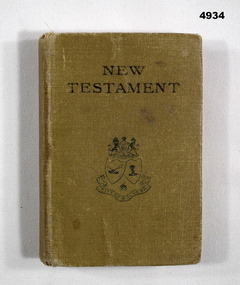 Bendigo Military Museum
Book - BOOK - NEW TESTAMENT, The British and Foreign Bible Society, 1916
... The back cover has written "Souvenir of Peace" - "City of Malvern" crest and "The Great War 1914 - 1918. There are 462 pages. ...The back cover has written "Souvenir of Peace" - "City of Malvern" crest and "The Great War 1914 - 1918. There are 462 pages. ...This is a small pocket sized book covered with khaki coloured buckram. Printed on front cover is the phrase "New Testament" under that in the entre is a coat of arms - British - under that are two shields with a symbol in each. Under those shields is a banner with the words "City of Malvern". The back cover has written "Souvenir of Peace" - "City of Malvern" crest and "The Great War 1914 - 1918. There are 462 pages. The printing is in black ink.On last page are the morse code symbols for name Leila Smith. Inside the rear cover is the name Leila Smith.bible, ww!, city of malvern -
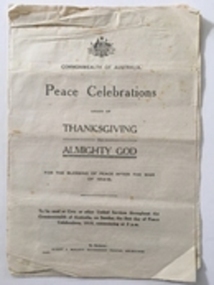 Warrnambool and District Historical Society Inc.
Document, Peace celebrations Commonwealth of Australia 1914-1918, 1919
... Peace celebrations Commonwealth of Australia 1914-1918......peace service 1914-1918...This would have been a common object when it was printed in 1919 and would have been used by communities all over Australia to celebrate the declaring od peace at the end of World War 1. warrnambool peace service 1914-1918 commonwealth of australia peace service Eight page program . ...This document is an order of Service for Thanksgiving for peace celebrations after the first World War. It was used at civic or United services throughout Australia. It contains prayers and hymns. This would have been a common object when it was printed in 1919 and would have been used by communities all over Australia to celebrate the declaring od peace at the end of World War 1.Eight page program . White paper with black text. Commonwealth of Australia Coat of Arms at top of page.warrnambool, peace service 1914-1918, commonwealth of australia peace service -
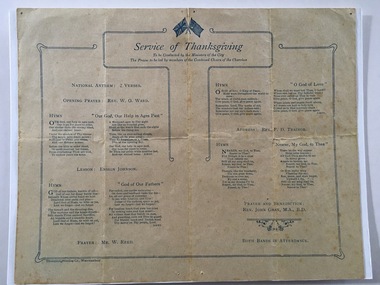 Warrnambool and District Historical Society Inc.
Document, Service of Thanksgiving, 1918
... 1918. One of the hymns sung had the opening lines: ‘O God of Love, O King of Peace/Make wars throughout the world to cease’. ...1918. One of the hymns sung had the opening lines: ‘O God of Love, O King of Peace/Make wars throughout the world to cease’. ...This is a programme of the Warrnambool City Council Civic & Thanksgiving Official Service on November 1918. The service was held in the Warrnambool Botanic Gardens, conducted by the Ministers of the Churches in Warrnambool and led by the combined choirs of the churches. It was a public occasion held to offer thanksgiving for the end of World War One in November 1918. One of the hymns sung had the opening lines: ‘O God of Love, O King of Peace/Make wars throughout the world to cease’. The service was attended by the Mayor of Warrnambool and the City Councillors and Council employees. World War One was a signal event in the history of Warrnanmbool (as it was for all places in Australia) with so many young men volunteering for active service and so many dying overseas.This programme is of great interest as it records an important occasion in Warrnambool – the end of World War One and the official service of thanksgiving that commemorated this happening. This is a programme for the Warrnambool City Council Civic & Thanksgiving Official Service in November 1918. It is a sheet of buff-coloured paper folded in two to make four pages. There is blue printed material on three of the pages. The front page has the City of Warrnambool crest printed in blue with blue edging on the page and some ornamental patterns. The inside pages has a blue sketch of the flags of Australia and Britain. The programme is faded and creased and a little blotched.warrnambool city council, history of warrnambool, world war one -
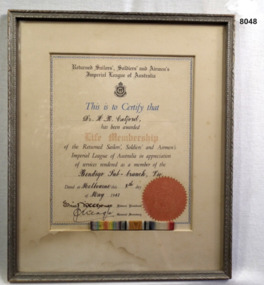 Bendigo Military Museum
Certificate - LIFE MEMBERSHIP 1947, FRAMED, 8/5/47
... 1918 and retired after 29 years at the AGM 1947 serving the whole time as Vice President. Doctor Harold Robert Catford enlisted as a Captain on 23.6.15 age 41 years and attached to HQ 29th Batt AIF. Embarked for overseas 10.11.15, transfer to 8th Field Ambulance 6.10.16. At various times he was attached to 5th Div Ammunition Column and 2nd A.C.C. Station, promoted to Major 24.8.17. He returned to Australia on 26.9.17 for personal reasons and his appointment in the AIF was terminated on 11.12.17. from 1.1.18 he was RMO to several military units including the 38th Batt in Peace...1918 and retired after 29 years at the AGM 1947 serving the whole time as Vice President. Doctor Harold Robert Catford enlisted as a Captain on 23.6.15 age 41 years and attached to HQ 29th Batt AIF. Embarked for overseas 10.11.15, transfer to 8th Field Ambulance 6.10.16. At various times he was attached to 5th Div Ammunition Column and 2nd A.C.C. Station, promoted to Major 24.8.17. He returned to Australia on 26.9.17 for personal reasons and his appointment in the AIF was terminated on 11.12.17. from 1.1.18 he was RMO to several military units including the 38th Batt in Peace ...Doctor HAROLD ROBERT CATFORD was the first to be made a Life Member of the Bendigo RSL Sub Branch. The certificate was signed on the 8th Day of May 1947. He was first elected to Committee of the Bendigo Branch in 1918 and retired after 29 years at the AGM 1947 serving the whole time as Vice President. Doctor Harold Robert Catford enlisted as a Captain on 23.6.15 age 41 years and attached to HQ 29th Batt AIF. Embarked for overseas 10.11.15, transfer to 8th Field Ambulance 6.10.16. At various times he was attached to 5th Div Ammunition Column and 2nd A.C.C. Station, promoted to Major 24.8.17. He returned to Australia on 26.9.17 for personal reasons and his appointment in the AIF was terminated on 11.12.17. from 1.1.18 he was RMO to several military units including the 38th Batt in Peace time. Promoted to Lt Col on 19.4.23, placed on the AAMC reserve list 30.1.30 and then the retired list 30.1.1934. Life membership certificate of the Bendigo RSL awarded to Dr HR Catford. Certificate is set in a yellowish cardboard frame inside a silver wooden frame. The certificate is in colour with a red seal and signatures of Federal President and Secretary of the RSSILA. A set of WWI ribbons has been placed in the frame.brsl, smirsl, life membership -
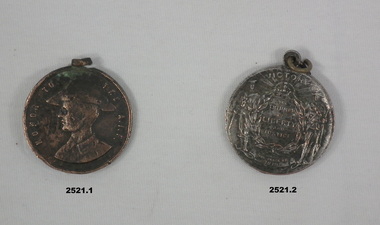 Bendigo Military Museum
Memorabilia - BADGES AND MEDALS, 1) 1918, .2) 1919, .3) to .6) post WW11
... 1918. Obverse has head of a soldier with Slouch Hat with wording "Honor to the AIF". Reverse has the words " Gallipoli, France, Palestine". .2) Medal, circular, metal, issued to School children to commemorate Victory and Peace in 1919. ...1918. Obverse has head of a soldier with Slouch Hat with wording "Honor to the AIF". Reverse has the words " Gallipoli, France, Palestine". .2) Medal, circular, metal, issued to School children to commemorate Victory and Peace in 1919. ...Medals .3) to .6) belonged to David William Ralph Davies No V245464, enlisted on 19.12.41 age 19 years. At discharge from the Army on 5.12.46 he was a Pte in 57/60th Aust Infantry Battalion.1) Medal, circular, metal, issued to Commemorate Anzac Day 1918. Obverse has head of a soldier with Slouch Hat with wording "Honor to the AIF". Reverse has the words " Gallipoli, France, Palestine". .2) Medal, circular, metal, issued to School children to commemorate Victory and Peace in 1919. Obverse depicts a Women, reverse has figures of a Sailor and Soldier with the wording "Victory the Triumph of Liberty and Justice, the Peace of 1919". Medals, ribbons, single, (4) re D.W.R Davies. .3) Pacific Star. .4) 1939-45 Star. .5) War Medal 1939-45. .6) Australian Service Medal..3) .4) .5) .6) "V245464 D.W.R Davies"medals, memorabilia, military -
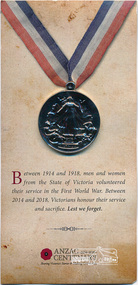 Eltham District Historical Society Inc
Medal, 1919 Children's Peace Medal (silver replica medallion attached to card), 2014
... 1918, men and women from the State of Victoria volunteered their service in the First World War. Between 2014 and 2018, Victorians honour their service and sacrifice. Lest We Forget. Anzac Centenary 2014-2018 Sharing Victoria's stories & making connections Card Back: 1919 Children's Peace Medal In 1919, Australian children aged 16 and under received a silver coated medallion. ...PEACE 1919'. Behind her flies a dove, and at her left and right feet are two figures freed from their shackles. (AWM description). The medals were originally suspended from a narrow piece of red, white and blue striped cotton ribbon which appears as illustration on the card. In 1919, Australian children under 16 received a silver-coated medallion – a special reminder of the service and sacrifice of Australians at war. medallion medal medalet Anzac Centenary commemoration Card Front: Between 1914 and 1918, men and women from the State of Victoria volunteered their service in the First World War. ...This object was part of various pieces enclosed in a folio entitled "ANZAC centenary : 2014-2018 sharing Victoria's stories & making connections : their journey is our story" produced by the Victorian State Government which was distributed as a free resource in 2014 at the beginning of the Anzac Centenary. Original condition would have included a clear cellophane enclosure. One side of the medal appears on the card. This features a symbolic female figure of Peace, holding a sword and standing on a plinth marked 'PEACE 1919'. Behind her flies a dove, and at her left and right feet are two figures freed from their shackles. (AWM description). The medals were originally suspended from a narrow piece of red, white and blue striped cotton ribbon which appears as illustration on the card. In 1919, Australian children under 16 received a silver-coated medallion – a special reminder of the service and sacrifice of Australians at war. Round medal stuck on coloured card with text on back and front. Card Front: Between 1914 and 1918, men and women from the State of Victoria volunteered their service in the First World War. Between 2014 and 2018, Victorians honour their service and sacrifice. Lest We Forget. Anzac Centenary 2014-2018 Sharing Victoria's stories & making connections Card Back: 1919 Children's Peace Medal In 1919, Australian children aged 16 and under received a silver coated medallion. For such a small object, it carried a large responsibility - to remind a generation of the service and sacrifice of Australians throughout the First World War. The Children's Peace Medal was a reminder that peace had been achieved, but at great cost. Now, 100 years on, this replica medallion serves to connect Victorians to the Anzac Centenary, teach them about our service history and encourage them to share their stories with future generations. Learn more at https://anzaccentenary.vic.gov.au/ Anzac Centenary 2014-2018 Sharing Victoria's stories & making connections Medal : Peace 1919 Australiamedallion, medal, medalet, anzac centenary, commemoration -
 Monbulk RSL Sub Branch
Book, 6th Machine Gun Company (A.I.F.) Association (Incorporating the 2nd Macine Gun Battalion), In good company : an account of the 6th Machine Gun Company A.I.F. in search of peace 1915-19, 1937
... World War 1939-1945 - Campaigns - France world war 1914-1918 - regimental histories Regimental history of the 6th Machine Gun Company A.I.F. Ill, maps, p.424. In good company : an account of the 6th Machine Gun Company A.I.F. in search of peace 1915-19 Book 6th Machine Gun Company (A.I.F.) ...Regimental history of the 6th Machine Gun Company A.I.F.Ill, maps, p.424.non-fictionRegimental history of the 6th Machine Gun Company A.I.F. world war 1939-1945 - campaigns - france, world war 1914-1918 - regimental histories -
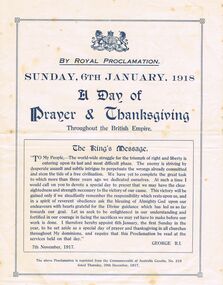 Bendigo Historical Society Inc.
Document - LYDIA CHANCELLOR COLLECTION; ' A DAY OF PRAYER $ THANKSGIVING'
... EVENT Official celebration Lydia Chancellor collection war W.W.II programme program peace White paper with blue printing. The title is, 'By Royal Proclamation. Sunday. 6th January, 1918 A Day of Prayer & Thanksgiving throughout the British Empire.' ...White paper with blue printing. The title is, 'By Royal Proclamation. Sunday. 6th January, 1918 A Day of Prayer & Thanksgiving throughout the British Empire.' 'The above Proclamation is reprinted from the Commonwealth of Australia Gazette, No. 219 dated Thursday, 20th December, 1917.event, official, celebration, lydia chancellor, collection, war, w.w.ii, programme, program, peace -
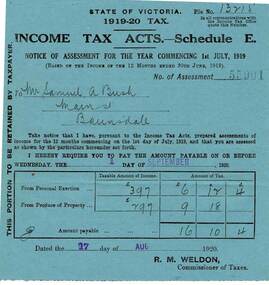 Bendigo Historical Society Inc.
Document - BUSH COLLECTION: COLLECTION OF STATE INCOME TAX ASSESSMENT NOTICES (S A BUSH), 1919-1921
... On reverse of note is Thanksgiving Service (United Peace) held at the Rotunda, Bairnsdale Tuesday 12 Nov. 1918 - Order of Service. ...On reverse of note is Thanksgiving Service (United Peace) held at the Rotunda, Bairnsdale Tuesday 12 Nov. 1918 - Order of Service. ...Collection of State Income Tax and Land Tax Assessment notices (S A Bush, Bairnsdale): a. Year commencing 1/7/1919; b. 1/7/1920; c. Land Tax Notice for year 1921; d. Memorandum to Taxpayer (assessment of income for 1919-1920); e. Handwritten single-page note relating to figures for various income tax and rates (& other) dated 10/8/1921. On reverse of note is Thanksgiving Service (United Peace) held at the Rotunda, Bairnsdale Tuesday 12 Nov. 1918 - Order of Service. Union Lodge of North Gippsland invitations (2) to ordinary meetings of the Lodge. 1930.person, individual, bush collection - personal, bendigo, bush collection, collection, business, commerce, retail -
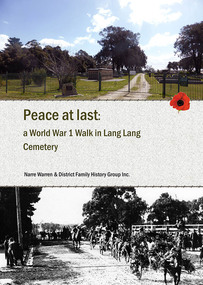 Narre Warren and District Family History Group
Book, Narre Warren & District Family History Group Inc, Peace at last: a World War 1 Walk in Lang Lang Cemetery, 2018
... 1918 Lang Lang (Vic.) Lang Lang Cemetery A compilation of stories of servicemen and their families with connections to the Lang Lang Cemetery and the Great War. Peace ...A compilation of stories of servicemen and their families with connections to the Lang Lang Cemetery and the Great War.non-fictionA compilation of stories of servicemen and their families with connections to the Lang Lang Cemetery and the Great War. world war 1914-1918, lang lang (vic.), lang lang cemetery -
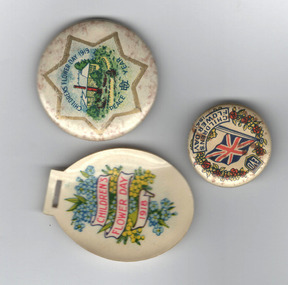 Warrnambool and District Historical Society Inc.
Three badges, Children's Flower Day, 1. 1941 2. 1918 3. 1919
... V. on rim 2 CHILDREN'S FLOWER DAY 1918 3 CHILDREN'S FLOWER DAY 1919 PEACE YEAR and symbol of an flattened semi circle with incomplete rectangle interlaced. ...V. on rim 2 CHILDREN'S FLOWER DAY 1918 3 CHILDREN'S FLOWER DAY 1919 PEACE YEAR and symbol of an flattened semi circle with incomplete rectangle interlaced. 1 Cream coloured circular metal and enamel badge featuring Union flag, a wreath of red flowers and leaves around the edge on two sides and text . ...These three badges were issued as fund raisers on Children's Day in 1918,1919 and 1941. The Children's Flower day arose out of the League of Young Gardeners established in 1916 to assist the war effort by encouraging children to cultivate garden plots at home and at school. The Children's Flower Day included lectures and lessons at school related to garden cultivation. Flower shows of produce grown at home and at school and street stalls were run by children to raise funds for the war effort.These badges are of interest as examples of the activities of children in Victoria to assist the War effort in World Wars.1 Cream coloured circular metal and enamel badge featuring Union flag, a wreath of red flowers and leaves around the edge on two sides and text . A clip is on the reverse. 2 Cream coloured oval plastic coated card badge featuring blue flowers and wattle blossom and text. A slot at the top for a pin so it may be attached to clothing. 3 Cream coloured circular badge featuring a six pointed gold star, a coloured image of a house and garden and text. A clip is on the reverse1 EVD CHILDREN'S FLOWER DAY 1941 on face. A.W. PATRICK. N. FITZROY. V. on rim 2 CHILDREN'S FLOWER DAY 1918 3 CHILDREN'S FLOWER DAY 1919 PEACE YEAR and symbol of an flattened semi circle with incomplete rectangle interlaced. children, flowers, war effort, warrnambool
