
Showing 101 items matching "the war 50 years on"
-
 Tatura Irrigation & Wartime Camps Museum
Book, The War 50 Years On, 1989
... The War 50 Years On...the war 50 years on...Slouch hat on front cover The War 50 Years On Book ...Produced by the Age Education UnitOff white soft cover book with black text front and back covers. Slouch hat on front coverthe war 50 years on, the age, tatura, ww2, books, history, local -
 Returned Nurses RSL Sub-branch
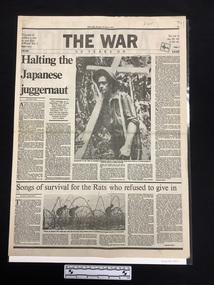
Newspaper - Newspaper liftout, Alan Howe, 'The War : 50 years on', 'Halting the Japanese juggernaut', 'Songs of survival for the Rats who refused to give in', 'A chronicle of conflict', 'Death, glory and faulty strategies in the fight for supremacy at sea', 'The day the horror hit home' & 'The vital build-up in air power', 19890902
... 'The War : 50 years on', 'Halting the Japanese juggernaut', 'Songs of survival for the Rats who refused to give in', 'A chronicle of conflict', 'Death, glory and faulty strategies in the fight for supremacy at sea', 'The day the horror hit home' & 'The vital build-up in air power'...Newspaper lift-out commemorating 50 years since the declaration of WWII. 'The war that forced a nation to come of age' (article p1 and continued on p22) - by Professor Manning Clark - Article provides political background within Australia to armed forces and WWII. ...Inside is a mix of articles, a timeline with photos and captions, a list of those who died with the unit they served and more photos and articles on the back cover. 'The War : 50 years on', 'Halting the Japanese juggernaut', 'Songs of survival for the Rats who refused to give in', 'A chronicle of conflict', 'Death, glory and faulty strategies in the fight for supremacy at sea', 'The day the horror hit home' & 'The vital build-up in air power' Newspaper Newspaper liftout Alan Howe Nick Creech The Weekend Australian ...Newspaper lift-out commemorating 50 years since the declaration of WWII. 'The war that forced a nation to come of age' (article p1 and continued on p22) - by Professor Manning Clark - Article provides political background within Australia to armed forces and WWII. 'The week before the world went mad' (article & photos p2) - Six sections on what was happening that week prior to war declared in Sydney, Melbourne, Adelaide, Brisbane, Perth and Hobart. '1939 - 1945 An Australian perspective' (article & timeline with captioned images and photos p3-8) - by Christine McGee - Article provides timeline of events at a personal/local through to national and international, influences and politics, statistics, and information on various fronts of battle from 03/09/1939 - 02/09/1945. Nursing mentioned on p6, there is a photo of a group of women in uniform walking towards the camera and the caption mentions the sinking of the Centaur, loss of 11 of 12 nurses aboard, and how 55 nurses were decorated and 82 mentioned in dispatches. 'The Australians killed in action in World War II : while serving with the nation's defence forces' (roll of honour list p9-21) - Official roll of honour for those who died between 3 September 1929 and 30 June 1947. Includes amendments. People are listed with their units surname followed by initials. 'Curtin's turn to America and the reshaping of Australia...' (article p22) - by Paul Kelly - Article looks at the circumstances and key people involved in the moving of ties away from Britain towards the United States. A large black and white newspaper lift-out with the cover showing the numerals 1939 filled with photos collaged together, several large headlines and subtitles, one article with two columns and a large captioned photo of a man in uniform with a gun on his shoulder, cigarette in his mouth, wearing a hat. Inside is a mix of articles, a timeline with photos and captions, a list of those who died with the unit they served and more photos and articles on the back cover.'WWII' [blue ink top of cover] 'Sept.2.3 1989' [blue ink top of cover]world war two, wwii, ww2, commemorative, timeline, australia -
 National Vietnam Veterans Museum (NVVM)
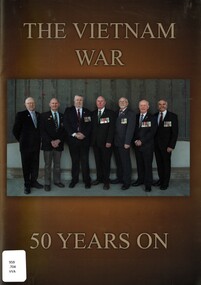
Booklet, The Vietnam War, 50 Years On (Copy 1), 2016
... The Vietnam War, 50 Years On (Copy 1)....Vietnam War - 1961-1975 - Soldiers - Australian Vietnam War 1961 - 1975 Personal narratives - Australian Vietnam War 1961-1975 - Participation Australian Produced by the Bendigo South East College in co-operation with members of the Bendigo Sub Branch of the VVAA. The Vietnam War, 50 Years On (Copy 1). Booklet VVAA Assoc of Aust: Bendigo Sub Branch Inc. ...Produced by the Bendigo South East College in co-operation with members of the Bendigo Sub Branch of the VVAA.vietnam war - 1961-1975 - soldiers - australian, vietnam war, 1961 - 1975, personal narratives - australian, vietnam war, 1961-1975 - participation, australian -
 National Vietnam Veterans Museum (NVVM)
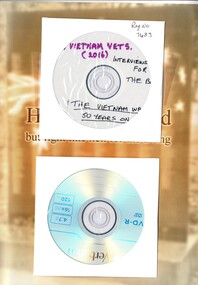
Film - Film, DVD, The Vietnam War, 50 Years On. (Copy 1), 2016
... The Vietnam War, 50 Years On. (Copy 1)...A collection of interviews by the studens of Bendigo South East Secondary College - 29th August 2016 Vietnam War - 1961-1975 - Soldiers - Australian Vietnam War 1961 - 1975 Personal narratives - Australian Vietnam War 1961-1975 - Participation Australian Produced by the Bendigo South East College in co-operation with members of the Bendigo Sub Branch of the VVAA. The Vietnam War, 50 Years On. (Copy 1) Film Film, DVD VVAA Assoc of Aust: Bendigo Sub Branch Inc. ...A collection of interviews by the studens of Bendigo South East Secondary College - 29th August 2016Produced by the Bendigo South East College in co-operation with members of the Bendigo Sub Branch of the VVAA.vietnam war - 1961-1975 - soldiers - australian, vietnam war, 1961 - 1975, personal narratives - australian, vietnam war, 1961-1975 - participation, australian -
 Bendigo Military Museum
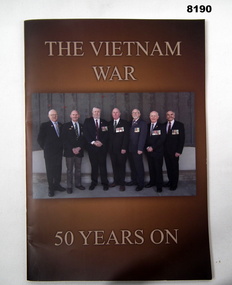
Mixed media - VIETNAM 50 YEARS ON, 2016
... The Vietnam War - 50 Years On. This project began with a meeting between Cliff Richards President BDRSL, Ward Buckeridge, Trish Di Donato from Bendigo South East Secondary College re 50 years on from the Vietnam War in May 2016. ...On the front cover, “The Vietnam War - 50 Years on”....The Vietnam War - 50 Years On. This project began with a meeting between Cliff Richards President BDRSL, Ward Buckeridge, Trish Di Donato from Bendigo South East Secondary College re 50 years on from the Vietnam War in May 2016. ...The Vietnam War - 50 Years On. This project began with a meeting between Cliff Richards President BDRSL, Ward Buckeridge, Trish Di Donato from Bendigo South East Secondary College re 50 years on from the Vietnam War in May 2016. The President promised Veterans and the Trish promised a a team of students. Seven Vietnam Veterans put their hand up and sixteen students met at the end of May and from there it progressed to a publication and DVD with their oral stories. There would be a launch at the BDRSL on November 2nd with Veterans Students,Teachers and Parents. The project also involved a trip to the Seymour Vietnam Veterans Commemorative Walk. Students and Veterans also attended the Vietnam Veterans Day Service in Pall Mall in front of the Soldiers Memorial Institute and photos taken. The Veterans were; Geoff Leach, Peter Ball, Bill Clark, Cliff Richards, Richard Penna, Michael Paine, Brian Timberlake. Production, gloss colour covers with 10 gloss colour pages double sided with all print and photos in colour. Inside the rear cover is a CD with the interviews with 7 Vietnam Veterans in 2016. Held together by 2 staples on the spine.On the front cover, “The Vietnam War - 50 Years on”.brsl, smirsl, vietnam, 50 years -
 Returned Nurses RSL Sub-branch
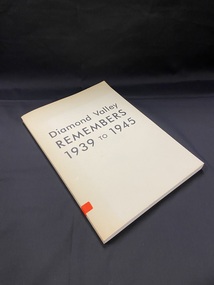
Book - Paperback book, Northern Metropolitan College of TAFE, Diamond Valley Remembers 1939 to 1945: an oral history project, 1995
... This book comprises a collection of unique and individual personal narratives of World War 2, written 50 years after the war and preserved for future generations. ...This book comprises a collection of unique and individual personal narratives of World War 2, written 50 years after the war and preserved for future generations. ...An Oral History Project - An Australia Remembers New Work Project funded by the Department of Employment, Education and Training. Sponsored by Northern Metropolitan College of TAFE. 34 chapters include reminiscences from 34 men and women mainly from the Watsonia Returned Servicemen's League recording their memories of the war years for the benefit of the [Shire of] Diamond Valley community.Cream coloured paperback book with the title printed across the front cover in black ink. The title is also printed in black ink along the spine. There is a small orange sticker on the lower part of the spine with B143 handwritten in black ink.non-fictionAn Oral History Project - An Australia Remembers New Work Project funded by the Department of Employment, Education and Training. Sponsored by Northern Metropolitan College of TAFE. 34 chapters include reminiscences from 34 men and women mainly from the Watsonia Returned Servicemen's League recording their memories of the war years for the benefit of the [Shire of] Diamond Valley community. world war 1939-1945, wwii, ww2, oral history of world war two, australia remembers -
 Melbourne Legacy
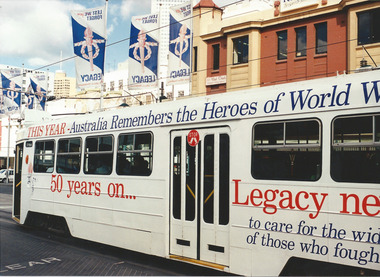
Photograph, Legacy Tram, 1995
... Wording on the tram says: "This year - Australia remembers the Heroes of World War II / 50 years on / Legacy never forgets to care for the widows and children of those who fought for our freedom". ...Wording on the tram says: "This year - Australia remembers the Heroes of World War II / 50 years on / Legacy never forgets to care for the widows and children of those who fought for our freedom". ...A photo of a tram painted to promote Legacy in 1995 which was the 50th Anniversary of the end of World War II. Wording on the tram says: "This year - Australia remembers the Heroes of World War II / 50 years on / Legacy never forgets to care for the widows and children of those who fought for our freedom". It appeared in The Answer in June 1995 after it had been launched on May 2nd by President David Millie and Public Transport Minister, Mr Alan Brown. The ribbon was cut by Junior Legatees Kim Anderson and Peter Hazelager. "The distinctive white tram will be running on routes around Melbourne for at least six months and our thanks go to the Public Transport Corporation for making it possible.A record of a way to promote Legacy during Legacy Week in 1995.Colour photo x 6 of a tram painted to promote to Legacy and widows riding the tram.Printed on the back "legacy promotion, tram, answer -
 Melbourne Legacy
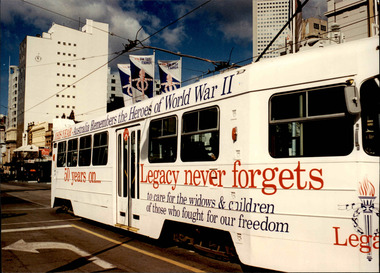
Photograph, Legacy Week 1995, 1995
... Wording on the tram says: "This year - Australia remembers the Heroes of World War II / 50 years on / Legacy never forgets to care for the widows and children of those who fought for our freedom". ...Wording on the tram says: "This year - Australia remembers the Heroes of World War II / 50 years on / Legacy never forgets to care for the widows and children of those who fought for our freedom". ...A photo of a tram painted to promote Legacy in 1995 which was the 50th Anniversary of the end of World War II. Wording on the tram says: "This year - Australia remembers the Heroes of World War II / 50 years on / Legacy never forgets to care for the widows and children of those who fought for our freedom". It appeared in The Answer in June 1995 after it had been launched on May 2nd by President David Millie and Public Transport Minister, Mr Alan Brown. The ribbon was cut by Junior Legatees Kim Anderson and Peter Hazelager. "The distinctive white tram will be running on routes around Melbourne for at least six months and our thanks go to the Public Transport Corporation for making it possible.A record of a way to promote Legacy during Legacy Week in 1995.Colour photo x 2 of a tram painted to promote to Legacy.legacy promotion, tram -
 Melbourne Legacy
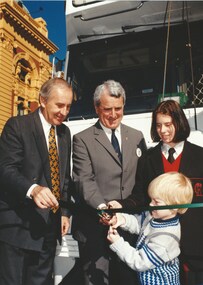
Photograph, Legacy Tram, 1995
... Wording on the tram says: "This year - Australia remembers the Heroes of World War II / 50 years on / Legacy never forgets to care for the widows and children of those who fought for our freedom". ...Wording on the tram says: "This year - Australia remembers the Heroes of World War II / 50 years on / Legacy never forgets to care for the widows and children of those who fought for our freedom". ...Photos from the 2 May 1995 when the Transport Minister, Mr Alan Brown and Legacy President David Millie unveiled banners at Flinders St Station saying "Australia Remembers". Also the launch of a tram by Junior Legatees Kim Anderson and Peter Hazelager. Another photo is a group of dignitaries in front of the tram. The tram was painted to promote Legacy in 1995 which was the 50th Anniversary of the end of World War II. Wording on the tram says: "This year - Australia remembers the Heroes of World War II / 50 years on / Legacy never forgets to care for the widows and children of those who fought for our freedom". It appeared in The Answer in June 1995 after it had been launched on May 2nd by President David Millie and Public Transport Minister, Mr Alan Brown. The ribbon was cut by Junior Legatees Kim Anderson and Peter Hazelager. "The distinctive white tram will be running on routes around Melbourne for at least six months and our thanks go to the Public Transport Corporation for making it possible." 01809.1 shows President Millie, Kim Anderson and Peter Hazelager. 01809.2 is Peter Hazelager being held by his mother, Margaret Anderson and Kim Anderson. 01809.4 is a Legatee, Minister Alan Brown, President Millie, a man in The MET uniform, Legatee Roger Greene.A record of a way to promote Legacy during Legacy Week in 1995.Colour photo x 6 of the launch of a tram painted to promote to Legacy at Flinders St Station.legacy promotion, answer, tram -
 Melbourne Legacy
Photograph, Legacy Tram, 1995
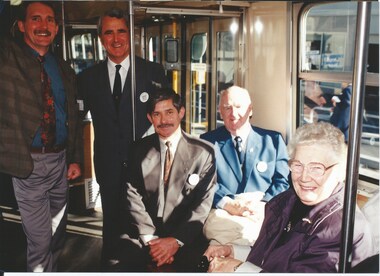
... Wording on the tram says: "This year - Australia remembers the Heroes of World War II / 50 years on / Legacy never forgets to care for the widows and children of those who fought for our freedom". ...Wording on the tram says: "This year - Australia remembers the Heroes of World War II / 50 years on / Legacy never forgets to care for the widows and children of those who fought for our freedom". ...Photos of widows, legatees, President Millie and the Transport Minister riding in a tram that was decorated to promote Legacy in 1995. 1995 which was the 50th Anniversary of the end of World War II. Wording on the tram says: "This year - Australia remembers the Heroes of World War II / 50 years on / Legacy never forgets to care for the widows and children of those who fought for our freedom". It appeared in The Answer in June 1995 after the tram had been launched on May 2nd by President David Millie and Public Transport Minister, Mr Alan Brown. The ribbon was cut by Junior Legatees Kim Anderson and Peter Hazelager. "The distinctive white tram will be running on routes around Melbourne for at least six months and our thanks go to the Public Transport Corporation for making it possible." 01810.1 shows President David Mille, Legatee Roger Greene (seated in the centre) and others. 01810.2 shows David Millie with Minister for Transport Alan Brown. 01810.3 is Kim Anderson and her mother Margaret speaking with the Minister Legatee Lucky Luscombe is in 01810.6 and 01810.9 01810.7 shows legatee George Woodward with two widows eating snacks 01810.10 is a photo of 4 widows. Second from the left is Hazel McKean, then Lorraine Dalton, and Irene Noll on the right.A record of a way to promote Legacy during Legacy Week in 1995.Colour photo x 10 of a tram painted to promote to Legacy and widows riding the tram.legacy promotion, tram, answer -
 Flagstaff Hill Maritime Museum and Village
Domestic object - Food Safe, Willow Ware Pty Ltd, 1920-1950
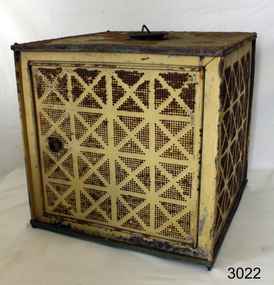
... war effort. In the early 1920’s, the Willow brand was established. Making tin plated canisters and baking pans with the well-known Willow pattern, imprinted on them. Some other items in production at this time include billies, boilers, basins and Coolgardie safes. In the late 1950’s, the company ventured into plastics production. Stepping away from its very successful tin plating industry of more than 50 years...war effort. In the early 1920’s, the Willow brand was established. Making tin plated canisters and baking pans with the well-known Willow pattern, imprinted on them. Some other items in production at this time include billies, boilers, basins and Coolgardie safes. In the late 1950’s, the company ventured into plastics production. Stepping away from its very successful tin plating industry of more than 50 years ...Willow started business in 1887 as a metal working company based in Melbourne Australia, making tinned biscuit and tea canisters. The outbreak of the First World War saw their manufacturing change to making armaments and essential packaging for the war effort. In the early 1920’s, the Willow brand was established. Making tin plated canisters and baking pans with the well-known Willow pattern, imprinted on them. Some other items in production at this time include billies, boilers, basins and Coolgardie safes. In the late 1950’s, the company ventured into plastics production. Stepping away from its very successful tin plating industry of more than 50 years. In 1965, the company name changed to Willow Ware Pty Ltd, to be more closely linked to its Willow brand. Willow Ware is still in business today. A food safe known as a “Coolgardie” meat storage made by an emerging Australian company no longer in bushiness. This item gives a snapshot into early Australian manufacturing specifically aimed at the Australian market. Safe metal kitchen safe with two shelves, a hinged door and latch and a small swivel wire handle at the top. cream colour . "Made in Australia" "Willow" warrnambool, shipwrecked-coast, flagstaff-hill, flagstaff-hill-maritime-museum, shipwreck-coast, flagstaff-hill-maritime-village, willow ware, domestic item, coolgardie meat safe, meat safe, food safe, food preservation -
 Flagstaff Hill Maritime Museum and Village
Domestic object - Food Safe, Willow Ware Pty Ltd, 1920s -1950
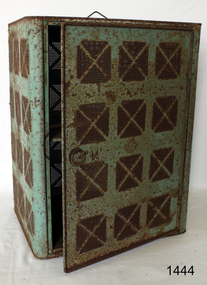
... war effort. In the early 1920’s, the Willow brand was established. Making tin plated canisters and baking pans with the well-known Willow pattern, imprinted on them. Some other items in production at this time include billies, boilers, basins and Coolgardie safes. In the late 1950’s, the company ventured into plastics production. Stepping away from its very successful tin plating industry of more than 50 years...war effort. In the early 1920’s, the Willow brand was established. Making tin plated canisters and baking pans with the well-known Willow pattern, imprinted on them. Some other items in production at this time include billies, boilers, basins and Coolgardie safes. In the late 1950’s, the company ventured into plastics production. Stepping away from its very successful tin plating industry of more than 50 years ...Willow started business in 1887 as a metal working company based in Melbourne Australia, making tinned biscuit and tea canisters. The outbreak of the First World War saw their manufacturing change to making armaments and essential packaging for the war effort. In the early 1920’s, the Willow brand was established. Making tin plated canisters and baking pans with the well-known Willow pattern, imprinted on them. Some other items in production at this time include billies, boilers, basins and Coolgardie safes. In the late 1950’s, the company ventured into plastics production. Stepping away from its very successful tin plating industry of more than 50 years. In 1965, the company name changed to Willow Ware Pty Ltd, to be more closely linked to its Willow brand. Willow Ware is still in business today. A food safe known as a “Coolgardie” meat storage made by an emerging Australian company no longer in bushiness. This item gives a snapshot into early Australian manufacturing specifically aimed at the Australian market.Safe metal kitchen food safe with 2 shelves, a hinged door and latch and a small swivel wire handle at the top. Painted light green, rusting.Willowwarrnambool, shipwrecked-coast, flagstaff-hill, flagstaff-hill-maritime-museum, maritime-museum, shipwreck-coast, flagstaff-hill-maritime-village, safe, food safe, meat safe, coolgardie safe, domestic object, kitchen object, willow ware, food preservation, kitchen safe -
 Mission to Seafarers Victoria
Medal - Defence Medal in box, c. 1945
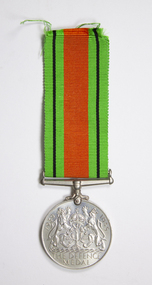
... War. It was Awarded for 3 years, 360, 180 or 90 days, depending on area and nature of service charles page medal defence medal Front of the box: (in black) stamp O.H.M.S. / circular stamp with English crown : OFFICIAL PAID Typewritten in blue ink: Mr. C. Page/50 ...Charles worked in the Merchant service. After enforced retirement due to injury he was active in Civil Defence.The Defence Medal is a campaign medal instituted by the United Kingdom in May 1945, to be awarded to citizens of the British Commonwealth for both non-operational military and certain types of civilian war service during the Second World War. It was Awarded for 3 years, 360, 180 or 90 days, depending on area and nature of serviceThe medal is cupro-nickel, with the uncrowned effigy of King George VI on the obverse. The reverse has a conventional oak tree centrally, with a crown above, with two lions counter rampart as supporters between the dates 1939 and 1945. The base of the medal reverse has the words ‘THE DEFENCE MEDAL’. The ribbon is orange with green outer stripes, each green stripe having a black pin-stripe running down the centre. The green represents the Islands of the United Kingdom, the orange represents enemy attacks, and the black represents the black outs. The medal is housed in a small cardboard box. There is a loose leaf of paper with the medal which conveys salutations.Front of the box: (in black) stamp O.H.M.S. / circular stamp with English crown : OFFICIAL PAID Typewritten in blue ink: Mr. C. Page/50 High Street/Woolton/LIVERPOOL Back of the box: printed in black ink: If undelivered, return to/Defence Medal/Central Index/Home Office/Whitehall/S.W.Icharles page, medal, defence medal -
 Lara RSL Sub Branch
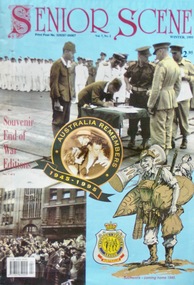
Magazine - Senior scene Magazines
... Souvenir end of war edition celebrating 50 years. SENIORS SCENE. Souvenir End Of War Editions. 1945-1995. ...Souvenir end of war edition celebrating 50 years.SENIORS SCENE. Souvenir End Of War Editions. 1945-1995. -
 Greensborough Historical Society
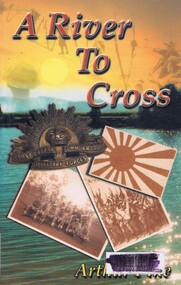
Book, Indra Publishing et al, A River to cross, by Arthur Pike, 2001_
... A fictional account of an Australian soldier's memories of World War II and his travels to Japan 50 years later....A fictional account of an Australian soldier's memories of World War II and his travels to Japan 50 years later. world war 2 Paperback, 222p. ...A fictional account of an Australian soldier's memories of World War II and his travels to Japan 50 years later.Paperback, 222p.world war 2 -
Glenelg Shire Council Cultural Collection
Accessory - Badge - Australia Remembers, c. 1995
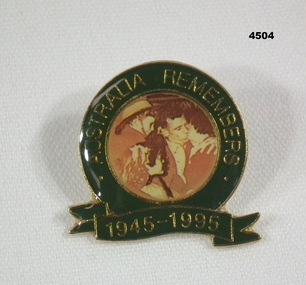
... Issued as fundraiser for, and to commemorate, the 50 years anniversary of the end of World War II....Issued as fundraiser for, and to commemorate, the 50 years anniversary of the end of World War II. WWII World War II commemoration accessory badge lapel pin Enamelled metal badge. ...Issued as fundraiser for, and to commemorate, the 50 years anniversary of the end of World War II.Enamelled metal badge. Round with scroll on bottom, with '1945-1995' in gold on green. Photo of family in centre, sepia, green border with gold 'AUSTRALIA REMEMBERS'.wwii, world war ii, commemoration, accessory, badge, lapel pin -
 Orbost & District Historical Society
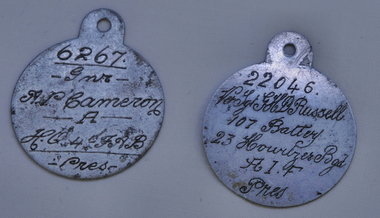
identity discs
... War the Australian 'Diggers' were issued an identity tag or disc. The first official disc was a small flat metal disc of aluminum, then there were two identity discs issued, made of a fibre one was a red disc the other was grey and octagonal. The discs were usually stamped with the information that the Military required. The Regimental number, Regimental name, soldiers' surname and initials and his religion were on the tag. Douglas Russell was a farmer, the son of John Russell, director of the Orbost Butter Factory for 50 years...War the Australian 'Diggers' were issued an identity tag or disc. The first official disc was a small flat metal disc of aluminum, then there were two identity discs issued, made of a fibre one was a red disc the other was grey and octagonal. The discs were usually stamped with the information that the Military required. The Regimental number, Regimental name, soldiers' surname and initials and his religion were on the tag. Douglas Russell was a farmer, the son of John Russell, director of the Orbost Butter Factory for 50 years ...The identity discs of Australian soldiers of the First World War were initially made of aluminum and then made of a fibre material. Like other soldiers of the Great War the Australian 'Diggers' were issued an identity tag or disc. The first official disc was a small flat metal disc of aluminum, then there were two identity discs issued, made of a fibre one was a red disc the other was grey and octagonal. The discs were usually stamped with the information that the Military required. The Regimental number, Regimental name, soldiers' surname and initials and his religion were on the tag. Douglas Russell was a farmer, the son of John Russell, director of the Orbost Butter Factory for 50 years. Alex Pullar Cameron died from injuries in 1919.Two World War 1 identity tags. Both are aluminium and engraved on front. There are loops at the top for a chain around the neck..1 22046 Vet Sgt G.H D. Russell.........Pres. .2 6267 GNR A.P. Cameron................Presworld-war-1 identity-disc russell-g.h.d. cameron-a.p. -
 Greensborough Historical Society
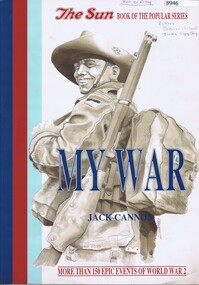
Book, Jack Cannon, My War: more than 150 epic events of World War 2, 1990
... World War II newspapers - melbourne facsimiles A collection of newspaper headlines gathered to commemorate 50 years since the outbreak of World War II. ...A collection of newspaper headlines gathered to commemorate 50 years since the outbreak of World War II.228 p., illus., newspaper facsimilesnon-fictionA collection of newspaper headlines gathered to commemorate 50 years since the outbreak of World War II.world war ii, newspapers - melbourne, facsimiles -
 Bendigo Military Museum
Booklet - BOOK, SOLDIERS PAY, SUFFOLK REGIMENT UK 1901, British Army, 1901
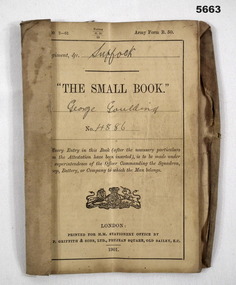
... years. He was born in Whitechapel, London. Height 5'5-1/2 ", Dark hair, tattoo on left forearm. He served in various places abroad. Malta, Dolpa, Sth Africa, Southampton. British Suffolk Regiment South African War Boer War Soldier This is a small booklet titled "The Small Book" British Army form B.50. ...Page 4 has handwritten description of soldier and enlistment details - George Goulding. Enlisted at St. Georges Barracks, London. County of Middlesex. 31 December 1897, age 18 yrs, 10 mths. He joined Suffolk Regiment for 7 years. He was born in Whitechapel, London. Height 5'5-1/2 ", Dark hair, tattoo on left forearm. He served in various places abroad. Malta, Dolpa, Sth Africa, Southampton.This is a small booklet titled "The Small Book" British Army form B.50. The soldier's name is George Goulding No. 4886. The Regiment is Suffolk. In the centre of the cover are the instructions for use, beneath that is the crest of Great Britain. The rear cover is khaki coloured buckram. Inside are 24 pages. These have Goulding's description - Navy regulations and details of Goulding's Service.british suffolk regiment, south african war, boer war, soldier -
 Bendigo Military Museum
Badge - BADGE, AUSTRALIA REMEMBERS, Patricks, c. 1995
... The badge was to Remember 50 years since the World War of 1939 - 45 ended....The badge was to Remember 50 years since the World War of 1939 - 45 ended. Badges Australia remembers Badge, circular, outside has a green band with "Australia Remembers", central circle has depiction of three people welcoming a returning person, under is a green scroll with "1945 - 1995" in gold, rear has a single pin with clip attachment, makers name in slight raised print. ...The badge was to Remember 50 years since the World War of 1939 - 45 ended.Badge, circular, outside has a green band with "Australia Remembers", central circle has depiction of three people welcoming a returning person, under is a green scroll with "1945 - 1995" in gold, rear has a single pin with clip attachment, makers name in slight raised print.badges, australia remembers -
 Bendigo Military Museum
Book - BOOK, 50 YEARS, The Open Road, Australia Remembers, 1995
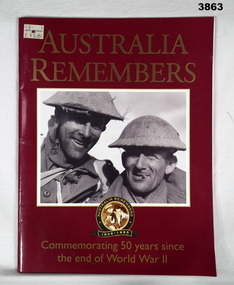
... Commemorating 50 years since the end of World War II....Commemorating 50 years since the end of World War II. Book remembers 50 years 1945 - 1995 Soft cardboard cover. ...Australia Remembers 1945 - 1995. Commemorating 50 years since the end of World War II.Soft cardboard cover. Gold print on front / back over dark red background. Illustrated front / back & white photo of 2 uniformed soldiers. Black / white photo of a crowd scene on back. 80 cut, plain, glossy white pages. Illustrated black / white / sepia / colour photos, porters, paintings & drawings.book, remembers, 50 years, 1945 - 1995 -
 Eltham District Historical Society Inc
Photograph - Digital Photograph, Marguerite Marshall, St John's Anglican Church, Diamond Creek, 7 September 2008
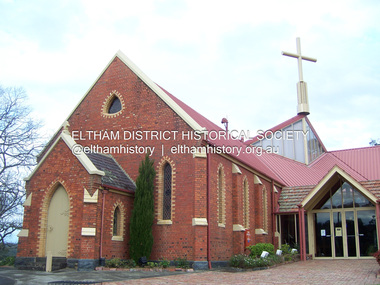
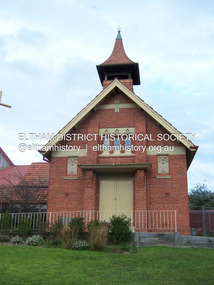
... 50 years until it was incorporated in the parish hall was brought out from England and presented by Charles Orme. In 1916, the estate of George Martin Pizzey left sufficient money to build the red brick hall, which still stands today (2023) though in January 1969 the hall and bell tower were badly damaged by bushfire. Coincidentally the former home of benefactor, George Pizzey was destroyed in the same fire. Of particular significance are the interior and exterior of the church, the Sunday school and hall with emphasis on pre-World War...50 years until it was incorporated in the parish hall was brought out from England and presented by Charles Orme. In 1916, the estate of George Martin Pizzey left sufficient money to build the red brick hall, which still stands today (2023) though in January 1969 the hall and bell tower were badly damaged by bushfire. Coincidentally the former home of benefactor, George Pizzey was destroyed in the same fire. Of particular significance are the interior and exterior of the church, the Sunday school and hall with emphasis on pre-World War ...The building was designed by Charles Maplestone of Heidelberg, son-in-law to Anthony Beale of St Helena. Maplestone was a prominent architect who came out to Australia with his family in 1852. The foundation stone was laid by Mrs Isabella Maplestone on 11th November 1867. The bricklayers for the church were George Stebbing, H Limmer, H Spicer and a Mr Timm while Thomas Day was the stonemason. Another three years were to pass before sufficient money could be raised for its completion. It was opened by Bishop Perry on 1st November, 1870. The church bell which hung under a tree for 50 years until it was incorporated in the parish hall was brought out from England and presented by Charles Orme. In 1916, the estate of George Martin Pizzey left sufficient money to build the red brick hall, which still stands today (2023) though in January 1969 the hall and bell tower were badly damaged by bushfire. Coincidentally the former home of benefactor, George Pizzey was destroyed in the same fire. Of particular significance are the interior and exterior of the church, the Sunday school and hall with emphasis on pre-World War I fabric (excluding the 1990s additions) and the three coloured glass windows currently suspended in the 1990s entry foyer. In 2011 further alterations were made to the front of the Church. The church is historically significant because it was the oldest public building in the former Diamond Valley Shire, is amongst the oldest buildings in the Shire of Nillumbik and is associated with the early settlement of the Diamond Creek district. The church is historically, socially and spiritually significant because it has been a place of worship for over 150 years and continues to be, an important meeting place in the Shire. The church is aesthetically significant for the three stained glass windows executed by the noted stained glass manufacturers, Ferguson & Urie, as well as the supporting coloured glass windows in the church. The Sunday school & parish hall is architecturally significant because the hall is a well executed and preserved example of the work of noted church architects, North & Williams. It is historically significant because it is connected with local parishioner and Melbourne industrialist, George Pizzey, who bequeathed funds for its construction. Covered under Heritage Overlay, Nillumbik Planning Scheme. National Estate Ntionl Trust of Australia (Victoria) Local significance Published: Nillumbik Now and Then / Marguerite Marshall 2008; photographs Alan King with Marguerite Marshall.; p85 St John’s Anglican Church stands like a beacon on the hill on Main Street, Diamond Creek. Today the church has a large congregation, but its early years were marked by a small congregation struggling to find enough money to survive. It was gold in Diamond Creek that resulted in the building of this National Trust registered property.1 This church is far removed from William Wilson’s humble barn (later the Bowling Green) where the first Anglican church services were conducted – probably the first in the district.2 In the mid 19th century services were infrequent as the Rev Francis Hales, travelling on horseback, also conducted services elsewhere, including at Heidelberg, Coburg, Kinglake, Arthurs Creek, St Andrews and Kangaroo Ground. In 1860 Diamond Creek came under the jurisdiction of the Eltham Parish. Until the mid 1860s the Diamond Creek settlement included only about 20 families who were struggling farmers. But this changed when gold was found in 1862. Then the township grew to 200 families, including miners, civil administration workers and shopkeepers. The resulting growth of Church of England adherents prompted them to petition the Government in 1866 for land to build a church. The area chosen, on which the original building still stands, was at the centre of the proposed township. Today church leaders believe that this conspicuous location is one of the reasons for its exceptional growth. Prominent architect Charles Maplestone designed the building as he did the Presbyterian Church at Kangaroo Ground. St John’s, which is still intact, was built in the Gothic Revival style with the traditional rectangular plan of a central nave and sanctuary at the end. It is typical of small churches built in Victoria at that time, with polychromatic hand-made bricks, a porch, diagonal buttresses and a slate roof.3 The church was officially opened by Lord Bishop Perry on November 1, 1870. But during the next 40 years, due to the varying fortunes of gold mining, the church struggled to remain viable. In 1909 it separated from the Eltham Parish to form a parish with Greensborough. Life became more difficult with the privations of World War One. Then disaster struck in 1915 when fire destroyed the Diamond Creek Gold Mine, wiping out the major livelihood of most parishioners. However the church’s morale was lifted in 1916, when it received a bequest to build the red brick hall, from late parishioner and prominent leather manufacturer, George Pizzey. As prosperity grew, in 1924 the congregation separated from Greensborough, but they rejoined in the 1930s Depression. In the 1950s the wider population soared, impacting on St John’s, and it became a separate parish, becoming responsible for six churches at St Andrews, Hazel Glen, Hurstbridge, St Helena and Yarrambat. As parishioner numbers outgrew the building, extensions were added in 1989 and then in 1993, blending in well with the original building. Church members have made a huge contribution to the local community. John Ryan was a Heidelberg Shire Councillor for 25 years from 1931, Mayor in 1939 and headed several local sporting and other organisations. His son Jock became a clergyman and a local historian heading the Nillumbik Historical Society. Another parishioner, Dr Ted Cordner, came to Diamond Creek in 1920. One of his sons Donald, who was a local doctor, won the Brownlow Medal, was President of the Melbourne Cricket Club and President of the Melbourne Grammar School Council. Roy ‘Monty’ Vale was a state Liberal MP and was related to May Vale, a member of the Heidelberg School of Artists.4 In the early 21st century St John’s Anglican Church is one of the fastest growing congregations in Melbourne. References: St Johns Anglican Church complex, Sunday School and Parish Hall 61 Main Street DIAMOND CREEK, NILLUMBIK SHIRE. (2023, June 7). Retrieved from https://vhd.heritagecouncil.vic.gov.au/places/64023 Diamond Creek, VIC. – St John’s Anglican (2023, June 7). Retrieved from https://www.churchhistories.net.au/church-catalog/diamond-creek-vic-st-johns-anglican This collection of almost 130 photos about places and people within the Shire of Nillumbik, an urban and rural municipality in Melbourne's north, contributes to an understanding of the history of the Shire. Published in 2008 immediately prior to the Black Saturday bushfires of February 7, 2009, it documents sites that were impacted, and in some cases destroyed by the fires. It includes photographs taken especially for the publication, creating a unique time capsule representing the Shire in the early 21st century. It remains the most recent comprehenesive publication devoted to the Shire's history connecting local residents to the past. nillumbik now and then (marshall-king) collection, st john's anglican church, diamond creek -
 Eltham District Historical Society Inc
Photograph - Digital Photograph, Marguerite Marshall, Parish Hall, St John's Anglican Church, Diamond Creek, 7 September 2008
... 50 years until it was incorporated in the parish hall was brought out from England and presented by Charles Orme. In 1916, the estate of George Martin Pizzey left sufficient money to build the red brick hall, which still stands today (2023) though in January 1969 the hall and bell tower were badly damaged by bushfire. Coincidentally the former home of benefactor, George Pizzey was destroyed in the same fire. Of particular significance are the interior and exterior of the church, the Sunday school and hall with emphasis on pre-World War...50 years until it was incorporated in the parish hall was brought out from England and presented by Charles Orme. In 1916, the estate of George Martin Pizzey left sufficient money to build the red brick hall, which still stands today (2023) though in January 1969 the hall and bell tower were badly damaged by bushfire. Coincidentally the former home of benefactor, George Pizzey was destroyed in the same fire. Of particular significance are the interior and exterior of the church, the Sunday school and hall with emphasis on pre-World War ...The building was designed by Charles Maplestone of Heidelberg, son-in-law to Anthony Beale of St Helena. Maplestone was a prominent architect who came out to Australia with his family in 1852. The foundation stone was laid by Mrs Isabella Maplestone on 11th November 1867. The bricklayers for the church were George Stebbing, H Limmer, H Spicer and a Mr Timm while Thomas Day was the stonemason. Another three years were to pass before sufficient money could be raised for its completion. It was opened by Bishop Perry on 1st November, 1870. The church bell which hung under a tree for 50 years until it was incorporated in the parish hall was brought out from England and presented by Charles Orme. In 1916, the estate of George Martin Pizzey left sufficient money to build the red brick hall, which still stands today (2023) though in January 1969 the hall and bell tower were badly damaged by bushfire. Coincidentally the former home of benefactor, George Pizzey was destroyed in the same fire. Of particular significance are the interior and exterior of the church, the Sunday school and hall with emphasis on pre-World War I fabric (excluding the 1990s additions) and the three coloured glass windows currently suspended in the 1990s entry foyer. In 2011 further alterations were made to the front of the Church. The church is historically significant because it was the oldest public building in the former Diamond Valley Shire, is amongst the oldest buildings in the Shire of Nillumbik and is associated with the early settlement of the Diamond Creek district. The church is historically, socially and spiritually significant because it has been a place of worship for over 150 years and continues to be, an important meeting place in the Shire. The church is aesthetically significant for the three stained glass windows executed by the noted stained glass manufacturers, Ferguson & Urie, as well as the supporting coloured glass windows in the church. The Sunday school & parish hall is architecturally significant because the hall is a well executed and preserved example of the work of noted church architects, North & Williams. It is historically significant because it is connected with local parishioner and Melbourne industrialist, George Pizzey, who bequeathed funds for its construction. Covered under Heritage Overlay, Nillumbik Planning Scheme. National Estate Ntionl Trust of Australia (Victoria) Local significance Published: Nillumbik Now and Then / Marguerite Marshall 2008; photographs Alan King with Marguerite Marshall.; p85 References: St Johns Anglican Church complex, Sunday School and Parish Hall 61 Main Street DIAMOND CREEK, NILLUMBIK SHIRE. (2023, June 7). Retrieved from https://vhd.heritagecouncil.vic.gov.au/places/64023 Diamond Creek, VIC. – St John’s Anglican (2023, June 7). Retrieved from https://www.churchhistories.net.au/church-catalog/diamond-creek-vic-st-johns-anglican This collection of almost 130 photos about places and people within the Shire of Nillumbik, an urban and rural municipality in Melbourne's north, contributes to an understanding of the history of the Shire. Published in 2008 immediately prior to the Black Saturday bushfires of February 7, 2009, it documents sites that were impacted, and in some cases destroyed by the fires. It includes photographs taken especially for the publication, creating a unique time capsule representing the Shire in the early 21st century. It remains the most recent comprehenesive publication devoted to the Shire's history connecting local residents to the past. nillumbik now and then (marshall-king) collection, st john's anglican church, diamond creek, parish hall -
 Eltham District Historical Society Inc
Photograph - Digital Photograph, Alan King, Monash Bridge, Hurstbridge, 23 January 2008
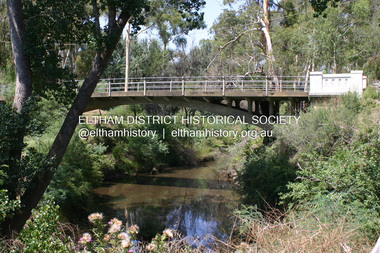
... 50 years before. The other was John McDonald of Arthurs Creek, who had built the old wooden bridge over the creek about 40 years earlier.4 Although John Monash was a fine engineer, his fame came from his brilliant war career, rather than from his engineering or his many other achievements. ...50 years before. The other was John McDonald of Arthurs Creek, who had built the old wooden bridge over the creek about 40 years earlier.4 Although John Monash was a fine engineer, his fame came from his brilliant war career, rather than from his engineering or his many other achievements. ...Monash Bridge spans the Diamond Creek at Hurstbridge. It was built in 1917 for the Shires of Heidelberg, Eltham and Whittlesea. It is considered Nillumbik Shire's finest engineered bridge and was construced by the engineering company of Sir John Monash. Covered under Heritage Overlay, Nillumbik Planning Scheme. Published: Nillumbik Now and Then / Marguerite Marshall 2008; photographs Alan King with Marguerite Marshall.; p117 Monash Bridge is considered the Shire’s finest engineered bridge and was constructed by the engineering company of that great Australian, Sir John Monash.1 The bridge spans Diamond Creek on the Hurstbridge-Arthurs Creek Road, linking Hurstbridge with Yarrambat and Arthurs Creek. Monash Bridge, also called Hurst’s Bridge, was built in 1917, by the Reinforced Concrete and Monier Pipe Construction Company Pty Ltd, for the Shires of Heidelberg, Eltham and Whittlesea. Although Monash was probably in action overseas during World War One when the bridge was designed and constructed, he evolved the basic design in the 1900s and it was a standard design for the firm. However J A Laing, a designer at the firm, was probably the designer, as his initials are on bridge drawings held by the Eltham District Historical Society.2 The bridge is an excellent early Australian example of an open spandrel reinforced concrete arch bridge and has a single span of 29 metres. It is unusual in Victoria, but similar to many reinforced concrete arch bridges in Europe and America, built from the late 19th century. In Victoria, Monash pioneered the use of reinforced concrete – then a revolutionary construction material. His company, Monash & Anderson, had the exclusive licence for the Monier patent for the system of reinforced concrete construction for Victoria and New South Wales. A well-known example of the Monier arch bridge is the Morell Bridge in South Yarra. The sweeping arch of the Monash Bridge combines grace and utility and blends with the surrounding rural landscape. Its design and construction have allowed it to carry increasing volumes of heavy traffic, but in modern times the one lane is considered by some to prevent easy passage through Hurstbridge. However others consider this an asset to deter too much more traffic, which would diminish Hurstbridge’s charming rural character.3 This is the third bridge across the Diamond Creek at this site. The original bridge was a log bridge upstream, constructed in the 1850s by early settler, Henry Hurst, after whom Hurstbridge was named. The bridge spanned the creek, where it divided his family’s property. In the 1880s a timber bridge replaced it, known as Hurst’s Bridge. However a more permanent bridge was considered necessary when the new railway arrived in 1912, bringing with it expectations of growth in the town and the surrounding fruit-growing district. Monash Bridge’s official opening on November 3, 1917 was a gala occasion, which took place before about 1000 spectators. Two who attended the opening had a particularly sound knowledge of the locality. One was Fred Hurst, Henry’s brother, who used to ford the creek at or near the bridge’s site more than 50 years before. The other was John McDonald of Arthurs Creek, who had built the old wooden bridge over the creek about 40 years earlier.4 Although John Monash was a fine engineer, his fame came from his brilliant war career, rather than from his engineering or his many other achievements. Monash was Corps Commander of the Australian Forces. His brilliance was recognised with his awards: Knight Grand Cross of the Order of St. Michael and St. George, and Knight Commander of the Bath. Monash was also decorated by the French, Belgian, and American Governments.5 After the war, Monash worked in many prominent civilian positions, the most notable as head of the Victorian State Electricity Commission. He was a leading and loved public figure, involved in many public and private organisations. He was president of the Australian Zionist Federation and involved in the Boy Scouts. Monash University is named after him. By the 1920s Monash was probably regarded as the greatest living Australian.6 Despite most of his life working as an administrator and leader, rather than a fighting soldier, he became integral to the ANZAC legend. Monash died in 1931.This collection of almost 130 photos about places and people within the Shire of Nillumbik, an urban and rural municipality in Melbourne's north, contributes to an understanding of the history of the Shire. Published in 2008 immediately prior to the Black Saturday bushfires of February 7, 2009, it documents sites that were impacted, and in some cases destroyed by the fires. It includes photographs taken especially for the publication, creating a unique time capsule representing the Shire in the early 21st century. It remains the most recent comprehenesive publication devoted to the Shire's history connecting local residents to the past. nillumbik now and then (marshall-king) collection, hurstbridge, monash bridge -
 Eltham District Historical Society Inc
Photograph - Digital Photograph, Marguerite Marshall, Rice House, 69 Ryans Road, Eltham, 27 March 2007
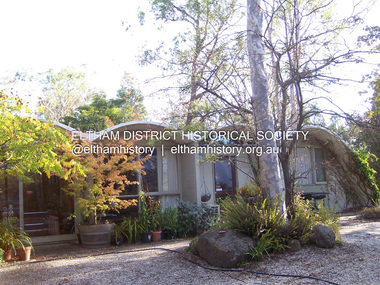
... war shortage of building materials largely resulted in mud-brick houses. Examples of Borland’s public work include contributions to the Olympic Swimming Pool in Melbourne and the Preshil Junior School in Kew. After more than 50 years...war shortage of building materials largely resulted in mud-brick houses. Examples of Borland’s public work include contributions to the Olympic Swimming Pool in Melbourne and the Preshil Junior School in Kew. After more than 50 years ...Built in 1953, the Rice House was leading Melbourne architect Kevin Borland's first commssion and was one of two houses of its kind. The design of the shell-like structure was inspired by the Arch of Ctesiphon, built in the second century south of Baghdad. Cement with a waterproofing agent was applied in layers to a form of regularly spaced timber arches covered in hessian. This ctesiphon system was developed in the United Kingdom by engineer J.H. de Waller in 1947. Commissioned in 1951 by Harrie and Lorna Rice, after Harrie, then an art student, met Borland at The Age Small Homes Service. Borland suggested they buy land in Eltham because at that time it was the only council in Melbourne that would grant a permit for such an innovative house. Covered under Victorian Heritage. Inspired by an ancient arch in Iraq, a house stands on top of a hill in a private position, off Ryans Road, Eltham. One of only two houses of its kind, it was leading Melbourne architect Kevin Borland’s first commissioned house, which he built in 1953. The shell-like structure, partially screened by giant trees and cacti, was inspired by the Arch of Ctesiphon south of Baghdad, built in the second century.1 Cement with a waterproofing agent was applied in layers to a form of regularly spaced timber arches tightly covered by hessian. This ctesiphon system was developed in the United Kingdom by engineer J H de Waller in 1947. This house was the first of three such structures built in Victoria, of which only one other remains, although substantially altered.2 It is the Wood House and supermarket, at the corner of Cleveland Road and High Street Road, Ashwood, designed by Robin Boyd in 1952. The Rice House demonstrates Kevin Borland’s innovative and experimental work. It is an outstanding example of the post-war period of experimentation in domestic architecture in Melbourne – by Robin Boyd, Kevin Borland and others – for The Age Small Homes Service from 1947 to 1953. This was partly an expression of late-Modernism and also necessitated by the post-war shortage of building materials. In Eltham, the post-war shortage of building materials largely resulted in mud-brick houses. Examples of Borland’s public work include contributions to the Olympic Swimming Pool in Melbourne and the Preshil Junior School in Kew. After more than 50 years of living in the house, Harrie and Lorna Rice still love it. Facing north-east with large windows overlooking the garden and two courtyards, it is well lit and benefits from a through breeze. The couple commissioned the extraordinary house after Harrie, then an art student, met Borland in 1951 at The Age Small Homes Service. Harrie was so impressed by the recently graduated Borland’s enthusiasm, that he asked him to design them an interesting house for a low budget. The unusual design presented several hurdles for the young couple before they could construct it. Borland suggested that they buy land in Eltham, because at that time it had the only council in Melbourne that would allow such an innovative house. Another hurdle was to gain finance for this remarkable house. The State Savings Bank Manager refused finance on the grounds that it was ‘unliveable’ and a ‘disgrace’. Fortunately, through a family connection, the couple borrowed money from the National Bank. But they discovered years later, that the bank’s evaluation stated the two ‘concrete sheds’ were of no value! The house built in off-white concrete, consists of two sections. The main house has four arches supported by brick and concrete walls that create a series of inter-connected rooms. Inside, the ceiling follows the roofline. Originally this section was only ten square metres, because of building restrictions at the time. But in 1973 Borland added two rooms and a carport. The second structure of two arches was originally a garage and a studio for art teacher Harrie Rice. To accommodate the growing family, in the mid 1950s, Borland converted the second structure into two children’s bedrooms, a kitchenette, a bathroom and a living room. The two structures were originally linked by a covered way of suspended draped-concrete, but this collapsed in the 1980s. The design has several maintenance problems. Cracks developed where two halves of the shells were joined. Then the material sprayed over the cracks became brittle, causing leaks. Fortunately Harrie found another material he could use. The valleys between the arches collect water, requiring annual painting with a waterproof material to prevent leaking. Lorna framed the house with native and exotic plants, which provide privacy and as a bonus, the garden attracted the rare Eltham Copper Butterfly. Published: Nillumbik Now and Then / Marguerite Marshall 2008; photographs Alan King with Marguerite Marshall.; p157 Comments about the Rice House on Lost Eltham page on Facebook June 2018 https://www.facebook.com/Lost-Eltham-1535993463348408/ Kate Borland: My dad designed this house. It is the Rice house and it is being renovated to its original glory as we speak.... Katherine Fox: I remember Harry and Lorna's, there was a secret room...! And the best loo with a view as I recall. Katherine Fox: Love this house! Wish I'd known it was up for sale. Looking forward to seeing progress if possible...If I recall correctly, the concrete swag over the walk-way collapsed at some stage. Marcus Skipper: In our little green Landrover, my dad and Alister Knox drove up dirt roads, a dirt track through the bush and finally to the ridge to check out this joint in about 1960. After the war at some time, they were all together at RMIT studying building design. Alister was the only one to graduate. A situation that resulted, my father would joke, in Alister having a career wherein his qualifications exceeded his talent. World Peace had broken out and all were hip to the ‘People’s’ century. Kevin went with the Modernist’s concrete, Alister went with the peasant’s mudbrick. “If this is the future,” my dad said,”I don’t like it.” And we drove back to medieval Montsalvat.This collection of almost 130 photos about places and people within the Shire of Nillumbik, an urban and rural municipality in Melbourne's north, contributes to an understanding of the history of the Shire. Published in 2008 immediately prior to the Black Saturday bushfires of February 7, 2009, it documents sites that were impacted, and in some cases destroyed by the fires. It includes photographs taken especially for the publication, creating a unique time capsule representing the Shire in the early 21st century. It remains the most recent comprehenesive publication devoted to the Shire's history connecting local residents to the past. nillumbik now and then (marshall-king) collection, eltham, rice house, ryans road, kevin borland -
 Running Rabbits Military Museum operated by the Upwey Belgrave RSL Sub Branch
Oil Painting HMAS Australia (1), HMAS Australia (1), 26/06/1910
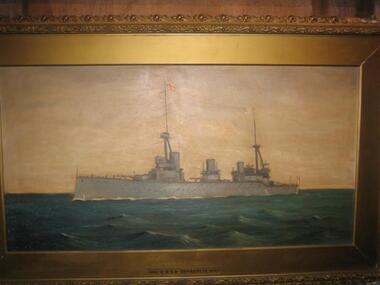
... war ship in the Australian fleet was the first flagship of the Australian fleet in WW1. She was Commissiond and paid for by the Australian Goverment to ensure sdequate protection for the Australasion Pacific Region. She had a crew of 900 "Officers and Crew" and was equipted with four sets of 12 inch breech loading guns,side firing torpedos and fourteen 4 inch guns for surface and air contacts. On the 12 of April 1924 HMAS Australia (1) was with "Full Military Honours" Scuttled 50 km east of Sydney. Only 14 Years...war ship in the Australian fleet was the first flagship of the Australian fleet in WW1. She was Commissiond and paid for by the Australian Goverment to ensure sdequate protection for the Australasion Pacific Region. She had a crew of 900 "Officers and Crew" and was equipted with four sets of 12 inch breech loading guns,side firing torpedos and fourteen 4 inch guns for surface and air contacts. On the 12 of April 1924 HMAS Australia (1) was with "Full Military Honours" Scuttled 50 km east of Sydney. Only 14 Years ...HMAS Australia (1) The largest war ship in the Australian fleet was the first flagship of the Australian fleet in WW1. She was Commissiond and paid for by the Australian Goverment to ensure sdequate protection for the Australasion Pacific Region. She had a crew of 900 "Officers and Crew" and was equipted with four sets of 12 inch breech loading guns,side firing torpedos and fourteen 4 inch guns for surface and air contacts. On the 12 of April 1924 HMAS Australia (1) was with "Full Military Honours" Scuttled 50 km east of Sydney. Only 14 Years old.Framed Oil Paintinghmas australia oil painting pictures -
 Eltham District Historical Society Inc
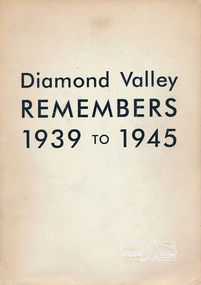
Book, Northern Metropolitan College of TAFE, Diamond Valley Remembers 1939-1945, 1995
... The Australia Remembers 1945-1995 campaign was a pageant of events commemorating the end of World War II. 34 chapters include reminiscences from 34 men and women mainly from the Watsonia Returned Servicemen's League recording their memories of the war years for the benefit of the [Shire of] Diamond Valley community. This copy is signed by Eleanor Sumner who is also a contributor. This book comprises a collection of unique and individual personal narratives of World War 2, written 50 ...An Oral History Project - An Australia Remembers New Work Project funded by the Department of Employment, Education and Training. Sponsored by Northern Metropolitan College of TAFE. The Australia Remembers 1945-1995 campaign was a pageant of events commemorating the end of World War II. 34 chapters include reminiscences from 34 men and women mainly from the Watsonia Returned Servicemen's League recording their memories of the war years for the benefit of the [Shire of] Diamond Valley community. This copy is signed by Eleanor Sumner who is also a contributor.This book comprises a collection of unique and individual personal narratives of World War 2, written 50 years after the war and preserved for future generations. The collection is linked through the association of the participants living in the Diamond Valley area in Melbourne's north in 1995.roy hillard, eleanor sumner, bob campbell, dulcie cox, lancelot riky, charles nelson, reg johnson, frank collings, george armstrong, stan ware, lorna mill, ann hewett, reg angwin, ruby talbot, dion hogan, elean dansey, mary keppel, charles baker, elaine grigg, len grigg, kathleen kennedy, arthur dykes, eric wood, frances jensen, mary edwards, frank wilson, harry hewett, mick marks, audrey wass, ian wall, joyce anderson, john grant, jean gee, noel mcintyre, allan dunn, reminscences, oral history, world war 1939-1945, world war 2, ww2, australia remembers, northern metropolitan college of tafe, watsonia, personal narrative, watsonia barracks -
 Bendigo Military Museum
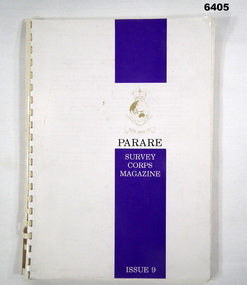
Magazine - "Parare" Survey Corps Magazine Issue 9, Royal Australian Survey Corps, 1993
... years 1991 to 1993. 4Fd Svy Sqn Adventure training list pages 7, 8. Army Map Depot - Unit Ski Day, pages 20, 21. The William Patton Expedition - Locating his grave as part of the " Burke and Wills " expedition, list of personnel involved - page 43. 8 Fd Svy Sqn - names mentioned and photo - page 50. 4 Fd Svy Sqn (1992) names mentioned page 69. The G Res manning list on page 70. Names mentioned in "Unit sports pages 73, 74. Exercise Kokoda Cartographer July 1992 list of participants on Page 78. Iraq - The Gulf War...years 1991 to 1993. 4Fd Svy Sqn Adventure training list pages 7, 8. Army Map Depot - Unit Ski Day, pages 20, 21. The William Patton Expedition - Locating his grave as part of the " Burke and Wills " expedition, list of personnel involved - page 43. 8 Fd Svy Sqn - names mentioned and photo - page 50. 4 Fd Svy Sqn (1992) names mentioned page 69. The G Res manning list on page 70. Names mentioned in "Unit sports pages 73, 74. Exercise Kokoda Cartographer July 1992 list of participants on Page 78. Iraq - The Gulf War ...An annual magazine published for release on RASvy Corps birthday 1st July. All units with RASvy Corps are invited / expected to submit an article depicting their activities over the preceding years 1991 to 1993. 4Fd Svy Sqn Adventure training list pages 7, 8. Army Map Depot - Unit Ski Day, pages 20, 21. The William Patton Expedition - Locating his grave as part of the " Burke and Wills " expedition, list of personnel involved - page 43. 8 Fd Svy Sqn - names mentioned and photo - page 50. 4 Fd Svy Sqn (1992) names mentioned page 69. The G Res manning list on page 70. Names mentioned in "Unit sports pages 73, 74. Exercise Kokoda Cartographer July 1992 list of participants on Page 78. Iraq - The Gulf War, Topographic Support page 52. Adelaide (4 Fd Svy Sqn) 1992 page 65. 8 Fd Svy Sqn manning wind down list pages 89-90. Military Geographic Information Pilot Project page 92. Royal Australian Survey Corps Aerial photography Team personnel list page 95. Operation Belama 92 Team list page 96. Long term Schooling attendees and promotions, page 105. Litho Sqn Postings in and out pages 116-117. Special awards SGT Durrant page 113, SSGT SR Hill page 114. RASvy completes 1:50,000 scale mapping of the Pilbara Region page 121. 1st Topo Svy Sqn personnel mentioned on page 122. A4 sized booklet with soft glossy card covers, paper pages held together with a plastic spiral binder.army survey regiment, army survey regt, fortuna, royal australian survey corps, rasvy, asr -
 Bendigo Military Museum
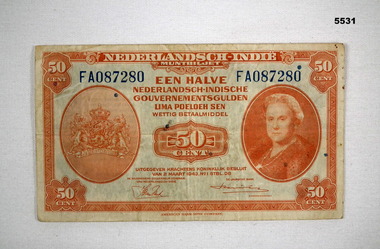
Currency - NEDERLANDS PAPER NOTE, Dutch Government & American Bank Note Coy, 1943
... It has a portrait of a mature lady (very possibly Queen Wilhelmina of the Netherlands who reigned during the war years). Its value is 50 cents. It appears to be a 'Half Gulden'. ...It has a portrait of a mature lady (very possibly Queen Wilhelmina of the Netherlands who reigned during the war years). Its value is 50 cents. It appears to be a 'Half Gulden'. ...Refer to Cat 95P Service of RAAF C.S. CORNELIUS NR 40595.This is a medium size note. First side is printed in red ink. It has a portrait of a mature lady (very possibly Queen Wilhelmina of the Netherlands who reigned during the war years). Its value is 50 cents. It appears to be a 'Half Gulden'. The other side is printed in green ink with Dutch and Indonesian words. It was printed by the American Bank Note Company.ww2, netherlands, east indies -
 Warrnambool and District Historical Society Inc.
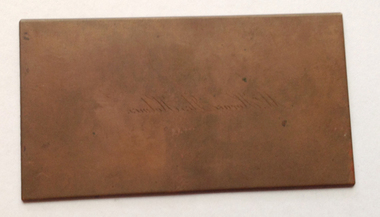
Functional object - Printing plate: Visitor Card
... war years, and died in 1959. He was a foundation member of the Warrnambool Rotary Club. This printing plate is a significant item as it belonged to Dr Holmes, a prominent doctor and a leading community member in Warrnambool for 50 years. ...This printing plate was made for Dr Horace Holmes to be used by him as a calling card. Dr Horace Holmes, born in Tasmania in 1877, came to Warrnambool in 1905 taking over the practice of Dr Fleetwood at ‘Ierne’, at the corner of Spence and Kepler Streets. In 1906 he built a new home at the corner of Liebig Street and Raglan Parade and moved his practice there in 1912 (Currently occupied by Oz Child in 2024). Dr Holmes retired in 1939, briefly returned to medical practice as a locum during the war years, and died in 1959. He was a foundation member of the Warrnambool Rotary Club. This printing plate is a significant item as it belonged to Dr Holmes, a prominent doctor and a leading community member in Warrnambool for 50 years. It also is a good example of a custom of the time – the use of a calling card when visiting homes or contacting clients and business people. (This practice continues today)This is a printing plate for Dr Horace Iles Holmes. It is made of brass and is quite worn, particularly on the reverse side where the name of the manufacturer is almost obliteratedDr Horace Iles Holmesdr horace holmes, printing plate
