
Showing 1116 items matching "the war continues"
-
 Moorabbin Air Museum
Book - RAAF air bases, Air Base Richmond The Story of the RAAF base on the Hawkesbury
... ...The war continues...RAAF bases Early days Enter the RAAF The squadrons arrive Early thirties Expansion War declared The early war years The WAAAF The paratroopers The war continues Aftermath of war On to the nineties Bicentennial air show Historical overview of RAAF base Richmond, circa 1991 Air Base Richmond The Story of the RAAF base on the Hawkesbury Book RAAF air bases ...Historical overview of RAAF base Richmond, circa 1991non-fictionHistorical overview of RAAF base Richmond, circa 1991early days, enter the raaf, the squadrons arrive, early thirties, expansion, war declared, the early war years, the waaaf, the paratroopers, the war continues, aftermath of war, on to the nineties, bicentennial air show -
Bialik College
Mixed media (sub-series) - Oct 7 Atzeret, 2024
... For this anniversary we gather as one to remember. we acknowledge oct 7 as the beginning of a war that continues and impacts us everyday. Our prayers are for this war to cease, for our people to return home and for families to be reunited. ...For this anniversary we gather as one to remember. we acknowledge oct 7 as the beginning of a war that continues and impacts us everyday. Our prayers are for this war to cease, for our people to return home and for families to be reunited. ...jewish life, october 7, 2020s, 2024, bialik collegejewish life, october 7, 2020s, 2024, bialik college -
 8th/13th Victorian Mounted Rifles Regimental Collection
Booklet - Annual reports 13ALH Association
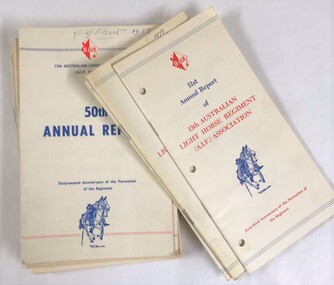
... The regimental association was formed following the return from the war and continued to meet regularly till early 1980s. ...The regimental association was formed following the return from the war and continued to meet regularly till early 1980s. ...The 13th Australian Light Horse Regiment (AIF) was raised at Broadmeadows Victoria in March 1915. Following service at Gallipoli the regiment was broken up with squadrons going to France as Divisional Cavalry Squadrons of 2nd, 4th and 5th Divisions. The regiment was reformed as firstly 1st Anzac Corps Mounted Troops and later Australian Corps Mounted Troops. The regimental association was formed following the return from the war and continued to meet regularly till early 1980s. Records and memorabilia were handed to the 8/13 Victorian Mounted Rifles.Twenty editions of the Annual Report of the 13th Australian Light Horse Regimental Association. Multiple pages, saddle stitched and stapled.association, 13th, light horse, wwi, world war one -
Moorabbin Air Museum
Machine - Miles Messenger 2A VH-AVQ (G-AJKG)
... At the end of the Second World War production continued for the civilian market. A number of Miles Messengers were imported into Australia, including t. ...At the end of the Second World War production continued for the civilian market. A number of Miles Messengers were imported into Australia, including t. ...Historical Details: The AARG aircraft was built by Miles Aircraft (Northern Ireland) Ltd as a production Messenger 2A model in April 1947 and registered as G-AJKG in the UK where it flew with a number of private owners before being sold in May 1953 to the Right Honourable R.. Description: The Miles Messenger was built in England from 1942 on as a liaison aircraft for the Royal Air Force. At the end of the Second World War production continued for the civilian market. A number of Miles Messengers were imported into Australia, including t. Level of Importance: National -
 Bendigo Historical Society Inc.
Literary work - 'History of Bendigo Legacy Club'
... Legacy aimed to assist the widows and children of servicemen who had died during World War 1. This has continued to the present day....Legacy aimed to assist the widows and children of servicemen who had died during World War 1. This has continued to the present day. Bendigo Legacy History 1996 renovation Unpublished and unbound copy of the history of the Bendigo Legacy Club. 97 pages. ...The Bendigo Legacy Club was formed in 1926 with members being returned soldiers. Legacy aimed to assist the widows and children of servicemen who had died during World War 1. This has continued to the present day.Unpublished and unbound copy of the history of the Bendigo Legacy Club. 97 pages. Printed on white A4 paper with black printing and secured with bulldog clip. Green folder containing printed and written material about the refurbishment of Legacy House in 1996. Details of builders, cost estimates and written correspondence included in the folder.bendigo legacy, history, 1996 renovation -
 Kiewa Valley Historical Society
Box Starch, circa 1914 to late 1900's
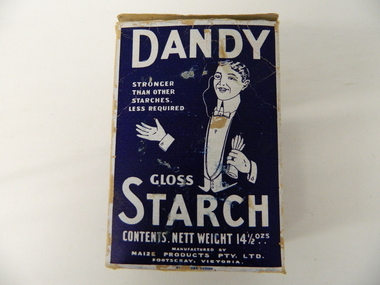
... This brand of starch was first manufactured in 1914, during the First World War, and continued to cover the other wars and military conflicts that followed. ...This brand of starch was first manufactured in 1914, during the First World War, and continued to cover the other wars and military conflicts that followed. ...This brand of starch was first manufactured in 1914, during the First World War, and continued to cover the other wars and military conflicts that followed. It was a time when Australian made was important due to the limited supplies coming from England and Europe. This was a period when the demand for "home grown" produce was at its peak. This was in a time when by necessity not by the "Buy Australian" campaign (of later years) which was the major factor for the demand of goods. It was in a time when starch was used in formal clothing to put a "crisp" or fresh new appearance for clothes. The important social more of "clothes make the person" was in vogue.This box which once contained starch powder is very significant to a rural semi isolated region because it clearly demonstrates that the social mores of the city were also entrenched into the rural population. The fashion of the day, even in remote areas, especially rural, were still a requirement to be maintained on certain special occasions. Cleanliness and stiff "upper lip" persona were just as important in the rural sector as in city and Government circles. Institutions such as hospitals, Government Offices and the legal personnel were bound by the fashion of the starch appearance (no dirt sticks to a personage with the "starch" look). Appearances, especially the first ones, were the judgmental image that remained in the uppermost regions of the viewer. This box with white writing and a "formally clad" man on a navy blue background held Australian grown maize based starch powder(1 LB gross). The package is made from 200 gsm thick cardboard. As production was made during the two World Wars 1914 to 1945 the promotion was heavily focused on Australian made and Australian grown maize.The same cover both front and back, "DANDY" below this a figure outlined in white on a navy blue background "hat and tails" outfit. Next to the sketch in smaller lettering" STRONGER THAN OTHER STARCHES. LESS REQUIRED". Below the figure "GLOSS" and below this in larger print "STARCH". Below this and in smaller print "CONTENTS. NETT WEIGHT 14 1/2 ozs" Below this and in smaller print "MANUFACTURED BY MAIZE PRODUCTS PTY LTD FOOTSCRAY VICTORIA" On one side of the box and in large white print on royal blue background"PURITY, STRENGTH AND UNIFORMITY." On the other side are the manufacturers directions. On the left side "FOR RAW STARCH" Underneath and in smaller print,"Dissolve in warm water a quantity to give the required thickness. Add bluing if required Stir before each using. On the right side "FOR BOILING STARCH" underneath this in small print"Mix well in small quantity of cold water to creamy consistency. Add boiling water, and stir constantly while cooking. Allow to cool, and add blueing if required. Underneath these two sets of instructions is "Make your consistency thinner than if using another kind of Starch"household starch, household cleaning, domestic laundering. -
 Kyneton RSL Sub Branch
Hat, Australia Army Hat, 1994
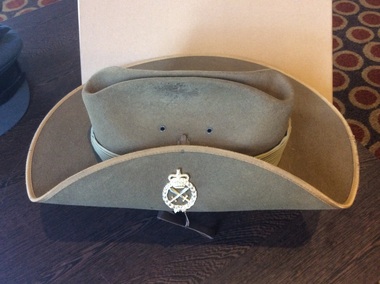
... The slouch hat became a famous symbol of the Australian fighting man during World War One and continued to be worn throughout World War Two. ...The slouch hat became a famous symbol of the Australian fighting man during World War One and continued to be worn throughout World War Two. ...The Slouch Hat became standard issue headdress in 1903 and its brim position was mostly standardised. The slouch hat became a famous symbol of the Australian fighting man during World War One and continued to be worn throughout World War Two. Its use since that time has made it a national symbol. https://www.army.gov.au/our-history/traditions/the-slouch-hatStandard uniform issue for the Australian Army.Khaki slouch hat, has pleated hat band, brim upturned with badge on upturned brim. Crown of hat pinched inwards. Leather crown liner and leather chin strap with adjustable clip.MOUNTCASTLE 1994 Made in Australia (Broad arrow) 56 Black pen handwritten. Fullerarmy, uniform -
 Monbulk RSL Sub Branch
Book, Ian Morris, War: What is good for? The role of conflict in civilisation from primates to robots, 2015
... War has allowed us to build huge nation states that keep us relatively safe from random acts of violence. And yet if we continue...War has allowed us to build huge nation states that keep us relatively safe from random acts of violence. And yet if we continue ...Ian Morris challenges the view that war is one of the greatest human evilsBibliography, index, notes, ill (b/w), maps, 393.p.non-fictionIan Morris challenges the view that war is one of the greatest human evilswar and civilization, military history -
 Geoffrey Kaye Museum of Anaesthetic History
Machine - Shipway's Apparatus, Circa 1916
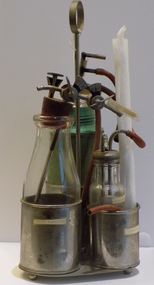
... Recognising that warmed ether was less irritating to the airway and patients receiving it were less likely to experience shock, Francis Shipway developed the Shipway's apparatus which was used during World War 1 and continued to be used through to World War 2. ...Recognising that warmed ether was less irritating to the airway and patients receiving it were less likely to experience shock, Francis Shipway developed the Shipway's apparatus which was used during World War 1 and continued to be used through to World War 2. ...Recognising that warmed ether was less irritating to the airway and patients receiving it were less likely to experience shock, Francis Shipway developed the Shipway's apparatus which was used during World War 1 and continued to be used through to World War 2. Reduction of shock for patients who had experienced trauma was crucial to their later recovery, particularly during war times. This example of the Shipway's apparatus also has the facility for administering chloroform.A triangular metal stand with two glass jars sitting in a metal tub and a green metal jar that looks like a thermos, also sitting in a metal tub. A metal pole has been screwed into the centre point of the stand, with a circular top to act as a handle. One of the jars has a rubber stopper in the neck with metal tubing attached to the stopper. The other glass jar has a metal screw top with a dropper spout. The two glass jars are connected via red rubber tubing. The apparatus has been sectioned in parts to show the inner mechanisms.Typed in black ink on white paper and adhered to metal bath: SHIPWAY'S APPARATUS •Typed in black ink on white paper and adhered to metal bath: ETHER VAPORISER •Typed in black ink on white paper and adhered to metal bath: THERMOS WITH HOT WATER •Typed in black ink on white paper and adhered to glass bottle: CHLOROFORM VAPORIZER •Typed in black ink on white paper and adhered to metal connector: TO AIR BELLOWS •Typed in black ink on white paper and adhered to tube in thermos: DELIVERY TUBE •Moulded into base of thermos: THERMOSshipway, world war i, warmed ether, endotracheal, chloroform -
 Warrnambool and District Historical Society Inc.
Trophy, Rifle Club, 1909
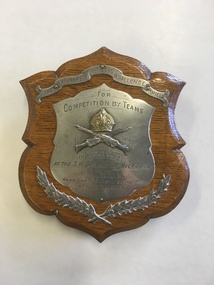
... After the Boer War Geary continued to serve in the Mounted Rifles local unit (later called Australian Lighthorse). ...After the Boer War Geary continued to serve in the Mounted Rifles local unit (later called Australian Lighthorse). ...This shield was awarded in 1909 by the Rifle Clubs of South Western Victoria for a rifle-shooting competition. Rifle Clubs operated in Warrnambool from 1860 and possibly earlier and in 1904 a union of rifle clubs in the Warrnambool district was formed - the South Western District Rifle Clubs' Union. Edward Geary was a member of the Mounted Rifles, G Company in the 1890s and served as a sergeant in the Boer War, 1899-1900. He was commended by the founder and commandant of the Victorian Mounted Rifles, Colonel Tom Price, for his bravery in South Africa rescuing wounded soldiers under heavy fire. After the Boer War Geary continued to serve in the Mounted Rifles local unit (later called Australian Lighthorse). He was also a long-time member of the Warrnambool Rifle Club and won this trophy as a member of a Lighthorse unit. This shield is of interest as an example of the early 20th century trophies awarded by the Warrnambool district Rifle Clubs. Gun Clubs and Rifle Clubs have been existing in the Warrnambool district since the 1860s. This is a small wooden shield, lightly polished on the front surface. It has silver-coloured metal plates attached by metal pins to the front of the shield in the form of a scroll, two fern or laurel leaves, printed information and a crown with two crossed rifles. At the back is a metal clip to enable the shield to stand up. 'The Warrnambool Citizens Challenge Shield for Competition by Teams, 1909, of Rifle Clubs in the S.W. District of Victoria won by No.1 Sq. XI, A.L.H. Handicap 65, Total Score 579, Arm. Sgt. E. Geary 88'warrnambool rifle club, edward geary, south western district rifle clubs union, warrnambool history -
 Kiewa Valley Historical Society
Box Sample Dandy Starch, circa mid to late 1900's
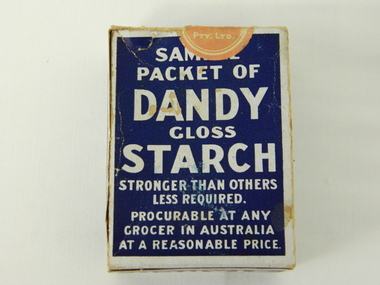
... This brand of starch was first manufactured in 1914, during the First World War, and continued to cover the other wars and military conflicts that followed. ...This brand of starch was first manufactured in 1914, during the First World War, and continued to cover the other wars and military conflicts that followed. ...This brand of starch was first manufactured in 1914, during the First World War, and continued to cover the other wars and military conflicts that followed. It was a time when Australian made was important due to the limited supplies coming from England and Europe. This was a period when the demand for "home grown" produce was at its peak. This was in a time when by necessity not by the "Buy Australian" campaign (of later years) which was the major factor for the demand of goods. It was in a time when starch was used in formal clothing to put a "crisp" or fresh new appearance for clothes. The important social more of "clothes make the person" was in vogue. This is a sample box provided by the manufacturer as an advertising and promotional method of prospective customers becoming aware of the product. This type of promotional avenue brought results and ensured that this type of advertising and inducement by manufacturers would be ingrained as a lasting avenue through to the 2nd Millennium This box which once contained starch powder is very significant to a rural semi isolated region because it clearly demonstrates that the social mores of the city were also entrenched into the rural population. The fashion of the day, even in remote areas, especially rural, were still a requirement to be maintained on certain special occasions. Cleanliness and stiff "upper lip" persona were just as important in the rural sector as in city and Government circles. Institutions such as hospitals, Government Offices and the legal personnel were bound by the fashion of the starch appearance (no dirt sticks to a personage with the "starch" look). Appearances, especially the first ones, were the judgmental image that remained in the uppermost regions of the viewer.This box with white writing and a "formally clad" man on a navy blue background held Australian grown maize based starch powder(1 LB gross). The package is made from 200 gsm thick cardboard. As production was made during the two World Wars 1914 to 1945 the promotion was heavily focused on Australian made and Australian grown maize.The front(has "Sample" on top) the rest inscriptions are the same on each cover both and back, "DANDY" below this a figure outlined in white on a navy blue background "hat and tails" outfit. Next to the sketch in smaller lettering" STRONGER THAN OTHER STARCHES. LESS REQUIRED". Below the figure "GLOSS" and below this in larger print "STARCH". Below this and in smaller print "CONTENTS. NETT WEIGHT 14 1/2 ozs" Below this and in smaller print "MANUFACTURED BY MAIZE PRODUCTS PTY LTD FOOTSCRAY VICTORIA" On one side of the box and in large white print on royal blue background"PURITY, STRENGTH AND UNIFORMITY." On the other side are the manufacturers directions. On the left side "FOR RAW STARCH" Underneath and in smaller print,"Dissolve in warm water a quantity to give the required thickness. Add bluing if required Stir before each using. On the right side "FOR BOILING STARCH" underneath this in small print"Mix well in small quantity of cold water to creamy consistency. Add boiling water, and stir constantly while cooking. Allow to cool, and add blueing if required. Underneath these two sets of instructions is "Make your consistency thinner than if using another kind of Starch"household starch, household cleaning, domestic laundering. -
Glen Eira Historical Society
Newspaper - CAULFIELD RSL
... Included are two sepia photographs of the 39th Victorian Battalion – the first of them travelling up the Kokoda Track and the second of them parading after being relieved by the 7th Division – and one colour photograph of Michael Danby MHR, Federal Member for Melbourne Ports, attending the 2005 Anzac Day service in Port Melbourne. 2/A clipping from the Caulfield/Glen Eira Leader (Titled ‘Conflict of war continues’, dated 09/11/2010, and authored by Jenny Ling) advertising the year’s Remembrance Day service to be held by the Caulfield RSL on 07/11/2010/ Special tribute is to be paid to service persons killed in Afghanistan. ...Included are two sepia photographs of the 39th Victorian Battalion – the first of them travelling up the Kokoda Track and the second of them parading after being relieved by the 7th Division – and one colour photograph of Michael Danby MHR, Federal Member for Melbourne Ports, attending the 2005 Anzac Day service in Port Melbourne. 2/A clipping from the Caulfield/Glen Eira Leader (Titled ‘Conflict of war continues’, dated 09/11/2010, and authored by Jenny Ling) advertising the year’s Remembrance Day service to be held by the Caulfield RSL on 07/11/2010/ Special tribute is to be paid to service persons killed in Afghanistan. ...This file contains five items of newspaper articles pertaining to the Caulfield RSL: 1/A pamphlet titled ‘A Chance to Honour – The Men Who Saved Australia’, date and parent organisation unspecified, advertising a presentation ceremony and film screening of Chris Masters’ documentary The Men Who Saved Australia to take place on 21/10/2005, to mark the 60th anniversary of the end of WWII. Included are two sepia photographs of the 39th Victorian Battalion – the first of them travelling up the Kokoda Track and the second of them parading after being relieved by the 7th Division – and one colour photograph of Michael Danby MHR, Federal Member for Melbourne Ports, attending the 2005 Anzac Day service in Port Melbourne. 2/A clipping from the Caulfield/Glen Eira Leader (Titled ‘Conflict of war continues’, dated 09/11/2010, and authored by Jenny Ling) advertising the year’s Remembrance Day service to be held by the Caulfield RSL on 07/11/2010/ Special tribute is to be paid to service persons killed in Afghanistan. (There exists a discrepancy between the date offered for the article, which is written on the page to which the clipping is attached, rather than the clipping itself, and the date offered for the event, which is written in the clipping itself. The event is described as taking place before the publication of the publication of the article advertising it. Presumably, the date offered for the article, written on the page to which the clipping is attached, is erroneous). 3/A clipping from the Caulfield Leader (titled ‘Our True Anzac Spirit’, dated 19/04/2011, and authored by Jenny Ling) noting that the New Zealand national anthem is to be played alongside Advance Australia Fair at all RSLs across Victoria on Anzac Day following lobbying by the Caulfield branch. Included is a colour photograph of New Zealand sub-branch vice-president Danny Allen and president Sam Smith standing in front of the New Zealand flag. 4/A clipping from the Caulfield Leader (titled ‘Veteran’s Vivid Memory’, dated 08/11/2011, and authored by Jenny Ling, consisting of a short biography of WWII veteran Eric Sparks. Included is a colour photograph of Sparks. 5/A clipping from the Melbourne Weekly Bayside – Your Community Voice (titled ‘Sun Up and Two-Up’, dated 18/04/2012, author unspecified) noting a visit to the Caulfield RSL by WWII veteran John Supple, and advertising a service to be held by the RSL on 25/04/2012. Included is a colour photograph of Supple outside the RSL.caulfield, caulfield returned servicemen league (rsl), exservice organisations, clubs and associations, returned servicepeople, armed forces, soldiers, aged people, senior citizens centres, st. george’s road, elsternwick, anzac day, memorial services, moore alan ‘kanga’, danby michael mhr, masters chris, ling jenny, sammon jason, larkin bob, gutnick dovid, remembrance day, blore jeff, mcbean jon, allen danny, smith sam, stewart mark, spark eric, spark eric ‘ned’, elder vin, supple john -
 Lakes Entrance Historical Society
Postcard - WW1 Postcard from Charles Sands to Dorothy Davidson 1917, Raphael Tuck and Sons
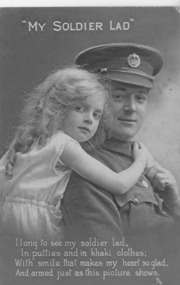
... I am still here but will be off to France sometime next month I do not feel at all happy this Xmas but I feel I will spend my next Xmas Day in South Buchan as I think the war will.......message continues on VTMH05475.1...I am still here but will be off to France sometime next month I do not feel at all happy this Xmas but I feel I will spend my next Xmas Day in South Buchan as I think the war will.......message continues on VTMH05475.1 World War 1914-1918 Correspondence My Soldier Lad Black and white postcard of a British WWI Army Officer a little girl about five years old with her arm across his chest. ...Postcard is one of I love Lassie series No 4286 Copy of message from Charles R Sands stationed at Durrington Camp Lark Hill Salsbury Plain on January 1917 Message reads Dear Little Dorothy I often wonder how you are since I left South Buchan and wish I was back again with you all. The snow is falling very fast tonight and all are suffering a lot with the frost and cold. I am still here but will be off to France sometime next month I do not feel at all happy this Xmas but I feel I will spend my next Xmas Day in South Buchan as I think the war will.......message continues on VTMH05475.1Black and white postcard of a British WWI Army Officer a little girl about five years old with her arm across his chest. EnglandMy Soldier Ladworld war 1914-1918, correspondence -
 Melbourne Legacy
Document - Article, Legatee K D (Ken) Green, President 1981
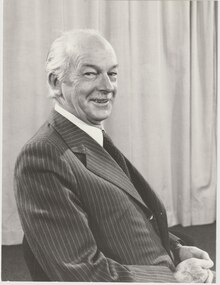
... Legatee Ken Green served with the 15th Australian Field Company RAE 2nd AIF during World War 2. He continued with Citizen Military Forces after the war. ...Legatee Ken Green served with the 15th Australian Field Company RAE 2nd AIF during World War 2. He continued with Citizen Military Forces after the war. ...A formal photo and a cutting from from a Melbourne Legacy President's report showing a photo of Legatee Ken Green (President of Melbourne Legacy in 1981). It was collected to be a record of a photo of past presidents. Legatee Ken Green served with the 15th Australian Field Company RAE 2nd AIF during World War 2. He continued with Citizen Military Forces after the war. He attained the rank of Major General with the 3rd Division between 1970-73. He joined Melbourne Legacy in 1959 on the nomination of Legatees Robert Myers and John Standish. The article was part of an album of past presidents from 1965 to 1989. The folder included biographical details and obituaries, eulogies and death notices of prominent Legatees. The items have been catalogued separately.A record of Legatee Ken Green a past president of Legacy. The information was collected to record the lives of prominent legatees in a folder.Black and white photo plus an article with a black and white photo of Legatee Ken Green - President 1981.past presidents, ken green -
 Melbourne Legacy
Article, Bulletin. A Tribute to Legatee Ken Green
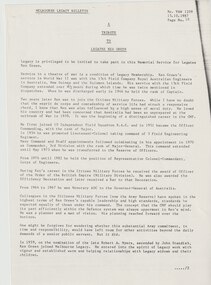
... Legatee Ken Green served with the 15th Australian Field Company RAE 2nd AIF during World War 2. He continued with Citizen Military Forces after the war. ...Legatee Ken Green served with the 15th Australian Field Company RAE 2nd AIF during World War 2. He continued with Citizen Military Forces after the war. ...An article from the Melbourne Legacy Bulletin on the death of Legatee Ken Green (President of Melbourne Legacy in 1981). The Bulletin published articles on Legatees when they passed away. Legatee Green was born in 1917 and died in 1987. More details of his life are outlined in the articles. Legatee Ken Green served with the 15th Australian Field Company RAE 2nd AIF during World War 2. He continued with Citizen Military Forces after the war. He attained the rank of Major General with the 3rd Division between 1970-73. He joined Melbourne Legacy in 1959 on the nomination of Legatees Robert Myers and John Standish. The article was part of an album of past presidents from 1965 to 1989. The folder included biographical details and obituaries, eulogies and death notices of prominent Legatees. The items have been catalogued separately.A record of Legatee Ken Green a past president of Legacy. The information was collected to record the lives of prominent legatees in a folder.Typed copy of pages from the Legacy Bulletin on the death of Legatee Ken Green - President 1981Bulletin No 1209. 15.10.1987. Page No 18 and 19.past presidents, vale, ken green -
 Returned Nurses RSL Sub-branch
Document - Photocopy of newspaper clipping and related documents, Sunday Herald, The forgotten heroine, 5 December 1914 - May 20 2012
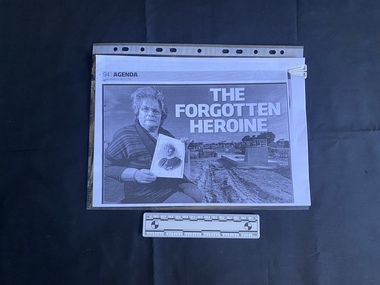
... Estelle served in seven army units and was in the Middle East, England and France for the duration of World War 1. After the war she continued to dedicate her life to the care of soldiers. ...Estelle served in seven army units and was in the Middle East, England and France for the duration of World War 1. After the war she continued to dedicate her life to the care of soldiers. ...Newspaper - 'The forgotten heroine' Visitors to New Cheltenham Cemetery in Melbourne would not know that a highly decorated and dedicated nurse was buried there. Her grave is unmarked, there is no reference to her achievements or selfless dedication. Estelle Lee Archer died in 1960, at the Repatriation General Hospital, Heidelberg, age 78 from a perforated ulcer. Margaret Leyden wants the Office of Australian War Graves to recognise that her great-aunt died from war-related injuries and to restore and maintain her grave. Margaret, who never met her aunt, has pieced together her history, including that Estelle's medals, including the prestigious Royal Red Cross 2nd Class for services in support of our ANZACs have ended up in the MAryborough Military & Colonial Museum after they were bought at a second hand shop. Estelle served in seven army units and was in the Middle East, England and France for the duration of World War 1. After the war she continued to dedicate her life to the care of soldiers. Document 1 - digitised copy of 'First Wold War Embarkation Roll' for Estelle Frances Lee-Archer Document 2 - photocopy of 'Austraalian Imperial Force - Nominal Roll' page 7 (Lee-Archer, Estelle Frances listed) Document 3 - photocopy of unknown document (Sis. Lee-Archer, Estelle (RRC) listed) Five photocopied pages held together with a plastic paperclip. Two pages are of a newspaper story, the first showing a full page black and white photo of a seated older woman holding a photo of a woman in nurse's uniform. The second page of the newspaper story has four columns of text with a photo of a war medal and a photo of a standing woman in nurse's uniform beside them. The final three pages are war-time documents.dr collopy, kildonian castle, london, caulfield, tasmania, john lee archer, mary anne lyons, joseph lyons, parlianment house, hobart, ross bridge, alfred hospital, kyarra, 1st australian general hospital, swanage, dorset, gallipoli, 2nd australian general hospital, 3rd australian general hospital, 25th australian general hospital, 47th australian casualty clearing station, 3rd australian casualty clearing station, 7th australian general hospital, john saddington -
 Flagstaff Hill Maritime Museum and Village
Tool - Auger, Thomas R Ellin, First half of the 20th century
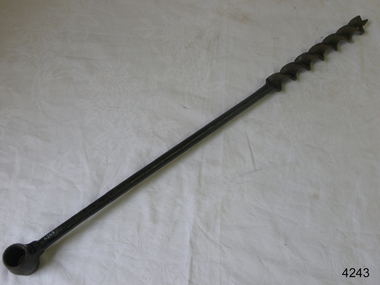
... After the war Footprint continued to grow, manufacture, and expand its range of hand tools for the professional tradesman. ...After the war Footprint continued to grow, manufacture, and expand its range of hand tools for the professional tradesman. ...Footprint Tools is a hand tool manufacturer based in Sheffield, England. In 2014 most of their hand tools were still made in Sheffield at the Footprint factory. Footprint Tools can trace its manufacturing history as far back as the 1760s when Alfrid Ridge & Sons was established as a manufacturer of woodworking tools. Ridge was bought by the current owning family in 1932. The Footprint brand originates from 1875 when Thomas R Ellin, a member of a cutlery manufacturing family, started a tool manufacturing business under the brand "Footprint". This subsequently became known as Thomas R Ellin (Footprint Works). This company was bought by the current owning family in 1948 and began to manufacture a range of tools under the Footprint, Domino, Climax, John Bull, and Clinker brands. During World War 2 the divisions of the business were engaged in manufacturing hand tools for British and Commonwealth forces. After the war Footprint continued to grow, manufacture, and expand its range of hand tools for the professional tradesman. In 2008 Footprint moved to a larger factory and invested in new forging equipment, but this process was interrupted by a global recession, and Footprint was unable to generate enough business to cover the cost of the upgrades. In early 2009 the company was forced to liquidate and lay off its staff to pay creditors. The Jewitt family retained the brand and intellectual property, and later that year revived the company under the name Footprint Sheffield and began producing a smaller range of products at first. With the same family of owner-managers, now run by the fourth generation, in 2015 Footprint continues to manufacture most of their products in Sheffield, England, and exports worldwide.This item gives us a look into the history of the beginnings of an early company that made tools in Sheffield England and is still producing tools today.Ring Auger, Double Twist with Lead Screw, bit 1" with round shaft Imprinted 'footprint' trademarkflagstaff hill, warrnambool, shipwrecked-coast, flagstaff-hill, flagstaff-hill-maritime-museum, maritime-museum, shipwreck-coast, flagstaff-hill-maritime-village -
 Flagstaff Hill Maritime Museum and Village
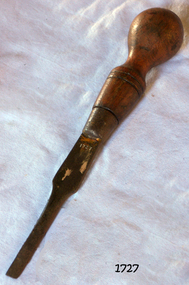
Tool - Screw Driver, A Ridge and Son, 1950s Item is in company catalogue in 1951
... After the war Footprint continued to grow, manufacture and expand its range hand tools for the professional tradesman. ...After the war Footprint continued to grow, manufacture and expand its range hand tools for the professional tradesman. ...Footprint Tools is a hand tool manufacturer based in Sheffield, England. In 2014 most of their hand tools are still made in Sheffield at the Footprint factory. Footprint Tools can trace its manufacturing history as far back as the 1760s when Alfrid Ridge & Sons was established as a manufacturer of wood working tools. Ridge was bought by the current owning family in 1932. The Footprint brand originates from 1875 when Thomas R Ellin, a member of a cutlery manufacturing family, started a tool manufacturing business under the brand “Footprint”. This subsequently became known as Thomas R Ellin (Footprint Works). This company was bought by the current owning family in 1948 and began to manufacture a range of tools under the Footprint, Domino, Climax, John Bull and Clinker brands. During World War 2 the divisions of the business were engaged in manufacturing hand tools for British and Commonwealth forces. After the war Footprint continued to grow, manufacture and expand its range hand tools for the professional tradesman. In 2004, Footprint cooperated with the University of Sheffield in a study of modern manufacturing techniques. In 2008 Footprint moved to a larger factory and invested in new forging equipment, but this process was interrupted by a global recession, and Footprint was unable to generate enough business to cover the cost of the upgrades. In early 2009 the company was forced to liquidate and lay off its staff in order to pay creditors. The Jewitt family retained the brand and intellectual property, and later that year revived the company under the name Footprint Sheffield, and began producing a smaller range of products at first. With the same family of owner managers, now run by the fourth generation, in 2015 Footprint continues to manufacture most products in Sheffield, England and exports worldwide.A tool that was made by a UK company in the 1950s that has a long history of tool manufacture and after many changes in company ownership is still producing tools today in Sheffield England.Screw driver wooden handle turned and steel blade. Made in Sheffield by Alfrid Ridge and Son. London patternNoneflagstaff hill, warrnambool, shipwrecked-coast, flagstaff-hill, flagstaff-hill-maritime-museum, maritime-museum, shipwreck-coast, flagstaff-hill-maritime-village, screw driver, alfrid ridge & son, footprint tools, tools -
Northern District School of Nursing. Managed by Bendigo Historical Society Inc.
Document - Northern District School of Nursing Graduates Association - Citation for Nancy Winifred Long, March 1986
... Recognized for her tireless dedication and pioneering efforts in nursing education, especially in post-war Australia. Continued as Dean until health issues forced her resignation in 1974.Remembered for her leadership, resilience, and the positive impact she had on nursing education and the lives of her colleagues and students. ...Recognized for her tireless dedication and pioneering efforts in nursing education, especially in post-war Australia. Continued as Dean until health issues forced her resignation in 1974.Remembered for her leadership, resilience, and the positive impact she had on nursing education and the lives of her colleagues and students. ...The Northern District School of Nursing in Victoria, Australia Graduates Association: This document outlines the life and career of Nancy Winifred Long, highlighting her significant contributions to nursing education and hospital administration in Australia. Born in Talbot, Victoria, in 1910.Left school at fourteen due to family circumstances and worked in domestic employment before entering nursing. Completed general nursing training at Ballarat Base Hospital in 1930 and midwifery training in 1931. Gained the Infant Welfare Certificate at Tweddle Babies' Home.Became Sister-in-Charge of the Children's Ward at Ballarat Hospital. Awarded the Florence Nightingale Scholarship, becoming its first recipient. Studied in the UK, earning a Diploma with distinction in Nursing Administration from the University of London in 1947.Undertook further study and hospital visits in the UK, Scandinavia, the United States, and Canada. Joined the Alfred Hospital in Melbourne as a tutor-sister. Appointed the first Dean of the Northern District School of Nursing in 1950, pioneering a college-based nursing education model. Despite financial and institutional challenges, she was instrumental in sustaining and advocating for the program. Served on various committees, including the Victorian Nurses Board Education Committee and the Course Development Committee of the Victoria Institute of Colleges.Active in the Matrons' Association, Nurse Educators Section, and the Royal Victorian College of Nursing, where she was a Fellow for 23 years. Recognized for her tireless dedication and pioneering efforts in nursing education, especially in post-war Australia. Continued as Dean until health issues forced her resignation in 1974.Remembered for her leadership, resilience, and the positive impact she had on nursing education and the lives of her colleagues and students. Passed away peacefully, 02 March 1986, leaving a legacy of service and innovation in Australian nursing.Northern District School of Nursing Graduates Association - Citation for Nancy Winifred Long who died on 02 March 1986 - 4 pages typed This item contains the following documents: 3792.6a Citation for Nancy Winifred Long who died on 02 March 1986 - 4 pages typed 3792.6b Copy of abovenurse training, lister house, history, nancy winifred long -
 Melbourne Legacy
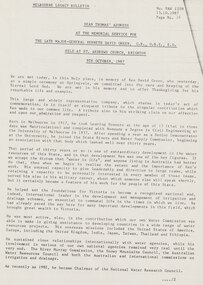
Article, Bulletin VALE Legatee Kenneth David Green
... Legatee Ken Green served with the 15th Australian Field Company RAE 2nd AIF during World War 2. He continued with Citizen Military Forces after the war. ...Legatee Ken Green served with the 15th Australian Field Company RAE 2nd AIF during World War 2. He continued with Citizen Military Forces after the war. ...An article from the Melbourne Legacy Bulletin on the death of Legatee Ken Green (President of Melbourne Legacy in 1981). The Bulletin published articles on Legatees when they passed away. Legatee Green was born in 1917 and died in 1987. More details of his life are outlined in the articles. This is a copy of the address by Dean Thomas at the Memorial Service for Major-General Green at St Andrews Church Brighton. At 02005 is a second articles, 'A Tribute to Legatee Ken Green' written by Legacy. Legatee Ken Green served with the 15th Australian Field Company RAE 2nd AIF during World War 2. He continued with Citizen Military Forces after the war. He attained the rank of Major General with the 3rd Division between 1970-73. He joined Melbourne Legacy in 1959 on the nomination of Legatees Robert Myers and John Standish. The article was part of an album of past presidents from 1965 to 1989. The folder included biographical details and obituaries, eulogies and death notices of prominent Legatees. The items have been catalogued separately.A record of Legatee Ken Green a past president of Legacy. The information was collected to record the lives of prominent legatees in a folder.Typed copy of pages from the Legacy Bulletin on the death of Legatee Ken Green - President 1981Bulletin No 1209. 15.10.1987. Page No 16 and 17.past presidents, vale, ken green -
 Uniting Church Archives - Synod of Victoria
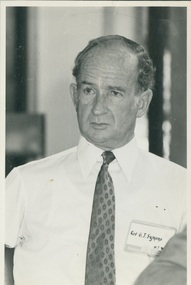
BW photo, Undated
... The homes were named in honour of Margaret Somerville MBE who helped evacuate 95 children from Croker Island to Sydney in 1942 and who returned to Croker Island with the children after the war and continued as a house mother and care giver until 1965. ...The homes were named in honour of Margaret Somerville MBE who helped evacuate 95 children from Croker Island to Sydney in 1942 and who returned to Croker Island with the children after the war and continued as a house mother and care giver until 1965. ...Somerville Homes came into existence in 1965. The homes were named in honour of Margaret Somerville MBE who helped evacuate 95 children from Croker Island to Sydney in 1942 and who returned to Croker Island with the children after the war and continued as a house mother and care giver until 1965. A book entitled "They Crossed A Continent", the story of Margaret Somerville's epic journey, will tell you how it all began. As government and social philosophies changed, these houses became homes for the profoundly disabled. In 1980, with expanded community services, Somerville Homes became Somerville Community Services Incorporated Somerville Community Services Inc is a non-government, not for profit, youth, family and community welfare organisation indigenous to the Northern Territory. We maintain strong constitutional links with the Uniting Church in Australia but we are governed by an independent and professional Board of Directors, ensuring that the organisation has the capacity to respond to the needs of people whatever their circumstances. Somerville recognises that being disadvantaged in a modern Western society is a condition relative to general living standards. We give priority to advocacy and improving the resources of people who are uninformed or ill-informed about community services and opportunities which may improve their circumstances. Somerville supports actions aimed at creating increased opportunities for people to become personally involved in a sharing and caring society. We promote opportunities for church and other local voluntary organisations to play a more effective part in meeting the needs of the community. Somerville monitors and evaluates its own service programs, adapting them to changing community needs and circumstances. We also monitor Federal and Territory programs affecting community and the way services and funding affect the position of individuals, couples and families in community. The organisation is financed by public donations, church and service club grants, business support, government grants, sponsorship and the organisation fundraising activities. Rev. Gordon J Symons, upper body photo of middle-aged man in white shirt and tie.Rev. Gordon Symons; Somerville Homes, Darwin. New Spectator (12 September 1972) p1rev. gordon symons; somerville christian homes -
 Surrey Hills Historical Society Collection
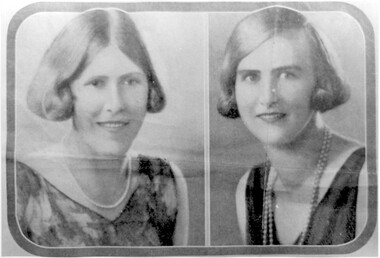
Photograph, Nancy and Hattie Steele
... continued their studies in Toronto and obtained their Doctorates. In 1923 Nancy and Hattie started the first girl guide group in Surrey Hills at Holy Trinity Church. Both married and had families. Nancy married Dr William Brayshaw Woodhouse and, while he took up army duties during World War...continued their studies in Toronto and obtained their Doctorates. In 1923 Nancy and Hattie started the first girl guide group in Surrey Hills at Holy Trinity Church. Both married and had families. Nancy married Dr William Brayshaw Woodhouse and, while he took up army duties during World War ...Nancy (Margaret Dillon) Steele born 1906 and Hattie ( Harriette Vevers) Steele were daughters of Charles Henri Dillon Steele (1869-1935) and Sarah Margaret Russell (1873-1944),he was a pioneer of dentistry in Victoria who was in practice in 1890 and later in Collins Street for 40 years. The family lived at ‘Dalriada’ (dem.) on the corner of Bona Vista Avenue and Union Road. Sarah Margaret Steele was President of the local Patriotic League during WW1 and is credited with starting the move to raise funds for the WW1 memorial in the Surrey Gardens. Nancy and Hattie were graduates at Melbourne University in Dentistry and Agricultural Science respectively. They continued their studies in Toronto and obtained their Doctorates. In 1923 Nancy and Hattie started the first girl guide group in Surrey Hills at Holy Trinity Church. Both married and had families. Nancy married Dr William Brayshaw Woodhouse and, while he took up army duties during World War II, Nancy continued his practice. Their son Anthony became a dentist, while Peter was known locally when he became a councillor and Mayor of Camberwell. Their daughter Margaret married Herbert Andrewartha and lived in NSW.A black and white photograph of two portraits of two young ladies. Their dress and hair styles are suggestive of a 1920's date..(miss) nancy (margaret) steele, (miss) hattie vevers steele, dalriada, house names, bona vista avenue, union road, surrey hills, dentists, first girl guide group, 1923, holy trinity church, world war, 1939-1945, mayors, councillors, (miss) margaret brayshaw-woodhouse, dr william brayshaw woodhouse, peter brayshaw woohdhouse, dr charles henri dillon steele, dr anthony brayshaw woodhouse, (miss) nancy steele, (mrs) nancy andrewartha, (miss) hattie steele, (miss) harriette vevers steele, (mrs) margaret brayshaw woodhouse, (miss) margaret dillon steele, (miss) sarah margaet russell, (mes) sarah margaret steele -
 Sunshine and District Historical Society Incorporated
Film - A Blast From The Past Albion Explosive Factory DVD
... . - By 1942–45, it was one of Australia’s three primary military explosives factories, employing thousands and contributing significantly to the war effort. Post War Time History - Continued production of explosives and fertilizers for commercial use after WWII. - Expanded in 1947–49 with the addition of the RDX plant north of Furlong Road. - Introduced new technologies like synthetic ammonia, DNT, and continuous TNT production through the 1950s–60s. .... - By 1942–45, it was one of Australia’s three primary military explosives factories, employing thousands and contributing significantly to the war effort. Post War Time History - Continued production of explosives and fertilizers for commercial use after WWII. - Expanded in 1947–49 with the addition of the RDX plant north of Furlong Road. - Introduced new technologies like synthetic ammonia, DNT, and continuous TNT production through the 1950s–60s. ...The Albion Explosives Factory was a major WWII-era munitions site in Sunshine, Victoria, operating from 1939 to 1986. Its legacy includes the Black Powder Mill, now a heritage landmark. War Time History - Established in 1939–40 in response to the looming threat of war in Europe. - Located in North Albion, opposite the ICIANZ chemical plant, which also helped design and operate the facility. - Initially known as Munitions Annexe No. 5, it became the Albion Explosives Factory, producing cordite, TNT, nitroglycerine, nitric acid, and other propellants for small arms and artillery. - By 1942–45, it was one of Australia’s three primary military explosives factories, employing thousands and contributing significantly to the war effort. Post War Time History - Continued production of explosives and fertilizers for commercial use after WWII. - Expanded in 1947–49 with the addition of the RDX plant north of Furlong Road. - Introduced new technologies like synthetic ammonia, DNT, and continuous TNT production through the 1950s–60s. Closure and Environmental Remediation - Closed in 1986, followed by extensive decontamination and cleanup. - The site was heavily contaminated with TNT, DNT, nitrates, ammonia, and metals, requiring years of environmental audits and remediation. - Eventually redeveloped into a housing estate and shopping complex, transforming the industrial site into a suburban community. A Blast from the Past Albion Explosive Factoryalbion explosive factory, deer park, cairnlea -
 Sunshine and District Historical Society Incorporated
Film - A Blast From The Past Albion Explosive Factory Video
... . - By 1942–45, it was one of Australia’s three primary military explosives factories, employing thousands and contributing significantly to the war effort. Post War Time History - Continued production of explosives and fertilizers for commercial use after WWII. - Expanded in 1947–49 with the addition of the RDX plant north of Furlong Road. - Introduced new technologies like synthetic ammonia, DNT, and continuous TNT production through the 1950s–60s. .... - By 1942–45, it was one of Australia’s three primary military explosives factories, employing thousands and contributing significantly to the war effort. Post War Time History - Continued production of explosives and fertilizers for commercial use after WWII. - Expanded in 1947–49 with the addition of the RDX plant north of Furlong Road. - Introduced new technologies like synthetic ammonia, DNT, and continuous TNT production through the 1950s–60s. ...The Albion Explosives Factory was a major WWII-era munitions site in Sunshine, Victoria, operating from 1939 to 1986. Its legacy includes the Black Powder Mill, now a heritage landmark. War Time History - Established in 1939–40 in response to the looming threat of war in Europe. - Located in North Albion, opposite the ICIANZ chemical plant, which also helped design and operate the facility. - Initially known as Munitions Annexe No. 5, it became the Albion Explosives Factory, producing cordite, TNT, nitroglycerine, nitric acid, and other propellants for small arms and artillery. - By 1942–45, it was one of Australia’s three primary military explosives factories, employing thousands and contributing significantly to the war effort. Post War Time History - Continued production of explosives and fertilizers for commercial use after WWII. - Expanded in 1947–49 with the addition of the RDX plant north of Furlong Road. - Introduced new technologies like synthetic ammonia, DNT, and continuous TNT production through the 1950s–60s. Closure and Environmental Remediation - Closed in 1986, followed by extensive decontamination and cleanup. - The site was heavily contaminated with TNT, DNT, nitrates, ammonia, and metals, requiring years of environmental audits and remediation. - Eventually redeveloped into a housing estate and shopping complex, transforming the industrial site into a suburban community. A Blast from the Past Albion Explosive Factoryalbion explosive factory, deer park, cairnlea -
 Sunshine and District Historical Society Incorporated
Film - A Blast From The Past Albion Explosive Factory USB Stick
... . - By 1942–45, it was one of Australia’s three primary military explosives factories, employing thousands and contributing significantly to the war effort. Post War Time History - Continued production of explosives and fertilizers for commercial use after WWII. - Expanded in 1947–49 with the addition of the RDX plant north of Furlong Road. - Introduced new technologies like synthetic ammonia, DNT, and continuous TNT production through the 1950s–60s. .... - By 1942–45, it was one of Australia’s three primary military explosives factories, employing thousands and contributing significantly to the war effort. Post War Time History - Continued production of explosives and fertilizers for commercial use after WWII. - Expanded in 1947–49 with the addition of the RDX plant north of Furlong Road. - Introduced new technologies like synthetic ammonia, DNT, and continuous TNT production through the 1950s–60s. ...The Albion Explosives Factory was a major WWII-era munitions site in Sunshine, Victoria, operating from 1939 to 1986. Its legacy includes the Black Powder Mill, now a heritage landmark. War Time History - Established in 1939–40 in response to the looming threat of war in Europe. - Located in North Albion, opposite the ICIANZ chemical plant, which also helped design and operate the facility. - Initially known as Munitions Annexe No. 5, it became the Albion Explosives Factory, producing cordite, TNT, nitroglycerine, nitric acid, and other propellants for small arms and artillery. - By 1942–45, it was one of Australia’s three primary military explosives factories, employing thousands and contributing significantly to the war effort. Post War Time History - Continued production of explosives and fertilizers for commercial use after WWII. - Expanded in 1947–49 with the addition of the RDX plant north of Furlong Road. - Introduced new technologies like synthetic ammonia, DNT, and continuous TNT production through the 1950s–60s. Closure and Environmental Remediation - Closed in 1986, followed by extensive decontamination and cleanup. - The site was heavily contaminated with TNT, DNT, nitrates, ammonia, and metals, requiring years of environmental audits and remediation. - Eventually redeveloped into a housing estate and shopping complex, transforming the industrial site into a suburban community. A Blast from the Past Albion Explosive Factoryalbion explosive factory, deer park, cairnlea -
 Uniting Church Archives - Synod of Victoria
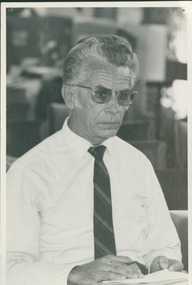
Photograph, Albert Kuipers, somerville Church Homes, Darwin
... The homes were named in honour of Margaret Somerville MBE who helped evacuate 95 children from Croker Island to Sydney in 1942 and who returned to Croker Island with the children after the war and continued as a house mother and care giver until 1965. ...The homes were named in honour of Margaret Somerville MBE who helped evacuate 95 children from Croker Island to Sydney in 1942 and who returned to Croker Island with the children after the war and continued as a house mother and care giver until 1965. ...Somerville Homes operated from 1965 to 1981. Somerville Homes came into existence in 1965. The homes were named in honour of Margaret Somerville MBE who helped evacuate 95 children from Croker Island to Sydney in 1942 and who returned to Croker Island with the children after the war and continued as a house mother and care giver until 1965. A book entitled "They Crossed A Continent", the story of Margaret Somerville's epic journey was produced. Somerville Homes was established in 1964 when the Methodist Overseas Mission began to discuss the closure of the Croker Island Mission and the transfer of all children to smaller group homes in the Darwin area. It had links with both the Methodist Overseas Mission and the United Church in the Northern Territory. Somerville Homes ran the Somerville Cottage Homes in Darwin from 1968 through to the 1980s. In 1981 Somerville Homes changed its name to Somerville Community Services. Somerville Homes was established as an organisation in 1964 when the Methodist Overseas Mission began to discuss the closure of the Croker Island Mission and the transfer of all children to smaller group homes in the Darwin area. A Somerville Homes Council was created with the aims: (a) to carry out charitable purposes of providing total care for children and young people in the Northern Territory of Australia and elsewhere; (b) to establish and maintain homes for children and young people, provide family counselling, arrange or assist in the arranging of adoptive or foster homes, provide after care and generally provide all such services in its own capacity or in co-operation with others, constituting the total care of the child or young person. The organisation had links with both the Methodist Overseas Mission and the United Church in the Northern Territory. It became an incorporated body with a Board in 1971. After 1977 it retained links with the Uniting Church, Northern Synod. Somerville Homes ran the Somerville Cottage Homes in Darwin from 1968 through to the 1980s. In 1980-81when the organisation expanded its services, it changed its name to Somerville Community Services. Albert Kuipers is not mentioned by name in the online information available.Kuipers is pictured in shirtsleeves taking notes."Albert Kuipers - Somerville Ch Homes Darwin"kuipers, albert, somerville homes, croker island mission, methodist overseas mission -
 Melbourne Legacy
Photograph - Portrait, Lieutenant-General Sir Stanley Savige
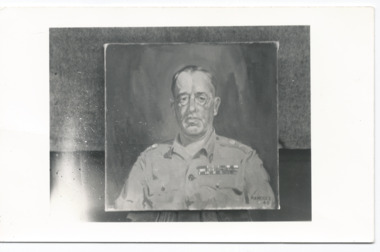
... Between the wars, Savige continued his military career with the Militia, and by 1939 he held the rank of colonel. ...Between the wars, Savige continued his military career with the Militia, and by 1939 he held the rank of colonel. ...Photograph of a painted portrait of L/- Stan Savige. The signature appears to be 'Manders '45'. He appears to be in uniform and could be from his service in World War 2. Stanley Savige is seen as the founder of Legacy when it was founded in Melbourne in September 1923. He was born in Morwell Victoria on 26/6/1890. He served in the Australian Army between 1915 and 1946, including service in both World Wars. Stanley Savige was awarded a KBE, CB, DSO, MC,ED. Stanley George Savige was born in Victoria in 1890, and enlisted in the AIF (Private 577) in March 1915. He served with 24 Battalion at Gallipoli, and was commissioned as a 2nd lieutenant prior to the evacuation, at which he was part of the final holding party at Lone Pine. In France he saw service with 6 Brigade Headquarters as well as with his battalion, and was awarded the Military Cross for his gallantry at the second battle of Bullecourt. In 1918, he became one of a small number of Australians selected for service with 'Dunsterforce' in Persia, commanding 'Urmia Force', and was awarded the Distinguished Service Order. Between the wars, Savige continued his military career with the Militia, and by 1939 he held the rank of colonel. When the 2nd AIF was raised, he was placed in command of 17 Brigade, which he led through the campaigns in Libya, Greece and Syria, before being promoted to command 3 Division (Militia) in New Guinea. In 1944, he was appointed GOC 2 Corps, in command of forces engaged in the campaign on Bougainville, and accepted the Japanese surrender there in September 1945. Lieutenant General Savige was knighted (KBE) in 1950, and died in 1954. He is widely remembered for his efforts between the wars in founding the Legacy Clubs (which he modelled on the 'Remembrance Club' formed in Hobart by his friend and former commander Sir John Gellibrand in 1923) to care for the dependants of deceased servicemen and ex-servicemen. These clubs grew into a nation wide organisation which, by the time of Savige's death, was supporting over 80 000 widows and children.This is a photographic portrait of the founder of the first Legacy Club in Australia, Sir Stanley Savige.Black and white photo of a painting of Sir Stan Savige printed onto a postcard.Stamped with 'Photograph No. MH 91859 Supplied by Military History Section (S.D.9,) General Staff L.H.Q. For official purposes ONLY, NOT TO BE PUBLISHED' in purple ink.savige, portrait, stan savige, founding legatees -
 Wodonga & District Historical Society Inc
Photograph - Whans' Stores, Wodonga
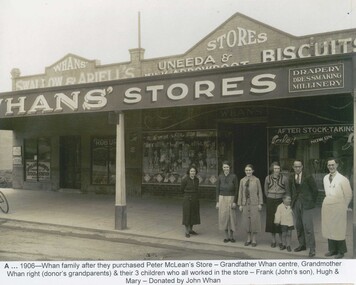
... Frank was a caring gentleman who looked after many during the difficult times of the Depression and World War 11. He continued to provide outstanding service to the Wodonga community. ...Frank was a caring gentleman who looked after many during the difficult times of the Depression and World War 11. He continued to provide outstanding service to the Wodonga community. ...John Whan was born in Carlton of Irish parents and moved with them to Wodonga by bullock dray at the age of 12. After completing his education in Wodonga, John became manager of McLean Brothers and Rigg branch store in Sydney Street, Wodonga for a number of years after which he bought the business and operated Whan’s General Store in Sydney Road, Wodonga which at its peak employed his six children. John Whan was Wodonga Shire Councillor for 15 years, including a term as Shire President in 1904-5. He was also Chairman of the Wodonga Water Trust when it built the water tower in 1922 – 23. He had many other community involvements including the School board and the Library Committee, served as an honorary justice and Deputy Coroner. secretary of the Wodonga branch of the I.O.O.F., and the Wodonga Cemetery Trust and the Masonic Lodge. He was a foundation member of the Presbyterian Church in Wodonga. He died on 10 October 1933. After his death, Whan's store was operated by John's son Francis William Whan who was born in Wodonga on 1 September 1901. He also served the community as a Justice of the Peace and Magostrate. Frank was a caring gentleman who looked after many during the difficult times of the Depression and World War 11. He continued to provide outstanding service to the Wodonga community. Frank was a dedicated member of the Presbyterian Church. The Whan General Store was purchased by Lincoln and Butterworth in 1945 and Francis and his family moved to Queensland He passed away in Lismore, NSW on 24 December 1975.These photographs represent the business of a prominent Wodonga family and community member.3 black and white photographs showing the Whan store in Wodonga at various stages in its developmentwodonga businesses, whan's store, whan family -
 Bendigo Historical Society Inc.
Photograph - AUSTIN COLLECTION: Wattle Gully Gold Mine, Chewton, Not dated but possibly 1980's
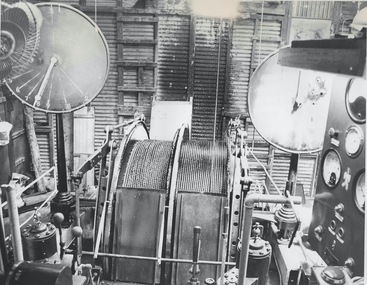
... After the war, the mine continued to develop - in the early 1950s new plant including a winding engine, steel poppet head, and twenty-head battery was added. ...After the war, the mine continued to develop - in the early 1950s new plant including a winding engine, steel poppet head, and twenty-head battery was added. ...Wattle Gully Mine holds a pivotal position in the history of the State's quartz mining industry. The rich strike at Wattle Gully mine in 1937 helped revive the State's gold mining industry that had been in the doldrums since the First World War. Wattle Gully, and a handful of other 'new' companies - the Maude and Yellow Girl, Morning Star, A 1, and North Deborah - were the flagships of the revived industry and sustained the State's gold production for some 30 years. Wattle Gully mine, with a yield of 350,000 ounces, was the richest mine of its era. By 1940, the Wattle Gully Company had paid out £207,000 in dividends to its shareholders. The company continued to mine profitably through the Second World War, though it struggled due to a shortage of manpower. After the war, the mine continued to develop - in the early 1950s new plant including a winding engine, steel poppet head, and twenty-head battery was added. The plant was obtained from the Central Nell Gwynne Company, Bendigo. On 13 March 1969, the Wattle Gully Company closed down the mine, laying off 62 men. Since 1970 Wattle Gully mine has worked intermittently. Recent additions to the mine's infrastructure has been a new ore processing plant and a decline tunnel. The ore processing plant was operated by Newmont mining from 1987 to 1990 and subsequently operated by Consolidated Victorian Mines and Duketon Goldfields. The mine site has retained evidence of its development since 1937 with its most recent periods of equipment upgrades in the 1950s and 1980s being documented by buildings, structures and intact and working machinery. Heritage Council Victoria: https://vhd.heritagecouncil.vic.gov.au/places/2380 Black and white photograph: view of engine room. Wattle Gully Gold Mine winding gear, two winding wheels in centre of image.gold mining, underground, wattle gully gold mine, chewton, winding gear -
 Bendigo Historical Society Inc.
Photograph - AUSTIN COLLECTION: Winding Gear, Wattle Gully Gold Mine, Chewton, 1982
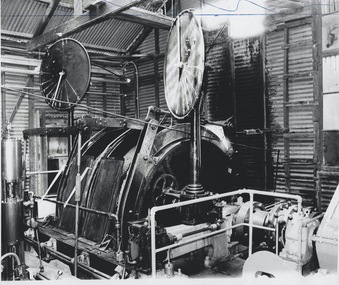
... After the war, the mine continued to develop - in the early 1950s new plant including a winding engine, steel poppet head, and twenty-head battery was added. ...After the war, the mine continued to develop - in the early 1950s new plant including a winding engine, steel poppet head, and twenty-head battery was added. ...Wattle Gully Mine holds a pivotal position in the history of the State's quartz mining industry. The rich strike at Wattle Gully mine in 1937 helped revive the State's gold mining industry that had been in the doldrums since the First World War. Wattle Gully, and a handful of other 'new' companies - the Maude and Yellow Girl, Morning Star, A 1, and North Deborah - were the flagships of the revived industry and sustained the State's gold production for some 30 years. Wattle Gully mine, with a yield of 350,000 ounces, was the richest mine of its era. By 1940, the Wattle Gully Company had paid out £207,000 in dividends to its shareholders. The company continued to mine profitably through the Second World War, though it struggled due to a shortage of manpower. After the war, the mine continued to develop - in the early 1950s new plant including a winding engine, steel poppet head, and twenty-head battery was added. The plant was obtained from the Central Nell Gwynne Company, Bendigo. On 13 March 1969, the Wattle Gully Company closed down the mine, laying off 62 men. Since 1970 Wattle Gully mine has worked intermittently. Recent additions to the mine's infrastructure has been a new ore processing plant and a decline tunnel. The ore processing plant was operated by Newmont mining from 1987 to 1990 and subsequently operated by Consolidated Victorian Mines and Duketon Goldfields. The mine site has retained evidence of its development since 1937 with its most recent periods of equipment upgrades in the 1950s and 1980s being documented by buildings, structures and intact and working machinery. Heritage Council Victoria: https://vhd.heritagecouncil.vic.gov.au/places/2380 Black and white photograph: view of engine room. Wattle Gully Gold Mine winding gear, two winding wheels in centre of image.gold mining, underground, wattle gully gold mine, chewton, winding gear
