
Showing 72 items matching "thompson paul"
-
 Whitehorse Historical Society Inc.
Map, Yarran Dheran Charts, 1974
... ...Thompson Paul...Yarran Dheran Area 21/05/2001 Paul Thompson 1974 Yarran Dheran Master Plan Section 3. ...Thompson, Paul...Yarran Dheran Area 21/05/2001 Paul Thompson 1974 Yarran Dheran Master Plan Section 3. ...Charts relating to the formation of Yarran DheranRolled charts of various dimensionsnon-fictionCharts relating to the formation of Yarran Dheranyarran dheran, yarran dheran advisory committee, thompson paul -
Whitehorse Historical Society Inc.
Map, Yarran Dheran Landscaping, 1974
... ...Thompson Paul...Yarran Dheran Landscape Development January 1974 Paul Thompson - 6 sheets Detailed planting and named species of plants - 14 sheets One hand painted watercolour...Thompson, Paul...Yarran Dheran Landscape Development January 1974 Paul Thompson - 6 sheets Detailed planting and named species of plants - 14 sheets One hand painted watercolour Yarran Dheran Thompson Paul Landscape Planning Charts relating to landscaping Yarran Dheran Charts of various dimensions Yarran Dheran Landscaping Map Thompson, Paul ...Charts relating to landscaping Yarran DheranCharts of various dimensionsnon-fictionCharts relating to landscaping Yarran Dheranyarran dheran, thompson paul, landscape planning -
Whitehorse Historical Society Inc.
Book - Report, Koonung - Mullum Forestway, c1975
... ...Thompson...Paul...A Report prepared for the Mullum Valley Freeway Action Group and Koonung Valley Action Group, under a grant from the Department of Environment by Ronald Champion Conservation Planning Environment Consultants and Paul Thompson, Rob Paul Landscapes ca1975...A Report prepared for the Mullum Valley Freeway Action Group and Koonung Valley Action Group, under a grant from the Department of Environment by Ronald Champion Conservation Planning Environment Consultants and Paul Thompson, Rob Paul Landscapes ca1975 Koonung - Mullum Forestway Book Report ...The Koonung-Mullum Freeway : a plan for action. A Report prepared for the Mullum Valley Freeway Action Group and Koonung Valley Action Group, under a grant from the Department of Environment by Ronald Champion Conservation Planning Environment Consultants and Paul Thompson, Rob Paul Landscapes ca1975mullum valley freeway action group, koonung valley action group, champion, randall, thompson, paul, rob paul landscapes, victoria. department of the environment, mullum mullum creek, koonung creek, eastern freeway, forest conservation, parks and reserves -
 Whitehorse Historical Society Inc.
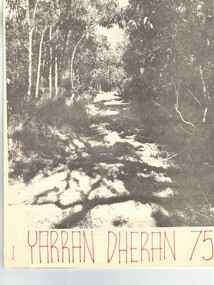
Document, Yarran Dheran, 1/06/1975 12:00:00 AM
... ...thompson...paul...parks and reserves yarran dheran thompson paul addie john Report on Yarran Dheran in 1975. ...Report on Yarran Dheran in 1975. Includes history of developments and photographs.parks and reserves, yarran dheran, thompson, paul, addie, john -
 Federation University Historical Collection
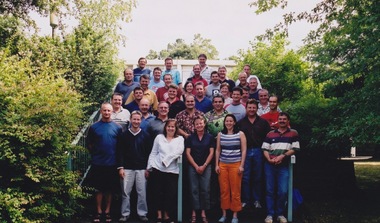
Photograph - Photograph - Colour, VIOSH: Graduate Diploma in Occupational Hazard Management; Intake 27, 2003
... ...paul thompson...VIOSH accepts people into the Graduate Diploma of Occupational Hazard Management who have no undergraduate degree - on the basis of extensive work experience and knowledge. viosh victorian institute of occupational safety and health occupational hazard management mary alvin shayne arthur tracey bence terence bernutt paul brooker joe boras dale brabham jacqueline bryant darryl casey jim coyle gregory creedon wendy dobson leanne edwards james evans paul gentles nicholas giles bethne goudie michael hartshorn peter haynes andrew holmes robert law michael martin david mckelvie gerard mcmillan phillip miles anna mitchell cameron montgomery kenneth nolan robert oliver fred panozzo phillip pennington noel pickering garry pirie rhonda rathjen yasmin saunders jenine smith zorn talevski lenard thomas paul thompson kristi turner patrick weston john whale glenn wiese lisa wild Colour photograph VIOSH: Graduate Diploma in Occupational Hazard Management; Intake 27, 2003 Photograph Photograph - Colour ...Victorian Institute of Occupational Safety and Health (VIOSH) Australia is the Asia-Pacific centre for teaching and research in occupational health and safety (OHS) and is known as one of Australia's leaders in the field. VIOSH has a global reputation for its innovative approach within the field of OHS management. VIOSH had its first intake of students in 1979. At that time the Institution was known as the Ballarat College of Advanced Education. In 1990 it became known as Ballarat University College, then in 1994 as University of Ballarat. It was 2014 that it became Federation University. VIOSH Australia students are safety managers, senior advisors and experienced OHS professionals. They come from all over Australia and industry. Students are taught active research and enquiry; rather than textbook learning and a one-size fits all approach. VIOSH accepts people into the Graduate Diploma of Occupational Hazard Management who have no undergraduate degree - on the basis of extensive work experience and knowledge.Colour photographviosh, victorian institute of occupational safety and health, occupational hazard management, mary alvin, shayne arthur, tracey bence, terence bernutt, paul brooker, joe boras, dale brabham, jacqueline bryant, darryl casey, jim coyle, gregory creedon, wendy dobson, leanne edwards, james evans, paul gentles, nicholas giles, bethne goudie, michael hartshorn, peter haynes, andrew holmes, robert law, michael martin, david mckelvie, gerard mcmillan, phillip miles, anna mitchell, cameron montgomery, kenneth nolan, robert oliver, fred panozzo, phillip pennington, noel pickering, garry pirie, rhonda rathjen, yasmin saunders, jenine smith, zorn talevski, lenard thomas, paul thompson, kristi turner, patrick weston, john whale, glenn wiese, lisa wild -
 Emerald Museum & Nobelius Heritage Park
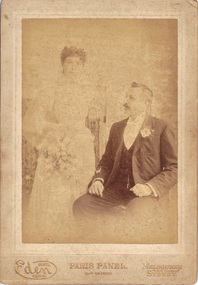
Photograph, Nightingale/Thompson Collection, 1899
... Photograph of Albert Paul THOMPSON and Elizabeth FLEMING, married 5/4/1899 in Windsor Victoria...Photograph of Albert Paul THOMPSON and Elizabeth FLEMING, married 5/4/1899 in Windsor Victoria Thompson Collection Thompson Collection Nightingale Makers Marks: Photo Eden Studios, Paris Panel Superior Finish, Melbourne and Sydney. ...Photograph of Albert Paul THOMPSON and Elizabeth FLEMING, married 5/4/1899 in Windsor VictoriaThompson CollectionSepia photograph on cream board of couple in wedding attire. Makers Marks: Photo Eden Studios, Paris Panel Superior Finish, Melbourne and Sydney. Inscription on back: Uncle All and Aunt Lis Mum's brother and sister in law.thompson collection, nightingale, -
 Melbourne Tram Museum
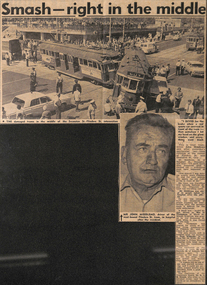
Newspaper, The Sun, The Herald, The Age, “Smash – right in the middle”, “Trams Hit; 25 People Hurt” "Crowd causes chaos", “Driver out before crash”, 21/03/1968
... John Middlemo, Mrs Glenys Thompson, Paul Williams, Carl Barrett, RJ Risson, Mr J Jackson Mr B Geddes John Watson John Dawson Paul Serafe Mrs KD Fairley...“Smash – right in the middle”, “Trams Hit; 25 People Hurt” "Crowd causes chaos", “Driver out before crash” Newspaper The Sun, The Herald, The Age John Middlemo, Mrs Glenys Thompson, Paul Williams, Carl Barrett, RJ Risson, Mr J Jackson Mr B Geddes John Watson John Dawson Paul Serafe Mrs KD Fairley ...Newspaper clipping titled: “Smash – right in the middle” The Sun, Thursday, March 21, 1968 The Herald, The Age Photos and text Flinders and Swanston Streets 25 people taken to hospital, St Vincent's, Royal Melbourne, Prince Henry's Accident happened about 12:30 pm when west-bound Flinders St tram crashed into north-bound city tram in Swanston St “Driver out before crash” The Age, Thursday, March 21, 1968 Photos and text Flinders and Swanston Sts Driver, Mr John Middlemo, was knocked semi-conscious two blocks before the collision. He struck his head when a car pulled out in front of him at Exhibition Street. Risson said it was worst accident he had seen in 40 years. Appoints 5 man inquiry committee Tram W2 304 (City Route 6) was crossing Flinders Street when it was hit by tram W2 559 (Spencer St route 28) which failed to stop at the red light. Tram 304 was subsequently scrapped. See item 9325 for an Age photo.trams, tramways, collision, accidents, flinders st, swanston st, tram 304, w2 class, tram 559, mmtb -
 Greensborough Historical Society
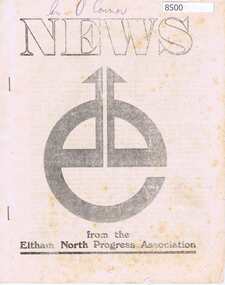
Newsletter, Eltham North Progress Assciation, News from the Eltham North Progress Association August 1977, 1977_08
... This edition of the News contains articles on garden construction by Paul Thompson; a message from the new Shire President Pauline Toner and other local news and commentary....This edition of the News contains articles on garden construction by Paul Thompson; a message from the new Shire President Pauline Toner and other local news and commentary. eltham north pauline toner Articles and comments of local interest Handwritten 'Cr O'Connor' 10 p typescript duplicated, stapled News from the Eltham North Progress Association August 1977 Newsletter Newsletter Eltham North Progress Assciation ...This edition of the News contains articles on garden construction by Paul Thompson; a message from the new Shire President Pauline Toner and other local news and commentary.10 p typescript duplicated, staplednon-fictionHandwritten 'Cr O'Connor'eltham north, pauline toner -
 Emerald Museum & Nobelius Heritage Park
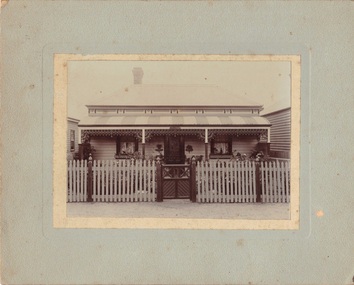
Photograph, Marshall, Nightingale/Thompson Collection, c 1905
... Residence of Albert Paul THOMPSON and family, (see photo VEMUP684 older photograph of house) This photo is later with more substantial fence, established garden and changed front door with new leadlight. ...Residence of Albert Paul THOMPSON and family, (see photo VEMUP684 older photograph of house) This photo is later with more substantial fence, established garden and changed front door with new leadlight. from Emma NIGHTINGALE'S collection THOMPSON NIGHTINGALE BEDGOOD Makers Mark:on back: Marshall, photographer, O'Connell Street, Geelong Photograph on board of house 'Rosebank' at 28 High Street (now 28 Lawton Ave) Geelong West Nightingale/Thompson Collection Photograph Marshall ...Residence of Albert Paul THOMPSON and family, (see photo VEMUP684 older photograph of house) This photo is later with more substantial fence, established garden and changed front door with new leadlight. from Emma NIGHTINGALE'S collectionPhotograph on board of house 'Rosebank' at 28 High Street (now 28 Lawton Ave) Geelong WestMakers Mark:on back: Marshall, photographer, O'Connell Street, Geelongthompson, nightingale, bedgood -
 Emerald Museum & Nobelius Heritage Park
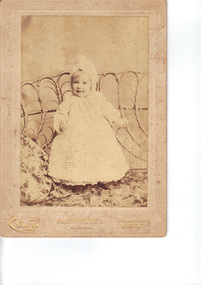
Photograph, Thompson Collection, c 1870 to 1910
... The child photographed was Frances Ruby Thompson (1900 - 1967) daughter of Albert Paul Thompson (b. 1865;d.1944) and Elizabeth Anna (nee) Fleming (b.1874;m.1899;d1954)...The child photographed was Frances Ruby Thompson (1900 - 1967) daughter of Albert Paul Thompson (b. 1865;d.1944) and Elizabeth Anna (nee) Fleming (b.1874;m.1899;d1954) Thompson Collection documenting family histories of nursery peoples of the Dandenongs Thompson Collection Fleming Makers Marks: Eden Photo Studios Paris Panel superior finish Melbourne and Sydney. ...The child photographed was Frances Ruby Thompson (1900 - 1967) daughter of Albert Paul Thompson (b. 1865;d.1944) and Elizabeth Anna (nee) Fleming (b.1874;m.1899;d1954)Thompson Collection documenting family histories of nursery peoples of the DandenongsSepia photograph on cream board of blonde infant girl in dress and bonnet. Makers Marks: Eden Photo Studios Paris Panel superior finish Melbourne and Sydney. Inscription on back: 'Fransis Thompson Uncle Alls first (Francis)thompson collection, fleming -
 Whitehorse Historical Society Inc.
Report, A Report on the Development of Yarran Dheran, 1/05/1985 12:00:00 AM
... Report by a landscape designer, Paul Thompson, on Yarran Dheran as it was in 1985 and its development in terms of the 1974 master plan. ...yarran dheran native plants weeds parks and reserves Report by a landscape designer, Paul Thompson, on Yarran Dheran as it was in 1985 and its development in terms of the 1974 master plan. ...Report by a landscape designer, Paul Thompson, on Yarran Dheran as it was in 1985 and its development in terms of the 1974 master plan. Various areas are discussed in detail. Also includes a summary of the Master Plan. Lists of weeds. Recommendations of appropriate plants for various zones. 22p.yarran dheran, native plants, weeds, parks and reserves -
 Ballarat Tramway Museum
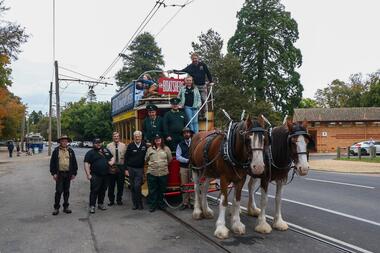
Photograph - Digital Image - BTM Horse tram day 2023 - crew, Benjamin Boehle-Mitchell, 22-4-2023
... Left to right: Richard Gilbert, Benjamin Fennell, Len Millar, Peter Winspur, Andrew Bailey, Kathy Thomas, Arthur Adams, Matthew Thompson, Alice Mong, Paul Mong and the two Clydesdales, Brooke and Noah from Sandy Creek Clydesdales....Left to right: Richard Gilbert, Benjamin Fennell, Len Millar, Peter Winspur, Andrew Bailey, Kathy Thomas, Arthur Adams, Matthew Thompson, Alice Mong, Paul Mong and the two Clydesdales, Brooke and Noah from Sandy Creek Clydesdales. ...Digital image of the BTM horse tram crew - tram 1 operating day 22-4-2023. Left to right: Richard Gilbert, Benjamin Fennell, Len Millar, Peter Winspur, Andrew Bailey, Kathy Thomas, Arthur Adams, Matthew Thompson, Alice Mong, Paul Mong and the two Clydesdales, Brooke and Noah from Sandy Creek Clydesdales.Yields information about the BTM crew for the 2023 horse tram operating day.Digital image by Benjamin Boehle-Mitchellhorse tram, tram 1, btm, wendouree parade, tram crews, crews, clydesdales -
 Emerald Museum & Nobelius Heritage Park
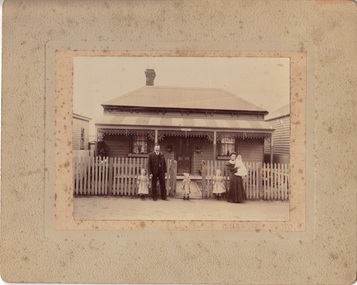
Photograph, Nightingale/Thompson Collection, c. 1900 - 1904
... Parents' name: Albert Paul THOMPSON (b.1865 d.1944) and Elizabeth Anna THOMPSON (nee FLEMING) (b.1874, m. 1899, d. 1954) Four daughters: Francis Ruby THOMPSON (b.1900 d. 1967) Violet May THOMPSON (b.1901 d.1966) Olive Doreen THOMPSON (b. 1902) Doris Grace THOMPSON (b. 1904)...B/W Photograph mounted on card; Albert Paul and Elizabeth Anna THOMPSON with their 4 children at 'Rosebank' Geelong West...Parents' name: Albert Paul THOMPSON (b.1865 d.1944) and Elizabeth Anna THOMPSON (nee FLEMING) (b.1874, m. 1899, d. 1954) Four daughters: Francis Ruby THOMPSON (b.1900 d. 1967) Violet May THOMPSON (b.1901 d.1966) Olive Doreen THOMPSON (b. 1902) Doris Grace THOMPSON (b. 1904) THOMPSON Thompson. ...'Rosebank' house name, couple with 4 children standing in front of double fronted weatherboard home. Parents' name: Albert Paul THOMPSON (b.1865 d.1944) and Elizabeth Anna THOMPSON (nee FLEMING) (b.1874, m. 1899, d. 1954) Four daughters: Francis Ruby THOMPSON (b.1900 d. 1967) Violet May THOMPSON (b.1901 d.1966) Olive Doreen THOMPSON (b. 1902) Doris Grace THOMPSON (b. 1904)THOMPSON B/W Photograph mounted on card; Albert Paul and Elizabeth Anna THOMPSON with their 4 children at 'Rosebank' Geelong WestMarkers Mark: C Marshall Photographers on front of mount. On back: Marshall Photographers, O'Connell Street, Geelongthompson. nightingale, fleming, bedgood -
 Flagstaff Hill Maritime Museum and Village
Functional object - Ship's Wheel, 1871 or earlier
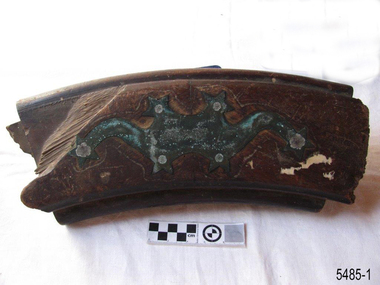
... Ellis, Q. Thompson, C. Newman, W. Paul, J. Davis, M. Horenleng, J. ...Ellis, Q. Thompson, C. Newman, W. Paul, J. Davis, M. Horenleng, J. ...The ship building company E. & A. Sewall, from Bath, Maine, USA, built many ships that had wheels with the same decorative, starburst pattern on them as this particular wheel segment, including the Eric the Red. The wheel was manufactured by their local Bath foundry, Geo. Moulton & Co. and sold to the Sewall yard for $100, according to the construction accounts of the vessel. Eric the Red was a wooden, three masted clipper ship. She had 1,580 tons register and was the largest full-rigged ship built at Bath, Maine, USA in 1871. She was built and registered by Arthur Sewall, later to become the partnership E. & A. Sewall, and was the 51st ship built by this company. The annually-published List of Merchant Vessels of the U.S. shows that Bath was still the home port of Eric the Red in 1880. The vessel was named after the Viking discoverer, Eric the Red, who was the first European to reach the shores of North America (in 980AD). The ship Eric the Red at first traded in coal between America and Britain, and later traded in guano nitrates from South America. In 1879 she was re-metalled and was in first class condition. On 10th June 1880 (some records say 12th June) Eric the Red departed New York for Melbourne and then Sydney. She had been commissioned by American trade representatives to carry a special cargo of 500 exhibits (1400 tons) - about a quarter to a third of America’s total exhibits - from America for the U.S.A. pavilion at Melbourne’s first International Exhibition. The exhibits included furniture, ironmongery, wines, chemicals, dental and surgical instruments, paper, cages, bronze lamp trimmings, axles, stamped ware, astronomical and time globes, samples of corn and the choicest of leaf tobacco. Other general cargo included merchandise such as cases of kerosene and turpentine, brooms, Bristol's Sarsaparilla, Wheeler and Wilson sewing machines, Wheeler’s thresher machine, axe handles and tools, cases of silver plate, toys, pianos and organs, carriages and Yankee notions. The Eric the Red left New York under the command of Captain Z. Allen (or some records say Captain Jacques Allen) and 24 other crew including the owner’s son third mate Ned Sewall. There were 2 saloon passengers also. On 4th September 1880 the ship had been sailing for an uneventful 85 days and the voyage was almost at its end. Eric the Red approached Cape Otway in a moderate north-west wind and hazy and overcast atmosphere. Around 1:30am Captain Allen sighted the Cape Otway light and was keeping the ship 5-6 miles offshore to stay clear of the hazardous Otway Reef. However he had badly misjudged his position. The ship hit the Otway Reef about 2 miles out to sea, south west of the Cape Otway light station. Captain Allen ordered the wheel to be put ‘hard up’ thinking that she might float off the reef. A heavy sea knocked the man away from the wheel, broke the wheel ropes and carried away the rudder. The sea swamped the lifeboats, the mizzenmast fell, with all of its rigging, then the mainmast fell and the ship broke in two. Some said that the passenger Vaughan, who was travelling for his health and not very strong, was washed overboard and never seen again. The ship started breaking up. The forward house came adrift with three of the crew on it as well as a longboat, which the men succeeded in launching and keeping afloat by continually bailing with their sea boots. The captain, the third mate (the owner’s son) and others clung to the mizzenmast in the sea. Then the owner’s son was washed away off the mast. Within 10 minutes the rest of the ship was in pieces, completely wrecked, with cargo and wreckage floating in the sea. The captain encouraged the second mate to swim with him to the deckhouse where there were other crew but the second mate wouldn’t go with him. Eventually the Captain made it to the deckhouse and the men pulled him up. At about 4:30am the group of men on the deckhouse saw the lights of a steamer and called for help. At the same time they noticed the second mate and the other man had drifted nearby, still on the spur, and pulled them both onto the wreck. The coastal steamer Dawn was returning to Warrnambool from Melbourne, its sailing time different to its usual schedule. Cries were heard coming from out of the darkness. Captain Jones sent out two life boats, and fired off rockets and blue lights to illuminate the area. They picked up the three survivors who were in the long boat from Eric the Red. Two men were picked up out of the water, one being the owner’s son who was clinging to floating kerosene boxes. At daylight the Dawn then rescued the 18 men from the floating portion of the deckhouse, which had drifted about 4 miles from where they’d struck the reef. Shortly after the rescue the deckhouse drifted onto breakers and was thrown onto rocks at Point Franklin, about 2 miles east of Cape Otway. Captain Jones had signalled to Cape Otway lighthouse the number of the Eric the Red and later signalled that there was a wreck at Otway Reef but there was no response from the lighthouse. The captain and crew of the Dawn spent several more hours searching unsuccessfully for more survivors, even going back as far as Apollo Bay. On board the Dawn the exhausted men received care and attention to their needs and wants, including much needed clothing. Captain Allen was amongst the 23 battered and injured men who were rescued and later taken to Warrnambool for care. Warrnambool’s mayor and town clerk offered them all hospitality, the three badly injured men going to the hospital and others to the Olive Branch Hotel, then on to Melbourne. Captain Allen’s leg injury prevented him from going ashore so he and three other men travelled on the Dawn to Portland. They were met by the mayor who also treated them all with great kindness. Captain Allen took the train back to Melbourne then returned to America. Those saved were Captain Z. Allen (or Jacques Allen), J. Darcy chief mate, James F. Lawrence second mate, Ned Sewall third mate and owner’s son, John French the cook, C. Nelson sail maker, Clarence W. New passenger, and the able seamen Dickenson, J. Black, Denis White, C. Herbert, C. Thompson, A. Brooks, D. Wilson, J. Ellis, Q. Thompson, C. Newman, W. Paul, J. Davis, M. Horenleng, J. Ogduff, T. W. Drew, R. Richardson. Four men had lost their lives; three of them were crew (Gus Dahlgreen ship’s carpenter, H. Ackman steward, who drowned in his cabin, and George Silver seaman) and one a passenger (J. B. Vaughan). The body of one of them had been found washed up at Cape Otway and was later buried in the lighthouse cemetery; another body was seen on an inaccessible ledge. Twelve months later the second mate James F. Lawrence, from Nova Scotia, passed away in the Warrnambool district; an obituary was displayed in the local paper. The captain and crew of the Dawn were recognised by the United States Government in July 1881 for their humane efforts and bravery, being thanked and presented with substantial monetary rewards, medals and gifts. Neither the ship, nor its cargo, was insured. The ship was worth about £15,000 and the cargo was reportedly worth £40,000; only about £2,000 worth had been recovered. Cargo and wreckage washed up at Apollo Bay, Peterborough, Port Campbell, Western Port and according to some reports, even as far away as the beaches of New Zealand. The day after the wreck the government steam ship Pharos was sent from Queenscliff to clear the shipping lanes of debris that could be a danger to ships. The large midship deckhouse of the ship was found floating in a calm sea near Henty Reef. Items such as an American chair, a ladder and a nest of boxes were all on top of the deckhouse. As it was so large and could cause danger to passing ships, Captain Payne had the deckhouse towed towards the shore just beyond Apollo Bay. Between Apollo Bay and Blanket Bay the captain and crew of Pharos collected Wheeler and Wilson sewing machines, nests of boxes, bottles of Bristol’s sarsaparilla, pieces of common American chairs, axe handles, a Wheelers’ Patent thresher and a sailor’s trunk with the words “A. James” on the front. A ship’s flag-board bearing the words “Eric the Red” was found on the deckhouse; finally those on board the Pharos had the name of the wrecked vessel. During this operation Pharos came across the government steamer Victoria and also a steamer S.S. Otway, both of which were picking up flotsam and wreckage. A whole side of the hull and three large pieces of the other side of the hull, with some of the copper sheathing stripped off, had floated on to Point Franklin. Some of the vessels yards and portions of her masts were on shore. The pieces of canvas attached to the yards and masts confirmed that the vessel had been under sail. The beach there was piled with debris several feet high. There were many cases of Diamond Oil kerosene, labelled R. W. Cameron and Company, New York. There were also many large planks of red pine, portions of a small white boat and a large, well-used oar. Other items found ashore included sewing machines (some consigned to ‘Long and Co.”) and notions, axe and scythe handles, hay forks, wooden pegs, rolls of wire (some branded “T.S” and Co, Melbourne”), kegs of nails branded “A.T. and Co.” from the factory of A. Field and Son, Taunton, Massachusetts, croquet balls and mallets, buggy fittings, rat traps, perfumery, cutlery and Douay Bibles, clocks, bicycles, chairs, a fly wheel, a cooking stove, timber, boxes, pianos, organs and a ladder. (Wooden clothes pegs drifted in for many years). There seemed to be no personal luggage or clothing. The Pharos encountered a long line, about one and a half miles, of floating wreckage about 10 miles off land, south east of Cape Otway, and in some places about 40 feet wide. It seemed that more than half of it was from Eric the Red. The ship’s crew rescued 3 cases that were for the Melbourne Exhibition and other items from amongst the debris. There were also chairs, doors, musical instruments, washing boards, nests of trunks and fly catchers floating in the sea. Most of the goods were saturated and smelt of kerosene. A section of the hull lies buried in the sand at Parker River Beach. An anchor with chain is embedded in the rocks east of Point Franklin and a second anchor, thought to be from Eric the Red, is on display at the Cape Otway light station. (There is a photograph of a life belt on the verandah of Rivernook Guest House in Princetown with the words “ERIC THE RED / BOSTON”. This is rather a mystery as the ship was registered in Bath, Maine, USA.) Parts of the ship are on display at Bimbi Park Caravan Park and at Apollo Bay Museum. Flagstaff Hill Maritime Village also has part of the helm (steering wheel), a carved wooden sword (said to be the only remaining portion of the ship’s figurehead; further research is currently being carried out), a door, a metal rod, samples of wood and a medal for bravery. Much of the wreckage was recovered by the local residents before police and other authorities arrived at the scene. Looters went to great effort to salvage goods, being lowered down the high cliff faces to areas with little or no beach to collect items from the wreckage, their mates above watching out for dangerous waves. A Tasmanian newspaper reports on a court case in Stawell, Victoria, noting a man who was caught 2 months later selling tobacco from the wreckage of Eric the Red. Some of the silverware is still treasured by descendants of Mr Mackenzie who was given these items by officials for his help in securing the cargo. The gifts included silver coffee and tea pots, half a dozen silver serviette rings and two sewing machines. The wreck and cargo were sold to a Melbourne man who salvaged a quantity of high quality tobacco and dental and surgical instruments. Timbers from the ship were salvaged and used in the construction of houses and sheds around Apollo Bay, including a guest house, Milford House (since burnt down in bushfires), which had furniture, fittings and timber on the dining room floor from the ship. A 39.7 foot long trading ketch, the Apollo, was also built from its timbers by Mr Burgess in 1883 and subsequently used in Tasmanian waters. It was the first attempt at ship building in Apollo bay. In 1881 a red light was installed about 300 feet above sea level at the base of the Cape Otway lighthouse to warn ships when they were too close to shore; It would not be visible unless a ship came within 3 miles from it. This has proved to be an effective warning. The State Library of Victoria has a lithograph in its collection depicting the steamer Dawn and the shipwrecked men, titled. "Wreck of the ship Eric the Red, Cape Otway: rescue of the crew by the Dawn". “The Eric the Red is historically significant as one of Victoria's major 19th century shipwrecks. (Heritage Victoria Eric the Red; HV ID 239) The wreck led to the provision of an additional warning light placed below the Cape Otway lighthouse to alert mariners to the location of Otway Reef. The site is archaeologically significant for its remains of a large and varied cargo and ship's fittings being scattered over a wide area. The site is recreationally and aesthetically significant as it is one of the few sites along this coast where tourists can visit identifiable remains of a large wooden shipwreck, and for its location set against the background of Cape Otway, Bass Strait, and the Cape Otway lighthouse.“ (Victorian Heritage Database Registration Number S239, Official Number 8745 USA) Segment of a ship's wheel, or helm, from the wreck of the sailing ship Eric the Red. The wheel part is an arc shape from the outer rim of the wheel and is made up of three layers of timber. The centre layer is a dark, dense timber and is wider than the two outer layers, which are less dense and lighter in colour. The wheel segment has a vertically symmetrical, decorative copper plate inlaid on the front. The plate has a starburst pattern; six stars decorate it, each at a point where there is a metal fitting going through the three layers of timber to the rear side of the wheel. On the rear each of the six fittings has an individual copper star around it. The edges of the helm are rounded and bevelled, polished to a shine in a dark stain. Around each of the stars, front and back, the wood is a lighter colour, as though the metal in that area being polished frequently. The length of the segment suggests that it has probably come from a wheel or helm that had ten spokes. (Ref: F.H.M.M. 16th March 1994, 239.6.610.3.7. Artefact Reg No ER/1.)flagstaff hill, warrnambool, shipwrecked-coast, flagstaff-hill, flagstaff-hill-maritime-museum, maritime-museum, shipwreck-coast, flagstaff-hill-maritime-village, ship's-wheel, eric-the-red, helm, shei's wheel, ship's steering wheel -
 Flagstaff Hill Maritime Museum and Village
Furniture - Door, 1871 or earlier
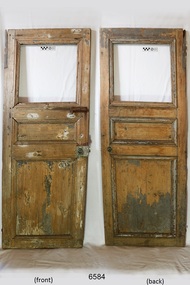
... Ellis, Q. Thompson, C. Newman, W. Paul, J. Davis, M. Horenleng, J. ...Ellis, Q. Thompson, C. Newman, W. Paul, J. Davis, M. Horenleng, J. ...The wooden door was salvaged from the wreck of the sailing ship Eric the Red, which was a wooden, three masted clipper ship. Eric the Red was the largest full-rigged ship built at Bath, Maine, USA in 1871, having had a 1,580 tons register. She was built and registered by Arthur Sewall, later to become the partnership E. & A. Sewall, the 51st ship built by this company. The annually-published List of Merchant Vessels of the U.S. shows Bath was still the home port of Eric the Red in 1880. The vessel was named after the Viking discoverer, Eric the Red, who was the first European to reach the shores of North America (in 980AD). The ship Eric the Red at first traded in coal between America and Britain, and later traded in guano nitrates from South America. In 1879 she was re-metalled and was in first class condition. On 10th June 1880 (some records say 12th June) Eric the Red departed New York for Melbourne and then Sydney. She had been commissioned by American trade representatives to carry a special cargo of 500 exhibits (1400 tons) – about a quarter to a third of America’s total exhibits - from America for the U.S.A. pavilion at Melbourne’s first International Exhibition. The exhibits included furniture, ironmongery, wines, chemicals, dental and surgical instruments, paper, cages, bronze lamp trimmings, axles, stamped ware, astronomical and time globes, samples of corn and the choicest of leaf tobacco. Other general cargo included merchandise such as cases of kerosene and turpentine, brooms, Bristol's Sarsaparilla, Wheeler and Wilson sewing machines, Wheeler’s thresher machine, axe handles and tools, cases of silver plate, toys, pianos and organs, carriages and Yankee notions. The Eric the Red left New York under the command of Captain Z. Allen (or some records say Captain Jacques Allen) and 24 other crew including the owner’s son third mate Ned Sewall. There were 2 saloon passengers also. The ship had been sailing for an uneventful 85 days and the voyage was almost at its end. On 4th September 1880 the Eric the Red approached Cape Otway with a moderate north-west wind and hazy and overcast atmosphere. Around 1:30am Captain Allen sighted the Cape Otway light and was keeping the ship 5-6 miles offshore to stay clear of the hazardous Otway Reef. However he had badly misjudged his position. The ship hit the Otway Reef about 2 miles out to sea, south west of the Cape Otway light station. He ordered the wheel to be put ‘hard up’ thinking that she might float off the reef. A heavy sea knocked the man away from the wheel, broke the wheel ropes and carried away the rudder. The sea swamped the lifeboats. The mizzenmast fell, with all of its rigging, then the mainmast also fell and the ship broke in two. Some said that the passenger Vaughan, who was travelling for his health and not very strong, was washed overboard and never seen again. The ship started breaking up. The forward house came adrift with three of the crew on it as well as a longboat, which the men succeeded in launching and keeping afloat by continually bailing with their sea boots. The captain, the third mate (the owner’s son) and others clung to the mizzenmast in the sea. Then the owner’s son was washed away off the mast. Within 10 minutes the rest of the ship was in pieces, completely wrecked, with cargo and wreckage floating in the sea. The captain encouraged the second mate to swim with him to the deckhouse where there were other crew but the second mate wouldn’t go with him. Eventually the Captain made it to the deckhouse and the men pulled him up. At about 4:30am the group of men on the deckhouse saw the lights of a steamer and called for help. At the same time they noticed the second mate and the other man had drifted nearby, still on the spur, and pulled them both onto the wreck. The coastal steamer Dawn was returning to Warrnambool from Melbourne, its sailing time different to its usual schedule. Captain Jones sent out two life boats, and fired off rockets and blue lights to illuminate the area. They picked up the three survivors who were in the long boat from Eric the Red. Two men were picked up out of the water, one being the owner’s son who was clinging to floating kerosene boxes. At daylight the Dawn then rescued the 18 men from the floating portion of the deckhouse, which had drifted about 4 miles from where they’d struck the reef. Shortly after the rescue the deckhouse drifted onto breakers and was thrown onto rocks at Point Franklin, about 2 miles east of Cape Otway. Captain Jones had signalled to Cape Otway lighthouse the number of the Eric the Red and later signalled that there was a wreck at Otway Reef but there was no response from the lighthouse. The captain and crew of the Dawn spent several more hours searching unsuccessfully for more survivors, even going back as far as Apollo Bay. On board the Dawn the exhausted men received care and attention to their needs and wants, including much needed clothing. Captain Allen was amongst the 23 battered and injured men who were rescued and later taken to Warrnambool for care. Warrnambool’s mayor and town clerk offered them all hospitality, the three badly injured men going to the hospital for care and others to the Olive Branch Hotel, then on to Melbourne. Captain Allen’s leg injury prevented him from going ashore so he and three other men travelled on the Dawn to Portland. They were met by the mayor who also treated them all with great kindness. Captain Allen took the train back to Melbourne then returned to America. Those saved were Captain Z. Allen (or Jacques Allen), J. Darcy chief mate, James F. Lawrence second mate, Ned Sewall third mate and owner’s son, John French the cook, C. Nelson sail maker, Clarence W. New passenger, and the able seamen Dickenson, J. Black, Denis White, C. Herbert, C. Thompson, A. Brooks, D. Wilson, J. Ellis, Q. Thompson, C. Newman, W. Paul, J. Davis, M. Horenleng, J. Ogduff, T. W. Drew, R. Richardson. Four men had lost their lives; three of them were crew (Gus Dahlgreen ship’s carpenter, H. Ackman steward, who drowned in his cabin, and George Silver seaman) and one a passenger (J. B. Vaughan). The body of one of them had been found washed up at Cape Otway and was later buried in the lighthouse cemetery; another body was seen on an inaccessible ledge. Twelve months later the second mate James F. Lawrence, from Nova Scotia, passed away in the Warrnambool district; an obituary was displayed in the local paper. The captain and crew of the Dawn were recognised by the United States Government in July 1881 for their humane efforts, being thanked and presented with substantial monetary rewards, medals and gifts. Neither the ship, nor its cargo, was insured. The ship was worth about £15,000 and the cargo was reportedly worth £40,000; only about £2,000 worth had been recovered. Cargo and wreckage washed up at Apollo Bay, Peterborough, Port Campbell, Western Port and according to some reports, even as far away as the beaches of New Zealand. The day after the wreck the government steam ship Pharos was sent from Queenscliff to clear the shipping lanes of debris that could be a danger to ships. The large midship deckhouse of the ship was found floating in a calm sea near Henty Reef. Items such as an American chair, a ladder and a nest of boxes were all on top of the deckhouse. As it was so large and could cause danger to passing ships, Captain Payne had the deckhouse towed towards the shore just beyond Apollo Bay. Between Apollo Bay and Blanket Bay the captain and crew of Pharos collected Wheeler and Wilson sewing machines, nests of boxes, bottles of Bristol’s sarsaparilla, pieces of common American chairs, axe handles, a Wheelers’ Patent thresher and a sailor’s trunk with the words “A. James” on the front. A ship’s flag-board bearing the words “Eric the Red” was found on the deckhouse; finally those on board the Pharos had the name of the wrecked vessel. During this operation Pharos came across the government steamer Victoria and also a steamer S.S. Otway, both of which were picking up flotsam and wreckage. A whole side of the hull and three large pieces of the other side of the hull, with some of the copper sheathing stripped off, had floated on to Point Franklin. Some of the vessels yards and portions of her masts were on shore. The pieces of canvas attached to the yards and masts confirmed that the vessel had been under sail. The beach there was piled with debris several feet high. There were many cases of Diamond Oil kerosene, labelled R. W. Cameron and Company, New York. There were also many large planks of red pine, portions of a small white boat and a large, well-used oar. Other items found ashore included sewing machines (some consigned to ‘Long and Co.”) and notions, axe and scythe handles, hay forks, wooden pegs, rolls of wire (some branded “T.S” and Co, Melbourne”), kegs of nails branded “A.T. and Co.” from the factory of A. Field and Son, Taunton, Massachusetts, croquet balls and mallets, buggy fittings, rat traps, perfumery, cutlery and Douay Bibles, clocks, bicycles, chairs, a fly wheel, a cooking stove, timber, boxes, pianos, organs and a ladder. (Wooden clothes pegs drifted in for many years). There seemed to be no personal luggage or clothing. The Pharos encountered a long line, about one and a half miles, of floating wreckage about 10 miles off land, south east of Cape Otway, and in some places about 40 feet wide. It seemed that more than half of it was from Eric the Red. The ship’s crew rescued 3 cases that were for the Melbourne Exhibition and other items from amongst the debris. There were also chairs, doors, musical instruments, washing boards, nests of trunks and fly catchers floating in the sea. Most of the goods were saturated and smelt of kerosene. A section of the hull lies buried in the sand at Parker River Beach. An anchor with chain is embedded in the rocks east of Point Franklin and a second anchor, thought to be from Eric the Red, is on display at the Cape Otway light station. (There is a photograph of a life belt on the verandah of Rivernook Guest House in Princetown with the words “ERIC THE RED / BOSTON”. This is rather a mystery as the ship was registered in Bath, Maine, USA.) Parts of the ship are on display at Bimbi Park Caravan Park and at Apollo Bay Museum. Flagstaff Hill Maritime Village also has part of the helm (steering wheel), a carved wooden sword (said to be the only remaining portion of the ship’s figurehead; further research is currently being carried out), a door, a metal rod and samples of wood. Much of the wreckage was recovered by the local residents before police and other authorities arrived at the scene. Looters went to great effort to salvage goods, being lowered down the high cliff faces to areas with little or no beach to collect items from the wreckage, their mates above watching out for dangerous waves. A Tasmanian newspaper reports on a court case in Stawell, Victoria, noting a man who was caught 2 months later selling tobacco from the wreckage of Eric the Red. Some of the silverware is still treasured by descendants of Mr Mackenzie who was given these items by officials for his help in securing the cargo. The gifts included silver coffee and tea pots, half a dozen silver serviette rings and two sewing machines. The wreck and cargo were sold to a Melbourne man who salvaged a quantity of high quality tobacco and dental and surgical instruments. Timbers from the ship were salvaged and used in the construction of houses and sheds around Apollo Bay, including a guest house, Milford House (since burnt down in bushfires), which had furniture, fittings and timber on the dining room floor from the ship. A 39.7 foot long trading ketch, the Apollo, was also built from its timbers by Mr Burgess in 1883 and subsequently used in Tasmanian waters. It was the first attempt at ship building in Apollo bay. In 1881 a red light was installed about 300 feet above sea level at the base of the Cape Otway lighthouse to warn ships when they were too close to shore; It would not be visible unless a ship came within 3 miles from it. This has proved to be an effective warning. The State Library of Victoria has a lithograph in its collection depicting the steamer Dawn and the shipwrecked men, titled. "Wreck of the ship Eric the Red, Cape Otway: rescue of the crew by the Dawn". “The Eric the Red is historically significant as one of Victoria's major 19th century shipwrecks. (Heritage Victoria Eric the Red; HV ID 239) The wreck led to the provision of an additional warning light placed below the Cape Otway lighthouse to alert mariners to the location of Otway Reef. The site is archaeologically significant for its remains of a large and varied cargo and ship's fittings being scattered over a wide area. The site is recreationally and aesthetically significant as it is one of the few sites along this coast where tourists can visit identifiable remains of a large wooden shipwreck, and for its location set against the background of Cape Otway, Bass Strait, and the Cape Otway lighthouse.“ (Victorian Heritage Database Registration Number S239, Official Number 8745 USA) Door from the wreck of the ship Eric the Red. The wooden singular rectangular door includes three insert panel sections. The top section is square shaped and is missing its panel or glass. The centre timber panel is about a third of the height of the top panel and the bottom timber panel is approximately equal in height to the total height of the two upper panels. The door fastenings include both a metal door latch and traditional door bolt. They are both attached to the front right hand side of the door. The bolt is just below the top panel, and the door latch is in approximately the centre of that side. The door latch has a round mark where a handle could have been attached. The wood of the door has scraping marks in a semi-circle around the door latch where the latch has swung around on its one remaining fastening and grazed the surface. There is a metal hinge at the top section of the door on the opposite side to the latch. The painted surface has been scraped back to expose the wood. The door is shorter than the average height of a person. On the reverse of the door there are lines on the panels, just inside their edges, is what appears to be pencil. The door is not aligned straight but is skew to centre.warrnambool, flagstaff hill, flagstaff hill maritime village, maritime museum, shipwreck coast, great ocean road, shipwreck artefact, eric the red, jaques allen, sewall, 1880, melbourne exhibition 1880, cape otway, otway reef, victorian shipwreck, bass strait, eric-the-red, door -
 Flagstaff Hill Maritime Museum and Village
Decorative object - Sword, 1871 or earlier
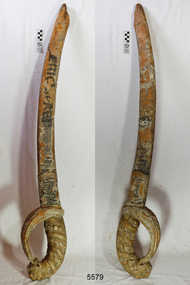
... Ellis, Q. Thompson, C. Newman, W. Paul, J. Davis, M. Horenleng, J. ...Ellis, Q. Thompson, C. Newman, W. Paul, J. Davis, M. Horenleng, J. ...This wooden sword is said to “possibly be the only remaining part of the figurehead from the sailing ship Eric the Red.” It was previously part of the collection of the old Warrnambool Museum and the entry in its inventory says “Wooden sword, portion of the figurehead, held by “Eric the Red” at the bow.” A large part of the ship’s hull was found on the rocks and a figurehead may have been attached or washed up on the shore. The shipping records for E. & A. Sewall, the builders, owners and managers of Eric the Red, are now preserved in the Maine Maritime Museum. There is no photograph on record of Eric the Red but photographs of other ships built around that time by the same company show that these did not have figureheads, and there is no record found of a figurehead for Eric the Red being ordered or paid for. Further research is being carried out. The ship building company E. & A. Sewall, from Bath, Maine, USA, built Eric the Red, a wooden, three masted clipper ship. She had 1,580 tons register and was the largest full-rigged ship built at Bath, Maine, USA in 1871. She was built and registered by Arthur Sewall, later to become the partnership E. & A. Sewall, and was the 51st ship built by this company. The annually-published List of Merchant Vessels of the U.S. shows that Bath was still the home port of Eric the Red in 1880. The vessel was named after the Viking discoverer, Eric the Red, who was the first European to reach the shores of North America (in 980AD). The ship Eric the Red at first traded in coal between America and Britain, and later traded in guano nitrates from South America. In 1879 she was re-metalled and was in first class condition. On 10th June 1880 (some records say 12th June) Eric the Red departed New York for Melbourne and then Sydney. She had been commissioned by American trade representatives to carry a special cargo of 500 exhibits (1400 tons) - about a quarter to a third of America’s total exhibits - from America for the U.S.A. pavilion at Melbourne’s first International Exhibition. The exhibits included furniture, ironmongery, wines, chemicals, dental and surgical instruments, paper, cages, bronze lamp trimmings, axles, stamped ware, astronomical and time globes, samples of corn and the choicest of leaf tobacco. Other general cargo included merchandise such as cases of kerosene and turpentine, brooms, Bristol's Sarsaparilla, Wheeler and Wilson sewing machines, Wheeler’s thresher machine, axe handles and tools, cases of silver plate, toys, pianos and organs, carriages and Yankee notions. The Eric the Red left New York under the command of Captain Z. Allen (or some records say Captain Jacques Allen) and 24 other crew including the owner’s son third mate Ned Sewall. There were 2 saloon passengers also. On 4th September 1880 the ship had been sailing for an uneventful 85 days and the voyage was almost at its end. Eric the Red approached Cape Otway in a moderate north-west wind and hazy and overcast atmosphere. Around 1:30am Captain Allen sighted the Cape Otway light and was keeping the ship 5-6 miles offshore to stay clear of the hazardous Otway Reef. However he had badly misjudged his position. The ship hit the Otway Reef about 2 miles out to sea, south west of the Cape Otway light station. Captain Allen ordered the wheel to be put ‘hard up’ thinking that she might float off the reef. A heavy sea knocked the man away from the wheel, broke the wheel ropes and carried away the rudder. The sea swamped the lifeboats, the mizzenmast fell, with all of its rigging, then the mainmast fell and the ship broke in two. Some said that the passenger Vaughan, who was travelling for his health and not very strong, was washed overboard and never seen again. The ship started breaking up. The forward house came adrift with three of the crew on it as well as a longboat, which the men succeeded in launching and keeping afloat by continually bailing with their sea boots. The captain, the third mate (the owner’s son) and others clung to the mizzenmast in the sea. Then the owner’s son was washed away off the mast. Within 10 minutes the rest of the ship was in pieces, completely wrecked, with cargo and wreckage floating in the sea. The captain encouraged the second mate to swim with him to the deckhouse where there were other crew but the second mate wouldn’t go with him. Eventually the Captain made it to the deckhouse and the men pulled him up. At about 4:30am the group of men on the deckhouse saw the lights of a steamer and called for help. At the same time they noticed the second mate and the other man had drifted nearby, still on the spur, and pulled them both onto the wreck. The coastal steamer Dawn was returning to Warrnambool from Melbourne, its sailing time different to its usual schedule. Cries were heard coming from out of the darkness. Captain Jones sent out two life boats, and fired off rockets and blue lights to illuminate the area. They picked up the three survivors who were in the long boat from Eric the Red. Two men were picked up out of the water, one being the owner’s son who was clinging to floating kerosene boxes. At daylight the Dawn then rescued the 18 men from the floating portion of the deckhouse, which had drifted about 4 miles from where they’d struck the reef. Shortly after the rescue the deckhouse drifted onto breakers and was thrown onto rocks at Point Franklin, about 2 miles east of Cape Otway. Captain Jones had signalled to Cape Otway lighthouse the number of the Eric the Red and later signalled that there was a wreck at Otway Reef but there was no response from the lighthouse. The captain and crew of the Dawn spent several more hours searching unsuccessfully for more survivors, even going back as far as Apollo Bay. On board the Dawn the exhausted men received care and attention to their needs and wants, including much needed clothing. Captain Allen was amongst the 23 battered and injured men who were rescued and later taken to Warrnambool for care. Warrnambool’s mayor and town clerk offered them all hospitality, the three badly injured men going to the hospital and others to the Olive Branch Hotel, then on to Melbourne. Captain Allen’s leg injury prevented him from going ashore so he and three other men travelled on the Dawn to Portland. They were met by the mayor who also treated them all with great kindness. Captain Allen took the train back to Melbourne then returned to America. Those saved were Captain Z. Allen (or Jacques Allen), J. Darcy chief mate, James F. Lawrence second mate, Ned Sewall third mate and owner’s son, John French the cook, C. Nelson sail maker, Clarence W. New passenger, and the able seamen Dickenson, J. Black, Denis White, C. Herbert, C. Thompson, A. Brooks, D. Wilson, J. Ellis, Q. Thompson, C. Newman, W. Paul, J. Davis, M. Horenleng, J. Ogduff, T. W. Drew, R. Richardson. Four men had lost their lives; three of them were crew (Gus Dahlgreen ship’s carpenter, H. Ackman steward, who drowned in his cabin, and George Silver seaman) and one a passenger (J. B. Vaughan). The body of one of them had been found washed up at Cape Otway and was later buried in the lighthouse cemetery; another body was seen on an inaccessible ledge. Twelve months later the second mate James F. Lawrence, from Nova Scotia, passed away in the Warrnambool district; an obituary was displayed in the local paper. The captain and crew of the Dawn were recognised by the United States Government in July 1881 for their humane efforts and bravery, being thanked and presented with substantial monetary rewards, medals and gifts. Neither the ship, nor its cargo, was insured. The ship was worth about £15,000 and the cargo was reportedly worth £40,000; only about £2,000 worth had been recovered. Cargo and wreckage washed up at Apollo Bay, Peterborough, Port Campbell, Western Port and according to some reports, even as far away as the beaches of New Zealand. The day after the wreck the government steam ship Pharos was sent from Queenscliff to clear the shipping lanes of debris that could be a danger to ships. The large midship deckhouse of the ship was found floating in a calm sea near Henty Reef. Items such as an American chair, a ladder and a nest of boxes were all on top of the deckhouse. As it was so large and could cause danger to passing ships, Captain Payne had the deckhouse towed towards the shore just beyond Apollo Bay. Between Apollo Bay and Blanket Bay the captain and crew of Pharos collected Wheeler and Wilson sewing machines, nests of boxes, bottles of Bristol’s sarsaparilla, pieces of common American chairs, axe handles, a Wheelers’ Patent thresher and a sailor’s trunk with the words “A. James” on the front. A ship’s flag-board bearing the words “Eric the Red” was found on the deckhouse; finally those on board the Pharos had the name of the wrecked vessel. During this operation Pharos came across the government steamer Victoria and also a steamer S.S. Otway, both of which were picking up flotsam and wreckage. A whole side of the hull and three large pieces of the other side of the hull, with some of the copper sheathing stripped off, had floated on to Point Franklin. Some of the vessels yards and portions of her masts were on shore. The pieces of canvas attached to the yards and masts confirmed that the vessel had been under sail. The beach there was piled with debris several feet high. There were many cases of Diamond Oil kerosene, labelled R. W. Cameron and Company, New York. There were also many large planks of red pine, portions of a small white boat and a large, well-used oar. Other items found ashore included sewing machines (some consigned to ‘Long and Co.”) and notions, axe and scythe handles, hay forks, wooden pegs, rolls of wire (some branded “T.S” and Co, Melbourne”), kegs of nails branded “A.T. and Co.” from the factory of A. Field and Son, Taunton, Massachusetts, croquet balls and mallets, buggy fittings, rat traps, perfumery, cutlery and Douay Bibles, clocks, bicycles, chairs, a fly wheel, a cooking stove, timber, boxes, pianos, organs and a ladder. (Wooden clothes pegs drifted in for many years). There seemed to be no personal luggage or clothing. The Pharos encountered a long line, about one and a half miles, of floating wreckage about 10 miles off land, south east of Cape Otway, and in some places about 40 feet wide. It seemed that more than half of it was from Eric the Red. The ship’s crew rescued 3 cases that were for the Melbourne Exhibition and other items from amongst the debris. There were also chairs, doors, musical instruments, washing boards, nests of trunks and fly catchers floating in the sea. Most of the goods were saturated and smelt of kerosene. A section of the hull lies buried in the sand at Parker River Beach. An anchor with chain is embedded in the rocks east of Point Franklin and a second anchor, thought to be from Eric the Red, is on display at the Cape Otway light station. (There is a photograph of a life belt on the verandah of Rivernook Guest House in Princetown with the words “ERIC THE RED / BOSTON”. This is rather a mystery as the ship was registered in Bath, Maine, USA.) Parts of the ship are on display at Bimbi Park Caravan Park and at Apollo Bay Museum. Flagstaff Hill Maritime Village also has part of the helm (steering wheel), a carved wooden sword (said to be the only remaining portion of the ship’s figurehead; further research is currently being carried out), a door, a metal rod, samples of wood and a medal for bravery. Much of the wreckage was recovered by the local residents before police and other authorities arrived at the scene. Looters went to great effort to salvage goods, being lowered down the high cliff faces to areas with little or no beach to collect items from the wreckage, their mates above watching out for dangerous waves. A Tasmanian newspaper reports on a court case in Stawell, Victoria, noting a man who was caught 2 months later selling tobacco from the wreckage of Eric the Red. Some of the silverware is still treasured by descendants of Mr Mackenzie who was given these items by officials for his help in securing the cargo. The gifts included silver coffee and tea pots, half a dozen silver serviette rings and two sewing machines. The wreck and cargo were sold to a Melbourne man who salvaged a quantity of high quality tobacco and dental and surgical instruments. Timbers from the ship were salvaged and used in the construction of houses and sheds around Apollo Bay, including a guest house, Milford House (since burnt down in bushfires), which had furniture, fittings and timber on the dining room floor from the ship. A 39.7 foot long trading ketch, the Apollo, was also built from its timbers by Mr Burgess in 1883 and subsequently used in Tasmanian waters. It was the first attempt at ship building in Apollo bay. In 1881 a red light was installed about 300 feet above sea level at the base of the Cape Otway lighthouse to warn ships when they were too close to shore; It would not be visible unless a ship came within 3 miles from it. This has proved to be an effective warning. The State Library of Victoria has a lithograph in its collection depicting the steamer Dawn and the shipwrecked men, titled. "Wreck of the ship Eric the Red, Cape Otway: rescue of the crew by the Dawn".The Eric the Red is historically significant as one of Victoria's major 19th century shipwrecks. (Heritage Victoria Eric the Red; HV ID 239) The wreck led to the provision of an additional warning light placed below the Cape Otway lighthouse to alert mariners to the location of Otway Reef. The site is archaeologically significant for its remains of a large and varied cargo and ship's fittings being scattered over a wide area. The site is recreationally and aesthetically significant as it is one of the few sites along this coast where tourists can visit identifiable remains of a large wooden shipwreck, and for its location set against the background of Cape Otway, Bass Strait, and the Cape Otway lighthouse. (Victorian Heritage Database Registration Number S239, Official Number 8745 USA)This carved wooden sword, recovered from the Eric the Red, is possibly the only portion of the figurehead recovered after the wreck. There are spirals carved from the base of the handle to the top of the sword. The hilt of the sword is a lion’s head holding its tail in its mouth, the tail forming the handle. The blade of the sword has engraved patterns on it. Tiny particles of gold leaf and dark blue paint fragments can be seen between the carving marks. There are remnants of yellowish-orange and crimson paint on the handle. At some time after the sword was salvaged the name of the ship was hand painted on the blade in black paint. The tip of the sword has broken or split and the remaining part is charcoal in appearance. On both the tip and the base of the handle are parts made where the sword could have been joined onto the figurehead There is a white coating over some areas of the sword, similar to white lead putty used in traditional shipbuilding. The words “ERIC the RED” have been hand painted on the blade of the sword in black paint sometime after it was salvaged.flagstaff hill, flagstaff hill maritime museum and village, warrnambool, maritime museum, maritime village, great ocean road, shipwreck coast, sword, wooden sword, eric the red, carved sword, figurehead, snake head on sword -
 Flagstaff Hill Maritime Museum and Village
Wood Sample, about 1871
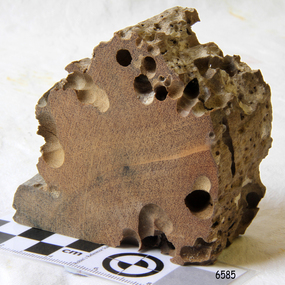
... Ellis, Q. Thompson, C. Newman, W. Paul, J. Davis, M. Horenleng, J. ...Ellis, Q. Thompson, C. Newman, W. Paul, J. Davis, M. Horenleng, J. ...This piece of timber from the ship Eric the Red has been eaten through by the marine animals called Teredo Worms, sometimes called sea worms or ‘termites of the sea’. The worms bore holes into wood that is immersed in sea water and bacteria inside the worms digest the wood. Shipbuilders tried to prevent this problem by using coatings of tar, wax, lead or pitch. In the 18th and 19th centuries the outside of their ships were sheathed in copper or a combination of copper and zinc (called Muntz metal) and would be re-metalled periodically to ensure the sheathing would remain effective. In more recent times the ships are protected with a toxic coating. The American ship Eric the Red was a wooden, three masted clipper ship. She had 1,580 tons register and was the largest full-rigged ship built at Bath, Maine, USA in 1871. She was built and registered by Arthur Sewall, later to become the partnership E. & A. Sewall, the 51st ship built by this company. The annually-published List of Merchant Vessels of the U.S. shows Bath was still the home port of Eric the Red in 1880. The vessel was named after the Viking discoverer, Eric ‘the Red-haired’ Thorvaldsson , who was the first European to reach the shores of North America (in 980AD). The ship Eric the Red at first traded in coal between America and Britain, and later traded in guano nitrates from South America. In 1879 she was re-metalled and was in first class condition. On 10th June 1880 (some records say 12th June) Eric the Red departed New York for Melbourne and then Sydney. She had been commissioned by American trade representatives to carry a special cargo of 500 exhibits (1400 tons) – about a quarter to a third of America’s total exhibits - for the U.S.A. pavilion at Melbourne’s first International Exhibition. The exhibits included furniture, ironmongery, wines, chemicals, dental and surgical instruments, paper, cages, bronze lamp trimmings, axles, stamped ware, astronomical and time globes, samples of corn and the choicest of leaf tobacco. Other general cargo included merchandise such as cases of kerosene and turpentine, brooms, Bristol's Sarsaparilla, Wheeler and Wilson sewing machines, Wheeler’s thresher machine, axe handles and tools, cases of silver plate, toys, pianos and organs, carriages and Yankee notions. The Eric the Red left New York under the command of Captain Zaccheus Allen (or some records say Captain Jacques Allen) and 24 other crew including the owner’s son third mate Ned Sewall. There were also 2 saloon passengers on board. The ship had been sailing for an uneventful 85 days and the voyage was almost at its end. As Eric the Red approached Cape Otway there was a moderate north-west wind and hazy and overcast atmosphere. On 4th September 1880 at about 1:30am Captain Allen sighted the Cape Otway light and was keeping the ship 5-6 miles offshore to stay clear of the hazardous Otway Reef. However he had badly misjudged his position. The ship hit the Otway Reef about 2 miles out to sea, south west of the Cape Otway light station. Captain Allen ordered the wheel to be put ‘hard up’ thinking that she might float off the reef. The sea knocked the helmsman away from the wheel, broke the wheel ropes and carried away the rudder. The lifeboats were swamped, the mizzenmast fell, with all of its rigging, then the mainmast also fell and the ship broke in two. Some said that the passenger Vaughan, who was travelling for his health and not very strong, was washed overboard and never seen again. The ship started breaking up. The forward house came adrift with three of the crew on it as well as a longboat, which the men succeeded in launching and keeping afloat by continually bailing with their sea boots. The captain, the third mate (the owner’s son) and others clung to the mizzenmast in the sea. Then the owner’s son was washed away off the mast. Within 10 minutes the rest of the ship was in pieces, completely wrecked, with cargo and wreckage floating in the sea. The captain encouraged the second mate to swim with him to the deckhouse where there were other crew but the second mate wouldn’t go with him. Eventually the Captain made it to the deckhouse and the men pulled him up. At about 4:30am the group of men on the deckhouse saw the lights of a steamer and called for help. At the same time they noticed the second mate and the other man had drifted nearby, still on the spur, and pulled them both onto the wreck. The coastal steamer SS Dawn was returning to Warrnambool from Melbourne, its sailing time different to its usual schedule. She was built in 1876 and bought by the Portland and Belfast Steam Navigation Co. in 1877. At the time of this journey she was commanded by Captain Jones, and was sailing between Melbourne and Portland via Warrnambool. The provedore of the Dawn, Benjamin Lear, heard cries of distress coming through the portholes of the saloon. He gave the alarm and the engines were stopped. Cries could be heard clearly, coming from the land. Captain Jones sent out crew in two boats, and fired off rockets and blue lights to illuminate the area. They picked up the three survivors who were in the long boat from Eric the Red. Two men were picked up out of the water, one being the owner’s son who was clinging to floating kerosene boxes. At daylight the Dawn then rescued the 18 men from the floating portion of the deckhouse, which had drifted about 4 miles from where they’d struck the reef. Shortly after the rescue the deckhouse drifted onto breakers and was thrown onto rocks at Point Franklin, about 2 miles east of Cape Otway. Captain Jones had signalled to Cape Otway lighthouse the number of the Eric the Red and later signalled that there was a wreck at Otway Reef but there was no response from the lighthouse. The captain and crew of the Dawn spent several more hours searching unsuccessfully for more survivors, even going back as far as Apollo Bay. On board the Dawn the exhausted men received care and attention to their needs and wants, including much needed clothing. Captain Allen was amongst the 23 battered and injured men who were rescued and later taken to Warrnambool for care. Warrnambool’s mayor and town clerk offered them all hospitality, the three badly injured men going to the hospital for care and others to the Olive Branch Hotel, then on to Melbourne. Captain Allen’s leg injury prevented him from going ashore so he and three other men travelled on the Dawn to Portland. They were met by the mayor who also treated them all with great kindness. Captain Allen took the train back to Melbourne then returned to America. Those saved were Captain Zaccheus Allen (or Jacques Allen), J. Darcy chief mate, James F. Lawrence second mate, Ned Sewall third mate and owner’s son, John French the cook, C. Nelson sail maker, Clarence W. New passenger, and the able seamen Dickenson, J. Black, Denis White, C. Herbert, C. Thompson, A. Brooks, D. Wilson, J. Ellis, Q. Thompson, C. Newman, W. Paul, J. Davis, M. Horenleng, J. Ogduff, T. W. Drew, R. Richardson. Four men had lost their lives; three of them were crew (Gus Dahlgreen ship’s carpenter, H. Ackman steward, who drowned in his cabin, and George Silver seaman) and one a passenger (J. B. Vaughan). The body of one of them had been found washed up at Cape Otway and was later buried in the lighthouse cemetery; another body was seen on an inaccessible ledge. Twelve months later the second mate James F. Lawrence, from Nova Scotia, passed away in the Warrnambool district; an obituary was displayed in the local paper. Neither the ship, nor its cargo, was insured. The ship was worth about £15,000 and the cargo was reportedly worth £40,000; only about £2,000 worth had been recovered. Cargo and wreckage washed up at Apollo Bay, Peterborough, Port Campbell, Western Port and according to some reports, even as far away as the beaches of New Zealand. The day after the wreck the government steam ship Pharos was sent from Queenscliff to clear the shipping lanes of debris that could be a danger to ships. The large midship deckhouse of the ship was found floating in a calm sea near Henty Reef. Items such as an American chair, a ladder and a nest of boxes were all on top of the deckhouse. As it was so large and could cause danger to passing ships, Captain Payne had the deckhouse towed towards the shore just beyond Apollo Bay. Between Apollo Bay and Blanket Bay the captain and crew of Pharos collected Wheeler and Wilson sewing machines, nests of boxes, bottles of Bristol’s sarsaparilla, pieces of common American chairs, axe handles, a Wheelers’ Patent thresher and a sailor’s trunk with the words “A. James” on the front. A ship’s flag-board bearing the words “Eric the Red” was found on the deckhouse; finally those on board the Pharos had the name of the wrecked vessel. During this operation Pharos came across the government steamer Victoria and also a steamer S.S. Otway, both of which were picking up flotsam and wreckage. A whole side of the hull and three large pieces of the other side of the hull, with some of the copper sheathing stripped off, had floated on to Point Franklin. Some of the vessels yards and portions of her masts were on shore. The pieces of canvas attached to the yards and masts confirmed that the vessel had been under sail. The beach there was piled with debris several feet high. There were many cases of Diamond Oil kerosene, labelled R. W. Cameron and Company, New York. There were also many large planks of red pine, portions of a small white boat and a large, well-used oar. Other items found ashore included sewing machines (some consigned to ‘Long and Co.”) and notions, axe and scythe handles, hay forks, wooden pegs, rolls of wire (some branded “T.S” and Co, Melbourne”), kegs of nails branded “A.T. and Co.” from the factory of A. Field and Son, Taunton, Massachusetts, croquet balls and mallets, buggy fittings, rat traps, perfumery, cutlery and Douay Bibles, clocks, bicycles, chairs, a fly wheel, a cooking stove, timber, boxes, pianos, organs and a ladder. (Wooden clothes pegs drifted in for many years). There seemed to be no personal luggage or clothing. The Pharos encountered a long line, about one and a half miles, of floating wreckage about 10 miles off land, south east of Cape Otway, and in some places about 40 feet wide. It seemed that more than half of it was from Eric the Red. The ship’s crew rescued 3 cases that were for the Melbourne Exhibition and other items from amongst the debris. There were also chairs, doors, musical instruments, washing boards, nests of trunks and fly catchers floating in the sea. Most of the goods were saturated and smelt of kerosene. A section of the hull lies buried in the sand at Parker River Beach. An anchor with chain is embedded in the rocks east of Point Franklin and a second anchor, thought to be from Eric the Red, is on display at the Cape Otway light station. (There is a photograph of a life belt on the verandah of Rivernook Guest House in Princetown with the words “ERIC THE RED / BOSTON”. This is rather a mystery as the ship was registered in Bath, Maine, USA.) Parts of the ship are on display at Bimbi Park Caravan Park and at Apollo Bay Museum. Flagstaff Hill Maritime Village also has part of the helm (steering wheel), a carved wooden sword (said to be the only remaining portion of the ship’s figurehead; further research is currently being carried out), a door, a metal rod, several samples of wood and a medal for bravery, awarded to Nelson Johnson, a crew member of the S.S. Dawn by the U.S. President, for the rescue of the crew. Much of the wreckage was recovered by the local residents before police and other authorities arrived at the scene. Looters went to great effort to salvage goods, being lowered down the high cliff faces to areas with little or no beach to collect items from the wreckage, their mates above watching out for dangerous waves. A Tasmanian newspaper reports on a court case in Stawell, Victoria, noting a man who was caught 2 months later selling tobacco from the wreckage of Eric the Red. Some of the silverware is still treasured by descendants of Mr Mackenzie who was given these items by officials for his help in securing the cargo. The gifts included silver coffee and tea pots, half a dozen silver serviette rings and two sewing machines. A Mr G.W. Black has in his possession a medal and a purse that were awarded to his father, another Dawn crew member who was part of the rescue team. The medal is inscribed and named “To John Black ….” (from “Shipwrecks” by Margaret E. Mackenzie, 3rd edition, published 1964). The wreck and cargo were sold to a Melbourne man who salvaged a quantity of high quality tobacco and dental and surgical instruments. Timbers from the ship were salvaged and used in the construction of houses and sheds around Apollo Bay, including a guest house, Milford House (since burnt down in bushfires), which had furniture, fittings and timber on the dining room floor from the ship. A 39.7 foot long trading ketch, the Apollo, was also built from its timbers by Mr Burgess in 1883 and subsequently used in Tasmanian waters. It was the first attempt at ship building in Apollo bay. In 1881 a red light was installed about 300 feet above sea level at the base of the Cape Otway lighthouse to warn ships when they were too close to shore; It would not be visible unless a ship came within 3 miles from it. This has proved to be an effective warning. Nelson Johnson, recipient of the medal for bravery, married Elizabeth Howard in 1881 and they had 10 children. They lived in South Melbourne, Victoria. Nelson died in 1922 in Fitzroy Victoria, age 66. In 1895 the owners of the S.S. Dawn, the Portland and Belfast Steam Navigation Co., wound up and sold out to the Belfast Company who took over the Dawn for one year before selling her to Howard Smith. She was condemned and sunk in Suva in 1928. The State Library of Victoria has a lithograph in its collection depicting the steamer Dawn and the shipwrecked men, titled. "Wreck of the ship Eric the Red, Cape Otway: rescue of the crew by the Dawn".The wood (timber) sample is listed on the Collections Australia Database, Heritage Victoria, number 239 00010 A “The Eric the Red is historically significant as one of Victoria's major 19th century shipwrecks. (Heritage Victoria Eric the Red; HV ID 239) The wreck led to the provision of an additional warning light placed below the Cape Otway lighthouse to alert mariners to the location of Otway Reef. The site is archaeologically significant for its remains of a large and varied cargo and ship's fittings being scattered over a wide area. The site is recreationally and aesthetically significant as it is one of the few sites along this coast where tourists can visit identifiable remains of a large wooden shipwreck, and for its location set against the background of Cape Otway, Bass Strait, and the Cape Otway lighthouse.“ (Victorian Heritage Database Registration Number S239, Official Number 8745 USA) Wood sample from the wreck of the ship Eric the Red. Triangular shaped, full of sea worm (Teredo worm) holes. The wood is dark in colour and is very light in weight.flagstaff hill, warrnambool, shipwrecked-coast, flagstaff-hill, flagstaff-hill-maritime-museum, maritime-museum, shipwreck-coast, flagstaff-hill-maritime-village, shipwreck-artefact, eric-the-red, zaccheus-allen, sewall, 1880, melbourne-exhibition, cape-otway, otway-reef, wood-sample, s.s.-dawn -
 Flagstaff Hill Maritime Museum and Village
Wood Sample, About 1871
... Ellis, Q. Thompson, C. Newman, W. Paul, J. Davis, M. Horenleng, J. ...Ellis, Q. Thompson, C. Newman, W. Paul, J. Davis, M. Horenleng, J. ...This piece of timber from the ship Eric the Red has been eaten through by the marine animals called Teredo Worms, sometimes called sea worms or ‘termites of the sea’. The worms bore holes into wood that is immersed in sea water and bacteria inside the worms digest the wood. Shipbuilders tried to prevent this problem by using coatings of tar, wax, lead or pitch. In the 18th and 19th centuries the outside of their ships were sheathed in copper or a combination of copper and zinc (called Muntz metal) and would be re-metalled periodically to ensure the sheathing would remain effective. In more recent times the ships are protected with a toxic coating. The American ship Eric the Red was a wooden, three masted clipper ship. She had 1,580 tons register and was the largest full-rigged ship built at Bath, Maine, USA in 1871. She was built and registered by Arthur Sewall, later to become the partnership E. & A. Sewall, the 51st ship built by this company. The annually-published List of Merchant Vessels of the U.S. shows Bath was still the home port of Eric the Red in 1880. The vessel was named after the Viking discoverer, Eric ‘the Red-haired’ Thorvaldsson , who was the first European to reach the shores of North America (in 980AD). The ship Eric the Red at first traded in coal between America and Britain, and later traded in guano nitrates from South America. In 1879 she was re-metalled and was in first class condition. On 10th June 1880 (some records say 12th June) Eric the Red departed New York for Melbourne and then Sydney. She had been commissioned by American trade representatives to carry a special cargo of 500 exhibits (1400 tons) – about a quarter to a third of America’s total exhibits - for the U.S.A. pavilion at Melbourne’s first International Exhibition. The exhibits included furniture, ironmongery, wines, chemicals, dental and surgical instruments, paper, cages, bronze lamp trimmings, axles, stamped ware, astronomical and time globes, samples of corn and the choicest of leaf tobacco. Other general cargo included merchandise such as cases of kerosene and turpentine, brooms, Bristol's Sarsaparilla, Wheeler and Wilson sewing machines, Wheeler’s thresher machine, axe handles and tools, cases of silver plate, toys, pianos and organs, carriages and Yankee notions. The Eric the Red left New York under the command of Captain Zaccheus Allen (or some records say Captain Jacques Allen) and 24 other crew including the owner’s son third mate Ned Sewall. There were also 2 saloon passengers on board. The ship had been sailing for an uneventful 85 days and the voyage was almost at its end. As Eric the Red approached Cape Otway there was a moderate north-west wind and hazy and overcast atmosphere. On 4th September 1880 at about 1:30am Captain Allen sighted the Cape Otway light and was keeping the ship 5-6 miles offshore to stay clear of the hazardous Otway Reef. However he had badly misjudged his position. The ship hit the Otway Reef about 2 miles out to sea, south west of the Cape Otway light station. Captain Allen ordered the wheel to be put ‘hard up’ thinking that she might float off the reef. The sea knocked the helmsman away from the wheel, broke the wheel ropes and carried away the rudder. The lifeboats were swamped, the mizzenmast fell, with all of its rigging, then the mainmast also fell and the ship broke in two. Some said that the passenger Vaughan, who was travelling for his health and not very strong, was washed overboard and never seen again. The ship started breaking up. The forward house came adrift with three of the crew on it as well as a longboat, which the men succeeded in launching and keeping afloat by continually bailing with their sea boots. The captain, the third mate (the owner’s son) and others clung to the mizzenmast in the sea. Then the owner’s son was washed away off the mast. Within 10 minutes the rest of the ship was in pieces, completely wrecked, with cargo and wreckage floating in the sea. The captain encouraged the second mate to swim with him to the deckhouse where there were other crew but the second mate wouldn’t go with him. Eventually the Captain made it to the deckhouse and the men pulled him up. At about 4:30am the group of men on the deckhouse saw the lights of a steamer and called for help. At the same time they noticed the second mate and the other man had drifted nearby, still on the spur, and pulled them both onto the wreck. The coastal steamer SS Dawn was returning to Warrnambool from Melbourne, its sailing time different to its usual schedule. She was built in 1876 and bought by the Portland and Belfast Steam Navigation Co. in 1877. At the time of this journey she was commanded by Captain Jones, and was sailing between Melbourne and Portland via Warrnambool. The provedore of the Dawn, Benjamin Lear, heard cries of distress coming through the portholes of the saloon. He gave the alarm and the engines were stopped. Cries could be heard clearly, coming from the land. Captain Jones sent out crew in two boats, and fired off rockets and blue lights to illuminate the area. They picked up the three survivors who were in the long boat from Eric the Red. Two men were picked up out of the water, one being the owner’s son who was clinging to floating kerosene boxes. At daylight the Dawn then rescued the 18 men from the floating portion of the deckhouse, which had drifted about 4 miles from where they’d struck the reef. Shortly after the rescue the deckhouse drifted onto breakers and was thrown onto rocks at Point Franklin, about 2 miles east of Cape Otway. Captain Jones had signalled to Cape Otway lighthouse the number of the Eric the Red and later signalled that there was a wreck at Otway Reef but there was no response from the lighthouse. The captain and crew of the Dawn spent several more hours searching unsuccessfully for more survivors, even going back as far as Apollo Bay. On board the Dawn the exhausted men received care and attention to their needs and wants, including much needed clothing. Captain Allen was amongst the 23 battered and injured men who were rescued and later taken to Warrnambool for care. Warrnambool’s mayor and town clerk offered them all hospitality, the three badly injured men going to the hospital for care and others to the Olive Branch Hotel, then on to Melbourne. Captain Allen’s leg injury prevented him from going ashore so he and three other men travelled on the Dawn to Portland. They were met by the mayor who also treated them all with great kindness. Captain Allen took the train back to Melbourne then returned to America. Those saved were Captain Zaccheus Allen (or Jacques Allen), J. Darcy chief mate, James F. Lawrence second mate, Ned Sewall third mate and owner’s son, John French the cook, C. Nelson sail maker, Clarence W. New passenger, and the able seamen Dickenson, J. Black, Denis White, C. Herbert, C. Thompson, A. Brooks, D. Wilson, J. Ellis, Q. Thompson, C. Newman, W. Paul, J. Davis, M. Horenleng, J. Ogduff, T. W. Drew, R. Richardson. Four men had lost their lives; three of them were crew (Gus Dahlgreen ship’s carpenter, H. Ackman steward, who drowned in his cabin, and George Silver seaman) and one a passenger (J. B. Vaughan). The body of one of them had been found washed up at Cape Otway and was later buried in the lighthouse cemetery; another body was seen on an inaccessible ledge. Twelve months later the second mate James F. Lawrence, from Nova Scotia, passed away in the Warrnambool district; an obituary was displayed in the local paper. Neither the ship, nor its cargo, was insured. The ship was worth about £15,000 and the cargo was reportedly worth £40,000; only about £2,000 worth had been recovered. Cargo and wreckage washed up at Apollo Bay, Peterborough, Port Campbell, Western Port and according to some reports, even as far away as the beaches of New Zealand. The day after the wreck the government steam ship Pharos was sent from Queenscliff to clear the shipping lanes of debris that could be a danger to ships. The large midship deckhouse of the ship was found floating in a calm sea near Henty Reef. Items such as an American chair, a ladder and a nest of boxes were all on top of the deckhouse. As it was so large and could cause danger to passing ships, Captain Payne had the deckhouse towed towards the shore just beyond Apollo Bay. Between Apollo Bay and Blanket Bay the captain and crew of Pharos collected Wheeler and Wilson sewing machines, nests of boxes, bottles of Bristol’s sarsaparilla, pieces of common American chairs, axe handles, a Wheelers’ Patent thresher and a sailor’s trunk with the words “A. James” on the front. A ship’s flag-board bearing the words “Eric the Red” was found on the deckhouse; finally those on board the Pharos had the name of the wrecked vessel. During this operation Pharos came across the government steamer Victoria and also a steamer S.S. Otway, both of which were picking up flotsam and wreckage. A whole side of the hull and three large pieces of the other side of the hull, with some of the copper sheathing stripped off, had floated on to Point Franklin. Some of the vessels yards and portions of her masts were on shore. The pieces of canvas attached to the yards and masts confirmed that the vessel had been under sail. The beach there was piled with debris several feet high. There were many cases of Diamond Oil kerosene, labelled R. W. Cameron and Company, New York. There were also many large planks of red pine, portions of a small white boat and a large, well-used oar. Other items found ashore included sewing machines (some consigned to ‘Long and Co.”) and notions, axe and scythe handles, hay forks, wooden pegs, rolls of wire (some branded “T.S” and Co, Melbourne”), kegs of nails branded “A.T. and Co.” from the factory of A. Field and Son, Taunton, Massachusetts, croquet balls and mallets, buggy fittings, rat traps, perfumery, cutlery and Douay Bibles, clocks, bicycles, chairs, a fly wheel, a cooking stove, timber, boxes, pianos, organs and a ladder. (Wooden clothes pegs drifted in for many years). There seemed to be no personal luggage or clothing. The Pharos encountered a long line, about one and a half miles, of floating wreckage about 10 miles off land, south east of Cape Otway, and in some places about 40 feet wide. It seemed that more than half of it was from Eric the Red. The ship’s crew rescued 3 cases that were for the Melbourne Exhibition and other items from amongst the debris. There were also chairs, doors, musical instruments, washing boards, nests of trunks and fly catchers floating in the sea. Most of the goods were saturated and smelt of kerosene. A section of the hull lies buried in the sand at Parker River Beach. An anchor with chain is embedded in the rocks east of Point Franklin and a second anchor, thought to be from Eric the Red, is on display at the Cape Otway light station. (There is a photograph of a life belt on the verandah of Rivernook Guest House in Princetown with the words “ERIC THE RED / BOSTON”. This is rather a mystery as the ship was registered in Bath, Maine, USA.) Parts of the ship are on display at Bimbi Park Caravan Park and at Apollo Bay Museum. Flagstaff Hill Maritime Village also has part of the helm (steering wheel), a carved wooden sword (said to be the only remaining portion of the ship’s figurehead; further research is currently being carried out), a door, a metal rod, several samples of wood and a medal for bravery, awarded to Nelson Johnson, a crew member of the S.S. Dawn by the U.S. President, for the rescue of the crew. Much of the wreckage was recovered by the local residents before police and other authorities arrived at the scene. Looters went to great effort to salvage goods, being lowered down the high cliff faces to areas with little or no beach to collect items from the wreckage, their mates above watching out for dangerous waves. A Tasmanian newspaper reports on a court case in Stawell, Victoria, noting a man who was caught 2 months later selling tobacco from the wreckage of Eric the Red. Some of the silverware is still treasured by descendants of Mr Mackenzie who was given these items by officials for his help in securing the cargo. The gifts included silver coffee and tea pots, half a dozen silver serviette rings and two sewing machines. A Mr G.W. Black has in his possession a medal and a purse that were awarded to his father, another Dawn crew member who was part of the rescue team. The medal is inscribed and named “To John Black ….” (from “Shipwrecks” by Margaret E. Mackenzie, 3rd edition, published 1964). The wreck and cargo were sold to a Melbourne man who salvaged a quantity of high quality tobacco and dental and surgical instruments. Timbers from the ship were salvaged and used in the construction of houses and sheds around Apollo Bay, including a guest house, Milford House (since burnt down in bushfires), which had furniture, fittings and timber on the dining room floor from the ship. A 39.7 foot long trading ketch, the Apollo, was also built from its timbers by Mr Burgess in 1883 and subsequently used in Tasmanian waters. It was the first attempt at ship building in Apollo bay. In 1881 a red light was installed about 300 feet above sea level at the base of the Cape Otway lighthouse to warn ships when they were too close to shore; It would not be visible unless a ship came within 3 miles from it. This has proved to be an effective warning. Nelson Johnson, recipient of the medal for bravery, married Elizabeth Howard in 1881 and they had 10 children. They lived in South Melbourne, Victoria. Nelson died in 1922 in Fitzroy Victoria, age 66. In 1895 the owners of the S.S. Dawn, the Portland and Belfast Steam Navigation Co., wound up and sold out to the Belfast Company who took over the Dawn for one year before selling her to Howard Smith. She was condemned and sunk in Suva in 1928. The State Library of Victoria has a lithograph in its collection depicting the steamer Dawn and the shipwrecked men, titled. "Wreck of the ship Eric the Red, Cape Otway: rescue of the crew by the Dawn".The wood (timber) sample is listed on the Collections Australia Database, Heritage Victoria, number 239 00010 A “The Eric the Red is historically significant as one of Victoria's major 19th century shipwrecks. (Heritage Victoria Eric the Red; HV ID 239) The wreck led to the provision of an additional warning light placed below the Cape Otway lighthouse to alert mariners to the location of Otway Reef. The site is archaeologically significant for its remains of a large and varied cargo and ship's fittings being scattered over a wide area. The site is recreationally and aesthetically significant as it is one of the few sites along this coast where tourists can visit identifiable remains of a large wooden shipwreck, and for its location set against the background of Cape Otway, Bass Strait, and the Cape Otway lighthouse.“ (Victorian Heritage Database Registration Number S239, Official Number 8745 USA) Wood sample from the wreck of the ship Eric the Red. Oblong shaped, full of sea worm (Teredo worm) holes. The wood is dark in colour and is very light in weight. flagstaff hill, warrnambool, shipwrecked-coast, flagstaff-hill, flagstaff-hill-maritime-museum, maritime-museum, shipwreck-coast, flagstaff-hill-maritime-village, shipwreck-artefact, eric-the-red, zaccheus-allen, sewall, 1880, melbourne-exhibition, cape-otway, otway-reef, wood-sample, s.s.-dawn -
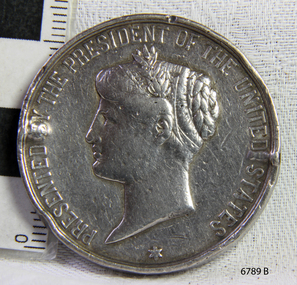 Flagstaff Hill Maritime Museum and Village
Award - Medal, Nelson Johnson, November 1880
... Ellis, Q. Thompson, C. Newman, W. Paul, J. Davis, M. Horenleng, J. ...Ellis, Q. Thompson, C. Newman, W. Paul, J. Davis, M. Horenleng, J. ...This medal for bravery, for rescue of the crew from the shipwreck “Eric the Red” on 4th September 1880, was awarded to one of the crew of the steamer S.S. Dawn by the President of the United States in July 1881. The medal is engraved with the name “Nelson Johnson” (the anglicised version of his Swedish name Neils Frederick Yohnson). It was donated to Flagstaff Hill Maritime Village in 2013 by Nelson’s granddaughter. Nelson had migrated from Sweden to Sydney in 1879. The next year in 1880, aged 24, he was a seaman on the steamship Dawn and involved in the rescue of the survivors of the Eric the Red. Nelson Johnson was a crew member of the S.S. Dawn and was one of the rescue team in the dinghy in the early morning of September 4th 1880. Medals were awarded to the Captain and crew of the S.S. Dawn by the President of the United States, through the Consul-general (Mr Oliver M. Spencer), in July 1881 “ … in recognition of their humane efforts in rescuing the 23 survivors of the American built wooden sailing ship, the Eric the Red, on 4th September 1880.” The men were also presented with substantial monetary rewards and gifts. The city of Warrnambool’s care of the survivors was also mentioned by the President at the presentation, saying that “the city hosted and supported the crew ‘most graciously’. Previously, a week after the shipwreck, the Australian Government had also conveyed its thanks to the Captain and crew of the S.S. Dawn “Captain Griffith Jones, S.S. Dawn, The Hon. Mr Clark desires that the thanks of the Government should be conveyed to you for the prompt, persevering and seamanlike qualities displayed by you, your officers and crew in saving the number of lives you did on the occasion referred to. The hon. The Commissioner has also been pleased to award you a souvenir in commemoration of the occasion, and a sum of 65 pounds to be awarded to your officers and crew according to annexed scale. I am, &c, W Collins Rees, for and in the absence of the Chief Harbour Master.” The Awards are as follows: - Crew of DAWN'S lifeboat-Chief Officer, Mr G. Peat, 15 pounds; boat's crew-G. Sterge, A.B., 5 pounds; T. Hammond, A.B., 5 pounds; J. Black, A.B., 5 pounds; H. Edwards, A.B., 5 pounds. Dinghy's Crew-Second Officer, Mr Christie, 10 pounds; boat's crew -F. Lafer, A.B., 5 pounds; W. Johnstone, A.B., 5 pounds; Mr Lear, provedore, 5 pounds; Mr Dove, purser, 5 pounds. Captain Jones receives a piece of plate. (from “Wreck of the ship Eric the Red” by Jack Loney) The medal’s history, according to the Editor of ‘E-Sylum’ (the newsletter of The Numismatic Bibliomania Society “… appears to be an example of an 1880 State Department medal, catalogued as LS-3 (page 322 of R. W. Julian's book, Medals of the United States Mint: The First Century 1792-1892). The reverse is mostly blank for engraving, surrounded by a thin wreath. It was designed by George Morgan, chief engraver for the Philadelphia Mint, and struck in gold, silver and bronze. The one pictured here (in The Standard newspaper, 2nd July 2013) appears to be silver.” The following is an account of the events which led to the awarding of this medal. The American ship Eric the Red was a wooden, three-masted clipper ship. She had 1,580 tons register and was the largest full-rigged ship built at Bath, Maine, USA in 1871. She was built and registered by Arthur Sewall, later to become the partnership E. & A. Sewall, the 51st ship built by this company. The annually-published List of Merchant Vessels of the U.S. shows Bath was still the home port of Eric the Red in 1880. The vessel was named after the Viking discoverer, Eric ‘the Red-haired’ Thorvaldsson, who was the first European to reach the shores of North America (in 980AD). The ship Eric the Red at first traded in coal between America and Britain, and later traded in guano nitrates from South America. In 1879 she was re-metalled and was in first-class condition. On 10th June 1880 (some records say 12th June) Eric the Red departed New York for Melbourne and then Sydney. She had been commissioned by American trade representatives to carry a special cargo of 500 exhibits (1400 tons) – about a quarter to a third of America’s total exhibits - for the U.S.A. pavilion at Melbourne’s first International Exhibition. The exhibits included furniture, ironmongery, wines, chemicals, dental and surgical instruments, paper, cages, bronze lamp trimmings, axles, stamped ware, astronomical and time globes, samples of corn and the choicest of leaf tobacco. Other general cargo included merchandise such as cases of kerosene and turpentine, brooms, Bristol's Sarsaparilla, Wheeler and Wilson sewing machines, Wheeler’s thresher machine, axe handles and tools, cases of silver plate, toys, pianos and organs, carriages and Yankee notions. The Eric the Red left New York under the command of Captain Zaccheus Allen (or some records say Captain Jacques Allen) and 24 other crew including the owner’s son third mate Ned Sewall. There were also 2 saloon passengers on board. The ship had been sailing for an uneventful 85 days and the voyage was almost at its end. As Eric the Red approached Cape Otway there was a moderate north-west wind and a hazy and overcast atmosphere. On 4th September 1880 at about 1:30 am Captain Allen sighted the Cape Otway light and was keeping the ship 5-6 miles offshore to stay clear of the hazardous Otway Reef. However, he had badly misjudged his position. The ship hit the Otway Reef about 2 miles out to sea, southwest of the Cape Otway light station. Captain Allen ordered the wheel to be put ‘hard up’ thinking that she might float off the reef. The sea knocked the helmsman away from the wheel, broke the wheel ropes and carried away the rudder. The lifeboats were swamped, the mizzenmast fell, with all of its riggings, then the mainmast also fell and the ship broke in two. Some said that the passenger Vaughan, who was travelling for his health and not very strong, was washed overboard and never seen again. The ship started breaking up. The forward house came adrift with three of the crew on it as well as a longboat, which the men succeeded in launching and keeping afloat by continually bailing with their sea boots. The captain, the third mate (the owner’s son) and others clung to the mizzenmast in the sea. Then the owner’s son was washed away off the mast. Within 10 minutes the rest of the ship was in pieces, completely wrecked, with cargo and wreckage floating in the sea. The captain encouraged the second mate to swim with him to the deckhouse where there were other crew but the second mate wouldn’t go with him. Eventually, the Captain made it to the deckhouse and the men pulled him up. At about 4:30 am the group of men on the deckhouse saw the lights of a steamer and called for help. At the same time, they noticed the second mate and the other man had drifted nearby, still on the spur, and pulled them both onto the wreck. The coastal steamer SS Dawn was returning to Warrnambool from Melbourne, and its sailing time was different to its usual schedule. She was built in 1876 and bought by the Portland and Belfast Steam Navigation Co. in 1877. At the time of this journey, she was commanded by Captain Jones and was sailing between Melbourne and Portland via Warrnambool. The provedore the Dawn, Benjamin Lear, heard cries of distress coming through the portholes of the saloon. He gave the alarm and the engines were stopped. Cries could be heard clearly, coming from the land. Captain Jones sent out crew in two boats and fired off rockets and blue lights to illuminate the area. They picked up the three survivors who were in the long boat from Eric the Red. Two men were picked up out of the water, one being the owner’s son who was clinging to floating kerosene boxes. At daylight, the Dawn then rescued the 18 men from the floating portion of the deckhouse, which had drifted about 4 miles from where they’d struck the reef. Shortly after the rescue the deckhouse drifted onto breakers and was thrown onto rocks at Point Franklin, about 2 miles east of Cape Otway. Captain Jones had signalled to Cape Otway lighthouse the number of the Eric the Red and later signalled that there was a wreck at Otway Reef but there was no response from the lighthouse. The captain and crew of the Dawn spent several more hours searching unsuccessfully for more survivors, even going back as far as Apollo Bay. On board the Dawn the exhausted men received care and attention to their needs and wants, including much-needed clothing. Captain Allen was amongst the 23 battered and injured men who were rescued and later taken to Warrnambool for care. Warrnambool’s mayor and town clerk offered them all hospitality, the three badly injured men going to the hospital for care and others to the Olive Branch Hotel, then on to Melbourne. Captain Allen’s leg injury prevented him from going ashore so he and three other men travelled on the Dawn to Portland. They were met by the mayor who also treated them all with great kindness. Captain Allen took the train back to Melbourne then returned to America. Those saved were Captain Zaccheus Allen (or Jacques Allen), J. Darcy chief mate, James F. Lawrence second mate, Ned Sewall third mate and owner’s son, John French the cook, C. Nelson sail maker, Clarence W. New passenger, and able seamen Dickenson, J. Black, Denis White, C. Herbert, C. Thompson, A. Brooks, D. Wilson, J. Ellis, Q. Thompson, C. Newman, W. Paul, J. Davis, M. Horenleng, J. Ogduff, T. W. Drew, R. Richardson. Four men had lost their lives; three of them were crew (Gus Dahlgreen ship’s carpenter, H. Ackman steward, who drowned in his cabin, and George Silver seaman) and one a passenger (J. B. Vaughan). The body of one of them had been found washed up at Cape Otway and was later buried in the lighthouse cemetery; another body was seen on an inaccessible ledge. Twelve months later the second mate James F. Lawrence, from Nova Scotia passed away in the Warrnambool district; an obituary was displayed in the local paper. Neither the ship nor its cargo was insured. The ship was worth about £15,000 and the cargo was reportedly worth £40,000; only about £2,000 worth had been recovered. Cargo and wreckage washed up at Apollo Bay, Peterborough, Port Campbell, Western Port and according to some reports, even as far away as the beaches of New Zealand. The day after the wreck the government steamship Pharos was sent from Queenscliff to clear the shipping lanes of debris that could be a danger to ships. The large midship deckhouse of the ship was found floating in a calm sea near Henty Reef. Items such as an American chair, a ladder and a nest of boxes were all on top of the deckhouse. As it was so large and could cause danger to passing ships, Captain Payne had the deckhouse towed towards the shore just beyond Apollo Bay. Between Apollo Bay and Blanket Bay, the captain and crew of Pharos collected Wheeler and Wilson sewing machines, nests of boxes, bottles of Bristol’s sarsaparilla, pieces of common American chairs, axe handles, a Wheelers’ Patent thresher and a sailor’s trunk with the words “A. James” on the front. A ship’s flag-board bearing the words “Eric the Red” was found on the deckhouse; finally, those on board the Pharos had the name of the wrecked vessel. During this operation, Pharos came across the government steamer Victoria and also a steamer S.S. Otway, both of which were picking up flotsam and wreckage. A whole side of the hull and three large pieces of the other side of the hull, with some of the copper sheathing stripped off, had floated onto Point Franklin. Some of the vessels' yards and portions of her masts were on shore. The pieces of canvas attached to the yards and masts confirmed that the vessel had been under sail. The beach there was piled with debris several feet high. There were many cases of Diamond Oil kerosene, labelled R. W. Cameron and Company, New York. There were also many large planks of red pine, portions of a small white boat and a large, well-used oar. Other items found ashore included sewing machines (some consigned to ‘Long and Co.”) and notions, axe and scythe handles, hay forks, wooden pegs, rolls of wire (some branded “T.S” and Co, Melbourne”), kegs of nails branded “A.T. and Co.” from the factory of A. Field and Son, Taunton, Massachusetts, croquet balls and mallets, buggy fittings, rat traps, perfumery, cutlery and Douay Bibles, clocks, bicycles, chairs, a fly wheel, a cooking stove, timber, boxes, pianos, organs and a ladder. (Wooden clothes pegs drifted in for many years). There seemed to be no personal luggage or clothing. The Pharos encountered a long line, about one and a half miles, of f locating wreckage about 10 miles off land, southeast of Cape Otway, and in some places about 40 feet wide. It seemed that more than half of it was from Eric the Red. The ship’s crew rescued 3 cases that were for the Melbourne Exhibition and other items from amongst the debris. There were also chairs, doors, musical instruments, washing boards, nests of trunks and flycatchers floating in the sea. Most of the goods were saturated and smelt of kerosene. A section of the hull lies buried in the sand at Parker River Beach. An anchor with a chain is embedded in the rocks east of Point Franklin and a second anchor, thought to be from Eric the Red, is on display at the Cape Otway light station. (There is a photograph of a life belt on the verandah of Rivernook Guest House in Princetown with the words “ERIC THE RED / BOSTON”. This is rather a mystery as the ship was registered in Bath, Maine, USA.) Parts of the ship are on display at Bimbi Park Caravan Park and at Apollo Bay Museum. Flagstaff Hill Maritime Village also has part of the helm (steering wheel), a carved wooden sword (said to be the only remaining portion of the ship’s figurehead; further research is currently being carried out), a door, a metal rod, samples of wood and this medal awarded for the rescue of the crew. Much of the wreckage was recovered by the local residents before police and other authorities arrived at the scene. Looters went to great effort to salvage goods, being lowered down the high cliff faces to areas with little or no beach to collect items from the wreckage, their mates above watching out for dangerous waves. A Tasmanian newspaper reports on a court case in Stawell, Victoria, noting a man who was caught 2 months later selling tobacco from the wreckage of Eric the Red. Some of the silverware is still treasured by descendants of Mr Mackenzie who was given these items by officials for his help in securing the cargo. The gifts included silver coffee and teapots, half a dozen silver serviette rings and two sewing machines. A Mr G.W. Black has in his possession a medal and a purse that was awarded to his father, another Dawn crew member who was part of the rescue team. The medal is similarly inscribed and named “To John Black ….” (from “Shipwrecks” by Margaret E. Mackenzie, 3rd edition, published 1964). The wreck and cargo were sold to a Melbourne man who salvaged a quantity of high-quality tobacco and dental and surgical instruments. Timbers from the ship were salvaged and used in the construction of houses and shed around Apollo Bay, including a guest house, Milford House (since burnt down in bushfires), which had furniture, fittings and timber on the dining room floor from the ship. A 39.7-foot-long trading ketch, the Apollo, was also built from its timbers by Mr Burgess in 1883 and subsequently used in Tasmanian waters. It was the first attempt at shipbuilding in Apollo Bay. In 1881 a red light was installed about 300 feet above sea level at the base of the Cape Otway lighthouse to warn ships when they were too close to shore; It would not be visible unless a ship came within 3 miles from it. This has proved to be an effective warning. Nelson Johnson married Elizabeth Howard in 1881 and they had 10 children, the father of the medal’s donor being the youngest. They lived in 13 Tichbourne Place, South Melbourne, Victoria. Nelson died in 1922 in Fitzroy Victoria, age 66. In 1895 the owners of the S.S. Dawn, the Portland and Belfast Steam Navigation Co., wound up and sold out to the Belfast Company who took over the Dawn for one year before selling her to Howard Smith. She was condemned and sunk in Suva in 1928. The State Library of Victoria has a lithograph in its collection depicting the steamer Dawn and the shipwrecked men, titled. "Wreck of the ship Eric the Red, Cape Otway: rescue of the crew by the Dawn". The medal for bravery is associated with the ship the “The Eric the Red which is historically significant as one of Victoria's major 19th century shipwrecks. (Heritage Victoria Eric the Red; HV ID 239) The wreck led to the provision of an additional warning light placed below the Cape Otway lighthouse to alert mariners to the location of Otway Reef. The site is archaeologically significant for its remains of a large and varied cargo and ship's fittings being scattered over a wide area. The site is recreationally and aesthetically significant as it is one of the few sites along this coast where tourists can visit identifiable remains of a large wooden shipwreck, and for its location set against the background of Cape Otway, Bass Strait, and the Cape Otway lighthouse.“ (Victorian Heritage Database Registration Number S239, Official Number 8745 USA) This medal was awarded to Nelson Johnson by the U.S. President for bravery in the rescue of the Eric the Red crew. The obverse of the round, solid silver medal has an inscription around the rim. In the centre of the medal is the head of Liberty to the left, hair in a bun, with a sprig of leaves in the top left of a band around her head. There is a 6-pointed star below the portrait, between the start and end of the inscription. There are two raised areas on the rim, horizontally opposite each other, from the edge to just below the lettering and coinciding with the holes drilled in the edge. Slightly right of the top is a round indentation in the rim. The reverse has a wreath of leaves as a border, joined at the bottom by a ribbon bow. In the centre of the medal is an inscription, decorated with 3-pronged design and dots. The edge is plain with 2 small, rough and uneven holes horizontally opposite to each other, as though they had been used for mounting the medal at some stage. The medal has a matte finish on both sides and is slightly pitted and scratched.“PRESENTED BY THE PRESIDENT OF THE UNITED STATES” around the perimeter of the obverse of the medal. “TO / Nelson Johnson, / seaman of the British, / str “Dawn”, for bravery, / at risk of life, / in / rescuing the crew of / the American Ship / “Eric the Red.” “M” on obverse, truncation of the portraitwarrnambool, flagstaff hill, flagstaff hill maritime village, maritime museum, shipwreck coast, great ocean road, shipwreck artefact, eric the red, zaccheus allen, sewall, 1880, melbourne exhibition, cape otway, otway reef, victorian shipwreck, medal, nelson johnson, neils frederick yohnson, s.s. dawn, george morgan, hero -
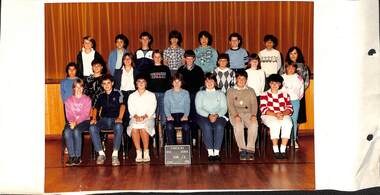 Sunshine and District Historical Society Incorporated
Photograph - Sunshine High School Class Photographs 1986, 1986
... Lyn Chatham (Teacher) Front Row (L-R) - Emma Thompson, Yen Ong, Paul Potra, Rachel Doyle, Zlatko Obic, Sandra Bilic, Teressa Ludlow 5845.04 - Sunshine High School Student Photos 1986 Year 7D Names.jpg 5845.04 - Sunshine High School Student Photos 1986 Year 7D.jpg 3rd Row (L-R) - Michelle Ritchie, Sofi Zaritsonos, Antonella Care, Jodie Hastings, Ederlyn Muli, Jody Ellior, Lorena Malik 2nd Row (L-R) - Anthony Anena, Christian Frazer, Michael Buttigieg, Nick Katsantonis, Long lee, Paul Pouwelse, Peter Francalanza, Ms. ...Lyn Chatham (Teacher) Front Row (L-R) - Emma Thompson, Yen Ong, Paul Potra, Rachel Doyle, Zlatko Obic, Sandra Bilic, Teressa Ludlow 5845.04 - Sunshine High School Student Photos 1986 Year 7D Names.jpg 5845.04 - Sunshine High School Student Photos 1986 Year 7D.jpg 3rd Row (L-R) - Michelle Ritchie, Sofi Zaritsonos, Antonella Care, Jodie Hastings, Ederlyn Muli, Jody Ellior, Lorena Malik 2nd Row (L-R) - Anthony Anena, Christian Frazer, Michael Buttigieg, Nick Katsantonis, Long lee, Paul Pouwelse, Peter Francalanza, Ms. ...5845.01 - Sunshine High School Student Photos 1986 Year 7A Names.jpg 5845.01 - Sunshine High School Student Photos 1986 Year 7A.jpg 3rd Row (L-R) - Mio Pandza, Phillip Azzopardi, Lee Grech, Julian Mizzi, Allan Pamintuan, Edin Garibovic, Dung Tran 2nd Row (L-R) - Barbara Aita, Marian Busuttil, Gabrielle Costa, Dean Kendrick, Peter O'Brien, Kathy Tonkovic, Bernadette Smith, Melissa Stork, Ms. Sophie Alamanas (Teacher) Front Row (L-R) - Dorothy Carrington, Doug Stojanovski, Joanne Borg, Daniel Tucker, Lena Markovska, Chris ?, Margaret Spiteri 5845.02 - Sunshine High School Student Photos 1986 Year 7B Names.jpg 5845.02 - Sunshine High School Student Photos 1986 Year 7B.jpg 4th Row (L-R) - Joe Matina, Craig Rowe 3rd Row (L-R) - Mr. Terry Kennedy (Teacher), Diep Tran, Kylie Ferguson, Alex Sorgiovanni, Edwin Cassar, Francie Gaffiero, Tammy Smith 2nd Row (L-R) - Edward Camilleri, Shane Mirabito, John Roberts, Peter Mavric, Sam Murawczuk, Nick Prisc, Denyse Strantzen Front Row (L-R) - Jody Bantz, Claudelte Gatt, Allijson Sammut, Doris Psaila, Olia Ahmed, Shirley Aquilina, Susan Galea 5845.03 - Sunshine High School Student Photos 1986 Year 7C Names.jpg 5845.03 - Sunshine High School Student Photos 1986 Year 7C.jpg 4th Row (L-R) - Shane Burley, Damen Allen, 3rd Row (L-R) - Michelle Curtis, Cindy Camilleri, Susan Zammit, Neral Ramadan, Trinette Eberle 2nd Row (L-R) - Michael Robinson, David Aziak, John Tsafalios, Matthew Gunther, Marion Monteleone, Danny Passalick, Ms. Lyn Chatham (Teacher) Front Row (L-R) - Emma Thompson, Yen Ong, Paul Potra, Rachel Doyle, Zlatko Obic, Sandra Bilic, Teressa Ludlow 5845.04 - Sunshine High School Student Photos 1986 Year 7D Names.jpg 5845.04 - Sunshine High School Student Photos 1986 Year 7D.jpg 3rd Row (L-R) - Michelle Ritchie, Sofi Zaritsonos, Antonella Care, Jodie Hastings, Ederlyn Muli, Jody Ellior, Lorena Malik 2nd Row (L-R) - Anthony Anena, Christian Frazer, Michael Buttigieg, Nick Katsantonis, Long lee, Paul Pouwelse, Peter Francalanza, Ms. Antonette Baltista (Teacher) Front Row (L-R) - Melissa Smith, Mary Tolentino, Hoa Luu, Anna Carravini, Robert ?, Natasha Grech, Nerrissa Kennedy 5845.05 - Sunshine High School Student Photos 1986 Year 8A Names.jpg 5845.05 - Sunshine High School Student Photos 1986 Year 8A.jpg 3rd Row (L-R) - Mark Borg, Antwanette Cassar, Helen Tabone, Oula Misto, Emine Torgut, Leisel Huntly, Steven Koumis 2nd Row (L-R) - Dwayne Piercy, Chris Prodanis, Richard Smith, Mark Marinkovic, Ashleigh Myers, Jason Mifsud Front Row (L-R) - Joanne Jakielaszek, Suzanne Stefanivska, Jodi Lally, Elissa Miller, Biljane Milenkovska, Tania Malloy, Rachel Barefoot Absent - Glenn Grima, Marle Matusen, Patrick Hill, Ms. Anne White (Teacher) 5845.06 - Sunshine High School Student Photos 1986 Year 8B Names.jpg 5845.06 - Sunshine High School Student Photos 1986 Year 8B.jpg 3rd Row (L-R) - Stephen Tsobanis, Jason Attard, Michael Gunther, John Murawczuk, Frank Kompar, George Boudoloh 2nd Row (L-R) - ? (Teacher), Angelo Scalise, Alex Taleski, Alec Simic, Tony Nesci, Michael Wilby, Dean Jesensek Front Row (L-R) - Donna Brown, Lisa Musumeci, Lisa Barr, Erika Statcic, Maria Kalfas, Sylvia Borg, Narelle Simmons Absent - Joanne Borg, Carolyn Knight, Leyle Seri 5845.07 - Sunshine High School Student Photos 1986 Year 8C Names.jpg 5845.07 - Sunshine High School Student Photos 1986 Year 8C.jpg 3rd Row (L-R) - Andrew Danks, Martin Pouwelse, Alan Alisic, Jay Anset, Jason Foley 2nd Row (L-R) - Clancy Nienartowicz, Tracey Funston, Ahmed Misto, Michael Gregory, Jenny Azzopardi, Irene Marosy Front Row (L-R) - Sue Foti, Natalie Birtic, Karl Hill, Suzi Bilic, David Motal, Suzanne Kieryzcuk, Rady Nuon Absent - Belinda Fraser, Darlene Krizmanix, Michelle Langford, Mr. Glenn Hayes (Teacher) 5845.08 - Sunshine High School Student Photos 1986 Year 8D Names.jpg 5845.08 - Sunshine High School Student Photos 1986 Year 8D.jpg 3rd Row (L-R) - Darren Blizzard, Shamus Robertson, Mark Mezzavilla, Tony Magavero, Michael Pastone, Steven Mifsud, Steven Spehar 2nd Row (L-R) - Felicity Bywaters, Susan Kent, Debbie Doyle, Peter Valcielaszek, Angelo Cassar, Mariana Capela, Brook Grima, Martha Kopsaftis Front Row (L-R) - Debbie Malloy, Jasminka Srbinovski, Tom Kourtessis, Sharyn Bant, Gavin Preston, Vesna Joncerska, Miryana Lasic Absent - Voanne Gillnespey, Ms. Serinch Mehmet (Teacher) 5845.09 - Sunshine High School Student Photos 1986 Year 8E Names.jpg 5845.09 - Sunshine High School Student Photos 1986 Year 8E.jpg 4th Row (L-R) - Andrew Vella, Zoki Klajcin 3rd Row (L-R) - Susan Dadman, Lynette Spiteri, Peter Panayi, Nick Zovko, Lilly Jane Cassar, Sandra Cowchi 2nd Row (L-R) - Zlate Markovski, Lindsay Todaro, Steven Bochenek, Leslie Wilson, Claudio Monteleone, Heider Matias Front Row (L-R) - Nadine Patten, Juliet Pace, Patricia Pacheco, Daniel Allen, Anastasia Dutkovich, Chrstine Watton, Michelle Buttigieg Absent - Joanne Cassar, Margaret Marshall, Ms. Anna Maria De Amicis (Teacher) 5845.10 - Sunshine High School Student Photos 1986 Year 9A Names.jpg 5845.10 - Sunshine High School Student Photos 1986 Year 9A.jpg 3rd Row (L-R) - Julie Frank, Natalie Zammit, Anthea Kennedy, Nicole Schuliga, Suzanne Jordan, Tu Linh Lam, Barbarella Duffy 2nd Row (L-R) - Esteban Sierra, Kyle Gillies, Evan Mousafiriadis, Maurice Mistero, Helen Sergakis, Rocky Senese Front Row (L-R) - Vivien Gardiner, colin McDonagh, Julie Emmett, Paul Carrarini, Skye Parsons, Tuan Luu, Maria Koutsiofis Absent - Shelly Danks, Benjamin Dinh, Daniel Tnewma, Kathleem Wilson, Mr. Ian Bowker (Teacher) 5845.11 - Sunshine High School Student Photos 1986 Year 9B Names.jpg 5845.11 - Sunshine High School Student Photos 1986 Year 9B.jpg 4th Row (L-R) - Nga Tran, ? 3rd Row (L-R) - Jenny Ragusa, Ralene Godde, Franca Di Lorenzo, Belinda Dixon, Jacqui Bajada, Tracey Cassar, Joanne Lazarenko 2nd Row (L-R) - Wayne Cox, Ioan Micetic, Jamie Ludlow, Paul Gauci, Darren Hildebrand, Romney Daulo Front Row (L-R) - Angela Sutherland, ?, Lisa Forte, Andrea Allen, Tracey Evans, ?, Sonia Cetwerschuk Absent - Mr. Evan Jones (Teacher) 5845.12 - Sunshine High School Student Photos 1986 Year 9C Names.jpg 5845.12 - Sunshine High School Student Photos 1986 Year 9C.jpg 3rd Row (L-R) - Esther Debrincat, Raymond Attard, Fiona Vella 2nd Row (L-R) - Binh Ong, Nhan To, Tim Passalick, Peter Smith, David Pettifier. Noren Ung Front Row (L-R) - Mario Todaro, Irena Dutkovich, Carolyn Bernat, Joanne Nereward, Julie Granger, Slavika Lasic, Giuliana Sradella Absent - Ms. Cathy Damon (Teacher) 5845.13 - Sunshine High School Student Photos 1986 Year 9D.jpg No Names 5845.14 - Sunshine High School Student Photos 1986 Year 10B Names.jpg 5845.14 - Sunshine High School Student Photos 1986 Year 10B.jpg 4th Row (L-R) - Impria Gauci, Mai Tran 3rd Row (L-R) - Sonia Lorenzini, Mary Saladino, Vincent Stranieri, Jeremy Boase, Craig Routledge, Kathryn Aqulina, Phevons Trans 2nd Row (L-R) - Louise Reaalo, Hang Tran, Krystyna Bochenek, Pietro Georgiou, ? Mitreski, Wendy Lilley, Lynette Thiele, Kerryn Wilby, Mr. Landido Esteban (Teacher) Front Row (L-R) - Rebecca Soldo, Ban Luu. Lidia Acancki, Nacih "Joe" Doudoloh, Rebecca Stark, Warren Theabould, Mary Santic Absent - Mai Trinh 5845.15 - Sunshine High School Student Photos 1986 Year 10C Names.jpg 5845.15 - Sunshine High School Student Photos 1986 Year 10C.jpg 3rd Row (L-R) - Cynthia Rowe, Anna Cioffi, Vicki Kavandgh, Naomi Patten, Michelle Spiteri, Carmen Agius, Leanne Rowe 2nd Row (L-R) - Marjana Filip, Stephen Kenner, Brian Azzopardi, Joe Scalise, Robert Csikos, Tanya Butson, Katerina nicolaou, Mrs. Holt (Teacher) Front Row (L-R) - Tracy Clark, Steven Jones, Tracey Watton, Ian Mavric, Danni Taleski, Michael O'Kely, Karen Aitchison Absent - Ronald Watson, Sue Psaila, Max Liebriana, Mrs. S. Kyris (Teacher) 5845.16 - Sunshine High School Student Photos 1986 Year 10D Names.jpg 5845.16 - Sunshine High School Student Photos 1986 Year 10D.jpg 4th Row (L-R) - Doreen Merciela, Josephine Gauci 3rd Row (L-R) - Annette Thewma, Michelle Bernard, Jo-Anne Fielding, Sue Micaleff, Patricia Messina, Lisa Bywaters, Michele Azzopardi, Mr. Peter Crow (Teacher) 2nd Row (L-R) - Yolanda Wilson, Jodie Conlin, Tony Diblasio, George Zammit, Christine Prisc, Wendy Gardener Front Row (L-R) - Kylie Taylor, Agazio Fiorenza, Doreen Camilleri, Domeni Digiglio, Lilian Boudoloh, Arped Fejes, Annette Thompson Absent - Raymonf Watson, Mr. C. Tassigiannakis (Teacher) 5845.17 - Sunshine High School Student Photos 1986 Year 10L Names.jpg 5845.17 - Sunshine High School Student Photos 1986 Year 10L.jpg 3rd Row (L-R) - Lourdes Galea, Nicole Blair, Tony Rullo, Maria Staffieri, Peter Kieryczuk, Michelle Mifsud, Christine Anadostuu, Mr. Ziver Hason (Teacher) 2nd Row (L-R) - Chris Chrisforou, Ann Petzieridis, Richard Soldaini, Emmanuel Kopsaptis, Hyssam Misto, Michael Sampson, Helen Kotopous Front Row (L-R) - Christine Plant, Jamie Parsons, Fay Tsatalios, Peter Kirko, Maria Prodanis, Serge Sinforosa, Maria Kladas Absent - Karen Lee, Daniel Duffy, Tomas Szafraniec 5845.18 - Sunshine High School Student Photos 1986 Year 11 Names.jpg 5845.18 - Sunshine High School Student Photos 1986 Year 11.jpg Back Row (L-R) - Very hard to read names 6th Row (L-R) - Very hard to read names 5th Row (L-R) - Very hard to read names 4th Row (L-R) - Very hard to read names 3rd Row (L-R) - Very hard to read names 2nd Row (L-R) - Very hard to read names Front Row (L-R) - Very hard to read names 5845.19 - Sunshine High School Student Photos 1986 Year 12 H.S.C. Names.jpg 5845.19 - Sunshine High School Student Photos 1986 Year 12 H.S.C..jpg 4th Row (L-R) - Thanh Lam, Tracey Martin, Veronica Popek, Adelina Pamintvan 3rd Row (L-R) - Emine Huseyin, Toung Kha, Verinica Stachlewski, Hop Viet Vu, Juanita Hutcheon 2nd Row (L-R) - Robert Aquilina, Corey Attard, Radomir Acanski, Andrew O'Kelly, Nello Ragusa, Chihow Chu Front Row (L-R) - Jeanette Spiteri, Lescek Jakielaszek, Susan Phillips, Jim Kirko, Jenny Miller, Alex Jesensek, Julie Stefanouska Absent - Mr. D. Smillie (Teacher) 5845.20 - Sunshine High School Student Photos 1986 Year 12 S.T.C. Names.jpg 5845.20 - Sunshine High School Student Photos 1986 Year 12 S.T.C..jpg 4th Row (L-R) - K. Santic, H. Zenonas, J. Cassar, M. Vella, K. Conlin, D. Gusman 3rd Row (L-R) - Max Hatzidimitriow, Sharon Hudson, Shane Brooking, Donna Heinyina, Sam Sorgiouanni, Frank Falukozi, Linda Portelli 2nd Row (L-R) - Nick Kourtessis, Gabriel Ianzano, Shane Boyd, Robert Damcersti, Maric Aropovic, Jim Hand, Daniel Sharpe, David Camilleri Front Row (L-R) - Peter Mulholland, Racheal McDonald, Colin Jardine, Carol Andrews, Andrew Rego, Karen Condos, Tony Strojonvski 5845.21 - Sunshine High School Student Photos 1986 Staff Names.jpg 5845.21 - Sunshine High School Student Photos 1986 Staff.jpg 3rd Row (L-R) - B. Winge, P. Crow, M. Kyris, A. White, D. Webster, G. Hayes, B. Tierney, D. Jones, Z. Hasan 2nd Row (L-R) - A. Ware, B. Gunn, M. Krasts, J. Holt, S. Alamanas, N. Pilic, L. Ostepeev, K. McCarthy, I. Bowker, L. Brick, M. Williams Front Row (L-R) - C. Sandars, A. McGeown, R. Johnson, M. Enright, G. Allort, T. Kennedy, C. Damon, J. Brown, L. Chathamsunshine high school, sunshine north, student photograph -
Federation University Historical Collection
Booklet, School of Nursing 25th Anniversary compilation, 2011
... thompson...sally wellard...philip warelon...bronwyn bentley...bernie galb...louie hamer...stephanie warren...stephanie richards...craig mcgeachim...jim avard...paul...The following people filled out some historical reflections: Dianne Thompson, Sally Wellard, Bernie Glab, Philip Warelow, Helen Ryan, Bronwyn Bentley, Leonie Hamer, Stephanie Warren (Richards), Craig McGeachim, Jim Avard, Paul Smith, Dorothy Lea, Jennier Macgill, , Donna Tiller. ...The University of Ballarat School of Nursing celebrated its 25th anniversary in 2011. university of ballarat nursing anniversary helen ryan margaret stevens dianne thompson sally wellard philip warelon bronwyn bentley bernie galb louie hamer stephanie warren stephanie richards craig mcgeachim jim avard paul smith dorothy lea eileen sellers jennifer magill donna tiller 25th anniversary Black plastic display book relating to the University of Ballarat School of Nursing 25th Anniversary, 2011. ...The University of Ballarat is a predecessor institution of Federation University Australia. The University of Ballarat School of Nursing celebrated its 25th anniversary in 2011.Black plastic display book relating to the University of Ballarat School of Nursing 25th Anniversary, 2011. The following people filled out some historical reflections: Dianne Thompson, Sally Wellard, Bernie Glab, Philip Warelow, Helen Ryan, Bronwyn Bentley, Leonie Hamer, Stephanie Warren (Richards), Craig McGeachim, Jim Avard, Paul Smith, Dorothy Lea, Jennier Macgill, , Donna Tiller. Also Eileen Sellers, Head, School of Nursing 1990 - 1998, speech Invitation to the School of Nursing 25th Anniversary Dinner Welcome to the School of Nursing 25th Anniversary Celebrations, Order of proceedings, Shirley Falkinder's Speech "From Doctor's Handmaiden, through Ballarat Bas Hospital School of Nursing, to University Graduate" School of Nursing Timelineuniversity of ballarat, nursing, anniversary, helen ryan, margaret stevens, dianne thompson, sally wellard, philip warelon, bronwyn bentley, bernie galb, louie hamer, stephanie warren, stephanie richards, craig mcgeachim, jim avard, paul smith, dorothy lea, eileen sellers, jennifer magill, donna tiller, 25th anniversary -
 Federation University Historical Collection
Booklet - Course Information, University of Ballarat Master of Nursing Graduate Diploma of Nursing, Bachelor of Nursing, c2002
... paul henderson...traci leung...natisha sands...mary tabarsi tsang...cannas yu...janine smith...sundram sivamalai...maris strickland...dianne thompson...The University of Ballarat is a predecessor institution of Federation University Australia. university of ballarat nursing david james ballarat sue turale allan donelly eileen sellers brendan baker claire bell hannelore best katherine birkin cecil deans judith forsyth neil gracie jennifer macgill kerry peart elizabeth crouch tulsa baker debra demeye gwen ford gillian fox paul henderson traci leung natisha sands mary tabarsi tsang cannas yu janine smith sundram sivamalai maris strickland dianne thompson david lee bernice whitaker robyn irish christopher brown leann brown michael reynolds peter swan christine o'connor shen genshen Blue soft covered booklet relating to the University of Ballarat Master of Nursing Graduate Diploma of Nursing, Bachelor of Nursing (Postregistration) University of Ballarat Master of Nursing Graduate Diploma of Nursing, Bachelor of Nursing Booklet Course Information ...The University of Ballarat is a predecessor institution of Federation University Australia.Blue soft covered booklet relating to the University of Ballarat Master of Nursing Graduate Diploma of Nursing, Bachelor of Nursing (Postregistration)university of ballarat, nursing, david james, ballarat, sue turale, allan donelly, eileen sellers, brendan baker, claire bell, hannelore best, katherine birkin, cecil deans, judith forsyth, neil gracie, jennifer macgill, kerry peart, elizabeth crouch, tulsa baker, debra demeye, gwen ford, gillian fox, paul henderson, traci leung, natisha sands, mary tabarsi tsang, cannas yu, janine smith, sundram sivamalai, maris strickland, dianne thompson, david lee, bernice whitaker, robyn irish, christopher brown, leann brown, michael reynolds, peter swan, christine o'connor, shen genshen -
 Federation University Historical Collection
Book, University of Ballarat Annual Report, 2005, 2005
... Smith, Kerry Cox, Maria Stickland, John McClure, Alla Wolf-Tasker, Henlen Kinlock, Michelle Mcfarland, Simone Heeney, Robert Hook, Garry Menz, Daniel Collings, Lynette Barr, Melissa Stojanovic, Dennis Olmstead, Clare Gervasoni, Dorothy Wickham, Geoffrey Blainey, Carolyn Taylor, Christine Nixon, Paul Lambeth, Bill Llwellyn, Betty Collier, Jennifer Elshaug, Helen Thompson. Krystal Newman, Joel Epstein, Gerrie Carr-McFie...Smith, Kerry Cox, Maria Stickland, John McClure, Alla Wolf-Tasker, Henlen Kinlock, Michelle Mcfarland, Simone Heeney, Robert Hook, Garry Menz, Daniel Collings, Lynette Barr, Melissa Stojanovic, Dennis Olmstead, Clare Gervasoni, Dorothy Wickham, Geoffrey Blainey, Carolyn Taylor, Christine Nixon, Paul Lambeth, Bill Llwellyn, Betty Collier, Jennifer Elshaug, Helen Thompson. Krystal Newman, Joel Epstein, Gerrie Carr-McFie University of Ballarat Annual Report, 2005 Book ...The Chancellor of the University of Ballarat in 2005 was Robert H.T. Smith. Blue soft covered annual book of 52 pages. The contents include, establishment of the University of Ballarat, the University Council, organisational Structure. Academic Board, Financial Summary, Technology Park, IBM regional Software, Eureka Encyclopaedia. Images include: University Council, Robert H.T. Smith, Kerry Cox, Maria Stickland, John McClure, Alla Wolf-Tasker, Henlen Kinlock, Michelle Mcfarland, Simone Heeney, Robert Hook, Garry Menz, Daniel Collings, Lynette Barr, Melissa Stojanovic, Dennis Olmstead, Clare Gervasoni, Dorothy Wickham, Geoffrey Blainey, Carolyn Taylor, Christine Nixon, Paul Lambeth, Bill Llwellyn, Betty Collier, Jennifer Elshaug, Helen Thompson. Krystal Newman, Joel Epstein, Gerrie Carr-McFieuniversity of ballarat, bracks, gervasoni, smith, cox, taylor, -
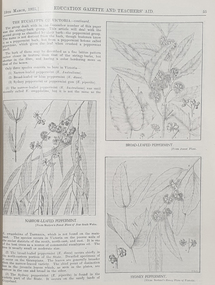 Federation University Historical Collection
Book, Victoria Education Gazette and Teachers' Aid, 1921-1930, 1921-1930
... Paul de Strzelecki...Gippsland...Villers-Bretonneaux Memorial School...Francis Thompson...In 1920 The Ballarat School of Mines had donated 136 pounds 14 shillings and 10 pence to the Victorian Education Department's War Relief Account, and the Ballarat Junior Technical School had donated 10 pounds 6 shillings and 10 pence. education gazette school education teaching teacher world war one school plantations macarthur street pine plantation school forestry creswick state forest anzac day armistance celebrations frank tate frank tate retirement drawing from cast education department school readers lake tyers pine plantation w.n. kernot rmit working men's college francis ormond pine plantations calenbeem park, creswick villers-brettonneux school hall and carvings thomas trengrove corsican pines Creswick Pine endowment plantations MCCarthur St Primary School Pine Plantation Ballarat High School Pine Plantation Vale Park Mount Pleasant Primary School Pine Plantation Golden Point pine plantation Angus Macmillan Paul de Strzelecki Gippsland Villers-Bretonneaux Memorial School Francis Thompson English Ash Pestalozzi centenary Shakespeare Day Swimming classes Clear Pine Cinema in education American Black Walnut Red Gum Thomas Wolliam Bothroyd obituary and portrait Physical Training Displays Teaching of Spelling Ohm's Law Blue Gum Ten black hard covered volumes with red tape spine, covering 1921 to 1930. ...The Victoria Education Gazette and Teachers' Aid was published for Victoria's teachers and was sent to all school on the state. In 1920 The Ballarat School of Mines had donated 136 pounds 14 shillings and 10 pence to the Victorian Education Department's War Relief Account, and the Ballarat Junior Technical School had donated 10 pounds 6 shillings and 10 pence.Ten black hard covered volumes with red tape spine, covering 1921 to 1930. The gazettes include Education Department appointments, transfers, resignations and retirements, vacancies, notices, queries, notices of books, examination papers, original articles, lesson plans, suggestions for lessons, drawing, obituaries, notes on nature study, mathematics, music, sloyd woodwork, English grammar, Victorian State School Swimming Clubs, Geography, penmanship, science, History, Latin, Geography, The School Garden, horticulture, singing, World War One; ANZAC Day, lifesaving, Astronomy, Empire Day, ANZAC Buffet London, Victorian Education Department's War Relief Fund .1) 1928. Articles include: New Caledonia, Swimming and Lifesaving, School forestry, a visit to the pyramids, Exploration of Gippsland, paul de Strezelecki, Angus McMillan, Villers Bretonneux Memorial School, American Black Walnut, Red Gum, Messmate Stringybark, The Great Barrier Reef, retirement of Frank Tate, Stawell High School, Report on Some Aspects of Education in the United States, Jubilee Education Exhibition , New School Readers; measured Drawing Images include: Macarthur Street School's Plantation, Maryborough School Plantation, Pinus Insignis (Radiata) ready for Milling, Creswick State Forest, Metalwork, Daylesford Pine Plantation four years old, Henry Harvey (art Inspector); Omeo School Endowment Plantation; Frank Tate; Stawell High School Drawings From Casts; Lake Tyers School Endowment Plantation, measured drawing, Thomas H. Stuart, GEorge Swinburne. J.R. Tantham-Fryer, Cookery Class, John Edward Thomas. .3) War Savings Stampsm Swimming and Life-saving, Teh Rural School System of Victoria, Imaginative Composition, ANZAC Day, Retardation, Teh Bright Child Hudson Hard Obituary, Leeches, Relief for Distress in Europe, Dental, Teachers' Library, History of Portarlington, J.E. Stevens Obituary, Victorian Teachers in England Images: Swimming and Life-Saving Medallion .3) Swimming and Lifesaving, Bronze medallion, Victoria Leage of Victori, War Savings Stamps, Rural School Sytem of Victoria, .4) War Relief, Talbot Colony for Epileptics Masonmeadows, Discipline New and Old (Percy Samson), Soldier teachers, Preservation of Australian Birds, Arbor Day, Jubilee of Free Education, Teaching Geography, Poery in Schools, School Committees, Shelter Pavilion, Mysia Memorial School, Clovers, Jubilee Exhibition, Domestic Arts, Louis Pasteur, .5) Victoria League of Victoria, An Endowment Scheme (Pine Plantations), School Endowment Plantations, Protecting our trees by Owen Jones,. Victorian State Schools Horticultural Society, Sloyd Woodwork, School Forestry, Thomas Brodribb Obituary and portrait, Imperial Education Conference London, school Management and Method, School plantations, Eucalypt plantations in the Bendix and Heathcote District, Junior Red Cross, Jubilee Education Exhibition, Gould League Competitions, handwriting, The School Magazine, Frank Tate in London, Victorian beetles, Council of Public Education, Villers Bretonneux and its new School, Death of Samuel Summons, Woodwork Summer School, Swimming, Japanese Relief Fund, Retirement of John Cross, reminiscences of the Late Mr Albert Mattingley .6) Thomas H. Trengrove and the Villers Bretonneux School hall and pilaster carvings, forestry, visit of Maryborough teachers to Ballarat Water Reserves, noxious weeds, relief for Distressed Europe, The Dalton Plan, Empire Day, Retirement of Mr Fussell, Centenary of Hume and Hovell Expedition, League of Kindness, Effective Nature Study in a Rural School, Some Facts About Paper and their Bearing Upon School Plantations, Council of the Working Men's College Melbourne, Maria Montessori, University Vacation School, Horticulture in State Schools, An Informal Chat About French Schools (C.R. McRae), The Vacation School, Johann Heinrich Pestalozzi, Inspector's Report on a 5th-class School, Can Children Write Verse, John Adams, Victoria League of Victoria, R.F. Toutcher, Sir James Barbie's Address to High-School Girls, Impressions of a High School Teacher Abroad (R.D. Collman), The Spirit of the School Plantation Scheme, Monument of the Late Mr and Mrs A.T. Sharp at Box Hill Cemetery, The Teaching of Geography, The Treatment of Poetry in Class, Two Difficult Arithmetic Lessons, Location of Principal Australian Timbers, Dr John Smyth, Stammering and its Influence on Education, Wireless Broadcasting as an Educational Medium, Boys School at Villers Brettonneux, The New School at Villers Brettonneux, Bird Day, Messmate or Stringybark, What Every Woman Knows, Director's Report on Denmark .7)1925 . Includes: School Forestry, horticulture, J.H. Betheras retirement, Ivanhoe School, Coburg School, Moorabool Junior Technical School, Villers Bretonneux School hall and pilaster carvings, Francis Ormond, William Charles Kernot, Corsican Pnes at Creswick, Ballarat High School Plantation, Workin Men's College, RMIT, Naorrow LEafed Peppermint, Education and World Peace, Eucalypts of Victoria, John C. Eccles, Blue Gum. Manners, Giving the Poorly Nourished Boy A Chance, Native Ferns, Marybourough Technical School, Memorial School at Villers-Brettonneux .8) Experimental Plots in Country Schools (W.W. Gay), Villers Bretonneaux and its Memorial School. nominated classes for Art Teachers, The Teachers Act 1925, Horsham High School, Richmond Technical School, Farewell to Messrs C.R. Long and Ponsonby Carew-Smyth, Frank Tate, Phyiscal Training, Arbor Day, ANZAC Day, Shakespeare Day,Bendigo Junior Techncial School, Musical Appreciation, Motor Dental Unit, School Camps, Education Act of 1872: Mr Angus McKay's Part (George Mackay), A Bush Fire Experience (Irene Stable), Black Sunday, Californian Red Pine, Women's Education in America, Farewell to Lord and Lady Stradbroke, Grevilia Robusta, Silky Oak, Redwood, John E. Grant, The Need for Research (Donald Clark), Junior Drama, Ida D. Marshall, John Pounds, Australian Books, Fish Creek School, State Boundaries, History in the Curriculum, Ceramic Art in Australia (Percy E. Everett), Choice of School Songs, Tasmanian Beech, Should History be Taught on a National or an International Basis, Hydatid Disease, James Holland Obituary, Florrie Hodges, Queensland Maple, Post Bushfire Ruins at Fumina, Arbor Day at Fumina, Queensland Rosewood, Omeo Endowment Plantation, Bird Day, Junior Red Cross, Pioneers' Day, Edward Henty, Junior Technical Schools, Yellow Pine, History and Progress of Needlework, A.B.C. of Astronomy, Northumberland Mental tests, Queensland Red Cedar, Teh Globe Theatre, .9) 1927 includes The ABC of Astronomy, Atr Theatre, English Beech, Angus McMillan Art Pottery, School Singing, State Schools' Nursery, School endowment plantations, Making a Man, experimental proof of Charles's Law, John Smyth obituary and portrait, Linton Pine Planation, motivation of arithmetic, Women's Classes at Dookie, Swimming and Lifesaving, Pioneers Day, Drawing, Ballarat High School planation, biting fly, Tir-Na-N'og, John Byatt retirement and portrait, Technical Schools Conference at Daylesford, Ethel Osborne and portrait, library. Francis Thompson portrait, Adam Lindsay Gordon, Solar movement, motor transport, Liverpool Cathedral, Teh Story of the Cathedral, Bendigo School of Mines, Omeo School pine plantation, Egypt and the Nile, Self-Criticism Images include Ballarat High School Pine Plantation, Vale Park, Francis Ormond, Woking Men's College (RMIT), W.N. Kernot, A Stand of Corsican Pines at Creswick, Victoria .10) Some Remarks on the Relationship of the technical Schools to the University (Donald Clark) , Present Day Education in England , Memorial to Joseph Cornwall, Spelling, motivation, Singing, State Scholarships, Agriculture, T.W. Bothroyd, The Swimmer - A Summer School Sketch (H.H. Croll), Swimming woodwork, Farewell to Dr Sutton. ,Drowning, War Savings Movement, White Beech. George S. Browne , Example of School Honor Book, Blackwood, Optimistic teacher, Soldier settlement around Shapparton, Oral Hygiene, Cinema Machines, Basketball, Wakter M. Camble obituary, ANZAC day Pilgrimage in England, Froebel's System, Montessori Method, War Relief Fund, New Zealand Kauri Tree, Bat Tenis at a Bush School., Advice to Australian Girls, Chrysanthemums, Royal Visit, National Parks of Victoria, Maurice Copland Obituary, total eclipse of the Moon, School libraries, The teacher and the COmmunity (A.M. Barry), The Reading Lesson, Swimming and Life-saving, MElbourne Teachers' College War Memorial Windows Old Trainees War Memorial, Cultivating a Natinoal Art education gazette, school, education, teaching, teacher, world war one, school plantations, macarthur street pine plantation, school forestry, creswick state forest, anzac day, armistance celebrations, frank tate, frank tate retirement, drawing from cast, education department school readers, lake tyers pine plantation, w.n. kernot, rmit, working men's college, francis ormond, pine plantations, calenbeem park, creswick, villers-brettonneux school hall and carvings, thomas trengrove, corsican pines, creswick, pine endowment plantations, mccarthur st primary school pine plantation, ballarat high school pine plantation, vale park, mount pleasant primary school pine plantation, golden point pine plantation, angus macmillan, paul de strzelecki, gippsland, villers-bretonneaux memorial school, francis thompson, english ash, pestalozzi centenary, shakespeare day, swimming classes, clear pine, cinema in education, american black walnut, red gum, thomas wolliam bothroyd obituary, and portrait, physical training displays, teaching of spelling, ohm's law, blue gum -
 Federation University Historical Collection
Photograph, Staff Photographs 2006 - School of Business
... Thompson...Rachael Sullivan...Leigh Stephenson...Helen Song-Turner...Andrew Smith...Geeta Singh...Jasvinder Sidhu...Leona Pike...Ti-Ching Peng...Bob O'shea...bernard o'meara...Patrick O'Leary...Joanne O'Leary...christine o'connor...Catherine Nunn...Ravi Nayak...patrice braun...Judi Bonny...Sandra Billard...Joanne Benyon...Lou Benson...Chris Baker...Adam Baker...elisa backer...Sarah Murphy...Abdul Moyeen...Alex Millmow...Paul...University of Ballarat is a Predecessor of Federation University Staff Photographs Debbie Lord Gloria Li Caroline Winter Mike Willis Caroline Wilden Brian West Phillipa Wells Jackie Tuck Jenny Trounce Pat Thompson Helen Thompson Rachael Sullivan Leigh Stephenson Helen Song-Turner Andrew Smith Geeta Singh Jasvinder Sidhu Leona Pike Ti-Ching Peng Bob O'shea bernard o'meara Patrick O'Leary Joanne O'Leary christine o'connor Catherine Nunn Ravi Nayak patrice braun Judi Bonny Sandra Billard Joanne Benyon Lou Benson Chris Baker Adam Baker elisa backer Sarah Murphy Abdul Moyeen Alex Millmow Paul McPhee Barbara McCartney Andrew Macleod David Lynch Julian Lowe Jonathon Langton Ian Knox gavin hurst Helen Hunter Melanie Hose Eric Holm Mary Hollick Rheanne Hogema Kara Hodgson Samantha Hettihewa Caitlin Herington Sam Henson Monika Heim Jessie Harman Lauren Hackwell Lorene Gottschalk Heath Gillett Frank Gilders Kathy Gamble Ros Fyffe Sarah Evans Robert Errey Jill Don Tushar Das Craig Cunningham Jerry Courvisanos Nicole Cleary Ian Clark Garry Carnegie Lee Campion Craig Briody University of Ballarat CD ROM Collection of photographs of staff from the University of Ballarat School of Business 2006 Staff Photographs 2006 - School of Business Photograph ...University of Ballarat is a Predecessor of Federation UniversityCD ROM Collection of photographs of staff from the University of Ballarat School of Business 2006staff, photographs, debbie lord, gloria li, caroline winter, mike willis, caroline wilden, brian west, phillipa wells, jackie tuck, jenny trounce, pat thompson, helen thompson, rachael sullivan, leigh stephenson, helen song-turner, andrew smith, geeta singh, jasvinder sidhu, leona pike, ti-ching peng, bob o'shea, bernard o'meara, patrick o'leary, joanne o'leary, christine o'connor, catherine nunn, ravi nayak, patrice braun, judi bonny, sandra billard, joanne benyon, lou benson, chris baker, adam baker, elisa backer, sarah murphy, abdul moyeen, alex millmow, paul mcphee, barbara mccartney, andrew macleod, david lynch, julian lowe, jonathon langton, ian knox, gavin hurst, helen hunter, melanie hose, eric holm, mary hollick, rheanne hogema, kara hodgson, samantha hettihewa, caitlin herington, sam henson, monika heim, jessie harman, lauren hackwell, lorene gottschalk, heath gillett, frank gilders, kathy gamble, ros fyffe, sarah evans, robert errey, jill don, tushar das, craig cunningham, jerry courvisanos, nicole cleary, ian clark, garry carnegie, lee campion, craig briody, university of ballarat -
 Federation University Historical Collection
Cards, 'Swap Cards', 2004-2006
... paul lewis...rory coughlan...sophie van doorn...josh eades...elisha sullivan...clair skrobalak...zoy frangos...michelle thompson...graphic design university of ballarat jarrod andrews tim mcdougall arthur strickland louis strickland michelle cook paul lewis rory coughlan sophie van doorn josh eades elisha sullivan clair skrobalak zoy frangos michelle thompson hailie mennen owen heggen kellie seers Seventeen 'swap cards' showing design work from the graduating students of the advanced graphic design students at the University of Ballarat (later Federation University Australia) 'Swap Cards' Cards ...Seventeen 'swap cards' showing design work from the graduating students of the advanced graphic design students at the University of Ballarat (later Federation University Australia)graphic design, university of ballarat, jarrod andrews, tim mcdougall, arthur strickland, louis strickland, michelle cook, paul lewis, rory coughlan, sophie van doorn, josh eades, elisha sullivan, clair skrobalak, zoy frangos, michelle thompson, hailie mennen, owen heggen, kellie seers -
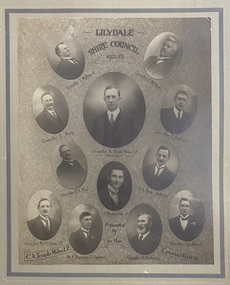 Ringwood and District Historical Society
Photograph, Shire Councillors, Lilydale, Victoria, 1922-23
... Paul Collector, Councillor W.C.E. Jones J.P. W.E. Thompson C.E. (Engineer), Councillor W. ...Paul Collector, Councillor W.C.E. Jones J.P. W.E. Thompson C.E. (Engineer), Councillor W. ...The Borough of Ringwood was created the following year, with separation from Lilydale approved on 22 October, 1924. Shire President Cr. A. Temple Miles was subsequently elected as Ringwood's first Mayor. Cr. W. Mackinlay also became a Borough of Ringwood Councillor.Sepia tone presentation photograph mounted on heavy cardboard with compilation of twelve individual oval portrait photographs depicting Lilydale Shire President and eleven Council members 1922-23. Inscription reads Presented by Cr. A. Temple Miles J.P. to the Councillors, and individual inscriptions Left to Right from top - Councillor J. Wallace J.P., Councillor J. McGhee, Councillor E. Burgi, Councillor A. Temple Miles J.P. (President), Councillor H. Hughes J.P., Councillor E.A. Paul, J.C. Winterbottom, Sec., G.A. Paul Collector, Councillor W.C.E. Jones J.P. W.E. Thompson C.E. (Engineer), Councillor W. Mackinlay, Councillor Jos. Hamill. -
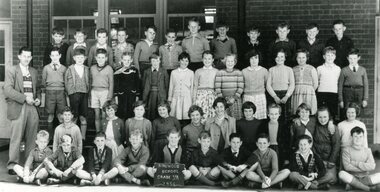 Ringwood and District Historical Society
Photograph, Ringwood State School -Class photograph - Grade 5A, 1956
... , Alan Byrne, Maurice Johnson. 3rd Row - L to R: Lawrence Sumpter, Janice Bomford, Glenys Paul, Rhonda Thompson, Anita Hill, Pat Carpenter, Carol Pavey, Erica Burns, Lorraine Guscott, Angela Ochram, Kathleen Haywood. ..., Alan Byrne, Maurice Johnson. 3rd Row - L to R: Lawrence Sumpter, Janice Bomford, Glenys Paul, Rhonda Thompson, Anita Hill, Pat Carpenter, Carol Pavey, Erica Burns, Lorraine Guscott, Angela Ochram, Kathleen Haywood. ...Black and white photograph - Grade 5A, 1956"Attached to photograph" Back Row- L to R: Wally Zielinski, Lylle Reeves, Mal Corin, T Cartright, Terry Segren, Kevin Burden, Wayne Ennis, ?, B James, Ian Simpson, Arthur Wigley, Doug Sjorgren. 2nd Row - L to R: Ian McLeave, Neal McCarten, Tom Guest, Margaret Cleator, Helen Bird, June Robinson, Marg Allsop, Susanne King, Olwyn Hayes, Lynette Broadway, ?, Alan Byrne, Maurice Johnson. 3rd Row - L to R: Lawrence Sumpter, Janice Bomford, Glenys Paul, Rhonda Thompson, Anita Hill, Pat Carpenter, Carol Pavey, Erica Burns, Lorraine Guscott, Angela Ochram, Kathleen Haywood. Front Row - L to R: Stan Bjerking, Ian Marshall, Barry Cooper, Robin Harris, Les Pattendon, Rod Clutterbuck, Kevin Divola, Kenny Gowers, Terry Wood, Ian Wilton. Absent - Dawn Riedel Teacher: Mr Reid. -
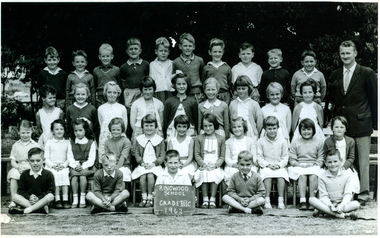 Ringwood and District Historical Society
Photograph, Ringwood State School - Grade 3C, 1962
... Paul Goddard, Alan Bibby, Peter Shiels, Lindsay Nelson, Frank Spenser, Robin Davies. 2nd Row- L to R: Vicky Munroe, Kerry Marsh, Dianne Fisher, ?, Julianne Glavimans, Anne (?), Barbara Hollingsworth, Helen Taylor, Barbara Trotter. 3rd Row- L to R: Gale Brade, Pauline Gardener, ?, Margarita Stevenson, ?, Lynette Costello, Cheryl (?), Susan Skurry, Gwen Jones, Kay-Cherie Mitchell, Julie Smart. Front Row- L to R: Daryl Mitchum, Shawn Finlay, Russell Prouse, Iain Thompson...Paul Goddard, Alan Bibby, Peter Shiels, Lindsay Nelson, Frank Spenser, Robin Davies. 2nd Row- L to R: Vicky Munroe, Kerry Marsh, Dianne Fisher, ?, Julianne Glavimans, Anne (?), Barbara Hollingsworth, Helen Taylor, Barbara Trotter. 3rd Row- L to R: Gale Brade, Pauline Gardener, ?, Margarita Stevenson, ?, Lynette Costello, Cheryl (?), Susan Skurry, Gwen Jones, Kay-Cherie Mitchell, Julie Smart. Front Row- L to R: Daryl Mitchum, Shawn Finlay, Russell Prouse, Iain Thompson ...Black and white photograph - Grade 3C, 1962"Attached to photograph" Back Row- L to R: Russell Walters, Robert Kenny, Mark Pekkarinen, Graeme Adamson, Paul Goddard, Alan Bibby, Peter Shiels, Lindsay Nelson, Frank Spenser, Robin Davies. 2nd Row- L to R: Vicky Munroe, Kerry Marsh, Dianne Fisher, ?, Julianne Glavimans, Anne (?), Barbara Hollingsworth, Helen Taylor, Barbara Trotter. 3rd Row- L to R: Gale Brade, Pauline Gardener, ?, Margarita Stevenson, ?, Lynette Costello, Cheryl (?), Susan Skurry, Gwen Jones, Kay-Cherie Mitchell, Julie Smart. Front Row- L to R: Daryl Mitchum, Shawn Finlay, Russell Prouse, Iain Thompson, Trevor Senior. Teacher: Mr Ellis -
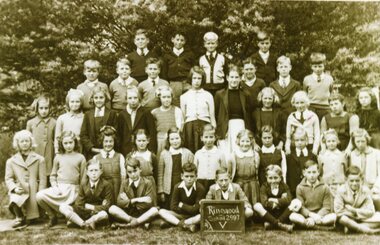 Ringwood and District Historical Society
Photograph, Ringwood State School - Grade 5, 1947
... "Attached to photograph" Back Row - L to R: Graeme Rattray, Paul Divola, Brian Simpson, John Caird. 2nd Row - L to R: Norman Wright, Brian Pump, Russell Read, Bill France, Phillip Collins, Peter Wigley. 3rd Row - L to R: Nola Scurry, Lorres Hill, Valerie Gordon, Yvonne Goodwin, Linley Clark, Lois Stevenson, ?, ?, Jennifer Parker, Chris Patterson, ?. 4th Row - L to R: (?) Georgie, Evelyn Willis, ?, Marion Medhurst, ?, ?, Elain Mathews, Valerie Everett, Dawn McAlpine, ?, ?. Front Row - L to R: Noel Deed, Ron Frazer, Brian Mallet, Vernon Lee, Ted Polkinghorne, John Wigley, Keith Thompson..."Attached to photograph" Back Row - L to R: Graeme Rattray, Paul Divola, Brian Simpson, John Caird. 2nd Row - L to R: Norman Wright, Brian Pump, Russell Read, Bill France, Phillip Collins, Peter Wigley. 3rd Row - L to R: Nola Scurry, Lorres Hill, Valerie Gordon, Yvonne Goodwin, Linley Clark, Lois Stevenson, ?, ?, Jennifer Parker, Chris Patterson, ?. 4th Row - L to R: (?) Georgie, Evelyn Willis, ?, Marion Medhurst, ?, ?, Elain Mathews, Valerie Everett, Dawn McAlpine, ?, ?. Front Row - L to R: Noel Deed, Ron Frazer, Brian Mallet, Vernon Lee, Ted Polkinghorne, John Wigley, Keith Thompson ...Black and white photograph - Grade 5, 1947."Attached to photograph" Back Row - L to R: Graeme Rattray, Paul Divola, Brian Simpson, John Caird. 2nd Row - L to R: Norman Wright, Brian Pump, Russell Read, Bill France, Phillip Collins, Peter Wigley. 3rd Row - L to R: Nola Scurry, Lorres Hill, Valerie Gordon, Yvonne Goodwin, Linley Clark, Lois Stevenson, ?, ?, Jennifer Parker, Chris Patterson, ?. 4th Row - L to R: (?) Georgie, Evelyn Willis, ?, Marion Medhurst, ?, ?, Elain Mathews, Valerie Everett, Dawn McAlpine, ?, ?. Front Row - L to R: Noel Deed, Ron Frazer, Brian Mallet, Vernon Lee, Ted Polkinghorne, John Wigley, Keith Thompson. Teacher: Added Sc0024 photo to "Media" and deleted VC entry 2157 on 14th June 2022. Sc0024 now with this Entry.
