
Showing 59 items matching "ticket writing"
-
 Bendigo Historical Society Inc.
Drawing - NORMAN PENROSE COLLECTION: TICKET WRITING
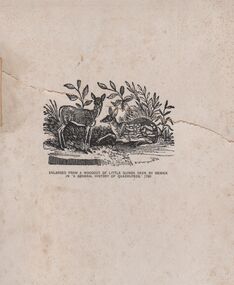
... NORMAN PENROSE COLLECTION: TICKET WRITING...... ticket writing...Coloured picture of furniture, a child's toy and a colourful advertisement of showcard and ticket writing. Also another cutting of Danger Days....Drawing NORMAN PENROSE COLLECTION: TICKET WRITING ...Artwork. Norman Penrose collection: a drawing of two deer, enlarged from a wood-cut. 'A General History of Quadrupeds.' 1790 printed under the drawing of the deer. Drawing is 7.5cmH x 13cmW on a larger piece of cardboard. Cutting of 7 Australian Butterflies. Coloured picture of furniture, a child's toy and a colourful advertisement of showcard and ticket writing. Also another cutting of Danger Days.drawing, wood-cut, norman penrose collection, artwork, butterflies, ticket writing -
 Tatura Irrigation & Wartime Camps Museum
Book, Ticket and Sign Writing, 1940's
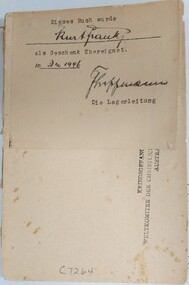
... Ticket and Sign Writing...ticket and sign writing...Possession of internee, Kurt Frank, at Camp 3 and used as a practical guide to ticket and sign writing. ...Ticket and Sign Writing Book Book ...Possession of internee, Kurt Frank, at Camp 3 and used as a practical guide to ticket and sign writing. Small book, minus cover, with a label stuck onto the first page with German writing on it, which translates roughly to this book was given as a gift to Kurt Frank December 1946 by the Camp Management. 64 pages.ticket and sign writing, hornung g, frank g, kurt frank, camp 3 internee, grett hornung nee frank -
 Federation University Historical Collection
Tool - Brushes, Keith Rash's Sign writing Brushes
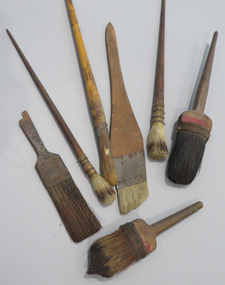
... ...ticket writing...Sign writing and ticket-writing bridged art and trade, with hand lettering applied to long-term signage and short-term promotional materials. ...Sign writing and ticket-writing bridged art and trade, with hand lettering applied to long-term signage and short-term promotional materials. ...Commercial artist, Keith Edwin Rash (1910-1985), studied at the Ballarat Technical Art School between 1923 and 1929. These artefacts are from his professional practice. Sign writing and ticket-writing bridged art and trade, with hand lettering applied to long-term signage and short-term promotional materials. At the Ballarat Technical Art School, sign writing, ticket writing, and house decoration were overseen by Thomas Raisbeck (1884-1970) from 1915. Classes were then successively taught by former students William Kenneth (Ken) Moss (1889-1921) from 1920 until his untimely death, Albert E. Williams (1899-1986) until 1928, followed by experienced, practising sign writer, Charles Emrys (Angus) Henderson (1899-1976), who had trained under Raisbeck. A number of brushes and sponges used by Ballarat sign writer, Keith Rash, who studied sign writing at the Ballarat School of Mines. signwriting, keith rash, ballarat school of mines, brushes, ballarat technical art school, sign writing, ticket writing -
 Federation University Historical Collection
Work on paper - Fashion Illustration and Commercial Art, Alice Watson, Ballarat Technical Art School folio of Alice Watson, 1931,1932 and 1933
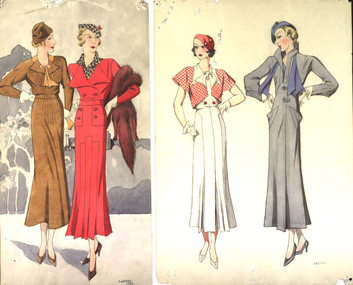
... ...ticket writing...This appears to be an example of ticket writing. Signed lrs "A Watson- 2nd term. 1932." .35) The image with a woman wearing a hat appears to be an example of ticket writing. ...This appears to be an example of ticket writing. Signed lrs "A Watson- 2nd term. 1932." .35) The image with a woman wearing a hat appears to be an example of ticket writing. ...Edith (Alice) WATSON (1914–2010) Murtoa | Australia Alice Watson studied at the Ballarat Technical Art School (at the School of Mines, Ballarat) from 1930 until 1933. These works include commercial art, advertising and catalogue illustrations as well as figure construction and fashion-plate designs. Watson sat several departmental exams, including drawing and painting plant forms from nature, lettering, Composition of Form and Colour and advanced General Design, as well as dressmaking and embossed leatherwork. Her folio applies many Australian native floral elements to design. Upon graduating, Watson taught at the Murtoa High School, living with her parents until their deaths in 1972 and 1988 when she was 74 years old. Alice Watson died in Ballarat, aged 95, having conserved her beautiful student folio, which was generously gifted to the Federation University permanent Historical Collection by the Watson family. Commercial artA folio of Fashion Drawing by Edith Alice Watson of the Ballarat Technical Art School. .1) Two women dressed in fashionable clothing- lhs tan ensemble and hat; rhs fuschia ensemble with black and white accessories plus fur stole. Signed lrs A.Watson. 1933. .26) The image with three women wearing a hats. This appears to be an example of ticket writing. Signed lrs "A Watson- 2nd term. 1932." .35) The image with a woman wearing a hat appears to be an example of ticket writing. Signed lrs "A Watson--11th-7-32." .23) female figure drawing. Signed lrs A.Watson. 1st Term. 1932 .21) female figure drawing. Signed lrs A.Watson. 2nd Term. 1932 .17) drawing of lips, side view. Signed lrs A. Watson. 1931 .18) drawing of lips,three-quarter view. Signed lrs A. Watson .37) Paper is embossed with 'Windsor & Newtons Bristol Board' stamp.(Griffin depicted in centre)alice watson, ballarat technical art school, art, drawing, figure drawing, alumni, costume drawing, fashion drawing, ticket writing, 1930's fashion, indian ink, edith alice watson, figure construction, advertising, commercial art -
 Federation University Historical Collection
Document, Waller and Chester, Ballarat School of Mines and Industries Ballarat: The Art School, c1948, c1948
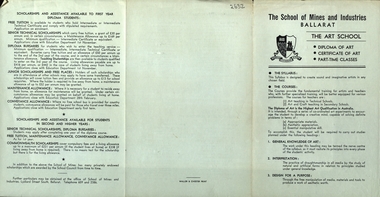
... ...Ticket Writing...Evening: Dressmaking, Weaving, Leatherwork, pottery, Metalwork, Painting, Sculpture, Ticket Writing, Lettering, Figure Drawing. ...Evening: Dressmaking, Weaving, Leatherwork, pottery, Metalwork, Painting, Sculpture, Ticket Writing, Lettering, Figure Drawing. ballarat technical art school art diploma of art certificate of art part-time classes syllabus design scholarships diploma of art in pottery diploma of art in advertising art education Dressmaking Weaving Leatherwork Pottery Metalwork Painting Sculpture Junior Art Dressmaking Weaving Leatherwork pottery Metalwork Painting Sculpture Ticket Writing Lettering Figure Drawing Two fold, 6 page information flyer on classes held at the Ballarat Technical Art School. ...Entrance requirements for a full-course student was an Intermediate Certificate of equivalent. The Certificate of Art was a two year course of basic study to enable students to undertake a further two years of specialised training in a chosen field of art. The Diploma of Art was a two-year course of specialised training available to students, who have passed the Certificate of Art Examination or its equivalent. Candidates of the examination must be at least 19 years of age, must have completed two years' full -time training or not less than three years' part-time training, and must present for the Matriculation examination for English Expression. Part-Time classes at the Ballarat Technical Art School c1948 were: Day: Dressmaking, Weaving, Leatherwork, Pottery, Metalwork, Painting, Sculpture, Junior Art. Evening: Dressmaking, Weaving, Leatherwork, pottery, Metalwork, Painting, Sculpture, Ticket Writing, Lettering, Figure Drawing. Two fold, 6 page information flyer on classes held at the Ballarat Technical Art School. The Art school offered Diploma of Art, Certificate of Art and Part-time classes.ballarat technical art school, art, diploma of art, certificate of art, part-time classes, syllabus, design, scholarships, diploma of art in pottery, diploma of art in advertising, art education, dressmaking, weaving, leatherwork, pottery, metalwork, painting, sculpture, junior art, dressmaking, weaving, leatherwork, pottery, metalwork, painting, sculpture, ticket writing, lettering, figure drawing -
 Federation University Historical Collection
Price Ticket, Price Ticket by signwriter Keith Rash
... ...ticket writing...White celluloid ticket with a metal 'prong' for display at a butchers. The sign writing has been undertaken by Keith Rash of Ballarat....signwriting ticket writing keith rash Chicken Rolls 18c White celluloid ticket with a metal 'prong' for display at a butchers. ...White celluloid ticket with a metal 'prong' for display at a butchers. The sign writing has been undertaken by Keith Rash of Ballarat.Chicken Rolls 18csignwriting, ticket writing, keith rash -
 Federation University Historical Collection
Object, Simplex Stencil Co, Signwriting Equipment
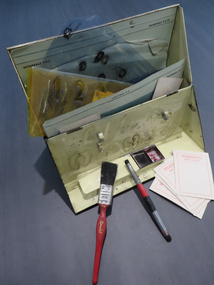
... ...ticket writing...The box of stencils was used by Ballarat signwriter Keith Rash, who studied signwriting at the Ballarat School of Mines. ballarat school of mines stencils signwriting keith rash simplex stencil co. simplex tucket writing outfit ticket writing Hinged box of stencils. Signwriting Equipment Object Simplex Stencil Co. ...The box of stencils was used by Ballarat signwriter Keith Rash, who studied signwriting at the Ballarat School of Mines. Hinged box of stencils.ballarat school of mines, stencils, signwriting, keith rash, simplex stencil co., simplex tucket writing outfit, ticket writing -
 Federation University Historical Collection
Documents, Herbert Henry Smith, Ballarat Technical Art School, 1929-1939, 1918-1929
... ...ticket writing...ballarat school of mines ballarat technical art school h.h. smith ticket writing robina mackie signwriting mavis oliver Don Refshauge Effie george f. smith bessie robertson Alice bosher george crawley R. ...Brown hard covered book with hand written reports from the Art Principal, H.H. Principal. 24 August 1932 - Wiltshire Poster Competition 19 August 1936 - King George V Memorial 18 November 1936 - Society for the Promotion of Peace in Melbourne ballarat school of mines, ballarat technical art school, h.h. smith, ticket writing, robina mackie, signwriting, mavis oliver, don refshauge, effie george, f. smith, bessie robertson, alice bosher, george crawley, r. swan, f.g. proctor, martha pinkerton scholarship, ladies art association, levi molineaux, lorna bailey, gordon leviston, frances brandenburg, jean rogers, pottery, bena lamb, olive bolitho, wiltshire poster competition, george ludbrook, george ludbrook, claudia mcilvena, mcrobertson scholarship, fred longhurst, jim allen, frank hall, kathleen mcmahon, edith curnow, edgar bartrop, jean maud, john taylor, century exhibition, lorna bailey, frances gleeson, albino paganetti, reginald warnock, john hewitt, maude paterson, king george v memorial, statue, clarice king -
 Greensborough Historical Society
Memorabilia - Ticket, Methodist Church Quarterly Ticket 1911, 30/06/1911
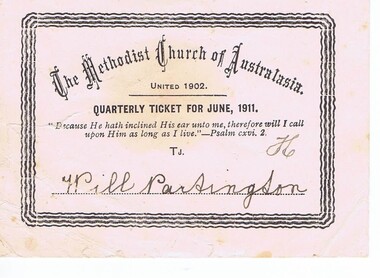
... Cream coloured paper ticket, black writing within black border....The Partington family are Greensborough pioneers and had long membership of the Methodist Church in Greensborough. partington family william partington methodist church greensborough In black pen "Will Partington" and the letter "H" Cream coloured paper ticket, black writing within black border. Methodist Church Quarterly Ticket 1911 Memorabilia Ticket ...Quarterly ticket issued to members of the congregation of the Methodist Church in Greensborough. This ticket belonged to Mr William Partington and was issued in June 1911.The Partington family are Greensborough pioneers and had long membership of the Methodist Church in Greensborough.Cream coloured paper ticket, black writing within black border.In black pen "Will Partington" and the letter "H"partington family, william partington, methodist church greensborough -
 National Vietnam Veterans Museum (NVVM)
Ephemera - QANTAS ticket
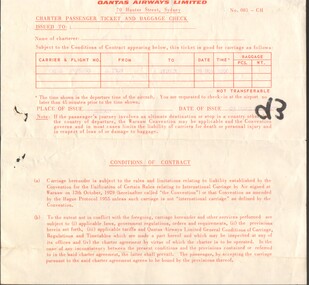
... Cream coloured paper QANTAS passenger ticket with red writing....QANTAS ticket Lette Ordnance Vietnam 3795490 Cream coloured paper QANTAS passenger ticket with red writing. Ephemera QANTAS ticket ...This ticket was issued to National Serviceman Allen Doran Lette (Service No. 3795490) for his passage from Saigon to Sydney on 5 November 1970, at the completion of his service in the Ordnance Corps during the conflict in Vietnam.Cream coloured paper QANTAS passenger ticket with red writing.qantas, ticket, lette, ordnance, vietnam, 3795490 -
Federation University Historical Collection
Book, Ballarat Technical Art School Register, 1955-1971, 1955-1971
... Courses listed include dressmaking, Elementary Art, Ticket Writing, Shorthand, Drawing, Pottery and Drawing. ...Courses listed include dressmaking, Elementary Art, Ticket Writing, Shorthand, Drawing, Pottery and Drawing. ...The Ballarat Technical Art School (No. 10) was a division of the Ballarat School of Mines. Green ledger with black spine. Lists Student Number, Name, Trade or Occupation, Age at Last Birthday, Address, Date of Joining the School, Course Work. Courses listed include dressmaking, Elementary Art, Ticket Writing, Shorthand, Drawing, Pottery and Drawing. Pottery, Millinery. Junior Art, Building Construction, Matriculation Art, Needlework, Painting, Life Class, Decorative Needlework, General Art Course, Sculptureballarat technical art school, art general register, student enrolments, alumni, art studies, ballarat school of mines -
 National Vietnam Veterans Museum (NVVM)
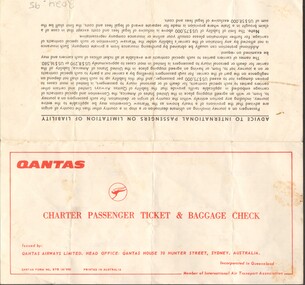
Ephemera - QANTAS ticket
... Double sided cream coloured paper of a QANTAS passenger ticket with red writing, marked in blue ink....Lette 3795490 Ordnance Corps Vietnam Qantas ticket flight Double sided cream coloured paper of a QANTAS passenger ticket with red writing, marked in blue ink. Ephemera QANTAS ticket ...This ticket was issued to National Serviceman Allen Doran Lette (Service No. 3795490) for his passage from Sydney to Saigon on 16 December 1969 to serve in the Ordnance Corps during the conflict in Vietnam.Double sided cream coloured paper of a QANTAS passenger ticket with red writing, marked in blue ink.lette, 3795490, ordnance corps, vietnam, qantas, ticket, flight -
 Bendigo Military Museum
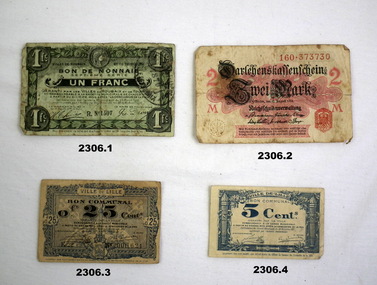
Currency - NOTES, 1914 - 1918
... .1) Note, green & black colour "UN FRANK" No. 1507. .2) Note, red & black colour "SWEI MARK" 160.373730. .3) Note, blue & black colour, Bon Communal 25 Cent. .4) Note, blue & black colour, Bon Communal 5 Cent. .5) Ticket, purple colour, black writing, "Bon Poor 5 Cent Merchandises". .6) Ticket, white, black writing, purple stamp "10 centimes". .7) Ticket, light blue, black writing, "CINQUANTE Centimes No. 753243". .8) Ticket, yellowed, black writing "Bon de Vinqt-cing Centimes No. 013307". .9) Ticket, reddish, black writing, Bon de 0,25 Cent No. 12728". .10) & .11) Re-catalogued as 2560.2...Refer 2325.2 for his service history. currency foreign .1) Note, green & black colour "UN FRANK" No. 1507. .2) Note, red & black colour "SWEI MARK" 160.373730. .3) Note, blue & black colour, Bon Communal 25 Cent. .4) Note, blue & black colour, Bon Communal 5 Cent. .5) Ticket, purple colour, black writing, "Bon Poor 5 Cent Merchandises". .6) Ticket, white, black writing, purple stamp "10 centimes". .7) Ticket, light blue, black writing, "CINQUANTE Centimes No. 753243". .8) Ticket, yellowed, black writing "Bon de Vinqt-cing Centimes No. 013307". .9) Ticket, reddish, black writing, Bon de 0,25 Cent No. 12728". .10) & .11) Re-catalogued as 2560.2 Currency NOTES ...Items souvenired by Horace Eli Hambly No 794 AIF. Refer 2325.2 for his service history..1) Note, green & black colour "UN FRANK" No. 1507. .2) Note, red & black colour "SWEI MARK" 160.373730. .3) Note, blue & black colour, Bon Communal 25 Cent. .4) Note, blue & black colour, Bon Communal 5 Cent. .5) Ticket, purple colour, black writing, "Bon Poor 5 Cent Merchandises". .6) Ticket, white, black writing, purple stamp "10 centimes". .7) Ticket, light blue, black writing, "CINQUANTE Centimes No. 753243". .8) Ticket, yellowed, black writing "Bon de Vinqt-cing Centimes No. 013307". .9) Ticket, reddish, black writing, Bon de 0,25 Cent No. 12728". .10) & .11) Re-catalogued as 2560.2currency, foreign -
 Bendigo Military Museum
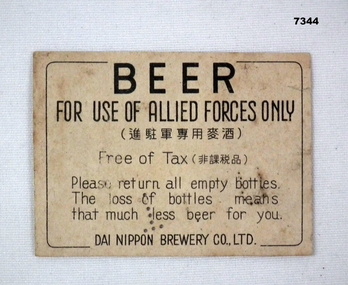
Document - BEER RATION TICKET
... Blank on the other side and punch holes in shape of a letter 'U' and letter 'T' through ticket. Some writing is in Japanese and brewery identified....Blank on the other side and punch holes in shape of a letter 'U' and letter 'T' through ticket. Some writing is in Japanese and brewery identified. ...Servicemen allocated beer ticket for ration of beer and to return empty bottles. Issued by Dai Nipon Brewery. Item in the collection of Richard William McGILVERY, RAAF. Refer Cat No. 7287P for his service details, photos and awards.Small ticket on white paper with black writing. Instructions on one side. Blank on the other side and punch holes in shape of a letter 'U' and letter 'T' through ticket. Some writing is in Japanese and brewery identified.Titled "Beer for use of Allied Forces only". beer ration, bcof -
 Linton and District Historical Society Inc
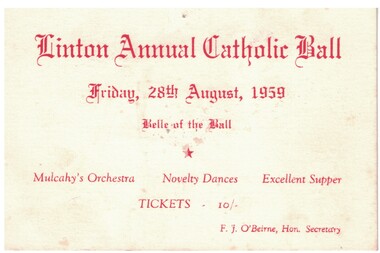
Ticket, Linton Annual Catholic Ball, 1959, 1959
... White card with red writing, ticket for Linton Annual Catholic Ball, held 28th August 1959. ...O'Beirne Text: " Linton Annual Catholic Ball / Friday, 28th August, 1959. " White card with red writing, ticket for Linton Annual Catholic Ball, held 28th August 1959. ...White card with red writing, ticket for Linton Annual Catholic Ball, held 28th August 1959. Two copies of ticket.Text: " Linton Annual Catholic Ball / Friday, 28th August, 1959. "linton catholic church, event, balls, f.j. o'beirne -
 Federation University Historical Collection
Document, Ballarat Technical Art School Prospectus, 1908, 1908
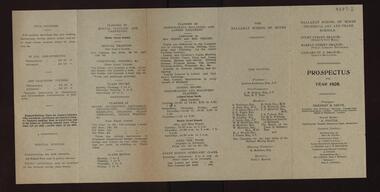
... Ladies Tailoring, Manual training, Carpentry, House Decoration, Signwriting, Lettering, Stenciling, Marbling, Graining, Glass Embossing, Ticket Writing, Art Teachers' Course, Life Classes, State School Teachers' CLasses, Drawing from a Flat Example, Drawing Ornament for the Cast, Practical Geometry, Perspective. ...Ladies Tailoring, Manual training, Carpentry, House Decoration, Signwriting, Lettering, Stenciling, Marbling, Graining, Glass Embossing, Ticket Writing, Art Teachers' Course, Life Classes, State School Teachers' CLasses, Drawing from a Flat Example, Drawing Ornament for the Cast, Practical Geometry, Perspective. ...The Ballarat Technical Art School was established in 1907 as a division of the Ballarat School of Mines. Folded brochure with a prospectus for the newly established Ballarat Technical Art School. The principal was Herbert H. Smith. Subjects taught included Dressmaking, Millinery. Ladies Tailoring, Manual training, Carpentry, House Decoration, Signwriting, Lettering, Stenciling, Marbling, Graining, Glass Embossing, Ticket Writing, Art Teachers' Course, Life Classes, State School Teachers' CLasses, Drawing from a Flat Example, Drawing Ornament for the Cast, Practical Geometry, Perspective. Drawing in Light and Shade from the Cast, Modelling Plant Forms, Historic Ornament, Drawing the Antique From Memory, Composition of Form and COlour, Human Anatomy, Design, etc.ballarat technical art school, ballarat school of mines technical art and trade schools, prospectus, herbert h. smith, h.h. smith, f. foster, m. young, g. clegg, j. barber, t.r. pridgeon, albert steane, a.w. steane, e. cornell, art education -
 Bendigo Historical Society Inc.
Ephemera - Bendigo Theatre Company: tickets 1989
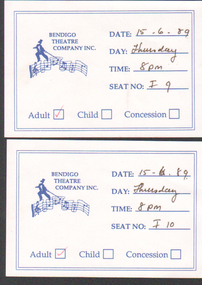
... Bendigo Theatre Company Inc, Two Tickets, for date 15th June 1989 Seat Numbers: i9 & i10, Adult tickets Blue printed tickets with black writing...Tickets Bendigo Theatre Company Bendigo Theatre Company Inc, Two Tickets, for date 15th June 1989 Seat Numbers: i9 & i10, Adult tickets Blue printed tickets with black writing Ephemera Bendigo Theatre Company: tickets 1989 Thelma Coombes ...In 1984, the Bendigo Operatic Society changed its name to the Bendigo Theatre Company. In 1989 the company produced two shows; its 84th production was "Annie Get your Gun and its 85th production was the pantomime "Cinderella". These tickets would have been for "Annie Get Your Gun" in June 1989.Bendigo Theatre Company Inc, Two Tickets, for date 15th June 1989 Seat Numbers: i9 & i10, Adult tickets Blue printed tickets with black writingtickets, bendigo theatre company -
 Sunshine and District Historical Society Incorporated
Ephemera - Sunshine Bowling Club 70th Anniversary 1913 - 1983 Dinner Dance Ticket, 1983
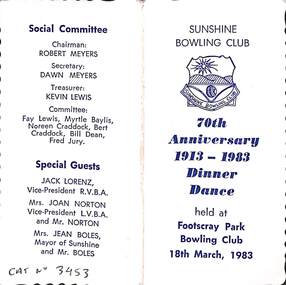
... Small white card folded ticket with white writing on both sides detailing location and date of of the dinner dance, mens and ladies committee members, social committee and special guests...Sunshine Bowling Club Bowling Memento Sunshine Bowling Club 70th Anniversary 1913 - 1983 Dinner Dance Ticket held at Footscray Park Bowling Club 18th March 1983 Small white card folded ticket with white writing on both sides detailing location and date of of the dinner dance, mens and ladies committee members, social committee and special guests Ephemera Sunshine Bowling Club 70th Anniversary 1913 - 1983 Dinner Dance Ticket ...Sunshine Bowling Club 70th Anniversary 1913 - 1983 Dinner Dance Ticket held at Footscray Park Bowling Club 18th March 1983sunshine bowling club, bowling, memento -
 Federation University Art Collection
Architectural Drawing, Measured drawing ornament House Fitzroy Gardens by Albert E. Williams, c1920, c1920
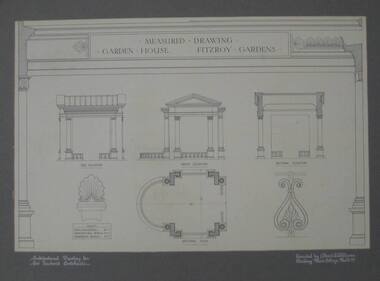
... Williams joined the staff of the Ballarat Junior Technical School in 1921, teaching sign writing, ticket writing and house decoration. He taught in other technical schools between 1923 and 1928, returning to Ballarat in that year to fill a vacancy left by John Rowell . ...Williams joined the staff of the Ballarat Junior Technical School in 1921, teaching sign writing, ticket writing and house decoration. He taught in other technical schools between 1923 and 1928, returning to Ballarat in that year to fill a vacancy left by John Rowell . ...Albert E. Williams first studied art under Fred Foster after being awarded a scholarship to the Ballarat East Art School. In 1913 he became one of the first intake of 83 students to study the Merit Certificate at the newly opened Ballarat Junior Technical School. Williams was the second person to receive a certificate from that institution. He then studied under H.H. Smith for the Art Teachers’ Certificate at the Ballarat School of Mines Technical Art School between 1915 and 1920. Williams joined the staff of the Ballarat Junior Technical School in 1921, teaching sign writing, ticket writing and house decoration. He taught in other technical schools between 1923 and 1928, returning to Ballarat in that year to fill a vacancy left by John Rowell . Williams continued his teaching career at both the Ballarat School of Mines Technical Art School and the Junior Technical School until 1942. He taught in various other technical schools from 1943, retiring as Headmaster of the Brighton Technical School in 1964. Albert E. Williams continued producing artwork throughout his career, and was responsible for the education of generations of artists and art teachers. This item is part of the Federation University Art Collection. The Art Collection features over 1000 works and was listed as a 'Ballarat Treasure' in 2007.Pen and ink measured drawing showing side elevation, front elevation, sectional elevation and scales.art, artwork, williams, albert e. williams, ballarat technical art school, architecture, art teachers' certificate -
 Federation University Art Collection
Drawing, Williams, Albert E, 'Drawing Human Figure from the Cast', 1931
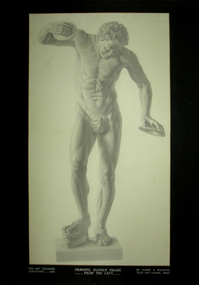
... Williams joined the staff of the Ballarat Junior Technical School in 1921, teaching sign writing, ticket writing and house decoration. He taught in other technical schools between 1923 and 1928, returning to Ballarat in that year to fill a vacancy left by John Rowell . ...Williams joined the staff of the Ballarat Junior Technical School in 1921, teaching sign writing, ticket writing and house decoration. He taught in other technical schools between 1923 and 1928, returning to Ballarat in that year to fill a vacancy left by John Rowell . ...Albert E. WILLIAMS (1899-1986) Victoria, Australia Albert E. Williams first studied art under Fred Foster after being awarded a scholarship to the Ballarat East Art School. In 1913 he became one of the first intake of 83 students to study the Merit Certificate at the newly opened Ballarat Junior Technical School. Williams was the second person to receive a certificate from that institution. He then studied under H.H. Smith for the Art Teachers’ Certificate at the Ballarat School of Mines Technical Art School between 1915 and 1920. Williams joined the staff of the Ballarat Junior Technical School in 1921, teaching sign writing, ticket writing and house decoration. He taught in other technical schools between 1923 and 1928, returning to Ballarat in that year to fill a vacancy left by John Rowell . Williams continued his teaching career at both the Ballarat School of Mines Technical Art School and the Junior Technical School until 1942. He taught in various other technical schools from 1943, retiring as Headmaster of the Brighton Technical School in 1964. Albert E. Williams continued producing artwork throughout his career, and was responsible for the education of generations of artists and art teachers. In 1937 he was living at 302 Drummond Steet South, Ballarat. This item is part of the Federation University Art Collection. The Art Collection features over 2000 works and was listed as a 'Ballarat Treasure' in 2007. Unframed pencil drawing of a plaster cast of a human figure known as the Dancing Faun, a marble sculpture first recorded in 1665, when Albert Rubens listed it as in the collection of the Grand Duke of Tuscany in Florence (probably long owned by the Medici). By 1688 the sculpture was held by the Uffizi in Florence. In September 1800 the sculpture was sent to Palermo along with other treasures to avoid plunder by the French army, but it was returned to the Florence in 1803. By the 18th Century the Dancing Faun gained a reputation as one of the finest ancient sculptures in existence. A faun makes music by simultaneously playing the ‘crotala’ (similar to cymbals) in his hands and the ‘scabellum’ or ‘croupezion’ under his right foot. In Victorian Education Department examinations, this sculpture was sometimes called the "Clapping Faun".Written on the mount board below the drawing "Drawing Human Figure from the Cast. for art Teacher's Certificate 1931 by Albert E. Williams. Tech. Art School, Ballarat."art, artwork, albert e. williams, williams, ballarat technical art school, art teacher's certificate, a.e. williams, alumni, drawing from the cast, drawing from the antique, drawing the himan figure from the cast, dancing faun -
 Federation University Art Collection
Drawing - pencil on paper, 'Drawing Ornament from Cast in Light & Shade' by Albert E. Williams, c1920
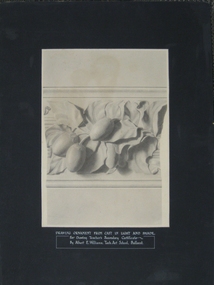
... Williams joined the staff of the Ballarat Junior Technical School in 1921, teaching sign writing, ticket writing and house decoration. He taught in other technical schools between 1923 and 1928, returning to Ballarat in that year to fill a vacancy left by John Rowell . ...Williams joined the staff of the Ballarat Junior Technical School in 1921, teaching sign writing, ticket writing and house decoration. He taught in other technical schools between 1923 and 1928, returning to Ballarat in that year to fill a vacancy left by John Rowell . ...Albert E. Williams first studied art under Fred Foster after being awarded a scholarship to the Ballarat East Art School. In 1913 he became one of the first intake of 83 students to study the Merit Certificate at the newly opened Ballarat Junior Technical School. Williams was the second person to receive a certificate from that institution. He then studied under H.H. Smith for the Art Teachers’ Certificate at the Ballarat School of Mines Technical Art School between 1915 and 1920. Williams joined the staff of the Ballarat Junior Technical School in 1921, teaching sign writing, ticket writing and house decoration. He taught in other technical schools between 1923 and 1928, returning to Ballarat in that year to fill a vacancy left by John Rowell . Williams continued his teaching career at both the Ballarat School of Mines Technical Art School and the Junior Technical School until 1942. He taught in various other technical schools from 1943, retiring as Headmaster of the Brighton Technical School in 1964. Albert E. Williams continued producing artwork throughout his career, and was responsible for the education of generations of artists and art teachers. This item is part of the Federation University Art Collection. The Art Collection features over 1000 works and was listed as a 'Bal larat Treasure' in 2007.Pencil drawing of a plaster cast floral form.Written on the mat board below the drawing "Drawing ornament from cast in light and shade. For Drawing Teacher's Secondary Certificate by Albert E. Williams, Tech. Art School, Ballarat."art, artwork, albert e. williams, williams, ballarat technical art school, plaster cast -
 Bendigo Historical Society Inc.
Ephemera - WARNE COLLECTION: MOTOR SPIRIT RATION TICKET
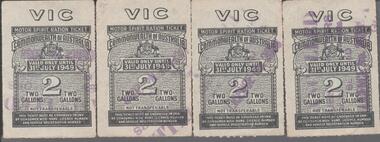
... Valid only until 31st july, 1949, for two gallons non transerable. The ticket are stamped anr writing on the back....Valid only until 31st july, 1949, for two gallons non transerable. The ticket are stamped anr writing on the back. Ephemera WARNE COLLECTION: MOTOR SPIRIT RATION TICKET ...Four motor spirit ration tickets. Issued by the Commonwealth of Australia in Victoria. Valid only until 31st july, 1949, for two gallons non transerable. The ticket are stamped anr writing on the back.transport, motor vehicles, ration ticket -
 Federation University Historical Collection
Booklet, The Ballarat School of Mines and Industries 1870-1920 Jubilee Booklet, 1920 (estimated)
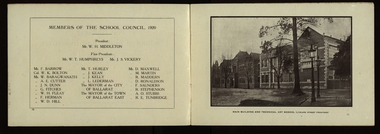
... The technical Art school curriculum includes training in all branches of pictorial and applied art, an Architectural Diploma Course, a Draughtman's Course, technical Art teachers' Course, Photography,Ticket Writing, Art Metal Work, Woodcarving, Needlework, and Leather work. ...The technical Art school curriculum includes training in all branches of pictorial and applied art, an Architectural Diploma Course, a Draughtman's Course, technical Art teachers' Course, Photography,Ticket Writing, Art Metal Work, Woodcarving, Needlework, and Leather work. ...The first school of Mines in Australia was established at Ballarat in 1870. At the time of its jubilee (1930) the following people were members of the School Council: W.H. Middleton (President), W.T. Humphreys (VP), J.S. Vickery (VP), F. Barrow, Col. W.K. Bolton, William Baragwanath, A.E. Cutter, J.N. Dunn, G. Fitches, W.H. Fleay, F. Herman. W.D. Hill, T. Hurley, K. Kean. J. Kelly, L. Lederman, Mayor of Ballarat, Mayour of Ballarat East, D. Maxwell, M. Martin, R. Maddern, D. Ronaldson, F. Saunders, R. Stephenson, A.O. Stubbs, R.E. Tunbridge. The School Staff in 1920 comprised: Herbert H. Smith, Walter Rowbotham, Reginald L. Cutter, M.C. Young, Hilda Wardle, M. Wiliamson, P.S. Richards, L.H. Archibald, J. Woods, Ken Moss, W. Kenneth, Mrs McIlvena. B. Robinson, S. Rowe, E. Hope-Jones, Miss Abrams, L.St.G.P. Austin, Alfred Mica Smith, J.R. Pound, Herbert R. Murphy, N.H. Junner, Maurice Copland, L.H. Archibald, E.J.A. McConnon, Newton King, D.m. Hull, T.R. Gordon, John M. Sutherland, T.K. Jebb, Dick Richards, C. Tonkin, A.W. Steane, J. Paterson, H.W. Malin, R.V. Maddison, S.M. Mayo, F.A. King, W.H. Steane, T.R. Gordon, T.A. Williams, H. Waldron, G. Black, E.J. McConnon, R.V. Duncan. R. Cutter, E.G. Vawdrey, Hilda WardleWhite stapled booklet - landscape format - 20pp + soft covers with blue writing. Includes an historical sketch of the Ballarat School of Mines. Contains images of the school from around 1920. The history outlined in the booklet follows: 'Ballarat has helped to influence the life and destinies of Australia in many ways, the recital of which would perhaps prove tedious to the citizens of less favoured localities! However, it can be said, without much fear of contradiction, that only less known thought Australia than its fame as a gold field is the reputation won for it by its school of Mines, ... Ballarat was still quite a new place when the School was founded, but a very propserous and popular place all the same, with a go-ahead lot of citizens brim full of the spirit of enterprise which seemsto animate mining populations generally. Money was plentiful, and they launched out into ventures, which later, were to develop and take the place of the gold mines, while what is more to the point, they understood the value of education. the old digging days were passing away. So far as Ballarat itself was concerned the day of the cradle and tin dish had already passed into an antiquity "as dead and distant as the age of the Tubal Caon," said dir redmond Barry on declaring the School open. Mining had become a serious business, and the mining engineer, the metallurgist, and the geologist had become a power in the land. In these circumstances the suggestions to found a School of Mines met with ready acceptance. The late Mr James M. Bickett had the honor of bringing forward the proposition at a meeting of the Ballarat Mining Board in October, 1869. it was agreed to, and the Government, having been approached for assistance, granted a lease of the old Supreme Court buildings at a nominal reantal. A modest sum, including 100 pounds from the Borough Council of Ballarat West, was subscribed by a number of sympathisers, and on the 26th October, 1870, the inaugural address was delivered by Sir Redmond Barry, the first President of the School. Classes were commenced on the 23rd January, 1871. The students at first were mostly adults. They were chiefly men emloyed at the mines, who had the wisdom and energy to devote their spare time to study, and, though their attendance was somewhat irregular, they made very good progress. Old prints which have been preserved show them at work at furnaces, big bearded men of the old-fashioned type of miner. It is interesting to note that among those who gave evidence and encouragement was Sir Roderick Murchison, who many years before had advised Cornish miners to emigrate to Australia to search for gold, and who in 1848 was in possession of gold ore sent from this country. Sir Roderick sent a parcel of books for the library, and gave useful advice as to the curriculum which should be adopted. The Museum, which now contains a most valuable collection of minerals, was one of the first things attended to, and the reports presented to the Council from time to time speak of additions being made from all parts of the world. New equipment was constantly being added to the School, a good deal of assay work was done, and some specimens were sent from the East Indies for examination as far back as 1873. By this time there was a difficulty in providing accomodation for the students who wished to enrol, and the number of instructors had grown from two to four. In 1882 the first building was being erected on what was then part of the gaol reserve. A little more than ten years afterwards a buildnig formerly serving as a Methodist Church was absorbed, while later on, the demand for accomodation increasing, the attack upon the gaol was renewed. The School continued to grow in reputation and size, and became the science centre of the district, and in 1889 a learge new building was opened by Sir Alexander Peacock. Students came from over seas as well as from all the States of Australia, and after going through their courses they took with them the name and fame of the old School to all parts of the globe. School of Mines boys have played a great part in developing the mining fields of Western Australia, South Australia, and africa, while old students who have made a name in their profession are constantly dropping in to see how the old place is getting along. It was not to be expected, however, that the Ballarat School would be left without rivals, its very success inspiring competition. Mining Schools were started in other parts of Australia, and, at the same time, Victoria ceased to hold first place as a mining state. On the other hand there was a great advance in manufacturing, and the demand for technicaly trained men became a great and as insistent as ever it had been for trained mining men. The Council was quick to adapt the school to the new conditions, and the result is seen in the institution, which is one of Ballarat's proudest possession. Instruction is given in all branches of technical work, and the classes are filled with students who are building up for Ballarat a reputation as an industrial centre, which promises to equal that which it formerly held as a mining town. Owing to its bracing climate, its abundant opportunities for recreations, and its accessibilty, Ballarat as a city is an ideal place for educational purposed, and is yearly becoming more and more appreciated throughout the State. The chairman of one of Ballarat's biggests industries claims that the workman can do twice the day's work here that he can do in Melbourne. he was a little enthusiastic over it, perhaps, but it is a well-known fact that the healthy and invigourating Ballarat climate is conducive to both physical and mental activity, and the records of the School provide ample proof of it. One of the most interesting and successful branches of the School of Mines and Industries - if the name be enlarged with the enlargement of its scope - is the Technical Art School. "The City of Statues" has from its earliest days been a stronghold of art. Art schools have flourised here, and in 1905 the Education Department came to the conclusion that the best thing to do with them was to place them under the management of the School of Mines Council. A magnificent new Technical Art School was built at a cost of some 12,000 pounds on the site of the old Supreme Court building, and was formally opened on the 23rd July, 1915. The results have not only been justified but surpassed all anticipations. The most comprehensive list of subjects is taught, and this list is constantly added to. Students have flocked to the art School, which may be said to occupy a unique position in Australia, and its record of success is really astonishing. Its students supply art teachers for the newer schools that are being built, and many occupy leading positinos in important business houses. So well is its reputation known that orders are constantly being received, not only from Victoria, but from other States, for honor boards and challenge shields to be designed and made. The most recent addition to the School of Mines and Industries is the Junior Technical School, for which a new building is now being erected on a portion of the gaol site, transferred to the School of Mines Counci by the Government. At the present moment temporary quarters are being occupied. Some students after passing through the Junior School go straight to employment, continuing perhaps to attend the evening trade classes, while others move on to the senior School. In a review of the work of the School of Mines mention must be made of a series of industrial research carried out under supervision of the Principal. One in particular, regarding the suitability of the local ores for the manufacture of pigments attracted much attention, while the experiemtns on the manufacture of white potery from Victorian clayes were considered of sufficient importance by the Federal Advisory Council of Science and Industry to warrant the appointment of a special investigator. The results of these have been most encouraging, and may have far-reaching consequences. The vocational training of returned soldiers also should not be overlooked. The work was taken in hand from the first, before the Repatriation Department gave assistance, and now with the help of the department of the School has become one of the largest vocational training centres in Victoria outside of Melbourne. The soldiers, trained in a variety of occupations, have made remarkable progress, and already considerable numbers have found employment in local workshops and factories. To sum up, the School is divided into the following departments, each well staffed and equipped: - The School of Mines, science, and Engineering; the Techncial Art School, the Boys' Junior Technical School, the Girl's Preparatory Technical Classes, Trade Classes, and the Commercial School. The school of Mines, science and Engineering, comprises the following branches: - Mining, Metallurgy, Geology, Electrical Engineering, Civil Engineering, Mechanical Engineering, Applied Chemistry, and Pharmacy. Battery treatments, Cyanide Testing, Smelting, Assays, and Clay Testing from a regular part of the School's work. Students gaining qualifications obtain concession in their courses at the university, should they proceed there to continue their studies. The technical Art school curriculum includes training in all branches of pictorial and applied art, an Architectural Diploma Course, a Draughtman's Course, technical Art teachers' Course, Photography,Ticket Writing, Art Metal Work, Woodcarving, Needlework, and Leather work. The Trade Classes give instruction in Telephone Mechanics, telegraphy, Carpentry, Cabinet Making, Plumbing, Blacksmithing, Fitting, Electric Wiring, and Printing. Numerous Scholarships are offered every year, and altogether students will find few places to equal the Ballarat School of Mines and Industries as a training place for their life's work. One of the first in the continent to be established, its Jubilee finds it still in the front rank, keeping pace with the times, and offering to the youths of this country the means of taking advantage of Australia's teeming opportunities. william, battery, smith, herbert, drawing from the antique, ballarat school of mines botanical gardens, ballarat school of mines, redmond barry, alfred mica smith, james bickett, museum, dick richards, ballarat junior technical school, s m b, ballarat school of mines and industries, ballarat technical art school, model mine, james m bickett, j m bickett, roderick murchison, vocational training rooms, wesley church, methodist church, alexander peacock, lathes, repatriation, repatriatin department, war service, school council, baragwanath, gold mining, mining laboratory, plaster cast, r.w. richards, anniversary, jubilee -
Federation University Historical Collection
Booklet, The Ballarat School of Mines and Industries 1870-1920 Jubilee Booklet, 1920 (estimated)
... The technical Art school curriculum includes training in all branches of pictorial and applied art, an Architectural Diploma Course, a Draughtman's Course, technical Art teachers' Course, Photography,Ticket Writing, Art Metal Work, Woodcarving, Needlework, and Leather work. ...The technical Art school curriculum includes training in all branches of pictorial and applied art, an Architectural Diploma Course, a Draughtman's Course, technical Art teachers' Course, Photography,Ticket Writing, Art Metal Work, Woodcarving, Needlework, and Leather work. ...The first school of Mines in Australia was established at Ballarat in 1870. At the time of its jubilee (1930) the following people were members of the School Council: W.H. Middleton (President), W.T. Humphreys (VP), J.S. Vickery (VP), F. Barrow, Col. W.K. Bolton, William Baragwanath, A.E. Cutter, J.N. Dunn, G. Fitches, W.H. Fleay, F. Herman. W.D. Hill, T. Hurley, K. Kean. J. Kelly, L. Lederman, Mayor of Ballarat, Mayour of Ballarat East, D. Maxwell, M. Martin, R. Maddern, D. Ronaldson, F. Saunders, R. Stephenson, A.O. Stubbs, R.E. Tunbridge. The School Staff in 1920 comprised: Herbert H. Smith, Walter Rowbotham, Reginald L. Cutter, M.C. Young, Hilda Wardle, M. Wiliamson, P.S. Richards, L.H. Archibald, J. Woods, Ken Moss, W. Kenneth, Mrs McIlvena. B. Robinson, S. Rowe, E. Hope-Jones, Miss Abrams, L.St.G.P. Austin, Alfred Mica Smith, J.R. Pound, Herbert R. Murphy, N.H. Junner, Maurice Copland, L.H. Archibald, E.J.A. McConnon, Newton King, D.m. Hull, T.R. Gordon, John M. Sutherland, T.K. Jebb, Dick Richards, C. Tonkin, A.W. Steane, J. Paterson, H.W. Malin, R.V. Maddison, S.M. Mayo, F.A. King, W.H. Steane, T.R. Gordon, T.A. Williams, H. Waldron, G. Black, E.J. McConnon, R.V. Duncan. R. Cutter, E.G. Vawdrey, Hilda WardleWhite stapled booklet - landscape format - 20pp + soft covers with blue writing. Includes an historical sketch of the Ballarat School of Mines. Contains images of the school from around 1920. The history outlined in the booklet follows: 'Ballarat has helped to influence the life and destinies of Australia in many ways, the recital of which would perhaps prove tedious to the citizens of less favoured localities! However, it can be said, without much fear of contradiction, that only less known thought Australia than its fame as a gold field is the reputation won for it by its school of Mines, ... Ballarat was still quite a new place when the School was founded, but a very propserous and popular place all the same, with a go-ahead lot of citizens brim full of the spirit of enterprise which seemsto animate mining populations generally. Money was plentiful, and they launched out into ventures, which later, were to develop and take the place of the gold mines, while what is more to the point, they understood the value of education. the old digging days were passing away. So far as Ballarat itself was concerned the day of the cradle and tin dish had already passed into an antiquity "as dead and distant as the age of the Tubal Caon," said dir redmond Barry on declaring the School open. Mining had become a serious business, and the mining engineer, the metallurgist, and the geologist had become a power in the land. In these circumstances the suggestions to found a School of Mines met with ready acceptance. The late Mr James M. Bickett had the honor of bringing forward the proposition at a meeting of the Ballarat Mining Board in October, 1869. it was agreed to, and the Government, having been approached for assistance, granted a lease of the old Supreme Court buildings at a nominal reantal. A modest sum, including 100 pounds from the Borough Council of Ballarat West, was subscribed by a number of sympathisers, and on the 26th October, 1870, the inaugural address was delivered by Sir Redmond Barry, the first President of the School. Classes were commenced on the 23rd January, 1871. The students at first were mostly adults. They were chiefly men emloyed at the mines, who had the wisdom and energy to devote their spare time to study, and, though their attendance was somewhat irregular, they made very good progress. Old prints which have been preserved show them at work at furnaces, big bearded men of the old-fashioned type of miner. It is interesting to note that among those who gave evidence and encouragement was Sir Roderick Murchison, who many years before had advised Cornish miners to emigrate to Australia to search for gold, and who in 1848 was in possession of gold ore sent from this country. Sir Roderick sent a parcel of books for the library, and gave useful advice as to the curriculum which should be adopted. The Museum, which now contains a most valuable collection of minerals, was one of the first things attended to, and the reports presented to the Council from time to time speak of additions being made from all parts of the world. New equipment was constantly being added to the School, a good deal of assay work was done, and some specimens were sent from the East Indies for examination as far back as 1873. By this time there was a difficulty in providing accomodation for the students who wished to enrol, and the number of instructors had grown from two to four. In 1882 the first building was being erected on what was then part of the gaol reserve. A little more than ten years afterwards a buildnig formerly serving as a Methodist Church was absorbed, while later on, the demand for accomodation increasing, the attack upon the gaol was renewed. The School continued to grow in reputation and size, and became the science centre of the district, and in 1889 a learge new building was opened by Sir Alexander Peacock. Students came from over seas as well as from all the States of Australia, and after going through their courses they took with them the name and fame of the old School to all parts of the globe. School of Mines boys have played a great part in developing the mining fields of Western Australia, South Australia, and africa, while old students who have made a name in their profession are constantly dropping in to see how the old place is getting along. It was not to be expected, however, that the Ballarat School would be left without rivals, its very success inspiring competition. Mining Schools were started in other parts of Australia, and, at the same time, Victoria ceased to hold first place as a mining state. On the other hand there was a great advance in manufacturing, and the demand for technicaly trained men became a great and as insistent as ever it had been for trained mining men. The Council was quick to adapt the school to the new conditions, and the result is seen in the institution, which is one of Ballarat's proudest possession. Instruction is given in all branches of technical work, and the classes are filled with students who are building up for Ballarat a reputation as an industrial centre, which promises to equal that which it formerly held as a mining town. Owing to its bracing climate, its abundant opportunities for recreations, and its accessibilty, Ballarat as a city is an ideal place for educational purposed, and is yearly becoming more and more appreciated throughout the State. The chairman of one of Ballarat's biggests industries claims that the workman can do twice the day's work here that he can do in Melbourne. he was a little enthusiastic over it, perhaps, but it is a well-known fact that the healthy and invigourating Ballarat climate is conducive to both physical and mental activity, and the records of the School provide ample proof of it. One of the most interesting and successful branches of the School of Mines and Industries - if the name be enlarged with the enlargement of its scope - is the Technical Art School. "The City of Statues" has from its earliest days been a stronghold of art. Art schools have flourised here, and in 1905 the Education Department came to the conclusion that the best thing to do with them was to place them under the management of the School of Mines Council. A magnificent new Technical Art School was built at a cost of some 12,000 pounds on the site of the old Supreme Court building, and was formally opened on the 23rd July, 1915. The results have not only been justified but surpassed all anticipations. The most comprehensive list of subjects is taught, and this list is constantly added to. Students have flocked to the art School, which may be said to occupy a unique position in Australia, and its record of success is really astonishing. Its students supply art teachers for the newer schools that are being built, and many occupy leading positinos in important business houses. So well is its reputation known that orders are constantly being received, not only from Victoria, but from other States, for honor boards and challenge shields to be designed and made. The most recent addition to the School of Mines and Industries is the Junior Technical School, for which a new building is now being erected on a portion of the gaol site, transferred to the School of Mines Counci by the Government. At the present moment temporary quarters are being occupied. Some students after passing through the Junior School go straight to employment, continuing perhaps to attend the evening trade classes, while others move on to the senior School. In a review of the work of the School of Mines mention must be made of a series of industrial research carried out under supervision of the Principal. One in particular, regarding the suitability of the local ores for the manufacture of pigments attracted much attention, while the experiemtns on the manufacture of white potery from Victorian clayes were considered of sufficient importance by the Federal Advisory Council of Science and Industry to warrant the appointment of a special investigator. The results of these have been most encouraging, and may have far-reaching consequences. The vocational training of returned soldiers also should not be overlooked. The work was taken in hand from the first, before the Repatriation Department gave assistance, and now with the help of the department of the School has become one of the largest vocational training centres in Victoria outside of Melbourne. The soldiers, trained in a variety of occupations, have made remarkable progress, and already considerable numbers have found employment in local workshops and factories. To sum up, the School is divided into the following departments, each well staffed and equipped: - The School of Mines, science, and Engineering; the Techncial Art School, the Boys' Junior Technical School, the Girl's Preparatory Technical Classes, Trade Classes, and the Commercial School. The school of Mines, science and Engineering, comprises the following branches: - Mining, Metallurgy, Geology, Electrical Engineering, Civil Engineering, Mechanical Engineering, Applied Chemistry, and Pharmacy. Battery treatments, Cyanide Testing, Smelting, Assays, and Clay Testing from a regular part of the School's work. Students gaining qualifications obtain concession in their courses at the university, should they proceed there to continue their studies. The technical Art school curriculum includes training in all branches of pictorial and applied art, an Architectural Diploma Course, a Draughtman's Course, technical Art teachers' Course, Photography,Ticket Writing, Art Metal Work, Woodcarving, Needlework, and Leather work. The Trade Classes give instruction in Telephone Mechanics, telegraphy, Carpentry, Cabinet Making, Plumbing, Blacksmithing, Fitting, Electric Wiring, and Printing. Numerous Scholarships are offered every year, and altogether students will find few places to equal the Ballarat School of Mines and Industries as a training place for their life's work. One of the first in the continent to be established, its Jubilee finds it still in the front rank, keeping pace with the times, and offering to the youths of this country the means of taking advantage of Australia's teeming opportunities. william, battery, smith, herbert, drawing from the antique, ballarat school of mines botanical gardens, ballarat school of mines, redmond barry, alfred mica smith, james bickett, museum, dick richards, ballarat junior technical school, s m b, ballarat school of mines and industries, ballarat technical art school, model mine, james m bickett, j m bickett, roderick murchison, vocational training rooms, wesley church, methodist church, alexander peacock, lathes, repatriation, repatriatin department, war service, school council, baragwanath, gold mining, mining laboratory, plaster cast, r.w. richards, anniversary, jubilee -
 Federation University Historical Collection
Ticket, Ballarat Teachers' College, Ballarat Teachers' College Grand Concert, 1947, 1947
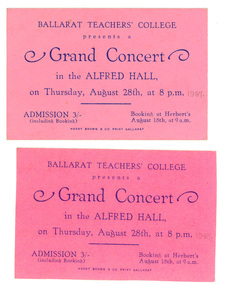
... ("Ruffians Attempted to Carry of the School Tent: A History of State Education in Ballarat", 1974, p73-4.) ballarat teachers' college concert alfred hall ballarat herbert's Two pink cards with blue writing for the Ballarat Teachers' College grand Concert in the Alfred Hall Ballarat on 28 August 1947. Ballarat Teachers' College Grand Concert, 1947 Ticket Ballarat Teachers' College Harry Brown and Co. ...The Ballarat Teachers' College was established after the Victorian State Government and the State Education Department decided to establish two provincial teachers' colleges, at Ballarat and Bendigo. On 04 May 1926 W.H. Ellwood (Principal), Miss A. Bouchier, and Mr A.B. Jones, welcomed the first enrolment of 61 students to undertake the one year course. In 1927 the College moved to the former Ballarat East Town Hall in Barkly Street, which was remodelled for their use. It closed in December 1931 due to the Great Depression. In 1946 Ballarat Teachers' College reopened and relocated to the Dana Street State School. It was originally planned to open as a women's college, for whom the residence at 130 Victoria Street was purchased, but the decision was made to admit resident men from Ballarat. Mr T.W. Turner was appointed as Principal in 1951 and directed the introduction of a two year course for the Trained Primary Teachers' Certificate. The former one year course was terminated at the end of 1951. In 1958 the College was relocated to a custom built facility at Gillies Street, in close proximity to the Ballarat Botanical Gardens. Numbers increased with the introduction of the Trained Infant Teachers' Certificate course under the guidance of Mary Egan. With the introduction of a three year Diploma Course in 1968 accommodation became cramped. The introduction of the Diploma of Teaching (Primary) led to the Trained Infant Teachers' Certificate being discontinued in 1969, and the end of the Trained Primary Teachers' Certificate in 1969. Secondary Art and Craft students began studies at Ballarat Teachers' College in 1969 under Mr Ted Doney. In 1971 Mr D. Watson was appointed Principal. The State College of Victoria was proclaimed by Order in Council on 24 July 1973, and Ballarat Teachers' College became a constituent college of the State College of Victoria, and was known as State College of Victoria, Ballarat. By 1975 the College moved to Mount Helen as part of the Ballarat College of Advanced Education. Pre service teachers currently undertake their studies on the Mount Helen Campus of Federation University. ("Ruffians Attempted to Carry of the School Tent: A History of State Education in Ballarat", 1974, p73-4.) Two pink cards with blue writing for the Ballarat Teachers' College grand Concert in the Alfred Hall Ballarat on 28 August 1947.ballarat teachers' college, concert, alfred hall, ballarat, herbert's -
 Federation University Historical Collection
Poster, Resball: Carnival. March 16th, 2016, 2016
... Entry between 7:30 pm - 9:00 pm = no tickets at the door - no passouts - This is a fully licensed events - Proof of age, res ID and valid ticket required - Management reserve the right to refuse entry. resball feduniliving federation university australi resfest 2016 poster carnival Student Residence Albert Coates Complex FedUniLiving, Federation University Australia, ResFest 2016. Catalogue no. '23154' written on back in Pencil A small poster with bright colours, stars on the border, images of circus tents with flags, and writing ...The Resball carnival was held on March 16th, 2016 at the Albert Coates Complex, and poster were displayed around the university to advertise it's event: 7:30 pm - 12:00 am. Residents Free: Tickets available from the FedUni Living Office. Non Residents $15: Tickets available from the FedUni Store. Dress Formal: Bus Leaving City Residences 7 pm. Entry between 7:30 pm - 9:00 pm = no tickets at the door - no passouts - This is a fully licensed events - Proof of age, res ID and valid ticket required - Management reserve the right to refuse entry. A small poster with bright colours, stars on the border, images of circus tents with flags, and writing advertising the Resball for 2016.FedUniLiving, Federation University Australia, ResFest 2016. Catalogue no. '23154' written on back in Pencilresball, feduniliving, federation university australi, resfest 2016, poster, carnival, student residence, albert coates complex -
 Greensborough Historical Society
Card - Membership card, Northern Districts Police Football Club Inc, Northern Districts Police Football Club Inc. 1989 Season Membership Ticket, 1989
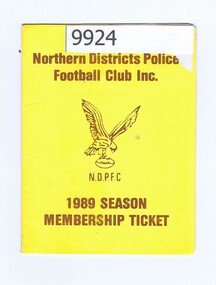
... Membership Ticket: Yellow glossy card with brown text on cover, white with brown text inside. Receipt: Paper with black text and blue writing....Northern Districts Police Football Club Inc. 1989 Season Membership Ticket and receipt. northern districts police football club inc peter spencer Membership Ticket: Yellow glossy card with brown text on cover, white with brown text inside. Receipt: Paper with black text and blue writing. ...Northern Districts Police Football Club Inc. 1989 Season Membership Ticket and receipt.Membership Ticket: Yellow glossy card with brown text on cover, white with brown text inside. Receipt: Paper with black text and blue writing.northern districts police football club inc, peter spencer -
 Ringwood and District Historical Society
Flyer - Catalogue, Public Auction - Brick Residence and Contents of Dwelling, "Wyncliff", Whitehorse Road, Ringwood. 1935
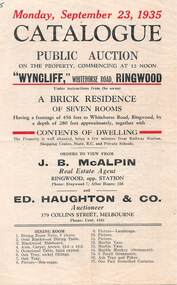
... .; Five Spanners; Box Tools 4 pieces; Four Coal Chisels; Box 7 pieces of Tools; Box of 5 pieces of Tools; Box of Docket Books; One Printing set; Large Figure Printing Set; Small Figure Printing set; Price Ticket Box; Air Brush Writing Set Complete; Six Shelves & Brackets, one Hat Rack, in store room; Box of Three Hammers; Two Boot Lasts; Tin of Polishing Oil; Box of Gardening Sundries; 2 Bicycle Pumps Saddle & Clips; One Covered Baking Dish; 200 c.p. ....; Five Spanners; Box Tools 4 pieces; Four Coal Chisels; Box 7 pieces of Tools; Box of 5 pieces of Tools; Box of Docket Books; One Printing set; Large Figure Printing Set; Small Figure Printing set; Price Ticket Box; Air Brush Writing Set Complete; Six Shelves & Brackets, one Hat Rack, in store room; Box of Three Hammers; Two Boot Lasts; Tin of Polishing Oil; Box of Gardening Sundries; 2 Bicycle Pumps Saddle & Clips; One Covered Baking Dish; 200 c.p. ...Double-sided A5 size advertisement for public auction under instructions from the owner on Monday, September 23, 1935 on the property - seven room brick residence with frontage 456 feet by approximately 280 feet and contentents of dwelling fully listed over 4 pages. Agent - J.B. McAlpin, Ringwood, opp. station. Phone Ringwood 7; after houres 236. Auctioneer - ED. Haughton & Co., 379 Collins Street, Melbourne. Phone Central 4101.Contents of Dwelling List - includes: DINING ROOM - Dining Room Suite - 6 pieces; Oval Blackwood Dining Table; Blackwood Sideboard; Axminster Carpet, Occasional Table hand carved; Oak Trays; Seascape, Landscape and other Pictures; 2 Marble Vases; Marble Monkey and 3 other Small Ornaments; Ash Tray and Poker; One Pair Stencilled Curtains. Two Large Vases, 1 with floral design; Salad Bowl and Servers; One Dozen Dessert Knives; Nine Stainless Teaspoons (new); Plated Vases; Plated Jam Dishes; Plated Cream Bowl; Silver Plated Cake Dish; One Pair Plated Shell Butter Dishes; Lino Border. LOUNGE ROOM - 2 Pictures and 1 pair with Circular Frames; Floral Jardinere and Pot Plant; Cabinet Gramophone "Singola"; Records; Player Piano "Cable"; Piano Stool; 31 Rolls; Roll Cabinet; Quantity of Music; Music Case, Leather; Portable Gramophone "Decca"; Floral Design Jardinere; Wicker Occasional Table; 2 Wicker Chairs; Cane Lounge Settee; Blackwood Bookcase; 9 Volumes Universal Encyclopedia; 10 Vols Children's Encyclopedia; Floral Vase; Black and Gold Vase; One pair Plated Vases; Ash Pan; Lino Border (Lounge Room); One Carpet, green 13.6 x 10.6; One Cushion; Hall Stand; Pedestal; Floral Design Jardinere; Painting on Canvas (Landscape); Hall Runner Carpet 25 feet; Hall Lino 29ft 5 in.; Five Door Mats (small). FIRST BEDROOM - Arm Chair (Leather); English Oak Dressing Table; English Oak Wash Stand Marble Top; Toilet Set (Four pieces); Silk Fire Screen; Blackwood Occasional Table; Black and Gold Vase; Pair China Vases; Pair Glass Vases; Single Glass Vase; One Kewpie Lavender Bag; Bedroom Lino 15.6 x 13.6. SECOND BEDROOM - Arm Chair (Leather); Dressing Table; Wash Stand; 3 Piece Toilet Set; One Vase (Pink Cameo Design); Two Ornaments (one round); Bedroom Lino 13.5 x 12.10; 3 Pictures; 2 Pairs Curtains (applique, stenc'ld); Pair Curtain Poles. THIRD BEDROOM - Lino approx 14ft x 10ft; Two Green Mohair Mats; Pair Pictures (White frames); One Picture ("The Mourners"); Picture ("The Wanderer Found"); Small Picture; Wicker Chair. FOURTH BEDROOM - Duchess Chest 5 drawers; Corner Wardrobe and Curtains; One Single Bed & Wire Mattress; Single Bedding; Lino on floor 14ft x 6ft 6in.; Occasional Table; 3 Pictures; Two Door Mats; Hall Runner (Carpet) 21ft. BREAKFAST ROOM - Two Wicker Chairs; Cushion; Brown Cushion; Four Vienna Chairs; Jardinere; Kerb (Wooden). 3 Pictures; Oil Painting (Canvas); 2 Pictures; Lino 14ft x 14ft; Brown Table Cover; Fruit Set; Robur Tea Pot; Plaque; China Biscuit Barrel; Glass Fruit Bowl; Pair Pickle Jars and Stand; Wooden Inkstand; Pair Ash Trays; Two Marble Vases; Glass Vase; Electric Jug and Electric Toaster (practically new); Picture; Cushion; Pair Lace Curtains; Curtain Rod; Three Lace Curtains; Brass Curtain Rods (3); Lino in Vestibule 10ft x 8 ft; Lino in Kitchen 12.6 x8.6; Coal Scuttle; Two Small Tables (1 Baize Cover). STORE ROOM - Briquette Grate; Three Coir Mats (one new); Three Small Door Mats (new); Glass Fire Screen; 2 Alm Pot Stands; Steel Pot Stand; Lady's Bicycle; 2 Electric Radiators (one large); White Cabinet; Stretcher Bed; Large Cot with Wire Mattress; Kerb; Fender and Irons; Lino on floor 12ft x 12ft; Lino in Storeroom 6ft x 6ft; Three Large Window Blinds; Clothes Horse; Dressmaker's Fitting Stand; Dressmaker's Bust; Window Display Bust; Blouse Stand; Small Display Stand; Meat Cover (Metal); Leather Portmantau; Leather Kit Bag; Four Large Wooden Drawers; Picnic Basket; Mattress, Bolster and Pillow; Cot Quilt; One Long-handled Feather Duster; Feather Duster; Wicker Lounge; Cane Soiled Linen Basket; One New Washing Tub; Copper Preserving Pan; Lino in Laundry 8 x 6 approx; Carpet Sweeper; Small Jardinere; 2 Shopping Baskets; Kitchen Safe; Kitchen Table; Three Buckets; 1 Horse Rub patent (prac new); Wooden Pot Plant Stand; Bird Cage and Stand; Pair Steps; Pair Small Steps; Metal Meat Safe; Wooden Safe; Hand worked Table Cover; Pair Poplin Silk Curtains (new); Leather Table Centre. VERANDAH - 12ft Shelving with doors; 35ft Shelving; Wooden Stand; Axe Stand (wooden); Nine feet Wooden Shop Fittings; Small Filing Cabinet; Three Window Frames & Glass; 38 Pot Plants Fernery; 9 Hanging Baskets Fernery; Electric Shop Sgn Storeroom; 2 Small Electric Shop Signs Storeroom; 2 Garden Sprays; Doll's Pram and Doll; Two Boxes Paint and Slate; Crystal Radio Set; New Canvas Blind & Roller 6ft.; Electric Light Reflectors (two); Two pieces of Painted Baize; Small Vice; Sprinkler; One Gallon Tin of Spray Oil; 2 Packets of "Aresto"; Two Hurricane Lamps; One Pair Spring Balance Scales; Small Pair Spring Balance Scales. WASH HOUSE - Pair Heavy Tracers (2); Pair Reins; Back Band; One Tug; Pair Hames; One Pair Neck Bands (2); Four Manger Balls; Pair Knee Pads; Kicking Strap complete; Leather Head Stall; Collar Pad; Knife Board and Tin Polish; Fork Cleaner; Foot Spray Pump. TOOL SHED - One Stewart Horse Clipper; Approx 120ft Ribbed Hose; 100ft ½in Hose; Child's Scooter; Tin Box; Ferret Box; One Tool Box; Tomato Hoe; Sprinkler; Two Large Augers; Large Watering Can; Medium Watering Can; Small Watering Can; Wooden Tool Chest; Rope, Tackle and two Pulleys; Six pieces of Lino; Three Small Canvas Blinds; Lawn Mower 14in.; Lawn Mower 12in.; Grass Catcher; 8 Pieces Garden Tools; Barrow; Quantity of Timber; Quantity of Flower Pots; Quantity of Wire; 4 Egg & 1 Fowl Crates Feed Room; 1 Gallon Demijohn Feed Room; Quantity of Shelving Feed Room; Quantity of Cement, Lime; Six Small Doors; Roll of Perforated Cardboard; Boot Rack; Coat Rack; 3 Automatic Sanitary Disinfectant; Pair Neck Straps and Rope; One Chimney Top & 3 Vent Bks.; Desk; Large Pump; Large Safe; Pair Sliding Door Rollers & Fittings; Two Wooden Doors; Box Sundries; Wooden Frame and Glass; 2 Vienna Chairs; Delivery Cart; Five Boxes Tiles; Quantity Agricultural Pipes; Wooden Bench; Wood Horse; Earthenware Drain Pipe; Wooden Tool Box; New Brass Spray "Rego"; Two Wood Planes. YARD - Pair Hedge Clippers; Box Containing 2 prs Secateurs & Punch; Box Tools seven pieces; Box Sundries; Lawn Weeder and Seed Sower; Box Tools 6 pieces; Two Saws; Bundle Files; Three Braces; Box of 13 pieces Gimlets etc.; Five Spanners; Box Tools 4 pieces; Four Coal Chisels; Box 7 pieces of Tools; Box of 5 pieces of Tools; Box of Docket Books; One Printing set; Large Figure Printing Set; Small Figure Printing set; Price Ticket Box; Air Brush Writing Set Complete; Six Shelves & Brackets, one Hat Rack, in store room; Box of Three Hammers; Two Boot Lasts; Tin of Polishing Oil; Box of Gardening Sundries; 2 Bicycle Pumps Saddle & Clips; One Covered Baking Dish; 200 c.p. Globe (Vestibule); Two "Dimolite" Fittings; Set of Five Canisters; Earthernware Jar; Two shopping Cases; Dinner Set 11 pieces; Box of Sundry Tins; Alm Fish Pan and Drainer; Two Ventilators; Knife Board & 3 Bread Saws; Soap Box and Jewel Case; Three Glass Articles. OFFICE FURNITURE - Steel Safe (Office Safe); Office Table five drawers; Cabinet 8 drawers; Cupboard three shelves; Selves 2ft3in x 1ft6in; Cheque Protector; Remington Typewriter; Typewriter Adjustable Table; Burroughs Bookkeeping Machine and Stand Complete; Small Office Table; Glass Show Case3ft9 x 2ft.; Four Sheets M. Glass; Five Sheets P. Glass; Gent's Overcoat new; Boy's Pullover New; Small Show Case; Duplicator (complete); Webster's Dictionary; Family doctor's Book. Two Dictionaries; Bundle of Three Books; Art Decorating Book; Bundle of Three Books; Bundle of Three Books; Two Books (Children's); (Multiple) Bundles each containing Three Books; Leather Riding Whip; Tort-shell Inkstand & Calendar; Tort-shell Folding Letter Rack; Water Filter; Thermos Flask and Case; Two Waste Paper Baskets. -
 Bendigo Military Museum
Document - DOCUMENTS WW1, 1 23/10/1918 .2 13/9/1921 .3 February 1917
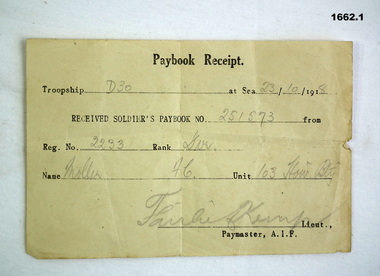
... writing. .2) Receipt for war bond, Form GB33. Printed template with typewritten details. .3) Travel warrant for NCOs and men, includes combined leave and travel tickets to and from London and France. ...writing. .2) Receipt for war bond, Form GB33. Printed template with typewritten details. .3) Travel warrant for NCOs and men, includes combined leave and travel tickets to and from London and France. ...Frederick Campbell Moller No 2233, 3rd FAB AIF. Refer Cat No 1661.3, 1663P. .1) Paybook receipt for 2233 Dvr Moller FC. Printed template with pencil writing. .2) Receipt for war bond, Form GB33. Printed template with typewritten details. .3) Travel warrant for NCOs and men, includes combined leave and travel tickets to and from London and France. Green paper.documents-receipts, permits, war bonds, leave, railway -
 Bendigo Military Museum
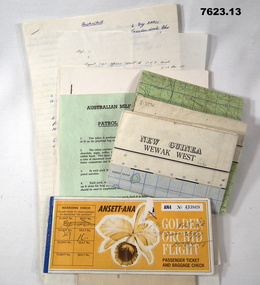
Document - PNG PAPERS, HERDMAN, Ansett - ANA et al, 1964- 1969
... tickets stapled together. 2. Small cream coloured soft cover notebook. Title and Rising Sun logo on front in black. lined pages with cut edges. Pages secured with two staples. 3. Topographical map of New Guinea - Wewak West. 4. Green coloured single page pamphlet with text in black on both sides. one side in English and the other in Pidgin English. 5. Quarto sized nine page document. Front cover has title in black and a black line illustration featuring a palm tree and crocodile. Pages stapled together along spine. 6. Handwritten foolscap sized document. Text in black ink. Writing...tickets stapled together. 2. Small cream coloured soft cover notebook. Title and Rising Sun logo on front in black. lined pages with cut edges. Pages secured with two staples. 3. Topographical map of New Guinea - Wewak West. 4. Green coloured single page pamphlet with text in black on both sides. one side in English and the other in Pidgin English. 5. Quarto sized nine page document. Front cover has title in black and a black line illustration featuring a palm tree and crocodile. Pages stapled together along spine. 6. Handwritten foolscap sized document. Text in black ink. Writing ...Collection of documents related to K.J. Herdman's visit to PNG as part of CMF Officer's visit, 2nd Dec to 13th Dec 1968. Part of the "Kevin John Herdman" No. 397661 Collection. See Catalogue No. 5942P for details of his service. 2. Notes related to Herdman's visit to PNG. List of personnel on visit. 4. Patrol ration pack details. 5. PNG Training Depot Hand Book, 6. Report - CMF Officer's visit to PNG. 2-13 Dec 1968. 8. Extended report by K.J. Herdman on CMF Officer's visit to PNG Command 1968. dated 21 Feb 1969. 9. Document related to CMF Officer's visit to Lae battlefields. 10. Detailed itinerary of CMF Officer's visit to Lae Battlefields. 11. Document detailing the organisation of PNG Command. 12. Document detailing the organisation of PNG Command. 12. Document detailing the organisation of HQ PNG Command (Murray Barracks) 13. Document detailing the itinerary for CMF Officers visit to PNG Command. the groups involved. K.J. Herdman was in Group 2. 1. Two (2) Rectangular paper airline tickets. Front page is orange in colour with black and white text. Picture of a flower. handwritten passenger details, handwritten flight details inside each, tickets stapled together. 2. Small cream coloured soft cover notebook. Title and Rising Sun logo on front in black. lined pages with cut edges. Pages secured with two staples. 3. Topographical map of New Guinea - Wewak West. 4. Green coloured single page pamphlet with text in black on both sides. one side in English and the other in Pidgin English. 5. Quarto sized nine page document. Front cover has title in black and a black line illustration featuring a palm tree and crocodile. Pages stapled together along spine. 6. Handwritten foolscap sized document. Text in black ink. Writing on one side. 7. Letter handwritten in blue ink. Writing on one side. plain paper. 8. Handwritten foolscap sized document. Text in blue ink. 8 pages of writing. Pages stapled in top LHC. 9. Foolscap sized document with text in black type. Printing on one side of each page. Two sheets of plain paper stapled on to LHC. 10. Three (3) page foolscap sized document with pages stapled on top LHC. Text in black type. Printing on one side of each page. 11. Five (5) page foolscap sized document with pages stapled on top LHC in landscape format. Text in black type, 12. Single page foolscap sized document with text in black type. 13. Eight (8) page foolscap sized document with pages stapled on top LHC. Text in black type.1. Handwritten passenger details on cover and inside each ticket. 2. Handwritten notes in blue ink on first 11 pages. 12. Handwritten on back of paper in black ink: THE DOCTOR SAID "YES", Brian Best.army, training notes, kevin john herdman
