
Showing 128 items matching "town halls -- melbourne (vic.)"
-
 Kew Historical Society Inc
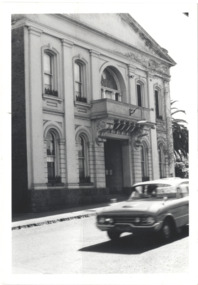
Photograph - Former Kew Town Hall, Walpole Street, 1970
... town hall -- walpole street...local government -- kew...civic buildings -- kew (vic.)...town halls -- melbourne...In 1994, Kew was amalgamated into the new City of Boroondara. kew town hall -- walpole street local government -- kew civic buildings -- kew (vic.) town halls -- melbourne (vic.) ...The Municipality of Kew was granted independence in 1860. It was declared a borough in 1863, a town in 1910 and a city in 1921. In 1994, Kew was amalgamated into the new City of Boroondara. Black and white photographic positive of the front of the (former) Kew Town Hall in Walpole Street between High Street and Malmsbury Street, on the west side where Woolworth's supermarket now stands. The photograph, from August 1970 shows the detailing of the Italianate rendered-brick facade, added in the 1880s when the hall was renovated. The earliest building on the site was the Kew Athenaeum Hall (built 1860) which was purchased by Kew Council in 1865. The Town Hall was sold to Woolworth's and subsequently demolished in 1972 when the civic offices were transferred to a new building on the corner of Charles Street and Cotham Road. "Old Kew Town Hall / Walpole St / Aug 1970/ Gift of Stewart West 1990" kew town hall -- walpole street, local government -- kew, civic buildings -- kew (vic.), town halls -- melbourne (vic.) -
 Kew Historical Society Inc
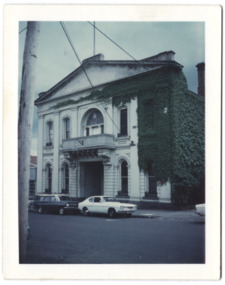
Photograph - Former Kew Town Hall, Walpole Street, 1972
... town hall -- walpole street...local government -- kew...town halls -- melbourne...Town Hall in Cotham Road was opened. The Municipal Offices that had remained in the former Town Hall in Walpole Street until it was moved to the new Civic Centre on the corner of Cotham Road and Charles Street in 1972. This is a rare and important colour photograph of the Kew Municipal Offices (former Town Hall) taken on 11/2/1972 in the year that the building was demolished and replaced by a Safeway Supermarket. kew town hall -- walpole street local government -- kew town halls -- melbourne (vic.) ...The Municipality of Kew was granted independence in 1860. It was declared a borough in 1863, a town in 1910 and a city in 1921. In 1994, Kew was amalgamated into the new City of Boroondara. In 1960, a new Town Hall in Cotham Road was opened. The Municipal Offices that had remained in the former Town Hall in Walpole Street until it was moved to the new Civic Centre on the corner of Cotham Road and Charles Street in 1972. This is a rare and important colour photograph of the Kew Municipal Offices (former Town Hall) taken on 11/2/1972 in the year that the building was demolished and replaced by a Safeway Supermarket. Colour photographic positive (polaroid) of the front of the (former) Kew Town Hall in Walpole Street between High Street and Malmsbury Street, on the west side where Woolworth's supermarket now stands. The photograph, taken in February 1972, shows the detailing of the Italianate rendered-brick facade, added in the 1880s when the hall was renovated. The earliest building on the site was the Kew Athenaeum Hall (built 1860) which was purchased by Kew Council in 1865. The Town Hall was sold to Woolworth's and subsequently demolished in 1972 when the civic offices were transferred to a new building on the corner of Charles Street and Cotham Road. kew town hall -- walpole street, local government -- kew, town halls -- melbourne (vic.) -
 Melbourne Tram Museum
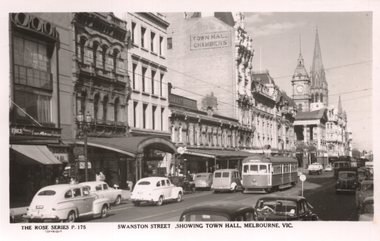
Postcard, Rose Stereograph Co, "Swanston Street, showing Town Hall, Melbourne Vic", c1954
... "Swanston Street, showing Town Hall, Melbourne Vic"...Rose Series postcard P.175, titled "Swanston Street, showing Town Hall, Melbourne Vic" looking south from near Bourke Street. ...Rose Series postcard P.175, titled "Swanston Street, showing Town Hall, Melbourne Vic" looking south from near Bourke Street. ...Rose Series postcard P.175, titled "Swanston Street, showing Town Hall, Melbourne Vic" looking south from near Bourke Street. Has SW6 class 920, (route 7) and another wide body tramcar in the view. Has the Town Hall Chambers building in the photograph. Yields information about Swanston St from Bourke St. C1954 Postcard - printed real photograph with Rose Stereograph Co. name on the rear. Used Has a letter to Ken from R Williams written on the rear. trams, tramways, swanston st, sw6 class, tram 920, rose series -
 Port Melbourne Historical & Preservation Society
Photograph - Unidentified event relating to Swallow and Ariell Busy Bee, 1914 - 1920
... This may be the Swallow & Ariell's "Busy Bee" Novelty Night at South Melbourne Town Hall, Friday 30 June 1916. 1916 '"NOVELTY NIGHT."', Port Melbourne Standard (Vic. : 1914 - 1920), 8 July, p. 3., viewed 21 Oct 2020, http://nla.gov.au/nla.news-article91165168...This may be the Swallow & Ariell's "Busy Bee" Novelty Night at South Melbourne Town Hall, Friday 30 June 1916. 1916 '"NOVELTY NIGHT."', Port Melbourne Standard (Vic. : 1914 - 1920), 8 July, p. 3., viewed 21 Oct 2020, http://nla.gov.au/nla.news-article91165168 Business and Traders War - World War I Social Activities Busy Bee Swallow & Ariell Ltd Red Cross Built Environment - Industrial One of 44 black and white photos recording the work and contribution by Swallow & Ariell's "Busy Bee" for the First World War in Europe .33 - Audience of hundreds in an unidentified major civic hall. ...This may be the Swallow & Ariell's "Busy Bee" Novelty Night at South Melbourne Town Hall, Friday 30 June 1916. 1916 '"NOVELTY NIGHT."', Port Melbourne Standard (Vic. : 1914 - 1920), 8 July, p. 3., viewed 21 Oct 2020, http://nla.gov.au/nla.news-article91165168 One of 44 black and white photos recording the work and contribution by Swallow & Ariell's "Busy Bee" for the First World War in Europe .33 - Audience of hundreds in an unidentified major civic hall. Dignitaries seated on stage also turned to face camera. business and traders, war - world war i, social activities, busy bee, swallow & ariell ltd, red cross, built environment - industrial -
Port Melbourne Historical & Preservation Society
Photograph - Audience, Swallow and Ariell Busy Bee event, 1914 - 1920
... This may be the Swallow & Ariell's "Busy Bee" Novelty Night at South Melbourne Town Hall, Friday 30 June 1916. 1916 '"NOVELTY NIGHT."', Port Melbourne Standard (Vic. : 1914 - 1920), 8 July, p. 3., viewed 21 Oct 2020, http://nla.gov.au/nla.news-article91165168...This may be the Swallow & Ariell's "Busy Bee" Novelty Night at South Melbourne Town Hall, Friday 30 June 1916. 1916 '"NOVELTY NIGHT."', Port Melbourne Standard (Vic. : 1914 - 1920), 8 July, p. 3., viewed 21 Oct 2020, http://nla.gov.au/nla.news-article91165168 Business and Traders War - World War I Social Activities Busy Bee Swallow & Ariell Ltd Red Cross Built Environment - Industrial One of 44 black and white photos recording the work and contribution by Swallow & Ariell's "Busy Bee" for the First World War in Europe .38 - Probably the same social event as (.33) to (.37) taken from the rear of the hall towards the stage . ...This may be the Swallow & Ariell's "Busy Bee" Novelty Night at South Melbourne Town Hall, Friday 30 June 1916. 1916 '"NOVELTY NIGHT."', Port Melbourne Standard (Vic. : 1914 - 1920), 8 July, p. 3., viewed 21 Oct 2020, http://nla.gov.au/nla.news-article91165168 One of 44 black and white photos recording the work and contribution by Swallow & Ariell's "Busy Bee" for the First World War in Europe .38 - Probably the same social event as (.33) to (.37) taken from the rear of the hall towards the stage . Many of the audience are in fancy dress. business and traders, war - world war i, social activities, busy bee, swallow & ariell ltd, red cross, built environment - industrial -
Port Melbourne Historical & Preservation Society
Photograph - Hard Up Wedding, Swallow and Ariell Bust Bee event, 1914 - 1920
... This may be the "Hard Up Wedding" set from the Swallow & Ariell's "Busy Bee" Novelty Night at South Melbourne Town Hall, Friday 30 June 1916. 1916 '"NOVELTY NIGHT."', Port Melbourne Standard (Vic. : 1914 - 1920), 8 July, p. 3., viewed 21 Oct 2020, http://nla.gov.au/nla.news-article91165168...This may be the "Hard Up Wedding" set from the Swallow & Ariell's "Busy Bee" Novelty Night at South Melbourne Town Hall, Friday 30 June 1916. 1916 '"NOVELTY NIGHT."', Port Melbourne Standard (Vic. : 1914 - 1920), 8 July, p. 3., viewed 21 Oct 2020, http://nla.gov.au/nla.news-article91165168 Business and Traders War - World War I Social Activities Busy Bee Swallow & Ariell Ltd Red Cross Built Environment - Industrial One of 44 black and white photos recording the work and contribution by Swallow & Ariell's "Busy Bee" for the First World War in Europe .34 - "Hard Up Wedding" set from a Swallow & Ariell's "Busy Bee" Novelty Night, probably held at South Melbourne Town Hall, Friday 30 June 1916. ...This may be the "Hard Up Wedding" set from the Swallow & Ariell's "Busy Bee" Novelty Night at South Melbourne Town Hall, Friday 30 June 1916. 1916 '"NOVELTY NIGHT."', Port Melbourne Standard (Vic. : 1914 - 1920), 8 July, p. 3., viewed 21 Oct 2020, http://nla.gov.au/nla.news-article91165168 One of 44 black and white photos recording the work and contribution by Swallow & Ariell's "Busy Bee" for the First World War in Europe .34 - "Hard Up Wedding" set from a Swallow & Ariell's "Busy Bee" Novelty Night, probably held at South Melbourne Town Hall, Friday 30 June 1916. The "Clergyman" on the left of the group could be the character promiently mentioned in the Standard newspaper report of the night. business and traders, war - world war i, social activities, busy bee, swallow & ariell ltd, red cross, built environment - industrial -
 Vision Australia
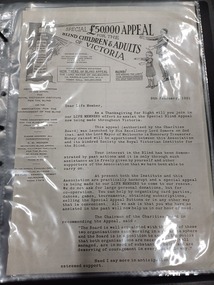
Letter - Text, Letter to a Life Member (1931), 9 February 1931
... Hedger, Secretary Blind Appeal, Royal Victorian Institute for the Blind, St Kilda Road, Prahran, S.1. Vic, Phone W 6500. Blind Appeal Enquiry Office: Nicholas Building, 5th Floor Swanston Street, Melbourne, Phone F 6418."...Harold Luxton M.L.A., Town Hall, Melbourne". Underneath the lighthouse against the left edge of the paper "Institutes participating in this appeal - The Royal Victorian Institute for the Blind and the Association for the Advancement of the Blind - these organisations care for the blind of Victoria from the cradle to the grave. ...Letter to an unidentified Life Member asking for assistance in organising fundraising events to support Special Blind Appeal. The letter continues on to a second page, however this is missing. This is an example of a joint appeal between the RVIB and the AAFB, who usually preferred to work independently. 1 photocopied letter with illustrations at top Top left hand corner is a lighthouse with the words 'Education and Maintenance of Blind Children, Industrial Professional Training Etc of Blind Adults, Homes Etc for Aged and Infirm Blind' written on the tower. The light that shines towards a female child and an adult male who are both wearing blindfolds, contains the wording 'Special 50,000 (pound) appeal for the Blind Children & Adults of Victoria". To immediate left of the people is written "Blind/and seeking the light/your generous donation will help them find it'. To the right of the rocks upon the which the lighthouse stands "Kindly address donations Hon. Treas. of Blind Appeal, The Lord Mayor of Melbourne, Cr. Harold Luxton M.L.A., Town Hall, Melbourne". Underneath the lighthouse against the left edge of the paper "Institutes participating in this appeal - The Royal Victorian Institute for the Blind and the Association for the Advancement of the Blind - these organisations care for the blind of Victoria from the cradle to the grave. Please address all correspondence S.W,. Hedger, Secretary Blind Appeal, Royal Victorian Institute for the Blind, St Kilda Road, Prahran, S.1. Vic, Phone W 6500. Blind Appeal Enquiry Office: Nicholas Building, 5th Floor Swanston Street, Melbourne, Phone F 6418." royal victorian institute for the blind, association for the advancement of the blind, fundraising -
 City of Melbourne Libraries
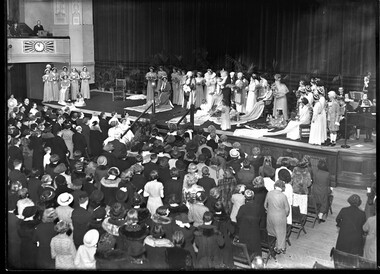
Photograph, Bull, Hugh Jones, 1897-1993, Girls' Friendly Society Concert, Melbourne Town Hall
... , Vic. : 1854 - 1954), p. 18. Retrieved October 29, 2025, from http://nla.gov.au/nla.news-article205953075 Description: The photograph captures an elaborately staged coronation of a queen, on the stage of Melbourne Town Hall. 25 female attendants in long gowns are holding posies. ...Glass plate negative Girls' Friendly Society Concert, Melbourne Town Hall Photograph Bull, Hugh Jones, 1897-1993 The Age (Melbourne, Vic. : 1854 - 1954) ...Photographer notations on slide: Town Hall Nov 1936 W.H. Everard [unknown] Friendly Society Concert B117 Published: The Age, Mon 16 Nov 1936 Published title and caption: CROWNING THE PRINCESS OF LOVE ON SATURDAY. Mr. W. H. Everard, M.L.A. , about to crown the winning Princess in the Girls' Friendly Society's competition at the Town Hall. Reference: CROWNING THE PRINCESS OF LOVE ON SATURDAY. (1936, November 16). The Age (Melbourne, Vic. : 1854 - 1954), p. 18. Retrieved October 29, 2025, from http://nla.gov.au/nla.news-article205953075 Description: The photograph captures an elaborately staged coronation of a queen, on the stage of Melbourne Town Hall. 25 female attendants in long gowns are holding posies. There are five flower girls and several wigged male attendants. An audience of mostly women and children is standing from their chairs to view the activities. The Age, Thursday 5 November 1936, page 6: "Princess" Coronation Ceremony. Thirty-eight branches of the Girls' Friendly Society are competing in the Princess competition, which will culmi nate in a coronation ceremony at Melbourne Town Hall, on the evening of Saturday, 14th inst. The princesses are Love, Joy. Youth, Beauty, Courage and Friendship. Mr. W. H. Everard, M.L.A., will crown the winning queen, and Mrs. F. W. Head, president of the G.F.S., will be the guest of honor. A programme of music and dances is being arranged. This is the first time that members of the G.F.S. have organised such a big effort to raise funds, and proceeds will be devoted to the building fund for the new hostel in Spring-street. Reference: "Princess" Coronation Ceremony. (1936, November 5). The Age (Melbourne, Vic. : 1854 - 1954), p. 6. Retrieved October 29, 2025, from http://nla.gov.au/nla.news-article205944373 GFS Australia Inc, https://gfsaustralia.org.au/ Girls' Friendly Society, https://en.wikipedia.org/wiki/Girls%27_Friendly_Society Photographer notations on slide: "Town Hall Nov 1936 W.H. Everard [unknown] Friendly Society Concert B117". melbourne town hall, town halls, dances and balls, societies, 1930-1939, fundraising events, clothing and dress -
 Bendigo Military Museum
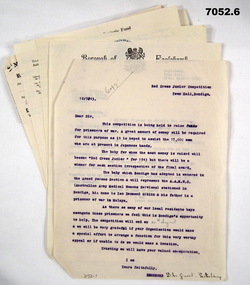
Letter - LETTERS, FUND RAISING, c1943
... Town Hall, Bendigo = from D.M. Guest. Secretary. 2. Letter and receipt for 750 pounds to Mrs Guest, Bendigo Town Hall from Army HR Melbourne. 3. ...Town Hall, Bendigo = from D.M. Guest. Secretary. 2. Letter and receipt for 750 pounds to Mrs Guest, Bendigo Town Hall from Army HR Melbourne. 3. ...Refer to Cat No 7029 - Memo book, Picture of Little boy. Refer Cat No 7028 for all the items. 1. Copy of a letter about junior Fund Raiser, Ian Desmond Giblin, to Red Cross Junior competition, Town Hall, Bendigo = from D.M. Guest. Secretary. 2. Letter and receipt for 750 pounds to Mrs Guest, Bendigo Town Hall from Army HR Melbourne. 3. Red Cross Society, Melbourne Letterhead, dated 23 Aug 1943, to Miss MacKay, Bendigo from Philadelphia N Robertson, Director, Red Cross. 4. Borough of Eaglehawk letterhead, dated 27 Aug 1943 to Mrs D. Giblin from Robert Watson, Mayor of Eaglehawk. 5. C of A, House of Reps letterhead dated 29 July 1943 to Mrs D M Guest, Town Hall Bendigo from G. Rankins On the back of this sheet is a list of organisations with one pond one shilling written beside them. 6. Victorian Railways Patriotic Fund letterhead dated 26-8-43 to Mrs Guest - The Organiser, Red Cross Junior, Bendigo from S.C. Ellis, Hon Sec Vic Railways Patriotic Fund. They donated 100 pounds. red cross fundraising, ww2 -
 City of Melbourne Libraries
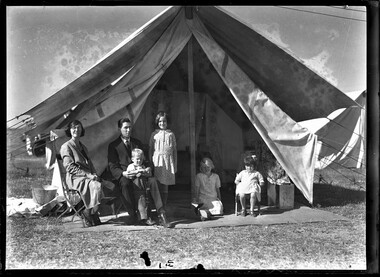
Photograph, Bull, Hugh Jones, 1897-1993, Seventh Day Adventists Camp at Hampton: E. Gane + family
... Even Melbourne City Council jumped on the bandwagon, leasing the lower hall of Melbourne Town Hall to colourful car dealer and racehorse owner Mr A. ...Even Melbourne City Council jumped on the bandwagon, leasing the lower hall of Melbourne Town Hall to colourful car dealer and racehorse owner Mr A. ...Photographer notations on slide: Seventh Day Adventists Camp. E Gane + family Published: 28 December 1933 Published title: SEVENTH DAY ADVENTISTS. Published caption: “I. — The Annual Camp of the Seventh Day Adventists in Highett-road, Hampton, comprising more than 250 tents and accommodating over a thousand persons. II. —W. J. Westerman (vice-president of Australasian) and Pastor G. G. Stewart (president of Victoria), conversing with Pastor C. H. Watson (world president of the Seventh Day Adventists).- III.— Evangelist E. R. Gane and family.” SEVENTH DAY ADVENTISTS. (1933, December 28). The Age (Melbourne, Vic. : 1854 - 1954), p. 9. Retrieved August 1, 2025, from http://nla.gov.au/nla.news-article203356427 Research by project volunteer, Fiona Collyer: In December 1933, evangelist Mr E.R. Gane and his family gather outside their tent during the ten day Seventh Day Adventist Conference held in Highett Road, Hampton. Description: A woman, man and four small children sit and stand in front of a tent. One child plays with a toy train. In December 1933, delegates from all over Victoria and beyond travelled to Melbourne for the annual Seventh Day Adventists Conference of Victoria, held over ten days on a vacant allotment at Highett Road Hampton. A canvas town of 250 tents for over 1000 campers was created along with large marquees for lectures, devotional services and kitchens. Many daily visitors also attended the lectures and services. The principal speaker was Victorian born world president of the Seventh Day Adventists, Pastor Charles H. Watson (1877-1962), who travelled from Washington DC for the event. The Highett Street campers attended a busy schedule of bible readings, devotional services and health lectures during the ten days of the camp. Lecture subjects included- “Among the Head Hunters of the Solomon Islands”, “ Looking Through the Prophetic Telescope into 1934”, “Soul Surgery”, “Viewing the Celestial Land Through the Prophetic Telescope”and “The Four Horsemen of the Apocalypse”. The Seventh Day Adventist religion was established in the USA in 1863. One of its co-founders was American Ellen G. White whose writings are regarded as divinely inspired and are still adhered to today. Ellen preached on the “Eight Laws of Health”- Nutrition, exercise, water, sunshine, temperance, air, rest and trust in God. Adventists regard their bodies as holy temples and avoid food deemed by the Bible as unclean. They eat a mainly plant based diet with no caffeinated beverages and abstain from alcohol and tobacco. They believe in the observance of Saturday, the seventh day of the week in the Christian (Gregorian) and Hebrew calendars as the sabbath and the literal and imminent second coming of Jesus Christ. New converts are baptised by immersion in water. The Adventists opened the Warburton Sanitarium in 1910 as a health retreat, integrating their holistic health philosophy of physical, mental and spiritual well being. It was a resort in the hills “among picturesque mountain scenery…surrounded by tall forests and deep fern gullies…” where highly strung Melburians could alleviate their digestive maladies, stress and jaded nerves as “…worn down nervous systems mend quickly in this peaceful environment…invigorating air and an abundance of home-grown fruit, vegetables, fresh eggs, milk, and cream help to build healthy bodies”. The resort also offered hydrotherapy, massage and electrical treatments. An advertisement in The Argus- 1 December 1947 assured readers- “EVERYTHING SUNNY AGAIN." “That's how you'll feel when you say farewell to Warburton Sanitarium and Hospital after spending a holiday here. Victoria's Hydro is famous far and wide for wonders worked with sufferers from nervous and digestive disorders. Wholesome food, perfectly cooked; splendid air, regulated exercise, sweet natural sleep; these quickly correct faulty digestion, restore vitality, bring back that sunny optimism natural to healthy people. Massage and curative baths under medical supervision…” Later, after further building work, it became the Warburton Hospital with medical, casualty and obstetrics wards as well as offering strategies to stop smoking, lose weight and for stress management. The hospital ceased operation in 2001. Ellen G. White wrote “God sent me to Australia” and in 1891, accompanied by her son William C. White she arrived in Australia to start a Bible school, spread her health philosophy and for missionary work. At first health food products were imported from America, but it soon became apparent that due to the expense and the food becoming stale over the long journey, that local manufacturing was necessary. In 1898 William secured the services of American Adventist baker Edward C. Halsey, who had worked at Dr Kellogg’s Battle Creek (“Cereal City”), Sanitarium, Michigan, USA. They rented the St George’s bakery in Northcote, Melbourne, producing the first ready to eat breakfast cereal Granola, Caramel Cereal, and peanut butter. The fledgling company relocated to larger premises in Cooranbong, NSW soon after. The Sanitarium Health Food Company opened a factory in Warburton in 1925, manufacturing Granose Biscuits, Cerix Puffed Wheat, San-Bran, Bixies malted wheat flakes, Betta peanut butter, Marmite, “Kwic-Bru - A delicious health “coffee” made from choicest cereals and free from drugs that affect the heart and nerves” In 1928, Sanitarium bought out Grain Products Limited who were manufacturing a sweet cereal biscuit called Weet-Bix which soon became Australia’s favourite breakfast cereal. The Warburton factory closed in 1997, with manufacturing shifting interstate. Sanitarium breakfast cereal boxes offered free collectable cards inside and children could buy albums from grocers for sixpence and mount the cards. Subjects of the albums included- “Aboriginal Tribes, Legends, Customs”, “Australia- Yesterday and Today”, “Marvels of the Great Barrier Reef”, “Advance Australia- a Pageant of the Years”. In 1902 the Adventist’s opened the “Pure Food Vegetarian Cafe” in Sydney (In 1907 the name was changed to “Sanitarium Health Food Cafe”), Eating vegetarian food was definitely a curiosity. “Cristina” reviewed the cafe for The Australasian-27 October 1906. Topics For The Block. “Feeling somewhat like a criminal, and hoping to escape detection, I stealthily made my way into a vegetarian restaurant the other day... If my friends happened to catch me walking in there, I should henceforth be considered a crank, a faddist, and little short of a lunatic! Whom did I find within, seated with the air of habitués at the small tables, but heaps of my friends. They had all this while been pursuing their vegetarian way, layin' low and sayin' nuffin'. Flesh-eaters, now that the Sydney summer has set in apparently in good earnest, are beginning to wonder if the vegetarians are not wiser in their day and generation. Roast beef, hot cornea beef, ragouts, and meat curries, the very thought of them makes one feel hot. Frosted lemon pudding, stewed fruits, wheatmeal rolls, and tomatoes sound nice when you look at their names on the vegetarian menu. Such weird messes are served, square, unintelligible blocks of some brown substance, a few bites of which form a full and satisfying meal. Cold nut foods, granose, nuttose, and jam protose, bromose, with jelly and various "ose" sandwiches, impossible for the unbeliever to diagnose, are put before you. You drink malted nut broth, you eat gluten sticks, stewed beans, lentil patties, with vegetable sauce, any or all of which are distinctly nourishing and filling at the price. A mock (decidedly mock) veal cutlet or a red lentil roast is sufficient lunch, it appears, for anyone. Thus, "you obtain the best working results from your machinery with the least possible expenditure..." In December 1906 the Adventists branched out to Melbourne, opening the Sanitarium Health Food Cafe at 289 Collins Street next to the Royal Bank building. (corner Collins and Elizabeth Streets, demolished in 1939). Their motto was “Quality and Purity”. “Cynthia” of The Leader “Social Circle” column reviewed the cafe in 9 March 1907- “Hundreds of people have a feeling of positive affection for a diet that will be satisfying, appetising and nourishing, without having meat for its backbone. It will come as news that we have in Melbourne a cafe where you can really enjoy yourself without eating anything in the way of meat. Cream, custard, cheese and the like are not cold shouldered out of the menu, and the housewife in search of new dishes will find here ever so much in the way of suggestions. Nuts figure conspicuously in the menu, and lentil and walnut cutlets may be instanced among the delicacies. Beans are cooked in quite alluring fashion, while creamed parsnips are excellent. For sandwiches you could hardly desire anything more appetising than granosi biscuits, and nut cheese. The combination is suggestive of school lunches, and nut meat might well be employed as a variant. A visit to the cafe itself — it is next the Royal Bank in Collins-street — will surprise anyone used to the average vegetarian restaurant. Every thing is fresh, fragrant, and thoroughly modern… It is run, in connection with that curious people the Seventh Day Adventists.” However, “Adele” writing for the Evelyn Observer and Bourke East Record -13 December 1907 had a different experience- CITY RESTAURANTS. “There is no glamour from the outside. We enter the dining room at six and secure a seat at a small table, for this night we are going to dine on vegetables. Some people pride themselves on being vegetarians, and devote a great deal of their spare cash and energy to disseminating vegetarian principles. I shall not in a hurry forget the dinner we tried to get through at this vegetarian restaurant. There was put before us plate after plate of vegetables not soaked, but sodden with water, not an atom of flavouring or dressing; no attempt was made to give the slightest piquancy to potato, cabbage, turnip or carrot. I beg pardon, I am unjust, there were two caterpillars in the cabbage. It is astonishing how persistently ordinary cooks spoil vegetables in the process of cooking and how little they understand the value of vegetables on a menu.” From the extensive menu of 1924, you could order cream of green pea soup, followed by nut meat with Yorkshire pudding, egg timbales, stewed brown lentils, savoury rissoles with piquant sauce. Among the dessert offerings were creamed sago, steamed figs and walnut drops. Washed down with fermented wine and to finish, “Frucerea”, a coffee substitute essence made from fruit and cereal. A four course meal of soup, entree, vegetables and sweets cost 1/6 in 1924. Proving that plant-based food was not just a novelty, 67,000 meals were served at the cafe in 1918, rising to 73,000 in 1921. Later the Sanitarium Cafe moved to 293 Little Collins Street, (opposite Royal Arcade) sharing the building with The Lilliput Golf Course, a miniature golf course of 18 holes. The course was a replica of the fashionable Lido Course in France and was open daily from 10am to midnight with a green fee of one shilling. It featured goldfish, waterfalls and dance music. Lilliput boasted that they were “Melbourne’s coolest indoor course” Miniature golf (mini, minnie, midget, miget, Tom Thumb, Wee golf, putt-putt, pigmy, peewee, crazy golf, obstacle golf) swept the globe in the 1930s, starting in the USA, then Europe. The courses provided affordable recreation during uncertainty at the start of the Great Depression. The craze arrived in Sydney September 1930 with the first mini golf course opening in the basement of the State Theatre. It featured a replica Sydney Harbour Bridge and attracted over 1000 players a day at one shilling per game. The miniature golf bug hit Melbourne hard in 1930-31 with nearly 200 courses springing up in the CBD and suburbs within a few months. The first miniature golf course to open in Melbourne was on 4 October 1930 in the basement of recently built art deco style Wentworth House at 203 Collins Street, designed by architect Cedric Heise Ballantyne, (also designed Regent Theatre, Plaza Ballroom, Athenaeum Club, National Theatre, St Kilda, built in 1930, demolished in 1974 for the City Square) It was managed by J. C. Williamson who advertised for a “Girl Spruiker” who “Must be Young, Attractive Personality, and Able to Talk to the Public” to work at the course. The Age 26 September 1930 reported - “The Wentworth House management have spared no expense in preparing the links. Water hazards, sand bunkers, running streams, ancestral castles, moats and a cunning drawbridge have each been devised to test the skill of players, while the walls and ceiling have been "atmospherically" treated to convey an exterior effect”. Even Melbourne City Council jumped on the bandwagon, leasing the lower hall of Melbourne Town Hall to colourful car dealer and racehorse owner Mr A. G. Barlow for £43 per week for the “Kit Kat Tiny Golf Course”, opening on 11 December 1930. (Turf identity, Mr Alexander George Barlow, (1880-1937) who raced under the nom de course “A. G. Vauxhall”, owned filly Frances Tressady, who in 1923 won the Victoria Derby and Oaks Stakes double and came fifth in the Melbourne Cup. The “Frances Tressady Stakes” is held each March at Flemington Racecourse in honour of the horse, the last filly to win the Derby. Barlow was the proprietor of Barlow Brothers Pty Ltd car dealership at 442 Elizabeth Street, Melbourne. He played 14 games for Carlton Football Club (VFL) on the half-forward line from 1901-1903). Patrons could vie for The Herald Miniature Golf Championship Cup, a gold cup worth £7/7, in an eight week long competition. Sports newspaper The Sporting Globe also offered a Cup and prize money. Many courses offered prizes of theatre tickets, cash and cigarettes. Myer’s department store, hoping to cash in on the fad, advertised in Melbourne’s newspapers that their Sports Department could design and equip complete miniature golf courses using “Fairway” imitation turf at 4/6 a yard. Newspaper cartoonists loved to lampoon the fad. Both Percy Leason, cartoonist for society magazine Table Talk and Syd Miller of Smith’s Weekly depicted “real” golfers causing havoc on a mini golf course, showing that being a “real” golf player was no advantage to playing miniature golf. But bust often follows boom. With such rapid market saturation, expensive novel hazards, waning interest, long opening hours, often to midnight, and price cutting of game fees from one shilling to sixpence and then to threepence amongst some courses, the bubble was bound to burst. The Sporting Globe columnist J.M.Dillon on 20 May 1931 lamented- £100,000 LOST Failure of ‘Minnie’ Golf. “Miniature golf might have provided fun and jokes for thousands of people in Australia, but there were many for whom it panned out a tragedy. It is likely that the dead losses of those who attempted to make money out of the game in Australia were in the vicinity of £100,000. …For a while there was hardly a spare block of land, or a possible “site” in the shape of a hall, or a showroom, in Sydney and Melbourne, that some one was not after to set upon it a “minnie links.” Big amusement firms and private individuals anxious to make money began to run courses. Practically every individual who touched the game had his finger’s financially burnt. …From the approximately £60,000 invested in Melbourne alone, there must have been £25,000 lost. …There are now dozens of courses going to ruin, and many more that the owners would be happy to give away if the takers would remove from them obligations of leases, &c…” The lease on the “Kit Kat Tiny Golf Club” at the Melbourne Town Hall expired on 30 April 1931, with Mr Barlow losing £798 on the venture. The hazards and fittings, which cost £400 and included a large replica of the Town Hall, now worthless. Due to declining patronage, the Little Collins Street cafe closed in 1938, although the adjacent shop continued to sell Sanitarium products. In New Zealand, the first Sanitarium factory opened in Christchurch in 1900, with the company later opening factories in Palmerston North and Auckland. The Adventists opened vegetarian cafes, firstly at 37 Taranaki Street Wellington in 1906, followed by cafes in Auckland, Christchurch and Dunedin. Weet-Bix is also New Zealand’s favourite cereal- there the jingle is “Kiwi kids are Weet-Bix kids.” In 1955, the Australian Women’s Weekly ran an illustrated, full colour advertisement featuring New Zealand born Edmund Hillary (later Sir) 1919-2008, who, along with Sherpa Tenzing Norgay, was the first climber to reach the summit of Mount Everest on 29 March 1953. The Australian Women’s Weekly, 30 March, 1955- “WEET-BIX carried by Hillary on Himalayan adventure! c/- N.Z. Alpine Club Inc., Dunedin, New Zealand. The Manager, Sanitarium Health Food Company, Christchurch, N.Z. Dear Sir. …Weet-Bix was chosen at my special request as I had always felt that some easily prepared form of breakfast was essential to the primitive conditions of high camps. Weet-Bix fulfilled its task very well indeed. We usually had them with hot milk (powdered) and sugar, and even when we were unable to eat anything else, we usually managed to have a little Weet-Bix . . . I regard them as a great success and expect they will be more widely used in the Himalayas in future. Yours faithfully, (Signed) E.P. Hillary. Sanitarium Marmite - motto- “Too much spoils the flavour”- is as beloved with Kiwis as Vegemite is with Australians. In 1966, a fire gutted the Christchurch Marmite factory causing a nation wide shortage. Once the factory was rebuilt, Sanitarium relaunched the yeasty extract in reusable glass tumblers with printed designs such as yachts, New Zealand birds and vintage cars. These popular collectibles can still be found in the kitchen cupboards of many New Zealand baches (holiday homes). After the devastating 2011 earthquake in Christchurch damaged the Marmite factory causing shortages and panic buying, a “Marmageddon” was declared with jars of the “black gold” advertised online for up to NZ$800. Consumers were advised to spread their Marmite sparingly until production resumed. (The Christchurch plant reportedly produces around 640,000kg of Marmite per year). Sanitarium Health and Wellbeing Company is exempt from paying company income tax on their profits due to their ownership by a religious organisation. Although not a compulsory rule for salvation, Adventists are encouraged to pay a tithe of 10% of their income to the church to support the ministry in God’s work. Nowadays, there are over 25 million members of the Seventh Day Adventists Church in 200 countries. ITEMS OF INTEREST (1933, December 22). The Argus (Melbourne, Vic. : 1848 - 1957), p. 8. Retrieved July 21, 2025, from http://nla.gov.au/nla.news-article11723188 SEVENTH DAY ADVENTISTS. (1933, December 28). The Age (Melbourne, Vic. : 1854 - 1954), p. 9. Retrieved July 1, 2025, from http://nla.gov.au/nla.news-article203356427 EVANGELISTS' CAMP (1933, December 20). The Herald (Melbourne, Vic. : 1861 - 1954), p. 30. Retrieved July 1, 2025, from http://nla.gov.au/nla.news-article243213209 Master Butchers Have A Time Pilots FOR School Air Race Charity Golf At Riversdale (1931, May 1). The Sun News-Pictorial (Melbourne, Vic. : 1922 - 1954; 1956), p. 14-15. Retrieved September 4, 2025, from http://nla.gov.au/nla.news-article276159136 2000 ADVENTISTS UNDER CANVAS (1933, December 27). The Herald (Melbourne, Vic. : 1861 - 1954), p. 17. Retrieved July 1, 2025, from http://nla.gov.au/nla.news-article243223698 TOPICS FOR THE BLOCK. (1906, October 27). The Australasian (Melbourne, Vic. : 1864 - 1946), p. 45. Retrieved August 30, 2025, from http://nla.gov.au/nla.news-article139178204 https://en.wikipedia.org/wiki/Seventh-day_Adventist_Church https://www.sanitarium.com/au/about/sanitarium-story/profits-for- ENTERTAINMENT AT MENZIES'. (1906, December 6). Punch (Melbourne, Vic. : 1900 - 1918; 1925), p. 26. Retrieved August 3, 2025, from http://nla.gov.au/nla.news-article175380296 https://encyclopedia.adventist.org/article?id=9HN0&highlight=Conference SOCIAL CIRCLE (1907, March 9). Leader (Melbourne, Vic. : 1862 - 1918, 1935), p. 41. Retrieved August 3, 2025, from http://nla.gov.au/nla.news-article196649677 CITY RESTAURANTS. (1907, December 13). Evelyn Observer and Bourke East Record (Vic. : 1902 - 1917), p. 1 (MORNING.). Retrieved August 3, 2025, from http://nla.gov.au/nla.news-article61133109 Advertising (1924, May 6). The Sun News-Pictorial (Melbourne, Vic. : 1922 - 1954; 1956), p. 9. Retrieved August 3, 2025, from http://nla.gov.au/nla.news-article274271406 1930, December 5). The Herald (Melbourne, Vic. : 1861 - 1954), p. 14. Retrieved August 5, 2025, from http://nla.gov.au/nla.news-page26374135 Thousands Are Still Playing Miniature Golf (1931, January 2). The Herald (Melbourne, Vic. : 1861 - 1954), p. 11. Retrieved August 8, 2025, from http://nla.gov.au/nla.news-article242880087 MINIATURE GOLF. (1930, October 16). The Argus (Melbourne, Vic. : 1848 - 1957), p. 10. Retrieved August 8, 2025, from http://nla.gov.au/nla.news-article4209280 THE REAL GOLFER WHO FORGOT HIMSELF ON THE MINIATURE GOLF COURSE (1930, November 13). Table Talk (Melbourne, Vic. : 1885 - 1939), p. 13. Retrieved August 8, 2025, from http://nla.gov.au/nla.news-article146706596 Advertising (1930, December 5). The Herald (Melbourne, Vic. : 1861 - 1954), p. 14. Retrieved August 8, 2025, from http://nla.gov.au/nla.news-article242761991 Advertising (1931, January 9). The Herald (Melbourne, Vic. : 1861 - 1954), p. 12. Retrieved August 8, 2025, from http://nla.gov.au/nla.news-article242887972 1955, March 30). The Australian Women's Weekly (1933 - 1982), p. 38. Retrieved August 9, 2025, from http://nla.gov.au/nla.news-page4812489 £100,000 LOST (1931, May 20). Sporting Globe (Melbourne, Vic. : 1922 - 1954), p. 1 (Edition1). Retrieved August 14, 2025, from http://nla.gov.au/nla.news-article183023946 1930, December 5). The Herald (Melbourne, Vic. : 1861 - 1954), p. 14. Retrieved August 15, 2025, from http://nla.gov.au/nla.news-page26374135 Advertising (1931, January 23). The Herald (Melbourne, Vic. : 1861 - 1954), p. 14. Retrieved August 15, 2025, from http://nla.gov.au/nla.news-article242887795 MINIATURE GOLF. (1931, February 5). The Dandenong Journal (Vic. : 1927 - 1954), p. 6. Retrieved August 16, 2025, from http://nla.gov.au/nla.news-article201082526 Still Time To Enter Midge (1931, January 16). The Herald (Melbourne, Vic. : 1861 - 1954), p. 12. Retrieved August 16, 2025, from http://nla.gov.au/nla.news-article242888830 WIT OF THE WEEK (1930, October 23). Table Talk (Melbourne, Vic. : 1885 - 1939), p. 23. Retrieved August 29, 2025, from http://nla.gov.au/nla.news-article146455050 Advertising (1930, October 2). Table Talk (Melbourne, Vic. : 1885 - 1939), p. 16. Retrieved August 18, 2025, from http://nla.gov.au/nla.news-article146454620 MIDGET GOLF LINKS. (1930, September 26). The Age (Melbourne, Vic. : 1854 - 1954), p. 6. Retrieved August 18, 2025, from http://nla.gov.au/nla.news-article202235074 https://www.smh.com.au/national/fairfax-archive-mini-golf-20131125-2y608.html TURF NOTES (1923, November 6). The Ballarat Star (Vic. : 1865 - 1924), p. 6. Retrieved September 3, 2025, from http://nla.gov.au/nla.news-article213855201 Advertising (1930, October 4). The Herald (Melbourne, Vic. : 1861 - 1954), p. 10. Retrieved October 14, 2025, from http://nla.gov.au/nla.news-article242937272 LAUGHTER AND TEARS. (1930, November 15). Smith's Weekly (Sydney, NSW : 1919 - 1950), p. 21. Retrieved September 9, 2025, from http://nla.gov.au/nla.news-article234426874 Advertising (1947, December 1). The Argus (Melbourne, Vic. : 1848 - 1957), p. 5. Retrieved September 15, 2025, from http://nla.gov.au/nla.news-article22523355 Photographer notations on slide: "Seventh Day Adventists Camp. E Gane + family". religion, health food, mini golf, 1930-1939, tents, churches, camps -
 City of Melbourne Libraries
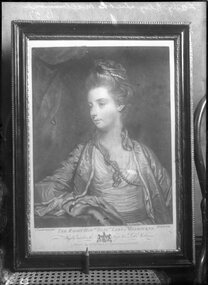
Photograph, Bull, Hugh Jones, 1897-1993, Photo of portrait of Lady Elizabeth Melbourne, 1934
... The portrait hung in the Lady Mayoress’s room at Melbourne Town Hall. References: CENTENARY GIFT PORTRAIT. (1934, October 3). ...The Age (Melbourne, Vic. : 1854 - 1954), p. 8. Retrieved June 14, 2024, from http://nla.gov.au/nla.news-article205883518 https://en.wikipedia.org/wiki/Lady_Caroline_Lamb city of melbourne melbourne town hall 1930-1939 portraits Photographer notations on slide: "Lady Elizabeth Melbourne B57". ...Published: The Age, 3 October 1934 Published title: CENTENARY GIFT PORTRAIT. Published caption: A reproduction of the attractive portrait of Lady Melbourne, the mother of Lord Melbourne, which has been presented to the City of Melbourne, and will hang in the Lady Mayoress’s room at the Town Hall. Trove article identifier: https://trove.nla.gov.au/newspaper/article/205879945 Description: A framed mezzotint portrait of a young woman gazing towards her right, with her right arm resting on a table. She is wearing an 18th century style dress and jacket trimmed with ermine tails. A string of pearls is entwined in her upswept hair and through a long lock of hair falling over her shoulder then draping across her bodice. The portrait rests on a cane bottomed chair and a pencil holds it in place. Research by project volunteer, Fiona Collyer: In 1934, Mr Roger Dolbey of London donated to the City of Melbourne a mezzotint engraving of Lady Melbourne, mother of the British Prime Minister after whom the Victorian capital city of Melbourne was named in 1837. The engraving was created in 1771 by John Finlayson after Sir Joshua Reynolds. The gift commemorates the centenary of Melbourne. Elizabeth Milbank, Viscountess Melbourne, 1751-1818 was the wife of wealthy Whig politician, Peniston Lamb, 1st Viscount Melbourne. Lady Melbourne was an ambitious political hostess of the Regency period who cultivated beneficial relationships for her husband’s career. She was beautiful and vibrant and men found her easy going, good humoured company. She had many lovers and it is believed that of her nine children, (three of which did not survive childhood) only her first born, Peniston was fathered by her husband. One of her lovers was George, Prince of Wales, later George IV, believed to be the father of her fourth son George and who was his godfather. Lady Melbourne’s second son William Lamb, 2nd Viscount Melbourne, 1779-1848, was British Prime Minister and a close political confidant and father figure to the young Queen Victoria in the early years of her reign. In 1812, his wife Lady Caroline Lamb, 1785-1828, had a torrid and very public affair with poet Lord Bryon who she described as “Mad, bad and dangerous to know”. As a child, Caroline considered being able to wash a dog as one of her most satisfying accomplishments! The portrait hung in the Lady Mayoress’s room at Melbourne Town Hall. References: CENTENARY GIFT PORTRAIT. (1934, October 3). The Age (Melbourne, Vic. : 1854 - 1954), p. 11. Retrieved June 14, 2024, from http://nla.gov.au/nla.news-article205879945 Presentation of Mezzotint of Lady Melbourne (1934, October 2). The Argus (Melbourne, Vic. : 1848 - 1957), p. 10. Retrieved June 14, 2024, from http://nla.gov.au/nla.news-article10961120 NEWS OF THE DAY. (1934, October 2). The Age (Melbourne, Vic. : 1854 - 1954), p. 8. Retrieved June 14, 2024, from http://nla.gov.au/nla.news-article205883518 https://en.wikipedia.org/wiki/Lady_Caroline_Lamb Photographer notations on slide: "Lady Elizabeth Melbourne B57". city of melbourne, melbourne town hall, 1930-1939, portraits -
 City of Melbourne Libraries
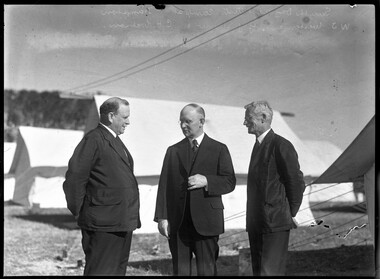
Photograph, Bull, Hugh Jones, 1897-1993, Seventh Day Adventists Camp at Hampton: W.J. Westerman, G.G. Stewart & C.H. Watson
... Even Melbourne City Council jumped on the bandwagon, leasing the lower hall of Melbourne Town Hall to colourful car dealer and racehorse owner Mr A. ...Even Melbourne City Council jumped on the bandwagon, leasing the lower hall of Melbourne Town Hall to colourful car dealer and racehorse owner Mr A. ...Photographer notations on slide: Seventh Day Adventists Camp at Hampton W.J. Westerman, G.G. Stewart & C.H. Watson Published: 28 December 1933 Published title: SEVENTH DAY ADVENTISTS. Published caption: “I. — The Annual Camp of the Seventh Day Adventists in Highett-road, Hampton, comprising more than 250 tents and accommodating over a thousand persons. II. —W. J. Westerman (vice-president of Australasian) and Pastor G. G. Stewart (president of Victoria), conversing with Pastor C. H. Watson (world president of the Seventh Day Adventists).- III.— Evangelist E. R. Gane and family.” SEVENTH DAY ADVENTISTS. (1933, December 28). The Age (Melbourne, Vic. : 1854 - 1954), p. 9. Retrieved August 1, 2025, from http://nla.gov.au/nla.news-article203356427 Research by project volunteer, Fiona Collyer: In December 1933, the annual Seventh Day Adventists Conference of Victoria was held, with over a 1000 participants camping for ten days at Highett Road Hampton. Pastor Charles H. Watson, world president of the Seventh Day Adventists, Walter J. Westerman, vice-president of Australasian and Pastor George G. Stewart, president of Victoria attended. Interestingly, The Age newspaper modified the original photo in their publication, placing the three men close to each other. Description: Three middle aged men dressed in suits converse in front of tents. In December 1933, delegates from all over Victoria and beyond travelled to Melbourne for the annual Seventh Day Adventists Conference of Victoria, held over ten days on a vacant allotment at Highett Road Hampton. A canvas town of 250 tents for over 1000 campers was created along with large marquees for lectures, devotional services and kitchens. Many daily visitors also attended the lectures and services. The principal speaker was Victorian born world president of the Seventh Day Adventists, Pastor Charles H. Watson (1877-1962), who travelled from Washington DC for the event. The Highett Street campers attended a busy schedule of bible readings, devotional services and health lectures during the ten days of the camp. Lecture subjects included- “Among the Head Hunters of the Solomon Islands”, “ Looking Through the Prophetic Telescope into 1934”, “Soul Surgery”, “Viewing the Celestial Land Through the Prophetic Telescope”and “The Four Horsemen of the Apocalypse”. The Seventh Day Adventist religion was established in the USA in 1863. One of its co-founders was American Ellen G. White whose writings are regarded as divinely inspired and are still adhered to today. Ellen preached on the “Eight Laws of Health”- Nutrition, exercise, water, sunshine, temperance, air, rest and trust in God. Adventists regard their bodies as holy temples and avoid food deemed by the Bible as unclean. They eat a mainly plant based diet with no caffeinated beverages and abstain from alcohol and tobacco. They believe in the observance of Saturday, the seventh day of the week in the Christian (Gregorian) and Hebrew calendars as the sabbath and the literal and imminent second coming of Jesus Christ. New converts are baptised by immersion in water. The Adventists opened the Warburton Sanitarium in 1910 as a health retreat, integrating their holistic health philosophy of physical, mental and spiritual well being. It was a resort in the hills “among picturesque mountain scenery…surrounded by tall forests and deep fern gullies…” where highly strung Melburians could alleviate their digestive maladies, stress and jaded nerves as “…worn down nervous systems mend quickly in this peaceful environment…invigorating air and an abundance of home-grown fruit, vegetables, fresh eggs, milk, and cream help to build healthy bodies”. The resort also offered hydrotherapy, massage and electrical treatments. An advertisement in The Argus- 1 December 1947 assured readers- “EVERYTHING SUNNY AGAIN." “That's how you'll feel when you say farewell to Warburton Sanitarium and Hospital after spending a holiday here. Victoria's Hydro is famous far and wide for wonders worked with sufferers from nervous and digestive disorders. Wholesome food, perfectly cooked; splendid air, regulated exercise, sweet natural sleep; these quickly correct faulty digestion, restore vitality, bring back that sunny optimism natural to healthy people. Massage and curative baths under medical supervision…” Later, after further building work, it became the Warburton Hospital with medical, casualty and obstetrics wards as well as offering strategies to stop smoking, lose weight and for stress management. The hospital ceased operation in 2001. Ellen G. White wrote “God sent me to Australia” and in 1891, accompanied by her son William C. White she arrived in Australia to start a Bible school, spread her health philosophy and for missionary work. At first health food products were imported from America, but it soon became apparent that due to the expense and the food becoming stale over the long journey, that local manufacturing was necessary. In 1898 William secured the services of American Adventist baker Edward C. Halsey, who had worked at Dr Kellogg’s Battle Creek (“Cereal City”), Sanitarium, Michigan, USA. They rented the St George’s bakery in Northcote, Melbourne, producing the first ready to eat breakfast cereal Granola, Caramel Cereal, and peanut butter. The fledgling company relocated to larger premises in Cooranbong, NSW soon after. The Sanitarium Health Food Company opened a factory in Warburton in 1925, manufacturing Granose Biscuits, Cerix Puffed Wheat, San-Bran, Bixies malted wheat flakes, Betta peanut butter, Marmite, “Kwic-Bru - A delicious health “coffee” made from choicest cereals and free from drugs that affect the heart and nerves” In 1928, Sanitarium bought out Grain Products Limited who were manufacturing a sweet cereal biscuit called Weet-Bix which soon became Australia’s favourite breakfast cereal. The Warburton factory closed in 1997, with manufacturing shifting interstate. Sanitarium breakfast cereal boxes offered free collectable cards inside and children could buy albums from grocers for sixpence and mount the cards. Subjects of the albums included- “Aboriginal Tribes, Legends, Customs”, “Australia- Yesterday and Today”, “Marvels of the Great Barrier Reef”, “Advance Australia- a Pageant of the Years”. In 1902 the Adventist’s opened the “Pure Food Vegetarian Cafe” in Sydney (In 1907 the name was changed to “Sanitarium Health Food Cafe”), Eating vegetarian food was definitely a curiosity. “Cristina” reviewed the cafe for The Australasian-27 October 1906. Topics For The Block. “Feeling somewhat like a criminal, and hoping to escape detection, I stealthily made my way into a vegetarian restaurant the other day... If my friends happened to catch me walking in there, I should henceforth be considered a crank, a faddist, and little short of a lunatic! Whom did I find within, seated with the air of habitués at the small tables, but heaps of my friends. They had all this while been pursuing their vegetarian way, layin' low and sayin' nuffin'. Flesh-eaters, now that the Sydney summer has set in apparently in good earnest, are beginning to wonder if the vegetarians are not wiser in their day and generation. Roast beef, hot cornea beef, ragouts, and meat curries, the very thought of them makes one feel hot. Frosted lemon pudding, stewed fruits, wheatmeal rolls, and tomatoes sound nice when you look at their names on the vegetarian menu. Such weird messes are served, square, unintelligible blocks of some brown substance, a few bites of which form a full and satisfying meal. Cold nut foods, granose, nuttose, and jam protose, bromose, with jelly and various "ose" sandwiches, impossible for the unbeliever to diagnose, are put before you. You drink malted nut broth, you eat gluten sticks, stewed beans, lentil patties, with vegetable sauce, any or all of which are distinctly nourishing and filling at the price. A mock (decidedly mock) veal cutlet or a red lentil roast is sufficient lunch, it appears, for anyone. Thus, "you obtain the best working results from your machinery with the least possible expenditure..." In December 1906 the Adventists branched out to Melbourne, opening the Sanitarium Health Food Cafe at 289 Collins Street next to the Royal Bank building. (corner Collins and Elizabeth Streets, demolished in 1939). Their motto was “Quality and Purity”. “Cynthia” of The Leader “Social Circle” column reviewed the cafe in 9 March 1907- “Hundreds of people have a feeling of positive affection for a diet that will be satisfying, appetising and nourishing, without having meat for its backbone. It will come as news that we have in Melbourne a cafe where you can really enjoy yourself without eating anything in the way of meat. Cream, custard, cheese and the like are not cold shouldered out of the menu, and the housewife in search of new dishes will find here ever so much in the way of suggestions. Nuts figure conspicuously in the menu, and lentil and walnut cutlets may be instanced among the delicacies. Beans are cooked in quite alluring fashion, while creamed parsnips are excellent. For sandwiches you could hardly desire anything more appetising than granosi biscuits, and nut cheese. The combination is suggestive of school lunches, and nut meat might well be employed as a variant. A visit to the cafe itself — it is next the Royal Bank in Collins-street — will surprise anyone used to the average vegetarian restaurant. Every thing is fresh, fragrant, and thoroughly modern… It is run, in connection with that curious people the Seventh Day Adventists.” However, “Adele” writing for the Evelyn Observer and Bourke East Record -13 December 1907 had a different experience- CITY RESTAURANTS. “There is no glamour from the outside. We enter the dining room at six and secure a seat at a small table, for this night we are going to dine on vegetables. Some people pride themselves on being vegetarians, and devote a great deal of their spare cash and energy to disseminating vegetarian principles. I shall not in a hurry forget the dinner we tried to get through at this vegetarian restaurant. There was put before us plate after plate of vegetables not soaked, but sodden with water, not an atom of flavouring or dressing; no attempt was made to give the slightest piquancy to potato, cabbage, turnip or carrot. I beg pardon, I am unjust, there were two caterpillars in the cabbage. It is astonishing how persistently ordinary cooks spoil vegetables in the process of cooking and how little they understand the value of vegetables on a menu.” From the extensive menu of 1924, you could order cream of green pea soup, followed by nut meat with Yorkshire pudding, egg timbales, stewed brown lentils, savoury rissoles with piquant sauce. Among the dessert offerings were creamed sago, steamed figs and walnut drops. Washed down with fermented wine and to finish, “Frucerea”, a coffee substitute essence made from fruit and cereal. A four course meal of soup, entree, vegetables and sweets cost 1/6 in 1924. Proving that plant-based food was not just a novelty, 67,000 meals were served at the cafe in 1918, rising to 73,000 in 1921. Later the Sanitarium Cafe moved to 293 Little Collins Street, (opposite Royal Arcade) sharing the building with The Lilliput Golf Course, a miniature golf course of 18 holes. The course was a replica of the fashionable Lido Course in France and was open daily from 10am to midnight with a green fee of one shilling. It featured goldfish, waterfalls and dance music. Lilliput boasted that they were “Melbourne’s coolest indoor course” Miniature golf (mini, minnie, midget, miget, Tom Thumb, Wee golf, putt-putt, pigmy, peewee, crazy golf, obstacle golf) swept the globe in the 1930s, starting in the USA, then Europe. The courses provided affordable recreation during uncertainty at the start of the Great Depression. The craze arrived in Sydney September 1930 with the first mini golf course opening in the basement of the State Theatre. It featured a replica Sydney Harbour Bridge and attracted over 1000 players a day at one shilling per game. The miniature golf bug hit Melbourne hard in 1930-31 with nearly 200 courses springing up in the CBD and suburbs within a few months. The first miniature golf course to open in Melbourne was on 4 October 1930 in the basement of recently built art deco style Wentworth House at 203 Collins Street, designed by architect Cedric Heise Ballantyne, (also designed Regent Theatre, Plaza Ballroom, Athenaeum Club, National Theatre, St Kilda, built in 1930, demolished in 1974 for the City Square) It was managed by J. C. Williamson who advertised for a “Girl Spruiker” who “Must be Young, Attractive Personality, and Able to Talk to the Public” to work at the course. The Age 26 September 1930 reported - “The Wentworth House management have spared no expense in preparing the links. Water hazards, sand bunkers, running streams, ancestral castles, moats and a cunning drawbridge have each been devised to test the skill of players, while the walls and ceiling have been "atmospherically" treated to convey an exterior effect”. Even Melbourne City Council jumped on the bandwagon, leasing the lower hall of Melbourne Town Hall to colourful car dealer and racehorse owner Mr A. G. Barlow for £43 per week for the “Kit Kat Tiny Golf Course”, opening on 11 December 1930. (Turf identity, Mr Alexander George Barlow, (1880-1937) who raced under the nom de course “A. G. Vauxhall”, owned filly Frances Tressady, who in 1923 won the Victoria Derby and Oaks Stakes double and came fifth in the Melbourne Cup. The “Frances Tressady Stakes” is held each March at Flemington Racecourse in honour of the horse, the last filly to win the Derby. Barlow was the proprietor of Barlow Brothers Pty Ltd car dealership at 442 Elizabeth Street, Melbourne. He played 14 games for Carlton Football Club (VFL) on the half-forward line from 1901-1903). Patrons could vie for The Herald Miniature Golf Championship Cup, a gold cup worth £7/7, in an eight week long competition. Sports newspaper The Sporting Globe also offered a Cup and prize money. Many courses offered prizes of theatre tickets, cash and cigarettes. Myer’s department store, hoping to cash in on the fad, advertised in Melbourne’s newspapers that their Sports Department could design and equip complete miniature golf courses using “Fairway” imitation turf at 4/6 a yard. Newspaper cartoonists loved to lampoon the fad. Both Percy Leason, cartoonist for society magazine Table Talk and Syd Miller of Smith’s Weekly depicted “real” golfers causing havoc on a mini golf course, showing that being a “real” golf player was no advantage to playing miniature golf. But bust often follows boom. With such rapid market saturation, expensive novel hazards, waning interest, long opening hours, often to midnight, and price cutting of game fees from one shilling to sixpence and then to threepence amongst some courses, the bubble was bound to burst. The Sporting Globe columnist J.M.Dillon on 20 May 1931 lamented- £100,000 LOST Failure of ‘Minnie’ Golf. “Miniature golf might have provided fun and jokes for thousands of people in Australia, but there were many for whom it panned out a tragedy. It is likely that the dead losses of those who attempted to make money out of the game in Australia were in the vicinity of £100,000. …For a while there was hardly a spare block of land, or a possible “site” in the shape of a hall, or a showroom, in Sydney and Melbourne, that some one was not after to set upon it a “minnie links.” Big amusement firms and private individuals anxious to make money began to run courses. Practically every individual who touched the game had his finger’s financially burnt. …From the approximately £60,000 invested in Melbourne alone, there must have been £25,000 lost. …There are now dozens of courses going to ruin, and many more that the owners would be happy to give away if the takers would remove from them obligations of leases, &c…” The lease on the “Kit Kat Tiny Golf Club” at the Melbourne Town Hall expired on 30 April 1931, with Mr Barlow losing £798 on the venture. The hazards and fittings, which cost £400 and included a large replica of the Town Hall, now worthless. Due to declining patronage, the Little Collins Street cafe closed in 1938, although the adjacent shop continued to sell Sanitarium products. In New Zealand, the first Sanitarium factory opened in Christchurch in 1900, with the company later opening factories in Palmerston North and Auckland. The Adventists opened vegetarian cafes, firstly at 37 Taranaki Street Wellington in 1906, followed by cafes in Auckland, Christchurch and Dunedin. Weet-Bix is also New Zealand’s favourite cereal- there the jingle is “Kiwi kids are Weet-Bix kids.” In 1955, the Australian Women’s Weekly ran an illustrated, full colour advertisement featuring New Zealand born Edmund Hillary (later Sir) 1919-2008, who, along with Sherpa Tenzing Norgay, was the first climber to reach the summit of Mount Everest on 29 March 1953. The Australian Women’s Weekly, 30 March, 1955- “WEET-BIX carried by Hillary on Himalayan adventure! c/- N.Z. Alpine Club Inc., Dunedin, New Zealand. The Manager, Sanitarium Health Food Company, Christchurch, N.Z. Dear Sir. …Weet-Bix was chosen at my special request as I had always felt that some easily prepared form of breakfast was essential to the primitive conditions of high camps. Weet-Bix fulfilled its task very well indeed. We usually had them with hot milk (powdered) and sugar, and even when we were unable to eat anything else, we usually managed to have a little Weet-Bix . . . I regard them as a great success and expect they will be more widely used in the Himalayas in future. Yours faithfully, (Signed) E.P. Hillary. Sanitarium Marmite - motto- “Too much spoils the flavour”- is as beloved with Kiwis as Vegemite is with Australians. In 1966, a fire gutted the Christchurch Marmite factory causing a nation wide shortage. Once the factory was rebuilt, Sanitarium relaunched the yeasty extract in reusable glass tumblers with printed designs such as yachts, New Zealand birds and vintage cars. These popular collectibles can still be found in the kitchen cupboards of many New Zealand baches (holiday homes). After the devastating 2011 earthquake in Christchurch damaged the Marmite factory causing shortages and panic buying, a “Marmageddon” was declared with jars of the “black gold” advertised online for up to NZ$800. Consumers were advised to spread their Marmite sparingly until production resumed. (The Christchurch plant reportedly produces around 640,000kg of Marmite per year). Sanitarium Health and Wellbeing Company is exempt from paying company income tax on their profits due to their ownership by a religious organisation. Although not a compulsory rule for salvation, Adventists are encouraged to pay a tithe of 10% of their income to the church to support the ministry in God’s work. Nowadays, there are over 25 million members of the Seventh Day Adventists Church in 200 countries. ITEMS OF INTEREST (1933, December 22). The Argus (Melbourne, Vic. : 1848 - 1957), p. 8. Retrieved July 21, 2025, from http://nla.gov.au/nla.news-article11723188 SEVENTH DAY ADVENTISTS. (1933, December 28). The Age (Melbourne, Vic. : 1854 - 1954), p. 9. Retrieved July 1, 2025, from http://nla.gov.au/nla.news-article203356427 EVANGELISTS' CAMP (1933, December 20). The Herald (Melbourne, Vic. : 1861 - 1954), p. 30. Retrieved July 1, 2025, from http://nla.gov.au/nla.news-article243213209 Master Butchers Have A Time Pilots FOR School Air Race Charity Golf At Riversdale (1931, May 1). The Sun News-Pictorial (Melbourne, Vic. : 1922 - 1954; 1956), p. 14-15. Retrieved September 4, 2025, from http://nla.gov.au/nla.news-article276159136 2000 ADVENTISTS UNDER CANVAS (1933, December 27). The Herald (Melbourne, Vic. : 1861 - 1954), p. 17. Retrieved July 1, 2025, from http://nla.gov.au/nla.news-article243223698 TOPICS FOR THE BLOCK. (1906, October 27). The Australasian (Melbourne, Vic. : 1864 - 1946), p. 45. Retrieved August 30, 2025, from http://nla.gov.au/nla.news-article139178204 https://en.wikipedia.org/wiki/Seventh-day_Adventist_Church https://www.sanitarium.com/au/about/sanitarium-story/profits-for- ENTERTAINMENT AT MENZIES'. (1906, December 6). Punch (Melbourne, Vic. : 1900 - 1918; 1925), p. 26. Retrieved August 3, 2025, from http://nla.gov.au/nla.news-article175380296 https://encyclopedia.adventist.org/article?id=9HN0&highlight=Conference SOCIAL CIRCLE (1907, March 9). Leader (Melbourne, Vic. : 1862 - 1918, 1935), p. 41. Retrieved August 3, 2025, from http://nla.gov.au/nla.news-article196649677 CITY RESTAURANTS. (1907, December 13). Evelyn Observer and Bourke East Record (Vic. : 1902 - 1917), p. 1 (MORNING.). Retrieved August 3, 2025, from http://nla.gov.au/nla.news-article61133109 Advertising (1924, May 6). The Sun News-Pictorial (Melbourne, Vic. : 1922 - 1954; 1956), p. 9. Retrieved August 3, 2025, from http://nla.gov.au/nla.news-article274271406 1930, December 5). The Herald (Melbourne, Vic. : 1861 - 1954), p. 14. Retrieved August 5, 2025, from http://nla.gov.au/nla.news-page26374135 Thousands Are Still Playing Miniature Golf (1931, January 2). The Herald (Melbourne, Vic. : 1861 - 1954), p. 11. Retrieved August 8, 2025, from http://nla.gov.au/nla.news-article242880087 MINIATURE GOLF. (1930, October 16). The Argus (Melbourne, Vic. : 1848 - 1957), p. 10. Retrieved August 8, 2025, from http://nla.gov.au/nla.news-article4209280 THE REAL GOLFER WHO FORGOT HIMSELF ON THE MINIATURE GOLF COURSE (1930, November 13). Table Talk (Melbourne, Vic. : 1885 - 1939), p. 13. Retrieved August 8, 2025, from http://nla.gov.au/nla.news-article146706596 Advertising (1930, December 5). The Herald (Melbourne, Vic. : 1861 - 1954), p. 14. Retrieved August 8, 2025, from http://nla.gov.au/nla.news-article242761991 Advertising (1931, January 9). The Herald (Melbourne, Vic. : 1861 - 1954), p. 12. Retrieved August 8, 2025, from http://nla.gov.au/nla.news-article242887972 1955, March 30). The Australian Women's Weekly (1933 - 1982), p. 38. Retrieved August 9, 2025, from http://nla.gov.au/nla.news-page4812489 £100,000 LOST (1931, May 20). Sporting Globe (Melbourne, Vic. : 1922 - 1954), p. 1 (Edition1). Retrieved August 14, 2025, from http://nla.gov.au/nla.news-article183023946 1930, December 5). The Herald (Melbourne, Vic. : 1861 - 1954), p. 14. Retrieved August 15, 2025, from http://nla.gov.au/nla.news-page26374135 Advertising (1931, January 23). The Herald (Melbourne, Vic. : 1861 - 1954), p. 14. Retrieved August 15, 2025, from http://nla.gov.au/nla.news-article242887795 MINIATURE GOLF. (1931, February 5). The Dandenong Journal (Vic. : 1927 - 1954), p. 6. Retrieved August 16, 2025, from http://nla.gov.au/nla.news-article201082526 Still Time To Enter Midge (1931, January 16). The Herald (Melbourne, Vic. : 1861 - 1954), p. 12. Retrieved August 16, 2025, from http://nla.gov.au/nla.news-article242888830 WIT OF THE WEEK (1930, October 23). Table Talk (Melbourne, Vic. : 1885 - 1939), p. 23. Retrieved August 29, 2025, from http://nla.gov.au/nla.news-article146455050 Advertising (1930, October 2). Table Talk (Melbourne, Vic. : 1885 - 1939), p. 16. Retrieved August 18, 2025, from http://nla.gov.au/nla.news-article146454620 MIDGET GOLF LINKS. (1930, September 26). The Age (Melbourne, Vic. : 1854 - 1954), p. 6. Retrieved August 18, 2025, from http://nla.gov.au/nla.news-article202235074 https://www.smh.com.au/national/fairfax-archive-mini-golf-20131125-2y608.html TURF NOTES (1923, November 6). The Ballarat Star (Vic. : 1865 - 1924), p. 6. Retrieved September 3, 2025, from http://nla.gov.au/nla.news-article213855201 Advertising (1930, October 4). The Herald (Melbourne, Vic. : 1861 - 1954), p. 10. Retrieved October 14, 2025, from http://nla.gov.au/nla.news-article242937272 LAUGHTER AND TEARS. (1930, November 15). Smith's Weekly (Sydney, NSW : 1919 - 1950), p. 21. Retrieved September 9, 2025, from http://nla.gov.au/nla.news-article234426874 Advertising (1947, December 1). The Argus (Melbourne, Vic. : 1848 - 1957), p. 5. Retrieved September 15, 2025, from http://nla.gov.au/nla.news-article22523355 Photographer notations on slide: "Seventh Day Adventists Camp at Hampton W.J. Westerman, G.G. Stewart & C.H. Watson". religion, health food, mini golf, 1930-1939, tents, churches, camps -
 City of Melbourne Libraries
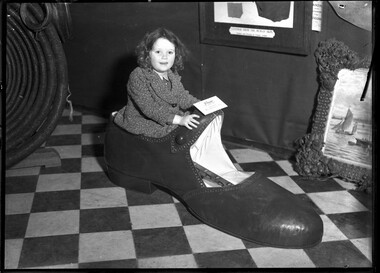
Photograph, Bull, Hugh Jones, 1897-1993, Leather Exhibition, Melbourne Town Hall
... Hall Melb 1933 Age Published: Age (Melbourne, Vic.: 1854- ), 1933 THE EXHIBITS. (1933, September 20). ...Hall Melb 1933 Age B5". Glass plate negative Leather Exhibition, Melbourne Town Hall Photograph Bull, Hugh Jones, 1897-1993 The Age (Melbourne, Vic. : 1854 - 1954) ...Photographer notations on slide: At the Leather Exhib. at T. Hall Melb 1933 Age Published: Age (Melbourne, Vic.: 1854- ), 1933 THE EXHIBITS. (1933, September 20). The Age (Melbourne, Vic. : 1854 - 1954), p. 16. Retrieved January 25, 2026, from http://nla.gov.au/nla.news-article205109730 Published title: THE EXHIBITS. A COMPREHENSIVE RANGE. Curios, Novelties, Working Displays Published Caption: ONE OF THE NOVELTIES – AN OUTSIZE IN SHOES Research by Project Volunteer, Louise McKenzie: Our photo is dated 20 September 1933, and shows a happy, chubby-faced young girl sitting in a very over-sized girl’s shoe. It is labelled – “Shoe, An Out Size, loaned by Messrs Blackman & Rose”. (1) It is an effective way to capture the attention of the readership and alert them to the Melbourne Leather Show 1933. This show was designed to be a drawcard of extraordinary proportion, and there is no doubt that this leather exhibition was a really big deal for Melbourne. It completely took over the Melbourne Town Hall, and was open from 10.30 am until 10.30 pm. It seemed to contain something for everyone – the military, the man about town, the home handyman, the housewife, the child, the sporting types, the domestic workers, the outdoor enthusiasts, the horseracing fans, car enthusiasts, those wishing to show off the latest fashion – both men and women - and those just intrigued by a lot of fascinating and wide ranging exhibits. One of the most comprehensive descriptions of the Exhibition accompanies the photograph, and is worth quoting in full: “PROMINENT among exhibits which first attract attention in the foyer of the Town Hall is a comprehensive display of leather articles used by the defence forces. A conspicuous legend states that leather plays an important part in national defence, being used for saddlery, tool containers, holdalls, range-finding, surveying and signalling equipment, explosives factories, harness accoutrement, bandsmen's equipment and clothing. Three models of horses and several figures of soldiers wearing leather equipment illustrate the lesson, and a great range of leather goods used in military training and work variegate the display. Nearby are Texas cowboy, buckjumping and breaking-in saddles; whips, a walking stick, made of leather and numerous other curios. The general exhibition occupies the whole floor space of the main Town Hall, and is subdivided by partitions running most of the length of the hall. A bewildering variety, of leather goods presses for close and leisured inspection. Here and there operatives in charge of working machinery give practical demonstrations of factory processes in the production of footwear. Polishing materials are well represented. One attractive exhibit includes two bush huts constructed of leather, with wattle bark for roofing. Opossums, rosellas and a kookaburra add touches of bush realism. Adjacent exhibits include bags, fishing boots, leggings, leather covers in all colours. Factory Processes. One exhibitor has installed an automatic cinema apparatus and screen, which projects various factory processes in making a shoe, the operator being shown at work. Elsewhere an interesting exhibit depicts the five stages in the manufacture of sole leather, and the tanning materials employed. "Very handsome effects are achieved in the interior appointments of motor cars, which are attended by figures of smart chauffeurs in leather coats. Motor-trimming leather is said to be more durable and hygienic than fabric materials, and cheaper. The neat finish of the material, its excellent appearance, certainly make a very favourable impression. It takes the hides of three beasts to cover the cushions, squabs and door panels of a full-sized sedan, while to finish the entire interior, including quarter-panels and head linings would take four or even five. Special Exhibits. Amongst the special sections the display arranged by the handicrafts and home industries- committee of the Country Women's Association of Victoria is a notable one. In all there are about 130 entries which are in four classifications, viz., hand-tooled or embossed leathers, suede, hand-made gloves and undecorated leather. The glove section attracted the most numerous entries, a number being the work of members and craft subscribers of the Country Women's Association. In the leathercraft competition, organised by the Country Women's Association, the judges yesterday awarded the first prize for bookbinding (the only prize given in this division) to Miss M. Alston, of South Yarra. There is also a creditable display of exhibits submitted by boys of the orthopaedic section of the Children's Hospital at Frankston. Amongst the novelties on view in other portions of the exhibition were the following: — Leather coats worn by Sir C. Kingsford Smith on his Atlantic flight. Model Wellington boot, Phar Lap's saddle. Melbourne Cup winner's saddle. Longest whip in world, 108 feet long. (33 metres) [See our photo, to left of Girl in Shoe] Diminutive shoes. Pair of shoes 65 years old. Pair of men's working boots 75 years old. Larwood's, Tate’s and Pataudi’s cricket boots. [Three internationally revered cricketers of the day] (2) Picture frame made of leather bought 63 years ago. [See our photo, to right of Girl in Shoe] Leather frame, powder bowl, &c. Saddle used by world's champion buckjumper in U.S.A. Mexican cowboy outfit. Miniature saddle and bridle. A fireman's helmet made of sole leather. (3) Sample of the leather hat worn by porters at the Billingsgate Fish Market, London. (4) From South Australia there have been obtained sets of harness for donkeys, goats and camels, the equipment being displayed to good advantage on stuffed representations of the animals mentioned. Close to the platform is a glass case containing snow shoes and coats which have been used in Antarctic exploration work. Trade Display. Amongst the trade exhibits may be seen in operation a slipper turn shoe sewing machine, with heeling and channelling facilities, and the various stages in the production of ladies' sandals are shown. There is a wide contrast between sole leather of varying degrees of thickness on view in one stall and the choice samples of ladies' footwear in another — footwear, by the way, which could almost be used as ornaments, so dainty in colour and production are they. Again, there are displays of upholstering leathers of such soft texture that they could he readily mistaken for some of the finest cloth. Those who may be particularly interested in the production of chamois leather may gain an insight into the materials and chemicals used in the "working up” of this variety of leather. Supplies of glace kid (5) are tastefully arranged, and there may also be seen bags of all shapes and sizes, including satchels, suit cases and "sporting" cases, and bags for tennis players and golfers. Further variety is given to the exhibition by the display of antique hides, brightly coloured, with punching balls, boxing gloves and batsman's pads. There are crocodile skins and snake skins so cleverly "Worked up" that one could be almost pardoned for betraying an affection for such unpopular creatures.” “ Another wonderful article on this Exhibition, published the same day in one of the opposition daily newspapers, The Argus, is in the weekly article “Women to Women”, entitled “A Great Victorian Industry: Many Uses for Leather”. This weekly column was penned by Vesta, and she writes, with much purpose: “Yesterday afternoon I paid a hurried visit to the Leather Exhibition now being held in the Melbourne Town Hall and I was disappointed to find that the early visitors to the main exhibition were almost all men. Women, I think, should make a point of seeing every exhibition of our great industries, for women are the buyers of household requisites and goods for their own use and their tastes, and opinion influence also, to a large extent, the purchases of men. So, the welfare of industries is more or less in their hands and it becomes a duty for them to inform themselves fully of the extent and the quality of the manufacturing that is done here. The value of the output of the Australian boot and shoe factories alone was in 1930-31, the latest year for which the figures are given, Stg 3,750,000. Fully two thirds of that amount must have been spent by women on boots and shoes for themselves and their children. In a host of other directions, in the purchase of handbags, travelling bags, belts and straps, cushions, furniture coverings, purses, notebooks, spectacle cases, their annual expenditure must be very high. Their interest, therefore, in this industry is practical, and their support of it should be governed by knowledge of comparable values and qualities of the goods they buy. From the point of view of women, however, the exhibition itself is rather disappointing. There is an amazing collection of good stuff on show, but most of it is not displayed in a fashion that attracts attention. I was surprised, for example, at the range and quality of the leathers displayed, the suppleness of the finer qualities, and the varied range of colours and designs. But they are shown in such a fashion that if one set out deliberately to look for them it would be quite easy to miss most of them.” …It was surprising, too, that no one seemed to have taken advantage of the present fashion of wearing coloured gloves, or the cult of glove making, which the Country Women’s Association has fostered so successfully. Outside the collection of chamois leathers I saw no skins which were suitable to glove making. (6) However, it is perhaps a little unfair to be highly critical of the exhibition, inasmuch as it is the first of its kind. The material is there, undoubtedly, for a splendid show of every phase of this enterprising industry, and I am confident that experience will prove to those concerned that it will be worth while next time to devote a great deal of attention of the method of display.” With further research, it transpires that “Vera” is in fact NZ born Stella May Allen (nee Henderson) (1871-1962), a journalist, the first woman in NZ to begin a law course, in 1890-91). She later worked at a law firm while she completed her degree. Study of the law had always been open to women in NZ, but its practice was still barred to them. Her case “…led to amending legislation in 1896 allowing women to practise as barristers or solicitors. However, on gaining her LL.B. in November 1897 she did not apply for admission to the Bar. Instead, she became the Wellington-based correspondent and leader-writer for the Lyttelton Times. Her appointment, the first for a woman, was not welcomed by the all-male Press Gallery, and special permission had to be obtained from a subcommittee of the House before her presence was accepted. In 1900 she married Edwin Allen, a senior leader-writer for the Wellington Evening Post, and they moved to Australia in 1903 when Edwin Allen took up the post of foreign affairs leader-writer and parliamentary man for the Melbourne Argus. As Patricia Keep notes in her excellent entry of Stella Allan in the Australian Dictionary of Biography: “In 1907 The Argus commissioned her to write a series of articles on the first Australian Women's Work Exhibition held in October. They aroused much interest and next year The Argus invited her to join its full-time staff and begin a weekly section on the particular interests of women. She adopted the nom de plume 'Vesta' and called the column 'Women to Women'. Her work was unique in an Australian daily paper at that time. Her pages extended to cover every aspect of women's affairs, children's interests and community welfare, and 'Vesta' became a household word for authoritative information and advice on such matters. An excellent needlewoman and first-rate cook herself, she thoroughly tutored her staff in the work and needs of women in both country and city, as well as providing the usual training for cadet journalists. She conducted interviews and also visited the country to see at first hand the results of bushfires, mouse plagues, droughts and floods. In 1910 she was one of three women foundation members of the Australian Journalists' Association. “…she found time to become deeply involved in community affairs. She was an original committee-member of the Victorian Association of Crèches and of the Free Kindergarten Union of Victoria, and had much to do with the early days of the Victorian Bush Nursing Association, the Baby Health Centres Association and the Queen Victoria Hospital. She was a member of the National Council of Women, first in New Zealand and then in Melbourne, and of the Country Women's Association from its inception. … in 1924 she was appointed substitute delegate for Australia to the fifth assembly of the League of Nations at Geneva and was a delegate to the second Pan Pacific Women's Conference in Hawaii in 1930. A meeting held in the Melbourne Town Hall in 1938 by representatives of all the main Victorian women's organizations paid special tribute to her work and influence. She retired next year to England where she continued to write for the Argus, contributing articles on the experiences of women and children in wartime.” It is little wonder that “Vesta” was unafraid to take to task both the women of Victoria, and those who created the exhibition! One item which appears to have gone unnoticed, or at least unreported, is a framed article in the background of the photo of the chubby girl in the shoe. The display frame is labelled “Leather from the Human Skin, Tanned and Dressed by French artists.” The exhibition was certainly a cabinet of curiosities! A charming article in The Argus is a nice note on which to end. It gives a quick history and overview of the Australian leather industry and its unprecedented, and possibly unexpected, development and success, and states with pride: “Though Victoria is the largest leather producer in the Commonwealth all tanners in the Commonwealth can look back with pride on the long march of progress.” Footnotes: (1) “Blackman and Rose”. Messrs Blackman and Rose were shoe manufacturers, from 1927 located at 200 Noone Street, Clifton Hill. The Melbourne Circle describes their building as a “fine-looking building in the Federation ‘blood and bandage’ style.” It was built around 1912 for Puttifoot and Bloom, boot manufacturers, and today the building is apartments. (2) These cricketers were household names in the day: Tate: Maurice Tate, “English cricketer of the 1920s and 1930s, and leader of England’s Test bowling attack for a long time during this period. The founder of modern seam bowling. “ Larwood: Harold Larwood, “English right-arm fast bowler and the main exponent of the bowling style known as “bodyline”. Used to considerable effect in the 1932-33 Test series in Australia. Pataudi: Iftikhar A K Pataudi, “an Indian prince who in the 1930s played Test cricket for England, and in the 1940s played Test cricket for India (as Captain) – the only test cricketer to have played for both India and England. (3) “sole” leather “… is the thickest and most resistant material existing in the tanning industry … made from vegetable tanned leathers, usually bovine butts, processed in a special way to make them the hardest type of leather in existence.” (4) The hats worn by porters at Billingsgate Fish Market were also known as a “Bobbin” and look quite squat and rather unsophisticated. They were made of wood and tarred leather, with a “flat, hardened top designed to support large rectangular boxes of fish. The upturned brim protected the porter’s head against fish juice draining from the boxes of fish which would be carried on top of the hat. Some hats featured a small drain hole at the rear to allow this collected juice to drain down the back of the carrier. The hats were made using the ‘cuir bouilli’ technique. The leather was immersed in water which was heated until the leather began to shrink. It was then removed and put on a wooden former. The leather was stitched together to make the hat while still wet, and then held in place until dry.” (See article and photo on the London Museum website) (5) Glace kid – described on the Boston Museum of Fine Arts’ Cameo database as “A smooth glossy leather originally prepared from goat or sheepskin. Early glace kid had a shiny surface that was originally prepared by tawing the skin in a mixture of alum, table salt, flour, and egg yolk. Today, glace kid is prepared from many types of vegetable or chrome tanned leathers. The smooth polished surface is obtained mechanically by shaving, glazing, ironing, and/or rolling the dry leather.” (6) In the 1930s, Melbourne’s glovemaking industry was characterised by local manufacturing, with key producers like Simpson’s Gloves Pty Ltd in Richmond and the Stagg Glove Company in Clifton Hill leading the market. These factories produced high-quality leather gloves, handbags, and specialty gear, often employing a clear gendered division of labour and training young, local women. Museum Victoria holds the Simpson’s Gloves Collection, comprising over 1200 items, and the University of Melbourne Archives holds the company’s business records. References: THE EXHIBITS. (1933, September 20). The Age (Melbourne, Vic. : 1854 - 1954), p. 16. Retrieved January 25, 2026, from http://nla.gov.au/nla.news-article205109730 EXPORT LEATHER. (1929, September 17). The Argus (Melbourne, Vic. : 1848 - 1957), p. 17. Retrieved January 19, 2026, from http://nla.gov.au/nla.news-article4037647 LEATHER EXHIBITION (1933, September 18). The Argus (Melbourne, Vic. : 1848 - 1957), p. 10. Retrieved January 19, 2026, from http://nla.gov.au/nla.news-article11693362 (1933, September 23). The Argus (Melbourne, Vic. : 1848 - 1957), p. 21. Retrieved January 19, 2026, from http://nla.gov.au/nla.news-page522766 WOMEN TO WOMEN (1933, September 20). The Argus (Melbourne, Vic. : 1848 - 1957), p. 13. Retrieved January 19, 2026, from http://nla.gov.au/nla.news-article11694034 Australian Dictionary of Biography, Stella May Allan (1871–1962) https://adb.anu.edu.au/biography/allan-stella-may-4998 WOMEN TO WOMEN (1930, January 22). The Argus (Melbourne, Vic. : 1848 - 1957), p. 13. Retrieved January 19, 2026, from http://nla.gov.au/nla.news-article4063888 Museums Victoria, Simpson’s Gloves, 486-496 Victoria Street, North Richmond, VIC, Australia https://collections.museumsvictoria.com.au/articles/2702 The Argus. (1927, October 31). The Argus (Melbourne, Vic. : 1848 - 1957), p. 20. Retrieved February 7, 2026, from http://nla.gov.au/nla.news-article3888451 Melbourne Circle: stories from the suburbs: “Boots and all in Clifton Hill” https://melbournecircle.net/2015/11/20/bootmakers-of-clifton-hill/ Wikipedia, Maurice Tate, https://en.wikipedia.org/wiki/Maurice_Tate Wikipedia, Harold Larwood, https://en.wikipedia.org/wiki/Harold_Larwood Wikipedia, Iftikhar Ali Khan Pataudi, https://en.wikipedia.org/wiki/Iftikhar_Ali_Khan_Pataudi Buy Leather Online Italy, Sole leather: https://buyleatheronline.com/en/blog/outsole-and-insole-leather-n7 London Museum, Porters hats, https://www.londonmuseum.org.uk/collections/v/object-731122/hat-porters-hat/ Cameo Database, Museum of Fine Arts, Boston, Glace Kid, https://cameo.mfa.org/wiki/Glac%C3%A9_kid VICTORIAN LEATHER HAS WON RENOWN (1937, September 22). The Argus (Melbourne, Vic. : 1848 - 1957), p. 31 (March of Progress Supplement). Retrieved February 7, 2026, from http://nla.gov.au/nla.news-article1108704 Photographer notations on slide: "At the Leather Exhib. at T. Hall Melb 1933 Age B5". displays, melbourne town hall, leather, children, shoes, 1930-1939, industry, hats, gloves -
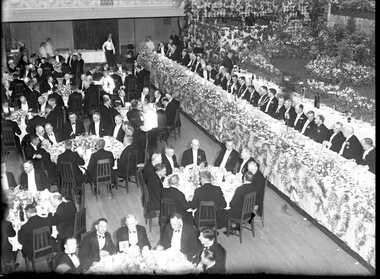 City of Melbourne Libraries
Photograph, Bull, Hugh Jones, 1897-1993, Lord Mayor's Dinner, Melbourne Town Hall
... Photographer notations on slide: "General View Of Lord Mayor's Dinner At Town Hall Nov 1936 B112" Published: The Age, Tuesday 10 November 1936, page 13 Published title: LORD MAYOR'S BANQUET Published caption: The brilliant scene inside the Melbourne Town Hall last night during the Lord Mayor’s banquet. ...Photographer notations on slide: "General View Of Lord Mayor's Dinner At Town Hall Nov 1936 B112" Published: The Age, Tuesday 10 November 1936, page 13 Published title: LORD MAYOR'S BANQUET Published caption: The brilliant scene inside the Melbourne Town Hall last night during the Lord Mayor’s banquet. ...Photographer notations on slide: "General View Of Lord Mayor's Dinner At Town Hall Nov 1936 B112" Published: The Age, Tuesday 10 November 1936, page 13 Published title: LORD MAYOR'S BANQUET Published caption: The brilliant scene inside the Melbourne Town Hall last night during the Lord Mayor’s banquet. Trove article identifier: http://nla.gov.au/nla.news-article205939431 Description: 700 guests (all men) are seated around numerous tables in the Melbourne Town Hall for the Lord Mayor's dinner in November 1936. Before the stage is a top table of 35 men, all dressed smartly in black dinner suits, with either a black or white bow tie. Many are wearing their medals. The Lord Mayor has on his Mayoral chains, and to his right is the Governor of Victoria, Lord Huntingfield. The stage is heavily decorated with fresh flowers. Research by project volunteer, Louise McKenzie: This image takes up one quarter of the photographic space on page 13 of The Age on 10 November 1936, reflecting the importance of the event and also the sheer dramatics of the image: 700 guests (all men), a top table of 35, and all dressed smartly in black dinner suits, with either a black or white bow tie. Many are wearing their medals. The Lord Mayor has on his Mayoral chains, and to his right is the Governor of Victoria, Lord Huntingfield. Further to his right is a man with an impressive sash across his chest. It is a very animated, and rather informal, moment. Banks of fresh flowers smother the stage, which is decorated in the manner of a terrace at an English stately home. Tables are laden with food, drink and decorations, and the wait staff (men and women) are also formally dressed, in the manner of Downton Abbey. It is spectacular, dramatic, and luxurious, and perpetuates the proud descriptor of “Marvellous Melbourne” as conferred by London Journalist George Augustus Sala when he visited the city in 1885. During its 1880s boom, Melbourne was the second-largest city in the British Empire, after London, and reputedly the richest city in the world. At times the expression was used with some irony, but "...in Victoria’s centenary year, 1934, with the city mired in another depression, a publisher bravely entitled a book of souvenir photographs Marvellous Melbourne, claiming that the subject ‘still finds apt expression in the happy one-time sobriquet’.” This photo seems to reflect an ongoing pride in Melbourne and a desire for it to live up to its descriptor and celebrate its post-centenary era in style. So it is no surprise to find that on page 11 of The Age on the same day, a second photo is to be found – a cropped view of one table – along with a very detailed description of the night, its purpose, and a surprise announcement. But, who was the Lord Mayor in whose honour the dinner was held? In 1934, the Lord Mayor of Melbourne was Cr. Alexander George Wales, (born Richmond, 11 October 1885, died Elsterwick, 31 May 1962). His father was a contractor and quarry-owner, but was blinded in an industrial accident in 1899. Consequently Alexander, then aged 14, left Brunswick State School to become a railway labourer working at a quarry, and in 1903 joined the Commonwealth public service as a clerk and began studying at night school, determined to improve himself. In 1907 he was appointed secretary of the Albion Quarrying Co. (in which the family had an interest), then its managing director and chairman. As the Australian Dictionary of Biography notes, he was instrumental in expanding the company’s interests, "...becoming director of the Hardware Co. of Australia Pty Ltd, the Twentieth Century Building and Investment Society, the Albion Sand Co. and the Geelong Brick Co.”. His public career began in 1914 when he was elected to the Brunswick council. He was mayor 1917-18, and in 1925 progressed to the Melbourne City Council where he remained for 29 years, being a member of most council committees. He served three successive terms as lord mayor (1934-37), was Chairman of the council’s decorations committee for Melbourne’s centenary, president of the Metropolitan Fire Brigades Board (1936), and Chairman of the Public Works Committee (1937-39). In 1936 he was elected to the Legislative Council with United Australia Party support, but later resigned over possible State government contract tender irregularities. Wales received "the customary reward” of a knighthood and was invested at Buckingham Palace by King George VI whose coronation he attended in 1937. He was an early director of what is now Ampol, and helped the development of the petroleum industry in Australia after visiting the USA in 1943 and 1946. He was impressed by that country’s wartime shipbuilding efforts and supported closer ties with the USA. “While president (1947-48) of the Melbourne Chamber of Commerce, Wales was a vocal critic of the Federal Labor Government, ...a staunch anti-socialist ... and a focus for conservative opposition to the Curtin and Chifley governments...” He is described as “a natural leader in business and civic politics,... a powerful force in the Melbourne City Council... opposing democratic reforms such as the creation of a Greater Melbourne Council and the abolition of plural voting, but advocat[ing] the redevelopment of city-owned property like the Eastern and Western markets...” So, this Lord Mayor’s dinner marks the third successive term in office for Governor Cr. A G Wales. The room is filled with powerful and influential men, and provided a platform for the Premier of Victoria, Albert Dunstan (1882-1950, United Country party) to announce that if the City Council would bear half the cost the State Government would build a bridge at Punt Road “at once”. He announced that the Government proposed to have the bridge built by the Country Roads Board, and allow the City Council to pay its share on convenient terms, and further, it would investigate the shared provision of more Yarra bridges. The proposal for the Punt Road Bridge was met with applause as the Yarra River constituted a serious traffic barrier. On 12 November 1936, two days after the Lord Mayor’s dinner, The Age published an article, “Building without a Plan”. It questions the appropriateness of the next Yarra bridge being the one at Punt Road, and encourages a “proper procedure” to look at the provision of additional Yarra bridges as a whole. But in fact this topic had been canvassed back in August when Melbourne City Council’s public works committee had recommended the replacement of the footbridge at Punt Road with a bridge, and if the Country Roads Board would declare this portion of Punt Road, including the river crossing, a State Highway, this could give the Board authority to construct the bridge and allocate the cost. Hence the reference at the dinner to a shared expense. Still an integral part of traffic management today, the Hoddle Bridge carries Punt Road over the Yarra River between Richmond and South Yarra in Melbourne. It is a five-lane road bridge with narrow footpaths on either side. It is of continuous reinforced concrete T-beam construction with five segmental arched spans, supported on transverse piers, and linked by concrete cross-beams. “The piers terminate in a series of tapered concrete pillars with Art Deco-styled steamlined decoration. Each pillar supports a Victorian-style lamp. The infill railings are geometric-patterned painted metal. Construction began in late 1937, and it was opened by Premier Albert Dunstan on 22 December 1938. It replaced an earlier footbridge, which in turn had replaced a punt service. The bridge (originally referred to as Punt Road Bridge) was named after Robert Hoddle, who planned central Melbourne’s Hoddle Grid, the grid of streets which form Melbourne’s central business district. Hoddle arrived in Australia from the UK in 1823 and went on to carry out surveys in NSW and Queensland before arriving in Melbourne in 1837. He designed layouts for both Melbourne and Williamstown, and later Geelong and other Victorian country areas. He was keen that major streets be at least 30 metres wide. ”With remarkable foresight he provided for wide boulevards from the city to the suburbs, but the subdivisions of early speculators in inner suburbs created the bottle-necks of today. After the separation of the colony in 1851, he became Victoria’s first surveyor-general... and advocated the provision of three-chain (60 m) roads and the widening of all existing main roads from one (20 m) to three chains." However, he was met with constant opposition and in 1853, was eased out of office. As a small and interesting aside: Hoddle was appointed auctioneer for the first sale of crown land in Melbourne on 1 June 1837. His commission was 57 pounds 12s 7d. and he bought two allotments for himself at a cost of 54 pounds. After he died his second wife married Richard Buckhurst Buxton, a member of the family which in 1860s Melbourne established the Australian property dynasty of Buxton Real Estate, Becton, MAB Corporation etc. Returning to the dinner and The Age article of 10 November 1836: Another topic of the after-dinner speeches was a reference to the upcoming Armistice Day. “The Minister of Customs (Mr White) said the proximity of Armistice day reminded us that eighteen years ago we had high hopes of prolonged peace.” The term “Armistice Day” was coined after WWI: “At 11 am on 11 November 1918, the guns on the Western Front fell silent after more than four years of continuous warfare. The Germans called for an armistice (suspension of fighting) in order to secure a peace settlement. They accepted the allied terms on unconditional surrender. Therefore on the 11th hour of the 11th day of the 11th month, a minute’s silence is observed and dedicated to those soldiers who died fighting to protect the nation. Originally known as Armistice Day, it was renamed Remembrance Day after World War Two to commemorate those who were killed in both World Wars. Today it refers to the loss of Australian lives from all wars and conflicts, accompanied by the words, "We will remember them, Lest we forget"." There was comment at the dinner about the need to remain firm in supporting the “democratic government in the British Empire to avoid a “plunge into savagery”. There was a grave responsibility on the British people to keep democracy alive, and that could not be done without adequate defence forces... Many weak governments in non-British countries had been swept aside by strong-fisted dictators, who now were the real threat to peace”. With the benefit of hindsight these were very pertinent comments and tragically prophetic. The Melbourne Shrine of Remembrance had only been dedicated two years earlier, at a ceremony attended by the Duke of Gloucester, son of King George V. Over 300,000 citizens attended: one third of the population of Melbourne. It became the location for the Anzac Day Dawn Service. Originally the march travelled from the Shrine into the city, however, in 1936, this was reversed, and the Shrine became the termination point for Anzac Day Marches. Also significant in 1936, was the installation of a statue in the west forecourt of the Shrine: “The Man with the Donkey” (aka 'Private John Simpson and his Little Donkey'). The work is said to represent the “valour and compassion of the Australian soldier”. Its full citation, according to the City of Melbourne City Collection is: West Side of Base: "The / Man with his Donkey / Gallipoli, April 25 to May 19 / in Commemoration / of the valour and compassion / of the Australian Soldier" AFTER LANDING AT GALLIPOLI, SIMPSON, WITH HIS LITTLE DONKEY, WORKED ALONE, DAY AND NIGHT TAKING WATER TO THE FRONT LINE AND CARRYING THE WOUNDED BACK TO THE DRESSING STATIONS. HE AND HIS DONKEY WERE KILLED BY A SHRAPNEL SHELL ON THE 19TH MAY, 1915. SIMPSON WAS MENTIONED IN DISPATCHES BY SIR IAN HAMILTON, COMMANDER-IN-CHIEF OF THE MEDITERRANEAN EXPEDITIONARY FORCE. / Erected by Public Subscription under auspices of the / Red Cross Society. East Side of Base: Private John Simpson." Their summary in background states: "A bronze figure of Simpson and his donkey with a wounded man on the donkey's back on a granite pedestal. Private John Simpson Kirkpatrick’s intrepid and short-lived exploits during the Gallipoli campaign have made him a popular figure of World War One. He has been mythologised to represent the lauded values of the digger, and he symbolises all those who went into battle unarmed. Born in England in 1892, he came to Australia in 1910. He enlisted to make his way back to England, but as a member of the 3rd Field Ambulance AIA was sent to Gallipoli. After just three weeks of bearing wounded soldiers across Shrapnel Gully on the back of his donkey, Simpson was killed by shrapnel fire. Simpson’s story became a powerful propaganda tool for enlistment in Australia, but following the war he was quickly forgotten. With the Shrine of Remembrance nearing completion in 1933, the memory of Simpson was rekindled to commemorate all who gave their lives to help others during the war. One plaque reads: ‘The / Man with his donkey / Gallipoli … / In commemoration / of the valour and compassion / of the Australian soldier’. In 1935, Wallace Anderson’s design for the memorial was selected though a competition organised by the Australian Red Cross. Anderson had served during the war and worked at the Australian War Memorial after his return. His Man with the Donkey was cast in Italy, and after some debate was sited near the shrine. Unveiled 20th June, 1936." The sculptor, Victorian-born William Wallace Anderson (1888-1975), served in France during WWI and afterwards produced a number of bronze war memorials and memorial portraits, predominantly in Victoria. “His most famous work is that of Simpson and his Donkey (1935), which he completed after winning a competition conducted by the Victorian Division of the Australian Red Cross. Anderson’s fee was 350 pounds; the cast, made by the Chiurazzi Foundry, Naples, Italy, cost 40 pounds. The work... has become well known as a symbol of the Anzac tradition.” A debate as to the siting of the statue arose from a strong view expressed by General Sir John Monash that no representation of individual members of the Australian Defence Force be located on the Shrine itself. Hence its location off to the northwest of the forecourt, in a garden of rosemary. And finally we return to the photo of the grand Lord Mayor’s dinner! An article in The Argus of 4 November 1936 refers to “Brilliant Scene at Lord Mayor’s Ball – Hall Becomes a Garden”. So now it becomes clear why the Town Hall, location of the Lord Mayor’s Dinner on 10 November 1934, only 6 days later, is so lavishly decorated. The floral decorations from the Ball are still in place - an early example of “recycling”, which is gratifying to note at a time of Depression. The reporter has captured the scene with enthusiasm: “Hundreds of tiny rose lights, hidden among pink roses, transformed the Melbourne Town Hall into a magical garden last night, when the Lord Mayor and Lady Mayoress (Councillor A. C. Wales, M.L.C., and Mrs. Wales) entertained about 3,500 guests at a ball. His Excellency the Governor (Lord Huntingfield) and Lady Huntingfield were present, while Rear-Admiral and Mrs. Lane Poole and officers from the visiting squadron were among the special guests. The balconies all round the hall were hidden by a white trellis, covered with pink blossoms and greenery. Rosy flowers were issued up every pillar, and great golden lamps, hanging from the door, were seated in greenery and trails of sweet peas. The organ gallery was converted into a terrace garden with stone steps leading to banks of pink azaleas, pink pelargoniums, masses of calceolarias, and the lovely deep mauve and blue of cinerarias. Slender Japanese maples and poplar trees grew from the higher slopes amid thickets of hostas, while a fascinating illusion was created by the lofty conservatory windows, which formed the background, and which were tinted cerulean blue to simulate the sky seen through glass. Large fern baskets hung from the conservatory roof, and the whole scene was enclosed in trellises of blossom. In the entrance palm green shrubs stood like sentinels round the passed floor, and flowers bloomed in misty golds. The long corridor upstairs leading to the council chamber was lined with an avenue of poplar trees in tubs. In the Lower Town Hall great banks of calceolarias and azaleas decked the upper dais, and each supper table was adorned with a different coloured flower with sprays of roses and Japanese maple laid on the snowy cloths. The adjoining supper-rooms were fragrant with the scent of huge bowls of stock in mauve, purple, and pink, while the white walls were covered with palm leaves and flowers. The roof garden below the clock tower was enclosed as a buffet with rose wreathed walls, and flowers were arranged attractively in the Lady Mayoress's rooms." References: LORD MAYOR'S BANQUET. CENTURY MAKERS AT THE M.C.G. BEFORE THE CHANGE. (1936, November 10). The Age (Melbourne, Vic. : 1854 - 1954), p. 13. Retrieved September 4, 2024, from http://nla.gov.au/nla.news-article205939431 'Portrait of Sir George Wales (Lord Mayor 1934-1937)', City Collection, City of Melbourne, https://citycollection.melbourne.vic.gov.au/portrait-of-sir-george-wales-lord-mayor-1934-37/ Graeme Davison, 'Marvellous Melbourne', eMelbourne, https://www.emelbourne.net.au/biogs/EM00906b.htm THE LORD MAYOR'S BANQUET. (1936, November 10). The Age (Melbourne, Vic. : 1854 - 1954), p. 11. Retrieved September 26, 2024, from http://nla.gov.au/nla.news-article205939643 BRILLIANT SCENE AT LORD MAYOR'S BALL Hall Becomes a Garden (1936, November 4). The Argus (Melbourne, Vic. : 1848 - 1957), p. 14. Retrieved September 26, 2024, from http://nla.gov.au/nla.news-article11932746 'Hoddle Bridge', Wikipedia, https://en.wikipedia.org/wiki/Hoddle_Bridge 'Hoddle Bridge', Victorian Heritage Database Report, Victorian Heritage Council, https://vhd.heritagecouncil.vic.gov.au/places/195689/download-report David Dunstan, 'Wales, Sir Alexander George (1885–1962)', Australian Dictionary of Biography, National Centre of Biography, Australian National University, https://adb.anu.edu.au/biography/wales-sir-alexander-george-8951/text15737, published first in hardcopy 1990, accessed online 26 September 2024. Marjorie J. Tipping, 'Hoddle, Robert (1794–1881)', Australian Dictionary of Biography, National Centre of Biography, Australian National University, https://adb.anu.edu.au/biography/hoddle-robert-2190/text2823, published first in hardcopy 1966, accessed online 26 September 2024. BUILDING WITHOUT A PLAN. (1936, November 12). The Age (Melbourne, Vic. : 1854 - 1954), p. 8. Retrieved September 26, 2024, from http://nla.gov.au/nla.news-article205949762 NEW BRIDGE AT PUNT ROAD (1936, August 12). The Argus (Melbourne, Vic. : 1848 - 1957), p. 10. Retrieved September 26, 2024, from http://nla.gov.au/nla.news-article11902131 'The Shrine of Remembrance', Beaconsfield’s Soldiers: https://beaconsfield.org.au/digitalmemorial/shrine-introduction/ 'Shrine of Remembrance', Wikipedia, https://en.wikipedia.org/wiki/Shrine_of_Remembrance Ken Scarlett, 'Anderson, William Wallace (1888–1975)', Australian Dictionary of Biography, National Centre of Biography, Australian National University, https://adb.anu.edu.au/biography/anderson-william-wallace-9362/text16441, published first in hardcopy 1993, accessed online 26 September 2024. 'Man with the Donkey', City Collection, City of Melbourne, https://citycollection.melbourne.vic.gov.au/man-with-the-donkey-aka-private-john-simpson-and-his-little-donkey/ 'Remembrance Day', Australian Army, https://www.army.gov.au/about-us/history-and-research/traditions/remembrance-day Photographer notations on slide: "General View Of Lord Mayor's Dinner At Town Hall Nov 1936 B112". melbourne town hall, mayors, lord mayors, centenaries, bridges, dinners, clothing and dress, festive decorations, dances and balls, eating and drinking, shrine of remembrance, governors, monuments and memorials, 1930-1939, plants -
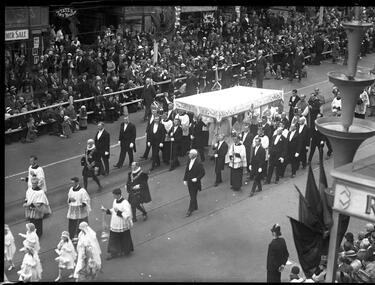 City of Melbourne Libraries
Photograph, Bull, Hugh Jones, 1897-1993, Eucharistic Congress Procession, Collins Street, Melbourne
... Research by project volunteer, Louise McKenzie: This photo was taken on Sunday 9 December 1934, looking from the Melbourne Town Hall (corner of Swanston and Collins streets) across the road to the Manchester Unity Building. ...Research by project volunteer, Louise McKenzie: This photo was taken on Sunday 9 December 1934, looking from the Melbourne Town Hall (corner of Swanston and Collins streets) across the road to the Manchester Unity Building. ...Published: The Age 10 December 1934 Published title: RELIGIOUS PAGEANTRY AND FERVOR MARKED CLOSE OF EUCHARISTIC CONGRESS. Published caption: Thousands of men and women marched in the Eucharistic procession yesterday which brought the Congress to a close. The picture above shows the procession headed by the Children of Mary in Bourke-street and turning into Spring-street, in front of Parlia ment House. Right (top) — The procession leaving the starting point at St. Patrick's Cathedral and below, the Papal Legate carrying the Host under a canopy borne by a guard of laymen and preceded by white-clad girls scattering rose leaves, incense bearers and the Papal Chamberlains in their Spanish uniforms. The end of the procession in front of Mount St. Evin’s Hospital from which the final benediction was given by Cardi nal MacRory from an altar on the bal cony. The Papal Legate carrying the Host is passing through the assemblage of surpliced priests. On the left is an aerial picture taken just as the Children of Mary at the head of the procession are taking up their places for the final assembling. In the left top corner of the picture is St Patrick's Cathedral, from which the procession started, and in the right lower corner is Mount St. Evin’s Hospital. The space immediately in front of the hospital was reserved for the processionists while on either side is the crowd that assembled to take part in the final service. Trove article identifier: http://nla.gov.au/nla.news-article205067634 Religious pageantry and fervour The National Eucharistic Congress took place from Sunday 2 to Sunday 9 December 1934. An initiative of the Roman Catholic Church, it was their contribution to Melbourne’s Centenary Celebrations. 200,000 Catholics resided in Melbourne at this time – one quarter of the city’s population. While the Congress was aimed at Catholics, and acted as an opportunity to reinforce their living faith and homage, it contained a variety of events of splendour, solemnity and significance designed to appeal to Melbournians, and would additionally provide incentive for people to travel to Victoria, thereby creating an economic benefit to the state. The Procession of the Blessed Sacrament concluded the week-long Congress. Commencing at St Patrick’s Cathedral, it covered a two-mile route via Gisborne, Collins, Elizabeth and Bourke streets, then to Victoria Parade, where a final benediction was pronounced by Cardinal MacRory from the balcony of Mount St. Evin’s Hospital (today the site of St Vincent’s Private Hospital). An estimated 100,000 took part. Onlookers line Swanston Street, some standing at the entrance to Tate’s Tea House – a well-known Melbourne landmark located in the basement of the Manchester Unity Building. The white-veiled Children of Mary Sodalists strew rose petals in the path of the canopy, covering the jewelled Monstrance containing the Blessed Sacrament of consecrated Host (bread) and carried by the Cardinal. Church hierarchy in scarlet robes walk alongside, followed by incense bearers, the Papal Chamberlains in their Spanish uniforms, and a guard of honour of laymen of the city and country parishes. In the foreground is a tiered pole. This is one of 800 “Venetian Lights” specifically installed for the Centenary along all principal thoroughfares. “The poles are painted white, the superstructure resembling three trumpet lilies are made of durable fibro-cement, and their colour scheme deepens from clear yellow on the top cone to orange on the lowest, with slender rims of vermilion and white. Each cone is flooded with light externally from three lamps concealed in the one below it. There is also a painted coat of arms from which spring a trophy of flags.” – Australian Home Beautiful Featured in "Newsworthy: Melbourne in photographs 1933-1936" exhibition at East Melbourne Library, October to December 2023. Exhibition caption by project volunteer, Louise McKenzie. Research by project volunteer, Louise McKenzie: This photo was taken on Sunday 9 December 1934, looking from the Melbourne Town Hall (corner of Swanston and Collins streets) across the road to the Manchester Unity Building. This is the afternoon procession concluding the Catholic Church’s National Eucharistic Congress in Melbourne - a procession of the Blessed Eucharist through the Melbourne city. It commenced at St Patrick’s Cathedral, and covered a two mile route via Gisborne, Collins, Elizabeth and Bourke streets, then to Victoria Parade where a final benediction was pronounced by the Cardinal from the balcony of Mount St. Evin’s Hospital (present day St Vincent’s Private Hospital). An estimated 100,000 took part in the march. The people lining the streets a men in suits and hats, women in coats and hats, and children in their “Sunday best”, kneeling beside the road, many with their hands clasped in front of them. The small girls ahead of the canopy covering the Host are pale-blue clad, white veiled Children of Mary Sodalists, who strew rose petals to pave the way of the Cardinal carrying the jewelled Monstrance (Blessed Sacrament of consecrated Host (bread)), together with church heirarchy wearing scarlet robes. Behind came incense bearers and the Papal Chamberlains in their Spanish uniforms, followed by a guard of honour of laymen of the city and country parishes. The Children of Mary Sodalities was a religious body which aimed at fostering in its members an ardent devotion, reverence, and filial love towards the Blessed Virgin Mary, initially embracing the pupils and orphans of the schools and institutions of the Sisters of Charity of St Vincent de Paul. In 1847, Blessed Pius IX affiliated them to the Jesuit Roman Sodality. They were distinguished by a medal suspended from a blue ribbon, and once a fully-fledged a Child of Mary wore a distinctive blue cape. On the extreme right foreground of the photo can be seen an intriguing piece of artistic design – a tiered pole. This is one of the 800 “Venetian Lights” specifically installed for Melbourne’s Centenary along all principal thoroughfares. “The poles are painted white, the superstructure resembling three trumpet lilies are made of durable fibro-cement, and their colour scheme deepens from clear yellow on the top cone to orange on the lowest, with slender rims of vermilion and white. Each cone is flooded with light externally from three lamps concealed in the one below it. There is also a painted coat of arms from which spring a trophy of flags.” Note the sign for Tates Tea House - a well-known Melbourne landmark, located in the basement of the Manchester Unity Building. References: RELIGIOUS PAGEANTRY AND FERVOR MARKED CLOSE OF EUCHARISTIC CONGRESS. (1934, December 10). The Age (Melbourne, Vic. : 1854 - 1954), p. 11. Retrieved September 14, 2023, from http://nla.gov.au/nla.news-article205067634 Eucharistic Congress (1934, December 1). The Argus (Melbourne, Vic. : 1848 - 1957), p. 11. Retrieved January 23, 2024, from http://nla.gov.au/nla.news-article10997817 National Eucharistic Congress, Melbourne. (1934, December 6). The Catholic Press (Sydney, NSW : 1895 - 1942), p. 28. Retrieved January 23, 2024, from http://nla.gov.au/nla.news-article104371824 'The year of the Melbourne Eucharistic Congress: 1934.' The Campion Society, https://campion.australiancardijninstitute.org/ch-7-the-year-of-the-melbourne-eucharistic-congress-1934/ 'Melbourne Eucharistic Congress 1934.' Panoramic photograph, https://emhs.org.au/catalogue/emdf0123 The National Eucharistic Congress, Melbourne, Australia December 2nd-9th, 1934. Edited by Rev. J.M. Murphy and Rev. F. Moynihan, The Advocate Press, Melbourne. 'Children of Mary Sodalists', Wikipedia, https://en.wikipedia.org/wiki/Sodality_of_Our_Lady 'Dressing Melbourne for the Duke' (1934, October 1). The Australian home beautiful : a journal for the home builder, p. 21, 58. Retrieved September 14, 2023, from http://nla.gov.au/nla.obj-2950922209 Photographer notations on slide: "Eucharistic Congress Procession on Swanston St B61" [sic - actually Collins Street]. events, religion, parades, catholic church -
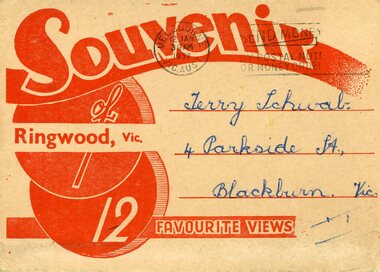 Ringwood and District Historical Society
Souvenir - Folder, 12 Black and White Souvenir photos of Ringwood, 1957
... Melbourne 12 Jan 1957, addressed to Terry Schwab, 4 Parkside Street., Blackburn, Vic. Handwritten message inside flap reads "sending this, hoping you will have many memories of Ringwood, from Mick." Produced by Murray Views, Gympie, Qld. Photograph captions – Main Street, Ringwood. Vic. Approaching Ringwood, Vic. Memorial Clock, Ringwood, Vic. The Lake, Ringwood Park, Ringwood, Vic. Main Street and Memorial Clock, Ringwood, Vic. State School, Ringwood, Vic. Panorama of Ringwood, Vic. Town Hall...Melbourne 12 Jan 1957, addressed to Terry Schwab, 4 Parkside Street., Blackburn, Vic. Handwritten message inside flap reads "sending this, hoping you will have many memories of Ringwood, from Mick." Produced by Murray Views, Gympie, Qld. Photograph captions – Main Street, Ringwood. Vic. Approaching Ringwood, Vic. Memorial Clock, Ringwood, Vic. The Lake, Ringwood Park, Ringwood, Vic. Main Street and Memorial Clock, Ringwood, Vic. State School, Ringwood, Vic. Panorama of Ringwood, Vic. Town Hall ...Buff coloured folder with red printing containing 12 black and white fold-out newsprint quality photos of Ringwood streetscapes, buildings and Memorial Clock and lake. 4 separated from rest. Postmarked Melbourne 12 Jan 1957, addressed to Terry Schwab, 4 Parkside Street., Blackburn, Vic. Handwritten message inside flap reads "sending this, hoping you will have many memories of Ringwood, from Mick." Produced by Murray Views, Gympie, Qld. Photograph captions – Main Street, Ringwood. Vic. Approaching Ringwood, Vic. Memorial Clock, Ringwood, Vic. The Lake, Ringwood Park, Ringwood, Vic. Main Street and Memorial Clock, Ringwood, Vic. State School, Ringwood, Vic. Panorama of Ringwood, Vic. Town Hall, Ringwood, Vic. Overlooking Ringwood, Vic. Business Centre, Ringwood, Vic. Looking towards Dandenong Ranges, Ringwood, Vic. The Lake, Ringwood Park, Ringwood, Vic. -
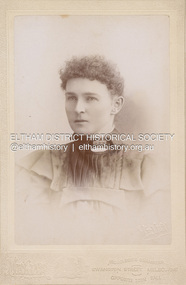 Eltham District Historical Society Inc
Photograph, Melba Studio, Caroline (Carrie) Shillinglaw, c.1898
... Melba Studio Photographers operated from Nicholson's Chambers at 101 Swanston Street, Melbourne opposite the Town Hall from 1897-1929 A review of Melba Studio NEWS AND NOTES FOR LADIES. (1897, November 25). ...Melba Studio Photographers operated from Nicholson's Chambers at 101 Swanston Street, Melbourne opposite the Town Hall from 1897-1929 A review of Melba Studio NEWS AND NOTES FOR LADIES. (1897, November 25). ...Caroline Shillinglaw married Christopher Watson 1907. Their daughter, Jean, was born 1906. Melba Studio Photographers operated from Nicholson's Chambers at 101 Swanston Street, Melbourne opposite the Town Hall from 1897-1929 A review of Melba Studio NEWS AND NOTES FOR LADIES. (1897, November 25). Fitzroy City Press (Vic. : 1881 - 1920), p. 3. Retrieved December 2, 2022, from http://nla.gov.au/nla.news-article65696093 CABINET 1866-1905 The Cabinet photo was introduced in 1866 in answer to a demand for a larger format photograph which could be mounted for a cabinet or on the wall. They were 4.5 inches by 6.5 inches (11.5 x 16.5 cm), more than twice the size of the cdv. They cost about twice as much as a cdv but eventually displaced them. They were not extensively produced until 1880 and had ceased by 1905. Coloured mounts, especially maroon or green, indicate a date between 1880 and 1890. - Frost, Lenore; Dating Family Photos 1850-1920; Valiant Press Pty. Ltd., Berwick, Victoria 1991 marg ball collection, shillinglaw family photo album 2, cabinet photo, 1897-1929, 1898, caroline (carrie) watson (nee shillinglaw) 1876-1956, melba photographers swanston st melbourne -
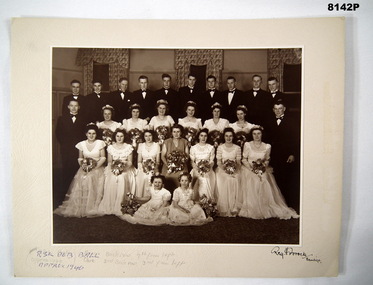 Bendigo Military Museum
Photograph - BENDIGO RSL DEBUTANTE BALL, Reg Brock, C. August 1947
... Melbourne, Vic. : 1848 - 1957), Thursday 14 August 1947, page 8 ________________________________________ 12 debutantes presented at Bendigo Ball Early Victorian posies which matched the pastel flowers in their hair were carried by the 12 debutantes who came out at the Annual RSL Ball at Bendigo Town Hall last night. ...Melbourne, Vic. : 1848 - 1957), Thursday 14 August 1947, page 8 ________________________________________ 12 debutantes presented at Bendigo Ball Early Victorian posies which matched the pastel flowers in their hair were carried by the 12 debutantes who came out at the Annual RSL Ball at Bendigo Town Hall last night. ...The date on the photograph states "approx 1946", actually 1947. The Bendigo RSL conducted Annual and Debutante Balls for many years as a fund raiser. The following article appeared in the Argus; “Argus (Melbourne, Vic. : 1848 - 1957), Thursday 14 August 1947, page 8 ________________________________________ 12 debutantes presented at Bendigo Ball Early Victorian posies which matched the pastel flowers in their hair were carried by the 12 debutantes who came out at the Annual RSL Ball at Bendigo Town Hall last night. The debutantes, who were presented to Lieut-General and Mrs V. A. H. Sturdee, were Eileen Clarke, Daphne Green, Norma Knopp, Doris Purtell, Inez Somerville, Eileen Simpson, Joy Taylor, Olive Tope, Judith Waters, Elvie Walker, Patricia Young, and Dorothy Herbert. The official party included Cr and Mrs D. W. Streader, Mayor and Mayoress of Bendigo; Cr and Mrs. McEwen, Mayor and Mayoress of Castlemaine; Major-General Rankin, MP, and Mrs Rankin; Mr Galvin, Minister for Lands, and Mrs Galvin; and Colonel Lansell MLC, President of Bendigo RSL.” Photograph B & W on light cream backing board. There are 12 young men, 12 Debutante girls, 2 Flower girls and 1 female Chaperone. Text has been written on the front in blue pen and black pencil. In blue pen and black pencil, "RSL Deb Ball approx 1946", In black pencil, "Bruce back row 7th from left, Olive 2nd back row from left", in black pen, "Reg Brock Bendigo" brsl, smirsl, debutante -
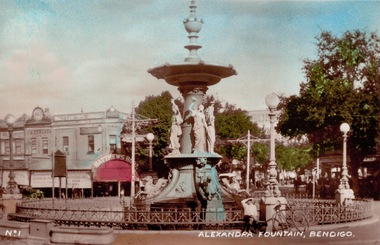 Bendigo Historical Society Inc.
Photograph - Valentine's Bendigo Snapshots, abt 1940s
... Valentine's Bendigo Snapshots Packet for Photos - Printed on the front of the envelope is "Valentine's Snapshots Bendigo, Vic., No. 1. Eight real Photographs for your album, Hand Coloured Published by the Valentine Publishing Co. ...BHS Collection history bendigo valentines photos Alexandra Fountain No 2 Town Hall No 3 The Conservatory Gardens No 4 The Swimming Pool No 5 View from Mitchell Street No 8 Queen Victoria Gardens No 9 King George 5th memorial Conservatory Gardens No 10 Queen Victoria Gardens Valentine's Bendigo Snapshots Packet for Photos - Printed on the front of the envelope is "Valentine's Snapshots Bendigo, Vic., No. 1. Eight real Photographs for your album, Hand Coloured Published by the Valentine Publishing Co. Pty. Ltd, Melbourne ...BHS Collection Valentine's Bendigo Snapshots Packet for Photos - Printed on the front of the envelope is "Valentine's Snapshots Bendigo, Vic., No. 1. Eight real Photographs for your album, Hand Coloured Published by the Valentine Publishing Co. Pty. Ltd, Melbourne" Photos of: No 1 Alexandra Fountain No 2 Town Hall No 3 The Conservatory Gardens No 4 The Swimming Pool No 5 View from Mitchell Street No 8 Queen Victoria Gardens No 9 King George 5th memorial, Conservatory Gardens No 10 Queen Victoria Gardens history, bendigo, valentines photos, alexandra fountain, no 2 town hall, no 3 the conservatory gardens, no 4 the swimming pool, no 5 view from mitchell street, no 8 queen victoria gardens, no 9 king george 5th memorial, conservatory gardens, no 10 queen victoria gardens -
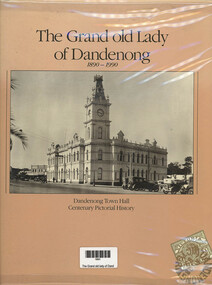 Narre Warren and District Family History Group
Book, Dandenong & District Historical Society, The Grand old lady of Dandenong -1890 - 1990, 1990
... dandenong (vic.) Dandenong Town Hall ‘In nearly every older municipality of Melbourne and in most provincial centres in Victoria we have been left a legacy of Victorian municipal life in the form of a town hall’ (from the foreword of the book). ...‘In nearly every older municipality of Melbourne and in most provincial centres in Victoria we have been left a legacy of Victorian municipal life in the form of a town hall’ (from the foreword of the book). This book provides a record of many of the events held within the Dandenong Town Hall and around it from the 1850s to 1990.64 p.; 30 cm non-fiction ‘In nearly every older municipality of Melbourne and in most provincial centres in Victoria we have been left a legacy of Victorian municipal life in the form of a town hall’ (from the foreword of the book). This book provides a record of many of the events held within the Dandenong Town Hall and around it from the 1850s to 1990. dandenong (vic.), dandenong town hall -
 Nillumbik Shire Council
Public Art: Tom SANDERS (b.1925-d.2008 Vic, Aus), Tom Sanders, Wall of the Moon (Homage to Miro) - (Location: Eltham Town Square, Arthur Street, Eltham), 1968
... Melbourne, 1969-70 (now demolished), Perth Concert Hall, 1971 and The University of Melbourne,1975 (with John Olsen). This mural is one of only three remaining in the public realm by Tom Sanders (the others are at the Perth Concert Hall (1971) and at the University of Melbourne (1975). mural public art earthernware pottery ceramics glaze eltham ekphrasis2017 eltham town square joan miro N/A Ceramic mural (earthenware tiles) consisting of a playful/organic abstract design similar in style to the Spanish artist Joan Miro. ...Sanders was a well-known local potter who worked for a time with David Boyd at the Martin Boyd Pottery, before returning to Melbourne where he had some association with Arthur Boyd, at the pottery in Murrumbeena. Sanders set up a studio in Eltham in the early 1950s and made the first of a series of architectural ceramic murals with painter and print maker Lawrence Daws in 1956. In 1957 he left for Europe and while there was inspired by the Spanish artist Joan Miro’s unconventional painting style and large scale murals, in particular Wall of the Moon (1957). After returning from his travels in Europe to Australia in 1964, he began to work solely on creating ceramic murals, some of which were commissioned for Southland Shopping Centre in Cheltenham, Melbourne, 1968 (now demolished), the National Mutual Centre, Melbourne,1964-5 (now demolished), Dee Why Library, Sydney 1966, Woden Valley High School, ACT, 1967, Tullamarine Airport Melbourne, 1969-70 (now demolished), Perth Concert Hall, 1971 and The University of Melbourne,1975 (with John Olsen). This mural is one of only three remaining in the public realm by Tom Sanders (the others are at the Perth Concert Hall (1971) and at the University of Melbourne (1975). Ceramic mural (earthenware tiles) consisting of a playful/organic abstract design similar in style to the Spanish artist Joan Miro. Shades of blue, yellow and black glazes are layered onto matte black and shiny bronze tiles. N/A mural, public art, earthernware, pottery, ceramics, glaze, eltham, ekphrasis2017, eltham town square, joan miro -
 Sunshine and District Historical Society Incorporated
Administrative record - City of Sunshine - Commissioner Mr Alexander Alex George Gillon Collection 1976 - 1982 - Minutes of the ordinary meeting of council held on 15th June 1977, City of Sunshine, 1th June 1977
... Freeholds & McPherson's Ltd Subdivision Creation of Easement Lots 18 & 19 Yarmouth Avenue Subdivision Proposed Stop Go Signals Hampshire Road / Wright Street and Market Road / Wright Street Contract Supply of Sanitary Landfill compactor Tutt Bryant (Vic) Pty Ltd Report of the Building Surveyor Fence 14 Belvedere Close Undersize Allotment lot 78 Forrest Street Ardeer Installation of Underground tank Sunshine Bus Lines Fraser Street flammable Liquids Buildings Lots 2 & 3 Ayton Street Sunshine North Cleaning of Municipal Buildings Major Repairs to Council Buildings House of Sunshine, House of Happiness, Municipal Offices, Deer Park Hall, 10 Watt Street Child Care Program Indoor Swimming Pool Service Street...Freeholds & McPherson's Ltd Subdivision Creation of Easement Lots 18 & 19 Yarmouth Avenue Subdivision Proposed Stop Go Signals Hampshire Road / Wright Street and Market Road / Wright Street Contract Supply of Sanitary Landfill compactor Tutt Bryant (Vic) Pty Ltd Report of the Building Surveyor Fence 14 Belvedere Close Undersize Allotment lot 78 Forrest Street Ardeer Installation of Underground tank Sunshine Bus Lines Fraser Street flammable Liquids Buildings Lots 2 & 3 Ayton Street Sunshine North Cleaning of Municipal Buildings Major Repairs to Council Buildings House of Sunshine, House of Happiness, Municipal Offices, Deer Park Hall, 10 Watt Street Child Care Program Indoor Swimming Pool Service Street Foolscap sized document. ...Minutes of the Ordinary Meeting of Council held on 15th June 1977 Report of the Town Clerk Glengala Park Primary School Agreement to use School Facilities Financil Reports D. J. Evans Hall Committee Applications From Persons For Rate Relief Who Are Not Automatically Entitled To Relief Approved By The Victorian Government Applications From Persons In Respect Of Possible Remission of rates From 1975/76 Conference Public Records Office Place Name Committee Naming of Albanvale Metropolitan Fire Brigade and the Country Fire Authority Revision of Voters list Surrender of lease 23C Northumberland Road Sunshine North Holiday Programme Report Report of the Chief Health Inspector Quarterly Return Food Sampling Report of City Engineer Proposed Amendment to Melbourne Metropolitan Planning Scheme Ordinance Service Bus Zone Proposed Amendment to Melbourne Metropolitan Planning Scheme Ordinance Advertising Signs In Residential Areas Flat Development Control Land Use Permit Application Addition of Two Flats Lot 51 Wood Street Land Use Permit Application Extension to Existing Workshop Lot 6 Munro Avenue Land Use Permit Application Coin Operated Launderette 113 South Road Land Use Permit Application Extension to Existing Wesleyan Church of Sunshine 139 - 143 Devonshire Road Cluster Subdivisions Land Use Permit Application Flats Lots 24 & 25 Matthews Street Land Use Permit Application Cluster Subdivision Furlong Road Land Use Permit Application Cluster Subdivision Furlong Road & Browne Avenue Tender for Tractor Drawn gang Mower Dickson street private Street Scheme Nashua Photo Copying Machine Progress Claim and Variation to Quotation Easement Draingage lot 4 Mitchell Street Maidstone Land Use Permit Car Parking Alternative Proposal St. John's College Braybrook Creation of Easement Mitchell Street Consolidated Bearing Company, S.S.W. Freeholds & McPherson's Ltd Subdivision Creation of Easement Lots 18 & 19 Yarmouth Avenue Subdivision Proposed Stop Go Signals Hampshire Road / Wright Street and Market Road / Wright Street Contract Supply of Sanitary Landfill compactor Tutt Bryant (Vic) Pty Ltd Report of the Building Surveyor Fence 14 Belvedere Close Undersize Allotment lot 78 Forrest Street Ardeer Installation of Underground tank Sunshine Bus Lines Fraser Street flammable Liquids Buildings Lots 2 & 3 Ayton Street Sunshine North Cleaning of Municipal Buildings Major Repairs to Council Buildings House of Sunshine, House of Happiness, Municipal Offices, Deer Park Hall, 10 Watt Street Child Care Program Indoor Swimming Pool Service Street city of sunshine, alexander "alex" george gillon, glengala park primary school, kermeen street, sunshine west, d. j. evans hall, churchill avenue, braybrook, albanvale, northumberland road, sunshine north, wood street, deer park, munro avenue, south road, devonshire road, wesleyan church of sunshine, matthews street, furlong road, browne avenue, dickson street, mitchell street, maidstone, st. john's college, consolidated bearing company, yarmouth avenue, st. albans, hampshire road, wright street, market road, belvedere close, maribyrnong, forrest street, ardeer, sunshine bus lines, fraser street, ayton street, house of sunshine, house of happiness, city of sunshine municipal offices, alexandra avenue, deer park hall, watt street -
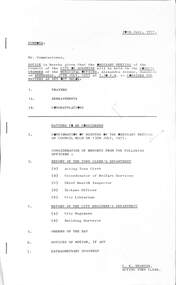 Sunshine and District Historical Society Incorporated
Administrative record - City of Sunshine - Commissioner Mr Alexander Alex George Gillon Collection 1976 - 1982 - Notice of ordinary meeting of the council of the City of Sunshine to be held on 27th July 1977, City of Sunshine, 20th July 1977
... Andrews Street Ravenscourt Road Tottenham Vule Street Rita Street Geelong Road Francis Street Brooklyn Western Avenue Ashley Street Boundary Road Fitzgerald Road Harrison Street Miles Street Hall Street Kalingra Road Northumberland Road Wattle Road Porter Road Willis Street Pre-School Centre Willis Street Errington Reserve Committee of Management Main Road East Clarke Street Coles Hulett Street Notice of Ordinary Meeting of the Council of the City of Sunshine to be held on 27th July 1977 Report of the Town Clerk's Department Report of the Town Clerk Building Highpoint West Agreement with Development Underwriting (Vic) Pty Ltd about Accommodation for Library, Infant Welfare and Child Care Services Infant Welfare Services Proposed Errington Reserve Committee of Management Financial Reports Rates, Sanitary and Interest Abandonments for 1976/1977 Melbourne Tourist Authority Reservation of Land for Facilities and Services for the Elderly Pound Keeper and Fees Valuations Site for Kindergarten for Physically Handicapped Children Rogers Reserve fronting Sonley Street and Babb Street Maidstone Australian - Britain Society Contribution Ambulance Service Melbourne Abandonment of Footpath Account Lot 94 Delmont Street Storage of Wastepaper at Sunshine Tip Site Hulett Street by Smorgan Consolidated Industries Interest on Rates Policy Rates Deferred Westerngate North Estate Report of the Co-Ordinator of Welfare Services Youth Outreach Project Closure of Access Radio Station 3ZZ Report of the Senior Health Inspector School Canteens Health Act Registrations Report of the By-Laws Officer Street Stall Rear of G. ...Notice of Ordinary Meeting of the Council of the City of Sunshine to be held on 27th July 1977 Report of the Town Clerk's Department Report of the Town Clerk Building Highpoint West Agreement with Development Underwriting (Vic) Pty Ltd about Accommodation for Library, Infant Welfare and Child Care Services Infant Welfare Services Proposed Errington Reserve Committee of Management Financial Reports Rates, Sanitary and Interest Abandonments for 1976/1977 Melbourne Tourist Authority Reservation of Land for Facilities and Services for the Elderly Pound Keeper and Fees Valuations Site for Kindergarten for Physically Handicapped Children Rogers Reserve fronting Sonley Street and Babb Street Maidstone Australian - Britain Society Contribution Ambulance Service Melbourne Abandonment of Footpath Account Lot 94 Delmont Street Storage of Wastepaper at Sunshine Tip Site Hulett Street by Smorgan Consolidated Industries Interest on Rates Policy Rates Deferred Westerngate North Estate Report of the Co-Ordinator of Welfare Services Youth Outreach Project Closure of Access Radio Station 3ZZ Report of the Senior Health Inspector School Canteens Health Act Registrations Report of the By-Laws Officer Street Stall Rear of G. J. Coles in Clarke Street Victorian Railways and Community Services Programme Report of the City Engineer Land Use Permit and Land Use Permit Application Display Homes Centre Camelot Drive and Trafalgar Street Land Use Permit Application Subdivision Furlong Road Land Use Permit Application Sign 592 Ballarat Road Deer Park Land Use Permit Application Sales of Secondhand Motor Vehicles, Mechanical Work and Motor Vehicle Storage Lots 48 & 48 Cranwell Street and Lots 35 & 36 Gilbert Street Land Use Permit Application Subdivision Neale Road Land Use Permit Application Sky Sign 310 Ballarat Road Braybrook Land Use Permit Application Extension to Flats Lot 50 Oldfield Street Land Use Permit Application Extension to Our Lady of the Immaculate Conception Church 90 Monash Street Land Use Permit Application Factory Lot 43 Somers Street South West Corner of Grainger Street Sunshine North Plan of Subdivision Corner Rear of 17 Simmie Street and 1 St. Andrews Street Plan of Strata Subdivision 26 Ravenscourt Road Plan of Subdivision Hook Street and Vule Street Plan of Subdivision Rita Street Plan of Subdivision Geelong Road and Francis Street Brooklyn Continuance of Consultant Services National Safety Council of Australia Construction of Western Avenue Reconstruction of Ashley Street Savlage Deport of Wastepaper and Bottles at Garbage Tip Sunshine Tip Smorgan Consolidated Industries and Manufacturers Bottle Company of Victoria Pty Ltd Allocation of Funds 77/78 Joint Works Main and Unlcassified Road Proposed Land Acquisition Boundary Road and Fitzgerald Road Intersection Items for Consideration at 77/78 Estimates Metrication of City Plans & Conversion to Metric Scale of Detailed City Plans Harrison Street and Miles Street Private Street Scheme Report of Building Surveyor Fencing 83 Hall Street Sunshine West Australian Institiute of Steel Construction Seminar Installation of Underground Tanks Readymix 550 Geelong Road Brooklyn Installation of Underground Tanks Australian Cargo Enterprises Lot 2 Kalingra Road Installation of Underground Tank Esso Service Station Lots 39, 40 & 41 Ballarat Road Corner Northumberland Road Dangerous Building 5 Wattle Road Maidstone Loading Space Lot 80 Porter Road Deer Park Sewer Willis Street Pre-School Centre Tenders Willis Street Pre-School Centre Construction Major Repairs Central Library and Infant Welfare Centre W.C. Facilities Hampshire Road city of sunshine, alexander "alex" george gillon, highpoint west shopping centre, rosamond road, maribyrnong, rogers reserve, sonley street, babb street, maidstone, delmont street, albion, sunshine tip, smorgan consolidated industries, radio station 3zz, camelot drive, trafalgar street, st. albans, furlong road, ballarat road, deer park, cranwell street, gilbert street, braybrook, neale road, oldfield street, sunshine west, our lady of the immaculate conception church, monash street, sunshine, somers street, grainger street, sunshine north, simmie street, st. andrews street, ravenscourt road, tottenham, vule street, rita street, geelong road, francis street, brooklyn, western avenue, ashley street, boundary road, fitzgerald road, harrison street, miles street, hall street, kalingra road, northumberland road, wattle road, porter road, willis street pre-school centre, willis street, errington reserve committee of management, main road east, clarke street, coles, hulett street -
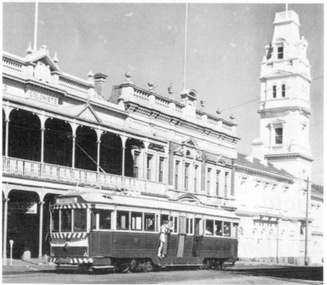 Ballarat Tramway Museum
Magazine, Association of Railway Enthusiasts (ARE), "Australian Railway Enthusiast - Vol 9, No. 4, December 1971", Dec. 1971
... Melbourne and a derailment at Yering Vic. in 1900. Ballarat Photos 1 - 40 in Lydiard St. 2 - Bogie car in Wendouree Parade from the wheat silos 3 - Intersection of Sturt and Lydiard Street from the Town Hall 4 - Tram at City Centre with Boer War (?) ...Melbourne and a derailment at Yering Vic. in 1900. Ballarat Photos 1 - 40 in Lydiard St. 2 - Bogie car in Wendouree Parade from the wheat silos 3 - Intersection of Sturt and Lydiard Street from the Town Hall 4 - Tram at City Centre with Boer War (?) ...Copy of the Australian Railway Enthusiast - Vol 9, No. 4, December 1971, which contains seven photographs of the closure of the Ballarat Tramway System on 19/9/1971 by Greg Triplett. Item 579 refers for centre page photograph. Magazine has articles on the Beech Forest Narrow Gauge, The Atjeh Tram (Indonesia), cable cars preserved in Melbourne and a derailment at Yering Vic. in 1900. Ballarat Photos 1 - 40 in Lydiard St. 2 - Bogie car in Wendouree Parade from the wheat silos 3 - Intersection of Sturt and Lydiard Street from the Town Hall 4 - Tram at City Centre with Boer War (?) statue in front of the tram - night photo 5 - 35 at Sebastopol Terminus - night photo 6 - 42 at the Lydiard Street terminus - night photo 7 - 40 leaving Sebastopol as the last tram - night photo (see item 579) Second copy added 31-8-2017. Second copy has a "Technical Book & Mag. Co." yellow label on the front cover. trams, tramways, ballarat, closure, lydiard st, sturt st, sebastopol -
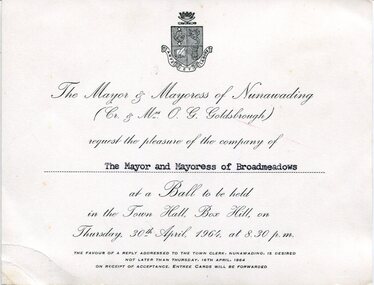 Broadmeadows Historical Society & Museum
Ephemera - Invitation, Ball Invitation, City of Nunawading, 1963, 1964
... This invitation provides documentary evidence of inter municipal civic culture and social practices in suburban Melbourne during the 1960s, highlighting the ceremonial functions of mayors and the importance of formal municipal events. Local government Municipal ceremonies Civic hospitality City of Nunawading (Vic.) City of Broadmeadows (Vic.) Box Hill Town Hall ...Reflects formal civic relationships between the municipalities of Nunawading and Broadmeadows during the mid twentieth century and illustrates the social role of municipal leadership in Victoria during the 1960s. This invitation provides documentary evidence of inter municipal civic culture and social practices in suburban Melbourne during the 1960s, highlighting the ceremonial functions of mayors and the importance of formal municipal events. Single square cornered printed invitation card with black ink on cream paper. Recto contains municipal coat of arms and formal script text. Verso is blank apart from an adhered later collection label. Recto, printed:“The Mayor & Mayoress of Nunawading/(Cr. & Mrs O. G. Goldsbrough)/request the pleasure of the company of/The Mayor and Mayoress of Broadmeadows/at a Ball to be held/in the Town Hall, Box Hill, on/Thursday, 30th April, 1964, at 8.30 p.m./The favour of a reply addressed to the Town Clerk, Nunawading, is desired/not later than Thursday, 16th April, 1964./On receipt of acceptance, entree cards will be forwarded.” Back (verso, adhesive label): “WI 4055” local government, municipal ceremonies, civic hospitality, city of nunawading (vic.), city of broadmeadows (vic.), box hill town hall -
 Ballarat Tramway Museum
Postcard - Folder set, Valentine & Sons Publishing Co, "Beautiful Views in Color of Ballarat Vic", Early 1950's
... Melbourne and Sydney., titled "Beautiful Views in Color of Ballarat Vic". Front cover has a image of the Arch of Victory on the left hand side with space for title, address area and stamp. Rear of Cover has printer name and a slit for the envelope to be closed over and sealed. 1. The Avenue of Honor and the Arch of Victory 2. The Eureka Stockade Memorial 3. The Old Curiosity shop 4. Town Hall..."Beautiful Views in Color of Ballarat Vic" Postcard Folder set Valentine & Sons Publishing Co. ...Shows views of Ballarat city, tourist attractions, Lake Wendouree in the 1950's, with some distance views of the trams in the streets. Demonstrates production of souvenirs of the era - folded postcards. Set of 9 coloured views of Ballarat printed with all photos on one side of a folded strip of paper glued within an colour printed light card folder. Published by The Valentine Publishing Co. Pty Ltd of Melbourne and Sydney., titled "Beautiful Views in Color of Ballarat Vic". Front cover has a image of the Arch of Victory on the left hand side with space for title, address area and stamp. Rear of Cover has printer name and a slit for the envelope to be closed over and sealed. 1. The Avenue of Honor and the Arch of Victory 2. The Eureka Stockade Memorial 3. The Old Curiosity shop 4. Town Hall Sturt St. (with trams in distance views, note Myers verandah still there) 5. Sturt St showing Mt. Warrenheip in the distance 6. Picturesque scene in the Gardens 7. The Boat shed and basin, Lake Wendouree 8. Sturt St. (from Greville St and large Robur Tea advertisement on building) 9. The Conservatory in the Gardens. From the motor vehicles in the photograph would say early 1950's. trams, tramways, ballarat, postcards, sturt st, bridge st, gardens, grenville st, lake wendouree -
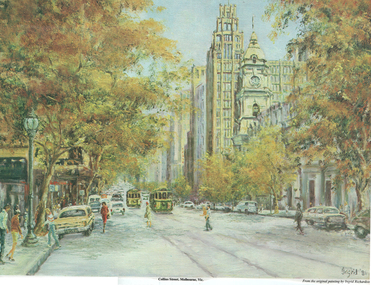 Melbourne Tram Museum
Artwork, other - Illustration, Ingrid Richardson, "Collins Street Melbourne Vic", 1981
... Reproduction of a painting titled "Collins Street Melbourne Vic" by Ingrid Richardson, 1981, looking west from near Russell St along Collins St Melbourne. ...Reproduction of a painting titled "Collins Street Melbourne Vic" by Ingrid Richardson, 1981, looking west from near Russell St along Collins St Melbourne. ...Reproduction of a painting titled "Collins Street Melbourne Vic" by Ingrid Richardson, 1981, looking west from near Russell St along Collins St Melbourne. Two W class trams are in the view, including the MLD building, and the Town Hall. Has a close association with the artist Ingrid Richardson. Illustration full colour, plain back. tramways, trams, collins st, art works -
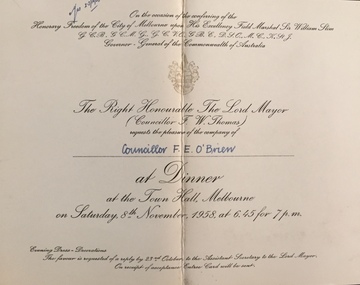 Kew Historical Society Inc
Document (item) - Invitation, City of Melbourne, Dinner on the Occasion of Conferring of Honorary Freedom of the City of Melbourne Upon His Excellency Field Marshall Sir William Slim, 1958
... As a continuous record, ranging across most decades of the Twentieth Century, they reveal changing tastes in design, values and relationships in the history of local government in Victoria. civic invitations -- kew (vic) city of melbourne field marshall slim.-- governor general of australia ON THE OCCASION OF THE CONFERRING OF THE / FREEDOM OF THE CITY OF MELBOURNE UPON HIS EXCELLENCY FIELD MARSHALL SIR WILLIAM SLIM / GCB, GCMG, GCVC, GBE, DSO, MC, KStJ, / GOVERNOR GENERAL OF THE COMMONWEALTH OF AUSTRALIA / THE RIGHT HONOURABLE THE LORD MAYOR / (CR F W THOMAS) / REQUESTS THE PLEASURE OF THE COMPANY OF / Councillor F E O'Brien / AT DINNER / AT THE TOWN HALL, MELBOURNE / ON SATURDAY, 8TH NOVEMBER, 1958, AT 6.45 FOR 7 PM / EVENING DRESS - DECORATIONS / THE FAVOUR IS REQUESTED OF A REPLY BY 23RD OCTOBER, TO THE ASSISTANT SECRETARY TO THE LORD MAYOR / ON RECEIPT OF ACCEPTANCE ENTREE CARD WILL BE SENT Single-sided invitation to Cr F E O'Brien (Mayor of Kew) to attend formal dinner on the Occasion of Conferring of Honorary Freedom of the City of Melbourne Upon Field Marshall Sir William Slim in 1958. ...The Municipality of Kew (1860-1863), the Borough of Kew (1863-1910), the Town of Kew (1910-1921) and the City of Kew (1921-1994) were local government instrumentalities in the State of Victoria. In 1994, the City of Kew was amalgamated, together with the former Cities of Camberwell and Hawthorn, into the new City of Boroondara (1994- ). Like other local government entities of the period, Kew was administered by town clerks. The two notable town clerks in Kew's history were H. H. (Henry Hirst) Harrison (1868-1955) and W. D. (William Dickie) Birrell (1899-1974). Harrison was appointed to the position in 1901 and retired in 1938 after 37 years. Birrell, appointed Acting Town Clerk in 1921, became Town Clerk in 1938, following Harrison's retirement. He continued in this role until his retirement in 1966. This card is part of an historically significant civic collection, containing hundreds of separate invitations, documents, greeting cards, programmes and tickets issued and/or collected by successive town clerks. Items in the collection illuminate the political, social and cultural history of the district. As a continuous record, ranging across most decades of the Twentieth Century, they reveal changing tastes in design, values and relationships in the history of local government in Victoria. ON THE OCCASION OF THE CONFERRING OF THE / FREEDOM OF THE CITY OF MELBOURNE UPON HIS EXCELLENCY FIELD MARSHALL SIR WILLIAM SLIM / GCB, GCMG, GCVC, GBE, DSO, MC, KStJ, / GOVERNOR GENERAL OF THE COMMONWEALTH OF AUSTRALIA / THE RIGHT HONOURABLE THE LORD MAYOR / (CR F W THOMAS) / REQUESTS THE PLEASURE OF THE COMPANY OF / Councillor F E O'Brien / AT DINNER / AT THE TOWN HALL, MELBOURNE / ON SATURDAY, 8TH NOVEMBER, 1958, AT 6.45 FOR 7 PM / EVENING DRESS - DECORATIONS / THE FAVOUR IS REQUESTED OF A REPLY BY 23RD OCTOBER, TO THE ASSISTANT SECRETARY TO THE LORD MAYOR / ON RECEIPT OF ACCEPTANCE ENTREE CARD WILL BE SENT civic invitations -- kew (vic), city of melbourne, field marshall slim.-- governor general of australia -
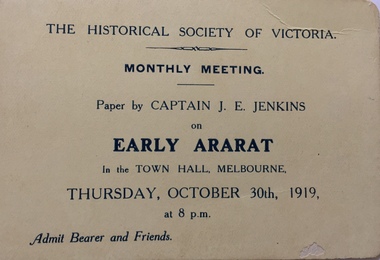 Kew Historical Society Inc
Document (item) - Entree card, The Historical Society of Victoria, Lecture on Early Ararat by Captain JE Jenkins, 1919
... As a continuous record, ranging across most decades of the Twentieth Century, they reveal changing tastes in design, values and relationships in the history of local government in Victoria. civic invitations -- kew (vic) the historical society of victoria -- meetings 1919 captain je jenkins -- early ararat THE HISTORICAL SOCIETY OF VICTORIA / MONTHLY MEETING / PAPER BY CAPTAIN J E JENKINS / ON / EARLY ARARAT / IN THE TOWN HALL MELBOURNE / THURSDAY OCTOBER 30TH 1919 / AT 8 P.M. / ADMIT BEARER AND FRIENDS Single-sided entree card to a lecture by Captain J E Jenkins on Early Ararat. ...The Municipality of Kew (1860-1863), the Borough of Kew (1863-1910), the Town of Kew (1910-1921) and the City of Kew (1921-1994) were local government instrumentalities in the State of Victoria. In 1994, the City of Kew was amalgamated, together with the former Cities of Camberwell and Hawthorn, into the new City of Boroondara (1994- ). Like other local government entities of the period, Kew was administered by town clerks. The two notable town clerks in Kew's history were H. H. (Henry Hirst) Harrison (1868-1955) and W. D. (William Dickie) Birrell (1899-1974). Harrison was appointed to the position in 1901 and retired in 1938 after 37 years. Birrell, appointed Acting Town Clerk in 1921, became Town Clerk in 1938, following Harrison's retirement. He continued in this role until his retirement in 1966. This card is part of an historically significant civic collection, containing hundreds of separate invitations, documents, greeting cards, programmes and tickets issued and/or collected by successive town clerks. Items in the collection illuminate the political, social and cultural history of the district. As a continuous record, ranging across most decades of the Twentieth Century, they reveal changing tastes in design, values and relationships in the history of local government in Victoria. THE HISTORICAL SOCIETY OF VICTORIA / MONTHLY MEETING / PAPER BY CAPTAIN J E JENKINS / ON / EARLY ARARAT / IN THE TOWN HALL MELBOURNE / THURSDAY OCTOBER 30TH 1919 / AT 8 P.M. / ADMIT BEARER AND FRIENDS civic invitations -- kew (vic), the historical society of victoria -- meetings 1919, captain je jenkins -- early ararat -
Kew Historical Society Inc
Journal, Kew Historical Society, Newsletter No.118, March 2017
... kew historical society (vic.) -- periodicals. kew historical society (vic.) -- newsletters kew historical society (vic.) -- journals Women's History / Robert Baker p1.Society news p2. ...Women's History / Robert Baker p1.Society news p2. Women working: a short history of the Kew Ladies' Benevolent Society / Suzanne McWha p4. Dwellings for people of small means / David White p6. Remembering Kew [Kew Town Hall 1865-1971; Ordsall 1858-1970] / Kerry Fairbank & Robert Baker p8. William James Runting / Desley Reid p.9. Mayoral mementoes in the collection / Robert Baker p10. Recent donations / Robert Baker p10.Published quarterly since 1977, the newsletters of the Kew Historical Society contain significant research by members exploring relevant aspects of the Victorian and Australian Framework of Historical Themes. Frequently, articles on people, places and artefacts are the only source of information about an aspect of Kew, and Melbourne’s history. non-fiction Women's History / Robert Baker p1.Society news p2. Women working: a short history of the Kew Ladies' Benevolent Society / Suzanne McWha p4. Dwellings for people of small means / David White p6. Remembering Kew [Kew Town Hall 1865-1971; Ordsall 1858-1970] / Kerry Fairbank & Robert Baker p8. William James Runting / Desley Reid p.9. Mayoral mementoes in the collection / Robert Baker p10. Recent donations / Robert Baker p10. kew historical society (vic.) -- periodicals., kew historical society (vic.) -- newsletters, kew historical society (vic.) -- journals
