
Showing 131 items matching "transmitting"
-
 Sunshine and District Historical Society Incorporated
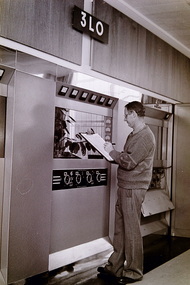
Photograph - 3LO Radio Transmitting Station Sydenham 1989 Photographs, Adam Ellwood, 7th June 1989
... These photographs were taken by the Sunshine Advocate in 1989, of Russell Rolls working at the 3LO Radio Transmitting Station, Sydenham....7499.01 - 3LO Radio Transmitting Station Sydenham 1989 Photographs (Advocate 971).JPG Russell Rolls 7499.02 - 3LO Radio Transmitting Station Sydenham 1989 Photographs (Advocate 971).JPG Russell Rolls 7499.03 - 3LO Radio Transmitting Station Sydenham 1989 Photographs (Advocate 971).JPG Russell Rolls 7499.04 - 3LO Radio Transmitting Station Sydenham 1989 Photographs (Advocate 971).JPG Russell Rolls...These photographs were taken by the Sunshine Advocate in 1989, of Russell Rolls working at the 3LO Radio Transmitting Station, Sydenham. 3LO Sydenham 7499.01 - 3LO Radio Transmitting Station Sydenham 1989 Photographs (Advocate 971).JPG Russell Rolls 7499.02 - 3LO Radio Transmitting Station Sydenham 1989 Photographs (Advocate 971).JPG Russell Rolls 7499.03 - 3LO Radio Transmitting Station Sydenham 1989 Photographs (Advocate 971).JPG Russell Rolls 7499.04 - 3LO Radio Transmitting Station Sydenham 1989 Photographs (Advocate 971).JPG Russell Rolls Collection of digitally scanned negatives Photograph 3LO Radio Transmitting Station Sydenham 1989 Photographs Adam Ellwood Sunshine Advocate ...These photographs were taken by the Sunshine Advocate in 1989, of Russell Rolls working at the 3LO Radio Transmitting Station, Sydenham.7499.01 - 3LO Radio Transmitting Station Sydenham 1989 Photographs (Advocate 971).JPG Russell Rolls 7499.02 - 3LO Radio Transmitting Station Sydenham 1989 Photographs (Advocate 971).JPG Russell Rolls 7499.03 - 3LO Radio Transmitting Station Sydenham 1989 Photographs (Advocate 971).JPG Russell Rolls 7499.04 - 3LO Radio Transmitting Station Sydenham 1989 Photographs (Advocate 971).JPG Russell Rolls3lo, sydenham -
 Sunshine and District Historical Society Incorporated
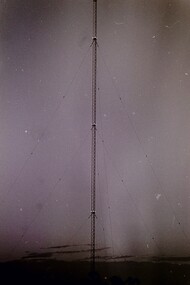
Photograph - 3AR And 3LO Radio Transmitting Station Sydenham Road Sydenham 1988 Photograph, The Sunshine Advocate, 30th September 1988
... This photograph, taken by The Advocate in 1988, features the 3AR and 3LO radio transmitting station on Sydenham Road, Sydenham. ...6862 - 3AR And 3LO Radio Transmitting Station Sydenham Road Sydenham 1988 Photograph (Advocate 700).JPG...This photograph, taken by The Advocate in 1988, features the 3AR and 3LO radio transmitting station on Sydenham Road, Sydenham. ...This photograph, taken by The Advocate in 1988, features the 3AR and 3LO radio transmitting station on Sydenham Road, Sydenham. The station's transmitter is a 705-foot (215-metre) steel lattice mast, recognised as one of the tallest radio masts in Australia. The structure was erected in 1938 when radio station 3LO relocated its transmission facilities from the Maidstone-Braybrook area to Sydenham. Although photographed in 1988, the image was later published in a 1989 Advocate article that discussed speculation surrounding the future of the site. By that time, a decision had been made to retain the landmark structure, which remains a prominent feature of the local landscape and an important reminder of the region's broadcasting history.The 3LO transmitter at Sydenham is one of the most important pieces of broadcasting infrastructure in Victoria. It is also one of the most recognised landmarks in Sydenham. The site is officially the ABC Radio Mast and Transmitter Station, Sydenham Road, Sydenham, built in 1938, and it still broadcasts 774 kHz ABC Melbourne (3LO) today6862 - 3AR And 3LO Radio Transmitting Station Sydenham Road Sydenham 1988 Photograph (Advocate 700).JPG3lo radio transmitter, 3ar radio transmitter, sydenham road, sydenham -
 Robin Boyd Foundation
Journal, Pregled, Apr-61
... Transmittal Slip 7 April 1961...Robin Boyd article "The Counter-Revolution Architecture", pp 53-60. architecture Walsh St library Transmittal Slip 7 April 1961 Pregled Journal ...Robin Boyd article "The Counter-Revolution Architecture", pp 53-60.Transmittal Slip 7 April 1961architecture, walsh st library -
 Sunshine and District Historical Society Incorporated
Administrative record - Sunshine Advocate Business Documents, 11 February, 1924 and 16 April, 1924
... Approval for Sunshine Advocate to be transmitted by post as a newspaper...Sunshine Advocate 1461.01 - Original and photocopy of Certificate of Registration of Printing Presses|1461.02 - Letter where Two single-page documents pasted together back to back one signed by Deputy Postmaster General dated 16 April 1924 Approval for Sunshine Advocate to be transmitted by post as a newspaper Administrative record Sunshine Advocate Business Documents ...1461.01 - Original and photocopy of Certificate of Registration of Printing Presses|1461.02 - Letter where Two single-page documents pasted together back to back one signed by Deputy Postmaster General dated 16 April 1924sunshine advocate -
 Sunshine and District Historical Society Incorporated
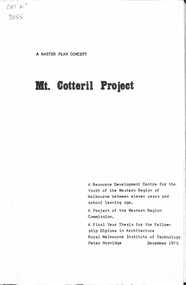
Document - Mt. Cottrell Project - A Master Plan Concept, Mr. Hornidge, 26999
... Cottrell Project|Rockbank Receiving Station|Fiskville Transmitting Station|Amalgamated Wireless (Australia) AWA...Cottrell Fiskville Transmitting Station Rockbank Receiving Station Amalgamated Wireless Mt. ...Came from the donation of the Gwenyth "Gwen" Goedecke collectionMt. Cottrell Project|Rockbank Receiving Station|Fiskville Transmitting Station|Amalgamated Wireless (Australia) AWAmt. cottrell, fiskville transmitting station, rockbank receiving station, amalgamated wireless -
 Bendigo Military Museum
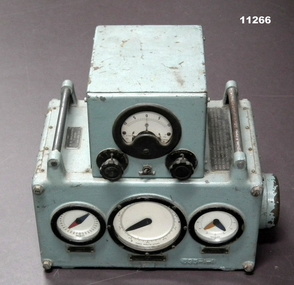
Equipment - HF TRANSMISSION TEST FIXTURE, IBS, c.1944
... ...Transmitting...Navy WW2 Transmitting FC Test Unit. Large section = Serial NR 2. ...Navy Test set for HF Transmission. A very heavy device, steel casing. The front has 4 gauges, 2 knobs and 1 toggle switch. It has 2 sections bolted together. There is a handle on top of 2 sides of the larger bottom section. The rear of the large section has a terminal block of 28 terminals. The side of the large section has a screw cap of 11 cm Ext. Under that cap is a brass tuning wheel. The rear of the smalll section has 11 terminals, two are recessed. Front dials = 1 - 10. Course training. Fine training or elevation, course elevation.FC Test Unit. Large section = Serial NR 2. Instruction charts for 'Magslip' selection. On top is list of instructions. Small section Rear = Type MA32 Misalinment aplifier Serial G52016. Mouded into front panel steel = 835-1-1. Written on large section - Donated by Colin Lelean.navy, ww2, transmitting -
 National Vietnam Veterans Museum (NVVM)
Certificate - Victorian Branch VVAA Statewide Gravesite Commemorations, Sunday 21 February, 2016, Certificate of Appreciation awarded to Eric Cross
... 'The Well-being of history lies in its telling, for unless the story is transmitted across the generations, it is lost' by Michael McKernan...National Vietnam Veterans Museum Vietnam Veterans Association of Australia 50th Anniversary - Battle of Long Tan Battle of Long Tan Certificate of Appreciation Victoria Branch VVAA Eric Cross 'The Well-being of history lies in its telling, for unless the story is transmitted across the generations, it is lost' by Michael McKernan On A4 paper from the Victorian Branch VVAA Statewide Gravesite Commemorations, Sunday 21 February, 2016, Certificate of Appreciation awarded to Eric Cross. ...On A4 paper from the Victorian Branch VVAA Statewide Gravesite Commemorations, Sunday 21 February, 2016, Certificate of Appreciation awarded to Eric Cross. At the bottom of the certificate reads 'Honour the dead, but fight like hell for the living' There are two insignias at the top of the certificate. The one of the left reads Vietnam Veterans Association of Australia and the one of the right reads 50th Anniversary - Battle of Long Tan 2016.'The Well-being of history lies in its telling, for unless the story is transmitted across the generations, it is lost' by Michael McKernannational vietnam veterans museum, vietnam veterans association of australia, 50th anniversary - battle of long tan, battle of long tan, certificate of appreciation, victoria branch vvaa, eric cross -
 4th/19th Prince of Wales's Light Horse Regiment Unit History Room
Radio BC-611-C, Galvin Mfg Corp, abt early 1940's
... VHF hand held transmitter/receiver (Walkie/Talkie) Operates in frequency range of 3500 to 6000 kcs Transmitting range of up to 1 mile...radio walkie-talkie d'atri No 6628 VHF hand held transmitter/receiver (Walkie/Talkie) Operates in frequency range of 3500 to 6000 kcs Transmitting range of up to 1 mile Radio BC-611-C Galvin Mfg Corp ...VHF hand held transmitter/receiver (Walkie/Talkie) Operates in frequency range of 3500 to 6000 kcs Transmitting range of up to 1 mileNo 6628radio, walkie-talkie, d'atri -
Frankston RSL Sub Branch
Lamp, Signalling
... These signalling lamps were used to transmit messages by switching the lamps 'on' and 'off' to represent Morse Code characters....These signalling lamps were used to transmit messages by switching the lamps 'on' and 'off' to represent Morse Code characters. ...Electrical signalling lamp and battery box used by defence forces for signalling messages when in the field. These signalling lamps were used to transmit messages by switching the lamps 'on' and 'off' to represent Morse Code characters. -
 Queenscliffe Maritime Museum
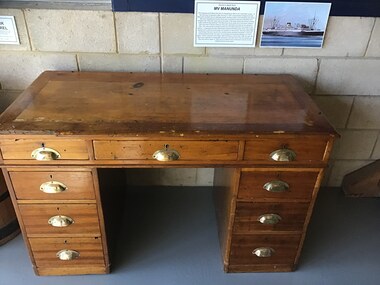
Furniture - Doctor's desk from 'Manunda'
... Several stamps on the inside of top middle draw - 'Radio Maintenance Store, Transmitting Station Essendon' and 'Paul.J.Barton, 33 Bellbird Cres, Vermont 3133'...Several stamps on the inside of top middle draw - 'Radio Maintenance Store, Transmitting Station Essendon' and 'Paul.J.Barton, 33 Bellbird Cres, Vermont 3133' Furniture Doctor's desk from 'Manunda' ...Adelaide Steamship Co. MV 'Manunda' built Glasgow 1927, commenced coastal passenger service in Australia 1929, converted to 2/1 Australian Hospital Ship (AHS) in 1940 for service to Middle East, New Guinea and New Zealand. Returned to coastal trade in 1948, sold to Japan 1956, broken up in 1957. 9 drawer timber desk with brass drawer pull handles. Several stamps on the inside of top middle draw - 'Radio Maintenance Store, Transmitting Station Essendon' and 'Paul.J.Barton, 33 Bellbird Cres, Vermont 3133''Manunda' stamped on back of deskship, furniture, manunda, doctor'sdesk, desk, steamship, ahs -
 National Communication Museum
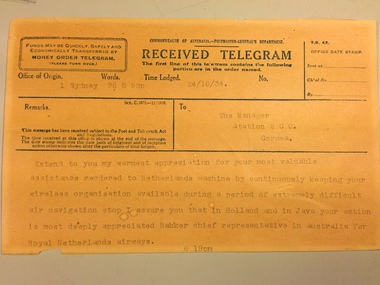
Document - Telegram, 24/10/1934
... Telegram split into sections designating details of the telegram, details of the recipient and a space for the transmitted message. A small section of paper is missing from bottom left corner....Telegram split into sections designating details of the telegram, details of the recipient and a space for the transmitted message. A small section of paper is missing from bottom left corner. ...This telegram was sent from the Royal Netherlands Airways, Sydney, to the manager of ABC Radio Station 2CO, Corowa, New South Wales. This telegram relates to the 1934 London to Melbourne Air Race. The telegram records the Royal Netherlands Airways' thanks to ABC Radio 2CO radio staff for their efforts in broadcasting an emergency message to the residents of Albury after the Dutch airliner ‘Uiver’ became lost at night in bad weather. As requested local radio listeners drove their cars to the Albury racecourse and illuminated an emergency landing ground using their vehicle headlights. This allowed the lost airliner to land safely.This item relates to the London to Melbourne Air Race of 1934, a significant event that shaped Australia's history as it proved travelling to and from Australia could be done within a reasonable time by air, thereby making the country less isolated. Up to that time Australia was three weeks away from Europe by steam ship. The Air Race was dreamt up by the Lord Mayor of Melbourne, Harold Smith, to commemorate the centenary of Victoria's statehood and was sponsored by the Melbourne chocolate manufacturer Sir MacPherson Robertson. The Royal Netherlands Airways entered a Douglas DC2 plane 'Uiver' - the largest aircraft in the race, and the only one to carry passengers as well as crew, to show that a commercial passenger service to Australia was possible. But in the last leg of the race, the Uiver lost its way in an electrical storm over the Riverina town of Albury. Several communication methods were used to land the plane safely, including the signalling of the word "Albury" in Morse code using the town's street lights. Local ABC Radio station 2CO also made a call for locals to light up a makeshift landing strip for the plane at the town's racecourse. The plane landed safely and the next morning with the help of the townspeople who pulled it out of the mud, took off and finished the race in second place. The story of the Uiver points to the importance of communication in its various forms: two-way and broadcast radio, Morse, and light signals. The survival of the Uiver is a reflection of the ingenuity of Australian communications and the solutions that can be found through the sharing of ideas of information. The landing of the Uiver was an important moment in Albury's social history, as residents participated in the rescue of the plane and its passengers, helping the Uiver to continue on its journey and finish second in the Race. When the Uiver crashed in the Syrian Desert in December 1934, Albury residents contributed to a memorial which honoured those who were killed. Beige paper telegram printed with black ink and overwritten with typewriter. Telegram split into sections designating details of the telegram, details of the recipient and a space for the transmitted message. A small section of paper is missing from bottom left corner."Extend to you my warmest appreciation for your most valuable / assistance rendered to Netherlands machine by continuously keeping your / wireless organisation available during a period of extremely difficult / air navigation stop I assure you that in Holland and in Java your action / is most deeply appreciated Bakker chief representative in Australia for / Royal Netherlands airways. / 6 18pm"telegrams, telegraphic messages, communications, radio, uiver, royal netherlands airways, albury, london to melbourne air race, morse code -
 National Vietnam Veterans Museum (NVVM)
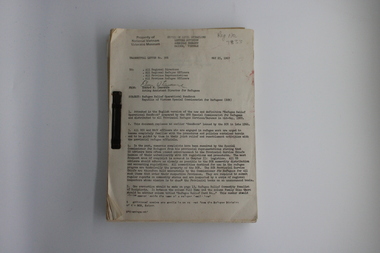
Manual - Operational handbook: Refugees, Refugee Division, Office of civil Operations, Republic of Vietnam, Refugee Relief Operational Handbook, April 1967, 1967
... First page is headed: Transmittal Letter No. 306, May 25, 1967...First page is headed: Transmittal Letter No. 306, May 25, 1967 Refugee Relief Operational Handbook, April 1967 Manual Operational handbook: Refugees Refugee Division, Office of civil Operations, Republic of Vietnam ...English translation of handbook of approximately100 pages in length printed in black, bound with a silver 2-pronged clip. Most are A4 -sized but groups of pages are folio-sized and folded up at the bottom. First page is headed: Transmittal Letter No. 306, May 25, 1967refugees, civil operations -
 Bendigo Military Museum
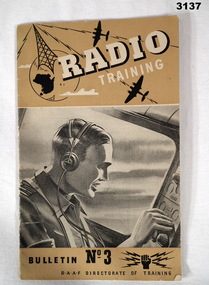
Manual - RADIO TRAINING RAAF, RAAF Directorate of Training, 1945
... Top section of front cover shows a globe of earth with a transmitting tower over it. The booklet is illustrated with cartoons & electrical circuits. ...Top section of front cover shows a globe of earth with a transmitting tower over it. The booklet is illustrated with cartoons & electrical circuits. ...Soft covered booklet, 32 pages, black & white print. Front cover has an image of an airman tuning a radio transceiver. Airman is wearing a headset & is in an aircraft in flight. Top section of front cover shows a globe of earth with a transmitting tower over it. The booklet is illustrated with cartoons & electrical circuits. books - manuals/military/eduction/education, radio, training -
 Federation University Historical Collection
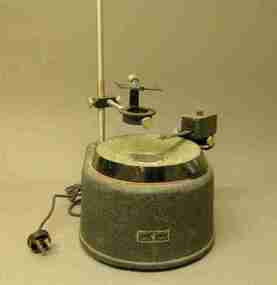
Scientific Instrument, Griffin and Tatlock Ltd, Ripple Tank and Projector, pre 1980
... An overhead lens transmits light to an adjustable mirror for viewing from the side. ...An overhead lens transmits light to an adjustable mirror for viewing from the side. ...Probably used at the Ballarat School of Mines as a teaching aid to demonstrate surface wave propagation in liquids.A hollow cast iron base contains electrical components which provide upward illumination of variable frequency. Cover is shaped lile a soup plate, with a 6.5cm diameter lens in the centre. An overhead lens transmits light to an adjustable mirror for viewing from the side. Complet with 240 volt AC lead and plug.scientific instrument -
 University of Melbourne, Burnley Campus Archives
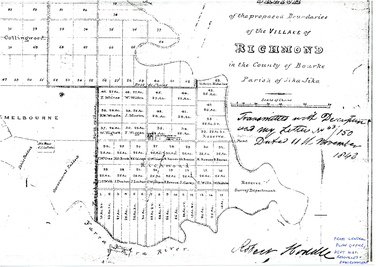
Plan - Photocopy, Sketch of the Proposed Boundaries of the Village of Richmond, 1843
... Handwritten on original: "Transmitted with Description and my letter No 43/150 Dated 11th November 1843 Robert Hoddle." ...Handwritten on original: "Transmitted with Description and my letter No 43/150 Dated 11th November 1843 Robert Hoddle." ...Sketch of the proposed boundaries of the village of Richmond in the County of Bourke Parish of Jika-Jika. Handwritten on original: "Transmitted with Description and my letter No 43/150 Dated 11th November 1843 Robert Hoddle." Shows Burnley Gardens site as "Reserve. Survey Department." original in Central Plan Office, Department of Natural Resources and EnvironmentIn ink: From Central Plan Office Dept. Nat. Resources & Environmentrichmond, jika-jika, survey department, yarra river, robert hoddle -
 Orbost & District Historical Society
chain drive sprocket, first half 20th century
... Sprockets are used in machinery either to transmit rotary motion between two shafts where gears are unsuitable or to impart linear motion. ...Sprockets are used in machinery either to transmit rotary motion between two shafts where gears are unsuitable or to impart linear motion. ...Sprockets are used in machinery either to transmit rotary motion between two shafts where gears are unsuitable or to impart linear motion. This one was probably used on farm machinery.A black painted steel chain drive sprocket. It has six triangular shaped holes around a circular centre hole. The rim has teeth / cogs that mesh with a chain.machinery chain-drive-sprocket -
 Dandenong/Cranbourne RSL Sub Branch
Equipment - Heliograph. MkV, Circa 1914
... http://www.prc68.com/I/MkVHeliograph.shtml Heliograph is a wireless solar telegraphic instrument which uses adjustable mirrors, reflecting the sunlight, creating flashes that transmit messages, typically via morse code....http://www.prc68.com/I/MkVHeliograph.shtml Heliograph is a wireless solar telegraphic instrument which uses adjustable mirrors, reflecting the sunlight, creating flashes that transmit messages, typically via morse code. ...http://www.prc68.com/I/MkVHeliograph.shtml Heliograph is a wireless solar telegraphic instrument which uses adjustable mirrors, reflecting the sunlight, creating flashes that transmit messages, typically via morse code.Brass heliograph.Helios. MkV . No:3075. 1914. Made by Siemens Brothers. -
 National Communication Museum
Tool - Morse Inker Tape
... At this time the transmitted message was received on paper tape and later transcribed onto a telegram form for delivery. .... / GOVERNMENT HOUSE, / PERTH, June 21, 1869 / Transmitted 11 am / J.C.F."|.2: "Instrument Register / of the First / Telegraphic Message / in / Western Australia"|.3: "The first Telegraph Pole / in / WESTERN AUSTRALIA / was erected by / The Hon. ...At this time the transmitted message was received on paper tape and later transcribed onto a telegram form for delivery. ...This tape is from the first telegram ever sent in Western Australia. This important event occurred on 21 June 1869. At this time the transmitted message was received on paper tape and later transcribed onto a telegram form for delivery. The original tape was presented to the Honourable Frederick Palgrave Barlee, Colonial Secretary of Western Australia, as a souvenir. "FPB" appears on an engraved shield on the lid. James Coats Fleming, the first telegraphist and later Superintendent of Telegraphs, sent the telegram. During 1875, Colonial Secretary Barlee transferred from Perth to Belize and then to Trinidad where he died in 1884. The fate of the case and spool, souvenir of that first telegram, was unknown. In July 1940, the WA Agent-General in London advised the Premier's Department in Western Australia that a Mrs EW Hillyer of Hertfordshire had the spool and case and was willing to sell it for ten guineas ($21). The Postmaster General's Department agree to the purchase and it duly arrived by registered mail. As a communications museum was planned in Melbourne, it was sent there to be included in the collection. Nothing more was heard until early 1980s when the relic arrived at the Post and Telecommunication museum in Perth. The case had been found in an old Melbourne strongroom where it had apparently been placed for safe-keeping and then forgotten. Initial attempts to decode the message on the tape were unsuccessful. Eventually, it was discovered that the Western Australian Telegraph Company, responsible for that first transmission, had devised its own code. A copy was obtained from the Battye Library and the message deciphered.This Morse tape is of historic significance as the first telegram ever sent in Western Australia. The occasion was momentous as the transition point between isolation and ease of connection for business and personal communications. The case is of aesthetic interest for the craftsmanship involved in the engraved text. Further, the tape has research potential owing to the unique information contained within this tape; that is, the code of the Western Australian Telegraph Company. This tape, may in turn be used to decode further messages sent by the Western Australian Telegraph Company. As the first telegraph message sent in Western Australia, this tape is rare. Despite a tumultuous journey from 1869 to the early 1980s, the tape's ceremonial wooden case provides provenance information which supports the tape's historic importance.Small wooden case (.1) holding a length of morse tape (.2) which was the first telegram ever sent in Western Australia . Wound onto a mother of pearl reel (.3). Accompanying signs and decoded message (.4,.5)..1 engraved on a metal shield shaped plaque on the lid: "WESTERN AUSTRALIAN / TELEGRAPHS / FPB" Inside: 'TRANSLATION OF REGISTER / TO THE CHAIRMAN OF FREMANTLE TOWN TRUST / His Excellency Colonel Bruce heartily congratulates the / inhabitants of Fremantle on this annihilation of distance / between the Port and the Capital, and he requests that this, / the first message, may be made publicly known. / GOVERNMENT HOUSE, / PERTH, June 21, 1869 / Transmitted 11 am / J.C.F."|.2: "Instrument Register / of the First / Telegraphic Message / in / Western Australia"|.3: "The first Telegraph Pole / in / WESTERN AUSTRALIA / was erected by / The Hon. Frederick P. Barlee / Colonial Secretary / on 19th Febr. 1869"telegram, commemorative item, morse inker, morse tape, morse code, code, postmaster-general's department -
 Kiewa Valley Historical Society
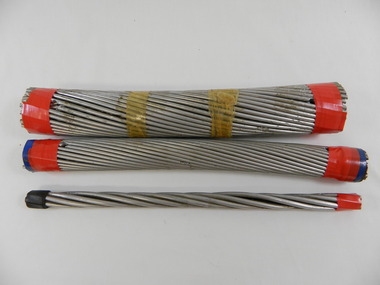
S.E.C.V. Transmission Cables x3
... 3 transmission cables of different width used for transmitting different amounts of power on different size power lines.The thinnest cable consists of a centre piece of wire covered by a layer of twisted wires. ...The thickest cable has a plastic strip with 330.000 Volt Cable inscribed on it. 3 transmission cables of different width used for transmitting different amounts of power on different size power lines.The thinnest cable consists of a centre piece of wire covered by a layer of twisted wires. ...The State Electricity Commission of Victoria constructed the Kiewa Hydro Electric scheme from the 1930's to 1960's during which time power cables were made to carry power from the Power stations to the switch yards and beyond to the towns and houses.These sample power cables indicate the types of power lines used in the Kiewa Hydro Electric Scheme and the amount of voltage that they carry.3 transmission cables of different width used for transmitting different amounts of power on different size power lines.The thinnest cable consists of a centre piece of wire covered by a layer of twisted wires. The middle sized cable has 4 layers of twisted wires around the centre piece and the thickest cable has 5 layers of twisted wires around the centre piece.The thickest cable has a plastic strip with 330.000 Volt Cable inscribed on it.state electricity commission of victoria. power lines. cables. kiewa hydro electric scheme. electricity. -
 National Communication Museum
Photograph (item), The Telegraph, James Melrose with aeroplane My Hildegarde, 16 October 1934
... This was the first press photograph transmitted by radio from England to Australia. ...This was the first press photograph transmitted by radio from England to Australia. ...This was the first press photograph transmitted by radio from England to Australia. On 16 October 1934, South Australian aviator, C J Melrose, was pictured beside his plane at the Mildenhall aerodrome, England, preparing for the start of the Centenary Air Race. Within hours of capture, the image was transmitted from London to Melbourne and then sent via picturegram to Sydney’s press, the greatest distance a photograph had been transmitted over radio. Wirephotos, as they are commonly called, are produced through electrical pulses which travel along telephone or telegraph wires, or radio waves. Like the transmission of Morse dots and dashes, the technology communicates the light and dark portions of an image, to be recorded on a negative or photographic paper at the receiver’s end. Previously, photographs of an event appeared several days after the fact; wirephoto technology enabled visual communication with relative speed. Our consumption and expectation of the immediacy of news and communication continued to grow, an expectation that forms the basis of time-based social media activities such as Snapchat or Facebook and Instagram stories.london to melbourne air race, wirephoto, picturegram, uiver, james melrose -
 Parks Victoria - Maldon State Battery
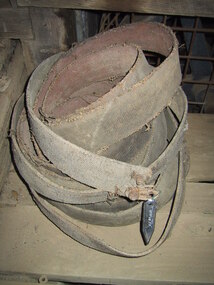
Belt, canvas
... Flat belts were widely used in line shafting to transmit power in mining applications. The flat belt is a simple system of power transmission that can deliver high power at high speeds. ...Flat belts were widely used in line shafting to transmit power in mining applications. The flat belt is a simple system of power transmission that can deliver high power at high speeds. ...Flat belts were widely used in line shafting to transmit power in mining applications. The flat belt is a simple system of power transmission that can deliver high power at high speeds. The belts were used with pulley wheels.Long canvas belting with frayed edges, wrapped up in coil. -
 Warrnambool and District Historical Society Inc.
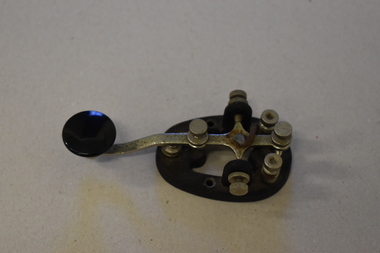
Morse code key, Mid 20th century
... Morse Code is a method of transmitting text information using short and long signals (‘dots and dashes’). ...Morse Code is a method of transmitting text information using short and long signals (‘dots and dashes’). ...This is a Morse Code key. Morse Code is a method of transmitting text information using short and long signals (‘dots and dashes’). It is named after Samuel Morse, the inventor of the telegraph and was developed in the 1860s. It was used extensively in the 1890s for early radio communication before it was possible to transmit voice and continued to be used in the 20th century along with voice transmission , especially by amateur radio persons. It was also used in military and naval communication but not so much today. It is believed that this Morse Code key belonged to Ted Salamy, a jeweller and the first person in Warrnambool to hold an amateur radio licence (1924 Call Sign A3AJ, the 35th licence issued in Victoria).This Morse Code key is of interest as an object more used in the past, especially by amateur radio persons. It is believed to have been the property of Ted Salamy, the first person in Warrnambool to hold an amateur radio licence. This is a metal Morse Code key with an oval metal base. It has three screws inserted in the base and two more screws attached to the sides of the base. There is a key lever on top of the base and this is adjustable. The hinge on which the key lever sits is missing. The lever has a round black knob at one end. ‘Made in U.S.A. H15.682’ Wm.M. Nye Co Inc. Bellevue W.A.’ morse code key, ted salamy,, history of warrnambool -
Clunes Museum
Tool - PULLEY
... The pulley is a wheel with a grooved rim inside a wooden frame for carrying a rope, turning in the frame and serving to change the direction of, or transmit power, as in pulling at one end of the line to raise a weight or object at the other end....The pulley is a wheel with a grooved rim inside a wooden frame for carrying a rope, turning in the frame and serving to change the direction of, or transmit power, as in pulling at one end of the line to raise a weight or object at the other end. ...This wooden pulley was used in mineshafts. The pulley is a wheel with a grooved rim inside a wooden frame for carrying a rope, turning in the frame and serving to change the direction of, or transmit power, as in pulling at one end of the line to raise a weight or object at the other end.USED IN UNDERGROWN MINING ON THE GOLD FIELDSWooden Pulley with ropes attached. Pulley has rope bound round outside to form a metal lined loop to attach to hook above and one lead reinforced loop to attach load to be lowered. The grooved wheel in centre of pulley houses the rope or to attach the load for transport.underground mining, mining tool, wooden pulley -
Emerald Museum & Nobelius Heritage Park
Machine - Kellogg Masterphone 1000, Kellogg, 1947-1953
... For this model, the user had to first turn the crank which generated a signal that was transmitted to the operator. The operator would then connect the call to the intended recipient by manually plugging the appropriate cables into the correct socket. ...For this model, the user had to first turn the crank which generated a signal that was transmitted to the operator. The operator would then connect the call to the intended recipient by manually plugging the appropriate cables into the correct socket. ...This phone and crank box is a reminder of a time when there was no automatic connection when making a telephone call. Connection had to be mediated by an operator.A non-dial phone connected to a crank box. Manufactured by Kellogg in the period 1947-1953 - the first phone made by Kellogg to have interchangeable parts for dial and non-dial models. For this model, the user had to first turn the crank which generated a signal that was transmitted to the operator. The operator would then connect the call to the intended recipient by manually plugging the appropriate cables into the correct socket. The recipient could then hear the caller's voice through the speaker. Note , handset incorrectly nnumbeed VEMU1591kellogg masterphone 1000, kellogg, crank box, telephone operator, usa -
 City of Moorabbin Historical Society (Operating the Box Cottage Museum)
Telegram Envelope, Stamped - Bentleigh S. E. VIC. 28 May 1946, 1946
... The last telegram was transmitted in Australia in 1983. Social telegrams were encouraged and special pictorial forms and envelopes were designed. ...The last telegram was transmitted in Australia in 1983. Social telegrams were encouraged and special pictorial forms and envelopes were designed. ...The telegraphs were originally a separate department in NSW and became part of the post office in 1893. After federation the use of telegrams increased until it peaked in the 1940s. The last telegram was transmitted in Australia in 1983. Social telegrams were encouraged and special pictorial forms and envelopes were designed. A special form and envelope in purple was used when conveying condolence details during World War 2.Brown paper envelope with window to show address TELEGRAMpost office, bentleigh, telegram -
 Geoffrey Kaye Museum of Anaesthetic History
Equipment - Sphygmograph, c. 1881 - 1901
... It was strapped tot he wrist with a metal strip that moved a stylus. This transmitted a record of the pulse onto smoked paper, creating a record of blood pressure....It was strapped tot he wrist with a metal strip that moved a stylus. This transmitted a record of the pulse onto smoked paper, creating a record of blood pressure. ...They sphygmograph was devised as an improved device to measure blood pressure, and was a marked improvement on the first machine of its type. The sphygmomanometer was considered cumbersome and the Dudgeon sphygmograph was smaller, and once placed into its box, could be carried in a pocket. The Dudgeon sphygmograph was introduced in 1881. It was strapped tot he wrist with a metal strip that moved a stylus. This transmitted a record of the pulse onto smoked paper, creating a record of blood pressure.The sphygmograph is housed in a purple-lined, leather bound case with a metal hinge and clasp located halfway up the case. It is constructed from chrome and comprises several moving parts including wires, knobs and handles. A black fabric strap with a metal attachment is also present, used to attach to the patient's wrist.blood pressure, dudgeon, pocket-sized, portable -
 National Communication Museum
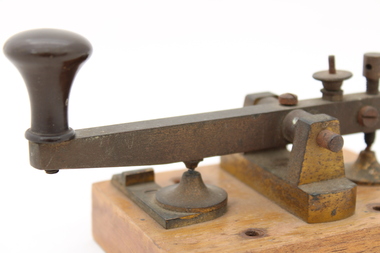
Equipment - Morse key, Postmaster-General's Department, circa 1920
... Device used to transmit telegraphic messages in Morse code through the manipulation of electric signals. ...The motion of the key acts to complete an electrical circuit between the sender and receiver, producing a short pulse 'dot' or longer 'dash,' the space between the code indicates a broken current or wave. telegraph telegraphist morse code mechanisation Printed ink on base: "PMG" Device used to transmit telegraphic messages in Morse code through the manipulation of electric signals. ...A telegraph or Morse key, sends a series of electrical signals down a telegraph line or via radio frequencies; the signals are interpreted as Morse code, a binary form of language constructed of 'dots and dashes', combinations of which correspond to letters of the alphabet. The motion of the key acts to complete an electrical circuit between the sender and receiver, producing a short pulse 'dot' or longer 'dash,' the space between the code indicates a broken current or wave.Device used to transmit telegraphic messages in Morse code through the manipulation of electric signals. The metal 'key' sits in a central bracket on which it moves up and down aided by a spring, controlled by an operator pushing the black Bakelite knob on the protruding end of the device. The motion presses the key onto a circular metal disc, completing the circuit and sending an electrical pulse to the receiver. The apparatus is secured to a wooden base with wires attached to the terminals; a cut out section of the base suggests wires may have entered through this area, attaching to a battery.Printed ink on base: "PMG"telegraph, telegraphist, morse code, mechanisation -
Emerald Museum & Nobelius Heritage Park
Machine - Potato Digger, Hoover, c.1900s
... Two large driving wheels were equipped with lugs and provided power which was transmitted to the elevator by means of gears and shafts. ...Two large driving wheels were equipped with lugs and provided power which was transmitted to the elevator by means of gears and shafts. ...This American-designed digger raised potatoes from the ground to be manually picked up by workers. It was used by Emerald residents in the local area and was owned by the Latter family from the early to the mid-20th century. Potato growing was an important industry in the Emerald area as a source of income for farmers and recent migrants, particularly between the 1930s and 1970s.This potato digger is a signifier of the importance of agricultural development in the development of the Emerald area. This is the only known example of the Hoover digger in Victoria.A horse-drawn potato raising machine which passed a share under the row of tubers, followed by both the earth and the potatoes being carried onto a revolving apron with crossbars arranged up and down alternately. The apron revolved, or agitated achieving a sifting action by means of elliptical sprockets. The earth passed through the bars and fell back into the furrow already dug and the tubers were passed over the back and deposited in a row on the loose earth. Two large driving wheels were equipped with lugs and provided power which was transmitted to the elevator by means of gears and shafts. Embossed on side: 'MODEL 384 D802L 21 PATENTED SEPT 11 1906'hoover, potato digger, latter, emerald -
 Sunshine and District Historical Society Incorporated
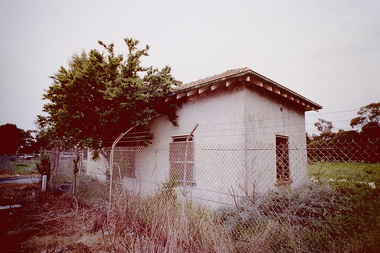
Photograph - 3LO Transmitter Station Building Ashley Street Maidstone 1999 Photograph, Larran Reed, 13th October 1999
... This photograph, taken by The Advocate in 1999, features one of the buildings of the former 3LO Radio Transmitting Station located on Ashley Street, Maidstone. ...This photograph, taken by The Advocate in 1999, features one of the buildings of the former 3LO Radio Transmitting Station located on Ashley Street, Maidstone. ...This photograph, taken by The Advocate in 1999, features one of the buildings of the former 3LO Radio Transmitting Station located on Ashley Street, Maidstone. Radio station 3LO commenced broadcasting on 13 October 1924, with its first transmission featuring an outside broadcast of the opera La Bohème from Melbourne's His Majesty's Theatre, including a performance by Dame Nellie Melba. The station was named after London's famous radio station, 2LO. The transmission facilities were established at the Ashley Street site in the early 1920s. The station originally operated from a powerful transmitting tower and associated equipment buildings located near the Maribyrnong River. The site was chosen because radio transmission technology of the period required transmitters to be located close to their audience. In 1932, when the Australian Broadcasting Commission was established, control of 3LO passed to the national broadcaster, making the station one of the foundations of the ABC radio network. In 1938, 3LO's transmission operations were moved from Maidstone to a new site at Sydenham (then often described as St Albans or Delahey), where broadcasting infrastructure for ABC Melbourne remains today.The photograph documents a surviving element of this historically significant site and provides a record of its appearance at the end of the twentieth century.7729 - 3LO Transmitter Station Building Ashley Street Maidstone 1999 Photograph (Advocate 559.2).JPG3lo, ashley street, maidstone -
 National Wool Museum
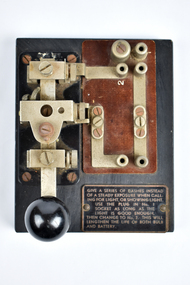
Machine - Morse Code Machine
... A telegraph key or Morse key is a specialised electrical switch used by a trained operator to transmit text messages in Morse code in a telegraphy system. ...A telegraph key or Morse key is a specialised electrical switch used by a trained operator to transmit text messages in Morse code in a telegraphy system. ...A telegraph key or Morse key is a specialised electrical switch used by a trained operator to transmit text messages in Morse code in a telegraphy system. Keys are used in all forms of electrical telegraph systems, including landline (also called wire) telegraphy and radio (also called wireless) telegraphy. An operator uses the telegraph key to send electrical pulses of two different lengths: short pulses, called dots or dits, and longer pulses, called dashes or dahs. These pulses encode the letters and other characters that spell out the message.Metal device with black knob mounted on a wooden base. A plaque with printed text is also attached to the base.Printed: GIVE A SERIES OF DASHES INSTEAD / OF A STEADY EXPOSURE WHEN CALL- / ING FOR LIGHT, OR SHOWING LIGHT. / USE THE PLUG IN No. 1 / SOCKET AS LONG AS THE / LIGHT IS GOOD ENOUGH. / THEN CHANGE TO No. 2 THIS WILL / LENGTHEN THE LIFE OF BOTH BULB / AND BATTERY.morse code, communication, telegraph key, messages, pulses
