
Showing 20 items matching "two postal deliveries"
-
 Melbourne Tram Museum
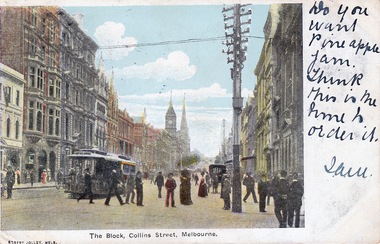
Postcard - The Block, Collins St, Robert Jolley, 1904
... ...two postal deliveries...In the years before telephones, there were two postal deliveries each working day and postcards were a cheap and preferred method of communicating simple messages to friends and family around Melbourne. ...In the years before telephones, there were two postal deliveries each working day and postcards were a cheap and preferred method of communicating simple messages to friends and family around Melbourne. ...This postcard shows a cable tram and horse drawn vehicle, many pedestrians on the footpaths and roadway, buildings with gothic style facades and the Town Hall in the distance. In the years before telephones, there were two postal deliveries each working day and postcards were a cheap and preferred method of communicating simple messages to friends and family around Melbourne. Yields information about communications in early MelbourneHand painted coloured postcard with title and message on front and addressee and stamp on rear.On front in print: 'The Block, Collins St, Melbourne, Robert Jolley Melb.'; on front in pen: 'Do you want pineapple jam. Think this is the time to order it ????'; on rear 'Stamp postmarked 18/1/04; addressee: 'Miss Laidlaw, Newlands, Apsley' pedestrians, cable tram, horse drawn vehicle, gothic style facades, town hall, method of communicating simple messages, two postal deliveries -
 Flagstaff Hill Maritime Museum and Village
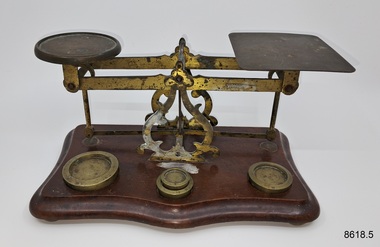
Equipment - Postal Scales, Unknown
... postal clerks' ability to count the number of sheets in a letter and an alternative method of determining the postage had to be found. Overweight mailings had previously required the items to be weighed but with the introduction of the Uniform Penny Postage act of 1839, the public could mail a letter not exceeding a half-ounce in weight within the United Kingdom for one penny if prepaid, or two pence if paid on delivery. ...postal clerks' ability to count the number of sheets in a letter and an alternative method of determining the postage had to be found. Overweight mailings had previously required the items to be weighed but with the introduction of the Uniform Penny Postage act of 1839, the public could mail a letter not exceeding a half-ounce in weight within the United Kingdom for one penny if prepaid, or two pence if paid on delivery. ...Before 1851, letters sent through the mail were charged by the number of sheets it contained and the distance it travelled. For example, a letter consisting of one sheet of paper was charged the single rate; a double letter, that is two sheets, was charged double the single rate, a treble letter, was charged three times the single rate, and so on. In other words, each additional sheet of paper increased the charge by one rate. In Great Britain. Sealing a letter in an envelope effectively put an end to postal clerks' ability to count the number of sheets in a letter and an alternative method of determining the postage had to be found. Overweight mailings had previously required the items to be weighed but with the introduction of the Uniform Penny Postage act of 1839, the public could mail a letter not exceeding a half-ounce in weight within the United Kingdom for one penny if prepaid, or two pence if paid on delivery. These postal scales belonged to Dr.William Roy Angus, Surgeon and Oculist. They were donated to Flagstaff Hill Maritime Village by his daughter, Bernice McDade. They are part of the “W.R. Angus Collection” that includes historical medical equipment, surgical instruments and material once belonging to Dr Edward Ryan and Dr Thomas Francis Ryan, (both of Nhill, Victoria) as well as Dr Angus’ own belongings. The Collection’s history spans the medical practices of the two Doctors Ryan, from 1885-1926 plus that of Dr Angus, up until 1969. ABOUT THE “W.R.ANGUS COLLECTION” Doctor William Roy Angus M.B., B.S., Adel., 1923, F.R.C.S. Edin.,1928 (also known as Dr Roy Angus) was born in Murrumbeena, Victoria in 1901 and lived until 1970. He qualified as a doctor in 1923 at University of Adelaide, was Resident Medical Officer at the Royal Adelaide Hospital in 1924 and for a period was house surgeon to Sir (then Mr.) Henry Simpson Newland. Dr Angus was briefly an Assistant to Dr Riddell of Kapunda, then commenced private practice at Curramulka, Yorke Peninsula, SA, where he was physician, surgeon and chemist. In 1926, he was appointed as new Medical Assistant to Dr Thomas Francis Ryan (T.F. Ryan, or Tom), in Nhill, Victoria, where his experiences included radiology and pharmacy. In 1927 he was Acting House Surgeon in Dr Tom Ryan’s absence. Dr Angus had become engaged to Gladys Forsyth and they decided he further his studies overseas in the UK in 1927. He studied at London University College Hospital and at Edinburgh Royal Infirmary and in 1928, was awarded FRCS (Fellow from the Royal College of Surgeons), Edinburgh. He worked his passage back to Australia as a Ship’s Surgeon on the on the Australian Commonwealth Line’s T.S.S. Largs Bay. Dr Angus married Gladys in 1929, in Ballarat. (They went on to have one son (Graham 1932, born in SA) and two daughters (Helen (died 12/07/1996) and Berenice (Berry), both born at Mira, Nhill ) According to Berry, her mother Gladys made a lot of their clothes. She was very talented and did some lovely embroidery including lingerie for her trousseau and beautifully handmade baby clothes. Dr Angus was a ‘flying doctor’ for the A.I.M. (Australian Inland Ministry) Aerial Medical Service in 1928 . Its first station was in the remote town of Oodnadatta, where Dr Angus was stationed. He was locum tenens there on North-South Railway at 21 Mile Camp. He took up this ‘flying doctor’ position in response to a call from Dr John Flynn; the organisation was later known as the Flying Doctor Service, then the Royal Flying Doctor Service. A lot of his work during this time involved dental surgery also. Between 1928-1932 he was surgeon at the Curramulka Hospital, Yorke Peninsula, South Australia. In 1933 Dr Angus returned to Nhill and purchased a share of the Nelson Street practice and Mira hospital (a 2 bed ward at the Nelson Street Practice) from Dr Les Middleton one of the Middleton Brothers, the current owners of what previously once Dr Tom Ryan’s practice. Dr Tom and his brother had worked as surgeons included eye surgery. Dr Tom Ryan performed many of his operations in the Mira private hospital on his premises. He had been House Surgeon at the Nhill Hospital 1902-1926. Dr Tom Ryan had one of the only two pieces of radiology equipment in Victoria during his practicing years – The Royal Melbourne Hospital had the other one. Over the years Dr Tom Ryan had gradually set up what was effectively a training school for country general-practitioner-surgeons. Each patient was carefully examined, including using the X-ray machine, and any surgery was discussed and planned with Dr Ryan’s assistants several days in advance. Dr Angus gained experience in using the X-ray machine there during his time as assistant to Dr Ryan. When Dr Angus bought into the Nelson Street premises in Nhill he was also appointed as the Nhill Hospital’s Honorary House Surgeon 1933-1938. His practitioner’s plate from his Nhill surgery is now mounted on the doorway to the Port Medical Office at Flagstaff Hill Maritime Village, Warrnambool. When Dr Angus took up practice in the Dr Edward and Dr Tom Ryan’s old premises he obtained their extensive collection of historical medical equipment and materials spanning 1884-1926. A large part of this collection is now on display at the Port Medical Office at Flagstaff Hill Maritime Village in Warrnambool. In 1939 Dr Angus and his family moved to Warrnambool where he purchased “Birchwood,” the 1852 home and medical practice of Dr John Hunter Henderson, at 214 Koroit Street. (This property was sold in1965 to the State Government and is now the site of the Warrnambool Police Station. and an ALDI sore is on the land that was once their tennis court). The Angus family was able to afford gardeners, cooks and maids; their home was a popular place for visiting dignitaries to stay whilst visiting Warrnambool. Dr Angus had his own silk worm farm at home in a Mulberry tree. His young daughter used his centrifuge for spinning the silk. Dr Angus was appointed on a part-time basis as Port Medical Officer (Health Officer) in Warrnambool and held this position until the 1940’s when the government no longer required the service of a Port Medical Officer in Warrnambool; he was thus Warrnambool’s last serving Port Medical Officer. (Masters of immigrant ships arriving in port reported incidents of diseases, illness and death and the Port Medical Officer made a decision on whether the ship required Quarantine and for how long, in this way preventing contagious illness from spreading from new immigrants to the residents already in the colony.) Dr Angus was a member of the Australian Medical Association, for 35 years and surgeon at the Warrnambool Base Hospital 1939-1942, He served as a Surgeon Captain during WWII1942-45, in Ballarat, Victoria, and in Bonegilla, N.S.W., completing his service just before the end of the war due to suffering from a heart attack. During his convalescence he carved an intricate and ‘most artistic’ chess set from the material that dentures were made from. He then studied ophthalmology at the Royal Melbourne Eye and Ear Hospital and created cosmetically superior artificial eyes by pioneering using the intrascleral cartilage. Angus received accolades from the Ophthalmological Society of Australasia for this work. He returned to Warrnambool to commence practice as an ophthalmologist, pioneering in artificial eye improvements. He was Honorary Consultant Ophthalmologist to Warrnambool Base Hospital for 31 years. He made monthly visits to Portland as a visiting surgeon, to perform eye surgery. He represented the Victorian South-West subdivision of the Australian Medical Association as its secretary between 1949 and 1956 and as chairman from 1956 to 1958. In 1968 Dr Angus was elected member of Spain’s Barraquer Institute of Barcelona after his research work in Intrasclearal cartilage grafting, becoming one of the few Australian ophthalmologists to receive this honour, and in the following year presented his final paper on Living Intrasclearal Cartilage Implants at the Inaugural Meeting of the Australian College of Ophthalmologists in Melbourne In his personal life Dr Angus was a Presbyterian and treated Sunday as a Sabbath, a day of rest. He would visit 3 or 4 country patients on a Sunday, taking his children along ‘for the ride’ and to visit with him. Sunday evenings he would play the pianola and sing Scottish songs to his family. One of Dr Angus’ patients was Margaret MacKenzie, author of a book on local shipwrecks that she’d seen as an eye witness from the late 1880’s in Peterborough, Victoria. In the early 1950’s Dr Angus, painted a picture of a shipwreck for the cover jacket of Margaret’s book, Shipwrecks and More Shipwrecks. She was blind in later life and her daughter wrote the actual book for her. Dr Angus and his wife Gladys were very involved in Warrnambool’s society with a strong interest in civic affairs. He had an interest in people and the community They were both involved in the creation of Flagstaff Hill, including the layout of the gardens. After his death (28th March 1970) his family requested his practitioner’s plate, medical instruments and some personal belongings be displayed in the Port Medical Office surgery at Flagstaff Hill Maritime Village, and be called the “W. R. Angus Collection”. At about the same time that the adhesive postage stamps and envelopes made their appearance, postal administrations began to experiment with strategically placed street letter boxes, known as pillar boxes because of their round, pillar-like shape, that permitted the public to mail letters from a place other than from a post office. For all these reasons, the use of postal scales became the nucleus of every post office. Scales had been in use since ancient Egyptian times so their use for everyday commerce was not unusual in the 1800s. What was new in 1840 was their ubiquitous use throughout the postal system. No post office could function effectively without one. Although the earliest scales used in post offices did not differ markedly from the ones in general use as time went on they were adapted specifically for postal use. For example, a paper sleeve, also known as a weight sticker, was attached that showed the applicable rate of postage for any given weight. This innovation was quite a time saver as postal clerks no longer needed to weigh the item first and then refer to a separate chart to determine the required postage for that particular weight.The W.R. Angus Collection is significant for still being located at the site it is connected with, Doctor Angus being the last Port Medical Officer in Warrnambool. The collection of medical instruments and other items and equipment is culturally significant, being an historical example of medicine from late 19th to mid-20th century. Dr Angus assisted Dr Tom Ryan, a pioneer in the use of X-rays and in ocular surgery.Postal scales with weights,. Balance scale has brass fittings and is mounted on a rectangular wooden stand, with depressions for brass weights. Weights measure 1oz, 2oz, 4oz and 8oz.'Warranteed Accurate'flagstaff hill maritime museum and village, great ocean road, shipwreck coast, scales, post -
 Flagstaff Hill Maritime Museum and Village
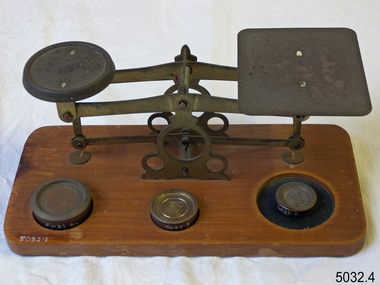
Instrument - Letter Scale, Late 19th Century
... postal clerks' ability to count the number of sheets in a letter and an alternative method of determining the postage had to be found. Overweight mailings had previously required the items to be weighed but with the introduction of the Uniform Penny Postage act of 1839, the public could mail a letter not exceeding a half-ounce in weight within the United Kingdom for one penny if prepaid, or two pence if paid on delivery. ...postal clerks' ability to count the number of sheets in a letter and an alternative method of determining the postage had to be found. Overweight mailings had previously required the items to be weighed but with the introduction of the Uniform Penny Postage act of 1839, the public could mail a letter not exceeding a half-ounce in weight within the United Kingdom for one penny if prepaid, or two pence if paid on delivery. ...Before 1851, letters sent through the mail were charged by the number of sheets it contained and the distance it travelled. For example, a letter consisting of one sheet of paper was charged the single rate; a double letter, that is two sheets, was charged double the single rate, a treble letter, was charged three times the single rate, and so on. In other words, each additional sheet of paper increased the charge by one rate. In Great Britain. Sealing a letter in an envelope effectively put an end to postal clerks' ability to count the number of sheets in a letter and an alternative method of determining the postage had to be found. Overweight mailings had previously required the items to be weighed but with the introduction of the Uniform Penny Postage act of 1839, the public could mail a letter not exceeding a half-ounce in weight within the United Kingdom for one penny if prepaid, or two pence if paid on delivery. At about the same time that the adhesive postage stamps and envelopes made their appearance, postal administrations began to experiment with strategically placed street letter boxes, known as pillar boxes because of their round, pillar-like shape, that permitted the public to mail letters from a place other than from a post office. For all these reasons, the use of postal scales became the nucleus of every post office. Scales had been in use since ancient Egyptian times so their use for everyday commerce was not unusual in the 1800s. What was new in 1840 was their ubiquitous use throughout the postal system. No post office could function effectively without one. Although the earliest scales used in post offices did not differ markedly from the ones in general use as time went on they were adapted specifically for postal use. For example, a paper sleeve, also known as a weight sticker, was attached that showed the applicable rate of postage for any given weight. This innovation was quite a time saver as postal clerks no longer needed to weigh the item first and then refer to a separate chart to determine the required postage for that particular weight. Victorian postal scales were used in village Post offices in the late 19th century, of which there are many examples today for sale. No maker can be attributed to the manufacture of the item. Postal scales with weights,. Balance scale has brass fittings and is mounted on a rectangular wooden stand, with depressions for brass weights; which measure 1/2oz, 1oz, 2oz, "Young Aton REL., C.N.0.9."flagstaff hill, warrnambool, shipwrecked-coast, flagstaff-hill, flagstaff-hill-maritime-museum, maritime-museum, shipwreck-coast, flagstaff-hill-maritime-village, scales and weights, balancing scales, postal scales, letter scale -
 Eltham District Historical Society Inc
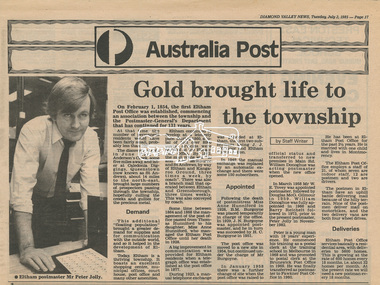
Newsclipping, Diamond Valley News, Gold brought life to the township, Diamond Valley News, 2 July 1985, p17, 2 Jul 1985
... postal clerk at the Brunswick Post Office in 1969. He was finally transferred as postmaster to Fawkner Post Office in 1980. He has been at Eltham Post Office for the past 2½ years. He is married with one child and lives in Montmorency. The Eltham Post Office employs a staff of 21, of whom seven are indoor staff, 12 are postmen and two are drivers. The postmen in Eltham have an uphill battle delivering mail because of the hilly terrain. Nine of the postmen deliver mail on motorbikes, and the two delivery...postal clerk at the Brunswick Post Office in 1969. He was finally transferred as postmaster to Fawkner Post Office in 1980. He has been at Eltham Post Office for the past 2½ years. He is married with one child and lives in Montmorency. The Eltham Post Office employs a staff of 21, of whom seven are indoor staff, 12 are postmen and two are drivers. The postmen in Eltham have an uphill battle delivering mail because of the hilly terrain. Nine of the postmen deliver mail on motorbikes, and the two delivery ...A history of Eltham Post Office. Australia Post: Gold brought life to the township - Diamond Valley News, Tuesday July 2, 1985, p17 On February 1, 1854, the first Eltham Post Office was established, commencing an association between the township and the Postmaster-General's Department that has continued for 131 years. At that time, the number of permanent residents would have been fairly small, probably less than 200. The discovery of gold in June 1851, at Anderson’s Creek, some five miles away, and later at Caledonia Diggings, Queenstown (now known as St Andrews), about 14 miles to the north-east, brought large numbers of prospectors passing through the township, hopefully culling the creeks and gullies for the precious metal. This additional "floating population" brought a greater demand for supplies and for communication with the outside world, and so it helped in the development of Eltham. Today, Eltham is a thriving township. It boasts an excellent shopping centre, municipal offices, court house. post office and many other amenities. Eltham continued to develop at a leisurely pace. During 1860, a total of just over 8000 postal articles were handled at the Eltham Post Office. By 1862, the mail route was "to and from Melbourne by way of Eltham and Kangaroo Ground, three times a week, by coach". There was also a branch mail that operated between Eltham and Greensborough, three times weekly. This was also conveyed by coach. Some time between 1864 and 1868 the management of the post office passed from Thomas Hunniford to his daughter, Miss Anne Hunniford, who managed the Eltham Post Office until her death in 1928. A big improvement in communication was provided for Eltham residents when a telegraph office was established at the post office in 1877. During 1923 a manual telephone exchange was provided at Eltham, the first two subscribers being J.J. O’Connor and Eltham Police Station. In 1949 the manual exchange was replaced by an automatic exchange and there were some 150 subscribers. Following the death of postmistress Miss Anne Hunniford in 1928, B.M. Burgoyne was placed temporarily in charge of the office. In 1929, J. N. Burgoyne was appointed postmaster, and he in turn was succeeded by H. C. Burgoyne in 1951. The post office was moved to a new site in 1954, but continued under the charge of Mr Burgoyne. In January 1958 there was a further change of site when the post office was raised to official status and transferred to new premises in Main Rd. William Donoghue was acting postmaster when the new office was opened. In March 1958 Mr W.E. Tovey was appointed postmaster, followed by Douglas McG. Gilmour in 1959. William Donoghue was fully appointed in 1966 and Barry Reichelt followed in 1973, prior to the present postmaster, Peter Jolly in November 1982. Peter is a young man with 18 years' experience. He commenced his training as a postal clerk at the training school in Melbourne in 1968 and was promoted to postal clerk at the Brunswick Post Office in 1969. He was finally transferred as postmaster to Fawkner Post Office in 1980. He has been at Eltham Post Office for the past 2½ years. He is married with one child and lives in Montmorency. The Eltham Post Office employs a staff of 21, of whom seven are indoor staff, 12 are postmen and two are drivers. The postmen in Eltham have an uphill battle delivering mail because of the hilly terrain. Nine of the postmen deliver mail on motorbikes, and the two delivery vans are both four wheel drives. Eltham Post Office services basically a residential area, with deliveries to 5600 homes. This is growing at the rate of 600 homes every 18 months, i.e. about 32 homes per month. At the present rate we will need a new postman every 18 months.Digital file only - Digitised by EDHS from a scrapbook on loan from Beryl Bradbury (nee Stokes), daughter of Frank Stokes.anderson's creek, anne hunniford, b.m. burgoyne, barry reichelt, beryl bradbury (nee stokes) collection, eltham police station, eltham post office, eltham post office history, gold, h.c. burgoyne, j.j. o'connor, j.n. burgoyne, peter jolly, postmaster, telephone exchange, thomas hunniford, w.e. tovey, william donoghue -
 Eltham District Historical Society Inc
Photograph, Jim Connor, Main Road, Eltham, 14 Jan 2017
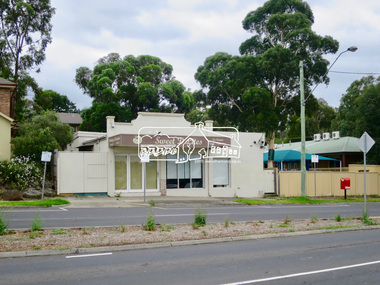
... postal delivery service at that time. In an emergency, such as illness, you could send a telegraph for tuppence (around two cents) a word. ...postal delivery service at that time. In an emergency, such as illness, you could send a telegraph for tuppence (around two cents) a word. ...Eltham Gateway, Sweet D Lites, 820 Main Road, Eltham. Former Burgoyne shop and Post Office, now home to San Antonio Barbershop. Once affectionately known as the Hilltop milk bar, or Burgoyne’s, this is one of the only three remaining early twentieth century village shops in Eltham and as the community’s first post office. In the 1920’s, the post office was run from a tiny 6 by 6 corrugated iron shed at the side of the store. Miss Hunniford, the post mistress, would give you your mail or take your letters to send, as there was no postal delivery service at that time. In an emergency, such as illness, you could send a telegraph for tuppence (around two cents) a word. Later, this was the site of the Eltham’s first telephone exchange. Tomorrow's history documented todayeltham, jim connor collection, main road, eltham gateway, burgoyne's shop, sweeet d lites, hilltop milk bar -
 Eltham District Historical Society Inc
Photograph, Hunniford’s Eltham Post Office, Main Road near Bridge Street, Eltham, c.1888
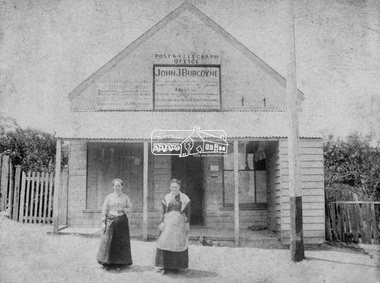
... postal clerk at the Brunswick Post Office in 1969. He was finally transferred as postmaster to Fawkner Post Office in 1980. He has been at Eltham Post Office for the past 2½ years. He is married with one child and lives in Montmorency. The Eltham Post Office employs a staff of 21, of whom seven are indoor staff, 12 are postmen and two are drivers. The postmen in Eltham have an uphill battle delivering mail because of the hilly terrain. Nine of the postmen deliver mail on motorbikes, and the two delivery...postal clerk at the Brunswick Post Office in 1969. He was finally transferred as postmaster to Fawkner Post Office in 1980. He has been at Eltham Post Office for the past 2½ years. He is married with one child and lives in Montmorency. The Eltham Post Office employs a staff of 21, of whom seven are indoor staff, 12 are postmen and two are drivers. The postmen in Eltham have an uphill battle delivering mail because of the hilly terrain. Nine of the postmen deliver mail on motorbikes, and the two delivery ...Sepia photograph of Hunniford’s Eltham Post Office, Main Road near Bridge Street, Eltham, c.1888 (Postmistress Anne Hunniford possibly on left). The building originally had a shingle roof. Anne Hamilton born 1814 Co Tyrone, Ireland married Michael Head Burgoyne (1820-1843) in 1839, Co. Tyrone, Ireland. They had two children, Charlotte Caroline (1840) and John James Thomas Neville (Londonderry, Ireland 1844) Whilst pregnant with John, husband Michael died. Following John’s birth, she emigrated to Victoria, Australia where she married Thomas Hunniford in 1854. Daughter Anne Jane Hunniford was born in Eltham in 1855. Anne (Annie) Jane Hunniford and John James Thomas Neville Burgoyne were half siblings. In the mid 1860s Annie Hunniford succeeded her father, Thomas Hunniford as Post Mistress for Eltham. Photo dated based on advertising on façade of the building by Annie’s half-brother, John James Thomas Burgoyne promotes his services as the area manager for John M’Ewan and Co, Auctioneers as well as him being agent for the National Mutual Life Association of Australasia, National Insurance Company of Australasia, Federal Mutual Livestock Association of Australasia, and as a House, Land, Estate, Insurance and Financial agent. This was the time period that he placed advertising for same in the local paper. Australia Post: Gold brought life to the township - Diamond Valley News, Tuesday July 2, 1985, p17 On February 1, 1854, the first Eltham Post Office was established, commencing an association between the township and the Postmaster-General's Department that has continued for 131 years. At that time, the number of permanent residents would have been fairly small, probably less than 200. The discovery of gold in June 1851, at Anderson’s Creek, some five miles away, and later at Caledonia Diggings, Queenstown (now known as St Andrews), about 14 miles to the north-east, brought large numbers of prospectors passing through the township, hopefully culling the creeks and gullies for the precious metal. This additional "floating population" brought a greater demand for supplies and for communication with the outside world, and so it helped in the development of Eltham. Today, Eltham is a thriving township. It boasts an excellent shopping centre, municipal offices, court house. post office and many other amenities. Eltham continued to develop at a leisurely pace. During 1860, a total of just over 8000 postal articles were handled at the Eltham Post Office. By 1862, the mail route was "to and from Melbourne by way of Eltham and Kangaroo Ground, three times a week, by coach". There was also a branch mail that operated between Eltham and Greensborough, three times weekly. This was also conveyed by coach. Some time between 1864 and 1868 the management of the post office passed from Thomas Hunniford to his daughter, Miss Anne Hunniford, who managed the Eltham Post Office until her death in 1928. A big improvement in communication was provided for Eltham residents when a telegraph office was established at the post office in 1877. During 1923 a manual telephone exchange was provided at Eltham, the first two subscribers being J.J. O’Connor and Eltham Police Station. In 1949 the manual exchange was replaced by an automatic exchange and there were some 150 subscribers. Following the death of postmistress Miss Anne Hunniford in 1928, B.M. Burgoyne was placed temporarily in charge of the office. In 1929, J. N. Burgoyne was appointed postmaster, and he in turn was succeeded by H. C. Burgoyne in 1951. The post office was moved to a new site in 1954, but continued under the charge of Mr Burgoyne. In January 1958 there was a further change of site when the post office was raised to official status and transferred to new premises in Main Rd. William Donoghue was acting postmaster when the new office was opened. In March 1958 Mr W.E. Tovey was appointed postmaster, followed by Douglas McG. Gilmour in 1959. William Donoghue was fully appointed in 1966 and Barry Reichelt followed in 1973, prior to the present postmaster, Peter Jolly in November 1982. Peter is a young man with 18 years' experience. He commenced his training as a postal clerk at the training school in Melbourne in 1968 and was promoted to postal clerk at the Brunswick Post Office in 1969. He was finally transferred as postmaster to Fawkner Post Office in 1980. He has been at Eltham Post Office for the past 2½ years. He is married with one child and lives in Montmorency. The Eltham Post Office employs a staff of 21, of whom seven are indoor staff, 12 are postmen and two are drivers. The postmen in Eltham have an uphill battle delivering mail because of the hilly terrain. Nine of the postmen deliver mail on motorbikes, and the two delivery vans are both four wheel drives. Eltham Post Office services basically a residential area, with deliveries to 5600 homes. This is growing at the rate of 600 homes every 18 months, i.e. about 32 homes per month. At the present rate we will need a new postman every 18 months.Sepia photograph (two copies plus two black and white enlargements)Shop originally had a shingle roofpost office, eltham, main road, anne jane hunniford (1855-1928), federal mutual live stock insurance association of australasia, federal mutual livestock association of australasia, john j burgoyne, john m'ewan and co. auctioneers, national insurance company of australasia, national mutual life association of australasia -
 Eltham District Historical Society Inc
Photograph, Clark Bros, Eltham Post Office, c.1895
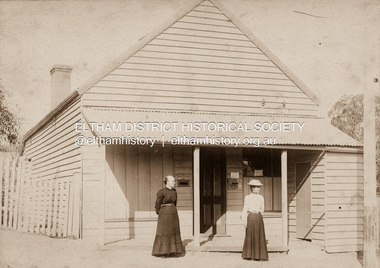
... postal clerk at the Brunswick Post Office in 1969. He was finally transferred as postmaster to Fawkner Post Office in 1980. He has been at Eltham Post Office for the past 2½ years. He is married with one child and lives in Montmorency. The Eltham Post Office employs a staff of 21, of whom seven are indoor staff, 12 are postmen and two are drivers. The postmen in Eltham have an uphill battle delivering mail because of the hilly terrain. Nine of the postmen deliver mail on motorbikes, and the two delivery...postal clerk at the Brunswick Post Office in 1969. He was finally transferred as postmaster to Fawkner Post Office in 1980. He has been at Eltham Post Office for the past 2½ years. He is married with one child and lives in Montmorency. The Eltham Post Office employs a staff of 21, of whom seven are indoor staff, 12 are postmen and two are drivers. The postmen in Eltham have an uphill battle delivering mail because of the hilly terrain. Nine of the postmen deliver mail on motorbikes, and the two delivery ...Hunniford's Eltham Post Office, Main Road near Bridge Street, Eltham, c.1895. Possibly Miss Anne (Annie) Hunniford, Post Mistress, on left. Annie was post mistress from the mid 1860s until her death in 1928. Photo taken by Clark Bros, 25 Thomas St, Windsor. Clark Bros operated from this address from c.1894 to 1914. Australia Post: Gold brought life to the township - Diamond Valley News, Tuesday July 2, 1985, p17 On February 1, 1854, the first Eltham Post Office was established, commencing an association between the township and the Postmaster-General's Department that has continued for 131 years. At that time, the number of permanent residents would have been fairly small, probably less than 200. The discovery of gold in June 1851, at Anderson’s Creek, some five miles away, and later at Caledonia Diggings, Queenstown (now known as St Andrews), about 14 miles to the north-east, brought large numbers of prospectors passing through the township, hopefully culling the creeks and gullies for the precious metal. This additional "floating population" brought a greater demand for supplies and for communication with the outside world, and so it helped in the development of Eltham. Today, Eltham is a thriving township. It boasts an excellent shopping centre, municipal offices, court house. post office and many other amenities. Eltham continued to develop at a leisurely pace. During 1860, a total of just over 8000 postal articles were handled at the Eltham Post Office. By 1862, the mail route was "to and from Melbourne by way of Eltham and Kangaroo Ground, three times a week, by coach". There was also a branch mail that operated between Eltham and Greensborough, three times weekly. This was also conveyed by coach. Some time between 1864 and 1868 the management of the post office passed from Thomas Hunniford to his daughter, Miss Anne Hunniford, who managed the Eltham Post Office until her death in 1928. A big improvement in communication was provided for Eltham residents when a telegraph office was established at the post office in 1877. During 1923 a manual telephone exchange was provided at Eltham, the first two subscribers being J.J. O’Connor and Eltham Police Station. In 1949 the manual exchange was replaced by an automatic exchange and there were some 150 subscribers. Following the death of postmistress Miss Anne Hunniford in 1928, B.M. Burgoyne was placed temporarily in charge of the office. In 1929, J. N. Burgoyne was appointed postmaster, and he in turn was succeeded by H. C. Burgoyne in 1951. The post office was moved to a new site in 1954, but continued under the charge of Mr Burgoyne. In January 1958 there was a further change of site when the post office was raised to official status and transferred to new premises in Main Rd. William Donoghue was acting postmaster when the new office was opened. In March 1958 Mr W.E. Tovey was appointed postmaster, followed by Douglas McG. Gilmour in 1959. William Donoghue was fully appointed in 1966 and Barry Reichelt followed in 1973, prior to the present postmaster, Peter Jolly in November 1982. Peter is a young man with 18 years' experience. He commenced his training as a postal clerk at the training school in Melbourne in 1968 and was promoted to postal clerk at the Brunswick Post Office in 1969. He was finally transferred as postmaster to Fawkner Post Office in 1980. He has been at Eltham Post Office for the past 2½ years. He is married with one child and lives in Montmorency. The Eltham Post Office employs a staff of 21, of whom seven are indoor staff, 12 are postmen and two are drivers. The postmen in Eltham have an uphill battle delivering mail because of the hilly terrain. Nine of the postmen deliver mail on motorbikes, and the two delivery vans are both four wheel drives. Eltham Post Office services basically a residential area, with deliveries to 5600 homes. This is growing at the rate of 600 homes every 18 months, i.e. about 32 homes per month. At the present rate we will need a new postman every 18 months.Sepia photograph mounted on cardpost office, eltham, main road, anne jane hunniford (1855-1928), clark bros. photo -
 Melbourne Tram Museum
Postcard - 'Swanston St east side from Morrells Hotel, V S M Series Preinted in Germany, 1910s
... There were eleven postal deliveries each week (two on weekdays, one on Saturdays) and postcards were cheaper than telegrams....There were eleven postal deliveries each week (two on weekdays, one on Saturdays) and postcards were cheaper than telegrams. ...Postcard shows cable trams, horse drawn carriages and pedestrians in Swanston St looking towards the Town Hall. Before the telephone, postcards were often used to send brief personal or business messages to others in Melbourne or further afield. There were eleven postal deliveries each week (two on weekdays, one on Saturdays) and postcards were cheaper than telegrams.Yields information about Swanston St and the use of postcards for short messages.Black and white postcard with title and detailed personal message on front; on rear are postcard markings, stamp and handwritten delivery address.On front 'Swanston St east side from Morrells Hotel, Melbourne'. Covering the space occupied by the sky, is a long closely hand written personal message written in ink which is mostly illegible. On rear in ink is the destination address written in large clear letters (London England), postcard markings, 'The V.S.M.Series' and a stamp.cable trams, horse drawn carriages, pedestrians, swanston st, town hall -
Melbourne Tram Museum
Postcard - 'Swanston St east side from Morrells Hotel, V S M Series Preinted in Germany, 1910s
... There were eleven postal deliveries each week (two on weekdays, one on Saturdays) and postcards were cheaper than telegrams....There were eleven postal deliveries each week (two on weekdays, one on Saturdays) and postcards were cheaper than telegrams. ...Postcard shows cable trams, horse drawn carriages and pedestrians in Swanston St looking towards the Town Hall. Before the telephone, postcards were often used to send brief personal or business messages to others in Melbourne or further afield. There were eleven postal deliveries each week (two on weekdays, one on Saturdays) and postcards were cheaper than telegrams.Yields information about Swanston St and the use of postcards for short messages.Black and white postcard with title and detailed personal message on front; on rear are postcard markings, stamp and handwritten delivery address.On front 'Swanston St east side from Morrells Hotel, Melbourne'. Covering the space occupied by the sky, is a long closely hand written personal message written in ink which is mostly illegible. On rear in ink is the destination address written in large clear letters (London England), postcard markings, 'The V.S.M.Series' and a stamp.cable trams, horse drawn carriages, pedestrians, swanston st, town hall -
 Sunbury Family History and Heritage Society Inc.
Photograph, c 1900s
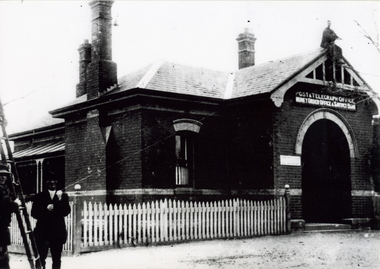
... postal delivery practices although it still operates from the same site. The Sunbury Post Office has operated in a building on the same site since 1892 despite many changes and extensions made to the building, which included the demolition of the residence attached to the original building. Sunbury sunbury post office Post and Telegraph offices A non-digital black and white photograph of Victorian style brick building with a slate roof with 3 chimneys and surrounded by a white picket fence. Two ...The building is the Sunbury Post and Telegraph Office and residence, which was built on the corner of Brook and Evans Street in 1892. Prior to that time the postal service in Sunbury was conducted at the railway station. Over the years changes and extensions have taken place to the building to accommodate it for modern postal delivery practices although it still operates from the same site.The Sunbury Post Office has operated in a building on the same site since 1892 despite many changes and extensions made to the building, which included the demolition of the residence attached to the original building.A non-digital black and white photograph of Victorian style brick building with a slate roof with 3 chimneys and surrounded by a white picket fence. Two men are standing by a ladder on the LHS of the image. sunbury, sunbury post office, post and telegraph offices -
 City of Greater Bendigo - Civic Collection
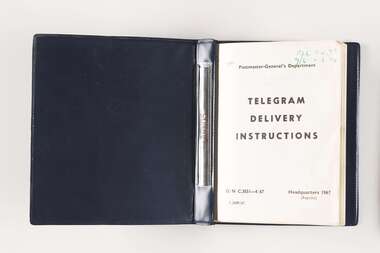
Manual, Post Master General's Department, Telegram Delivery Instructions, 1967
... postal collection donated by the Rankins family in memory of Ted. Ted Rankins Collection Bendigo Post Office Bendigo Tourism City of Greater Bendigo Tourism Post Office collection Front cover; Australian Post Office / Telecommunications Division / Telegram / Delivery / Instructions / Headquarters / 1962 Various annotations and updates throughout. Small, blue, vinyl covered manual. Contains thirty printed pages covering all aspects of how to correctly deliver telegrams. Topics include 'Loss of telegram', 'Undelivered Telegram', 'special Delivery' and 'Beware of Dogs'. Bound with two ...Electrical telegraphs were point to point text messaging systems primarily used from the 1840's until the late 20th century. It was the first electrical telecommunications system and were sent by an operator or telegrapher using Morse code. Social telegrams were also encouraged and special pictorial forms and envelopes were designed such as the special purple form and envelope which was used when conveying condolence details during World War 2.(fn. Powerhouse https://collection.powerhouse.com.au/object/163103). There was a brief resurgence in telegraphy during World War I but the decline continued as the world entered the Great Depression years of the 1930s. Although telegraph lines continued to play an important part in distributing news feeds from news agencies post World War 2, the rise of the internet in the 1990s and the widespread installation of the telephones in homes saw the need for telegrams to greatly decline. When the Commonwealth Post and Telegraph Act was passed in June 1902, and a national Postmaster General's Department (the PMG) was established the responsibility for the nation's mail and telephone services fell on Post Offices. The Bendigo Post Office, built in 1887 and situated on Pall Mall was the central distribution centre for receiving and delivering telegrams and continued to deliver communication and postal services until 1997. Now a Visitor Centre, dedicated volunteers at the Post Office continued to demonstrate and educate the public about telegraphic services and the development of this unique form of communication up until 2019 when Covid 19 disrupted every day life, coupled with the death Ted Rankins (the last Post Master and a long term telegraph volunteer at the Post Office). This book was issued to Junior Postal Workers in Bendigo to guide them in the delivery of telegrams and designed to fit into their delivery satchels and carried while on the job. In the early years telegrams were delivered by bicycle and this manual is part of the postal collection donated by the Rankins family in memory of Ted. Small, blue, vinyl covered manual. Contains thirty printed pages covering all aspects of how to correctly deliver telegrams. Topics include 'Loss of telegram', 'Undelivered Telegram', 'special Delivery' and 'Beware of Dogs'. Bound with two ring metal clip. Front cover; Australian Post Office / Telecommunications Division / Telegram / Delivery / Instructions / Headquarters / 1962 Various annotations and updates throughout. ted rankins collection, bendigo post office, bendigo tourism, city of greater bendigo tourism, post office collection -
 City of Greater Bendigo - Civic Collection
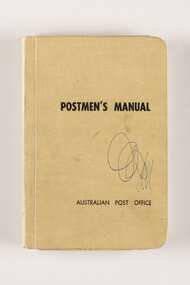
Manual, Post Master General's Department, Postmen's Manual, 1964
... delivery of letters and parcels and were small enough to be carried with them. This manual was used by the Bendigo Post Office postmen and is part of the postal collection donated by the Rankins family in memory of Ted Rankins,. Ted Rankins Collection Bendigo Post Office Bendigo Tourism City of Greater Bendigo Tourism Post Office collection Front cover; Postmen's Manual / Australian Post Office Various annotations and updates throughout. Small, creamed coloured cloth covered manual. Contains forty four printed pages and two ...When the Commonwealth Post and Telegraph Act was passed in June 1902, and a national Postmaster General's Department (the PMG) was established the responsibility for the nation's mail and telephone services fell on Post Offices. The Bendigo Post Office, built in 1887 and situated on Pall Mall was the central distribution centre for receiving and delivering telegrams and continued to deliver communication and postal services until 1997. Now a Visitor Centre, dedicated volunteers at the Post Office continued to demonstrate and educate the public about the daily workings of the Post Office up until 2019 when Covid 19 disrupted every day life and Ted Rankins, the last Post Master and a long term telegraph volunteer at the Post Office, died. Manuals were issued to postmen to guide them in the delivery of letters and parcels and were small enough to be carried with them. This manual was used by the Bendigo Post Office postmen and is part of the postal collection donated by the Rankins family in memory of Ted Rankins,. Small, creamed coloured cloth covered manual. Contains forty four printed pages and two blank end pages covering all aspects of how to correctly deliver the post. Topics include 'Behaviour', 'Deceased Persons' and 'Bicycles' amongst many others. Book is bound and contains many extra additional paragraphs stuck in on appropriate pages noting changes and amendments. Additional amendments in handwritten red pen also occur on pages 28, 29 and 36.Front cover; Postmen's Manual / Australian Post Office Various annotations and updates throughout. ted rankins collection, bendigo post office, bendigo tourism, city of greater bendigo tourism, post office collection -
 Melbourne Tram Museum
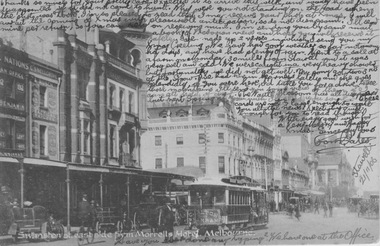
Postcard - Swanston St east side from Morrells Hotel, V S M Series Preinted in Germany, 1910s
... There were eleven postal deliveries each week (two on weekdays, one on Saturdays) and postcards were cheaper than telegrams....There were eleven postal deliveries each week (two on weekdays, one on Saturdays) and postcards were cheaper than telegrams. ...Postcard shows cable trams, horse drawn carriages and pedestrians in Swanston St looking towards the Town Hall. Before the telephone, postcards were often used to send brief personal or business messages to others in Melbourne or further afield. There were eleven postal deliveries each week (two on weekdays, one on Saturdays) and postcards were cheaper than telegrams.Yields information about Swanston St and the use of postcards for short messages.Black and white postcard with title and detailed personal message on front; on rear are postcard markings, stamp and handwritten delivery address.On front 'Swanston St east side from Morrells Hotel, Melbourne'. Covering the space occupied by the sky, is a long closely hand written personal message written in ink which is mostly illegible. On rear in ink is the destination address written in large clear letters (London England), postcard markings, 'The V.S.M.Series' and a stamp with postmark 1921.cable trams, horse drawn carriages, pedestrians, swanston st, town hall -
 Melbourne Tram Museum
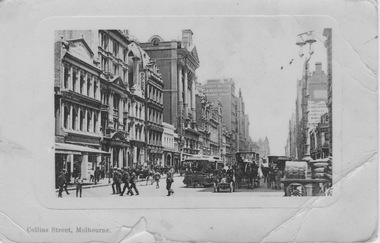
Postcard - Collins Street Melbourne, V S M Series Preinted in Germany, 1910s
... There were eleven postal deliveries each week (two on weekdays, one on Saturdays) and postcards were cheaper than telegrams....There were eleven postal deliveries each week (two on weekdays, one on Saturdays) and postcards were cheaper than telegrams. ...Postcard shows cable trams, horse drawn carriages and pedestrians in Collins St. Before the telephone, postcards were often used to send brief personal or business messages to others in Melbourne or further afield. There were eleven postal deliveries each week (two on weekdays, one on Saturdays) and postcards were cheaper than telegrams.Yields information about Collins St and the use of postcards for short messages.Black and white postcard with title on front and detailed personal message on rear but no stamp or delivery address.On front 'Collins Street Melbourne'. On rear is a long closely hand written personal message written in ink that begins with an apology but is difficult to decipher in parts and the publisher, 'The V.S.M.Series'.cable trams, horse drawn carriages, pedestrians, collins st -
 Melbourne Tram Museum
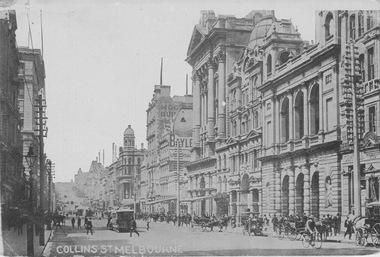
Postcard - Collins Street Melbourne, V S M Series Preinted in Germany, 1910s
... There were eleven postal deliveries each week (two on weekdays, one on Saturdays) and postcards were cheaper than telegrams....There were eleven postal deliveries each week (two on weekdays, one on Saturdays) and postcards were cheaper than telegrams. ...Postcard shows cable trams, horse drawn carriages and many pedestrians in Collins St. Before the telephone, postcards were often used to send brief personal or business messages to others in Melbourne or further afield. There were eleven postal deliveries each week (two on weekdays, one on Saturdays) and postcards were cheaper than telegrams.Yields information about Collins St and the use of postcards for short messages.Black and white postcard with title on front and detailed personal message, stamp but no delivery address on rear.On front 'Collins Street Melbourne'. On rear is a long closely hand written easy to read personal message written in ink that begins with 'March 22 1908', and the publisher, 'The V.S.M.Series'.cable trams, horse drawn carriages, pedestrians, collins st -
 Melbourne Tram Museum
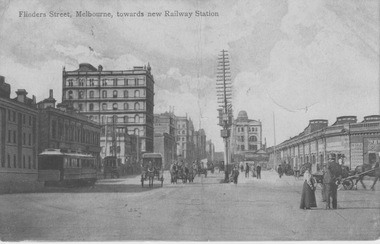
Postcard - Flinders St towards Railway Station, c1910
... There were eleven postal deliveries each week (two on weekdays, one on Saturdays) and postcards were cheaper than telegrams....There were eleven postal deliveries each week (two on weekdays, one on Saturdays) and postcards were cheaper than telegrams. ...Postcard shows cable tram, horse drawn carriages and pedestrians in Flinders St at Market St looking towards the newly built Flinders St Station. Before the telephone, postcards were often used to send brief personal or business messages to others in Melbourne or further afield. There were eleven postal deliveries each week (two on weekdays, one on Saturdays) and postcards were cheaper than telegrams.Yields information about Flinders St and the use of postcards for short messages.Black and white postcard with title on front and postcard markings and handwritten text on rear but no stamp or delivery address.On front 'Flinders Street Melbourne, towards new Railway Station'. On rear in ink is a long closely hand written personal message that begins with 'Address Melbourne Russell St Police Station 17-10-11'. Some of the words are not legible.cable trams, horse drawn carriages, pedestrians, flinders st, flinders st station -
 Melbourne Tram Museum
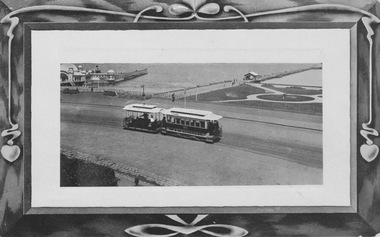
Postcard - Esplanade St Kilda, 1910s
... There were eleven postal deliveries each week (two on weekdays, one on Saturdays) and postcards were cheaper than telegrams....There were eleven postal deliveries each week (two on weekdays, one on Saturdays) and postcards were cheaper than telegrams. ...Postcard shows cable tram travelling on The Esplanade with piers and water in the background. Before the telephone, postcards were often used to send brief personal or business messages to others in Melbourne or further afield. There were eleven postal deliveries each week (two on weekdays, one on Saturdays) and postcards were cheaper than telegrams.Yields information about The Esplanade and the use of postcards for short messages.Black and white postcard with brief personal message, delivery address postcard markings but no stamp on rear.Printed on rear: 'Commonwealth of Australia Post Card' and postcard markings. In ink and pencil is written: '6/6/09 To Norman, Wishing him many happy returns of the day. Uncle' and a street address in Collingwood.cable trams, the esplanade, piers, water -
 Melbourne Tram Museum
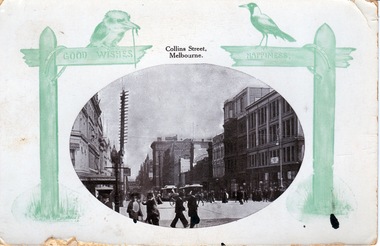
Postcard - Collins Street Melbourne - A Soldier's Farewell, c1915
... There were eleven postal deliveries each week (two on weekdays, one on Saturdays) and postcards were cheaper than telegrams. ...There were eleven postal deliveries each week (two on weekdays, one on Saturdays) and postcards were cheaper than telegrams. ...Postcard shows small oval shaped photograph of Collins St framed by a green drawing of timber posts with a kookaburra and magpie on top. The photo shows cable trams and many pedestrians in Collins St. This message is time critical as this soldier is likely off to the European war and writing to his wife, sweet-heart or sister. Before the telephone, postcards were often used to send brief personal or business messages to others in Melbourne or further afield. There were eleven postal deliveries each week (two on weekdays, one on Saturdays) and postcards were cheaper than telegrams. The troopship HMAT Ballarat mentioned in the text departed Melbourne for Port Suez on 18/2/16 and Plymouth on 19/2/17, so the postcard author was likely on one of these two departures. As the Ballarat approached Plymouth with 1150 troops on board, it was sunk by a German U-boat on 25/4/17 yet everyone survived.Yields information about Collins St, The Block and the use of postcards for short messages.Partially coloured postcard with title on front and detailed personal message but no delivery address or stamp on rear.On front 'Collins Street Melbourne'. On rear: postcard markings, 'Printed in Melbourne' and hand written personal message written in ink from a departing soldier, which includes ' Dear Mary ... We fall in at 5 o'clock tomorrow morning. Reveille sounds at 3 o'clock. You had better not come down to see me off. It's rather early ... the Ballarat is a good boat. I will write from next port .... Jack' cable trams, pedestrians, collins st, kookaburra, magpie, european war, soldier, port suez, plymouth, hmat ballarat, german u-boat -
 Melbourne Tram Museum
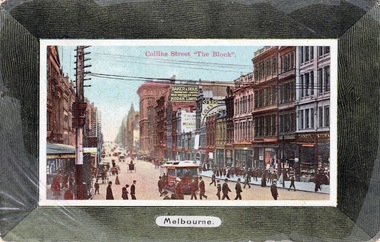
Postcard - Collins Street 'The Block', 'Ward, Lock & Co Ltd', 1910s
... There were eleven postal deliveries each week (two on weekdays, one on Saturdays) and postcards were cheaper than telegrams....There were eleven postal deliveries each week (two on weekdays, one on Saturdays) and postcards were cheaper than telegrams. ...Postcard shows cable trams and many pedestrians in Collins St. 'The Block' described the buildings and footpaths in the area bounded by Collins St, Elizabeth St, Bourke St and Swanston St. From the early years, this was the commercial heart of Melbourne, where the well-off promenaded (walked) to see and be seen by other notable people and where before cable trams the network of horse omnibuses drove in a loop to collect passenger. Before the telephone, postcards were often used to send brief personal or business messages to others in Melbourne or further afield. There were eleven postal deliveries each week (two on weekdays, one on Saturdays) and postcards were cheaper than telegrams.Yields information about Collins St, The Block and the use of postcards for short messages.Coloured postcard with title on front and detailed personal message, delivery address but no stamp on rear.On front 'Collins Street The Block' and 'Melbourne'. On rear is a long hand written personal message written in ink, postcard markings and 'Ward, Lock & Co Ltd'.cable trams, pedestrians, collins st, the block, commercial heart, promenade, horse omnibuses -
 Melbourne Tram Museum
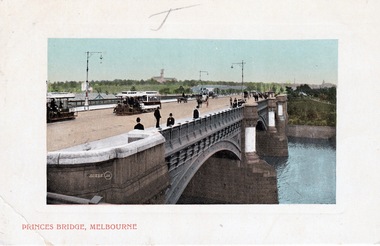
Postcard - Princes Bridge Melbourne, Valentine's, 1900s
... There were eleven postal deliveries each week (two on weekdays, one on Saturdays) and postcards were cheaper than telegrams....There were eleven postal deliveries each week (two on weekdays, one on Saturdays) and postcards were cheaper than telegrams. ...Photograph looks south over Princes Bridge towards the Domain Gardens and Government House. It shows cable trams and pedestrians on the bridge and the Yarra River below. Before the telephone, postcards were often used to send brief personal or business messages to others in Melbourne or further afield. There were eleven postal deliveries each week (two on weekdays, one on Saturdays) and postcards were cheaper than telegrams.Yields information about Princes Bridge and the use of postcards for short messages.Coloured postcard with title below photograph and detailed personal message on rear, but no delivery address or stamp On front 'Princes Bridge Melbourne'. On rear: Postcard markings, 'Valentines Series' and a handwritten message beginning '11.10.010 (perhaps 1910) Dear Ett & Bertie'. The note describes the terrible cold and wet weather in Melbourne and expresses hope that they are having better weather and a good time. Signed 'husband Les'.cable trams, pedestrians, princes bridge, domain gardens, government house, yarra river
