
Showing 248 items matching "uniforms - badges (cloth)"
-
 Bendigo Military Museum
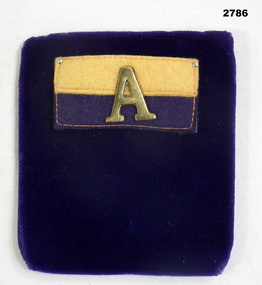
Accessory - COLOUR PATCH AND “A”, Australian Government, Post 1915
... uniforms - badges (cloth)...uniforms - badges (cloth) military history ANZAC colour patch Passchendaele barracks trust Felt colour patch, rectangular shape divided horizontally, top half is yellow 14th Battalion, bottom half is dark blue. ...Felt colour patch, rectangular shape divided horizontally, top half is yellow 14th Battalion, bottom half is dark blue. A capital letter A is mounted in centre of patch. The colour patch is mounted on a card with purple velour.uniforms - badges (cloth), military history, anzac, colour patch, passchendaele barracks trust -
 Bendigo Military Museum
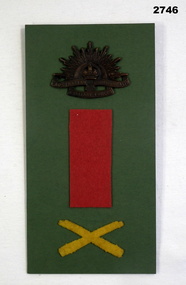
Badge - BADGE & COLOUR PATCHES, C.WW1
... ...uniforms - badges (cloth)...numismatics-badges-army uniforms - badges (cloth) military history Passchendaele barracks trust Mounted on dark green cardboard backing with metal Rising Sun hat badge, 15th Machine Gun red colour patch over crossed yellow felt machine guns. 15th Machine Gun Coy. ...Mounted on dark green cardboard backing with metal Rising Sun hat badge, 15th Machine Gun red colour patch over crossed yellow felt machine guns. 15th Machine Gun Coy.numismatics-badges-army, uniforms - badges (cloth), military history, passchendaele barracks trust -
 Bendigo Military Museum
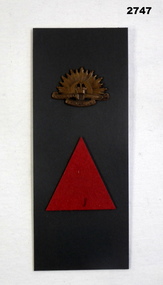
Badge - BADGE & COLOUR PATCH, post 2000
... ...uniforms - badges (cloth)...numismatics-badges-army uniforms - badges (cloth) military history Passchendaele barracks trust On badge, "Australian Commonwealth Military Forces" Mounted on dark grey cardboard backing with metal Rising Sun lapel badge & triangular red colour patch, Camel Corp. ...Mounted on dark grey cardboard backing with metal Rising Sun lapel badge & triangular red colour patch, Camel Corp.On badge, "Australian Commonwealth Military Forces"numismatics-badges-army, uniforms - badges (cloth), military history, passchendaele barracks trust -
 Bendigo Military Museum
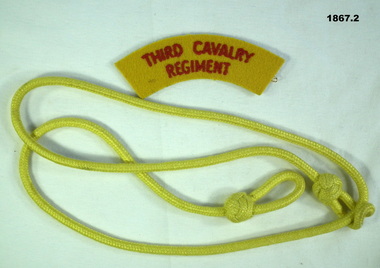
Uniform - UNIFORM ACCESORIES, C.1960’s
... uniforms-badges, cloth...Belonged to Geoff Murray, refer Cat No 638P for his service history. uniforms-badges, cloth 3 cav .1 Yellow lanyard. .2 Yellow and red felt 3rd Cavalry Regiment unit patch. with pin on back. ...Belonged to Geoff Murray, refer Cat No 638P for his service history..1 Yellow lanyard. .2 Yellow and red felt 3rd Cavalry Regiment unit patch. with pin on back.uniforms-badges, cloth, 3 cav -
 Melbourne Tram Museum
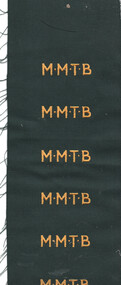
Badge - MMTB Uniform Name badge on green cloth, Melbourne & Metropolitan Tramways Board (MMTB), 1970s
... MMTB Uniform Name badge on green cloth...MMTB Uniform Name badge on green cloth in a cloth strip....Demonstrates the method of providing uniform emblems and organisation identification. tramways badges uniforms inspectors clothing MMTB Uniform Name badge on green cloth in a cloth strip. ...MMTB Uniform organisation name for sewing onto a uniform for identification - possibly inspectors or officers.Demonstrates the method of providing uniform emblems and organisation identification.MMTB Uniform Name badge on green cloth in a cloth strip.tramways, badges, uniforms, inspectors, clothing -
 Bendigo Military Museum
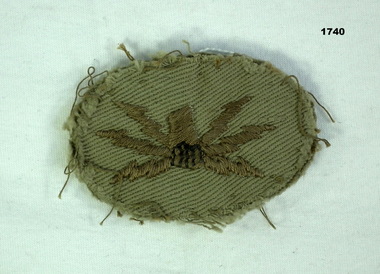
Badge - BADGE RAAF, 1939-45
... Summer uniform cloth badge for WWII RAAF Wireless Operator. ...Refer Cat no 1760.4. uniforms-insignia military history-raaf Wireless Summer uniform cloth badge for WWII RAAF Wireless Operator. ...Item belonged to Victor Henry Evans No 418655 RAAF. Refer Cat no 1760.4.Summer uniform cloth badge for WWII RAAF Wireless Operator. Khaki coloured, oval shaped, depicts a hand holding lightning bolts.uniforms-insignia, military history-raaf, wireless -
 Nhill Aviation Heritage Centre
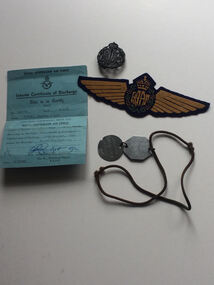
Memorabilia - Muriel Holly collection, 1944
... 1 Service Dog Tags 2 of 2 Cap badge RAAF 3 Uniform cloth badge RAAF wing $ Itnerim Certificate or Dicharge...Muriel Holly 114774 dog tag discharge certificate WAAAF badge WAAAF 11474, Discharge certificate 16/8/46 1 Service Dog Tags 2 of 2 Cap badge RAAF 3 Uniform cloth badge RAAF wing $ Itnerim Certificate or Dicharge Memorabilia Muriel Holly collection ...1 Service Dog Tags 2 of 2 Cap badge RAAF 3 Uniform cloth badge RAAF wing $ Itnerim Certificate or DichargeWAAAF 11474, Discharge certificate 16/8/46muriel holly, 114774, dog tag, discharge certificate, waaaf, badge -
 Wangaratta RSL Sub Branch
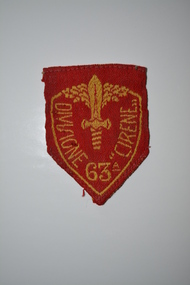
Badge
... Uniform cloth badge of the 63A Infantry Division "Cirene" of the Italian Army. ...Uniform cloth badge of the 63A Infantry Division "Cirene" of the Italian Army. ...Uniform cloth badge of the 63A Infantry Division "Cirene" of the Italian Army. The 63rd Infantry Division Cirene was an auto-transportable infantry division of the Italian Army during World War II. The Cirene Division was formed 1 October 1937 and destroyed 5 January 1941 in Bardia. The Australians captured Bardia on 5 January, 1941, taking 45,000 prisoners and 462 guns for a loss of 130 dead and 326 wounded of their own.The 63rd Infantry Division Cirene was an auto-transportable infantry division of the Italian Army during World War II. The Cirene Division was formed 1 October 1937 and destroyed 5 January 1941 in Bardia. small red cloth with gold thread insigniaDivisione 63A "Cirene"battle of bardia, ww2, italian army -
 Federation University Historical Collection
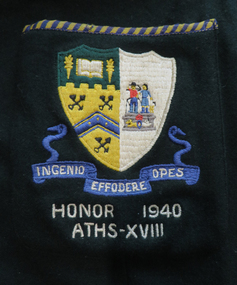
Clothing - Costume - Blazer, 1940 Honor Blazer - Athletics XVIII, c1940
... Then, in 1998, SMB and the Horsham-based Wimmera Institute of TAFE (1984), dating back to 1882, merged into the University of Ballarat to create a larger University. blazer honor blazer harold john hassell smb school of mines ballarat costume textiles uniform embroidery Cloth label - Mark & Philp Pty Ltd On embroidered badge "Incenio Effodore Opes", Honor 1940 ATHS - XVIII" This three buttoned, bottle green woolen blazer is edged in black twill piping and has a Ballarat School of Mines coat of arms on pocket "Honor 1940 ATHS - XVIII. ...In 1940 Harold John Hassell was a 4th year student in the Science school. He won the Mica Smith Trust Fund (open championship) and was awarded the 1940 Honour Blazer. The School of Mines was established in 1870 in Ballarat, making it Australia's third oldest tertiary institution. Redmond Barry was its first president, and he was involved in the creation of university degree level courses for the school. The School of Mines was divided into a tertiary division and a technical division. The tertiary division provided higher education courses such as mining engineering, geology, education and business studies, while the technical division provided such programs as wool classing, plumbing and bricklaying.It remained in that form until the 1967 when it was split into three institutions, Ballarat School of Industries, Ballarat Technical School, and Ballarat Institute of Advanced Education. They remained three entities until 1976. Ballarat Institute of Advanced Education merged into Ballarat College of Advanced Education. The Ballarat School of Industries and Ballarat Technical School merged into the School of Mines and Industries, Ballarat (SMB) in 1976. Several entities merged or had arrangements with SMB. In 1994, a memo of understanding (MOU) was signed between SMB and the Ararat Technical School, which was founded in 1969. Then, in 1998, SMB and the Horsham-based Wimmera Institute of TAFE (1984), dating back to 1882, merged into the University of Ballarat to create a larger University.This three buttoned, bottle green woolen blazer is edged in black twill piping and has a Ballarat School of Mines coat of arms on pocket "Honor 1940 ATHS - XVIII. The two side pockets are also edged in the black twill and there is a trim of the twill 8.3cm from the sleeve cuff. The breast pocket has a top binding of yellow and blue stripes. The seams are hand stitched down to prevent fraying and there are tapes hand sewn on the inside across the back of the pockets to prevent tearing. Cloth label - Mark & Philp Pty Ltd On embroidered badge "Incenio Effodore Opes", Honor 1940 ATHS - XVIII"blazer, honor blazer, harold john hassell, smb, school of mines ballarat, costume, textiles, uniform, embroidery -
 Lara RSL Sub Branch
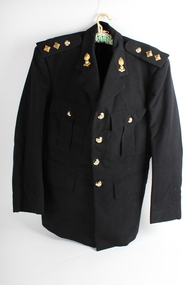
Uniform, Officer Dress Uniform Jacket
... CGCF (Commonwealth Government Clothing Factory) Brass Lapel Badge UBIQUE (Everywhere in Latin) 5 Front of Jacket Brass Badges (2.5cm) Epaulette with First Lieutenant insignia Cloth Belt rear Black Officer Dress Uniform Jacket with Belt on rear Officer Dress Uniform Jacket Uniform Uniform ...Black Officer Dress Uniform Jacket with Belt on rearCGCF (Commonwealth Government Clothing Factory) Brass Lapel Badge UBIQUE (Everywhere in Latin) 5 Front of Jacket Brass Badges (2.5cm) Epaulette with First Lieutenant insignia Cloth Belt rear -
 Lara RSL Sub Branch
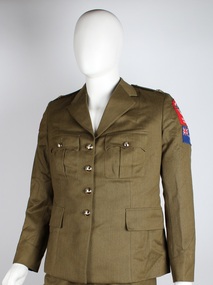
Uniform, Army Dress Jacket
... Red cloth Badges NZ 28 Maori 28 Battalion on both Shoulders Cloth Badge New Zealand Flag on left Shoulder Brass Buttons Badges of Rank Major on both shoulders Cloth Tag White on Inside of Jacket Emerco Brand Khaki Service Dress Ass. Sub Branch Australia Army Dress Jacket Uniform ...Khaki Service Dress Ass. Sub Branch Australia Red cloth Badges NZ 28 Maori 28 Battalion on both Shoulders Cloth Badge New Zealand Flag on left Shoulder Brass Buttons Badges of Rank Major on both shoulders Cloth Tag White on Inside of Jacket Emerco Brand -
 Lara RSL Sub Branch
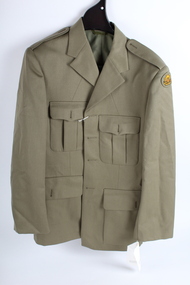
Uniform, Fletcher Jones Victoria, Army Dress Jacket, 1996
... The Australian Army Rising Sun Cloth Cloth Badge on each shoulder Jacket has no Buttons White cotton Label on inside of Jacket with provision for ID. Fletcher Jones Victoria 1996 Stock Item Tag on Right Sleeve Khaki Army Dress Jacket Army Dress Jacket Uniform Uniform Fletcher Jones Victoria ...Khaki Army Dress JacketThe Australian Army Rising Sun Cloth Cloth Badge on each shoulder Jacket has no Buttons White cotton Label on inside of Jacket with provision for ID. Fletcher Jones Victoria 1996 Stock Item Tag on Right Sleeve -
 Lara RSL Sub Branch
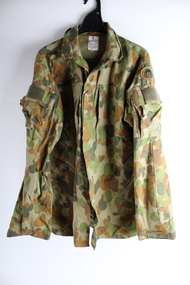
Uniform, ADI Australian Defence Industries, Camouflage Jacket Australia, 2006
... DPCU Standard Working Dress of Army and RAAF The Australian Army Cloth Badge above Right Pocket White cloth label ADA Victoria 2006 Size 105L Name Tag Cloth Garrett above right Hand Pocket Disruptive Pattern Camouflage Jacket Two Pockets with buttons Velcro patch on each pocket Camouflage Jacket Australia Uniform ADI Australian Defence Industries ...DPCU Standard Working Dress of Army and RAAFDisruptive Pattern Camouflage Jacket Two Pockets with buttons Velcro patch on each pocket The Australian Army Cloth Badge above Right Pocket White cloth label ADA Victoria 2006 Size 105L Name Tag Cloth Garrett above right Hand Pocket -
 Lara RSL Sub Branch
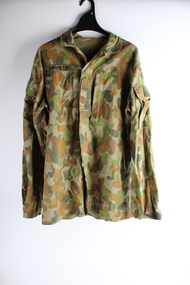
Uniform, ADI Australian Defence Industries, Camouflage Jacket Australia, 2006
... DPCU Standard Working Dress of Army and RAAF The Australian Army Cloth Badge above Right Pocket White cloth label ADA Victoria 2006 Size 105L Name Tag Cloth Garrett above right Hand Pocket Disruptive Pattern Camouflage Jacket Two Pockets with buttons Velcro patch on each pocket Camouflage Jacket Australia Uniform ADI Australian Defence Industries ...DPCU Standard Working Dress of Army and RAAFDisruptive Pattern Camouflage Jacket Two Pockets with buttons Velcro patch on each pocket The Australian Army Cloth Badge above Right Pocket White cloth label ADA Victoria 2006 Size 105L Name Tag Cloth Garrett above right Hand Pocket -
 Flagstaff Hill Maritime Museum and Village
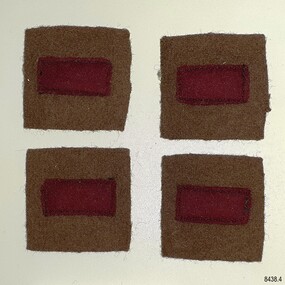
Badge - Australian Military cloth patch, Army Medical Corps, 108 Australian General Hospital, 1939-1945
... Angus Collection Australian Army Surgeon Captain Ballarat Bonegilla badge insignia badge collection World War 2 Second World War Australian Defence Forces Army Medical Corps 108 Australian General Hospital Great War Military uniform 106 Australian General Hospital 1939-1945 Badges; set of four cloth patches, red rectangles on brown squares. ...The four cloth patches belonged to Dr William Roy Angus and are now part of Flagstaff Hill’s comprehensive W.R. Angus Collection, donated by the family of Dr W R Angus (1901-1970), surgeon and oculist. The badges date to the Second World War era, when Dr Angus was a Surgeon Captain for the Australian Defence Forces in the Army Medical Corps, 108 Australian General Hospital and 106 Australian General Hospital, stationed in Ballarat, Victoria, and in Bonegilla, N.S.W. He completed his service just before the end of the war due to suffering from a heart attack. In World War I the troops of the Australian Military Forces staked coloured flags of various shapes and colours in the ground where they camped to identify their units. These flag codes were quickly recognised. The system worked so well that miniature flags were called colour patches. They became part of the uniform, to be worn on both sleeves just below the shoulder. The system was slightly modified for use in the Second World War. The W.R. Angus Collection: - The W.R. Angus Collection includes historical medical equipment, surgical instruments and material belonging to Dr Edward Ryan and Dr Thomas Francis Ryan, (both of Nhill, Victoria) and Dr Angus’ own belongings. The Collection’s history spans the medical practices of the two Doctors Ryan, from 1885-1926 plus that of Dr Angus, up until 1969. It includes historical medical and surgical equipment and instruments from the doctors Edward and Thomas Ryan of Nhill, Victoria. Dr Angus married Gladys in 1927 at Ballarat, the nearest big city to Nhill where he began as a Medical Assistant. He was also Acting House surgeon at the Nhill hospital where their two daughters were born. During World War II He served as a Military Doctor in the Australian Defence Forces. Dr Angus and his family moved to Warrnambool in 1939, where Dr Angus operated his own medical practice. He later added the part-time Port Medical Officer responsibility and was the last person appointed to that position. Both Dr Angus and his wife were very involved in the local community, including the planning stages of the new Flagstaff Hill and the layout of the gardens there. Dr Angus passed away in March 1970.Dr W R Angus (1901-1970), surgeon and oculist, collected a range of military objects including those he personally used during his time as Surgeon Captain in the Australian Defence Forces in World War II. The objects allow insight into military life in the early-to-mid 20th century. The W.R. Angus Collection is significant for still being located at the site it is connected with, Doctor Angus being the last Port Medical Officer in Warrnambool. The Collection includes historical medical objects that date back to the late 1800s.Badges; set of four cloth patches, red rectangles on brown squares. Insignia of the Australian Defence Forces, Army Medical Corps, 108 Australian General Hospital, WWII era. Dr W R Angus owned the cloth patches that are now part of the W. R. Angus Collection.flagstaff hill, warrnambool, maritime village, maritime museum, shipwreck coast, great ocean road, flagstaff hill maritime museum and village, dr w r angus, w.r. angus collection, australian army, surgeon captain, ballarat, bonegilla, badge, insignia, badge collection, world war 2, second world war, australian defence forces, army medical corps, 108 australian general hospital, great war, military uniform, 106 australian general hospital, 1939-1945 -
 Flagstaff Hill Maritime Museum and Village
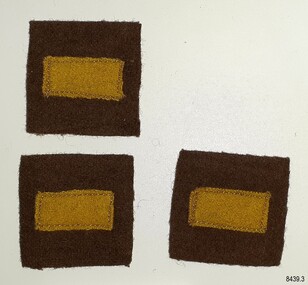
Badge - Australian Military cloth patch, Army Medical Corps, 106 Australian General Hospital, 1939-1945
... Angus Collection Australian Army Surgeon Captain Ballarat Bonegilla badge insignia World War 1 1914-1918 badge collection World War 2 Second World War Australian Defence Forces Army Medical Corps 108 Australian General Hospital Great War Military uniform 106 Australian General Hospital Badges; set of three cloth patches, yellow rectangles on brown squares. ...The three cloth patches belonged to Dr William Roy Angus and are now part of Flagstaff Hill’s comprehensive W.R. Angus Collection, donated by the family of Dr W R Angus (1901-1970), surgeon and oculist. The badges date to the Second World War era, when Dr Angus was a Surgeon Captain for the Australian Defence Forces in the Army Medical Corps, 108 Australian General Hospital and 106 Australian General Hospital, stationed in Ballarat, Victoria, and in Bonegilla, N.S.W. He completed his service just before the end of the war due to suffering from a heart attack. In World War I the troops of the Australian Military Forces staked coloured flags of various shapes and colours in the ground where they camped to identify their units. These flag codes were quickly recognised. The system worked so well that miniature flags were called colour patches. They became part of the uniform, to be worn on both sleeves just below the shoulder. The system was slightly modified for use in the Second World War. The W.R. Angus Collection: - The W.R. Angus Collection includes historical medical equipment, surgical instruments and material belonging to Dr Edward Ryan and Dr Thomas Francis Ryan, (both of Nhill, Victoria) and Dr Angus’ own belongings. The Collection’s history spans the medical practices of the two Doctors Ryan, from 1885-1926 plus that of Dr Angus, up until 1969. It includes historical medical and surgical equipment and instruments from the doctors Edward and Thomas Ryan of Nhill, Victoria. Dr Angus married Gladys in 1927 at Ballarat, the nearest big city to Nhill where he began as a Medical Assistant. He was also Acting House surgeon at the Nhill hospital where their two daughters were born. During World War II He served as a Military Doctor in the Australian Defence Forces. Dr Angus and his family moved to Warrnambool in 1939, where Dr Angus operated his own medical practice. He later added the part-time Port Medical Officer responsibility and was the last person appointed to that position. Both Dr Angus and his wife were very involved in the local community, including the planning stages of the new Flagstaff Hill and the layout of the gardens there. Dr Angus passed away in March 1970.Dr W R Angus (1901-1970), surgeon and oculist, collected a range of military objects including those he personally used during his time as Surgeon Captain in the Australian Defence Forces in World War II. The objects allow insight into military life in the early-to-mid 20th century. The W.R. Angus Collection is significant for still being located at the site it is connected with, Doctor Angus being the last Port Medical Officer in Warrnambool. The Collection includes historical medical objects that date back to the late 1800s.Badges; set of three cloth patches, yellow rectangles on brown squares. Insignia of the Australian Defence Forces, Army Medical Corps, 106 Australian General Hospital, WII era. Dr W R Angus owned the cloth patches that are now part of the W. R. Angus Collection.flagstaff hill, warrnambool, maritime village, maritime museum, shipwreck coast, great ocean road, flagstaff hill maritime museum and village, dr w r angus, w.r. angus collection, australian army, surgeon captain, ballarat, bonegilla, badge, insignia, world war 1, 1914-1918, badge collection, world war 2, second world war, australian defence forces, army medical corps, 108 australian general hospital, great war, military uniform, 106 australian general hospital -
 Flagstaff Hill Maritime Museum and Village
Badge - Australian Military cloth patch, Army Medical Corps, Non-Divisional Units, 1925 - 1942
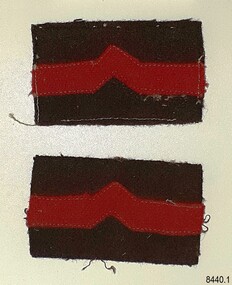
... badge collection...World War 2...Second World War...Australian Defence Forces...Army Medical Corps...Military uniform...cloth...Angus Collection Australian Army Surgeon Captain Ballarat Bonegilla badge insignia badge collection World War 2 Second World War Australian Defence Forces Army Medical Corps Military uniform cloth patch insignia patch Australian Army Medical Corp (Militia) WW 2 ww II 1925-1940 Military badge Non-Divisional Unit AAMC 1940-1942 8th Field Ambulance peacetime training insignia history Badge, cloth insignia patch. ...The cloth insignia badges date to 1925-1940, after the First World War and into the early Second World War era. During peacetime training, the "brown with a cherry-red crossbar" badge was initially used for the 8th Field Ambulance, 2nd Military District Medical and Veterinary Stores. The colour patch was approved for wear by full-time duty personnel of all medical units apart from the Infantry and Cavalry. In 1942 these patches were replaced by the new scheme of colour patches introduced by the Australian Army Medical Corps. Dr W R Angus was a Surgeon Captain for the Australian Defence Forces, Army Medical Corps, stationed in Ballarat, Victoria, and in Bonegilla, N.S.W. He completed his service just before the end of the war due to suffering from a heart attack. The badges are now part of Flagstaff Hill’s comprehensive W.R. Angus Collection, donated by the family of Dr W R Angus (1901-1970), surgeon and oculist. The W.R. Angus Collection: - The W.R. Angus Collection includes historical medical equipment, surgical instruments and material belonging to Dr Edward Ryan and Dr Thomas Francis Ryan, (both of Nhill, Victoria) and Dr Angus’ own belongings. The Collection’s history spans the medical practices of the two Doctors Ryan, from 1885-1926 plus that of Dr Angus, up until 1969. It includes historical medical and surgical equipment and instruments from the doctors Edward and Thomas Ryan of Nhill, Victoria. Dr Angus married Gladys in 1927 at Ballarat, the nearest big city to Nhill where he began as a Medical Assistant. He was also Acting House surgeon at the Nhill hospital where their two daughters were born. During World War II He served as a Military Doctor in the Australian Defence Forces. Dr Angus and his family moved to Warrnambool in 1939, where Dr Angus operated his own medical practice. He later added the part-time Port Medical Officer responsibility and was the last person appointed to that position. Both Dr Angus and his wife were very involved in the local community, including the planning stages of the new Flagstaff Hill and the layout of the gardens there. Dr Angus passed away in March 1970.These colour insignia patches represent the history between the First and Second World Wars and the evolution of Australian Army Medical Corps patches. They Dr W R Angus (1901-1970), surgeon and oculist, collected a range of military objects including those he personally used during his time as Surgeon Captain in the Australian Defence Forces in World War II. The item allows insight into military life in the early-to-mid 20th century. The W.R. Angus Collection is significant for still being located at the site it is connected with, Doctor Angus being the last Port Medical Officer in Warrnambool. The Collection includes historical medical objects that date back to the late 1800s.Badge, cloth insignia patch. Pair of two Insignia colour patches.Red stripe with an inverted 'V' shape on brown fabric. Insignia of the Australian Army Medical Corps, Non-Divisional Units. One badge has light-coloured stitches around the perimeter. The cloth patches belonged to Dr W R Angus and are now part of the W. R. Angus Collection.flagstaff hill, warrnambool, maritime village, maritime museum, shipwreck coast, great ocean road, flagstaff hill maritime museum and village, dr w r angus, w.r. angus collection, australian army, surgeon captain, ballarat, bonegilla, badge, insignia, badge collection, world war 2, second world war, australian defence forces, army medical corps, military uniform, cloth patch, insignia patch, australian army medical corp (militia), ww 2, ww ii, 1925-1940, military badge, non-divisional unit, aamc, 1940-1942, 8th field ambulance, peacetime training, insignia history -
 Flagstaff Hill Maritime Museum and Village
Badge - Australian Military cloth patch, Army Medical Corps, Non-Divisional Units, 1925 - 1942
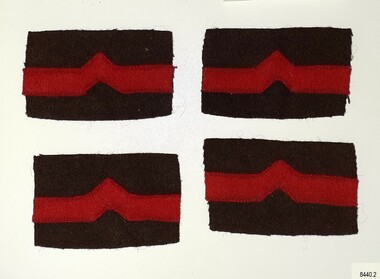
... badge collection...World War 2...Second World War...Australian Defence Forces...Army Medical Corps...Military uniform...cloth...Angus Collection Australian Army Surgeon Captain Ballarat Bonegilla badge insignia badge collection World War 2 Second World War Australian Defence Forces Army Medical Corps Military uniform cloth patch insignia patch Australian Army Medical Corp (Militia) WW 2 ww II 1925-1940 Military badge Non-Divisional Unit AAMC 1940-1942 8th Field Ambulance peacetime training insignia history Badge, cloth insignia patch. ...The cloth insignia badges date to 1925-1940, after the First World War and into the early Second World War era. During peacetime training, the "brown with a cherry-red crossbar" badge was initially used for the 8th Field Ambulance, 2nd Military District Medical and Veterinary Stores. The colour patch was approved for wear by full-time duty personnel of all medical units apart from the Infantry and Cavalry. In 1942 these patches were replaced by the new scheme of colour patches introduced by the Australian Army Medical Corps. Dr W R Angus was a Surgeon Captain for the Australian Defence Forces, Army Medical Corps, stationed in Ballarat, Victoria, and in Bonegilla, N.S.W. He completed his service just before the end of the war due to suffering from a heart attack. The badges are now part of Flagstaff Hill’s comprehensive W.R. Angus Collection, donated by the family of Dr W R Angus (1901-1970), surgeon and oculist. The W.R. Angus Collection: - The W.R. Angus Collection includes historical medical equipment, surgical instruments and material belonging to Dr Edward Ryan and Dr Thomas Francis Ryan, (both of Nhill, Victoria) and Dr Angus’ own belongings. The Collection’s history spans the medical practices of the two Doctors Ryan, from 1885-1926 plus that of Dr Angus, up until 1969. It includes historical medical and surgical equipment and instruments from the doctors Edward and Thomas Ryan of Nhill, Victoria. Dr Angus married Gladys in 1927 at Ballarat, the nearest big city to Nhill where he began as a Medical Assistant. He was also Acting House surgeon at the Nhill hospital where their two daughters were born. During World War II He served as a Military Doctor in the Australian Defence Forces. Dr Angus and his family moved to Warrnambool in 1939, where Dr Angus operated his own medical practice. He later added the part-time Port Medical Officer responsibility and was the last person appointed to that position. Both Dr Angus and his wife were very involved in the local community, including the planning stages of the new Flagstaff Hill and the layout of the gardens there. Dr Angus passed away in March 1970.These colour insignia patches represent the history between the First and Second World Wars and the evolution of Australian Army Medical Corps patches. Dr W R Angus (1901-1970), surgeon and oculist, collected a range of military objects including those he personally used during his time as Surgeon Captain in the Australian Defence Forces in World War II. The item allows insight into military life in the early-to-mid 20th century. The W.R. Angus Collection is significant for still being located at the site it is connected with, Doctor Angus being the last Port Medical Officer in Warrnambool. The Collection includes historical medical objects that date back to the late 1800s.Badge, cloth insignia patch. Set of four Insignia colour patches.Red stripe with an inverted 'V' shape on brown fabric. Insignia of the Australian Army Medical Corps, Non-Divisional Units. The cloth patches belonged to Dr W R Angus and are now part of the W. R. Angus Collection.flagstaff hill, warrnambool, maritime village, maritime museum, shipwreck coast, great ocean road, flagstaff hill maritime museum and village, dr w r angus, w.r. angus collection, australian army, surgeon captain, ballarat, bonegilla, badge, insignia, badge collection, world war 2, second world war, australian defence forces, army medical corps, military uniform, cloth patch, insignia patch, australian army medical corp (militia), ww 2, ww ii, 1925-1940, military badge, non-divisional unit, aamc, 1940-1942, 8th field ambulance, peacetime training, insignia history -
 Flagstaff Hill Maritime Museum and Village
Badge - Insignia Ribbon, 1939-1945
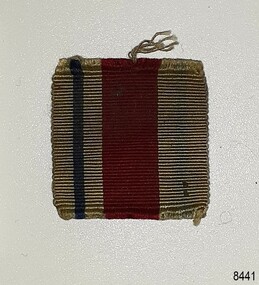
... badge collection...World War 2...Second World War...Australian Defence Forces...Army Medical Corps...Military uniform...cloth...Angus Collection Australian Army Surgeon Captain Ballarat Bonegilla badge insignia badge collection World War 2 Second World War Australian Defence Forces Army Medical Corps Military uniform cloth patch insignia patch Australian Army Medical Corp (Militia) WW 2 ww II 1925-1940 Military badge Non-Divisional Unit AAMC 1940-1942 8th Field Ambulance peacetime training insignia history insignia ribbon ribbon patch Badge, woven ribbon insignia patch. ...The cloth insignia patch is one of a collection of military badges that date to the World War II period. This ribbon has not yet been identified. The badges are now part of Flagstaff Hill’s comprehensive W.R. Angus Collection, donated by the family of Dr W R Angus (1901-1970), surgeon and oculist. Dr W R Angus was a Surgeon Captain for the Australian Defence Forces, Army Medical Corps, stationed in Ballarat, Victoria, and in Bonegilla, N.S.W. He completed his service just before the end of the war due to suffering from a heart attack. The W.R. Angus Collection: - The W.R. Angus Collection includes historical medical equipment, surgical instruments and material belonging to Dr Edward Ryan and Dr Thomas Francis Ryan, (both of Nhill, Victoria) and Dr Angus’ own belongings. The Collection’s history spans the medical practices of the two Doctors Ryan, from 1885-1926 plus that of Dr Angus, up until 1969. It includes historical medical and surgical equipment and instruments from the doctors Edward and Thomas Ryan of Nhill, Victoria. Dr Angus married Gladys in 1927 at Ballarat, the nearest big city to Nhill where he began as a Medical Assistant. He was also Acting House surgeon at the Nhill hospital where their two daughters were born. During World War II He served as a Military Doctor in the Australian Defence Forces. Dr Angus and his family moved to Warrnambool in 1939, where Dr Angus operated his own medical practice. He later added the part-time Port Medical Officer responsibility and was the last person appointed to that position. Both Dr Angus and his wife were very involved in the local community, including the planning stages of the new Flagstaff Hill and the layout of the gardens there. Dr Angus passed away in March 1970.This insignia ribbon is connected to the collection of military badges in the W.R. Angus Collection. Dr W R Angus (1901-1970), surgeon and oculist, collected a range of military objects including those he personally used during his time as Surgeon Captain in the Australian Defence Forces in World War II. The item allows insight into military life in the early-to-mid 20th century. The W.R. Angus Collection is significant for still being located at the site it is connected with, Doctor Angus being the last Port Medical Officer in Warrnambool. The Collection includes historical medical objects that date back to the late 1800s.Badge, woven ribbon insignia patch. Rectangular patch has vertical stripes, one is a narrow blue stripe and the other is a wide red or crimson stripe. The cloth patches belonged to Dr W R Angus and are now part of the W. R. Angus Collection.flagstaff hill, warrnambool, maritime village, maritime museum, shipwreck coast, great ocean road, flagstaff hill maritime museum and village, dr w r angus, w.r. angus collection, australian army, surgeon captain, ballarat, bonegilla, badge, insignia, badge collection, world war 2, second world war, australian defence forces, army medical corps, military uniform, cloth patch, insignia patch, australian army medical corp (militia), ww 2, ww ii, 1925-1940, military badge, non-divisional unit, aamc, 1940-1942, 8th field ambulance, peacetime training, insignia history, insignia ribbon, ribbon patch -
 Flagstaff Hill Maritime Museum and Village
Badge - Insignia Ribbon, 1939-1945
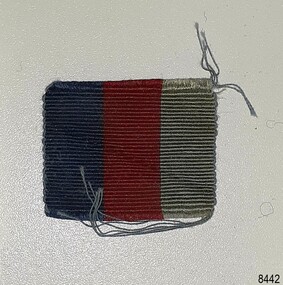
... badge collection...World War 2...Second World War...Australian Defence Forces...Army Medical Corps...Military uniform...cloth...Angus Collection Australian Army Surgeon Captain Ballarat Bonegilla badge insignia badge collection World War 2 Second World War Australian Defence Forces Army Medical Corps Military uniform cloth patch insignia patch Australian Army Medical Corp (Militia) WW 2 ww II 1925-1940 Military badge Non-Divisional Unit AAMC 1940-1942 8th Field Ambulance peacetime training insignia history insignia ribbon ribbon patch Badge, woven ribbon insignia patch. ...The cloth insignia patch is one of a collection of military badges that date to the World War II period. This ribbon has not yet been identified. The badges are now part of Flagstaff Hill’s comprehensive W.R. Angus Collection, donated by the family of Dr W R Angus (1901-1970), surgeon and oculist. Dr W R Angus was a Surgeon Captain for the Australian Defence Forces, Army Medical Corps, stationed in Ballarat, Victoria, and in Bonegilla, N.S.W. He completed his service just before the end of the war due to suffering from a heart attack. The W.R. Angus Collection: - The W.R. Angus Collection includes historical medical equipment, surgical instruments and material belonging to Dr Edward Ryan and Dr Thomas Francis Ryan, (both of Nhill, Victoria) and Dr Angus’ own belongings. The Collection’s history spans the medical practices of the two Doctors Ryan, from 1885-1926 plus that of Dr Angus, up until 1969. It includes historical medical and surgical equipment and instruments from the doctors Edward and Thomas Ryan of Nhill, Victoria. Dr Angus married Gladys in 1927 at Ballarat, the nearest big city to Nhill where he began as a Medical Assistant. He was also Acting House surgeon at the Nhill hospital where their two daughters were born. During World War II He served as a Military Doctor in the Australian Defence Forces. Dr Angus and his family moved to Warrnambool in 1939, where Dr Angus operated his own medical practice. He later added the part-time Port Medical Officer responsibility and was the last person appointed to that position. Both Dr Angus and his wife were very involved in the local community, including the planning stages of the new Flagstaff Hill and the layout of the gardens there. Dr Angus passed away in March 1970.This insignia ribbon is connected to the collection of military badges in the W.R. Angus Collection. Dr W R Angus (1901-1970), surgeon and oculist, collected a range of military objects including those he personally used during his time as Surgeon Captain in the Australian Defence Forces in World War II. The item allows insight into military life in the early-to-mid 20th century. The W.R. Angus Collection is significant for still being located at the site it is connected with, Doctor Angus being the last Port Medical Officer in Warrnambool. The Collection includes historical medical objects that date back to the late 1800s.Badge, woven ribbon insignia patch. Rectangular patch has wide vertical stripes, one is a blue stripe and the other is a red or crimson stripe. The cloth patches belonged to Dr W R Angus and are now part of the W. R. Angus Collection.flagstaff hill, warrnambool, maritime village, maritime museum, shipwreck coast, great ocean road, flagstaff hill maritime museum and village, dr w r angus, w.r. angus collection, australian army, surgeon captain, ballarat, bonegilla, badge, insignia, badge collection, world war 2, second world war, australian defence forces, army medical corps, military uniform, cloth patch, insignia patch, australian army medical corp (militia), ww 2, ww ii, 1925-1940, military badge, non-divisional unit, aamc, 1940-1942, 8th field ambulance, peacetime training, insignia history, insignia ribbon, ribbon patch -
 Geelong RSL Sub Branch
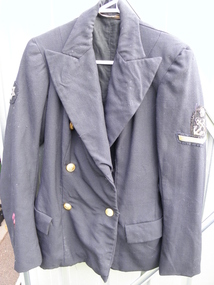
Uniform Jacket - RAN, Mid 20th Century
... uniform jacket of C? L Taylor. ran aif military c? l taylor Inside the Jacket the name C?L Taylor. Navy Blue Cloth Jacket with buttons attached, inscribed Australia. The Jacket has badge ...Uniform Jacket belonging to C? L Taylor who served in the Royal Australian Navy.The is a uniform jacket of C? L Taylor.Navy Blue Cloth Jacket with buttons attached, inscribed Australia. The Jacket has badge of Rank on the left sleeve, badge of Trade on the right sleeve and three red markings for period of enlistment.Inside the Jacket the name C?L Taylor.ran, aif, military, c? l taylor -
 Geelong RSL Sub Branch
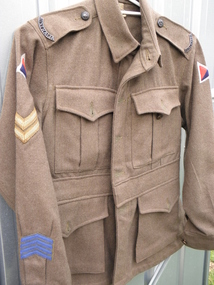
Uniform Jacket- Service Dress Ceremonial, 1941
... uniform jacket service dress khaki amf Inside the Jacket hand written OSWR. Makers Tag - Freedman & Co Pty Ltd. 1941. Size 6. Name Tag - Regimental No VX33678. Name Bdr E. O'Shea. Khaki Wool cloth Jacket, four patch pockets on the front of the Jacket. The Jacket has two 'Australia' shoulder titles on the epaulets, one only small (king's Crown) rising sun badge ...This particular Jacket was issued to VX 33678 Bdr E. O'Shea.Bdr O'Shea served during WW2Khaki Wool cloth Jacket, four patch pockets on the front of the Jacket. The Jacket has two 'Australia' shoulder titles on the epaulets, one only small (king's Crown) rising sun badge on the collar, six small buttons, four small buttons with King's Crown, map of Australia and embossed Australian Military Forces. One small button at the collar. On the right and left sleeve are the colour patch of Artillery. On the right sleeve is the badge of rank of Bombardier and four blue service chevrons. Inside the Jacket hand written OSWR. Makers Tag - Freedman & Co Pty Ltd. 1941. Size 6. Name Tag - Regimental No VX33678. Name Bdr E. O'Shea. uniform, jacket, service dress, khaki, amf -
 The Beechworth Burke Museum
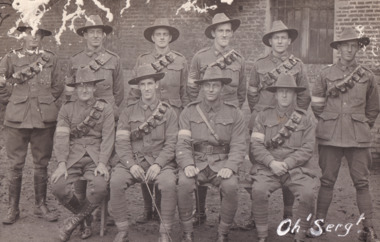
Postcard, 1918
... badge. This insignia is almost always identified with the Australian Imperial Force. Another characteristic of the Australian Imperial Force uniform are the rectangular colour patches worn by all men on this postcard. In March 1915, a new scheme of unit identification was devised to replace the wearing of unit titles. This consisted of cloth...badge. This insignia is almost always identified with the Australian Imperial Force. Another characteristic of the Australian Imperial Force uniform are the rectangular colour patches worn by all men on this postcard. In March 1915, a new scheme of unit identification was devised to replace the wearing of unit titles. This consisted of cloth ...It is believed that the photograph on the obverse side of the postcard was taken in 1918. Depicted are ten Australian male soldiers. Their names are transcribed in pencil on the reverse side of the postcard. Each soldier is dressed in a formal military uniform. It is believed that these soldiers were part of The Australian Imperial Force during World War I. This can be inferred by the chevron rank insignia visible on the uniforms of nine of ten men. The placement of this insignia on the sleeves of their right arms suggests that they were either Warrant Officers or Non-Commissioned Officers (NCO). Specifically, the number of chevron stripes - here, nine men have three - are believed to signify a Corporal rank. The men pictured on this postcard are also wearing 'Rising Sun' collar badges on their coats. Australia, unlike most other Commonwealth countries, did not adopt metal regimental badges during the First World War. All units were issued with the Australian Army General Service Badge, better known as the 'Rising Sun’ badge. This insignia is almost always identified with the Australian Imperial Force. Another characteristic of the Australian Imperial Force uniform are the rectangular colour patches worn by all men on this postcard. In March 1915, a new scheme of unit identification was devised to replace the wearing of unit titles. This consisted of cloth colour patches on the upper arms of a soldier’s tunic. The black and white nature of the record means that we cannot establish which battalion these soldiers were part of. However, one of the handwritten signatures on the reverse side of the postcard reads "W.A. Griggs". This was the signature of Sergeant William Archibald Griggs. Further research shows that Griggs was part of the 5th Australian Division Signals Company. Therefore, it is believed these soldiers were part of the ANZAC Signal Companies. The main role of the Signal Companies during World War I was the laying and maintenance of telephone cables and switchboards, used to connect various units in their area. Furthermore, the man standing in the back row, third from the left side, has an Overseas Service chevron patch on his coat. In January 1918, the Australian Imperial Force approved the wearing of the overseas service chevrons which had been adopted by the British Army. These were embroidered or woven inverted chevrons worn above the cuff on the right arm. Due to a shortage of supply, some men had chevrons privately made. For each year of war service, a blue chevron was awarded, and those men who had embarked in 1914 received a red chevron to indicate that year’s service; however, the black and white nature of the postcard makes it difficult to determine what colours are on this man's patch.The record is historically significant due to its connection to World War I. This conflict is integral to Australian culture as it was the single greatest loss of life and the greatest repatriation of casualties in the country's history. Australia’s involvement in the First World War began when the Australian government established the Australian Imperial Force (AIF) in August 1914. Immediately, men were recruited to serve the British Empire in the Middle East and on the Western Front. The first significant Australian action of the war was the Australian Naval and Military Expeditionary Force’s (ANMEF) landing on Rabaul on 11 September 1914. The ANMEF took possession of German New Guinea at Toma on 17 September 1914 and of the neighbouring islands of the Bismarck Archipelago in October 1914. On 25 April 1915, members of the AIF landed on Gallipoli in Turkey with troops from New Zealand, Britain, and France. This specific event holds very strong significance within Australian history. The record has strong research potential. This is due to the ongoing public and scholarly interest in war, history, and especially the ANZAC legend, which is commemorated annually on 25 April, known as ANZAC Day.Black and white rectangular postcard printed on paper.Obverse: Oh 'Serg!' / Reverse: CARTE POSTALE / 6537 / Correspondance / Adresse / w.a. Grigg / J. Fain / Ruckling / R.J Farrar / (?) / Clarke / L (?) / GFFisher / R. M. Forrest / With Compliments / Sgt's Mess / November 1918 /military album, army, aif, uniform, military, wwi, world war i, rising sun badge, william archibald griggs, anzac, signal companies, postcard, patches, chevron -
 The Beechworth Burke Museum
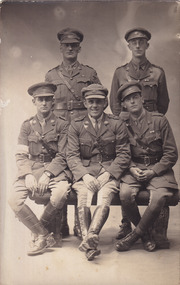
Postcard
... badge. This insignia is almost always identified with the Australian Imperial Force. Another characteristic of the Australian Imperial Force uniform are rectangular colour patches. One is visible on the soldier in the front row, first from the left on this postcard. In March 1915, a new scheme of unit identification was devised to replace the wearing of unit titles. This consisted of cloth...badge. This insignia is almost always identified with the Australian Imperial Force. Another characteristic of the Australian Imperial Force uniform are rectangular colour patches. One is visible on the soldier in the front row, first from the left on this postcard. In March 1915, a new scheme of unit identification was devised to replace the wearing of unit titles. This consisted of cloth ...The photograph on the obverse side of the postcard was taken some time between 1914-1918. Depicted are five unidentified Australian soldiers. They are all dressed in military uniforms. It is believed that these soldiers were part of The Australian Imperial Force during World War I. This can be inferred by the 'Rising Sun' collar badges on their coats. Australia, unlike most other Commonwealth countries, did not adopt metal regimental badges during the First World War. All units were issued with the Australian Army General Service Badge, better known as the 'Rising Sun’ badge. This insignia is almost always identified with the Australian Imperial Force. Another characteristic of the Australian Imperial Force uniform are rectangular colour patches. One is visible on the soldier in the front row, first from the left on this postcard. In March 1915, a new scheme of unit identification was devised to replace the wearing of unit titles. This consisted of cloth colour patches on the right arms of a soldier’s tunic. The sepia nature of the record means that we cannot determine the colour, and therefore cannot establish which battalion this soldier was part of. Furthermore, the man seated in the middle of the front row has an Overseas Service chevron patch on his coat. In January 1918, the Australian Imperial Force approved the wearing of the overseas service chevrons which had been adopted by the British Army. These were embroidered or woven inverted chevrons worn above the cuff on the right arm. Due to a shortage of supply, some men had chevrons privately made. For each year of war service, a blue chevron was awarded, and those men who had embarked in 1914 received a red chevron to indicate that year’s service; however, the sepia nature of the postcard makes it difficult to determine what colours are on this man's patch.The record is historically significant due to its connection to World War I. This conflict is integral to Australian culture as it was the single greatest loss of life and the greatest repatriation of casualties in the country's history. Australia’s involvement in the First World War began when the Australian government established the Australian Imperial Force (AIF) in August 1914. Immediately, men were recruited to serve the British Empire in the Middle East and on the Western Front. The first significant Australian action of the war was the Australian Naval and Military Expeditionary Force’s (ANMEF) landing on Rabaul on 11 September 1914. The ANMEF took possession of German New Guinea at Toma on 17 September 1914 and of the neighbouring islands of the Bismarck Archipelago in October 1914. On 25 April 1915, members of the AIF landed on Gallipoli in Turkey with troops from New Zealand, Britain, and France. This specific event holds very strong significance within Australian history. The record has strong research potential. This is due to the ongoing public and scholarly interest in war, history, and especially the ANZAC legend, which is commemorated annually on 25 April, known as ANZAC Day.Sepia rectangular postcard printed on paper.Reverse: CARTE POSTALE / hyossest (?) / 6538 /military album, army, aif, australian imperial force, postcard, wwi, world war i, portrait, soldiers -
 Orbost & District Historical Society
Uniform - Orbost Municipal Band, F Maxey & Son P/L, c. 1960s - 1970s
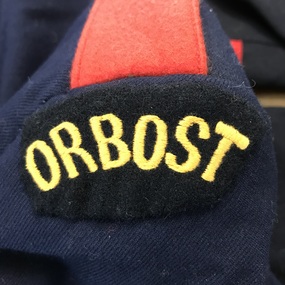
... badges; gold lanyard on right sleeve. Gold on black cloth badge on shoulders. A whistle is also with this jacket. 3364.4 small jacket, dark blue/black, woollen, red epaulets, gold studs, 2 lyre studs on lapels 3364.5 small trousers. dark blue/black, woollen. Red stripe down outside of both legs. 3364.3 a 41 cm square square red cloth banner, with gold fringe on the bottom, gold tassle on top with gold cord. Has O M B in large lettering appliqued to the banner. Uniform ...In 2024, while doing some renovations at the Orbost Customer Service Centre / Library, Council staff have found some boxes of old Orbost Municipal Band uniforms and flags which date back to the late 1970s (when it’s understood the band wound up). These items were offered to the O D Historical Society for its collection. A selection was made (3364). The first Orbost Brass Band was formed in 1889. Around 1908 the town band split and the Orbost Workers' Band was formed. Eventually the two bands merged in 1913 to reform as the Orbost Municipal Band under conductorship of Charles Spink. The band continued for many years but was later disbanded and again reformed. This was to happen a number of times, the last time being in 1961 and continuing through to the late 1970's. Also refer to items in the O D H S collection. Further info and Ref: In Times Gone By - Deborah Hall The items are significant because they are authentic parts of the Orbost Municipal Band. A number of items of clothing (cap, coat, gloves, jacket, badges, trousers), banner, insignias, whistle. These are all items associated with the Orbost Municipal Band. The costume items are all dark blue/black with gold and red trims. Gloves are white/cream gauntlet style. Whistle is silver. The banner is red background with gold trims and O M B appliqued. 3364.1 cap, dark blue with front visor, red ribbon decoration, 2 gold buttons on sides; large gold metal decoration of a lyre with crown on top a the front. 3364.2 pair of gloves, gauntlet style, white/cream leather, silver studs 3364.6 large jacket, dark blue/black, woollen, red epaulets on shoulders with gold buttons, 4 gold buttons on front, 6 on sleeves, gold braiding; drum badge on sleeves, 2 lyre badges; gold lanyard on right sleeve. Gold on black cloth badge on shoulders. A whistle is also with this jacket. 3364.4 small jacket, dark blue/black, woollen, red epaulets, gold studs, 2 lyre studs on lapels 3364.5 small trousers. dark blue/black, woollen. Red stripe down outside of both legs. 3364.3 a 41 cm square square red cloth banner, with gold fringe on the bottom, gold tassle on top with gold cord. Has O M B in large lettering appliqued to the banner. labels on clothing: F. Maxey & Son P/L - on cap Simpson's Gloves P/L Vic. - gloves Hersh's - on badges, also trousers, and jacket OMB - Orbost Municipal Band - on banner ORBOST - on cloth badges orbost municipal band, orbost bands -
 Orbost & District Historical Society
pocket badge
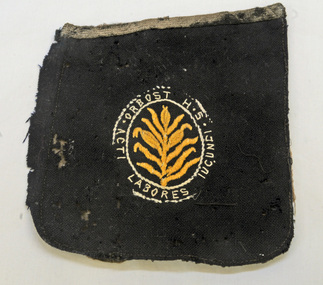
... This item represents the history of the institution. badge school-uniform education orbost-high-school On back lining : PR in black marker 1922 A navy coloured cloth pocket badge from Orbost High School. ...This pocket with the school badge was part of the girls' uniform at Orbost High School. The blazer pocket forms part of the Mary Gilbert collection. The Latin inscription, :acti labores lucundi" can be freely translated as "finished work is pleasant". The school badge with its stalk of maize was designed by Clarke Cowell who was in the first Senior Class of Orbost Higher Elementary School in 1912.Orbost High School / Orbost Secondary College has played a significant role in the education of senior students in Orbost as the sole facility in the distruct. This item represents the history of the institution.A navy coloured cloth pocket badge from Orbost High School. It has the school motto, "acti labores lucundi" around a yellow/gold stalk of maize.On back lining : PR in black marker 1922 badge school-uniform education orbost-high-school -
 Orbost & District Historical Society
badge
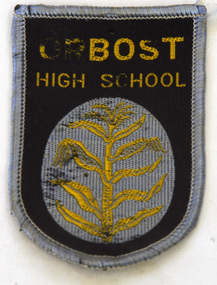
... This cloth badge was part of the Orbost High School girls' sports uniform. It was sewn onto the inter-school sports uniform....This cloth badge was part of the Orbost High School girls' sports uniform. It was sewn onto the inter-school sports uniform. ...This cloth badge was part of the Orbost High School girls' sports uniform. It was sewn onto the inter-school sports uniform.Orbost High School / Orbost Secondary College has played a significant part in the education of senior students in the Orbost district . It is the sole senior educational institution. This badge is representative of its history.A small shield-shaped cloth badge of the Orbost High School emblem. It is of a yellow/gold stalk of maize in a grey circle with ORBOST HIGH SCHOOL in yellow lettering.badge school-uniform education orbost-high-school -
 Ringwood and District Historical Society
Uniform, Ringwood Technical School - Prefect's Blazer badge and Pin 1970-71
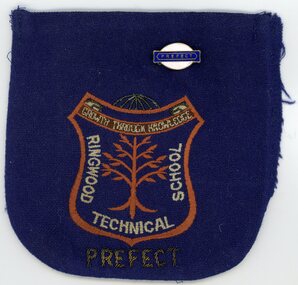
... Cloth Blazer Prefect's Badge. and metal pinned badge. Worn 1970-71 by Joan Pickford (Nee Dear). Ringwood Technical School - Prefect's Blazer badge and Pin 1970-71 Uniform ...Dark Blue Cloth Blazer Prefect's Badge. and metal pinned badge. Worn 1970-71 by Joan Pickford (Nee Dear). Ringwood Technical School / Growth Through Knowledge" / PREFECTrts, ringwood tech -
 Montmorency–Eltham RSL Sub Branch
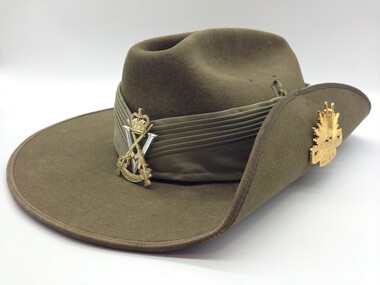
Headwear - Slouch hat, 1990
... uniform item slouch hat Australian Army Australian Army slouch hat Bardsley Hats Bardsley Hats 1990 broad arrow Fur felt 54 gold stencil on sweat band. "319232 READ R" handwritten inside sweatband "Sgt Nicholls" handwritten brown marker pen on mounting board Khaki Australian Army slouch hat (fur felt) with khaki cloth puggaree. Cloth black over red rectangular colour patch on right hand side of puggaree. Gilt metal Royal Victoria Regiment cap badge ...Standard issue hat to Army Reserve unit. Representative uniform itemKhaki Australian Army slouch hat (fur felt) with khaki cloth puggaree. Cloth black over red rectangular colour patch on right hand side of puggaree. Gilt metal Royal Victoria Regiment cap badge on front of puggaree. Australian Army rising sun badge on left side turned up brim. Brown vinyl sweat band. Chin strap missing. Hat mounted on plywood carrying board. Bardsley Hats 1990 broad arrow Fur felt 54 gold stencil on sweat band. "319232 READ R" handwritten inside sweatband "Sgt Nicholls" handwritten brown marker pen on mounting board slouch hat, australian army, australian army slouch hat, bardsley hats -
 Montmorency–Eltham RSL Sub Branch
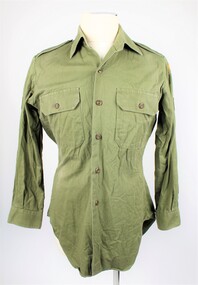
Uniform - Shirt, Green, Field Dress, Green Field Dress Shirt, 1980
... Badge sewn inside shirt. Australian Government Clothing Factory, Victoria, 1980 SIZE 38/81 B405.66.093.2430 SERVICE NO. NAME Green field shirt with two chest pockets. It has three cloth badges of rank. Two badges sewn on the right sleeve and one badge on the left sleeve. The Australian Military Badge is at the top of the L sleeve. Warrant Officer Class II badges (L/R sleeves). Each shoulder has a strap. Green Field Dress Shirt Uniform ...Green field shirt with two chest pockets. It has three cloth badges of rank. Two badges sewn on the right sleeve and one badge on the left sleeve. The Australian Military Badge is at the top of the L sleeve. Warrant Officer Class II badges (L/R sleeves). Each shoulder has a strap.Manufacturers Badge sewn inside shirt. Australian Government Clothing Factory, Victoria, 1980 SIZE 38/81 B405.66.093.2430 SERVICE NO. NAMEgreen shirt,, 1980,, australian armed forces
