
Showing 75 items matching "united states marines"
-
 National Vietnam Veterans Museum (NVVM)
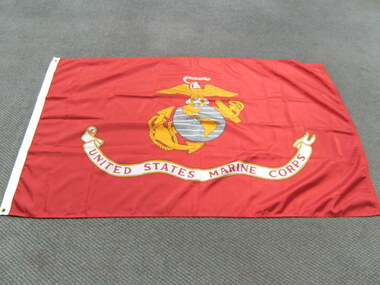
Flag, United States Marine Corps
... United States Marine Corps......United States - Marine Corps...Large banner on bottom of flag saying "United States Marine Corps" Also around the world globe is an anchor and rope also in yellow...United States Marine Corps...Flag United States - Marine Corps United States Marine Corps Red nylon flag featuring yellow and white eagle, standing on a gray round map of the world featuring North and South America in yellow. ...Red nylon flag featuring yellow and white eagle, standing on a gray round map of the world featuring North and South America in yellow. Large banner on bottom of flag saying "United States Marine Corps" Also around the world globe is an anchor and rope also in yellowUnited States Marine Corpsflag, united states - marine corps -
 National Vietnam Veterans Museum (NVVM)
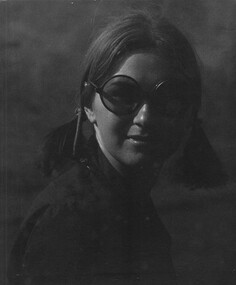
Photograph, Gibbons, Denis, Ms Toby Pyle
... United States...United States Marines Press Centre...A black and white photograph of Danang South Vietnam circa February 1969 American Associated Press War Correspondaent Ms Toby Pyle leaves the Danang United States Marines Press Centre to be ferried to an assignment with US Forces operating in 2 Corps...Photograph Ms Toby Pyle American Associated Press Danang US Forces 2 Corps Gibbons Collection Catalogue War Correspondents - United States United States Marines Press Centre Denis Gibbons A black and white photograph of Danang South Vietnam circa February 1969 American Associated Press War Correspondaent Ms Toby Pyle leaves the Danang United States Marines Press Centre to be ferried to an assignment with US Forces operating in 2 Corps Ms Toby Pyle Photograph Gibbons, Denis ...Denis Gibbons (1937 – 2011) Trained with the Australian Army, before travelling to Vietnam in January 1966, Denis stayed with the 1st Australian Task Force in Nui Dat working as a photographer. For almost five years Gibbons toured with nine Australian infantry battalions, posting compelling war images from within many combat zones before being flown out in late November 1970 after sustaining injuries. The images held within the National Vietnam Veterans Museum make up the Gibbons Collection. A black and white photograph of Danang South Vietnam circa February 1969 American Associated Press War Correspondaent Ms Toby Pyle leaves the Danang United States Marines Press Centre to be ferried to an assignment with US Forces operating in 2 Corpsphotograph, ms toby pyle, american associated press, danang, us forces, 2 corps, gibbons collection catalogue, war correspondents - united states, united states marines press centre, denis gibbons -
 Returned Nurses RSL Sub-branch
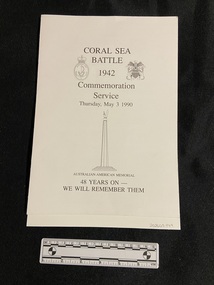
Document - programme of commemoration service, Coral Sea Battle 1942: commemoration service, 1990
... ...United States Marines...Service details printed on front cover in black print with the emblems of the Royal Australian Navy and the United States Marines on either side. There is an image of a memorial statue beneath the service date....Programme for the commemoration service and the Australian-American memorial of the Coral Sea battle of 1942, held on Thursday, May 3, 1990 War memorials Coral Sea Battle 1942 WWII WW2 World War Two Royal Australian Navy United States Marines Single-fold white card. Service details printed on front cover in black print with the emblems of the Royal Australian Navy and the United States Marines on either side. ...Programme for the commemoration service and the Australian-American memorial of the Coral Sea battle of 1942, held on Thursday, May 3, 1990Single-fold white card. Service details printed on front cover in black print with the emblems of the Royal Australian Navy and the United States Marines on either side. There is an image of a memorial statue beneath the service date.war memorials, coral sea battle 1942, wwii, ww2, world war two, royal australian navy, united states marines -
 National Vietnam Veterans Museum (NVVM)
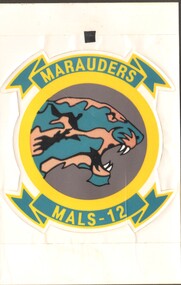
Memorabilia - Sticker
... ...United States Marines...Patch of the Marine Aviation Logistics Squadron 12 (MALS-12), also known as the "Marauders" : an aviation logistics support unit of the United States Marine Corps, deployed in support of combat operations in Vietnam in May 1965. ...Patch of the Marine Aviation Logistics Squadron 12 (MALS-12), also known as the "Marauders" : an aviation logistics support unit of the United States Marine Corps, deployed in support of combat operations in Vietnam in May 1965. ...Patch of the Marine Aviation Logistics Squadron 12 (MALS-12), also known as the "Marauders" : an aviation logistics support unit of the United States Marine Corps, deployed in support of combat operations in Vietnam in May 1965. This item was collected by Warrant Officer Class 2 R P Matthews of the Royal Australian Army Ordnance Corps, who served in 161 (Independent) Reconnaissance Flight, Vietnam 22 Dec 1970 until 23 Dec 1971. Sticker - Yellow circle rim with green and yellow banners top 'Marauders' and bottom ' MALS 12'. Head of large wild cat in green brown and white. marauders, mals 12, sticker, vietnam war, united states marines, us marine corps, marines -
 National Vietnam Veterans Museum (NVVM)
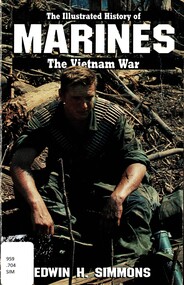
Book, Simmons, Edwin H, Marines: the Vietnam War, 1987
... 1961-1975 -- United States - Marines...1961-1975 -- United States - Marines Battle of Khe Sanh Con Thien The Marines were the first combat troops into Vietnam and the last to leave. ...The Marines were the first combat troops into Vietnam and the last to leave. They bore an even greater proportion of the fighting in Vietnam that in any previous American War.The Marines were the first combat troops into Vietnam and the last to leave. They bore an even greater proportion of the fighting in Vietnam that in any previous American War.1961-1975 -- united states - marines, battle of khe sanh, con thien -
 National Vietnam Veterans Museum (NVVM)
Film - Film, DVD, Vietnam Combat: Volume 3
... 1961-1975 -- United States - Marines...Vietnam War 1961-1975 -- United States - Marines Vietnam War 1961-1975 - United States - Navy Vietnam Combat: Volume 3. ...vietnam war, 1961-1975 -- united states - marines, vietnam war, 1961-1975 - united states - navy -
 National Vietnam Veterans Museum (NVVM)
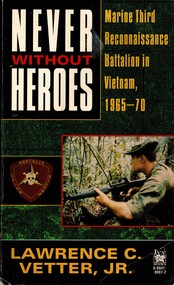
Book, Vetter, Lawrence C. Jr, Never Without Heroes: Marine Third Reconnaissance Battalion in Vietnam 1965-70
... United States. Marine Corps. Reconnaissance Battalion...United States. Marine Corps. Reconnaissance Battalion Vietnam War 1961-1975 - Regimental histories - United States US Marines 3rd Reconnaissance Battalion North Vietnamese Vietcong NVA Base Camps In four and a half years in Vietnam, the Marines of the Third Reconnaissance Battalion repeatedly penetrted North Vietnam and Vietcong sanctuaries by foor and by helipcopter to find enemy forces, learn the enemy's intentions, and, when possible, bring deadly fire down on his head. ...In four and a half years in Vietnam, the Marines of the Third Reconnaissance Battalion repeatedly penetrted North Vietnam and Vietcong sanctuaries by foor and by helipcopter to find enemy forces, learn the enemy's intentions, and, when possible, bring deadly fire down on his head.In four and a half years in Vietnam, the Marines of the Third Reconnaissance Battalion repeatedly penetrted North Vietnam and Vietcong sanctuaries by foor and by helipcopter to find enemy forces, learn the enemy's intentions, and, when possible, bring deadly fire down on his head.united states. marine corps. reconnaissance battalion, vietnam war, 1961-1975 - regimental histories - united states, us marines, 3rd reconnaissance battalion, north vietnamese, vietcong, nva base camps -
 Friends of Ballarat Botanical Gardens History Group
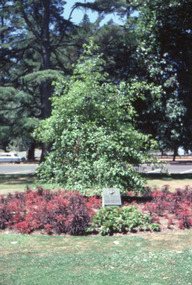
Slide - Colour transparency
... ...united states...navy...marine...Inscription on the plaque : "A tree that looks at God all day and lifts her leafy arms to pray." United States Marine Corps 1st Marine Division This tree is to commemorate the friendship established between the United States marines and the citizens of Ballaarat during their sojourn here in early 1943....Inscription on the plaque : "A tree that looks at God all day and lifts her leafy arms to pray." United States Marine Corps 1st Marine Division This tree is to commemorate the friendship established between the United States marines and the citizens of Ballaarat during their sojourn here in early 1943. ballarat botanical gardens trees parks lawns flowers pathways plaque memorial united states navy marine corps friendship 1943 glove anchor View of the gardens with the sculpture of Wallace and the statuary pavilion. ...Inscription on the plaque : "A tree that looks at God all day and lifts her leafy arms to pray." United States Marine Corps 1st Marine Division This tree is to commemorate the friendship established between the United States marines and the citizens of Ballaarat during their sojourn here in early 1943.View of the gardens with the sculpture of Wallace and the statuary pavilion.ballarat botanical gardens, trees, parks, lawns, flowers, pathways, plaque, memorial, united states, navy, marine corps, friendship, 1943, glove, anchor -
 Friends of Ballarat Botanical Gardens History Group
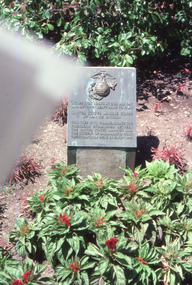
Slide - Colour transparency
... ...united states...navy...marine...Inscription on the plaque : "A tree that looks at God all day and lifts her leafy arms to pray." United States Marine Corps 1st Marine Division This tree is to commemorate the friendship established between the United States marines and the citizens of Ballaarat during their sojourn here in early 1943....Inscription on the plaque : "A tree that looks at God all day and lifts her leafy arms to pray." United States Marine Corps 1st Marine Division This tree is to commemorate the friendship established between the United States marines and the citizens of Ballaarat during their sojourn here in early 1943. ballarat botanical gardens trees parks lawns flowers pathways plaque memorial united states navy marine corps friendship 1943 glove anchor View of the gardens with the sculpture of Wallace and the statuary pavilion. ...Inscription on the plaque : "A tree that looks at God all day and lifts her leafy arms to pray." United States Marine Corps 1st Marine Division This tree is to commemorate the friendship established between the United States marines and the citizens of Ballaarat during their sojourn here in early 1943.View of the gardens with the sculpture of Wallace and the statuary pavilion.ballarat botanical gardens, trees, parks, lawns, flowers, pathways, plaque, memorial, united states, navy, marine corps, friendship, 1943, glove, anchor -
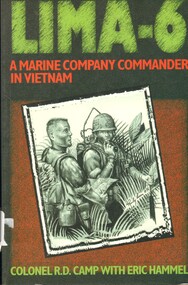 National Vietnam Veterans Museum (NVVM)
Book, Camp, R. D. (Col) with Hammel, Eric, LIMA-6: A Marine Company Commander in Vietnam, 1989
... United States...United States. Marine corps. Marines...1961-1971 - Personal narratives American Vietnamese Conflict 1961-1975 - Regimental histories - United States United States. Marine corps. Marines 26th. Battalion Solid, down to earth, and faithful in describing the way it was (for) one Marine Company Commander. ...Solid, down to earth, and faithful in describing the way it was (for) one Marine Company Commander.Solid, down to earth, and faithful in describing the way it was (for) one Marine Company Commander. 1961-1971 - personal narratives, american, vietnamese conflict, 1961-1975 - regimental histories - united states, united states. marine corps. marines, 26th. battalion -
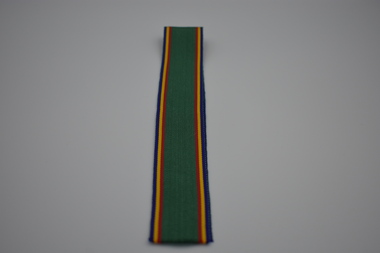 Moorabbin Air Museum
Badge (item) - Military Medal Ribbon, United States Navy Unit Commendation
... United States Navy Unit Commendation. The Navy Unit Commendation (NUC) is an award of the United States Navy that is used to recognise heroism and outstanding actions performed by any ship, unit, aircraft or detachment of the Navy and United States Marine Corps. ...United States Navy Unit Commendation. The Navy Unit Commendation (NUC) is an award of the United States Navy that is used to recognise heroism and outstanding actions performed by any ship, unit, aircraft or detachment of the Navy and United States Marine Corps. ... -
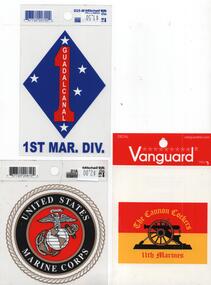 Ballarat Tramway Museum
Document - Adhesive label, Mitchell and Vanguard, "United States Marine Corps"
... "United States Marine Corps"...Set of three adhesive label or car sticker with images of 1 -- Shoulder patch of the United States Marine Corps - made by Mitchell 2 - ditto - 1st Marine Division - with the word "Guadalcanal" vertically - made by Mitchell 3 - ditto - 11th Marines - The Cannon cockers - made by Vanguard of California. ...Refer to https://www.ozatwar.com/usmc/1stmarinedivision.htm - accessed 18/1/2019 which confirms the items being at Victoria Park. "United States Marine Corps" Document Adhesive label Mitchell and Vanguard ...Set of three adhesive label or car sticker with images of 1 -- Shoulder patch of the United States Marine Corps - made by Mitchell 2 - ditto - 1st Marine Division - with the word "Guadalcanal" vertically - made by Mitchell 3 - ditto - 11th Marines - The Cannon cockers - made by Vanguard of California. Donated to the Museum by the son of US Marine whose father was at Victoria Park, July 2018, - noting that they were badges or insignia of the units that were in Victoria Park during 1943. Refer to https://www.ozatwar.com/usmc/1stmarinedivision.htm - accessed 18/1/2019 which confirms the items being at Victoria Park. tramways, trams, world war i, victoria park, ballarat -
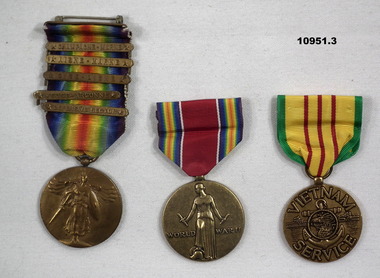 Bendigo Military Museum
Award - MEDALS, U.S, Unknown
... Front - "Vietnam Service" - Back - "United States Merchant Marine"...marine service Medal - to qualify had to serve on a US flagged vessel in support of the Vietnam War. Ron Mills Collection Medals US 1. Bars inscribed; a. “Champagne - Marne. b. Aisne - Marne. c. Oise - Aisne. d. Meuse - Argonne. e. Defensive Sector” 2. Inscribed back - "Freedom from Fear & Want" and "Freedom of Speech & Religion". 3. Front - "Vietnam Service" - Back - "United States ...1. US Victory Medal - A version issued by most Allied countries for Victory in WW1. 2. US WW2 Victory Medal - Awarded to all service personnel with any active duty from 7 Dec 1941 to 31 Dec 1946. 3. US Merchant marine service Medal - to qualify had to serve on a US flagged vessel in support of the Vietnam War.Three medals with Ribbons, unmounted. 1. US WW1 Victory Medal with 5 bars. 2. US WW2 Victory Medal. 3. US Merchant Marine Service medal - mounted on a piece of cardboard.1. Bars inscribed; a. “Champagne - Marne. b. Aisne - Marne. c. Oise - Aisne. d. Meuse - Argonne. e. Defensive Sector” 2. Inscribed back - "Freedom from Fear & Want" and "Freedom of Speech & Religion". 3. Front - "Vietnam Service" - Back - "United States Merchant Marine"ron mills collection, medals, us -
 National Vietnam Veterans Museum (NVVM)
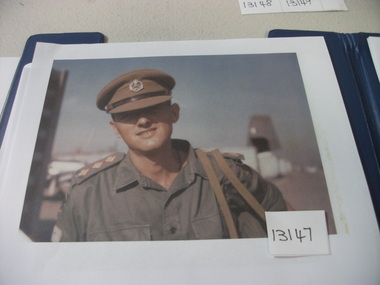
Photograph, Captain John White, AATTV, arrives in Vietnam, January 1968, 1/01/1968 12:00:00 AM
... However, in the meantime a platoon of United States Marine Corps artillery arrived bringing with them two howitzers and a stockpile of ammunition. ...However, in the meantime a platoon of United States Marine Corps artillery arrived bringing with them two howitzers and a stockpile of ammunition. ...Captain John E D White, Australian Army Training Team in Vietnam (AATTV) took over command of 11 Mobile Strike Force (Mike Force) Company in Da Nang, Vietnam, in February 1968. He was 26 years old. The 2 NVA Division was moving from Laos into South Vietnam and his mission was to establish contact with the division and trace its movements south. In mid-March the company was air lifted to the Special Forces camp of Kham Duc, near the Laotian border. They used an old French Foreign Legion fort as a temporary base from which patrols could be sent out. White called it Ngok Tavak after a nearby mountain. Initially, patrols failed to find the enemy, but in late April a patrol clashed with the enemy. At the same time, White received intelligence that the NVA division was closing in. At night they could hear explosions in the distance heading toward them. White decided their best chance was to leave the fort and take to the jungle to adopt guerrilla tactics. However, in the meantime a platoon of United States Marine Corps artillery arrived bringing with them two howitzers and a stockpile of ammunition. To abandon the fort was to abandon the guns. White contacted Da Nang, explaining the predicament, and was ordered to remain where he was. A Civilian Irregular Defense Group (CIDG) platoon was sent to reinforce his numbers. This was a para military force comprised mainly of indigenous highlanders, trained by United States Special Forces. They also brought with them two mortars and their crews. At 3.15am on 10 May 1968 some members of the CIDG chose to assist the NVA to attack the fort instead of supporting Mike Force, and close hand to hand fighting followed, along with grenade attacks and heavy machine gun fire. Air support offered a brief respite from the NVA attack, and some NVA forces were pushed back outside the perimeter by counter attacks, but at 9am White contacted Da Nang to advise that his position was untenable. A second attack was imminent and they could not withstand it, so they would have to withdraw. The wounded were evacuated by helicopter (under orders from Major Mai, the NVA had not attacked the previous medical helicopters that collected the wounded under the cover of air strikes) and at 1pm the rest of the force evacuated east, into the jungle. The NVA did not notice their withdrawal, and continued mortar attacks on the fort for another ninety minutes. Seven kilometres from the fort White called for a helicopter withdrawal of his forces. The force was successfully lifted to Kham Duc and then Da Nang. (Credit AWM)Coloured image of John (Jed) White, aged 26 arriving at Tan Son Nhut Airport in full uniform, bag straps over left shoulder. Close- up of chest and head with plane visible in the background.AWM - p 11058,001capt john (jed) white, aattv, battle of ngok tavak -
 National Vietnam Veterans Museum (NVVM)
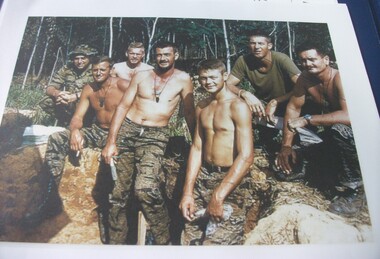
Photograph, Leadership group the day before the Battle of Ngok Tavak, 9/05/1968 12:00:00 AM
... However, in the meantime a platoon of United States Marine Corps artillery arrived bringing with them two howitzers and a stockpile of ammunition. ...However, in the meantime a platoon of United States Marine Corps artillery arrived bringing with them two howitzers and a stockpile of ammunition. ...Captain John E D White, Australian Army Training Team in Vietnam (AATTV) took over command of 11 Mobile Strike Force (Mike Force) Company in Da Nang, Vietnam, in February 1968. He was 26 years old. The 2 NVA Division was moving from Laos into South Vietnam and his mission was to establish contact with the division and trace its movements south. In mid-March the company was air lifted to the Special Forces camp of Kham Duc, near the Laotian border. They used an old French Foreign Legion fort as a temporary base from which patrols could be sent out. White called it Ngok Tavak after a nearby mountain. Initially, patrols failed to find the enemy, but in late April a patrol clashed with the enemy. At the same time, White received intelligence that the NVA division was closing in. At night they could hear explosions in the distance heading toward them. White decided their best chance was to leave the fort and take to the jungle to adopt guerrilla tactics. However, in the meantime a platoon of United States Marine Corps artillery arrived bringing with them two howitzers and a stockpile of ammunition. To abandon the fort was to abandon the guns. White contacted Da Nang, explaining the predicament, and was ordered to remain where he was. A Civilian Irregular Defense Group (CIDG) platoon was sent to reinforce his numbers. This was a para military force comprised mainly of indigenous highlanders, trained by United States Special Forces. They also brought with them two mortars and their crews. At 3.15am on 10 May 1968 some members of the CIDG chose to assist the NVA to attack the fort instead of supporting Mike Force, and close hand to hand fighting followed, along with grenade attacks and heavy machine gun fire. Air support offered a brief respite from the NVA attack, and some NVA forces were pushed back outside the perimeter by counter attacks, but at 9am White contacted Da Nang to advise that his position was untenable. A second attack was imminent and they could not withstand it, so they would have to withdraw. The wounded were evacuated by helicopter (under orders from Major Mai, the NVA had not attacked the previous medical helicopters that collected the wounded under the cover of air strikes) and at 1pm the rest of the force evacuated east, into the jungle. The NVA did not notice their withdrawal, and continued mortar attacks on the fort for another ninety minutes. Seven kilometres from the fort White called for a helicopter withdrawal of his forces. The force was successfully lifted to Kham Duc and then Da Nang. (Credit AWM)Coloured image of 7 soldiers (5 shirtless) posed on the edge of a foxhole with jungle in background. L-R Willie Swicegood (USA), John White (AATTV-Aus), Ken Benway (USA), Frank Lucas (Aust), Clay Aitkins (USA), Glenn Miller (USA), Don Cameron (Aust)john white, aattv, battle of ngok tavak -
 National Vietnam Veterans Museum (NVVM)
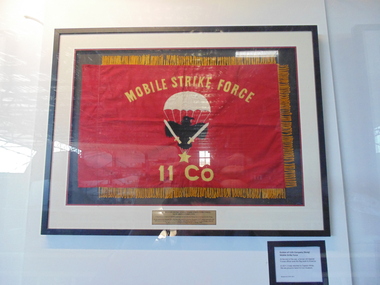
Banner - Banner, framed, 11 Co (Nung)
... However, in the meantime a platoon of United States Marine Corps artillery arrived bringing with them two howitzers and a stockpile of ammunition. ...However, in the meantime a platoon of United States Marine Corps artillery arrived bringing with them two howitzers and a stockpile of ammunition. ...Captain John E D White, Australian Army Training Team in Vietnam (AATTV) took over command of 11 Mobile Strike Force (Mike Force) Company in Da Nang, Vietnam, in February 1968. He was 26 years old. The 2 NVA Division was moving from Laos into South Vietnam and his mission was to establish contact with the division and trace its movements south. In mid-March the company was air lifted to the Special Forces camp of Kham Duc, near the Laotian border. They used an old French Foreign Legion fort as a temporary base from which patrols could be sent out. White called it Ngok Tavak after a nearby mountain. Initially, patrols failed to find the enemy, but in late April a patrol clashed with the enemy. At the same time, White received intelligence that the NVA division was closing in. At night they could hear explosions in the distance heading toward them. White decided their best chance was to leave the fort and take to the jungle to adopt guerrilla tactics. However, in the meantime a platoon of United States Marine Corps artillery arrived bringing with them two howitzers and a stockpile of ammunition. To abandon the fort was to abandon the guns. White contacted Da Nang, explaining the predicament, and was ordered to remain where he was. A Civilian Irregular Defense Group (CIDG) platoon was sent to reinforce his numbers. This was a para military force comprised mainly of indigenous highlanders, trained by United States Special Forces. They also brought with them two mortars and their crews. At 3.15am on 10 May 1968 some members of the CIDG chose to assist the NVA to attack the fort instead of supporting Mike Force, and close hand to hand fighting followed, along with grenade attacks and heavy machine gun fire. Air support offered a brief respite from the NVA attack, and some NVA forces were pushed back outside the perimeter by counter attacks, but at 9am White contacted Da Nang to advise that his position was untenable. A second attack was imminent and they could not withstand it, so they would have to withdraw. The wounded were evacuated by helicopter (under orders from Major Mai, the NVA had not attacked the previous medical helicopters that collected the wounded under the cover of air strikes) and at 1pm the rest of the force evacuated east, into the jungle. The NVA did not notice their withdrawal, and continued mortar attacks on the fort for another ninety minutes. Seven kilometres from the fort White called for a helicopter withdrawal of his forces. The force was successfully lifted to Kham Duc and then Da Nang. (Credit AWM)Black framed glass covered flag. Red material with gold fringe, gold writing with Blackbird in the centre with parachute holding 2 white swords standing on a gold star. 11Co. in gold underneath. Gold plaque mounted under the flag.GUIDON OF 11 COY (NUNG) MOBILE STRIKE FORCE (MIKE FORCE) /5th SF GROUP, 1 CORPS, SVN/ A Significant number of AATTV personnel served with this Nung Company based in Da Nang./ At the end of the Vietnam War, this flag was taken by a former US SF officer and held until/ when it was given to former Captain John "Jed" White (AATTV), CO 11 Coy (Nung), who led/ the MIKE Forces at the Battle of Ngok Tavak on 10 May 1968.battle of ngok tavak, mobile strike force, nung, john white -
 National Vietnam Veterans Museum (NVVM)
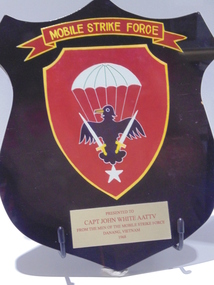
Plaque, Mobile Strike Force Shield
... However, in the meantime a platoon of United States Marine Corps artillery arrived bringing with them two howitzers and a stockpile of ammunition. ...However, in the meantime a platoon of United States Marine Corps artillery arrived bringing with them two howitzers and a stockpile of ammunition. ...Captain John E D White, Australian Army Training Team in Vietnam (AATTV) took over command of 11 Mobile Strike Force (Mike Force) Company in Da Nang, Vietnam, in February 1968. He was 26 years old. The 2 NVA Division was moving from Laos into South Vietnam and his mission was to establish contact with the division and trace its movements south. In mid-March the company was air lifted to the Special Forces camp of Kham Duc, near the Laotian border. They used an old French Foreign Legion fort as a temporary base from which patrols could be sent out. White called it Ngok Tavak after a nearby mountain. Initially, patrols failed to find the enemy, but in late April a patrol clashed with the enemy. At the same time, White received intelligence that the NVA division was closing in. At night they could hear explosions in the distance heading toward them. White decided their best chance was to leave the fort and take to the jungle to adopt guerrilla tactics. However, in the meantime a platoon of United States Marine Corps artillery arrived bringing with them two howitzers and a stockpile of ammunition. To abandon the fort was to abandon the guns. White contacted Da Nang, explaining the predicament, and was ordered to remain where he was. A Civilian Irregular Defense Group (CIDG) platoon was sent to reinforce his numbers. This was a para military force comprised mainly of indigenous highlanders, trained by United States Special Forces. They also brought with them two mortars and their crews. At 3.15am on 10 May 1968 some members of the CIDG chose to assist the NVA to attack the fort instead of supporting Mike Force, and close hand to hand fighting followed, along with grenade attacks and heavy machine gun fire. Air support offered a brief respite from the NVA attack, and some NVA forces were pushed back outside the perimeter by counter attacks, but at 9am White contacted Da Nang to advise that his position was untenable. A second attack was imminent and they could not withstand it, so they would have to withdraw. The wounded were evacuated by helicopter (under orders from Major Mai, the NVA had not attacked the previous medical helicopters that collected the wounded under the cover of air strikes) and at 1pm the rest of the force evacuated east, into the jungle. The NVA did not notice their withdrawal, and continued mortar attacks on the fort for another ninety minutes. Seven kilometres from the fort White called for a helicopter withdrawal of his forces. The force was successfully lifted to Kham Duc and then Da Nang. (Credit AWM)A wooden shield painted grey/black celebrating the 40th Anniversary of the Battle of Ngok Tavak. There are three messages from mates written in black on the back. The shield was presented to Capt John (Jed) White.Presented to Captain John White, AATTV from the men of the Mobile Strike Force, Danang, Vietnam, 1968.mobile strike force, capt john (jed) white, shield, battle of ngok tavak -
 Wangaratta RSL Sub Branch
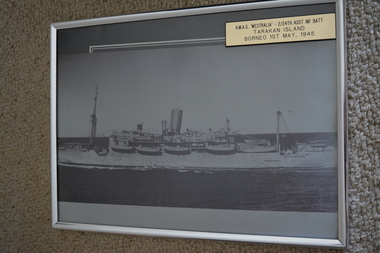
Photograph - Framed Photograph, HMAS Westralia
... In this role, Westralia had a capacity of 933 soldiers, and was used primarily to transport units of the United States Army and Marine Corps. The ship arrived at Manus on 7th April 1945 befoe reaching Morotai on the 19th. ...In this role, Westralia had a capacity of 933 soldiers, and was used primarily to transport units of the United States Army and Marine Corps. The ship arrived at Manus on 7th April 1945 befoe reaching Morotai on the 19th. ...In 1943 Westralia was converted into a Landing Ship, Infantry. In this role, Westralia had a capacity of 933 soldiers, and was used primarily to transport units of the United States Army and Marine Corps. The ship arrived at Manus on 7th April 1945 befoe reaching Morotai on the 19th. The 2/24th Australian Infantry Battalion embarked for attack on Tarakan Island, Borneo. On 1 May – After preliminary bombardment by two cruisers and six destroyers ,troops of 26th Australian Infantry Brigade were landed. After the end of the war, Westralia was one of the ships at Ambon on 22 September 1945 for the surrender and occupation of the island where the 164 survivors of Gull Force prisoners had already been taken off on 10 September. She was later used for the repatriation of Australian troops, before being paid off in September 1946. The ship earned five battle honours for her wartime service: Silver frame containing black and white image of a ship at seaGold coloured plaque attached top right "HMAS Westralia" - 2/24th AUST INF BATT TARAKAN ISLAND BORNEO 1ST MAY, 1945hmas westralia, 2/24th aust inf battalion -
 Flagstaff Hill Maritime Museum and Village
Clocks, 1939-1946
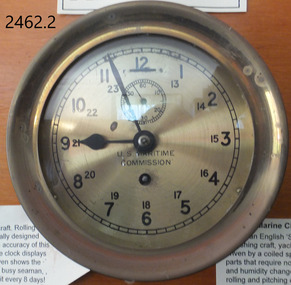
... It was intended to formulate a merchant shipbuilding program to design and build five hundred modern merchant cargo ships to replace the World War I vintage vessels that comprised the bulk of the United States Merchant Marine, and to administer a subsidy system authorized by the Act to offset the cost differential between building in the U.S. and operating ships under the American flag. ...It was intended to formulate a merchant shipbuilding program to design and build five hundred modern merchant cargo ships to replace the World War I vintage vessels that comprised the bulk of the United States Merchant Marine, and to administer a subsidy system authorized by the Act to offset the cost differential between building in the U.S. and operating ships under the American flag. ...Chelsea Clock Company History: The Chelsea Clock Company is an American clock manufacturing company that started before 1880 with Joseph Henry Eastman who founded the Harvard Clock Company and produced 800 clocks of marine, carriage, shelf and banjo types. He went on to change the company name to the Boston Clock Company in 1884. After several name changes in 1897, the Chelsea Clock Company was finally founded. Clocks produced by Chelsea Clock Company have been found in the White House, on US Naval Ships, and in homes and offices around the world. After the company first began life as the Harvard Clock Company, it was named the Boston Clock Company, the Eastman Clock Company before finally becoming the Chelsea Clock Company in July of 1897. The company had developed many patents and innervations over these years and between 1939 and 1946 during World War II they were awarded contracts by the U.S Maritime Commission and produced vast numbers of clocks for both merchant and naval ships. U.S Maritime Commission History: The United States Maritime Commission (MARCOM) was an independent executive agency of the U.S. federal government that was created by the Merchant Marine Act of 1936, and replaced the United States Shipping Board which had existed since World War I. It was intended to formulate a merchant shipbuilding program to design and build five hundred modern merchant cargo ships to replace the World War I vintage vessels that comprised the bulk of the United States Merchant Marine, and to administer a subsidy system authorized by the Act to offset the cost differential between building in the U.S. and operating ships under the American flag. It also formed the United States Maritime Service for the training of seagoing ship's officers to man the new fleet. The purpose of the Maritime Commission was to formulate a merchant shipbuilding program to design and then have built over a ten-year period 900 modern fast merchant cargo ships which would replace the World War I-vintage vessels Those ships were intended to be then leased to U.S. shipping companies for their use in the foreign seagoing trades the aim was to offer better and more economical freight services. The ships were also intended to serve as a reserve naval auxiliary force in the event of armed conflict which was a duty the U.S. merchant fleet had often filled throughout the years since the Revolutionary War. From 1939 through the end of World War II, the Maritime Commission funded and administered the largest and most successful merchant shipbuilding effort in world history, producing ships for both navy and merchant marine. By the end of the war, U.S. shipyards working under Maritime Commission contracts had built a total of 5,777 ocean-going merchant and naval ships. In early 1942 both the training and licensing was transferred to the U.S. Coast Guard for administration, then later to the Maritime Service final responsibility was conveyed to the newly created War Shipping Administration which was created to oversee the operation of merchant ships being built by the Emergency Program to meet the needs of the U.S. Armed Services. With the end of World War II, both the Emergency and Long Range shipbuilding programs were terminated as there were far too many merchant vessels now for the Nation's peacetime needs. In 1946, the Merchant Ship Sales Act was passed to sell off a large portion of the ships built during the war to commercial buyers, both domestic and foreign. The U.S Maritime Commission was officially disbanded on May 24th 1950. These clocks were to be found on all ships made in American for the war effort between 1939 and 1946. They are a significant reminder of the sacrifice by those who served in the merchant marine and the navy’s during the Second World War. The item is a part of our social history that reminds us of these dark times. The loses of family members, along with the trauma that many sailors had endured and had to live with for the rest of their lives once they were released from service and allowed to go home.American Clock is an 8-day marine clock made by the Chelsea clock Co for the “US Maritime Commission” . There is a second smaller dial for the seconds and 24-hour markings. Also a fast-slow adjuster to the top of the dial. The clock is an 8 day marine clock with US Maritime Commission inscribed on face in black lettering. flagstaff hill, warrnambool, shipwrecked-coast, flagstaff-hill, flagstaff-hill-maritime-museum, maritime-museum, shipwreck-coast, flagstaff-hill-maritime-village, clock, us maritime commission, chelsea clock company, horology, maratime clock -
 Flagstaff Hill Maritime Museum and Village
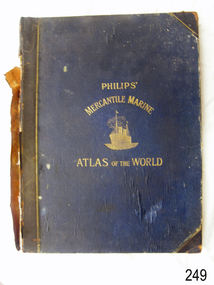
Book - Atlas, George Philip & Son Ltd, The London Geographical Institute, Philips' Mercantile Marine Atlas, 1904
... Philips' Mercantile Marine Atlas of the World contains a series of 30 plates containing over 100 charts and plans, with tables of over 8,600 distances between ports, national and house flags, lists of British & United States Consulates and a complete index of 20,000 ports. ...Philips' Mercantile Marine Atlas of the World contains a series of 30 plates containing over 100 charts and plans, with tables of over 8,600 distances between ports, national and house flags, lists of British & United States Consulates and a complete index of 20,000 ports. ...Philips' Mercantile Marine Atlas of the World contains a series of 30 plates containing over 100 charts and plans, with tables of over 8,600 distances between ports, national and house flags, lists of British & United States Consulates and a complete index of 20,000 ports. Specially designed for merchant shippers, exporters and ocean travellers, and for general use. The atlas is significant as a record of the status of world statistics in 1904, of interest to travelers, merchants, and world traders. "Philips' Mercantile Marine Atlas of the World". Dark blue hardcover, gold embossing and trim. Edited by George Philip, F.R.G.S. Second edition. Published in London by George Philip & Son, London, Date: 1904 Inscription on a purple stamp on the fly page."Please - - - / HARDY GILLARD / - - / - - LONDON"flagstaff hill, warrnambool, flagstaff hill maritime museum and village, shipwreck coast, great ocean road, atlas, marine atlas, philip's mercantile marine atlas, ports, flags, consulates, ocean travellers, shipppers, merchants, 1904 -
 Flagstaff Hill Maritime Museum and Village
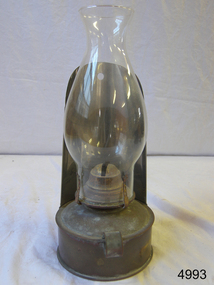
Functional object - Kerosene Lamp, Perko Inc, 1922 -1930
... United States in the early 1890s and soon became employed as a machinist for E.W. Bliss & Company in Brooklyn, New York. In the early 1900s, he and a partner began operating a business, F. Persky & Company, Lantern Manufacturer, out of the basement of his house. In 1907, Frederick's son Louis joined him in the business, and together they enlarged both the product line and the manufacturing facilities. By 1912, they had seventeen employees and made a wide range of marine...United States in the early 1890s and soon became employed as a machinist for E.W. Bliss & Company in Brooklyn, New York. In the early 1900s, he and a partner began operating a business, F. Persky & Company, Lantern Manufacturer, out of the basement of his house. In 1907, Frederick's son Louis joined him in the business, and together they enlarged both the product line and the manufacturing facilities. By 1912, they had seventeen employees and made a wide range of marine ...The company was originally founded by Frederick Perkins a Russian immigrant schooled in Germany as a machinist and tool and die, maker. Frederick came to the United States in the early 1890s and soon became employed as a machinist for E.W. Bliss & Company in Brooklyn, New York. In the early 1900s, he and a partner began operating a business, F. Persky & Company, Lantern Manufacturer, out of the basement of his house. In 1907, Frederick's son Louis joined him in the business, and together they enlarged both the product line and the manufacturing facilities. By 1912, they had seventeen employees and made a wide range of marine lanterns and products. The business continued operating until 1913 when Frederick became president of National Marine Lamp Company, based out of Forestville, Connecticut. Frederick and Louis left that company in 1916 and moved back to Brooklyn, New York, where they started Perkins Marine Lamp Corporation. Five generations later, PERKO is still a privately owned, family-operated corporation. Perkins Marine Corporation was initially known as Perkins Marine Lamp, Inc. The original focus was on the manufacture of hand-formed sheet metal products for the marine market. The first “Perko” catalogue was published in 1916. It included a full range of kerosene and electric lanterns for small and large boats, ventilators, chart cases, signalling devices, mooring buoys, pumps and a variety of spare parts. These products, fabricated from brass, copper and galvanized sheet metal, began a reputation for producing high-quality products. In 1922, the "PERKO" trademark was instituted with each new product utilising the latest, sophisticated metal manufacturing technology.A significant item from an American manufacturer that specialises in making marine products and is still in business today under the same trade name. The subject item is significant as it was made not long after the trade name of PERKO was registered in 1922 and began to be used on the company's various products.Kerosene lamp with circular fuel tank and chrome plated reflector shield. "PERKO" stamped on base.warrnambool, flagstaff-hill, flagstaff-hill-maritime-museum, maritime-museum, shipwreck-coast, flagstaff-hill-maritime-village, kerosene lamp, marine lamp, perko inc, lighting, marine accessories manufacturer -
 Flagstaff Hill Maritime Museum and Village
Instrument - Ship Log, 1880-1890
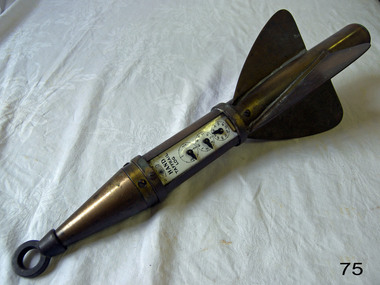
... United States military began preparations for World War II. Although the Hand Company never completely abandoned its involvement with private industry, after World War II, military contracts monopolised their business. The Company obtained contracts with the Navy, Coast Guard and Marines...United States military began preparations for World War II. Although the Hand Company never completely abandoned its involvement with private industry, after World War II, military contracts monopolised their business. The Company obtained contracts with the Navy, Coast Guard and Marines ...The John E. Hand & Sons Company was founded in Philadelphia in 1873, quickly gaining a reputation as competent manufacturers of nautical instruments and compass adjusters. In fact, John Enos Hand, the company founder, is recognised as the first man in America to adjust a compass aboard an iron ship. The Hand Company built navigational equipment for all varieties of floating vessels, and operated a chain of retail outlets with “service stations” in numerous port cities, including Baltimore and New Orleans, until 1956. Service stations sold Hand instruments as well as other nautical paraphernalia and provided compass adjusting services. Additionally, John E Hand and his two sons, John L Hand and Bartram Hand, were inventors in their own right who patented design improvements for numerous instruments that were employed in the company’s work. Commercial and private contracts dominated the firm’s business until the late 1930s when the United States military began preparations for World War II. Although the Hand Company never completely abandoned its involvement with private industry, after World War II, military contracts monopolised their business. The Company obtained contracts with the Navy, Coast Guard and Marines to develop new instruments, and to build military-engineered nautical equipment. Of note are the wrist compass, developed for the Navy beginning in the 1950s, and the Mark VII Model 5 Navy Standard Binnacle. Although it moved numerous times, the Hand Company headquarters and factory remained in the Delaware Valley, occupying several buildings in Philadelphia and southern New Jersey. Maintaining its central office in Philadelphia well into the 1900s, the factory was moved to Atco, New Jersey around the turn of the twentieth century and subsequently to Haddon field, New Jersey. It moved one last time in the 1960s to Cherry Hill, New Jersey. In 1997, California-based Sunset Cliffs Merchandising Corporation purchased the Hand Company and all its assets for $100,000. "HAND" brand taffrail log by John F. Hand and Sons Co. Register is enclosed in log, has a glass front and 3 dials on an enameled surface, the first dial registers the miles up to 100, the second registers the units up to 10 mile, the third registers quarters of a mile. The item is rocket shaped with a three blade rotor and a rope ring attachment at one end; the rotor will spin when a rope is attached, allowing the apparatus dials to measure the ship's speed when it is dragged behind a ship. Diagram of the 'Hand' trademark with a compass card in the middle, inscription reads "John F Hand and Sons Co" and "PHILA-BALTO" ( Abbreviation for: Philadelphia / Baltimore) flagstaff hill, warrnambool, shipwrecked coast, flagstaff hill maritime museum, maritime museum, shipwreck coast, flagstaff hill maritime village, great ocean road, bartram hand, john enos hand, john f. hand and sons co, john l hand, john hand & sons instrument makers, john hand & sons of philadelphia, marine instrument, marine service station, mechanical ship log, nautical instrument, nautical navigation, navigational equipment, scientific instrument, ship log, ship log register, ship’s speed, sunset cliffs merchandising corporation, speed log, rocket log, harpoon log, taffrail log, taff rail log -
 Bendigo Military Museum
Uniform - SHIRT, USMC, United States Marine Corps, Unknown
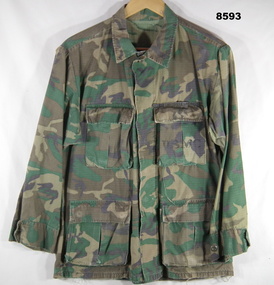
... ...United States Marine Corps....United States Marine Corps....Uniform SHIRT, USMC. United States Marine Corps. ...Shirt - cotton, polyester fabric DPCU (Disruptive Pattern Camouflage Uniform). Jungle colours - dark brown through to light brown, dark green and black. US Design. Shirt has long sleeves, collar, four front patch pockets with button down flaps. Sleeve cuffs with button. Buttons - plastic, dark green colour. Front closure. Marking on left front pocket - black ink stamp.Black ink stamp "U.S.M.C."passchendaele barracks trust, uniform, dpcu shirt, united states marine corps. -
 Conservation Volunteers
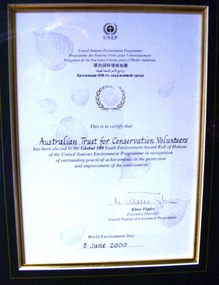
Award: Honour Roll, United Nations Environment Program (UNEP) - 1 June 2000 - The UNEP announced that the Australian Trust of Conservation Volunteers of Australia (ATCV), has been elected to the prestigious ranks of its Global 500 Roll of Honour for outstanding contributions to the protection of the environment, Award:United Nations Environment Program (UNEP) - 1 June 2000 - UNEP announced today that the ATCV has been elected to the prestigious ranks of its Global 500 Roll of Honour for outstanding contributions to the protection of the environment
... Among prominent past winners are: French Marine explorer Jacques Cousteau; Sir David Attenborough, producer of environmental television programmes; Gro Harlem Brundtland, former Prime Minister of Norway; Anil Aggarwal, the prominent environmentalist from India; Ken Saro-Wiwa, the environmental and human rights activist from Nigeria who was executed for leading the resistance of the Ogoni People against the pollution of their Delta homeland; the World Wide Fund for Nature (WWF), Jimmy Carter, former President of the United States; Jane Goodall of the United Kingdom whose research on wild chimpanzees and olive baboons provided insight into the lives of non-human primates; and the late Chico Mendes, the Brazilian rubber tapper who was murdered during his fight to save the Amazon forest. ...Among prominent past winners are: French Marine explorer Jacques Cousteau; Sir David Attenborough, producer of environmental television programmes; Gro Harlem Brundtland, former Prime Minister of Norway; Anil Aggarwal, the prominent environmentalist from India; Ken Saro-Wiwa, the environmental and human rights activist from Nigeria who was executed for leading the resistance of the Ogoni People against the pollution of their Delta homeland; the World Wide Fund for Nature (WWF), Jimmy Carter, former President of the United States; Jane Goodall of the United Kingdom whose research on wild chimpanzees and olive baboons provided insight into the lives of non-human primates; and the late Chico Mendes, the Brazilian rubber tapper who was murdered during his fight to save the Amazon forest. ...THE AUSTRALIAN TRUST OF CONSERVATION VOLUNTEERS, ONE OF 14 INDIVIDUALS AND ORGANIZATIONS, TO RECEIVE UNITED NATIONS ENVIRONMENT AWARD NAIROBI, 1 June 2000 - The United Nations Environment Programme (UNEP) announced today that the Australian Trust of Conservation Volunteers of Australia (ATCV), has been elected to the prestigious ranks of its Global 500 Roll of Honour for outstanding contributions to the protection of the environment. ATCV is one of 14 individuals and organizations to receive this honour in 2000. Founded in 1982, ATCV is a national, not-for-profit community organization, whose mission is to attract and manage a force of volunteers in practical conservation projects for the betterment of the Australian environment. ATCV completes more than 4000 week-long conservation projects in urban, regional and remote areas of Australia each year. Activities range from bush regeneration, tree planting, seed collection, endangered species protection, weed control, flora and fauna surveys, walking trail construction, fencing, environmental monitoring and the protection of world heritage areas. ATCV community participation has resulted in more than 1.8 million trees being planted in 1999, and in more than 7.3 million trees planted over the past 10 years. Community involvement totalled 200,000 project days in 1999 and more than 700,000 days since 1989. To encourage the involvement of young people, ATCV developed and manages the federal government-funded programme Green Corps. Green Corps is a six-month traineeship for 17 to 20 year-olds, which incorporates conservation projects and accredited training. Since 1997, more than 4,000 trainees have completed the Green Corps programme. ATCV is a founding member of the International Conservation Alliance, which brings together organizations working in conservation volunteering, and is a member of the World Conservation Union (IUCN). " The award will be presented in Adelaide, Australia, at the World Environment Day ceremonies on 4 June 2000. World Environment Day, which is celebrated in some 120 countries around the world on 5 June, was established by the United Nations General Assembly in 1972 to focus global attention and action on environmental issues. Some 701 individuals and organizations, in both the adult and youth categories, have been honoured since UNEP launched the Global 500 award in 1987. Among prominent past winners are: French Marine explorer Jacques Cousteau; Sir David Attenborough, producer of environmental television programmes; Gro Harlem Brundtland, former Prime Minister of Norway; Anil Aggarwal, the prominent environmentalist from India; Ken Saro-Wiwa, the environmental and human rights activist from Nigeria who was executed for leading the resistance of the Ogoni People against the pollution of their Delta homeland; the World Wide Fund for Nature (WWF), Jimmy Carter, former President of the United States; Jane Goodall of the United Kingdom whose research on wild chimpanzees and olive baboons provided insight into the lives of non-human primates; and the late Chico Mendes, the Brazilian rubber tapper who was murdered during his fight to save the Amazon forest. To forge global links and to implement ideas, which can contribute to a more sustainable future, a network of all Global 500 laureates has been formed. Information about this unique network can be obtained at http://www.global500.org. The winners of UNEP's Global 500 Roll of Honour are members of a broad and growing environmental movement that is flourishing around the world. They have taken the path that most of us hesitate to take for want of time or caring," says UNEP's Executive Director, Klaus Toepfer. "In honouring the Global 500 laureates, UNEP hopes that others will be inspired by their extraordinary deeds."Certificatecva, conservation volunteers, conservation volunteers australia, conservation volunteers new zealand, colin jackson, better earth, environmental conservation, volunteers, volunteering, corporate volunteering, education – environmental, carbon footprint, climate change, ballarat, safety, training, partnerships, victoria, vic, nsw, queensland, act, australian capital territory, nt, northern territory, western australia, wa, south australia, sa, tasmania, new zealand, california conservation corps, atcv, unep, unep honour roll, united nations environment program -
 Bendigo Historical Society Inc.
Document - THOMAS LANGDON COLLECTION: SOUVENIR INVITATION, 1908
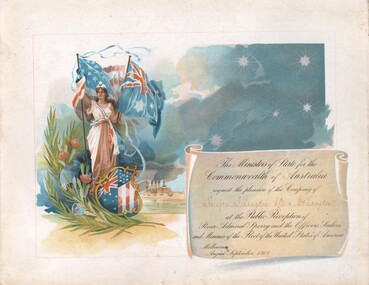
... Thomas Langdon to the Public Reception of Rear Admiral Sperry and the Officers, Sailors and Marines of the Fleet of the United States of America, Melbourne August- September 1908....Thomas Langdon to the Public Reception of Rear Admiral Sperry and the Officers, Sailors and Marines of the Fleet of the United States of America, Melbourne August- September 1908. ...Document. Illuminated Souvenir Invitation to family of Mr. Thomas Langdon to the Public Reception of Rear Admiral Sperry and the Officers, Sailors and Marines of the Fleet of the United States of America, Melbourne August- September 1908.document, memo, souvenir invitation -
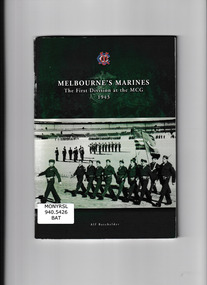 Monbulk RSL Sub Branch
Book, Melbourne Cricket Club, Melbourne, Title Melbourne's Marines: the First Division at the MCG 1943, 2002
... World war 1939 – 1945 – Personal narratives – United States US 1st Division Describes the experience of the US 1st division quartered at the Melbourne Cricket Ground Notes, ill, p.51. Title Melbourne's Marines ...Describes the experience of the US 1st division quartered at the Melbourne Cricket GroundNotes, ill, p.51.non-fictionDescribes the experience of the US 1st division quartered at the Melbourne Cricket Groundworld war 1939 – 1945 – personal narratives – united states, us 1st division -
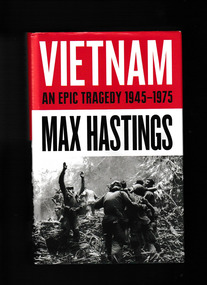 Monbulk RSL Sub Branch
Book, William Collins, Vietnam : an epic tragedy history of a tragic war, 2018
... United States in 1975. Max Hastings has spent the past three years interviewing scores of participants on both sides, as well as researching a multitude of American and Vietnamese documents and memoirs, to create an epic narrative of an epic struggle. He portrays the set pieces of Dienbienphu, the Tet offensive, the air blitz of North Vietnam, and less familiar battles such as the bloodbath at Daido, where a US Marine ...Vietnam became the Western world's most divisive modern conflict, precipitating a battlefield humiliation for France in 1954, then a vastly greater one for the United States in 1975. Max Hastings has spent the past three years interviewing scores of participants on both sides, as well as researching a multitude of American and Vietnamese documents and memoirs, to create an epic narrative of an epic struggle. He portrays the set pieces of Dienbienphu, the Tet offensive, the air blitz of North Vietnam, and less familiar battles such as the bloodbath at Daido, where a US Marine battalion was almost wiped out, together with extraordinary recollections of Ho Chi Minh's warriors. Here are the vivid realities of strife amid jungle and paddies that killed 2 million people. Many writers treat the war as a US tragedy, yet Hastings sees it as overwhelmingly that of the Vietnamese people, of whom forty died for every American. While all the world has seen the image of a screaming, naked girl seared by napalm, it forgets countless eviscerations, beheadings and murders carried out by the communists. The people of both former Vietnams paid a bitter price for the Northerners' victory in privation and oppression. Here is testimony from Vietcong guerrillas, Southern paratroopers, Saigon bargirls and Hanoi students alongside that of infantrymen from South Dakota, Marines from North Carolina, Huey pilots from Arkansas.Index, bibliography, notes, ill, maps, p.722.non-fictionVietnam became the Western world's most divisive modern conflict, precipitating a battlefield humiliation for France in 1954, then a vastly greater one for the United States in 1975. Max Hastings has spent the past three years interviewing scores of participants on both sides, as well as researching a multitude of American and Vietnamese documents and memoirs, to create an epic narrative of an epic struggle. He portrays the set pieces of Dienbienphu, the Tet offensive, the air blitz of North Vietnam, and less familiar battles such as the bloodbath at Daido, where a US Marine battalion was almost wiped out, together with extraordinary recollections of Ho Chi Minh's warriors. Here are the vivid realities of strife amid jungle and paddies that killed 2 million people. Many writers treat the war as a US tragedy, yet Hastings sees it as overwhelmingly that of the Vietnamese people, of whom forty died for every American. While all the world has seen the image of a screaming, naked girl seared by napalm, it forgets countless eviscerations, beheadings and murders carried out by the communists. The people of both former Vietnams paid a bitter price for the Northerners' victory in privation and oppression. Here is testimony from Vietcong guerrillas, Southern paratroopers, Saigon bargirls and Hanoi students alongside that of infantrymen from South Dakota, Marines from North Carolina, Huey pilots from Arkansas.vietnam war 1961-1975 – history, vietnam war 1961-1975 – personal recollections -
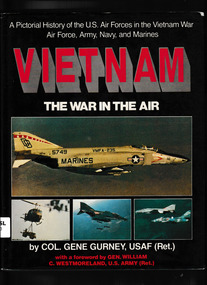 Monbulk RSL Sub Branch
Book, Sidgwick and Jackson, Vietnam, the war in the air : a pictorial history of the U.S. air forces in the Vietnam War, Air Force, Army, Navy and Marines, 1985
... Vietnam war - 1961-1975 - Aerial operations - United States Vietnam war - 1961-1975 - History This book covers US aerial operations from the first entrance of US planes to the evacuation of POW's in 1973 Index, ill, maps, p.227. Vietnam, the war in the air : a pictorial history of the U.S. air forces in the Vietnam War, Air Force, Army, Navy and Marines Book Sidgwick and Jackson Gene Gurney ...This book covers US aerial operations from the first entrance of US planes to the evacuation of POW's in 1973Index, ill, maps, p.227.non-fictionThis book covers US aerial operations from the first entrance of US planes to the evacuation of POW's in 1973vietnam war - 1961-1975 - aerial operations - united states, vietnam war - 1961-1975 - history -
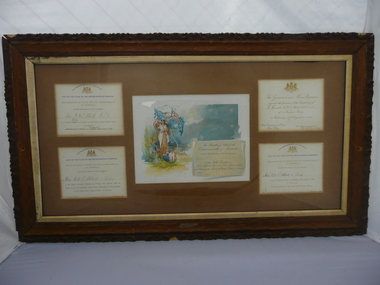 Bendigo Historical Society Inc.
Document - R.H.ABBOTT. INVITATIONS. 1908, 1908
... Abbott at the public reception of Rear Admiral Sperry and the officers, sailors, & marines of the fleet of the united states of America. Sydney. ...Abbott at the public reception of Rear Admiral Sperry and the officers, sailors, & marines of the fleet of the united states of America. Sydney. ...5 Invitation cards in a display. 1. The ministers of state for the commonwealth of Australia request the pleasure of the company of R.H.S. Abbott at the public reception of Rear Admiral Sperry and the officers, sailors, & marines of the fleet of the united states of America. Sydney. August 1908. 2. Invitations to a theatre parties. Tuesday 25th August 1908. 3. Invitation to Public Reception. Friday 21st August. 1908. 4. Invitation to garden party. State government house. Rose Bay. Wednesday. 26th August 1980 at 3pm. 5. Invitation to Naval & Military review. Monday 24th August 1908 at centennial park. Deframed 2022document, invitations, receptions -
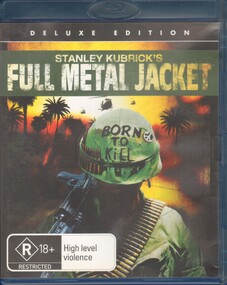 National Vietnam Veterans Museum (NVVM)
Film - DVD, Kubrick, Stanley, Full Metal Jacket, 2001
... War films -- United States...DVD...US Marine...The second half portrays the experiences of Joker and other Marines in the Vietnamese cities of Da Nang and Huế during the Tet Offensive of the Vietnam War.]The film's title refers to the full metal jacket bullet used by military servicemen. Full Metal Jacket was theatrically released in the United States...Sourced from Wikipedia War films -- United States DVD US Marine Corps Hue Da Nang In a blue plastic cover there is a DVD. ...Full Metal Jacket is a 1987 war film directed and produced by Stanley Kubrick from a screenplay he co-wrote with Michael Herr and Gustav Hasford. The film is based on Hasford's 1979 autobiographical novel The Short-Timers. It stars Matthew Modine, R. Lee Ermey, Vincent D'Onofrio, Adam Baldwin, Dorian Harewood, and Arliss Howard. The storyline follows a platoon of U.S. Marines through their boot camp training at Marine Corps Recruit Depot Parris Island, South Carolina. The first half of the film focuses primarily on privates J. T. Davis and Leonard Lawrence, nicknamed "Joker" and "Pyle" respectively, who struggle under their abusive drill instructor, Gunnery Sergeant Hartman. The second half portrays the experiences of Joker and other Marines in the Vietnamese cities of Da Nang and Huế during the Tet Offensive of the Vietnam War.]The film's title refers to the full metal jacket bullet used by military servicemen. Full Metal Jacket was theatrically released in the United States on June 26, 1987, by Warner Bros., and in the United Kingdom on September 11, 1987. It was the last of Kubrick's films to be released during his lifetime. The film grossed $120 million against a budget of $16.5–30 million and received positive reviews from critics. It was nominated for an Academy Award for Best Adapted Screenplay,[8] and was also nominated for two BAFTA Awards, while Ermey was nominated for a Golden Globe Award for Best Supporting Actor – Motion Picture for his performance. In 2001, the American Film Institute placed the film at number 95 in its poll titled "AFI's 100 Years...100 Thrills." Sourced from WikipediaIn a blue plastic cover there is a DVD. On the front there is a coloured photograph with the title of the DVD and the front of a soldier with his weapon and ammunition. On his helmet reads "Born To Kill"war films -- united states, dvd, us marine corps, hue, da nang
