
Showing 136 items matching "unknown australian soldier"
-
 Returned Nurses RSL Sub-branch
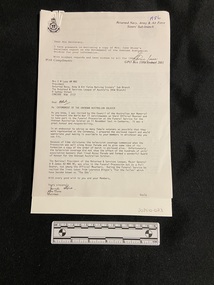
Document - correspondence and report, June Stone, The entombment of the unknown Australian soldier, Nov 29 1993
... The entombment of the unknown Australian soldier.......Unknown Australian Soldier...A letter and report from June Stone, providing an account of her experience as the representative and Official Mourner for World War II Servicewomen, at the service and funeral procession for the Unknown Australian Soldier at the War Memorial in Canberra, November 11th, 1993....The entombment of the unknown Australian soldier. Document correspondence and report June Stone ...A letter and report from June Stone, providing an account of her experience as the representative and Official Mourner for World War II Servicewomen, at the service and funeral procession for the Unknown Australian Soldier at the War Memorial in Canberra, November 11th, 1993.Collection of typed documents on white paper. The first is a 'with compliments' slip with the RSL emblem and a typed message. The second is a full page letter on a Council of Ex-servicewomen's Association (NSW) letterhead. Followed by a two page typed report. The final page contains a funeral procession diagram set out in a black rectangle template.'M86' [handwritten in blue ink in the top right corner of the 'with compliments' slip]returned navy army and air force sisters, june stone, war memorial, unknown australian soldier, ceremonies, australian war memorial, world war two servicewomen -
 Ballarat RSL Sub-Branch Inc.
Photographs - Framed "On the Return of the Australian Unknown Soldier"
... Photographs - Framed "On the Return of the Australian Unknown Soldier"...first world war (ww1) 1914 - 1918 photo/pictures ballarat rsl ballarat Engraved plaque - "Presented to Ballarat RSL by Peter D TOBIN November 1993" Photographs - Framed "On the Return of the Australian Unknown Soldier" ...Engraved plaque - "Presented to Ballarat RSL by Peter D TOBIN November 1993"first world war (ww1), 1914 - 1918, photo/pictures, ballarat rsl, ballarat -
 Frankston RSL Sub Branch
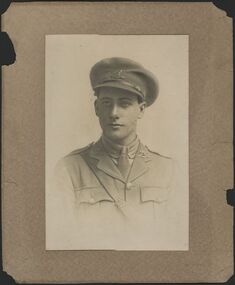
Photograph
... A black and white photograph of an unknown Australian Soldier wearing World War 1 uniform....A black and white photograph of an unknown Australian Soldier wearing World War 1 uniform. ...A black and white photograph of an unknown Australian Soldier wearing World War 1 uniform. -
 Bendigo Military Museum
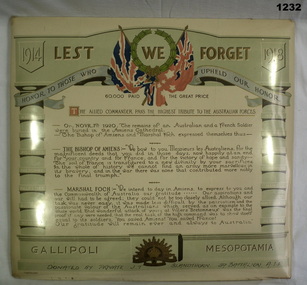
Certificate - CERTIFICATE WW1,FRAMED, A Spencer & E Rider, C.1920
... The item relates to the burial of an unknown Australian soldier...The item relates to the burial of an unknown Australian soldier documents - certificates military history tributes Burial The Allied Commander Pays the Highest Tribute to the Australian Forces. ...The item relates to the burial of an unknown Australian soldierColoured, pastel green & cream, black print (under plastic), metal backing. Australian & British Flags surrounding (red flag), laurel wreath.The Allied Commander Pays the Highest Tribute to the Australian Forces.documents - certificates, military history, tributes, burial -
 Bendigo Military Museum
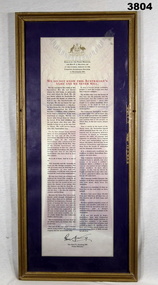
Document - DOCUMENT, FRAMED, C. 1993
... Document of a speech by the Prime Minister of Australia, The Hon P J Keating MP at the funeral service of the unknown Australian soldier on 11.11.1993. Document is printed on cream background with coat of arms at top. ...Document framed unknown soldier Top of document in red print: “We do not know this Australian's name and we never will” Bottom L: “Signature of the Prime Minister of Australia” Document of a speech by the Prime Minister of Australia, The Hon P J Keating MP at the funeral service of the unknown Australian soldier on 11.11.1993. ...Document of a speech by the Prime Minister of Australia, The Hon P J Keating MP at the funeral service of the unknown Australian soldier on 11.11.1993. Document is printed on cream background with coat of arms at top. Mounted with purple border & gold wooden frame with glass front & wooden ply backing.Top of document in red print: “We do not know this Australian's name and we never will” Bottom L: “Signature of the Prime Minister of Australia”document, framed, unknown soldier -
 Melbourne Legacy
Photograph - Australian War Memorial, The Unknown Soldier, 1993
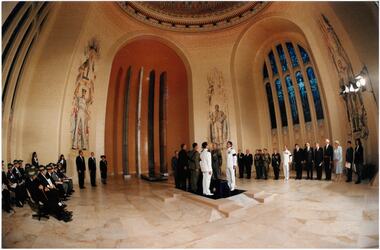
... The tombstone later placed on top of the tomb has the inscription: “An unknown Australian soldier killed in the war of 1914–1918”. ...The tombstone later placed on top of the tomb has the inscription: “An unknown Australian soldier killed in the war of 1914–1918”. ...A photo of the internment of the coffin of the Unknown Australian Solider in the Hall of Memory at the Australian War Memorial in Canberra. The coffin is flanked by pall bearers from each of the defence forces. The official Party, including the Prime Minister, Hon Paul Keating MP, looks on and veterans are seated. There are two Junior Legatees present, they were Rebecca and John Healey of Canberra. There was in article in The Answer newsletter in June 1994. The Unknown Australian Soldier was interred in the Hall of Memory on 11 November 1993. He was buried in a Tasmanian blackwood coffin, on which were placed a bayonet and a sprig of wattle. Soil from the Pozières battlefield in France was scattered in his tomb. The tombstone later placed on top of the tomb has the inscription: “An unknown Australian soldier killed in the war of 1914–1918”. At the head of the tomb is inscribed “Known unto God” and at the foot, “He is all of them and he is one of us.” (details taken from awm.gov.au)A record of Junior Legatees being present at the interring of the Unknown Soldier at the Australian War Memorial in Canberra. It shows how respected Legacy's work is by the wider community that the Junior Legatees are included in such a distinguished group at such an important event.Colour photo inside the Hall of Memory at the Australian War Memorial.australian war memorial, answer -
 Buninyong & District Historical Society
Photograph - 3 Black and White photographs of World War 1 Soldiers, Photographs of unknown World War 1 soldiers
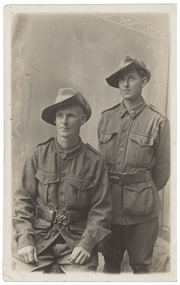
... A series of three black and white photographs of unknown World War 1 Australian soldiers photographed in England and made into postcards...A series of photographs of World War 1 Australian soldiers taken at Salisbury Plain in England 1917 given to BDHS in 1997 Buninyong has a World War 1 Avenue of Honour along Learmonth Street and many Honour boards in the Churches and Schools in the District to commemorate those who served World War 1 Unknown Soldiers "From Best to Hans England 11/7/17", "Your Pal Tom Hynd" A series of three black and white photographs of unknown World War 1 Australian soldiers photographed in England and made into postcards Photographs of unknown World War 1 soldiers Photograph 3 Black and White photographs of World War 1 Soldiers ...A series of photographs of World War 1 Australian soldiers taken at Salisbury Plain in England 1917 given to BDHS in 1997Buninyong has a World War 1 Avenue of Honour along Learmonth Street and many Honour boards in the Churches and Schools in the District to commemorate those who servedA series of three black and white photographs of unknown World War 1 Australian soldiers photographed in England and made into postcards"From Best to Hans England 11/7/17", "Your Pal Tom Hynd"world war 1, unknown soldiers -
 Bendigo Historical Society Inc.
Postcard - ACC LOCK COLLECTION: B&W PHOTO OF A BOMBED RAILWAY YARD, POSTCARD, 1914-1918
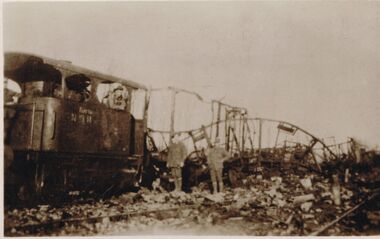
... Location unknown. Two Australian soldiers standing among rubble in the foreground. ...Location unknown. Two Australian soldiers standing among rubble in the foreground. ...Postcard, WW1, B&W image of a bombed railway yard showing what appears to be the tender of an engine. Location unknown. Two Australian soldiers standing among rubble in the foreground. Another two soldiers leaning from the tender. Ruined steel framework of a building in background. Written in pencil on the reverse "G10" and "GS"postcard, postcard, ww1, railway yard ruins -
 Melbourne Legacy
Letter, To Robert Bowring from Rob C. Allison, 2000
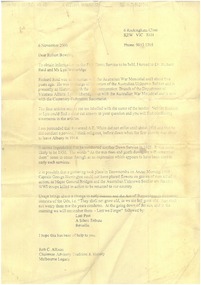
... Australia was about to sail from Albany. The letter also makes reference to a gathering at Toowoomba QLD on Anzac morning 1919, however that rumour suggest that flowers were placed on returned soldiers graves, L/- Allison cast doubt about the placing of flowers on graves of returned service personnel, because only Major General Bridges and the Australian Unknown Soldier were the only two WW1 troops killed in action, to be returned to Australia....Australia was about to sail from Albany. The letter also makes reference to a gathering at Toowoomba QLD on Anzac morning 1919, however that rumour suggest that flowers were placed on returned soldiers graves, L/- Allison cast doubt about the placing of flowers on graves of returned service personnel, because only Major General Bridges and the Australian Unknown Soldier were the only two WW1 troops killed in action, to be returned to Australia. ...A file copy of a letter sent from Legatee Rob Allison to Robert Bowring (6th November 2000) in answer to a request regarding the origins of the first Dawn Service. Legatee Rob Allison signed himself as the Chairman, Advisory Tradition and History Committee. To research his response he consulted the AWM and summarised the content in the letter and enclosed four articles. Unfortunately the four articles sent to Robert Bowring are not included here. L/- Rob Allison makes reference to information obtained from Dr Richard Reid (historian at the Australian War Memorial and then the Commonwealth Branch of the Department of Veterans Affairs). Also Rob Allison makes reference to Lyn Witheridge (Australian War Memorial and later with the Centenary Federation Secretariat). He was addressing the rumour that there was a Dawn Service held in Albany WA in 1914 when the first convoy in WW1 from Australia was about to sail from Albany. The letter also makes reference to a gathering at Toowoomba QLD on Anzac morning 1919, however that rumour suggest that flowers were placed on returned soldiers graves, L/- Allison cast doubt about the placing of flowers on graves of returned service personnel, because only Major General Bridges and the Australian Unknown Soldier were the only two WW1 troops killed in action, to be returned to Australia.A record that members of the public approached Legacy with questions about military and post war history. Legatee Allison made an effort to research and base his reply on evidence.White paper with black type, a facsimile of a letterTelephone No 61395620309 top right.research, world war one -
 Melbourne Legacy
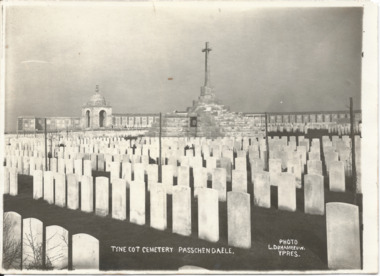
Photograph, Tyne Cot Cemetery, Passchedale. Photo L. Duhameeuw, Ypres, 1930
... Stone wall at back has soldiers names engraved on same. Those unknown - words in stone 'Australian Soldier of the Great War Known unto God.' ...Stone wall at back has soldiers names engraved on same. Those unknown - words in stone 'Australian Soldier of the Great War Known unto God.' ...A photo of the Tyne Cot Cemetery in Passchendale dated September 24, 1930. It appears to be a professional photograph purchased as a souvenir. See also 01024 Menin Gate, Ypres, as it is by the same manufacturer. The Tyne Cot Commonwealth War Graves Cemetery and Memorial to the Missing is a Commonwealth War Graves Commission (CWGC) burial ground for the dead of the First World War in the Ypres Salient on the Western Front (source Wikipedia). The hand written inscription on the back of the photo says: "This memorial in Cemetery was built over a German dugout. 12,000 men are buried here. Stone wall at back has soldiers names engraved on same. Those unknown - words in stone 'Australian Soldier of the Great War Known unto God.' Australians captured Passchendale from the Germans Oct 4th 1917. Beautiful cemetery, all well kept, gardens, lawns, flowers. Ypres, Belgium Sept 24/30" The source of these photos is not known but they were stored together in the archives. The founders of Legacy were returned servicemen from the first world war and may have returned to France in the 1930s. Manufactured by L. Duhameeuw, Ypres.The professional photos from France imply that Legatees were making pilgrimages to the battlefields of France in the 1930s in memory of their comrades.Black and white photo of Tyne Cot Cemetery, Passchendale, France.Indistinct round stamp on the back and a handwritten message.world war one, souvenir, cemetery, memorial -
Frankston RSL Sub Branch
Document, Letter to unknown Serviceman from RSSAILA, Frankston Branch, Victoria
... from the President of the Returned Sailor's Soldier's and Airmen's Imperial League of Australia, Frankston Branch. Signed by P Langford as President Letter to unknown Serviceman from RSSAILA, Frankston Branch, Victoria. ...Letter to serviceman (Neil ?) from the President of the Returned Sailor's Soldier's and Airmen's Imperial League of Australia, Frankston Branch. Signed by P Langford as Presidentletter, document -
 Frankston RSL Sub Branch
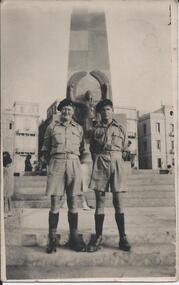
Photograph
... Australian Army soldiers in summer uniform. The soldier to the left in the photograph is Noel Blundell, the other soldier is unknown. ...Australian Army soldiers in summer uniform. The soldier to the left in the photograph is Noel Blundell, the other soldier is unknown. ...Postcard with a black and white photograph of two Australian Army soldiers in summer uniform. The soldier to the left in the photograph is Noel Blundell, the other soldier is unknown. The photograph was sent home to family by Noel Blundell who served in the Middle East during World War 2.middle east, australia, army, aif, ww2, world war 2 -
 Frankston RSL Sub Branch
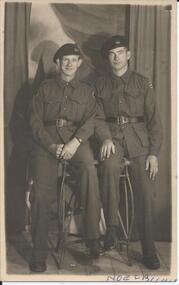
Photograph
... Australian Army soldiers in winter uniform. The soldier to the left in the photograph is Noel Blundell, the other soldier is unknown. ...middle east 2nd aif australia army aif ww2 world war 2 soldier Black and white photograph of two Australian Army soldiers in winter uniform. The soldier to the left in the photograph is Noel Blundell, the other soldier is unknown. ...Black and white photograph of two Australian Army soldiers in winter uniform. The soldier to the left in the photograph is Noel Blundell, the other soldier is unknown. The photograph was sent home to family by Noel Blundell who served in the Middle East during World War 2. middle east, 2nd aif, australia, army, aif, ww2, world war 2, soldier -
 Frankston RSL Sub Branch
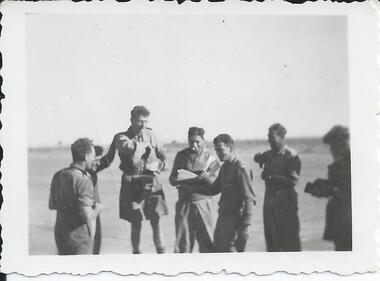
Photograph
... Australian Army soldiers. The soldiers in the photograph include Noel Blundell who is apparently "taking bets", the other soldiers are unknown. ...2nd aif australia army aif ww2 world war 2 soldier syria Inscibed on the reverse of the photograph are the hand written words; "Noel Blundell taking bets in the desert in Syria 1940's" Small black and white photograph of a group of seven Australian Army soldiers. The soldiers in the photograph include Noel Blundell who is apparently "taking bets", the other soldiers are unknown ...Small black and white photograph of a group of seven Australian Army soldiers. The soldiers in the photograph include Noel Blundell who is apparently "taking bets", the other soldiers are unknown. The photograph was sent home to family by Noel Blundell who served in the Middle East during World War 2. Inscibed on the reverse of the photograph are the hand written words; "Noel Blundell taking bets in the desert in Syria 1940's"2nd aif, australia, army, aif, ww2, world war 2, soldier, syria -
 Flagstaff Hill Maritime Museum and Village
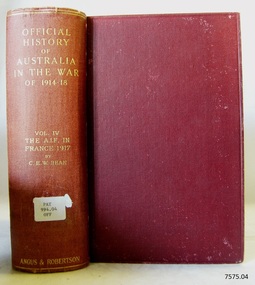
Book, Official History of Australia In The War of 1914-18 Vol 4
... Unknown Soldiers. Last year 795 bodies of British Soldiers of which 47 were Australiands, were recovered from the battlefields of France and Belgium. The High Commissioner ( Mr. S. M. Bruce) states in his annual report that, althoughthe 47 bodies were readily identifiable by their uniforms,caps,and badges and shoulder titles as those of Australian soldeirs, it must be regretfully recorded that in most cases their names will never be known." ...His aim was to foster portraiture, as well as support artists, and perpetuate the memory of great Australians. warrnambool shipwrecked-coast flagstaff-hill flagstaff-hill-maritime-museum maritime-museum shipwreck-coast flagstaff-hill-maritime-village shipwrecked-artefact book warrnambool mechanics’ institute pattison collection warrnambool library ralph eric pattison warrnambool city librarian mechanics’ institute library victorian library board warrnambool books and records warrnambool children’s library official history of australia in the war of 1914-18 vol 4 official history of australia in the war of 1914-18 the australian imperial force in france 1917 a.i.f. c e w bean s. m. bruce Label on spine cover with typed text PATT 994.04 OFF Front loose endpaper has a sticker from Warrnambool Public Library covered by a sticker from Corangamite Regional Library Service Front end pastedown paper has a type written paper that reads "Unknown Soldiers. ...This item is from the ‘Pattison Collection’, a collection of books and records that was originally owned by the Warrnambool Mechanics’ Institute, which was founded in Warrnambool in 1853. By 1886 the Warrnambool Mechanics’ Institute (WMI) had grown to have a Library, Museum and Fine Arts Gallery, with a collection of “… choice productions of art, and valuable specimens in almost every branch and many wonderful national curiosities are now to be seen there, including historic relics of the town and district.” It later included a School of Design. Although it was very well patronised, the lack of financial support led the WMI in 1911 to ask the City Council to take it over. In 1935 Ralph Pattison was appointed as City Librarian to establish and organise the Warrnambool Library as it was then called. When the WMI building was pulled down in 1963 a new civic building was erected on the site and the new Warrnambool Library, on behalf of the City Council, took over all the holdings of the WMI. At this time some of the items were separated and identified as the ‘Pattison Collection’, named after Ralph Pattison. Eventually the components of the WMI were distributed from the Warrnambool Library to various places, including the Art Gallery, Historical Society and Flagstaff Hill. Later some were even distributed to other regional branches of Corangamite Regional Library and passed to and fro. It is difficult now to trace just where all of the items have ended up. The books at Flagstaff Hill Maritime Village generally display stamps and markings from Pattison as well as a variety of other institutions including the Mechanics’ Institute itself. RALPH ERIC PATTISON Ralph Eric Pattison was born in Rockhampton, Queensland, in 1891. He married Maude Swan from Warrnambool in 1920 and they set up home in Warrnambool. In 1935 Pattison accepted a position as City Librarian for the Warrnambool City Council. His huge challenge was to make a functional library within two rooms of the Mechanics’ Institute. He tirelessly cleaned, cleared and sorted a disarrayed collection of old books, jars of preserved specimens and other items reserved for exhibition in the city’s museum. He developed and updated the library with a wide variety of books for all tastes, including reference books for students; a difficult task to fulfil during the years following the Depression. He converted all of the lower area of the building into a library, reference room and reading room for members and the public. The books were sorted and stored using a cataloguing and card index system that he had developed himself. He also prepared the upper floor of the building and established the Art Gallery and later the Museum, a place to exhibit the many old relics that had been stored for years for this purpose. One of the treasures he found was a beautiful ancient clock, which he repaired, restored and enjoyed using in his office during the years of his service there. Ralph Pattison was described as “a meticulous gentleman whose punctuality, floorless courtesy and distinctive neat dress were hallmarks of his character, and ‘his’ clock controlled his daily routine, and his opening and closing of the library’s large heavy doors to the minute.” Pattison took leave during 1942 to 1942 to serve in the Royal Australian Navy, Volunteer Reserve as Lieutenant. A few years later he converted one of the Museum’s rooms into a Children’s Library, stocking it with suitable books for the younger generation. This was an instant success. In the 1950’s he had the honour of being appointed to the Victorian Library Board and received more inspiration from the monthly conferences in Melbourne. He was sadly retired in 1959 after over 23 years of service, due to the fact that he had gone over the working age of council officers. However he continued to take a very keen interest in the continual development of the Library until his death in 1969. WARRNAMBOOL PUBLIC LIBRARY The Warrnambool Mechanics’ Institute (WMI) was formed by a voluntary community group in 1863, within six years of Warrnambool’s beginnings, and its Reading Room opened in 1854. The WMI operated until 1963, at which time it was one of the oldest Mechanics’ Institutes in Victoria. Mechanics’ Institutes offered important services to the public including libraries, reading rooms and places to display and store collections of all sorts such as curiosities and local historical relics. In 1886 a Museum and Fine Arts Gallery were added to the WMI and by the beginning of the 20th century there was also a billiards room and a School of Art. By this time all Mechanics’ Institutes in country Victoria had museums attached. Over the years the Warrnambool Mechanics’ Institute Library was also known as the Warrnambool Public Library the Warrnambool Library and the Free Library. Early funding from the government was for the “Free Library”. The inscription in a book “Science of Man” was for the “Warrnambool Public Library”, donated by Joseph Archibald in 1899. Another inscription in the book “Catalogue of Plants Under Cultivation in the Melbourne Botanic Gardens 1 & 2, 1883” was presented to the “Warrnambool Library” and signed by the author W.R. Guilfoyle. In 1903 the Warrnambool Public Library decided to add a Juvenile Department to library and stock it with hundreds of books suitable for youth. In 1905 the Public Library committee decided to update the collection of books and added 100 new novels plus arrangements for the latest novels to be included as soon as they were available in Victoria. In July 1911 the Warrnambool Council took over the management of the Public Library, Art Gallery, Museum and Mechanics’ Institute and planned to double the size of the then-current building. In 1953, when Mr. R. Pattison was Public Librarian, the Warrnambool Public Library’s senior section 10,000 of the 13,000 books were fiction. The children’s section offered an additional 3,400 books. The library had the equivalent of one book per head of population and served around 33 percent of the reading population. The collection of books was made up of around 60 percent reference and 40 percent fiction. The library was lending 400 books per day. In 1963 the Warrnambool City Council allocated the site of the Mechanics’ Institute building, which included the Public Library, Museum and Art Gallery, for the new Municipal Offices and the Collections were dispersed until 1971. The Warrnambool Library took over the Mechanics’ Institute Library’s holdings on behalf of the Warrnambool City Council. Since the closure of the Warrnambool Mechanics’ Institute the exact location and composition of the original WMI books and items has become unclear. Other materials have been added to the collection, including items from Terang MI, Warrnambool Court House and Customs House. Many of the books have been identified as the Pattison Collection, named after the Librarian who catalogued and numbered the books during his time as Warrnambool Public Librarian in the time before the Mechanics’ Institute closed. It seems that when Warrnambool became part of the Corangamite Regional Library some of the books and materials went to its head office in Colac and then back to Warrnambool where they were stored at the Art Gallery for quite some time. Some then went to the Warrnambool Historical Society, some stayed at the Art Gallery and some were moved to Flagstaff Hill Maritime Village. The various stamps and labels on the books held at Flagstaff Hill show the variety of the collection’s distribution and origin. The books in the collection at Flagstaff Hill Maritime Village date from the 1850’s to the late 1950’s and include rare and valuable volumes. Many of the books are part of the “Pattison Collection” after the Warrnambool’s Public Librarian, Mr. R. Pattison The Pattison Collection, along with other items at Flagstaff Hill Maritime Village, was originally part of the Warrnambool Mechanics' Institute’s collection. The Warrnambool Mechanics’ Institute Collection is primarily significant in its totality, rather than for the individual objects it contains. Its contents are highly representative of the development of Mechanics' Institute libraries across Australia, particularly Victoria. A diversity of publications and themes has been amassed, and these provide clues to our understanding of the nature of and changes in the reading habits of Victorians from the 1850s to the middle of the 20th century. The collection also highlights the Warrnambool community’s commitment to the Mechanics’ Institute, reading, literacy and learning in the regions, and proves that access to knowledge was not impeded by distance. These items help to provide a more complete picture of our community’s ideals and aspirations. The Warrnambool Mechanics Institute book collection has historical and social significance for its strong association with the Mechanics Institute movement and the important role it played in the intellectual, cultural and social development of people throughout the latter part of the nineteenth century and the early twentieth century. The collection of books is a rare example of an early lending library and its significance is enhanced by the survival of an original collection of many volumes. The Warrnambool Mechanics' Institute’s publication collection is of both local and state significance. The Warrnambool Mechanics' Institute Collection is primarily significant in its totality, rather than for the individual objects it contains. Its contents are highly representative of the development of Mechanics' Institute libraries across Australia, particularly Victoria. A diversity of publications and themes has been amassed, and these provide clues to our understanding of the nature of and changes in the reading habits of Victorians from the 1850s to the middle of the 20th century. The collection also highlights the Warrnambool community’s commitment to the Mechanics’ Institute, and to reading, literacy and learning in the regions, and proves that access to knowledge was not impeded by distance. These items help to provide a more complete picture of our community’s ideals and aspirations. As with many Mechanics' Institutes in Australia, the one which operated in Warrnambool was established and overseen for many years by key individuals associated with the development of the city itself. The WMI publication collection is historically significant because of its association with local people, places and the key historical themes in the development of Warrnambool of rural development, industry, farming, education, and community. The collection documents and illustrates the changing interests, focus and tastes of Victorians, especially those in regional cities. Generally the individual items in the collection are not particularly rare, as examples of all probably exist in other public collections in Victoria. It is primarily because there are so very few surviving Mechanics' Institute collections in Victoria, which lends this overall collection its significance. Many items in the WMI Collection have the potential to support further research, both as individual objects and through the collection in its entirety. This material is significant for its ability to assist in the interpretation of the history of the area and adds to the general understanding of the development of the township. Many components of the WMI publication collection complement and reinforce the Flagstaff Hill Maritime Museum Collection, the Warrnambool Art Gallery Collection, and that in the Warrnambool Historical Society, and also contribute to a clearer understanding of the original Warrnambool Mechanics' Institute collections. This will greatly enhance the appreciation of the few surviving Mechanics' Institute collections across Victoria, and also in New South Wales. The similarities and differences between the small number of collections that have survived can provide further insights into how the people of Victoria in general, and Warrnambool in particular, constructed a civic culture of adult learning to foster an informed citizenry. The Warrnambool Mechanics' Institute publication collection is of both local and state significance. (This Statement of Significance is quoted from the Significance Assessment : Warrnambool Mechanics’ Institute Book Collection at Flagstaff Hill Maritime Museum, February 2009, by Annette Welkamp, Cultural Connections, for Delise Oldfied, FHMV) References Juvenile Department in Warrnambool Public Library In August 1903 The Age newspaper reported in its Warrnambool news section that “With the object of discouraging boys from reading literature of the “penny dreadful” class, the committee of the local public library has decided to open a juvenile department and to stock it with hundreds of suitable books attractive to the youthful mind.” 100 new novels added to Warrnambool Public Library Shelves In November 1905 The Argue newspaper’s Warrnambool news section announced “The committee of the Public Library is bringing the collection of books more up to date. It has recently added 100 new novels to the shelves, and arrangements have been made for a supply of the latest novels immediately they arrive in the state.” Warrnambool Town Council takes over Mechanics’ Institute, Art Gallery, Public Library, Museum – and will double the building’s size In 1912 The Age reported in its Warrnambool news section “Considerable improvements are being effected by the town council in the most picturesque part of Liebig Street. Between the fire brigade station and the mechanics’ institute and art gallery a vacant block of land is being transformed a garden for carpet bedding and flowering plants. The council, which recently took over the control of the art gallery, public library, museum and mechanics’ institute, is doubling the size of the substantial stone building containing these institutions. The new building will contain a supper room for use in conjunction with functions in the town hall, adjoining, and a new reading room.” Mr Pattison, Public Librarian, says Library has a book per head of population In 1953 The Age reported an interview with the Public Librarian, Mr. R. Pattison, who said “Warrnambool has an insatiable thirst for reading. And its reading recipe contains a strong dash of fiction – 73 percent of it. Fiction makes up 10,000 of the 13,000 books in the senior section of the public library. That works out at a book per head of population. Warrnambool today is really book minded. This city has an almost insatiable thirst for knowledge as well as fiction. We’re lending 400 books a day. We supply 33 percent of the reading population of Warrnambool.” The reporter goes on to say “Warrnambool Public Library also has an ultra-modern children’s section of 3,400 books, open to every boy and girl attending school in Warrnambool. Mr Pattison hopes to show travel-talk films and install a radiogram in the children’s section “later on”. But it won’t disturb adult reading next door because the junior section is sound proof. “ Mechanics’ Institutes and Museums Mechanics’ Institutes were important sites for collecting in country Victoria … Warrnambool … all had museums attached to Mechanics’ Institutes before the end of the twentieth century” Warrnambool Mechanics’ Institute Ms Tierney said FHMV holds the collection of the Warrnambool Mechanics’ Institute in three different locations on its site. “The Mechanics’ Institute opened in 1871, was demolished in the 1960s and was one of the oldest in Victoria. “FHMV intends to create a new storage area and bring the collection together in one place which will greatly facilitate access and research. “The collection consists of books and archives dating from the 1850s to 1959s. “Some of the books are rare and valuable but it is unclear as to their relevance to the history of Warrnambool or Victoria,” Ms Tierney said. Warrnambool TAFE History South West TAFE has a long and proud history of providing technical and specialist education, with links back to the formation of the Mechanic’s Institute in 1853. Warrnambool Art Gallery’s History The Warrnambool Art Gallery began in 1886 when retired police officer Joseph Archibald opened its doors in a building behind the mechanics institute in Liebig Street. The Gallery began with an eclectic mix of artworks and museum curios. Before long Archibald mobilised public support and paid for a new gallery annex. Loans and grants allowed the Gallery collection to grow with significant early acquisitions by French, German, and Belgian artists, which were less expensive than British works. Despite its enthusiastic start the economic downturn of the 1890s brought the Collection to a halt. In 1910 the Council took control of the Mechanics Institute and ran the Gallery there until 1963 when the building was allocated for municipal offices. The Collection was dispersed on loan to galleries in Shepparton and Hamilton and not reunited until 1971. In 1986 the Gallery’s Centenary year, a permanent home was built next to the ‘Civic Green’ and named in memory of one its champions Sir Fletcher Jones O.B.E. 2016 Warrnibald Entries Joseph Archibald established the Warrnambool Museum and Art Gallery in 1886 while his son Jules Francois Archibald founded the Archibald Prize through his bequest of 1919. His aim was to foster portraiture, as well as support artists, and perpetuate the memory of great Australians. Official History of Australia In The War of 1914-18 Vol 4 The Australian Imperial Force in France 1917 Author: C E W Bean Publisher: Angus & Robertson Date: 1936 Label on spine cover with typed text PATT 994.04 OFF Front loose endpaper has a sticker from Warrnambool Public Library covered by a sticker from Corangamite Regional Library Service Front end pastedown paper has a type written paper that reads "Unknown Soldiers. Last year 795 bodies of British Soldiers of which 47 were Australiands, were recovered from the battlefields of France and Belgium. The High Commissioner ( Mr. S. M. Bruce) states in his annual report that, althoughthe 47 bodies were readily identifiable by their uniforms,caps,and badges and shoulder titles as those of Australian soldeirs, it must be regretfully recorded that in most cases their names will never be known." warrnambool, shipwrecked-coast, flagstaff-hill, flagstaff-hill-maritime-museum, maritime-museum, shipwreck-coast, flagstaff-hill-maritime-village, shipwrecked-artefact, book, warrnambool mechanics’ institute, pattison collection, warrnambool library, ralph eric pattison, warrnambool city librarian, mechanics’ institute library, victorian library board, warrnambool books and records, warrnambool children’s library, official history of australia in the war of 1914-18 vol 4, official history of australia in the war of 1914-18, the australian imperial force in france 1917, a.i.f., c e w bean, s. m. bruce -
 City of Moorabbin Historical Society (Operating the Box Cottage Museum)
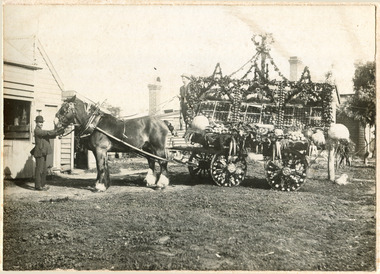
Photograph - Photograph, Exhibit at 1916 Easter Carnival, Exhibit at 1916 Easter Carnival, 1916 Easter Monday
... It is showing one of the exhibits at the Australian Natives Association's Fruit and Vegetable Exhibit, at the Mentone Recreation Ground. The Easter Carnival was a fund-raising event to assist and repatriate wounded WW1 soldiers returning home. The photographer is unknown...It is showing one of the exhibits at the Australian Natives Association's Fruit and Vegetable Exhibit, at the Mentone Recreation Ground. The Easter Carnival was a fund-raising event to assist and repatriate wounded WW1 soldiers returning home. The photographer is unknown ...The photograph was taken on Easter Monday 1916 at the Easter Carnival. It is showing one of the exhibits at the Australian Natives Association's Fruit and Vegetable Exhibit, at the Mentone Recreation Ground. The Easter Carnival was a fund-raising event to assist and repatriate wounded WW1 soldiers returning home. The photographer is unknown.Black and white photograph. The photograph is showing two men, a horse and a carriage. One of the men is holding on to the horses' harness and the other man in standing on a platform on the carriage holding the horses' reign. The horse is harnessed to the carriage containing various fruits and vegetables elaborately displayed. Much of the fruit and vegetables are seen in boxes along the carriage and others are hanging along the edge of the carriage. Some of the fruit and vegetable clearly able to be seen are pumpkin, parsnip, carrots, cabbage, cauliflower, turnip, grapes, various types of apples, oranges and lemons. There are also flowers meticulously arranged around the frame of the carriage and wheels. Front; A.N.A Exhibit / Easter Carnival - 1916 Back; Donated by / W.A.Follett / Heatherton ( written in ink ) Easter Monday CCarnival / at Mentone Recreation Ground / 1916 A.N.A ( written in pencil)easter carnival, 1916, photograph, australian natives association, fund-raising, world war i, ww1, mr w.a follett - heatherton, fruit, vegetable, mentone, mentone recreation ground -
 City of Moorabbin Historical Society (Operating the Box Cottage Museum)
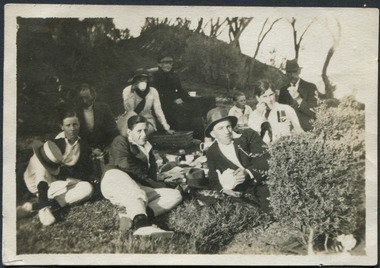
Photograph, 1914-18 The Methodists Youth Group Cheltenham, 1914-18 The Methodists Youth Group Cheltenham, 1914-18
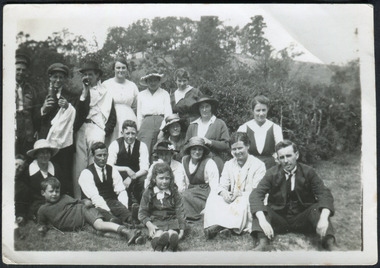
... unknown however it can be suggested it was probably during world war one, 1914-18, as one member in the group is in solider's uniform. The photographs are showing the Cheltenham Methodists Youth Group. cheltenham cheltenham methodists youth group youth group 1914-18 moorabbin shire, market gardeners, world war 1 1914 - 1918, soldiers, australian infantry force, back of photographs : C Whitehead These two small photos depicting a group photo of the Cheltenham Methodists Youth Group. ...The date of the photograph is unknown however it can be suggested it was probably during world war one, 1914-18, as one member in the group is in solider's uniform. The photographs are showing the Cheltenham Methodists Youth Group.These two small photos depicting a group photo of the Cheltenham Methodists Youth Group. The first photo shows the group sitting on the grass having a picnic. The second photograph depicts five members standing and two people sitting in front of them to the right of the photograph.back of photographs : C Whiteheadcheltenham, cheltenham methodists youth group, youth group, 1914-18, moorabbin shire, market gardeners, world war 1 1914 - 1918, soldiers, australian infantry force, -
 Greensborough Historical Society
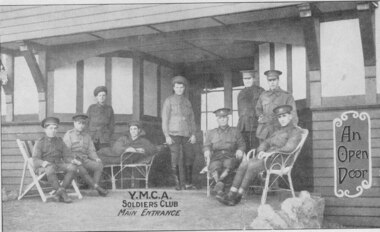
Postcard - Digital image, YMCA Soldiers Club, 1916c
... Soldiers' Club. Location unknown. There were YMCA soldiers' clubs in most capital cities in Australia, where soldiers could meet, relax and have a meal....Soldiers' Club. Location unknown. There were YMCA soldiers' clubs in most capital cities in Australia, where soldiers could meet, relax and have a meal. world war i ymca soldiers club young mens christian association Digital copy of black and white postcard. ...Soldiers sitting outside the YMCA Soldiers' Club. Location unknown. There were YMCA soldiers' clubs in most capital cities in Australia, where soldiers could meet, relax and have a meal.Digital copy of black and white postcard.world war i, ymca soldiers club, young mens christian association -
 The Beechworth Burke Museum
Photograph
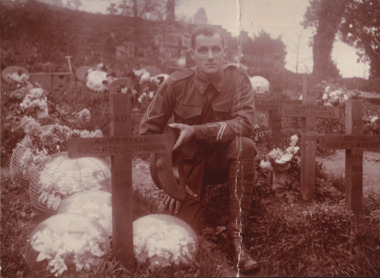
... Taken on an unknown date, depicted is a portrait of a young, unidentified male soldier kneeling beside a grave in a cemetery. He is dressed in an Australian...Taken on an unknown date, depicted is a portrait of a young, unidentified male soldier kneeling beside a grave in a cemetery. He is dressed in an Australian ...Taken on an unknown date, depicted is a portrait of a young, unidentified male soldier kneeling beside a grave in a cemetery. He is dressed in an Australian military uniform. The cemetery pictured is the Arnos Vale Cemetery in Bristol, United Kingdom. There are multiple crosses marking graves in this photograph, all marked in memory of different soldiers who fought with the Australian Imperial Force (AIF) during World War I. It is believed that the soldier who is kneeling was also part of the Australian Imperial Force. This can be inferred by the chevron rank insignia visible on the uniform. The placement of this insignia on the sleeve of the right arm suggests that this soldier was either a Warrant Officer or a Non-Commissioned Officer (NCO). Another signifier of the Australian Imperial Force uniform are the three inverted chevron stripes positioned on the lower part of the left sleeve, near the wrist. These are called Good Conduct Stripes and were worn by Warrant Officers and NCOs. This patch consisted of a single chevron stripe for each year of military service meeting certain requirements of good conduct. Additionally, the man in this photograph is also wearing a 'Rising Sun' collar badge on his coat. Australia, unlike most other Commonwealth countries, did not adopt metal regimental badges during the First World War. All units were issued with the Australian Army General Service Badge, better known as the 'Rising Sun’ badge. This insignia is almost always identified with the Australian Imperial Force. Furthermore, the grave that this unidentified soldier is kneeling next to is the resting place of Private John James (J. J.) Simpson. He was born in Stanley, Victoria in 1883. He enlisted in the Australian Imperial Force in Melbourne, Victoria on 12 July, 1915, with the service number 4909. John James Simpson was then posted to the 60th Company Depot at Seymour for military recruit training. John James Simpson was reported wounded in action in France on 19 July, 1916. He was admitted to 13th General Hospital, France with gunshot wounds to his legs. From Boulogne, France, he traveled to the United Kingdom aboard the Hospital Ship 'St. Denis' for medical care. Upon arrival, he was admitted to 2nd Southern General Hospital, Bristol, England on 27 July, 1916. John James Simpson passed away from his wounds on 1 August, 1916. He was 33 years old.The record is historically significant due to its connection to World War I. This conflict is integral to Australian culture as it was the single greatest loss of life and the greatest repatriation of casualties in the country's history. Australia’s involvement in the First World War began when the Australian government established the Australian Imperial Force (AIF) in August 1914. Immediately, men were recruited to serve the British Empire in the Middle East and on the Western Front. The first significant Australian action of the war was the Australian Naval and Military Expeditionary Force’s (ANMEF) landing on Rabaul on 11 September 1914. The ANMEF took possession of German New Guinea at Toma on 17 September 1914 and of the neighbouring islands of the Bismarck Archipelago in October 1914. On 25 April 1915, members of the AIF landed on Gallipoli in Turkey with troops from New Zealand, Britain, and France. This specific event holds very strong significance within Australian history. The record has strong research potential. This is due to the ongoing public and scholarly interest in war, history, and especially the ANZAC legend, which is commemorated annually on 25 April, known as ANZAC Day.Sepia rectangular photograph printed on matte photographic paper mounted on card.Obverse: A.I.F. / AUSTRALIA / 441, PTE.T. / T (?) / 26B (?) / 6.1.17 / (?) / LANGTON RD. / ST. ANNES PK. / BRISTOL / A.I.F. / AUSTRALIA. / 708, GNR B.L.CRAWFORD. / FR / 5 D.A.C. / 13.2.17 / A.I.F. / AUSTRALIA. / 4481, P (?) D.MORRIS. / (?) / 31.12.(?) / A.I.F. / AUSTRALIA. / 4909, PTE J.J.SIMPSON. / 608(?) / 1.8.16 / Winchester / LANGTON RD. / ST. ANNES PK / BRISTOL / Reverse: 2641 /military album, military, war, world war i, wwi, australian imperial force, aif, j. j. simpson, uniform, cemetery -
 City of Moorabbin Historical Society (Operating the Box Cottage Museum)
Photograph, 6 x B&W Photos of Cheltenham Methodist Youth Group c1914 -1918, Various Photos of Cheltenham Methodist Youth Group c1914-18, 7 x 1914-18 & 1 x 1947
... unknown. (Note soldier's uniform in some photos) 1 x photograph celebrating the Anniversary of Conductor Mr Huntly in 1947 cheltenham methodist youth group 1914 1918 world war 1 1914 - 1918, cheltenham, moorabbin, methodist church, social clubs, youth groups, australian infantry force, concerts, musical conductors, market gardeners, early settlers, moorabbin shire 7 left : 1947 Anniversary / Conductor Mr Huntly 6 x Black and White photographs 5 x . ...5 x Various photos of the Cheltenham Methodist Youth Group.c 1914 - 1918 Location unknown. (Note soldier's uniform in some photos) 1 x photograph celebrating the Anniversary of Conductor Mr Huntly in 1947 6 x Black and White photographs 5 x . Various photos of the Cheltenham Methodist Youth Group.c1914-18 1x photo Anniversary Conductor Mr Huntly 19477 left : 1947 Anniversary / Conductor Mr Huntly cheltenham methodist youth group, 1914, 1918, world war 1 1914 - 1918, cheltenham, moorabbin, methodist church, social clubs, youth groups, australian infantry force, concerts, musical conductors, market gardeners, early settlers, moorabbin shire -
 Montmorency–Eltham RSL Sub Branch
Uniform - Jacket, Service Dress WW2, WW2 Service Jacket, 1942
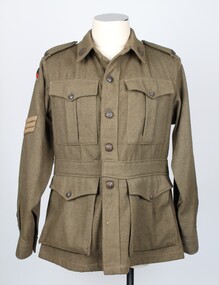
... Australia [including Proceedings of Discharge - see pdf Media File above], indicate that he was Sergeant, which is consistent with the rank on this jacket). Name not written on item but known to be part of set which includes slouch hat, which does contain the name, and other related items which include Service Number, verifying identity. See further service details in "Links" above. Soldier's name known. Items donated (date unknown ...Owned by William Albert HARRISON (Service Number VX41478; above Link ["WW2 Record"] indicates that Rank on Discharge was Cpl, but other AIF documents, from National Archives Australia [including Proceedings of Discharge - see pdf Media File above], indicate that he was Sergeant, which is consistent with the rank on this jacket). Name not written on item but known to be part of set which includes slouch hat, which does contain the name, and other related items which include Service Number, verifying identity. See further service details in "Links" above. Soldier's name known. Items donated (date unknown) by brother-in-law who was living in Montmorency and was a committee member of MERSL when item donated.Khaki jacket; long sleeve 4 front buttons (attached with continuous leather strip) 4 pockets (buttons sewn on) Shoulder straps (buttons sewn on) Cuff buttons (sewn on) Badges on lapels & on shoulder straps Unit Patches on upper sleeves (Part of set with Slouch Hat, 0030.2)Inside label: V300; 1942; Size (2 - 'faint', may be other numbers indicating size details) Brass badges: Australian Commonwealth Military Forces (both lapels); Australia (both shoulder straps) Badge of rank (Sergeant) - 3 chevrons (R upper sleeve) Colour patches on both sleeves for 2/5 Battalion, 6th Division Second AIF Years of Service insignia - 3 chevrons, indicating 3 years O/S service (R lower sleeve) Unit patches - rectangle black over red (2/5 Battalion, WW2) -
 Montmorency–Eltham RSL Sub Branch
Headwear - Slouch hat, Hat, khaki, fur felt, 1940, 1940
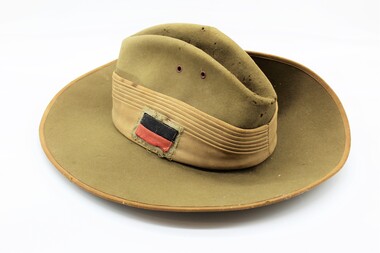
... Owned by William Albert HARRISON (Service Number VX41478; above Link ["WW2 Record"] indicates that Rank on Discharge was Cpl, but other AIF documents, from National Archives Australia [including Proceedings on Discharge - see pdf Media File above], indicate that he was Sergeant). Soldier's name known. Items donated (date unknown ...Owned by William Albert HARRISON (Service Number VX41478; above Link ["WW2 Record"] indicates that Rank on Discharge was Cpl, but other AIF documents, from National Archives Australia [including Proceedings on Discharge - see pdf Media File above], indicate that he was Sergeant). Soldier's name known. Items donated (date unknown) by brother-in-law who was living in Montmorency and was a committee member of MERSL when item donated.Slouch hat with Australian Commonwealth Military Forces badge; cotton puggaree with 2/5 Battalion unit colour patch (Rectangle, black over red). Inside: hand-written name (W. A. HARRISON) Size 6 7/8, 1940 Maker's name stamped on leather lining (CORONET FELTS Pty [Ltd]) -
 Montmorency–Eltham RSL Sub Branch
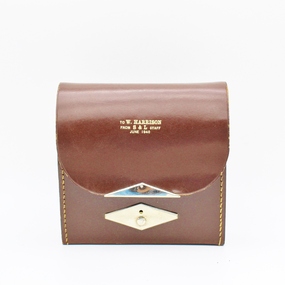
Functional object - Bandage Case
... Owned by William Albert HARRISON (Service Number VX41478; above Link ["WW2 Record"] indicates that Rank on Discharge was Cpl, but other AIF documents, from National Archives Australia [including Proceedings on Discharge - see pdf Media File above], indicate that he was Sergeant). Soldier's name known. Items donated (date unknown ...Owned by William Albert HARRISON (Service Number VX41478; above Link ["WW2 Record"] indicates that Rank on Discharge was Cpl, but other AIF documents, from National Archives Australia [including Proceedings on Discharge - see pdf Media File above], indicate that he was Sergeant).Soldier's name known. Items donated (date unknown) by brother-in-law who was living in Montmorency and was a committee member of MERSL when item donated.Brown vinyl case with silver coloured clasp at front and cotton stitching around edgingTo W.HARRISON From S & L Staff June 1940 -
 Montmorency–Eltham RSL Sub Branch
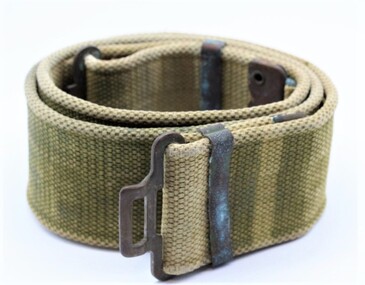
Uniform - Belt, Patt. '37 W.E, 1937 Khaki Webbing Belt, 1940
... Owned by William Albert HARRISON (Service Number VX41478; above Link ["WW2 Record"] indicates that Rank on Discharge was Cpl, but other AIF documents, from National Archives Australia [including Proceedings on Discharge - see pdf Media File above], indicate that he was Sergeant). Soldier's name known. Items donated (date unknown ...Owned by William Albert HARRISON (Service Number VX41478; above Link ["WW2 Record"] indicates that Rank on Discharge was Cpl, but other AIF documents, from National Archives Australia [including Proceedings on Discharge - see pdf Media File above], indicate that he was Sergeant). Soldier's name known. Items donated (date unknown) by brother-in-law who was living in Montmorency and was a committee member of MERSL when item donated.Khaki Pattern 1937 Webbing belt minus its two rear brass buckles. hand-written name ("W. A. HARRISON") and service number (VX41478) Carrier PLN 2/5 Bn S^ ME Co 1940 -
 Montmorency–Eltham RSL Sub Branch
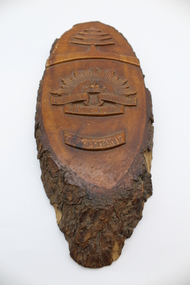
Plaque - Wooden wall-hanging, Cedar Wooden Wall Hanging, 1941
... Soldier's name known. Items donated (date unknown) by brother-in-law who was living in Montmorency and was a committee member of MERSL when item donated. Two stamps in French possibly where it was made, Artiols bois des cedres. Becharry Liban. Salim Kabalan. Hand written message;- Mother with all the best to you Bill. Dated 25-10-41 Oval shaped slice of wood from the cedar tree in Lebanon. Carving of a cedar tree across top and emblem of Australian ...Owned by William Albert HARRISON (Service Number VX41478; above Link ["WW2 Record"] Sent home to his mother from Liban on 25-10-41 Soldier's name known. Items donated (date unknown) by brother-in-law who was living in Montmorency and was a committee member of MERSL when item donated.Oval shaped slice of wood from the cedar tree in Lebanon. Carving of a cedar tree across top and emblem of Australian Commonwealth Military Services half way down and Cedar of Lebanon across the bottom half. Stained with light brown varnish. Original bark of tree all the way around the edge.Two stamps in French possibly where it was made, Artiols bois des cedres. Becharry Liban. Salim Kabalan. Hand written message;- Mother with all the best to you Bill. Dated 25-10-41 -
 Montmorency–Eltham RSL Sub Branch
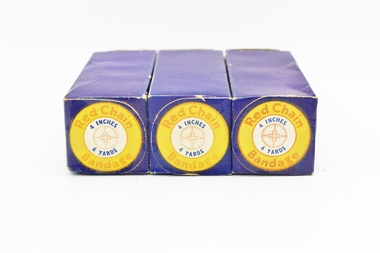
Textile - Red Chain Bandage Box, Bandage Box, 1940
... Australia [including Proceedings of Discharge - see pdf Media File above], indicate that he was Sergeant, which is consistent with the rank on this jacket). Name not written on item but known to be part of set which includes slouch hat, which does contain the name, and other related items which include Service Number, verifying identity. See further service details in "Links" above. Soldier's name known. Items donated (date unknown ...Owned by William Albert HARRISON (Service Number VX41478; above Link ["WW2 Record"] indicates that Rank on Discharge was Cpl, but other AIF documents, from National Archives Australia [including Proceedings of Discharge - see pdf Media File above], indicate that he was Sergeant, which is consistent with the rank on this jacket). Name not written on item but known to be part of set which includes slouch hat, which does contain the name, and other related items which include Service Number, verifying identity. See further service details in "Links" above. Soldier's name known. Items donated (date unknown) by brother-in-law who was living in Montmorency and was a committee member of MERSL when item donated.Blue coloured rectangle box with orange, red & white labels on one side and ends of boxSide label: Sterilized neat Edge RED CHAIN BANDAGE 4 Inches 6 Yards Johnson & Johnson Pty Ltd Sydney End labels: Red Chain Bandage 4 Inches 6 Yards -
 Montmorency–Eltham RSL Sub Branch
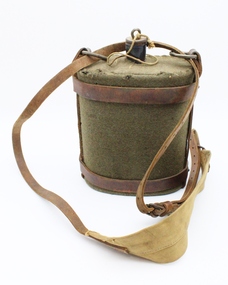
Container - Water bottle, Australian, WW2, 1942
... Australia [including Proceedings of Discharge - see pdf Media File above], indicate that he was Sergeant, which is consistent with the rank on this jacket). Name not written on item but known to be part of set which includes slouch hat, which does contain the name, and other related items which include Service Number, verifying identity. See further service details in "Links" above. Soldier's name known. Items donated (date unknown ...Owned by William Albert HARRISON (Service Number VX41478; above Link ["WW2 Record"] indicates that Rank on Discharge was Cpl, but other AIF documents, from National Archives Australia [including Proceedings of Discharge - see pdf Media File above], indicate that he was Sergeant, which is consistent with the rank on this jacket). Name not written on item but known to be part of set which includes slouch hat, which does contain the name, and other related items which include Service Number, verifying identity. See further service details in "Links" above. Soldier's name known. Items donated (date unknown) by brother-in-law who was living in Montmorency and was a committee member of MERSL when item donated.Australian WW2 blue enamel 2 pint water bottle with cork and metal stopper. Wool felt cover and leather 1903 Pattern carrier. Cork and metal stopper is attached with twine sewn to the cover.D^D KH 1942 G^ QP D^D KH 1942 Acceptance mark G^ -
 Montmorency–Eltham RSL Sub Branch
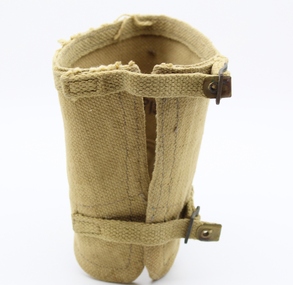
Accessory - Gaiter, Patt. '37 W.E, Gaiter, 1942
... Owned by William Albert HARRISON (Service Number VX41478; above Link ["WW2 Record"] indicates that Rank on Discharge was Cpl, but other AIF documents, from National Archives Australia [including Proceedings on Discharge - see pdf Media File above], indicate that he was Sergeant). Soldier's name known. Items donated (date unknown ...Owned by William Albert HARRISON (Service Number VX41478; above Link ["WW2 Record"] indicates that Rank on Discharge was Cpl, but other AIF documents, from National Archives Australia [including Proceedings on Discharge - see pdf Media File above], indicate that he was Sergeant). Soldier's name known. Items donated (date unknown) by brother-in-law who was living in Montmorency and was a committee member of MERSL when item donated.Gaiter webbing, Australian Commonwealth Military Forces. Hand-written name ("W. A. HARRISON") and service number (VX41478) JJ 1942 size 2 -
 Red Cliffs Military Museum
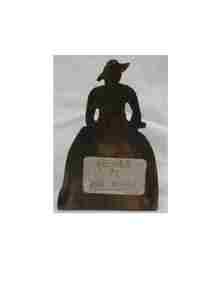
Brass Statue, Brass Australian WW11 Soldier, (estimated); late 1940's
... No-one at currently at Red Cliffs Military Museum knows Mrs Mihan. but are trying to rectify this. australian ww11 brass figure jungle owen gun fighter trench art No makers mark A brass cast Australian Soldier in jungle equipment with Owen Gun, slouch hat, dog tags, basic 37 patern webbing, short and boots. Brass Australian WW11 Soldier Brass Statue unknown ...No-one at currently at Red Cliffs Military Museum knows Mrs Mihan. but are trying to rectify this.A brass cast Australian Soldier in jungle equipment with Owen Gun, slouch hat, dog tags, basic 37 patern webbing, short and boots.No makers markaustralian, ww11, brass, figure, jungle, owen, gun, fighter, trench, art -
 Red Cliffs Military Museum
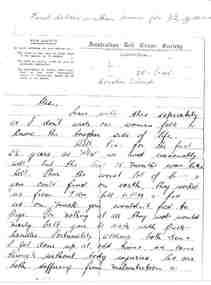
Letter
... unknown) friend. Descriptive of life and treatment in POW camp. The island was captured by the Japanese in early 1942. Morotai's southern plain was taken by American forces in September 1944 during the Battle of Morotai, and used as a staging point for the Allied invasion of the Philippines in early 1945, and of Borneo in May and June of that year. Japanese soldier Teruo Nakamura was discovered in the Morotai jungle in 1974, as one of the WWII Japanese soldiers who held out subsequent to the Japanese military's surrender. 2 pow morotri island morotai island world war prisoner of war australian ...Letter written from (unknown) POW imprisioned by the Japanese on Morotai Island from 1942 - 1945 to (unknown) friend. Descriptive of life and treatment in POW camp. The island was captured by the Japanese in early 1942. Morotai's southern plain was taken by American forces in September 1944 during the Battle of Morotai, and used as a staging point for the Allied invasion of the Philippines in early 1945, and of Borneo in May and June of that year. Japanese soldier Teruo Nakamura was discovered in the Morotai jungle in 1974, as one of the WWII Japanese soldiers who held out subsequent to the Japanese military's surrender.Photocopy of letter, 4 pages, originally written in ink on (unofficial) Australian Red Cross form.Added to head of letter at a later date is inscription ' First letter written home for 3 1/2 years'.Top left hand- FOR SAFETY/ IN YOUR LETTERS DO NOT REFER TO:-/ The name of your ship or other ships in the convoy, or its escorts./The date of sailing, ports of call, or probable destination./ The description of troops, their loca-/tion or any other information/ which, if intercepted, would be of/ value to the enemy. In your Top right hand- Australian Red Cross Society/ (UNOFFICIAL)/ 25-8-45/ (added at later date 'Morotri Island')/ Alex, Have witten this especially/ as i don't wish our women folk to know the tougher side of life./Well Alex for the first/ 2 1/2 years as POWs we lived reasonably/ well, but the last 15 months was like /hell. Heres the worst lot of b-s/ you could find on earth, they worked /us from 7AM till 6 PM, & fed/ us on muck you wouldn't feed to/ Pigs. I'm nothing at all they would 2, pow, morotri island, morotai island, world war, prisoner of war, australian red cross society
