
Showing 151 items matching "us soldiers"
-
 Bendigo Military Museum
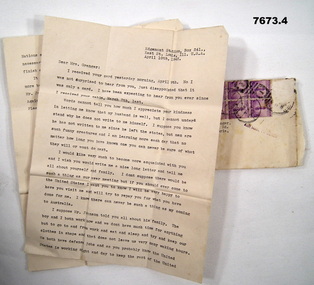
Letter - LETTER AND ENVELOPE, Edna Johnson, 10 April 1942
... US Soldiers...Letter was from a USA family member of a US soldier staying at a private residence in Bendigo. ...Letter was from a USA family member of a US soldier staying at a private residence in Bendigo. ...Letter was from a USA family member of a US soldier staying at a private residence in Bendigo. The US soldier was not permitted to communicate with family members as to their location. the Granger family circumvented that by sending a cable to his family and this letter was a reply to them..1) & .2) A4 page typed letter (2 pages) from Edna Johnson to Enid Granger. Black typed writing on cream coloured paper. Address on top and signed off on page 2. .3) Cream coloured envelope, address on front and six stamps. Various black stamps on front and air mail stamp address from written on back. .4) Small newspaper cut out photo of a young girl..1) Address on top - Edgemont Station, Box 241, East St, Louis, Ill, USA, April 10th 1942. .2) Signed "Sincerely Edna Johnson. .1) Address on front, Mrs Enid Granger, 32 Mt Korong Rd, Bendigo, Victoria, Australia.us soldiers, censorship, letter -
 National Vietnam Veterans Museum (NVVM)
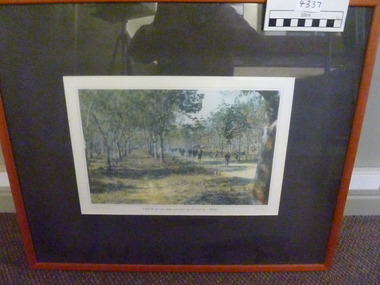
Photograph, 1 RAR Patrol
... Colour photograph of 1 RAR patrolling in rubber plantation with US soldiers following...Colour photograph of 1 RAR patrolling in rubber plantation with US soldiers following 1 RAR Patrol Photograph Photograph ...Timber framed black matt board. Colour photograph of 1 RAR patrolling in rubber plantation with US soldiers following1 RAR patrols under watchful eye of cavalry - 1965.1 rar, photograph -
 National Vietnam Veterans Museum (NVVM)
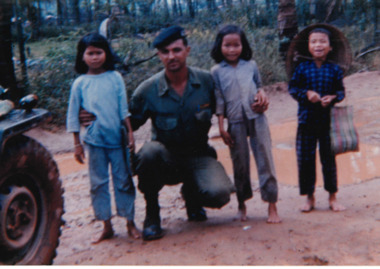
Photograph
... Coloured photograph of US Soldier kneeling with three Vietnamese children beside him. ...Photograph Cam Rahn Bay 101st Airborne Jack Cogle children Vietnam war Coloured photograph of US Soldier kneeling with three Vietnamese children beside him. ...Coloured photograph of US Soldier kneeling with three Vietnamese children beside him. The soldier Jack Cogle stationed in Vietnam 1967 to 1969 with 101st Airborne.photograph, cam rahn bay, 101st airborne, jack cogle, children, vietnam war -
 Bendigo Military Museum
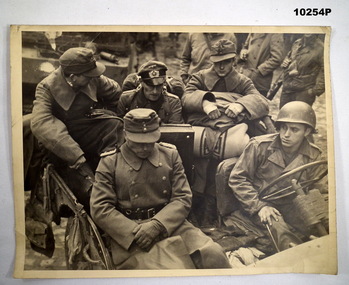
Photograph - GERMAN POW'S WW2, 21 Oct 1944
... Photo is of him and three other German soldiers sitting in a US Jeep with a US soldier with other soldiers standing in the background....Photo is of him and three other German soldiers sitting in a US Jeep with a US soldier with other soldiers standing in the background. ...Commanding Officer of Aachen was Colonel Gerhard Wilck. Aachen was the first German city captured by the Allies. Part of the collection of William (Bill) Thomason. Refer Cat No.4136P.Black and white photo of German Commander of German City of Aachen in about 1944. Photo is of him and three other German soldiers sitting in a US Jeep with a US soldier with other soldiers standing in the background.Typed label on back describing the event.collection of william (bill) thomason, photograph, germany, ww2 -
 Bendigo Military Museum
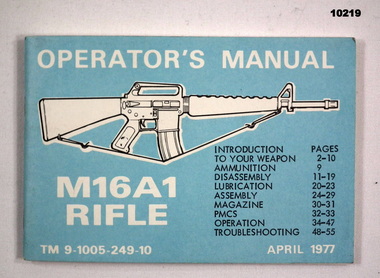
Manual - OPERATORS MANUAL, US Govt Printing Office, c.1984
... Manual issued to US soldiers to understand and maintain their weapon. ...Manual issued to US soldiers to understand and maintain their weapon. ...Manual issued to US soldiers to understand and maintain their weapon. Part of the collection of "Bill Thomason". Refer No. 4136P.Small blue covered booklet with 56 pages inside covering the use and maintenance of the USA M16 Rifle issued by the US Dept of Defence. Includes descriptions, drawings and specifications for the weapon. Manual is dated April 1977.collection of william (bill) thomason, operators manual, m16 rifle -
 Bendigo Military Museum
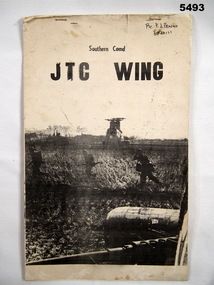
Administrative record - BOOKLET, Australian Army Southern Command, Southern Command JTC Wing, C1967
... Programme- front cover cardboards with grainy image of a twin rotor helicopter, three helmeted US soldiers moving to left of picture. Machine gin barrel in the foreground. 3 pages, white paper of instructions, two pink pages of lessons and times. ...PENNO 3790111 Programme- front cover cardboards with grainy image of a twin rotor helicopter, three helmeted US soldiers moving to left of picture. Machine gin barrel in the foreground. 3 pages, white paper of instructions, two pink pages of lessons and times. ...Australia served alongside SVN forces plus other Allied nations 1962-1972. Before our soldiers left Aust they had specific jungle training.Programme- front cover cardboards with grainy image of a twin rotor helicopter, three helmeted US soldiers moving to left of picture. Machine gin barrel in the foreground. 3 pages, white paper of instructions, two pink pages of lessons and times. Four pages of wartime tasks in the field. Front cover in biro PTE P.J. PENNO 3790111vietnam war, svn -
 Montmorency–Eltham RSL Sub Branch
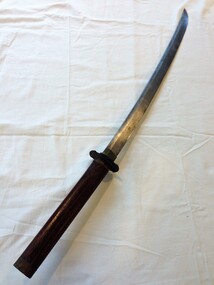
Weapon - Sword, Samurai (Period Reproduction)
... This is believed to be a period "reproduction" most likely made from a JEEP vehicle spring by Australian soldiers to sell as a souvenir. US soldiers were prime targets for this type of deception as they were known to pay a premium for "Japanese" samurai swords....This is believed to be a period "reproduction" most likely made from a JEEP vehicle spring by Australian soldiers to sell as a souvenir. US soldiers were prime targets for this type of deception as they were known to pay a premium for "Japanese" samurai swords. ...This is believed to be a period "reproduction" most likely made from a JEEP vehicle spring by Australian soldiers to sell as a souvenir. US soldiers were prime targets for this type of deception as they were known to pay a premium for "Japanese" samurai swords.Steel blade and wooden handleNone -
 National Vietnam Veterans Museum (NVVM)
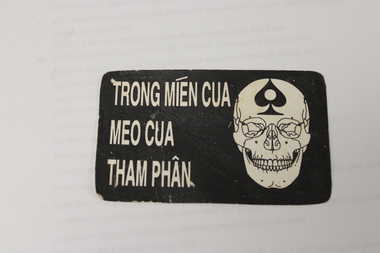
Card - Death card
... "Death Card" designed to be left on the body of dead enemy soldiers. US soldiers believed that the ace of spades held a superstitious meaning for the Viet Cong, stemming from French colonial rule and fortune-telling practices where the spade suit was associated with death and misfortune. ..."Death Card" designed to be left on the body of dead enemy soldiers. US soldiers believed that the ace of spades held a superstitious meaning for the Viet Cong, stemming from French colonial rule and fortune-telling practices where the spade suit was associated with death and misfortune. ..."Death Card" designed to be left on the body of dead enemy soldiers. US soldiers believed that the ace of spades held a superstitious meaning for the Viet Cong, stemming from French colonial rule and fortune-telling practices where the spade suit was associated with death and misfortune. This item was donated by Peter S Sims, who served as a Corporal in the Royal Australian Army Medical Corps in Vietnam 1969-70.Card with black background and white writing. A skull with a Spade symbol on it's forehead.Trong Mien Cua Meo Cua Tham Phandeath card, peter sims, nvvm, enemy, death, ace of spades -
 Bendigo Military Museum
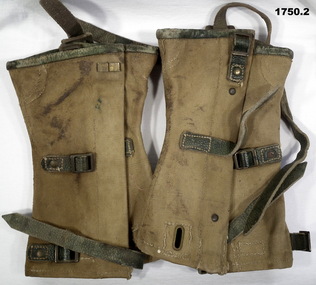
Uniform - GAITERS U.S, c.1930’s - 40’s
... Pair of US gaiters worn by soldiers in WWII. Made of canvas with green leather straps & brass buckles...Later in life he was President of the Bendigo RSL. uniforms - army Gaiters US Inside canvas in black texta: “VX124730 A HOLMES 13” Pair of US gaiters worn by soldiers in WWII. Made of canvas with green leather straps & brass buckles Uniform GAITERS U.S. ...ALAN WILLIAM HOLMES No VX124730 enlisted in the 2nd AIF on 13.4.1943 age 20 years. At discharge on 24.6.1946 he held the rank of Cpl in 18th Advanced Ordnance Depot. Later in life he was President of the Bendigo RSL.Pair of US gaiters worn by soldiers in WWII. Made of canvas with green leather straps & brass bucklesInside canvas in black texta: “VX124730 A HOLMES 13”uniforms - army, gaiters us -
 National Vietnam Veterans Museum (NVVM)
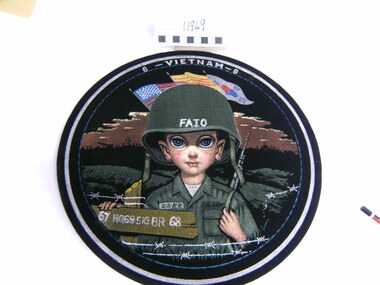
Artwork, other - Painting on velvet
... ...US soldier...Round black velvet disc with caricature of a US Army soldier, "ZERR" on right pocket. He is holding a road sign hand written 67 HQ69 SIG BR 68. ...disc painting velvet US soldier caricature At top: 6-VIETNPM - 6 (in white) On helmet: FAIO (written by hand) On sign: 67 HQ69 SIG BR 68 (in white) Round black velvet disc with caricature of a US Army soldier, "ZERR" on right pocket. ...Round black velvet disc with caricature of a US Army soldier, "ZERR" on right pocket. He is holding a road sign hand written 67 HQ69 SIG BR 68. Flags of USA, Vietnam and Korea in background with silhouettes of tanks and soldiers on horizon. Rows of barbed wire in foreground. At top: 6-VIETNPM - 6 (in white) On helmet: FAIO (written by hand) On sign: 67 HQ69 SIG BR 68 (in white) disc, painting, velvet, us soldier, caricature -
 Returned Nurses RSL Sub-branch
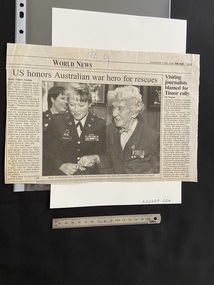
Newspaper - Newspaper clipping, The Age, US honors Australian war hero for rescues, Wednesday 1 May, 1996
... Newspaper article about the heroism of Australian soldier, Corporal Leslie "Bull" Allen.Mr Allen has been inducted into the Oregon National Guard's Hall of Honor and earned the US Silver Star for carrying a dozen US soldiers down Mount Tambu in New Guinea under heavy Japanese fire in 1943. ...Newspaper article about the heroism of Australian soldier, Corporal Leslie "Bull" Allen.Mr Allen has been inducted into the Oregon National Guard's Hall of Honor and earned the US Silver Star for carrying a dozen US soldiers down Mount Tambu in New Guinea under heavy Japanese fire in 1943. ...Newspaper article about the heroism of Australian soldier, Corporal Leslie "Bull" Allen.Mr Allen has been inducted into the Oregon National Guard's Hall of Honor and earned the US Silver Star for carrying a dozen US soldiers down Mount Tambu in New Guinea under heavy Japanese fire in 1943. He also earned Australia's highest honor for enlisted men, the Military Medal, for his rescue of Australian soldiers. Leslie Allen's widow, Jean Allen, attended the induction ceremony in Oregon, United States, to commemorate American-Australian Armed Forces Day. She wore the six medals she had earned as a war-time nurse.Half a newspaper page with two articles, the date and paper are printed across the top right, with 'World News' on the line below. The main article takes up most of the page with one column of text and a large photograph of Major Beverly Jorgenson escorting Jean Allen.'NC9' [Handwritten on blue ink at the top centre of the page.army nurses, leslie allen, jean allen, war heroes, wwii, world war 1939-1945, war medals -
 National Vietnam Veterans Museum (NVVM)
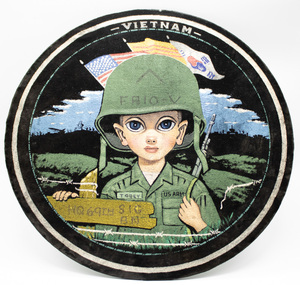
Artwork, other - Painting, on velvet
... ...US soldier...Round black velvet disc with caricature-style image of a soldier in US Army battle dress with a rifle over his left shoulder painted on it . ...Plaque America craft art souvenir US soldier On helmet: FAID-V ( written in pen) . ...Round black velvet disc with caricature-style image of a soldier in US Army battle dress with a rifle over his left shoulder painted on it . Flags of America, Vietnam and Korea are in the background. He is holding a road sign. "Tobey" on his right pocket.On helmet: FAID-V ( written in pen) . On road sign: HQ69th Sig B.N. VIETNAM printed in white on top of disc.plaque, america, craft, art, souvenir, us soldier -
 Wangaratta RSL Sub Branch
Flag - Italian Flag, pre 1942
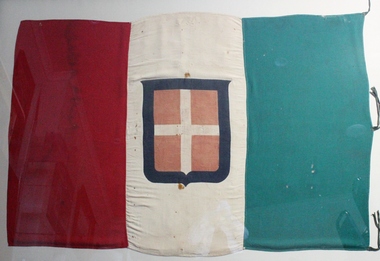
... Soldiers' inscriptions on the flag suggest that it was capture from Italian troops during the Battle of El Alamein on 9 July 1942. The service numbers tell us...Soldiers' inscriptions on the flag suggest that it was capture from Italian troops during the Battle of El Alamein on 9 July 1942. The service numbers tell us ...This was the official state flag of Italy used by Italian armed forces during WWII. The tri-colour flag with the emblem of the former Royal House of Savoy was the first national flag and lasted for 85 years until the birth of the Italian Republic in 1946. Soldiers' inscriptions on the flag suggest that it was capture from Italian troops during the Battle of El Alamein on 9 July 1942. The service numbers tell us that these soldiers served with the 2/24th Battalion which was raised Wangaratta. Walter Edward PARKER VX34529 Lancelot HALL VX32047 DOB 25/10/1904 Mildura Greville Egerton DENNYS Capt. NX4731 DOB 4/3/1917 DOD 4/10/1969 Enlisted 27/10/1939 George Charles GREEN VX21968This was the official state flag of Italy used by Italian armed forces during WWII. The tri-colour flag with the emblem of the former Royal House of Savoy was the first national flag and lasted for 85 years until the birth of the Italian Republic in 1946. Soldiers' inscriptions on the flag suggest that it was capture from Italian troops during the Battle of El Alamein on 9 July 1942. The service numbers tell us that these soldiers served in the 2/24th Battalion which was raised in Wangaratta. Recognising the cultural and historical significance of the flag to both Italy and Australia, the Wangaratta RSL received a grant to have the flag professionally restored and framed in 2017.Large Italian flag with green, white and red vertical panels of equal size defaced with the Savoyan coat of arms, a red shield with white cross bordered with blue. Three two-piece hoist ties on the green side. Panels are sewn together from separate pieces of fabric. The shield appears to have been printed directly onto the white panel. The edges are hemmed.There are several handwritten inscriptions on the coat of arms in red and blue/black ink detailing the name and service numbers of different soldiers. (Not all of the writing is legible). Legible texts reads: "VX32047 / L HALL / ALAMEINE / 9.7.42" "VX21968 / G Green" "VX?45?? / W PARKER / ALAMEIN" - "NX4731 Greville Denys"italian flag, italy, el alamein, battle of el alamein, 2/24th battalion, wangaratta, ww2 -
 Eltham District Historical Society Inc
Audio - Audio Recording, Dr Geoffrey Sandy - Soldier Welcome Home Committees, 10 Jun. 2023
... Geoffrey Sandy to present to us on the WW1 Soldier Welcome Home Committees, with specific reference to Eltham. ...Geoffrey Sandy to present to us on the WW1 Soldier Welcome Home Committees, with specific reference to Eltham. ...EDHS Newsletter No. 270 June 2023 At our next meeting at 2.00pm on Saturday 10th June 2023 we are pleased to have Dr. Geoffrey Sandy to present to us on the WW1 Soldier Welcome Home Committees, with specific reference to Eltham. Geoffrey is an author, parish historian and parish archivist for St Margaret’s Anglican Church in Eltham. Soldier Welcome Home Committees (SWHC) were established throughout Australia during WW1 by the soldier’s local community - their home. Despite WW1 being a well-researched area of Australian history, little has been published on the SWHCs. The work of these committees is an important part of our war history, and our volunteer history. As women were often well-represented, and active within the SWHCs, it is also important to our history of Australian women. Geoff has undertaken a detailed case study of the Soldier Welcome Home Committee at Eltham (SWHCE). During the WW1 period Eltham can be described a small rural community. What is fortunate is that the Minute Books of the SWHC Eltham meetings are extant and readily accessible, as these are held in the archives of Saint Margaret’s Anglican Church Eltham.1:17:13 duration Digital MP3 file; 26.5MBaudio recording, eltham district historical society, meeting, society meeting, eltham, avenue of honour, dr geoffrey sandy, welcome home committee -
 Flagstaff Hill Maritime Museum and Village
Leisure object - Toy Soldier, circa 1878
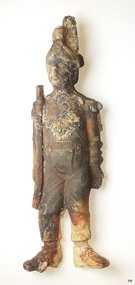
... us to interpret Victoria's social and historical themes. Through is associated with the worst and best-known shipwreck in Victoria's history. flagstaff hill warrnambool flagstaff hill maritime museum shipwreck coast flagstaff hill maritime village great ocean road loch ard toy soldier napoleonic uniforms military toy moulded soldier An unpainted, cream-coloured toy soldier, recovered from the Loch Ard. ...The toy soldier is a relic from the shipwreck of the LOCH ARD in 1878. It has a companion piece in the Flagstaff Hill collection. The toy soldier is unpainted, but the style of uniform, and the weapons carried (a musket and a basket-handled cutlass), indicate it is a representation of the Napoleonic Wars period from the beginning of the nineteenth century. Mass-produced toy soldiers made of cast metal (lead or tin) became popular during the 1800s. Heyde of Germany manufactured silhouette-shaped flat toy soldiers early in the century. Mignot of France released three-dimensional solid figures and later around 1893 W. Britain, a toy company became known for its die-cast lead toy soldiers. These innovations were designed to make sets of toy soldiers more affordable for middle and lower-class children, extending the market beyond the intricately made and hand-crafted replicas that were the preserve of the rich in the eighteenth century. Wooden military figures, specially carved and unpainted ones, were therefore not particularly common at the time when the Loch Ard foundered on Victoria’s southwest coast. Mignot was the first to sell unpainted soldiers, leaving their customers to fill in the colours according to their own patriotic preferences. It is, therefore, possible the two figures in the Flagstaff Hill collection were part of a new set intended for sale, rather than part of a passenger’s existing collection. Loch Ard History: The Loch Ard got its name from ”Loch Ard” a loch that lies to the west of Aberfoyle, and the east of Loch Lomond. It means "high lake" in Scottish Gaelic. The vessel belonged to the famous Loch Line which sailed many vessels from England to Australia. The Loch Ard was built in Glasgow by Barclay, Curle & Co. in 1873, the vessel was a three-masted square-rigged iron sailing ship that measured 79.87 meters in length, 11.58 m in width, and 7 m in depth with a gross tonnage of 1693 tons with a mainmast that measured a massive 45.7 m in height. Loch Ard made three trips to Australia and one trip to Calcutta before its fateful voyage. Loch Ard left England on March 2, 1878, under the command of 29-year-old Captain Gibbs, who was newly married. The ship was bound for Melbourne with a crew of 37, plus 17 passengers. The general cargo reflected the affluence of Melbourne at the time. Onboard were straw hats, umbrellas, perfumes, clay pipes, pianos, clocks, confectionery, linen and candles, as well as a heavier load of railway irons, cement, lead and copper. There were other items included that were intended for display in the Melbourne International Exhibition of 1880. The voyage to Port Phillip was long but uneventful. Then at 3 am on June 1, 1878, Captain Gibbs was expecting to see land. But the Loch Ard was running into a fog which greatly reduced visibility. Captain Gibbs was becoming anxious as there was no sign of land or the Cape Otway lighthouse. At 4 am the fog lifted and a lookout aloft announced that he could see breakers. The sheer cliffs of Victoria's west coast came into view, and Captain Gibbs realised that the ship was much closer to them than expected. He ordered as much sail to be set as time would permit and then attempted to steer the vessel out to sea. On coming head-on into the wind, the ship lost momentum, the sails fell limp and Loch Ard's bow swung back towards land. Gibbs then ordered the anchors to be released in an attempt to hold their position. The anchors sank some 50 fathoms - but did not hold. By this time the ship was among the breakers and the tall cliffs of Mutton Bird Island rose behind. Just half a mile from the coast, the ship's bow was suddenly pulled around by the anchor. The captain tried to tack out to sea, but the ship struck a reef at the base of Mutton Bird Island, near Port Campbell. Waves subsequently broke over the ship and the top deck became loosened from the hull. The masts and rigging came crashing down knocking passengers and crew overboard. When a lifeboat was finally launched, it crashed into the side of Loch Ard and capsized. Tom Pearce, who had launched the boat, managed to cling to its overturned hull and shelter beneath it. He drifted out to sea and then on the flood tide came into what is now known as Lochard Gorge. He swam to shore, bruised and dazed, and found a cave in which to shelter. Some of the crew stayed below deck to shelter from the falling rigging but drowned when the ship slipped off the reef into deeper water. Eva Carmichael a passenger had raced onto the deck to find out what was happening only to be confronted by towering cliffs looming above the stricken ship. In all the chaos, Captain Gibbs grabbed Eva and said, "If you are saved Eva, let my dear wife know that I died like a sailor". That was the last Eva Carmichael saw of the captain. She was swept off the ship by a huge wave. Eva saw Tom Pearce on a small rocky beach and yelled to attract his attention. He dived in and swam to the exhausted woman and dragged her to shore. He took her to the cave and broke the open case of brandy which had washed up on the beach. He opened a bottle to revive the unconscious woman. A few hours later Tom scaled a cliff in search of help. He followed hoof prints and came by chance upon two men from nearby Glenample Station three and a half miles away. In a complete state of exhaustion, he told the men of the tragedy. Tom then returned to the gorge while the two men rode back to the station to get help. By the time they reached Loch Ard Gorge, it was cold and dark. The two shipwreck survivors were taken to Glenample Station to recover. Eva stayed at the station for six weeks before returning to Ireland by steamship. In Melbourne, Tom Pearce received a hero's welcome. He was presented with the first gold medal of the Royal Humane Society of Victoria and a £1000 cheque from the Victorian Government. Concerts were performed to honour the young man's bravery and to raise money for those who lost family in the disaster. Of the 54 crew members and passengers on board, only two survived: the apprentice, Tom Pearce and the young woman passenger, Eva Carmichael, who lost her family in the tragedy. Ten days after the Lochard tragedy, salvage rights to the wreck were sold at auction for £2,120. Cargo valued at £3,000 was salvaged and placed on the beach, but most washed back into the sea when another storm developed. The wreck of Lochard still lies at the base of Mutton Bird Island. Much of the cargo has now been salvaged and some items were washed up into Lochard Gorge. Cargo and artefacts have also been illegally salvaged over many years before protective legislation was introduced in March 1982. One of the most unlikely pieces of cargo to have survived the shipwreck was a Minton majolica peacock- one of only nine in the world. The peacock was destined for the Melbourne 1880 International Exhibition. It had been well packed, which gave it adequate protection during the violent storm. Today the Minton peacock can be seen at the Flagstaff Hill Maritime Museum in Warrnambool. From Australia's most dramatic shipwreck, it has now become Australia's most valuable shipwreck artifact and is one of very few 'objects' on the Victorian State Heritage Register.The toy soldier represents a 19th-century child's interest in military history. The item is one of two toy soldiers recovered from the Loch Ard in Flagstaff Hill's collection. The shipwreck of the Loch Ard is of significance for Victoria and is registered on the Victorian Heritage Register ( S 417). Flagstaff Hill has a varied collection of artefacts from Loch Ard and its collection is significant for being one of the largest accumulations of artefacts from this notable Victorian shipwreck of which the subject items are a small part. The collections of objects give us a snapshot of how we can interpret the story of this tragic event. The collection is also archaeologically significant as it represents aspects of Victoria's shipping history, allowing us to interpret Victoria's social and historical themes. Through is associated with the worst and best-known shipwreck in Victoria's history.An unpainted, cream-coloured toy soldier, recovered from the Loch Ard. The figure wears a Napoleonic Wars-era uniform, a plumed helmet, a short jacket with tails, bib-front trousers with button closure, straps crossed at the front and back, and epaulettes. The figure is in marching posture with one foot extended forward, and is bearing a musket at the slope-arms position, with a sabre or cutlass slung behind. It is unable to stand on its own. There are reddish-brown and orange-brown stains on the head and body. The body has seams along both sides that are uneven at the lower leg. There is a hole in the back and the inside is hollow. The material has a rough texture.flagstaff hill, warrnambool, flagstaff hill maritime museum, shipwreck coast, flagstaff hill maritime village, great ocean road, loch ard, toy soldier, napoleonic uniforms, military toy, moulded soldier -
 Federation University Historical Collection
Programme, Alex. King & sons, Printer, A Concert in Aid of a Fund to establish a Percy Campbell Memorial Prize, 11/1949 (exact); The concert was held on 27 November 1949
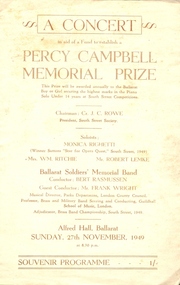
... us who knew him well will reflect with pride that we were privileged to journey with him for a little while along life's highway. Percy Campbell belonged to Ballarat, and to Ballarat's music. He was part of the city itself. Handicapped through partial blindness from birth, there can be no doubt that had he been in full possession of his faculties, and been able to travel, his name would have been known in every corner of the world." frank wright j c rowe albert hall percy campbell monica righetti star for opera quest william ritchie robert lemke ballarat soldiers memorial band bert rasmussen ellinor morcom south street society righetti morcom Four page programme printed in brown ink on cream paper. the concert was held at Albert Hall Ballarat A Concert in Aid of a Fund to establish a Percy Campbell Memorial Prize Programme Alex. ...Frank Wright wrote the following tribute to Percy Campbell which was printed in the Ballarat Courier. "With the passing of Percy Campbell, Ballarat has lost its best known and most distinguished musician. His was no ordinary talent, but an inborn musicianship touched with genius. He was a critic of the keenest perception and many able musicians sought his advice on technical matters over a wide range. His ear was of the most sensitive kind, and among his unusual accomplishments was that rarity among musicians, "absolute pitch." Those of us who knew him well will reflect with pride that we were privileged to journey with him for a little while along life's highway. Percy Campbell belonged to Ballarat, and to Ballarat's music. He was part of the city itself. Handicapped through partial blindness from birth, there can be no doubt that had he been in full possession of his faculties, and been able to travel, his name would have been known in every corner of the world."Four page programme printed in brown ink on cream paper. the concert was held at Albert Hall Ballaratfrank wright, j c rowe, albert hall, percy campbell, monica righetti, star for opera quest, william ritchie, robert lemke, ballarat soldiers memorial band, bert rasmussen, ellinor morcom, south street society, righetti, morcom -
 Federation University Historical Collection
Book, William Ripper, Steam, 1897
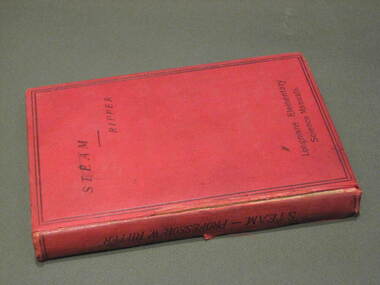
... He who was with us a few short months ago, in all strength of sturdy manhood, has met a soldier's death in South Africa, and we sincerely mourn his loss…. ...He who was with us a few short months ago, in all strength of sturdy manhood, has met a soldier's death in South Africa, and we sincerely mourn his loss…. ...This book was owned by Alf Gresham Johnston who was a former SMB mining student from the Ballarat School of Mines. He died at the age of 29 during military service in South Africa. The following is from the Federation Uni Honour Roll at http://federation.edu.au/about-us/our-university/history/geoffrey-blainey-research-centre/honour-roll/j/alfred-gresham-johnston-1872-1901 The October 1901 Ballarat School of Mines (SMB) Students Magazine reported 'Alf. Johnston's gone. The news came as a shock to all of us at the school. He who was with us a few short months ago, in all strength of sturdy manhood, has met a soldier's death in South Africa, and we sincerely mourn his loss…. His heart was in the school, and he did his best to further its interests … His last act on leaving Australian shores was to send a telegram from Albany to Prof. Mica Smith, to whom he was warmly attached, wishing the School and all connected with it "Good-bye". In his short, all to short, life of 29 years, he had more adventure than falls the lot of most men, and possibly the spirit of adventure, and also, of duty, prompted him to throw in his lot with the "colors," and leave for the front. The news of his death comes to us with added weight of sadness when we remember that he was one of the organisers of the School entertainment last year to help swell the fund for the erection of a statue to fallen Victorian soldiers.'A small red book with a double black line bordering the front cover, with the text Longmans Elementary Science Manuals on the bottom of the cover. On the back cover is an L&Co logoOn the title page is the inscription of the original owner of the book Alf G Johnston School of Mines Ballarat 1899. Inside the front cover and on page 19 is the stamp of the School of Mines Ballaratalfred johnston, steam engine, compound engines, condensers, heat, horse-power, transfer of heat, combustion of fuel, saturated steam, cranks and crank shafts, watt governor, boilers, alf johnston, william ripper, boer war -
 Federation University Historical Collection
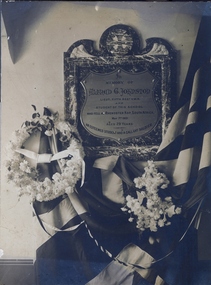
Photograph, Boer War Memorial to Alfred G. Johnston, c1901
... He who was with us a few short months ago, in all strength of sturdy manhood, has met a soldier's death in South Africa, and we sincerely mourn his loss…. ...He who was with us a few short months ago, in all strength of sturdy manhood, has met a soldier's death in South Africa, and we sincerely mourn his loss…. ...Former Ballarat School of Mines mining student Alfred Johnston was the son of Charles Johnston of Cork, Ireland, and Elizabeth Jameson, the family owning a large furniture store in Fitzroy. Alfred joined the Fifth Victorian (Mounted Riffles) contingent at the Melbourne suburb of Hawthorn. The October 1901 Ballarat School of Mines (SMB) Students Magazine reported 'Alf. Johnston's gone. The news came as a shock to all of us at the school. He who was with us a few short months ago, in all strength of sturdy manhood, has met a soldier's death in South Africa, and we sincerely mourn his loss…. His heart was in the school, and he did his best to further its interests … His last act on leaving Australian shores was to send a telegram from Albany to Prof. Mica Smith, to whom he was warmly attached, wishing the School and all connected with it "Good-bye". In his short, all to short, life of 29 years, he had more adventure than falls the lot of most men, and possibly the spirit of adventure, and also, of duty, prompted him to throw in his lot with the "colors," and leave for the front. The news of his death comes to us with added weight of sadness when we remember that he was one of the organisers of the School entertainment last year to help swell the fund for the erection of a statue to fallen Victorian soldiers.' The SMB Annual Report of 1901 recognised the loss of one of their students: 'Mr Johnston was, until the date of his leaving for active military service in South Africa, one of our students. While here besides being regarded as a general favourite for his urbanity and manliness, he was noted as a faithful, diligent, and most successful student. The news of Lieutenant Johnston's death cast quite a gloom over the school and it was early decided that in addition to a letter of condolence sent to his parents a bronze tablet, suitably inscribed, be erected to his memory in some prominent part of the school. On the 4th November last the ceremony of unveiling the memorial tablet was performed by Professor A. Mica Smith in the presence of several members of the late Lieutenant A.G. Johnston's family, the President and Members of Council, the Staff and Students of the School, and a number of prominent citizens. Lieut. Alfred Johnston was killed on 7 May 1901 at Rhenosterkop, Middleburg district, Transvaal. When the news reached Ballarat the students wrote 'Alfred Gresham Johnston has passed away, and his passing has left many a sorrowing heart amongst his troop of friends everywhere. Outside of his home circle, none will miss him more than his old friends - Professors and students alike - of the Ballarat School of Mines. Farewell, Alf., a long farewell.' Alfred Johnston is buried in an unlocated grave. His SMB friends decided to erect a tablet at the school to the late Lieutenant Johnston. An appeals for donations was made, the SMB students magazine reporting that it had 'met with a handsome response from past and present students.' The SMB Council augmented the fund, and the memorial was dedicated with great reverence. (See http://guerin.ballarat.edu.au/aasp/is/library/collections/art_history/honour-roll/honourroll_Johnston,%20Alfred.shtml) Black and white image of a Boer War Memorial to Alfred G Johnston. The memorial includes a marble and brass plaque, flag and flower. boer war, alfred johnston, ballarat school of mines and industries, rhenoster kop, transvaal -
 Mission to Seafarers Victoria
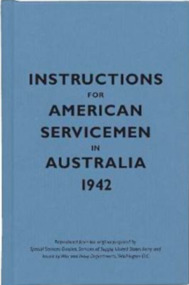
Book - Pocket book, Special Service Devision, Service of Supply, United States Army, Instructions for American Servicemen in Australia 1942, 2007
... The American Army requisitioned the Port Melbourne Mission on Beach Road. 1942 American soldiers australia In 1942, the United States issued Instructions for American Servicemen in Australia as a quick guide to Australia's people, politics, history and culture for Americans stationed there during the Second World War. It was one of several similar sets of instructions put together by the US ...In 1942, the United States issued Instructions for American Servicemen in Australia as a quick guide to Australia's people, politics, history and culture for Americans stationed there during the Second World War. It was one of several similar sets of instructions put together by the US government to help its soldiers, sailors and airmen adjust to life abroad.Pocket size book of blue colour ix, [54] p. : ill., mapsnon-fictionIn 1942, the United States issued Instructions for American Servicemen in Australia as a quick guide to Australia's people, politics, history and culture for Americans stationed there during the Second World War. It was one of several similar sets of instructions put together by the US government to help its soldiers, sailors and airmen adjust to life abroad. 1942, american soldiers, australia -
 Werribee RSL Sub Branch
Book, Military History, ON GUARD WITH THE VOLUNTEER DEFENCE FORCE, 1944 (exact)
... The summer soldier and the sunshine patriot will, in this crisis, shrink from the service to their country; be he that stands it now; tyranny, like hell, is not easily conquered; yet we have the consultion with us, that the harder the confilct the more glorious the triumph"......The summer soldier and the sunshine patriot will, in this crisis, shrink from the service to their country; be he that stands it now; tyranny, like hell, is not easily conquered; yet we have the consultion with us, that the harder the confilct the more glorious the triumph"... ...The Voluteer Defence Corps decided to have their own book to help people understand the Corps. In it's early years it was raised and maintained by the Return Soldiers League. The original mambers had all served in the late war. The book appeared on the Fourth Anniversary of V.D.C establishment in Australia.TO OUR COMRADES MEN AND WOMEN OF THE FIGHTING SERVICES 'Thesea re the times that try men's souls. The summer soldier and the sunshine patriot will, in this crisis, shrink from the service to their country; be he that stands it now; tyranny, like hell, is not easily conquered; yet we have the consultion with us, that the harder the confilct the more glorious the triumph"...world war two, vdc, v d c, volunteer defence force, volunteer defence corps, return soldiers league, aaho7 1 -
Werribee RSL Sub Branch
Book, Military History, ON GUARD WITH THE VOLUNTEER DEFENCE FORCE, 1944 (exact)
... The summer soldier and the sunshine patriot will, in this crisis, shrink from the service to their country; be he that stands it now; tyranny, like hell, is not easily conquered; yet we have the consultion with us, that the harder the confilct the more glorious the triumph"......The summer soldier and the sunshine patriot will, in this crisis, shrink from the service to their country; be he that stands it now; tyranny, like hell, is not easily conquered; yet we have the consultion with us, that the harder the confilct the more glorious the triumph"... ...The Voluteer Defence Corps decided to have their own book to help people understand the Corps. In it's early years it was raised and maintained by the Return Soldiers League. The original mambers had all served in the late war. The book appeared on the Fourth Anniversary of V.D.C establishment in Australia.TO OUR COMRADES MEN AND WOMEN OF THE FIGHTING SERVICES 'These are the times that try men's souls. The summer soldier and the sunshine patriot will, in this crisis, shrink from the service to their country; be he that stands it now; tyranny, like hell, is not easily conquered; yet we have the consultion with us, that the harder the confilct the more glorious the triumph"...world war two, vdc, v d c, volunteer defence force, volunteer defence corps, return soldiers league, aaho7 1 -
 Lara RSL Sub Branch
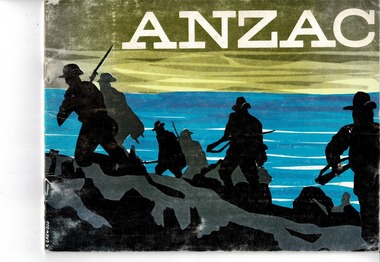
Booklet, ANZAC
... soldiers formed part of the allied expedition that set out to capture the Gallipoli peninsula. These became known as Anzacs and the pride they took in that name continues to this day. This booklet gives a brief rundown on the history of the ANZACS. The Anzacs were courageous and although the Gallipoli campaign failed in its military objectives, the Australian and New Zealand actions during the campaign left us ...On the 25th of April 1915, Australian and New Zealand soldiers formed part of the allied expedition that set out to capture the Gallipoli peninsula. These became known as Anzacs and the pride they took in that name continues to this day. This booklet gives a brief rundown on the history of the ANZACS.The Anzacs were courageous and although the Gallipoli campaign failed in its military objectives, the Australian and New Zealand actions during the campaign left us all a powerful legacy. Rectangular shaped Booklet.ANZACbooklet, anzac, world war one, lara r.s.l. -
 Lara RSL Sub Branch
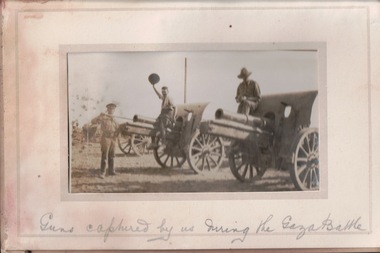
Photograph, Photograph in paper frame, 1917
... The picture shows 3 soldiers, 2 sitting on 2 of the captured Ottaman Field guns during the Gaza Battle in WW1 gaza battle ww1 guns ottaman On the paper frame written Guns captured by us during the Gaza Battle Photograph in paper frame Photograph ...The picture shows 3 soldiers, 2 sitting on 2 of the captured Ottaman Field guns during the Gaza Battle in WW1On the paper frame written Guns captured by us during the Gaza Battle gaza battle, ww1, guns, ottaman -
 Orbost & District Historical Society
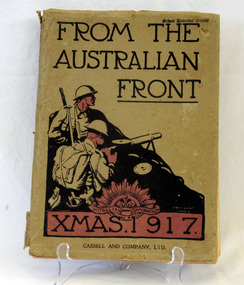
book, Cassell and Company Limited, From The Australian Front, 1917
... soldiers and their families on the Western Front in 1917. In the introduction General Birdwood, Commander of the ANZACS, explained it was for ‘…those whom we left behind in Australia, and who we know are thinking of us, some idea of our surroundings on the battle fronts…’....soldiers and their families on the Western Front in 1917. In the introduction General Birdwood, Commander of the ANZACS, explained it was for ‘…those whom we left behind in Australia, and who we know are thinking of us, some idea of our surroundings on the battle fronts…’. ...This book was produced as a gift for Australian soldiers and their families on the Western Front in 1917. In the introduction General Birdwood, Commander of the ANZACS, explained it was for ‘…those whom we left behind in Australia, and who we know are thinking of us, some idea of our surroundings on the battle fronts…’.This book is a significant contemporary record of life for the Australian soldiers on the Western Front during World War 11.Grey cardboard covered 128 pp book with black and red writing on cover. the title, "FROM THE AUSTRALIAN FRONT" is in black print at the top above a black drawn sketch of two soldiers behind a mound and holding bayonets. at the foot is XMAS. 1917 inside a red rectangle with the insignia of the Australian Army (the rising sun) at the top. It contains cartoons, illustrations and photographs created by the soldiers themselves and put together in the style of an annual. military book-from-the-western-front world-war-11 -
 Flagstaff Hill Maritime Museum and Village
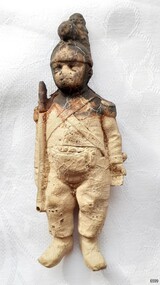
Leisure object - Toy Soldier, circa 1878
... soldiers recovered from the Loch Ard that are in Flagstaff Hill's collection. The shipwreck of the Loch Ard is of significance for Victoria and is registered on the Victorian Heritage Register ( S 417). Flagstaff Hill has a varied collection of artefacts from Loch Ard and its collection is significant for being one of the largest accumulation of artefacts from this notable Victorian shipwreck of which the subject items are a small part. The collections objects give us ...The toy soldier is a relic from the shipwreck of the LOCH ARD in 1878. It has a companion piece in the Flagstaff Hill collection. The toy soldier is unpainted, but the style of uniform, and the weapons carried (a musket and a basket-handled cutlass), indicate it is a representation of the Napoleonic Wars period from the beginning of the nineteenth century. Mass-produced toy soldiers made of cast metal (lead or tin) became popular during the 1800s. Heyde of Germany manufactured silhouette-shaped ‘flats’ early in the century; then Mignot of France released three-dimensional ‘solids’; and later (1893) Britain of England made ‘hollow cast’ figures. These innovations were designed to make sets of toy soldiers more affordable for middle and lower-class children, extending the market beyond the intricately made and hand-crafted replicas that were the preserve of the rich in the eighteenth century. Wooden military figures, specially carved and unpainted ones, were therefore not particularly common at the time when the LOCH ARD went down on Victoria’s southwest coast. Mignot was the first to sell unpainted soldiers, leaving their customers to fill in the colours according to their own patriotic preferences. If a similar attitude is assumed for the two virtually identical figures in the Flagstaff Hill collection, it is possible they were part of a new set intended for sale, rather than part of a passenger’s existing collection. A similarly light composite material of sawdust, glue and linseed oil (press-moulded onto a metal frame) was used by the German firm O & M Hausler to create toy soldiers, but this type of modelling was not commercialised until after 1912. The first heat-moulded plastic toy soldiers did not become available until after 1945.The toy soldier represents a 19th century child's interest in military history. The item is one of two toy soldiers recovered from the Loch Ard that are in Flagstaff Hill's collection. The shipwreck of the Loch Ard is of significance for Victoria and is registered on the Victorian Heritage Register ( S 417). Flagstaff Hill has a varied collection of artefacts from Loch Ard and its collection is significant for being one of the largest accumulation of artefacts from this notable Victorian shipwreck of which the subject items are a small part. The collections objects give us a snapshot of how we can interpret the story of this tragic event. The collection is also archaeologically significant as it represents aspects of Victoria's shipping history that allows us to interpret Victoria's social and historical themes of the time. Through is associated with the worst and best-known shipwreck in Victoria's history.An unpainted replica or toy soldier, presented in a Napoleonic Wars era uniform. The moulded figure is in a standing posture and is bearing a musket at the slope-arms position, with a sabre or cutlass slung behind. It wears a plumed helmet, short-fronted coat with longer buttoned tails at the back, button-fastened bib-front trousers, a pair of crossed bandoliers, and tasselled shoulder epaulettes. The figure is a creamy colour with red-brown stains on the head and shoulder. There is a hole in the end of the musket. The model is detailed and sharp. It was recovered from the wreck of the Loch Ard.Cataloguing numbers: “6599” on the rear of the left trouser leg “PWO 2308” on the sole of the left boot, (partially obscuring “R122” written in biro) “2218” on the sole of the right boot.flagstaff hill, warrnambool, loch ard, flagstaff hill maritime museum, shipwreck coast, flagstaff hill maritime village, great ocean road, loch line, napoleonic uniform, toy soldier, replica soldier -
 Mortlake and District Historical Society
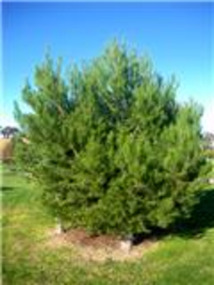
Lone Pine
... soldiers souvenired pine cones - one was brought back to Victoria (see above). Many young men from Mortlake and district volunteered to fight in the Great War and the presence of this tree in our Gardens reminds us all of the local as well as the national sacrifice. gallipoli lone pine first world war great war mcdowell keith Small plaque on railing western side. l pine tree Lone Pine ...This pine tree (Allepo Pine, Pinus halepensis) a native of the Gallipoli Peninisula (Gelibolu, Turkey), was grown from a cutting obtained from the War Memorial Canberra and planted in the Mortlake Botanic Gardens in 2002. It replaces the original which grew outside the Mortlake RSL Hall which blew down in a storm c.2000. That tree (Allepo brutius)came from 'the original on Gallipoli' and was planted to commemorate 'fallen comrades' in 'the Jubilee year 1965.' However, two soldiers first brought home pine cones direct from that fateful battlefield. . One was Sgt. Keith McDowell of the 24th Btn. His aunt, Mrs. Emma Gray of Grassmere (Vic.) planted the seeds c. 1928 and four seedlings resulted. One was planted in Wattle Park, Melbourne, one at the Shrine of Remembrance, one at the Soldier's Memorial Hall at The Sisters (c.15 km. south of Mortlake) and one at the Warrnambool Botanic Gardens. The First World War (or 'Great War') and in particular the battle for the Gallipoli Peninsula is of immense national significance. Lone Pine or Plateau 400 was the scene of a major offensive on August 6th 1915. All the trees on the ridge at this point were cut down but one, which was dominated by the 'Lone Pine'. In three days of fighting more than 2,000 Australians lost their lives and seven Victoria Crosses were won. Two Australian soldiers souvenired pine cones - one was brought back to Victoria (see above). Many young men from Mortlake and district volunteered to fight in the Great War and the presence of this tree in our Gardens reminds us all of the local as well as the national sacrifice.l pine tree Small plaque on railing western side. gallipoli, lone pine first world war great war mcdowell, keith -
 Australian Commando Association - Victoria
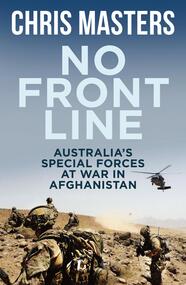
Book, No Front Lines-Australia Special Forces at War in Afghanistan
... Implicitly trusted by Special Forces, Chris gives voice to these soldiers. He takes us right into the centre of some of the fiercest combat, opens up the story of the relationship between the Australians and their US partners and provides the most intimate examination of what it is like to be a member of this country’s elite fighting forces. ...Implicitly trusted by Special Forces, Chris gives voice to these soldiers. He takes us right into the centre of some of the fiercest combat, opens up the story of the relationship between the Australians and their US partners and provides the most intimate examination of what it is like to be a member of this country’s elite fighting forces. australian special forces afghanistan commandos No Front Lines-Australia Special Forces at War in Afghanistan Book ...Chris Masters is Australia’s foremost investigative journalist. His descriptions of battle are some of the most powerful reporting from that war. No Front Line takes this story even further, to the heart of Special Forces and its war in Afghanistan, a war the Australian public know very little about. Implicitly trusted by Special Forces, Chris gives voice to these soldiers. He takes us right into the centre of some of the fiercest combat, opens up the story of the relationship between the Australians and their US partners and provides the most intimate examination of what it is like to be a member of this country’s elite fighting forces. australian special forces, afghanistan, commandos -
 Australian Commando Association - Victoria
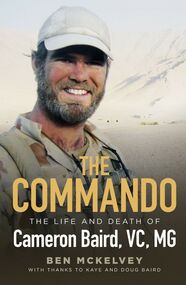
Book, The Commando: The Life and Death of Cameron Baird, VC, MG
... soldier and leader. Cameron's story and that of 4RAR and 2nd Commando personifies the courage and character of the men and women who go to war and will show us the good man we have lost. ...soldier and leader. Cameron's story and that of 4RAR and 2nd Commando personifies the courage and character of the men and women who go to war and will show us the good man we have lost. ...On 22 June 2013, Corporal Cameron Baird was a 2nd Commando Regiment Special Forces soldier when he led his platoon into a known Taliban stronghold to back-up another Australian unit under heavy fire. In the prolonged firefight, Cameron was mortally wounded. In 2014, Cameron's bravery and courage under fire saw him posthumously awarded the 100th Victoria Cross, our highest award possible for bravery in the presence of the enemy. Cameron Baird died how he lived - at the front, giving it his all, without any indecision. He will forever be remembered by his mates and the soldiers he served with in the 2nd Commando Regiment. THE COMMANDO reveals Cameron's life, from young boy and aspiring AFL player, who only missed out on being drafted because of injury, to exemplary soldier and leader. Cameron's story and that of 4RAR and 2nd Commando personifies the courage and character of the men and women who go to war and will show us the good man we have lost. australian special forces, commandos, afghanistan, 2nd commando regiment -
 Flagstaff Hill Maritime Museum and Village
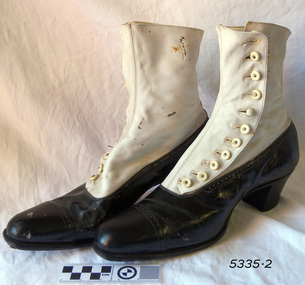
Clothing - Boots, Tony Lama, Early 20th century
... He joined the US Cavalry when he was 16, after lying about his age, working as a cobbler to make boots for the soldiers. ...He joined the US Cavalry when he was 16, after lying about his age, working as a cobbler to make boots for the soldiers. ...The inscription "T L" on these early 20th century ladies button-up boots lead to the maker likely to be Tony Lama, a famous USA boot manufacturer, son of Italian immigrants. The "Rome" is the style of boot. The "6" is likely to be the soot size. Tony Lama began work at age 11 years in the leather trade industry, serving an apprenticeship as a shoemaker. He joined the US Cavalry when he was 16, after lying about his age, working as a cobbler to make boots for the soldiers. His workmanship became popular, particularly for the 'Western' style of boot. TONY LAMA boots In 1911 Lama established a company in Texas, first repairing boots, then adapting his shop to manufacture boots in order to meet the many orders he was receiving. He married and he and his wife Esther brought up six children who also went on to work in the family business. The business continued to grow through WWII. Part of the business included custom boot making and Tony's eldest son Joseph presented President Truman with a pair of kangaroo skin boots. The prosperous business became a company and eventually, in 1990, was sold to Justin Industries.This pair of boots is an example of women's footwear dating around the early 20th century. Pair of ladies leather button-up boots. Two-tone style: black bottom strong leather bottom and white, soft kid leather top. Boots have a curved fly fastened by 11 white buttons with metal shanks. Boots are constructed with cork filling. Inscriptions of both boots. "6 101" "TL" " Rome" "Cork Filled"flagstaff hill, warrnambool, maritime-museum, shipwreck-coast, flagstaff hill maritime museum & village, ladies button up boots, footwear, victorian era, granny boots, tony lama, ladie's boots, ladies' fashion, women's clothing, rome, kid leather, two-tone boots, leather boots, button-up boots -
Mission to Seafarers Victoria
Article, A Woman's Melbourne Letter
... They even cried when we left, and the day before the rescue boat arrived they begged us to go into the hills and hide." At another table a Canadian lad - once a sailor - then a soldier, who trained at the Broadmeadows camp - was telling his experiences : - "The voyage which will always stick in my memory," he said, "was to a place which must be nameless. ...They even cried when we left, and the day before the rescue boat arrived they begged us to go into the hills and hide." At another table a Canadian lad - once a sailor - then a soldier, who trained at the Broadmeadows camp - was telling his experiences : - "The voyage which will always stick in my memory," he said, "was to a place which must be nameless. ...A detailed description of the Mission and its activities written by a woman: Western Mail (Perth, WA : 1885 - 1954), Friday 13 December 1918, page 34 A WOMAN'S MELBOURNE LETTER. Melbourne, Dec. 4. There is an idea abroad, which as regards Melbourne, at any rate, is quite erroneous, that our sailors are not as well looked after as our soldiers, and that the noble men of the Mercantile Marine are much neglected ! For once, perhaps, my readers will pardon a letter dealing with only one subject, but the steady, unostentatious work done by the Ladies' Harbour Light Guild, in connection with the mission to seamen in Melbourne could not be adequately explained if dismissed in the usual short paragraph. Some of the most prominent names in Melbourne are associated with this guild and with the Mission Chaplain, and Mrs. Gurney Goldsmith, the members have made the Seamen's Institute a real home for those sailors of the Mercantile Marine, who touch our port. What we as a community owe to those men by their heroism in recent hostilities is certainly more understood by this band of enthusiastic workers than by the community generally. By using their unflagging energies, and influence on the sailor's behalf they endeavour to discharge a debt to which in some way or other we could and should all contribute. Even the most casual person can, if he thinks at all, sum up a few of the things our sailors - other than those belonging to our glorious navy - have done for us. On the spur of the moment we remember that those of the Mercantile Marine, are the men who manned our transports, who carried our wheat and wool, to oversea markets; who kept us in touch with our loved ones abroad; who kept the fires going in the furnaces of the great leviathans, bringing our wounded soldiers home again; who never flinched when self-sacrifice was demanded; who cared, with that tenderness, innate in all sailors, for the women and children, when the passenger ships were struck a dastardly blow by the wicked enemy; who, mocking death, gave up life with a heroism all the more heroic because it was always taken as a matter of course! Is it any wonder, then, that the members of the Ladies' Harbour Light Guild make it their business to provide a bright, homelike, spot in Melbourne, where the sailors are always certain of a cherry welcome ashore? The members of the guild are admirably drafted! The 360 non-workers each pay £1 1s. per annum. The workers, of whom there are between 700 and 800, donate 2s. 6d. and school members - it is confidently hoped that gradually all the schools will take an active interest in the mission - 1s. a year. The knights of the guild - as the men members are designated - are responsible for any sum they wish to name, from 5s. a year upwards. Everything is paid for out of these revenues, with the exception of a small grant from the Home Mission Fund - and such is the organisation, and management, that the entire concern is quite free from debt. The Seamen's Church and Institute, where the "Harbour Lights" gleam so brightly, is situated right in the midst of all the bustle and turmoil of the wharves, at the end of Flinders-street. The building, comprising chapel, and institute under the one red tiled roof, is grey stuccoed, with a small tower, from which flaunts the flag of 'The Flying Angel" - the badge of the guild. A visit to the institute makes one fully appreciate the boon the place must be to the voyage worn, weary, sailor. The atmosphere is eminently social in its best sense. While the architecture imparts an elegance, and quiet dignity which soothes by the very subtlety of its charm. With its comfortable furniture, its wealth of flowers, and the happy, wholesome, feminine influence which prevails everywhere, the quality which stands for the magic word "home" abounds. The Chaplain in the course of conversation said: -"We try to make this really a free club for sailors." But the habitues would probably tell you it was far more than that to them. The Institute is excellently appointed, and every little corner seems to have its particular history. It was built after the model of one of the old mission churches in California, and retains something of the old world attraction, while yet it combines all the advantages of modern, practical, conveniences. On entering the door the first thing, one notices is a huge compass, inlaid upon the floor, evidently to indicate one's proper bearings for it points due north - to the chapel! Only one other seamen's mission in the world boasts such a compass. As the sailor swings through the entrance he finds the office on his right, and there is, here, always a smiling face to welcome the shy, or timid, new comer. Quite a real post office is staffed by members of the guild, and all the letters received are listed alphabetically. Therefore, the expectant sailor has just to run his eye down the list, and he can immediately see whether there is a letter for him or not. If he is fortunate, he comes up to the member in charge, who unlocks the box, and produces the longed for missive. The boys are always encouraged to answer letters - and to write them. Often a few words about their mother, and their own home, will provoke a sleeping memory into activity. The writing room is well stocked with paper, envelopes, pens, and ink. The tables are so divided to ensure the utmost privacy, and through a calculated chain of circumstances, many an anxious mother receives a letter from her sailor lad, who, perhaps, might not have written but for these kindly inducements. The central hall - where social evenings are held every other night besides two special concerts a week - is inviting in the extreme. A handsome piano affords opportunity for those musically inclined. The tables are strewn with papers. The walls are bright with pictures, and here, and there, is a carved model, of a ship. One, of especial interest, is a model of "The Roon" carved, and presented by a French sailor. This German vessel will always be remembered in Australia. For it was across her bows that the first hostile shot was ever fired in Australian waters. In the corner is the canteen. It was fitted up entirely from the proceeds of a quotation calendar compiled by one of the members. The sailors may at any time, get a teapot of tea, or a tray of eatables, at a nominal cost. Before the canteen was in existence they had to go out for refreshments! - and sometimes they did not come back! Groups of sailors sit chatting at the tables. Half a dozen Swedes laugh and talk among themselves, for the simple reason they know no other language than their own. Several British sailors cluster about a dark-eyed Welsh lad - a perfect Celtic type - who, although only about twenty years of age, has been the victim of the Hun five times. Mines and torpedoes sank the ships he was in, either in the Channel or off the English coast, four times; and it is to his fifth experience, when the Inverness was wrecked, that everyone is eagerly listening. "We were in the boats eight days," he was saying, "I was pretty well mangled when they picked me up. The sufferings we endured were awful. At last we managed to reach Rapa, a Hawaiian island. The natives thought we were Germans, and came at us with spears. When they found we were British, they were awfully good to us. They even cried when we left, and the day before the rescue boat arrived they begged us to go into the hills and hide." At another table a Canadian lad - once a sailor - then a soldier, who trained at the Broadmeadows camp - was telling his experiences : - "The voyage which will always stick in my memory," he said, "was to a place which must be nameless. We left the United States not knowing whether we were bound, or what we were going to do. After some weeks we sighted a group of wonderfully beautiful islands, and we headed for the most remote and most lovely of them all. Then, and only then, we learned our mission from the skipper. We were taking their year's supply to a leprosy station! Oh no! I don't blame the skipper for not telling us ! Someone has to do these things, you know. A naval guard saw they didn't come near - and we all got sixty dollars extra. When the job was over we were quarantined on another island for two months, and one little chap - the baby of the crew, not eighteen - developed leprosy, and died before we left. Yes! I'll never forget that voyage, mates! Sometimes, I seem to see Leper's Island yet, with its lavish tropical vegetation and the gorgeous sunsets which stained all the water with blood. Then, too" - here the voice deepened - "there was an English girl - a leper - there. We heard she used to be an actress, and she contracted the disease somehow or other. She was always alone, and always watching us. In the distance we could see her come to the water's edge, and from there she would watch. Just watch . .. . watch . . .watch. ..." "Here come a couple of North Sea chaps," broke in an elderly man after pause. "One of them wounded, too, poor lad." It is not strange that all the sailors flock to the Institute. It is so comfortable, and essentially inviting, besides being full of human interest. The men's quarters comprise reading, writing and dressing rooms - hot and cold baths are always available - billiard room, and a special baggage room, where any sailor may leave his kit for as long as he likes. The payment of 3d. covers its complete insurance. Upstairs are the officers' quarters. These also have their own billiard room, writing and reading rooms, bath and dressing rooms. Just close are the apprentices' quarters - "The Half Deck," as popular parlance has it! The lads also have a billiard room of their own, and indulge in an easy armchair - amongst others - which was a donation from the Milverton School branch of the Guild. It is hoped by the committee to some day utilise the huge empty rooms, which run the length of the whole building. Their ultimate intention is to fit them up as cubicles, or "cabins," as they are to be called. They trust these "cabins" will be donated, either in memory, or in honour, of someone dear to the donor. Another forward movement soon to be put in hand, now that materials are available, is the establishment of "Norla Gymnasium." In a sailors' club such facility for exercise is absolutely essential. The men both need, and miss, exertion. As one boy, who had been backsliding, once said pathetically : -"If only there was something to do to get me into a good sweat, I would be all right." Soon such an one will be helped to swing from the trapese of the Norla Gymnasium into the right track! Sunday is always a fete day at the Institute, for 40 or 50 sailors generally come into tea. The up-to-date kitchen, which is fitted with every labour-saving appliance - all paid for out of working members' half crowns - is then a hive of animation, and methodical order. A formidable row of teapots await filling. Mrs. Goldsmith -, the chaplain's wife - rightly thinks it is far more homely to pour out the tea from a pot, than to serve it straight from the urns. So tea is poured out by a member, who sits at the head of a table gay with flowers, and chats to the guests. These latter are of all nationalities. But the French, the Spanish, Scandinavian, Norwegian - or any other sailor is equally welcome with the British. Two enthusiasts belonging to the Guild actually learnt Norwegian, so that men of this nation would have someone to talk to, and so be less lonely when they reached this, to them, foreign port ! The members of the Guild have their own private suite where they arrange the flow-err and do other necessary odds and ends undisturbed. No one appreciates flowers like a sailor, and the earliest and most beautiful may always be seen adorning the tables and rooms. Teas are served and lectures are held in the "Celia Little Hall," one of the most beautiful portions of the institute. It was erected by the chaplain in memory of his aunt from whom the hall takes its name. The Gothic windows open upon the cloisters, where, in the hot weather, the sailors enjoy their meals out of doors. The cloisters, indeed, form an exquisite spot. They are between a series of sweeping arches which lead to the chapel, and are sheltered by the open balcony of the chaplain's quarters. Grace of contour marks the architecture on every turn. Just around the corner is the chaplain's garden - a patch of green and colour, transformed from a desert waste, by a well-known woman horticulturist. The book room is a department especially valued by the sailors. There are two secretaries, one for home and the other for foreign literature. Books in French, English, Spanish, Scandinavian, Norwegian, and German may be found on the shelves. Each week about 36 convenient parcels of reading stuff are made up. These contain illustrated papers, books in various languages, and magazines. These parcels are eagerly accepted by the sailor with a long monotonous voyage before him. But complete as is every corner of the institute, no part is so well equipped as the memorial chapel erected by the Ladies' Harbour Light Guild, in memory of the officers and men, who have lost their lives during the war. St Peter's - for it is called after the sailor's patron saint - with its hallowed gentle dignity is a veritable sanctuary of peace, perhaps all the more so because it sprang out of war. The fittings are entirely of Australian wood. The pews, given in memory of some loved one by one of the members, are of Tasmanian hardwood. The reredos and altar chairs of carved blackwood. The rich carpet was provided by the members' magical half-crowns. Already this chapel holds memorials of peculiar historical interest. The altar lectern was given in memory of Commander Elwell, who, it will be remembered, was killed at Rabaul, in the early part of the war. The font commemorates two heroes - Nigel Hockley and Fred Hyde, who lost their lives at the hands of the Germans, although they survived the actual torpedoing of their ships, the Galgorn Castle off the coast of Ireland. The mother of one of them wrote out that her son had died as an Englishman should - fighting for the right. This noble sentiment is suitably paraphrased upon the inscription engraved upon the font. Practically every-hing enshrined in the chapel has its own sentimental value. The alms salver of beaten copper, studded with agate, is fragrant with the memory of a saintly woman.The eye of the sailor is caught and held by the pulpit, which is fashioned like a ship's hull and only a twist of rope guides the chaplain up the steps. For the last 13 years the Rev. A. Gurney Goldsmith, M.A., has acted as chaplain to the Seamen's Mission in Melbourne. Before that he and his wife worked in China. Mr Goldsmith visits all the boats and gets in touch personally with the sailor, over whom he has great influence. He is not only their chaplain and friend, but, amongst a wide range of other things, their banker besides. An exchange system exists between the various Missions, and the sailor who has "banked" his money with the chaplain, upon going away, receives a cheque which is cashed - minus exchange - by the chaplain of the next port. Mr. Goldsmith will tell you he has a soft spot in his heart for on old sailor he calls "Paddy." This ancient mariner has been wrecked ten times. It was a long time before the chaplain prevailed upon "Paddy" to partake of the spiritual and secular advantages afforded by the institute. He would not come, he said, until he could do so "with a good heart." Finally he frankly admitted that he had no "friends like those of 'the Flying Angel,' " and that he eventually proved his own "good heart" will be shown in this story. One day he came in to the chaplain and said bluffly, "Well, sir, I've been payin' off some old scores up Carlton way, an' I tells yer, plain, sir, not one of 'em would have seen a penny of their money but for the Mission." The Ladies' Harbour Light Guild has over thirty working suburban branches, and the excellent results achieved at the Institute now will no doubt be considerably augmented in the future. The practical actions of the members do more than anything else to convey the subtle meaning of the name of the Guild. To the visiting sailors the word "ladies" signifies the bread givers; "harbour" safety ; "lights" welcome; "guild" the welding of fraternity, and they one and all tell you the ideals thus embodied are unselfishly carried out by all the ladies who have banded together to care for the sailors' welfare.The article describes the Mission and the use of several spaces a year after its opening and gives details about the daily activities.Digital copy of an article published in the Western Mail on the 13th of December 1918. 717 flinders street, seamen's mission, norla dome, lhlg, reverend alfred gurney goldsmith, celia little room, garden, frederica godfrey
