
Showing 100 items matching "use of the globes"
-
 Flagstaff Hill Maritime Museum and Village
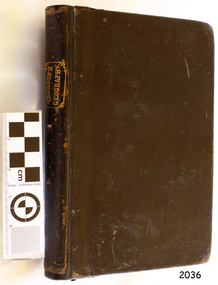
Book - Textbook, Introduction to Modern Geography
... ...Use of the Globes...This mid-19th century scientific reference book, Introduction to Modern Geography, explains geography and astronomy using the globe of the world as a teaching aid. ...Spine within a gold border: "THOMSON'S GEOGRAPHY" Fly Page: "AN INTRODUCTION TO MODERN GEOGRAPHY, WITH AN APPENDIX, CONTAINING AN OUTLINE OF ASTRONOMY, AND THE USE OF THE GLOBES. BY JAMES THOMSON, LL.D., PROFESSOR OF MATHEMATICS IN THE UNIVERSITY OF GLASGOW." ...This mid-19th century scientific reference book, Introduction to Modern Geography, explains geography and astronomy using the globe of the world as a teaching aid. ...This mid-19th century scientific reference book, Introduction to Modern Geography, explains geography and astronomy using the globe of the world as a teaching aid. The inscription connects this book to the Bobinawarrah Public Library but research to date has found no further details about the library. The rural area was settled in 1859, but in 2016 its population was only 87. It is situated about 21 kilometres south of the City of Wangaratta, in Northeast Victoria. In 2024 the local community received a grant for preservation of its almost 100-year-old Bobinawarrah Memorial Hall which displays an honour board of the Pioneers of Bobinawarrah 1859-1959. The donor of the book lived in Warrnambool. ABOUT THE AUTHOR, James Thomson (1786-1849): - James Thomson was a British Irish mathematician. He became Professor of Mathematics at the University of Glasgow. He wrote many school textbooks and reference books, one of which was Introduction to Modern Geography, first published in Belfast in 1827, and revised and published in over 20 more editions. Thomson tutored two of his several children at home. His older son James Thomson (1822-1892) became an engineer and physicist. His younger son William Thomson (1824-1907) became Professor of Natural Philosophy from 1846-1899 at the University of Glasgow, and later the 1st Baron of Kelvin, famous for his designs of nautical instruments such as the navigational compass and sounding equipment used in the transatlantic installation of sea cable. William was part of the firm that became famous as Kelvin & Hughes Ltd., suppliers of radar and echo sounders to the Ministry of Transport and the Ministry of Defence. The name continued on as Kelvin & Hughes. James Thomson (1786-1849) was a renowned British Irish mathematician and Professor of Mathematics at the University of Glasgow. He was a respected author of many important school books and textbooks that were widely used to provide understanding of arithmetic and geography. Thomson encouraged practical education and held extra classes for young ladies to learn mathematics and geography, which were a novelty at that time. Many of his works were known and used worldwide. This work was published in many editions. It is now considered as culturally significant as a basis for knowledge about our civilisation and has been made publicly available in overseas countries, and republished and reproduced in a readable format, including its diagrams and maps. Book; scientific textbook. The book has a black leather cover. The front cover is blank, but the spine has an embossed gold vertical title within a rectangular border boasting fancy corners. The fly page has a detailed title. The author is James Thomson. It is the Eighteenth edition, published in Simms & McIntyre of London and Belfast in 1845. An inscription connects it to the Bobinawarrah Public Library in Victoria.Spine within a gold border: "THOMSON'S GEOGRAPHY" Fly Page: "AN INTRODUCTION TO MODERN GEOGRAPHY, WITH AN APPENDIX, CONTAINING AN OUTLINE OF ASTRONOMY, AND THE USE OF THE GLOBES. BY JAMES THOMSON, LL.D., PROFESSOR OF MATHEMATICS IN THE UNIVERSITY OF GLASGOW." "Eighteenth Edition" "LONDON: SIMMS AND McINTYRE, ALDINE CHAMBERS, PATERSOSTER ROW; AND DONEGALL -STREET, BELFAST.""1845"flagstaff hill, flagstaff hill maritime museum and village, warrnambool, maritime museum, maritime village, great ocean road, shipwreck coast, introduction to geography, james thomson, reference book, professor thomson's introduction to modern geography, bobinawarrah public library, james thomson mathematician, james thomson engineer, 19th century irish mathematician, irish presbyterian, william thomson 1st baron of kelvin, professor of mathematics, glasgow university, william thomson professor of natural philosophy, introduction to modern geography, outline of astronomy, use of the globes, james thomson ll.d., simms and mcintyre, 1843, scientific book, school book, lord kelvin, baron kelvin of langs, nautical instruments, marine instruments, transatlantic cable, kelvin & hughes, thomson’s geography, astronomy, geography, world globe, cartography, pioneers of bobinawarrah, textbook -
 Anglesea and District Historical Society
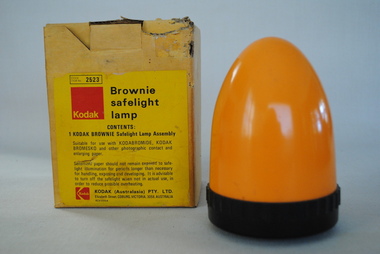
Brownie Safelight Lamp, Kodak (Australasia) Pty. Ltd, Estimated 1960's
... / BROWNIE SAFELIGHT LAMP / USE GLOBE NOT EXCEEDING 15 WATTS..... / BROWNIE SAFELIGHT LAMP / USE GLOBE NOT EXCEEDING 15 WATTS. Orange cone-shaped lamp with bulb and box (missing electrical connection). ...Orange cone-shaped lamp with bulb and box (missing electrical connection). Suitable for use with Kodabromide, Kodak Bromesko and other photographic contact and enlarging paper. Stock Item No. 2523. (Directions for use inside box).Bottom: (in black) - KODAK (AUSTRALASIA) PTY. LTD. / BROWNIE SAFELIGHT LAMP / USE GLOBE NOT EXCEEDING 15 WATTS.photography, safelight lamp, brownie -
 Vision Australia
Text, Life Governor certificate, 1932
... 1 x cream coloured page with brown writing and images (front view of St Kilda Road building across top, and pictures of a man weaving a mat, children using a large tactile globe and people rowing boats)...Hedger Superintendent & Secretary 1 x cream coloured page with brown writing and images (front view of St Kilda Road building across top, and pictures of a man weaving a mat, children using a large tactile globe and people rowing boats) Life Governor certificate Text ...Life Governor certificates were given to those who supported the RVIB either through certain levels of financial contribution or by activities undertaken to support the institute. In this example, S.J. Riches was awarded a governorship in July 1950.1 x cream coloured page with brown writing and images (front view of St Kilda Road building across top, and pictures of a man weaving a mat, children using a large tactile globe and people rowing boats)Royal Victorian Institute for the Blind St Kilda Road, Melbourne President: J. Lewis Carnegie, Esq. JP Vice-Presidents: L.F. Miller, Esq. , James Angus, Esq. Hon. Treasurer: R.S Couche, Esq. Members: P. Warford Mein, Esq. Harold E. Brookes, Esq. W. Purves Smith, Esq. W.E. Cash, Esq., JP Dr. W.B. Vance Cr. Baron Marks, JP Industry, Education, Recreation This is to certify that S.J. Leslie Riches, Esq. has been appointed a Life Governor of the Institute. J. Lewis Carnegie President S. W. Hedger Superintendent & Secretaryroyal victorian institute for the blind -
 Flagstaff Hill Maritime Museum and Village
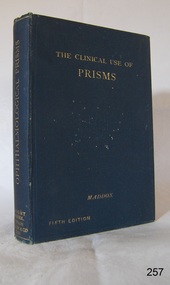
Book - Reference Book Ophthalmology, Ernest Edmund Maddox, The Clinical Use of Prisms, 1907
... He invented several fundamental diagnostic tools that remain standard clinical practice across the globe today, including, the Maddox rod a series of parallel glass cylinders used to dissociate binocular vision and measure latent squint (phoria). ...He invented several fundamental diagnostic tools that remain standard clinical practice across the globe today, including, the Maddox rod a series of parallel glass cylinders used to dissociate binocular vision and measure latent squint (phoria). ...The subject volume The Clinical Use of Prisms; and the Decentring of Lenses is a seminal treatise on ophthalmic optics, binocular vision, and the correction of eye muscle imbalances (strabismus and heterophoria). The book covers two core clinical topics. Prismatic Refraction, how light bends through optical prisms, and how clinicians can use prisms to measure, diagnose, and relieve eye strain (asthenopia), double vision (diplopia), and misaligned line of sight. Decentring Lenses is the second and its focusing on the mathematical and practical rules for shifting the optical center of a spectacle lens relative to the patient's pupil. By decentring a standard spherical or cylindrical lens, allowing an optometrist or ophthalmologist to create an intentional "prismatic effect" without needing to grind a separate, heavy prism into the glassHard cover book,The Clinical Use of Prisms Author: Ernest Edmund Maddox Publisher: John Wright & Co Date: 1907 5th Edition Further Information: Front cover & spine blue cloth title, publisher details and author name in gilt lettering.non-fictionThe subject volume The Clinical Use of Prisms; and the Decentring of Lenses is a seminal treatise on ophthalmic optics, binocular vision, and the correction of eye muscle imbalances (strabismus and heterophoria). The book covers two core clinical topics. Prismatic Refraction, how light bends through optical prisms, and how clinicians can use prisms to measure, diagnose, and relieve eye strain (asthenopia), double vision (diplopia), and misaligned line of sight. Decentring Lenses is the second and its focusing on the mathematical and practical rules for shifting the optical center of a spectacle lens relative to the patient's pupil. By decentring a standard spherical or cylindrical lens, allowing an optometrist or ophthalmologist to create an intentional "prismatic effect" without needing to grind a separate, heavy prism into the glassflagstaff hill, warrnambool, shipwrecked-coast, flagstaff-hill, flagstaff-hill-maritime-museum, maritime-museum, shipwreck-coast, flagstaff-hill-maritime-village, the clinical use of prisms, book, ernest f. maddox -
 Mission to Seafarers Victoria
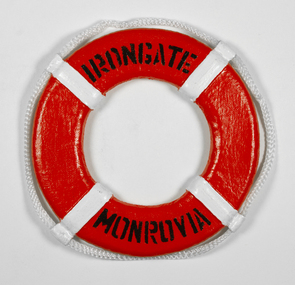
Decorative object - Miniature, lifebuoy, c. 2018
... used the services. The object forms a connection through the creator with the Mission network across the globe. ...Presented to MTSV by seafarer Bosun Tomovs from the vessel Irongate, registered in Monrovia, Liberia who created this memento miniature and presented it to Chief Manager Sue Dight, on the occasion of his visit to the MTSV, Melbourne.The seafarer who created this object has presented similar objects to Missions to Seamen wherever he has come ashore and used the services. The object forms a connection through the creator with the Mission network across the globe. It is also a representative sample of creativity aboard ship: model making was often a hobby to kill time on long journeys.small red painted and white corded life buoy with inscription in black paint.side a) In Upper Case stencil: " IRONGATE / MONROVIA " Side b) handwritten in black ink: "04.09.2018 / BSN TOMOVS / BULGARIA"lifebelt, life preserver, miniature models, life buoy, bosun tomovs, irongate ship, gift, buoy, hobbie, seamen, sailors, seafarers -
 Mission to Seafarers Victoria
Plaque - Opus sectile tablet, 1936
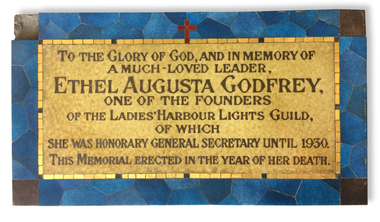
... The structure of the LHLG was used as a model framework by similar groups supporting Missions around Australia and the Globe. ...The structure of the LHLG was used as a model framework by similar groups supporting Missions around Australia and the Globe. ...The memorial tablet was unveiled in the St Nicholas chapel at the Port Melbourne mission (Beach Cnr Nott St) on Wednesday 24 June 1936. The ceremony was performed by her nephew, Reverend John Smerger Drought - her sister's son. Another plaque was erected the same month in the Williamstown Institute. (Annual Report 1936) Along with the windows in the St Peter chapel in the Central Institute, those were the 3 memorials similar to the ones erected in memory of Miss Tracy. Miss Ethel Godfrey was born in 1861 at sea on the vessel called Copenhagen. Daughter of a pioneer, and settler Frederick Race Godfrey MLA and subsequently Lay Dean at St Paul's. Ethel Studied in Melbourne and abroad at Brussels and became a singing teacher and performer. In 1906 she took on the role of Honorary General Secretary to create and lead the volunteer organisation "The Ladies Harbour Lights Guild" and subsequently helped establish similar groups in Newcastle, Brisbane, Sydney, Hobart, Adelaide and also established the mission in Southampton in the UK. The structure of the LHLG was used as a model framework by similar groups supporting Missions around Australia and the Globe. A key achievement was the fundraising campaign for the memorial chapel in St Peters built in 1917 by Walter R.Butler. She died the 7 July 1935, and is buried in the St Kilda Cemetery.On her retirement in 1930 after some 25 years, Miss Godfrey together with Chaplain Gurney Goldsmith was recognised in the journal The Church and the Sailor, as a key influence and promoter of the formation of Harbour Lights groups across the suburbs of Melbourne, Victoria and Australia, the Ladies Harbour Lights Guild, Melbourne being the first such auxiliary group in the world.Clay base rectangular plaque with inlaid blue ceramic regular tesserae surrounding the ceramic centre rectangular ceramic panel with inscription and decorative glazed detail tiles. Support is a metal frame with inset wood pieces .To the Glory of God and in memory ops/ a much loved leaderAthel Augusta Godfrey, / one of the founders/ of the ladies Harbour Lights Guild/ of which she was honorary general secretary / Until 1930./ This memorial erected in the year of her death."memorial plaque, plaque, lhlg, port melbourne, chapel, brooks robinson and co, reverend john smerger drought, sectile tablet, opus sectile mosaic, mosaic, ethel augusta godfrey 1861-1935 -
 Mission to Seafarers Victoria
Photograph - Photograph, Sepia, Starting for Christmas picnic, 25 December 1913
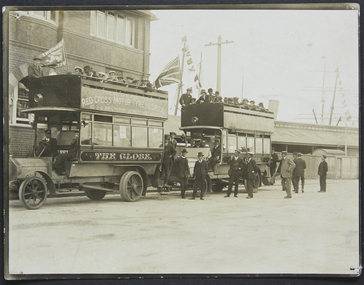
... The photograph was used in the "Jottings fro our log" quarterly publication of the Mission in 1916. siddeley street institute ww1 christmas transport rev gurney goldsmith flag red cross the globe union jack motorbus 1913 xmas Handwritten at the back in pencil: "168" / Starting for Christmas picnic Handwritten in blue ink: "8" Handwritten twice in blue ink: 1914? ...The sailors, officers and Reverend Gurney Goldsmith (centre) were picked up from the Siddeley Street mission by two double deck motorbuses. On the buses is written: "Motor Tyre, The place for tyre, 400-3-5 Swanston Street, Melbourne - Red Cross Hospital - The Globe". The Mission flag and the Union Jack are brought with the men to the St John's College, St Kilda East. The photograph appears in the Annual Report 1913. In the Age we could read: "SAILORS' PICNIC. The seamen from ships in port, were hospitably entertained on Christmas day by friends of the Victoria Missions to Seamen. The day was spent at St. John's College, East St. Kilda, by invitation of the warden and Mrs. Hart. The sailors enjoyed the treat, and entered heartily into the sports held during the afternoon. The evening was spent at the institute on the Australian wharf when every sailor received a Christmas' present from 'the brig." The photograph was used in the "Jottings fro our log" quarterly publication of the Mission in 1916.Sepia photograph with a thin black frame depicting seamen gathering in front of the Central Institute, Siddeley Street, where buses are waiting for them to take them on an outing.Handwritten at the back in pencil: "168" / Starting for Christmas picnic Handwritten in blue ink: "8" Handwritten twice in blue ink: 1914? at the top and 1914 at the bottom.siddeley street institute, ww1, christmas, transport, rev gurney goldsmith, flag, red cross, the globe, union jack, motorbus, 1913, xmas -
 Federation University Historical Collection
Equipment - Equipment - Photographic, ZILLES COLLECTION: Collection of Photographic Equipment
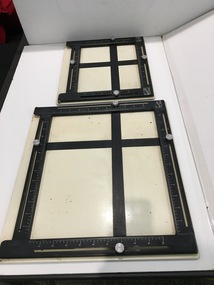
... Collection of photographic equipment used by Zilles Printers. zilles printers photographic equipment developing trays image holders tongs thermometer wooden negative holder darkroom safe light globes negative holders darkroom Ilford on plastic developing tray Collection of equipment - negative holders, developing trays - enamel and plastic, globes, thermometer, tongs - metal and plastic, metal frames, measuring cups, ZILLES COLLECTION: Collection of Photographic Equipment Equipment Equipment - Photographic ...Collection of photographic equipment used by Zilles Printers. Collection of equipment - negative holders, developing trays - enamel and plastic, globes, thermometer, tongs - metal and plastic, metal frames, measuring cups, Ilford on plastic developing trayzilles printers, photographic equipment, developing trays, image holders, tongs, thermometer, wooden negative holder, darkroom safe light, globes, negative holders, darkroom -
 Federation University Historical Collection
Photograph, Marilyn Jeffs, Hotels of Ballarat, 2019
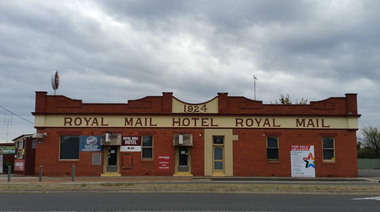
... hotels ballarat royal mail hotel peter lalor hotel the george hotel x on albert hotel cattleyards inn market hotel bunch of grapes hotel argyle hotel atlantic hotel ballarat hotel black hill hotel blue bell hotel bluebell hotel brown hill hotel canberra hotel carboni carboni's italian kitchen eureka stockade hotel carriers arms hotel eastern station hotel centenary hotel craig's hotel eastern railway hotel freight bar athletic club hotel grapes hotel munster arms hotel golden city hotel golf house hotel irish murphy's camp hotel lake view hotel la porchetta southern cross hotel the mallow hotel meaghers hotel millers arms miners tavern hotel miner's tavern hotel provincial hotel north britain hotel north star hotel oscar's hotel criterian hotel park hotel prince regent house prince regent hotel sport globe sporting globe jacksons hotel railway hotel pwtn pater lalor hotel royal highlander hotel queen's head hotel red lion hotel robin hood hotel military arms hotel royal oak hotel western hotel imperial hotel unicorn hotel union hotel Numerous photographs take by Marilyn Jeffs for use on the Ballarat and District Industrial Heritage Wiki Hotels of Ballarat Photograph Marilyn Jeffs ...Numerous photographs take by Marilyn Jeffs for use on the Ballarat and District Industrial Heritage Wikihotels, ballarat, royal mail hotel, peter lalor hotel, the george hotel, x on albert hotel, cattleyards inn, market hotel, bunch of grapes hotel, argyle hotel, atlantic hotel, ballarat hotel, black hill hotel, blue bell hotel, bluebell hotel, brown hill hotel, canberra hotel, carboni, carboni's italian kitchen, eureka stockade hotel, carriers arms hotel, eastern station hotel, centenary hotel, craig's hotel, eastern railway hotel, freight bar, athletic club hotel, grapes hotel, munster arms hotel, golden city hotel, golf house hotel, irish murphy's, camp hotel, lake view hotel, la porchetta, southern cross hotel, the mallow hotel, meaghers hotel, millers arms, miners tavern hotel, miner's tavern hotel, provincial hotel, north britain hotel, north star hotel, oscar's hotel, criterian hotel, park hotel, prince regent house, prince regent hotel, sport globe, sporting globe, jacksons hotel, railway hotel, pwtn, pater lalor hotel, royal highlander hotel, queen's head hotel, red lion hotel, robin hood hotel, military arms hotel, royal oak hotel, western hotel, imperial hotel, unicorn hotel, union hotel -
 Federation University Historical Collection
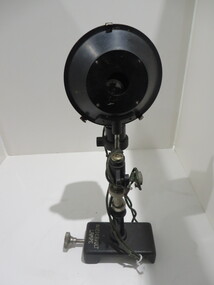
Instrument - Scientific Object, Niedervolt Lampe (Low voltage lamp)
... Used in the Electrical Department at the University of Ballarat, Victoria niedervolt lampe scientific instruments low voltage electrical engineering phillips globe lamp 5 volt globe carl reichert optische werke c. reichert Maker's metal label. ...Used in the Electrical Department at the University of Ballarat, VictoriaBlack metal lampMaker's metal label. Hand written "NIEDERVOLT LAMPE" on baseniedervolt lampe, scientific instruments, low voltage, electrical, engineering, phillips globe, lamp, 5 volt globe, carl reichert, optische werke c. reichert -
 Federation University Historical Collection
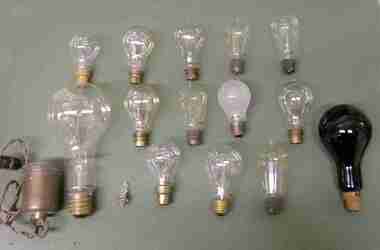
Equipment - Scientific Instument, Globes, 20th Century
... Most were used in various capacities at Ballarat School of Mines or University of Ballarat. scientific instrument ballarat school of mines globes edison lamps light bulbs bayonet Some have makers brand and voltage and wattage stamped onto the glass. ...Most were used in various capacities at Ballarat School of Mines or University of Ballarat.Assorted lamps including Edison Carbon filament light bulbs and other special purpose lamps, .1-3) Robertson, pear shaped 220 V 16, carbon filament? bayonet light bulb with 'nipple'. .4) Ediswan, standard shaped, 928, carbon filament? bayonet light bulb with 'nipple'. .5) (B in a circle) 280 V 32 oo1A, pear shaped, carbon filament? bayonet light bulb with 'nipple'. .6-7) Crompton? standard shaped, carbon filament? bayonet light bulb. Clear glass with an amber tint. .8) 230-240 V 40 W, pear shaped, wire filament bayonet light bulb. .9-10) Osram standard shaped, heavy spiral and disc electrodes, bayonet light bulb. (The disc is loose in 10) .11 a&b) Osram black glass, large standard shaped, 230-240 V 125 W, bayonet light bulb. .12) Philips tubular shaped projector lamp with instruction leaflet. .13) Philips tubular shaped projector lamp with instruction leaflet in original box. .14) EH JA 12 V 55 W small projector lamp. .15) Large special purpose, standard shaped, frosted bayonet light bulb. .16) Siemens, standard shaped, modern Edison screw light bulb. .17) Philips, standard shaped, modern Edison screw, frosted light bulb. .18) Crompton, gas filled 240 V 75 W, standard shaped, bayonet frosted light bulb in original box. .19) Crompton, gas filled 230 V 300 W. standard shaped, large modern Edison screw light bulb. .20) Probably an extension cord with a bayonet fitting at one end connected by a twisted cord of two fabric covered wires to a large socket. This socket has a copper Edison screw inner, surrounded by a ceramic tube and covered with a copper housing. The housing is cracked in two places.Some have makers brand and voltage and wattage stamped onto the glass.scientific instrument, ballarat school of mines, globes, edison, lamps, light bulbs, bayonet -
 Federation University Historical Collection
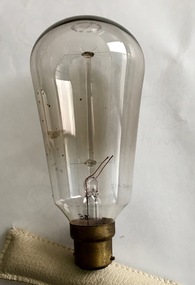
Scientific instrument, Globe
... Used as spot lights or a bank of these bulbs were used for load when testing the generators at SMB or University of Ballarat. ballarat school of mines globes ediswan lamps light bulbs bayonet Royal Ediswan, 240 V 60 W, pear shaped, wire filament bayonet light bulb. ...First type of metal filament lamp. Used as spot lights or a bank of these bulbs were used for load when testing the generators at SMB or University of Ballarat.Royal Ediswan, 240 V 60 W, pear shaped, wire filament bayonet light bulb.ballarat school of mines, globes, ediswan, lamps, light bulbs, bayonet -
 Federation University Historical Collection
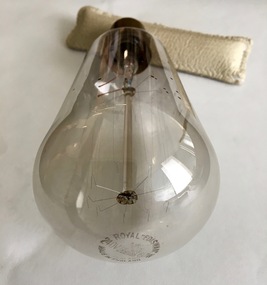
Scientific Object, Globe
... Used at Ballarat School of Mines in areas needing a lot of light as well as numerous globes in banks to test the generators....Used at Ballarat School of Mines in areas needing a lot of light as well as numerous globes in banks to test the generators. bulbs light bulbs osram gec osram ballarat school of mines globes edison screw lamps electricity Osram large gas filled, standard shaped, Eddison screw 250 V 300 W light globe. ...Used at Ballarat School of Mines in areas needing a lot of light as well as numerous globes in banks to test the generators.Osram large gas filled, standard shaped, Eddison screw 250 V 300 W light globe.bulbs, light bulbs, osram, gec osram, ballarat school of mines, globes, edison screw, lamps, electricity -
 Flagstaff Hill Maritime Museum and Village
Functional object - Lens Bulb
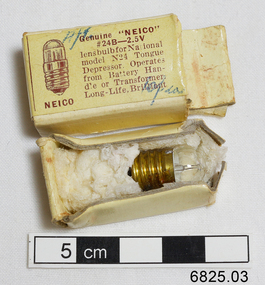
... This light bulb or globe was used for lighting the torch of an electronic tongue depressor. ...This light bulb or globe was used for lighting the torch of an electronic tongue depressor. ...This light bulb or globe was used for lighting the torch of an electronic tongue depressor. It was donated to Flagstaff Hill Maritime Village by the family of Doctor William Roy Angus, Surgeon and Oculist. It is part of the “W.R. Angus Collection” that includes historical medical equipment, surgical instruments and material once belonging to Dr Edward Ryan and Dr Thomas Francis Ryan, (both of Nhill, Victoria) as well as Dr Angus’ own belongings. The Collection’s history spans the medical practices of the two Doctors Ryan, from 1885-1926 plus that of Dr Angus, up until 1969. ABOUT THE “W.R.ANGUS COLLECTION” Doctor William Roy Angus M.B., B.S., Adel., 1923, F.R.C.S. Edin.,1928 (also known as Dr Roy Angus) was born in Murrumbeena, Victoria in 1901 and lived until 1970. He qualified as a doctor in 1923 at University of Adelaide, was Resident Medical Officer at the Royal Adelaide Hospital in 1924 and for a period was house surgeon to Sir (then Mr.) Henry Simpson Newland. Dr Angus was briefly an Assistant to Dr Riddell of Kapunda, then commenced private practice at Curramulka, Yorke Peninsula, SA, where he was physician, surgeon and chemist. In 1926, he was appointed as new Medical Assistant to Dr Thomas Francis Ryan (T.F. Ryan, or Tom), in Nhill, Victoria, where his experiences included radiology and pharmacy. In 1927 he was Acting House Surgeon in Dr Tom Ryan’s absence. Dr Angus had become engaged to Gladys Forsyth and they decided he would take time to further his studies overseas in the UK in 1927. He studied at London University College Hospital and at Edinburgh Royal Infirmary and in 1928, was awarded FRCS (Fellow from the Royal College of Surgeons), Edinburgh. He worked his passage back to Australia as a Ship’s Surgeon on the on the Australian Commonwealth Line’s T.S.S. Largs Bay. Dr Angus married Gladys in 1929, in Ballarat. (They went on to have one son (Graham 1932, born in SA) and two daughters (Helen (died 12/07/1996) and Berenice (Berry), both born at Mira, Nhill ) Dr Angus was a ‘flying doctor’ for the A.I.M. (Australian Inland Ministry) Aerial Medical Service in 1928 . The organisation began in South Australia through the Presbyterian Church in that year, with its first station being in the remote town of Oodnadatta, where Dr Angus was stationed. He was locum tenens there on North-South Railway at 21 Mile Camp. He took up this ‘flying doctor’ position in response to a call from Dr John Flynn; the organisation was later known as the Flying Doctor Service, then the Royal Flying Doctor Service. A lot of his work during this time involved dental surgery also. Between 1928-1932 he was surgeon at the Curramulka Hospital, Yorke Peninsula, South Australia. In 1933 Dr Angus returned to Nhill where he’d previously worked as Medical Assistant and purchased a share of the Nelson Street practice and Mira hospital from Dr Les Middleton one of the Middleton Brothers, the current owners of what was once Dr Tom Ryan’s practice. Dr L Middleton was House Surgeon to the Nhill Hospital 1926-1933, when he resigned. [Dr Tom Ryan’s practice had originally belonged to his older brother Dr Edward Ryan, who came to Nhill in 1885. Dr Edward saw patients at his rooms, firstly in Victoria Street and in 1886 in Nelson Street, until 1901. The Nelson Street practice also had a 2 bed ward, called Mira Private Hospital ). Dr Edward Ryan was House Surgeon at the Nhill Hospital 1884-1902 . He also had occasions where he successfully performed veterinary surgery for the local farmers too. Dr Tom Ryan then purchased the practice from his brother in 1901. Both Dr Edward and Dr Tom Ryan work as surgeons included eye surgery. Dr Tom Ryan performed many of his operations in the Mira private hospital on his premises. He too was House Surgeon at the Nhill Hospital 1902-1926. Dr Tom Ryan had one of the only two pieces of radiology equipment in Victoria during his practicing years – The Royal Melbourne Hospital had the other one. Over the years Dr Tom Ryan gradually set up what was effectively a training school for country general-practitioner-surgeons. Each patient was carefully examined, including using the X-ray machine, and any surgery was discussed and planned with Dr Ryan’s assistants several days in advance. Dr Angus gained experience in using the X-ray machine there during his time as assistant to Dr Ryan. Dr Tom Ryan moved from Nhill in 1926. He became a Fellow of the Royal Australasian College of Surgeons in 1927, soon after its formation, a rare accolade for a doctor outside any of the major cities. He remained a bachelor and died suddenly on 7th Dec 1955, aged 91, at his home in Ararat. Scholarships and prizes are still awarded to medical students in the honour of Dr T.F. Ryan and his father, Dr Michael Ryan, and brother, John Patrick Ryan. ] When Dr Angus bought into the Nelson Street premises in Nhill he was also appointed as the Nhill Hospital’s Honorary House Surgeon 1933-1938. His practitioner’s plate from his Nhill surgery states “HOURS Daily, except Tuesdays, Fridays and Saturday afternoons, 9-10am, 2-4pm, 7-8pm. Sundays by appointment”. This plate is now mounted on the doorway to the Port Medical Office at Flagstaff Hill Maritime Village, Warrnambool. Dr Edward Ryan and Dr Tom Ryan had an extensive collection of historical medical equipment and materials spanning 1884-1926 and when Dr Angus took up practice in their old premises he obtained this collection, a large part of which is now on display at the Port Medical Office at Flagstaff Hill Maritime Village in Warrnambool. During his time in Nhill Dr Angus was involved in the merging of the Mira Hospital and Nhill Public Hospital into one public hospital and the property titles passed on to Nhill Hospital in 1939. In 1939 Dr Angus and his family moved to Warrnambool where he purchased “Birchwood,” the 1852 home and medical practice of Dr John Hunter Henderson, at 214 Koroit Street. (This property was sold in1965 to the State Government and is now the site of the Warrnambool Police Station. ). The Angus family was able to afford gardeners, cooks and maids; their home was a popular place for visiting dignitaries to stay whilst visiting Warrnambool. Dr Angus had his own silk worm farm at home in a Mulberry tree. His young daughter used his centrifuge for spinning the silk. Dr Angus was appointed on a part-time basis as Port Medical Officer (Health Officer) in Warrnambool and held this position until the 1940’s when the government no longer required the service of a Port Medical Officer in Warrnambool; he was thus Warrnambool’s last serving Port Medical Officer. (The duties of a Port Medical Officer were outlined by the Colonial Secretary on 21st June, 1839 under the terms of the Quarantine Act. Masters of immigrant ships arriving in port reported incidents of diseases, illness and death and the Port Medical Officer made a decision on whether the ship required Quarantine and for how long, in this way preventing contagious illness from spreading from new immigrants to the residents already in the colony.) Dr Angus was a member of the Australian Medical Association, for 35 years and surgeon at the Warrnambool Base Hospital 1939-1942, He served as a Surgeon Captain during WWII 1941-45, in Ballarat, Victoria, and in Bonegilla, N.S.W., completing his service just before the end of the war due to suffering from a heart attack. During his convalescence he carved an intricate and ‘most artistic’ chess set from the material that dentures were made from. He then studied ophthalmology at the Royal Melbourne Eye and Ear Hospital and created cosmetically superior artificial eyes by pioneering using the intrascleral cartilage. Angus received accolades from the Ophthalmological Society of Australasia for this work. He returned to Warrnambool to commence practice as an ophthalmologist, pioneering in artificial eye improvements. He was Honorary Consultant Ophthalmologist to Warrnambool Base Hospital for 31 years. He made monthly visits to Portland as a visiting surgeon, to perform eye surgery. He represented the Victorian South-West subdivision of the Australian Medical Association as its secretary between 1949 and 1956 and as chairman from 1956 to 1958. In 1968 Dr Angus was elected member of Spain’s Barraquer Institute of Barcelona after his research work in Intrasclearal cartilage grafting, becoming one of the few Australian ophthalmologists to receive this honour, and in the following year presented his final paper on Living Intrasclearal Cartilage Implants at the Inaugural Meeting of the Australian College of Ophthalmologists in Melbourne In his personal life Dr Angus was a Presbyterian and treated Sunday as a Sabbath, a day of rest. He would visit 3 or 4 country patients on a Sunday, taking his children along ‘for the ride’ and to visit with him. Sunday evenings he would play the pianola and sing Scottish songs to his family. One of Dr Angus’ patients was Margaret MacKenzie, author of a book on local shipwrecks that she’d seen as an eye witness from the late 1880’s in Peterborough, Victoria. In the early 1950’s Dr Angus, painted a picture of a shipwreck for the cover jacket of Margaret’s book, Shipwrecks and More Shipwrecks. She was blind in later life and her daughter wrote the actual book for her. Dr Angus and his wife Gladys were very involved in Warrnambool’s society with a strong interest in civic affairs. Their interests included organisations such as Red Cross, Rostrum, Warrnambool and District Historical Society (founding members), Wine and Food Society, Steering Committee for Tertiary Education in Warrnambool, Local National Trust, Good Neighbour Council, Housing Commission Advisory Board, United Services Institute, Legion of Ex-Servicemen, Olympic Pool Committee, Food for Britain Organisation, Warrnambool Hospital, Anti-Cancer Council, Boys’ Club, Charitable Council, National Fitness Council and Air Raid Precautions Group. He was also a member of the Steam Preservation Society and derived much pleasure from a steam traction engine on his farm. He had an interest in people and the community He and his wife Gladys were both involved in the creation of Flagstaff Hill, including the layout of the gardens. After his death (28th March 1970) his family requested his practitioner’s plate, medical instruments and some personal belongings be displayed in the Port Medical Office surgery at Flagstaff Hill Maritime Village, and be called the “W. R. Angus Collection”. The W.R. Angus Collection is significant for still being located at the site it is connected with, Doctor Angus being the last Port Medical Officer in Warrnambool. The collection of medical instruments and other equipment is culturally significant, being an historical example of medicine from late 19th to mid-20th century. Dr Angus assisted Dr Tom Ryan, a pioneer in the use of X-rays and in ocular surgery. Lens bulb, NEICO #24B -2.5v, for an electronic tongue depressor in original cardboard package; part of the W.R. Angus Collection. The package is rectangular and the base slides out, giving access to the small globe. Package reads "Genuine NEICO #24B -2.5v lens bulb for National Model N24 tongue depressor. Operates from battery handle or Transformer. Long life. Brilliant", "Made in U.S.A.. Tested and sealed at factory", "National Elec. Instr. Co. Inc. Long Island, New York". "Apply current gradually until filament is changing from yellow to a white light - THEN STOP. Glaring Illumination indicates excessive voltage which shortens filament light without increasing illuminating efficiency."flagstaff hill, warrnambool, shipwrecked coast, flagstaff hill maritime museum, maritime museum, shipwreck coast, flagstaff hill maritime village, great ocean road, dr w r angus, dr ryan, surgical instrument, t.s.s. largs bay, warrnambool base hospital, nhill base hospital, mira hospital, flying doctor, medical treatment, medical history, national electric instrument company, electronic tongue depressor, lens bulb -
 Flagstaff Hill Maritime Museum and Village
Equipment - Medical Examination Light, early to mid 1900's
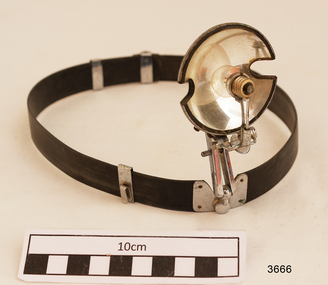
... Dr Angus assisted Dr Tom Ryan, a pioneer in the use of X-rays and in ocular surgery. flagstaff hill warrnambool shipwrecked coast flagstaff hill maritime museum maritime museum shipwreck coast flagstaff hill maritime village great ocean road dr w r angus dr ryan surgical instrument t.s.s. largs bay warrnambool base hospital nhill base hospital mira hospital flying doctor medical treatment medical history examination light doctor's headlamp doctor's examination light medical equipment Medical examination light on headband, part of the W.R. Angus Collection. Doctor's flexible black headband with reflective mirror disc and mounted light globe ...This doctor's medical examination headband light was donated to Flagstaff Hill Maritime Village by the family of Doctor William Roy Angus, Surgeon and Oculist. It is part of the “W.R. Angus Collection” that includes historical medical equipment, surgical instruments and material once belonging to Dr Edward Ryan and Dr Thomas Francis Ryan, (both of Nhill, Victoria) as well as Dr Angus’ own belongings. The Collection’s history spans the medical practices of the two Doctors Ryan, from 1885-1926 plus that of Dr Angus, up until 1969. ABOUT THE “W.R.ANGUS COLLECTION” Doctor William Roy Angus M.B., B.S., Adel., 1923, F.R.C.S. Edin.,1928 (also known as Dr Roy Angus) was born in Murrumbeena, Victoria in 1901 and lived until 1970. He qualified as a doctor in 1923 at University of Adelaide, was Resident Medical Officer at the Royal Adelaide Hospital in 1924 and for a period was house surgeon to Sir (then Mr.) Henry Simpson Newland. Dr Angus was briefly an Assistant to Dr Riddell of Kapunda, then commenced private practice at Curramulka, Yorke Peninsula, SA, where he was physician, surgeon and chemist. In 1926, he was appointed as new Medical Assistant to Dr Thomas Francis Ryan (T.F. Ryan, or Tom), in Nhill, Victoria, where his experiences included radiology and pharmacy. In 1927 he was Acting House Surgeon in Dr Tom Ryan’s absence. Dr Angus had become engaged to Gladys Forsyth and they decided he would take time to further his studies overseas in the UK in 1927. He studied at London University College Hospital and at Edinburgh Royal Infirmary and in 1928, was awarded FRCS (Fellow from the Royal College of Surgeons), Edinburgh. He worked his passage back to Australia as a Ship’s Surgeon on the on the Australian Commonwealth Line’s T.S.S. Largs Bay. Dr Angus married Gladys in 1929, in Ballarat. (They went on to have one son (Graham 1932, born in SA) and two daughters (Helen (died 12/07/1996) and Berenice (Berry), both born at Mira, Nhill ) Dr Angus was a ‘flying doctor’ for the A.I.M. (Australian Inland Ministry) Aerial Medical Service in 1928 . The organisation began in South Australia through the Presbyterian Church in that year, with its first station being in the remote town of Oodnadatta, where Dr Angus was stationed. He was locum tenens there on North-South Railway at 21 Mile Camp. He took up this ‘flying doctor’ position in response to a call from Dr John Flynn; the organisation was later known as the Flying Doctor Service, then the Royal Flying Doctor Service. A lot of his work during this time involved dental surgery also. Between 1928-1932 he was surgeon at the Curramulka Hospital, Yorke Peninsula, South Australia. In 1933 Dr Angus returned to Nhill where he’d previously worked as Medical Assistant and purchased a share of the Nelson Street practice and Mira hospital from Dr Les Middleton one of the Middleton Brothers, the current owners of what was once Dr Tom Ryan’s practice. Dr L Middleton was House Surgeon to the Nhill Hospital 1926-1933, when he resigned. [Dr Tom Ryan’s practice had originally belonged to his older brother Dr Edward Ryan, who came to Nhill in 1885. Dr Edward saw patients at his rooms, firstly in Victoria Street and in 1886 in Nelson Street, until 1901. The Nelson Street practice also had a 2 bed ward, called Mira Private Hospital ). Dr Edward Ryan was House Surgeon at the Nhill Hospital 1884-1902 . He also had occasions where he successfully performed veterinary surgery for the local farmers too. Dr Tom Ryan then purchased the practice from his brother in 1901. Both Dr Edward and Dr Tom Ryan work as surgeons included eye surgery. Dr Tom Ryan performed many of his operations in the Mira private hospital on his premises. He too was House Surgeon at the Nhill Hospital 1902-1926. Dr Tom Ryan had one of the only two pieces of radiology equipment in Victoria during his practicing years – The Royal Melbourne Hospital had the other one. Over the years Dr Tom Ryan gradually set up what was effectively a training school for country general-practitioner-surgeons. Each patient was carefully examined, including using the X-ray machine, and any surgery was discussed and planned with Dr Ryan’s assistants several days in advance. Dr Angus gained experience in using the X-ray machine there during his time as assistant to Dr Ryan. Dr Tom Ryan moved from Nhill in 1926. He became a Fellow of the Royal Australasian College of Surgeons in 1927, soon after its formation, a rare accolade for a doctor outside any of the major cities. He remained a bachelor and died suddenly on 7th Dec 1955, aged 91, at his home in Ararat. Scholarships and prizes are still awarded to medical students in the honour of Dr T.F. Ryan and his father, Dr Michael Ryan, and brother, John Patrick Ryan. ] When Dr Angus bought into the Nelson Street premises in Nhill he was also appointed as the Nhill Hospital’s Honorary House Surgeon 1933-1938. His practitioner’s plate from his Nhill surgery states “HOURS Daily, except Tuesdays, Fridays and Saturday afternoons, 9-10am, 2-4pm, 7-8pm. Sundays by appointment”. This plate is now mounted on the doorway to the Port Medical Office at Flagstaff Hill Maritime Village, Warrnambool. Dr Edward Ryan and Dr Tom Ryan had an extensive collection of historical medical equipment and materials spanning 1884-1926 and when Dr Angus took up practice in their old premises he obtained this collection, a large part of which is now on display at the Port Medical Office at Flagstaff Hill Maritime Village in Warrnambool. During his time in Nhill Dr Angus was involved in the merging of the Mira Hospital and Nhill Public Hospital into one public hospital and the property titles passed on to Nhill Hospital in 1939. In 1939 Dr Angus and his family moved to Warrnambool where he purchased “Birchwood,” the 1852 home and medical practice of Dr John Hunter Henderson, at 214 Koroit Street. (This property was sold in1965 to the State Government and is now the site of the Warrnambool Police Station. ). The Angus family was able to afford gardeners, cooks and maids; their home was a popular place for visiting dignitaries to stay whilst visiting Warrnambool. Dr Angus had his own silk worm farm at home in a Mulberry tree. His young daughter used his centrifuge for spinning the silk. Dr Angus was appointed on a part-time basis as Port Medical Officer (Health Officer) in Warrnambool and held this position until the 1940’s when the government no longer required the service of a Port Medical Officer in Warrnambool; he was thus Warrnambool’s last serving Port Medical Officer. (The duties of a Port Medical Officer were outlined by the Colonial Secretary on 21st June, 1839 under the terms of the Quarantine Act. Masters of immigrant ships arriving in port reported incidents of diseases, illness and death and the Port Medical Officer made a decision on whether the ship required Quarantine and for how long, in this way preventing contagious illness from spreading from new immigrants to the residents already in the colony.) Dr Angus was a member of the Australian Medical Association, for 35 years and surgeon at the Warrnambool Base Hospital 1939-1942, He served as a Surgeon Captain during WWII 1941-45, in Ballarat, Victoria, and in Bonegilla, N.S.W., completing his service just before the end of the war due to suffering from a heart attack. During his convalescence he carved an intricate and ‘most artistic’ chess set from the material that dentures were made from. He then studied ophthalmology at the Royal Melbourne Eye and Ear Hospital and created cosmetically superior artificial eyes by pioneering using the intrascleral cartilage. Angus received accolades from the Ophthalmological Society of Australasia for this work. He returned to Warrnambool to commence practice as an ophthalmologist, pioneering in artificial eye improvements. He was Honorary Consultant Ophthalmologist to Warrnambool Base Hospital for 31 years. He made monthly visits to Portland as a visiting surgeon, to perform eye surgery. He represented the Victorian South-West subdivision of the Australian Medical Association as its secretary between 1949 and 1956 and as chairman from 1956 to 1958. In 1968 Dr Angus was elected member of Spain’s Barraquer Institute of Barcelona after his research work in Intrasclearal cartilage grafting, becoming one of the few Australian ophthalmologists to receive this honour, and in the following year presented his final paper on Living Intrasclearal Cartilage Implants at the Inaugural Meeting of the Australian College of Ophthalmologists in Melbourne In his personal life Dr Angus was a Presbyterian and treated Sunday as a Sabbath, a day of rest. He would visit 3 or 4 country patients on a Sunday, taking his children along ‘for the ride’ and to visit with him. Sunday evenings he would play the pianola and sing Scottish songs to his family. One of Dr Angus’ patients was Margaret MacKenzie, author of a book on local shipwrecks that she’d seen as an eye witness from the late 1880’s in Peterborough, Victoria. In the early 1950’s Dr Angus, painted a picture of a shipwreck for the cover jacket of Margaret’s book, Shipwrecks and More Shipwrecks. She was blind in later life and her daughter wrote the actual book for her. Dr Angus and his wife Gladys were very involved in Warrnambool’s society with a strong interest in civic affairs. Their interests included organisations such as Red Cross, Rostrum, Warrnambool and District Historical Society (founding members), Wine and Food Society, Steering Committee for Tertiary Education in Warrnambool, Local National Trust, Good Neighbour Council, Housing Commission Advisory Board, United Services Institute, Legion of Ex-Servicemen, Olympic Pool Committee, Food for Britain Organisation, Warrnambool Hospital, Anti-Cancer Council, Boys’ Club, Charitable Council, National Fitness Council and Air Raid Precautions Group. He was also a member of the Steam Preservation Society and derived much pleasure from a steam traction engine on his farm. He had an interest in people and the community He and his wife Gladys were both involved in the creation of Flagstaff Hill, including the layout of the gardens. After his death (28th March 1970) his family requested his practitioner’s plate, medical instruments and some personal belongings be displayed in the Port Medical Office surgery at Flagstaff Hill Maritime Village, and be called the “W. R. Angus Collection”. The W.R. Angus Collection is significant for still being located at the site it is connected with, Doctor Angus being the last Port Medical Officer in Warrnambool. The collection of medical instruments and other equipment is culturally significant, being an historical example of medicine from late 19th to mid-20th century. Dr Angus assisted Dr Tom Ryan, a pioneer in the use of X-rays and in ocular surgery. Medical examination light on headband, part of the W.R. Angus Collection. Doctor's flexible black headband with reflective mirror disc and mounted light globe. flagstaff hill, warrnambool, shipwrecked coast, flagstaff hill maritime museum, maritime museum, shipwreck coast, flagstaff hill maritime village, great ocean road, dr w r angus, dr ryan, surgical instrument, t.s.s. largs bay, warrnambool base hospital, nhill base hospital, mira hospital, flying doctor, medical treatment, medical history, examination light, doctor's headlamp, doctor's examination light, medical equipment -
 Flagstaff Hill Maritime Museum and Village
Container - Ship Tank, Early 20th century
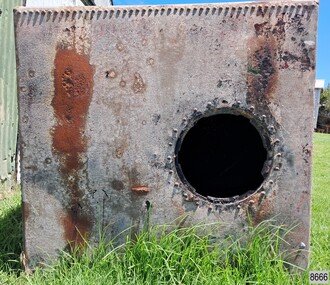
... used as washing tubs or cookers. A 1929 catalogue from Hudson’s Tank Stores advertised square tanks that contained around 600 litres – 160 gallons – which equals an internal measurement of 33.25 inches – 84.5 centimetres – per side ship tanks are still made and sold in 1952 by the Globe Tank and Foundry in Wolverhampton, England, which was incorporated in 1922. ...used as washing tubs or cookers. A 1929 catalogue from Hudson’s Tank Stores advertised square tanks that contained around 600 litres – 160 gallons – which equals an internal measurement of 33.25 inches – 84.5 centimetres – per side ship tanks are still made and sold in 1952 by the Globe Tank and Foundry in Wolverhampton, England, which was incorporated in 1922. ...Cubed iron ship tanks were invented by Richard Trevithich in 1808, in partnership with Robert Dickson, and the design was patented that year. The invention eventually replaced the wooden casks or barrels used at the time, as the ship tanks were more secure and their shape was much more economical in storage space. The robust metal tanks were originally made to transport water, but their preserving quality enabled them to transport perishable dry goods such as grain on long voyages, as well as other forms of liquid and solid cargo. The first ship tanks were made from sheets of iron, and later mild steel sheets, with double riveted edges and corners. A round cast iron lid with handle grips was fitted snugly into the top opening, providing an air-tight and water-tight seal. Brass taps were often fitted into the base, which could have been the case with this tank, but it now has a wooden bung in the hole. Sailing ships began using the new ship tanks on Australian voyages from around the 1830s, storing food and water for those on board, and filling them with other cargo. A large number of the ship tanks were repurposed in 1838 for the Victoria Settlement at Port Essington, N.T., as they were able to protect the food, clothing and other stores from termite and insect damage. Other ‘recycled’ ship tanks were cut in half and used as washing tubs or cookers. A 1929 catalogue from Hudson’s Tank Stores advertised square tanks that contained around 600 litres – 160 gallons – which equals an internal measurement of 33.25 inches – 84.5 centimetres – per side ship tanks are still made and sold in 1952 by the Globe Tank and Foundry in Wolverhampton, England, which was incorporated in 1922. Today, ship tanks can be seen around Australia. Wilsonson’s Promontory Lightstation has the lid from a ship tank that was used on site for the storage of water. Some have been repurposed as domestic water tanks and dog kennels, others for eucalyptus distilleries. Flagstaff Hill has two ship tanks. The Campaspe Port at Echuca, once a bustling river port, has a ship tank beside the locomotive yard. The lids of ship tanks are collectible items. Richard Trevithick (1771-1833): - Trevithick was born in 1771 in Cornwall, England. He was a famous British engineer and inventor during the Industrial Revolution, known for his invention of the first full-scale working railway, the high-pressure steam locomotive, which he demonstrated hauling a railway train in 1804. He set up a small workshop in 1808 at 72 Fore Street, Limehouse, London, to make iron ship tanks, and this invention was instrumental in replacing the wooden casks formerly used for storage on ships. He was involved with mining technology, iron foundry and ship equipment. Ship tanks changed the way that cargo was transported on ships and other vehicles from the 1830s and were used into the mid-20th century. The ship tanks’ advantages were that they could store more content, lasted longer, were waterproof and airtight, stackable and could be repurposed for many uses other than water, such as fuel, dry goods and domestic cargo. They have even been used aa dog kennels and cookers. Ship tanks were part of the evolving methos to transport water, food and cargo, which changed in 1956 when Malcolm McLean invented the large, rectangular shipping containers that are in use today; they speed up the process of loading on and off the ships, saving time and money. Ship tank: a cubed iron container with an offset hole on one side. The hole has cutouts for securely attaching a lid. This tank is on its side on the ground with the opening facing sideways. The side facing upwards has a wooden bung in a round hole. The ship tank is made from six square, thick iron sheets, rolled and riveted along the edges. The inside has a black sticky coating, possibly bitumen, and a strong creosote odour. There are small remnants of green paint on the outer surface.flagstaff hill, flagstaff hill maritime museum and village, warrnambool, maritime museum, maritime village, great ocean road, shipwreck coast, iron cube, water tank, shipping container, ship tank, ship's tank, ship tanks, marine container, richard trevithich, 1808, robert dickson, water transport, water storage, iron foundry, steel sheets, iron sheets, revets, victoria settlement, port essington, globe tank and foundry, wolverhampton, british engineer, british inventor, wooden casks -
 Flagstaff Hill Maritime Museum and Village
Currency - Banknote Belfast, Bank of Victoria, 1853
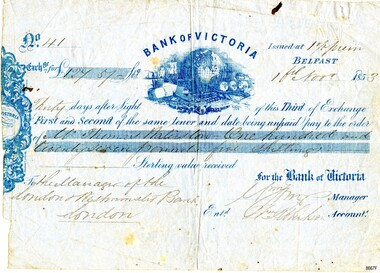
... globe, sailing ships, wool bails, sheep, colonial building and mining tools. Banknote of fine paper. There is a fold multi-crease down the centre top to bottom, lighter creasing across the top and angular creasing to the bottom left and right-hand corners. Yellow spotting is visible across the object breaking through the grey blue colour of the paper. A dark ink blot appears near the top right-hand corner. The left-hand side of the banknote is uneven. The back of the document has darker spotting, a used ...The promissory note issued at Belfast, now Port Fairy, Victoria by the “Bank of Victoria” is an early example of currency issued by a private bank. This note was issued in 1853 the same year that the bank commenced business in Belfast. Details of the first production of a banknote backed by the Australian Government occurred on 1 May 1913 following the "Australian Notes Act of 1910" (Australian National Museum). The first building the Bank of Victoria purchased in Belfast was of timber and later sold. Smith & Watts Architects advertised for tenders in the Melbourne Argus on Thursday 29/4/1869 for the erection of a substantial building that is now occupied by Moyne Shire Council in Cox Street. A meeting of the Directors of the Bank of Victoria elected on 1 October 1852. A ballot took place for four directors resulting in Wm. Highett Esq. Wm F. Splatt, Esq. M.L.C., Alex. Wilson, Esq. and W.H. Tuckett” elected as Directors. It was reported from a later meeting in “The Argus” Melbourne on 3 August 1853 that a branch had opened in Swanston Street, Melbourne on 3rd January 1852 with Henry Miller as Chairman of the Board and J. Matheson as the Manager; followed by Geelong on 12 August 1852. Then at the request of “influential inhabitants”, the Belfast branch commenced on 11 May 1853, which had “already met with very general support and encouragement”. This was a colonial bank at the time of vast pastoral runs and gold speculation – how "Mr Thomas [....ton?]" came by his fortune of One Hundred and Twenty-Seven Pound and five shillings can only be wondered at until further research reveals the story. This promissory note records the early colonial system of banking and reflects the economic growth and entrepreneurship of the South West Region of Victoria.Banknote of fine paper. There is a fold multi-crease down the centre top to bottom, lighter creasing across the top and angular creasing to the bottom left and right-hand corners. Yellow spotting is visible across the object breaking through the grey blue colour of the paper. A dark ink blot appears near the top right-hand corner. The left-hand side of the banknote is uneven. The back of the document has darker spotting, a used dirty look patina and some insect spotting. Horizontal crease markings can be seen creating quarter marks. The front of the banknote reads: "No.41/ Exch.ge for £127.57- Bank of Victoria/Issued at 1% prem/Thirty days after Sight of this Third of Exchange/First and Second of the same tenor and date being unpaid pay to the order of/Mr. Thomas [Raliston?]/One hundred and twenty seven pounds five shillings Sterling silver received/To the Manager of the London Westminister Bank London/for the Bank of Victoria [signed?] Manager/Ent.d [?] Robertson Account.t. The blue printed Bank of Victoria logo features a world globe, sailing ships, wool bails, sheep, colonial building and mining tools. flagstaff hill, warrnambool, maritime village, maritime museum, flagstaff hill maritime museum and village, shipwreck coast, great ocean road, promissory notes, bank notes, bank of victoria, smith & watts, smith & watts architects, 1853, william highett, william f. splatt, alex wilson, w.h. tuckett, henry miller, money miller, belfast (now port fairy), banknote -
 Flagstaff Hill Maritime Museum and Village
Book - Fictional Novel, Sir Thomas Malory, Morte Darthur, 1868
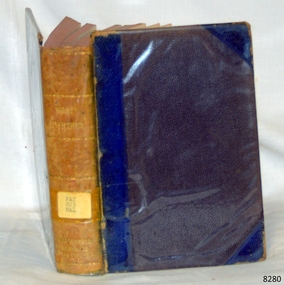
... use crutches for over twenty years, he turned his focus entirely to literature. His work focused on biblical criticism and politics. He was a close friend of Thomas Carlyle and the uncle of the famous early 20th-century biographer Lytton Strachey. The publisher, Macmillan & Co., was founded in 1843 by Scottish brothers Daniel and Alexander Macmillan. This powerhouse Victorian firm became one of the most prestigious publishers in the world, publishing monumental authors like Charles Kingsley, Lewis Carroll, and Alfred Tennyson. This volume is regarded as immensely significant because, before Strachey's Globe ...This work, Le Morte d'Arthur, was originally finished around 1469–1470 and is the definitive English compilation of the legends of King Arthur. Written in Middle English prose, it weaves together diverse French and British source materials into a single cohesive epic. It follows Arthur from his miraculous birth and pulling the sword from the stone, through the golden age of the Round Table and the Quest for the Holy Grail, to the tragic collapse of the kingdom fueled by the love affair between Sir Lancelot and Queen Guinevere.Morte Darthur Author: Thomas Malory Publisher: Macmillan & Co Date: 1868 Further Information: Blue front cover and brown spine with gilt lettering, reinforced corners to hard cover in dark blue, library label to spine. Introduction By Sir Edward Strachey BartfictionThis work, Le Morte d'Arthur, was originally finished around 1469–1470 and is the definitive English compilation of the legends of King Arthur. Written in Middle English prose, it weaves together diverse French and British source materials into a single cohesive epic. It follows Arthur from his miraculous birth and pulling the sword from the stone, through the golden age of the Round Table and the Quest for the Holy Grail, to the tragic collapse of the kingdom fueled by the love affair between Sir Lancelot and Queen Guinevere.flagstaff hill, warrnambool, shipwrecked coast, flagstaff hill maritime museum, maritime museum, shipwreck coast, flagstaff hill maritime village, great ocean road, book, pattison collection, warrnambool library, warrnambool mechanics’ institute, ralph eric pattison, corangamite regional library service, warrnambool city librarian, mechanics’ institute library, victorian library board, warrnambool books and records, warrnambool children’s library, thomas malory, morte darthur -
 Flagstaff Hill Maritime Museum and Village
Book - Anthropological Travelogue/Fictional, Captain Mayne Reid, Odd People being A Popular Description of Singular Races of Man, 1860
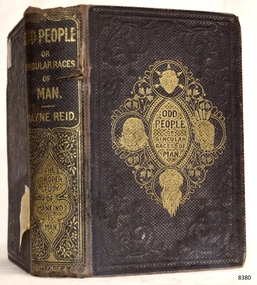
... globe. Reid details their physical characteristics, social structures, hunting practices, and customs. It features a number of cultures, with accounts of the Bushmen of South Africa, the Mundurucu ("Mundrucu") of the Amazon, the Esquimaux (Inuit), the Water Chatts, and the inhabitants of the "Feegee" (Fiji) Islands—the latter section focusing heavily on tales of cannibalism. The book presents a classic Victorian paradox: while it uses...globe. Reid details their physical characteristics, social structures, hunting practices, and customs. It features a number of cultures, with accounts of the Bushmen of South Africa, the Mundurucu ("Mundrucu") of the Amazon, the Esquimaux (Inuit), the Water Chatts, and the inhabitants of the "Feegee" (Fiji) Islands—the latter section focusing heavily on tales of cannibalism. The book presents a classic Victorian paradox: while it uses ...Odd People: Being a Popular Description of Singular Races of Man (1860) is an interesting piece of 19th-century literature. The book was written by Captain Thomas Mayne Reid (1818–1883), a Scots-Irish American novelist and adventurer. He was immensely popular in the mid-to-late 19th century for his boys' adventure novels, tales of the American West, and travelogues. The true first edition was published in London by Routledge, Warne & Routledge in 1860. In the United States, it was published around the same time (1860/1861) by Ticknor and Fields in Boston, and later editions were retitled The Man-Eaters and Other Odd People. The book is an early work of popular ethnology and anthropology, written for a general audience and heavily marketed toward young readers and armchair travelers of the Victorian era.Book, brown covers, embossed with borders and patterns and gilt decoration and titles. The book includes illustrations. Handwritten inscription on the front paste-down page. The opposite page has a stamped and a handwritten inscription. The book was presented as a prize to a Latin student at the National School, Warrnambool in 1861. Title: Odd People being a Popular Description of Singular Races of Man. Alternate title: Odd People or Singular Races of Man Author: Captain Mayne Reid Publisher: Routledge Warne & Routledge, London Date: 1860 Further information: additional text on the spine reads 'A Proper Study of Mankind is Man'fictionOdd People: Being a Popular Description of Singular Races of Man (1860) is an interesting piece of 19th-century literature. The book was written by Captain Thomas Mayne Reid (1818–1883), a Scots-Irish American novelist and adventurer. He was immensely popular in the mid-to-late 19th century for his boys' adventure novels, tales of the American West, and travelogues. The true first edition was published in London by Routledge, Warne & Routledge in 1860. In the United States, it was published around the same time (1860/1861) by Ticknor and Fields in Boston, and later editions were retitled The Man-Eaters and Other Odd People. The book is an early work of popular ethnology and anthropology, written for a general audience and heavily marketed toward young readers and armchair travelers of the Victorian era.shipwrecked-coast, flagstaff-hill, flagstaff-hill-maritime-museum, warrnambool, maritime-museum, shipwreck-coast, flagstaff-hill-maritime-village, shipwrecked-artefact, book, odd people, captain mayne reid, national school warrnambool., daniel b sellers, classic fiction, the proper study of mankind is man, singular races of man, , routledge warne and routledge, latin student -
 City of Moorabbin Historical Society (Operating the Box Cottage Museum)
Electrical, fittings 3 bakelite 1 brass c1930, c1931
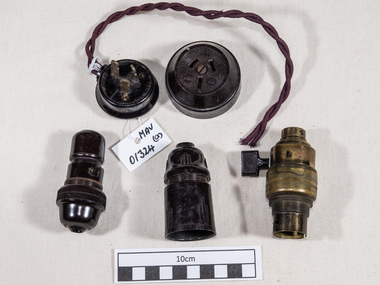
... used for fittings. Bakelite was a safe non-conductor of the electric current. Housewives, who had ironed clothes with flat irons heated on the hearth of open fires, were delighted to be able to stand on a chair and remove the light globe and plug in their new clean and efficient electric iron. ...used for fittings. Bakelite was a safe non-conductor of the electric current. Housewives, who had ironed clothes with flat irons heated on the hearth of open fires, were delighted to be able to stand on a chair and remove the light globe and plug in their new clean and efficient electric iron. ...As supply of electricity became available in the Moorabbin Shire c 1920 homes gradually changed from Gas lighting to Electrical lighting and bakelite was used for fittings. Bakelite was a safe non-conductor of the electric current. Housewives, who had ironed clothes with flat irons heated on the hearth of open fires, were delighted to be able to stand on a chair and remove the light globe and plug in their new clean and efficient electric iron. The supply of electricity to homes in the City of Moorabbin in the early 20th Century brought many welcome changes to domestic and commercial life 3 Electrical, fittings c 1931 a) a bakelite plug and socket Made in Australia b) a bakelite bayonet fitting Made in England ;c) Bakelite screw type with no markings d) A large brass and porcelain screw type with no markings L8 a) Australian Made / PIMI b) British Made in England c) No marks d) no marks electricity, electric lights, electric irons, bakelite, market gardeners, early settlers, moorabbin shire, mechanics institute cheltenham, postworld war 11 settlers, housing estates moorabbin 1950, bentleigh, ormond, moorabbin, cheltenham, clark judy, reed gladys, reed george -
 City of Moorabbin Historical Society (Operating the Box Cottage Museum)
Functional object - Lamp fitting double holders, Middy's Aust, c 1930
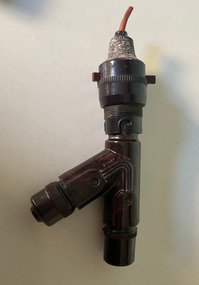
... Used by a pioneer family in Moorabbin. Manufactured by Middy's: Arriving in Australia at age 19 by ship at Port Melbourne, Dutch immigrant Petrus Cornelis Nicolaas Middendorp (1891-1963) settled in Melbourne to apply his trade as a cigar maker for the British American Tobacco Co. Retiring from the cigar industry and following his work as an honorary orderly tending WW1 Australian casualties in Paris and Melbourne, Petrus began selling Dutch manufactured light globes ...Made in Australia by Middy's Used by a pioneer family in Moorabbin. Manufactured by Middy's: Arriving in Australia at age 19 by ship at Port Melbourne, Dutch immigrant Petrus Cornelis Nicolaas Middendorp (1891-1963) settled in Melbourne to apply his trade as a cigar maker for the British American Tobacco Co. Retiring from the cigar industry and following his work as an honorary orderly tending WW1 Australian casualties in Paris and Melbourne, Petrus began selling Dutch manufactured light globes, vacuum cleaners and other electrical products imported from Holland and England. Warehousing and sales of the goods were undertaken from 1928 by the ‘Middendorp Goods Supply Company’ initially located in Flinders Lane in Melbourne’s CBD, then moving to McKillop Street, followed by a basement store at 148 Queen Street. During the 1940s a manufacturing plant known as ‘Middendorp and Sons’ was established in the Melbourne suburb of Preston, where Petrus’ three teenage sons Peter, Nick and Hugh joined him. Peter and Hugh worked with a small team of staff to produce rubber plug tops, extension sockets, double adaptors and a small range of bakelite accessories, whilst Nick became the first sales rep calling on customers and construction sites. The products were sold under the brand name of ‘Middy’. A name change of the distribution business took place in the late 40s and Middendorp Electric Company Pty Ltd was officially registered in 1948. The manufacturing operation ceased during the late 50s due to the introduction and acceptance of plastic and injection moulding. However, the Middendorp family had positioned itself to further establish its electrical wholesale business with the first branch and Head Office opening in 1956, located at 520 Latrobe Street, Melbourne. By 1962 there were five trading branches, growing to 25 in 1986 and 101 by 2018 Australia wide. Middendorp Electric, more commonly known as Middy’s and readily identified by its trademark colour of Middy’s pink, has developed into the largest privately owned Electrical Wholesaler in Australia. In 2015 Middy’s acquired Mekolec lifts fire and electrical adding presence and sector expertise in Melbourne’s inner south. In Sep 2018 Middy's acquired Salmon Brothers Electrical, with 5 Branches in Sydney's Metro region and in 2019 they acquired Goulburn Electrical Wholesalers greatly adding to Middy's location coverage in NSW and providing Middy’s the ability to better service NSW contractors. Bakerlite electrical fittingMiddy - Made in Australiamiddy's, moorabbin pioneers, electrical, bakerlite -
 Ringwood and District Historical Society
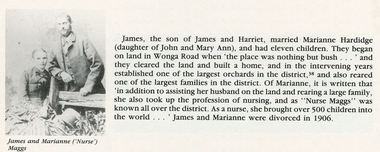
Nurses case, Globe Goods, Nurse Maggs' case used in Ringwood in the early 1900s
... On case - Beatzall Cases Australia (manufacturers logo) Inside Hand written M.A.Maggs, Clive Street ,Mitcham Nurses case containing black velvet cape, white apron, and measuring glass in box: Brown case with split opening lid revealing a 2 black velvet cape, with frilled edge, 3 white cotton apron, and 4 a small black box containing 5 a measuring glass +Additional Keywords: Maggs, James / Hardridge, Marianne Nurse Maggs' case used in Ringwood in the early 1900s Nurses case Globe Goods ...Marianne Hardridge married James Maggs and had 11 children. They began orcharding on Wonga Road when there was nothing but bush. Over the years it became one of the largest orchards, and they were also one of the largest families in the district. As well as helping on the land Marianne took up nursing and as Nurse Maggs brought over 500 children into the world in the Ringwood area. This was in the early 1900s when there was no doctor, no dentist, no hospital or chemist in the area.Nurses case containing black velvet cape, white apron, and measuring glass in box: Brown case with split opening lid revealing a 2 black velvet cape, with frilled edge, 3 white cotton apron, and 4 a small black box containing 5 a measuring glass +Additional Keywords: Maggs, James / Hardridge, MarianneOn case - Beatzall Cases Australia (manufacturers logo) Inside Hand written M.A.Maggs, Clive Street ,Mitcham -
 Orbost & District Historical Society
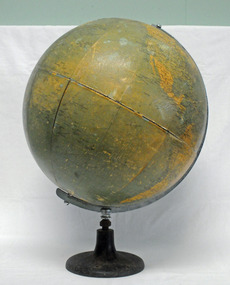
globe, C1958
... This desk globe was owned by Evelyn Bessie Travaskis and used when teaching at State School Wairewa where she taught from 2-2-1945 until her retirement on 29-6-1956. ...The Philips' Challenge Globe was commonly used in Australian schools in the teaching of geography. ...This desk globe was owned by Evelyn Bessie Travaskis and used when teaching at State School Wairewa where she taught from 2-2-1945 until her retirement on 29-6-1956. She retired from the Education Department temporary staff, aged 76. ( More info.from Newsletter November 2015 by John Phillips). The Philips' Challenge Globe was commonly used in Australian schools in the teaching of geography. This item is associated with the history of education in East Gippsland. It is also associated with Evelyn Trevaskis.A large globe mounted on a round metal stand which has three holes for securing to a flat surface - a desk or tabletop. It sits in a half meridian.C 1958 Philips' Challenge Globetrevaskis-evelyn globe education-equipment-geography wairewa-school -
 City of Moorabbin Historical Society (Operating the Box Cottage Museum)
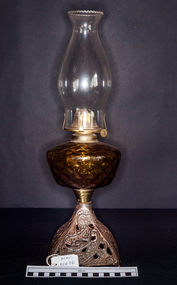
Lights, Victorian kerosene banquet lamp, c1900
... uses kerosene as a fuel. Kerosene lamps have a wick or mantle as light source, protected by a glass chimney or globe; lamps may be used on a table, or hand-held lanterns may used for portable lighting. ...uses kerosene as a fuel. Kerosene lamps have a wick or mantle as light source, protected by a glass chimney or globe; lamps may be used on a table, or hand-held lanterns may used for portable lighting. ...The kerosene lamp is a type of lighting device that uses kerosene as a fuel. Kerosene lamps have a wick or mantle as light source, protected by a glass chimney or globe; lamps may be used on a table, or hand-held lanterns may used for portable lighting. There are three types of kerosene lamp: traditional flat wick, central draught (tubular round wick), and mantle lamp. The screws on the side adjust the flame and hence the strength of the flame produced. Prior to the introduction of gas and electricity these lamps provided lighting in all householdsPioneers and early settlers in Moorabbin Shire relied on kerosene lamps for lighting their homes after sunset.This kerosene, flat wick, banquet lamp has a clear glass shade chimney with a frilled rim, a reservoir of plain yellow glass and a metal engraved base . 1 side screw to adjust the flamelights, early settlers, pioneers, market gardeners, moorabbin, brighton, bentleigh, cheltenham. lamps, kerosene, paraffin, oil -
 City of Moorabbin Historical Society (Operating the Box Cottage Museum)
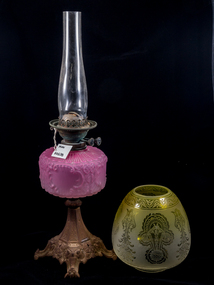
Lights, Victorian kerosene banquet lamp, c1900
... uses kerosene as a fuel. Kerosene lamps have a wick or mantle as light source, protected by a glass chimney or globe; lamps may be used on a table, or hand-held lanterns may used for portable lighting. ...uses kerosene as a fuel. Kerosene lamps have a wick or mantle as light source, protected by a glass chimney or globe; lamps may be used on a table, or hand-held lanterns may used for portable lighting. ...The kerosene lamp is a type of lighting device that uses kerosene as a fuel. Kerosene lamps have a wick or mantle as light source, protected by a glass chimney or globe; lamps may be used on a table, or hand-held lanterns may used for portable lighting. There are three types of kerosene lamp: traditional flat wick, central draught (tubular round wick), and mantle lamp. The side screws adjust the length of the wick and hence the strength of the flame / light produced. Prior to the introduction of gas and electricity these lamps provided light in households after sunset.Prior to the introduction of gas and electricity these lamps provided light after sunset for the early settlers, as they established their farms and businesses, in Moorabbin Shire.A Victorian kerosene banquet lamp, with a gilded metal quad footed base, cranberry glass oil reservoir with geometric patterns, original etched, yellow, glass globe shade and clear glass chimney. There are 2 side screws for adjusting the flame.early settlers. pioneers, follett w, moorabbin, bentleigh, brighton, ormond, market gardeners, kerosene, paraffin, lights, lamps, candles -
 City of Moorabbin Historical Society (Operating the Box Cottage Museum)
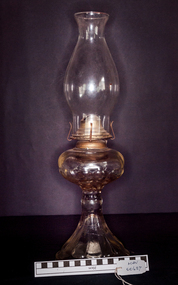
Lights, kerosene chamber lamp, 19thC
... uses kerosene as a fuel. Kerosene lamps have a wick or mantle as light source, protected by a glass chimney or globe; lamps may be used on a table, or hand-held lanterns may used for portable lighting. ...uses kerosene as a fuel. Kerosene lamps have a wick or mantle as light source, protected by a glass chimney or globe; lamps may be used on a table, or hand-held lanterns may used for portable lighting. ...The kerosene lamp is a type of lighting device that uses kerosene as a fuel. Kerosene lamps have a wick or mantle as light source, protected by a glass chimney or globe; lamps may be used on a table, or hand-held lanterns may used for portable lighting. There are three types of kerosene lamp: traditional flat wick, central draught (tubular round wick), and mantle lamp. The side screws adjust the length of the wick and hence the strength of the flame/light produced. Prior to the introduction of gas and electricity these lamps were used for lighting in all households after sunsetPioneers and early settlers relied on kerosene lamps for lighting their homes after sunset.A 19th Century kerosene chamber lamp, with clear, plain glass shade and reservoir, circular metal base and 1 side screw for adjusting the flameearly settlers, pioneers, market gardeners, moorabbin, brighton, bentleigh, ormond, cheltenham, candles, lights, lamps, kerosene, paraffin, oil -
 Montmorency–Eltham RSL Sub Branch
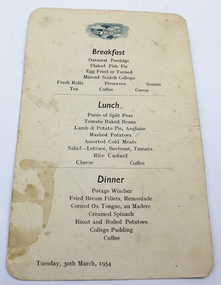
Ephemera - Menu from S.S. New Australia
... It was used on S S New Australia when our soldier Keith Richard Foulkes was returning back to Korea in 1954 He was returning to service for the second time It has S S New Australia at top of sheet across a globe of the world with Australia at the front. ...It was used on S S New Australia when our soldier Keith Richard Foulkes was returning back to Korea in 1954He was returning to service for the second timeCream coloured cardboard sheet with black writing and blue emblem with S S New Australia on globe of the world at the top of page. It has S S New Australia at top of sheet across a globe of the world with Australia at the front. Then there is a Breakfast menu then Lunch and then the Dinner menu at the bottom of the page it is dated Tuesday, 30th March 1954 -
 The Cyril Kett Optometry Museum
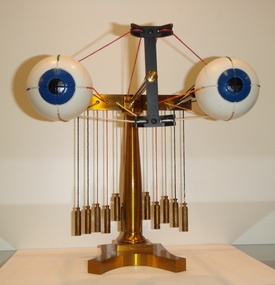
Ophthalmotrope, unknown, (estimated); mid 20th century
... This ophthalmotrope is the one that was used as a teaching aid in the College from the mid 20th century. optometry ophthalmology ophthalmotrope eye eye movements extra ocular muscles eye muscles eye teaching Brass framed model to illustrate actions of extra-ocular muscles. Two painted wooden globes ...This model was used in lectures in the College from the mid 20th century. An ophthalmotrope is a mechanical model constructed to demonstrate the movements of the eyes and the actions of the various muscles which produce them. The first ophthalmotrope was made by Theodore Reute in 1845 and it was he who gave it the name 'ophthalmotrope'. Frans Donders (1818-1889) became interested in eye movements on reading Reute's work, and his subsequent studies were of physiological interest and also provided the basis for principles underlying the correction of squint. Because of the complexity of the actions and counter actions of the eye muscles, ophthalmologists of the 19th century sought a practical solution with the construction of mechanical models. Reute's second model of 1857 was more sophisticated. Its eyeballs contained lenses and the optical system could be moved backwards and forwards to simulate accommodation. Later ophthalmotropes are known by Landolt, Knapp and Snellen.This ophthalmotrope is the one that was used as a teaching aid in the College from the mid 20th century.Brass framed model to illustrate actions of extra-ocular muscles. Two painted wooden globes mounted in brass frame with coloured strings attached to brass weights positioned to show actions of various extra-ocular muscles. Also wooden storage box. Materials: brass, metal, wood, string.optometry, ophthalmology, ophthalmotrope, eye, eye movements, extra ocular muscles, eye muscles, eye teaching -
 Flagstaff Hill Maritime Museum and Village
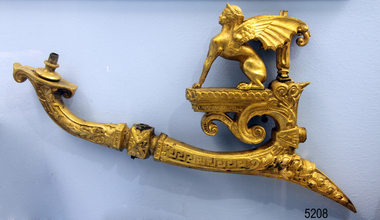
Functional object - Gas lamp wall bracket, Late 19th to early 20th Century
... globes and had an overall ornate look making the lamp ascetically pleasing and protecting the flame from being blown out. However, this arrangement was extremely inefficient: To get as much light as possible, the gas had to be turned fully up, resulting in large sheets of flame rising towards a ceiling. Also, because the lamp had to be point upwards, the illumination was directed upwards, i.e. at the ceiling rather than where it was needed. So the usable...globes and had an overall ornate look making the lamp ascetically pleasing and protecting the flame from being blown out. However, this arrangement was extremely inefficient: To get as much light as possible, the gas had to be turned fully up, resulting in large sheets of flame rising towards a ceiling. Also, because the lamp had to be point upwards, the illumination was directed upwards, i.e. at the ceiling rather than where it was needed. So the usable ...Gas lamps worked by heating something called a 'mantle' with a gas flame. The mantle then glowed brightly, lighting up the room. Lamps had either two chains, for a ceiling-mounted lamp or a tap for a wall-mounted burner to turn off the gas. These chains or taps could also adjust the flow of the gas and hence the brightness of the mantle. Before Carl Auer von Welsbach invented the gas mantle in the 1890s, all gas lights in homes and street lights had simple gas jets that pointed upwards. In the home, these lights were covered with glass globes and had an overall ornate look making the lamp ascetically pleasing and protecting the flame from being blown out. However, this arrangement was extremely inefficient: To get as much light as possible, the gas had to be turned fully up, resulting in large sheets of flame rising towards a ceiling. Also, because the lamp had to be point upwards, the illumination was directed upwards, i.e. at the ceiling rather than where it was needed. So the usable light for a given amount of gas was minimal but the invention of the gas mantle eventually changed this. It enabled gas lights to have a small flame and to direct their light downwards. The item is significant as it is part of a very ornate gas lamp wall bracket from the late 19th to early 20th century. Its provenance is currently unknown and at this time cannot be associated with a historical event, person or place and the item is assessed as a collective asset.Gas lamp wall bracket; part of a gas lamp. A single burner fancy wall mounted bracket, brass, ornate and decorative, featuring a Lamassu - figure with the body of a lion , wings of an eagle and human head. It was recovered from the wreck of the Loch ArdNoneflagstaff hill, warrnambool, flagstaff-hill, flagstaff-hill-maritime-museum, shipwreck-coast, flagstaff-hill-maritime-village, gas lamp, brass lamp, gas burner bracket, domestic artifact, gas lighting, gas lamp bracket -
Hamilton Pastoral Museum
Candlabrum, Untitled et al, 1861 approx
... Used for lighting in the church with candles then converted to electricity 1940s ___ # A Candlabrum 3 candle holder origionaly for candles now converted to electric globes Candlabrum Untitled ...Used for lighting in the church with candles then converted to electricity 1940s Candlabrum 3 candle holder origionaly for candles now converted to electric globes___ # A
