
Showing 10 items matching "utopian"
-
 Whitehorse Historical Society Inc.
Document, Herrnhut, 2002
... Pages from 'Herrnhut; Australia's first Utopian commune' by William James Metcalf and Elizabeth Huf, concerning Algernon John Elmore. ...Elmore Algernon John Herrnhut Pages from 'Herrnhut; Australia's first Utopian commune' by William James Metcalf and Elizabeth Huf, concerning Algernon John Elmore. ...Pages from 'Herrnhut; Australia's first Utopian commune' by William James Metcalf and Elizabeth Huf, concerning Algernon John Elmore.Pages from 'Herrnhut; Australia's first Utopian commune' by William James Metcalf and Elizabeth Huf, concerning Algernon John Elmore. Incl. photos of Elmore Family and Algernon as a child.Pages from 'Herrnhut; Australia's first Utopian commune' by William James Metcalf and Elizabeth Huf, concerning Algernon John Elmore. elmore, algernon john, herrnhut -
 City of Stonnington
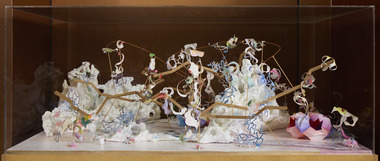
Nathan Gray, Untitled, 2009
... ...Utopian...Stonnington contemporary art collection Nathan Gray Sculpture Mixed Media Utopian Ecology Untitled Nathan Gray ...Nathan Gray is an artist and experimental musician whose work is optimistic, dynamic and festive. It is often characterised by its utopian or optimistic tones, and dynamic physical construction. Gray builds incredible structures from humble materials, and complex networks from simple ideas. His practice incorporates a multitude of process-based elements, often using a method that parallels brainstorming or mind mapping, in an attempt to explore links between craft, sound, culture and ecology. stonnington contemporary art collection, nathan gray, sculpture, mixed media, utopian, ecology -
 Robin Boyd Foundation
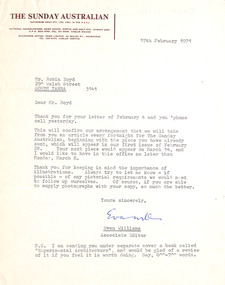
Letter, The Sunday Australian, Evan Williams (The Sunday Australian) to Robin Boyd, 17.02.1971
... Boyd wrote about this book in the article 'Utopians versus the Squares' (See D055)....Boyd wrote about this book in the article 'Utopians versus the Squares' (See D055). There is an extra page where Robin Boyd wrote down the address of Associate Editor and the dates and arrangements discussed in the letter. ...This letter from the Assistant Editor, Evan Williams, confirms the arrangement that Robin Boyd will write a piece for The Sunday Australian every fortnight, starting with the first edition on 28 February, 1971. It also states that the book 'Experimental Architecture' (Peter Cook, 1970) is being sent to Boyd and they would be glad of his review. Boyd wrote about this book in the article 'Utopians versus the Squares' (See D055).Quarto, letter plus extra page.There is an extra page where Robin Boyd wrote down the address of Associate Editor and the dates and arrangements discussed in the letter. -
 Robin Boyd Foundation
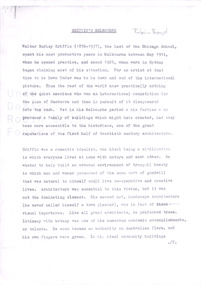
Document, Robin Boyd, Griffin's Melbourne, 1964
... Boyd discusses the utopian tendencies of Griffin as well as his temperament and approach to practice. ...Boyd discusses the utopian tendencies of Griffin as well as his temperament and approach to practice. ...Boyd discusses the influence and legacy of the work of Walter Burley Griffin on Melbourne's architecture. Boyd discusses the utopian tendencies of Griffin as well as his temperament and approach to practice. The text goes on to discuss Griffin's exemplary works including the Capitol Building and Leonard House and the ongoing legacy of Griffin's work. Griffin's patented construction system, 'Knitlock', is also discussed with exemplary projects using this system mentioned. Griffin's influence is concluded as initially controversial and jarring to the conservative nature of Melbourne suburbia, but later becomes exemplary work and essential to the progression of Melbourne's architecture.Typewritten, photocopy, 15 pages, A4, 210x297.Signature. Pencil mark up on page 2, 3, 4, 6, 7, 9, 14.walter burley griffin, chicago school, melbourne, sydney, canberra, a.s. eggleston, edward billson, marion griffin, knitlock, capitol theatre, leonard house. -
 Merri-bek City Council
Gloss enamel painted paper collage, Louise Paramor, Boomtown, 2016
... In this work, Paramor creates a utopian building from collaged pieces of paper, which have been painted in planes of coloured enamel. ...In this work, Paramor creates a utopian building from collaged pieces of paper, which have been painted in planes of coloured enamel. ...Louise Paramor says, “I just love colour and playing around with it, it makes me feel good. I get a kick out of harmonising colour in conjunction with form. I think if there was more finely tuned colour in the world it would be a better place. There exists a lot of untamed colour in the everyday and to me this is often creates a feeling that is the opposite of uplifting.” In this work, Paramor creates a utopian building from collaged pieces of paper, which have been painted in planes of coloured enamel. Often these collages become sculptures, for which Paramor is mainly known. Andy Gomez writes of Boomtown, “Louise Paramor invites us into her own fabricated domain, where colours are coherent and vivid, buildings are unique and non-conformist, where public sculpture exists for the sake of form, colour, line, and levity. There is an inherent optimism at work here, exalting the accomplishments and ingenuity of the urban sprawl and the enforced participation of a shared culture and experience that offers.” -
 Flagstaff Hill Maritime Museum and Village
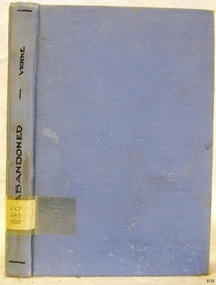
Book - A Fictional Adventure Story, Jules Verne, Abandoned, 1892
... The story blends adventure, technology, and social Utopian themes, showing how rational cooperation can triumph over hardship and moral degeneration. ..."Abandoned" is the second part of Jules Verne’s “The Mysterious Island trilogy”, continuing the story of a group of castaways testing their ingenuity and courage on a remote Pacific island. The 1892 Sampson Low, Marston, Searle & Rivington edition is an early English language reprint of this work.This novel is not among Verne’s absolute core masterpieces like “Twenty Thousand Leagues Under the Seas” or “Around the World in Eighty Days”. Abandoned (also known as its original French title, "L’Île mystérieuse: Deuxième partie L’Abandonné" picks up the narrative of five or six men (including the engineer Cyrus Harding and the sailor Pencroff) who have already survived a balloon crash and built a rudimentary civilisation on a seemingly uninhabited island. As they explore the island further, they discover signs of a mysterious benefactor and eventually meet the “abandoned” character Ayrton, a former convict who has lived in isolation while the island itself faces natural and human threats that test their survival and moral choices. The story blends adventure, technology, and social Utopian themes, showing how rational cooperation can triumph over hardship and moral degeneration.Hard cover book, Abandoned. Author: Jules Verne Publisher: Sampson Low Marston Searle and Rivington, St. Dunstans House, Fetter Lane Fleet Street, London. EC. Date: 1892 Light blue hardcover with the title on the spine having lettering to spine in black hand written text pen. fiction"Abandoned" is the second part of Jules Verne’s “The Mysterious Island trilogy”, continuing the story of a group of castaways testing their ingenuity and courage on a remote Pacific island. The 1892 Sampson Low, Marston, Searle & Rivington edition is an early English language reprint of this work.This novel is not among Verne’s absolute core masterpieces like “Twenty Thousand Leagues Under the Seas” or “Around the World in Eighty Days”. Abandoned (also known as its original French title, "L’Île mystérieuse: Deuxième partie L’Abandonné" picks up the narrative of five or six men (including the engineer Cyrus Harding and the sailor Pencroff) who have already survived a balloon crash and built a rudimentary civilisation on a seemingly uninhabited island. As they explore the island further, they discover signs of a mysterious benefactor and eventually meet the “abandoned” character Ayrton, a former convict who has lived in isolation while the island itself faces natural and human threats that test their survival and moral choices. The story blends adventure, technology, and social Utopian themes, showing how rational cooperation can triumph over hardship and moral degeneration.warrnambool, shipwrecked-coast, flagstaff-hill, flagstaff-hill-maritime-museum, maritime-museum, flagstaff-hill-maritime-village, shipwrecked-artefact, book, warrnambool mechanics’ institute, pattison collection, warrnambool library, corangamite regional library service, warrnambool city librarian, mechanics’ institute library, victorian library board, warrnambool books and records, warrnambool children’s library, ralph eric pattison, jules verne, voyages extraordinaire series, l’école des robinson's -
 Robin Boyd Foundation
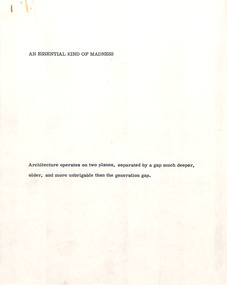
Document - Manuscript, Robin Boyd, An Essential Kind of Madness, 1970/1971
... Original manuscript of an article published as 'Utopians versus the squares' in "The Sunday Australian", 1971. ...Discusses pragmatic buildings in contrast to the architecture of dreamers, experimenters and idealists through a review of Peter Cook's book "Experimental Architecture".Original manuscript of an article published as 'Utopians versus the squares' in "The Sunday Australian", 1971.Typewritten (c copy), quarto, 9 pagespeter cook, archigram, experimental architecture, robin boyd, manuscript -
![Book - Novel, Lytton, Lord [Edward George Earle Lytton Bulwer-Lytton] [=Baron Lytton, Lord Lytton], The coming race, 1874](/media/collectors/641920217f0478323d8a47a8/items/688330cd6053c9a908c48e30/item-media/68f5b45ed44fd839782883f6/item-fit-380x285.jpg?cb=6) Linton Mechanics Institute and Free Library Collection
Linton Mechanics Institute and Free Library CollectionBook - Novel, Lytton, Lord [Edward George Earle Lytton Bulwer-Lytton] [=Baron Lytton, Lord Lytton], The coming race, 1874
... The protagonist, a wealthy American, discovers the existence of a highly advanced race, the Vril-ya, who live a Utopian existence beneath the surface of the Earth but intend to use their advanced and unusual powers to conquer and do away with humanity. 248 p. : dark green cover, "The Knebworth Edition" embossed in gold on front, title and author's name in gold on spine. ...Originally published as 'Vril : the power of the coming race'. The protagonist, a wealthy American, discovers the existence of a highly advanced race, the Vril-ya, who live a Utopian existence beneath the surface of the Earth but intend to use their advanced and unusual powers to conquer and do away with humanity.248 p. : dark green cover, "The Knebworth Edition" embossed in gold on front, title and author's name in gold on spine.fictionOriginally published as 'Vril : the power of the coming race'. The protagonist, a wealthy American, discovers the existence of a highly advanced race, the Vril-ya, who live a Utopian existence beneath the surface of the Earth but intend to use their advanced and unusual powers to conquer and do away with humanity.fiction, lord lytton, science fiction -
 Flagstaff Hill Maritime Museum and Village
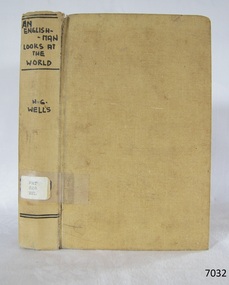
Book - A Collection of Essays, H G Wells, An Englishman Looks At the World, 1914
... The novel was for connecting Wells's own Utopian writings elsewhere in his career. Its real significance is scholarly as it's a primary-source window into pre-war Edwardian opinion from one of the era's most-read public commentators. ...Published in 1914, this is a collection of essays by H.G. Wells consisting of journalistic pieces written between 1909 and 1914, spanning twenty-six pieces ranging from five to sixty-two pages in length. Roughly half of the essays were originally printed in the Daily Mail between 1904 and 1913, with ten more appearing in nearly as many weekly and monthly papers, and three others having had prior publication in volume form. The subjects range widely flight and aviation with the opening with Blériot's Channel crossing, the monarchy, imperialism, labour and socialism, modern warfare, sociology, divorce, education, motherhood, the future of civilisation, and more. It's essentially Wells thinking aloud in print opinionated, topical journalism rather than fiction, reflecting a period when he was consciously stepping back from novel-writing to comment directly on contemporary affairs. A companion American edition was published the same year by Harper and Brothers under the different title Social Forces in England and America.Hard Cover Book. An English Man Looks At The World Author: HG Wells Publisher: Cassell & Co Date: 1914 Further Information: Yellow Cloth hardcover with lettering and patterning to spine in black. The spine has a Library label with an inscription.fictionPublished in 1914, this is a collection of essays by H.G. Wells consisting of journalistic pieces written between 1909 and 1914, spanning twenty-six pieces ranging from five to sixty-two pages in length. Roughly half of the essays were originally printed in the Daily Mail between 1904 and 1913, with ten more appearing in nearly as many weekly and monthly papers, and three others having had prior publication in volume form. The subjects range widely flight and aviation with the opening with Blériot's Channel crossing, the monarchy, imperialism, labour and socialism, modern warfare, sociology, divorce, education, motherhood, the future of civilisation, and more. It's essentially Wells thinking aloud in print opinionated, topical journalism rather than fiction, reflecting a period when he was consciously stepping back from novel-writing to comment directly on contemporary affairs. A companion American edition was published the same year by Harper and Brothers under the different title Social Forces in England and America.warrnambool, shipwrecked-coast, flagstaff-hill, flagstaff-hill-maritime-museum, maritime-museum, shipwreck-coast, flagstaff-hill-maritime-village, shipwrecked-artefact, book, an englishman looks at the world, h g wells, warrnambool mechanics’ institute, pattison collection, warrnambool library, ralph eric pattison, corangamite regional library service, warrnambool city librarian, mechanics’ institute library, victorian library board, warrnambool books and records, warrnambool children’s library -
Linton Mechanics Institute and Free Library Collection
Book - Novel, Collins, Wilkie, The fallen leaves : First series in three volumes : Vol. II ; Book the fourth (continued). Love and Money, 1879
... Fiction Literature Wilkie Collins The plot details American Christian Socialist Amelius Goldenheart's sojourn to England after exile from his Utopian commune, and his difficulties when elements of his past life resurface. ...The plot details American Christian Socialist Amelius Goldenheart's sojourn to England after exile from his Utopian commune, and his difficulties when elements of his past life resurface.269p. ; Chatto & Windus's List of Books p.1-40 ; beige cover with title and drawing of leaves embossed on front cover in blackfictionThe plot details American Christian Socialist Amelius Goldenheart's sojourn to England after exile from his Utopian commune, and his difficulties when elements of his past life resurface.fiction, literature, wilkie collins
