
Showing 41 items matching "victoria description and travel"
-
 Phillip Island and District Historical Society Inc.
Book, BRADLEY, David, Within the plains of paradise : a brief social history of Rhyll, Phillip Island, 1997
... ...travel......travel...History of Rhyll phillip island victoria description travel rhyll history Stamped 'Phillip Island & District Historical Society'. ...History of RhyllStamped 'Phillip Island & District Historical Society'. Signed by the authors, November 1997.phillip island, victoria, description, travel, rhyll, history -
 Eltham District Historical Society Inc
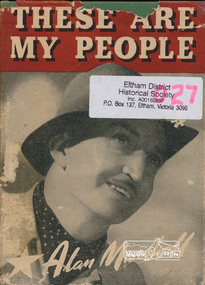
Book, Alan Marshall (1902-1984), These are my people / by Alan Marshall, 1944
... ...victoria description and travel...alan marshall victoria description and travel travel reminiscences anecdotes country life Hardback with dust jacket; 202 p. : ill., map ; 19 cm. ...Hardback with dust jacket; 202 p. : ill., map ; 19 cm.alan marshall, victoria description and travel, travel, reminiscences, anecdotes, country life -
 Eltham District Historical Society Inc
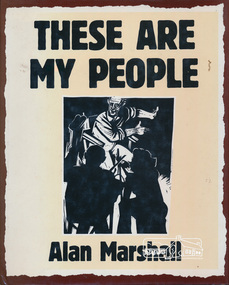
Book, These are my people by Alan Marshall, illustrated by Rick Amor, 1984
... ...victoria description and travel...The illustrations in this book are reproduced from original lineocuts from Rick Amor alan marshall rick amor country life travel anecdotes reminiscences victoria description and travel Hard back These are my people by Alan Marshall, illustrated by Rick Amor Book Curry O'Neil Ross Pty Ltd ...First published 1944. This edition first published 1984. The illustrations in this book are reproduced from original lineocuts from Rick AmorHard backalan marshall, rick amor, country life, travel, anecdotes, reminiscences, victoria description and travel -
Phillip Island and District Historical Society Inc.
Book, GLIDDON, Joshua Wickett, Phillip Island in picture and story, 1977
... ...travel...Phillip Island victoria history description travel marsupials Phillip Island in picture and story Book GLIDDON, Joshua Wickett Committee of Trust "Warley", Cowes Bush Nursing Hospital ...phillip island, victoria, history, description, travel, marsupials -
Phillip Island and District Historical Society Inc.
Book, GLIDDON, Joshua Wickett, Phillip Island in picture and story, 1968
... ...travel...phillip island victoria history description travel marsupials Stamped 'Phillip Island & District Historical Society'. ...Stamped 'Phillip Island & District Historical Society'. Signed by the compiler March 1974.phillip island, victoria, history, description, travel, marsupials -
Phillip Island and District Historical Society Inc.
Book, GLIDDON, Joshua Wickett, Phillip Island in picture and story, 1968
... ...travel...phillip island victoria history description travel marsupials Phillip Island in picture and story Book GLIDDON, Joshua Wickett Committee of Trust "Warley", Cowes Bush Nursing Hospital ...phillip island, victoria, history, description, travel, marsupials -
Phillip Island and District Historical Society Inc.
Book, GLIDDON, Joshua Wickett, Phillip Island in picture and story, 1977
... ...travel...phillip island victoria history description travel marsupials Phillip Island in picture and story Book GLIDDON, Joshua Wickett Committee of Trust "Warley", Cowes Bush Nursing Hospital ...phillip island, victoria, history, description, travel, marsupials -
Phillip Island and District Historical Society Inc.
Book, GLIDDON, Joshua Wickett, Phillip Island in picture and story, 1958
... ...travel...phillip island victoria history description travel marsupials Stamped 'J.T.& D.Taylor, 109 Church St., Cowes, Phillip Island 3922'. ...Stamped 'J.T.& D.Taylor, 109 Church St., Cowes, Phillip Island 3922'.phillip island, victoria, history, description, travel, marsupials -
Phillip Island and District Historical Society Inc.
Book, GLIDDON, Joshua Wickett, Phillip Island in picture and story, 1958
... ...travel...phillip island victoria history description travel marsupials Boxed Presentation copy. ...Boxed Presentation copy. Stamped 'P.I. Municipal Library. Not to be removed'. Stamped 'Phillip Island & District Historical Society'. Labelled 'Cowes Free Public Library no. 287c'. Signed by the compiler. Includes bookmark.phillip island, victoria, history, description, travel, marsupials -
Phillip Island and District Historical Society Inc.
Book, GLIDDON, Joshua Wickett, Phillip Island in picture and story, 1968
... ...travel...phillip island victoria history description travel marsupials Phillip Island in picture and story Book GLIDDON, Joshua Wickett Committee of Trust "Warley", Cowes Bush Nursing Hospital ...phillip island, victoria, history, description, travel, marsupials -
 Flagstaff Hill Maritime Museum and Village
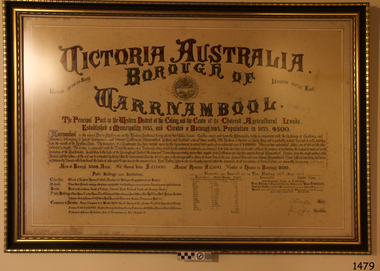
Document - Framed Poster, Borough of Warrnambool, Victoria, Australia, after 30/06/1875
... descriptions of Farm Produce are annually increasing. Area of Borough, 3362 Acres. Net Annual Value £27,000. Annual Revenue £5,500. Number of Houses in Borough 800. Public Buildings and Institutions Churches. Church of England, Roman Catholic, Presbyterian, Wesleyan, Congregational and Baptist. Schools. Three State Schools, average attendance nearly 1000. New Building in course of erection. Several private establishments. Banks. Bank of Australasia, Bank of Victoria ...This document, also referred to as a word picture or Tablet, is framed in glass and timber with gilt trim, is handwritten with colour highlights. The penned letters rest on ruled guide lines, decorated where the lines intersect. The writing gives a description of the state of Borough of Warrnambool around 1875; its location, the area it covers, its population, Harbour and facilities, public buildings and institutions, imports and exports, financial worth, number of houses, connection with other areas of the Colony. A possible reason and origin for the document is found in an article ‘Link with US Exhibition’ from the Warrnambool Standard of December 19, 1981, written by local historian Bruce Morris. The writer mentions that the Warrnambool Borough Council met on 15th June 1875 and recorded a letter from G.C. Levey , secretary to the Melbourne group of commissioners representing the Colony, and Victoria in particular, for the Philadelphia Centennial Exhibition of 1876. The letter asks Council to provide “statistics as to the population, social condition and commercial and industrial state of the district in and around Warrnambool.” A sub committee was formed for the project. The Mayor, Cr. Thomas King, wrote and signed a Report, presented to the council on July 14, 1875, in which “The Committee … begs to recommend that a Tablet be prepared setting for the particulars respecting the following matters relating to the Borough”. The matters included area, population, annual income, churches, schools, other public buildings, societies and companies, general description of houses erected, and returns of exports and imports for 1874. The minutes note that the Report was adopted. The article above also notes the opinion of Warrnambool printers who have examined the document; it is almost certainly to be an old lithograph, which means there could be several copies. It is possible that there may be a copy in Melbourne and another in Philadelphia. It is interesting to note that (1) the quoted location co-ordinates are for an “Unnamed Road, Packsaddle NSW 2880, Australia”, and that the DMS co-ordinates for Warrnambool’s Council Offices differ, being 38.23.9.12 South, 142.28.52.887. (2) the date for “Exports and Imports for the Year Ending 30th June 1875” is different to the period mentioned by Cr. King in the sub committee’s Report of recommendation “returns of exports and imports for 1874”. The information required to have the figures for the end of June 1875 would need to have been compiled very quickly for the Tablet to be ready for the opening of the Philadelphia Exhibition on 10 May 1876. The document/certificate shows the following – - - - - - - - - - - - - - - -- - - - - - - - - - - - - - -- - - - - - - - - - - - - - -- - - - - - - - - - - - - - - “Victoria Australia, Borough of Warrnambool. Latitude, 30.24.50 South, Longitude 142.32 East The Principal Port in the Western District of the Colony and the Centre of its Choicest Agricultural Lands. Established a Municipality in 1855, and Created a Borough 1863. Population in 1875 4,500. Warrnambool is the nearest Port to Melbourne on the Western Seaboard, being about 160 miles distant. Coaches run to and from the Metropolis daily, in connexion [connection] with the Railway of Geelong and Steamers belonging to Local Companies sail between Melbourne, Warrnambool, Belfast [renamed Port Fairy], and Portland several times weekly. The Harbour is known as Lady Bay, and is partially protected by a reef of rocks stretching from the mouth of the Hopkins River. The formation of a Breakwater has been decided upon by the Government, to extend 600 yards, at an estimated cost of £100,000. There are two substantial Jetties, one of 800 and the other of 600 feet in length. The former is connected with the Town by means of a Tramroad, along which Goods, inwards & outwards, are conveyed, & the latter has been constructed solely for the purpose of facilitating the transit of material for the formation of the Breakwater. In addition to the trade of the Borough and District, the principal Townships up country receive their supplies from Melbourne and ship their exports through Warrnambool. Potatoes form the staple produce of the district, and the richness of the soil can be estimated by the fact that the Government Statistics for 1875 give as the average yield a return of Seven Tons to the acre. Several thousand acres between Warrnambool and Tower Hill are now being laid down in Potatoes by Tenants who have leased the lands at rates up to £5 per acre for the season 1875-6. Wool, Tallow, hides &c are also largely exported, while the shipments of all descriptions of Farm Produce are annually increasing. Area of Borough, 3362 Acres. Net Annual Value £27,000. Annual Revenue £5,500. Number of Houses in Borough 800. Public Buildings and Institutions Churches. Church of England, Roman Catholic, Presbyterian, Wesleyan, Congregational and Baptist. Schools. Three State Schools, average attendance nearly 1000. New Building in course of erection. Several private establishments. Banks. Bank of Australasia, Bank of Victoria, National Bank, Colonial Bank and Savings Bank. Public Buildings. Court house, Custom house, Post & Telegraph Offices, Survey & Land Offices, Shire £, Town Hall, Mechanics Institute, Volunteer Orderly Room, Odd Fellows Hall, Hospital & Benevolent Asylum, Temperance Hall &c. Companies & Societies. Steam Navigation Co, Woolen Mill Co, Gas Co, Racing Club, Amateur Turf Club, Agricultural Society, Farmers’ Club, Cricket Club, Anglers’ Society, Building Society, Freemasons Odd Fellows, Foresters, Druids, Hibernians. Protestant Alliance, Rechabites, Sons of Temperance, &c, Fire Brigade &c. --- Exports and Imports for the Year Ending 30th June 1875 –-- --Exports Total Tonnage 27,800 (Calculated at the Current Warrnambool Market Prices) Potatoes Wool Wheat Barley Hides Skins Fowls Butter Cheese Eggs Tallow Leather Ale Pigs Sheep Sundries --Imports 13,000 Tons Of the Estimated Value of £520,000 Total Tonnage of Exports and Imports 40m900 Tons, Value £806,627 Passenger Travels, to ad from Warrnambool during year, 10,000 persons Revenue from all sources paid through Warrnambool Sub Treasury From 1860 to June 1875 £1, 292, 300 Thomas King [signed] Mayor Henry T Read [signed] Town Clerk” - - - - - - - - - - - - - - -- - - - - - - - - - - - - - -- - - - - - - - - - - - - - -- - - - - - - - - - - - - - - The document is of historical, social, economic and local significance in that it summarises activities, business, community, trade, travel and government at a point in time in Warrnambool’s history – 30th June 1875.Document, also referred to as a ‘word picture’ or ‘tablet’. Document is framed in glass and timber with gilt trim, handwritten with colour highlights. The penned letters rest on ruled guide lines, decorated where the lines intersect. Document outlines the establishment of Warrnambool as a Municipality in 1855 and Borough in 1863, with a population of 4,500 in 1875. It states geographic location, public buildings and institutions, harbor facilities and imports and exports for the year ending 30th June 1875. Two signatures "Thomas King" Mayor and "Henry T Read" Town Clerk. It shows the Coat of Arms of the Borough of Warrnambool.Signatures - "Thomas King" Mayor and "Henry T Read" Town Clerk. Warrnambool Coat of Arms; “British Coat of Arms, above sailing vessel and sheaf of wheat in sun, motto “By these we flourish” and around circumference “Borough of Warrnambool 1855”flagstaff hill, warrnambool, shipwrecked coast, flagstaff hill maritime museum, maritime museum, shipwreck coast, flagstaff hill maritime village, great ocean road, borough of warrnambool, municipality of warrnambool, document borough of warrnambool 1875, word picture of warrnambool 1875, tablet of borough of warrnambool 1875, statistics borough of warrnambool 1875, lithograph borough of warrnambool 1875, coat of arms warrnambool, warrnambool city motto – in these we flourish, establishment of warrnambool, warrnambool history, thomas king mayor of warrnambool, henry t read town clerk of warrnambool, warrnambool breakwater, warrnambool jetty, warrnambool imports and exports 1875, warrnambool agriculture 1875, warrnambool business 1875, warrnambool population 1875, centennial exhibition philadelphia 1876, framed certificate -
 Marysville & District Historical Society
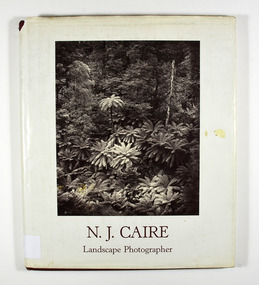
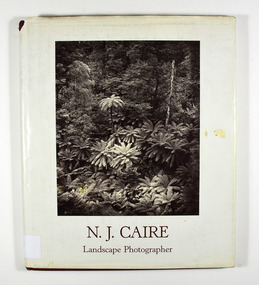
Book - Hardcover book, N.J. Caire Landscape Photographer, 1988
... description...travel...views...anne pitkethly...don pitkethly...nicholas john caire...victoria...Victoria. Photographs by Nicholas John Caire are among the most widely published late nineteenth and early twentieth-century Australian photographs. Between 1875 and 1905 Nicholas Caire travelled the Victorian countryside, looking to capture the scenery for the commercial market. His artistic sensitivity created images which earned him popular acceptance during his lifetime and an enduring place as one of Australia's finest landscape photographers. photographers australia photograpy landscapes history description travel views anne pitkethly don pitkethly nicholas john caire victoria For Jane and Clare Hardcover. ...A book of photographs taken by Nicholas John Caire of places and scenery throughout Victoria.A book of photographs taken by Nicholas John Caire of places and scenery throughout Victoria. Photographs by Nicholas John Caire are among the most widely published late nineteenth and early twentieth-century Australian photographs. Between 1875 and 1905 Nicholas Caire travelled the Victorian countryside, looking to capture the scenery for the commercial market. His artistic sensitivity created images which earned him popular acceptance during his lifetime and an enduring place as one of Australia's finest landscape photographers.Hardcover. Front cover photograph-Fairy Scene at the Landslip, Blacks' Spur c1878-9; taken by Nicholas John Caire.For Jane and Clarephotographers, australia, photograpy, landscapes, history, description, travel, views, anne pitkethly, don pitkethly, nicholas john caire, victoria -
 Marysville & District Historical Society
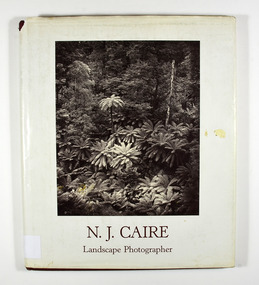
Book - Hardcover book, N.J. Caire Landscape Photographer, 1988
... description...travel...views...anne pitkethly...don pitkethly...nicholas john caire...victoria...Victoria. Photographs by Nicholas John Caire are among the most widely published late nineteenth and early twentieth-century Australian photographs. Between 1875 and 1905 Nicholas Caire travelled the Victorian countryside, looking to capture the scenery for the commercial market. His artistic sensitivity created images which earned him popular acceptance during his lifetime and an enduring place as one of Australia's finest landscape photographers. photographers australia photograpy landscapes history description travel views anne pitkethly don pitkethly nicholas john caire victoria For Jane and Clare Hardcover. ...A book of photographs taken by Nicholas John Caire of places and scenery throughout Victoria.A book of photographs taken by Nicholas John Caire of places and scenery throughout Victoria. Photographs by Nicholas John Caire are among the most widely published late nineteenth and early twentieth-century Australian photographs. Between 1875 and 1905 Nicholas Caire travelled the Victorian countryside, looking to capture the scenery for the commercial market. His artistic sensitivity created images which earned him popular acceptance during his lifetime and an enduring place as one of Australia's finest landscape photographers.Hardcover. Front cover photograph-Fairy Scene at the Landslip, Blacks' Spur c1878-9; taken by Nicholas John Caire.For Jane and Clarephotographers, australia, photograpy, landscapes, history, description, travel, views, anne pitkethly, don pitkethly, nicholas john caire, victoria -
 Marysville & District Historical Society
Book, N.J. Caire Landscape Photographer, 1988
... description...travel...views...anne pitkethly...don pitkethly...victoria...Victoria. Photographs by Nicholas John Caire are among the most widely published late nineteenth and early twentieth-century Australian photographs. Between 1875 and 1905 Nicholas Caire travelled the Victorian countryside, looking to capture the scenery for the commercial market. His artistic sensitivity created images which earned him popular acceptance during his lifetime and an enduring place as one of Australia's finest landscape photographers. nicholas j caire photographers australia photograpy landscapes history description travel views anne pitkethly don pitkethly victoria For Jane and Clare Hardcover. ...A book of photographs taken by Nicholas John Caire of places and scenery throughout Victoria.A book of photographs taken by Nicholas John Caire of places and scenery throughout Victoria. Photographs by Nicholas John Caire are among the most widely published late nineteenth and early twentieth-century Australian photographs. Between 1875 and 1905 Nicholas Caire travelled the Victorian countryside, looking to capture the scenery for the commercial market. His artistic sensitivity created images which earned him popular acceptance during his lifetime and an enduring place as one of Australia's finest landscape photographers.Hardcover. Front cover photograph-Fairy Scene at the Landslip, Blacks' Spur c1878-9; taken by Nicholas John Caire.For Jane and Clarenicholas j caire, photographers, australia, photograpy, landscapes, history, description, travel, views, anne pitkethly, don pitkethly, victoria -
Federation University Historical Collection
Document, Zelda Martin, Central Victorian Goldmining towns - Boom Towns or Ghost Towns?, c1996
... Victoria', John Quick. References the Haines Land Bill, land tenure and Land Leagues. [.17] Light blue envelope folder titled 'Birtchnell's Ballarat, etc. Directory 1862 *Contains various directories for Smythesdale, Buninyong, Clunes, Brown's and Creswick. [.18] Red envelope folder no.2 titled Victorian Gazetteer *Selected pages from 1869 Victorian Gazetteer on A4 paper (with a handwritten note questioning if some pages are from 1868 Victorian Gazetteer as appears to be different sizes - A3 pages.) Information includes locations and descriptions...Victoria', John Quick. References the Haines Land Bill, land tenure and Land Leagues. [.17] Light blue envelope folder titled 'Birtchnell's Ballarat, etc. Directory 1862 *Contains various directories for Smythesdale, Buninyong, Clunes, Brown's and Creswick. [.18] Red envelope folder no.2 titled Victorian Gazetteer *Selected pages from 1869 Victorian Gazetteer on A4 paper (with a handwritten note questioning if some pages are from 1868 Victorian Gazetteer as appears to be different sizes - A3 pages.) Information includes locations and descriptions ...Zelda Martin was a PhD candidate at the University of Melbourne.[.1] 4th item in light blue display book titled Research Approach/Overview of Chapters/Confirmation of Canditure/Chapters1,2,3&4 of proposed thesis. *Twenty-seven page article on Victorian goldfields towns titled: Central Victorian Goldmining Towns - Boom Towns or Ghost Towns. The article was written during the author's PhD study. It outlines the context methodology, and resources and the chapters of the proposed thesis: (1) Central Victorian Goldmining Towns - The Context (2) Contemporary Views of the Factors Necessary for Town Growth (3) Outward Manifestations of Town Growth (4) The Trappings of Government (5-9) The Main Towns and Their Hinterland. [.2] 5th item in Light Blue display book as above item. *Chapter 1 of proposed thesis titled 'Pick, Shovel and Tin Dish Mining.' Covers in Section A: Central Victoria - Pre 1851: Aborigines in Central Victoria, Squatters, and Government. Section B: The years 1851-1854: The Early Gold Rushes, Government Reaction, Township Surveys, Legislation, Town Development, Local Government and Early Settlement. [.3] 6th item in Light Blue display book as above item. *2A of proposed thesis titled 'Contemporary Views of the Factors Necessary for Town Growth'. Similar information to Chapter 1 plus extra re towns and maps. Sections: Introduction, Context of Place - Geographical Towns Listed, The Context of Time - Pre1851 Aborigines, Governance of Port Phillip, The Squatters, The Villages of Central Victorian Highlands, Conclusion, Condensed Version of Chapter2B. [.4] 7th item in Light Blue display book as above item. *Chapter2B of proposed thesis. Sections: Area of Research, Schools, Banks, Newspapers, Progress Association, Town Development - Sandhurst (Bendigo), Ballarat, Castlemaine,, Maryborough, Ararat and Stawell. [.5] 8th item in Light Blue display book as above item. *Chapter 3 of proposed thesis titled 'Outward Manifestations of Town Growth'. Sections: Introduction, Contemporary Writing, Educationalists, The Bankers, The Townsfolk, Current Theory, General Theories of Urban Development, and Conclusion. [.6] 9th item in Light Blue display book as above item. *Chapter 4 of proposed thesis titled 'Trappings of Government' Sections: Introduction, Early Government Attitudes to Mining and Town Development, Law and Order, Township Surveys, Legislation, Local Government, Transport and Communication, The People and Lobbyists. [.7] 10th item in Light Blue display book as above item. *'The Rise and Fall of Central Victorian Goldmining Towns'. Includes a map showing main Goldfields, a table showing towns and villages at two points in time - 1857 and 1871; a Bibliography of Primary and Secondary Sources. [.8] Resource No1. Black display book titled Local Towns 1 : Alma: *Brief history *Directory *Maps Amphitheatre / Mountain Hut: *Brief History Post Office Directory Ararat: *Brief History *Post Office Directory 1869 - Alphabetical Listing by Occupation *Ararat - Prominent Citizens of 1858 *Langi-Morgala Museum Avoca: *Brief History *Excerpts from 'Avoca The Early Years', Margery and Betty Beavis; pg1 - Beginnings; pg11 - The Midas Touch; pg25 - Local Gold Escorts; pg27 - A Town is Born; pg51- The Administration of Justice; pg53 - The Ways of the Law; pg61 - News of the Day; pg65 - A Time to Play; pg72 - Land Ownership *Post Office Directory (Bailliere's) 1869 *Tourism Map and Information of area *Historic Avoca - A 5.5km Tour *Avoca & the Pyrenees Region - information pamphlet Ballarat: *Early History of Ballarat - Ballarat Historical Society, Publication No.1: origin of the name; Ballaarat - the Beginning; Fabulous Yields from the Ballaarat Goldfield; *Streetscape Lydiard Street. *Hand drawn map showing Leigh River, Old Portland Bay Road, plaque on road to Colac; etc. *Newspaper article re 'The Theatre Royal' ( which stood in the vicinity of the current Owen Williams store) - 'The News'15/04/1998 *Article - 'Ballarat's Mechanics' Institute Lives On' Ballarat Courier, 14/09/1985 *Article - Standing the Test of Time' The News 17/11/1993 re The Mechanics Institute & picture of the Reading Room *'Ballarat a Study of a City, Phyllis Reichl, pub. Nelson, 1968; no.3 place, time and people field studies series *Investigator Vol.33 No.2, 1998 Geelong Historical Society. Article on pg75 describes Ballarat in 1861 *Folded poster - 'Ballarat 100' a history of telegraph communication, pub. Telecom. Beaufort (Fiery Creek): *Brief history *Post Office Directory [.9] Resource No.2 Black Folder Titled Towns cont.No2 Bendigo (Sandhurst): *'Family & Local History at the Bendigo Library - 1851-2001 150 years of gold'. *Bendigo Government Camp in 1853 illustration; key to sketch and names of Government officers stationed there *Excerpts from 'Bendigo and Vicinity' Adolph Haman *The Bendigo Goldfield Registry - pgs 1-7 Introduction *Excerpt: 'Breaking the Grip' *Excerpt: The Most Go-Ahead Place *Excerpts from 'History of Bendigo' - anti license agitation; laying out of town; proposed railway; gold calls and dividends; the Sandhurst Municipality; journalism *Bibliography Blackwood: *Excerpts from 'Aspects of Early Blackwood - The Goldfield, the Landmarks, the Pioneers' Alan J Buckingham and Margaret F Hitchcock, JG Publishing,1980 Buninyong: *A Brief History *Investigator Vol1 No.2 Feb 1966 Geelong Historical Society. Pg3 - Article re gold escort route - Mt Alexander to Adelaide - (see a simple monument on the Western Highway a few miles out of Horsham. Pg 15 - Ballarat Excursion - re the finding of gold. *Three articles published by Buninyong and District Historical Society Inc: (Magpie Exploration; Finding Gold In The Green Hills; Magpie Exploration; Burnt Bridge to Cargarie to Mt Mercer) *Copies of newspaper articles/items *Buninyong Street Directory Carisbrook: *In the Beginning There Was Carisbrook *The History of the Carisbrook Racecourse Carngham / Snake Valley: *Brief History *Directory Castlemaine: *Directory 1865-1866 - Alphabetical and Street *Poster - Castlemaine A Contemporary Guide "The Great Centre" 1866 - A Contemporary Guide to the Fascinating Past *Pamphlet - Castlemaine District Community Hospital *Map - Castlemaine, Maldon & Surrounding Districts *Map and Information - The Dry Diggings Track - a 55kl walk among historic goldfields relics ( Castlemaine Fryerstown Vaughan Mt Franklin Hepburn Daylesford) *Postcard - Former Court House *Directory 1867 - Alphabetical, Trade [.10] Resource No.3 Grey folder Titled Towns 3 Creswick to Maryborough Creswick: *Brief History *Booklet - "Creswick Cemetery Walk" *Booklet - The Buried Rivers of Gold Heritage Trail Creswick *Creswick Historical Museum Information Sheet *Chronological History of Creswick *Alphabetical Directory of the Borough of Creswick *Creswick's Creek Directory 1856 *Historic Creswick Walking Tour *A Brief Account of the Schools of Creswick - Past and Present *100 Years of Railway Travel in Creswick *The Berry Deep Leads *The Spence Home at Jackass Gully in the Creswick State Forest ( William Guthrie Spence - Pioneer) *The New Australian Mine and the 1882 Disaster *Creswick District News, Issue 7, July August 1999 *The Creswick Miners Walk - Information and Map *Maps Chewton: *Brief History *Directory Clunes: *Brief History *Clunes Street Directory Daylesford: *Brief History *Notable Bushfires in Daylesford District Over More Than a Century - "Black Thursday" 1851; 1862; 1899; the Disastrous Hepburn Fire of 1906; 1939; 1944; 1969. *Post Office Directory -Daylesford and Hepburn Dunolly / Inkerman: *Brief History *Directory *Pamphlet - Goldfields Historical Museum *Pamphlet - Historic Dunolly - Victoria's Best Kept Secret *Map of Gold Workings at Dunolly Area - showing where the main gold rushes occurred *Brief History - Inglewood *Directory - Inglewood - Name Occupation, Dwelling Kingower: *Brief History *Directory - Name / Ocupation / Dwelling Linton / Happy Valley / Piggoreet: *Brief History *Directory - Lintons McIvor: *"A History of the Shire and the Township of Heathcote" by J.O. Randell Majorca: *Brief History *Official Post Office Directory 1869 - Name / Occupation/ Address Maldon (Tarrangower): *Brief History Part 1 *Brief History Part 2 *Post Office Directory *List - Alphabetical Order by Names plus Business and Trade (Tarrangower Times Oct/1858) *List - Alphabetical Order by Trade plus Name and Business *Directory - Name / Occupation / Dwelling Maryborough: *Worsley Cottage - built by Arthur Worsley, a contractor in stonework in 1894 [.11] Resource No. 4 Blue Display Book titled Towns 4 Moliagul to Stawell Moliagul: *Brief History *Moligul Legislative Assembly (Voting?) List - Names and Occupations *Moliagul Victorian Post Office Directory 1868 - Name / Ocupation / Address / Comments *"The Welcome Stranger" gold nugget *The Sunday School *The Welcome Stranger Discovery Walk - information and map Moonambel (Mountain Creek) Redbank *Brief History *List of names extracted from advertisments of the Pioneer and Mountain Creek Advertiser 16/02/1861. *Bailliere's Directory 1869 - Alphabetical List of Name / Occupation / Place St Arnaud: *Brief History Sebastapol: *Brief History *Directory 1869 - Alphabetical by Name; plus occupation and address. Browns and Scarsdale: *Brief History *Browns Street Directory - Name and Occupation Smythesdale: *Brief Description *Smythesdale Street Directory -Name and Occupation Stawell (Pleasant Creek) *Brief History *Victorian Official Post Office Directory - Name /Occupation / Dwelling *Chronology - 1841-1920 *Production of gold statistics - 1879 - 1900 *Big Hill *Extracts from "The Golden Years of Stawell". Chapt 1 - Stawell's Coming Out. Capt. 2 - The Gold Rush. Caapt.3 - Cradle of Democracy. Chapt.4 - The Reefs Becomes Stawell. Chapt. 5 - Rushing In. Chapt.6 - The Pioneers. Chapt 7 - The Decade of Optimism. [.12] Resource No. 5: Blue Display Book titled 'Towns Steiglitz to the The Golden Triangle. Steiglitz: Brief History Victorian Post Office Directory 1869 *Map of Steiglitz *List of maps relevant to Steiglitz history *Information 6 tables of data from "Reports of Mining Surveyors Talbot (Back Creek) Brief History Taradale: Post office Directory 1869 - Name/Occupation/Street. Also list in alphabetical order by Occupation Taradale *Chronological Reference to Taradale Mines *Water - The Coliban System of Waterworks *Joseph Brady *The Syphon Tarnagulla (Sandy Creek) *Brief History *Tarnagulla Businessmen Cameos to give depth to advertisments in 'The Tarnagulla Courier' various issues 1864-1871 *Directory - Name/Occupation /Address *List - Name/Business/Trade Wedderburn (Koorong) *Brief History *List - Name/Occupation The Golden Triangle: *The Early Rushes - Wedderburn / Moliagul / Sandy Creek - Tarnagulla / Jones Creek - Waanyarra / Kingower / Dunolly - Goldsborough / Inglweood *Census of 1857 - Population / Occupations *1858-1871 - A Time of Consolidation- Wedderburn / Moliagul / Sandy Creek- Tarnagulla / Arnold *Census 1871 - Population *Information gleaned from the census data - Demographics / Population / Occupations / marital / Birthplace / Religion / Literacy/ Occupation and Housing Cameos *Graphs - Birthplace of settlers /Male-Female Ratio / Married males / Children under 15 as Percentage of Population / Religion *Census 1857 - Statistical data *Maps *Bibliography [.13] Resource No. 6 - Black Display Book Information and Research in Central Victoria including: *Banking - Research from ANZ Bank Archives *Institutions - also includes articles listed from the Ballarat Times Newspaper *Australian mining History Association - A.M.H.A. Bibliography *Australia's Mining History * Bibliography - Land Surveys Victoria - *1853 Administration (Statistics and Other) includes: schools / ministers of religion / police / military / local administration / licences for sale of spirits / distances between various Victorian gold fields. * Victoria Government Gazette (Copy) - N0. 116, 12/12/1854 includes: Gold Felds Commission of Enquiry & No. 85, 15/09/1854 - Addresses presented to the Lieutenant Governor (Sir Charles Hotham) during his tour through the Gold Fields of Victoria,1854. Addresses on behalf of : the people of Bendigo; Members of the Church of England, Bendigo; Members of the Wesleyan Church on the Bendigo Gold Fields; Bendigo Gold District General Hospital; the Bendigo Prospecting Association; Committee of the Bendigo Local Exhibition; Bendigo District Medical Association; Coloured Americans Resident at Bendigo; German Inhabitants of Bendigo; Landowners, Inhabitants, and Miners of Castlemaine; Inhabitants of Forest Creek; Inhabitants of Heathcote and Gold Miners of McIvor; Residents and landholders of the District of Bacchus Marsh; Inhabitants of Kilmore and Vicinity. *Gold Fields Correspondence 1853: letter from Lieutenant Colonel Valiant, (Officer commanding the Troops in Victoria) to the Lieutenant Governor re threatened disturbance at Sandhurst (Bendigo) regarding the Gold License Fee. * Extracts from a book "Victoria" re Gold Fields Commission of Enquiry involving mainly Ballarat and Castlemaine and a chapter titled 'A Tour to the Victorian Gold-Fields' *Lists of central Victorian newspapers - listed by date published 1851to 1874; by first date available to State Library. *A list of cities and towns showing County, population in 1861 &1871, and municipal status. [.14] Resource no.7. Black display book. *Reference: Papers presented to Parliament Victoria - 1859-1860 4 volumes - relevant sections copied. Contains information on Branches of Government. General / Finance / Gold / Gazette / Commission and Warrant / Statistic. *Gold Fields Act. In accordance with the Act the gold fields are divided into six districts - Ballaarat, Castlemaine , Sandhurst, Avoca, Ararat, and Beechworth.. Official staff in each gold district consists of a Resident Warden, Wardens, Wardens' Clerks, Bailiffs, Chinese Protectors, Chinese Interpreters, and Mining Surveyors. *Gold Receiver *Gaols *Police magistrates and Clerks of Petty Sessions, etc. *Field Branch *Immigration and Emigration Overland - Chinese - 1859 *Population on the Goldfields *The Geological Survey - The Government Geologist is assisited by staff from four branches - the office Branch; the Publishing Branch; the Field Branch and the Museum Branch. *Commission to Enquire Into Sludge dated 10/02/1859 (Some sections copied) - Report to the Honorable Chief Commissioner of Public Works, Melbourne re the mode of carrying the sludge from the puddling mills in Sandhurst without interfering with the drainage of the town and the roads in the neighbourhood. [.15] Resource No.8: Camel display book titled Resource No. 8. Aborigines *Lists of book titles - +"Readings in Victorian prehistory" +"The Aborigines of Port Phillip" +Aboriginal languages and clans" +"A History of the Port Phillip District" +"Langi Ghiran 1: Aboriginal Rock...." +"Koorie History: sources for aboriginal studies in the State Library of Victoria", ed. Tom Griffiths, Melb. Friends of the State Library, 1989 +"The Public Lands of Australia Felix"; settlement and land appraisal in Victoria1834-91 with special reference to the Western Plains", J.M.Powell, Melb. Oxford University Press 1970 +*Bibliography of the Victorian Aborigines' from the earliest manuscripts to 31st December 1970, Massoa, Aldo, Melb. Hawthorn Press, 1971 +"Aborigines in Colonial Victoria, 1836-1886", M.F. Christie, Sydney University Press, 1979 +"Urban and Industrial Australia: readings in Human Geography" ed J.M. Powell, Melb. Sorrett Pub. 1974 *Extracts: -Processes of Pioneer Settlement - The Squatting Occupation of Victoria, 1834-60. J.M. Powell -Areal Variations in the Class Structure of the Central-Place Hierarchy. P. Scott - Volume1 and Volume 2: Notes Relating to the Habits of the Natives of Other Parts of Australia and Tasmania. Compiled from various sources for the Government of Victoria by R Brough Smyth. John Curry, O'Neil, Melb. 1st pub. Melb. 1876. p31-45 - Numbers and Distribution of the Aborigines in Victoria -Victorian Aborigines 1835-1901 - A Resource Guide to the Holdings of the Public Record Office, Victoria; published by the Government Information Centre 1984. *History of the Aboriginal Artefacts Displayed in the Daylesford Museum. F. G. Powell (4 page pamphlet) *Letter to Zelda Martin from Peter Lovett, Cultural Officer, Ballarat & District Aboriginal Co- Operative, 05/02/1997 *Map: Ian Clarke Victorian Tribunal Boundary Map - Clans of Central Victoria. *Victorian Rock Art and Mythology - Article about Mount Langhi Ghiran and myths of the Tjapwarong people. *Two Aboriginal myths relating to the Grampians - 'The Monster Emu' / 'The Aquisition of Fire', by the Aborigines in the Grampians Areas *Article titled (chapter 8) Ballarat - information re camping sites in the region. Lake Wendouree / Lake Burrumbeet (includes a myth) / Mt Bunninyong / Lal Lal / Pitfield / Mount Elephant / Mount Egerton / Meredith / Lake Goldsmith / Lake Learmonth / Ercildoune *Notes on the Aborigines of the Wider Ballarat Region plus European names=Aboriginal names. John Morris 26/07/1995 *Role of Aborigines in Town Development in Central Victoria. Mentions Native Police Force est. in Port Phillip 1842 and Central Board for Aborigines est. 1860 *The Grave of King Billy. (Frank Wilson) Pamphlet. *Camping Places in Central and Northern Victoria. Article re Lake Burrumbeet site. *Programme for the Unveiling of Memorial Cairn for Edward Stone Parker 1802-1865. Note portrait not accurate. Accurate portrait is available in the book "A Successful Failure A Trilogy The Aborigines and Early Settlers", Edgar Morrison, Graffiti Publications, 2002. * Large envelope addressed to Mr G Netherway containing newspaper cuttings regarding the life of Edward Stone Parker, the unveiling of the Memorial Cairn as mentioned above, articles titled 'Episodes from Our Early Days' (Edgar Morrison, Yandoit)- The Black's School, A School At Last and The Final years. Also a typed page titled 'Historical Background to E.S.Parker's Career. Includes an interesting tale titled 'When the cat lay doggo' re laying power leads for the unveiling ceremony at the memorial site. [.16] green display folder titled 'Research Aids' *List of references to Commissioners' & W'ardens' Reports (formerly held at La Trobe Library Archives, now at Public Records Office [PRO]). Indicates town referred to / date of report / name of camp if different to town. * Archive information re Anglican Records *Movement around the Goldfields - Miners and Storekeepers - usefulness of newspapers in providing information - areas covered - Castlemaine, Maldon, Ararat, Stawell, Tarnagulla, Dunolly. *Port Phillip /Victoria Directories 1839/1867 - Chronological list of Directories included in this series. *"Notes on the History of Local Government in Victoria" A.W. Greig Melb. University Press 1925 - Photo-copied extract p5-p40. (Source - Deakin University Library) - Introduction by W.Harrison Moore. Section 1 - Development in New South Wales Before Separation. Section 2 - Development in Victoria After Its Separation from New South Wales. Hand written notations: 'roads, markets, and local government 1855 on' ;'opportunity of squatters in parliament' and 'opportunities of matters in parliament p33' * Notes on the Establishment of Surveyor General's Department 1851and Commissioner of Crown Lands and Survey. * Newspaper articles from The Argus, 1849, re the discovery of gold in the Pyrenees region. * Excerpt - a report on schools - A.B.Orlebar, Inspector; re the need for permanent school buildings rather than tents. *Excerpt from - 'Approaches to Urban History', Sean Glynn: The Case for Caution * Except from - 'The Urban Sprinkle', Weston Bate: Country Towns and Australian Regional History *Reference- 'The History of Land Tenure in the Colony of Victoria', John Quick. References the Haines Land Bill, land tenure and Land Leagues. [.17] Light blue envelope folder titled 'Birtchnell's Ballarat, etc. Directory 1862 *Contains various directories for Smythesdale, Buninyong, Clunes, Brown's and Creswick. [.18] Red envelope folder no.2 titled Victorian Gazetteer *Selected pages from 1869 Victorian Gazetteer on A4 paper (with a handwritten note questioning if some pages are from 1868 Victorian Gazetteer as appears to be different sizes - A3 pages.) Information includes locations and descriptions of towns, hotels, banks, communications and populations. (Does not include names, residences and occupations) [.19] Red Envelope folder titled Bailliere's Official Post Office Directory 1868 (or1869 or a mixture of both?) *Preface *Contains a selection of pages of towns highlighted in yellow in the the index *Work on this directory was commenced in 1867. *Information includes: Municipalities - mayors and councilors; lists of towns naming male inhabitants and their occupations. [.20]Yellow manila folder titled Post Grad Seminar Presentation 1996 *Gives some background to Zelda Martin's proposed thesis and why she chose the topic Gold Mining Towns Boom or Bust [.21] A3 display book - No. 1A * A list of 'Relevant Newspapers collected: The Tarrangower Times and Maldon Advertiser (first published 1858) Includes dates 1858-1867. The Mount Alexander Mail. Includes dates 1854-1866 The Tarnagulla Courier. Includes dates from1864-1871 Dunolly and Burnt Creek Express. Includes dates from 1862-1871 * Selection of newspaper pages from The Mount Alexander Mail 1854 to 1856, mostly showing advertisements for businesses and services provided to that community. [.22] A3 display book - No. 1B * Selection of newspaper pages from The Mount Alexander Mail 1857 to 1866, mostly showing advertisements for businesses and services provided to that community. [.23] A3 display book -No. 2 * Selection of newspaper pages from The Tarnagulla Courier 1864 to 1871, mostly showing advertisements for businesses and services provided to that community. [.24] A3 display book - No. 3 *Selection of newspaper pages from The Tarrangower Times (and Maldon and Newstead) Advertiser 1858 to1867, mostly showing advertisements for businesses and services provided to that community. [.25] A3 display book - No.4 * Selection of newspaper pages from The Dunolly and Burnt Creek Express; and The Dunolly and Betbetshire Express 1862 to 1871, mostly showing advertisements for businesses and services provided for that community. [.26] A3 display book - No.5 Includes: * Bryce Ross's Diggings Directory. Includes instructions for using this directory. This directory was used by "all persons having connexion or desiring to communicate with 'working parties, private friends, or Stores at the Diggings." As a directory for each area wwas completed it was published in each month's issue of Bonwick's "Digger's Magazine." Years c1852/1853. This Directory commences first at the head of Forest Creek. Includes a directory for Bendigo and Ballarat. Of interest at the end of the Bendigo and Ballarat directory is a list of the number of storekeepers, butchers, doctors, smiths, eating houses, lemonade sellers and chapels. * The Castlemaine Directory and Book of General Information Comprehending Glass's Model Calendar for the Two Years 1862 and1863. "zelda martin, victorian goldfield towns, bendigo, castlemaine, ballarat, maldon, stawell, ararat, maryborough, creswick, avoca, heathcote, banks, bank of australasia, union bank of australia, government camp, sandhurst, water supply, tarnagulla, talbot, back creek, mountain creek, police court, carisbrook, dunolly, thompson's foundry, charles clacy, anthony trollope, robert cecil, mount alexander, urbanisation, national schools, education, govenrment, industry, railway, transport, settlement, land settlement in central victoria, steiglitz, joseph brady, the new australian mine, berry deep leads, william guthrie spence, creswick state forest, arthur worsley, worsley cottage, the welcome stranger, moliagul, moonambel, redbank, st arnaud, sebastapol, brown's, scarsdale, clunes, chewton, daylesford, bushfires, inkerman, inglewood, kingower, lintons, happy valley, piggoreet, mcivor, majorca, tarrangower, taradale, the coliban system, the syphon, sandy creek, wedderburn, koorong, arnold, jones creek, waanyarra, the golden triangle, census 1857, blackwood, buninyong, durham lead, magpie, carngham, snake valley, alma, amherst, daisy hill, amphitheatre, mountain hut, beaufort, fiery creek, counties, population, gold fields commission of enquiry1854, william westgarth, gold license fee, lieutenant colonel valiant, administration of the victorian gold fields, commission to enquire into sludge 1859, e.s. parker, edward stone parker, edgar morrison, mount franklin protectorate, dja dja wurrung, memorial cairn, franklinford, mt franklin memorial cairn, jajowurrong, dja dja wurung, tjaowarong, wothowurong, assistant protectors, daylesford museum, buluk, rock art - grampians, aboriginal mythology - grampians, aborigines, first nations people, mount franklin, aboriginal artifacts, lake burrumbeet, native police force, central board of aborigines, yandoit, commissioners' reports, wardens' reports, port phillip/victoria directories 1839-1867, local government - victoria 1853/1854, surveyor general's department - 1850's, victorian schools 1850's, a.b.orlebar, haines land bill, william charles haines, wilson gray, land tenure, land leagues, victorian gazetteer, the tarrangower times and maldon advertiser - 1858-1867, the mount alexander mail 1854-1866, the tarnagulla courier 1864, dunolly and burnt creek express 1862-1871, bryce rose's diggings directory, the castlemaine directory 1862-1863 -
Phillip Island and District Historical Society Inc.
Book, EDGECOMBE, Jean, Phillip Island and Western Port, 1989
... ...travel...Natural history victoria phillip island western port region history description travel Phillip Island and Western Port Book EDGECOMBE, Jean J.M. ...natural history, victoria, phillip island, western port region, history, description, travel -
Phillip Island and District Historical Society Inc.
Book, Victoria Queen of Great Britain, Leaves from the journal of our life in the Highlands, from 1848 to 1861, to which are prefixed and added extracts from the same journal giving an account of earlier visits to Scotland, and tours in England and Ireland, and yachting excursions / edited by Arthur Helps, 1877
... ...travel...Victoria Queen of Great Britain homes and haunts scotland highlands diaries queens description travel journeys kings rulers Labelled 'Cowes Free Public Library'. ...Labelled 'Cowes Free Public Library'. Labelled: 'Phillip Island Historical Society. Cleeland Bequest'. Inscribed ' ... 25/2/91'victoria queen of great britain, homes and haunts, scotland, highlands, diaries, queens, description, travel, journeys, kings, rulers -
 Orbost & District Historical Society
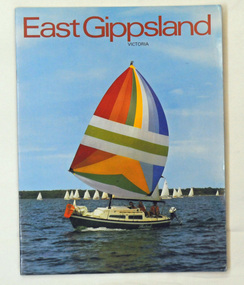
magazines, East Gippsland Victoria, 1978
... Victoria. It contains coloured photographs. This is a 24pp travel book containing coloured illustrations, maps and descriptions of East Gippsland. ...The magazine is a travel book and is probably one of a series. travel East-Gippsland A glossy magazine titled, East Gippsland - Victoria. ...The magazine is a travel book and is probably one of a series.A glossy magazine titled, East Gippsland - Victoria. It contains coloured photographs. This is a 24pp travel book containing coloured illustrations, maps and descriptions of East Gippsland. There are historical details/articles in the book. The photography is by George Hurdes and Ian Roberts. The cover which was designed by Bill Stockdale has a colour photo of a yacht with a predominantly blue background of water and sky. The text is by Barbara Glover.travel east-gippsland -
 Alfred Hospital Nurses League - Nursing History Collection
Book, John Milner 1822-1927 et al, The cruise of H. M. S. Galatea, 1869
... The assassination attempt lead to the naming of two hospitals: Prince Alfred Hospital, Sydney and the Alfred Hospital Melbourne Of significance to the AHNL as the Alfred Hospital was named after Prince Alfred after the assassination attempt in Sydney HRH Prince Alfred Duke of Edinburgh Voyages around the world Australia - description - travel 1860's South Africa - description - travel -1860's In 1867, Prince Alfred, Queen Victoria's second son, commissioned the Galatea for a voyage around the world which would include the first royal visit to Australia. ...In 1867, Prince Alfred, Queen Victoria's second son, commissioned the Galatea for a voyage around the world which would include the first royal visit to Australia. Stopping along the way in Rio de Janeiro and Cape Town, Alfred was received with great ceremony at each port of call. These visits provided the ship's chaplain John Milner (1822-97) and the artist Oswald Brierly (1817-94) with ample material for this chronicle, published in 1869, which gives background details of each region alongside scenes from the tour, enhanced by illustrations based on Brierly's sketches. The authors drew on various recollections and writings, including a letter from Alfred to his brother describing an elephant hunt in South Africa. The tour was abruptly curtailed in Sydney when a Fenian sympathiser attempted to assassinate the prince, an act which boosted support for the British royal family. More »Illustrated book with blue cloth cover, gilt stamped decorations on front and spinenon-fictionIn 1867, Prince Alfred, Queen Victoria's second son, commissioned the Galatea for a voyage around the world which would include the first royal visit to Australia. Stopping along the way in Rio de Janeiro and Cape Town, Alfred was received with great ceremony at each port of call. These visits provided the ship's chaplain John Milner (1822-97) and the artist Oswald Brierly (1817-94) with ample material for this chronicle, published in 1869, which gives background details of each region alongside scenes from the tour, enhanced by illustrations based on Brierly's sketches. The authors drew on various recollections and writings, including a letter from Alfred to his brother describing an elephant hunt in South Africa. The tour was abruptly curtailed in Sydney when a Fenian sympathiser attempted to assassinate the prince, an act which boosted support for the British royal family. More »hrh prince alfred duke of edinburgh, voyages around the world, australia - description - travel 1860's, south africa - description - travel -1860's -
 Alfred Hospital Nurses League - Nursing History Collection
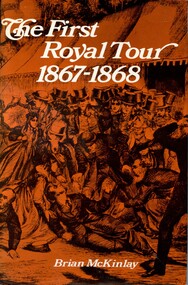
Book - Illustrated book, Rigby Limited, The first royal tour 1867-1868, 1970
... After the assassination attempt two hospitals were named after Prince Alfred: Prince Alfred Hospital, Sydney and the Alfred Hospital Melbourne Of significance to the AHNL as the Alfred Hospital was named after Prince Alfred after the assassination attempt in Sydney HRH Prince Alfred Duke of Edinburgh Australia - description - travel 1860's South Africa - description - travel -1860's Voyages around the world In July, 1867, the Australian colonies were electrified by the news that they were to be visited by royalty. ...In July, 1867, the Australian colonies were electrified by the news that they were to be visited by royalty. Prince Alfred, Duke of Edinburgh, second son of Queen Victoria and commander of H.M.S. Galatea, was en route from Europe. He landed in South Australia on a blazing November day, and he was welcomed with an exuberant Colonial loyalty which, as one of his equerries sniffly remarked "seemed ignorant of protocol." During his visits to South Australia, Victoria, Tasmania, New South Wales, and Queensland, the Prince was swept along on a tide of frenzied enthusiasm. Each State tried to outdo the others in the splendour of its receptions and the garishness of its decorations. In Melbourne, a Free Banquet in honour of the Prince turned into a drunken fiasco. On the goldfields, he lunched down a mine and "helped himself rather liberally from a selection of nuggets. He was cheered by convicts in Tasmania, wrangled over by Queensland politicians and bombarded with bouquets, Declarations of Loyalty, and innumerable speeches. Surrounded by city fathers, Bishops, brass bands, fireworks and uproarious multitudes, he went from one triumph to another. Finally, he was shot in Sydney, and his recovery was accompanied by even more passionate demonstrations of loyalty. These were inflamed by revulsion against the would-be assassin, who was hurried to the gallows as the Prince sailed for home. His departure closed a colourful chapter in Australian history, of which the author writes with humour and gustoIllustrated book with dustjacket. Book has a blue cloth binding with title, author and publisher's name stamped in gilt on spine. Dustjacket has an orange and black print of the assassination attempt on Prince Alfred, Duke of Edinburgh in Sydney 1868. Title and author's name overprinted in white on front and spinenon-fictionIn July, 1867, the Australian colonies were electrified by the news that they were to be visited by royalty. Prince Alfred, Duke of Edinburgh, second son of Queen Victoria and commander of H.M.S. Galatea, was en route from Europe. He landed in South Australia on a blazing November day, and he was welcomed with an exuberant Colonial loyalty which, as one of his equerries sniffly remarked "seemed ignorant of protocol." During his visits to South Australia, Victoria, Tasmania, New South Wales, and Queensland, the Prince was swept along on a tide of frenzied enthusiasm. Each State tried to outdo the others in the splendour of its receptions and the garishness of its decorations. In Melbourne, a Free Banquet in honour of the Prince turned into a drunken fiasco. On the goldfields, he lunched down a mine and "helped himself rather liberally from a selection of nuggets. He was cheered by convicts in Tasmania, wrangled over by Queensland politicians and bombarded with bouquets, Declarations of Loyalty, and innumerable speeches. Surrounded by city fathers, Bishops, brass bands, fireworks and uproarious multitudes, he went from one triumph to another. Finally, he was shot in Sydney, and his recovery was accompanied by even more passionate demonstrations of loyalty. These were inflamed by revulsion against the would-be assassin, who was hurried to the gallows as the Prince sailed for home. His departure closed a colourful chapter in Australian history, of which the author writes with humour and gustohrh prince alfred duke of edinburgh, australia - description - travel 1860's, south africa - description - travel -1860's, voyages around the world -
Moorabbin Air Museum
Document (item) - Roland Jahne Collection - See Description for details
... Manilla Folder Varioius Tupolev Manilla Folder Feb-75 Travel Air Manilla Folder Varioius Transall Manilla Folder May-99 Tracor. ... -
 Sunshine and District Historical Society Incorporated
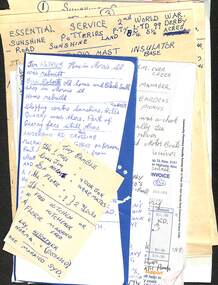
Archive - Les Noble Collection
... 3003.01 - Les Noble Collection - Multiple Notes on a variety of subjects 3003.02 - Les Noble Collection - Postcard The Spirit Out of Albury 1947 3003.03 - Les Noble Collection - Identity Card V7 M14 20081 Leslie William Noble Drivers Licence 2791473 3003.04 - Les Noble Collection - Identity Card V7 F20 13309 Gertrude Irene A Noble Drivers Licence 3003.05 - Les Noble Collection - Identity Card V7 M19 8589 Joseph Henry F Noble Drivers Licence 3003.06 - Les Noble Collection - State Saving Bank Passbook for Joseph Henry F Noble 1951 to 1954 Savings 127 pound 5 shillings 9 pence Account No 23068 3003.07 - Les Noble Collection - Receipts from Trahairs Sunshine Busy Drapers 207 Hampshire Road Sunshine 1946 Receipt 15th March 1946 3003.07 - Les Noble Collection - Receipts from Trahairs Sunshine Busy Drapers 207 Hampshire Road Sunshine 1946 Receipt 2nd April 1946 3003.08 - Les Noble Collection - Photograph of 5 Men Standing 3003.09 - Les Noble Collection - Broadcast Listeners Licence Fee 20- Paid at the Post Office when Renewed 13 April 1942 No 730526 3003.09 - Les Noble Collection - Invoice from JW McGrath Grocer Ironmonger Provision Merchant Hampshire Road Sunshine 31st January 1946 3003.09 - Les Noble Collection - Photograph of 5 Men Sitting 3003.09 - Les Noble Collection - Receipts from Trahairs Sunshine Busy Drapers 207 Hampshire Road Sunshine 1946 Receipt 15th March 1946 3003.10 - Les Noble Collection - Combined Receiving Licence No 1157310 Expiry Date 13 June 1975 Fee $26.50 3003.11 - Les Noble Collection - Federal Income Tax Year ended 30 June 1944 Joseph Noble Amount of Tax 6180 Total Tax Payable 9130 by 20 Mar 1945 3003.12 - Les Noble Collection - Sunshine Scholars Reunion 1907 to 1977 19 November 1977 3003.13 - Les Noble Collection - Shooters Licence No 211067 for Pea rifle to Leslie William Noble Valid to 22 March 1976 costing $6.00 Issued by Victoria Police 3003.14 - Les Noble Collection - Shire of Braybrook Combined Notice of Valuation General Rates and Charges 1945 to 1946 for Mr JHP Noble Costing 470 General Rates and 3003.15 - Les Noble Collection - Licence to drive a Motor Car Dated 4 May 1954 No 103230 for Mr Joseph HF Noble Costing 10 Shillings 3003.16 - Les Noble Collection - Sunshine Lodge No 474 UAOD Sales to Members All description of goods usually stocked by Chemists 3003.17 - Les Noble Collection - Souvenir Guide The Ballarat Miner and Weely Mining Records July 1962 3003.18 - Les Noble Collection - Calendar supplied with advertising for W Cameron and Son 9 City Place Sunshine Auctioneer Estate Insurance and Travel Agents 3003.19 - Les Noble Collection - Sunshine Potteries Reminiscence Afternoon 22 June 2000 Council Conference Room 3003.20 - Les Noble Collection - Sunshine Lodge No 474 UAOD United Ancient Order Druids 1967 Membership Card Sunshine UFS Dispensary Card 3003.21 - Les Noble Collection - Cheque Book Bank of New South Wales 1945 3003.22 - Les Noble Collection - Wallet compliments of Eric Fowler Hotel Derrimut Sunshine 3003.23 - Les Noble Collection - Postcard Fun and Games 1956 The 80 metre hurdles medal Presentation.1st Shirley Strickland Australia 2nd Gisela Kohler Germany 3rd Nor 3003.24 - Les Noble Collection - Postcard Fun and Games 1956 The Australian eight head out to race in the first heat at Lake Wendoree 3003.25 - Les Noble Collection - Postcard Salesian College Rupertswood Sunbury The Lady Chapel Mary of Christians 3003.26 - Les Noble Collection - Postcard Salesian College Rupertswood Sunbury Rupertswood seen from McMahons Hill 3003.27 - Les Noble Collection - Postcard Salesian College Rupertswood Sunbury The Flock Drifting Home 3003.28 - Les Noble Collection - Postcard Flinders Street Station A Saturday in April 1927 1220pm 3003.29 - Les Noble Collection - Postcard An early Melbourne bus The first Melbourne bus service began Operation in 1905...Leslie "Les" Noble 3003.01 - Les Noble Collection - Multiple Notes on a variety of subjects 3003.02 - Les Noble Collection - Postcard The Spirit Out of Albury 1947 3003.03 - Les Noble Collection - Identity Card V7 M14 20081 Leslie William Noble Drivers Licence 2791473 3003.04 - Les Noble Collection - Identity Card V7 F20 13309 Gertrude Irene A Noble Drivers Licence 3003.05 - Les Noble Collection - Identity Card V7 M19 8589 Joseph Henry F Noble Drivers Licence 3003.06 - Les Noble Collection - State Saving Bank Passbook for Joseph Henry F Noble 1951 to 1954 Savings 127 pound 5 shillings 9 pence Account No 23068 3003.07 - Les Noble Collection - Receipts from Trahairs Sunshine Busy Drapers 207 Hampshire Road Sunshine 1946 Receipt 15th March 1946 3003.07 - Les Noble Collection - Receipts from Trahairs Sunshine Busy Drapers 207 Hampshire Road Sunshine 1946 Receipt 2nd April 1946 3003.08 - Les Noble Collection - Photograph of 5 Men Standing 3003.09 - Les Noble Collection - Broadcast Listeners Licence Fee 20- Paid at the Post Office when Renewed 13 April 1942 No 730526 3003.09 - Les Noble Collection - Invoice from JW McGrath Grocer Ironmonger Provision Merchant Hampshire Road Sunshine 31st January 1946 3003.09 - Les Noble Collection - Photograph of 5 Men Sitting 3003.09 - Les Noble Collection - Receipts from Trahairs Sunshine Busy Drapers 207 Hampshire Road Sunshine 1946 Receipt 15th March 1946 3003.10 - Les Noble Collection - Combined Receiving Licence No 1157310 Expiry Date 13 June 1975 Fee $26.50 3003.11 - Les Noble Collection - Federal Income Tax Year ended 30 June 1944 Joseph Noble Amount of Tax 6180 Total Tax Payable 9130 by 20 Mar 1945 3003.12 - Les Noble Collection - Sunshine Scholars Reunion 1907 to 1977 19 November 1977 3003.13 - Les Noble Collection - Shooters Licence No 211067 for Pea rifle to Leslie William Noble Valid to 22 March 1976 costing $6.00 Issued by Victoria Police 3003.14 - Les Noble Collection - Shire of Braybrook Combined Notice of Valuation General Rates and Charges 1945 to 1946 for Mr JHP Noble Costing 470 General Rates and 3003.15 - Les Noble Collection - Licence to drive a Motor Car Dated 4 May 1954 No 103230 for Mr Joseph HF Noble Costing 10 Shillings 3003.16 - Les Noble Collection - Sunshine Lodge No 474 UAOD Sales to Members All description of goods usually stocked by Chemists 3003.17 - Les Noble Collection - Souvenir Guide The Ballarat Miner and Weely Mining Records July 1962 3003.18 - Les Noble Collection - Calendar supplied with advertising for W Cameron and Son 9 City Place Sunshine Auctioneer Estate Insurance and Travel Agents 3003.19 - Les Noble Collection - Sunshine Potteries Reminiscence Afternoon 22 June 2000 Council Conference Room 3003.20 - Les Noble Collection - Sunshine Lodge No 474 UAOD United Ancient Order Druids 1967 Membership Card Sunshine UFS Dispensary Card 3003.21 - Les Noble Collection - Cheque Book Bank of New South Wales 1945 3003.22 - Les Noble Collection - Wallet compliments of Eric Fowler Hotel Derrimut Sunshine 3003.23 - Les Noble Collection - Postcard Fun and Games 1956 The 80 metre hurdles medal Presentation.1st Shirley Strickland Australia 2nd Gisela Kohler Germany 3rd Nor 3003.24 - Les Noble Collection - Postcard Fun and Games 1956 The Australian eight head out to race in the first heat at Lake Wendoree 3003.25 - Les Noble Collection - Postcard Salesian College Rupertswood Sunbury The Lady Chapel Mary of Christians 3003.26 - Les Noble Collection - Postcard Salesian College Rupertswood Sunbury Rupertswood seen from McMahons Hill 3003.27 - Les Noble Collection - Postcard Salesian College Rupertswood Sunbury The Flock Drifting Home 3003.28 - Les Noble Collection - Postcard Flinders Street Station A Saturday in April 1927 1220pm 3003.29 - Les Noble Collection - Postcard An early Melbourne bus The first Melbourne bus service began Operation in 1905 A collection of Les Noble's personal documents, photographs and notes Archive Les Noble Collection ...3003.01 - Les Noble Collection - Multiple Notes on a variety of subjects 3003.02 - Les Noble Collection - Postcard The Spirit Out of Albury 1947 3003.03 - Les Noble Collection - Identity Card V7 M14 20081 Leslie William Noble Drivers Licence 2791473 3003.04 - Les Noble Collection - Identity Card V7 F20 13309 Gertrude Irene A Noble Drivers Licence 3003.05 - Les Noble Collection - Identity Card V7 M19 8589 Joseph Henry F Noble Drivers Licence 3003.06 - Les Noble Collection - State Saving Bank Passbook for Joseph Henry F Noble 1951 to 1954 Savings 127 pound 5 shillings 9 pence Account No 23068 3003.07 - Les Noble Collection - Receipts from Trahairs Sunshine Busy Drapers 207 Hampshire Road Sunshine 1946 Receipt 15th March 1946 3003.07 - Les Noble Collection - Receipts from Trahairs Sunshine Busy Drapers 207 Hampshire Road Sunshine 1946 Receipt 2nd April 1946 3003.08 - Les Noble Collection - Photograph of 5 Men Standing 3003.09 - Les Noble Collection - Broadcast Listeners Licence Fee 20- Paid at the Post Office when Renewed 13 April 1942 No 730526 3003.09 - Les Noble Collection - Invoice from JW McGrath Grocer Ironmonger Provision Merchant Hampshire Road Sunshine 31st January 1946 3003.09 - Les Noble Collection - Photograph of 5 Men Sitting 3003.09 - Les Noble Collection - Receipts from Trahairs Sunshine Busy Drapers 207 Hampshire Road Sunshine 1946 Receipt 15th March 1946 3003.10 - Les Noble Collection - Combined Receiving Licence No 1157310 Expiry Date 13 June 1975 Fee $26.50 3003.11 - Les Noble Collection - Federal Income Tax Year ended 30 June 1944 Joseph Noble Amount of Tax 6180 Total Tax Payable 9130 by 20 Mar 1945 3003.12 - Les Noble Collection - Sunshine Scholars Reunion 1907 to 1977 19 November 1977 3003.13 - Les Noble Collection - Shooters Licence No 211067 for Pea rifle to Leslie William Noble Valid to 22 March 1976 costing $6.00 Issued by Victoria Police 3003.14 - Les Noble Collection - Shire of Braybrook Combined Notice of Valuation General Rates and Charges 1945 to 1946 for Mr JHP Noble Costing 470 General Rates and 3003.15 - Les Noble Collection - Licence to drive a Motor Car Dated 4 May 1954 No 103230 for Mr Joseph HF Noble Costing 10 Shillings 3003.16 - Les Noble Collection - Sunshine Lodge No 474 UAOD Sales to Members All description of goods usually stocked by Chemists 3003.17 - Les Noble Collection - Souvenir Guide The Ballarat Miner and Weely Mining Records July 1962 3003.18 - Les Noble Collection - Calendar supplied with advertising for W Cameron and Son 9 City Place Sunshine Auctioneer Estate Insurance and Travel Agents 3003.19 - Les Noble Collection - Sunshine Potteries Reminiscence Afternoon 22 June 2000 Council Conference Room 3003.20 - Les Noble Collection - Sunshine Lodge No 474 UAOD United Ancient Order Druids 1967 Membership Card Sunshine UFS Dispensary Card 3003.21 - Les Noble Collection - Cheque Book Bank of New South Wales 1945 3003.22 - Les Noble Collection - Wallet compliments of Eric Fowler Hotel Derrimut Sunshine 3003.23 - Les Noble Collection - Postcard Fun and Games 1956 The 80 metre hurdles medal Presentation.1st Shirley Strickland Australia 2nd Gisela Kohler Germany 3rd Nor 3003.24 - Les Noble Collection - Postcard Fun and Games 1956 The Australian eight head out to race in the first heat at Lake Wendoree 3003.25 - Les Noble Collection - Postcard Salesian College Rupertswood Sunbury The Lady Chapel Mary of Christians 3003.26 - Les Noble Collection - Postcard Salesian College Rupertswood Sunbury Rupertswood seen from McMahons Hill 3003.27 - Les Noble Collection - Postcard Salesian College Rupertswood Sunbury The Flock Drifting Home 3003.28 - Les Noble Collection - Postcard Flinders Street Station A Saturday in April 1927 1220pm 3003.29 - Les Noble Collection - Postcard An early Melbourne bus The first Melbourne bus service began Operation in 1905leslie "les" noble -
 Robin Boyd Foundation
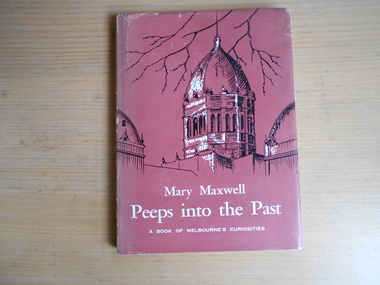
Book, Mary Maxwell, Peeps into the Past, 1957
... and travel...Historic sites -Victoria History Description and travel Walsh St library Hardcover w/ Dust Jacket Peeps into the Past Book Mary Maxwell William Heinemann ...Hardcover w/ Dust Jackethistoric sites -victoria, history, description and travel, walsh st library -
 Ballarat Tramway Museum
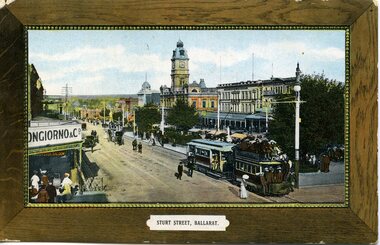
Postcard, ESCo tram just past the intersection of Doveton St. and Sturt St, c1906
... Colour postcard, presented within a wooden framed image of an ESCo tram just past the intersection of Doveton St. and Sturt St. travelling east along the north side of Sturt. ...Trams tramways Sturt St Trailers Horse Tram Town Hall ESCo In pencil along top edge "9269 V and $5" Colour postcard, presented within a wooden framed image of an ESCo tram just past the intersection of Doveton St. and Sturt St. travelling east along the north side of Sturt. ...Demonstrates aspects of Ballarat tramway operation with horse tram trailers, Sturt St buildings, yields information about the appearance of Ballarat in colour.Colour postcard, presented within a wooden framed image of an ESCo tram just past the intersection of Doveton St. and Sturt St. travelling east along the north side of Sturt. Street towing a heavily laden horse tram as a trailer. Photo appears to be taken soon after opening of the electric trams, as the tram does not have any destination box above the driver. Possibly summer 1905/1906. Numerous people in the street, some horse drawn vehicles in the photograph. Shows buildings along the south side of Sturt St. and part of the verandah of the building at the NE corner of Doveton St. For a list and description of the same base image see Archives file - "Notes on ESCo Tram towing a heavily loaded trailer" On rear is "Made in Germany", areas for correspond, a Victoria one penny postage stamp, an din the bottom right hand corner, "09 3851" The card has been addressed to a Miss Seymour "Larramea", Mulwala NSW. Has a handwritten note to her sister (signed Flo?) about a trip arrangements to Melbourne and other details. Date 13 April, but year not apparent. Has been postmark, Melbourne (appears)In pencil along top edge "9269 V and $5"trams, tramways, sturt st, trailers, horse tram, town hall, esco -
Koorie Heritage Trust
Book, Burrows, William, Adventures of a mounted trooper, 1986
... 1830- -- Journeys -- Victoria. | Victoria -- Description and travel -- 1851-1900....Burrows William 1830- -- Journeys -- Victoria. | Victoria -- Description and travel -- 1851-1900. Contents: Arrival in the colony & visit to the diggings; Road-making in Victoria; The tents and their occupants; Mounted police and their operations; Government Land Surveying; The mounted police again; The sessions at the diggings; Australian Birds; Birds Continued; Australian Animals; The Aboriginal inhabitants; Sheep and cattle stations; Climate and vegetable productions of Australia; Melbourne and its suburbs; Adventures narrated by a log-fire; A voyage to China; Three months in China and voyage to Sydney. ...Contents: Arrival in the colony & visit to the diggings; Road-making in Victoria; The tents and their occupants; Mounted police and their operations; Government Land Surveying; The mounted police again; The sessions at the diggings; Australian Birds; Birds Continued; Australian Animals; The Aboriginal inhabitants; Sheep and cattle stations; Climate and vegetable productions of Australia; Melbourne and its suburbs; Adventures narrated by a log-fire; A voyage to China; Three months in China and voyage to Sydney. Prehistory, early culture contact and history -- Early European contact -- Exploration and expeditions -- Colonisation -- 1851-. Other: Mounted Police -- Black Forest -- Wood End.143 p. ; 21 cm.Contents: Arrival in the colony & visit to the diggings; Road-making in Victoria; The tents and their occupants; Mounted police and their operations; Government Land Surveying; The mounted police again; The sessions at the diggings; Australian Birds; Birds Continued; Australian Animals; The Aboriginal inhabitants; Sheep and cattle stations; Climate and vegetable productions of Australia; Melbourne and its suburbs; Adventures narrated by a log-fire; A voyage to China; Three months in China and voyage to Sydney. Prehistory, early culture contact and history -- Early European contact -- Exploration and expeditions -- Colonisation -- 1851-. Other: Mounted Police -- Black Forest -- Wood End.burrows, william, 1830- -- journeys -- victoria. | victoria -- description and travel -- 1851-1900. -
Koorie Heritage Trust
Book, Bunce, Daniel et al, Australasiatic reminiscences of twenty-three years' wanderings in Tasmania and the Australias, 2000
... | Tasmania -- Description and travel -- To 1850. | Victoria -- Description and travel -- To 1850. | Body - Decoration. | Body - Scarification. | Settlement and contacts - Colonisation - 1788-1850. | Costume and clothing. | Food - Meat - Echidna. | Settlement and contacts - Explorers. | Food. | Hunting. | Gathering - Honey. | Food - Meat - Kangaroo / Wallaby. | Language - Vocabulary..... | Tasmania -- Description and travel -- To 1850. | Victoria -- Description and travel -- To 1850. | Body - Decoration. | Body - Scarification. | Settlement and contacts - Colonisation - 1788-1850. | Costume and clothing. | Food - Meat - Echidna. | Settlement and contacts - Explorers. | Food. | Hunting. | Gathering - Honey. | Food - Meat - Kangaroo / Wallaby. | Language - Vocabulary. ...This book is a reprint of the original journal entries of Daniel Bunce prior to 1857. A journal style record of travel within Tasmania and Australia for a period of 23 years beginning in March 1833. Arriving in Port Phillip in October 1839 early observations of the colony are most interesting. Chap.4; incidents in relation to the Aborigines at Hobart town; Chap.8; Tasmania - womens life, body decoration, clothing and scarification; Chap.9; Native chiefs with Buckley, the Wild white man; Chap.11; Journey to Westernport with natives (Derrimut, Benbow and Yammabook), foods - kangaroo and native porcupine; duties of women; Chap.12; Leichhardts journey, native names of flowers, fruits, etc. (Condamine River area); foods, treacherous natives near Fitzroy DownsThis book is a reprint of the original journal entries of Daniel Bunce prior to 1857. A journal style record of travel within Tasmania and Australia for a period of 23 years beginning in March 1833. Arriving in Port Phillip in October 1839 early observations of the colony are most interesting. Chap.4; incidents in relation to the Aborigines at Hobart town; Chap.8; Tasmania - womens life, body decoration, clothing and scarification; Chap.9; Native chiefs with Buckley, the Wild white man; Chap.11; Journey to Westernport with natives (Derrimut, Benbow and Yammabook), foods - kangaroo and native porcupine; duties of women; Chap.12; Leichhardts journey, native names of flowers, fruits, etc. (Condamine River area); foods, treacherous natives near Fitzroy Downsleichhardt, ludwig, 1813-1848. | leichhardt expedition, (1846-1847) | botany -- queensland. | botany -- tasmania. | queensland -- discovery and exploration. | tasmania -- description and travel -- to 1850. | victoria -- description and travel -- to 1850. | body - decoration. | body - scarification. | settlement and contacts - colonisation - 1788-1850. | costume and clothing. | food - meat - echidna. | settlement and contacts - explorers. | food. | hunting. | gathering - honey. | food - meat - kangaroo / wallaby. | language - vocabulary. -
Koorie Heritage Trust
Booklet, Brownlie, John et al, Wilsons Promontory National Park, 1973
... Victoria. Wilsons Promontory National Park (Vic.) -- Description and travel -- Guidebooks....Victoria. Wilsons Promontory National Park (Vic.) -- Description and travel -- Guidebooks. ...References to plants, animals, birds, sea creatures, seasons, and recommended walks to take in the park.80 p. : ill. maps ; 18 cm.References to plants, animals, birds, sea creatures, seasons, and recommended walks to take in the park.national parks and reserves -- victoria. parks -- victoria. wilsons promontory national park (vic.) -- description and travel -- guidebooks. -
Koorie Heritage Trust
Book, C. E. Sayers (Original edition edited by Bride, Thomas Francis), Letters from Victorian pioneers : a series of papers on the early occupation of the colony, the Aborigines, etc. addressed by Victorian pioneers to His Excellency Charles Joseph La Trobe, Esq., Lieutenant-Governor of the Colony of Victoria, 1983
... ...etc. | Victoria. Description & travel...Correspondence diaries etc. | Victoria. Description & travel 1836-1854. Correspondence diaries etc. | Frontier and pioneer life -- Victoria. | Victoria -- History -- 1834-1900 -- Sources. | Victoria -- Description and travel -- 1851-1900. ...Brief notes on the contributors and incidents have been included in this edition although the above-mentioned items have been left out, some marginal notes made by Governor La Trobe have been dealt with in the footnotes. "From the original edition edited for the Trustees of the Public Library by Thomas Francis Bride'. Previously published: Melbourne : Heinemann, 1969. Originally published: Melbourne : Government Printer for the Trustees of the Public Library, Museums and National Gallery of Victoria, 1898.xiv, 455 p., 31 p. of plates : map ; 26 cm.Brief notes on the contributors and incidents have been included in this edition although the above-mentioned items have been left out, some marginal notes made by Governor La Trobe have been dealt with in the footnotes. "From the original edition edited for the Trustees of the Public Library by Thomas Francis Bride'. Previously published: Melbourne : Heinemann, 1969. Originally published: Melbourne : Government Printer for the Trustees of the Public Library, Museums and National Gallery of Victoria, 1898.pioneering, 1836-1854. victoria. correspondence, diaries, etc. | victoria. description & travel, 1836-1854. correspondence, diaries, etc. | frontier and pioneer life -- victoria. | victoria -- history -- 1834-1900 -- sources. | victoria -- description and travel -- 1851-1900. -
 Nillumbik Historical Society Incorporated
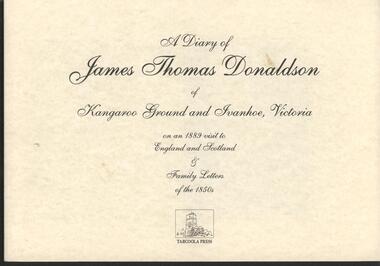
Book - Softcover book, Tarcoola Press, A Diary of James Thomas Donaldson of Kangaroo Ground and Ivanhoe Victoria, 1998
... Adds to the story of early Melbourne and Victoria and one of the earliest families to the north of Port Phillip and later Nillumbik donaldson james t 1832-1916 great britain - description & travel kangaroo ground heidelberg on an 1889 visit to England and Scotland & Family Letters of the 1850's None Cover is parchment coloured card 300gsm with white paper pages 100gsm - 50 pages A Diary of James Thomas Donaldson of Kangaroo Ground and Ivanhoe Victoria Book Softcover book Tarcoola Press Heidelberg Historical Society ...on an 1889 visit to England and Scotland & Family Letters of the 1850'sCover is parchment coloured card 300gsm with white paper pages 100gsm - 50 pagesnon-fictionon an 1889 visit to England and Scotland & Family Letters of the 1850'sdonaldson james t 1832-1916, great britain - description & travel, kangaroo ground, heidelberg -
 Ballarat Base Hospital Trained Nurses League
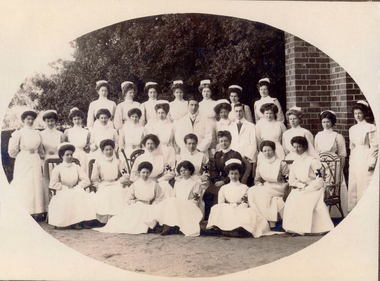
Priscilla Wardle - Trainee Ballarat District Hospital, 27/02/1905 to 01/03/1908 and WW1 Nurse. Also Edith Popplewell & Lily MacKenzie
... The other nurses are wearing their “travelling” army uniform. They were rudely called “Salvation Army Lassies” by American nurses for the way they were dressed. ...The other nurses are wearing their “travelling” army uniform. They were rudely called “Salvation Army Lassies” by American nurses for the way they were dressed. ...No 1: Matron Eagleton with Nursing Staff, Ballarat & District Hospital. Priscilla Wardle, far right - trainee nurse 1905-1908. No 2: This could be a group of trainee nurses at Ballarat Hospital. Circa 1906/1907. The nurses with the grey looking sleeves in this black and white photograph may be wearing the lilac uniform of Trainee nurses. The sitting nurse on the far right may already be qualified because she appears to be wearing the white of a trained nurse. Sitting in the middle with the cheeky grin could be Priscilla and the standing nurse on the far left could be Edith Popplewell. No 3: This photograph is labelled 1907 and Priscilla would have just commenced her training. She appears to be “fanning” a female patient presumably to cool her down. This could be upstairs in the Queen Victoria’s Women’s Ward. Priscilla graduated as a nurse in 1908. In this photograph Priscilla was at age 23 years. No 5: Sheila Kelly (left) and Priscilla Wardle. This photograph is labelled 1909 and shows Priscilla in an all white uniform indicating she has qualified as a nurse. Sheila Kelly appears to have darker sleeves/blouse (lilac) and may still be a trainee. No 6: There is a very good chance that this photograph is Edith Popplewell, standing left, Lily MacKenzie , standing on the right and Priscilla seated. Writing in her album is very hard to read but it appears to be “Pop McK & I”. The arm bands with the St John Cross denote they are “charge nurses” maybe in charge of a ward. Taking all this into account the photograph could be circa 1909/1910. No 8 & 9: Priscilla painting what appears to be a gate while wearing her nurse uniform. She has a big grin on her face. Together with Lily MacKenzie they were the principals in the Mount Stuart Private Hospital at 18 Duke Street. Daylesford. This property is now known as Mount Stuart House. Priscilla appears to be on Central Spring Road with the Daylesford Post Office in the background. Photograph 9 is labelled 1914 which would make it near the end of their tenancy between 1911 and 1914. No 10: This photograph raises some questions. Priscilla appears to have darker sleeves /blouse (lilac) which may indicate she is still a trainee however Priscilla is also wearing a “charge nurse” arm band. While my research shows trainee nurses can be a “charge nurse” this is not common practise. The scene appears to be at the door of a house/home. I am not sure if the children’s ward/orphanage at the Ballarat Hospital at this time was in such a building. It could be that it is at the Mount Stuart Hospital but this would mean Priscilla and Lily have duplicated the wearing of the “charge nurse” arm band. The St John’s logo looks different too. Priscilla Isabel “Pearl” Wardle (1884-1967). The armband indicates Priscilla is a Charge Nurse at the Ballarat Hospital. Nothing else known. No 11: Mary & I at Mount Stuart – House Daylesford – This is probably the nursery at the Mount Stuart House Private Hospital being run by Priscilla Isabel “Pearl” Wardle (1884 – 1967) and Selina Lily (Lil) MacKenzie or McKenzie (1882 – 1975) between 1910 and 1914. Mary is certainly Mary Young MacKenzie or McKenzie (1865- 1942) Lily’s stepsister who trained at Ballarat Hospital as “Mary Young “at the same time as Priscilla and Lily. Mount Stuart House still stands at 18 Duke Street Daylesford. Photo date 1912. No 12: Priscilla wearing her distinctive Queen Alexandra’s Imperial Military Nursing Service Reserve cape and badge. Possibly while nursing in London for a month in 1919 after the war. No 12A: Priscilla Wardle - WW1 Diary, OCR enabled. No 13: Priscilla and friends at No. 7 General Hospital, Malassises, Saint Omer, France in July 1915 The old monastery being used as a hospital can be seen in the background. The tents are the nurses quarters. This photograph may have been taken at the same time as the group photograph on page 250 of the diary transcription. Priscilla is thought to be the nurse at the centre in the QAIMNSR uniform. The nurses quarters at the No 7 General Hospital in Saint Omer in France where Priscilla worked for most of the first year of her Diary. Their Monastery (Hospital) at Malassises can be seen in the background. No 15: Priscilla is an Acting Sister working at the 2nd General Hospital for Officers in Havre, France, between March and July 1918. The nurses were enjoying their “tea party”. (see also page 253 of the Diary transcription) No 17: Priscilla at Havre - at 2nd General Hospital (Officers Hospital) in Havre., France Friday 29 March 1918 to Monday 29 July 1918 note the two dark bands on her right sleeve denoting that she is an “Acting Sister”. Priscilla is 34 years of age in this picture and in the three weeks prior to this posting she met Cyril Terence Charles Kirby (1892-1968) her future husband at the 42nd Stationary Hospital in Flixecourt while he was serving with the British Army during the battle and evacuation of Amiens. No 18: Priscilla Wardle at No 8 Stationary Hospital Wimereux, France - from Saturday 24 June 1916 to Tuesday 18 September 1917, Priscilla worked at this hospital for 15 months her longest time in one hospital. during the war. While at Wimereux on Sunday 1 July 1917 she was appointed an Acting Sister. Priscilla once said she disliked nursing in her cape and badges and here she is in her favourite “uniform” for work “the robe” as she called it. She may be leaving the “operating theatre” at Wimereux in this photograph. No 19: Priscilla worked in various operating theatres throughout France. This could be after she became an anaesthetist in 1918 and worked with this team. She is wearing her favourite uniform which is more comfortable. She did not like the collars and capes that were required to be worn. No 20: Priscilla and Sister Michael Meeke? (details not found) are having a quiet drink at the 2nd General Hospital for Officers in Havre, France. Note the dark bands on their sleeves denote their rank as nursing “Sisters”. While it looks like they are smoking look more closely they are in fact holding a “flute” style probably “cocktail” glass. Tea parties and cocktails, Havre could almost have been fun. No 22: 1913 – Ballarat nurse Priscilla Isabell “Pearl” Wardle (1884-1967) in Cannes on the French Riviera during leave from between Friday 20 February 1918 and Friday 6 March 1918.Priscilla is second from the left wearing her distinctive QAIMNSR cape of grey with dark “wine” coloured border. The other nurses are wearing their “travelling” army uniform. They were rudely called “Salvation Army Lassies” by American nurses for the way they were dressed. (see page 232 of Priscilla’s War Diary) The description of 1913 on this photograph is confusing. No 23: Priscilla with her best friend Edith Victoria Donaldson somewhere in the “mysterious far east” on their trip on the Orontes. Priscilla is second from left - this may have been taken at Durban during Priscilla's return to Australia in 1919. No 25: Priscilla Wardle, Ballarat nurse in her Queen Alexandra’s Imperial Military Nursing Service Reserve (QAIMNSR) uniform. Notice the distinctive grey cape with “wine coloured” border Priscilla is also wearing her QAIMNSR qualification badge (medal) on the right side. Because she has no dark (wine coloured) bands on her sleeves so this photograph may be before 1 July 1918. No 26: Priscilla met her husband to be English army Lieutenant Cyril Terrence Charles Kirby during the battle and subsequent evacuation of Amiens in France. As an army nursing “Sister” Priscilla also held the rank of Lieutenant. Priscilla was stationed at the 42nd Stationary Hospital between 7/3/18 and 23/3/18. She had just completed a fortnight break at Cannes on the French Riviera. They were married at Priscilla’s home “Waverley" at 215 Dawson Street Ballarat on Saturday 15 November 1919. Nov 15, 1919 – Mr and Mrs Kirby. The bride Priscilla Isabell “Pearl” Kirby (nee Wardle) (1884-1967) and the groom Cyril Terence Charles Kirby (1892– 1968) on their wedding day. Priscilla was 34 years of age and Cyril 27 years of age however their marriage certificate states that they were both 34 years of age. Their marriage certificate states they were married at Waverley, Dawson St, South, Ballarat in a Presbyterian service conducted by the Rev. John Walker, a Minister of the Presbyterian Church of Australia and the Moderator General of the Church we think for Victoria. Was it in an outdoor setting as the surrounds in this photograph seem to indicate. Their witnesses were Robert and Olive, Priscilla’s brother and sister. Cyril signed as C. Terence. C. Kirby and Priscila signed as Priscilla I. Wardle. The certificate lists Cyril (Terence) as a Bachelor, Born at sea on a British ship and his occupation as Sailor. His father interestingly is listed as Charles John Kirby, of independent means and his mother as Emily Newman. Priscilla is listed as a Spinster, born in Ballarat with occupation as a Nurse. Her father is listed as Henry Thomas Wardle, Timber Merchant and her mother as Isabella Allan. They are both resident at 215 Dawson St. Ballarat which was Waverley the Wardle family home. No 28: Reverse in Poppy’s handwriting: “Lovingly yours Poppy, Dec 1908” Taken the year after Poppy qualified at BBH. No 29: Reverse in Poppy’s handwriting: “With much love to you Cilla, Poppy 1915” This picture was taken in the same year as the Marquette sinking incident. Edith Catheina Popplewell RRC (1884-1972) in her New Zealand Army Nursing Service (NZANS) Uniform. Poppy is at age 29 years in this photograph. Poppy was awarded the Royal Red Cross (RRC) medal for her heroism during the sinking of the Marquette transport ship. She lost her best friend NZ nurse Lorna Ratray. No 30: Taken in Cairo. Poppy is in the centre and wearing her New Zealand army badge and cape. The two nurses on either side are Australian nurses probably wearing their unique silver Australian Army sunrise badge and cape. No 31: Reverse in Poppy’s handwriting: “Ward 7 on Xmas day 1917, with my love, Poppy, A Happy New Year to you – had the sweetest letter from Bobbie”. (Bobbie is Priscilla’s brother Robert). It is thought the nurse in the centre of the three on the left is Poppy. It is 1917 two years after the Marquette sinking. Poppy appears to be a “sister” note the two dark bands on her sleeve. The uniform also matches that of Poppy 2. This photograph is in Post Card form very common during WWI. Edith Popplewell RRC is the “Sister” in the middle of the group of three nurses on the left. She is a sister not a general nurse because of the two bands on her left wrist denoting her rank. She was in fact the Charge Nurse ( in charge) of Ward 7 at this time. Note the Christmas decorations. Poppy is at age 33 years of age in this photograph.Bobbie is Priscilla’s brother Robert Norman “Bobbie” Wardle (1895-1979). No 32: Lilly MacKenzie & Poppy – Otaki - Australian nurse Selina Lily (Lil) MacKenzie sometimes McKenzie (1882– 975) grew up and trained as a nurse in Ballarat Victoria. After completing her training Lily and Priscilla Isabell “Pearl” Wardle (1884 – 1967) conducted the Mount Stuart House Private Hospital in Daylesford Victoria. In late 1913 Lily travelled to Otaki, 32 kms north of Wellington in New Zealand and worked at the Otaki Cottage Hospital with close friend Edith Catheina Popplewell “Poppy” (1884-1976) who also grew up and trained as a nurse at the Ballarat Hospital. In 1914 Lily was matron of a private hospital in Taihape 150kms north of Wellington. Both Lily and Poppy volunteered for New Zealand but as New Zealand were not accepting Australian trained nurses she returned to Australia and enlisted in the Australian Army Nursing Service (AANS) in October 1915. Lily went on to serve in Egypt, England, France and Italy where she was awarded the Royal Red Cross (RRC) medal for her service. This photograph is while Lily and Poppy were working at Otaki Cottage Hospital in New Zealand. Circa 1914. trainee, charge sister, ballarat, hospital, 1905, 1908, ww1, mount stuart house, sleeman, wardle, popplewell, mackenzie, military, queen alexandra's imperial military nursing service reserve, daylesford, nurses, private hospital, edith popplewell, france, cairo, diary, ww1 diary, havre, lily mackenzie, eagleton, matron, otaki, new zealand, donaldson, malassises, kelly, young, kirby, priscilla
