
Showing 94 items matching "victoria street (richmond)"
-
 Kew Historical Society Inc
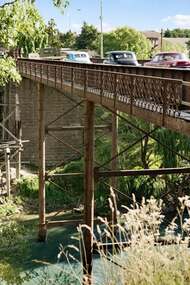
Victoria Bridge, Barkers Road, Kew to Victoria Street, Richmond, over Yarra River, 1950s, c.1950s
... Victoria Bridge, Barkers Road, Kew to Victoria Street, Richmond, over Yarra River, 1950s......Victoria Street (Richmond)...Victoria Bridge, linking Victoria Street, Richmond, with Barkers Road, Kew, over Yarra River. ...Victoria Bridge, linking Victoria Street, Richmond, with Barkers Road, Kew, over Yarra River. ...Victoria Bridge, linking Victoria Street, Richmond, with Barkers Road, Kew, over Yarra River. Riveted and welded steel Warren truss bridge, completed 1884 to design by Fraser & Chase, following controversial design competition held in 1880. Funds provided by councils of Collingwood, Hawthorn, Kew and Richmond. Widened 1890 for horse trams, strengthened 1915 for electric trams, widened again 1933 with cantilever footpaths. Listed on Victorian Heritage Register. Still in use. Colourised photograph, Victoria Bridge over Yarra River, seen from below, river in foreground, willows and grass. Steel bridge deck with lattice balustrade, cars crossing — light blue sedan, black sedan, red sedan, truck. Tall circular iron columns in river, cross-braced, supporting girders. Brown brick abutment at left, houses and trees on Kew side at right.victoria bridge, barkers road (kew), victoria street (richmond), yarra river, bridges, yarra river -
 Ithacan Historical Society
Photograph, Greek National Day, 25 March 1961
... The photograph was taken at a gathering held at the Victoria Theatre in Victoria Street Richmond in 1961. The function was held to celebrate 25th March Greek National Day. ...Victoria Street, Richmond, Victoria, Australia....The photograph was taken at a gathering held at the Victoria Theatre in Victoria Street Richmond in 1961. The function was held to celebrate 25th March Greek National Day. ...The photograph was taken at a gathering held at the Victoria Theatre in Victoria Street Richmond in 1961. The function was held to celebrate 25th March Greek National Day. Seated in the front row second from the left with other dignitaries is Stathi Vlass who was Secretary of Melbourne's Greek Community during the 60s. He was also president of the Ithacan Philanthropic Society 1957 - 1959. Fifth from the left is Stathi's uncle, Spiros Raftopoulos who was the President of the Greek Returned Soldiers. Important national days for the Greek community are the 25 March and 28 October. 25 March commemorates the start of the Greek Revolution of 1821; it honors the Greeks' fight for freedom after being occupied by the Ottoman Empire for over 400 years. The 28th of October, known as OXI day (NO day) commemorates the rejection by Greek Prime Minister Ioannis Metaxas of the ultimatum made by Italian dictator Benito Mussolini on 28 October 1940 with a resounding NO. Subsequently Italy invaded Greece but were successfully repelled by the Greeks, delivering one of the first allied victories. However, this was met with a forceful and immediate response when In April 1941 Germany invaded Greece. Greek resistance fighters — a combination of right and left wing partisan groups — mounted a sustained guerrilla war throughout the 4 year occupation. Greece suffered 400,000 casualties during the occupation.A copied black and white photograph of a group of people seated in a large auditorium. CELEBRATION OF THE GREEK NATIONAL DAY HELD IN THE VICTORIA THEATRE/ VICTORIA ST. RICHMOND IN 1661(incorrect date) vlassopoulos -
 Linton Mechanics Institute and Free Library Collection
Book - Novel, Seymour, Molly, The marriage of Nicola, [n.d.] [1946]
... Jackson Lending Library, 308 Victoria Street, North Richmond"; "Timboon Library"; "Mooroopna Mechanics' Hall & Free Library"....Jackson Lending Library, 308 Victoria Street, North Richmond"; "Timboon Library"; "Mooroopna Mechanics' Hall & Free Library". 171 p. : pale blue cover, title and author's name printed on spine. ...Romance fiction171 p. : pale blue cover, title and author's name printed on spine. Section of original dust jacket pasted to front cover.fictionRomance fictionfiction, romance, molly seymour -
 Kew Historical Society Inc
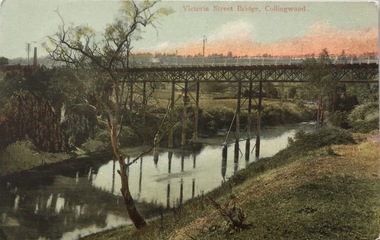
Postcard, Victoria Street Bridge, Collingwood, 1905-1913
... Polychrome postcard of the Victoria Street Bridge which links Richmond and Abbotsford with Kew and Hawthorn....Victoria Street Bridge linking Victoria Street and Barkers Road. postcards -- Yarra River postcards -- bridges. -- Greater Melbourne (Vic.) Victoria Street bridge View from Harrison Cres embankment / former Xavier College boatshed on site of tree in foreground. / Chimney left corner - Wool Scoring Mils in Victoria St. / On horizon - Studley Villa, Studley House circa 1880s, Studley Hall / Chinese gardens to be seen behind three set of columns / M.J. Slattery Polychrome postcard of the Victoria Street Bridge which links Richmond ...Victoria Bridge is a riveted and welded steel Warren truss bridge over the Yarra River completed in 1884 to a design by Fraser & Chase following a controversial design competition held in 1880. Funds for the bridge's construction were provided by the councils of Collingwood, Hawthorn, Kew and Richmond. The contract was awarded to Mr P. Platt. Charles Rowand was officially appointed Supervising Engineer in 1883. The winning design was based on the theoretical work of William Charles Kernot (1845-1909) who campaigned for economy in public works design and the application of scientific principles in engineering. ... The bridge was widened in 1890 by the addition of a third line of truss on new piers on the up stream side to carry horse trams. Work commenced in 1914 to convert the horse tramway to an electric tramway by the Prahran & Malvern Tramways Trust, part of the Trust's extension of its tramway into the eastern suburbs between 1913-18. In 1915 the bridge was further strengthened to accommodate the extra weight of electric trams and widened by the addition of two six feet cantilever footpaths. During this period the Prahran & Malvern Tramways Trust erected two ornamental gantries over the roadway to support overhead wires for the electric tramway. Further widening and reconditioning of the bridge took place in 1933, including the addition of four new welded trusses, two intermediate and two on the outside. The latter were supported on new cantilevered truss cross beams attached to the top of the piers. (Source: Heritage Victoria)Early and rare postcard of the Victoria Street Bridge linking Victoria Street and Barkers Road.Polychrome postcard of the Victoria Street Bridge which links Richmond and Abbotsford with Kew and Hawthorn.View from Harrison Cres embankment / former Xavier College boatshed on site of tree in foreground. / Chimney left corner - Wool Scoring Mils in Victoria St. / On horizon - Studley Villa, Studley House circa 1880s, Studley Hall / Chinese gardens to be seen behind three set of columns / M.J. Slatterypostcards -- yarra river, postcards -- bridges. -- greater melbourne (vic.), victoria street bridge -
 City of Moorabbin Historical Society (Operating the Box Cottage Museum)
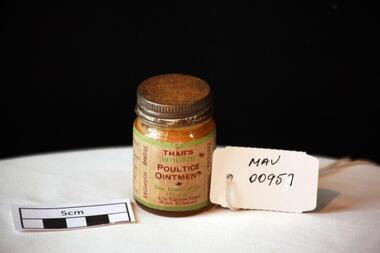
Manufactured Glass, 'Thars' ointment, mid 20th C
... . / 74-76 Victoria Street / North Richmond / Left Side WAR-TIME PACK / FOR ......... ...It can be used on wounds such as cuts, inflammations like boils and to draw out splinters. pharmacy medicines thars ointment thar chemical company hospitals nursing containers moorabbin richmond bentleigh cheltenham melbourne poultices medical poultices Front THAR'S / ANTISEPTIC / POULTICE / OINTMENT / Thar Chemical Co. / Pty. Ltd. / 74-76 Victoria Street ...A poultice is a soft moist mass, often heated and medicated, that is spread on cloth over the skin to treat an aching, inflamed, or painful part of the body. It can be used on wounds such as cuts, inflammations like boils and to draw out splinters.A clear glass jar with a metal screw top containing 'Thar's' antiseptic poultice ointment.Front THAR'S / ANTISEPTIC / POULTICE / OINTMENT / Thar Chemical Co. / Pty. Ltd. / 74-76 Victoria Street / North Richmond / Left Side WAR-TIME PACK / FOR ......... Right Side DIRECTIONS ....... / Vertically sides Purifying, Soothing / Antiseptic, Healing pharmacy, medicines, thars ointment, thar chemical company, hospitals, nursing, containers, moorabbin, richmond, bentleigh, cheltenham, melbourne, poultices, medical poultices -
 Kew Historical Society Inc
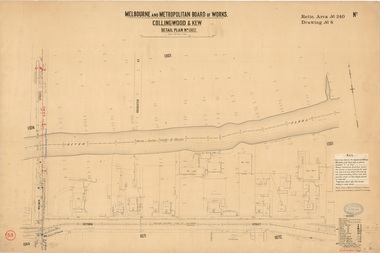
Plan, Melbourne & Metropolitan Board of Works : Borough of Kew : Detail Plan No.1302, 1910
... Walmer Street and its bridge stretched, then and now, from Studley Park Road to Victoria Street, Richmond. On the Richmond side of the Yarra, there was evidence in 1904 of industry (‘Wool shed’; Soap Works’) and entertainment (‘Skittle Alley’). ...Walmer Street and its bridge stretched, then and now, from Studley Park Road to Victoria Street, Richmond. On the Richmond side of the Yarra, there was evidence in 1904 of industry (‘Wool shed’; Soap Works’) and entertainment (‘Skittle Alley’). ...The Melbourne and Metropolitan Board of Works (MMBW) plans were produced from the 1890s to the 1950s. They were crucial to the design and development of Melbourne's sewerage and drainage system. The plans, at a scale of 40 feet to 1 inch (1:480), provide a detailed historical record of Melbourne streetscapes and environmental features. Each plan covers one or two street blocks (roughly six streets), showing details of buildings, including garden layouts and ownership boundaries, and features such as laneways, drains, bridges, parks, municipal boundaries and other prominent landmarks as they existed at the time each plan was produced. (Source: State Library of Victoria)This plan forms part of a large group of MMBW plans and maps that was donated to the Society by the Mr Poulter, City Engineer of the City of Kew in 1989. Within this collection, thirty-five hand-coloured plans, backed with linen, are of statewide significance as they include annotations that provide details of construction materials used in buildings in the first decade of the 20th century as well as additional information about land ownership and usage. The copies in the Public Record Office Victoria and the State Library of Victoria are monochrome versions which do not denote building materials so that the maps in this collection are invaluable and unique tools for researchers and heritage consultants. A number of the plans are not held in the collection of the State Library of Victoria so they have the additional attribute of rarity.Original survey plan, issued by the MMBW to a contractor with responsibility for constructing sewers in the area identified on the plan within the Borough of Kew. The plan was at some stage hand-coloured, possibly by the contractor, but more likely by officers working in the Engineering Department of the Borough and later Town, then City of Kew. The hand-coloured sections of buildings on the plan were used to denote masonry or brick constructions (pink), weatherboard constructions (yellow), and public buildings (grey). The absence of buildings and or property in Kew facing the Yarra is the most notable feature of this plan. Walmer Street and its bridge stretched, then and now, from Studley Park Road to Victoria Street, Richmond. On the Richmond side of the Yarra, there was evidence in 1904 of industry (‘Wool shed’; Soap Works’) and entertainment (‘Skittle Alley’). In reality, another Plan (No.1303) shows Chinese Gardens bordering the Yarra on the Kew side and buildings in Young Street.melbourne and metropolitan board of works, detail plans, mmbw 1302, cartography -
 Melbourne Tram Museum
Negative, Wal Jack, 23/07/1944 12:00:00 AM
... Black and white negative, by Wal Jack, of SW5 841 (St Kilda Beach, Route 79) at the North Richmond terminus at Church and Victoria Streets North Richmond. ...Trams tramways Church St North Richmond Route 79 SW5 class tram 841 victoria st World War 2 Black and white negative, by Wal Jack, of SW5 841 (St Kilda Beach, Route 79) at the North Richmond terminus at Church and Victoria Streets North Richmond. ...Black and white negative, by Wal Jack, of SW5 841 (St Kilda Beach, Route 79) at the North Richmond terminus at Church and Victoria Streets North Richmond. Photo shows the curve from Victoria St. Note the "T" reflector on the tram apron. In the background is the Hotel advertising Victoria Bitter. Photo dated 23-7-1944 in the Wal Jack album along with details of the location and the tramcar.trams, tramways, church st, north richmond, route 79, sw5 class, tram 841, victoria st, world war 2 -
 Ballarat Heritage Services
Photograph - Colour, Dorothy Wickham delivers the Eureka address at Collingwood
... "Carrying on the fight for a just, democratic and sovereign Australia" held Thursday 4 December 2014 at 6.00pm at The Eureka Hotel, corner of Victoria and Church Streets, Richmond, Melbourne. See poster...."Carrying on the fight for a just, democratic and sovereign Australia" held Thursday 4 December 2014 at 6.00pm at The Eureka Hotel, corner of Victoria and Church Streets, Richmond, Melbourne. See poster. ...160 years Eureka Stockade anniaversary. "Carrying on the fight for a just, democratic and sovereign Australia" held Thursday 4 December 2014 at 6.00pm at The Eureka Hotel, corner of Victoria and Church Streets, Richmond, Melbourne. See poster. -
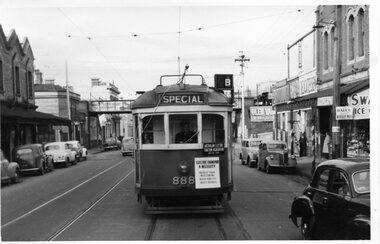 Ballarat Tramway Museum
Photograph - Black & White Photograph/s, Geoff Grant, 25/06/1955 12:00:00 AM
... Black & white photo of M&MTB tram No. 888 from rear cab of 877 while on AETA tour of 25/6/1955 in Victoria Street, North Richmond, just to the west of the North Richmond Station, Victoria Street railway bridge. ...Trams Tramways Victoria St Bourke St AETA North Richmond Tram 888 On typed paper on rear, "Shot out of the Rear cabin of 877 showing 888 tailing us on AETA Bourke St. tour. June 25 1955" and "Geoff Grant" stamp in btm rh cnr. Black & white photo of M&MTB tram No. 888 from rear cab of 877 while on AETA tour of 25/6/1955 in Victoria Street ...Black & white photo of M&MTB tram No. 888 from rear cab of 877 while on AETA tour of 25/6/1955 in Victoria Street, North Richmond, just to the west of the North Richmond Station, Victoria Street railway bridge. Numerous parked cars of the era in the street, and shops on both sides of street. Tram 888 has destination of "SPECIAL", carrying AETA auxiliary board and a board on front dash of tram that says "ELECTRIC TRANSPORT A NECESSITY , PROTECTS YOUR INVESTMEST, BUILDS YOUR CITY, CREATES BUSINESS"On typed paper on rear, "Shot out of the Rear cabin of 877 showing 888 tailing us on AETA Bourke St. tour. June 25 1955" and "Geoff Grant" stamp in btm rh cnr.trams, tramways, victoria st, bourke st, aeta, north richmond , tram 888 -
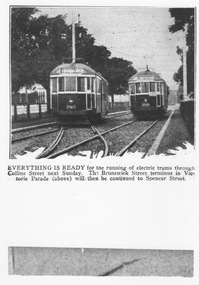 Melbourne Tram Museum
Photograph - Victoria Parade terminus, early December 1929
... In September 1929, a new electric tramway opened along Victoria Street, Richmond, and Victoria Parade, East Melbourne, to this location at the corner of Brunswick and Victoria Streets. ...In September 1929, a new electric tramway opened along Victoria Street, Richmond, and Victoria Parade, East Melbourne, to this location at the corner of Brunswick and Victoria Streets. ...In September 1929, a new electric tramway opened along Victoria Street, Richmond, and Victoria Parade, East Melbourne, to this location at the corner of Brunswick and Victoria Streets. It replaced the Victoria Bridge cable line and allowed electric trams from Mont Albert to reach this temporary terminus. On 8 December 1929 (just days after this photograph), an electric tramway then opened from this point to Spencer Street via Macarthur and Collins Streets. The engine house that had once powered the cable lines was to the left of this photograph. In July 1930, the remaining Brunswick Street cable line from this point to North Fitzroy was closed and converted to an electric tramway. Opening in October 1930, it allowed Preston electric trams to reach this point then continue via MacArthur and Collins Streets to Spencer Street. The electric conversion of the Collins Street tramway was undertaken despite a Parliamentary committee recommendation to delay further conversions for financial reasons and sustained criticism of the tramways board chairman by The Herald newspaper. The paper’s argument was that electric trams were too noisy and would destroy the elegance of Collins Street. Nevertheless, the conversion proceeded. Then during conversion works, the stock market crashed in 1929 and the ensuing economic depression delayed further electric conversions until 1935. While some of the remaining cable lines were converted to electric tramways, the majority became bus routes. Yields information about the electric conversion of Collins StreetBlack and white photograph of newspaper cutting with printed note on front but nothing on rearPrinted on front: 'Everything is ready for the running of electric trams through Collins Street next Sunday. The Brunswick Street terminus in Victoria Parade (above) will then be continued to Spencer Street.'victoria street, victoria parade, brunswick and victoria streets, mont albert, temporary terminus, new electric tramway, spencer street, macarthur and collins streets, engine house, preston, criticism, chairman, stock market, conomic depression, bus routes -
 Melbourne Tram Museum
Photograph - Staff at Victoria Bridge cable tram depot, 1901-1916
... The location was probably the Victoria Bridge car house (depot) in Victoria Street, North Richmond just west of the Yarra River, not a workshop. ...The location was probably the Victoria Bridge car house (depot) in Victoria Street, North Richmond just west of the Yarra River, not a workshop. ...Photograph shows 12 men standing and sitting in rows facing the camera with a stone wall behind. One man, presumably the depot master, is dressed in a suit, tie and hat. The other 11 are in full tramway (MTOC) uniform with caps, two wearing the large pins used by conductors. As the MTOC only provided full uniforms to its traffic staff from 1901, this photograph can be dated between 1901 and 1916 when MTOC ceased, not 1895. The location was probably the Victoria Bridge car house (depot) in Victoria Street, North Richmond just west of the Yarra River, not a workshop. The usual flat fare for adults was three pennies, pronounced thrippence, not tuppence which was two pennies. There are many similar staff photos from this era which suggests they were initiated by MTOC. Yields information about Brunswick cable tram employees Black and white newsprint photograph with notes below. Appears to be a more recent compilation using the original photograph with added contemporary and sometimes inaccurate text.Notes read: "These are nine gripmen, two conductors and the depot-master in this remarkable old shot" "Melbourne cable trammies in 1895 [sic]. Those were the days when you could take a ride around town for tuppence [sic] - or a penny ha'penny if you were under age. Picture was taken at North Richmond workshops [sic]" full tramway uniform, mtoc, depot master, large pins, victoria bridge car house, thrippence -
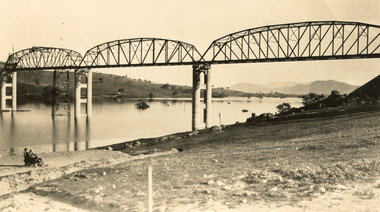 The Beechworth Burke Museum
Photograph
... Ltd., engineers who were located on Victoria Street, West Richmond. The contract was awarded for £71,890. ...Ltd., engineers who were located on Victoria Street, West Richmond. The contract was awarded for £71,890. ...Taken between 1928 and 1930, depicted is the Bethanga Bridge under construction. The Bridge was completed in 1930 and was built to assist residents of the Bethanga district to travel to Albury. Other bridges would become submerged by the backed-up water of the Murray and Mitta Rivers so the Bethanga bridge was built two miles above the Mitta Weir. The Bethanga Bridge was built north of the future Hume Dam which would be completed in 1936. At 2430 feet long, Bethanga Bridge was the longest road bridge in Australia at the time of its completion. The Bridge is 20 feet wide and made up of nine 270 feet long spans. Materials used include ten tons of paint for the steel works; 1600 tons of steel; 900 tons of timber for the decking; and reinforced concrete for the piers. The tender for the construction was awarded to C. Ruwolt Pty. Ltd., engineers who were located on Victoria Street, West Richmond. The contract was awarded for £71,890. It was predicted between 250 and 300 men would find employment on the project. The news was well received by trade unions at the time as there had been a drop in available engineering work.This photograph is historically significant as it depicts the progress of the Bethanga Bridge construction, which was important infrastructure for the area. It is also a good example of methods used in the area to assist in travel over the river prior to the construction of the Hume Dam.Black and white rectangular photo printed on matte photographic paper.Reverse: 1997 3186 / 84-19-3 / This is the bridge. / It is not yet open to traffic / yet. will not be completed / until May next / It is a wonderful bridge the / pillars are 100 feet high. / KODAK PRINT Envelope Obverse: Peterson PHOTO / Hume Weir Envelope Reverse: BMM 84-20-1,2+3. bethanga bridge, lake hume, hume dam, hume weir, murray river, bridge, bethanga, albury -
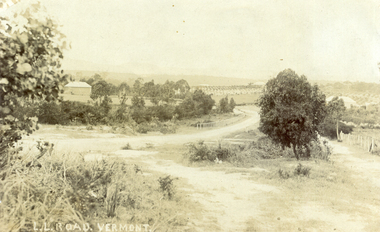 Whitehorse Historical Society Inc.
Photograph, L L Road Vermont, late 1800
... Shambrook - Tim's father)|Information on the back of the Postcard reveal it was sent to Miss Roberts of 61 Hoddle Street Richmond Victoria by Muriel at 37 Victoria Road Northcote and was posted at the Fairfield Post Office Victoria on 27 August 1909. ...Shambrook - Tim's father)|Information on the back of the Postcard reveal it was sent to Miss Roberts of 61 Hoddle Street Richmond Victoria by Muriel at 37 Victoria Road Northcote and was posted at the Fairfield Post Office Victoria on 27 August 1909. ...Dr L L Smith was a pioneer of the Vermont District. He owned 250 acres in the area bounded by Boronia, Canterbury and Heatherdale Roads and the creek. The property was known as L L Vale after which the road was named. Name was changed to Boronia Road in later years. He was a Doctor with rooms in the City, was a member of Parliament.Sepia Postcard of L L Road, Vermont (now Boronia Road) taken in the early 1900s (card is postmarked 27 Aug 1909). Shows the road going down it is presumed to the creek. It is possible that the house is that of Dr.L.L.Smith. See History.|Orchard in background is the Finger orchard. (from Mr. Shambrook - Tim's father)|Information on the back of the Postcard reveal it was sent to Miss Roberts of 61 Hoddle Street Richmond Victoria by Muriel at 37 Victoria Road Northcote and was posted at the Fairfield Post Office Victoria on 27 August 1909. Text is 'Dear Ethel Just a Post Card to let you know I will be out to see you on Monday if convenient. I came down with Mr Hutchinson and he asked me what were we laughing out on the Sunday when he came up. Muriel|See the following references -ND199, 313, 539. 1242, 2013, 3680 & 4295.l l road vermont, boronia road vermont, smith . l l dr -
 University of Melbourne, Burnley Campus Archives
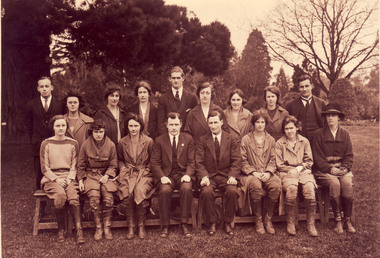
Photograph - Black and white and sepia prints and negatives, C.J. Frazer, Students and Staff. Mr. Rae on the Long Border, 1922-1923
... Stamp, "Burnley Horticultural College Swan Street, Richmond, Victoria. Photographer was C.J. Frazer, Melbourne (embossed). ...Stamp" Burnley Horticultural College Swan Street, Richmond, Victoria."...Stamp, "Burnley Horticultural College Swan Street, Richmond, Victoria. Photographer was C.J. Frazer, Melbourne (embossed). ...1 copy used in a display in Burnley Library Nov 1995. Note by T.H. Kneen 4 December 1991, "1922 or 3 Back Row (L to R): Fred Sala, Kath Keynes, Miss Pye (Parttime), ?,Fred Gillespie, Clara Broadhurst, Jean Borrett, Kathleen Curry, Alex Jessep. Front Row: Joan Anderson?, Violet Warren?, Miss Northcote, Mr. Rae, ?, Kathie Clark (Tas), Dorothy Allender, Mrs Hedges (Kathleen Curry married Charles Fryer ex-Longerenong student. Together they established Fryer's Nursery in Glenferrie Rd., Hawthorn." (4) 2 copies of photograph, 1 on reverse, "1922 Mr Rae Principal c.1923." Stamp, "Burnley Horticultural College Swan Street, Richmond, Victoria. Photographer was C.J. Frazer, Melbourne (embossed). This photograph appears as an illustration in, "Green Grows Our Garden," A.P. Winzenried, p68. The caption states, "Alex Jessep (sic) admiring an Umbrella Palm from Lord Howe Island near the herbaceous border along the orchard fence." Note by T.H. Kneen 11 December 1991, "Location is the pathway along the Long Border adjoining the Orchard fence. "(1) 2 black and white negatives joined. (2) The 2 negatives developed. (3) 3 copies Group photograph of Students and Staff some seated on a bench and some standing behind.. (4) 2 copies sepia photograph Mr Rae , Principal, on the Long Border (looks like the Orchard Border).On reverse of 1 copy, "1922 Mr Rae Principal, c.1923 Mr. Alex Jessep Lecturer in Botany & Chemistry."Stamp" Burnley Horticultural College Swan Street, Richmond, Victoria."students, staff, mr rae, principal, a.w jessep, lecturer, botany, chemistry, burnley horticultural college, fred sala, kath keynes, miss pye, clara broadhurst, jean borrett, kathleen curry, joan anderson, violet warren, kathie clark, dorothy allender, mrs hedges, charles fryer, fryer's nursery, hawthorn, mr rae principal, c.j. frazer, umbrella palm, lord howe island, herbaceous border, r. fred gillespie, miss northcote, orchard border -
 City of Moorabbin Historical Society (Operating the Box Cottage Museum)
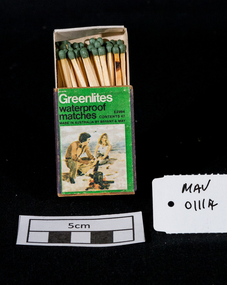
Maufactured Objects, 1 box of Bryant & May waterproof safety matches, 20thC
... On 15th December 1909, Bryant & May, Australia’s first match factory at Church Street, Richmond, Victoria. was opened by The Honorable Alfred Deakin, Prime Minister of Australia, and Mrs. ...Church Street, Richmond, Melbourne, Victoria, Australia...On 15th December 1909, Bryant & May, Australia’s first match factory at Church Street, Richmond, Victoria. was opened by The Honorable Alfred Deakin, Prime Minister of Australia, and Mrs. ...‘Strike anywhere’ or ‘Waterproof’ matches are still used today all around the world, including many developing countries and are widely used for camping, outdoor activities, emergency/survival /military situations, and stocking homemade survival kits. Anton Schrötter von Kristelli discovered in 1850 that heating white phosphorus at 250 °C in an inert atmosphere produced a red allotropic form, which did not fume in contact with air. It was suggested that this would make a suitable substitute in match manufacture although it was slightly more expensive. Two French chemists, Henri Savene and Emile David Cahen, proved in 1898 that the addition of phosphorus sesquisulfide meant that the substance was not poisonous, that it could be used in a "strike-anywhere" match, and that the match heads were not explosive. British company Albright and Wilson, was the first company to produce phosphorus sesquisulfide matches commercially. The company developed a safe means of making commercial quantities of phosphorus sesquisulfide in 1899 and started selling it to match manufacturers. Bryant and May was a United Kingdom (UK) company created in the mid-nineteenth century specifically to make matches. Their original Bryant and May Factory was located in Bow, London. They later opened other match factories in the United Kingdom and Australia. On 15th December 1909, Bryant & May, Australia’s first match factory at Church Street, Richmond, Victoria. was opened by The Honorable Alfred Deakin, Prime Minister of Australia, and Mrs. Deakin The Bryant & May Ltd factory in Church St Richmond is a listed building and has been converted to apartments following the closure of the Company 1980. Bryant & May's Ltd were influential in fighting against the dreadful disease known as Phossy jaw which was caused by white phosphorus used in the manufacture of the early matches. They were also the object of the 'Match Girls Strike' in London 1888, which won important improvements in working conditions and pay for the mostly female workforce working with the dangerous white phosphorus. The public were slow to purchase these red phosphorus sesquisulfide safety matches because of the higher price1 box of unused Bryant & May safety matches 'Greenlite' waterproof Greenlites / waterproof / matches / CONTENTS 47 / MADE IN AUSTRALIA BY BRYANT & MAY / E 2994 photograph of a man and woman beside a camp fire on the beachsafety matches, bryant & may pty ltd, phossy jaw disease, early settlers, moorabbin, bentleigh, cheltenham, lights, lamps, tobacco, white phosphorous, red, phosphorus sesquisulfide, swedish match pty ltd, pitt william, savens henri, cahen emile david , richmond victoria, -
 City of Moorabbin Historical Society (Operating the Box Cottage Museum)
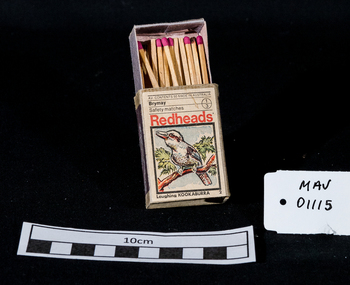
Containers, matchbox 'Redhead' with matches, 20thC
... On 15th December 1909, Bryant & May, Australia’s first match factory at Church Street, Richmond, Victoria. was opened by The Honourable Alfred Deakin, Prime Minister of Australia, and Mrs. ...Church Street , Richmond, Melbourne, Victoria, Australia...On 15th December 1909, Bryant & May, Australia’s first match factory at Church Street, Richmond, Victoria. was opened by The Honourable Alfred Deakin, Prime Minister of Australia, and Mrs. ...On 15th December 1909, Bryant & May, Australia’s first match factory at Church Street, Richmond, Victoria. was opened by The Honourable Alfred Deakin, Prime Minister of Australia, and Mrs. Deakin. It was heralded by the first Commonwealth Government of newly-federated Australia because the government of the day was anxious to encourage secondary industry and pledged tariff protection of local manufacturers. The building was constructed in 1909 as the Empire Works to a design by prolific Melbourne architect William Pitt and was purchased soon after by British safety match manufacturer Bryant and May, who significantly expanded the building, adding another level and the landmark clock tower. Bryant and May were unique in that they operated as a model factory, providing workers with conditions and amenities that even today seem generous. These included a dining hall and sports facilities such as a tennis court and bowling green which were constructed in the 1920s. Bryant and May ceased Australian match manufacture in the early 1980s as a result of import competition. Their iconic Redheads matches are now imported from Sweden. The complex has since been converted for use as offices and showrooms but is extremely well preserved. It is listed on the Victorian Heritage Register. Bryant and May was a United Kingdom (UK) company created in the mid-nineteenth century specifically to make matches. Their original Bryant and May Factory was located in Bow, London. They later opened other match factories in the United Kingdom and Australia, such as the Bryant and May Factory, Melbourne; and owned match factories in other parts of the world. Bryant and May survived as an independent company for over seventy years, but went through a series of mergers with other match companies and later with consumer products companies. To protect its position Bryant and May merged with or took over its rivals. In 1971 the Northern Ireland factory, Maguire & Patterson closed down following a terrorist attack.. In the 1980s, factories in Gloucester and Glasgow closed too leaving Liverpool as the last match factory in the UK, until December 1994. . The registered trade name Bryant and May still exists and it is owned by Swedish Match, as are many of the other registered trade names of the other, formerly independent, companies within the Bryant and May group. Two French chemists, Henri Savene and Emile David Cahen, proved in 1898 that the addition of phosphorus sesquisulfide meant that the substance was not poisonous, that it could be used in a "strike-anywhere" match, and that the match heads were not explosive. British company Albright and Wilson, was the first company to produce phosphorus sesquisulfide ( Red Phosphorous) matches commercially. The company developed a safe means of making commercial quantities of phosphorus sesquisulfide in 1899 and started selling it to match manufacturers. Matches were first produced by Bryant & May in Australia in 1909. The Redhead name applies to the red striking heads of the matches which were introduced to Australia in 1946. The logo on the matchbox depicted the head and shoulder of a redheaded woman and has had four major updates since that time with a number of special issues depicting birds, animals and notable persons also produced.The Bryant & May Ltd factory in Church St Richmond is a listed building and has been converted to apartments following the closure of the Company 1980. Bryant & May's Ltd were influential in fighting against the dreadful disease known as Phossy jaw which was caused by white phosphorus used in the manufacture of the early matches. They were also the object of the 'Match Girls Strike' in London 1888, which won important improvements in working conditions and pay for the mostly female workforce working with the dangerous white phosphorus. The public were slow to purchase these safety matches because of the higher price .A box of safety matches with unused matches made by Bryant & May Pty Ltd , Richmond Victoria Australia. The tray containing the matches slides inside the open ended cover.. The striking patch is on both sides of the cover. Av. CONTENTS 50 MADE IN AUSTRALIA / Brymay / 1/3 / Safety Matches / Redheads / a colour picture of a Kookaburra / Laughing KOOKABURRAsafety matches, bryant & may pty ltd, phossy jaw disease, early settlers, moorabbin, bentleigh, cheltenham, lights, lamps, tobacco, white phosphorous, phosphorus sesquisulfide, swedish match pty ltd, pitt william, savens henri, cahen emile david , richmond victoria, -
 City of Moorabbin Historical Society (Operating the Box Cottage Museum)
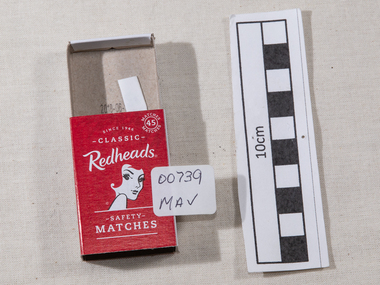
Manufactured Objects, safety matches 'Redheads' 2015, c2015
... This is a current example of the 'Redhead' logo used by Bryant & May Ltd Richmond,Victoria, Australia c 1946 - 1980 On 15th December 1909, Bryant & May, Australia’s first match factory at Church Street, Richmond, Victoria. was opened by The Honourable Alfred Deakin, Prime Minister of Australia, and Mrs. ...This is a current example of the 'Redhead' logo used by Bryant & May Ltd Richmond,Victoria, Australia c 1946 - 1980 On 15th December 1909, Bryant & May, Australia’s first match factory at Church Street, Richmond, Victoria. was opened by The Honourable Alfred Deakin, Prime Minister of Australia, and Mrs. ...This is a current example of the 'Redhead' logo used by Bryant & May Ltd Richmond,Victoria, Australia c 1946 - 1980 On 15th December 1909, Bryant & May, Australia’s first match factory at Church Street, Richmond, Victoria. was opened by The Honourable Alfred Deakin, Prime Minister of Australia, and Mrs. Deakin. It was heralded by the first Commonwealth Government of newly-federated Australia because the government of the day was anxious to encourage secondary industry and pledged tariff protection of local manufacturers. The building was constructed in 1909 as the Empire Works to a design by prolific Melbourne architect William Pitt and was purchased soon after by British safety match manufacturer Bryant and May, who significantly expanded the building, adding another level and the landmark clock tower. Bryant and May were unique in that they operated as a model factory, providing workers with conditions and amenities that even today seem generous. These included a dining hall and sports facilities such as a tennis court and bowling green which were constructed in the 1920s. Bryant and May ceased Australian match manufacture in the early 1980s as a result of import competition. Their iconic Redheads matches are now imported from Sweden. The complex has since been converted for use as offices and showrooms but is extremely well preserved. It is listed on the Victorian Heritage Register. Bryant and May was a United Kingdom (UK) company created in the mid-nineteenth century specifically to make matches. Their original Bryant and May Factory was located in Bow, London. They later opened other match factories in the United Kingdom and Australia, such as the Bryant and May Factory, Melbourne; and owned match factories in other parts of the world. Bryant and May survived as an independent company for over seventy years, but went through a series of mergers with other match companies and later with consumer products companies. To protect its position Bryant and May merged with or took over its rivals. In 1971 the Northern Ireland factory, Maguire & Patterson closed down following a terrorist attack.. In the 1980s, factories in Gloucester and Glasgow closed too leaving Liverpool as the last match factory in the UK, until December 1994. . The registered trade name Bryant and May still exists and it is owned by Swedish Match Industries as are many of the other registered trade names of the other, formerly independent, companies within the Bryant and May group. Two French chemists, Henri Savene and Emile David Cahen, proved in 1898 that the addition of phosphorus sesquisulfide meant that the substance was not poisonous, that it could be used in a "strike-anywhere" match, and that the match heads were not explosive. British company Albright and Wilson, was the first company to produce phosphorus sesquisulfide ( Red Phosphorous) matches commercially. The company developed a safe means of making commercial quantities of phosphorus sesquisulfide in 1899 and started selling it to match manufacturers. Matches were first produced by Bryant & May in Australia in 1909. The Redhead name applies to the red striking heads of the matches which were introduced to Australia in 1946. The logo on the matchbox depicted the head and shoulder of a redheaded woman and has had four major updates since that time with a number of special issues depicting animals, birds and notable persons also producedThe Bryant & May Ltd factory in Church St Richmond is a listed building and has been converted to apartments following the closure of the Company 1980. Bryant & May's Ltd were influential in fighting against the dreadful disease known as Phossy jaw which was caused by white phosphorus used in the manufacture of the early matches. They were also the object of the 'Match Girls Strike' in London 1888, which won important improvements in working conditions and pay for the mostly female workforce working with the dangerous white phosphorus. The public were slow to purchase these safety matches because of the higher price An empty box of 'Redheads' safety matches made in Sweden for ST-Group, Springvale, Victoria, Australia c2015. The tray for the matches slides inside the open ended cover. The striking patch is on both sides of the cover. The matches have been removed. Matches were first produced by Bryant & May in Australia in 1909. The Redhead name applies to the red striking heads of the matches which were introduced to Australia in 1946. The logo on the matchbox depicted the head and shoulder of a redheaded woman and has had four major updates since that time with a number of special issues depicting animals, birds and notable persons also produced. Bryant and May ceased Australian match manufacture in the early 1980s.Top of cover ; Redheads / 45 safety / matches . Logo ; head & shoulders of a female with red hair Base of coverMade in Sweden / Redheads (R) is proudly marketed / by ST- Group Australia. / 718 Princes Highway Springvale Vic. 3171 / .............../ Readheads is a registered trademark / of Swedish Match Industries AB. / Complies ith European / Match Standard EN 1783-1997-SAF/ WARNING; / KEEP OUT OF REACH / OF CHILDREN. STRIKE / GENTLY AWAY FROM BODY . / barcode.redheads safety matches, safety matches, bryant & may pty ltd, phossy jaw disease, early settlers, moorabbin, bentleigh, cheltenham, lights, lamps, tobacco, white phosphorous, phosphorus sesquisulfide, swedish match pty ltd, pitt william, savens henri, cahen emile david , richmond victoria, match girls strike 1888, -
 Flagstaff Hill Maritime Museum and Village
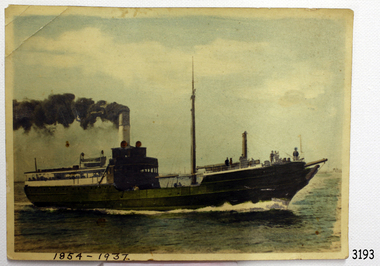
Photograph - Vessel, Steam Ship, Between 1890 - 19-12-1937
... * RN 3193 (this photograph) - Transcription of pen and ink script handwriting = = = = = = = = = = = = 19-12-37 No. 1 Flat, “Goodwood Lodge” 196 Lennox Street, Richmond [Victoria] Dear Arnie , Been meaning to write for long time but you know, it’s just the usual routine of the seamen within Bay trades. ... * RN 3193 (this photograph) - Transcription of pen and ink script handwriting = = = = = = = = = = = = 19-12-37 No. 1 Flat, “Goodwood Lodge” 196 Lennox Street, Richmond [Victoria] Dear Arnie , Been meaning to write for long time but you know, it’s just the usual routine of the seamen within Bay trades. ...This photographic postcard of the SS Edina was taken after the 1890’s due to the style and configuration of the vessel. There is a black and white photograph of the same image also in our Collection (RN 3192). It is most likely that both of the photographs were donated by the same person because the people mentioned in the inscription on the black and white photograph’s reverse side connect with two of the people mentioned in the letter on the reverse of the coloured photograph. * RN 3192; Black & White photograph - inscription: - "Donated by Mrs. Nancy Mason, Bay View. Owned by Mac Fordham, Chief Engineer, 'Edina', then given to Mrs. Mason's father-in-law Arnold Mason (both Engineers W.W. I)" The “Arnie” to whom the letter was addressed is likely to be Arnold Mason, Engineer. The author of the letter, “Mac”, is likely to be Mac Fordham, Chief Engineer of SS Edina. The transcribed letter tells of two men who know each other well and have an interest in the Edina. “Mac” mentions that he may be “too old” to be at sea again; this would also support the idea that the older writer would give his photographs to the perhaps younger “Arnie”. * RN 3193 (this photograph) - Transcription of pen and ink script handwriting = = = = = = = = = = = = 19-12-37 No. 1 Flat, “Goodwood Lodge” 196 Lennox Street, Richmond [Victoria] Dear Arnie , Been meaning to write for long time but you know, it’s just the usual routine of the seamen within Bay trades. Had a good trip back from Sydney. Took our time, spent almost a week coming back, rather monotonous in parts in the hill country, too many darn curves, still was a good trip. How are you all keeping? Suppose you’ve moved back to Drummoyne [erettris?], expect you can let the house in Manly easily enough. Noticed they had a strike at Cockatoo [Cockatoo Island NSW]. don’t suppose they pulled the boys out. How is Jack doing? Has [Willie?] commenced training yet, or no! too young, isn’t she? Been a lot of “paper” talk about the “Edina” finishing but nothing official that I’m aware of, but it’s always on the cards I suppose, then I suppose it will be to sea again if I’m not too old. Easy Winter only 3 trips per week, running every day from today until further notice. Trust [Mary?] Is well & all’s well with you too. Best wishes from us both for Xmas & New Year. Cheerio Mac = = = = = = = = = = = = ABOUT THE SS EDINA The three masted iron screw steamer SS Edina was built in Glasgow, Scotland, in 1854 by Barclay and Curle. She was adorned with the figurehead of ‘fair maid of Judea’. The many years of service made SS Edina famous world-wide as the longest serving screw steamer. (The term screw steamer comes from being driven by a single propeller, sometimes called a screw, driven by a steam engine.) SS Edina’s interesting history includes English Chanel runs, serving in the Crimean Ware carrying ammunition, horses and stores to the Black Sea, and further service in the American Civil War and later, serving in the western district of Victoria as well as in Queensland and carried gold, currency and gold prospectors Australia to New Zealand. SS Edina had the privilege of being an escort vessel to H.R.H. the Duke of Edinburgh during his visit to Australia in 1867. In March 1863 SS Edina arrived in Port Phillip Bay, Melbourne and was bought by Stephen Henty, of Portland fame, to work the cargo and passenger run from Melbourne – Warrnambool – Port Fairy - Portland. After a short time of working the run from Australia to New Zealand, with passengers and cargo that included gold and currency, she returned to her Melbourne - Warrnambool – Port Fairy run, with cargo including bales of wool produced in the western district of Victoria. The Warrnambool Steam Packet Company purchased SS Edina in 1867; she was now commanded by Captain John Thompson and Chief Engineer John Davies. She survived several mishaps at sea, had a complete service and overhaul and several changes of commanders. In 1870 SS Edina was in Lady Bay, Warrnambool, when a gale sprung up and caused a collision with the iron screw steamer SS Dandenong. SS Edina’s figurehead was broken into pieces and it was not ever replaced. SS Edina was re-fitted in 1870 then was used as a coastal trader in Queensland for a period. She was then brought to Melbourne to carry cargo and passengers between Melbourne and Geelong and performed this service 1880-1938. During this time (1917) she was again refitted with a new mast, funnel, bridge and promenade deck, altering her appearance. In 1938, after more collisions, SS Edina was taken out of service. However she was later renamed Dinah and used as a ‘lighter’ (a vessel without engine or superstructure) to be towed and carry wool and general cargo between Melbourne and Geelong. In 1957, after 104 years, the SS Edina was broken up at Footscray, Melbourne. Remains of SS Edina’s hull can be found in the Maribyrnong River, Port Phillip Bay. This photographic postcard with the letter on the revers tell about the SS Edina and are significant for its association with the screw steamer SS Edina. The SS Edina is heritage listed on the Victorian Heritage Database VHR S199. She had endeared herself to the people of Port Phillip Bay as a passenger ferry, part of their history and culture. She played a significant role in the Crimean War, the American Civil War and the gold rush in New Zealand. She also served western Victoria for many years in her cargo and passenger runs. The SS Edina is famous for being the longest serving screw steamer in the world. After spending her first nine years overseas she arrived in Melbourne and her work included running the essential service of transporting cargo and passengers between Melbourne and the western Victoria ports of Warrnambool, Port Fairy and Portland. The SS Edina was purchased in the late 1860’s by local Warrnambool business, the Warrnambool Steam Packet Co. and continued trading from there as part of the local business community. The SS Edina’s original ‘fair maid of Judea’ figurehead was broken to pieces in a collision with another vessel (the SS Dandenong) in a gale off Warrnambool, Victoria, in 1870.Coloured (hand coloured) photographic postcard of SS Edina. Letter on reverse, hand written in pen and ink, from Mac to Arnie, dated 19-12-37 [1937]. The photograph shows the SS Edina moving under steam power, many people on both the bow and stern and a few people in the centre of the vessel. There are buildings on the shore in the background. The ship's configuration is dated post 1890.Hand written in pen on base of front “1854-1957” Hand written on back in blue pen and crossed out “REC 409” Hand written on back in pen ‘EDINA,’ “3173,” “086.2” Hand written letter dated 19-12-37, from Mac to Arnie. Script writing in pen and ink letter on reverse of photograph – see “Context” section for transcription. warrnambool, shipwrecked coast, flagstaff hill, flagstaff hill maritime museum, maritime museum, shipwreck coast, flagstaff hill maritime village, shipwrecked artefact, barclay & curle, figurehead 'fair maid of judea', centenary maritime exhibition 1934, a brief review of steam navigation in victoria, pleasure steamer edina, trade and travel late 19th and early 20th century, trade melbourne to geelong, screw steamer edina, coastal trader edina, lighter dinah, cargo carrying for cremean war, cargo carrying for american civil war, passenger and trade in western district of victoria, export gold and currency and gold diggers to new zealand, export vessel to h r h the duke of edinburgh, melbourne - warrnambool - port fairy - portland cargo run, warrnambool steam packet company, stephen henty, captain john thompson, chief engineer john davies, lady bay warrnambool, lighter edina, shipping victoria, port phillip bay steamers, steamship great britain, edina, vhr s199 victorian heritage database, photographic postcard of ss edina 1854-1957, letter by mac fordham chief engineer ss edina, letter to arnold mason, engineer -
 City of Melbourne Libraries
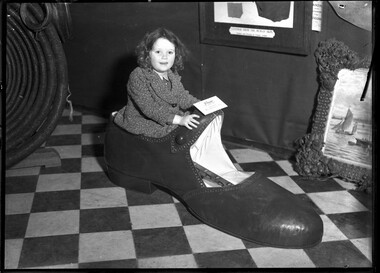
Photograph, Bull, Hugh Jones, 1897-1993, Leather Exhibition, Melbourne Town Hall
... Retrieved January 19, 2026, from http://nla.gov.au/nla.news-article4063888 Museums Victoria, Simpson’s Gloves, 486-496 Victoria Street, North Richmond, VIC, Australia https://collections.museumsvictoria.com.au/articles/2702 The Argus. (1927, October 31). ...Retrieved January 19, 2026, from http://nla.gov.au/nla.news-article4063888 Museums Victoria, Simpson’s Gloves, 486-496 Victoria Street, North Richmond, VIC, Australia https://collections.museumsvictoria.com.au/articles/2702 The Argus. (1927, October 31). ...Photographer notations on slide: At the Leather Exhib. at T. Hall Melb 1933 Age Published: Age (Melbourne, Vic.: 1854- ), 1933 THE EXHIBITS. (1933, September 20). The Age (Melbourne, Vic. : 1854 - 1954), p. 16. Retrieved January 25, 2026, from http://nla.gov.au/nla.news-article205109730 Published title: THE EXHIBITS. A COMPREHENSIVE RANGE. Curios, Novelties, Working Displays Published Caption: ONE OF THE NOVELTIES – AN OUTSIZE IN SHOES Research by Project Volunteer, Louise McKenzie: Our photo is dated 20 September 1933, and shows a happy, chubby-faced young girl sitting in a very over-sized girl’s shoe. It is labelled – “Shoe, An Out Size, loaned by Messrs Blackman & Rose”. (1) It is an effective way to capture the attention of the readership and alert them to the Melbourne Leather Show 1933. This show was designed to be a drawcard of extraordinary proportion, and there is no doubt that this leather exhibition was a really big deal for Melbourne. It completely took over the Melbourne Town Hall, and was open from 10.30 am until 10.30 pm. It seemed to contain something for everyone – the military, the man about town, the home handyman, the housewife, the child, the sporting types, the domestic workers, the outdoor enthusiasts, the horseracing fans, car enthusiasts, those wishing to show off the latest fashion – both men and women - and those just intrigued by a lot of fascinating and wide ranging exhibits. One of the most comprehensive descriptions of the Exhibition accompanies the photograph, and is worth quoting in full: “PROMINENT among exhibits which first attract attention in the foyer of the Town Hall is a comprehensive display of leather articles used by the defence forces. A conspicuous legend states that leather plays an important part in national defence, being used for saddlery, tool containers, holdalls, range-finding, surveying and signalling equipment, explosives factories, harness accoutrement, bandsmen's equipment and clothing. Three models of horses and several figures of soldiers wearing leather equipment illustrate the lesson, and a great range of leather goods used in military training and work variegate the display. Nearby are Texas cowboy, buckjumping and breaking-in saddles; whips, a walking stick, made of leather and numerous other curios. The general exhibition occupies the whole floor space of the main Town Hall, and is subdivided by partitions running most of the length of the hall. A bewildering variety, of leather goods presses for close and leisured inspection. Here and there operatives in charge of working machinery give practical demonstrations of factory processes in the production of footwear. Polishing materials are well represented. One attractive exhibit includes two bush huts constructed of leather, with wattle bark for roofing. Opossums, rosellas and a kookaburra add touches of bush realism. Adjacent exhibits include bags, fishing boots, leggings, leather covers in all colours. Factory Processes. One exhibitor has installed an automatic cinema apparatus and screen, which projects various factory processes in making a shoe, the operator being shown at work. Elsewhere an interesting exhibit depicts the five stages in the manufacture of sole leather, and the tanning materials employed. "Very handsome effects are achieved in the interior appointments of motor cars, which are attended by figures of smart chauffeurs in leather coats. Motor-trimming leather is said to be more durable and hygienic than fabric materials, and cheaper. The neat finish of the material, its excellent appearance, certainly make a very favourable impression. It takes the hides of three beasts to cover the cushions, squabs and door panels of a full-sized sedan, while to finish the entire interior, including quarter-panels and head linings would take four or even five. Special Exhibits. Amongst the special sections the display arranged by the handicrafts and home industries- committee of the Country Women's Association of Victoria is a notable one. In all there are about 130 entries which are in four classifications, viz., hand-tooled or embossed leathers, suede, hand-made gloves and undecorated leather. The glove section attracted the most numerous entries, a number being the work of members and craft subscribers of the Country Women's Association. In the leathercraft competition, organised by the Country Women's Association, the judges yesterday awarded the first prize for bookbinding (the only prize given in this division) to Miss M. Alston, of South Yarra. There is also a creditable display of exhibits submitted by boys of the orthopaedic section of the Children's Hospital at Frankston. Amongst the novelties on view in other portions of the exhibition were the following: — Leather coats worn by Sir C. Kingsford Smith on his Atlantic flight. Model Wellington boot, Phar Lap's saddle. Melbourne Cup winner's saddle. Longest whip in world, 108 feet long. (33 metres) [See our photo, to left of Girl in Shoe] Diminutive shoes. Pair of shoes 65 years old. Pair of men's working boots 75 years old. Larwood's, Tate’s and Pataudi’s cricket boots. [Three internationally revered cricketers of the day] (2) Picture frame made of leather bought 63 years ago. [See our photo, to right of Girl in Shoe] Leather frame, powder bowl, &c. Saddle used by world's champion buckjumper in U.S.A. Mexican cowboy outfit. Miniature saddle and bridle. A fireman's helmet made of sole leather. (3) Sample of the leather hat worn by porters at the Billingsgate Fish Market, London. (4) From South Australia there have been obtained sets of harness for donkeys, goats and camels, the equipment being displayed to good advantage on stuffed representations of the animals mentioned. Close to the platform is a glass case containing snow shoes and coats which have been used in Antarctic exploration work. Trade Display. Amongst the trade exhibits may be seen in operation a slipper turn shoe sewing machine, with heeling and channelling facilities, and the various stages in the production of ladies' sandals are shown. There is a wide contrast between sole leather of varying degrees of thickness on view in one stall and the choice samples of ladies' footwear in another — footwear, by the way, which could almost be used as ornaments, so dainty in colour and production are they. Again, there are displays of upholstering leathers of such soft texture that they could he readily mistaken for some of the finest cloth. Those who may be particularly interested in the production of chamois leather may gain an insight into the materials and chemicals used in the "working up” of this variety of leather. Supplies of glace kid (5) are tastefully arranged, and there may also be seen bags of all shapes and sizes, including satchels, suit cases and "sporting" cases, and bags for tennis players and golfers. Further variety is given to the exhibition by the display of antique hides, brightly coloured, with punching balls, boxing gloves and batsman's pads. There are crocodile skins and snake skins so cleverly "Worked up" that one could be almost pardoned for betraying an affection for such unpopular creatures.” “ Another wonderful article on this Exhibition, published the same day in one of the opposition daily newspapers, The Argus, is in the weekly article “Women to Women”, entitled “A Great Victorian Industry: Many Uses for Leather”. This weekly column was penned by Vesta, and she writes, with much purpose: “Yesterday afternoon I paid a hurried visit to the Leather Exhibition now being held in the Melbourne Town Hall and I was disappointed to find that the early visitors to the main exhibition were almost all men. Women, I think, should make a point of seeing every exhibition of our great industries, for women are the buyers of household requisites and goods for their own use and their tastes, and opinion influence also, to a large extent, the purchases of men. So, the welfare of industries is more or less in their hands and it becomes a duty for them to inform themselves fully of the extent and the quality of the manufacturing that is done here. The value of the output of the Australian boot and shoe factories alone was in 1930-31, the latest year for which the figures are given, Stg 3,750,000. Fully two thirds of that amount must have been spent by women on boots and shoes for themselves and their children. In a host of other directions, in the purchase of handbags, travelling bags, belts and straps, cushions, furniture coverings, purses, notebooks, spectacle cases, their annual expenditure must be very high. Their interest, therefore, in this industry is practical, and their support of it should be governed by knowledge of comparable values and qualities of the goods they buy. From the point of view of women, however, the exhibition itself is rather disappointing. There is an amazing collection of good stuff on show, but most of it is not displayed in a fashion that attracts attention. I was surprised, for example, at the range and quality of the leathers displayed, the suppleness of the finer qualities, and the varied range of colours and designs. But they are shown in such a fashion that if one set out deliberately to look for them it would be quite easy to miss most of them.” …It was surprising, too, that no one seemed to have taken advantage of the present fashion of wearing coloured gloves, or the cult of glove making, which the Country Women’s Association has fostered so successfully. Outside the collection of chamois leathers I saw no skins which were suitable to glove making. (6) However, it is perhaps a little unfair to be highly critical of the exhibition, inasmuch as it is the first of its kind. The material is there, undoubtedly, for a splendid show of every phase of this enterprising industry, and I am confident that experience will prove to those concerned that it will be worth while next time to devote a great deal of attention of the method of display.” With further research, it transpires that “Vera” is in fact NZ born Stella May Allen (nee Henderson) (1871-1962), a journalist, the first woman in NZ to begin a law course, in 1890-91). She later worked at a law firm while she completed her degree. Study of the law had always been open to women in NZ, but its practice was still barred to them. Her case “…led to amending legislation in 1896 allowing women to practise as barristers or solicitors. However, on gaining her LL.B. in November 1897 she did not apply for admission to the Bar. Instead, she became the Wellington-based correspondent and leader-writer for the Lyttelton Times. Her appointment, the first for a woman, was not welcomed by the all-male Press Gallery, and special permission had to be obtained from a subcommittee of the House before her presence was accepted. In 1900 she married Edwin Allen, a senior leader-writer for the Wellington Evening Post, and they moved to Australia in 1903 when Edwin Allen took up the post of foreign affairs leader-writer and parliamentary man for the Melbourne Argus. As Patricia Keep notes in her excellent entry of Stella Allan in the Australian Dictionary of Biography: “In 1907 The Argus commissioned her to write a series of articles on the first Australian Women's Work Exhibition held in October. They aroused much interest and next year The Argus invited her to join its full-time staff and begin a weekly section on the particular interests of women. She adopted the nom de plume 'Vesta' and called the column 'Women to Women'. Her work was unique in an Australian daily paper at that time. Her pages extended to cover every aspect of women's affairs, children's interests and community welfare, and 'Vesta' became a household word for authoritative information and advice on such matters. An excellent needlewoman and first-rate cook herself, she thoroughly tutored her staff in the work and needs of women in both country and city, as well as providing the usual training for cadet journalists. She conducted interviews and also visited the country to see at first hand the results of bushfires, mouse plagues, droughts and floods. In 1910 she was one of three women foundation members of the Australian Journalists' Association. “…she found time to become deeply involved in community affairs. She was an original committee-member of the Victorian Association of Crèches and of the Free Kindergarten Union of Victoria, and had much to do with the early days of the Victorian Bush Nursing Association, the Baby Health Centres Association and the Queen Victoria Hospital. She was a member of the National Council of Women, first in New Zealand and then in Melbourne, and of the Country Women's Association from its inception. … in 1924 she was appointed substitute delegate for Australia to the fifth assembly of the League of Nations at Geneva and was a delegate to the second Pan Pacific Women's Conference in Hawaii in 1930. A meeting held in the Melbourne Town Hall in 1938 by representatives of all the main Victorian women's organizations paid special tribute to her work and influence. She retired next year to England where she continued to write for the Argus, contributing articles on the experiences of women and children in wartime.” It is little wonder that “Vesta” was unafraid to take to task both the women of Victoria, and those who created the exhibition! One item which appears to have gone unnoticed, or at least unreported, is a framed article in the background of the photo of the chubby girl in the shoe. The display frame is labelled “Leather from the Human Skin, Tanned and Dressed by French artists.” The exhibition was certainly a cabinet of curiosities! A charming article in The Argus is a nice note on which to end. It gives a quick history and overview of the Australian leather industry and its unprecedented, and possibly unexpected, development and success, and states with pride: “Though Victoria is the largest leather producer in the Commonwealth all tanners in the Commonwealth can look back with pride on the long march of progress.” Footnotes: (1) “Blackman and Rose”. Messrs Blackman and Rose were shoe manufacturers, from 1927 located at 200 Noone Street, Clifton Hill. The Melbourne Circle describes their building as a “fine-looking building in the Federation ‘blood and bandage’ style.” It was built around 1912 for Puttifoot and Bloom, boot manufacturers, and today the building is apartments. (2) These cricketers were household names in the day: Tate: Maurice Tate, “English cricketer of the 1920s and 1930s, and leader of England’s Test bowling attack for a long time during this period. The founder of modern seam bowling. “ Larwood: Harold Larwood, “English right-arm fast bowler and the main exponent of the bowling style known as “bodyline”. Used to considerable effect in the 1932-33 Test series in Australia. Pataudi: Iftikhar A K Pataudi, “an Indian prince who in the 1930s played Test cricket for England, and in the 1940s played Test cricket for India (as Captain) – the only test cricketer to have played for both India and England. (3) “sole” leather “… is the thickest and most resistant material existing in the tanning industry … made from vegetable tanned leathers, usually bovine butts, processed in a special way to make them the hardest type of leather in existence.” (4) The hats worn by porters at Billingsgate Fish Market were also known as a “Bobbin” and look quite squat and rather unsophisticated. They were made of wood and tarred leather, with a “flat, hardened top designed to support large rectangular boxes of fish. The upturned brim protected the porter’s head against fish juice draining from the boxes of fish which would be carried on top of the hat. Some hats featured a small drain hole at the rear to allow this collected juice to drain down the back of the carrier. The hats were made using the ‘cuir bouilli’ technique. The leather was immersed in water which was heated until the leather began to shrink. It was then removed and put on a wooden former. The leather was stitched together to make the hat while still wet, and then held in place until dry.” (See article and photo on the London Museum website) (5) Glace kid – described on the Boston Museum of Fine Arts’ Cameo database as “A smooth glossy leather originally prepared from goat or sheepskin. Early glace kid had a shiny surface that was originally prepared by tawing the skin in a mixture of alum, table salt, flour, and egg yolk. Today, glace kid is prepared from many types of vegetable or chrome tanned leathers. The smooth polished surface is obtained mechanically by shaving, glazing, ironing, and/or rolling the dry leather.” (6) In the 1930s, Melbourne’s glovemaking industry was characterised by local manufacturing, with key producers like Simpson’s Gloves Pty Ltd in Richmond and the Stagg Glove Company in Clifton Hill leading the market. These factories produced high-quality leather gloves, handbags, and specialty gear, often employing a clear gendered division of labour and training young, local women. Museum Victoria holds the Simpson’s Gloves Collection, comprising over 1200 items, and the University of Melbourne Archives holds the company’s business records. References: THE EXHIBITS. (1933, September 20). The Age (Melbourne, Vic. : 1854 - 1954), p. 16. Retrieved January 25, 2026, from http://nla.gov.au/nla.news-article205109730 EXPORT LEATHER. (1929, September 17). The Argus (Melbourne, Vic. : 1848 - 1957), p. 17. Retrieved January 19, 2026, from http://nla.gov.au/nla.news-article4037647 LEATHER EXHIBITION (1933, September 18). The Argus (Melbourne, Vic. : 1848 - 1957), p. 10. Retrieved January 19, 2026, from http://nla.gov.au/nla.news-article11693362 (1933, September 23). The Argus (Melbourne, Vic. : 1848 - 1957), p. 21. Retrieved January 19, 2026, from http://nla.gov.au/nla.news-page522766 WOMEN TO WOMEN (1933, September 20). The Argus (Melbourne, Vic. : 1848 - 1957), p. 13. Retrieved January 19, 2026, from http://nla.gov.au/nla.news-article11694034 Australian Dictionary of Biography, Stella May Allan (1871–1962) https://adb.anu.edu.au/biography/allan-stella-may-4998 WOMEN TO WOMEN (1930, January 22). The Argus (Melbourne, Vic. : 1848 - 1957), p. 13. Retrieved January 19, 2026, from http://nla.gov.au/nla.news-article4063888 Museums Victoria, Simpson’s Gloves, 486-496 Victoria Street, North Richmond, VIC, Australia https://collections.museumsvictoria.com.au/articles/2702 The Argus. (1927, October 31). The Argus (Melbourne, Vic. : 1848 - 1957), p. 20. Retrieved February 7, 2026, from http://nla.gov.au/nla.news-article3888451 Melbourne Circle: stories from the suburbs: “Boots and all in Clifton Hill” https://melbournecircle.net/2015/11/20/bootmakers-of-clifton-hill/ Wikipedia, Maurice Tate, https://en.wikipedia.org/wiki/Maurice_Tate Wikipedia, Harold Larwood, https://en.wikipedia.org/wiki/Harold_Larwood Wikipedia, Iftikhar Ali Khan Pataudi, https://en.wikipedia.org/wiki/Iftikhar_Ali_Khan_Pataudi Buy Leather Online Italy, Sole leather: https://buyleatheronline.com/en/blog/outsole-and-insole-leather-n7 London Museum, Porters hats, https://www.londonmuseum.org.uk/collections/v/object-731122/hat-porters-hat/ Cameo Database, Museum of Fine Arts, Boston, Glace Kid, https://cameo.mfa.org/wiki/Glac%C3%A9_kid VICTORIAN LEATHER HAS WON RENOWN (1937, September 22). The Argus (Melbourne, Vic. : 1848 - 1957), p. 31 (March of Progress Supplement). Retrieved February 7, 2026, from http://nla.gov.au/nla.news-article1108704 Photographer notations on slide: "At the Leather Exhib. at T. Hall Melb 1933 Age B5".displays, melbourne town hall, leather, children, shoes, 1930-1939, industry, hats, gloves -
 Mission to Seafarers Victoria
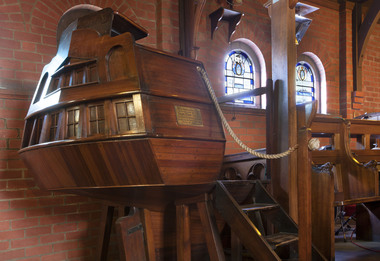
Furniture - Pulpit, Rodney Howard Alsop, 1909
... Street West, and won recognition at the Indian and Colonial Exhibition in London in 1886. Penman and Dalziel were identified in 1937 as one of Melbourne’s early ‘skilled craftsmen’ and ‘leading names’ in the manufacture of fine furniture. He died in February 1918 in a railway accident. mission seafarers melbourne victoria chapel saint peter pulpit australian timber stern walter richmond ...In 1909, assistant Chaplain Rev. Haire presented the Mission with an 'uncommonly artistic pulpit' in memory of his mother. A plaque in memory of Jane King Haire can be found on the side next to the steps. The dedication was performed by the Archbishop of Melbourne on the 26th January (date engraves on the plaque) This pulpit was designed by Melbourne architect Rodney Howard Alsop (1881-1932) and manufactured by William John Dalziel (furniture manufacturer). It was initially used in the first Mission in Central Melbourne, Siddeley St. It is located in the Chapel of Saint Peter of the Mission to Seafarers 717 Flinders St. complex since 1917 (State Heritage listed (H1496). This complex was designed by Walter Richmond Butler in 1916, and officially opened on 11 September 1917, a day '...of unusually kind weather', by the Governor of Victoria, the Honourable Sir Arthur Stanley. According to a later article published in 1950: The pulpit is a model, built to scale, of the stern of an old ship of the line in Lord Nelson's day. This pulpit is significant as it is housed in The Memorial Chapel of Saint Peter forming part of the State Heritage listed Mission to Seafarers Victoria complex. It was built in Melbourne of Australian timbers, and is one of only two known maritime inspired pulpits, both associated with Missions to Seamen of the early 20th C. the other is held in the ANMM Collection see link. Their statement of significance is worth quoting in part as it applies equally to this pulpit "...an extremely rare and unique example of such pulpits. It is highly significant as a wonderfully preserved example of a time when religion was preached to sailors for their spiritual guidance and temperance..." Rodney Howard Alsop was an important Melbourne architect of the Arts and Crafts movement. John William Dalziel had sailed from Liverpool to Melbourne in 1862. Seventeen years later Penman and Dalziel founded the business in Lonsdale Street West, and won recognition at the Indian and Colonial Exhibition in London in 1886. Penman and Dalziel were identified in 1937 as one of Melbourne’s early ‘skilled craftsmen’ and ‘leading names’ in the manufacture of fine furniture. He died in February 1918 in a railway accident.Timber pulpit built in the form of a ship's stern including a timber step ladder for access, a timber keel and rudder, a rope fixed from the pulpit to a post mounted to the floor, and a dedication plaque on the side of the pulpit. The pulpit sits on timber legs. It's likely to be the original rope: traditionally made coir rope with twisted fibres, covered with canvas supported by a thread. At lower end the rope is secured by a monkey fist know and at the top by a turk head knot.Inside the pulpit (right) is the cardboard label with the maker details: " On an attached plaque see 0678 To the greater glory of God and in ever loving memory of Jane King Haire. This pulpit is erected by her son. Blessed are the pure in heart. For they shall see God. St. Matt. V.8. 26.1.09mission, seafarers, melbourne, victoria, chapel, saint peter, pulpit, australian timber, stern, walter richmond butler, australian maritime history, reverend w.f. haire, rodney howard alsop (1881-1932), wright's lane, william john dalziel, gifts-1917, heritage listed -
 Mission to Seafarers Victoria
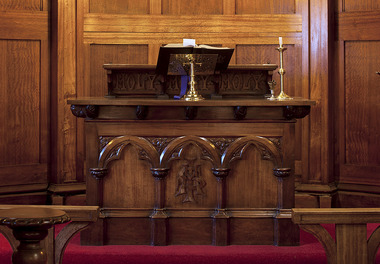
Furniture - Altar, Rodney Howard Alsop, 1907
... victoria...charles shuter...siddeley street institute...chapel...australian timber...walter richmond...Richmond Butler in 1916, and officially opened on 11 September 1917. On the right hand side of the altar, is a brass plaque in memory of Charles Shuter, a colonist and police magistrate who died in 1902. The plaque was made in 1907. The Altar is significant because it is located within the Memorial Chapel of Saint Peter, forming part of the State Heritage listed Mission to Seafarers Victoria complex. It is of religious significance in catering for all denominations and the spiritual needs of visiting seafarers. altar mission seafarers seamen melbourne victoria charles shuter siddeley street ...Along with the pulpit, this Altar was designed by architect Rodney Howard Alsop (1881-1932) (Annual report 1908). It was originally made for the Siddeley Street Institute, which was built in 1907 on a block of land leased from the Melbourne Harbour Trust and donated by Mrs Amelia Shuter (nee Lord) (see Annual Report 1907). The altar is photographed in an early picture of the Siddeley Mission in a room used as chapel before the chapel built in 1909. Although a 21 year lease for the site had been granted, a notice was delivered to the Mission to quit the site in 1912. In 1915, the present site was agreed on. The Altar sits within the Chapel of Saint Peter, which belongs to the State Heritage listed (H1496) Mission to Seafarers Victoria complex. This complex was designed by Walter Richmond Butler in 1916, and officially opened on 11 September 1917. On the right hand side of the altar, is a brass plaque in memory of Charles Shuter, a colonist and police magistrate who died in 1902. The plaque was made in 1907.The Altar is significant because it is located within the Memorial Chapel of Saint Peter, forming part of the State Heritage listed Mission to Seafarers Victoria complex. It is of religious significance in catering for all denominations and the spiritual needs of visiting seafarers.The Altar has a shelf above and three panels along the front, with carved decoration and lettering. Altar bears a plaque that reads "To the Glory of God - In memory of Charles Shuter, of Melbourne, Police Magistrate, Given by his Wife, December 13th 1907". Carved letters "MTS" in centre of three panels along front of Altar, and "HOLY, HOLY, HOLY" in three panels below shelf on top of Altar.altar, mission, seafarers, seamen, melbourne, victoria, charles shuter, siddeley street institute, chapel, australian timber, walter richmond butler, australian maritime history, rodney howard alsop (1881-1932), saint peter chapel, communion table, amelia shuter nee lord, heritage listed, gifts-1917 -
 Mission to Seafarers Victoria
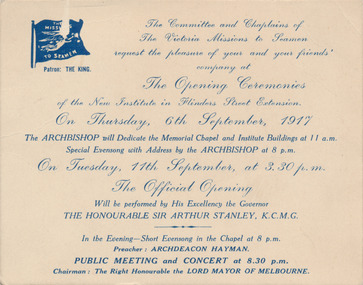
Card - Invitation card, Opening Ceremonies 6th September, 1917, 1917
... This building which has housed the multitude of continual services to Seafarers will attain the Centenary year in 2017. invitation 1917 opening ceremony flinders street walter Richmond butler seamen missions mission to seafarers lord mayor of melbourne dedication sir arthur lyulph stanley (1875-1931) archdeacon hayman printed in copperplate script:"The Committee and Chaplains of / the Victoria Missions to Seamen / request the pleasure of your and your friends' company at / The Opening Ceremonies of the New Institute in Flinders Street extension. / On Thursday, 6th September, 1917 /...The Official Opening / will be performed by His Excellency the Governor / THE HONOURABLE SIR ARTHUR STANLEY, K.C.M.G/..." ...This card is an invitation to attend the opening ceremonies with the dedication of memorial chapel on the 6th of September 1917 by the Archbishop, and the official opening of the Flinders Street Mission on the 11th of September 1917 by the Governor, Sir, Arthur Lyulph Stanley.This 1917 invitation marks the commencement of official ceremonies to dedicate both the new Mission Building and Chapel and associated services and celebratory concert. This building which has housed the multitude of continual services to Seafarers will attain the Centenary year in 2017.Commercially printed invitation on heavy card printed with blue ink ; features a Flying Angel flag of the Mission to Seamen in top left crnrprinted in copperplate script:"The Committee and Chaplains of / the Victoria Missions to Seamen / request the pleasure of your and your friends' company at / The Opening Ceremonies of the New Institute in Flinders Street extension. / On Thursday, 6th September, 1917 /...The Official Opening / will be performed by His Excellency the Governor / THE HONOURABLE SIR ARTHUR STANLEY, K.C.M.G/..."invitation, 1917, opening ceremony, flinders street, walter richmond butler, seamen missions, mission to seafarers, lord mayor of melbourne, dedication, sir arthur lyulph stanley (1875-1931), archdeacon hayman -
 Mission to Seafarers Victoria
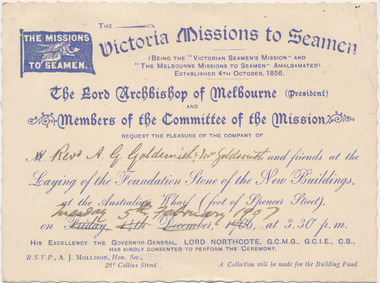
Card - Invitation card, The Victoria Missions to Seamen, 1906
... street alfred gurney goldsmith walter richmond butler Ink inscriptions: the Rev A.G. Goldsmith and Mrs Goldsmith // ; printed date of Friday 14th of December 1906 is crossed out and superscribed in handwritten ink as: Tuesday 5th of February 1907 A heavy card with crimped edge with commercially printed invitation in cursive scripts from the Archbishop of Melbourne and the Members of the Committee of the Mission. A blue flying angel Missions to Seamen flag is printed in the top left corner. The invitee name is written in sepia ink as is an altered date. The Victoria ...The original date for the laying of Foundation stone for the first Mission building at Australian Wharf in 1906 had to be changed to the 5th of February 1907 due to industrial action at the Wharves. See scrapbooks and clippings for details. Lord Northcote the Governor General officiated. The invitation marks the establishment for the first time at the Australian Wharf official recognition of the need to establish a Mission for seafarers in this location, some six years after presentation of the letter in 1897 from 22 Captains urging and requesting a respectable and convenient facility. Just ten years later the Mission would have to move to an adjacent site and raise funds for yet another Mission building in 1916. A heavy card with crimped edge with commercially printed invitation in cursive scripts from the Archbishop of Melbourne and the Members of the Committee of the Mission. A blue flying angel Missions to Seamen flag is printed in the top left corner. The invitee name is written in sepia ink as is an altered date. Ink inscriptions: the Rev A.G. Goldsmith and Mrs Goldsmith // ; printed date of Friday 14th of December 1906 is crossed out and superscribed in handwritten ink as: Tuesday 5th of February 1907 lord northcote, governor general, rev gurney goldsmith, foundation stone, australian wharf, the melbourne missions to seamen, victorian seamen's mission, 1907, siddeley street, alfred gurney goldsmith, walter richmond butler -
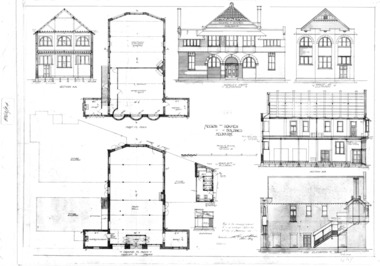 Mission to Seafarers Victoria
Plan - Architectural Plan, copy, Walter Butler, c. 2013
... Doig Architecture joined Baldasso Cortese in 2019. peter doig redevelopment built heritage Walter Richmond Butler (1864–1949) siddeley street institute Large copy in black and white on glossy strong paper of the original bButler plan for the first central mission, Siddeley Street, held at the State Library of Victoria. ...The copy was part of the conservation plan written by Peter Doig Architecture. Doig Architecture joined Baldasso Cortese in 2019.Large copy in black and white on glossy strong paper of the original bButler plan for the first central mission, Siddeley Street, held at the State Library of Victoria.peter doig, redevelopment, built heritage, walter richmond butler (1864–1949), siddeley street institute -
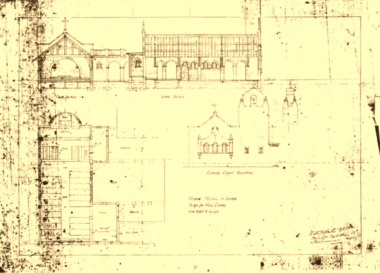 Mission to Seafarers Victoria
Drawing - Architectural drawings, Walter Butler, Victoria Missions to Seamen, Design for the New Chapel, September 1916
... Street building designed by Walter Richmond Butler. The copy was published in the 2002 conservation plan without mentionne the source. The original has not been located. The drawing shows the first design of the chapel, the intented position of the weathervane, the absence of chaplain's residence and dome. Walter Richmond Butler (1864–1949) flinders street building sketch built heritage Original drawing for the new chapel with signature of Walter Butler Victoria ...Rough sketch for the new Flinders Street building designed by Walter Richmond Butler. The copy was published in the 2002 conservation plan without mentionne the source. The original has not been located.The drawing shows the first design of the chapel, the intented position of the weathervane, the absence of chaplain's residence and dome.Original drawing for the new chapel with signature of Walter Butlerwalter richmond butler (1864–1949), flinders street, building, sketch, built heritage -
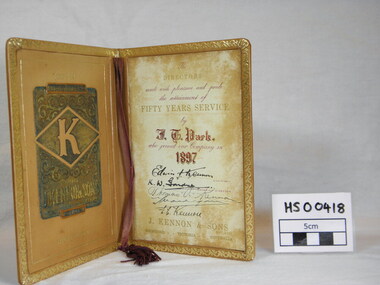 Richmond & Burnley Historical Society
Service Award, J. Kennon & Sons Pty Ltd, Kennon Tannery 50 Year Service Award to J.T.Park, c. 1897
... Street, Richmond. The/Directors/mark with pleasure and pride/the attainment of/Fifty Years Service/by/J.T.Parks/who joined our company in/1897/signed by the Chairman and Directors/ Edwin J. Kennon/K.W.Gardner/Thomas A. Kennon/E.C.Kennon/ J.Kennon & Sons Pty Ltd/ Richmond Victoria...Street, Richmond. The/Directors/mark with pleasure and pride/the attainment of/Fifty Years Service/by/J.T.Parks/who joined our company in/1897/signed by the Chairman and Directors/ Edwin J. Kennon/K.W.Gardner/Thomas A. Kennon/E.C.Kennon/ J.Kennon & Sons Pty Ltd/ Richmond Victoria ...The Certificate was presented to the Society by J T Parks daughter after a presentation by John rose who spoke about the history of the Kennon Family and the Kennon Tannery.Limited number of certificates issued with 50 years of Service. The Certificate is representative of companies in Richmond and the extended loyalty and service of employees.Guilded Leather Certificate, Tan colour. Cover Engraving - J T Park Certificate No. 4 Years of Service, 1897 -1947 J. Kennon & Sons Tannery, River Street, Richmond. The/Directors/mark with pleasure and pride/the attainment of/Fifty Years Service/by/J.T.Parks/who joined our company in/1897/signed by the Chairman and Directors/ Edwin J. Kennon/K.W.Gardner/Thomas A. Kennon/E.C.Kennon/ J.Kennon & Sons Pty Ltd/ Richmond Victoria Australia service, award, kennon, tannery, j t parks, richmond -
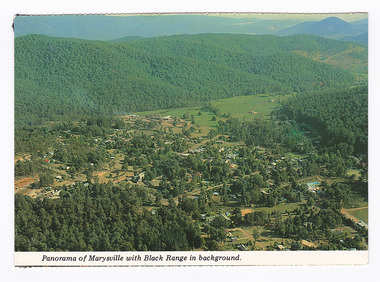 Marysville & District Historical Society
Postcard (item) - Colour postcard, K. & H. Ellis, Panorama of Marysville with Black Range in background, Pre 2009
... Colorscans MARYSVILLE - VICTORIA Panorama of Marysville with Black/ Range in background. c PUBLISHED & PRINTED BY COLORSCAPES PUBLISHING PTY LTD 118-120 BRIGHTON STREET RICHMOND 3121 Supa-vu/ cards Photographed and Distributed by:/ K. & H. ...Colorscans MARYSVILLE - VICTORIA Panorama of Marysville with Black/ Range in background. c PUBLISHED & PRINTED BY COLORSCAPES PUBLISHING PTY LTD 118-120 BRIGHTON STREET RICHMOND 3121 Supa-vu/ cards Photographed and Distributed by:/ K. & H. ...A colour photograph of a view of Marysville in Victoria.A colour photograph of a view of Marysville in Victoria. The photograph has been taken from one of the many lookouts that surround Marysville.Panorama of Marysville with Black Range in background. Colorscans MARYSVILLE - VICTORIA Panorama of Marysville with Black/ Range in background. c PUBLISHED & PRINTED BY COLORSCAPES PUBLISHING PTY LTD 118-120 BRIGHTON STREET RICHMOND 3121 Supa-vu/ cards Photographed and Distributed by:/ K. & H. ELLIS - 35 Old Warburton Road/ Warburton 3799 20-1-81/ Dear Mum/ Just a line/ to let you know we/ have settled in here./ Its a nice park not to/ big, with a river in/ behind the van. (its/ more like a swift/ running creek, the/ kids are really enjoying/ it. There are plenty of/ walks to go on, up here/ tracks everywhere./ Hows the cooler going/ keeping you cool?/ We are able to say here until/ Sunday./ See you Mum/ Love Lois, Tom,/ & Kids. Mrs A. McTaggart/ 2 Frederick Street/ Kyabram Vic/ 3620. On reverse of postcard are 5 black marks; one in each corner and one in the centre from where the postcard has been removed from an album.marysville, victoria, postcard, souvenir, k & h ellis, colorscans publishing -
 Marysville & District Historical Society
Postcard (item) - Colour postcard, K. & H. Ellis, Pack Road, Marysville, Pre 2009
... Colorscans c PUBLISHED & PRINTED BY COLORSCANS (PUBLISHING) PTY LTD 118-120 BRIGHTON STREET, RICHMOND 3121/ Supa-vu/ cards MARYSVILLE - VICTORIA/ Pack Road, Marysville Photographed and Distributed by:/ K & H. ...Street in Marysville in Victoria. A colour photograph of Pack Road in Marysville in Victoria. Labeling is incorrect. View is down Murchison Street towards Barton Bridge. In the background can be seen the rectory from the Church of England. The rectory survived the 2009 Black Saturday bushfires whilst the church was destroyed. This postcard was produced by Colorscans Publishing as a souvenir of Marysville. marysville victoria pack road murchison street postcard souvenir colorscans publishing k & h ellis 2009 black saturday bushfires church of england Colorscans c PUBLISHED & PRINTED BY COLORSCANS (PUBLISHING) PTY LTD 118-120 BRIGHTON STREET, RICHMOND 3121/ Supa-vu/ cards MARYSVILLE - VICTORIA/ Pack Road, Marysville Photographed and Distributed by:/ K & H. ...A colour photograph of Murchison Street in Marysville in Victoria.A colour photograph of Pack Road in Marysville in Victoria. Labeling is incorrect. View is down Murchison Street towards Barton Bridge. In the background can be seen the rectory from the Church of England. The rectory survived the 2009 Black Saturday bushfires whilst the church was destroyed. This postcard was produced by Colorscans Publishing as a souvenir of Marysville.Colorscans c PUBLISHED & PRINTED BY COLORSCANS (PUBLISHING) PTY LTD 118-120 BRIGHTON STREET, RICHMOND 3121/ Supa-vu/ cards MARYSVILLE - VICTORIA/ Pack Road, Marysville Photographed and Distributed by:/ K & H. Ellis - 35 Old Warburton Road,/ Warburton 3799marysville, victoria, pack road, murchison street, postcard, souvenir, colorscans publishing, k & h ellis, 2009 black saturday bushfires, church of england -
 Marysville & District Historical Society
Postcard (item) - Colour postcard, Colorscans (Publishing) Pty Ltd, The Log Train - Marysville, Pre 2009
... LTD. 118-120 BRIGHTON STREET, RICHMOND. 3121 Supa-vu/ cards MARYSVILLE - VICTORIA The Log Train was originally in/ use at Anderson's Mill - Marysville./ The log came from a Messmate/ Stringy bark (Eucalyptus Obliqua),/ age 134 years; height 53.3 metres;/ felled in 1970 at Elliots Creek, / Mt. ...This postcard was produced by Colorscans Publishing as a souvenir of Marysville. marysville log train anderson's mill messmate stringy bark eucalyptus obliqua victoria colorscans publishing postcard souvenir Colorscans c PUBLISHED & PRINTED BY COLORSCANS (PUBLISHING) PTY. LTD. 118-120 BRIGHTON STREET, RICHMOND. 3121 Supa-vu/ cards MARYSVILLE - VICTORIA The Log Train was originally in/ use at Anderson's Mill - Marysville./ The log came from a Messmate/ Stringy bark (Eucalyptus Obliqua),/ age 134 years; height 53.3 metres;/ felled in 1970 at Elliots Creek, / Mt. ...A colour photograph of a log train that was used in a sawmill in Marysville in Victoria.A colour photograph of a log train that was used in a sawmill in Marysville in Victoria. The Log Train was originally in use at Anderson's Mill - Marysville. The original log came from a Messmate Stringy bark (Eucalyptus Obliqua), age 134 years; height 53.3 metres; felled in 1970 at Elliots Creek, Mt. Margaret. The volume of the log was 6,000 super feet. The original log was destroyed in the 2009 Black Saturday bushfires. This postcard was produced by Colorscans Publishing as a souvenir of Marysville.Colorscans c PUBLISHED & PRINTED BY COLORSCANS (PUBLISHING) PTY. LTD. 118-120 BRIGHTON STREET, RICHMOND. 3121 Supa-vu/ cards MARYSVILLE - VICTORIA The Log Train was originally in/ use at Anderson's Mill - Marysville./ The log came from a Messmate/ Stringy bark (Eucalyptus Obliqua),/ age 134 years; height 53.3 metres;/ felled in 1970 at Elliots Creek, / Mt. Margaret. Volume of the log/ 6,000 super feet. Photographed and Distributed by:/ K & H. ELLIS - 35 Old Warburton Road,/ Warburton 3799marysville, log train, anderson's mill, messmate stringy bark, eucalyptus obliqua, victoria, colorscans publishing, postcard, souvenir -
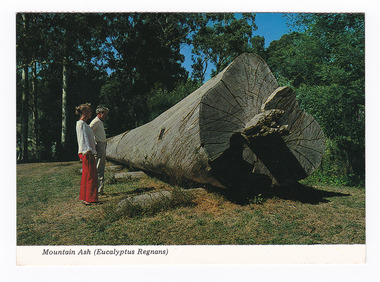 Marysville & District Historical Society
Postcard (item) - Colour postcard, Colorscans (Publishing) Pty Ltd, Mountain Ash (Eucalyptus Regans), Pre 2009
... LTD. 118 BRIGHTON STREET, RICHMOND 3121 Supa-vu/ cards MARYSVILLE - VICTORIA This Mountain Ash (Eucalyptus/ Regnans) log was felled in 1971/ on Mt. ...Ltd. as a souvenir of Marysville. marysville mountain ash eucalyptus regnans victoria colorscans publishing postcard souvenir Colorscans C PUBLISHED & PRINTED BY COLORSCANS (PUBLISHING) PTY. LTD. 118 BRIGHTON STREET, RICHMOND 3121 Supa-vu/ cards MARYSVILLE - VICTORIA This Mountain Ash (Eucalyptus/ Regnans) log was felled in 1971/ on Mt. ...A colour photograph of a felled Mountain Ash tree that was on display in Marysville, Victoria.A colour photograph of a felled Mountain Ash tree that was on display in Marysville, Victoria. This postcard was produced by Colorscans (Publishing) Pty. Ltd. as a souvenir of Marysville.Colorscans C PUBLISHED & PRINTED BY COLORSCANS (PUBLISHING) PTY. LTD. 118 BRIGHTON STREET, RICHMOND 3121 Supa-vu/ cards MARYSVILLE - VICTORIA This Mountain Ash (Eucalyptus/ Regnans) log was felled in 1971/ on Mt. Observation. Total height/ 57.3 metres, age 224 years. Volume/ of this log 1194 super feet suffic-/ ient to frame an average house. Photographed and Distributed by:/ K & H. ELLIS - 35 Old Warburton Road,/ Warburton 3799marysville, mountain ash, eucalyptus regnans, victoria, colorscans publishing, postcard, souvenir
