
Showing 367 items matching "victorian border"
-
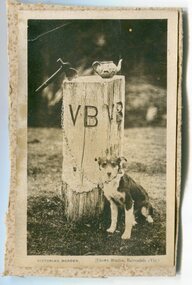 Orbost & District Historical Society
Photograph - V B post - Victorian Border, Crown Studios ( W Stanley Vogt), c.1920s-1950s
... V B post - Victorian Border...Victorian Border...The Victorian/New South Wales border is near Genoa in Far East Gippsland. ...Victorian Border. Crown Studios, Bairnsdale, Vic....This photograph is significant because it is a rare image of a marker post which was once very important. Victorian Border NSW Border Marker post Princes Highway Victorian Border. ...The Victorian/New South Wales border is near Genoa in Far East Gippsland. This post marked this border and was positioned beside the Highway. For many years, the border was an important stopping point because it also had a Fruit Fly inspection point for traffic coming into Victoria from N S Wales.This photograph is significant because it is a rare image of a marker post which was once very important. A b/w photograph/postcard of a square post, painted white with the letters W B stencilled into it. The post has a Tea Pot on top, and a small axe. A b/w dog is sitting nearby and appears to be attached to the post by a chain. Victorian Border. Crown Studios, Bairnsdale, Vic.victorian border, nsw border, marker post, princes highway -
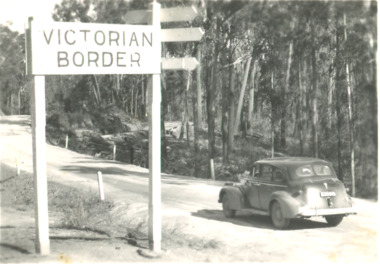 Lakes Entrance Historical Society
Postcard, Victorian Border sign East Gippsland Victoria, 1940 c
... Victorian Border sign East Gippsland Victoria...Black and white postcard showing a sedan driving by the Victorian Border sign East Gippsland Victoria...Roads and Streets Topography Vehicles Black and white postcard showing a sedan driving by the Victorian Border sign East Gippsland Victoria Victorian Border sign East Gippsland Victoria Postcard ...Black and white postcard showing a sedan driving by the Victorian Border sign East Gippsland Victoriaroads and streets, topography, vehicles -
 Glenelg Shire Council Cultural Collection
Negative - Negative - South Australia / Victorian border fence sign post, c. 1936
... Negative - South Australia / Victorian border fence sign post...Nelson - Mt Gambier mail truck, with two men standing beside it Negative Negative - South Australia / Victorian border fence sign post Miss Zillah Maschmedt, photographer ...Transparency for black and white photo. SA/Vic border fence. Sign post reading '22 miles to Mt Gambier, 2 1/2 miles to Nelson'. Nelson - Mt Gambier mail truck, with two men standing beside it -
University of Melbourne, Burnley Campus Archives
Plan, Plant Culture and Garden Maintenance Planting Plan Assignment, 1987-1988
... border...Victorian Plant Research Institute...gardens maintenance planting plant culture mixed border Victorian Plant Research Institute M. Green (1) Plan on tracing paper of Mixed Border, plants not included, signed MG March '87. (2) Base Plan by MG, July 1988. ...(1) Plan on tracing paper of Mixed Border, plants not included, signed MG March '87. (2) Base Plan by MG, July 1988. Scale 1:100.gardens, maintenance, planting, plant culture, mixed border, victorian plant research institute, m. green -
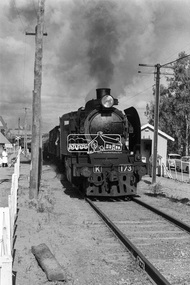 Eltham District Historical Society Inc
Photograph, George Coop, Steam locomotive K-173 departing Echuca Railway Station, 1962
... Standing to the left is the Fruit Fly Inspector who was once a common sight at the NSW/Victorian border crossings....Standing to the left is the Fruit Fly Inspector who was once a common sight at the NSW/Victorian border crossings. George Coop Collection Echuca Echuca Railway Station Fruit Fly Inspection K-173 K-Class Steam Locomotive (VR Newport Workshops) Digital TIFF file Scan of 35mm Ilford FP3 black and white negative transparency Steam locomotive K-173 departing Echuca Railway Station Photograph Photograph George Coop ...Leaving the Echuca yards and charging up the hill approaching the Iron Bridge. Standing to the left is the Fruit Fly Inspector who was once a common sight at the NSW/Victorian border crossings.Digital TIFF file Scan of 35mm Ilford FP3 black and white negative transparencygeorge coop collection, echuca, echuca railway station, fruit fly inspection, k-173, k-class steam locomotive (vr newport workshops) -
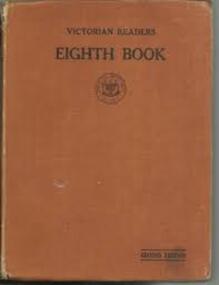 Tatura Irrigation & Wartime Camps Museum
Book, Victorian Readers Eighth Book, 1929
... Brown cover, black lettering, Black border. Victorian Education Department logo on front....Now closed. victorian readers eighth book craven w crawn j tatura craven road books history local education Jean M Craven. Wm. J Craven Brown cover, black lettering, Black border. ...School reader used by W Craven and J Craven at Toolamba West School. Now closed.Brown cover, black lettering, Black border. Victorian Education Department logo on front.Jean M Craven. Wm. J Cravenvictorian readers, eighth book, craven w, crawn j, tatura, craven road, books, history, local, education -
 Bendigo Historical Society Inc.
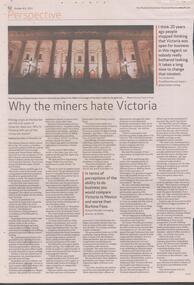
Newspaper - NEWSPAPER ARTICLE, WHY THE MINERS HATE VICTORIA
... Mining exploration stops at the Victorian border. Tom Goldsmith of PriceWaterhouseCoopers is quoted beside the headline 'Why the miners have Victoria' saying 'I think 20 years ago people stopped thinking that Victoria was open for business in this regard, so nobody really bothered looking. ...Mining exploration stops at the Victorian border. Tom Goldsmith of PriceWaterhouseCoopers is quoted beside the headline 'Why the miners have Victoria' saying 'I think 20 years ago people stopped thinking that Victoria was open for business in this regard, so nobody really bothered looking. ...Article from the Weekend Australian Financial Review, Octobert 8-9, 2011. explores the reasons why mining investment in Victoria is not an attractive proposition. Mining exploration stops at the Victorian border. Tom Goldsmith of PriceWaterhouseCoopers is quoted beside the headline 'Why the miners have Victoria' saying 'I think 20 years ago people stopped thinking that Victoria was open for business in this regard, so nobody really bothered looking. It takehs a long time to change that mindset'bendigo, mining, mining investment -
 Bendigo Historical Society Inc.
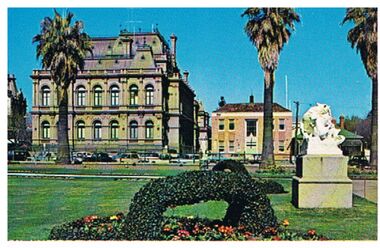
Postcard - LAW COURTS, BENDIGO
... Former Police Station on RH side of Law Courts, beside Police Station is a Victorian house, bordering the Bendigo Creek and entry into Rosalind Park. ...Former Police Station on RH side of Law Courts, beside Police Station is a Victorian house, bordering the Bendigo Creek and entry into Rosalind Park. ...Postcard: image shows Law Courts, Bendigo. Former Police Station on RH side of Law Courts, beside Police Station is a Victorian house, bordering the Bendigo Creek and entry into Rosalind Park. In foreground, ivy basket, statue in Conservatory Gardens.Plastichromebendigo, buildings, law courts, bendigo, law courts, police station -
 Wodonga & District Historical Society Inc
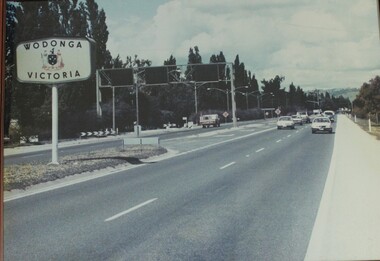
Photograph - Wodonga, Victoria sign and the Fruit Fly check point c1970s
... A large image of the LIncoln Causeway at the Victorian/NSW border at Wodonga. The southbound lanes on the right hand side feature overhead signals and traffic light signs to control traffic leading into the Fruit fly inspection checkpoint ahead. ...On right hand side: Border sign: Wodonga/Victoria and the Victorian State Coat of Arms....A large image of the LIncoln Causeway at the Victorian/NSW border at Wodonga. The southbound lanes on the right hand side feature overhead signals and traffic light signs to control traffic leading into the Fruit fly inspection checkpoint ahead. ...The permanent fruit fly road blocks in Victoria began in 1958. The first was set up on the Lincoln Causeway between Albury and Wodonga. The aim was to protect the Victorian fruit export industry, the largest in the country. Cars would be stopped and inspected when entering Victoria. At peaks periods, such as Easter and school holidays, there were up to 10 inspectors at the 24 hour checkpoint near the former butter factory on the Lincoln Causeway. Local residents could apply for a pass which would be displayed on their window, but were still subject to random checks. Hundreds of tonnes of fruit each week was confiscated and pulverised by Department of Agriculture staff. The road block was closed in 1980, partly due to the increased traffic flows and the cost of maintaining inspection points.This image reflects government measures taken to protect the fruit industry in Victoria.A large image of the LIncoln Causeway at the Victorian/NSW border at Wodonga. The southbound lanes on the right hand side feature overhead signals and traffic light signs to control traffic leading into the Fruit fly inspection checkpoint ahead. The photo is in a wooden frame.On right hand side: Border sign: Wodonga/Victoria and the Victorian State Coat of Arms.fruit fly control, victoria border, lincoln causeway wodonga -
 City of Moorabbin Historical Society (Operating the Box Cottage Museum)
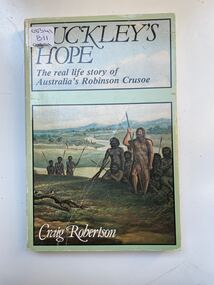
Book, Globe Press Pty. Ltd, Buckley's hope : the story of Australia's wild white man, 1981
... On the third page there are five lines of text on the next page is a map of Southern Victoria listing the different indigenous tribes that lived from Port Phillip Bay west to Cape Otway on the next page there is another map showing Van Dieman's land in the South,Victoria and the South Australian border to the West and the Victorian N.S.W. border up to the Lachlan River in the north....On the third page there are five lines of text on the next page is a map of Southern Victoria listing the different indigenous tribes that lived from Port Phillip Bay west to Cape Otway on the next page there is another map showing Van Dieman's land in the South,Victoria and the South Australian border to the West and the Victorian N.S.W. border up to the Lachlan River in the north. ...A small soft cover book with a blue/green cover,on the front cover is a painting of early Australia with Indigenous Australians hunting with spears alongside them is a European with long unkept hair and a beard dressed in animal skins,on the back cover is text by the author giving a brief outline of the book.buckley, sorrento, robinson crusoe, port phillip, van diemen's land, colonialism, 1840, convicts, indigenous tribes. -
Lakes Entrance Historical Society
Photograph - McKillops Bridge across the Snowy River East Gippsland Victoria 1990
... Colour photograph showing McKillops Bridge across the Snowy River in the High Country near Deddick, East Gippsland near the Victorian / NSW border, south side of bridge, road to Deddick just visible opposite end, taken from west end of bridge. ...Also another photo taken later Bridges Waterways Topography Colour photograph showing McKillops Bridge across the Snowy River in the High Country near Deddick, East Gippsland near the Victorian / NSW border, south side of bridge, road to Deddick just visible opposite end, taken from west end of bridge. ...Also another photo taken laterColour photograph showing McKillops Bridge across the Snowy River in the High Country near Deddick, East Gippsland near the Victorian / NSW border, south side of bridge, road to Deddick just visible opposite end, taken from west end of bridge. River flowing to right, bridge of timber, steel and concrete, mountains around. East Gippsland Victoriabridges, waterways, topography -
 Orbost & District Historical Society
black and white photograph, first half 20th century
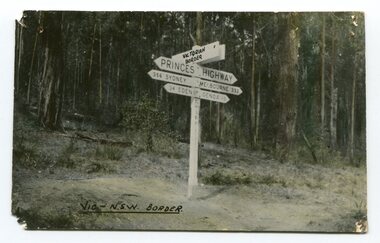
... A black / white photograph postcard of the signpost at the Victorian - New South Wales border. It shows distances to Sydney and Eden on one arrow and distances to Melbourne and Genoa on another. ...Princes-Highway-East-Gippsland road-transport road-sign on front - Vic - NSW Border A black / white photograph postcard of the signpost at the Victorian - New South Wales border. ...Prior to the sealing of the Princes Highway west of Orbost, the road surface was anything but good, even by C1917 when cars started to use the road. From Orbost the old road via Marlo to Sydenham was abandoned for the new location which traversed more rugged country via Cabbage Tree, Bell Bird and Club Terrace to Cann River, and the reason for this diversion was on account of settlements being established at Murrungowar and Club Terrace, at which latter place there was a temporary rush to obtain gold. This road was constructed by the Public Works department and a maximum grade of 1 in 19 was adopted, and as speed was not to be catered for the grade followed in and out round the spurs and gullies, resulting in a maze of turns and twists which required a good deal of skill on the part of the horse driver to negotiate." - Bairnsdale Advertiser, Friday, May 2, 1947. (More information from Newsletter February 2010)This is a pictorial record of an early road distance sign on a major highway through East Gippsland. The distances are indicated in miles, a measurement standard no longer in use.A black / white photograph postcard of the signpost at the Victorian - New South Wales border. It shows distances to Sydney and Eden on one arrow and distances to Melbourne and Genoa on another. on front - Vic - NSW Borderprinces-highway-east-gippsland road-transport road-sign -
 Orbost & District Historical Society
post cards, ca. 1945
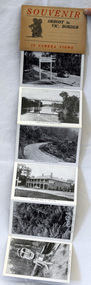
... Snowy River bridge at Orbost, Snowy River at Orbost, Marlo from the sand dunes, Prince's Highway at Victorian-NSW. border, Genoa River and bridge at Genoa, Prince's Highway at Mt. ...Border 13 camera views A set of 13 black and white postcards in a fold-out format. Pictures are of : Nicholson Street, Snowy Rriver flats from Grand View, avenue leading to Obost. Snowy River bridge at Orbost, Snowy River at Orbost, Marlo from the sand dunes, Prince's Highway at Victorian-NSW. border, Genoa River and bridge at Genoa, Prince's Highway at Mt. ...This is a souvenir of Orbost from 1945.A set of 13 black and white postcards in a fold-out format. Pictures are of : Nicholson Street, Snowy Rriver flats from Grand View, avenue leading to Obost. Snowy River bridge at Orbost, Snowy River at Orbost, Marlo from the sand dunes, Prince's Highway at Victorian-NSW. border, Genoa River and bridge at Genoa, Prince's Highway at Mt. Drummer, Cann River hotel, fern scene, Euchre Valley, ponsasinorum near Cann River. SOUVENIR Orbost to Vic Border 13 camera viewspostcard souvenir photographs orbost cann-river -
 Wodonga & District Historical Society Inc
Photograph - Fred Rochow Railways Collection - George Henry Lynch and Jack Anderson, 24 November 1937
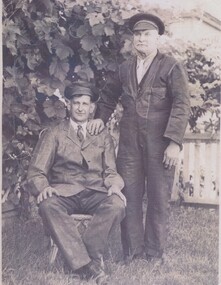
... From its introduction in November 1937 until April 1962 the train service ran on 1,600 mm (5 ft 3 in) broad gauge line from Melbourne's Spencer Street station to Albury, on the New South Wales / Victorian border, where passengers changed to a New South Wales Government Railways train (the Melbourne Limited Express). ...From its introduction in November 1937 until April 1962 the train service ran on 1,600 mm (5 ft 3 in) broad gauge line from Melbourne's Spencer Street station to Albury, on the New South Wales / Victorian border, where passengers changed to a New South Wales Government Railways train (the Melbourne Limited Express). ...The Fred Rochow Railways Collection incorporates photos related to the operation of the Wodonga Railway Station including different types of trains and railways staff C. 1930 – 1990. It was donated to the Wodonga Historical Society by Fred Rochow, a railwayman who spent many years based in Wodonga. He joined the Victorian Railways on 17th June l947 and retired in 1988. For some time, he was a member of the Australian Federated Union of Locomotive Enginemen and served a term as a member of the Trades Hall Council. He had an extensive knowledge of the struggles that took place to achieve better conditions for railway workers. Fred worked for many years as a fireman and then worked his way up the ranks to driver, experiencing many changes from the days of steam locomotives through to diesel trains, locomotives and even the modern XPT train. He worked throughout Victoria at different stages of his career, with his final working years focused on the northeast of Victoria and the Albury to Melbourne line. After his retirement, Fred continued to share his love of steam miniature trains with the community.This collection has local and statewide significance as it captures images of trains, locomotives and personnel who operated the railway services in Wodonga and throughout Northeast Victoria. The railways played a critical role in opening up Victoria and connecting Australia for trade, business, social communication and transport.Driver George Henry Lynch (standing) with Fireman Jack Anderson. This photo was taken the day after the first regular run of the "Spirit of Progress". The Spirit of Progress was the premier express passenger train on the Victorian Railways in Australia, running from Melbourne to the New South Wales border at Albury, and later through to Sydney. From its introduction in November 1937 until April 1962 the train service ran on 1,600 mm (5 ft 3 in) broad gauge line from Melbourne's Spencer Street station to Albury, on the New South Wales / Victorian border, where passengers changed to a New South Wales Government Railways train (the Melbourne Limited Express). Following the completion of the standard gauge line between Melbourne and Albury in April 1962 the Spirit of Progress was extended to Sydney. With declining passenger numbers it was decided to combine the Spirit of Progress and Southern Aurora into one train, the Sydney/Melbourne Express. The Spirit of Progress ran for the last time on 2 August 1986. V/Line rostered S301 Sir Thomas Mitchell to haul the last journeys in Victoria.railways wodonga, fred rochow, wodonga railwaymen, george henry lynch, jack anderson, spirit of progress -
 Bendigo Historical Society Inc.
Book - GERMAN HERITAGE SOCIETY COLLECTION: THE VICTORIAN DRAWING BOOK
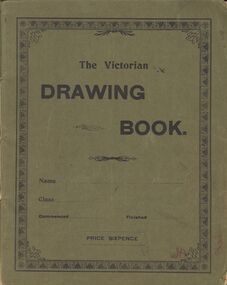
... Dark green book with blue printing on the cover titled 'The Victorian Drawing Book'. Border around the edges. Has space on the front for name, class, commenced and finished on the front. ...DRAWING Pencil drawing book German Heritage Society Collection - The Victorian Drawing Book Dark green book with blue printing on the cover titled 'The Victorian Drawing Book'. Border around the edges. Has space on the front for name, class, commenced and finished on the front. ...Dark green book with blue printing on the cover titled 'The Victorian Drawing Book'. Border around the edges. Has space on the front for name, class, commenced and finished on the front. Price sixpence. Pencil drawings in the book include some letters of the alphabet, people, animals and flowers. Three loose drawing in the book and a transfer of an iris and butterflies for embroidery. Supplement to Weldon's Ladies' Journal. Advertisement for Faudel's Embroidery Silks, Peacock & Squirrel Brands.drawing, pencil, drawing book, german heritage society collection - the victorian drawing book -
 Puffing Billy Railway
Double Headed Rail, circa 1872 - 1883
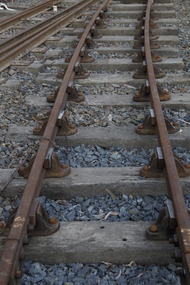
... It was established on 8 February 1853 to build a railway from Melbourne to Echuca on the Victorian-NSW border and a branch railway to Williamstown. ...It was established on 8 February 1853 to build a railway from Melbourne to Echuca on the Victorian-NSW border and a branch railway to Williamstown. ...Double Headed Rail from Ravenswood Station Siding which was dismantled circa 1987 the two rails were stored for a time at Maldon before being donated to Puffing Billy Museum Bearing makers marks of Wilson & Cammell - Dronfield- Steel works Wilson & Cammell made Steel rails at their Dronfield Steel Works, in Dronfield, North East Derbyshire, England from 1872 - 1883 Double-headed rail In late 1830s Britain, railway lines had a vast range of different patterns. One of the earliest lines to use double-headed rail was the London and Birmingham Railway, which had offered a prize for the best design. This rail was supported by chairs and the head and foot of the rail had the same profile. The supposed advantage was that, when the head became worn, the rail could be turned over and re-used. In practice, this form of recycling was not very successful as the chair caused dents in the lower surface, and double-headed rail evolved into bullhead rail in which the head was more substantial than the foot. Info from Wikipedia - Rail Profile https://en.wikipedia.org/wiki/Rail_profile The first records of double headed rail being used In Victoria by Victorian Railways was in 1859, the rails, chairs, oak and trenails were imported from UK. After the 1870’s the Victorian Railways went over to using flat bottom rails, but they still needed replacement double headed rail for lines already laid and this continued up to at least 1883 Wilson & Cammell - Dronfield- Steel works Wilson & Cammell made Steel rails at their Dronfield Steel Works, in Dronfield England from 1872 - 1883 Mount Alexander & Murray River Railway The Melbourne, Mount Alexander & Murray River Railway Company received parliamentary assent in February 1853 to build Victoria's first inland railway from Melbourne to Williamstown, and Melbourne to Bendigo and Echuca. Construction commenced in January 1854 with work on a pier at Williamstown but lack of funds slowed progress, eventually prompting the company to sell out to the government. The 100-mile (162 km) section to Bendigo opened in October 1862. Its cost of £35,000 per mile made it the most expensive railway ever built in Australia. In 1864, the line was extended to Echuca, tapping into the booming Murray-Darling paddlesteamer trade. info from Museums Victoria - Victorian Railways https://museumsvictoria.com.au/railways/theme.aspx?lvl=3&IRN=450&gall=456 1863 Ravenswood Station open on the 1st Feb 1863 Victorian Railways - purchased and imported the Rail and Chairs from Raleigh, Dalgleish, White and Co. London Importation of railway plant : abstract of a return to an order of the Legislative Assembly dated 27th June 1860 for - Copies of the advertisements calling for tenders, the names of the tenderers and the accounts and correspondence with Mr Brunel relating thereto GP V 1859/60 no. C 15 http://www.parliament.vic.gov.au/papers/govpub/VPARL1859-60NoC15.pdf Report from the Select Committee upon the Importation of Railway Plant : together with proceedings of the Committee, minutes of evidence and appendix GP V 1859/60 no. D 38 (2.9 MB) http://www.parliament.vic.gov.au/papers/govpub/VPARL1859-60NoD38.pdf Ravenswood Siding When the Victorian Railways were established in 1856 they adopted one of the popular British permanent way standards - heavy 80lb (36.3kg) double-headed rail held up right in cast iron chairs attached to transverse timber sleepers by wooden pegs called trenails. The Ravenswood Railway siding was constructed in 1862 with 12 feet wrought iron double-head rail held in cast iron chairs with Ransom and May patent compressed keys. Trenails held the chairs to the sleepers and the joints were secured in joint chairs. Joints were subsequently joined using fish plates. It formed part of the Melbourne to Echuca rail line, initially known as the Melbourne, Mt Alexander and Murray River Railway. George Christian Derbyshire, the first Engineer-in-Chair of the Victorian Railways was responsible for the design and construction of the works. No new lines were built in Victoria using double-headed rail after 1870. The siding was disconnected from the main line in 1988. The Ravenswood Railway Siding demonstrates the original 1856 philosophy of the Victorian Railways to adopt British permanent way technology. The siding demonstrates significant aspects in the development of permanent way technology in England and Victoria over the period from the 1830's to the 1880's. The chairs in the Ravenswood siding are physical evidence of early railway technology rendered obsolete 120 years ago, namely joint chairs at rail joints and trenails to secure the chairs to the sleepers. The double-headed rail demonstrates an important stage in the evolution of British rail technology in the 1830s. The old fish plates, square headed bolts and square nuts demonstrate the success of fishing the rail joins. The Ravenswood siding demonstrates the earliest form of rail joint technology developed in England, and existing in Australia, the joint chair. In part of the siding the sequence of joint and intermediate chairs is consistent with the 1856 specifications, that sequence is rare with the joints secured in joint chairs. The survival of chairs in this sequence is rare and almost certainly demonstrates that they remained in continuous use at the same location from 1862 to 1988. This remnant of the Ravenswood siding has survived 126 years. The siding has proved to be the most significant of extant remnant double-headed sidings in Victoria, containing a rare combination of early permanent way technologies. Construction dates 1862, Info from Ravenswood Railway Siding Victorian Heritage Database Report http://vhd.heritagecouncil.vic.gov.au/places/4693/download-report The remaining section of this siding is significant at the State and National levels in that it demonstrates the use of chaired rail by the Victorian Railways Department for the Trunk Lines and, more particularly, the following stages in the evolution of this long obsolete method of permanent way construction: a) The use of joint chairs and intermediate chairs at regular intervals inferring that the original wrought iron rail lengths were 12 feet, as is known through documentary sources to have been the case. The survival of chairs in this sequence is unique and almost certainly demonstrates that they have remained in continuous use at the same location and in the same sequence from 1862 to 1988 . b) The use of joint chairs and intermediate chairs designed for use with trenails. c) The use of later intermediate chairs designed for use with steel pins and the use of fished joints with steel double head chaired rail, representing a second method of constructing the permanent way using chaired rail technology. info from Ravenswood Siding - Melbourne/Echuca Railway Line - Victorian Heritage Database Report http://vhd.heritagecouncil.vic.gov.au/places/70103/download-report Addition to Citation for Melbourne to EchucaRailway Line 1/10/1990 Double Head Rail The surviving lengths of double head rail with chairs on this railway compare with one surviving similar remnant on the Geelong to Ballarat railway and are representative of permanent way construction techniques applied exclusively to the two trunk railways of the 1860's. In this respect they are rare survivors and may be unique at the national level and of technical importance at the international level to the extent that they enhance contemporary understanding of early railway building technology. Surviving lengths of chaired double head rail survive at Kyneton, Ravenswood and Bendigo on this railway and include a number of different types of cast iron intermediate and joint chairs with hardwood keys and metal pins. The Ravenswood siding is of special significance for the diversity of chair types and for the sequence of chairs recalling rail lengths known to be associated with construction of the line in 1862. Construction of the Railway Tenders closed on 24 March 1858 with no less than 133 tenders being received. A contract was let to Cornish and Bruce for £3,356,937 to commence work on 1 June 1858 and complete the line by 31 July 1861. Cornish and Bruce made quick early progress with the Melbourne to Sunbury section being officially opened on 13 January 1859. The line was officially opened to Bendigo (Sandhurst) on 20 October 1862 by the Governor of Victoria, Sir Henry Barkly. A great banquet was held for 800 guests and this was followed by a grand ball. The extension of the line to Echuca was a relatively simple matter as that part of the line was across plain country without any significant engineering challenges. Tenders were called for the work in 1863 and the work was completed in 1864 by contractors Collier and Barry Apart from the line contractors, other firms directly involved were J Shire law and Co (sleepers), R Fulton, Langlands Brothers and Co, William Crossley (water supply), B Moreland, Langlands Brothers and Co (platelayers lorries), E Chambers (iron pins, traversers), Miller and McQuinstan (luggage vans and steam engines) and various contractors for building works. Info from Engineers Australia Engineering Heritage Victoria Nomination for Recognition under the Engineering Heritage Australia Heritage Recognition Program for the Goldfields Railways - Melbourne , Bendigo & Echuca Railway Page 25 - .2.9.2 Statement from National Trust of Australia (Victoria) Listing number B5323 for Mt Alexander/Murray Valley Rail Line: Page 69 - Theme 3 https://www.engineersaustralia.org.au/portal/system/files/engineering-heritage-australia/nomination-title/Melbourne_%20Bendigo_Echuca%20Railway%20Nomination.pdf The Melbourne, Mount Alexander and Murray River Railway Company was a railway company in Victoria, Australia. It was established on 8 February 1853 to build a railway from Melbourne to Echuca on the Victorian-NSW border and a branch railway to Williamstown. The company struggled to make any progress and on 23 May 1856, the colonial Government took over the Company and it became part of the newly established Department of Railways, part of the Board of Land and Works. The Department of Railways became Victorian Railways in 1859. Construction of the Bendigo line commenced in 1858, but this private consortium also met with financial difficulties when it was unable to raise sufficient funds, and was bought out by the Victorian colonial government. The design work was then taken over by Captain Andrew Clarke, R. E., Surveyor-General of Victoria, with bridge designs completed by Bryson and O'Hara The contract for the first stage of the line from Footscray to Sandhurst (now Bendigo), was let to Cornish and Bruce for £3,356,937.2s.2d ($6.714 million) with work commencing on 1 June 1858. Completion of the permanent way was to be by 31 July 1861 https://en.wikipedia.org/wiki/Melbourne,_Mount_Alexander_and_Murray_River_Railway_Company Victorian Railways - purchased and imported the Rail and Chairs from Raleigh, Dalgleish, White and Co. London Importation of railway plant : abstract of a return to an order of the Legislative Assembly dated 27th June 1860 for - Copies of the advertisements calling for tenders, the names of the tenderers and the accounts and correspondence with Mr Brunel relating thereto GP V 1859/60 no. C 15 http://www.parliament.vic.gov.au/papers/govpub/VPARL1859-60NoC15.pdf Report from the Select Committee upon the Importation of Railway Plant : together with proceedings of the Committee, minutes of evidence and appendix GP V 1859/60 no. D 38 (2.9 MB) http://www.parliament.vic.gov.au/papers/govpub/VPARL1859-60NoD38.pdf Victorian Railways : report of the Board of Land and Works November 1862 GP V 1862/63 no. 21 (2.8 MB) https://www.parliament.vic.gov.au/papers/govpub/VPARL1862-63No21.pdfHistoric - Victorian Railways - Double Headed rail Ravenswood Railway Station and Siding Victorian Heritage Database Reports Victorian Heritage Register VHR H1100 Victorian Heritage Register VHR H1786 National Trust VHR H1100 Mount Alexander and Murray River Rail way Line National Trust2 rail lengths of Double Headed Rail made of Iron makers marks : Wilson & Cammell - Dronfield - Steel and 20 joint chairs with metal rail pins Makers mark Wilson & Cammell - Dronfield - Steel (possible date 187? very hard to read ) puffing billy, double headed rail, wilson & cammell - dronfield - steel works, ravenswood station siding, melbourne to echuca rail line, initially known as the melbourne, mt alexander and murray river railway. -
 Flagstaff Hill Maritime Museum and Village
Artwork, other - Window, Brooks, Robinson & Co, Christ Showing the Helmsman the Way, circa August 1947
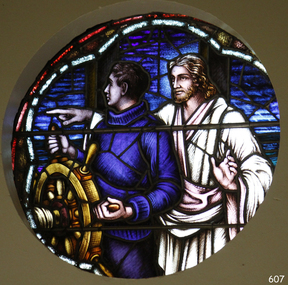
... victorian heritage database merchant navy ww2 1939-1945 anglican church bishop mckie mrs musther brooks robinson & co flying angel club williamstown lightkeepers' auxiliary ladies' harbour lights guild commemorative window Window, stained glass, circular, with reinforcing bars. The window represents Christ showing the helmsman the way. It shows a man in blue knitted jumper holding onto a ship's wheel, looking over his right shoulder. Behind him stands a man in a white robe, pointing to his right and looking to his left, his left hand gesturing to pause. The background has various shapes and patterns of blue glass, bordered ...This round, stained glass window, titled "Christ Showing the Helmsman the Way", was also referred to as the Sanctuary Window or Memorial window. It was installed in the St Nicholas Seamen's Church at 139 Nelson Place, Williamstown, Victoria, inside the chapel above the altar. This memorial window has significance as a part of Victoria's War Heritage and is listed on the Victorian Heritage Database. The window and subsequent plaque were donated to St Nicholas Seamen’s Church as a memorial to the members of the Merchant Navy whose lives were lost in the Second World War, 1939-1945. The donor was the Williamstown Lightkeepers Auxiliary, an independent ladies' association working with the Williamstown Missions to Seamen (the Missions to Seamen organisation was re-named the Mission to Seafarers in the year 2000). The window was officially dedicated on December 14, 1947, by Geelong's Anglican Bishop, Rt. Rev. J.D. McKie. In the early months of 1948, a bronze plaque was also placed in the chapel above the altar. It recognises the lost souls of the Merchant Navy during World War 2, as well as the donor of the window, the Williamstown Lightkeepers Auxiliary. The inscription impressed on the rectangular bronze plaque, 20.4 x 10.2cm, is as follows: “IN MEMORY OF THE MEMBERS OF THE MERCHANT NAVY WHO WERE LOST IN THE SECOND WORLD WAR 1939-1945 FAITHFUL UNTO DEATH. THE WINDOW ABOVE THE ALTAR WAS ERECTED BY THE WILLIAMSTOWN LIGHTKEEPERS AUXILIARY 1947.” The Williamstown St Nicholas Seamen’s Church ceased operation in 1966. In 1979, the Victoria Missions to Seamen donated this round, stained glass window and the memorial plaque to Flagstaff Hill Maritime Village, along with many other items and furnishings. These items have been used to simulate the Williamstown Mission and Chapel as much as possible. The round space that formerly displayed the window can still be seen at the back of the old St Nicholas Seamen’s Church, previously the ES&A bank, in Williamstown. THE MISSIONS TO SEAMEN (Brief History): - The Missions to Seamen was an Anglican charity in Great Britain that has served the world's seafarers since 1856. Its symbol is a Flying Angel, inspired by a Bible verse. Today, there are centres in over 200 ports worldwide where seamen of all backgrounds are offered a warm welcome and provided with a wide range of facilities. In Victoria, the organisation began in Williamstown in 1857 as a Sailors’ Church, also known as ‘Bethel’ or the ‘Floating Church’ in an old hulk floating in Hobson’s Bay, Port of Melbourne. It soon became part of the Missions to Seamen, Victoria. In 2000, the organisation, now named Mission to Seafarers, still operated locally in Melbourne, Portland, Geelong and Hastings. The Ladies’ Harbour Lights Guild was formed in 1906 to support the Missions to Seamen in Melbourne and other centres, such as Williamstown. Two of the most significant ladies of the Guild were founder Ethel Augusta Godfrey and foundation member Alice Sibthorpe Tracy (who established a branch of the Guild in Warrnambool in 1920). The Guild continued its work until the 1960s. In 1943, a former Williamstown bank was purchased for the Missions to Seamen Club. The chapel was named St Nicholas’ Seamen’s Church and was supported by the Ladies’ Harbour Lights Guild, the Williamstown Lightkeepers’ Auxiliary and the League of Soldiers’ and Sailors’ Friends. It ceased operation in 1966. A Missions to Seamen Chapel and Recreation Room was a significant feature of ports during the late 1800s and 1900s. It seemed appropriate for Flagstaff Hill to include such a representation within the new Maritime Village, and the Melbourne Board of Management of Missions to Seamen Victoria gave its permission on 21st May 1979 for the entire furnishings of the Williamstown chapel to be transferred to Flagstaff Hill. The St Nicholas Seamen’s Church was officially opened on October 11, 1981, and resembles the Williamstown chapel. This stained glass window is historically significant for its connection to the St Nicholas Mission to Seamen's Church in Williamstown, established in 1857 to cater for the physical, social, and spiritual needs of seafarers. It was donated to the Mission by the Lightkeepers Auxiliary (Ladies Harbour Lights Guild, which was formed in 1905). The Missions to Seamen organisation had its origins in Bristol, England, when a Seamen's Mission was formed in 1837. The first Australian branch was started in 1856 by the Rev. Kerr Johnston, a Church of England clergyman, and operated from a hulk moored in Hobson’s Bay. Later, the Mission occupied buildings in Williamstown and Port Melbourne. The connection of this window, the Mission to Seamen and the Ladies Harbour Lights Guild highlights the strong community awareness of the life of people at sea, their dangers and hardships, and their need for physical, financial, spiritual and moral support. This memorial window is significant as a part of Victoria's War Heritage and is listed on the Victorian Heritage Database, Heritage Number 196973.Window, stained glass, circular, with reinforcing bars. The window represents Christ showing the helmsman the way. It shows a man in blue knitted jumper holding onto a ship's wheel, looking over his right shoulder. Behind him stands a man in a white robe, pointing to his right and looking to his left, his left hand gesturing to pause. The background has various shapes and patterns of blue glass, bordered by two arcs; the outer one is white, the inner one is red. This beautiful window is in our St Nicholas Seamen's Church Collection and was brought to Warrnambool from the original St Nicholas Seamen’s Church in Williamstown. flagstaff hill, warrnambool, shipwrecked coast, flagstaff hill maritime museum, maritime museum, shipwreck coast, flagstaff hill maritime village, great ocean road, mission to seamen williamstown, st nicholas seaman’s church williamstown, missions to seamen victoria, mission to seafarers, lightkeepers auxiliary, ladies harbour light guild, 139 nelson place williamstown, religion, religious service, sailors rest, bethel sailors’ church, bethel floating church, e. s. & a. bank williamstown, christ directing a sailor, christ showing the helmsman the way, quartermaster’s hand on the wheel, stained glass window, church window, religious window, sanctuary window, memorial window, war memorial window, victorian war heritage inventory, victorian heritage database, merchant navy ww2, 1939-1945, anglican church, bishop mckie, mrs musther, brooks robinson & co, flying angel club, williamstown lightkeepers' auxiliary, ladies' harbour lights guild, commemorative window -
 Flagstaff Hill Maritime Museum and Village
Domestic object - Card Holder, c. 1854 - 1957
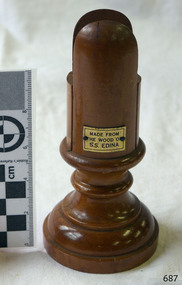
... Victorian Heritage Database card holder menu holder table number holder souvenir of the ss edina Printed on plaque "MADE FROM / THE WOOD OF / S.S. EDINA" Card holder, made from the wood from the SS Edina (screw steamer ship). Holder is cylindrical shape, wider turned wood base. Top is divided with a space in the centre tor inserting a card. Rectangular metal plaque, gold-coloured, has a printed inscription within black border ...This wooden cardholder was made from the wood of the screw steamer S.S. Edina, most probably after she was broken up in 1957, but could have been made after one of several renovations during her lifetime. The slotted design of the cardholder allows a card to stand vertically, and the base is made wider to stabilise the holder. It could be used for holding items such as place cards, menus, and table numbers. ABOUT THE SS EDINA: - The three-masted, iron-hulled screw steamer SS Edina was built in Glasgow, Scotland, in 1854 by Barclay and Curle and launched on the Clyde on May 4th, 1854. The 322-ton, three-masted ship was 171 feet long, 23 feet 6 inches broad, and 12 feet 7 inches deep (52.12 L x 7.16 B x 3.84 D metres). The traditional figurehead of Edina, the ‘fair maid of Judea’, adorned its bow. The Edina later became famous worldwide for being the longest-serving screw steamer. (The term screw steamer comes from being driven by a single propeller, sometimes called a screw, driven by a steam engine.) During its long working life, SS Edina had its accommodation enlarged for war service, was completely overhauled and serviced several times; boilers were replaced, masts were reduced to one, and later added then reduced, a Poop Deck, Forecastle and additional accommodation were added, the hull was gutted completely, new decks and bulwarks, saloon was redecorated and upgraded, and several changes of commander. The busy vessel also survived several mishaps at sea. SS Edina’s interesting history includes English Channel runs, carrying stores and horses to the Black Sea in the Crimean War as HMS Edina 1864-55. The vessel then sailed to Europe and the UK before being sold and used for further service in 1861 as a blockade runner in the American Civil War. The vessel later served as a coastal trader in the western district of Victoria and Queensland, then carried gold, currency, and gold prospectors from Australia to New Zealand. SS Edina was an escort vessel to H.R.H. the Duke of Edinburgh during his visit to Australia in 1867. SOME EVENTS in the life of SS EDINA: - The SS Edina had voyaged to Australia under sail. Owners Leith, Hull & Hamburg Steam Packet Co. sold the SS Edina in March 1863 at Port Phillip Bay, Melbourne, to Stephen Henty of Portland, Victoria; Edina was perfect for working the West Coast cargo and passenger run between Melbourne and Portland, via the Port of Warrnambool, and Port Fairy. It first visited Warrnambool on April 4, 1863. SS Edina briefly worked the run from Australia to New Zealand, then returned to the West Coast run; the cargo included bales of wool produced in the western district of Victoria. In 1867-68, Stephen Henty sold SS Edina to the Warrnambool Steam Packet Company to continue trading along the coast of western Victoria. Captain John Thompson was the commander, and John Davies was the Chief Engineer. In 1870, SS Edina was in Lady Bay, Warrnambool, when a gale sprang up and caused a collision with the iron screw steamer SS Dandenong. SS Edina’s figurehead was broken into pieces and was never replaced. The Edina was refitted that year for use as a coastal trader in Queensland for a period, named R.M.S. Edina. It then went to Melbourne and carried cargo and passengers between there and Geelong from 1880 to 1938, with modifications in 1917; the ship was extensively overhauled, radically changing its appearance. It returned to having two masts, and the funnel, bridge, engines, and promenade deck were upgraded, and the saloon reupholstered. By 1924, Edina had made over 12,000 journeys, carrying over one million travellers between Melbourne and Geelong. In 1937, Australian Steamships Pty Ltd advertised in The Argus its Bay Excursions on the SS Edina from Portarlington and Geelong; it promoted, “Splendid Beaches, Excellent Bathing Facilities, and Light Refreshments available on board”. After several collisions, the SS Edina was taken out of service in 1938 and sold by its owner, Howard Smith Ltd., to a Williamstown shipbreaker, Mr George Burton. The Melbourne Harbour Trust permitted Burton to strip the hull and sell all parts at auction. The fittings were sold by auctioneers J.W. Styles & Son, c. 1938, on site at the Port of Melbourne and became widely dispersed. Victorian Lighterage Pty Ltd. purchased the hull, removed the engine and superstructure, and repurposed it as a ‘lighter’ named Dinah. It was loaded with wool and general cargo, then towed behind small tugs around the bay between Melbourne and Geelong. In 1957, after 104 years of activity, the SS Edina was broken up on the banks of the Maribyrnong River, Footscray, Melbourne, and used as landfill. A piece of the hull with Victorian Heritage significance is buried in the river. This card holder is made from wood from the SS Edina and is significant for its association with that vessel. The SS Edina is heritage listed on the Victorian Heritage Database VHR S199. She had endeared herself to the people of Port Phillip Bay as a passenger ferry, part of their history and culture. She played a significant role in the Crimean War, the American Civil War and the gold rush in New Zealand. She also served Western Victoria for many years in her cargo and passenger runs. The SS Edina is famous for being the longest-serving screw steamer in the world. After spending her first nine years overseas, she arrived in Melbourne, and her work included running the essential service of transporting cargo and passengers between Melbourne and the western Victoria ports of Warrnambool, Port Fairy and Portland. The SS Edina was purchased in the late 1860s by local Warrnambool business, the Warrnambool Steam Packet Co. and continued trading from there as part of the local business community. The SS Edina’s original ‘fair maid of Judea’ figurehead was broken to pieces in a collision with another vessel (the SS Dandenong) in a gale off Warrnambool, Victoria, in 1870. Card holder, made from the wood from the SS Edina (screw steamer ship). Holder is cylindrical shape, wider turned wood base. Top is divided with a space in the centre tor inserting a card. Rectangular metal plaque, gold-coloured, has a printed inscription within black border. Made c. 1854 - 1957.Printed on plaque "MADE FROM / THE WOOD OF / S.S. EDINA"warrnambool, shipwrecked coast, flagstaff hill, flagstaff hill maritime museum, maritime museum, shipwreck coast, flagstaff hill maritime village, shipwrecked artefact, barclay & curle, figurehead 'fair maid of judea', centenary maritime exhibition 1934, a brief review of steam navigation in victoria, pleasure steamer edina, trade and travel late 19th and early 20th century, trade melbourne to geelong, screw steamer edina, coastal trader edina, lighter dinah, cargo carrying for cremean war, cargo carrying for american civil war, passenger and trade in western district of victoria, export gold and currency and gold diggers to new zealand, export vessel to h r h the duke of edinburgh, melbourne - warrnambool - port fairy - portland cargo run, warrnambool steam packet company, stephen henty, captain john thompson, chief engineer john davies, lady bay warrnambool, lighter edina, shipping victoria, port phillip bay steamers, steamship great britain, edina, vhr s199 victorian heritage database, card holder, menu holder, table number holder, souvenir of the ss edina -
 Federation University Historical Collection
Book, Victorian Government Legislative Assembly, The Select Committee on Castlemaine and Sandhurst water supply, Report from the Select Committee on Castlemaine and Sandhurst Water Supply, together with the proceedings of the Committee, minutes of evidence and appendices, 19/5/1865 (exact)
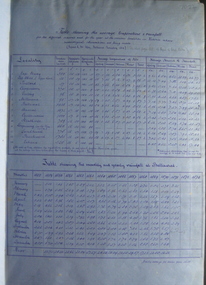
... Border Sawmills, Ferdinand Krause, Ohlfsen Bagge, W.H. Shaw, Report from the Select Committee on Castlemaine and Sandhurst Water Supply, together with the proceedings of the Committee, minutes of evidence and appendices. Book Book Victorian ...This book contains the report from the select committee on Castlemaine and Sandhurst water supply; with the proceedings of the committee, minutes of evidence and appendices. It also contains the report Of the Engineer-In-Chief of Railways, and reply of the Chief Engineer of Water Supply on the works constructed by the Victorian Water Supply Department, presented to both houses of parliament by His Excellency’s command. Ferdinand M. Krause, was a lecturer at the Ballarat School of Mines in Geology Mineralogy Mining Engineering and Surveying. He was a Fellow of the Geological Society and a Fellow of the Linnian Society. He was assistant engineer for the Ballaarat and Ballarat East Water Supply Committee and helped plan local reservoirs.A brown cloth hard cover, foolscap book with leather spine. Title is written in black on the title page. "Water Supply Reports" is engraved in gold on spine. It includes a table showing the monthly and yearly rainfall and shade temperature at Ballarat, 2nd February, 1885. It also includes two reports and two replies, a map No.7082.2 of Victorian Water Supply, Castlemaine and Sandhurst district general plan including lines of Aqueduct, Reservoirs. No. 7082.3 of Victorian Mining districts, Mining Divisions and The Gold Fields in 1866 - includes districts to be supplied under the Waterworks Act, 1965. It also includes: *Report of the Engineer-in-chief of Railways and Reply of the Chief Engineer of Water Supply on the works constructed by the Victorian Water Supply Department, 1869. * Coliban Water Scheme, 1864 * Ballarat and Ballarat East Water Supply (1869) including the Ballarat Water Supply List containing names of occupiers and nature of improvements on lands comprised within the proposed reserve of Gong Gong Reservoir, Ballaarat. At Warrenheip the names included: Honora McCallin, William Honan, C. McMahon, Patrick McMahon, J.P. Beach, J.H. Smith, Michael Nestor, Martin Quinn, Martin McIntyre, Robert Higgins, Coleman Kane, Robert Bond. At Ballarat: William Clarke, Richard White, John Hosking, Wesleyan Chapel, J. Hewitt, Robert McRobinson. At Bungaree: John Pullin, John Llewellyn. William Daw, Smith and Wynne, William Brough, A. Alexander. * Ballarat and Ballaarat East Water Supply report upon the advisability, or otherwise, of constructing a reservoir at the junction of the Yarrowee Creek and Gile's Creek, upon a site known as Gile's Reservoir (printed by Frank Pinkerton). This report has numerous notes written on it (most probably by Krause) and includes the capacity of Harry Beale's Reservoir, Pimcott's Reservoir and the Proposed Gong Gong Reservoir. * Statement as to the position of the Ballaarat and Ballaarat East Borough Councils in Connection with Water Supply, September 1869. * Ballarat and Ballaarat East Water Supply - General Statement upon the Ballaarat and Ballaarat east Scheme of Water Supply. Includes information on Moorabool reservoir, Harry Beale's Reservoir, Lal Lal Creek, Two Mile Creek, Beale's Dam, Yarrowee Creek, Gong Gong Reservoir, Kirk's Dam, Devil's Creek, Moorabool Creek. Additional handwritten notes (probably by Krause) * Engineer's Report on the resolution of the COmmittee of Water Supply, of the 7th July 1868. The report refers to the Country around Mount Warrenheip. Names mentioned are L. Abraham, Great North-West Gold Mining Company, Border Sawmills, Ferdinand Krause, Ohlfsen Bagge, W.H. Shaw, A signature by "Ferdinand M. Krause" at the top corner of the title page. A few pages have handwriting on the margins, it is believed to be his handwriting. water supply victoria, castlemaine directories, sandhurst directories, ballarat directories, james blackburn, edward wardle, daylesford water race, c j taylor, george avery fletcher, bagge, ohlfsen bagge, george foote, john h reilly, ambrose johnson, george francis, timber preservation, james forbes, alfred surplice, malcolm carmichael, robert adams, frederick hugh thomas, h o christerpherson, william downe, thomas lawrence brown, francis hadgson nixon, strangways, guildford, maldon, muckleford, lauriston, malmesbury, franklinford, walmer, strathloddon, downe, ferdinand krause, m7082, trentham, castlemaine, drummond, metcalfe, sutton grange, lockwood, ravenswood, mandurang, yandoit, c.h. ohlfsen bagge, moorabool reservoir, gong gong reservoir, harry beale's reservoir, pincott reservoir, frank pinkerton, water -
 Federation University Historical Collection
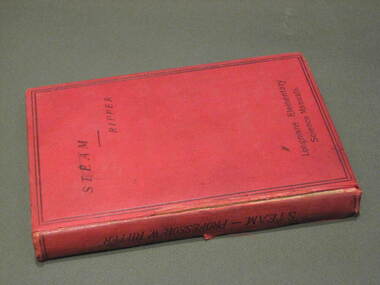
Book, William Ripper, Steam, 1897
... The news of his death comes to us with added weight of sadness when we remember that he was one of the organisers of the School entertainment last year to help swell the fund for the erection of a statue to fallen Victorian soldiers.' alfred johnston steam engine compound engines condensers heat horse-power transfer of heat combustion of fuel saturated steam cranks and crank shafts watt governor boilers alf johnston william ripper boer war On the title page is the inscription of the original owner of the book Alf G Johnston School of Mines Ballarat 1899. Inside the front cover and on page 19 is the stamp of the School of Mines Ballarat A small red book with a double black line bordering ...This book was owned by Alf Gresham Johnston who was a former SMB mining student from the Ballarat School of Mines. He died at the age of 29 during military service in South Africa. The following is from the Federation Uni Honour Roll at http://federation.edu.au/about-us/our-university/history/geoffrey-blainey-research-centre/honour-roll/j/alfred-gresham-johnston-1872-1901 The October 1901 Ballarat School of Mines (SMB) Students Magazine reported 'Alf. Johnston's gone. The news came as a shock to all of us at the school. He who was with us a few short months ago, in all strength of sturdy manhood, has met a soldier's death in South Africa, and we sincerely mourn his loss…. His heart was in the school, and he did his best to further its interests … His last act on leaving Australian shores was to send a telegram from Albany to Prof. Mica Smith, to whom he was warmly attached, wishing the School and all connected with it "Good-bye". In his short, all to short, life of 29 years, he had more adventure than falls the lot of most men, and possibly the spirit of adventure, and also, of duty, prompted him to throw in his lot with the "colors," and leave for the front. The news of his death comes to us with added weight of sadness when we remember that he was one of the organisers of the School entertainment last year to help swell the fund for the erection of a statue to fallen Victorian soldiers.'A small red book with a double black line bordering the front cover, with the text Longmans Elementary Science Manuals on the bottom of the cover. On the back cover is an L&Co logoOn the title page is the inscription of the original owner of the book Alf G Johnston School of Mines Ballarat 1899. Inside the front cover and on page 19 is the stamp of the School of Mines Ballaratalfred johnston, steam engine, compound engines, condensers, heat, horse-power, transfer of heat, combustion of fuel, saturated steam, cranks and crank shafts, watt governor, boilers, alf johnston, william ripper, boer war -
 Flagstaff Hill Maritime Museum and Village
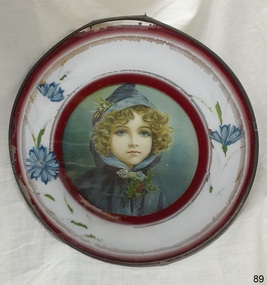
Decorative object - Flue Cover Art, 1890s to 1930s
... border was commonly gilt with a black stripe around the centre. There were numerous illustrations, many with a European appearance, and were easily bought through local merchants for a small price. This pretty flue cover is significant for representing a common domestic wall decoration from the late Victorian ...In the late 19th and early-20th centuries household heaters burned wood and coal for heating. In winter the warm air from the fireplace would flow into the room through a round flue in the face of the chimney. In the warmer months the unnecessary heater and flue was removed and the chimney cleaned. Homemakers then covered the circular flue hole with a decorative and usually inexpensive wall hanging to prevent draughts and dust. The practice was especially popular in France and Germany where a lot of the artwork originated. The covers were no longer needed after households changed over to more modern designs of heaters. The flue covers were known as Wall Art or Flue Cover Art. They were usually round and illustrated with a lithograph or chromograph print. The picture was then mounted on card, covered with glass, and framed with a brass or tin rim. The border was commonly gilt with a black stripe around the centre. There were numerous illustrations, many with a European appearance, and were easily bought through local merchants for a small price.This pretty flue cover is significant for representing a common domestic wall decoration from the late Victorian to the Edwardian eras, when solid fuel heaters were used in low to high income homes. The picture is similar to many other flue cover images, apart from the holly clutched in the girl’s hand, which gives the cover a Christmas theme. This flue cover is the only one in our collection and appears to have a unique design; the hand painted floral decoration on the glass and the two crimson rings around the edges of the frame’s white border haven’t been seen on other flue covers. Flue cover, metal and glass. Print of a young girl with blue eyes and curly blonde hair, a hooded blue cape, a silver clasp with blue stones, and a sprig of holly in her hand. The round metal frame forms a deep, white-painted, crimson-edged border for the illustration. The hand-painted blue flowers on the glass front form add to the border and give a 3-dimensional effect. The picture is between the cardboard backing and the glass front, with the metal frame holding them together. There is a metal chain attached for hanging the cover.warrnambool, flagstaff hill maritime museum, picture, handpainted, portrait, girl in blue cape, metal frame, round picture, illustration, print, holly, christmas, child in blue cape, silver and blue clasp, holly sprig, late 19th century, early 20th century, 1890s-1930s, victorain, edwardian, flue cover, flue cover art, wall art, chimney flue cover, chimney hole cover, stove pipe cover, fireplace flue cover, antique, victorian, glass frame, chromograph, lithograph, tin, brass, lithograph print, chromo print, christmas girl, blue cape, blonde girl -
 Flagstaff Hill Maritime Museum and Village
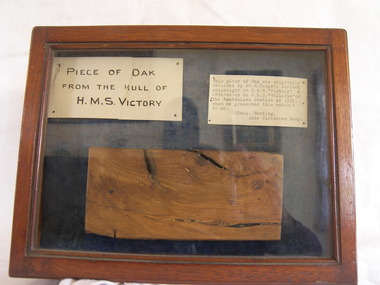
Plant specimen - Wood Sample, Herbst, 1759-1765
... Victorian Navy.” Wood sample adhered to the base of a hinged wood and glass display case. Wood is a sample of oak taken from the hull of Vice-Admiral Lord Nelson's flagship, the HMS Victory, built in 1765. The case also contain two exhibit labels pinned above the wood sample. Other items donated with the display case, and relating to the wood sample: an 1895 photograph, a 1905 newspaper clipping, a 1962 donor's letter (two pages), and a handwritten exhibit label with a border of red lines. ...The piece of oak wood sample inside the case was obtained from Mr H. Cooper during the time he served as a shipwright for the British Royal Navy on Nelson’s flagship, HMS Victory, in 1891. By that time, the H.M.S. Victory was around 100 years old, having been built in 1765 and was currently in dry dock undergoing restoration. Cooper’s skills as a shipwright would have been well employed during this period. HMS Victory was, and still is, undergoing continuous restoration to preserve her for display as a museum ship, due to the vessel's significant naval history. It was during that early restoration period that Cooper obtained the piece of Oak from HMS Victory, believed to be from the ship's hull. Cooper was in Australia in September 1891 serving on the HMS Wallaroo, a British Auxiliary Squadron commissioned as part of the British Royal Navy contingent, to serve and operate in Australian waters. The photograph included with the donation of the wood sample is a portrait of Mr H Cooper taken in 1895 in Sydney. The inscription on the photograph describes him as a skilled shipwright from H.M.S. Wallaroo, depicting Cooper as a young man in Royal Navy uniform, with the emblem of a petty officer third class. While Cooper was stationed on the H.M.S. Wallaroo in Sydney, he presented the display case, containing the wood sample from H.M.S. Victory, as well as the exhibit labels, to Charles Harding ("Chas"), late of the Royal Australian Navy. Harding had been based at the H M Naval Torpedo Depot at Williamstown, Victoria. Although not mentioned, it is believed the two men met whilst serving together in Australia in their respective assignments. It could have been a retirement gift from Cooper to Harding, with the photograph of Cooper likely included with the case, and gifted to Harding in 1895, as the date on the photograph indicates. One of the exhibit's labels indicates that Harding had the item on display whilst serving at the Naval Torpedo Depot in Williamstown. The label indicates: "This piece of Oak is part of the hull of H.M.S. 'Victory', Lord Nelson’s renowned flagship, which took such a prominent part in the Battle of Trafalgar. 21st October 1805. Exhibited by Charles Harding, H.M.V. Naval Torpedo Depot, Williamstown.” After Charles Harding died in 1931, the case containing the sample of oak from H.M.S. Victory was donated by his son, Reg Harding, to Mr Murphy in 1962. The display case has since become a treasured item at Flagstaff Hill. A newspaper article dated 1905 included with the donation mentions that the city of Hamilton in Victoria was shortly expecting a mounted piece of the H.M.S. Victory to be included in the city’s commemoration of the centenary of the "Battle of Trafalgar". Battle of Trafalgar: On October 21, 1805, twenty-seven British ships of the line led by Admiral Lord Nelson aboard HMS Victory defeated thirty-three French and Spanish ships of the line under French Admiral Villeneuve. The battle took place in the Atlantic Ocean off the southwest coast of Spain, just west of Cape Trafalgar, near the town of Los Caños de Meca. The victory confirmed the naval supremacy Britain had established during the course of the eighteenth century, and it was achieved in part through Nelson's departure from the prevailing naval tactical orthodoxy of the day. Conventional practice at the time was for opposing fleets to engage each other in single parallel lines, to facilitate signalling and disengagement, and to maximise fields of fire and target areas. Nelson instead arranged his ships into two columns to sail perpendicularly into the enemy fleet's line. During the battle, Nelson was shot by a French musketeer, and he died shortly before the battle ended. Villeneuve was captured, along with his ship Bucentaure. He later attended Nelson's funeral while a captive on parole in Britain. Admiral Federico Gravina, the senior Spanish flag officer, escaped with the remnant of the fleet. He died five months later from wounds sustained during the battle. It was before this battle that Nelson had issued his now-famous final orders to his ships in 12 separate flag-hoists: “England expects that every man will do his duty”. This wood sample is historically significant for its association with Admiral Lord Nelson and the Battle of Trafalgar. Through Nelson’s leadership and unorthodox battle tactics, he secured not only a victory against the French and Spanish but also reaffirmed Britain's naval supremacy, opening the way for Britain to continue the policy of colonisation of many countries, including Australia.Wood sample adhered to the base of a hinged wood and glass display case. Wood is a sample of oak taken from the hull of Vice-Admiral Lord Nelson's flagship, the HMS Victory, built in 1765. The case also contain two exhibit labels pinned above the wood sample. Other items donated with the display case, and relating to the wood sample: an 1895 photograph, a 1905 newspaper clipping, a 1962 donor's letter (two pages), and a handwritten exhibit label with a border of red lines. Photograph Front: printed- "Herbst" "28 Oxford Street, Hyde Park, Sydney", handwritten - "Mr Cooper", "see back". Back: handwritten - "Mr H Cooper, skilled shipwright, H.M.S. Wallaroo 1895" Exhibit labels still in the case: Left: handwritten- “PIECE OF OAK FROM THE HULL OF H.M.S. VICTORY”, Right: typewritten- “This piece of Oak was originally obtained by Mr. H. Cooper, skilled shipwright on H.M.S. “Victory” & afterwards on H.M.S. “Wallaroo” on the Australian Station in 1895, when he presented this exhibit to me. Chas. Harding, Late Victorian Navy.”flagstaff hill, warrnambool, shipwrecked-coast, flagstaff-hill, flagstaff-hill-maritime-museum, maritime-museum, shipwreck-coast, flagstaff-hill-maritime-village, oak, hms victory, vice-admiral lord nelson, horatio nelson, lord nelson, oak piece, piece of oaknelson, battle of trafalgar, maritime technology, ship relics, 18th century warship, british royal navy, h cooper shipwright, hms wallaroo, herbst hyde park sydney, charles harding, hmv naval orpedo depot williamstown, sir home popham’s telegraphic code, admiralty official day signal book -
 Flagstaff Hill Maritime Museum and Village
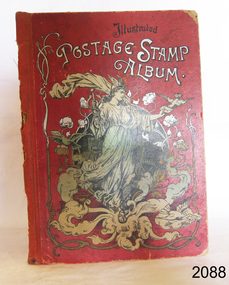
Book - Stamp Album, CF Lucke, publisher, Illustrated Postage Stamp Album, ca 1900
... Victorian vintage and shows that at the end of the 19th century people collected stamps. It represents the hobbies and past times of the people of that era. flagstaff hill warrnambool shipwrecked-coast flagstaff-hill flagstaff-hill-maritime-museum maritime-museum shipwreck-coast flagstaff-hill-maritime-village illustrated postage stamp album postage stamp album stamp album book postage stamp stamp Edwin J Dale May 13th 1901 stamp collecting German stamp album Spottiswoode & Co Ltd Germany CF Lucke Leipzig CF Lucke Leipzig Inscription: Edwin J Dale, May 13th 1901" Cover: "Illustrated POSTAGE STAMP ALBUM" Inage on cover: "within a floral border, a robed figure wearing a winged helmet, holding a staff with two snakes in one hand, and a sealed letter in the other." ...The inscription in the book indicates that it once belonged to Edwin J Dale, who may have received it May 13th 1901, the date on the inscription. The album was made in Germany and has English, German, French and Spanish language on the fly page. It has 2000 pockets for holding stamps and is illustrated. The printer, Spottiswoode and Co., was established in 1738 by William Strahan, with premises in New Street Square, London. The growing firm advertised as Printers, Lithographers, Stationers, Electrotypers, Publishers, and Booksellers and by 1914 there were 1,000 employees.The stamp album is of Victorian vintage and shows that at the end of the 19th century people collected stamps. It represents the hobbies and past times of the people of that era.Illustrated Postage Stamp Album. Publisher: Lalso by CF Lucke, Leipzig, Germany Printer: Spottiswoode & Co Ltd, London Date: 1908 Red hardcover, illustrated with a robed figure image and text in English, German, French and Spanish. Book has information, advertising and pages divided into blank squares for attaching stamps. Some pages have cutouts where squares would have been, perhaps holding stamps. An inscription with the name Edwin J Dale, 13 May 1901 is on the first turned page..Inscription: Edwin J Dale, May 13th 1901" Cover: "Illustrated POSTAGE STAMP ALBUM" Inage on cover: "within a floral border, a robed figure wearing a winged helmet, holding a staff with two snakes in one hand, and a sealed letter in the other." Fly: "Registered" "Schaubeks Postage Stamp Album" "Victoria" "Briefmarken"[German - stamps] "Pour Timbres-poste" [French - for postage Stamps] "Para Selloyde Correo" [Spanish - for postage stamps] "With 1070 reduced illustrations, 2200 blank cases for stamps" (also in German, French and Spanish) "Made in Germany"flagstaff hill, warrnambool, shipwrecked-coast, flagstaff-hill, flagstaff-hill-maritime-museum, maritime-museum, shipwreck-coast, flagstaff-hill-maritime-village, illustrated postage stamp album, postage stamp album, stamp album, book, postage stamp, stamp, edwin j dale, may 13th 1901, stamp collecting, german stamp album, spottiswoode & co ltd, germany, cf lucke leipzig, cf lucke, leipzig -
 Flagstaff Hill Maritime Museum and Village
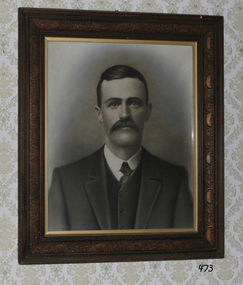
Photograph - Portrait, pre 1915
... Flagstaff Hill Flagstaff Hill Maritime Museum and Village Warrnambool Maritime Museum Maritime Village Great Ocean Road Shipwreck Coast historic photograph Frank Wicking Tom Wicking quarry worker Thomas Allen Wicking Thomas Wicking Emma Wicking Mary Wicking Garvoc Victorian pioneer beekeeper sketch artist gardener Photograph of a male adult, mounted behind glass, in a wooden frame with a carved, decorative border featuring trees, and a gold coloured inner border. ...Mr Frank Wicking (1877-1915): Frank Wicking was born on July 19, 1877, at Garvoc, western Victoria, the sixth child of Thomas and Emma Wicking's ten children. Frank loved the outdoors and was a beekeeper, gardener and sketch artist. He worked as a labourer around the district, including at a local quarry. He passed away at only 37 years of age, leaving his wife, Mary, with three children aged 13 to 4 years. One of the children was Thomas Allen Wicking (1907-1995). He passed away on December 13, 1915, aged 37, and was buried in the Warrnambool Cemetery, southwest Victoria. The photograph is a historical record of Frank Wiking, a locally born quarry worker. He was born in the mid-19th century, to pioneers Thomas and Emma Wicking, and father of local historian, Tom Wicking.Photograph of a male adult, mounted behind glass, in a wooden frame with a carved, decorative border featuring trees, and a gold coloured inner border. The subject is Mr Frank Wicking (1877-1915).flagstaff hill, flagstaff hill maritime museum and village, warrnambool, maritime museum, maritime village, great ocean road, shipwreck coast, historic photograph, frank wicking, tom wicking, quarry worker, thomas allen wicking, thomas wicking, emma wicking, mary wicking, garvoc, victorian pioneer, beekeeper, sketch artist, gardener -
 Flagstaff Hill Maritime Museum and Village
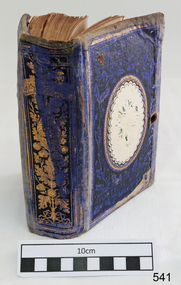
Book - Literary Work, Henry Wardsworth Longfellow, The Poetical Works of Henry Wadsworth Longfellow, (short title on cover is ‘Longfellow’s Poetical Works’), 1877
... Victorian Heritage Register S417. warrnambool shipwrecked-coast flagstaff-hill flagstaff-hill-maritime-museum longfellow’s poems loch ard eva carmichael warrnambool mechanics institute library warrnambool museum joseph archibald henry davis William P. Nimmo poetry Heny Longfellow henry wadsworth longfellow poetical works 1870s 1877 Longfellow’s Poetical Works ‘Inscribed “Loch Ard June 1 1878” in pencil within ― believed to be a salvage from the shipwreck’ (Mechanics Institute Library auditor, June 1996). A volume of poetry by Henry Wadsworth Longfellow. It is bound in blue-purple cloth on thick board, with black lettering and curling-vine design, framed by gold border ...This well-produced but water-damaged book of Longfellows Poetry, was part of the former Warrnambool Mechanics Institute Library and Museum collection. The custody of this collection was assumed by Flagstaff Hill Maritime Village in the 1970s. Supporting provenance indicates the book was retrieved from the sea at Loch Ard Gorge soon after the shipwreck of the same name in June 1878. This book was given to the Warrnambool Museum curator Joseph Archibald by its finder, the Warrnambool Standard editor Henry Davis in October 1883. A letter from Mr Davis describing the poignant circumstances of his discovery is also in the Flagstaff Hill collection. A transcript of this letter is displayed next to the book in the Great Circle Gallery at the Maritime Village (reg. no. 2292). The story behind this book prompted Mr Archibald to write to the sole surviving female passenger from the LOCH ARD, Eva Carmichael, asking if the book was hers. Miss Carmichael replied by handwritten letter in January 1884, advising that the volume of poems did not belong to her: “We had a ‘Longfellow’, but our book had a green cover”. This letter is also in the Flagstaff Hill collection (reg. no. 2290.4).The book is rare as it has survived a shipwreck in relatively good condition. It is an example of personal possessions carried by a shipboard passenger in the 1870s. It holds significance for its connection to the renowned poet, Henry Wardsworth Longfellow. The book is important for its probable association with the wreck of the vessel Loch Ard in 1878. The LOCH ARD shipwreck is of State significance and is listed on the Victorian Heritage Register S417. A volume of poetry by Henry Wadsworth Longfellow. It is bound in blue-purple cloth on thick board, with black lettering and curling-vine design, framed by gold border. In the centre of the front cover is a raised smooth-white ellipse with crimped edges, now worn bare but with traces of an original brightly coloured floral design. This white centre of supple leather is also framed by a decorative gold border. The upper case lettering on the front cover reads ‘Longfellow’s Poetical Works’. The edges of the blue material are faded and worn. The pages are corrugated by water damage but their original gold-edged condition is still evident. The front and back covers are scored with singed holes approximately 1.5cm diameter, situated about the centre edge of each side and in roughly corresponding positions. These holes may be from an original book-latch or fastening. However they have since been damaged by a hot piercing object, which has blackened the holes and extended the damage into the enclosed pages. The spine of the book features a stylised oak tree in gold, rising from bared roots to serrated leaves and acorns. The letters “LON[DON]” at the top of the spine and “W.P.NI[MM]O” at the bottom. The book cover has separated from the majority of stitched pages, along with a number of title pages, which are now loosed from the binding. The books condition is fragile from a handling perspective, but stable in terms of further deterioration. ‘Inscribed “Loch Ard June 1 1878” in pencil within ― believed to be a salvage from the shipwreck’ (Mechanics Institute Library auditor, June 1996).warrnambool, shipwrecked-coast, flagstaff-hill, flagstaff-hill-maritime-museum, longfellow’s poems, loch ard, eva carmichael, warrnambool mechanics institute library, warrnambool museum, joseph archibald, henry davis, william p. nimmo, poetry, heny longfellow, henry wadsworth longfellow, poetical works, 1870s, 1877, longfellow’s poetical works -
 Mission to Seafarers Victoria
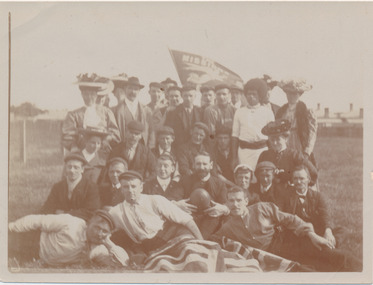
Photograph - Photograph, Sepia, First picnic of the Mission, Graylings, St Kilda, King's Birthday 1905, 13 November 1905
... Victorian Seamen's Mission and the first picnic organised by Miss Ethel Godfrey. A year later she was nominated Honorary Secretary of the newly Ladies Harbour Light Guild. The Melbourne Guild was the first one of its kind and was so successful that the scheme was spread around the world. 1905 graylings st kilda ethel augusta godfrey lhlg reverend a. gurney-goldsmith king's birthday picnic hugh h.reid Handwritten in pencil on verso: 82 Handwritten in white ink on the album page: First picnic of the Mission, Graylings, St Kilda, King's Birthday 1905 Small sepia tone photograph with thin white border, slightly blurred, depicting a group of men and women; some standing, sitting, kneeling and lying on the grass. ...Gathering of seafarers and LHLG members carrying the Mission flag, at Graylings, property of Frederic Race Godfrey, in St Kilda, on 13 November 1905. Sixty-three men and boys were invited to the picnic. Miss Ethel Godfrey is kneeling on the right hand side, wearing a dark dress and hat. The man holding the ball in the center is thought to be Hugh H. Reid. In an article published in the Church and the Sailor in July 1930 after she resigned from her position of Honorary Secretary, she described this occasion as the first picnic organised by her after Reverend Gurney Goldsmith pleaded for women's help during a sermon at All Saints church in St Kilda the same month. See also item 1643This was the official first picnic of the Amalgamated Victorian Seamen's Mission and the first picnic organised by Miss Ethel Godfrey. A year later she was nominated Honorary Secretary of the newly Ladies Harbour Light Guild. The Melbourne Guild was the first one of its kind and was so successful that the scheme was spread around the world.Small sepia tone photograph with thin white border, slightly blurred, depicting a group of men and women; some standing, sitting, kneeling and lying on the grass. At the back the Flying Angel flag. In front the English flag. One man (Hugh Reid) is holding a footy ball. The photograph was previously in a photographic album.Handwritten in pencil on verso: 82 Handwritten in white ink on the album page: First picnic of the Mission, Graylings, St Kilda, King's Birthday 1905 1905, graylings, st kilda, ethel augusta godfrey, lhlg, reverend a. gurney-goldsmith, king's birthday, picnic, hugh h.reid -
 Blacksmith's Cottage and Forge
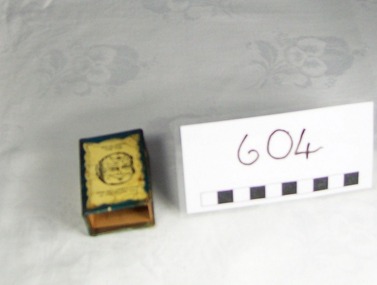
Matchbox and Matchbox Holder, Box : Bryant and May's, early 20th. century
... Victorian Heritage Register. Source: www.wikipedia.org Local social history of Bacchus Marsh box souvenir sport item cricket match team cyril jones border inn cover novelty Cover/spine: Strike The Border Inn Bacchus Marsh for a good spot Phone 16 Cyril Jones, Proprietor. ...The Bryant and May Factory is located in the suburb of Cremorne in Melbourne, Australia. It was constructed in 1909 as the Empire Works to a design by prolific Melbourne architect William Pitt. It was purchased soon after by British safety match manufacturer Bryant and May who significantly expanded the building adding an additional level and the landmark clock tower. Bryant and May were unique in that they operated as a model factory providing workers with conditions and amenities which even today seem generous. These included a dining hall and sports facilities such as a tennis court and bowling green which were constructed in the 1920s. Bryant and May ceased Australian match manufacture in the early 1980s as a result of import competition. Their iconic Redheads matches are now imported from Sweden. The complex has since been converted for use as offices and showrooms but is extremely well preserved. It is listed on the Victorian Heritage Register. Source: www.wikipedia.org Local social history of Bacchus MarshMetal matchbox holder for a matchbox-one side has a photo of a local cricket team, the other side has a caricature of a man's face when held one way up is smiling and when turned up the other way the face is looking unhappy. The cover is blue with yellow. The matchbox cover is made of a thin veneer wood. The makers inscription is in blue and red.Cover/spine: Strike The Border Inn Bacchus Marsh for a good spot Phone 16 Cyril Jones, Proprietor. Cover/side: This man always calls in at the Border Inn. This Man wishes he did Matchbox:Bryant & May's "Crown" Safety Matchesbox, souvenir, sport, item, cricket, match, team, cyril, jones, border, inn, cover, novelty -
 The Beechworth Burke Museum
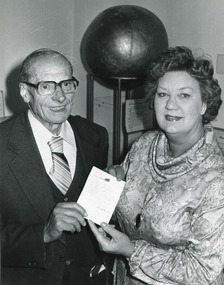
Photograph, Border Morning Mail newspaper, 14/5/2979
... ...Border Morning Mail...Victorian...Border Morning Mail on Friday 14th May, 1979. Alan Dunlop, pictured, was Sir Edward 'Weary' Dunlop's older brother. The tie pin artefact being donated in this photo is entered into the Victorian Collections database as follows: 'This nugget was found on the Beechworth Goldfield in the late 1800s by Mr Fred McIntosh (Alan & Edward Dunlop's Uncle by marriage, husband of Elizabeth (Bessie) Dunlop), who had made it into a tie pin and presented it to the Dunlop family'. ...Weary Dunlop Gold Beechworth Val Mason Tie pin Jewellery Goldfield Beechworth goldfield Fred McIntosh Bessie Dunlop Elizabeth Dunlop Dunlop Border Morning Mail Victorian Collections Donation Burke Museum Obverse: (lllegible) Reverse: A02653 Black and white, rectangular photograph printed on paper. ...This photograph is recorded as depicting the presentation by Mr Alan Dunlop to Cr Val Mason, Shire President, of a 2.86-gram solid gold nugget found in the area more than 100 years ago, at the Burke Museum. The gold is reported as attached to a small amount of milk quartz mounted onto a tie pin. The photo and an article about the donation appeared in the Border Morning Mail on Friday 14th May, 1979. Alan Dunlop, pictured, was Sir Edward 'Weary' Dunlop's older brother. The tie pin artefact being donated in this photo is entered into the Victorian Collections database as follows: 'This nugget was found on the Beechworth Goldfield in the late 1800s by Mr Fred McIntosh (Alan & Edward Dunlop's Uncle by marriage, husband of Elizabeth (Bessie) Dunlop), who had made it into a tie pin and presented it to the Dunlop family'. Furthermore, Val Mason was the first female president of the former Beechworth Shire for two terms and a councillor for nine years. This photograph is of historic significance as it depicts known individuals who have connections to key Australian figures. Alan Dunlop is the brother of famous war doctor Edward 'Weary' Dunlop, and both men are Beechworth locals. The object Alan holds is a tie pin made from gold found by the Dunlops' uncle. It's also significant as it documents visually the origin of the tie pin artefact in the Burke Museum collection, via donation by Alan Dunlop. In addition, it depicts Val Mason, the first female president of the former Beechworth Shire for two terms and a councillor for nine years. It is of social significance as it depicts two well-known and respected Beechworth locals handling a key artefact of significance to the Beechworth Goldfields, and therefore Beechworth local history. It also shows the Burke Museum in 1979, providing research potential for those interested in the history of the development of the museum's collection.Black and white, rectangular photograph printed on paper.Obverse: (lllegible) Reverse: A02653weary dunlop, gold, beechworth, val mason, tie pin, jewellery, goldfield, beechworth goldfield, fred mcintosh, bessie dunlop, elizabeth dunlop, dunlop, border morning mail, victorian collections, donation, burke museum -
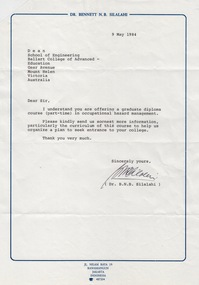 Federation University Historical Collection
Document - Document - Letter, VIOSH: BCAE: Letter from Dr B N Silalahi to Derek Woolley re Occupational Hazard Management Course, 1984
... Letter from Dr Silalahi in Jakarta, Indonesia to Derek Woolley at Ballarat College of Advanced Education viosh victorian institute of advanced education derek woolley dr silalahi indonesia ballarat college of advanced education .1 Signature of Dr Silalahi .2 Signature per D Woolley Two A4 sheets, typed. .1 Blue border with name and address .2 Letter from BCAE VIOSH: BCAE: Letter from Dr B N Silalahi to Derek Woolley re Occupational Hazard Management Course, 1984 Document Document - Letter ...Victorian Institute of Occupational Safety and Health (VIOSH) Australia is the Asia-Pacific centre for teaching and research in occupational health and safety (OHS) and is known as one of Australia's leaders on the field. VIOSH has a global reputation for its innovative approach within the field of OHS management. VIOSH had its first intake of students in 1979. At that time the Institution was known as the Ballarat College of Advanced Education. In 1990 it became known as Ballarat University College, then in 1994 as University of Ballarat. It was 2014 that it became Federation University. VIOSH Australia students are safety managers, senior advisors and experienced OHS professionals. They come from all over Australia and industry. Students are taught active research and enquiry; rather than textbook learning and a one-size fits all approach. VIOSH accepts people into the Graduate Diploma of Occupational Hazard Management who have no undergraduate degree - on the basis of extensive work experience and knowledge. Letter from Dr Silalahi in Jakarta, Indonesia to Derek Woolley at Ballarat College of Advanced EducationTwo A4 sheets, typed. .1 Blue border with name and address .2 Letter from BCAE.1 Signature of Dr Silalahi .2 Signature per D Woolleyviosh, victorian institute of advanced education, derek woolley, dr silalahi, indonesia, ballarat college of advanced education -
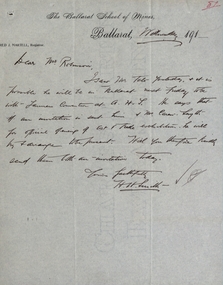 Federation University Historical Collection
Letter, Frank Tate, 1 Letter from Frank Tate of the Victorian Educatition Department & .2 Letter from School of Mines Ballarat to Mr Robinson, 07/07/1910
... Typed letted on Government of Victorian Education Office letterhead. The front page is bordered in black for mourning after the death of King Edward VII. ...Smith robinson Typed letted on Government of Victorian Education Office letterhead. The front page is bordered in black for mourning after the death of King Edward VII. ...Typed letted on Government of Victorian Education Office letterhead. The front page is bordered in black for mourning after the death of King Edward VII. The letter related to an exhibiton being held in Ballarat which was to be visited by Frank Tate (Director of Education) and Ponsonby Carew Smyth (Art Inspector). Another handwritten letter from H.H. Smith to Mr Robinson highlights the possible visit to the Ballarat School of Mines Art and trade Exhibition. frank tate, victorian education department, coat of arms, letterhead, ponsonby carew smith, exhibition, mourning, h.h. smith, robinson
