
Showing 220 items matching "victorian interiors"
-
![Architectural Moulding: Fragment of plaster and cement cornice from Southesk [Ordsall]](/media/collectors/550653872162f11fb04854aa/items/66b185bc235bc2950ebe8440/item-media/66b197c7235bc2950ec38cc7/item-fit-380x285.jpg?cb=6) Kew Historical Society Inc
Kew Historical Society IncArchitectural Moulding, Fragment of plaster and cement cornice from Southesk [Ordsall], 1870-80
... ...Victorian interiors...Rare, and possible unique fragment of a plaster cornice from one of the most architecturally distinctive houses in Kew, demolished 1970. ordsall south esk cullis Hill plasterwork cornices Victorian interiors Nil Section of plaster cornice removed from Southesk on the corner of Charles Street and Cotham Road, Kew, when it was demolished in 1970 by the City of Kew. ...'Ordsall', renamed 'Southesk' in the 20th century was built for John Halfey in or before 1865. The house was rebuilt in the 1870s to designs by architect Michael Hennessy. In 1882 the house was redecorated by the firm of Cullis Hill & Co., who hired the artists 'Mr Vandenbrandt' and 'Signor Rizzi" to paint the ceilings of the ballroom and the drawingroom. The artistic triumph was described in detail in The Argus, 30 October, 1882. In 1947, Southesk was purchased by the Kew City Council. For 23 years it was used as a meeting place for community groups. The house was then demolished in 1970 to make way for a new Town Hall.Rare, and possible unique fragment of a plaster cornice from one of the most architecturally distinctive houses in Kew, demolished 1970.Section of plaster cornice removed from Southesk on the corner of Charles Street and Cotham Road, Kew, when it was demolished in 1970 by the City of Kew. The cornice has a narrow layer of previously coloured plaster which is now overlaid with a grey distemper. The foundation of the cornice is moulded cement. Remnant flowers moulded in the central band of the cornice include a rose and a sunflower. The plaster decoration was probably located in the entrance hall, dining room or ballroom, all of which were created in the 1870s by Michael Hennessy and decorated by the firm of art decorators, Cullis Hill & Co in 1882.Nilordsall, south esk, cullis hill, plasterwork, cornices, victorian interiors -
 Kew Historical Society Inc
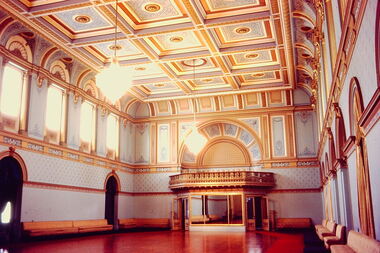
Slide - State Ballroom: Government House Victoria, John T Collins, 1979
... ...victorian interiors...The interiors including the ballroom were created soon after the building's opening. The Victorian Heritage Register citation notes that the extravagant single storey State Ballroom occupies the entire south wing. ...The slide is significant as it represents the decoration and furnishings of the State Ball Room in 1979. government house -- melbourne victorian interiors ballrooms -- melbourne (vic.) john t collins "South Yarra Government House Ballroom J Collins 17-10-79" One of six colour transparencies, purchased from John T Collins of interior and exterior views of Government House, Melbourne. ...Government House, Melbourne was constructed between 1972 and 1876 to a design of William Wardell. The interiors including the ballroom were created soon after the building's opening. The Victorian Heritage Register citation notes that the extravagant single storey State Ballroom occupies the entire south wing. The slide is significant as it represents the decoration and furnishings of the State Ball Room in 1979.One of six colour transparencies, purchased from John T Collins of interior and exterior views of Government House, Melbourne. This photograph (slide) is of the entrance to the State Ballroom."South Yarra Government House Ballroom J Collins 17-10-79"government house -- melbourne, victorian interiors, ballrooms -- melbourne (vic.), john t collins -
 Kew Historical Society Inc
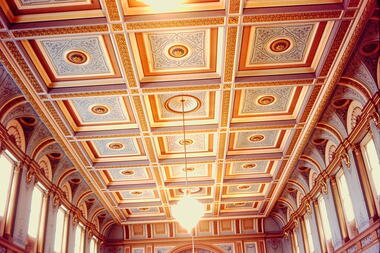
Slide - Coffered Ceiling of the State Ballroom: Government House Victoria, John T Collins, 1979
... ...victorian interiors...The interiors including the ballroom were created soon after the building's opening. The Victorian Heritage Register citation notes that the extravagant single storey State Ballroom occupies the entire south wing. ...The slide is significant as it represents the decoration of the State Ball Room in 1979. government house -- melbourne victorian interiors ballrooms -- melbourne (vic.) john t collins "South Yarra Government House Ballroom J Collins 17-10-79" One of six colour transparencies, purchased from John T Collins of interior and exterior views of Government House, Melbourne. ...Government House, Melbourne was constructed between 1972 and 1876 to a design of William Wardell. The interiors including the ballroom were created soon after the building's opening. The Victorian Heritage Register citation notes that the extravagant single storey State Ballroom occupies the entire south wing. The slide is significant as it represents the decoration of the State Ball Room in 1979.One of six colour transparencies, purchased from John T Collins of interior and exterior views of Government House, Melbourne. This photograph (slide) is of the coffered ceiling of the State Ballroom."South Yarra Government House Ballroom J Collins 17-10-79"government house -- melbourne, victorian interiors, ballrooms -- melbourne (vic.), john t collins -
 Kew Historical Society Inc
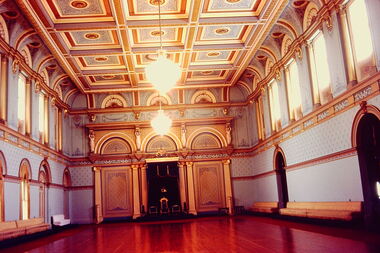
Slide - State Ballroom: Government House Victoria, John T Collins, 1979
... ...victorian interiors...The interiors including the ballroom were created soon after the building's opening. The Victorian Heritage Register citation notes that the extravagant single storey State Ballroom occupies the entire south wing. ...The slide is significant as it represents the decoration of the State Ball Room in 1979. government house -- melbourne victorian interiors ballrooms -- melbourne (vic.) john t collins "South Yarra Government House Ballroom J Collins 17-10-79" One of six colour transparencies, purchased from John T Collins of interior and exterior views of Government House, Melbourne. ...Government House, Melbourne was constructed between 1972 and 1876 to a design of William Wardell. The interiors including the ballroom were created soon after the building's opening. The Victorian Heritage Register citation notes that the extravagant single storey State Ballroom occupies the entire south wing. The slide is significant as it represents the decoration of the State Ball Room in 1979.One of six colour transparencies, purchased from John T Collins of interior and exterior views of Government House, Melbourne. This photograph (slide) is of the State Ballroom."South Yarra Government House Ballroom J Collins 17-10-79"government house -- melbourne, victorian interiors, ballrooms -- melbourne (vic.), john t collins -
 Kew Historical Society Inc
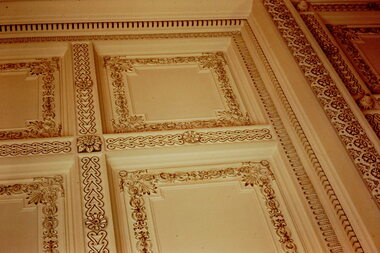
Slide - Ceiling of the State Drawing Room: Government House Victoria, John T Collins, 1979
... ...victorian interiors...The slide is significant as it represents the ceiling decoration of the State Drawing Room in 1979. government house -- melbourne victorian interiors john t collins state drawing room (melbourne) "South Yarra Government House Ceiling Drawing Room J Collins 17-10-79" One of six colour transparencies, purchased from John T Collins of interior and exterior views of Government House, Melbourne. ...Government House, Melbourne was constructed between 1972 and 1876 to a design of William Wardell. The State Drawing Room is part of the 'State Apartments' which also includes the State Hall, State Ballroom, State Dining Room and the Billiard Room.The slide is significant as it represents the ceiling decoration of the State Drawing Room in 1979.One of six colour transparencies, purchased from John T Collins of interior and exterior views of Government House, Melbourne. This photograph (slide) is of the ceiling of the Drawing Room."South Yarra Government House Ceiling Drawing Room J Collins 17-10-79"government house -- melbourne, victorian interiors, john t collins, state drawing room (melbourne) -
 Kew Historical Society Inc
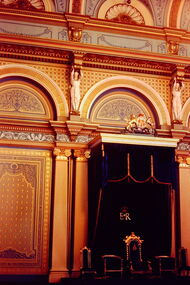
Slide - State Ballroom: Government House Victoria, John T Collins, 1979
... ...victorian interiors...The slide is significant as it represents the ceiling decoration of the State Drawing Room in 1979. government house -- melbourne victorian interiors ballrooms -- melbourne (vic.) john t collins "South Yarra Government House Throne J Collins 17-10-79" One of six colour transparencies, purchased from John T Collins of interior and exterior views of Government House, Melbourne. ...Government House, Melbourne was constructed between 1972 and 1876 to a design of William Wardell. The State Ballroom is part of the 'State Apartments' which also includes the State Hall, State Drawing Room, State Dining Room and the Billiard Room.The slide is significant as it represents the ceiling decoration of the State Drawing Room in 1979.One of six colour transparencies, purchased from John T Collins of interior and exterior views of Government House, Melbourne. This photograph (slide) is of the throne in the State Ballroom."South Yarra Government House Throne J Collins 17-10-79"government house -- melbourne, victorian interiors, ballrooms -- melbourne (vic.), john t collins -
 Kew Historical Society Inc
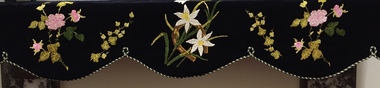
Decorative object - Velvet mantel hanging embroidered with chenille thread, c. 1890
... Variably described as mantel hangings, pelmets or valances, these became a common form of Victorian interior decoration in the second half of the 19th century. ...Variably described as mantel hangings, pelmets or valances, these became a common form of Victorian interior decoration in the second half of the 19th century. ...Variably described as mantel hangings, pelmets or valances, these became a common form of Victorian interior decoration in the second half of the 19th century. The hanging uses arrasene embroidery which was introduced for artistic embroidery c.1883. Arrasene embroidery was a variation of chenille embroidery and was mainly used for curtain borders, mantel hangings and screens. When used to embroider flowers on velvet or plush, it was sewn upon the surface without being ‘drawn through’. Madonna lilies, irises, daffodils and narcissi were commonly used in designs of mantel hangings.Velvet mantel hanging embroidered with chenille thread. The scalloped edge of the pelmet is bordered by multicoloured silk cording. This example was owned by Netty Cornish of 15 Peel Street, Kew, and donated by her daughter, Mrs F Plumridge in 1980. The embroidered flowers in this example include narcissi and roses.mantel pelmet, peel street, kew, nettie cornish, mary plumridge -
 Federation University Historical Collection
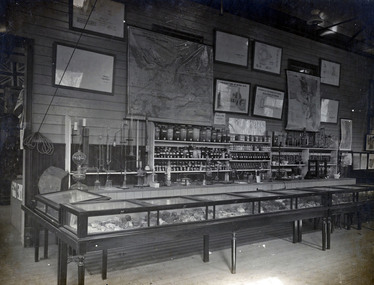
Photograph - Photograph (Black & White), Ballarat School of Mines Chemistry Room, c 1900
... interior chemistry classroom at the Ballarat school of Mines. Chemicals and apparatus line one wall, and geological specimens are housed in glass cases. Posters line the wall. Ballarat School of Mines Chemistry Room Photograph Photograph (Black & White) Victorian ...This image was taken at the height of the Ballarat school of Mines world wide fame.Black and white photograph mounted onto green card showing an interior chemistry classroom at the Ballarat school of Mines. Chemicals and apparatus line one wall, and geological specimens are housed in glass cases. Posters line the wall. On lower section of photograph 'Section Chemistry Room S.M.B. mines Dept Vic.ballarat school of mines, mines department, geology, chemisty -
 Federation University Historical Collection
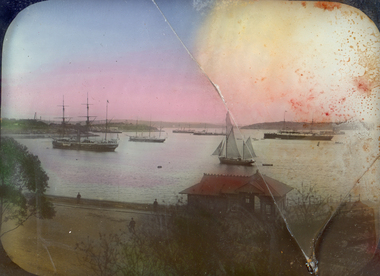
Photograph - Lantern Slides, Boxed Lantern Slides, c1920
... The box contains 50 lantern slides including: * male Turk in turbin *interior of a cathedral * Cavalry Scene, Boer War (c1900) * Richard Seddon portrait * Fishermen at Sea * Turkish domed building * Eddystone Lighthouse, England * image of early printing * Cloister Court, Trinity College, Cambridge * Farm Cove, Sydney Harbour (by I.F.E) * National Park, Sydney * Customs House, Sydney * View from the Dome of St Peter's, Rome (Pre 1929) * Botanical Gardens, Sydney * Coogee Bay, NSW * Keeble College Chapel, Oxford * Holy Land - The Village of Endor * Sydney Cove * Interior portrait of members of the Victorian Legislative Assembly, Parliament House, Melbourne * Palace Dela Concord, Italy...The box contains 50 lantern slides including: * male Turk in turbin *interior of a cathedral * Cavalry Scene, Boer War (c1900) * Richard Seddon portrait * Fishermen at Sea * Turkish domed building * Eddystone Lighthouse, England * image of early printing * Cloister Court, Trinity College, Cambridge * Farm Cove, Sydney Harbour (by I.F.E) * National Park, Sydney * Customs House, Sydney * View from the Dome of St Peter's, Rome (Pre 1929) * Botanical Gardens, Sydney * Coogee Bay, NSW * Keeble College Chapel, Oxford * Holy Land - The Village of Endor * Sydney Cove * Interior portrait of members of the Victorian Legislative Assembly, Parliament House, Melbourne * Palace Dela Concord, Italy Boxed Lantern Slides Photograph Lantern Slides ...The lantern slides were most probably used at the Ballarat School of Mines. The image of Rome from St Peter's (Vatican) was taken before 1929. The "Via Conciliazione", built by Mussolini in 1929 is not present in the image. Hinged timber box designed to hold glass lantern slides. The box contains 50 lantern slides including: * male Turk in turbin *interior of a cathedral * Cavalry Scene, Boer War (c1900) * Richard Seddon portrait * Fishermen at Sea * Turkish domed building * Eddystone Lighthouse, England * image of early printing * Cloister Court, Trinity College, Cambridge * Farm Cove, Sydney Harbour (by I.F.E) * National Park, Sydney * Customs House, Sydney * View from the Dome of St Peter's, Rome (Pre 1929) * Botanical Gardens, Sydney * Coogee Bay, NSW * Keeble College Chapel, Oxford * Holy Land - The Village of Endor * Sydney Cove * Interior portrait of members of the Victorian Legislative Assembly, Parliament House, Melbourne * Palace Dela Concord, Italylantern slides, entertainment, ballarat school of mines, boer war, richard seddon, sydney harbour, coogee beach, legislative assembly, rome, roma, vatican, vaticono, fairyland, lake wendouree, glass slide, lantern slide -
 Flagstaff Hill Maritime Museum and Village
Instrument - Scale, George Salter & Co, ca. 1886
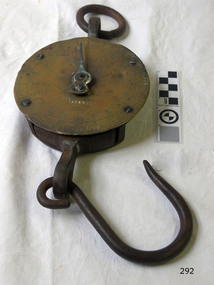
... Victorian government’s Department of Trade and Customs. It was armed with a 6-inch gun and two 1-inch Nordenfelt guns. The Sydney Morning Herald of 27th January 1888 describes the vessel in detail. It even comments on the interior...Victorian government’s Department of Trade and Customs. It was armed with a 6-inch gun and two 1-inch Nordenfelt guns. The Sydney Morning Herald of 27th January 1888 describes the vessel in detail. It even comments on the interior ...There were at least three 1880s vessels named Lady Loch, all built in Victoria; a river launch (ca 1884 to ca 1916, originally named Lady of the Lake), a steamer ferry (1884 to 1920s), and a government lighthouse tender steamer HMV Lady Loch (1886 to 1962). The spring balance scale was part of the equipment on the HMV Lady Loch. The scale was made by the renowned company Salter Weighing Machines in the United Kingdom, to Silvester's patent design. Salter Weighing Machines, Britain, began making spring scales in the 1820s. In 1908 Salter opened up an Australian branch named Salter Scales Pty. Ltd. The scale is marked HMV SS Lady Loch. It would be suspended by its top ring, a basket or other container is hung from the hook, and the items inside the basket are then pulled downwards on the hook, which stretches the springs inside the works. The pulling action moves a rack and gears a calculated distance and the gears turn the pointer on the dial to indicate the weight of the goods. This scale measures up to 200 pounds capacity. The HMV SS Lady Loch was an iron steamship built in Footscray, Melbourne, by Campbell, Sloss and McCain in 1886 for the colonial Victorian government’s Department of Trade and Customs. It was armed with a 6-inch gun and two 1-inch Nordenfelt guns. The Sydney Morning Herald of 27th January 1888 describes the vessel in detail. It even comments on the interior of the Saloon “The wood work … is on a very elaborate scale and is exceedingly neat …”. The HMV Lady Loch performed Customs duties and serviced the lighthouses along the coast. The scale could have measured goods for the Customs Tax, or for measuring out supplies for the lighthouse keepers. The vessel was named after Lady Elizabeth Loch, wife of Sir Henry Loch, Governor of Victoria from 1884 to 1889. In 1932 Lady Loch was converted to a hulk and used in Brisbane, and finally scuttled in 1962 at Moreton Bay, Queensland.The scale has importance due to its connection to the 1886 HMV Lady Loch, a vessel of great significance to Melbourne’s shipbuilding industry. It was the largest auxiliary vessel in the Victorian Colonial Government’s fleet and the first prominent vessel launched by Melbourne’s shipbuilding industry. The scale is also important for its connection with the colonial navy's Custom's work, as the scale was available to weigh goods that could attract taxes and deal out goods for distribution to lighthouse keepers. The HMV Lady Loch was also important part of Victoria's maritime history for its communication and support of the lighthouse keeper's along the coast of Victoria.Scale; Salter's spring balance mechanical hanging scale, brass and iron. Equally spaced marks around the circular dial have values from 0 to 200 in increments of 10, each increment is also divided into 10. An iron ring is attached to a fitted loop on the top of the scale, and an iron hook is attached to the fitted loop onthe bottom of the scale. A moving pointer attached to the centre of the dial has a calibration screw joined to its base. Four screws fix the brass face to the works at the back. There are stamped and embossed inscriptions. Made by Salter in Britain, to Silvester's Patent design. The scale was once equipment carried abourd the steamship HMV SS Lady Loch. Stamped: "SALTER'S / SPRING BALANCE" "SILVESTOR'S / PATENT" Embossed in script: "HMV SS / Lady Loch"warrnambool, shipwreck coast, flagstaff hill, flagstaff hill maritime museum, flagstaff hill maritime village, scale, salter, spring balance, silvester's patent, lady loch, steamship, hmv, colonial navy, victoria, lady elizabeth loch, custom's vessel, lighthouse tender, 1886, government vessel, victorian government, measuring instrument, weight, weighing instrument, mechanical scale, hanging scale, hmv lady loch, weights and measures, silvestor's patent, george salter & co. -
 Flagstaff Hill Maritime Museum and Village
Furniture - Carved Panel, Campbell, Sloss and McCain, ca. 1886
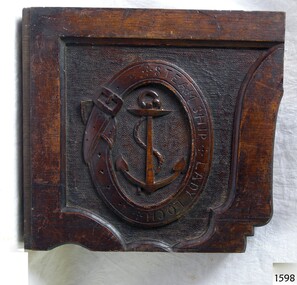
... Victorian government’s Department of Trade and Customs. It was armed with a 6-inch gun and two 1-inch Nordenfelt guns. The Sydney Morning Herald of 27th January 1888 describes the vessel in detail. It even comments on the interior...Victorian government’s Department of Trade and Customs. It was armed with a 6-inch gun and two 1-inch Nordenfelt guns. The Sydney Morning Herald of 27th January 1888 describes the vessel in detail. It even comments on the interior ...There were at least three 1880s vessels named Lady Loch, all built in Victoria; a river launch (ca 1884-ca 1916, originally named Lady of the Lake), a steamer ferry (1884-1920s) and a government lighthouse tender steamer HMV Lady Loch (1886-1962.) The carved wooden panel was removed from the HMV SS Lady Loch before the vessel was scuttled in 1962. About HMV SS Lady Loch: - The HMV SS Lady Loch was an iron steamship built in Footscray, Melbourne, by Campbell, Sloss and McCain in 1886 for the colonial Victorian government’s Department of Trade and Customs. It was armed with a 6-inch gun and two 1-inch Nordenfelt guns. The Sydney Morning Herald of 27th January 1888 describes the vessel in detail. It even comments on the interior of the Saloon “The wood work … is on a very elaborate scale and is exceedingly neat …”. The HMV Lady Loch performed Customs duties and serviced the lighthouses along the coast. The scale could have measured goods for the Customs Tax, or for measuring out supplies for the lighthouse keepers. The vessel was named after Lady Elizabeth Loch, wife of Sir Henry Loch, Governor of Victoria from 1884 to 1889. In 1932 Lady Loch was converted to a hulk and used in Brisbane, and finally scuttled in 1962 at Moreton Bay, Queensland. The carved wood panel has importance due to its connection to the 1886 HMV Lady Loch, a vessel of great significance to Melbourne’s shipbuilding industry. It was the largest auxiliary vessel in the Victorian Colonial Government’s fleet and the first prominent vessel launched by Melbourne’s shipbuilding industry. It is significant to the history of the Victorian era and the colonial navy's steamship HMV SS Lady Loch. The vessel carried out Custom's work, and the scales were available to weigh goods that could attract taxes and goods for distribution to lighthouse keepers. The HMV Lady Loch was also important part of Victoria's maritime history, its communication with and support of the lighthouse keepers along the coast of Victoria.Heavy carved wooden panel, square, representing a framed plaque. The bottom and right edges are scalloped on the outer and inner edges. A carved oval within the frame represents a wide belt with buckle and tongue, and indents for the belt holes on its left and a carved inscription runs from top centre to bottom centre on the right side of the belt. Within the belt is the maritime symbol of an upright anchor in front of a rope. It was once part of the furnishing of the steamer HMVS Lady Loch and was removed before the ship was scuttled.Carved within the belt: "STEAM SHIP LADY LOCH"warrnambool, shipwreck coast, flagstaff hill, flagstaff hill maritime museum, flagstaff hill maritime village, scale, salter, spring balance, silvester's patent, lady loch, steamship, hmv, colonial navy, victoria, lady elizabeth loch, custom's vessel, lighthouse tender, 1886, government vessel, victorian government, wood panel, timber panel, carved panel, carved log, lady loch logo, belt enclosing and anchor, anchor within belt, lady loch steam ship, wooden panel, ship's furinshing, ship's panel, ship's logo, great ocean road, government steamer, victorian colonial government, colonial vessel, public works, bass straight, hmv lady loch, hmvs lady loch, hmv ss lady loch, melbourne, melbourne shipbuilder, ship furnishings, wooden furnishings, decorative panel, carved emblem, carved logo, carved symbol, campbell stoss and mccain, government tender, victorian customs -
 Federation University Historical Collection
Book, Victoria Education Gazette and Teachers' Aid, 1911-1919, 1910-1919
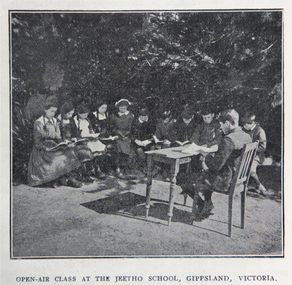
... Black hard covered book with red spine, holding Victorian Education Gazettes for one calendar year. .1) 1910 .2) 1912 .3) 1911 .4) 1914 .5) 1918 Images: Open Air Classroom Black Rock; Open Air Classroom, Jeetho, Gippsland; Open Air Nurses bedroom, Mildura; Gym at Canterbury School ; Babies and Nurses at Melbourne Foundling Hospital; Camp at Portland; Alexander Peacock Opens a Melbourne School; Unveiling Major Mitchell Memorial at Mt Arapiles; Agricultural Plot; School Interior; Swimming Drill; Graham Dux Prize Board; Bathing Place; Classroom with blackboard and pictures; Major Mitchell's Map; Melbourne, Derbyshire; Market Place Melbourne; The Blackwood; World War One Send-off at The Athenaeum; Scarsdale Old Boy's logo; Sloyd articles for the Field Hospital; World War One; Gifts for Transport to the Wharf; soldiers; ANZAC Day; ANZAC Day Medalion .5) 1915: Education Department's War Relief Fund, William Park obituary, Closer Settlement Act 1912, Agriculture, needlework, Swimming and Life Saving, explorers, Gregory Blaxland, Matthew Flinders, Composition, Geography, potatoes, onions, gardens, Needlework for Infants, Iona and Staffa, Trained Primary Teacher's Course, Electricity, Electrical Technology, hygiene, Arbour Day, Horticulture, Wattle Day, Bird Day, Technical Schools, Landing at Gaba Tepe, Evils of Alcohol, Old Boys of Scarsdale, Belgium, Teachers' College Images: The British at War, The Sonnet, History and Patriotism, Male Swimming Teachers Summer School at Geelong, Women Swimming Teachers at Port Fairy, Buln Buln State School, Burwood East State School, needlework plans, methods of Rescue and Resucitation. plan of the journey of Gregory Blaxland, Macquarie House, teachers killed (William Ross Hoggart, Stanley Robert Close, William Roy Hodgson, Campbell McDiarmid Peter, William Henry Dawkins, William Hugh Hamilton, Frederick McRae Neal, Vernon Brookes, Frank J. ...Bailey Black hard covered book with red spine, holding Victorian Education Gazettes for one calendar year. .1) 1910 .2) 1912 .3) 1911 .4) 1914 .5) 1918 Images: Open Air Classroom Black Rock; Open Air Classroom, Jeetho, Gippsland; Open Air Nurses bedroom, Mildura; Gym at Canterbury School ; Babies and Nurses at Melbourne Foundling Hospital; Camp at Portland; Alexander Peacock Opens a Melbourne School; Unveiling Major Mitchell Memorial at Mt Arapiles; Agricultural Plot; School Interior; Swimming Drill; Graham Dux Prize Board; Bathing Place; Classroom with blackboard and pictures; Major Mitchell's Map; Melbourne, Derbyshire; Market Place Melbourne; The Blackwood; World War One Send-off at The Athenaeum; Scarsdale Old Boy's logo; Sloyd articles for the Field Hospital; World War One; Gifts for Transport to the Wharf; soldiers; ANZAC Day; ANZAC Day Medalion .5) 1915: Education Department's War Relief Fund, William Park obituary, Closer Settlement Act 1912, Agriculture, needlework, Swimming and Life Saving, explorers, Gregory Blaxland, Matthew Flinders, Composition, Geography, potatoes, onions, gardens, Needlework for Infants, Iona and Staffa, Trained Primary Teacher's Course, Electricity, Electrical Technology, hygiene, Arbour Day, Horticulture, Wattle Day, Bird Day, Technical Schools, Landing at Gaba Tepe, Evils of Alcohol, Old Boys of Scarsdale, Belgium, Teachers' College Images: The British at War, The Sonnet, History and Patriotism, Male Swimming Teachers Summer School at Geelong, Women Swimming Teachers at Port Fairy, Buln Buln State School, Burwood East State School, needlework plans, methods of Rescue and Resucitation. plan of the journey of Gregory Blaxland, Macquarie House, teachers killed (William Ross Hoggart, Stanley Robert Close, William Roy Hodgson, Campbell McDiarmid Peter, William Henry Dawkins, William Hugh Hamilton, Frederick McRae Neal, Vernon Brookes, Frank J. ...Black hard covered book with red spine, holding Victorian Education Gazettes for one calendar year. .1) 1910 .2) 1912 .3) 1911 .4) 1914 .5) 1918 Images: Open Air Classroom Black Rock; Open Air Classroom, Jeetho, Gippsland; Open Air Nurses bedroom, Mildura; Gym at Canterbury School ; Babies and Nurses at Melbourne Foundling Hospital; Camp at Portland; Alexander Peacock Opens a Melbourne School; Unveiling Major Mitchell Memorial at Mt Arapiles; Agricultural Plot; School Interior; Swimming Drill; Graham Dux Prize Board; Bathing Place; Classroom with blackboard and pictures; Major Mitchell's Map; Melbourne, Derbyshire; Market Place Melbourne; The Blackwood; World War One Send-off at The Athenaeum; Scarsdale Old Boy's logo; Sloyd articles for the Field Hospital; World War One; Gifts for Transport to the Wharf; soldiers; ANZAC Day; ANZAC Day Medalion .5) 1915: Education Department's War Relief Fund, William Park obituary, Closer Settlement Act 1912, Agriculture, needlework, Swimming and Life Saving, explorers, Gregory Blaxland, Matthew Flinders, Composition, Geography, potatoes, onions, gardens, Needlework for Infants, Iona and Staffa, Trained Primary Teacher's Course, Electricity, Electrical Technology, hygiene, Arbour Day, Horticulture, Wattle Day, Bird Day, Technical Schools, Landing at Gaba Tepe, Evils of Alcohol, Old Boys of Scarsdale, Belgium, Teachers' College Images: The British at War, The Sonnet, History and Patriotism, Male Swimming Teachers Summer School at Geelong, Women Swimming Teachers at Port Fairy, Buln Buln State School, Burwood East State School, needlework plans, methods of Rescue and Resucitation. plan of the journey of Gregory Blaxland, Macquarie House, teachers killed (William Ross Hoggart, Stanley Robert Close, William Roy Hodgson, Campbell McDiarmid Peter, William Henry Dawkins, William Hugh Hamilton, Frederick McRae Neal, Vernon Brookes, Frank J. Olle, Alfred J. Collins, Ernest R. Fairlie, William J. McLaren, A.E. Smith, Thomas Patton, Francis W. Kemp, Frederick G. Hall, Rupert O. Hepburn, Woolston J. Govan), Frederick Harold Tubb VC, Botanic Gardens Red Gum, Shelter Pavillions, Head of Wheat, Australian Commonwealth Flag, Iona Cathedral, Drawing exercises, ANZAC Madallion, School Rolls of Honor .6) 1916 - Nature Study, war relief, school gardening, horticulture, singing class, geography of the war, School Rolls of Honour, Ponsonby Carew-Smyth, Astronomy, ANZAC Day, Empire Day, Arbor Day, "Some Suul of Goodness in Things Evil" by Frank Tate, War Relief Gardeners' League, ANZAC Day medallion, Solar System, Abolition of German Schools in Victoria, ANZAC Avenues, avenues of honour, Geography of the War: The West, War relief and handwork, Victorian State Schools Horticultural Society, Patrick Maloney obituary, formalin lamps, Victoria League of Victoria, Wonwondah East Roll of Honor Images - Teachers killed (John Clarke, A.C.H. Jackson, Alexander Robertson, Noel Gambetta, Ralp E. Leyland, Laurance J. Woodruff, Walter E. Cass, Percy D. Moncur, Thomas M. Carmichael, Edward G. Brain, Reginald N.F. Woods, George E. James, William Colvin, David Dobson, Stanley L. Robinson, Charles Allen, G.E. James, H.F. Curnow, Franl L. Cousins, James R. Thompson, Henry H. Campbell, George E. Read, Ernest D. Morshead, Wilfred S. Merlin, Henry R. Wright, George B. Webb, Noel Nicholas, David H. Thomas, Charles A. Levens, Thomas R. Fenner, John M. Daniell, P.J. Larkin, Ralph Smith, Philip Ormsby), school rolls of honour, Swimming Instructors at Queenscliff, The Southern Sky, Map of the North Sea and its Littorals, Easter School of Horticulture at Oakleigh, Map of the Eastern Front, Map of Mesopotamia, Map of the War Area in the Egyptian Campaign, leeches for the Melbourne Hospital .7) 1917 - Swimming and Life-Saving, Childre's FLower Day, Education Department's War Relief Fund, State War Council, Horticulture, Bird Day, Swimming, Growing Chicory at Cowes Images - Teachers killed during World War One (G.M. Nicholas, William C.W. Spencer, J.W.C. Profitt, Ivon C. Bromilow, John Colwell, Robert W. Campbell, Arthur P. Bourchier, Francid G. Houston, Claude N. Harrison, Edgar Williams, Leslie A. Stevens, Charles E. W. Chester, Stanley R. Green, Walter Baker, Arthur G. Scott, Harry L. Swinburne, Horace W. Brown, Arnold Bretherton, Edward W. Jenkins Aubrey Liddelow, Ewen A. Cameron, Edmund R. Lyall, John H. Martin, Harry Bell, Frank L. Nicholls, Melville R. Hughes, Edwin W. Hauser, Walter S. Filmer, Walter G. Barlow, Henry A. Donaldson, Edward H. Jones, Walter W. Raw, Alfred W. Dean, Wiliam Lea, Frederick G. Drury, J.T. Richards, Norman G. Pelton, Lance-Corporal Doran, Kenneth F. McKenzie, William F. Robertson, Wiliam Jarrott, Norman Graham, George G. Paul, Victor Green, Arthur William Rennie, Alfred J. Glendinning, Robert B. Liston, Eward P. Toll, George Jones, Errol E. Rodda, Christian P. Christensen, Charles F. Sydes, H.G. Clements, Norman C. Fricker, J.M. Romeo. Eric N. Lear, Thomas J. Bartley, Norval Birrell, Frederick H. Tubb. J.T. Hamilton Aram, Arthur Wilcock, William M. Conroy, Alex. H. Miller, Patrick J. Cunningham, Charles S. Mitchell, John R. Maddern, James Roadknight, Harry Arundel, Jack C. McKellar, duncan M. McKellar, George S. Manfield, Edgar C. Holmes, George A. Young, Raymond A. Gardiner, William B. Bell, William Opie, George R. Scott, Richard V.B. Vine, Herbery S. Marshall, Hugh St Omer Dentry, George B. Fullerton, Harry Oulton, Iva F. Morieson), School Honor Books, Drawing, Presentation of 30,000 pounds to the British Red Cross at Melbourne Town Hall .8) 1918 .9) 1919 - Photographs of World War One soldiers from the Education Department, Margaret Montgomery Memorial, 1918 Act relating to State School Teachers, State Scolarships, Victorian State Schools' Horticultural Society, Pneumonic Influenza, Spanish Flu, epedemic, swimming and life savinfJunior cadet training, vacancies in Fiji, School Committees, Arbor Day, Arbour Day, Henry Harding of Yinnar, Planting Trees and Shrubs, Juvenile Crime, The use of 'Get', Soldier-Teachers from Overseas in Congress London, Australia's Effort in the War, Military, Working Bees, Tree Planting, fence building, Welcoming Home a Returned Soldier, Avenue of Honour planting, Discipline, Unveiling an Honor Board, School gymnasium, school tennis court, E. E. Crogger grave at Aldershot, The School Honor Book. War Relief Fund, Commonwealth War Record, Caulfield Military Hosptial, ANZAC Day Pilgrimage, Jimmie Panikin, Donald Fraser, Arthur Mee, Card Sun Dial, Balboa Day in Honolulu, William Hamilton, Alfred Jackson, The Backward Child, Flies, Language Teaching and Learning, Spelling, The Education of the Adolescent, victorian education gazette, education gazette and teachers' aid, sloyd, william a. cavanagh, james i froebel, school, education, world war one, memorials, alfred williams, exploration and settlement, cadets, australian naval college, bernard o;dowd, birds, swimming, drawingempire league, eucalypts, paper in history, forestry, arbor day, identification of trees, forestrey museums, fiji, gravel hill school band, horticulture, hygiene, gould league of bird lovers, life saving, la perouse, bandin, j. holland, w. hamilton, charles sturt, principles of archimedes, james holland, william hamilton, scarsdale old boys' reunion, foundling home melbourne, montessori education, open air schools, james hughes, marie corelli, flinders sydney harbour, major mitchell's map, tooth brushing, r.h.s. bailey -
 The Beechworth Burke Museum
Photograph, c1970
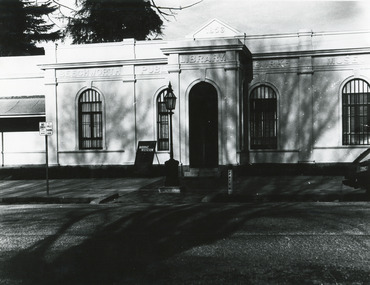
... Described as quick-tempered yet generous, Burke later joined an expedition to explore the interior of the Victorian colony, which was later termed the Burke and Wills expeditions. ...Historical photograph taken of the frontage of the Burke Museum in Beechworth. As Australia’s oldest regional museum, the building used for the Burke Museum was originally built as the Beechworth Athenaeum, and was later dedicated as a museum in memorial to the explorer Robert O’Hara Burke, who died on the Burke and Wills expeditions in 1861. The Burke and Wills exhibitions were a significant colonial event that was memorialised in paintings, buildings, monuments, and statues. The photograph has historical significance, connecting with various themes such as exploring, establishing pathways, and significant colonial events or persons. The photograph depicts the frontage of the Burke Museum, which was dedicated as a memorial to the explorer Robert O’Hara Burke, who died on the Burke and Wills expeditions in 1861. Robert O’Hara Burke was a significant person who was connected to both Beechworth and to an important colonial event, the Burke and Wills expeditions. Born in Ireland, Burke migrated to Australia in 1853 and nearly a year later, was appointed to senior inspector at Beechworth. Described as quick-tempered yet generous, Burke later joined an expedition to explore the interior of the Victorian colony, which was later termed the Burke and Wills expeditions. While the expeditions generated a significant amount of interest, the objectives of the Burke and Wills expeditions were hazy, as was its planned route, leading to disaster on the trip as group infighting, poor provisions, and a lack of clear instructions ultimately resulted in Burke’s death. Regardless, the Burke and Wills expeditions promoted discovery and endures today in popular memory.Black and white rectangular photograph printed on paper.Obverse: 1856/ BEECHWORTH/ PUBLIC/ LIBRARY/ BURKE/ MUSEUM/ BURK MUSEUM/ (parking signs illegible) Reverse: BMM 84-2-1/ A02989 1997 2696/ BMM 84-2-3burke museum, beechworth, beechworth athenaeum, athenaeum, memorial, robert o'hara burke, robert burke, burke and wills exhibitions -
 Federation University Historical Collection
Equipment - Equipment - Safety Glasses, VIOSH: Polarised Safety Glasses by UVEX of Germany
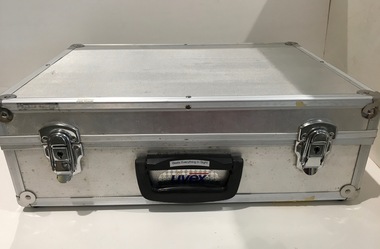
... Also have self tinting coating that darkens when exposed to UV. viosh victorian institute of occupational safety and health uvex germany polarised safety glasses coating on lens of glasses self tinting Silver metal case. Interior ...Victorian Institute of Occupational Safety and Health (VIOSH) Australia is the Asia-Pacific centre for teaching and research in occupational health and safety (OHS) and is known as one of Australia's leaders on the field. VIOSH has a global reputation for its innovative approach within the field of OHS management. VIOSH had its first intake of students in 1979. At that time the Institution was known as the Ballarat College of Advanced Education. In 1990 it became known as Ballarat University College, then in 1994 as University of Ballarat. It was 2014 that it became Federation University. VIOSH Australia students are safety managers, senior advisors and experienced OHS professionals. They come from all over Australia and industry. Students are taught active research and enquiry; rather than textbook learning and a one-size fits all approach. VIOSH accepts people into the Graduate Diploma of Occupational Hazard Management who have no undergraduate degree - on the basis of extensive work experience and knowledge. UVEX is a German company with over 95 years experience. The produce safety equipment - polarised safety glasses. These have a combination of different coatings on the lens suitable for a wide range of workplaces. Also have self tinting coating that darkens when exposed to UV.Silver metal case. Interior has two removable trays, each divided into sections. Top tray has various lenses, bottom tray has various frames.viosh, victorian institute of occupational safety and health, uvex, germany, polarised safety glasses, coating on lens of glasses, self tinting -
 Federation University Historical Collection
Booklet, Education Department Victoria, Victorian Education Department Course of Study of primary Schools: Social Studies, 1954 and 1956
... Victorian Education Department Course of Study of Primary Schools: Social Studies grades 1 to 6. Topics include family and home, how the community lives and works, Beyond the Neighbourhood (Africa, Canada, New Guinea, India, China, Italy, English factory town), The World About Me (School, home, food, clothes), Our Own Land (The Australia Our Ancestors Found - unknown interior, sheep, riches from underground, water, grain, cows, meat, tropics, tall timbers, manufacture, Melbourne, travel), The Land of Our Fathers (British Descent, From other Countries .2) Victorian Education Department Course of Study of primary Schools: Social Studies, Grades VII and VIII 6 page printed booklet...Victorian Education Department Course of Study of Primary Schools: Social Studies grades 1 to 6. Topics include family and home, how the community lives and works, Beyond the Neighbourhood (Africa, Canada, New Guinea, India, China, Italy, English factory town), The World About Me (School, home, food, clothes), Our Own Land (The Australia Our Ancestors Found - unknown interior, sheep, riches from underground, water, grain, cows, meat, tropics, tall timbers, manufacture, Melbourne, travel), The Land of Our Fathers (British Descent, From other Countries .2) Victorian Education Department Course of Study of primary Schools: Social Studies, Grades VII and VIII 6 page printed booklet Victorian Education Department Course of Study of primary Schools: Social Studies Booklet Booklet Education Department Victoria ....1) 18 page booklet relating to the Victorian Education Department Course of Study of Primary Schools: Social Studies grades 1 to 6. Topics include family and home, how the community lives and works, Beyond the Neighbourhood (Africa, Canada, New Guinea, India, China, Italy, English factory town), The World About Me (School, home, food, clothes), Our Own Land (The Australia Our Ancestors Found - unknown interior, sheep, riches from underground, water, grain, cows, meat, tropics, tall timbers, manufacture, Melbourne, travel), The Land of Our Fathers (British Descent, From other Countries .2) Victorian Education Department Course of Study of primary Schools: Social Studies, Grades VII and VIII 6 page printed bookleteducation department, social studies, education -
 Shepparton RSL Sub Branch
Book, Royal Australian Air Force, Standard Notebook for Initial Training Schools: Air Navigation, August 1942
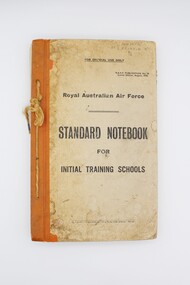
... interior "449852/ELIASON. R./B/2". Series of pages bound via twine passed through four holes along left side. Front and back cover are card with orange vinyl/fabric strip and paper cover bearing title text. Orange pages throughout mark sections. Book printed throughout. Royal Australian Air Force, Standard Notebook for Initial Training Schools: Air Navigation Book Victorian ...This notebook contains information on air navigation and electrical science. It was issued to Roy Eliason (449852), a Shepparton local who enlisted in 1944 and served as a Leading Aircraftman with the 2nd Operational Training Unit Mildura. Contents include: Appendix I: Law, Discipline, Administration and Organisation, Hygiene and Sanitation, Notes on Meteorology, Definitions, The principles of flight, Airframes, Engine; Appendix II: Mathematics problems for revision.This notebook has significant research potential, as it bears the service number of the owner: Roy Eliason. Roy Eliason's service history is well documented in the National Archives of Australia and this book provides an insight into a period of his service. Notebooks such as this were presumably issued to new recruits in the early stages of their service. Though this copy is in fair condition with several signs of wear, these signs may in fact increase the significance of the item, demonstrating the frequent use of this item in the hands of a new recruit to the Royal Australian Air Force. Series of pages bound via twine passed through four holes along left side. Front and back cover are card with orange vinyl/fabric strip and paper cover bearing title text. Orange pages throughout mark sections. Book printed throughout.Inscribed on front cover: "449852/AC2 ELIASON R/B/2". Inscribed on interior "449852/ELIASON. R./B/2". air navigation, training, royal australian air force, raaf, eliason, world war ii, wwii, second world war -
 Flagstaff Hill Maritime Museum and Village
Book, Country Houses and Villas
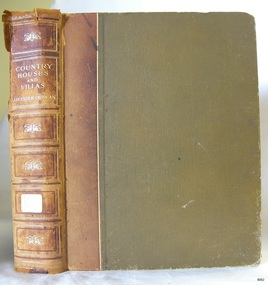
... The Warrnambool Mechanics' Institute’s publication collection is of both local and state significance. warrnambool shipwrecked-coast flagstaff-hill flagstaff-hill-maritime-museum maritime-museum shipwreck-coast flagstaff-hill-maritime-village shipwrecked-artefact book pattison collection warrnambool library warrnambool mechanics’ institute ralph eric pattison corangamite regional library service warrnambool city librarian mechanics’ institute library victorian library board warrnambool books and records warrnambool children’s library great ocean road Country Houses and Villas J H Elder-Duncan The Architectural Review Label on spine cover with typed text PAT F 728 ELD Pastedown front endpaper has sticker from Warrnambool Mechanics Institute and Free Library Front loose endpaper has a sticker from Corangamite Regional Library Service Front loose endpaper has a stamp from Corangamite Regional Library Service Country Houses and Villas Comprising 'Country Cottages' & 'The House Beautiful' illustrated with plans and interior decorations by well known Architects Author: J H Elder-Duncan Editorial secretary of "The Architectural Review" Publisher: Cassell & Co Date: 1908 Country Houses and Villas Book ...This item is from the ‘Pattison Collection’, a collection of books and records that was originally owned by the Warrnambool Mechanics’ Institute, which was founded in Warrnambool in 1853. By 1886 the Warrnambool Mechanics’ Institute (WMI) had grown to have a Library, Museum and Fine Arts Gallery, with a collection of “… choice productions of art, and valuable specimens in almost every branch and many wonderful national curiosities are now to be seen there, including historic relics of the town and district.” It later included a School of Design. Although it was very well patronised, the lack of financial support led the WMI in 1911 to ask the City Council to take it over. In 1935 Ralph Pattison was appointed as City Librarian to establish and organise the Warrnambool Library as it was then called. When the WMI building was pulled down in 1963 a new civic building was erected on the site and the new Warrnambool Library, on behalf of the City Council, took over all the holdings of the WMI. At this time some of the items were separated and identified as the ‘Pattison Collection’, named after Ralph Pattison. Eventually the components of the WMI were distributed from the Warrnambool Library to various places, including the Art Gallery, Historical Society and Flagstaff Hill. Later some were even distributed to other regional branches of Corangamite Regional Library and passed to and fro. It is difficult now to trace just where all of the items have ended up. The books at Flagstaff Hill Maritime Village generally display stamps and markings from Pattison as well as a variety of other institutions including the Mechanics’ Institute itself. RALPH ERIC PATTISON Ralph Eric Pattison was born in Rockhampton, Queensland, in 1891. He married Maude Swan from Warrnambool in 1920 and they set up home in Warrnambool. In 1935 Pattison accepted a position as City Librarian for the Warrnambool City Council. His huge challenge was to make a functional library within two rooms of the Mechanics’ Institute. He tirelessly cleaned, cleared and sorted a disarrayed collection of old books, jars of preserved specimens and other items reserved for exhibition in the city’s museum. He developed and updated the library with a wide variety of books for all tastes, including reference books for students; a difficult task to fulfil during the years following the Depression. He converted all of the lower area of the building into a library, reference room and reading room for members and the public. The books were sorted and stored using a cataloguing and card index system that he had developed himself. He also prepared the upper floor of the building and established the Art Gallery and later the Museum, a place to exhibit the many old relics that had been stored for years for this purpose. One of the treasures he found was a beautiful ancient clock, which he repaired, restored and enjoyed using in his office during the years of his service there. Ralph Pattison was described as “a meticulous gentleman whose punctuality, floorless courtesy and distinctive neat dress were hallmarks of his character, and ‘his’ clock controlled his daily routine, and his opening and closing of the library’s large heavy doors to the minute.” Pattison took leave during 1942 to 1945 to serve in the Royal Australian Navy, Volunteer Reserve as Lieutenant. A few years later he converted one of the Museum’s rooms into a Children’s Library, stocking it with suitable books for the younger generation. This was an instant success. In the 1950’s he had the honour of being appointed to the Victorian Library Board and received more inspiration from the monthly conferences in Melbourne. He was sadly retired in 1959 after over 23 years of service, due to the fact that he had gone over the working age of council officers. However he continued to take a very keen interest in the continual development of the Library until his death in 1969. The Pattison Collection, along with other items at Flagstaff Hill Maritime Village, was originally part of the Warrnambool Mechanics' Institute’s collection. The Warrnambool Mechanics’ Institute Collection is primarily significant in its totality, rather than for the individual objects it contains. Its contents are highly representative of the development of Mechanics' Institute libraries across Australia, particularly Victoria. A diversity of publications and themes has been amassed, and these provide clues to our understanding of the nature of and changes in the reading habits of Victorians from the 1850s to the middle of the 20th century. The collection also highlights the Warrnambool community’s commitment to the Mechanics’ Institute, reading, literacy and learning in the regions, and proves that access to knowledge was not impeded by distance. These items help to provide a more complete picture of our community’s ideals and aspirations. The Warrnambool Mechanics Institute book collection has historical and social significance for its strong association with the Mechanics Institute movement and the important role it played in the intellectual, cultural and social development of people throughout the latter part of the nineteenth century and the early twentieth century. The collection of books is a rare example of an early lending library and its significance is enhanced by the survival of an original collection of many volumes. The Warrnambool Mechanics' Institute’s publication collection is of both local and state significance. Country Houses and Villas Comprising 'Country Cottages' & 'The House Beautiful' illustrated with plans and interior decorations by well known Architects Author: J H Elder-Duncan Editorial secretary of "The Architectural Review" Publisher: Cassell & Co Date: 1908Label on spine cover with typed text PAT F 728 ELD Pastedown front endpaper has sticker from Warrnambool Mechanics Institute and Free Library Front loose endpaper has a sticker from Corangamite Regional Library Service Front loose endpaper has a stamp from Corangamite Regional Library Service warrnambool, shipwrecked-coast, flagstaff-hill, flagstaff-hill-maritime-museum, maritime-museum, shipwreck-coast, flagstaff-hill-maritime-village, shipwrecked-artefact, book, pattison collection, warrnambool library, warrnambool mechanics’ institute, ralph eric pattison, corangamite regional library service, warrnambool city librarian, mechanics’ institute library, victorian library board, warrnambool books and records, warrnambool children’s library, great ocean road, country houses and villas, j h elder-duncan, the architectural review -
 Flagstaff Hill Maritime Museum and Village
Book - Fictional Novel, Henry James Jr, Tales of Three Cities, 1884
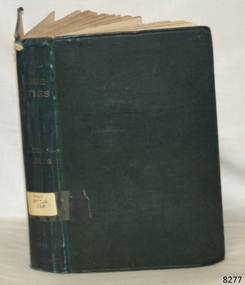
... interior psychological style that would later define high literary modernism. Famous for his deep psychological insights and intricate prose style, he explored how innocent Americans interacted with the older, more cynical cultures of Europe. He became a British citizen shortly before his death. The publisher, Macmillan & Co., was founded in London in 1843 by Scottish brothers Daniel and Alexander Macmillan. The house grew into one of the absolute giants of Victorian...interior psychological style that would later define high literary modernism. Famous for his deep psychological insights and intricate prose style, he explored how innocent Americans interacted with the older, more cynical cultures of Europe. He became a British citizen shortly before his death. The publisher, Macmillan & Co., was founded in London in 1843 by Scottish brothers Daniel and Alexander Macmillan. The house grew into one of the absolute giants of Victorian ...The novel Tales of Three Cities (1884) is not a single narrative, but rather a collection of three distinct novellas inspired by Henry James’s travels and his deep fascination with regional and transatlantic cultural clashes. The first novella, ‘Lady Barberina’, is a classic exploration of James’s famous ‘international theme’. It focuses on the marriage between a wealthy American doctor and an aristocratic Englishwoman, exposing the rigid social expectations of British high society. The second, ‘A New England Winter’, is a witty, satirical look at the distinct social nuances, manners, and artistic attitudes dividing New York and Boston. The third, ‘The Impressions of a Cousin’, is a story structured around a young woman’s personal journal, detailing a complex web of family relationships, trust, and art.Hard cover book, Tales of Three Cities Author: Henry James Publisher: Macmillan And Co Date: 1884 Blue cloth hardcover and spine with spine lettering in black texter. The spine has a Library label with inscription.fictionThe novel Tales of Three Cities (1884) is not a single narrative, but rather a collection of three distinct novellas inspired by Henry James’s travels and his deep fascination with regional and transatlantic cultural clashes. The first novella, ‘Lady Barberina’, is a classic exploration of James’s famous ‘international theme’. It focuses on the marriage between a wealthy American doctor and an aristocratic Englishwoman, exposing the rigid social expectations of British high society. The second, ‘A New England Winter’, is a witty, satirical look at the distinct social nuances, manners, and artistic attitudes dividing New York and Boston. The third, ‘The Impressions of a Cousin’, is a story structured around a young woman’s personal journal, detailing a complex web of family relationships, trust, and art.flagstaff hill, warrnambool, shipwrecked coast, flagstaff hill maritime museum, maritime museum, shipwreck coast, flagstaff hill maritime village, great ocean road, book, pattison collection, warrnambool library, warrnambool mechanics’ institute, ralph eric pattison, corangamite regional library service, warrnambool city librarian, mechanics’ institute library, victorian library board, warrnambool books and records, warrnambool children’s library, tales of three cities, henry james -
 Flagstaff Hill Maritime Museum and Village
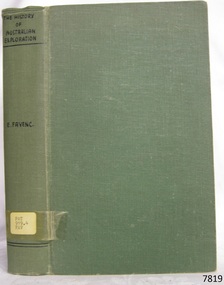
Book - Reference Book/History, Ernest Favenc, The History Of Australian Exploration 1788-1888, 1888
... (For more information on the Pattison Collection see item 3678 Flagstaff Hill collections) https://victoriancollections.net.au/items/5580c7e72162f114d8b758db warrnambool shipwrecked-coast flagstaff-hill flagstaff-hill-maritime-museum maritime-museum shipwreck-coast flagstaff-hill-maritime-village shipwrecked-artefact book pattison collection warrnambool library warrnambool mechanics’ institute ralph eric pattison corangamite regional library service warrnambool city librarian mechanics’ institute library victorian library board warrnambool books and records warrnambool children’s library great ocean road the history of australian exploration 1788-1888 ernest favenc Ernest Favenc's "The History of Australian Exploration from 1788 to 1888" is a key 19th-century chronicle of the continent's inland discoveries, compiled from official records and private accounts. Published in Sydney by Turner & Henderson, it covers expeditions from the First Fleet's arrival through late-19th-century ventures. The work details public and private explorations, from early Sydney ventures by Phillip and Tench to later interior ...Ernest Favenc's "The History of Australian Exploration from 1788 to 1888" is a key 19th-century chronicle of the continent's inland discoveries, compiled from official records and private accounts. Published in Sydney by Turner & Henderson, it covers expeditions from the First Fleet's arrival through late-19th-century ventures. The work details public and private explorations, from early Sydney ventures by Phillip and Tench to later interior explorations, highlighting geographical features and Indigenous encounters. Issued under Australian colonial governments' auspices, it fills gaps in prior narratives by emphasising lesser-known private efforts.The History Of Australian Exploration 1788-1888 2 Compiled from State Documents, Private Papers, and the most authentic sources of information. Issued under the auspices of the Governments of the Australian Colonies Author: Ernest Favenc Publisher: Turner & Henderson Date: 1888non-fictionErnest Favenc's "The History of Australian Exploration from 1788 to 1888" is a key 19th-century chronicle of the continent's inland discoveries, compiled from official records and private accounts. Published in Sydney by Turner & Henderson, it covers expeditions from the First Fleet's arrival through late-19th-century ventures. The work details public and private explorations, from early Sydney ventures by Phillip and Tench to later interior explorations, highlighting geographical features and Indigenous encounters. Issued under Australian colonial governments' auspices, it fills gaps in prior narratives by emphasising lesser-known private efforts. warrnambool, shipwrecked-coast, flagstaff-hill, flagstaff-hill-maritime-museum, maritime-museum, shipwreck-coast, flagstaff-hill-maritime-village, shipwrecked-artefact, book, pattison collection, warrnambool library, warrnambool mechanics’ institute, ralph eric pattison, corangamite regional library service, warrnambool city librarian, mechanics’ institute library, victorian library board, warrnambool books and records, warrnambool children’s library, great ocean road, the history of australian exploration 1788-1888, ernest favenc -
 Supreme Court of Victoria Library
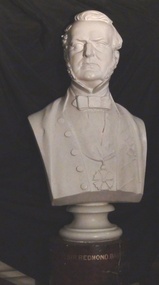
Plaster Portrait Bust, Justice Redmond Barry, 1884
... The purchases were probably part of the program of outfitting the library interiors and may have been purchased for the niches, that were later covered with the portraits, ironically one of these was of Barry. Redmond Barry is an important figure in colonial Victorian history, responsible for the establishment of key cultural institutions as well as a Supreme Court Judge for nearly 30 years, presiding over both the Eureka trials and the trial of Ned Kelly....The purchases were probably part of the program of outfitting the library interiors and may have been purchased for the niches, that were later covered with the portraits, ironically one of these was of Barry. Redmond Barry is an important figure in colonial Victorian history, responsible for the establishment of key cultural institutions as well as a Supreme Court Judge for nearly 30 years, presiding over both the Eureka trials and the trial of Ned Kelly. ...The library committee had already commissioned a portrait of Sir Redmond Barry when they purchased this bust of Barry along with that of Justice Fellows. The library still holds the receipt for this purchase of 24 pounds. The purchases were probably part of the program of outfitting the library interiors and may have been purchased for the niches, that were later covered with the portraits, ironically one of these was of Barry. Redmond Barry is an important figure in colonial Victorian history, responsible for the establishment of key cultural institutions as well as a Supreme Court Judge for nearly 30 years, presiding over both the Eureka trials and the trial of Ned Kelly.The bust of Redmond Barry is of some interest as part of the original furnishings of the library. It represents one of a number of bust portraits of Barry and is of some significance as it portrays Barry, an important figure in Victorian history. The bust is also of interest as a work of James Scurry, most well known for his architectural sculpture.Plaster bust of Justice Redmond Barry. The bust itself is painted white. The pedestal has been painted for a red and black marble effect. Barry's name appears in gold lettering. The Bust is larger than life size. The head is finely detailed with Barry in contemporary clothing with a bow tie and his orders on his chest.Sir Redmond Barry -
Glen Eira Historical Society
Article - Prentice Street, 32A, Elsternwick
... It gives details of this Victorian home prior to upcoming sale. Describes interior style and notes the addition of the outside plunge pool and established garden. ...It gives details of this Victorian home prior to upcoming sale. Describes interior style and notes the addition of the outside plunge pool and established garden. ...Two items about sales of this property: 1/Newspaper article dated 23/07/2004 featuring this property. It gives details of this Victorian home prior to upcoming sale. Describes interior style and notes the addition of the outside plunge pool and established garden. Includes a coloured photograph. 2/2 copies of same advertisement in 'Melbourne Weekly Bayside - Your Community Voice' dated 08/02/2012 for sale of property.victorian style, prentice street, elsternwick, peden gole, estate agents, timber houses, edwardian style, biggin scott -
Glen Eira Historical Society
Article - Prentice Street, 30, Elsternwick
... interior of this architect-designed home. The other is dated 21/11/2014 with same photos but different description. Prentice Street Franzi Craig Elsternwick Kingston Phillip Architecture Hocking Stuart Victorian Style Estate Agents Timber Houses Hocking Stuart Architects Article Prentice Street, 30, Elsternwick ...Three items about sales of this property: 1/Property Review Weekly, advertising dated 15/06/01, on forthcoming executors auction 24/06/2001. Listed as outstanding development potential by Buxton Estate Agents, coloured photo of exterior included. 2/Property Review Weekly feature, dated 14/02/2003, includes two coloured photographs (one exterior and one interior) for sale of renovated property, beachside architecture; agent Hocking Stuart. Also an advertisement, dated 26/02/2003, giving brief house features of property renovation and colour photo of front exterior. 3/Two ads for sale of property in November 2014. One is hand-daterd 2014 with front and back colour exterior photos plus one colour interior of this architect-designed home. The other is dated 21/11/2014 with same photos but different description.prentice street, franzi craig, elsternwick, kingston phillip, architecture, hocking stuart, victorian style, estate agents, timber houses, hocking stuart, architects -
Glen Eira Historical Society
Document - PRENTICE STREET, 59, ELSTERNWICK
... Dated 16/03/2002 and includes 2 coloured interior and 1 colour exterior photographs. Prentice Street Victorian Style Fitzmonnie Leonora Ward Andrew Elsternwick Timber Houses Manson Emmert Bricklayers Buxtons Corrugated Iron Kooyong Road Tiles 'Elyse' Edwardian Style Estate Agents Verandah Fitzmonnie Henry Newsagents Lowe s Andrew Architectural Features Fitzmonnie John Elliott William Elliott Marc Document PRENTICE STREET, 59, ELSTERNWICK ...Two items about this property: 1/Caulfield Conservation study by Andrew Ward, dated September 1994. His description of the villa is brief, he includes a small history of the street and ownership/tenants from 1885 to 1924. 2/Newspaper advertisement on newly built Elyse at 59 Prentice Street, Elsternwick. Details modern features of home and the incorporation of Edwardian style as well. Dated 16/03/2002 and includes 2 coloured interior and 1 colour exterior photographs.prentice street, victorian style, fitzmonnie leonora, ward andrew, elsternwick, timber houses, manson emmert, bricklayers, buxtons, corrugated iron, kooyong road, tiles, 'elyse', edwardian style, estate agents, verandah, fitzmonnie henry, newsagents, lowe s andrew, architectural features, fitzmonnie john, elliott william, elliott marc -
 Glen Eira Historical Society
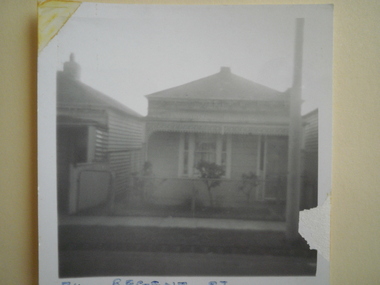
Regent Street, 78, Elsternwick
... Regent Street Elsternwick Victorian style Williams Kharla Stavrakis Bill Buxton Real Estate Real estate agents Altman Romana Cheeseman A N Elliott W M C Cope Chas Evans Hy T Evans E Cast iron work Verandahs Three items on 78 Regent Street, Elsternwick., Newspaper advertisement from the Bayside Weekly, 03/2009 for the sale of 78 Regent Street. Gives brief description of the house’s interior ...Three items on 78 Regent Street, Elsternwick., Newspaper advertisement from the Bayside Weekly, 03/2009 for the sale of 78 Regent Street. Gives brief description of the house’s interior and exterior features. Includes one colour photograph of the house exterior and two colour photographs of the house interior., Newspaper advertisement dated 08/09/2001, source unknown, advertising the sale of 78 Regent Street. Gives brief details of the house interior. Includes a colour photograph of the house exterior and a colour photograph of the Elsternwick Plaza area., A research note by Claire Barton, dated 03/07/2012, referencing Sands and McDougall editions 1911, 1913, 1923, 1948, 1960 and 1970, giving names of previous occupants of 78 Regent Street.regent street, elsternwick, victorian style, williams, kharla, stavrakis, bill, buxton real estate, real estate agents, altman, romana, cheeseman, a n, elliott, w m c, cope, chas, evans hy t, evans, e, cast iron work, verandahs -
Glen Eira Historical Society
Article - Shoobra Road, 61, Elsternwick
... interior features of interest for forthcoming auction by Biggin and Scott. Handwritten research by Claire Barton via Sands and McDougalls that No. 61 was probably called Relough in 1910 and the name seems to have disappeared by 1923 and 1942 editions. Shoobra Road Elsternwick Timber houses Biggin & Scott Victorian ...Three documents about this property: Two unattributed newspaper items dated 12/12/2001 and 5/12/2002 includes interior features of interest for forthcoming auction by Biggin and Scott. Handwritten research by Claire Barton via Sands and McDougalls that No. 61 was probably called Relough in 1910 and the name seems to have disappeared by 1923 and 1942 editions.shoobra road, elsternwick, timber houses, biggin & scott, victorian style, verandahs, architectural features, house names, relough, mclean bh mrs, elsworthy henry, hastings dora mrs, german robert, cast iron work, real estate agents, hannaford jc -
Glen Eira Historical Society
Article - SHOOBRA ROAD, 62, ELSTERNWICK
... interior and exterior facade. Article notes renovated features and garden highlights, selling agents Biggin and Scott. 2/Handwritten research from Sands and McDougalls edition 1923, 1942, and 1948 giving occupier details, by Claire Barton. 3/Forthcoming auction flyer for 62 Shoobra Road, Elsternwick. Auction date 30/05/2015. Property sold for approximately $2,000,000 by auctioneers HockingStuart. Victorian ...Three items on Shoobra Road; 1/Newspaper article dated 02/02/2011, from Melbourne Weekly Bayside, includes three coloured photographs showing renovated home interior and exterior facade. Article notes renovated features and garden highlights, selling agents Biggin and Scott. 2/Handwritten research from Sands and McDougalls edition 1923, 1942, and 1948 giving occupier details, by Claire Barton. 3/Forthcoming auction flyer for 62 Shoobra Road, Elsternwick. Auction date 30/05/2015. Property sold for approximately $2,000,000 by auctioneers HockingStuart.victorian style, elsternwick, shoobra road, fireplaces, ceiling roses, cast iron work, hastings geo.t., hastings mary mrs, verandahs, biggin and scott, real estate agents, water tanks -
Glen Eira Historical Society
Article - Shoobra Road, 53, Elsternwick, 'Linbrae'
... interior and exterior. Handwritten research by Claire Barton taken from Sands and MacDougalls editions 1910, 1913, 1923, 1942, 1948 and 1960 dated 30/09/2011. Shoobra Road Elsternwick 'Linbrae' Biggin Scott Williams Kharla Stavrakis Bill Architectural Features Architectural Styles Cast Iron Work Real Estate Agents Bryant Samuel Rev. Bay Windows Hestia House Names Appleton BV Miss Victorian ...Three articles on 53 Shoobra Road: Melbourne Weekly Bayside magazine auction features dated 06/10/2010 and 20/10/2010 giving brief details of interior features and external extras. Articles include four and seven photographs respectively of house interior and exterior. Handwritten research by Claire Barton taken from Sands and MacDougalls editions 1910, 1913, 1923, 1942, 1948 and 1960 dated 30/09/2011.shoobra road, elsternwick, 'linbrae', biggin scott, williams kharla, stavrakis bill, architectural features, architectural styles, cast iron work, real estate agents, bryant samuel rev., bay windows, hestia, house names, appleton bv miss, victorian style, marble, fireplaces -
Glen Eira Historical Society
Article - Shoobra Road, 3, Elsternwick
... interior rooms. Article dated April 2002, includes 4 coloured photographs. Elsternwick Buxton Shoobra Road Real Estate Agents Spanish Mission Stefanis Angelos Architectural Styles Victorian Style Architectural features Article Shoobra Road, 3, Elsternwick ...Advertising article from elsternwick, buxton, shoobra road, real estate agents, spanish mission, stefanis angelos, architectural styles, victorian style, architectural features -
Glen Eira Historical Society
Article - Regent Street, 38, Elsternwick
... interiors and exteriors. Regent Street Elsternwick Townhouses Caulfield Spicer Stanley Darvell Tania Persichetti Leonard Real estate agents Stefanis Angelos Stavrakis Bill St Kilda Glen Huntly Talbot Birner Morley Victorian style Architectural features Article Regent Street, 38, Elsternwick ...Five newspaper advertisements for the sale of townhouses located at 38 Regent Street. The articles give details on the townhouses for sale; 1/38, 2/38 and 7/38, and are dated 04/08/2000, 04/05/2002, 01/09/2000 and 07/09/2001. The articles include coloured photographs of the house interiors and exteriors.regent street, elsternwick, townhouses, caulfield, spicer stanley, darvell tania, persichetti leonard, real estate agents, stefanis angelos, stavrakis bill, st kilda, glen huntly, talbot birner morley, victorian style, architectural features -
Glen Eira Historical Society
Document - Regent Street, 45, Elsternwick
... The article gives details on renovations and interior and exterior features. 2/Research note by Claire Barton, dated 08/06/2012, referencing Sands and McDougall editions 1948, 1960 and 1970 giving names of previous tenants at 45 Regent Street. Regent Street Elsternwick Victorian ...Two items about this property: 1/Newspaper advertisement in the Bayside Weekly, dated 08/2009, advertising the forthcoming sale of 45 Regent Street, Elsternwick. The article gives details on renovations and interior and exterior features. 2/Research note by Claire Barton, dated 08/06/2012, referencing Sands and McDougall editions 1948, 1960 and 1970 giving names of previous tenants at 45 Regent Street.regent street, elsternwick, victorian style, glenhuntly road, cast ironwork, stefanis angelos, stavrakis bill, smith arthur r, johnson b mrs, bungalows
